Sarah Goldschmidt’s Daughters and Their Children, 1910-1930: The Calm Before The Storm

In this post, I will focus on the two daughters of Sarah Goldschmidt and Salomon Stern, Lina and Keile, and their lives and the lives of Keile’s family between 1910 and 1930 in Germany.

Lina Stern Brinkmann

We saw last time that Lina lost her husband Levi Brinkmann on September 14, 1907, when she was fifty-five years old. Lina and Levi had not had children, and the only other record I have for Lina is her death record. She died on January 31, 1935, in Frankfurt, Germany. She was 84 years old. Lina experienced the first few years of Nazi reign in Germany. I wonder if in some way it hastened her death.

Lina Stern Brinkmann death record, Personenstandsregister Sterberegister; Bestand: 903; Signatur: 11044, Ancestry.com. Hesse, Germany, Deaths, 1851-1958

Keile Stern Loewenthal

We also saw last time that Lina’s sister Keile had lost her husband Abraham Loewenthal in the first decade of the 20th century.  He was survived by Keile and their five children: Selma, Julius, Helen, Siegfried, and Martha.

Selma Loewenthal was married to Nathan Schwabacher and had three children: Alice, Julius, and Gerhard.

UPDATE: Thanks to the generosity of her great-granddaughter Carrie, I am able to share these photographs of Selma, Nathan, and their children and grandchildren.

Selma Loewenthal younger

Selma Loewenthal Courtesy of her family
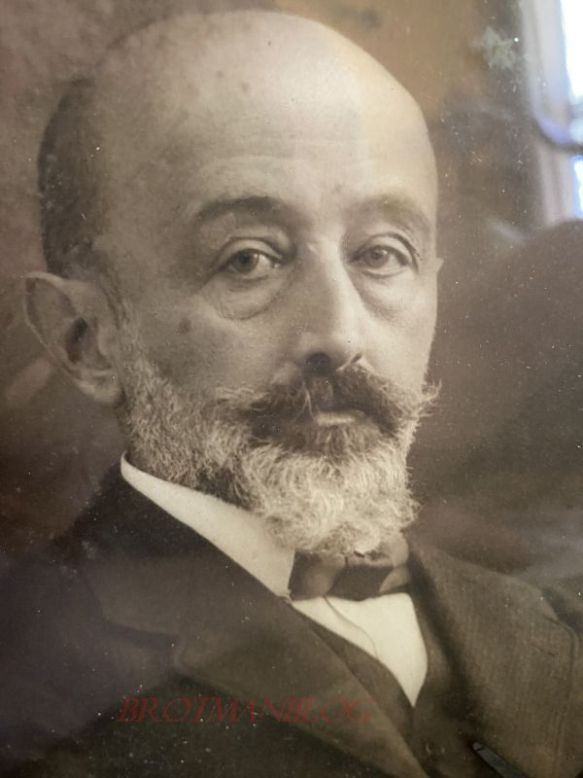
Nathan Schwabacher

Nathan Schwabacher

Alice Schwabacher younger

Alice Schwabacher

Gerhard Paul Schwabacher

Gerhard Schwabacher Courtesy of the family

Fred Wenten Julius Alfred Schwabacher

Julius Schwabacher

Wolfgang Schwabacher and dog

Wolfgang Weinstein and dog

IMG_0320

Eva Lore Schwabacher Courtesy of the family

Selma Loewenthal Schwabacher

Selma Loewenthal Schwabacher Courtesy of the family

Alice Schwabacher married David Weinstein on October 7, 1912, in Frankfurt. David was the son of Cappel Weinstein and Cecelia Weinstein and was born in Eschwege on December 19, 1885.

Marriage record of Alice Schwabacher and David Weinstein , Hessisches Hauptstaatsarchiv; Wiesbaden, Deutschland; Bestand: 903, Ancestry.com. Hesse, Germany, Marriages, 1849-1930

Alice and David had one son, Wolfgang Carl Weinstein, born in Eschwege on November 9, 1913. He was Keile’s first great-grandchild.1

Julius Schwabacher married Margarete Wurtemberg on September 20, 1920, in Erfurt Germany.  Margarete was born in that city in 1894; I could not find the names of her parents.2 Margarete gave birth to Eva Lore Schwabacher on June 11, 1921, in Frankfurt.3 But the marriage between Julius and Margarete did not last, and they were divorced in 1928.4

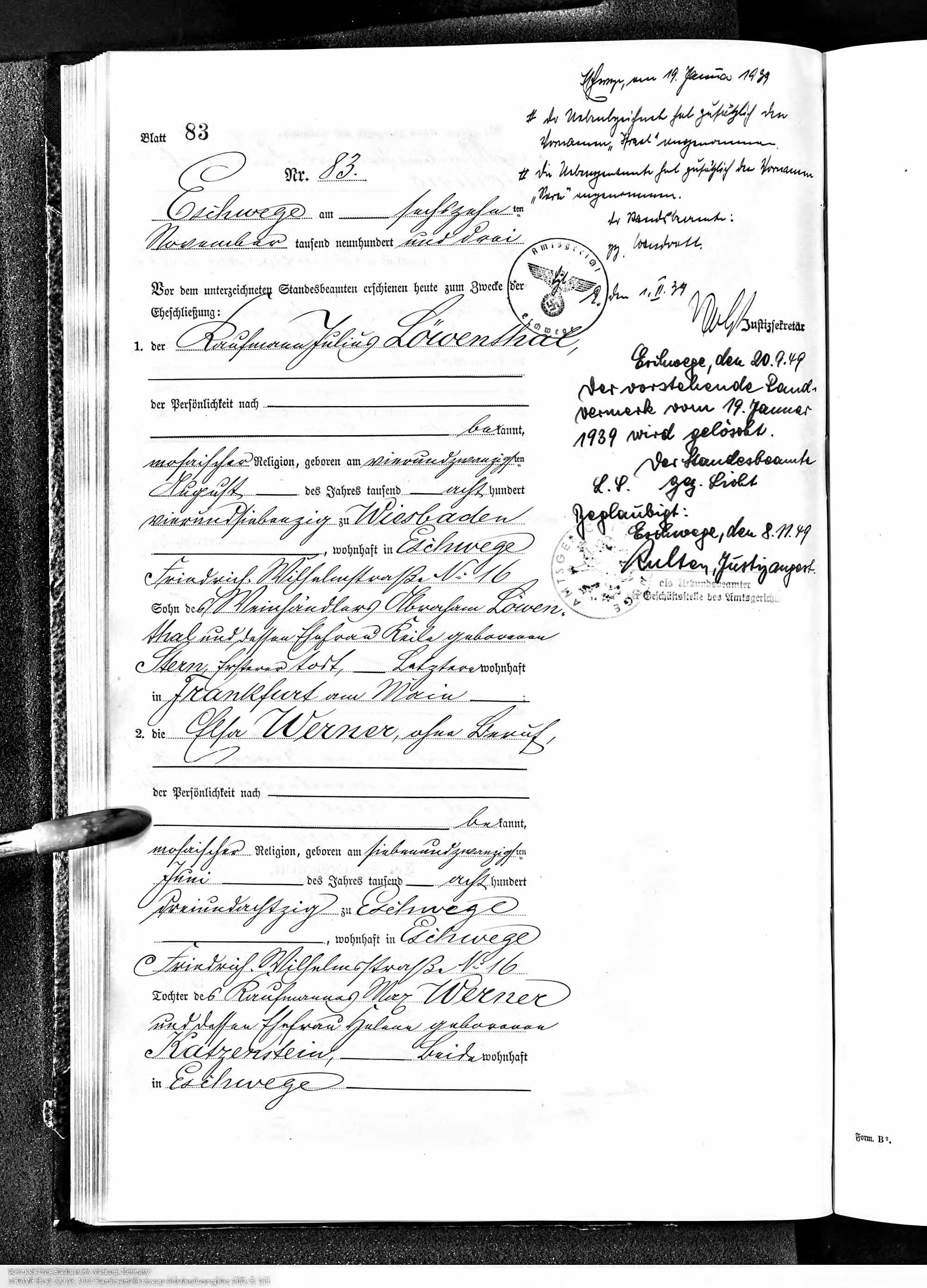
Julius Loewenthal and his wife Elsa Werner, had two children before 1910, Ruth and Herbert, and two more before 1920.  Hilda Henriette Loewenthal was born on October 22, 1911,5 and Karl-Werner Loewenthal, who was born on February 14, 1918, in Eschwege.6 Only Ruth married before 1930. She married Leonhard Fulda on March 16, 1928, in Eschwege. Leonhard was the son of Isaac Fulda and Johanna Rosenblatt, and he was born May 2, 1898, in Mainz, Germany.
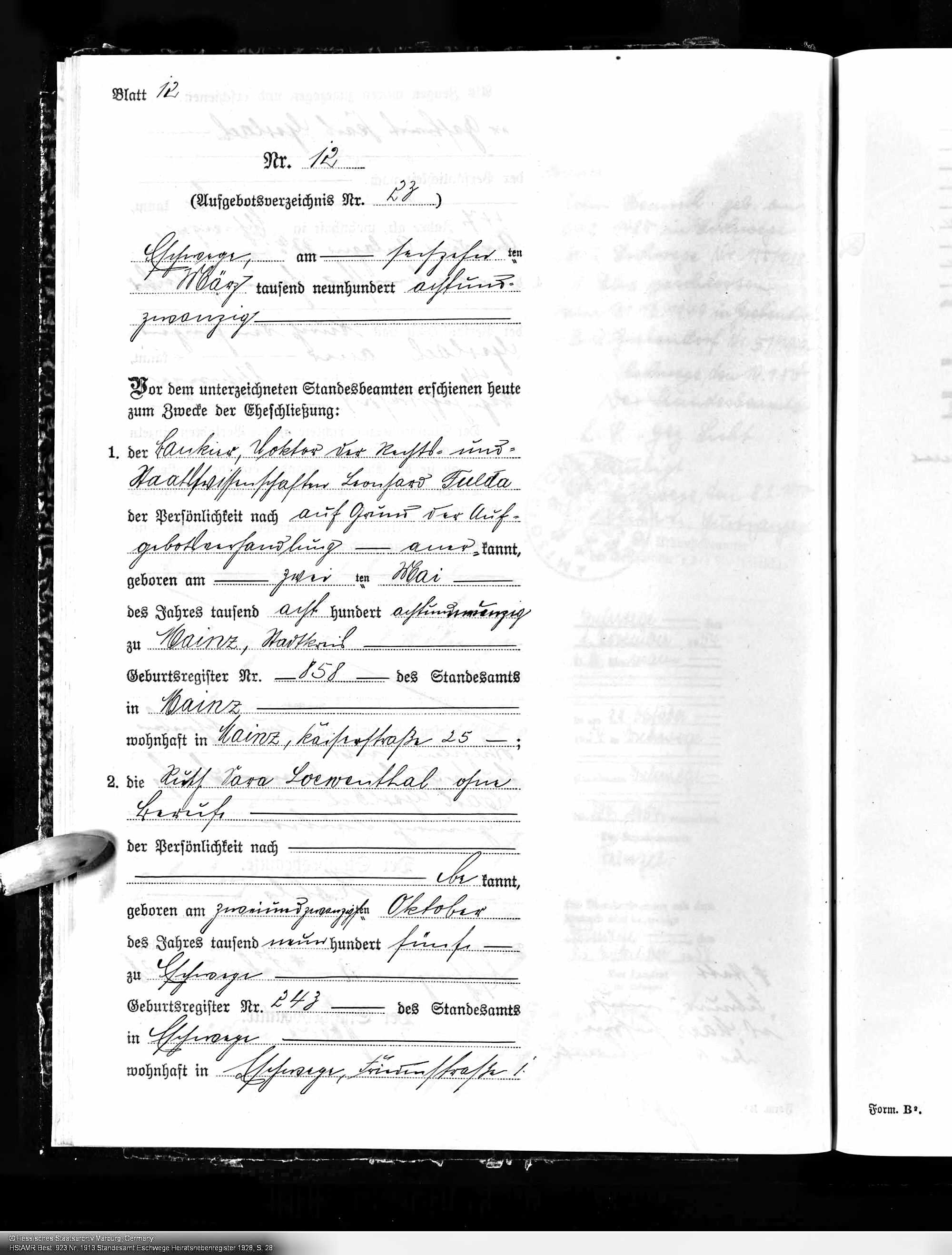
Marriage Record of Ruth Loewenthal and Leonhard Fulda, Hessisches Hauptstaatsarchiv; Wiesbaden, Deutschland; Bestand: 923; Laufende Nummer: 1913
Ancestry.com. Hesse, Germany, Marriages, 1849-1930

Marriage Record of Ruth Loewenthal and Leonhard Fulda, Hessisches Hauptstaatsarchiv; Wiesbaden, Deutschland; Bestand: 923; Laufende Nummer: 1913 Ancestry.com. Hesse, Germany, Marriages, 1849-1930

Helene Loewenthal had married Eduard Feuchtwanger in 1897, but it appears that that marriage did not last. On October 9, 1913, Helene married Oskar Friedrich August Heinrich Maximilian Schultze. As you can see from the marriage record, Oskar was not Jewish, but “evangilische,” Protestant.

Helene Loewenthal Feuchtwanger marriage to Oskar Friedrich August Heinrich Maximilian Schultze, Hessisches Hauptstaatsarchiv; Wiesbaden, Deutschland; Bestand: 925; Laufende Nummer: 2493, Ancestry.com. Hesse, Germany, Marriages, 1849-1930

Helene and Oskar had one child, Elisabeth Auguste Aloysia Schultze born on December 3, 1914, and baptized on May 12, 1915, in Koblenz, Germany.

Birth record of Elisabeth Schultze, Description: Taufen, Heiraten u Tote 1869-1920
Ancestry.com. Rhineland, Prussia, Lutheran Baptisms, Marriages, and Burials, 1533-1950

Siegfried Loewenthal’s family also continued to grow in the 1910s. He and his wife Henriette Feuchtwanger had two more children in that decade, following the births of the first three children, Rosel in 1908 and Albert in 1909, and Louise Sarah Loewenthal in 1910, all in Frankfurt. Grete was born on April 16, 1913, and lastly, Lotte Loewenthal was born on October 3, 1914.7

UPDATE: Aaron Knappstein located Grete’s birth record.

Grete Loewenthal birth record from AK

Martha Loewenthal, Keile’s fifth and youngest child, and her husband Jakob Wolff did not have any additional children after 1910. Their three children Anna, Hans Anton, and Hans Walter, were growing up in that decade.

Thus, by 1920, Keile had fifteen grandchildren and one great-grandchild. The 1910s had been good to her and her children. But 1920 brought the next loss to the family when Nathan Schwabacher, Selma’s husband and Keile’s son-in-law, died on March 6, 1920, at the age of sixty.8

The decade ended with two big losses for the family. Keile Stern Loewenthal died on January 9, 1927, in Frankfurt; she was 73. She was survived by her five children, sixteen grandchildren, and one great-grandchild with more to come.

Keile Stern Loewenthal death record, Personenstandsregister Sterberegister; Bestand: 903; Signatur: 10926, Ancestry.com. Hesse, Germany, Deaths, 1851-1958

And her daughter Martha died three years later on May 19, 1930. She was only 47 years old and was survived by her husband Jakob Wolff and their three children.9

UPDATE: Aaron Knappstein also located Martha’s actual death record.

Martha Loewenthal Wolff death cert from AK

For Keile’s other children, Selma, Julius, Helene, and Siegfried, and for their children, the 15 years after Keile’s death in 1927 would bring many challenges and much heartache when life for Jews in Germany was forever altered by the rise of Hitler and Nazism.

Before we turn to that era, let’s catch up with Keile’s siblings, Sarah Goldschmidt’s sons, Abraham Stern and Mayer Stern, and their families.


  1. SSN: 041105870, Ancestry.com. U.S., Social Security Applications and Claims Index, 1936-2007 
  2. Julius Schwabacher naturalization papers, The National Archives at Philadelphia; Philadelphia, Pennsylvania; NAI Title: Declarations of Intention for Citizenship, 1/19/1842 – 10/29/1959; NAI Number: 4713410; Record Group Title: Records of District Courts of the United States, 1685-2009; Record Group Number: 21, Ancestry.com. New York, State and Federal Naturalization Records, 1794-1943 
  3. SSN: 045121672.
    Ancestry.com. U.S., Social Security Applications and Claims Index, 1936-2007 
  4. See footnote 2. 
  5.  National Archives and Records Administration; Washington, DC; NAI Title: Index to Petitions for Naturalizations Filed in Federal, State, and Local Courts in New York City, 1792-1906; NAI Number: 5700802; Record Group Title: Records of District Courts of the United States, 1685-2009; Record Group Number: RG 21, Description: (Roll 1126) Petition No· 304900 – Petition No· 305314, Ancestry.com. New York, State and Federal Naturalization Records, 1794-1943 
  6. Arolsen Archives, Digital Archive; Bad Arolsen, Germany; Lists of Persecutees 2.1.1.1; Series: 2.1.1.1, Reference Code: 02010101 oS, Ancestry.com. Europe, Registration of Foreigners and German Persecutees, 1939-1947 
  7. Grete’s birthdate comes from her immigration file at the Israel Archives, found at https://www.archives.gov.il/en/archives/#/Archive/0b07170680034dc1/File/0b07170680a31bed.  Lotte’s birth date appears in several documents including at Arolsen Archives, Digital Archive; Bad Arolsen, Germany; Lists of Persecutees 2.1.1.1; Series: 2.1.1.1, Reference Code: 02010101 oS, Ancestry.com. Europe, Registration of Foreigners and German Persecutees, 1939-1947. 
  8. Death record of Nathan Schwabacher, Certificate Number: 426,
    Personenstandsregister Sterberegister; Bestand: 903; Signatur: 10828,
    Ancestry.com. Hesse, Germany, Deaths, 1851-1958 
  9. Translated death record located in Jakob Wolff’s immigration file at the Israel Archives, found at https://www.archives.gov.il/en/archives/#/Archive/0b07170680034dc1/File/0b07170680e4ea29 

Sarah Goldschmidt’s Descendants: The Family Expands 1889-1909

As seen in my last post, Sarah Goldschmidt Stern was survived by four children, Lina, Keile, Abraham, and Mayer, and by eleven grandchildren: Keile’s five children, Abraham’s four children, and Mayer’s two children. Lina did not have children.

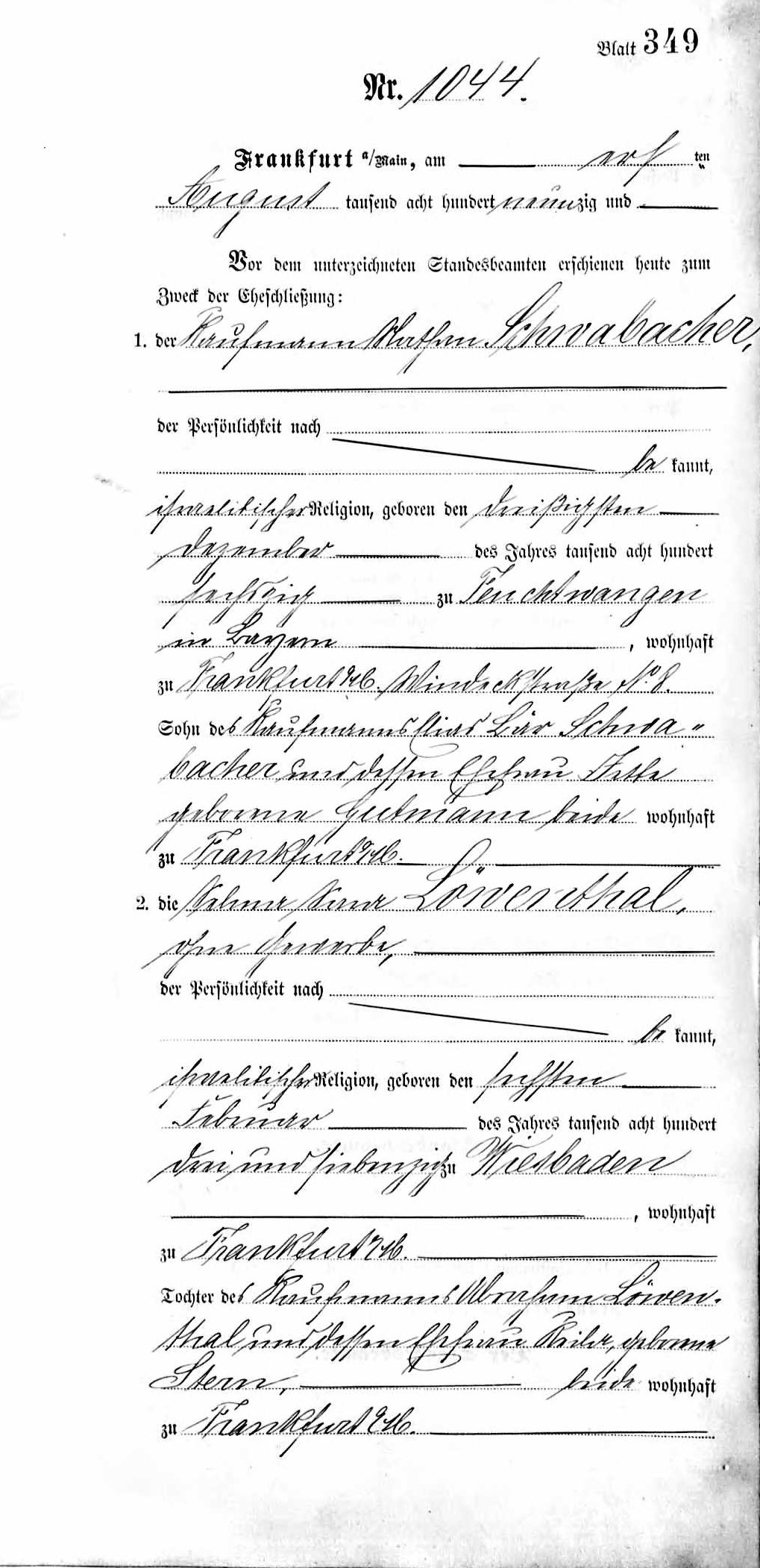
Before the dawn of the 20th century, Keile had herself become a grandmother. Her daughter Selma Loewenthal married Nathan Schwabacher on August 1, 1890, in Bornheim. He was born on December 30, 1860, in Feuchtwangen, Germany, to Elias Baer Schwabacher and Jette Gutmann. Notice that Levi Brinkmann, husband of Selma’s aunt Lina, was one of the witnesses.

Marriage record of Selma Loewenthal and Nathan Schwabacher, Hessisches Hauptstaatsarchiv; Wiesbaden, Deutschland; Signatur: 9490
Ancestry.com. Hesse, Germany, Marriages, 1849-1930

Selma and Nathan’s first child was Alice Therese Schwabacher, born December 29, 1891, in Frankfurt.

Alice Schwabacher birth record, Hessisches Hauptstaatsarchiv; Wiesbaden, Deutschland; Bestand: 903; Signatur: 903_9093, Ancestry.com. Hesse, Germany, Births, 1851-1901

Next came Julius Schwabacher, born May 17, 1893, in Frankfurt.

Julius Schwabacher birth record, Hessisches Hauptstaatsarchiv; Wiesbaden, Deutschland; Bestand: 903; Signatur: 903_9120, Ancestry.com. Hesse, Germany, Births, 1851-1901

Their third child Gerhard Schwabacher was actually born in the 20th century. He was born in Frankfurt on June 27, 1902.1

Keile and Abraham Loewenthal’s second oldest daughter Helene also married in the 1890s. She married Eduard Feuchtwanger on April 4, 1897, in Frankfurt. He was the son of Jacob Loew Feuchtwanger and Auguste Hahn, and was born in Munich on April 21, 1862. Keile’s brother Abraham Stern was a witness to this marriage.

Marriage of Helene Loewenthal and Eduard Feuchtwanger, Hessisches Hauptstaatsarchiv; Wiesbaden, Deutschland; Bestand: 903, Ancestry.com. Hesse, Germany, Marriages, 1849-1930

But the happiness brought by the marriages of Keile’s daughters Selma and Helene and the births of her grandchildren between 1891 and 1902 was unfortunately darkened by the death of her husband Abraham Loewenthal on January 28, 1903. He was sixty years old.

Abraham Loewenthal death record, Personenstandsregister Sterberegister; Bestand: 903; Signatur: 10570,Ancestry.com. Hesse, Germany, Deaths, 1851-1958

The first decade of the 20th century brought one other loss to the family when Lina’s husband Levi Brinkmann died on September 14, 1907, in Eschwege, Germany. He was only 65.

Levi Brinkmann death record, Personenstandsregister Sterberegister; Bestand: 903; Signatur: 11044, Ancestry.com. Hesse, Germany, Deaths, 1851-1958

Thus, both Keile and her sister Lina were widowed during that decade.

But that first decade also brought new members into the family as more of the grandchildren of Sarah Goldschmidt Stern began to marry and have children. First, Julius Loewenthal, Keile’s son, married Elsa Werner on November 16, 1903, in Eschwege, Germany. Elsa was the daughter of Max Werner and Helene Katzenstein, and she was born on June 27, 1883, in Eschwege.

UPDATE: Thank you to David Baron for pointing out that Elsa Werner was a second cousin to Julius Loewenthal. Her mother Helene Katzenstein Werner was the daughter of Malchen Goldschmidt Katzenstein, younger sister of Sarah Goldschmidt Stern. Thus, Julius and Elsa were both the great-grandchildren of Meyer Goldschmidt.

Julius Loewenthal and Elsa Stern marriage record, Hessisches Hauptstaatsarchiv; Wiesbaden, Deutschland; Bestand: 923, Ancestry.com. Hesse, Germany, Marriages, 1849-1930

Julius and Elsa had two children in the first decade of the 20th century. Ruth Loewenthal was born on October 22, 1905, in Eschwege,2 and Herbert Loewenthal was born on September 2, 1909.3 Two more children would come in the next decade.

Keile and Abraham Loewenthal’s daughter Martha also married in this decade. On November 8, 1904, she married Jakob Abraham Wolff, son of Abraham Wolff and Hannchen Wolff, in Frankfurt. Jakob was born in Aurich, Germany, on December 20, 1875. Keile’s brother Abraham Stern was once again a witness to this marriage.

Martha Loewenthal marriage to Jakob Wolff, Hessisches Hauptstaatsarchiv; Wiesbaden, Deutschland; Bestand: 903, Ancestry.com. Hesse, Germany, Marriages, 1849-1930

Martha and Jakob had three children.  Anna was born on July 23, 1905,4  Hans Anton was born on December 1, 1906, and Hans Walter on December 6, 1909. 5

Martha’s brother Siegfried Loewenthal also married in this decade. Siegfried married Henriette Feuchtwanger, daughter of Amson Feuchtwanger and Roeschen Oppenheimer, sometime before 1908. Henriette was born in Furth on October 13, 1881.6  Siegfried and Henriette had three children born between their marriage and 1910: Rosel on February 14, 1908,7 Albert on March 25, 1909,8 and Louise on December 25, 1910,9 all in Frankfurt. They would have two more children in the next decade.

Thus, by the end of 1910, Keile Stern Loewenthal had eleven grandchildren, Sarah Goldschmidt’s great-grandchildren, Meyer Goldschmidt’s great-great-grandchildren. My fourth cousins, once removed.

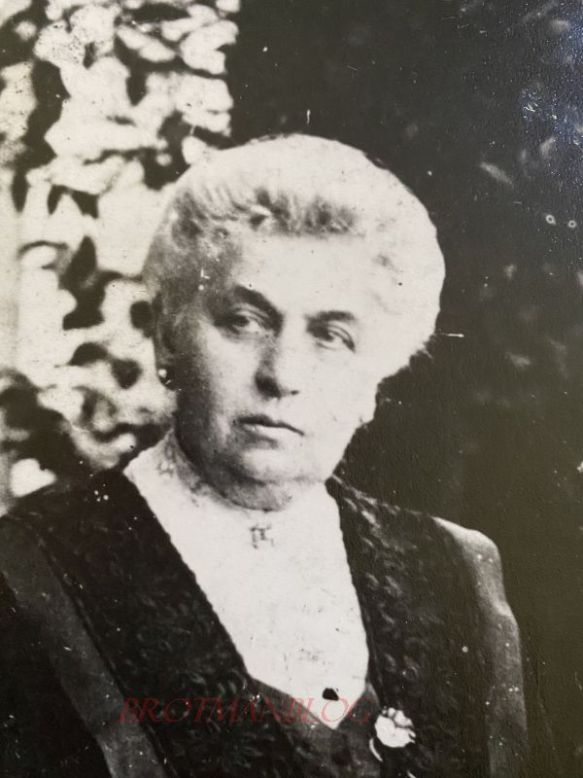
UPDATE: Thank you to my cousin Carrie for sharing this photograph of her great-great-grandmother, Kiele Stern Loewenthal.

Grandma Caroline Stern Born July 11, 1852

Keile Stern Loewenthal. Courtesy of her family

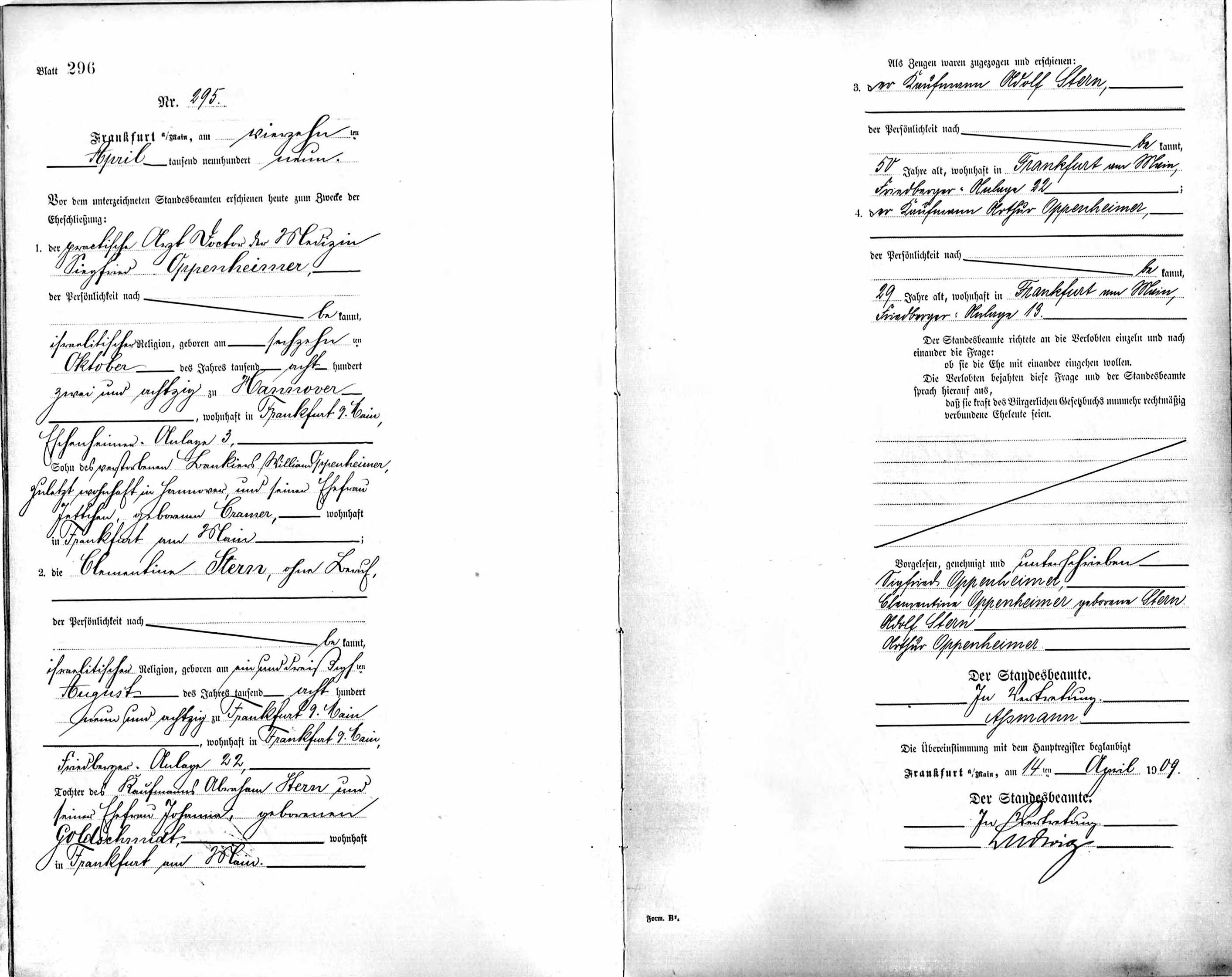
Keile was not the only child of Sarah Goldschmidt Stern to have grandchildren in the first decade of the 20th century. On April 14, 1909, Abraham Stern’s daughter Clementine married Siegfried Oppenheimer in Frankfurt. He was born in Hannover on October 16, 1882, the son of Wilhelm Oppenheimer and Jettchen Cramer. He was a physician.

Marriage of Clementine Stern and Siegfried Oppenheimer, Hessisches Hauptstaatsarchiv; Wiesbaden, Deutschland; Bestand: 903, Ancestry.com. Hesse, Germany, Marriages, 1849-1930

Clementine and Siegfried had twins on December 23, 1909. Sadly, one was stillborn. The other twin Erika survived.10 Given that Clementine and Siegfried were married just eight months when Clementine gave birth, I wonder whether the twins were born prematurely, thus contributing to or causing the death of one of those babies.

Death record of Oppenheimer infant, Personenstandsregister Sterberegister; Bestand: 903; Signatur: 10652, Ancestry.com. Hesse, Germany, Deaths, 1851-1958

Clementine and Siegfried would have more children in the next decade, as would Clementine’s siblings and her first cousins. But with the growth of the family tree during the twenty years that followed Sarah Goldschmidt’s death in 1889, it’s time to focus on each of her children and their children and grandchildren separately as we move forward into the 1910s and beyond.


  1. National Archives at Boston; Waltham, Massachusetts; ARC Title: Naturalization Record Books, 12/1893 – 9/1906; NAI Number: 2838938; Record Group Title: Records of District Courts of the United States, 1685-2009; Record Group Number: RG 21, Ancestry.com. Connecticut, Federal Naturalization Records, 1790-1996 
  2.  Certificate Number: 12, Hessisches Hauptstaatsarchiv; Wiesbaden, Deutschland; Bestand: 923; Laufende Nummer: 1913, Ancestry.com. Hesse, Germany, Marriages, 1849-1930 
  3.  Arolsen Archives, Digital Archive; Bad Arolsen, Germany; Lists of Persecutees 2.1.1.1; Series: 2.1.1.1, Reference Code: 02010101 oSm Source Information
    Ancestry.com. Europe, Registration of Foreigners and German Persecutees, 1939-1947 
  4. National Archives and Records Administration (NARA); Washington, DC; Name Index of Jews Whose German Nationality Was Annulled by the Nazi Regime (Berlin Documents Center); Record Group: 242, National Archives Collection of Foreign Records Seized, 1675 – 1958; Record Group ARC ID: 569; Publication Number: T355; Roll: 9, Stern, Johanna (Löb) – Zysmann, Judith, Ancestry.com. Germany, Index of Jews Whose German Nationality was Annulled by Nazi Regime, 1935-1944 
  5. I encountered trouble finding birth records as I began to research children born in Frankfurt after 1901 because the online records for Frankfurt births end with 1901. Although these birth dates are listed on trees on Ancestry and MyHeritage, the trees do not cite to specific sources.  I never rely on these unsourced trees unless I can find a source to verify the information. In this case, there is also the extensive research done over many years by my cousin Roger Cibella and his husband David Baron, both on the website they created in 1998, The History of the Jewish Community of Frankfurt am Main, and in the updated family report they shared with me more recently. Roger and David’s research has always proven to be thorough and accurate, so I have faith in their work, even though I do not have access to their sources for these birth dates.  Where I have relied on Roger and David’s research, I will cite to their work as “Cibella/Baron,” either in the text or in a footnote. That is the case for two of the three children of Martha Loewenthal and Jakob Wollf, Hans Anton, and Hans Walter. 
  6. Arolsen MArchives, Digital Archive; Bad Arolsen, Germany; Lists of Persecutees 2.1.1.1; Series: 2.1.1.1, Reference Code: 02010101 oS, Ancestry.com. Europe, Registration of Foreigners and German Persecutees, 1939-1947. Several unsourced trees on Ancestry and MyHeritage provide a wedding date of May 16, 1907, in Wuerzberg. 
  7. Rosa Loewenthal marriage record, Hessisches Hauptstaatsarchiv; Wiesbaden, Deutschland; Bestand: 903, Ancestry.com. Hesse, Germany, Marriages, 1849-1930 
  8. Albert Loewenthal immigration and naturalization papers found at the Israel Archives at https://www.archives.gov.il/en/archives/#/Archive/0b07170680034dc1/File/0b07170680fd584e 
  9. SSN: 122285989, Ancestry.com. U.S., Social Security Applications and Claims Index, 1936-2007. 
  10. National Archives at Chicago; Chicago, Illinois; ARC Title: Illinois, Petitions for Naturalization, 1906-1991; NAI Number: 593882; Record Group Title: Records of District Courts of the United States, 1685-2009; Record Group Number: RG 21, Description: Petitions for naturalization, v 1185, no 296351-296550, ca 1943-1944,
    Ancestry.com. Illinois, Federal Naturalization Records, 1856-1991 

The “Good and Noble Angel of A Sister,” Sarah Goldschmidt Stern

I am finally returning to the family of Meyer Goldschmidt, brother of my three-times great-grandfather Seligmann Goldschmidt. As I’ve already written, Meyer Goldschmidt was born in about 1787 in Oberlistingen, Germany. He married Lea Katzenstein with whom he had seven children: Ella (1822?), Sarah (1823), Malchen (about 1827), Selig (1828), Joseph (1830?), and Falk (1836). Joseph died a month before his sixth birthday on November 27, 1836, five months after Falk was born, but the other children all lived to adulthood. They lost their mother Lea when she was 45 in 1839 when those children ranged in age from three to seventeen.

All the children but the oldest, Ella, remained in Germany, although Falk did spend some years in the United States before returning for good to Germany. They took care of their much beloved father until his death in 1858, by which time they were all adults living their own lives. I’ve already blogged extensively about Ella. In the posts to come I will report on the four children who lived their lives in Germany: Sarah, Malchen, Selig, and Falk. I will start with Sarah, the second oldest child of Meyer and Lea.

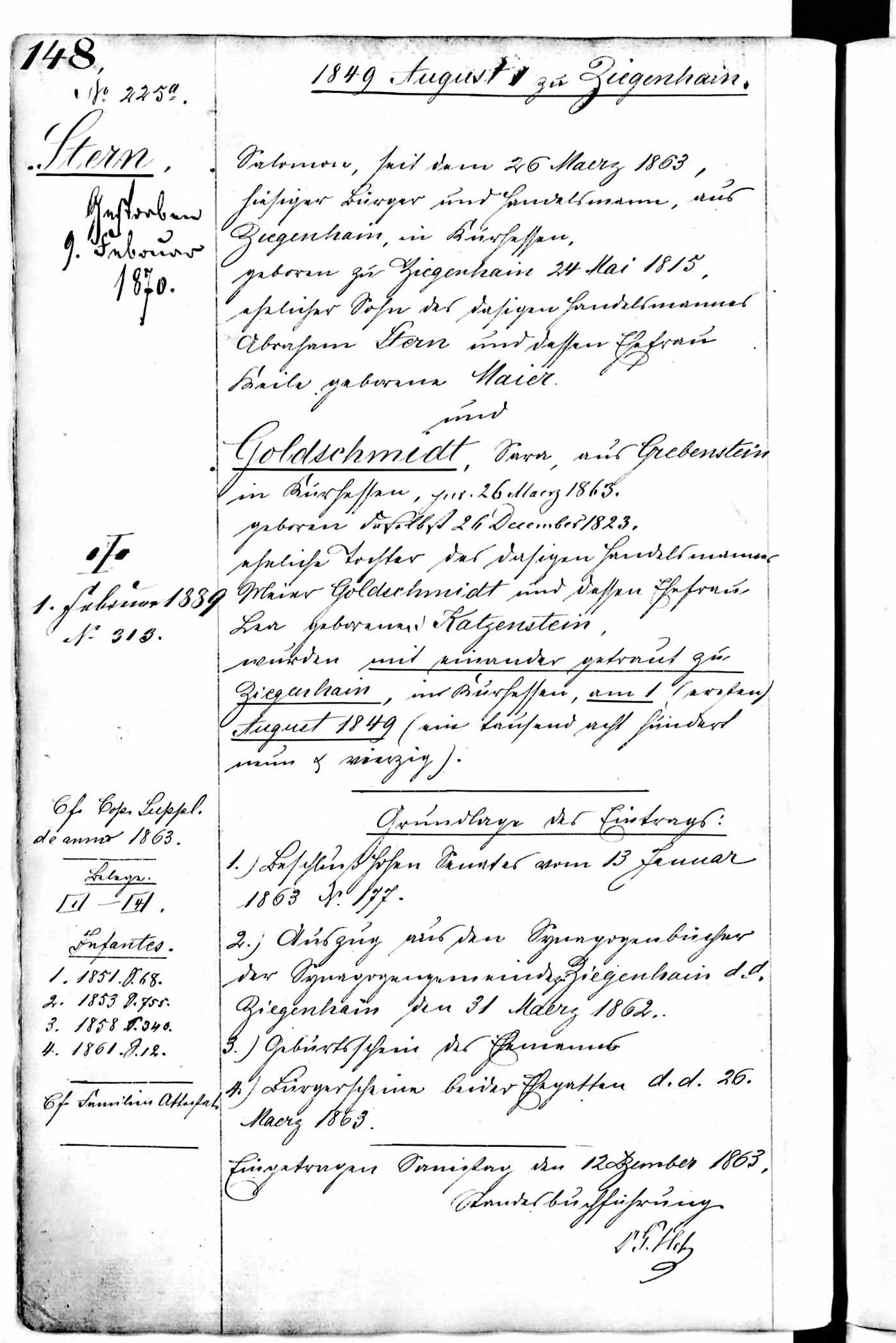
Sarah Goldschmidt was born on December 26, 1823, in Grebenstein, Germany. After her mother died when Sarah was 16, Sarah helped to care for her younger siblings. Her younger brother Selig talked about her cooking for the family and described her as “our good and noble sister.” Sarah, or Sarchen, whom Selig also described as “our angel of a sister,” married Salomon Stern on August 1, 1849. Salomon was born on May 24, 1815, in Ziegenhain, Germany, to Abraham Stern and Keile Maier.

Marriage record of Sarah Goldschmidt and Salomon Stern, Certificate Number: 225a
Hessisches Hauptstaatsarchiv; Wiesbaden, Deutschland
Ancestry.com. Hesse, Germany, Marriages, 1849-1930

Sarah and Salomon had four children. Their daughter Lina was born on January 11, 1851, in Ziegenhain. She presumably was named for Sarah’s mother, Lea.

Birth record of Lina Stern, Hessisches Hauptstaatsarchiv; Wiesbaden, Deutschland; Bestand: 903; Signatur: 903_8797, Ancestry.com. Hesse, Germany, Births, 1851-1901

A second daughter Keile, named for Salomon’s mother and sometimes known as Caroline, was born on July 11, 1853, in Ziegenhain.

Birth record of Keile Stern, Hessisches Hauptstaatsarchiv; Wiesbaden, Deutschland; Bestand: 903; Signatur: 903_8803, Ancestry.com. Hesse, Germany, Births, 1851-1901

Then came Abraham, also born in Ziegenhain, on May 17, 1858. I assume he was named for Salomon’s father Abraham.

Birth record of Abraham Stern, Hessisches Hauptstaatsarchiv; Wiesbaden, Deutschland; Bestand: 903; Signatur: 903_8812, Ancestry.com. Hesse, Germany, Births, 1851-1901

Finally, a fourth child was born on January 7, 1861, named Mayer. He was born in Frankfurt, so the family must have relocated between 1858 and 1861.

Birth record of Mayer Stern, Hessisches Hauptstaatsarchiv; Wiesbaden, Deutschland; Bestand: 903; Signatur: 903_8818, Ancestry.com. Hesse, Germany, Births, 1851-1901

Unfortunately, Sarah and her children suffered a great loss when Salomon Stern died on February 9, 1870, in Frankfurt. He was only 54, and his children were still quite young. Mayer was nine, Abraham, not yet twelve, Keile seventeen, and Lina was nineteen.

Death record of Salomon Stern, Personenstandsregister Sterberegister; Bestand: 903; Signatur: 10269, Ancestry.com. Hesse, Germany, Deaths, 1851-1958

Lina was already married when her father died. She had married Levi Brinkmann on November 20, 1868, in Frankfurt, when she was only seventeen years old. Levi was the son of Suschen Brinkmann and Goldchen Plock and was born on October 29, 1841, in Wanfried, Germany. Thus, Levi was ten years older than Lina and 27 when they married. As far as I can tell, they had no children.

Marriage record of Lina Stern and Levi Brinkmann, Hessisches Hauptstaatsarchiv; Wiesbaden, Deutschland, Ancestry.com. Hesse, Germany, Marriages, 1849-1930

Sarah’s second child Keile married Abraham Loewenthal on March 8, 1872, in Frankfurt. She was eighteen years old. Abraham was the son of Isaac Loewenthal and Sarah Maier, born in Schierstein, Germany, on February 17, 1842. He was thirty when he married Keile.

Marriage record of Keile Stern and Abraham Loewenthal, Hessisches Hauptstaatsarchiv; Wiesbaden, Deutschland, Ancestry.com. Hesse, Germany, Marriages, 1849-1930

They had five children. Selma was born on February 6, 1873, in Wiesbaden, Germany.1Their second child was Julius, born August 24, 1874, also in Wiesbaden.2 A third child Helene was born February 20, 1877, but in Frankfurt, so Keile and Abraham must have relocated by that time.

Birth record of Helene Loewenthal, Hessisches Hauptstaatsarchiv; Wiesbaden, Deutschland; Bestand: 903; Laufende Nummer: 143, Ancestry.com. Hesse, Germany, Births, 1851-1901

Siegfried came next; he was born on May 12, 1879, in Frankfurt.

Birth record of Siegfriend Loewenthal, Hessisches Hauptstaatsarchiv; Wiesbaden, Deutschland; Bestand: 903; Signatur: 903_8929, Ancestry.com. Hesse, Germany, Births, 1851-1901

And finally, Martha was born to Keile Stern and Abraham Loewenthal in Frankfurt on August 15, 1882.

Birth record of Martha Loewenthal, Hessisches Hauptstaatsarchiv; Wiesbaden, Deutschland; Bestand: 903; Signatur: 903_8970
Ancestry.com. Hesse, Germany, Births, 1851-1901

Abraham Stern, Sarah Goldschmidt and Salomon Stern’s third child, married his first cousin Johanna Goldschmidt on June 24, 1887, in Bornheim, Germany. Johanna was the daughter of Selig Goldschmidt, Sarah Goldschmidt’s younger brother, and Clementine Fuld. She was born in Frankfurt on December 18, 1867, making her nine years younger than her husband and cousin Abraham and not quite twenty years old when she married.

Marriage record of Abraham Stern and Johanna Goldschmidt, Hessisches Hauptstaatsarchiv; Wiesbaden, Deutschland; Signatur: 9460
Ancestry.com. Hesse, Germany, Marriages, 1849-1930

Abraham and Johanna had four children. These children were not just siblings to each other, but also second cousins since their parents were first cousins.

Siegfried Salomon Stern (named for his paternal grandfather) was born on September 17, 1888, in Frankfurt.

Birth record of Siegfried Salomon Stern, Hessisches Hauptstaatsarchiv; Wiesbaden, Deutschland; Bestand: 903; Signatur: 903_9047
Ancestry.com. Hesse, Germany, Births, 1851-1901

Clementine was Abraham and Johanna’s second child. She was born on August 31, 1889, in Frankfurt.3 She was named for her maternal grandmother Clementine Fuld Goldschmidt, who had died in 1888.4

Two years later, Johanna and Abraham had a third child, Sittah Sarah, born July 12, 1891, in Frankfurt.5

Sittah Sarah must have been named for her paternal grandmother Sarah Goldschmidt Stern, who died on February 1, 1889, in Frankfurt, at the age of 65. At her death Sarah was survived by her four children and eight grandchildren as well as all but two of her siblings. She had outlived her husband Abraham by nineteen years.

Death record of Sarah Goldschmidt Stern, Personenstandsregister Sterberegister; Bestand: 903; Signatur: 10420, Ancestry.com. Hesse, Germany, Deaths, 1851-1958

But Sarah’s family continued to grow. On June 5, 1894, Sarah’s ninth grandchild Alice Lea Stern was born to her son Abraham Stern and his wife (and Sarah’s niece) Johanna Goldschmidt.

Birth record of Alice Lea Stern, Hessisches Hauptstaatsarchiv; Wiesbaden, Deutschland; Bestand: 903; Signatur: 903_9136, Ancestry.com. Hesse, Germany, Births, 1851-1901

Sarah Goldschmidt and Salomon Stern’s youngest child Mayer had married Gella Hirsch on March 5, 1886, in Bornheim, Germany. Gella was the daughter of Marcus Hirsch and Hannchen Schwabacher, and she was born on February 17, 1864, in Frankfurt.

Marriage record of Mayer Stern and Gella Hirsch, Hessisches Hauptstaatsarchiv; Wiesbaden, Deutschland; Signatur: 9449
Ancestry.com. Hesse, Germany, Marriages, 1849-1930

Mayer and Gella had two children. Elsa Sara Stern was born January 4, 1891, in Frankfurt. She was presumably named in part for her paternal grandmother Sarah Goldschmidt Stern.

BIrth record of Elsa Sara Stern, Hessisches Hauptstaatsarchiv; Wiesbaden, Deutschland; Bestand: 903; Signatur: 903_9085,  Ancestry.com. Hesse, Germany, Births, 1851-1901

Four years later Mayer and Gella’s son Marcus (named for his maternal grandfather) was born in Frankfurt on January 28, 1895. He was Sarah Goldschmidt Stern’s eleventh grandchild.

Birth record of Markus Kurt Stern, Hessisches Hauptstaatsarchiv; Wiesbaden, Deutschland; Bestand: 903; Signatur: 903_9149, Ancestry.com. Hesse, Germany, Births, 1851-1901

As you may have noticed, Sarah Goldschmidt Stern and all of her children were living in Frankfurt, Germany, by the late 19th century. That is not surprising because Frankfurt had at that time the second largest Jewish community in Germany. In fact, Jewish life in Frankfurt had a long history, not all of it very pleasant.

According to one source:

The history of Frankfurt’s Jewish population dates back to approximately 1150. …. Sadly, even Emperor Frederick II’s official charter could not stop the first Frankfurt pogrom from occurring in 1241.

The next major conflict occurred in 1349, when Frankfurt’s Jewish population was blamed for an outbreak of the plague. When a fire broke out in the cathedral, a rumour was started that it had been laid by Jews, which once more brought upon them the people’s wrath. More than 200 Frankfurt Jews were murdered in the civil unrest that followed.

In 1462, Frankfurt’s Jews were forced to move into a ghetto at the edge of town. For the next 350 years, approximately 2,200 Jews resided there, crammed into some 160 houses situated along a 330-metre stretch of the city wall. The lives of the ghetto’s inhabitants were further hamstrung by a variety of restrictive city ordinances. …

This former compulsion [to live in the ghetto] was officially annulled in 1811.

In 1804, a general-education school named the “Philanthropin” was founded in Frankfurt, becoming a prominent centre of liberal Judaism. In 1850, Orthodox Jews established what later became known as the Jewish Religious Community. Despite these achievements, Frankfurt’s Jews still did not enjoy the same basic civil rights as the city’s Christian population. Only in 1864 did they achieve full equality, which enabled the Jewish community to grow and prosper.

In 1882, the Börneplatz Synagogue was consecrated, followed by the consecration of the Synagogue Friedberger Anlage in 1907 and the Westend Synagogue in 1910. Consisting of approximately 30,000 members, Frankfurt’s Jewish community was at the time the second largest in Germany. …

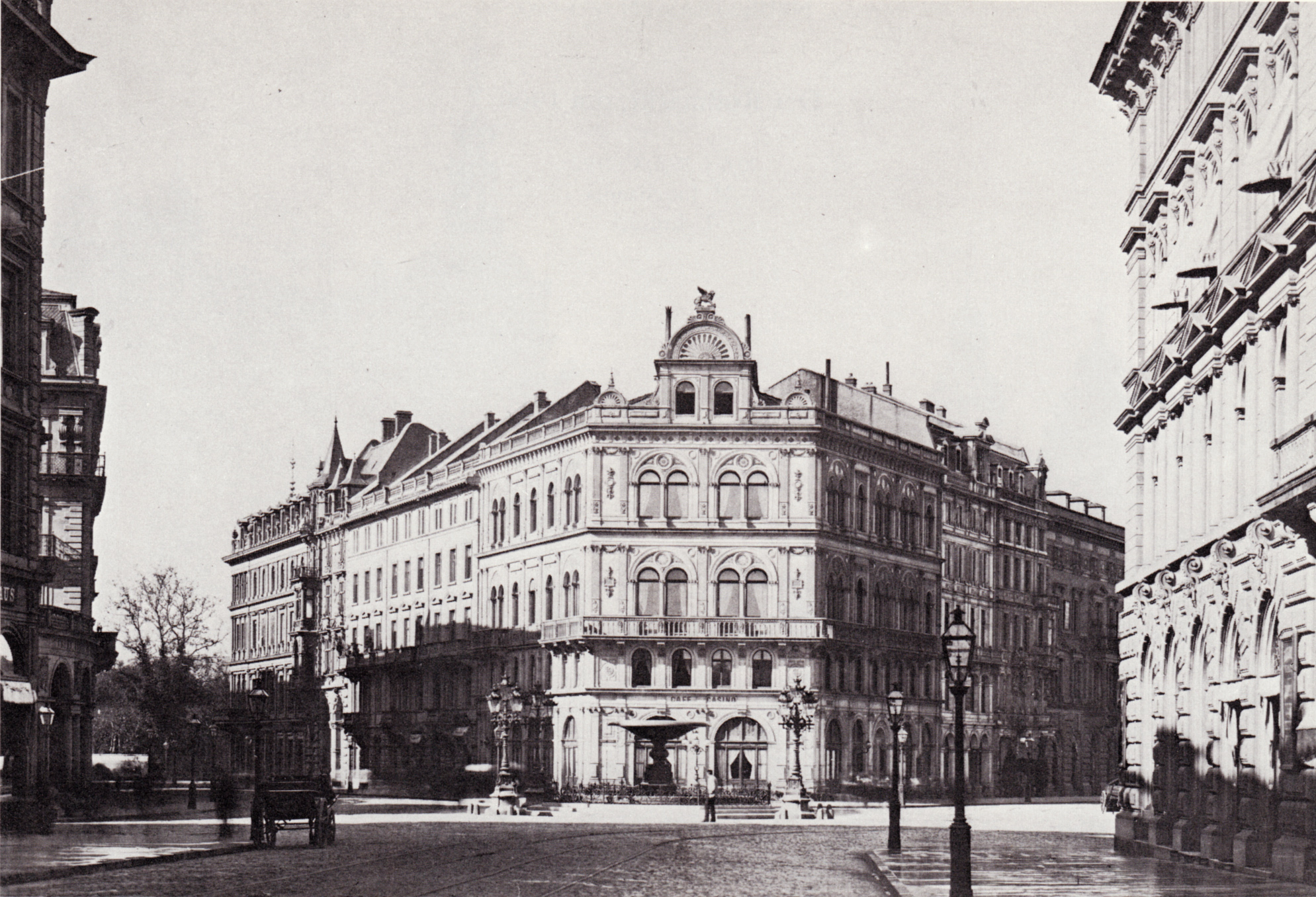
Frankfurt would therefore have been a good place for Jews to relocate during the 1880s and 1890s, and Sarah’s family took advantage of that opportunity. These photographs show the bustling and beautiful city it was at that time.

Alte Oper (“Old Opera”) of Frankfurt am Main, ca. 1880, found at https://commons.wikimedia.org/wiki/File:Oper1880.jpg

Sarah Goldschmidt Stern, the “good and noble” “angel of a sister,” was survived by her four children, Lina, Keile, Abraham, and Mayer, and by eleven grandchildren. What would become of those children and grandchildren in the 20th century? That is the subject for my next series of posts.

Children of Sarah Goldschmidt and Salomon Stern and Their Spouses


  1.  Certificate Number: 1044, Hessisches Hauptstaatsarchiv; Wiesbaden, Deutschland; Signatur: 9490, Ancestry.com. Hesse, Germany, Marriages, 1849-1930 
  2. Certificate Number: 83, Hessisches Hauptstaatsarchiv; Wiesbaden, Deutschland; Bestand: 923, Ancestry.com. Hesse, Germany, Marriages, 1849-1930 
  3.  Certificate Number: 295, Hessisches Hauptstaatsarchiv; Wiesbaden, Deutschland; Bestand: 903, Ancestry.com. Hesse, Germany, Marriages, 1849-1930 
  4.  Certificate Number: 628, Personenstandsregister Sterberegister; Bestand: 903; Signatur: 10411, Ancestry.com. Hesse, Germany, Deaths, 1851-1958 
  5.  Certificate Number: 721, Hessisches Hauptstaatsarchiv; Wiesbaden, Deutschland,
    Ancestry.com. Hesse, Germany, Marriages, 1849-1930 

My Cousin’s Case before the US Supreme Court: Philipp v. Germany

My second Goldschmidt update involves the descendants of Selig Goldschmidt, specifically his great-great-grandson, my fifth cousin, Alan Philipp.

Right now there is a case pending before the United States Supreme Court that was brought by Alan Philipp and two other plaintiffs. They brought a lawsuit against the Federal Republic of Germany and the Stiftung Preussischer Kulturbesitz (“SPK”), or in English, the Prussian Cultural Foundation.

The SPK is described on its website as “the largest employer in the cultural sector in Germany. It is a federal foundation and is shaped by the federal structure of Germany. The federal government and all sixteen federal states support and finance it jointly.” It was formed in 1957 after “the final dissolution of the state of Prussia ten years earlier. As a result, the question of ownership of its important public collections had to be reorganized. These collections were given to the foundation as property by the establishment law.” (translations by Google Translate)

Among those properties that were transferred by the government to the SPK was a very valuable collection of medieval works of art known as the Welfenschatz or in English, the Guelph Treasure. The Welfenschatz had been acquired in 1929 by three art collectors who had formed a consortium (“the Consortium”) to acquire art.

One of those art collectors was the firm of J&S Goldschmidt, founded in the mid-19th century by my cousins Jacob Meier and Selig Goldschmidt; another was Zacharias Hackenbroch, the grandson-in-law of Selig Goldschmidt, the son-in-law of Recha Goldschmidt, and husband of Clementine Schwarzschild. Alan Philipp shared with me a photograph of three of the investors, his grandfather Zacharias Hackenbroch, his cousin Julius Falk Goldschmidt, and Saemy Rosenberg:

Zacharias M. Hackenbroch, Julius Falk Goldschmidt, and Saemy Rosenberg. Courtesy of Alan Philipp

According to the allegations made by the plaintiffs, heirs to the Consortium, in 1935 the Consortium was coerced by economic duress, fraud, and bad faith to sell the Welfenschatz to the Nazis for about a third of its value   After unsuccessfully pursuing their claim for compensation first in Germany, the plaintiffs sued both the Federal Republic of Germany and the SPK in the US District Court for the District of Columbia for either the return of the Welfenschatz, which is currently located in the collection of the SPK in Germany, or for damages equivalent to the current value of the collection, claiming that the property had been wrongfully misappropriated from the Consortium in 1935.

Germany and the SPK moved to dismiss the lawsuit, arguing in part that the United States courts did not have jurisdiction over the plaintiffs’ claims against a foreign state. Before getting too far into the weeds of the legal issues and all their complexities, let me stop here to explain just a few procedural matters.

There has not been a trial in this case. The defendants moved to dismiss the case on the basis of the plaintiff’s pleadings alone; a court can dismiss a lawsuit if it finds that the plaintiffs have no basis for a legal claim even if they can eventually prove every fact they have alleged in their pleadings. So for purposes of this case—at all three levels of the federal court system, the District Court, the Court of Appeals, and the Supreme Court—the courts are assuming the truth of the facts claimed in the plaintiff’s complaint. The only issues the lower courts have determined and the only issues the Supreme Court will decide is whether this case should be dismissed because the American federal courts do not have jurisdiction over these claims even if the plaintiffs can eventually prove the truth of their allegations.

So what were those allegations? The District Court for the District of Columbia summarized them in their opinion (the paragraph numbers are references to the plaintiff’s complaint):

Plaintiffs’ position is that the 1935 sale between the Consortium and the State of Prussia, a political subdivision of the German Weimar Republic and later the Third Reich, was coerced as part of the Nazi persecution of the Jewish sellers of the Welfenschatz and, as such, the Court shall briefly summarize the allegations in the complaint that Plaintiffs rely on in support of this position. Id. ¶ 22. Specifically, Plaintiffs allege the 1935 transaction was spearheaded by Nazi-leaders Hermann Goering and Adolf Hitler, who were involved in explicit correspondence to “save the Welfenschatz” for the German Reich. Id. ¶¶ 2, 9. Further, the 1935 sale resulted in a payment of 4.25 million RM, which Plaintiffs assert demonstrates the lack of an arms’-length transaction because it was barely 35% of the market value of the Welfenschatz. Id. ¶¶ 4, 12.  Further, the money exchanged was never fully accessible to the Consortium because it was split and partly paid into a blocked account, and was subject to “flight taxes” that Jews had to pay in order to escape. Id. ¶¶ 4, 12. Moreover, in November of 1935, Goering presented the Welfenschatz as a personal “surprise gift” to Hitler during a ceremony. Id. ¶¶ 13, 179.

Philipp v. Fed. Republic of Ger., 248 F. Supp. 3d 59, 65 (D.D.C. 2017)

The District Court’s opinion then listed the plaintiff’s allegations describing some of the specific steps the Nazis took to coerce and defraud the Consortium into selling them the Welfenschatz, knowing the enormous economic pressure they were under as a result of the Nazi persecution of Jews at that time.

The defendants moved to dismiss on numerous grounds, but the ones that are still being pressed at the Supreme Court boil down to two arguments:  one, that the US courts have no jurisdiction to adjudicate the claims based on a federal statute, the Federal Sovereign Immunity Act (“FSIA”), and two, that US courts should not allow such a claim out of respect for the laws and procedures of a foreign country under principles of comity.

For lawyers, these issues are fascinating. But this is not a blog about legal matters, and there are many resources out there for those who are interested in all the ins and outs of the issues presented. (See the list below for a few.) I just want to say a little more about the issues involving the FSIA.

The FSIA generally grants immunity from liability to foreign states, preventing lawsuits against those states and their agents (in this case SPK) in American courts. But there are exceptions provided in the statute; the plaintiffs are relying on one of those exceptions as the basis of the court’s jurisdiction over their claims, the so-called “expropriation exception.” It provides that a party can proceed against a foreign state where their claim is one “in which rights in property taken in violation of international law are in issue and that property or any property exchanged for such property is present in the United States in connection with a commercial activity carried on in the United States by the foreign state….” 28 U.S.C. § 1605(a)(3).

The defendants raised several arguments against the application of this exception to the plaintiffs’ claims, but I want to focus on just one of those arguments—whether or not this was a taking of the Consortium’s property that violated international law. The plaintiffs argued, relying on an earlier decision of the Court of Appeals of the District of Columbia, that when a taking of property bears a “sufficient connection” to genocide, the taking is itself a violation of international law.

The District Court agreed, focusing on the plaintiffs’ allegations that “the coerced sale of the Welfenschatz was accomplished to deprive the Consortium of their ability to earn a living and the motivation for the taking was to deprive the Consortium of resources needed to survive as a people in furtherance of the genocide of the German Jews during the Holocaust.” Philipp v. Fed. Republic of Ger., 248 F. Supp. 3d 59, 71 (D.D.C. 2017) The District Court also concluded that the plaintiffs had satisfied the commercial nexus requirement of the expropriation exception and that therefore the case should not be dismissed.

A work from the Guelph Treasure
Reliquary of the arm of Saint Blaise (Herzog Anton Ulrich Museum, Dankwarderode Castle). User:Brunswyk, CC BY-SA 3.0 <http://creativecommons.org/licenses/by-sa/3.0/&gt;, via Wikimedia Commons

The defendants appealed this decision to the Court of Appeals of the District of Columbia, and the Court of Appeals agreed with the District Court on the issue of whether there was a taking of property in violation of international law, reasoning in part:

Congress has twice made clear that it considers Nazi art-looting part of the Holocaust. In enacting the Holocaust Victims Redress Act, which encouraged nations to return Nazi-seized assets, Congress “f[ound]” that “[t]he Nazis’ policy of looting art was a critical element and incentive in their campaign of genocide against individuals of Jewish … heritage.” Holocaust Victims Recovery Act, Pub. L. No. 105-158, § 201, 112 Stat. 15, 15 (1998). And in the Holocaust Expropriated Art Recovery Act (HEAR Act), which extended statutes of limitation for Nazi art-looting claims, Congress again “f[ound]” that “the Nazis confiscated or otherwise misappropriated hundreds of thousands of works of art and other property throughout Europe as part of their genocidal campaign against the Jewish people and other persecuted groups.” Holocaust Expropriated Art Recovery Act of 2016, Pub. L. No. 114-308, § 2, 130 Stat. 1524, 1524 (emphasis added)

Philipp v. Fed. Republic of Germany, 894 F.3d 406, 411-12 (D.C. Cir. 2018)

The Court of Appeals, however, disagreed with the District Court with respect to the application of the expropriation exception to Germany based on the second requirement of the exception: that for a claim against a foreign state to fit within the exception, the property that was confiscated must be located in the United States, which was not the case here with the Welfenschatz. Thus, the appellate court dismissed the claim against Germany itself.

With respect to the claim against the SPK, the appellate court concluded that the requirements of the statute were different with respect to an instrumentality of a foreign state and that because there was a “sufficient commercial nexus” between the SPK, an instrumentality of Germany, and the United States, the case against the SPK could go forward even though the disputed property was in Germany, not the United States.

A work from the Welfenschatz in the Bode Museum in Germany
User:FA2010, Public domain, via Wikimedia Commons

It will be very interesting to see how the Supreme Court rules in this case. The issues go beyond this one case, of course. Sadly, genocide has occurred and continues to occur in all parts of the world, and those who have been damaged—whose property has been stolen, as was the case with so much of the art owned by German Jews—may want to seek recourse in American courts.

Foreign policy concerns and the principles of comity lie behind the arguments of the defendants that these matters should be pursued in the country where the wrongful acts occurred. One argument made by the defendants was that if claims against a country by a national of that country can be brought in other countries, foreign courts could end up litigating claims by US nationals against the US, e.g., claims brought by Japanese-Americans who were interned during World War II against the US might be litigated outside the US or claims brought against the US by African-Americans for reparations for slavery could be litigated in another country.

The plaintiffs distinguish those cases by pointing out that Nazi Germany stripped their ancestors of their citizenship as part of their persecution of Jews and that therefore they were no longer nationals of Germany but stateless. Thus, these are not claims against Germany or its agents by German nationals. They also argue that the Holocaust has been treated as unique by both American law and international law, and thus special treatment needs to be provided for those seeking redress for harms done as part of the Holocaust.

I listened to the oral arguments made by the lawyers before the Supreme Court on December 7, and although I thought that the defendant’s lawyer was persuasive with regard to the meaning and scope of the statutory language, the plaintiffs’ arguments have the stronger moral position. I will be watching carefully to see whether the heirs of my Goldschmidt cousins are able to pursue their claims and ultimately obtain compensation for the harm that was done to their ancestors almost 90 years ago.

For those who want to learn more about the case, I suggest the following resources:

I have included links to the lower court opinions in the body of the text of the blog.

Here is a link to a recording of the oral arguments made before the Supreme Court on December 7, 2020.

The Scotus Blog has links to the briefs filed by the parties and by amicus curiae.

The Art Newspaper has a recent article about the case.

The New York Times has a good summary of the case.

This is a short piece written by the plaintiffs’ lawyer Nicholas O’Donnell of Sullivan & Worcester.

For more in-depth analysis of the FSIA and the international law regarding Nazi appropriation of art, see the following law review articles about FSIA:

Vivian Grosswald Currana, “THE FOREIGN SOVEREIGN IMMUNITIES ACT’S EVOLVING GENOCIDE EXCEPTION, ” UCLA Journal of International Law and Foreign Affairs, Spring, 2019

Michael J. Birnkrant, “THE FAILURE OF SOFT LAW TO PROVIDE AN EQUITABLE FRAMEWORK FOR RESTITUTION OF NAZI-LOOTED ART, ” Washington University Global Studies Law Review, 2019

Ugboaja, Ikenna (2020) “Exhaustion of Local Remedies and the FSIA Takings Exception: The Case for Deferring to the Executive’s Recommendation,” University of Chicago Law Review: Vol. 87 : Iss. 7 , Article 5.
Available at: https://chicagounbound.uchicago.edu/uclrev/vol87/iss7/5