The original CBC Film Sales logo used from 1919 through 1924 (Photo credit: Wikipedia)
As I continued to research the descendants of my four-times-great-uncle Marx Seligman, one thing kept bothering me. I had not yet confirmed one of the facts asserted in the second handwritten tree discovered by my cousin Wolfgang. That second handwritten tree, which had led me to Marx and his family, claimed (1) that Marx had remarried and moved to New York. That was true about the Marx I was following—he had married Sara Koppel and moved to New York City.
The creator of that second tree also claimed that (2) Marx and Sara had had a son who (also) married a woman whose surname was Koppel (or Coppel). That also proved to be true of the Marx I was following: his son Sigmund had married a woman named Charlotte Koppel, born in Germany (and likely related to Sigmund’s mother).
But there was one more specific fact that the tree had mentioned that I had not yet confirmed: (3) that the son had had a daughter who married a film agent. As I researched up to 1900, I had not yet uncovered anyone involved in the film industry who was related to Marx. Being a big movie fan, I was disappointed not to find a connection to Hollywood.
But then I entered the 20th century in my research. While researching the children of Sigmund Seligman as they entered adulthood, I found the answer. According to another family tree I found on Ancestry owned by Sharon Bolton, Sigmund and Charlotte’s first child, Mary, married a man named Joseph Brandt, who was born on July 20, 1882, in Troy, New York. I am always very reluctant to rely on anyone else’s tree, having seen so many that are unsourced and clearly carelessly done, but this one seemed very thorough and included many photographs as well as personal stories by Sigmund’s grandson, Steve. (I am now in touch with both Sharon and Steve, and they generously shared wonderful photographs and stories about Sigmund’s family. I will post more photographs in a subsequent post.)
Sigmund Seligman and family about 1901. Standing rear: Mary, Max. Sitting middle row: Sigmund, Albert, Leo, and Charlotte. In front: Theresa Photo courtesy of Steve Seligman
According to Joseph Brandt’s record on the 1920 census, his father was born in Russia and spoke Yiddish; his mother was born in Germany.
Joseph Brandt and family 1920 census Source Citation Year: 1920; Census Place: Manhattan Assembly District 23, New York, New York; Roll: T625_1227; Page: 38B; Enumeration District: 1506; Image: 543
I could not find Joseph on any census before or after 1920, and I could not find anything else about his parents or family. (Sharon also had nothing about his background on her tree.) Based on his birth date and birth place as recorded on Sharon’s family tree, the only other official records I could find for him were his 1913 passport application, his 1918 World War I draft registration card, and several ship manifests for his travels with Mary.
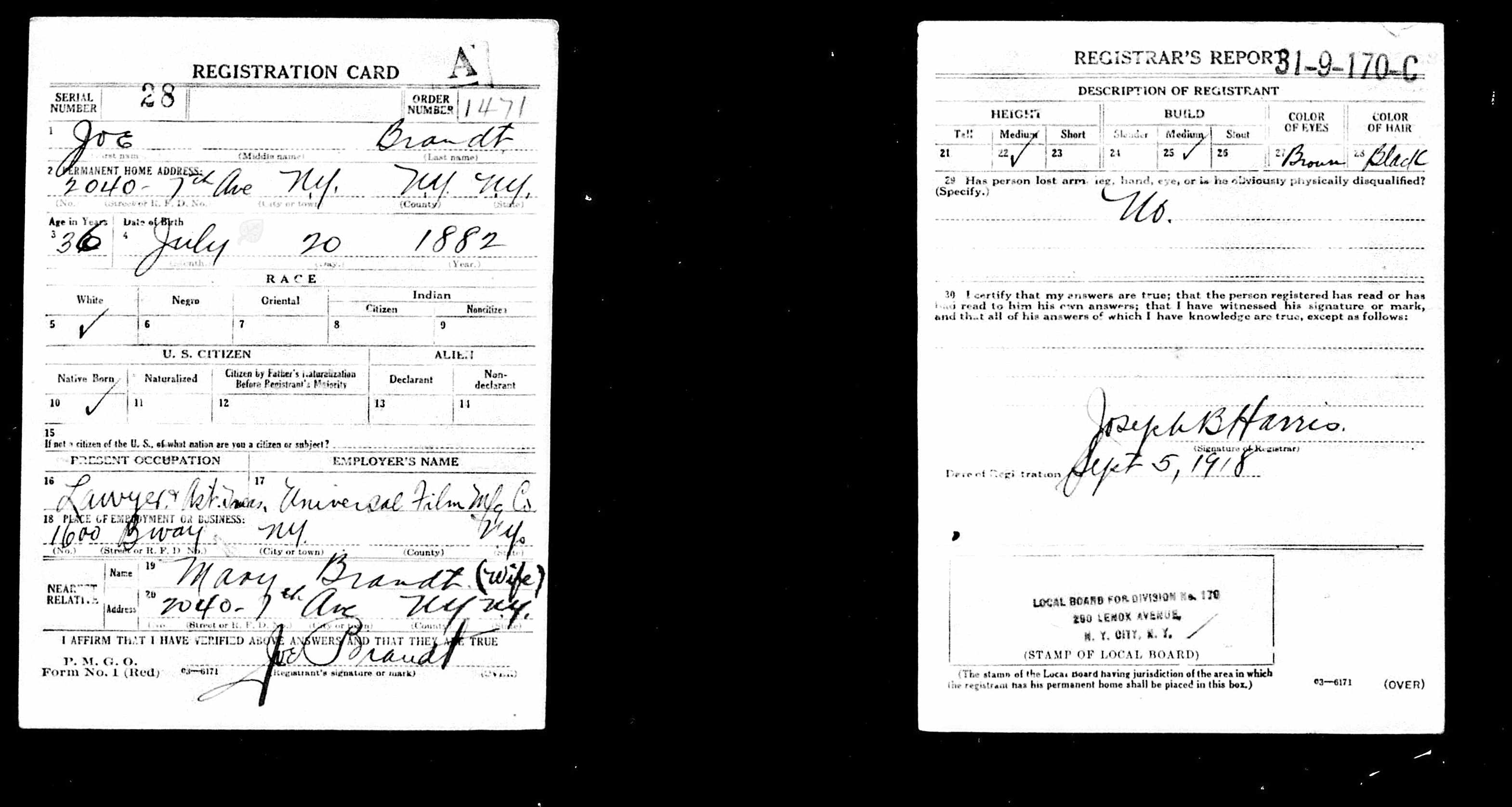
But his draft registration corroborated that third missing fact from the handwritten family tree. According to his 1918 draft registration card, Joseph was then employed as an attorney and assistant treasurer for Universal Film Manufacturing Company. Now I had evidence that the Marx Seligman I had been following was the same man discussed in the handwritten family tree: Marx’s son Sigmund had married a woman named Koppel; they had had a daughter (Mary) who married a “film agent.”
Registration State: New York; Registration County: New York; Roll: 1787086; Draft Board: 170
Of course, Joe Brandt was more than a film agent. In fact, he was much, much more. Once I saw that he was in fact involved in the film industry, I googled his name and learned more. From Wikipedia and his obituary in the New York Times on February 23, 1939, p.28, I learned that Joe Brandt was one of the founders and the first president of Columbia Pictures. Joe had graduated from NYU Law School in 1906 and had worked in the advertising industry for several years before being hired in 1912 by Carl Laemmle, the founder of Universal Film Manufacturing, today known as Universal Studios. In 1919 he and two brothers he had known at Universal,, Harry and Jack Cohn, formed their own film production company, known first as C.B.C. Film Sales (for Cohn Brandt Cohn) and later known as Columbia Pictures.
Christmas ad in The Film Daily December 1920 p 1484
Joe sold his interest in Columbia Pictures in 1932 and then became president of two other film companies before retiring due to poor health in 1935. Joe died at the age of 56 on February 22, 1939. Joe and Mary had had one child, a son named Jerrold Thurston Brandt, who would also enter the movie industry.
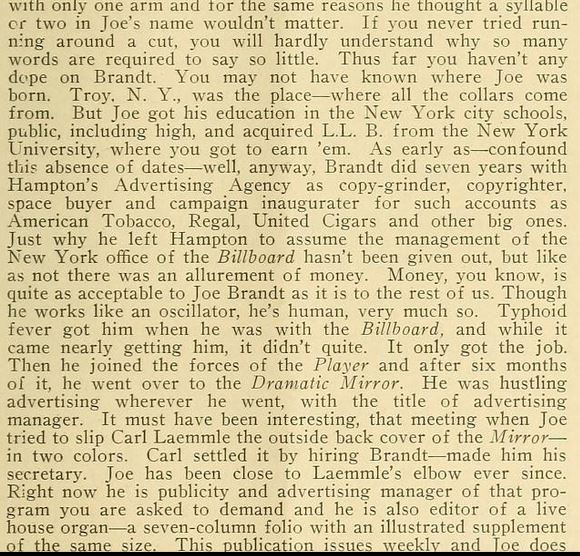
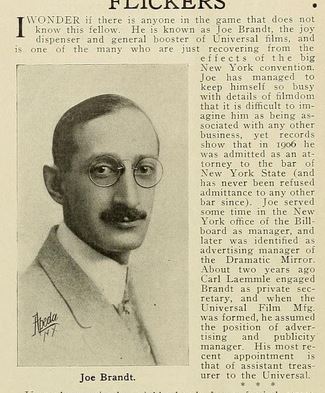
But why couldn’t I find out anything about Joe’s background before entering the film industry other than his birth in Troy, New York, in 1882? From a link in the Wikipedia entry, I found this little snippet about him from a journal called Moving Picture World dated April 6, 1912:
Joe had changed his name from Brandenburg to Brandt. There is also a reference to his name change in this article from the February 1, 1913 edition of Motography:
Once I knew his original name, I had no trouble locating his parents and his siblings. Joseph Brandenburg was the son of Daniel and Rosa Brandenburg. Daniel was born in 1846 in Russia, and according to the 1900 census, had arrived in the United States in 1870. His wife Rosa was born in Prussia in 1847 and had immigrated to the US in 1865, according to the 1900 census. Daniel and Rosa had married in 1871, and by 1880 they were living in Troy, New York, where Daniel was working as a tailor. They had three children by that time: Albert, Lilly, and Anna. Joseph was their youngest child, born in 1882. At some point the family must have moved to New York City because the article reprinted above from Motography states that Joe was educated in the NYC public schools. On the 1900 census, Daniel and Rosa were living in New York City with all of their children, including Joe, who was already a lawyer, according to the census report. Daniel was still working as a tailor. Joe was still living with his parents as of the 1905 New York census and was still listed as a lawyer on that census record.
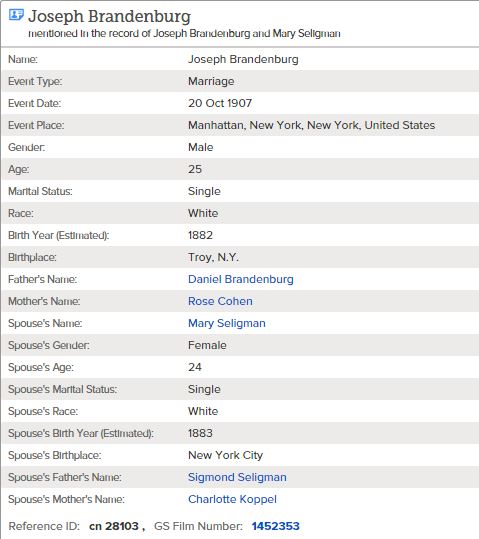
On October 20, 1907, Joseph Brandenburg married Mary Seligman in New York City.
New York, New York City Marriage Records, 1829-1940,” database, FamilySearch (https://familysearch.org/ark:/61903/1:1:24HY-X9K : accessed 15 July 2015), Joseph Brandenburg and Mary Seligman, 20 Oct 1907; citing Marriage, Manhattan, New York, New York, United States, New York City Municipal Archives, New York; FHL microfilm .
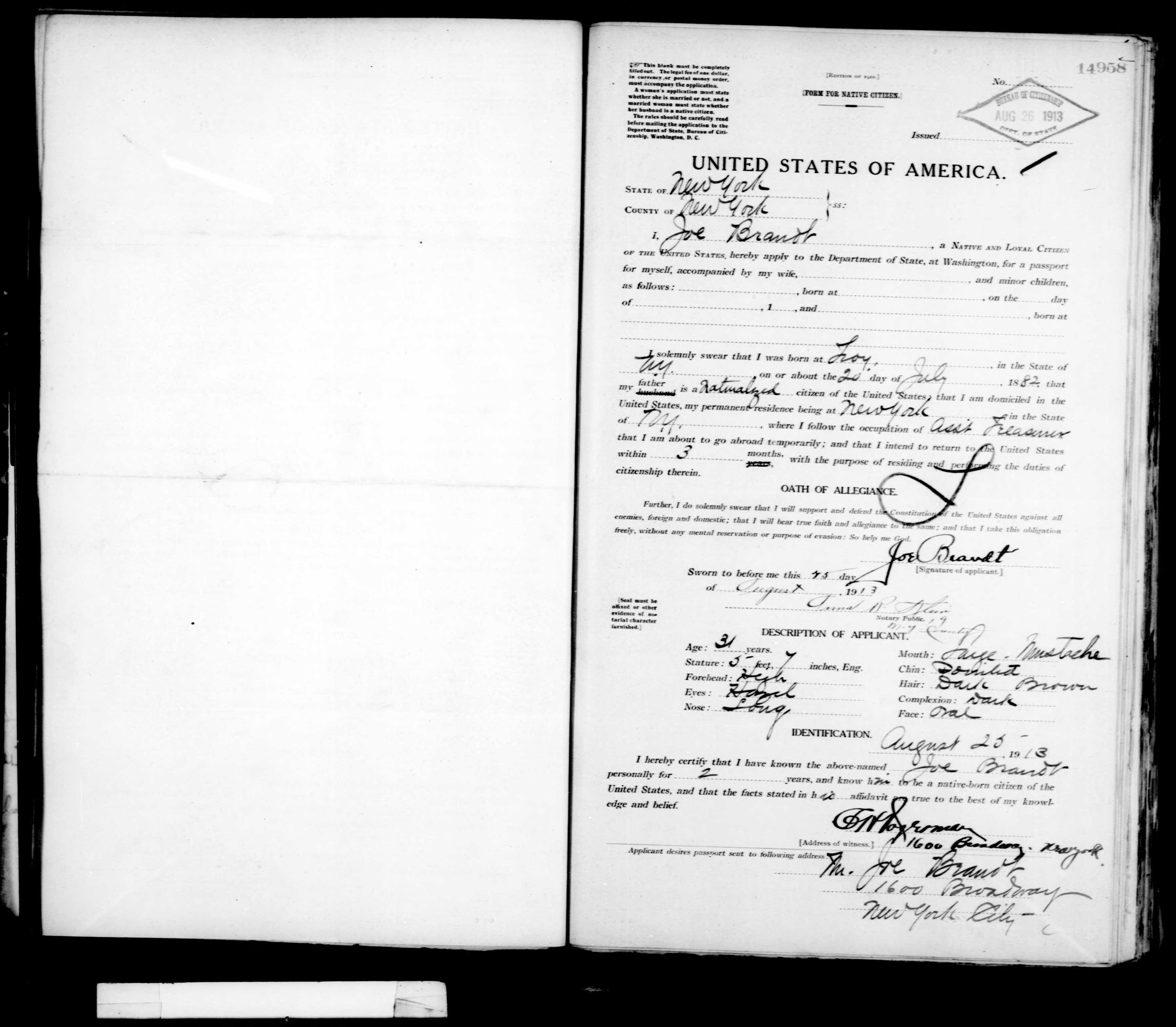
He was still using the Brandenburg surname as of 1910, when according to the census, he was working in advertising for Billboard magazine. He and Mary were living at 3161 Broadway in NYC. Sometime between 1910 and 1913 when he applied for a passport, Joe changed his surname to Brandt, as that is how he appears on every document thereafter.
Joe Brandt passport application 1913 National Archives and Records Administration (NARA); Washington D.C.; NARA Series: Passport Applications, January 2, 1906 – March 31, 1925; Roll #: 194; Volume #: Roll 0194 – Certificates: 14182-15185, 07 Aug 1913-30 Aug 1913
Joe Brandt’s story is another one of those remarkable American dreams come true. The son of a Russian Jewish immigrant who worked as a tailor, Joe not only went to college and law school. He became a major figure in the burgeoning American film industry of the early 20th century and an extremely wealthy man, according to his nephew Steve. In fact, if I hadn’t found the facts myself, I’d say it was just a Hollywood story made to perpetuate the myth of the American dream. But it is in fact a real story.
Mary Seligman Brandt, my second cousin, three times removed Photo courtesy of Steve Seligman
Genealogy research is like peeling an onion. You peel back a layer, study that layer, and feel a good degree of sweet satisfaction, but there are always more layers, and if you are as lucky as I have been with my Seligmann family, you can keep peeling back more and more layers. Sometimes a new layer brings new tears, sometimes it brings more joy. The two handwrittenfamily trees that Wolfgang and his mother found in their suitcase revealed several new layers of the Seligmann and Schoenfeld families, including the names of all the siblings of my three-times great-grandparents Moritz Seligmann and Babetta Schoenfeld.
One of those siblings was a younger brother of Moritz named Marx Seligmann. From the handwritten trees I knew that Marx had married Rosina Loeser and had two daughters with her, Mathilde and Sophie. I also knew that Marx and Rosina had divorced about ten years after they married or in 1849. I don’t believe I had seen any evidence of a divorce that far back in time in my family, and I assume that divorce was probably pretty unusual back then, or at least not as common as it is now.
The first tree had a confusing comment about someone coming later to America, but it wasn’t clear whether that was Marx or his ex-wife or his daughters. The second handwritten tree was more explicit: Marx had remarried and had gone to New York . The tree seemed to suggest that he’d had a son who married a woman with the birth name Coppel, and that they’d had a daughter who married a film agent. I searched for Marx based on those assumptions and found the record I posted last time.
Assuming that this is the same Marx Seligmann, he had himself married a woman named Sara Koppel, and they had had a daughter named Charlotte. Charlotte had married someone named Max Schlesinger. From that one record, I was able to research further and put together a more complete picture of Marx Seligmann and his descendants.
It appears that Marx and Sara had married not long after Marx’s divorce from Rosina and before leaving Germany because they sailed together as Marx and Sara Seligmann and arrived in New York on August 18, 1849. Marx was 39, Sara 27, and Marx listed his occupation as a merchant. (They are the third and fourth entries from the bottom on the document shown here.)
Source: Year: 1849; Arrival: New York, New York; Microfilm Serial: M237, 1820-1897; Microfilm Roll: Roll 082; Line: 49; List Number: 1146
A year later according to the census taken on August 26, 1850, they were living in New York City and had a four month old son Siegmund (later Sigmund), so Sara must have been just pregnant when they arrived in New York. Marx was working as a cigar maker. They were living in the 13th Ward or the Lower East Side, which then had a large population of German immigrants.
Marx and Sara Seligman 1855 US censusSource Citation Year: 1850; Census Place: New York Ward 13, New York, New York; Roll: M432_550; Page: 200A; Image: 148
Marx filed a declaration of intent to become a US citizen on November 25, 1850.
By 1860, Marx and Sara had three more children: Jacob, born in 1852; Charlotte, born in 1855; and Mary, born in 1856. The family was still living in the 13th Ward, and Marx was still employed as a cigar maker. The only thing that disturbs me about this census record is that it reports that both Marx and Sara were born in Darmstadt. I assume that Marx, like his siblings, was born in Gaulsheim. However, given how unreliable census records can be, I am willing to put that aside.
Year: 1860; Census Place: New York Ward 13 District 2, New York, New York; Roll: M653_803; Page: 418; Image: 422; Family History Library Film: 803803
By 1870, it appears that Marx had died. He is not listed with his family on the 1870 census, and in the 1872 NYC directory, Sara is listed as a widow. I contacted the cemetery where Sara was later buried, but they had no listing for a Marx or Max Seligmann.
According to the 1870 census, Sarah (now spelled with the H) was the head of household. Sigmund, now 20, was working as a clerk. Jacob, 17, was working in a cigar store, perhaps following in his father’s footsteps. Charlotte was 16 and at home, and Mary was 14 and a dressmaker. They were now living in the 17th Ward, also in the Lower East Side in a neighborhood inhabited by mostly German immigrants.
Year: 1870; Census Place: New York Ward 17 District 20, New York, New York; Roll: M593_999; Page: 188A; Image: 377; Family History Library Film: 552498
The first of the children of Marx and Sarah to marry was their youngest child, Mary. She married Oscar Kornfeld on September 11, 1873, when she was only seventeen years old. Oscar was only twenty. Oscar was the son of Charles and Julia Kornfeld, who were born in Austria, according to the 1860 and 1880 census, or Baden, according to the 1870 census. Oscar’s father was a cigar maker like Mary’s father had been, so I wonder if they had met through their fathers. Oscar also followed his father into the cigar business.
By 1880, Mary and Oscar had three children. Their first child, born in 1874, was named Marx, presumably for his grandfather. In 1877, Rose was born, and then Carrie was born in 1879. In addition, Mary’s mother Sarah and her brother Sigmund were living with them at 239 East 51st Street in New York. Both Sigmund and Oscar were working as cigar packers.
Mary and Oscar Kornfeld 1880 census Year: 1880; Census Place: New York City, New York, New York; Roll: 893; Family History Film: 1254893; Page: 358B; Enumeration District: 557; Image: 0720
Mary and Oscar had another daughter, Lillian, in 1882. According to the 1892 New York State census, Mary and Oscar and their family were living in Long Island City in Queens, where Oscar continued to work in the cigar business.
Mary Seligmann and Oscar Kornfeld 1892 NY census Ancestry.com. New York, State Census, 1892 [database on-line]. Provo, UT, USA: Ancestry.com Operations, Inc., 2012. Original data: New York State Education Department, Office of Cultural Education. 1892 New York State Census. Albany, NY: New York State Library.
By 1900 they were living at 1883 Madison Avenue, and Oscar was still working in the cigar business. Their three daughters were still living with them, Rose doing housework, Carrie doing office work, and Lillian working as a cashier. Their son Marx (later Max) married Emma Pisko on April 1, 1900. I cannot locate them on the 1900 census—perhaps they were away on their honeymoon?
Oscar and Mary Kornfeld 1900 US census Year: 1900; Census Place: Manhattan, New York, New York; Roll: 1119; Enumeration District: 0849; FHL microfilm: 1241119
As seen in the first record above, Charlotte Seligmann was the second child of Marx and Sarah Seligmann to marry; she married Max Schlesinger in 1874. According to the 1880 census, Max Schleslinger was born in Berlin and was working in 1880 as a supervisor in a tie factory, and by 1880 he and Charlotte had three children: Hattie (or Harriet), born in 1875; Arthur, born in 1876; and Lena, born in 1877.
Max Schlesinger and Charlotte Seligman 1880 US census Year: 1880; Census Place: New York City, New York, New York; Roll: 894; Family History Film: 1254894; Page: 52C; Enumeration District: 564; Image: 0096
I found a card for Max in the ancestry.com database for U.S. Naturalization Record Indexes indicating that he became a citizen on October 5, 1877, and was living at 315 East 56th Street, not too far from where Charlotte’s mother and siblings were living at that time. In 1884, they had a fourth child, Louis.
National Archives and Records Administration (NARA); Washington, D.C.; Soundex Index to Petitions for Naturalizations Filed in Federal, State, and Local Courts in New York City, 1792-1906 (M1674); Microfilm Serial: M1674; Microfilm Roll: 251
In 1900, Charlotte and Max were living at 202 East 123rd Street with just their two youngest children, Lena (listed here as Lillie) and Louis. Max was still employed in tie manufacturing. Their daughter Hattie (or Harriet) had married George Cain in 1897. George was a banker, and in 1900, they had a daughter Edith, just born that year. They also were living with George’s sister Lucie.
Max Schlesinger and Charlotte Seligman 1900 census Year: 1900; Census Place: Manhattan, New York, New York; Roll: 1119; Page: 13A; Enumeration District: 0854; FHL microfilm: 1241119
I unfortunately have had no luck locating Max and Charlotte’s son Arthur on the 1900 census or elsewhere. The name Arthur Schlesinger is more common than you’d think (and that doesn’t include the famous historian Arthur Schlesinger, Jr. or his father, with whom there is no apparent tie), so I’ve not been able to figure out (yet) whether any of the men with that name in New York is the correct one.
Jacob was the next child of Marx and Sarah Seligmann to marry. He married Mathilde Kerbs on April 3, 1881, in New York City.[1] Mathilde was a German immigrant, and at the time of the 1880 census she was living with her siblings in New York City. Both of her brothers were in the cigar business as was Jacob, and so once again I think this was a connection made through the family ties to the cigar industry. Between 1882 and 1888, Jacob and Mathilde had four sons. The first, Max (presumably for his grandfather Marx), was born in 1882, then came Harry (1883), Louis (1885), and Samuel (1888). In 1900, Jacob was still a cigar packer, and the family was living at 303 East 69th Street. They would have one more child, Beatrice, in 1902.
Jacob Seligman and Mathilde Kerbs 1900 census Year: 1900; Census Place: Manhattan, New York, New York; Roll: 1112; Page: 1B; Enumeration District: 0700; FHL microfilm: 1241112
Sigmund, the oldest child of Marx and Sarah Seligmann, was the last to marry. According to the 1900 census, he married his wife Charlotte in 1882. From a death notice I found for Sigmund in the New York Times, I learned that Charlotte’s birth name was Koppel.
Ancestry.com. Historical Newspapers, Birth, Marriage, & Death Announcements, 1851-2003 [database on-line]. Provo, UT, USA: Ancestry.com Operations Inc, 2006. Original data: The New York Times. New York, NY, USA: The New York Times, 1851-2001.
Thus, the story posted about Marx on the second handwritten tree—that one of his sons had married someone whose birth name was Koppel (or Coppel, as spelled there) —was in fact true. Both Marx and his son Sigmund married women with that surname. My guess is that Charlotte Koppel was a relative of Sarah Koppel, Sigmund’s mother. That guess is supported by two clues: one, Sarah’s mother’s first name was also Charlotte, according to Sarah’s death record, and two, Sigmund’s grandson posted a story on Ancestry.com saying that Sigmund had gone back to Germany to marry Charlotte and suggesting that it had been an arranged marriage.
Death Certificate for Sarah Koppel Seligman, wife of Marx
Sigmund and Charlotte had five children between 1883 and 1896: Mary (1883), Max (1884) (another namesake for Marx or perhaps for Sarah’s father Max Koppel?), Leo (1891), Theresa (1894), and Albert (1896). Sigmund was employed in the insurance industry. In 1900, they were living at 304 East 117th Street.
Sigmund and Charlotte Seligman 1900 US census Year: 1900; Census Place: Manhattan, New York, New York; Roll: 1123; Page: 3A; Enumeration District: 0933; FHL microfilm: 1241123
Thus, by 1900, Marx Seligmann had not only four grown children surviving him in the United States (plus the two daughters born of his first marriage); there were also eighteen grandchildren and one great-grandchild to follow him in the United States, including several named Max or Marx in his honor. Sometimes it amazes me to see just how many descendants one person can have. As I follow the descendants of Marx Seligmann into the 20th century in my next post, I cannot help but think about all the potential lives that were lost for every person whose life was cut short.
I have finally reached the last twig on the last branch of the Nusbaum family tree. This final chapter concerns Fanny Nusbaum, who married Jacob L. Hano. Fanny was the daughter of Ernst Nusbaum and Clarissa Arnold, the granddaughter of Amson Nusbaum and Voegele Welsch, my four-times great-grandparents.
You might recall that my family tree is doubly connected to the Hano family tree. First, I learned that Jacob Weil had married Flora Cohen, the daughter of Louise Lydia Hano and Samuel Cohen. Jacob was the son of Rachel Cohen Weil, my great-grandfather’s sister. (Samuel Cohen was not related to Rachel Cohen or any of my Cohens, however.)
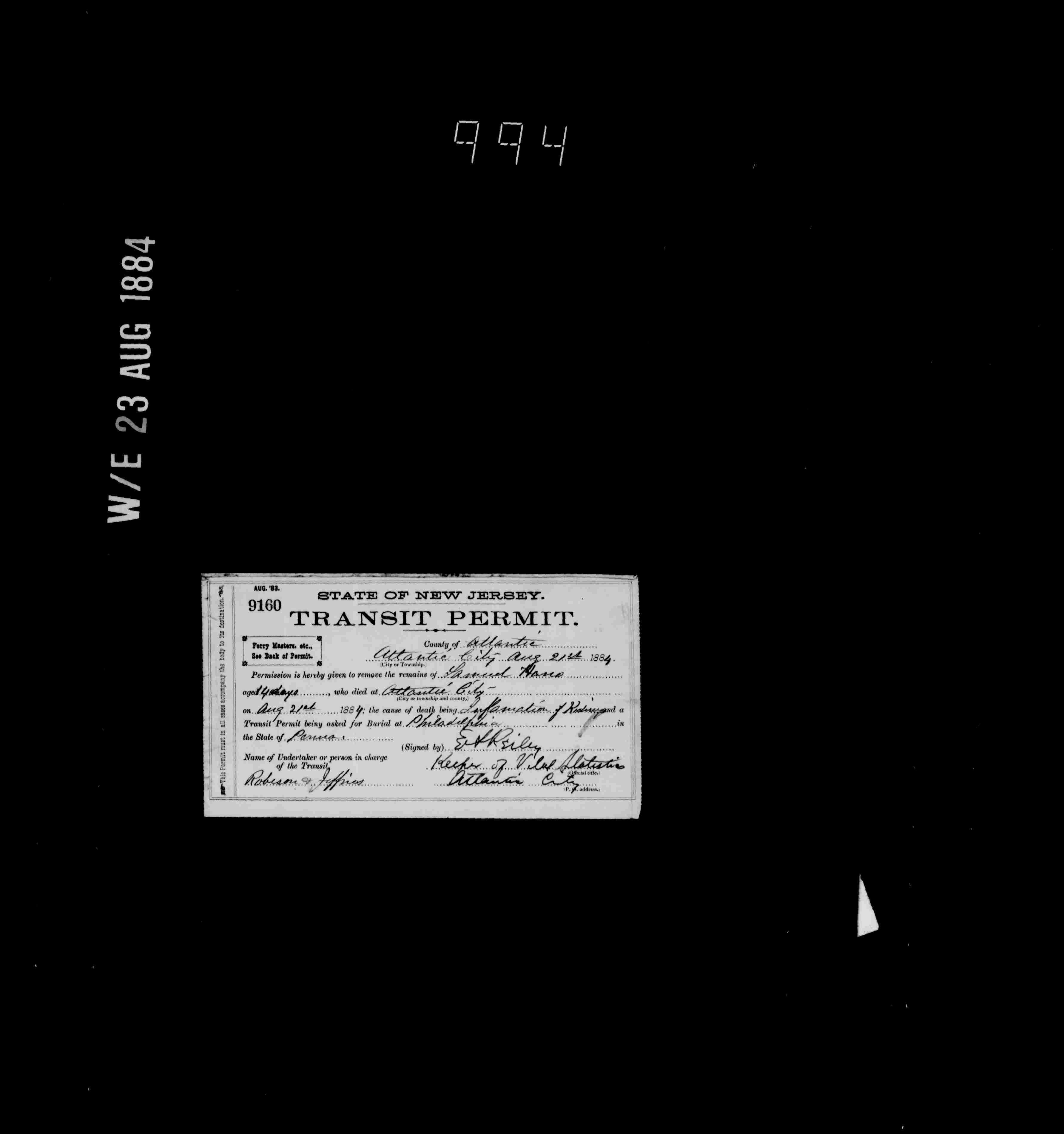
Jacob Hano and Fanny Nusbaum had married on February 28, 1877, and had moved to Youngstown, Ohio, where their first two children, Louis and Ernest, were born. They had returned to Philadelphia by 1884, when their third son Samuel was born. Samuel died just fourteen days later on August 21, 1884, from inflammation of his kidneys. He died in Atlantic City, and was buried at Mt. Sinai cemetery in Philadelphia.
“Pennsylvania, Philadelphia City Death Certificates, 1803-1915,” index and images, FamilySearch (https://familysearch.org/ark:/61903/1:1:J6S5-2N5 : accessed 14 April 2015), Samuel Hano, 21 Aug 1884; citing , Philadelphia City Archives and Historical Society of Pennsylvania, Philadelphia; FHL microfilm 2,069,818
“Pennsylvania, Philadelphia City Death Certificates, 1803-1915,” index and images, FamilySearch (https://familysearch.org/ark:/61903/1:1:J6S5-2N5 : accessed 14 April 2015), Samuel Hano, 21 Aug 1884; citing , Philadelphia City Archives and Historical Society of Pennsylvania, Philadelphia; FHL microfilm 2,069,818
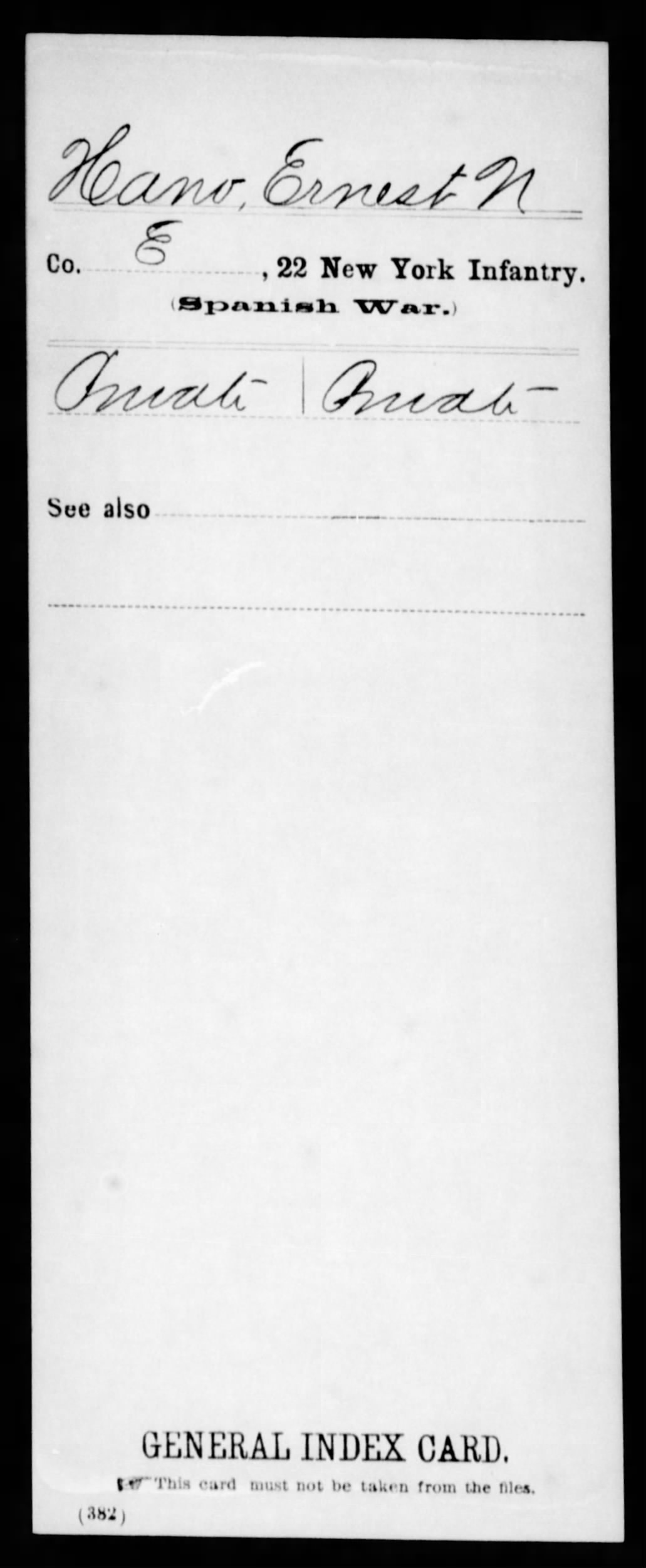
A fourth son, Myer Arnold, was born in Boston in 1885, so the family must have relocated again after Samuel’s death. And then by 1890 the family had moved to New York City, where they would have two more sons, Alfred (1890) and Clarence (1891). Their second oldest son Ernest served in the US Army in the Spanish American War in 1898; according to his nephew Arnold, Ernest was gassed while serving in the war and as a result suffered heart damage that affected him for the remainder of his life.
Indexes to the Carded Records of Soldiers Who Served in Volunteer Organizations During the Spanish-American War, compiled 1899 – 1927, documenting the period 1898 – 1903
Jacob Hano had been in the printing business on his own, but in 1892 he joined with his younger brother Philip in the printing business instead of competing with him, as discussed in the ad below.
The American Stationer, Volume 31 p. 93
I love the comment here that this reduction in competition would not result in rising prices, just better service.
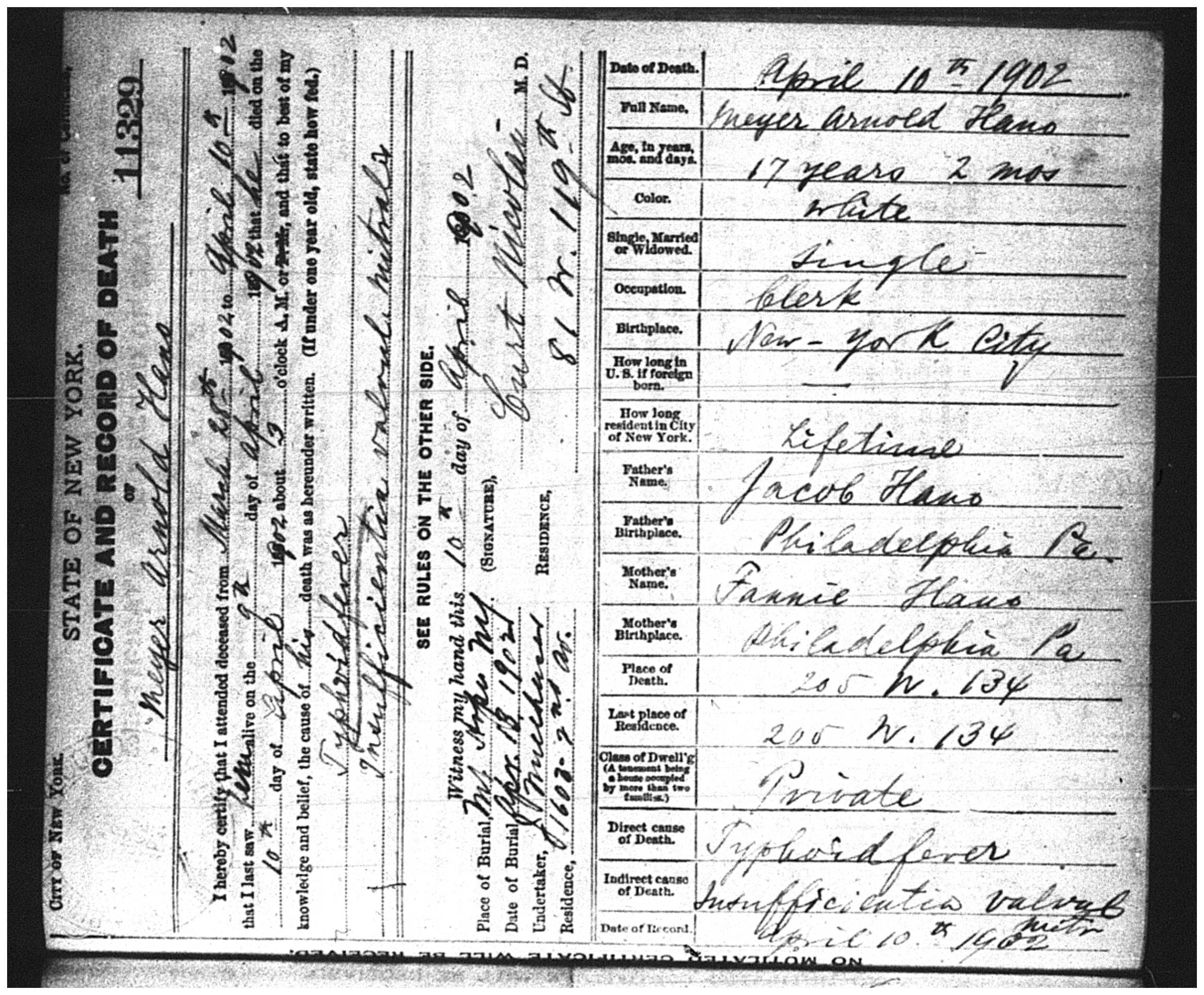
As of 1900 the Hano family was living at 205 West 134th Street in Manhattan. Louis, now 22, was working as a salesman, and the other four sons were at home. Unfortunately, the family was to lose another son early in the 20th century. On April 10, 1902, Myer Arnold Hano died at age seventeen from typhoid fever. This was the second son that Jacob and Fanny lost far too early.
In 1905, the family was still living at the same address on West 134th Street, and now Ernest (25) was also working as a salesman. Alfred (15) and Clarence (13) were still in school. Jacob was in the “manifold business,” as stated in the advertisement above. From what I can gather, a manifold book is a type of form book used by businesses.
Source Citation New York State Archives; Albany, New York; State Population Census Schedules, 1905; Election District: A.D. 23 E.D. 13; City: Manhattan; County: New York; Page: 44
Louis, the oldest son, was not listed with the family on the 1905 census, nor can I find him elsewhere. However, by 1910, he was back living in the household with his parents and brothers. The family was now living at 344 St. Nicholas Avenue, and both Jacob and his son Louis were in the business of manufacturing “cravats.” Clarence was a salesman for the company, and Alfred was not employed. Alfred must have been in school because by 1910, he was employed as a lawyer.
Year: 1910; Census Place: Manhattan Ward 12, New York, New York; Roll: T624_1022; Page: 10B; Enumeration District: 0560; FHL microfilm: 1375035
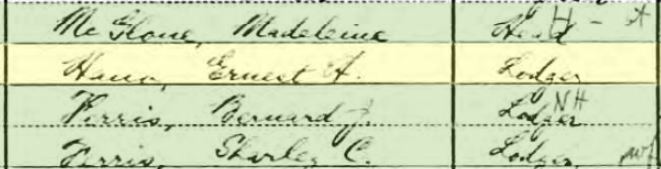
Ernest, the second oldest son, was not living with his family in 1910, but was living as a lodger in the household of Madeleine McGlone at 325 West 141st Street. There were two other lodgers living there as well. Ernest was a neckwear salesman, presumably those made by his father since his father and brothers were manufacturing and selling cravats. Madeleine McGlone, his landlady, was listed as married for 14 years, but there was no husband in the household. A little research revealed that Madeleine was born Madeleine Constance Barnard in Ontario, Canada, and had married George A. McGlone in 1896; however, in 1910, George McGlone was living in the Bronx and listing himself as a widower, so it would seem that the marriage between Madeleine and George had ended. At any rate, I mention this because, as we will see, Madeleine would end up being much more than Ernest’s landlady, and perhaps already was by 1910.
Year: 1910; Census Place: Manhattan Ward 12, New York, New York; Roll: T624_1027; Page: 11A; Enumeration District: 0706; FHL microfilm: 1375040
In 1915, Jacob and Fanny still had three of their sons at home, Louis, Alfred, and Clarence, and the family had relocated to Queens. Jacob, Louis (37), and Clarence (23) listed their occupations as salesmen, and Alfred (25) was a lawyer. Ernest, meanwhile, had moved to the Bronx, where he was still listed as a boarder living in Madeleine McGlone’s household along with her mother. Ernest, now 36, listed his occupation as a collector (bills? Stamps? Coins?).
The next five years brought lots of changes, in particular, the year 1917. On June 3, 1917, Clarence, the youngest of the brothers, became the first to marry. He married Mathilda Kutes, the daughter of a Russian immigrant and an Austrian immigrant. Mathilda was born in New York in April 1897, and although she was living with her parents in 1900 in New York, by 1910 when she was not yet 13 years old, she was living as a “relative” in a household of people named Hertz of Hungarian background. I cannot seem to locate Mathilda’s parents or her siblings on the 1910 census.
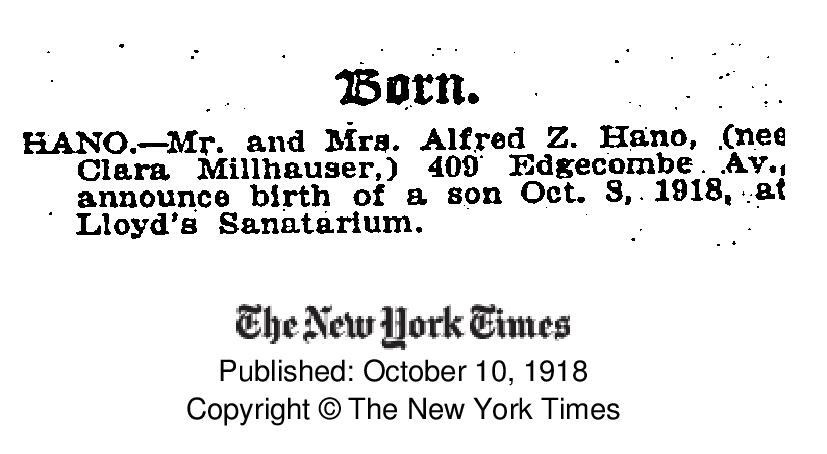
Just four and a half months after Clarence married, Alfred Hano married Clara Millhauser on October 25, 1917. Clara was the daughter of Isaac Millhauser, a police officer, and Bertha Silverberg, and was a native New Yorker. According to the 1915 New York census, Clara had been working as a typist before she married Alfred.
Unfortunately, 1917 ended on an unhappy note. Fanny Nusbaum Hano, my first cousin four times removed, died on December 25, 1917, from cancer. She was 61 years old. She was the second of the Nusbaum children to predecease her mother Clarissa.
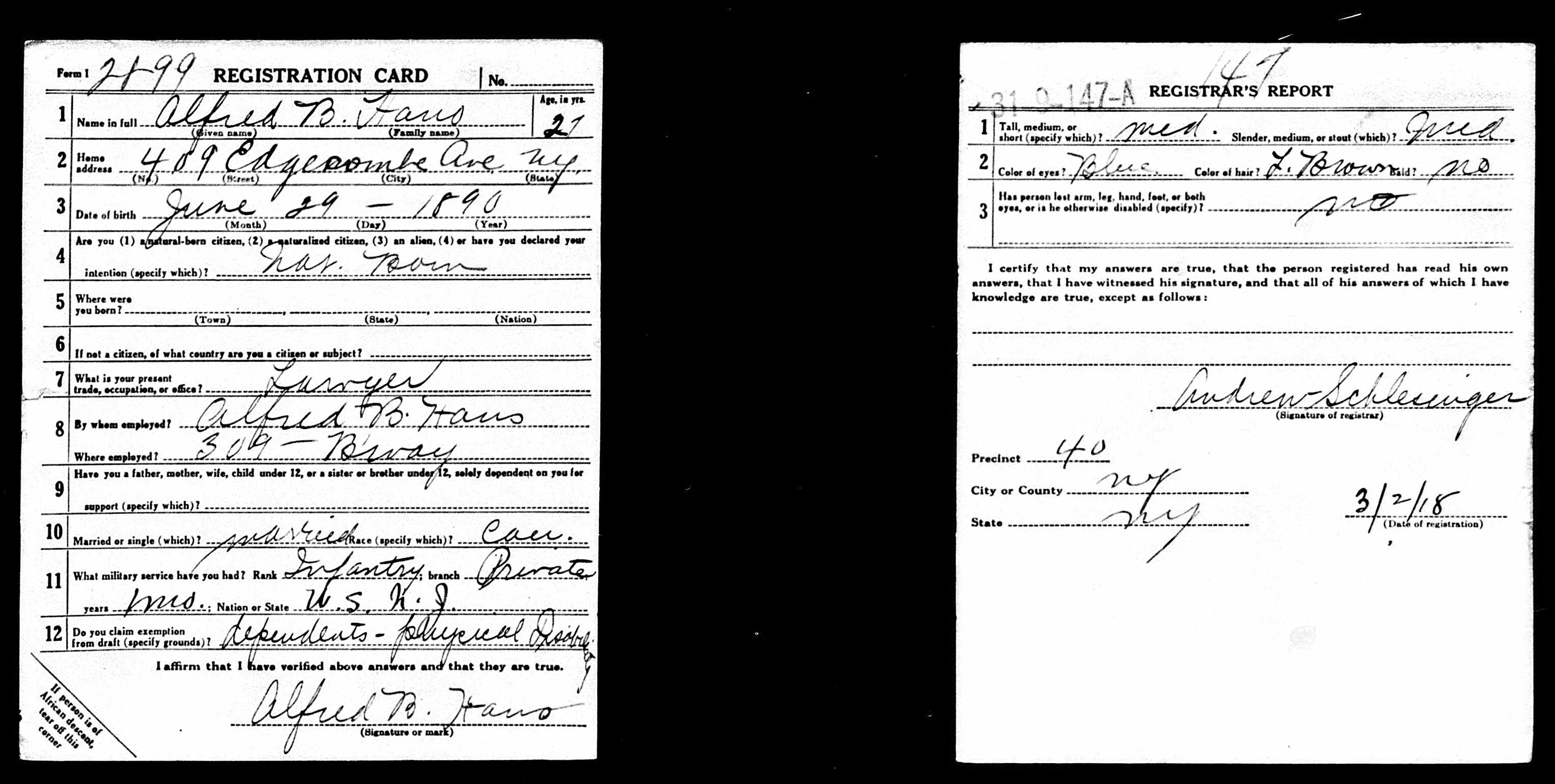
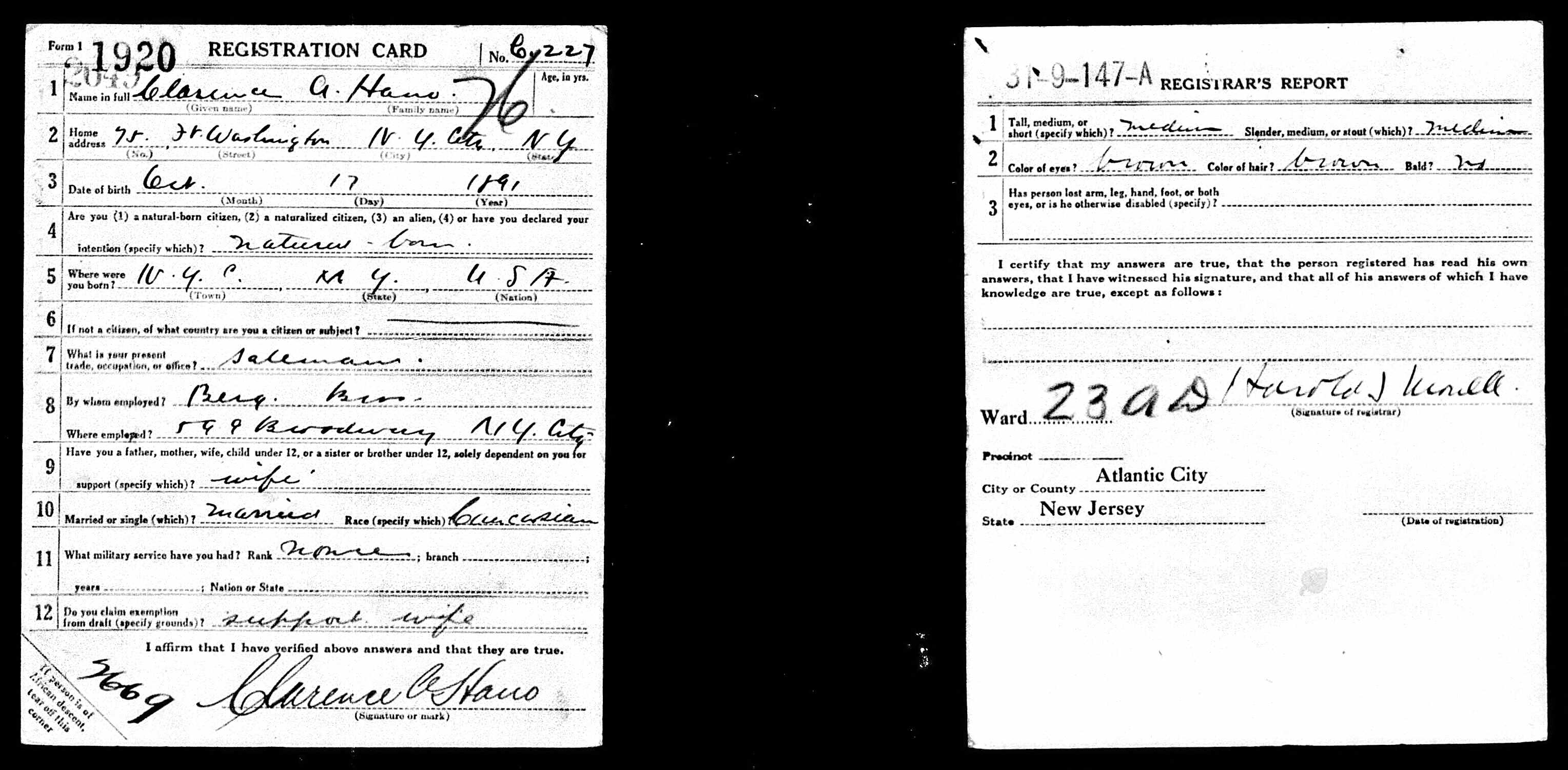
The World War I draft registrations for the Hano sons give more information about where they were in 1917-1918. Louis, now 40 years old, was living with his father Jacob in Manhattan. He was a salesman for Anathan & Co. Ernest, now 38, was living in Brooklyn, and was self-employed as a kennel owner. Both Louis and Ernest were single. Alfred was a lawyer, living in Manhattan with his wife Clara. He claimed an exemption from service based on “dependents—physical disability.” He also indicated that he had previously served as a private in the infantry for a month. It appears that instead Alfred served in the NY Guard. Finally, Clarence was living in Manhattan with Matilda and was employed as a salesman for Berg Brothers.
Registration State: New York; Registration County: New York; Roll: 1786680; Draft Board: 145
Registration State: New York; Roll: 1754135; Draft Board: 23
Registration State: New York; Registration County: New York; Roll: 1786806; Draft Board: 147
New York State Archives; Albany, New York; Collection: New York, New York Guard Service Cards and Enlistment Records, 1906-1918, 1940-1948; Series: B2000; Film Number: 10
Registration State: New York; Registration County: New York; Roll: 1786806; Draft Board: 147
Both Alfred and Clarence had sons born in 1918, named Alfred and Richard, respectively.
In 1920, Jacob, now a widower and working again as a printer, was living with Clarence, Matilda, and their son Richard in Hempstead, Long Island. Clarence was a dry goods buyer. Louis was living alone at 168 West 74th Street and working as a ladies’ neckwear salesman. Alfred and his wife and son were living on Edgecomb Avenue in Manhattan, and Alfred was working as a lawyer. Ernest was continuing to live with Madeleine McGlone. Ernest was listed as Madeleine’s “cousin” on the census. Hmmm… Madeleine and Ernest both described their occupations as dog breeders. From my cousin Arnold, I now know that they were very successful breeders of Boston terriers.
Year: 1920; Census Place: Bronx Assembly District 8, Bronx, New York; Roll: T625_1143; Page: 2A; Enumeration District: 462; Image: 438
In the next two years, both Alfred and Clarence again had sons, named Arnold and Edwin, respectively. That made four grandsons after six sons for Jacob and Fanny Hano.
Jacob Hano died on September 5, 1922. He was 72 years old and died from kidney and heart disease.
In 1925, Louis was living alone on West 73rd Street, working as a salesman. Ernest was living on Pelham Parkway in the Bronx with Madeleine McGlone, now listed as her “partner” in the dog breeding business. Alfred was also living in the Bronx on Montgomery Avenue with his wife and two sons, and he was still practicing law. Clarence was living in Inwood on Long Island with his wife and two sons, and he was still a salesman.
New York State Archives; Albany, New York; State Population Census Schedules, 1925; Election District: 32; Assembly District: 06; City: New York; County: Bronx; Page: 14
Ernest finally married his former “landlady/cousin/partner” on December 28, 1927. He was 47, and she was 51, and they had been living with each other since at least 1910. Things did not change much for the other brothers between 1925 and 1930. According to the 1930 census, Louis was still living alone in Manhattan, now on West 86th Street, and selling sportswear. Alfred was still living in the Bronx, but had changed occupations; he was now in the printing business as his father Jacob had once been. According to his son Arnold, Alfred joined his uncle Philip Hano’s printing business after he closed his law practice. Clarence was still living on Long Island, now a sales manager for a millinery business.
Sometime between 1930 and 1940, Louis Hano married a woman named Blanche, who had a son named Lewis. Blanche is listed as his wife on the 1940 census, and Lewis, 22 years old, is listed as his son. Since Louis was single in 1920 and 1930, I was fairly certain that Lewis was not his biological child. After much research, I concluded that Blanche had previously been married to Maurice Tobias and that Lewis was his biological child. After Blanche married Louis, Lewis Bertram Tobias became Lewis Bertram Hano. Whether or not he was legally adopted I cannot determine. I am in touch with a descendant of Lewis, and we are trying to learn more. At any rate, Louis F. Hano (note the different spelling of Louis and Lewis) became a husband and father for the first time some time in his fifties. Louis was a salesman for a knit goods business, and Lewis was engaged in purchasing for a specialty shop. They were living in Queens.
Year: 1940; Census Place: New York, Queens, New York; Roll: T627_2729; Page: 62B; Enumeration District: 41-449
While Louis had moved out of Manhattan by 1940, two of his brothers had moved back to Manhattan. Alfred Hano was living at 41 West 83rd Street with his wife and sons in 1940, and he was working as a salesman for an industrial company, according to the census. His son Alfred, now 21, was working as a salesman for a tonsorial equipment company, i.e., barbershop supplies.
Occupations of Alfred Hano and his son Alfred on the 1940 census Year: 1940; Census Place: New York, New York, New York; Roll: T627_2642; Page: 17A; Enumeration District: 31-801
Clarence Hano also moved back to Manhattan by 1940. He and his family were living at 465 West 65th Street. Clarence was still selling millinery; his wife Mathilda was working as a manager for a publishing company. Their sons Richard and Edwin were both working as stock clerks, one for a thread company and the other for a button company.
I cannot locate Ernest and his wife Madeleine on the 1940 census, but he and Madeleine are listed in the 1938 directory for Claremont, New Hampshire, described as “retired” and living at “Blink Cottage” on Lake Avenue. There is an identical listing in the 1942 Claremont directory, so I assume that that is where they were in 1940 as well. On the other hand, Ernest’s 1942 draft registration lists his residence as 1422 Pelham Parkway in the Bronx, so perhaps they had both a city home and a country home during this period. The draft registration confirmed that he was retired and married to Madeleine Hano.
The National Archives at St. Louis; St. Louis, Missouri; State Headquarters: New York
Louis’ World War II draft registration showed him living with Blanche in Elmhurst, Queens, and employed by the Elgin Knit Sportswear Company. He was now 64 years old. His adopted son Lewis Bertram Hano married Marion Fitz on September 20, 1942, and Lewis served in the US Navy for much of World War II.
The National Archives at St. Louis; St. Louis, Missouri; State Headquarters: New York
According to his World War II draft registration, Clarence Hano was living at 25 West 68th Street and employed by the American Straw Goods Company. He was 50 years old. His son Richard enlisted in the US Army on May 14, 1941, before the US had entered World War II. Edwin Hano also served in the US Army during the war.
The National Archives at St. Louis; St. Louis, Missouri; State Headquarters: New York
Alfred Hano was living at 41 West 83rd Street at the time of his draft registration in 1942. He was employed by the United Autographic Register Company at that time. He was 52 years old. Both of his sons also served in World War II. His younger son Arnold enlisted in the US Army on October 16, 1942, and served in the Pacific Theater during the war.
The National Archives at St. Louis; St. Louis, Missouri; State Headquarters: New York
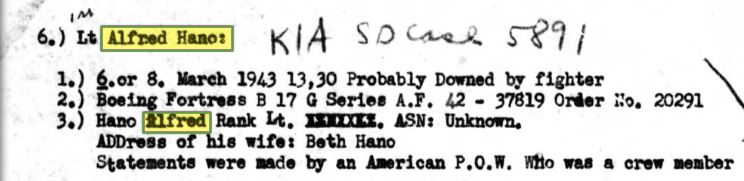
Alfred’s older son, Alfred, had enlisted six months before his younger brother on April 10, 1942. He served in the Army Air Corps in Europe. Tragically, Alfred was killed when his plane was shot down over Germany in March, 1944. He was only 25 years old.
Publication Title: Missing Air Crew Reports (MACRs) of the U.S. Army Air Forces, 1942-1947 Publisher: NARA National Archives Catalog ID: 305256 National Archives Catalog Title: Missing Air Crew Reports (MACRs), compiled 1942 – 1947
The 1940s must have been very painful, heart-breaking years for the extended Hano family. Not only did they lose Alfred in the war and see four other young men put their lives on the line, they also lost two of the Hano brothers within just months of each other. On August 8, 1847, Ernest Nusbaum Hano died in Sunapee, New Hampshire; he was 67 years old. His wife Madeleine survived him by sixteen years, dying March 6, 1963, in Greenwich, Connecticut, where she had relocated after Ernest’s death. Then on November 30, 1947, Louis F. Hano died in Queens; he was seventy years old. His wife Blanche lived until April 2, 1965.
As for the other two brothers, Clarence died in April, 1960. He was 69 years old. His wife Mathilda died in 1976 when she was 79 years old. Both of their sons died before they were sixty years old, Edwin in 1970 and Richard in 1977.
Alfred Hano was the last surviving Hano brother. His wife Clara had died in 1953, and Alfred lived until May, 1967. He was 76 when he died. He was survived by his son Arnold, who is a very well-known and well-regarded sportswriter. His book about one game of the 1954 World Series,A Day in the Bleachers, is considered a baseball classic and innovative in the way he described in detail the play by play of the entire game. It was in that game that Willie Mays made his historic catch, captured in this video:
He has also written a number of biographies as well as a number of novels. I recently had the great pleasure of speaking with Arnold, who is now 93 years old. It was an absolutely delightful conversation in which we discussed everything from the Bronx, baseball, war, children, careers, and family. I have already added his books to my reading list for the summer. There is a documentary currently being made about my cousin Arnold, and although Arnold himself questions why anyone would be interested in his life, I know that I will be very excited to see this film when it is completed.
And so that brings me to the end of the story of not only the Hano family, and not only to the end of story of the descendants of Ernst Nusbaum, but to the end of the story of all the children and grandchildren of Amson Nusbaum and Voegele Welsch,[1] my four-times great-grandparents from Schopfloch, Germany.
[1] Voegele was most likely the person for whom all those girls named Fanny, Flora, Florence, and Frances were named for in the Nusbaum/Dreyfuss/Dinkelspiel family. I still need to find out more about the Welsch line of my family.
If the 1880s were years of general growth and prosperity for Ernst Nusbaum and his family, the 1890s were years of loss. Once again, the Nusbaum/Dreyfuss family lost a young member of the family to suicide.
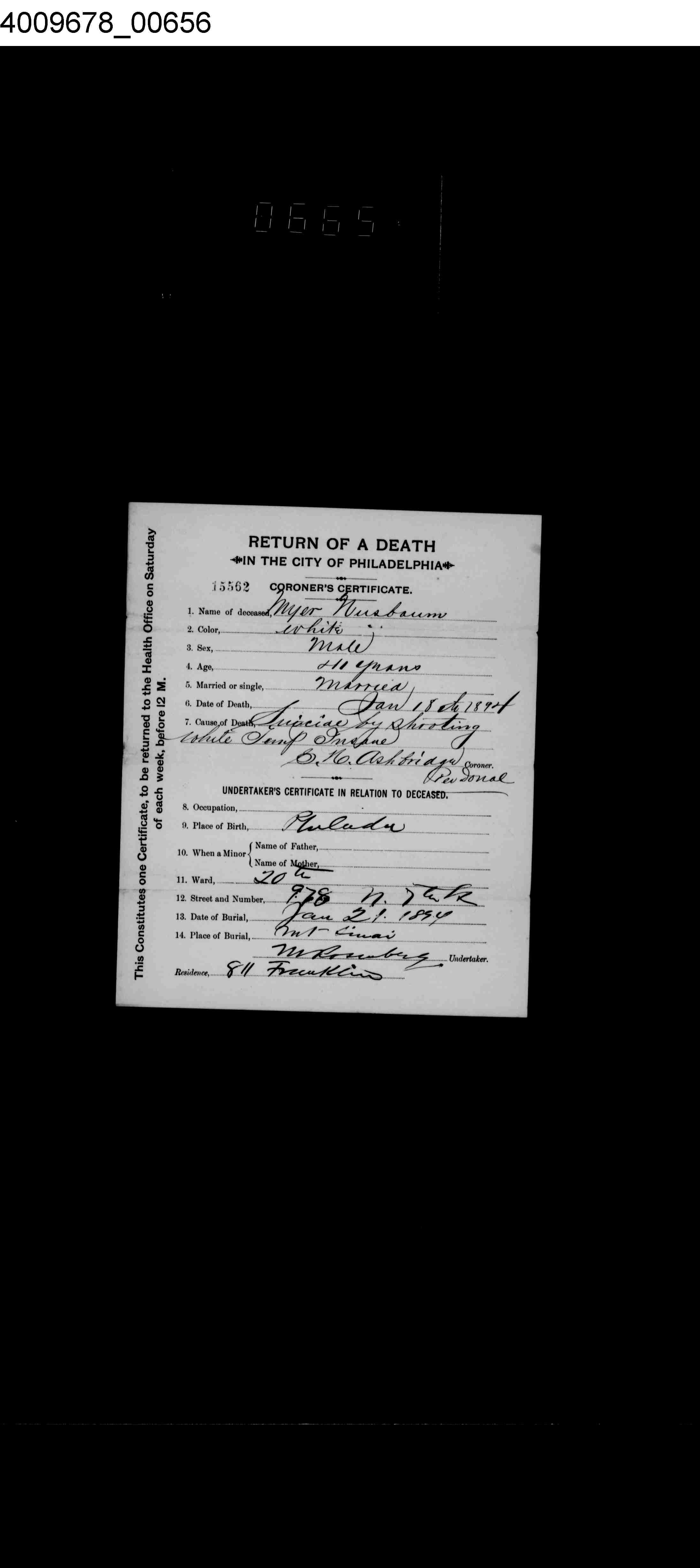
On January 18, 1894, Myer Nusbaum, 41 years old and the father of two young teenagers, took his own life.
Here was a man of a steady and upstanding reputation, a bookkeeper for a clothing company who had been employed in one place for over twenty years, a man who was well-liked and active in his community, a man with a wife and two teenaged children. What was this “grip” that caused him so much pain that he felt he had no alternative but to end his life?
From what I can gather from various sources on line, the grip was a term for what we would today call influenza or the flu. I’ve had the flu. Probably all of you have had the flu at some time or another. It’s awful. You feel terrible. Your head hurts, your body aches, you have respiratory symptoms, sometimes stomach symptoms. It can last for many days. But most people don’t become suicidal.
Although the headline on the Philadelphia Times story about Myer says, “Another Grip Tragedy,” I would imagine that even back in the 1890s, most people did not intentionally end their lives while suffering from the flu. Somehow I have to believe that Myer’s illness was something more than influenza, but it just was not diagnosed. The Inquirer story says he had been suffering for seven weeks; I have never heard of the flu lasting that long, but maybe it did back then. He must have been suffering terribly to have been driven to such an extreme. Imagine his poor fifteen year old son Jacob, watching his father die in his arms, and his wife Rosalie and sixteen year old daughter Corinne having to identify his body at the hospital.
UPDATE: My cousin Jessica, an expert in disease and disaster control, sent me a link to an article about the flu pandemic of the 1890s, the so-called Russian flu. It included this quote: “Influenza was also considered to be a major cause of nervous and psychological disorders by acting as a “devitalizing agent.” Descriptions of influenza sequelae included “depression,” “shattered nerves,” “neurasthenia,” and “despondency.” During 1890, for example, an unprecedented 140 melancholics afflicted with influenza “poison” were admitted to Scotland’s Royal Edinburgh Asylum. Coroners also cited influenza as a reason for “temporary insanity” in cases of suicide. Across Europe, rates of suicide (mostly male) and attempted suicide (mostly female) rose during the 1890s. In England and Wales, there was a 25 percent increase in suicides between 1889 and 1893. Paris witnessed a 23 percent rise during 1889–1890 compared with the average, and there were also increased rates in Germany and Switzerland.” Thus, Myer Nusbaum was not alone in suffering severe depression as a result of the flu. You can read more about the Russian flu here.
“Pennsylvania, Philadelphia City Death Certificates, 1803-1915,” index and images, FamilySearch (https://familysearch.org/pal:/MM9.1.1/JK96-L2H : accessed 11 March 2015), Myer Nusbaum, 18 Jan 1894; citing 15562, Philadelphia City Archives and Historical Society of Pennsylvania, Philadelphia; FHL microfilm 1,871,367.
1894 ended as tragically as it began. Almost eleven months to the day after Myer died, on December 16, 1894, his father Ernst died from injuries sustained in a fall. Ernst was 78 years old; the last of the Nusbaum siblings in America was gone. And not from disease or old age, but from an accidental fall. Somehow that just seems unfair; he had been able to adjust to life in America, had been a successful businessperson, had bounced back from bankruptcy and the Depression of the 1870s, and had raised six children with his wife Clarissa, and his life had ended because of a fall.
Pennsylvania, Philadelphia City Death Certificates, 1803-1915,” index and images, FamilySearch (https://familysearch.org/pal:/MM9.1.1/VKDH-3ZJ : accessed 11 March 2015), Ernst Nusbaum, 16 Dec 1894; citing page 284 certificate # 11892, Philadelphia City Archives and Historical Society of Pennsylvania, Philadelphia; FHL microfilm 1,011,822.
As for the rest of the family, Arthur Nusbaum and his wife Henrietta had two more children in the 1890s: Clare, born in 1894, and Helen, born in 1895. There were now six children in the family, and they were living at 2559 North 16th Street. Arthur was involved in clothing sales in the 1890s and as reported on the 1900 census. Their son Sidney, now 21, was also a clothing salesman, and Horace, who was 15, was working as an upholsterer.
Fanny Nusbaum and her husband Jacob Hano continued to live in New York City in the 1890s. Fanny and Jacob had five sons (Samuel having died in 1884), all still at home during that decade and in 1900. In 1891, they were living at 119 East 111th Street in East Harlem, and Jacob was a printer and book manufacturer. In 1892 they were living at 948 Fleetwood Avenue, which I cannot locate in New York City today, but by 1898 they were living at 803 Edgecombe Avenue, even further uptown, near 171st Street on what is now Amsterdam Avenue. On the 1900 census, the family is living at 203 West 134th Street, and the oldest son, Louis, now 22, was employed as a salesman. The other four were still at home. There was also a servant living in the home.
Edgar Nusbaum and his wife Viola continued to live 2029 North 11th Street in Philadelphia in the early 1890s, and Edgar was working as a clerk. By 1897, however, the family had moved to 1520 North 12th Street, and Edgar was working as a publisher like his brother-in-law Jacob Hano. On the 1900 census, however, Edgar listed his occupation as clerk once again. Their daughter Selena, now 19, was working as a dressmaker. Viola’s sister and a boarder were also living with them.
Henrietta Nusbaum and her husband Frank Newhouse had been living with Ernst and Clarissa, her parents, in 1890 at 2028 Mt. Vernon Street, and Frank was working as a tailor. They were still living at that address as of the 1900 census with Clarissa, now a widow, and Frank’s occupation was a traveling salesman. Neither Clarissa nor Henrietta were working outside the home, and there were two domestic servants living with them.
Frank Nusbaum and his wife Dolly and their daughter Loraine were living at 811 Windsor Square in 1891. By 1896, Frank was selling insurance, and they were living at 637 North 33rd Street; a year later they were living at 3223 Wallace Street. In 1900, the family was living at yet another location, 3206 Manton Avenue, and Frank was still an insurance broker.
As for the widow of Myer Nusbaum, Rosalie Aub Nusbaum, she and their children Corinne and Jacob (called Jack on the 1900 census) were living at 5020 Cedar Street in 1900. Jack was working as a salesman, now almost 21 years old, and his mother and sister were at home. There was also a boarder living with them as well as one domestic servant.
Thus, somehow the family survived the two tragedies of 1894 and entered the 20th century, all but Fanny still living in Philadelphia, all still working and living their lives.
One of the biggest mysteries I encountered in researching my Rosenzweig cousins was the mystery of Lilly Rosenzweig, the first child of Gustave and Gussie Rosenzweig. Lilly was my grandfather Isadore Goldschlager’s first cousin. Lilly had married Toscano Bartolino in 1901 and had had a child William with him, born March 9, 1902. Then just two years later on April 27, 1904, Toscano had died from kidney disease at age 27, leaving Lilly a twenty year old widow with a two year old child.
Bartolini Rosenzweig marriage certificate
William Bartolini birth certificate
Toscano Bartolini death certificate
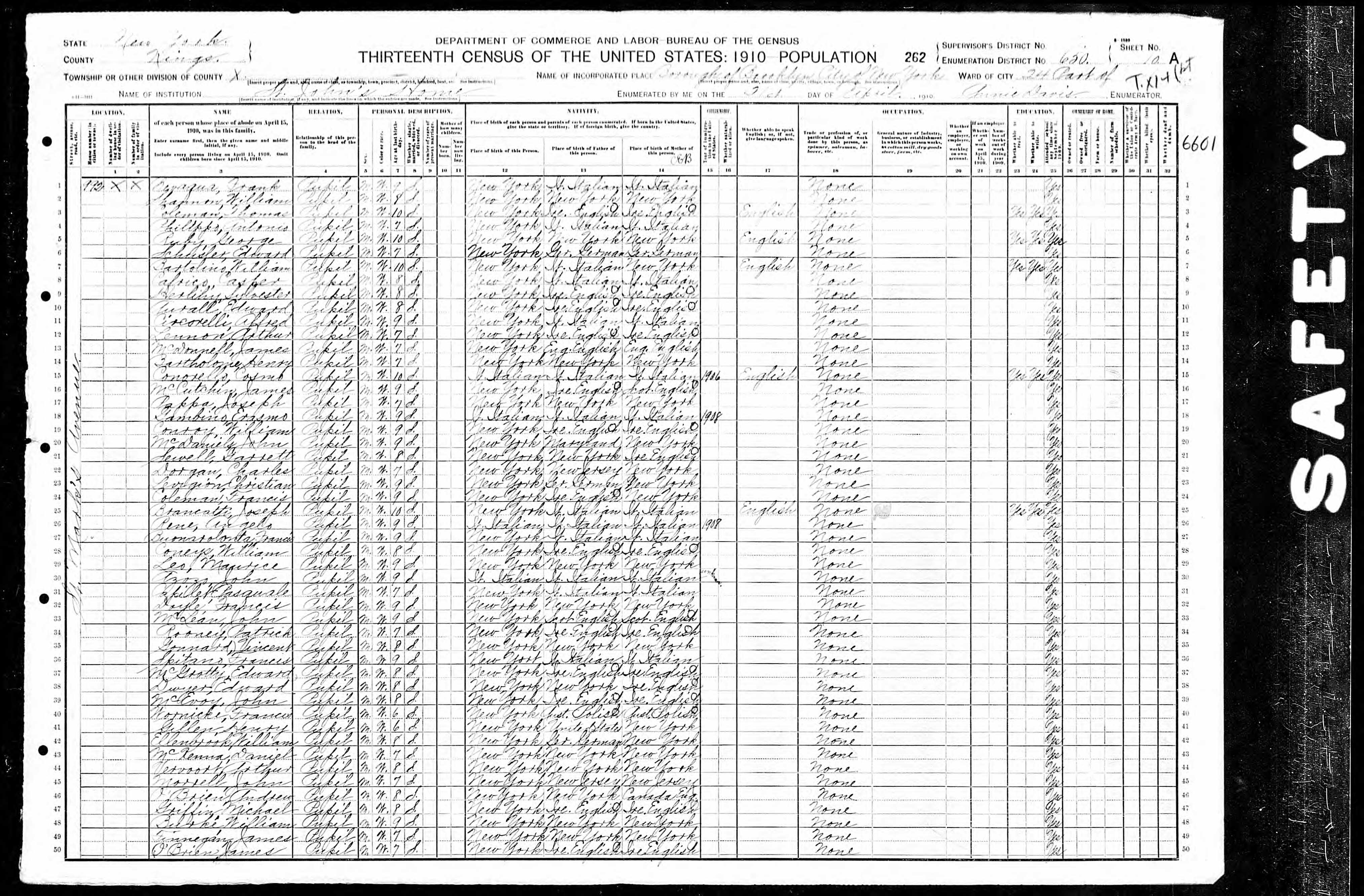
Lilly and her son William were living with Gustave and Gussie in 1905, but by 1910, William was no longer living with his mother and grandparents, but was in St. John’s Home for Boys in Brooklyn.
Gustave Rosenzweig family on the 1905 NYS census
William Bartolini 1910 at St John’s Home, Brooklyn
Lilly was still living with her parents in 1910 and working as a nurse. In 1915, William was at a different residential home, but I could not find Lilly at all on the 1915 NYS census nor could I find her anywhere after that. None of the great-grandchildren of Gustave and Gussie knew what had happened to her, except that they thought she had remarried and moved to New Jersey at some point. No one knew her married name or whether she had more children. I was stuck and could not get any further.
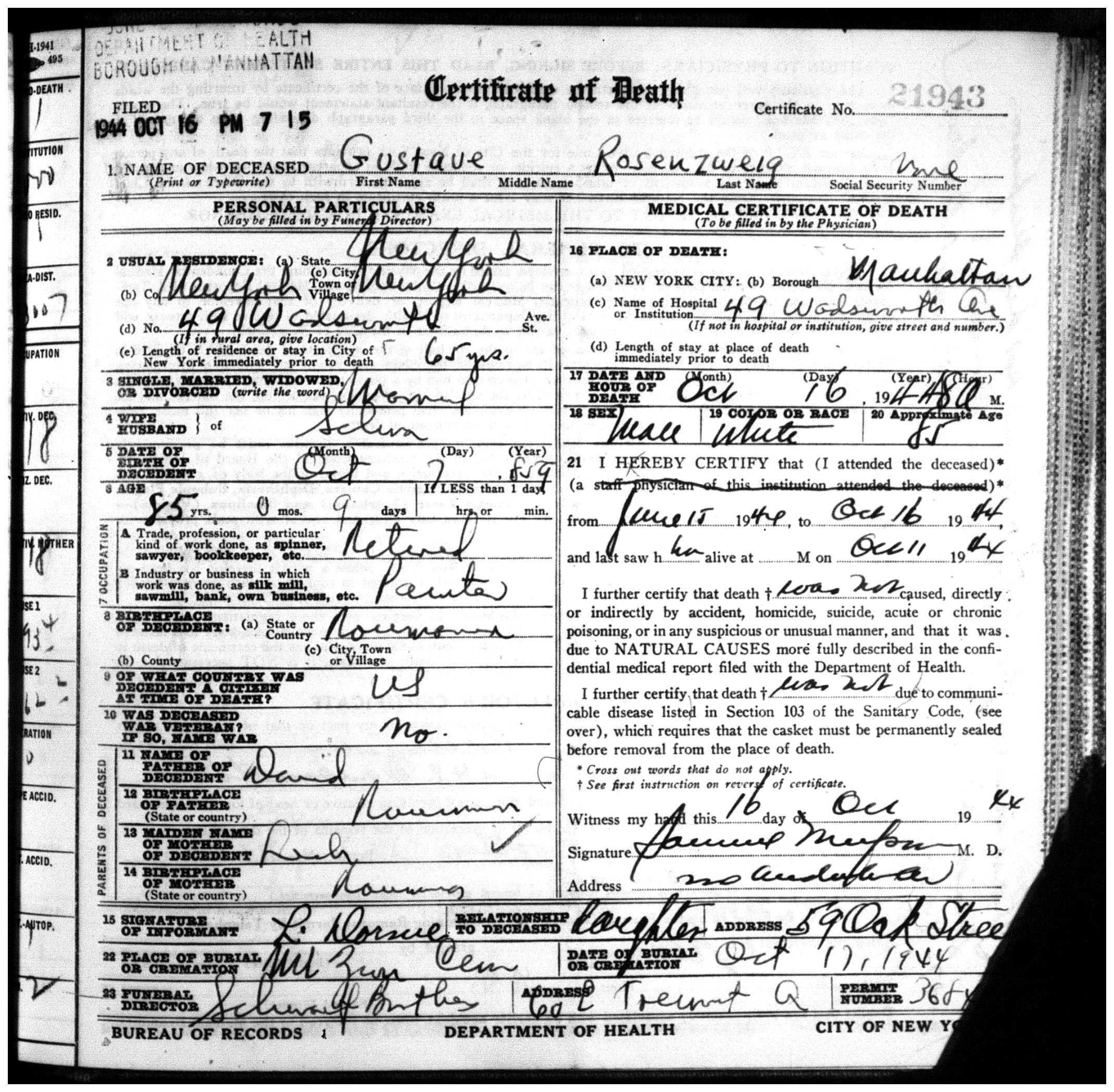
I thought I had a new clue when I obtained Gustave’s 1944 death certificate. It was signed by an informant I thought might be Lilly. I posted the signature on the blog, hoping someone would be able to decipher it more clearly than I could, but every possible reading of the signature led me nowhere, even using wildcard searches and as many variations as I could. I put Lilly aside and figured it was a lost cause.
And then? Well, this past weekend I received a call from Harriet, one of Lilly’s nieces. She not only remembered Lilly well—she remembered the first name of her second husband—Carmen. And she said they had lived in Jersey City. She remembered Lilly fondly and described her as funny and fun-loving, like all the Rosenzweig siblings.
So I now had two more clues. Lilly had married someone named Carmen, and they had lived in Jersey City, New Jersey. Armed with just those additional pieces of information, I was able to design a search on FamilySearch using the two first names and the location. The first result on the results list was a Lilly and Carmen Dorme living in Rutherford, New Jersey in 1940.
Carmen and Lillian Dorme 1940 US census
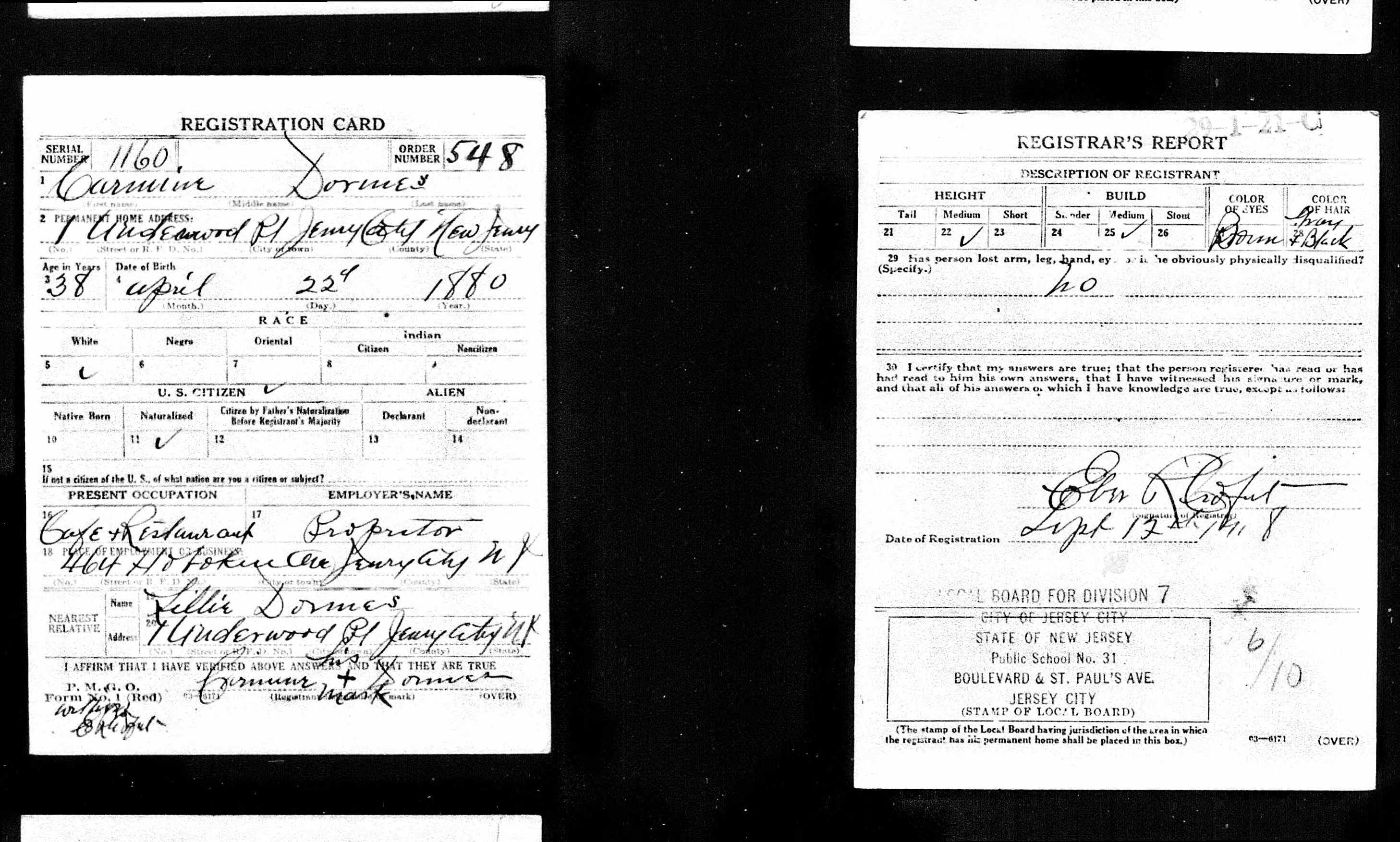
Rutherford was not Jersey City, but it was close by, so I decided to try that surname. Using Dorme, I was able to search more thoroughly and found that Lilly and Carmen Dorme were already married by 1918 when Carmen (using Carmine Dormes then) registered for the World War I draft and that they were living in Jersey City. This had to be my long-missing cousin Lilly.
Carmine Dormes World War I draft registration
After that, I was also able to find Lilly and Carmen in several Jersey City directories and in the 1930 US census, which revealed that Lilly and Carmen had a child, Louis, who was then sixteen years old.
Dorme family on the 1930 US census
Further searching uncovered a Louis Dorme’s entry on the Social Security Death Index, indicating that he was born in New York on May 13, 1913, and had died in 1977. This was consistent with the age and birthplace for Louis on the 1930 census, so I am reasonably certain that this is the correct person.
I still cannot find the family on the 1920 census, and since they were living in Jersey City both before and after 1920, I assumed that they would have been there then as well. But although Carmen is listed in both the 1918 and the 1925 Jersey City directories, he is not in the 1922 directory (the intermediate years are not available online). Harriet thought that Lilly had served as a nurse overseas during World War I, so perhaps that is where the family was located during that period. I cannot, however, find a military record for Carmen, so I have no way to know for sure where they were during that period.
And although I do know when Louis died (1977) and when Carmen died (1962) from the SSDI, I cannot find Lilly on the SSDI nor can I find any other record of her death. Harriet does remember Lilly’s death (in fact, Harriet’s mother reported that Lilly’s last words was a request for a corned beef sandwich!), but not the specific year or place.
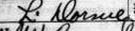
But I do have one clue, and it goes back to Gustave’s death certificate. As soon as I saw that Lilly’s married name was Dorme, something clicked in my head. I went back to look at Gustave’s death certificate, and now it seemed strikingly clear that the informant’s name was L. Dorme.
How could I not have seen that or found her before? I just don’t know. But now I knew that it was in fact Lilly who signed her father’s death certificate. And so I know that she was still alive as of October 16, 1944, when Gustave died. I am sure with a few more clues I will be able to narrow down the year and perhaps find her death record as well.
So in the space of one afternoon with the help of a new cousin, I was able to resolve one of the biggest questions I had remaining about my grandfather’s Rosenzweig first cousins. Thank you, Harriet!
It was about three years ago that I first started wondering more about my grandfather Isadore Goldschlager. I knew almost nothing about his life before he came to the US in 1904 from Iasi, Romania. I didn’t know too much about his life when he got to the US either. It was my interest in his life in particular that first prompted me to go on ancestry.com and start searching for answers. I soon hit a wall and gave up, only returning to ancestry a year later and starting my search for my Brotman relatives instead.
Then I returned to my grandfather again, a somewhat more experienced researcher, and this time I had better luck. In fact, as I have written, I found not only his parents—I found his mother’s siblings Gustav and Tillie and Zusi Rosenzweig, and then I found their children and many of their grandchildren and great-grandchildren. I was able to piece together a better picture of my grandfather’s extended family and even figured out how he met my grandmother Gussie, who happened to be living down the street from his Rosenzweig cousins in 1915 on Pacific Street in Brooklyn.
Last night I got to meet some of my Rosenzweig cousins for the very first time. Four of the great-great-grandchildren of David and Esther Rosenzweig were there—Gerry, Ron, Michael and me. Gerry, Ron and Michael are all the great-grandsons of Gustave Rosenzweig, the brother of my great-grandmother Ghitla/Gussie Rosenzweig Goldschlager. Gerry is the grandson of Abraham Rosenzweig, and Michael and Ron are the grandsons of Joe Rosenzweig, the brother of Abraham.
Here is a picture of Abraham, Joe and Jack Rosenzweig:
Abraham Joseph and John (Jack) Rosenzweig
And here is a picture of their first cousin Isadore Goldschlager, my grandfather.
Isadore Goldschlager
It was a wonderful evening. Even though many of us had never, ever met before, we quickly connected and found common bonds—all having grown up in greater New York, all enjoying a good laugh, all loving dogs and our grandchildren (not in that order), and all being unable to digest raw onions. It was a great time, and even if we never knew each other as children, there was definitely a feeling of family.
Here we all are with our spouses. Thanks to the lovely newlywed couple who not only put up with our noisy conversations, but also graciously offered to take this picture (on about five different smartphones).
So keep looking for your cousins—you will never know how much joy you can experience.
Two months ago I wrote a summary of my perspective on the descendants of Jacob and Sarah Jacobs Cohen and their thirteen children, including my great-grandfather Emanuel Cohen. I wrote about the way they managed to create a large network of pawnshops that provided support for the generations to come. Many of the Philadelphia Cohens stayed in the pawnshop business into the 20th century. The generation that followed, those born in the 20th century, began to move away from the pawn business and from Philadelphia. Descendants began to go to college and to become professionals. Today the great-great-grandchildren of Jacob and Sarah live all over the country and are engaged in many, many different fields. Few of us today can imagine living with twelve siblings over a pawnshop in South Philadelphia. We can’t fathom the idea of losing child after child to diseases that are now controlled by vaccinations and medicine. We take for granted the relative luxurious conditions in which we live today.
Philadelphia flag
The story of the Cohen family in Washington is much the same in some ways, different in other ways. Jacob’s brother Moses and his wife Adeline also started out as immigrants in the pawnshop business , first in Baltimore and then Washington. But unlike Jacob who lived to see his children become adults, Moses Cohen died at age 40 when his younger children were still under ten years old. Adeline was left to raise those young children on her own as she had likely raised her first born son, Moses Himmel Cohen, on her own until she married Moses Cohen, Sr. When I look at what those children accomplished and what their children then accomplished, I am in awe of what Adeline was able to do. For me, the story of the DC Cohens is primarily the story of Adeline Himmel Cohen for it was she, not Moses, who raised the five children who thrived here in the US. She somehow instilled in those children a drive to overcome the loss of their father, to take risks, to get an education, and to make a living.
Her son Moses, Jr., an immigrant himself, had nine children; his son, Myer, became a lawyer. To me it is quite remarkable that a first generation American, the son of a Jewish immigrant, was able to go to law school in the late 19th century. Myer himself went on to raise a large family, including two sons who became doctors and one who became a high ranking official at the United Nations in its early years after World War II. Moses, Jr.’s other children also lived comfortable lives, working in their own businesses and raising families. These were first generation Americans who truly worked to find the American dream.
Adeline and Moses, Sr.’s other three children who survived to adulthood, Hart, JM, and Rachel Cohen, all took a big risk and moved, for varying periods of time, to Sioux City, Iowa. Even their mother Adeline lived out on the prairie for some years. JM stayed out west, eventually moving to Kansas City; he was able to send his two daughters to college, again something that struck me as remarkable for those times. His grandchildren were very successful professionally. Hart, who lost a son to an awful accident, had a more challenging life. His sister Rachel also had some heartbreak—losing one young child and a granddaughter Adelyn, but she had two grandsons who both appear to have been successful.
Three of the DC Cohen women married three Selinger brothers or cousins. Their children included doctors, a popular singer, and a daughter who returned to England several generations after her ancestors had left. The family tree gets quite convoluted when I try to sort out how their descendants are related, both as Cohens and as Selingers.
There were a number of heart-breaking stories to tell about the lives of some of these people, but overall like the Philadelphia Cohens, these were people who endured and survived and generally succeeded in having a good life, at least as far as I can tell. The DC Cohens, like the Philadelphia Cohens, have descendants living all over the United States and elsewhere and are working in many professions and careers of all types.
flag of Washington, DC
Looking back now at the story of all the Cohens, all the descendants of Hart Levy Cohen and Rachel Jacobs, I feel immense respect for my great-great-great grandparents. They left Amsterdam for England, presumably for better economic opportunities than Amsterdam offered at that time. In England Hart established himself as a merchant, but perhaps being a Dutch Jew in London was not easy, and so all five of Hart and Rachel’s children came to the US, Lewis, Moses, Jacob, Elizabeth, and Jonas, again presumably for even better opportunities than London had offered them. Eventually Hart himself came to the US, uprooting himself for a second time to cross the Atlantic as a man already in his seventies so that he could be with his children and his grandchildren. Rachel unfortunately did not survive to make that last move.
The flag of the City of London
Arriving in the US by 1850 in that early wave of Jewish immigration gave my Cohen ancestors a leg up over the Jewish immigrants who arrived thirty to sixty years later, like my Brotman, Goldschlager, and Rosenzweig ancestors. Of course, the Cohens had the advantage of already speaking English, unlike my Yiddish speaking relatives on my mother’s side. They also had the advantage of arriving at a time when there wre fewer overall immigrants, Jewish immigrants in particular and thus faced less general hostility than the masses of Jewish, Italian, and other immigrants who arrived in the 1890s and early 20th century. Also, my Cohen relatives may not have been wealthy when they arrived, but Hart and his children already had experience as merchants and were able to establish their own businesses fairly quickly. Thus, by the time my mother’s ancestors started arriving and settling in the Lower East Side of NYC or in East Harlem, working in sweatshops and struggling to make ends meet, my father’s ancestors were solidly in the middle and upper classes in Philadelphia, Washington, Sioux City, Kansas City, Detroit, and Baltimore.
When I look at these stories together, I see the story of Jewish immigration in America. I see a first wave of Jews, speaking English, looking American, and living comfortably, facing a second wave who spoke Yiddish, looked old-fashioned, and lived in poverty. No wonder there was some tension between the two groups. No wonder they established different synagogues, different communities, different traditions.
A recent study suggests that all Ashkenazi Jews were descended from a small group of about 350 ancestors. We all must share some DNA to some extent. We are really all one family. But we have always divided ourselves and defined our subgroups differently—Orthodox, Conservative, Reform; Galitizianer or Litvak; Sephardic or Ashkenazi; Israeli or American; so on and so forth. We really cannot afford to do that in today’s world; we never really could. Today very few of us make distinctions based on whether our ancestors came in 1850 or 1900 because we are all a mix of both and because we have blurred the economic and cultural distinctions that once were so obvious. But we still have a long way to go to eradicate the divisions among us and to overcome the prejudices that continue to exist regarding those who are different, whether Jewish or non-Jewish.
It’s been a long time since I’ve written about the Strolowitz Adler line in my family tree since I have been focused on my father’s Cohen line, but I have now completed my research on one other member of the Strolowitz Adler family so am taking a short break from the Cohens in order to report on that research.
Tillie Rosenzweig Strolowitz Adler was my great-grandmother Ghitla Rosenzweig Goldschlager’s sister. Tillie was the aunt who provided a home for my grandfather Isadore Goldschlager and his sister Betty when their father died in 1909. Tillie had been recently widowed herself after her husband Jacob had died shortly after arriving in NYC from Iasi. Tillie also outlived two of her sons, Pincus and Isidor, both of whom had died from serious illnesses as young adults. Her other five children lived to adulthood, but many of them also faced some personal struggles and in some cases tragic deaths. Only Leah, the youngest child, seemed to lead a long and happy life with a long and happy marriage to Ben Schwartz.
The only one of Tillie’s children I had not yet written about was Rebecca, the fifth child born in 1892 in Iasi. She was fifteen when she immigrated to the US with her parents and younger brother and sister in December, 1907, and in 1910 and 1915 she was working in a sweatshop as a dressmaker.
I am very fortunate to have this beautiful photograph of Rebecca Strolowitz Adler. All the photos included in this post were provided by members of the extended family.
Rebecca Strolowitz/Ray Adler (undated)
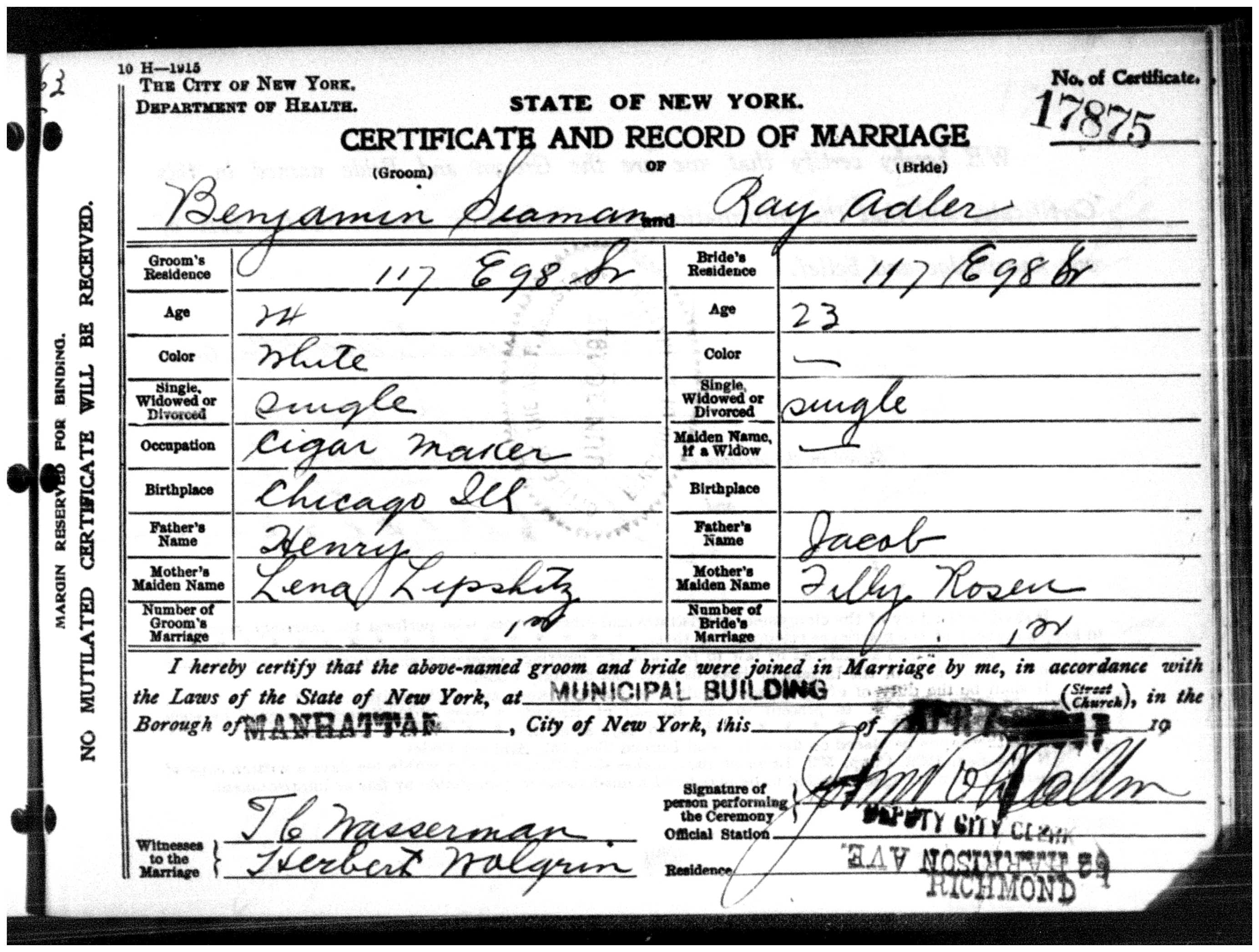
On April 7, 1917, Rebecca, now using the name Ray, married Ben Seamon.
Ray Adler and Ben Seamon marriage certificate
Ben was born in Chicago in 1893. He enlisted in the US Army in November, 1917, and served during World War I until he was honorably discharged in January, 1919. Ray and Ben’s first child Jerome was born in June 1919, and as of 1920, Ben was working as a foreman in a dressmaking shop (perhaps this is where he had met Ray?). By 1925, Ray and Ben had two sons, Jerome born in 1919, and Paul, born in December, 1920, and the family had moved to the Bronx. Ben was now working as a chauffeur. Their third son, Harold, was born in October, 1924, and Ben and Ray’s youngest child Thelma was born in 1926.
By 1930, however, Ray was living with her children in the home of her brother David Adler along with his wife Bertha and their daughter Tessie in Manhattan. Ben, on the other hand, was living in the Bronx with his mother and his brothers Samuel and Mannie Seamon.
Mannie Seamon ran a gym where he trained boxers, and according to the 1930 census, both Manny and Ben were working as managers at the gym at that time. According to Mannie’s obituary in the NYTimes dated March 26, 1983, in 1937, Mannie was hired as the assistant to the trainer for Joe Louis, the world heavyweight boxing champion from 1937 until 1949, and in 1942 when that trainer died, Mannie became Joe Louis’ trainer, working in that position until 1951.
During the Depression, Ray became a patient at the Central Islip State Hospital. I was not able to find any records for Ray after 1942. Her two youngest children, Thelma and Harold, were admitted to the Hebrew Orphan Asylum (HOA) in Manhattan on June 28, 1935. Thelma resided there from ages 9 through 15. Harold was discharged to return to live with his father on February 25, 1940; Ben was then working as an announcer for boxing and wrestling bouts. Thelma was discharged from the HOA on July 20, 1941, two months before the HOA closed in Sept. 1941.
Teddy Schwartz, daughter of Leah Adler Schwartz, visiting her cousin Thelma Seamon around 1944
But it all seemed to work out well for Thelma. While at the orphanage, she met her future husband, Nathan Letnick, who was also a resident there. Thelma graduated from high school in 1942.
Thelma Seamon graduation photograph 1942
Jerome Seamon married Lillian Wolf on September 22, 1940:
Wedding of Jerome Seamon and Lillian Wolf September 22, 1940
Pictured here are Mannie Seamon (top row, second from left), Harry Seamon (right of Mannie), Paul Seamon (right of Harry). Thelma is second from the left in the middle row. In the front row, Ben Seamon is second from the left, then the groom Jerome Seamon, Ben’s mother, and the bride Lillian Wolf Seamon. The others are relatives and cousins from the Seamon side of the family.
All three of Ben and Ray’s sons and their son-in-law Nathan served overseas during World War II, and Paul received a Purple Heart for his service. Thelma worked at Western Electric in Manhattan during World War II.
Thelma working at Western Electric during World War II
Nathan Letnick and Thelma Seamon were married after the war on November 10, 1946. Here is their wedding photograph with the extended family.
Nathan Letnick and Thelma Seamon’s wedding 1946
Among those pictured above are the following people, most of whom are referred to in this post:
Back row, far left: Paul Seamon; Middle row, far left: Jerry Seamon; Front row: Lillian Wolf Seamon (Jerry’s wife); Ben Seamon’s sister, Ida; Nathan Letnick; Thelma Seamon Letnick; Ben Seamon; Ben’s sister Bertha.
Nathan graduated from NYU with degrees in business, thanks to the GI Bill. The four Seamon children, Jerome, Paul, Harold, and Thelma, eventually moved to Long Island after the war, where all except Harold married and raised families.
Here is a photograph from the wedding of Paul Seamon and Marilyn Tobetsky on August 6, 1949, showing all of Ray and Ben’s children and their spouses as well as Ben:
Wedding of Paul Seamon and Marilyn Tobetsky 1949
From left to right: Nathan Letnick, Thelma Seamon Letnick, Ben Seamon, Mae, Paul Seamon, Marilyn Seamon, Jerome Seamon, Lillian Seamon, and Harold Seamon
As for Ben, I found a World War II draft registration dated 1942 that indicates that he was employed by the Town Pump in Tullahoma, Tennessee, but was residing with Jerome in the Bronx. Ben moved to Florida sometime after 1952 and worked at a dog racing track now known as the Mardi Gras Casino. He died in July, 1971, and is buried at Long Island National Cemetery.
After retirement Nat and Thelma moved to Florida. They were still married in 2000 when tragically Thelma was killed by an elderly driver who had Alzheimer’s. Nat died six years later. Thelma’s daughter told me that one of Thelma’s passions was knitting: “All her adult life, everyone knew my mother to be knitting something for everyone and anyone having a baby.”
Finally, a more recently dated photograph of Thelma and her brother Paul in 2000.
The story of Tillie Strolowitz Adler and her children is a story filled with lots of heartbreak and hardship but ultimately survival. They all came as immigrants from Romania to New York City and sought happiness and success, which did not come easily to them. Although they may have struggled, the generations who followed them found a home here in the US, served their country, and ultimately not only survived but thrived. These photographs reflect the resilience of the human spirit better than I can ever capture it in words.
The third child of Moses, Jr., and his wife Henrietta was Jacob G. Cohen. As I wrote previously, Jacob had married Ida Siegel in 1894 and had moved to New York City, where he first worked as a bookkeeper. Just this week I received a copy of their marriage certificate.
Jacob G. Cohen and Ida Siegel marriage certificate
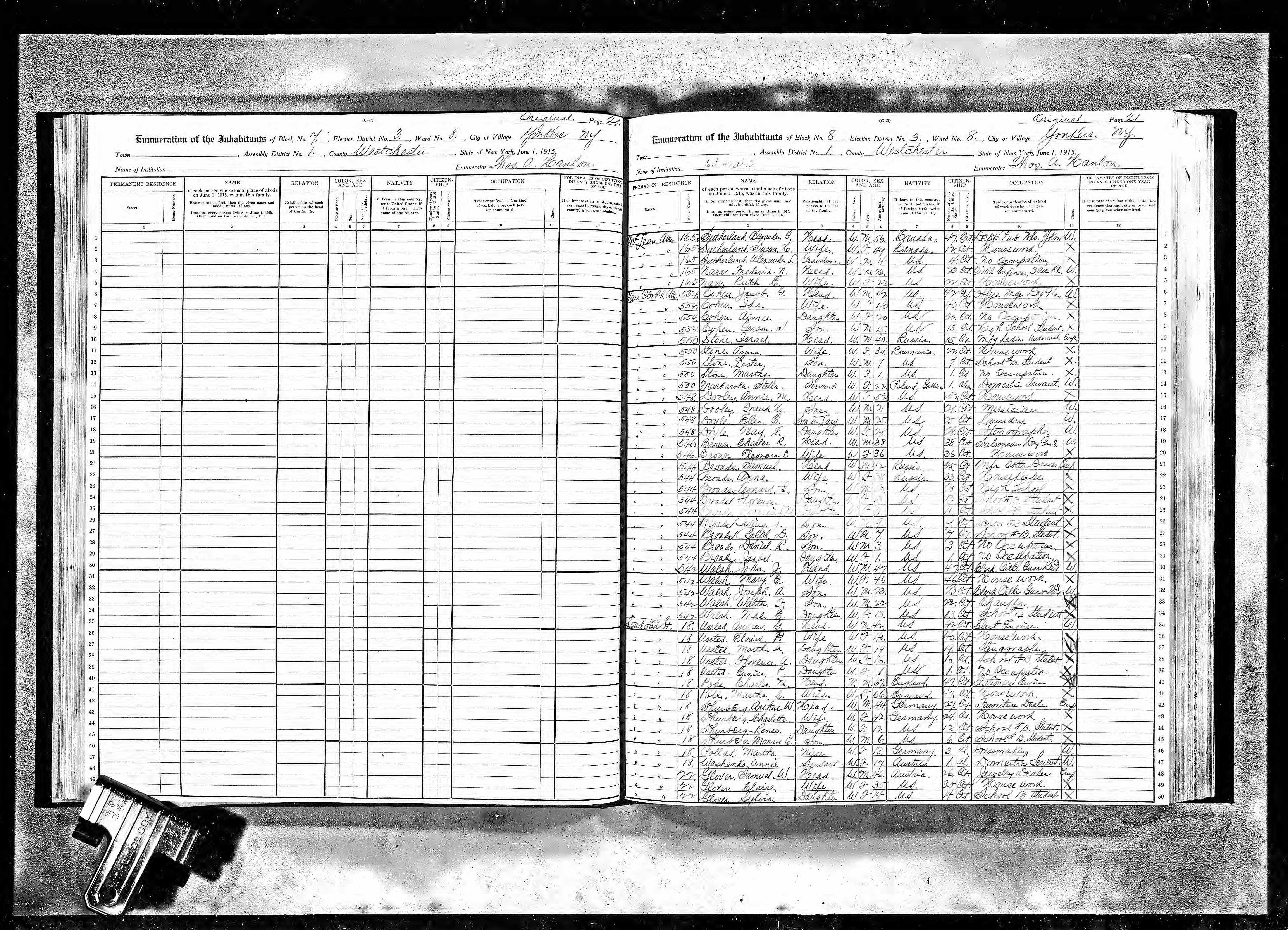
Jacob and Ida had two children, Aimee and Gerson, and by 1910 had moved to Yonkers, New York, where Jacob worked as the manager of a dry goods store, according to the 1910 census. In 1912, Jacob and Ida traveled overseas, and in 1915 Jacob’s occupation was an office manager for a business that is not legible to me. Maybe someone else can decipher it? Ida’s obituary said he was the treasurer of a department store at some point, so perhaps this says department store?
UPDATE: Thank you to Gil Weeder! He read it as Dry Goods, and now that I look at it, I think that’s right, and it makes sense!
Jacob and Ida Cohen and family 1915 NY census
On February 12, 1917, their daughter Aimee married Lester Wronker, who was working in the leather goods industry. Aimee and Lester had a son, Robert, who was born in April, 1919. In 1920, the family was living in Manhattan.
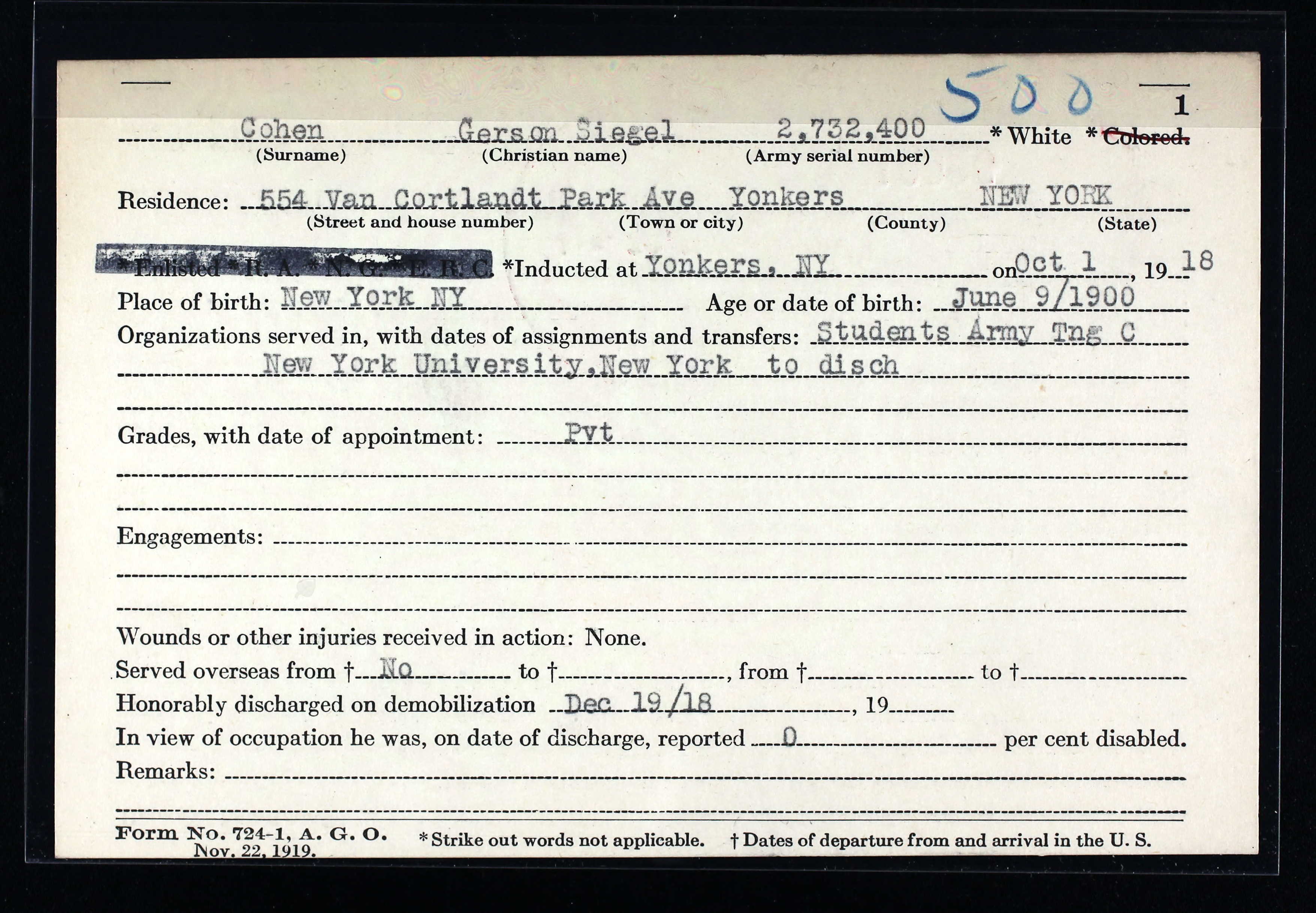
Ida and Jacob’s son Gerson was a student at New York University at the time he registered for the draft in 1917. He was inducted into the US Army on October 1, 1918, and was discharged on December 19, 1918, without ever serving overseas. He was part of the NYU student training corps.
Al Smith served four terms as governor of New York State and in 1928 became the first Catholic nominated by a major party as a candidate for President of the United States. He was soundly defeated by Herbert Hoover. But imagine if Jacob had won and served as NYS treasurer with Al Smith—and imagine if Smith had won in 1928—my cousin Jacob G. Cohen might have become the US Treasury Secretary. If he had won the election for New York State Treasurer, he would have been one of the first Jews to hold statewide office in New York.
Instead, Jacob returned to civilian life as a businessman. In 1920, Jacob and Ida were living in Chicago as lodgers in what appears to have been a very large boarding house or hotel. Jacob was working as the manager of a department store. Did he leave New York to escape after losing the election? In 1925 Jacob and Ida were back in New York, living in Manhattan, and Jacob was working as an insurance agent. Their daughter Aimee and her husband Lester and their son Robert were now living in Yonkers, and Lester was working in the silk industry. I was not able to locate Gerson on the 1920 US census or the 1925 New York State census.
Jacob died on February 13, 1930, according to a death notice in the New York Times.
(Obituary No. 5, February 15, 1930, New York Times, p. 17)
For a long time I could not find any records for Jacob or Ida after 1925, but then by searching for “Wronker” in the New York Times archives, I was able to find this death notice for Jacob, which revealed why I had not been able to find them: they had changed their surname from Cohen to Cole sometime between 1925 and 1930.
Gerson had also changed his last name to Cole and also his first name to Gary. (Even searching for him under Gary Cole has not provided me with any information about his whereabouts between 1918 and 1930 or after 1930.) After Jacob died, Ida moved in with Aimee and her family in Yonkers, where Lester continued to work as a sales manager in the silk industry.
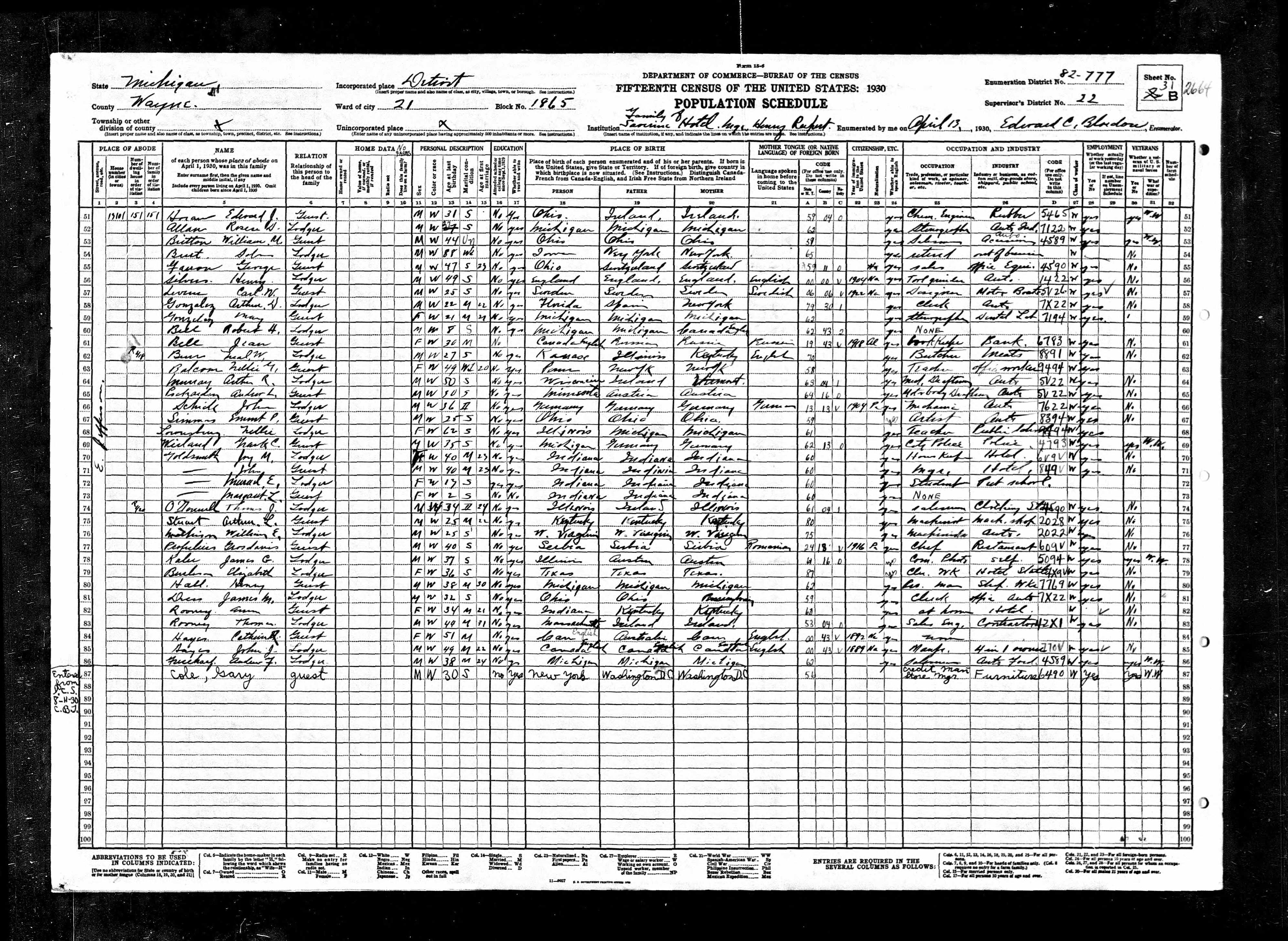
Gerson, now Gary Cole, finally reappeared in 1930 in Detroit as a credit manager for a furniture business. I believe this is the same Gary Cole/Gerson Cohen based on his age (30), birth place (New York), and birth places of his parents (Washington, DC.) He was living in what seems to be a hotel as a guest.
Gary Cole 1930 census
In 1940, Ida was still living with Aimee and Lester in Yonkers. Lester was now an executive in the silk business, according to the 1940 census.
Robert, now 20, was a student at Princeton, although he was still listed as living in his parents’ residence on the 1940 census. (Although the Princeton yearbook lists his address as being in the village of Tuckahoe, the census considered that same address to be in Yonkers.) According to several editions of the Princeton yearbook, Bric a Brac, found in the ancestry.com database, Robert played the oboe in the university band, was on the editorial staff of the Princeton Tiger, was a member of the Princeton Liberal Club and a member of the Nassau Literary Review (“the oldest undergraduate literary review in the country”), and was on the executive committee of the Princeton Anti-War Society in 1939, presumably a group arguing against the United States’ entry into World War II. Robert graduated from Princeton in 1940. The photo below is of Robert as an associate editor of the Nassau Literary Review.
Robert Wronker Ancestry.com. U.S. School Yearbooks [database on-line]. Provo, UT, USA: Ancestry.com Operations, Inc., 2010. Original data: Various school yearbooks from across the United States.
Despite his anti-war feelings, Robert enlisted in the military on March 18, 1941, listing his occupation as an “author, editor, reporter,” not surprising given his activities at Princeton.
After that he, like his uncle Gary Cole, disappeared. I could not find anything, which was surprising given the unusual name and his interest in writing and journalism. I wondered: Did he also change his name? Did he die? He is not listed under Robert Wronker on the SSDI or anywhere else. Once again, I was left with a loose end, a brick wall.
So I called on my mentor Renee Steinig once again for some direction, and damn, she found him so fast I was blown away. She was able to find a death notice for Robert in the New York Times as well as a death notice in the Princeton alumni magazine that I had not found. Robert had died on August 20, 1956, after a long illness. He was only 37 years old.
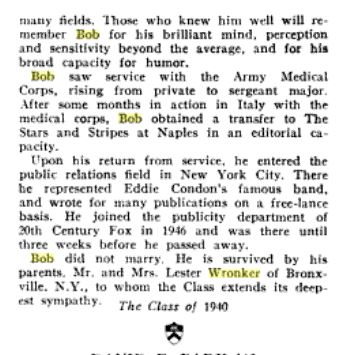
Here is what the Princeton Alumni Weekly wrote about him:
(Princeton Alumni Weekly, Volume 57 (1956) )
What a waste. Such a young and bright and talented person taken so young. His mother Aimee died only three years later in January, 1959, when she was 64 years old. His father Lester lived until October 1976, having survived both his wife and their only child.
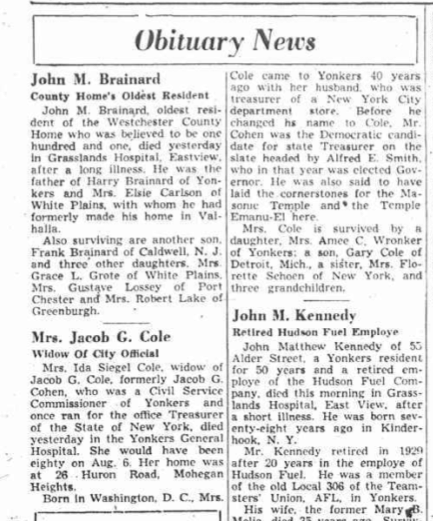
Renee also helped me find this obituary of Ida Cole, who died July 25, 1949.
Ida Cole obituary Yonkers Herald Stateman July 26, 1949. p. 2
Since Ida was survived by three grandchildren and Aimee only had one child, Robert, Gary must have had two children. I will continue to try and find Gary Cole/Gerson Siegel Cohen in hopes that the line of Jacob G. Cohen/Cole and his wife Ida did not end with the untimely death of their grandson Robert Wronker.
When I think about all the “what ifs” with Jacob and with his descendants, I feel very wistful about how this line might have ended.









































![Robert Wronker Ancestry.com. U.S. School Yearbooks [database on-line]. Provo, UT, USA: Ancestry.com Operations, Inc., 2010. Original data: Various school yearbooks from across the United States.](https://brotmanblog.com/wp-content/uploads/2014/08/wronker-photo-princeton.jpg)

 Brotmanblog: A Family Journey