Abraham Blumenfeld III’s Family 1909-1928: Births and Deaths

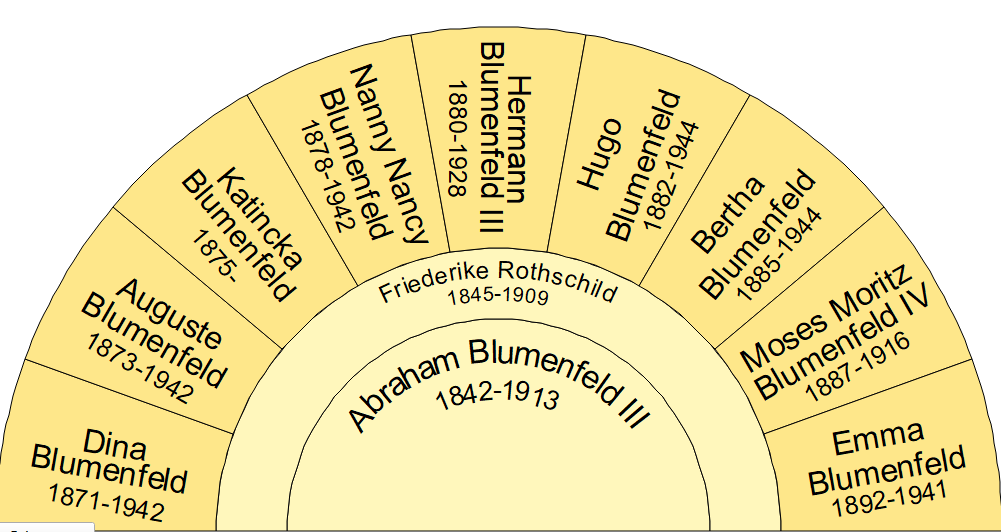
When Friedericke Rothschild Blumenfeld died on October 8, 1909, five of her nine children were married. There were also quite a few grandchildren born before and shortly after Friedericke’s death. To recap:

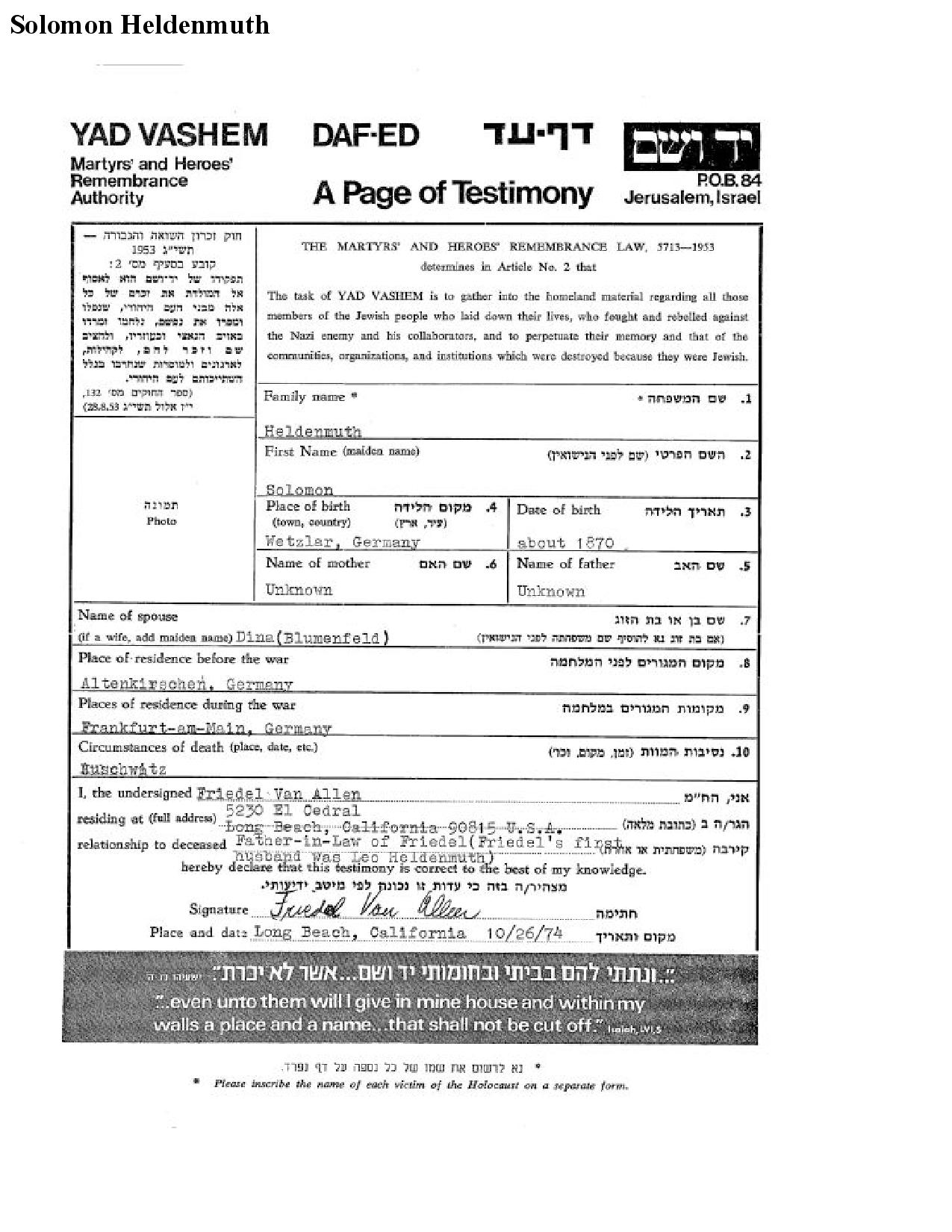
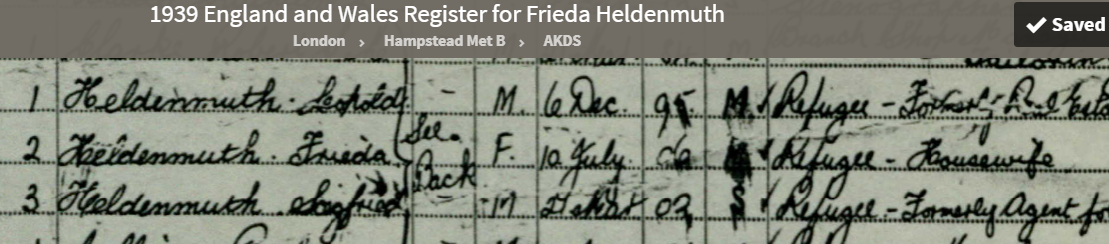
Dina and her husband Salomon Heldenmuth had two children: Gertrude (1897) and Siegfried (1902).

Auguste and her husband Menko Stern’s son Max was born in 1901, and their son Julius was born in February, 1910, a few months after Friedericke’s death

Katincka and her husband Samuel Heymann had lost their one child Frieda at ten months in July 1911. She was probably named for her grandmother Friedericke since she was born sometime around September 1910.

We saw that the family had a double/double wedding on June 30, 1909, when Nanny Blumenfeld married Jakob Stern and her brother Hermann Blumenfeld married Jeanette Stern, Jakob’s sister. Those two marriages produced more grandchildren born after Friedericke’s death

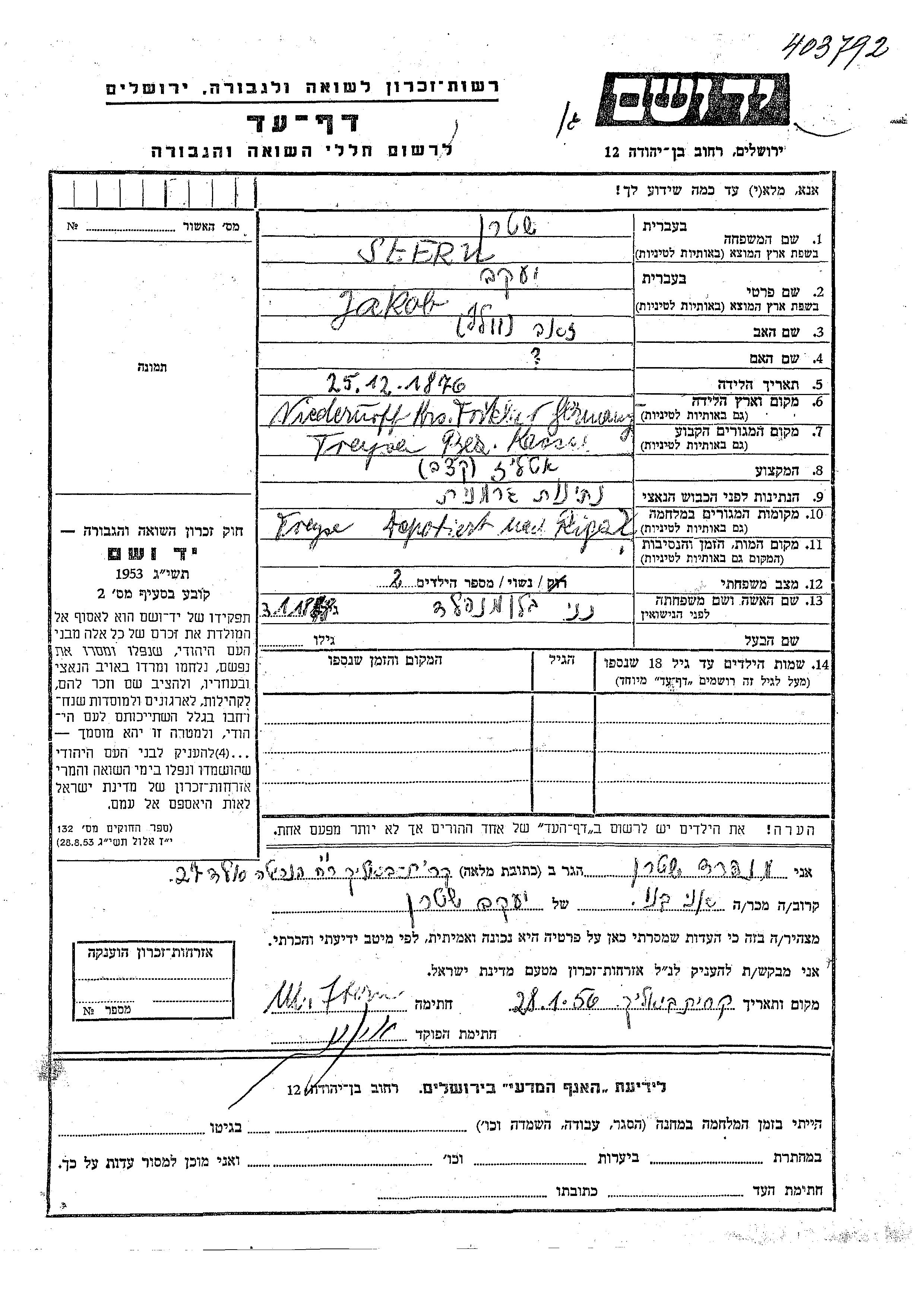
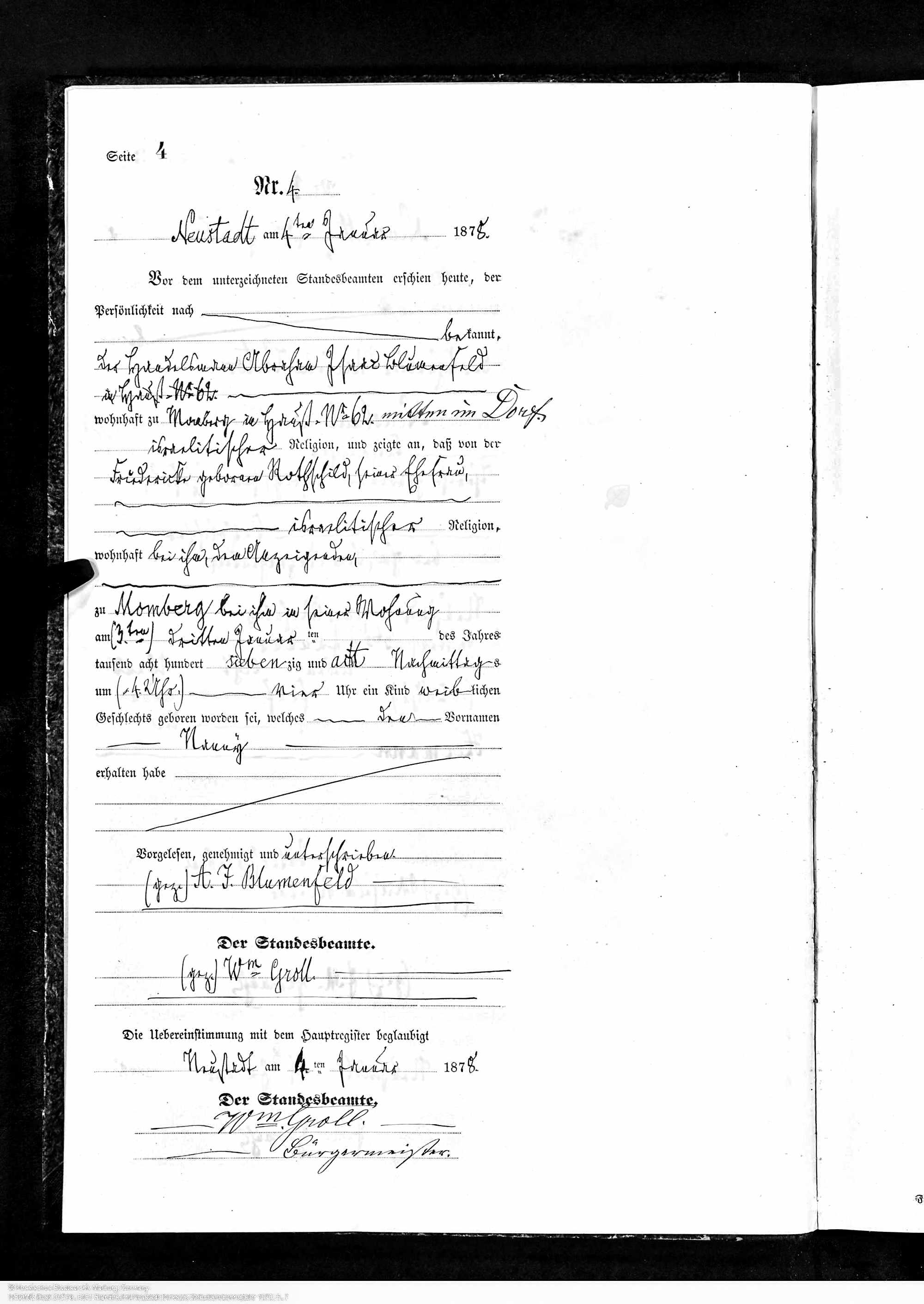
Nanny and her husband Jakob Stern had two children. Manfred Stern was born on July 3, 1910, in Treysa.

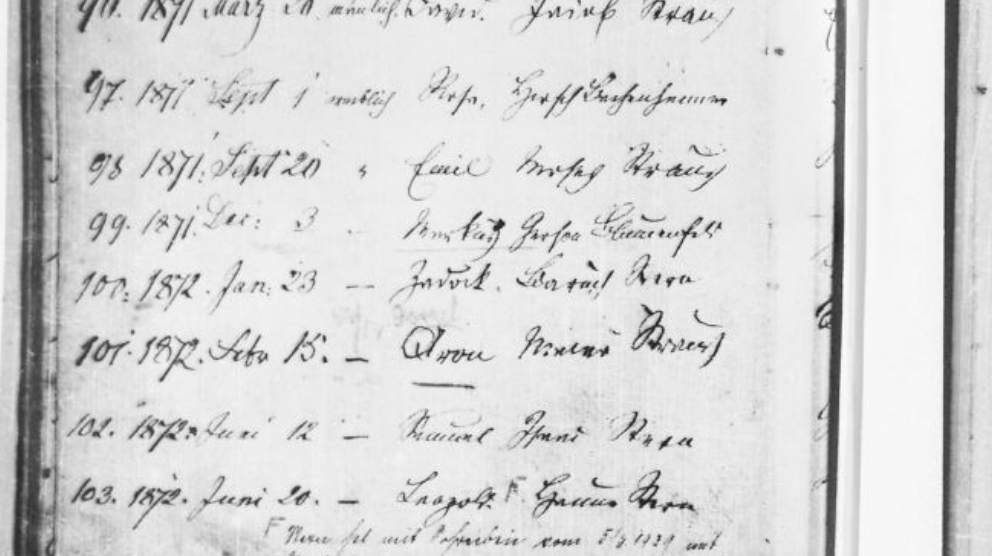
Manfred Stern birth record, Arcinsys Hessen Archives, HHStAW Fonds 365 No 792, p. 56

His brother Arthur Stern was born on November 12, 1914, in Treysa.

Arthur Stern birth record , Arcinsys Archives Hessen, HHStAW Fonds 365 No 792, p. 57

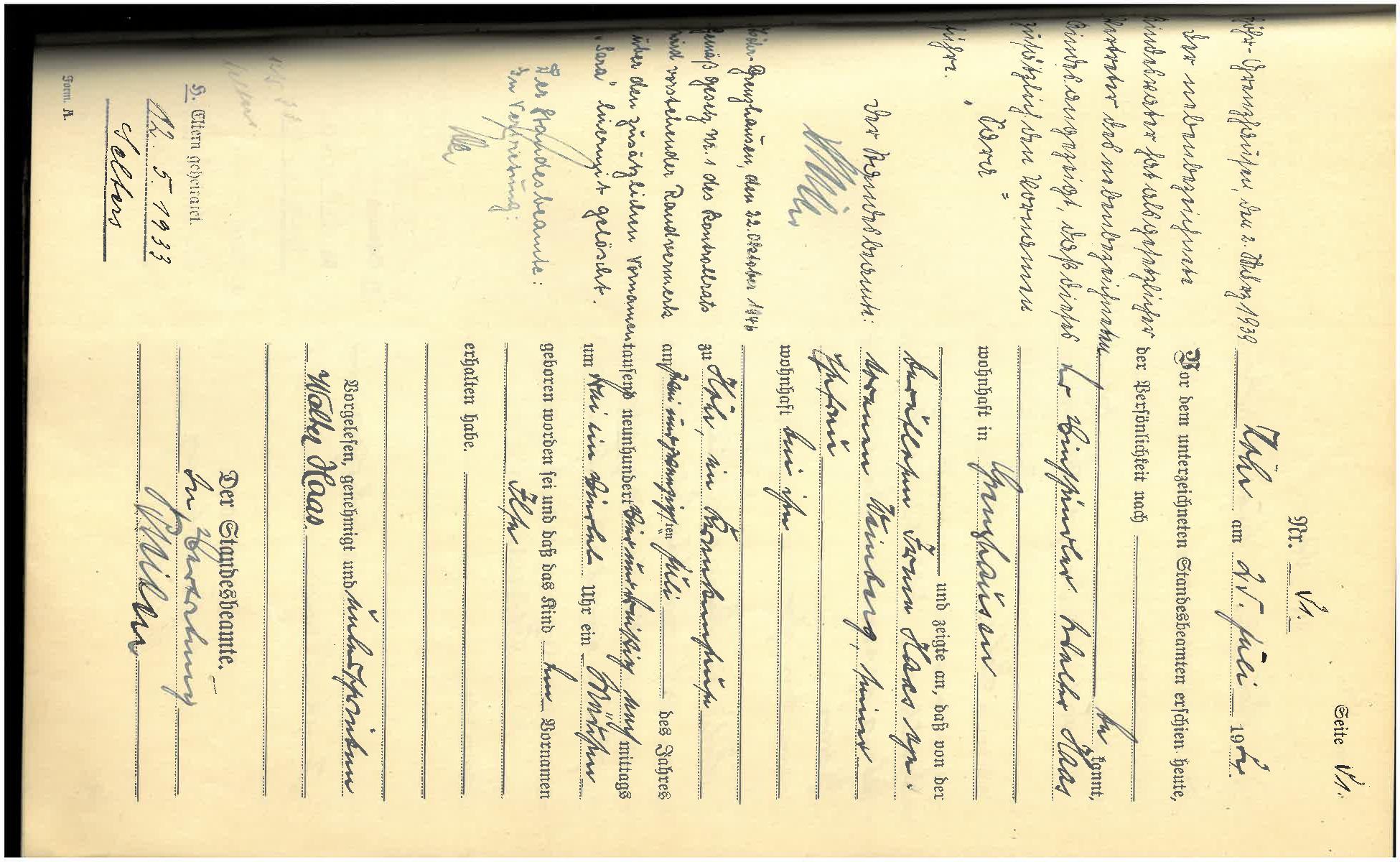
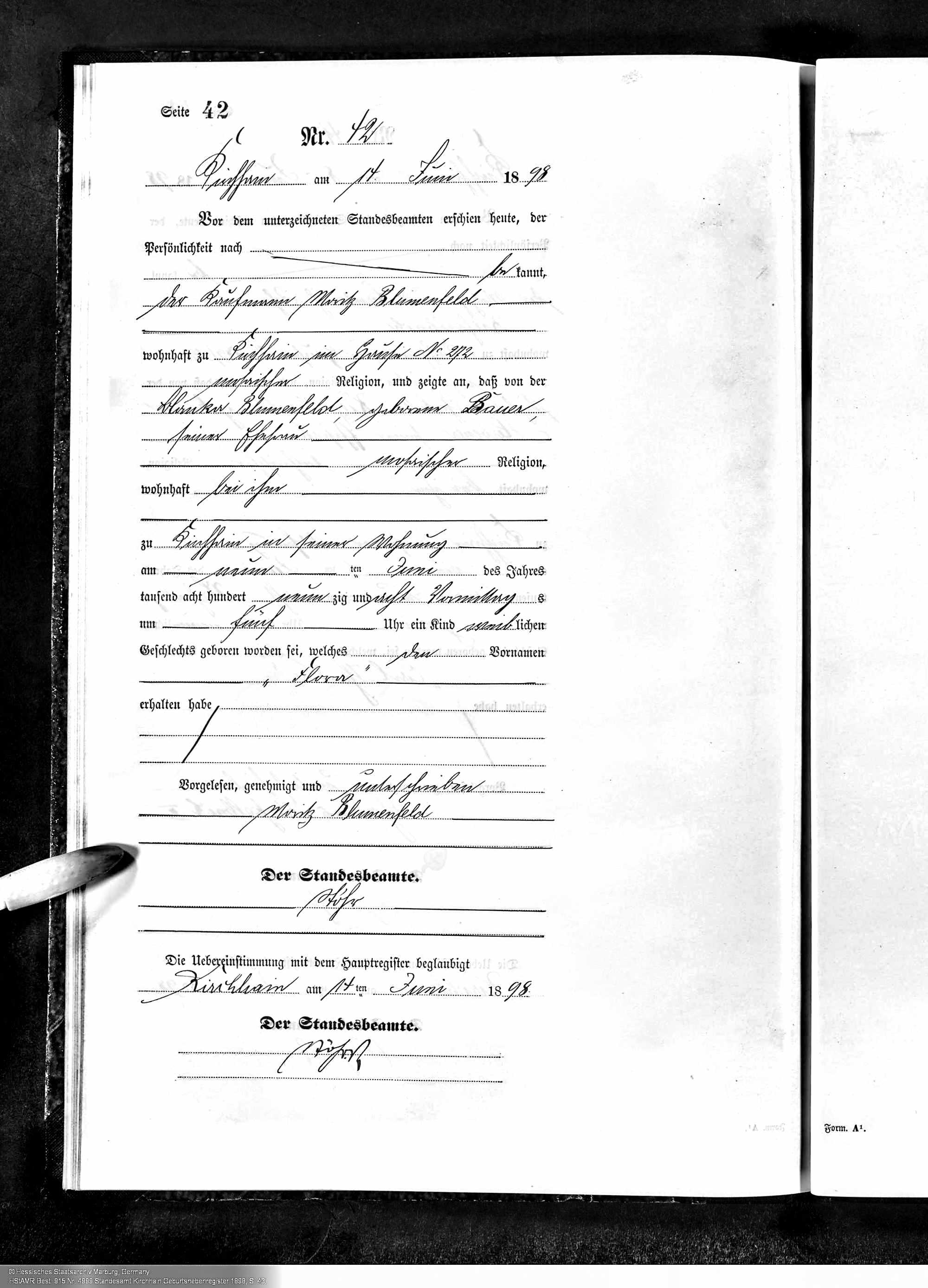
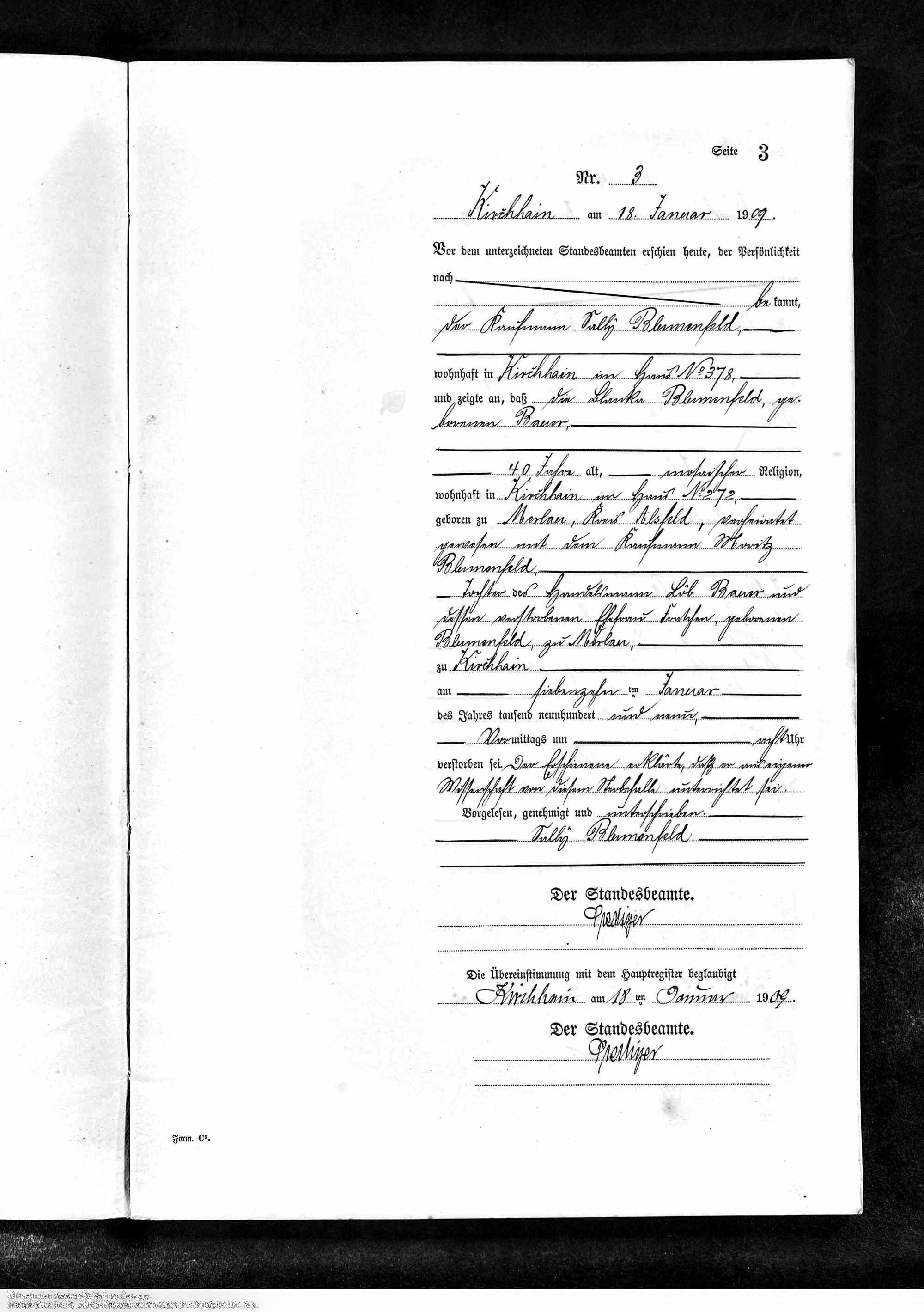
Hermann Blumenfeld III and his wife Jeanette had four children. Julius Blumenfeld was born on May 29, 1910, in Momberg.1His sister Frieda was born in Momberg on August 24, 1911;2 she was probably named for Friedericke, but might also have been named for her cousin Frieda Heymann, who had died the month before.

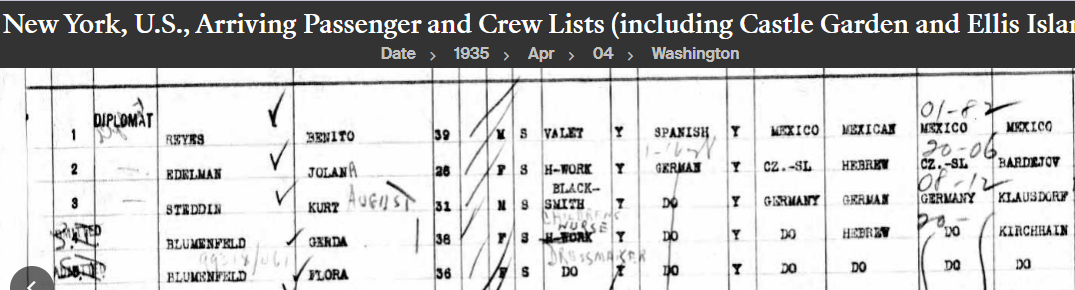
Hermann III and Jeanette’s third child was Max Blumenfeld, born in 1913.3

Abraham Blumenfeld III had lived to see the births of all ten of these grandchildren, and there were two more to come. But he died on December 8, 1913, at the age of 71.

Personenstandsregister Sterberegister; Bestand: 915; Laufende Nummer: 6223, Year Range: 1913, 
Ancestry.com. Hesse, Germany, Deaths, 1851-1958

Although I have not been able to locate one record to verify this, according to several trees on Ancestry, Jeanette Stern Blumenfeld gave birth to a fourth child, Alfred, on April 23, 1915. If Jeanette did have this fourth child, it must have led to health problems because she died just a few weeks later on May 8, 1915, in Marburg, Germany.

Jeanette Stern Blumenfeld death record, Personenstandsregister Sterberegister; Bestand: 915; Laufende Nummer: 5705, Year Range: 1915, Ancestry.com. Hesse, Germany, Deaths, 1851-1958

Jeanette was only 32 years old and left behind four children all under five years of age. Her husband Hermann was a widower at 35.

That tragedy was followed just a year later when Moritz Blumenfeld IV, the eighth and second youngest child of Abraham III and Friedericke, was killed on June 21, 1916, fighting for Germany while the German army was storming Fort Souville in France, a key battlefield in the Verdun battle during World War I. Moritz was 29 years old when he lost his life in battle. Like his cousin Siegmund Blumenfeld, he gave his life for the country that would persecute and murder his relatives just twenty years later.

His two brothers-in-law Jakob Stern and Menko Stern also fought for Germany in World War I, but they came back alive.

Thus, in three years the family lost Abraham Blumenfeld III, his daughter-in-law Jeanette Stern Blumenfeld, and his youngest son Moritz Blumenfeld IV.

On April 12, 1920, Hermann Blumenfeld III remarried five years after losing his first wife Jeanette. His second wife was Ida Stern, daughter of Samuel Stern and Guetel Loewenstein, born in Wehrda, Germany, on September 17, 1878. As far as I can determine, there was no relationship between Ida Stern and Hermann’s first wife Jeanette Stern, but there may very well have been some cousin relationship.

Hermann Blumenfeld and Ida Stern marriage record, Hessisches Hauptstaatsarchiv; Wiesbaden, Deutschland; Bestand: 915; Laufende Nummer: 3583, Year Range: 1920, Ancestry.com. Hesse, Germany, Marriages, 1849-1930

Hermann and Ida had one child together, a son Kurt Siegfried Blumenfeld, born in Momberg on July 11, 1921.4

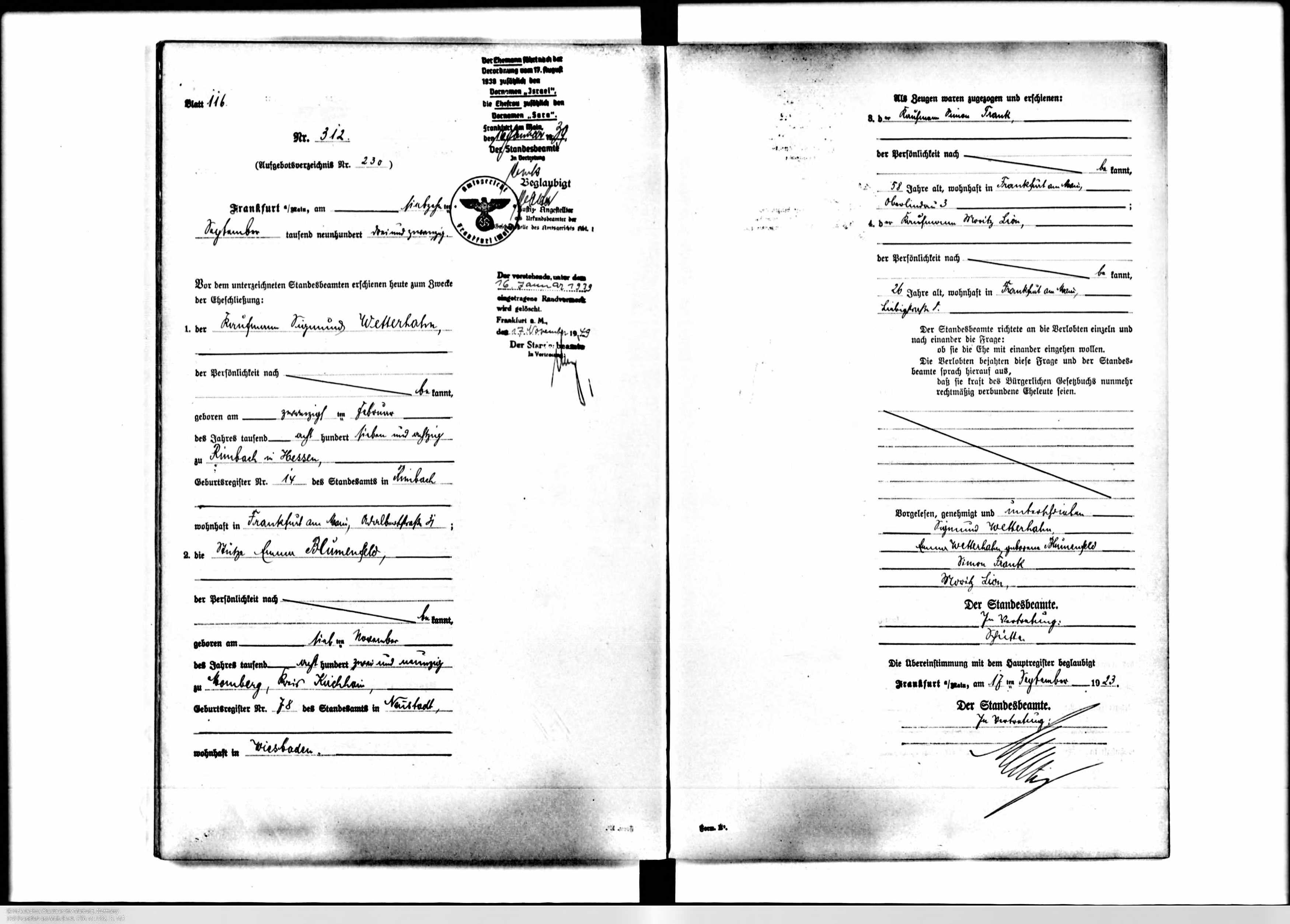
Neither Hugo Blumenfeld nor his sister Bertha Blumenfeld, the sixth and seventh of the nine children of Abraham Blumenfeld III, ever married or had children. In fact, there were no more weddings or births in the family until Emma Blumenfeld, the youngest sibling, married Siegmund Wetterhahn on September 17, 1923. Siegmund was born in Rimbach, Germany, on February 20, 1887, to Alexander Wetterhahn and Emilie Seligmann. Emma had lost her mother when she was a teenager and her father when she was 22. But she fortunately had seven older siblings and many nieces and nephews still living when she married Siegmund Wetterhahn.

Emma Blumenfeld and Siegmund Wetterhahn marriage record, Hessisches Hauptstaatsarchiv; Wiesbaden, Deutschland; Bestand: 903, Year Range: 1923, Ancestry.com. Hesse, Germany, Marriages, 1849-1930

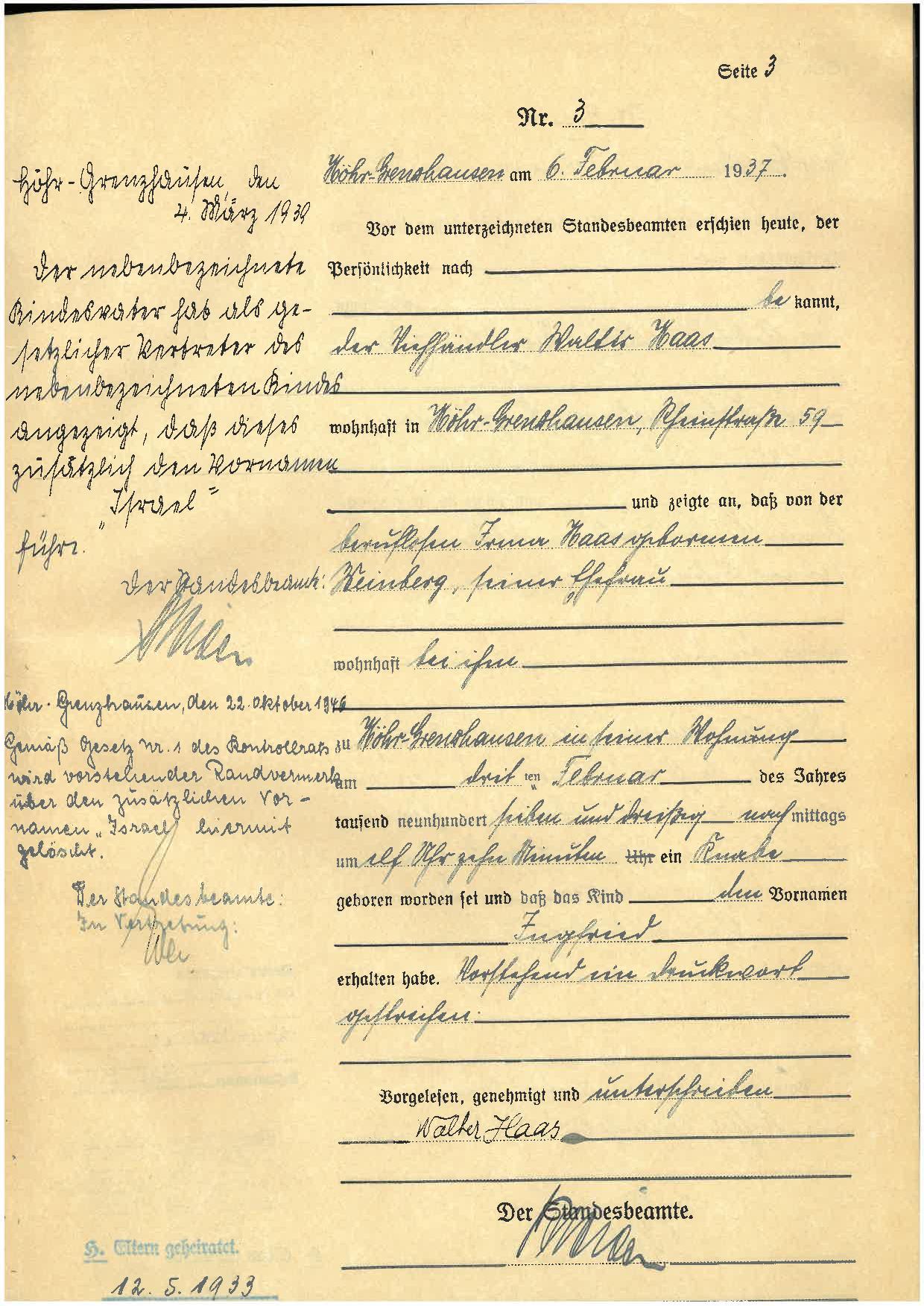
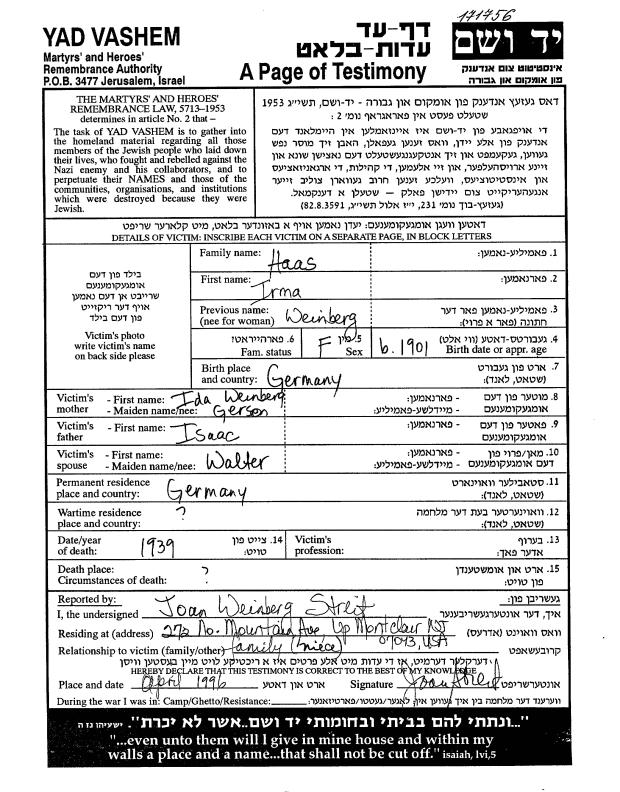
Siegmund and Emma had one child, a daughter Trude Ruth Friedericke Wetterhahn, born on April 9, 1925, in Frankfurt, Germany. She was the last born of the twelve grandchildren of Abraham Blumenfeld III and Friedericke Rothschild.5

Tragedy struck the family three years later when Hermann Blumenfeld III, widowed at 35 and left to raise four children on his own, died at age 48 in Momberg on October 17, 1928. He also left behind his second wife Ida and their seven year old son Kurt.

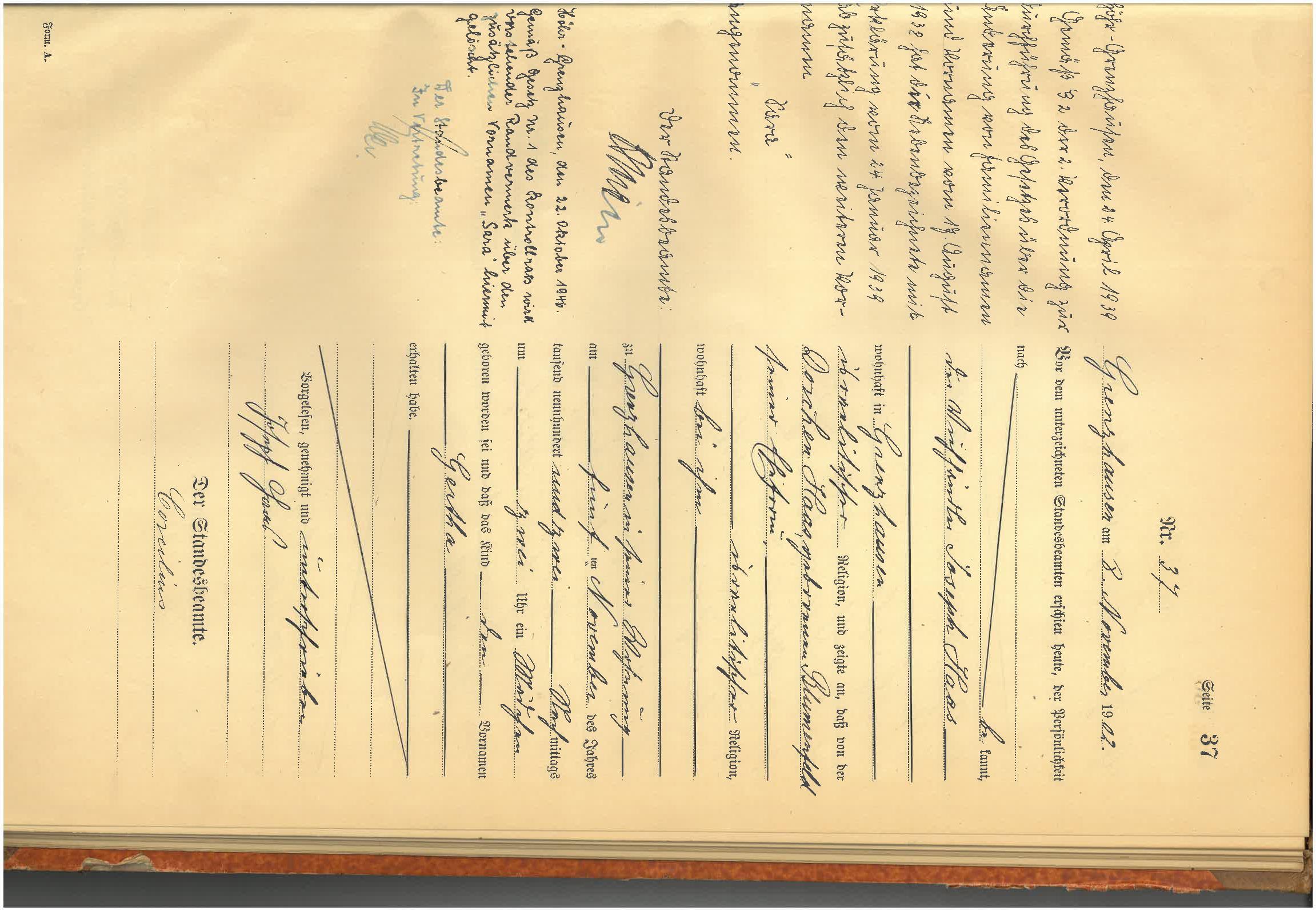
Hermann Blumenfeld death record, Personenstandsregister Sterberegister; Bestand: 915; Laufende Nummer: 6238, Year Range: 1928, Ancestry.com. Hesse, Germany, Deaths, 1851-1958

Thus, by the end of 1928, seven of the nine children of Abraham III and Friedericke were still living, but two of the three sons had died, Moritz in World War I and Hermann. Eleven of their grandchildren were also living.

How many of these descendants of Abraham Blumenfeld III and Friedericke would survive the Holocaust?

To be continued.


  1. Julius Blumenfeld, Gender: männlich (Male), Nationality: dtsch. Juden, Residence Age: 29, Record Type: Residence, Birth Date: 29 Mai 1910 (29 May 1910), Birth Place: Momberg, Last Residence: Momberg, Sojourn Start Date: 3 Mai 1940 (3 May 1940)
    Residence Place: Treysa Ziegenhain, Sojourn End Date: 18 Okt 1940 (18 Oct 1940)
    Notes: Foreigners who were living in the location during the war – permanently or temporarily, Reference Number: 02010101 oS, Document ID: 70487480Arolsen Archives, Digital Archive; Bad Arolsen, Germany; Lists of Persecutees 2.1.1.1, Reference Code: 02010101 oS, Ancestry.com. Free Access: Europe, Registration of Foreigners and German Persecutees, 1939-1947 
  2.  Frieda Blumenfeld S., Gender: weiblich (Female), Nationality: Deutsch Juden
    Record Type: Miscellaneous, Birth Date: 24 Aug 1911, Birth Place: Momberg
    Residence Place: Momberg Marburg, Notes: Lists of judicial and official files concerning foreigners and German Jews, Reference Number: 02010101 oS, Document ID: 70443455, Arolsen Archives, Digital Archive; Bad Arolsen, Germany; Lists of Persecutees 2.1.1.1, Ancestry.com. Free Access: Europe, Registration of Foreigners and German Persecutees, 1939-1947 
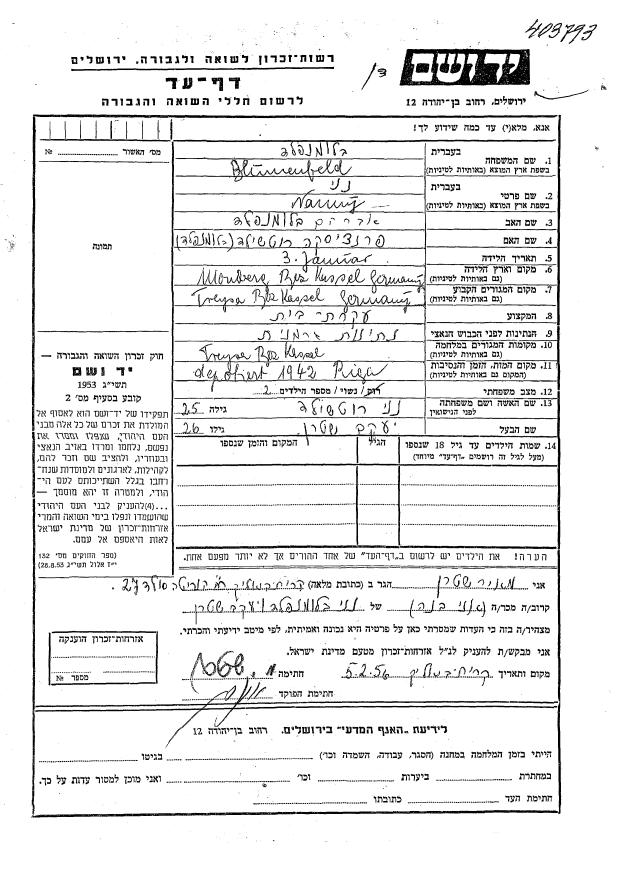
  3. Meir Max Blumenfeld, Name in Hebrewמאיר מקס בלומנפלדHebrew Nameמאיר מקס, Birth Date1913 Death Date21 Sep 2004 / ו תשרי תשסהDeath Place Kaplan Hospital, Rehovot /בי”ח קפלן Age at Death91Burial Date22 Sep 2004Burial Plotסא ד 29Burial PlaceRehovot, IsraelFather NameHerman /הרמןMother NameYenta /ינטהCemetery Burials197 
  4.  Arolsen Archives, Digital Archive; Bad Arolsen, Germany; Lists of Persecutees 2.1.1.1, Description Reference Code: 02010101 oS, Ancestry.com. Free Access: Europe, Registration of Foreigners and German Persecutees, 1939-1947 
  5. Entry at Yad Vashem found at https://yvng.yadvashem.org/nameDetails.html?language=en&itemId=11654659&ind=1 

Abraham Blumenfeld III’s Children: Sisters and Brothers Marrying Sisters and Brothers, and Down the Rabbit Hole I Fell

As we saw, Abraham Blumenfeld III and his wife Friedericke Rothschild had nine children born between 1871 and 1892. By 1894, the older children were beginning to marry and have children of their own while Abraham and Friedericke were still raising their younger children.

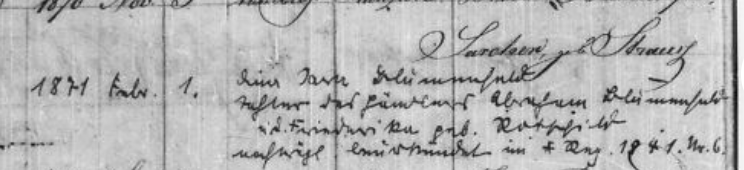
The oldest child of Abraham III and Friedericke was their daughter Dina, born on February 1, 1871. She married Salomon Heldenmuth on November 27, 1894. Salomon, the son of Samuel Heldenmuth and Auguste Katz, was born in Altenkirchen, Germany, on May 16, 1866.

Marriage of Dina Blumenfeld and Salomon Heldenmuth, Hessisches Hauptstaatsarchiv; Wiesbaden, Deutschland; Bestand: 915; Laufende Nummer: 6504, Ancestry.com. Hesse, Germany, Marriages, 1849-1930

Dina and Salomon had three children. Leopold was born on December 5, 1895, in Altenkirchen.

Leopold Heldenmuth birth record, Hessisches Hauptstaatsarchiv; Wiesbaden, Deutschland; Bestand: 911; Laufende Nummer: 4624, Year Range: 1895, Ancestry.com. Hesse, Germany, Births, 1851-1901

Gertrude was born on July 31, 1897, in Altenkirchen.

Gertrud Heldenmuth birth record, Hessisches Hauptstaatsarchiv; Wiesbaden, Deutschland; Bestand: 911; Laufende Nummer: 4626, Year Range: 1897, Ancestry.com. Hesse, Germany, Births, 1851-1901

And Siegfried was born March 21, 1902, also in Altenkirchen.1

Auguste, the second child of Abraham Blumenfeld III and Friedericke Rothschild, born on June 13, 1873, married Menko Stern on December 19, 1900. Menko was the son of Wolf Stern and Minna Hirsch and was born in Niederurff on March 30, 1872.

Marriage record of Auguste Blumenfeld and Menko Stern, Hessisches Hauptstaatsarchiv; Wiesbaden, Deutschland; Bestand: 920; Laufende Nummer: 8009, Year Range: 1900, Ancestry.com. Hesse, Germany, Marriages, 1849-1930

Auguste and Menko had two children born in Treysa, Germany. Max was born on November 7, 1901.

Birth record, Max Stern, Arcinsys Archives Hessen, HHStAW Fonds 365 No 792, p. 52

Julius was born on February 1910 in Trysa.

Birth record of Julius Stern, Arcinsys Archives Hessen, HHStAW Fonds 365 No 792, p. 55

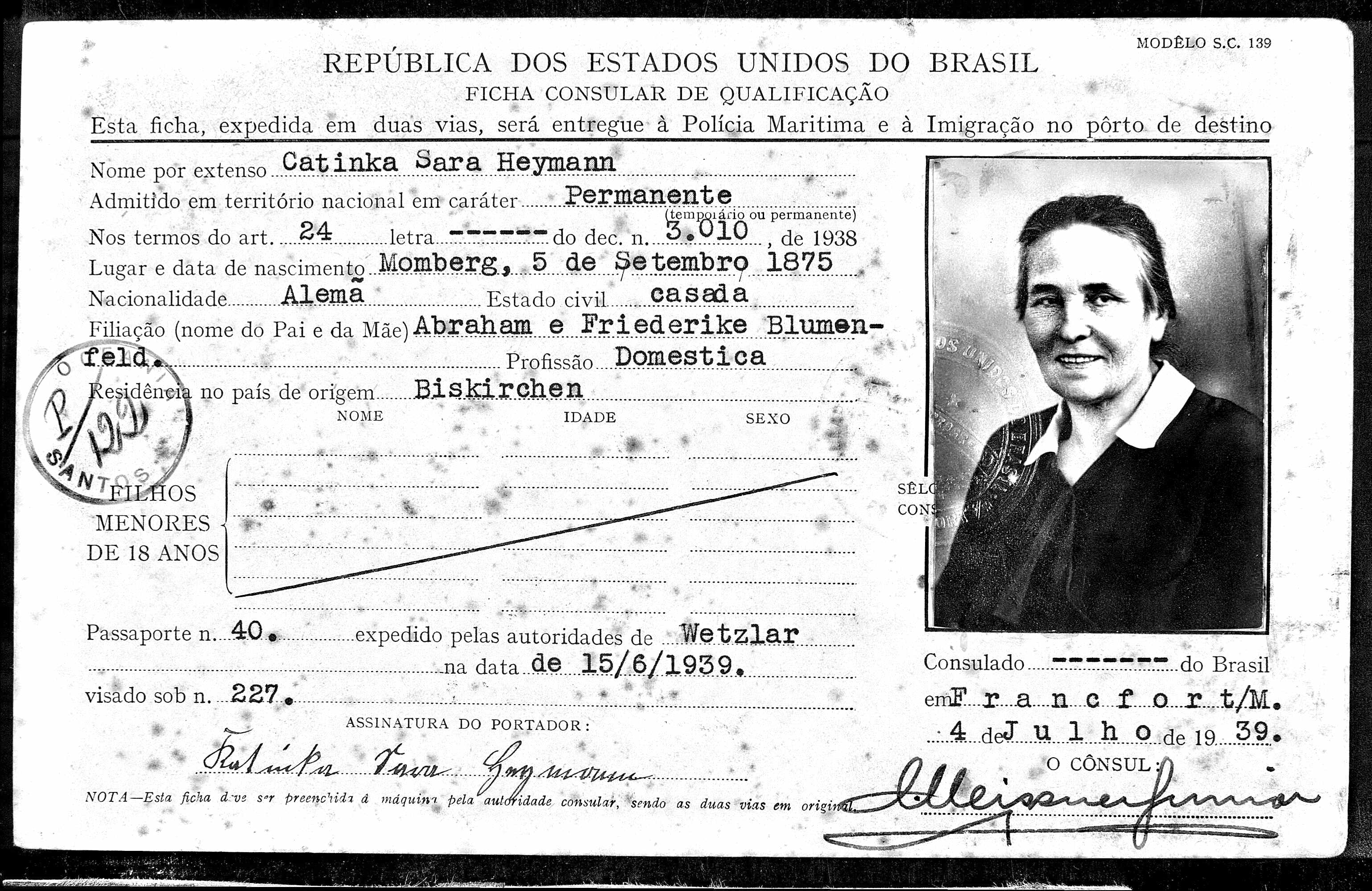
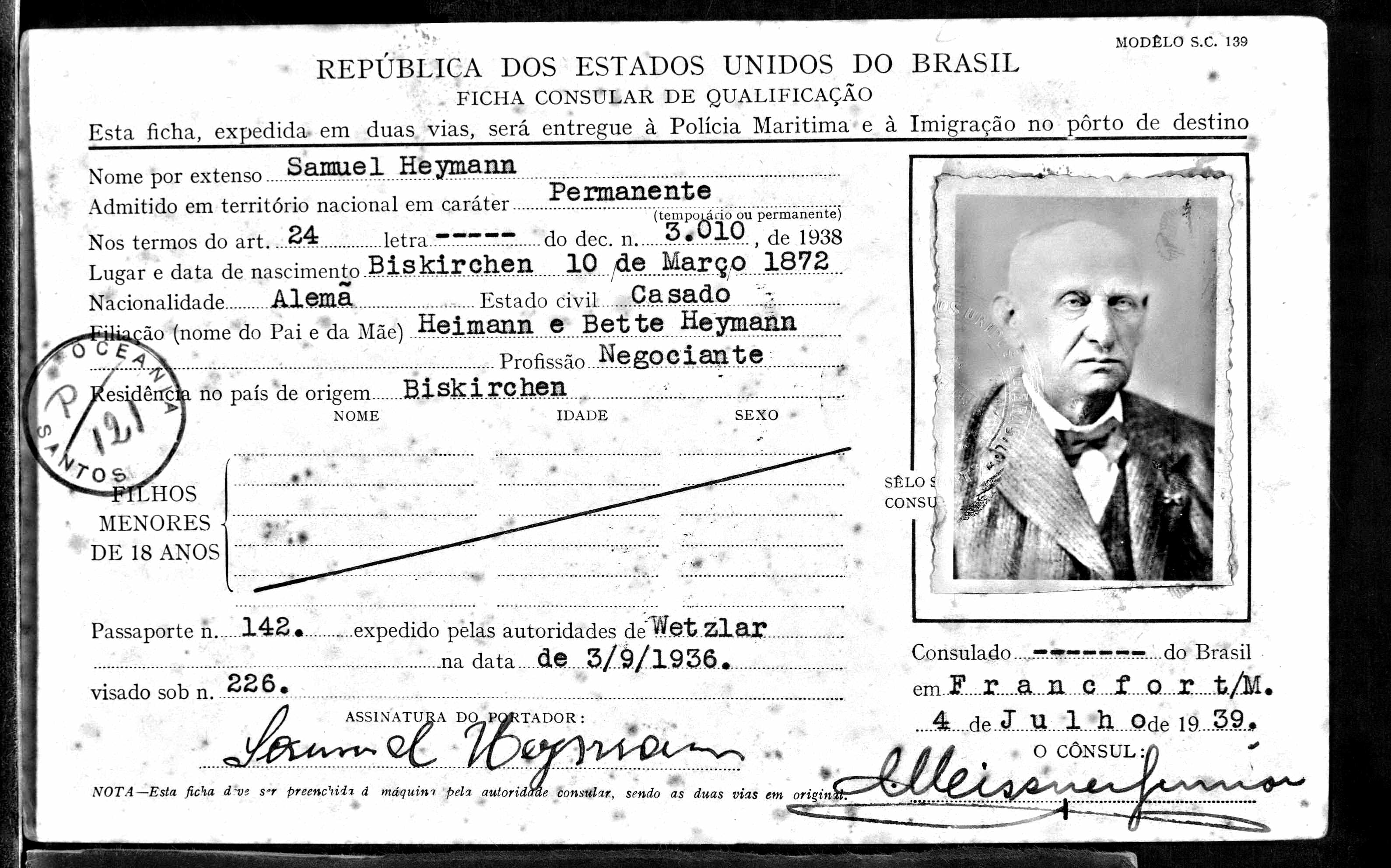
The third child of Abraham III and Friedericke, Katincka, was born September 5, 1875, and she married Samuel Heymann on November 28, 1902, in Greifenstein, Germany. He was born in Biskirchen, Germany, on March 10, 1872, to Heimann Heymann and Betty Moses.

Marriage record of Katincka Blumenfeld and Samuel Heymann, Hessisches Hauptstaatsarchiv; Wiesbaden, Deutschland; Bestand: 911; Laufende Nummer: 7199, Year Range: 1902, Ancestry.com. Hesse, Germany, Marriages, 1849-1930

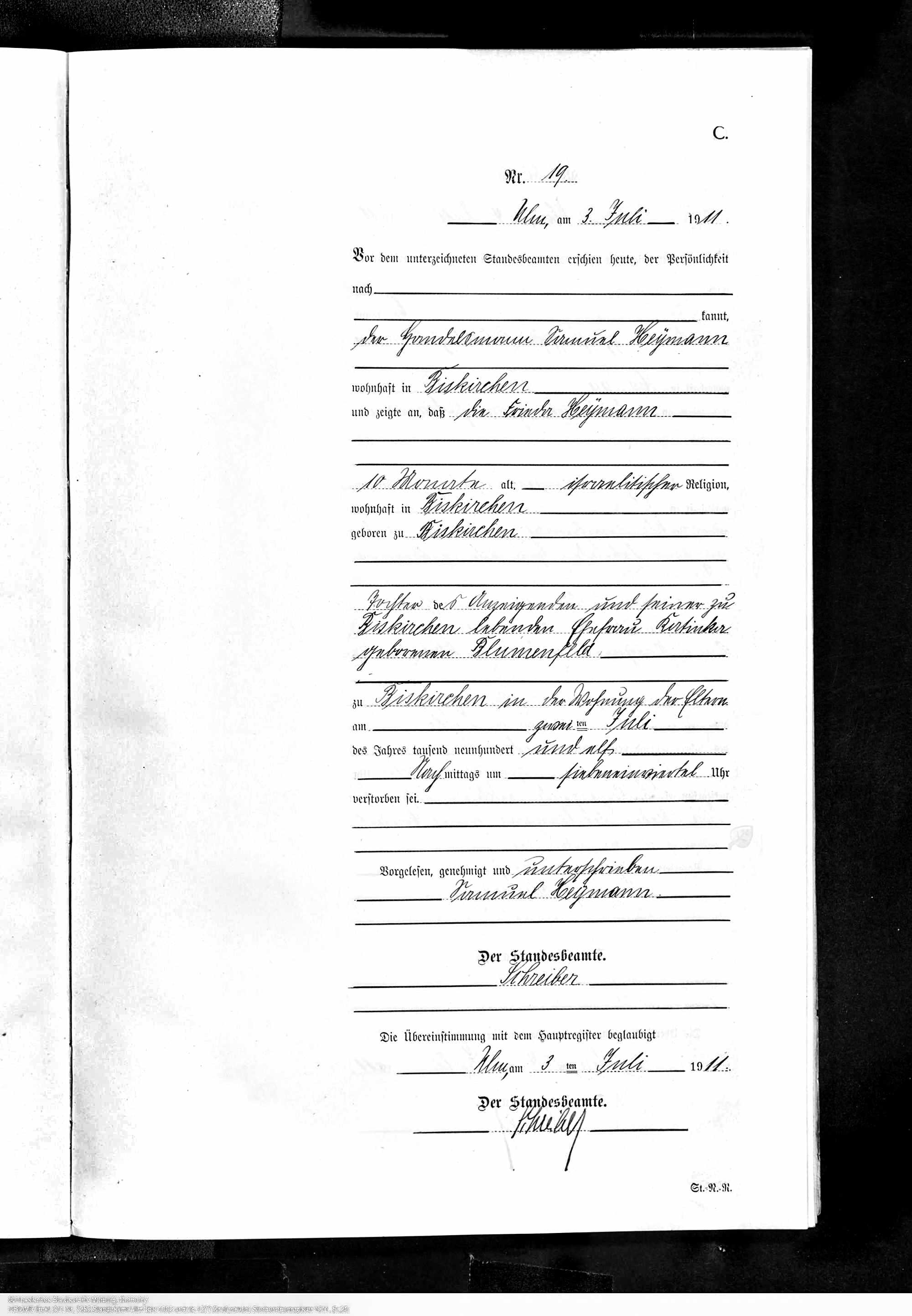
Katincka and Samuel had one child, Frieda, who died when she was ten months old on July 2, 1911.

Death record of Frieda Heymann, Personenstandsregister Sterberegister; Bestand: 911; Laufende Nummer: 7256, Year Range: 1911, Ancestry.com. Hesse, Germany, Deaths, 1851-1958

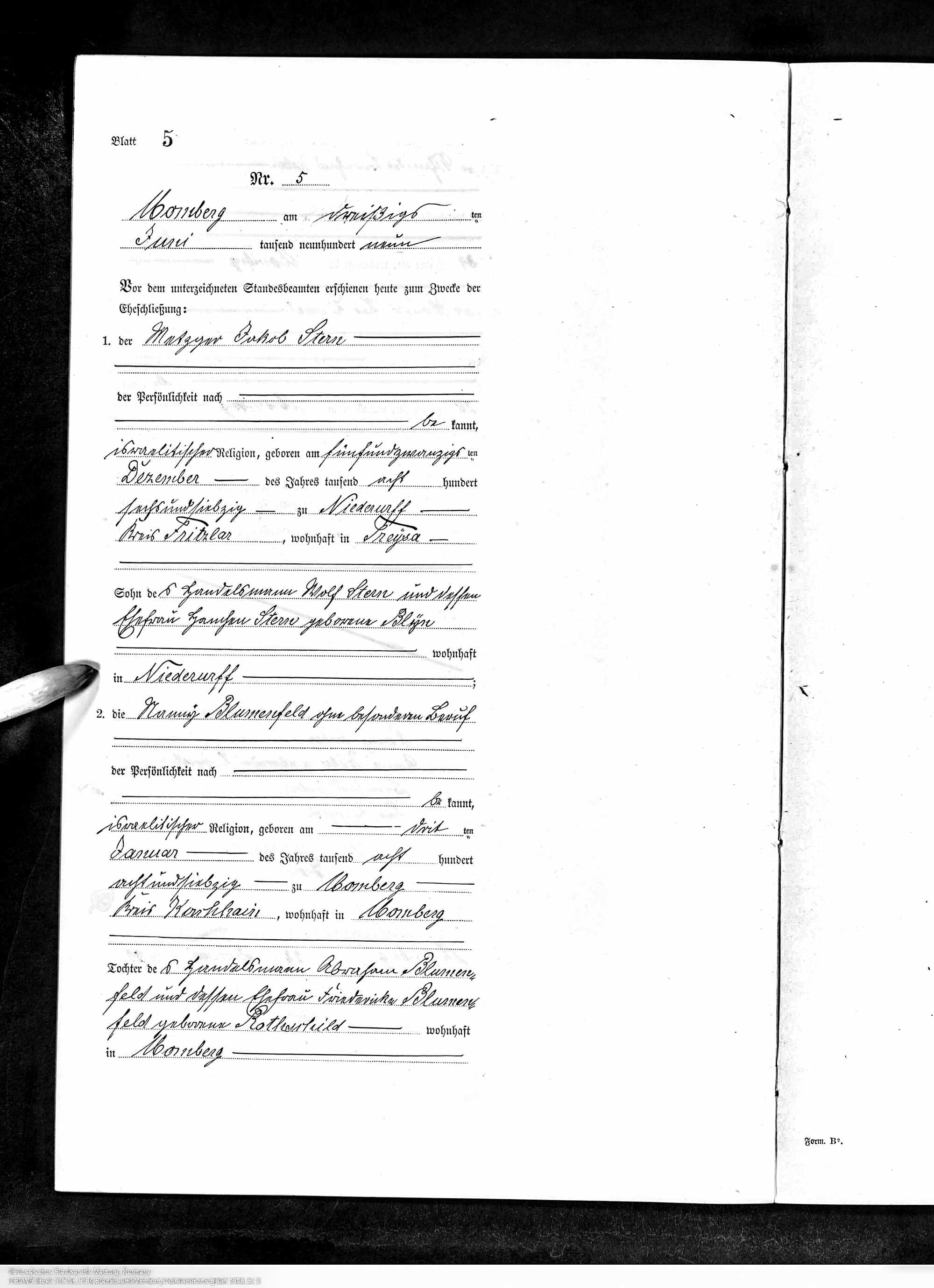
Abraham III and Friedericke’s fourth child, their daughter Nanny, who was born on January 3, 1878, in Momberg married Jakob Stern on June 30, 1909, in Momberg.  He was born in Niederurff on December 25, 1876, to Wolf Stern and Hannah Blyn.

Nanny Blumenfeld Jakob Stern marriage record, Hessisches Hauptstaatsarchiv; Wiesbaden, Deutschland; Bestand: 915; Laufende Nummer: 6194, Year Range: 1909, Ancestry.com. Hesse, Germany, Marriages, 1849-1930

There was actually a double/double wedding on June 30, 1909, the day Nanny Blumenfeld married Jakob Stern because Nanny’s brother Hermann married Jakob’s sister Jeannette Stern that day. Jeannette, also known as Johannette, was also the child of Wolf Stern and Hannah Blyn and was born in Niederurff on January 23, 1883.

Marriage of Hermann Blumenfeld and Jeannette Stern, Hessisches Hauptstaatsarchiv; Wiesbaden, Deutschland; Bestand: 915; Laufende Nummer: 6194, Year Range: 1909, Ancestry.com. Hesse, Germany, Marriages, 1849-1930

But then the question came to me: were Jeanette Stern and Jakob Stern related to Menko Stern, who’d married Auguste Blumenfeld, the sister of Hermann and Nanny Blumenfeld?

I went down quite a rabbit hole trying to ascertain whether the Wolf Stern who was the father of Menko Stern was the same Wolf Stern who was the father of Jakob Stern and Jeannette Stern. Knowing how names repeat in Jewish families, it could very well have been possible that there were two Wolf Sterns from Niederurff who were cousins or not even related. To answer this question, I needed to know the names of the parents of the two “Wolf Stern” entries on my tree, and so I looked for marriage records for Wolf Stern and Minna Hirsch and for Wolf Stern and Hannah Blyn and/or for birth records for Wolf Stern.

Unfortunately, I had no luck. I looked for records in the towns where Minna Hirsch was born (Sachsenhausen) and where Hannah Blyn was born (Niederurff)2 since marriages often took place in the brides’ hometowns. I was hampered to some extent by which records were available online for each of these towns.

I consulted with Dennis Aron, who has the same Wolf Stern married to both Minna and Hannah (not at the same time, of course) on his Ancestry tree. He sent me a link to the page for Wolf Stern’s gravestone on the LAGIS Jewish cemetery website, which reports as follows (translation by Google Translate):

Wolf Stern, butcher; born on September 4th, 1843 in Niederurff; Parents: Meier Stern, butcher and trader, and his first wife, Fradchen (Fratchen), born Rothschild, from Gilserberg, living in Niederurff;

married in first marriage legally (officially) in Jesberg on May 21, 1869, born in Minchen, Hirsch from Sachsenhausen (Waldeck), born there on April 11, 1839, daughter of the married couple Michel Hirsch and Süschen, born in Löwenstern;

married in second marriage judicially (officially) in Jesberg on November 8th, 1872 Hanna née Blyn [Stein No. 132] from Zwesten;

died on May 5th, 1922 in Niederurff at the stated age of 78 years, 8 months and 1 day.

That sent me to the marriage records for Jesberg online, but again I had no luck because those years are not included in the online archives for Jesberg on any of the sites for Jewish records in Hesse. I also was puzzled as to why a man born in Niederurff marrying women born in Sachsenhausen and Niederurff would have married them in Jesberg. Jesberg is under four miles from Niederurff and 22 miles from Sachsenhausen.

I also had no luck locating a death record for Minna Hirsch, which might have given me evidence of why Wolf Stern married Hanna Blyn just three years after supposedly marrying Minna.

I finally crawled out of the rabbit hole, thinking, “Does it matter if Jakob and Johannette Stern were the half-siblings of Menko Stern?” I decided to accept that the best I could do was rely on the information on the LAGIS Jewish cemetery website and assume that they were.

It was only after I’d given up on finding an answer that I located an article about the Stern family of Treysa written when Stolpersteine were installed for them in Treysa. According to that article, Jakob and Menko were brothers and in business together as butchers, living and working in the same house.

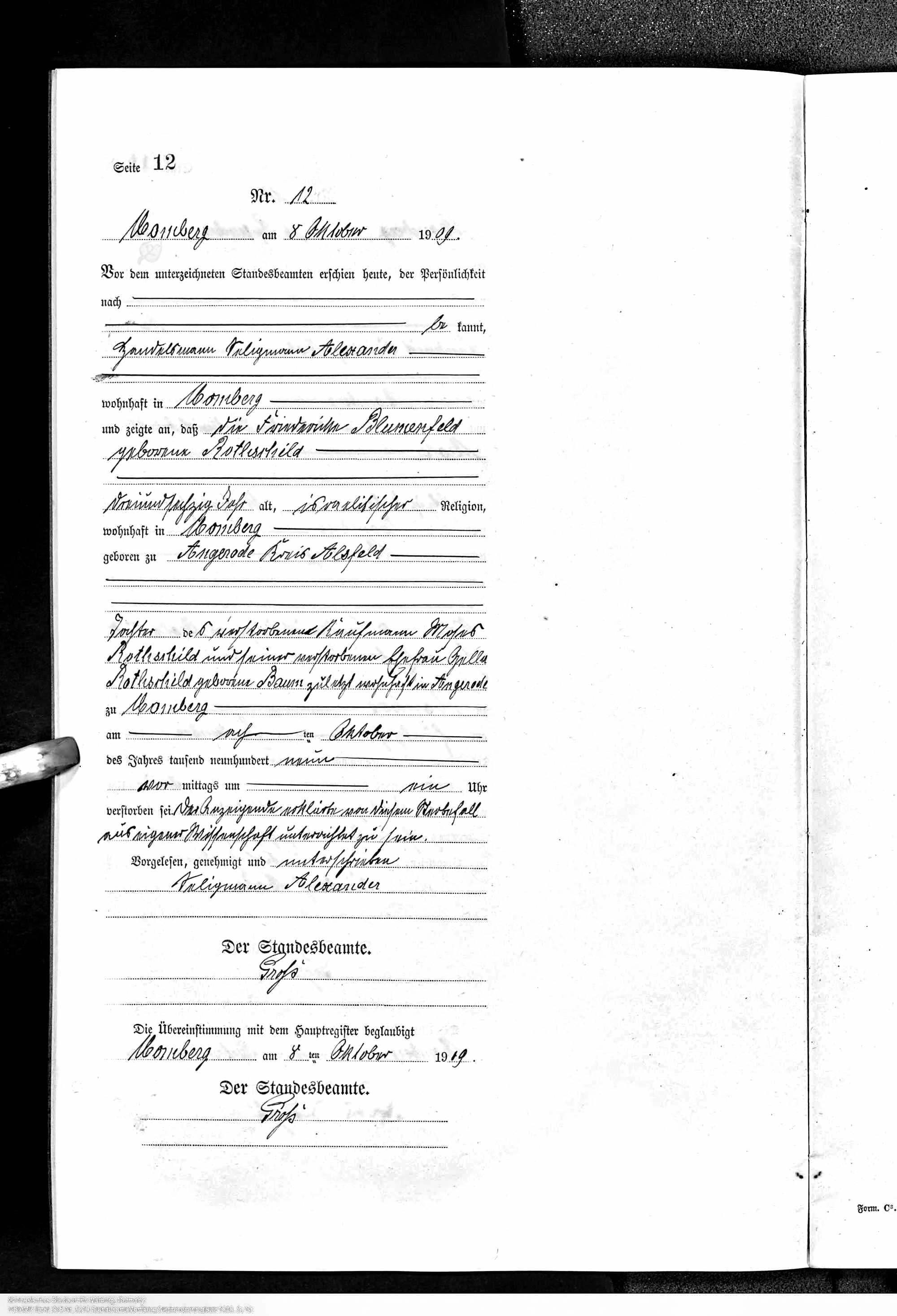
Thus, as of June 30, 1909, five of the children of Abraham Blumenfeld III and Friedericke Rothschild were married, and there were already quite a few grandchildren.  But just over three months later Friedericke, the mother of nine who gave birth over a twenty-one year period, died at the age of 63 on October 8, 1909, in Niederurff. Her youngest child Emma was still a teenager at the time, just a month shy of her seventeenth birthday.

Death of Friedericke Rothschild Blumenfeld, Personenstandsregister Sterberegister; Bestand: 915; Laufende Nummer: 6219, Year Range: 1909, Ancestry.com. Hesse, Germany, Deaths, 1851-1958

Unfortunately, Friedericke’s death in 1909 started a long period of many losses for the family of Abraham Blumenfeld III.


  1.  Siegfried Heldenmuth, Gender: Male, Declaration Age: 38, Record Type: Declaration, Birth Date: 21 Mar 1902, Birth Place: Altenkirchen, Germany,
    Arrival Date: 28 May 1940, Arrival Place: New York New York, Declaration Date: 15 Feb 1941, Declaration Place: Northampton, Hampshire, Massachusetts, USA, Declaration Number: 4912, Has Photo: Y, National Archives At Boston; Waltham, Massachusetts; ARC Title: Naturalization Record Books, 12/1893 – 9/1906; NAI Number: 2838938; Record Group Title: Records of District Courts of the United States, 1685-2009; Record Group Number: Rg 21, Ancestry.com. Connecticut, U.S., Federal Naturalization Records, 1790-1996 
  2. The birth places of Minna Hirsch and Hannah Blyn were found on the LAGIS Jewish graves website here

Isaak Blumenfeld’s First Born, Abraham Blumenfeld III, and His Nine Children

By 1861 when their last and ill-fated daughter Sara was born, Isaak and Gelle (Straus) Blumenfeld had nine children plus Isaak’s son Abraham III, who was born to his first wife Frommet Kugelmann who died shortly after giving birth. Because there are so many children and because some of them had many children, I’ve decided that rather than go decade by decade as I often do, I will need to examine each of the eight children who survived to adulthood separately, starting with the first-born child of Isaak, his son Abraham III.

As we saw, Abraham III was born on March 13, 1842, and his mother died five days later. Isaak did not remarry for ten months, so I don’t know who helped him care for the newborn baby. Isaak’s mother Gidel died a year after the baby’s birth, so perhaps she helped through that first year. Or maybe Frommet’s family helped. I don’t know, but somehow little Abraham survived.

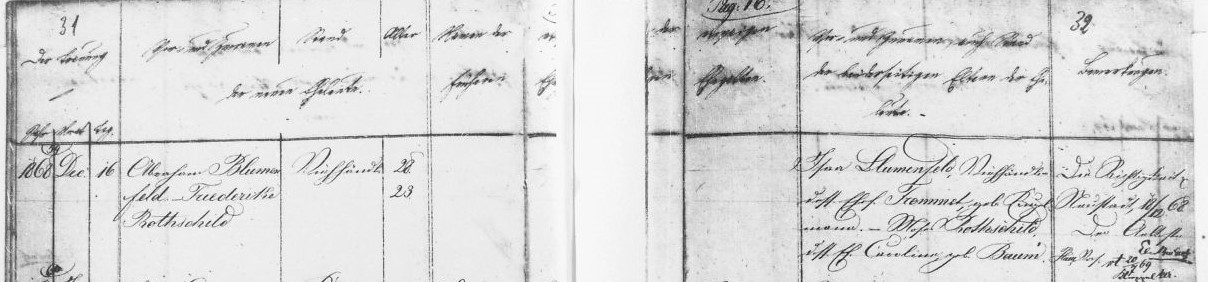
On December 16, 1868, Abraham III married Friedericke Rothschild, the daughter of Abraham Rothschild and Gelle Baum, born in Angerod, Germany, on December 18, 1845.1

Marriage record of Abraham Blumenfeld III and Friedericke Rothschild, Arcinsys Archives Hessen, HHStAW Fonds 365 No 628, p. 12

Abraham III and Friedericke had nine children (you can see why I had to break this family down a bit!).

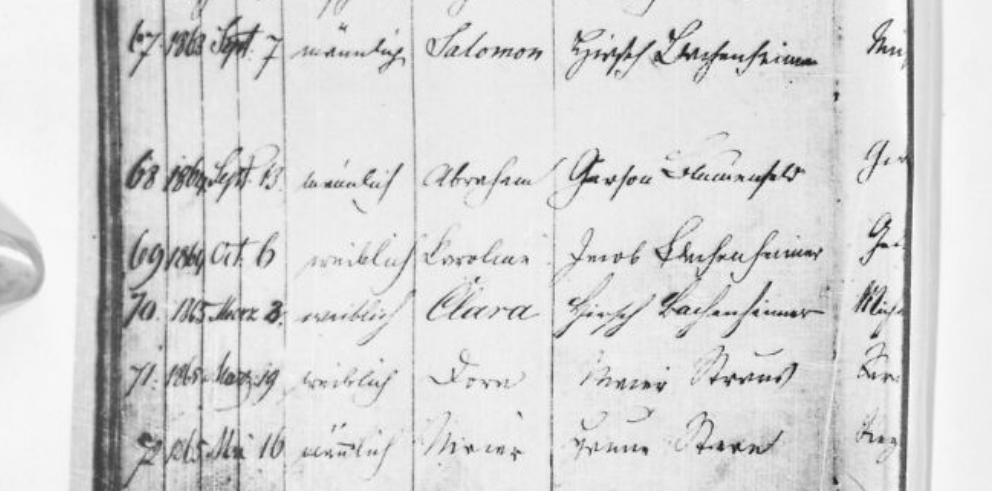
Dina Blumenfeld was born on February 1, 1871, in Momberg, Germany.

Dina Blumenfeld birth record, LAGIS Hessen Archive, Geburtsregister der Juden von Momberg (Neustadt) 1850-1874 (HHStAW Abt. 365 Nr. 608), p. 7

Her sister Auguste came next on June 13, 1873, in Momberg.

Auguste Blumenfeld birth record, LAGIS Hessen Archives, Geburtsregister der Juden von Momberg (Neustadt) 1850-1874 (HHStAW Abt. 365 Nr. 608), p. 7

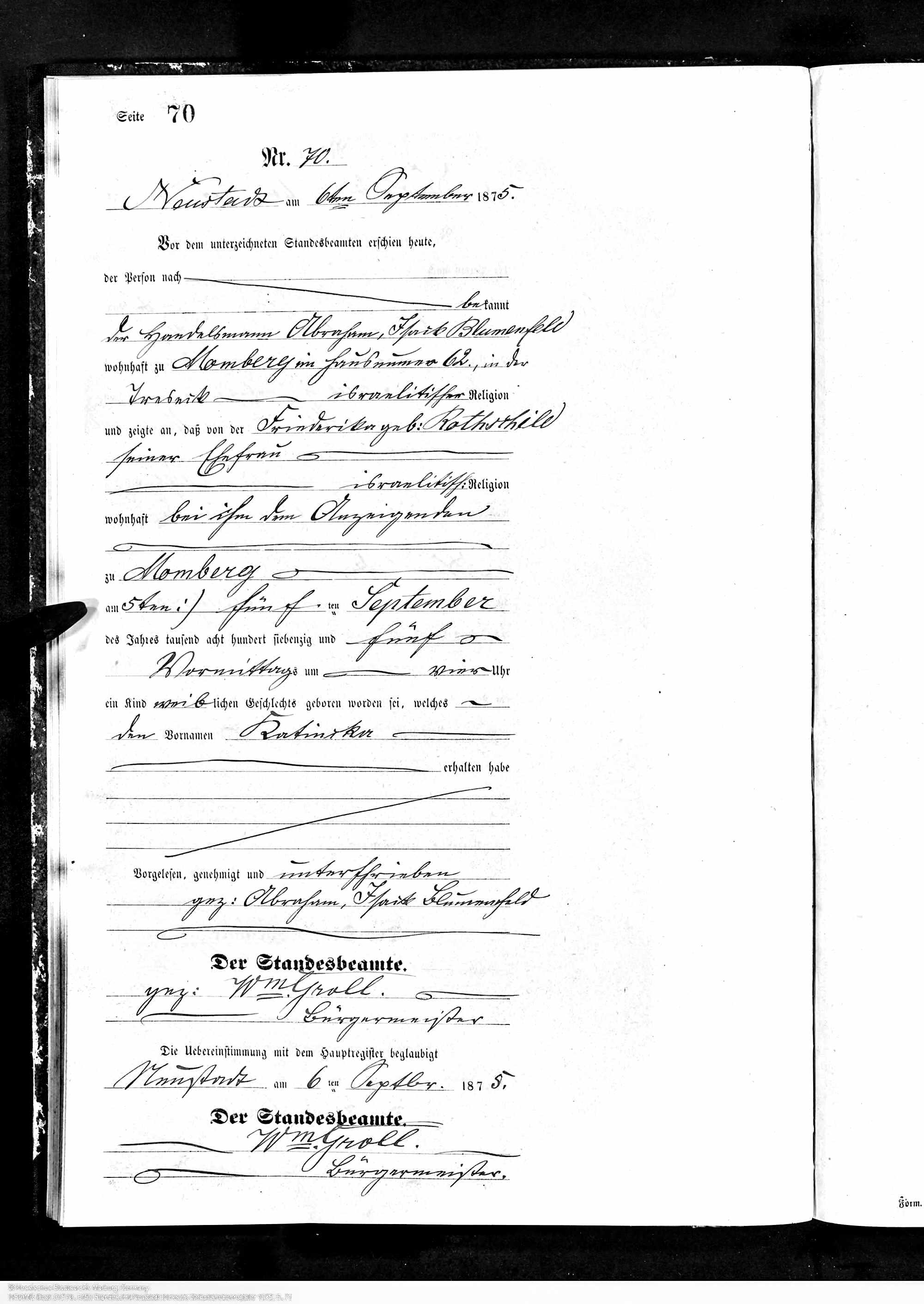
Then came Katincka, born February 5, 1875.

Katincka Blumenfeld birth record, Hessisches Hauptstaatsarchiv; Wiesbaden, Deutschland; Bestand: 915; Laufende Nummer: 6458, Year Range: 1875, Ancestry.com. Hesse, Germany, Births, 1851-1901

Nanny was the fourth child, born January 3, 1878.

Nanny Blumenfeld birth record, Hessisches Hauptstaatsarchiv; Wiesbaden, Deutschland; Bestand: 915; Laufende Nummer: 6461, Year Range: 1878, Ancestry.com. Hesse, Germany, Births, 1851-1901

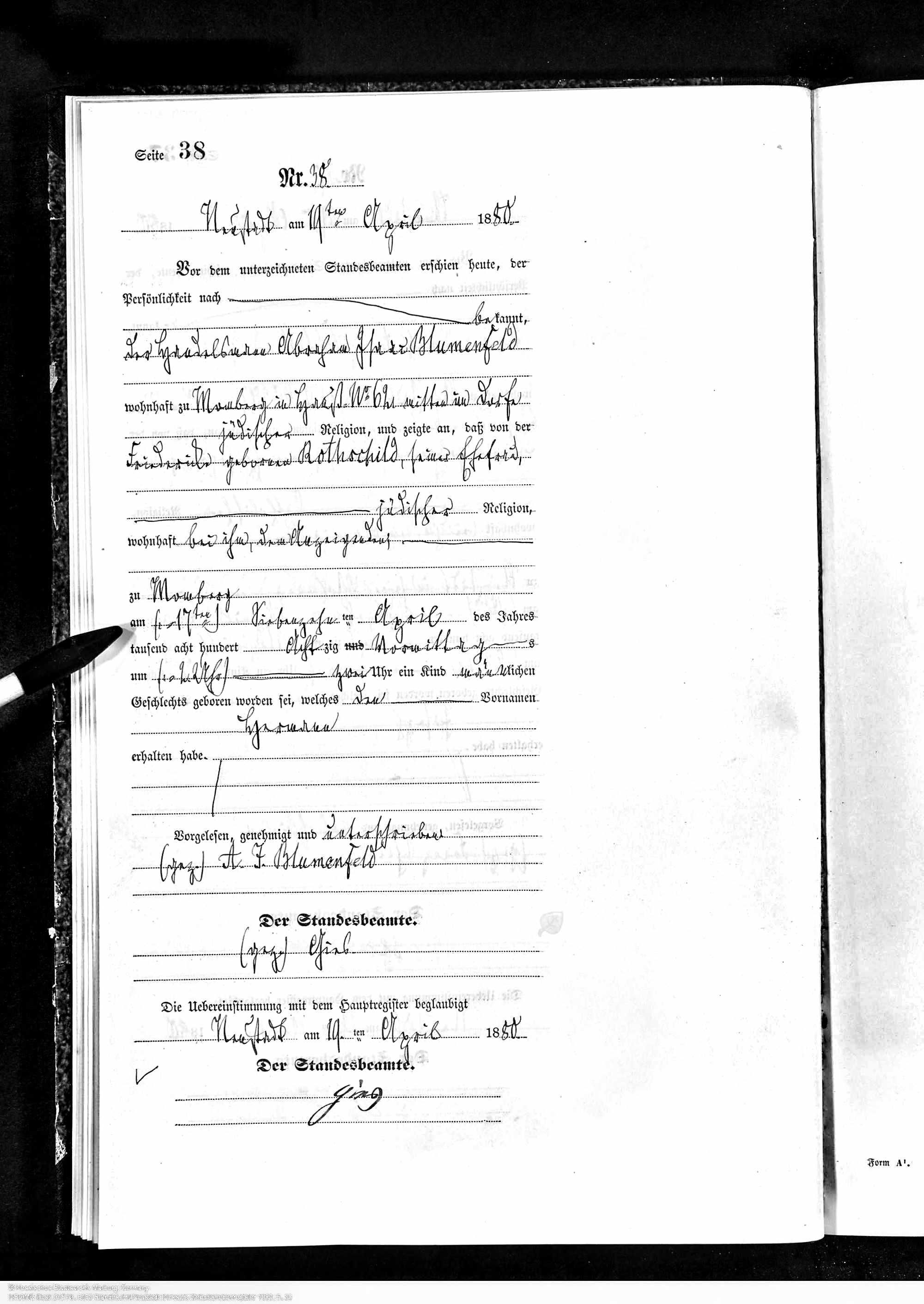
After four daughters, Abraham III and Friedericke had two sons. Hermann was born on April 17, 1880. Since he is the youngest of the three Hermann Blumenfeld’s on the tree, I will refer to him as Hermann Blumenfeld III.

Hermann Blumenfeld birth record, Hessisches Hauptstaatsarchiv; Wiesbaden, Deutschland; Bestand: 915; Laufende Nummer: 6463, Year Range: 1880, Ancestry.com. Hesse, Germany, Births, 1851-1901

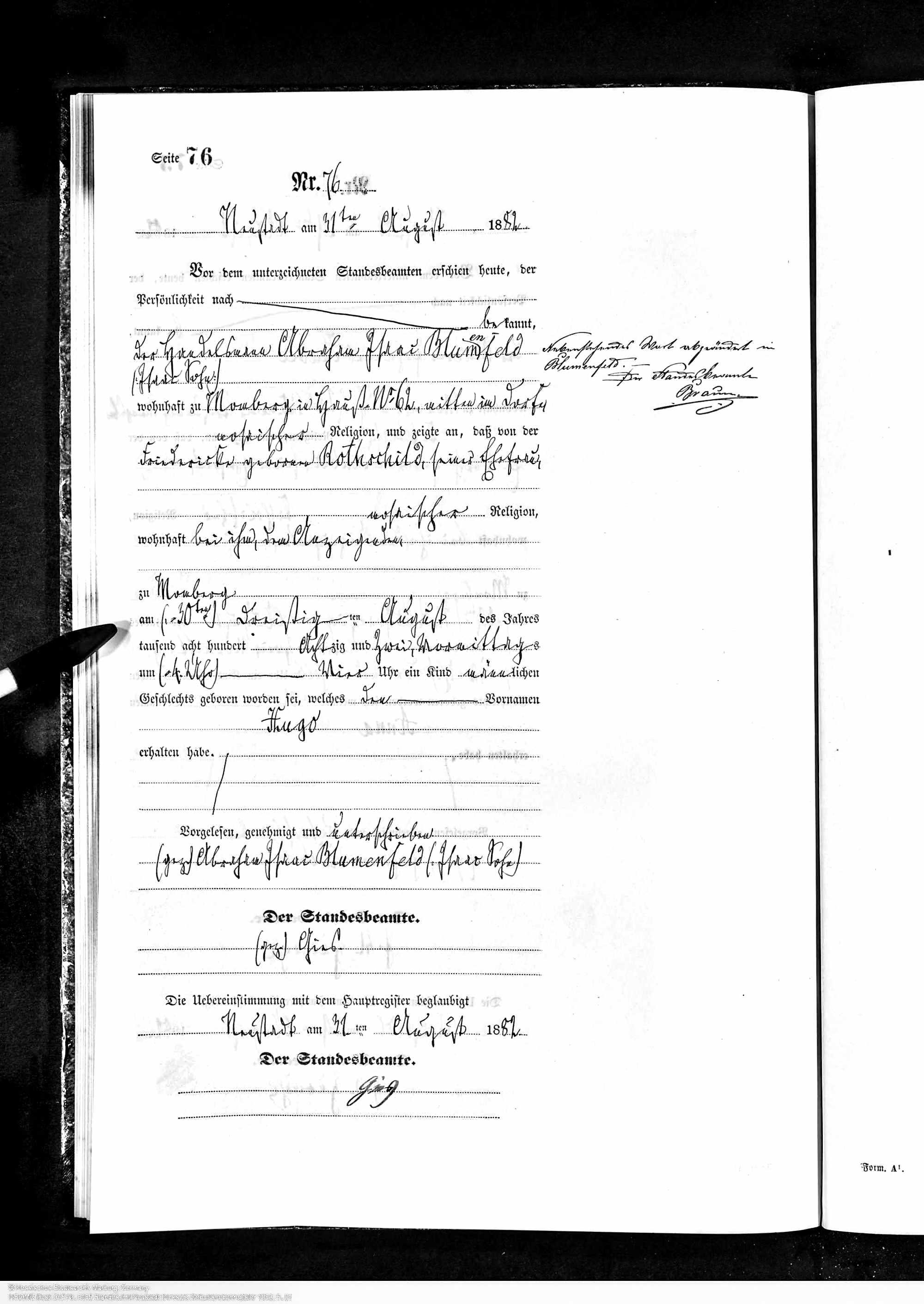
And his brother Hugo was born August 30, 1882.

Hugo Blumenfeld birth record, Hessisches Hauptstaatsarchiv; Wiesbaden, Deutschland; Bestand: 915; Laufende Nummer: 6465, Year Range: 1882, Ancestry.com. Hesse, Germany, Births, 1851-1901

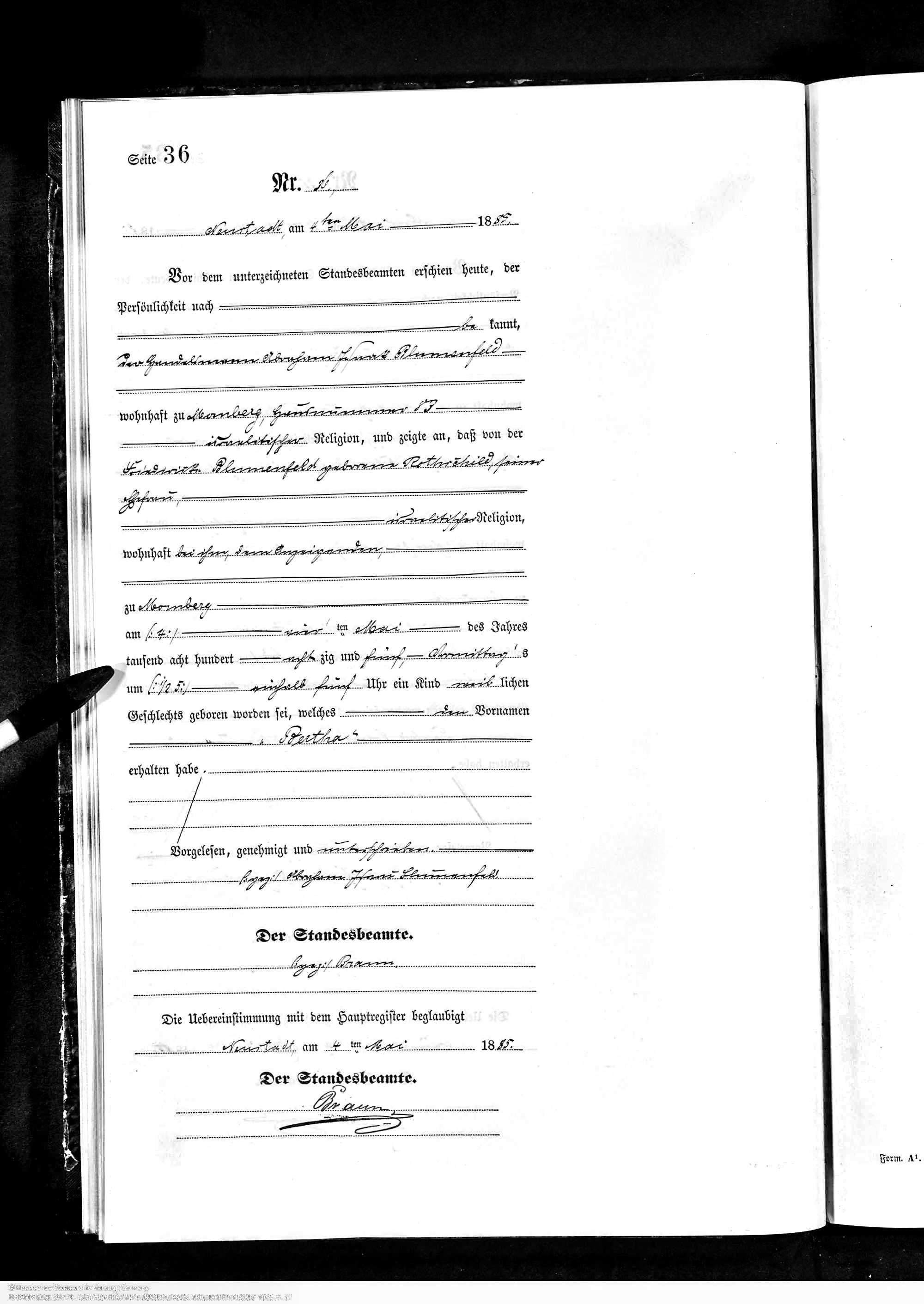
Bertha came next. She was born on May 4, 1885.

Bertha Blumenfeld birth record, Hessisches Hauptstaatsarchiv; Wiesbaden, Deutschland; Bestand: 915; Laufende Nummer: 6468, Year Range: 1885, Ancestry.com. Hesse, Germany, Births, 1851-1901

The eighth child was another boy and yet another Moses Blumenfeld to add to the family tree. He was born on September 28, 1887, and was known as Moritz, as were three other men on the family tree (not to mention all the men named Moses Blumenfeld). I will refer to this cousin as Moritz Blumenfeld IV because he was youngest of the four cousins who used that name.

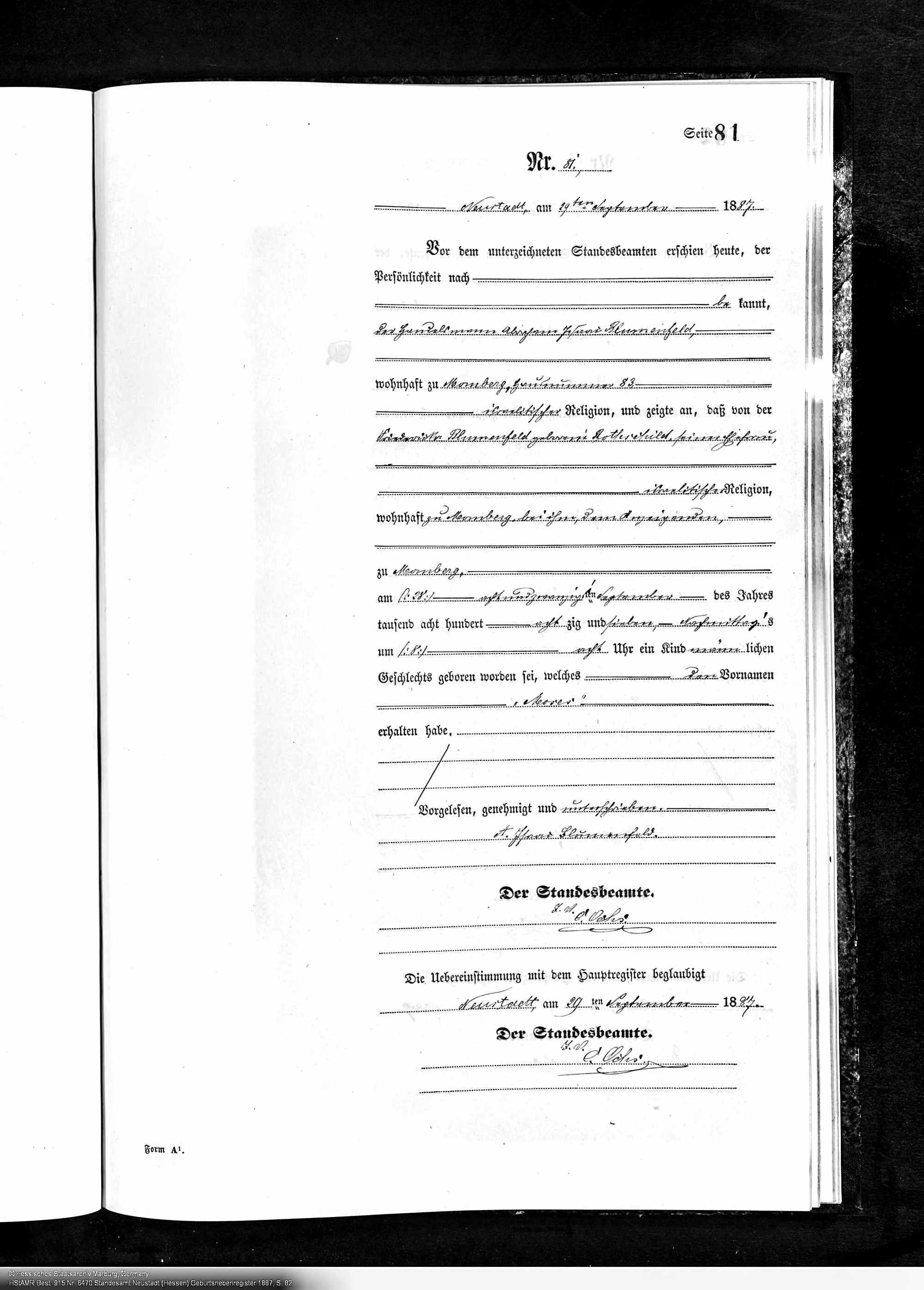
Moses (Moritz) Blumenfeld birth record, Hessisches Hauptstaatsarchiv; Wiesbaden, Deutschland; Bestand: 915; Laufende Nummer: 6470, Year Range: 1887, Ancestry.com. Hesse, Germany, Births, 1851-1901

Finally, Abraham III and Friedericke’s ninth and final child arrived on November 7, 1892. Her name was Emma.

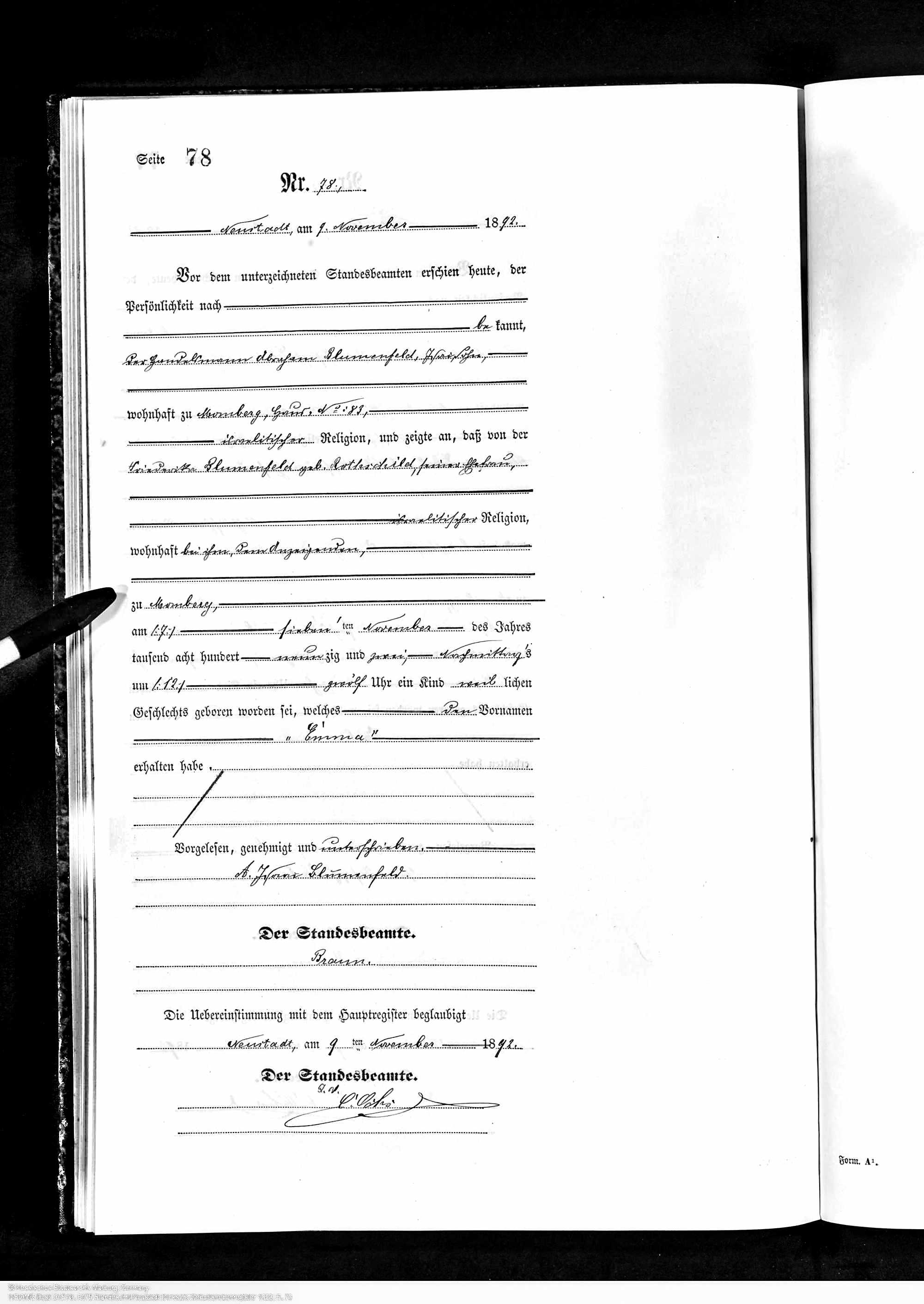
Emma Blumenfeld birth record, Hessisches Hauptstaatsarchiv; Wiesbaden, Deutschland; Bestand: 915; Laufende Nummer: 6475, Year Range: 1892, Ancestry.com. Hesse, Germany, Births, 1851-1901

Thus, Friedericke was pregnant and giving birth from 1871 until 1892. She was 47 when she gave birth to her last child Emma in 1892. I cannot begin to imagine it. Her first grandchild was born just three years after the birth of Emma, so Emma was an aunt at three.

More on the next generation in the posts to come.


  1. Friedericke’s birth date and place were found here

Isaak Blumenfeld’s Ten Children, Or How I Found Myself Overwhelmed With Repeating Names!

I am slowly working through the research of my Blumenfeld relatives, a branch of the tree that sometimes seems overwhelming. I have completed the blogging (for now) about only the first branch of the first sibling of my 3x-great-grandmother Breine Blumenfeld Katzenstein, that is, the oldest child (Abraham IIA) of the oldest brother of Breine, Moses Blumenfeld I. I will now turn to the second child of Moses Blumenfeld I, his son Isaak.

There are two different dates recorded for Isaak’s birth. First, on a family register compiled for the Neustadt region which includes Momberg where he was born, his birth is given as December 13, 1814.

Family register for Moses Blumenfeld, Arcinsys Archives Hessen, HHStAW Abt. 365 Nr. 631, S. 18

On the other hand, his death record filed many years later says he was born on December 18, 1813.1

Which is right? I don’t know. But given the general principle that the record created closest in time to the event is presumed to be more reliable, I will assume that Isaak was born on December 13, 1814.

Isaak was a butcher, like his father and his brother Abraham IIA. He married Frommet Kugelmann on August 27, 1841, in Neustadt. Frommet was the daughter of Hiskias (Hezekiah) Kugelmann and Knendel Andorn, and she was born in about 1821 in Wohrda. I have no actual birth record, but her marriage record reports that she was 20 when she married Isaak.2

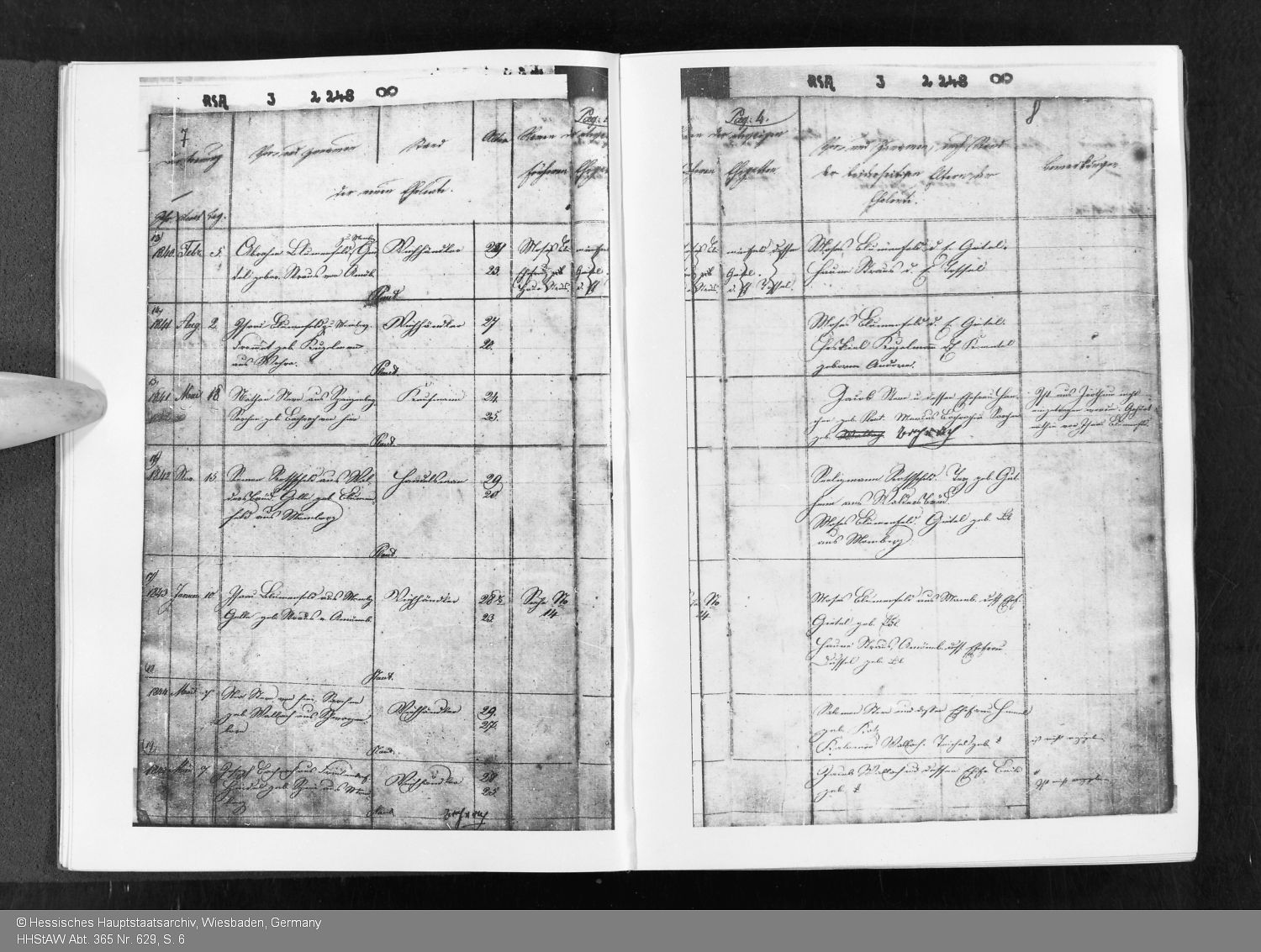
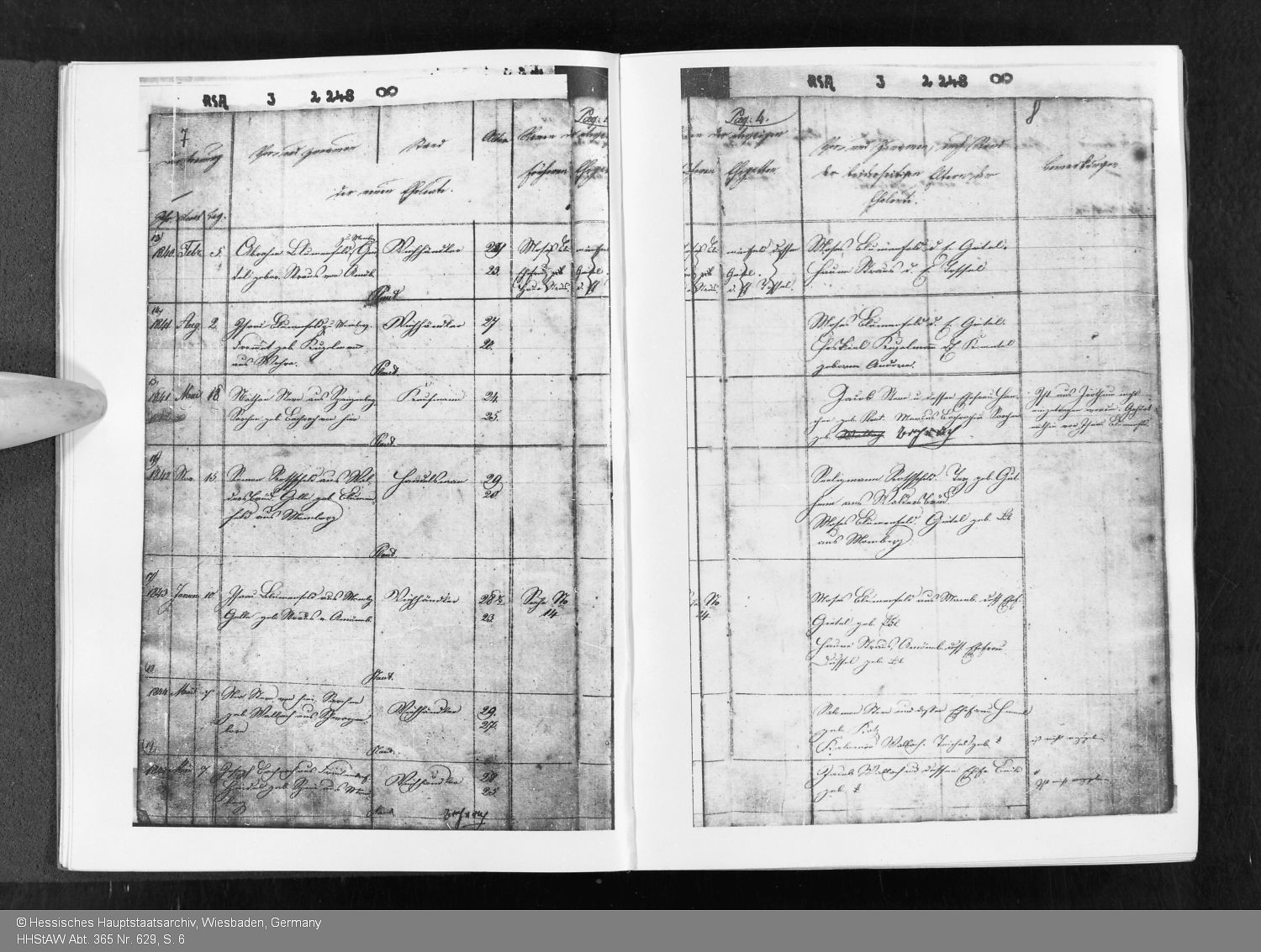
Marriage of Isaak Blumenfeld and Frommet Kugelmann, Arcinsys Archives Hessen, HHStAW Abt. 365 Nr. 629, S. 6

Sadly, Frommet died on March 18, 1842, just five days after giving birth on March 13, 1842, to her first and only child, Abraham Blumenfeld, named presumably for his great-grandfather Abraham Katz Blumenfeld, the patriarch of this line in my tree and my four-times great-grandfather. According to her death record, Frommet was nineteen when she died, meaning either her marriage record or her death record is incorrect.

Frommet Kugelmann Blumenfeld death record, Arcinsys Archives Hessen, HHStAW Abt. 365 Nr. 630, S. 8

I will refer to her son as Abraham III to distinguish him from his great-grandfather and from his uncle, Abraham Blumenfeld IIA, Isaak’s brother, as well as the other four Abraham Blumenfelds on my tree.

Abraham Blumenfeld III birth record, Arcinsys Archives Hessen, HHStAW Abt. 365 Nr. 628, S. 12

Ten months after Frommet’s death, on January 10, 1843, Isaak married again. His second wife was Gelle Straus, sister of Giedel Straus, the wife of Isaak’s brother Abraham IIA. So two brothers were now married to two sisters. Gelle was born on November 6, 1819, in Amoeneburg, to Hahne Straus and Dusel Loewenstein.

Marriage of Isaak Blumenfeld and Gelle Straus, Arcinsys Archives Hessen, HHStAW Abt. 365 Nr. 629, S. 6

Gelle and Isaak had nine children together, meaning that Isaak had ten children altogether. Unfortunately, the first child born to Gelle and Isaak, an unnamed baby boy, did not survive. He was born and died on January 24, 1844, in Momberg.

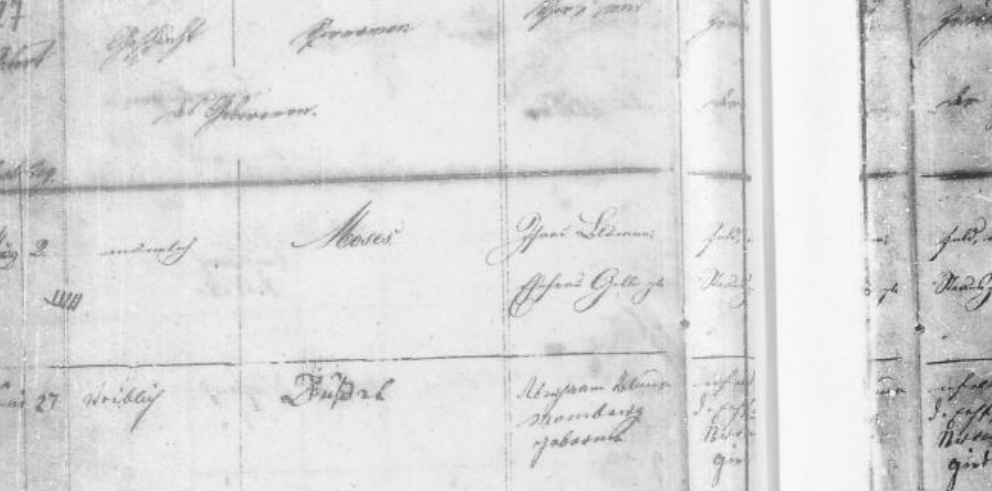
Unnamed child, LAGIS Hessen Archives, Geburtsregister der Juden von Neustadt 1824-1884 (HHStAW Abt. 365 Nr. 628), p. 13

Just eleven months after losing that first baby, Gelle gave birth to her second baby, a girl named Giedel, born on December 16, 1844. I assume that Giedel was not named for her aunt, Gelle’s sister, but for one of the many other women with that name on the family tree.

Giedel Blumenfeld birth, LAGIS Archives, Geburtsregist Neustader der Juden vont 1824-1884 (HHStAW Abt. 365 Nr. 628)AutorHessisches Hauptstaatsarchiv, WiesbadenErscheinungsjahr1824-1884, p. 14

And guess what they named their next child, a boy born on May 2, 1847, in Momberg? Moses! Yes, another Moses Blumenfeld, one of six on this tree. I will refer to this one as Moses Blumenfeld IIB to distinguish him from his first cousin Moses Blumenfeld IIA, son of Abraham Blumenfeld II.

Moses Blumenfeld birth record, LAGIS Hessen Archives, Geburtsregister der Juden von Neustadt 1824-1884 (HHStAW Abt. 365 Nr. 628)AutorHessisches Hauptstaatsarchiv, WiesbadenErscheinungsjahr1824-1884, p. 16

Next born was another Dusschen Blumenfeld, not to be confused with her first cousin Dusschen Dora Blumenfeld, daughter of Abraham Blumenfeld IIA. I was confused about these two Dusschens for some time. To keep them straight, I called Abraham’s daughter Dora; I will refer to this one as Dusschen. She was born on December 25, 1848.

Dusschen Blumenfeld birth record, LAGIS Hessen Archives, Geburtsregister der Juden von Neustadt 1824-1884 (HHStAW Abt. 365 Nr. 628), p. 16

Then came Meier Blumenfeld, born on March 5, 1851, in Momberg. Like his siblings Moses and Dusschen, he also shared his first name with a first cousin, Meier Blumenfeld IIA, son of his uncle Abraham IIA. I will refer to Isaak’s son as Meier Blumenfeld IIB.

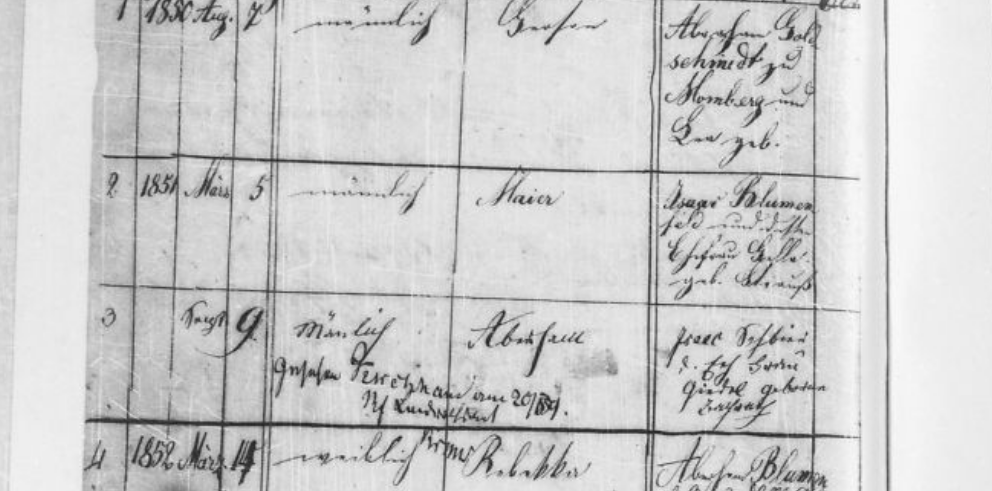
Meier Blumenfeld birth record, LAGIS Hessen Archives, Geburtsregister der Juden von Momberg (Neustadt) 1850-1874 (HHStAW Abt. 365 Nr. 608), p. 3

Isaak and Gelle’s sixth child was named Gerson. He was born on April 29, 1853, in Momberg. You might think that unlike his older siblings, Gerson didn’t have to share a name with a first cousin since we haven’t yet talked about another Gerson Blumenfeld. But in fact, there was another Gerson Blumenfeld, the son of Meier Blumenfeld I, younger brother of Moses Blumenfeld. That Gerson Blumenfeld was born in 1834, and guess what? He would later marry Isaak’s daughter (and Gerson’s sister) Giedel! But I am getting ahead of myself. Isn’t this fun? Anyway, Isaak’s son Gerson will be referred to as Gerson II.

Gerson Blumenfeld birth record, LAGIS Hessen Archives, Geburtsregister der Juden von Momberg (Neustadt) 1850-1874 (HHStAW Abt. 365 Nr. 608)AutorHessisches Hauptstaatsarchiv, WiesbadenErscheinungsjahr1850-1874, p. 4

The seventh child born to Isaak and Gelle was born on August 23, 1856, in Momberg. Her name was Rebecca, and she also shared her name with a first cousin, Rebecca Blumenfeld, the daughter of Abraham IIA. So I will refer to this Rebecca as Rebecca II.

Rebecca Blumenfeld birth record, LAGIS Hessen Archives, Geburtsregister der Juden von Momberg (Neustadt) 1850-1874 (HHStAW Abt. 365 Nr. 608), p. 4

Finally with their eighth child, Isaak and Gelle selected a name that was not shared by any of that child’s close relatives. Fradchen Friedericke Blumenfeld was born on November 2, 1858, in Momberg.

Fradchen Blumenfeld birth record, LAGIS Hessen Archives, Geburtsregister der Juden von Momberg (Neustadt) 1850-1874 (HHStAW Abt. 365 Nr. 608)AutorHessisches Hauptstaatsarchiv, WiesbadenErscheinungsjahr1850-1874, p. 5

That brings me to the ninth and last child born to Gelle and Isaak, Sara, born on October 16, 1861, when Gelle was 42 years old. Unfortunately Sara died when she was only eight years old on July 11, 1870.

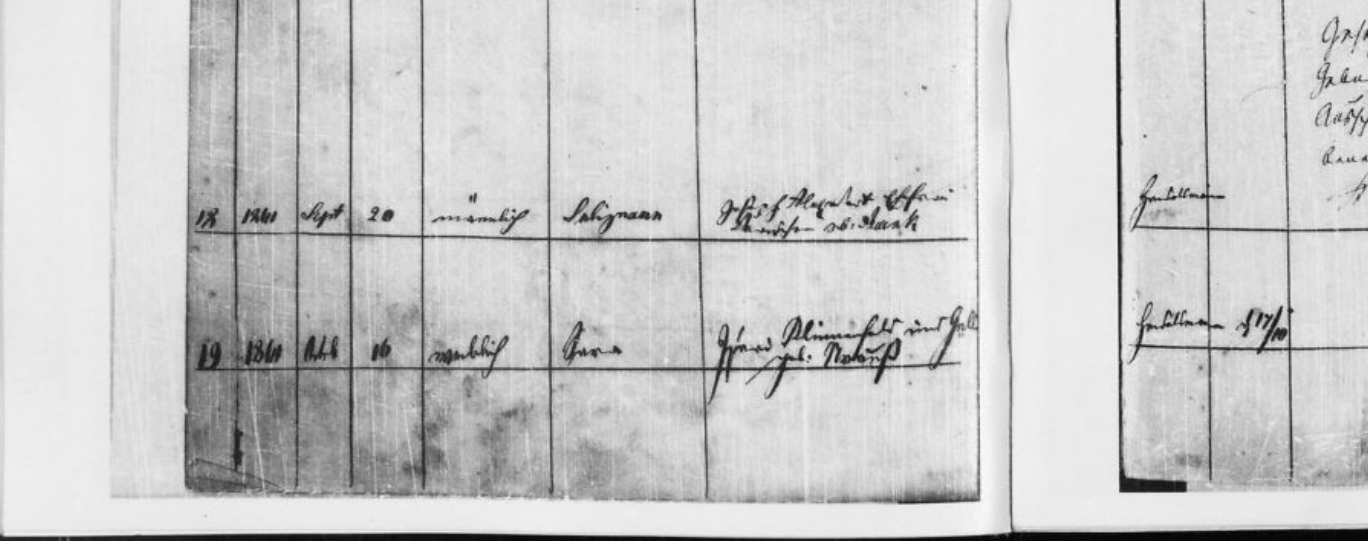
Sara Blumenfeld birth record, LAGIS Hessen Archives, Geburtsregister der Juden von Momberg (Neustadt) 1850-1874 (HHStAW Abt. 365 Nr. 608)AutorHessisches Hauptstaatsarchiv, WiesbadenErscheinungsjahr1850-1874, p. 5

Sara Blumenfeld death record, LAGIS Hessen Archives, Sterberegister der Juden von Momberg (Neustadt) 1851-1873 (HHStAW Abt. 365 Nr. 609)AutorHessisches Hauptstaatsarchiv, WiesbadenErscheinungsjahr1851-1873, p. 5

Thus, Isaak Blumenfeld had ten children, one with his first wife Frommet and nine with his second wife Gelle. Eight of those children lived to adulthood, and their stories will be told in the posts to come. Let’s hope I can keep them all straight from their identically named cousins!


  1. Isak Blumenfeld, Age: 79. Birth Date: 18. Dez 1813 (18 Dec 1813), Death Date: 2. Apr 1892 (2 Apr 1892), Death Place: Neustadt Hessen, Hessen (Hesse), Deutschland (Germany), Civil Registration Office: Neustadt (Hessen), Father: Moser Blumenfeld, Mother: Giedes Blumenfeld, Personenstandsregister Sterberegister; Bestand: 915; Laufende Nummer: 6559, Ancestry.com. Hesse, Germany, Deaths, 1851-1958 
  2. To learn Frommet’s parents’ names other than from the information on the LAGIS cemetery website here, I looked at the birth records for Wohrda in the Arcinsys Archives, but they start in 1825 so too late to include Frommet. I found a birth record for one of her siblings, however, and asked on the GerSIG Facebook group for help in deciphering the script. Thanks to Bernhard Kukatzki for doing so and revealing the names of their parents. 

Don’t Believe Everything You Read on Public Records: An Update on Albert Kaufmann

It’s always good to be reminded that “official records” are only as accurate as the person who creates them and the information that person was able to obtain.

Back in December 2021, I wrote about Albert Kaufmann, the son of Hedwig Blumenfeld Kaufmann. He was married first to Dorothy Schimmelfennig in Germany in 1928, but they divorced in 1932. Albert had immigrated to Brazil sometime after his divorce from Dorothy and married a woman named Georgina Correa, who was born in 1921 and almost twenty years younger than Albert. I assume they married sometime in the 1940s, but I have no record. Albert died in Brazil in 1986 at the age of 84.

I did not believe that Albert had had any children in part because I could find no birth records or any other record for a child and also because Albert’s death record reported that he had no children. Thus, I reported originally on my blog that Hedwig had no living descendants since her daughter Anna and her entire family had been killed in the Holocaust and because her son Albert had not had any children.

Brasil, Rio de Janeiro, Registro Civil, 1829-2012,” database with images, FamilySearch (https://familysearch.org/ark:/61903/3:1:S3HY-6QQP-KV?cc=1582573&wc=9GYK-DPJ%3A113334201%2C120190503%2C122537201 : 7 January 2019), Rio de Janeiro 02ª Circunscrição Óbitos 1985, Nov-1987, Jan image 172 of 304; Corregedor Geral da Justicia (Inspector General of Justice Offices), Rio de Janeiro.

But it turns out that Albert’s death record was wrong. And I never would have known except for the good fortune that another Blumenfeld cousin, Gail Levy, found my blog. Gail is the granddaughter of Hedwig Blumenfeld Kaufmann’s brother, Ernst Blumenfeld. Thus, Gail’s father Paul Blumenfeld was Albert Kaufmann’s first cousin. Not only did Gail help me fill out Paul Blumenfeld’s branch of the family tree, she shared with me correspondence she’d had with another cousin, Paul St. George, who was, according to that correspondence, the grandson of Albert Kaufmann and Dorothy Schimmelfennig and thus Gail’s second cousin and my fifth cousin, once removed.

I contacted Paul, and he confirmed what he had told Gail—that his mother Inge Kaufmann was the daughter of Albert and Dorothy—and he shared with me Inge’s birth record from Berlin. She was born on November 23, 1928, nine months after her parents married on February 10, 1928.

Birth record of Inge Kaufmann. Courtesy of Paul St George

Transcribed birth record of Inge Kaufmann. Courtesy of Paul St George

Thus, the Brazil death record was wrong. Albert Kaufmann did have a child and does have living descendants, including my cousin Paul.

I asked Paul what he knew about his grandfather, but he had never met his grandfather and knew little about him. He only has one photograph of his grandfather, and he obtained it from Gail. It’s a 1980 photograph of Albert with his second wife Georgina or Gina with a New Year’s greeting on the reverse:

Albert and Gina Kaufmann. Courtesy of Paul St George

I also asked Paul about his grandmother Dorothy and his mother Inge. I knew from my research that Dorothy Schimmelfennig was born in England, married Albert Kaufmann in 1928, and died on March 31, 1938, in Berlin when she was a month shy of her thirtieth birthday. But I didn’t know the cause of her death. I had also wondered why she would have been in Berlin in 1938, given what was going on in Germany.

Paul told me that his grandmother Dorothy and his mother Inge went to England in 1933 and lived in London. But in 1938 Dorothy returned to Berlin, apparently just a few days before her untimely death on March 31, 1938.1 Paul told me that her death is listed as a suicide in the memorial book for victims of the Holocaust.  Also, the Arolsen Archives include a document that lists Dorothy’s cause of death as from poisoning (“Veronslvergiftug”).

AJDC Berlin Card File (Deportations) Subcollection 1.2.1, ITS Digital Archive, Arolsen Archives.

In addition, Paul told me that Dorothy is listed as a forced suicide in a 2007 book by Anna Fischer, Erzwungener Freitod: Spuren und Zeugnisse in Den Freitod Getriebner Juden der Jahre 1938-1945 in Berlin (translation: Forced Suicide: Traces and Testimonies in The Suicides of Driven Jews of the Years 1938-1945 in Berlin) (2007: Berlin : Text Verlag Edition Berlin).  Yad Vashem lists Dorothy as both murdered and as a suicide. There do not appear to be any more details, but it seems entirely possible that Dorothy felt hopeless and helpless in the face of Nazi persecution and became too despondent to go on with life in a world filled with so much hatred and fear. But as Paul wrote, it remains a mystery.

But what happened to young Inge Kaufmann, just ten years old at the time of her mother’s death in 1938? She was still in England, and Paul shared what happened to her after her mother’s death:2

My mother was looked after in England by a Jewish Charity (Central British Fund for German Jewry (CBF)). Some Jewish people in England could see the problems in Germany as early as 1933. They petitioned the UK government for permission to bring Jews from Germany to England. The UK government agreed but with strict rules. The refugee had to be self-supporting, looked after to a certain standard, and so on.

So this is why my mother did not live with a relative. Many if not most of these refugees did not live with a relative in England. Reasons against included over-crowding, too poor, etc. But a relative (Charlotte Pick) was a sponsor. She paid money to the charity and the charity bought clothes, shoes, etc. for my mum. My mother would have been housed in a series of homes in the Hemel Hempstead area. By housed I mean she had a room and meals. Those who provided the children with a place to live were not there to look after the children they housed. The charity did that. Also, my mother would have attended a normal local authority school near to the digs. The charity (now called World Jewish Relief) sent me her case file and that lists the monies and the check-up visits and so on.

Inge later attended the well-known St. Martin’s School for the Arts where she studied fashion and developed friendships with several people who became well-known artists. Paul, a well-known artist himself, recalls visiting the grand homes of these artists as a child, describing them as “full of clutter and the smell of oil paint and cake.”3

After she graduated, Inge became a costume designer for the theater, where she met Paul’s father, an acrobatic tap dancer born George Alexander Bernard, who adopted his stage name Buster St. George as his legal name. He was born in Manchester, England, to Alexander Bernard and Doris Matz on January 16, 1913. Inge and Buster were married in 1953 and had two sons, Julian and Paul. Paul was born in Norway while the theater group which employed them was on tour for performances of Kiss Me Kate. Inge and Buster divorced in 1957. Inge Kaufmann St. George, my fifth cousin, died on November 9, 2000; she was 71. Buster St. George died on October 10, 1986.4

I am very grateful that I was able to connect with my cousin Paul (via our mutual cousin Gail) and to learn that Hedwig Blumenfeld Kaufmann’s son Albert did have a child, his daughter Inge, and that thus today Hedwig has living descendants, unlike what I believed before finding Gail and thus Paul. This experience was an important lesson in remembering that just because a record records a “fact” does not necessarily make it true.


  1. Email from Paul St George, January 13, 2022. 
  2. Email from Paul St George, January 7, 2022. 
  3. Email from Paul St. George, January 13, 2022. 
  4. Emails from Paul St George, January 7, 13, and 17, 2022. Buster St George
    Registration Date: Jul 1953, Registration Quarter: Jul-Aug-Sep, Registration District: Brighton, Inferred County: Sussex, Spouse: Inge Kaufmann, Volume Number: 5h
    Page Number: 280, General Register Office; United Kingdom; Volume: 5h; Page: 280,
    Ancestry.com. England & Wales, Civil Registration Marriage Index, 1916-2005. Paul St. George Ancestry Family Tree, located at https://www.ancestry.com/family-tree/tree/171856232/family/familyview?cfpid=122230313195&fpid=122231826460&usePUBJs=true 

The Fate of Caroline Blumenfeld Hoxter and Her Children: Final Chapter

As we saw, by the middle of 1940, all three of Caroline Blumenfeld Hoxter’s daughters and their families were safely out of Germany. Toni and Gerda were in the US as were their children, and Betty and her family were in Palestine.

But what about their mother Caroline? Last we knew she, having lost her husband Simon in 1932, had been living in Marburg with Toni and her family after Toni’s husband Sally was driven out of his haberdashery business in Hersfeld by Nazi persecution. But Caroline was not with Toni and Sally when they left for America in 1940 nor was she with Gerda and her family when they left Germany in 1939. Nor was Caroline with her daughter Betty in Palestine.

Tragically, Caroline was still in Germany. At some point she moved to Frankfurt, and in 1942 she was taken to Theriesenstadt where she died on February 17, 1942. Her daughter Betty (here spelled Beti) filed this Page of Testimony with Yad Vashem:

Caroline Hoxter, Page of Testimony at Yad Vashem, filed by her daughter Beti Openheimer, found athttps://yvng.yadvashem.org/nameDetails.html?language=en&itemId=1617046&ind=1

In her speech to middle school students in 2020, Caroline’s granddaughter Jane explained why Caroline had been unable to leave Germany with her family:1

Before we left [Germany], my sister and I went to see our grandmother who was blind and could not come with us. Much later she was deported to Thereisenstadt concentration camp. She was then in her late 80s. We were informed that she died of natural causes. Can you imagine for someone that old to travel for three weeks in a cattle car? It is still very hard for me to think about that and accept it.

Jane rightfully questioned whether her grandmother’s death was in fact from “natural causes.” Subjecting an elderly and blind woman to the conditions she must have experienced on that cattle car and then at Theriesenstadt surely contributed to her death as much as if she’d been gassed or shot by the Nazis.

I am very grateful to Andre Guenther from Tracing the Tribe who located Caroline’s death certificate from Theriesenstadt; she died from “enteritis darmkatarrah” or what we might call gastroenteritis.

At no point during the Shoah Foundation interview with Arthur Goldschmidt,2 did the interviewer ask about the fate of his grandmother Caroline Blumenfeld Hoxter, and Arthur did not bring it up himself. I don’t know whether this was an oversight or whether he simply could not bring himself to speak about what happened to his grandmother. I imagine the family must have been devastated by what happened to her. Peter, Jane’s son, told me that his mother still gets emotional when she talks about her grandmother Caroline and what happened to her.

But Caroline was blessed that her three daughters and her grandchildren all escaped and survived the Holocaust.

Her daughter Toni died in New York on April 21, 1956,[^3] two years after her husband Sol, who died on May 13, 1954, in New York.3 Their daughter Miriam died on January 7, 1988, in Queens, New York,4 followed by her husband Rudolf on January 21, 1993, in Los Angeles.5 They were survived by their daughter and her family.

Their son Arthur Goldschmidt shared this photograph of his parents with the Shoah Foundation:

Toni Hoxter and Sally (Sol) Goldschmidt. Arthur Goldschmidt, Interview 8542,  Visual History Archive, USC Shoah Foundation,  November 10, 1995. Accessed 15 August 2021, from the archive of the University of California Shoah Foundation Institute for Visual History and Education, found at https://sfi.usc.edu/what-we-do/collections

Toni’s sister Betty/Beti lived the rest of her life in Israel and died on December 15, 1975, at the age of 86. She was predeceased by her husband Max, who died May 25, 1961, in Israel. They were survived by their daughter Lotte, who married Theo Kleeman in Israel and who died June 26, 1998, in Israel, and their son Shimon, who died August 14, 2012, in Haifa, Israel. Today they have grandchildren and great-grandchildren in Israel.6

The youngest sister Gerda died in New York on April 13 1974,7 two years after her husband Adolf, who died March 18, 1972.8 They were survived by their two daughters. Their daughter Alice Lore Goldschmidt married Richard Oster,9 with whom she had two children. Alice died on January 13, 2014.10

Their other daughter Jane Inge Goldschmidt married Ralph Keibel on August  11, 1950,11. Peter shared with me his parents’ wedding photograph.

Jane and Ralph had two children, including my cousin Peter. Jane is still living and is 98 years old. Imagine—she gave that speech to the Vermont middle school group when she was almost 97 years old. Just remarkable.

As for Arthur Goldschmidt, whose interview helped me tell this story, after World War II he returned to New York City where he met and married his wife Ruth Herz. As he told the story, they met in January 1950, were engaged by April, and married in August 1950. Ruth was also a refugee from Germany. She was born on April 18, 1922, in Holzheim, Germany, to Eugen Isaak Herz and Lilli Weinberg.12 Her father had died in 1932, and her mother was killed in the Holocaust.

According to her obituary, “Ruth left Germany at age 16 via the Kindertransport and spent nine years on the run, in hiding, in a displaced persons camp, and then came to the US where she was able to build a good life. She met her husband Arthur Goldschmidt on a blind date that blossomed into their beautiful marriage on August 27, 1950.”13 Ruth and Arthur had two children. It was clear from the video of the interview that they both still adored each other 45 years after their marriage began.

Arthur Goldschmidt and his wife Ruth during the Shoah Foundation interview. Arthur Goldschmidt, Interview 8542,  Visual History Archive, USC Shoah Foundation,  November 10, 1995. Accessed 15 August 2021, from the archive of the University of California Shoah Foundation Institute for Visual History and Education, found at https://sfi.usc.edu/what-we-do/collections

Arthur worked for many years at a dairy company on Long Island, so the skills he learned back in the 1930s from the Zionist organization that prepared him to work on a kibbutz in Palestine/Israel held him in good stead. He died on January 15, 2021, in New York; he was 96 years old.14

It was an honor to watch his interview the Shoah Foundation. He was amazingly matter-of-fact through almost the entire interview, answering questions calmly and saying that he and his family survived because they were able to get out early enough. He didn’t seem angry or resentful at all—until the very end when the interviewer asked him a simple and straightforward question about what he hoped the world had learned. He then broke down in tears, unable to speak, finally saying in essence that we must never forget and that we must never let it happen again.15

Today Caroline Blumenfeld Hoxter has many living descendants in Israel and in the US. She may not have survived the Holocaust, but her daughters and their families did, and they and their descendants carry on her legacy.

I am deeply grateful to my cousin Peter Keibel for sharing so much of his information and his family photographs with me and especially for sharing his mother’s speech about her experiences before and during the Holocaust.


And this brings me to the end of not only Caroline Blumenfeld Hoxter’s story and that of her children and grandchildren, but also to the end of the story of Abraham Blumenfeld IIA since Caroline was the youngest of his eight children. Now I will turn to Abraham’s younger siblings. First, his brother Isaak, the second child of my four-times great-uncle Moses Blumenfeld.


  1. Jane Inge Goldschmidt Keibel, Speech to Hazen School, Hardwick, Vermont, 2020, shared by Peter Keibel. 
  2. Arthur Goldschmidt, Interview 8542,  Visual History Archive, USC Shoah Foundation,  November 10, 1995. Accessed 15 August 2021, from the archive of the University of California Shoah Foundation Institute for Visual History and Education, found at https://sfi.usc.edu/what-we-do/collections 
  3. Toni Goldschmidt, Age: 70, Birth Date: abt 1886, Death Date: 21 Apr 1956, Death Place: Queens, New York, New York, USA, Certificate Number: 4251, Ancestry.com. New York, New York, U.S., Death Index, 1949-1965 
  4. Sol Goldschmidt, Age: 72, Birth Date: abt 1882, Death Date: 13 May 1954, Death Place: Manhattan, New York, New York, USA, Certificate Number: 10469, Ancestry.com. New York, New York, U.S., Death Index, 1949-1965 
  5.  Miriam Lauter, Social Security Number: 112-05-7561, Birth Date: 23 Apr 1911, Issue Year: Before 1951, Issue State: New York, Last Residence: 11375, Flushing, Queens, New York, USA, Death Date: 7 Jan 1988, Social Security Administration; Washington D.C., USA; Social Security Death Index, Master File, Ancestry.com. U.S., Social Security Death Index, 1935-2014 
  6. These dates came from Peter Keibel, Betty’s nephew. Email from Peter Keibel, November 17, 2021.  I have no official records for them. 
  7. Date is from her grandson, Peter Keibel, FamilyTree on Ancestry.com, found at https://www.ancestry.com/family-tree/person/tree/52614823/person/372143503930/facts 
  8. Date is from his grandson, Peter Keibel, FamilyTree on Ancestry.com, found at https://www.ancestry.com/family-tree/person/tree/52614823/person/372143503930/facts 
  9. Alice L Goldsmith, Gender: Female, Marriage License Date: 18 Jul 1950, Marriage License Place: Manhattan, New York City, New York, USA, Spouse: Richard Oster, License Number: 18819, New York City Municipal Archives; New York, New York; Borough: Manhattan; Volume Number: 27, Ancestry.com. New York, New York, U.S., Marriage License Indexes, 1907-2018 
  10. Find a Grave, database and images (https://www.findagrave.com/memorial/130447894/alice-oster : accessed 02 December 2021), memorial page for Alice Oster (unknown–13 Jan 2014), Find a Grave Memorial ID 130447894, citing Mount Hebron Cemetery, Flushing, Queens County, New York, USA ; Maintained by Mom (contributor 48202874) . 
  11. From their son Peter Keibel, https://www.ancestry.com/family-tree/person/tree/52614823/person/372143503829/facts 
  12. Peter Keibel Ancestry Family Tree, https://www.ancestry.com/family-tree/person/tree/52614823/person/372145394061/facts; Ruth Goldschmidt
    Age: 29, Birth Date: 18 Apr 1922, Issue Date: 12 Jun 1951, State: New York
    Locality, Court: Eastern District of New York, District Court, National Archives and Records Administration (NARA); Washington, D.C.; Index to Naturalization Petitions of the United States District Court for the Eastern District of New York, 1865-1957; Microfilm Serial: M1164; Microfilm Roll: 63, Ancestry.com. U.S., Naturalization Records Indexes, 1794-1995. The other information came from Arthur Goldsdchmidt’s Shoah Foundation interview. Arthur Goldschmidt, Interview 8542,  Visual History Archive, USC Shoah Foundation,  November 10, 1995. Accessed 15 August 2021, from the archive of the University of California Shoah Foundation Institute for Visual History and Education, found at https://sfi.usc.edu/what-we-do/collections 
  13. “Goldschmidt, Ruth,” The Baltimore Sun, Baltimore, Maryland, 03 Jan 2021, Sun • Page A14 
  14.  Arthur Goldschmidt, Social Security Number: 099-24-1370, Birth Date: 9 Aug 1913, Issue Year: Before 1951, Issue State: New York, Last Residence: 11415, Jamaica, Queens, New York, Death Date: 15 Jan 2010, Social Security Administration; Washington D.C., USA; Social Security Death Index, Master File, Ancestry.com. U.S., Social Security Death Index, 1935-2014 
  15. Arthur Goldschmidt, Interview 8542,  Visual History Archive, USC Shoah Foundation,  November 10, 1995. Accessed 15 August 2021, from the archive of the University of California Shoah Foundation Institute for Visual History and Education, found at https://sfi.usc.edu/what-we-do/collections 

My Cousins on the SS St Louis: The Shameful Conduct of the US Government

We left off in my last post with the family of Gerda Hoxter and Adolph Goldschmidt about to board the SS St. Louis to go to Cuba and escape from Germany. As described on the US Holocaust Museum website:

On May 13, 1939, the German transatlantic liner St. Louis sailed from Hamburg, Germany, for Havana, Cuba. On the voyage were 937 passengers. Almost all were Jews fleeing from the Third Reich. Most were German citizens, some were from eastern Europe, and a few were officially “stateless.”The majority of the Jewish passengers had applied for US visas, and had planned to stay in Cuba only until they could enter the United States.

Gerda’s daughter Jane provided this more personal account in her speech to middle school students in early 2020:1

May 13, 1939, was a Saturday and the ship sailed in the afternoon. We stood at the railing of the ship to wave good-bye to relatives with a heavy heart. The possibility certainly existed that we were never going to see them again. One of the things we remember was that upon boarding the band was playing Strauss waltzes. In the captain’s daily log, he noted that the mood of the passengers was very solemn, but he was assured that good food and sea air for two weeks will lift the pain that was emanating from the passengers.

We settled into our new routine of shipboard life and day by day the moods lifted. My sister and I made friends with other young people on board. One of these people became my best friend. She lived in upstate NY with her husband who also was a passenger on the St. Louis.

Peter, Jane’s son, shared with me this remarkable photograph of his grandfather Adolf Goldschmidt boarding the St. Louis; he is the man on the far right in the light colored coat, holding a book:

Adolf Goldschmidt aboard the St. Louis. Courtesy of the family

Jane’s story continued:

After a two week voyage, we arrived in the harbor of Havana, Cuba. We were informed that we could not lay anchor at the pier because our credentials had to be checked. Even after they were checked, there were more excuses for not letting us land and disembark. A day before arrival in Cuba the Captain was informed that he cannot lay anchor at a pier, he had to stay in the middle of the harbor. We stayed in the harbor for one week.

We did not want to return to Germany, nothing was left there, no housing, no money – all the savings people had accumulated had to be left to the German government – so we would all be taken to a concentration camp, an impossible thought. We had people on board who were released from concentration camps under the condition never to return to Germany. These men considered mutiny or committing suicide. The captain was very diligent and did not want this to happen.

During that time one man slashed his wrist and jumped overboard. He was saved and taken to a hospital in Havana. His wife was not allowed to visit him, but after his recuperation he was returned to his wife.

Small boats came to the side of the St. Louis with relatives who lived in Cuba to shout encouragements to us. Meanwhile, organizations, Jewish and government, were at work to see what can be done to have us disembark. Also contact was made with almost every country to see if one of them would take us in.

The German propaganda had a field day. No one wanted Jews, Hitler was right in ridding his country of them.

The Captain tried everything to enable us to land. He even went so far and visited the President of Cuba to plead for us. Nothing helped.

Jewish refugees aboard the SS St. Louis attempt to communicate with friends and relatives in Cuba, who were permitted to approach the docked vessel in small boats. |Source=USHMM, courtesy of National Archives and Records Adminis (public domain)

The Holocaust Museum article describes the purported reasons for Cuba’s refusal to admit the refugees—not just anti-Semitism, but economic conditions and anti-immigration sentiment.

So the refugees and others tried to find help in places besides Cuba. As Jane described it:2

From the ship, telegrams were sent to heads of states and Jewish organizations. The children pleaded by telegram with Mrs. Roosevelt for shelter, but no reply came from her or the President. After 10 days in limbo, the captain was told to leave Cuban waters. Very slowly the Captain steered the ship toward the US, toward Miami, hoping that the President would relent and let us land. There were 935 people on board who were seeking refuge. Instead the Coast Guard was on watch to see that no one jumped overboard and swam ashore. We went up the coast to New York and then the captain was informed to hurry home. He was such a decent man that he really did not want to take us back, but he had no alternative. In his log, he wrote that he would scuttle his ship on the English shore if no result was forthcoming, to prevent us returning to Germany. This action cost him his job.

The Holocaust Museum article also described the US indifference to the needs of the refugees:

Sailing so close to Florida that they could see the lights of Miami, some passengers on the St. Louis cabled President Franklin D. Roosevelt asking for refuge. Roosevelt never responded. The State Department and the White House had decided not to take extraordinary measures to permit the refugees to enter the United States. A State Department telegram sent to a passenger stated that the passengers must “await their turns on the waiting list and qualify for and obtain immigration visas before they may be admissible into the United States.” US diplomats in Havana intervened once more with the Cuban government to admit the passengers on a “humanitarian” basis, but without success.

Having nowhere to disembark, the passengers on the St. Louis were forced to return to Europe, where Great Britain, the Netherlands, Belgium, and France responded more humanely than the US or Cuba had to the needs of these refugees.

Jane described what happened next to her family and to others:3

Meanwhile, negotiations went on to find some country that had mercy on us. The passengers were becoming more desperate. Long face and worried looks were on everyone’s faces. We were close to the English Channel when we were informed that four countries were willing to take the passengers. Morris Troper of the European Joint Distribution Committee was responsible for securing that haven. The grateful passengers cabled him that their gratitude was as immense as the ocean on which they have been traveling. It was England, France, Belgium and the Netherlands. You could have heard the biggest sigh when the news was broadcast. Again people made plans and their outlook was improving.

On June 17, we landed in Antwerp, Belgium, and disembarked to immediately go on to a freighter that was provided by the Germans for those who went to France and England.

Our captain really tried his best and risked his life and career for us. Many years later, the surviving passengers signed a petition to recommend him as a righteous gentile, which afforded him a place at the Yad Vashem in Jerusalem.

Our family was sent to France, where my sister, I, and other children were taken in by an orphanage. Our parents and other adults were placed in Le Mans, a city west of Paris. Because no one had money, we were only allowed 10 German Marks (Approximately $80 today) to take out of Germany. We all lived on charity provided by Jewish organizations. During those six months my parents lived in Le Mans, they were supported by the HIAS, a Jewish relief organization that helps immigrants. They lived in a house that was shared with three other couples, one bedroom each, communal kitchen and living room.

When the War broke out, September 1, 1939, all the men were interned as foreigners and the women had to double up. My sister and I and all other children under 18 years were sent by train to OSE homes near Paris. The OSE is a Russian organization that is involved with the care of orphans. These homes were led by a Viennese educator and his wife, a physician. Personally, I enjoyed my stay there, although once the War broke out it got a little scary, especially when the air raid sirens sounded and we had to go to the shelters. The older children took care of the young ones.

But ultimately, after the Nazis took over France, Belgium, and the Netherlands in the spring of 1940, 254 of the over 900 passengers who had been on the St. Louis and had been forced back to Europe in May, 1939, were murdered by the Nazis.

Gerda and her family were among the lucky ones who were able to immigrate successfully to the US. They arrived in New York on January 8, 1940. I don’t know when this photograph of Gerda and Adolf was taken, but from their ages, I assume it was sometime during this era, either before or after they came to the US.

Adolf and Gerda (Hoxter) Goldschmidt. Courtesy of the family

This is one of the most shameful examples of the way the US acted during the 1930s and 1940s, knowing the dangers that Jews were facing in Nazi Germany and elsewhere in Europe, but cold-heartedly turning the other way, refusing to help those in need. I do wonder, however, whether we’ve learned our lesson. Money and jobs (not to mention xenophobia and prejudice) still seem to trump the needs of those who are suffering when it comes to US immigration policy.


  1. Jane Inge Goldschmidt Keibel, Speech to Hazen School, Hardwick, Vermont, 2020, shared by Peter Keibel. 
  2. Jane Inge Goldschmidt Keibel, Speech to Hazen School, Hardwick, Vermont, 2020, shared by Peter Keibel. 
  3. Jane Inge Goldschmidt Keibel, Speech to Hazen School, Hardwick, Vermont, 2020, shared by Peter Keibel. 

The Children and Grandchildren of Caroline Blumenfeld Hoxter: Leaving Germany

Happy New Year, everyone! I hope you had a good holiday season and are safe and healthy. I have been trying to relax and gain some perspective on 2021, a tough year, and prepare for 2022, a year I expect to be just as tough. But genealogy and family history always help me put things in perspective, so I am ready to return and find new meaning and new discoveries in the history of my family.

Let me refresh your memories of where I was back in December 2021. I have been writing about my Blumenfeld branch and more specifically the line that begins with my four-times great-uncle Moses Blumenfeld and goes from his son Abraham Blumenfeld IIA to Abraham’s daughter Caroline Blumenfeld Hoxter. We saw that Caroline’s son Siegmund died fighting for Germany in World War I, that her husband Simon died in 1932, and that her daughter Toni Hoxter Goldschmidt and her family had all escaped from Nazi Germany by 1940.

But what about Caroline herself and her two other daughters, Betty and Gerda? What happened to them and their families?

Again I want to thank the Shoah Foundation for allowing me to have access to the interview done with Arthur Goldschmidt,1 Toni’s son, so that I could learn more about the fate of his family, including that of his aunts Betty and Gerda. I am also deeply grateful to Peter Keibel, grandson of Gerda Hoxter Goldschmidt, for sharing the speech his mother Jane Inge Goldschmidt gave to a middle school in Vermont in early 2020 about her experiences during the Nazi era.

Like Arthur and Miriam, her nephew and niece, Betty Hoxter Oppenheimer and her husband Max and their two children Lotte and Franz Siegmund left Germany not long after Hitler’s rise to power. According to Arthur, Max Oppenheimer was a doctor, and once he was restricted by Nazi law from being able to practice medicine fully, he and his family left for England. But they must not have stayed there long because on November 26, 1934, they arrived in Palestine. Max was a physician, Lotte, their daughter, was an orthopedist, and their son, who became Shimon, was a carpenter. By 1938, they had all obtained citizenship to Palestine.2

Max and Betty (Hoxter) Oppenheimer, Palestinian citizenship cards found at the Israel State Archives, at https://www.archives.gov.il/en/

Lotte Oppenheimer, Palestine citizenship card, found at the Israel State Archives, at https://www.archives.gov.il/en/

The family of Gerda Hoxter Goldschmidt, the youngest child of Caroline Blumenfeld and Simon Hoxter, had a harder time escaping from Germany. Gerda’s daughter Inge Goldschmidt, who became Jane in the US and who is Peter Keibel’s mother, provided this description of her family’s life in Germany before and during the Nazi era in a speech she gave to a middle school in Vermont in early 2020:3

My father owned a department store in that town [Wuppertal]. My sister and I attended public schools. My father was well known because of the store and we were in comfortable circumstances. … In 1933 when Hitler came to power my father’s store was closed to make the population aware that the owner was Jewish and to discourage the people from doing business with a Jewish establishment. Some days later business resumed at a normal rate, but our lives changed. It seems that every year another law was passed that made our lives almost unbearable. We could not attend school any more or use public pools. Park benches were marked where we could sit. [The Nazis] burned books by Jewish authors and … destroyed Jewish businesses. On November 9, 1938, Kristallnacht started, the synagogues, Jewish houses of worship were destroyed. Many Jewish men were sent to concentration camps.

Our parents were well known and liked. Our father was tipped off by an official and was therefore able to leave town and avoid internment. The Gestapo did come to our house to look for him, but we were not molested, and our house was not ransacked. We did not know where he went. Occasionally he called, but those were very tense days for us. His safety was always on our minds. After his return, he was seriously looking to leave the country.

We had received a quota number from the US Embassy, but we were also aware that it was a very high number and there was no way we could leave before a year or two. So my father searched for a country that we could go to while waiting for our quota number. Of course, the store was closed and had to be sold to the Germans for a very minimal amount. He preferred to leave Europe as he did not think it was safe to stay there. America let only a designated number of people to immigrate into their country. My father purchased Visas ($250 for each person which in today’s dollars is $4,362) for Cuba and booked passage on the ocean liner, SS St. Louis that belonged to a German shipping company.

Thus, Gerda and her family were among those who sailed to Cuba on the ill-fated St. Louis in May 1939.

For those who don’t know the story of the St. Louis, it is one example of the shameful and tragic ways the US government failed to respond to the cries for help of those seeking to escape the horrors of the Holocaust. Jane’s telling of the story will continue in my next post.


  1. Arthur Goldschmidt, Interview 8542,  Visual History Archive, USC Shoah Foundation,  November 10, 1995. Accessed 15 August 2021, from the archive of the University of California Shoah Foundation Institute for Visual History and Education, found at https://sfi.usc.edu/what-we-do/collections 
  2. The Palestine citizenship papers can be found at the Israel State Archives by searching for their names. Unfortunately, the site does not provide specific links to those results, but the site can be found at https://www.archives.gov.il/en/ 
  3. Jane Inge Goldschmidt Keibel, Speech to Hazen School, Hardwick, Vermont, 2020, shared by Peter Keibel. 

Leaving Germany: The Family of Toni Hoxter Goldschmidt

By 1930, the three daughters of Caroline Blumenfeld and Simon Hoxter were married, and each had two children. Their son Siegmund had been killed fighting for Germany in World War I, but their lives otherwise as middle-class German Jews must have seemed secure and comfortable. Here is a wonderful photograph of Caroline and Simon, shared by their great-grandson Peter:

Simon and Karoline (Blumenfeld) Hoxter. c. 1930 Courtesy of the family.

The next decade saw the family ripped apart and separated as each daughter and her family had to find a way to escape from Nazi Germany. But even before Hitler came to power, the family faced another loss. Simon Hoxter died in Marburg, Germany, on June 10, 1932, at the age of 79.

Simon Hoxter death record, Personenstandsregister Sterberegister; Bestand: 915; Laufende Nummer: 5739, Year Range: 1932, Ancestry.com. Hesse, Germany, Deaths, 1851-1958

Less than a year later, Hitler came to power, and soon thereafter members of the family began to look for ways to leave Germany. I am grateful to the Shoah Foundation for providing me with access to the interview given by Arthur Goldschmidt, Caroline and Simon’s grandson and the son of Toni Hoexter and Sally Goldschmidt, in which Arthur shared much of the story of how most of his relatives escaped from Germany. Much of the information in this post came from Arthur’s interview, except where noted.1

Arthur and his sister Miriam were among the first to make plans to leave Germany. Arthur, who had been raised in the town of Hersfeld, described a relatively innocent childhood in that town. It was a town of about 12,000 people where most people worked as cattle dealers, but also as lawyers and doctors and merchants and other tradesmen. His father Sally owned a haberdashery store and did business with Jews and non-Jews in the town. Aside from some anti-Semitic taunting on occasion, Arthur experienced no sense of danger and no physical assaults. He went to school with and was friends with both Jewish and non-Jewish children. When he was sixteen, Arthur left school and left Hersfeld. He went to the city of Hamm in Westphalia about three hours from Hersfeld, where he trained in a department store to be a salesman. He was there for four years until Hitler came to power in 1933.

Here is a photograph of Hersfeld that Arthur shared with the Shoah Foundation. The building in the left background with the two little turrets is the house where Arthur and his family lived.

Arthur Goldschmidt. Arthur Goldschmidt, Interview 8542,  Visual History Archive, USC Shoah Foundation,  November 10, 1995. Accessed 15 August 2021, from the archive of the University of California Shoah Foundation Institute for Visual History and Education, found at https://sfi.usc.edu/what-we-do/collections

In October 1933, Arthur joined a cousin in Berlin where a Zionist organization was training young people to become farmers in preparation for immigration to Palestine. Arthur was there until June 1934, working for a farmer who happened to be a Nazi, but who, according to Arthur, was very kind to him and the other Jewish youth. (He did note that they were providing the farmer with free labor.)  From there, Arthur was sent by the Zionist organization to Yugoslavia to continue his training until December 1935 when he received a certificate to go Palestine. He arrived in Palestine in January 1936.

Meanwhile, the rest of his immediate family was also experiencing relocation. His parents Sally Goldschmidt and Toni Hoxter relocated from Hersfeld to Marburg in 1933 after Sally’s haberdashery business began to fail as a result of Nazi persecution. He no longer could do business with non-Jewish residents, and many of the Jewish residents were leaving or planning to leave Germany. They decided to move in with Toni’s mother, Caroline Blumenfeld Hoxter, who still owned her home in Marburg after the death of her husband Simon in 1932.

Their daughter Miriam left Marburg for New York, arriving on November 1, 1934. She listed her occupation on the ship manifest as a clerk and listing her cousin Rosalie Livingston as the person she was going to in the US.2 On September 27, 1936, after settling in New York, she married Rudolf Lauter, who was also a refugee from Germany. Interestingly, Rudolf was born and had last lived in Hamm, Germany, the same city that Miriam’s brother Arthur had lived in from 1929 to 1933. Rudolf was born on April 27, 1906, the son of Isidore Lauter and Helene Schonberger.3

Thus, by 1936 Toni and Sally’s children Arthur and Miriam were safely out of Germany. Arthur was living on a kibbutz near Rehovoth in Palestine, working at the new port in Tel Aviv that had opened after the Arab-controlled port in Jaffa was closed to Jewish businesses. Miriam urged Arthur to come to the US, and in 1938 when she was able to provide an affidavit for her brother, he was able to do that. He arrived on May 31, 1938,4 and after a brief stay with Miriam and Rudolf, he got a job on a farm in upstate New York in the town of Windsor near Binghamton; he was living there with some paternal cousins in 1940.

But Toni Hoxter and Sally Goldschmidt, Arthur and Miriam’s parents, were still in Germany, living in Marburg. According to Arthur’s testimony, his father was taken to Buchenwald. Arthur didn’t know when or for how long, but he said the experience forever changed his father; my guess is that this was after Kristallnacht in November 1938 when thousands of Jewish men were rounded up and taken to Buchenwald. Sally had served for Germany in World War I, earning the Iron Cross. His brother and his brother-in-law Siegmund Hoxter, Toni’s brother, were both killed fighting for Germany in that war, and Sally could never forgive Germany for ignoring his service and those sacrifices just twenty years later, imprisoning him in a concentration camp and destroying his business and his family’s life.

By the spring of 1940, Arthur was able to provide an affidavit for his parents to leave Germany, and on April 29, 1940, Toni and Sally (soon to be known as Sol) arrived in New York.5 According to Arthur, that was the last or one of the last ships allowed to sail from Europe after the war broke out. At that time Arthur’s sister Miriam and her husband Rudolf and their daughter were living in Bridgeport, Connecticut, where Rudolf was working as a butcher.6 Thus, Toni Hoxter Goldschmidt’s family was safely out of Germany by the spring of 1940.

What about Toni’s sisters Betty and Gerda and their families? And what about their mother Caroline? What happened to them? And what happened to Toni and Sol and their children Miriam and Arthur after arriving in the US? Those stories will be told next.

But not until early January 2022. I will be taking the next couple of weeks off from blogging.

Happy Holidays to All! I wish all my readers who celebrate a merry Christmas and a happy New Year to everyone! May 2022 bring us all good health and peace and progress on the many challenges facing us all, globally and personally.


  1. The information in this post, except where otherwise noted, is from the Shoah Foundation interview with Arthur Goldschmidt. Arthur Goldschmidt, Interview 8542,  Visual History Archive, USC Shoah Foundation,  November 10, 1995. Accessed 15 August 2021, from the archive of the University of California Shoah Foundation Institute for Visual History and Education, found at https://sfi.usc.edu/what-we-do/collections 
  2. Miriam Goldschmidt, Gender: Female, Ethnicity/ Nationality: Hebrew, Marital status: Single, Age: 23, Birth Date: abt 1911, Birth Place: Germany, Other Birth Place: Hersfeld, Last Known Residence: Frankfurt, Germany, Departure Port: Hamburg, Germany,Arrival Date: 1 Nov 1934, Arrival Port: New York, New York, USA, Final Destination: Chicago, Illinois, Years in US: Permanently, Citizenship Intention: Yes, Height: 5 Feet, 8 Inches, Hair Color: Blonde, Eye Color: Blue, Complexion: Fair, Money in Possession: 50 Person in Old Country: Sally Goldschmidt, Person in Old Country Relationship: Father Person in Old Country Residence: Marburg.gy, Person in US: Rosalie Livingston, Person in US Relationship: Cousin, Father: Sally Goldschmidt, Ship Name: Manhattan Year: 1934; Arrival: New York, New York, USA; Microfilm Serial: T715, 1897-1957; Line: 12; Page Number: 32, Ancestry.com. New York, U.S., Arriving Passenger and Crew Lists (including Castle Garden and Ellis Island), 1820-1957 
  3. Naturalization papers for Rudolf Lauter and Miriam Goldschmidt, Court District: Southern District, New York, Description: (Roll 1332) Petition No. 383569 – Petition No. 383997, The National Archives and Records Administration; Washington, D.C.; Petitions for Naturalization from the U.S. District Court for the Southern District of New York, 1897-1944; Series: M1972; Roll: 1332, Ancestry.com. New York, U.S., Naturalization Records, 1882-1944. The naturalization papers filed for both Rudolf and Miriam indicate that they were married on September 27, 1936, but that Rudolf did not arrive in the US until December 24, 1936. I had no way to reconcile these two recorded assertions, but I then I found Rudolf on a passenger manifest arriving in New York on August 20, 1936. Given that there was just a month between his arrival and his marriage to Miriam, I believe they must have known each other in Germany before immigrating to the US. Since on that manifest Rudolf indicated he was intending to stay only four months, my hunch is that he then returned to Germany after they married and came back to the US permanently on December 24, 1936, as indicated on his naturalization papers. Rudolf Lauter, Marital status: Single,Age: 30, Birth Date: abt 1906, Birth Place: Germany, Other Birth Place: Hamm, Last Known Residence: Amsterdam, Hamburg??
    Place of Origin: Germany, Departure Port: France, Arrival Date: 20 Aug 1936
    Arrival Port: New York, New York, USA, Years in US: 4 Months, Citizenship Intention: No, Height: 5 Feet, 11 Inches, Hair Color: Brown, Eye Color: Brown, Complexion: Dark
    Money in Possession: $200, Person in Old Country: Helene Lauter, Person in Old Country Relationship: Mother, Person in Old Country Residence: Germany
    Person in US: George H Lauter, Mother: Helene Lauter, Ship Name: Washington
    Year: 1936; Arrival: New York, New York, USA; Microfilm Serial: T715, 1897-1957; Line: 3; Page Number: 108, Ancestry.com. New York, U.S., Arriving Passenger and Crew Lists (including Castle Garden and Ellis Island), 1820-1957 
  4.  Arthur Goldschmidt, Gender: Male, Ethnicity/ Nationality: Hebrew, Marital status: Single, Age: 24, Birth Date: abt 1914, Birth Place: Germany, Other Birth Place: Hersfeld
    Last Known Residence: Telaviv, Palastine, Place of Origin: Palastine, Departure Port: Cherbourg,France, Arrival Date: 31 May 1938, Arrival Port: New York, New York, USA
    Final Destination: L. I., New York, Years in US: Permanently, Citizenship Intention: Yes
    Height: 5 Feet, 9 Inches, Hair Color: Brown, Eye Color: Brown, Complexion: Fair
    Money in Possession: 19.00, Person in Old Country: Sally Goldschmidt, Person in Old Country Relationship: Father, Person in Old Country Residence: Marburg. Person in US: Miriam Lauter, Person in US Relationship: Sister, Father: Sally Goldschmidt
    Sibling: Miriam Lauter, Ship Name: Aquitania, Year: 1938; Arrival: New York, New York, USA; Microfilm Serial: T715, 1897-1957; Line: 18; Page Number: 103, Ancestry.com. New York, U.S., Arriving Passenger and Crew Lists (including Castle Garden and Ellis Island), 1820-1957 
  5. Sally and Toni (Hoxter) Goldschmidt ship manifest, Year: 1940; Arrival: New York, New York, USA; Microfilm Serial: T715, 1897-1957; Line: 9; Page Number: 85, Ancestry.com. New York, U.S., Arriving Passenger and Crew Lists (including Castle Garden and Ellis Island), 1820-1957 
  6. Lauter family, 1940 US census, Year: 1940; Census Place: Bridgeport, Fairfield, Connecticut; Roll: m-t0627-00532; Page: 7A; Enumeration District: 9-92, Ancestry.com. 1940 United States Federal Census 

Caroline Blumenfeld Hoxter and Her Family, Part I: A Son Killed in Battle

Having told the stories of seven of Abraham Blumenfeld IIA’s eight children,1 I now turn to his youngest child, his daughter Gelle. She was born on July 16, 1857. Later records refer to her as Caroline (or Karoline) and so I will refer to her by that name was as well.2

Birth record of Gelle Blumenfeld, Arcinsys Hessen Archives, HHStAW Fonds 365 No 608, p. 5

Caroline married Simon Hoxter on November 30, 1882, in Neustadt, Germany. Simon was born in Gemunden, Germany, on August 26, 1852, to Anselm Hoxter and Betty Blumenthal. (Hoxter is spelled with an umlaut or an “oe” in German, but for simplicity purposes, I am just going to spell it Hoxter.)

Jettchen Blumenfeld, Gender: weiblich (Female),Age: 25, Birth Date: 16 Jul 1857
Marriage Date: 20 Nov 1882, Marriage Place: Neustadt, Hessen (Hesse), Deutschland (Germany)
Civil Registration Office: Neustadt (Hessen), Father: Abraham Blumenfeld, Mother: Güdel Blumenfeld, Spouse: Simon Thoxter, Certificate Number: 16, Hessisches Hauptstaatsarchiv; Wiesbaden, Deutschland; Bestand: 915; Laufende Nummer: 6492, Ancestry.com. Hesse, Germany, Marriages, 1849-1930

Thank you to my cousin Peter Keibel, great-grandson of Caroline and Simon, for sharing these two photographs of his great-grandparents.

Caroline Blumenfeld Hoxter. Courtesy of the family

Simon Hoxter. Courtesy of the family

Caroline and Simon had four children, one son and three daughters. Their son Siegmund was born on December 5, 1883, in Gemuenden.

Siegmund Hoexter birth record, Hessisches Hauptstaatsarchiv; Wiesbaden, Deutschland; Signatur: 4110, Year Range: 1883, Ancestry.com. Hesse, Germany, Births, 1851-1901

Their daughter Toni was born on October 14, 1885, in Gemuenden.

Toni Hoxter birth record, Hessisches Hauptstaatsarchiv; Wiesbaden, Deutschland; Signatur: 4112
Year Range: 1885, Ancestry.com. Hesse, Germany, Births, 1851-1901

Then came Betty, born August 3, 1889, in Gemuenden.

Betty Hoexter birth record, Hessisches Hauptstaatsarchiv; Wiesbaden, Deutschland; Signatur: 4116, Year Range: 1889, Ancestry.com. Hesse, Germany, Births, 1851-1901

Finally, Gerda, the youngest child, was born June 7, 1895, in Gemuenden.

Gerda Hoexter birth record, Hessisches Hauptstaatsarchiv; Wiesbaden, Deutschland; Signatur: 4122, Year Range: 1895, Ancestry.com. Hesse, Germany, Births, 1851-1901

I am grateful to my cousin Peter Keibel for sharing this wonderful photograph of the four children of his great-grandparents Simon Hoxter and Caroline Blumenfeld: Betty, Siegmund, Gerda, and Toni.

Betty, Siegmund, Gerda, and Toni Hoxter, c. 1910. Courtesy of the family

Toni married Sally (later Sol) Goldschmidt on July 6, 1910. He was born on July 4, 1881, in Bad Hersfeld, Germany, to Isaak Goldschmidt and Malchen Greif.

Marriage record of Toni Hoxter and Sally Goldschmidt, Hessisches Hauptstaatsarchiv; Wiesbaden, Deutschland; Bestand: 915; Laufende Nummer: 5625, Year Range: 1910, Ancestry.com. Hesse, Germany, Marriages, 1849-1930

Toni and Sally had two children, a daughter Miriam born on April 23, 1911, in Hersfeld,3 and a son Arthur born on August 9, 1913, in Hersfeld.4

The family’s life was cruelly disrupted when Caroline and Simon’s son Siegmund was killed while fighting for Germany in World War I. He was killed during the Second Battle of Ypres on May 8, 1915. His death record says that he was the Vizefeldwebel (vice-sergeant) of the Königlich-Preussisches Reserve-Infanterie-Regiment 46 No. 234, 8. Kompanie and died in Wieltje, Belgium. He was one of over 35,000 German soldiers killed in that battle; the Allies lost roughly 59,000 troops, making this one of the costliest battles in World War I. It is perhaps mostly remembered as the first time the Germans used chlorine gas in combat on the Western front, explaining why so many more Allies died as compared to the German losses.[5]

Siegmund Höxter, Age: 31, Birth Date: abt 1884, Death Date: 8 Mai 1915 (8 May 1915)
Death Place: Marburg, Hessen (Hesse), Deutschland (Germany), Civil Registration Office: Marburg, Father: Simon Höxter, Mother: Karoline Höxter, Certificate Number: 331, 
Personenstandsregister Sterberegister; Bestand: 915; Laufende Nummer: 5705, Ancestry.com. Hesse, Germany, Deaths, 1851-1958

Caroline and Simon thus lost their oldest child and only son fighting for Germany in the war. Here is a beautiful photograph of Siegmund wearing his World War I uniform, courtesy of Peter Keibel and the family.

Siegmund Hoxter. Courtesy of the family

Five months after Siegmund’s death, his sister Betty married Max Oppenheimer on October 5, 1915. Max, a doctor, was born on August 28, 1886, in Hadamar, Germany, and was the son of Adolf Oppenheimer, a teacher, and Johanna WInkelstein.5

Betty and Max had two children, Lotte and Franz Siegmund. Lotte was born on January 29, 1917, in Posen in what was still a province of Germany at that time and  is now part of Poland, as it became in the aftermath of World War I.6 Franz Siegmund, presumably named in memory of Betty’s brother, was born on February 17, 1920, in Friedberg, Germany.7 I don’t know why Betty and Max’s children were born in two different cities, one quite far from the Hesse region where both Betty and Max were from.

Betty’s younger sister and Caroline and Simon’s youngest child Gerda married Adolf Goldschmidt on May 8, 1922, in Marburg, Germany. Adolf was the son of Louis Elieser Goldschmidt and Sophie Adler and was born on March 11, 1885, in Eldagsen in the Hanover region of Germany. Adolf Goldschmidt and Toni’s husband Sally Goldschmidt were first cousins, both grandsons of  Feist Goldschmidt and Minna Wallach.8

Marriage record of Gerda Hoxter and Adolf Goldschmidt, Hessisches Hauptstaatsarchiv; Wiesbaden, Deutschland; Bestand: 915; Laufende Nummer: 5640, Year Range: 1922, Ancestry.com. Hesse, Germany, Marriages, 1849-1930

Gerda and Adolf’s grandson Peter shared this beautiful photograph of his grandparents:

Gerda Hoxter and Adolf Goldschmidt. Courtesy of the family

Gerda and Adolf had two daughters. Inge was born in Dusseldorf, Germany, in 1923, and Lore was born three years later on March 23, 1926, in Elberfeld, a section of Wuppertal not far from Dusseldorf where Adolf now owned a department store.9 This adorable photo of Inge (later Jane) and Lore (later Alice) was provided by Jane’s son, my cousin Peter.

(Alice) Lore Goldschmidt and (Jane) Inge Goldschmidt, c. 1931. Courtesy of the family

Thus, by 1926, Caroline Blumenfeld and her husband Simon Hoxter had six grandchildren. They had tragically lost their son Siegmund during his service for Germany in World War I, but I hope they were finding joy in those grandchildren and with their three daughters in the years after Siegmund’s death.

Of course, the family’s life would change drastically in the 1930s.

To be continued.


  1. As mentioned earlier, the sixth child Rebecca died when she was four years old, and the seventh child Heinemann married my cousin Caroline Katzenstein and their story and that of their children was told when I was writing about my Katzenstein family line. 
  2. Her marriage record refers to her as Jettchen Blumenfeld, but I don’t see that name used on any other records. 
  3.  Miriam Lauter, Social Security Number: 112-05-7561, Birth Date: 23 Apr 1911
    Issue Year: Before 1951, Issue State: New York, Last Residence: 11375, Flushing, Queens, New York, USA, Death Date: 7 Jan 1988, Social Security Administration; Washington D.C., USA; Social Security Death Index, Master File, Ancestry.com. U.S., Social Security Death Index, 1935-2014 
  4. Arthur Goldschmidt, World War II draft registration, National Archives at St. Louis; St. Louis, Missouri; WWII Draft Registration Cards for New York State, 10/16/1940 – 03/31/1947; Record Group: Records of the Selective Service System, 147, Ancestry.com. U.S., World War II Draft Cards Young Men, 1940-1947 
  5. The marriage date came from Peter Keibel, grandson of Toni Hoxter and Sally Goldschmidt, and thus the nephew of Betty Hoxter Oppenheimer. Peter also provided me with some other information, as will be noted. Max’s birth and parent information was found on his birth record, Hessisches Hauptstaatsarchiv; Wiesbaden, Deutschland; Bestand: 912; Laufende Nummer: 1832, Year Range: 1886, Ancestry.com. Hesse, Germany, Births, 1851-1901. Thank you to the members of the German Genealogy group for helping me to decipher Adolf’s mother’s birth name. 
  6. Lotte’s birth information was found in her immigration file at the Israel State Archives, which can be found by searching for her name at https://www.archives.gov.il/en/ 
  7. Franz Siegmund’s birth information was found in his father’s immigration file at the Israel State Archives, found by searching for his name at https://www.archives.gov.il/en/ 
  8. The familial connection between Adolf and Sally Goldschmidt was pointed out to me Peter Keibel; I then found the marriage records of their respective parents, which corroborated that their fathers were both the sons of Feist Goldschmidt and Minna Wallach. 
  9. Inge is still living, so I will not reveal her exact birth date; Lore’s birth information came from Ancestry.com. U.S., Public Records Index, 1950-1993, Volume 2. Inge (later Jane)’s son Peter provided the information about his grandfather’s store in Wuppertal.