Part III: My Grandmother and Her Brothers 1942-2004


As I wrote in my last post, my Schoenthal great-grandparents died in 1941 and 1942.  At that time, three of their children were living on the East Coast: Harold in Montclair, New Jersey, Lester in Upper Darby, Pennsylvania, and my grandmother Eva in Philadelphia.

Gerson/Gary, the son whose asthma had taken them to Denver in 1907, continued to live in Denver with his wife Maude for many years, but in May, 1954 they decided to move to Desert Hot Springs, California, due to Gerson’s continuing health problems. The Desert Sentinel of Desert Hot Springs reported on June 10, 1954, p. 4, that, “Mr. and Mrs. Gary Sheridan are the lovely couple renting the Herb Ecclestone cottage for the summer. They are enamored of the village and will build a home here.” Sadly, within a few months of moving there, Gerson’s asthma finally took its toll, and he died at age 62.  As this article from the July 1, 1954, Desert Sentinel reported, it appears he and Maude had quickly made friends in their new home.

Gerson Schoenthal death Desert Sentinel July 1, 1954 p 1 Desert Hot Springs CA

How very sad that a fluke in the weather contributed to his death from the asthma he had battled for so many years.

Lester died five years later in August 1959, when he was seventy years old and had retired to Florida with his wife Juliet Grace “Julia” Beck.  She lived another fourteen years, dying in 1983, dying in and buried in Livingston County, Michigan.

Neither Lester nor Gerson had ever had children and thus have no descendants living today.  I never met Gerson or Lester, although I was two when Gerson died and seven when Lester died.  I had known virtually nothing about their lives before I started doing this research.


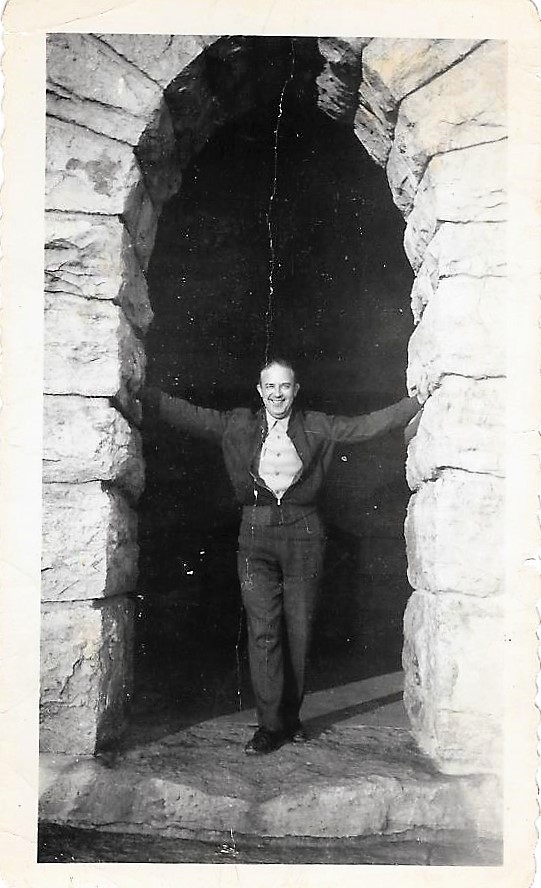
Harold Schoenthal

Harold Schoenthal


I did meet my great-uncle Harold, however. He had lived with his parents until they moved to Philadelphia in 1941 and had remained single.  When he was in his late 40s, he married May Gunther, and they had one child, my second cousin June.  Harold was in many ways a role model and mentor for my father.  He encouraged my father to pursue architecture, and my father took his advice and following in his footsteps, going to Columbia to study architecture.  Harold was not only a designer; he wrote poetry and painted.  He lived to 103, dying in 2004, in Montclair, New Jersey, where he had lived for almost eighty years.  Although I only saw him a handful of times, I remember him as a very gentle and kind man with a good sense of humor and a positive outlook on life.  I wish that I had been interested then in family history because he would have been an amazing source of information.


My Aunt Eva, my father, May and Harold Schoenthal

My Aunt Eva, my father, May and Harold Schoenthal

Uncle Harold and Aunt Eva

Aunt Eva and Great-Uncle Harold

Uncle Harold older


As for my grandmother, I knew almost nothing about her childhood before I started my research.  When I found the pictures and news stories about her in the Denver papers and in her high school yearbook, it made me think that she might have had a happy childhood growing up in Denver.  But her life was filled with challenges once she left Denver.  She was only eighteen and just out of high school when she married a man she had known for only half a year and who was nine years older than she was; within a year she had had a child and before she was twenty-three, she had two children.  She was living halfway across the country, far from her parents and two oldest brothers.  Only Harold was nearby.

Eva Schoenthal Cohen

Eva Schoenthal Cohen

Then her husband became disabled, and she just was not strong enough to deal with it all.  When she finally started getting her life back together in the early 1940s, she lost both of her parents within a year of each other. Soon thereafter both of her children became adults and left home.  She remarried in the 1950s to a very nice man named Frank Crocker who cared for her until she died in 1963 when she was 58 years old.

It was when she was married to Frank that I knew her, and we would see her a few times a year when we would make day trips to Philadelphia to visit. My clearest memory involves Frank more than my grandmother; he and I watched a Dodgers-Phillies game together on television during one of those visits, and if I remember correctly, Sandy Koufax was pitching.   I thought of that day when I saw last week that Sandy Koufax had turned eighty years old.

My memory of my grandmother is of someone who was fragile and insecure with a reserved and genteel presence.  But to be honest, I really did not know her well at all.  Doing this research has given me a somewhat fuller picture, and although she remains largely a mystery to me, at least I now know more about her brothers and her parents and the lives they led as well as more about her and her life.

My father and my grandmother at his graduation from Columbia, 1952

My father and my grandmother at his graduation from Columbia, 1952


Going Back East: My Schoenthal Great-grandparents and their Family 1924-1942

Happy New Year! I am still on vacation, but had this post 90% ready before we left, so with a cloudy morning I was able to get it finished.  Here is the remainder of the story of my Schoenthal great-grandparents; I have one more post almost done which will wrap up the story of my grandmother and her brothers.

….

By the mid-1920s, my grandmother Eva Schoenthal and her brother Harold had left Denver and moved east.  My grandmother had married my grandfather John Nusbaum Cohen and moved to Philadelphia in 1923. She had two children by the end of 1926.

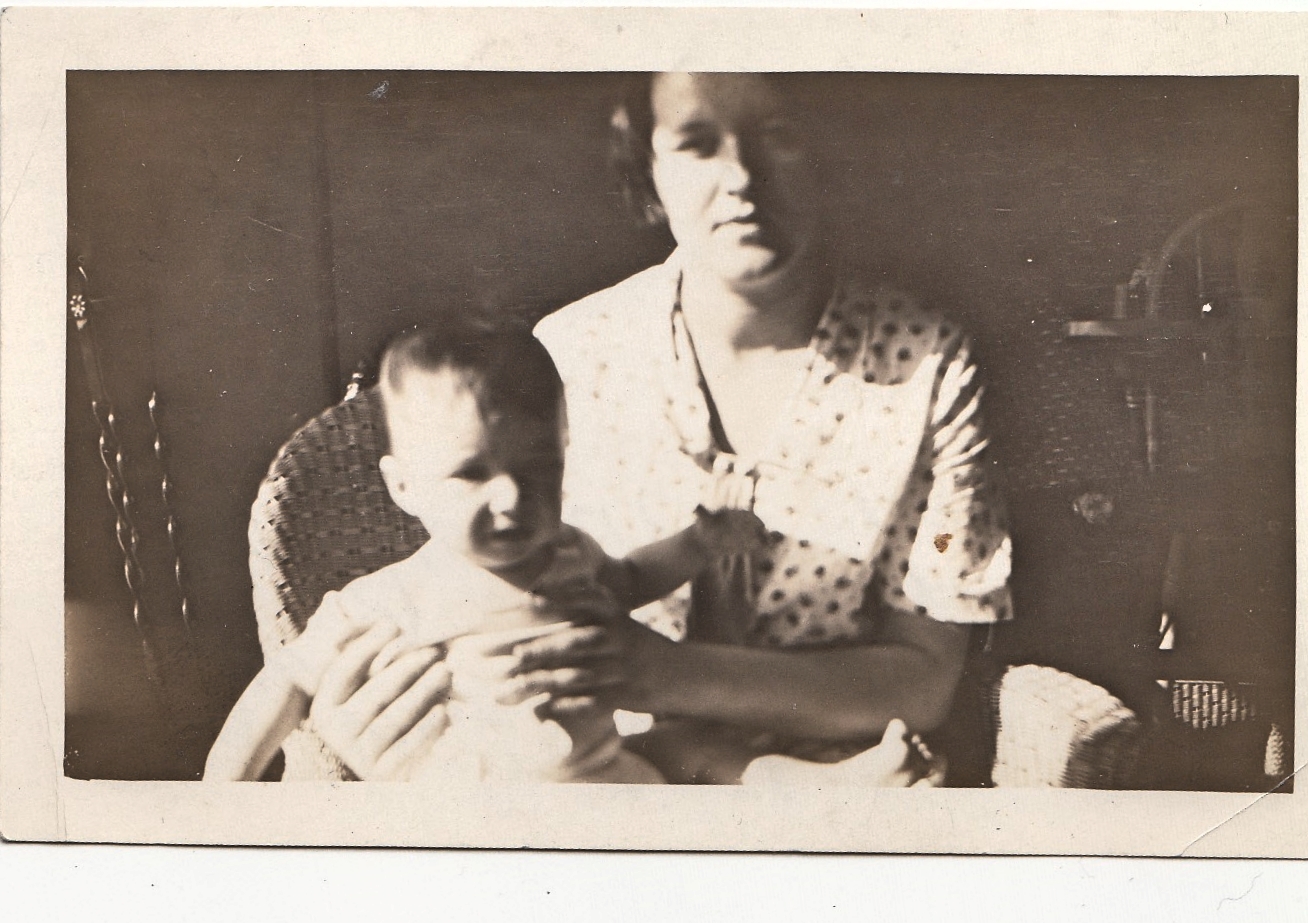
My aunt Eva Hilda Cohen and my grandmother Eva Schoenthal Cohen, c. 1925

My aunt Eva Hilda Cohen and my grandmother Eva Schoenthal Cohen, c. 1925


My father and his mother, Eva Schoenthal Cohen, c. 1927

My father and his mother, Eva Schoenthal Cohen, c. 1927


My great-uncle Harold was in college at Columbia University, studying architecture; he would graduate in 1927.

The rest of the Schoenthal family was still in Denver, where as seen in the 1924 and in 1925 Denver directories, they were still in the same occupations in which they’d been employed earlier in the decade: my great-grandfather Isidore was still working for Carson Crockery; Lester was still a traveling salesman, and Gerson was a salesman for the Sunland Sales Cooperative Association.

Ancestry.com. U.S. City Directories, 1822-1995 [database on-line]. Provo, UT, USA: Ancestry.com Operations, Inc., 2011.

Ancestry.com. U.S. City Directories, 1822-1995 [database on-line]. Provo, UT, USA: Ancestry.com Operations, Inc., 2011. 1925 Denver directory

In 1926, however, my great-grandparents and their son Gerson and his wife Gratice were the only family members listed in the Denver directory.  Lester is not listed in the Denver directory and does not reappear in a directory in the Ancestry database again until 1929, when he is listed in the Richmond, Indiana directory as a manufacturer’s agent; his wife is now listed as Grace. By that time Lester and Juliet Grace had moved back and forth between Denver and Indiana twice.  It’s hard to know whether Lester kept moving for jobs or because he and his wife couldn’t decide whether to be closer to her family or his.

1929 Directory, RIchmond, Indiana Ancestry.com. U.S. City Directories, 1822-1995 [database on-line]. Provo, UT, USA: Ancestry.com Operations, Inc., 2011.

1929 Directory, Richmond, Indiana Ancestry.com. U.S. City Directories, 1822-1995 [database on-line]. Provo, UT, USA: Ancestry.com Operations, Inc., 2011.

On June 15, 1928, my great-uncle Gerson  was divorced from Gratice.

Ancestry.com. Colorado, Divorce Index, 1851-1985 [database on-line]. Provo, UT, USA: Ancestry.com Operations, Inc., 2015.

Ancestry.com. Colorado, Divorce Index, 1851-1985 [database on-line]. Provo, UT, USA: Ancestry.com Operations, Inc., 2015.

Also around this time, my great-grandparents left Denver and followed their two youngest children back to the east.  They settled in Montclair, New Jersey, where their son Harold was working as a designer after completing his undergraduate degree at Columbia.  They were all living together at 16 Forest Street in Montclair in 1929, 1930, and 1931, according to the city directories for those years, yet they are not listed in the 1930 US census at that address or elsewhere.  The enumerator did include other people who were living at that address (presumably an apartment building), but not my relatives.  According to those directories, Isidore was working at The China Shop and Harold was a designer.  A later news article about Harold indicated that in 1931 he was working at the interior design firm Schulz and Behrle.

Hilda (Katzenstein) Schoenthal, Eva Schoenthal Cohen, Eva Hilda Cohen, and Harold Schoenthal

Hilda (Katzenstein) Schoenthal, Eva Schoenthal Cohen, Eva Hilda Cohen, and Harold Schoenthal


My grandparents, Eva (Schoenthal) and John Cohen, and their two children were living at 6625 17th Street in Philadelphia, according to the 1930 US census; my aunt was six, my father three and a half.  My grandfather was a clothing and jewelry merchant. But not long after the 1930 census, my grandparents’ lives changed dramatically.   My grandfather was diagnosed with MS, and in the aftermath of that diagnosis, my grandmother suffered a breakdown and was unable to care for her children. My grandmother ended up living with her parents and brother Harold in Montclair, New Jersey.  Her children were living with their ailing father and his mother, my great-grandmother Eva Mae Seligman Cohen, in Philadelphia, as I wrote about here and here.

As for Lester, he and his wife  were living in Richmond, Indiana, in 1930.  Lester was a traveling salesman and Juliet (listed on the 1930 census as Grace) an office manager for an insurance company, according to the 1930 census.  A year later, they had moved again.  In 1931, Lester and his wife (listed here as Julia G.) were living in Dayton, Ohio.  Lester was still a salesman. They are not, however, in the 1932 Dayton directory.  I do not know where they were until in 1935, when, according to the 1940 US census, they were living in Montclair, NJ, where my great-grandparents and great-uncle Harold were also living.

Thus, by 1930, Gerson was the only Schoenthal left in Denver. Gerson must have visited his family back East around 1930. That is my father in the photograph, and he appears to be about three or four years old in that picture.

Dad Uncle Gerson Eva

My father, his uncle Gerson Schoenthal, and his sister Eva Hilda Cohen


Although Gerson is listed in the 1930, 1931 , and 1932 Denver directories, like his parents and brother Harold in Montclair, NJ, he seems to have been missed by the census enumerator. Gerson is also missing from the Denver directories in 1934 and 1935, and when he reappears in the 1936 directory for Denver, he is listed with a wife named Maude.

Maude Sheridan was born in May 11, 1883, in Salt Creek Township, Kansas.  Her father died when she was just a young child, and she and her mother lived in Kansas until at least 1905.  By 1910, she and her mother had moved to Colorado Springs, where they were living with Maude’s father’s brother, Patrick Sheridan, a leather retailer.  Maude was working as a public school teacher.  She became a school principal in Colorado Springs, Colorado, around 1912, and had great success there.  In 1916, she signed a long term contract with Colorado Agricultural College, and she and her mother were living in Fort Collins, Colorado, in 1920.  Maude was working as a college instructor.

Maude Sheridan principal


By 1930 Maude had left her education career and was the owner of a restaurant in Alamosa, Colorado.  She was still single and no longer living with her mother.  Then sometime between 1930 and 1936, Maude married my great-uncle Gerson Schoenthal.  In 1936, she would have been 53, he would have been 44.

Meanwhile, back in Montclair, New Jersey, in 1935, my great-grandfather was continuing to work for The China Shop, and his son Harold continued to work as a designer, living with his parents at 16 Forest Street in Montclair and working in Newark. My grandmother was also living with her parents in Montclair. Lester and Grace also continued to live in Montclair where Lester worked as a salesman.  All of them were still in Montclair for the rest of the 1930s, although my great-grandparents and Harold moved to 97 North Fullerton Avenue by 1937.

Upper Montclair NJ

Upper Montclair NJ (Photo credit: Wikipedia)

In 1939, my grandmother moved back to Philadelphia to live with her children, who were then sixteen and thirteen.  Their father was in a long term care facility by that time, and their paternal grandmother Eva Seligman Cohen had died on   October 31,  1939.  According to the 1940 census, my grandmother was working as a saleswoman in the wholesale china business at that time.

Her parents and brother Harold were still living in Montclair where in 1940 my great-grandfather was retired and Harold was working as a designer in the interior decorating business.  Lester and Juliet had moved once again, this time to Upper Darby, Pennsylvania, where according to the 1940 census, Lester was working as a refrigeration engineer for a wholesale refrigeration business.

As for Gerson, for a long time I could not find him on the 1940 census.  Then when Ancestry added the Social Security Applications and Claims Index to its database collection, the mystery was solved.  This is what I saw:

Ancestry.com. U.S., Social Security Applications and Claims Index, 1936-2007 [database on-line]. Provo, UT, USA: Ancestry.com Operations, Inc., 2015. Original data: Social Security Applications and Claims, 1936-2007.

Ancestry.com. U.S., Social Security Applications and Claims Index, 1936-2007 [database on-line]. Provo, UT, USA: Ancestry.com Operations, Inc., 2015.
Original data: Social Security Applications and Claims, 1936-2007.

Obviously, Gerson had changed his name to Gary Sheridan sometime between the 1938 Denver directory and the 1940 US census.  And for some reason he had changed his mother’s birth name (and his middle name) from Katzenstein to Kay.  Why? To sound less Jewish, I’d assume. Or maybe to sound less German as Europe and eventually the US were at war against Germany. Sheridan had been Maude’s birth name, and Gerson kept his initials the same, but otherwise he’d taken on a whole different identity.

Once I knew his new name, I found Gerson a/k/a Gary and his wife Maude on the 1940 census.  He was working as a salesman for the American Automobile Association, and Maude was working a manager of a tea room in Denver.

Year: 1940; Census Place: Denver, Denver, Colorado; Roll: T627_488; Page: 8A; Enumeration District: 16-148

Year: 1940; Census Place: Denver, Denver, Colorado; Roll: T627_488; Page: 8A; Enumeration District: 16-148

In early 1941, my great-grandparents moved to Philadelphia to help my grandmother with her children and lived next door to them on Venango Street.  My great-grandmother Hilda Katzenstein Schoenthal died not long after on August 17, 1941; she had only been living in Philadelphia for seven months when she died, according to her death certificate.  She was 77 years old and died from pneumonia.

Hilda Katzenstein Schoenthal death certificate Ancestry.com. Pennsylvania, Death Certificates, 1906-1963 [database on-line]. Provo, UT, USA: Ancestry.com Operations, Inc., 2014. Original data: Pennsylvania (State). Death certificates, 1906–1963. Series 11.90 (1,905 cartons). Records of the Pennsylvania Department of Health, Record Group 11. Pennsylvania Historical and Museum Commission, Harrisburg, Pennsylvania.

Hilda Katzenstein Schoenthal death certificate
Ancestry.com. Pennsylvania, Death Certificates, 1906-1963 [database on-line]. Provo, UT, USA: Ancestry.com Operations, Inc., 2014.
Original data: Pennsylvania (State). Death certificates, 1906–1963. Series 11.90 (1,905 cartons). Records of the Pennsylvania Department of Health, Record Group 11. Pennsylvania Historical and Museum Commission, Harrisburg, Pennsylvania.

My great-grandfather Isidore died a year later on July 10, 1942; he was 83 when he died; he also died from pneumonia.

Isidore Schoenthal death certificate 1942 Ancestry.com. Pennsylvania, Death Certificates, 1906-1963 [database on-line]. Provo, UT, USA: Ancestry.com Operations, Inc., 2014. Original data: Pennsylvania (State). Death certificates, 1906–1963. Series 11.90 (1,905 cartons). Records of the Pennsylvania Department of Health, Record Group 11. Pennsylvania Historical and Museum Commission, Harrisburg, Pennsylvania.

Isidore Schoenthal death certificate 1942
Ancestry.com. Pennsylvania, Death Certificates, 1906-1963 [database on-line]. Provo, UT, USA: Ancestry.com Operations, Inc., 2014.
Original data: Pennsylvania (State). Death certificates, 1906–1963. Series 11.90 (1,905 cartons). Records of the Pennsylvania Department of Health, Record Group 11. Pennsylvania Historical and Museum Commission, Harrisburg, Pennsylvania.

When I think about my great-grandfather’s life, I am left with many questions.  He was the second youngest child in a large family and the youngest son.  Of those who emigrated from Germany, he was among the last members of his family to arrive. He watched, one by one, as his older brothers and sisters moved away. Then he finally came to the US himself with his mother and younger sister Rosalie.  He lived in the small town of Washington, Pennsylvania, for the first 25 years of his years in the US, a town where his older brother Henry was a recognized leader both in the business and Jewish community.  Isidore had most of his siblings relatively close by once again.

Then suddenly in his late 40s he moved far away from his entire family, taking his wife and his four children far from everything they knew to start again in order to give his son Gerson a healthier place to live. He started over working in the china business. And then he started over one more time when he returned to the east coast twenty years later to be closer to his two youngest children.  In the end he and his wife Hilda ended up helping to care for his daughter and his grandchildren, including my father.  By the time my great-grandfather died, he had lost every one of his nine siblings as well as his wife and his parents.


Cologne, after bombing of World War II By U.S. Department of Defense. Department of the Army. Office of the Chief Signal Officer. [2] [Public domain], via Wikimedia Commons HTML Attribution not legally required

Cologne, after the bombing of World War II
By U.S. Department of Defense. Department of the Army. Office of the Chief Signal Officer. [2] [Public domain], via Wikimedia Commons

My father recalls him as a very quiet man. He has a vivid memory of his grandfather Isidore crying when he learned of the bombing of Cologne by the Allies in May, 1942, during World War II.  My father had assumed that Isidore had lived in Cologne, and although his brother Jacob had lived in that city, there is nothing to indicate that Isidore had ever lived anywhere but Sielen when he lived in Germany.  Perhaps it was more the notion that his homeland was at war with his adopted country and that the land of his birth and his childhood was being devastated by Allied bombing that made him cry. Perhaps he had visited Jacob in Cologne and remembered what a beautiful city it was. Or maybe he was just crying for the memories of his nine siblings and his parents, living in Germany, when he was a child.

My father said that his grandfather didn’t talk about it, just sat with tears running down his face. He died just two months later. I will always wonder what stirred beneath the surface of this man who had led what seemed to be a quiet life but with so many twists and turns and so many losses.

In Part III, I will follow up with what happened to Lester, Gerson, Harold, and my grandmother Eva after 1942.

The Mystery of the Philadelphia Lawyer: Part II

In my last post I wrote about the mystery of my cousin Celina Nusbaum, who had been married to Inglis Cameron, with whom she’d had a son Edward James.  Then she became Sally Carnes, married to Donald Carnes, and her son Edward James also took on the surname Carnes. Celina’s granddaughter Tracy had commented on my blog and helped to fill in some details about Celina. But there was more to learn.  Why did Celina change her name and move to Texas? Who was Donald Carnes, and what had happened to Inglis Cameron?

An old friend of the family had shared his memories with Tracy and her brother, and Tracy sent me the notes she had from that conversation.  Since I cannot prove some of the details alleged in those notes, I need to be careful what I write here, but from that conversation, Tracy understood that her grandfather had gotten into some sort of trouble, had changed his name to Donald Carnes, and had moved the family to Texas to start over.  Celina became Sally Carnes, and Edward James became E.J. Carnes. Tracy said that her mother’s maiden name had been Barnes, and she thought that the family combined Cameron with Barnes to create Carnes as their new name.

Why did they choose Texas as a place to move? On Donald Carnes’ death certificate, it says that Donald was born on December 2, 1884, in “Corsicane [sic], Texas.”

Ancestry.com. Texas, Death Certificates, 1903–1982 [database on-line]. Provo, UT, USA: Ancestry.com Operations, Inc., 2013. Original data: Texas Department of State Health Services. Texas Death Certificates, 1903–1982. iArchives, Orem, Utah.

Ancestry.com. Texas, Death Certificates, 1903–1982 [database on-line]. Provo, UT, USA: Ancestry.com Operations, Inc., 2013.
Original data: Texas Department of State Health Services. Texas Death Certificates, 1903–1982. iArchives, Orem, Utah.

I did some more research into the background of Inglis Cameron and learned that his parents had once lived in Corsicana, Navarro County, Texas. The Camerons had first lived in Philadelphia after marrying, but their second child, Charles Cameron, was born in Corsicana, Texas, in Navarro County in 1879, according to his death certificate; that certificate also identified the full names of the Cameron parents—James Cameron and Mary Elizabeth.

Charles Cameron death certificate Ancestry.com. Pennsylvania, Death Certificates, 1906-1963 [database on-line]. Provo, UT, USA: Ancestry.com Operations, Inc., 2014. Original data: Pennsylvania (State). Death certificates, 1906–1963. Series 11.90 (1,905 cartons). Records of the Pennsylvania Department of Health, Record Group 11. Pennsylvania Historical and Museum Commission, Harrisburg, Pennsylvania.

Charles Cameron death certificate
Ancestry.com. Pennsylvania, Death Certificates, 1906-1963 [database on-line]. Provo, UT, USA: Ancestry.com Operations, Inc., 2014.
Original data: Pennsylvania (State). Death certificates, 1906–1963. Series 11.90 (1,905 cartons). Records of the Pennsylvania Department of Health, Record Group 11. Pennsylvania Historical and Museum Commission, Harrisburg, Pennsylvania.

The Cameron family is also listed in Navarro County on the 1880 census.

James Cameron and family 1880 census Year: 1880; Census Place: Navarro, Texas; Roll: 1321; Family History Film: 1255321; Page: 314D; Enumeration District: 127

James Cameron and family 1880 census
Year: 1880; Census Place: Navarro, Texas; Roll: 1321; Family History Film: 1255321; Page: 314D; Enumeration District: 127


The Camerons later returned to Pennsylvania, where Inglis was born on December 2, 1883, according to his World War I draft registration and several census records.

Registration State: Pennsylvania; Registration County: Philadelphia; Roll: 1907636; Draft Board: 17

Registration State: Pennsylvania; Registration County: Philadelphia; Roll: 1907636; Draft Board: 17


So Inglis had family ties to Corsicana, Texas.  It seems clear to me that Inglis Cameron became Donald Carnes and that he changed his birth place to Corsicana where his parents had once lived, perhaps to give himself credible Texas roots.  He also kept his birthday (though not the year) the same.  Although I have no official documentation to prove that he changed his name, the circumstantial evidence certainly points that way.

Donald Carnes’ application for a Social Security number seems to support this conclusion as well.  There is an entry in the Social Security Applications and Claims Index on Ancestry.com that indicates that Donald Carnes filed for a Social Security number in October 1940. The SSACI index lists Donald Carnes’ birth place as Corsicana, Texas, and his birth date as December 6, 1884. It lists his parents’ names as James Carnes and Mary Smith. Inglis Cameron’s parents were James and Mary Cameron—coincidence?  I think not.   I have sent for the actual application, but I doubt it will say he was also once known as Inglis Cameron.

Thus, I am convinced that, as the family friend told Tracy, Inglis Cameron became Donald Carnes, that Celina Nusbaum Glessner Cameron became Sally Carnes, and that Edward James Cameron became Edward James Carnes.  But why? What had happened to cause them to change their names and move to Texas?

I was able to find Inglis E.D. Cameron listed as a lawyer in the Philadelphia directory in 1922 and in 1923.  In 1923, he was listed as part of a firm, Cameron & Carey.  In 1925, he was listed in the NYC directory as an attorney, but in the Philadelphia directory, it only listed his residence.  In the 1930 directory, he is not listed at all. (There are no online Philadelphia directories for the years between 1925 and 1930.)

I needed to find a source for news about Philadelphia during the 1920s and 1930s, but the databases to which I subscribe have no Philadelphia papers dated past 1922.  The only online database that has Philadelphia newspapers dated after 1922 is a wonderful free website known as Fulton History or Old Fulton Postcards.  It is run by one man who has scanned and uploaded millions of pages of old newspapers, including the Philadelphia Inquirer.  It is not always an easy site to use because you have to be very persistent and creative in searching, and my first time through I had not found anything too helpful.  But after receiving Tracy’s comment on the blog, I was motivated to spend more time learning how to search the Fulton site.

What did I learn? Inglis E.D. Cameron had been a member of a law firm in Philadelphia called Cameron & Carey, as indicated in the 1923 Philadelphia directory; his partner was James T. Carey.  In 1922 they represented a company called United Auto Stores, a chain that sold auto parts and accessories. The company was founded by Edward B.P. Carrier, a young man who was the son of a doctor in Philadelphia and who had been a student at the University of Pennsylvania when he left to start the company.  By 1922, the company had over fifty stores in many states, and Edward “Bud” Carrier was only 28.

In February, 1922, Carrier and others involved in the business of United Auto Stores were sued by stockholders for conspiracy to commit stock fraud; they were allegedly lying to purchasers about the value of the company in order to induce them to buy stock and also profiting by using a shell company as the selling agent of the stock.

Edward P. B. "Bud" Carrier, head of Auto Stores Philadelphia Inquirer, February 25, 1922, p. 1

Edward P. B. “Bud” Carrier, head of Auto Stores
Philadelphia Inquirer, February 25, 1922, p. 1

The story was covered in detail by The Philadelphia Inquirer, and in some of the articles there are references either to Inglis Cameron, his partner James T. Carey, or their firm Cameron & Carey as the counsel to United Auto Stores.  See, e.g., “Gigantic Swindle Seen in Collapse of Auto Stores Co.,” Philadelphia Inquirer, February 24, 1922, p. 1, 3 [names Cameron & Carey as counsel and quotes James T. Carey]; “File Court Actions to Save Creditors of Auto Stores Co.,” Philadelphia Inquirer, February 25, 1922, pp. 1, 9; “Gay Parties Marked Spending Orgy of Auto Stores Head,” Philadelphia Inquirer, February 26, 1922, p. 1; “Auto Stores Chief Denies All Charges of Wild Spending,” Philadelphia Inquirer, February 27, 1922, p. 1, 5 [mentions Cameron & Carey as company counsel and Inglis E.D. Cameron specifically as present during questions by reporter]; “Auto Stores Yields Up But $30,” Philadelphia Inquirer, February 28, 1922, p. 2; “Auto Stores Head Called Falsifier,” Philadelphia Inquirer, March 1, 1922, p. 2; “Receivers Named for Auto Stores,” Philadelphia Inquirer, March 2, 1922, p.2; “Hint of US Action Shock to Carrier,” Philadelphia Inquirer, March 4, 1922, p. 2.

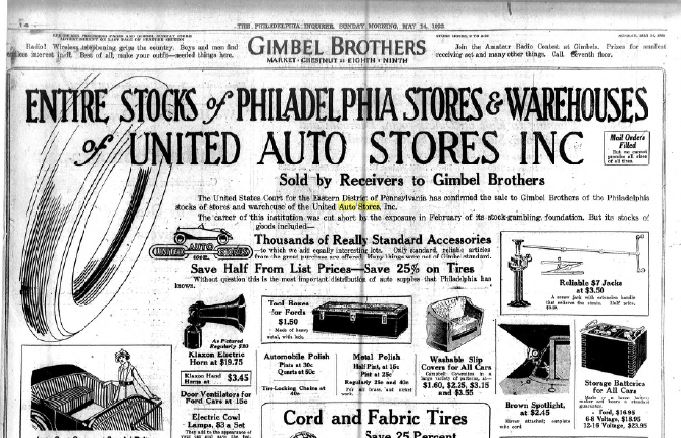
By March 7, 1922, United Auto Stores was in permanent receivership, and soon thereafter its assets were sold to Gimbel Brothers.  “Special Referee to Probe Crash of Carrier’s Concerns,” Philadelphia Inquirer, March 7, 1922, pp. 1. 13.

Philadelphia Inquirer, May 14, 1922, p. 14

Philadelphia Inquirer, May 14, 1922, p. 14

The timing of this case unfolding raised some red flags for me.  It was in the spring of 1921 that “thieves” struck Inglis Cameron’s company, Cameo Dress Company, at least three times.  And it was on February  22, 1922, that the newspaper reported that Cameo Dress Company had been damaged by fire.  The first story about the United Auto Stores’ charges appeared in the paper on February 24, 1922, two days later. Could this be just coincidence? Or is there a connection?

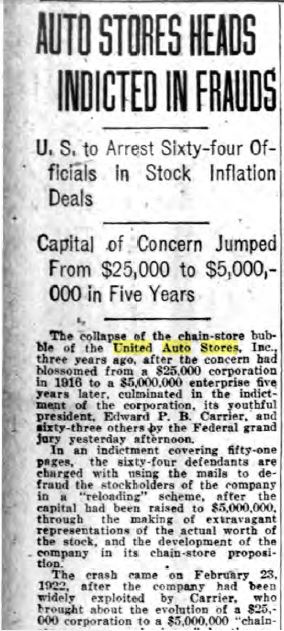
In 1925, sixty-four individuals and the corporation itself were indicted on grounds of conspiracy to commit fraud.  Carrier was indicted as well as other officers of the company and a number of individuals who had been involved in the sales of United Auto Stores stock.  Absent, however, from the list of indicted individuals were the names of Inglis E.D. Cameron and James T. Carey.

Auto Stores Indictments 2 10 25 p 2 pt 1

indictments pt 2

Philadelphia Inquirer, February 10, 1925, p. 2

Philadelphia Inquirer, February 10, 1925, p. 2

And then the case disappeared from the papers.  I don’t know what happened with the charges.  Was there a trial? A verdict?  It’s very odd, but so far I have not found answers to those questions. But even before the Auto Stores indictment,  Samuel Safir and Samuel Rosenblatt, two of the first three names listed in the article identifying those who were indicted in the Auto Stores matter, had been charged in another case of stock fraud, this one involving the Altoona Glass Casket Company, a story that made the newspapers throughout the country. E.g., “Glass Casket Co. Promoters Jailed,” Boston Herald, February 2, 1924, p. 4.  Safir and Rosenblatt were ultimately convicted in the casket case.

As for Edward B.P. Carrier, as far as I can tell he was not convicted of any charges.  He married in 1924 and was living on Long Island, New York, in 1930 with his wife and family. He was working as a real estate broker.  In 1942 when he registered for the draft, he was living at the YMCA in Pottstown, Pennsylvania, working for a company called Defense Builders in Pottstown.  He died in Brigantine, New Jersey, in 1957.  Maybe he was just manipulated  by people like Safir and Rosenblatt, who may have been the true masterminds behind the conspiracy.  One other source I read suggested that Carrier himself may have been duped. “United Auto Stores Swindle,” United States Investor, vol. 33, issue 1 (April 1922), pp.749-750 (describing Carrier as a “tool” in the scheme of another).

The notes that Tracy had from the conversation with her father’s old friend suggest that Inglis and his son went to Florida around 1925 to invest in real estate and ended up losing a lot of money, but I have no way of verifying that information.  But Edward James Cameron, Celina’s son and Tracy’s father, would have been only ten years old in 1925.

So what do you think happened between 1925, when Inglis disappeared, and 1940, when he applied for a Social Security card as Donald Carnes?  Was he running from creditors? Was he running from the law?

Or, as I am thinking, was he running from those who were behind the stock fraud conspiracy? Had he been a witness against them, leading to the 1925 indictments?  Had they been trying to intimidate him by subjecting Cameo Dress to theft and fire?  The Federal Witness Protection program did not exist in those days, but perhaps there was some informal way that the government enabled Inglis Cameron and his family to change their names and move from Philadelphia to Houston.

Inglis Cameron, a/k/a Donald Carnes, was killed in a car accident in 1948. He and his wife Sally/Celina were run down by a Houston carpenter named Homer Bertram Poole.  Sally survived.  The driver was indicted for murder by automobile, as described in the following three articles.   I am grateful to Leah, Amanda, and Barb from the Texas Genealogy Network on Facebook for helping to locate these articles about Donald Carnes’ death.

Donald Carnes accident

Sweetwater Reporter, November 7, 1948, p. 3


Houston Post, November 7, 1948

Houston Post, November 7, 1948


Amarillo Daily New, December 14, 1948, p.7

Amarillo Daily New, December 14, 1948, p.7

Was this just a case of drunk driving? Or was it something more intentional? I don’t know.

Celina/Sally Cameron/Carnes died eighteen years later in 1966.   Edward James Cameron/Carnes died in 1984. This mystery remains largely unsolved.

Thanks to Tracy and her sister Ginger, I now have pictures of my cousin Celina Nusbaum, her husband Inglis Cameron, and their son Edward James Cameron—otherwise known as Sally, Donald, and E.J. Carnes.

Sally, Edward James, and Donald Carnes Courtesy of Tracy Carnes

Sally, Edward James, and Donald Carnes
Courtesy of Tracy Carnes and Ginger Carnes

Celina Nusbaum a/k/a Sally Carnes Courtesy of Tracy and Ginger Carnes

Celina Nusbaum a/k/a Sally Carnes
Courtesy of Tracy and Ginger Carnes

I will continue to look for more information.  But for now, I am interested in what you all think.  How would you fit together all these pieces of the puzzle?  Why did the Cameron family leave Philadelphia, change their names, and move to Houston?


The Mystery of the Philadelphia Lawyer: Part I

I am taking a short break this week from the Schoenthal story to return to a mystery I discovered in the Nusbaum family line. Back in April I wrote about the strange disappearance of Celina Nusbaum, my second cousin, three times removed.  Celina was the granddaughter of Ernst Nusbaum, brother of my 3x-great-grandfather John Nusbaum.  Her life story was intriguing, and I was frustrated that I could not find some closure to her story.

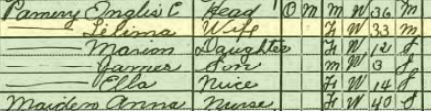
Here’s what I knew: Celina was born in November 1881 in Philadelphia, daughter of Edgar Nusbaum and Viola Barritt.  She had married Hamilton Hall Treager Glessner in 1904, and their daughter Marian Glessner was born in 1906.  But by 1910, the marriage was over, and Celina had returned with her daughter to her parents’ home.  Celina was working as a dress designer, according to the 1910 census.

Year: 1910; Census Place: Abington, Montgomery, Pennsylvania; Roll: T624_1377; Page: 9B; Enumeration District: 0064; FHL microfilm: 1375390

Year: 1910; Census Place: Abington, Montgomery, Pennsylvania; Roll: T624_1377; Page: 9B; Enumeration District: 0064; FHL microfilm: 1375390

Celina remarried in August 1912.  Her second husband, Inglis E.D. Cameron, was a lawyer who had graduated from the University of Pennsylvania School of Law in 1909.  He must have been somewhat well-regarded there because he was selected as toastmaster for the class banquet:

Inglis Cameron from UPenn 1909 yearbook

Penn Law 1909 Cameron

Philadelphia Evening Bulletin March 15, 1909

Philadelphia Evening Bulletin March 15, 1909


Celina and Inglis had a son, Edward James Cameron, born in June, 1915.  On the 1920 census, Inglis, Celina (Selena on the census record), Marian, and Edward (called James there) were living in Philadelphia, and Inglis listed his occupation as a lawyer for a manufacturer. (His name was really butchered by the census enumerator, but this is definitely his family.)

Year: 1920; Census Place: Philadelphia Ward 22, Philadelphia, Pennsylvania; Roll: T625_1624; Page: 7A; Enumeration District: 617; Image: 269

Year: 1920; Census Place: Philadelphia Ward 22, Philadelphia, Pennsylvania; Roll: T625_1624; Page: 7A; Enumeration District: 617; Image: 269

I was able to find Inglis in the 1925 NYC directory as a lawyer in midtown Manhattan, but residing in Philadelphia.

Title : New York, New York, City Directory, 1925 Source Information Ancestry.com. U.S. City Directories, 1822-1989 [database on-line].

Title : New York, New York, City Directory, 1925
Source Information
Ancestry.com. U.S. City Directories, 1822-1989 [database on-line].

I found one brief news item in the Philadelphia Inquirer about Inglis Cameron as a lawyer, dated April 17, 1924:

Inglis Cameron atty april 17 1924 p 12

Philadelphia Inquirer, April 17, 1924, p. 12

I am not quite sure what to make of this article.  It appears that Inglis was representing a client whose identity he would not or could not reveal, but that the newspaper believed was the Fifth Avenue Coach Company, a New York bus company that was seeking to establish business in Philadelphia.

After that, I could not find any trace of any of them; Celina, Inglis, Marian, and Edward James Cameron all seemed to have vanished.  I could not find them in any directory nor on either the 1930 or 1940 census.

But a woman named Sally Carnes with a husband named Donald Carnes and a son named E. J. Carnes surfaced in Texas, in the 1940s.  Why is that relevant? Because this death certificate made it very clear to me that Sally Carnes was the same woman as Celina Nusbaum Glessner Cameron:

Ancestry.com. Texas, Death Certificates, 1903–1982 [database on-line]. Provo, UT, USA: Ancestry.com Operations, Inc., 2013.

Ancestry.com. Texas, Death Certificates, 1903–1982 [database on-line]. Provo, UT, USA: Ancestry.com Operations, Inc., 2013.

Her parents were Edgar Nusbaum and Viola Barritt, and the informant was her daughter from her first marriage, Marian (using her married name Pattinson).  This had to be Celina.  When I then searched for Carnes in Houston, it led me to the death certificate of Donald Carnes, who had a son named E.J. Carnes:

Ancestry.com. Texas, Death Certificates, 1903–1982 [database on-line]. Provo, UT, USA: Ancestry.com Operations, Inc., 2013. Original data: Texas Department of State Health Services. Texas Death Certificates, 1903–1982. iArchives, Orem, Utah.

Ancestry.com. Texas, Death Certificates, 1903–1982 [database on-line]. Provo, UT, USA: Ancestry.com Operations, Inc., 2013.
Original data: Texas Department of State Health Services. Texas Death Certificates, 1903–1982. iArchives, Orem, Utah.

The initials E.J. for E.J. Carnes?  To me that had to be Edward James Cameron using a different surname, that of the man I assumed was Celina/Sally’s third husband, Donald Carnes.  But I had no further record for Inglis Cameron, no earlier records for Donald Carnes, and no marriage record for Sally and Donald Carnes.  There are further details of my search described here in my earlier post, but the bottom line is that I had no definite answers as to what happened to Inglis or how Celina became Sally Carnes and ended up in Houston.  Even searching for descendants of Marian Glessner Pattinson led me nowhere.

Enter Tracy Carnes, who left a comment on my blog in October. Tracy wrote that she was the daughter of Edward James Carnes, who was the son of Donald Carnes and Lena Claire Nusbaum (Celina was sometimes identified as Lena), also known as Sally Carnes.  That is, Tracy is my fourth cousin, once removed. And she had some answers to my questions and some fascinating information about her grandmother, Sally Carnes, who had once been Celina Nusbaum:

Tracy wrote:

My grandmother, Lena Claire Nusbaum (as listed on my father’s death certificate) or Sally Carnes, was a dressmaker. She had a knack for making fat women look thin and thin women look shapely. I stayed with her in Houston one summer for about a week, and she had dress forms, patterns she was making, and wedding dresses in the works. Mother (Margaret Hannah Barnes Carnes) told us that Sally had the patent on the metal slider that adjusts bra straps. She also designed a slip for Babe Didrikson Zaharias for golfing, called the “super-stride.” Mom and dad said that Sally Carnes had a line of clothing called, “Sally Smart” and four dress factories in Philadelphia lost during the depression. Sally also owned a Russian Tea Room. We don’t have any documentation to support these stories.

So I set out to find some documentation.  I thought the easiest story to validate was the one about the patent on a bra strap slider so I used Google Patents to try and locate such a patent.  Although I did not find one for that specific invention, I did find three patents that were issued to Celina Cameron.  The first, Patent No. 1709337, was filed July 12, 1926, and was issued on April 16, 1929.  That patent was for a garment combining a skirt and bodice.  In her application, Celina wrote:

This invention relates to women’s garments, more particularly garments combining a bodice and skirt. In connection with garments embodying the general characteristics mentioned, I seek to retain all the advantages of the skirt as considered from the esthetic standpoint, and yet afford the wearer the utmost comfort with regard to freedom of leg movement 0 without entailing exposure within the confines of the skirt.

Celina Cameron patent 2-page-001 Celina Cameron patent 2-page-002 Celina Cameron patent 2-page-003


A second patent, No. 1797714, filed May 17, 1929, and granted on March 24, 1931, was also for a garment, this one for a negligee, as described in the application:

This invention relates to garments of the negligee class and of a type intended more particularly for women.  The object of my invention is to provide a slip-on garment of the kind referred to which is simple in design, yet highly attractive in appearance; which is easily and quickly put on or taken ‘off and which ordinarily affords complete protection, but when desired permits the back of the wearer to be exposed for sun or heat treatment to the exclusion of all other parts of the body.

Celina Cameron patent 1-page-002 Celina Cameron patent 1-page-003 Celina Cameron patent 1-page-004

Perhaps this was the slip designed for Babe Didrikson Zacharias?

The third patent issued to Celina Cameron, No. 1834331, was for a modification to the first invention so that it could be reversible.  That patent application was filed on February 19, 1930, and the patent issued on December 1, 1931.

So although I did not find a patent for a bra strap slider, there certainly was truth to the family story that Celina had patented some of her clothing designs.  And from the dates on these patents, I knew that at least until 1930 when she applied for the third patent, Celina was still using the name Celina Cameron.

As for the four dress factories, I found two possible companies.  The first was Cameo Dress Company, which Inglis listed as his company on his World War I draft registration in September, 1918.

Registration State: Pennsylvania; Registration County: Philadelphia; Roll: 1907636; Draft Board: 17

When I Googled this company, however, I found that the company had been incorporated on February 27, 1918, by Edgar Nusbaum, Celina’s father. Edgar had for many years worked as a clerk for the railroad, not as a manufacturer.  I assume that he incorporated this business for his daughter Celina, who had listed her occupation in 1910 as a dress designer.  Although Inglis had been working as a lawyer as of the taking of the 1920 census, in the 1921 Philadelphia directory his listing simply says Cameo Dress Company.

But Cameo Dress Company ran into some bad luck.  The company fell victim to thieves at least twice in the spring of 1921, and then suffered a devastating fire in 1922.

Philadelphia Inquirer, April 9. 1921, p 3

Philadelphia Inquirer, April 9. 1921, p 3

And then just two months later, there was a second theft:

Philadelphia Inquirer, June 25, 1921, p 3

Philadelphia Inquirer, June 25, 1921, p 3

This article made reference to a theft ten days earlier, so it seems that Cameo Dress was subjected to (at least) three thefts in the spring of 1921.

Then, in February 1922, there was a devastating fire:

Philadelphia Inquirer, February 22, 1922, p. 3

Philadelphia Inquirer, February 22, 1922, p. 3


Was this really all just bad luck? The article about the fire notes that it “started beneath a stairway from an undetermined origin.”  Was someone targeting Cameo Dress Company?

Because almost all of the databases of online newspapers do not include any Philadelphia newspapers after 1922, I could not find out what happened to Cameo Dress Company after the fire.  But there had been an earlier fire that also seemed to involve the Cameron family.  Reginald on the Philadelphia Genealogy group on Facebook found a listing from the Philadelphia fire department’s annual report for 1914:

I then found this news article:

Mayfair fire

Mayfair fire 2

Philadelphia Inquirer, November 9, 1914, p. 5

Although I have not yet found anything else about Mayfair Manufacturing Company, I did find it rather strange that another company owned by Inglis Cameron had been damaged by a fire.  As with Cameo Dress, it was a company occupying the third floor of a building.  That time the fire department had opined that it could have been spontaneous combustion—dirty rags, I suppose.

(Of course, I am very glad that they saved the kitten.)

I did not find any documenation for a Sally Smart line of clothing or for a Russian tea room owned by Celina, the last two stories Tracy had shared in her comment about her grandmother .

But what Tracy and I were really interested in was why her grandmother Celina and her father Edward James had moved to Texas and changed their names to Cameron.  Tracy said that her father, Edward James Cameron/Carnes, had died in 1984 and that she had known that he had died with a secret, but not what it was.  Then about 20 years ago, Tracy and her brother received a phone call from an old friend of their father who shared what he knew.  Tracy sent me the notes she and her brother had saved from that phone conversation.  That led me down yet another research path.

To be continued….


Those Who Left Western Pennsylvania: The Schoenthals 1880-1900

Although most of the extended Schoenthal family was located in western Pennsylvania during the 1880s, a few family members had moved further east.  I’ve already written about Julius Schoenthal and his life and his family in Washington, DC.  He was a German and US veteran, a shoemaker, and the father of four children.  In the 1880s he and his wife Minnie were busy raising their family.

What I had not mentioned in my post about Julius was that by 1879, he was joined in Washington, DC, by his younger (by nine years) brother Nathan.  On the 1880 census, Nathan was living in DC, not married, and working as a clerk in a “fancy store.” I am not sure what that is, but according to the Free Dictionary, it is “one where articles of fancy and ornament are sold.”   Nathan and Julius were not living in the same enumeration district, and the 1880 census did not provide street addresses, so I don’t know how close together the brothers were living.  I don’t know why Nathan left Washington, PA, for Washington, DC, but I would assume that having a brother there was a factor.

Washington, D.C. (Sept. 26, 2003) - Aerial vie...

Washington, D.C. (Sept. 26, 2003) – Aerial view of the Washington Monument with the White House in the background. (Photo credit: Wikipedia)

By 1883, however, Nathan had moved again.  He was then living in Richmond, Virginia, working as a salesman, according to the city directory for that year.  He was still in Richmond in 1888.  According to the 1900 census, Nathan married a woman named Alice in 1890.  I have not been able find out very much about Alice except that she was born in South Carolina in 1865.  I don’t know her birth name, I don’t know anything about her family, and I don’t know where she married Nathan.


English: Looking east on Main Street, Richmond...

English: Looking east on Main Street, Richmond, Virginia, ca. 1901-1907. (Photo credit: Wikipedia)

Perhaps Alice had been living in Philadelphia; in 1891 and 1892, Nathan appeared in the Philadelphia city directory, working as a “supt,” which I assume means he was a superintendent.  But of what?

Philadelphia City Hall, Philadelphia, Pennsylv...

Philadelphia City Hall, Philadelphia, Pennsylvania, USA. (Photo credit: Wikipedia)

Well, in 1896 Nathan Schoenthal is listed in the directory for Lancaster, Pennsylvania, working as an assistant superintendent for Prudential Insurance Company, so I assume that that is what he was also doing in Philadelphia and perhaps even in Richmond.  He is also listed as an insurance agent in the 1898 Lancaster directory.

English: North Duke Street in Lancaster, Penns...

English: North Duke Street in Lancaster, Pennsylvania (Photo credit: Wikipedia)

But he was not done moving because in 1900 he and Alice were living in Newport News, Virginia, where Nathan continued to work as an insurance agent.  They had been married for ten years, as mentioned above, and had no children.


Embed from Getty Images

A year later they moved once again, this time to Petersburg, Virginia, a city about 24 miles south of Richmond.  According to the 1901 directory for Petersburg, Nathan was now an assistant superintendent for the Insurance Company of Virginia.  He was still in that position there in 1905, but in the 1909 directory for Petersburg he is listed as a solicitor without further description.

Exchange Building (Petersburg, Virginia).(cropped)

Exchange Building (Petersburg, Virginia).(cropped) (Photo credit: Wikipedia)


And then in 1910, Nathan Schoenthal is listed in the Baltimore directory as a manager, but I’ve no idea of what.  Is it possible that this is not the same Nathan Schoenthal?  I don’t know.  But this is the last record I have for Nathan.  I cannot find him or Alice on the 1910 census, and in June 1912, an “Alice Shoenthal” married a man named John Alexander Mallory in Petersburg, Virginia.  Had Nathan died? Had their marriage ended?  Had he moved to Baltimore without Alice? Had she finally gotten fed up with moving from place to place? I don’t know.

Nathan Schoenthal wife remarries


I’ve hit one of those brick walls, and I have no answers.  Nathan Schoenthal, a man who moved from place to place and then disappeared, will be in my “To Be Done” folder for a while.

Yet another brick wall.

Yet another brick wall. (Photo credit: Wikipedia)


The third Schoenthal brother who left western Pennsylvania, in addition to Julius and Nathan, was Simon.  Simon had moved to Philadelphia by 1880, where he continued to work as a bookbinder.  Unlike his brother Nathan, Simon’s life was remarkably stable and consistent.  He was still working as a bookbinder and living in Philadelphia in 1890.

The 1880s were productive years at home for Simon and his wife Rose nee Mansbach.  By 1880, they’d had five children: twins, Ida and Harry, born in 1873; then Gertrude, born in 1875; Louis, born in 1878, and Maurice, born in 1879, all of whom were born in western Pennsylvania.  After that they had five more who were born in Philadelphia: Martin (1881), Jacob (1883), Hettie (1885), Estelle (1888), and Sidney (1891).  Rose had been pregnant nine times, almost every other year over almost twenty years.  Wow.

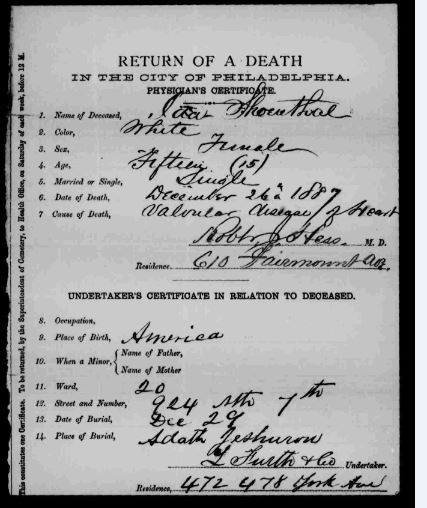
In 1887, the oldest daughter Ida died from heart disease; she was only fourteen years old.  No matter how many children they had, losing the first born daughter Ida must have been devastating for the family.  It must have been especially hard for Harry, her twin.

Ida Shoenthal death certificate

Ida Shoenthal death certificate “Pennsylvania, Philadelphia City Death Certificates, 1803-1915,” database with images, FamilySearch (https://familysearch.org/pal:/MM9.3.1/TH-267-12895-183388-90?cc=1320976 : accessed 28 October 2015), 004008625 > image 605 of 612; Philadelphia City Archives and Historical Society of Pennsylvania, Philadelphia

By 1890, Simon and Rose had nine children living with them, ranging in age from Harry, who was seventeen, to Sidney, who was an infant.  Interestingly, around this time Simon changed occupations.  He is listed as selling “segars” in the 1891 and 1892 Philadelphia directories.

By 1898, Simon and Rose had relocated to  Atlantic City, where Simon now owned a “notion and bric-a-brac store” that was destroyed by a fire on February 7 of that year.

Fire in Atl City store of Simon Schoenthal


By 1900, however, Simon was back in business in Atlantic City, as reported on the 1900 census.  He was then operating a cigar and stationery store.  Six of their nine children were living with Rose and Simon: Louis was working as a cigar salesman, and Martin and Jacob were working as “laundrymen.”  Hettie, Estelle, and Sidney were also living at home.

There were three children missing from Simon and Rose’s Atlantic City household on the 1900 census:  Harry, Gertrude, and Maurice.  Harry, now 27, was a student at Juniata College in Huntingdon in 1900, as listed on the census.  Juniata was at that time a  relatively new college, founded in 1876 by the Church of the Brethren, a Protestant sect started in Germany.  I would be interested in knowing what drew Harry to Juniata and what classes he took while there. Two years later, Harry was living in Atlantic City where his parents and most of his siblings were living; he was working for Atlantic Wine and Liquor, according to a city directory.

As for Simon and Rose’s daughter Gertrude, she had married a man named Jacob J. Miller in Atlantic City on February 12, 1898, when she was 23.  Jacob was born in Germany on June 6, 1873, and had immigrated to the US sometime in the 1880s.  A year after marrying, Jacob and Gertrude were living in Tucson, Arizona, where Jacob was working for the Crescent Cigar Company, the same industry in which his father-in-law Simon and brother-in-law Louis were engaged.  In 1900, they had an infant daughter Juliette and were living in Pima, Arizona.  Jacob was working as a grocer.  Gertrude and Jacob would have two more children: Harry in 1902 and Sylvester in 1906.

A stunning view of Cluff Ranch Pond near Pima,...

A stunning view of Cluff Ranch Pond near Pima, Arizona. (Photo credit: Wikipedia)

As for Maurice, although I cannot find him with the family or elsewhere on the 1900 census, he and three of his brothers are all listed in the 1904 Atlantic City directory, as seen below:

Atlantic City directory 1904

Atlantic City directory 1904 Ancestry.com. U.S. City Directories, 1822-1989 [database on-line]. Provo, UT, USA: Ancestry.com Operations, Inc., 2011.

All four brothers were living at 22 Delaware Avenue in Atlantic City, their mother at 23 Delaware.  It appears that Martin and Jacob were running a laundry called Incomparable Laundry at 1432-1434 Atlantic Avenue and that Louis was running a cigar, tobacco, stationery and sporting goods business at the same location.  Louis also listed a billiards and pool hall on “S Virginia av n Beach.”  Maurice is listed as a manager at “S Virginia av, Ocean end.”  I think that those two addresses are likely the same location and that Maurice was managing the pool hall.

As the listings also reveal, Rose was a widow by the time of the 1904 directory’s publication.  Simon died on March 26, 1904, in Atlantic City; he was buried at Mt. Sinai cemetery in Philadelphia.  He was 55 years old and the first of my great-grandfather’s siblings to die.

I will follow up with what happened to Simon’s children and other descendants in the 20th century in a later post.


My Aunt Eva’s Magic Suitcases: Another Small World Story

A long time back I mentioned that my father had two suitcases filled with photographs and letters that had belonged to his sister, my aunt, Eva Hilda Cohen.  My aunt had died February 14, 2011, but my father had never gone through the suitcases and wasn’t eager to do so.  Finally this past weekend he agreed to let my brother and me bring the suitcases down from their garage and go through their contents.  I was hoping for some old photographs or letters about my ancestors, and I didn’t find much of that, but there was an amazing small world story that came out of those suitcases. (I will report on the other finds in later posts.)

First, a little bit about my Aunt Eva.  She was born on January 13, 1924, the first child of my paternal grandparents, John Nusbaum Cohen, Sr. and Eva Schoenthal.

Eva Hilda Cohen

Eva Hilda Cohen

My father was born almost three years later.  They were very close as children growing up together.

Eva and John Cohen, Jr.

Eva and John Cohen, Jr.

My father describes his sister as a strong-willed and rebellious child who became a strong-willed and rebellious teenager and adult. She also was a very intelligent woman with many interests. She graduated from Gratz High School in Philadelphia in 1941, where she apparently was known by the nickname “Ave,” and was described as follows in the yearbook: “To Gratz our “Ave” has given services of hours; in almost every field she has displayed her powers.”  From the list of her activities, that inscription seems accurate: drama club, debate club, a cappella choir, and several others.

Aunt Eva yearbook picture

Simon Gratz High School yearbook 1941 Ancestry.com. U.S., School Yearbooks, 1880-2012 [database on-line]. Provo, UT, USA: Ancestry.com Operations, Inc., 2010.

During World War II, she served in the United States Navy. She served from February 10, 1944 until February 10, 1946, and was stationed in Corpus Christi, Texas, for most of her second year of service.  She wrote a letter to her mother in May, 1945, describing her trip by train from Philadelphia to Texas.  I had to chuckle as I read it because it sounded so much like her, describing and naming every person that she met along the way.    She clearly was a hit with the servicemen, frequently being invited to eat and drink and sit with them on that long train.  That ability to befriend new people wherever she went was a skill she maintained throughout her life.

After the war, she completed her education at the University of Colorado at Boulder.  There she also was active socially and academically.

Aunt Eva college yearbook

University of Colorado at Boulder yearbook 1949 Ancestry.com. U.S., School Yearbooks, 1880-2012 [database on-line]. Provo, UT, USA: Ancestry.com Operations, Inc., 2010.

After college she became engaged to be married to a man named Karl, but when she was diagnosed with multiple sclerosis, Karl broke it off, not wanting to care for someone he thought would be an invalid.

Eva and Karl

Eva and Karl

He sorely underestimated her.  She never married, but her inner strength and her independence held in her good stead for the rest of her life even as her physical challenges became greater.  She worked for the city of Philadelphia until retirement age, and she had a large circle of friends who were devoted to her. She traveled all over the world and was interested in many things and well-informed about current events. She remained devoted to my father, and he to her, her whole life.

Her collected photographs and letters reflected those priorities— the many letters she kept that she had received from my father over the years; lots of photographs of our family, extended and immediate; lots of pictures from her numerous trips and cruises.  And many, many pictures of people who were her friends. The photographs were not at all organized by subject matter or date, so as I went through the photographs with my brother, I sorted them into piles—family, travel, friends.  I wasn’t particularly interested in the last two categories, but I still looked at each photo, hoping to find some of my ancestors or distant cousins mixed in.

Then I found this photograph.  It was a Christmas card with a family photograph, an item for the friends’ pile.  But I looked at it more closely and thought one of the faces looked familiar.  Then I looked at the family’s surname, and I got the chills.  The face was in fact familiar.

Scan0014


The little boy in that photograph looked just like the young man who is now engaged to my daughter’s best friend Anna.  I knew that her fiancé Mark was from Philadelphia, and it certainly was possible that my aunt could have known his family.  But nevertheless—what were the odds?  Mark’s parents are at least a generation younger than my aunt.  How in the world would they have known her? It made no sense.  I continued looking through the photographs, and I found five more pictures of Mark’s family, including his parents’ wedding photograph.  Obviously, my aunt knew his family for a long, long time.

I took snapshots of the pictures of Mark’s family with my phone and sent them to Maddy and Anna, asking them if this was Mark’s family. Anna responded that indeed it was his family.  Anna asked Mark what he knew about my aunt, if anything, and he did remember her and said that his father had been a lifeguard at the pool in her building and had met her there.

That made perfect sense to me.  My aunt was an avid swimmer; being in the water gave her the mobility and comfort that she could not find out of the water because of her MS.  As my father wrote in one of his letters to her, she swam in pools and oceans all over the world; she found it liberating.  When she moved into The Philadelphian, one of the large apartment buildings in Philadelphia, one of the great benefits was that there was a pool in the building.  It was there that she made many friends over the years, including Mark’s father and his family.

Scan0016 (2)

I still get the chills thinking about this.  There I was sitting in my parents’ house, sorting through photographs mostly of strangers, and I found a photograph of someone who will now be marrying Anna.  Anna, whom I’ve known since she was born and who has been my daughter Maddy’s best friend since they sat in the sandbox as one year olds at our child care cooperative in 1985.  Anna, who was Maddy’s roommate in Boston for several years—until she met Mark.  Mark, a delightful young man whom we met the first time a few years back when he was helping Maddy and Anna move from one apartment to another and sitting patiently outside the apartment, watching their stuff while they went to rent a truck.  Mark, whose father befriended my aunt years before Mark was even born and who obviously stayed in touch with her over the years as his children grew to adulthood.

I am sure that my aunt would have been thrilled to know that her friend’s son was marrying her great-niece’s best friend.  I am just sorry she is no longer around to hear the story.  It’s the kind of story she would have loved.

Scan0025


My Great-grandfather Comes to America: The Schoenthals in Western Pennsylvania 1880-1890

Map of Pennsylvania highlighting Allegheny County

Map of Pennsylvania highlighting Allegheny County (Photo credit: Wikipedia)

Or how my great-grandfather met my great-grandmother.  I love finding stories about how couples met each other.  From a little tiny news item in a small local paper in 1887, I may have found a clue as to how my Schoenthal/Katzenstein grandparents met each other.
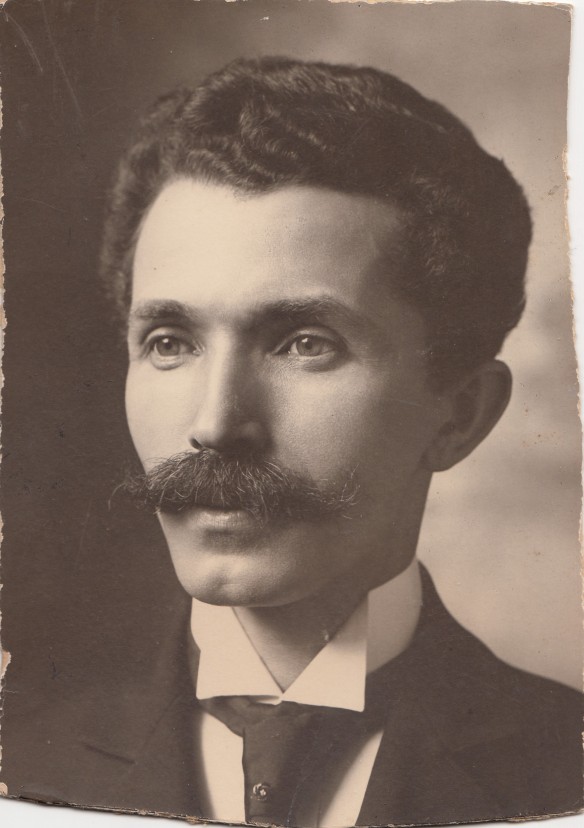
Isidore Schoenthal

Isidore Schoenthal

By 1880, many of the members of the family of Heinemann Schoenthal and Hendel Beerenstein had moved from Sielen, Germany, to the United States.  Their two daughters had arrived first: Fanny and her husband Simon Goldsmith and Mina and her husband Marcus Rosenberg.  They were followed by six of the children of Levi Schoenthal (Fanny and Mina’s brother) and Henrietta Hamberg: Henry, Julius, Amalie, Simon, Nathan, and Felix.

Their father Levi died in 1874; their mother Henrietta was still living in Germany in 1880. Four of the children of Levi and Henrietta were also still in Germany in 1880: Hannah, Jacob, Rosalie, and my great-grandfather Isidore.  All but Jacob would soon be in the United States.

Jacob had married Charlotte Lilienfeld in 1879 and was a merchant living in Cologne (or Koln), Germany.  Charlotte was the daughter of Meyer Lilienfeld and Hannchen Meiberg of Gudensberg, another small town in the Kassel district of Hessen, not far from Sielen.   Charlotte was the half-sister of Helen Lilienfeld, who had married Jacob’s brother Henry in 1872.   Although Jacob and Charlotte never emigrated from Germany, they had two sons who did: Lee, born in 1881, and Meyer, born in 1883. More on them in a later post.

HStAMR Best. 920 Nr. 2610 Standesamt Gudensberg Heiratsnebenregister 1879, S. 10
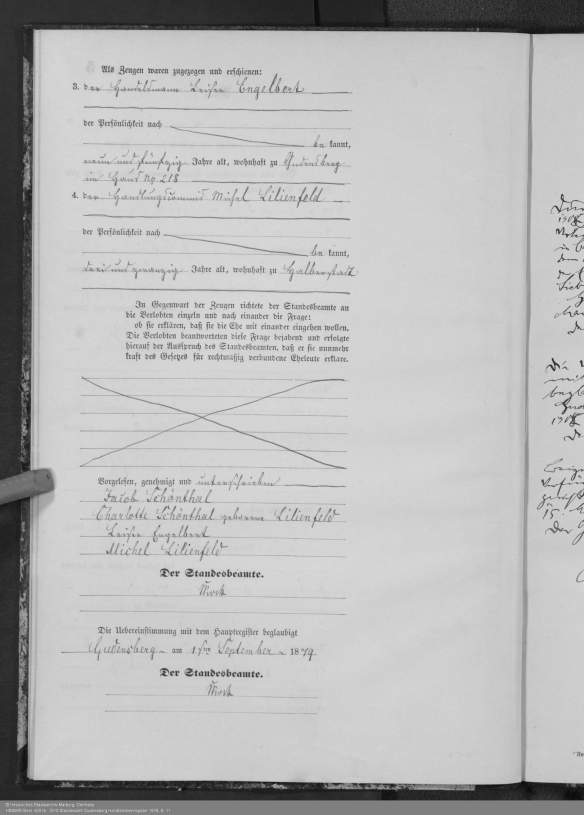
HStAMR Best. 920 Nr. 2610 Standesamt Gudensberg Heiratsnebenregister 1879, S. 10

Eine Vervielfältigung oder Verwendung dieser Seite in anderen elektronischen oder gedruckten Publikationen und deren Veröffentlichung (auch im Internet) ist nur nach vorheriger Genehmigung durch das Hessische Staatsarchivs Marburg, Friedrichsplatz 15, D-35037 Marburg, Germany gestattet.

HStAMR Best. 920 Nr. 2610 Standesamt Gudensberg Heiratsnebenregister 1879, S. 10

As for the many Schoenthal family members already in the United States, as of 1880 only Henry and his wife Helen (Lilienfeld) and their two young children, Hilda (six) and Lionel (three), were still living in Washington, Pennsylvania, where Henry owned a retail variety store.  Living with them and described as their adopted son was a twelve year old boy named Samuel Hamberg, who was born in South Carolina.  I have to believe that Samuel Hamberg was somehow related to Henry’s mother’s family, the Hambergs of Breuna, but I cannot find the connection.[1]  Henry and Helen would have one more child in the 1880s, a son born in 1883 named Meyer Lilienfeld Schoenthal, named for Helen’s father.
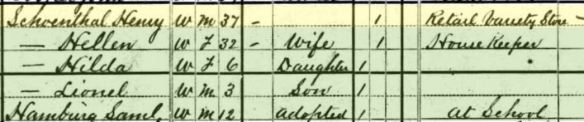
Henry Schoenthal and family 1880 census Year: 1880; Census Place: Washington, Washington, Pennsylvania; Roll: 1202; Family History Film: 1255202; Page: 596A; Enumeration District: 271

Henry Schoenthal and family 1880 census
Year: 1880; Census Place: Washington, Washington, Pennsylvania; Roll: 1202; Family History Film: 1255202; Page: 596A; Enumeration District: 271


Although Henry was the only Schoenthal sibling still in Washington, Pennsylvania in 1880, others were not too far away.  Amalie and her husband Elias Wolfe were now living in Allegheny (today part of Pittsburgh so from hereon I will refer to both Allegheny and Pittsburgh as Pittsburgh), Pennsylvania.  According to the entry in the census record, Elias was a “drover.”  I’d never heard this term before, but according to the Merriam-Webster dictionary online, a drover is “a person who moves groups of animals (such as cattle or sheep) from one place to another.”     Amalie and Elias had three children at the time of the census: Morris was 7, Florence was 5, and Lionel was 2.  A fourth child was born in June, 1880, shortly after the census, a son named Ira.   Two more were born in the 1880s: Henrietta (1883) and Herbert (1885).

Amalie Schoenthal Wolfe and family 1880 census Year: 1880; Census Place: Allegheny, Allegheny, Pennsylvania; Roll: 1086; Family History Film: 1255086; Page: 153C; Enumeration District: 006; Image: 0310

Amalie Schoenthal Wolfe and family 1880 census
Year: 1880; Census Place: Allegheny, Allegheny, Pennsylvania; Roll: 1086; Family History Film: 1255086; Page: 153C; Enumeration District: 006; Image: 0310


As noted in my earlier post, Felix Schoenthal was also still relatively close to Washington, Pennsylvania, living with his wife  Maggie in West Newton, about 25 miles away, where Felix was working as a clerk at the paper mill.  Felix and Maggie also had two children during the 1880s: Rachel (1881) and Yetta (1884).

The other siblings had moved further east.  Julius was in Washington, DC, working as a shoemaker, as described in my last post.  His brother Nathan was also now in DC, working as a clerk in a “fancy store.”  Simon Schoenthal had also moved further east by 1880.  Although he and his family were living in Pittsburgh in 1879, by 1880 he and Rose and their five children had moved to Philadelphia.  Simon was still working as a bookbinder. In the 1880s they would have four more children: Martin (1881), Jacob (1883), Hettie (1886), and Estelle (1889).  In 1891, one more child was added to the family, Sidney.
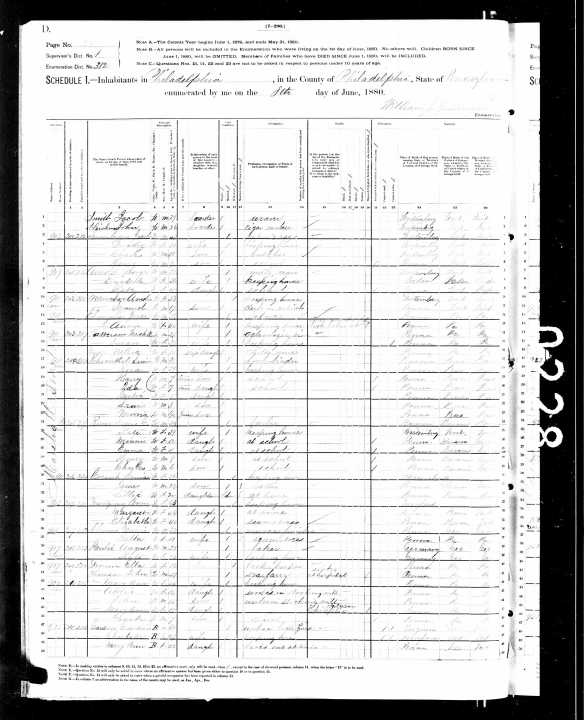
Simon Schoenthal and family 1880 census Year: 1880; Census Place: Philadelphia, Philadelphia, Pennsylvania; Roll: 1179; Family History Film: 1255179; Page: 12D; Enumeration District: 382; Image: 0218

Simon Schoenthal and family 1880 census
Year: 1880; Census Place: Philadelphia, Philadelphia, Pennsylvania; Roll: 1179; Family History Film: 1255179; Page: 12D; Enumeration District: 382; Image: 0218


But other members of the extended Schoenthal clan still lived in western Pennsylvania.  Fanny Schoenthal Goldsmith’s widower Simon Goldsmith was living in Pittsburgh with their daughter Hannah and her family.  Hannah’s husband Joseph Benedict was a rag dealer, and in 1880 they had three sons: Jacob (10), Hershel (9), and Harry (3).[2]

Simon Goldsmith and Joseph Benedict families on 1880 census Year: 1880; Census Place: Pittsburgh, Allegheny, Pennsylvania; Roll: 1092; Family History Film: 1255092; Page: 508D; Enumeration District: 122; Image: 0683

Simon Goldsmith and Joseph Benedict families on 1880 census
Year: 1880; Census Place: Pittsburgh, Allegheny, Pennsylvania; Roll: 1092; Family History Film: 1255092; Page: 508D; Enumeration District: 122; Image: 0683

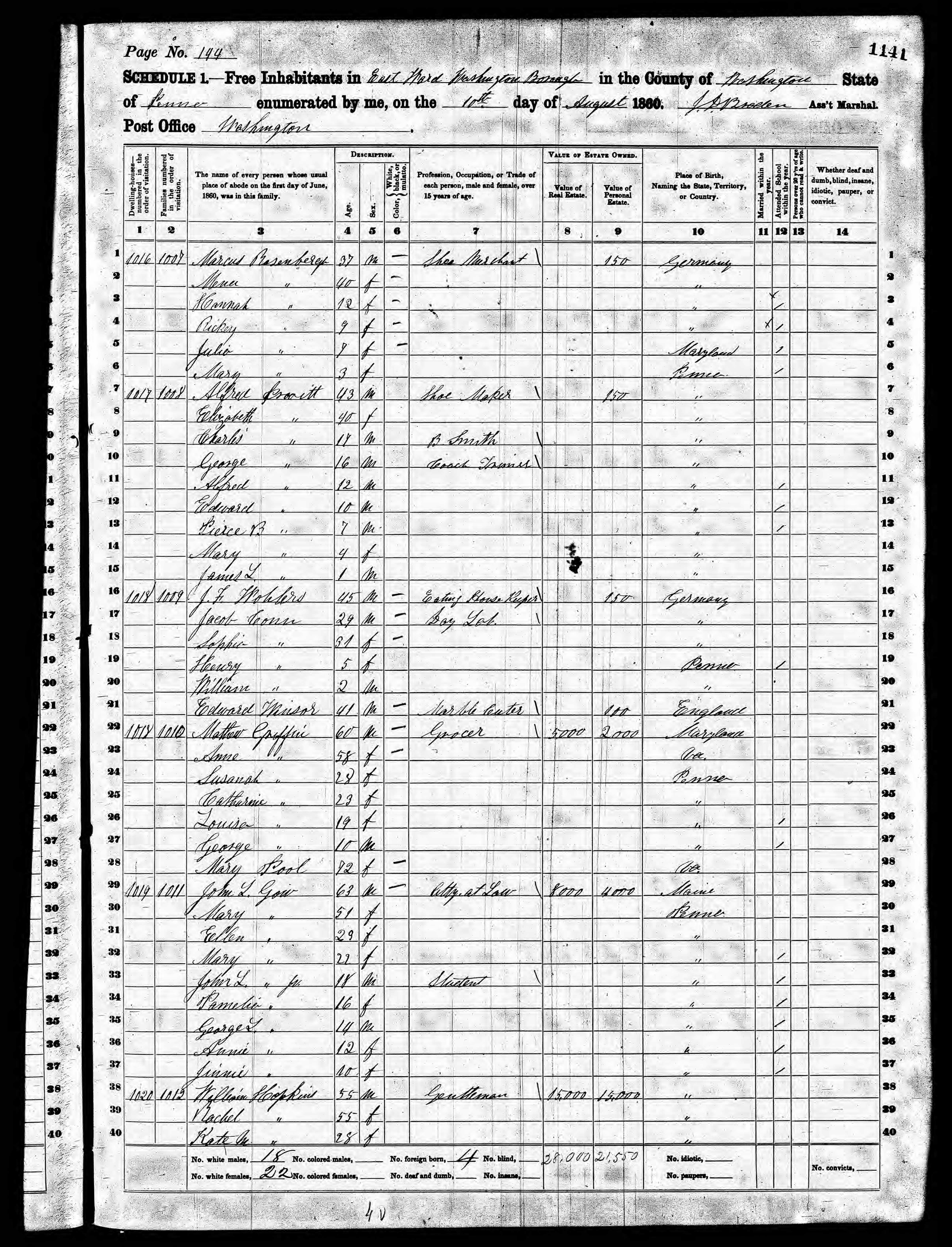
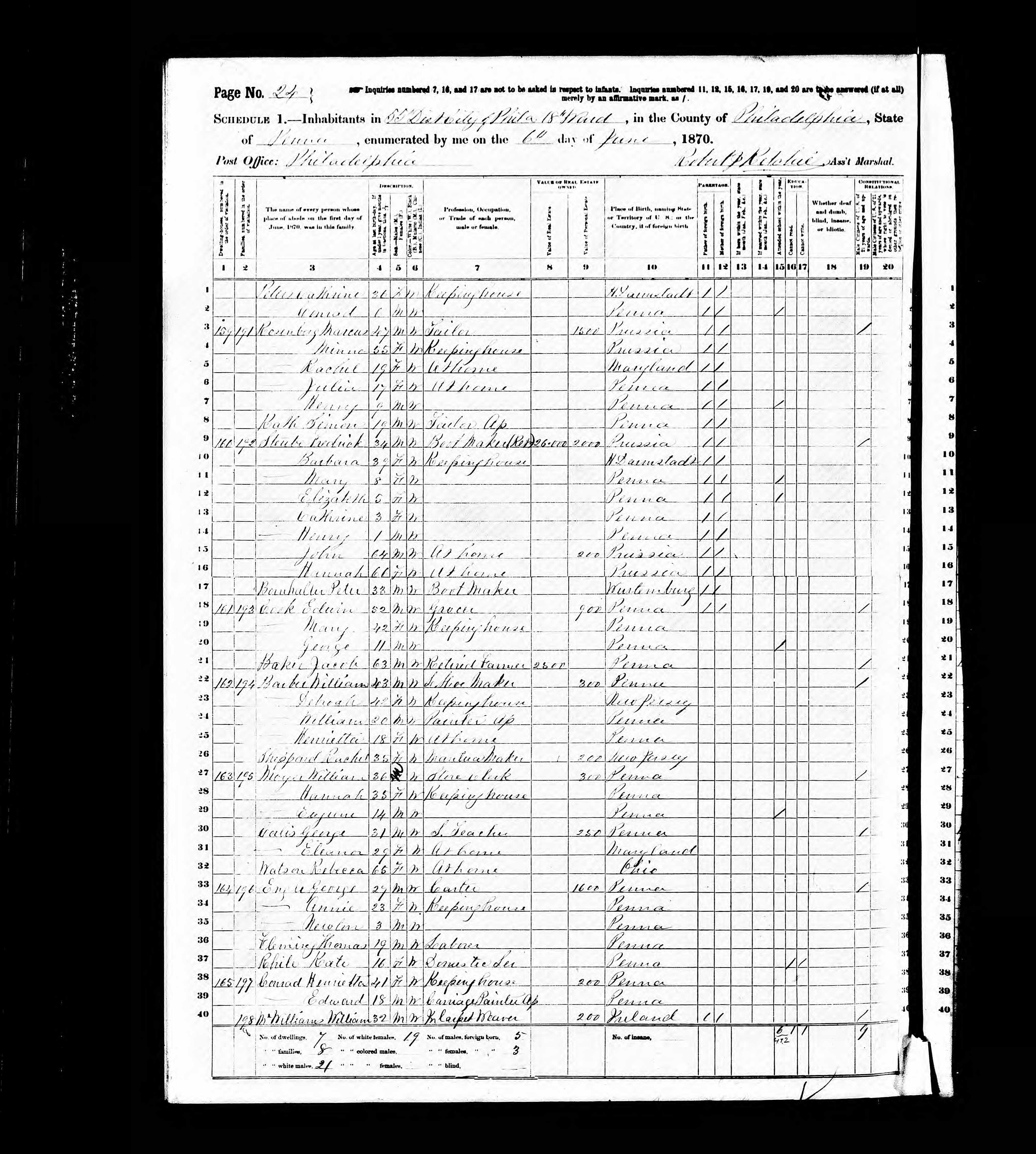
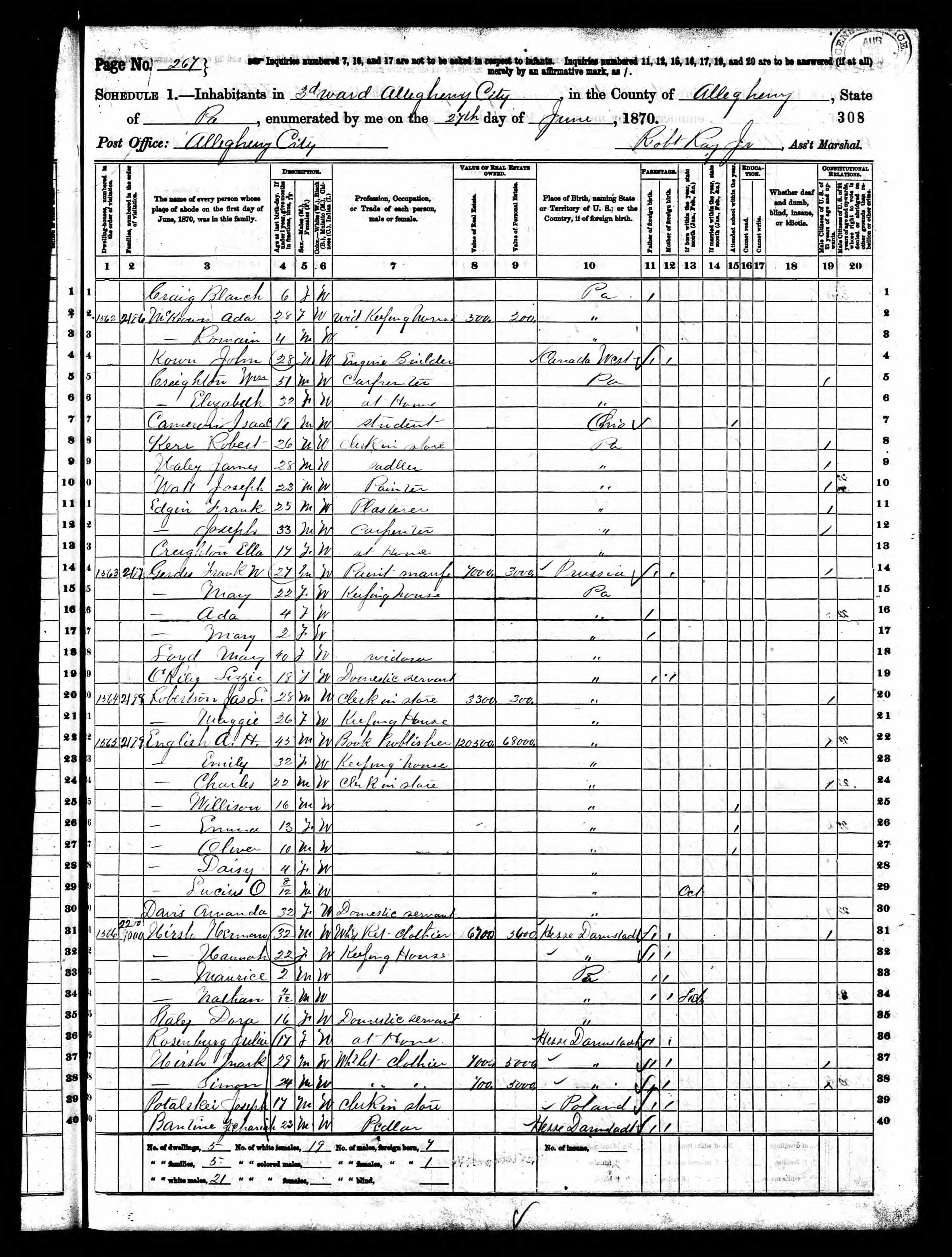
As described in an earlier post, Mina Schoenthal Rosenberg and her husband Marcus Rosenberg and their daughter Julia were living in Elk City, Pennsylvania, in 1880.  Their daughter Hannah and her husband Herman Hirsh were living in Pittsburgh with their five children in 1880.  Their daughter Mary and her husband Joseph Podolsky and children were living in Ohio.  Mina’s other two children, Rachel and Harry, are missing from the 1880 census.

Thus, by 1880, there were still a large number of family members in western Pennsylvania; it was still home to most of the extended Schoenthal clan.  It is not surprising that when my great-grandfather Isidore arrived with his mother and sister Rosalie, they ended up in western Pennsylvania as well.

My great-grandfather Isidore, his mother Henrietta Hamberg Schoenthal, and his younger sister Rosalie arrived in New York on September 3, 1881, upon the ship Rhein, which had sailed from Bremen.  Isidore was 22, Rosalie was seventeen, and Henrietta was 64 years old.  They settled in Washington, Pennsylvania, where Henry was living. Isidore worked as a clerk in Henry’s variety store.

Henrietta died just a year later in December, 1882; she was buried at Troy Hill cemetery in Pittsburgh.  Washington did not yet have a Jewish cemetery.  Although I could not find an American death certificate, Henrietta’s death was recorded back in Sielen even though she had died in the US.
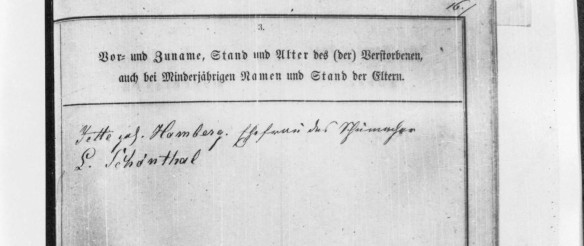
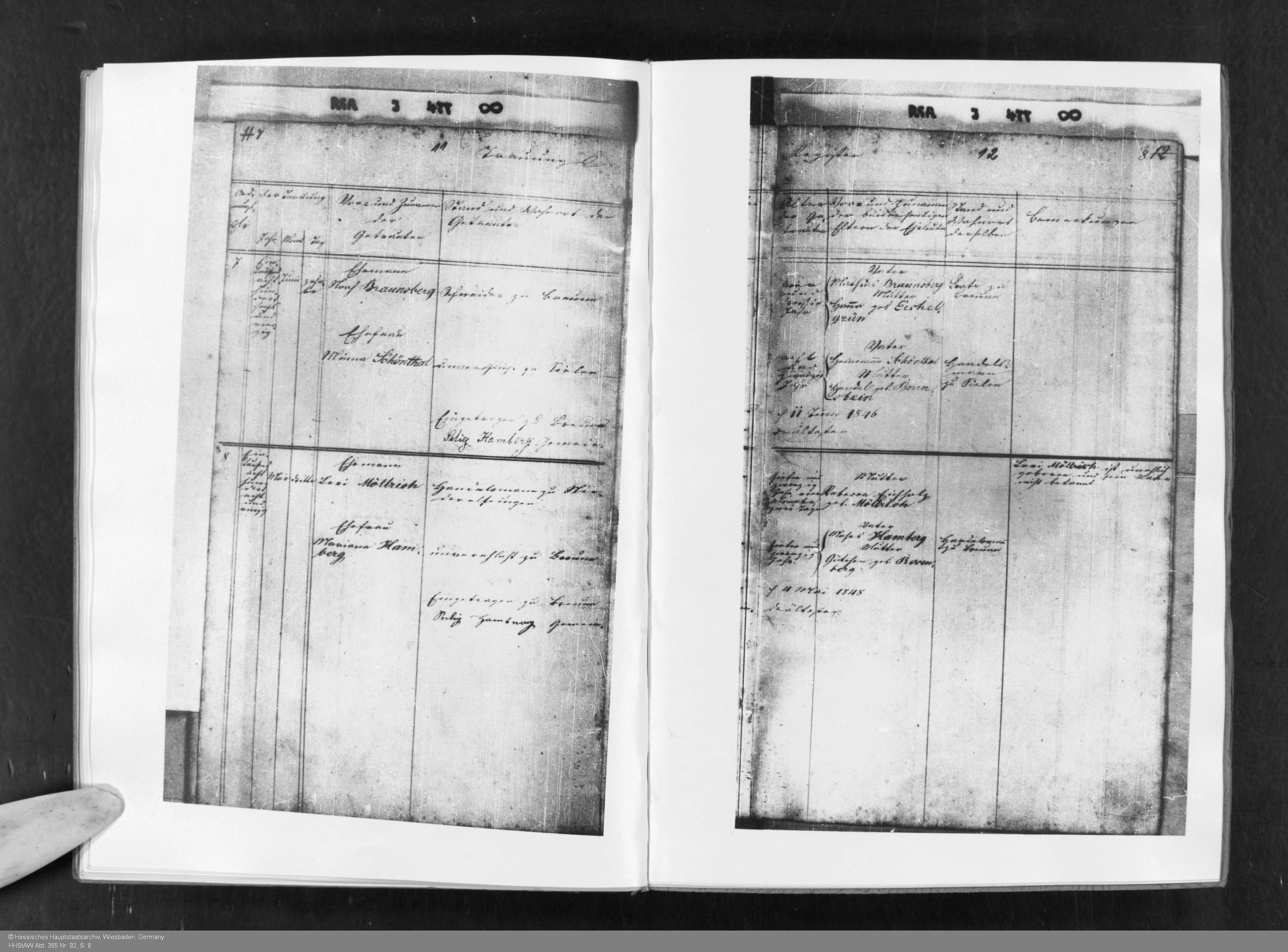
Henrietta Hamberg Schoenthal death record from Sielen HHStAW Abt. 365 Nr. 773, S. 10

Henrietta Hamberg Schoenthal death record from Sielen
HHStAW Abt. 365 Nr. 773, S. 10

Henrietta’s brother-in-law Simon Goldsmith died a few months later on March 17, 1883.  He also was buried at Troy Hill.

Rosalie Schoenthal, the youngest child of Levi and Henrietta, returned to Germany where she married William or Willie Heymann in Geldern, Germany, on December 8, 1884.  She and Willie would have four children born in Geldern: Lionel (1887, for Rosalie’s father Levi, presumably), Helen (1890), Max (1893), and Hilda (1898).  I assume that either Helen or Hilda was named for Rosalie’s mother Henrietta.  The two sons ended up immigrating to the United States; the two daughters and their families perished in the Holocaust.  But more on that in a later post.

There would be one more Schoenthal sibling who would immigrate to the US: the oldest child, Hannah.  Hannah had had a child out of wedlock in 1865, a daughter named Sarah whose father is unknown.
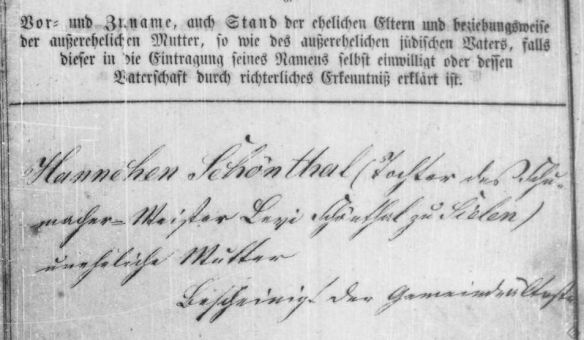
birth of Sarah Schoenthal, daughter of Hannah HHStAW fonds 365 No 772 p12

birth of Sarah Schoenthal, daughter of Hannah Schoenthal, in Sielen, 1865
HHStAW fonds 365 No 772 p12

[Translation: “Hannchen Schönthal (Tochter des Schuhmacher=Meister Levi Schönthal zu Sielen) uneheliche Mutter.”…..Hannchen Schönthal (daughter of the master shoemaker (cobbler) Levi Schönthal of Sielen) unmarried mother.]

Hannah later married Solomon Simon Stern in Sielen, Germany, on August 19, 1874, five months after her father Levi died.  She was 29 years old at that time.  Solomon was 57.
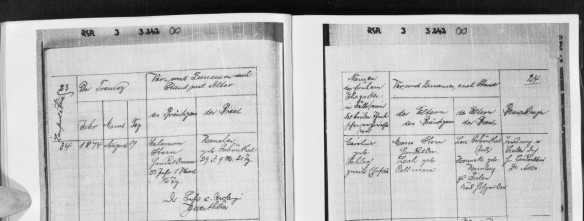
Marriage of Solomon Stern to Hannah Schoenthal HHStAW Abt. 365 Nr. 839, S. 22

Marriage of Solomon Stern to Hannah Schoenthal in Sielen
HHStAW Abt. 365 Nr. 839, S. 22

Together they would have three children: Jennie, born June 20, 1875; Edith, born September 7, 1877; and Louis, born May 17, 1879.  Solomon Stern died February 20, 1888, and Hannah and their three children emigrated from Germany shortly thereafter.  According to later census records, Hannah and the three children all emigrated in 1888.
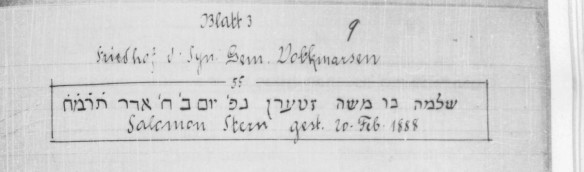
Solomon Stern gravestone inscription HHStAW Abt. 365 Nr. 842, S. 11

Solomon Stern gravestone inscription
HHStAW Abt. 365 Nr. 842, S. 11

Hannah and her children settled in Pittsburgh, where her sister Amalie and her husband Elias Wolfe and their six children, named above, were still living.  Elias continued to work as a drover.  Hannah and Amalie’s brother Felix also was in Pittsburgh by that time, having relocated there from West Newton by 1882.  He was working as a bookkeeper.  In 1889 he opened his own store:

 Pittsburgh Daily Post, 9 Apr 1889, Tue, Page 3

Pittsburgh Daily Post, 9 Apr 1889, Tue, Page 3

Also living in Pittsburgh in the 1880s was their Schoenthal cousin, Hannah Goldsmith Benedict, and her husband Joseph and three children, Jacob, Herschel, and Harry; Joseph was selling rags and paper stock.  Joseph became entangled in a rather gruesome lawsuit involving the sale of rags to a paper mill.  The purchaser had failed to pay the purchase price, and Joseph had sued for payment.  The purchaser alleged that they were not liable for the purchase price because the rags had been infected with the smallpox virus, and several of the purchaser’s employees had taken ill, causing the shutdown of the purchaser’s mills.  Thus, the purchaser claimed it had been damaged by loss of business in an amount exceeding what it allegedly owed Joseph Benedict.
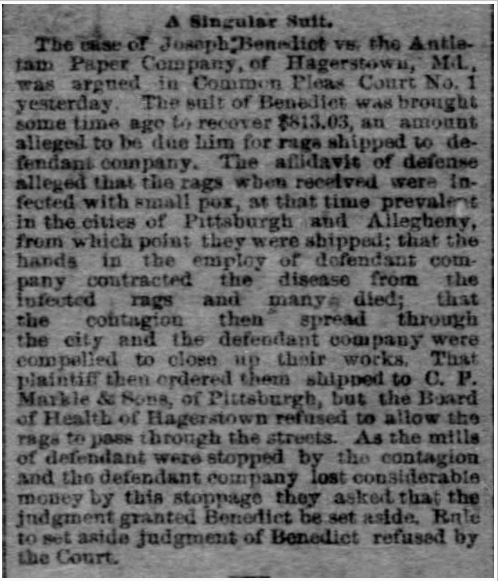
 Pittsburgh Post-Gazette, 5 Sep 1882, Tue, Page 1

Pittsburgh Post-Gazette, 5 Sep 1882, Tue, Page 1

This would have been a fun case for me to teach in my days as a law professor teaching Contracts.  It is similar to a famous case taught in most Contracts courses called Hadley v. Baxendale.  Was the shutdown of the paper mill a foreseeable consequence of the seller’s defective product? Here there are also issues of negligence, breach of warranty, damages, and so on.  It would have been a great exam question. Fortunately for Joseph Benedict, the court refused to set aside the judgment in his favor, and the paper mill was held liable for the purchase price of the rags.

Another Schoenthal cousin, Hannah Rosenberg Hirsh, and her husband Herman and their five children, Morris, Nathan, Carrie, Harry, and Sidney, were also living in Pittsburgh; Herman was in the varnish business, at first for the Michigan Furniture Company and then in his own business manufacturing varnish.

Hannah thus had many family members close by in Pittsburgh to provide support as she raised her three children alone in the new country.

My great-grandfather Isidore lived in Pittsburgh for some time also around 1887 through 1889, working as a floor walker in a retail store, at least according to the listings in the Pittsburgh city directories for those years.  But sometime in early 1888 he married my great-grandmother Hilda Katzenstein in Philadelphia.  Hilda was the daughter of Eva Goldschmidt and granddaughter of Seligmann Goldschmidt.  As discussed in an earlier post, Seligmann Goldschmidt was the brother of Simon Goldschmidt, who became Simon Goldsmith and who had married Isidore’s aunt, Fanny Schoenthal. Thus, Hilda and Isidore were already related to each by marriage. In addition, Hilda’s brother S.J. Katzenstein was a merchant, living in Washington, Pennsylvania.  I don’t know whether my great-grandparents met through S.J. in Washington, Pennsylvania, or through their mutual cousins, the Goldsmiths, or perhaps even through Isidore’s brother Simon, who lived in Philadelphia, where Hilda had been born and raised.

But I did find this important clue:
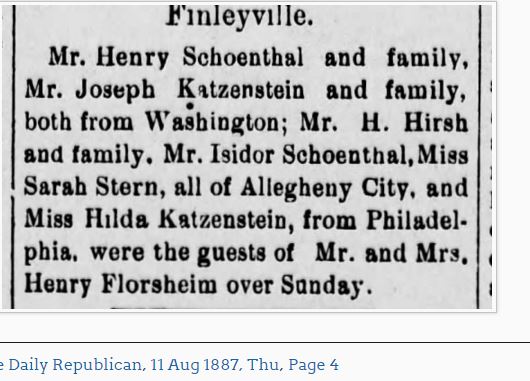
The Daily Republican (Monongahela, Pennsylvania) 11 Aug 1887, Thu • Page 4

The Daily Republican
(Monongahela, Pennsylvania)
11 Aug 1887, Thu • Page 4

Was this when Isidore and Hilda met—at a gathering at the house of a man named Henry Florsheim who lived in Finleyville? And who was he?  A little research revealed that Henry Florsheim was born in 1842 in Gudensberg, Germany, the same town where Helen and Charlotte Lilienfeld were born, the wives of Henry Schoenthal and Jacob Schoenthal, respectively.

Henry (Hienemann) Florsheim birth record HHStAW Abt. 365 Nr. 384, S. 35

Henry (Heinemann) Florsheim birth record from Gudensberg
HHStAW Abt. 365 Nr. 384, S. 35

In fact, according to research done by Hans-Peter Klein as reflected on his incredibly helpful website found here, Henry Florsheim’s sister married Helen Lilienfeld’s brother in Gudensberg in 1872, the same year that Helen Lilienfeld married Henry Schoenthal.  According to the 1910 census, Henry Florsheim came to the US in 1876, so the two families were already related by marriage when he arrived.  In 1880 Henry Florsheim was a merchant, living in Union Township in Washington County, Pennsylvania, about 20 miles from the city of Washington, PA.  An article in the January 31, 1887, Pittsburgh Daily Post (p.4) , reported that he was the proprietor of the Union Valley coal mines and had been presented with a gold watch by the citizens of Finleyville, a town about 16 miles from Washington and two miles from Union Township. Thus, in just a decade, Henry Florsheim had made quite a mark on his community.  Was this successful businessman the one who was responsible for bringing my great-grandparents together?  If so, thank you, Mr. Florsheim![3]
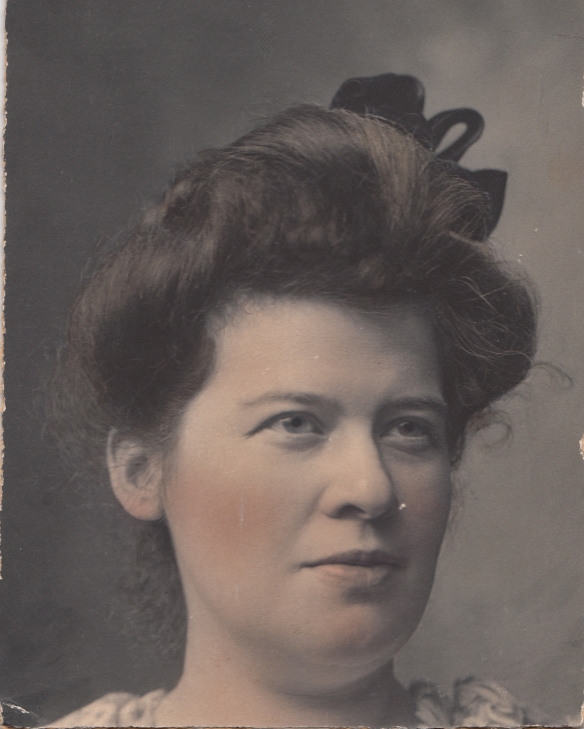
Hilda Katzenstein Schoenthal

Hilda Katzenstein Schoenthal

That was not the end of Henry Florsheim’s role in my great-grandparents’ lives.  In 1889, he hired my great-grandfather to work in his store in Finleyville; this news article suggests that they were still living in Pittsburgh before that opportunity arose.
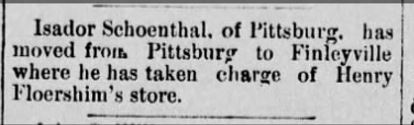
The Daily Republican (Monongahela, Pennsylvania) 8 Nov 1889, Fri • Page 1

The Daily Republican
(Monongahela, Pennsylvania)
8 Nov 1889, Fri • Page 1

Isidore and Hilda’s first child, my great-uncle Lester Henry Schoenthal, was born on December 3, 1888.  I assume that, like all the Lionels and Leo and Lee, he was named for Isidore’s father Levi.  About three years later on January 20, 1892, Isidore and Hilda had a second son, Gerson Katzenstein Schoenthal, named for Hilda’s father.  Their third child, Harold, and their fourth and youngest child, my grandmother Eva, would not arrive until after the 20th century had begun.

Thus, by 1890, the Schoenthal family had deep and wide connections to western Pennsylvania.  My next post will catch up with those family members who were living elsewhere in the 1880s: Washington DC, Ohio, and Philadelphia.


[1] All I can find about Samuel’s background is that he appears to have been the son of Charles Hamberg, who was born in Germany and emigrated before 1850; in 1853, Charles married Mary E. Hanchey in New Hanover, North Carolina.  She, however, was not Samuel’s mother because she was murdered on November 18, 1866.  On the 1870 census, Charles was living with a 21 year old woman named Tenah Hamberg and two year old Samuel. Since the 1870 census did not report information about the relationships among those in a household, I don’t know for sure whether Tenah was Charles’ wife or Samuel’s mother. Charles died in 1879, and the administrix of his intestate estate was a woman named Amalia Hamberg.  I don’t know who Amalia was or how she was related to Charles.  But by 1880, twelve year old Samuel had moved to Washington, Pennsylvania, to live with Henry.

[2] There were also two young boys, Jacob and Benjamin Goldsmith, living with them and a 21 years old named Jacob Basch.  They were labeled “grandsons,” but they had to be Simon’s grandsons, not Joseph and Hannah’s grandsons.  Jacob Basch was the son of Simon’s daughter Lena from his first marriage, who had married Gustav Basch.  I don’t know who the parents of Jacob and Benjamin Goldsmith were.

[3] That little article about Henry Florsheim’s party also led me to another question: who was the woman named Sarah Stern who also attended this gathering? I assumed she must have been a relative since everyone else at the Floersheim event was part of the Schoenthal or Katzenstein families, and I only knew of one Stern in the family—Solomon Stern who had married Hannah Schoenthal, the older sister of Henry, Isidore, and the other children of Levi Schoenthal.  Hannah’s first child, born before she married Solomon Stern, was named Sarah.  Was this Sarah Stern the same person, taking on her stepfather’s surname? Further investigation would support that conclusion, as I will describe in a later post.

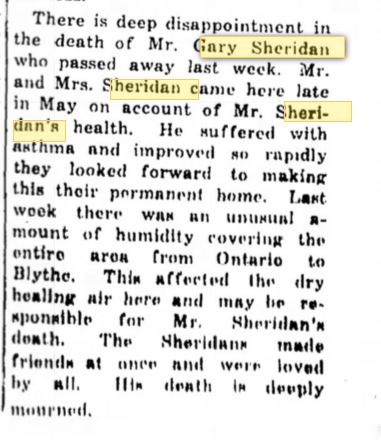
The Other Sister: Mina Schoenthal

It’s fascinating to me how finding one more ancestor—in this case, my great-great-grandfather’s younger sister Mina–leads to so many more descendants, so many more stories.  Sometimes I do think that eventually I will find myself related to every Jewish person I know if not every person I know.

While searching for Hamberg relatives in the Breuna marriage archives, I ran across a record for a “Minna Schoenthal” who married a Markus Rosenberg.  I was surprised to see the name Schoenthal in Breuna, but saved the document to study later.  I thought Minna could be a relative, but I was focused on the Hambergs at that moment, and I couldn’t decipher Minna’s parents’ names, so put it on the back burner.

Marriage of Minna Schoenthal and Markus Rosenberg September 1849 HHStAW Abt. 365 Nr. 92, S. 9

Marriage of Minna Schoenthal and Markus Rosenberg September 1849
HHStAW Abt. 365 Nr. 92, S. 9

I did the same when I saw a Breuna birth record for a child named Hendel whose mother’s birth name had been Mina Schoenthal, father Noah Braunsberg.  I was a bit confused—was this the same woman as the Minna married to Markus Rosenberg? Was this a relative?  Again, I put it on the back burner.

Birth of Hendel Braunsberg August 1847 HHStAW Abt. 365 Nr. 90, S. 12

Birth of Hendel Braunsberg
August 1847
HHStAW Abt. 365 Nr. 90, S. 12


When I returned to the children of Levi Schoenthal and Henrietta Hamberg, first David Baron and Roger Cibella shared their discovery of Levi Schoenthal’s sister Fradchen/Fanny, and her marriage to Simon Goldschmidt/Goldsmith.   That led to the discovery that more than twenty years before Henry Schoenthal had arrived in America in 1866, his aunt and uncle had settled in western Pennsylvania with their children Jacob and Hannah.  I had assumed that Henry had been the pioneer in the family, but in fact he was following in the footsteps of Fanny and Simon Goldsmith and their children.

Then Hans-Peter Klein informed me that Levi Schoenthal had had a third sister, Mina, and I recalled that I had seen the above-mentioned records in the Breuna archives.  I sent them to Hans-Peter, and he confirmed that both records were for Levi’s sister Mina; the marriage record to Markus Rosenberg indicated that her parents were Hienemann Schoenthal and Hendel Beerenstein, who were also the parents of Levi Schoenthal and Fanny Schoenthal Goldsmith.  That is, Mina, like Fanny, was my three-times great-aunt.

Hans-Peter also explained that Mina had first married Noah Braunsberg and had the child for whom I’d found the birth record, that is, Hendel, born in August 1847. Mina had then gotten married again, this time to Markus Rosenberg in September 1949, and they had also had a child, a daughter named Malchen who died two months after she was born in 1850.  Hans-Peter sent me Madchen’s birth and death records, and with some additional searching I found both the marriage record for Mina Schoenthal and Noah Braunsberg and the death record for Noah Braunsberg, who died in 1847, just a year after marrying Mina and months after the birth of their daughter Hendel.

Mina Schoenthal marriage to Noah Braunsberg June 10, 1846 HHStAW Abt. 365 Nr. 92, S. 8

Mina Schoenthal marriage to Noah Braunsberg June 10, 1846
HHStAW Abt. 365 Nr. 92, S. 8

Hans-Peter had concluded that Mina and Markus had not had any other children after Madchen died.  But after entering Markus Rosenberg into my family tree on Ancestry, a number of shaky leafs, as the hint system on Ancestry calls them, popped up.  I figured that they would be hints for a different man named Marcus Rosenberg, so I was pleasantly surprised when I saw that it was a US census report for a Marcus Rosenberg with a wife named Mena and several children.  I searched a bit further, and once I saw that this family had been living in Washington, Pennsylvania, in 1860, I knew that this had to be the same Markus and Mina Rosenberg from Breuna, Germany, and thus my three-times great-aunt and her husband. Marcus was working as a shoemaker, just like his father-in-law back in Germany, and he and Mina had in fact had a number of children after Madchen died—some born in Germany, some in the United States.

Markus Rosenberg and family 1860 US census Year: 1860; Census Place: Washington, Washington, Pennsylvania; Roll: M653_1192; Page: 1141; Image: 580; Family History Library Film: 805192

Markus Rosenberg and family 1860 US census
Year: 1860; Census Place: Washington, Washington, Pennsylvania; Roll: M653_1192; Page: 1141; Image: 580; Family History Library Film: 805192

From this advertisement, it appears that Marcus had been in business in Washington, Pennsylvania, for some time before 1860:

Advertisement Date: Thursday, July 19, 1860 Paper: Washington Reporter (Washington, Pennsylvania) Volume: LII Issue: 53 Page: 4

Advertisement
Date: Thursday, July 19, 1860 Paper: Washington Reporter (Washington, Pennsylvania) Volume: LII
Issue: 53 Page: 4

To figure out when they had immigrated to the US, I tried to find records for the children reported to have been born in Germany on the 1860 US census record: Hannah (1848) and Rachel (1852).  If the birth year for Hannah was really 1848, that would mean she was born before Mina married Marcus and that she was probably the child named Hendel born to Mina and her first husband Noah Braunsberg.  The birth year was inferred by Ancestry as 1848 because Hannah was reported to have been twelve on the 1860 census and 22 on the 1870 census, but she also could have been born in August, 1847, as Hendel had been, and just not yet have   celebrated her next birthday at the time of the census.  Although I cannot be sure, I am fairly certain that Hannah was in fact the daughter of Noah Braunsberg, not Marcus Rosenberg.  Rachel, born in 1852, would then be the first child born to Mina and Marcus Rosenberg.

But where was Rachel born? On the 1860 census, she is listed as nine years old and born in Germany, thus presumably born in 1851.  The 1870 census reports that Rachel was then nineteen, but that she was born in Maryland.  Using the closer in time rule, it would seem more likely that she was born in Germany as the 1860 census reports.  I’ve yet to find a German birth record for her, however.

Marcus Rosenberg 1870 US census Year: 1870; Census Place: Philadelphia Ward 18 District 55, Philadelphia, Pennsylvania; Roll: M593_1403; Page: 338B; Image: 356; Family History Library Film: 552902

Marcus Rosenberg 1870 US census
Year: 1870; Census Place: Philadelphia Ward 18 District 55, Philadelphia, Pennsylvania; Roll: M593_1403; Page: 338B; Image: 356; Family History Library Film: 552902


The next child listed as a child of Mina and Marcus Rosenberg was Julia, who according to the 1860 census was born in 1854 in Maryland.  Of course, there are inconsistencies in later records.  The 1870 census says she was born in Hesse-Darmstadt; the 1880 census says she was born in Pennsylvania.  Since two out of three say she was born in the US, and the closest in time to her birth (1860) says she was born in the US, I am willing to discount the 1870 census.  She was then living as a lodger with her sister Hannah, and the census taker could have gotten bad information from someone else in the household.

Thus, if in fact Julia was born in the US (whether Maryland or Pennsylvania) in 1854, that meant that Mina had herself immigrated by that time. If Rachel was born in the United States in 1851, then the family had immigrated even earlier.   Although I still have not found a passenger manifest for Mina or her two oldest children, Hannah and Rachel, I was able to find this one listing Marcus Rosenberg.   He arrived on the ship Ocean on August 9, 1850, five years after Fanny and Simon Goldsmith, and sixteen years before Henry Schoenthal.  If Rachel was born in 1851 in Germany, as one of the census records suggests, Mina must have been pregnant when Marcus left for the United States.

Marcus Rosenberg ship manifest National Archives and Records Administration (NARA); Washington, DC; Records of the US Customs Service, RG36; Series: M255; Roll: 8

Marcus Rosenberg ship manifest
National Archives and Records Administration (NARA); Washington, DC; Records of the US Customs Service, RG36; Series: M255; Roll: 8

A fourth daughter named Mary was three in 1860 and fourteen in 1870 and born in Pennsylvania, according to the census records. (She is missing from the first enumeration of the 1870 census, but appears in the second enumeration.)  Thus, she was likely born in 1856. Mina and Marcus had another child, a son named Henry on the 1870 census, but listed as Harry on later records.  Harry was reported as nine years old on the 1870 census, so was born probably in 1861.

Thus, not only was Henry Schoenthal preceded by Fanny and Simon Goldsmith in coming to Washington, Pennsylvania; Fanny’s sister Mina and her husband Marcus Rosenberg had also gotten here before Henry and had also lived in Washington, Pennsylvania.

But the Rosenberg family did not stay in Washington.  By 1870 and perhaps earlier, they had relocated to Philadelphia, where Marcus was working as a tailor, according to the 1870 US census.  Rachel, Julia, Mary, and Henry were still living with them.  Their oldest daughter, Hannah, had married Herrman (later Herman) Hirsh on November 5, 1867, in Philadelphia, so it is possible that by 1867 the family as a whole had already moved to Philadelphia.  But Herman and Hannah moved back to the western part of Pennsylvania not too long after their marriage; their first child, Morris, was born in Pittsburgh on August 12, 1869, and his brother Nathan was born the following year.  In 1870, Herman and Hannah Hirsh and their two sons were living in Allegheny City (today part of Pittsburgh), and Herman was working in the retail clothing business.  Herman was also born in Germany and a fairly recent immigrant.

Herman Hirsh and family 1870 census Year: 1870; Census Place: Allegheny Ward 3, Allegheny, Pennsylvania; Roll: M593_1290; Page: 308A; Image: 617; Family History Library Film: 552789

Herman Hirsh and family 1870 census
Year: 1870; Census Place: Allegheny Ward 3, Allegheny, Pennsylvania; Roll: M593_1290; Page: 308A; Image: 617; Family History Library Film: 552789

During the 1870s, Herman and Hannah (Rosenberg) Hirsh had three more children, a daughter Carrie born in 1872, and two sons: Harry (1874) and Sidney (1878).

By 1880, Marcus and Mina only had Julia living with them at home in Elk City, Pennsylvania.  Marcus was working in the retail clothing business.  Elk City is about 90 miles northeast of Pittsburgh and over 300 miles from Philadelphia.  I am not sure what took Marcus, Mina and Julia back to the western part of Pennsylvania, yet to a place not close to their other family members in Pittsburgh and Washington, Pennsylvania.

Marcus Rosenberg and family 1880 US census Year: 1880; Census Place: Elk, Clarion, Pennsylvania; Roll: 1117; Family History Film: 1255117; Page: 131C; Enumeration District: 068; Image: 0267

Marcus Rosenberg and family 1880 US census
Year: 1880; Census Place: Elk, Clarion, Pennsylvania; Roll: 1117; Family History Film: 1255117; Page: 131C; Enumeration District: 068; Image: 0267

Their youngest daughter Mary had married Joseph Podolsky sometime between 1870 and 1878, when their first child Flora was born.  Harry followed in 1879, and Birdie in 1880.  According to the 1880 census, Joseph was a clothing dealer born in Prussia.  They were living in Millersburg, Ohio, about 120 miles from Pittsburgh, where Mary’s sister Hannah was living, and almost 170 miles from Elk City, where Mary’s parents and sister Julia were living.

Joseph Podolsky and family 1880 US census Year: 1880; Census Place: Millersburg, Holmes, Ohio; Roll: 1034; Family History Film: 1255034; Page: 292A; Enumeration District: 128; Image: 0305

Joseph Podolsky and family 1880 US census
Year: 1880; Census Place: Millersburg, Holmes, Ohio; Roll: 1034; Family History Film: 1255034; Page: 292A; Enumeration District: 128; Image: 0305

I cannot account for where the other two children of Mina and Marcus Rosenberg were in 1880. I cannot find Rachel or Harry on the 1880 census.  In fact, I can’t locate Rachel on any document after 1870.  Perhaps Rachel had married, but I can’t find her.  I think it is more likely that she died.  Harry would have been only 19 in 1880.  Where could he have gone? He does reappear later, but I’ve no idea where he was in 1880.

By 1880, my various Schoenthal relatives were thus getting more spread out, though still for the most part in Pennsylvania and mostly in the western part of the state.  The next two decades would bring new family members into the fold—both by birth and by immigration.


My Grandmother, Eva Schoenthal Cohen

It’s time to turn another page in the history of my family, or I suppose I should say, to climb another branch on the family tree.  Thus far I have researched my mother’s maternal and paternal sides as far back as I’ve been able (not far enough yet, but as far as I can, given the lack of documentation) and my father’s paternal side as far as I’ve been able.  Now I turn my focus to my father’s maternal side—his mother’s parents and their ancestors.  His mother’s father was Isidore Schoenthal; his mother’s mother was Hilda Katzenstein.  I am going to start with the Schoenthal family and explore and learn what I can about my great-grandfather, his parents, his siblings, and his children, including my paternal grandmother Eva Schoenthal Cohen.

My Grandma Eva

My Grandma Eva

My grandmother Eva was a beautiful and refined woman.  She was born on March 4, 1904, in Washington, Pennsylvania, but the family moved to Denver, Colorado, by the time she was six years old because one of Eva’s brothers had allergies and the doctors had recommended the drier climate out West.  After graduating from high school in Denver in 1922, Eva traveled to Philadelphia to visit with some of her mother’s family who lived there.

Eva Schoenthal high school yearbook picture

Eva Schoenthal high school yearbook picture

My grandfather John Nusbaum Cohen, who was born and raised in Philadelphia, met her at a social event there, and he was so taken with her that he followed her back to Colorado to woo her and ask her to marry him.  She was very young when they met—only eighteen and right out of high school; my grandfather was nine years older.  Eva accepted his proposal, and they settled in Philadelphia after marrying in Denver on January 7, 1923.

Eva Schoenthal and John Cohen, Jr. 1923

Eva Schoenthal and John Nusbaum Cohen, Sr. 1923

John and Eva Cohen c. 1930

John and Eva (Schoenthal) Cohen
c. 1930

Their first child, my aunt Eva Hilda Cohen, was born a year later on January 13, 1924, and my father was born almost three years after that.

My grandmother Eva Schoenthal Cohen and my aunt Eval Hilda Cohen

My grandmother Eva Schoenthal Cohen and my aunt Eva Hilda Cohen

My grandmother and my father

My grandmother and my father

In 1930, they were living at 6625 17th Street in Philadelphia, and my grandfather was a merchant, selling jewelry and clothing at a store called The Commodore, as I’ve written about previously.  They even had a servant living with them named Frances Myers, according to the 1930 census.

Year: 1930; Census Place: Philadelphia, Philadelphia, Pennsylvania; Roll: 2133; Page: 41B; Enumeration District: 1034; Image: 588.0; FHL microfilm: 2341867

Year: 1930; Census Place: Philadelphia, Philadelphia, Pennsylvania; Roll: 2133; Page: 41B; Enumeration District: 1034; Image: 588.0; FHL microfilm: 2341867

But not long afterwards, their life as a family suffered two major blows.  My grandfather was diagnosed with multiple sclerosis, and by 1936 had to be admitted to a veteran’s hospital where he lived the rest of his life.  Meanwhile, my grandmother Eva, a fragile and sensitive woman probably overwhelmed by what was happening to her, had herself been hospitalized and when released was not able to take care of her two young children.  As I’ve written before, my father’s paternal grandmother Eva May Seligman Cohen took care of my father and my aunt for several years.  After my great-grandmother died in 1939, my grandmother was well enough to move back to Philadelphia to live with my father and aunt.  In 1940, the three of them were living at 2111 Venango Street, and my grandmother was employed as a saleswoman in the wholesale china business, according to the 1940 census.

Year: 1940; Census Place: Philadelphia, Philadelphia, Pennsylvania; Roll: T627_3732; Page: 11A; Enumeration District: 51-1431

Year: 1940; Census Place: Philadelphia, Philadelphia, Pennsylvania; Roll: T627_3732; Page: 11A; Enumeration District: 51-1431

The 1940s must have been very difficult for my grandmother.  Her mother died in 1941, her father the following year.  My father and my aunt both served in the military during World War II and went away to college.  My grandmother remarried after World War II.  Her second husband, Frank Crocker, was the only “grandfather” I knew on that side of my family.  He was a kind and talkative man, much more outgoing than my shy, reserved grandmother.

My father and my grandmother at his college graduation in 1952

My father and my grandmother at his college graduation in 1952

Even as a child, I sensed that that my grandmother was a bit insecure and unsure of herself and perhaps uncomfortable around her three grandchildren.  I found her beautiful and refined,  and also somewhat mysterious.  Of course, as a child I knew nothing about her life.  Only by stepping into the family history and asking my father more questions did I develop a better understanding of who she was.

My grandmother died on January 10, 1963, when I was ten years old.  Her death was the first one I ever experienced.  (Although my mother’s father Isadore Goldschlager died when I was four years old, I really have no memory of his death.)  I remember being frightened and worried about my father and also confused because no one really talked about it before she died or after.  We weren’t (and still aren’t) too good at those things.

So as I start to delve now more deeply into her family history, I do it with the perspective of trying to understand who my grandmother was, where she came from, what her family was like, and how that all fits with the woman I remember.

One New Database, A Whole Lot of Answers: The Social Security Applications and Claims Index


Back in January when I was researching my Nusbaum relatives, I ran into a dead end.  My great-great-grandmother Frances Nusbaum had a sister Miriam.  Miriam married Gustavus Josephs and had a daughter named Florence born in Philadelphia in 1880.  Florence had married Louis Siegel in 1903; Louis was also from Philadelphia and was working as a traveling salesman.  I found Louis and Florence on the 1910 US census, but after that, things got fuzzy.

I wrote then:

Sometime thereafter, Louis must have become ill.  He died on September 30, 1915, at the State Hospital for the Insane in Norristown, Pennsylvania.  According to his death certificate, he had been ill for three years and had been hospitalized since November 19, 1913.  His cause of death was general paralysis of the insane or paresis.  He was only 43 years old.

Although I only have one document to support this, it appears that in 1913, Florence and Louis had had a child, a daughter Marion.  On the 1920 census, Florence Siegel was living with her father Gustavus Josephs and her brother Jean Josephs, both of whom were working at a mill as manufacturers, presumably of fabrics, as discussed in an earlier post.  Included in the household was a seven year old girl named Marion Siegel.  Although she is described as the daughter of the head of household, it seems apparent that Marion was Florence’s daughter, given her age and her surname.

Gustavus Josephs 1920 census

When her father Gustavus died in May 1924, Florence continued to live in the home at 2020 North Park Avenue; she is listed as a dressmaker in the 1925 Philadelphia directory residing at that address.  Unfortunately, that is the last document I have for Florence.  I cannot find a marriage record or a death record for her, nor can I find any definitive document for her daughter Marion.

Despite searching for every Marion with a mother named Florence, I could not find either of them on any document after that 1920 census and the 1925 directory.

And then just about a month ago, Ancestry.com added a new database to its collection—the U.S., Social Security Applications and Claims Index, 1936-2007 (“SSACI”).  Ancestry describes the new database this way: “This database picks up where the Social Security Death Index (SSDI) leaves off by providing more details than those included in the SSDI. It includes information filed with the Social Security Administration through the application or claims process, including valuable details such as birth date, birth place, and parents’ names. While you will not find everybody who is listed in the SSDI in this database, data has been extracted for more than 49 million people.”

I was a bit overwhelmed.  This could be an incredibly helpful tool, but it meant going back and searching through it for any and all ancestors who were alive in the 1930s when Social Security was enacted and who might have applied for its benefits.  That’s a lot of ancestors!  But I slowly plodded through, and for the most part, I found either confirmation of what I already knew or a tidbit of information that was interesting on its own, but not terribly helpful in terms of further research.

But with Marion Siegel, the daughter of Florence Josephs, I hit the jackpot.  Here is Marion’s record in the SSACI:

Ancestry.com. U.S., Social Security Applications and Claims Index, 1936-2007 [database on-line]. Provo, UT, USA: Ancestry.com Operations, Inc., 2015. Original data: Social Security Applications and Claims, 1936-2007.

Ancestry.com. U.S., Social Security Applications and Claims Index, 1936-2007 [database on-line]. Provo, UT, USA: Ancestry.com Operations, Inc., 2015.
Original data: Social Security Applications and Claims, 1936-2007.

What did I learn from this? Well, it confirmed that Florence Josephs and Louis Siegel did have a daughter, as the 1920 census record suggested.  It also gave me her birth date, birth place, her date of death, and, most importantly, her married name—Kane.  I then was able to search for a marriage record and found this one from the Philadelphia, Pennsylvania Marriage Index on Ancestry:

Pennsylvania, Philadelphia Marriage Index, 1885–1951." Index. FamilySearch, Salt Lake City, Utah, 2009. Philadelphia County Pennsylvania Clerk of the Orphans' Court. "Pennsylvania, Philadelphia marriage license index, 1885-1951." Clerk of the Orphans’ Court, Philadelphia, Pennsylvania.

Pennsylvania, Philadelphia Marriage Index, 1885–1951.” Index. FamilySearch, Salt Lake City, Utah, 2009. Philadelphia County Pennsylvania Clerk of the Orphans’ Court. “Pennsylvania, Philadelphia marriage license index, 1885-1951.” Clerk of the Orphans’ Court, Philadelphia, Pennsylvania.

So now I knew that Marion Siegel had married Louis Kane in 1932. [See UPDATE below; they were actually married on January 1, 1933.]  Since they were married in Philadelphia, I assumed that they were living there after getting married, but I could not find them at all on the 1940 census in Philadelphia.  But then I found a 1952 ship manifest for a cruise from the West Indies to New York with three passengers with the last name Kane: Louis Kane, Marion Kane, and Lois Kane.  The ages for Louis and Marion were correct, and Marion’s birthplace in New Jersey was also correct.  And they were living at 573 Washington Street in Brookline, Massachusetts—a neighborhood I know well since my daughter once lived right near there as does a close friend from college.

Year: 1952; Arrival: New York, New York via West Indies; Microfilm Serial: T715, 1897-1957; Microfilm Roll: Roll 8085; Line: 1; Page Number: 237

Year: 1952; Arrival: New York, New York via West Indies; Microfilm Serial: T715, 1897-1957; Microfilm Roll: Roll 8085; Line: 1; Page Number: 237

Knowing now that Louis was born in Connecticut and that the family was living in the Boston area, I was able to find a number of additional records for Louis and Marion Kane and their daughter Lois. In 1930, Louis was living with his parents in Newton, Massachusetts, according to the census of that year.  Louis was the son of Harry and Jessie Kane, both of whom were born in Connecticut and were the children of Russian immigrants.  Harry Kane was the owner of a furniture business, Kane Furniture, which further research revealed later belonged to Louis.  It was apparently quite successful, as this article  from the April 18, 1954 Boston Herald indicates.

Kane photo

Kane furniture text

By then finding Louis and Marion Kane in several directories and passenger manifests, I learned Louis’ precise birth date, which then led me to the SSDI, where I learned that he had died in October 1963.  Unfortunately, I could not find an obituary for him.  He was only 53 when he died, and Marion was just 51.  What happened to her between 1963 and 1994 when she died?  I did not yet know.

UPDATE: On July 2, 2020, many years after writing this blog post, I received a message from Jackie at Temple Beth El of Hollywood, Florida, who told me that Louis and Marion had joined that synagogue in July 1961 and that she had further information. From Jackie I learned that Louis and Marion had been members from July 1961 until December 7, 1984, when Marion resigned from the synagogue. According to their application for membership, Marion and Louis were married on January 1, 1933, not in 1932 as the Ancestry record indicated.  Most importantly, Jackie had a letter in the file sending condolences to Marion on the death of her mother Florence. The letter was dated June 28, 1968, and with that additional information I was finally able to find an obituary for Florence Josephs Siegel Hageman in The Philadelphia Inquirer stating that she died on June 18, 1968. Thank you, Jackie!

While searching for information about Louis and Marion, I also found an article revealing that their daughter Lois Kane had played an important part in the prosecution of a murder case in Boston in 1954 when she was just a teenager.  As described in many newspaper articles, eighteen year old Ronald Blumenthal had committed a brutal murder of 53 year old Ora Schornath in July, 1954; he had beaten, stabbed, and strangled her in her home.  Blumenthal had then described the murder to Lois Kane and another friend, suggesting that he had committed it.  When the victim’s body was discovered and the crime was described in the newspapers, Lois realized that Blumenthal’s story could in fact be true.  She informed the police, and Blumenthal was arrested.  He ultimately confessed and pled guilty to second degree murder on October 1, 1954.  He was sentenced to life in prison, but was paroled in 1967, over the objections of Schornath’s brother.

Lois Kane part 1

Lois Kane part 2

Lois Kane part 3Lois Kane part 4

Boston Herald, July 31, 1954, p. 4.  (For more information on this case, see also “Boy Tells Thrill Killing,” Boston Daily Record, July 30, 1954, pp. 3, 6; “Ronnie Pleads 2d Degree Murder Guilt, Gets Life,” Boston American, October 1, 1954 (p. 3); “Killer’s Parole Opposed,” Boston Record American, October 6, 1966, p. 5; “Brookline ‘Thrill Killer’ Wins Parole,” Boston Record American, February 2, 1967.)

I then searched for more information about Lois Kane.  I wanted to know what had happened to this courageous young woman. Once again, the SSCAI was a valuable resource.  I found this entry.

Ancestry.com. U.S., Social Security Applications and Claims Index, 1936-2007 [database on-line]. Provo, UT, USA: Ancestry.com Operations, Inc., 2015.

Ancestry.com. U.S., Social Security Applications and Claims Index, 1936-2007 [database on-line]. Provo, UT, USA: Ancestry.com Operations, Inc., 2015.

I now had her birth and death dates and locations, and I had two married names, suggesting that she had married twice, once to someone named Sisson and once to someone named Brooner.  In the Florida Marriage index, I found a listing for a Lois F. Kane who married H. Michael Sisson in November 1960 in Dade County.  Unfortunately I have had no luck yet finding out anything about Michael Sisson; I cannot find him on any documents that predate or postdate their marriage in 1960.   But I will keep looking.

Either Michael Sisson died before January 1, 1982, or he and Lois had divorced by then, because on that date Lois Florence Sisson married James C. Brooner in Broward County, Florida.  Seeing that Lois’ middle name was Florence confirmed for me that I had the right person, based on the SSACI.  I knew from the SSACI that Lois died in 2006, but as with her father Louis, I’ve had no luck finding an obituary.  I don’t know what she did after the Blumenthal case or how she ended up in Florida or whether she had children.

One thing that bothered me about the entry for Lois on the SSACI was the listing for her mother’s name: Marion Hageman. Even though I was reasonably confident that I had the correct Louis, Marion, and Lois Kane, I had to find out why the SSACI listing had Marion’s name as Hageman, not Siegel, which was her birth name.

Searching for Marion Hageman answered a number of the unresolved questions.  In particular, it told me more about what had happened to Florence Josephs after her first husband Louis Siegel died in 1915.  On the 1930 census I found a Marion Hageman listed as the daughter of Ely and Florence Hageman, who were living in Philadelphia, Florence Joseph’s hometown.  I was pretty sure that this was Marion and Florence (Josephs) Siegel, given the birth places listed for them and their parents and the ages.  It seemed that Florence had married someone named Ely Hageman.

Year: 1930; Census Place: Philadelphia, Philadelphia, Pennsylvania; Roll: 2136; Page: 26B; Enumeration District: 1075; Image: 53.0; FHL microfilm: 2341870

Year: 1930; Census Place: Philadelphia, Philadelphia, Pennsylvania; Roll: 2136; Page: 26B; Enumeration District: 1075; Image: 53.0; FHL microfilm: 2341870

Ely Hageman is listed on the 1930 census as born in Florida, but later documents indicate he was born in Virginia.  He was working as a salesman for a furniture company in 1930.  (Looking back at what I already knew about Marion’s then future husband Louis Kane, I wondered whether her stepfather Ely introduced her to Louis, who after all was living in the Boston area, quite far from Philadelphia where Marion had been living.)

I was able to locate a marriage record on the Philadelphia marriage index indicating that Ely Hageman and Florence Siegel had married in 1929.  In 1940, Ely and Florence were still living in Philadelphia, where Ely was still working in the furniture business.  Sadly, four years later Ely died from a coronary occlusion brought on hepatitis and diabetes, according to his death certificate.  He was 67 years old.

Ancestry.com. Pennsylvania, Death Certificates, 1906-1963 [database on-line]. Provo, UT, USA: Ancestry.com Operations, Inc., 2014. Original data: Pennsylvania (State). Death certificates, 1906–1963. Series 11.90 (1,905 cartons). Records of the Pennsylvania Department of Health, Record Group 11. Pennsylvania Historical and Museum Commission, Harrisburg, Pennsylvania.

Ancestry.com. Pennsylvania, Death Certificates, 1906-1963 [database on-line]. Provo, UT, USA: Ancestry.com Operations, Inc., 2014.
Original data: Pennsylvania (State). Death certificates, 1906–1963. Series 11.90 (1,905 cartons). Records of the Pennsylvania Department of Health, Record Group 11. Pennsylvania Historical and Museum Commission, Harrisburg, Pennsylvania.

I do not know what happened to Florence after Ely died.  She did take a trip with her granddaughter, daughter, and son-in-law in 1953, as this passenger manifest indicates.

Ancestry.com. Massachusetts, Passenger and Crew Lists, 1949-1957 [database on-line]. Provo, UT, USA: Ancestry.com Operations, Inc., 2014.

Ancestry.com. Massachusetts, Passenger and Crew Lists, 1949-1957 [database on-line]. Provo, UT, USA: Ancestry.com Operations, Inc., 2014.

But I have not found any record after that indicates what happened to Florence after that.  Did she move to Boston to be closer to Marion, her only child, and Lois, her only grandchild? Or did she move to Florida, where her granddaughter Lois had married by 1960 and lived thereafter? I don’t know.  Yet.  [See UPDATE above. I know now that Florence died on June 18, 1968, in Philadelphia.]

But isn’t it amazing how one new database entry led to so much more information?  Thank you, Ancestry, for adding the SSCAI.