For My Cousins in Israel

For all my cousins in Israel and their children and their families and their friends, my heart is with you. I am so blessed to have found you, and I will continue to stay in touch and hope for your safety and for peace. Please know that you are all in my thoughts—Omri, Ravid, Rafi, Joyce, Ester, Ariela, and Miki. And all your families and friends.

I wrote a short essay about Israel three days ago intending to post it here on my blog. But I was hurting too much, and since the blog is public, not private, I decided not to post. I did not want to invite anti-Israel, antisemitic posts by members of the public. Instead I posted on Facebook, limiting my audience to my Facebook friends. Fortunately, the responses I received were all sensitive and supportive from both my Jewish and non-Jewish friends.

I am still hurting too much. But I’ve decided to share this more publicly now. Because it’s important to speak up. Because now that Israel is fighting back, I know that the tide of public opinion will start to shift for many. I am not indifferent to the suffering of the people in Gaza. I understand that many of them are not terrorists. Many are children. But I also know that Israel has over and over again been convinced to walk away and agree to ceasefires only to once again have Hamas fire rockets and engage in terrorism to kill innocent people in Israel.

There is a lot of history here. It didn’t start in 1948 or 1967 or 1973. And it certainly didn’t start with Israel’s current response to the October 7 massacres. I can’t begin to summarize all the times that Israel has tried to find peace with the Palestinians only to find that violence and hatred are all they get in response. Of course, it’s not all Palestinians. It’s the leadership and the extremists who refuse to accept Israel’s right to exist. But it’s the leadership and the extremists who control whether or not there will be peace, and they refuse to take the steps that will bring peace, thus endangering the lives of not only Israelis but also their own people.

I am not a historian, but in the last week I’ve read many different articles outlining that history. For now I will only recommend two articles, one written in 2021 by Michael Oren that details the long history of Gaza and one published this week by David Brooks about more recent attempts to find peace between Israel and the Palestinians.

In that context, here are the words I posted on Facebook earlier this past week.


I can’t get the beautiful faces of the Israeli teens out of my head. My Facebook newsfeed contains one photo after another—of a teen taken hostage by Hamas or worse killed by Hamas. Or of the mother with her two young children. Or the elderly great-grandmother holding her great-grandchild. I can’t stop thinking about them all. And I can’t help but associate those faces with the names and faces of the many relatives I’ve researched who were killed by the Nazis. It’s all mixed up in my head.

I am not one who has been blind to Israel’s faults. I have often criticized the way Palestinians have been treated by Israel; I do not defend the oppression of others. I have been disappointed and angered by the way Netanyahu and the right-wing coalition he panders to have undermined liberal democracy and liberal Judaism in Israel. But those criticisms of Israel don’t mean that I don’t care about the people in and future of Israel just as it doesn’t mean I don’t care about America’s people and America’s future when I criticize it for its racism, the pandering to the white supremacists and the MAGA cult by Republicans, the failure to address poverty, the corporate greed, the gun violence, and so on. You can criticize without hating or being indifferent. You can love without being blind to the faults of those you love.

So right now my heart is with Israel and with its people. We can wonder later about how security failed or why or how this all happened. But no matter whatever criticisms anyone has of Israel, the terrorism of Hamas cannot be considered acceptable or understandable or justifiable. We need to stand together—and by “we” I don’t mean just Jews. I mean everyone. If you are silent or indifferent, you are part of the problem. If you can just scroll past all those beautiful faces and not feel anything, you are part of the problem.
When hatred starts to spread its poison and people remain silent, then we are all responsible for what happens next. Remember the six million. Please do not let it happen again.


Guest Post: My Cousin Miki Katzenstein’s Trip to Jesberg and Munich—Retrieving History and Honoring the Past

A few months ago I wrote about how I had connected with my cousin Miki Katzenstein Dror from Israel. Miki is a daughter of Aryeh Katzenstein, who was murdered in a terrorist attack in Munich, Germany, in 1970, when he was just 32 and Miki was a young child. Aryeh gave his life to save the lives of others, including the life of his father, Heinz Katzenstein. The city of Munich is now planning to install a memorial to Aryeh on the grounds where the attack occurred in collaboration with a corporation called BrainLab, which now owns the land where Aryeh was killed.

In preparation for this memorial, Miki and her brother Ofer and their spouses recently traveled to Germany to meet with the people there who are working on the memorial. In addition, Miki made a trip to Jesberg, the small village where our mutual Katzenstein ancestors once lived and where Miki’s grandfather Heinz Katzenstein lived until he left for Palestine in the 1930s. I asked Miki if she would share her thoughts on her visit to her grandfather’s childhood home in Jesberg and also on her trip to Munich, and she has graciously done so. All photos are also courtesy of Miki.

Miki wrote:

For many years I dreamed of traveling to Germany with my grandfather, Heinz Katzenstein, to see the districts of his childhood. I hadn’t heard much about his childhood in Germany, except for the simple facts he told me; he said that he was born in Kassel, immigrated to Palestine in 1933, and had managed to return to Germany in 1936 to take his parents and siblings to his new home. My grandfather often returned to Germany to go to Baden-Baden, but always refused to travel with me to the region where he grew up. I thought it was because it would have been hard for him to see again the home he ran away from so many years ago.

After my grandfather passed away, it became clear to me that although he always talked about Kassel, he actually was born and raised in the village of Jesberg, a really small village about a 40-minute drive from Kassel. Maybe it was easier for him to talk about a more well-known city. I became even more curious, and when the municipality of Munich invited us in June 2023 to preparatory meetings for the establishment of the memorial site for my late father, Aryeh Katzenstein, I decided to combine a roots trip to Jesberg with the meetings in Munich.

I started the preparations with the help of my cousin Amy Cohen, whose blog I found when I was looking for information about Jesberg online. Thanks to her, I met a lovely man named Heinz Hildebrandt, who volunteered to guide me in the village along with his wife Erika. I told him a little about our family, and he told me not to worry – he would already know what to show me. We set a date, and I waited anxiously. In the meantime, I had a lot of preparatory work for the meetings in Munich, and time was running out.

On June 16th my husband and I took off to Frankfurt; from there we went to Kassel and walked around the city for two days. On June 18, we met with the Hildebrandt family in Jesberg at 9 am, as prearranged. I will never forget the Jesberg welcome. Heinz and his wife Erica, Mrs. Regina Ochs, Herald England, Mayor Heiko Mans, and Pastor Reinhard Keller all accompanied us for the visit, and we ended up staying with them until six in the evening. Hans-Peter Klein and his friend Irina also came especially to meet us. It was one of the most exciting days of my life.

Miki and her husband with the mayor of Jesberg

Amy, my cousin, had given me a piece of advice: imagine the life your grandfather lived in the village while visiting there. This is what I did: we saw the tower overlooking the village and the surrounding agricultural area, we saw the well-kept village and all the Jewish houses that remained mostly in their original form, including the ancient synagogue that is now used as a residence. 

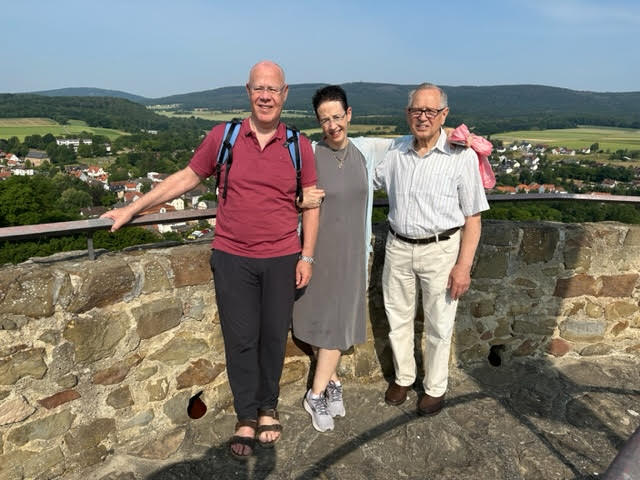
Overlooking Jesberg with Miki, her husband, and their guide Heinz Hildebrandt

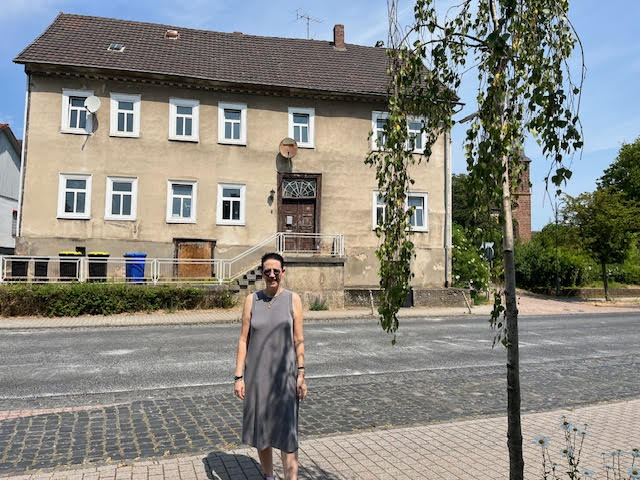
We even managed to enter the house where my grandfather was born and raised, thanks to the current owner, Michael Jung. It was very emotional for me; the house is in need of repairs and is about to be completely renovated. But I could easily see its beauty, size, and even glory. The ceiling is spectacular. In some ways the house reminded me of my grandfather’s home in Haifa, with all the wooden hand-crafted furniture.

Miki standing in front of the house where her grandfather lived in Jesberg

We said Kaddish at the well-preserved grave of Levi Katzenstein and Jeanette Bendheim, my grandfather’s grandparents, and we saw a gravestone for the victims of the First World War from which the name of our relative Max Katzenstein had been erased during the Nazi era; his name was returned to that memorial a few decades ago. A fascinating presentation was prepared for us that dealt with the history of the Jewish families in the village and in the region, especially the story of our Katzenstein family. It amazes me to think that if my grandfather could have remained in Jesberg undisturbed, my children would have been the 11th generation in the village.

The grave of Levy Katzenstein, Miki’s great-great-grandfather

World War I memorial in Jesberg where you can see that Max Katzenstein’s name was removed and then later restored

My grandfather loved Germany all his life and missed it endlessly. There wasn’t a year he didn’t go there. It also became clear to me from records Mrs. Ochs shared that a year before his death he even came to Jesberg, but without me.

The second part of this busy week was no less emotionally difficult. We went to Munich for three days where we met my brother and sister-in-law who came from Israel and were hosted by the people of the municipality, whom we were very happy to meet after about three years of seeing them only on the small screens of Zoom in our conference calls. The program was very busy, and the terrible heat and the fact that there was no air conditioning made it very difficult. The truth is that even there we were shocked by the welcome we received.

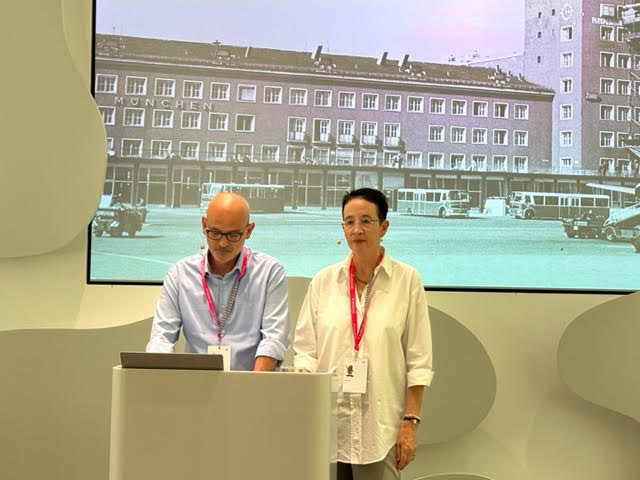
The project to commemorate my father, which started from a humble initiative of family friends, Michael Weidenhiller and Werner Haberkorn, has developed into a huge project that combines our family, the municipality of Munich, and the high-tech company BrainLab. We were invited to lunch with the mayor of Munich, with the head of the Jewish community in Munich, and with the Israeli consulate there. We visited BrainLab’s amazing offices and met with the CEO, Stefan Fieldsmeier, his employees, and the artist chosen to create the artwork that will be erected on the site. We participated in a press conference where the launch of the project was announced, and millions of German residents were exposed to it.

Miki at the press conference in Munich

The site where the memorial to Aryeh Katzenstein will be installed

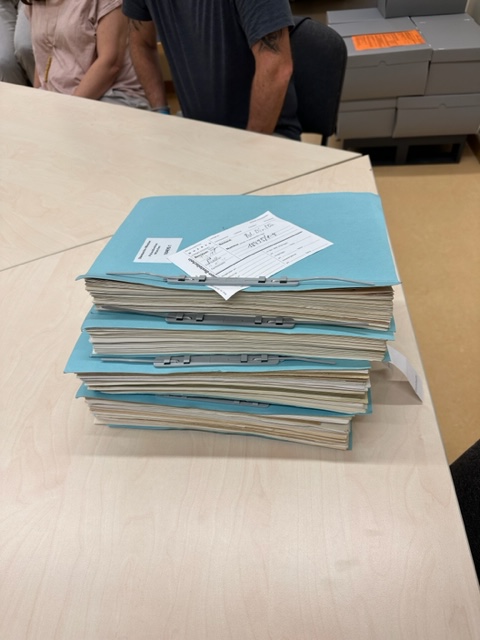
The highlight for me and my brother was the visit that was organized for us at the municipal archives, where we were exposed for the first time to four huge files of evidence that were prepared for the trial of the three terrorists who murdered my late father. Those files were never used because the terrorists were released without a trial three months later when a Pan Am jet was hijacked and the German government agreed to release those three terrorists in exchange for the safe release of the three hundred passengers on that plane.

The files from the Munich Archives about the 1970 terrorist attack

[For more on this exchange and its historical significance, here is one writer’s views.]

Our faithful translator translated for us from German into Hebrew the testimonies of my grandfather, who was interrogated right after the terrorist incident while he was injured in the hospital, of Hana Maron, the Israeli actress who was seriously injured in the attack, of Uri Cohen, the heroic captain who fought the terrorists with his bare hands, and the bus driver who drove the passengers from the terminal to the plane.

The pictures were very difficult to see but important. We saw drawings of the terminal and timeline of the chain of events. We read what they found with my father after his death: coins, a horseshoe-shaped gold necklace that I really remember as a child, a list my mother sent with him of things to buy in Germany including Pantene diaper cream and decorations for a Purim party they were planning to throw for their friends, and a picture of us – his three children.

We left with tears in our eyes and a heavy heart. On the other hand, we now know much more than we knew before the visit, we met lovely people who tried to help with infinite sensitivity, and we are waiting for the launch of the memorial website, which will be in 2024.


Thank you, Miki, for sharing this with me and my readers. We will always remember the story of your father and the lessons we all must learn about the destructive consequences of hatred in all forms.


An Amazing Day!

No stories about my distant relatives today because my heart is too full with love and pride for my daughters to think about the past—though I realize and recognize that my daughters wouldn’t be who they are but for all those ancestors who came before them—all those who were brave enough and optimistic enough to take all those steps that made it possible for my children to be here. So forgive me for indulging today in parental pride as I bask in the glow of yesterday.

Yesterday was such an amazing day. Both of our daughters were at their very best. And as their parents, we were both excited and worried about how their days would go. Maddy was going to run her third Boston marathon (and her fourth marathon overall), and Rebecca was going to testify before a Congressional committee. How were we going to juggle both and be able to focus on each of them fully?

Well, fortunately Rebecca’s testimony was in the morning, and Maddy’s start for the marathon wasn’t until 11:15, so we were able to watch most of the Congressional hearing before Maddy even started to run. It was an exhausting but exhilarating day from start to finish.

Rebecca was asked to testify before the House Judiciary Committee on behalf of New Yorkers Against Gun Violence, the non-profit organization for which she is the executive director. The hearing was ostensibly called as a hearing to determine what could be done for the victims of violent crime in New York City, but as many of the Democrats on the Committee stated and as media outlets also recognized, it was actually called by the committee chair, Republican Representative Jim Jordan of Ohio, as an attempt to intimidate and punish the Manhattan DA Alvin Bragg for his office’s prosecution of Donald Trump. Since violent crime rates are higher in many places, including Ohio, than they are in New York City, it was obvious that this was a set-up, not a good faith investigation of violent crime.

As Rebecca said in her testimony, if the committee and Congress were truly concerned about victims of violent crime, then they would be focused on taking actions to prevent gun violence. She stated:

“To make a significant change, we need bipartisan support in Congress to fight violent crime and make our communities safer.  Congress can combat the national gun trafficking crisis plaguing New York City and the state by passing federal gun reform laws that are modeled after New York State’s.  We need to close loopholes in the federal background check system, protect victims and survivors of domestic violence, strengthen extreme risk protection order laws, promote safe storage laws, crack down on ghost guns and hold rogue, reckless gun dealers accountable.  Our federal, state, and local governments need to invest more in community violence intervention and prevention programs, invest more in housing, healthcare, and education.  Our state and our cities need more funding for victim services. And Congress must support and fund federal law enforcement efforts to investigate gun crimes and hold the highest drivers of crime and gun trafficking accountable.”

You can see Rebecca’s full opening statement here.

Rebecca faced questioning by the members of the committee, both Democrats and Republicans, and was steadfast in her position and persuasive in articulating the position that it is the easy access to guns that leads to most violent crime, not the actions of a prosecutor’s office. Surrounded by other witnesses hand-picked by the Republicans to pursue their political agenda, Rebecca stayed calm, resolute, and professional. We couldn’t have been prouder.

Meanwhile, as we were watching Rebecca on my laptop, we were also keeping our eyes on our phones and the Boston Athletic Association app that allows people to track runners in the marathon. Maddy started the race at 11:18 am, and we began to track her progress. You can imagine our excitement and our stress—both daughters testing themselves in challenging and extraordinary circumstances.

Just as last year and the year before, we were staying at the Lenox Hotel in Boston where Maddy is now the general manager of the restaurants. She has worked there for over 16 years, starting as a host and working her way to the general manager’s position. She is passionate about the hospitality business, making sure that all guests receive the best service and feel welcome and appreciated whenever they come to one of the restaurants in the hotel. As we had lunch in one of those restaurants and walked through the lobby and stood outside to watch the runners crossing the finish line a few hundred feet away, over and over we heard from everyone, “We love Maddy.” From the servers in the restaurant to the hotel staff to the many “regulars” who eat there often, we heard how wonderful Maddy is to everyone.

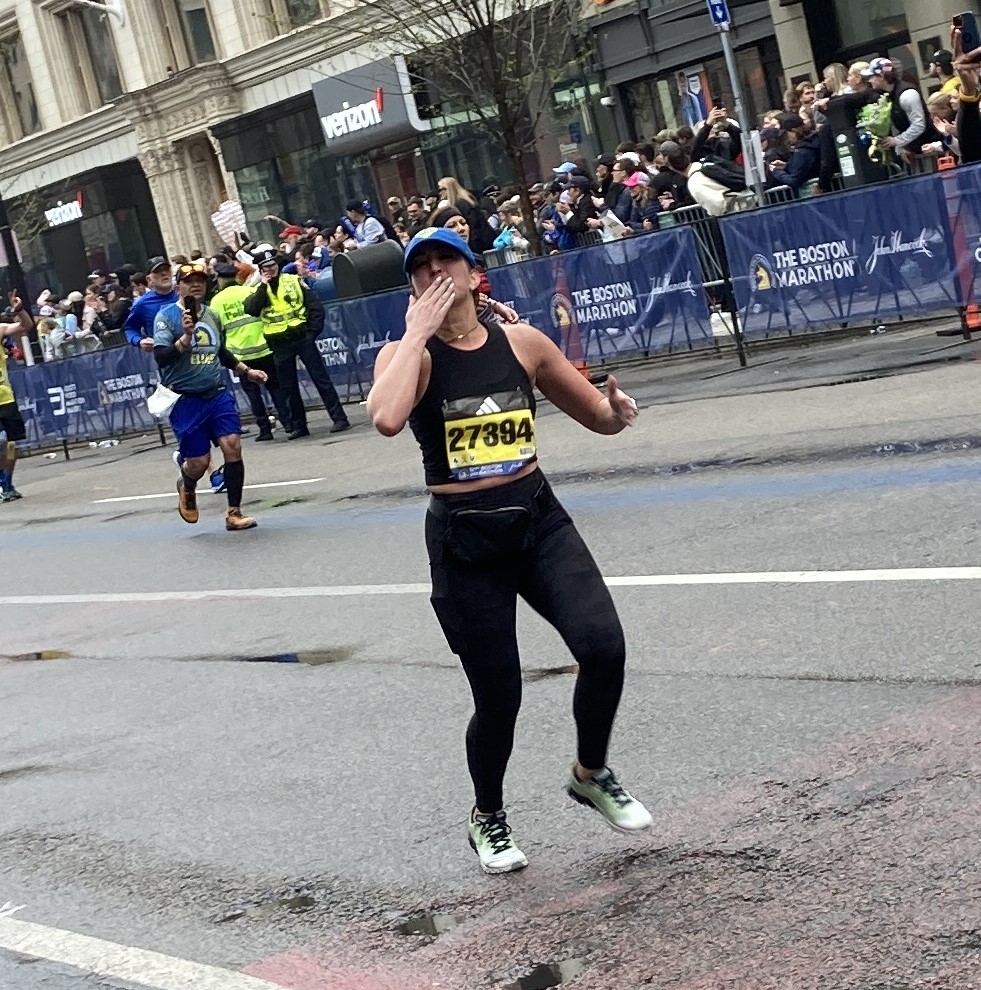
And then, as we tracked the app and watched her progress, we stood outside in the cool and sometimes rainy weather, waiting anxiously to see her finish the race. We watched as she made her paces through Hopkinton, Ashland, Wellesley, Natick. We saw her pace slow a bit as she ran up and down the hills of Newton—the infamous Heartbreak Hill. And then we saw her gain speed again as she went through Brookline and finally crossed the Boston city line. My heart was pounding as I saw her turn right on Hereford Street and then left for the final stretch down Boylston Street. And then there she was, smiling, jubilant, and seemingly unfatigued by the 26.2 mile run.

And then there was the excitement of seeing her return to the hotel and the loud cheers and hugs and flowers and love that greeted her—not only by us, her parents, but by all those friends, co-workers, and guests who were there to cheer for her and support her.

What a day! These are the days that you dream about when you have children—the days that make all the worrying and hard work and sleepless nights worth it. The days that make you grateful for the gifts your children have given you with their passion, their love, their strength, and their commitment to being good and kind people determined to make the world better in many different ways.


Time for A Break

I started writing about my Blumenfeld family back in August of 2021—almost a year and a half ago. In my first post about the Blumenfelds, I pointed out that my four times great-grandparents Abraham Katz Blumenfeld and Geitel Katz had six children, one being my three-times great-grandmother Breine Blumenfeld Katzenstein, whose descendants I covered in my work on the Katzenstein family several years ago.

Abraham and Geitel’s first-born child was their son Moses, who had three children, Abraham II, Isaac, and Gelle. So far, in the seventeen months or so that I’ve been posting about the Blumenfelds, I’ve not even reached Gelle or finished Isaac, let alone any of the other children of Abraham I and Geitel, the other four siblings of Moses and Breine: Sprintz, Hanna, Maier, and Jakob.

Sometimes it just feels overwhelming, and I wonder how many more years it will take before I reach Abraham and Geitel’s youngest child, Jakob. I believe each and every one of these relatives should be remembered, and my goal remains to do my best to honor their memories. But at times I feel like I am in an endless maze from which I will never emerge.

And so it’s time to take a break from blogging. I need to reinvigorate myself and clear my head so that I don’t feel so overwhelmed. I will be back—maybe in a couple of weeks, maybe longer. And when I am, I will be writing about Isaac Blumenfeld I’s eighth child, his daughter Rebecca Blumenfeld Rosenberg, one of the over 80 great-grandchildren of my four-times great-grandparents, Abraham Blumenfeld I and Geitel Katz.

Until then I will be enjoying a break from screens and getting outside as much as possible, reading books, and seeing friends and family. I will keep up with blogs and emails, of course, but otherwise hope to limit my time on the computer.

See you all soon! Have a good couple of weeks or whatever it takes until I am ready to return to the blogiverse!


Blumenfeld Cousins Hanukkah Zoom

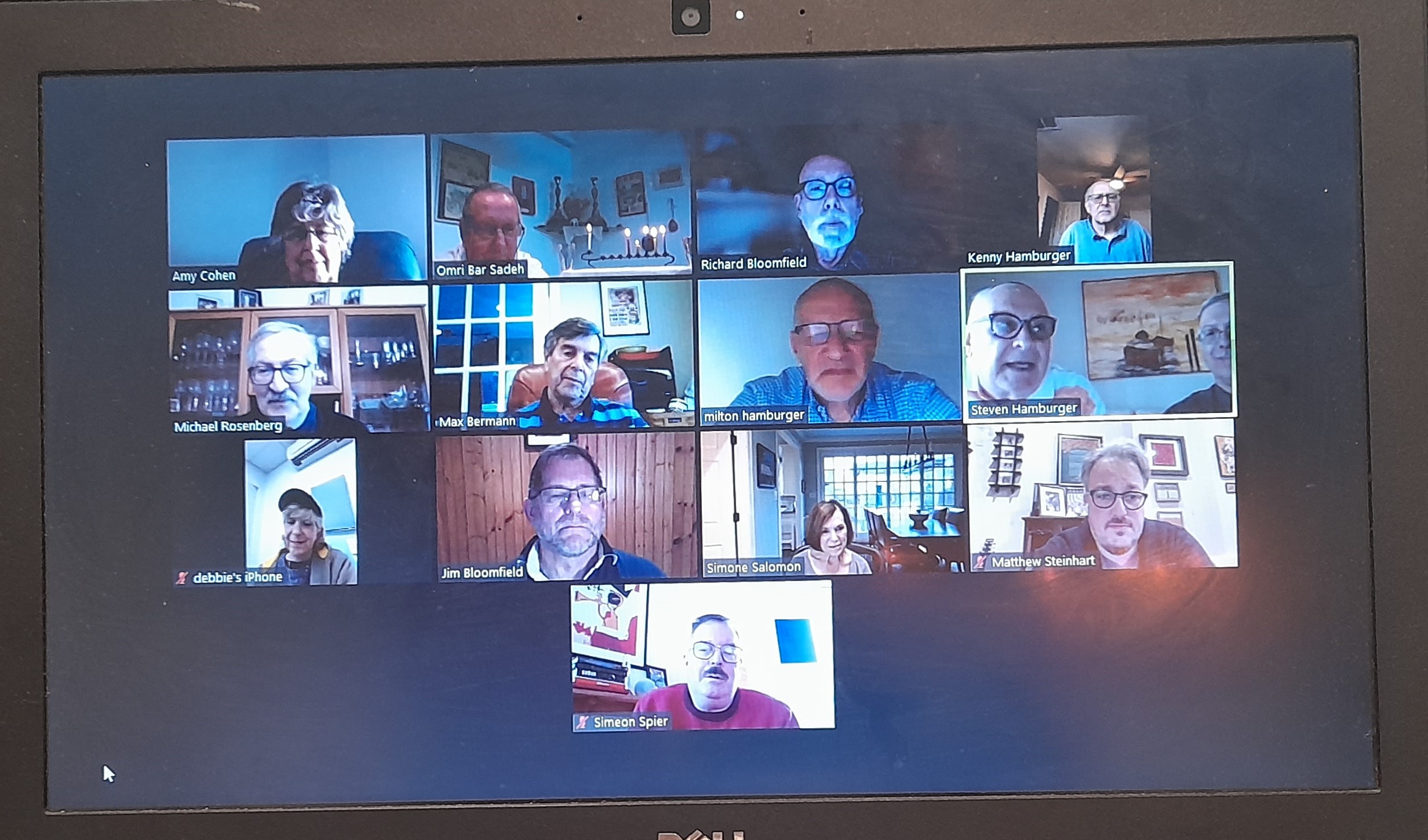
Last Thursday I was fortunate to be able to Zoom with thirteen of my Blumenfeld cousins—Omri, Richard, Jim, Steven, Milton, Kenny, Alan, Debbie, Simeon, Simone, Matthew, Max, and Michael. Some members of the group had known others for their entire lives; others of us had never met in person or otherwise before the Zoom. Most of the group are my fifth cousins—we are all descended from Abraham Katz Blumenfeld and Geitel Katz, who lived in Momberg, Germany, in the late 18th and early 19th centuries.

We span the globe—Omri from Israel, Richard from Switzerland, and the rest of us from the eastern seaboard of the US from as far north as Maine all the way to Florida. We come from a range of backgrounds—some of us (like me) having roots in the US since the mid-19th century, many of us the children of Holocaust survivors, and three of us born outside the US, one in Israel, one in Canada, and one in Italy. Our religious backgrounds also range from Orthodox Judaism to Christianity. Almost all of us fall into the Baby Boomer generation.

Yet despite our differences, our commonalities far outweigh those differences. We were moved by Omri’s lighting of the Hanukkiah from Israel and our combined voices singing Maoz Tzur. We shared stories of our own lives and the lives of our parents and grandparents. We found much to talk about and to learn from each other, including family heirlooms and family history. For some, learning that they had cousins, albeit distant, was a wonderful revelation because their own family story had not been connected to the larger Blumenfeld family tree.

My only regret is that in the midst of all the warmth, laughter, and stories, I forgot to take a screenshot of all of us on Zoom together. You will have to use your imagination. But here at least is a chart showing the descendants of Abraham Blumenfeld and Geitel Katz to the sixth generation (for most of us, our parents’ generation). It’s quite remarkable to see just how many people one couple generated through their children, grandchildren, and so on.

Overall, it was a wonderful hour for me—to share with those I’ve found through my research (or who found me through my blog or through other cousins) is the best reward of doing family history research. It helps to keep me motivated to continue the search.

UPDATE! Both Omri and Matthew did capture a screenshot of at least part of the group, so I can add these to the post.

Thank you to all who joined in. And I hope all my cousins, friends, and readers had a happy and meaningful holiday, whichever one you celebrated, and I wish you all a new year filled with love, peace, light, and meaning.


Smokey March 23, 2008 – August 16, 2022

You may have noticed that I haven’t been blogging in recent weeks. There’s been a lot going on in terms of our move, but mostly I just haven’t had the heart. My beloved cat Smokey was diagnosed with a cancerous mass in early July, and on Tuesday we had to make the heartrending decision to let him go before he started to suffer. Smokey was my baby—I loved him with all my heart, and he loved me back. And so as I do with all my family members, close and distant, I want to honor his memory on my blog.

Smokey was born on March 23, 2008, in Southwick, Massachusetts. We had been looking to adopt two kittens after losing our last surviving cat Lily in the fall of 2007. I saw an ad on Craig’s List for a newborn litter, and we went out to Southwick to check out the new kittens. The kittens were born to siblings—the people had three cats, all black and white tuxedo cats, one female, two males—and the brothers had impregnated their sister. I was a bit concerned about the genetic consequences, but decided to ignore the issue.

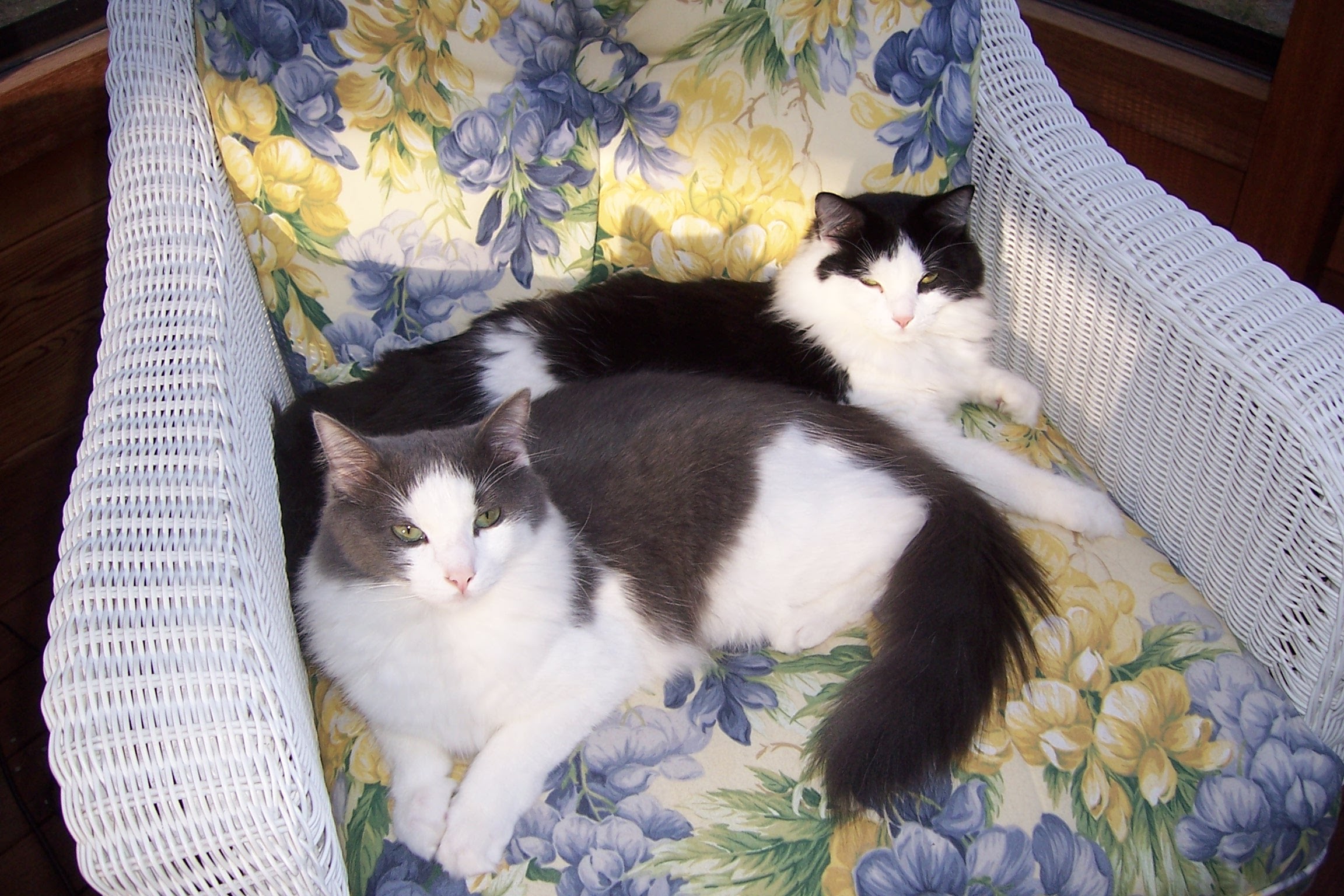
There were six kittens—five of whom were black and white tuxedos, not surprisingly, and then there was Smokey. He was gray and white—the oddball in the litter. In fact, the family was referring to him as Oddie. I knew I had to have any cat who was an oddball. We asked the family which kitten seemed most friendly, and they pointed to a female, and she was our other pick, and she became Luna.

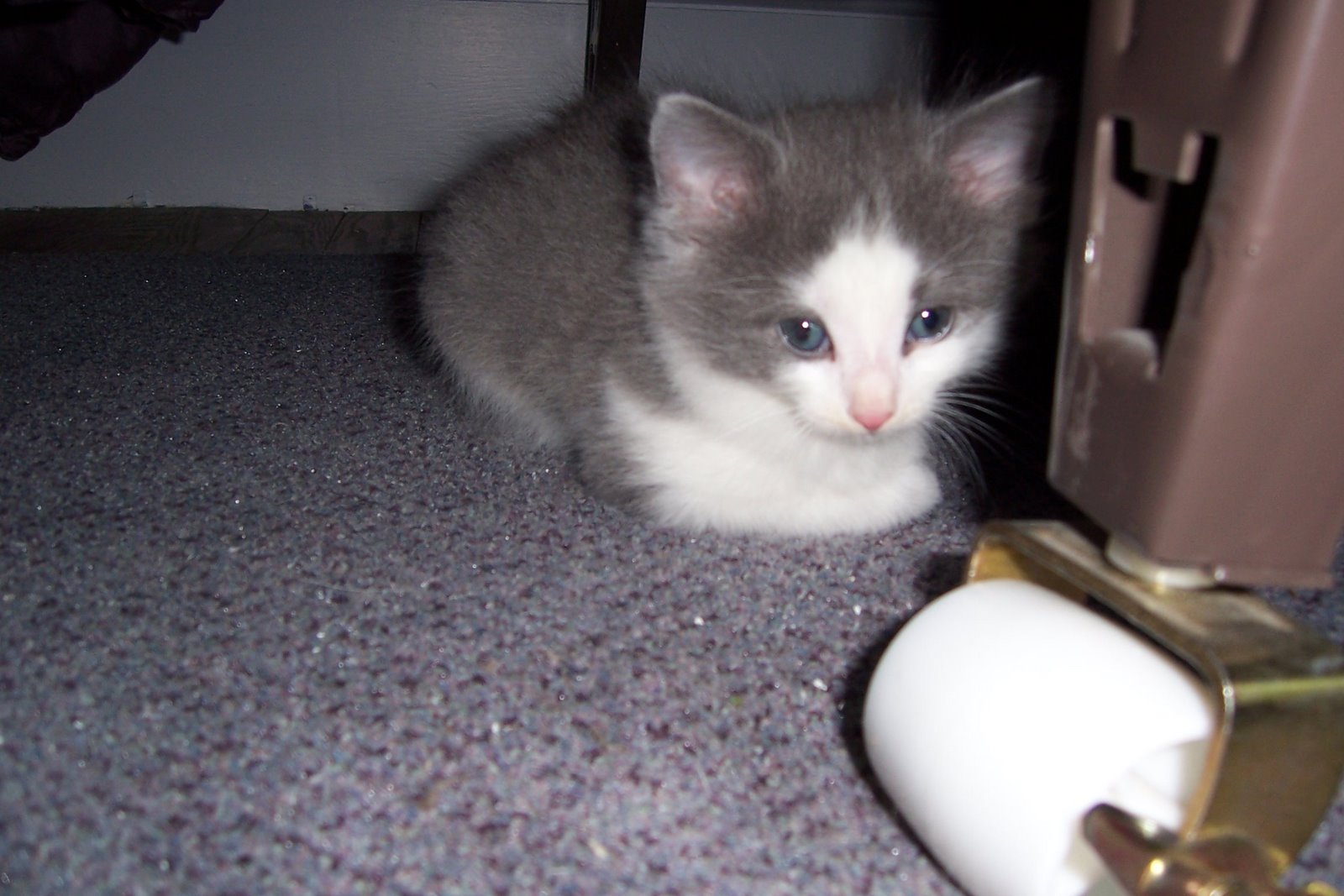
Here’s Smokey the first time we saw him. He was just a few weeks old.

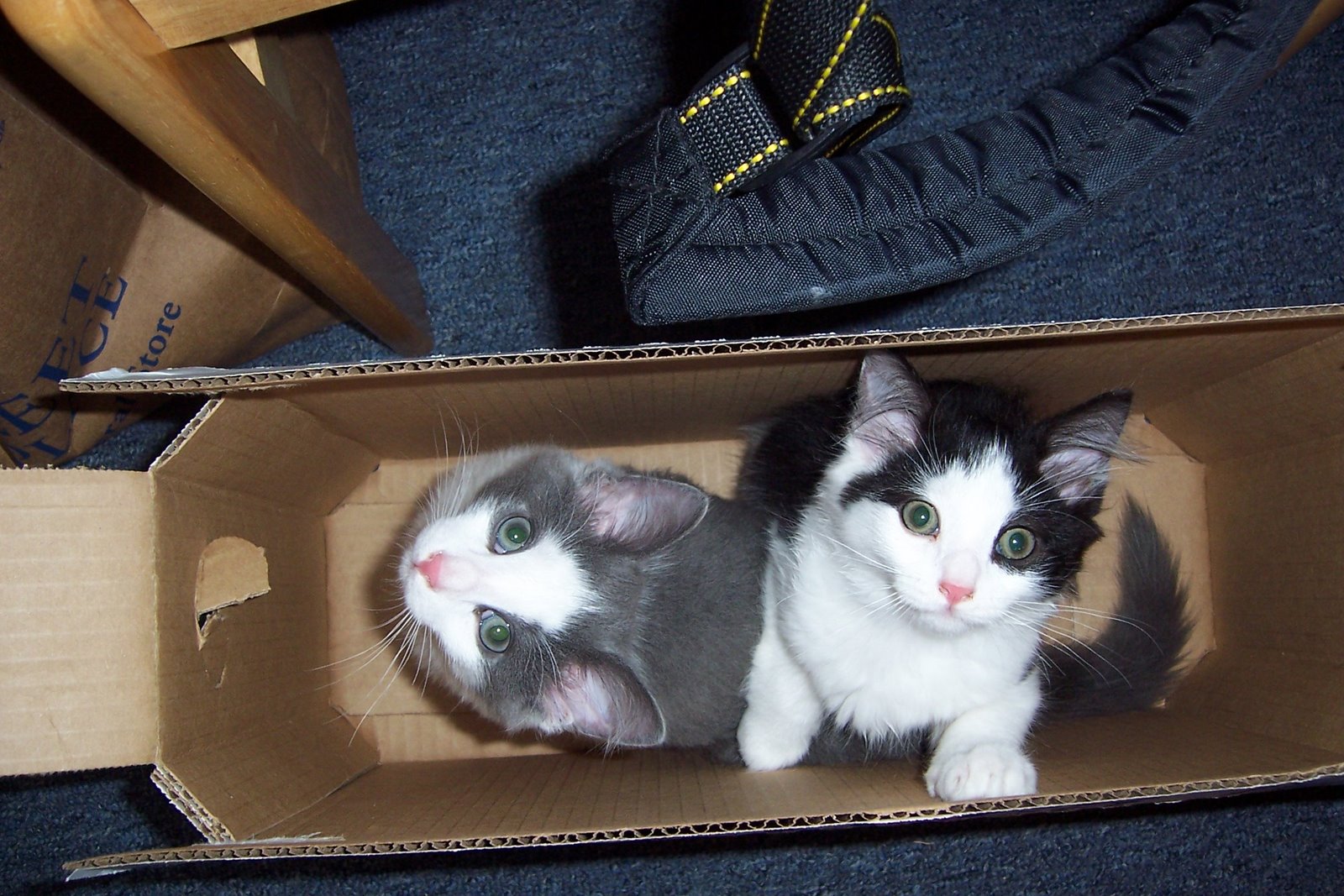
We had to wait a few weeks until the kittens could be weaned, so we returned on Mother’s Day in 2008 to pick up Smokey and Luna. Luna was, as predicted, friendly and outgoing; Smokey was shy and hid under Maddy’s bed until he was sure we were safe.

He and Luna were bonded tightly—slept together, played together, and bathed each other. And soon they also bonded with our dog Cassie, who treated them like they were her babies, allowing them to cuddle up and knead their paws into her soft belly like she was their mother.

Smokey and Luna were inside cats only, but they loved going to the Cape and watching the birds and squirrels and chipmunks in the yard outside our screened porch.

Smokey and Luna on the porch.

When Luna died unexpectedly in the fall of 2014 when she was only six, I was shocked and devastated. I worried about Smokey. But although he seemed to look for her at first, he soon adapted to being the only cat. But when Cassie then died in June of 2015, Smokey was bereft. He started chewing on his leg, leaving a raw bald spot. Maybe he was picking up our sadness. Hard to know.

So to ease our pain and his, we adopted two new kittens in August of 2015—Zoe and Chloe. We brought them to our Cape cottage from the no-kill shelter in Provincetown and opened the carrier, waiting to see how Smokey would react. He sniffed, hissed gently, they hissed gently back at him. And then they became his babies.

Just as Cassie had allowed Smokey and Luna to pretend-nurse on her, Smokey allowed Zoe and Chloe to do the same. He bathed them, protected them, played with them. And he never again chewed on his leg. He was just happy to have his new babies to love.

Smokey remained shy forever around strangers, but with his family he was frisky and friendly and so affectionate. He was the ultimate lapcat—always happy to sit on me or next to me or with Harvey, squinting his eyes with love, rubbing his head into us to get us to give him some attention. He slept next to me every night, quietly curled up near me. When I sat in my chair working on my computer, he would jump up and squeeze in next to me, and as soon as I put the laptop aside, he would jump right onto my lap and sit there for as long as I allowed him to do so. He was my constant companion, a comfort when I was sad. He never resisted a hug or a kiss.

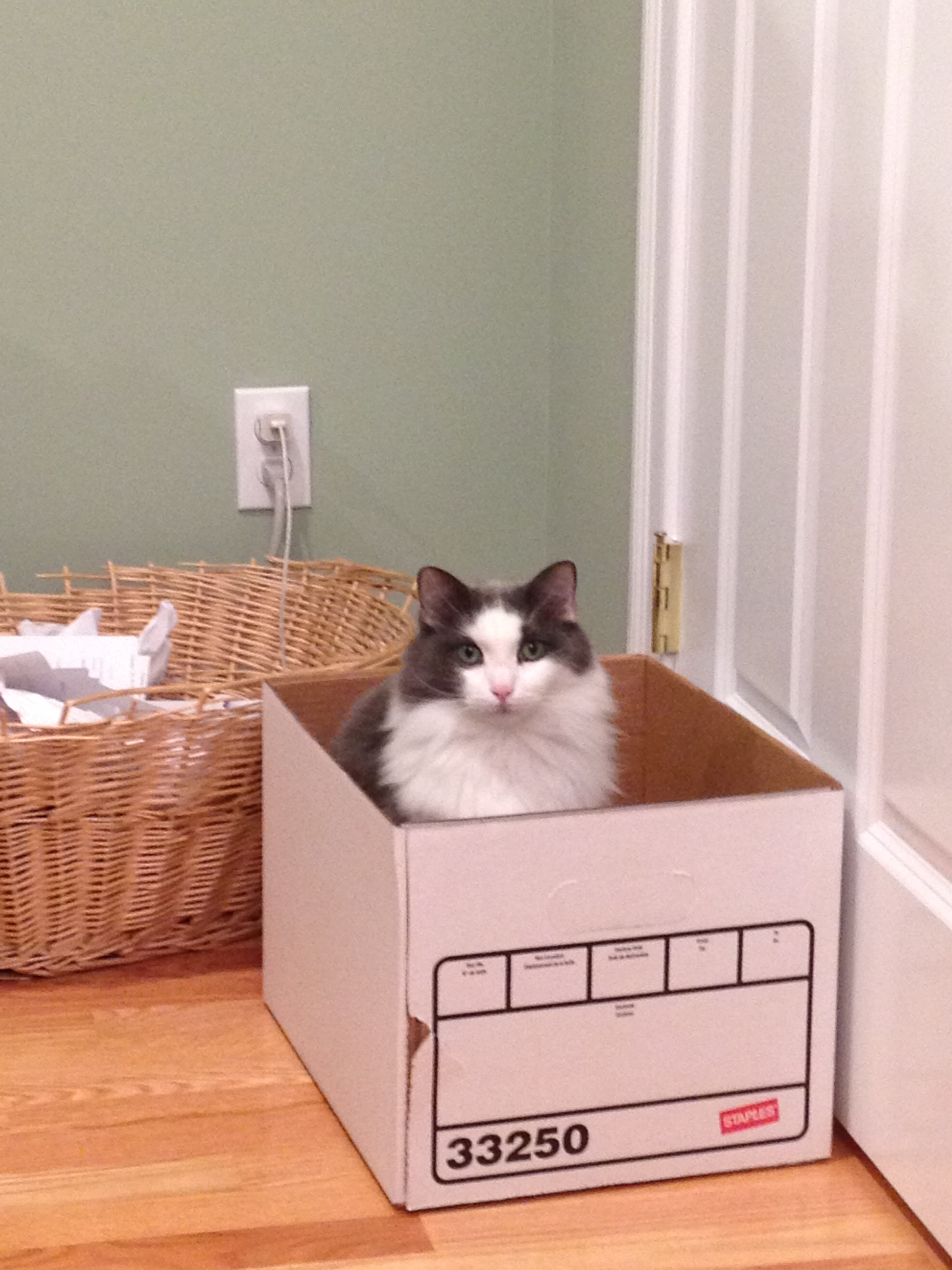
He was also well traveled. He first lived with us in Longmeadow, then adjust easily to our move to East Longmeadow in 2009. He loved going to the Cape, and he even tolerated the ten-hour drives to Florida and back. And I feel so lucky that he also got to spend a few weeks in our new house. In fact, he adjusted more easily than Zoe or Chloe to the newest environment. Here he is in the new house.

This photo was taken just a few days before he died. He was as beautiful then as he was all his life.

After he was diagnosed, he tolerated being given meds every morning without ever growling or hissing. In fact, other than the time he hissed at Chloe and Zoe, I had never heard him growl or hiss at all. He continued to act like he always had until just a week or so ago. But when he stopped eating and no longer could jump up on the bed by himself, I knew his time had come. It was both a hard decision and an easy one. Easy to know we were doing the right thing for him, hard to give him up, to say goodbye to our most precious, most gentle, sweetest cat ever.

I miss him so much. I see him out of the corner of my eye when I’m not looking carefully. I reach for him at night, but now Chloe has taken his spot on the bed. Chloe and Zoe will help to fill the hole that Smokey has left in my heart, but there will always be an ache, something missing from our home and from our lives.

Rest in peace, my sweet boy.

At a Crossroads: The Future of My Blog

I am at a crossroads.

I have been thinking a lot about the future of my blog lately because I am feeling a bit blocked, a bit overwhelmed. Some of my sense of being blocked comes from the fact that too much of what I have been researching recently is overwhelmingly sad. So many of the families I am now focused on were killed in the Holocaust. Each time I need to search Yad Vashem to find out what happened to some cousin, it takes something out of me. Even though these are all very distant relatives, each name is real. I feel compelled to tell their stories, but it does have a real impact on me.

Yet how dare I complain, given what so many of them experienced? I know how important it is to tell these stories and to remember what happened and to honor all of them and their lives. But it is truly wearing me down.

For almost nine years, writing this blog has been a true labor of love for me, and it’s given me the opportunity to do numerous things I love to do: research, writing, connecting with friends and family members, and connecting with fellow family historians and genealogy bloggers. I still love the research, and I still love the writing. I still love connecting with others who are interested in what I write.

But for the first time since I started blogging in 2013, I am having a hard time finishing the posts I’ve already researched and written—that is, doing the technical work where I add all the footnotes and images before hitting publish. It is very time-consuming and frankly boring.

Also, I have noticed a substantial drop in the number of people blogging about genealogy. People who used to post frequently and regularly have either stopped posting completely or are posting very infrequently. The community of genealogy bloggers has become smaller and smaller, and that is a loss for me. I enjoy reading about the work of others almost as much as I enjoy having them read about mine. And if others have lost interest in their own research, it makes sense that they will have less interest in my research also.

But I am not going away or stopping. I started the Blumenfeld branch of my tree back in August 2021, starting with my 4th great uncle Moses Blumenfeld, brother of my three-times great-grandmother Breine Blumenfeld Katzenstein. Breine had five siblings, so there are four more to do after Moses. And Moses had three children, and I am only on his second child, Isaak. And Isaak had ten children, and I am only up to Isaak’s son Moses IIB, the fourth of those ten.

So there is still so, so much to do on the Blumenfeld family. I will complete the Blumenfeld family story no matter how long it takes. I’ve made some wonderful connections recently, and I want to share those on the blog. That’s the most rewarding part of this whole endeavor.

But to help me balance all that is going on and give me a break from the constant pace of preparing posts, I’ve decided to cut back to posting about once a week instead of twice a week.

What about you, fellow bloggers? Are you feeling some burn out? How do you stay motivated?

The Boston Marathon 2022

As a mother, I have been blessed with many days that have brought me immeasurable joy and pride—the days my daughters were born, their first words, their first steps, their first days of school. Watching them perform on stage in theatrical and musical performances. Bat mitzvahs, graduations, a wedding, and the births of my grandchildren. Those are the big events. Then there are so many smaller events that have filled my heart with so much love and joy—when they’ve done something kind to a friend or family member, when they’ve made someone smile, when they’ve made me laugh until tears roll down my face. Being their mother has been a constant source of joy and pride.

Yes, there were and still are moments that I get exasperated with them. There were times I’ve lost my temper or said something too harsh. Times I was in too much of a rush or under too much stress to be as patient or attentive as I should have been. And there were times they also didn’t behave as I might have wanted them to. But overall being a mother has brought me the greatest challenges and the greatest rewards of my life.

Yesterday was one of those days of immeasurable joy and pride just as last October 11 had been when Maddy ran the Boston Marathon for the first time. Yesterday she did it again. Of course, I am proud of her determination and her hard work and her accomplishment of running 26.2 miles on one of the hardest marathon courses in the world. But it is more than that. So much more than that.

Maddy works at the Lenox Hotel in Boston, a beautiful old hotel with so much style and class that it puts any other hotel to shame. And it happens to be located just a block away from the Marathon finish line. It is the perfect place to watch the thousands of runners as they finally reach their goal after hours of running. You are a witness to all their excitement, exhaustion, and elation as they see that finish line in front of them. And so, of course, we stayed at the hotel to watch and to witness Maddy’s completion of the marathon for the second time.

From the moment we entered the hotel on Sunday night, we were treated like VIPs. Everyone told us how proud they were of Maddy, how excited they were, and how much they loved her. From the top management of the hotel to the woman who came to clean our room, we heard over and over again how kind she was, how special she was. What more could a parent ask for?

And then we waited and watched as the participants passed the Lenox. First, the amazing grit and determination of the wheelchair and hand-cycle participants, then the awe-inspiring runners who were pushing a loved one in a wheelchair through the racecourse, then the elite runners arriving in just over two hours, and then wave after wave of runners from all over the world of all ages.

The fourth wave were the runners who ran for charity, not based on a qualifying time, and in my mind, they are the most important of all. They are not doing it solely for the athletic challenge, but to make life better for others at the same time.

Maddy was in that fourth wave. In the three times she has raised money in order to run in the Marathon (the first time cancelled because of COVID), she has raised close to $50,000 from friends and family for the Boston Medical Center, a non-profit 514-bed academic hospital in Boston; its mission statement states that the hospital is “driven by a commitment to care for all people, regardless of their ability to pay, providing not only traditional medical care, but also programs and services that wrap around that care to enhance overall health.” Maddy’s ability to raise that kind of money for the hospital is a testament to how many people care about her and support her efforts.

As we waited for Maddy to approach the finish line, we tracked her on the Boston Athletic Association app. She was running with her friend Mo, and they stopped to send us a selfie they took as they passed the halfway mark at 13.1 miles—their big smiles glowing with pride and happiness. Maddy’s oldest and dearest friend Anna traveled from western Massachusetts with her family to stand along the race route to cheer Maddy on and give her a hug. Our cousins in Newton waited along Heartbreak Hill to cheer her on as well.

Anna and Maddy

And then we saw on the app that Maddy was crossing Mass Avenue and then turning onto Hereford Street and finally on to Boylston Street, just a few blocks away from where we were standing. We noticed that Mo was now trailing her just a bit and later learned that Mo had graciously told Maddy to run ahead—perhaps to get all her glory alone as she passed us, arms high, smile beaming, with her co-workers and friends and her parents yelling and screaming her name as she ran by and then crossed the finish line.

We then waited for her to return to the hotel, her home away from home, the place where so many who love her were waiting to cheer her accomplishment. As she walked in, the DJ played “Eye of the Tiger,” and the crowd cheered and applauded and then allowed us, her parents, to give her the first hugs.

And then, as she was being hugged and greeted by others, she noticed that the 95-year-old owner of the hotel was also in the lobby, sitting in a wheelchair, waiting to see her. Maddy went over and gave him a hug and spoke to him, and my heart almost exploded with pride and emotion.

So yes, yesterday was one of those days you dream of as a mother when you are raising a young child and hoping that they will grow up to be hard-working and determined and kind and generous. That they will be filled with joy and self-confidence. And most importantly, that they will be loved and loving.

I am so blessed that both of my daughters have fulfilled those dreams for me in so many ways. Rebecca, through her work fighting against gun violence and as a loving and devoted mother, wife, daughter, sister, and friend, has also given me many days of intense joy and pride. And yesterday was only one of the many days when Maddy has brought tears to my eyes with her kindness and love and joyfulness and her determination to do her best at whatever she does.

But yesterday—well, yesterday was one of those truly special days that I will always cherish.

1950 Census Day!

I was going to post more about the Blumenfelds today, but I am too distracted and excited because the 1950 US census has been released, and I just want to dive right in and start looking for all my family and friends who were born before 1950. I’ve already found my mother and maternal grandparents and my husband’s parents and brother, but that’s just the tip of the iceberg.

My grandparents and my 19 year old mother on the 1950 US census

So I’ll be happily buried in the search page which you can find here. Even if you aren’t a family history/genealogy geek like I am, I bet you will be interested in finding all those pre-1950 people you know.

Florence Goldschlager Cohen: A Life Filled with Love

Thank you to everyone who commented or emailed or texted me to express their condolences regarding the loss of my mother. I am deeply grateful to you all for your support during this difficult time. I hope to be back to regular blogging soon.

I wanted to share a little more about my mother’s life. She was born on October 15, 1930, in Brooklyn, New York. She was the third child of my maternal grandparents, Isadore Goldschlager and Gussie Brotman, whose stories were told in my family history novel, Pacific Street. My mother Florence was twelve years younger than her brother Maurice and thirteen years younger than her sister Elaine and so was very much the baby in the family. Her family lived in a small four unit building in the East Flatbush section of Brooklyn at 1010 Rutland Road. My grandfather was a milkman whose route was overnight and whose earnings were limited, although my mother said she never felt poor. There was always good food on the table and a roof over their heads.

Goldschlagers 1931

My mother loved growing up in Brooklyn. Her best friend Beatty lived in the building, and as I wrote about here,  I was able to reconnect my mother and Beatty about six years ago after they’d been out of touch for seventy years.

My mother was a good student although being left-handed back then meant that the teachers tried to force her to write with her right hand. But she was too left-dominant for that. She was a voracious reader from a young age and visited the local library in Brooklyn often to borrow books.

Florence and Elaine Goldschlager

When she was eleven, her parents decided to move to a new apartment complex in the Bronx called Parkchester where my aunt had moved after she got married. My mother was devastated to leave behind her friends especially Beatty and her beloved dog Sparky.

Beatty and my mother c. 1940

But she adjusted to life in the Bronx and made new friends and graduated from high school in 1948.

Florence Goldschlager 1948

Two years later she met my father at a Jewish singles camp, as I described here. They were married in 1951 in New York and had a long and happy marriage until my father died in 2019.

Florence and John Cohen 1951

My mother was a stay-at-home mom until 1965 when she decided to get a job as a teacher’s aide in the local elementary school. Because she proved to be so skilled as a teacher, she soon moved up to be a resource room teacher working with children with different learning styles and challenges. She was a devoted, well-respected, and beloved educator for many years, and even after she retired from full-time teaching, she continued to tutor children for most of the rest of her life.

She had many interests and never stopped loving books as well as theater, music, travel, knitting, cooking, gardening, Cape Cod, and especially animals. She was absolutely crazy about dogs and cats, and our home was always filled with both. She had a wonderful sense of humor and incredible taste in clothes, decor, food, and art.

But perhaps the most important thing I can say about my mother is that she was an unbelievably kind, loving, and compassionate woman—especially to her family, but also to her students, her colleagues, her friends, and everyone who ever had the good fortune of spending any time with her. I know I will keep her close to my heart for the rest of my life.

You can learn more about my mother and her life in her obituary found here.

Ny mother and me, c. 1954