The Legacy of Thekla Blumenfeld Gruenbaum: Family Photos

I mentioned in my last blog post that I have recently connected with another cousin, Robin Kravets, the great-granddaughter of Thekla Blumenfeld Gruenbaum. Robin is my fifth cousin, once removed. We are both descendants of Abraham Blumenfeld and Geitel Katz, Robin through their son Moses and me through their daughter Breine.

Robin has generously shared with me a collection of photographs of her family, and I am delighted to be able to share them with you. All the photos in this post are courtesy of my cousin Robin. I am providing a summary of what I posted two years ago about Robin’s direct ancestors to provide context to the photos and to add some additional insights Robin shared with me. The blog posts from 2021 contain more details and my sources.

Salomon Blumenfeld, Robin’s great-great-grandfather, first married Caecilie Erlanger, but she died when she was only 24 years old, leaving behind two very young children: Thekla (Robin’s great-grandmother), not yet two, and Felix, just seven months old. Two years after his first wife Caecilie died, Salomon married Emma Bendheim and had a third child, Moritz, in 1877. And then sometime within the next five or six years, Salomon left Germany for Spain with Emma and Moritz, leaving his first two children, Thekla and Felix, behind. As best I can tell, Thekla and Felix, still both young children, must have been raised by their mother’s family, the Erlangers, in Marburg.

I had wondered whether Salomon or his son from his second marriage, Moritz, had remained in touch with Thekla and Felix. Robin provided this photograph of Moritz with his half-niece Cecilie, Thekla’s daughter, and another unidentified woman, so there is some evidence that at least Moritz had some contact with his half-sister Thekla and her family.
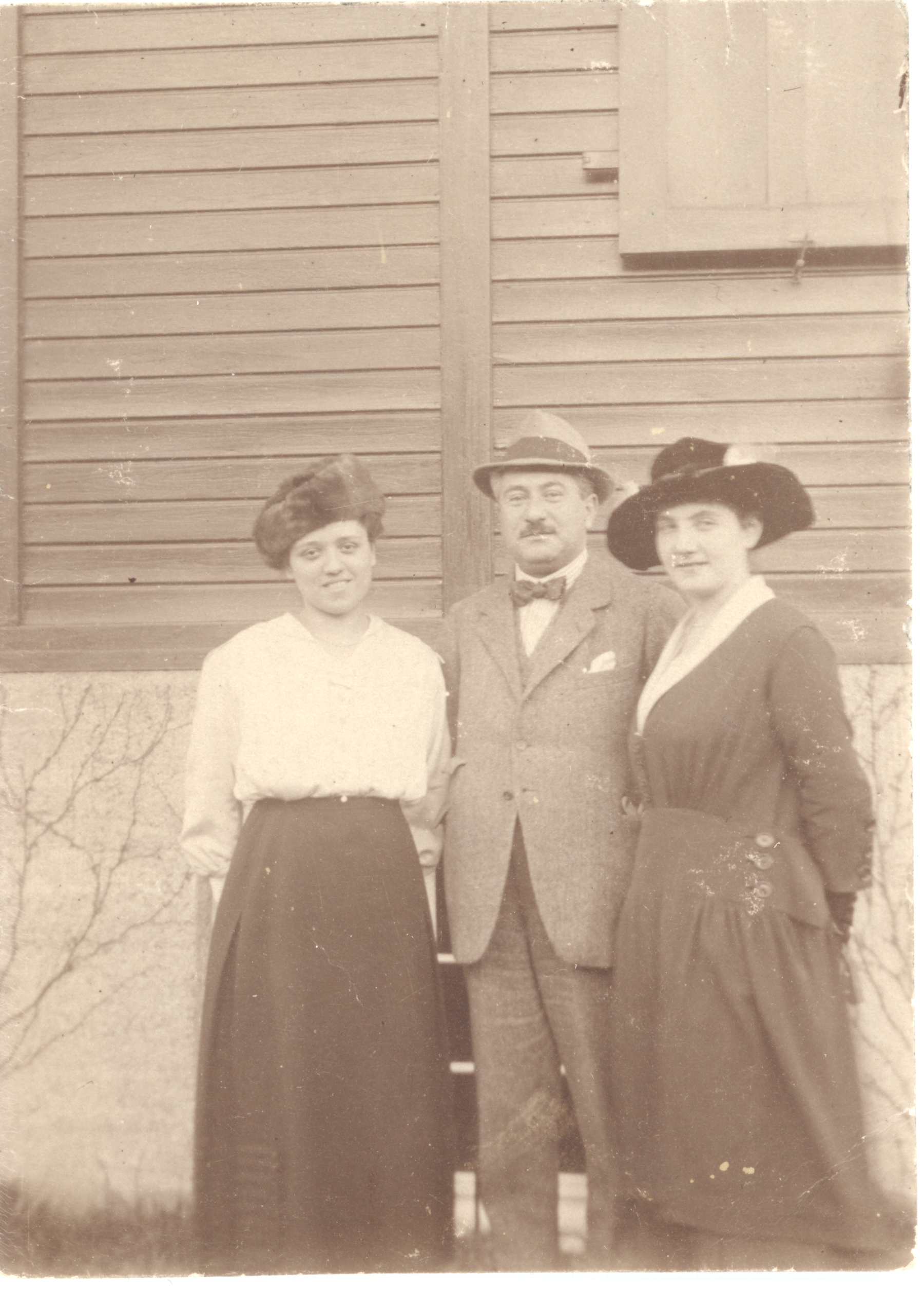
Moritz Blumenfeld and Cecilie Gruenbaum (with unknown woman on the left)
Courtesy of Robin H Kravets

This is the oldest photograph in Robin’s collection. It shows Thekla as an infant with her mother, Caecilie Erlanger Blumenfeld and must have been taken in about 1872 when Thekla was born. Thank you to Ava Cohn, aka Sherlock Cohn, The Photogenealogist, for pointing out the correct dating of this photograph.
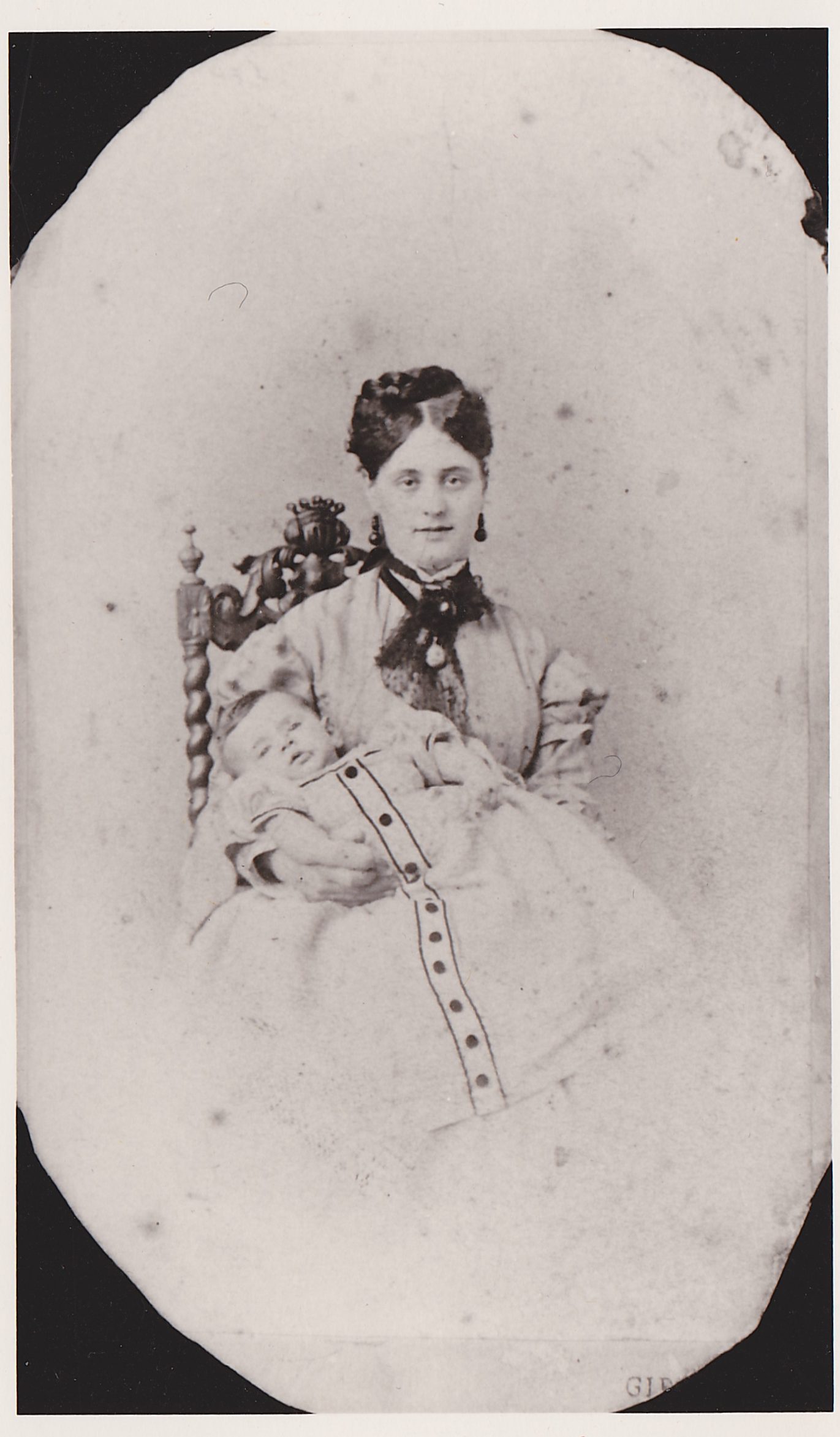
Caecilie Erlanger Blumenfeld with Thekla Blumenfeld, c. 1872 Courtesy of Robin H Kravets

Here are two beautiful photographs of Thekla as a young woman.

Thekla Blumenfeld, courtesy of Robin H Kravets
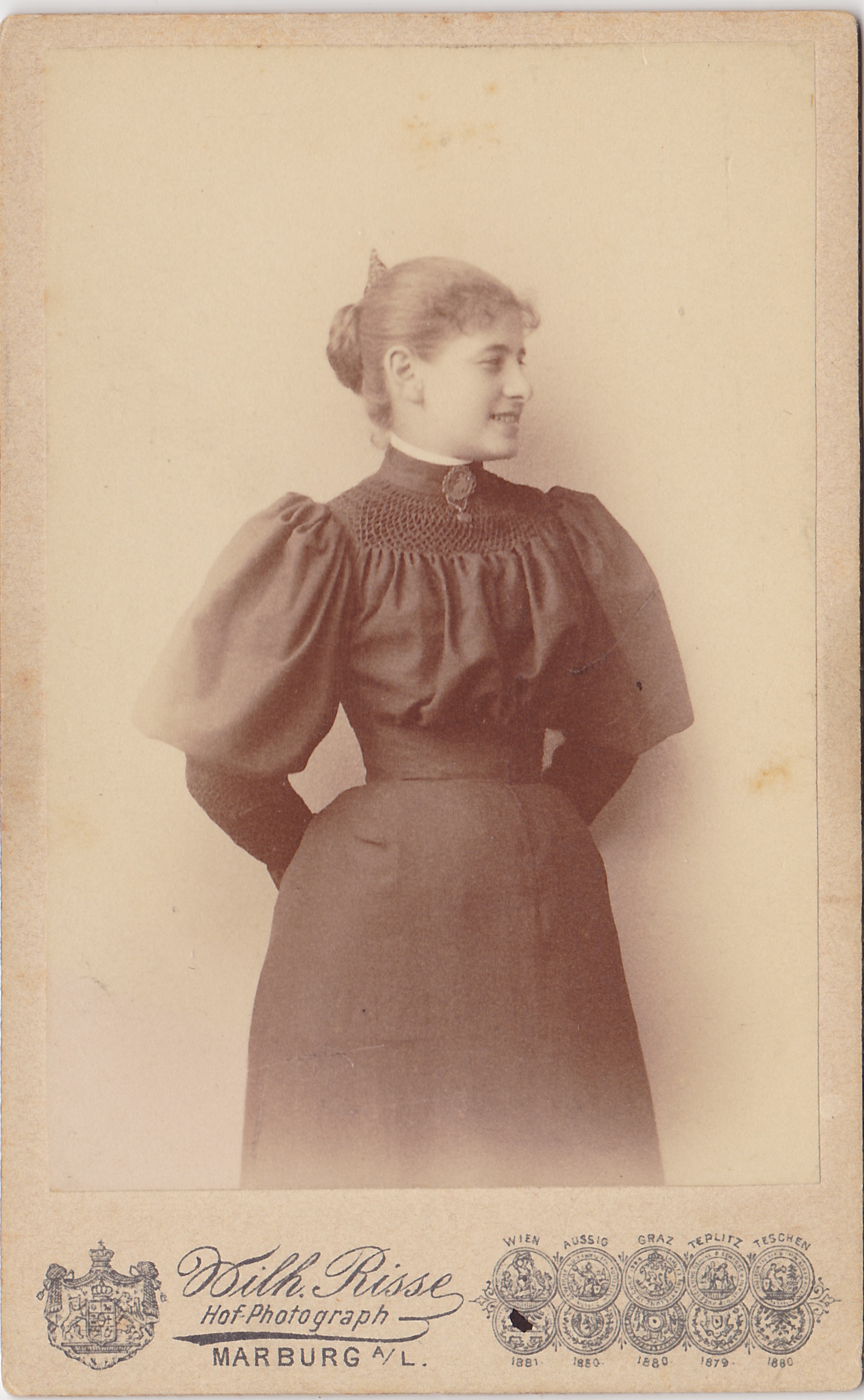
Thekla Blumenfeld, courtesy of Robin H Kravets

Thekla married Max Gruenbaum in 1894. Here is a photograph of them taken in 1895.

Thekla Blumenfeld and Max Gruenbaum 1895
Courtesy of Robin H Kravets

Thekla and Max had four children: Cecilie (1895), Curt (1897), Franz (1899), and Rosemarie, Robin’s grandmother (1912).

Cecilie, Curt, and Franz Gruenbaum c. 1908 Courtesy of Robin H Kravets

Courtesy of Robin H Kravets
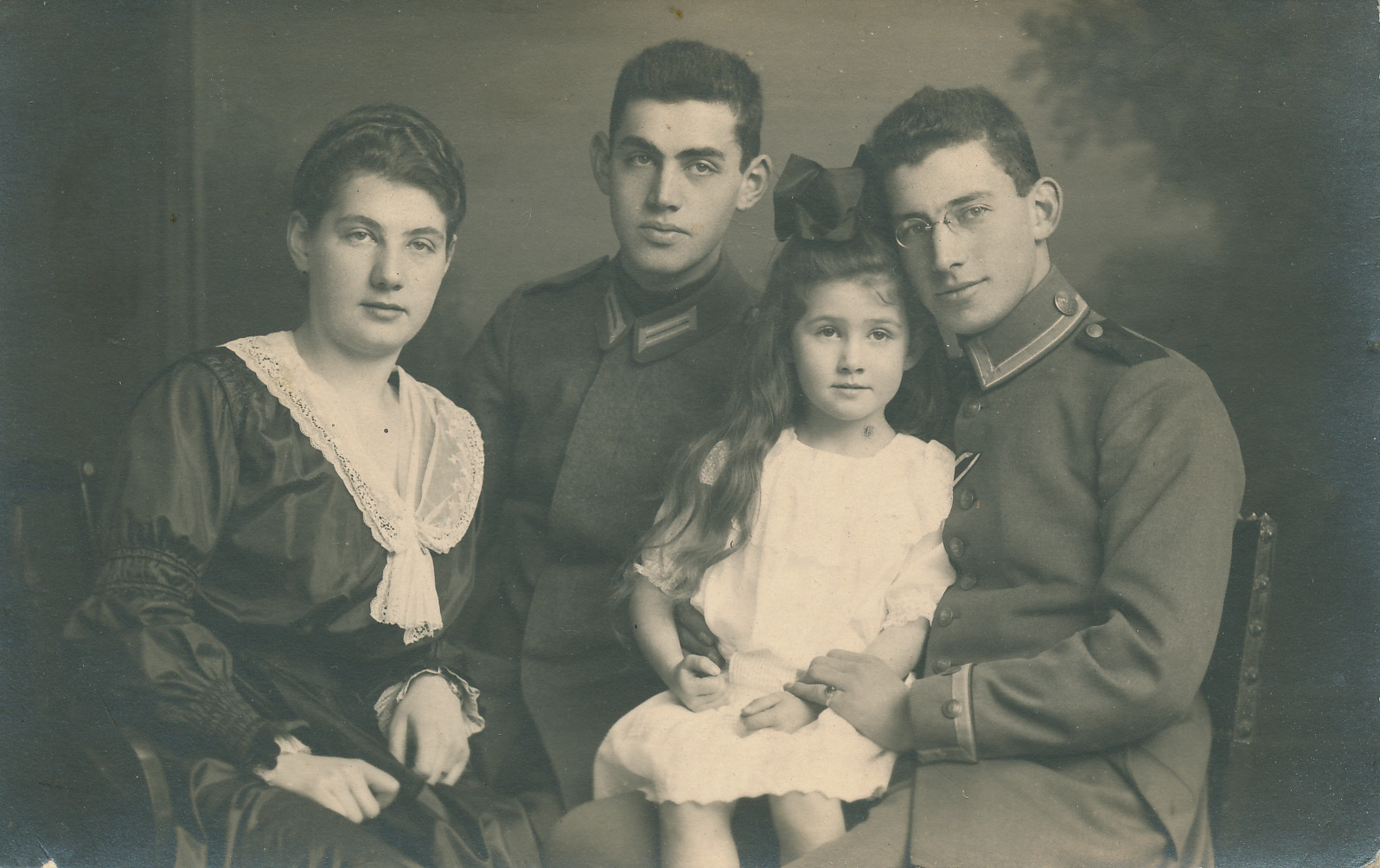
Cecilie, Franz, Rosemarie and Curt Gruenbaum, 1918  Courtesy of Robin H Kravets

Thekla’s brother Felix married Thekla Wertheim in 1902, and they had two sons, Edgar (1903) and Gerhard (1906). Robin had just a few photos of Felix; he appears to be in uniform during World War I in these first two. The caption on the first translates as “to commemorate the first nailing of the Zaitenstock.” I am not sure what that means, but Wikipedia explains (as translated by Google) that zaitenstocke were part of the pipe systems used to carry water into the cities.

Felix Blumenfeld, 1915 Courtesy of Robin H Kravets

detail from photo above

Felix Blumenfeld, 1916
Courtesy of Robin H Kravets

detail from photo above

As I wrote in my earlier posts, both Felix and his sister Thekla lost their spouses at relatively young ages. Thekla’s husband Max Gruenbaum died in 1917, and Felix’s wife Thekla died in 1923.

But even more tragically, both Felix and Thekla were among the six million who were killed in the Holocaust, Felix by suicide in 1942, as detailed here, when he was in despair and had no hope in surviving, and Thekla at Treblinka in 1943.

Felix Blumenfeld
Courtesy of Robin H Kravets

Thekla had refused to leave Germany, and her daughter Cecilie would not leave her mother behind. Robin wrote that “[Cecilie] was very smart and saw the writing on the wall but her mother would not leave.  I remember my family talking about them having tickets on a boat somewhere. But the boat was cancelled.”1 Fortunately, Cecilie’s children were safely in England.

But Cecilie and her husband Walter Herzog were sent to the concentration camp in Riga in 1941. Walter did not survive, but against all odds, Cecilie did even after being sent to Stutthof, a camp where the conditions were truly horrible, as I wrote about here. When I asked Robin whether she had any information as to how Cecilie had survived, she wrote that “since she was trained as a nurse during WWI, she used her skills to help people in the camps. I have always believed it gave her a purpose to survive. The story I heard as a child was that when the Allies liberated the camp, she knew she had to get west. She collected a group of people and helped them make their way west. As a nurse, she knew that they needed to be very careful about overeating after being in the camps and made sure they did not die from bloating.”2 As was not uncommon with Holocaust survivors, Cecilie never wanted to talk about her experiences.

Cecilie Gruenbaum Herzog Courtesy of Robin H Kravets

The other children of Thekla Blumenfeld Gruenbaum and Felix Blumenfeld had all managed to escape Germany before it was too late, as I wrote about here. Robin’s grandmother Rosemarie, the youngest of Thekla’s children, had married while still in Germany. In fact, as Robin explained, she had married her husband Ernest Heymann in absentia as Ernest was in England at the time, having gone there on business and then realizing it was not safe to return. I’d never heard of being married in absentia, but apparently Rosemarie’s nephew stood in as a surrogate groom.3

Rosemarie was able to get out of Germany and join Ernest in London where their first child, Robin’s mother, was born. After the war started, Ernest was one of the many Jewish refugees who was sent to an internment camp as a “enemy alien.” He was interned from June 21, 1940, until October 17, 1940.
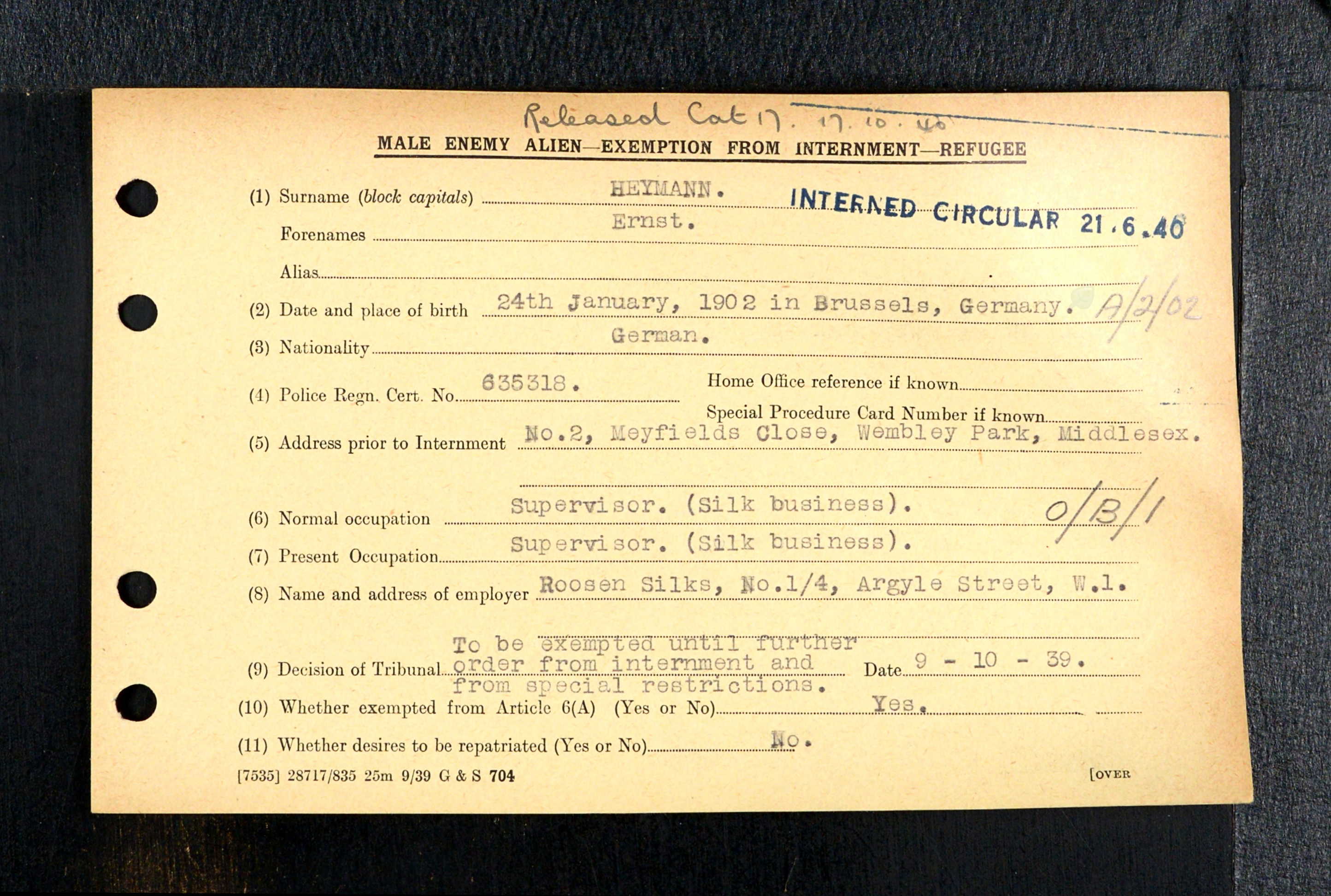
Ernst Heymann, he National Archives; Kew, London, England; HO 396 WW2 Internees (Aliens) Index Cards 1939-1947; Reference Number: Ho 396/178
Piece Number Description: 178: German Internees Released in Uk 1939-1942: Hertzke-Hoj
Ancestry.com. UK, World War II Alien Internees, 1939-1945

After he was released, he and Rosemarie and their daughter immigrated to the US and settled in New York. They had another child in New York after the war.

Rosemarie’s sister Cecilie made it to the US in 1946 and went to live with Rosemarie and her family in New York. The two sisters lived together for the rest of their lives and remained close to their brothers Curt and Franz (later known as Frank), who visited them often from Massachusetts.  Cecilie lived to 95, dying in 1990, and Rosemarie to 91, dying in 2004.3

The story of Thekla Blumenfeld Gruenbaum is tragic: motherless as toddler, left behind by her father, widowed at a young age, and then killed by the Nazis. The fact that Thekla’s two daughters Cecilie and Rosemarie lived together and survived into their 90s is quite a tribute to the strength their mother must have had and that they both had.
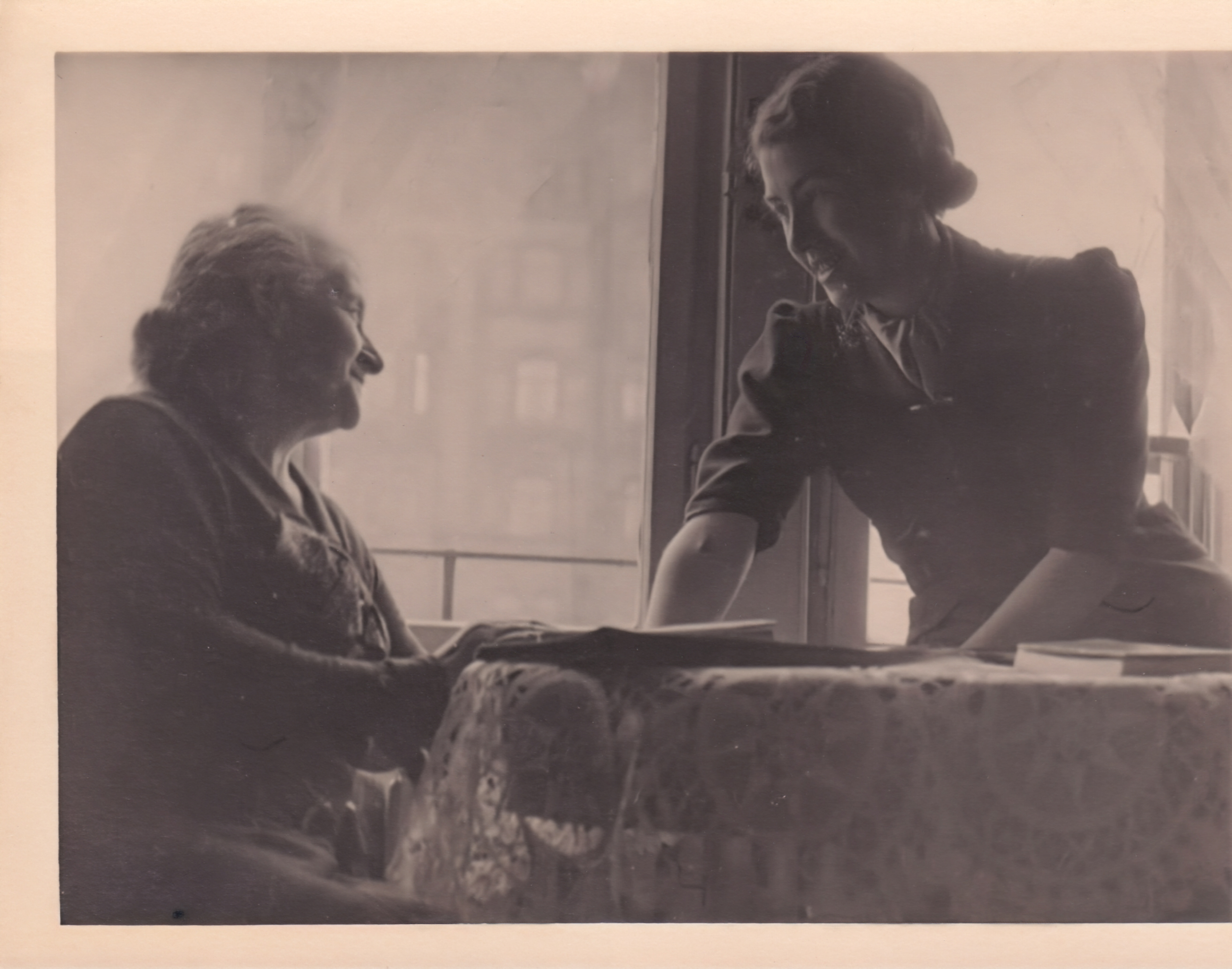
Thekla with her daughter Rosemarie Courtesy of Robin H Kravets

Thekla Blumenfeld Gruenbaum  Courtesy of Robin H Kravets

Thekla Blumenfeld Gruenbaum  Courtesy of Robin H Kravets


  1. Email from Robin H. Kravets, September 10, 2023. 
  2. Ibid. 
  3. Emails from Robin H. Kravets, September 10, 2023, and October 27, 2023. 

Friederike Blumenfeld Schoen, Part I: Her Life and Her Children

In my telling of the Blumenfeld saga, I am now up to Friederike Blumenfeld, the eighth child of Isaac Blumenfeld I and his second wife Gelle Strauss. Friederike was born November 2, 1858, in Momberg. Since Isaac and Gelle’s ninth child, Sara, died as a young child, Friederike was the youngest of their children to survive to adulthood, and her story is the final chapter in the story of the family of Isaac Blumenfeld I.

Friederike Blumenfeld birth record, Geburtsregister der Juden von Momberg (Neustadt) 1850-1874 (HHStAW Abt. 365 Nr. 608)AutorHessisches Hauptstaatsarchiv, WiesbadenErscheinungsjahr1850-1874, p. 5

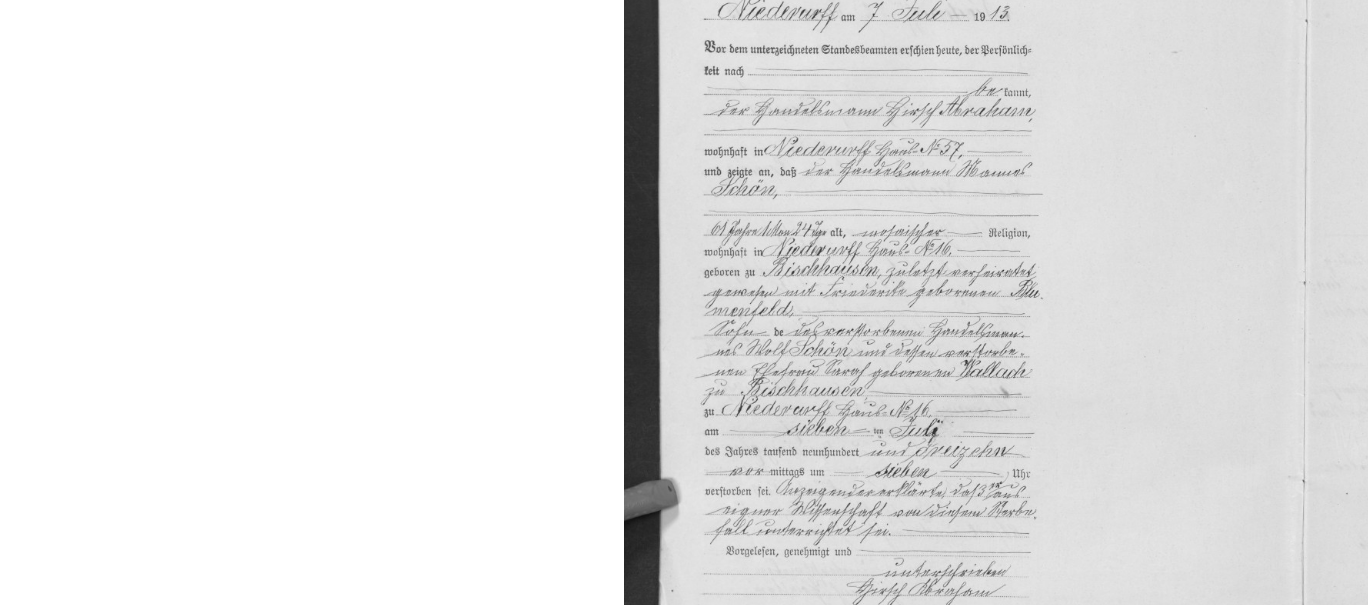
Friederike married Mannes Schoen on January 28, 1884, in Niederurff, Germany. Mannes, the son of Wolf Schoen and Sarah Wallach, was born in Bischhausen, Germany, on May 14, 1852. Mannes was living in Niederurff at the time of their marriage.

Marriage of Friederike Blumenfeld and Mannes Schoen, Hessisches Hauptstaatsarchiv; Wiesbaden, Deutschland; Bestand: 920; Laufende Nummer: 6193, Year Range: 1884
Ancestry.com. Hesse, Germany, Marriages, 1849-1930

Friederike and Mannes had five children, four sons and one daughter.

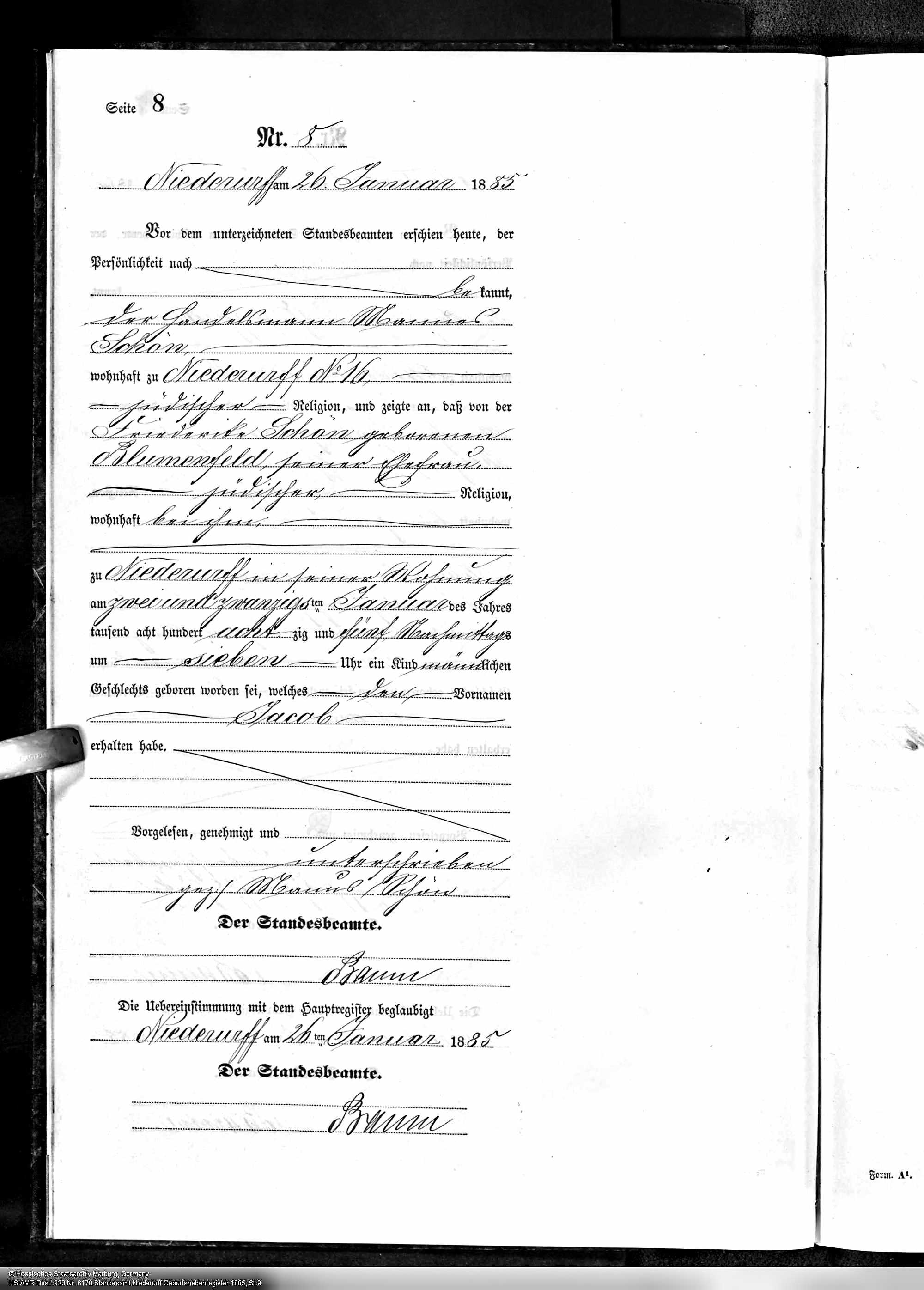
First born was Jakob, born on January 22, 1885, in Niederurff.

Jakob Schoen birth record, Hessisches Hauptstaatsarchiv; Wiesbaden, Deutschland; Bestand: 920; Laufende Nummer: 6170, Year Range: 1885, Ancestry.com. Hesse, Germany, Births, 1851-1901

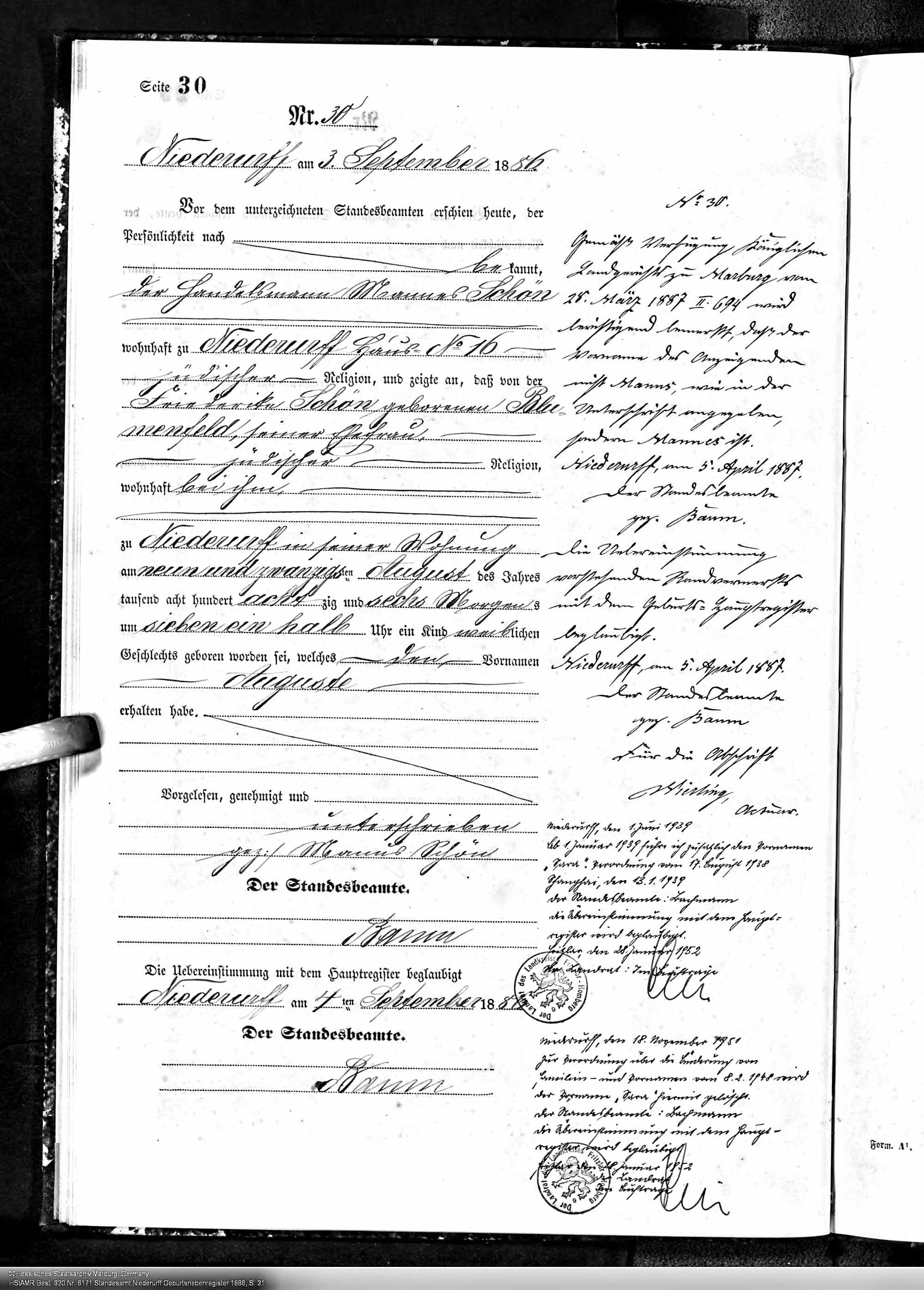
The only daughter, Auguste, was born in Niederurff on August 29, 1886.

Auguste Schoen birth record, Hessisches Hauptstaatsarchiv; Wiesbaden, Deutschland; Bestand: 920; Laufende Nummer: 6171, Year Range: 1886, Ancestry.com. Hesse, Germany, Births, 1851-1901

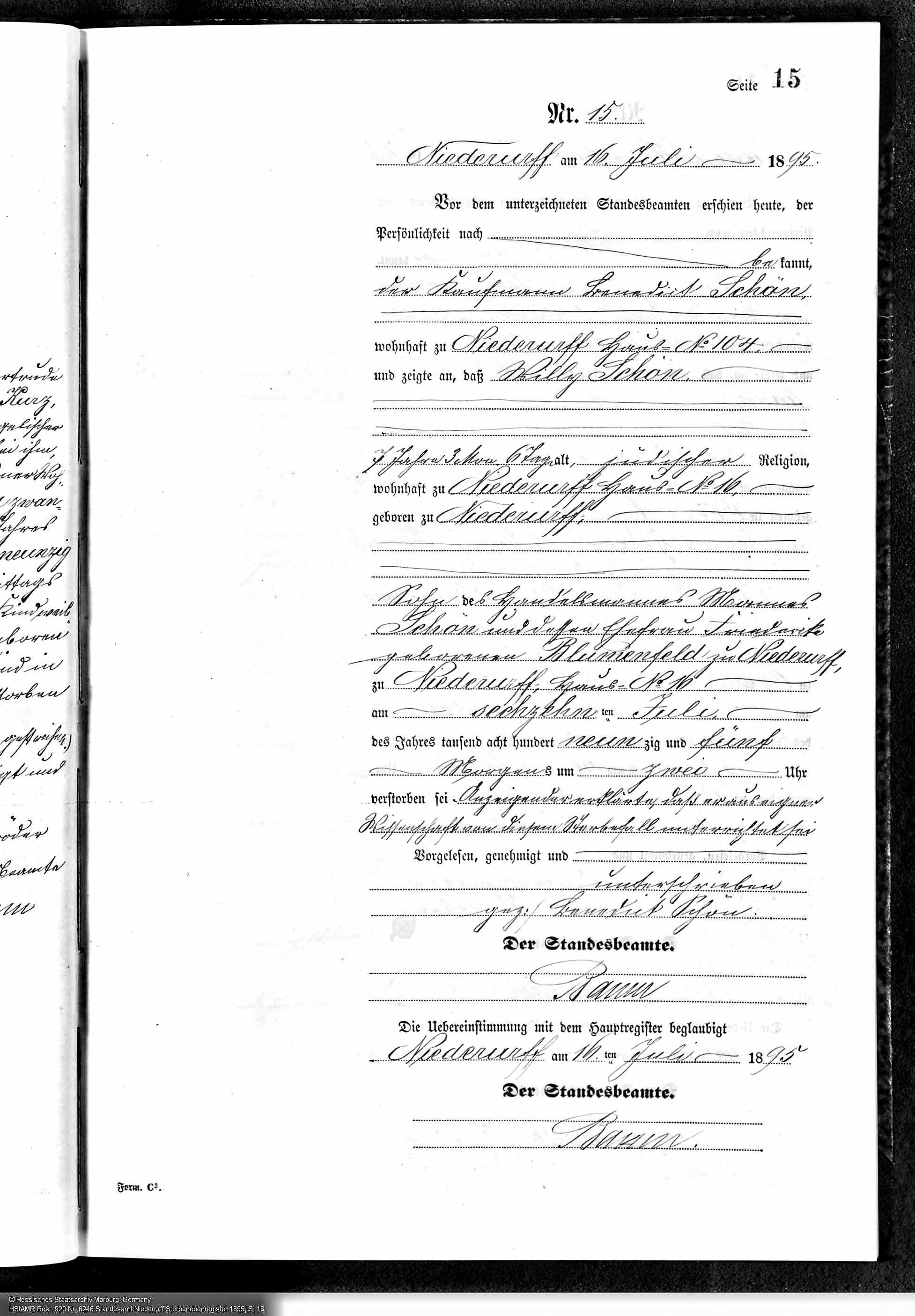
Friederike and Mannes’ third child Willy was born April 10, 1888, in Niederurff. Sadly, he died on July 16, 1895, when he was only seven years old.

Willy Schoen birth record, Hessisches Hauptstaatsarchiv; Wiesbaden, Deutschland; Bestand: 920; Laufende Nummer: 6173, Year Range: 1888, Ancestry.com. Hesse, Germany, Births, 1851-1901

Willy Schoen, death record, Hessisches Hauptstaatsarchiv; Wiesbaden, Deutschland; Personenstandsregister Sterberegister; Bestand: 6246; Laufende Nummer: 920, Year Range: 1895, Ancestry.com. Hesse, Germany, Deaths, 1851-1958

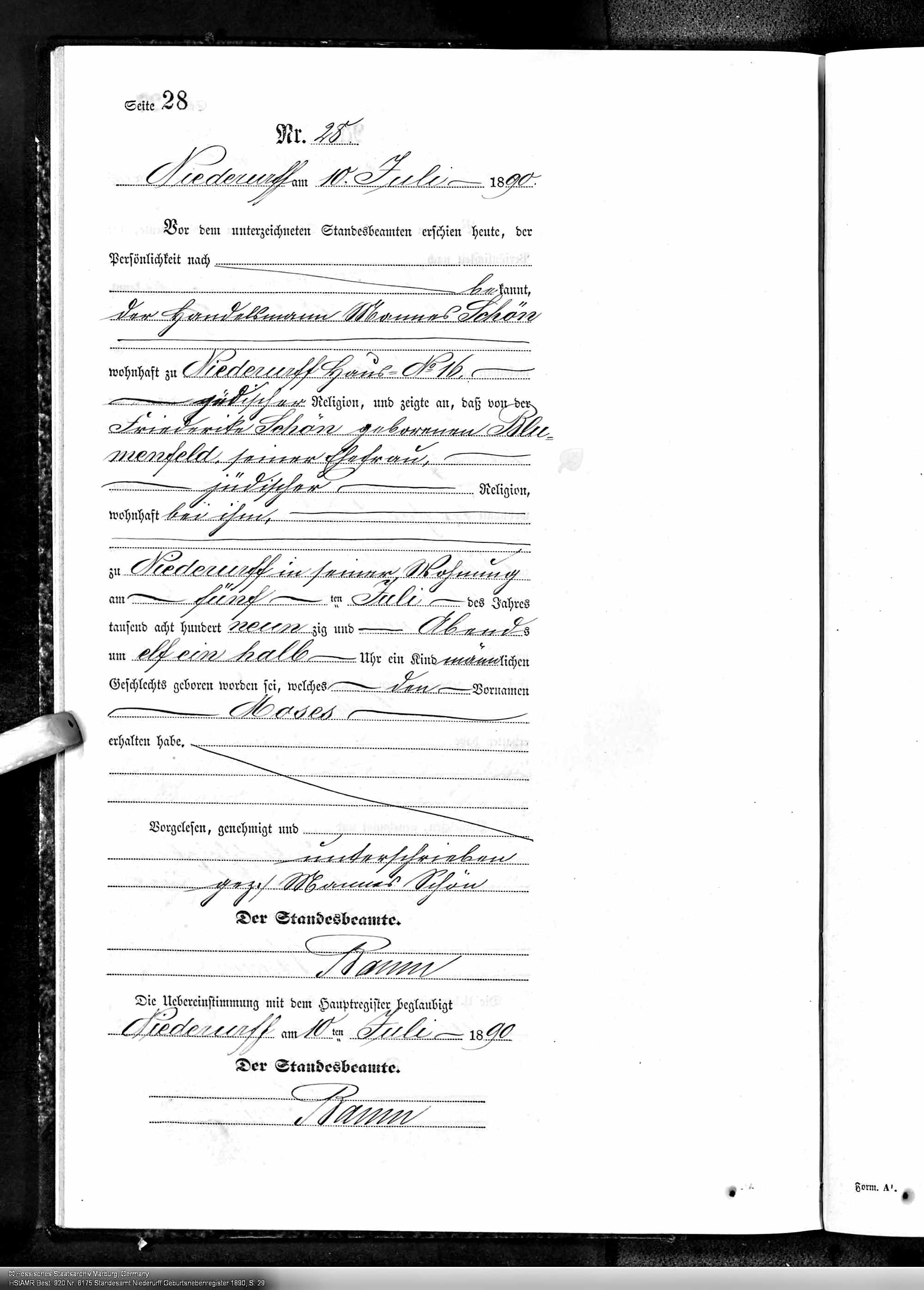
Moses, the fourth child, was born in Niederurff on July 6, 1890.

Moses Schoen birth record, Hessisches Hauptstaatsarchiv; Wiesbaden, Deutschland; Bestand: 920; Laufende Nummer: 6175, Year Range: 1890, Ancestry.com. Hesse, Germany, Births, 1851-1901

And finally, the last child was Isaak, born June 25, 1893, also in Niederurff.

Isaak Schoen birth record, Hessisches Hauptstaatsarchiv; Wiesbaden, Deutschland; Bestand: 920; Laufende Nummer: 6178, Year Range: 1893, Ancestry.com. Hesse, Germany, Births, 1851-1901

Their father Mannes died on July 7, 1913, in Niederurff. He was 61 years old.

Mannes Schoen death record, Standesamt Niederurff Sterbenebenregister 1913 (HStAMR Best. 920 Nr. 6264)AutorHessisches Staatsarchiv MarburgErscheinungsortNiederurff, p 7

World War I started the following year when Jakob would have been 29, Moses 24, and Isaak 21. Although I have no military records to establish that the sons served in the war for Germany, Moses Schoen’s son Kurt stated in an interview with the United States Holocaust Memorial and Museum that his father had served in World War I and was awarded an Iron Cross.1 In addition, Richard Bloomfield located an obituary for Jakob Schoen that mentioned his membership in the Reichsbund Jüdischer
Frontsoldaten [National Association of Jewish Frontline Soldiers], indicating that he also served for Germany in World War I.2  Perhaps their brother Isaak also served, but I’ve yet to locate any evidence of his service.

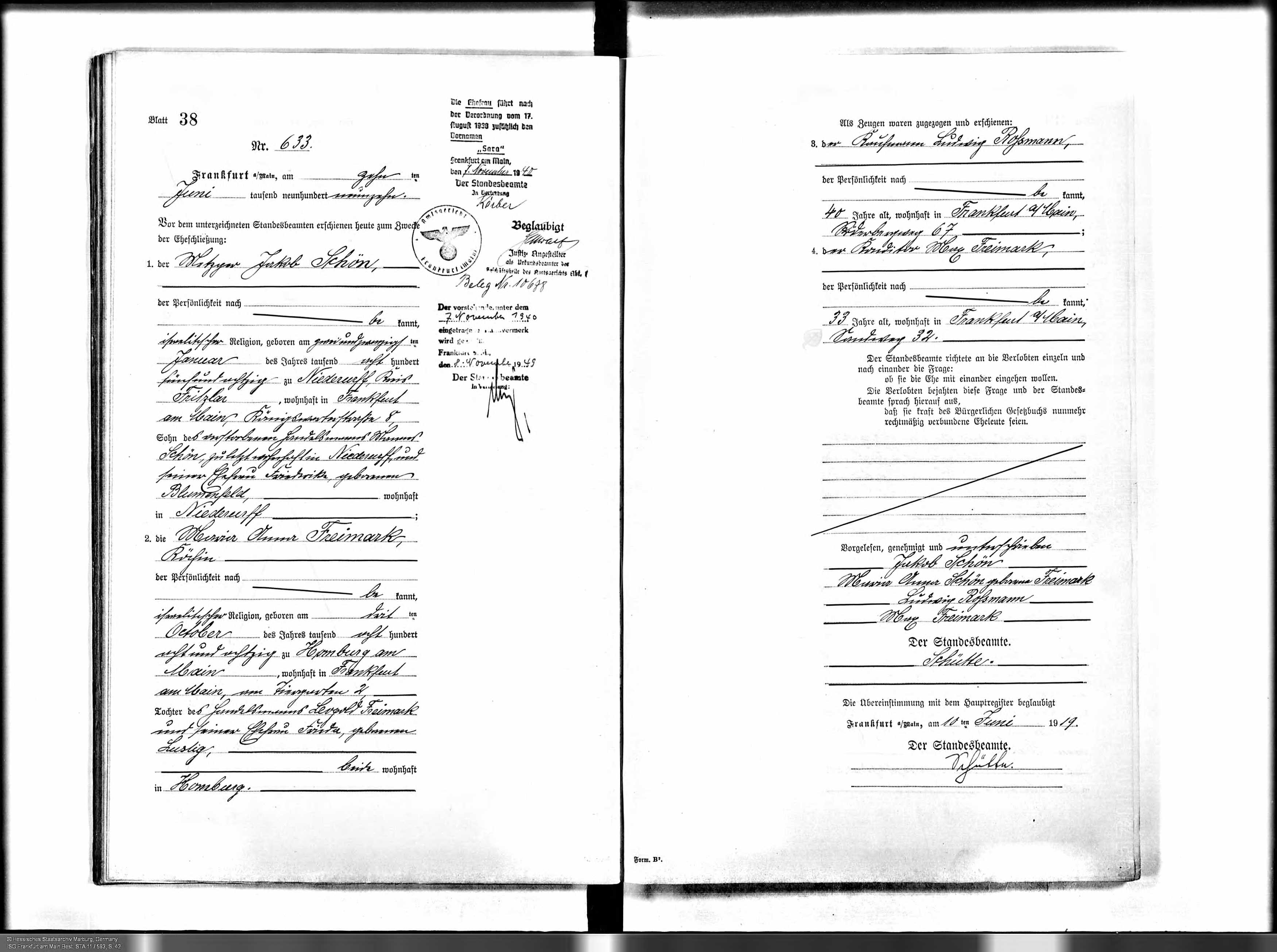
None of the children married until after the war ended. Jakob was the first to marry. He married Maria Anna (later identified as Johanna or Hannah) Freimark on June 10, 1919, in Frankfurt. Maria Anna was born in Homburg am Main on October 3, 1888, to Leopold Freimark and Frieda Lustig.

Marriage record of Jakob Schoen and Maria Anna Freimark, Hessisches Hauptstaatsarchiv; Wiesbaden, Deutschland; Bestand: 903, Year Range: 1919, Ancestry.com. Hesse, Germany, Marriages, 1849-1930

Jakob and Maria Anna had one child, a daughter Ruth, born in Frankfurt on January 1, 1924.3 If there were other children, I’ve yet to locate records for them.

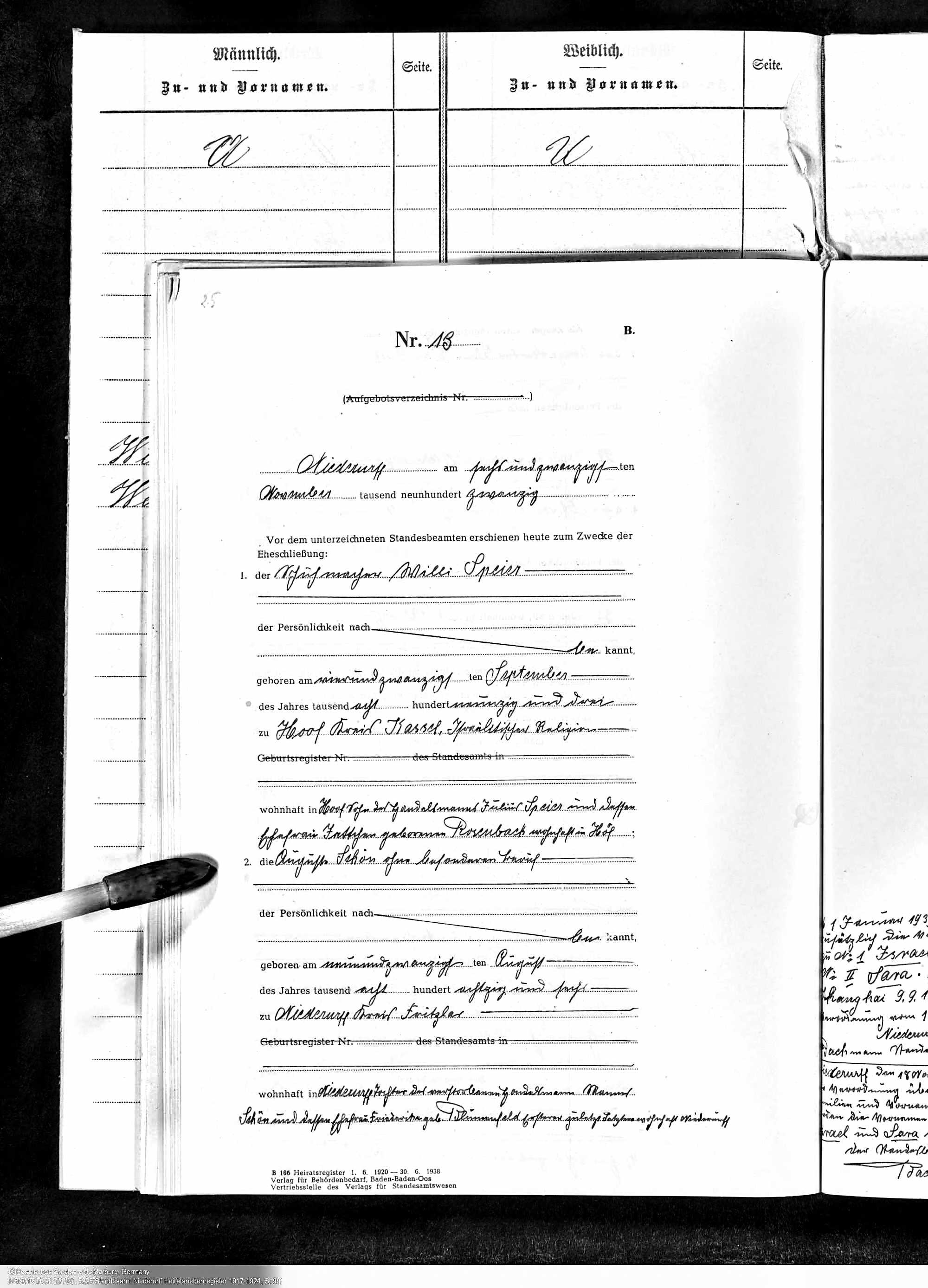
Jakob’s sister Auguste married Willi Speier on November 26, 1920, in Niederurff. Willi, son of Julius Speier and Jettchen Rosenbach, was born September 24, 1893, in Kassel, Germany.

Marriage record of Auguste Schoen and Willi Speier, Hessisches Hauptstaatsarchiv; Wiesbaden, Deutschland; Bestand: 920; Laufende Nummer: 6226, Year Range: 1917-1924, Ancestry.com. Hesse, Germany, Marriages, 1849-1930

Auguste and Willi had one child, a son Julius, born August 10, 1922, in Niederurff.4 As with Jakob, if there were other children born to Auguste and Willi, I’ve yet to locate records for them.

Moses (also known as Moritz) Schoen married Else Freimark on February 13, 1923, in Kassel, Germany. Moses and Else had three children. Alice was born on January 14, 1924, in Kassel. Manfred was born on September 13, 1926, in Kassel. And Leopold (later known as Kurt Leopold) was born on December 14, 1927, in Kassel.5

Trees on Ancestry and Geni and a genealogy that Richard Bloomfield located done by a local Homburg historian named Dr. Leonhard Scherg have Else listed with the same parents as Jakob’s wife Maria Anna Freimark, Leopold Freimark and Frieda Lustig, meaning Moses married his brother Jakob’s sister-in-law. But Richard and I have not yet found any primary sources to corroborate that with absolute certainty.

However, Richard and I feel confident that Else was in fact Maria Anna’s younger sister and the child of Leopold Freimark and Frieda Lustig based on a few inferences. First, Leopold Freimark died on October 18, 1926. In the oral history interview Else’s son Kurt did for the USHMM,6 he mentioned that his maternal grandfather died shortly before he was born. As noted above, Kurt was born December 14, 1927.

In addition, Else and Moses’ third child was named Kurt Leopold, and given that in accordance with Ashkenazi Jewish tradition a child should be named for a close relative who has died, it would make sense that Else would have wanted her new son named for her recently deceased father. Also, Else’s daughter Alice later named one of her children Frances, perhaps for her grandmother Frieda Lustig.

And finally, on Else’s petition for naturalization, one of her supporting witnesses was Betty Kutz.7 In addition, on his 1938 ship manifest Moses Schoen listed his sister-in-law Betty Kutz as the person he was going to in the US. Betty Kutz was born Babette Freimark and was a daughter of Leopold Freimark and Frieda Lustig; thus, Betty would have been Else’s older sister.8

Thus, there seems to be several good reasons to believe that Else Freimark, wife of Moses Schoen, and Maria Anna Freimark, wife of Jakob Schoen, were also sisters. An actual record would be wonderful, but for now I am comfortable with that assumption.

The youngest child of Friederike and Mannes, Isaak, did not marry as far as I’ve been able to discover.

Friederike Blumenfeld Schoen died on May 25, 1927. Richard not only located her death record, but also a page describing her gravestone.

Friedericke Blumenfeld Schoen death record, LAGIS Hessian Vital Records,Standesamt Treysa Sterbenebenregister 1927 (HStAMR Best. 920 Nr. 8076)AutorHessisches Staatsarchiv MarburgErscheinungsortTreysaErscheinungsjahr1927, p. 44

The German inscription on her gravestone says:

Hier ruht:

Franziska Schön

geb. Blumenfeld,

geb. 2. 11. 1856,

gest. 25. 5. 1927.

This translates to

Franziska Schön

born Blumenfeld,

born November 2, 1856

died May 25, 1927.

(The birth date is incorrect as she was born on November 2, 1858, and that error is noted in the commentary on the page.)

The Hebrew inscription translates as follows:

a dear and pure woman,

perfect all their days:

Freidche, daughter of Yitzchak ha-Kohen.

She went into her eternity (on) 23.

Ijjar 687 ndk Z. (=25.05.1927).

Your soul is bound in the bond of life.

Friederike was 68 years old when she died; her death record states that she died in the Hephata Hospital in Treysa.  She was survived by her four surviving children, Jakob, Auguste, Moses, and Isaak, their spouses, and at least five grandchildren. They all  had to face the rise of the Nazis in the following decade, as we will see.

TO BE CONTINUED


  1. Oral History interview with Kurt L. Schoen, July 24, 2002, Accession Number: 1997.A.0441.512 | RG Number: RG-50.462.0512, United States Holocaust Memorial Museum Collection, Gift of the Gratz College Holocaust Oral History Archive, found at https://collections.ushmm.org/search/catalog/irn566135 (hereinafter referred to as Kurt Schoen Oral History Interview). 
  2. Der Israelit, July 1, 1937, p. 11 
  3. Entry at Yad Vashem, found at https://yvng.yadvashem.org/nameDetails.html?language=en&itemId=11628404&ind=1 
  4. Julius Speier, Social Security Number 079-24-2442, Birth Date 10 Aug 1922, Issue year Before 1951, Issue State New York, Last Residence 33162, Miami, Miami-Dade, Florida, USA, Death Date 22 Nov 1992, Social Security Administration; Washington D.C., USA; Social Security Death Index, Master File, Ancestry.com. U.S., Social Security Death Index, 1935-2014 
  5. Moses Schon, Declaration of Intention, The National Archives at Philadelphia; Philadelphia, PA; NAI Title: Declarations of Intention For Citizenship, 1/19/1842 – 10/29/1959; NAI Number: 4713410; Record Group Title: Records of District Courts of the United States, 1685-2009; Record Group Number: 21, Description
    Description: (Roll 555) Declarations of Intention For Citizenship, 1842-1959 (No 433201-434100), Ancestry.com. New York, U.S., State and Federal Naturalization Records, 1794-1943 
  6. See Note 1, supra. 
  7. Else Schoen, Petition for Naturalization,  “New York, U.S. District Court Naturalization Records, 1824-1991”, database with images, FamilySearch (https://www.familysearch.org/ark:/61903/1:1:QP76-DQ6K : 8 March 2021), Else Schoen or Freimark, 1940. 
  8. Moses Schoen, passenger manifest, The National Archives and Records Administration; Washington, D.C.; Passenger and Crew Lists of Vessels Arriving at and Departing from Ogdensburg, New York, 5/27/1948 – 11/28/1972; Microfilm Serial or NAID: T715, 1897-1957, Ancestry.com. New York, U.S., Arriving Passenger and Crew Lists (including Castle Garden and Ellis Island), 1820-1957. See also marriage record for Betty Freimark and Bernhard Kutz, “New York, New York City Marriage Records, 1829-1938”, database, FamilySearch (https://www.familysearch.org/ark:/61903/1:1:243L-8BP : 20 June 2023), Bernhardt Kutz and Betty Freimark, 1912.

Gerson Blumenfeld II, Part II: Two Sons Killed in World War I Fighting for Germany

In the summer of 1914 after the assassination of the Archduke Franz Ferdinand of Austria-Hungary, the countries of Europe and of the wider world declared war on each other based on mutual protection agreements those countries had previously formed. On one side were the Central Powers including Austria-Hungary, Germany, and Turkey; on the other side were the Allies, including France, England, Italy, Russia, Japan, and later the US.

The three sons of Gerson Blumenfeld II and his wife Berta Alexander—Moritz, Friedrich, and Isaak—all served in the German army for the Central Powers. But only one of those sons came home alive.

Moritz, their oldest son, was killed on the Eastern Front of the War in Niedzieliska, Poland, on December 11, 1914, according to his German death record.1 The report of his death came from the commander of his reserve infantry unit, as indicated on the death record, and stated that he’d been shot in the abdomen.2

Moritz Blumenfeld, Death Age: 27, Birth Date: abt 1887, Death Date: 11. Dez 1914 (11 Dec 1914)
Death Place: Momberg, Hessen (Hesse), Deutschland (Germany), Civil Registration Office: Momberg, Father: Gerson Blumenfeld, Mother: Bertha Blumenfeld, Certificate Number: 1, Hessisches Hauptstaatsarchiv; Wiesbaden, Deutschland; Personenstandsregister Sterberegister; Bestand: 6225; Laufende Nummer: 915, Ancestry.com. Hesse, Germany, Deaths, 1851-1958

Niedzieliska was a small village about 42 miles east of Krakow. During the summer and into the fall of 1914, the Russians were successfully fighting the German and Austrian troops in that general area, winning an important battle in Lemberg (now Lviv) in the late summer of 1914 and then moving west and capturing Przemysl in the spring of 1915.

I am very grateful to Eric Feinstein of the GerSIG Facebook group for providing me with access to a description of the battle of Niedzieliska from a book entitled (as translated) Reserve Infantry Regiment No. 83: edited from official and private war diaries by Hans Wahrenburg, published in 1924 by Stalling Verlag in Berlin. Eric pointed me to page 42 which describes the Niedzieliska battle, and I used DeepL to translate it, though some of the references are not clear.

At 12:12, II and III Battalions will be moved out of the forward line during the morning and III Battalion will be housed and fed at Niedzieliska. At 1.30 a.m. the II Battalion also follows there, while at the same time the III Battalion from the eastern exit of the Dorsel is deployed for another assault against the Russian position at the windmill Wszeliwn in the subsection of the 49 RJB.

Heavy flank fire from the right initially hampered the advance of the companies and only after the arrival of II Battalion on the obstructed right wing did the assault proceed briskly, especially since the enemy apparently had little artillery, but was able to bring the assault to a halt with even more intense infantry and M.C. fire.

Exhausting effort! 4 o’clock in the morning the position on the Wszelimn-Dsief road was taken by assault, during which, among others, the leader of 12 Company, Captain a D Rudel, and by roughing up the enemy MC Sergeant Emilius and Muss. Cohn 11 Compagnie, Ref. Zinf. Kriegsfreim. Ludwig and Ref. harms 12th Compagnie and Ref. Deja quite particularly distinguish.

About 1500 prisoners and 12 MC find the spoils of the day. I Battalion advanced as a division reserve to the west exit of Niedzieliska, but failed to enter.

It was sometime during this battle that Moritz Blumenfeld II, oldest child of Gerson Blumenfeld II and Berta Alexander, was mortally wounded.

His younger brother Isaak was killed on the Western Front. Although I do not have a death certificate for Isaak, I have information from the lists of German casualties located on Ancestry and elsewhere. Isaak died in a field hospital in Sainghin-en-Weppes in the north of France on January 8, 1915, after being seriously wounded. He was only 21 at the time.

Isaack Blumenfeld, Residence Year: 1914, Residence Country: Deutschland (Germany)
List Date: 30. Jan 1915 (30 Jan 1915), List Number: 0345, Volume: 1915_VII, Ancestry.com. Germany, World War I Casualty Lists, 1914-1919

Isaack Blumenfeld Residence Year: 1914 Residence Country: Deutschland (Germany) List Date: 20. Jan 1915 (20 Jan 1915) List Number: 0331 Volume: 1915_VII, Ancestry.com. Germany, World War I Casualty Lists, 1914-1919

Like Niedzieska where Moritz was killed, Sainghin was just a small village with no obvious strategic importance, but it was located in the region of France where during this time period, thousands of soldiers on both sides were killed during trench warfare where the two sides were essentially deadlocked, going back and forth slaughtering each other’s young soldiers and others.

This UK website on World War I described it in these terms:

By the end of 1914 the battles of movement in the first weeks of the war had been  brought to a halt. The fierce defence of strategic landmarks by the Allied forces resulted in a situation which became one of deadlock. Carefully selecting the most favourable high ground the Imperial German Army began the construction of a strong defensive line from early in 1915.

The consolidation of the Front Lines consisted of trenches, wire defences, mined dugouts and deep bunkers, reinforced concrete emplacements and selected strongpoints, usually a reinforced farm, in an Intermediate, Second and Third defensive line. Gradually the building and digging was carried on on both sides of the wire along a distance of approximately 450 miles, creating a more or less continous line of trenches separating the warring belligerents along the length of The Western Front.

In 1915, 1916 and 1917 both sides made attempts to break the deadlock with major battle offensives. The characteristics of siege warfare which developed on the Western Front in these three years created conditions never witnessed before. Instead of expecting to achieve objectives at a considerable distance from the start of an offensive, the type of trench warfare fighting created a situation where attacks were carried out in phases with short distance objectives and usually following a bombardment of enemy trench lines beforehand. This strategy led to prolonged periods of fighting with success counted in gains hundreds of yards rather than miles. The human cost of casualties and dead in such a grinding type of siege warfare would be recorded in the thousands in the space of a single day.

Isaak Blumenfeld, Gerson II and Berta’s youngest son, was killed during the early days of this period of warfare, less than a month after the death of his brother Moritz.

A January 29, 1914 article in the Frankfurter Israelitisches Familienblatt reported, “The G. Blumenfeld family was hit by a heavy loss. Two hopeful sons both suffered heroic deaths for their fatherland. Both stood out from the enemy with their outstanding bravery honored, the eldest carried a seriously wounded man out of the most terrible shell fire at great risk to his life. The youngest last stood as a teacher in Petershagen on the Weser.”

The deaths of Moritz and Isaak left Gerson and Berta with just one surviving son, their middle son Friedrich. But Friedrich also served in the German armed forces. His great-nephew Michael Rosenberg shared with me Friedrich’s military record, including translations of the information on each page done by Richard Bloomfield.

As translated by Richard, this record indicates that Friedrich began his military service for Germany on August 24, 1915, just months after the deaths of both of his brothers. He was transferred to the homeland and away from the front in January 1917, perhaps because the family had already lost Isaak and Moritz. Friedrich was discharged from service on December 26, 1918, six weeks after the war ended, and came home alive.

His father Gerson Blumenfeld II, however, died in Momberg on July 29, 1919, just seven months after Friedrich returned home. Although Gerson was 66 and thus was not particularly young for that era when he died, I nevertheless wonder whether losing two of this three sons in some way hastened his death.

UPDATE: My cousin Gary Rosenberg, Gerson II’s great-grandson, shared these images of Gerson II’s grave and also translated the Hebrew side for me. It reads:

Here Is buried A man that was unblemished (or complete) from an early age, a Tzadik in all his ways and a Chasid in all his doings, Father to the poor and to orphans – Gershon the son of Yitzchak the Cohen who died on the 2nd day of the month of Av 5679  And was buried with great honor on the 4th day of Av May his soul be bound up in the bond of eternal life.

Gravestone of Gerson Blumenfeld II Courtesy of Gary Rosenberg

Gravestone of Gerson Blumenfeld II Courtesy of Gary Rosenberg

One might have thought that sacrificing two sons to the cause of Germany in World War I would have somehow kept the rest of this family safe from the Nazis, but it was not to be, as we will see.


  1. At least one secondary source reports that his death occurred on December 12, 1914, but I am relying on his actual death record. See the list of Jewish World War I casualties for Germany at http://denkmalprojekt.org/verlustlisten/rjf_orte_m_wk1.htm 
  2. Thank you to the members of the GerSIG: German Jewish Genealogy Special Interest Group on Facebook for transcribing and translating this record.