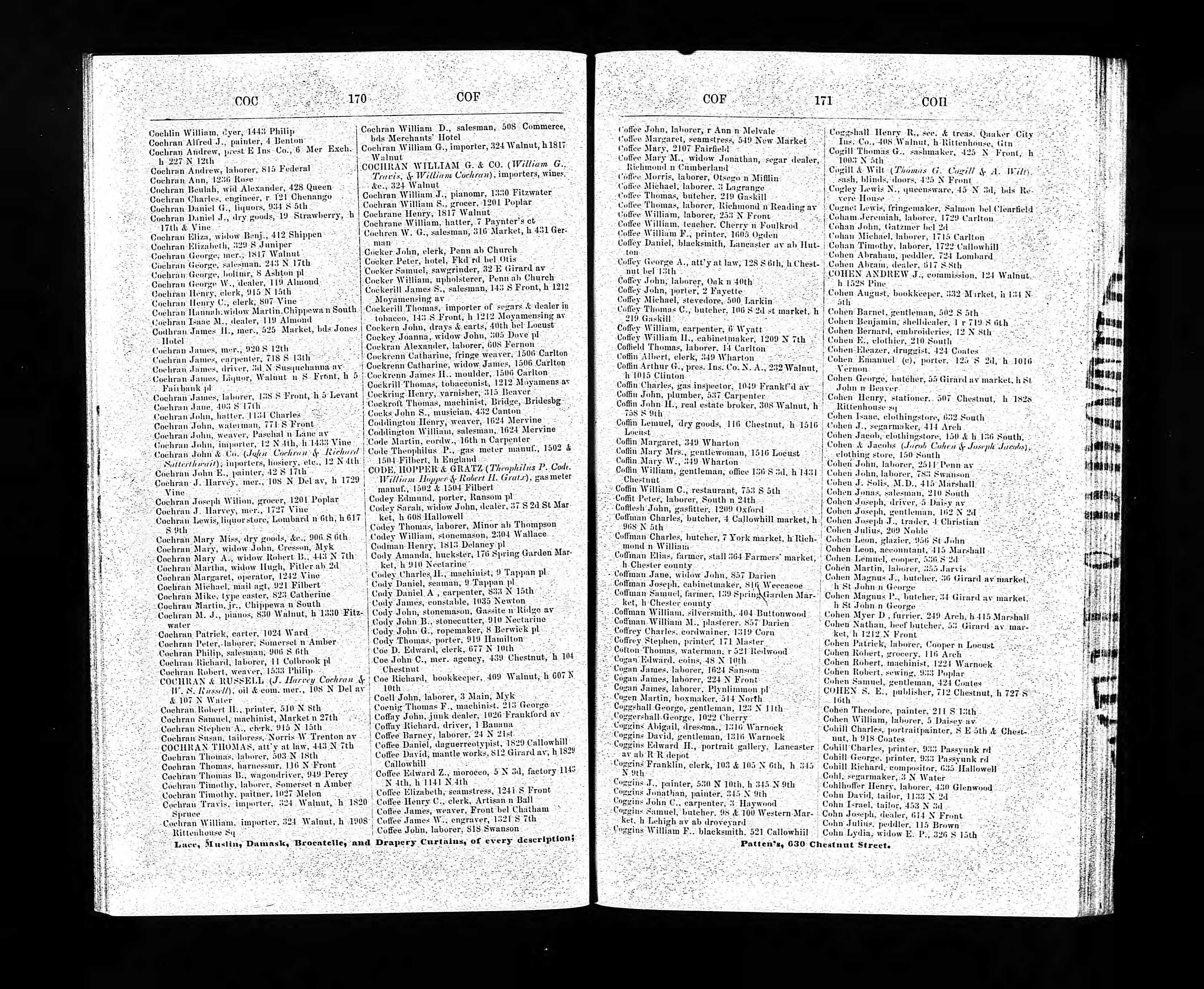
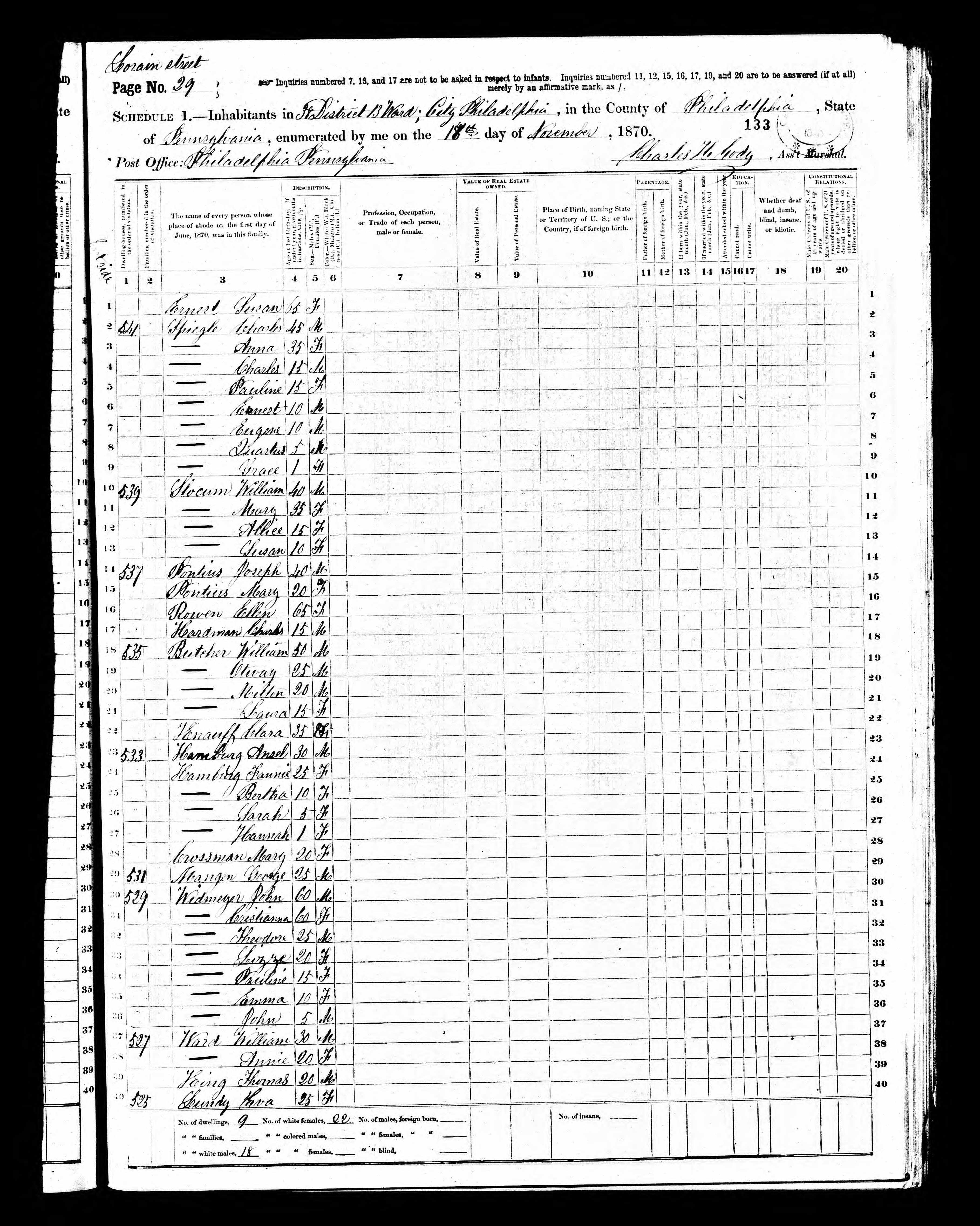
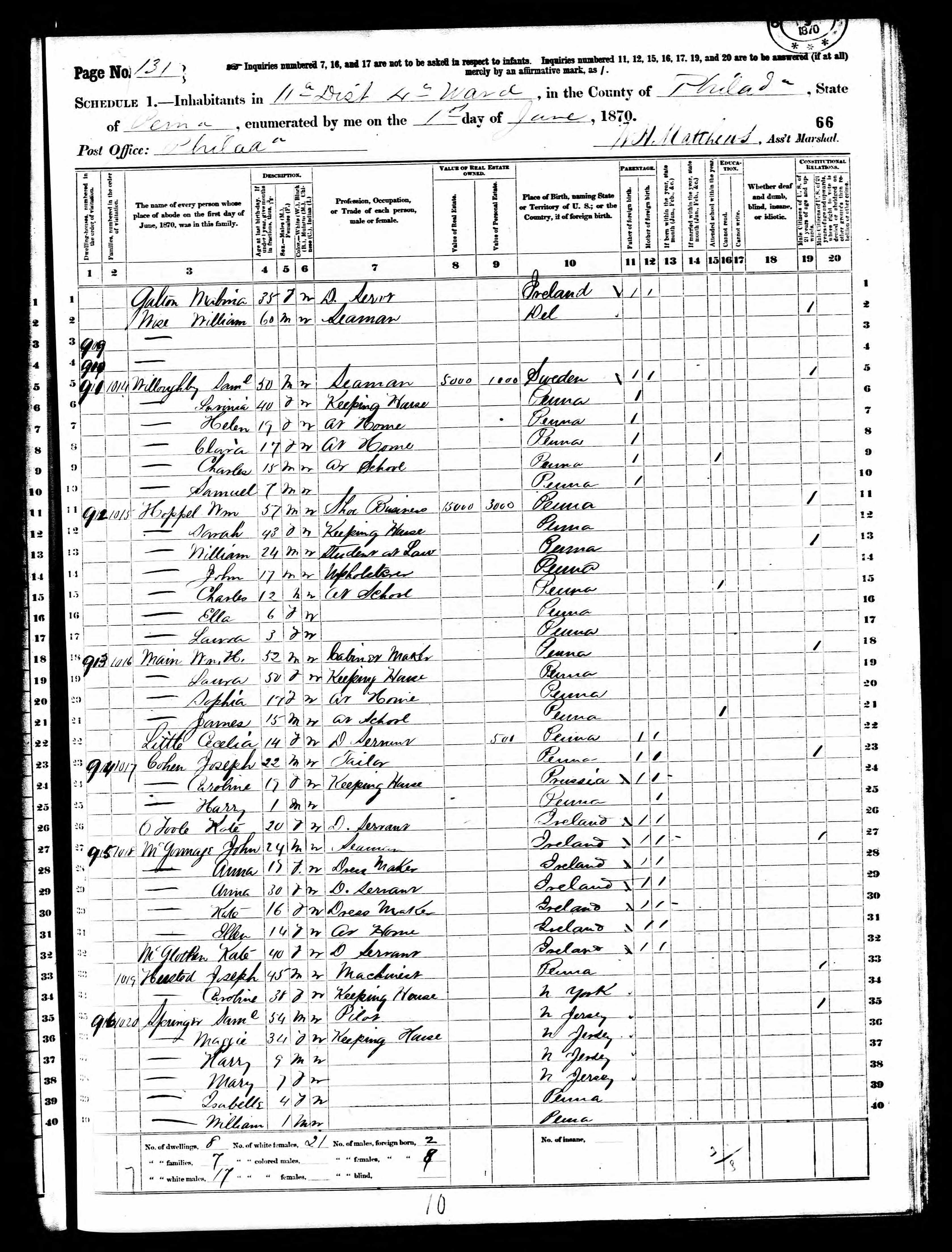
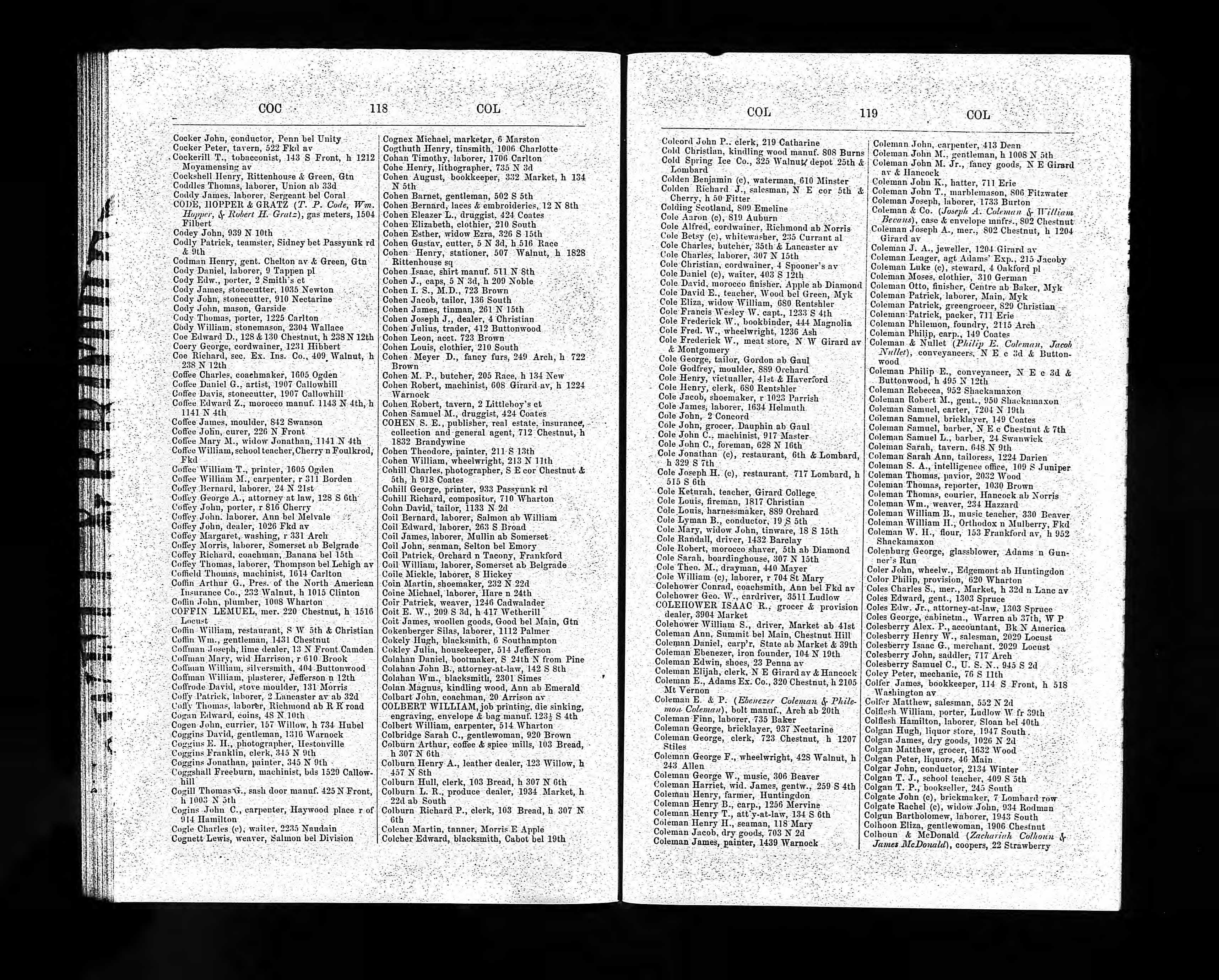
Hart Cohen and family 1841-1851: Before the Move to America

be

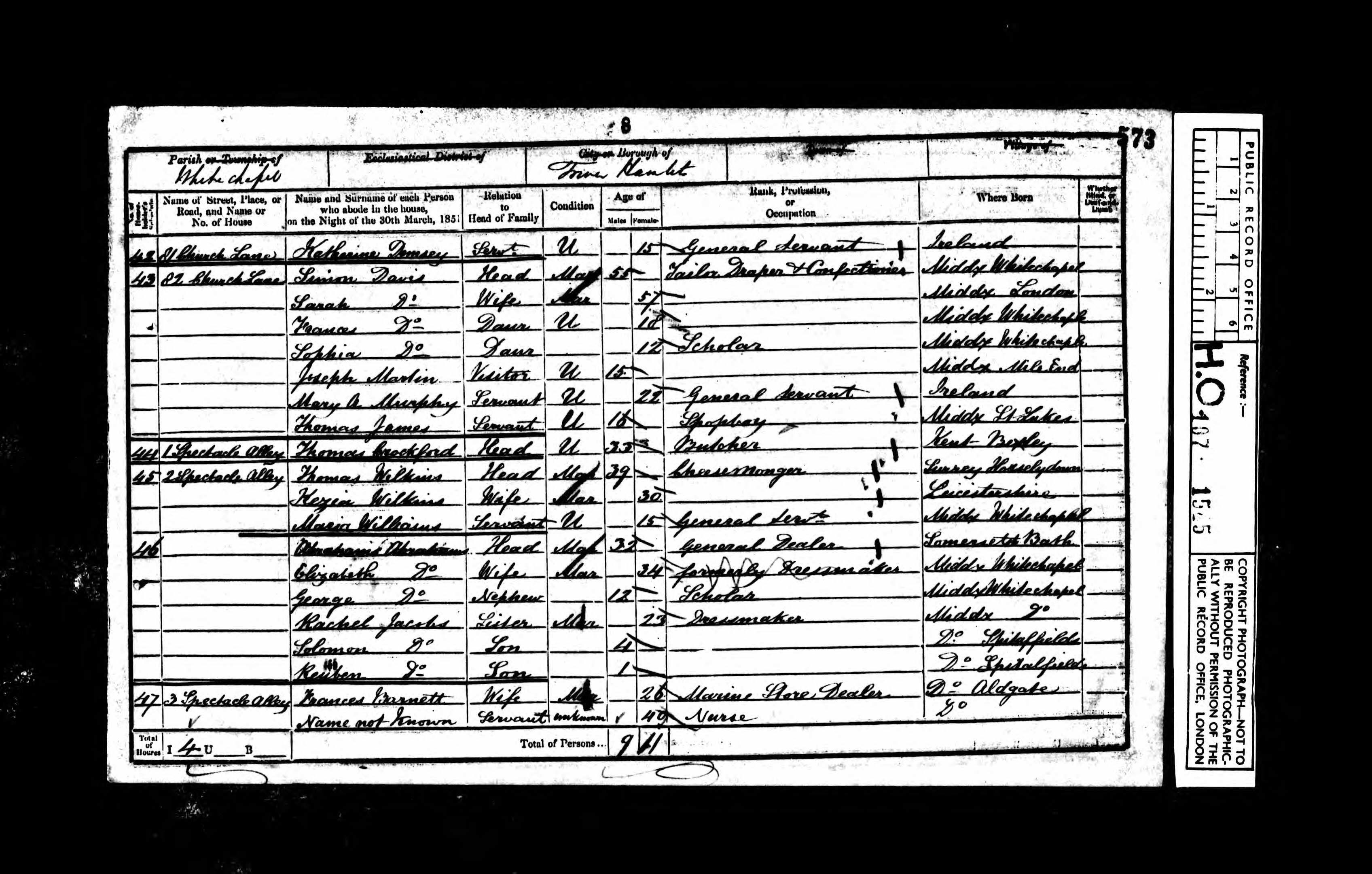
By 1851, the time of the second English census, my great-great grandfather Jacob Cohen had already moved with his family to Philadelphia.  Much of the rest of his family of origin, however, was still in London.  According to the 1851 census, Hart, my three-times great grandfather, was now a widower and 75 years old, living with two of his children, Elizabeth, now listed as 28 despite having been listed as 20 ten years earlier, and Jonas, who was 22.  Jonas was not even listed as living with the family in 1841 when he would have been only 12 years old.   All three were listed as general dealers and living at 55 Landers Buildings in Spitalfields parish in Tower Hamlets.

Hart, Elizabeth and Jonas Cohen 1851 England Census

Hart, Elizabeth and Jonas Cohen 1851 England Census

Although I thought this might indicate a move to a new neighborhood, my research revealed that Landers Buildings were on Middlesex Street, which was just one blog from New Goulston Street where the family had been living in 1841.  The English genealogy site Genuki indicates that Spitalfields was a district within the parish of Whitechapel for at least some point in London’s history.

I do not know when Rachel, my three-times great grandmother died.  My search of the BMDIndex, the English index of births, marriages and deaths that began to be registered in 1837, revealed quite a few Rachel Cohens who died between 1841 and 1851.  I have ordered one certificate on a hunch that it might be the right one, but I need to do more investigating before I know for certain when she died.

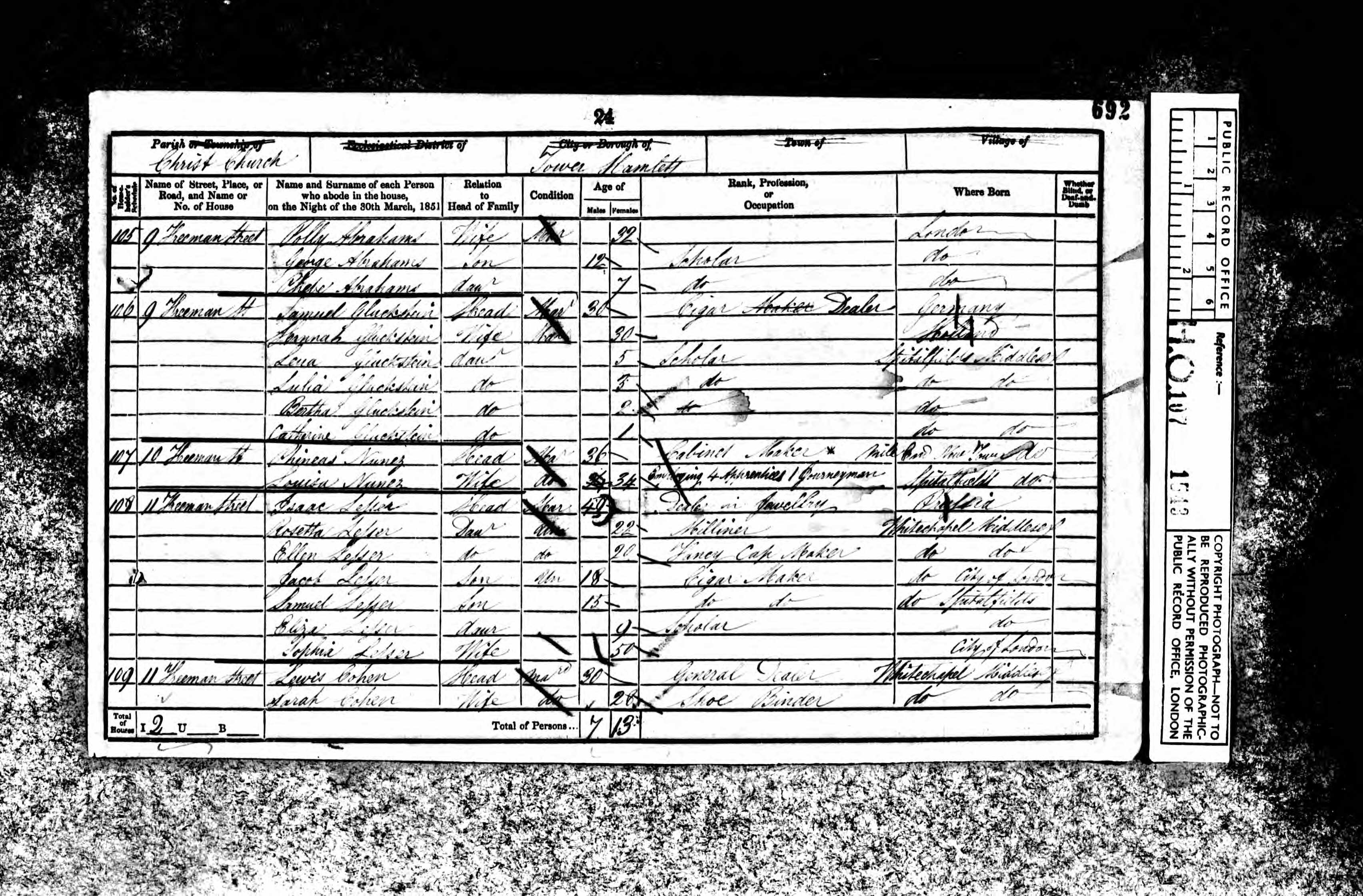
Hart’s son, Moses, now 30 years old, had married Clara Michaels in the fall of 1843, according to the BMDIndex.  I need to obtain a copy of the actual record to be sure, but on the 1851 census, Moses Cohen was married to a woman named Clara and had three daughters, Judith (6), Hannah (2), and Sophia (six months).  He was employed as a general dealer and living at 35 Cobbs Yard in the parish of Christchurch in Tower Hamlets.

UPDATE:  I now know that Moses in fact had left England with Jacob in 1848.  This is not the correct Moses.

Moses Cohen and family 1851 census

Moses Cohen and family 1851 census

This neighborhood is about three miles west of where Moses had been living with his parents in 1841. Moses must have been fairly comfortable as they also had a servant living with them, although the Charles Booth Poverty Map depicted this area as poor in 1898.

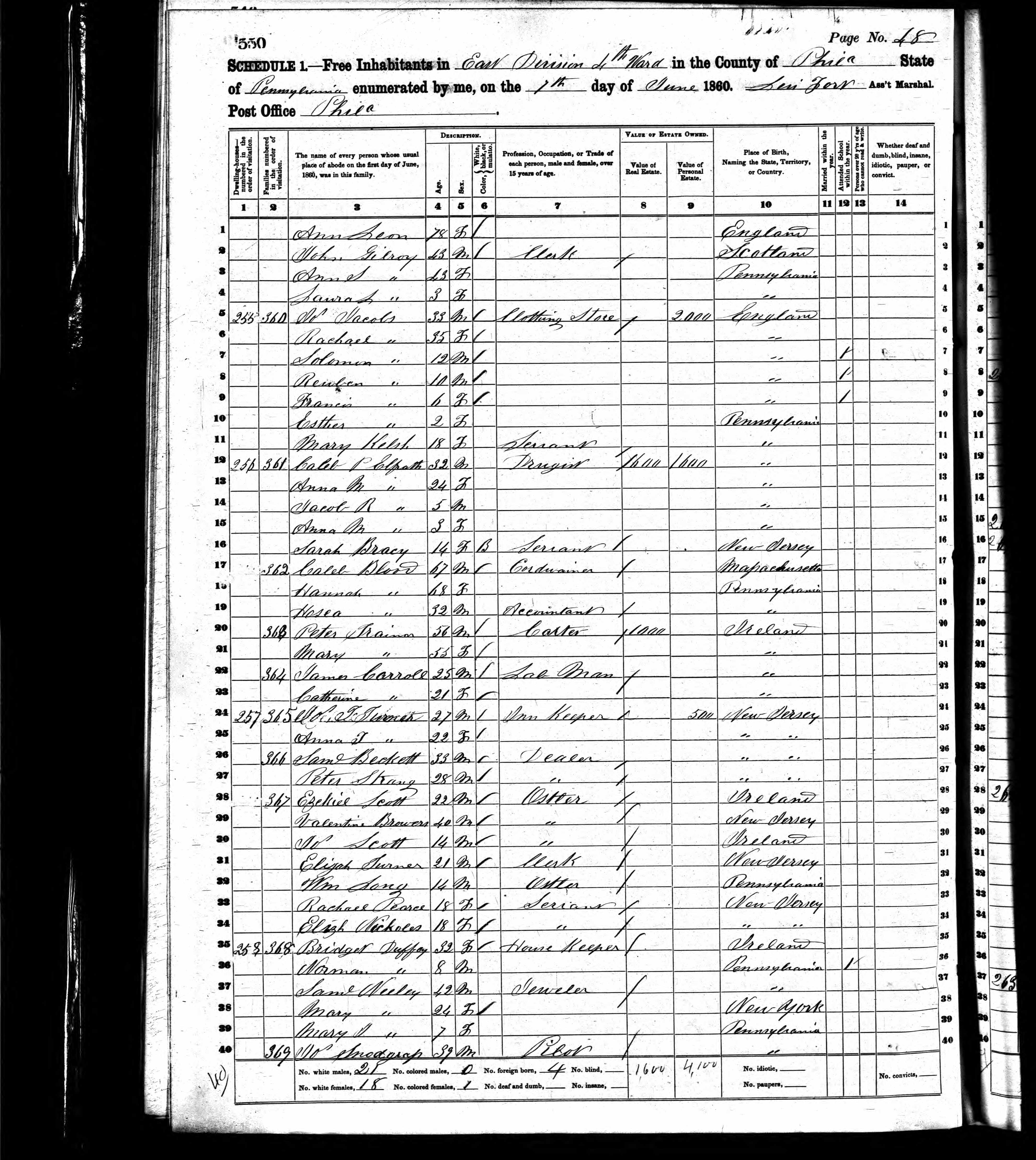
The oldest son, Lewis, has been more difficult to track.  He was not living with the family in 1841 nor was he living with his father and younger siblings in 1851.  I would not even have known that he existed except for the fact that he appears on the 1860 US census reports living with his siblings Elizabeth and Jonas and his father Hart and on the 1880 census living with Elizabeth and Jonas.  So where was he in 1841? 1851?  According to those two US census reports, he was born in 1820, so would have been Hart and Rachel’s second child after Elizabeth.  He might have been living independently in 1841, married, or perhaps just not home.  The FamilySearch website indicates that the 1841 census had many holes; if someone was not staying at a home that night, they were not included in the census for that household.  I found three Lewis Cohens on the 1841 Census, but none of them was a good fit.  One was too old, one was living with different parents, and one was not born in England.  But since the 1841 was the first true census taken in England, I assumed that perhaps Lewis was just not among those counted.

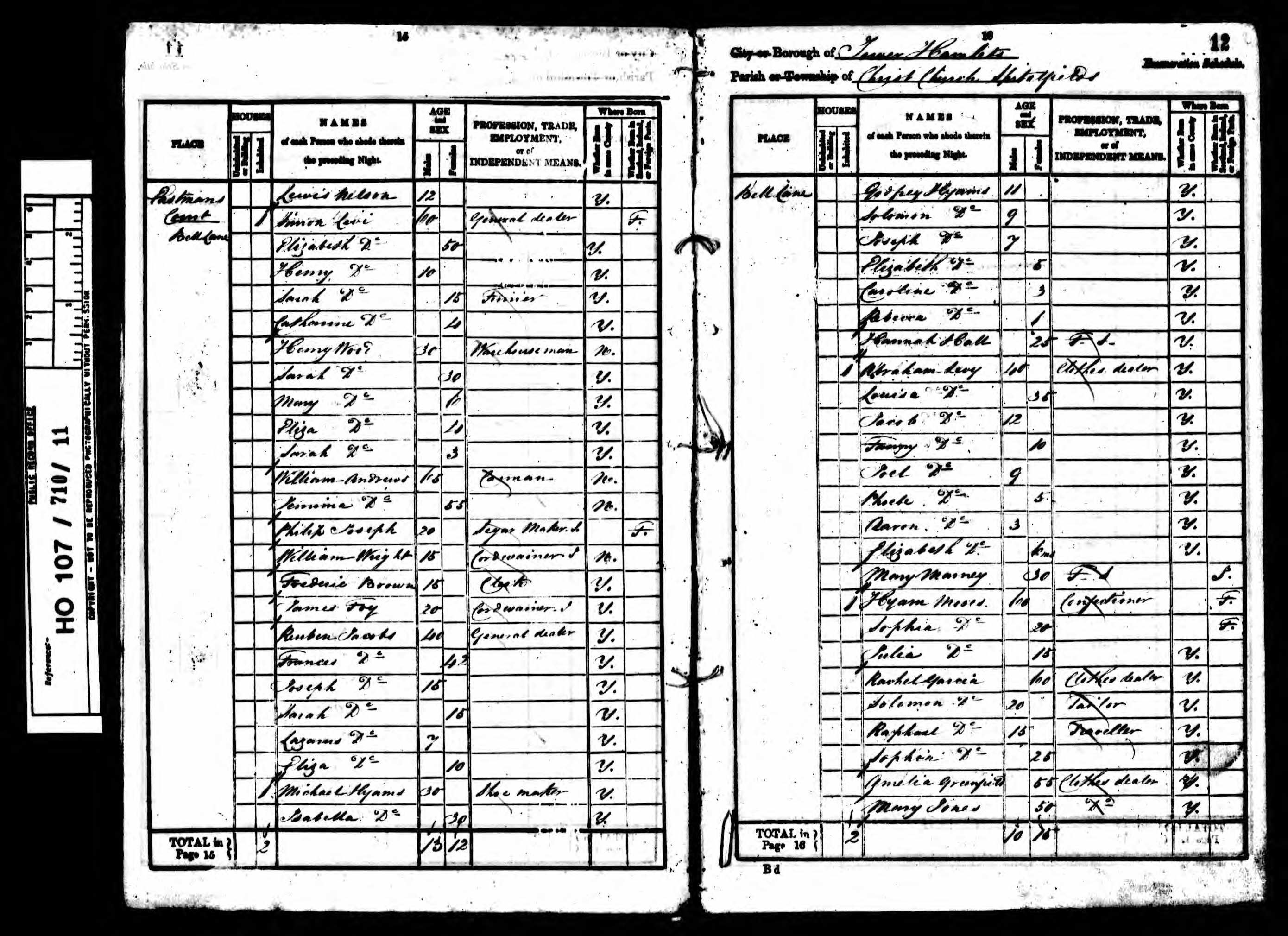
The 1851 English census did not provide any greater information on Lewis.   There were several Lewis Cohens again, but only one who was a possible fit: he was born in Middlesex County in Spitalfields, Christchurch, around 1821 and was married to a woman named Sarah.  They were living with Sarah’s mother, Ann Solomon.

Lewis Cohen 1851 census (not sure this is the correct Lewis)

Lewis Cohen 1851 census (not sure this is the correct Lewis)

I have found a marriage for this Lewis and Sarah in 1848 on the BMD Index and will write away for the record, but since Lewis was single in 1860 according to the US census, if this is the right Lewis, either Sarah had died or divorced him between 1851 and 1860.  I searched for a death record for a Sarah Cohen who died between 1851 and 1860, and there were several on the BMD Index.  I am not sure how to determine which ones might be relevant, but will order any that appear to be possibilities once I know that this was the correct Lewis.

UPDATE:  I know now that Lewis had in fact emigrated from England to the US in 1846.  This is not the correct Lewis.

The other possibility is that Lewis had immigrated to the US before the 1851 census or even the 1841 census.  I cannot find him on either the 1840 or 1850 US census, but I did find some immigration records for a Lewis H. Cohen who was naturalized in Philadelphia in 1848.

Lewis H Cohen naturalization ED PA 1848

Lewis H Cohen naturalization ED PA 1848

Since Lewis is listed on the 1860 US census as Lewis H. Cohen, I am inclined to think that this is the right person.  If so, then I also may have found a passenger ship manifest for Lewis, arriving in the US in 1846, which would have made him the first Cohen to immigrate to the US, not my great-great grandfather Jacob.  I need to check further into this, but it seems quite possible that the reason Lewis is not on the 1851 census in England is that he was already in the US.  But then why can’t I find him on the 1850 US census either?

The other mystery child of Hart and Rachel Cohen is the son identified on the 1841 census as John, the youngest child on that census whose age was given as 14, giving him a birth year of 1827.  In my initial research on the family, I thought that John had become Alfred J. Cohen, who was also born in 1827.  Alfred married Mary A. Cohen and remained in England where eventually they had seven children.

In reviewing my earlier work from last year, however, I am now doubtful that this was in fact the child of Hart and Rachel. Although I will order a marriage record for Alfred to be sure, I now think that the John in the 1841 census was actually Jonas, the youngest son of Hart and Rachel and the son who was living with Hart in 1851 in London and in 1860 in Philadelphia.  My reasoning is that Jonas was not listed on the 1841 census when he would have been only twelve years old.  Where else would he have been if not living with his parents? Also, since Jacob’s age was off by a few years on the 1841 census, it seems quite possible that there was an error in “John’s” age and also his name.  Jonas is close enough to John, at least the first syllable, so a census taker might have just recorded it or heard it incorrectly.  On the US census reports, Jonas’ age jumps around, making it difficult to pinpoint a correct year of birth.  Although I am going to order whatever vital records I can for Alfred and for Jonas, right now my hunch is that Jonas and John were the same person, the youngest son of Hart and Rachel Cohen, born sometime between 1825 and 1830.

UPDATE:  It seems quite clear to me now that “John” was Jonas.

So I have a lot of unanswered questions about my Cohen ancestors between 1841 and 1851. When did Rachel, my three-times great grandmother die?  Where was Lewis in 1841? Did he marry in England?  Did he in fact immigrate to the US in 1846? If so, why isn’t he on the 1850 US census? Are John and Jonas the same person, or were there in fact two sons younger than Jacob?

It will take some time to get the records that may help to answer these questions, so while I am waiting for those documents,  I will move on to the next decade and the story of my Cohen ancestors in the United States.


Happy Mother’s Day

I am not usually a big fan of Mother’s Day.  It’s always seemed like a “Hallmark” holiday to me, manufactured for commercial purposes to sell cards and overpriced meals at overcrowded restaurants.  And I say this as a mother, not as a daughter. But this year I’d like to pay tribute to all the mothers I’ve learned about through my genealogy research.

First, to Bessie Brotman, my great-grandmother, who journeyed to America like so many other immigrant women alone with two young children, who took in the young children of her husband Joseph’s first marriage and raised them.  Bessie then lost that husband after being in the US for only ten years and after bearing three more children with him, one born just months before he died, leaving her as a widow with three very young children and several older children.  Bessie remarried and then took care of not only her children but the numerous children of her second husband, Philip Moskowitz.  She was a sweet and loving woman who brought love to all those children.

Bessie Brotman

Bessie Brotman

I’d also like to pay tribute to my other great-grandmother on my mother’s side, Ghitla Rosenzweig Goldschlager.  She also made the journey to America, only to find when she arrived that her husband Moritz had died  months before her arrival.  She also persisted and survived, as did her sister Tillie, also widowed shortly after arriving in the US and having seven children to care for herself. She had a generous enough heart to take in my grandfather and his sister Betty after their father died and before their mother arrived from Romania.  The third Rosenzweig sister Zusi also lost her husband and raised her son Nathan on her own after losing his twin brother as a month old infant.  All the Rosenzweig sisters suffered such terrible heartbreak.

Ghitla Rosenzweig Goldschlager

Ghitla Rosenzweig Goldschlager

I am thinking also of my grandmother Gussie, who never spoke of her childhood and who lost her father when she was only five years old.  She then moved in with her sister Tillie when her mother remarried rather than live in a household filled with stepsiblings and a stepfather she did not like.  She took care of her younger siblings from a very early age and then took care of her three young nephews before marrying my grandfather and raising three children of her own.  Despite her own unhappiness, she was a loving grandmother and always made us laugh and smile.

Gussie with Jody Julie and Ira 1962

Gussie with Jody Julie  Ira and me 1962

My grandmother’s two sisters also come to mind this Mother’s Day—Frieda, who died from complications of childbirth and thus never got to experience the joys of motherhood, and Tillie, who my mother and her siblings remember as being a devoted aunt who took them places and brought them baked goods, gifts and most importantly lots of love and affection.

Tillie

Tillie

My other grandmother, Eva Schoenthal Cohen, whose story I’ve not yet told, also lost her husband at a young age and managed to move on, remarrying later in life.  My memories of her are of a soft-spoken, beautiful woman, who had experienced a great deal of sadness but carried herself with a lot of pride and dignity.  I also think about my two great-grandmothers, my father’s grandmothers. who took care of him and my Aunt Eva when his parents were not able to do so.

Eva Cphen

Eva Cohen

All who read this blog know that my Aunt Elaine was our family matriarch, the one who kept the family history and saw to it that we all knew each other and were part of each other’s lives.  She was thirteen years older than my mother and often like a second mother to her as well as her sister and friend.  She could always make us laugh, always make us feel loved.

Elaine and Jeff 1949

Elaine and Jeff 1949

And, of course, I am thinking of my own mother.  She is and always has been a devoted, loving mother who gives her love unconditionally.  Alhtough she has said that she was so young when I was born that she had no idea what she was doing, she did everything right.  She, along with my father, have always made me feel special, loved and valued.  I grew up believing that I could do and be anything I wanted.  To this day my mother is someone I  turn to when I have something good or bad to share.  She is always there to listen, not to pass judgment, but to listen and to provide support.

My mother and me 1952

My mother and me 1952

My mother and my daughters and grandson

My mother and my daughters and grandson 2011

And finally, I am thinking of my daughters, the ones who enabled me to take on the title of mother myself.  Somehow despite all my mistakes, and there were many, they both grew up to be amazing young women who love with all their hearts and bring joy to all who are lucky enough to know them.  They taught me how to be a mother just by letting me watch them  become the people they were always meant to be.  I don’t need cards or overpriced meals at overcrowded restaurants.  I am just happy getting to be their mother every day of the year.

Happy Mother’s Day to all!

Enhanced by Zemanta

Hart Cohen and Family Between 1841 and 1851: My Great-Great Grandfather Jacob Cohen

English: Liberty Bell

English: Liberty Bell (Photo credit: Wikipedia)

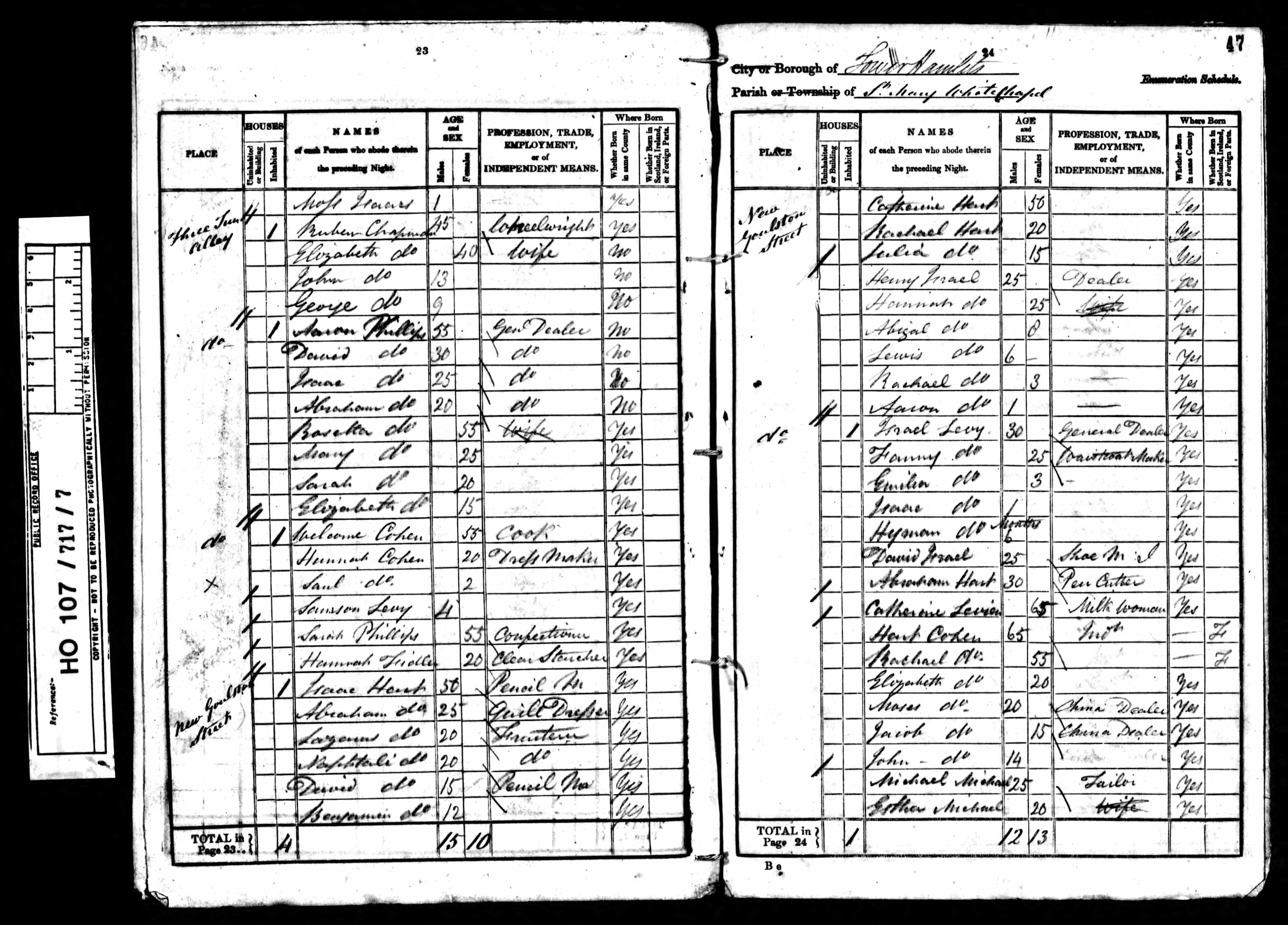
As reported previously, in 1841 Hart Cohen and his wife Rachel were living with four of their children, Elizabeth, Moses, Jacob and John, on New Goulston Street in the Whitechapel section of London, presumably part of the Chut community and living fairly comfortably with the two older sons working as china dealers.  There was also at least one other son, an older son Lewis, and possibly another younger son, Jonas, although I am now thinking that John was in fact Jonas, but more on that later.  By 1860, only Moses (and John if there was in fact a son named John) was living in England; all the rest were in Philadelphia. I will try to trace in chronological order the major events and moves made by these family members.

In order to get a complete picture of the family and their lives in England, I will need to get copies of the vital records, including their birth certificates and marriage certificates.  I am now trying to learn how to do that.  I have received some extremely helpful tips and information from another of my favorite genealogy bloggers, Alex Cleverley of the blog Root to Tip.  Alex is a very experienced English genealogist, and with the help she has given me, I will now order the records I need.  Unfortunately it appears that there is no fast and easy access to these documents so for now I will have to rely on the 1851 census, a few other secondary sources, and later census reports and infer a number of facts from those documents.  As I receive other documentation, I will report what I find.

I will start with Hart and Rachel’s son Jacob because he is my direct ancestor, my great-great grandfather, and thus the one I have the greatest interest in tracking.  According to the 1841 census, Jacob was 15 that year, giving him a birth year of 1826.

Hart Cohen and family 1841 English census

Hart Cohen and family 1841 English census

This appears, however, to be inaccurate based on later census reports from the United States and from a passenger manifest, all of which indicate a birth year of 1824 or 1825.  That would have made Jacob 16 or 17 in 1841.

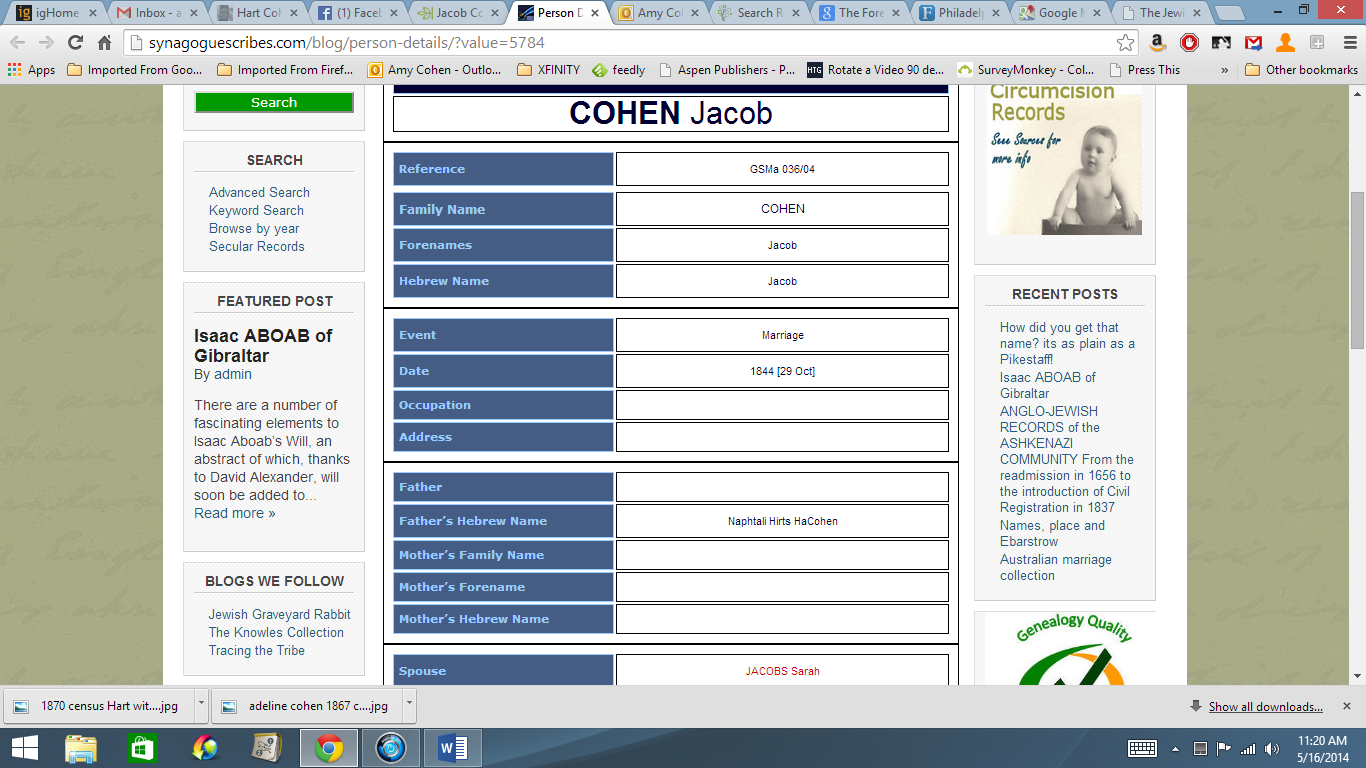
This also seems more consistent with the fact that Jacob may have married his wife Rachel Jacobs (possibly a relative of his mother, whose birth name was also Jacobs) on October 24, 1844.  Without an actual marriage certificate I cannot be completely sure, but I found a marriage record on SynagogueScribes for Jacob Cohen, son of Naphtali Hirts HaCohen, to Sarah Jacobs, at the Great Synagogue of London on that date.  The Hebrew name is not identical to what I had earlier found for Hart, Jacob’s father, but it is very close.  I know that Sarah’s maiden name was Jacobs based on the death certificates of two of their children, Isaac and Frances.  Thus, I feel fairly confident that this is in fact their marriage record as transcribed by SynagogueScribes.

COHEN
Forenames Jacob
Hebrew Name Jacob
Event Marriage
Date 1844 [29 Oct]
Occupation
Address
Father
Father’s Hebrew Name Naphtali Hirts HaCohen
Mother’s Family Name
Mother’s Forename
Mother’s Hebrew Name
Spouse JACOBS Sarah

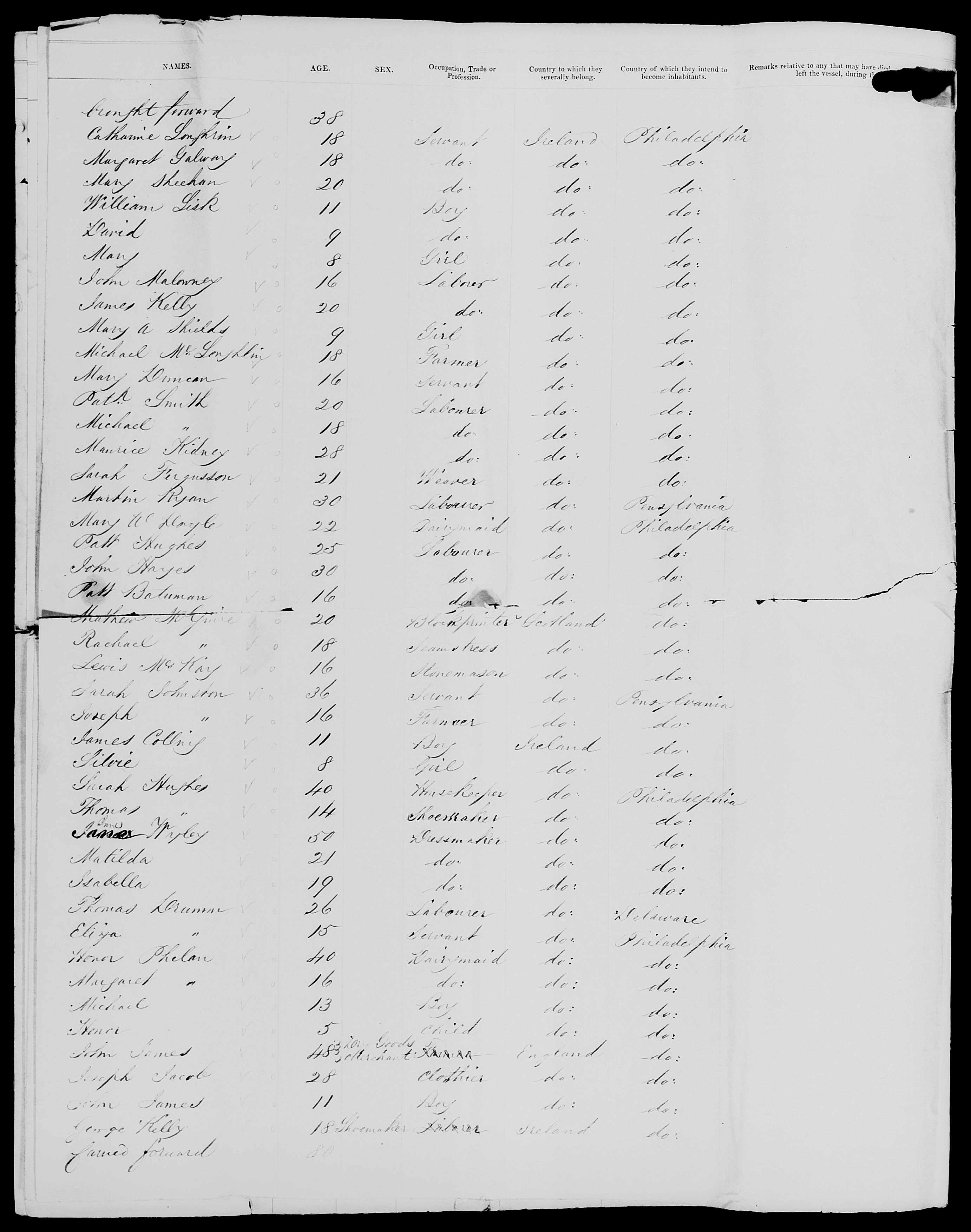
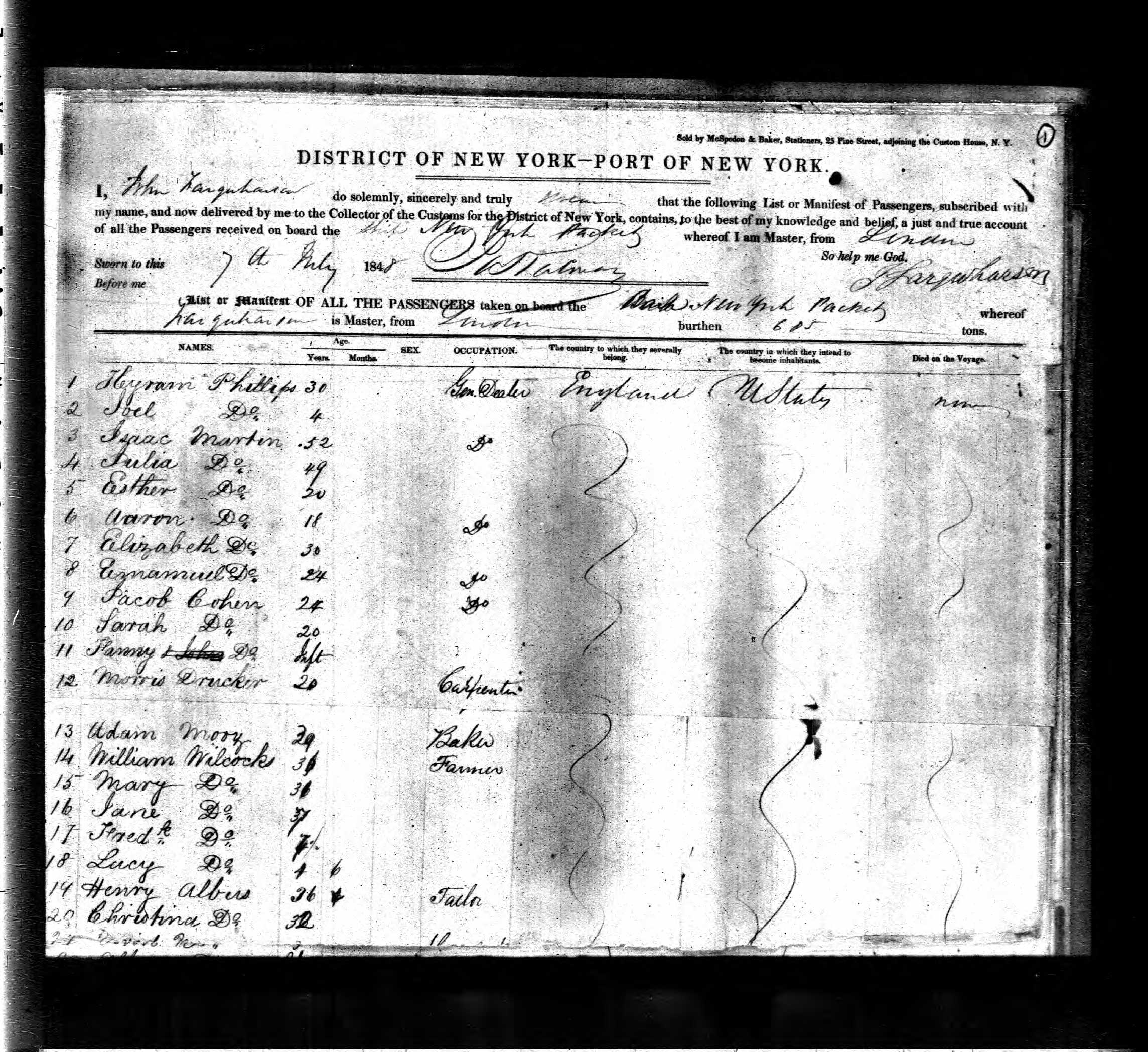
Frances, or Fanny, was Jacob and Sarah’s first child, born around 1847, as inferred from later US census reports.   Within a year of Fanny’s birth, Jacob and Sarah left London and moved to Philadelphia.  On July 7, 1848, Jacob, Sarah and Fanny, an infant, arrived in New York aboard the ship New York Packing.  Jacob’s age was given as 24, consistent with a birth year of 1824, and Sarah was 20, giving her a birth year of 1828.  Jacob’s occupation was given as “General dealer,” as were many other men on the manifest.

Jacob and Sarah Cohen ship manifest 1848

Jacob and Sarah Cohen ship manifest 1848

Jacob was the first of Hart and Rachel’s children to leave London and move to the US.  His siblings and eventually his father began arriving several years later.  I found this interesting, given that Jacob was not the oldest son, but the fourth child and third son.  Why did he go first?  What drew him away from his family and to America with his young wife and baby?  I also found it revealing about my direct line that both Hart and Jacob were the sons who left their families behind and moved to a foreign country.  As far as I can tell, Hart arrived alone and without his family when he immigrated to England, just as his son Jacob did fifty years later when he left England and moved to the US.  I can’t say I inherited this willingness to take risks and move far from home, having never lived more than four hours from where I was born, but I like the idea that my ancestors were such risk-takers and so independent.

I don’t know whether Jacob and his family stayed very long in New York after arrival, but by 1850, Jacob and Sarah were living in Philadelphia.  It was not easy finding Jacob and Sarah on the 1850 US census.  I tried searching for all Jacob Cohens, Sarah Cohens, Fanny Cohens, and variations on each name and wild card searches on each name, but came up empty for a family that fit my relatives.  Then I decided to search just by first names for a Jacob with a wife named Sarah and a daughter Fanny and found them listed as “Coyle,” not “Cohen,” another instance of a mistaken name on a census report.  I am quite certain that these are my relatives despite the Irish surname because all the other facts fit closely enough—names, ages, places of birth for Jacob, Sarah and Francis.  Jacob’s occupation is described as “Dealer in 2d HG,” which I interpret to mean a dealer in second hand goods.  The only inconsistency is that Francis is listed as male, not female, but later census reports correct that mistake and list her as female.


Jacob Cohen and family 1850 US census

Jacob Cohen and family 1850 US census

By 1850, Jacob and Sarah had two additional children born in Pennsylvania.  Joseph was two years old, so presumably born shortly after Jacob and Sarah had arrived in the US in 1848, meaning Sarah was pregnant when they left England.  Isaac was six months old, so presumably born in January, 1850, since the 1850 census was dated July 25, 1850.

There were also two other men living in the household, both twenty years old: Mordecia (Mordecai?) Coyle (Cohen?) and Alexander Kelly.  Unfortunately, the1850 census did not identify the relationship of each individual to the head of household as later census reports did, so I do not know who these two men were.  Mordecai might very well have been a relative since he shared the same surname with the family.  But how might he have been related? None of Jacob’s siblings were old enough to have had a twenty year old son, and Jacob did not have a younger brother named Mordecai.  Also, the census indicates that Mordecai was born in Pennsylvania, meaning that his parents would have been in the US in 1830.  Perhaps Hart had a brother who had emigrated from Holland or Amsterdam or England that early? Or was Mordecai not even related to Jacob?  I have done some preliminary searching for other records for Mordecai, but so far have not had any success.

Thus, by 1850 my great-great grandfather was settled in Philadelphia, a young man with a young wife and three little children, working as a dealer in second hand goods.  His parents and his siblings were all still back in London, but between 1850 and 1860, that would change, and Jacob’s family both in his household and in Philadelphia would expandd many times over.

My next post will describe what the rest of Hart’s family was doing between 1841 and 1860, by which time most of the Cohens had arrived in Philadelphia.


Enhanced by Zemanta

My Ancestor was a Chut: More on Dutch and English Jews

The Chuts” Synagogue Sandy’s Row London

After I wrote my last post saying I was going to put aside for now any attempt to find my four times great-grandfather’s family in Holland, I decided to look more generally into the question of why a Dutch Jew would have emigrated from Holland to England in the late 18th century.  After all, life seemed to be pretty good for the Jews in Amsterdam at that point.  They had acquired full legal rights as citizens, many were comfortable both socially and economically, and England was in fact still forty years away from giving Jews the same legal rights as Christian residents.  Why would someone have left Amsterdam to move to London?

Su Leslie of Shaking the Tree mentioned in a comment that she had seen some episodes of the British version of Who Do You Think You Are involving famous British Jews and recalled that there had been discussion of an immigration of Jews from Holland to England in the late 18th century.  I decided to search on line for more information and learned that there was in fact a whole community of Dutch Jews who settled in London during that time.  My research led me to several websites discussing this community, including the Bishopsgate Institute website describing a recent oral history project about this community being sponsored by the Institute and created under the direction of Rachel Lichtenstein, a well-known writer and artist.  According to this site:

The oldest Ashkenazi synagogue in London, Sandys Row in Spitalfields, was established by Dutch Jewish immigrants in 1854, who began arriving in the city from the 1840s onwards. They came in search of a better life, rather than fleeing persecution like the thousands of Ashkenazi Jews who came after them in the 1880s from the Pale of Settlements.  Mostly from Amsterdam, many settled in a small quarter of narrow streets in Spitalfields known as the Tenterground. Here they continued to practise the trades they had bought with them from Holland, which were predominately cigar making, diamond cutting and polishing, and slipper and cap making. Many small workshops were established in the area and businesses were passed on within generations of families.

With their own practises and customs, many of which were different from other Ashkenazi Jewish groups, they became a distinctive, tight knit community of about a thousand people. To the frustration of the more established Anglo-Jewish population living in the area at the time, ‘the Chuts’ (as they were known locally) refused to join any of the existing synagogues…

Sandys Row Synagogue

Sandys Row Synagogue (Photo credit: FarzanaL)

So my four times great grandfather Hart Levy Cohen was a Chut—a term I’d never heard before and a community I’d never known about before.  Other sites confirmed this information and also provided some other details.  Wikipedia provided this explanation for the name “Chuts.”

The origin of the name Chuts is uncertain. A popular assumption is that it derives from the Dutch word goed (meaning “good”) and is imitative of the foreign-language chatter that others heard. It is also Hebrew חוץ for “outside” or “in the street” and may have been applied to the Dutch Jews of London either because they were socially isolated or because many were street vendors. Another possibility is that the Hebrew word would have appeared increasingly in Amsterdam synagogue records as more and more emigrated to London, and others who followed would have “gone chuts” (i.e., emigrated).

Sandys Row Synagogue, London

Sandys Row Synagogue, London (Photo credit: nicksarebi)

The About Jewishness website revealed where in London the Chuts lived:

They settled mostly in a small system of streets in Spitalfields known as the Tenterground, formerly an enclosed area where Flemish weavers stretched and dried cloth on machines called tenters (hence the expression “on tenterhooks”). By the 19th century, the site had been built upon with housing, but remained an enclave where the Dutch immigrants lived as a close-knit and generally separate community. Demolished and rebuilt during the twentieth century, the area is now bounded by White’s Row, Wentworth Street, Bell Lane and Toynbee Street (formerly Shepherd Street).

I looked up these streets on the map of London and was not surprised that this area is very close to New Goulston Street where my ancestors were living in 1841.

The About Jewishness site also provided some insight into what happened to this community and perhaps why my ancestors left London and moved to the US.  According to this site, “the successful introduction of machinery for the mass-production of cigarettes ultimately led to the collapse of the cigar-making economy on which the Chuts community depended. Many Chuts returned to improved conditions in Amsterdam, some emigrated further afield to places such as Australia and the USA, some assimilated into other Jewish families, and some eventually lost their Jewish identity altogether.”

In addition, the huge influx of Eastern European Jewish immigrants in the late 19th century caused tensions between the older established Chuts community and the newer immigrants, most of whom were poor, not as well skilled, and not used to living in a big city.  Interestingly, the Chuts community had traditions and practices that made them different both from the older Sephardic community and from the newer Eastern European Ashkenazi community.  Again, from the About Jewishness site:

[T]he Chuts were treated with suspicion by other Jews because the former had developed specific customs and practices, many of their families having lived in Amsterdam since the first synagogues were established there in the early years of the 17th century. Uniquely in Amsterdam, Ashkenazim (so-called “German Jews”) and Sephardim (so-called “Spanish Jews”) lived in close proximity for centuries, resulting in a cultural blend not found elsewhere. Most remarkably, the Dutch Jews were well accustomed to the sea, and ate seafoods considered not kosher by other Jewish communities.

From this information, it seems reasonable to infer a couple of things.  First, it seems that despite the fact that the Amsterdam Jewish community was fairly well-established, there must have been those, my ancestor Hart among them, who believed that there was greater opportunity for financial success in London.  These Dutch Jews decided to emigrate in order to achieve greater economic security.  Secondly, it seems that at some point many of those Dutch Jews either left or assimilated into the greater Jewish or non-Jewish society.  Some may have left because economic conditions were not as good as they had hoped; others may have left because as a “Chut,” they were not well integrated into the world of London’s Jews.  With different traditions, different practices, different synagogues, they may have felt isolated and disrespected.  I don’t know specifically what motivated my ancestors first to leave Amsterdam and then to leave London, but I’d imagine it was a combination of these factors.

Once again I am finding out new things about my own history and about Jewish history by doing genealogy.  I never knew about the Chuts, and I certainly never knew I was descended from one.  I have written to Rachel Lichtenstein to learn more about her project and will report back with whatever else I learn.

Also, in researching more about the Dutch Jews in general, I came across a genealogy blog I’d not seen before written by Kerry Farmer called Family History Research.  Kerry had a post from two years ago about searching for a Dutch Jewish ancestor using information she was able to obtain from a book compiling information about marriages performed at the Great Synagogue in London, Harold and Miriam Lewin’s Marriage Records of the Great Synagogue- London 1791-1885.  I was very excited when I read this post and contacted Kerry, who generously looked up Hart Levy Cohen and Rachel Jacobs’ wedding for me in the Lewin book.  She was able to provide me with the information she found there:

(Groom) Cohen Hart Levy

(Groom’s father) Leib Katz

(Groom’s patronymic) Hertz b. Leib Katz

(Groom’s address) Not listed

(Bride) Jacobs Rachel

(Bride’s father) Yaakov

(Bride’s patronymic) Rechel b. Yaakov

She also suggested that I contact the owners of the Akevoth site to see if this additional information would help in locating the records of my ancestors, and I have done that.  Now I will wait to see if they can provide any further assistance.

So yesterday I was ready to put aside the search for my Dutch ancestors, and then, with the help of Su Leslie and Kerry Farmer, I was able to make some progress in understanding who they were and why they left Amsterdam and why they left London.  Once again I am humbled by and grateful for the generosity of the genealogy community.  Su and Kerry are from New Zealand and Australia, respectively, and they have helped me in my search to find a Dutch Jew who lived in England and moved to America.  What a small world it is when you find such wonderful, helpful and knowledgeable people.


Enhanced by Zemanta

The Brick Dyke in Amsterdam?

Before I write about the next phase in the life of Hart Levy Cohen and his children, I want to explain what I have learned or rather tried to learn about his life and his family before he came to London.  From the English census of 1841, I knew he was born in “foreign parts” outside of Great Britain.  The 1851 English census was more specific; it said that he was born in Holland.  The 1860 US census was even more specific than that.  It reported his place of birth as Amsterdam.

photo 1 (3)IMG_1060

Knowing his Hebrew name, his father’s Hebrew name, his English name and his approximate year of birth, I thought that I would be able to find some record of Hart’s birth and of his family in Holland fairly easily.  When I first found this information over a year ago, I searched every way I could on a site called Akevoth, which has a huge database and lots of information on Dutch Jewry.  It’s a wonderful resource, but I was soon overwhelmed.  There were just too many people with the names Hart(og), Levie, and Cohen or some combination of two of those three.  I had no way to figure out whether any of those people were my relatives.  I’ve just looked again, and now I remember why I was overwhelmed.  It’s like looking for a needle in a haystack.  Last time I had not known about FamilySearch, so I have now looked there as well, and once again, I have not found anything definitive there or on ancestry.com.

I’ve also had a chance to try and find evidence of Hart not only online, but also in Amsterdam itself.  Last spring we took a weeklong trip to Amsterdam.  We had an amazing time and loved the city.  It was not a trip we took for genealogical purposes, but rather a general interest trip to see the art, walk the canals, visit the museums, drink the beer, and learn about the history of Amsterdam.  Part of that history is, of course, the history of the Jews in Amsterdam, and in addition to an incredibly moving visit to Anne Frank’s house, we also took a walking tour of Jewish Amsterdam with Jeannette Loeb, a Dutch Jew herself with expertise in the history of the Jews in Amsterdam.

From Jeannette and other sources, I’ve learned some of the long history of the Jews in Amsterdam.  Like England and like the United States, the earliest Jews in Amsterdam were Sephardic—traders from Portugal and Spain. When the Netherlands established their independence from Spain, religious freedom was one of the important tenets of the new state, allowing not only Protestants but also Jews to practice their religion.  The Sephardic Jewish community became well-integrated both socially and economically in Amsterdam, although Jews were not given the full legal rights of citizens.

Portuguese Synagogue Amsterdam

Portuguese Synagogue Amsterdam

It was not until the late 17th century that Ashkenazi Jews from Germany and Poland began to settle in Amsterdam to escape persecution and poverty.  These immigrants were helped by the established Sephardic community, although the two communities retained their own languages, practices and synagogues.  Although they  started off poverty-stricken, the Ashkenazi community became more economically stable over the years.  In 1792 Jews were finally given full legal rights in the Netherlands, certainly late but nevertheless a full forty years before Jews were given such rights in England.

Joods Historisch Museum (Jewish Historical Mus...

Joods Historisch Museum (Jewish Historical Museum) in Amsterdam, Holland. {| cellspacing=”0″ style=”width:400px; text-align:left; color:#000; background:#ddd; border:1px solid #bbb; margin:1px; direction:ltr;” class=”layouttemplate” | style=”width:22px; height:22px;” | 20px|link= | style=”font-size:8pt; padding:1pt; line-height:1.1em;” | This is a photo of rijksmonument number 265 |} 00000265 (Photo credit: Wikipedia)


Before World War II, there were 80,000 Jews living in Amsterdam, about 10% of the overall population.  Almost all of them were killed during the Holocaust, leaving only 20,000 Jews in Amsterdam after the war.  Today there is a small Jewish community in Amsterdam, but nothing like that large and active Jewish community that existed before the Holocaust.

Holocaust Memorial Amsterdam

Holocaust Memorial Amsterdam

Thus, in the late 18th century when Hart was born, the Ashkenazi Jewish community in Amsterdam was fairly well established, and Jews had full legal rights by the time he was a young adult in 1792.  Why did he leave? What was the economic situation of his family? Who was his family?

While we were on our walking tour, I asked Jeannette Loeb where I might be able to get some help in tracking my Dutch ancestor, Hart Levy Cohen.  She suggested that I visit the Amsterdam city archives and ask for some help in searching the city records.  I followed her advice and spent a couple of hours there with an archivist who specialized in Dutch Jewish genealogy.  He sifted through many books of records of births and circumcisions, but was unable to come up with anything definitive.  As he explained to me, until 1812 most Ashkenazi Jews in Amsterdam (and in Europe generally) did not have surnames.  People were known only by their patronyms, that is, by their Hebrew name paired with their father’s Hebrew name.  Because of that, it is nearly impossible to identify specific families.  Rather, there are just a very large number of people with very similar names.  Hart was probably Hartog in Amsterdam, a Dutch version of Hirts, and there were many Hartog Cohens.  Cohen was also probably a patronymic label, referring to the Cohanim tribe, not a specific family.

Thus, for now I am going to once again put aside any attempt to find Hart Levy Cohen’s father or other relatives and ancestors.  Perhaps I will have another chance to go to Amsterdam or find some other clues to help me sift through all the data.  Perhaps there will be some hole in this “brick dyke” that will allow me to find my ancestors.  For now instead I will bring the story forward and trace Hart’s children and grandchildren all the way to my father and to his children.


Enhanced by Zemanta

Hart Levy Cohen and A Very Brief History of Jews in London

In my research so far, Hart Levy Cohen is the earliest verified ancestor I have found.  There are some others on other lines on my father’s side that are earlier, but not yet verified.  But I am quite certain that Hart was my three-times great grandfather based on the census reports I have been able to locate in both English and American records.

The earliest reference I have to Hart is a transcription of his wedding record from the Great Synagogue of London. I found this on a website called Synagogue Scribes, which provides a free, searchable database of transcriptions of the information from marriage and other records from the Ashkenazi synagogues in London.  According to this site, Hart Levy Cohen, whose Hebrew name was Hirts and whose father’s Hebrew name was Leib, married Rachel Jacobs on January 29, 1812.  I was thrilled when I first found this record because it provided me with not only my three-times great grandmother’s name, but also because it revealed my four-times great-grandfather’s first name.  It also revealed that by 1812 Hart was living in England.[1]

The Great Synagogue of London: This engraving ...

The Great Synagogue of London

The earliest actual record I have for Hart is the 1841 English census, which lists Hart, his wife Rachael (sp?), and four of his children, Elizabeth, Moses, John and Jacob.[2]  Jacob was my great-great grandfather. According to the census, Hart was then 65 years old, giving him a birth year of 1776.  Rachel was 55, giving her a birth year of 1786.  Elizabeth and Moses were both listed as twenty years old, Jacob was 15, and John was 14.  All of the children were listed as born in England, but Rachel and Hart were listed as foreign born.  Hart’s occupation was described as “Ind’t,” meaning he was of independent means, and Moses and Jacob were both described as china dealers.

Hart Cohen and family 1841 English census

Hart Cohen and family 1841 English census

The family was residing on New Goulston Street in the St. Mary Whitechapel parish of Middlesex County in East London.  Scanning through the names and occupations of other residents of that street and nearby streets, I noticed that many of the names were Jewish and that many of the residents were merchants of some sort or tradespeople.  I knew nothing about the history of Jews in London, and thus studying this census led me to research that history in order to learn more about the neighborhood where my ancestors lived in the early 19th century.  That, in turn, led me to read more about the history of Jews in England overall and specifically in London.

Although I cannot do justice to the long and complicated history of the Jews in England here, a very brief overview may suffice.  According to a number of sources, Jews had first settled in England during the reign of William I in the 11th century, but were expelled from England in 1290 by an edict of King Edward I, and there was no Jewish community thereafter until the 17th century when a community of Sephardic Jews from Spain arrived, although many of these Jews hid their religious identities.  Eventually for political and economic reasons, the English acquiesced in the growth of the Jewish community, although there was still a great deal of anti-Semitism.  Jews were not allowed to be citizens and were denied many of the legal rights of non-Jewish English citizens.

In the 18th century, the Sephardic community grew both in size and in wealth and became quite successful, but Jews were still denied full legal rights.  There was a short lived naturalization law passed in 1754 to enable Jewish men to become citizens, but it was repealed one year later due to widespread popular opposition.  It was not until 1833 that Jewish men were emancipated and given full legal rights as English citizens.

Meanwhile, there was also a growing Ashkenazi community during the 18th and 19th centuries, referred to as “Dutch Jews.”  My three-times great grandfather Hart Levy Cohen would have been one of those Dutch Jews, probably arriving at the end of the 18th century.   According to the Jewish Encyclopedia, “the bulk of the Ashkenazic community consisted of petty traders and hawkers, not to speak of the followers of more disreputable occupations.”  They settled in East London in the parish of Whitechapel, as did my ancestor Hart.  Whitechapel in the 1840s was described in Wikipedia as “classic “Dickensian” London, with problems of poverty and overcrowding.”

It would appear from the 1841 census listing, however, that Hart and his family were not among those poor.  Hart appears to have been retired, and his two sons were china dealers.  Perhaps their particular section of Whitechapel was not as poor as other sections.  For example, their street was very close to the Petticoat Market, a clothing manufacturing center that catered to the well-to-do of London.

File:Thomas Rowlandson - Rag Fair or Rosemary Lane - Google Art Project.jpg

Petticoat Market in the early 19th century

UPDATE:  Thanks to the help of my fellow blogger Su Leslie from Shaking the Tree, another of my very favorite genealogy blogs, I was able to find a map prepared by Charles Booth in the late 19th century that shows street by street the economic standing of the residents.  He rated each street on a seven level scale from poorest to upper class.  New Goulston Street appears to be purple on his map, meaning it was a mixed neighborhood with some poor residents and some comfortable residents.  That also seems consistent with my scan of the census of their street.

Charles Booth poverty map of London, New Goulston Street marked in center
https://booth.lse.ac.uk/map/18/-0.0757/51.5160/100/0?marker=533621.0,181427.0

In the later part of the 19th century, there was a tremendous influx of poor European Jewish immigrants to London, just as there was in New York and other American cities, coming to escape the oppression, violence and poverty in East Europe. There was also a large immigration of poor people from Ireland during this same period. The Whitechapel neighborhood became even more poverty-stricken, and crime became rampant, including widespread prostitution.  It was also during this period that Jack the Ripper, the serial killer, committed a string of murders and caused widespread terror.

By this time, however, most of my Cohen relatives had left England and come to the United States.  Only two of Hart’s six children remained in England by 1860.  Why did they leave? And why did Hart come to England from Holland in the first place? Those are questions that I want to answer if I can as I dig more deeply into my Cohen ancestors.


[1] I also thought I had found earlier records for Hart in tax records from 1798, but I now think that those records were for a different person because I found a record dated 1768 at the same address, also for a man named Hart Cohen.  These records require deeper investigation.


[2] There were six children altogether.  Lewis and Jonah are not accounted for on this census.  Lewis would have been 21, so perhaps was not living at home, but I have not yet found him elsewhere.  Jonah would have been 12, so I cannot account for the fact that he is not listed, except to note that this was the first English attempt for a comprehensive census and undoubtedly mistakes were made.


Enhanced by Zemanta

My Father’s Family, Part I: The Cohens

My surname is Cohen, and it always has been.  I have always been proud to be a Cohen.  It is a clear marker to the outside world that I am Jewish.  Because I grew up in a secular home and did not go to Hebrew School like almost all my Jewish classmates, some of them expressed skepticism about whether I was “really” Jewish, but my name always gave me some authenticity.

The Cohens (Cohanim) are the high priests, a line that is supposed to descend from Aaron, Moses’ older brother.  Observant Orthodox Jews who are Cohanim do not go into cemeteries or attend a funeral or touch a dead body in order to maintain their priestly purity.  In a traditional service, there is a special ritual where the Cohanim bless the congregation.  Cohanim get the first aliyah for the reading of the Torah.

Birkhat cohanim 4

Birkhat cohanim 4 (Photo credit: Wikipedia)

Although I do not believe in any of the “special holiness” of the Cohen tribe and in fact am not even sure my family are true Cohanim, I do feel proud to have the name and some of the tradition and history that goes along with it.  It was one reason that I did not change my name when I got married.  I wanted to remain a Cohen—it was my name, it was my family’s name, and it was my ancestors’ name.
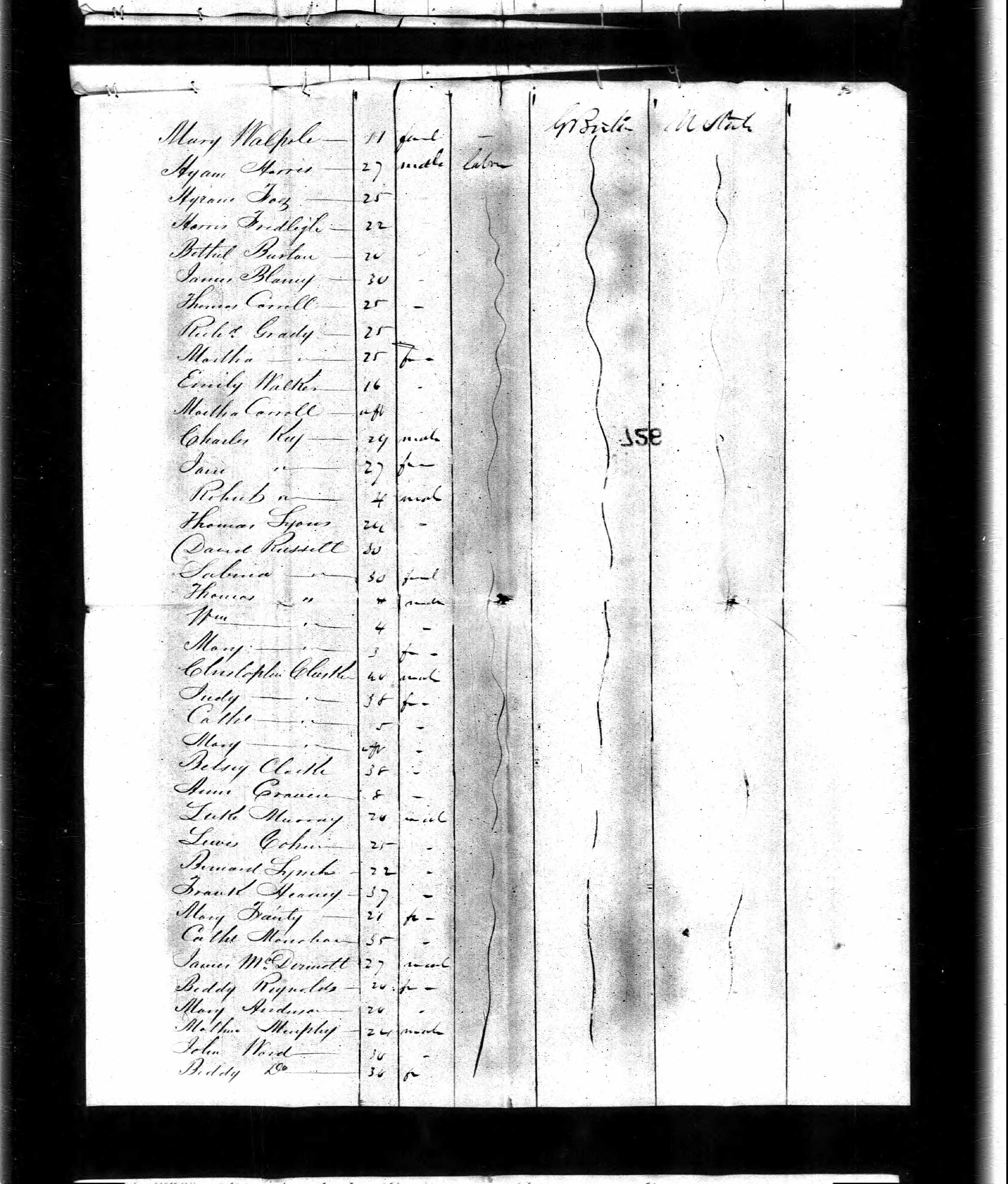
So perhaps it is not surprising that one of my first genealogical tasks was to trace the Cohen line.  It was fairly easy to get as far back as my great-great-great-grandfather Hart Levy Cohen, who was born around 1772 in Amsterdam and emigrated to England as a young man.  The English records and then the American records on my Cohen line were clear and easy to find through ancestry.com, and thus within a short period of time I was able to create a tree that went from Hart Levy Cohen to Jacob Cohen, my great-great-grandfather, to Emanuel Cohen, my great-grandfather, to John Nusbaum Cohen, my grandfather, to John Nusbaum Cohen, Jr., my father, to me.  I have census reports going back as early as 1841 in England and 1850 in the United States as well as tax records and a marriage record from England.  I have the names of Hart’s children, his grandchildren, his great-grandchildren and so on.  I compiled a lot of information very quickly, but now I need to go back and learn from all those documents and see what I can find out about Hart Levy Cohen and all his descendants and also to see if I can find his ancestors from Amsterdam and before.

This research will require learning about English records and census reports and also about Pennsylvania records.  From the little bit of initial work I’ve done this week, I already know that it will be more difficult to obtain Pennsylvania records than New York City records.  There is not much online and not much available through the Family History Library.  Most of it will require snail mail requests or traveling to places that are not as accessible to me as New York City.  I do not foresee traveling to Harrisburg in the near future, so it may require hiring someone there to retrieve documents for me.  And as for the English records, well, a trip to London sounds a lot more fun than a trip to Harrisburg, but I don’t think it’s too likely either.

So I have a big learning curve ahead.  I am up for the challenge and ready to learn more about my Cohen relatives and about genealogical research.  I will start by posting what I already know, and then I will fill in the details as I learn more.

Meanwhile, I will also continue to look for more information about the Brotmans, the Goldschlagers, and the Rosenzweigs.  Tomorrow I hope to talk to David Goldschlager’s son and grandson and maybe learn more about the Goldschlagers. I am still hoping to work with Larry Brotman about a Brotmanville connection.  I am still hoping to hear from my cousin Lois about her family and Lizzie and Ray Rosenzweig.  I have written to descendants of Ray Strolowitz Adler and Zusi Rosenzweig Mintz, and I hope to hear back from them.  So at the moment I am depending on these others to help me break down the brick walls that remain on my mother’s side.  Without their help, I am at an impasse for now, but will keep on looking for any and all clues.


Enhanced by Zemanta

Pet Photo Gallery

It seemed a lot of people enjoyed my post about our family pets, and some have shared pet stories with me by email or in the comments.  My sister also sent me some photos of two of her dogs, Pablo and Roxanne, as well as some of my parents’ cat Honey.

IMG_0023

IMG_0011

Pablo

IMG_0334

Roxanne

IMG_0250

Honey

IMG_0270 IMG_0434 IMG_0471 IMG_0227


If anyone else wants to add more pets to the “family tree,” just send me a photo, and I will add it here.

Thanks!


Enhanced by Zemanta

The rest of the family: Four legged variety

I was inspired by a post on one of my favorite genealogy blogs, The Family Kalamazoo, a while back.  Currentdescendent, the blog owner and author, posted a series of photographs of her family’s dogs going back over a hundred years.  I am a huge animal lover and have had cats and dogs all my life.  My parents are both big animal lovers also, as were my grandparents Gussie and Isadore.  My mother even remembers playing with a kitten at her grandmother Bessie Brotman’s apartment when my mother was a very little girl.  My uncle Maurice Goldschlager was also a big animal lover; I remember that his last home was filled with cats, dogs, even a horse, I believe.

Unlike Currentdescendent, I do not have photographs of family pets going back that far.  But I want to share what I have because these pets are a big part of my family’s story.  I know from talking to many of my cousins on both sides of my mother’s family that they also are big animal lovers.  I’d love to build a family tree of pet photos, so send them along if you want to share them.

But for now, these are the pets who lived with my immediate family, starting with my mother’s childhood pet, her dog Sparky.

Image

On the back of this photo my mother wrote,”The Cutest Thing in the World.”  My mother still gets teary-eyed when she sees this picture of her beloved dog.  Obviously he gave her a tremendous amount of joy and love when she was a little girl growing up in Brooklyn.

When I turned nine, I got my very first camera, and the very first photograph I ever took is this one:

Image

As you can see, this is my cat Pixie.  He was my first ever pet, and we got him when I was about two years old.  He was not a cat that everyone could love.  He tended to hiss and growl quite a bit, but never at me.  He let me carry him around like a doll and place him in my doll carriage.  As I grew up, he slept with me every night.  He truly had nine lives—surviving rat poison and being injured either by a car or animal.  He lived until I went away to college, and to this day I believe he died of a broken heart because I had left him behind.

I don’t have pictures of two cats who only lived with us a short time: Fearless and Cleopatra, and I don’t really remember them.  According to my parents, one jumped out of our window in Parkchester, never to return, and one ran away when we moved to the suburbs.  Our next cat, however, was originally my grandmother’s cat, the elegant long-haired tabby, Rajah.Image

(Note the creative spelling of his name.)  He was Pixie’s cousin–their mothers were littermates who had belonged to friends of my parents.  My parents took Pixie and gave Rajah to my grandmother.  Rajah was as sweet as Pixie was snarly.  He was a gorgeous and very smart cat who somehow put up with my grandmother washing his face with a wet washcloth.  When we were little and would visit my grandmother, he would always hide under the furniture.  But when we adopted him when my grandmother for some reason no longer wanted to care for him, he became a friendly and loving pet.  As he aged, he got a little senile and would insist on drinking water from an eye cup my mother kept in her bathroom.  He lived to be eighteen years old.

But two cats were not enough for me, so for my sixth birthday I wanted a kitten.  That kitten was Little Bit.Image


I wanted to call him Lucky, but my parents didn’t really like that name for some reason, so we compromised on Little Bit of Luck.  For a long time I called him Lucky, and they called him Little Bit.  Eventually I gave in, and he became Little Bit.  He was a funny and not too bright cat who didn’t have a mean bone in his body.  He was just a dumb, lovable creature who had to find his place with two much more dominant cats, with Pixie being without a question the alpha cat of the bunch.

But even with three cats in a small three bedroom ranch house, I was not content.  I wanted a dog, and I just kept asking for a dog.  After much persistence and a trip to the animal shelter, my parents agreed and we adopted our first dog, Colleen.  She was not a particularly pretty dog—just a mutt, and she was probably a few years old when we got her.  But she was my first dog, and I thought she was gorgeous.

Image

That’s me, hugging her to death in our backyard in 1959.  Our family was complete: three cats and a dog.  For most of my childhood, those were our family pets.  Colleen proved to be a wonderful dog, and she followed me everywhere.  We were very lackadaisical back then, and my parents would just open the door and three cats and a dog would run out and roam the neighborhood.  Colleen developed a reputation in the neighborhood for scavenging for food at other people’s houses.  Once she reportedly ate the food right off someone’s outdoor grill.  She once followed me all the way to a friend’s house in a different neighborhood.  My father came to pick me up in the car and figured Colleen would just find her way home.  But Colleen thought I was still in the house and refused to leave, so my father had to go back to get her.

We were very lucky for a long time that nothing bad happened to our roaming pets, but our luck ran out in April, 1964, when Colleen was hit by a truck right in front of my eyes.  She died at the vet’s office a few hours later, and I was bereft.  She’d been my companion for five years, those Wonder Years from seven to almost twelve, and I was heartbroken.

My parents could not stand my sadness as well as their own and that of my siblings, so they almost immediately went back to the dog shelter and brought home another dog for the family.  Although it took me a while to bond with this new dog, eventually I loved her  dearly as well. Here she is probably not long after we got her with Pixie and my cousin June Marie behind us.Image

Velvet was also a mutt, but she had collie-like markings with some setter or something else mixed in.  She was also a few years old when we got her, and she became a devoted pet like Colleen.  We all used to chuckle at the way she would cross her front legs in a very ladylike way.  By the time we got her, I was moving on from the innocence of childhood to the preoccupations of adolescence, and so she spent more time with my younger siblings than she did with me.

When I was in junior high school, we lost Little Bit to feline leukemia at a fairly young age.  Sometime thereafter we got another cat Phoebe, who was a calico with an attitude—proud, smart, and independent.

phoebe

After Pixie died, my parents adopted Missy—-a truly neurotic but gorgeous cat who was half Siamese and half tabby with the silliest half mustache under her nose.  She was a jumpy, anxious cat, but because she was beautiful, my mother decided to let her get pregnant.  We’d always spayed and neutered all our pets, but somehow Missy escaped the knife.  She did get pregnant and had four kittens: Louie, Susie, Bulldog, and Charlie, but my parents could only find a home for Charlie, so we ended up keeping Louis, Susie and Bulldog (who was renamed Taurus to make it sound more classy).  No way were we taking our kittens to the shelter! So there we were with a dog (Velvet), three adult cats (Rajah, Phoebe, and Missy) and three kittens.  Or six cats within a short period of time.  I was mostly gone at this point—in college and thereafter.  But I loved those kittens dearly.  We lost Louie at a very young age, but Susie and Taurus lived fairly long lives.  I will have to add pictures of Missy and her brood at some later point.

My parents went on to have more cats and now have Honey as their sole pet, the others all being long gone.  But beginning in 1975 I started having my own home with my own pets.  Our first cat was Kahlua, inspired not by her looks but by the ingredient in my then favorite drink, a Black Russian.  Kahlua was not the prettiest or the smartest or the sweetest cat, but she was our first cat together, and we loved her.

Kahlua

A few years later we adopted Blaze, a kitten from a litter of one of my Connecticut cousins’ cats.  She was gorgeous and affectionate and funny, and I was heartbroken when she disappeared one day, never to return.  I posted signs everywhere, called everywhere, but never could find her.  Somehow I still had not learned that cats are not safe roaming around the streets of suburbia.  I was so devastated that we did not get a second cat for a long time after that.  Instead we had human babies, who kept our lives busy and filled with love.

blaze

Blaze and Kahlua

Blaze and Kahlua

Kahlua lived as a solo pet for many years until our own children clamored for a kitten.  We adopted Wheatie, who looked just like Little Bit to me, and my younger daughter Maddy dragged him around just as I had dragged Pixie around three decades earlier.  But we still had not learned our lesson, and Wheatie was killed by a car as a young cat, and we were once again heartbroken.

Maddy and Wheatie

Maddy and Wheatie

1987

1987

But then we got Sneakers.  And he was the best cat we ever had (until the two we now have who rival Sneakers in personality and sweetness).  I picked him out at a vet’s office that had a litter they were trying to find homes for, and I picked him because he walked right up to me.  I knew he was a people cat, unlike Kahlua, and I knew he would be great with my kids.  And he was.  He was playful all his life and affectionate and smart and clean and independent.  When I taught at night, I would come home to nap first, and I would place him next to me; his purring would put me to sleep.  He regularly slept with Maddy, cuddled up around her head.  Once he disappeared for a week, and that was when we finally stopped letting our cats outside.  I knew I would never forgive myself if we lost Sneakers.  He would frequently bolt out the door, and we would all race outside, chasing him around the yard and the neighborhood  until we caught him and brought him home.  Sheakers lived a good long life, and he was a true gentleman until the end.

Sneakers

Sneakers

sneakersMaddy and Sneakers

When Kahlua died also at a ripe old age, we got Lily, who, to be honest, was not really a people cat.  She did not like to be held, and she preferred her own company most of the time.

Lilly


And then we got a dog.  Just as I had wanted a dog as a child, Maddy wanted a dog and kept asking for a dog until we finally agreed.  I’d been reluctant because dogs are a lot more work than cats, and we were both working full time and had little time for anything besides our kids and cats.  But inside I also missed having a dog.  And so I started looking until I saw an ad for a year old collie.  Having grown up watching Lassie religiously, I’d always wanted a collie.  One cold January morning in 1994, Harvey and I drove to Ware, about 20 miles away, and met Zapper.  He was a big and beautiful collie, living in a small apartment with a couple and their three children under five years old.  The wife did not want to keep the dog, but the husband was heartbroken to give him away.  We assured him that we would take good care of him, and we did.  He was a wonderful dog—sweet, protective, playful, smart and so beautiful.  Aside from barking way too much and jumping up on people until we trained him not to, he never did anything wrong.  Except get sick far too young.  He was only seven when he died.

Zapper

Zapper

Around the same time we lost Zap, we also lost a cat we had for only a short time named Simon.  He was the funniest cat I’ve ever had—he just was mischievous and would sit in the funniest positions.  He made me laugh every day until the day he ate some lilies we had the house.  We never knew that they were poisonous to cats, and Simon died within a day of getting into those flowers.  Between Simon and Zapper, I wasn’t sure I’d ever get another pet again.

But I did.  Six months later I saw an ad for a female collie who was at the local pound.  We went to see her–she was skinny, dirty and hyper as could be.  Maddy and Harvey (Rebecca was off at college) thought I was crazy, but I wanted her and knew she would be a great dog.  And she is.  She is now almost fourteen and has been with us for almost thirteen years.  She was a bit wild and skittish at first, but soon settled into be the best dog in the world.  Like Zapper, she is sweet and smart and playful, and she doesn’t bark or jump on people.  She just wants to be with her people and be loved.  She’s deaf now and has trouble walking, but she is still a magnificent dog.

Cassie

Cassie

When Sneakers and Lily were both gone, we decided that we would adopt two cats from the same litter so that they would have each other for company.  By this time (2008), our kids were grown and out of the house, and we did not want a solo cat to be lonely all day while we were working.  So we adopted Smokey and Luna.  I can’t even begin to describe how much I love these two cats.  Smokey thinks he is Cassie’s baby and still tries to nurse on the poor old dog, who loves him and plays with him and tolerates anything he does.  Luna is like Sneakers—a people cat from day one.  She is a cuddler, constantly purring, and doesn’t know how to hiss as far as we can tell (nor does Smokey).  These two have never been outside and never will.  I will keep them safe for as long as I can.  They are my babies.

smokey luna sibling love

Luna

Luna

Smokey

Smokey

So now you know that I will one day be that crazy cat lady.  Or maybe I already am….

Enhanced by Zemanta

The Fusgeyers, Part IV: Romania Today

St_Andrew_Str_no_26_0002

Where my grandfather was born in 1888 in Iasi, Romania

As noted in my last post, the population of Jews in Romania has declined precipitously over the last one hundred years as a result of emigration before World War I and thereafter and also as a result of the murder of about 300,000 of them during the Holocaust.  From a peak of 800,000 after World I, there are now just a few thousand Jews living in Romania today. What is it like in Romania today, and, more specifically, what is it like to be a Jew living in Romania today? What  legacy is there in Romania from the once substantial Jewish community, and what do current residents know or remember of the Jewish communities and of the Fusgeyer movement that led many of those Jewish residents out of Romania?  Beyond the cold, hard statistical facts, what is left of Jewish Romania?

I have consulted only two sources of information to answer these questions, so my views are based on limited information and possibly inaccurate.  But those two sources left somewhat different impressions, so perhaps the truth lies somewhere in between.  Jill Culiner’s book, Finding Home, paints a rather gray and dismal picture of life in Romania in general and specifically of the Jewish legacy there.  Stuart Tower, author of The Wayfarers, has a more positive impression of Romania today and of its people as seen in the photographs he took first in the 1980s and then in 2005 and also from what he shared with me by email.  Culiner and Tower visited different cities and towns for the most part, but there was some overlap; both visited Barlad and Sinaia within a few years of each other.  Both ultimately paint a picture of a country that once had many thriving Jewish communities but that now has virtually no Jewish communities and few residents who remember the communities that once were there.

Tower based his book around the town of Barlad; it is where the three Americans, grandfather, father and son, go to learn about their ancestral roots and meet the rabbi there who tells them the story of the Barlad Fusgeyers.  Tower’s story is fictional, and he told me that he’d never actually met a rabbi in Barlad, but both Culiner’s book and Tower’s book talk about a very small Jewish community continuing to exist in that city and the beautiful synagogue that still stands there.  In Tower’s novel, the rabbi describes a community of thirty people who still keep kosher and observe shabbat, but who have trouble forming a regular minyan.  The elderly rabbi’s children have all moved away, and he knows that he will be the last rabbi in Barlad (spelled Birlad in the novel).

Culiner started her Romanian travels in Adjud, where she got off the train and began her Fusgeyer-inspired walk.  Her description of Adjud is disheartening:

Here, fields lie flat under a grueling sun, and cars, trucks and buses roar with giddy impunity over pot-holed, uneven main roads.  Under thirsty-looking trees outside the station, lining the street are unlovely lean-tos, modern bars and patios. All claim to be discos, all pump loud American music into the hot air.

Culiner, p, 35.

Culiner also said that “there were no buildings left from the pre-Communist era and certainly nothing of beauty.” (Culiner, p. 35)  Her encounters with the local people are no more heart-warming.  No one could tell her where there was a hotel or room to stay in, and she described the people she saw as “exhausted..expressionless, resigned.”  Culiner, p.36.  No one in town remembered  that there ever was a Jewish community there or a synagogue, although there had been a community of about a thousand Jews there in 1900.  The man who showed her where the non-Jewish cemetery was located demanded an exorbitant fee for his troubles.  By the end of this first chapter, I was already feeling rather depressed about her experience and about  life in Romania.

In contrast, here are some of Tower’s photos of the Romanian countryside that left me with a different impression.  Thank you to Stuart Tower for giving me permission to post these:

Recently%2520Updated%25201112 Recently%2520Updated%25201113 Casa Elena in Voronets Fall foliage in the Bicaz Gorge Romania%25202005%2520262 Romania%25202005%2520263 Romania%25202005%2520264

Culiner’s experience at her second stop, Podu Turcului, was not any better.  The townspeople warned her that her plans to walk through Romania were dangerous and that she would be better off visiting more modern cities elsewhere.  There were no Jews left in this town, and no one there remembered there ever being a synagogue, although there was a Jewish cemetery.  Only one man acknowledged that there once was a Jewish community there, a workman who had been curious about the Jews while in school and had learned where the Jewish residents had once lived in town, now just a neighborhood of faceless housing from the Communist era.  This man told Culiner that he had been unable to learn more about the Jewish community in his town because discussing such matters was prohibited during the Communist era.

Culiner and her companion next arrived in Barlad, a city of 79,000 people, the city where Tower’s characters stayed and learned about the Fusgeyers and were in awe of the beautiful synagogue.  Culiner is less enthusiastic.  Her first impression of the city is its “potholed, deteriorated sidewalks” and the “[r]are trees [that] gasp out their life in the dense cloud of exhaust fumes, providing little shelter from the pitiless sun.” (Culiner, p. 55) Culiner once again encountered skepticism about her plans and ignorance about the Jewish history of the city.  She was particularly disappointed that in this city where the Fusgeyer movement began, no one seemed to remember anything about them.  Even she, however, was impressed with the synagogue, to an extent:

Despite its rather austere, unassuming exterior, the synagogue is magnificent.  Dating from 1788, the walls and ceilings are decorated with paintings of birds, flowers, leaves and imagined scenes of Jerusalem.  Yet, despite its beauty, there is a strange feeling of loss, the aura of a building struggling to exist in a world that has little place for it.  It has become a relic.

Culiner, p. 58.

Although Tower also described a dying Jewish community in his novel, there was still some life, some people who cared in Barlad.  Culiner saw the glass as half-empty whereas Tower saw it as half-full.  Here are some pictures of the Barlad synagogue and some other towns visited by Tower that show a far less dismal impression of  in Romania.  All photos courtesy of Stuart Tower.

Synagogue in Barlad courtesy of Stuart Tower

Synagogue in Barlad  Photos courtesy of Stuart Tower

President Alexander Coitru

Stuart Tower reading from The Wayfarers at the Barlad Synagogue

Stuart Tower reading from The Wayfarers at the Barlad Synagogue

birlad shul interior

Romanian countryside

Romanian countryside

Romanian woman

Romanian woman

Romania%25202005%2520090 Romania%25202005%2520175

17th Century wooden synagogue in Piatra Neamts

17th Century wooden synagogue in Piatra Neamts

Piatra Neamts Sinagogaodd haystack, neighboring farm Troop Popa Tarpesht villagers and their War Lord

Culiner’s experiences in the towns and cities she visited after Barlad were not much different from her first three stops: ignorance and indifference to the history of the Jewish communities in those towns, ugly scenery, and disappointment.  She did meet some friendly and helpful people along the way, including some who were Jewish or were descended from Jews, but for the most part she found most Romanians at best ignorant and at worst rude and even hostile.

In Focsani, no one seemed to be able to help her find the synagogue, sending her on a wild goose chase only to find it right near her hotel.   On the other hand, Focsani had a fairly active Jewish community (relatively speaking), as the synagogue regularly drew about twenty people for shabbat services and more on major holidays.  Culiner was bewildered by the fact that the non-Jewish residents did not even know where the synagogue was located despite its central location.

In Kuku, Culiner met a friendly, helpful woman who likely lived in a building that was once the hostel where the Fusgeyers stayed while traveling through that town, but that woman also knew nothing about where the Jewish community had gone or about the Fusgeyers.   In Ramnicu Sarat, Culiner spent time with a woman whose mother was Jewish and who remembered the days of an active and close Jewish community.  The woman told Culiner that the Communists had demolished the synagogue that had once stood in the town.  She also talked about being unable to be openly Jewish during the Communist era.

Similarly, in Buzau she talked to a Jewish man who refused to take her inside the synagogue because he was ashamed of its condition; there were not enough Jews left in the town to make a minyan and not enough money to maintain the building.  This man told her that “the greatest threat is that all will be forgotten.” Culiner, p.122.   In Campina, another Jewish man told her, “The Jews will die out.  We will go to the cemetery.  And no one will replace us.” Culiner, p. 144.

Only in Sinaia did Culiner find anything of beauty in the countryside, but again not without some negative observations. She wrote: “The scenery is a slice out of a romantic painting and Watteau would have delighted in the mossy banks, the majestic spread of trees, although he might have taken artistic liberty, ignored the discarded shoes and packaging stuffed into vegetation, the tattered plastic and ripped shreds of fabric caught on branches in the river.”  Culiner, p. 146.  Tower’s photographs of Sinaia reveal all the beauty without the observations of garbage mentioned by Culiner.

Peles Castle, Sinaia and surrounding countryside

Peles Castle, Sinaia and surrounding countryside

cottage on the grounds Romania%25202005%2520042 Romania%25202005%2520044 October snowfall, near Peles

Before I read Culiner’s book, I had been giving serious thought to an eventual trip to Romania, in particular to Iasi.  After reading her book, I put that thought on the far back burner.  Her book left me with a vision of an ugly country filled with ugly people who hated Jews.  After looking at Tower’s photos and corresponding with him about his travels in Romania, I am reconsidering my decision to put a visit there on the back burner.  Just as I would like to visit Galicia to honor my Brotman family’s past, I would like to visit Iasi—to see where my grandfather was born and spent his first sixteen years, to honor his past and the lives of his family—-the Rosenzweigs and the Goldschlagers.  I have no illusions about what I will find there.  I know not to expect a lively Jewish community or even any Jewish community.  It’s all about walking where they walked and remembering their travails and their courage.  Maybe the scenery is not as idyllic as in some of Tower’s photos.  Maybe the people are not as colorful and friendly as they seem in his photos.  But that, after all, is not the point, is it?

Culiner did not visit Iasi, our ancestral town in Romania, on her trip, but Tower did, and I thought I would end this post by posting his pictures of Iasi and some of its people as well as those taken by my Romanian researcher Marius Chelcu.  Maybe someday I will get to be there in person and walk down St Andrew’s Street where my grandfather was born and pay tribute.

If we don’t, who will? Will we allow the story of the Fusgeyers and of the Jews of Romania to be forgotten for all time? That, in some ways, is the message of both Tower’s book and Culiner’s book: we need to learn and retell the story of our ancestors so that those stories and those people will not be forgotten.


Stuart Tower’s photos of Iasi

1670 Synagogue in Iasi

1670 Synagogue in Iasi

Traian Hotel, Iasi

Hotel

Father of Yiddish Theater

Father of Yiddish Theater, plaque in Iasi

National Theater, Iasi

National Theater, Iasi

Gypsy wagon, near Iasi (Yash) Astoria Hotel, Iasi Yash) Iasi street Recently%2520Updated%25201108 Lady/Man (?) walking toward Yash (Iasi) Gypsy family (Iasi), wanted food and money Iasi (yash) Ladies of Iasi (Yash)


Marius Chelcu’s photos of Iasi:

St_Andrew_Str_no_26_0003 St_Andrew_Str_no_26_0001 Near St Andrew Str_11 Near St Andrew Str_10 Near St Andrew Str_4 Near St Andrew Str_5 Near St Andrew Str_6 Near St Andrew Str_7 Near St Andrew Str_8 Near St Andrew Str_2

Photos taken near St Andrew Street where the Goldschlagers lived

Photos taken near St Andrew Street where the Goldschlagers lived


Enhanced by Zemanta