What’s next?

I am currently waiting for three more documents that I am hoping will provide some clues to where our family lived in Galicia: Hyman and Sophie’s marriage certificate, Tilly’s death certificate, and Max’s naturalization papers. It may be quite a while before I get these three documents since (1) the FHL is currently not processing requests because it is upgrading its system; (2) I just ordered Tilly’s death certificate from NYC, and that will take at least a few weeks, and (3) USCIS estimates a 90 day wait for naturalization records, and I only made that request four weeks ago.  Thus, I may not have any new information for quite a while. From my experience with marriage and death certificates, I am not too hopeful that I will get anything too helpful from the first two; I have no idea what the naturalization papers may provide, but they may be our best chance for finding another clue as to the hometown.  I remain determined to find the answer to the question of where our family lived.

I also may not soon have an answer for the other big question: are we related to the Brotmanville Brotmans, and if so, how? Without some way to learn more about Moses Brotman’s parents, I can’t make a connection between Moses and Joseph. Even though I was able to find two of Moses’ living descendants, neither can answer any questions about his parents, and the other living descendants have been unwilling to respond to my inquiries.  To be honest, I doubt they would have that information anyway.

To answer either of these questions will require access to documents from Galicia that date back before 1890, documents that are obviously not in English.  Although many Galician records exist and are indexed on various websites, I have not been able yet to find anything that relates to our ancestors or Moses’ Brotman’s ancestors.  I need more help, more training, more experience before I can do that effectively.  I will be consulting with some others with more experience to see how to get the education I need. I have just joined a Yahoo Group for people interested in genealogy research in the Tarnozbreg region of Poland, which is where Dzikow is located, the town I think may be the most likely place our family lived in Galicia. I just have to be patient and willing to work hard, and I believe I will find the answers to these questions.

That does not mean that there is nothing to do until then.  There is still a lot to do to make the blog a real resource for our family and for future generations.  I need your help for that.  Yes, more photos and documents would be great.  But I’ve been thinking that it would also be nice to add more personal information about some of the family members I never knew. I’ve added some personal touches to the descriptions of my grandparents, aunt and uncle, but I didn’t know Abraham, Max, Hyman, Tilly or any of their children.  I need help from the rest of you to add a personal dimension to their portraits. Right now I am working on a portrait of Tilly and her life, for example.  Even a brief description of a person’s career, interests, or personality will add some “flesh” to the facts and dates that are currently reported on the blog pages. Are any of you are interested in writing either a “guest post” or in providing a few words to add to the page about your parents or grandparents?  What would you like future generations of Brotmans to know about their ancestors?

Miracles

There has been more than enough media attention paid to the fact that Hanukkah coincides with Thanksgiving this year.  There have been menu suggestions, historical comparisons, mathematical calendar explanations, and rabbinic messages regarding the coincidence.  It’s all been fun and interesting, but in the end nothing too serious since it only will happen this year for any of us living today and for hundreds of generations to come.  (Apparently the next time it happens will be almost 80,000 years from now.)  It’s a once in many lifetimes coincidence with no deeper hidden meaning.  And yet here I am, looking for meaning.

Aside from planning to have latkes with the turkey, I hadn’t given this whole thing much thought myself, but now that the two events are about to occur, I have been thinking about what this means to me.  Both holidays celebrate freedom and specifically freedom of religion.  The Pilgrims left England and came to the New World to be able to practice their own form of Christianity; the Maccabees fought the Syrian army in order to be able to practice Judaism. When we light the menorah, we not only celebrate the miracle of the oil lasting eight days. we also celebrate the miracle that we have survived—not only then, but every time before and after that time when some army, some nation, some maniac tried to exterminate the Jewish people.  It is indeed a miracle that we, the Jewish people, are here.

Although Thanksgiving has no particular miracle associated with it (aside from the miracle that at least for a short time, the settlers were not trying to kill the natives who lived here first), we celebrate the miracle of America—its bounty, its beauty, and its identity as a place of refuge not only for the Pilgrims, but for all the immigrants who came later to escape religious, political or economic oppression.  This year when we eat the turkey and light the candles, I will be grateful not only for what I have now, but for all those who came before me.  I will think of Joseph and Bessie and be grateful for their courage and determination.  It is in many ways a miracle that they were able to come here with their children and survive with few resources or skills other than hard work, determination, hope, and love.  I am so thankful for all they did and for everything their descendants—my grandparents and my parents —have done to provide me with the life I live today.  It is indeed a miracle that we, all of our family members, all of the descendants, are here.

Of course, this year I am also grateful to have found all of you, my long-lost cousins, and for all my relatives everywhere.  Enjoy this crazy coincidence of Thanksgivukah in whatever way you celebrate it, and let’s hope for continuing miracles in our lives and the lives of all people everywhere.  It is indeed a miracle that we are here.

A Brief Introduction to Genealogical Research

Some of you might be interested in how to do genealogical research yourselves, so I thought I’d provide a very brief introduction for those who might want to try.

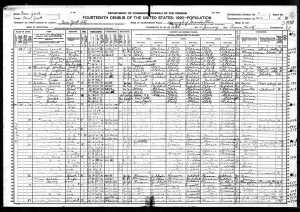
I would start (and did start) with ancestry.com.   You can get a short free trial subscription (14 days) just to see if you are intrigued. (And no, I don’t get a kickback from ancestry if you subscribe!) Ancestry provides digital copies of many documents including all US census reports up through the 1940  census (the later census reports are not yet available), except for the 1890 census which was destroyed in a fire. (That is particularly frustrating and sad for people researching ancestors who arrived in the 1880s.  We will likely never know where Joseph, Abraham and Max first settled, although it appears that all three arrived sometime between 1888 and 1890. )

Ancestry also has many other records available in digital form: some naturalization papers, some draft registration forms, some yearbooks, phone books, directories, and ship manifests.  Many records, however, are not directly accessible through ancestry.  For example, NYC birth, death and marriage certificates are not viewable through ancestry; you may find a record that indicates some of the information found on such certificates, but not the entire certificate.  For that, you have to order a digital copy or a photocopy elsewhere.

I have found the Family History Library to be a great resource for this.  The FHL is run by the Mormon Church in Salt Lake City; apparently the Mormons are trying to collect the names of anyone who ever lived as part of a religious mission to save everyone’s souls.  Fortunately, you don’t have to be a Mormon or support their mission in order to be able to use their services.  I guess the Church sees helping others find their relatives to be part of that overall mission.

At any rate, to request documents from the FHL, you need to find the NYC certificate number[1] and then the FHL film number.  Sometimes ancestry.com will have the certificate numbers, but usually I go to another website, http://www.germangenealogygroup.com/records-search/, to locate the certificate number.  It provides an index of NYC birth, death, and marriage certificates, but only for those years for which NYC has made them accessible to the general public.  For example, death certificates only run up to 1948; birth certificates are even more limited in terms of availability.  (I assume this is for privacy reasons, just as with the census reports.)  If, however, the certificate you are seeking falls within the date range, you can find the certificate number and dates through the germangenealogy website.

Once I have that information, I then go to another website, http://stevemorse.org/vital/filmnotes.html, where I can enter the information into the appropriate boxes, and then obtain FHL film number.  That website also includes a link to the FHL Photoduplication Request form.  By filling out that form with the numbers I now have, I can make a request to FHL for the certificates I am seeking.  There is a limit of five per month, and it can take several weeks to receive them, but it is free.  Amazing, it is free!

For other documents, for example, more recent death certificates and other documents like Social Security applications or immigration papers, the process can be more complicated, involving notarized documents, some fees, and much longer waits.  But starting with ancestry.com and using the FHL process can give you a good start on finding out more about your ancestors.  I found most of the documents that I have used in my research and reported here through those two sources and have only turned to the less efficient means of obtaining information more recently.

Of course, there have been lots of other sources of information: all of you who gave me clues and information, my mentor Renee and other experienced genealogists who helped me dig up clues, and many other websites like http://www.jewishgen.org/ and Findagrave.com.  There are still lots of other sources I have yet to explore, but those will require more time and more training before I can use them very effectively.


[1] This website only indexes NYC documents and some Nassau/Suffolk County documents.  For other locations in New York State and other states, you need to check the appropriate website for vital records for that county or state.

Jewish Naming Patterns

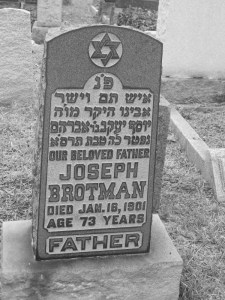
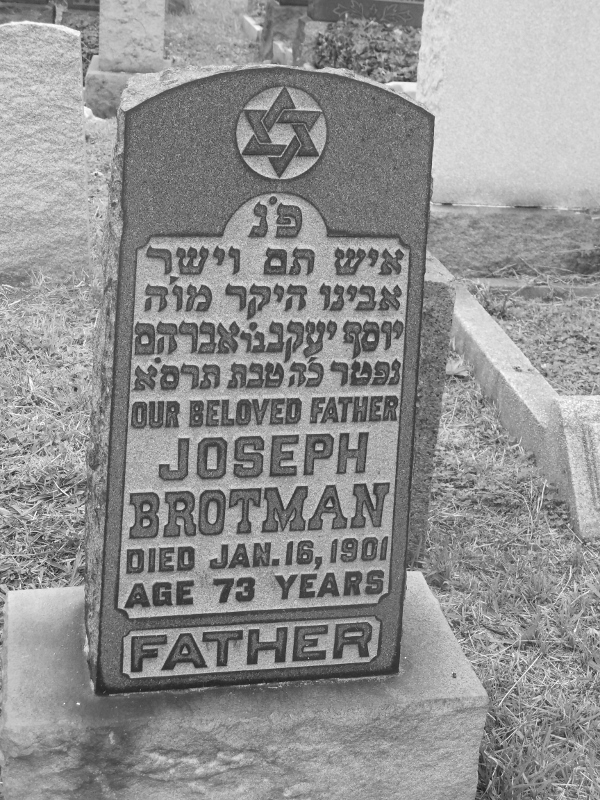
Most people know that in Jewish tradition, a child is often named after a relative who is no longer alive.[1]  It is also Jewish practice to identify a person in Hebrew with his or her father’s first name added to that person’s own first name.  For example, on his headstone Joseph’s name appears in Hebrew as Yosef Yakov ben Avraham, meaning that his father’s name was Abraham.  These naming patterns are a great help to genealogical research since often you can find names recurring through several generations, providing a means of establishing family relationships.

For example, we know that Bessie’s Hebrew name was Pessel and that her mother was named Gittel.  Bessie named her daughter Gussie for her own mother—in Hebrew, Gussie’s name was Hannah Gittel.  Then, in turn, I was named for Gussie’s mother, Bessie—in Hebrew, Pessel.  I then named my older daughter Rebecca Grace for my grandmother; her Hebrew name is Rivka Gittel.  So both Gittel and Pessel are names that recur through the generations and perhaps go back even further and perhaps will stretch further into the future.

Similarly, my brother Ira was named for our grandfather Isadore, whose Hebrew name was Ira.  Isadore’s father was Moritz/Moshe, and Isadore was named for Moshe’s father Ira.  Isadore in turn named his son Maurice for his father, and Maurice named his son James Ian and one of his daughters Robin Inez, the I being for Maurice’s father Isadore.  So the M’s and the I’s keep recurring in our family.  My younger daughter Madeline (Mazal Ahava) was named in part for my uncle Maurice (as well as for my husband’s uncle Murray), and there are several other M’s in the family among the fifth generation.

I am sure each of you can find similar recurring patterns in your own branches of the family.  There certainly are many B/P names and J names that run throughout our family tree.   Some of them undoubtedly are for Bessie/Pessel and Joseph or one of their descendants.

Why do I bring this up now? Well, after receiving Abraham’s death certificate and being bewildered by the fact that it records his parents’ names as Harry and Anna, I consulted with my mentor Renee.  She asked me several questions that reassured me that the death certificate is most likely incorrect.  First, she said look for naming patterns.  That reminded me that Abraham’s oldest son was named Joseph Jacob—Yosef Yakov on his headstone.Image  If Abraham’s father was named Harry, then why would he have named his son Joseph and not Harry? In fact, there are no Harrys or H names among Abraham’s children or grandchildren.

In addition, Renee pointed out that Abraham’s full name on his headstone is Avraham Zvi ben Yosef Yakov.  Zvi is a Hebrew name that means “deer” and in Yiddish was usually translated into Hersh or some Americanized version: Harry, Herbert, or (as in the case of my husband) Harvey.  Renee also pointed out that Abraham’s American name was Abraham H. Brotman.  She said it was extremely unlikely that his father’s name would have been Harry or Hersh/Zvi also (unless, of course, his father had died before Abraham was born, which does not seem likely).  By looking at the naming patterns, I am now convinced that it is unlikely that Abraham’s father’s name was Harry and that the death certificate is not correct and the headstone is.  Perhaps the Zvi/H in his name was for his maternal grandfather. Maybe that’s how it ended up on his death certificate.

So, cousins, do you know who you were named for? Do you know what your Hebrew name is? What your parents’ Hebrew names are? It would be really helpful and interesting to me and perhaps to others to know this information as it may open other doors for more research.  If you are willing to share that information, please let me know by using the comment box below so that we can all share this information.  Thank you!


[1][1] At least that has been the tradition among Ashkenazi East European Jews.  German Jews apparently did not always adhere to this tradition.  For example, my father’s name is the same as his father, John Nusbaum Cohen, and until he was an adult, he used “junior” after his name.  Moreoever, his sister’s name was the same as their mother—Eva.

Max Brotman: Who was his mother?

Yesterday I received Max Brotman’s death certificate from the City of Mount Vernon.  It has been quite a task tracking down this document.  Although I knew from Judy and the picture of his headstone that he had died in 1946, I could not find any record of his death certificate.  There is a public index of NYC death certificates that runs through 1948, so if he had died in 1946, it should have been there.  But it wasn’t.  Death certificates dated after 1948 from NYC are much harder to obtain; to get Abraham’s I had to use snail mail (!) and a notarized form and fee and self-addressed envelope sent to the NYC Department of Vital Records.  I was hoping that I could just obtain Max’s electronically through the Family History Library, which is faster, easier and free.  Unfortunately, the FHL does not have non-NYC certificates, and I could not find Max in the NYC register.

I was fortunate to find a volunteer in NYC who checked the paper records and found a reference indicating that Max, a NYC resident, had died “upstate.”   But where upstate?  It’s a big state! I recalled that Max had had a summer home in Congers, NY, and since he died in late May, I thought that perhaps he had died while up there. Image I contacted the town registrar in Congers, sent them a written request, check, and envelope, but they sent it back, saying that they had no record for Max Brotman.

So I was stumped.  I asked Renee, my mentor, for advice, and she suggested calling the cemetery where he was buried to see if they had a record for where he had died.  I called Beth David Cemetery on Long Island, and sure enough, they did have such a record and were willing to divulge where he died without a written letter, check and envelope.  They said he had died in Mount Vernon, New York, not far from where I grew up.

I asked Judy if she had any idea what he might have been doing in Mount Vernon at the time of his death.  She didn’t know.  I wrote to Mount Vernon (yes, a notarized letter, check and envelope), and finally received the long-sought-after document yesterday.Image

So what does it say? Well, it explains what he was doing in Mount Vernon.  He was a patient at the Mount Vernon Convalescent Home, where he was suffering from liver cancer.  It looks like he was there for three weeks, as the doctor who signed the certificate had cared for him from May 6 through May 27 when he died.

What else does it report? It lists Joseph Brotman as his father (phew!), but Adda Browman as his mother.  That conflicted with his marriage certificate which said his mother’s name was Chaye. Image And Browman? Is that just a misspelling of Brotman? Or was her maiden name really Browman? I consulted with Renee, and she said that Chaye was often Americanized to Ida, which is close to Adda.  (She said immigrants tended to Americanize even the names of ancestors who never left Europe.)  So maybe Adda is Chaye? Or maybe Richard Jones, who was Max’s son-in-law and the informant on the certificate, misunderstood or was misunderstood.  I don’t know and probably won’t know until I can learn how to research records from Europe.

The good news is that it’s just one more bit of evidence confirming that Max was Joseph’s son.  The bad news is that the document brings us no closer to knowing the town in Galicia from which they all came.

Max Brotman: When was he born?

Here’s another example of the inconsistency of records when it comes to birthdays.  On the 1900 US Census, Max gave his birthday as April, 1878.[1]  [Edited: On his naturalization application in 1900, he listed his birthdate as April 1877.] On the 1910 Census, he reported being thirty years old, meaning he was born around 1880.  On his draft registration in 1918, he gave his birthday as July 7, 1878.  On the 1920 Census, he said he was 45, making his birth year 1875.  In 1930, he said he was 50, meaning he was born in 1880.  In 1940, he claimed to be 60, again meaning he was born in 1880.  On his draft registration in 1942, he put his birthday as March 26, 1880. [2]

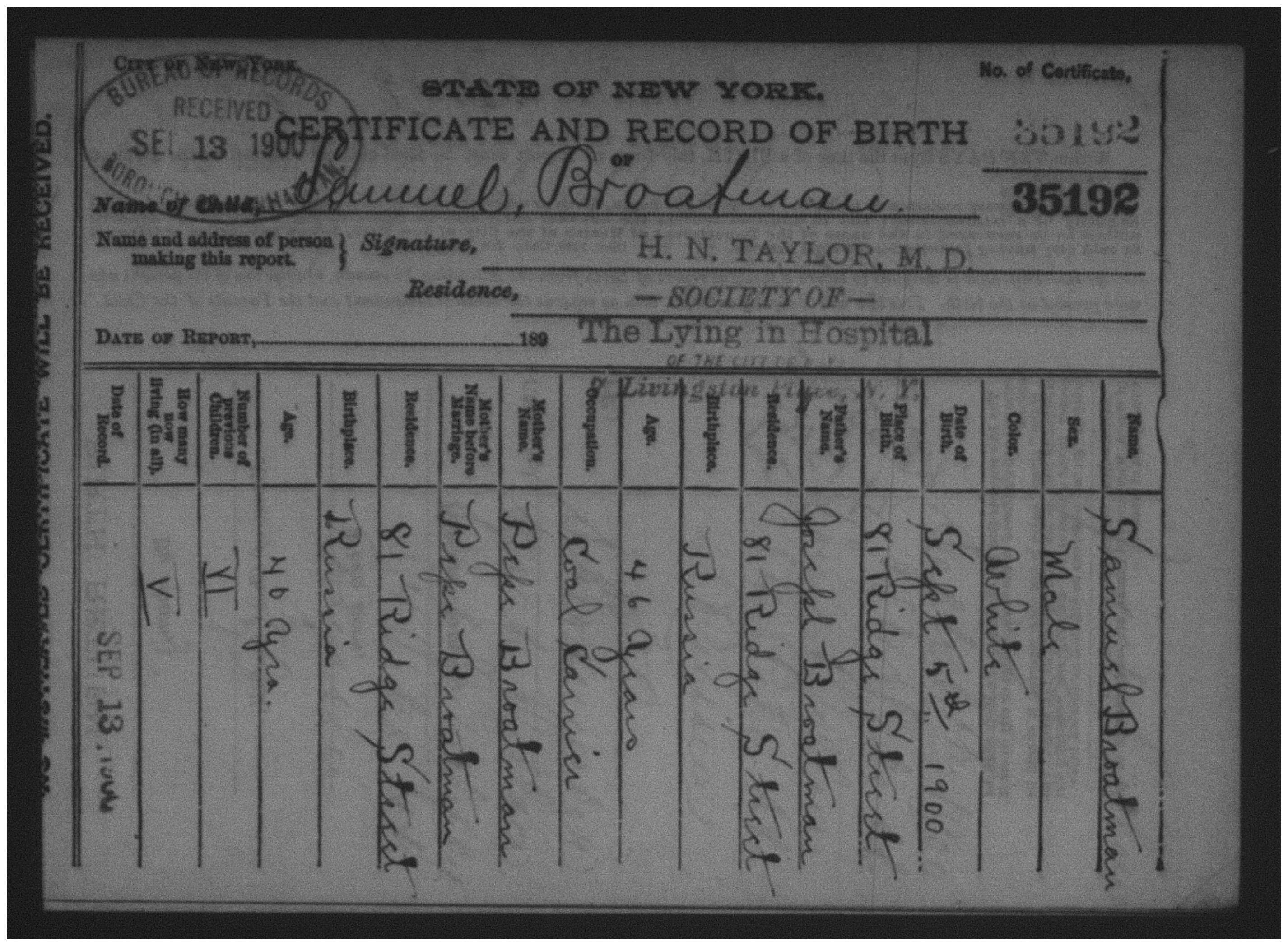
Today I received his death certificate.[3]  It has his birthdate as July 27, 1882!  He just kept getting younger (like we all wish we could, I suppose).  Since Hyman was born in either 1882 or 1883 and had a different mother than Max, it seems unlikely that Max was born in 1882.  I am going to assume that the earliest documents are more reliable (when he had less incentive to make himself younger) so that 1878 is the mostly likely year of birth.  As to the month? Who knows? Could be March, April, or July.  As I said in an earlier post, birthdays were not a big deal to Jews in Europe, so maybe he never knew the month, but wouldn’t people know what year they were born? We know Joseph’s age is equally mysterious—he could have been born any time between 1825 and 1855, depending on which document you read.  And Hyman also had two different birth years on his records.

The other inconsistency in these records is the year of immigration for Max.  The 1900 Census says he came in 1888; the 1910 and 1920 say it was 1890.  Finally, the 1930 Census says it was 1893.  I have applied for a copy of his naturalization records (which take 90 days to process, so it will be at least another two months before I get it), so perhaps those will be more accurate. [Edited: The naturalization application said 1882, when Max was at most five years old.]

Sometimes I wonder whether there was a certain level of paranoia among immigrants—people who had faced such hostility and oppression at the hand of the governments of the countries where they were born.  Maybe they just didn’t want to give the US government too much personal information.   Or maybe census takers just weren’t very careful note takers or very good listeners. Or maybe our relatives just liked to lie about their ages.


[1] All the documents are consistent with respect to his place of birth being Austria, though none specifies the town or city. [Edited: The naturalization application said Germany.]

[2] These documents are available on ancestry.com.  If anyone is interested, I can download them and post them on the blog.

[3] More on his death certificate tomorrow.  I want to scan it and won’t get a chance tonight.

Family Trees: Blog Tip

It seems that some people are having trouble locating the family trees on the blog.  If you click [1]on the words “Joseph’s Descendants: Family Trees” near the top of the page (under the blog title), a page will open that has a list of family trees. There is one for Joseph, which goes only to the third generation (Joseph’s grandchildren).  Then there are separate trees for each of Joseph’s children, following through a few more generations.  The trees are all quite large, so you will need to zoom in to read the names, but then you can move around that page to see the various relationships.  You can also save the trees to your own computer.  They are in PDF format.

Hope that helps.


[1] If you just let your mouse hover over those words, a dropdown menu displays the names of Joseph’s seven children.  If you click on one of those names, it will open that person’s page.  You need to click on “Joseph’s Descendants: Family Trees” to open the family tree page.

Another day, another death certificate, and more confusion

Sometimes I wonder why we have death certificates.  Just about every single one I have seen has raised more questions than it has provided answers.  I’ve been told by an expert genealogist that death certificates are notoriously unreliable because usually the person providing the information is a close relative still in shock and mourning the death of a loved one.  No wonder Hyman’s said he was born in Philadelphia and Bessie’s said her mother’s name was Bessie.  And so on.

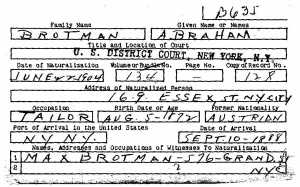
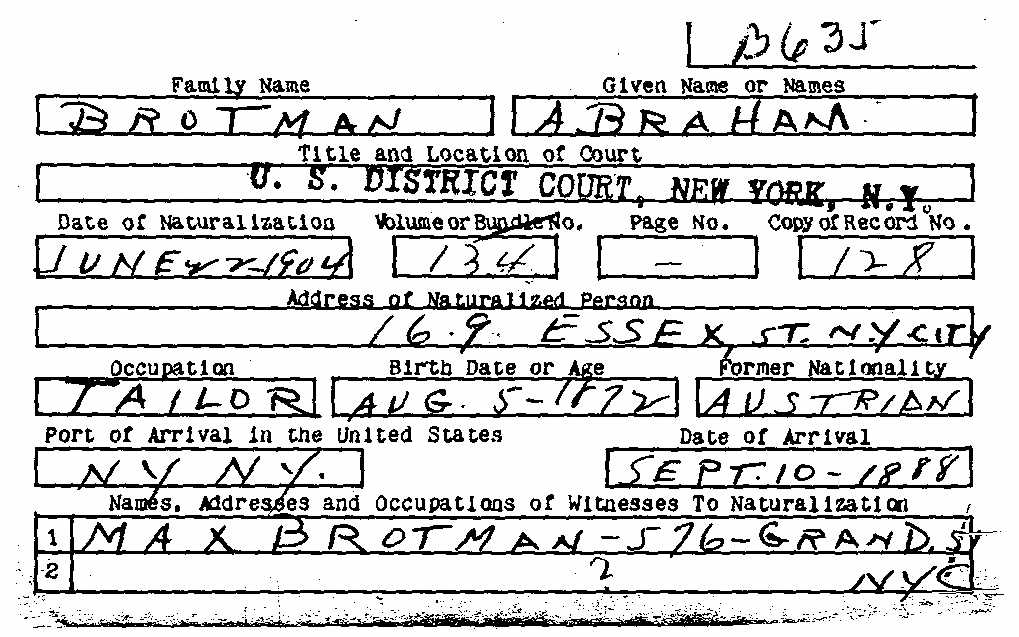
All that leads me to today’s mysterious death certificate, that of Abraham Brotman of Brooklyn.  You may recall that Abraham’s headstone revealed that his Hebrew name was Abraham ben Yosef Yaakov, just as Joseph’s revealed that his was Yosef Yaakov ben Abraham, providing me with the additional clues that helped me conclude that Abraham was Joseph’s son and Max’s brother.Image

(You may also recall that Max was the witness on Abraham’s naturalization application.)

Naturalization of Abraham Brotman Max as Witness

Naturalization of Abraham Brotman
Max as Witness

I had ordered Abraham’s death certificate in order to obtain more confirmation of those relationships as well as to get some information about the place where they were all from in Galicia.

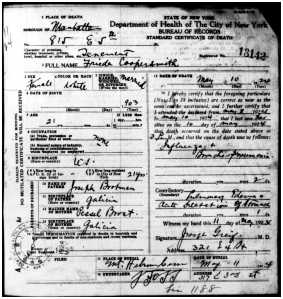
Unfortunately, Abraham’s death certificate confirmed nothing and just added to the confusion.  His birth place is listed as Russia, despite the fact that every census report and his naturalization papers list his birth place as Austria.  His parents’ names are listed as Harry and Anna.

Image

I emailed Abraham’s grandchildren, Paula Newman and Morty Grossman (whose mother Ethel provided the information on the certificate), but neither of them knows anything about Abraham’s parents.  So now what? Do I assume that it’s just another mistake on the death certificate? Is it more likely that the headstone is right than the death certificate? Since the place of birth is wrong, why should I trust any of the information on the death certificate? Perhaps Ethel Grossman was thinking of her mother’s parents, not her father’s parents?   Abraham’s wife Bessie Brotman was born in Russia, so maybe her parents were Harry and Anna? Grrrr…now I am ordering another death certificate to see who HER parents were.  But why would I trust that one either?

Very frustrating! So no new information and just more confusion.

I can’t wait to see what misinformation Max’s death certificate provides.  That should be arriving in a day or so.

Rosalind Haber and Dan Dombey’s wedding photos

Thanks to Naomi, we have some new pictures to add to the blog.  I will also post these to Max’s page, but thought I’d also post them this way so that everyone sees them.  I already posted about the photo of the groomsmen including Sam Brotman, but here are several more.

First, the bride and groom, Rosalind and Dan. Notice the two young people in the background to the left—that’s cousins Tom Jones, son of Rosalie and Dick Jones, and Judy Haber Ruzicka, daughter of Renee and Charles and the bride’s sister.

Image

Here are the bride’s parents, Renee Brotman Haber and Charles Haber.

Image

And here are the bride’s aunt and uncle, Rosalie Brotman Jones and Dick Jones.Image

Finally, here’s one of the Haber family, including Renee, Charles, Susan and Judy, and the Dombey family.

Image

I tried to look at the faces in the background of these pictures to see if any other Brotman family members are shown, but no one besides those mentioned looked familiar to me.  Do any of you recognize any of those faces?

Link

A great story by Calvin Trillin about name confusion in his own family.

I guess I am not the only one visiting cemeteries, translating headstones, and enjoying the search for answers to family questions.