From A to Z: Adventures in Chile

Once again I found myself taking quite a rollercoaster ride in my genealogy research-this one involving one of the children of Pauline Ruelf and Hirsch Abraham.

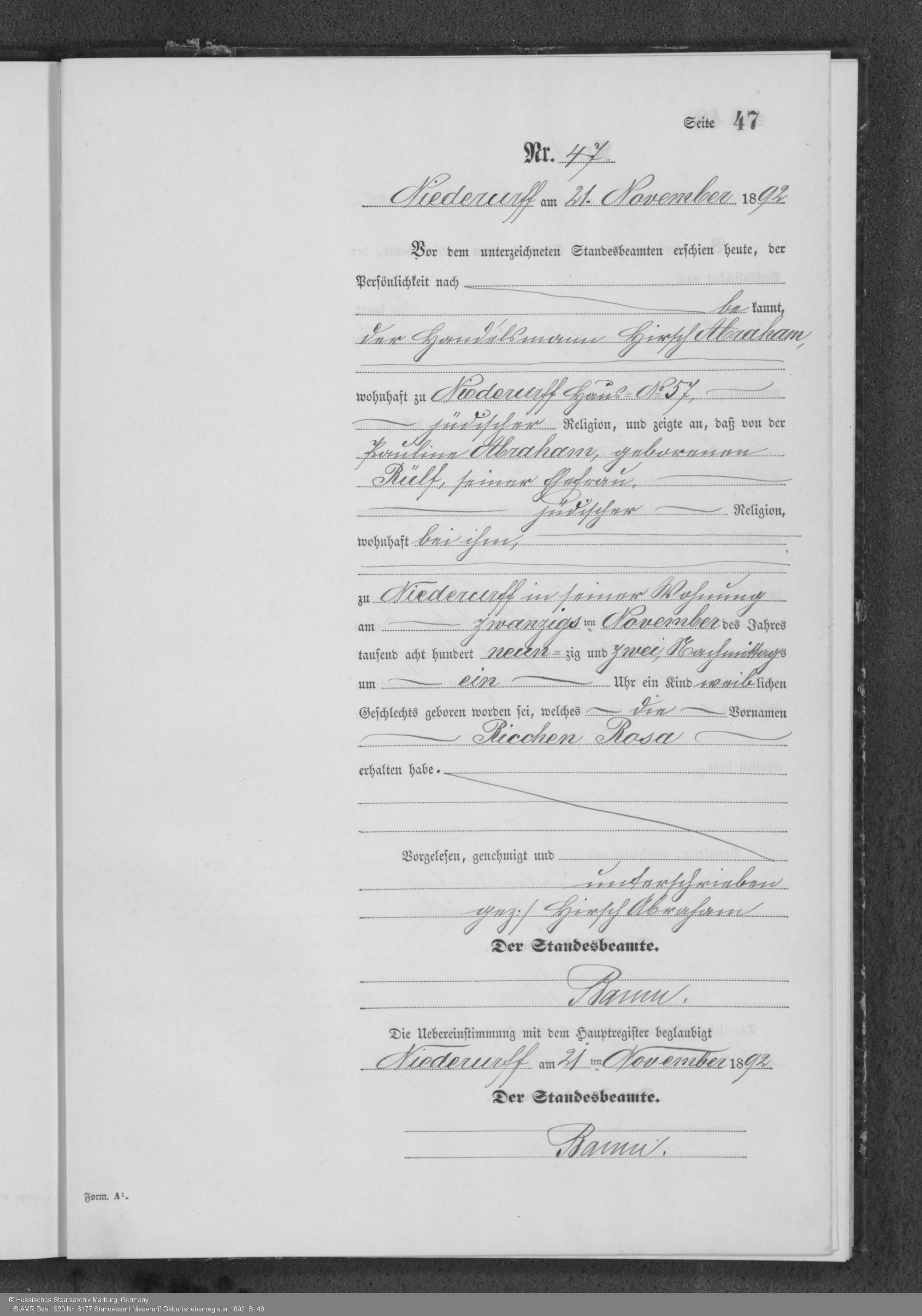
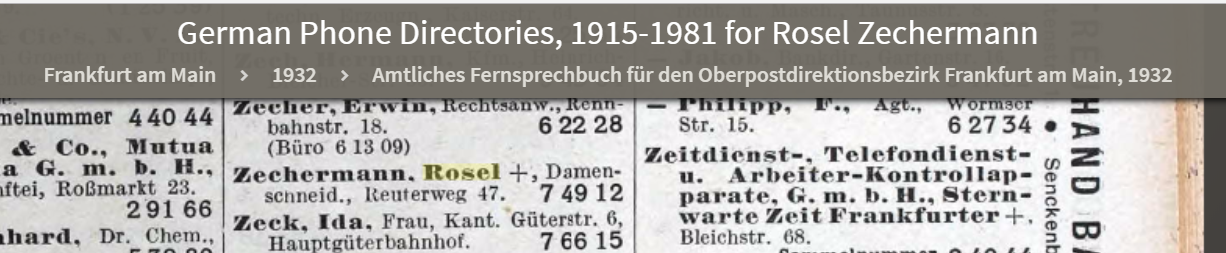
As I wrote in this post, I had very little information about their oldest daughter, Rosa.  All I knew about her was her birth date and place (November 20, 1892 in Niederurff); the only other document I had was a passenger card from a 1961 flight from Santiago, Chile, to Miami, Florida. The birth date and place matched what I knew about Rosa, and the card listed her as Rosa A. Zechermann, so the middle initial could have referred to Abraham. But that wasn’t enough to know for sure whether this Rosa was in fact Rosa Abraham, even though the circumstantial evidence made it seem very likely.

Rosa Abraham passenger card
The National Archives at Washington, D.C.; Washington, D.C.; Series Title: Passenger and Crew Manifests of Airplanes Arriving at Miami, Florida.; NAI Number: 2788541; Record Group Title: Records of the Immigration and Naturalization Service, 1787 – 2004; Record Group Number: 85

And who was Mr. Zechermann? And why were they in Chile? Rosa’s nephew Martin remembered that one of his father’s sisters had ended up in Chile, but that was all he remembered. He didn’t remember a husband named Zechermann or anything else. But his memory and the passenger card led me to believe that I had to search for Zechermanns in Santiago, Chile.

Unfortunately, there are no documents on Ancestry.com for Chile after 1920, and although FamilySearch does have some cemetery records up through 2015 for Chile, there were no Zechermanns listed in that database. I wasn’t able to find any other websites or databases that might help.

I turned to Facebook and specifically to the Jekkes group on Facebook. Jekke (pronounced Yekkie) is a term used to refer to German Jews or more broadly, German-speaking Jews. I thought that this group might know about Jews of German background who had settled in South America, so I asked for help at 8 am one morning. First, a woman named Hanna responded within a half hour of my post and mentioned that she had known a woman named Ilse Dahlberg who had immigrated from Frankfurt to Chile. She didn’t know if Ilse was still alive, but thought she might be worth contacting.

When I googled Ilse Dahlberg, a Geni result came up for an Ilse Dahlberg whose birth name was Zechermann! I didn’t know whether Hanna had mentioned her for that reason or whether it was just a coincidence, but obviously Zechermann is not a common name so I thought it possible if not likely that  Ilse Dahlberg was somehow related to Rosa A. Zechermann.

Geni listed Ilse with a brother named Erich Zechermann and a father named Isidor Zechermann, but Ilse’s mother’s name was Amalia Zechermann, born Dahlberg, and not Rosa Abraham. (Ilse married one of her mother’s relatives, Nathan Dahlberg, thus ended up with a married name that was the same as her mother’s birth name. Just to confuse genealogists, I am sure.)

I found an immigration card for Erich that confirmed that his mother was also Amalia Dahlberg:

Erich Zechermann, Brazil immigration card
Ancestry.com. Rio de Janeiro, Brazil, Immigration Cards, 1900-1965 [database on-line]. Lehi, UT, USA: Ancestry.com Operations, Inc., 2016.
Original data: “Rio de Janeiro Brazil, Immigration Cards, 1900-1965”. FamilySearch, Salt Lake City, Utah, 2013.

And I found the record of Isidor Zechermann’s marriage to Mali Dahlberg in Worms in 1905:

Marriage of Isidor Zechermann to first wife

Marriage of Isidor Zechermann to Amalie Dahlberg Ancestry.com. Worms, Germany, Marriages, 1876-1923 [database on-line]. Provo, UT, USA: Ancestry.com Operations, Inc., 2015. Original data: Personenstandsregister Eheregister, 1876-1923. Stadtarchiv Worms.

So how did Rosa fit into this picture? Had she married Isidor’s brother or some other Zechermann who also ended up in Chile?

Then I found a record of Mali Dahlberg Zechermann’s death in Frankfurt on August 23, 1924:

Amalia Dahlberg death record
Hessisches Hauptstaatsarchiv; Wiesbaden, Deutschland; Personenstandsregister Sterberegister; Bestand: 903; Signatur: 903_10891

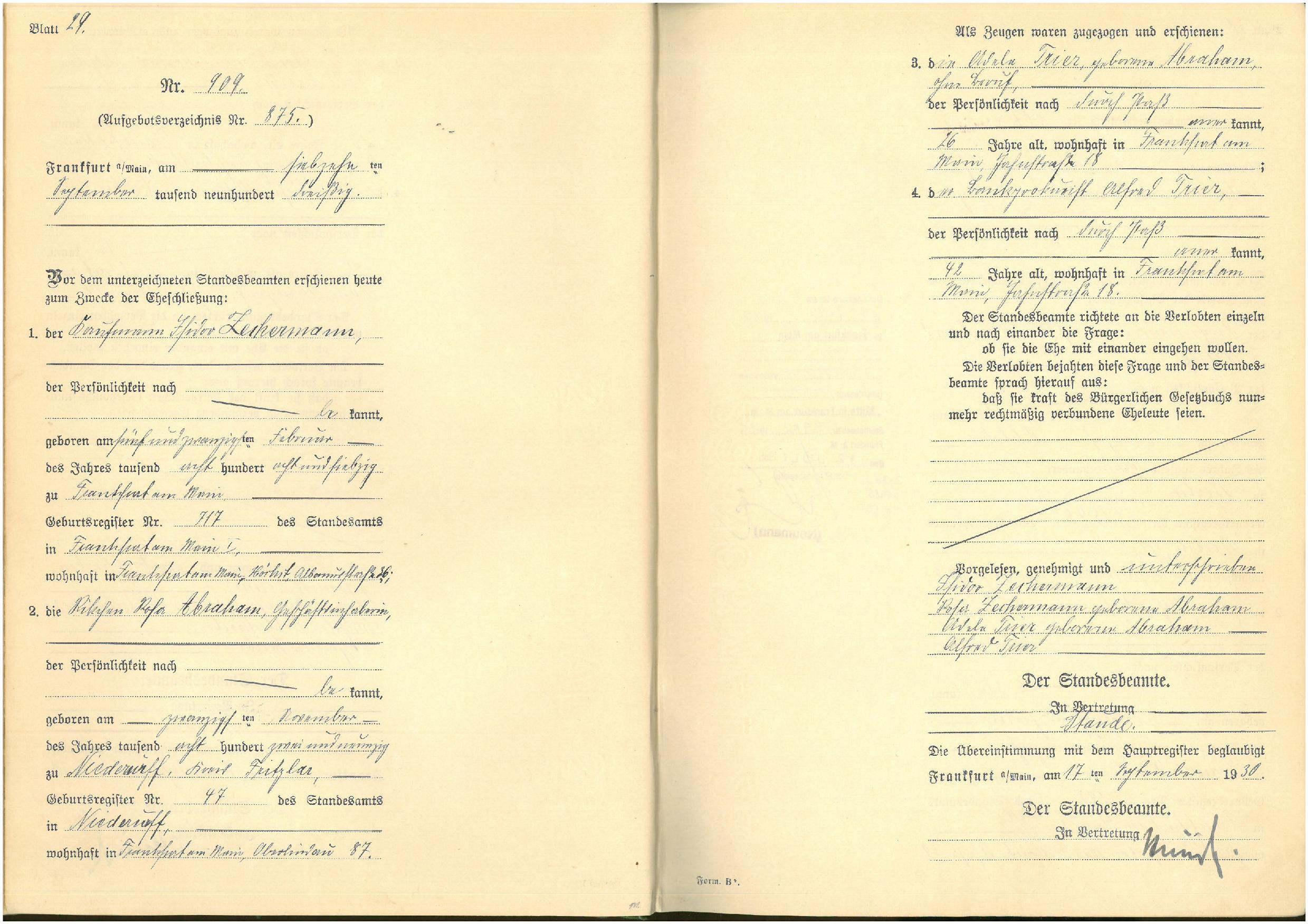
Thus, Isidor was a widower as of August 1924 and might have married Rosa Abraham sometime thereafter. But I could find no record of a second marriage for Isidor or any marriage for Rosa.

The first document I located that possibly linked Isidor Zechermann to Rosa Abraham was this passenger manifest listing Isidor and Rosa Zechermann traveling together in April 1952 on a flight from Buenos Aires, Argentina, to New York:

Isidor and Rosa Zechermann, 1952 passenger manifest
Year: 1952; Arrival: Idlewild Airport, Idlewild, New York; Microfilm Serial: T715, 1897-1957; Microfilm Roll: Roll 8139; Line: 1; Page Number: 164
Ancestry.com. New York, Passenger Lists, 1820-1957

It listed their destination address as 41-15 50th Avenue, Long Island, New York. That address did not mean anything to me, and Google identified it as an apartment building in Queens, New York.

The manifest listed Isidor’s occupation as a “rentista,” which translated to a person of independent means or a stockholder or financial expert. Rosa also had an occupation listed—“bussinesm,” which didn’t translate to anything, but I assume meant she was in business. But there was no birth name given for Rosa to link her to Rosa Abraham.

I also searched for descendants of Isidor Zechermann, hoping that one of them might be able to help. Eric Zechermann had eventually immigrated to the United States, and I was able to find the names of his children and grandchildren. One of them was on Facebook, a woman named Deborah, and I left a private message explaining who I was and asking her to get in touch.

And then I sat back and waited.

No, not really.  I kept desperately trying to figure out where to turn next.

Around 3 in the afternoon of that same day, I received a Facebook notification that a man named Simon had commented on my post in the Jekkes group. Simon lives in Santiago, and his first comment was to tell me that “most of the German Jews know and knew each other in Chile.”

And he then blew me away by telling me that not only had he known Ilse Zechermann Dahlberg, but that he remembered and knew Rosa as well and remembered her sitting in synagogue with Ilse. But Simon did not know Rosa’s birth name or what had happened to either Isidor or Rosa.  He did not believe that Isidor and Rosa had children of their own and called his mother to check.  She agreed that Rosa and Isidor did not have children, but she also did not know what had happened to Isidor and Rosa, nor did she know Rosa’s birth name. Simon gave me several suggestions for websites and people to contact in Santiago, and I followed up with his suggestions.

Later that same afternoon I also heard back from Deborah, Isidor’s great-granddaughter.  She was excited about my work and interested in what I had learned, but unfortunately she didn’t know anything about Rosa.

So that’s where I was on Rosa. I knew that there was a Rosa A. Zechermann whose birthdate and place matched those of Rosa Abraham and a Rosa Zechermann who had traveled to New York with Isidor in 1952. I was 90% certain that this had to be my cousin, the daughter of Pauline Ruehl and Hirsch Abraham. But there was that nagging 10% of doubt.

I contacted Fred and Martin Abrahams, Rosa’s nephews, to report on what I’d found and to see if I could stir up any other stories or memories. Fred had no memory of an aunt named Rosa; he wrote that he only remembered three of his father’s sisters—Meta and Recha and Adele.

Adele, I said? I hadn’t found a sibling named Adele in researching the Abraham family. I had written a long blog post about the Abraham siblings, and neither Fred nor Martin had previously mentioned an aunt named Adele despite having had several communications back and forth among us.

Fred wrote that Adele’s married name was Trier and that she had lived in Queens.  So back to Ancestry I went to look for this missing sibling, Adele Abraham Trier. And it wasn’t hard to find her. She had arrived in the US on on October 10, 1936, with her husband Alfred Trier. I knew this was the right person because her birth place was Niederurff, and they were going to Meta Abraham and Recha Abraham, the sisters of Adele Abraham.

Alfred and Adele Trier 1936 passenger manifest
Year: 1936; Arrival: New York, New York; Microfilm Serial: T715, 1897-1957; Microfilm Roll: Roll 5890; Line: 1; Page Number: 120
Ancestry.com. New York, Passenger Lists, 1820-195

Other US documents revealed that Adele was born on December 21, 1903; now I knew why I hadn’t found her before. The Hesse records on Ancestry stop in 1901, and there are no birth records on the LAGIS website for Niederurff for 1903 either. If Fred hadn’t mentioned Adele, I’d never have known there was another sibling.

In 1940, Adele and Alfred Trier were living in the apartment next to Adele’s sisters Meta and Recha. I’d seen this census before, of course, but had not had any reason to see the connection between the two households.

Alfred, Adele and Paul Trier on 1940 census
Year: 1940; Census Place: New York, New York, New York; Roll: T627_2643; Page: 1B; Enumeration District: 31-809

The next records I found for Adele and Alfred related to their deaths—entries in the Social Security Death Index and on FindAGrave. Both lived long lives. Adele died in March 1993 at age 89, Alfred in 1996 at age 108! Alfred died in New Jersey, but Adele had died in Queens. They are buried at Mt. Zion cemetery in Queens.

And then I recalled that Rosa and Isidor had listed a Queens address on the 1952 manifest. I decided to see if I could find Alfred or Adele in any directories or databases for Queens. And I found this:

City: Long Is City; State: New York; Year(s): 1993 1994
Source Information
Ancestry.com. U.S. Phone and Address Directories, 1993-2002 [database on-line]. Provo, UT, USA: Ancestry.com Operations Inc, 2005.
Original data: 1993-2002 White Pages. Little Rock, AR, USA: Acxiom Corporation.

Adele Abraham and Alfred Trier had lived at 41-15 50th Avenue in Long Island, New York—-the very address that Rosa and Isidor Zechermann had listed as their destination in 1952. I was now 99% sure that Rosa Zechermann was the sister of Adele Abraham Trier as well as Meta, Recha, and Julius Abraham and that she was the aunt of Fred and Martin Abrahams. And thus she was my third cousin, once removed.

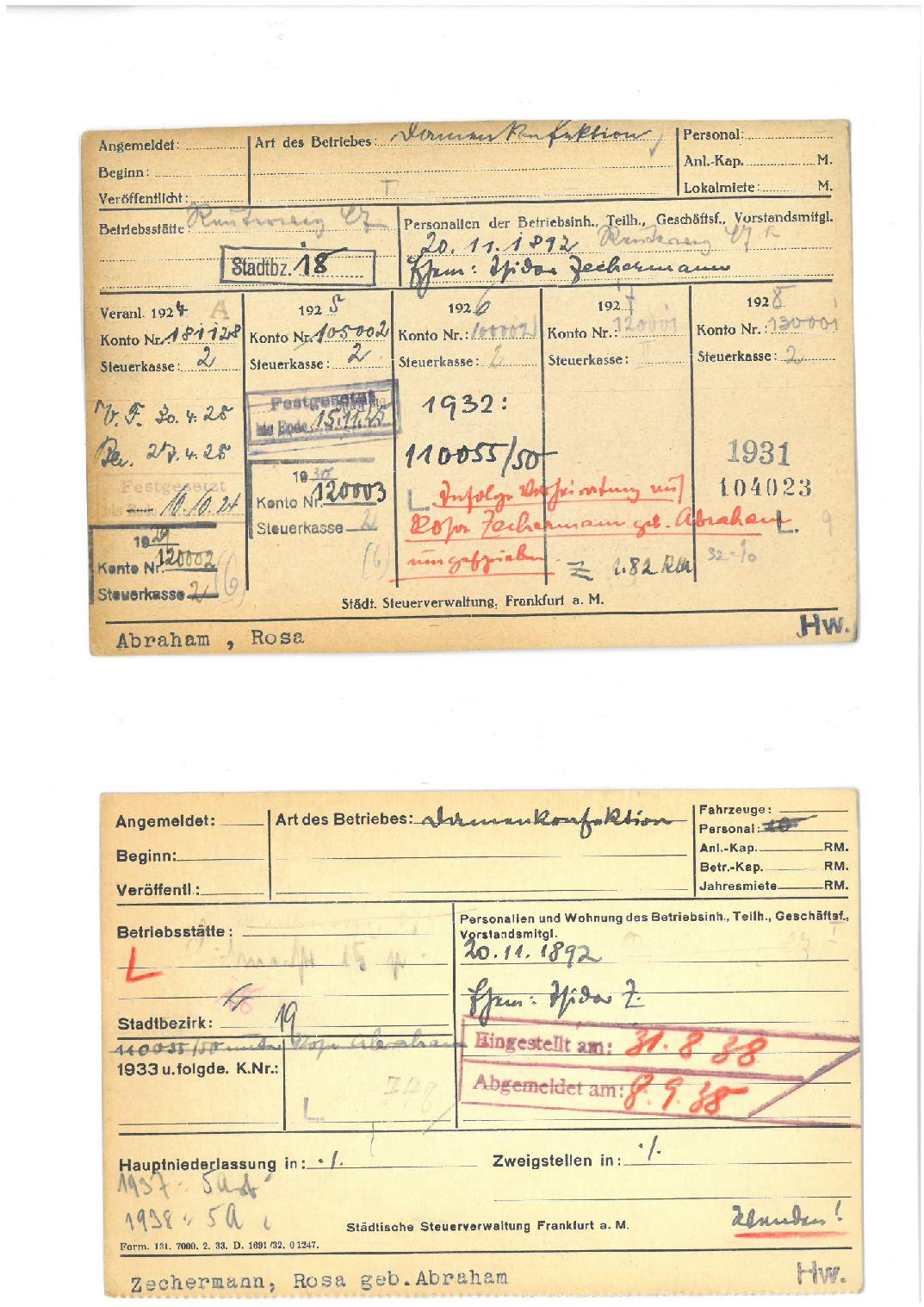
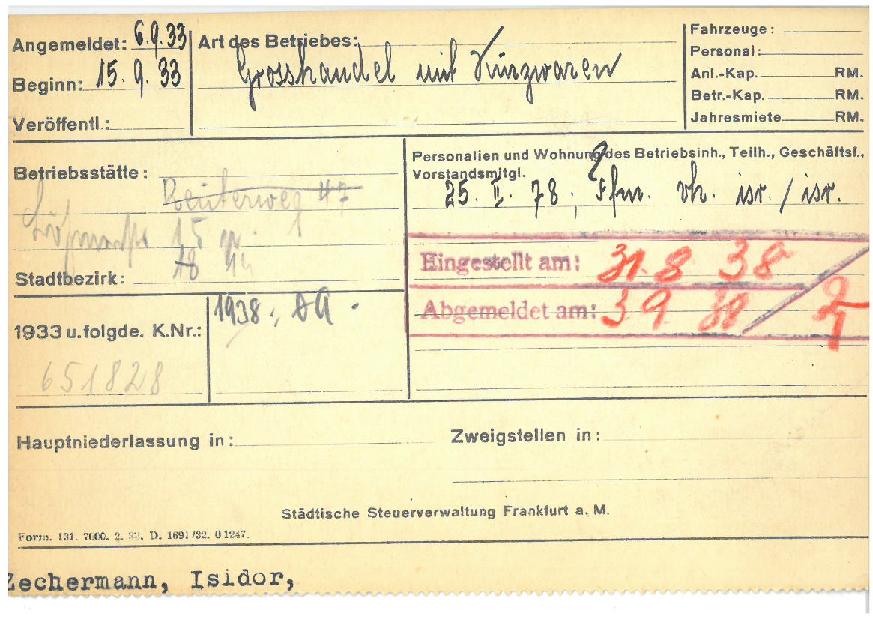
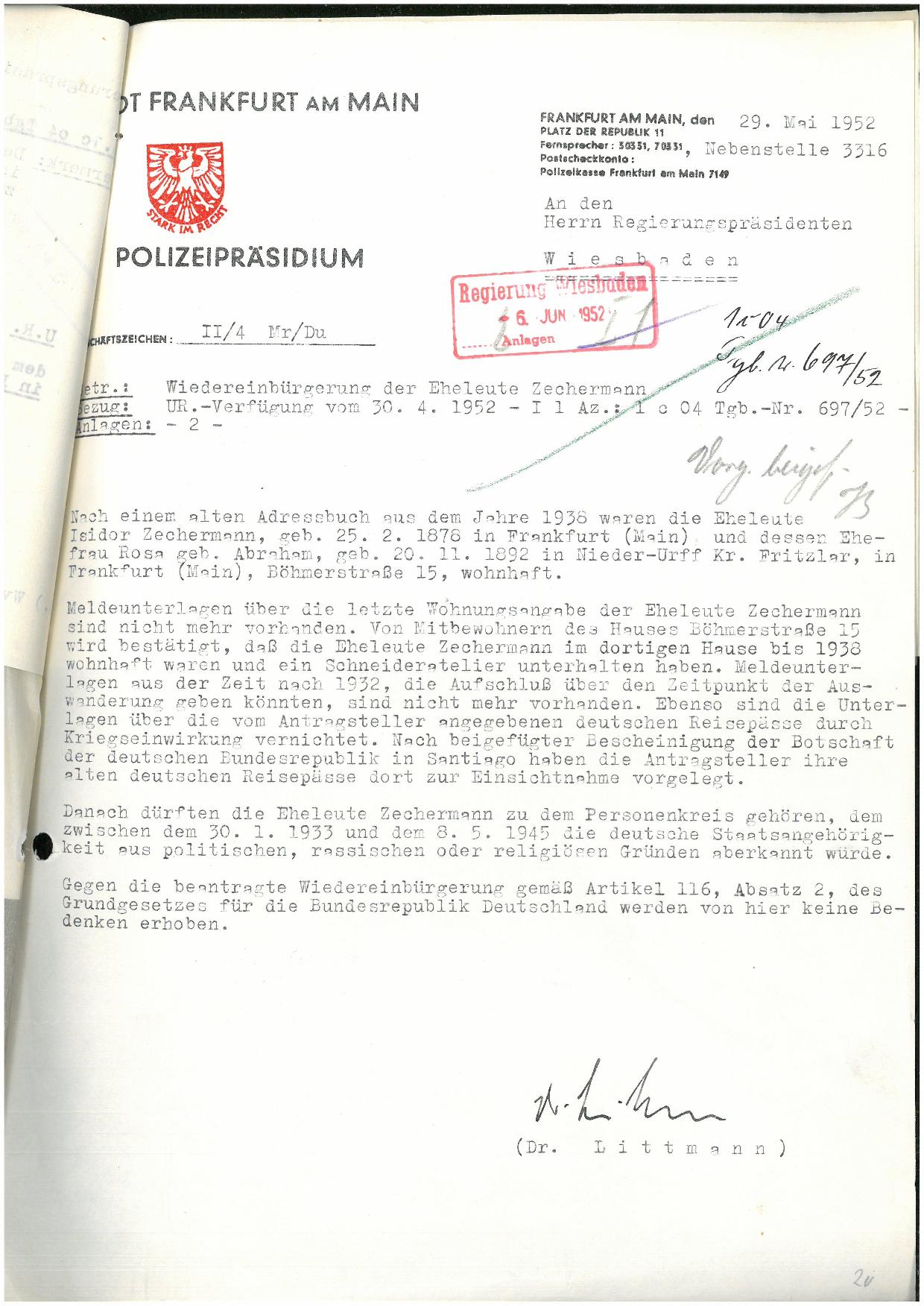
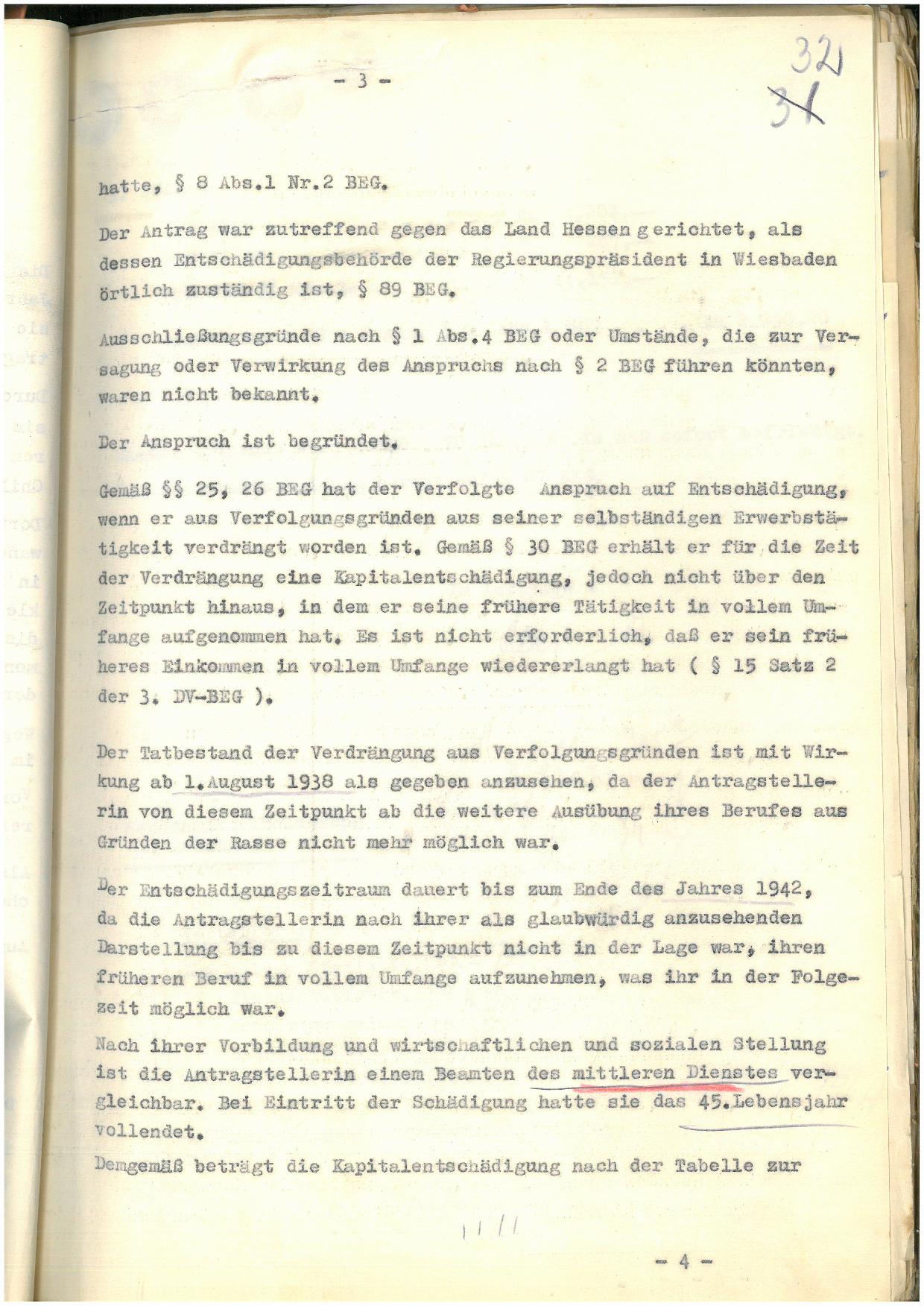
The final piece of the puzzle came from a tip from a researcher in Germany named Kari, whom Fred Abrahams had recommended. She found two files in the Arcinsys website for Hesse, one for Isidor Zechermann and one for Rosa Zechermann geb Abraham. Although the files themselves are not accessible online, the descriptions of the files made it clear that this was my cousin Rosa and that she was married to Isidor Zechermann:

The birth date and place matched, her birth name was Abraham, and she was married to a Zechermann.  And I learned that Rosa was a “modistin,” a milliner.

I contacted someone at the archives to see what was in the file. The archives responded that there were four files in the Hesse archives relating to Isidor and Rosa Zechermann, including two lengthy files relating to their claims for compensation and one nine page file that included their naturalization application.

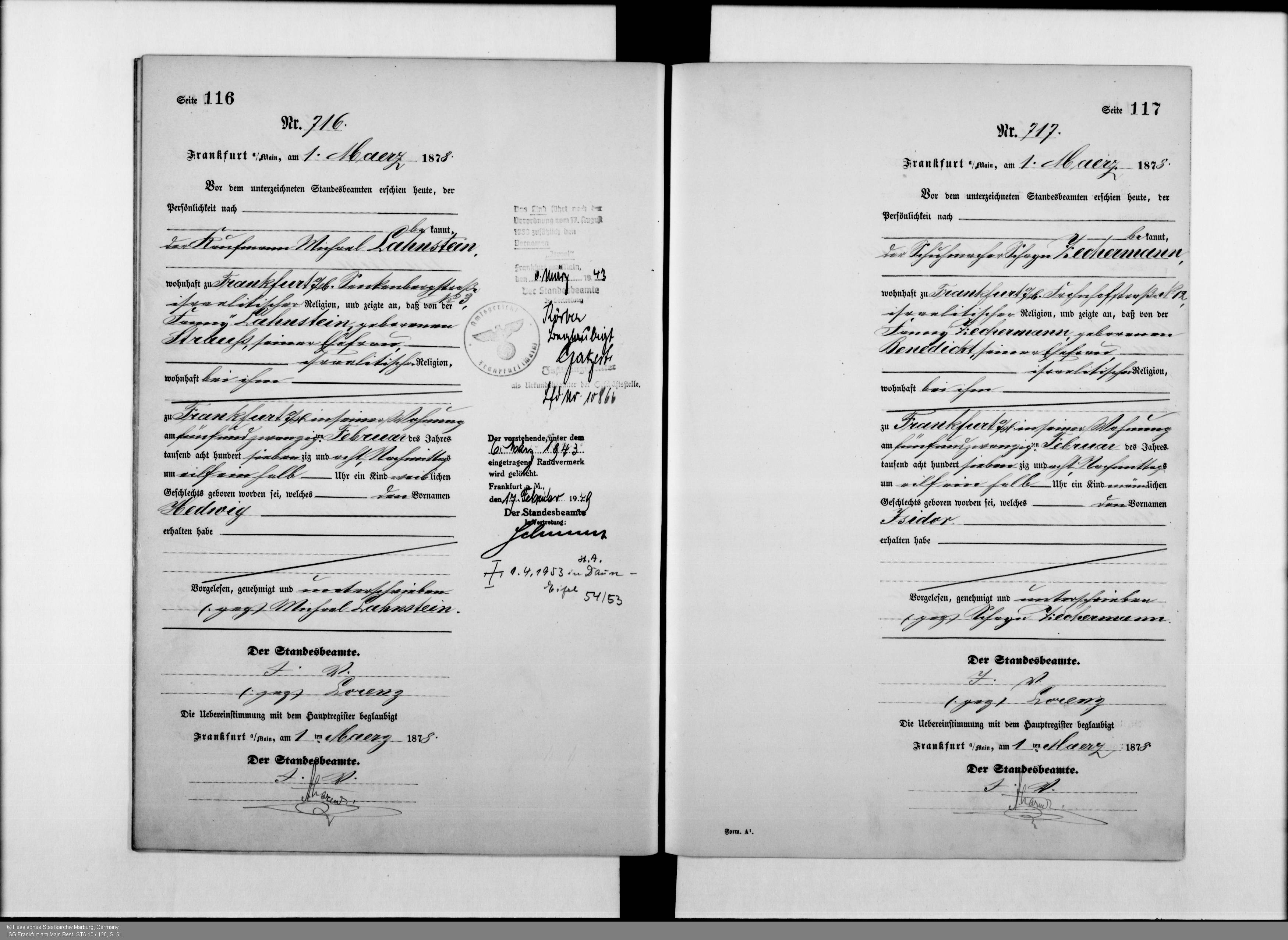
I have requested the naturalization papers (the other two files would be very costly to obtain), but from just the label on the file, I now have confirmation that Isidor Zechermann (born February 25, 1878) was married to my cousin Rosa Abraham (born November 20, 1892).

My search for Rosa Abraham Zechermann was over. It had truly been a search from A (Abraham) to Z (Zechermann).


Book, Book, & Book – Plus a Wee Glimpse of a Tale of Using Indirect Evidence

Thanks so much to Amberly, The Genealogy Girl, for her generous words about my book Pacific Street at the end of this lovely post about books. If you aren’t following Amberly’s blog, check it out. It’s wonderful.

thegenealogygirl's avatarthe genealogy girl

IMG_8814

I have loved books for as long as I can remember.  I probably even loved them before that.  When I was a teenager there was a certain book I checked out from the library several times.  I loved it so much that I asked my mom if I could say that I “lost it” and pay the lost book fee so I could keep it.  I was only joking.  Mostly.  You see, it was out of print and I really wanted my own copy.

That is definitely not the only time I have longed for an out of print book.

A few years ago I solved a long-standing brick wall using indirect evidence.  It was a lot of work.  I was nervous to call my conclusion solid.  The whole concept of indirect evidence was new to me.  I didn’t even know that phrase until well after I had drawn my conclusions.

View original post 668 more words

The Search for Jakob David: A New Story Discovered

Before I move on to the remaining children of Jakob Katzenstein and Sarchen Lion, I want to tie up some loose ends from the stories of other descendants.

There was a loose end in the story of Rebekka Ruelf, and in trying to tie up that loose end, I learned a great deal more about Rebekka’s son Hugo David. He was a brave and adventurous man.

As I wrote in my earlier post, Jakob David married my distant cousin Rebekka Ruelf, daughter of Gelle Katzenstein, my great-grandmother’s first cousin. Jakob and Rebekka had one child who survived to adulthood, Hugo. The David family lived in Moringen, Germany, where they owned a textile business. Hugo married Berta Loeber of Alten-Buseck, Germany, and they had a daughter named Margot.

From my research, I knew that Rebekka had died in Moringen in 1929 and that at some point in the 1930s the family had left Moringen for Abbazia, Italy, and then for the United States, where they had settled in Rhode Island in 1940.

What I did not know was the fate of Jakob David. There was no death record for him in Moringen, but also no immigration record for him. Had he died elsewhere in Germany? Where was he buried? I hate loose ends, and although Jakob was only my relative through his marriage to Rebekka Ruelf, I wanted to know what had happened to him.

Although I still don’t have all the answers, I have many. Through the magic of Facebook, I was able to connect with Jakob’s great-grandson Andy. Andy told me that his grandfather Hugo had been quite outspoken in his criticism of Hitler and the Nazis even before Hitler became Chancellor in 1933 and as a result was forced to leave Germany. First, he went to Saint-Raphael, France, which is on the southeast coast of France not far from Cannes. His brother-in-law Martin Loeber was already living there, and together they ran a hotel. Within a year, Hugo’s family joined him, including his father-in-law Jakob, wife Berta, and daughter Margot. In 1935 the French government refused to renew the visas of foreign-born Jews, and so the David family left France for Italy.

Saint Raphael, France
By Tobi 87 (Own work) [GFDL (http://www.gnu.org/copyleft/fdl.html) or CC BY-SA 3.0 (https://creativecommons.org/licenses/by-sa/3.0)%5D, via Wikimedia Commons

I knew from Hugo’s naturalization papers that the family had resided in Abbazia, Italy, before immigrating to the US in 1940, but when I googled Abbazia in Italy, there were a number of places in Italy with that name, and I had no idea how to find out which was the correct Abbazia.  I googled a number of phrases, but the one that finally worked was “Abbazia Jewish refugees 1930s.” I found this website, written by a man named Federico Falk, who was born in 1919 in Rijeka, a port city in Croatia. [1]

At first I was confused (not an unusual state). Why was a man from Croatia writing about a town in Italy? And then I received one of those wonderful benefits of doing genealogy research—-I learned something new about European history. The province in what is now Croatia that includes the two port cities of Rijeka and Opatija were once under Italian control and were then known as Fiume and Abbazia. That is, the Abbazia where my David relatives lived was at that time in Italy, but today is part of Croatia and known as Opatija.

According to the official website for Rijeka, that city was originally settled in prehistoric times and then further developed in the Roman Empire era because of its favorable location: “Given its location on gentle slopes and a narrow coastal zone, abundant with fresh water springs, secluded by a bay having the properties of a natural port, this settlement possessed all the predispositions required for development into a major seaport and trading town.” Then in medieval times, the Croatian people moved into the region.

As the city became more and more strategically and economically important, it also became a focus for conquest by various European nations. At various times the region was under the control of the French, the Hungarians, the Austrians, the Croatians, and then in 1924 in the aftermath of World War I, the Italians. Thus, when Federico Falk was growing up, Rijeka was known as Fiume and was an Italian city. After the war it became part of Yugoslavia and today is in Croatia.

Rijeka or Fiume in 1937
By SpeedyGonsales (self-made from postcard from 1937.) [Public domain], via Wikimedia Commons

Less than ten miles east from Rijeka/Fiume, also on the coast, is the now-Croatian town of Opatija, known as Abbazia during the time the region was part of Italy. Opatija is a Croatian term meaning “abbey,” and Abbazia is the Italian equivalent. The town was named for the church and monastery built there in medieval times in honor of St. Jacob. Like Rijeka, Opatija was very well situated as a port city; an Opatija travel website describes it as “Located at the edge of the Mediterranean, on the slopes of Mount Učka gently descending towards the coast of Kvarner Bay.”

By the late 19th century, Opatija had become a very popular tourist destination and it remains one today:

Director of the Austrian Southern Railway Company Friedrich Schüler and its shareholders wanted to improve passenger traffic to the south. After choosing Opatija as the region’s most promising destination, they started building the first hotel in this new bathing and climatic health resort, advertising it widely as the “Austrian Nice”.

Several important facilities were built alongside the first hotel: a pavilion with indoor pool for warm sea baths, a bathing place with separate areas for ladies and gentlemen, and the 12-kilometre-long coastal promenade from Volosko to Opatija and further to Lovran.

The hotel was opened on the 27th March 1884. Its original name was Hotel Quarnero, and it offered its visitors 60 rooms.

Kings and emperors came to Opatija as well as Isadora Duncan, Gustav Mahler, Giacomo Puccini, James Joyce, and Anton Chekhov, among others.

According to Federico Falk, “The Jews of Abbazia began to settle there at a time when the area was being undergoing a transformation, from a small coastal town into – after 1892 – an elegant holiday and health resort. They used to meet at the Breiner Pension where food was prepared according to kasherut rules. In 1922 they asked to be officially recognised by the autonomous Jewish community and inaugurated their headquarters in a building they owned (Villa Zora).”

Falk continued, “With the rise of Nazism in the ‘30s there was a considerable inflow of Jews who, having fled Germany and its neighbouring countries, were emigrating overseas. Many of them stopped temporarily in Fiume and surrounding areas and were registered as residents, but most of them continued on their journeys towards other destinations.”

And it was to this very important resort city of Opatija/Abbazia that Hugo David and his wife, child, and father came after leaving France. According to the website created by Federico Falk, Hugo David and family arrived on June 6, 1935, and Hugo became the owner of the Pensione Adria. This is the entry Falk has about the David family on his website:


With help from Google Translate, I read this as saying: “Hugo David, son of Jakob David and Rebecca Ruelf, born in Moringen on September 25, 1897, householder and trader (owner of the Pensione Adria). German citizen. In Abbazia from June 6, 1935. Married to Berta Loeber, daughter of Sigmund Loeber and Selma Katz, born in Alten Buseck on August 13, 1903, hotelier. German citizen, in Abbazia since June 6, 1935. Hugo and Berta David have one daughter named Margot, born in Moringen, March 4, 1928, a student. In Abbazia from June 6, 1935.”

Why, one might wonder, would a Jewish family go to Mussolini’s Italy? After all, we know now that Italy became Germany’s ally in World War II.

Italy had not historically been associated with much anti-Semitism, according to an article written by Mary Feltsiner, “Refuge and Persecution in Italy, 1933-1945,” (1997, Simon Wiesenthal Center).  Even after Mussolini obtained power, he did not immediately do anything to persecute the Jews in Italy.

According to Feltsiner:

After gaining power, Mussolini’s government pursued a policy of integration toward the tiny group of approximately 40,000 Jews, expecting strict political loyalty from them. Consequently, Italian Jews faced little discrimination until the mid-1930s. In 1930 the Comprehensive Law on the Jewish communities was passed; the statute assured their rights. The Union of Jewish Communities of Italy (Unione delle Comunita Israelitiche Italiane) with an office in Rome, served as the central umbrella organization. Legally there was no obstacle to providing help for other Jews who had emigrated to Italy because of persecution elsewhere.

Thus, when Hugo David and his family arrived in 1935, Italy was still a relatively safe haven for Jews. Andy’s mother Margot said that they were treated well in Abbazia; she attended school and was friendly with both Jewish and non-Jewish students.

But that changed in the fall of 1938 when Mussolini’s government enacted a series of laws that discriminated against Jews; as described by Feltsiner, “persons of Jewish origin, irrespective of their own religious affiliation, were banned from public service; forbidden to attend state schools, universities, and educational facilities; could not enter civil marriages with Aryans; and were prohibited from engaging in a significant part of their economic activity.” See also Paul Vitello, “Scholars Reconsidering Italy’s Treatment of Jews in the Nazi Era,” The New York Times (November 10, 2000) found here.

Feltsiner noted, however, that the policies were not always strictly enforced, were not generally popular among the Italian people, and were not as severe as those adopted by the Nazis.  Margot recalled that even after she was no longer able to attend the public schools, she was still able to attend a Catholic school where the nuns knew she was Jewish and allowed her to be excused from the religious part of the school curriculum.

But although there might not have been as much terror and violence as Jews were experiencing elsewhere, the Italians did start rounding up and arresting Jewish residents; Hugo David was one of those arrested. His wife Berta went to Rome and asked for help from a magistrate who had often stayed at the family’s hotel in Abbazia, and Hugo was released. But the family had to leave within 24 hours of his release, so they left Abbazia and went to Greece and then Portugal. From Portugal, they sailed to the United States, arriving on August 11, 1940, just one month after Italy entered World War II as an ally of Nazi Germany.

Hugo David and family on ship manifest
Year: 1940; Arrival: New York, New York; Microfilm Serial: T715, 1897-1957; Microfilm Roll: Roll 6488; Line: 1; Page Number: 153
Ancestry.com. New York, Passenger Lists, 1820-1957

Despite learning this additional information about the lives of the David family between 1933 and 1940, I was unable to find any record of when or where Hugo’s father Jakob David died. In his description of the David family on his website, Federico Falk does not mention Jakob at all. According to Andy, his great-grandfather Jakob David died before the family left Abbazia and was buried in a small hillside cemetery in Matulji, a small town about three miles from Opatija/Abbazia.

Roberta F. [CC BY-SA 3.0 (https://creativecommons.org/licenses/by-sa/3.0)%5D, via Wikimedia Commons

And then Andy sent me this precious photograph of his great-grandparents Jakob David and Rebekka Ruelf with his grandfather Hugo David. Hugo was born on September 25, 1897, so I would say this photograph was taken sometime in 1898.

Jakob David, Hugo David, and Rebekka Ruelf David c. 1898
Courtesy of their descendants

In addition, Andy scanned the back of the photograph:

Courtesy of the family

Andy’s mother Margot, the daughter of Hugo David, had written the information on the back of the photo. And it included the year that her grandfather Jakob had died: 1936.

Thus, although I did not find any official records of Jakob David’s death, I did learn where and when he died. More importanly, I learned the story of a very brave and outspoken man, my cousin Hugo David. If Hugo had not been courageous enough to speak out against the Nazis, he would not have had to leave Germany as early as he did. His outspokenness probably saved his family’s lives by forcing them to leave before the Nazis’ full terror began against the Jews in Germany.


[1] Federico Falk died only last year (2016).

Rebekka and Regina: Sisters with Intertwined Lives

The last two children of Mina Katzenstein and Wolf Katzenstein were Rebekka and Regina, and because their fates are intertwined in several ways, I will discuss both in this post.

Rebekka was born on August 28, 1865, in Frankenau. Regina was born two years later on September 24, 1867.

Rebekka Katzenstein birth record Arcinsys
HHStAW Fonds 365 No 174

Regina Katzenstein birth record arcinsys
HHStAW Fonds 365 No 174, p. 8

Rebekka married her cousin Salomon Schalom Kneibel Katz (apparently known as Kneibel) on April 30, 1889, as discussed previously.

Marriage of Rebekka Katzenstein and Salomon Kneibel Katz
Hessisches Hauptstaatsarchiv; Wiesbaden, Deutschland; Collection: Personenstandsregister Heiratsregister; Signatur: 920; Laufende Nummer: 3844

Two and a half years later, on November 25, 1891, Regina Katzenstein married Selig(mann) Alexander in Frankenau. He was born on September 20, 1861, in Momberg, the son of Joseph Alexander and Fradchen Frank.

Marriage of Regina Katzenstein to Selig Alexander
Hessisches Hauptstaatsarchiv; Wiesbaden, Deutschland; Standesamt Frankenau Heiratsnebenregister 1891 (Hstamr Best. 922 Nr. 3226); Collection: Personenstandsregister Heiratsregister; Signatur: 922

Rebekka and Salomon Kneibel Katz had four children, three sons and one daughter. Their first child was Berthold; he was born on May 15, 1890, in Jesberg.

Berthold Katz birth record
HStAMR Best. 920 Nr. 3821 Standesamt Jesberg Geburtsnebenregister 1890, S. 36

Then came Rebekka and Salomon’s only daughter, Therese. She was born November 11, 1891, in Jesberg.

Therese Katz birth record
Hessisches Hauptstaatsarchiv; Wiesbaden, Deutschland; Collection: Personenstandsregister Geburtsregister; Signatur: 920; Laufende Nummer: 3822

Two sons followed Therese. Julius was born May 30, 1893, in Jesberg.

Julius Katz birth record
Hessisches Hauptstaatsarchiv; Wiesbaden, Deutschland; Collection: Personenstandsregister Geburtsregister; Signatur: 920; Laufende Nummer: 3824

And Jakob Katz was born April 14, 1895, in Jesberg.

Jakob Katz birth record
Hessisches Hauptstaatsarchiv; Wiesbaden, Deutschland; Collection: Personenstandsregister Geburtsregister; Signatur: 920; Laufende Nummer: 3826

Meanwhile, Regina and her husband Selig Alexander were also having children in the 1890s. Regina gave birth to seven children, but only four survived infancy. The first child, a girl, was stillborn on January 9, 1893.

Stillborn daughter of Regina Katzenstein and Selig Alexander
Hessisches Hauptstaatsarchiv; Wiesbaden, Deutschland; Personenstandsregister Sterberegister; Bestand: 915; Laufende Nummer: 6560

Less than a year later, Regina gave birth to Bertha on December 28, 1893, in Momberg.

Bertha Alexander birth record
Hessisches Hauptstaatsarchiv; Wiesbaden, Deutschland; Collection: Personenstandsregister Geburtsregister; Signatur: 915; Laufende Nummer: 6476

Regina and Selig’s third child was Rosa. She was born in Momberg on January 18, 1896.

Rosa Alexander birth record
Hessisches Hauptstaatsarchiv; Wiesbaden, Deutschland; Collection: Personenstandsregister Geburtsregister; Signatur: 915; Laufende Nummer: 6479

Almost two years after Rosa’s birth, on December 22, 1897, Regina gave birth to her fourth child, Mina, named for Regina’s mother Mina Katzenstein, who had died on September 5, 1896.

Mina Alexander birth record
Hessisches Hauptstaatsarchiv; Wiesbaden, Deutschland; Collection: Personenstandsregister Geburtsregister; Signatur: 915; Laufende Nummer: 6480

After giving birth to Mina, Regina and Selig lost two sons in infancy. Little Joseph Alexander lived only thirteen days, dying on January 24, 1902. His brother Manus lived for two months, dying on March 23, 1903.

Joseph Alexander death record
Hessisches Hauptstaatsarchiv; Wiesbaden, Deutschland; Personenstandsregister Sterberegister; Bestand: 915; Laufende Nummer: 6569

Manus Alexander death record
Hessisches Hauptstaatsarchiv; Wiesbaden, Deutschland; Personenstandsregister Sterberegister; Bestand: 915; Laufende Nummer: 6570

The seventh and last child I have for Regina Katzenstein and Selig Alexander was a son named Samuel, born January 1, 1906, according to a source provided by Barbara Greve, Barbara Haendler-Lachmann’s Schicksale der Juden im alten Landkreis Marburg 1933-1945, Hitzeroth, Marburg 1992, p. 125. Without Barbara Greve’s help, I never would have known about this seventh child as there was no available birth record for him online.

Thus, of the seven children born to Regina and Selig Alexander, only Bertha, Rosa, Mina, and Samuel lived to adulthood.

In many ways the two Katzenstein sisters were following similar paths at the same time, Rebekka in Jesberg, Regina in Momberg, fifteen miles apart. Their lives became even more intertwined on August 21, 1923, when Rebekka’s son Jakob married Regina’s daughter Rosa.

Marriage record of Rosa Alexander and Jakob Katz
Hessisches Hauptstaatsarchiv; Wiesbaden, Deutschland; Collection: Personenstandsregister Heiratsregister; Signatur: 915; Laufende Nummer: 6208

That is, Rosa Alexander married her first cousin, Jakob Katz. They had three daughters who were not only sisters but also second cousins to each other. Rebekka and Regina shared granddaughters who were also their great-nieces. Remember also that Rebekka and her husband Salomon Kneibel were also cousins to each other, so Salomon Kneibel was not only his children’s father but also their cousin and the same for Rebekka.

As for Rebekka and Regina’s other children, they made my life easier by marrying outside of the family.

The first to marry was Rebekka’s daughter Therese. On June 16, 1919, she married Hermann Blum, who was born in Kuelsheim on July 7, 1883, son of Abraham and Sophie Blum. I have not been able to identify any children born to Therese and Hermann.

Hessisches Hauptstaatsarchiv; Wiesbaden, Deutschland; Collection: Personenstandsregister Heiratsregister; Signatur: 920; Laufende Nummer: 3872

Rebekka’s oldest son Berthold married Ida Blumenstiel on January 20, 1920. Ida was the daughter of Hugo Blumenstiel and Bertha Weinberg of Mansbach, Germany. She was born July 9, 1893.

Marriage record of Berthold Katz and Ida Blumenstiel
Hessisches Hauptstaatsarchiv; Wiesbaden, Deutschland; Standesamt Hersfeld, Bad Heiratsnebenregister 1920, Eintrags-Nr. 1 – 78; Collection: Personenstandsregister Heiratsregister; Signatur: 907

Berthold and Ida would have two children born in the 1920s, Senta (1921) and Ludwig (1924).

I have not found any marriage record for Rebekka’s son Julius, and, as discussed above, her son Jakob married his cousin Rosa on August 21, 1923, and they had three daughters.

As for Regina’s children, Bertha Alexander married Julius Simon on June 26, 1922, in Momberg. He was the son of Moses Simon and Fanni Katz and was born in Pohl-Goens on May 29, 1891.

Marriage record of Bertha Alexander and Julius Simon
Hessisches Hauptstaatsarchiv; Wiesbaden, Deutschland; Collection: Personenstandsregister Heiratsregister; Signatur: 915; Laufende Nummer: 6207

I have not been able to locate any record of children born to Bertha and Julius, nor do I have any records for them after their marriage, but I am still looking. Thank you to Aaron Knappstein for finding this photograph of Julius Simon on the Vor dem Holocaust – Fotos zum jüdischen Alltagsleben in Hessen website. According to the website, this was taken in 1916 when Julius was a soldier in the Germany army during World War I.

I am still hoping to locate some records that will reveal what happened to Julius Simon and Bertha Alexander.

Bertha’s younger sister Rosa Alexander married Jakob Katz, as discussed above. The third sister Mina Alexander married Leo Wachenheimer in Momberg on December 25, 1927. Leo was the son of Meier Wachenheimer and Klara Rothschild; he was born on March 23, 1897, in Biebesheim, Germany. Mina and Leo would have two children.

Marriage record of Mina Alexander and Leo Wacheneimer
Hessisches Hauptstaatsarchiv; Wiesbaden, Deutschland; Collection: Personenstandsregister Heiratsregister; Signatur: 915; Laufende Nummer: 6212

According to Barbara Greve, Regina and Seligmann’s only surviving son, Samuel, married Lottie Weiler in July 1933; Lottie was born in Marburg on January 10, 1913, according to the JOWBR. I do not have names for her parents. Samuel and Lottie had one son, Hans-Joseph Alexander, according to Barbara Greve.

Rebekka Katzenstein Katz died in Jesberg on March 2, 1927; she was only 61 years old. Her husband Salomon Scholum Kneibel Katz died two years later on May 2, 1929.  He was 69.

Death record of Rebekka Katzenstein Katz
Hessisches Hauptstaatsarchiv; Wiesbaden, Deutschland; Personenstandsregister Sterberegister; Bestand: 920; Laufende Nummer: 3918

Here is the photograph I took in the Jesberg cemetery of Rebekka’s grave long before I knew the whole story of their family; sadly, I do not have a photograph of her husband’s gravestone:

The rest of the families of Rebekka and Regina Katzenstein survived into the Nazi era, and it appears that every single one of them left Germany in time—all of Rebekka and Salomon Kneibel’s children and spouses and grandchildren as well as Regina Katzenstein and Selig Alexander and at least three of their four children and spouses and grandchildren. The only couple I’ve been unable to find in any later record or index are Regina’s daughter Bertha and her husband Julius Simon.

Almost all the rest of the families of Rebekka Katzenstein and her sister Regina Katzenstein ended up in Johannesburg, South Africa. Unfortunately, I don’t have any actual records or documents that reveal when the family arrived there or any other information aside from their deaths and burials.

But I was fortunate to connect with John Leach, a relative by marriage of Leo Wachenheimer, husband of Mina Alexander. From John I learned that Leo had been a cattle dealer in Germany and had also worked in his father’s kosher butcher business. Leo was arrested by the Nazis in 1935 for doing business with a non-Jew; when he was released, he escaped from Germany to South Africa, where he opened a kosher butcher shop. Soon many family members followed him, including his wife Mina and their children, his in-laws Regina and Selig Alexander, his sister-in-law Rosa Alexander Katz and her husband Jakob Katz and their three children, and Jakob Katz’s sister Therese Katz and her husband Hermann Blum and Jakob’s brother Julius Katz. They all appear to have spent the rest of their lives in Johannesburg.

The only descendants of Rebekka or Regina who did not go to South Africa were Rebekka’s son Berthold and his wife Ida and their children, Senta and Ludwig. Instead, they went to the United States. Their daughter Senta arrived first on October 8, 1938, and Berthold, Ida, Ludwig, and Ida’s mother Bertha Blumenstiel arrived on November 25, 1938; they were all going to a cousin, Leo Katzmann in the Bronx:

Senta Katz 1938 passenger manifest
Year: 1938; Arrival: New York, New York; Microfilm Serial: T715, 1897-1957; Microfilm Roll: Roll 6238; Line: 1; Page Number: 176
Ancestry.com. New York, Passenger Lists, 1820-1957

Berthold Katz and family passenger manifest
Year: 1938; Arrival: New York, New York; Microfilm Serial: T715, 1897-1957; Microfilm Roll: Roll 6254; Line: 1; Page Number: 68
Ancestry.com. New York, Passenger Lists, 1820-1957

By 1940, they had settled in Philadelphia where Berthold was working as a salesman for a paper bag company and Senta was working as a packer for a children’s dress company. Bertha’s mother-in-law Bertha Blumenstiel was also living with them.

Berthold Katz and family 1940 US census
Year: 1940; Census Place: Philadelphia, Philadelphia, Pennsylvania; Roll: T627_3733; Page: 1A; Enumeration District: 51-1446

That same year Senta married Julius Idstein, who was also a refugee from Germany. (Philadelphia, Pennsylvania, Marriage Index, 1885-1951)  Julius was born on August 6, 1906, in Bad Homburg, and came to the United States on October 20, 1938. On his World War II draft registration, he reported that he was a partner in business with Berthold Katz, his father-in-law. On Berthold’s registration, he reported that he owned a paper products business. So between his arrival in 1938 and 1942, Berthold had become a business owner in partnership with his son-in-law Julius.

Julius Idstein World War II draft registration
Selective Service Registration Cards, World War II: Multiple Registrations

World War II draft registration for Berthold Katz
The National Archives at St. Louis; St. Louis, Missouri; World War II draft cards (Fourth Registration) for the State of Pennsylvania; Record Group Title: Records of the Selective Service System, 1926-1975; Record Group Number: 147; Series Number: M1951

Sadly, Berthold’s wife Ida died at age 48 of liver cancer on December 29, 1941.

Ida Blumenstiel Katz death certificate
Pennsylvania Historic and Museum Commission; Pennsylvania, USA; Certificate Number Range: 109451-112000

Their son Ludwig was in college at Temple College (now Temple University) in Philadelphia in 1942:

Ludwig Katz World War II draft registration
Selective Service Registration Cards, World War II: Multiple Registrations

In 1943, Berthold remarried; his second wife was Betty Nussbaum, and she also was a German native, born in Mansbach on February 4, 1893. She had come to the US in 1925 on her own; her parents stayed behind where her mother died in 1939 and her father died in the Theriesenstadt concentration camp in 1942. (Philadelphia, Pennsylvania, Marriage Index, 1885-1951)

Berthold died from stomach cancer on March 5, 1959; he was 68 years old; his second wife Betty died in 1977:

Berthold Katz death certificate
Pennsylvania Historic and Museum Commission; Pennsylvania, USA; Certificate Number Range: 026551-029250

Meanwhile, Berthold’s siblings and first cousins and aunt and uncle were all living in South Africa.  His aunt Regina Katzenstein Alexander died on October 14, 1942, and her husband Selig Alexander died on May 5, 1949; they are buried at West Park Cemetery in Johannesburg. (JewishGen Online World Burial Registry (JOWBR)). Charmaine Rosenberg of the Johannesburg Chevra Kadisha kindly sent me the following photograph of Regina’s headstone:

Headstone of Regina Katzenstein Alexander

Berthold’s daughter Senta and her husband Julius Idstein had five children. Julius died in 1981, and Senta lived until 2003. She was 82 when she died.

Berthold’s son Ludwig became a nuclear physicist and was a senior scientist for Visidyne, Inc. in Burlington, Massachusetts, when he was killed in a car accident on March 18, 1981. He was 57 years old and was survived by his wife and two children. “Ludwig Katz, Swampscott,” Boston Herald (March 25, 1981), p. 40.

As for the family in South Africa, I have no information other than their dates of death and burial place. All those named below are, like Regina Katzenstein and Selig Alexander, buried at the West Park Cemetery in Johannesburg, and all this information comes from the JOWBR on Jewishgen.org and from Charmaine Rosenberg of the Chevra Kadisha in Johannesburg. I am very grateful to Charmaine for providing me with these photographs of the headstones.

Julius Katz died on November 11, 1958, when he was 65. As far as I know, he never married or had children.

Headstone of Julius Katz

Therese Katz died on September 28, 1964, eight years after her husband Hermann Blum, who died on December 23, 1956. She was 73, he was also 73 when he died. As far as I have been able to determine, they did not have children.

Headstone of Therese Katz Blum and Hermann Blum

Jakob Katz died on August 24, 1974; he was 79. His wife and first cousin Rosa Alexander Katz outlived him by 23 years. She was almost 101 when she died on June 14, 1997.

Headstone of Jakob Katz

Rosa’s sister Mina Alexander Wachenheimer also outlived her husband by many years. Leo Wachenheimer died on January 23, 1969, when he was 72. Mina survived him by over twenty years, dying on December 23, 1989, when she was 92.

Headstone of Mina (Minna) Alexander Wachenheimer

Headstone of Leo Wachenheimer

Samuel Alexander died on June 21, 1989; he was 83. He had outlived his wife Lotte by seventeen years; she died on January 11, 1972, when she was 59.

Overall, the children of both Rebekka and Regina Katzenstein, daughters of Mina Katzenstein and Wolf Katzenstein, were fortunate to escape from Nazi Germany when they did. Perhaps Leo Wachenheimer’s arrest in 1935 was the key that opened the door to the survival of all of them.


Some Questions Answered and More Raised: Which Manus Katzenstein Killed the Pig?

This is an update on my prior post today about Manus Katzenstein and his wife Fanny Bickhardt. A huge thank you to Aaron Knappstein and Jennifer Sanders Stern who both sent me this website about the Vohl Synagogue, a website I had not found while researching the Frankenau Katzenstein family. The website includes a detailed report on the Jews of Frankenau. Not only does it provide more information about Manus Katzenstein, but it also shed new light on his father, Wolf Katzenstein.

First, with respect to Wolf Katzenstein, husband of my cousin Mina Katzenstein, I learned that he was one of the leaders of the Jewish community in Frankenau who helped plan the construction of the synagogue there in 1862.  In 1869, the teacher at the Jewish school had moved away, and eighteen Jewish children began to attend the Protestant school where the teachers were charging seven Silbergroschen per child. Wolf, as a community leader, protested this, pointing out that the teachers were already being paid by the state, not by the families. By June 1870, a new Jewish teacher had moved to Frankenau. The Vohl synagogue site goes on to describe Wolf’s continuing actions advocating on behalf of the education of the students both in the Jewish school and in the Protestant school which some of the Jewish girls attended in the 1870s. One author described Wolf as a very stubborn man.

Wolf was considered a wealthy man; in 1870 he owned a factory and a grocery store as well as a house and barn on seven acres of land. The site reports that in 1870 there were seven people in his family, including three school age children. That is consistent with my research; in 1870 Mina and Wolf had five children, three of whom were old enough to be attending school.[1]

Regarding Wolf’s son Manus, the Vohl synagogue website also is very informative, but more confusing. First, it’s important to point out that there were two men (first cousins) of almost the same age named Manus Katzenstein in Frankenau; my Manus, son of Wolf, was born in 1863, the other Manus, son of Heinemann, was born in 1864. One or the other of the men named Manus Katzenstein got in trouble for “illegally slaughtering a pig on a Sunday.” This entry appears on the page of both men named Manus Katzenstein with the note that it is not clear which Manus Katzenstein was so charged. Some might ask why was Jewish man killing a pig? For a Christian neighbor, perhaps? At any rate, apparently Manus (whichever one it was) had the mayor’s permission, and even after the prosecutor warned the mayor against doing so in the future, it appears nothing happened to Manus.

By Adriaen van Ostade (Holland, Haarlem, 1610-1685) [Public domain], via Wikimedia Commons

The other area of confusion regarding these two men named Manus is more important.  The website reports that Manus Katzenstein (1863, my Manus) applied for tax relief in 1896 because his son Manus was “nervous” and required expensive care. A footnote to this comment notes that it is not clear whether this child was the son of my Manus Katzenstein (1863) or the other Manus Katzenstein (1864). In any event, it does seem odd that either one would have a son with the same first name as his own father.

The page for the other Manus Katzenstein (1864) reports that he was married to Jeanette Mueller with whom he had four or five children born between 1900 and 1905, but none named Manus. However, Manus Katzenstein (1864) married Jeanette Mueller on October 5, 1892, and they had a son named Heinemann (for Manus’s father), born on October 16, 1894, and a daughter named Johanna who died when she was three months old on December 23, 1898. These two children are not listed on the Vohl Synagogue website page for Manus (1864).

Birth record of Heinemann Katzenstein, son of Manus Katzenstein (1864) and Jeannette Mueller
Hessisches Hauptstaatsarchiv; Wiesbaden, Deutschland; Standesamt Frankenau Geburtsnebenregister 1894 (Hstamr Best. 922 Nr. 3200); Collection: Personenstandsregister Geburtsregister; Signatur: 922

My theory? Heinemann, born in 1894, was the child who needed medical care for nervousness in 1896. Or perhaps there was another son born before 1896 who needed that care. At any rate, I believe that the child who needed medical care was a child of the other Manus (1864), not my Manus (1863). Heinemann Katzenstein is the only child with the Katzenstein surname born in Frankenau between 1890 and 1900 listed in the Hesse, Germany, Births, 1851-1901 database on Ancestry. I believe this was the child named “Manus” referred to on the Vohl Synagogue website.

One other reason for my conclusion? This page from the Alemannia-Judaica about Frankenau reports on the Jewish families left in Frankenau in 1933; it lists my Manus Katzenstein and his wife Fanny without children. The other Manus is not listed at all, but he had died in 1931, and his children might have left the community by the time this report was made on the Jews in Frankenau. (Thank you to Eran Elijahu of the German Genealogy group for sending me the link to this page.)

At any rate, despite this confusion, which led me down the research rabbit hole today, the Vohl Synagogue page for my Manus Katzenstein (1863) did answer some of the questions that had been left unanswered in my prior post. According to the Vohl Synagogue website, Manus and Fanny moved to Momberg on July 29, 1933, where they lived until January 1, 1940, when they moved to a “retirement home” in Frankfurt. I still don’t know whether that last move was voluntary or required by the Nazis as a preparation for the later deportation of elderly Jews. As stated in my earlier post, Manus died in the Jewish community hospital in Frankfurt on October 15, 1941, and his wife Fanny was deported to Theriesenstadt on September 1, 1942, and died or was killed there on April 15, 1943.

UPDATE: I just received this morning from Barbara Greve these photographs of Manus Katzenstein and Fanny Birkhardt Katzenstein from Barbara Händler-Lachmann’s book, “unbekannt verzogen” oder “weggemacht”.Hitzeroth, Marburg 1992, p 131:

manus-and-fanny-katzenstein-from-b-greve-10-23-17.jpg

Manus and Fanny Katzenstei

Barbara Greve also filled me in a bit about why Manus and Fanny might have left Momberg for Frankfurt in 1940.  She said that Manny and Fanny might have wanted to emigrate, but it would have been very difficult for them to get visas at that point in time, especially given their ages and more so if they lacked funds or were in poor health.  Barbara said that the Jewish home for the elderly in Frankfurt was run at first by the Jewish community as a place for older people leaving the smaller villages in Hesse, many of whom hoped to emigrate and follow their children out of the country. Those who ran the home tried to make it a comfortable place for those living there, but it was overcrowded. Eventually, however, it became a place where the Nazis ordered elderly Jews to go as they forced them out of their homes in other places. (Email from Barbara Greve, October 23, 2017)


____

[1] The source for much of the information about Wolf Katzenstein came from a book by Heinz Brandt, Die Judengemeinde Frankenau zwischen 1660 und 1940. Aus dem Leben jüdischer Landmenschen. Frankenberger Hefte Nr. 1, 1992.  I have just ordered the book; it should be quite a challenge to read with my elementary level of German.

A Story Left Unfinished

Mina Katzenstein and Wolf Katzenstein had only one son, their middle child, Manus, who was born in Frankenau on April 23, 1863.

Birth record of Manus Katzenstein
Standesamt Höringhausen Heiratsnebenregister 1891 (HStAMR Best. 922 Nr. 5542)AutorHessisches Staatsarchiv MarburgErscheinungsortHöringhausen, p. 19

I have nothing more than the bare facts for Manus: birth, marriage, and death. He married Fanny Bickhardt on November 18, 1891, in Hoeringhausen, Germany.  Fanny was born on June 6, 1868, in Hoeringhausen.  She was the daughter of Abraham Bickhardt and Esther Lion.

Marriage record of Manus Katzenstein and Fanny Bickhardt
HStAMR Best. 922 Nr. 5542 Standesamt Höringhausen Heiratsnebenregister 1891, S. 19

I was not able to locate any children born to Manus and Fanny.  I searched the birth registers for Frankenau, Hoeringhausen, and Momberg, but found nothing. The only other residence I found for Manus and Fanny was Frankfurt, but that was in 1941, long after they would have had children. If they’d moved to Frankfurt early in their marriage and had children there, I was not able to find any such children.

In fact, I could not find any information about either Manus or Fanny between their marriage in 1891 and their deaths. Manus Katzenstein died on October 15, 1941, of Altersverfall—old age. He was without occupation at the time of his death and was living with his wife Fanny in Frankfurt. It appears that he died at the Jewish community hospital in Frankfurt. Notice that both Manus and Fanny had been assigned the middle names used by the Nazis to identify someone as Jewish—-Israel for Manus and Sara for Fanny.

Manus Katzenstein death record
Hessisches Hauptstaatsarchiv; Wiesbaden, Deutschland; Personenstandsregister Sterberegister; Bestand: 903; Signatur: 903_11127

I wish I knew how and why and when Manus and Fanny had ended up in Frankfurt.  Had they moved there of their own free will before the Nazis came to power or even afterwards? Or had they been deported there? Did Manus really die from old age (he was 78 years old), or had he been mistreated and died from abuse, neglect, torture, or worse? I don’t know.

What I do know from the Yad Vashem database is that on September 1, 1942, Fanny Bickhardt Katzenstein was deported from Frankfurt to Theriesenstadt, where she died on April 15, 1943, just seven months after arriving there.  She was 74 years old.

The story of Manus and Fanny is for me a hard one to leave alone. I keep hoping to learn more. Why hadn’t they left Germany like the children of Manus’s sisters Rosa Katzenstein Katz and Karoline Katzenstein Blumenfeld and their other nieces and nephews? What kept Manus and Fanny in Germany if they had no children? Were they just unable to leave? How I wish I could learn more.

But sadly these are the only traces of them that I have—a birth record, a marriage record, a death record, and an entry in Yad Vashem.  It doesn’t feel like nearly enough to honor their lives and their memories.

UPDATE! Once again my friend Aaron Knappstein has come to my rescue.  Aaron found this page for me, and it has a great deal of information about Manus Katzenstein. I am now trying to sort through it and will update again once I understand it.


The Children of Karoline Katzenstein: Together in Life, Together in Death

Although Mina and Wolf’s oldest daughter Rosa had left me with many unanswered questions (that were soon answered with the help of Aaron Knappstein), I had greater success with their second oldest child, Karoline.

Karoline was born on March 30, 1861, in Frankenau.

Karoline Katzenstein birth record from Arcinsys for Hessen
HHStAW Fonds 365 No 174, p. 8

She married Heineman Blumenfeld on October 10, 1884, in Frankenau. He was born in Momberg on October 8, 1854, to Abraham Blumenfeld and Giedel Straus. (There is another intrafamily relationship between the Blumenfelds and the Katzensteins, as Barbara Greve explained to me yesterday, but for now, I won’t confuse the narrative. I need to be sure I understand it first!) (UPDATE: So it turns out that Heinemann Blumenfeld was my second cousin, three times removed. More on that at some later point.)

Marriage record of Karoline Katzenstein and Heineman Blumenfeld
Hessisches Hauptstaatsarchiv; Wiesbaden, Deutschland; Standesamt Frankenau Heiratsnebenregister 1884 (Hstamr Best. 922 Nr. 3219); Collection: Personenstandsregister Heiratsregister; Signatur: 922

Karoline and Heineman had three children. Their oldest, Toni, was born on September 21, 1885, in Momberg:

Toni Blumenfeld birth record
Hessisches Hauptstaatsarchiv; Wiesbaden, Deutschland; Collection: Personenstandsregister Geburtsregister; Signatur: 915; Laufende Nummer: 6468

She married Moritz Schuster on October 5, 1912, in Momberg; he was born on June 20, 1883, in Sterbfritz, Germany, the son of David Schuster and Bertha Schuster:

Marriage record of Toni Blumenfeld and Moritz Schuster Hessisches Hauptstaatsarchiv; Wiesbaden, Deutschland; Collection: Personenstandsregister Heiratsregister;Signatur: 915; Laufende Nummer: 6197

Toni and Moritz had two children born in Sterbfritz: Kathryn/Kaete (1913) and Alfred (1915).

The second child of Karoline and Heineman Blumenfeld was their son Moritz (also Moses and later Morris). He was born on October 7, 1887, in Momberg.

Moritz Blumenfeld birth record
Hessisches Hauptstaatsarchiv; Wiesbaden, Deutschland; Collection: Personenstandsregister Geburtsregister; Signatur: 915; Laufende Nummer: 6470

He married Sophie Spier on December 23, 1924, in Momberg. Sophie was born in Momberg on June 28, 1894.

Marriage record of Moritz Blumenfeld and Sophie Spier
HStAMR Best. 915 Nr. 6209 Standesamt Momberg Heiratsnebenregister 1924, S. 9

Moritz and Sophie Blumenfeld had three children: Ursula, Ruth, and Werner.

The youngest child of Karoline and Heineman Blumenfeld was their daughter Bella. She was born May 23, 1890:

Bella Blumenfeld birth record
Hessisches Hauptstaatsarchiv; Wiesbaden, Deutschland; Collection: Personenstandsregister Geburtsregister; Signatur: 915; Laufende Nummer: 6473

She married Hermann Stein on January 23, 1922. Hermann was born in Burgsinn, Germany, on September 22, 1884, the son of Julius Stein and Regina Heil. Bella and Hermann did not have any children.

Bella Blumenfeld and Hermann Stein marriage record
Hessisches Hauptstaatsarchiv; Wiesbaden, Deutschland; Collection: Personenstandsregister Heiratsregister; Signatur: 915; Laufende Nummer: 6207

Fortunately, the Blumenfeld family decided quite early in Hitler’s reign to start emigrating from Germany. On October 5, 1934, the two children of Toni Blumenfeld and Moritz Schuster arrived in the US; Alfred Schuster was 18, his sister Kathryn was 21. They had been living in Sterbfritz and were going to a cousin named Hermann Livingston in Bloomington, Illinois, although the manifest notes that they were instead discharged to an uncle, Sid Livingston of Chicago.

Alfred and Kaete Schuster passenger manifest
Year: 1934; Arrival: New York, New York; Microfilm Serial: T715, 1897-1957; Microfilm Roll: Roll 5559; Line: 1; Page Number: 139

Year: 1934; Arrival: New York, New York; Microfilm Serial: T715, 1897-1957; Microfilm Roll: Roll 5559; Line: 1; Page Number: 139
Ancestry.com. New York, Passenger Lists, 1820-1957

Karoline and Heinemann Blumenfeld did not live long after their grandchildren departed for the US. Karoline died on January 25, 1935, in Momberg.  She was 73 years old.  Her husband Heinemann died the following year on August 31, 1936; he was 81.

Karoline Katzenstein Blumenfeld death record
Hessisches Hauptstaatsarchiv; Wiesbaden, Deutschland; Personenstandsregister Sterberegister; Bestand: 915; Laufende Nummer: 6245

It was not long after their parents’ deaths that the three children of Karoline and Heinemann escaped from Nazi Germany to the United States. Bella left with her husband Hermann Stein on August 24, 1937. The manifest indicates that they had been living in Burgsinn before emigrating. Hermann was a merchant.  The manifest also reports that they were going to a cousin named Sigmund Livingston in Chicago, presumably the same individual who had picked up Alfred and Kathryn.[i]

Bella and Hermann Stein passenger manifest
Year: 1937; Arrival: New York, New York; Microfilm Serial: T715, 1897-1957; Microfilm Roll: Roll 6030; Line: 1; Page Number: 85
Ancestry.com. New York, Passenger Lists, 1820-1957

Bella’s sister Toni and her husband Moritz Schuster arrived a little over two years later on December 21, 1939. According to Toni Schuster’s obituary, her husband Moritz had spent some time in a concentration camp before escaping with Toni to the US. The manifest listed their son Alfred in Bloomington as the person they were going to, but that entry was crossed out and replaced with the name of a nephew, Milan (?) Schuster, in the Bronx.

Year: 1939; Arrival: New York, New York; Microfilm Serial: T715, 1897-1957; Microfilm Roll: Roll 6428; Line: 1; Page Number: 170

It also appears that Moritz and Toni were detained for one day until December 22, 1939, because they were seen as LPC—likely to become public charges. I wonder whether that is why the person they were released to was someone in the New York City area instead of their son in Bloomington, Illinois.

Record of Aliens Held for Special Inquiry 12 21 1939
Supplemental Manifests of Alien Passengers and Crew Members Who Arrived on Vessels at New York, New York, Who Were Inspected for Admission, and Related Index, compiled 1887-1952. Microfilm Publication A3461, 21 rolls. NAI: 3887372. RG 85, Records of the Immigration and Naturalization Service, 1787-2004; Records of the Immigration and Naturalization Service; National Archives, Washington, D.C.

Finally, the remaining members of the Blumenfeld family arrived on March 18, 1940—Moritz Blumenfeld and his wife Sophie and their three young children. They also reported that they were going to their cousin, Sid Livingston of Chicago.

Moritz Blumenfeld and family ship manifest
Year: 1940; Arrival: New York, New York; Microfilm Serial: T715, 1897-1957; Microfilm Roll: Roll 6451; Line: 1; Page Number: 37

All the Blumenfeld siblings and their spouses and children were living together in Bloomington, Illinois, in 1940, according to the census. Alfred Schuster, who was only 24, was listed as the head of the household. He was working as a salesman at a department store. His sister Kathryn was a clerk at a department store. Their father Moritz Schuster did not have any employment listed nor did their mother Toni. Bella’s husband, Hermann Stein, was working as a tailor, and Moritz Blumenfeld, who is listed here as Morris Bloomfield, a surname change that was adopted by his wife and children as well, was working as a janitor in a tailor shop, presumably with his brother-in-law Hermann.

Blumenfeld siblings and families 1940 census
Year: 1940; Census Place: Bloomington, McLean, Illinois; Roll: T627_841; Page: 5B; Enumeration District: 57-26

In 1942, according to his draft registration Morris Bloomfield was working for Advance Cleaners in Bloomington. His brother-in-law Hermann Stein reported on his draft registration that he was working for a different cleaning company, Broleen’s Cleaners. Toni Blumenfeld’s husband did not identify any employment when he registered for the draft in 1942, but according to his obituary, he had owned a furniture store in Bloomington until 1944. “Morris M, Schuster,” The Pantagraph  (13 Aug 1964, p. 22)

After settling in Bloomington, all the Blumenfeld siblings and their spouses stayed in the Bloomington/Peoria region for the rest of their lives. Toni Blumenfeld died on October 2, 1964, just two months after her husband Moritz Schuster died on August 10, 1964; they had been living in Peoria at the time of their deaths and are buried in the Peoria Hebrew Cemetery. “Morris M, Schuster,” The Pantagraph  (13 Aug 1964, p. 22);  “Mrs. Schuster, Nazi Germany Escapee, Dies,”  The Pantagraph (7 Oct 1964, p 5).

Toni’s brother Morris Bloomfield died on May 14, 1966, three years after his wife Sophie.  They also are buried in the Peoria Hebrew Cemetery. Finally, Bella Blumenfeld Stein lost her husband Hermann in 1954; she died in 1984 in Chicago, but was buried with her husband and siblings in the Peoria Hebrew Cemetery.

When Karoline Katzenstein and Heinemann Blumenfeld died in 1935 and 1936, respectively, they must have been deeply concerned about the future of their family under Nazi rule; after all, two of their grandchildren had already left Germany. I imagine that Karoline and Heinemann would be greatly pleased to know that all three of their children escaped from Germany and spent the remainder of their lives living close to one another and are even buried near each other in Peoria, Illinois.

JewishGen, comp. JewishGen Online Worldwide Burial Registry (JOWBR) [database on-line]. Provo, UT, USA: Ancestry.com Operations Inc, 2008.

JewishGen, comp. JewishGen Online Worldwide Burial Registry (JOWBR) [database on-line]. Provo, UT, USA: Ancestry.com Operations Inc, 2008.

JewishGen, comp. JewishGen Online Worldwide Burial Registry (JOWBR) [database on-line]. Provo, UT, USA: Ancestry.com Operations Inc, 2008.


____________

[i] Since Sigmund Livingston was identified as family on all the manifests for the Blumenfeld family, I assumed that he was somehow related to the Blumenfelds, and indeed, research uncovered that his mother’s name was Dora Blumenfeld. She was the sister of Heinemann Blumenfeld, so Sigmund was in fact the first cousin of Toni, Moritz, and Bella Blumenfeld. Dora and her husband Meyer Loewenstein had immigrated to the US by 1871, and their son Sigmund was born in the US in 1872. Sigmund and his siblings changed the surname from Loewenstein to Livingston.

Update on Rosa Katzenstein Katz and Her Family!

Just a quick update on the family about whom I posted today.  My dear friend and brilliant researcher Aaron Knappstein located Stolpersteine in Selters for Rosa Katzenstein Katz, her daughter Sara Katz Loew, and Sara’s husband Otto Loew.  And the good news is that these are not Stolpersteine for people killed, but for people who escaped—to Argentina in 1936.

Here are their Stolpersteine:

Thank you SO much, Aaron! Now I will see if I can find anything about their lives in Argentina.

Further update: A search of the JewishGen Online Worldwide Burial Registry turned up burial records for Rosa and for her daughter Sara.  Sadly, neither lived very long after escaping to Argentina. I did not find Otto there so perhaps he left Argentina after Rosa and Sara died.

Burial information for Sara Katz Low

Rosa Katzenstein burial information

FURTHER UPDATE! Well, from Aaron Knappstein’s discovery of the Stolpersteine, I now have found not only where Rosa and her daughter Sara died and are buried; I’ve also found Rosa’s daughters Sophie and Recha and their husbands.  They all ended up in Buenos Aires and are buried in the same cemetery.

Aaron, you knocked down a big brick wall with one blow!

The Brick Wall Surrounding Rosa Katzenstein: Help Wanted!

The story of Rosa Katzenstein is largely unrevealed, and I sure could use some help. Rosa was the oldest child of Mina and Wolf Katzenstein, born on June 19, 1859, in Frankenau, Germany, and as I wrote last time, she married her third cousin, once removed, Salomon Feist Katz, son of Joseph Feist Katz and Brendel Katz of Jesberg. Rosa and Salomon were married on June 28, 1881, in Jesberg.

Marriage record of Rosa Katzenstein and Salomon Feist Katz
Hessisches Hauptstaatsarchiv; Wiesbaden, Deutschland; Collection: Personenstandsregister Heiratsregister; Signatur: 920; Laufende Nummer: 3836

Rosa and Salomon had four daughters. The first, Zilli, was born on May 22, 1882, and died just two and a half months later on August 4, 1882.

Zilli Katz birth record
Hessisches Hauptstaatsarchiv; Wiesbaden, Deutschland; Collection: Personenstandsregister Geburtsregister; Signatur: 920; Laufende Nummer: 3813

Zilli Katz death record
Hessisches Hauptstaatsarchiv; Wiesbaden, Deutschland; Personenstandsregister Sterberegister; Bestand: 920; Laufende Nummer: 3880

The second daughter, Sarah, was born a year later in Jesberg on July 14, 1883.

Sarah Katz birth record
Hessisches Hauptstaatsarchiv; Wiesbaden, Deutschland; Collection: Personenstandsregister Geburtsregister; Signatur: 920; Laufende Nummer: 3814

She married Otto Loew on October 28, 1904, in Jesberg. Otto was the son of Leopold Loew and Johanna Bickhardt of Selters, Germany.

Marriage of Sarah Katz and Otto Loew
Hessisches Hauptstaatsarchiv; Wiesbaden, Deutschland; Collection: Personenstandsregister Heiratsregister; Signatur: 920; Laufende Nummer: 3859

Unfortunately, that is all I know about Sara and Otto. I don’t know if they had children. I don’t know if they emigrated from Germany. I don’t know where or when they died. They are not in the Yad Vashem database. They just seem to have disappeared. I searched for hypothetical children, but could find none. The names Sara, Katz, Otto, and Loew are so common that there was no way to determine whether any of the people with those names were my relatives, but I found nothing that would lead me to believe that they were.

I did not have much better luck with Sara’s younger sister Sophie. She was born in Jesberg on July 10, 1885.

Sophie Katz birth record
Hessisches Hauptstaatsarchiv; Wiesbaden, Deutschland; Collection: Personenstandsregister Geburtsregister; Signatur: 920; Laufende Nummer: 3816

On June 9, 1909, she married Isaak Vogel in Marburg, Germany. He was born in Borken, Germany, on November 7, 1878, to Hermann Ephraim Vogel and Betti Trier.

Sophie Katz marriage to Isaak Vogel
Hessisches Hauptstaatsarchiv; Wiesbaden, Deutschland; Collection: Personenstandsregister Heiratsregister; Signatur: 915; Laufende Nummer: 5624

Barbara Greve told me that Sophie and Isaak had two sons, Karl, born in 1910, and Heinz, born in 1912, but I have no records for them, nor do I know what happened to Sophie, Isaak, Karl or Heinz. Once again, the names were so common that there are many people with those names, but none that matched my relatives.

I had a little bit more luck with Rosa and Salomon’s youngest daughter, Recha. She was born on September 25, 1889, in Jesberg.

Recha Katz birth record
Hessisches Hauptstaatsarchiv; Wiesbaden, Deutschland; Collection: Personenstandsregister Geburtsregister; Signatur: 920; Laufende Nummer: 3820

She married Julius Goldschmidt on November 20, 1911. He was the son of David Goldschmidt and Jettchen Rosenblatt of Hebel, Germany, born on November 11, 1886.

Marriage of Recha Katz and Julius Goldschmidt
HStAMR Best. 920 Nr. 3866 Standesamt Jesberg Heiratsnebenregister 1911, S. 29

Thank you once again to the members of the German Genealogy group on Facebook for help in translating this record and to Doris Strohmenger for finding several articles about David Goldschmidt, Julius’ father. David was apparently a leader in the Jewish community, a very knowledgeable and committed Jew:

David Goldschmidt father of Julius Goldschmidt (Jesberg, 3 November David Goldschmidt celebrated 81th birthday  fresh in mind and body.He got the title of Chower by Rabbi Dr. Walter). Courtesy of Doris Strohmenger

Recha Katz and Julius Goldschmidt had a daughter named Lotte born in Jesberg on December 13, 1913. Although I could not find Lotte’s birth record, I know that Lotte was their daughter because Recha and Julius are identified as her parents on her entry in the US Social Security Applications and Claims Index.  David Baron, who was in touch with Lotte’s descendants, informed me that Lotte married Julius Gans in Johannesburg, South Africa, on October 19, 1940.  Eventually Lotte settled in the US where in 1974 she became a naturalized citizen.

Lotte Gans naturalization petition
National Archives at Riverside; Riverside, California; NAI Number: 594890; Record Group Title: 21; Record Group Number: Records of District Courts of the United States, 1685-2009

David Baron also learned from family members that Lotte’s parents both died in Buenos Aires, Argentina, Julius Goldschmidt on August 4, 1961, and Recha Katz on January 14, 1964.

What had happened to the rest of the family? I know that Salomon Feist Katz died in Jesberg on February 16, 1924.

Salomon Feist Katz death record
Hessisches Hauptstaatsarchiv; Wiesbaden, Deutschland; Personenstandsregister Sterberegister; Bestand: 920; Laufende Nummer: 3915

But what had happened to Rosa and her two other daughters Sara and Sophie and their husbands? I just don’t know, and I have looked everywhere I can imagine searching. David Baron and Barbara Greve also had no information about the fates of Rosa, Sara or Sophie. If they did not find anything, perhaps there just is nothing to find.

If anyone has any suggestions as to where else I might look, please let me know.

UPDATE! Please see my next post for important updates to this one.

The Increasingly Twisted Family Tree: Mina and Wolf Katzenstein

I still have some work to do on two of the previously-mentioned descendants of Jakob Katzenstein’s oldest daughter Gelle and her husband Moses Ruelf, and I am working on some leads right now and should have updates soon on both Rosa Abraham Zecherman and Hugo David. But for now I am moving on to Gelle’s younger sister Mina and her descendants.

Once again, my family tree looks more like the roots of a mangrove than the usual image of a tree with outstretched and separate branches.

Mangrove roots
By Steve Hillebrand, U.S. Fish and Wildlife Service [Public domain], via Wikimedia Commons

At first I thought Mina was going to be a tough brick wall because I was researching her under the name Michaela.  The starting point of my research into the family of Jakob Katzenstein and Sarchen Lion was a handwritten document sent to me by Barbara Greve that had been prepared by a Reverend William Bach sometime after 1824; it listed the names of the children of Jakob Katzenstein and Sarchen Lion as follows:

As you can see, Reverend Bach had listed their second child as Michaela with a birthdate of May 29, 1832. But I could not find a birth record or any record for a person with the name Michaela Katzenstein.  And none of the other secondary sources for Jakob Katzenstein and Sarchen Lion listed a daughter named Michaela.

But as I was searching for Michaela on Ancestry.com, I noticed a listing of a death record for a Mina Katzenstein and decided to take a look. My gut instinct proved to be correct: Mina Katzenstein was the daughter of the merchant Jakob Katzenstein and Sarchen geb Lion. She was 64 when she died on September 5, 1896, meaning she was born in 1832, just as “Michaela” supposedly had been. I knew this had to be the same person and that her real name was Mina, not Michaela.

Mina Katzenstein death record
Hessisches Hauptstaatsarchiv; Wiesbaden, Deutschland; Personenstandsregister Sterberegister; Bestand: 922; Signatur: 3290

The death record also revealed that Mina was the wife of Wolf Katzenstein and that she had been living in Frankenau, Germany, at the time of her death.

Now that I knew Mina’s actual first name, I was able to uncover several other important documents, including a marriage record for her marriage to Wolf Katzenstein:

HHStAW Fonds 365 No 175, p.4

They were married in Frankenau on July 27, 1858.  Wolf was not, as far as I can tell, a cousin. His father was Manus Katzenstein, born in Frankenau, and I’ve yet to find a familial connection between the Frankenau Katzensteins and the Jesberg Katzensteins. Wolf’s mother was Roeschen Mannheimer.

When I initially only found two children born to Mina and Wolf, I thought that this part of the family would be much easier to research than that of Mina’s older sister Gelle Katzenstein Ruelf. But the more I looked, the more I found, and things became more and more complex.

Mina and Wolf in fact had five children, all born in Frankenau: Rosa (1859), Karoline (1861), Manus (1863), Rebecca (1865), and Regina (1867). I located them by searching page by page through the birth register for Frankenau starting the year after Mina and Wolf’s marriage up through 1875. If there were others born later or elsewhere, I’ve not yet found them.

All five of those children lived to adulthood and were married, and four had children. And sometimes they married cousins within the Katzenstein family, making the research and the story even more convoluted. So from what I thought would be a simple one-post story of Mina and Wolf Katzenstein, I now have several posts to write about the large, extended family.

This post will outline the growth of the family from 1859 through 1915. Subsequent posts will focus on each of Mina and Wolf’s children and their respective offspring.

Rosa, the oldest child, was born on June 19, 1859, in Frankenau, eleven months after her parents’ marriage.

Rosa Katzenstein birth record arcinsys
HHStAW Fonds 365 No 174, p. 7

She married Salomon Feist Katz on June 18, 1881, when she was 21 years old. Salomon was born on September 29, 1852, to Joseph Feist Katz and Brendel Katz, both of whom were born in Jesberg, as was their son Salomon.

Marriage of Rose Katzenstein and Salomon Feist Katz
Hessisches Hauptstaatsarchiv; Wiesbaden, Deutschland; Collection: Personenstandsregister Heiratsregister; Signatur: 920; Laufende Nummer: 3836

As you might have guessed, Salomon Feist Katz was also related to me and to his wife Rosa. We are all descendants of my 6-times great-grandfather Pinchas (Bonum) Katz.  Rosa was my second cousin, twice removed, and Salomon my third cousin, three times removed.

The numerous familial relationships between Rosa and her husband Salomon Feist were, for some reason, beyond the ability of my Family Tree Maker software to calculate, so I substituted Rosa’s sister Regina for Rosa and compared her to Salomon’s father Joseph Feist, and they came up as second cousins, twice removed, meaning that Regina and Salomon were third cousins, once removed, and thus so were Rosa and Salomon.

Rosa and Salomon would have four children, all born in Jesberg: Zilli (1882), Sara (1883), Sophie (1885), and Recha (1889).

Mina and Wolf’s second child was Karoline. She was born on March 30, 1861, in Frankenau:

Caroline Katzenstein birth record from Arcinsys for Hessen
HHStAW Fonds 365 No 174, p. 8

On October 10, 1884, she married Heinemann Blumenfeld, who, thank goodness, was not her cousin (as far as I can tell). He was born on October 8, 1854, in Momberg, Germany.

Marriage record of Karoline Katzenstein and Heineman Blumenfeld
Hessisches Hauptstaatsarchiv; Wiesbaden, Deutschland; Standesamt Frankenau Heiratsnebenregister 1884 (Hstamr Best. 922 Nr. 3219); Collection: Personenstandsregister Heiratsregister; Signatur: 922

Karoline and Heinemenn had three children born in Momberg: Toni (1885), Moritz (1887), and Bella (1890).

Manus Katzenstein was the middle child and only son of Mina and Wolf. He was born on April 23, 1863, in Frankenau.

Birth record of Manus Katzenstein
Standesamt Höringhausen Heiratsnebenregister 1891 (HStAMR Best. 922 Nr. 5542)AutorHessisches Staatsarchiv MarburgErscheinungsortHöringhausen, p. 19

He married Fanny Bickhardt of Hoeringhausen, Germany, on November 18, 1891.  Fanny was born in Hoeringhausen on June 6, 1868, daughter of Abraham Bickhardt and Esther Lion. Manus and Fanny did not have children as far as I’ve been able to determine.

Marriage record of Manus Katzenstein and Fanny Bickhardt
HStAMR Best. 922 Nr. 5542 Standesamt Höringhausen Heiratsnebenregister 1891, S. 19

Wolf and Mina’s fourth child was Rebecca, born on August 28, 1865, in Frankenau.

Rebekka Katzenstein birth record Arcinsys
HHStAW Fonds 365 No 174

On April 30, 1889, she married Salomon Schalom Kneibel Katz (“Salomon SK Katz”), who was, you guessed it, a cousin. Salomon SK Katz was born in Jesberg on June 28, 1859, to Schneuer Kneibel Katz and Sarchen Rosenblatt. Like his cousin Salomon Feist Katz who married Rebecca’s older sister Rosa, Salomon SK Katz was a grandson of Pinchas Bonum Katz, my six times great-grandfather. Salomon SK Katz and his brother-in-law Salomon Feist Katz were first cousins married to sisters, Rosa and Rebecca Katzenstein. And they were all descended from Pinchas Bonum Katz, as am I.

Marriage of Rebecca Katzenstein and Salomon SK Katz
Hessisches Hauptstaatsarchiv; Wiesbaden, Deutschland; Collection: Personenstandsregister Heiratsregister; Signatur: 920; Laufende Nummer: 3844

Once again, the relationship between Rebecca Katzenstein and Salomon Schalom Kneibel Katz proved too confusing for my software, but when I used Rebecca’s sister Regina again and compared her to Rebecca’s father-in-law, Schneuer Katz, it showed Regina and Schneuer as second cousins, twice removed, meaning that Regina and thus her sister Rebecca were third cousins, once removed, of Salomon SK Katz.

Rebecca Katzenstein and Salomon SK Katz had four children, all born in Jesberg: Berthold (Pinchas) (1890), Theresa (1891), Julius (1893), and Jakob (1895).

Regina Katzenstein was the youngest child of Mina and Wolf Katzenstein; she was born on September 24, 1867, in Frankenau.

Regina Katzenstein birth record arcinsys
HHStAW Fonds 365 No 174, p. 8

She married Selig Alexander, the son of Joseph Alexander and Fradchen Frank of Momberg. Selig (sometimes called Seligmann) was born on September 20, 1861, in Momberg. Regina and Selig were married on November 25, 1891, in Frankenau.

Marriage of Regina Katzenstein to Selig Alexander
Hessisches Hauptstaatsarchiv; Wiesbaden, Deutschland; Standesamt Frankenau Heiratsnebenregister 1891 (Hstamr Best. 922 Nr. 3226); Collection: Personenstandsregister Heiratsregister; Signatur: 922

Regina and Selig Katz had six children: a stillborn child (1893), Bertha (1893), Rosa (1896), Mina (1897), Joseph (1902), and Manus (1903).

As you might have inferred from the names of Regina’s children, her mother Mina had died before the birth of Regina and Selig’s fourth child Mina. Mina Katzenstein died on September 5, 1896, in Frankenau. She was 64 years old.

Mina Katzenstein death record
Hessisches Hauptstaatsarchiv; Wiesbaden, Deutschland; Personenstandsregister Sterberegister; Bestand: 922; Signatur: 3290

Mina’s husband Wolf Katzenstein survived her by almost twenty years. He died at age 85 on March 18, 1915, in Frankenau.  Mina and Wolf were survived by their five children and their grandchildren, whose stories will be told in posts to follow.

Now if I ever discover that Mina and her husband Wolf were also cousins, well, then I may just suffocate in those mangrove roots!