Another new relative: Gustave Rosenzweig

As I wrote yesterday, I was excited in reading the case file of Jankel Srulovici to see that the principal witness who came forward to vouch for him at the hearing to determine his admission into the US was a brother-in-law named Gustave Rosenzweig.  Gustave is the fourth child of my great-grandparents David Rosenzweig and Esther Gelberman whom I have been able to locate.   He was my great-grandmother Ghitla’s older brother and also Tillie and Zusi’s brother.  I had already noted his name on Bertha Strolowitz’s marriage certificate in 1915, but now I have some verification that he was in fact a member of the same family.  Not simply because he testified for Jankel and helped post the bond for his admission, but because he described Jankel and Tillie in his testimony as his brother-in-law and sister.

I have now done research to learn more about this man, my great-great uncle, who had $6000 in assets in 1908 and a painting supply business in Brooklyn and who had already impressed me with his character for helping out his family.  From various records, I have learned that Gustave was born in Romania in September, 1861.  He married his first wife, Gussie, in 1882, according to the 1900 census.

Gustave Rosenzweig and family 1900 census

Gustave Rosenzweig and family 1900 census

It is not at all clear exactly when Gustave and Gussie arrived in NYC, and I have not yet found a ship manifest for either of them.  On his naturalization papers in January of 1892, Gustave wrote that he had arrived on April 12, 1887.

naturalization petition gustave rosenzweig

naturalization petition gustave rosenzweig

Some of the census reports indicate that Gussie and Gustave emigrated in 1881, others say 1888. According to the 1900 census, their first child Lilly was born in Romania in 1884, and if Lilly was born in Romania, the later date seems to be more accurate.  On the other hand, the 1905 and 1910 census reports say that Lilly was born in the United States, and, according to the 1905 census, that Gussie and Gustave had been in the US for 22 years, i.e., since 1883.  At any rate, Gustave and Gussie were certainly in the United States by 1888, and thus he was the earliest of the Rosenzweig children to come to America, at least a few years before Zusi, 13 years before his nephew Isidor Strolowitz, 15 years before my grandfather Isadore Goldschlager, and almost 20 years before Tillie, over 20 years before Ghitla.

Gustave Rosenzweig family on the 1905 NYS census

Gustave Rosenzweig family on the 1905 NYS census

The earliest record I have of Gustave in NYC is an 1892 New York City directory listing him as a painter, living on Eldridge Street in the Lower East Side.  His naturalization papers also indicated that he was a painter, as was Jankel Srulovici and his two sons Isidor and David.  It makes me wonder whether Jankel and Gustave had been in business together as painters back in Iasi.  Jankel would have been about ten years older, so perhaps he trained Gustave and brought him into his business.  Gustave might have felt some sense of gratitude to him as well as brotherly love for his sister Tillie, motivating him even more so to help bring Jankel into the country.
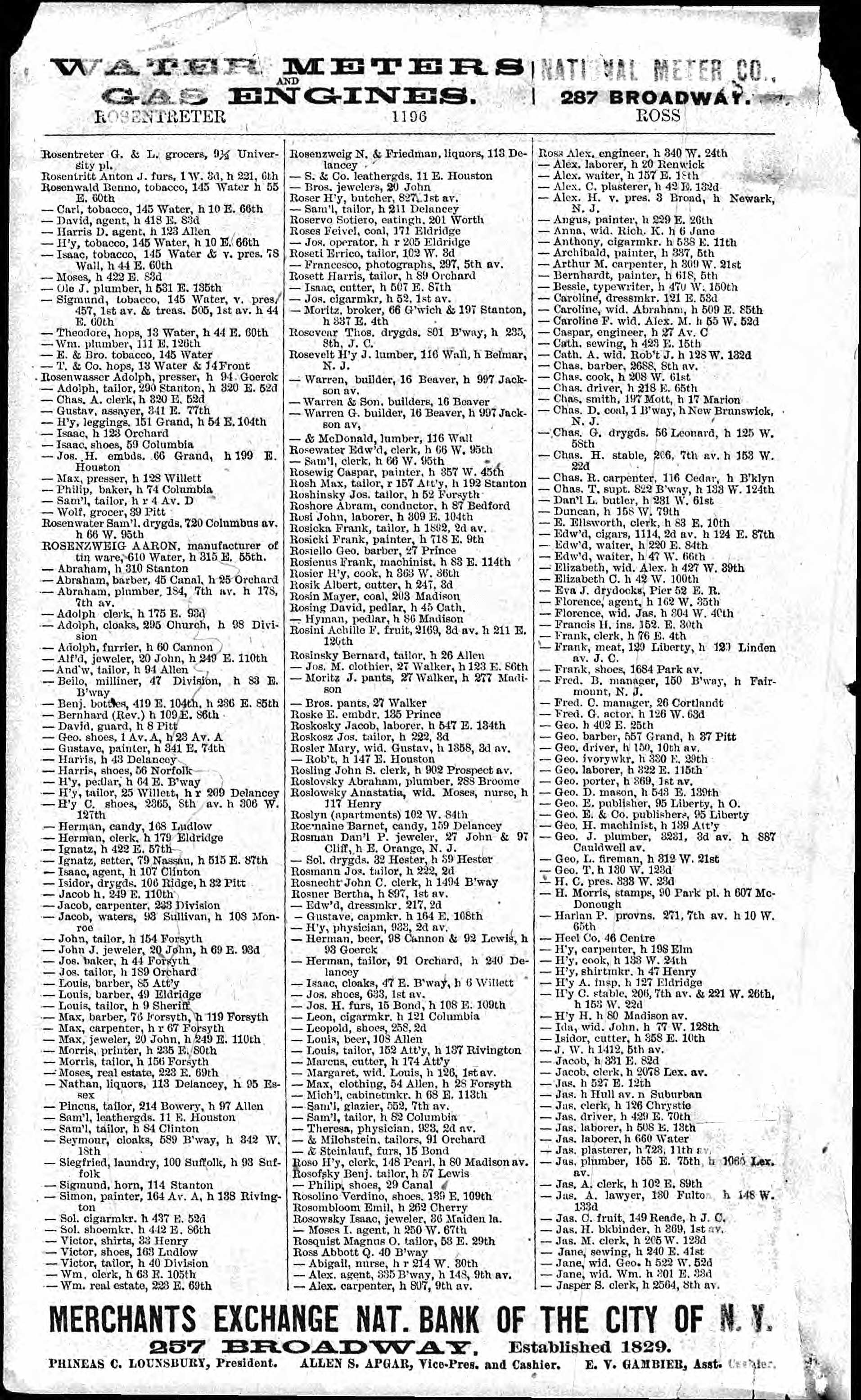
1894 NYC directory

1894 NYC directory

Gussie and Gustave moved several times after 1892—uptown on East 74th Street in 1894, downtown to E. 6th Street in 1900, and to Brooklyn by 1905, where they first lived in Fulton Street and then on Franklin Avenue, where they were living in 1908 at the time of Jankel’s hearing.  Throughout this period of time, Gustav was a painter, eventually owning his own paint supply business, and he and Gussie were having many children: after Lilly came Sarah (1888), Abraham (1890), Rebecca (1894), Jacob (1895), Harry (1897), Joseph (1898), Lizzie (1900) and Rachel (1903).  Apparently there were five others who died, as the 1900 census reports that Gussie had had thirteen children, eight of whom were then living.

It’s mind-boggling on many levels.  First, how did the support and feed all those children and where did they fit them?  And secondly, how did they endure the deaths of five children?  I’ve seen this many times.  In fact, on the 1900 census for Bessie Brotman, my great-grandmother, it reports that she had had nine children, only four of whom where then living.  I cannot imagine how these mothers coped with losing these babies.  Did it make them less able to bond with each newborn, fearing they would not survive, or did it make them cherish each new child even more, knowing how fragile life was and how difficult it was for a child to survive?

In addition, it appears that one of the children who survived infancy, Harry, died as a teenager in 1913.  Perhaps all this did take its toll on the family.  By 1915 it appears that Gustave and Gussie had separated or divorced. Gussie is living alone with the children in 1915; I cannot find Gustav at all on the 1915 census. The census reports for 1920 also had me somewhat confused.  I found Gustave on two reports, one in Brooklyn on Bergen Street, living with the four youngest children, and another in Manhattan on East 110th Street, living as a boarder with another family.  In the Brooklyn census report, Gustave is listed as having no profession; on the Manhattan one it says he was a painter.  And I could not find Gussie anywhere, though the Brooklyn census said that Gustave was divorced.  What I finally concluded was that the Gustave in Brooklyn was really Gussie, despite the fact that it said Gustave and listed him as male.  My guess is that, as was often the case, the census taker was given or heard confusing information and misinterpreted it.   It makes more sense, given the times, that the children would be with their mother and that a woman would not be employed outside the home.  The Manhattan Gustave, the painter, is obviously the actual Gustave Rosenzweig.

Rosenzweigs in Brooklyn 1920

Rosenzweigs in Brooklyn 1920

Gustave Rosenzweig in Manhattan 1920

Gustave Rosenzweig in Manhattan 1920

By 1925 Gustave was remarried to a woman named Selma Nadler.  I was able to find a family tree containing Gustave and Selma which included this photograph, apparently of Selma and Gustave.  Selma had also been previously married and had ten children of her own.

Gustave and Selma Rosenzweig

Gustave and Selma Rosenzweig

Between them, Selma and Gustave had nineteen living children in 1925.  Imagine what that family reunion would look like.  The last record I have for Gustave is the 1930 census.  I have not found him yet on the 1940 census.  I have found two death records for men named Gustave Rosenzweig, one in 1942, the other in 1944.  I have ordered them both to determine whether either one is our Gustave.

Meanwhile, Gussie continued to live with one or more of her children in 1925, 1930 and 1940.  I do not yet have a death record for her either.  I have been able to trace the nine children with varying degrees of success.  Lilly appears to have had a child out of wedlock in 1902 named William who was living with Gustave and Gussie for some time in 1905, but who was placed in an orphanage (father listed as Frank with no surname and deceased) for a short time in 1906. William Rosenzweig at Hebrew Orphanage Then Lilly reappears on the 1910 census living with her parents and without William.  I’ve not yet learned what happened to either Lilly or William.

Similarly, the other four daughters Sarah, Rebecca, Rachel and Lizzie, all became untraceable after they left home since I have no idea what their married names were.  As for the sons, Abraham married and had two daughters, who for similar reasons I cannot find after 1940.  Jacob/Jack also had two daughters, and Joseph I’ve not yet found past 1920.   So at the moment I have not located any current descendants, but I will continue to look to see if I can somehow find out the married names of some of Gustave’s granddaughters.  The NYC marriage index only contains records up to 1937, and these grandchildren would not yet have been married by then; thus, I have no readily available public source to find their married names.  It may take a trip to NYC to see if those records are available in person.  Or perhaps I can find a wedding announcement.

UPDATE: Much of the information in the preceding paragraph has been updated here, here, here, here, here, here, and other posts on the blog on Joseph, Jack, Rebecca and Sarah.

So that is the story of Gustave Rosenzweig as I know it to date: a Romanian born painter who married twice, had nine children, real estate and a painting business, and who came to the rescue of his sister and her family.  It would be wonderful to know what happened once they all settled in America.  Gustave obviously stayed in touch with Tillie and her children, as he was present at Bertha’s wedding.  Did he help out Zusi, his little sister, when her husband died? I had hoped to find her living with him on one of those census reports, but did not.  Did he help out my grandfather when he arrived as a 16 year old boy in NYC in 1904? Did he help out my great-grandmother when she arrived in 1910, a widow without any means of support aside from her children? I certainly wish there was some way of knowing the answers to these questions.  From his conduct at the hearing for Jankel in 1908, I’d like to think that Gustave was there for them all, but we will never know.

Enhanced by Zemanta

Another Addition to the Brotman Family Tree: David Brotman and his wife Annie

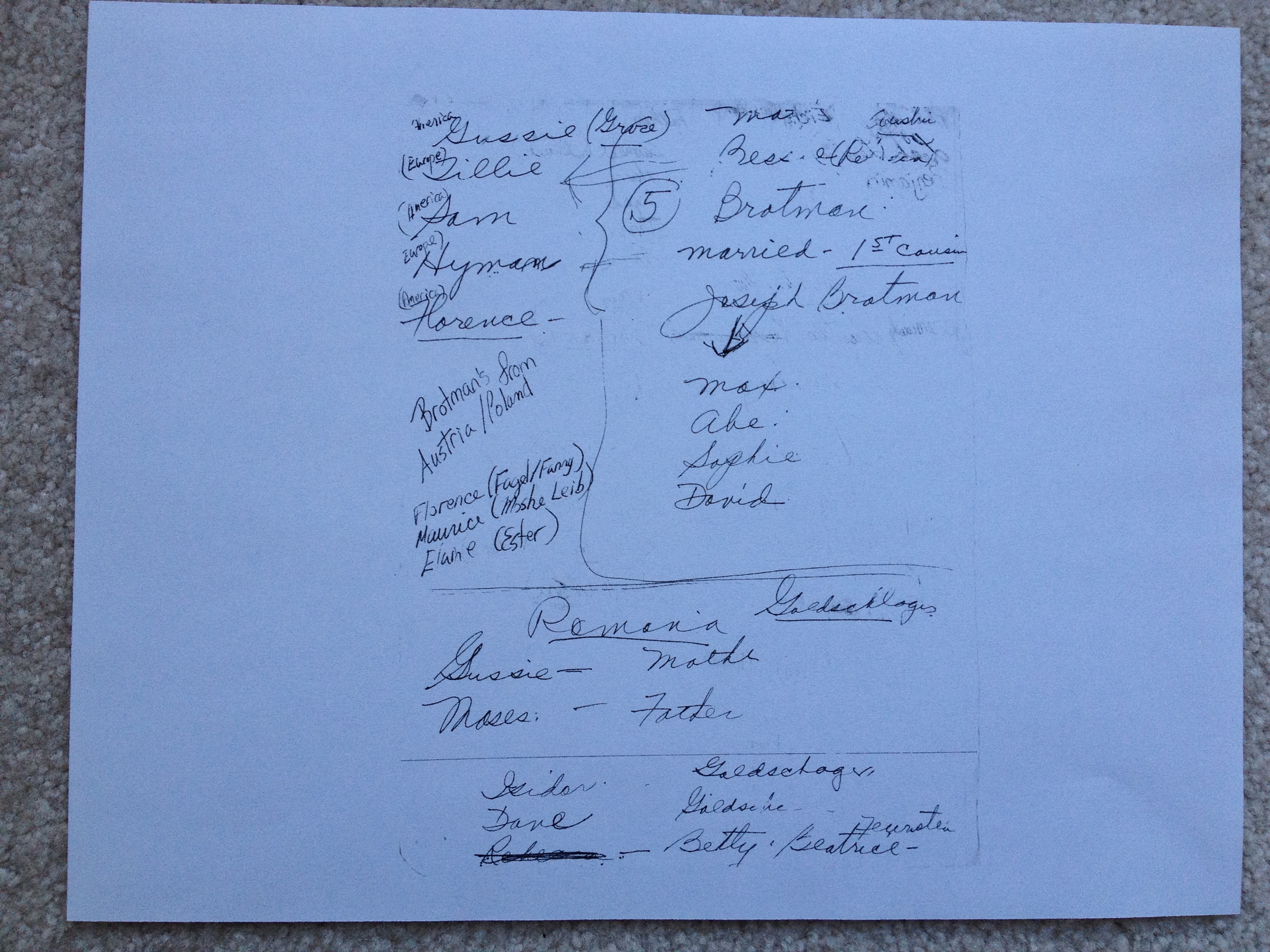
Family Tree drawn by Elaine Goldschlager Lehbraum

Family Tree drawn by Elaine Goldschlager Lehbraum

As you may recall, a couple of weeks ago my cousin Jody made a big discovery: handwritten notes that her mother had made of Joseph Brotman’s children.  It included all the children we already knew about: Bessie’s children Hyman, Tillie, Gussie, Frieda (Florence in her notes) and Sam, as well as the two sons we knew of from Joseph’s first marriage, Abraham and Max.   My brother had recalled that our aunt had said Joseph had had four children from his first marriage, but we did not know the names of the two remaining children, and I had traced every possible Brotman I could find to see if there was a link.  I had hit many dead ends and found nothing that linked these other Brotmans to our family.

My aunt’s notes were a huge discovery because for the first time we had evidence of the names of those two missing children: David and Sophie.  As I wrote when Jody first sent me the tree, I was able to locate a David Brotman from Austria who was a possible match for Joseph’s missing son, but I needed to check further and obtain some documentation in order to be sure.

Well, those documents arrived the other day, and I was so excited to see that on David’s marriage certificate in 1897, he listed his father’s name as Joseph Brotman and his mother’s as Chaye Fortgang.

David Brotman and Annie Salpeter marriage certificate

David Brotman and Annie Salpeter marriage certificate

You may recall that Max had also listed his mother’s name as Chaye on his marriage certificate, so this confirmed that Joseph’s first wife was named Chaye, but now we know her surname as well.

Max Brotman marriage certificate

Max Brotman marriage certificate

In addition, the marriage certificate gave David’s current address as 85 Ridge Street—the same address where Joseph and Bessie were living in 1895 when Gussie was born, according to her birth certificate.

Gussie birth certificate

Gussie birth certificate

This confirmed for me that David was Joseph’s son, Max and Abraham’s full brother, half-brother to Hyman, Tillie, Gussie, Frieda and Sam, and our great-uncle.  I am still in a state of amazement that I was able to find him.  Thank you, Aunt Elaine, for leaving behind this great clue to our family.

Once I had this information confirming the relationship, I located whatever census reports and other records I could find for David and his wife, Annie Salpeter.  I found them on census reports for 1900, 1905, 1910, and 1920.  David was a tailor according to the first three census reports, and he and Annie were living on the Lower East Side until at least 1910. At times Annie’s brother Morris lived with them as well as a cousin Meier, but there were no children listed on any of these census reports.

At the time of his World War I draft registration in 1917, David and Annie had left the Lower East Side and were living at 143 Manhattan Avenue in Brooklyn, which was also their address on the 1920 census report, when David’s occupation was given as a cloak dealer in a “cloak house.”  Annie and David were now 44 years old and still had no children living with them, so I assume that they never had children. So there are no more second cousins to find and probably no pictures of David and Annie.  (But I’ve learned never to say never.)

I’ve yet to find David and Annie on the 1930 or 1940 censuses, but I am still looking.  It seems unlikely that they had left Brooklyn.  I was able to locate a 1946 death certificate for a David Brotman married to Anna living at 10 Sumner Avenue in Brooklyn, and I believe this is the same David, despite the fact that the death certificate has his father’s name as Isaac.  I’ve learned enough to know that death certificates are notoriously unreliable.  I will continue to see if I can find anything about David and Annie after 1920.

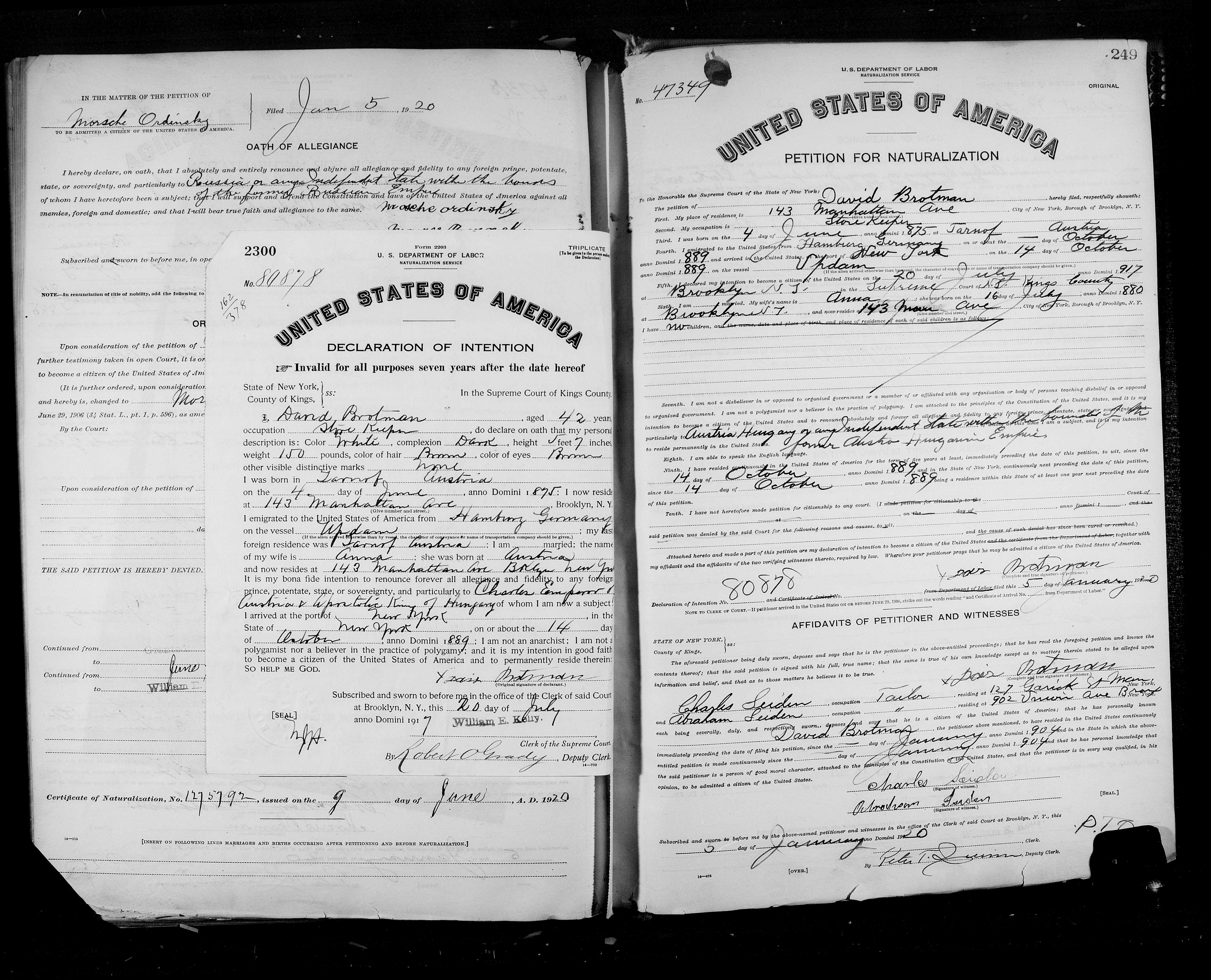
I do have David’s petition for naturalization in 1920, and it indicates that he had arrived in NYC on October 14, 1889, on the “Updam” from Tarnof, Austria.

David Brotman petition for naturalization 1920

David Brotman petition for naturalization 1920

Tarnof could be Tarnow, a city about fifty miles north of Tarnobrzeg/Dzikow and even further from Czchow, the two areas that I have been focusing on as the Brotman hometown based on Hyman’s listing of “Jeekief” and “Giga” on his documents.  But Tarnof could also be Tarnobrzeg, the larger town that is near Dzikow.  So did this new information help our search for our hometown in Galicia or did it just make it more confusing?

That led me to search for the ship manifest for David, now that I knew when he arrived and on what ship.  With some help from Renee, I located a September 4, 1889,  German ship manifest for the Portia, sailing to Rotterdam, listing Dawid Brodmann as a passenger.  I was excited to see that David was traveling with his older brother, Abe Brodmann. I had not previously been able to find Abraham on a ship manifest, so this was another exciting discovery.

David and Abe Brodmann on the Portia 1889

David and Abe Brodmann on the Portia 1889

On the Portia ship manifest, Abe and David are listed as coming from “Grambow, Russland,” not Austria at all, let alone Tarnow, Tarnobrzeg, Dzikow or Czchow.  I would have found this an indication that these were not the right boys, but there is a town right near Tarnobrzeg called Grebow, and according to a 1914 map, Tarnobrzeg was very close to the Russian border. So perhaps our family lived in Grebow? Or maybe that is where Joseph lived with Chaye and then moved to Dzikow when he married Bessie?

On the manifest for the Obdam, sailing from Rotterdam to New York arriving on September 19, 1889, David and Abe are listed as coming from Austria, not Russia, which appears to be correct.

David and Abe Brodman on the Obdam to New York 1889

David and Abe Brodman on the Obdam to New York 1889

There is obviously some confusion and conflict here, but it’s another clue and another place to look for the Brotman home in Galicia. I already have contacted several people researching this area to see if I can uncover more clues.

I have a few more leads to follow to fill in the gaps in David’s life story, and maybe they will even lead me to Sophie, the only remaining child of Joseph to locate.  There is also some potential evidence that will link our family to the Brotmanville Brotmans, but again, I need to do more research before it is worth speculating about that connection.

Enhanced by Zemanta

Tillie’s Story

Image

Although I have no memory of meeting Aunt Tillie, I heard her name all the time when I was growing up. (I don’t know which spelling she preferred; sometimes it is Tilly, sometimes Tillie.  I have used both spellings throughout the blog.)  She was very close to my grandmother Gussie, and my mother and her sister and brother adored her.    She was described to me as a lot of fun: vivacious, outgoing, funny and loving.  It seems she was the one who provided a lot of the happy experiences for my mother and her siblings growing up.

Like my grandmother, she had a tough life.  She was born in 1884 and came to the US with Bessie and Chaim when she was 6 or 7 (census reports are in conflict; some say 1890, some say 1891).  In 1900 when she was sixteen, she was living on Ridge Street with her parents, her brother Hyman, and her two little sisters, Gussie, who was five, and Frieda, was three.  When her father Joseph died a year later, my guess is that Tillie must have become a second parent to Gussie, Frieda and the infant Sam.

In 1905 when she was 22, Tillie married Aaron Ressler.  At the time she was still living on Ridge Street with her mother and siblings.  Aaron was 26 at the time and was also living in the Lower East Side.  By 1910, Tillie and Aaron had three sons, Leo, Joseph, and Harry, all under five.  They were living at 94 Broadway in Brooklyn, where they owned a grocery store at 100 Broadway.  In addition, Gussie had moved in with them, choosing to live with Tillie instead of moving in with Bessie after she had married Phillip Moskowitz.  (Bessie and Phillip were still living on the Lower East Side in 1910, so moving to Brooklyn must have been a big deal for twelve year old Gussie.) Gussie helped take care of the boys while Aaron and Tillie worked in the store.  Family lore has it that my grandfather spotted my grandmother while she was sitting in the window of Tillie and Aaron’s store.

Life must have seemed pretty good for the Ressler family in 1910.  By 1918, however, things had changed.  On Aaron’s draft registration form of that year, he reported that he was not employed and was suffering from locomotor ataxia, a condition that causes pain and loss of muscle control and movements.  The 1920 census did report that Aaron worked at a grocery store, although it also said he worked at home.  They no longer lived on Broadway, but on Ralph Avenue in Brooklyn.  Aaron died six years later in February, 1926, leaving behind Tillie and three sons aged 20, 19, and 17.

Tillie continued to run the grocery store for some time after Aaron died. I cannot find any record of Tillie and her two younger sons in the 1930 census, but in 1940 she was living on the Grand Concourse in the Bronx with Joe and Harry (Leo had married Mildred and moved to Connecticut by then).  According to the census, she had also lived at this same address in 1935, so at some point Tillie had left Brooklyn as a widow with two almost grown sons and moved all the way to the Bronx.  She never remarried and died at age 72 in 1956 after suffering from painful arthritis.  My mother remembers that she was treated with cortisone, perhaps excessively, and ended up dying in a public hospital on Welfare Island in NYC, where my grandmother would go to see her every week.

I don’t know why she moved to the Bronx, perhaps to make a fresh start.  My mother remembers that Aunt Tillie lived in an apartment on the then-glamorous Grand Concourse with her two adult sons, Joe and Harry.  I don’t know how she supported herself after Aaron died, but somehow she did.  My mother was born after Aaron died, and so she only knew Tillie as a widow, yet she remembers Tillie as a happy, upbeat person who would bring my mother baked goods (and once a large easel) that she carried on the subway from the Bronx to Brooklyn on her weekly trips. Tillie was the one who held the family together—the one who encouraged my aunt Elaine to go stay with Leo and Mildred in Connecticut to broaden her horizons, who took my mother to baseball games, who could occasionally get my shy grandmother to socialize. When my sister was born in 1955, Tillie brought treats not only for my mother, but also for the other new mothers who were sharing the same hospital room.   She was a woman who was born in Europe, but spoke English like an American, who brought up three sons, took care of her sisters and brothers, and was one of the most positive influences on my mother and her siblings. She was strong and positive despite all the hardships she had faced.  I wish I had had a chance to know her.

Another day, another death certificate, and more confusion

Sometimes I wonder why we have death certificates.  Just about every single one I have seen has raised more questions than it has provided answers.  I’ve been told by an expert genealogist that death certificates are notoriously unreliable because usually the person providing the information is a close relative still in shock and mourning the death of a loved one.  No wonder Hyman’s said he was born in Philadelphia and Bessie’s said her mother’s name was Bessie.  And so on.

All that leads me to today’s mysterious death certificate, that of Abraham Brotman of Brooklyn.  You may recall that Abraham’s headstone revealed that his Hebrew name was Abraham ben Yosef Yaakov, just as Joseph’s revealed that his was Yosef Yaakov ben Abraham, providing me with the additional clues that helped me conclude that Abraham was Joseph’s son and Max’s brother.Image

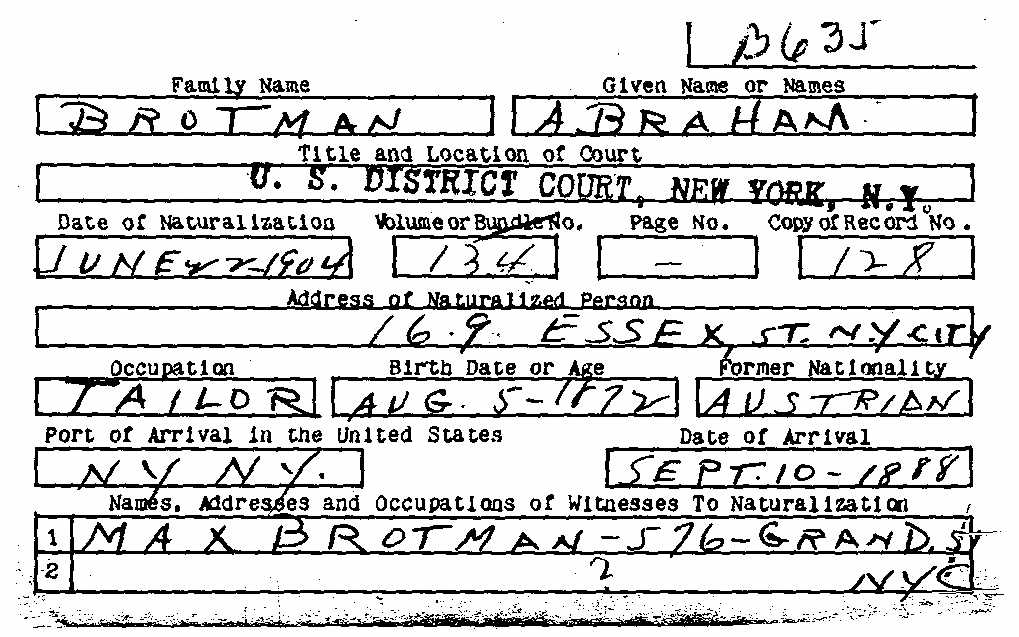
(You may also recall that Max was the witness on Abraham’s naturalization application.)

Naturalization of Abraham Brotman Max as Witness

Naturalization of Abraham Brotman
Max as Witness

I had ordered Abraham’s death certificate in order to obtain more confirmation of those relationships as well as to get some information about the place where they were all from in Galicia.

Unfortunately, Abraham’s death certificate confirmed nothing and just added to the confusion.  His birth place is listed as Russia, despite the fact that every census report and his naturalization papers list his birth place as Austria.  His parents’ names are listed as Harry and Anna.

Image

I emailed Abraham’s grandchildren, Paula Newman and Morty Grossman (whose mother Ethel provided the information on the certificate), but neither of them knows anything about Abraham’s parents.  So now what? Do I assume that it’s just another mistake on the death certificate? Is it more likely that the headstone is right than the death certificate? Since the place of birth is wrong, why should I trust any of the information on the death certificate? Perhaps Ethel Grossman was thinking of her mother’s parents, not her father’s parents?   Abraham’s wife Bessie Brotman was born in Russia, so maybe her parents were Harry and Anna? Grrrr…now I am ordering another death certificate to see who HER parents were.  But why would I trust that one either?

Very frustrating! So no new information and just more confusion.

I can’t wait to see what misinformation Max’s death certificate provides.  That should be arriving in a day or so.