Zusi Rosenzweig: Some answers, more questions

About ten days ago I wrote about the documentation that confirmed that Zusi Rosenzweig—also known as Sonsa, Ceci, Cecile, Celie, Susie and Susan Mintz—was my great-grandmother’s sister and the aunt who met my grandfather Isadore at Ellis Island in 1904.  I also knew that she had married a man named Harry Mintz in December 1896, but it appeared that Harry had died by the time of 1900 census since Zusi, as Sonsa Mintz, was listed as a widow on the 1900 census, living with Jake and Rachel Reitman.

I also believed that I had found evidence that Zusi had had a son Nathan, born in December, 1897, but had not further evidence of him until he was living with Zusi at the time of the 1915 census.  I believed Nathan had married a woman named Gertrude in 1930 and had had a daughter named Susanne in 1932, one year after his mother Zusi/Susie had died.

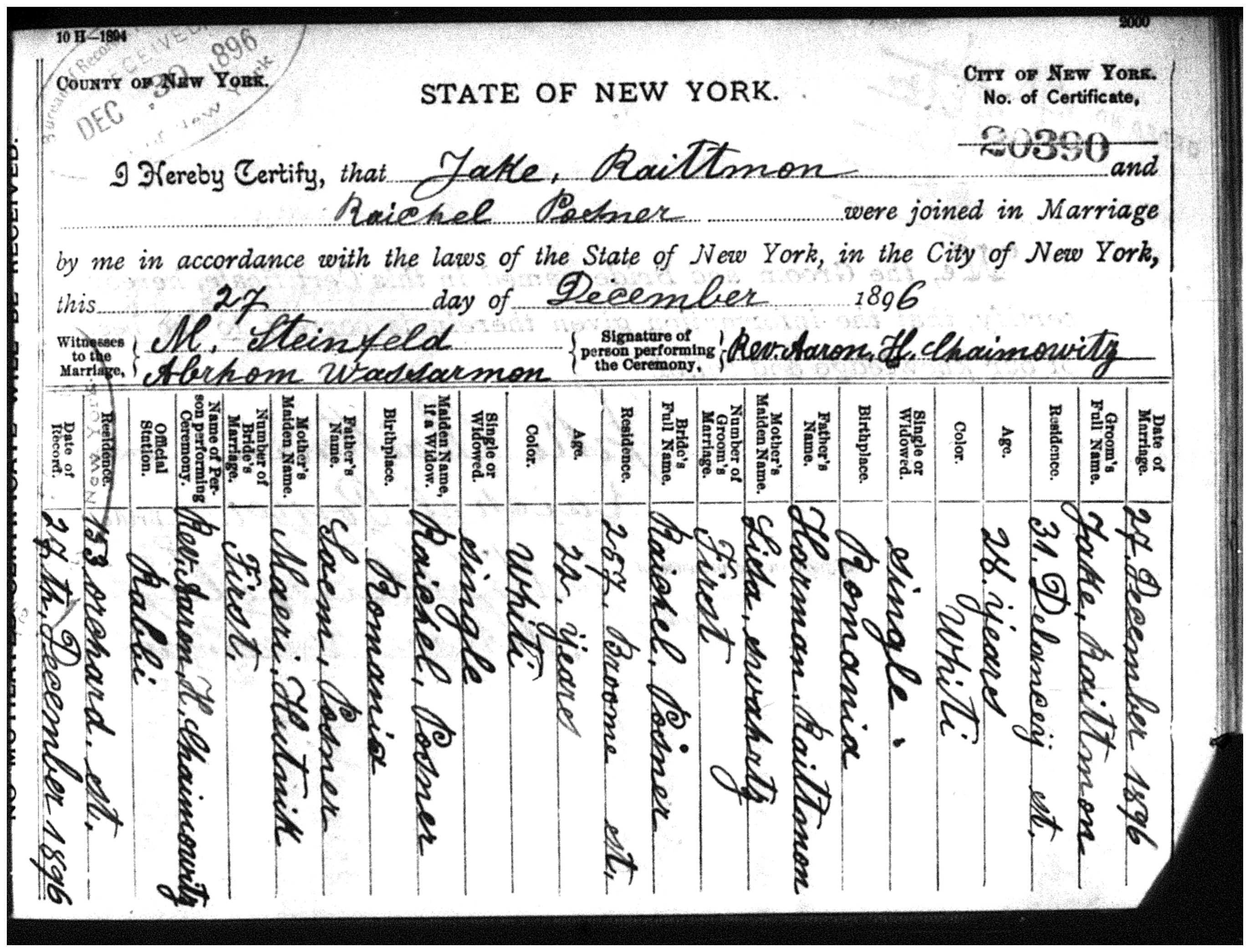
Although I was able to research fairly deeply into Jake and Rachel Reitman from the public records, I could not find any familial link between Zusi and either Jake and Rachel.  On Jake and Rachel’s marriage certificate, their parents’ names are all revealed, and no one has a surname that I can link to the Rosenzweig/Goldschlager/Strolowitz family.  I still don’t know if Sonsa Mintz is in fact Zusi, and if it was, I have no idea why she was living with the Reitmans.

Jake and Rachel Reitman marriage certificate

Jake and Rachel Reitman marriage certificate

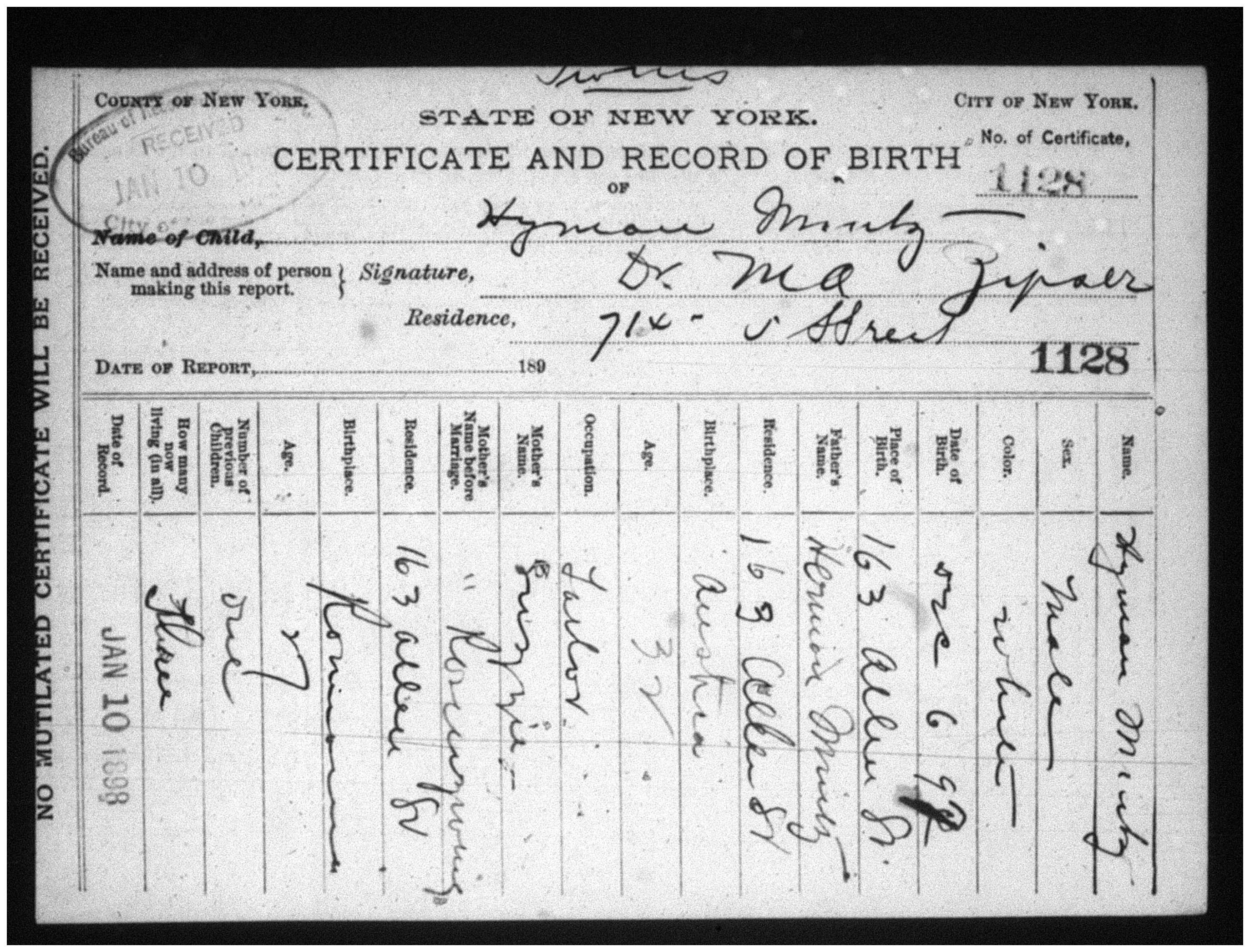
I had ordered three more documents: a birth certificate for Nathan Mintz, a marriage certificate for Nathan and Gertrude Mintz, and a death certificate for a Harry Mintz who died in 1924, thinking that perhaps Harry had just “disappeared” and had not died between 1897 and 1900.  Today I received those documents, plus one more.  For the most part, these documents did in fact confirm my hunches.  The Nathan Mintz born in December, 1897, was the child of “Zussie” Rosenzweig, born in Romania, and her husband “Herman” Mintz.

Nathan Mintz birth certificate

Nathan Mintz birth certificate

The Nathan Mintz who married Gertrude in 1930 was the same: son of Susan “Rosenberg” and Harry Mintz.

Nathan and Gertrude marriage certificate

Nathan and Gertrude marriage certificate

Thus, Susanne is Zusi’s granddaughter and her namesake.  The death certificate for Harry Mintz dated 1924 neither confirmed nor contradicted what information I had because it is not the same Harry; this one had only been in the US for four years, was older, from Poland, and married to a woman named Ida.

Harry Mintz death

Harry Mintz death

But there were some surprises in the documents; first, I received a second birth certificate for a baby Mintz born in December, 1897, Nathan’s twin, Hyman: same parents, same birth date, same doctor.

Hyman Mintz birth certificate

Hyman Mintz birth certificate

I immediately wondered why I had not seen any future references to Hyman and suspected the worst.  I checked the death index, and Hyman Mintz died in January, 1898, a month old infant.

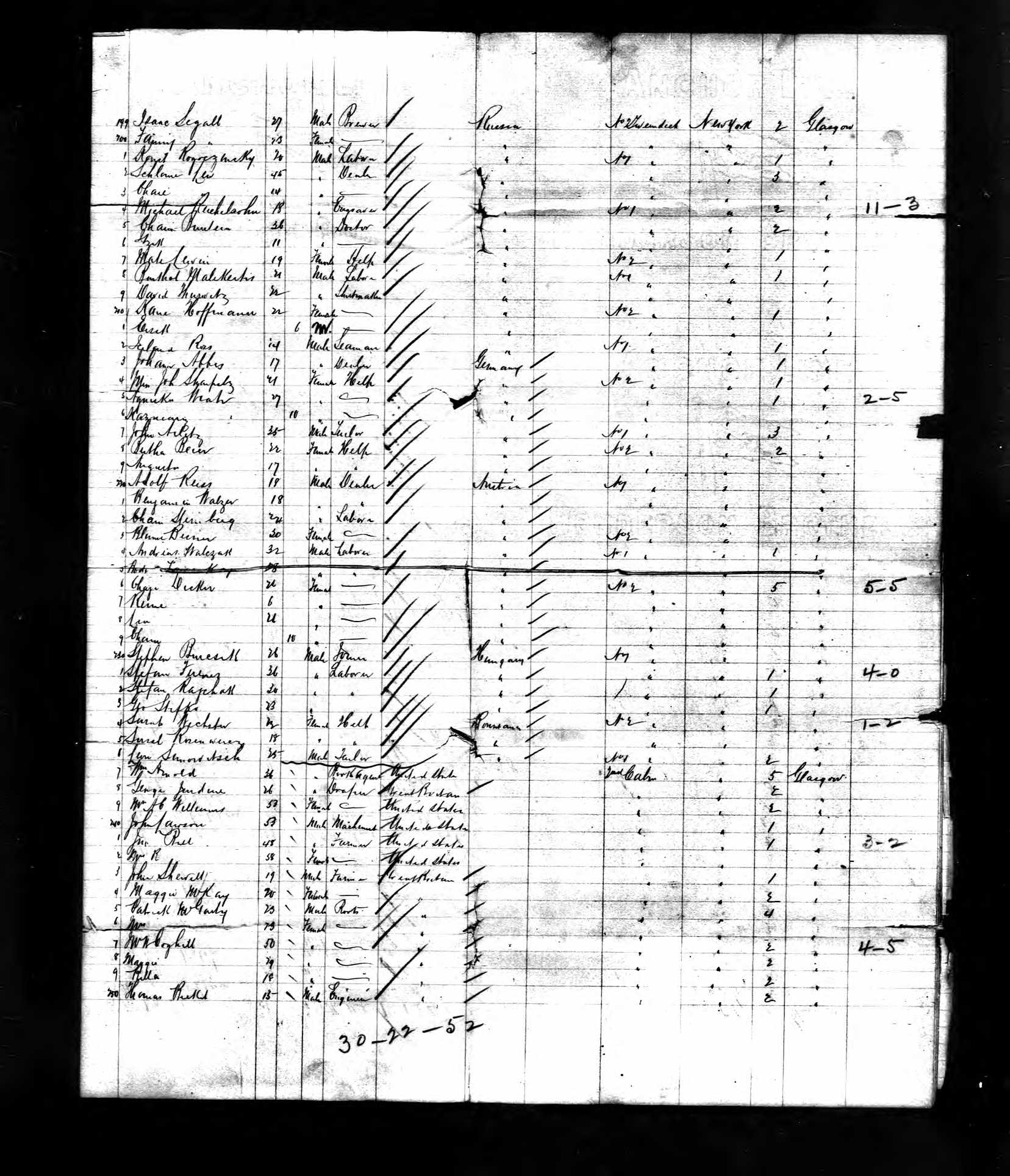
Moreover, the New York City birth certificate form asked how many children were born to this mother before this delivery and how many of those children were still living.  On both Nathan and Hyman’s birth certificates, it says that Zusi had had one prior child and that three were still living.  So who was this first child, and where was she or he living? Zusi and Harry had only been married twelve months when the twins were born, so they could not have had a prior child (well, at least one conceived since they had married).  Zusi had been a 24 year old widow when she married Harry; she must have had a child with her first husband, perhaps in Romania before immigrating to the US.  She was only a teenager when she emigrated.  I have what I think could be the ship manifest listing Zusi as a passenger on the Ethopia, arriving in New York City on September 30, 1890; there is no child with her.

Ship Manifest as Susel Rosenzweig

Ship Manifest as Susel Rosenzweig

Did she leave her child behind in Iasi for her family to raise? Why did she return to her maiden name if she’d been married? Perhaps there never was a marriage?  I can guess, speculate, but not know for certain.

So what do we know and what don’t we know about this woman who met my grandfather at Ellis Island? We know she married Harry Mintz, had twin sons Nathan and Hyman, but only Nathan survived.  Nathan grew up, married Gertrude, and had a daughter in 1932 named Susanne.  Zusi died in 1931. What we don’t know is what happened to Harry or what happened to her first child.  We don’t know where Zusi and Nathan were between 1898 and 1915. And we don’t know whether Nathan and Gertrude had additional children, whether Susanne had children, whether there are any living descendants of the elusive Zusi Rosenzweig.

Enhanced by Zemanta

Brotman Ancestral Home: Tarnobrzeg (probably)

While researching my Goldschlager/Rosenzweig relatives, I have also been continuing to work towards an answer to the question

Photograph of Tarnobrzeg Main Square.

Photograph of Tarnobrzeg Main Square. (Photo credit: Wikipedia)

of where in Galicia my ancestors Joseph and Bessie Brotman lived.  The discovery of David Brotman, Joseph’s son from his first marriage, provided a new jumpstart to that research because David had listed two different home towns on his documentation: Tarnof on the ship manifest and Grambow on his naturalization papers.  Unfortunately, that information seemed to conflict with what I had from Hyman’s papers—Jeekief and Giga.

After consulting with a few people in the field, my best guess is that the family came from Tarnobrzeg, then called Dzikow.  A town called Grebow or Grybow is close by, and I am wondering whether David was born in Grebow, near Tarnobrzeg, when Joseph was married to Chaye Fortgang, and that Joseph moved to Dzikow/Tarnobrzeg when he married Bessie and when Chaim/Hyman was born.  It’s a guess, but it’s the best I think I will be able to do, given the unreliability of the US records and our ancestors’ memories.

Having decided to make the assumption that Tarnobrzeg was the Brotman ancestral home, I then again researched the available resources online such as JRIPoland, Gesher Galicia, and JewishGen, to see if there were any records that might be relevant, adding the surname Fortgang to my search since that is what David’s death certificate said had been his mother Chaye’s maiden name.  I could not find any, and then I checked to see what records were even available in general for Tarnobrzeg. 

I wrote to Stanley Diamond, the creator of JRI-Poland, and this is what he informed me: “Among all the towns listed [on JRI-Poland], Tarnobrzeg is the one with the fewest surviving records.  They are the 1889-1911 births that are in the Polish State Archive branch in Sandomierz (for which we now have digital images) and the 1912-1937 birth records in the town hall in Tarnobrzeg.”  Obviously, all of those records are too late for our family as the last child born in Galicia was Tillie in 1884. Just our luck—our relatives had to come from the place with the fewest surviving records.

Stanley told me not to give up all hope—that new records are sometimes discovered over time.  And I will certainly keep renewing my search periodically, hoping that something does turn up.  But for now, I think I have to accept the limitations of our ability to learn everything about our past.

So am I content with this? No, of course not.  It’s particularly frustrating because it means I cannot go back any earlier than Joseph, Bessie and Chaye to find our earlier ancestors. I think that I can learn to be comfortable saying that my great-grandparents Joseph and Bessie Brotman probably came from the Tarnobrzeg region of Galicia.  That’s much better than what I could say last summer when I really started digging for answers.  But being even 99% sure is not the same as knowing for certain, and I am not even close to 99% sure.

For those who are interested, here are two websites about Tarnobrzeg, the town where my great-grandparents Joseph and Bessie Brotman probably lived.

Poland, Tarnobrzeg - Museum of City History, p...

Poland, Tarnobrzeg – Museum of City History, placed in old granary (Photo credit: Wikipedia)

ShtetlLinks page

Gesher Galicia page

Enhanced by Zemanta

Keep it or Throw it Away? Why we save things

I tend to be a saver.  Not an out-of-control packrat, but a saver.  I save books, photographs, letters, papers, cards, report cards, etc.  I also saved almost all the clothes that my children wore as babies and toddlers, regardless of the condition.  I just couldn’t part with the memory of each of them being so little.  The clothes were tangible evidence, more so than photographs, that they were once tiny babies.

When my grandson was born, I went down to the basement to see if any of the baby clothes I’d saved were usable.  For the most part, they weren’t.  Things were stained, stretched out, out of style—not what you’d put on a new baby.  So I had to decide what to do.  Throw them away? Put them back in the boxes?  I weeded through them, saving the ones that triggered particular memories: the purple corduroy outfit that both girls wore when they were toddlers, the Snoopy outfit that my older daughter wore almost every day when her sister was born and we were both too tired to fight with her about what to wear; sweaters my mother had knit, a few special party dresses.  The ones that were badly stained and not wearable I threw away.  All the rest I put back in the boxes anyway, not having the heart to throw them away just yet.

Now I am glad that I did keep some of these things.  One of the pictures Jody sent me a couple of weeks ago was this picture:

booties

Imagine—these booties are almost 100 years old.  My aunt Elaine was born in 1917, my uncle Maurice in 1919.  Someone saved these and pinned a label to them to identify them for posterity as the booties of Elaine and Maurice.  There were not a lot of material objects passed on from my grandparents, but here is one that says so much.  They, too, cherished their babies, wanted to preserve the memories of them as tiny babies, and held on to something tangible to keep those memories alive.  And it worked—I now can imagine those babies and my grandparents as new parents, probably as overwhelmed, exhausted and delirious as all new parents, but also in love with those babies.

So I guess I won’t be getting rid of the baby clothes yet.  Maybe some time in the 2080s, a great-grandchild will find a box with a sweater, a Snoopy outfit, a purple corduroy jacket, and imagine the children who once wore them.

Enhanced by Zemanta

Family resemblance?

I know that often the mind plays tricks,  and you see things that aren’t there but that you hope are there.  When a baby is born, some people will say, “Oh, he looks just like his mother, ” and others will say, “Oh, he looks just like his father.”  Since we all have certain common physical traits–two eyes, a nose and a mouth, it’s not that hard to find a similarity with anyone  if you look hard enough for it and want to see it badly enough.

So I need some help from objective eyes.  Here are two photographs, one of my great-grandmother Ghitla Rosenzweig Goldschlager, and the other of Gustave Rosenzweig, who I believe to be her brother.  The more I look at these two faces, the more I am struck by the similarity—in particular, the shape and deep-seatedness of the eyes and the nose.  What do you think?

Ghitla Rosenzweig Goldschlager

Ghitla Rosenzweig Goldschlager

Gustave Rosenzweig

Gustave Rosenzweig

I also find the same eyes in my grandfather, Ghitla’s son, and in Murray Leonard, her great-nephew, and in David Adler, her nephew, Tillie’s son:

Isadore Goldschlager

Isadore Goldschlager

David Adler and his wife Bertha

David Adler and his wife Bertha

Murray_Leonard_Lacey_Busby_Hadwin_Layla_Hadwin_11_JAN_2014

Murray Leonard

So it is just me?  Or do the Rosenzweig descendants share this common trait of deep-set, down-turned eyes? Do you see that trait in your family if you also are a descendant of Tillie, Ghitla, Zusi or Gustav?

Enhanced by Zemanta

Another new relative: Gustave Rosenzweig

As I wrote yesterday, I was excited in reading the case file of Jankel Srulovici to see that the principal witness who came forward to vouch for him at the hearing to determine his admission into the US was a brother-in-law named Gustave Rosenzweig.  Gustave is the fourth child of my great-grandparents David Rosenzweig and Esther Gelberman whom I have been able to locate.   He was my great-grandmother Ghitla’s older brother and also Tillie and Zusi’s brother.  I had already noted his name on Bertha Strolowitz’s marriage certificate in 1915, but now I have some verification that he was in fact a member of the same family.  Not simply because he testified for Jankel and helped post the bond for his admission, but because he described Jankel and Tillie in his testimony as his brother-in-law and sister.

I have now done research to learn more about this man, my great-great uncle, who had $6000 in assets in 1908 and a painting supply business in Brooklyn and who had already impressed me with his character for helping out his family.  From various records, I have learned that Gustave was born in Romania in September, 1861.  He married his first wife, Gussie, in 1882, according to the 1900 census.

Gustave Rosenzweig and family 1900 census

Gustave Rosenzweig and family 1900 census

It is not at all clear exactly when Gustave and Gussie arrived in NYC, and I have not yet found a ship manifest for either of them.  On his naturalization papers in January of 1892, Gustave wrote that he had arrived on April 12, 1887.

naturalization petition gustave rosenzweig

naturalization petition gustave rosenzweig

Some of the census reports indicate that Gussie and Gustave emigrated in 1881, others say 1888. According to the 1900 census, their first child Lilly was born in Romania in 1884, and if Lilly was born in Romania, the later date seems to be more accurate.  On the other hand, the 1905 and 1910 census reports say that Lilly was born in the United States, and, according to the 1905 census, that Gussie and Gustave had been in the US for 22 years, i.e., since 1883.  At any rate, Gustave and Gussie were certainly in the United States by 1888, and thus he was the earliest of the Rosenzweig children to come to America, at least a few years before Zusi, 13 years before his nephew Isidor Strolowitz, 15 years before my grandfather Isadore Goldschlager, and almost 20 years before Tillie, over 20 years before Ghitla.

Gustave Rosenzweig family on the 1905 NYS census

Gustave Rosenzweig family on the 1905 NYS census

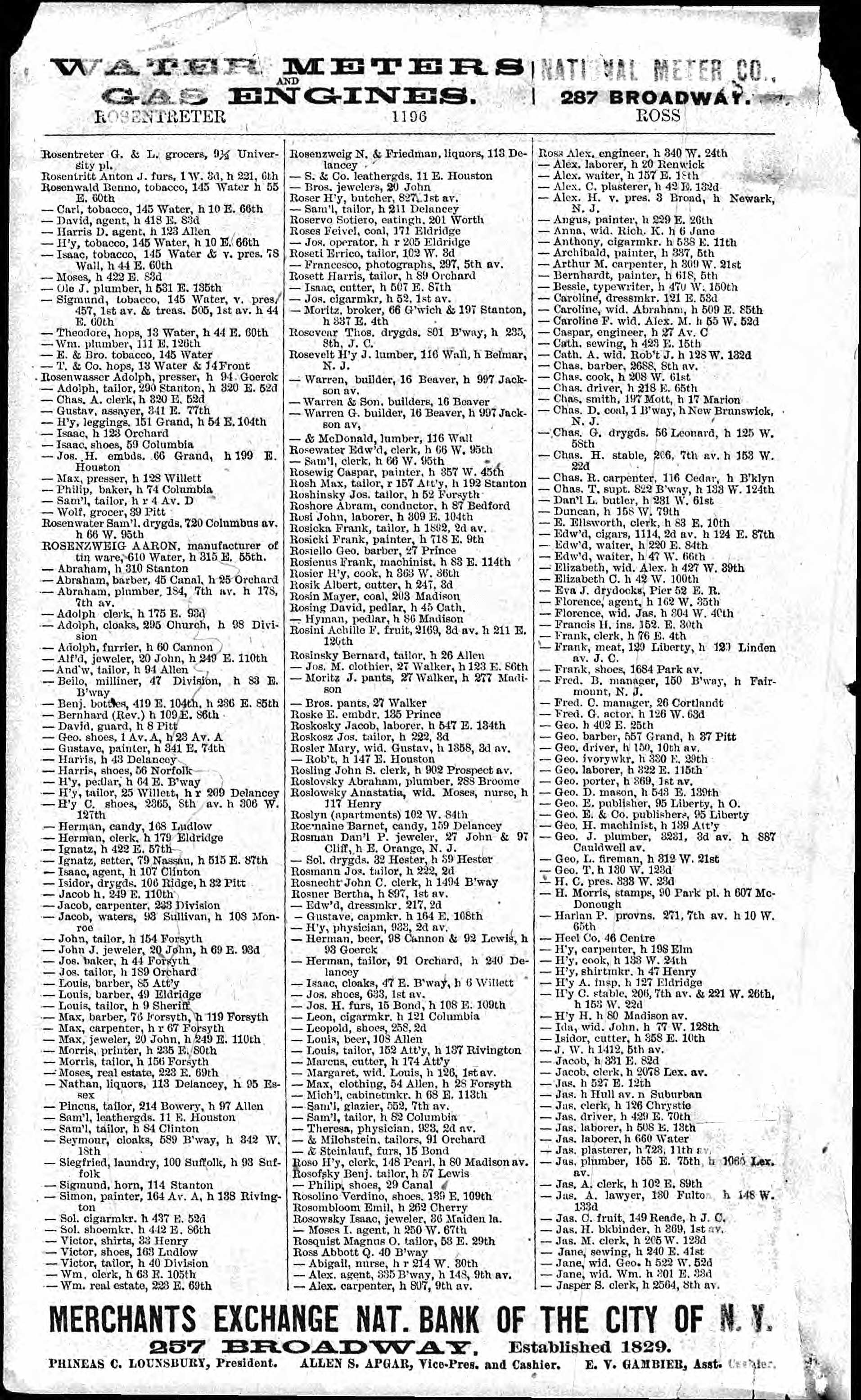
The earliest record I have of Gustave in NYC is an 1892 New York City directory listing him as a painter, living on Eldridge Street in the Lower East Side.  His naturalization papers also indicated that he was a painter, as was Jankel Srulovici and his two sons Isidor and David.  It makes me wonder whether Jankel and Gustave had been in business together as painters back in Iasi.  Jankel would have been about ten years older, so perhaps he trained Gustave and brought him into his business.  Gustave might have felt some sense of gratitude to him as well as brotherly love for his sister Tillie, motivating him even more so to help bring Jankel into the country.

1894 NYC directory

1894 NYC directory

Gussie and Gustave moved several times after 1892—uptown on East 74th Street in 1894, downtown to E. 6th Street in 1900, and to Brooklyn by 1905, where they first lived in Fulton Street and then on Franklin Avenue, where they were living in 1908 at the time of Jankel’s hearing.  Throughout this period of time, Gustav was a painter, eventually owning his own paint supply business, and he and Gussie were having many children: after Lilly came Sarah (1888), Abraham (1890), Rebecca (1894), Jacob (1895), Harry (1897), Joseph (1898), Lizzie (1900) and Rachel (1903).  Apparently there were five others who died, as the 1900 census reports that Gussie had had thirteen children, eight of whom were then living.

It’s mind-boggling on many levels.  First, how did the support and feed all those children and where did they fit them?  And secondly, how did they endure the deaths of five children?  I’ve seen this many times.  In fact, on the 1900 census for Bessie Brotman, my great-grandmother, it reports that she had had nine children, only four of whom where then living.  I cannot imagine how these mothers coped with losing these babies.  Did it make them less able to bond with each newborn, fearing they would not survive, or did it make them cherish each new child even more, knowing how fragile life was and how difficult it was for a child to survive?

In addition, it appears that one of the children who survived infancy, Harry, died as a teenager in 1913.  Perhaps all this did take its toll on the family.  By 1915 it appears that Gustave and Gussie had separated or divorced. Gussie is living alone with the children in 1915; I cannot find Gustav at all on the 1915 census. The census reports for 1920 also had me somewhat confused.  I found Gustave on two reports, one in Brooklyn on Bergen Street, living with the four youngest children, and another in Manhattan on East 110th Street, living as a boarder with another family.  In the Brooklyn census report, Gustave is listed as having no profession; on the Manhattan one it says he was a painter.  And I could not find Gussie anywhere, though the Brooklyn census said that Gustave was divorced.  What I finally concluded was that the Gustave in Brooklyn was really Gussie, despite the fact that it said Gustave and listed him as male.  My guess is that, as was often the case, the census taker was given or heard confusing information and misinterpreted it.   It makes more sense, given the times, that the children would be with their mother and that a woman would not be employed outside the home.  The Manhattan Gustave, the painter, is obviously the actual Gustave Rosenzweig.

Rosenzweigs in Brooklyn 1920

Rosenzweigs in Brooklyn 1920

Gustave Rosenzweig in Manhattan 1920

Gustave Rosenzweig in Manhattan 1920

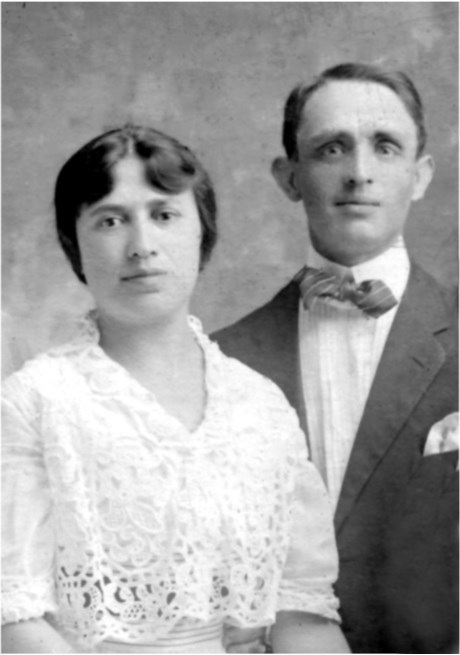
By 1925 Gustave was remarried to a woman named Selma Nadler.  I was able to find a family tree containing Gustave and Selma which included this photograph, apparently of Selma and Gustave.  Selma had also been previously married and had ten children of her own.

Gustave and Selma Rosenzweig

Gustave and Selma Rosenzweig

Between them, Selma and Gustave had nineteen living children in 1925.  Imagine what that family reunion would look like.  The last record I have for Gustave is the 1930 census.  I have not found him yet on the 1940 census.  I have found two death records for men named Gustave Rosenzweig, one in 1942, the other in 1944.  I have ordered them both to determine whether either one is our Gustave.

Meanwhile, Gussie continued to live with one or more of her children in 1925, 1930 and 1940.  I do not yet have a death record for her either.  I have been able to trace the nine children with varying degrees of success.  Lilly appears to have had a child out of wedlock in 1902 named William who was living with Gustave and Gussie for some time in 1905, but who was placed in an orphanage (father listed as Frank with no surname and deceased) for a short time in 1906. William Rosenzweig at Hebrew Orphanage Then Lilly reappears on the 1910 census living with her parents and without William.  I’ve not yet learned what happened to either Lilly or William.

Similarly, the other four daughters Sarah, Rebecca, Rachel and Lizzie, all became untraceable after they left home since I have no idea what their married names were.  As for the sons, Abraham married and had two daughters, who for similar reasons I cannot find after 1940.  Jacob/Jack also had two daughters, and Joseph I’ve not yet found past 1920.   So at the moment I have not located any current descendants, but I will continue to look to see if I can somehow find out the married names of some of Gustave’s granddaughters.  The NYC marriage index only contains records up to 1937, and these grandchildren would not yet have been married by then; thus, I have no readily available public source to find their married names.  It may take a trip to NYC to see if those records are available in person.  Or perhaps I can find a wedding announcement.

UPDATE: Much of the information in the preceding paragraph has been updated here, here, here, here, here, here, and other posts on the blog on Joseph, Jack, Rebecca and Sarah.

So that is the story of Gustave Rosenzweig as I know it to date: a Romanian born painter who married twice, had nine children, real estate and a painting business, and who came to the rescue of his sister and her family.  It would be wonderful to know what happened once they all settled in America.  Gustave obviously stayed in touch with Tillie and her children, as he was present at Bertha’s wedding.  Did he help out Zusi, his little sister, when her husband died? I had hoped to find her living with him on one of those census reports, but did not.  Did he help out my grandfather when he arrived as a 16 year old boy in NYC in 1904? Did he help out my great-grandmother when she arrived in 1910, a widow without any means of support aside from her children? I certainly wish there was some way of knowing the answers to these questions.  From his conduct at the hearing for Jankel in 1908, I’d like to think that Gustave was there for them all, but we will never know.

Enhanced by Zemanta

Itic Jankel Srulovici

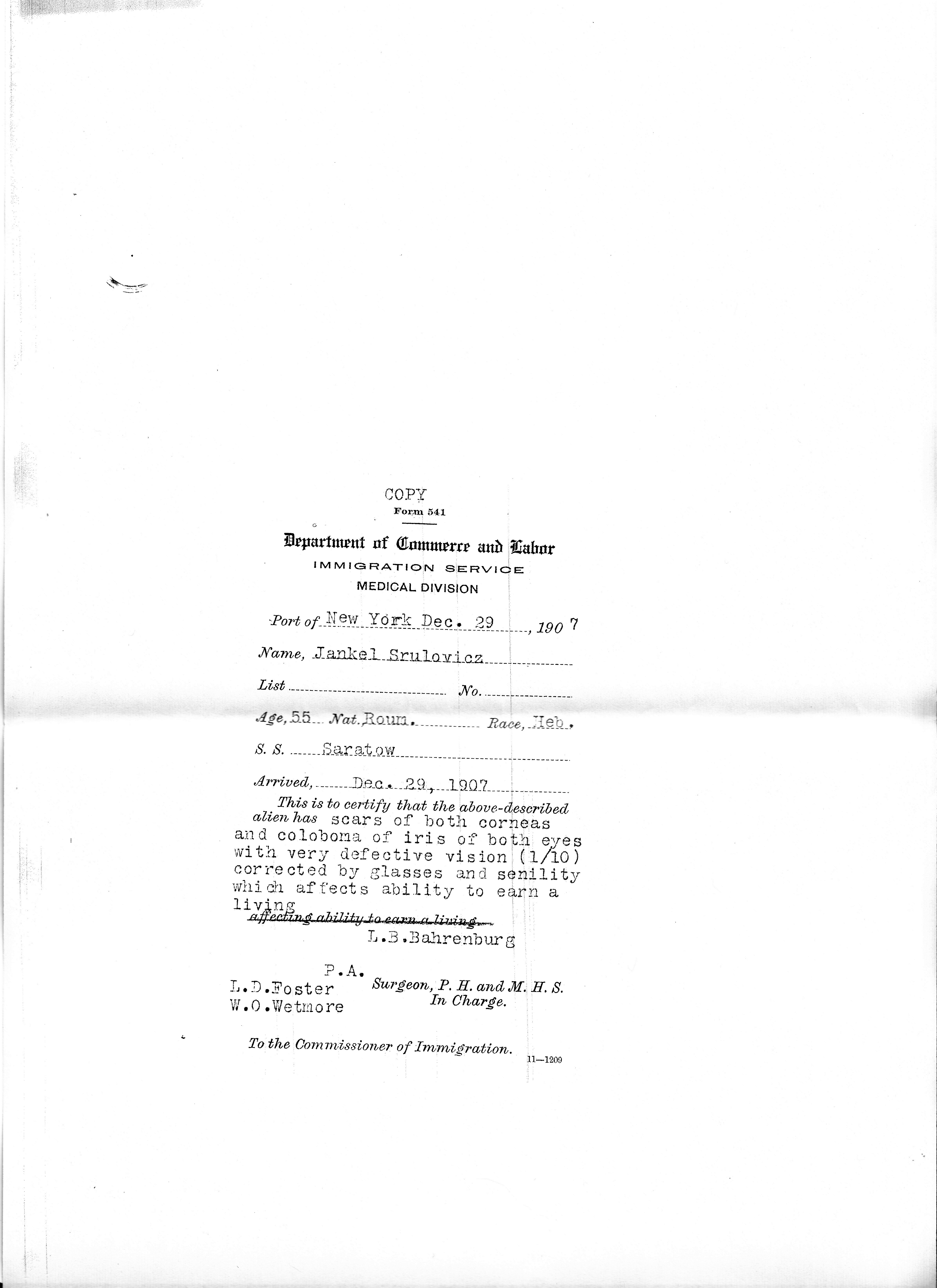
As you may recall, one of the mysteries I was having trouble solving was the fate of Itic Jankel Srulovic, aka Jacob Strolowitz or Adler, aka a number of other possible spellings of both his first and last name.  He was the husband of Tillie Rosenzweig Strolowitz, my great-grandmother Ghitla Rosenzweig Goldschlager’s sister.  He had arrived with his wife and his three youngest children on December 29, 1907, aboard the SS Saratov and had been detained because of problems with his eyes—scars on his corneas and coloboma on both irises.  Family lore suggested that he had never left Ellis Island, either having been deported or dying there, but the passenger manifest was stamped “Admitted,” indicating that a bond had been posted.

I had requested the case file for Jankel Srulovici from NARA, the National Archives and Records Administration in Washington, DC, a few weeks ago, and it arrived yesterday.  I have been studying it ever since.  The papers are fascinating not only because of what they reveal about Jankel and his family, but also because they provide some insight into the times and the experiences of immigrants. I will post scans of the documents in their entirety for those who are interested in the general history as well as those who are interested in the particulars of the family history.

The first document, dated December 31, 1907, is a recommendation from the Acting Commissioner of the Immigration Service, Joseph Murray, that Jankel Srulovic [sic] be admitted to the United States based on a bond of $1000 that was being posted. Commissioner Murray then described Jankel’s eye problems as causing “very defective vision (1/10), corrected by glasses,” but also said that Jankel was suffering from senility which affected his ability to earn a living.  He was only 55 years old; why was he suffering from senility?  What was this diagnosis based upon? There is later testimony that Jankel could not read or write; perhaps the diagnoses was based on his illiteracy, or maybe his illiteracy and his apparent senility was really more a misdiagnosis based on the fact that he did not speak English. Or, of course, perhaps he was really senile.

acting commissioner's recommendation

Enclosed with the recommendation were the report of the doctor’s exam of Jankel, as described in the Acting Commissiner’s letter,doctor's report and a transcript of the hearing held on December 30, 1907.  The transcript names the parties detained and subject to the inquiry as Itie Jankel Srulovic, 55, Roumanian Hebrew, and his wife Tille, 48, and children Riwke [Beckie, then Ray], 15, Pinkus, 9, and Lea, 7.  There is then what I assume to be a translation of some of the testimony given by Jankel.  He named his four older children already residing in the United States, Srul [Isidore], 26, Judel [David?], 21, Brucha [Bertha], 23, and Bluma [Bella], 18.  He testified that he could not read or write, that he was a painter, that he paid his own passage on the Saratov, and that he had $100, which he showed to the hearing officers.  He then was asked whether he had worked before coming to the US or been supported by his children, and he responded, “I supported myself without assistance from my children.”

transcript

transcript

A few things struck me by this testimony. First, I had an immediate reaction of surprise and anger that Jankel was identified by his religion.  Why was the fact that he was “Hebrew” at all relevant, especially in the context of a legal hearing to determine his right to enter the country, a country supposedly founded in large part on the principle of freedom of religious exercise?  Second, I could almost feel Jankel’s humiliation; he was asked whether he needed his children to support him.  He had to admit that he could not read and write.  On the other hand, he had $100—was that a lot or a little for an immigrant to have with them back then? And he had a trade—he was a painter.

The next paragraph made me smile because the next witness was Gustave Rosenzweig.  You may recall that I had noticed on Bertha Strulowitz’s marriage certificate that one of the witnesses was named Gustave Rosenzweig, and I had wondered whether this could be Tillie’s brother and thus also my great-grandmother’s brother.  Well, here he was, testifying at the hearing where the future of Tillie and her husband and children were at stake.  Gustave testified that he wanted [to help?] his sister, brother-in-law and their children.  He said, “I am worth $6000, all told; have a business of Painter Supplies,” and further said, “I will do the best I can for them.”  When asked whether Jankel could work, Gustav responded,”He has no business to work at all.  I will keep him in my house.”  He further testified that Jankel had “four grown children here to take care of them and able to take care of them.”

I was impressed both by the fact that Gustav had $6000 in assets and that he was so generous in coming forward to help his sister and her family.  He could not have been in the US that long himself, and he had to have some concern and fears about facing an official governmental agency, but he stood up for Jankel and his family.  Based on this testimony, the board of inquiry recommended that Jankel be “given this opportunity” to apply for admission on bond.

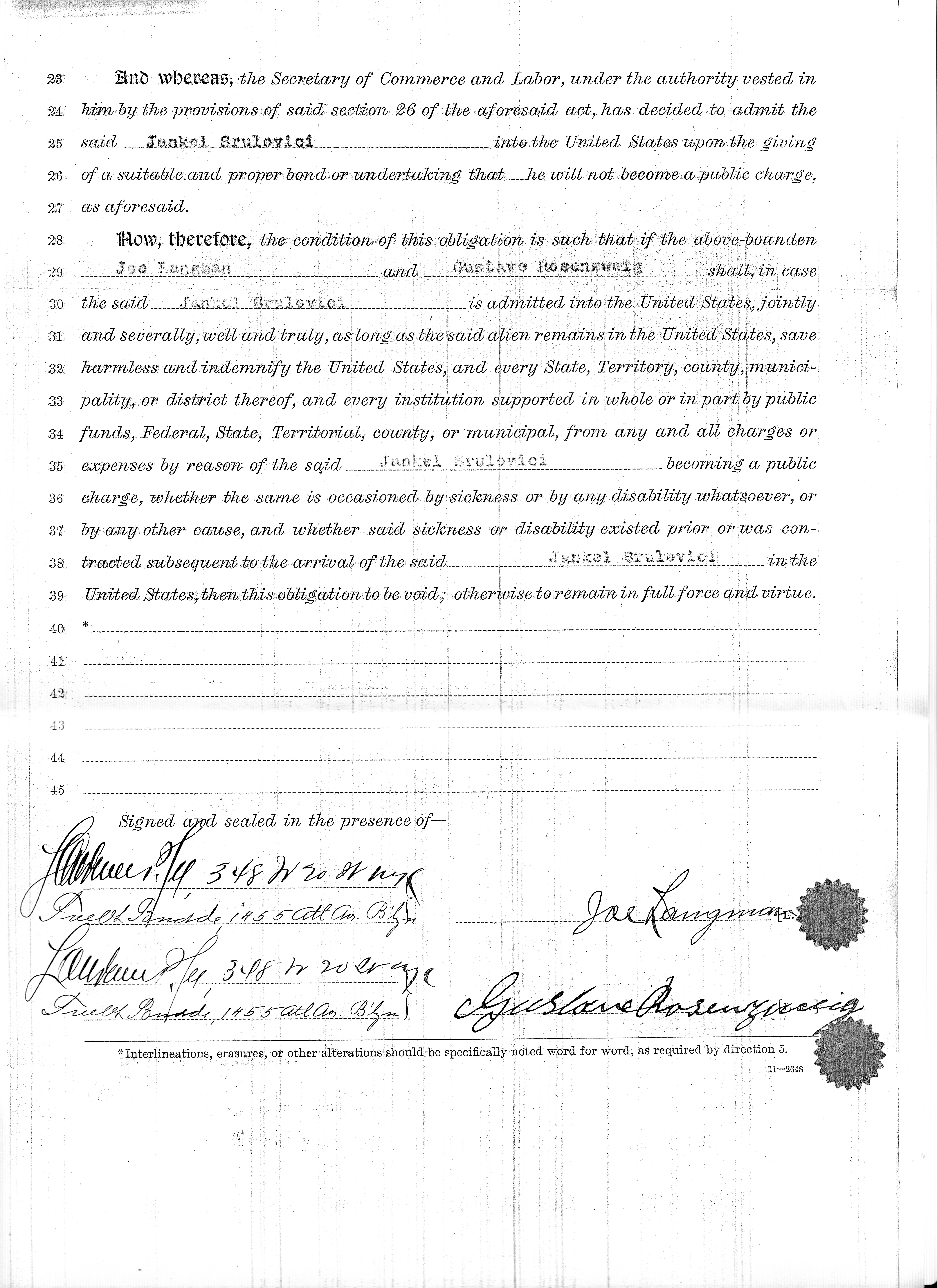
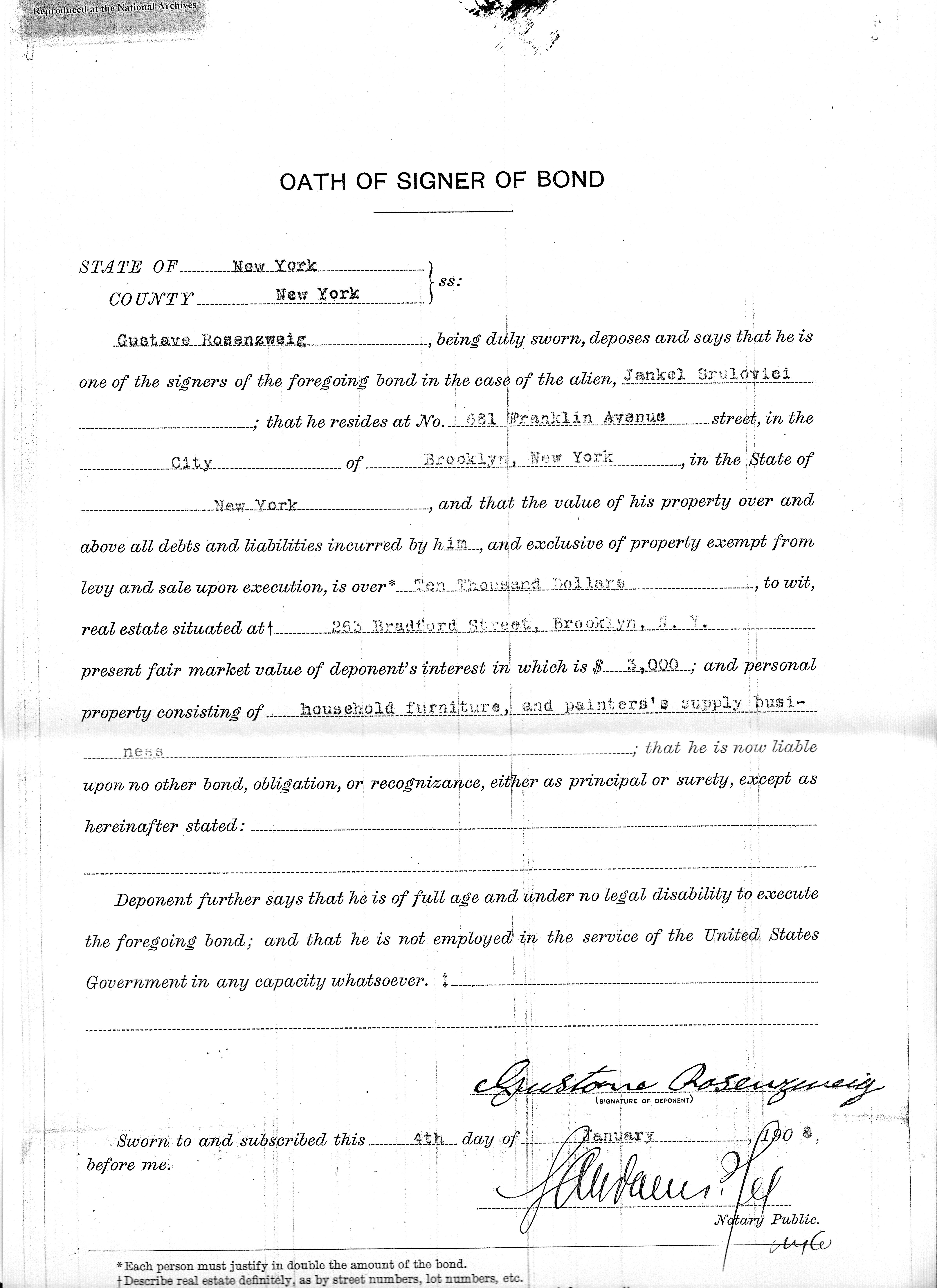
The remaining pages included with the Acting Commissioner’s recommendation are the bond, the application for the bond, and the oaths made by those providing the bond, Gustave Rosenzweig and Joe Langman.  Although I have only done some preliminary research on Joe Langman, it appears that he was also from Iasi and had been in the US for some time before this hearing.  I do not know whether there is any family connection, or whether he was just a landsman helping out another Romanian from Iasi.  Langman signed an oath claiming to have real property in Manhattan worth over $60,000, which must have been quite a substantial sum back then.  Gustave also signed a similar oath, asserting that he had $3000 worth of interest in real estate located in Brooklyn as well as personal property consisting of furniture and his painters’ supply business (presumably worth the other $3000).  Based on these oaths, a bond was issued for $1000 and presented in order that Jankel “shall not become a public charge” and be allowed to enter the country.

bond application p.1

bond application p.1

page 2

page 2

Oath of Joe Langman

Oath of Joe Langman

Oath of Gustave Rosenzweig

Oath of Gustave Rosenzweig

One other interesting thing I noticed about these documents: at the bottom of the page containing the oath is a footnote that reads, “In case signer of bond is a woman, insert here [on a line on the oath] “that deponent is an unmarried woman.” “ I had to stop and think about that for a minute, and then I realized what it meant.  Only an unmarried woman could post a bond because a married woman had no independent claim to property.  Boy, between being Jewish and a married woman, I would have had no rights back in 1908.

The final document in the file is the recommendation of the Commissioner of Immigration Services to the Secretary of Commerce and Labor, agreeing with the Acting Commissioner’s recommendation and recommending that Jankel Srulovici be granted admission on bond.  Although there is no response from the Secretary, I would assume that in general the Secretary deferred to the Commissioner and his hearing officers, and that Jankel and his family were in fact admitted into the United States and that he was not left on Ellis Island or deported.commissioner's recommendation

And yet, despite spending hours again last night searching for some record of his death or a gravesite, I still cannot find anything that reveals what happened to Jankel after January, 1908, when he was admitted, and April 29, 1910, when, according to the 1910 US census, Tillie was already a widow.

I’ve also been tracking down records for Gustav Rosenzweig and Joe Langer, but more on that in the next post.

Enhanced by Zemanta

The Family Album continued

For those who love old photographs, here are a few more to enjoy.

First, this is a photograph of my two big cousins, Jeff Lehrbaum and Beth Goldschlager.  They are younger here than I would remember them.  (I was probably younger than two when this was taken.)  I don’t know where this was taken, but I love how young and innocent they both look.  Beth and I used to compete for Jeff’s attention; she would point out that she was closer to him in age, but I would respond that I lived closer by and saw him more often.  Here I see how those extra two years gave her a headstart.

Jeff and Beth c. 1954

Jeff and Beth c. 1954

Here is one of Barry and Karyn Kenner with their father Irving.  According to Barry, this was taken when they were visiting their grandmother, Betty Goldschlager Feuerstein, at her home in Levittown, New York.  I love that I get a sneak peak into her home and its furnishings as well as a picture of my newly-found second cousins as children.

Barry, Irving and Karyn Kenner

Barry, Irving and Karyn Kenner

And here’s one of my aunt and uncle, Elaine and Phil Lehrbaum, canoeing somewhere, perhaps on their honeymoon.  My aunt always would talk about how athletic Phil and his family all were, skating, swimming, biking, and, it seems, canoeing.  She would tell funny stories of her attempts to compete with the Lehrbaums —or more accurately, her inability to compete.  I think this photo captures that—she seems to be holding that paddle as if she had no idea of what to do with it and with no intention of using it.

Phil and Elaine Lehrbaum

Phil and Elaine Lehrbaum

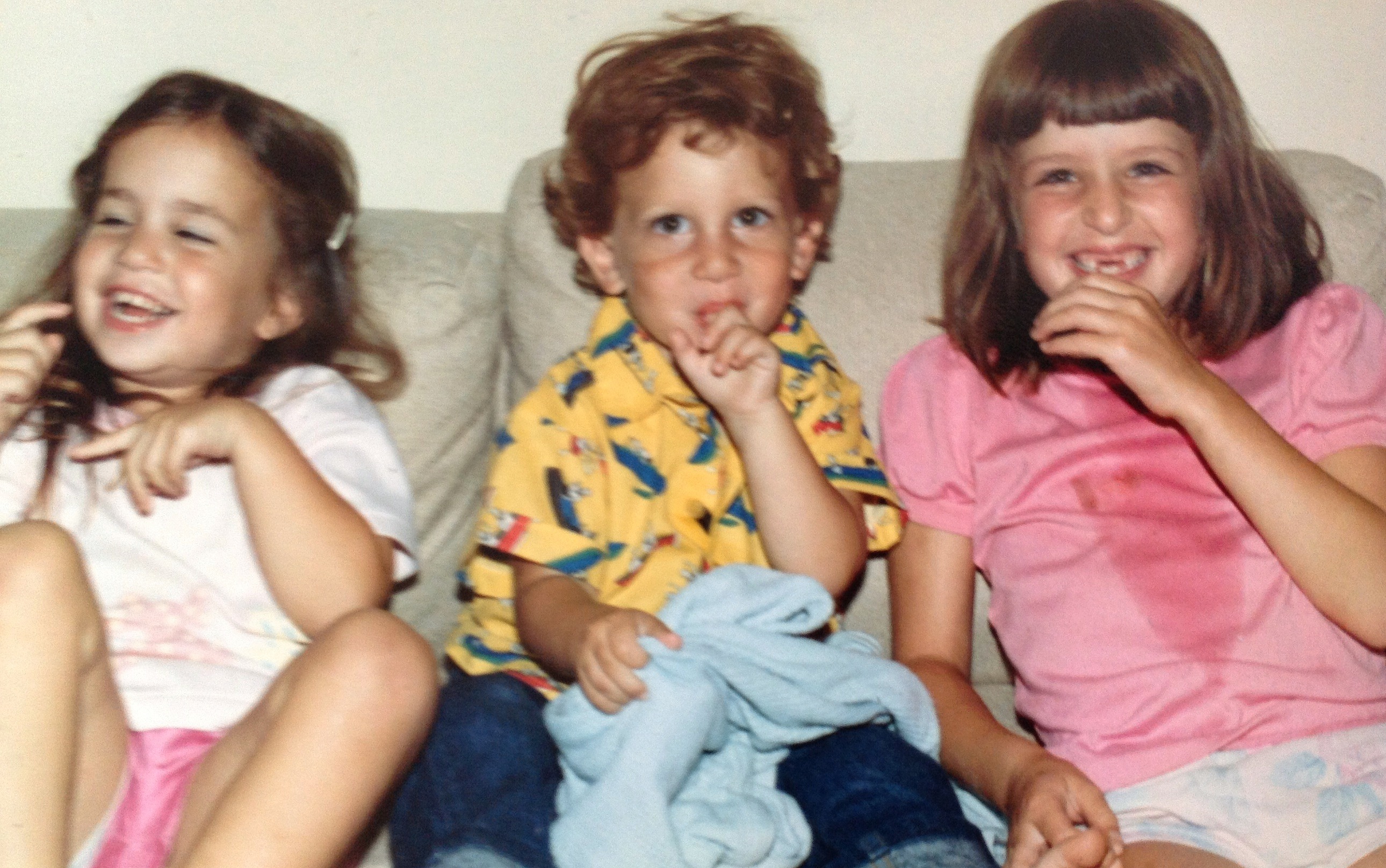
Finally, one that’s of more recent vintage—probably around 1987—of three little cousins, my daughters Maddy and Rebecca surrounding their second cousin, Mark, Jody and Joel’s son.  May they remain connected and always part of each other’s lives.

Maddy, Mark and Rebecca

Maddy, Mark and Rebecca

Thanks to Barry, Jody and Robin for these pictures.

Enhanced by Zemanta

More Family Photos

Another day of “new” old family photos to enjoy.

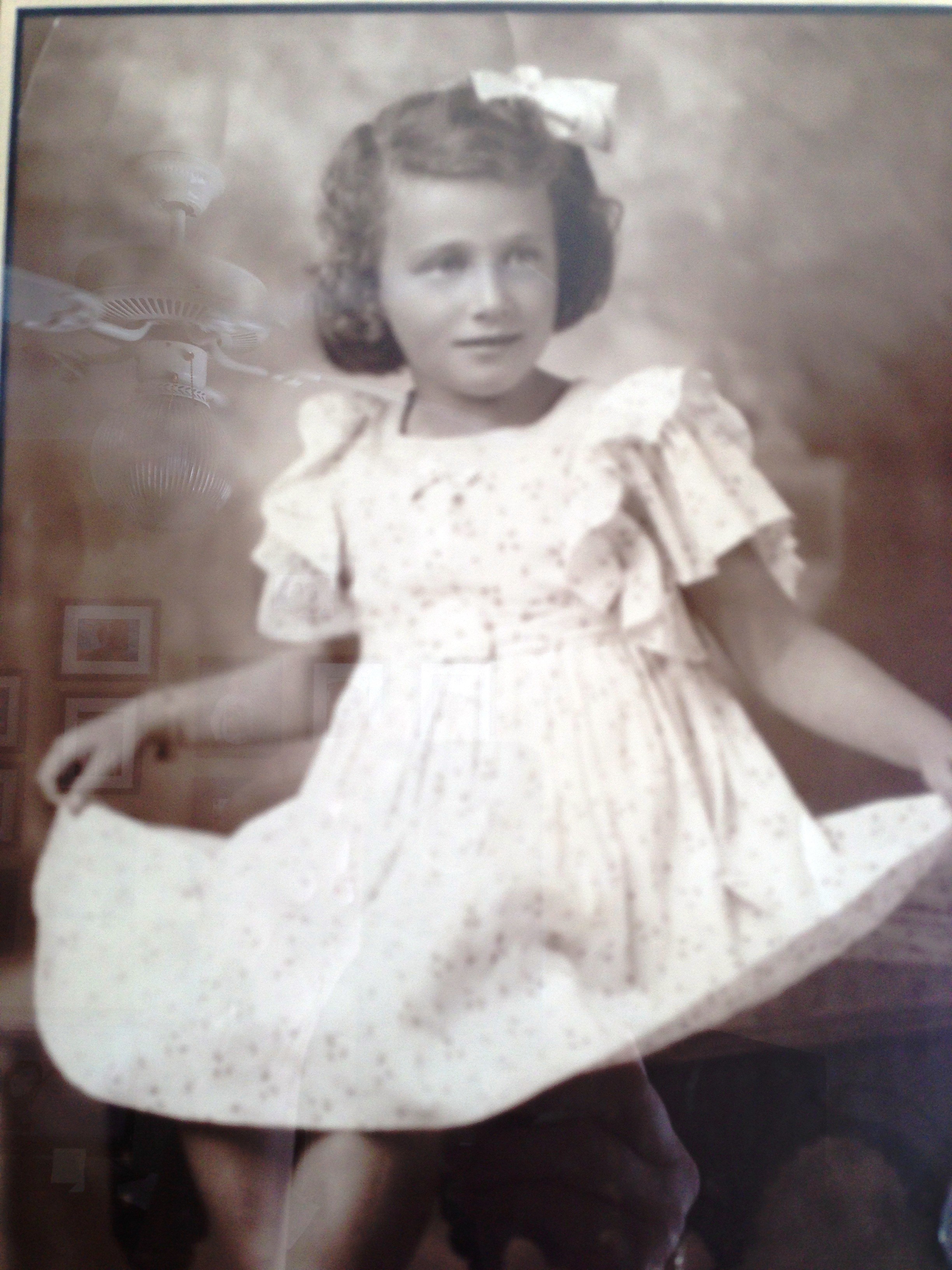
First, some from the Goldschlager side: Robyn, Estelle Feuerstein Kenner’s daughter, sent me these two wonderful photos of her mother Estelle.

Estelle Feuerstein, Betty's daughter

Estelle Feuerstein, Betty’s daughter

You can see why my grandfather described her as a princess—what an adorable little girl.  Here she is an adult:

Estelle

Estelle

I love the hat! I wonder what the occasion was and what year this was taken. So elegant. I also see something of my mother in her eyes here.

Now one for the Brotman side.  Jody found this picture of Sam Brotman as a young man:

Sam Brotman

Sam Brotman

He looks like a teenager here.  Can you imagine a teenage boy today dressing up like this for a studio photograph?  Well, maybe if it was his bar mitzvah.  Hmm, maybe this IS a bar mitzvah picture.  Why else would my great-grandmother have spent money for a fancy picture of her son?

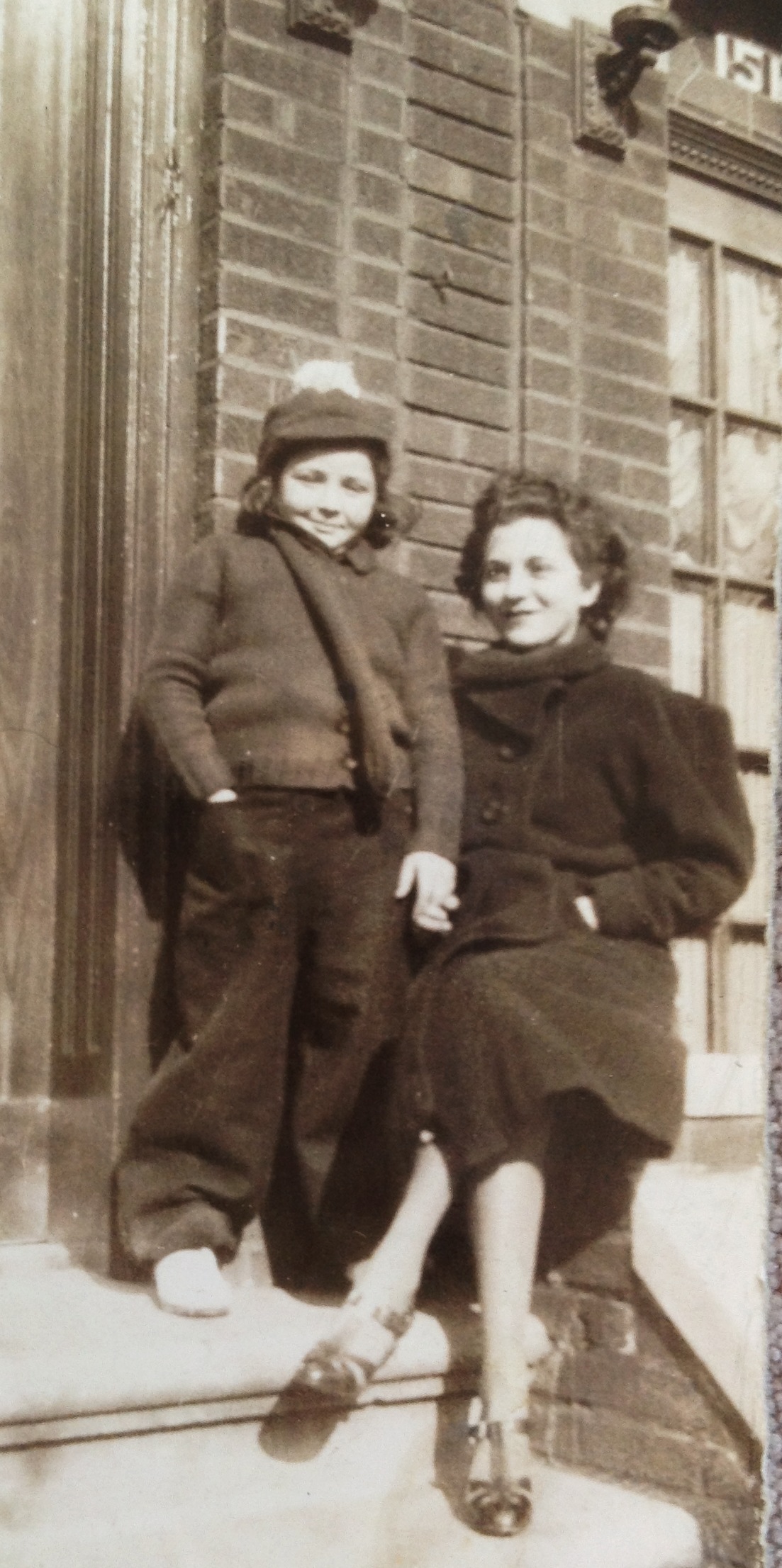
Finally, here is one of two young women who share both Goldschlager and Brotman genes—my mother and her big sister, my Aunt Elaine.  As you can see, they both had a sense of style. I love how they both have the large buttons and a scarf like attachment to their sweater/coat.  And you can’t miss those Bessie Brotman cheekbones!

Florence and Elaine Goldschlager

Florence and Elaine Goldschlager

That’s it for today.  I’d love more photos so if you have any old pictures of your parents or grandparents or aunts and uncles, please scan and send them, and I will share them here with everyone. Thanks!

Family pictures

While I am waiting to receive further documentation for my genealogy research, I thought I would share some more of the photographs that I received from my cousin Robin and also some that my cousin Jody sent me last week.  These are almost all pictures I’d never seen before and that I found very touching.  Today I want to post some new (to me) photographs of my grandparents, Gussie Brotman and Isadore Goldschlager.

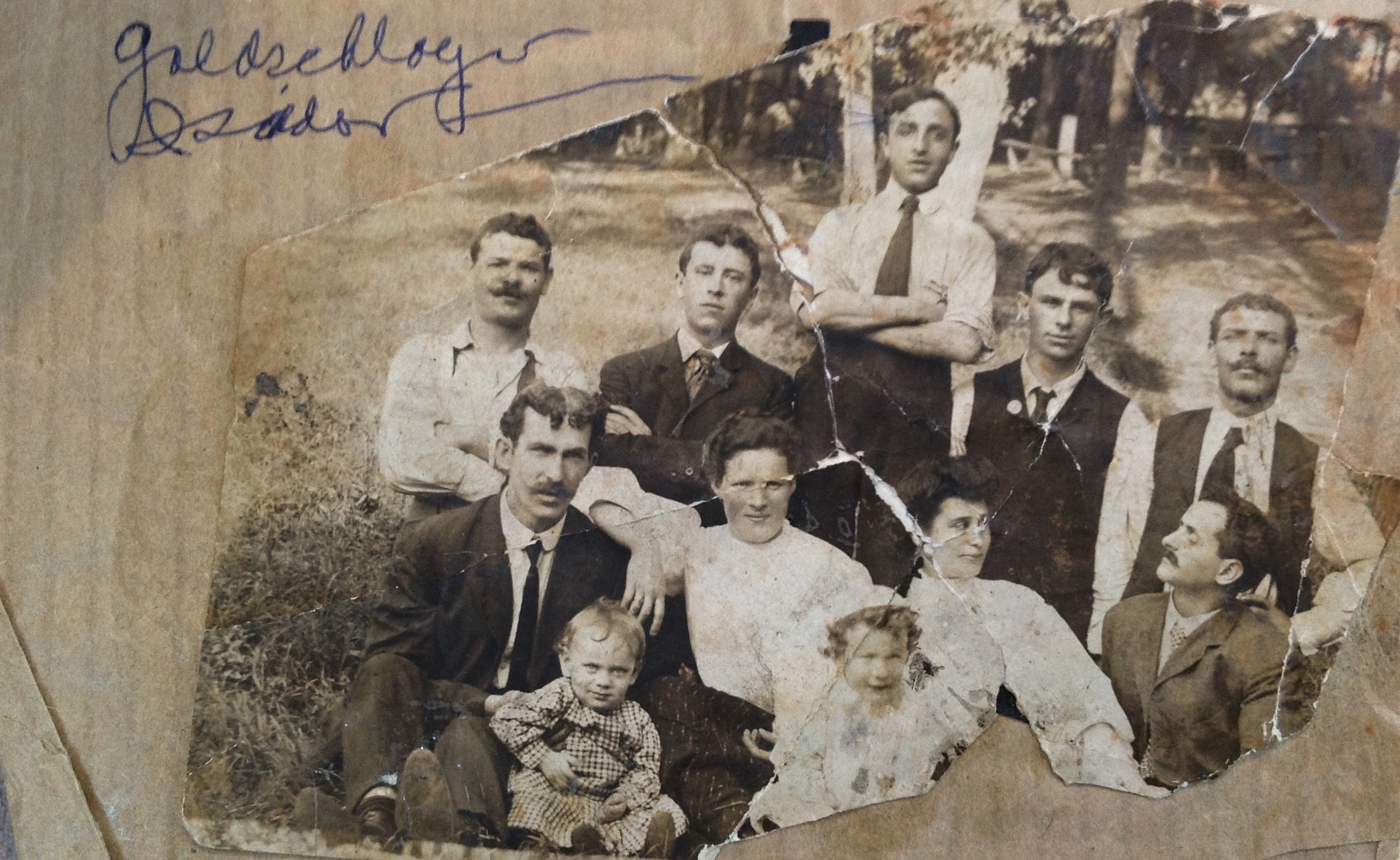
I would love to know more about this photograph.  My grandfather is the young (and short) man standing in the center of the rear row in this picture, but I have no idea who these other young people are or where or when this picture was taken.  Isadore looks like a teenager, but could be in his early 20s, so perhaps this was in Iasi, perhaps in New York City.  Since he was 16 when he came to New York, my guess is that this is in New York City.  But who are these people? Could any of them be his Strolowitz/Adler cousins? Or Nathan Mintz? I don’t see anyone who could be Betty or David.  Maybe these are just his friends.  I wish I knew.

Isadore Goldschlager and unknown others

Isadore Goldschlager and unknown others

Here are two more of my grandfather, one alone and one with my grandmother:

Isadore

Isadore

Gussie and Isadore

Gussie and Isadore

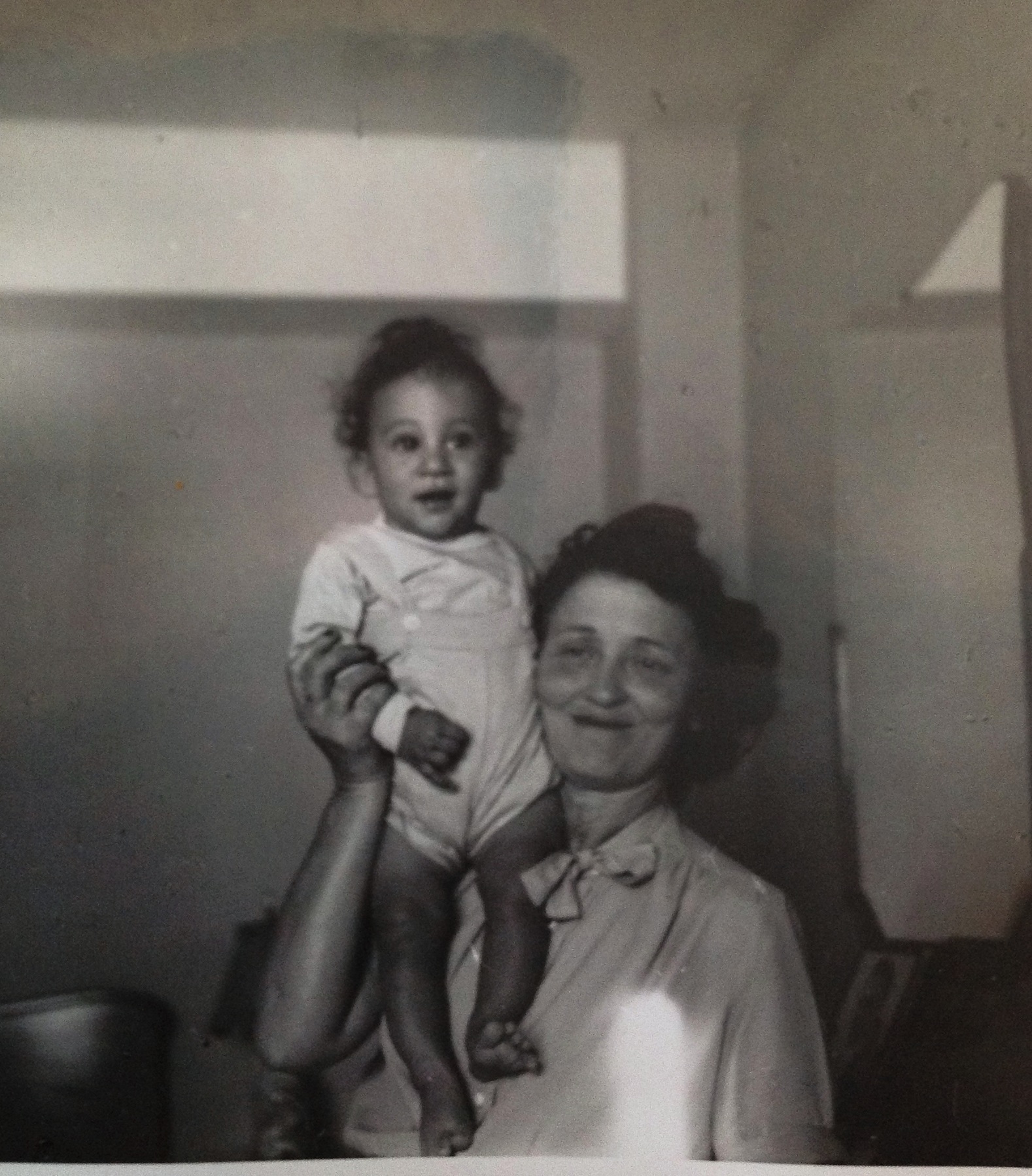
And here are several of my grandmother with her grandchildren.  The first one is of her holding Jeffrey, her first grandchild.  I don’t think I have ever seen a photograph of her looking so happy.

Gussie and Jeff 1946

Gussie and Jeff 1946

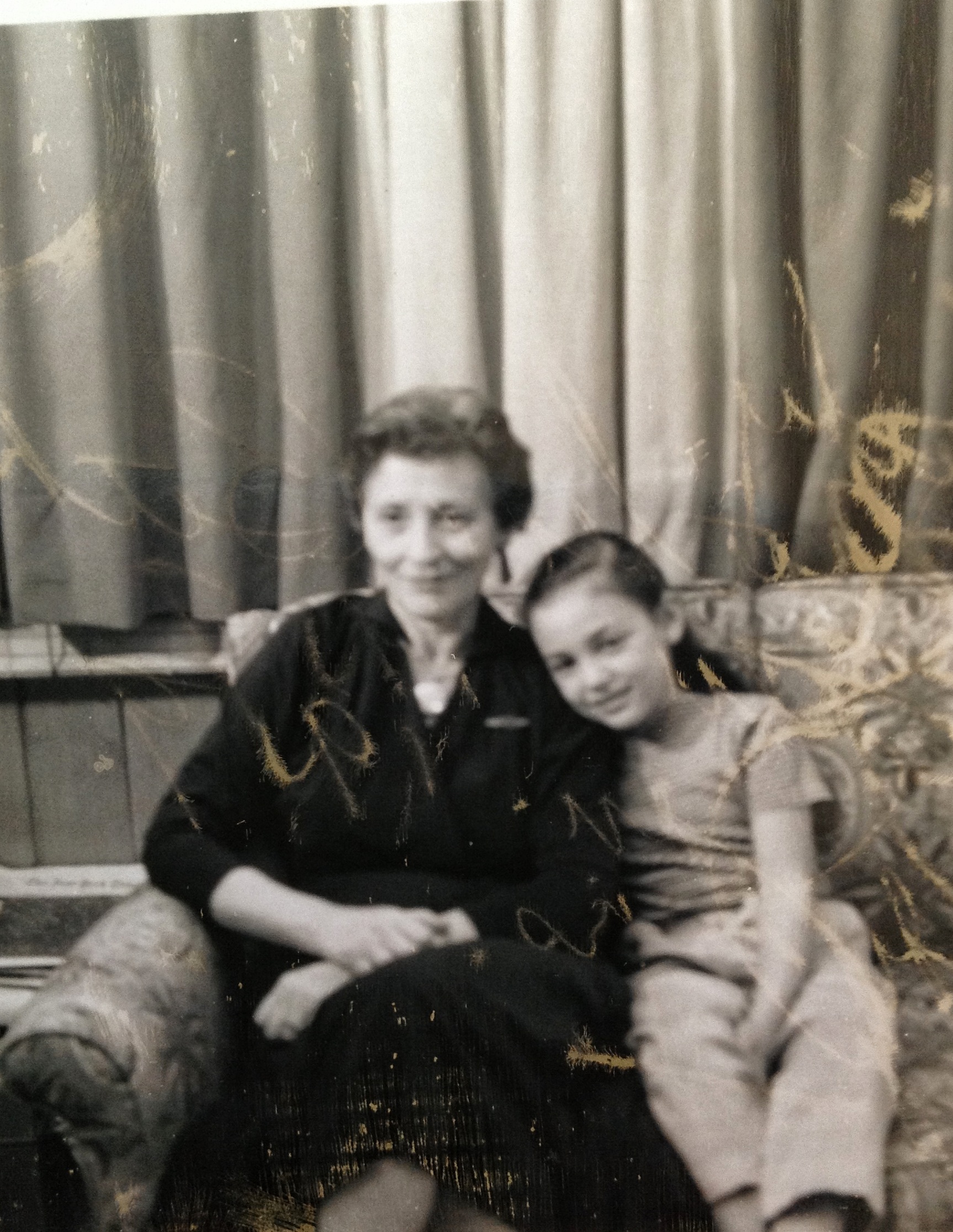
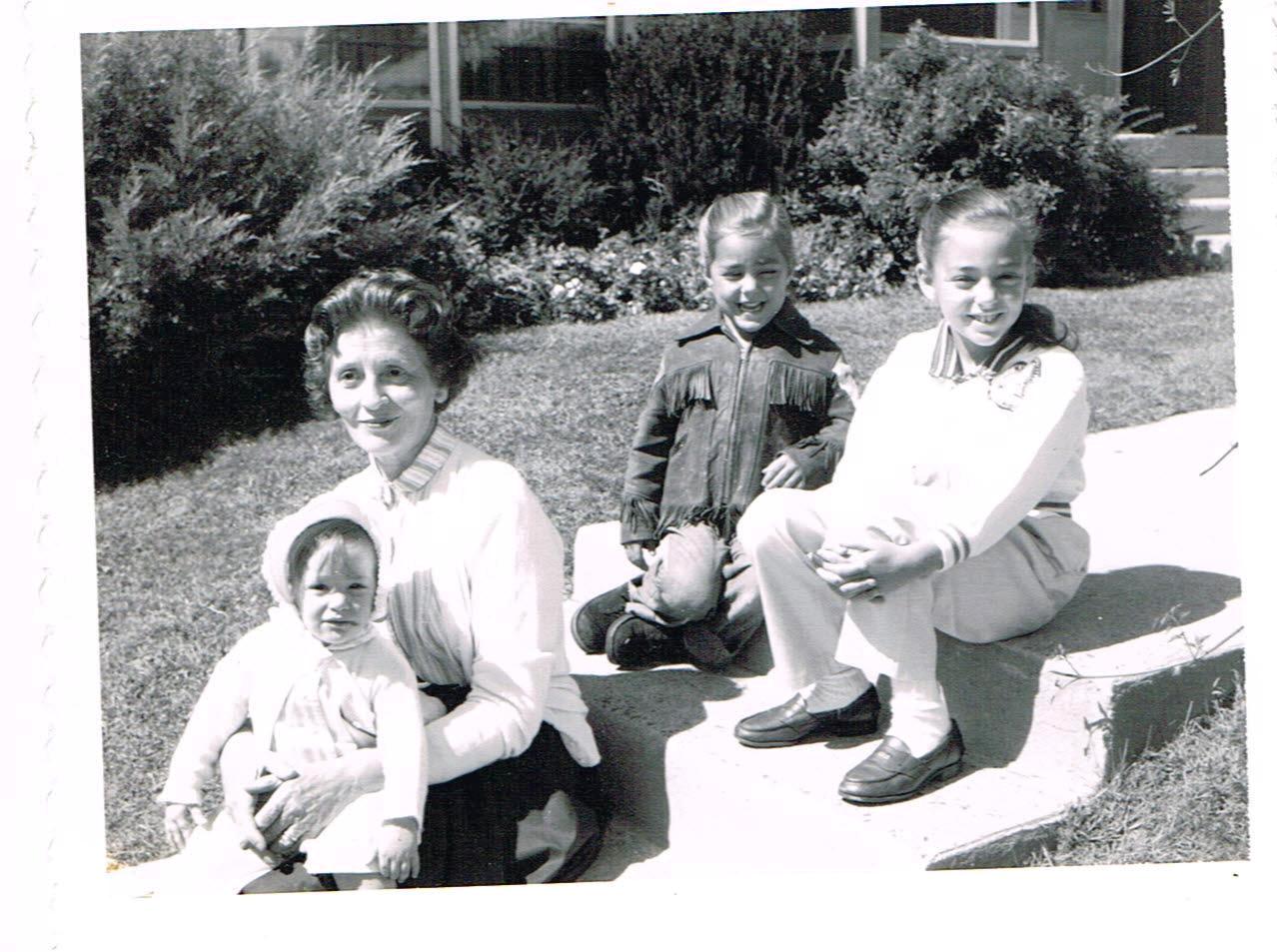
The remaining photographs are pictures of my grandmother with her West Hartford grandchildren:

Gussie and Beth 1954

Gussie and Beth 1954

Gussie with Robin Sue and Beth c. 1958

Gussie with Robin Sue and Beth c. 1958

Lynn, Robin and Gussie 1958

Lynn, Robin and Gussie 1958

Gussie and Robin 1958

Gussie and Robin 1958

Thank you to Robin and to Jody for sharing these.  More to come in the days ahead.

And A New Branch for the Goldschlager Tree: The Third Rosenzweig Sister

These last few days have been very exciting ones for me.  Not only did I find persuasive evidence of another member of the Brotman family, I also have persuasive evidence of a new member of the Goldschlager family, a third Rosenzweig sister, Zusia, also called Sonsa, Celie, Susie and Susan.  I am still piecing together her life and need to obtain more documentation to do that, but this is what I know so far.

Ghitla Rosenzweig Goldschlager

Ghitla Rosenzweig Goldschlager

First, some background: Moritz Goldschlager, my great-grandfather, married Ghitla Rosenzweig, daughter of David and Esther Rosenzweig, according to the records found by my researcher in Iasi, Romania.  Ghitla, who was also called Gittel, Gussie and Gisella, emigrated to the United States in 1910 with her son David, following my grandfather Isadore in 1904, her husband Moritz in 1909, and her daughter Betty in 1910.  As described before, her husband died in April, 1910, and her two children, Isadore and Betty, moved in with Tillie Strolowitz, herself a widow, and her seven children.  According to Tillie’s death certificate, her birth name was Tillie Rosenzweig, and her parents were also David and Esther Rosensweig.  Tillie had emigrated with her husband and her three youngest children in 1907, following her older children who had emigrated over the years 1901 through 1907.  I was quite excited when I figured out that Tillie was my grandfather’s aunt and had taken him and Betty in after their father had died.

Then a few weeks ago, I reviewed my grandfather’s ship manifest from 1904 (under his brother David’s name) and noticed again that he was supposed to meet an uncle, Morsche or Moische Mintz, in New York City.  I had not been able to find this uncle before, and I was stymied again when I searched for him.  Then I located a document indicating that my grandfather had been shortly detained at Ellis Island, apparently because his uncle had not been able to meet him.  Instead he was met by an aunt Zusie Mintz, who lived at 110 East 117th Street.  But who was she?
Record of Detained Aliens Isadore listed as David Goldschlager

Record of Detained Aliens
Isadore listed as David Goldschlager meeting Zusie Mintz

By searching the NYC marriage index, I was able to locate a Zusie Rosenzweig married to a Harry Mintz and wondered whether this could be the aunt who met Isadore and whether she was another sister of Ghitla and Tillie.   I ordered a copy of the marriage certificate and also looked for further documentation of Zusie Mintz.  I found one census reference for a Sonsa Mintz, living with cousins Jacob and Rachel Reitman in 1900 as a widow.  If this was the same person as Zusie Mintz, it explained why the uncle had not been available in 1904; he had died.  But was Sonsa also Zusie, and who were the Reitmans?

I looked for Zusie or Sonsa or Susie on the later census reports, but could not find her on any of them.  Had she remarried and changed her name? Had she died?

I then looked for and found a death certificate for a Susie Mintz dated March 11, 1931, and I ordered that as well.  At that point I decided to wait for these two documents to arrive before going on what might be a wild goose chase.  I received those documents two days ago, the same day I received the documents evidencing that David Brotman was my great-uncle.  Could I have struck gold twice in one day?

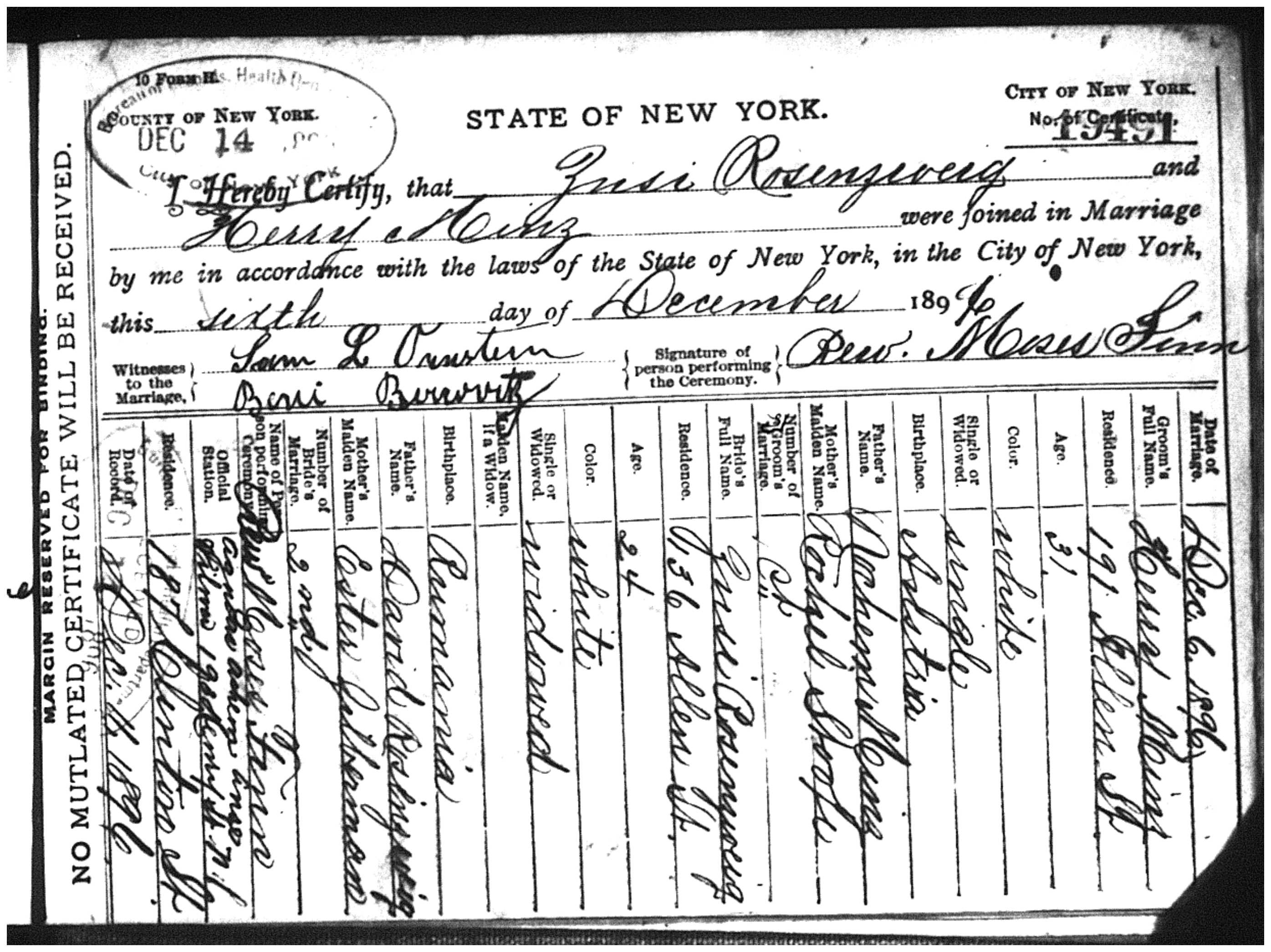
Yes, I could, and I did.  The marriage certificate, dated December 6, 1896, confirmed that the Zusi Rosenzweig who married Harry Mintz was the daughter of David Rosenzweig and Esther Gilberman, revealing for the first time Esther’s birth name.  The certificate confirmed also that Zusi was from Romania.  Zusi had been living at 136 Allen Street, and Harry was living at 191 Allen Street, so presumably they had met in the neighborhood.  Harry was 31 years old, born in Austria, and was marrying for the first time. Zusi was 24 years old, but already a widow.

Zusi Rosenzweig and Harry Mintz marriage certificate

Zusi Rosenzweig and Harry Mintz marriage certificate

Had she married before she left Romania, or since arriving in NYC? Why had she gone back to her birth name, Rosenzweig?  These are questions for which I still do not have answers.

The second document I received, the death certificate for Susie Mintz who died on March 11, 1931, also confirmed that Zusi, now Susie, was the daughter of David and Esther Rosenzweig, born in Romania.  Susie was 54 years old at the time of her death, meaning that she was born in 1877, whereas if she had been 24 in 1896, her birth year would have been 1872.  The death certificate also indicated that she was a widow, and it provided her current address: 523 East 108th Street in the Bronx.

Susie Mintz death certificate

Susie Mintz death certificate

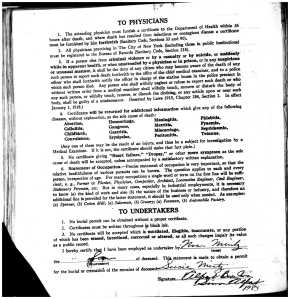
The reverse side of her death certificate contained some surprising information. It revealed that the undertaker had been employed by “Mr. Mintz,” Susie’s son.  Susie had a son? If so, where was he in 1900 when Sonsa was living with Jacob Reitman? Or was that really Susie/Zusi? If Susie had a son, perhaps she had other descendants as well.  But what was her son’s name? When was he born?
reverse of death certificate

reverse of death certificate

Using the address on the death certificate, I worked backwards to see if I could find Susie on the 1930 census, since I assumed she had not moved between the 1930 census and the time of her death in March, 1931.  This took some doing, as you have to scan through all the pages within a specific enumeration district to find the address; there is no index by address.  I finally found her address, and then I found her listing: she was living at the same address, listing herself as  Susan Mintz, 42 years old, a dressmaker, and as married.  Married? She was living with a boarder named Hannah Kassel, an older woman who was a widow.  When I looked at the form more closely, I realized that the M for married also could be a W for widowed.  I think the indexers read it incorrectly, and that Susie was in fact still a widow in 1930, as she was in 1900 and at her death.

Susan Mintz 1930 census

Susan Mintz 1930 census

From the 1930 census, I then went to see if she had been at that address ten years earlier for the 1920 census.  After more scanning and searching, I found her once again at the same address, but now using the name Celie, or at least that is how the census taker recorded it.  She was listed as a widow, a dressmaker, and 42 years old (I guess she did not want to admit being any older ten years later in 1930).  Zusi/Susie/Celie was living alone at that time.

Celie Mintz 1920 census

Celie Mintz 1920 census

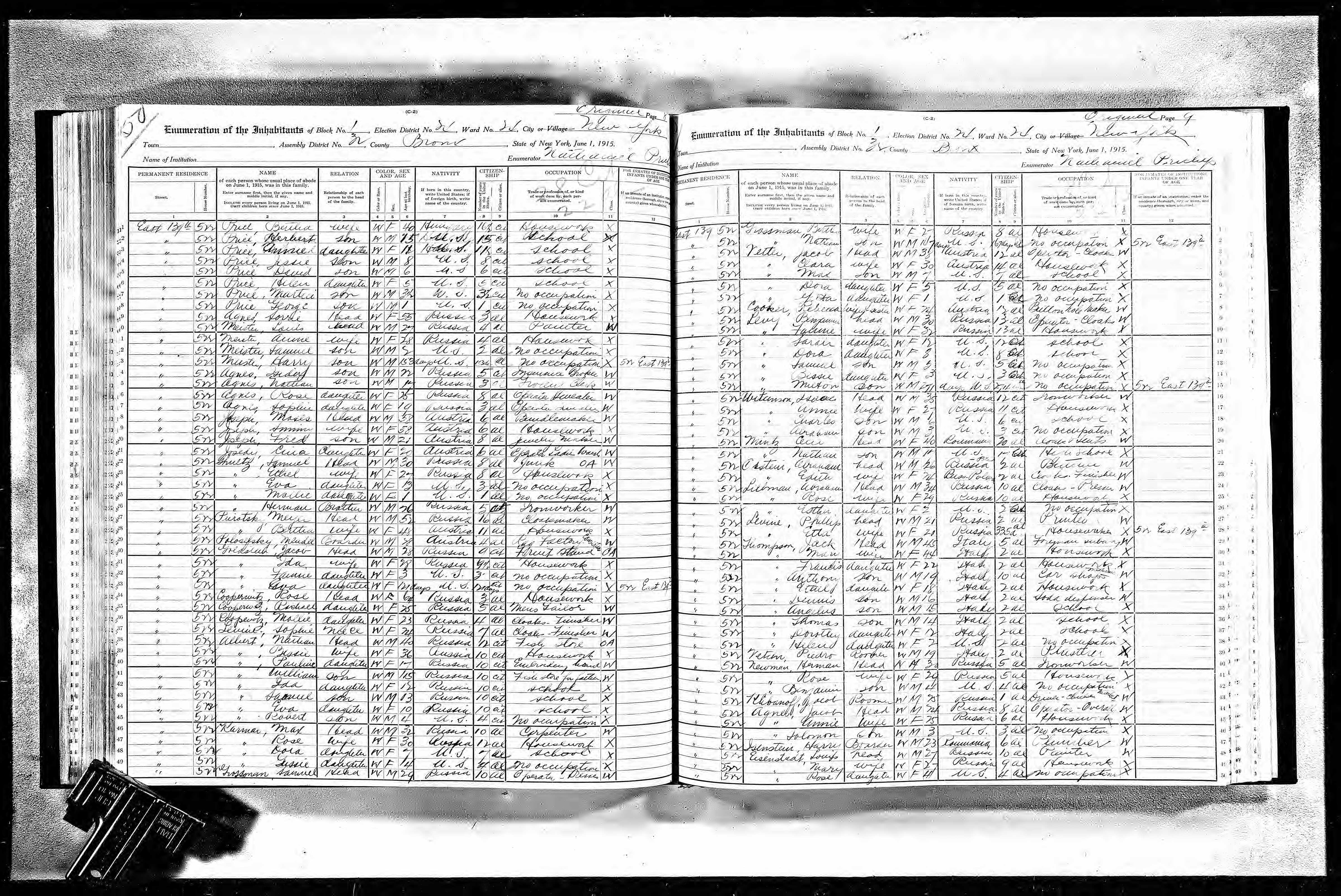
Next came the 1915 New York State census—could I find her again at that address?  I searched for Celie Mintz this time, and without having to scan the census, I found her on the next block at 522 East 139th Street in the Bronx, working at a cloak and suit factory, and living with her son, Nathan.  Her son!  I had found a record for her son.

Celie and Nathan Mintz 1915 NYS census

Celie and Nathan Mintz 1915 NYS census

I could not find either of them on the 1910 census or the 1905 New York State census, at least not yet, but now I had her son’s name and could search for him.

I checked the New York City birth index for a birth certificate for a baby named Nathan Mintz and found one dated December 6, 1897, exactly a year after Harry Mintz had married Zusi Rosenzweig.  This certainly could be the right Nathan, but I now need to obtain that certificate to be sure.

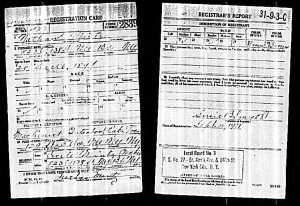
I did find Nathan’s 1917 draft registration for World War I, listing his mother as Cecile Mintz living at 523 East 138th Street in the Bronx, the same address where she was living from 1920 until her death.  Cecile is closer to Zusi and Susie than Celie, and looking at the 1915 census it does look more like Ceci than Celie.  The fact that Nathan’s address in 1917 was the same as that on Susie Mintz’s death certificate confirms that Susie and Cecile and Celie and Susan were all the same woman.
Nathan Mintz draft registration 1917

Nathan Mintz draft registration 1917

I then found a Nathan Mintz who married Gertrude Friedman in 1930. I need to order that certificate as well, but  I suspect that this is the correct Nathan because on the 1940 census, Nathan and Gertrude have an eight year old daughter, born then in 1932, named Susanne.  If this is the right Nathan, it makes perfect sense that he would name his first born child after his mother Susie one year after her death.

Nathan, Gertrude and Susanne Mintz 1940 census

Nathan, Gertrude and Susanne Mintz 1940 census

But there are obviously many unanswered questions.  I can’t find a death certificate for Harry—did he really die, or did he just disappear? Who are Jacob and Rachel Reitman? How, if it all, were they related to Zusi? And where was Nathan living if that was Zusi living with the Reitmans in 1900?  Zusi was the one who met my grandfather at Ellis Island in 1904, but he was living alone in 1905.  Where was Zusi living in 1905? 1910? She was not living with either of her sisters in 1910, so where did she go?   And where was Nathan in those years and between 1917 when he registered for the draft and 1930 when he married Gertrude?

Yes, there are a lot of holes and a lot of questions, but I remain fairly certain that Zusi Rosenzweig Mintz was my great-grandmother’s sister and thus my great-great aunt and that Nathan Mintz was therefore a first cousin to Isadore, David and Betty Goldschlager and to all the Strolowitz children.  Did they know him? And, of course, if Susanne Mintz was Nathan’s daughter, then she would have been my mother’s second cousin.  And if Susanne had children, then they would be my third cousins.
So stay tuned—more to come once I receive more information.