A wonderful email from a Selinger cousin

Yesterday I received an email from Ann Griffin Selinger, whose husband was John Reynolds Selinger, Sr.  John Selinger was the son of Maurice Selinger, Sr., and the grandson of Julius Selinger and Augusta Cohen, the oldest child of Moses, Jr, and Henrietta Cohen.  I was so touched by the stories that Ann had to share about her husband John and his family that I asked her whether I could quote from her email on the blog and share these memories of her family.  She graciously gave me permission to do so, and so here they are with just a few side comments by me.  Ann’s language is italicized, whereas mine is in regular font.

My husband, was John Reynolds Selinger, 1933-2007, born in Washington, DC as was his brother, Maurice Arthur Selinger, Jr.  For a time we lived in Chevy Chase, Maryland and one day we received a visit from Eliot Selinger who apparently lived around the corner from us with his family. We had exchanged mail a few times without meeting, but never looked into whether we were related.  He told us at the time that he thought we were related and that his father and John’s grandfather were brothers – Frederick and Julius.  We had been under the obviously false impression that Julius had no siblings.  

Interestingly, Mildred Selinger, Dr. Maurice A. Selinger’s wife, having lived in Washington her whole adult life, lived with us just before she died in 1981.  I see that Eliot died a year later.  He must have knocked on our door just before he died.


The comment about Julius and Frederick Selinger being brothers  was a very important revelation for me because it confirmed what I had suspected.  I assume that Alfred Selinger was also, given that he lived with Julius and traveled with Julius and Augusta before marrying Augusta’s sister Fanny.

Here is a bittersweet story about Eleanor Selinger, the daughter of Julius and Augusta  who married Henry Abbot and moved to England as discussed here.

Years earlier, John and I were in England and he said he would like to see if he could find his Aunt Eleanor.  
We were successful and made arrangements to have tea with her in her apartment just before we left London.  When she opened the door, John was astonished to notice she looked exactly like his Dad who had died over ten years before.  We had a lovely visit.  She shared that she loved to play cards, but had a hard time see the cards now.  So the next day we had some “jumbo faced” cards sent over to her from Harrod’s – a fun idea.  She called us to say she was so flustered when the delivery man said he was from Harrod’s that she had a hard time buzzing him in.  Very sweet – a wonderful connection that pleased my husband very much.  We flew home the next day and then received word a day later that she had died.
 

Ann also told me more about the accomplishments of Dr. Maurice Selinger, her husband’s father, who along with his brother Jerome were probably the first doctors in the extended Cohen family, as discussed here.

Dr. Maurice Selinger, my father-in-law, who died before John and I were married, served in World War I and World War II as a physician.  He was a very dedicated doctor who gave his all to medicine and his patients.  He was very highly regarded in the Washington medical world.  He was instrumental in bringing three hospitals together (Garfield, Emergency, and one other – can’t remember) to form the new Washington Hospital Center. I remember just after we were married going to a diabetes center in Maryland that was dedicated to Dr. Selinger.  I know nothing more about that.  Amazing what you don’t pay attention to when you are young.
They lived in a lovely home on California Street, NW – should look up the number, that is now the Embassy of Venezuela.

Washington Hospital Center   "WHCExtGarden". Via Wikipedia - http://en.wikipedia.org/wiki/File:WHCExtGarden.JPG#mediaviewer/File:WHCExtGarden.JPG

Washington Hospital Center
“WHCExtGarden”. Via Wikipedia – http://en.wikipedia.org/wiki/File:WHCExtGarden.JPG#mediaviewer/File:WHCExtGarden.JPG

And finally this story about John’s father Maurice and his grandfather Julius and the Selinger’s jewelry store on F Street discussed here.

John always told the story that when his father was a young boy he would earn his allowance by winding the clocks on F Street that were installed by his grandfather, Julius.  They also put the clock in the tower of the old National Savings and Trust Building downtown.  Years later, John became a banker and worked as a Vice President in that same bank.


National Savings and Trust Building, Washington, DC "15th, New York, & Pennsylvania Avenue, NW" by AgnosticPreachersKid - Own work. Licensed under Creative Commons Attribution-Share Alike 3.0 via Wikimedia Commons - http://commons.wikimedia.org/wiki/File:15th,_New_York,_%26_Pennsylvania_Avenue,_NW.jpg#mediaviewer/File:15th,_New_York,_%26_Pennsylvania_Avenue,_NW.jpg

National Savings and Trust Building, Washington, DC
“15th, New York, & Pennsylvania Avenue, NW” by AgnosticPreachersKid – Own work. Licensed under Creative Commons Attribution-Share Alike 3.0 via Wikimedia Commons – http://commons.wikimedia.org/wiki/File:15th,_New_York,_%26_Pennsylvania_Avenue,_NW.jpg#mediaviewer/File:15th,_New_York,_%26_Pennsylvania_Avenue,_NW.jpg


There is nothing better than hearing and preserving these family stories.  They take the facts and inferences I make from government documents come to life and fill them with the love and respect that these people deserve.  Thank you so much, Ann, for sharing these with me.  I can’t tell you how much it meant to me.


Wonderful Surprises and Gifts

I had two wonderful surprises this week.  Usually I am hunting down family members, hoping for a response.  Twice this week I heard from relatives who found me.

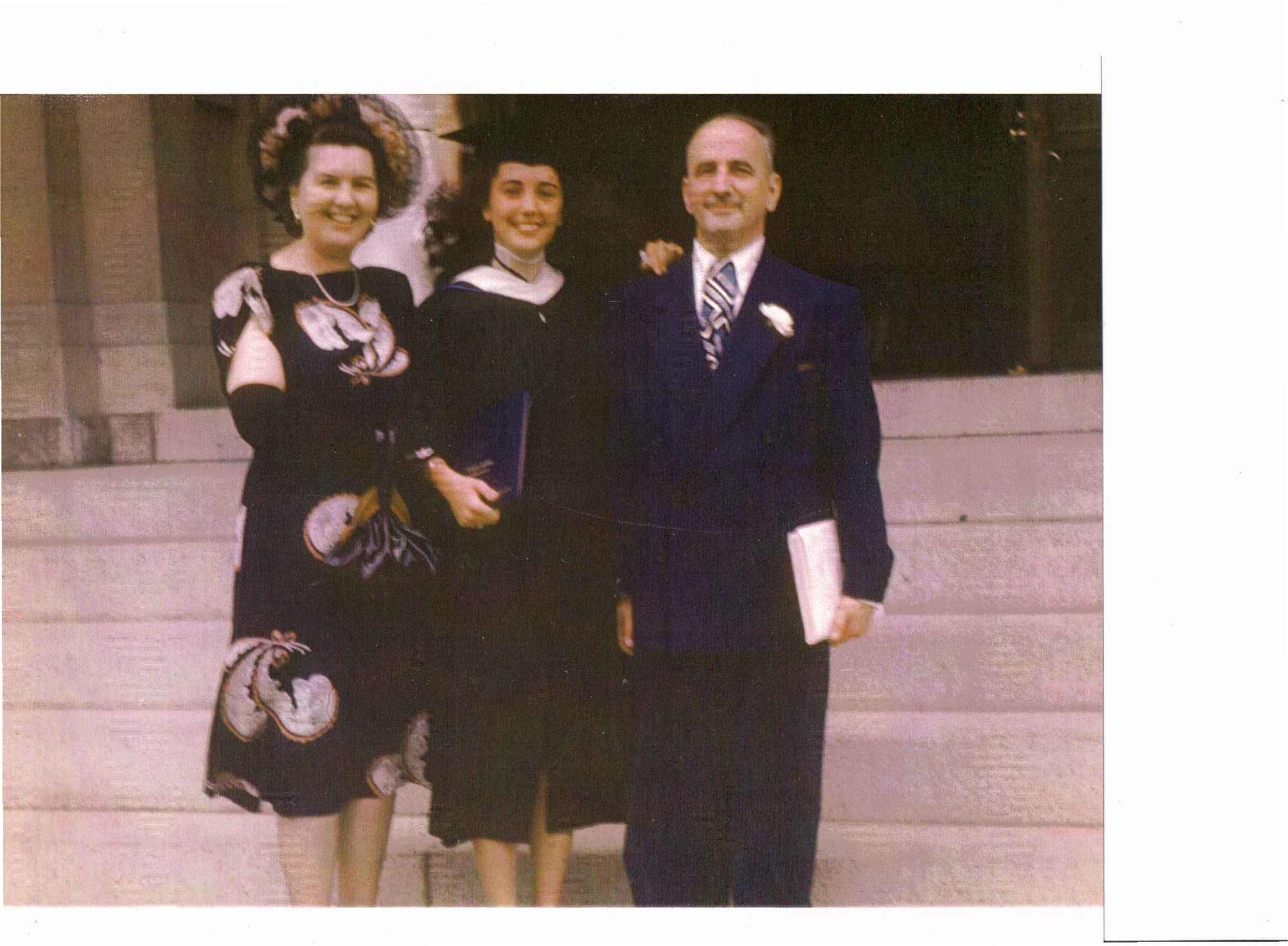
Lou, a relative by marriage, is a cousin of my cousin Marjorie.  He had visited Marjorie recently and heard about my contact with her.  He sent me two wonderful photographs of Marjorie.  One is posted here: a photograph of Marjorie and her parents, Bessie and Stanley Cohen, at her graduation from Trinity College in Washington, DC, probably around 1947.  I’d never seen a picture of any of these family members before, and it was so meaningful to be able to see Marjorie’s face after spending time getting to know her on the phone this summer.  I hope to be able to meet her in person in the coming months.  I also was excited to see what my great-uncle Stanley looked like and what his wife Bessie looked like.   It really helps to bring these people to life when you can put a face to the name.  Bessie and Stanley look so proud of their daughter, a college graduate back when most women did not even dream of going to college.  (The second photograph I will post when I get to my Seligman relatives as it depicts two of them.)

Bessie and Stanley Cohen with their daughter Marjorie at her graduation

Bessie and Stanley Cohen with their daughter Marjorie at her graduation

The second wonderful surprise came in the form of a comment on the blog from a descendant of Julius and Augusta Selinger, their great-grandson Cito.  He had just accidentally found the blog while searching for something else and was pleased to see and learn more about his family’s history.

He then sent me this wonderful photograph of his great-grandfather Julius’ jewelry store.  Although the photograph is not dated, if you look at it closely, you can read the larger sign in the window that says “Sale…Watches…$4,” and see at the bottom “Price during the War +15.”  I am not exactly sure what that means, but I assume that the reference is to World War I, dating the photograph during the second decade of the 20th century.

Selinger's Jewelry Store 820 F Street, Washington, DC

Selinger’s Jewelry Store 820 F Street, Washington, DC

That makes sense because the young woman to the right standing in the doorway is assumed by the family to be Eleanor Selinger, the daughter of Julius and Augusta who married Henry Abbot and moved to London in 1926.  Eleanor would have been about 22 years old in 1917 when the US entered World War I.  I love being able to see Eleanor’s face also.  She has such a searching, pensive look on her face—what was she thinking?  You can see the reflections of a crowd of people looking into the window as well as some of the buildings across the way.  The store was at 820 F Street in Washington, DC.  Perhaps some of you recognize that location?

Thanks to both Lou and Cito for generously sharing these photographs and for contacting me.  I am so happy that you both were able to find me.  I also received photographs from another family member this week, my cousin Jack, the great-grandson of Joseph Cohen, who was my great-grandfather Emanuel’s older brother.  I will post some of those photographs next week after I have a chance to scan them.

So it’s been a great week to be doing genealogy research.  I am feeling very fortunate for all the gifts that genealogy has provided to me.  Happy Labor Day Weekend, everyone!


Grandsons and Memories

The last five days were spent with my grandsons Nate and, for two of those days, Remy.  Nate came back to our house for three days, and I just had the best time with him, doing not much of anything special, but just enjoying him and seeing life through his eyes.  Being with my grandsons makes me think about how important those first few years of life are—how they form us, teach us about the world, and introduce us to relationships, love, trust, friendship, and family.

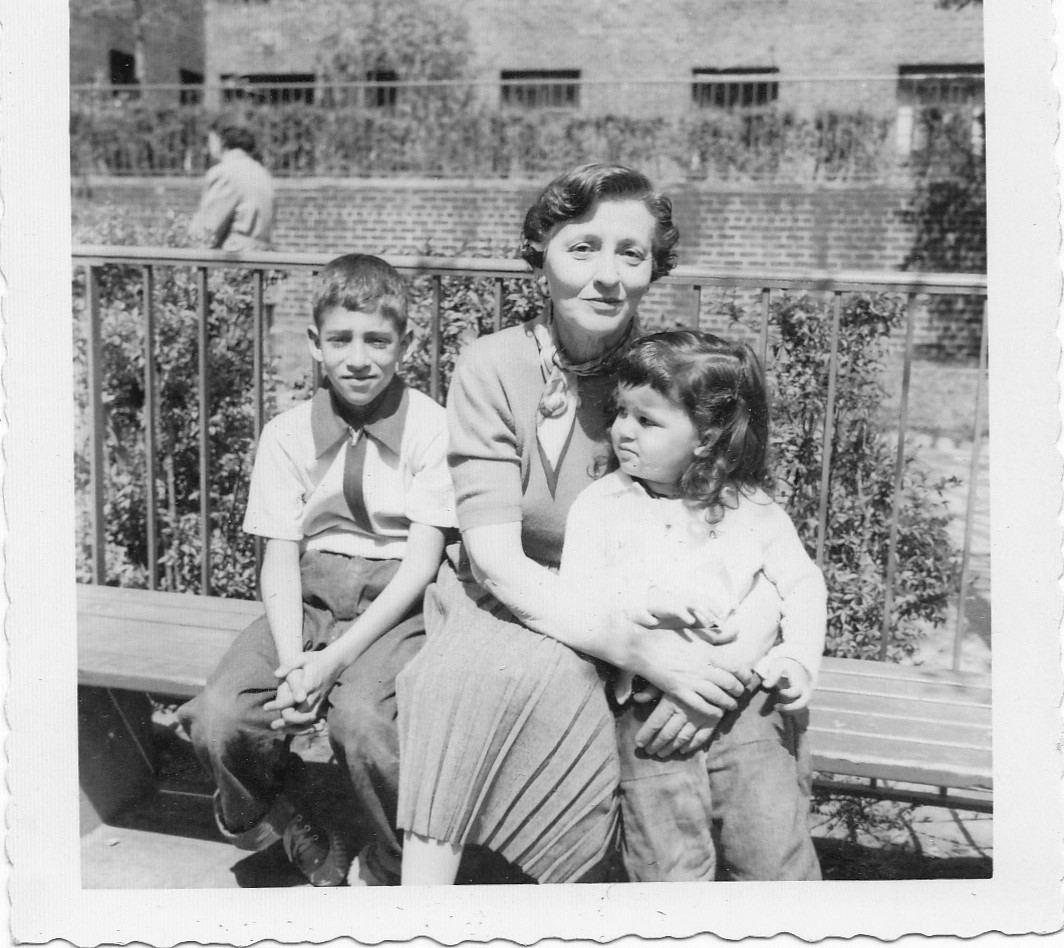
I was fortunate to get a box of old photographs from my cousin Jody a few weeks ago, and I spent one day last week scanning those photos, many of which will eventually get posted on the blog.  But for today, as I think about being with Nate and Remy, I want to recognize those people I spent most of my time with during the early years of my own life—my parents, my grandparents, my aunt and uncle, and my older cousin Jeff.  We all lived within a few minutes of each other in Parkchester, a large apartment complex in the Bronx, and I probably saw them every day or almost every day during those years.  We also spent summers together near Lake Mahopac, New York, on Long Pond.  They called me Kugel, or Amy Kugel, or sometimes just Kug–the only people who ever did.  (My mother still occasionally does.)

They made me feel loved, and they gave me a sense of family that has stayed with me all my life.  I can only hope that we are doing the same for Nate and Remy, even though we don’t live close enough to be with them as much as I was able to be with my grandparents at their ages.   Although I don’t have many specific concrete memories of those years, these photographs capture those magical years of my early life.

amy florence abt 1954

My mother

amy and john 1954 abt

My father

Amy Gussie and Isadore

My Grandparents

elaine and amy 1953

My Aunt Elaine

My cousin Jeff

My cousin Jeff

Jeff and Amy

Jeff

jeff gussie amy 1955 abt

Jeff, my grandmother, and me


The Flat: A film by Arnon Goldfinger


The other night we watched a fascinating movie, The Flat. It is a documentary made by Arnon Goldfinger about what he learns about his grandparents after his grandmother dies and he and his family clean out their apartment in Tel Aviv. His grandparents had lived in Berlin until 1936 when they left for Israel. Goldfinger and his family, including his mother, had almost no knowledge of the grandparents’ lives before they left Germany.

I do not want to reveal too much about what they learn because each viewer should be able to experience the revelations as they are uncovered in the course of the film. But I will say that this is a film that anyone interested in family history and the ethical dilemmas that are created when you learn something surprising and perhaps troubling about the past should watch. What is our obligation to reveal the truths we learn to those left behind, even if they were innocent of the past actions of their family members? Why do people hide from the truth? Why do some of us ask questions and seek answers whereas others prefer to avoid uncovering the past?

But this is not only a film for genealogists. It is a film for everyone who has an interest in human nature. The film addresses important questions of identity and nationality. What makes people identify with a country, a religion, a family? How do we pick our friends? How does denial play into our sense of who we are?

Finally, this is also a film about our legacy. What will our families do and think after we are gone?  When the family throws out bag after bag after bag of the treasured belongings of the grandparents, I couldn’t help but think about the way we all collect objects—clothing, books, jewelry, letters, photographs—that our descendants will toss away with barely a thought. We have to leave something else behind besides these material things—our good name, our good deeds, our stories, and our love. All else will vanish.

Did Eleanor Selinger Marry an English Cousin? And Did She Remember Her American Roots?

In my post about the children of Julius and Augusta Selinger, I wrote about the marriage of their daughter Eleanor to an Englishman, Henry Abbot.  Henry Abbot was the son of Hyams Auerbach (some members of the family changed the name to Abbot at some point) and Helen (or Ellen or Helena) Selinger.  I had wondered whether there was any familial connection between Helen Selinger and Eleanor’s father, Julius Selinger.  Both were born in Germany, and they were three years apart in age:  Helen was born in 1850, Julius in 1853.

As I wrote then, I was in touch with one of Henry and Eleanor Abbot’s relatives on the Abbot side, Henry’s great-niece, Valentine Ann Abbot Collinson, and was hoping that she would be able to provide some clues to determine whether the two different Selingers were related.  Over the last several days I received a number of documents about Helen Selinger and her family from Val that could help answer that question, including this photograph. Val believes that the woman seated in the center of the photograph is Eleanor Selinger Abbot with her husband Henry seated to her right.  The others are other members of the Abbot/Auerbach family.

Eleanor Selinger Abbot and Abbot family-page-001

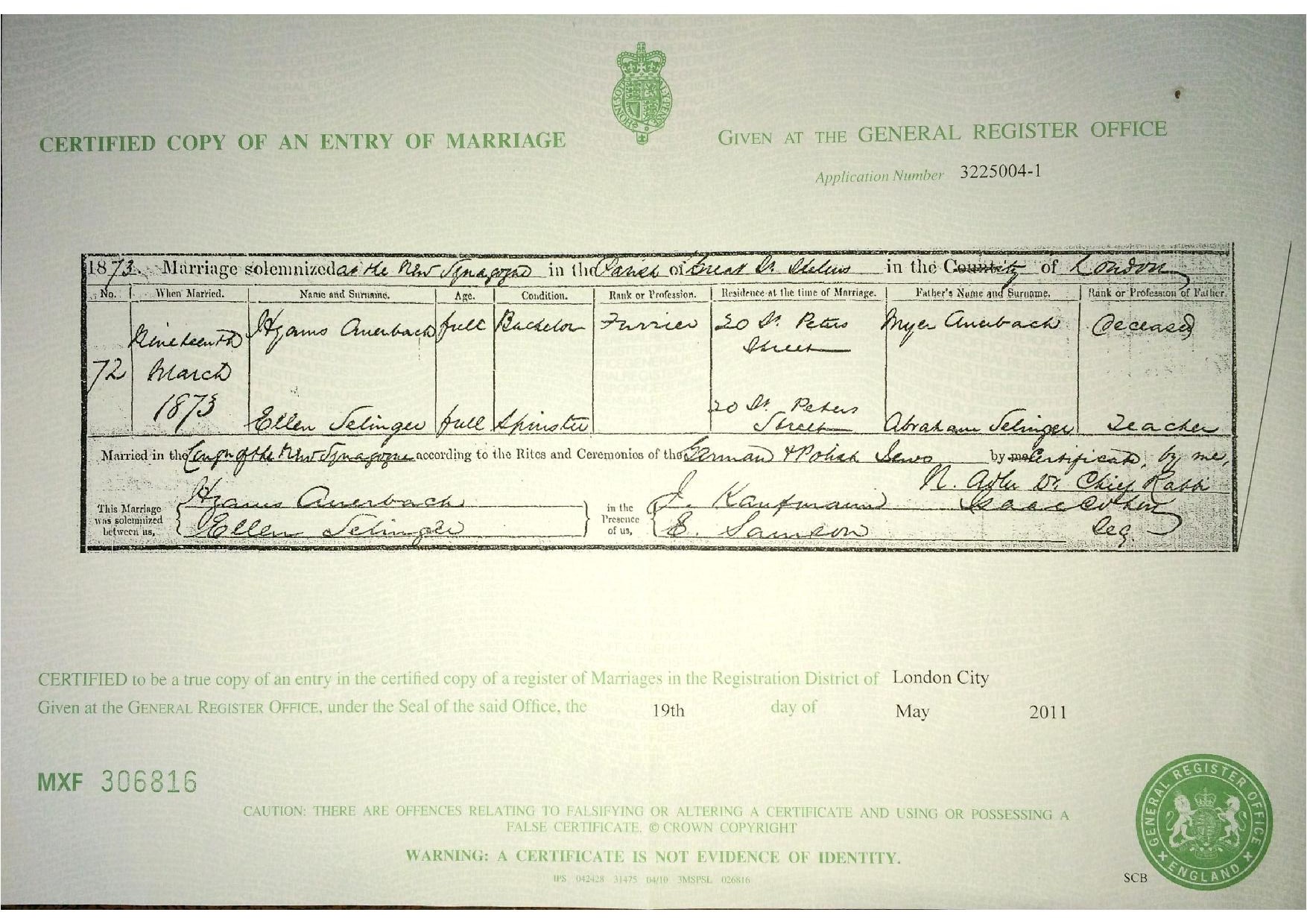
The oldest document is the English marriage certificate of Hyams Auerbach and Ellen Selinger, dated March 19, 1873.  According to the certificate, Hyams was a furrier whose father was deceased, and Ellen was the daughter of Abraham Selinger, a teacher.


Hyams Auerbach and Ellen Selinger marriage certificate

Hyams Auerbach and Ellen Selinger marriage certificate


Since Julius Selinger’s passport application indicated that his father’s name was Sigmund, I knew that Julius and Ellen/Helena did not have the same father.    But could they still be cousins? I do not know Alfred or Frederick Selinger’s fathers’ names, so it still seemed possible that there was some familial connection among the various Selingers.

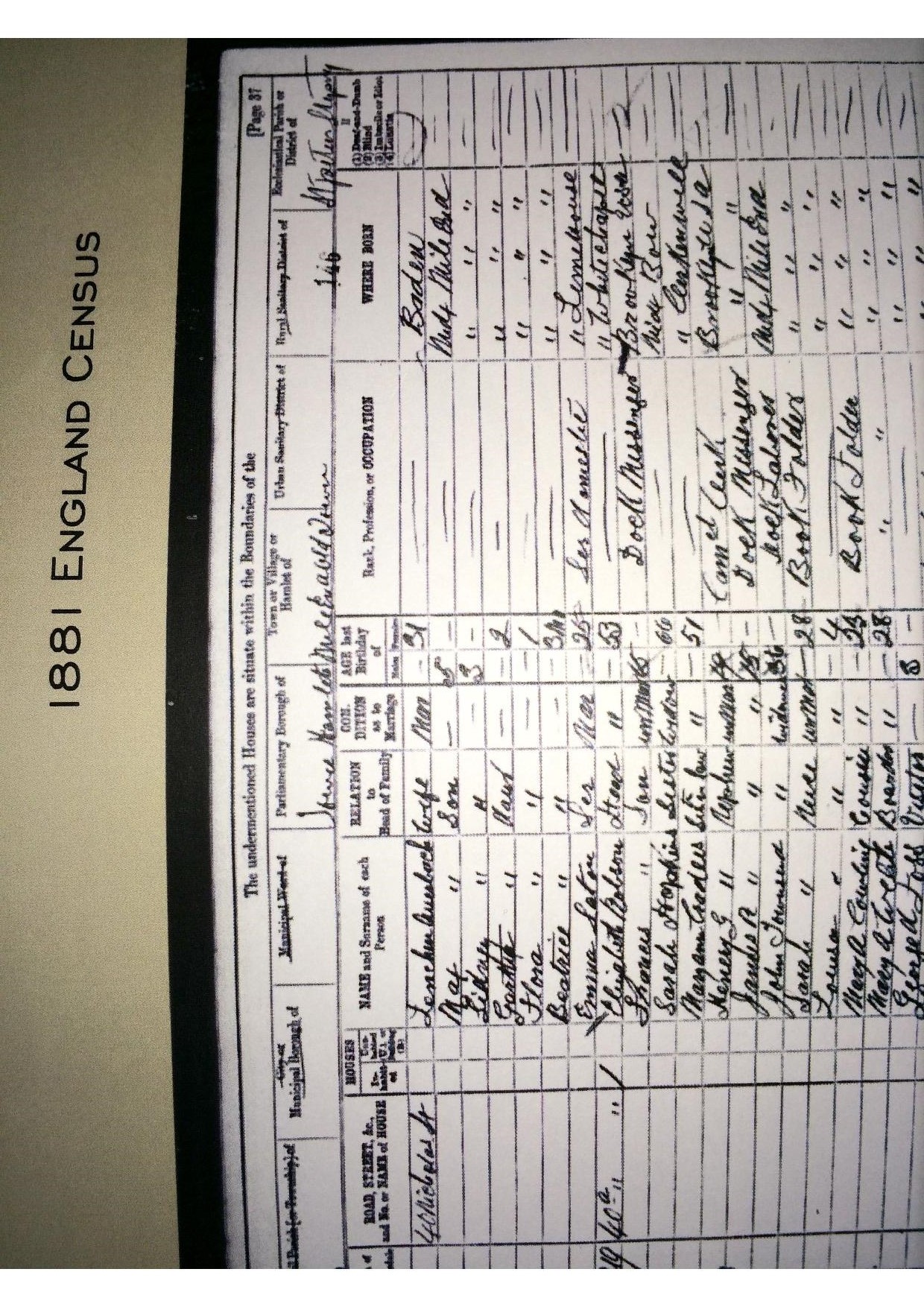
The next document was the 1881 English census for the Auerbach family.


Hyams Auerbach and family 1881 English census

Hyams Auerbach and family 1881 English census


This is definitely the right family; the page preceding this one includes as its last entry Hyams Auerbach, the furrier.  His wife’s name was given as Lenchen, which is the German equivalent of Helen.  Her place of birth was reported to be Baden.  This was the second clue that there might not be any familial relationship between Helen Selinger and Julius Selinger.  Julius and Frederick Selinger were both from Hurben in the region of Bavaria, not from Baden, an entirely separate region of what became united Germany in the late 19th century, although perhaps no more than a few hours away.  I then checked JewishGen.org and found that Selinger was not an uncommon name for Jews in Germany, especially if other spelling variations were included.  This makes it harder to assume any family connection between the DC Selingers and Helen Selinger.


I do have the names of two other members of Helen’s family; in addition to her father Abraham, her mother’s name was Gali.  She died in 1899, and her son, Helen’s brother, Sidney Selinger, was with her at her death.  If I can find a way to research the family in Baden, I might find a possible link to the Hurben Selingers, though it seems unlikely.

Perhaps the most intriguing document that I received from Val was an account of the distribution of the estate of Eleanor Selinger Abbot.  Eleanor died in 1979, and her will was probated on January 23, 1980.  The executor’s report on the distribution of the estate listed seven named beneficiaries, including two whose names were familiar:  Marjorie Christian and Ellen Kleinfeld.

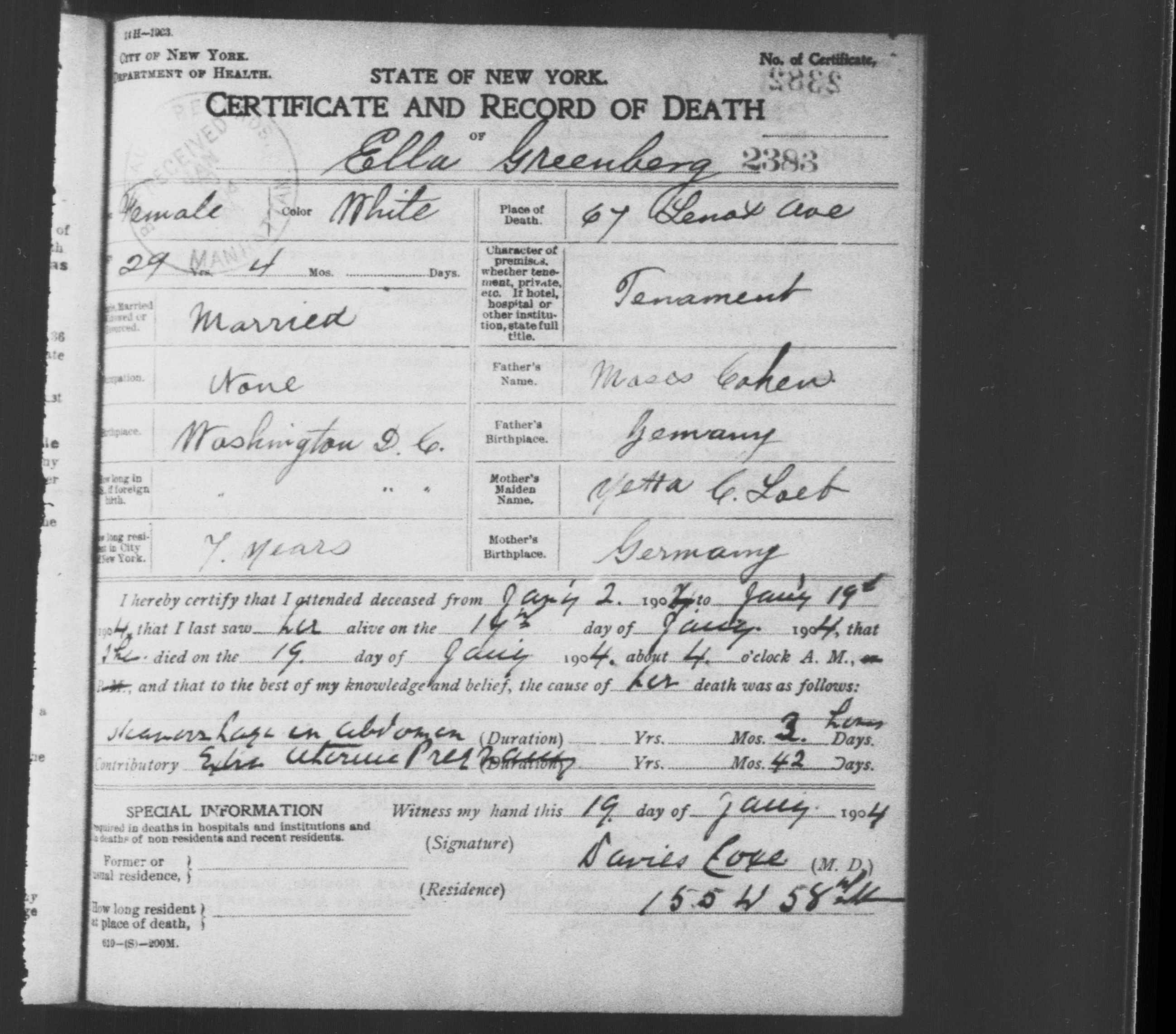
Who were Marjorie Christian and Ellen Kleinfeld?  They were born Marjorie and Ellen Rosenstock, daughters of Felix Rosenstock and Marjorie Greenberg.  Marjorie Greenberg was the daughter of Jacob Greenberg and Ella Cohen.  Ella Cohen was the daughter of Moses, Jr., and Henrietta Cohen.  She died at age 29, leaving behind her eight year old daughter Marjorie and her husband Jacob.  (Ellen Rosenstock Kleinfield was named in memory of her grandmother Ella.)  I have just received Ella’s death certificate, and it says that she died from an abdominal hemorrhage caused by an “extra uterus pregnancy,” which is what we would now call an ectopic pregnancy.  How tragic it must have been for Marjorie and her father Jacob to lose Ella in such an awful way.


Ella Cohen Greenberg death certificate 1904

Ella Cohen Greenberg death certificate 1904


1904 19 Jan Ella greenberg death cert#2383  pg2  004006272_00860

As I wrote earlier, Jacob remarried a few years after Ella died and had a son Theodore with his new wife Hattie.  Since Jacob lived in New York, I had wondered whether he and Marjorie had maintained much contact with Ella’s family after Ella died. Well, Eleanor’s will would certainly indicate that there was a continuing relationship.  Eleanor, who never had children of her own, left part of her estate to her Aunt Ella’s granddaughters.  Her first cousin Marjorie Greenberg Rosenstock had died in 1964, but obviously despite living in England since 1926, Eleanor had enough of a relationship with her American family and in particular with her cousin Marjorie Greenberg to leave part of her estate to Marjorie’s daughters.

Marjorie Rosenstock Christian died on July 18, 2013.  According to her obituary as published on July 24, 2013 in the Washington Post, she graduated Phi Beta Kappa in math and chemistry from Hunter College and then earned her Master’s degree in chemistry from the University of Maryland. (See more at: http://search.ancestry.com/search/obit/viewbody.aspx?db=web-obituary&pid=219473182&kw=Rosenstock+Christian+Marjorie&cpp=2013%5c07%5c26%5ccp_12269788.html&bhr=http%3a%2f%2fwww.legacy.com%2fobituaries%2fwashingtonpost%2fobituary.aspx%3fn%3dmarjorie-christian%26pid%3d166008840#sthash.E4eCxeTg.dpuf .)  She was married to Jack Christian, who died in 2011, and had three children.

I was very fortunate to speak with her sister Ellen Rosenstock Kleinfeld, my fourth cousin, who told me that she remembers Eleanor Selinger Abbot well and that Eleanor had visited with her family many times  over the years, including one trip to Long Island during a hurricane after Ellen was married and had children.   Unfortunately, I did not learn any more about how Eleanor met Henry or whether the various Selingers were related.  Ellen was married to Herman Kleinfeld and had two children.

Thus, from one thread in one family I found a link to another part of the family, tying together the lives of Ella Cohen and her descendants with the life of her niece Eleanor, the daughter of Augusta Cohen Selinger.   Eleanor may not have married a cousin, but she kept her ties to her American cousins.  She also brought the Cohen family back to its prior home in London.


Myer and Helen Wolf Cohen and their Children: The American Dream

Myer Cohen, Sr., was the second child of Moses, Jr. and Henrietta Cohen.  As described earlier, he was a lawyer, perhaps the first in the extended Cohen family.  He had married Helen Wolf, daughter of the esteemed Simon Wolf, and they had five children between the years 1891 and 1907.  In 1910, all five children were still living at home, and Myer was engaged in the general practice of law.

As reported earlier, their daughter Marjorie died in 1920 as a young woman.  According to the town clerk in Saranac Lake where Marjorie died in 1920, she died from tuberculosis; the clerk also confirmed that there were several hospitals in the area where TB patients went for treatment.

In 1921, Myer, Sr., was written up in Who’s Who in the Nation’s Capital (Consolidated Publishing Company, 1921) as follows:
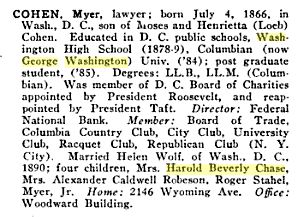
Who's Who in the Nation's Capital (1921) found on Google Books

Who’s Who in the Nation’s Capital (1921) found on Google Books

Myer died in 1930, and Helen died in 1949.  They are buried at the Washington Hebrew Congregation cemetery.

Myer Cohen, Sr. headstone

Myer Cohen, Sr. headstone


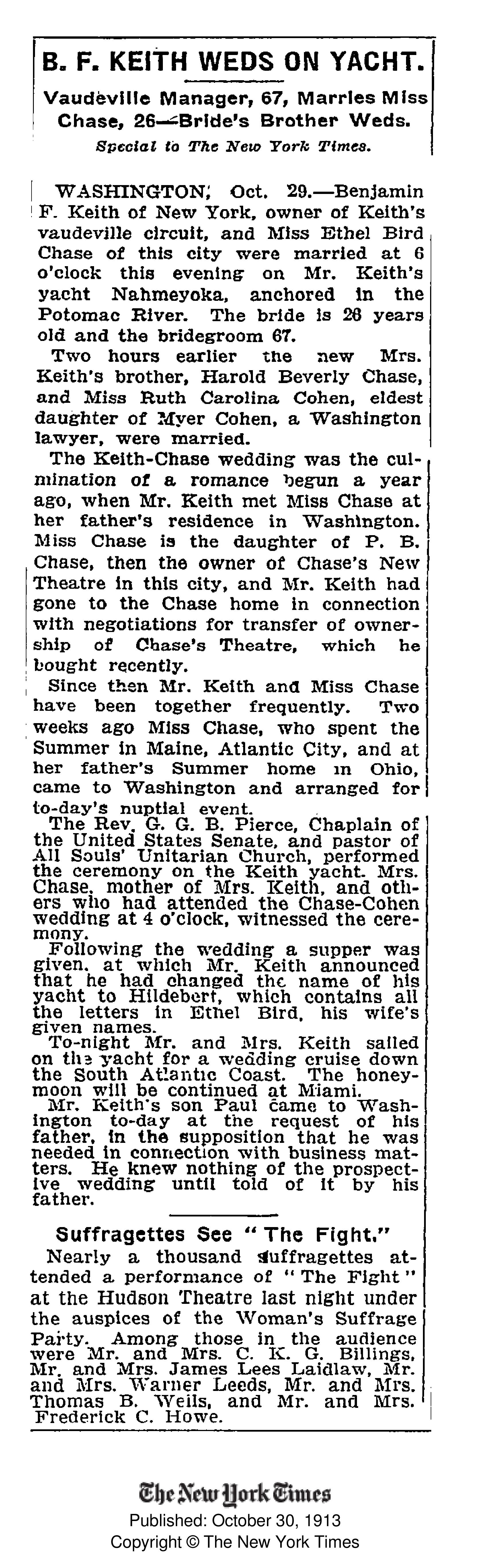
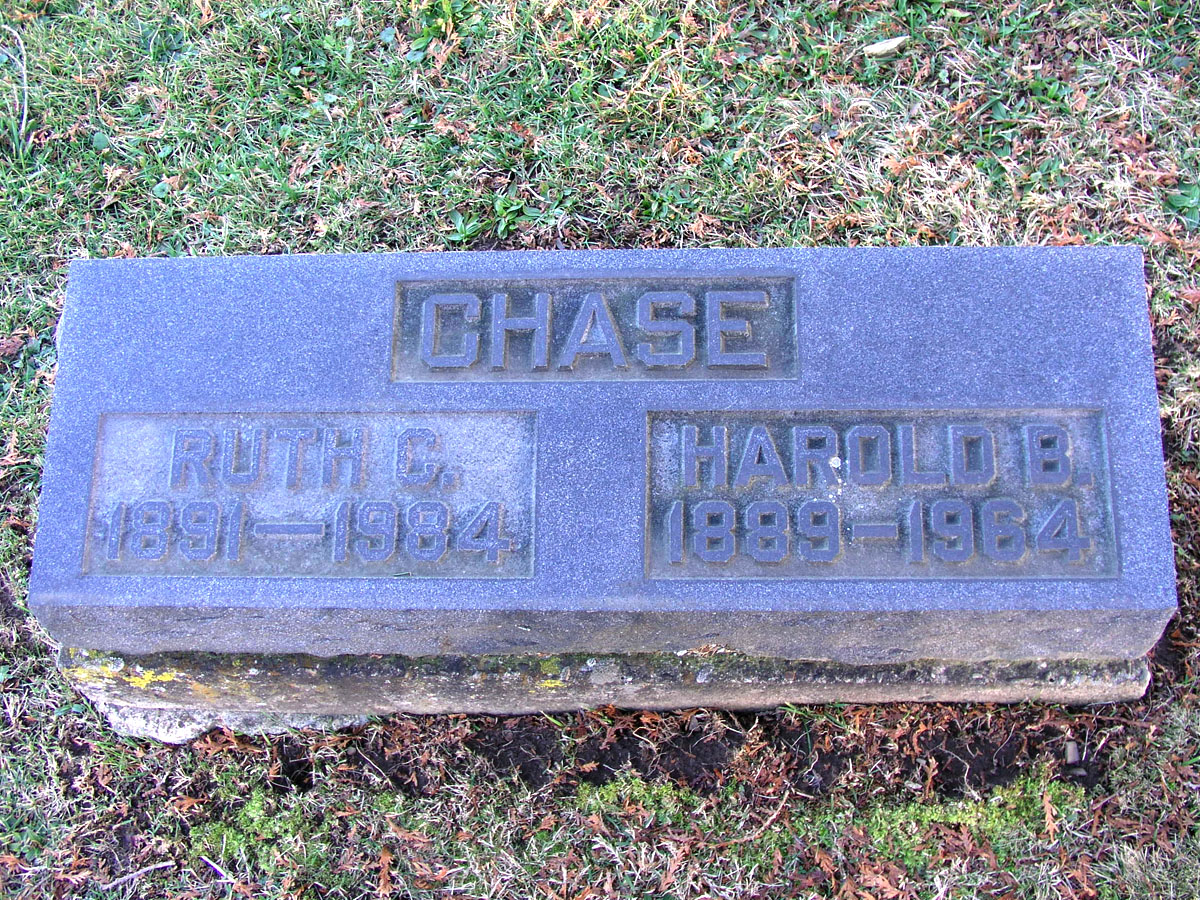
Ruth, their oldest daughter, married Harold B. Chase, the son of Plimpton B. Chase and Anna Bird of Ohio, on October 29, 1913.  Ruth and Harold were the couple who traveled with Harold’s recently widowed sister Ethel Chase Keith to England and probably also introduced her to Ruth’s cousin Jerome Selinger, whom she later married. In following up on my research of Ruth and Harold, I found this New York Times article about their wedding and that of Ethel Chase and B.F. Keith:

BF Keith wedding-page-001


I wonder how Harold and Ruth felt about B.F. Keith and Ethel Chase stealing their thunder on their wedding day!

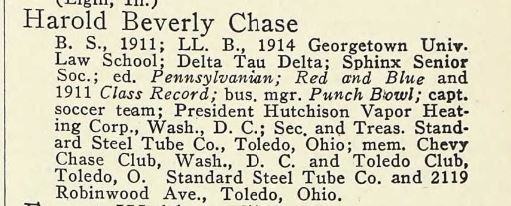
Harold had graduated from the University of Pennsylvania in 1911 and from Georgetown Law School in 1914, bringing another lawyer into Myer’s family, although it does not appear that Harold ever practiced law. ( See Abraham J. Baughman, Robert Franklin Bartlett, History of Morrow County, Ohio: A Narrative Account of Its Historical Progress, Its People, and Its Principal Interests, Volume 2 (1911) (Google eBook), p. 744)

Harold B Chase U Penn alumni directory 1917

Harold B Chase U Penn alumni directory 1917 Ancestry.com. U.S., School Catalogs, 1765-1935 [database on-line]. Provo, UT, USA: Ancestry.com Operations, Inc., 2012. Original data: Educational Institutions. American Antiquarian Society, Worcester, Massachusetts

In December 1915, Ruth and Harold had a daughter, Ann Beverly Chase.  In 1917 they were living in Toledo, Ohio, where Harold was then secretary and treasurer of Standard Steel Tube Company, a company owned in part by Harold’s father, who had acquired it in 1915.

In January, 1919, their three year old daughter Ann died of meningitis while the family was visiting Harold’s parents in St. Augustine, Florida, according to an obituary published in the St. Augustine Record of January 31, 1919.

Although the family was still living in Ohio in 1920, when their son Harold, Jr., was born, by 1922 Harold and Ruth had moved to Worcester, Massachusetts, where they were to live for the rest of their lives.  Harold was the owner and president of Chase Motor Cars, a car dealership, for many years, and both Harold and Ruth seem to have been quite active in a number of community organizations and clubs, according to various newspaper reports and documents.  Harold wrote an autobiography entitled Auto-biography: Recollections of a Pioneer Motorist, 1896 to 1911 (Pageant Press, 1955); unfortunately, it seems to be out of print and not available.

Harold, Sr., died in January, 1964, and Ruth, the daughter of Myer, Sr. and Helen Cohen, died in October, 1984. Ruth returned to the Washington area after Harold died.   Despite living for so many years in Worcester, both Harold and Ruth were buried in Ohio at Bloomfield Cemetery with their little daughter, Ann, as well as many members of Harold’s extended family.

Their son Harold, Jr., served in the US Air Force for many years in Colorado Springs, Colorado and then lived in Alexandria, Virginia; he died in 2006 and is buried at Arlington National Cemetery.

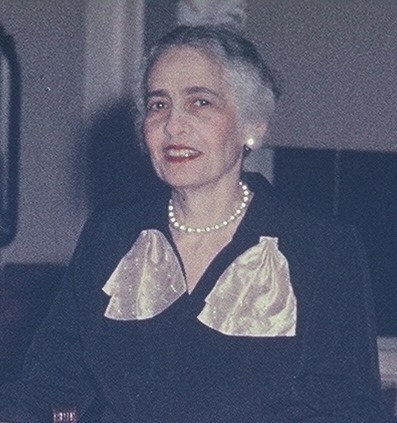
Myer and Helen’s second child, Edith, married Alexander Ceal Robeson on December 27, 1919.  Alexander, who was known as Zanny according to family members, was a lawyer in a general practice in Washington, DC, like his father-in-law Myer, according to the 1930 census and several city directories.  He was a 1916 graduate of George Washington Law School.  Edith and Zanny had one child, a son, Alexander C. Robeson, Jr., who was born April 13, 1923.  Zanny died July 26, 1972, in Washington, DC., and Edith died at age 90 in September, 1983.  Their son, who was intellectually challenged, lived as an adult in Innisfree Village in Crozet, Virginia, for some time; when Edith died, the family asked that donations be made to that institution in her memory.  Alexander, Jr., died December 15, 1996. His death notice said he was a retired weaver.    (Richmond Times-Dispatch (VA) – Wednesday, December 4, 1996)

Edith Cohen Robeson death notice 1983 Ancestry.com. Historical Newspapers, Birth, Marriage, & Death Announcements, 1851-2003 [database on-line]. Provo, UT, USA: Ancestry.com Operations Inc, 2006.
Edith Cohen Robeson death notice 1983 Ancestry.com. Historical Newspapers, Birth, Marriage, & Death Announcements, 1851-2003 [database on-line]. Provo, UT, USA: Ancestry.com Operations Inc, 2006.


Edith Cohen Robeson courtesy of Jane and Scott Cohen

Edith Cohen Robeson, photo courtesy of Jane and Scott Cohen

Roger Stahel Cohen was the fourth child and first son of Myer and Helen Cohen.
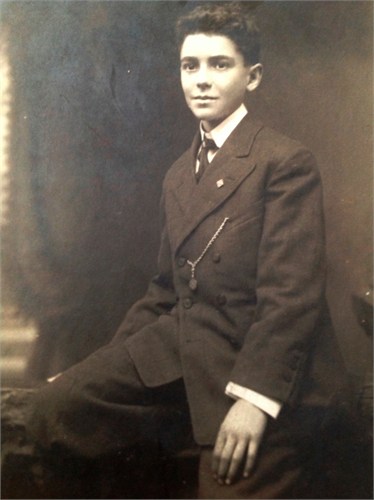
Roger Stahel Cohen as a young man, photo courtesy of Jane and Scott Cohen

Roger Stahel Cohen as a young man, photo courtesy of Jane and Scott Cohen

Unlike his father and brothers-in-law, he did not become a lawyer but instead became a doctor.  Roger went to Princeton University, graduating in 1919. The family said that he also served in World War I, but I have been unable to find a military record.  Since he was born in 1898, was already at age 19 at Princeton when the US entered the war in 1917, and was still at Princeton to graduate at age 21 in 1919, I had assumed he had been in school throughout the war. His tombstone in Arlington National Cemetery says that he served in World War I and World War II, achieving the rank of Commander (the family indicated the tombstone is incorrect and he achieved the rank of lieutenant commander), so somehow Roger must have taken time off from Princeton to serve and still manage to graduate when he was only 21 years old.
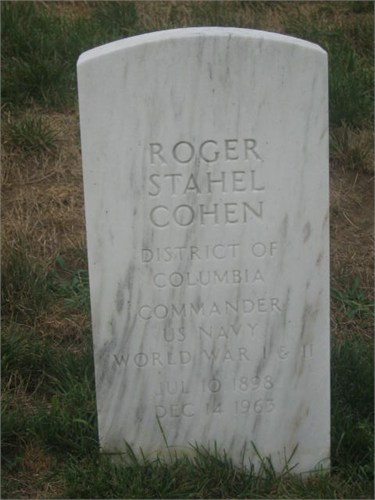
Roger Stahel Cohen headstone

Roger was living at home with his parents in 1920 and working as a law clerk, according to the 1920 census, but then went to George Washington University for medical school, graduating in 1924, according to his family.  After graduating from medical school, Roger married Lee Lenthal Towers on December 17, 1924. In 1926, he was a junior medical officer at St. Elizabeth’s Hospital, according to the Washington city directory for that year. The family has a graduation certificate for Roger Sr. from the University of Vienna showing that he studied there from October 3, 1927 to September 29, 1928.  According to family sources, Roger, Sr., said he studied under Sigmund Freud at the University of Vienna. By 1930 he was back in Washington, practicing psychiatry at Johns Hopkins Hospital in Baltimore, according to the 1930 census.

Meanwhile, Roger and Lee were also having children.  They had four children born between 1925 and 1931, and after a time in Baltimore, returned to the Washington, DC, area, where they settled and raised their family.  Roger was stationed for some time in San Francisco with the Navy during World War II, and the family has a 1959 letter from Dwight D. Eisenhower, appointing him to serve on the Board of Veterans Appeals. The family also told me that Roger and the family enjoyed vacationing in Point Lookout, Maryland, and at 13th Lake in upstate New York.  He loved photography and his grandchildren and combined the two loves, taking many pictures of his grandchildren.  Sadly, Roger died of a brain tumor on December 14, 1963, when he was only 65 years old.  His widow Lee continued to live in the DC area until she died in May, 1980.
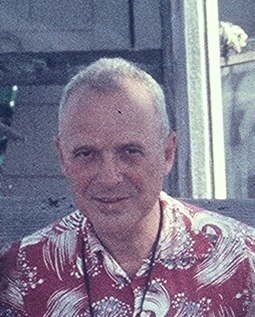
Roger Stahel Cohen, Sr., photo courtesy of Jane and Scott Cohen

Roger Stahel Cohen, Sr., photo courtesy of Jane and Scott Cohen

Lee Towers Cohen  photo courtesy of Jane and Scott Cohen

Lee Towers Cohen
photo courtesy of Jane and Scott Cohen

The youngest child of Myer and Helen Cohen was Myer Cohen, Jr., born in 1907, almost ten years after Roger, the sibling closest to him in age.

Roger and Myer, Jr., c. 1909, photo courtesy of Jane and Scott Cohen

Roger and Myer, Jr., c. 1909, photo courtesy of Jane and Scott Cohen

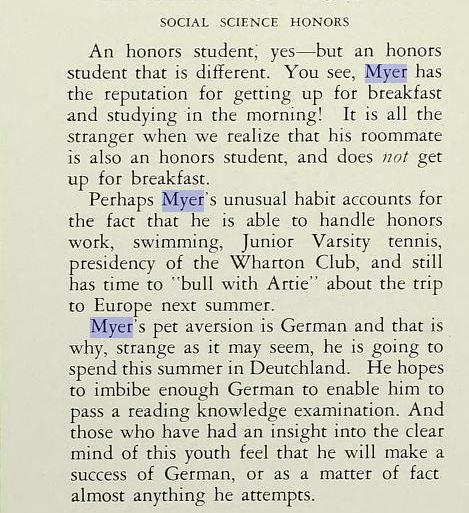
Myer, Jr., was still living at home in 1920 and in 1930. Myer went to Swarthmore College, where he was an honors student, a member of the Wharton Club, the Philosophy Club,  and the Men’s Debate Club as well as on the staff of the yearbook, the Halcyon.  This is how he was described in that yearbook:
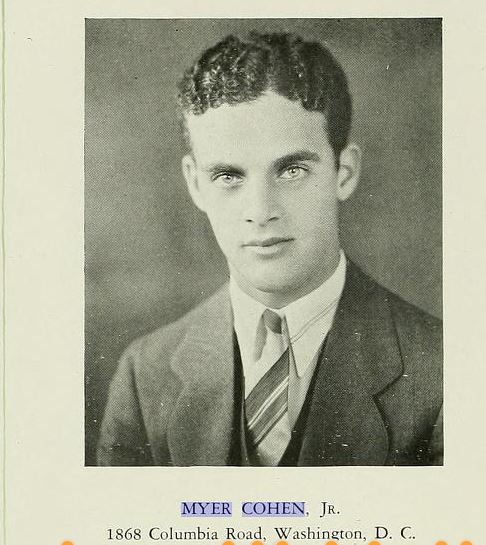
Myer Cohen Jr 1929 Halcyon yearbook

1929 Swarthmore College yearbook The Halcyon https://archive.org/stream/halcyon1929unse#page/84

1929 Swarthmore College yearbook The Halcyon
https://archive.org/stream/halcyon1929unse#page/84

After college, Myer made trips across the Atlantic in 1928, 1929, and 1930.  In 1932, he again traveled overseas, giving his residence as New Haven, Connecticut, where he was a graduate student at Yale.  I would think that these trips were related to his graduate work. Myer’s study of German must have been useful in his graduate studies. Myer received his Ph.D. from Yale in 1935 based on his dissertation, “Austria: An International Problem.”  I tried to locate a copy of it online, but could not find it.  It would be interesting to know what Myer’s thoughts were on what was happening in Europe at the time.

On August 21, 1933, Myer, Jr., married Elizabeth Elson, who was Russian born, but had immigrated to the United States in 1906 when she was two years old and had settled with her family in Chicago. Myer and Elizabeth were married in Chicago, and according to the 1940 census, in 1935 Myer and Elizabeth were residing in New Haven. After receiving his degree, Myer and Elizabeth relocated to San Francisco, where their two children were born, one born in 1937, the other in 1938.    According to the 1940 census, Myer was working as a private school teacher in San Francisco.

Although I cannot locate any military records for Myer, after World War II he definitely had a change of careers.  In 1945 he made the first of many trips to England; his residence was now Silver Spring, MD.  In 1946 he made at least two trips, one in June and one in October.  According to the airline manifest for the June trip, Myer was working for the UN BRA headquarters in Washington as the director of repatriation and (I think) relief division.

Ancestry.com. New York, Passenger Lists, 1820-1957 [database on-line]. Provo, UT, USA: Ancestry.com Operations, Inc., 2010. Original data: Passenger Lists of Vessels Arriving at New York, New York, 1820-1897. Microfilm Publication M237,

Ancestry.com. New York, Passenger Lists, 1820-1957 [database on-line]. Provo, UT, USA: Ancestry.com Operations, Inc., 2010.
Original data: Passenger Lists of Vessels Arriving at New York, New York, 1820-1897. Microfilm Publication M237,

Although I could not find an explanation for UN BRA, I found that acronym in several places with reference to the UNRRA, the United Nations  Relief  and Rehabilitation Administration, an organization involved in providing relief to refugees in Europe after the war.  I assume that Myer’s work was related to this endeavor.  The October trip in 1946 was on a flight from Berlin to Frankfurt to New York, and Myer’s address was now Chevy Chase, Maryland, and he was flying on a military permit.  Once again, his German studies must have come in handy.

In 1950, Myer again traveled to Europe, and the manifest for his flight from Zurich to New York has his address as “c/o I.R.O. Washington, DC,” and states that he was an O.I.R. director.   He was traveling with two other people involved with the same agency.  I could not find one definitive meaning for O.I.R or I.R.O, but given Myer’s work in 1946, this might be Office of International Relief and International Relief or Relations Organization.  I need to check further.  A later trip with Elizabeth to Europe in 1954 also lists their residence as Washington, DC.

Eventually, Myer rose to a fairly high level post within the United Nations. In 1962 he was the Director of Operations for the UN Special Fund, a fund created in 1958 by the UN General Assembly “in order to enlarge the scope of the UN programme of technical assistance in certain basic fields.”

UNDP Approves $1.5 Million Agreement to Expand Training Activities at International Institute of Seismology in Japan

UNDP Approves $1.5 Million Agreement to Expand Training Activities at International Institute of Seismology in Japan Ambassador Senjin Tsuruoka, Permanent Representative of Japan, is seen signing the agreement. At left is Mr. Myer Cohen, UNDP Assistant Administrator and Director of the Operations and Planning Bureau. At right is Mr. Tadayuki Monoyama, Second Secretary, Mission of Japan to the UN 27 March 1969 United Nations, New York http://www.unmultimedia.org/photo/detail.jsp?id=124/124433&key=89&query=undp&so=0&sf=date

In 1969 Myer, Jr., was the Assistant Administrator and Director of Operations and Planning for the UNDP, the United Nations Development Programme, an agency involved in assisting developing nations.

Special Fund to Aid in Land and Water Surveys in Northern Rhodesia

Special Fund to Aid in Land and Water Surveys in Northern Rhodesia An agreement laying down conditions for the surveying of the land and water resources of the Kafue River Basin in Northern Rhodesia was signed this morning at United Nations Headquarters by representatives of the UN Special Fund and the United Kingdom Government on behalf of the Federation of Rhodesia and Nyasaland. Signing the agreement are Mr. Paul G. Hoffman (left), Managing Director of the Special Fund, and Sir Patrick Dean, Permanent Representative of the United Kingdom to the United Nations. Looking on are (1eft to right) Mr. Roberto M. Heurtematte, Associate Managing Director of the Special Fund; Mr. Myer Cohen, Director of Operations, Special Fund; and Sri Ram Vasudev, Special Fund project officer. 23 February 1962 http://www.unmultimedia.org/photo/detail.jsp?id=167/167583&key=73&query=acess%20water&so=0&sf=date

Myer, Jr., and Elizabeth ultimately retired to Newtown, Pennsylvania, where Myer died on January 8, 2003, at the age of 95, and Elizabeth died on July 25, 2004.  She was a hundred years old.

Myer, Sr., and Helen Wolf Cohen must have been very proud of their children.  Although the family suffered some heartbreaks with the deaths of Marjorie and little Ann Chase and the challenges presented to Alexander Robeson, Jr., overall it was a family that prospered.  There were several lawyers and a psychiatrist in the family as well as a Ph.D and  UN official.  The family moved around a bit, but overall stayed close to their roots in the Washington, DC, area.  The family seems to have moved away from the strong Jewish involvement of Helen’s father Simon Wolf and Myer, Sr.’s father Moses Cohen, Jr., as they moved into mainstream America and achieved success in fields that seem quite distant from the family’s beginnings as peddlers and merchants and pawnbrokers.  In just two generations, the family had gone from struggling Jewish immigrants to full-fledged participants in the American dream.




Jews in Iowa? Cohens on the Prairie 1880-1900

“Sioux Falls panorama 1908 1” by G.W. Fox – This image is available from the United States Library of Congress’s Prints and Photographs division under the digital ID pan.6a09880. Licensed under Public domain via Wikimedia Commons – http://commons.wikimedia.org/wiki/File:Sioux_Falls_panorama_1908_1.jpg#mediaviewer/File:Sioux_Falls_panorama_1908_1.jpg

Although the descendants of Moses and Adeline Cohen stayed close to Washington until 1880, in the next two decades many of them ventured further away.  I’ve already written about the children of Moses, Jr., four of whom left DC, three for NYC, and one for Baltimore.  But his siblings and their children ventured even further away, although for some it was just a temporary move.

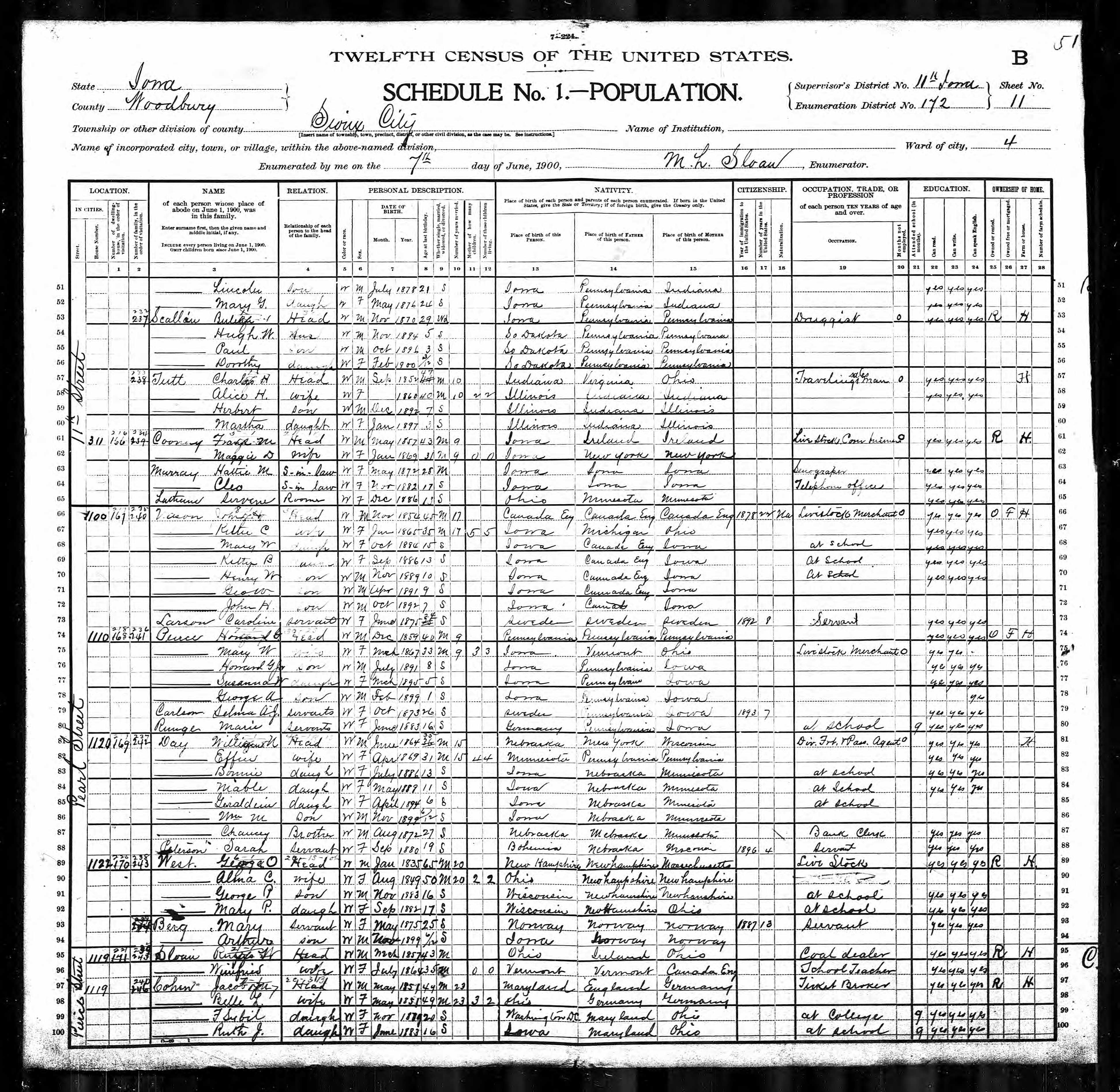
The real adventurer seems to have been Jacob M. Cohen, apparently known as JM.  JM married a woman from Cuyahoga, Ohio, named Belle Lehman, on August 19, 1877.  Their first daughter, Fannie Sybil, was born in Washington, DC, in 1879, but sometime after 1880, JM and his wife and young daughter left town and moved west to the Dakota Territory where the second child, Seba Maude, was born in 1882.  I wish I knew what drew JM away from Washington and off to the prairie and how he met a woman from Ohio in the first place.  Was it a desire to be a pioneer or a desire to strike out on his own away from his family?  I don’t know, but I was certainly surprised to see “Dakota” as the birthplace of his second child.

Not long after Seba’s birth, the family must have moved again because a third daughter, Ruth Josephine, was born on June 8, 1883, in Sioux City, Iowa.  Sioux City seems to be where JM and Belle established deeper roots. They lived there until at least 1905, and their fourth child and only son Arthur was born there in 1885.  According to the 1885 Iowa state census, JM was working as a pawnbroker; in the 1888 directory for Sioux City, he is listed as being in real estate, but in 1900 his occupation on the census is a ticket broker.  Perhaps the census taker heard that incorrectly; perhaps he was still a pawnbroker.  Or maybe a real estate broker.

JM Cohen and family 1885 Iowa census

JM Cohen and family 1885 Iowa census

JM Cohen and family 1900 US census

JM Cohen and family 1900 US census

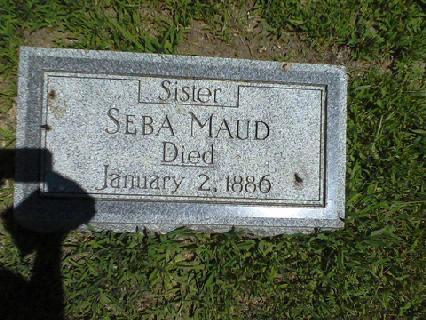
JM and Belle suffered a terrible loss when their daughter Seba died on January 2, 1886; she was not even four years old.

Seba Maude Cohen headstone

I fear that their son Arthur, born in 1885, also died young.   He does not appear on the 1895 census or the 1900 census when one would assume he would have been only ten and then fifteen years old and presumably living with his family.  On the other hand, I cannot find a death record for him in Iowa or elsewhere, nor is he buried where Seba and his parents were buried in Sioux City.

I wondered whether there were any other Jews in Sioux City at that time and was able to locate a book by Simon Glazer entitled The Jews in Iowa: A Complete History and Accurate Account of Their Religious, Social, Economical and Educational Progress in this State; a History of the Jews of Europe, North and South America in Modern Times, and a Brief History of Iowa, published in 1904 by Koch Brothers Printing Company and now available as a free e-book on Google.  According to Glazer, there were only 25 Jews in Sioux City in 1869, but by 1904 there were over two thousand, including my relatives. In fact, when the Jewish community decided to form a cemetery association, the Mt Sinai Cemetery Association, in 1884, JM Cohen, my cousin, was one of the founding members.  (Glazer, p. 295)  Moreover, that same year JM’s wife Belle was the leader of a movement among the Jewish women to create a fund-raising organization to help the poor and to raise money to build a house of worship. (Glazer, p. 296)  Despite this burst of energy in 1884, there was no formal congregation until 1898.  As described by Glazer:

“The Jewish spirit which kept them together was a mere ghost of little more consequence than a shadow. Everything they had gained during their childhood, everything their parents had imbued within them vanished form [sic] their memories, and nothing new could come and knock at their gates since no effort was endeavored prior to 1898, to form a congregation and engage the services of a minister.” (p. 297)

According to Glazer, “Their temple was built largely through the efforts of the ladies, and the man [sic] frankly admit that had it not been for the heroic efforts of the Jewish women no such place for Judaism in Sioux City would as yet have been made a matter of fact. Their first services were conducted at the Masonic Temple, which is, indeed, very complimentary to both, the Masons and the Jews.” (p. 300)

JM Cohen was listed by Glazer as one of the ten officers and leaders of Mt Sinai Congregation in those early days.

Mt Sinai Synagogue, Sioux CIty, Iowa From Wikimedia Commons, the free media repository

Glazer then described the influx of Russian and Eastern European Jews in the late 1880s and thereafter and the divisions between the older assimilated population which had established Mt Sinai, the Reform congregation, and the newcomers who were more Orthodox.  He concluded his chapter on Sioux City by saying, “The Jewry of Sioux City is as yet in its infancy, but it has plenty of mettle to make itself a stronghold of both Orthodox and Reform Judaism in the northwest.” (p. 302)

So my cousin Jacob M. Cohen was a pioneer.  He left the comforts of a well-established Jewish community in Washington, DC, where his older brother Moses, Jr., was a leader in the Washington Hebrew Congregation, a well-established synagogue, and went out to the prairie lands of the Midwest (the northwest in 1904 when Glazer was writing) to become a Jewish leader there.

JM also succeeded in getting two of his siblings and his mother Adeline to move to Iowa, if for only a short time. Adeline, who was born in Baden, Germany, had immigrated to Baltimore, raised four children on her own when her husband Moses died in 1860, and supported them herself in Washington, DC.  Adeline again uprooted herself and left a safe, settled urban world to live in Iowa.   In 1888 she was living with JM in Sioux City, according to the city directory.  I don’t know how long she lived there, but she did return to Washington, DC, by 1894.

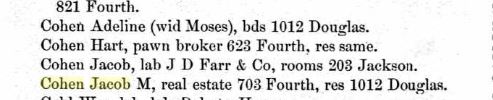
Title : Sioux City, Iowa, City Directory, 1888 Source Information Ancestry.com. U.S. City Directories, 1821-1989

Title : Sioux City, Iowa, City Directory, 1888
Source Information
Ancestry.com. U.S. City Directories, 1821-1989

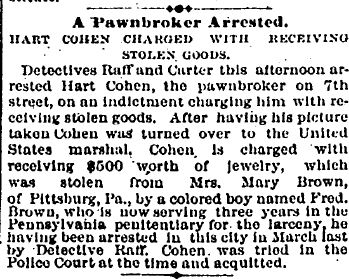
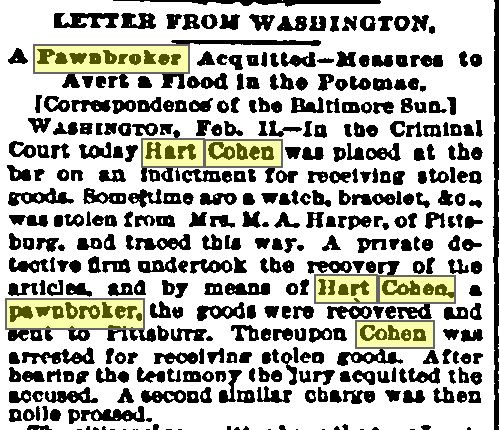
In that same 1888 Sioux City directory is a listing for Hart Cohen as well, JM’s older brother.  The first half of the 1880s for Hart and his wife Henrietta brought two more children to their family, Isadore Baer, born in 1883, and Jacob M. II, born in 1885, in addition to Frances, who was born in 1878, and Munroe, born in 1880.  Hart, like his brother JM, was a pawnbroker, and like his first cousin Hart in Philadelphia, he was charged in 1885 with receipt of stolen goods in the course of his business; he was acquitted of the charges in 1886.


Hart DC Cohen arrested 1885 snip

(“A Pawnbroker Arrested,” Wednesday, March 25, 1885, Critic-Record (Washington (DC), DC),Issue: 5,187, Page: 3)

Letter from Washington. A Pawnbroker Acquitted - Measures to Avert a Flood in the Potomac Date: Friday, February 12, 1886  Paper: Sun (Baltimore, MD)   Volume: XCVIII   Issue: 76   Page: 4

Letter from Washington. A Pawnbroker Acquitted – Measures to Avert a Flood in the Potomac
Date: Friday, February 12, 1886 Paper: Sun (Baltimore, MD) Volume: XCVIII Issue: 76 Page: 4

It might have been in the aftermath of these criminal proceedings that Hart decided to join his brother JM in Sioux City.  He was there at least until 1895, as on the 1895 Iowa census he and his entire family are included.  His occupation at that time was described as a jeweler.

Hart Cohen and family 1895 Iowa census

Hart Cohen and family 1895 Iowa census

By 1900, however, Hart and his family had returned to Washington, DC, where he was still working as a jeweler.  His children were now all at least teenagers, ranging in age from 14 (Jacob) to Frances (21), and perhaps he felt like he had gotten his life in order and could return to his hometown.  They were living at 1424 Seventh Street, NW, in 1900.

Hart Cohen and family 1900 census

Hart Cohen and family 1900 census

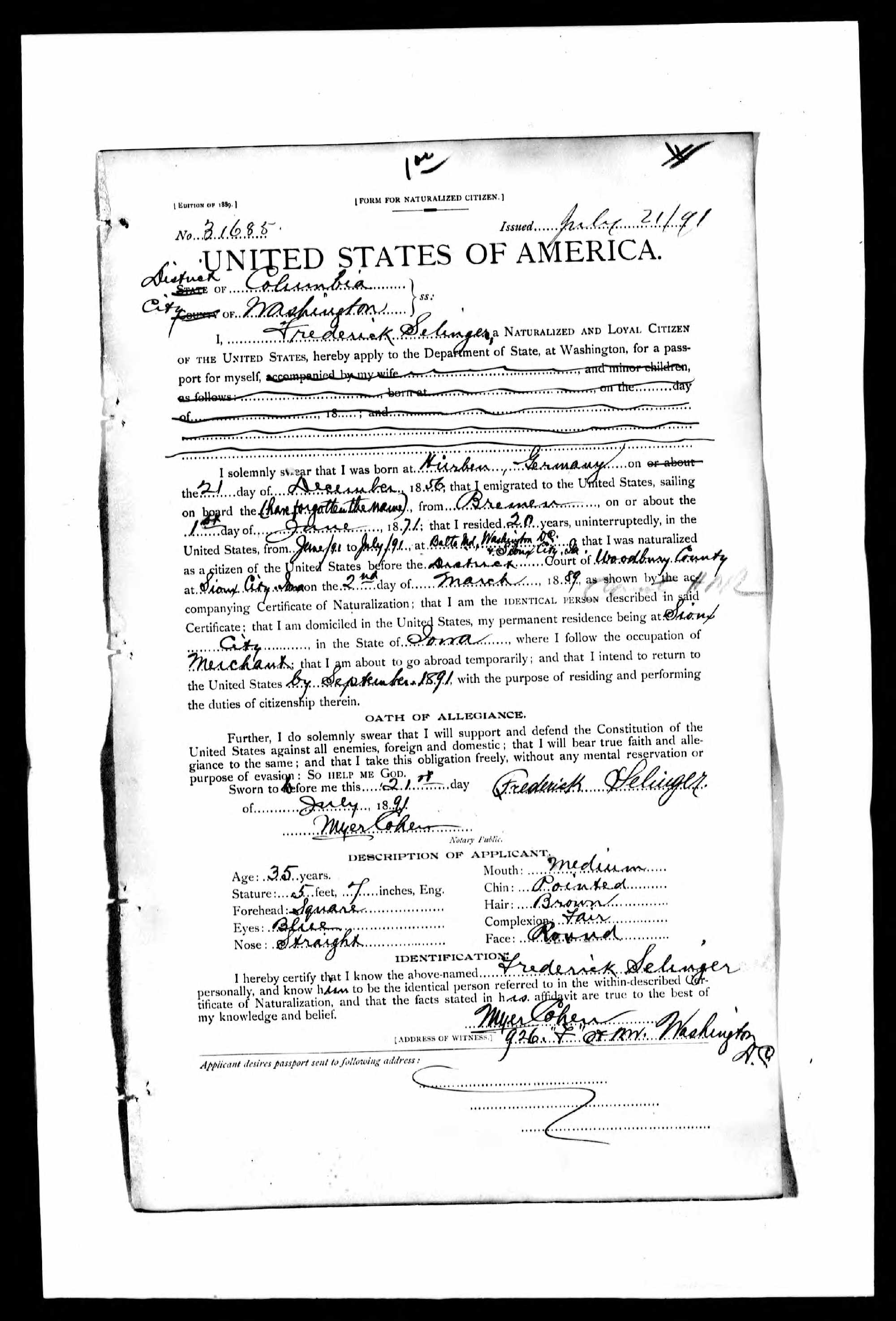
JM even lured his sister Rachel to come to Iowa for some time.  Rachel had been newly married to Frederick Selinger in 1880, and in 1882 they had their first child, Fannie Selinger, in Washington, DC.  Their second child, Monroe, was born in 1888 in Washington as well, but in 1891 when Frederick applied for a passport, they were living in Sioux City, Iowa.  (Interestingly, the witness on the application was Myer Cohen of Washington, DC, his wife’s nephew, son of her brother Moses, Jr.)

Frederick Selinger passport application 1891

Frederick Selinger passport application 1891

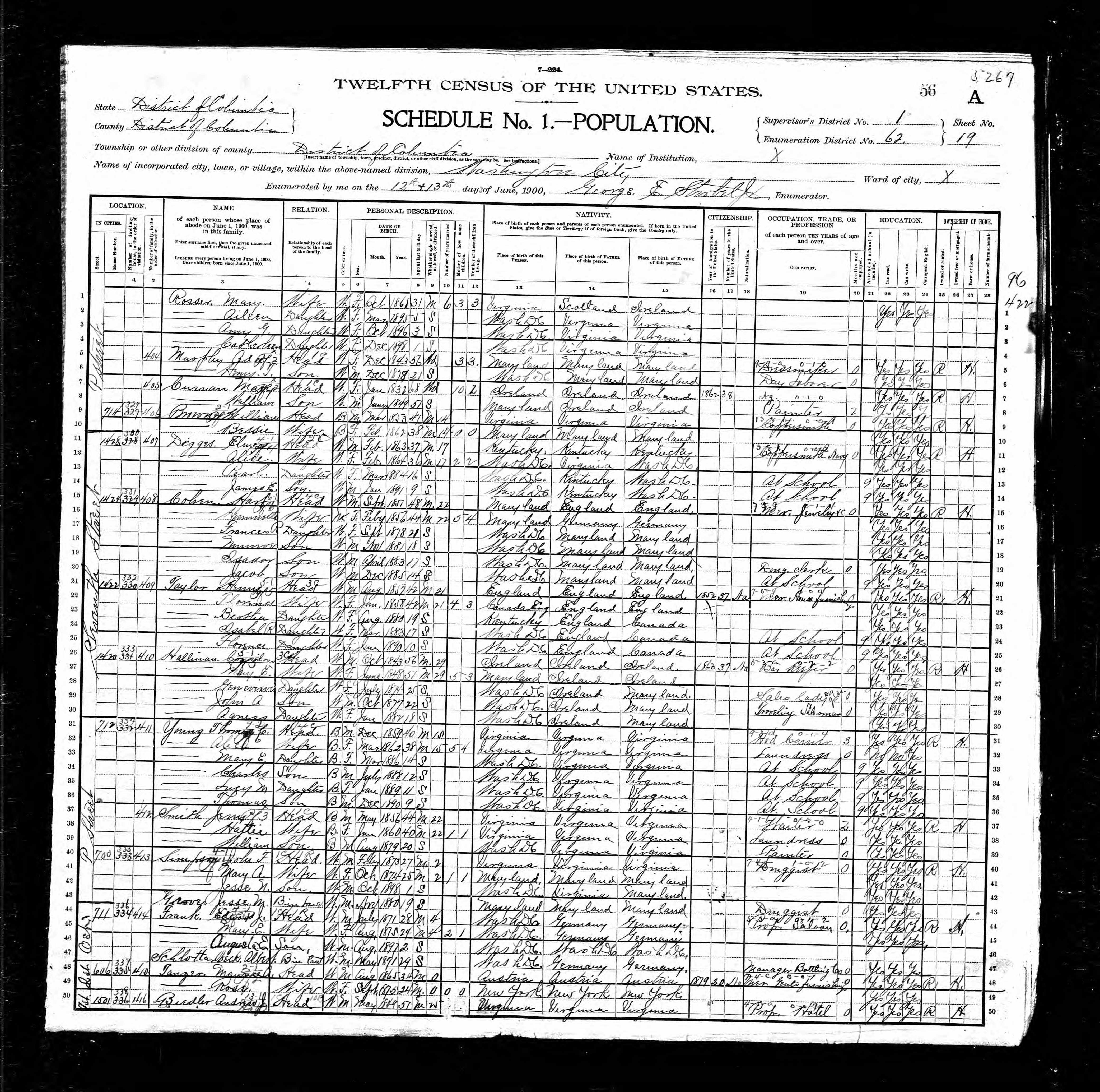
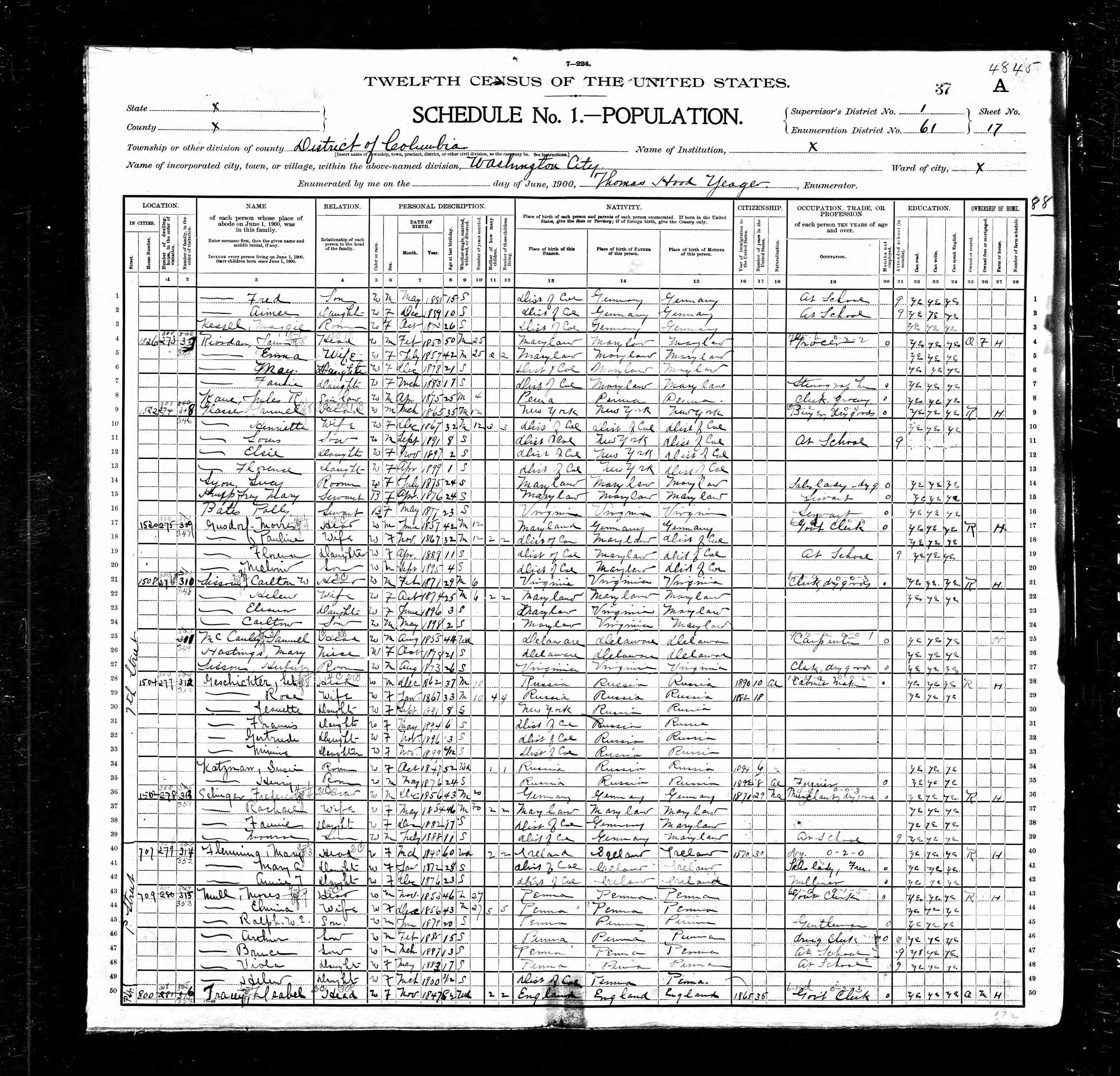
Frederick is also listed in directories for Sioux City from 1890 through 1892.  Like Hart and Adeline, however, Rachel and Frederick returned to Washington, DC, where in 1900 the family was living at 1502 Seventh Street, NW.

Frederick and Rachel Selinger and family 1900 census

Frederick and Rachel Selinger and family 1900 census

Thus, by 1900, the great experiment of living out in Sioux City had ended for all of the DC Cohens except for JM and his family, who would never return to Washington, DC.  All the rest of the Moses Cohen family—from Adeline (until her death in 1895) to Moses, Jr., to Hart, to Rachel– were living within five or six blocks of each other in the Northwest section of Washington, DC, in 1900.

The twentieth century was about to begin, and with it came new challenges and new family members.  The story will continue…


Cohens in the Nation’s Capital: 1860-1880

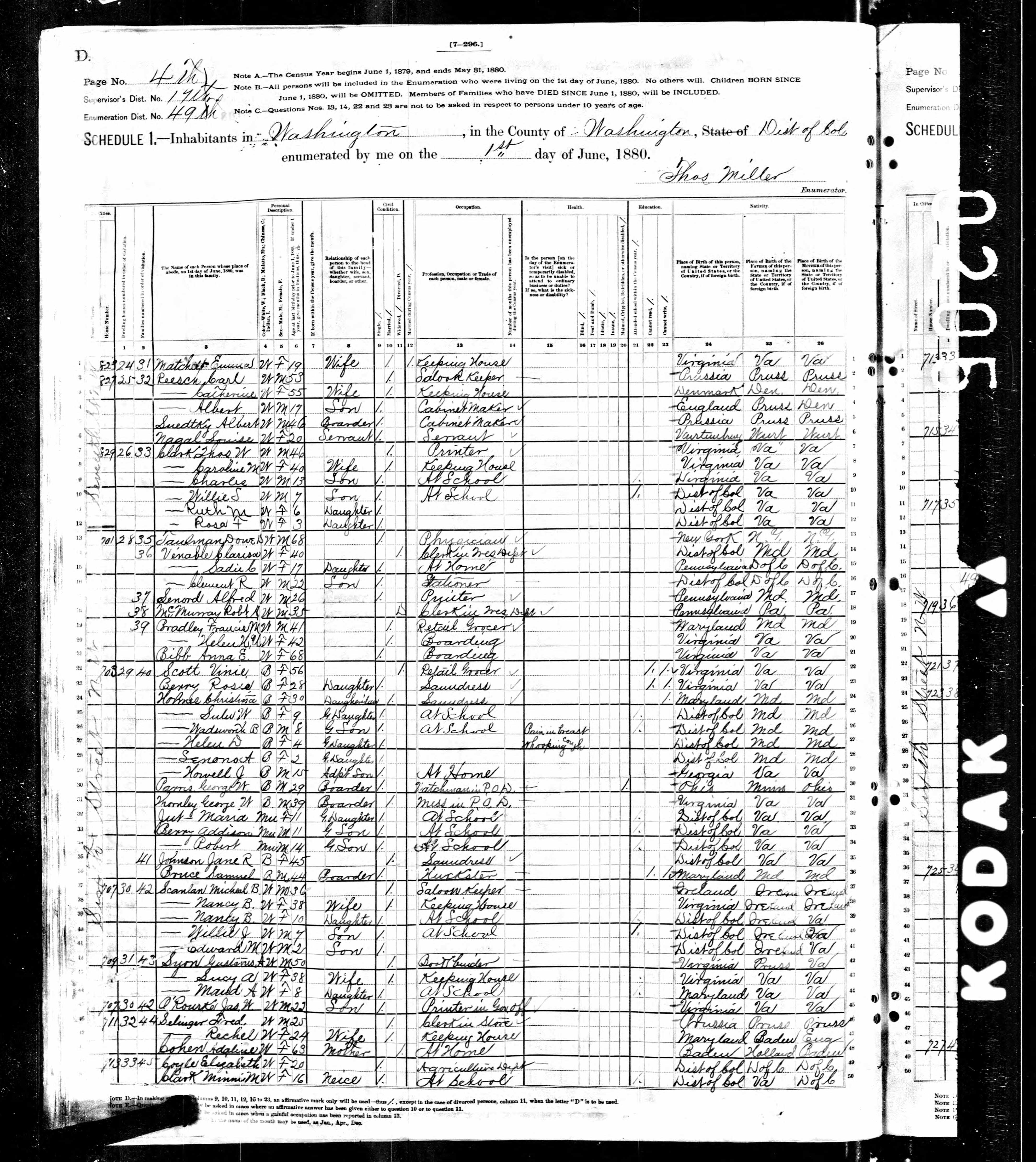
As I continue to work on finding out when and where Moses Cohen, Sr., married Adeline Himmel and where and when Moses, Jr., was born and whether he was the biological son of Moses, Sr., I am operating under the assumption that Moses Cohen, Sr., was the brother of my great-great grandfather Jacob and the son of Hart Levy Cohen and Rachel Jacobs Cohen, my great-great-great grandparents.

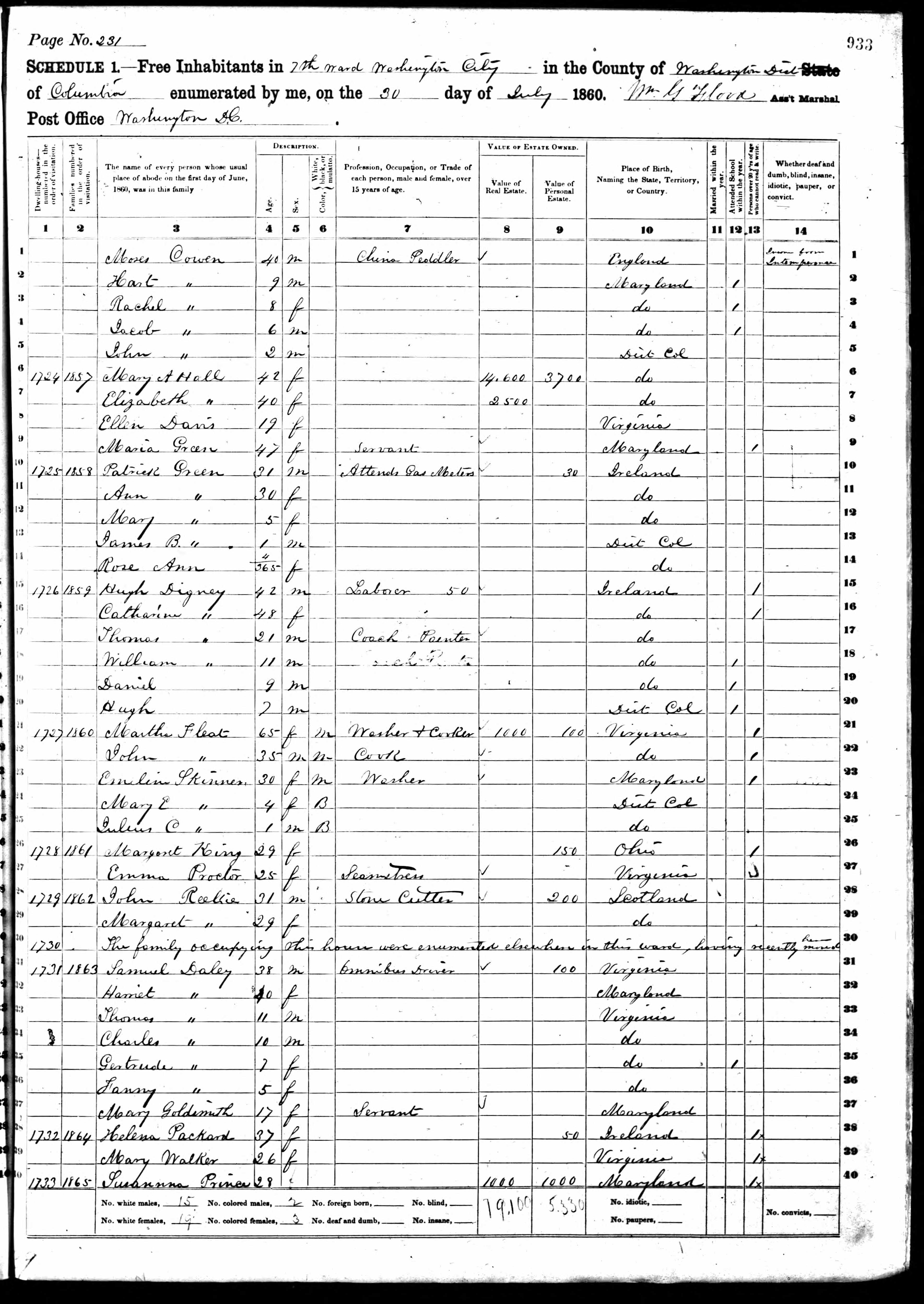
Two months ago I wrote about the death of Moses Cohen, Sr., in 1860 and the decade that followed for his widow and children.  To recap, on the 1860 census, Moses, Sr., was listed as a forty year old china peddler, born in England; he was also described as “insane from intemperance.”  Perhaps that alcoholism is what led to his early demise just over two months later on October 2, 1860, at age 32, according to his headstone, or at most age 40, if his age on the 1860 census is more accurate.  He left his widow Adeline with four children under ten: Hart (9), Rachel (8), Jacob (6), and John (2).  In addition, he was survived by Moses Cohen, Jr, who was twenty years old.

Moses Cohen and family 1860 census

Moses Cohen and family 1860 census


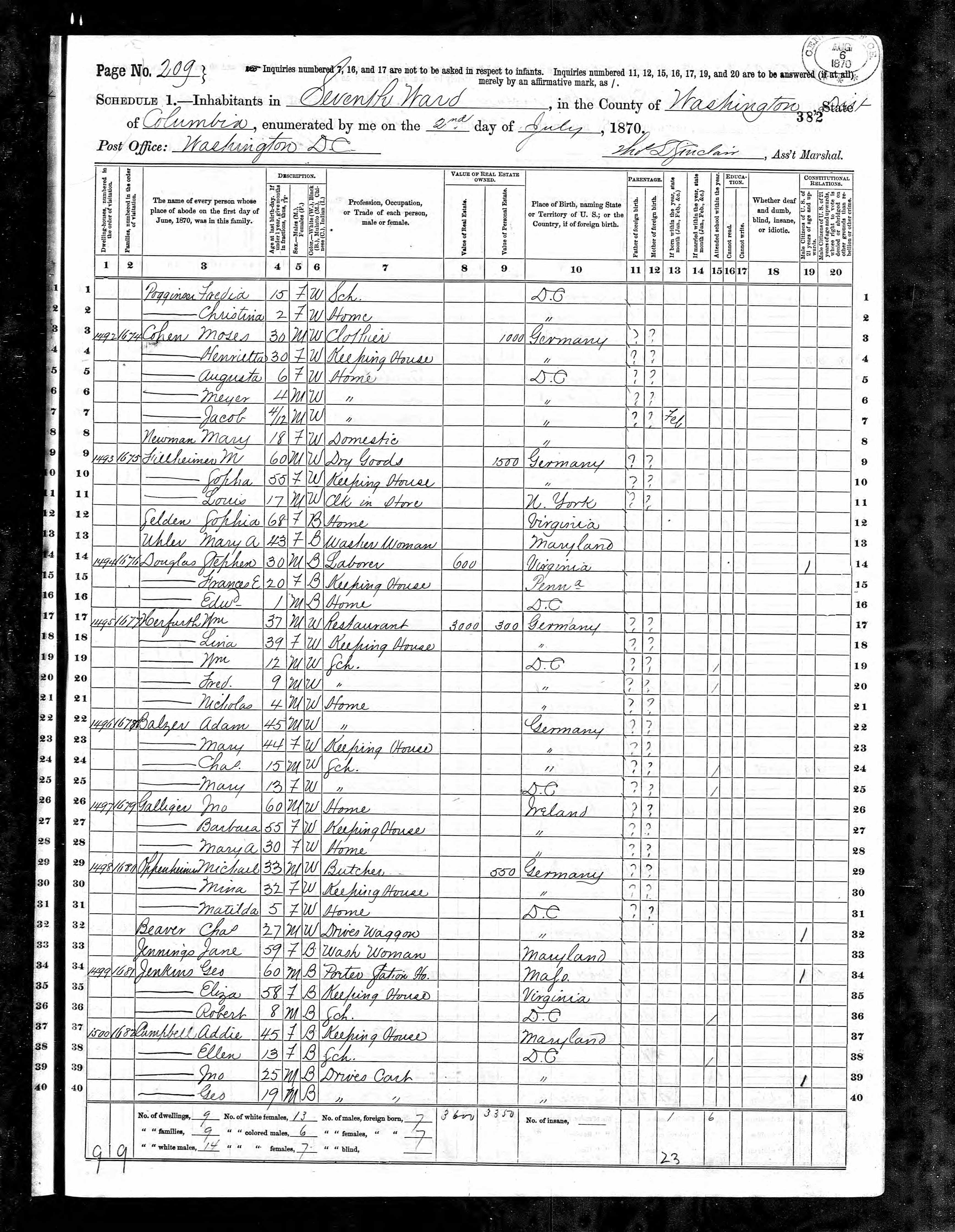
After Moses, Sr., died, Adeline had gone to work out of the home as a merchant of second hand clothing, and Moses, Jr., was also in the clothing business. Moses married Henrietta Loeb on August 16, 1862, and by 1870, Moses and Henrietta had three children, Augusta (6), Myer (4), and Jacob (4 months). Moses was still a clothier.

Moses, Jr. and family 1870 census

Moses, Jr. and family 1870 census

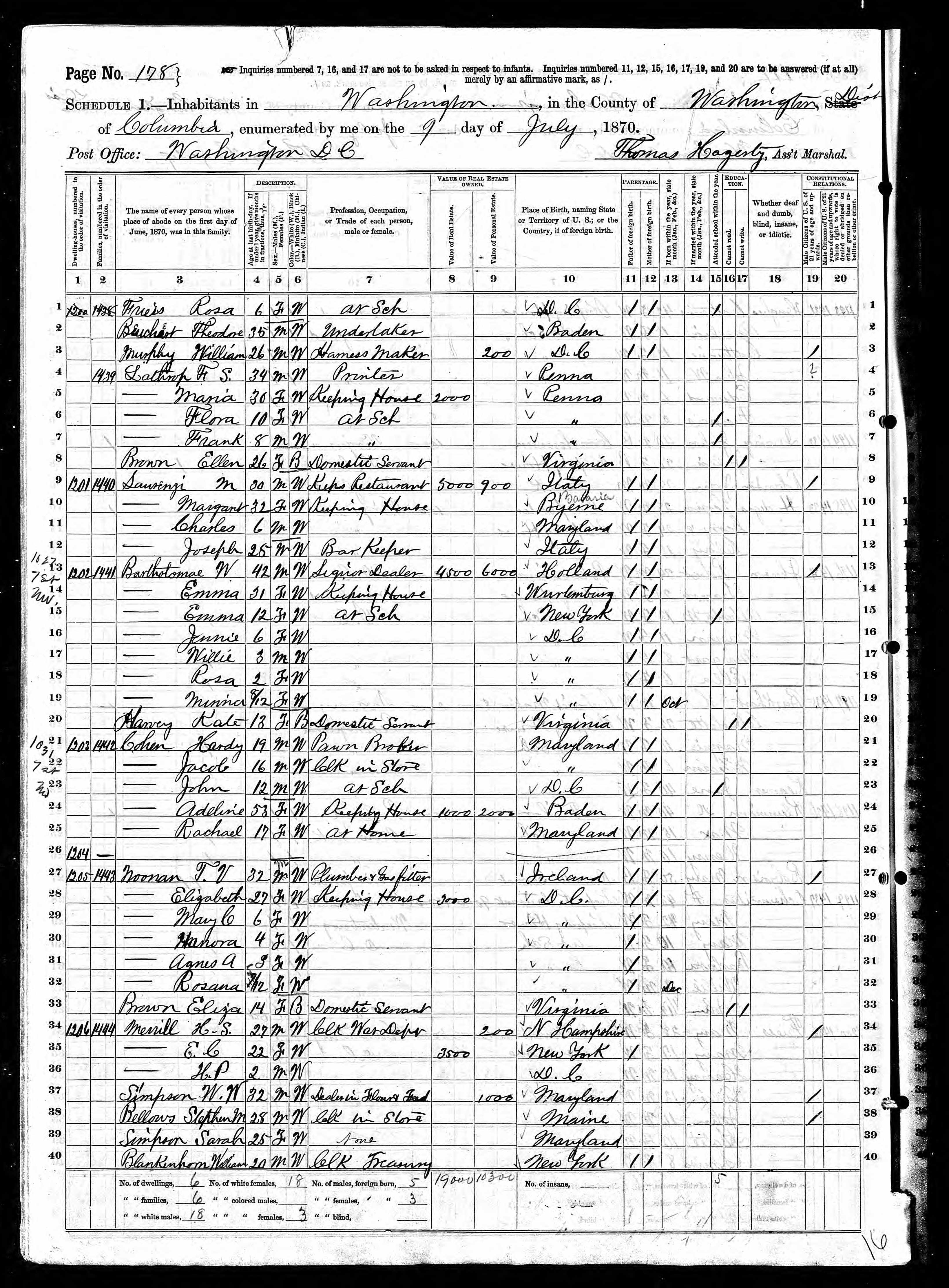
Adeline in 1870 was still living with the four younger children; Hart was working as a pawnbroker and Jacob as a clerk. The other two children were still at home.  Interestingly, although on both the 1850 and 1860 census, Adeline had indicated she could not read or write (English, I assume), by 1870 that box was no longer checked off.

Adeline Cohen and family 1870 census

Adeline Cohen and family 1870 census

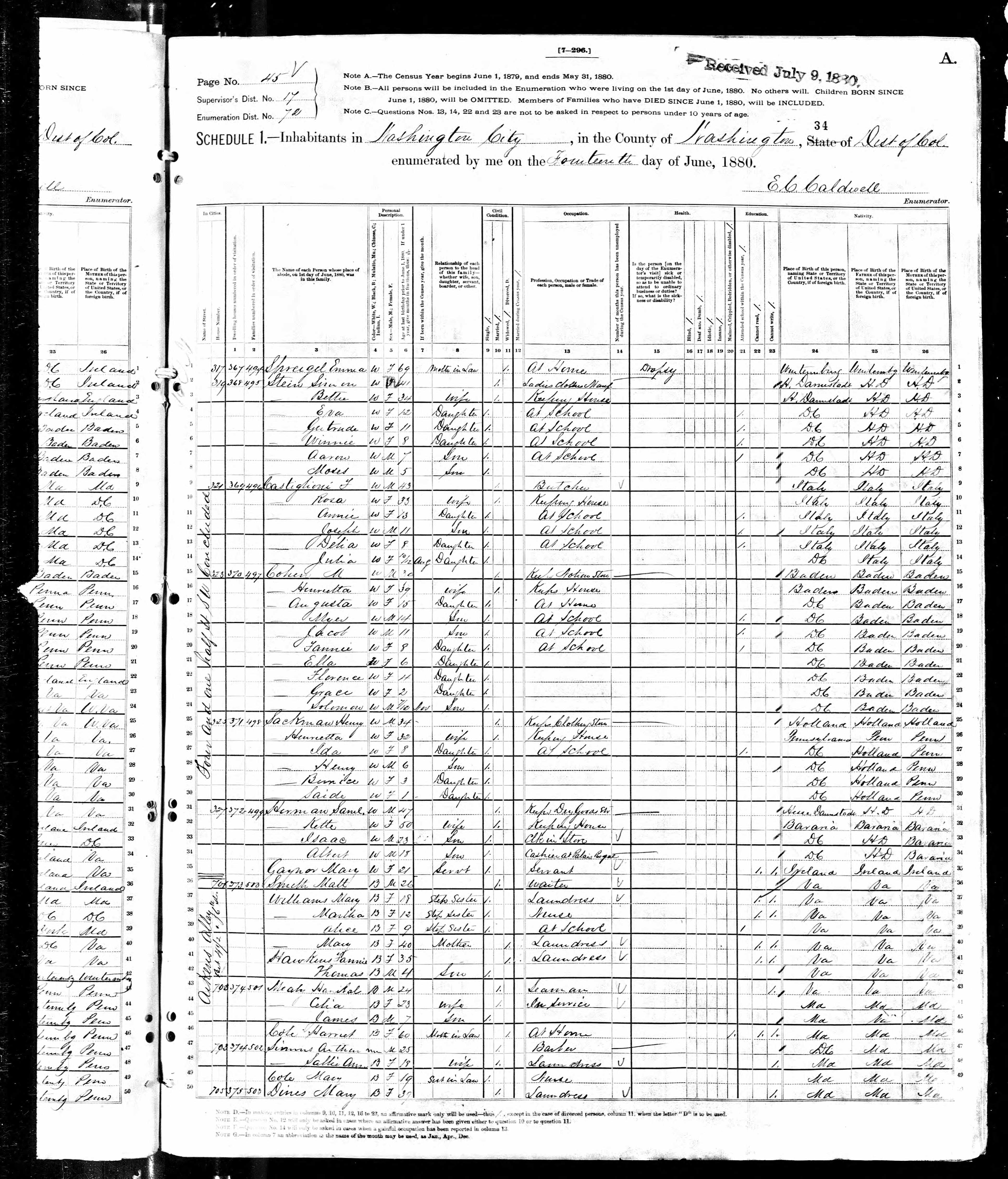
Between 1870 and 1880, there was a lot of growth in the family.  Moses, Jr., and Henrietta had five more children: Fannie (1872), Ella (1874), Florence (1876), Grace (1877), and Solomon (1879), bringing their family to eight children, ranging in age from one year to fifteen years old.  Moses was working at or owned a notions store in 1880.

Moses Cohen, Jr., and family 1880 census

Moses Cohen, Jr., and family 1880 census

Moses, Jr.’s brother Hart married Henrietta Baer in 1878, and they had their first child, Frances, later that year.  Hart was working as a clerk, presumably in a pawnshop.  A son Munroe was born on November 5, 1880, after the 1880 census had been taken.

Hart Cohen and family 1880 census

Hart Cohen and family 1880 census

Jacob M. Cohen, the next child of Moses, Sr., and Adeline, was married to Belle Lehman in 1877 in Cuyahoga, Ohio, where Belle’s family resided.  They had a daughter, Fannie Sybil Cohen, born on November 7, 1879.  As of the 1880 census, Jacob was working in a “loan office.”

Jacob M. Cohen and family 1880 census

Jacob M. Cohen and family 1880 census

Moses, Sr., and Adeline’s only daughter, Rachel, was also married by the end of the decade.  She married Frederick Selinger on January 10, 1880.  Frederick was born in Hurben, Germany, and had emigrated from Germany to the US in 1871, according to his passport application.  According to the 1880 census, Frederick was working as a “clerk in store.”   Adeline Cohen, Moses, Sr.’s widow, was living with her daughter Rachel and son-in-law Frederick Selinger.

Frederick and Rachel Cohen Selinger and Adeline Cohen on 1880 census

Frederick and Rachel Cohen Selinger and Adeline Cohen on 1880 census

The only member of the family I cannot locate between 1870 and 1880 or thereafter is the youngest child, John.  He was twelve as of the 1870 census, but I cannot find him at all on the 1880 census, nor can I find a marriage record or a death record.  He seems to have just disappeared.

Thus, as of 1880, Adeline and Moses, Sr.’s four oldest children were all married, and Adeline already had eleven grandchildren with more to come.  All of the children were living in Washington, DC, and it would seem that life was fairly routine for the four young families and their matriarch, Adeline Cohen.  It seemed that Adeline’s children had thrived despite losing their father at such an early age.

Things would start to change in the 1880s, as members of the extended family faced crises and changes.


A Delightful Conversation: Cousin Marjorie 

There are so many joys that come with doing genealogy work: solving family mysteries, learning about your roots, reliving the lives of those who came before you, working with other researchers and learning and teaching each other, and many other benefits.  But perhaps the greatest joy for me has been finding and meeting new cousins.  My reunion with my Brotman cousins last April was more than I’d ever expected, and the phone conversations, email exchanges, and meetings I’ve had with other cousins have also all been so much fun and so rewarding.

But this cousin connection was particularly special to me.  Cousin Marjorie is my father’s first cousin and close to him in age.  They knew each other as children, but have not been in contact for over sixty years.  In order to contact this cousin, I could not rely on email or Facebook.  I had to do it the old-fashioned way, a handwritten letter.  Fortunately, I was able to find her address on line and took a chance that she would still be able to respond and that she would want to respond.

When I did not hear back for nearly two weeks, I assumed that she either could not or did not want to respond, and I resigned myself to the fact that I would not hear from her.  Then one day last week my cell phone rang, and a number came up that was not familiar.  I answered the phone, and a woman who sounded like someone in her 20s said, “Amy?  You will never guess who this is.”  I said that I had no idea, and she said, “This is your cousin Marjorie.”

What then followed was an hour long conversation, followed up with another hour long conversation the other day.  Marjorie’s memory is remarkable; she was able to confirm a number of dates and addresses and stories that I had found online through public documents, but she had them at her fingertips.  She also had memories of my great-grandmother, my grandfather, my great-uncles and great-aunts, stories I had not known before.  And she had wonderful stories about her own life and her parents’ lives as well.   Our conversations ranged from the particular to the universal, discussing everything from Winston Churchill (from whom she has a signed letter), Queen Elizabeth (to whom she sends a birthday card every year and receives a thank you in return), and how she learned to drive, to current politics and social issues like legalizing drugs and sexual mores and her current day-to-day life with her cat Scarlett and her many friends.

Out of respect for her privacy, I do not want to discuss too many of the details of her own life on the blog, but suffice it to say that she is a very bright, articulate, and opinionated woman.  She told me that she had graduated from Trinity College (D.C.) and that she had traveled the world as part of her career working for the American Automobile Association.  She is still volunteering one day a week for the local historical society in her neighborhood.

As for some of the family memories, Marjorie did not remember her grandfather Emanuel well since she was only about three years old when he died, but she does remember her grandmother, Eva May Seligman Cohen, lovingly and clearly.  She said Bebe, as the grandchildren called her, had been a brilliant woman.  Her brother, Arthur Seligman, was the governor of New Mexico (more on that when I get to the Seligman line), and he had been invited to speak one year at Valley Forge.  When he had to cancel his plans, my great-grandmother Eva May spoke as his replacement.  Marjorie had not been able to attend, but wished that she had been there.  Marjorie said that not only was Bebe brilliant, she was kind and giving and would do anything for her family.  I shared with her the fact that Eva May and Emanuel had opened their home to Emanuel’s brother Isaac and his son when his wife died, and she was not surprised.  Like my father, Marjorie remembers exactly when her beloved grandmother passed away in October, 1939.

I also asked Marjorie what she remembers of my grandfather, her Uncle John, and she said that she has no memory of him before he became disabled, but remembers driving with her parents to Coatesville, Pennsylvania, once a month to visit him at the VA hospital there.  She described him as very good looking, thin, with black hair.

She also remembered going to occasional Sunday dinners at her grandmother’s house when my father and my aunt were living there and going to the movies with her cousins.  She said that somewhere she has a street photograph of the three cousins—my father, my aunt, and Marjorie—walking in Philadelphia.  Marjorie also told me that about 25 years ago she got a call out of the blue from her cousin Buddy, Maurice’s son, saying that he was back east from California and wanted to see her.  He and his wife (whom she remembered as being Norwegian) came to visit, and she said she and Buddy stayed in touch until he died in 1995.

Marjorie also spoke adoringly of her parents, Stanley and Bessie Cohen.  She said that although they were brought up in different faiths—her father a Reform Jew, her mother a High Episcopalian, they were an ideal match and had a wonderful marriage for well over 60 years.  She quoted to me several sayings that her mother used to convey her values to her daughter—as Marjorie described them, common sense statements about the value of an education and the importance of good health.  She said her mother was a sweet and kind person who always saw the good in other people.  Her father, my great-uncle Stanley, she described as a broad-minded man who had a bit of a temper, but who adored his wife and daughter.  He lived to be 98 years old and had good health all the way until the very end.   Marjorie said her parents had a very large circle of friends and were very well-regarded in their community.

At the end of our conversation, I told Marjorie that I would stay in touch.  She said that I had made her day, and I told her that she had made mine as well.  And I meant it from the bottom of my heart.

Two of Marjorie’s heroes:

English: Sir Winston Churchill.

English: Sir Winston Churchill. (Photo credit: Wikipedia)


HMTQ Landing Page Burnley

Queen Elizabeth II

Seeing the Forest: In Memory of Jacob and Sarah Cohen and All their Children


When doing genealogy research, I often find I get very focused on one person or one couple or sometimes one nuclear family and forget to think about the bigger picture, the extended family and their history.  This has been particularly true in researching my great-great grandparents Jacob and Sarah Cohen and their thirteen children.  Each one of those children was a story unto itself; each of their nuclear units told a complete story.  Doing the research for each of them brought me into their individual lives—their relationships, their careers, their children, their achievements, and their tragedies.

Leaf lamina. The leaf architecture probably ar...

Leaf lamina. The leaf architecture probably arose multiple times in the plant lineage (Photo credit: Wikipedia)

It was only when I got to child number eleven, my great-grandfather Emanuel, that I realized I had lost the bigger picture.  His life was not only about his adulthood—his wife and his children and grandchildren, but was also shaped by and always affected by what was happening with his extended family—his parents, his siblings, his nieces and nephews. It was then that I looked at the overall timeline to see what was happening outside his nuclear family as well as within it.

Now looking back and trying to get that bigger picture overall, I can make some fairly general observations about these thirteen children and their extended family.  First, they were all very interconnected in their work as well as their personal lives.  Almost all the men, including many of the brothers-in-law and sons-in-law, were pawnbrokers.  I don’t have a very good sense of how many separate stores there were in the Cohen pawnshop industry, but obviously there were enough to support more than a dozen families, including a family as large as that of Reuben Cohen, Sr., with his many children.  Yes, there were some trouble spots and some disputes undoubtedly, but this was a family that worked together and lived together, often within blocks of each other.  One project I have in mind at some point is creating a map to show where they all were living at a given point in time.  This was a family where almost everyone stayed in Philadelphia or perhaps New Jersey for multiple generations at least until the 1930s or 1940s.

Every tragedy—the deaths of so many young children, the premature deaths of so many young adults, the horrible accidents—must have rippled through the entire family in some way.  This was a family that suffered greatly over and over again—perhaps no more than any other of its time, but nevertheless, more than most of us can imagine today.  Almost every one of them lost at least one young child; some lost several.   Reuben and Sally lost ten children.  Some, like my great-grandparents and Reuben, not only lost a young child, but also lost adult children who died too young.

Yet this was also a family that triumphed.  Most of them lived fairly comfortably, if not luxuriously.  They moved to the northern sections of Philadelphia away from the increasingly poor sections where Jacob and Sarah had settled at 136 South Street.  Many had servants living with them, even when they had only a few or even no children.  These were not college-educated people.  Most did not even finish high school.  But they were savvy business people who, as far as I can tell, for the most part operated their businesses honestly but successfully, as the profile of Reuben Cohen described.  They saw themselves as money lenders, as the banks for those who could not borrow money from a traditional, established bank. Some were more successful than others, but overall this was a family that came to America in the 1840s and made a good life for themselves and their descendants.

Looking back on those times makes me wonder what happened.  How did this large, interconnected family lose touch with each other?  It’s not just my father’s immediate line that was disconnected; every Cohen descendant I’ve been able to locate says the same thing—that they had no idea about all these other cousins and Cohen relatives.  My father said he had no idea that his father had cousins.  I counted sixty-nine grandchildren born to Jacob and Sarah Cohen.  Even if you subtract the many who did not survive childhood, there were probably fifty—meaning that my grandfather had fifty living first cousins, mostly living in Philadelphia, yet my father did not know of any of them.

I suppose that that is how it is as families grow, children marry, grandchildren are born.  You no longer can fit everyone around the table even for special occasions.  Other families also need attention—the in-laws and all their relatives.  Especially back then, before the telephone and the automobile and certainly before the internet, Facebook, Google, email, and cellphones, it was just too hard and too expensive to stay in touch if someone was not in your immediate neighborhood and your day-to-day life.  We all know how hard it is to stay in touch even with all those modern means of communication.

So people moved away, grew apart, and lost touch.  At least now we can all benefit from knowing the bigger picture, from looking at our shared history, and knowing that even if we do not know each other, we are all part of the same tree.


Thanks to Rabbi Albert Gabbai of Mikveh Israel Congregation in Philadelphia, I now have photos of the headstones for Jacob and Sarah.

jacob headstone enhanced 2

Headstone for Jacob and Sarah Cohen

Jacob Cohen's headstone enhanced

They are not very legible, but you can clearly see Jacob’s name in English, and with the help of others, I’ve been told that the Hebrew includes Jacob’s name, Yaakov ben Naftali ha Cohen, and his date of death, 13 Iyar 5648, or April 24, 1888.  It also apparently has a reference to London as his birthplace.

Jacob headstone from FB

The side for Sarah (the second one above)  is almost completely eroded, so no one could decipher it.    Rabbi Gabbai also found the stone for Hart Levy Cohen, but he said it was nothing but a plain stone as all the engraving had eroded so he did not take a picture.  I wish that he had, but did not have the heart to ask him to go back to the cemetery.

All that is left is for us to remember them and their children and their grandchildren.