Changing of the Guard: 1870 to 1893

Mikveh Israel Cemetery, Philadelphia

Mikveh Israel Cemetery, Philadelphia (Photo credit: Wikipedia)

As we move forward from 1870, the grandchildren of Hart and Rachel Cohen were becoming adults and forming businesses and families of their own.  The generation of Hart and Rachel’s children—Elizabeth, Lewis, Moses, Jacob and Jonas—was growing older and passing on the legacy of the family to this next generation.  Today’s post will focus on those five children, my great-great grandfather and his siblings.  Subsequent posts will focus on the grandchildren and their families, in particular my great-grandfather Emanuel and his family.

In 1871, Elizabeth was still working as a clothier, according to the Philadelphia city directory.  Lewis continued to work as a pawnbroker and Jonas a clothing salesman through the 1870s, according to the city directories.  In 1880, the three siblings were still living with each other at 713 May Street, a location north and west of the neighborhood where the family had long lived near 136 South Street.

Lewis, Elizabeth and Jonas Cohen 1880 US census

Lewis, Elizabeth and Jonas Cohen 1880 US census

In 1870, their brother Jacob continued to live at 136 South Street with his wife Sarah and eleven of his thirteen children, ages five through twenty-one.  He also continued to work as a pawnbroker, and his sons Isaac and Reuben were also working in the business in 1870.  By 1880 much would have changed.  Most importantly, Jacob’s wife, my great-great grandmother Sarah, died on November 19, 1879, of erysipelas, a bacterial infection similar to cellulitis.  She, like her father-in-law Hart, was buried in Mikveh Israel cemetery.  She was 53 years old, had moved from London to Philadelphia with her husband and first child, and had then given birth to twelve more children, some of whom were still young teenagers when she died.

Sarah Jacobs Cohen death certificate 1879

Sarah Jacobs Cohen death certificate 1879

On the 1880 census, Jacob was a widower, still working as a pawnbroker, and living with five of his children, ages 14 through 23.  All but one of them, Lizzie who was 19, was working either as a salesperson or a clerk in a store, presumably their father’s store.  The eight other children were married and out of the house, some of them also working as pawnbrokers. His son-in-law Ansel Hamberg, Fannie’s husband, was also working as a pawnbroker, again presumably still in business with Jacob.   Jacob’s business was still supporting many people.  Obviously, with all those children working in the store, it must have been quite an establishment.

Jacob Cohen and family 1880 US census

Jacob Cohen and family 1880 US census

In the decade that followed that census, all of Hart and Rachel’s children passed away, except for Jonas, the youngest, who died in 1893. First, Elizabeth died on June 28, 1883, of what looks like “atrophy muscular,”  which I assume, from reading online, was some form of a motor neuron disease.  She was about 65 years old.  She was buried in Mikveh Israel cemetery, like her father and her sister-in-law, Sarah.
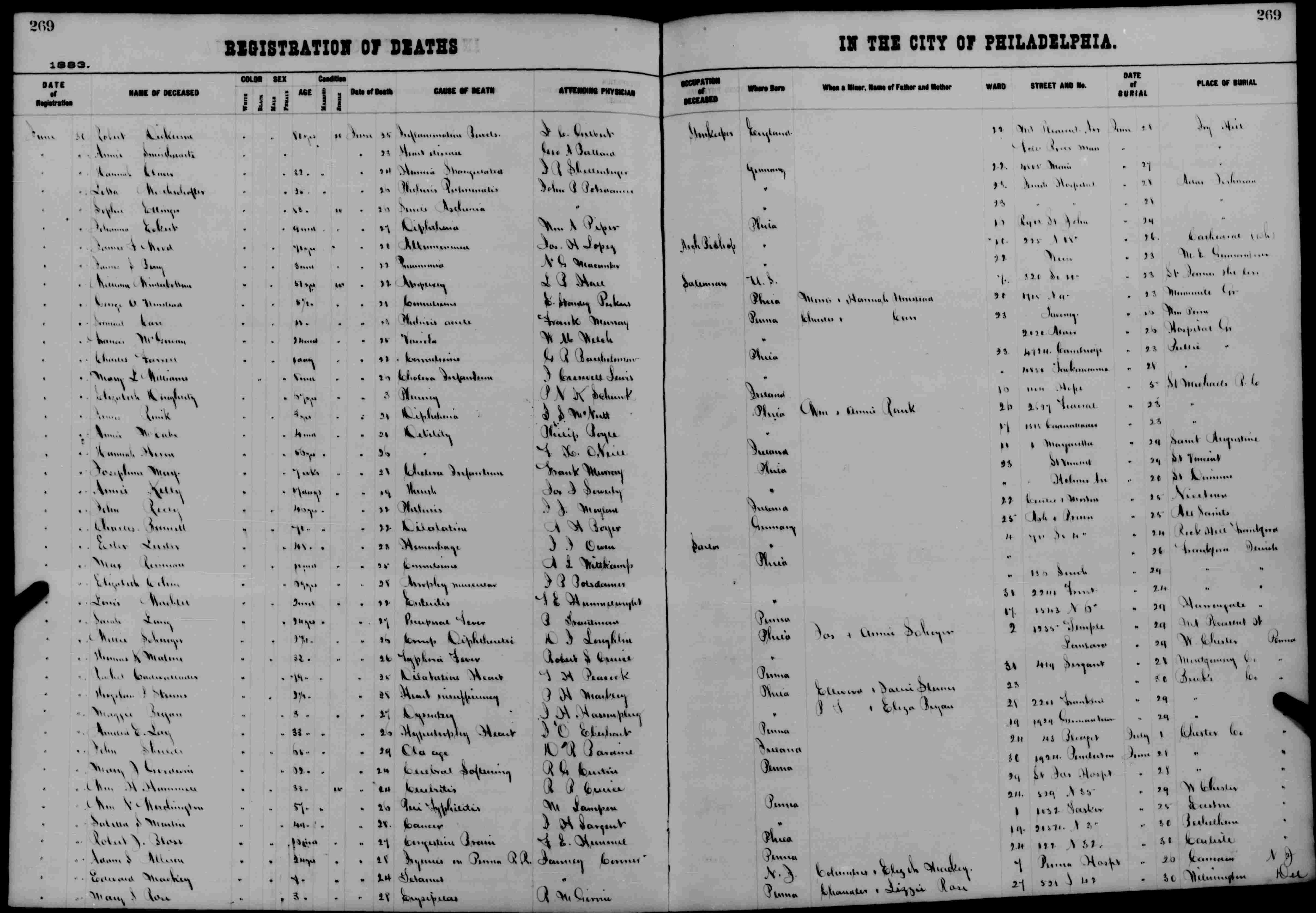
Elizabeth Cohen death record 1883

Elizabeth Cohen death record 1883

Less than a year later, on March 6, 1884, her brother Lewis died of an abscess of the lung.  His age was given as 68 on his death certificate, and he also was buried at Mikveh Israel cemetery.

Lewis Cohen death certificate 1884

Lewis Cohen death certificate 1884

On April 21, 1888, my great-great-grandfather Jacob died as well, also in his sixties.  He, too, was buried at Mikveh Israel, with his wife Sarah, his father and his siblings.  According to his death certificate, he died from “uremia from Bright’s disease of the kidneys (probably  auto ? kidneys).”  (If someone can decipher the word after “probably,” please comment below.)  Bright’s disease was defined in Wikipedia as follows:  “Bright’s disease is a historical classification of kidney diseases that would be described in modern medicine as acute or chronic nephritis. The term is no longer used, as diseases are now classified according to their more fully understood causes.”

Jacob Cohen 1888 death certificate

Jacob Cohen 1888 death certificate


The last of Jacob and Sarah’s children, the youngest, Jonas, died on January 23, 1893, and was also buried at Mikveh Israel.  He also was in his early 60s when he died.  His cause of death was given as pneumonia.

Jonas Cohen 1893 death certificate

Jonas Cohen 1893 death certificate

So all five of Jacob and Sarah’s children died before reaching seventy years of age, whereas their father lived to be 88.  (Their brother Moses had died before reaching forty; although I’ve yet to locate a death certificate for Moses, according to the 1860 census taken just months before he died, he was “insane from intemperance.”)  They all died from different causes—atrophy muscular, a lung abscess, kidney disease, and pneumonia.  Their mother died from a bacterial infection. I would think most of these would be treatable today and that, given better medical treatment, they all could have lived a long life like Hart Levy Cohen had. Looking at how young they all were when they died makes me realize just how remarkable it was for Hart to live to be almost 90 years old back in the 19th century.  And how lucky we all are to live in the 21st century.


Enhanced by Zemanta

Who Knew?  My Great-Great Grandmother’s Family, the Jacobs

One of the great surprises I’ve encountered in doing genealogy work is that I have many more surnames in my family than I ever knew.  I knew about Goldschlager and Brotman, on my mother’s side, and I knew about Cohen, Schoenthal, Seligman and Katzenstein, on my father’s side. But I never knew that I was also a Rosenzweig until I found my great-grandmother Ghitla’s maiden name, and now I know that I am also descended from the Jacobs family on my father’s side.  My great-great grandmother was Sarah Jacobs, married to Jacob Cohen.  My great-great-great grandmother was Rachel Jacobs, married to Hart Levy Cohen.  Although I have not yet found any familial connection between Rachel and her mother-in-law Sarah, I have found some evidence of Rachel’s parents and siblings.

First, I noticed that a man named Lazarus Jacobs was living with Rachel and Jacob Cohen in Philadelphia in 1860.  Then yesterday while researching the Cohens in the 1860s, I found a Philadelphia directory that listed Jacob’s business partner as Joseph Jacobs.  I assumed this was another of Rachel’s relatives, but was not sure how they might be related.

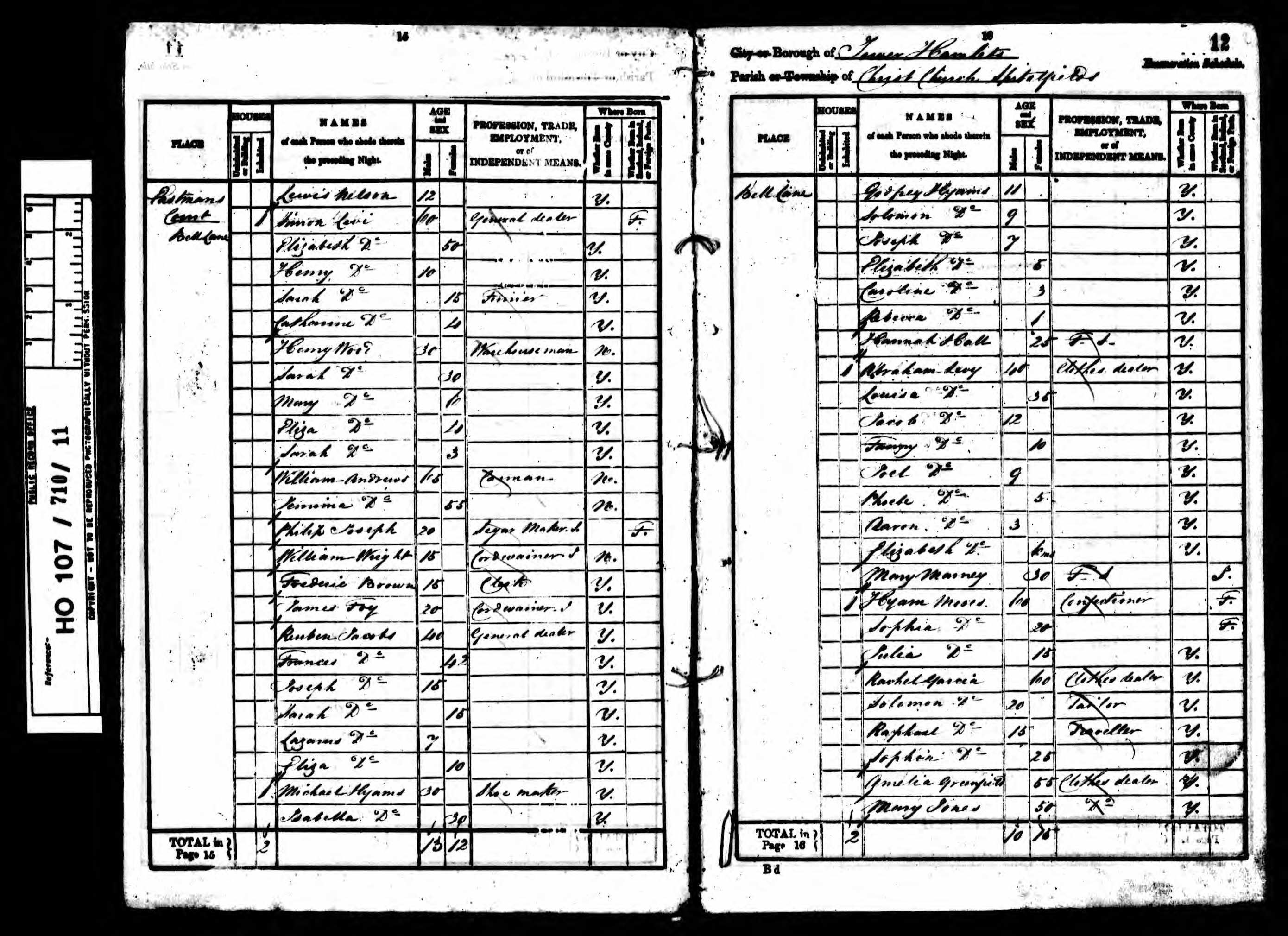
After some further searching, I found Joseph Jacobs on the 1841 England census, living with his parents Reuben and Frances and his siblings Rachel, my great-great-grandmother, and Lazarus, the younger brother who was living with Jacob and Rachel in 1860.

Reuben Jacobs and family 1841 England Census

Reuben Jacobs and family 1841 England Census

Joseph married his wife, Rachael, in 1847, whose maiden name may also have been Jacobs.  (The BMDIndex has two Rachels on the registry page for Joseph Jacobs, so until I can obtain the actual records, I am not sure if she was Rachel Levy or Rachael Jacobs.)

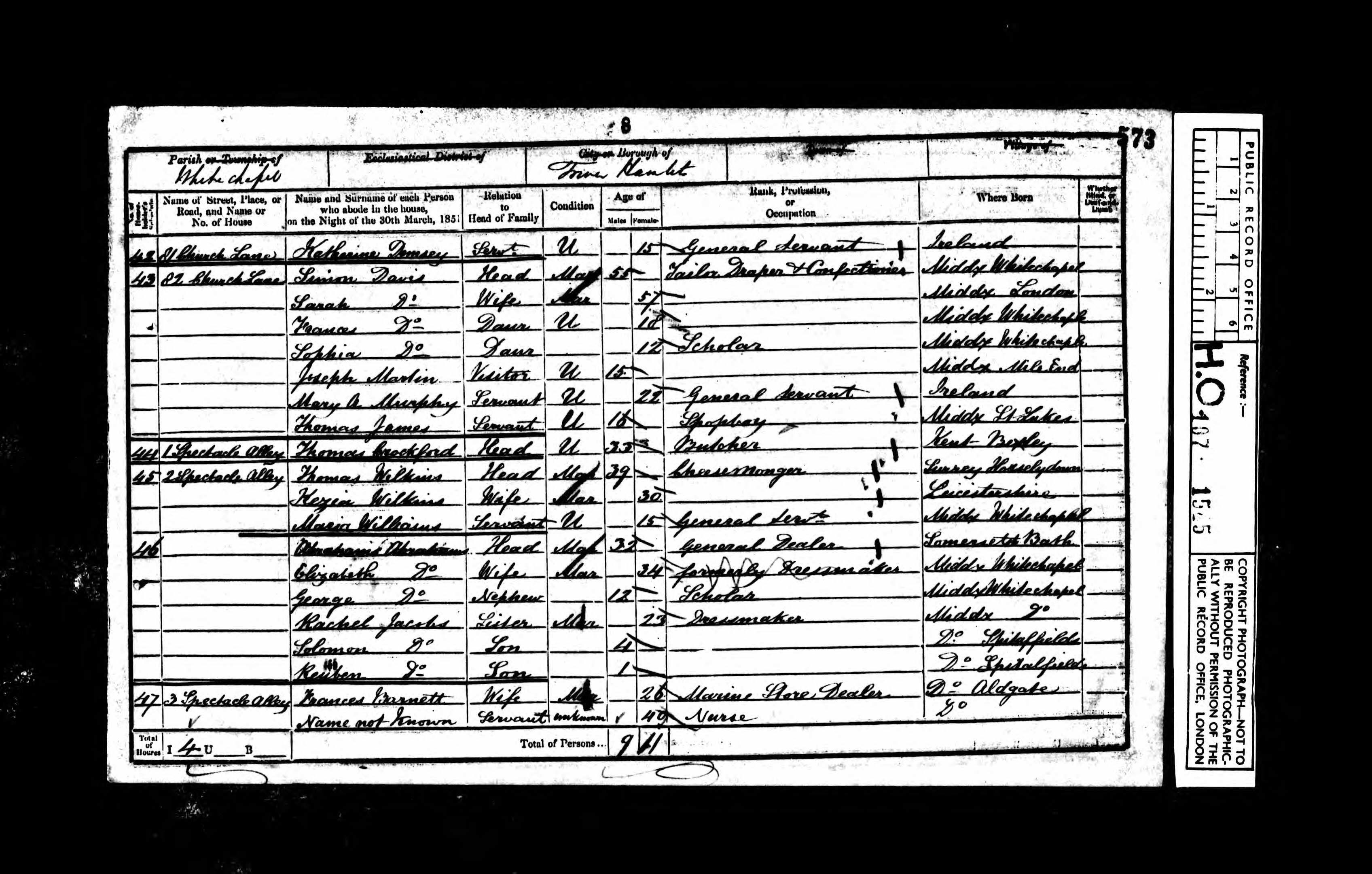
Joseph and Rachel had a son, Solomon, born in 1848, and a son Reuben, born in 1850.  Both were living with Rachel on the 1851 England census.  Rachel was listed as the sister of the head of household, whose name was Abraham Abrahams; his wife’s name was Elizabeth.  I cannot find a Rachel Abrahams on the marriage registry on the BMDIndex, and although I did find an Abraham Abrahams married to an Elizabeth Levy, I also wonder whether the census taker took down Abraham’s name incorrectly since there is also an Abraham Jacobs married to an Elizabeth.

Rachel Jacobs and children 1851 England census

Rachel Jacobs and children 1851 England census

At any rate, the bigger question is— where was Joseph?

My guess was that he was in the US, preparing to move the family to Philadelphia.  I could not find him, however, on the 1850 US census nor could I find him on a ship manifest for that time period.  I did, however, find a Joseph Jacobs on the 1851 England census as a visitor in Birmingham, England; he was listed as born in Middlesex, London, and his occupation was as a general dealer, so my guess is that Joseph was simply away on business the day the census was taken.

Joseph Jacobs 1851 England census  a visitor

Joseph Jacobs 1851 England census
a visitor

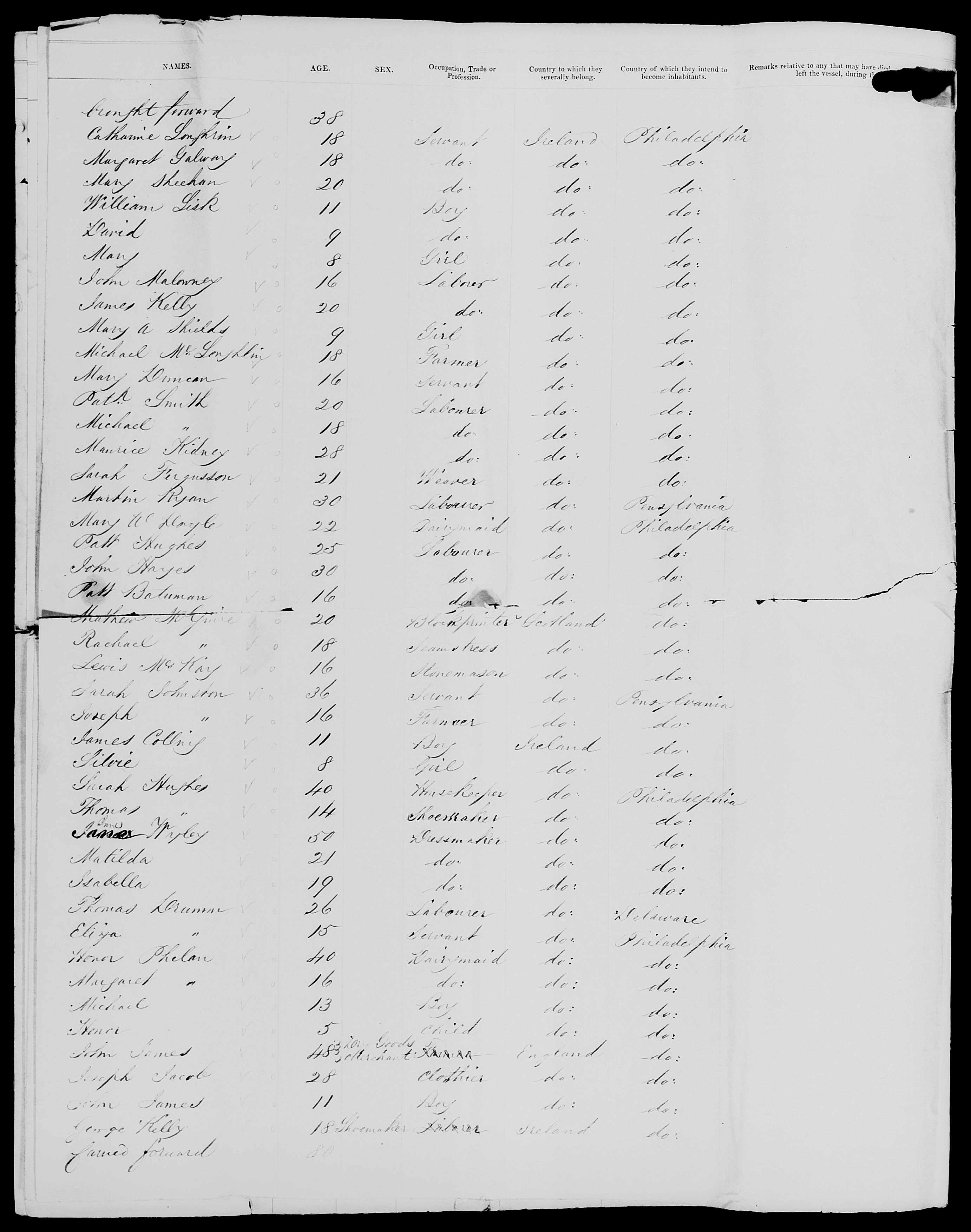
Joseph and his family left England and, like Joseph’s sister Rachel, settled in Philadelphia.  It appears that Rachel Jacobs and her three children, Solomon (4), Reuben (2) and Emanuel, who was described as an infant, left in 1853 along with her brother-in-law, fourteen year old Lazarus (L. Jacobs on the manifest).

Rachel Jacobs and children 1853 ship manifest

Rachel Jacobs and children 1853 ship manifest “Pennsylvania, Philadelphia Passenger Lists, 1800-1882”, index and images, FamilySearch (https://familysearch.org/pal:/MM9.1.1/K8CH-1V8 : accessed 20 May 2014), Jacobs, 1853.

Her husband Joseph may not have left until 1854.

Joseph Jacobs ship manifest 1854

Joseph Jacobs ship manifest 1854 “Pennsylvania, Philadelphia Passenger Lists, 1800-1882”, index and images, FamilySearch (https://familysearch.org/pal:/MM9.1.1/K8CC-N1Z : accessed 20 May 2014), Joseph Jacob, 1854

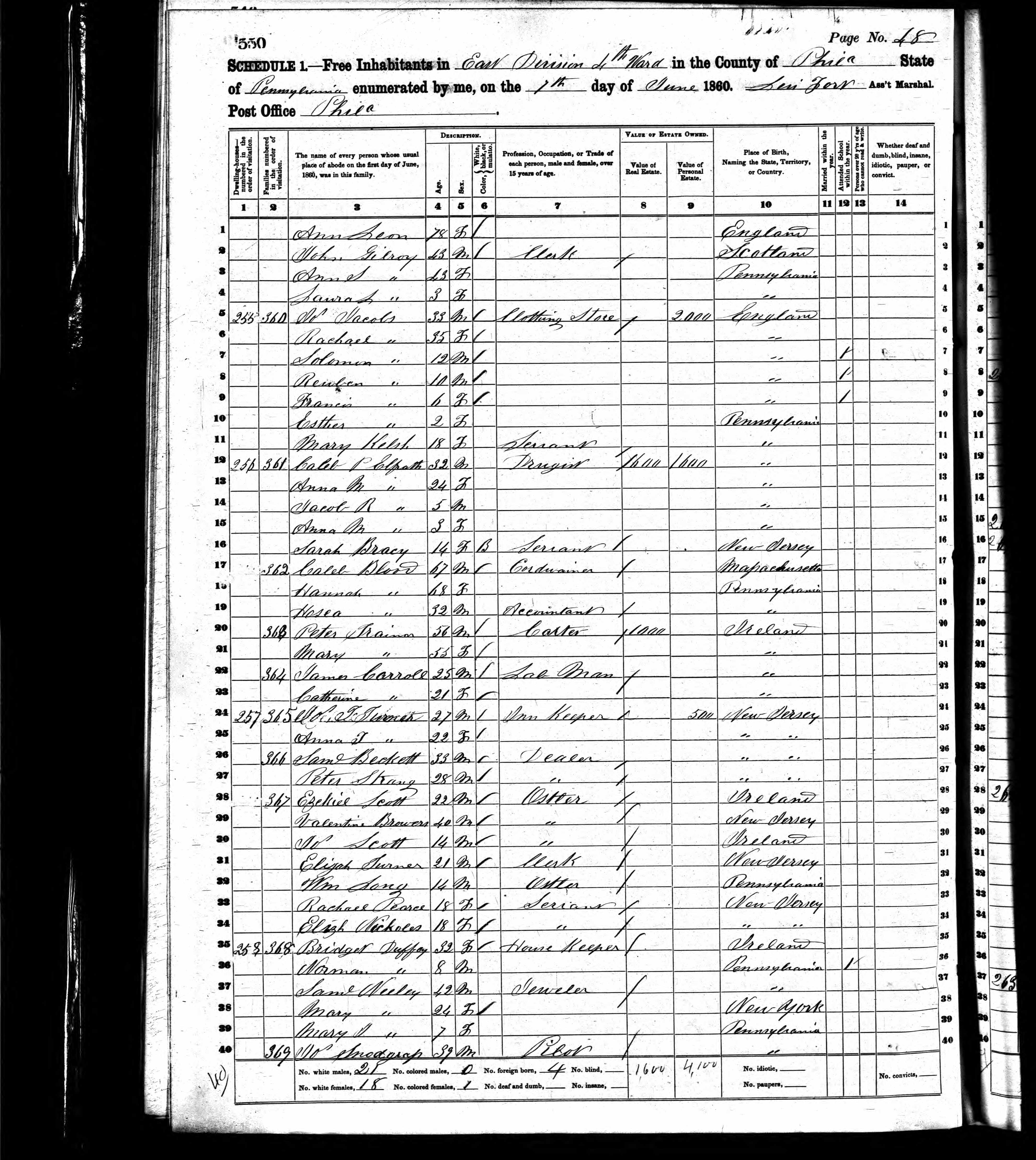
These dates make sense because according to the 1860 US census, their daughter Frances or Fanny was born in England and was six at the time of the census in 1860, but their daughter Esther was born in Pennsylvania and was already two years old in 1860.


Joseph Jacobs and family 1860 US census

Joseph Jacobs and family 1860 US census

What seems inconsistent, however, is that Frances/Fanny is not on the ship manifest with either her mother Rachel or her father Joseph.  Perhaps the 1860 census was incorrect, and Frances was born shortly after arriving in the US, but the 1870 census also has her listed as born in England, so more likely she just wasn’t included on the ship manifest. Emanuel Jacobs, however, although listed on the ship manifest, is not included in the 1860 census.  In fact, a later born child was named Emanuel, born in 1866.  So was “Emanuel” on the manifest really Frances? Or did the first Emanuel die?

Sadly, it was the latter.  Emanuel died on May 3, 1860, of heart disease, according to the US Federal Census Mortality Schedule.  The Philadelphia death certificate identifies his father as Joseph Jacobs residing at 150 South Street, so this is definitely the right child since that is where the Jacobs family was living in 1860.  The certificate also says that Emanuel had been in Philadelphia for 2 and 2/3 years, meaning since sometime in 1857 (which seems incorrect unless they lived elsewhere between 1853 and 1857), and although I cannot decipher the age very well, I think it says he was 8+ years, meaning he was born sometime either in 1851 or 1852, which would explain why he was not on the 1851 census, but was on the 1853 manifest.  Apparently, the second Emanuel, born in 1866, was named for the deceased older brother.

Emanuel Jacobs death certificate May 3, 1860

Emanuel Jacobs death certificate May 3, 1860

That does not explain where Frances was, however, when the rest of the family was sailing to Philadelphia.

In 1860 Joseph Jacobs and his family lived at 150 South Street in Philadelphia, not more than a few houses from my great-grandparents who lived at 136 South Street.  He was in business with his brother-in-law, Jacob Cohen, my great-great-grandfather. Although I will track what happened to Joseph and to Lazarus after 1860 as well as research Joseph, Sarah, and Lazarus’ parents in England, for now I will return to the Cohen family and finish their story before returning to my newly discovered family line, the Jacobs.  The tree just keeps on growing.

Enhanced by Zemanta

Mystery Solved—I think

As I wrote yesterday, I was somewhat befuddled by the existence of two men named Hart Cohen, born around the same time (1850-1851), both married to women named Henrietta whose birth names started with B.  Although one Hart was born in Philadelphia and the other in Maryland, at first I (along with many other ancestry.com members) thought they were the same person and had their families intertwined on my family tree.  After spending much time sifting through census reports and other documents, I was finally convinced that there were in fact two Hart Cohens married to two different Henriettas, one living in the Washington, DC, area his whole life and the other living in Philadelphia his whole life except at the very end of his life.  Philadelphia Hart died in Washington, DC, in 1911, thus making the situation even more confusing.  But there were in fact two separate men, not one man living a double life.

But was this more than coincidence? Was there any connection between them aside from all those coincidences?  I went to sleep last night unsure about the answer to that question, but the last document I found before my post was a death record for DC Hart which revealed his parents’ names: Moses Cohen and Adeline Himmel.  Further research revealed that Moses was born in England, Adeline in Germany, and that they had had a son born in Germany named Moses before emigrating to Maryland and having DC Hart.

Hart Cohen DC death record 1926

Hart Cohen DC death record 1926

I woke up this morning, determined to find some link between Moses Cohen, DC Hart’s father, and Jacob Cohen, my great-great grandfather and the father of Philadelphia Hart.  After some searching, I first found Adeline’s death record and saw that she had died in 1895, already a widow, in Washington, DC, and was buried in Washington.  I then tried to figure out when Moses, her husband, had died, and found a number of  Washington, DC. city directory listings in which Adeline Cohen was described as the widow of Moses.  The earliest one I found was dated 1867, meaning that Moses had already died by that time.

1867 Washington DC city directory Adeline Cohen as widow of Moses

1867 Washington DC city directory Adeline Cohen as widow of Moses

In fact, in 1870, Adeline was living with DC Hart and her other children in Washington.

Adeline living with her children 1870 US census

Adeline living with her children 1870 US census


That gave me an outer limit for when Moses, Sr., had died, and by placing a date limit on his death, I was able to uncover this record on ancestry.com:

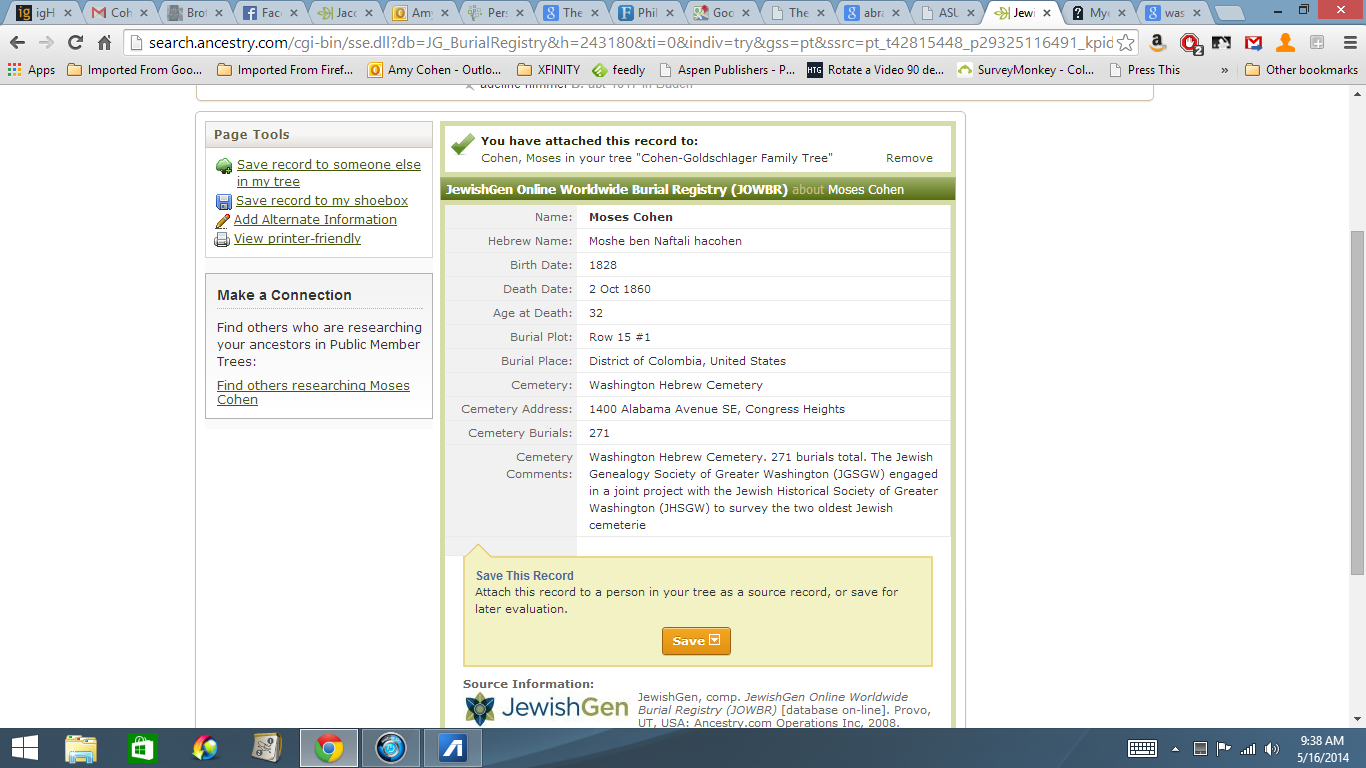
Moses Cohen death record 1860

Moses Cohen death record 1860

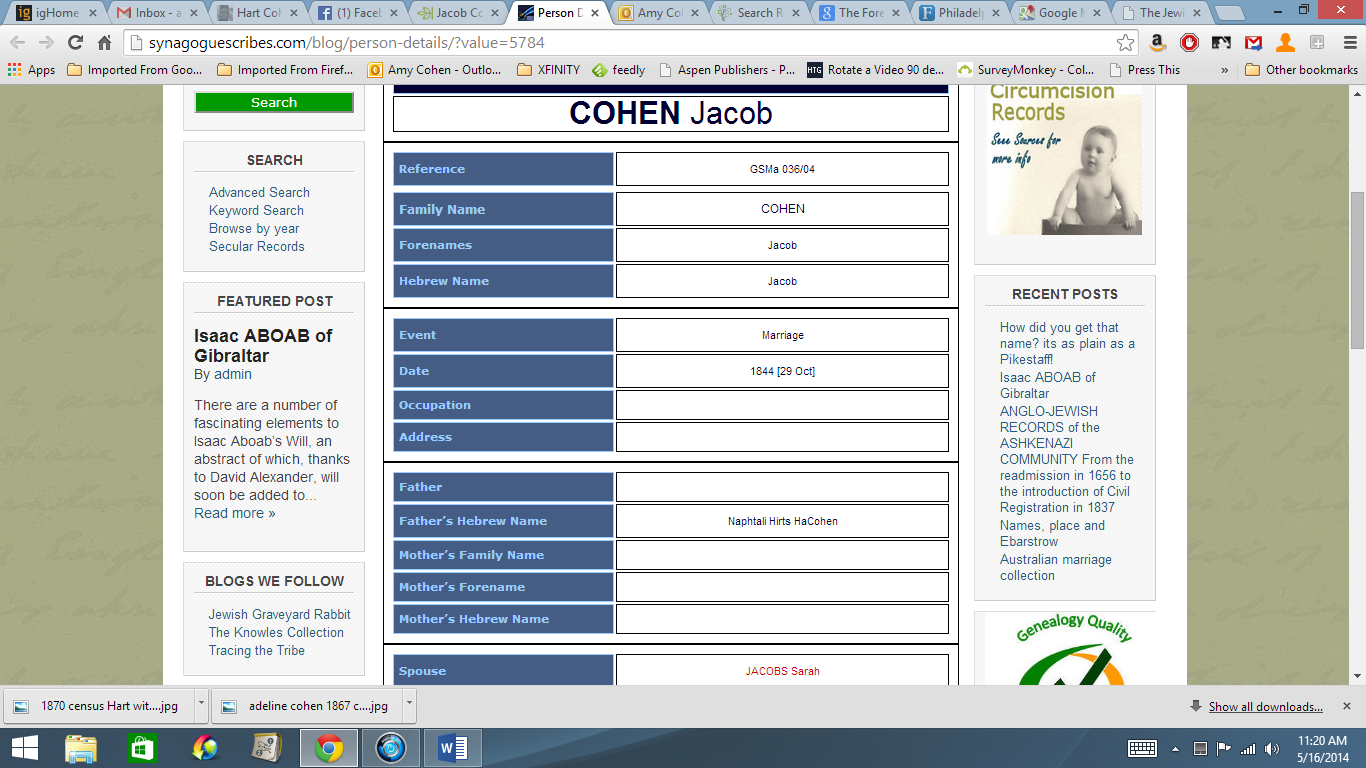
Notice his father’s Hebrew name: Naftali ha Cohen.  This rang a bell, and I went back to my earlier research and found that on my great-great grandfather Jacob Cohen’s marriage record his father’s Hebrew name was recorded as Naftali Hirts ha Cohen.

Jacob and Sarah Cohen's marriage record

Jacob and Sarah Cohen’s marriage record

This was one coincidence too many and enough for me to conclude that Moses, Sr. and Jacob were in fact brothers, that Moses had not stayed in England as I had concluded early on in my Cohen research, but had come to America just as all his other siblings had.  I now also think that it is possible that the “Mordecia” [sic] listed as living with Jacob on the 1850 US census was probably his brother Moses, who had also emigrated in 1848 from England.

Jacob Cohen and family 1850 US census

Jacob Cohen and family 1850 US census

His wife Adeline and son Moses, Jr., must have arrived sometime later, though I have not yet located a record revealing when they came.  I will need to track down a few more documents to be sure—death certificates for Moses and Jacob and also photographs of their headstones.

But assuming my hunches are correct, Philadelphia Hart and DC Hart were first cousins, sharing a name, sharing an occupation (pawnbroker/jewelry store owner), having wives with the same first name, and sharing a grandfather for whom they were both named, my three-times great-grandfather, Hart Levy Cohen.  The only real coincidence was that they both had wives named Henrietta.

I just love when the pieces come together.  It is what makes this so much fun.  Digging around in the muck, being totally confused and overwhelmed, and then that AHA! moment when suddenly it all makes sense.

Enhanced by Zemanta

Did My Great-Grandfather’s First Cousin Live Two Separate Lives?

I have started tracking down the lives of the children of Jacob and Sarah Cohen, my great-great-grandparents, and all was going pretty well until I started to research their son Hart.  It seems he might have been living two lives, one in Philadelphia, one in Washington, DC.   Or perhaps not.  Here’s what I have found; see if you have any ideas on how to resolve this one.

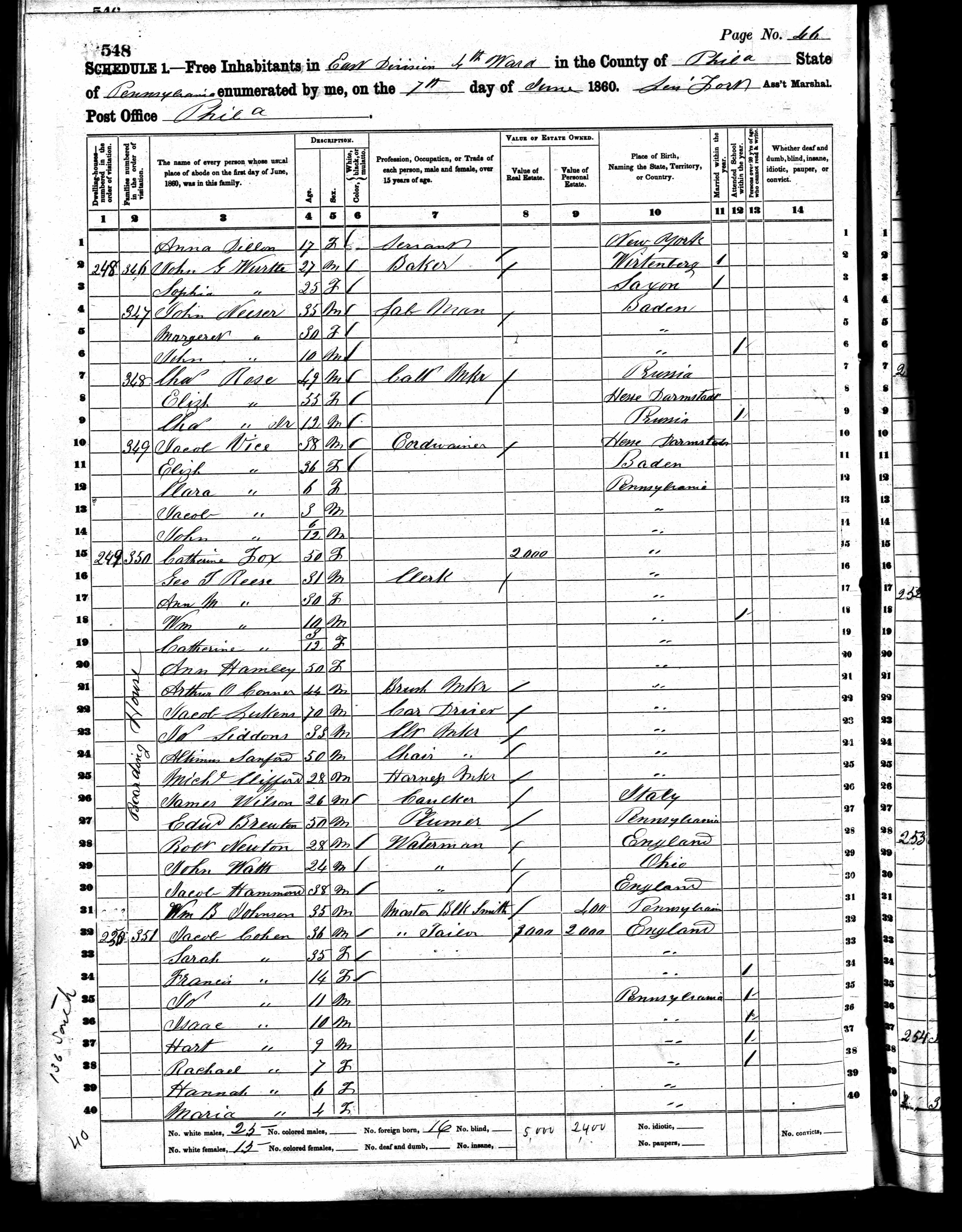
The first mention of Hart, obviously named for his grandfather Hart Levy Cohen who was still alive when he was born, is on the 1860 US census, listing little Hart as nine years old, so born in 1850 or 1851, depending on whether his birthday was before or after June 7th, the date in 1860 when the census was taken.  Since he was not listed on the 1850 census taken on July 25, 1850, he was obviously born sometime between July 25, 1850 and June 7, 1851 if he was actually nine on June 7, 1860.

Jacob and Sarah Cohen and family 1860 US census

Jacob and Sarah Cohen and family 1860 US census

Things start getting weird in 1870.  I found two census reports for Jacob and Sarah and their children for 1870, one taken in June, one in November.  The second one is labeled “Second Enum” for second enumeration so for some reason the census taker went to the neighborhood twice.  What’s odd is that Hart is listed as 20 on the June version and 19 on the November version.  I’ve seen age mistakes so often that this did not faze me in the least, but it does not help pin down Hart’s precise birth date.

It is the 1880 census, however, that really threw me.  In 1880 there are also two census reports for Hart Cohen born in 1850 or 1851.  One is clearly the right Hart:  He was living in Philadelphia, working as a storekeeper, and was born in Pennsylvania of parents born in England. He is 30 years old, giving him a birth year of 1850 or 1851.  This Hart was married to a woman named Henreta or probably Henrietta and had three children, Jacob (6), Sarah (5), and Julia (4).  If Hart and Henrietta had a six year old child, then presumably they would have been married no later than 1873, and in fact I was able to find a record of a marriage of Hart Cohen to a Henrietta Brunswick in Philadelphia on February 12, 1873 in the Pennsylvania marriage index.

Hart Cohen and family Philadelphia 1880 US census

Hart Cohen and family Philadelphia 1880 US census

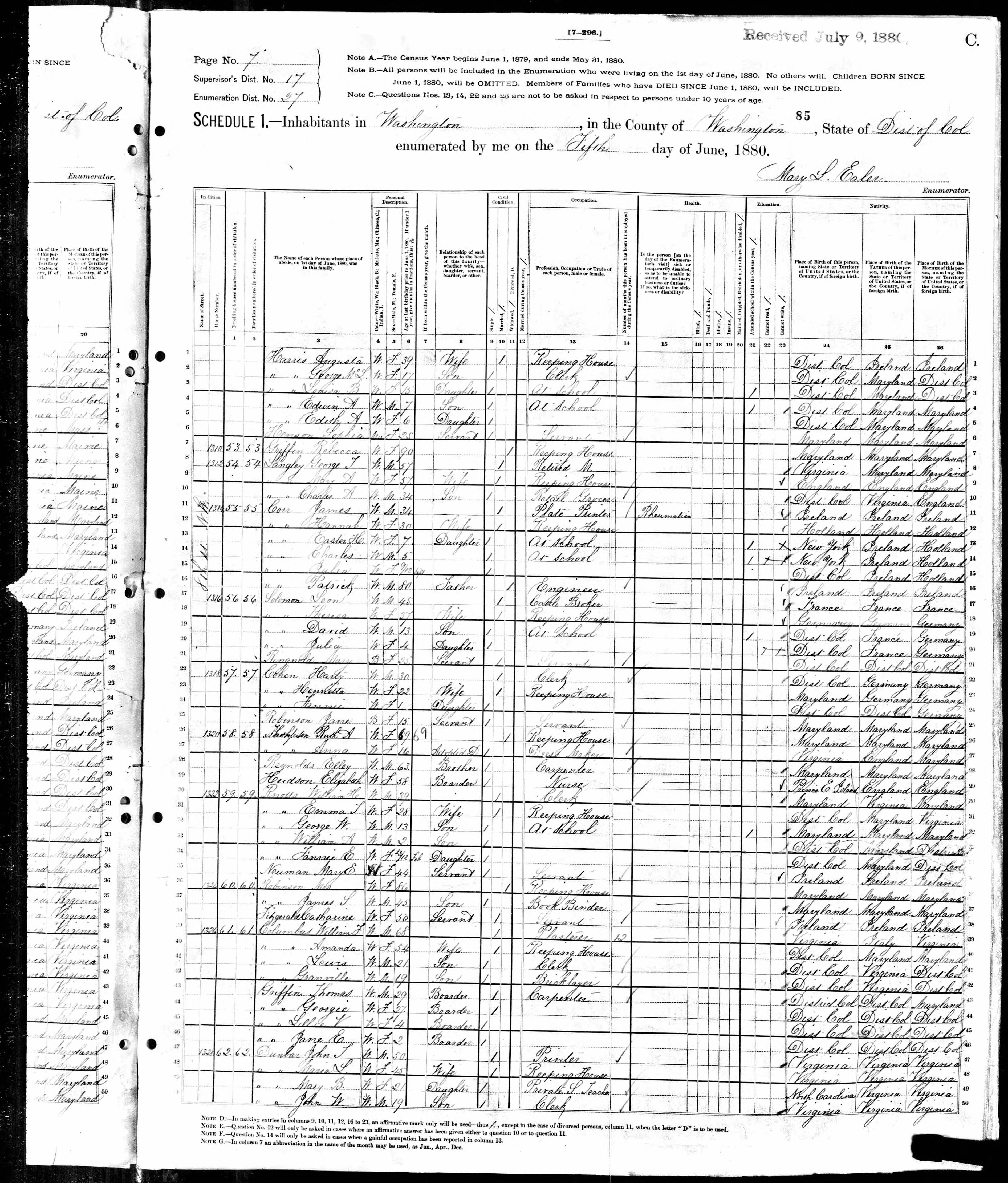
All seemed to be making sense until I found another 1880 census report for a Hart and Henrietta Cohen residing in Washington, DC. This Hart was also 30 years old.  I was ready to dismiss this as just as bizarre coincidence since this Hart was listed as having parents who were born in Germany.  His own birthplace was given as Washington, DC.  This seemed like it had to be a different person.  The DC Hart and Henrietta had one child, a daughter named Fanny who was only a year old.

Hart Cohen and family Washington, DC 1880 US census

Hart Cohen and family Washington, DC 1880 US census

I have a city directory for Philadelphia listing Hart Cohen as a pawnbroker in 1886, so I was convinced that the DC Hart was just a fluky coincidence of someone with the same name and age as my Hart marrying a woman also named Henrietta.  The 1890 census was destroyed by fire, so I had to skip ahead to 1900 to see if I could follow up on the two Hart and Henrietta Cohens.

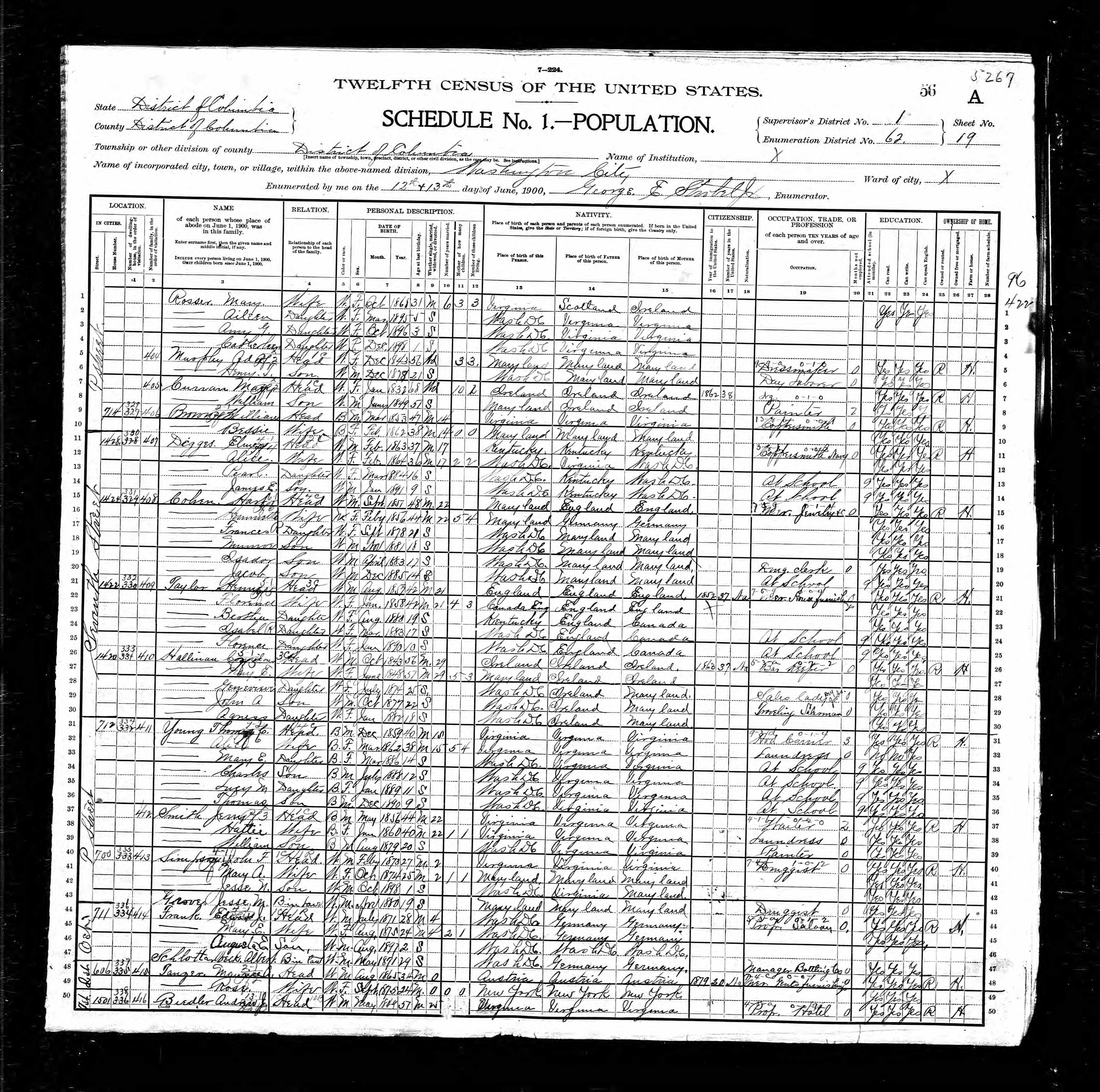
I could not find the Philadelphia Hart and Henrietta on either the 1900 or the 1910 census, but I did find the DC Hart and Henrietta on both.  The 1900 census for the DC Hart provided a more specific birthdate—September, 1851—and had his birth place as Maryland, but this census listed his parents’ birthplace as England, not Germany as on the 1880 census. DC Hart was working in a jewelry store, a retail business not unlike those of my ancestors, so that seemed strange as well. Hart and Henrietta now had four children, Frances, Munroe, Isador and Jacob.  But this Jacob was only 14 in 1900 so could not be the same Jacob who was 6 in 1880 and thus born in 1874.  Once again I felt pretty certain that this was still not the same Hart Cohen who was Jacob and Sarah’s son.  Despite the fact that his parents were now reported to be English-born, that he was a jeweler, that he married a woman named Henrietta and that he was also 30 years old, I again said that this was just a coincidence.

Hart Cohen and family in Washington, DC 1900 US census

Hart Cohen and family in Washington, DC 1900 US census

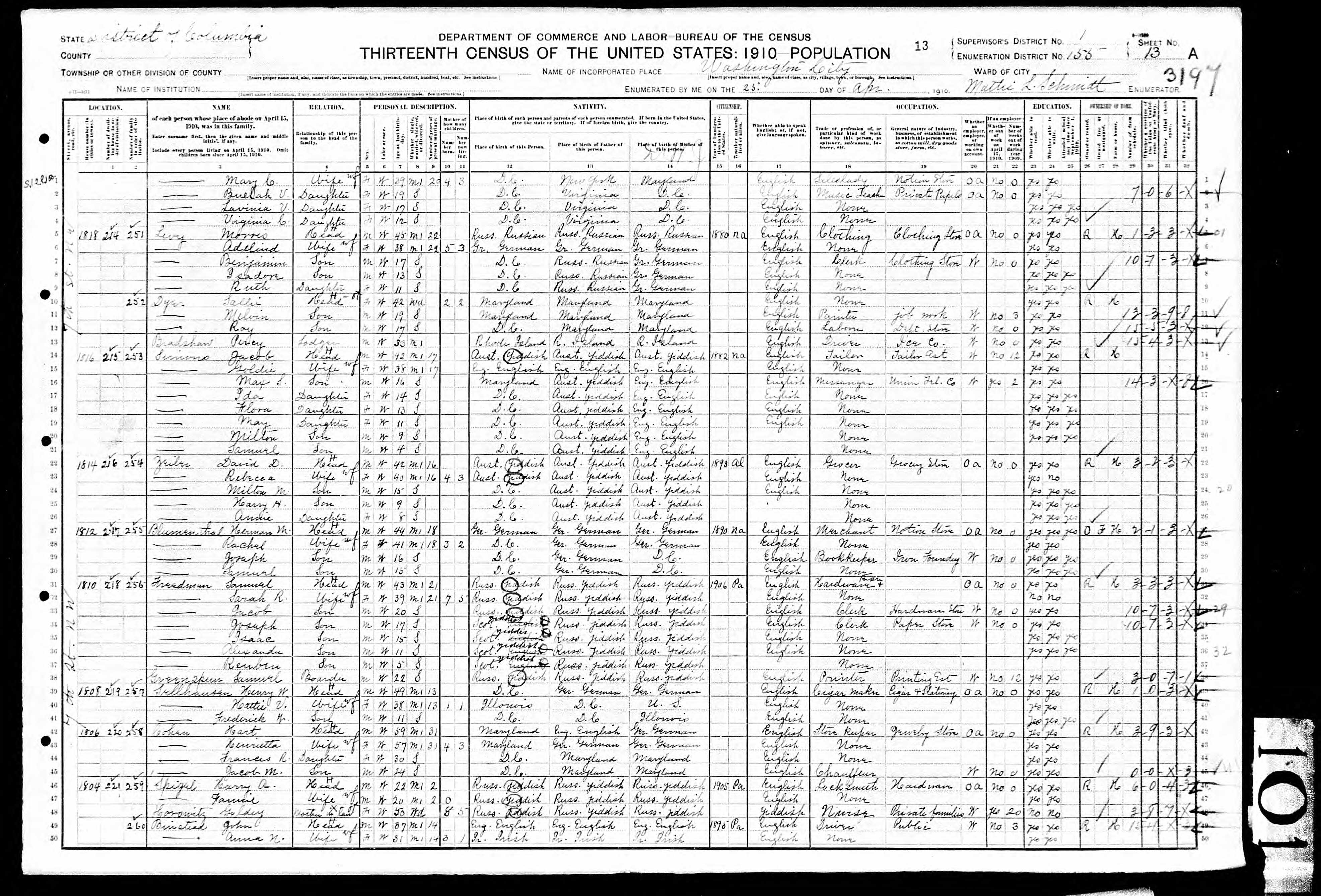
On the 1910 census report for the DC Hart and Henrietta,  Hart still had a jewelry store and was married to Henrietta and living with Frances and Jacob, two of their children.  His birthplace was listed as Maryland, and now his parents’ birthplaces were reported as England for his father and Germany for his mother.  This also seemed to suggest that this was not the Philadelphia Hart.

Hart Cohen and family Washington, DC 1910 US Census

Hart Cohen and family Washington, DC 1910 US Census

But because I could not find the Philadelphia Hart on the 1900 or the 1910 census, I was a bit perplexed.  Could he have died? Had he moved to DC?   Even if that were the case, it would not explain the two 1880 census reports.  Was he living a double life, having two wives both named Henrietta, one in Philadelphia and one in DC, and two different sets of children?

I decided to search for a death record for any Hart Cohen born around 1850, and I found one dated January 3, 1911.  Since this   record was from the District of Columbia Selected Deaths and Burials database, I assumed that this related to the DC Hart especially since the report said that the deceased was living in DC at the time of his death, but on a closer look I saw that it said that he had been born and was buried in Philadelphia.

I then found a second record in the Philadelphia Death Certificates Index that made it quite clear that this was the Philadelphia Hart, not the DC Hart: it listed his parents’ names as Jacob Cohew (sic) and Rachel Jacobs, both of whom were born in England.

Pennsylvania Death Certificates Index

Pennsylvania Death Certificates Index


Further research revealed that Hart’s body had been moved from its original burial location twice by two of his children, Jesse Cohen and Sarah Cohen Jonas, ending in a move in 1944 to a location in Mt Sinai Cemetery where both his son Jacob H. Cohen and a Ralph Brunswick were also buried.  Since the Henrietta who married Jacob was born Henrietta Brunswick, this seemed (no pun intended) to be the final nail in the coffin establishing that the Jacob who died in January, 1911, was the Philadelphia Hart, son of Jacob and Sarah Cohen, my great-great grandparents.

If that conclusion is correct, then Philadelphia Hart was actually living in Washington, DC, at the time of his death in January, 1911, just nine months after the 1910 census recorded DC Hart (and no other Hart) living with his wife Henrietta and two children Frances and Jacob at 1806 4th Street.  Philadelphia Hart’s residence at his time of death was reported as 1737 N. 15th Street in Washington.  He was also a widower, and I was able to locate a death record for a Henrietta B. Cohen who was born in Lengnau, Switzerland and died in November, 1902.  Had he moved to DC after Henrietta died? If so, why? And what, if any connection, might there be to the “other” Hart and Henrietta?

The other Hart, the DC Hart, was still alive in 1920 and living with his daughter Frances in the District of Columbia.  He also was a widower at this time and retired.  The census report lists his and his parents’ birthplaces as DC, but that is clearly wrong, at least for his parents, whose birthplaces had previously been reported at various times as England and Germany.

Hart Cohen Washington, DC 1920 US Census

Hart Cohen Washington, DC 1920 US Census

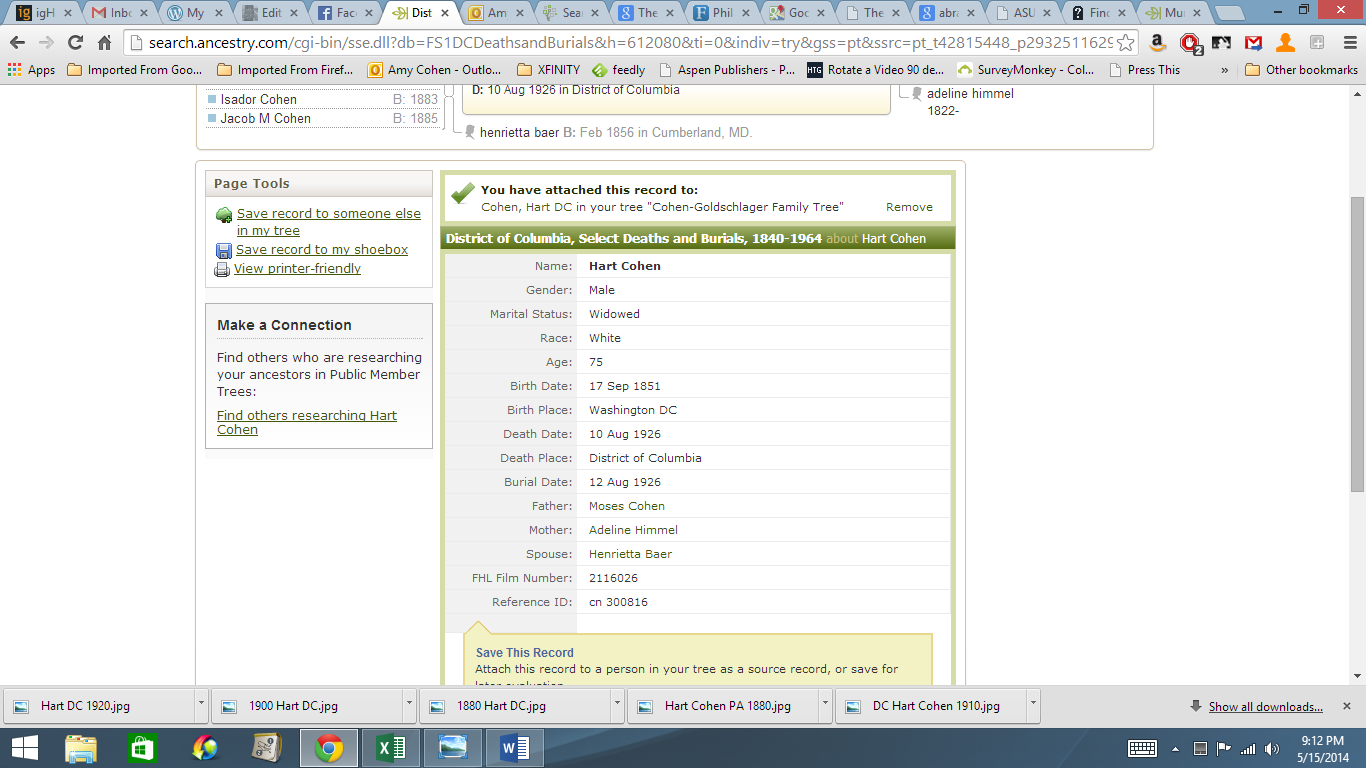
My next find was a record of DC Hart’s death. He died August 10, 1926, in Washington, DC.  His parents’ names were listed on this record: Moses Cohen and Adeline Himmel.  His wife’s name was Henrietta Baer.  So not only did both Philadelphia Hart and  DC Hart marry women named Henrietta, they both married Henriettas  with a birth name that started with a B.  It is no wonder that I was confused, and there are numerous trees on ancestry.com that have mixed together the two Hart and Henrietta Cohen families.

Screenshot (3)

When I saw the name Moses Cohen as DC Hart’s father, it stopped me in my tracks.  Could this be my great-great grandfather Jacob’s brother Moses, the one I thought had stayed behind in England? So far I have not been able to find whether there is a connection.  Although I did find a ship manifest with a Moses Cohen emigrating from England to New York in 1848, the same year Jacob left England, I have no idea whether this is the right Moses Cohen.  Tracking Moses Cohen and Adeline Himmel, I know that they had a son also named Moses before Hart and that Moses the younger was born in Baden, Germany around 1839.  Adeline was born in Germany, and Moses must have gone there, married her, had Moses his son, and then moved sometime between 1839 and 1850 to the United States and settled in Maryland where DC Hart was born.

If this was in fact Moses, the son of Hart Levy Cohen, my three times great grandfather, it would explain why Moses named his son Hart.  It might also explain why Philadelphia Hart was living for some time in Washington.  Perhaps he wanted to be closer to his cousin DC Hart and his family.  On the other hand, if there is no connection, then it is just a very, very strange series of coincidences.

What do you think?


Enhanced by Zemanta

Hart Cohen and family 1841-1851: Before the Move to America

be

By 1851, the time of the second English census, my great-great grandfather Jacob Cohen had already moved with his family to Philadelphia.  Much of the rest of his family of origin, however, was still in London.  According to the 1851 census, Hart, my three-times great grandfather, was now a widower and 75 years old, living with two of his children, Elizabeth, now listed as 28 despite having been listed as 20 ten years earlier, and Jonas, who was 22.  Jonas was not even listed as living with the family in 1841 when he would have been only 12 years old.   All three were listed as general dealers and living at 55 Landers Buildings in Spitalfields parish in Tower Hamlets.

Hart, Elizabeth and Jonas Cohen 1851 England Census

Hart, Elizabeth and Jonas Cohen 1851 England Census

Although I thought this might indicate a move to a new neighborhood, my research revealed that Landers Buildings were on Middlesex Street, which was just one blog from New Goulston Street where the family had been living in 1841.  The English genealogy site Genuki indicates that Spitalfields was a district within the parish of Whitechapel for at least some point in London’s history.

I do not know when Rachel, my three-times great grandmother died.  My search of the BMDIndex, the English index of births, marriages and deaths that began to be registered in 1837, revealed quite a few Rachel Cohens who died between 1841 and 1851.  I have ordered one certificate on a hunch that it might be the right one, but I need to do more investigating before I know for certain when she died.

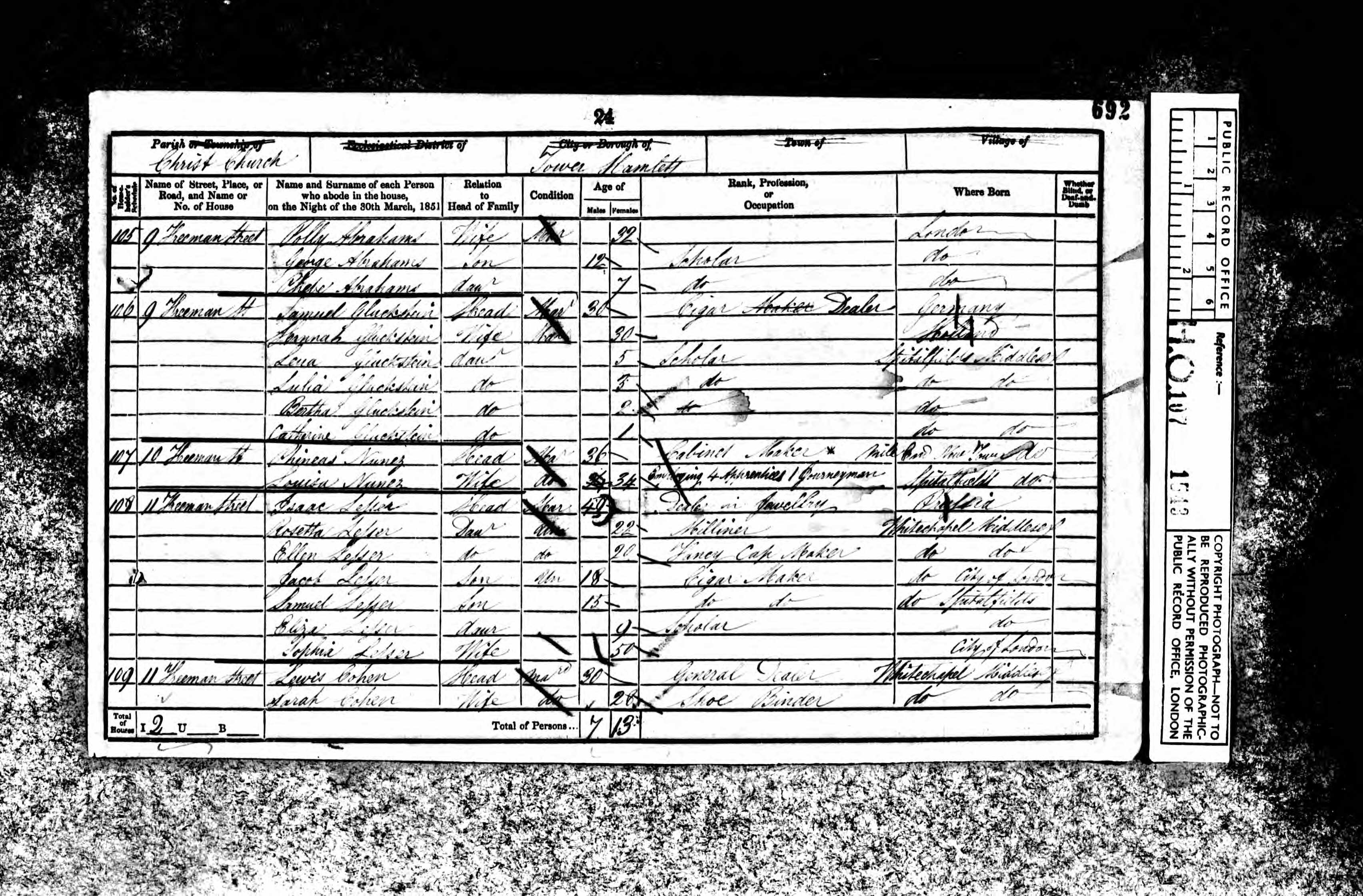
Hart’s son, Moses, now 30 years old, had married Clara Michaels in the fall of 1843, according to the BMDIndex.  I need to obtain a copy of the actual record to be sure, but on the 1851 census, Moses Cohen was married to a woman named Clara and had three daughters, Judith (6), Hannah (2), and Sophia (six months).  He was employed as a general dealer and living at 35 Cobbs Yard in the parish of Christchurch in Tower Hamlets.

UPDATE:  I now know that Moses in fact had left England with Jacob in 1848.  This is not the correct Moses.

Moses Cohen and family 1851 census

Moses Cohen and family 1851 census

This neighborhood is about three miles west of where Moses had been living with his parents in 1841. Moses must have been fairly comfortable as they also had a servant living with them, although the Charles Booth Poverty Map depicted this area as poor in 1898.

The oldest son, Lewis, has been more difficult to track.  He was not living with the family in 1841 nor was he living with his father and younger siblings in 1851.  I would not even have known that he existed except for the fact that he appears on the 1860 US census reports living with his siblings Elizabeth and Jonas and his father Hart and on the 1880 census living with Elizabeth and Jonas.  So where was he in 1841? 1851?  According to those two US census reports, he was born in 1820, so would have been Hart and Rachel’s second child after Elizabeth.  He might have been living independently in 1841, married, or perhaps just not home.  The FamilySearch website indicates that the 1841 census had many holes; if someone was not staying at a home that night, they were not included in the census for that household.  I found three Lewis Cohens on the 1841 Census, but none of them was a good fit.  One was too old, one was living with different parents, and one was not born in England.  But since the 1841 was the first true census taken in England, I assumed that perhaps Lewis was just not among those counted.

The 1851 English census did not provide any greater information on Lewis.   There were several Lewis Cohens again, but only one who was a possible fit: he was born in Middlesex County in Spitalfields, Christchurch, around 1821 and was married to a woman named Sarah.  They were living with Sarah’s mother, Ann Solomon.

Lewis Cohen 1851 census (not sure this is the correct Lewis)

Lewis Cohen 1851 census (not sure this is the correct Lewis)

I have found a marriage for this Lewis and Sarah in 1848 on the BMD Index and will write away for the record, but since Lewis was single in 1860 according to the US census, if this is the right Lewis, either Sarah had died or divorced him between 1851 and 1860.  I searched for a death record for a Sarah Cohen who died between 1851 and 1860, and there were several on the BMD Index.  I am not sure how to determine which ones might be relevant, but will order any that appear to be possibilities once I know that this was the correct Lewis.

UPDATE:  I know now that Lewis had in fact emigrated from England to the US in 1846.  This is not the correct Lewis.

The other possibility is that Lewis had immigrated to the US before the 1851 census or even the 1841 census.  I cannot find him on either the 1840 or 1850 US census, but I did find some immigration records for a Lewis H. Cohen who was naturalized in Philadelphia in 1848.

Lewis H Cohen naturalization ED PA 1848

Lewis H Cohen naturalization ED PA 1848

Since Lewis is listed on the 1860 US census as Lewis H. Cohen, I am inclined to think that this is the right person.  If so, then I also may have found a passenger ship manifest for Lewis, arriving in the US in 1846, which would have made him the first Cohen to immigrate to the US, not my great-great grandfather Jacob.  I need to check further into this, but it seems quite possible that the reason Lewis is not on the 1851 census in England is that he was already in the US.  But then why can’t I find him on the 1850 US census either?

The other mystery child of Hart and Rachel Cohen is the son identified on the 1841 census as John, the youngest child on that census whose age was given as 14, giving him a birth year of 1827.  In my initial research on the family, I thought that John had become Alfred J. Cohen, who was also born in 1827.  Alfred married Mary A. Cohen and remained in England where eventually they had seven children.

In reviewing my earlier work from last year, however, I am now doubtful that this was in fact the child of Hart and Rachel. Although I will order a marriage record for Alfred to be sure, I now think that the John in the 1841 census was actually Jonas, the youngest son of Hart and Rachel and the son who was living with Hart in 1851 in London and in 1860 in Philadelphia.  My reasoning is that Jonas was not listed on the 1841 census when he would have been only twelve years old.  Where else would he have been if not living with his parents? Also, since Jacob’s age was off by a few years on the 1841 census, it seems quite possible that there was an error in “John’s” age and also his name.  Jonas is close enough to John, at least the first syllable, so a census taker might have just recorded it or heard it incorrectly.  On the US census reports, Jonas’ age jumps around, making it difficult to pinpoint a correct year of birth.  Although I am going to order whatever vital records I can for Alfred and for Jonas, right now my hunch is that Jonas and John were the same person, the youngest son of Hart and Rachel Cohen, born sometime between 1825 and 1830.

UPDATE:  It seems quite clear to me now that “John” was Jonas.

So I have a lot of unanswered questions about my Cohen ancestors between 1841 and 1851. When did Rachel, my three-times great grandmother die?  Where was Lewis in 1841? Did he marry in England?  Did he in fact immigrate to the US in 1846? If so, why isn’t he on the 1850 US census? Are John and Jonas the same person, or were there in fact two sons younger than Jacob?

It will take some time to get the records that may help to answer these questions, so while I am waiting for those documents,  I will move on to the next decade and the story of my Cohen ancestors in the United States.


My Ancestor was a Chut: More on Dutch and English Jews

The Chuts” Synagogue Sandy’s Row London

After I wrote my last post saying I was going to put aside for now any attempt to find my four times great-grandfather’s family in Holland, I decided to look more generally into the question of why a Dutch Jew would have emigrated from Holland to England in the late 18th century.  After all, life seemed to be pretty good for the Jews in Amsterdam at that point.  They had acquired full legal rights as citizens, many were comfortable both socially and economically, and England was in fact still forty years away from giving Jews the same legal rights as Christian residents.  Why would someone have left Amsterdam to move to London?

Su Leslie of Shaking the Tree mentioned in a comment that she had seen some episodes of the British version of Who Do You Think You Are involving famous British Jews and recalled that there had been discussion of an immigration of Jews from Holland to England in the late 18th century.  I decided to search on line for more information and learned that there was in fact a whole community of Dutch Jews who settled in London during that time.  My research led me to several websites discussing this community, including the Bishopsgate Institute website describing a recent oral history project about this community being sponsored by the Institute and created under the direction of Rachel Lichtenstein, a well-known writer and artist.  According to this site:

The oldest Ashkenazi synagogue in London, Sandys Row in Spitalfields, was established by Dutch Jewish immigrants in 1854, who began arriving in the city from the 1840s onwards. They came in search of a better life, rather than fleeing persecution like the thousands of Ashkenazi Jews who came after them in the 1880s from the Pale of Settlements.  Mostly from Amsterdam, many settled in a small quarter of narrow streets in Spitalfields known as the Tenterground. Here they continued to practise the trades they had bought with them from Holland, which were predominately cigar making, diamond cutting and polishing, and slipper and cap making. Many small workshops were established in the area and businesses were passed on within generations of families.

With their own practises and customs, many of which were different from other Ashkenazi Jewish groups, they became a distinctive, tight knit community of about a thousand people. To the frustration of the more established Anglo-Jewish population living in the area at the time, ‘the Chuts’ (as they were known locally) refused to join any of the existing synagogues…

Sandys Row Synagogue

Sandys Row Synagogue (Photo credit: FarzanaL)

So my four times great grandfather Hart Levy Cohen was a Chut—a term I’d never heard before and a community I’d never known about before.  Other sites confirmed this information and also provided some other details.  Wikipedia provided this explanation for the name “Chuts.”

The origin of the name Chuts is uncertain. A popular assumption is that it derives from the Dutch word goed (meaning “good”) and is imitative of the foreign-language chatter that others heard. It is also Hebrew חוץ for “outside” or “in the street” and may have been applied to the Dutch Jews of London either because they were socially isolated or because many were street vendors. Another possibility is that the Hebrew word would have appeared increasingly in Amsterdam synagogue records as more and more emigrated to London, and others who followed would have “gone chuts” (i.e., emigrated).

Sandys Row Synagogue, London

Sandys Row Synagogue, London (Photo credit: nicksarebi)

The About Jewishness website revealed where in London the Chuts lived:

They settled mostly in a small system of streets in Spitalfields known as the Tenterground, formerly an enclosed area where Flemish weavers stretched and dried cloth on machines called tenters (hence the expression “on tenterhooks”). By the 19th century, the site had been built upon with housing, but remained an enclave where the Dutch immigrants lived as a close-knit and generally separate community. Demolished and rebuilt during the twentieth century, the area is now bounded by White’s Row, Wentworth Street, Bell Lane and Toynbee Street (formerly Shepherd Street).

I looked up these streets on the map of London and was not surprised that this area is very close to New Goulston Street where my ancestors were living in 1841.

The About Jewishness site also provided some insight into what happened to this community and perhaps why my ancestors left London and moved to the US.  According to this site, “the successful introduction of machinery for the mass-production of cigarettes ultimately led to the collapse of the cigar-making economy on which the Chuts community depended. Many Chuts returned to improved conditions in Amsterdam, some emigrated further afield to places such as Australia and the USA, some assimilated into other Jewish families, and some eventually lost their Jewish identity altogether.”

In addition, the huge influx of Eastern European Jewish immigrants in the late 19th century caused tensions between the older established Chuts community and the newer immigrants, most of whom were poor, not as well skilled, and not used to living in a big city.  Interestingly, the Chuts community had traditions and practices that made them different both from the older Sephardic community and from the newer Eastern European Ashkenazi community.  Again, from the About Jewishness site:

[T]he Chuts were treated with suspicion by other Jews because the former had developed specific customs and practices, many of their families having lived in Amsterdam since the first synagogues were established there in the early years of the 17th century. Uniquely in Amsterdam, Ashkenazim (so-called “German Jews”) and Sephardim (so-called “Spanish Jews”) lived in close proximity for centuries, resulting in a cultural blend not found elsewhere. Most remarkably, the Dutch Jews were well accustomed to the sea, and ate seafoods considered not kosher by other Jewish communities.

From this information, it seems reasonable to infer a couple of things.  First, it seems that despite the fact that the Amsterdam Jewish community was fairly well-established, there must have been those, my ancestor Hart among them, who believed that there was greater opportunity for financial success in London.  These Dutch Jews decided to emigrate in order to achieve greater economic security.  Secondly, it seems that at some point many of those Dutch Jews either left or assimilated into the greater Jewish or non-Jewish society.  Some may have left because economic conditions were not as good as they had hoped; others may have left because as a “Chut,” they were not well integrated into the world of London’s Jews.  With different traditions, different practices, different synagogues, they may have felt isolated and disrespected.  I don’t know specifically what motivated my ancestors first to leave Amsterdam and then to leave London, but I’d imagine it was a combination of these factors.

Once again I am finding out new things about my own history and about Jewish history by doing genealogy.  I never knew about the Chuts, and I certainly never knew I was descended from one.  I have written to Rachel Lichtenstein to learn more about her project and will report back with whatever else I learn.

Also, in researching more about the Dutch Jews in general, I came across a genealogy blog I’d not seen before written by Kerry Farmer called Family History Research.  Kerry had a post from two years ago about searching for a Dutch Jewish ancestor using information she was able to obtain from a book compiling information about marriages performed at the Great Synagogue in London, Harold and Miriam Lewin’s Marriage Records of the Great Synagogue- London 1791-1885.  I was very excited when I read this post and contacted Kerry, who generously looked up Hart Levy Cohen and Rachel Jacobs’ wedding for me in the Lewin book.  She was able to provide me with the information she found there:

(Groom) Cohen Hart Levy

(Groom’s father) Leib Katz

(Groom’s patronymic) Hertz b. Leib Katz

(Groom’s address) Not listed

(Bride) Jacobs Rachel

(Bride’s father) Yaakov

(Bride’s patronymic) Rechel b. Yaakov

She also suggested that I contact the owners of the Akevoth site to see if this additional information would help in locating the records of my ancestors, and I have done that.  Now I will wait to see if they can provide any further assistance.

So yesterday I was ready to put aside the search for my Dutch ancestors, and then, with the help of Su Leslie and Kerry Farmer, I was able to make some progress in understanding who they were and why they left Amsterdam and why they left London.  Once again I am humbled by and grateful for the generosity of the genealogy community.  Su and Kerry are from New Zealand and Australia, respectively, and they have helped me in my search to find a Dutch Jew who lived in England and moved to America.  What a small world it is when you find such wonderful, helpful and knowledgeable people.


Enhanced by Zemanta

The Brick Dyke in Amsterdam?

Before I write about the next phase in the life of Hart Levy Cohen and his children, I want to explain what I have learned or rather tried to learn about his life and his family before he came to London.  From the English census of 1841, I knew he was born in “foreign parts” outside of Great Britain.  The 1851 English census was more specific; it said that he was born in Holland.  The 1860 US census was even more specific than that.  It reported his place of birth as Amsterdam.

photo 1 (3)IMG_1060

Knowing his Hebrew name, his father’s Hebrew name, his English name and his approximate year of birth, I thought that I would be able to find some record of Hart’s birth and of his family in Holland fairly easily.  When I first found this information over a year ago, I searched every way I could on a site called Akevoth, which has a huge database and lots of information on Dutch Jewry.  It’s a wonderful resource, but I was soon overwhelmed.  There were just too many people with the names Hart(og), Levie, and Cohen or some combination of two of those three.  I had no way to figure out whether any of those people were my relatives.  I’ve just looked again, and now I remember why I was overwhelmed.  It’s like looking for a needle in a haystack.  Last time I had not known about FamilySearch, so I have now looked there as well, and once again, I have not found anything definitive there or on ancestry.com.

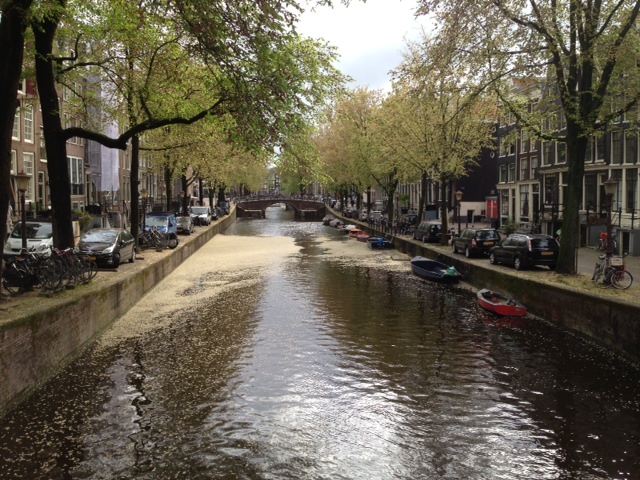
I’ve also had a chance to try and find evidence of Hart not only online, but also in Amsterdam itself.  Last spring we took a weeklong trip to Amsterdam.  We had an amazing time and loved the city.  It was not a trip we took for genealogical purposes, but rather a general interest trip to see the art, walk the canals, visit the museums, drink the beer, and learn about the history of Amsterdam.  Part of that history is, of course, the history of the Jews in Amsterdam, and in addition to an incredibly moving visit to Anne Frank’s house, we also took a walking tour of Jewish Amsterdam with Jeannette Loeb, a Dutch Jew herself with expertise in the history of the Jews in Amsterdam.

From Jeannette and other sources, I’ve learned some of the long history of the Jews in Amsterdam.  Like England and like the United States, the earliest Jews in Amsterdam were Sephardic—traders from Portugal and Spain. When the Netherlands established their independence from Spain, religious freedom was one of the important tenets of the new state, allowing not only Protestants but also Jews to practice their religion.  The Sephardic Jewish community became well-integrated both socially and economically in Amsterdam, although Jews were not given the full legal rights of citizens.

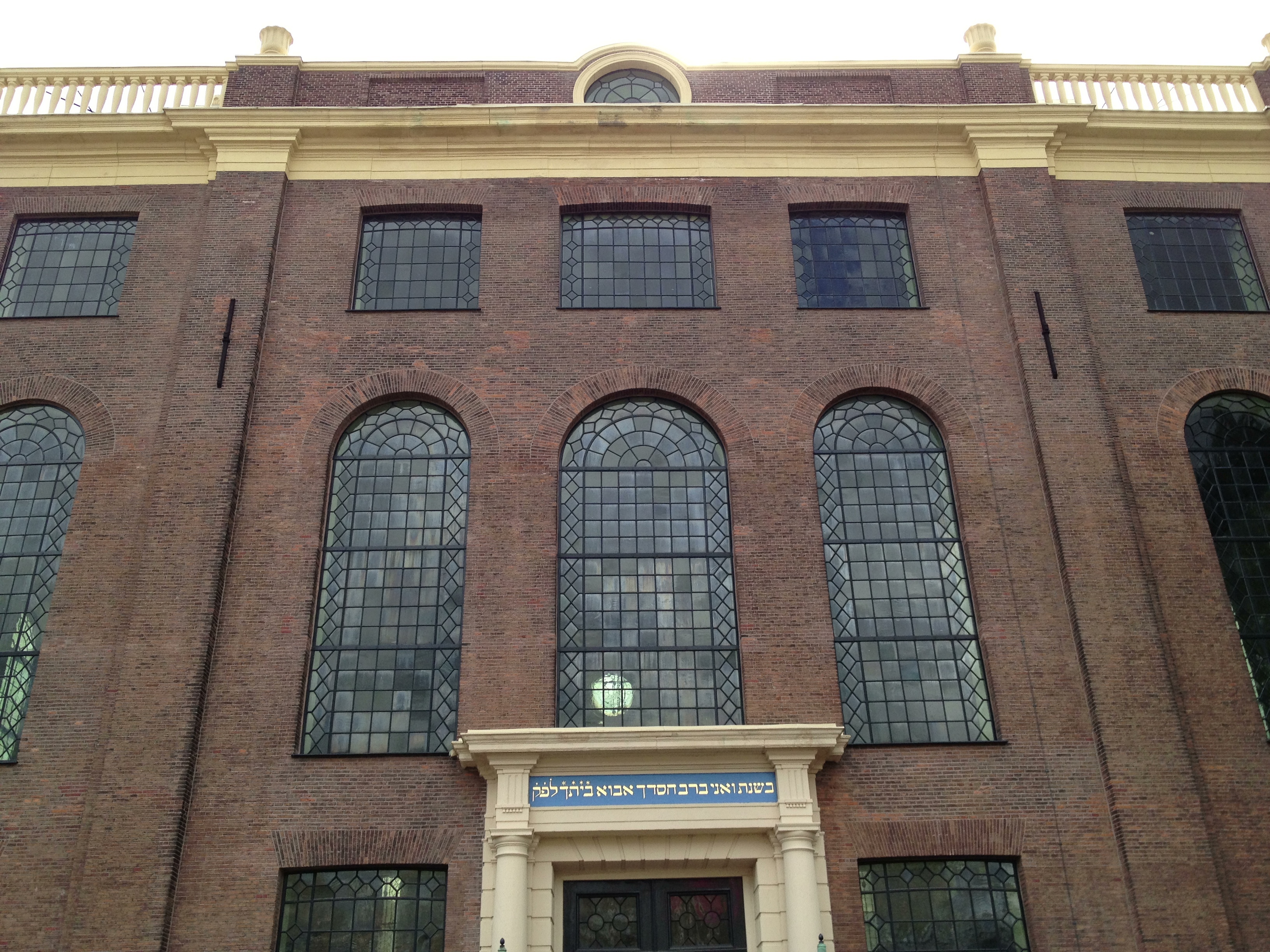
Portuguese Synagogue Amsterdam

Portuguese Synagogue Amsterdam

It was not until the late 17th century that Ashkenazi Jews from Germany and Poland began to settle in Amsterdam to escape persecution and poverty.  These immigrants were helped by the established Sephardic community, although the two communities retained their own languages, practices and synagogues.  Although they  started off poverty-stricken, the Ashkenazi community became more economically stable over the years.  In 1792 Jews were finally given full legal rights in the Netherlands, certainly late but nevertheless a full forty years before Jews were given such rights in England.

Joods Historisch Museum (Jewish Historical Mus...

Joods Historisch Museum (Jewish Historical Museum) in Amsterdam, Holland. {| cellspacing=”0″ style=”width:400px; text-align:left; color:#000; background:#ddd; border:1px solid #bbb; margin:1px; direction:ltr;” class=”layouttemplate” | style=”width:22px; height:22px;” | 20px|link= | style=”font-size:8pt; padding:1pt; line-height:1.1em;” | This is a photo of rijksmonument number 265 |} 00000265 (Photo credit: Wikipedia)


Before World War II, there were 80,000 Jews living in Amsterdam, about 10% of the overall population.  Almost all of them were killed during the Holocaust, leaving only 20,000 Jews in Amsterdam after the war.  Today there is a small Jewish community in Amsterdam, but nothing like that large and active Jewish community that existed before the Holocaust.

Holocaust Memorial Amsterdam

Holocaust Memorial Amsterdam

Thus, in the late 18th century when Hart was born, the Ashkenazi Jewish community in Amsterdam was fairly well established, and Jews had full legal rights by the time he was a young adult in 1792.  Why did he leave? What was the economic situation of his family? Who was his family?

While we were on our walking tour, I asked Jeannette Loeb where I might be able to get some help in tracking my Dutch ancestor, Hart Levy Cohen.  She suggested that I visit the Amsterdam city archives and ask for some help in searching the city records.  I followed her advice and spent a couple of hours there with an archivist who specialized in Dutch Jewish genealogy.  He sifted through many books of records of births and circumcisions, but was unable to come up with anything definitive.  As he explained to me, until 1812 most Ashkenazi Jews in Amsterdam (and in Europe generally) did not have surnames.  People were known only by their patronyms, that is, by their Hebrew name paired with their father’s Hebrew name.  Because of that, it is nearly impossible to identify specific families.  Rather, there are just a very large number of people with very similar names.  Hart was probably Hartog in Amsterdam, a Dutch version of Hirts, and there were many Hartog Cohens.  Cohen was also probably a patronymic label, referring to the Cohanim tribe, not a specific family.

Thus, for now I am going to once again put aside any attempt to find Hart Levy Cohen’s father or other relatives and ancestors.  Perhaps I will have another chance to go to Amsterdam or find some other clues to help me sift through all the data.  Perhaps there will be some hole in this “brick dyke” that will allow me to find my ancestors.  For now instead I will bring the story forward and trace Hart’s children and grandchildren all the way to my father and to his children.


Enhanced by Zemanta

My Father’s Family, Part I: The Cohens

My surname is Cohen, and it always has been.  I have always been proud to be a Cohen.  It is a clear marker to the outside world that I am Jewish.  Because I grew up in a secular home and did not go to Hebrew School like almost all my Jewish classmates, some of them expressed skepticism about whether I was “really” Jewish, but my name always gave me some authenticity.

The Cohens (Cohanim) are the high priests, a line that is supposed to descend from Aaron, Moses’ older brother.  Observant Orthodox Jews who are Cohanim do not go into cemeteries or attend a funeral or touch a dead body in order to maintain their priestly purity.  In a traditional service, there is a special ritual where the Cohanim bless the congregation.  Cohanim get the first aliyah for the reading of the Torah.

Birkhat cohanim 4

Birkhat cohanim 4 (Photo credit: Wikipedia)

Although I do not believe in any of the “special holiness” of the Cohen tribe and in fact am not even sure my family are true Cohanim, I do feel proud to have the name and some of the tradition and history that goes along with it.  It was one reason that I did not change my name when I got married.  I wanted to remain a Cohen—it was my name, it was my family’s name, and it was my ancestors’ name.

So perhaps it is not surprising that one of my first genealogical tasks was to trace the Cohen line.  It was fairly easy to get as far back as my great-great-great-grandfather Hart Levy Cohen, who was born around 1772 in Amsterdam and emigrated to England as a young man.  The English records and then the American records on my Cohen line were clear and easy to find through ancestry.com, and thus within a short period of time I was able to create a tree that went from Hart Levy Cohen to Jacob Cohen, my great-great-grandfather, to Emanuel Cohen, my great-grandfather, to John Nusbaum Cohen, my grandfather, to John Nusbaum Cohen, Jr., my father, to me.  I have census reports going back as early as 1841 in England and 1850 in the United States as well as tax records and a marriage record from England.  I have the names of Hart’s children, his grandchildren, his great-grandchildren and so on.  I compiled a lot of information very quickly, but now I need to go back and learn from all those documents and see what I can find out about Hart Levy Cohen and all his descendants and also to see if I can find his ancestors from Amsterdam and before.

This research will require learning about English records and census reports and also about Pennsylvania records.  From the little bit of initial work I’ve done this week, I already know that it will be more difficult to obtain Pennsylvania records than New York City records.  There is not much online and not much available through the Family History Library.  Most of it will require snail mail requests or traveling to places that are not as accessible to me as New York City.  I do not foresee traveling to Harrisburg in the near future, so it may require hiring someone there to retrieve documents for me.  And as for the English records, well, a trip to London sounds a lot more fun than a trip to Harrisburg, but I don’t think it’s too likely either.

So I have a big learning curve ahead.  I am up for the challenge and ready to learn more about my Cohen relatives and about genealogical research.  I will start by posting what I already know, and then I will fill in the details as I learn more.

Meanwhile, I will also continue to look for more information about the Brotmans, the Goldschlagers, and the Rosenzweigs.  Tomorrow I hope to talk to David Goldschlager’s son and grandson and maybe learn more about the Goldschlagers. I am still hoping to work with Larry Brotman about a Brotmanville connection.  I am still hoping to hear from my cousin Lois about her family and Lizzie and Ray Rosenzweig.  I have written to descendants of Ray Strolowitz Adler and Zusi Rosenzweig Mintz, and I hope to hear back from them.  So at the moment I am depending on these others to help me break down the brick walls that remain on my mother’s side.  Without their help, I am at an impasse for now, but will keep on looking for any and all clues.


Enhanced by Zemanta

Assessment time

It’s time for my periodic review of what I have learned and where I am going in my research.  I keep a Word document with lists of things I need to do, but sometimes I need to step back and see the whole picture, then step forward and see the details.

English: Forest trees Part of the forest which...

English: Forest trees Part of the forest which is a bit more mature than some of the other parts along the path here. (Photo credit: Wikipedia)

On the Brotman side, I think I am in fairly good shape.  I have found descendants of all but one of Joseph and Bessie Brotman’s children, although I am not in touch with all of the descendants.  The only missing link is Sophie Brotman; I’ve had absolutely no luck finding any records for her.  I don’t know when she arrived, whether she married and, if so, who she married, where she lived, where she died.  And sadly, I don’t think I ever will.  There is no one left alive to ask about Sophie; none of the descendants I’ve spoken with know anything about her.  Perhaps one of Abraham’s descendants might know something, so I will contact Paula, the one Abraham descendant I’ve been in touch with, and see if she has ever heard of an aunt named Sophie.

Bessie

Bessie

The big research area remaining for me on the Brotman side is finding out whether we are related to any other Brotmans, in particular the Brotmans who settled in Brotmanville.  I am in touch with a few of Moses Brotman’s descendants, and one is a genealogist, so we plan to collaborate and see whether we can find the connection between our families.  If we can, that may also lead me to other clues about where in Galicia Joseph and Bessie lived and to clues about other family members.

Moses Brotman

Moses Brotman—Joseph’s brother?

On the Goldschlager branch, I think I am also in fairly good shape.  I have found the descendants of Moritz, my great-grandfather, and of Betty and David Goldschlager, my grandfather’s siblings, and I know about the lives of Betty and David and their children.  I’d love to go back and research Moritz Goldschlager’s family, but since his parents died when he was a young child, there does not seem to be too much more I can learn.  My Romanian researcher did not find anything more related to my Goldschlager relatives, so I may have reached the brick wall with respect to that line.

Moritz Goldschlager

Moritz Goldschlager

On the other hand, the Rosenzweig branch, my great-grandmother Ghitla’s family, still has a number of unanswered questions.  I have been able to learn a great deal about most of the children of David and Esther Rosenzweig, my great-great-grandparents, but Zusi Rosenzweig remains a mystery.  Her descendants were not responsive to my inquiries, so I may have to find another way to get closure on Zusi and her son Nathan and her husband Harry Mintz.  I’ve had better luck with Tillie Rosenzweig Strolowitz Adler and her children and grandchildren and have been in touch with two of her great-grandchildren.  There are still some loose ends there, but for the most part I have been able to find a fair amount about the children of Tillie and Jankel and even about their grandchildren and great-grandchildren.

Ghitla Rosenzweig Goldschlager

Ghitla Rosenzweig Goldschlager

As for the family of Gustave and Gussie Rosenzweig, I still have some open questions, mostly about the daughters Lillie, Lizzie and Ray.  This week I spoke with one of Sarah’s granddaughters, and I am hoping that she will also be able to help me find out more about her grandmother’s sisters, but as of right now, I have not been able to find any of the descendants of Lillie, Lizzie or Ray.

So that’s where I am in this journey to find my mother’s family.  I feel as though I am seeing the light at the end of the tunnel, though there is still plenty of tunnel to get through.

Tunnel

What do I do now besides continue to search for answers to the remaining questions?  I have a number of thoughts.

For one, I want to continue to build the relationships I’ve made with all my new cousins on both sides of my mother’s family—the Brotmans and the Goldschlager/Rosenzweigs.  Having found them, I don’t want to lose them again.  Facebook and email make this so much easier, but it will still take effort.  I also want to see if I can organize a meeting for the Rosenzweig/Goldschlager cousins like we had for the Brotmans earlier this month.

I also want to pull all my research together into a format that will make it more easily accessible.  I’d like to tell the story of the Brotmans, Goldschlagers and Rosenzweigs as a chronological story so that someone can pick it up and get the whole story without having to jump from blog post to blog post, searching for the next discovery.  That is a larger project, and I don’t even know how to start it, but that is what I see as my ultimate goal—to write the book that tells the stories so that our descendants will have it and know who their ancestors were.

And then there is the next huge research task: my father’s side.  That will be a very different research experience.  His family has been in this country for about fifty years longer than my mother’s family.  They came from Germany and from England.  They settled and lived in other places: Philadelphia, western Pennsylvania, New Jersey, New Mexico, among other places.  There will be a lot more American and European records available, which will make the task both easier and harder.  I’ve already traced one of my father’s lines back to the 1750s or so in Amsterdam, a full century earlier than I’ve been able to trace any of my mother’s relatives.  I look forward to this research with some trepidation because of the size of the task ahead.  But I am also excited by the idea that I have more discoveries, more stories, more understanding of my family and of myself ahead of me.


Enhanced by Zemanta

Hyman and Sophie Brotman’s Sons: A Family Album


Sophie and Hyman Brotman

Sophie and Hyman Brotman

One of the benefits of getting to meet six of my Brotman second cousins was that I was able to obtain a lot more photographs of my Brotman relatives.  All six of the living grandchildren of Sophie and Hyman Brotman, my grandmother’s older brother, were able to attend our “reunion”—the three children of Saul and Vicky Brotman and the three children of Manny and Freda Brotman.  Sadly, the two daughters of Joseph Brotman, Hyman and Sophie’s oldest son, have passed away.  But I now have a good collection of pictures of Hyman, Sophie, their three sons, and their grandchildren.

Hyman Brotman was born in Galicia and arrived with  his mother, my great-grandmother Bessie,  and his sister Tillie in 1891 when he was about eight years old.  He lived on Ridge Street with his family until he married Sophie Weiss on March 12, 1904.  Hyman and Sophie had three sons.  Joseph Jacob was born on February 4, 1905, and was named for Hyman’s father, my great-grandfather Joseph Jacob Brotman.  Their second son, Saul, was born on April 27, 1907, and their third son Emanuel or Manny was born on May 9, 1910.

Hyman worked at various occupations, including as a chauffeur and in the sweatshops of NYC, but in the early 1920s he and his family moved to Hoboken, NJ, where he opened a liquor store.  My mother has childhood memories of visiting her uncle and aunt in Hoboken, though by that time the three boys were all grown, and sadly she has no memories of her cousins.

Hyman, Bruce and Sophie in the Hoboken liquor store

Bruce, Hyman and Sophie in the Hoboken liquor store


As their children reported, all three Brotman brothers were very close and very athletic.  They were all excellent swimmers and loved competing against each other, always arguing over who was the fastest.

Saul Sophie Joe and Manny

Saul Sophie Joe and Manny

Joe married Perle Gorlin on May 1, 1935, and they lived in Queens where Joe was employed as a salesman for Abbott Laboratories, according to the 1940 census. Joe was a pharmacist in New York, but later moved to Florida where he became involved in commercial real estate.

Joe and Perle Brotman 1940 census

Joe and Perle Brotman 1940 census

Joe and Perle had two daughters, Barbara, born in 1939 and probably named for Bessie, who had died just five years earlier, and Merle or Miki, born in 1941.  Here are some photos of Joe and Perle and other family members:

Perle, Joe and Sophie Brotman

Perle, Joe and Sophie Brotman


Hyman (second from left) and Joe (far right) and two unknown men

Hyman (second from left) and Joe (far right) and two unknown men

Joe and Saul Brotman

Joe and Saul Brotman

From Front Center, Clockwise: Joel, Herman, Sophie, Joe, Perle, Manny, Freda, Denny, Saul , and Vicky Brotman

From Front Center, Clockwise: Joel, Herman, Sophie, Joe, Perle, Manny, Freda, Denny, Saul , and Vicky Brotman

Saul Brotman was an excellent athlete, especially in swimming and handball.  He graduated from Hoboken High School and started college at the New Jersey College of Pharmacy in 1926; he then transferred to and graduated from Panzer College, which has since merged with Montclair State University in New Jersey.  He later got a master’s from Rutgers University.

1932 Panzer College yearbook

1932 Panzer College yearbook

Saul at Panzer College

Saul at Panzer College

Saul

Saul

Saul

Saul

In a comment posted in response to an earlier blog post, Bruce wrote the following about how his parents Saul and Vicky met:

“In Manhattan Beach (Brooklyn) there was a beach club, Manhatten Private. It had pools, handball courts, tennis and other sports. My parents were playing handball, my parents were both fine athletes, but not with each other. The ball from my mom’s court was accidently hit toward my dad’s court some distance away. My mom called to my dad saying “ball please”. Dad picked it up and threw it to mom. He then turned to his cousin, with whom he was playing and said “I’m going to marry that girl”. That was about 1940 or 41 I guess. He asked her out several times but she refused. On December 7 1941 my cousin Mel was born. Somehow my father found out and went to the hospital. (Mel was mom’s older brother Al’s first child). Mom asked dad what he was doing there – he said that he thought she might need some help, noting that Pearl Harbor had just been attacked. She apparently knew at that moment that she loved him. The rest is history.”

Vicky Horowitz Brotman

Vicky Horowitz Brotman

Saul and Vicky were married in 1942.

Saul served in the US Army during World War II and won a handball championship while serving in the army. After the war, he became a teacher in New Jersey, where he coached many state championship teams.  After 32 years as a teacher,  he left teaching after being assaulted by the parent of one of his students.  Saul then became the pension director for a union.

Saul in the army

Saul in the army

Saul and Vicky 1940s

Saul and Vicky 1940s

Saul and Vicky had three sons, Bruce, Ronald and Lester.

les bruce ron

Les, Bruce and Ron

Bruce, Ron and Les Brotman

Bruce, Ron and Les Brotman

Saul, Bruce and Vicky at Bruce's bar mtizvah

Saul, Bruce and Vicky at Bruce’s bar mtizvah

Saul remained a great athlete all his life.  In fact, Bruce told me that when Saul was in his seventies, Bruce challenged him to a game of handball, thinking that he could easily beat his father. Instead, Saul soundly defeated his much younger son;  he won four straight games, with Bruce unable to score a single point in any of the four games.

Saul and Bruce

Saul and Bruce

Saul and Vicky

Saul and Vicky

Manny, the youngest of Hyman and Sophie’s sons, was also an excellent athlete like his older brothers.

Manny (far left) at camp in 1925

Manny (far left) at camp in 1925

manny 1926

Manny November 1928

Manny November 1928


Like his brother Saul, he began college at the New Jersey College of Pharmacy, but he transferred to the University of Iowa, from which he graduated.

Manny with his fraternity brothers at U Iowa

Manny with his fraternity brothers at U Iowa

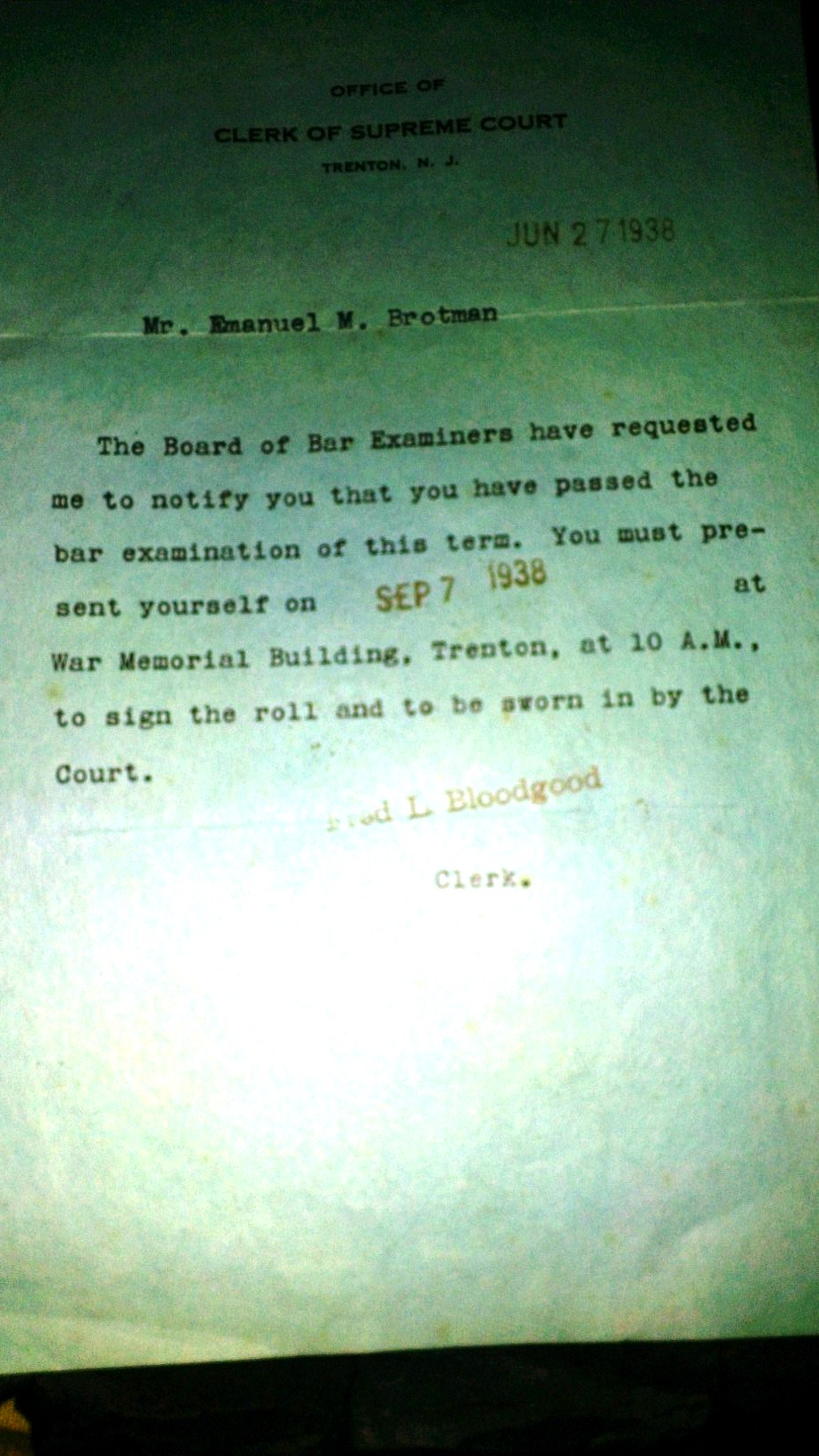
He also graduated from John Marshall Law School (New Jersey), which was later taken over by Seton Hall University. Manny became a member of the New Jersey bar in 1938.

Letter informing Manny that he has passed the New Jersey bar exam

Letter informing Manny that he has passed the New Jersey bar exam

Manny married Freda Feinman on December 22,  1940.

Freda and Manny's wedding invitation 194?

Freda and Manny’s wedding invitation 1940

Manny and Freda 1940s

Manny and Freda 1940s

Manny enlisted in the US Army in 1944 during World War II.

Manny Brotman

Manny Brotman

Manny practiced law for some time, but then joined J.I. Kislak Mortgage Corporation, a subsidiary of J.I. Kislak, Inc.  J.I.Kislak, Inc. was a residential and commercial Realtor, originally based in Hoboken and then in Jersey City, and Kislak Mortgage was primarily a residential mortgage banking company, one of the largest in NJ at the time, based in Newark.  He was president and then chairman of Kislak Mortgage for many years, was president of the Mortgage Bankers Association of NJ, and a long-time board member and two-term Treasurer of the Mortgage Bankers Association of America, where he received the Distinguished Service award. Kislak Realty, a commercial mortgage firm, where he became the president.  He was often quoted as an expert on veteran’s housing and housing in general in various newspaper articles.  Here is one example of an article that ran in several newspapers across the country:  Lebanon_Daily_News_July_10__1971_Lebanon__PA_Manny_Brotman

Manny and Freda had three children: Joel, Denny and Bonnie.  Here are some pictures of Manny and his family:

Manny, Joel and Freda

Manny, Joel and Freda

Denny, Bonnie and Freda

Denny, Bonnie and Freda

The Feinman and Brotman families June 16, 1932

The Feinman and Brotman families June 16, 1937

From left to right: Aron Feinman, Hyman Brotman, Mary Feinman, Sophie Brotman, Manny Brotman, Sam Feinman, Freda Feinman, Saul Brotman (according to the back of this photograph)


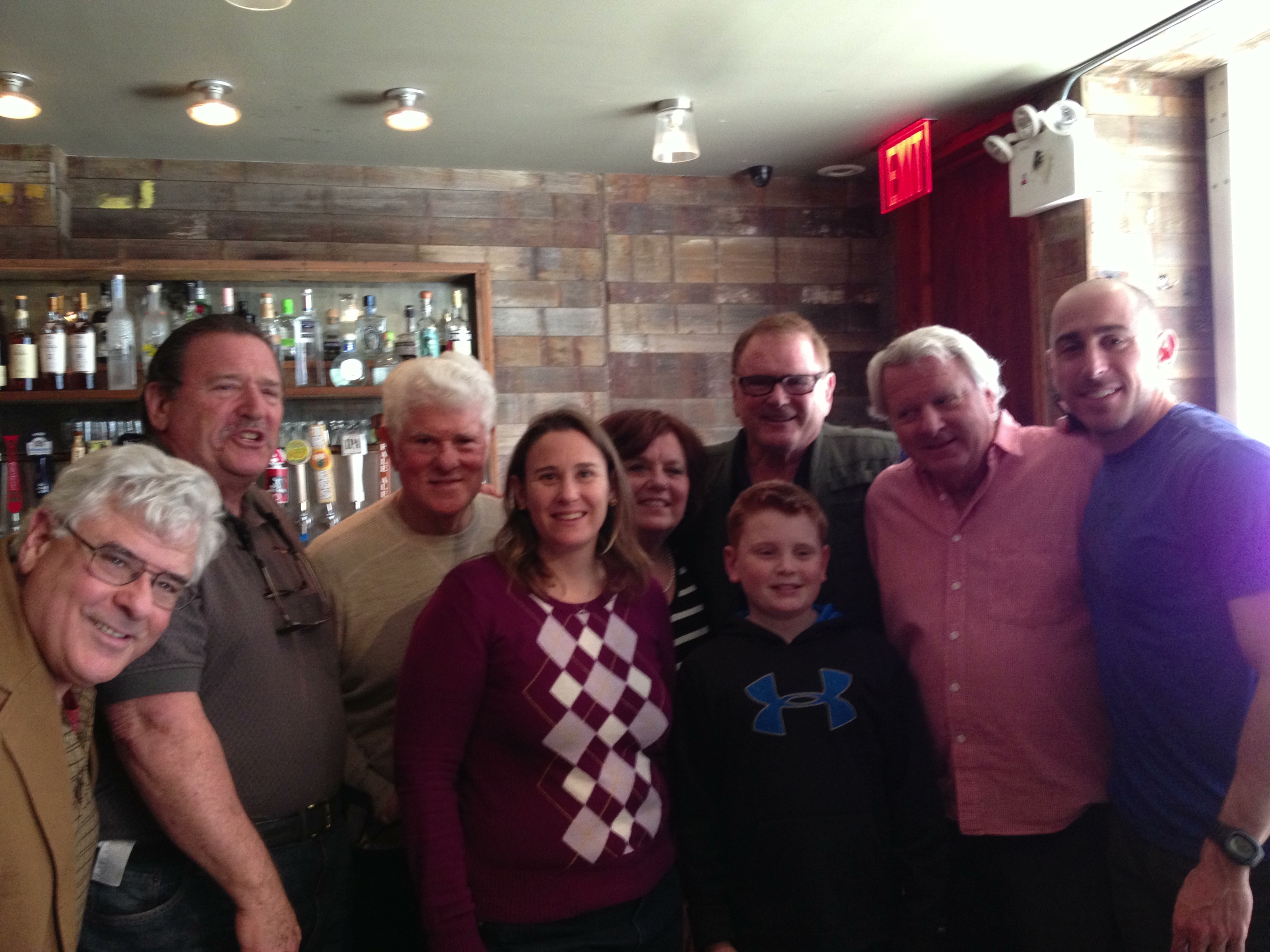
I did not know Hyman or Sophie or any of their sons, but I was very fortunate to meet six members of the next generation, my second cousins Bruce, Ron, Les, Joel, Denny, and Bonnie.  They all made the effort to come to New York City, some from as far away as Florida and Ohio.  I really enjoyed meeting and talking to each one of them and getting a chance to meet some of their children, four of whom also showed up during the course of the weekend.

What a wonderful tribute to their grandparents and parents that these cousins and their children cared enough about the extended family, including some second cousins they’d never met,  to make such a united effort to come to New York so that we could all be together.


Saul and Manny's descendants

Six of Hyman and Sophie’s grandchildren and three of their great-grandchildren


Enhanced by Zemanta