First Cousins: The Grandchildren of David and Esther Rosensweig

Immigrants just arrived from Foreign Countries...

Immigrants just arrived from Foreign Countries–Immigrant Building, Ellis Island, New York Harbor. (Half of a stereo card) (Photo credit: Wikipedia)

Genealogy research can be both very frustrating and very exhilarating.  Sometimes you feel like you have hit a wall and can get no further.  Every stone you turn leads nowhere.  People don’t respond to requests for information, documents have been lost or destroyed, and you feel like you will never find anything new.  Then there are the times that are exhilarating.  You find a document that tells a story and reveals a relative you never knew about.  You contact a long lost cousin and make a new friend.  You put together pieces of a puzzle and see a picture of your family that touches you in ways you never anticipated.

Yesterday was one of those exhilarating days.  I had found an email address for someone I thought could be one of Leah Adler’s grandsons and had taken a chance that it was the right person and that he would respond.  It was a long shot—we are fairly distant cousins—third cousins—and it was very unlikely that my name and background would mean much to him.  Well, I hit the jackpot!  He forwarded my email to his sister Jean, who is herself someone with 30 years of experience in genealogy.  Jean wrote to me right away, and we have since exchanged several emails and lots of information.  Through this contact, I have been able to learn a lot more about my great-grandmother’s sister Tillie and her family.

Some might wonder why I care so much about these individuals and their lives.  Well, these were my grandfather’s first cousins.  He and his brother David were close in age to Isidor, Bertha, Bella, David, Pincus and Becky, and his sister Betty would have been close in age to Leah.  These could have been their playmates as children in Iasi.  They all had the same grandparents, David and Esther Rosensweig.  Tillie and Ghitla both named sons for their father David.

Moreover, Tillie took in my grandfather and his sister in 1910 when she herself was a single mother already caring for her seven children.  My grandfather and his sister must have been mourning their father, who had died in April, 1910, and awaiting their mother, who arrived in November.  (One mystery: I cannot find David Goldschlager on any 1910 census, though he shows up living with his mother and siblings in 1915.)

So what have I learned from Jean about my grandfather’s aunt and her children? For one thing, it now seems quite clear that Itic Yankel Srulivici and Jacob Adler were one and the same person.  Jean said that family lore in her family is that Jacob never left Ellis Island.  The ship manifest does indicate that he was admitted in 1907, but perhaps something happened after that to block his ability to leave Ellis Island.  The ship manifest does indicate that he was examined by a doctor and had scars on his corneas and coloboma of both irises.  Could that have been enough to block his entry and have him deported?  I have ordered a death certificate for a Jacob Adler who died in 1910, and I have asked my Romanian researcher to look for a record for Itic in Romania.

Jean was also able to confirm much of the information that I had found in public documents: that Bertha had been briefly married, that David died in the 1930s, and that her mother Teddy had married Abner Cohen.  She also told me that Bertha had been killed in an accident in the 1960s, that Bella had married Baer Rothschild and had had no children, and that Beckie, who became Ray as an adult, had married Ben Seamon and had four children, including a daughter Thelma with whom Jean had corresponded in the late 1970s and who had filled Jean in on many of these details.  Sadly, Thelma was also killed in a freak accident in 2000.

It seems no one knows what happened to Isidor, and I have sent for one death certificate that might be his from 1915.  If it is in fact his death certificate, it would mean he died very young, as did his brother Pincus.  The Adler family had more than their fair share of tragedies—losing Jacob, Isidor, Pincus and David at such young ages and losing Bertha and Thelma to freak accidents.  As with my grandfather as well as his brother David Goldschlager, it seems that Leah and her siblings also did not like discussing their past or their childhood family.  Perhaps the hardships of leaving Iasi where they had lived as children, coming to America as immigrants, and fighting to survive the poverty and the language and cultural differences left them all with scars that made it too painful to recall the past.

I don’t know anything about what their childhoods were like in Iasi.  I’ve read enough to know that there was terrible anti-Semitism in Romania during those years and also terrible poverty.  But children often are immune to those external factors in many ways because they know nothing else.  I’d like to think that the Goldschlager-Rosensweig-Srulivici children as young children had some joyfulness in their lives.  I’d like to imagine that Isadore, David and Betty Goldschlager and Isidor, Bertha, Bella, David, Beckie, Pincus and Leah Srulivic/Adler were all young cousins who played together and grew up together in Iasi, just as I was fortunate enough to grow up with my first cousins Jeff and Jody, who lived less than 20 minutes away from us during my childhood. All my first cousins—Jeff, Jody, Beth, Suzie, Robin and Jamie (Jim)– added so much laughter and joy to my life as a child, and I would hope that the same was true for my grandfather, his siblings and his first cousins.

Isadore and Gussie’s nine grandchildren 
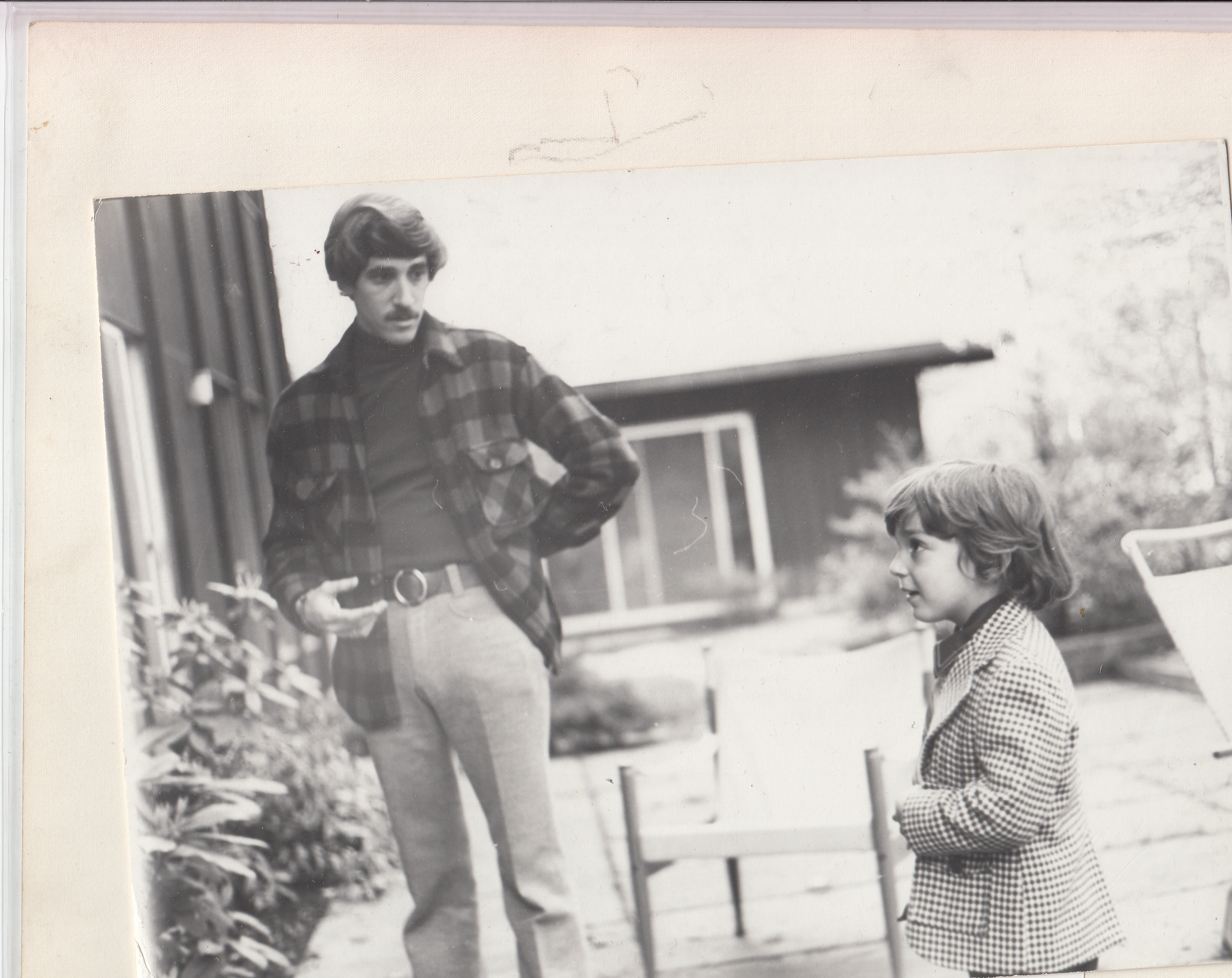
Jeff and Jim 1971

Jeff and Jim 1971

jody julie and ira 1963

jody julie and ira 1963

Beth 1954

Beth 1954

Julie, Robin, Amy, Suzie, and Ira 1962

Julie, Robin, Amy, Suzie, and Ira 1962

Elaine Jeff and Amy 1953

Amy and Jeff (with Elaine) 1953
Enhanced by Zemanta

The Adler Strolowitz family continued

Although I still don’t have answers to all the questions about the Strolowitz/Adler family, I have made a lot of progress finding the descendants of Tillie Strolowitz Adler and her children, with a lot of assistance from Renee Steinig, who continues to teach me and to amaze me with her ability to find people through various search methods.  So here’s a summary and a description of the process used to find most of these people, including several living descendants who I am now trying to contact.

I’ve not had any success finding Tillie’s son Isidor yet aside from the entry in the 1910 census.  There are numerous Isidor Adlers listed in the NYC marriage index and many also in the US and NY census reports, but I cannot with any degree of certainty identify the right one.  Some are too old or were married and had children before 1910, when the right Isidor was still single and living with his mother.  Some are not from Romania or born in the United States.  I am beginning to think that Isidor either died young or maybe even returned to Romania.  I have found one death record for an Isidor Adler who died April 23, 1915, and the age looks right, so I will send for that death certificate.

I’ve had better luck locating the second son, David Adler.  After a careful process of elimination, I believe that Tilllie’s son David married a woman named Bertha (maiden name not yet found).  Since David also had a sister named Bertha, this created some confusion for me.  David and Bertha had a daughter Tessie, born in 1927 (possibly named for Tillie, who had died in 1925).  Renee found a memorial written about Tessie Adler on the Findagrave.com site, and the date of birth corroborated that this is the correct Tessie.  Tessie and her husband Harry had two sons, David, possibly named for his grandfather David Adler, and Ira.  I am now in touch with Ira, who confirmed that he is Tessie’s son and that she was David’s daughter and Tillie’s granddaughter.

The Strolowitz daughters were much trickier to find, as women tend to be.  Once they get married, they are much harder to find, unless I can find a marriage record which gives me their husband’s name.  I first focused on Bertha, figuring that it was a less common name than Beckie, Bella or Lizzie.  I found a marriage record for Bertha Strulovitz to Benny Bloom in May, 1914.  I then did a census search and found a Bertha and Bernard Bloom living on East 109th Street in 1915.  The “Bernard” threw me, as did the fact that Bertha was 27, meaning she would have been born in 1888, not 1885, as reported on the 1910 census.  But while scanning the page to look for their entry, I saw a listing in the same building for a Tillie Stralowitch and her children, David, Bella, Beckie, Peter (Pincus?) and Lizzie.  This was obviously Tillie Strolowitz, living in the same building as in 1910, with her married daughter Bertha and her new husband Bernard or Ben in their own apartment.  So far, so good.  It also made sense that Bertha was born in 1888, not before David, who was 28 in the 1915 census and thus older than Bertha.  That could explain why David and Isidor were Adlers, while the rest of the children were Strolowitz.  Perhaps Mr. Adler died right after David was born, Tillie remarried to Strolowitz and within a year had Bertha?  Phew!  They acted fast back then!  (Remember Harry Coopersmith…)

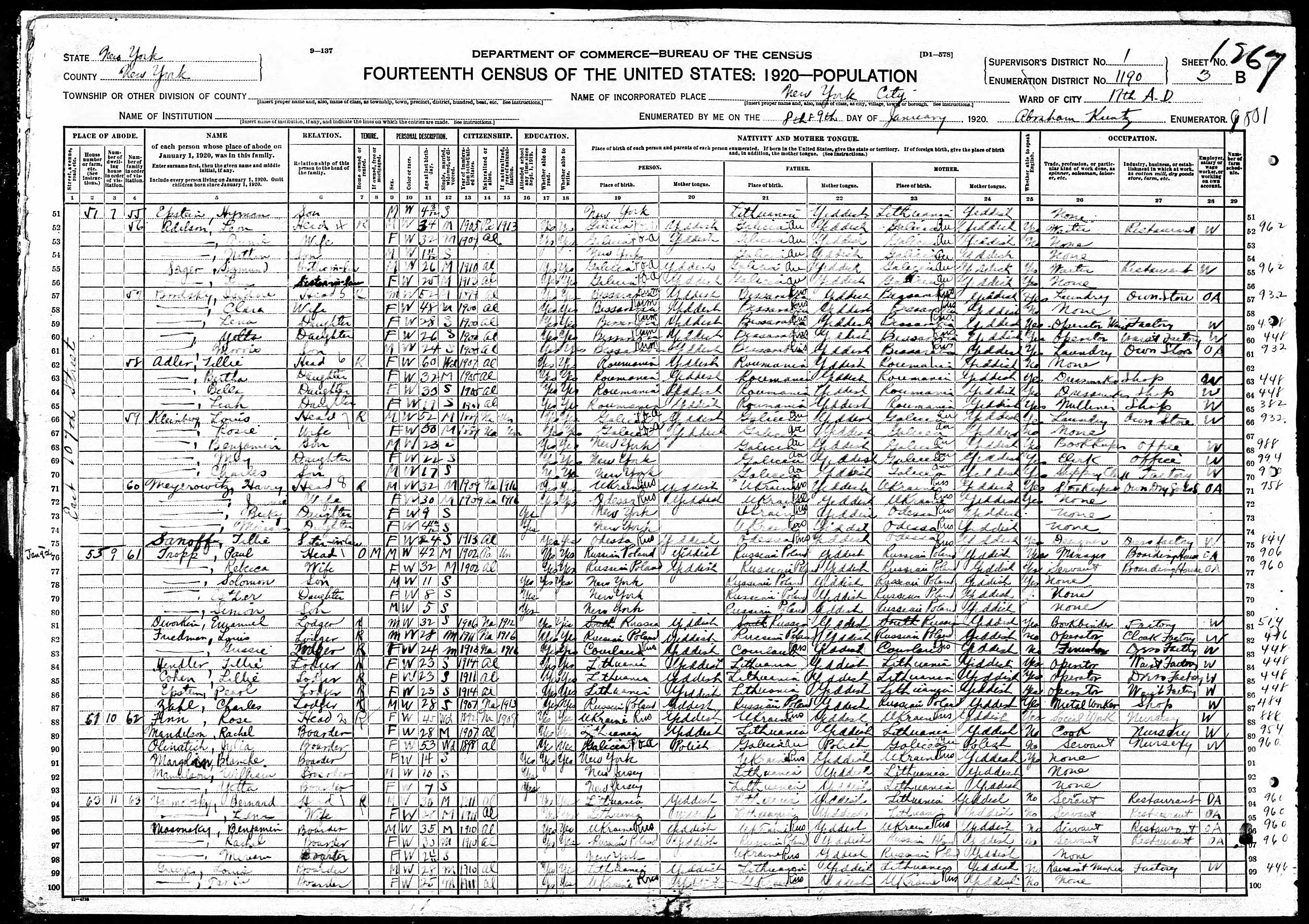
But after that, I could not find any references for Bertha Bloom at all.  I was stumped.  I couldn’t find any more references for Tillie Strolowitz either, no matter how I spelled it.  Finally, I decided to look for Tillie Adler, and there she was in the 1920 census, listed as Tillie Adler, living with her three daughters, Bertha, Bella and Leah (Lizzie?) on East 107th Street.  The ages and names matched, but why were they now using Adler? So much for my earlier hypothesis.  Maybe Mr. Adler was the father of all these children? Maybe Mr. Adler and Mr. Strolovitz were the same person? And what happened to Bertha’s husband? Why was she living with her mother?  She is listed as married, not single, on the 1920 census, but not living with Bloom.

In 1925 Tillie, Bertha and Bella were all still living together on East 107th Street under the surname Adler.  There was no question about marital status on this form, but apparently Bertha was still legally married because in 1926 she applied for citizenship.  On the naturalization form she signed as “Bertha Adler known as Bertha Strulovici and Bertha Bloom,” and listed her spouse as Benjamin Bloom.  Her brother David Adler signed as a witness for her.

By 1930, Tillie had died, and Bertha and Bella had moved in with David Adler and his wife Bertha and daughter Tessie.  Imagine—two Bertha Adlers living in one household.  The census taker must have been confused because he listed Bertha, David’s sister, as his mother.  On this census, Bertha (the sister) is now listed as divorced, finally.

In 1940, Bertha was no longer living with David, but now was living with her sister Leah on Grant Avenue in the Bronx.  Leah was married to Benjamin Schwartz, an optometrist, and had two children, Ira and Theodora.  Renee helped me locate Theodora, who is now living in Atlanta where her parents eventually moved and died.

No further luck finding out what happened to Bella or Bertha after 1940, but at least we know what happened to Tillie, David, and Leah, and have located the next generation of third cousins, the great-great grandchildren of David and Esther Rosensweig.

More discoveries in the next post, including some of the most interesting ones of all.  But for now, back to the research.

Enhanced by Zemanta

Who was Tillie Srulowitz? Another mystery solved?

As I mentioned in my post about the ship manifests, Betty Goldschlager was released from Ellis Island to someone she identified as her aunt, Tillie Srulowitz.  I had no idea who this could be when I first saw this many months ago.

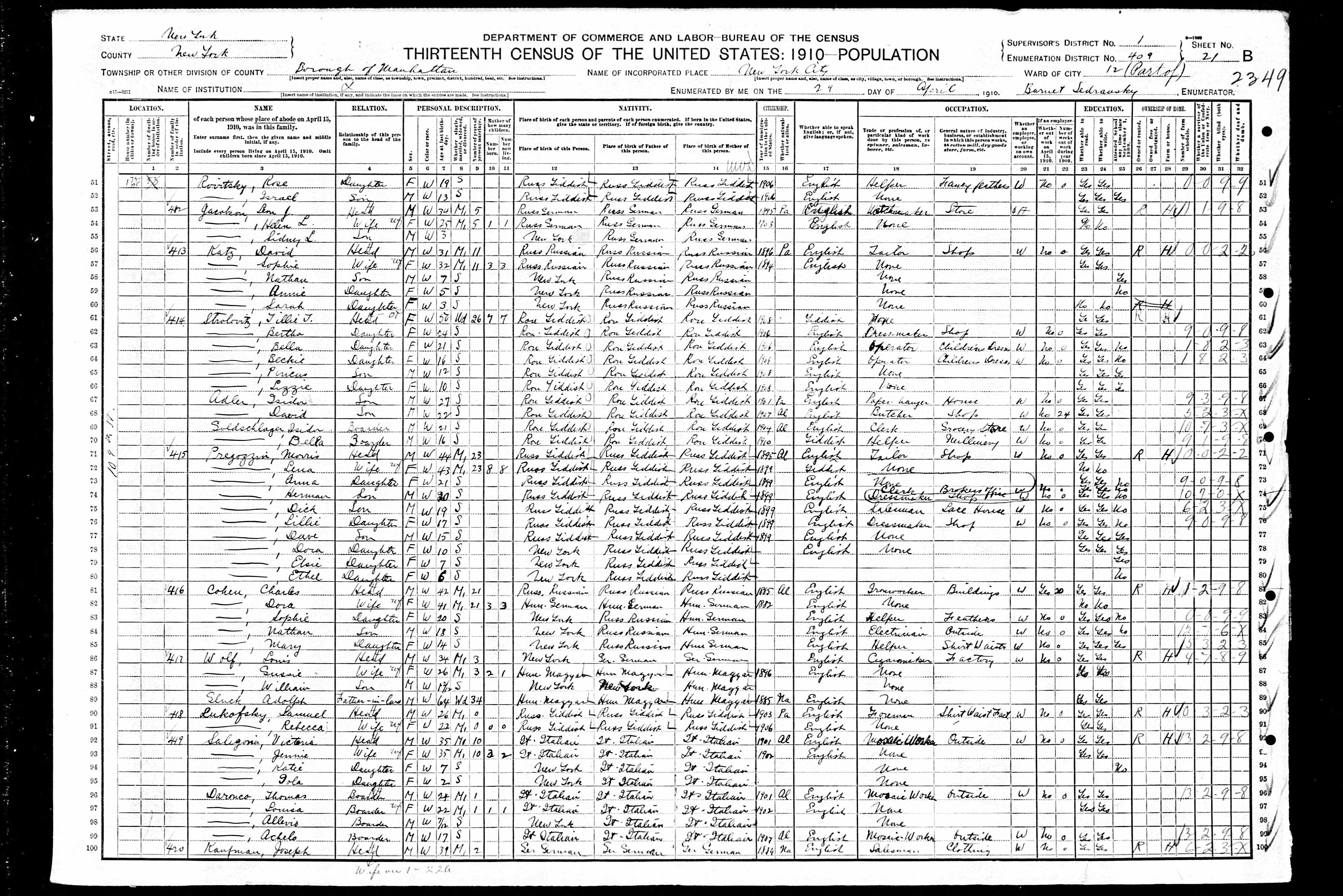
In reviewing my Goldschlager research this past week or so, however, I looked more closely at the census report from 1910, as seen below.

The Strolovitz Adler family with Isadore and Betty in 1910

The Strolovitz Adler family with Isadore and Betty in 1910

Isadore and “Bella” Goldschlager are listed as boarders living with….Tillie Strolowitz and her many children.  When I first looked at this, I had no idea who the Strolowitz family was and just assumed that Isadore and Betty were living there as boarders, not relatives.  This time I remembered the name on the ship manifest and made the connection: this was the aunt that met Betty at Ellis Island.

So who were these people?  Tillie was listed as a widow and had five children named Strolowitz: Beckie, Bertha, Bella, Lizzie and Pincus.  She also had two sons with the last name Adler, David and Isidor.  I assumed David and Isidor were children of a first marriage, and the others children of her second marriage, but since David is younger than Bertha, that did not make sense.  Of course, knowing how unreliable census reports are, it is also likely that that is just an error and that David was in fact older than Bertha.  The census also reports that Tillie’s present marriage was 26 years old, but I don’t know whether that means she’d been married to Mr. Strolovitz for 26 years when he died or whether it had been 26 years since she had married him.  All her children named Strolovitz were younger than 26, whereas Isidor was 27.

I then decided to see what I could find about the Strolovitz family and the possible connection to the Goldschlager family.  On the Ellis Island site, I found entries for two sisters, Betty and Bruche Strulovici from Jassy, who arrived together in 1906 on the Noordam when Betty was 17 and Bruche was 20 with thirty dollars between them.  That information matched the ages and dates of arrival for Bella and Bertha Strolovitz on the 1910 census, so it could very well be them.  I so far have not been able to locate any other Ellis Island records for Tillie Strolovitz’s family.

When I searched for later US census records, I could find almost nothing at first for anyone named Strolovitz with similar first names or for Szrulowitz or Strulowitz or any other reasonable variation.  I then turned to search for David and Isidor Adler and ran into the problem of too many people with those names and no certain way of determining which ones were Tillie’s sons.  I think I have narrowed it down, but am still not certain that I have found the right David or Isidor.

On the other hand, while searching for Adlers on the US census I found this one:

Tillie, Bertha, Bella and Leah Adler 1920

Tillie, Bertha, Bella and Leah Adler 1920

Tillie, Bertha, Bella and Leah Adler, listed as mother and daughters, of the approximate ages that Tillie Strolovitz and her daughters would have been in 1920, from Romania.  This seemed too unlikely to be a coincidence, and I feel fairly certain that for some reason, Tillie and her daughters had changed from being Strolovitz to Adler.  I could not find any records under either last name for Tillie or the daughters, except for death certificate for a Tillie Adler dated 1925 for a woman of the correct age.  I have ordered that certificate and will wait to see what it contains.

Having concluded that Tillie and her daughters were now using Adler, I thought that perhaps her son Pincus had also switched from Strolovitz to Adler, so I searched for him.  I found a South Carolina death certificate for Pincus Adler dated July, 1919, age 19, born in Romania, whose father’s name was Jacob Adler, and whose mother’s maiden name was Tillie Rosensweig.

Pincus Adler Death Certificate 1919

Pincus Adler Death Certificate 1919

The informant on the death certificate was David Adler of West 68th Street, New York, New York.   I am fairly certain that this is the same David Adler and the same Pincus Strolovitz AKA Pincus Adler, although the age may be off by a year or so (not anything surprising in these records).  Everything else lines up: mother is Tillie and brother is David Adler from NYC.  Pincus Adler was also buried at Mount Zion cemetery in Queens, not in South Carolina.  Perhaps Pincus ended up in South Carolina after World War I.  I’ve yet to find a draft registration under either name, but am continuing to look.

So why does any of this matter? When I first saw what Tillie’s maiden name, it didn’t mean anything to me.  Like so many other times in the research, I had to move away from it. Several hours later, while doing something completely unrelated, a lightbulb went off.  Rosensweig was Gisella Goldschlager’s maiden name also! Gisella and Tillie were sisters—Tillie, after all, was listed as Betty’s (and thus, David’s and Isadore’s) aunt on that Ellis Island form.  Her children—Bertha, Bella, Beckie, Pincus, Lizzie, David and Isidor— were my grandfather’s first cousins.

I still have more work to do to figure out the Strolovitz/Adler family.  Why did they use two different last names?  I found a Tillie Strulowitz buried at Mount Zion on August 4, 1925, the day after the date of death for Tillie Adler; this must be the same person, but one place she is Adler, the other she is Strulowitz.  Why is Jacob Adler listed by David Adler as Pincus’ father?  Was there ever a Mr. Strolovitz or was Jacob Adler the father of all seven children? Why did Tillie switch back and forth? Why did her daughters become Adlers?

This stuff just never gets boring to me; there is always another mystery, another surprise around each corner.

Enhanced by Zemanta

Passenger Ship Manifests and The Heartrending Stories They Tell

English: Ellis Island's Immigrant Landing Stat...

English: Ellis Island’s Immigrant Landing Station, February 24, 1905. (Photo credit: Wikipedia)

One of my favorite documents to locate is a ship manifest listing one of our ancestors as a passenger, bringing them from Europe to America. I have read and seen enough about these ships and the hardships that the passengers endured to know that these were not pleasant cruises across the Atlantic Ocean. People suffered from disease, malnutrition, terrible hygienic conditions, and frequently even death. Yet I tend to romanticize these journeys, despite the facts. I imagine how frightened but also how excited these travelers must have been, thrown together with other people from all different countries and of all different backgrounds, all of whom were dreaming of a better life in the United States. The stories told by ship manifests I’ve found do much to break down that romantic ideal.

I was only able to find two ship manifests for the Brotman immigrants. The first exciting find was the manifest for the Obdam, the ship that brought Bessie, Hyman and Tillie to New York in January, 1891. Their names were listed as Pessel, Chaim and Temy Brodmann. One column lists how many pieces of luggage each passenger brought, and for Bessie, Hyman and Tillie, they brought only two pieces of luggage. Imagine fitting the clothing of three people plus any other possessions you wanted to keep with you into just two pieces of luggage. When we go away for a weekend, we often need more than that for just two of us. Hyman was only 8, Tillie 6, and somehow they endured this long voyage at sea with their mother. When I fast-forward to how American they became as adults, I find it remarkable.

The Obdam 1891

The Obdam 1891

The only other ship manifest I located for the Brotman family is one I believe is for Max, but cannot tell for sure. It lists a Moshe (?) Brodmann as a ten year old boy, traveling with one bag, on a ship called the City of Chicago in 1890. This very well could be Max, but there is no other Brodmann or anyone else with a similar name traveling with him. If I have a hard time imagining Hyman and Tillie coming with their mother, it is really unfathomable to imagine a ten year old boy traveling alone across the ocean. None of the names above or on the page following his sound like possible relatives, friends or even neighbors since for the most part they are listed as coming from Russia, not Austria. If that is in fact our Max, I imagine that this must have been an incredible experience—frightening, even horrifying, and lonely. Perhaps an experience like that explains how these children then endured the working and living conditions they found in the United States. They had already survived much worse.

I’ve had no luck yet locating a manifest that includes Joseph or Abraham Brotman, but I will keep looking.

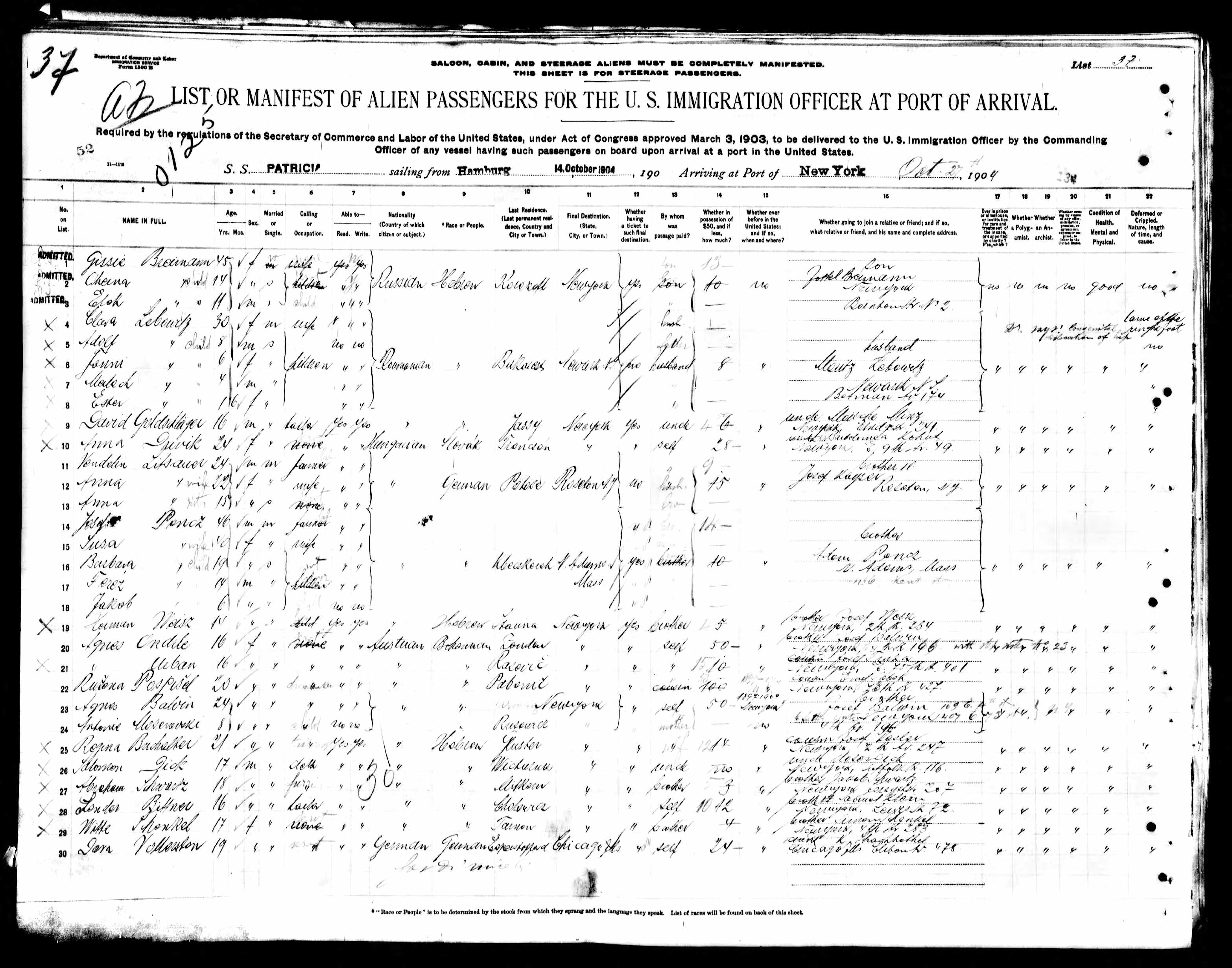
On the Goldschlager side, I’ve had more success. I have found a ship manifest for Moritz, Gisella, David and Betty, each of whom came separately, but nothing for my grandfather Isadore. These manifests also tell interesting and some heart-breaking stories. David came in 1904 on the Patricia, which departed out of Hamburg. (Perhaps like his brother, David also walked out of Romania to get to Hamburg.) This manifest contains far more information than the two above. First, it asks for information about who paid for the ticket and the name, address and relationship of any relative or friend the passenger was joining at their destination. David said his uncle paid his passage and that he was going to join that uncle in New York. From what I can decipher, it looks like the uncle’s name was Moishe Minz.

David Goldschlager ship manifest

David Goldschlager ship manifest

I have searched many times and ways to figure out who this person was and how he was an uncle to David. Was he a brother-in-law of Moritz or of Gisella/Gittel/Gussie? Since his last name is neither Goldschlager or Rosensweig (Gisella’s maiden name), I assume he is not a brother. Or perhaps he is a half-brother. Whoever he was, I cannot find him yet. I also find it puzzling that David listed this uncle and not his brother Isadore. Perhaps because Isadore himself was still just a minor, he would not have been a satisfactory person to list as the connection for David in the United States. The other interesting bit of information gleaned from this manifest is the amount of money David was carrying with him: six dollars. He was 16 years old, traveling alone, with six dollars to his name.

The next to arrive was Isadore and David’s father, Moritz. He arrived in August 1909 on the ship La Touraine out of Havre. His occupation is listed as a tailor, and his age as 46 years old. This manifest did not ask who you were meeting in the United States, but instead who you were leaving behind in your old place of residence. Moritz listed his wife, Gisella Goldschlager. So by August 1909, the three males in the family had emigrated from Iasi, and Gisella and her daughter Betty were left behind. This seems consistent with the pattern in the Brotman family: Joseph came first, then his two sons from his first marriage, and then his wife and younger children.

Moritz Goldschlager ship manifest

Moritz Goldschlager ship manifest

Betty’s arrival story is more complicated and very sad. On the ship manifest filed at Ellis Island, Betty had listed her father as the person she was joining in New York. Betty arrived in April 4, 1910, on the ship Kaiserin Auguste Victoria. However, she was detained at Ellis Island for a short time. On a document titled “Record of Detained Aliens,” the cause given for detention simply says “to father.”

Betty Goldschlager Detention of Aliens

Betty Goldschlager Detention of Aliens

According to his headstone, her father Moritz died on April 3, 1910, the day before Betty arrived on the Kaiserin August Victoria. It is hard to believe that her father died the day before she arrived, but if the records and headstone are accurate, that is what happened.

Moritz Goldschlager headstone

Moritz Goldschlager headstone

Betty must have been kept at Ellis Island until another person could meet her. On that form for detained aliens, she listed an aunt, Tillie Srulowitz, under “Disposition,” which I interpret to mean that Betty was released to her aunt on April 4 at 3 pm. (More about Tillie Srulowitz in my next post.)

This story breaks my heart. Moritz had only been in the United States since August, just eight months, when he died. He did not live to see his daughter or his wife again. He was only fifty years old. I don’t have his death certificate yet, but will see if I can obtain it and learn why he died. Imagine how Isadore and David must have felt—waiting four to five years to see their father, only to lose him eight months later. And imagine how Betty must have felt—coming to America, taking that awful voyage, only to be greeted with the news that her father had died just before she arrived.

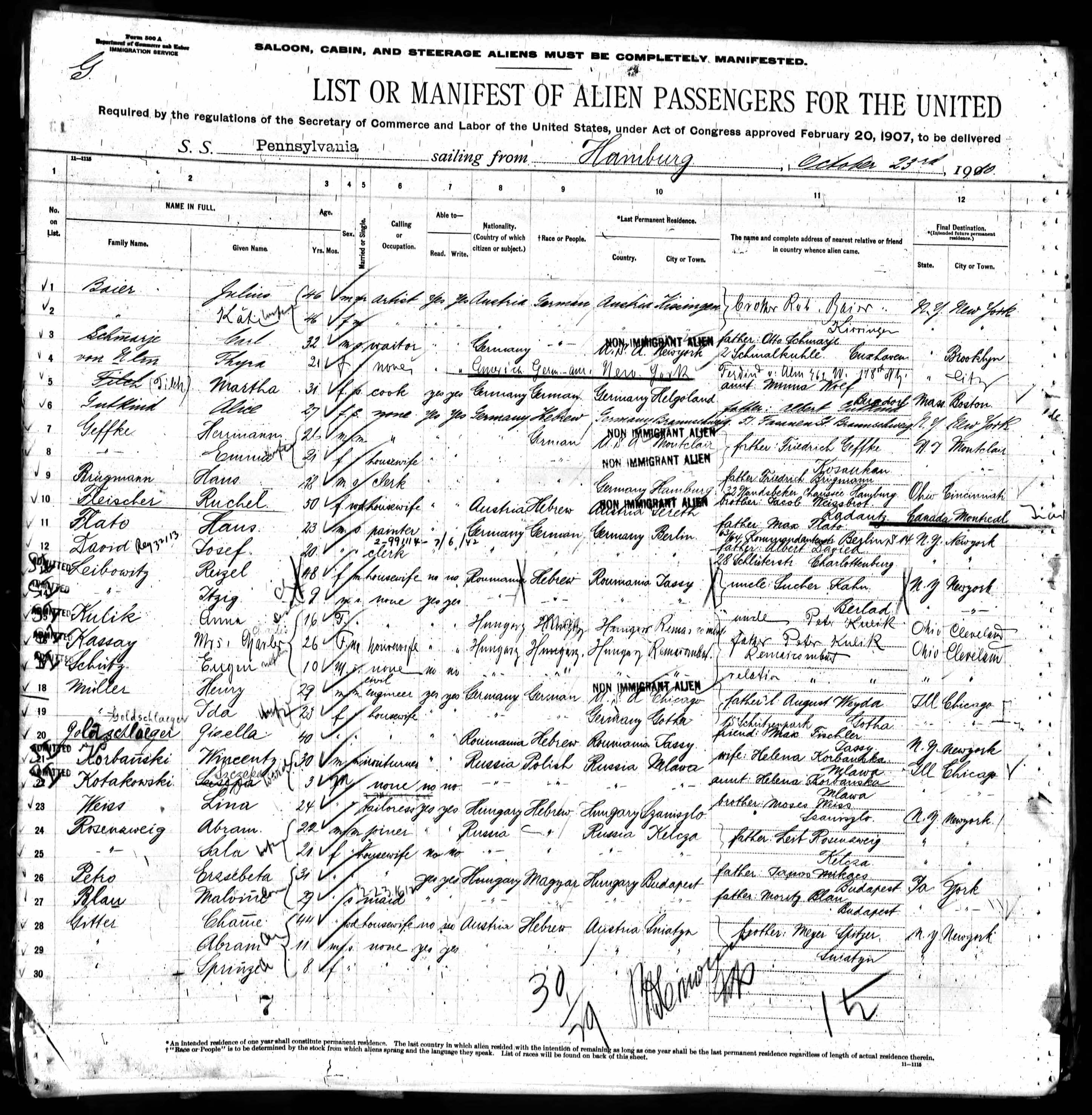
And finally, think about his wife Gisella. She arrived in NYC in November, 1910, seven months after her husband had died. Did she know what was awaiting her? She sailed on the ship Pennsylvania out of Hamburg; the ship manifest does not list who was waiting for her, only the name of someone who resided in her old home, a friend named Max Fischler.

Gisella Goldschlager ship manifest

Gisella Goldschlager ship manifest

But the record from Ellis Island indicates that she had expected to join her husband Morris Goldschlager, but was instead released to her son Isadore. I have no idea how immigrants communicated with their relatives back in Europe in those days or how quickly news could travel from place to place, but since the ship manifest indicates that the ship sailed from Hamburg on October 23, 1910, over six months after Moritz had died, Gisella must not have known that he had died, or why would she have listed him as the person receiving her in New York when she got to Ellis Island? It appears that Gisella did not know until she arrived in New York that her husband had died the previous April. It is heart-breaking to imagine what her reunion with her sons and daughter must have been like under those circumstances.

EDITED: Some of the facts in this post have been updated with subsequent research.  See my post of January 22, 2014, entitled “Update: My Grandfather’s Arrival.”   Also, this one.

English: Immigrants entering the United States...

English: Immigrants entering the United States through Ellis Island, the main immigrant entry facility of the United States from 1892 to 1954. Español: Inmigrantes entran a los Estados Unidos a traves de la Isla Ellis, el mayor lugar de entrada a los Estados Unidos entre 1892 y 1954. (Photo credit: Wikipedia)

Enhanced by Zemanta

Playing detective: Searching for Gold(schlagers)

My first genealogical search efforts about a year and half ago related to my grandfather’s family, the Goldschlagers.  I started there because I figured (somewhat incorrectly) that Goldschlager was an uncommon name and thus would be an easier family to research, unlike Cohen, Brotman, Schoenthal, Seligman—my other family lines.  I also was very curious about my grandfather’s life because I had always heard about how he had walked out of Romania.  It also helped that we knew where he had lived in Romania, the city of Iasi (sometimes spelled Jassy, sometimes Yassy) and that we knew the names of his parents and siblings.

I started by focusing on finding other descendants of the Goldschlager clan.  We knew that Isadore had a brother David and a sister Betty.  My brother had already found some of the relevant records from Ellis Island.  We also knew that David had had two sons, Murray and Sidney, and that Betty had had two daughters, Frieda and Estelle. I figured that I would start with Murray and Sidney since I assumed (again incorrectly) that since they were men, their names would be Goldschlager and they would be easy to find.

I was not very experienced in my research techniques back then and did not get very far.  Since the US Census records are only available up through the 1940 census, I could not get too far using ancestry.com at that point.  I was lucky, however, to find Sidney Goldschlager’s obituary by googling his name.  From that obituary, I learned that his brother Murray had changed his last name to Leonard and was living with his wife Edna in Tucson, Arizona.  (Murray and Edna were listed as survivors of Sidney along with his wife Nora; there were no others mentioned, so I assumed (this time correctly) that Sidney and Nora had not had children.)

Once I knew that Murray was using the name Murray Leonard, I searched for him online by googling his name and Tucson and found a news article about the closing of a chain of women’s clothing stores called Vicky Wayne in the Tuscon area owned by Murray and Edna Leonard.  After that, however, I hit a wall.  Although I could find a telephone listing for Murray Leonard, I was not comfortable making a telephone call blindly. At that point I gave up and turned to searching for Frieda and Estelle, but because I had no idea what their married names were, that ended up as a dead end also.  That was, as I said, about a year and half ago.  I figured I had done all I could do to find the Goldschlagers.

Then this past summer I got an email from a man who was also searching for Goldschlagers.  He had seen my family tree on ancestry.com and was interested in sharing information.  Although we were not able to find any connection between our trees, he did inspire me to start looking again.  He gave me the name of a researcher he had found in Iasi, Romania, and I contacted him to look for records for my Goldschlager ancestors.  As I wrote in my prior post about the Goldschlagers, he was able to obtain several records about my grandfather, about my great-grandparents, and about David, my great-uncle.

Those findings were what really lit a fire for me and inspired me to start my research again.  Although I did not get any further with finding Goldschlagers, it was at that point that I turned to the Brotman line and became fully immersed in learning how to do genealogical research.

With the benefit of this new knowledge and the tools I now knew how to use, I returned to researching my Goldschlager relatives.  This time I knew to dig deeper in order to find other descendants. First, I was able to find some records for Betty and her daughters.  I found a census report for Betty Feuerstein living with her husband Isadore, her mother (listed as Gussie Gold), and her two daughters in Bayshore, Long Island.

Betty Feuerstein and family 1940 census

Betty Feuerstein and family 1940 census

By researching the Feuerstein family, I was able to link with a descendant of that family, who sent me pictures of Frieda and of Betty.  He also knew their married names; Frieda married Abe Adler, and Estelle married I. Kenner, known as Kenny. I found a listing for an Estelle Kenner in Florida, but that’s as far as I have gotten.  My contact did not know whether they had had children or where Frieda had lived.

Last week I returned to the search for David’s descendants. I re-read the article about the Vicky Wayne stores and saw that the stores had been named for a niece of Murray and Edna Leonard.  I googled Vicky Wayne and found many references to a mail order clothing store and then ultimately a reference to the name in an obituary for a woman named Anne Steinberg.  I read the obituary and saw that Anna was survived by two sisters, Faye and Edna.  I thought that perhaps Edna Leonard was Anne’s sister, and so I searched for a record on ancestry that would have listed three sisters on a census named Anne, Edna and Faye.  I found one, the daughters of Ben and Sarah Kaufman living in NYC.

Kaufman family 1930 census

Kaufman family 1930 census

From there I looked at the names of Anne’s children in the obituary and googled them and searched for them on Facebook.  Once I found a few of them on Facebook, I looked to see if they had any friends with the last name Leonard, figuring that Murray and Edna’s children would be cousins of Anna’s children and grandchildren.  Sure enough, Anne’s daughter had a “friend” named Richard Leonard from Tucson, now living in Australia.  I contacted Richard through Facebook and LinkedIn, and within an hour I’d heard back from him, confirming that he is Murray and Edna’s son, David Goldschlager’s grandson, and my second cousin. I had indeed found another Goldschlager descendant.

Richard and I spoke at length by Skype (despite a 13 hour time difference) the other night, and he filled me in on his parents and his grandparents.  His father, though born in Scranton, PA, had grown up in the Bronx and is a loyal Yankee fan (sigh…), as is Richard.  His parents had moved to Tucson in 1958  shortly after marrying in NYC.  Edna’s sister Anna had moved there, and they all worked in the business together, eventually dividing it into two parts, the mail order business and the retail stores.  Sometime in the early 1970s, Murray moved his parents, David and Rebecca Goldschlager, to Tucson as well, where they lived nearby and where Richard was able to see them often.

Richard said that his grandfather did not talk to him about his life in Romania or his family, but was more focused on the present and enjoyed spending time with Richard as he was growing up.  I’ve asked Richard to see if his father, now 92, knows any more about David’s life and family, and he said that he will do so and let me know what he learns.  I also asked Richard if he knew anything about our great-aunt Betty or her daughters Frieda and Estelle, but unfortunately he did not.

Once again, I am amazed by how much you can find in public sources if you are persistent and thorough enough.  I will continue to look for Frieda and Estelle and their descendants, if any.  Now I am expanding the search, looking for other possible relatives of the Goldschlager family.  I believe I have found my great-grandmother’s sister and her family, but that’s a post for another day.

Enhanced by Zemanta

The Goldschlagers

Having reached (for now) a dead end on my research of the Brotman family, I have decided to turn to, or rather return to, my research of my grandfather’s family, my Goldschlager relatives.  I had previously done a fair amount of research on the Goldschlager line, but had put it aside when I found my Brotman cousins. For some of you, the Goldschlager story will be perhaps of less interest, although it is itself a wonderful story of American Jewish immigration.  For others, in particular my first cousins and siblings and my mother, the Goldschlager story will be of great interest.  And for those who are interested in genealogy generally and/or the history of Jews in Europe and America, this story should also be a great interest.

So although this blog is called the Brotmanblog (and will continue to be so titled), I have created a new page for my Goldschlager ancestors and relatives.  If you are interested, please check it out.  I also will be writing some posts to describe the research I’ve done to uncover the story of my grandfather, his siblings and his parents and grandparents.

In this first Goldschlager post, I want to tell the story of my grandfather Isadore.  Isadore was born in Iasi (or Jassy), Romania.  He was the oldest child of Moritz (Moses, Moshe, or Morris)and Gitla (Gittel or Gussie) Goldschlager.  He was born in August, 1888; his younger brother David was born the following year, and their younger sister Betty was born in 1896.  Isadore was named for his grandfather, Ira Goldschlager.  I was very fortunate to find a researcher in Iasi who located and translated several documents relating to these relatives, including birth records and marriage records for Moritz and Gitla, my great-grandparents.

Moritz and Gittel's marriage certificate

Moritz and Gittel’s marriage certificate

He even took a photograph of the house were my grandfather and his parents and siblings lived in Iasi.

The Goldschlager House in Iasi

The Goldschlager House in Iasi

When my grandfather was 16 years old, he left Iasi and walked through Romania to escape the tzar’s army and persecution.  Romania was one of the most anti-Semitic and oppressive countries in Europe at the time, and many Jewish residents decided to escape in the early years of the 20th century. In a subsequent post, I will write more about the conditions in Romania and the history of the Fusgeyers—the “foot goers” who left Romania on foot.  My mother said that she does not remember her father talking about Romania very much, except to talk about the horses and the music, two things that he loved very much.

My teenaged grandfather arrived in New York City in 1904 without any relatives and under his brother’s name.  In 1905 he had a job as a storekeeper in a grocery store and lived in what is now East Harlem at 113th Street, apparently alone or perhaps in a boarding house.  His father Moritz arrived in 1909, and his mother Gittel, brother David, and sister Betty in 1910.  Sadly, it appears that Gittel, David and Betty arrived shortly after Moritz had died.

By 1915, Isadore and his mother and siblings were living together in East Harlem.  David was working at a hat maker, Betty as a dressmaker.  Isadore’s occupation unfortunately is not legible on the 1915 census form.  Edit:  On closer examination, I believe it says “Driver Milk,” which is consistent with what he was doing for the rest of his working life.

1905 NY census

1905 NY census

1915 NY Census for the Goldschlagers

1915 NY Census for the Goldschlagers

By 1917, when Isadore registered for the draft, he was working as a driver for a dairy company and married to my grandmother Gussie and living in Brooklyn.

Isadore's World War I draft registration

Isadore’s World War I draft registration

He continued working for dairy companies and eventually became a foreman.  He and my grandmother had three children. As a milkman, my grandfather worked at night to deliver the milk by morning.  When he delivered milk to people in the poor communities, they all loved him so much that they would bring him food.

My grandparents moved to Parkchester in the 1940s with my mother, who was only twelve at the time.  When I was born ten years later, my parents also lived in Parkchester, just a few buildings away from my grandparents, so I spent my first four and half years living right near my grandparents.

My grandparents and me 1956

My grandparents and me 1956

Although my grandfather died before I was five years old and thus my memories of him are vague, I do have a memory of him as a loving grandfather.  Perhaps it is the stories I’ve heard all my life about him rather than my own memories—it’s hard to know.  I know that my mother and her siblings loved him a great deal, that he was a big tease with a great sense of humor, and that although he left Romania at fifteen and never received a high school education, he spoke several languages and was a very smart and witty man.  He must have been an incredibly strong person to have left his family at such a young age; most likely he helped the rest of his family come to the United States once he got here.

I wish I had known him longer, and I wish I knew more about his life both in Romania and in New York.  Perhaps as I pursue this line of research I will learn more.  I have just located one of David’s grandsons, Richard, and David’s son Murray is 92 and living in Arizona.  I am hoping that Murray may know more about David’s life in Romania and the relationship between the two brothers, David and Isadore.

Enhanced by Zemanta

Happy New Year!

Happy New Year to all my family and friends and followers and readers from all over! I can’t believe I’ve had readers from not only the United States, but Canada, Great Britain, Germany, New Zealand, Bulgaria, Sweden, Turkey, Ireland, Greece, Australia, Russia, Poland, and Israel.  Thanks to all of you for stopping by, whether you have been here once or many times.  May 2014 bring everyone peace, happiness, and good health.

I am grateful to you all for your support and your readership, and I look forward to making new discoveries and new connections in the year ahead.  I hope to learn more both from my relatives and from my fellow genealogy bloggers and others about genealogy, my family, and myself.

Amy

Galicia Mon Amour: A Conversation

I just finished watching a video called “Galicia Mon Amour.”  It is a recording of a conversation between Daniel Mendelsohn and Leon Wieseltier.  Mendelsohn’s book, The Lost, which I read a number of years ago, is one of the most moving books I’ve read; in it he recounts his journey to find out what happened to members of his family who had not left Galicia before the Holocaust.  It is beautifully written, well-researched, and deeply tragic.  I read it long before I started doing my own genealogical research, but it likely was one of the sources of inspiration for my journey.[1]

Leon Wieseltier’s book Kaddish is also excellent, but I have to admit much of it was a bit too scholarly and dry for my taste, except for the parts where he reflects on his own family and experiences.  I admit to skimming a lot of the more academic parts of the book.

At any rate, when I saw a recommendation for the video on the digest I receive daily from Gesher Galicia, I decided to try and make the time to watch the video.  (It’s about two hours long.)  You can find a link to the video here.

In the video Mendelsohn interviews Wieseltier about his recent trip to Galicia.  (The interview takes place in January, 2007; Wieseltier’s trip was in 2006.)  Both Mendelsohn and Wieseltier had family that came from eastern Galicia in what is now Ukraine from towns near the city of Lviv, known by the Jews as Lemberg.  Both had taken trips back to the region to research and visit the places where their relatives had lived.  Although Mendelsohn’s direct ancestors had immigrated to the United States before the Holocaust like ours did, he had many relatives who remained behind about whom he had known very little.[2]  Wieseltier’s parents, on the other hand, were Holocaust survivors and came to the United States after World War II.  All the rest of his family was killed in the Holocaust.

One audience member asked at the end of the interview whether there were differences between those who were grandchildren of immigrants and those who were children of Holocaust survivors.  Were the survivors from the wealthier families who saw no reason to leave in the 19th century and the earlier immigrants from the poorer families who had no reason to stay?  Although Wieseltier dismissed this as an overgeneralization, which I am sure it is, it nevertheless is an interesting sociological question.  Remembering Margoshes’ memoirs and the fact that there were so many wealthy Jews, I thought that it made some sense that only those who had nothing to lose would have taken the risk of leaving the world they knew.  This may suggest that Joseph and Bessie were not among the wealthier segments of the Galician Jewish community.

Wieseltier described his own family as being among the more prosperous, educated and aristocratic clans in their area and confirmed the impression left by Margoshes that the Jewish world in Galicia was very diverse and that there were many who were wealthy, well-educated, and sophisticated.  He described Cracow as the “Jerusalem of the North” and the Galitzianers as the princes of the Jewish world.  Mendelsohn concurred, saying that although there was also a lot of poverty, there was a large bourgeoisie and a large wealthy class.  He said that Emperor Franz Joseph, who was the head of the Austro-Hungarian Empire from 1848 until 1916, was admired and even loved by the Jews for his enlightened leadership and treatment of the Jewish citizens, also described in Margoshes’ memoirs.

One observation that I found particularly interesting was Mendelsohn’s comment that he always thought of Jews as living in tenements until he went to Galicia.   He believed that Jews, wherever they lived, lived urban lives, and he was surprised by how wrong he was when he saw the rural areas where they had lived in Galicia.  He described the countryside as beautiful—with mountain, streams, rivers.  Wieseltier used the word “paradise” to describe it.

A lot of their conversation focused on the reasons to make a trip to Galicia.  Both said quite emphatically that this is not a place to go for typical tourist reasons; for Mendelsohn it was partly to find out what happened there and to visit the places where his family had lived. Wieseltier said he went not only out of grief, but also out of pride. He talked movingly of standing where his mother had once stood and leaving a copy of his book in the empty field as a symbol of Jewish survival.  Both talked about the absence of Jewish life there now and how the Polish people themselves realize how much has been lost by the destruction of the Jews and their culture.  Wieseltier said that you won’t find Jewish life there so you must bring your Judaism with you if you go.

There is also discussion of the Holocaust, of the camps, of anti-Semitism, but overall the theme was more about remembering the world that was there in a realistic and accurate way and cherishing that culture and the people.  Wieseltier himself is quite skeptical of genealogy (“It’s amazing how much you can’t learn from genealogy.”).  Although Mendelsohn obviously values genealogical research highly, he did not really push Wieseltier to elaborate on this point.  I think, however, that Wieseltier was expressing some doubts about all those who, like me, are trying to trace some names and dates to make a connection, perhaps without any purpose or perspective.  He said that our parents and grandparents were ours “by luck,” just as the fact that we have two legs or brown eyes, and that what is more important is who we are ourselves and what we do with our lives.  I think that that is an important perspective for me to remember as I continue to look for our family in Galicia.


[1] We were fortunate enough to hear Mendelsohn read from and talk about the book many years back when it was first published.  That made his story even that much more personal.

[2][2][2] I am sure that that is true for the Brotman family as well, although I do not know specifically of any family members who died in the Holocaust.

Looking forward: Skiing on the Blue Trails

Having looked back to see what I have learned, I have also gained some insight into to what I still want to learn and what I need to do to get there.

There are a number of unresolved questions.  For me, the most important issue remains determining where our family lived in Galicia.  I am currently assuming that our family came from Dzikow Tarnobrzeg, but it’s only based on two forms completed by Hyman, one referring to Jeekief as his birthplace, the other referring to Giga as his birthplace.  Hyman’s forms had so many inconsistencies in terms of birth date and other facts that I do not want to rely too heavily on it being Dzikow Tarnobrzeg since, as my last post said, forms are not necessarily reliable.  Plus I am speculating that Jeekief/Giga is a phonetic spelling of Dzikow.  Plus there was another Dzikow in Galicia.  But I have to start somewhere, so that’s my current focus.

I am just starting to work with the sources available for documents from Galicia, and I need to devote a lot more time to learning how to search and how to interpret those forms.  I am networking with some other researchers who are also searching in that region or who are also searching for the surname Brotman.  So far nothing relevant has turned up.  I plan to take an online course in May that may help me become a better researcher with respect to these resources and documents.

The second goal I have for my research is trying to locate any other children or siblings of Joseph and/or Bessie.  My brother recalls that my aunt thought that Joseph had four older children in the United States—that is, four who were older than the five children he had with Bessie.  We have found two of those four—Abraham and Max.  There is another Brotman family from Passaic, New Jersey, that I am trying to learn more about.  From what I can tell, it seems there were two brothers, Jacob and Benjamin, who could possibly be sons of Joseph, born after Abraham but before Max.  I have been in touch with relatives of theirs, but as with the Brotmanville Brotmans, I can’t seem to find anything that links their family to ours.  I need to learn the name of the Passaic brothers’ parents before I can begin to determine if there is a connection.  I have the same goal with Brotmanville Brotmans, but without more research of European records for Moses Brotman, I cannot get any further.

So those are my two research goals: go further back in time to learn more about Joseph and Bessie’s families and to find links to other possible families in the United States or elsewhere.

I think that this process has a learning curve similar to learning many other new skills.  It reminds me of learning to ski.  At first it goes very slowly; you don’t know what you are doing and figure that you never will.  You find yourself on the ground as much as you are moving on the skis.  It seems like you will never make progress.  Then suddenly you figure it out—you know how to get down a novice trail pretty easily.  You even start to look like you are skiing, and you think, “Wow, I am actually making progress.  I am skiing.”

But then you decide to try a steeper trail, a blue trail.  If you are a skier like I was, you suddenly find you are stuck somewhere on that trail, staring down and thinking, “Whoa! That’s really scary.  I can’t do that!” And you feel like a beginner all over again.  You start falling, your turns get more awkward, and you look like a klutz compared to everyone else.  You start to think that maybe you will never get off those easy green trails.[1]

That’s what I feel like now.  I am standing at the top of a steeper trail, knowing that getting to the bottom will take a lot longer than it did with the green trail.   I don’t expect to find as many pieces of evidence as quickly as I did while looking for US documents.  But I have to start down this trail—I can’t just stay at the top or return to the green trails.  I need to jump off and start the next part of the adventure.  The rewards may not come as quickly, but when they do, I will once again have that feeling of accomplishment.

I hope you will follow me as I go.  I am not sure what I will find or whether I will find anything, but I am ready to try.


[1][1] I have to admit that as a skier, I never actually made much progress getting off the green trails.  I am hoping that I can get further in my genealogy skills than I ever got with skiing.  At least I won’t have to worry about breaking any bones.

Looking back on the first six months: Seven lessons learned by doing genealogy

As my semester has drawn to an end, as the year draws to an end, I want to take some time to reflect on what I have learned in the last six months or so since I began this project in earnest and what I still want to learn and to accomplish as we start a new year.

So first, what have I learned?

1.  I’ve learned that I had two great-uncles whom I’d never known about.  For at least two months of my research, I was sure that Joseph and Bessie had only had five children: Hyman, Tillie, Gussie, Frieda and Sam.  When I kept running into a Max Brotman married to Sophie with children named Rosalie and Renee, I just figured Hyman had changed his name to Max.  My mother didn’t know about her cousins Joseph, Saul and Manny, but she had met Rosalie and Renee, and I was sure they were Hyman’s daughters.  My mother knew that Hyman’s wife’s name was Sophie.  So instead of looking harder, I just assumed Max was Hyman and that the other Hyman Brotman married to a Sophie was not my relative.  Only when I was able to find Max’s granddaughter Judy and Hyman’s grandson Bruce did I learn that Max and Hyman were BOTH my great-uncles, that both had married women named Sophie, and that Rosalie and Renee were the daughters of Max, not Hyman.  That was a HUGE turning point for me and a big lesson.  Lesson learned? Don’t trust memory alone, and don’t assume that documents are wrong just because family memories conflict with those documents.

Herman and Sophie with sons 1920

Herman and Sophie with sons 1920

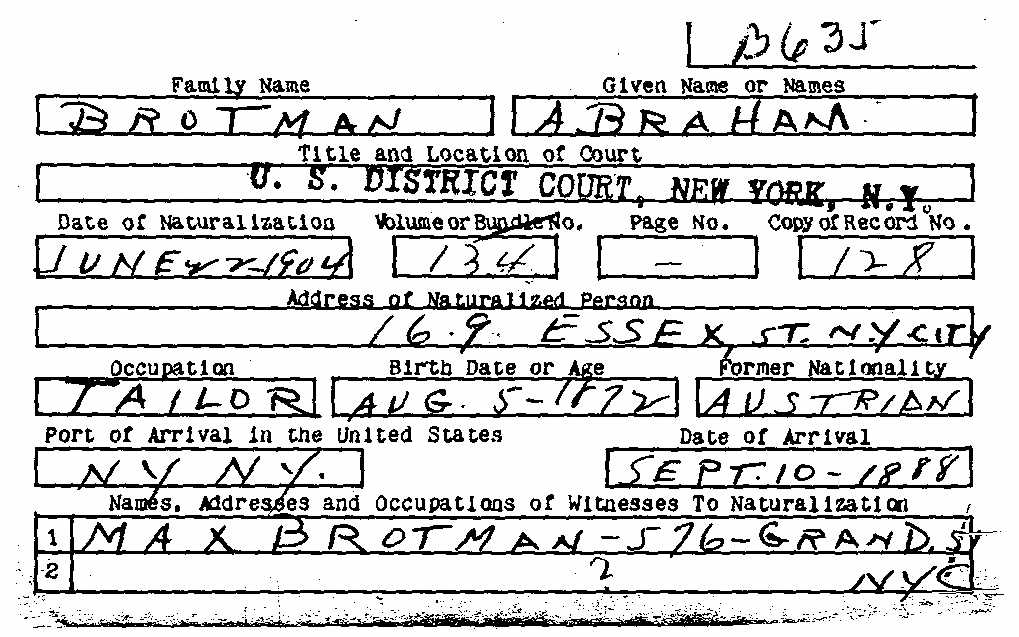
2. The second new great-uncle was Abraham, and finding him was also somewhat of a lucky break.  I ran across many Brotmans in my research, but most I assumed were not our relatives because I could not find any document linking them to our relatives and because no one in our family had ever heard of them.  I can’t even remember all the details, but I recall that it was my brother Ira who found Abraham’s naturalization papers—I think (I am sure he will remember and correct me if I am wrong) it was in the course of looking into the Brotmanville Brotmans.  When I saw Max’s name on those papers, I did not assume it was the same Max.  (There were many Max Brotmans living in NYC at that time.)  Once I checked the address for the Max on Abraham’s card against the address I had for Max on the census form from that same time period, I knew it was in fact “our” Max.  That led me on the search that brought me to Abraham’s headstone and death certificate, indicating that his father was also Joseph Jacob Brotman.  Lesson learned? Don’t dismiss any clue.  You never know where one document may lead you, even if in a direction you never expected.

Naturalization of Abraham Brotman Max as Witness

Naturalization of Abraham Brotman
Max as Witness

3.  Contrary to Lesson #1 and Lesson #2, I have also learned that often you cannot trust documents.  Documents lie.  People lie.  People give bad information, and bureaucrats transcribe information inaccurately.  People who transcribe handwritten documents for indexing purposes make errors.  In particular, our relatives were entirely inconsistent when it came to birth dates and birth places.  I now know why one relative found it so easy to lie about her age.  It was family tradition.  So lesson #3: Don’t assume that because it is written on some “official document” that it is reliable in any way.

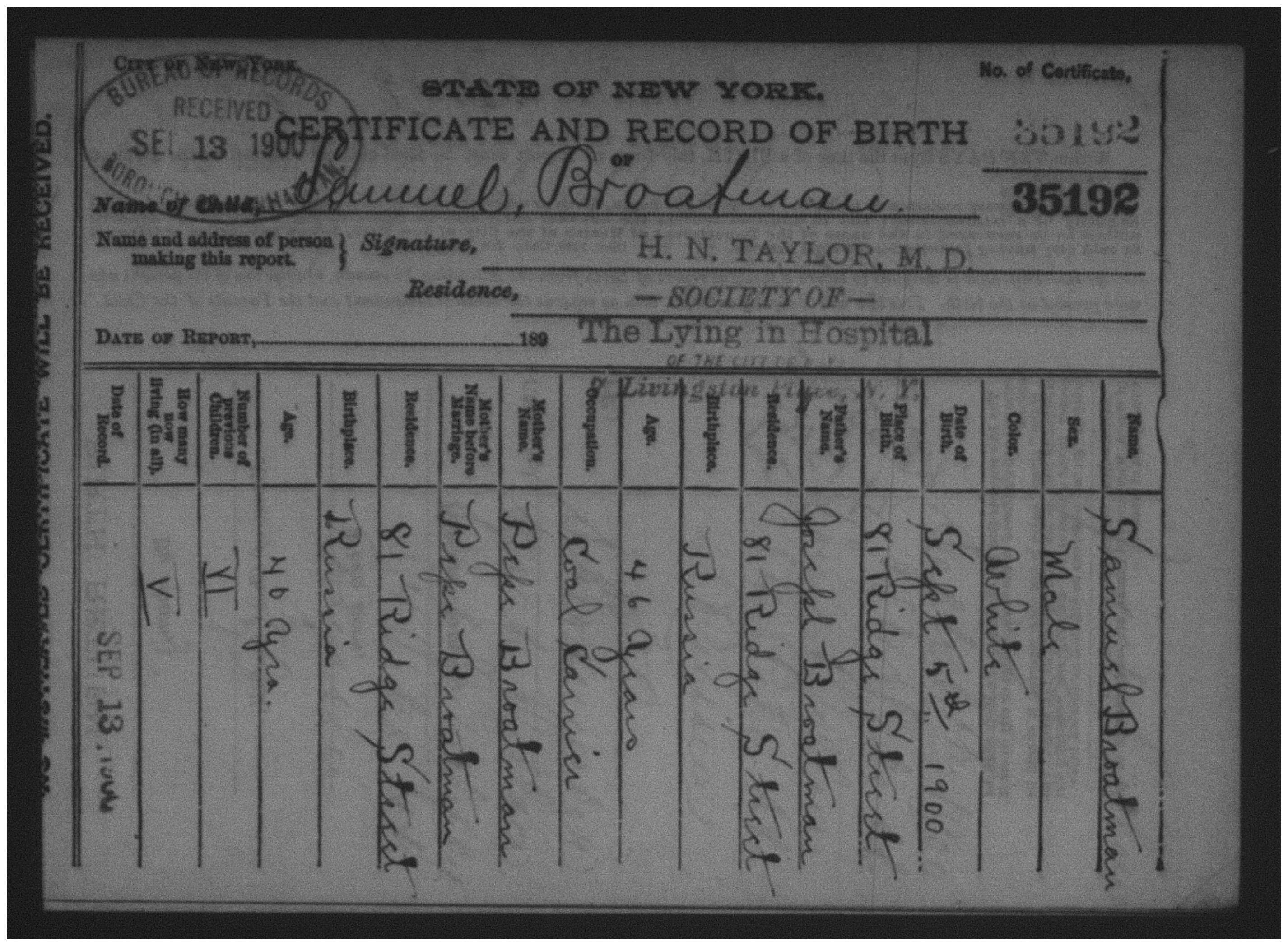
Sam's Birth Certificate Joseph was NOT 42!

Sam’s Birth Certificate
Joseph was NOT 46!

4. One of my most rewarding accomplishments was finding out what happened to Frieda Brotman. Now we know who she married and how she died and even the name of her infant son Max, who only lived one day.    We even know what happened to her husband Harry Coopersmith after she died.  I never thought I’d be able to track down her story.  That experience is what will keep me going as I continue to look for the answers to more questions.  Lesson #4: Do not give up.  Do not give up. Do NOT give up!

Frieda Brotman Coopersmith death certificate

5. There are more helpful and supportive people in the world than there are mean or evil people.  I know we hear all the time about all the evil in the world, and there is far too much of it.  And even if not evil, there are also many people who are rude, incompetent and unhelpful.  We all know that.  But we often forget that there are also many, many more people who are kind, helpful and competent.  In my six months of doing this research, I have gotten help from many strangers—government employees who patiently helped me find a document, FHL volunteers who helped me track down a document request I had made, JewishGen and GesherGalicia members and other genealogists who have gone far out of their way to teach me how to find documents and how to connect with other researchers, who have photographed gravestones and given me directions to gravestones, who have translated documents for me, who have helped me find a clue when I was sure I had hit a brick wall.  I cannot tell you how much these people have touched me and changed my views on human nature.

I want to express special thanks and deep appreciation to Renee Steinig, who contacted me many months ago in response to my cry for help on GesherGalicia and who has truly been my teacher and is now my friend as I have gone from being a total newbie to a fairly competent novice with her guidance. She is the one who found the obituary of Renee that led to me finding Judy.  She is the one who suggested I post an inquiry on a bulletin board that led me to Bruce.  When I look back, in fact, I know it was Renee who got me to where I am today.  Thank you, Renee, for everything.

Lesson #5: If you ask for help, there will be generous and kind people who will reach out and help you.  Don’t do this alone.

6. I have also learned that I have many second cousins and second cousins once and twice removed—people I would never have discovered if I had not started down this path.  This has been probably the biggest gift of all from doing this research.  What a wonderful and interesting group of people I have gotten to know—by email, by phone, by pictures and stories.  When I look at the pictures and see the distinctive Brotman cheekbones shared by so many of you and your parents and your children, it gives me such a great sense of connection.  This may be the best lesson I’ve learned: everyone is looking for connections, everyone is looking to find their place in time and in the world.  I am so glad to have made these connections with so many of you, people who never even knew my name until this fall but whom I now consider not just cousins, but friends.

7. Finally, and in some ways the point of this whole adventure, I have really learned more than I ever could have hoped about my great-grandparents and their children and how they lived in the United States.  Joseph and Bessie were nothing but names to me six months ago; now they are flesh and blood people, my flesh and blood.  Their drive and courage is an inspiration to me, as it must have been to their own children.  After all, Abraham, Hyman and Tillie all named a son for their father Joseph, and perhaps some of the great-grandchildren were named for him as well.  I was so blessed to have been named for Bessie, as were some of you.  Bessie and Joseph—they are the real heroes of this story.  That’s the real lesson.

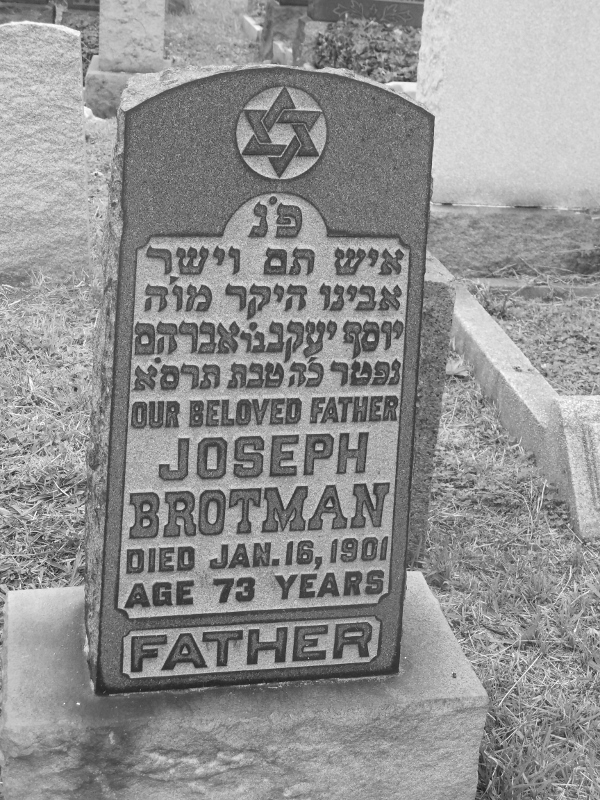
Joseph's headstone

Joseph’s headstone

Bessie Brotman

Bessie Brotman

Next post: Looking forward to the next six months