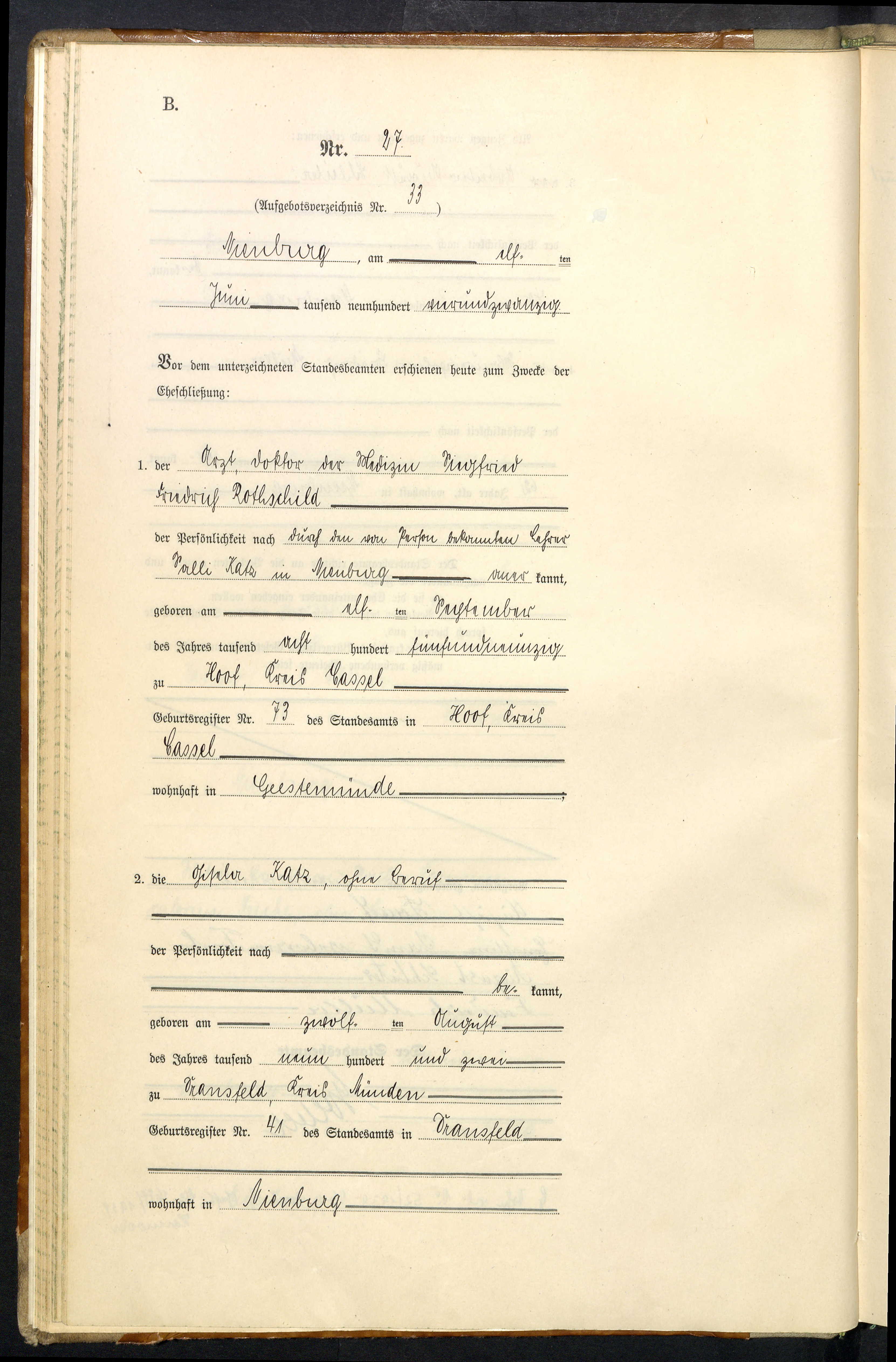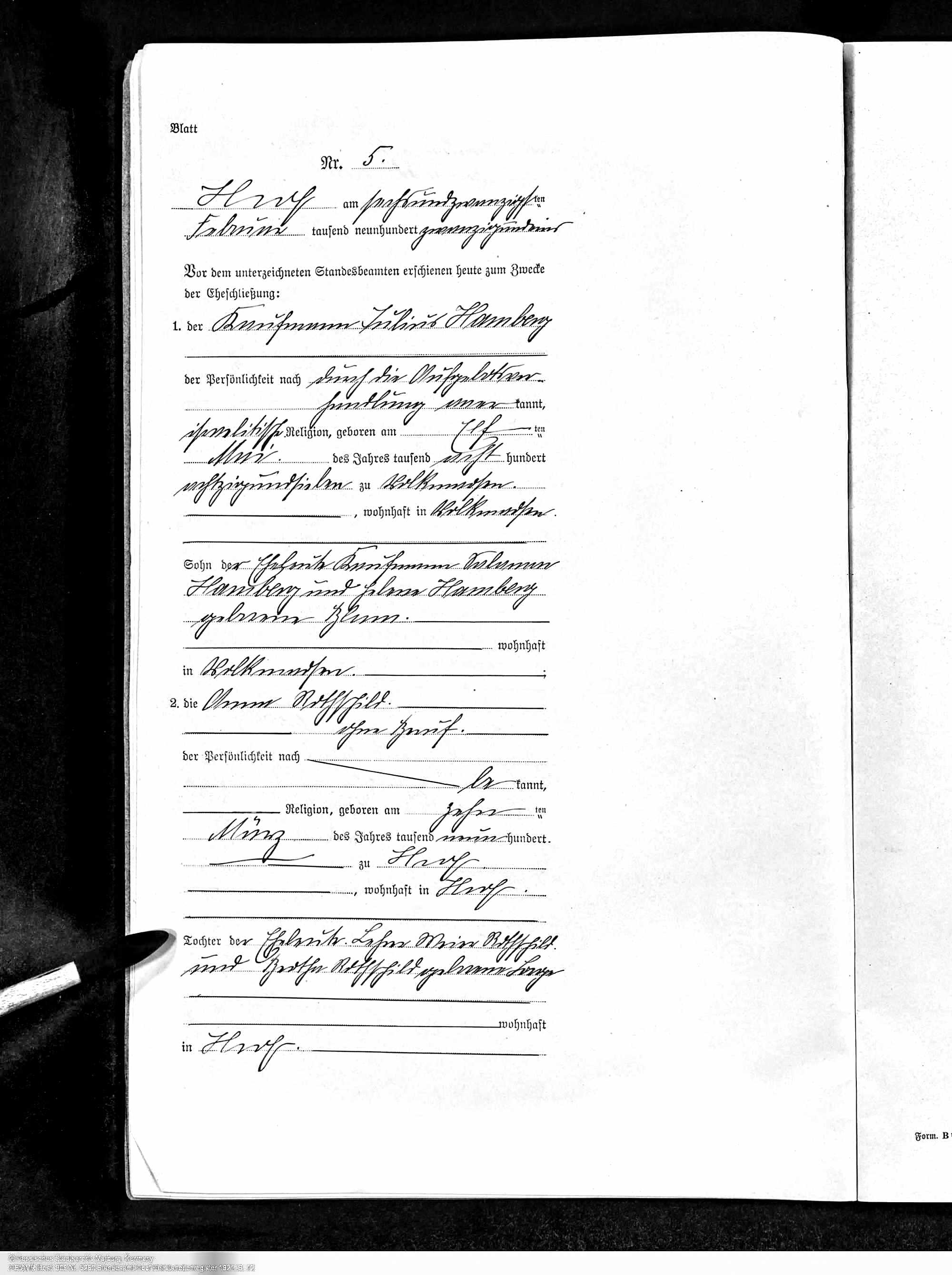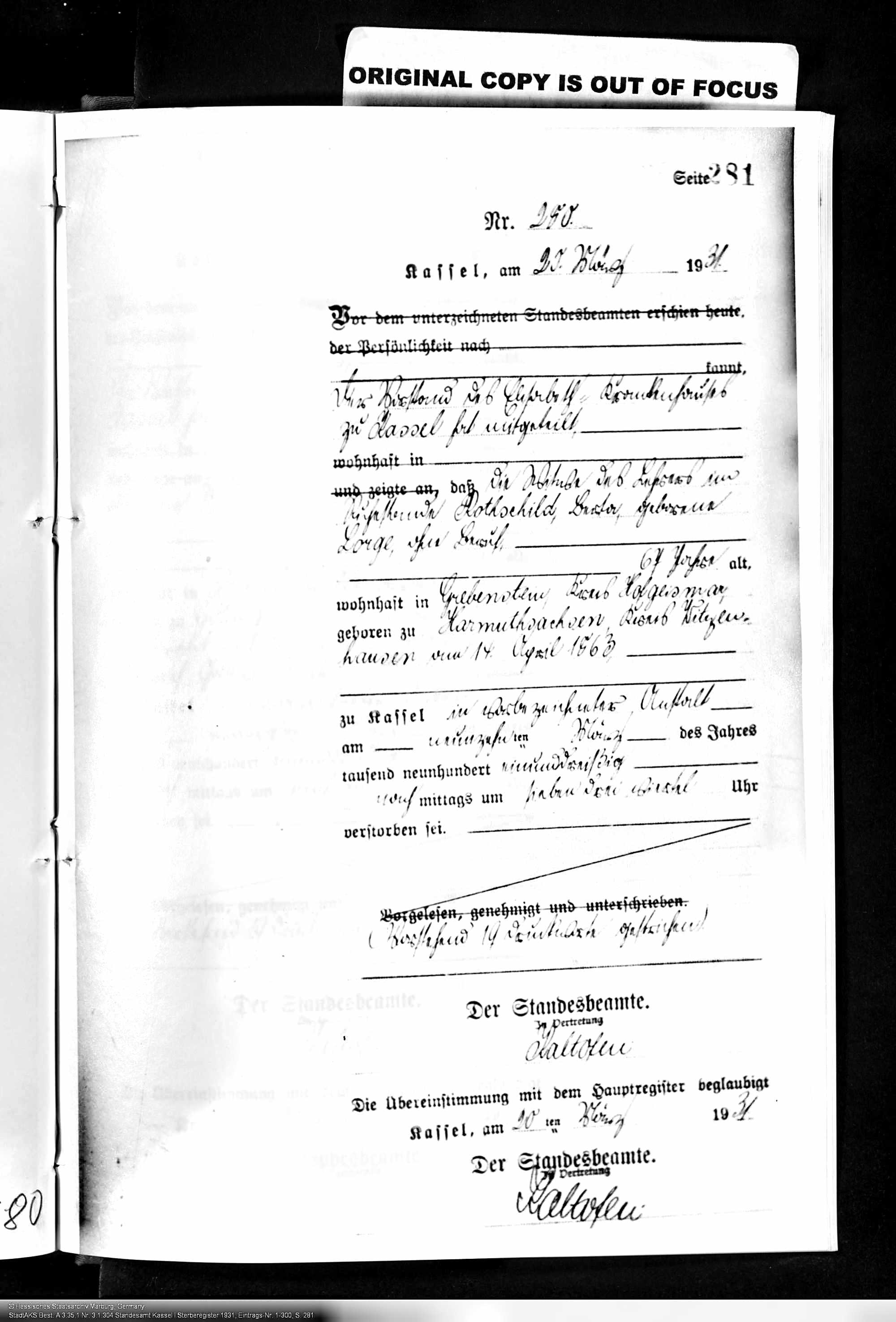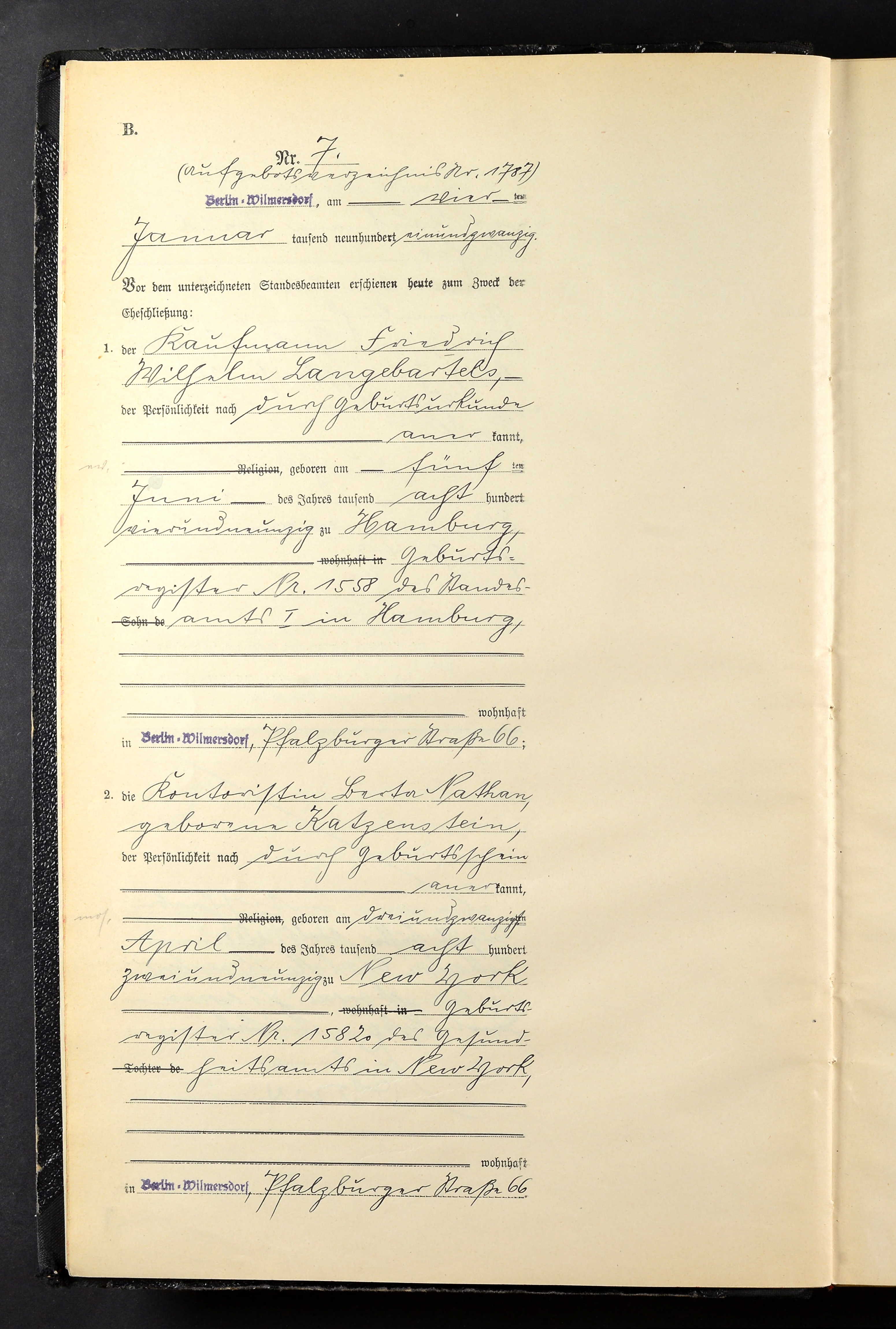
Sara Rothschild Adler, Part I: Ten Children in Seventeen Years

Having completed the story of Malchen Rothschild Rosenblatt, I will now move on to the tenth child of Gelle Blumenfeld and Simon Rothschild, their daughter Sara. Fortunately her family has happier stories than those of some of her siblings.

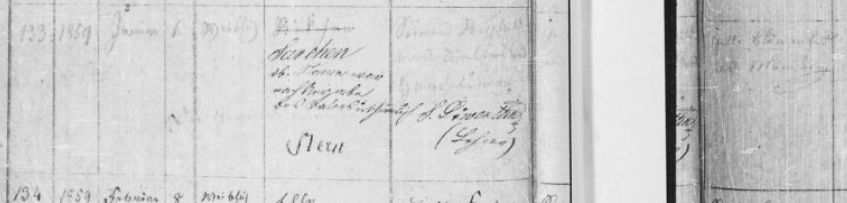
Sara Rothschild was born on either January 6, 1859, or January 3, 1860, in Waltersbrueck, Germany. Her marriage and death records indicate the January 3, 1860, date, but there was no record of her birth on that date in the archives for Waltersbrueck. The birth record below, however, appears to be for Sara (Sarchen) and shows a birth date of January 6, 1859. It’s difficult to read, but the baby’s name is Sarchen, and in very faint letters you can see that the father is Simon and the mother’s name is Gelle Blumenfeld of Momberg. You will need to click on the image and zoom in to see the writing.

Sara Rothschild birth record, Arcinsys Archives of Hessen, HHStAW Fonds 365 No 893, p. 30, found at https://digitalisate-he.arcinsys.de/hhstaw/365/893/00030.jpg

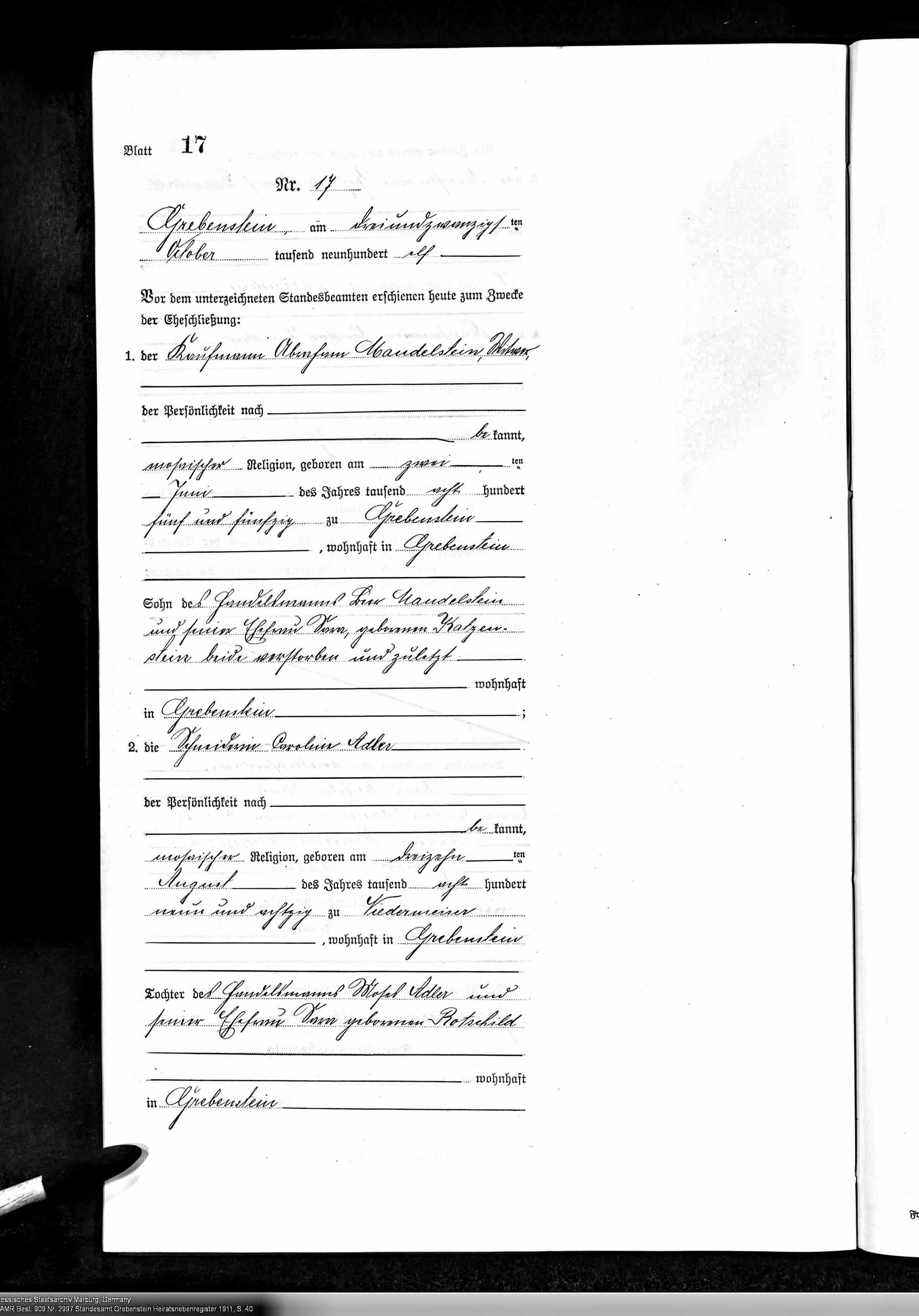
Sara married Moses Adler on December 26, 1883, in Waltersbrueck. He was the son of Selig Adler and Amalie Winkler and was born in Desenberg, Germany, on April 25, 1858. (Notice the January 3, 1860 birthdate for Sara.)

Sara Rothschild and Moses Adler marriage record, Hessisches Hauptstaatsarchiv; Wiesbaden, Deutschland; Bestand: 920; Laufende Nummer: 8409, Year Range: 1883, Ancestry.com. Hesse, Germany, Marriages, 1849-1930

Sara and Moses had ten children. Their first was Louis, born December 4, 1884, in Niedermeiser, Germany.

Louis Adler birth record, Hessisches Hauptstaatsarchiv; Wiesbaden, Deutschland; Bestand: 909; Signatur: 7410, Year Range: 1884, Ancestry.com. Hesse, Germany, Births, 1851-190

Then came Siegmund, born March 10, 1886, in Niedermeiser.

Siegmund Adler birth record, Hessisches Hauptstaatsarchiv; Wiesbaden, Deutschland; Bestand: 909; Signatur: 7412, Year Range: 1886, Ancestry.com. Hesse, Germany, Births, 1851-1901

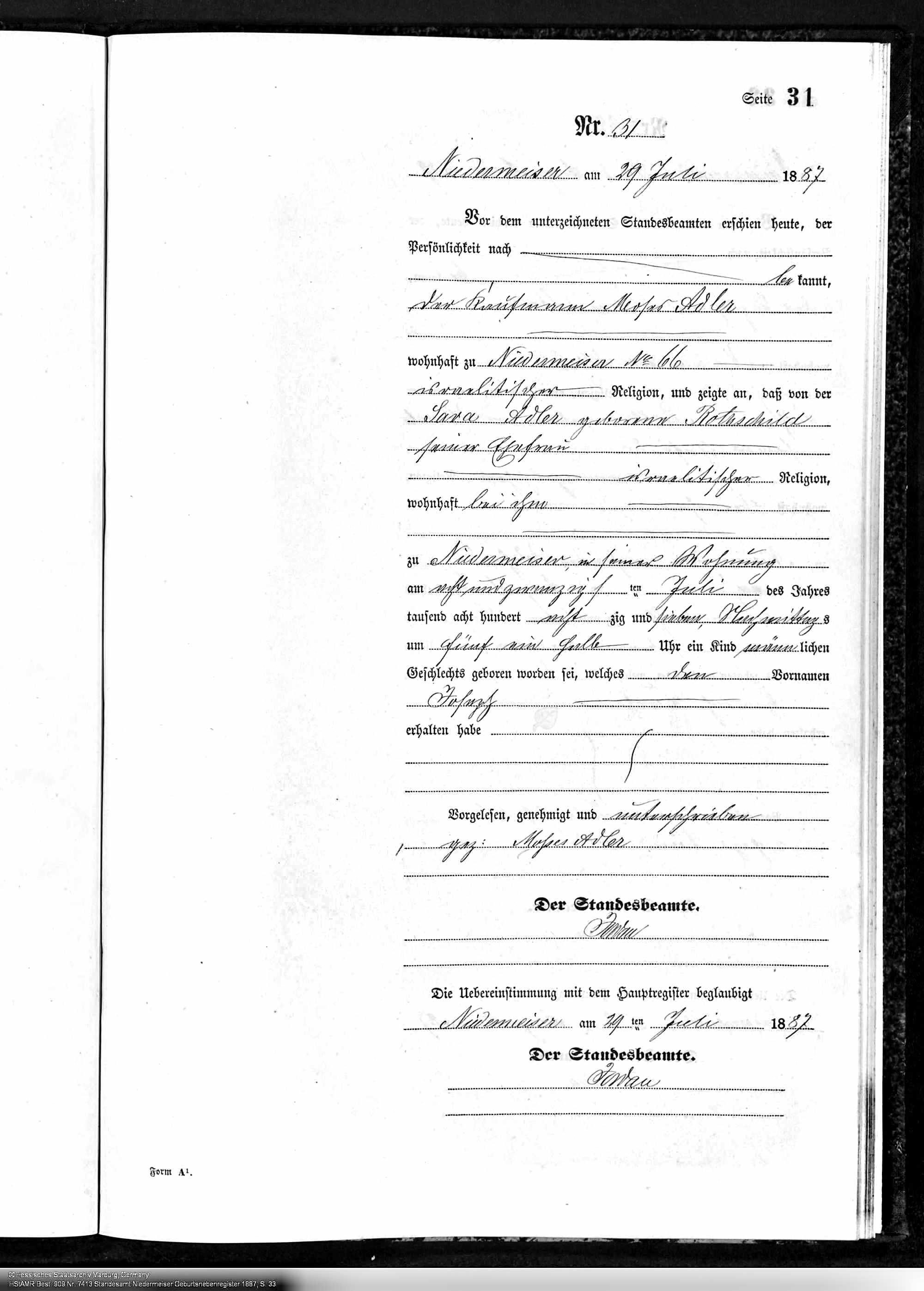
The third child was Joseph, born July 28, 1887, in Niedermeiser. Joseph proved to be a real challenge to track down later, as we will see.

Joseph Adler birth record, Hessisches Hauptstaatsarchiv; Wiesbaden, Deutschland; Bestand: 909; Signatur: 7413, Year Range: 1887, Ancestry.com. Hesse, Germany, Births, 1851-1901

After three sons, Sara and Moses next had a girl, Caroline (also known as Grete), born on August 13, 1889, in Niedermeiser.

Caroline Adler birth record, Hessisches Hauptstaatsarchiv; Wiesbaden, Deutschland; Bestand: 909; Signatur: 7415, Year Range: 1889, Ancestry.com. Hesse, Germany, Births, 1851-1901

Sara and Moses’ second daughter Malchen was born on March 15, 1891, in Niedermeiser.

Malchen Adler birth record, Hessisches Hauptstaatsarchiv; Wiesbaden, Deutschland; Bestand: 909; Signatur: 7417, Year Range: 1891, Ancestry.com. Hesse, Germany, Births, 1851-1901

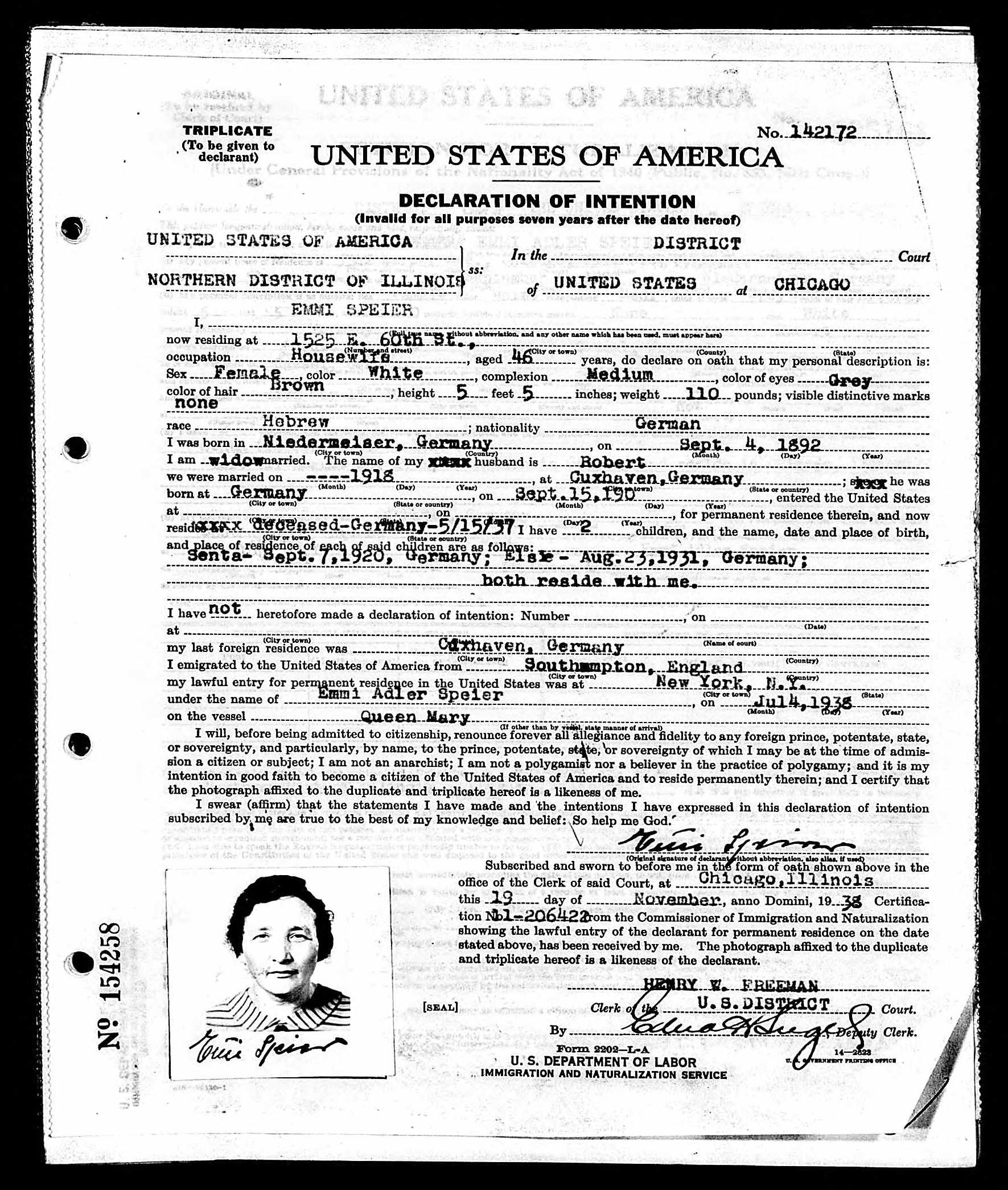
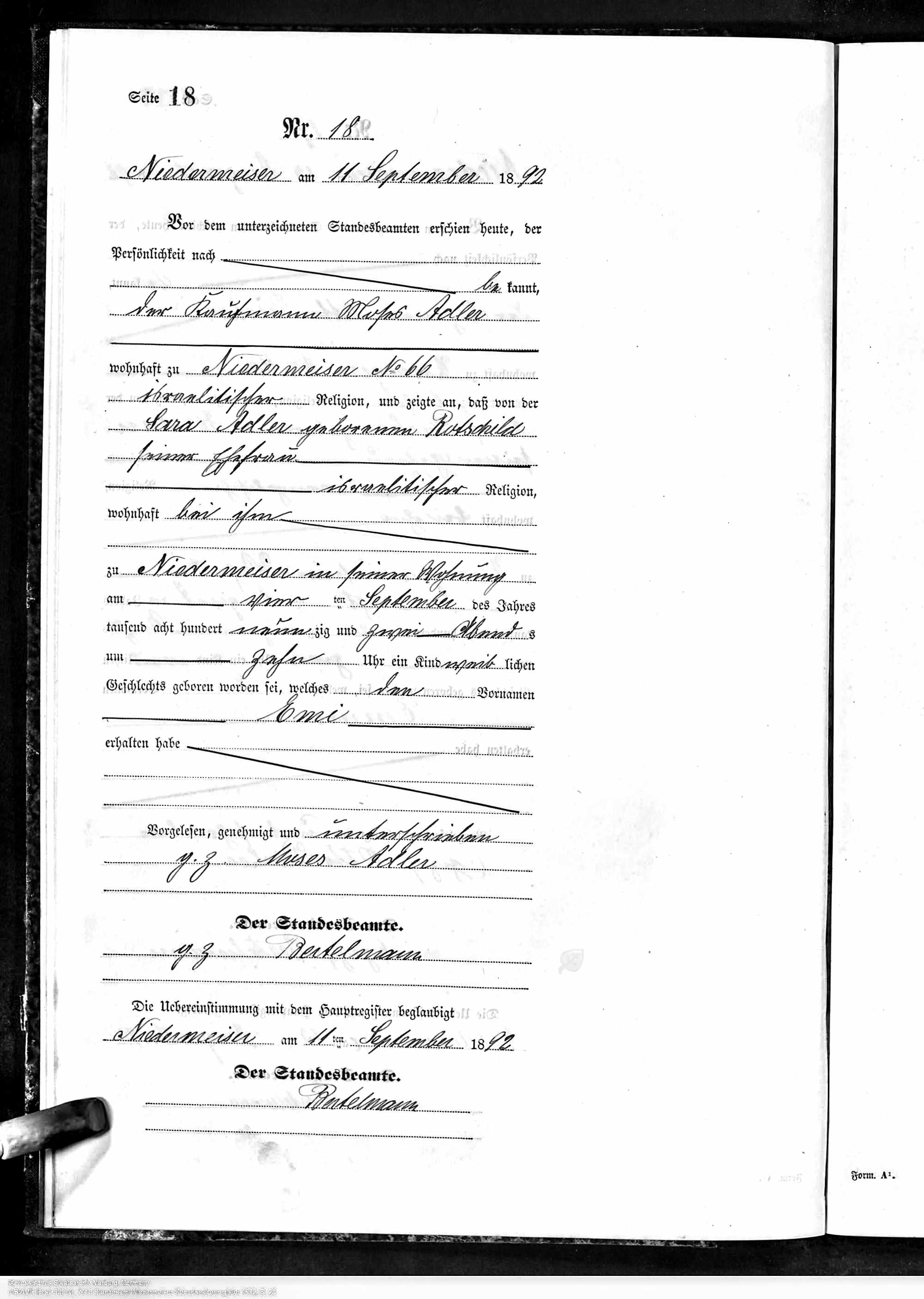
Then came another daughter, Emmi, born in Niedermeiser on September 4, 1892.

Emmi Adler birth record, Hessisches Hauptstaatsarchiv; Wiesbaden, Deutschland; Bestand: 909; Signatur: 7418, Year Range: 1892, Ancestry.com. Hesse, Germany, Births, 1851-1901

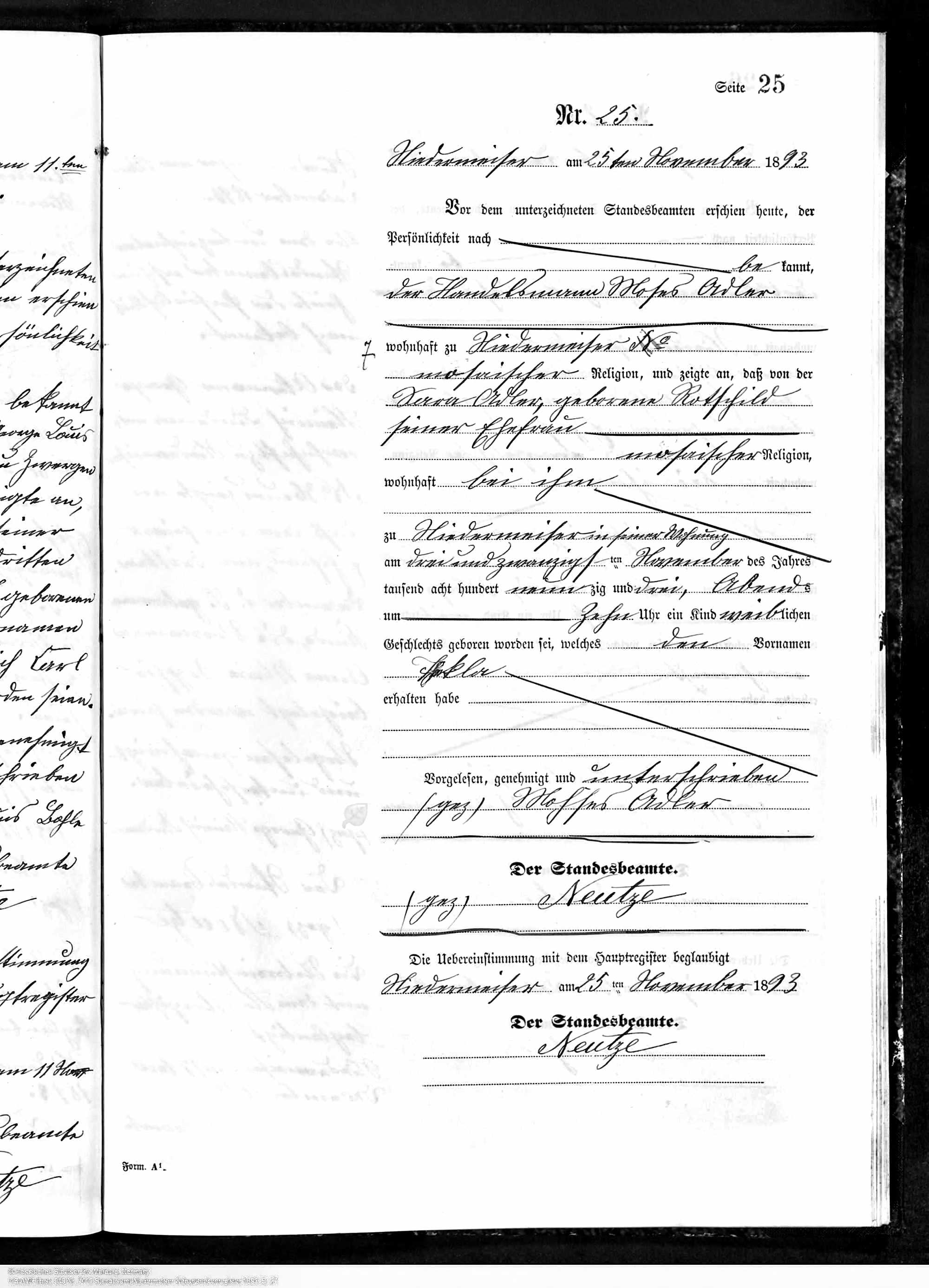
Their seventh child was Tekla, born November 23, 1893 in Niedermeiser. Tekla died when she was only twelve years old on June 17, 1906 in Grebenstein, Germany.

Tekla Adler birth record, Hessisches Hauptstaatsarchiv; Wiesbaden, Deutschland; Bestand: 909; Signatur: 7419, Year Range: 1893, Ancestry.com. Hesse, Germany, Births, 1851-1901

Tekla Adler death record, Hessisches Hauptstaatsarchiv; Wiesbaden, Deutschland; Personenstandsregister Sterberegister; Signatur: 3052; Laufende Nummer: 909, Year Range: 1906, Ancestry.com. Hesse, Germany, Deaths, 1851-1958

Another boy was born next. David (also known as Theodore) was born on July 2, 1895, in Niedermeiser.

David Adler birth record, Hessisches Hauptstaatsarchiv; Wiesbaden, Deutschland; Bestand: 909; Signatur: 7422, Year Range: 1895, Ancestry.com. Hesse, Germany, Births, 1851-1901

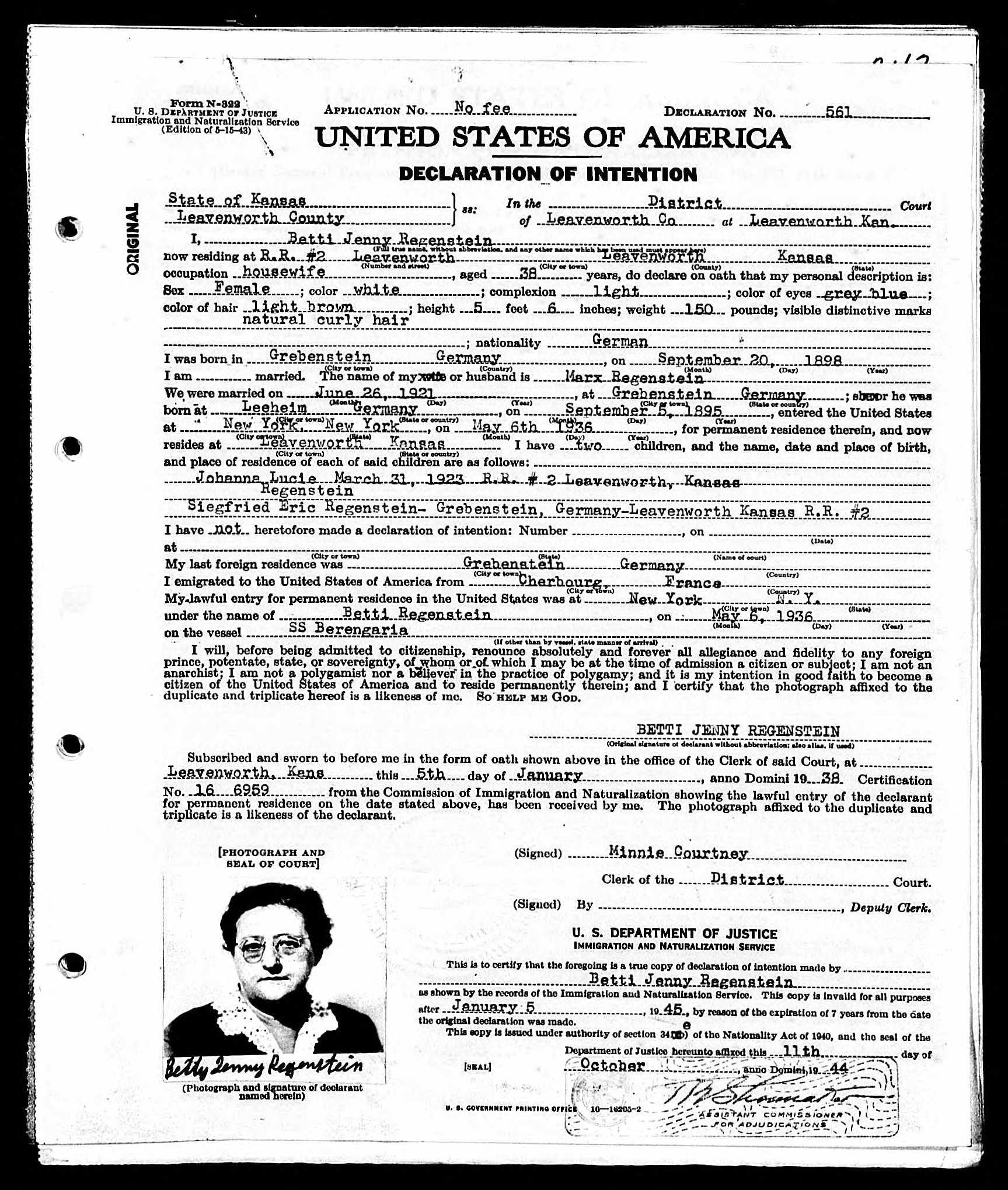
Then came Betty (also known as Jenny), born on September 20, 1898, in Grebenstein, so the family must have relocated to Grebenstein sometime between July 1895 and September 1898.

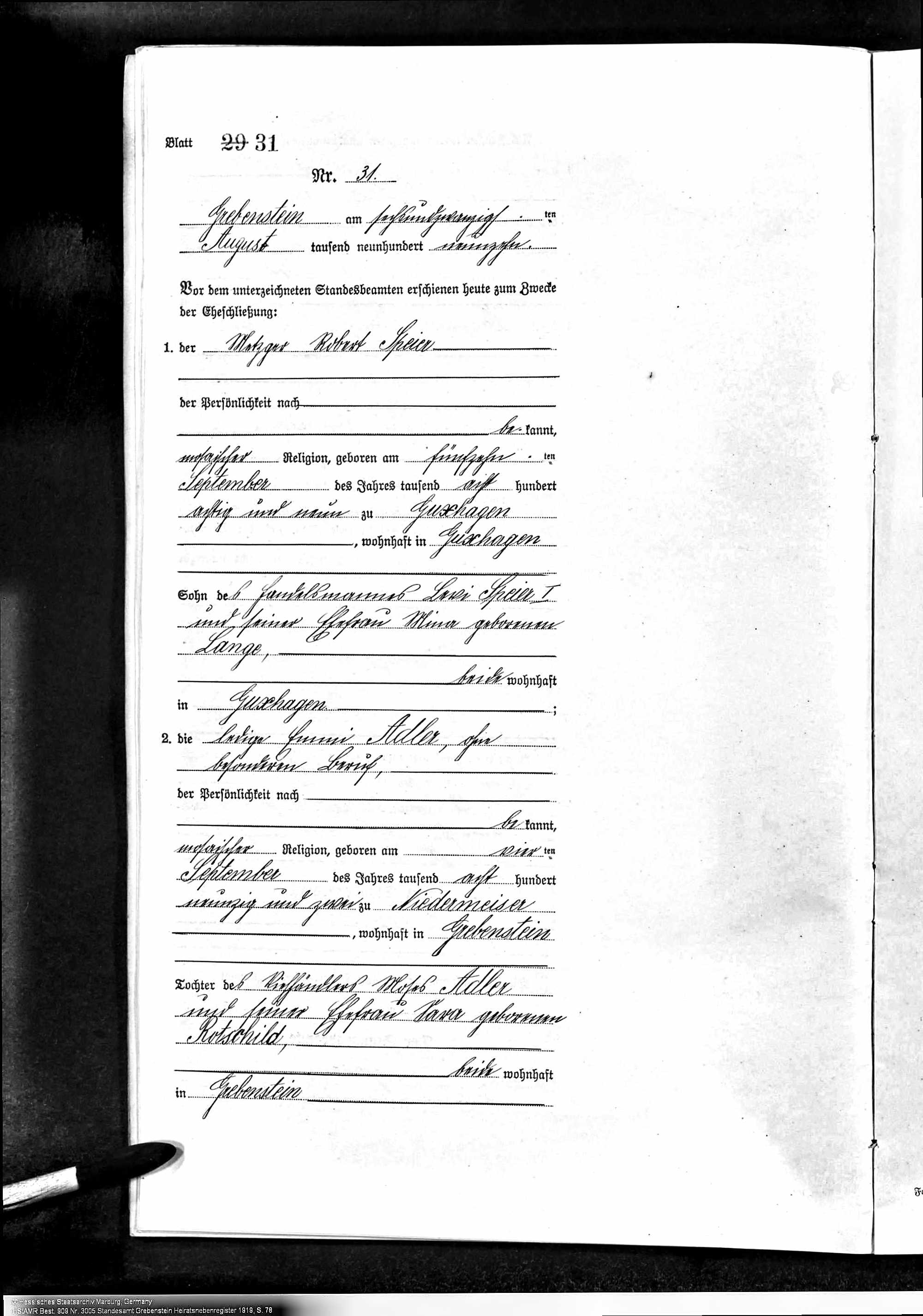
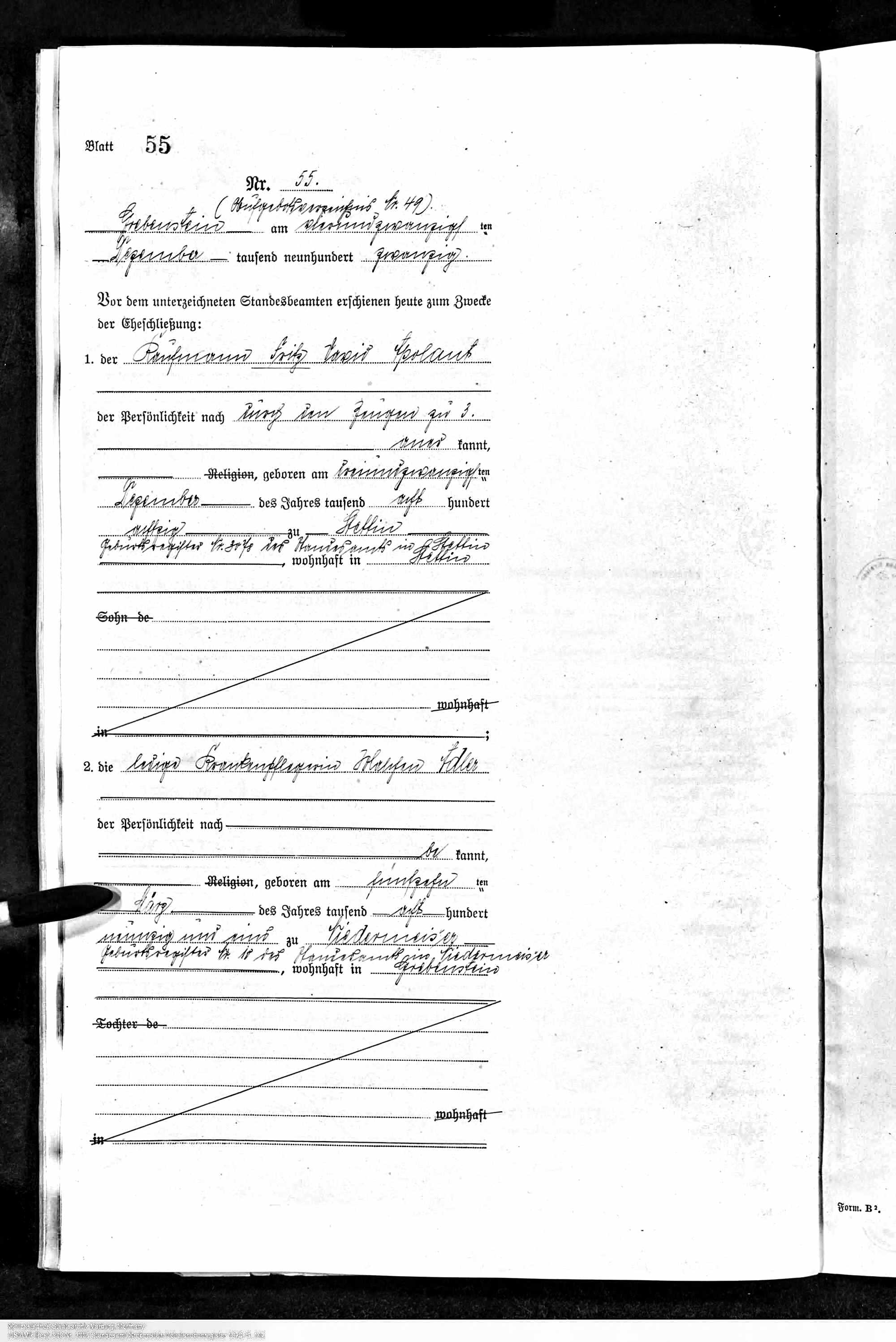
Betti Adler birth record, Hessisches Hauptstaatsarchiv; Wiesbaden, Deutschland; Signatur: 2954, Year Range: 1898, Ancestry.com. Hesse, Germany, Births, 1851-1901

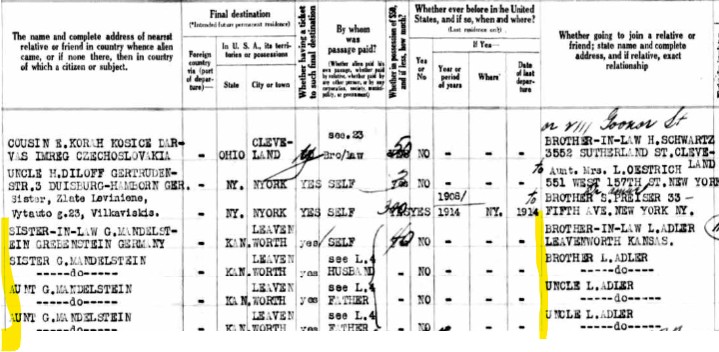
Sara and Moses’ last child was Adolph/Adolf Adler, and he died when he was nine months old in Grebenstein on February 25, 1902. I couldn’t locate a birth record, but I can infer from his death record that he was probably born in May, 1901. UPDATE: Richard Bloomfield found in the Arcinsys Archives of Hessen a database of headstone inscriptions from the cemetery in Grebenstein that included information from Adolph’s headstone indicating that he was born on May 11, 1901.

Arcinsys Archives of Hessen, HHStAW, 365, 378, p. 6, found at https://digitalisate-he.arcinsys.de/hhstaw/365/378/00006.jpg

Adolf Adler death record, Hessisches Hauptstaatsarchiv; Wiesbaden, Deutschland; Personenstandsregister Sterberegister; Signatur: 3048; Laufende Nummer: 909, Year Range: 1902, Ancestry.com. Hesse, Germany, Deaths, 1851-1958

Of the ten children born to Sara Rothschild and Moses Adler, eight survived to adulthood: Louis, Siegmund, Joseph, Malchen, Caroline, Emmi, Tekla, David, and Betty Jenny. Miraculously, all eight survived the Holocaust, and all ended up in the United States. Some came long before Hitler came to power, some came after. But they all survived. I will tell all of their stories in the posts to come.


Lotte Nathan: Carrying and Passing on Family Trauma

Although I couldn’t find out what happened to Bertha Katzenstein Nathan Langebartels, I learned from her naturalization papers that Bertha had had a child with her first husband, Hermann Nathan, named Lotte. Lotte, according to the naturalization petition, was born on May 1, 1915, in Hamburg, Germany. She would have been only eleven years old when her mother and stepfather immigrated to the US in 1926, but she did not come with them. The naturalization petition stated that she “lives in Germany.” The petition also indicated that Friedrich and Bertha had last resided in Hamburg before coming to the United States. I hoped to find Lotte as another way of learning what happened to her mother.

Bertha Katzenstein Langebartels Weber petition for naturalization, The National Archives and Records Administration; Washington, D.C.; Petitions For Naturalization From the U.s. District Court For the Southern District of New York, 1897-1944; Series: M1972; Roll: 542
Description
Archive Roll Descriptions: (Roll 0542) Petition No· 124777-Petition No· 125042
Source Information
Ancestry.com. New York, U.S., Naturalization Records, 1882-1944

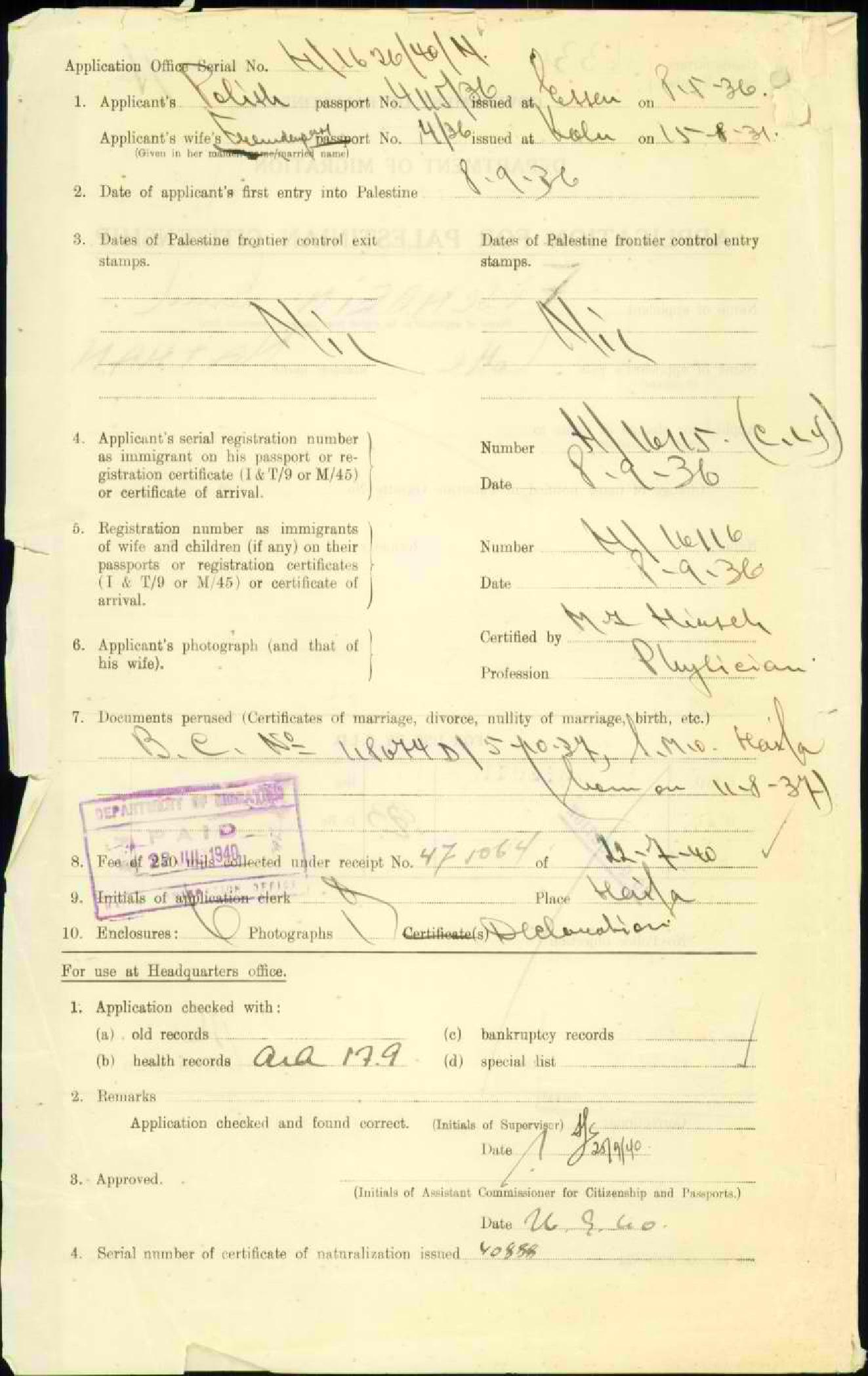
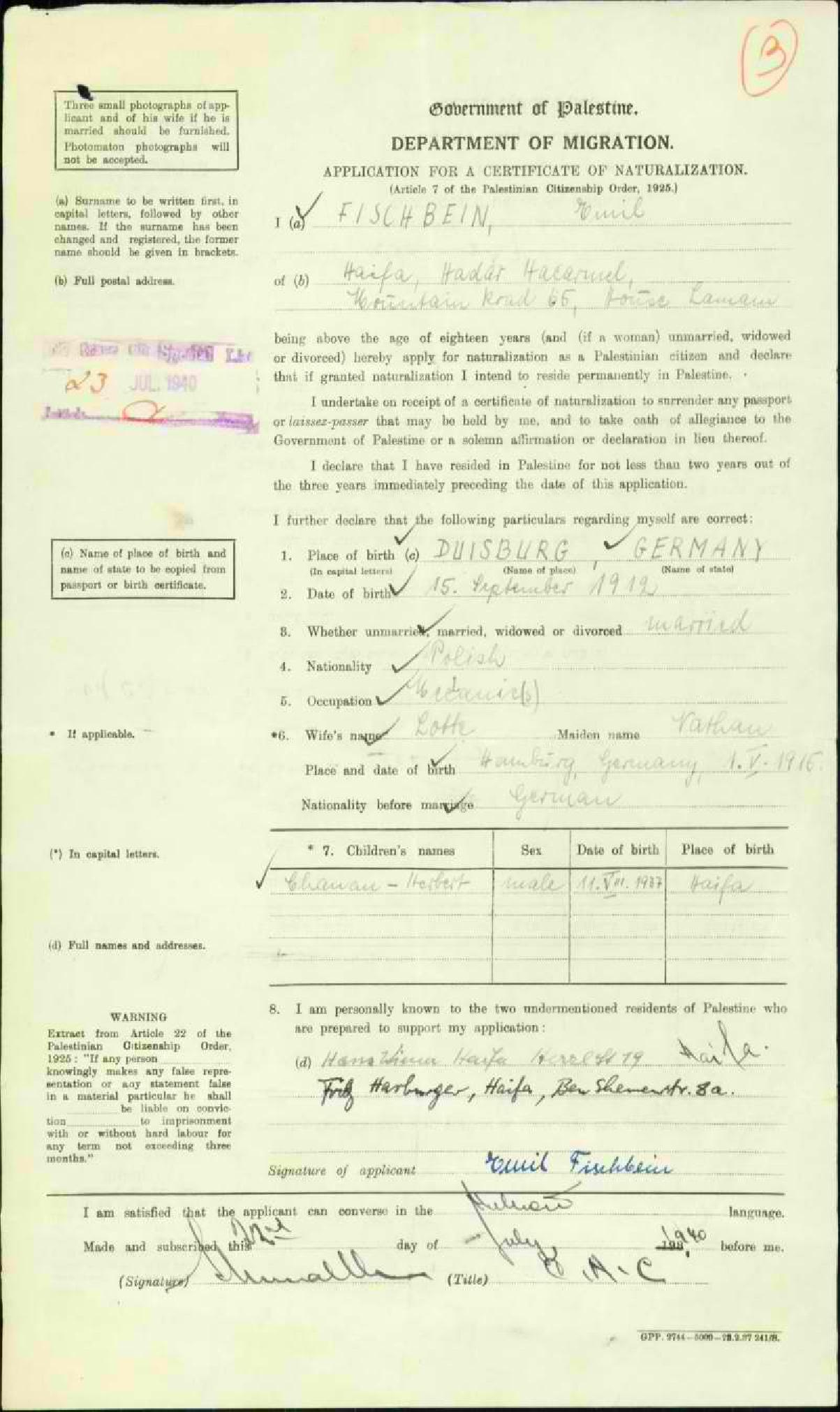
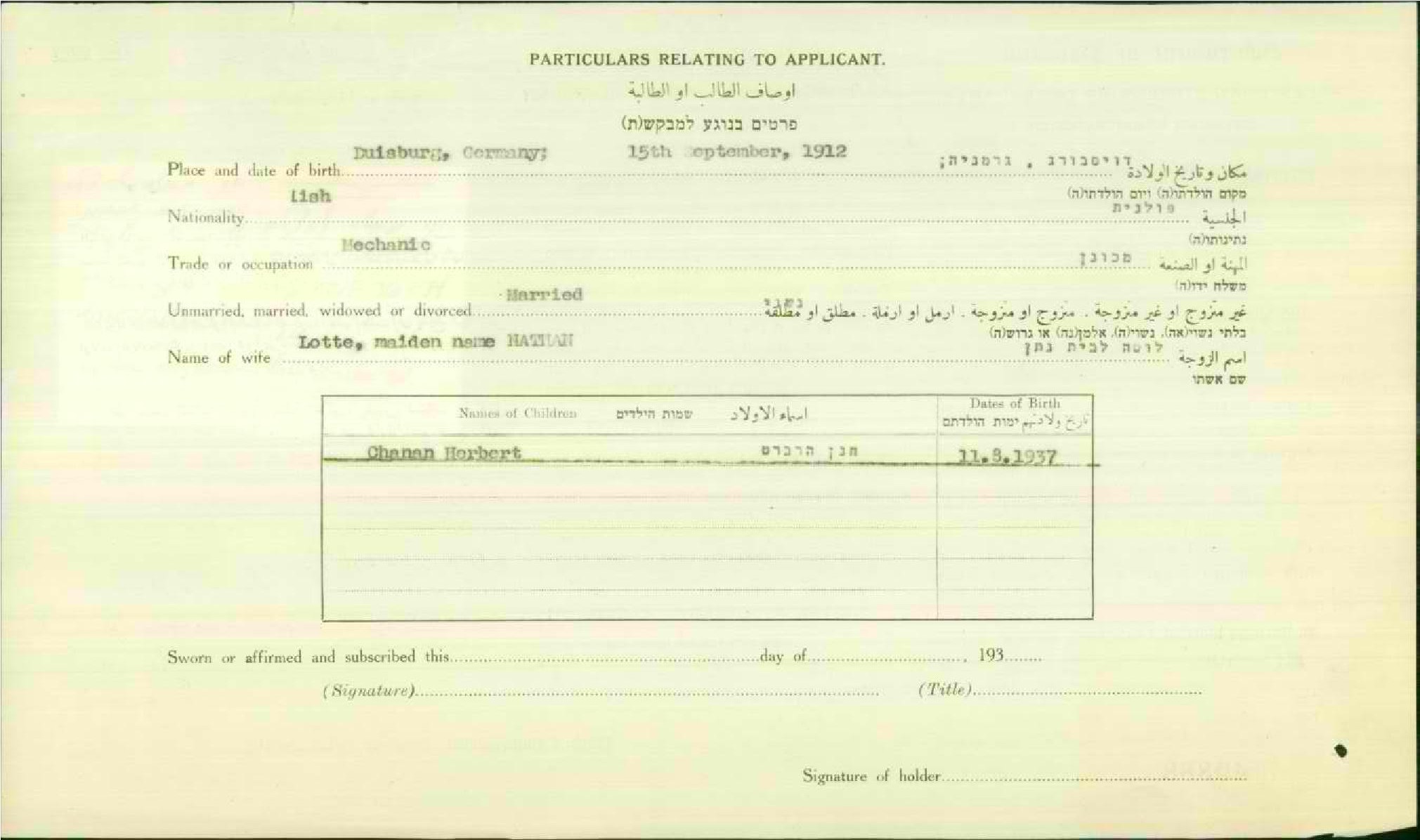
My hunch is that Lotte stayed behind with her father Hermann Nathan, but I can’t be certain. But I do know that sometime during or before 1936 Lotte married Emil Fischbein because on September 8, 1936, they left Germany and immigrated to Palestine as a married couple.1 Emil was born in Duisburg, Germany, on September 15, 1912, but was of Polish nationality, according to his Palestine immigration documents; one tree on MyHeritage created by his great-grandson Gil reports that Emil’s parents were Isaak and Esther Fischbein, both born in what is now Poland. German law at that time provided that children born to non-German parents were not considered German.

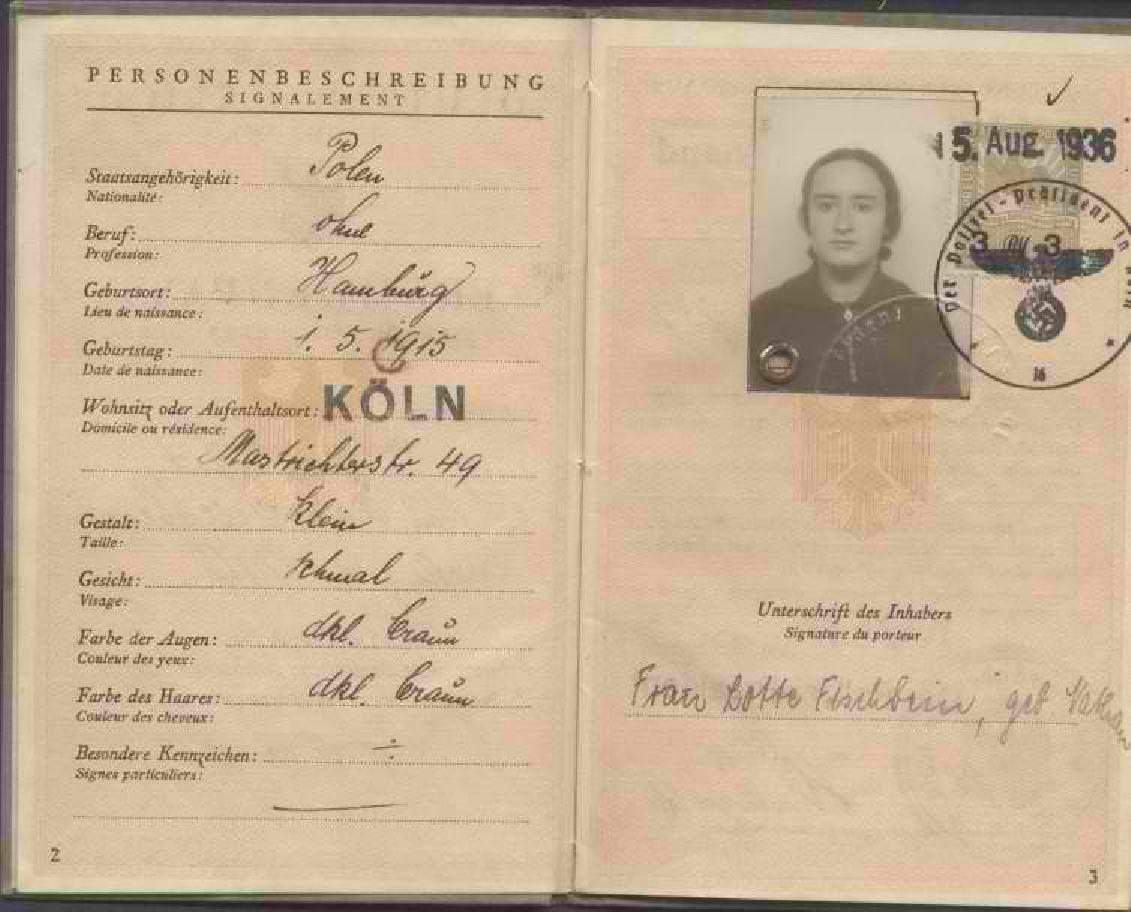
Emil and Lotte’s Palestine immigration documents also include Lotte’s passport,2 which was issued as a Fremdenpass, or a passport issued by the German government to non-Germans living in Germany. Lotte was not eligible for a regular German passport—either because she had married a “foreigner” or because she was Jewish. Jews whose citizenship had been revoked also were granted Fremdenpasses, not regular German passports.

Lotte’s passport was issued on August 15, 1931, from Koeln (Cologne), which suggests that she was living in the German state of North Rhine Westphalia in 1931, not in Hamburg where she was born and where her mother and stepfather had been living before going to the US. It also appears that Lotte’s father Hermann Nathan was not living in North Rhine Westphalia; he was born in Wittingen3 and in 1939 was living in Hildesheim, both of which are located in the German state of Lower Saxony. Emil, however, was born in Duisburg, which is in North Rhine Westphalia, so perhaps that is where they connected with each other.

By October 15, 1940, when Lotte and Emil obtained Palestinian citizenship, they were living in Haifa and had a son, Hanan, who was born on August 11, 1937, in Haifa.4 Through MyHeritage, I located one of their descendants to learn more about Lotte and her family. Gil is Lotte’s great-grandson; his grandfather was Hanan, the baby born in Haifa in 1937. He told me that family lore is that Lotte left Emil and Hanan when Hanan was a child and went to England with an English soldier.

Some trees on Ancestry and MyHeritage indicate that she married Ronald Francis George Buchanan and died in England in 1971. There is a death record on Ancestry for  Lotte Emma B. Buchanan born on May 1, 1915, the day Lotte Nathan was born; the index indicated that she died in the fall of 1971 in Nottingham, England.5 Another record on Ancestry indicates that she died on November 21, 1971, and was cremated in Nottinghamshire on November 24, 1971.6

Lotte Nathan Fischbein Buchanan had a family history and personal history that was difficult. Her grandmother Bertha Metz died from complications of childbirth just two weeks after giving birth to Lotte’s mother Bertha Katzenstein in New York. Bertha Katzenstein was then taken by her father Adolf to Germany, away from her mother’s family.

Then Lotte’s mother Bertha married Hermann Nathan and had Lotte in 1915, only to be divorced from Hermann in 1919 and to marry Friedrich Langebartels in 1921. In 1926 Bertha and Friedrich came to the US and were there at least long enough to file for US citizenship in 1927, leaving Lotte behind in Germany at eleven years old. I don’t know what happened to Bertha after 1927 or whether Lotte ever reunited with her mother.

We know that there is truth to the concept of generational trauma—how the traumas and tragedies suffered by earlier generations are passed down to the children, grandchildren, and so forth of those earlier generations. Bertha Katzenstein grew up without a mother and was taken from the US to Germany as a child by her father, far from her maternal relatives. We don’t know how that trauma affected her, but in some ways her daughter Lotte suffered a similar trauma when her mother Bertha divorced her father, remarried, and left Lotte behind after moving to the US with her second husband. And then Lotte inflicted a similar trauma on her son Hanan, leaving him behind when she remarried and moved to England.

How tragic it is that the scars of one generation can be so easily passed on to the later generations.


  1. Emil and Lotte’s application for citizenship in Palestine in 1940 was found at the Israel State Archives website, temporarily found at https://search.archives.gov.il/, after a cyberattack on their main site. 
  2. See Note 1, supra. 
  3. Hermann Nathan and Bertha Katzenstein marriage record, Year Range and Volume: 1913 Band 01, Ancestry.com. Hamburg, Germany, Marriages, 1874-1920 
  4. See Palestine immigration documents above. 
  5. Name Lottie Emma B Buchanan, Death Age 56, Birth Date 1 May 1915, Registration Date Oct 1971, [Nov 1971] [Dec 1971], Registration Quarter Oct-Nov-Dec, Registration District Nottingham, Inferred County Nottinghamshire, Volume 3c
    Page 1274, General Register Office; United Kingdom; Volume: 3c; Page: 1274, Ancestry.com. England & Wales, Civil Registration Death Index, 1916-2007 
  6. Name Lottie Emma Bertha Buchanan, Register Type Cremation, Death Date 21 Nov 1971, Burial or Cremation Date 24 Nov 1971, Burial or Cremation Place Nottinghamshire, Deceased Online; Kettering, England, UK; Deceased Online Burial Indexes, Ancestry.com. Web: UK, Burial and Cremation Index, 1576-2024 

Zooming with My Cousin Julio Rosenblatt in Uruguay

Since it’s been a while since I wrote about the Blumenfeld clan, let me recap where I was. I was writing about the family of Malchen Rothschild, the ninth child of Gelle Blumenfeld and Simon Rothschild. Malchen and her husband Daniel Rosenblatt had seven children, one of whom died as a child (Betti) and one, Julius, who died in 1920 as a thirty-six year old newlywed whose wife Julie Rosenblatt had just recently given birth to their son, Manfred or Friedel/Fredi (hereinafter “Fredi.”)

Thus, when Hitler came to power in 1933, there were five living children of Malchen and Daniel: their daughters Julchen, Jette, and Auguste, and their sons Felix and Siegmund. Also living was their daughter-in-law Julie and their grandson Manfred/Fredi.

But as we saw, the three daughters were all killed by the Nazis as were some of their family members. Fortunately their two sons and their daughter-in-law Julie survived as did two of the children of Auguste. And that is where we will now pick up.

As I wrote in my last post about this family, I was able to find a descendant of Julius and Julie Rosenblatt, their grandson Julio, named for his grandfather Julius. I finally had a chance to zoom with Julio on September 10, and he was able to fill me on on the story of the surviving branches of Malchen and Daniel’s family.1

As noted above, Julio’s father Fredi was born just three months before his father Julius Rosenblatt died in December 1920. I asked Julio how his grandmother Julie Rosenblatt (wife and first cousin of Julius) coped with raising a baby without her husband. Julio told me that after Julius died, his grandmother moved from Zimmersrode where they’d been living back to Beisefoerth where her father and two of her brothers were still living. Julie and Fredi lived with them and, as Julio said, she not only raised her son but also took care of her father and brothers.

Here is a photograph taken in about 1931 of Fredi and some of his cousins in Beisefoerth. Fredi is the boy in the front, “driving” the motorcycle. The motorcycle belonged to his uncle Ferdinand Rosenblatt, his mother’s brother.

Lothar Rosenblatt, Claire Rosenblatt, Doris Rosenblatt and Fredi Rosenblatt on the motorcycle of Ferdinand Rosenblatt at Beiseförth in about 1931, 1932. Courtesy of Julio Rosenblatt

Once Hitler came to power, the family experienced antisemitism. When Fredi was fourteen or fifteen years old, boys threw rocks and apples at him. After Kristallnacht, Julie knew it was time to leave Germany.

This is a photograph of Fredi taken in Beisefoerth in 1938 the day before he left Germany.

Fredi Rosenblatt c. 1938 Courtesy of Julio Rosenblatt

Julio explained how his grandmother Julie and father Fredi ended up in Uruguay. Julie’s brother Ferdinand Rosenblatt had a sister-in-law, his wife Flori’s sister, who owned a well-known cafe in Frankfurt called Cafe Falk. The Uruguay Consul General Florencio Rivas was a regular customer at the cafe, and after the Nuremberg Laws were enacted, he offered to help the family get visas to immigrate to Uruguay.

Florencio Rivas not only helped the Rosenblatt family; he helped hundreds of German Jews survive the Holocaust. As The New York Times reported:2

While serving as consul general in Germany, Rivas harbored more than 150 Jews on embassy grounds during Kristallnacht in 1938, when Nazi-inspired mobs attacked synagogues and Jews. He then issued them all passports and visas ensuring passage to Uruguay.

Ferdinand Rosenblatt and his wife and son were the first Rosenblatts to leave Germany and go to Uruguay. Fredi left in 1938, and after Kristallnacht in November 1938, Julio’s grandmother Julie Rosenblatt joined them in Montevideo, Uruguay.

This photograph is of Ferdinand Rosenblatt and his wife Flori Goldschmidt. In the middle is their niece, Martha Rosenblatt.

Ferdinand Rosenblatt, Martha Rosenblatt, and Flory Goldschmidt. Courtesy of Julio Rosenblatt

I asked Julio about the family’s transition from Germany to Uruguay, and he told me that Uruguay has always been a very open and accepting country to immigrants. As The New York Times commented:3

Unlike Argentina and many other Latin American countries, Uruguay has been a liberal, secular democracy for much of its history. It became a republic in 1830 and has remained one, with the exception of right-wing dictatorships in the periods of 1932-38 and 1973-85. It separated church and state in 1917. And by 1890, it had enacted a ”policy of the open door,” encouraging immigration by issuing visas free of charge and even providing a hostel for new arrivals.

Julio said that his grandmother quickly found work as a maid in Montevideo and that his father Fredi worked making tapestries to cover furniture. They were welcomed and did not encounter any antisemitism. Julio clearly loves his country and feels deeply grateful that Uruguay took in his grandmother, father, and other relatives and gave them a place to be safe and to prosper.

Fredi Rosenblatt married Erika Katz in 1949 in Uruguay. Here they are on their wedding day:

Erika Katz and Friedel Rosenblatt on their wedding day in 1949. Courtesy of Julio Rosenblatt

Erika Katz and Fredi Rosenblatt on their wedding day in 1949. Courtesy of Julio Rosenblatt

wedding of Fredi Rosenblatt and Erika Katz 1949. Courtesy of Julio Rosenblatt

Julio was the only child of Fredi Rosenblatt and Erika Katz. Here is a photo of him with his parents, taken in 1954.

Fredi Rosenblatt, top; Julio Rosenblatt and Erika Katz, bottom. Courtesy of Julio Rosenblatt

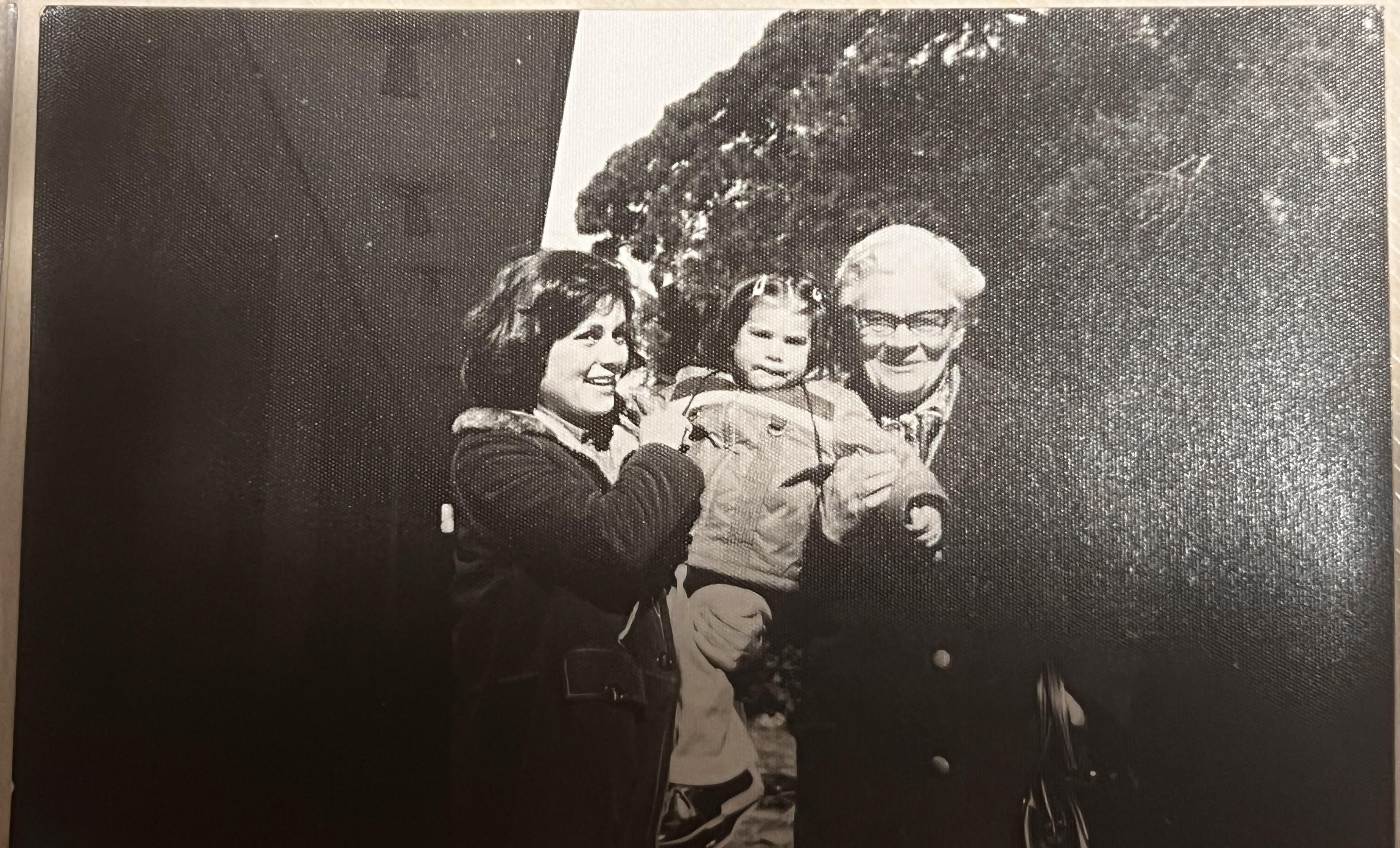
Julio is married to Ana Bogacz, and they have two children. This photograph is of Ana with her daughter Beatriz and Julio’s grandmother, Julie Rosenblatt Rosenblatt.

Ana Bogacz, Beatriz Rosenblatt, and Julie Rosenblatt Rosenblatt, in 1976. Courtesy of Julio Rosenblatt

Julio and Ana have two children. One lives in Uruguay and and the other in England. They also have three grandchildren, one in Uruguay and two in England. So Julius Rosenblatt, who died when his son Fredi was just a baby, and his wife, Julie Rosenblatt, have living great-grandchildren living across the world because Julie Rosenblatt Rosenblatt was smart enough and strong enough and lucky enough to leave Germany when she did.

Thank you to my cousin Julio for sharing his stories and these amazing photographs of his family. I am so glad we connected!


  1. The information about Julie Rosenblatt and her family in this post almost all came from her grandson Julio Rosenblatt during a Zoom on September 10, 2025. 
  2. Samuel Freedman, “A Treasure Hunt for Lost Memories,” The New York Times, August 16, 2003, p. A 15. 
  3. Ibid. 

Malchen Rothschild Rosenblatt, Part III: How I Found Her Great-Grandson Julio

Although the three daughters of Malchen Rothschild and Daniel Rosenblatt were all murdered in the Holocaust, their two surviving sons Felix and Siegmund were able to escape Nazi Germany as was their daughter-in-law Julchen Rosenblatt Rosenblatt, the widow of their son Juda/Julius.

I did not have a great deal of information about Felix or Siegmund because they escaped to Argentina, and I have limited resources for research there. I could not find them or their children on the CEMLA website for ships going to Argentina. All I had were burial records for some of them from the Jewish Online Worldwide Burial Registry (JOWBR) at JewishGen.org.

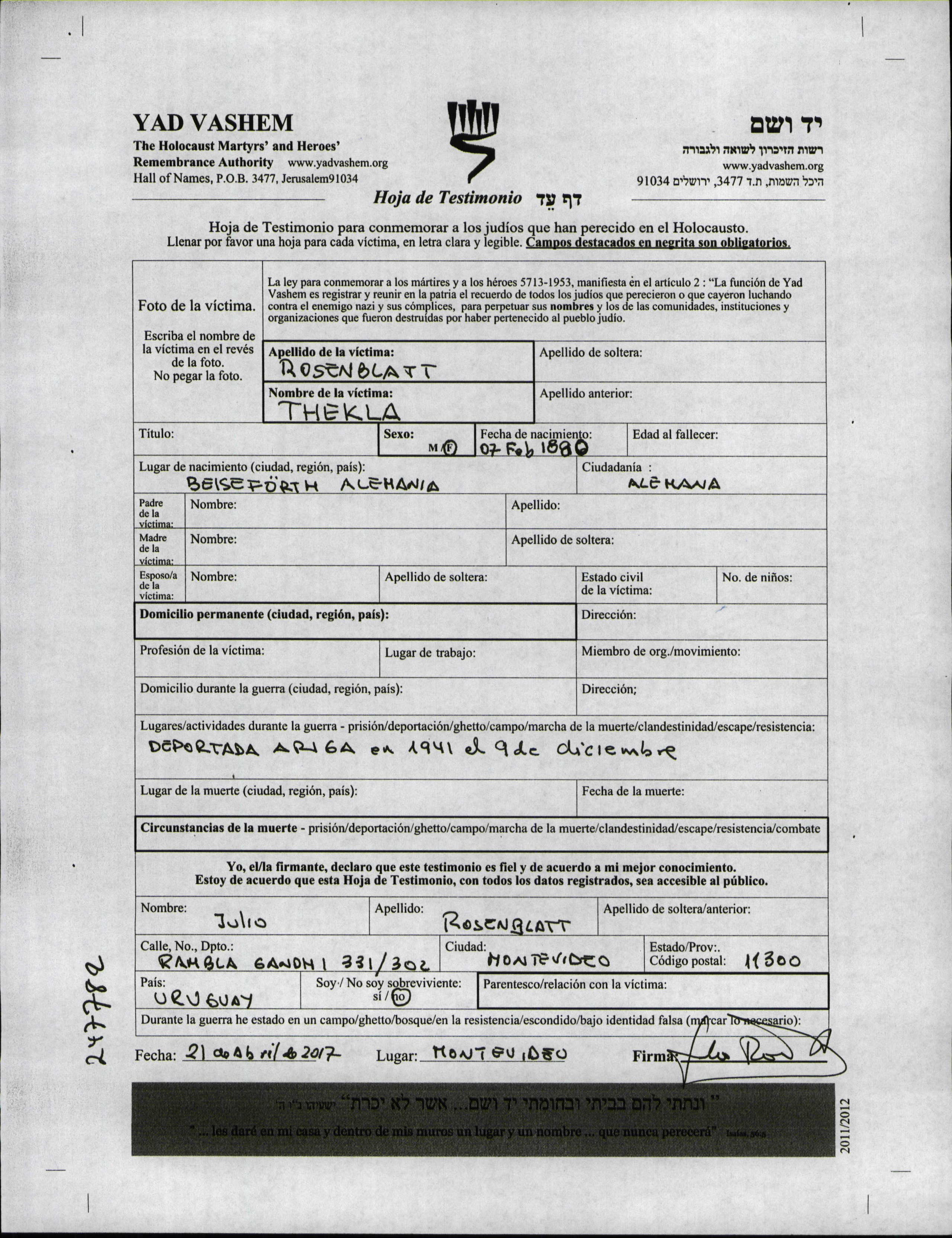
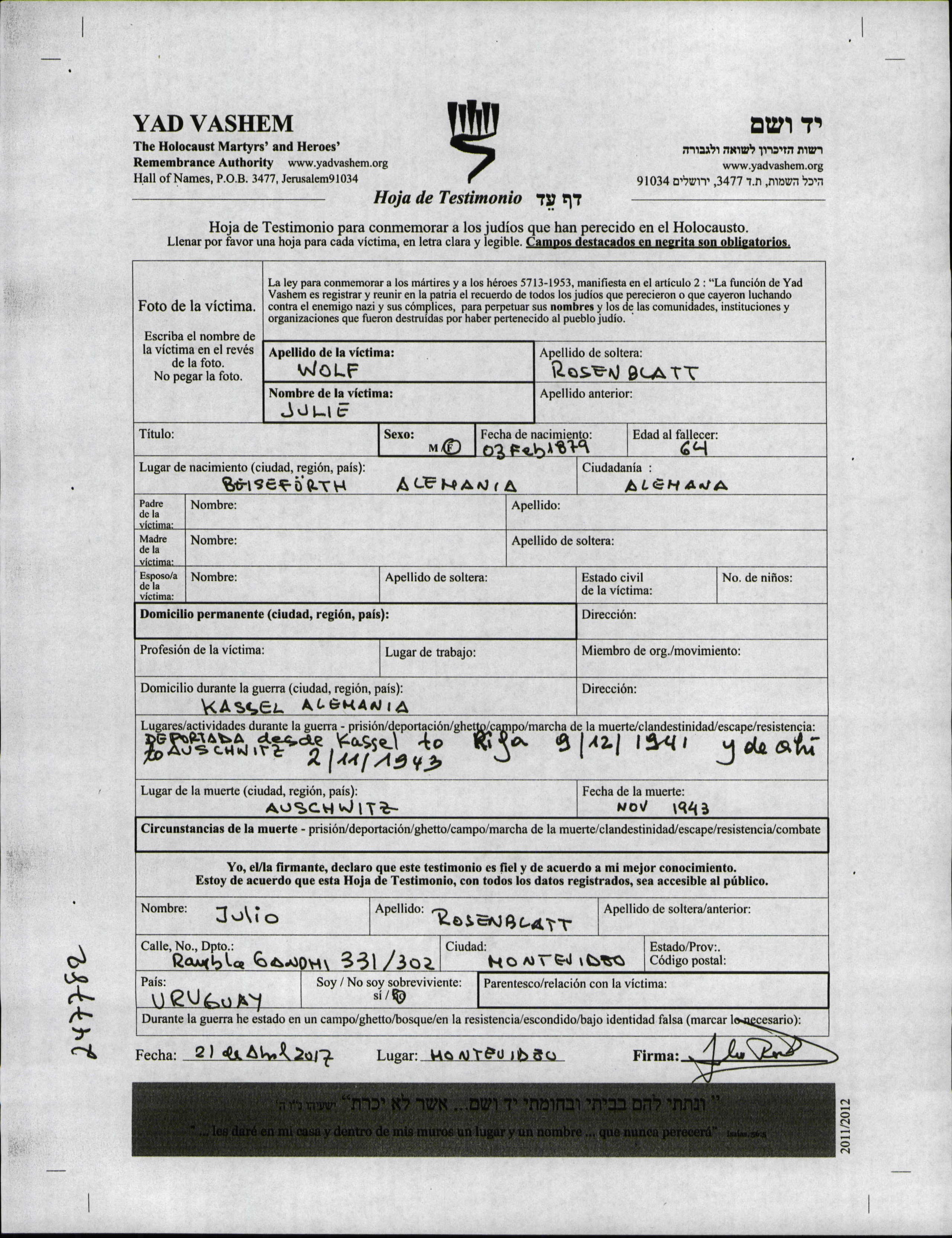
But some of the bricks in this wall crumbled a bit. In looking at the Pages of Testimony for Thekla Rosenblatt and Julie Rosenblatt Wolf, I noticed that both were filed by someone named Julio Rosenblatt. No relationships were given by the submitter, and I had no one in my tree with that name. Julio submitted the pages fairly recently–in 2017–and he lived in Montevideo, Uruguay.

Thekla Rosenblatt page of testimony, found at https://collections.yadvashem.org/en/names/13324460

Julchen Rosenblatt Wolf page of testimony, found at https://collections.yadvashem.org/en/names/13324463

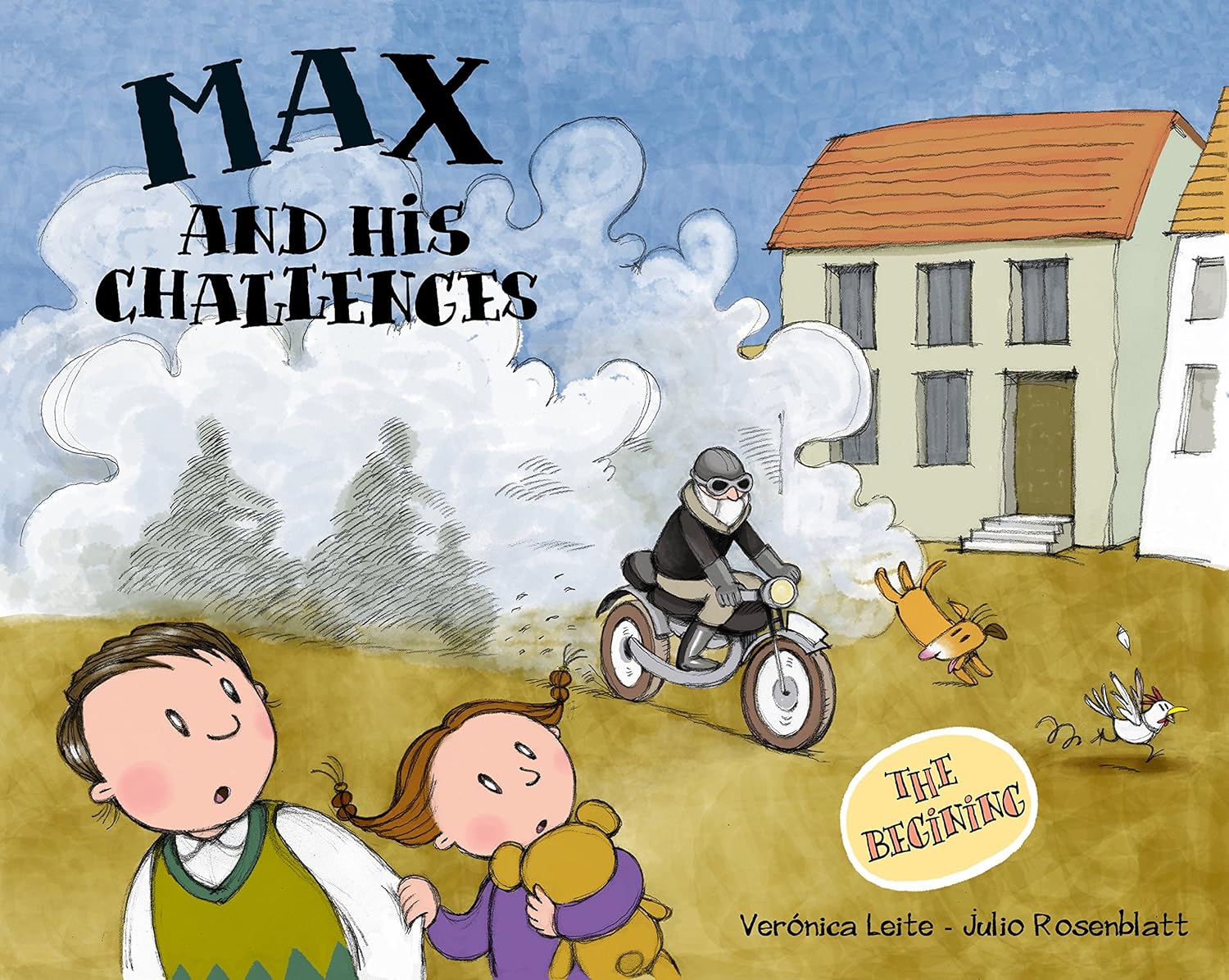
So I googled his name and found two links that helped me figure out who he is and how is he related to the other Rosenblatts and to me. The first page I found was an interview with Julio Rosenblatt of Uruguay that revealed that Julio is the author of several children’s books in the “Max y sus desafíos” series (translated either as Max and His Questions or Max and His Challenges). The books tell the story of Julio’s family in Nazi Germany. “Max” is Julio’s middle name, and he was named in memory of his grandmother’s brother Max. But who was his grandmother? The interview did not reveal.

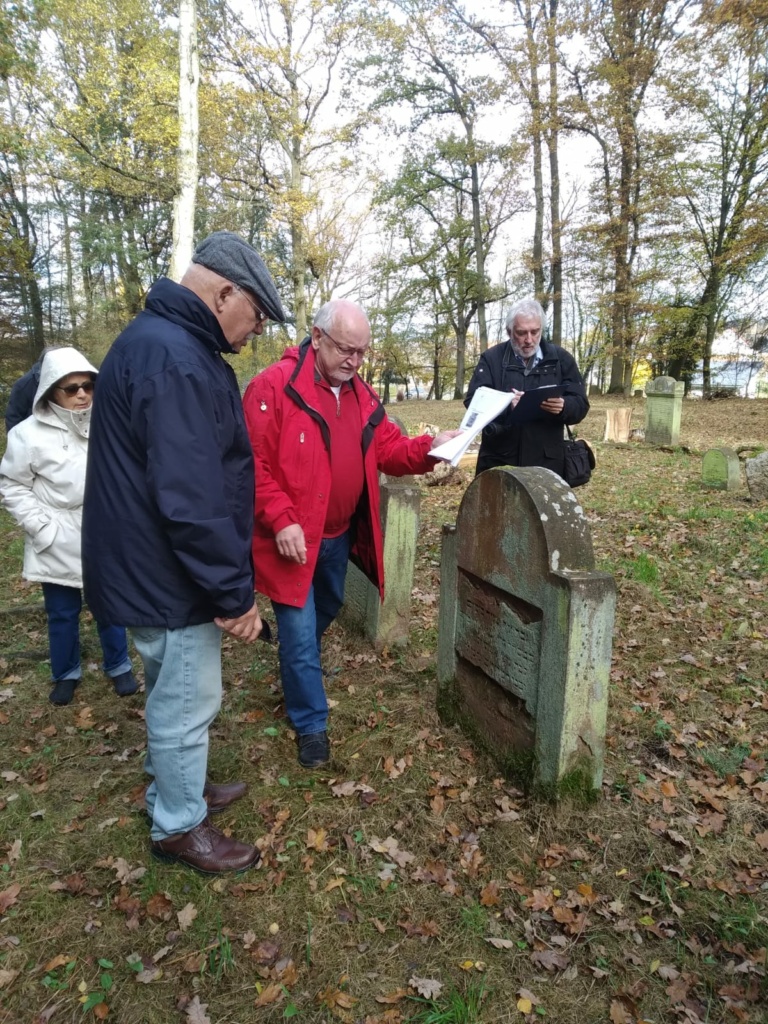
So I kept digging. And then I found the second website about Julio Rosenblatt, Judische Leben in Beisefoerth, or Jewish Life in Beisefoerth, which was the town where Daniel Rosenblatt was born and where the first two of Daniel and Malchen’s children were born. Seeing that confirmed that I was on the right track. The website had a detailed telling of Julio’s trip to Beisefoerth and his search for his family history there. And from that page I learned Julio’s ancestry and how he is related to me. The page describes his trip to the Jewish cemetery in Haarhausen with Hans Peter Klein, the same man who took me there in 2017. This is what they saw there (see photo accompanying quote below):

Five generations of Julio Rosenblatt’s ancestors from Zimmersrode and Waltersbrück are buried there; the oldest grave of his four-times [sic] great-grandfather, Simon Rothschild from Waltersbrück, dates back to 1811. Julio and his wife Ana were particularly touched by the grave of his grandfather Julius Rosenblatt, who died in 1920 at the age of just 36 and just a few months after the birth of Fredi Rosenblatt, Julio’s father.

Now I know exactly who Julio is. He is my fifth cousin, the four-times great-grandson of Abraham Blumenfeld I and Geitel Katz, my four-times great-grandparents. His father was the baby born to Julius Rosenblatt and Julie Rosenblatt, Manfred; his great-grandmother was Malchen Rothschild Rosenblatt, his great-great-grandmother was Gelle Blumenfeld Rothschild, his great-great-great-grandfather was Moses Blumenfeld I, the older brother of my great-great-great-grandmother Breune Blumenfeld Katzenstein.

Julio’s paternal grandmother was Julie Rosenblatt, the widow and first cousin of Julius Rosenblatt. And Julie had a brother Max Rosenblatt who was killed in the Holocaust and became the name of the character in Julio’s books. But Julie survived and immigrated to Uruguay with her son Manfred (or Fredi), and Julio was born there.

I have gotten in touch with Julio and learned more about the Rosenblatts who survived the Holocaust in South America. Once again connecting with a cousin has allowed me the privilege of better understanding and appreciating my family history.

On top of that, a cousin of Sigmund Rosenblatt’s family, Ellie, found me through the blog, and she has been updating me on that branch of the family.


To be continued in September. My family will be visiting for the next two weeks, so I will see you after Labor Day!


Malchen Rothschild, Part I: A Large Family

Having now completed the stories of the family of Gerson Rothschild and Fanny Kupermann, it is time once again to see where I am in the overall Blumenfeld family. Gerson was the eighth of the eleven children of Gelle Blumenfeld and Simon Rothschild. And Gelle Blumenfeld was the third of the three children of Moses Blumenfeld I and Gidel Loeb. And Moses Blumenfeld was the older brother of my three-times great-grandmother Breine Blumenfeld Katzenstein. So seeing this in a visual format, this is where I am:

Here is a chart of where I am in the descendants of Moses Blumenfeld I:

That looks like a lot of progress, doesn’t it?

But this is where I am in the overall family of Abraham Blumenfeld I and Geitel Katz, my 4x-great-grandparents:

So I still have a long, long way to go. (One thing not reflected here is that I have already covered the family and descendants of my three-times great-grandmother Breine Blumenfeld Katzenstein, the third child of Abraham I and Geitel.)

Now I will move on to the ninth of the children of Gelle Blumenfeld and Simon Rothschild, their daughter, Malchen. She was born on March 3, 1857, in Waltersbrueck, Germany.

Malchen Rothschild birth record, Arcinsys Archives of Hessen, HHStAW Fonds 365 No 893, p. 28

On May 12, 1878, Malchen married Daniel Rosenblatt in Waltersbrueck. Daniel, the son of Feist Rosenblatt and Minna Heilbrunn, was born on December 20, 1851, in Beisefoerth, Germany (now known as Malsfeld, Germany).

Malchen Rothschild and Daniel Rosenblatt marriage record, Hessisches Hauptstaatsarchiv; Wiesbaden, Deutschland; Bestand: 920; Laufende Nummer: 8404, Year Range: 1878, Ancestry.com. Hesse, Germany, Marriages, 1849-1930

Malchen and Daniel had seven children.

Their first born was Julchen or Julie Rosenblatt; she was born February 3, 1879, in Beisefoerth.

Julchen Rosenblatt birth record, Hessisches Hauptstaatsarchiv; Wiesbaden, Deutschland; Bestand: 920; Laufende Nummer: 4410, Year Range: 1879, Ancestry.com. Hesse, Germany, Births, 1851-1901

The second child was Jette, born February 8, 1880, in Beisefoerth.

Jette Rosenblatt birth record, Arcinsys Archives of Hessen, HHStAW, 365, 66, pp. 76-77

Felix, the third child, was born December 15, 1881, but in Zimmersrode, so the family must have relocated from Beisefoerth by then.

Felix Rosenblatt birth record, Hessisches Hauptstaatsarchiv; Wiesbaden, Deutschland; Bestand: 920; Laufende Nummer: 9519, Year Range: 1881, Ancestry.com. Hesse, Germany, Births, 1851-1901

The fourth child was Auguste, born in Zimmersrode on February 6, 1883.

Auguste Rosenblatt birth record, Hessisches Hauptstaatsarchiv; Wiesbaden, Deutschland; Bestand: 920; Laufende Nummer: 9521, Year Range: 1883, Ancestry.com. Hesse, Germany, Births, 1851-1901

The fifth child, another boy, was Juda or Julius Rosenblatt, also born in Zimmersrode, on July 13, 1884.

Juda Rosenblatt birth record, Hessisches Hauptstaatsarchiv; Wiesbaden, Deutschland; Bestand: 920; Laufende Nummer: 9522, Year Range: 1884, Ancestry.com. Hesse, Germany, Births, 1851-1901

After Juda came Betty Rosenblatt, born January 8, 1887, in Zimmersrode. Sadly, Betty did not make it to her second birthday; she died on October 7, 1888, in Zimmersrode.

Betty Rosenblatt birth record, Hessisches Hauptstaatsarchiv; Wiesbaden, Deutschland; Bestand: 920; Laufende Nummer: 9525, Year Range: 1887, Ancestry.com. Hesse, Germany, Births, 1851-1901

Betty Rosenblatt death record, Hessisches Hauptstaatsarchiv; Wiesbaden, Deutschland; Personenstandsregister Sterberegister; Bestand: 9603; Laufende Nummer: 920, Year Range: 1888, Ancestry.com. Hesse, Germany, Deaths, 1851-1958

Finally, Malchen gave birth to her seventh child, Siegmund, on November 15, 1889, in Zimmersrode.

Siegmund Rosenblatt birth record, Hessisches Hauptstaatsarchiv; Wiesbaden, Deutschland; Bestand: 920; Laufende Nummer: 9527, Year Range: 1889. Ancestry.com. Hesse, Germany, Births, 1851-1901

Julchen, Jette, Felix, Auguste, Juda, and Siegmund all survived to adulthood. Finding records for some of their children has proven to be a challenge.

On July 3, 1905, Julchen Rosenblatt married Max Wolf in Zimmersrode. Max, the son of Loeb Bunum Wolf and Bertha Blach, was born on April 11, 1879, in Barchfeld, Germany.

Julchen Rosenblatt and Max Wolf marriage record, Hessisches Hauptstaatsarchiv; Wiesbaden, Deutschland; Bestand: 920; Laufende Nummer: 9567, Year Range: 1905, Ancestry.com. Hesse, Germany, Marriages, 1849-1930

Julchen and Max had one child, Edgar, who died on March 2, 1909, in Kassel, when he was only one year old.

Edgar Wolf death record, Hessisches Hauptstaatsarchiv; Wiesbaden, Deutschland; Personenstandsregister Sterberegister; Signatur: 5501; Laufende Nummer: 910,  Year Range: 1909, Ancestry.com. Hesse, Germany, Deaths, 1851-1958

As far as I have been able to determine, Julchen and Max did not have any other children.

Jette Rosenblatt, the second child, does not appear to have married or had children.

Felix Rosenblatt, the third child, married Minna Goldwein on March 17, 1914, in Ehrsten, Germany.  Minna was born in Meimbressen, Germany on January 2, 1891, to Jakob Goldwein and Bertha Frankenberg. (Minna is likely very distantly related to Manfred Goldwein, who married my cousin Margaret Sluizer.) I have no primary sources to prove that Felix and Minna had children, just unsourced family trees on Ancestry and on Geneanet and Geni/MyHeritage, but those trees and sites show that Felix and Minna had two children born in Zimmersrode: Siegfried, born January 23, 1915, and Ludwig, born November 15, 1919.

Felix Rosenblatt and Minna Goldwein marriage record, Hessisches Hauptstaatsarchiv; Wiesbaden, Deutschland; Signatur: 1808, Year Range: 1914, Ancestry.com. Hesse, Germany, Marriages, 1849-1930

Auguste Rosenblatt, the fourth child of Malchen Rothschild and Daniel Rosenblatt, married Samuel Roth on June 13, 1911. Samuel was born February 16, 1883, in Nieder-Ohmen, Germany. He was the son of Jakob Roth and Jettchen Stiebel. Auguste and Samuel had four children born in Breitenbach, Germany, according to various secondary sources, Holocaust documents, and a few primary sources for marriage or death: Irma, born May 26, 1912;1 Friedel, born December 15, 1913;2 Lothar, born January 15, 1915;3 and Gretl, November 12, 1919.4

Auguste Rosenblatt and Samuel Solly Roth marriage record, Hessisches Hauptstaatsarchiv; Wiesbaden, Deutschland; Bestand: 920; Laufende Nummer: 9573, Year Range: 1911, Ancestry.com. Hesse, Germany, Marriages, 1849-1930

Juda Rosenblatt married Julchen Rosenblatt on February 3, 1920. No, not his sister—this Julchen Rosenblatt was his first cousin. Julchen, Juda’s wife, was born on September 10, 1892, in Malsfeld (formerly Beisefoerth), Germany, to Levi Rosenblatt and Dorette Levi. Levi Rosenblatt was Daniel Rosenblatt’s brother.

Juda Rosenblatt and Julchen Rosenblatt marriage record, Hessisches Hauptstaatsarchiv; Wiesbaden, Deutschland; Bestand: 920; Laufende Nummer: 4473, Year Range: 1918-1924, Ancestry.com. Hesse, Germany, Marriages, 1849-1930

Tragically, Juda died just ten months later on December 15, 1920. He was only thirty-six years old. I believe that Juda and Julie had one child before Juda died: a son Manfred born on August 11, 1920. More on that to come in a subsequent post.

Juda Julius Rosenblatt death record, Hessisches Hauptstaatsarchiv; Wiesbaden, Deutschland; Personenstandsregister Sterberegister; Bestand: 9635; Laufende Nummer: 920, Year Range: 1920-1921, Ancestry.com. Hesse, Germany, Deaths, 1851-1958

Siegmund Rosenblatt, the youngest sibling, married Else Schwab in Schlitz, Germany, on February 9, 1920, six days after his brother Jude’s wedding. Else was born on November 1, 1896, in Schlitz, Germany, to Abraham Schwab and Franziska Strauss. Once again several unsourced trees and sites list Siegmund and Else with two or three children: Arno and Ruth and Margot. I have no primary sources for those children.

Siegmund Rosenblatt and Else Schwab marriage record, Hessisches Hauptstaatsarchiv; Wiesbaden, Deutschland; Bestand: 921; Laufende Nummer: 902, Year Range: 1915-1925, Ancestry.com. Hesse, Germany, Marriages, 1849-1930

Thus, as you can see, my research of many of the grandchildren of Malchen Rothschild and Daniel Rosenblatt rests largely on unsourced trees and websites. I am not sure where I could find more reliable information since the birth records for the towns and years where and when these grandchildren were born are not available online. But I will keep searching.

Sadly, Malchen Rothschild Rosenblatt died before any of those grandchildren had reached their teenage years. She was 65 when she died on January 11, 1923, in Kassel, Germany.5 She was survived by her husband Daniel, five of her seven children, and her grandchildren.

“Rosenblatt, Malchen née Rothschild (1923) – Haarhausen,” in: Jewish Gravesites <https://www.lagis-hessen.de/de/subjects/idrec/sn/juf/id/2330&gt; (accessed June 5, 2012)

Her gravestone reads:

Here rests

a capable housewife for her husband and children.

This is Malchen, daughter of Simon,

Wife of Gedaliah, son of Uri.

She died on Thursday, 23 Tevet,

and was buried on the 25th of the same [5] 683

after the small count.

Her soul is bound in the bond of life.

(German inscription below:)

Here rests

Malchen Rosenblatt

from Zimmersrode

born March 3, 1857, died January 11, 1923

Her husband Daniel Rosenblatt lived long enough to experience Nazi persecution and the beginning of World War II. He died on April 5, 1940, in Zimmersrode.

Daniel Rosenblatt death record, Hessisches Hauptstaatsarchiv; Wiesbaden, Deutschland; Personenstandsregister Sterberegister; Bestand: 9655; Laufende Nummer: 920, Year Range: 1940, Ancestry.com. Hesse, Germany, Deaths, 1851-1958

Notice that his death record has his name as Daniel “Israel” Rosenblatt, reflecting the Nazi requirement that all Jewish men add Israel as their middle name. He was 88 years old and died of a stroke.6

Malchen and Daniel were spared seeing what would happen to their three daughters and their families during the Holocaust.


  1. Irma Roth marriage record, Landesarchiv Berlin; Berlin, Deutschland; Personenstandsregister Heiratsregister, Ancestry.com. Berlin, Germany, Marriages, 1874-1940 
  2. Friedel Roth death record, Hessisches Hauptstaatsarchiv; Wiesbaden, Deutschland; Personenstandsregister Sterberegister; Signatur: 598; Laufende Nummer: 926, Ancestry.com. Hesse, Germany, Deaths, 1851-1958 
  3. Lothar or Lotario Roth burial record on JewishGen, JOWBR database, found at https://www.jewishgen.org/databases/cemetery/jowbr.php?rec=J_ARGENTIN_0200287&#160;
  4. Gretel Roth, Arolsen Archives; Bad Arolsen, Germany; Record Group 1 Incarceration Documents; Reference: 1.2.1.1, Ancestry.com. Germany, Incarceration Documents, 1933-1945 
  5. “Rosenblatt, Malchen née Rothschild (1923) – Haarhausen,” in: Jewish Gravesites <https://www.lagis-hessen.de/de/subjects/idrec/sn/juf/id/2330&gt; (accessed June 5, 2012) 
  6. Daniel Rosenblatt, Arolsen Archives, Digital Archive; Bad Arolsen, Germany; Lists of Persecutees 2.1.1.1, Description Reference Code: 02010101 oS, Ancestry.com. Free Access: Europe, Registration of Foreigners and German Persecutees, 1939-1947 

Clara Rothschild Katz, Part III: Her Sons at War for America

Once again proving how valuable immigrants have been to this country, Clara Rothschild Katz’s two sons, Otto and Helmut (Harold or Hal) both did outstanding service for their new country against their old country during World War II. These memories of their service during the war were collected by Otto’s daughter and Hal’s niece, Judy Katz, and she generously shared them with me. All of the details below came from Judy’s interviews with her father Otto in 2001 and 2016 and with her uncle Hal in 2019 or from my Zoom calls with Hal and his family this year.

Otto did basic training in Vancouver, Washington, and went overseas in January 1944. He was in training in England until June 1944. Otto told Judy in his 2016 interview that he was first stationed in Bournemouth, England, and then was sent to Plymouth, where they took landing craft to Normandy, landing there two or three days after D-Day (or June 8-9, 1944). Otto described walking through the water to get to the beach, holding onto a rope that extended from the landing craft to the beach and holding his weapon overhead. One soldier in the group took his pants off; the rest got their wool pants wet and were extremely uncomfortable until their pants dried. Then they walked fifteen miles from the beach where they were loaded onto trucks and taken into France towards the front with Germany where they dug foxholes to sleep in. During that summer the Allied troops made substantial progress in moving the German army east out of France and into Germany.

In his 2019 interview with Judy, Hal reported that his brother Otto was in the Quartermaster Corps in the Third Army in France and Germany, commanded by General George Patton. Otto was in a unit stationed near General Patton’s headquarters as the troops battled into France and thus was near the center of the army’s advance through France into Germany. According to several sources, the quartermaster corps was generally in charge of procuring and delivering supplies for the combat units, including food, clothing, fuel, ammunition, and general supplies. They also planned for transportation and handle other logistical matters. And they could often be in danger during combat, serving alongside their fellow soldiers in providing those goods and services to them.

Otto reported that he saw little fire as they moved through France. By the fall of 1944, they were stationed for several months about fifty miles from Metz, France, and by early January, 1945, his division had advanced into Metz, which is about fifty miles from the German border.

They were in Metz until the spring, and Otto reported that the captain of their unit was Jewish and allowed the Jewish soldiers to stay for Passover in Metz. By that time (March 28, 1945) the rest of the unit had begun moving into Germany. They were all reunited in early April in Eisenach, Germany, which was close to the Nazi camp in Buchenwald.1 Otto told Judy in 2001 that the Jewish captain of their unit sent the known antisemites in the unit to Buchenwald, now liberated, to see the results of Nazi persecution, and the soldiers who visited came back very upset by what they had seen. Unfortunately, that did not erase their underlying antisemitism, according to Otto.

Otto’s unit stayed in Eisenach for two weeks. When the war ended on May 8, 1945, he was then stationed near Nuremberg. He was camped in Furth, near Zirndorf, where he and Hal were reunited for a brief visit. This photograph was taken during that visit in July, 1945.

Otto and Hal Katz, July 1945, in Zirndorf, Germany. Courtesy of the family

Otto worked from March 1945 until August 1945 as a sewing machine operator, making snow suits and repairing army clothing. He was then transferred to Reims in France, and then Marseilles, where he waited to be sent to fight in the Pacific Theater. Fortunately, the war ended before he could be sent to the Pacific, and he was transferred to a suburb outside of Antwerp, where from August 1945 until November 1945, he was an inspector in a dry cleaning plant and was able to see Ruth and Jonas Tiefenbrunner. He returned home sometime after that and was discharged from the army on January 19, 1946.

Otto Katz at his sewing machine. Courtesy of the family

Here is a map showing Otto’s path from Normandy to Metz to Eisenach to Zirndorf to Reims to Marseilles and finally to Antwerp.


Meanwhile, Hal also was stationed overseas during the war. He provided Judy with many details about his training and his service during her interview with him in 2019. He was drafted in September 1943 and reported for duty in New York, bringing nothing with him except some underwear and toilet articles. He told Judy that he “wasn’t smart enough to be nervous.” He was not yet nineteen years old at the time.

He was taken by train to Fort Dix in New Jersey and then to Camp Landing in Jacksonville, Florida, for basic training where he learned how to march in formation and how to handle an M1 rifle. He claimed he was terrible at shooting because he couldn’t see the target (Hal wore and wears glasses). He became a low speed radio operator and rifleman. While in Florida he applied for and became a US citizen.

Here is Hal with his rifle:

Hal Katz during World War II. Courtesy of the family

From Florida he was sent to Newport News, Virginia, and after one night there he boarded a Liberty ship with five hundred other GIs. The ship was not built for passengers, and the bunks were stacked four to five high in the cargo hold. They sailed to Naples, Italy—a trip that took 28 days. They were sent to a “Repo Depot,” a replacement depot where the newly arrived soldiers were used to replace those who had been wounded, killed, or captured. He spent two to three weeks there, waiting for assignments and marking time. They lived in tents and slept on cots, ten people to a tent.

Hal became a radio operator in the 88th Division, 351st Regiment, Second Battalion, Company B, in the Fifth Army in Italy. By that time Italy had surrendered to the Allies and had joined them in the war against Germany. The Allies were at the time of Hal’s service trying to drive the Germans out of Italy. His division was assigned to areas in Italy between Naples and Rome, and it was mostly quiet for the sixteen months he was there. In the spring of 1945, his regiment would move forward a couple of miles a day, occasionally having contact with the Germany army, and “sometimes people were shot.”

It was during this time that Hal did something extraordinary for which he received a Bronze Medal, an experience he did not even discuss in his interview with Judy and was reluctant to discuss with me. I will transcribe the citation given when he received medal.

Bronze Star citation for Hal Katz

Headquarters 88th Infantry Division

United States Army

APO 88

SUBJECT: Award of Bronze Medal

To: Private First Class Harold Katz, 42043105, Company F, 351st Infantry Regiment

CITATION

Harold Katz, 42043105, Private First Class, Company F, 351st Infantry Regiment. For heroic achievement in action on April 19, 1945 in the vicinity of San Giacomo di Martignone Italy. When his platoon was fired on from a house three hundred yard to its front, Private KATZ volunteered to go forward dodging from cover to cover until he was within seventy-five yard of the house and within easy calling distance. Then stepping boldly out into the open Private KATZ shouted to the enemy in perfect German that their force was completely surrounded and further resistance would be suicide. His answer was a blast of machine pistol fire from an upper window. Private KATZ was entirely alone and the nearest friendly troops were three hundred yards from the house, he kept his nerve and negotiated the surrender of forty-six Germans through sheer bluff, telling them that if anything happened to him the house and all its occupants would be completely destroyed. This plucky action of Private KATZ removed a serious obstacle to the advance of his battalion and permitted the advance to continue with almost no delay. This action is typical of Private KATZ’s courageous conduct in battle, and he reflects the fine traditions of the Armed Forces. Entered military service from New York, New York.

J.C. FRY, Colonel, Infantry, Commanding

Imagine the scene. A house of Germans shooting at a company of American soldiers. Of the three hundred American GIs there, Hal Katz, all of 5’3 1/2” according to his draft registration, is the one to run up close to the house and yell, in German, that they were surrounded and had to surrender. And the Germans believed him and surrendered to him. I find it hard to imagine how he had the guts to do this.

Hal came home from Europe six months later in early September 1945 and was assigned to Fort Dix and then to Fort Wadsworth on Staten Island. He was able to sleep at home and report to duty at Fort Wadsworth during the day. He was finally discharged from the army on October 31, 1945. He had just turned 21.

As you can probably infer from these summaries of their interviews with Judy, both Otto and Hal spoke very modestly about their service during the war. Both of them played down the dangers they faced and the violence they must have seen. When I asked Hal on Zoom about his medal, he dismissed his heroic act as being just a stupid act by a very young man.

My cousins Otto Katz and Harold “Hal” Katz are two of the many men of the Greatest Generation who helped us defeat the Nazis: two young Jewish men, immigrants from Germany, who fought against Hitler and defended their new homeland here in the United States. We should all be eternally grateful to them.

Otto Katz and Hal Katz. Courtesy of the family


  1. Eisenach was heavily bombed by the Allies during World War II and was taken over by the Americans in April 1945 near the end of the war. It then was taken over by the Soviets and became part of East Germany. See website at https://www.germansights.com/eisenach/#:~:text=Eisenach%20was%20bombed%20heavily%20at,miles%20away%20from%20the%20town). 

Clara Rothschild Katz, Part I: Living in and Escaping from Germany

Doing family history research is a labor of love. I have said that many times over the almost fifteen years that I’ve been engaged in this work. Being able to honor the memories of those I never knew but who are somehow related to me is a joy and a privilege. Connecting with and getting to know so many living “long-lost” cousins has given me great joy.

Researching the family of Clara Rothschild and Moritz Katz has led me to a really special opportunity for such joy—-the opportunity to talk to their son Hal Katz, my one-hundred-year-old fourth cousin, once removed. Imagine having lived through an entire century and seeing all the horrors and all the miracles since 1924—the Holocaust, World War II, the creation of the state of Israel, the Cold War, the social activism and unrest of the 1960s and the 1970s, the Vietnam War, all the civil rights movements, the election of the first African-American president, the COVID pandemic, and the introduction of so many scientific inventions good and bad—-the atomic bomb, television, cell phones, the internet, and now AI. It’s mind-boggling how much the world has changed in the last hundred years.

Hal Katz has lived through it all, starting as a small boy in Germany, living in a small town, escaping from Germany in 1938 shortly after his bar mitzvah, settling in New York City as a young teenager, fighting for the US in World War II, building a lifelong career with General Electric, marrying and having children, and now still living on his own, playing bridge, and talking to me on Zoom as if it were the most natural thing in the world. Over the course of three Zoom calls, I have been blessed to talk to Hal as well as his daughter, his nieces, his nephew, and another Rothschild cousin, all of whom are my cousins.

And so now as I turn to the story of the sixth of Gerson and Fanny’s children who lived to adulthood, their daughter Clara Rothschild, I feel so fortunate that I was able to hear her story and the stories of her family from her son Helmut Harold “Hal” Katz. Unless otherwise indicated, the information in this post came from Zoom calls or emails with Hal and members of the family or from interviews with Hal or Hal’s brother Otto done by Otto’s daughter Judy, Hal’s niece.1

As we saw, Clara Rothschild was born on July 15, 1891, in Waltersbrueck, Germany.  According to Hal, this photograph of Clara was probably taken when she was nineteen and working as an apprentice bookkeeper in a dry goods store.

Clara Rothschild c. 1910
Courtesy of the family

On November 1, 1921, she married Moritz Katz, who was born in Neuenhain, Germany, on November 4, 1894. Here is a photograph of Moritz taken in 1912 when he was eighteen, a photograph of Clara in the 1920s, and an undated one of Clara and Moritz taken years later.

Moritz Katz in 1912. Courtesy of the family.

Clara Rothschild in the 1920s. Courtesy of the family.

Clara Rothschild and Moritz Katz undated
Courtesy of the family

Clara and Moritz had three children, Otto, born in 1922, Helmut (Hal) born in 1924, and Ilse, born in 1928. Hal told me that until he was six years old, he and his family lived with his paternal grandmother, Caroline Rosenblatt Katz, in Neuenhain. His paternal grandfather Jacob Katz had died many years before in 1899. Neuenhain was a very small village, about two hundred people. Hal’s parents and grandmother ran a grocery business out of their home selling produce grown on their farm. This is a photograph of Hal’s paternal grandmother Caroline in 1930 in Neuenhain.

Caroline Katz 1930. Courtesy of the family

Hal said that they were the only Jewish family in the village, and he never understood how his father had become so knowledgeable about Judaism and Hebrew since there was no Hebrew school in Neuenhain. The closest synagogue was within walking distance, but it was a challenge finding the ten men to make a minyan. His father was able to lead services and even acted as the kosher butcher on the side.

Here is a beautiful photograph of Hal with his older brother Otto taken when they lived in Neuenhain. Hal looks no more than two years old, so this photograph was probably taken in about 1925-1926.

Otto and Helmut Katz, c. 1925-1926. Courtesy of the family

I asked Hal what he remembered about his maternal grandfather Gerson Rothschild, and he told me that he was in the coal business. He also said that the first funeral he ever went to was Gerson’s funeral in 1930 when Hal would have been six years old.

When Hal was six, the family moved to a larger town, Borken, which was about six miles from Neuenhain and had a population of about two thousand people and more of a Jewish community than Neuenhain. There his father Moritz had a business selling the raw materials needed to make clothing. Hal compared it to being a peddler. From the way Hal spoke, it sounds like those early years of his life were happy and secure. He had many cousins from his Rothschild side—-all the children of his mother’s siblings—who were living in other towns in the Hessen region. He also had many relatives from his Katz side.

This is a photograph of the three Katz siblings taken in Borken in 1934. It was probably Ilse’s first day of school since she is holding a cone filled with candy traditionally given to children in Germany on their first day of school.

Otto, Ilse, and Hal Katz 1934 in Borken. Courtesy of the family

Of course, everything changed after Hitler came to power. In an interview Judy did with her father Otto, he reported that once the Nazis came to power, the children had to change schools as they were no longer allowed to go to school with Christians, so they went to a Jewish school. In addition, the family was forced to sell their land and their business and lived on the money from those sales until that money ran out.

In 1937 when he was fifteen, Otto left school and was doing an apprenticeship in a retail clothing store in Wolfhagen, a town about 40 miles north of Borken. Apparently this was a common practice—-to send a teenage boy to live with another Jewish family and learn a trade. In an interview with his daughter Judy,  Otto said that the store had so little business that he spent his days gardening. One day Otto was riding his bike in Wolfhagen and a group of Hitler Youths tried to take his bike from him; Otto hit them with the bike pump and escaped. When Otto told the man with whom he was apprenticing what had happened, that man contacted Moritz.

Moritz went to Wolfhagen and took Otto to Kassel to stay with relatives for six months. Fortunately, Moritz had had the foresight to see what was happening with the Nazis, and this gave him the extra incentive to work on getting them out of the country. He was able to get the necessary papers to leave Germany with the help of the Hebrew Immigration Aid Society and a sponsor named Albert Decker. First, Moritz left with Otto and went to Hamburg where the two of them were able to board a ship and travel to America. Leaving Clara, Hal, and Ilse behind was very difficult because none of them knew when they would see each other again.

Hal believes this family photograph was taken not too long before Moritz and Otto left Borken for the US.

Katz family in Borken, maybe 1936. Courtesy of the family

Moritz and Otto arrived in New York on August 27, 1937.2

Fortunately, Clara was able to leave with Hal and Ilse eight months later, just a few months after Hal celebrated his bar mitzvah in Borken without his father or brother. In an interview Judy did with Hal in 2023, Hal told her that Clara and the children were living with a family from Borken, the Blums, until April 8,1938 when they left to go to the US. First, they took a train to Antwerp, where they stayed with the Tiefenbrunners at the orphanage they were running. (See earlier blog post here.) Then they boarded a freighter, a slower moving form of transport that was crowded with mostly Jewish people escaping Hitler. This photograph was taken before they boarded the ship to leave Germany on April 11, 1938.

Clara, Ilse, and Hal (on the right side of the photo) on the day they left Germany for the US in 1938. Courtesy of the family

They arrived in New York after an uncomfortable eleven day journey on April 21, 1938.3

Thanks to Moritz’s foresight, he and Clara and their children were now safely out of Germany, and they were the first ones in the extended Rothschild family to get out—-before Siegmund and before Max, Clara’s brothers.

And as we have already seen, most of the rest of the family did not escape in time. Hal said that his parents did all they could to get other family members out, but unfortunately as we have seen and as we will see, those efforts did not succeed. Hal said that they eventually lost contact with those still in Germany. When I asked why those who remained—-e.g., Clara’s sisters Katchen, Auguste, Jenny, Rosa and Amalie—-hadn’t also tried to get out of Europe when Moritz and Clara did, Hal said he thought they all just believed it would all blow over and that they would be safe.

But Clara, Moritz, Otto, Hal, and Ilse were now in New York, starting over in a new country.

More on that to come in my next post.


  1. Zoom calls with Hal Katz and family, May and June 2025. Interviews with Hal and Otto over the years by Judy Katz. 
  2. Moritz Katz, ship manifest, Departure Port Hamburg, Germany, Arrival Date 27 Aug 1937, Arrival Port New York, New York, USA, Ship Name Hansa  The National Archives in Washington, DC; Washington, DC, USA; Passenger and Crew Lists of Vessels Arriving at New York, New York, 1897-1957; Microfilm Serial or NAID: T715; RG Title: Records of the Immigration and Naturalization Service, 1787-2004; RG: 85, Ancestry.com. New York, U.S., Arriving Passenger and Crew Lists (including Castle Garden and Ellis Island), 1820-1957 
  3. Clara Katz ship manifest, Place of Origin Germany, Departure Port Antwerp, Belgium, Arrival Date 21 Apr 1938, Arrival Port New York, New York, USA
    Ship Name Gerolstein, The National Archives in Washington, DC; Washington, DC, USA; Passenger and Crew Lists of Vessels Arriving at New York, New York, 1897-1957; Microfilm Serial or NAID: T715; RG Title: Records of the Immigration and Naturalization Service, 1787-2004; RG: 85, Ancestry.com. New York, U.S., Arriving Passenger and Crew Lists (including Castle Garden and Ellis Island), 1820-1957 

Jeanette “Jenny” Rothschild Abraham: An Entire Family Murdered

Turning now to Jeanette or Jenny Rothschild, the fifth of the eight Rothschild children who survived to adulthood, we saw that she married Salomon Abraham on November 11, 1920, and that they had two children: Walter, born in 1921, and Herta, born in 1928.

This photograph is possibly of Jenny and Salomon:

Maybe Jenny Rothschild Abraham
Courtesy of the family

Unfortunately, Jenny and her family suffered a fate like those of her older sisters Katchen and Auguste and not like those of her older brothers Siegmund and Max, both of whom survived the Holocaust. Jenny, Salomon, Walter, and Herta were all murdered in the Holocaust.

This document from the census taken in 1938-1939 by the Nazis of any household where a resident had at least one Jewish grandparent shows us that Jenny and Salomon and their children were living in Kassel at that time. It also shows that none of them had finished high school or vocational school and that all of them had four Jewish grandparents.

Salomon Abraham and family, RG-14.013M.0216.00000011, German minority census of 1939, United States Holocaust Museum and Memorial, also summarized at MyHeritage at   https://www.myheritage.com/research/record-10901-14585/herta-greta-abraham-in-german-minority-census?fbclid=IwY2xjawJyNahleHRuA2FlbQIxMAABHjMpngFoUVAHvZ8hfTE5lCsMwdc-9bHAeMU5opyaipBCxYmQYX8bXBPReDTp_aem_DvzcPxQysQHhqKjX3STcgw

Another document created by the International Tracing Service reveals that in 1939-1940, Salomon Abraham was working in Kassel for the Georg Sauer railway, road, and underground construction company.1

Yad Vashem files and the Gedenkbuch report that on December 9, 1941, Salomon, Jenny, and their thirteen-year-old daughter Herta were deported along with over a thousand other Jews from Kassel and surrounding towns and sent to the Jewish ghetto established by the Nazis in Riga, Latvia. According to an article about the transport on Yad Vashem, “The deportees were told to bring a sum of 50 Reichmarks, a suitcase, a set of clothes, suitable shoes, bedding, tableware, and food supplies for a few days. They were also required to produce an inventory of all their properties. In the Kassel district, the Jews received notification that all furniture was to be carefully packed and placed in one room of the apartment. Household valuables were to be deposited in a closet together with a list of contents.”

The train took three days to get to Riga, arriving on December 12, 1941; according to one account by a survivor as quoted in the same Yad Vashem article, “The temperature was 40 degrees below freezing. Most of the luggage was left at the train station and we never saw it again. We had to walk to the ghetto while a terrible snow storm was blowing.”

Unfortunately, I do not have any specific information about what happened to Salomon or Jenny after arriving in Riga, except I know that they did not survive. Readers may recall that Jenny’s sisters Auguste and Katchen as well as Katchen’s husband Adolf Hirschberg and their son Ludwig Hirschberg were also deported to Riga on December 9, 1941, and that none of them survived the Holocaust either. According to the Yad Vashem article, “little is known about the further fate of the deportees from Kassel in the Riga ghetto. More than 900 Jews were shot in several “Aktionen” in the Bikerniki forest. Others were transported to Auschwitz-Birkenau or to Stutthof concentration camp for forced labour. According to the historian Monica Kingreen only 137 Jews from this transport survived.”

Records show that little Herta was one of those transported to the Stutthof concentration camp. The report from the ITS on Herta Abraham states that she was sent to Stutthof on October 1, 1944.2  I do not know what happened to Herta after that, but she also did not survive the Holocaust.

As for Walter Abraham, he had moved to Berlin sometime after the 1939 Minority Census was taken and was working as a baker. One document seems to suggest he had left Kassel on April 28, 1940. Unfortunately Walter’s move to Berlin did not save his life. On December 7, 1943, he was deported from Berlin to Auschwitz. I don’t know when exactly Walter was killed there, but like his mother, father, and sister, he was murdered by the Nazis.3

There thus are no descendants of Jenny Rothschild Abraham. Her entire family was wiped out by the Nazis.


  1. Tracing and documentation case no. 416.705 for ABRAHAM, SALOMON born 14.08.1898, Reference Code 06030302.0.382.916, 6 Records of the ITS and its predecessors / 6.3 Inquiry processing / 6.3.3 ITS case files as of 1947 / 6.3.3.2 Repository of T/D cases / Tracing and documentation cases with (T/D) numbers between 250.000 and 499.999 / Tracing and documentation cases with (T/D) numbers between 416.500 and 416.999 ITS Digital Archive, Arolsen Archives 
  2. See Note 1, supra. 
  3. Welle 61 – 47. Osttransport in das KL Auschwitz, 07.12.1943, 1 Inhaftierungsdokumente / 1.2 Verschiedenes / 1.2.1 Deportationen und Transporte / 1.2.1.1 Deportationen / Deportationen aus dem Gestapobereich Berlin /  Signatur 15510056b, Entstehungszeitraum. 1943-12-07 – 1943-12-10, Anzahl Dokumente 4, ITS Digital Archive, Arolsen Archive 

Katchen Rothschild Hirschberg: A Family Destroyed

The second oldest child of Gerson Rothschild and Fanny Kugelmann was their daughter Katchen, born in 1885 in Waltersbrueck. As we saw, she married Adolf Hirschberg in 1914, and they had one child, a son Ludwig born in 1920. According to their marriage record, Adolf was a merchant and a butcher. They were living in Kassel, Germany, when Ludwig was born in 1920. Unfortunately, I do not know much more about their lives before the Nazi era. But I know that all three were persecuted and killed during the Holocaust. But the records of where and how they died are in conflict.

Katchen Rothschild and Adolf Hirschberg marriage record, Hessisches Hauptstaatsarchiv; Wiesbaden, Deutschland; Bestand: 920; Laufende Nummer: 9576, Year Range: 1914, Ancestry.com. Hesse, Germany, Marriages, 1849-1930

First, there are records at the Arolsen Archives showing that both Adolf and Ludwig were incarcerated at Buchenwald for some period of time after Kristallnacht in 1938.

Then, according to entries in the Gedenbuch (“Victims of the Persecution of Jews under the National Socialist Tyranny in Germany 1933 – 1945″ prepared by the German Federal Archives) as recorded at Yad Vashem, Katchen, Adolf, and Ludwig Hirschberg were all deported from Kassel on December 9, 1941, to the Riga ghetto in Latvia. As best I can determine from records at Yad Vashem, Katchen died in the Riga ghetto, but no date was given. For Adolf, the Gedenbuch reported that he died there on August 24, 1943.

Pages of Testimony were filed at Yad Vashem for Katchen, Adolf, and Ludwig by Katchen’s sister-in-law, Elise Block Rothschild, the wife of Siegmund Rothschild, one of the few siblings to survive the Holocaust. Elise filed many Pages of Testimony for the family members murdered by the Nazis, as we will see. Her Pages of Testimony for Katchen and Adolf state that they died at the Bergen-Belsen concentration camp, but after searching the Arolsen Archives lists of those killed at Bergen-Belsen, I was unable to find either Adolf or Katchen’s name, so I do not know how accurate Elise’s information was. Did they die in Riga, or were they at some point transferred to Bergen-Belsen and killed there? I don’t know.

Adolf Hirschberg Page of Testimony filed at Yad Vashem, found at https://collections.yadvashem.org/en/names/14982438

Katchen Rothschild Hirschberg Page of Testimony filed at Yad Vashem, found at https://collections.yadvashem.org/en/names/645337

As for Ludwig, there is also conflicting information. The Gedenbuch summary at Yad Vashem reports that Ludwig was killed at the Natzweiler-Struthof concentration camp in France on December 24, 1944. A record in the Arolsen Archives also indicates that he died at Natzweiler-Struthof on that date, and there is also a record on Ancestry that seems to confirm that Ludwig was imprisoned at Natzweiler-Struthof during the Holocaust.1 Both records indicate that Ludwig was transferred to Natzweiler-Struthof from the camp in Dautmergen, a town in southwest Germany about 100 miles from Natzweiler-Struthof in France.

Ludwig Hirschberg record at Arolsen Archives, 2 Registration of Foreigners and German Persecutees by Public Institutions, Social Securities and Companies (1939 – 1947) / 2.3 Post-war Evaluations of Various Organizations / 2.3.3 Haut-Commissariat de la République Française en Allemagne / 2.3.3.1 Card file of persecutees in the later French zone and of French persecutees in other areas / Documents without (captured) names and names from A; further sub-structure available /, Reference Code
02030301001.474

But other records on JewishGen and Ancestry2 indicate that Ludwig was at the Stutthof concentration camp in Poland. Those records, however, are confusing because they say “Riga/Stutthof/Natzweiler.” Did they mean Stutthof, or did they mean Struthof/Natzweiler?

But this card from the Arolsen Archives is clearly marked only Stutthof and indicates that Ludwig Hirschberg was incarcerated there.

Ludwig Hirschberg at Stutthof, 1 Incarceration Documents / 1.1 Camps and Ghettos / 1.1.41 Stutthof Concentration Camp / 1.1.41.2 Individual Documents Stutthof / Personal Files – Stutthof Concentration Camp / Files with names from HERZ , Reference Code
01014102 047.243found at https://collections.arolsen-archives.org/en/document/4493200

Could he have been at both camps? Or is one of these records incorrect? After all Struthof and Stutthof could be easily confused. The Page of Testimony filed by Elise Block Rothschild does not resolve this confusion because it only reported that his place of death was unknown.

Ludiwg Hirschberg page of testimony at Yad Vashem, found at https://collections.yadvashem.org/en/names/622945

Only to add to the confusion, the Projekt Judische Leben Frankfurt states that Ludwig was one of the passengers on the St. Louis, the ship that was turned back in 1939 after being refused entry by both Cuba and the United States, and that he was later killed at Auschwitz. I searched the list of St. Louis passengers on file at the US Holocaust Museum and Memorial, however, and did not find Ludwig Hirschberg on that list. Nor does any record at Yad Vashem or on JewishGen or on Ancestry indicate that Ludwig was murdered at Auschwitz.

One might conclude that Ludwig was at Natzweiler-Struthof based on the larger number of records so indicating, but how did he get there from the Riga ghetto? They are more than 1200 miles apart. Not that Riga is close to Stutthof either (469 miles), but still much closer. Also, the JewishGen database devoted to Stutthof includes a description that states, “The Stutthof camp was originally not designed to hold Jews, but, beginning in 1944, substantial numbers (30,000-50,000) of Jews were sent there, primarily from Kovno, Rīga and Auschwitz.” So it would make sense that Ludwig would have been sent from Riga to Stutthof, not to Natzweiler-Struthof.

Unless Ludwig was in fact on the St Louis? Since many of those passengers did end up in France after being turned back by the US and Cuba, that might explain how Ludwig ended up in Natzweiler-Struthof. But if he was on the St Louis in 1939 and then sent to France, how could he have been deported to Riga from Kassel with his parents in 1941? Something didn’t add up.

I was very fortunate to speak with Ludwig’s first cousin Hal Katz on May 8, 2025, and he confirmed that Ludwig was not on the St. Louis. That makes it even less likely that Ludwig ended up in France and thus in Natzweiler-Struthof. My best guess at this point is that Ludwig was sent to Stuffhof along with other prisoners from Riga. My hunch, totally speculative, is that somewhere someone mixed up Struthof and Stutthof and wrote the wrong name on one of Ludwig’s records.

Sadly, in the end, these details do not change the ultimate outcome. Katchen, Adolf, and Ludwig Hirschberg were all murdered by the Nazis during the Holocaust. One family story shared with me in my conversation with Hal Katz and his daughter Sandy and niece Judy is that Ludwig survived in the camp and was shot in cold blood by a guard on the day the camp was to be liberated.

May the names and memories of Katchen, Adolf, and Ludwig be preserved forever.


  1. Name Ludwig Hirschberg, Nationality German Jew, Birth Date 1 Feb 1920
    Transfer Place In Dautmergen, Death Date 24 Dec 1944, Prisoner Number 34908
    Microfilm/Roll/Section A3355/2/4, Alphabetical/Roll/Section A3355/76/GOE-HUA
    Record Number 24120, Irvin Horn, comp. France, Natzweiler-Struthof Concentration Camp Record Book, 1940-1945 
  2. Ludwig Hirschberg, Birth Date 1 Feb 1920, Birth Place Kassel, Residence Kassel, Camp Riga/Stutthof/Natzweiler, Ancestry.com. Poland, German Jews at Stutthof Concentration Camp, 1940-1945. See also the same information at JewishGen found at https://www.jewishgen.org/databases/jgdetail_2.php&#160;

Siegmund Rothschild: Escape from Nazi Germany

It’s been a few weeks since I wrote about the family of Gelle Blumenfeld Rothschild, given the breaks for some updates, Passover, and our trip to England. Today I return to Gelle’s story, specifically the story of her son Gerson Rothschild. In my last post about Gerson, we saw he died in 1930 and was survived by his wife Fanny Kugelmann and eight children.

In my next series of posts, I will write about the eight surviving children of my cousin Gerson Rothschild and his wife Fanny Kugelmann. Only three of those children survived the Holocaust, making this task a very painful one. But I can start with one of those three who survived, the oldest child of Gerson and Fanny, their son Siegmund.

As we saw, Siegmund married Elise Olga Block on December 22, 1919, in Frankfurt, and they had two sons, Ernst, born March 1, 1922, and Werner, born January 12, 1928, both in Frankfurt. There is a wonderful resource about this family on the Projekt Judische Leben Frankfurt am Main website. Based in part on information obtained during a visit to Frankfurt by Werner Rothschild in 2019, the website details the family’s life before, during, and after the Nazi era. Much of the information in this post came from that website.

According to that website, Siegmund Rothschild moved to Frankfurt in 1911 and was known as “a valued historian with good contacts abroad and president of the liberal main synagogue in Frankfurt.”  He taught at Philanthropin, a free Reform Jewish school founded in 1804 in Frankfurt. An article from the Encyclopedia of Jewish History and Culture abstracted here states that the school was “one of the most significant German Jewish Reform projects in the first half of the 19th century.” Siegmund’s wife Elise also taught at Philanthropin on and off between 1913 and 1939.

UPDATE: I learned from Siegmund’s grandson Alex that Siegmund fought for Germany during World War I. Here is a photo of him from that time.

Siegmund Rothschild c. 1915
Courtesy of the family

Siegmund and his family were living a good life in Frankfurt, identifying more as German than Jewish, until Hitler came to power in 1933. Siegmund’s son Werner recalled that one friend joined Hitler Youth and stopped talking to him. Another time while visiting family in Borken, he and his cousins were tormented by Hitler Youth.

Here is the family in January 1938:

Siegmund, Werner, Ernst, and Elise (Bloch) Rothschild, January 1938.

As for Ernst, the older son, according to the Projekt Judische Leben Frankfurt website, he had always dreamed of being a dentist, but under Nazi persecution he was not allowed to pursue the studies to reach that goal. Instead he ended up working as an apprentice in a leather dressing business after leaving school in 1937. But when that business was Aryanized in 1938, Ernst lost his job.

The family’s situation became even more dire in November 1938 with Kristallnacht.  As reported on the Projekt Judische Leben website, “For Werner… the worst day of his young life was the so-called “Reichskristallnacht.” He saw furniture fly out of the windows and buildings burn. Immediately afterwards, his father was picked up by the Gestapo. They gave [Siegmund] ten minutes to pack his things, then they deported him to Buchenwald. Fortunately, [Ernst] was not at home or he would have been arrested too.” Elise did everything she could to get Siegmund released; he was released in December 1938 with orders to leave Germany quickly.

The Projekt Judische Leben Frankfurt website continued, “Siegmund was a broken man when he came home and it took weeks and intensive care from his wife before he regained his strength. As soon as his health permitted, he traveled to England with his son Ernst, with ten Marks in his pocket. More was not allowed per person. The only contact there was with two of Elise’s brothers who had emigrated from Ratibor in 1935 and opened a dental practice in London.”

Meanwhile, Elise and Werner remained in Frankfurt until Elise arranged in 1939 for Werner to leave Germany as part of the Kindertransport program. Werner took the train alone to Hamburg and was forced to strip naked so that the Gestapo could check to be sure he wasn’t taking anything prohibited with him. In Hamburg he took a ship to England, where he  was placed in a youth hostel.1

Once Elise also was able to escape to England, the family was reunited in London and Werner was able to attend school.   The 1939 England & Wales Register shows Siegmund and Elise living in London.2 But after the war started against Germany in September 1939, Ernst was interned as an enemy alien; Siegmund and Elise, however, were exempted from internship. Werner was just a child.

Siegmund Rothschild, The National Archives; Kew, London, England; HO 396 WW2 Internees (Aliens) Index Cards 1939-1947; Reference Number: HO 396/238, Piece Number Description: 238: Dead Index (Wives of Germans Etc) 1941-1947: Rosenber-Schitz, Ancestry.com. UK, World War II Alien Internees, 1939-1945

Elise Rothschild, The National Archives; Kew, London, England; HO 396 WW2 Internees (Aliens) Index Cards 1939-1947; Reference Number: HO 396/238, Piece Number Description: 238: Dead Index (Wives of Germans Etc) 1941-1947: Rosenber-Schitz, Ancestry.com. UK, World War II Alien Internees, 1939-1945

Ernst Rothschild, The National Archives; Kew, London, England; HO 396 WW2 Internees (Aliens) Index Cards 1939-1947; Reference Number: HO 396/193, Ancestry.com. UK, World War II Alien Internees, 1939-1945

Ernst was eventually released, and the family was finally able to immigrate to the United States in the summer of 1940, as we will see. Then they had to start their lives all over again. More on their life in the US in the next post.


  1. Werner Rothschild, Gender Male, Record Type Refugee List, Birth Date 12 Jan 1928, Residence Place Frankfurt, Document Date 22 Mär 1939 (22 Mar 1939)
    Permit Number 3813, United States Holocaust Memorial Museum; Washington, D.C.; Series: Selected Records Relating to Kindertransports; Record Group: RG-59.075; File Number: mh55-704.00000088, Ancestry.com. UK, Selected Records Relating to Kindertransport, 1938-1939 (USHMM) 
  2. Siegmund Rothschild, The National Archives; Kew, London, England; 1939 Register; Reference: RG 101/244E, Description Enumeration District: Akde, Ancestry.com. 1939 England and Wales Register