A Package from Germany and More Sobering Revelations: A Seligmann Update

Coat of arms of Gau-Algesheim

Coat of arms of Gau-Algesheim (Photo credit: Wikipedia)

A few days ago I received a package from Gau-Algesheim with photocopies of the birth records of Bernard Seligman and his siblings as well as a book about the Jews of Gau-Algesheim, Die Geschichte der Gau-Algesheimer Juden by Ludwig Hellriegel (1986, revised 2008)[The History of the Jews of Gau-Algesheim].  Of course, the records were in German, as is the book.  And the documents were also in Germanic font and in the old German script.   Completely unintelligible to me.  Here is an example, the birth certificate of my great-great-grandfather, Bernard Seligman or Bernhard Seligmann, as it was originally spelled.

Bernard Seligman's birth record

Bernard Seligman’s birth record

And so I started with the book, which is at least printed in regular font.  I first went through the entire book (about 110 pages), looking for the name Seligmann, not really expecting to find it.  But there on page 52 was the name Moritz Seligmann, and there again a few pages later, and then a list of Seligmanns a few pages after that, and then a few paragraphs here and a few paragraphs there.  But I can’t read German.

I painstakingly entered the passages that mention Seligmann into Google Translate and mostly got gibberish.  Google Translate does not like umlauts or those funny double S symbols used in German, and typing in German is very hard when you do not know the language.  Google Translate can do a word, but putting down a whole sentence leads to verbs and nouns and prepositions in places that just make it almost impossible to know what you are reading.

For example, what does this sentence mean?

Mr. Landauer of the Israelite Religious Community in Mainz has found that Moritz Seligmann who has led this protocol , although writes excellent German , but his burden with the Hebrew has unpunctured .

That is how Google Translate translated this sentence:  Herr Landauer von der israelitischen Religionsgemeinde in Mainz hat festgestellt, dass Moritz seligmann, der dieses protokoll gefuhrt hat, zwar ausgezeichnet deutsch schreibt, aber seine Last mit dem unpunktierten Hebraisch hat.

So if there are any readers out there who can help me with translation, please let me know.  I have no clue what that means except that perhaps my great-great-great-grandfather was very proficient in German.  The sentence that follows discusses the fact that the Jews in Gau-Algesheim did not speak or read Hebrew except for religious purposes.

Now I am working on getting a better translation program or finding someone to translate the book for me.  But here are a few random tidbits of information that I am pretty sure I did understand from my very poor translation of some of the passages.

Perhaps the most informative section revealed the livelihoods of two of my great-great-grandfather’s brothers, August and Hyronimus, and a third Seligmann whose name was Jacob, for whom I have no earlier record.  August opened a business in October, 1891, for iron and also spices and playing cards.  (That’s what Google Translate says anyway.)  August died on May 14, 1909.  Hyronimus also was in the iron and spice business as well in the wine trade; he opened his business on May 22, 1892.  Jacob was also in the iron trade and the wine and spirits trade; his business opened June 5, 1898.

I also know from the book that at one time August and Hyronimus both lived and/or did business on Langgasse or Long Alley.  I had posted this photo before without realizing that this was the street were some of my family lived or worked.

Gau-Algesheim. Langgasse.

Gau-Algesheim. Langgasse. (Photo credit: Wikipedia)

The paragraph that follows the one about the three Seligmanns and their businesses was a bit hard to follow with Google Translate, but from what I can decipher, August had a son named Julius born in 1877.  Julius married a Catholic woman and converted to Catholicism.  He had a hardware store in Gau-Algesheim as well as a spice business.  If I am reading the German correctly, he closed the store on December 9, 1935 and moved with his family to Bingen on September 15, 1939.  He had two sons, Herbert and Walter, who were both apparently still alive when the book was written.  Julius also survived the war, but was killed in a fatal car accident on his way to church on March 28, 1967.

Burg Klopp in Bingen am Rhein, Germany

Burg Klopp in Bingen am Rhein, Germany (Photo credit: Wikipedia)

Julius had an older sister Frances, born on December 26, 1875, who married Max Michel, but divorced him and moved to Bingen.  Frances died on December 19, 1933; her son Fred escaped to the United States in 1937.

The third child of August Seligmann was named Moritz, and he participated in the town’s cycling association. Moritz Seligmann, his grandfather’s namesake, was born in June 25, 1881.  The book seems to be describing the skills of various members and seems to be praising the skills of young Moritz, who was nineteen when he joined the club.  The end of this passage about Moritz says that he was single and had moved to Koenigsberg and that it was believed he was killed in 1941 in Theresienstadt.

The fourth child of August Seligmann was his daughter Anna.  She was born on November 30, 1889, in Gau-Algesheim.  She had moved with her husband Hugo Goldmann to Neunkirchen in Saarland.  They and their three children, Ruth, Heinz, and Gretel, were all killed in the Holocaust.

There is also an entry for Elizabeth nee Seligman Arnfeld, who was born March 17, 1875.  She had moved to Mulheim on the Ruhr in 1938 and wanted to emigrate to the United States.  A woman named Leonara Morreau[1] had vouched for them, but for unknown reasons they were never able to emigrate.  Elizabeth died on January 23, 1943 at Theresienstadt.  Her son Heinz survived the war.  The book did not identify the parents of Elizabeth Seligman Arnfeld, but she could have been the daughter of Salomon or Benjamin, who unfortunately are not mentioned in the book, or of Hyronimus or Jacob.
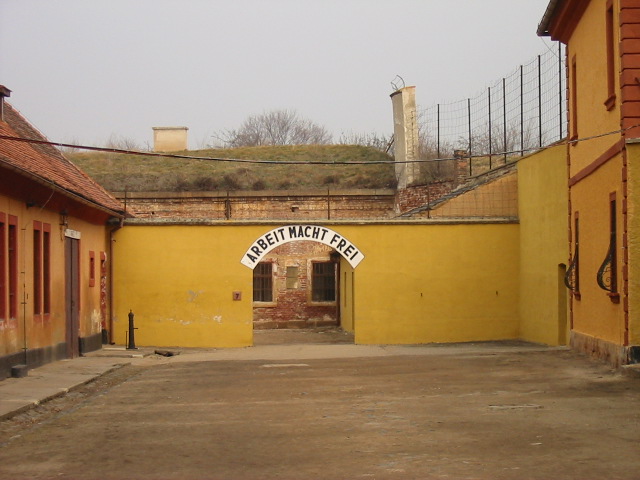
Theresienstadt

Theresienstadt concentration camp

Now that I have more names and more recent relatives, I am hoping that perhaps I can find out more about these people.  I also now know that many of them moved to Bingen, so there may be records from that larger town that will tell me more about the Seligmanns who stayed in Germany. And from several other entries in the book, I know where they lived in Gau-Algesheim.

I would love to be able to read the entire book and learn more about the history and lives of Jews in Gau-Algesheim, but it took me a good part of two days just to translate these few passages, and those translations are not very reliable.  It seems hiring someone to translate the whole book could cost me as much as $1000, and that is not in my genealogy budget by a long shot.  If someone has any brilliant ideas on how to get the book translated for free or for a really reasonable price, please let me know.

What I did learn from the passages I struggled to translate is that my family was not untouched by the Holocaust, as I once believed, but that we lost many people just from Gau-Algesheim alone.   I am hoping that I can find the descendants of the few who seem to have survived—Heinz Arnfeld and Fred Michel and Herbert and Walter Seligmann—and learn more.

In my next post I will discuss the birth records I received for the Seligmanns and how I was able to translate them.  Then I will return to the Nusbaums.
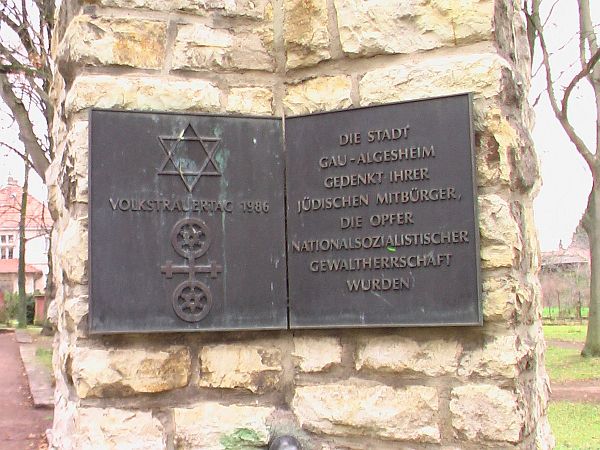
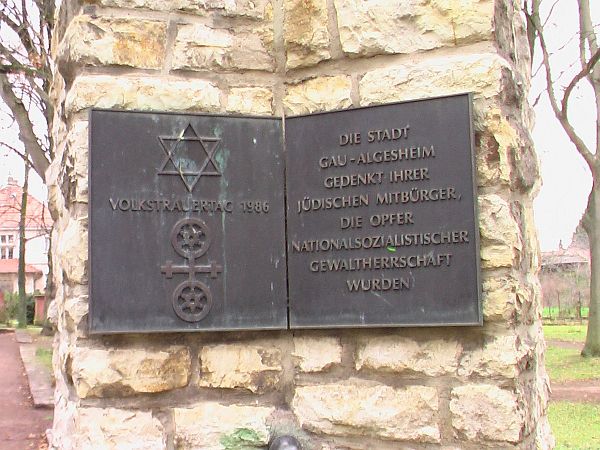
memorial plaque gau aldesheim

Holocaust Memorial plaque in Gau-Algesheim

[1] I found Leonara Morreau’s obituary and researched her a bit, but know of no reason that she would have had a connection to the Seligmanns in Germany.  She was born, married, and lived in Cleveland.  Her husband died in 1933, and she died in 1947.  As far as I can tell, they never traveled to Germany.  Leonara’s brother was Isaac Heller, who was also born in Cleveland, as was their father, Charles Heller.  Although their grandfather was born in Germany, it was not even in the same region as the Seligmanns.  Perhaps Leonara was active in trying to bring German Jews to the United States during Hitler’s reign, but I can find no evidence of that.  Her obituary only states that she was active in charitable and religious causes.

Goodbye for now, Santa Fe

Gau-Algesheim. Langgasse.

Gau-Algesheim. Langgasse. (Photo credit: Wikipedia) Where They Started

I’ve now completed my research of the American Seligmans, or at least those I know to be related to me.  I have added a page with a family tree and descendant chart to the blog that you can find by clicking on the label in the menu box at the top of the page.

For a number of reasons, this has been the easiest branch of the family tree to research.  First, I was fortunate to find my cousin Arthur “Pete” Scott, who is the great-grandson of Bernard Seligman and the grandson of Arthur Seligman.   He had already done a lot of work on the family history in New Mexico and was very generous in sharing his research and photographs with me.  He also had published a great deal of it on the web at vocesdesantafe.com.

Secondly, Bernard and Arthur Seligman were public figures—men who were often written about during their lives in newspapers and after their lives by historians.  Their fame made it much easier for me to find sources and information to learn about their lives and the lives of their families.  (Although it was easier to find information, it also was a lot more work to read it, digest it, and analyze it all.)

Bernard Seligman and other merchants

My great-great-grandfather Bernard on the fronteir

Also, there were not a lot of descendants to trace.  Sigmund Seligman never married, James Seligman in England had no children, and Bernard only had three children who lived to adulthood—my great-grandmother Eva and her two brothers James and Arthur.[1]  Eva’s family I had already researched in doing the Cohen branch, James had only one child who lived to adulthood, and Arthur had one biological child and a stepdaughter.  So compared to the thirteen children of Jacob Cohen, some of whom had over ten children themselves, this was a much smaller family to research.

I still do have work to do, tracing the German Seligmanns and seeing if I can learn what happened to them.  That is a task I will continue to work on, but it will be slowed by the inaccessibility of German records and my inability to read German.  I am ordering copies of the records I posted about here, but I hope to be able to learn more.  Once I know more, I will write about it on the blog.

But for now I will move on from the Seligmans in my writing and begin the next branch of my father’s father’s family, the Nusbaums.  As far as I know, there are no famous people on this branch, but time will tell.  I am hoping that my cousin Pete will be able to help me here as well since he also is a descendant of Frances Nusbaum Seligman.  I have already learned some interesting things about the Nusbaums and am eager to learn more.

Arthur Seligman, Marjorie, and Eva May Cohen, 1932 Atlantic City

Governor Arthur Seligman, Marjorie, and his sister, my great-grandmother Eva May Seligman Cohen, 1932 Atlantic City

Before I move on from the Seligmans, however, I have a few concluding thoughts about this branch of my family tree.  Unlike my Cohen, Goldschlager, Rosenzweig, and Brotman branches, the Seligmans were in the public eye and not able to lead the private lives that my other relatives lived and that most of us live.  They were subject to much scrutiny—Bernard was a wealthy merchant and public servant, Arthur a mayor and governor, and Morton a Navy hero.  Their actions and character were criticized at times, but each in his own way managed to rise above that criticism.   They were loyal, decent and honest men who served their communities with honor.

What the Seligmans share with the rest of my ancestors is the story of Jewish immigrants in general—whether they came in 1850 or 1890 or 1910, whether they came from Germany or England or Romania or Galicia.  All came here for a better life, all were brave enough to leave their homes and their families, all took a risk that living in America would be better for them, their families, and their descendants.  Some may have come with more than others, some succeeded more than others, but all were undoubtedly better off here than they would have been had they stayed in Europe.  With hindsight we know what would have been their fate if they had still been in Europe in the 1930s and 1940s, as was the fate of some of my German Seligmann relatives who did not leave Europe in time.

Once again, I feel grateful for the risks that my ancestors all took and for their courage and hard work, which made it possible for me to be here today, remembering them all.


Bernard Seligman

My great-great-grandfather Bernard Seligman, born in Gau-Algesheim, a pioneering leader in Santa Fe, and father of a US governor


[1] Adolph did have children, and I’ve traced all of his descendants, but out of privacy concerns have not written about them since many of his grandchildren are still living, and I have not been in touch with them.


Gau-Algesheim and the Seligmans: My Great-great-grandfather’s Birthplace and What I Learned

Coat of arms of Gau-Algesheim

Coat of arms of Gau-Algesheim (Photo credit: Wikipedia)

From several documents and historical references, I know that Bernard Seligman, my great-great-grandfather, and his brothers Adolph and Sigmund were born in a small town close to the Rhine River called Gau-Algesheim in what was then the Hesse Darmstadt region of Germany. Today it is located in the Mainz-Bingen district in the Rheinland-Pfalz state in Germany.   Gau-Algesheim is about 15 miles southwest of Mainz and 40 miles southwest of Frankfort, Germany.  Its population in 2012 was under seven thousand people, and it is less than five miles square in area.[1]   From the photographs posted on the town’s official website, it appears to be a very charming and scenic location.  There are wineries nearby, and tourism appears to be an important source of revenue for the town.[2]


What was Gau-Algesheim like almost 200 years ago when my ancestors were living there?  How long had my Seligman ancestors been there, and were there any family members who remained behind after Bernard and his brothers left? How long had there been Jews living in Gau-Algesheim, and are there any left today? These were the questions that interested me the most about my great-great-grandfather’s birthplace.

There is a book about the history of Jews in Gau-Algesheim written by Ludwig Hellriegel in 1986, Die Geschichte der Gau-Algesheimer Juden, but unfortunately there is no copy available online, and the closest hard copy is in the New York Public Library.  I tried to borrow it through my university’s interlibrary loan program, but was it was not available for lending.  Thus, I’ve had to piece together bits of information from Wikipedia, JewishGen.org, the Gau-Algesheim website, and http://www.alemannia-judaica.de to get some answers to my questions, relying on Google Translate in order to read the sources written in German.  What follows is a very brief skeletal history of Gau-Algesheim overall and in particular of the history of Jewish life there based on these limited secondary sources.

Gau-Algesheim has ancient roots.  There is evidence of graves dating back as far as 1800 BCE, and evidence of a settlement during Roman times as well.  In the 700s a church and a monastery were established.  Gau-Algesheim was part of the Holy Roman Empire in the Middle Ages, and during that time was under the control of various different officials and jurisdictions within the Empire and often the subject of disputes and battles for control.  See  http://en.wikipedia.org/wiki/Gau-Algesheim  http://www.gau-algesheim.de/category/stadt-gau-algesheim/geschichte/  It was part of Napoleon’s empire until 1812, and then eventually became part of the nation state of Germany in the mid-19th century.


Gau-Algesheim. Rathaus am Marktplatz.

Gau-Algesheim. Rathaus am Marktplatz. (Photo credit: Wikipedia)

Its Jewish history dates back to at least the 14th century.  By the 14th century, the town had developed into a commercial center.  Many merchants and artisans lived in the town, including herring merchants, blacksmiths, bakers, barbers, coopers, tailors, and shopkeepers.  The monasteries owned a lot of the land, and there was also a fairly large class of nobility.  By 1334, there must have been a Jewish community in Gau-Algesheim because in that year a head tax was imposed upon the Jewish residents.  According to Wikipedia, Jews were required to pay this additional tax because they were considered the property of the crown and under its protection.[3] There was also a Jewish cemetery in existence during the 14th century.  However, this community must have been a very small minority, and the Jews were certainly considered outsiders by the Catholic majority.  In 1348 there was a flu pandemic in the region, and Jews were accused of poisoning the water, such accusations then leading to pogroms across the region.

Gau-Algesheim. Langgasse.

Gau-Algesheim. Langgasse. (Photo credit: Wikipedia)

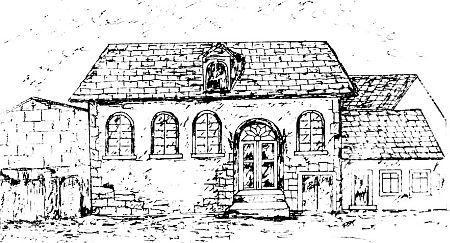
My sources do not reveal anything about Jewish life in Gau-Algesheim between 1400 and 1800, but the population in 1790 was reportedly only nineteen (it’s not clear whether this refers to people or households, but I assume it refers to total people).  In 1808 there were three Jewish families, and in 1819 only six Jewish families.  In 1857, the Jewish population was fifty people, and the Jewish population peaked in Gau-Algesheim in 1880 when it reached eighty people or 2.6% of the total population of the town, according to the alemannia-judaica website.  (JewishGen puts the 1880 population at only 66.[4])  According to alemannia-judaica, a synagogue is not mentioned as being in the town until 1838. It was described as very old and in poor condition in 1850 and was rebuilt in 1861 and renovated again in 1873-1874.  There was also a mikveh and a religious school, although it seems that there was a joint school with the nearby town of Bingen. (Bingen, by comparison, had 542 Jews in 1880, amounting to almost eight percent of its overall population; it was only six miles away from Gau-Algesheim. By further comparison, Mainz had a Jewish population of about 3,000 in 1900, and Frankfurt had almost 12,000 Jews in 1900.)[5]

The tiny size of the Jewish population in Gau-Algesheim in the 19th century in the years when my ancestors were living there surprised me.  How did my family end up there?  And why did they leave? I don’t know the answers to the first question at all and can only speculate about the second and will write more generally about it in a later post.   But what I want to focus on for now is what happened to the Jewish community in Gau-Algesheim after my great-great-grandfather Bernard and his brothers left in the middle of the 19th century.

It appears that my ancestors were not the only Jews to leave Gau-Algesheim.  By 1900, the Jewish population had declined to 27 people; in 1931 there were only 31 Jewish residents.  Presumably many of these Jews had immigrated to another country, and many may have moved to the larger cities in Germany.  In the Reichstag elections of 1933, the Nazi Party only received 26.6% of the vote in Gau-Algesheim with the Center Party carrying almost half the vote.  Unfortunately, that did not reflect the overall vote in Germany, and the Nazi Party took control of the country, soon dissolving the Reichstag and all other political parties, ultimately leading to World War II and the Holocaust.  Whatever Jews were left in Gau-Algesheim before World War II either left the town or were killed by the Nazis.

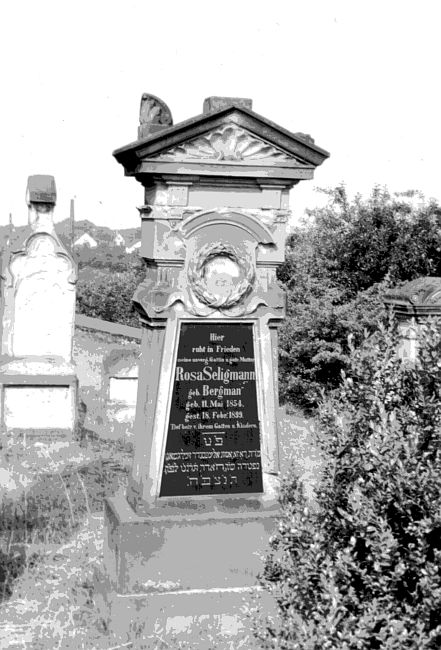
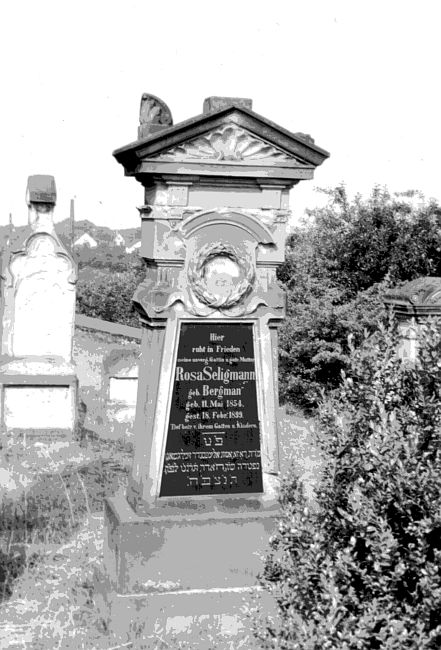
There is no Jewish community there today.  The Jewish cemetery remains, however, although it was desecrated during the Holocaust and has been vandalized several times since then.  In 2006, Walter Nathan, whose father was born in Gau-Algesheim, visited the cemetery and was so disturbed by the condition of the cemetery that he decided to work to have it restored and to create a memorial to those who were buried there and also to those who had been killed in the Holocaust.  On November 9, 2008, on the 70th anniversary of Kristallnacht, the memorial was dedicated by Nathan and many members of his extended family.[6]  Included in the headstones remaining in the cemetery was this one for a woman named Rosa Gebmann Seligmann who was born in 1853 and died in 1899 and married someone who was probably my relative.

With the help of two members of the Tracing the Tribe Facebook group, I can provide this translation of the German and the Hebrew on the headstone.  The German says, “Here rests in peace my unforgettable wife and good mother Rosa Seligman, nee Bergman, born May 11, 1854, died Feb.1 8, 1899. Deeply missed by her husband and children.  The Hebrew at the bottom says, “Here is buried Mrs. Roza wife of Alexander Seligman Died (on the) holy Shabbos 8(th day of) Adar 5659 by the small count. May her soul be bound in the bonds of life.”

There is also a plaque in town commemorating the Jewish citizens of Gau-Algesheim who were killed by the Nazis. It says, as translated by Google Translate, “The city of Gau-Algesheim commemorates their Jewish fellow citizens who were victims of Nazi violence and domination.”


There is another plaque hanging on the wall of the cemetery listing the Jews born in Gau-Algesheim who were murdered during the Holocaust according to Memorial Book: Victims of the Persecution of Jews under the National Socialist Tyranny in Germany 1933 – 1945.  It says, “Standing in this sacred place our hearts turn to the memory of those who fell victim to the violence of the Nazis, and we vow to keep their memory alive. In solemn testimony of the unbroken faith that connects us with them, their names are referred to in profound awe. We say the Kaddish—the prayer for the dead— and remember the terrible tragedy of the Jewish people.”

Among the names listed on this second plaque were these individuals: Bettina Elisabeth Arnfeld born Seligmann (1875), Johanna Bielefeld born Seligmann (1881), Anna Goldmann born Seligmann (1889), and Moritz Seligmann (1881),.[7]

On the JewishGen.org site, I found two more Seligmanns born in Gau-Algesheim: Jacob Seligmann, born April 8, 1869, who became a resident of Neunkirche and emigrated in 1935 to Luxembourg, and Laura Seligmann Winter, born June 9, 1870, who was also a resident of Neunkirche and immigrated to Luxembourg in 1935. [8]

These may have been my relatives.  Given the small size of the Jewish community that lived in Gau-Algesheim, I have to assume that at least some if not all of those named Seligmann were related to my great-great-grandfather Bernard and were thus related to me.  When I saw those names, I was stunned.   Because I have not found where my Brotman relatives lived in Galicia, because I have not found any Goldschlagers from Iasi who were killed in the Holocaust, because my Cohen relatives left Europe long before Hitler was even born, I had not ever before seen the names of possible relatives who were victims of the Holocaust.  But Bettina, Johanna, Anna, Moritz, Jacob, and Laura Seligmann—they were likely the nieces and nephew or the cousins of Bernard, Sigmund, Adolph and James Seligman.  They were likely my family.

Now I need to see what I can learn about them and what happened to them.  I need to be sure that their names are not forgotten.  This is what I know so far from the Yad Vashem names database:

Bettina Elizabeth Seligmann Arnfeld, born March 17, 1875, was residing in Muelheim Ruhr, Dusseldorf, Rhine Province, and was deported to Theresienstadt on July 21, 1942, and she died there on January 23, 1943.


Johanna Seligmann Bielefeld, born March 13, 1881, was living in Mainz during the war.  She died in Auschwitz.


Anna Seligmann Goldmann, born November 30, 1889, was living in Halle der Saale, Merseburg, Saxony Province.  She was deported from there May 30, 1942.  Her husband Hugo Goldmann, born in 1885, and their daughter Ruth Sara, born in 1924, were also deported that same day.  They were all murdered.


Moritz Seligmann, born in 1881, was not listed in the Yad Vashem database.  On the memorial plaque placed at the cemetery in Gau-Algesheim the only notation after his name is Verschollen, which means “missing, lost without a trace,” according to one source.


Jacob Seligmann, despite escaping Germany in 1935 and moving to Luxemburg, did not escape the Nazis.  He was killed in 1941 in Luxemburg, according to the Yad Vashem website.

Laura Seligmann Winter, who may have been Jacob’s sister, was a widow; on August 28, 1940, she also was killed in Luxemburg.


I will continue to look for more records that will tell something about the lives of these people and their families so that they can be remembered not only for how they died but also for how they lived.


“Dachau never again” by Forrest R. Whitesides – Own work. Licensed under Creative Commons Attribution-Share Alike 3.0 via Wikimedia Commons – http://commons.wikimedia.org/wiki/File:Dachau_never_again.jpg#mediaviewer/File:Dachau_never_again.jpg


[1] See http://en.wikipedia.org/wiki/Gau-Algesheim


[2] See http://www.gau-algesheim.de/category/stadt-gau-algesheim/geschichte/


[3] See http://en.wikipedia.org/wiki/Leibzoll


[4] See http://data.jewishgen.org/wconnect/wc.dll?jg~jgsys~community~-1774383


[5] See http://fr.wikipedia.org/wiki/Synagogue_de_Bingen_am_Rhein_(1905-1938)


[6] See http://www.iit.edu/magazine/spring_2009/article_1.shtml#top


[8] [8] http://www.bundesarchiv.de/gedenkbuch/directory.html


The Fusgeyers, Part III:  What Came Afterwards

In my last two posts, I wrote about the vast emigration of Jews from Romania between the late nineteenth century and World War I in the face of widespread anti-Semitism and poverty. According to one source, almost thirty percent of Romanian Jews migrated to the United States or Canada between 1871 and 1914; many others migrated to what was then Palestine.[1]  Wikipedia estimates that about 70,000 Jews emigrated from Romania, almost a quarter of the total Romanian Jewish population in that period.

Many of those who left were part of the Fusgeyer movement, groups who walked from their home towns across Romania to escape, often depending on donations raised by entertaining the crowds in towns throughout their route to freedom.  My grandfather was one of these walkers, and so perhaps were his siblings, cousins and other family members, though I’ve not heard any other descendant report that their grandparent walked across Romania.  According to Culiner, there are no statistics on how many people were a part of this movement or how long it lasted.  Groups ranged in size from forty people to 300 people, and in 1903 about 200 to 300 Jews were leaving Romania each week, many on foot. (Culiner, p. 20).

Although Jacob Finkelstein’s report of the experiences of his 1900 Fusgeyer group painted a generally rosy picture of their trek, being welcomed and well-fed in most places they visited, other groups faced greater struggles.  One observer reported that he saw groups where people were famished, in some cases starving, and living in horrible conditions.  He wrote:

One has to imagine 300 people, men, women and children wandering through the cemetery [where they were then living] like famished wolves, burnt by the sun during the day, tormented by mosquitoes in the night, all three hundred of them with bare feet, sick, some moaning, others crying: fever-racked women who are incapable of feeding their young, the children pale and suffering.[2]

Is it any wonder that my grandfather never talked about his life in Romania, other than to mention the music and beautiful horses he remembered? I’ve asked many of my newly-found Rosenzweig and Goldschlager cousins if they knew anything about their ancestors’  lives in the “old country,” and the response I’ve heard over and over is that their grandparent never wanted to talk about those days, but wanted to focus on the present and the future.  Given the conditions they endured both living in Romania and leaving it, why would they want to remember any of it?

Jewish population per county in Greater Romani...

Despite this large-scale emigration of Jews before World War I, there were close to 800,000 Jews remaining in Romania at the end of that war. (This large increase resulted from the addition of Bukovina, Transylvania, and Bessarabia to the territory controlled by Romania in accordance with the terms of the 1919 Paris Peace Conference after World War I.)


the death train from Iaşi

the death train from Iaşi (Photo credit: Wikipedia)

By the end of World War II, that community had been further decimated.  Approximately 300,000 Jews were murdered in the Holocaust between 1941 and 1944 by the Romanian government, the largest number of people killed by any Nazi ally other than Germany itself.  Nevertheless, unlike in many other countries in Europe, the majority of the Jews in Romania survived the war.  Estimates vary, but approximately 300,000 Romanian Jews survived.  Most, however, did not return to or remain very long in Romania. The Communist era resulted in further reduction of the Jewish population with many who had returned emigrating to Israel or the United States or elsewhere. Wikipedia includes this chart of the declining population of Jews in Romania:


Historical population
Year Pop.   ±%  
1866 134,168
1887 300,000 +123.6%
1899 256,588 −14.5%
1930 728,115 +183.8%
1956 146,264 −79.9%
1966 42,888 −70.7%
1977 24,667 −42.5%
1992 8,955 −63.7%
2002 5,785 −35.4%
2011 3,271 −43.5%
Censuses in 1948, 1956, 1966, 1977, 1992, 2002 and 2011 covered Romania’s present-day territory
Source: Demographic history of Romania


These facts are important in order to put into context my next post: what Romania is like today, as seen through Jill Culiner’s eyes in her book Finding Home and through Stuart Tower’s eyes as depicted in his photographs of Romania.


[1] Joseph Kissman, “The Immigration of Romanian Jews Up to 1914,” YIVO Annual of Jewish Social Science (New York 1947-1948), p. 165, as cited in Jill Culiner, Finding Home: In the Footsteps of the Jewish Fusgeyers (Sumach Press 2004), p. 19.


[2] Isaac Astruc, “Israelites de Roumanie,” p. 43, as translated by and quoted by Culiner, p. 23.


Enhanced by Zemanta

The Fusgeyers: Why They Left Romania

Isadore Goldschlager

Isadore Goldschlager

“Grandpa walked out of Romania to escape from the Romanian army.”  That was the one story I knew about my grandfather’s life before he came to the US as a teenager.  I knew a few other snippets about him in general—that he loved music and animals, that he knew multiple languages, that he was a union activist and very left-wing in his political views, that he was a milkman, and that he was a terrible tease and had a great sense of humor.  But the story about him walking out of Romania was the one that always intrigued me the most.  I would ask my mother questions: Did he go alone?  Where did he walk to? How did he get to the United States? But she knew nothing more than that barebones story—that as a teenager, he decided to run away from the army and walked across the country to escape.

When I first started researching my grandfather’s family, I wanted to know more about this story.  Was it just a myth, or was there any factual basis to it?  I did some initial research and learned that there was in fact an entire movement of Jews who left Romania by foot beginning in the early 1900s, around the same time my grandfather left (1904).  These walkers were known as the Fusgeyers or “foot-goers.”  Unfortunately, I could not find many sources of information about this movement.  I found only two books devoted in depth to the topic.   One is a novel called The Wayfarers by Stuart F. Tower; although written as a novel, it was inspired by the author’s actual search to learn about the Fusgeyers.  It tells the story of an American man whose grandfather left Romania by foot.  The grandson, now an adult, takes his own teenage son and his elderly father to Romania to learn more about his grandfather’s escape from Romania.  The author describes long conversations that the lead character had with a rabbi living in Romania who was familiar with the Fusgeyer movement.  Although this book gave me a taste of what the movement was like, I wanted to read something more fact-based and scholarly to understand and know more about the Fusgeyers.[1]

I found that in the second book about the Fusgeyers: Finding Home: In the Footsteps of the Jewish Fusgeyers by Jill Culiner.  This book, a work of non-fiction, is fascinating and heart-breaking.   After reading Jacob Finkelstein’s “Memoir of a Fusgeyer from Romania to America,” an unpublished Yiddish manuscript written around 1942 and held by the New York-based YIVO Institute, Culiner, not herself a descendant of Romanian Jewss, decided to retrace the routes taken by the Fusgeyers as they walked out of Romania.  She actually walked these routes, visiting all the towns and cities along the way, asking current residents what they remembered of the Fusgeyers and of the Jewish communities that existed in those towns before the Holocaust.  What she learned about the past and present in Romania is what makes the book both fascinating and heart-breaking, and in a subsequent post, I will write more about that.  But first, I want to set the scene by describing what I learned from this book and elsewhere about why the Jews left Romania in the early 1900s.

As reported by Culiner and others[2], Jews had likely been living in the two principalities that became Romania, Walachia and Moldavia, since Roman times.   The Jewish population increased significantly in the second half of the 14th century when many Jews from Hungary and Poland immigrated there after being expelled from their home countries. (Wikipedia).  Ironically, Romania eventually became one of the most anti-Semitic of the European countries.  In 1640, the Church Codes of Walachia and Moldavia declared Jews heretics and banned all relationships between Christians and Jews. (Culiner, p. 15). During the 17th and 18th century, there were repeated “blood libel” accusations against Jews—being accused of killing Christian children for their blood— followed by violence and persecution.  (Culiner, p. 15; Wikipedia).

The widespread anti-Semitism really came to a head in the mid-nineteenth century during the movement for Romanian independence and the unification of Walachia and Moldavia into the independent nation of Romania. As the report on Romanian anti-Semitism on file with Yad Vashem reports, after the Crimean War and the defeat of Russia, which had previously controlled Walachia and Moldavia, the European powers (primarily France and Britain) put a great deal of pressure on the leaders of the independence movement in the region to grant Jews full legal status in the new country.  Although the leaders had originally argued for such rights during the uprisings against Russia, the external pressure created a great deal of resentment, and in the end the European powers backed off from insisting on full legal rights for the Jewish residents of the newly-united nation of Romania.  (Yad Vashem report).

The Yad Vashem report continues:  “A real explosion of openly expressed antisemitism occurred as the prospect of achieving national independence became more certain. During discussions of the new Constitution of 1866, Romanian leaders began to portray Jews as a principal obstacle to Romanian independence, prosperity, and culture.”  As finally drafted, Article 7 of the new Constitution for Romania provided that “[t]he status of Romanian citizen is acquired, maintained, and forfeited in accordance with rules established through civil legislation. Only foreign individuals who are of the Christian rite may acquire Romanian citizenship.”  Culiner described this development, saying that “anti-Semitism had now become part of the national identity.” (Culiner, p. 15)

Despite protests and outcry from western European countries, the new country persisted in its anti-Semitic views and practices.  Between 1866 and 1900, a number of laws were enacted restricting the business and other activities of Jewish residents in Romania.  Jews could not become officers in the military, customs officials, journalists, craftsmen or clerks.  Jews could not vote or obtain licenses to sell alcohol.  Jews could not own or cultivate land.  Jews could not own or manage pharmacies.  They could not work in psychiatric institutions or receive care as free patients in hospitals.  Jews could not sell tobacco or soda water or certain baked goods. Fewer than ten percent of Jewish children were allowed to attend public schools, and Jews were prohibited from opening their own schools.  Jews were not allowed to work as peddlers, which was sometimes interpreted to include owning shops.  Jewish homes were randomly destroyed as “unsanitary.”  (Culiner, pp. 16-17)

Culiner wrote:  “Eventually, 20,000 Jews found themselves on the streets of Romania and dying of starvation.  There were many suicides in Iasi, Bacu, and Roman….In 1899 and 1900, harvests were poor and a severe depression gripped the country.  Anti-Semitic decrees were applied with new severity and anti-Jewish speeches were delivered in parliament.  Riots took place in several towns, and…a pogrom broke out in Iasi.”  (Culiner, pp. 17, 19) (See also Wikipedia  and the Yad Vashem report on Anti-Semitism in Romania.)

That pogrom in Iasi was described in the American Jewish Yearbook of 1900: “For several hours there was fighting, merciless blows, pillaging and devastation, all under the paternal eyes of the police authorities and the army, which interfered only to hinder the Jews from defending themselves.”[3]

In 1900, my grandfather was twelve years old.  He lived in Iasi.  He experienced this horrible violence and hatred.  By that time his uncle Gustave and his aunt Zusi had already left for America.  Is it any surprise that this young teenager would have wanted to escape from his homeland and seek refuge someplace else?

Isadore age 27

Isadore age 27

As I will report in a later post, he and thousands of other Jews did leave, many on foot, walking out of Romania to find a better life.  My grandfather followed his uncle and his aunt, who had left in the late 1880s, but he left alone, without his parents or siblings.  His first cousin Srul Srulovici, who became Isador Adler, had left two years before him in 1902, also alone and without his parents and siblings.  My grandfather left in 1904, and by 1910 the rest of his family—his siblings, mother and father and the rest of his Srulovici cousins—had also arrived.  I don’t know the details of how any of them got out or whether they were also Fusgeyers, but they all  followed their two oldest sons and brothers, both to be called Isadore in the United States.

So  my grandfather left Romania on foot, but not only to escape the Romanian army.  He escaped a life of poverty, of hatred, of discrimination.  He was only sixteen, but he was brave enough, smart enough, and strong enough to get out of a place that held no future for him.  He led his family to freedom.  Whatever life brought them in America, and it wasn’t easy, it was better than what they had left behind.


[1] Apparently the novel is being turned into a documentary about the Fusgeyer movement.  See https://www.kickstarter.com/projects/1552736981/the-wayfarers-the-story-of-the-fusgeyers

[2] Wikipedia has a long and detailed article on the history of the Jews in Romania at http://en.wikipedia.org/wiki/History_of_the_Jews_in_Romania.  I also consulted other sources, such as a report on Romanian anti-Semitism filed on the Yad Vashem website at http://www.yadvashem.org/yv/en/about/events/pdf/report/english/1.1_roots_of_romanian_antisemitism.pdf

[3][3] “Romania since the Berlin Treaty,” The American Jewish Yearbook (Philadelphia: The Jewish Publication Society of America, 1900), p. 83, as quoted in Culiner, p, 19.

Enhanced by Zemanta

Galicia Mon Amour: A Conversation

I just finished watching a video called “Galicia Mon Amour.”  It is a recording of a conversation between Daniel Mendelsohn and Leon Wieseltier.  Mendelsohn’s book, The Lost, which I read a number of years ago, is one of the most moving books I’ve read; in it he recounts his journey to find out what happened to members of his family who had not left Galicia before the Holocaust.  It is beautifully written, well-researched, and deeply tragic.  I read it long before I started doing my own genealogical research, but it likely was one of the sources of inspiration for my journey.[1]

Leon Wieseltier’s book Kaddish is also excellent, but I have to admit much of it was a bit too scholarly and dry for my taste, except for the parts where he reflects on his own family and experiences.  I admit to skimming a lot of the more academic parts of the book.

At any rate, when I saw a recommendation for the video on the digest I receive daily from Gesher Galicia, I decided to try and make the time to watch the video.  (It’s about two hours long.)  You can find a link to the video here.

In the video Mendelsohn interviews Wieseltier about his recent trip to Galicia.  (The interview takes place in January, 2007; Wieseltier’s trip was in 2006.)  Both Mendelsohn and Wieseltier had family that came from eastern Galicia in what is now Ukraine from towns near the city of Lviv, known by the Jews as Lemberg.  Both had taken trips back to the region to research and visit the places where their relatives had lived.  Although Mendelsohn’s direct ancestors had immigrated to the United States before the Holocaust like ours did, he had many relatives who remained behind about whom he had known very little.[2]  Wieseltier’s parents, on the other hand, were Holocaust survivors and came to the United States after World War II.  All the rest of his family was killed in the Holocaust.

One audience member asked at the end of the interview whether there were differences between those who were grandchildren of immigrants and those who were children of Holocaust survivors.  Were the survivors from the wealthier families who saw no reason to leave in the 19th century and the earlier immigrants from the poorer families who had no reason to stay?  Although Wieseltier dismissed this as an overgeneralization, which I am sure it is, it nevertheless is an interesting sociological question.  Remembering Margoshes’ memoirs and the fact that there were so many wealthy Jews, I thought that it made some sense that only those who had nothing to lose would have taken the risk of leaving the world they knew.  This may suggest that Joseph and Bessie were not among the wealthier segments of the Galician Jewish community.

Wieseltier described his own family as being among the more prosperous, educated and aristocratic clans in their area and confirmed the impression left by Margoshes that the Jewish world in Galicia was very diverse and that there were many who were wealthy, well-educated, and sophisticated.  He described Cracow as the “Jerusalem of the North” and the Galitzianers as the princes of the Jewish world.  Mendelsohn concurred, saying that although there was also a lot of poverty, there was a large bourgeoisie and a large wealthy class.  He said that Emperor Franz Joseph, who was the head of the Austro-Hungarian Empire from 1848 until 1916, was admired and even loved by the Jews for his enlightened leadership and treatment of the Jewish citizens, also described in Margoshes’ memoirs.

One observation that I found particularly interesting was Mendelsohn’s comment that he always thought of Jews as living in tenements until he went to Galicia.   He believed that Jews, wherever they lived, lived urban lives, and he was surprised by how wrong he was when he saw the rural areas where they had lived in Galicia.  He described the countryside as beautiful—with mountain, streams, rivers.  Wieseltier used the word “paradise” to describe it.

A lot of their conversation focused on the reasons to make a trip to Galicia.  Both said quite emphatically that this is not a place to go for typical tourist reasons; for Mendelsohn it was partly to find out what happened there and to visit the places where his family had lived. Wieseltier said he went not only out of grief, but also out of pride. He talked movingly of standing where his mother had once stood and leaving a copy of his book in the empty field as a symbol of Jewish survival.  Both talked about the absence of Jewish life there now and how the Polish people themselves realize how much has been lost by the destruction of the Jews and their culture.  Wieseltier said that you won’t find Jewish life there so you must bring your Judaism with you if you go.

There is also discussion of the Holocaust, of the camps, of anti-Semitism, but overall the theme was more about remembering the world that was there in a realistic and accurate way and cherishing that culture and the people.  Wieseltier himself is quite skeptical of genealogy (“It’s amazing how much you can’t learn from genealogy.”).  Although Mendelsohn obviously values genealogical research highly, he did not really push Wieseltier to elaborate on this point.  I think, however, that Wieseltier was expressing some doubts about all those who, like me, are trying to trace some names and dates to make a connection, perhaps without any purpose or perspective.  He said that our parents and grandparents were ours “by luck,” just as the fact that we have two legs or brown eyes, and that what is more important is who we are ourselves and what we do with our lives.  I think that that is an important perspective for me to remember as I continue to look for our family in Galicia.


[1] We were fortunate enough to hear Mendelsohn read from and talk about the book many years back when it was first published.  That made his story even that much more personal.

[2][2][2] I am sure that that is true for the Brotman family as well, although I do not know specifically of any family members who died in the Holocaust.

A Call to Israel!

Just to show that I never give up, I thought I’d report on a phone call I made this morning to Shmuel Brotman of Kiryat Tivon in Israel.   Renee, my mentor, made the suggestion that I look for any Brotmans who had lived in Dzikow by checking both JRI-Poland and the database at Yad Vashem.  Both sources found one family, the family of Shmuel and Zipporah Brotman, who had resided in Dzikow/Tarnobrzeg.  It looked like the entire family had died in the Holocaust, but Renee suggested I contact the person who had submitted the names to Yad Vashem, Shmuel’s daughter-in-law Chana Brotman.

I then had to track down Chana Brotman.  I knew from the Yad Vashem submission that she had lived in Kiryat Tivon in 1997 when she submitted the names of Shmuel and his family, and so I made a request on both the JewishGen website and on Gesher Galicia for help in locating the family.  By this morning I had several responses, including two that gave me phone numbers, one for Chana and one for her son Shmuel.  The person who provided me with Shmuel’s number had just spoken with him and said he was awaiting my call.

I jotted down some notes and then called Shmuel.  He’s about my age and fluent in English.  He was very happy to help me, and we spent about half an hour, comparing notes and trying to figure out whether there is a connection between our families.

At the moment I still don’t know what the connection is, but it seems likely that there is one.  His grandfather Shmuel Brotman was born around 1888 in Dzikow, and his great-grandfather’s name was Moshe.  I don’t yet know where Moshe Brotman was born.  He could even be the same Moses Brotman who ended up in Brotmanville.  We still have to sort more things out.

He did tell me that he has done some research and believes that the Brotman family originally came from Georgia in the former Soviet Union and left to escape the pogroms.  He believes they changed their name to Brotman to get across the border.  According to Shmuel, some Brotmans went to the US, some to Romania, and some to Poland, including his family.  Whether our ancestors were also part of that family I don’t yet know, but it is a possibility.

So just as I was about to give up hope of finding more traces of our family, I received a glimmer of hope this morning from Israel.  No matter where this goes, it was another one of those uplifting experiences where strangers helped me find someone and that someone ended up being welcoming and hopeful that we are related.

A World Apart, part 5: Relationships between Jews and non-Jews in Galicia

My reading this time related largely to the relationships between the Jews and non-Jews in Galicia, socially, politically and otherwise.  Margoshes began this section by claiming that at least in the region where he lived near Radomishla, the Jews were economically and politically often more powerful than most of the non-Jewish population.   I would never have expected that at all; I assumed that the Jews were oppressed politically and economically.  Instead, Margoshes asserted that in area from Rzeslow to Tarnow to Krakow, the peasants lived under the dominance of the Jewish estate holders.  He wrote, “During the period between the 1880s and [World War I], this part of Galicia was a true paradise for Jews in some respects.” (p. 99; emphasis added)

According to Margoshes, in this region, anti-Jewish persecution and acts were unknown, and Jews and gentiles lived peacefully together.  If a peasant struck or even just insulted a Jew, the courts would punish the peasant by placing him in jail for at least two days.  Peasants would tip their hats to Jewish estate-holders when they were driving (oxen or horses, I assume) on the road and when they entered their homes.  (There is no mention of how the peasants treated and were treated by poor Jews, just the wealthier Jews, who in many instances were the employers of these peasants.)

Margoshes explains the political context for this by pointing out that in 1846 there had been a widespread revolt of the peasants against the wealthy Polish lords and landholders and that even forty years later, the politically powerful Polish aristocracy which controlled the government had not forgiven the peasants for the violence, deaths and damages caused by that uprising.  Thus, in a dispute between a peasant and a Jew, the government would generally side with the Jew.

Margoshes also attributed much of the peacefulness of the region to the Austro-Hungarian gendarmes who were responsible for keeping law and order in the Empire as part of the imperial army.  These soldiers lived in the area in barracks and frequently visited the estates to insure that all animals were registered and that everything was being managed according to the requirements of the Empire.

That did not mean that there were no disputes or problems between the peasants and their Jewish employers.  Margoshes described a number of incidents of theft by the peasants who worked at his father-in-law’s estate.  He wrote, “A Jewish estate-holder and his household had to have eyes in the back of their heads in order to make sure that the workers were not stealing from him….” (p. 127).  He also made the offensive generalization that it was part of the “inborn nature” of the peasants to steal: “he had to steal whenever the opportunity presented itself, especially from the Jewish estate-holder.  For a peasant, the smallest stolen article was an asset.”

In one story about the workers at his father-in-law’s estate in Zgursk, moreoever, Margoshes also revealed that the relationships between the Polish peasants who worked on the estate and their Jewish employers were not always quite so amicable.  There were at times hundreds of workers on the estate, and many of them boarded there.  Margoshes himself admits that their living conditions were substandard: “everyone found a place to sleep in one of the three stables atop hay and straw and that was it.  No pillows or sleepwear were provided and…a blanket used to cover horses served as a cover.” (p. 96) The estate did provide three meals a day that Margoshes described as generous.   Margoshes’ mother-in-law and father-in-law were the task masters who oversaw all the work on the estate, and his father-in-law was known to be rather cold and strict.

Margoshes described one time that his father-in-law lost his temper with some of the workers who in his view were not working hard enough and began beating them with a paddle.  In response, these workers and a number of others went on strike and refused to return to the fields. It took an intervention from the mother of the father-in-law to persuade the workers to return to work the next day.  Margoshes described this as if it were a one-time incident, and perhaps it was, but it does reveal that there was some abuse of the peasants by at least this powerful Jew, his own father-in-law.

Thus, although Margoshes initially described the relationship between the gentile peasants and the Jews as peaceful and amicable, these incidents of theft and abusiveness suggest that there was in fact a great deal of resentment and anger among the peasants towards the Jews. Perhaps he was deluding himself when he wrote that it was a “true paradise” for Jews in this region during that time.

According to Margoshes, the wealthy Jews also had good relationships with the wealthy Polish lords and landowners, called pritsim or porits in the singular.  He described his relationship with a neighboring porits  as “very friendly, although from a distance.” (p. 103) They would help each other out with favors, but were not social friends.  Margoshes did not think that this relationship was unusual.  He said that he “never heard of a case in the entire region of a porits who had negative relations with a Jew or where he insulted a Jew or harmed him in any way,” (p. 104) although he did then go on to mention one polits who refused to trade with Jews.

There was also, according to Margoshes, peaceful co-existence between the Catholic priests and the Jewish population.  Although he commented that “[p]riests, especially Catholic priests, cannot ever really be friends of the Jews” because “it is almost against [their]religion to love people of another faith,” (p.111), he reported that nevertheless for the most part there was little conflict between the priests and the Jewish estate holders.  He described a church law that prohibited Catholics from working as servants in Jewish homes, but pointed out that it was rarely enforced since the peasants needed employment and often worked in Jewish homes. Margoshes even developed a friendship with one of the local priests, but he severed that relationship when the priest tried to persuade Margoshes to come and see his church—not to convert, but just to go inside the church.  Obviously, this “friendship” was a superficial one based on necessity, and feelings of distrust and difference outweighed any sense of real connection.  Margoshes made it clear that it would not have been acceptable for him, as a Jew, to be seen in a Catholic church.

By the time I finished reading this section, I realized that Margoshes had had a very unrealistic view of the relationships between the Jews and non-Jews in Galicia during the late 19th century.  First, his viewpoint is entirely based on the experiences of the wealthy Jewish estate-holders.  The non-Jewish peasants may have seemed respectful and accepting of their Jewish employers, but beneath the surface there was likely a great deal of resentment and anger.  The priests and non-Jewish estate-holders also may have been willing to live peacefully side-by-side with the wealthy Jews, but there certainly was not a true acceptance or friendship in these relationships.  The gendarmes may have been keeping the peace, but beneath the surface the Jews were still the outsiders who were not integrated into the gentile world.

Moreover, Margoshes does not at all provide a picture of what life was like for the Jews who were not wealthy estate-holders.  Were their relationships with the peasants, priests, and wealthy Polish landowners as “peaceful”?  Or were they the targets of all the repressed resentment and anger that the gentiles felt towards the wealthy Jews?

It occurred to me after reading these chapters that Margoshes was writing in 1936.  He had no idea what was going to happen in Poland during the Holocaust. I wonder whether his naiveté about how the gentiles felt about the Jews was widespread in Poland during the 1930s and 1940s.  If only they had been more realistic, perhaps more of them would have left sooner.

Which brings me to another question: if things were so great in the 1880s and 1890s for wealthy Jews in Poland, why did Margoshes and so many others, including Joseph and Bessie, leave?