Ernest Lion’s The Fountain at the Crossroad: An Unforgettable Book

I am very excited to announce that Ernest Lion’s memoir, The Fountain at the Crossroad, has now been published and is available on Amazon.com both as a paperback ($10.50) and an ebook ($2.99). [UPDATE: the Kindle version is now available!] It has been my honor and privilege to bring this book to the public with the permission and assistance of Ernest’s son Tom.  I did this because I found the book unforgettable and because I don’t want Ernest or his life to be forgotten.  Tom and I are not deriving any financial gain from sales of the book. All net proceeds received from sales of the book will be donated to the United States Holocaust Memorial Museum in memory of Ernest Lion.

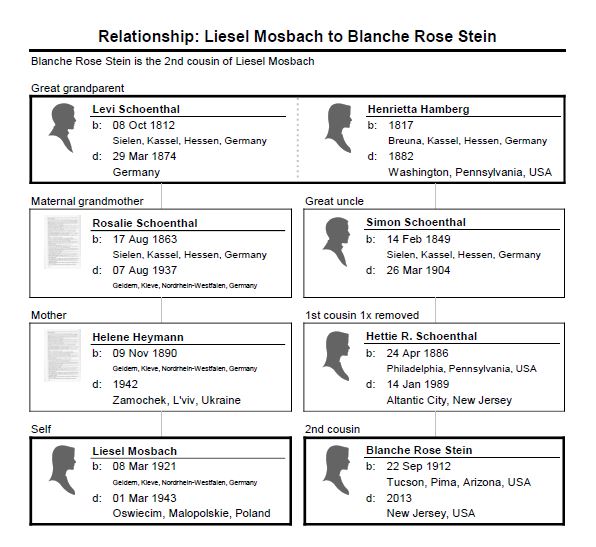
I have written about some aspects of Ernest’s life on the blog as he was married to my cousin, Liesel Mosbach, granddaughter of Rosalie Schoenthal, my grandfather’s sister.  Ernest and Liesel were deported from Germany to Auschwitz in early 1943; Liesel was murdered there, but Ernest survived.

The story of what he endured and how he survived is moving and horrifying.  His determination and courage in the face of unimaginable suffering is a story of what it means to be human when you are surrounded by inhumanity. And Ernest’s escape from the Nazis kept me on the edge of my seat even though I knew that he would survive.

But the book is not only about Ernest’s experience during the Holocaust.  It also tells the story of his childhood growing up with his parents in Germany and of his early adulthood when he dreamed of being an actor.  In addition, Ernest wrote about his life after the war—how he rebuilt his life in the US, starting all over, scarred by his experiences, but nevertheless determined to have a full and meaningful life.

Ernest only started talking about his Holocaust experiences late in his life, and then he was persuaded to write his memoirs.  In doing so, he relived much of the pain, but also reached a very poignant conclusion about the value of his own life.

If you have an interest in history, in World War II, in the Holocaust, in fact, if you have an interest in human beings and what they are made of, you should read this book. You can find it here.

Sliding Doors

Back in April, I wrote about the family of Rosalie Schoenthal, my great-grandfather’s sister, the one who stayed in Germany to marry Willy Heymann.  Most of what I knew of their fate I learned from the memoir written by Ernest Lion, the man who married Rosalie and Willy’s granddaughter, Liesel Mosbach.  Liesel, her sister, her parents, and her aunt, were all victims of the Holocaust. Ernest Lion memorialized them all in his heartbreaking memoir, The Fountain at the Crossroad.

As I mentioned in a subsequent post written for Yom Hashoah in May, I was so moved by Ernest’s story that I tracked down his son Tom to ask about getting it published so that it could be more widely read.  Since then, I have been working with Tom to edit and format the memoir for publication.  (We’ve run into a few obstacles, but that’s a story for another day.)  I am hoping that sometime soon the book will be available for distribution. When it is, I will post the relevant information on the blog.

But none of this would be possible without the help of another of my cousins by marriage, Sharon.  Sharon is married to the great-grandson of Simon Schoenthal, who was also my great-grandfather’s brother as well as Rosalie Schoenthal Heymann’s brother.  And Sharon, who writes the blog The Heart and Craft of Life Writing, has a great deal of knowledge not only about writing, but also about getting your writing published.  Sharon and her husband were the ones who shared with me the remarkable memoir written by Hettie Schoenthal Stein.  So when I decided to try and get Ernest Lion’s book into a publishable format, I turned to Sharon for help.

Sharon spent hours through email and Skype instructing me on how to turn a typed manuscript into a format that is not only more readable, but also professional looking.  She has been incredibly patient with me, as all this was new to me, and the old brain isn’t quite as flexible as it once was.  I cannot possibly express how grateful I am to her for her help.

One of the last things we worked on was inserting photographs into the memoir, and as she was doing this, Sharon was struck by the resemblance she saw between Liesel Mosbach Lion, Ernest’s first wife and our mutual cousin, and Sharon’s mother-in-law, Blanche Stein Lippincott.  She sent me a photograph of Blanche and her family that I had not previously seen.

ezzie-blanche-parvin-1940

Blanche Stein Lippincott and her family 1940 Courtesy of the Lippincott family

And here is a photograph of Liesel Mosbach and Ernest Lion that I obtained from Ernest’s son to put into his book:

wedding-ernest-liesel-dec-18-1940-600-dpi

Liesel Mosbach and Ernest Lion Courtesy of the Lion Family


The resemblance is striking.  Blanche and Liesel were second cousins, but from these two photographs, they could have been sisters.

jpg-blanche-to-liesel


But what different lives and fates they had, and the expressions on their faces in these two photographs reflect those differences. While Blanche looks healthy and happy, Liesel looks drawn and sad, even on her wedding day.

Blanche was born in 1912 in Tucson, Arizona, and grew up living on the American frontier in the 1910s and 1920s.  Her mother Hattie and her aunt Gertrude had ventured out west after growing up in Philadelphia and Atlantic City.  They did later return to the East, as I’ve written, and Blanche spent the rest of her life living in New Jersey.  She married in 1937 and raised two children with her husband Ezra.  Blanche lived a long and happy life, making it to almost 101 years old before dying in 2013.  Her mother Hettie had made it to 103.

Blanche Stein Lippincott with her great-granddaughter 1996

Blanche Stein Lippincott with her great-granddaughter 1996

In contrast, Liesel lived a short and tragic life.  She was born in 1921 in Germany, where her father Julius Mosbach owned a fruit and vegetable stand. The family was probably living a comfortable enough life until Hitler came to power.  When Liesel married Ernest Lion on December 18, 1939, conditions for Jews were terrible in Germany, and the young couple had no idea what the future would bring.

There would, in fact, be no future. As a result of the Nazi oppression and the loss of his business, Julius Mosbach suffered a nervous breakdown; in 1941, he was sent to an institution where instead of being treated, he was murdered by the Nazis. In 1942, Liesel’s mother, sister, and aunt, and Ernest’s father were all deported and eventually killed in a Nazi concentration camp.  In 1943, Liesel and Ernest were deported to Auschwitz, where Liesel was killed.  Ernest survived and eventually escaped; he became the voice for the whole family.

Thus, Blanche and Liesel, second cousins who looked like sisters, had far different lives and fates.  I can’t help but think, what if Rosalie and Willie had come to the US like almost all of Rosalie’s siblings? What if Liesel and her sister Grete had grown up in Pennsylvania or anywhere else in the United States?

As the president of our synagogue reminded us on Rosh Hashanah, we cannot control where we are born, when we are born, or to whom we are born.  Some of us are blessed with good luck in all of those things while others are not.  We should never take that for granted.

Yom Hashoah—Holocaust Remembrance Day

Today is Yom Hashoah, Holocaust Remembrance Day, a day to remember all those who were killed during the Holocaust.

As a result of my genealogy work, I have learned in the last few years that there were many members of my extended family who were victims of the Nazis.  I had always assumed that all my relatives had left Europe before Hitler came to power—long before he came to power.  So learning about the many members of the Seligmann family who were killed and then more recently about the many members of the Schoenthal and Hamberg families who were killed has been very painful.

The Holocaust touched us all, whether we know it or not, whether we are Jewish or not. Our world lost millions of people.  As each generation learns how cruel and inhumane other people can be, there is once again a loss of innocence.  I dread the day when my grandsons also have to learn this horrible truth.

English: A lit Yom Hashoah candle in a dark ro...

English: A lit Yom Hashoah candle in a dark room on Yom Hashoah (Photo credit: Wikipedia)

Last spring I visited the camps at Terezin and Auschwitz.  I carried with me a list of the names of my relatives who had died at each of the camps so that I could honor their memories.

That list has grown since last spring.  One of the most recent names I’ve had to add to the list of those who died at Auschwitz was Liesel Mosbach Lion, granddaughter of Rosalie Schoenthal Heymann, my great-grandfather’s sister.  Liesel was my father’s second cousin.

I recently posted about Liesel and her family and what happened to them.  Most of what I knew came from the memoir written by Liesel’s husband Ernst Georg Lion, The Fountain at the Crossroads.  I was so moved by his book that I have decided to see whether there is a way to get it published in a format where it will be accessible to more people.  I am now in touch with Ernst’s son Tom.  He sent me photographs of Ernst and his family, including my cousin Liesel.  With his permission, I am posting a few of them here to honor their memory this Yom Hashoah.

The first three are of Ernst’s parents, Leo and Bertha (Weinberg) Lion.  Bertha died from the stress caused by the Nazi treatment of Jews during the 1930s.  Leo was killed in one of the camps.

Ernst Lion parents 1 Ernst Lion father

Ernst Lion parents 2

This is the last photograph taken of Leo Lion before he was arrested and sent to a concentration camp.

Ernst Lion father 2

On the left below is my cousin Liesel Mosbach Lion; she was killed at Auschwitz.  On the right is the wedding picture of Liesel and Ernst, December 18, 1939.

Liesel, her sister Grete, both of her parents, Helene Heymann Mosbach and Julius Mosbach, and her aunt Hilda Heymann were all killed during the Holocaust. Her grandfather Willy Heymann was arrested and taken to Dachau and died soon after being released.

They were all my cousins.

Liesel Mosbach Lion alone and in wedding picture with Ernst

These are various photographs of Ernst from childhood through the war years and afterwards in the US.  His story of suffering and survival is unforgettable.

pictures of Ernst Lion

We live in a time when once again hatred and fear permeate our world and demagogues are seeking power.  We must be vigilant and remember what happened then.  We must do all we can to ensure that genocide does not occur again anywhere.

We must never forget.  Never again.

Passover 2016: The Exodus

In many ways Jewish history is about one exodus after another.  The Jewish story begins when God tells Abra(ha)m, “Lech Lecha,”  or “Go, Go out.”  He instructs him to leave his father’s land and go to a new land where his children would be as numerous as the stars.

There are many journeys throughout the Bible—Noah’s journey, Jacob’s journey, Joseph’s journey, and, of course, the exodus from Egypt led by Moses, which is recalled and re-enacted every year on Passover.

This Friday evening we will once again remember and re-enact that journey.  We will read the story of the Exodus.  We will drink wine, recline like free people, and eat matza to remember that our ancestors had no time to wait for the dough to rise before exiting from Egypt.  We will eat the bitter herbs to remember the bitterness of slavery, and we will eat the charoset—a mixture of apples, nuts, and wine—to embrace the sweetness of freedom from slavery.

English: Passover Seder Table, Jewish holidays...

English: Passover Seder Table, Jewish holidays עברית: שולחן הסדר, Original Image Name:סדר פסח, Location:חיפה (Photo credit: Wikipedia)


But that exodus was not the last journey our people took to freedom.  Over the centuries Jews kept moving from one land to another, either having been expelled or deciding on their own to seek freedom from oppression, violence, and hatred.  They moved to Babylonia, to Spain, to eastern Europe, to Germany, to places all over the globe, including eventually to the Americas.

I have spent much of the year since last Passover studying the journeys of my paternal relatives from Sielen, Germany—my father’s maternal grandfather’s family, the Schoenthals.  Although I still have a few more stories to share about my Schoenthal cousins, now that I have written about all the children of Levi Schoenthal and Henriette Hamberg, I want to spend this Passover looking back over the story of this particular family.

Levi and Henriette Schoenthal had ten children who survived to adulthood, all born in Sielen, Germany.  Of those ten, eight settled permanently in the US, and all but one of those eight started their lives in America in western Pennsylvania—either in Pittsburgh or the town thirty miles away, known as Little Washington.  Henry, the oldest son, arrived first in 1866, and by 1881, eight of the siblings were living in the US.  Henry over the years was a book seller and a china dealer, but underneath was a deeply religious and well-educated man.

His youngest brother was my great-grandfather Isidore, who arrived in 1881, also settled in Washington, and also worked as a china dealer.

Isidore Schoenthal

Isidore Schoenthal

In between Henry and Isidore were four other brothers in the US plus two sisters.  Over the years almost all of them prospered.  Some moved away from western Pennsylvania.  Simon ended up in Atlantic City, where he and his wife raised nine children, many of whom ended up in the hotel business there; Felix and his wife and two daughters ended up in Boston, where he became successful in the typewriter repair business. Julius lived in Washington, DC, worked as a shoemaker and had four children.  Nathan lived in many different places.  And even Isidore and Henry eventually left Pennsylvania, Isidore for Colorado and Henry for New York.  The two sisters, Hannah and Amalie, stayed in Pittsburgh for most of their lives.  Both were married and had children.

Felix and Margaret Schoenthal from 1919 passport application, National Archives and Records Administration (NARA); Washington D.C.; NARA Series: Passport Applications, January 2, 1906 - March 31, 1925; Roll #: 728; Volume #: Roll 0728 - Certificates: 70500-70749, 19 Mar 1919-20 Mar 1919

Felix and Margaret Schoenthal from 1919 passport application,
National Archives and Records Administration (NARA); Washington D.C.; NARA Series: Passport Applications, January 2, 1906 – March 31, 1925; Roll #: 728; Volume #: Roll 0728 – Certificates: 70500-70749, 19 Mar 1919-20 Mar 1919


Simon Schoenthal, my great-great-uncle

Simon Schoenthal, my great-great-uncle


The next generations wandered even further afield, although many ended up not too far from where their parents had originally settled.  My grandmother, who was born in Washington, PA, and grew up in Denver, spent her whole adult life in Philadelphia and New Jersey.

My Grandma Eva

My Grandmother Eva Schoenthal Cohen

Martin Schoenthal, Gertrude Sch., Hettie Sch Blanche Walter

Walter Schoenthal, Gertrude Schoenthal, Hettie Schoenthal, Blanche Stein and Walter Stein in Arizona


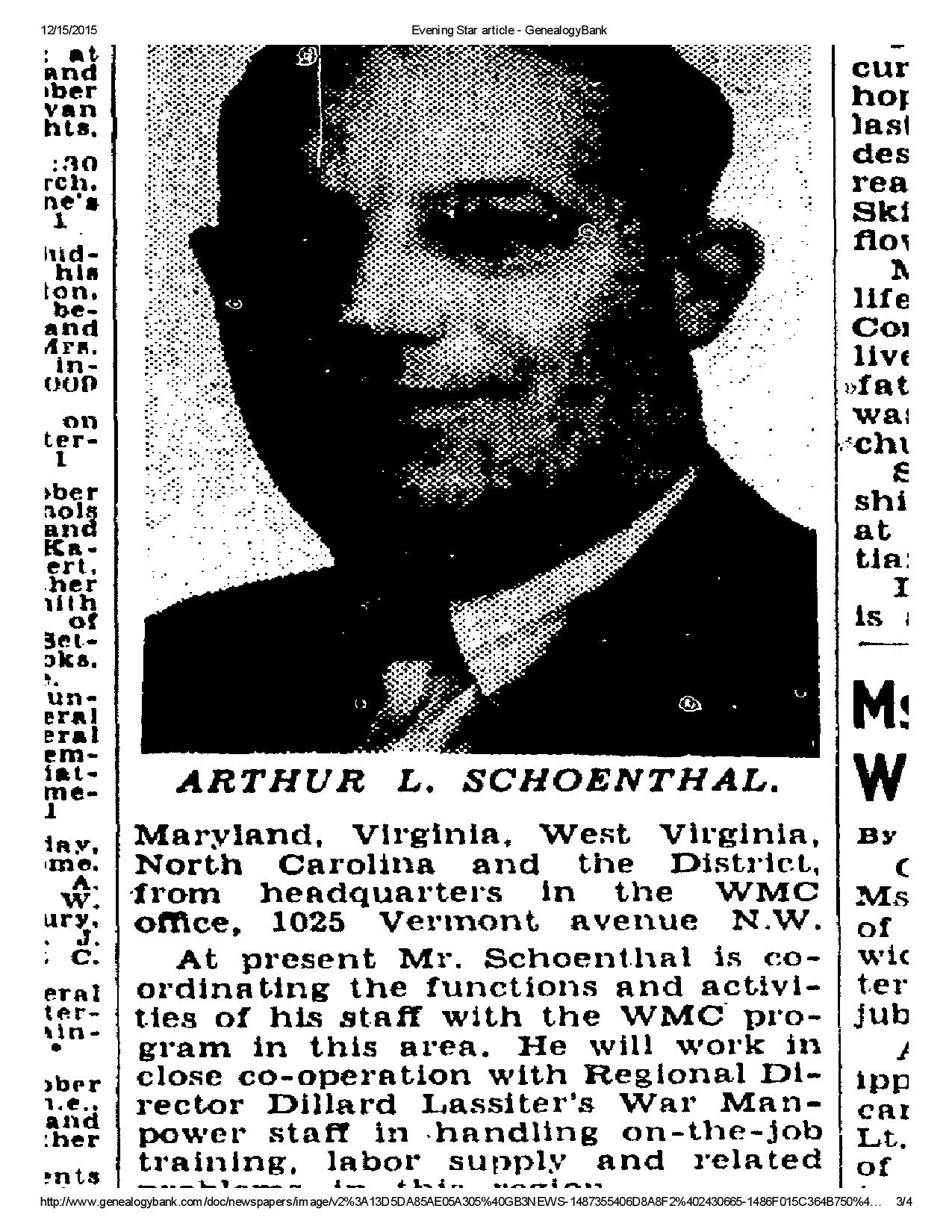
Arthur Schoenthal promoted 1942-page-003


Washington Evening Star, September 14, 1928, p. 9

Washington Evening Star, September 14, 1928, p. 9


Washington Star, December 2, 1928 p. 64

Washington Star, December 2, 1928 p. 64

Washington Evening Star, February 18, 1963, p. 24

Washington Evening Star, February 18, 1963, p. 24


Overall, the Schoenthals in the US prospered; most were successful business owners.  Most of these people appeared to have full and happy lives, although there were some who struggled.  Today there are numerous living descendants of those eight siblings, myself included.

On the other hand, the two siblings who stayed in Germany did not have as happy a legacy.  Jakob died young, and his daughter Henriette was killed in the Holocaust.  His four other children survived and, like their aunts and uncles, ended up in western Pennsylvania. Lee, Meyer, and Erna came before the war.  But Johanna was deported to a camp in Gurs, France, during the war and did not come until 1947.   From these five children, there were just two grandchildren: Helmut Levi, son of Henriette and Julius Levi, and Werner Haas, Erna’s son.  Both grandsons made it to the US before World War II.  Neither had children, however, so there are no living descendants of Jakob Schoenthal and his wife Charlotte Lilienthal.

Jewish Chronicle of Pittsburgh, June 14, 1984, p. 23 ewish+Chronicle+Vol.+23+No.+18 Formed+by+the+union+of:+Jewish+criterion+;++and:+American+Jewish+outlook. http://doi.library.cmu.edu/10.1184/pmc/CHR/CHR_1984_023_018_06141984

Jewish Chronicle of Pittsburgh, June 14, 1984, p. 23
ewish+Chronicle+Vol.+23+No.+18
Formed+by+the+union+of:+Jewish+criterion+;++and:+American+Jewish+outlook.
http://doi.library.cmu.edu/10.1184/pmc/CHR/CHR_1984_023_018_06141984


And finally Rosalie, the youngest child of Levi and Henriette, after living in the US for a few years made the fateful decision to return to Germany to marry Willy Heymann.  They had six children.  Four survived the Holocaust.  The three sons, Lionel, Max, and Walter, settled in Chicago before the war, where Lionel became a well-regarded photographer.   One daughter, Johanna, who was widowed at a young age, followed her stepdaughter Else Mosbach to Sao Paulo, Brazil, to escape the Nazis.

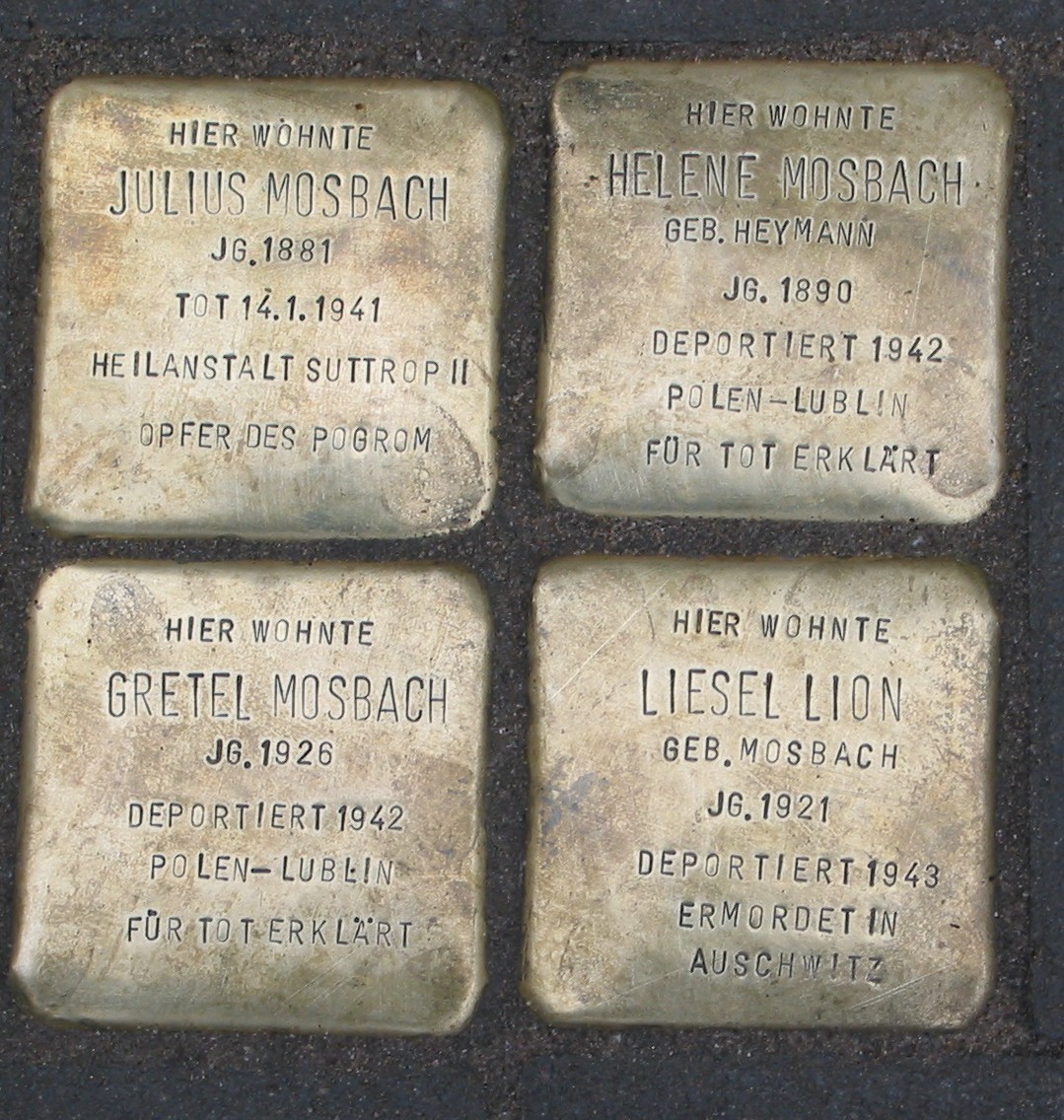
The other two daughters, Helene and Hilda, were murdered in the Holocaust as were Helene’s two daughters, Liesel and Grete.  From Rosalie’s six children, only one grandchild survived, the son of Max Heymann.  I am still hoping to find him.

Stolperstein for Julius Mosbach and family

The Schoenthal story illustrates how one fateful decision can alter the future irrevocably. One decision to take a chance and leave what you know—to listen to the call of Lech Lecha, to venture out to a new land—can make all the difference.  By taking a chance that the sweet charoset of that new land would outweigh the bitterness of leaving a land they knew, my great-grandfather and seven of his siblings changed their own fates and those of their descendants.

What if Jakob and Rosalie had left Germany when their siblings did?

And what if the other eight siblings had never left at all?  This story would have a very different ending.

In fact, it never would have been written.


Fritz Davids: A Young Hero


I know I promised my next post would be about Lionel Heymann and his secret life, but first I need to write about someone else, someone who was not in any way related to me, but who deserves to be remembered and honored.  I will return to Lionel next time.

In my last post I had asked for help in interpreting a sentence in the Steinheim Institute site describing what had happened to Willy Heymann.

Willy Heymann wurde nach seinem Tod von dem 14jährigen Fritz Davids, der erst kurze Zeit zuvor aus dem KZ Dachau zurückgekehrt war, in das man ihn nach derPogromnacht mit seinem Vater verschleppt hatte, ganz alleine und heimlich zum Friedhof gebracht und begraben.

Translated by a member of the German Genealogy Facebook group as:

After his death, Willy Heyman was brought secretly to the cemetery and buried by 14 year old Fritz Davids alone, who had returned only a short time before from the concentration camp of Dachau where he had been brought with his father after the [Kristallnacht, Nov. 9, 1938].

And two members of the genealogy village came to my assistance and found this link and interpreted it for me:

Recently back from the concentration camp, Fritz Davids experienced, two months later, how bad the Jews had fared. There was no respect even for the dead. The Jew Willy Heymann died at the age of almost 84 years old. Since nobody wanted to bury him or could, the 14-year-old Fritz put the corpse in a wheelbarrow and at dawn wheeled it to Boeckelter Weg (street name) to the Jewish cemetery, where he, fully in dignity of the time, shoveled a grave for the old man and spoke the Kaddish. David Cain and Jacob Heymann were also buried under such humiliating circumstances.

Imagine being fourteen, being arrested and sent to a camp like Dachau.  Then imagine coming back and finding what the Nazis had done to your community.  And then imagine that fourteen year old boy having the courage and the moral decency to ensure a proper burial for one of his fellow citizens, an 84 year old man whose wife had died and whose three sons were in America.   What an exceptional person this young boy must have been.

That left me and some of my readers wondering about this brave fourteen year old boy, Fritz Davids.  Who was he, and what happened to him?

So this morning I checked my sources, and what I learned did not shock me, but it did break my heart.

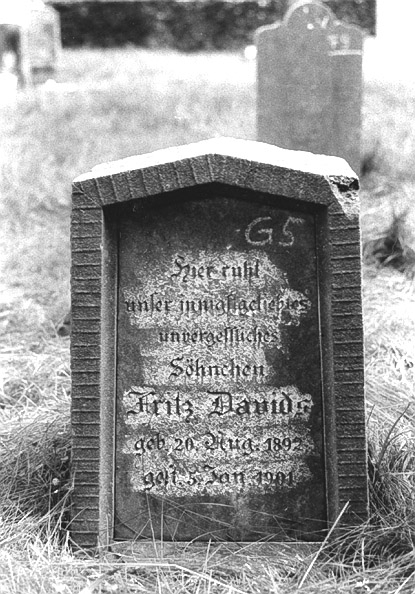
Fritz Davids, the son of Gustav Davids and Freidel Hext, was born in Geldern on April 4, 1924.  He was named for his father’s brother, who had died in 1901 when he was just nine years old.

Fritz Davids, uncle of the subject of this post http://www.steinheim-institut.de/daten/picse05/xl/0051_E05_1_1984.jpg

Fritz Davids, uncle of the subject of this post
http://www.steinheim-institut.de/daten/picse05/xl/0051_E05_1_1984.jpg


Fritz was imprisoned again at Dachau on September 5, 1941, until May 4, 1942.  He was then deported to the killing facility at Hartheim, where he was killed on July 2, 1942.  Both of his parents and his aunt were also murdered during the Holocaust.

Fritz Davids was 18 years old.  He did not get a decent burial.  No one was there to say kaddish for him.

May his memory be for a blessing.  May we never forget his name.

The Little Sister Who Went Back Home: Rosalie Schoenthal, Part I


Finally I have come to the youngest of my great-grandfather’s siblings, the only one born after he was, his younger sister Rosalie.   Her story is even more tragic than that of her brother Jakob.

Rosalie was born in Sielen, Germany, in 1863, five years after my great-grandfather Isidore.  As I wrote earlier, she came with her mother and Isidore to the United States in 1881 when she was eighteen, but returned to Germany to marry Willy Heymann of Geldern, to whom she was apparently engaged even before leaving Germany. They were married on December 8, 1884, in Geldern.


I was fortunate that there were numerous sources available that provided me with information about Rosalie, Willy, and their family.  Two German websites had biographies of Willy and Rosalie Heymann and their children.  One, a site about the Geldern Jewish community, indicated that Willy and Rosalie had had six children, although it only named two of them, Helene and Hilda.  A second website containing information about the Heymann family was the Steinheim Institute site, which confirmed the fact that there had been six children and provided the names and birth years of all six as well as other pertinent facts that helped me with my research of Rosalie’s children.

From these two sources, I learned that Willy was a horse trader like his father Levi Heymann and was born in Geldern in February, 1857.  Geldern is about 150 miles from Sielen, so I’ve no idea how Rosalie and Willy knew each other; perhaps their fathers had known each other.  Willy and Rosalie settled in Geldern; their six children were: Lionel, born in 1887 and presumably named for Rosalie’s father, my great-great grandfather Levi Schoenthal; Johanna, born in 1889; Helene, born in 1890 (perhaps named for Henriette Hamberg, Rosalie’s mother), Max, 1893; Walter, 1896; and Hilda, born in 1898.

The Geldern site had a photograph of the Heymann home in Geldern, depicted below.


Home of Willy and Rosalie Schoenthal Heymann in Geldern http://hv-geldern.de/images/juden/juden.htm

Home of Willy and Rosalie Schoenthal Heymann in Geldern
http://hv-geldern.de/images/juden/juden.htm

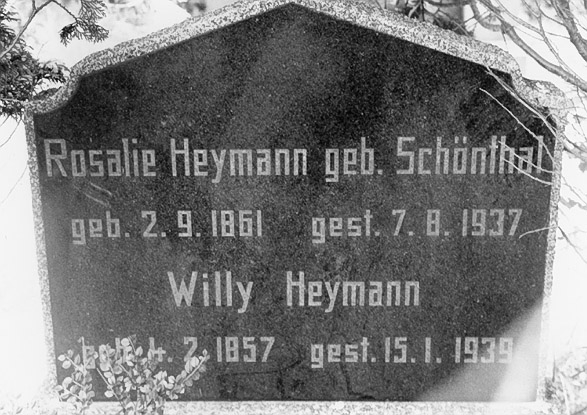
The Steinheim Institute site reported that Rosalie died on August 7, 1937, when she was 74 and that Willy Heymann died on January 15, 1939; it provided this description of his death:

Willy Heymann wurde nach seinem Tod von dem 14jährigen Fritz Davids, der erst kurze Zeit zuvor aus dem KZ Dachau zurückgekehrt war, in das man ihn nach der Pogromnacht mit seinem Vater verschleppt hatte, ganz alleine und heimlich zum Friedhof gebracht und begraben.

Translated by a member of the German Genealogy Facebook group as:

After his death, Willy Heyman was brought secretly to the cemetery and buried by 14 year old Fritz Davids alone, who had returned only a short time before from the concentration camp of Dachau where he had been brought with his father after the [Kristallnacht, Nov. 9, 1938].

How would you interpret that sentence? Does it mean that Willy had died outside of Geldern and been secretly returned by this fourteen year old boy? Had Willy also been at Dachau or just Fritz and his father? Or does it mean that Willy and Fritz’s father had been brought to Dachau after Kristallnacht? Does the “he” in that last phrase refer to Willy or Fritz?  I am inclined to think that Willy was at Dachau because otherwise, why would he have had to have been secretly brought to the Geldern cemetery?

UPDATE:  Thanks to Renate Adolfs and Cathy Meder-Dempsey, I now have more information about what happened to Willy, and it is awful.  Both Renate and Cathy found a link here that describes the terrible fate of Willy Heymann.  As translated by Cathy, this is the full story:

Aus dem KZ zurück, muß Fritz Davids schon zwei Monate später miterleben, wie schlimm es mittlerweile den Juden erging. Selbst vor dem Tod hat man nämlich keine Achtung mehr : Der Jude Willy Heymann war fast 84-jährig verstorben. Da ihn niemand begraben wollte oder konnte, lädt der 14-jährige Fritz die Leiche auf eine Schubkarre und fährt sie im Morgengrauen zum Boeckelter Weg auf den jüdischen Friedhof, wo er, ganz der ‚Würde” der Zeit entsprechend, dem alten Mann ein Grab schaufelt und den Kaddish spricht. Auch David Cain und Jakob Heymann wurden unter solchen entwürdigenden Umständen begraben.

Recently back from the concentration camp, Fritz Davids experienced, two months later, how bad the Jews had fared. There was no respect even for the dead. The Jew Willy Heymann died at the age of almost 84 years old. Since nobody wanted to bury him or could, the 14-year-old Fritz put the corpse in a wheelbarrow and at dawn wheeled it to Boeckelter Weg (street name) to the Jewish cemetery, where he, fully in dignity of the time, shoveled a grave for the old man and spoke the Kaddish. David Cain and Jacob Heymann were also buried under such humiliating circumstances.

Thank you, Renate and Cathy, for allowing me to memorialize Willy Heymann more completely.


The information about Willy and Rosalie and their children was also confirmed by a third source, Juden in der Geschichte des Gelderlandes (2002), a book edited by Gerd Halmanns and Bernhard Keuck that contains information, photographs, articles, documents, and maps of the Jewish communities in Geldern and the surrounding townsRodney Eisfelder from the GermanSIG of JewishGen kindly sent me a copy of page 370 from that book, which lists information about Willy Heymann and his family.  That page also provided me with numerous clues about the Heymann children.

page 370 for blog

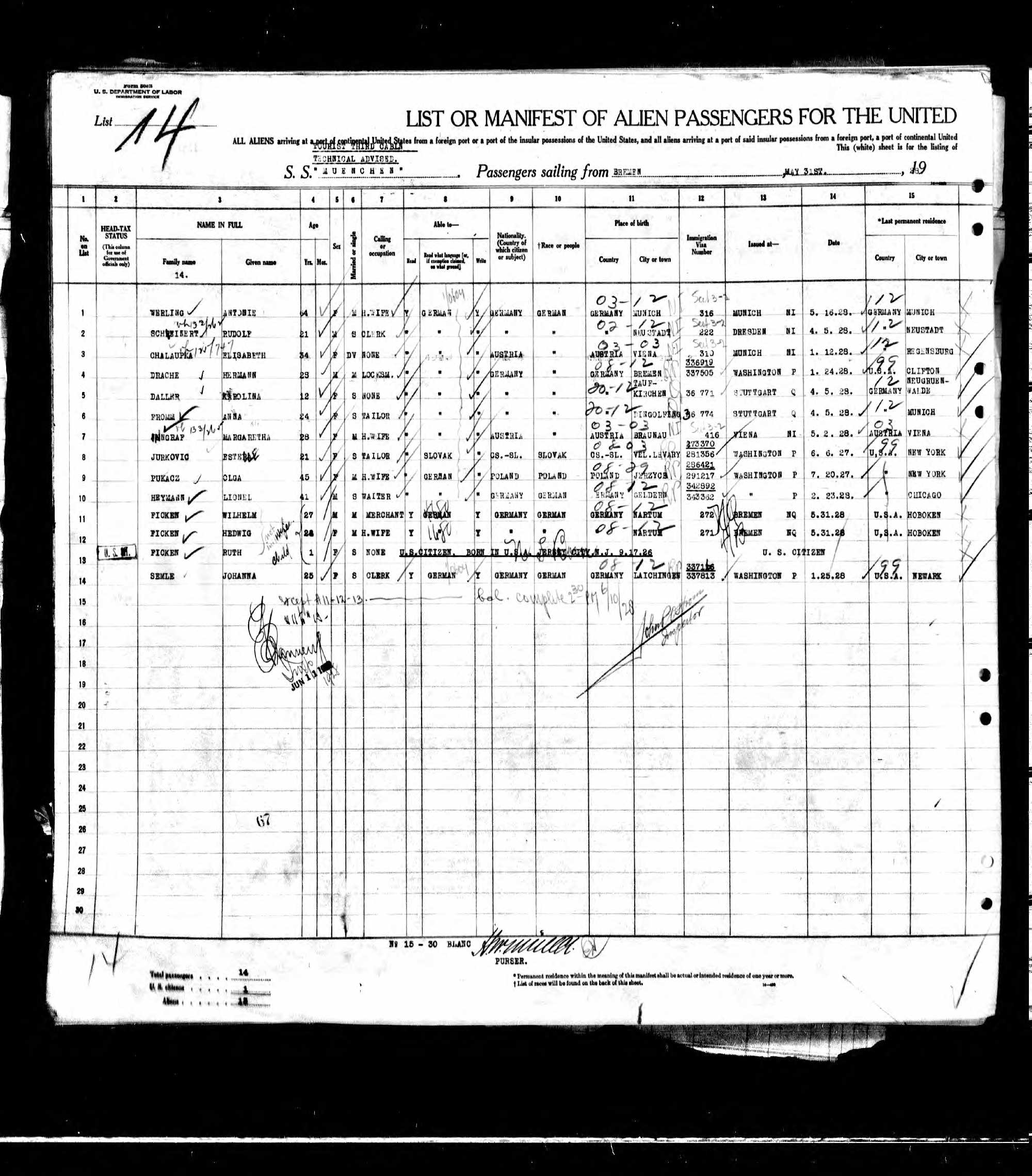
From these sources, I knew that Lionel Heymann, the oldest child, had moved to Chicago, but I found out that before he immigrated to the US, he had left Germany for England; he is listed on the 1911 English census as a 24 year old German national, living in London and working as a hotel waiter.


Lionel Heymann 1911 UK census Ancestry.com. 1911 England Census [database on-line]. Provo, UT, USA: Ancestry.com Operations, Inc., 2011. Original data: Census Returns of England and Wales, 1911. Kew, Surrey, England: The National Archives of the UK (TNA), 1911. Data imaged from the National Archives, London, England.

Lionel Heymann 1911 UK census
Ancestry.com. 1911 England Census [database on-line]. Provo, UT, USA: Ancestry.com Operations, Inc., 2011.
Original data: Census Returns of England and Wales, 1911. Kew, Surrey, England: The National Archives of the UK (TNA), 1911. Data imaged from the National Archives, London, England.

In 1912 he sailed from England to Algiers, still a German citizen, but listing his intended future permanent residence as Switzerland.  He was working as a hotel manager, according to the ship manifest.


Lionel Heymann 1912 passenger manifest Ancestry.com. UK, Outward Passenger Lists, 1890-1960 [database on-line]. Provo, UT, USA: Ancestry.com Operations, Inc., 2012. Original data: Board of Trade: Commercial and Statistical Department and successors: Outwards Passenger Lists. BT27. Records of the Commercial, Companies, Labour, Railways and Statistics Departments. Records of the Board of Trade and of successor and related bodies. The National Archives, Kew, Richmond, Surrey, England.

Lionel Heymann 1912 passenger manifest
Ancestry.com. UK, Outward Passenger Lists, 1890-1960 [database on-line]. Provo, UT, USA: Ancestry.com Operations, Inc., 2012.
Original data: Board of Trade: Commercial and Statistical Department and successors: Outwards Passenger Lists. BT27. Records of the Commercial, Companies, Labour, Railways and Statistics Departments. Records of the Board of Trade and of successor and related bodies. The National Archives, Kew, Richmond, Surrey, England.

He next surfaced on a passenger ship manifest for a ship sailing from England to New York in 1924. He was still a German citizen, stating that his last permanent residence was Geldern, Germany, and listing his father “Wilhelm Hyman” of Geldern as his contact in that place.  He said that he was going to his uncle Harry Schoenthal of 260 Riverside Drive in New York City.  At first I was thrown by this, but then realized he must have meant Henry Schoenthal, his mother’s oldest brother, who was in fact living in New York at that time.  Lionel indicated on this manifest that he intended to settle permanently in the United States.


Lionel Heymann 1924 passenger manifest Ancestry.com. New York, Passenger Lists, 1820-1957 [database on-line]. Provo, UT, USA: Ancestry.com Operations, Inc., 2010. Original data: Passenger Lists of Vessels Arriving at New York, New York, 1820-1897. Microfilm Publication M237, 675 rolls. NAI: 6256867.

Lionel Heymann 1924 passenger manifest
Ancestry.com. New York, Passenger Lists, 1820-1957 [database on-line]. Provo, UT, USA: Ancestry.com Operations, Inc., 2010.
Original data: Passenger Lists of Vessels Arriving at New York, New York, 1820-1897. Microfilm Publication M237, 675 rolls. NAI: 6256867.

By 1928, Lionel was living in Chicago and working as a waiter, as reflected on this October 30, 1928 passenger manifest.  He was still an alien resident, listing his father again as his contact in Germany, but providing his Chicago address as his permanent address.  He was returning from Germany, so he probably had been visiting his family back home.


Lionel Heymann 1928 passenger manifest Year: 1928; Arrival: New York, New York; Microfilm Serial: T715, 1897-1957; Microfilm Roll: Roll 4280; Line: 1; Page Number: 200

Lionel Heymann 1928 passenger manifest
Year: 1928; Arrival: New York, New York; Microfilm Serial: T715, 1897-1957; Microfilm Roll: Roll 4280; Line: 1; Page Number: 200


Interestingly, Lionel’s younger brother Walter had arrived in the US just a few months earlier in June, 1928.  This was consistent with the information in the above-mentioned  sources—that is,  that Walter also had ended up in Chicago. On the ship manifest for Walter’s arrival it reports that Walter was a cook, that he was 32, that his last residence had been Cologne, Germany, and that he was heading for Chicago where his brother Lionel resided.


Walter Heymann 1928 ship manifest Year: 1928; Arrival: New York, New York; Microfilm Serial: T715, 1897-1957; Microfilm Roll: Roll 4373; Line: 1; Page Number: 141

Walter Heymann 1928 ship manifest
Year: 1928; Arrival: New York, New York; Microfilm Serial: T715, 1897-1957; Microfilm Roll: Roll 4373; Line: 1; Page Number: 141


After searching the 1930 census as many ways as I could, including using Lionel’s address as given on both the 1928 ship manifests and his 1933 naturalization papers (1411 Winnemac Avenue), I concluded that the census enumerator had completely missed that address.  The listings include 1409 and 1413, but not 1411.  Just my luck.

Although I could not find Lionel on the 1930 census, Walter is listed on that census, living as a lodger in Chicago and working as a chef in a hotel.  He was then 34 years old and had been in the US for two years and had filed his papers for citizenship.

As mentioned, Lionel became a naturalized US citizen in 1933.

Ancestry.com. U.S. Naturalization Record Indexes, 1791-1992 (Indexed in World Archives Project) [database on-line]. Provo, UT, USA: Ancestry.com Operations, Inc., 2010.

Ancestry.com. U.S. Naturalization Record Indexes, 1791-1992 (Indexed in World Archives Project) [database on-line]. Provo, UT, USA: Ancestry.com Operations, Inc., 2010.

According to the Cook County, Illinois Marriage Index, Walter Heymann married Lucie Goldschmied on March 16, 1934.  Lucie was born in Frankfurt, Germany, on February 11, 1908, the daughter of Miksa (later Americanized to Michael) Goldschmied, a Hungarian native, and Bertha Hirschberg, a native of Eschbach, Germany.  Lucie first came to the US in 1928, according to the 1930 census, which has her listed as residing at the Moraine Hotel in Highland Park, Illinois (a suburb of Chicago), where she was employed as a pantry servant.  I assume that this was the same hotel where Walter was employed as a chef.

The Chicago Tribune described the history of the Moraine Hotel in an article published on May 11, 1986:

In the early years of this century, the Hotel Moraine-on-the-Lake sparkled as a North Shore glamor resort. Built on 15 acres overlooking Lake Michigan in Highland Park, the hostelry opened in 1900 with 140 rooms.

The Moraine immediately caught the eye of the rich and famous. Glancing through old guest registries (now in the Highland Park Historical Society), you`ll spot some well-known Chicago names–the Marshall Field family, the Swifts, the Pullmans, the Florsheims, and many others.

Guests came from all over the U.S. and even from abroad. Some of the more affluent even traveled with their chauffeurs and maids.

…   The heyday of the Moraine continued into the 1920s, when the increasing number of guests necessitated additions to the hotel. Then came the Depression and even the Moraine was not spared–it declared bankruptcy in 1937.

By 1939, the once-grand hotel had become a barracks for military officers. But sunnier days were just around the corner. In 1942, the hotel was purchased, rehabbed, and reopened. It regained some of its former glory and operated until 1969, when the last guest checked out.

In 1972, the Hotel Moraine-on-the-Lake itself checked out. It was torn down and the site was turned into a public park.

“North Shore Glamor Hotel Reborn,” Chicago Tribune, May 11, 1986


If this is indeed where Walter and Lucie were working when they met, they were certainly working in quite a grand place.

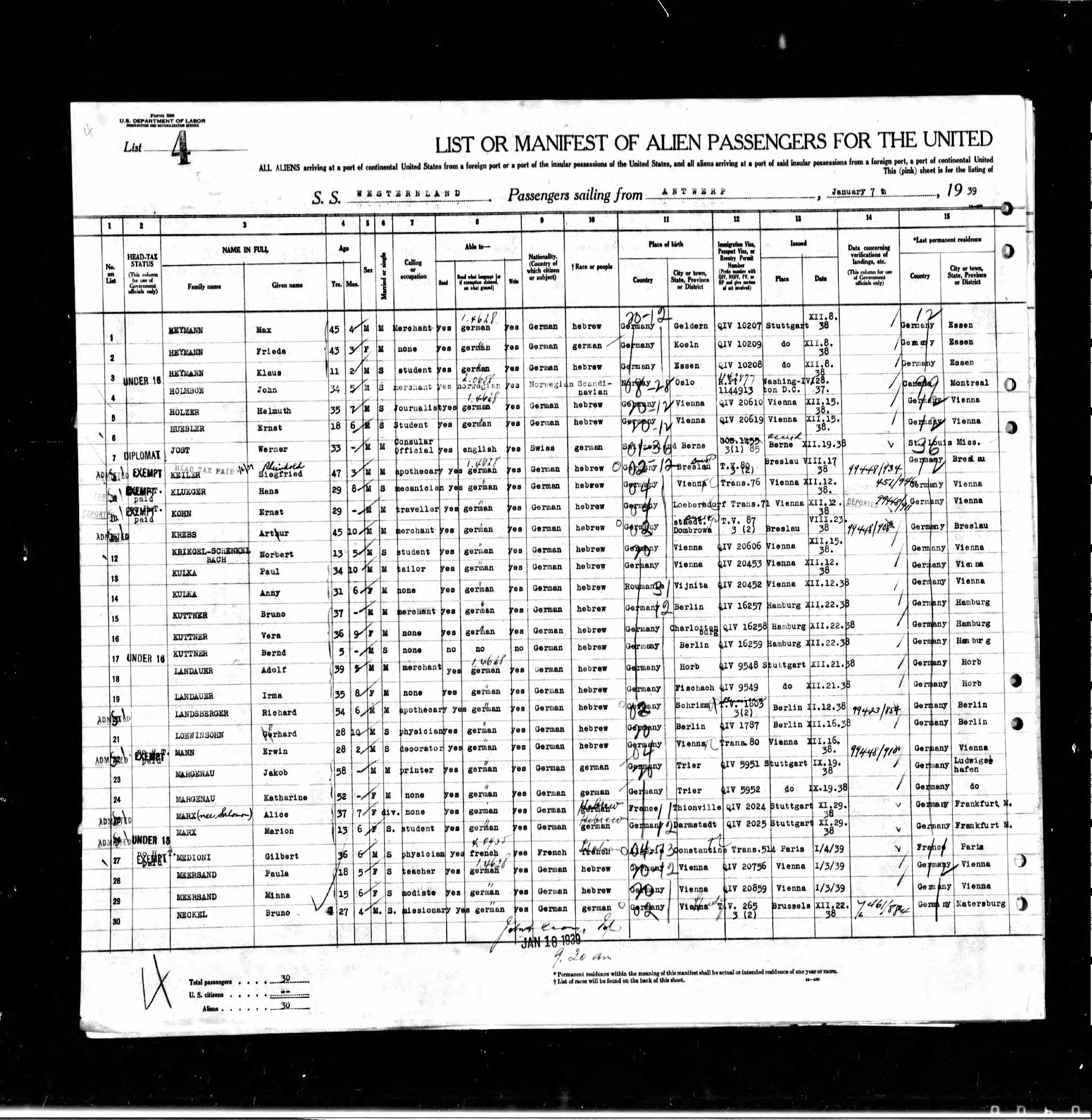
Max Heymann, the middle brother, was still back in Germany during this period, but he finally came to the US with his wife Frieda and their eleven year old son Klaus on January 7, 1939, escaping from Nazi Germany.  They had been most recently living in Essen, Germany, where Klaus was born.  Max listed his occupation as a merchant, his father Willy Heymann as the person he was leaving behind, and his brother Lionel as the person he was going to in the US.  I was surprised to see that Lionel was then living in Detroit, not Chicago.


Max and Frieda Heymann 1939 ship manifest Year: 1939; Arrival: New York, New York; Microfilm Serial: T715, 1897-1957; Microfilm Roll: Roll 6274; Line: 1; Page Number: 8

Max and Frieda Heymann 1939 ship manifest
Year: 1939; Arrival: New York, New York; Microfilm Serial: T715, 1897-1957; Microfilm Roll: Roll 6274; Line: 1; Page Number: 8


By 1940, all three of the sons of Rosalie Schoenthal and Willy Heymann were living in Chicago.  According to the 1940 census, Lionel was living in the household of his brother Max in 1940, apparently having returned from Detroit.  Lionel was now the head waiter at a hotel, according to the census.  Max was a salesman for a paper box manufacturing company. Lionel, Max, Frieda, and Klaus were living at 1441 Belle Plaine Avenue in Chicago.

Walter and his wife Lucie as well as Lucie’s recently arrived parents, Michael and Bertha Goldschmied, were living a mile away from Max and Lionel at 3325 North Paulina Street in Chicago.  Walter was continuing to work as the cook in a hotel, and Lucie was working as a waitress, perhaps in the same hotel restaurant.  Lucie and Walter did not have any children.

All three brothers registered for the World War II draft in 1942.  According to those registrations, Lionel was still living with Max on Belle Plaine Avenue and working for the Blackstone Hotel.  Max was now working for Parfeit Powder Puff Company in Chicago. Walter was still living on North Paulina Street and working for “Martin,” a restaurant.


Lionel Heymann World War II draft registration Ancestry.com. U.S., World War II Draft Registration Cards, 1942 [database on-line]. Provo, UT, USA: Ancestry.com Operations, Inc., 2010. Original data: United States, Selective Service System. Selective Service Registration Cards, World War II: Fourth Registration.

Lionel Heymann World War II draft registration
Ancestry.com. U.S., World War II Draft Registration Cards, 1942 [database on-line]. Provo, UT, USA: Ancestry.com Operations, Inc., 2010.
Original data: United States, Selective Service System. Selective Service Registration Cards, World War II: Fourth Registration.

Max Heymann World War II draft registration Ancestry.com. U.S., World War II Draft Registration Cards, 1942 [database on-line]. Provo, UT, USA: Ancestry.com Operations, Inc., 2010. Original data: United States, Selective Service System. Selective Service Registration Cards, World War II: Fourth Registration

Max Heymann World War II draft registration
Ancestry.com. U.S., World War II Draft Registration Cards, 1942 [database on-line]. Provo, UT, USA: Ancestry.com Operations, Inc., 2010.
Original data: United States, Selective Service System. Selective Service Registration Cards, World War II: Fourth Registration

Walter Heymann World War II draft registration Ancestry.com. U.S., World War II Draft Registration Cards, 1942 [database on-line]. Provo, UT, USA: Ancestry.com Operations, Inc., 2010. Original data: United States, Selective Service System. Selective Service Registration Cards, World War II: Fourth Registrati

Walter Heymann World War II draft registration
Ancestry.com. U.S., World War II Draft Registration Cards, 1942 [database on-line]. Provo, UT, USA: Ancestry.com Operations, Inc., 2010.
Original data: United States, Selective Service System. Selective Service Registration Cards, World War II: Fourth Registrati

Max died a year later on May 31, 1943.  He was only 49 years old.  Walter died ten years after his brother Max on August 14, 1953; he was only 57.  Did the stress of uprooting themselves and worrying about their relatives back home contribute to their early deaths? I don’t know.

Lionel, the oldest brother, lived the longest.  He died on November 29, 1966, when he was 79 years old.  I was fortunate to find both a death notice and an obituary for Lionel (but none for his brothers).  Those two records revealed more about Lionel than I’d been able to glean from the passenger ship manifests or the census records.  He’d had a whole other life not reported on those documents.

More on that in my next post.


Fighting their Native Country in World War II: Jakob Schoenthal’s Grandsons

As I wrote last time, the two sons of Jakob Schoenthal and Charlotte Lilienfeld had arrived in the US long before Hitler came to power in Germany.  They were working as tailors and living in Washington, Pennsylvania, where their uncles and aunt had lived for many years.  Then Hitler came to power, and their family back home was in danger.

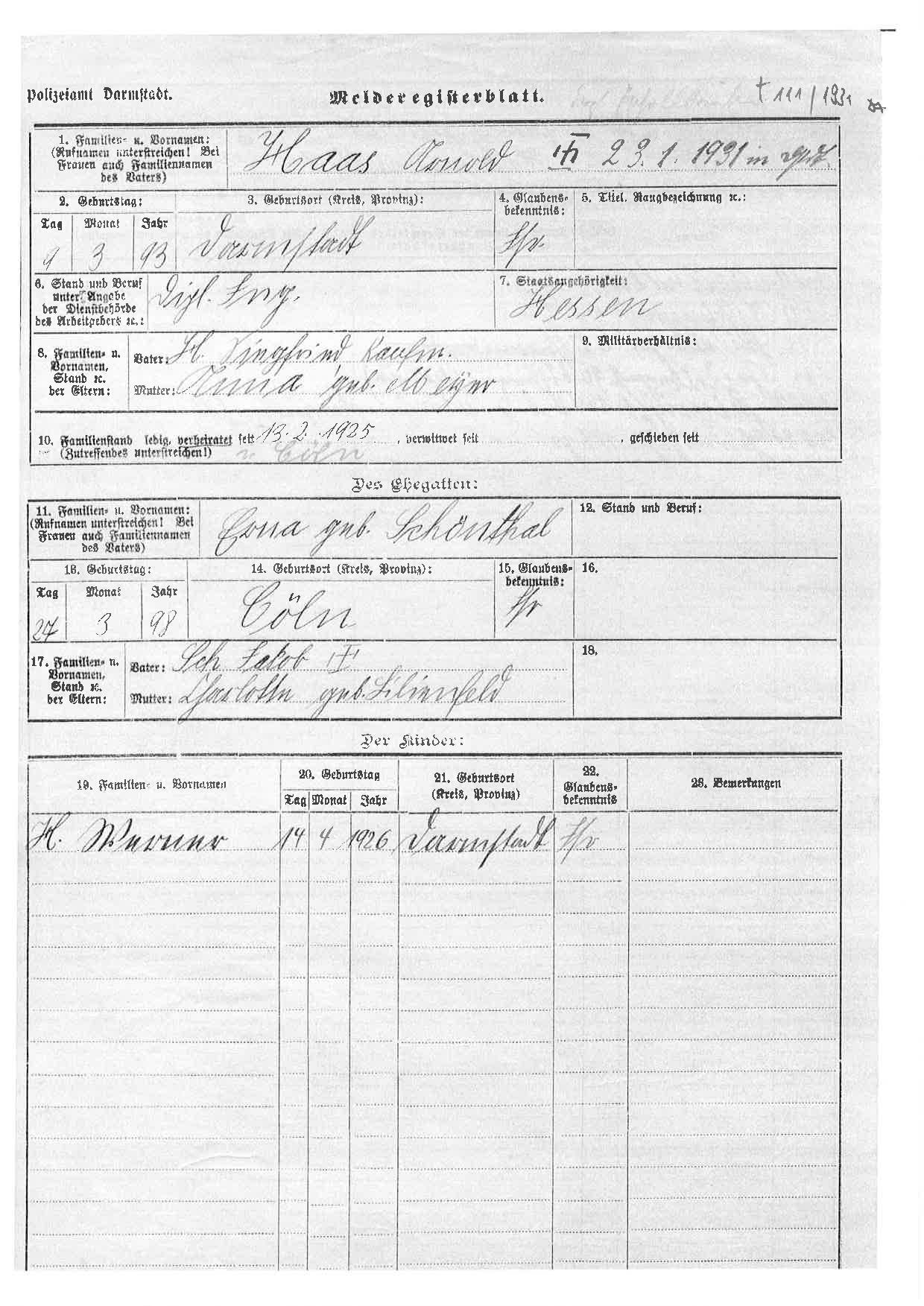
In 1938, Lee and Meyer’s sister Erna arrived from Germany with her son Werner.  I have now learned more about Erna’s husband Arnold Haas.  He was born in Darmstadt, Germany, in 1893, and had served his native country during World War I.  He and Erna Schoenthal had married on February 13, 1925, and their son Werner was born on April 14, 1926.  Then Arnold died at age 38 on January 23, 1931, leaving behind his young widow Erna and his not-yet five year old son Werner.  Fortunately Erna had the good sense to leave Germany in May, 1938, and bring her son and herself to safety in the US.  In 1940, they were living in Pittsburgh.

Darmstadt register for Arnold Haas and family indicating birth, marriage, and death of Haas and birth of son Werner

Darmstadt register for Arnold Haas and family indicating birth, marriage, and death of Arnold Haas and birth of son Werner

Helmut Levi, the son of Julius and Henriette (Schoenthal) Levi, had also arrived by then and was living in New York City.  Both Helmut and Werner soon found themselves fighting their former homeland when the US entered World War II at the end of 1941 after the bombing of Pearl Harbor.

Werner Haas joined the US Navy on March 15, 1944, when he was 18, and served until March 6, 1946.  He spent time at the Naval Air Stations in Norfolk, Virginia, and in Corpus Christi, Texas, before being assigned to the Destroyer Escort USS Wesson in June, 1945.  According to Michael Moskow, who has done extensive research on Jewish military service during World War II, the Wesson had been struck by a kamikazi in April, 1945, two months before Werner was assigned to that vessel.

As seen in the caption on the photo below, the Wesson was “in overhaul” from May to July 1945, so it would seem likely that Werner was working on her repairs when he was first assigned to that ship.  Werner served as a fireman on the destroyer; according to this site about military careers, “The training received as a Fireman or in the related engineering skill specialties is equivalent to that received as an electrician, electrical or power plant/co-generation plant operator or supervisor, diesel mechanic, or electronics repair technician.”  From various military records it appears that Werner was assigned to the Wesson for at least a year and was then assigned to two other naval ships.


English: 26 June 1945: Mare Island Naval Shipy...

English: 26 June 1945: Mare Island Naval Shipyard, San Francisco, Cal. – Forward plan view of USS Wesson (DE 184) at Mare Island. She was in overhaul at the yard from 16 May to 1 July 1945. USS Blessman (APD 48) inboard of Wesson and USS Hazelwood (DD 531) is on the opposite side of the pier. (U.S. Navy photo #DE-184-4842-45) (Photo credit: Wikipedia)


Werner’s older cousin Helmut Levi served in the US Army, enlisting on November 28, 1942.  He served as a private and then a corporal during the course of World War II.   Although I am still looking for more information about Helmut’s service during the war, I was able with the help of Michael Moskow to find this letter that Helmut Levi (presumably the same one) wrote to Yank magazine in September, 1944:


Pvt Helmut Levi letter to Yank magazine, September 29, 1944, p 14

Pvt Helmut Levi letter to Yank magazine, September 29, 1944, p 14, found at http://www.unz.org/Pub/Yank-1944sep29-00014


Not surprisingly, Helmut had strong feelings about the need for Germany (and Japan) to be occupied and supervised carefully after the war.  It appears that he was stationed in Britain in September, 1944, just months after the D-Day invasion and the beginning of the Allies’ advances in France against Germany.  During that time, Helmut’s aunt and uncle, Johanna (Schoenthal) and Heinrich Stern, were living in France, hiding from the Nazis. His parents had already been killed at the Chelmno death camp.

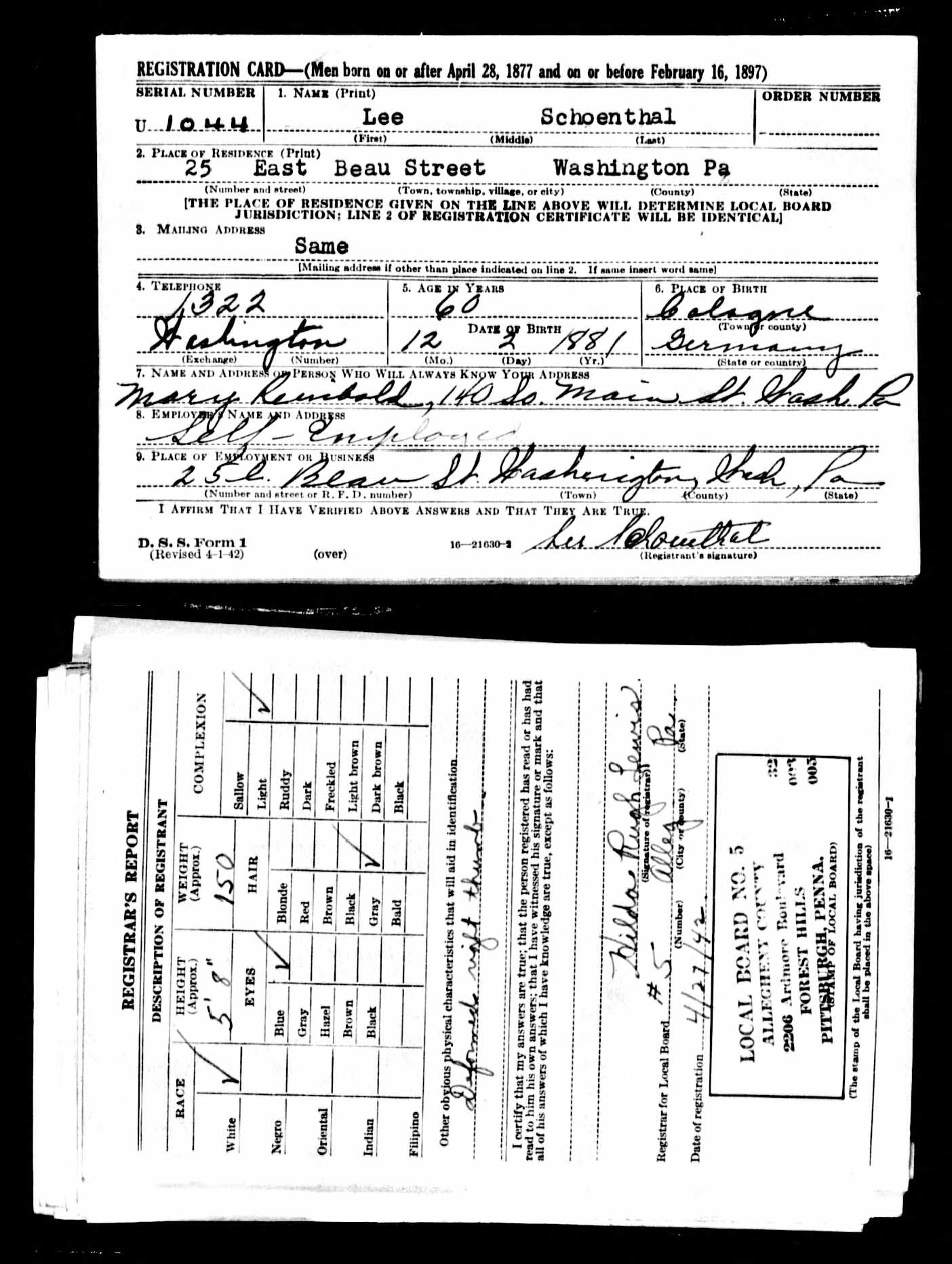
Lee and Meyer both registered for the World War II draft, though being almost in their sixties when the war began, neither served in the military during the war.  Note that Meyer was both working for and living with Lee in April 1942.  (Lee seems to have listed his work address as his residence.)  Although Meyer listed his brother Lee as the person who would always know his address, Lee listed someone named Mary Reinbold, who as listed in the 1940 census, was then a 39 year old single woman living with her father and brothers and working as a telephone operator.


Lee Schoenthal World War II draft registration The National Archives at St. Louis; St. Louis, Missouri; World War II draft cards (Fourth Registration) for the State of Pennsylvania; State Headquarters: Pennsylvania; Microfilm Series: M1951; Microfilm Roll: 278

Lee Schoenthal World War II draft registration
The National Archives at St. Louis; St. Louis, Missouri; World War II draft cards (Fourth Registration) for the State of Pennsylvania; State Headquarters: Pennsylvania; Microfilm Series: M1951; Microfilm Roll: 278


Meyer N Schoenthal World War II draft registration Ancestry.com. U.S., World War II Draft Registration Cards, 1942 [database on-line]. Provo, UT, USA: Ancestry.com Operations, Inc., 2010.

Meyer N Schoenthal World War II draft registration
Ancestry.com. U.S., World War II Draft Registration Cards, 1942 [database on-line]. Provo, UT, USA: Ancestry.com Operations, Inc., 2010.

Why wouldn’t Lee have listed Meyer as his contact just as Meyer had listed him? More on that in a later post.

Once the war ended, the family apparently spent a year trying to learn what had happened to Henriette Schoenthal and Julius Levi.  My heart broke when, with Michael Moskow’s help,  I found this notice in the June 14, 1946 issue of Aufbau, the newspaper published beginning in the 1930s for German Jewish immigrants in the United States:


Aufbau June 14, 1946

Aufbau June 14, 1946 found at http://archive.org/stream/aufbau1219461946germ#page/n475/mode/1up


Translation: After a one year search in Europe, we today know that our beloved parents and siblings, Julius Levi and Henriette Levi (nee Schoenthal) from Cologne have fallen to the Nazi terror …. [followed by the names of their son and their siblings].

By the time Helmut Levi had enlisted in the US Army in November 1942, his parents had already been murdered by the Nazis.  It must have just been unbearable for him to realize that while he had been fighting to defeat Hitler and the Nazis, it had already been too late to save his parents.

This notice also indicates that as of June 14, 1946, Helmut was still in the Army; although I am not sure what “Liaison Sec” refers to, G-2 is military shorthand for military intelligence staff.  It appears that Helmut was doing some kind of intelligence work in Berlin after the war, which makes sense, given his familiarity with Germany and the German language.  Being in Berlin may have also allowed him to search more quickly for what had happened to his parents.

As for Johanna Schoenthal Stern and her husband Heinrich Stern, they arrived in the US in 1947 from France.  As I mentioned in my prior post, Johanna and Heinrich had listed a friend named Henry Kahnweiler of Paris as their contact person in France.  I was curious as to who he was and how Johanna and Heinrich were connected to him.  I wanted to know more about their story—how and when did they go to France? How did they survive the Nazi occupation of France? Had they had children who had not survived the war?

Although I don’t have all the answers, I now have at least some answers to those questions.  I will address those in my next post.


Jakob Schoenthal and Charlotte Lilienfeld, Part II: Finding Their Children and Grandchildren

In my last post, I talked about the twisted path I took to find my great-great-uncle Jakob Schoenthal and his wife Charlotte Lilienfeld.  After discovering that their daughter Henriette Schoenthal and her husband Julius Levi had been killed in the Holocaust, I was determined to find out what had happened to Henry Lyons, who was the son of Henriette and Julius Levi and who had filed Pages of Testimony for his parents with Yad Vashem.

I thought that would be easy.  After all, I had a name and a specific address from the Pages of Testimony—99-30 59th Avenue, Rego Park, New York.  And I did almost immediately find a Public Records listing with his name at that address that provided me with his birthdate, October 17, 1919.  But that didn’t tell me much more than what I knew from the Pages of Testimony.

Yad Vashem page of testimony for Henriette Schoenthal Levi


Searching a bit further using the Rego Park address listed on the Pages of Testimony, I found a Pauline Lyons listed at that same address; I assumed that she was Henry’s wife.  Having both names made the search a bit easier since Henry Lyons itself is not exactly a unique name. I was able to use their two names together to find that they are both buried at Calverton National Cemetery and that Henry had died on December 18, 1986, and Pauline on November 30, 2007.  Henry had served in the US military during World War II, beginning his service on November 28, 1942, and thus was entitled to a military burial.  Imagine coming to America as a young man to escape Hitler and then fighting against the country of your birth.

When had he come to the US? Had he and Pauline had children? I wanted to know more.  I assumed Henry had arrived in the US sometime in the mid-to late 1930s.  I also assumed that he had arrived under the surname Levi, not Lyons.  After I wasted a lot of time searching for him under the wrong name, a member of the NYC Genealogy Group found a record for a man named Helmut Levi who had changed his name to Henry Lyons on October 5, 1953, in the city courts in New York.


Helmut Levi change of name to Henry Lyons Ancestry.com. U.S. Naturalization Record Indexes, 1791-1992 (Indexed in World Archives Project) [database on-line]. Provo, UT, USA: Ancestry.com

Helmut Levi change of name to Henry Lyons
Ancestry.com. U.S. Naturalization Record Indexes, 1791-1992 (Indexed in World Archives Project) [database on-line]. Provo, UT, USA: Ancestry.com

Armed with the information about what was probably his original name, I was able to find Helmut Levi on the 1940 census, living as a lodger at 204 West 87th Street in NYC and working as a watchmaker.  I was pretty certain I had found the right person when I saw on the census record that he had been living in Cologne, Germany, in 1935.

I also then found him on a passenger manifest (see line 26 on each page below):

Helmut Levy ship manifest p 1

Helmut Levi ship manifest Henry Lyons

Year: 1939; Arrival: New York, New York; Microfilm Serial: T715, 1897-1957; Microfilm Roll: Roll 6293; Line: 1; Page Number: 188


Helmut Levi had arrived in NYC on February 25, 1939.  According to the ship manifest, he was a nineteen year old merchant born and last residing in Cologne, leaving behind his father Julius Levi of Breitstrasse in Cologne and going to his uncle Lee Schoenthal of Washington, Pennsylvania.  This was obviously my cousin, the man later known as Henry Lyons.

I also found him on a second passenger manifest dated July 4, 1948, arriving in NYC from Bremerhaven, Germany.  Henry had returned to Germany after the war.  What a devastating trip that must have been.  The photo below shows what his home city of Cologne looked like after Allied bombing during the war.  Henry had not only lost his parents, but the place where he had lived as a child and a teenager.


By U.S. Department of Defense. Department of the Army. Office of the Chief Signal Officer. [2] [Public domain], via Wikimedia Commons

By U.S. Department of Defense. Department of the Army. Office of the Chief Signal Officer. [2] [Public domain], via Wikimedia Commons

From that 1948 passenger manifest (line 10), I saw that Helmut Levi was then living in Washington, Pennsylvania, where his two uncles, Lee and Meyer, were also living, that is, his mother’s brothers, the two sons of Jakob and Charlotte mentioned in my last post.  Like so many Schoenthal relatives before him, Helmut had spent time living in western Pennsylvania.  The ship manifest also indicated that by 1948, Helmut had married, although Pauline is not listed as traveling with him.


Helmut Levi aka Henry Lyons 1948 ship manifest

Helmut Levi 1948 ship manifest Year: 1948; Arrival: New York, New York; Microfilm Serial: T715, 1897-1957; Microfilm Roll: Roll 7624; Line: 10; Page Number: 9


But I still didn’t know whether Helmut/Henry and Pauline had had children or whether there were other family members I might have missed.  I called Calverton National Cemetery, but they had no additional information.  I searched in the newspaper databases for articles or obituaries that might reveal more about Henry and Pauline Lyons.  At first I limited myself to New York papers, but then I realized that that was too narrow, given that he had once lived in western Pennsylvania.  I broadened my search and found this obituary from the January 19, 1989, Pittsburgh Press:


Erna Schoenthal Haas obit 1989


Who was Erna Haas? And was she Henry’s aunt or Pauline’s aunt? And who was Yohana Stern? I had more work to do.  I searched for Erna Haas, an unusual enough name, and was very excited to find this ship manifest (see lines 15 and 16):


Erna Haas ship manifest p 1

Year: 1938; Arrival: New York, New York; Microfilm Serial: T715, 1897-1957; Microfilm Roll: Roll 6152; Line: 1; Page Number: 174


Erna and her twelve year old son Werner had sailed from Hamburg, Germany on May 4, 1938; Erna was a beautician coming from Cologne.  I assumed that therefore her connection would be to Henry, a native of Cologne, not to Pauline, who was American-born.  Turning to the second page of the manifest, my hunch was confirmed (again, see lines 15 and 16):


Erna Haas ship manifest p 2

Year: 1938; Arrival: New York, New York; Microfilm Serial: T715, 1897-1957; Microfilm Roll: Roll 6152; Line: 1; Page Number: 174


Who was the person she named as living in the place she had left? Her sister, H. Levy of Breitstrasse in Cologne—that is, Henriette Schoenthal Levi, who had lived on that street as seen in the Köln directories in my last post. And who was she going to be with in the US? Her brother, Lee Schoenthal in Washington, Pennsylvania.  Erna Haas was another child of Jakob Schoenthal and Charlotte Lilienfeld.  She was also my grandmother’s first cousin.  And the aunt of Henry Lyons.  She was born Erna Schoenthal. I had found a fourth child of Jakob and Charlotte Schoenthal.

In 1940, Erna was listed on the census living with her son Werner in Pittsburgh, Erna working in cosmetics sales, Werner in newspaper sales.  Erna was a widow, so I assume that her husband Arnold had died in Germany, as I have no record of him in the US.  Unfortunately I have not yet found a record for him in Germany either.

But what about Yohana Stern, who had been listed in Erna’s obituary as her sister? I found this obituary for her husband Heinrich while searching for more information about Erna Haas:

Heinrich Stern obit


And then I located a ship manifest for Johanna Stern and Heinrich Stern (lines 3 and 4):


Ship manifest p 1 Johanna Schoenthal and Heinrich Stern


Ship manifest p 2 for Johanna Schoenthal and Heinrich Stern

Year: 1947; Arrival: New York, New York; Microfilm Serial: T715, 1897-1957; Microfilm Roll: Roll 7389; Line: 4; Page Number: 107


They had not arrived in the US until June 10, 1947, when they were 66 and 70 years old.  Notice that Johanna was born in Cologne, presumably around 1880.  How had she and Heinrich survived the Holocaust?  The manifest lists them as “stateless” and notes that they had last resided in “Lyon, France” and that their visas had been issued in “Marseille, France.”

The second page indicates that the person they were leaving behind at their last residence was a friend named Henry Kahnweiler of Paris (more on him in my next post) and the person they were going to see in the US was Johanna’s brother Lee Schoenthal of Washington, Pennsylvania.  Their final destination was Washington, Pennsylvania.  Yohana or Johanna Stern was born Johanna Schoenthal, a fifth child of Jakob and Charlotte Schoenthal. Another of my grandmother’s first cousins.


Thus, Jakob and Charlotte had had five children.  Their two sons Lee and Meyer had emigrated from Germany long before Hitler came to power; they had both settled near their aunt and uncle in Washington, Pennsylvania.    Jakob and Charlotte’s three daughters had stayed behind.  One, Henriette, was murdered by the Nazis with her husband Julius Levi at the Chelmno death camp in 1942, but their son Helmut Levi, aka Henry Lyons, left Germany in 1939 and survived.  Another daughter, Erna, left Germany with her son Werner in 1938.  And finally a third daughter, Johanna, somehow survived the war by going to France, and she and her husband Heinrich Stern came to the US in 1947.

It was a long and twisty road finding these five children, and it was heartbreaking to read of more cousins killed in the Holocaust.  But four of those five children survived and came to the US as did two of Jakob and Charlotte’s grandsons, Henry Lyons and Werner Haas.  More on the lives of these four children and their descendants in my next post.

The Memoirs of Lotte’s Sister Doris: Another Perspective on Life in Hitler’s Germany

Many of you enjoyed the memoirs and other writings of my cousin Lotte Furst, which are posted here, here, here, and here.  You will recall that Lotte and her family lived in Mannheim, Germany, and were living a comfortable life in a good home; Lotte’s father was a doctor, and her mother was the granddaughter of Hieronymous Seligmann, younger brother of my great-great-grandfather Bernard Seligman.  When the Nazis came to power, Lotte’s life changed forever.  After suffering through years of anti-Semitism and deprivation of their rights, her family finally decided to leave Germany and came to the United States.  Lotte’s writings described in vivid terms her perspective on all of this as she experienced it as a young girl and then as a young woman.

I recently learned that Lotte’s older sister Doris also wrote a memoir.  Doris was four years older than Lotte, and thus I was curious as to how her perspective was like or different from that of her younger sister.  When Hitler came to power in 1933, Doris was seventeen and thus would have had a more adult-like view of things.  Doris died in 2007, and her daughter Ruth was kind enough to share her mother’s memoirs with me.  Much of it is quite personal, so I am going to focus on those sections that provide insights into the larger questions: what was life like before Hitler came to power, how did it change when he did, and what led to the decision to leave Germany? [All material quoted from Doris Gruenewald’s writings is protected by copyright and may not be used without the permission of her children.]

By Snapshots Of The Past (Parade Place and Kaufhaus Karlsruhe Baden Germany) [CC BY-SA 2.0 (http://creativecommons.org/licenses/by-sa/2.0)], via Wikimedia Commons

By Snapshots Of The Past (Parade Place and Kaufhaus Karlsruhe Baden Germany) [CC BY-SA 2.0 (http://creativecommons.org/licenses/by-sa/2.0)%5D, via Wikimedia Commons

Doris was born in October 1916 in Mannheim; Germany was in the midst of World War I, and her father, Joseph Wiener, was drafted into the German army as a medical officer soon after she was born.  Her mother, Annie Winter Wiener, went with Doris to live with her parents, Samuel and Laura (Seligmann) Winter in Neunkirchen, where Samuel owned a women’s clothing business.  Annie’s brother Ernst had recently been killed while serving in the German army after volunteering against his parents’ wishes.  Doris wrote:

He had been the apple of their eyes and his death dealt a terrible blow to both.  My grandmother wore only black from then on, and my grandfather’s health began to deteriorate.  They also lost their sizable fortune, having bought war bonds as their patriotic duty, which at the end of the war were not worth anything anymore.  My grandfather’s business was dissolved and then reestablished on a much smaller scale.

Ernst Winter Courtesy of Lotte Furst

Ernst Winter
Courtesy of Lotte Furst

Doris compared her grandparents’ home in Neunkirchen with her own home in Mannheim:

The house in Neunkirchen had a large garden in back of it, most of which was rented out.  The smallest part, directly behind the house, was used for growing some vegetables and flowers.  I remember loving to play in the garden and watching earthworms after a rain as well as other living creatures.  In Mannheim there was little opportunity for this kind of nature watching as we lived in a built-up urban area with little greenery, other than a well laid out park some distance from our apartment.

Neunkirchen

Neunkirchen

For several years while the French occupied parts of Germany after World War I, several family members housed French soldiers, and the neighborhood school Doris would have attended was also being used by the French military.  Thus, she had to go to a school somewhat further from her home for those years.  Like her sister Lotte, Doris pursued a highly academic path in school and was one of only six girls out of thirty students in her Gymnasium classes and then the only girl in her class when she reached the final years of her pre-university level education.

This excerpt provides a sense of the family’s lifestyle:

My parents employed a cook and a housemaid, and when my sister and I were still young, a “Kinderfraulein” who used to be an untrained young woman with an interest in children.  In other words, not quite a “governess.”  My father had help in his office and for some time also employed a driver after he developed a painful condition in his left arm, due to having to reach outside the car for shifting gears.  …. 

We had a Bechstein Grand piano in our living room. This instrument had been given to my mother as a young girl. She had really wanted to study music on a professional basis. But her parents felt that “proper” young ladies did not take up that kind of profession and did not allow her to pursue her wish. Instead, they bought her the Bechstein and let her have piano lessons.

I began taking piano lessons at age seven, with a teacher considered among the best in Mannheim. My mother, although an accomplished pianist, no longer played much. But occasionally, she and my father, who had learned to play the violin in his youth, would play duets together. That always was a special treat.

By Annaivanova (Own work) [CC BY-SA 3.0 (http://creativecommons.org/licenses/by-sa/3.0)], via Wikimedia Commons

By Annaivanova (Own work) [CC BY-SA 3.0 (http://creativecommons.org/licenses/by-sa/3.0)%5D, via Wikimedia Commons

I was particularly interested in what Doris wrote about the role of Judaism in the family’s life.

I grew up through the years with some awareness that we were Jewish, without knowing what significance that had then and later. Neither my parents nor my grandparents when I knew them observed any religious tenets. However, I was told that in past years my grandfather had been the head of the Jewish Congregation in Neunkirchen. My grandmother, who was president of the local Red Cross chapter for some time, used to fast on Yom Kippur. She reluctantly told me, when I kept asking her, that she had promised her dying mother to keep that tradition. As for me, I was kept home on the Jewish High Holy Days. My family did not attend any services.  …. 

At eight years of age I happened to be visiting my grandparents at the time of Passover. They had been invited by friends to a large Seder. Unfortunately, nobody thought of explaining to me what that was all about. My grandparents may have assumed that I knew, but I did not. I understood nothing of what was being read in Hebrew or spoken in German. I was utterly bored! Furthermore, when the ceremony asked for tasting the so-called bitter herbs, I bit off a piece of the horseradish on my plate and soon experienced the consequences of that act!

Unfortunately, I think far too many children, here in the US and elsewhere in the world, have that experience at seders.

The family was, however, required to provide some religious instruction because of the school system’s requirements:

There having been no separation of Church and State, religious instruction was part of the official curriculum. The students were separated one period per week according to their denominations. Most were Protestants, some were Catholics, and a few were Jewish. Since the number of Jewish children was so small, and in the case of my first-grade placement non-existent, my parents were required for that year to hire a private instructor in order to comply with the legal requirement. Thus, there suddenly appeared a not very clean looking young man with a greasy book, from which he proceeded to read and attempt to teach me-at six years of age-the Hebrew text. My recollection is that he came to our house only a very few times. I do not know how the religious instruction requirement was fulfilled after that disaster.

When, at fourth grade level, I changed schools, religion was taught by a little old man, a retired rabbi, who was very nice and even made some of what he taught rather interesting. But I developed no feeling for or interest in it at all, as it was totally divorced from the rest of my life.

Then, as Lotte also described, their father decided to withdraw from the Jewish community:

When I was fourteen, my father had some kind of a dispute with the Jewish Community, which was the official agency for collecting taxes. These taxes were legally mandated as a percentage of one’s general income tax obligation. I nearer knew exactly what the problem was, except that it had something to do with the amount owed, to which my father was apparently objecting. The Rabbi came to our house to straighten the matter out. Apparently he was not successful as subsequent events proved. (This rabbi became my brother-in-law at a much later time. He knew that I was far removed from religious observance, but he was always very tolerant and friendly to me.)

Whatever the problem had been, my father decided to leave the Jewish Congregation. Since I was already fourteen years old, I was required to state my personal intention. As I had no ties to the Jewish community, that was no problem for me. From then on I was without any religious affiliation, called “konfessionslos.” In practical terms it meant that I no longer had to attend religious instruction at school. I used the weekly free hour to visit the Art Gallery opposite the school building and saw a lot of very interesting, good art works.

Dr. Joseph Wiener

Dr. Joseph Wiener  Courtesy of Lotte Furst

Of course, the family’s withdrawal from the Jewish community and lack of religious involvement did not make any difference in the eyes of the Nazis once they came to power.  Doris wrote:

Between 1932 and 1935 I had a valid German passport, used during those years primarily for trips to the Saar to visit my grandparents and take the then permitted two hundred German marks to be deposited outside Germany. In those years the Saar was still under the administration of a French post-World-War I governing authority. My grandmother took care of such transactions. By the time I needed a new passport, the Nazis had decided that a big “J” had to be stamped on any so-called non-Aryan, meaning Jewish, person’s passport. Word had gotten around that one of the clerks in the passport office in Mannheim would issue a “clean” document without the dreaded J, for suitable consideration. I went to that office, saw the clerk in question, and for the small sum of five marks was issued a regular passport without the J. I still have this passport as a memento.

When the Nazis assumed power in 1933, we as a family re-joined the Jewish Congregation as a matter of honor. Not that it would have made any difference had we not done so as the Nazis classified people not necessarily by religion but by their so-called racial identity.

German Jewish passports could be used to leave...

An example of German Jewish passport. (Photo credit: Wikipedia)

As Doris approached the end of her time in the local schools in the 1930s, she was both the only girl and the only Jew in her class.  She wrote that things did not change dramatically at school despite the political changes around them, but she did describe one troubling incident:

I entered the classroom in the morning, as usual. Upon approaching my desk, I saw that someone had pasted a viciously antisemitic sticker from the “Sturmer,” a rabidly anti-Jewish paper, on my desk. By that time, one of my classmates had begun wearing the SS uniform. I more or less assumed that he was the culprit, which in the end turned out not to have been the case. However, at that moment I decided not to confront him or anyone else. I sat down at another desk and waited for the right time to act. This came with the second period when the “Klassenlehrer”-the equivalent of our Home Room teacher-was due for his hour. … I waited for this teacher outside the classroom and told him my reason for doing so, adding that I knew there was nothing I could do about official policy and insults, but that I was not willing to put up with personal attacks.

This teacher, who, incidentally, had been an officer in World War I and had lost an arm, rose to the occasion. He and I entered the classroom together, and he immediately asked who had done this deed. Somewhat to my surprise, and perhaps his too, not one of the students admitted having put the sticker on my desk. There was nothing further he could have done: I do not remember whether he spoke to the class, but his earlier behavior had given ample proof of his opinion. … The incident occurred about one week before the final exam, the Abitur. It cast a pall over that important event.


Embed from Getty Images

Imagine being the only girl and the only Jew in the class and standing up for herself that way.  What courage it must have taken to do this.  What if her teacher had not been sympathetic?  Despite this stressful incident, Doris successfully passed the Abitur.  Although Doris was entitled to enroll in the university based on her father’s military service during World War I, Jews were prohibited from enrolling in either law school or medical school.  Instead, Doris decided to audit a few courses while awaiting a visa to leave Germany.  She wrote:

I had known for some time that I had to get out of Germany as there was no future there for me, and I was willing to take whichever came first [she had applied for both a US visa and a certificate to immigrate to Palestine]. However, I admit that I was relieved when the American visa materialized first.

The American Consulate closest to Mannheim was located in Stuttgart. In due course I was summoned for an interview with the American consular officials. I was in a somewhat unusual position in that my father had learned of a legal means of transferring money abroad, which was then discounted at the rate of fifty percent. The permissible amount was sufficient to enable me to show the U.S. Consulate that I had the requisite five thousand dollars for obtaining an immigration visa to the U.S. In this way I did not have to await my application number to come up in regular order, which would have taken a great deal more tame. I got my visa rather quickly. By that time I had also received a so-called Affidavit of Support from one of my grandmother’s cousins, whose father had emigrated in the nineteenth century and had settled in Cleveland, Ohio. This cousin was in very good financial circumstances and readily responded to our request for an affidavit.  …

I was very interested in determining who this cousin might have been.  If she was Laura Seligmann Winter’s cousin, she might have also been a cousin of mine, depending on whether she was a paternal cousin or not.  The only clues I had from Doris’ memoir were her married name (Irma Rosenfeld), her residence in Cleveland, her children: a son who was in his 20s in 1937, a daughter who was married, and another daughter who was a student at Vassar.

I found one Irma Rosenfeld living in Cleveland at that time who had two daughters and a son and was married to a man named Mortimer Centennial Rosenfeld (I assume the middle name was inspired by the fact that Mortimer was born in 1876, the centennial of the Declaration of Independence).  I sent Lotte the photo from that Irma’s passport application, but Lotte was unable to confirm from the photograph that it was the right Irma Rosenfeld.

Irma Rosenfeld and daughter passport photo 1924 Ancestry.com. U.S. Passport Applications, 1795-1925 [database on-line]. Provo, UT, USA: Ancestry.com Operations, Inc., 2007. Original data: Selected Passports. National Archives, Washington, D.C.

Irma Rosenfeld and daughter passport photo 1924
Ancestry.com. U.S. Passport Applications, 1795-1925 [database on-line]. Provo, UT, USA: Ancestry.com Operations, Inc., 2007.
Original data: Selected Passports. National Archives, Washington, D.C.

After reading Doris’ memoir, I went back to all the documents I had for her and examined more closely the passenger manifest for her trip to the US in 1937.  I had not seen the second page of it my first time through, but this time I noticed that it not only named Irma Rosenfeld; it had her street address in Cleveland.  It only took a glance at the 1940 US census for me to confirm that I had in fact found the correct Irma.

Doris Wiener 1937 ship manifest

Doris Wiener 1937 ship manifest part one

 p2 Ancestry.com. New York, Passenger Lists, 1820-1957 [database on-line]. Provo, UT, USA: Ancestry.com Operations, Inc., 2010. Original data: Passenger Lists of Vessels Arriving at New York, New York, 1820-1897.

p2
Ancestry.com. New York, Passenger Lists, 1820-1957 [database on-line]. Provo, UT, USA: Ancestry.com Operations, Inc., 2010.
Original data: Passenger Lists of Vessels Arriving at New York, New York, 1820-1897.

A little more research revealed that Irma’s birth name had been Irma Levi, daughter of Isaac Levi and Fanny Loeb.  Since Doris and Lotte’s great-grandfather (and my three-times great-uncle) Hieronymous Seligmann had married a woman named Anna Levi, I believe that that is the connection between Doris and Irma.  Anna Levi was a contemporary of Isaac Levi; perhaps they were siblings, and thus Irma Rosenfeld would have been a first cousin, twice removed, of Doris and Lotte, their grandmother Laura’s first cousin.  Obviously, the family had stayed in touch with these American cousins, and even though Irma was American-born and had never met Doris before, she reached out to help her escape the Nazi regime.

Continuing now with Doris and her emigration from Germany:

Necessary preliminaries having been taken care of and good-byes having been said, it was time to arrange for the journey to America. We bought a ticket for me on the SS Washington, a twenty-thousand ton ocean-going passenger boat, and also obtained railroad tickets for me and my mother who wanted to accompany me to Cherbourg, the place of embarkation. …

In Cherbourg I said good-bye to my mother, for whom the separation was very hard, more so than for me. For one thing, I was looking toward something new. But perhaps more importantly, I had unwittingly insulated myself to some degree from the impact of events. This condition lasted for a long time and to some extent gave me some emotional protection….

In contrast to so many, I confess that I had an easy time. Not only was the way for coming to America smoothed. My parents also were well able to pay for my ticket and whatever other expenses arose in connection with my leaving. I was twenty years old at that time.  …

Aenne Wiener and Doris

Doris Wiener and her mother Courtesy of Lotte Furst

Doris explained why her parents and sister did not come with her:

The question has often been asked why my parents and sister did not come at the same time. Like a great many people, my father kept believing that the Hitler episode was just that, and he refused for a long time to see the situation realistically. Not so my mother. She was instrumental in organizing their own as well as her parents’ emigration to Luxembourg, and later their own to America.

Doris wrote that she arrived in New York in 1937 with $400.  Her parents had arranged for friends to meet her at the boat, and Doris stayed with them for a week before moving to her own apartment on the top floor of a building at 96th Street and Central Park West.  Doris also described a visit to Cleveland to see her grandmother’s cousin, Irma Rosenfeld, the woman who had provided the affidavit in support of Doris’ visa, as discussed above. “The slightly more than four weeks I spent with the Rosenfelds were very pleasant, with visits to their country club and other social activities.”  But Doris preferred to remain in New York City.

After returning to New York, Doris soon found employment in a dentist’s office and also soon met her future husband, Ernst Gruenewald.  They were married in May 1938.  Her mother Annie came to New York for the wedding, not only to witness the wedding but also “to gain insight into the international situation uninfluenced by German propaganda.”

My mother had intended to stay in America for about six weeks. But as she listened to the broadcasts available to us, she became increasingly agitated and decided to cut her visit short in order to initiate their emigration from Luxembourg to the United States. She had always been a very intelligent woman capable of making important decisions, many of which were advantageous. She returned to Luxembourg and was able to convince my father that this was the right thing to do. They arrived in the U.S. in April 1939, three weeks after the birth of our first child and about half a year before the outbreak of World War II.

Her grandparents, as we know from Lotte’s memoirs, did not fare as well:

During my childhood I had spent a good deal of time with them in Neunkirchen and was very fond of my grandmother. I knew her only from her mid-forties on, when in my eyes she was an old lady. She was a very reserved but warm person and managed their life very competently. My grandfather was a short, slim man who from the time I knew him as a person, was not well. …  My grandparents had applied for a visa to the United States before the outbreak of World War II, but failed to be granted immigrant status. In retrospect, I am convinced that my grandfather’s condition was the reason, as they had enough money to qualify for a visa. My parents also could have vouched for them. My grandfather ended up in Theresienstadt, where he died of pneumonia, as we were told after the war. My grandmother had suffered a fatal heart attack while still living in Luxembourg.

Doris and her husband Ernst and their family ended up relocating from New York to Chicago for a business opportunity a few years after her parents and Lotte arrived .  During the 1950s, Doris went back to school and obtained her bachelor’s degree while also raising her children; in 1961 she received a masters’ degree in psychology as well.  She then went on to get a Ph.D. in psychology, specializing in neuropsychology, which was itself still a relatively new field.  After obtaining her degree, she worked at Michael Reese Hospital in the Adult Inpatient department where she eventually became the director. Sadly, after twenty years there, she found herself forced out on the basis of their mandatory retirement age.  She had just turned seventy.

By Zol87 from Chicago, Illinois, USA (Michael Reese Hospital) [CC BY-SA 2.0 (http://creativecommons.org/licenses/by-sa/2.0)], via Wikimedia Commons

By Zol87 from Chicago, Illinois, USA (Michael Reese Hospital) [CC BY-SA 2.0 (http://creativecommons.org/licenses/by-sa/2.0)%5D, via Wikimedia Commons

In 1987 Doris and Ernst moved to California, where the winters were milder and where her sister Lotte was living.  Doris had obtained a California license before moving and was able to continue to practice as a psychologist when they moved, but did so only for a short period before retiring.  Ernst died in 1989, and Doris died almost twenty years later in 2007.

It was fascinating to me to read Doris’ memoirs after reading Lotte’s; both sisters wrote so clearly and so powerfully about their lives.  I can see that they had much in common: great intelligence, dedication to hard work and to family, astute powers of observation, and a love of language.  Doris struck me as the more thick-skinned of the two sisters, often talking about her independence and emotional distance from others, even as a young child.  Doris wrote about being somewhat of a loner and keeping her thoughts and feelings to herself.  I would imagine that those qualities served her well as she endured her teen years in Hitler’s Germany and a voyage alone to America in 1937 as well as her adjustment to life in America.

Overall, I am struck by how strong these two women were, both as children in Germany, as new immigrants to the US, and as women experiencing all the changes that came in the years after World War II.    I’d like to think some of that is the Seligmann DNA that we share, but I doubt that I would have been as resilient and brave as they had to be, if I had had to endure the challenges and hardships they did.


Lotte’s Story: A Post-Script

The response I received to the writings of my cousin Lotte was overwhelming.  People were very moved by her life story and by her writing. (You can find her story here, here, and here.)  Lotte has generously shared some additional writings and photographs about her family and her life, which I will share with you, with her consent.  (All of Lotte’s writings are protected by copyright and may not be reproduced without her permission.)

First, a reminder of how I am related to Lotte:

Lotte to me


For those who have not read the first installment of Lotte’s story, a brief recap:  Lotte grew up in Mannheim, Germany, with her parents, Joseph and Aennie (Winter) Wiener and her older sister Doris.  Her father Joseph was a doctor in Mannheim, and her family was living a comfortable life there.  Lotte was an excellent student and was enjoying a good life until the Nazis came to power in 1933.

Aenne Wiener and Doris

Aenne and Doris Wiener c. 1916

Joseph Wiener earlier picture

Dr. Joseph Wiener

Her grandparents, Laura (Seligmann) and Samuel Oscar Winter lived not too far away in Neunkirchen, where her grandfather was in business with his brother-in-law, Laura’s brother Jakob Seligmann.  Lotte described what it was like to visit her grandparents:

MY GRANDPARENTS’ HOUSE

Neunkirchen

It was a foregone conclusion that I spent most of my Christmas and Easter and also a couple of summer vacations at my grandparents’ house. I never was asked whether I wanted to go there. If so, the answer would have been “yes”. I liked them.

They lived in Neunkirchen in the Saarland, an area of coal mining and steel production administered by the League of Nations at that time. Their three-story attached row house was at Moltkestrasse 23, a nice residential neighborhood. A buzzer would open the front door after which another door with a glass panel opened to a short corridor. To the right on the first floor, called parterre, there was a fairly large carpeted and well-furnished salon and a quite formal dining room. Both rooms were dark and hardly ever used. The smelled a bit dank and musty. But to the left of the dining room a glass-beaded curtain opened to a long, enclosed, bright veranda where my grandmother kept a number of house plants including some she called amaryllis, her pride and joy. And yes, there was a rope-operated dumb-waiter from the kitchen above to the dining room. I used to love pulling those ropes and playing with it.

A toilet with a small hand basin and a spindle full of squares of cut newspaper, hardly to be called toilet tissue, was located half-way up the stairway  to the middle floor, the actual living quarters. The living room was fairly bright and not anywhere as elegant as the downstairs salon. The main attraction were my grandfather’s rocking chair and the blue and white KKL (Jewish National Fund) box filled with a number of coins. I liked to manipulate them out with a knitting needle. Of course I replaced them immediately. I knew the money was for a far-away country called Palestine.

Gilabrand at en.wikipedia [CC BY 3.0 (http://creativecommons.org/licenses/by/3.0)], from Wikimedia Commons

Gilabrand at en.wikipedia [CC BY 3.0 (http://creativecommons.org/licenses/by/3.0)%5D, from Wikimedia Commons

Next to the living room was the fairly spacious master bedroom, dark and gloomy and actually taboo for me. But the bathroom was bright and big and quite an attraction for me because I could come in while my grandfather was still brushing his teeth and whistling while doing so. He used to announce that he was the only person with that capacity because he had false teeth. Oh, and of course the kitchen was on that floor but I did not spend much time in it and don’t remember the details, except that it opened up to a balcony where we would sometimes eat. On those occasions we had to constantly wipe off the ever-present soot that came from the coal mines.

The landing half-way up to the third floor featured an ice box. Not much food was stored in it. Certainly nothing kept there tasted fresh. We had to watch out for the sound of drip-drip-dripping water which meant the molten ice had filled the basin below it almost to capacity.

I slept in the first of the three bedrooms on the third floor, up a creaky stairway. It was pretty dark too with a large bed and a dresser. It also smelled pretty musty and the bed springs were making all kinds of noises. A large limp rag doll with a porcelain head and eyes that would open and close greeted me on the bed. It was the ugliest thing I can remember, but my grandmother thought I would like to play with it since it had been my mother’s. I hated it and tucked it away in a drawer very quickly. Early in the morning I could hear the crowing of roosters. Kickeri-kee they went. Kickeri-kee. On Sunday mornings that sound was joined by the ringing of several church bells. After all, Neunkirchen means nine churches. It did not wake me since I was not asleep any more but had to stay upstairs until I could get into the bathroom. On the way downstairs I was greeted by the aroma of freshly brewed coffee.

Two more rooms were located on that floor. One was a large storage room, mostly unused. The other was the former bedroom of my uncle, my mother’s brother, who was killed early in World War I. I was not allowed to enter that room. Probably it was locked. I believe it was kept exactly the way my uncle had left it. My grandparents never talked about it but never got over it. My grandmother only wore black or grey clothes.

Of course the house also featured a basement. There were at least two parts to it, one a coal cellar, unpleasant with a dusty smell all of its own, and a fruit cellar. That was a delightful place. I loved to go downstairs and inhale the aroma of apples, yeast cakes, apple pies and other goodies which were stored in the cool basement room.

The house really was quite gloomy and I probably was bored during my visits. But I never felt unhappy there. That was the way it was. And my grandparents certainly loved my visits and I loved them for it.

Her writing is so vivid that I can easily picture this large and dark house that she visited as a small child.  It’s incredible to me how clearly she remembers this house and these visits.

Samuel, Laura, and Anna Winter and Jakob Seligmann

Lotte’s grandparents Samuel and Laura Winter, her mother Anna (Winter) Wiener, and her great-uncle Jakob Seligmann


Lotte also has painted a wonderful portrait in words of her great-uncle Jakob Seligmann, depicted above, far right:

Onkel Jakob

He was a good-looking man. Portly and erect. He had a rosy complexion, a well cared-for short white beard, short white hair surrounding his mostly bold pate, an aquiline nose. Portly, I said. His belly protruded just enough to display a heavy golden watch on a chain. That was Onkel Jakob, my grandmother’s brother and thus my mother’s uncle. He was my grandfather’s business partner.

He was very fastidious. His shoes were always shined and a crisp handkerchief was tucked in his left upper coat pocket. He spoke clearly and slowly in a baritone voice. He showed up at the office at exactly the same time every day. On Sundays at 10 o’clock he walked to the train station, about 20 minutes from where he lived, in order to check the correct time and reset his watch if necessary. He wanted to make sure his gold watch, so prominently displayed on his belly, was correct. Once the watch was set, he might pick me up at my grandparent’s house in Neunkirchen. He took me and perhaps my sister too for a walk in the nearby woods, right behind my grandparent’s store. Sometimes Herr Eisenbeis, the owner of the building, would join us. He was a hunter and carried a long rifle. He actually was looking for deer in the birch woods. I never saw him shooting any but I did see a number of deer. Herr Eisenbeis was stocky and short. He was dressed in a green hunter’s outfit. He spoke in staccato sentences and was very abrupt and very Prussian. I did not like him very much.

But back to Onkel Jakob. I did like him and I also liked Tante Anna, his wife, who was quite beautiful and a wonderful cook. She served different kinds of food from those my grandmother made because she was not Jewish and was born in Hamburg in northern Germany. She had a brother in Kalamazoo. I remember because that name sounded very funny.

Onkel Jakob’s life seemed to be run strictly by the rules. He was pedantic, to say the least. But something went utterly against those rules. He never brought Tante Anna to my grandparent’s house. Somehow I found out that she was not welcome there because she was a shikse and because she had been Onkel Jakob’s housekeeper for many years and that they had only recently been married. It was not fair. She was a good woman who went with Onkel Jakob when he had to leave Neunkirchen to move to Luxembourg during the Hitler years. She was the one who kept in touch with my mother as long as she could after World War II broke out. Through her we learned that my grandmother collapsed on the doorsteps and died when the Nazis marched in. That my grandfather had been deported. And that Onkel Jakob had died before the same fate could happen to him. That both he and my grandmother were buried in the Jewish cemetery in Luxembourg for which she supplied the address. She finally moved back to Hamburg where she had some family. After that we did not hear from her again.

I remember Onkel Jakob as a very pedantic man. But along with him I also remember Tante Anna who was a kind and good woman.

As she wrote in Part II of her story, her grandparents and her great-uncle all moved to Luxembourg around 1935 to escape the Nazis.  They were, however, unable to come to the United States when Lotte and her parents left in 1939, and all three died during the Holocaust.  There is a memorial stone for the three of them in Luxembourg.

Winter stone


Fortunately, Lotte, her sister, and her parents were able to move first from Germany to Luxembourg and then to the United States in 1939 where Lotte successfully completed nursing school.


Lotte

Lotte

I was curious about what had happened to her father Joseph Wiener after he came to the US.  He’d been a doctor in Germany, and I asked Lotte whether he had been able to continue practicing medicine after coming to the US to escape the Nazis.  She shared this essay:

FACING DIFFICULTIES

Imagine having to learn a new language, having to take difficult tests in it, living in a completely new environment and under completely different circumstances, and making the best of it, all at the age of 56 which was considered “getting there” agewise at the time? That’s what happened to my father.

Under duress he had to give up his medical practice in Germany. Other than his native German he knew a little French and of course had studied Latin and Greek in highschool. In Luxembourg where we lived for a year he had no way of working in his profession. Knowing that it was just an interim stop he began to study English. “1000 Words of English” was his first textbook. It was over-simplified and actually quite hilarious. “Do you like this girl?” was the beginning of one of the dialogues. “I not only like her, I love her” it went on. “She has millions of dollars”. That kind of thing really was not adequate , but he learned. My mother who did speak English fairly well taught him some more. And then we left for America.

He felt very strange but he knew he had to make the best of it. He learned that he would have to take the New York State Boards in order to practice medicine. Anatomy, physiology, pharmacology, psychology, the whole works. He plowed right into it. The English language came “as you go” so to speak. He might have taken a course or two, I don’t quite remember. His pronunciation was not great, but then neither was mine.

Meanwhile I started nursing school. Since I had a few of the same courses, though in drastically abridged form, I helped him some whenever I had a chance to get home. He really worked hard at it. He also found time to play the stock market, thanks to two very good advisors whom he knew from before. Whatever little money my parents had managed to smuggle or take out of Germany needed to be augmented in order provide for a decent living. He had no illusions about the income from his medical practice, whenever that would materialize. But the war had started, the market was going up, and as I said, he had some very good advisors who went for safety and not for speculation.

After studying for almost two years my father applied for the State Boards. Miraculously he passed almost all of the difficult courses. All except one in a course called “Hygiene”. The Board, consisting of physicians eager to keep out the new competition g by German immigrants, could not in good conscience let him pass. So he had to take a refresher course and an additional exam, fortunately just in the one subject.

Now he would be able to hang out his shingle. My parents moved from apartment B61, on the sixth floor of the Park Chateau building at 8409 Talbot Street,  Kew Gardens, to a spacious five-room one on the ground floor in the A building. My sister, her husband and their little girl, who had been sharing the upstairs apartment with my parents, moved to their own place a  convenient distance away. My father bought second-hand equipment for his office. He posted a sign reading “Joseph Wiener, M.D. Physician” or something like that at the front of the building. I must explain that it was and probably still is quite customary for New York physicians to practice out of their living accommodations. No need to rent a special office space.

I remember the “Field of Dreams” movie with the theme “when you build it, they will come”. Well my father opened his office and a few patients came. Not too many, but at least it was a start. By now he was 58 or 59 years old and not too anxious to establish a large practice. He definitely did not to drive a car any more. His clients would have to live in walking distance. That worked out just fine. The neighborhood with its small homes and working-class occupants which started right behind the Park Chateau building turned out to be just what he needed. They did not come in droves. Just enough to keep him happily satisfied. He charged $3.00 for an office visit. Sometimes he did not charge anything. He made house calls by walking there. He joined the local AMA chapter and enjoyed going to their meetings. I suppose he was glad to get away from home once in a while. He also looked forward to what they called “collation” on the invitations. It took a while to figure out that meant refreshments. For several summers he worked  as the physician at a summer camp in the Catskills. The kids and also heir parents loved him and respected him. He had a great time there.

But then his health gave out. His arteriosclerotic heart grew weary. It took a few years before it went into failure. A few critical episodes followed. And yet he was determined to face this fact. Released after an early April stay in an oxygen tent at the local hospital, he proceeded to file his income tax. He knew his house was in order. He knew my mother was well provided for. And then he went to sleep. No longer did he have to face any difficulties.

Joseph Wiener MD

Dr. Joseph Wiener

You can see the sadness in Joseph’s eyes (as well as his strength) in this later photograph as compared to the one above that was taken in the pre-Hitler era.

I also asked Lotte about her own adjustment—in particular, how she was able to do so well in her studies, given that English was not even her first language.  She shared with me this essay:

MOTHER TONGUE

It is obvious. The moment I open my mouth, people recognize my accent. “Charming”, they may say. “Annoying”, it seems to me. I can’t hear it myself, except when I listen to my own phone message. “That’s me?” It sure does not sound like it. It sounds like a stranger.

Whether I like it or not, German is my mother tongue. That’s what I spoke exclusively until I was seventeen. That’s what my schooling and much of my thinking are based on. That’s what influenced my formative years. But that’s not what I spoke for many years. After all, I left Germany under the pressure of the Hitler years. When I left, I was sure I would never look back, never return again and never want to be involved with anything German. I had to start a new life. And when I met my husband who was from Vienna which after all is not Germany, we hardly ever spoke German. It was during the war, and the language was not welcome. Besides, in Austria they use a number of different terms for everyday common things, and we would begin to argue who was right. So we dropped it and just spoke English.

Learning English was not difficult for me. For a while I took English as an elective in high school.At age sixteen I took some private lessons at a Berlitz School where you are immersed in the foreign language. My courses included conversation, shorthand  and commercial correspondence. With my German and a strong background in French it came easily. The study of Latin and Greek was very handy to understand grammar and vocabulary. But the pronunciation! German is a phonetic language while English is not. That caused – and causes – some trouble. While I pride myself in being completely fluent in English, I still may pronounce certain words the way I think they should be pronounced, the way I can sound them out. That is especially true with proper names many of which have been anglicized, for no good reason so it seems. Why for example should Verdi be pronounced “Voedy” when in Italian it is VERDI, or “Aphrodite” sound like “Aphrodaite” while the I in Greek is just that: “EE”? Well, so much for that.

I do think and figure almost exclusively in English. But sometimes an old German adage creeps in. And oh how many such words can be found in that language. There is a saying of wisdom for just about everything. And certain words simply cannot be translated – they are idiomatic. Just like the Yiddish schlemiel, or chutzpah. There is no English word for that.

I can still converse fairly fluently in my erstwhile mother tongue. People who did not know about my background would comment that for an American I spoke very good German. Little did they know. But when it comes to writing it becomes more difficult. For many years I had a lively correspondence with one of my high school friends who did not speak English. Often I would have to beat around the bush, so to speak, and find some alternate, perhaps awkward way to describe what I wanted to say. And reading German books or communications. Those convoluted intertwined interminably long sentences. English is much more direct.

Somehow I cannot think of English as being my mother tongue. It is not, although it is what I use almost exclusively. Somewhere, deep in the crevices of my brain my German background prevails. Sometimes it comes to the fore. After all, that is my mother tongue.

There is no question that Lotte has mastered the English language; very few of us for whom English is our mother tongue can express ourselves as well as she does in her adopted language.

Once again, I was and continue to be struck by how determined and how positive Lotte was as a young woman and how she has remained so to this day.  These more recent photographs of her show her indomitable spirit in her smile and in the light in her eyes.

Uli and Lotte 1988

Lotte and her husband Uli 1988

Lotte Furst in 2006

Lotte in 2006