Siegmund Rothschild: Escape from Nazi Germany

It’s been a few weeks since I wrote about the family of Gelle Blumenfeld Rothschild, given the breaks for some updates, Passover, and our trip to England. Today I return to Gelle’s story, specifically the story of her son Gerson Rothschild. In my last post about Gerson, we saw he died in 1930 and was survived by his wife Fanny Kugelmann and eight children.

In my next series of posts, I will write about the eight surviving children of my cousin Gerson Rothschild and his wife Fanny Kugelmann. Only three of those children survived the Holocaust, making this task a very painful one. But I can start with one of those three who survived, the oldest child of Gerson and Fanny, their son Siegmund.

As we saw, Siegmund married Elise Olga Block on December 22, 1919, in Frankfurt, and they had two sons, Ernst, born March 1, 1922, and Werner, born January 12, 1928, both in Frankfurt. There is a wonderful resource about this family on the Projekt Judische Leben Frankfurt am Main website. Based in part on information obtained during a visit to Frankfurt by Werner Rothschild in 2019, the website details the family’s life before, during, and after the Nazi era. Much of the information in this post came from that website.

According to that website, Siegmund Rothschild moved to Frankfurt in 1911 and was known as “a valued historian with good contacts abroad and president of the liberal main synagogue in Frankfurt.”  He taught at Philanthropin, a free Reform Jewish school founded in 1804 in Frankfurt. An article from the Encyclopedia of Jewish History and Culture abstracted here states that the school was “one of the most significant German Jewish Reform projects in the first half of the 19th century.” Siegmund’s wife Elise also taught at Philanthropin on and off between 1913 and 1939.

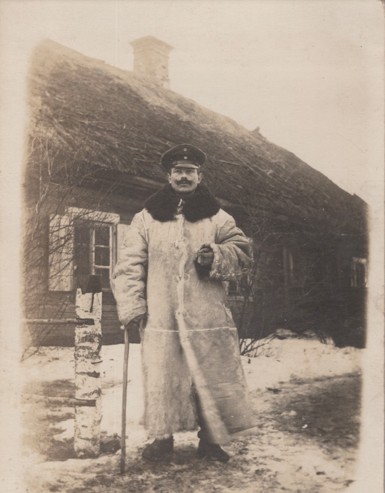
UPDATE: I learned from Siegmund’s grandson Alex that Siegmund fought for Germany during World War I. Here is a photo of him from that time.

Siegmund Rothschild c. 1915
Courtesy of the family

Siegmund and his family were living a good life in Frankfurt, identifying more as German than Jewish, until Hitler came to power in 1933. Siegmund’s son Werner recalled that one friend joined Hitler Youth and stopped talking to him. Another time while visiting family in Borken, he and his cousins were tormented by Hitler Youth.

Here is the family in January 1938:

Siegmund, Werner, Ernst, and Elise (Bloch) Rothschild, January 1938.

As for Ernst, the older son, according to the Projekt Judische Leben Frankfurt website, he had always dreamed of being a dentist, but under Nazi persecution he was not allowed to pursue the studies to reach that goal. Instead he ended up working as an apprentice in a leather dressing business after leaving school in 1937. But when that business was Aryanized in 1938, Ernst lost his job.

The family’s situation became even more dire in November 1938 with Kristallnacht.  As reported on the Projekt Judische Leben website, “For Werner… the worst day of his young life was the so-called “Reichskristallnacht.” He saw furniture fly out of the windows and buildings burn. Immediately afterwards, his father was picked up by the Gestapo. They gave [Siegmund] ten minutes to pack his things, then they deported him to Buchenwald. Fortunately, [Ernst] was not at home or he would have been arrested too.” Elise did everything she could to get Siegmund released; he was released in December 1938 with orders to leave Germany quickly.

The Projekt Judische Leben Frankfurt website continued, “Siegmund was a broken man when he came home and it took weeks and intensive care from his wife before he regained his strength. As soon as his health permitted, he traveled to England with his son Ernst, with ten Marks in his pocket. More was not allowed per person. The only contact there was with two of Elise’s brothers who had emigrated from Ratibor in 1935 and opened a dental practice in London.”

Meanwhile, Elise and Werner remained in Frankfurt until Elise arranged in 1939 for Werner to leave Germany as part of the Kindertransport program. Werner took the train alone to Hamburg and was forced to strip naked so that the Gestapo could check to be sure he wasn’t taking anything prohibited with him. In Hamburg he took a ship to England, where he  was placed in a youth hostel.1

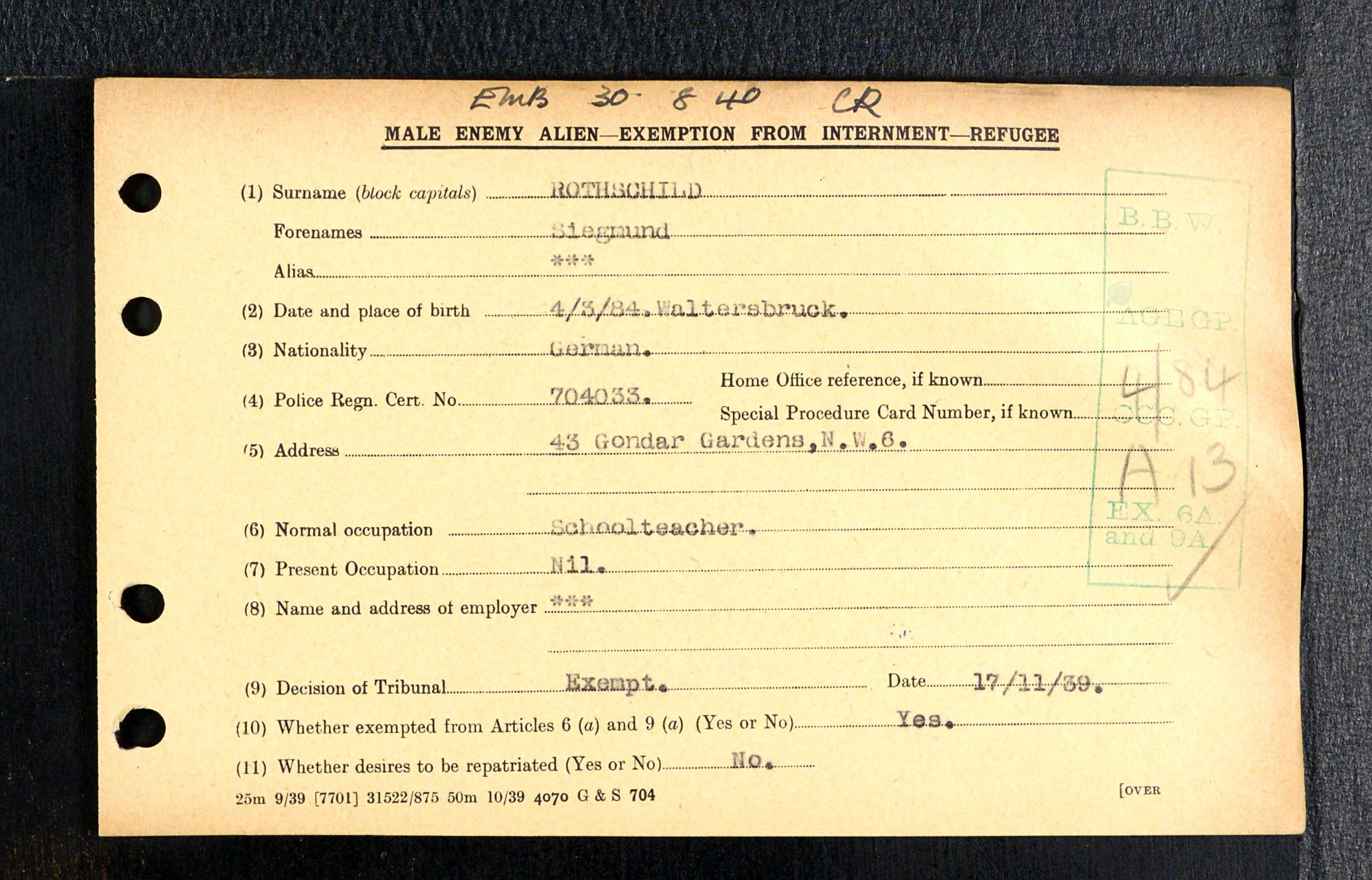
Once Elise also was able to escape to England, the family was reunited in London and Werner was able to attend school.   The 1939 England & Wales Register shows Siegmund and Elise living in London.2 But after the war started against Germany in September 1939, Ernst was interned as an enemy alien; Siegmund and Elise, however, were exempted from internship. Werner was just a child.

Siegmund Rothschild, The National Archives; Kew, London, England; HO 396 WW2 Internees (Aliens) Index Cards 1939-1947; Reference Number: HO 396/238, Piece Number Description: 238: Dead Index (Wives of Germans Etc) 1941-1947: Rosenber-Schitz, Ancestry.com. UK, World War II Alien Internees, 1939-1945

Elise Rothschild, The National Archives; Kew, London, England; HO 396 WW2 Internees (Aliens) Index Cards 1939-1947; Reference Number: HO 396/238, Piece Number Description: 238: Dead Index (Wives of Germans Etc) 1941-1947: Rosenber-Schitz, Ancestry.com. UK, World War II Alien Internees, 1939-1945

Ernst Rothschild, The National Archives; Kew, London, England; HO 396 WW2 Internees (Aliens) Index Cards 1939-1947; Reference Number: HO 396/193, Ancestry.com. UK, World War II Alien Internees, 1939-1945

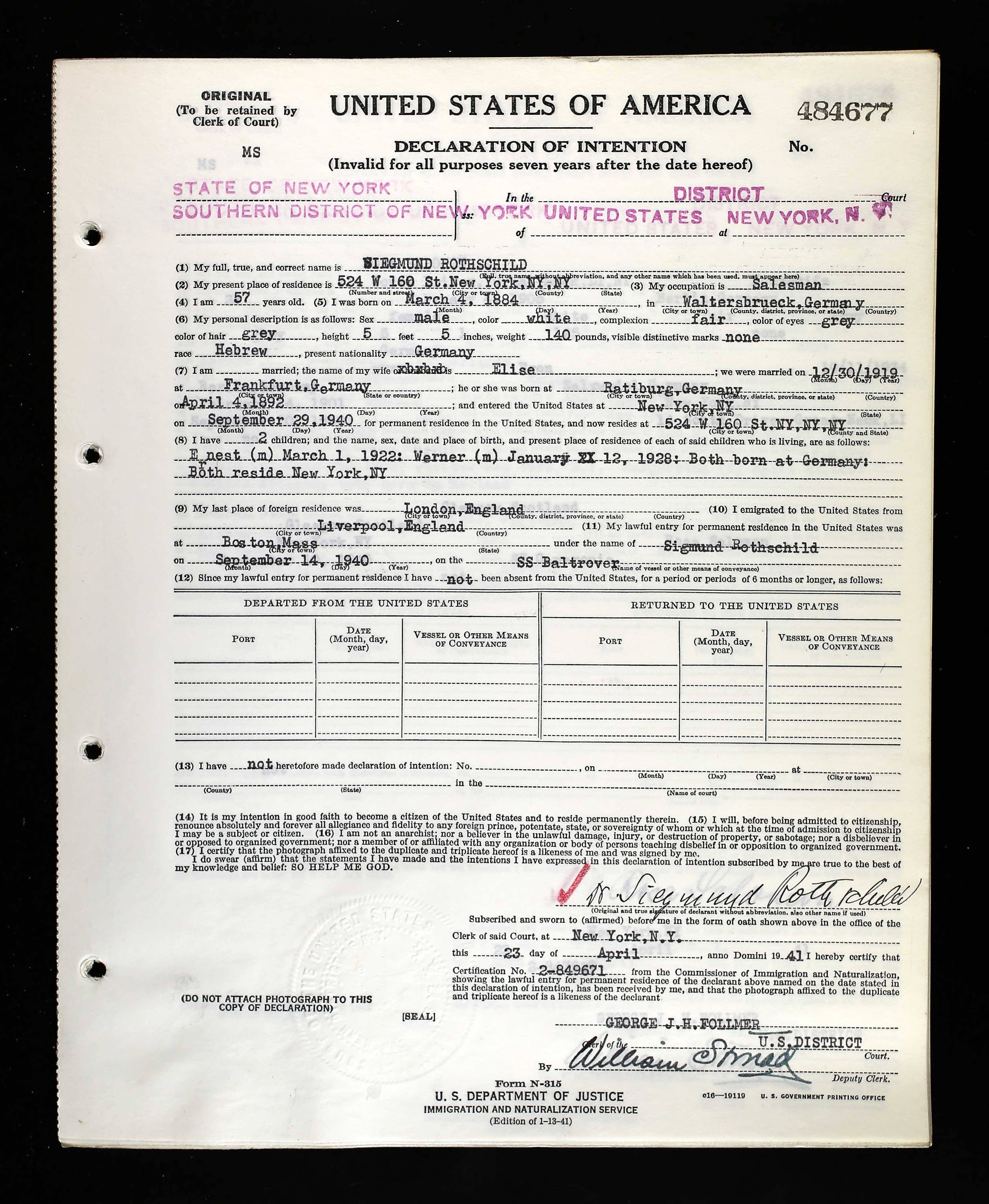
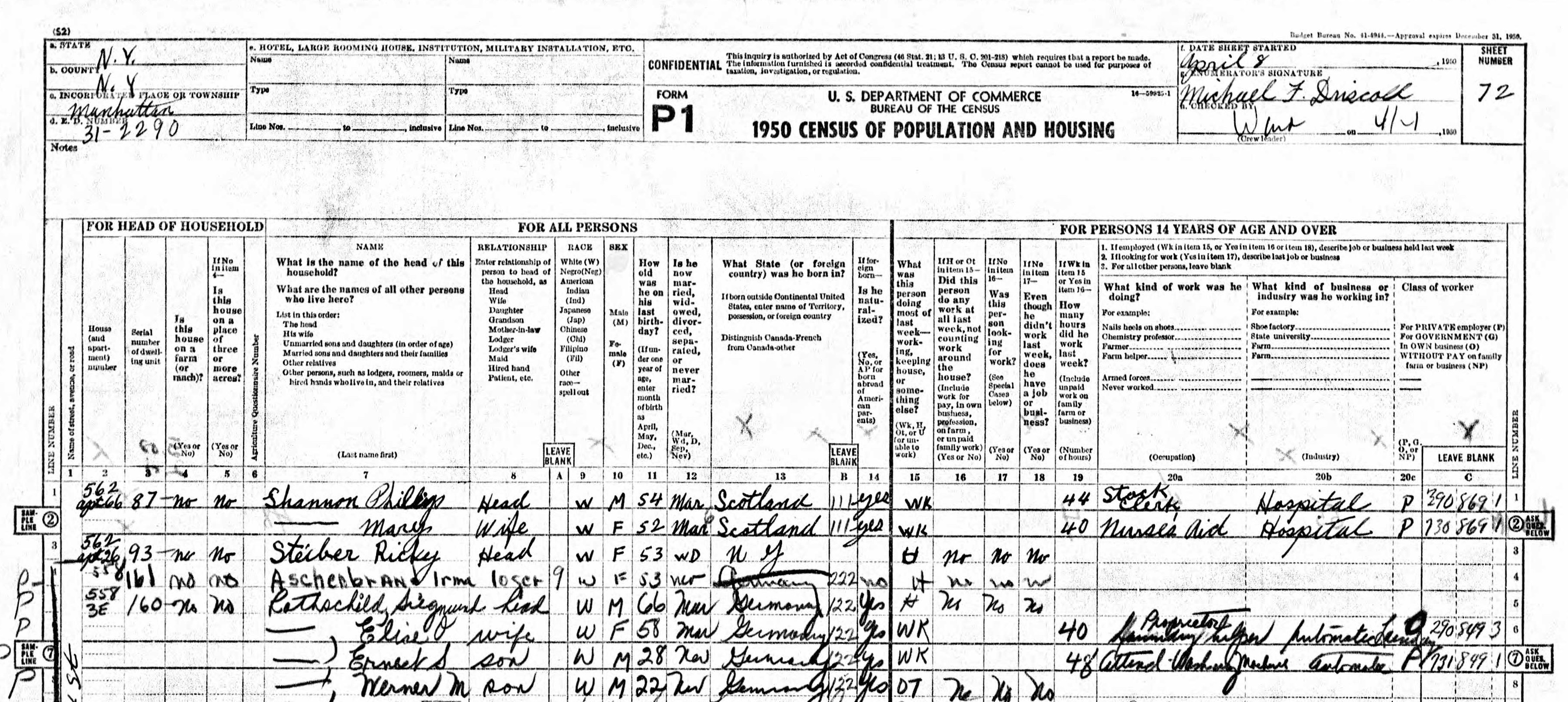
Ernst was eventually released, and the family was finally able to immigrate to the United States in the summer of 1940, as we will see. Then they had to start their lives all over again. More on their life in the US in the next post.


  1. Werner Rothschild, Gender Male, Record Type Refugee List, Birth Date 12 Jan 1928, Residence Place Frankfurt, Document Date 22 Mär 1939 (22 Mar 1939)
    Permit Number 3813, United States Holocaust Memorial Museum; Washington, D.C.; Series: Selected Records Relating to Kindertransports; Record Group: RG-59.075; File Number: mh55-704.00000088, Ancestry.com. UK, Selected Records Relating to Kindertransport, 1938-1939 (USHMM) 
  2. Siegmund Rothschild, The National Archives; Kew, London, England; 1939 Register; Reference: RG 101/244E, Description Enumeration District: Akde, Ancestry.com. 1939 England and Wales Register 

Yom Hashoah 2025

Before I started researching my family history back in 2010, I believed that I had no relatives who were killed in the Holocaust. Since then I have learned that there are so many of my cousins who were killed by the Nazis that I have lost count—babies, children, teenagers, mothers and fathers, brothers and sisters, grandparents, the frail and the elderly—innocent people who were put to death for no reason other than their Jewish identity.

Here we are 80 years after the Holocaust and we are still seeing people being despised and targeted because of their identities. There is still widespread antisemitism, but also widespread racism and islamophobia. We seem to have learned nothing.

On Yom Hashoah let’s work for and hope for the end of all kinds of intolerance and hatred.

Two Updates: Why Didn’t Mathilde Rothschild Leave Germany With Her Family? And How did Albert Alexander Meet His Wife?

Before I continue the stories of the children of Gerson Rothschild and Fanny Kugelmann, I have three updates to earlier posts that I’d like to share. All three are possible because other researchers and family members found this blog and contacted me. These are true gifts from the genealogy village. I am so grateful.

Some of you may recall that back in May 2024, I wrote about my relative Hirsch “Harry” Rothschild and his three children, all of whom escaped from Nazi Germany to the United States before World War II started. But unfortunately Harry’s wife Mathilde did not escape with her family and was ultimately murdered by the Nazis.

In my blog post about this family I wondered why Mathilde had not come with Harry and her children when they left Germany. Was she ill, I speculated? I had no answers.

Now I have more information about the family of Harry Rothschild. A man named Fredo Behrens recently contacted me after seeing my blog post. He lives in Oldenburg, Germany, and as he told me in his email, he worked for the “Nordwestdeutsches Museum für Industriekultur” in Delmenhorst for several years 25 years ago, where his area of responsibility was museum education, exhibitions and a regional “Topography of the Nazi Era.” He also is on the board of the “Friends and Supporters of the Jewish Community of Delmenhorst,” and heads the Delmenhorst City History Working Group. More specifically, he has done research into the history of the Jewish people of Delmenhorst, including the Rothschild family.1

Fredo told me about a monograph by Dr. Enno Meyer from 1985 entitled “Die Geschichte der Delmenhorster Juden 1695-1945”, or the History of the Jews of Delmenhorst 1695-1945. Dr. Meyer was the head of “Gesellschaft für christlich-jüdische Zusammenarbeit” (Society for Christian-Jewish Cooperation) for at least 30 years, according to Fredo. Fredo sent me both a copy of Dr. Meyer’s monograph (in German) and also a copy of an article that Fredo himself wrote about the Jews of Delmenhorst that excerpts parts of Meyer’s monograph and adds to it.2 I was able to use DeepL to translate Fredo’s work and learn more about the Rothschild family’s life in Delmenhorst.

According to the works of Meyer and Behrens, Dr. Harry Rothschild came to Delmenhorst from Hesse in 1914 and was the first Jewish doctor to practice in that town. By 1925, he was one of the top two taxpayers in the town. Harry was not active in the organized Jewish community, however, until after the Nazis came to power.3 According to Fredo’s research, the growing antisemitism in the early 1930s prompted Harry to become more involved. By 1933 he was chairman of the local Zionist organization and on the Jewish community board.

When the Nuremberg Laws were adopted and Jews were no longer allowed to employ Aryans, Harry and his Aryan cleaning woman petitioned the mayor for permission to continue their employment relationship, but their petition was rejected.4

Fredo kindly shared with me this photograph showing the street where the Rothschild family lived in Delmenhorst in 1930. The arrow points to where Harry Rothschild practiced medicine and lived before he left Germany in 1939.

Rothschild house and office in Delmenhorst, 1930, courtesy of Fredo Behrens: Jüdisches Leben in der Langen Straße nach 1933. In: Die Lange Straße in Delmenhorst : Biographie einer alten Straße ; Begleitveröffentlichung zur Ausstellung in den Museen der Stadt Delmenhorst auf der Nordwolle vom 24.6. – 2.9.2001. Hg. vom Stadtmuseum Delmenhorst. Isensee, Oldenburg 2001, p. 60

Then on October 10, 1937, Harry and a number of other Jewish residents of Delmenhorst were arrested by the Gestapo without warning or warrants. According to the observations of a fellow prisoner who became Harry’s cellmate, Harry was particularly humiliated by this experience and was called a “dirty stinking Jew” by one of the Gestapo agents. Harry and his cellmate were in solitary confinement, and Harry remained in prison until the spring of 1938. Harry’s condition had deteriorated greatly during his imprisonment.5

On November 10, 1938 in the aftermath of Kristallnacht, Harry was again arrested and was one of fourteen Jewish men who were arrested and sent to the concentration camp at Sachsenhausen.6

By that time all three of Harry and Mathilde’s children had left Germany for the United States. Harry left in the spring of 1939 and went to Cuba, and he was finally able to join his children in the US in December 1939.

But as we know, Mathilde did not come with him, and she was eventually deported to Minsk and died there. Dr. Meyer shed some light on this in his monograph, also quoted in Fredo Behren’s work. On page 85 of his history of the Delmenhorst Jews, Enno Meyer wrote that Mathilde had stayed behind to try and sell the family house; then when the war started in September 1939, she was trapped in Germany and could not leave.7

If only Mathilde had left with Harry and had not tried to sell the family’s home, this family’s story would have had a much happier ending. There may be more to this story that we will never know, but if this account is accurate, it shows how one decision affected an entire family’s fate during the Holocaust.

I want to thank Fredo Behrens again for providing me with the information and the photograph used in this post and for the work he does to preserve the Jewish history of Delmenhorst.


The second update came from two newly found cousins—my fifth cousin Charles Alexander and his daughter Kate. They also found me through my blog. Charles is the grandson of Theresa Rothschild Alexander, and I wrote about that family here. Check out the update there and learn how Charles’ parents, Albert Alexander and Mary Jane Deiches, actually met. My original speculation proved to be incorrect.

Also, I’ve added to that post a photo Charles gave me from his father’s yearbook. I am also adding it here since I could not place it properly in the original post.


Finally, the third update will have to wait until next week.


  1. Email from Fredo Behrens, March 25, 2025. 
  2. Fredo Behrens, “Jüdisches Leben in der Langen Straße nach 1933. In: Die Lange Straße in Delmenhorst : Biographie einer alten Straße; Begleitveröffentlichung zur Ausstellung in den Museen der Stadt Delmenhorst auf der Nordwolle vom 24.6. – 2.9.2001. Hg. vom Stadtmuseum Delmenhorst. Isensee, Oldenburg 2001. 
  3. Enno Meyer, “Die Geschichte der Delmenhorster Juden 1695-1945,” (1985), pp. 48, 55, 60, as cited in Behrens,  Note 2, supra. 
  4. Behrens, Note 2, supra, citing a letter dated November 14, 1936, response from the mayor dated December 3, 1936. Exhibition “Delmenhorst in National Socialism.   based on a letter dated September 24, 1955, affidavit from Wilhelm Schroers for Dr. Rothschild. Exhibition “Delmenhorst under National Socialism.” 
  5. Letter dated September 24, 1955, affidavit from Wilhelm Schroers for Dr. Rothschild. Exhibition “Delmenhorst under National Socialism.” as quoted in Behrens, Note 2, supra. 
  6. Behrens, Note 2, supra. 
  7. Enno Meyer, “Die Geschichte der Delmenhorster Juden 1695-1945,” (1985), p. 85, as cited in Behrens, Note 2, supra. 

A Brick Wall Tumbles: The Fates of August Felix Katzenstein and Julius Katzenstein, Orphaned Sons of Meier Katzenstein, Part I

Thanks to my friend Aaron Knappstein and my cousin Richard Bloomfield, an old brick wall has recently come down. Over seven years ago I wrote about the tragic story of Meier Katzenstein and his family. You can find all the sources, citations, and details here. But I will briefly outline their story.

Meier, my great-grandmother Hilda Katzenstein Schoenthal’s first cousin, lost his first wife Auguste Wolf in 1876, shortly after she gave birth to their son August Felix Katzenstein. Meier remarried and had two more children with his second wife Bertha Speier:  Julius Katzenstein, born in 1879, and Ida Katzenstein, born in 1880. Both Ida and her mother Bertha died in April 1881, less than a year after Ida’s birth. Meier was left with two young sons, August, who was five years old, and Julius, who was two.

And then Meier himself died three years later in 1884, leaving August and Julius orphaned at eight and five, respectively. I couldn’t imagine what had happened to those two little boys. Who took care of them? What happened to them? This post will follow up on August, and the one to follow will be about his half-brother Julius.

I had been able to find out some of what happened to August as an adult when I initially wrote about him over seven years. He had married his first cousin, once removed, Rosa Bachenheimer in Kirchain, Germany, in 1900 when he was twenty-four years old. August and Rosa had two children, Margarete and Hans-Peter. All four of them were killed by the Nazis during the Holocaust. I knew that much, but there were still some gaping holes in my research. Where had August lived after his father died? Did he have any grandchildren? If so, did they survive the Holocaust?

So I went back now to to double-check my research and see if I could find anything more about August Felix Katzenstein and his family. I am so glad I did.

First, I learned at Yad Vashem that August and Rosa’s daughter Margarete had married Rudolf Loewenstein and had had two children with him: Klaus, born March 16, 1930, in Soest, Germany, and Klara, born June 9, 1932, in Soest, Germany. Unfortunately, Rudolf, Margarete and their two young children were also killed along with their grandparents and uncle during the Holocaust.

Then I found this Stolpersteine biography of August Katzenstein on a website about the history of the community of Essen, revised in 2024 by Mr. and Mrs. Hülskemper-Niemannn. It provides in part, as translated by Google Translate:

August Katzenstein was orphaned at a very early age. He then lived for a long time in the household of the parents of his future wife Rosa Bachenheimer from Kirchhain, whom he married around the turn of the century. The couple had two children: Margarethe (1901, later Loewenstein) and Hans (1905). August Katzenstein moved with his family to Steele in 1908 and took up a position as a teacher in the one-class Jewish elementary school at Isinger Tor.

After 1933, the Katzensteins’ lives changed radically. In 1937, the Gestapo arrested the couple because they were allegedly managing the assets of a dissolved Jewish organization. After a search of their apartment and rigorous interrogation and warnings, the couple were released. Even worse happened to August Katzenstein, who taught at the Jewish elementary school in Essen on Sachsenstrasse after the Jewish elementary school in Steele was closed, during and after the November pogrom. The apartment on Grendtor (then Ruhrstrasse) was destroyed and looted, and he and his disabled son Hans were arrested. While the 62-year-old father was released from police prison after 11 days, Hans was taken to Dachau despite written requests from his parents, from where he was only released after four weeks.

In the autumn of 1941, the deportation of Jews began across the Reich, including in Essen. … Half a year later, Katzenstein and his entire family were deported to Izbica. 

So now I know who had taken care of August after his father died: Rosa’s parents Sussman Bachenheimer and his wife Esther Ruelf, my second cousin, twice removed. I wrote about them here. I also now know that August had become a teacher and lived in Steele, Germany, a suburb of Essen, Germany.

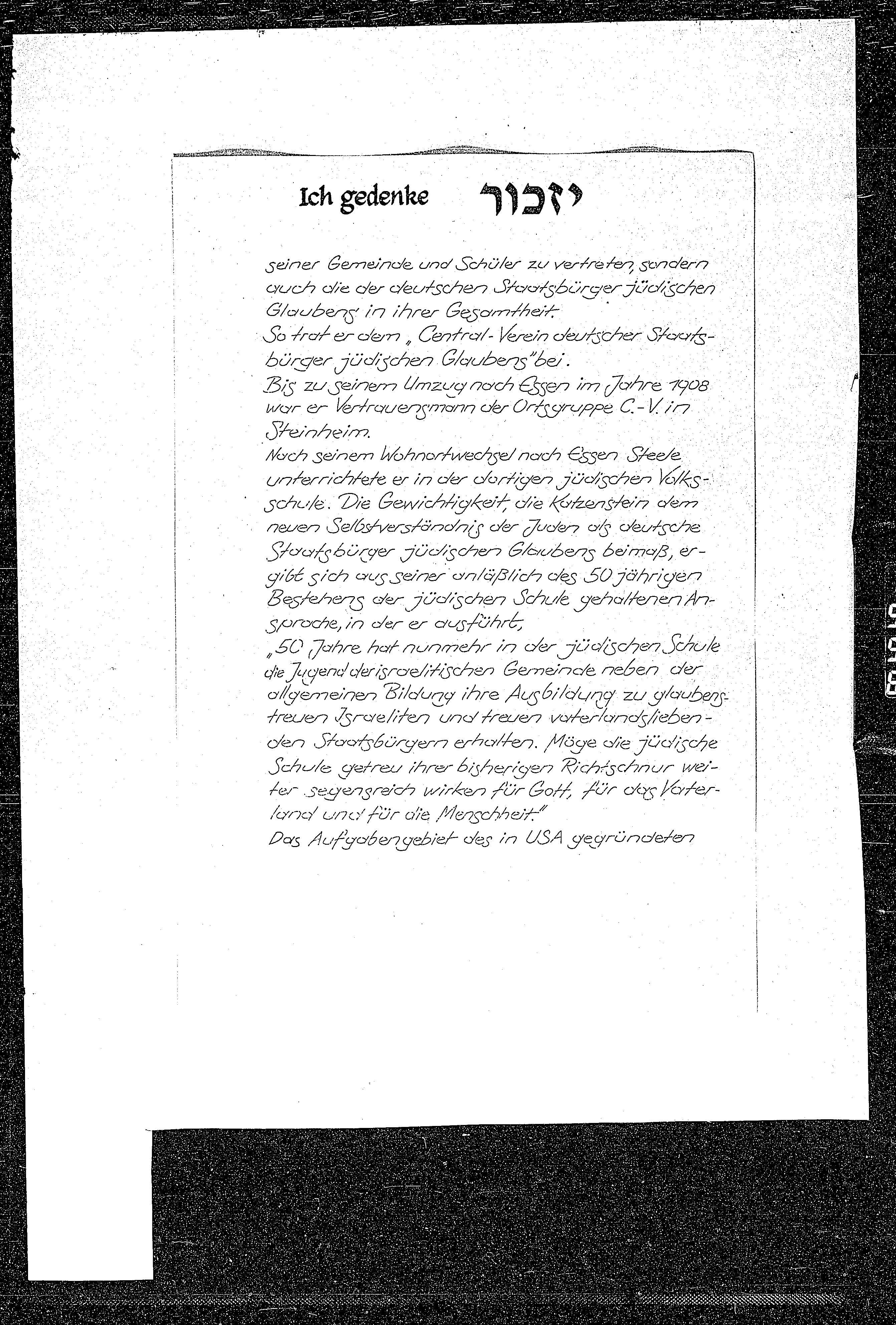
I found additional information about August and his family at Yad Vashem. The website has been updated since I had last researched August Katzenstein, and I found these documents I had not seen before from the Yizkor Book for the Jews of the Essen community who had been killed during the Holocaust. I asked my cousin Richard Bloomfield to translate these pages, and he graciously (and quickly!) agreed to do so.

Richard’s translation provides:

August Katzenstein was a Mensch.

He was a German citizen and of the Jewish faith, whose teachings shaped his life. He was born on September 13, 1876, in Jesberg/Hesse and lived in the Jewish community of Steinheim in Westphalia until 1908, where he held the office of teacher and religious official. With his wife Rosa, née Bachenheimer, he had a daughter Margarete, born in 1901, and a son Jacob (Hans), born in 1905.

August Katzenstein saw his work as a teacher not just as a profession, but as a vocation. In his eyes, the teacher was not only an imparter of knowledge, he was also a leading figure in the Jewish community who had to ensure a harmonious relationship between the community and school life.

Beginning at the age of 20, August Katzenstein decided to represent not only the interests of his community and pupils, but also those of German citizens of the Jewish faith as a whole.

He joined the “Central Association of German Citizens of the Jewish Faith” “Central-Verein deutscher Staatsbürger jüdischen Glaubens”.

Until he moved to Essen in 1908, he was a representative of the C.-V. local group in Steinheim.

After moving to Essen Steele, he taught at the Jewish elementary school there. The importance that Katzenstein attached to the new self-image of Jews as German citizens of the Jewish faith can be seen in his speech on the occasion of the 50th anniversary of the Jewish school, in which he states,

“For 50 years now, the youth of the Jewish community has received their education in the Jewish school to become faithful Israelites and loyal citizens who love their fatherland, in addition to their general education. May the Jewish school continue to work beneficially for God, for the fatherland and for humanity, true to its guiding principles.”

The mission of the independent order “Bnai Brith” founded in the USA, spiritual self-education, the promotion of science and art, help for the persecuted and needy and the defense of Jewish citizens in the event of anti-Semitic attacks led August Katzenstein to join the Glück-Auf-Lodge of “Bnai Brith” in Essen in 1911 and of which he was president until April 1935.

Until his retirement in 1937, he also headed the Jewish relief organization in Essen-Steele. But despite his retirement, he did not neglect the members of the community whose employ he had left.

The ban and immediate dissolution of the “Bnai Brith” order by Himmler’s decree of April 10, 1937, resulted in August Katzenstein’s arrest on April 19, 1937, after his apartment and all the rooms of the Glück-Auf-Loge had already been searched two days earlier.

August Katzenstein then had to endure hours of interrogation under threat of state police measures. He was forced to sign a declaration that he had no further property belonging to the Glück-Auf-Lodge at his disposal and that he was not aware of where further material might be hidden, as documented in the Gestapo protocol of the same day.

During the so-called Reichskristallnacht on November 9, 1938, the Katzenstein family’s home at Ruhrstrasse 24 was also severely damaged. One day later, August Katzenstein and his disabled son were arrested again. They were held in the police prison in Essen until November 19, 1938. After his release, August Katzenstein wrote a letter to the Gestapo asking them to release his son, who had been sent to Dachau concentration camp. His son Jacob (Hans) then returned on December 21, 1938.

However, not only the care of his family, but also the suffering of the community entrusted to him had become his life’s purpose. Even the destruction of the school and synagogue as the center of the community during the November pogrom could not break August Katzenstein’s will to live in the Jewish faith.

In January 1939, August Katzenstein carried out his last community-related activity, officiating at the wedding of a young couple in the wife’s parental home.

On April 22, 1942, August Katzenstein, his wife Rosa, his son Hans, his daughter Margarete, his son-in-law Rudolf Loewenstein and his two grandchildren were deported to Izbica. No trace of them remains.

His strong faith and the willpower born of it made him a lovable, upright person whose care for his Jewish community defined his life.

Contemporary Jewish witnesses describe August Katzenstein as a wonderful person of integrity, very wise, reserved and fully committed to his Judaism. As a teacher, he was not only a person of respect for the children, but “more like a father.” August Katzenstein was a man whose life was simply snuffed out because he was Jewish.

Nikolaus-Gross, Abendgymnasium Essen, Semester 4

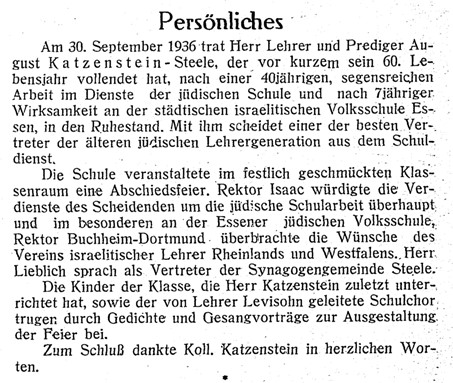
I wondered whether August’s “retirement” from teaching was voluntary or forced upon him by the Nazis, and although it’s still not clear, Richard also found this article about August’s retirement published on November 1, 1936, in the Jüdische Schulzeitung [Monthly journal for education, instruction and school policy; official publication of the Reich Association of Jewish Teachers’ Associations], (p.6):

Richard translated the article for me:

On September 30, 1936, after 40 years of beneficial work in the service of Jewish schools and 7 years of work at the local Jewish elementary school in Essen, teacher and preacher August Katzenstein of Essen-Steele, who recently turned 60, retired. With him, one of the best representatives of the older Jewish generation of teachers leaves the teaching profession.

The school held a farewell party in the festively decorated classroom. Principal Isaac paid tribute to the departing teacher’s services to Jewish schools in general and to the Jewish Elementary School in Essen in particular. Principal Buchheim of Dortmund conveyed the wishes of the Association of Israelite Teachers of the Rhineland and Westphalia. Mr. Lieblich spoke as a representative of the Steele Synagogue community.

The children of the class that Mr. Katzenstein taught last, as well as the school choir led by teacher Levisohn, contributed to the ceremony with poems and songs.

Finally, colleague Katzenstein gave a heartfelt thank you.

Obviously, August was a well-loved, well-respected teacher and community leader. His early childhood was quite miserable—losing his mother, then his stepmother and half-sister, then his father—all before he was nine years old. But despite that tragic beginning, he lived a full and productive life, filled with meaning, faith, family, and love. How someone recovers from so much tragedy is amazing to me.

But then the Nazis came to power and destroyed August’s life and his family. I am so glad I went back to see if I could learn more about his life, and I am so grateful to Richard for his translation of the documents from the Essen Yizkor Book and for finding the article about August’s retirement. I found comfort in knowing that despite his tragic beginning and ending, August found fulfillment and meaning in his life.

But what about his younger brother Julius? I had known even less about him when I first researched this family. I couldn’t find anything that revealed what happened to him after his parents died. I couldn’t find a marriage record, a death record, a birth record for any children—-not one thing. Fortunately, he was not listed at Yad Vashem, so presumably had not shared the fate of his brother August. But where had he gone? Who had taken care of this little orphaned boy?

I will report on what I’ve learned about Julius in my next post.


Levi Rothschild’s Daughters Thekla Rothschild Weinberg and Frieda Rothschild Phillipsohn: One Survived, One Did Not

This is the story of the last two children of Levi Rothschild and Clara Jacob who lived to adulthood, their daughters Thekla and Frieda. Both have heartbreaking stories though Thekla survived and Frieda did not.

The fifth child of Levi and Clara, their daughter Thekla, married Manuel Edward Weinberg on August 19, 1907, in Borken. Manuel was born in Lichenroth, Germany, to Lazarus Weinberg and Karoline Oppenheimer on October 11, 1880.

Thekla Rothschild and Manuel Weinberg marriage record, Hessisches Hauptstaatsarchiv; Wiesbaden, Deutschland; Bestand: 920; Laufende Nummer: 843, Ancestry.com. Hesse, Germany, Marriages, 1849-1930

Thekla and Manuel had a son Hans Herbert Weinberg born in Frankfurt, Germany, on November 2, 1908.1

After Kristallnacht in November 1938, Manuel Weinberg was imprisoned at Buchenwald for a short time,2 and that may have motivated the family to leave Germany. By 1940 if not before, the family had left Germany for France, and according to Yad Vashem, Thekla’s husband Manuel was deported in 1940 to the internment camp near Toulouse, France known as the Recebedou camp.3

According to one website, the camp of Recebedou was created in July 1940 to receive refugees and those who had been evacuated. It was turned into a hospital camp in February 1941. But conditions in the camp deteriorated over time due to the lack of adequate medical care and a shortage of food. By late 1941, there were 739 interns, many of whom were over 60 and ill; 118 of them died in the winter of 1941-1942. Manuel Weinberg was one of those who died; he died on March 4, 1942.4

I don’t know for certain whether Thekla or their son Herbert, as he came to be known, were also interned at Recebedou because there are no documents I can find that indicate that they were. However, I do know that they must have been in France because Herbert and his wife, Edith Seckbach, had a daughter Yvonne born in Toulouse, France sometime in 1943.5  I could not find a marriage record for Herbert and Edith, but according to other records, Edith was born in Wiesbaden, Germany, in about 1918. 6

Wherever they were in France, somehow Thekla, Herbert, Edith, and their baby daughter survived. A document on Ancestry’s collection of Munich, Vienna and Barcelona Jewish Displaced Persons and Refugee Cards, 1943-1959 (JDC) indicates that as of November 1942, Thekla, Herbert, Edith, and Yvonne were in Vigo, Spain, which is almost seven hundred miles from Toulouse, France. How they got there in the midst of the war is a story I do not know.

Ancestry.com. Munich, Vienna and Barcelona Jewish Displaced Persons and Refugee Cards, 1943-1959 (JDC)

From Vigo they went to Madrid as of December 26, 1943. The Refugee Card lists two people as the “parents,” which I assume really means sponsors in this situation. One was Walter Hirschmann, Thekla’s nephew, the son of her sister Betti Rothschild Hirschmann.7 The other, Jacob Bleibtreu, was a banker and later a governor of the New York Stock Exchange who had immigrated to the US from Germany as a young man in 1909. He also was on the Greater New York Army and Navy Committee of the Jewish Welfare Board. Perhaps he knew Walter from the banking and broker business and agreed to help rescue his aunt and other family members.8

On March 23, 1944, Thekla, Herbert, Edith, and Yvonne all arrived in Philadelphia after sailing from Lisbon, Portugal. The ship manifest shows that they all had last been residing in Madrid, Spain, and were heading to Montreal, Canada under the sponsorship of the Joint Distribution Committee. Herbert reported that he was a chemist by occupation.

Thekla Weinberg and family passenger manifest, The National Archives at Washington, D.C.; Washington, D.C.; Series Title: Passenger Lists of Vessels Arriving at Philadelphia, Pennsylvania; NAI Number: 4492386; Record Group Title: Records of the Immigration and Naturalization Service, 1787-2004; Record Group Number: 85; Series: T840; Roll: 177, Ancestry.com. Pennsylvania, U.S., Arriving Passenger and Crew Lists, 1798-1962

Herbert’s wife Edith must not have lived very long after their voyage from Portugal to Philadelphia because on September 8, 1946, Herbert married his second wife, Anna or Anya Grodzky, in Hochelaga, Quebec, Canada. Anna was born in Russia on June 18, 1910, and was a beautician. Herbert is listed as a widower on their marriage record and as a chemist by trade.

Hans Herbert Weinberg marriage to Anna Grodsky, Marriage Sep 8 1946 Westmount, Québec, Canada, Groom Herbert Hans Weinberg, Groom’s birth 1908 Germany, Bride Anna Goodsky, Certificate number upd46-128967, Quebec Marriage Returns, 1926-1997, found at https://www.myheritage.com/research/record-10723-1831907/herbert-hans-weinberg-and-anna-goodsky-in-quebec-marriage-returns

The family all settled in Montreal, where Thekla died on March 11, 1962, at the age of 76.9 Herbert lost his second wife Anna on July 9, 1976.10 He died February 12, 2001, at the age of 92, and was survived by his third wife Sally Lazoff Bailen.11

I have not found any further information about Herbert’s daughter Yvonne despite searching everywhere I could and receiving help from members of Tracing the Tribe. I don’t know whether she died, married, or moved from Canada and changed her name. There just is no trace of her after a mention in her stepmother Anna’s obituary in 1976. She is not mentioned in her father’s obituary in 2001.12

Although Thekla Rothschild Weinberg survived the Holocaust, she lost her husband, her homeland, and, as we will now see, her sister Frieda to the Holocaust.

Frieda was born May 31, 1993, in Borken, Germany.  As we saw, she first married Leonard Marxsohn and was widowed and then married Paul Phillipsohn, with whom she had a daughter Hannelore, born December 3, 1926.

Unfortunately, I have no happy ending for Frieda, Paul, or Hannelore. On June 11, 1942, they were all deported to Theriesenstadt. None of them survived. According to Yad Vashem, Paul died on December 20, 1942. I have no exact dates for Frieda or Hannelore, only that they also died in about 1942.13

Thus ends the story of Levi Rothschild’s family. Although most of them survived the Holocaust and made it to the US, Israel, or Canada, they were scattered across the globe, and their lives were all forever changed. The family members who were killed must have left holes in their hearts forever.


  1. Hans Herbert Kaufmann Weinberg, Gender männlich (Male), Record Type Inventory, Birth Date 02 Nov 1908 (2 Nov 1908), Birth Place Frankfurt am Main,
    Last Residence Frankfurt am Main, Residence Place Frankfurt am Main, Father
    Edmund Weinberg, Mother Thekla Weinberg, Spouse Edith Seckbach, Notes Inventories of personal estates of foreigners and especially German Jews
    Reference Number 02010101 oS, Document ID 70370883, Arolsen Archives, Digital Archive; Bad Arolsen, Germany; Lists of Persecutees 2.1.1.1, Ancestry.com. Free Access: Europe, Registration of Foreigners and German Persecutees, 1939-1947 
  2. Arolsen Archives, 1 Incarceration Documents / 1.1 Camps and Ghettos / 1.1.5 Buchenwald Concentration Camp / 1.1.5.3 Individual Documents male Buchenwald / Individual Files (male) – Concentration Camp Buchenwald / Files with names from SYS and further sub-structure / Files with names from WECK /, Personal file of WEINBERG, EMANEL, born on 11-Oct-1880, Reference Code, 01010503 002.042.476, Number of documents, 1, found at https://collections.arolsen-archives.org/en/document/7388346 
  3. Yad Vashem entries for Manuel Weinberg, found at  https://collections.yadvashem.org/en/names/13545516 and at https://collections.yadvashem.org/en/names/3229127 
  4. See Note 3, supra. 
  5. Yvonne Miriam Weinberg, passenger manifest, The National Archives at Washington, D.C.; Washington, D.C.; Series Title: Passenger Lists of Vessels Arriving at Philadelphia, Pennsylvania; NAI Number: 4492386; Record Group Title: Records of the Immigration and Naturalization Service, 1787-2004; Record Group Number: 85; Series: T840; Roll: 177, Ancestry.com. Pennsylvania, U.S., Arriving Passenger and Crew Lists, 1798-1962 
  6. Edith Weinberg, passenger manifest, The National Archives at Washington, D.C.; Washington, D.C.; Series Title: Passenger Lists of Vessels Arriving at Philadelphia, Pennsylvania; NAI Number: 4492386; Record Group Title: Records of the Immigration and Naturalization Service, 1787-2004; Record Group Number: 85; Series: T840; Roll: 177, Ancestry.com. Pennsylvania, U.S., Arriving Passenger and Crew Lists, 1798-1962. See also Edith Weinberg geb. Seckbach, Arolsen Archives, Digital Archive; Bad Arolsen, Germany; Lists of Persecutees 2.1.1.1, Description Reference Code: 02010101 oS,
    Ancestry.com. Free Access: Europe, Registration of Foreigners and German Persecutees, 1939-1947 
  7. It was Walter’s name on this card that led me to discover that he was the child of Betti and Emanuel Hirschmann. 
  8. “Jacob Bleibtreu, Former Governor of New York Stock Exchange, 90,” The New York Times, December 6, 1976. 
  9. Thekla Weinberg death notice, The Montreal Star, Montreal, Quebec, Canada, Mon, Mar 12, 1962, Page 16. 
  10. Anna (Anya) Weinberg death notice, The Montreal Star, Montreal, Quebec, Canada, Sat, Jul 10, 1976, Page 10. 
  11. Marriage of Herbert Weinberg to Sally Lazoff, Nov 15 1980, Côte St Luc, Québec, Canada, Groom Herbert Weinberg, Groom’s birth Nov 5 1908, Germany, Groom’s age 72, Bride Sally Lazoff, Bride’s birth Aug 15 1917, Québec, Canada, Bride’s age 63, Groom’s father Manuel Weinberg, Groom’s father’s birth Germany, Groom’s mother Thekla Rothschild, Groom’s mother’s birth Germany, Bride’s father Gedaliah Lazoff
    Bride’s father’s birth Russia, Bride’s mother Telia Brasgold, Bride’s mother’s birth Russia
    Certificate number upd80-141452, Quebec Marriage Returns, 1926-1997, found at https://www.myheritage.com/research/record-10723-2419633/herbert-weinberg-and-sally-lazoff-in-quebec-marriage-returns. Herbert Weinberg death notice, The Gazette
    Montreal, Quebec, Canada, Mon, Feb 12, 2001, Page 35. 
  12. Anna (Anya) Weinberg death notice, The Montreal Star, Montreal, Quebec, Canada, Sat, Jul 10, 1976, Page 10. Herbert Weinberg death notice, The Gazette, Montreal, Quebec, Canada, Mon, Feb 12, 2001, Page 35. 
  13. See Yad Vashem entries at https://collections.yadvashem.org/en/names/11607287 for Frieda, https://collections.yadvashem.org/en/names/14969310 for Paul, and https://collections.yadvashem.org/en/names/11607287 for Hannelore. 

Mathilde Rosenbaum Rothschild: Why Didn’t She Leave Germany?

Several readers asked me whether I could learn more about why Mathilde Rosenbaum Rothschild did not go with her husband Hirsch Rothschild and their children to the United States in the 1930s, but stayed in Germany. Tragically Mathilde was eventually killed by the Nazis whereas her husband and children all survived.

I decided to dig a little deeper into Mathilde’s family to see if perhaps she’d stayed to care for elderly parents, but both of her parents died long before the Nazi era.1  Mathilde also had numerous siblings, including one who was killed at Auschwitz, but others escaped—to Israel, to the US, and to South Africa. In fact, this review of my research allowed me to realize something I had not noticed before. Mathilde’s sister Fanni Rosenbaum had married Hirsch Rothschild’s older brother Sigmund. They had escaped to South Africa.

I couldn’t trace all of her siblings, but given that her family was from Schluechtern and that Schluechtern is over 250 miles from Bremen, the city Hirsch listed as his wife’s residence on the passenger manifest, I don’t think that Mathilde was in Bremen to help with a family member.

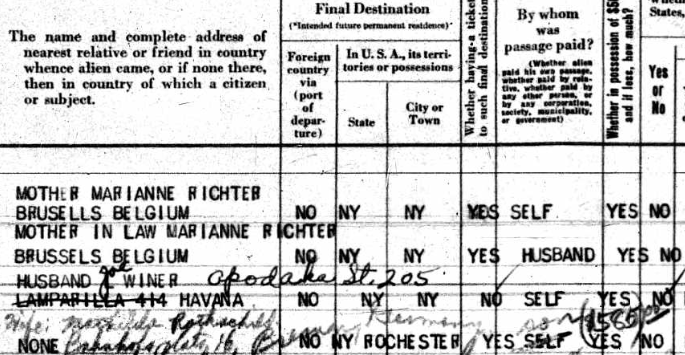
I looked more closely at the address that had been added to Hirsch’s passenger manifest—Bahnhofsplatz 16, in Bremen, thinking that perhaps it was the address of a hospital where Mathilde might have been getting treatment.

Hirsch Rothschild, passenger manifest, p. 2, The National Archives At Washington, D.c.; Washington, D.c.; Series Title: Passenger Lists of Vessels Arriving At Miami, Florida; NAI Number: 2788508; Record Group Title: Records of the Immigration and Naturalization Service, 1787 – 2004; Record Group Number: 85 Description Roll Number: 086 Source Information Ancestry.com. Florida, U.S., Arriving and Departing Passenger and Crew Lists, 1898-1963

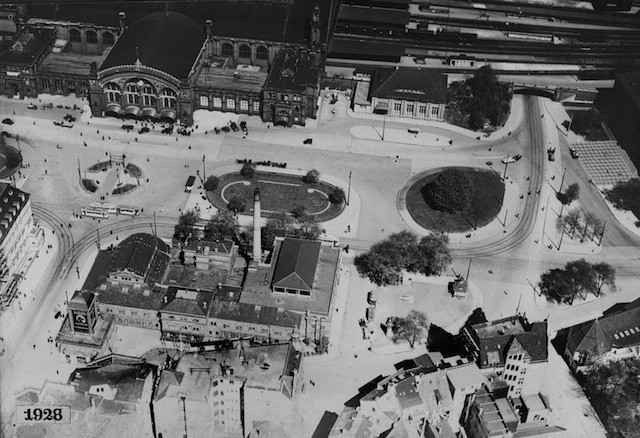
But “Bahnhofsplatz” means a plaza or square where the train station is located, and as best I can tell, in the late 1930s there was no hospital located near there. Rather, it was a place where there were hotels for those traveling to Bremen, an indoor swimming pool facility, and other public and private buildings. Although I can’t be certain, Banhofsplatz 16 may have been the address for a hotel in the 1930s.

Bahnhofsplatz-1928 Bremen Germany

Why would Mathilde be living in a hotel in Bremen? When Hirsch left Germany in the late 1930s, he listed his last permanent residence as Delmenhorst, a village about ten miles from Bremen.  It’s possible that Hirsch and Mathilde had been forced out of their home in Delmenhorst by then either by force or for better opportunities and had moved into a hotel in Bremen. As a  Jewish doctor, by 1938-1939, Hirsch would only have been allowed to treat Jewish patients, and Bremen had a larger Jewish population than Delmenhorst.  Although the passenger manifest indicates that Hirsch’s last permanent residence was Delmenhorst, not Bremen, I would think that staying in a hotel near the train station would not be considered a “permanent” residence so Delmenhorst would still have been more accurate.

I still don’t know why Hirsch left without Mathilde. Maybe he thought he’d go first and settle in and then send for her. I also don’t know when Hirsch left Germany because the ship manifest listing his arrival in Florida on December 18, 1939, was for a ship arriving from Havana, Cuba. I searched the Bremen passenger manifests and found two of his children on them—Edith and Edmund—but not Hirsch. And I don’t know how long Hirsch was in Cuba before being allowed to sail to the US. So…anything I write is total speculation on my part.

The only way I’ll be able to find an answer to these questions would be to ask one of Mathilde’s grandchildren. I have located a few of them but have not yet contacted them. Somehow it just feels intrusive to ask them why their grandmother was left behind. For now I am letting this sit as an unanswered question.


  1. Her mother died in 1913. Jeanette Rosenbaum, Maiden Name Sondheimer, Gender weiblich (Female), Death Age 72, Birth Date abt 1841, Death Date 23 Okt 1913 (23 Oct 1913), Death Place Schluechtern (Schlüchtern), Hessen (Hesse), Deutschland (Germany), Civil Registration Office Schluechtern, Father Moses Sondheimer, Mother
    Marianne Sondheimer, Spouse Salomon Rosenbaum, Certificate Number 47, Hessisches Hauptstaatsarchiv; Wiesbaden, Deutschland; Personenstandsregister Sterberegister; Signatur: 5999, Ancestry.com. Hesse, Germany, Deaths, 1851-1958. Her father died in 1925. Salomon Rosenbaum, Gender männlich (Male), Death Age 83
    Birth Date abt 1842, Death Date 14 Juli 1925, Death Place Schluechtern (Schlüchtern), Hessen (Hesse), Deutschland (Germany), Civil Registration Office Schluechtern, Spouse Johannatta Certificate Number 40, Hessisches Hauptstaatsarchiv; Wiesbaden, Deutschland; Personenstandsregister Sterberegister; Signatur: 6011, Ancestry.com. Hesse, Germany, Deaths, 1851-1958 

Levi Rothschild’s son Hirsch: Leaving Germany with a Heavy Heart

Levi Rothschild’s fourth child, Hirsch (also known as Harry) and his three children Gertrude, Edith, and Edmund all managed to leave Germany in time to survive the Holocaust. His wife and their mother Mathilde Rosenbaum, however, did not.

Gertrude, Hirsch’s oldest child, was the first member of the family to come to the US although her husband preceded her. She had married Gustav Rosbasch sometime before 1933, the year their first child was born. Gustav was born in Kremenchug, Russia (maybe now Ukraine?) on August 12, 1901. Gustav, a surgeon, came to the US on October 10, 1934, listing his last residence as Delmenhorst, Germany, a town in the Saxony state of Germany.  He reported his wife Gertrude as the person he had left behind in Delmenhorst, and his uncle Phillip Rosbasch of Rochester, New York, as the person he was going to in the US. 1

Gertrude arrived almost a year later with their two-year-old daughter. They arrived on September 8, 1935, listing their prior residence as Delmenhorst and listing “G. Rosbasch” in Rochester as the person they were going to; “H. Rothschild,” Gertrud’s father, was listed as the person they had left behind in Delmenhorst.2 Gustav and Gertrude had a second child in Rochester a few years after Gertrude’s arrival.

The next member of the family to escape to the US was Edith, Gertrude’s younger sister. She arrived in New York on May 28, 1937, listing her destination as Rochester, New York, where her sister Gertrude was living, and listing her father, “Dr. Rothschild” as the person she’d left behind in Delmenhorst, her prior residence.3

Edith and Gertrud’s brother Edmund arrived a year after Edith on June 24, 1938, in New York with his destination being New York City where his uncle Karl Rosenbaum, his mother’s brother, was living. Edmund identified his occupation as a physician, like his father and his brother-in-law Gustav, and listed his father “Dr. Harry Rothschild” of Delmenhorst as the person he left behind, but Edmund gave his last residence as Basel, Switzerland, not Delmenhorst.4

Thus, the three children of Hirsch and Mathilde Rothschild had all arrived before Kristallnacht in November 1938. Their father Hirsch did not arrive for over another year. His ship sailed from Havana, Cuba, and arrived in Miami on December 17, 1939, three months after World War II had begun. Hirsch listed his occupation as a physician and the person he was going to as his son “Edw. Rothschild” in Rochester, New York. He also listed his last residence as Delmenhorst.

Hirsch Rothschild passenger manifest, The National Archives At Washington, D.c.; Washington, D.c.; Series Title: Passenger Lists of Vessels Arriving At Miami, Florida; NAI Number: 2788508; Record Group Title: Records of the Immigration and Naturalization Service, 1787 – 2004; Record Group Number: 85, Roll Number: 086, Ancestry.com. Florida, U.S., Arriving and Departing Passenger and Crew Lists, 1898-1963

There is a notation on Hirsch’s line on the passenger manifest that reads, “Admitted on appeal 1-3-40.”  Also for the section listing the person left behind in the prior country, where the word None had been typed, someone added in handwriting, “Wife Mathilde Rothschild” living in Bremen, Germany. Another handwritten change indicates that his son had paid his passage; “self” was crossed out.

Were these additions of Mathilde’s name and the fact that his son was paying his way what helped Hirsch win his appeal? Why wouldn’t he have listed Mathilde before? Why was she living in Bremen, not Delmenhorst? When did Hirsch actually leave for Germany? How long had he been in Cuba before sailing from Havana to Miami in December 1939?

These are questions for which I currently do not have answers, just some speculation. Was Mathilde ill and hospitalized in Bremen? Is that why she hadn’t come with Hirsch to the US?

I don’t know, but we do know that by early 1940, Hirsch and his three children and his son-in-law and granddaughter were all safely in the US. Gustav and Gertrude and their two children were living in Rochester, New York, where Gustav was a doctor.5 Edith was also in Rochester, working as a housekeeper for another family.6 Edmund was working as a doctor at the Monroe County (New York) Infirmary and Home for the Aged in Brighton, New York, only four miles from Rochester.7 I could not locate Hirsch/Harry on the 1940 US census, but on April 25, 1942, when he registered for the World War II draft, he was at that time living in Rochester with Gertrude and Gustav and unemployed.

Harry Hirsch Rothschild, World War II draft registraiton, The National Archives At St. Louis; St. Louis, Missouri; World War Ii Draft Cards (Fourth Registration) For the State of New York; Record Group Title: Records of the Selective Service System; Record Group Number: 147; Box or Roll Number: 522, Name Range: Rosser, Roscoe – Rought, Walter, Ancestry.com. U.S., World War II Draft Registration Cards, 1942
But not long after that Hirsch/Harry must have moved to New Rochelle, New York, 350 miles from his children in Rochester, where he found work as the house physician for the Jewish Home for the Aged in New Rochelle. Harry died on April 18, 1945, in New Rochelle; he was 64. Heartbreakingly, his obituary revealed that as of that date with Germany’s surrender just a few weeks away, Harry and his children did not yet know what had happened to Mathilde, their wife and mother. The obituary states that Harry’s wife Mathilde “remained in Germany when Dr. Rothschild left the country. Relatives here have been trying through the Red Cross to learn her fate.”

“Death Claims Ex-Physician to Aged Jews,” Rochester Democrat and Chronicle, April 14, 1945, p. 17

Yad Vashem, however, reveals what had happened to Mathilde. On November 18, 1941, she had been deported to the Minsk ghetto in Belarus where she was murdered on July 28, 1942. She was 57 years old. It must have been devastating for the family to learn this.8

But Mathilde and Harry were survived by all three of their children and by their grandchildren. Their daughter Gertrude and her husband Gustav remained in Rochester, New York, for the rest of their lives, where Gustav continued to practice medicine. He died on January 7, 1992, at the age of 90.9 Gertrude outlived him by five and a half years; she died on July 4, 1997; she was 86 years old.10 They were survived by their children and grandchildren.

Gertrud’s sister Edith married Abram Solomon (Jalomek) in 1943.11 As far as I can tell, they did not have children as none are listed in either of their obituaries. Edith died July 28, 2003, in Rochester, at the age of 92;12 her husband Abram died many years before on June 9, 1971, in Rochester.13

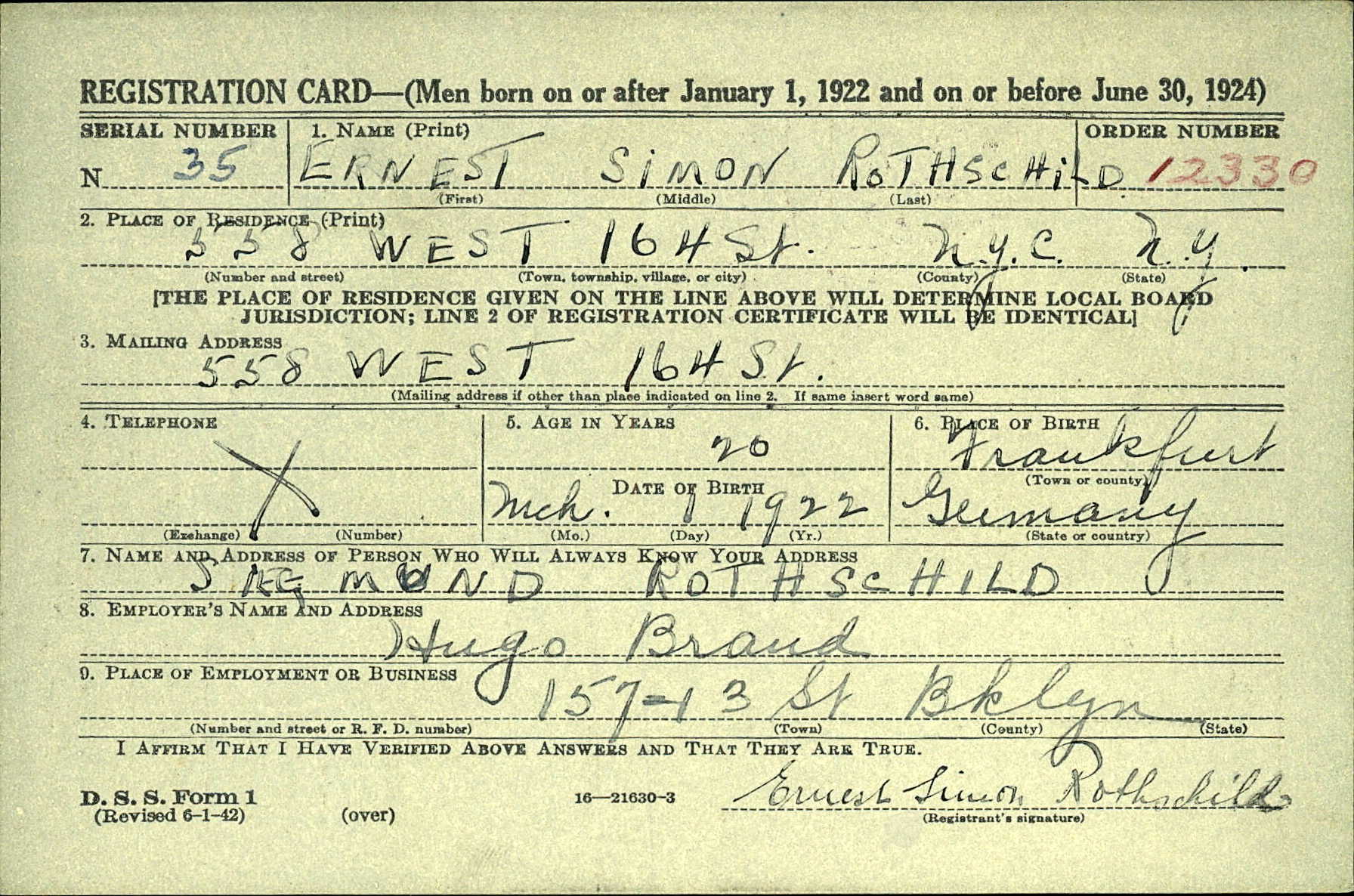
Edmund Rothschild, the youngest child of Hirsch and Mathilde, had registered for the draft on October 16, 1940.

Edmund Rothschild, World War II draft registration, National Archives at St. Louis; St. Louis, Missouri; Wwii Draft Registration Cards For New York State, 10/16/1940 – 03/31/1947; Record Group: Records of the Selective Service System, 147, Name Range: Roth, Cletus-Rotonde, Nicholas
Ancestry.com. U.S., World War II Draft Cards Young Men, 1940-1947

He married Helene Lois Brown on August 17, 1941, in Buffalo, New York.  She was the daughter of David Brown and Lucile Manheim.14 Edmund and Helene would have two children. Edmund served in the US Army during World War II from August 27, 1943, until March 11, 1946.15 Edmund and his family then settled in Springville, New York, where he continued to practice medicine.16

Later Edmund and Helene retired to Fort Myers, Florida, where Helene died at age 71 on April 24, 1993.17 Edmund died in Cleveland, Ohio, almost exactly a year later on April 21, 1994; he was 81.18 According to his obituary in the Springville Journal, Edmund “was an old-fashioned family physician [who] cared not only for his patients but also for their families and their community. His home was always equipped to see patients after hours and house calls were made often.” The obituary also noted that he was a gifted artist. Edmund and Helene are survived by their children and grandchildren.19

The story of the family of Hirsch Rothschild and his family reminds me of how much the US gained when Germany’s persecution of the Jews forced so many to come here. Hirsch, his son Edmund, and his son-in-law Gustav were all doctors educated and trained in Europe. They came to this country as refugees, and Americans benefited from those skills and that education and dedication. But Mathilde Rosenbaum Rothschild’s death at the hands of the Nazis must remind us that the gifts we Americans may have received from those refugees were not given by them without enduring terrible heartbreak and loss on their part.


  1. Gustav Rosbasch, World War II draft registration, National Archives at St. Louis; St. Louis, Missouri; Wwii Draft Registration Cards For New York State, 10/16/1940 – 03/31/1947; Record Group: Records of the Selective Service System, 147, Ancestry.com. U.S., World War II Draft Cards Young Men, 1940-1947; Gustav Rosbasch, passenger manifest, The National Archives in Washington, DC; Washington, DC, USA; Passenger and Crew Lists of Vessels Arriving at New York, New York, 1897-1957; Microfilm Serial or NAID: T715; RG Title: Records of the Immigration and Naturalization Service, 1787-2004; RG: 85, Ship or Roll Number: Scythia, Ancestry.com. New York, U.S., Arriving Passenger and Crew Lists (including Castle Garden and Ellis Island), 1820-1957 
  2. Gertrude Rosbasch, passenger manifest, The National Archives in Washington, DC; Washington, DC, USA; Passenger and Crew Lists of Vessels Arriving at New York, New York, 1897-1957; Microfilm Serial or NAID: T715; RG Title: Records of the Immigration and Naturalization Service, 1787-2004; RG: 85, Ancestry.com. New York, U.S., Arriving Passenger and Crew Lists (including Castle Garden and Ellis Island), 1820-1957 
  3. Edith Rothschild, passenger manifest, The National Archives in Washington, DC; Washington, DC, USA; Passenger and Crew Lists of Vessels Arriving at New York, New York, 1897-1957; Microfilm Serial or NAID: T715; RG Title: Records of the Immigration and Naturalization Service, 1787-2004; RG: 85, Ship or Roll Number: New York, Ancestry.com. New York, U.S., Arriving Passenger and Crew Lists (including Castle Garden and Ellis Island), 1820-1957 
  4. Edmund Rothschild, passenger manifest, The National Archives in Washington, DC; Washington, DC, USA; Passenger and Crew Lists of Vessels Arriving at New York, New York, 1897-1957; Microfilm Serial or NAID: T715; RG Title: Records of the Immigration and Naturalization Service, 1787-2004; RG: 85, Ship or Roll Number: New York, Ancestry.com. New York, U.S., Arriving Passenger and Crew Lists (including Castle Garden and Ellis Island), 1820-1957 
  5. Gustav Rosbasch and family, 1940 US census, Year: 1940; Census Place: Rochester, Monroe, New York; Roll: m-t0627-02848; Page: 4B; Enumeration District: 65-232, Ancestry.com. 1940 United States Federal Census 
  6. Edith Rothschild, 1940 US census, Year: 1940; Census Place: Rochester, Monroe, New York; Roll: m-t0627-02842; Page: 6B; Enumeration District: 65-22, Ancestry.com. 1940 United States Federal Census 
  7. Edmund Rothschild, 1940 US census, Year: 1940; Census Place: Brighton, Monroe, New York; Roll: m-t0627-02678; Page: 14A; Enumeration District: 28-9, Ancestry.com. 1940 United States Federal Census 
  8. Yad Vashem entry found at https://collections.yadvashem.org/en/names/11619667 
  9. Gustav Rosbasch, Social Security Administration; Washington D.C., USA; Social Security Death Index, Master File, Ancestry.com. U.S., Social Security Death Index, 1935-2014 
  10. Gertrude Rosbasch, [Gertrude Rothschild], Gender Female, Birth Date 3 Sep 1910, Birth Place Gudensberg, Death Date 4 Jul 1997, Claim Date 17 May 1973
    Father Harry Rothschild, Mother Mathilde Rosenbaum, Ancestry.com. U.S., Social Security Applications and Claims Index, 1936-2007 
  11. “Marriage Licenses,” Rochester Democrat and Chronicle, October 26, 1943, p. 12 
  12. Edith Miriam Solomon, [Edith Miriam Rothschild], Gender Female, Race White, Birth Date 4 Jul 1911, Birth Place Gudensberg, Federal Republic of Germany, Death Date 28 Jul 2003, Claim Date 19 Jan 1976, Father Harry Rothschild, Mother Mathilde Rosenbaum, Ancestry.com. U.S., Social Security Applications and Claims Index, 1936-2007. 
  13. Abram Solomon, Social Security Number 128-09-6834, Birth Date 18 Nov 1899,
    Issue year Before 1951, Issue State New York, Last Residence 14617, Rochester, Monroe, New York, USA, Death Date Jun 1971, Social Security Administration; Washington D.C., USA; Social Security Death Index, Master File,  Ancestry.com. U.S., Social Security Death Index, 1935-2014 
  14. “Dr. Edward [sic] Rothschild to be Married Soon,” Bradford Evening Star and The Bradford Daily Record, Bradford, Pennsylvania · Friday, August 01, 1941, p. 5; Helene Brown Rothschild, Gender Female, Birth Date 30 Jul 1921, Birth Place Minneapolis, Minnesota, Death Date 24 Apr 1993, Father David Brown, Mother Lucile S Manheim,
    SSN 057382510, Ancestry.com. U.S., Social Security Applications and Claims Index, 1936-2007. 
  15. Edmund S Rothschild, Birth Date 30 Jul 1912, Death Date 21 Apr 1994, Cause of Death Natural, SSN 114342498, Enlistment Branch ARMY, Enlistment Date 27 Aug 1943, Discharge Date 11 Mar 1946, Page number 1, Ancestry.com. U.S., Department of Veterans Affairs BIRLS Death File, 1850-2010. 
  16. “Founder of Medical Group Dies,” Springville Journal, Springville, New York · Thursday, May 05, 1994, p. 6. 
  17. “Helene L. Brown Rothschild,” News-Press, Fort Myers, Florida · Tuesday, April 27, 1993, p. 19; Helene Brown Rothschild, Gender Female, Birth Date 30 Jul 1921, Birth Place Minneapolis, Minnesota, Death Date 24 Apr 1993, Father David Brown, Mother Lucile S Manheim, SSN 057382510, Ancestry.com. U.S., Social Security Applications and Claims Index, 1936-2007. 
  18. See Notes 15 and 16, supra. 
  19. See Note 16, supra. 

Levi Rothschild’s Children Part III: Escaping The Holocaust to South Africa, New York, and Palestine/Israel

Of the six children of Levi Rothschild and Clara Jacob who lived to adulthood in Germany, amazingly all but one escaped from Germany in time to avoid being killed by the Nazis. Only the youngest sibling Frieda was not as fortunate. But that doesn’t mean that there wasn’t suffering and loss endured by the other five. This post will focus on the three oldest children: Sigmund, Betti, and Moses.

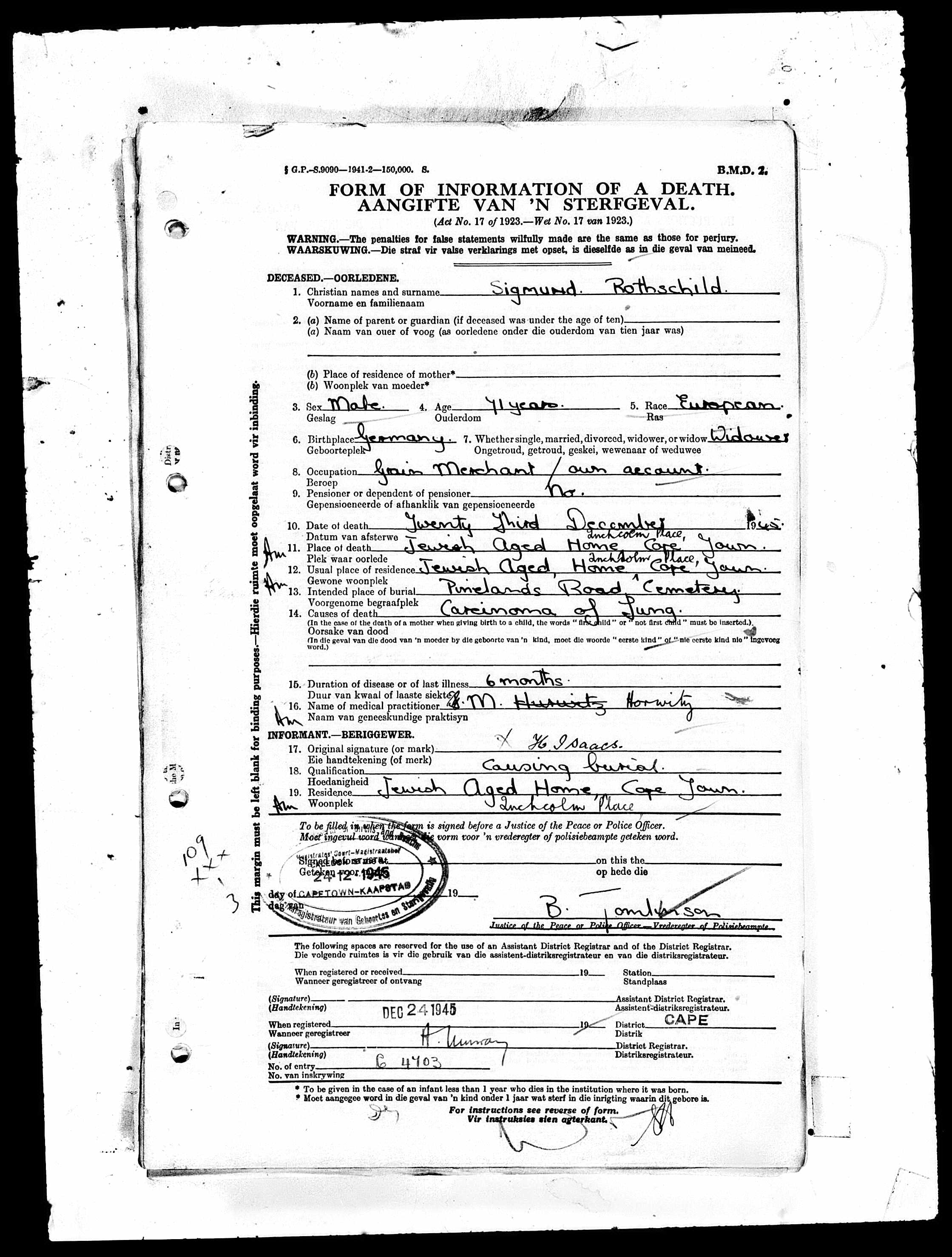
Sigmund Rothschild and his wife Fanny Rosenbaum escaped to South Africa. I don’t know when or how they immigrated there, but Fanny died there on August 20, 1942, in Capetown at the age of  62.

Fanny Rosenbaum Rothschild death record, Municipality or Municipality Range: Cape Town
Ancestry.com. Cape Province, South Africa, Civil Deaths, 1895-1972

Her husband Sigmund died in Capetown three years later on December 23, 1945; he was 71.

Sigmund Rothschild death record, Municipality or Municipality Range: Cape Town
Ancestry.com. Cape Province, South Africa, Civil Deaths, 1895-1972

As for Sigmund and Fanny’s son Kurt, I have very little information. An entry in the England & Wales Civil Registration Death Index on Ancestry shows that he died in Lancaster, England, and that the death was registered in September 1997.1 A FindAGrave entry shows his gravestone with the date of death as August 30, 1997.

Find a Grave, database and images (https://www.findagrave.com/memorial/81923216/kurt-rothschild: accessed April 19, 2024), memorial page for Kurt Rothschild (1910–3 Sep 1997), Find a Grave Memorial ID 81923216, citing Lytham Park Cemetery and Crematorium, Lytham Saint Annes, Fylde Borough, Lancashire, England; Maintained by ProgBase (contributor 47278889).

The Ancestry tree that appears to have been created by Kurt’s daughter-in-law shows that Kurt married Erna Erdmann and had one child, who is the home person on that tree. I have not been able to find a marriage record for Kurt and Erna Erdmann or a birth record for their child, so I am hoping that the owner of that tree will respond to the message I sent to help me find out what happened to Kurt Rothschild and his family. But since it’s been well over two months at this point, I am not optimistic that I will hear from her anytime soon.

The second child of Levi and Klara, their daughter Betti, lost her husband Emanuel Hirschmann on November 4, 1932. He died in Fulda, Germany, and was 64.

Emanuel Hirschmann death record, Hessisches Hauptstaatsarchiv; Wiesbaden, Deutschland; Personenstandsregister Sterberegister; Signatur: 2470, Year Range: 1932, Ancestry.com. Hesse, Germany, Deaths, 1851-1958

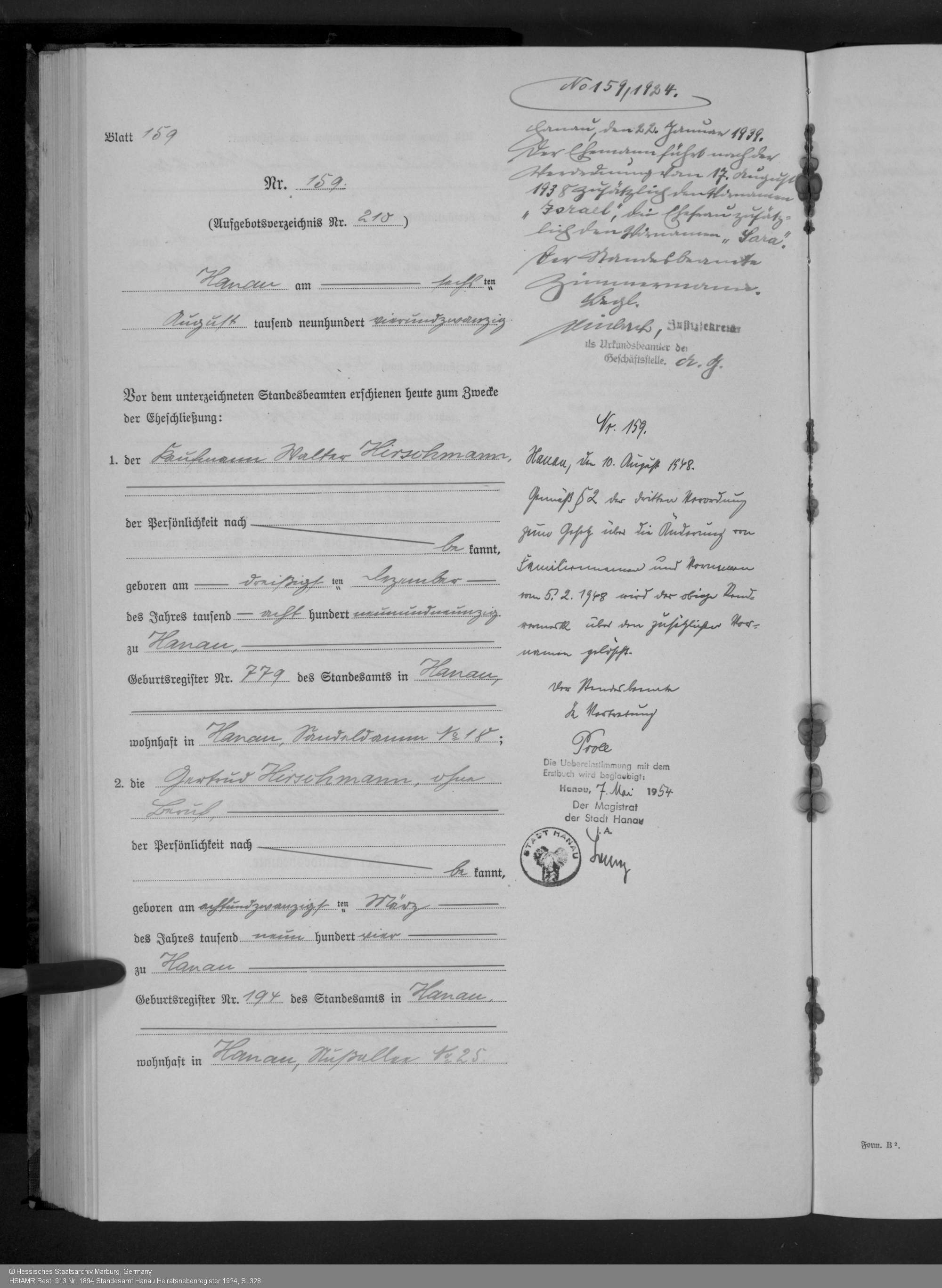
Their son Walter had married Gertrud Hirschmann on August 6, 1924, in Hanau, Germany. Gertrud was born in Hanau on March 28, 1904, according to their marriage record, but that record does not include her parents’ names. It would appear that Gertrud was likely a relative given the surname and her birth place, but so far I’ve not found any way to connect her to Walter’s Hirschmann relatives.

Walter Hirschmann and Gertrude Hirschmann marriage record, LAGIS Hessen Archives, Standesamt Hanau Heiratsnebenregister 1924 (HStAMR Best. 913 Nr. 1894)AutorHessisches Staatsarchiv MarburgErscheinungsortHanauErscheinungsjahr1924, p. 328

Walter Hirschmann and Gertrude Hirschmann marriage record, p. 2

Walter and Gertrud and their twelve year old daughter immigrated to the US on a December 15, 1938. Walter listed his occupation as a banker and their last residence as Frankfurt, Germany, where his mother “B. Hirschmann” was still residing. They were heading to a friend, L. Schwarzchild, in New York.2

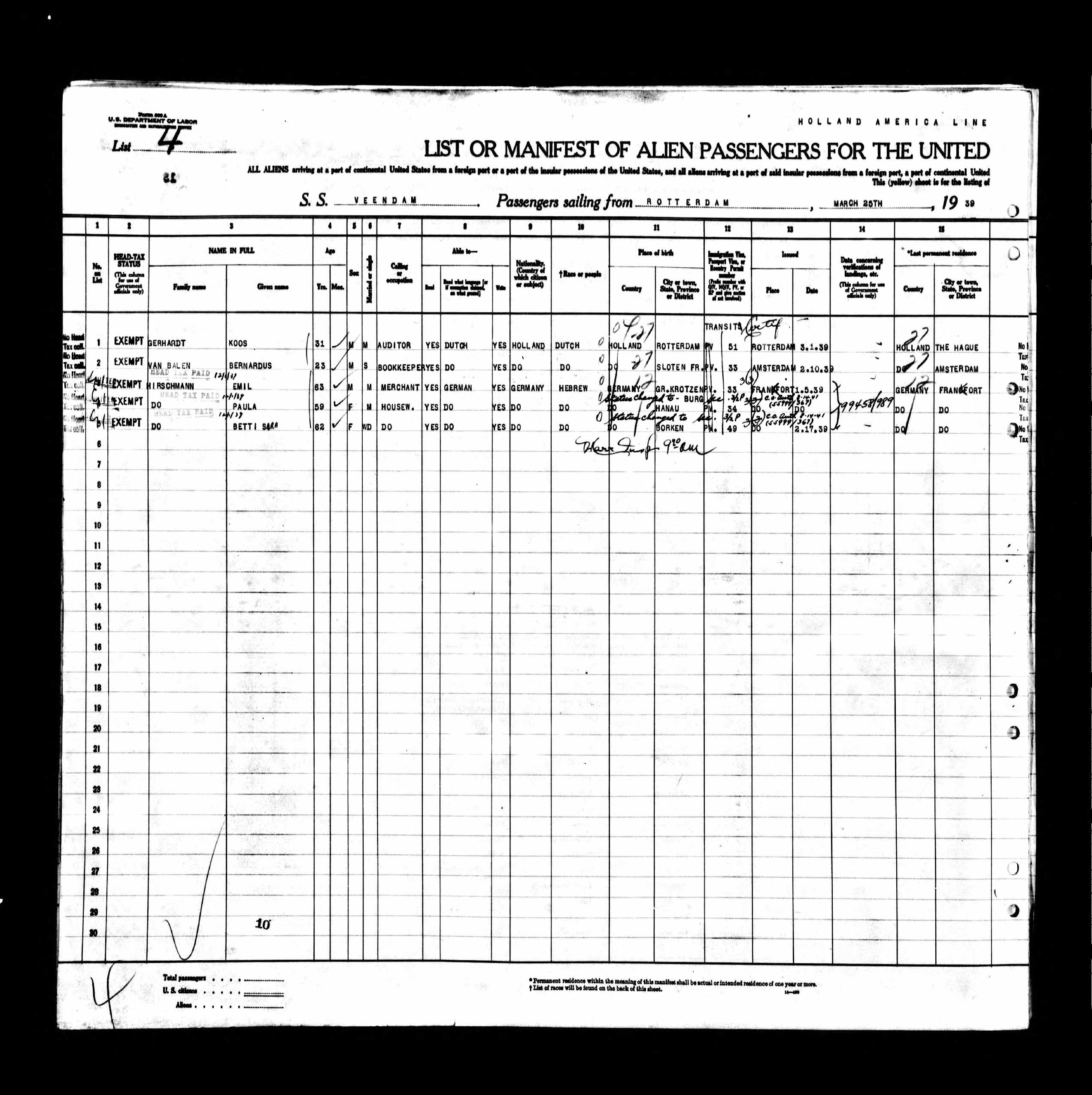
Walter’s mother Betti Rothschild Hirschmann immigrated to the US on March 25, 1939, with a cousin of her husband, Emil Hirschmann, and his wife Paula.

Betti Rothschild passenger manifest, The National Archives in Washington, DC; Washington, DC, USA; Passenger and Crew Lists of Vessels Arriving at New York, New York, 1897-1957; Microfilm Serial or NAID: T715; RG Title: Records of the Immigration and Naturalization Service, 1787-2004; RG: 85, Ship or Roll Number: Veendam, Ancestry.com. New York, U.S., Arriving Passenger and Crew Lists (including Castle Garden and Ellis Island), 1820-1957

On the 1940 census, Betti was living as a lodger in the household of Helena Pessel in New York City, but in the same building as her son Walter and his family at 670 Riverside Drive in New York City. Walter was employed as a salesman.3

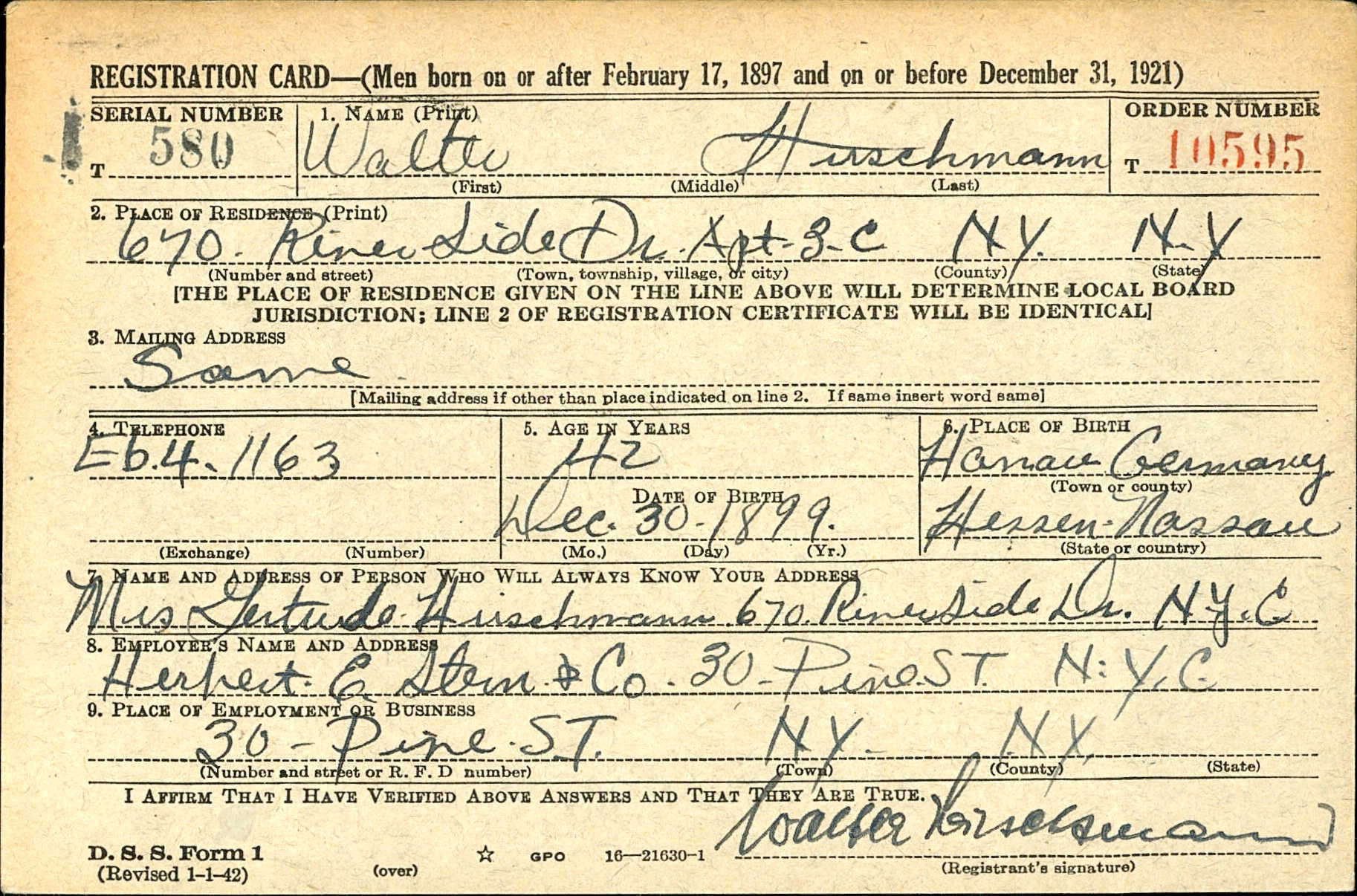
On his World War II draft registration, Walter identified his employer as Herbert E. Stern & Company. From his obituary I learned that Herbert E. Stern was also a refugee from Nazi Germany and an investment banker.4

Walter Hirschmann World War II draft registration, National Archives at St. Louis; St. Louis, Missouri; Wwii Draft Registration Cards For New York City, 10/16/1940 – 03/31/1947; Record Group: Records of the Selective Service System, 147, Name Range: Hirsch, Walfgang-Hobbs, Robert, Ancestry.com. U.S., World War II Draft Cards Young Men, 1940-1947

In 1950 Betti was still living in the same building as her son Walter and his family. Walter was still working as a broker and banker. I am very grateful to Eric Ald of Tracing the Tribe who found the 1950 census record for Betti and also a listing on Ancestry in the New York, New York Death Index for a Betty Hirschmann who died on February 15, 1956.5

Walter Hirschmann and Betty Hirschmann, 1950 US census, National Archives at Washington, DC; Washington, D.C.; Seventeenth Census of the United States, 1950; Year: 1950; Census Place: New York, New York, New York; Roll: 6203; Page: 75; Enumeration District: 31-1900, Ancestry.com. 1950 United States Federal Census

Her son Walter Hirschmann died on June 24, 1977, at the age of 77.6 He had been predeceased by his wife Gertrud, who died in December 1966 7 and was survived by their daughter and grandchildren.

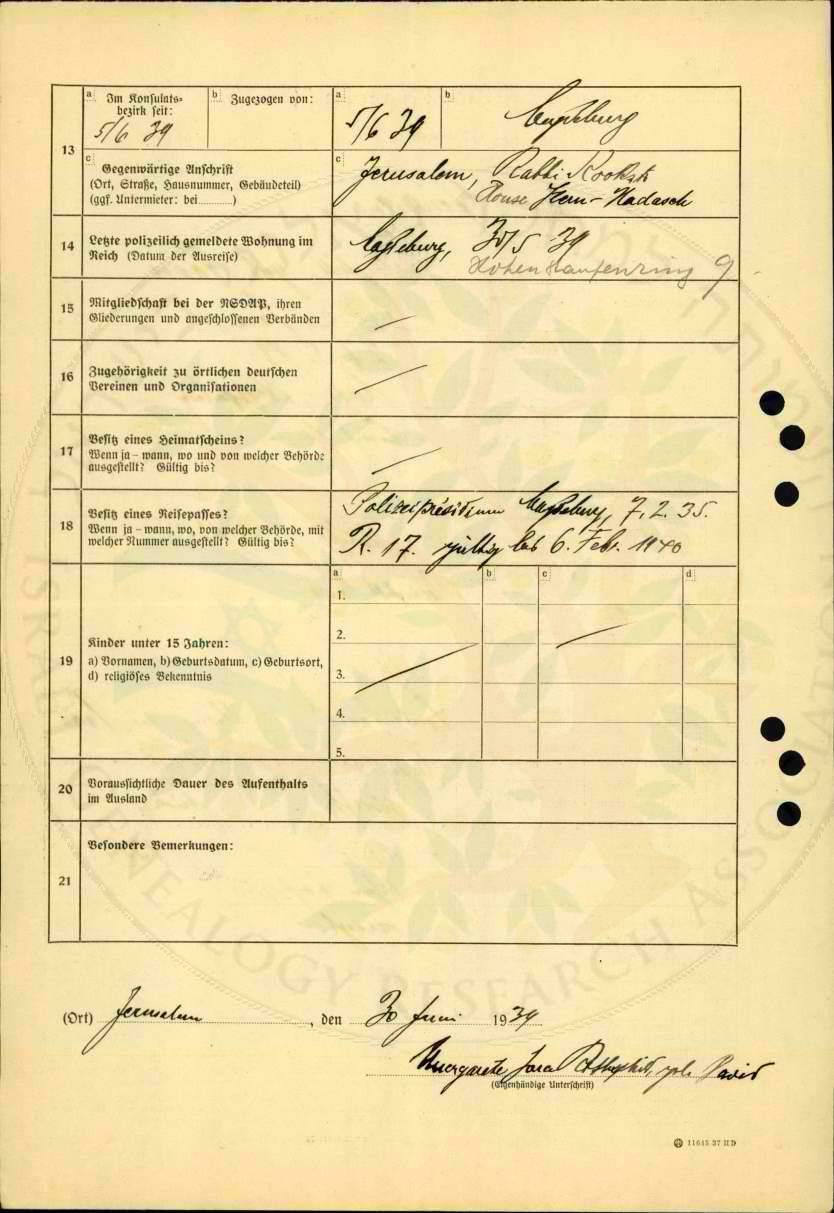
Sigmund and Betti’s brother Moses/Moritz Rothschild and his wife Margarete David ended up in Israel/Palestine in the 1930s along with their two children, Ruth, born October 8, 1914, in Magdeburg, Germany, and Herbert (later Yehuda), born December 10, 1921, in Magdeburg. The documents below are immigration documents showing that Moritz and Margarete were in Jerusalem by June 30, 1939; these and the others that follow were found at the Israel Genealogy Research Association website.

Registration form for Margarete David Rothschild reporting to the German Embassy Legation at the German Consulate General Consulate Bizekonsult in Jerusalem, A-B (טפסי הרשמה: A-B), part of the Residents 1938-1939 (תושבים 1938-1939) database, system number פ-500/5, IGRA number 1459. The original records are from Israel State Archives (ארכיון המדינה), and found at the IGRA website.

Registration form for Margarete David Rothschild reporting to the German Embassy Legation at the German Consulate General Consulate Bizekonsult in Jerusalem, A-B (טפסי הרשמה: A-B), part of the Residents 1938-1939 (תושבים 1938-1939) database, system number פ-500/5, IGRA number 1459. The original records are from Israel State Archives (ארכיון המדינה), and found at the IGRA website.

Registration form for Moses Moritz Rothschild, This record comes from the Meldeblaetter: A-B (טפסי הרשמה: A-B), part of the Residents 1938-1939 (תושבים 1938-1939) database, system number פ-500/5, IGRA number 1462. The original records are from Israel State Archives (ארכיון המדינה), and found at the IGRA website.

Registration form for Moses Moritz Rothschild, This record comes from the Meldeblaetter: A-B (טפסי הרשמה: A-B), part of the Residents 1938-1939 (תושבים 1938-1939) database, system number פ-500/5, IGRA number 1462. The original records are from Israel State Archives (ארכיון המדינה), and found at the IGRA website.

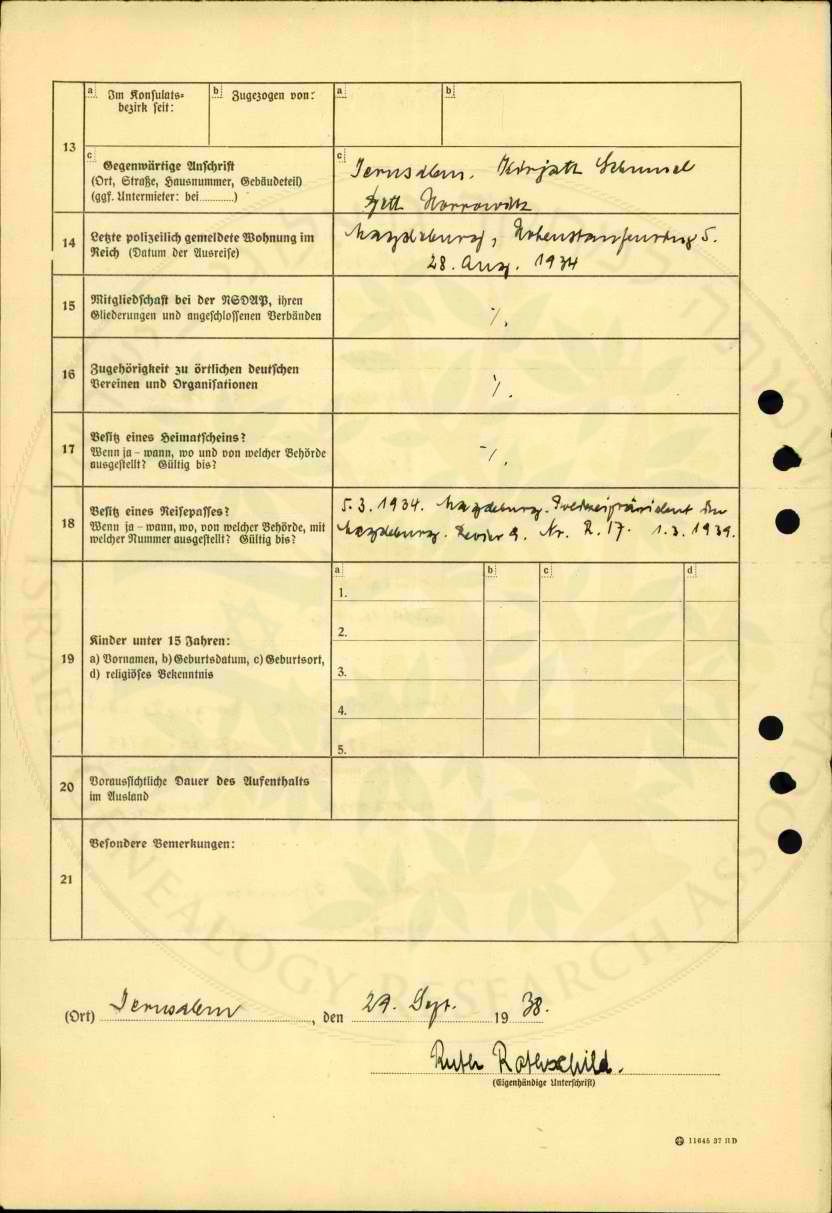
Their daughter Ruth had arrived by September 29, 1938.

Registration form for Ruth Rothschild reporting to the German Embassy Legation at the German Consulate General Consulate Bizekonsult in Jerusalem, A-B (טפסי הרשמה: A-B), part of the Residents 1938-1939 (תושבים 1938-1939) database, system number פ-500/5, IGRA number 1465. The original records are from Israel State Archives (ארכיון המדינה), as found at the IGRA website.

Registration form for Ruth Rothschild reporting to the German Embassy Legation at the German Consulate General Consulate Bizekonsult in Jerusalem, A-B (טפסי הרשמה: A-B), part of the Residents 1938-1939 (תושבים 1938-1939) database, system number פ-500/5, IGRA number 1465. The original records are from Israel State Archives (ארכיון המדינה), as found at the IGRA website.

Although I was unable to find a comparable record for Herbert/Yehuda, I found a record showing that he and his father Moritz were on the voter registration list and living at Kfar Yedidya in 1942:

Moritz and Yehuda Rothschild on 1942 Knesset register, This record comes from the Voters List Knesset Israel 1942 (פנקס הבוגרים של כנסת ישראל תש”ב), part of the Voters Knesset Israel 1942 (בוגרים של כנסת ישראל 1942) database, system number 001mush, document number 119, line 59, IGRA number 1107. The original records are from Israel State Archives (ארכיון המדינה), and was found at the IGRA website.

Yehuda married Ruth Hesin, daughter of Avraham and Hava, on April 17, 1949, in Haifa, Israel. She was 22 years old, he was 27.

Yehuda Rothschild marriage record, Marriage/Divorce Certificates (תעודות נישואין / גירושין), part of the Marriages and Divorces 1921-1948 Palestine British (נישואין וגירושין 1948-1921 ארץ ישראל) database, document number 91714, IGRA number 507. The original records are from Israel State Archives (ארכיון המדינה), and was found at the IGRA website.

At this time I have no further records for this family, but we know that at least they escaped from Germany in time to survive the Holocaust.

Thus, the first three children of Levi Rothschild and Clara Jacob all escaped from Nazi Germany in time, but look at what they lost. They were all spread across the globe: Sigmund in South Africa, Betti in the United States, and Moses in Palestine/Israel.

The fourth child of Levi and Klara, their son Hirsch Rothschild, also escaped. He and his wife Mathilde Rosenbaum and their three children Gertrude, Edith, and Edmund ended up, like Betti, in the US. I will write about Hirsch and his family in my next post.


  1. Kurt Rothschild, Death Age 87, Birth Date 30 Mar 1910, Registration Date Sep 1997, Registration district Lancaster, Inferred County Lancashire, Register Number A58B, District and Subdistrict 5871A, Entry Number 166, General Register Office; United Kingdom, Ancestry.com. England & Wales, Civil Registration Death Index, 1916-2007 
  2. Walter Hirschmann and family, passenger manifest, The National Archives in Washington, DC; Washington, DC, USA; Passenger and Crew Lists of Vessels Arriving at New York, New York, 1897-1957; Microfilm Serial or NAID: T715; RG Title: Records of the Immigration and Naturalization Service, 1787-2004; RG: 85, Ancestry.com. New York, U.S., Arriving Passenger and Crew Lists (including Castle Garden and Ellis Island), 1820-1957 
  3. Betti Hirschmann, 1940 US census, Year: 1940; Census Place: New York, New York, New York; Roll: m-t0627-02671; Page: 7B; Enumeration District: 31-1929, Ancestry.com. 1940 United States Federal Census. Walter Hirschmann and family, 1940 US census, Year: 1940; Census Place: New York, New York, New York; Roll: m-t0627-02671; Page: 7A; Enumeration District: 31-1929, Ancestry.com. 1940 United States Federal Census 
  4. “Herbert E. Stern Dead, An Investment Banker,” The New York Times, August 6, 1973, p. 32. 
  5. Betty Hirschmann, Age 75, Birth Date abt 1881, Death Date 15 Feb 1956, Death Place Manhattan, New York, New York, USA, Certificate Number 3638, Ancestry.com. New York, New York, U.S., Death Index, 1949-1965. Although there is a listing for Betti on the SSCAI with her Social Security Number, there is no listing on the SSDI for her under that number or under that date or under her name. Betty Sara Hirschmann, [Betty Sara Rohserild], Gender Female, Race White, Birth Date 14 Sep 1876, Birth Place Borken Hesse, Federal Republic of Germany, Father Levi Rohserild
    Mother, Clara Jacob, SSN 057200860, Notes Feb 1943: Name listed as BETTY SARA HIRSCHMANN, Ancestry.com. U.S., Social Security Applications and Claims Index, 1936-2007. 
  6. Walter Hirschmann death notice, The New York Times, June 27, 1977, p, 30. Walter Hirschmann, Social Security Number 092-14-5701, Birth Date 30 Dec 1899
    Issue year Before 1951, Issue State New York, Last Residence 10023, New York, New York, New York, USA, Death Date Jun 1977 Social Security Administration; Washington D.C., USA; Social Security Death Index, Master File,  Ancestry.com. U.S., Social Security Death Index, 1935-2014 
  7. Gertrud Hirschmann death notice, The New York Times, December 16, 1966, p. 47. 

Irma and Hilde: The Power of Love

In my last post, I shared the story of my cousin Erwin Rothschild and his wife Irma Simon. As we saw, Erwin died from typhoid fever at Bergen-Belsen, but Irma survived. Erwin had done everything he could to keep Irma, her sister Hilde, and Hilde’s husband Simon Eisenmann alive, but in the end only Hilde and Irma survived. They were two young widows in their thirties as the war drew to a close in Europe.

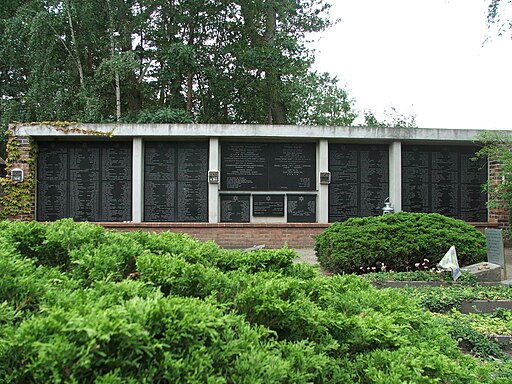
As recounted by Irma in her moving testimony for the Shoah Foundation,1 in the spring of 1945 Irma and Hilde and about 2200 other prisoners at Bergen-Belsen were put on cattle trains by the Nazis with nothing to eat but one turnip each and taken on a long and twisting trip through Germany. When they saw the planes of the Allies flying overhead, they hung white shirts out the window, trying to save themselves from being bombed. As the train neared Frankfurt an der Oder near the Polish border, the Nazi guards abandoned the train, and the Russians came to liberate the people on the train on April 23, 1945. The Russians told the prisoners that they should go to a nearby village called Trobitz, which had been emptied of its residents and would be safe for the survivors.2

They had to walk to the village, but Hilde, who weighed only 70 pounds, was too weak to walk. So Irma and another woman found a wheelbarrow and pushed Hilde to the village. They settled into the village where there was shelter and food. One man died from eating too much food too quickly. Many others—about 600 people—died while living in Trobitz. But Irma and Hilde survived.

Memorial listing the names of those from the Lost Train who died in Trobitz, LutzBruno, Public domain, via Wikimedia Commons

The people living in Trobitz were taken later by the Allies to Leipzig for a week and then they were allowed to go “home.” Irma and Hilde went back to the southern part of the Netherlands, where Hilde, a Dutch citizen by marriage, lived in a cloister and Irma was interned in a school. They could not return to Amsterdam because northern Holland had not yet been liberated. Once the war ended, the sisters moved to Amsterdam and then immigrated to the US in 1947 with the help of their brother Julius, who lived in Philadelphia. They traveled on the Queen Elizabeth and were able to get kosher food on the ship. Irma and Hilde settled in Washington Heights in New York, and Irma continued her career as a kindergarten teacher.

Both Irma and Hilde remarried in the 1950s, Irma to Nathan Haas, and Hilde to Nathan Meyer, both also German Jewish survivors of the Holocaust. Neither had children. They lived in adjoining apartments in Washington Heights. In 1967 the two couples moved to one house together in Englewood, New Jersey. They all became active in the Orthodox Jewish community there. Their second husbands both died in the 1970s, but Irma and Hilde continued to live together for the rest of their lives.

As reported by Joseph Berger in The New York Times on December 29, 2004,3 Irma and Hilde decided when they were 97 and 94, respectively, that they wanted to live the rest of their lives in Israel in a home for senior citizens in Jerusalem called Beit Barth. Berger described their special relationship and recounted their long lives together during and after the Holocaust:

The two sisters were inseparable….[He then described much of what I’ve reported earlier about their lives during the Holocaust.]

They came to the United States together and lived with their second husbands in adjoining apartment buildings in Washington Heights. … As if that were not close enough, they moved in 1967 into a single suburban ranch house in Englewood, N.J., which they continued to share after their husbands died.

Until yesterday. That was when Irma Haas, 97, and Hilde Meyer, 94, set off from Kennedy International Airport for Israel to spend the remainder of their lives in the same residence for the elderly in Jerusalem.

… With canes across their laps, they sat next to each other in wheelchairs as El Al security hurriedly examined their passports and put them through the requisite grilling about who had packed their bags and whether they had received any gifts. Much of the time, Hilde, looking frightened, clutched Irma’s left arm with her right hand.

“She cannot let go of me,” Irma said, mentioning their wartime terror. “She is afraid she would be brought somewhere and I would not come.”

…Both sisters are slight of build and wear gray shaytls, or wigs. Irma is hardier, Hilde more easily rattled. They were born in Londorf, a town in Hessen, a German state where their family’s roots stretch back hundreds of years. …Irma promised her mother that she would always take care of the more delicate Hilde….

Judy Marcus, their second cousin, who accompanied them on the flight, said the two sisters seemed to have eluded the arrows of sibling rivalry. “They were never jealous of each other,” she said. “They were always happy whatever the other one had.”

About two years ago, Hilde was briefly hospitalized and pleaded that Irma remain at her side. Mrs. Marcus said she told a hospital official: “They are Holocaust survivors. They can’t be separated.”

“They made a special dispensation to allow Irma to sleep in Hilde’s room,” Mrs. Marcus recalled. “But Irma would not have left anyway, even if it meant sitting up in a chair all night.”

Only death separated these two amazing sisters. Hilde died first on May 8, 2005;4 she was 94 and had been in Israel for only five months. Irma Simon Rothschild Haas, who had done so much to care for her younger sister and whose strength got them through the camps, liberation, and immigration to the US, died on April 17, 2009, just six months before she would have turned 102.5 She had outlived her parents, all her siblings, and two husbands. Neither Irma nor Hilde had had children, so there are no direct descendants to remember these two remarkable women. But I will forever, and I hope that you will also.

I wish I had some photos of Irma and Hilde I could share. All I found is this one small photo from the New York Times in 2004 when they moved to Israel. But If you haven’t already, please watch Irma’s Shoah Foundation testimony—if for no other reason than to see Irma with Hilde together near the end of that testimony. I guarantee it will both bring you to tears and lift you up with joy. The power of their love was immeasurable.


  1. Haas, Irma. Interview 32295. Interview by Miriam Horowitz. Visual History Archive, USC Shoah Foundation, 04 August 1997. https://vha.usc.edu/testimony/32295. Accessed 18 Jan 2024. Almost all of the information in this post came from Irma’s testimony, except where noted. 
  2. You can read more about the “lost train” from Bergen-Belsen to Trobitz here, here, and here. 
  3. Joseph Berger, “A Bond the Holocaust and Time Couldn’t Break,” The New York Times, December 29, 2004, page B1. See also “Holocaust Survivors from Englewood Begin Their New Lives in Jerusalem,” The Hackensack Record, December 31, 2004, p. A5. 
  4. Hilde Meyer, Gender Female, Birth Date 30 Sep 1910, Death Date 8 May 2005,
    Claim Date 13 Jul 1972, SSN 081242610, Ancestry.com. U.S., Social Security Applications and Claims Index, 1936-2007 
  5. Find a Grave, database and images (https://www.findagrave.com/memorial/254917717/irma-haas: accessed 18 January 2024), memorial page for Irma Simon Haas (9 Oct 1907–17 Apr 2009), Find a Grave Memorial ID 254917717, citing Har HaMenuchot Cemetery, Jerusalem, Jerusalem District, Israel; Maintained by DTWer (contributor 47953179). 

Erwin Rothschild As Remembered By His Wife Irma

Although two daughters of Moses Max Rothschild appear to have survived the Holocaust, his son Erwin was not as fortunate. The only official records I have for Erwin Rothschild are two that relate to his death, but they also include his birth date and his parents’ names. He was born on December 5, 1904, in Nordeck, Germany, and he died of typhus on March 28, 1945, in the Bergen-Belsen concentration camp. These two records also both provide evidence that Erwin was a dentist and that he was married to Irma Simon. But not much else can be discerned about Erwin’s life from these two documents.

Erwin Rothschild death record from the Bergen Belsen Concentration Camp, The National Archives at College Park; College Park, Maryland; Microfilm: A3355; ARC: 596972; Title: Lists and Registers of German Concentration Camp Inmates, 1946 – 1958; Record Group: 242; Record Group Title: National Archives Collection of Foreign Records Seized, 1675 – 1958
Source Information
Ancestry.com. Germany, Concentration Camp Records, 1937-1945

Erwin Rothschild death certificate, Hessisches Hauptstaatsarchiv; Wiesbaden, Deutschland; Personenstandsregister Sterberegister; Signatur: 135; Laufende Nummer: 926
Year Range: 1951, Ancestry.com. Hesse, Germany, Deaths, 1851-1958

Fortunately, Erwin’s widow Irma Simon Rothschild Haas gave testimony to the Shoah Foundation and filled in the details of Erwin’s life as well has her own quite moving and amazing life story. I am so grateful to the Shoah Foundation for recording and preserving these stories.

Irma was 89 years old when she was interviewed on August 4, 1997. But you would never know it from the sharpness of her mind, the depth and precision of her memories, and her ability to answer probing and difficult questions. She was an incredible storyteller, and I felt like I was with her during those awful years of the Holocaust. I started out wanting to learn more about Erwin, but by the end of Irma’s testimony I was moved to tears by not only what I’d learned about Erwin, but by what I’d learned from Irma about the best side of human nature. Find two hours in your busy lives and listen to what Irma has to say. You also will never forget her. 1

Although I cannot do justice to Irma’s testimony in a brief paraphrasing of its content, I want to tell the story of Erwin and Irma as best I can. Irma Simon was born on October 9, 1907, in the small town of Londorf, Germany. Irma had two older brothers, Siegfried and Julius, and a younger sister Hilde.

Irma went to school to become a kindergarten teacher and worked in Cologne, Frankfurt, and Berlin before the Nazi era. She was working in a children’s home for 150 children in 1935 outside of Berlin when the Nuremberg Laws were enacted and the home was no longer able to obtain kosher meat. Irma left the home and found a new job teaching in Berlin. She lived with an unnamed cousin of Erwin Rothschild, and I assume that that is how she met Erwin. He was practicing dentistry in Berlin at that time.

After Kristallnacht in November 1938, the school where Irma had been working closed, and Erwin and Irma and her parents tried to get out of Germany . One of her brothers, Julius, was already in the US, her sister Hilde was married to Simon Eisenmann and living in Amsterdam, and her other brother Siegfried had been arrested after Kristallnacht and sent to Sachsenhausen. With Irma’s help and a visa obtained by her sister Hilde in Holland, Siegfried was released and left for South America. Later, Hilde was also able to get a visa for their parents and for her sister Irma to come to Holland.

Meanwhile, Erwin Rothschild, who was now engaged to Irma Simon, had gotten a ticket to leave Germany on the ill-fated ship, the St. Louis in the spring of 1939. I’ve previously told the story of the St. Louis, the ship that was turned away from Cuba and from the US and had to sail back to Europe in June, 1939, returning its passengers to a likely death in the Holocaust. Erwin ended up in Holland where Irma and her family were living.

Jewish refugees aboard the SS St. Louis attempt to communicate with friends and relatives in Cuba, who were permitted to approach the docked vessel in small boats. |Source=USHMM, courtesy of National Archives and Records Adminis (public domain)

But Erwin was not able to live in Amsterdam where Irma was living; as a refugee from the St Louis, he was required by the Dutch to live in the internment camp in Westerbork. But he was free to work as a dentist in Amsterdam and to see Irma, who was working at a children’s home in Amsterdam.

However, when the Nazis invaded Holland in May, 1940, the school was forced to close and the children were evicted. Irma helped find homes for 130 of those children with families in Amsterdam. The Nazis also took over the camp at Westerbork where Erwin was living.

Nazi troops and supporters in front of De Bijenkorf, Dam Square, Amsterdam, The Netherlands, 1941 (crop of original 1941 public domain photo). 47thPennVols, CC0, via Wikimedia Commons

In 1942 Erwin and Irma married, but Irma stayed with her parents in Amsterdam because they all believed she would be safer there. But by the end of that year her parents were taken to Westerbork. To avoid being taken to a concentration camp at Vught where conditions were worse, Irma voluntarily moved to Westerbork to be with her husband Erwin as well as her parents and her sister Hilde and brother-in-law Simon. Conditions at Westerbork were at that time not bad at all, and Irma became a dental assistant working with Erwin.

In September 1943, Irma’s parents were put on a transport to Bergen-Belsen, where conditions were much worse. Then Irma’s sister Hilde and her husband Simon Eisenmann were put on a list for transport despite having certificates to go to Palestine, which were supposed to keep them (and Erwin and Irma) off the transport lists. Erwin figured out that there was confusion regarding a different man named Eisenmann and got Hilde and Simon off the list.

In December 1943, they were told that the Westerbork camp was to be dissolved and all those with Palestine certificates would go to a Red Cross camp, but in fact  Erwin, Irma, Hilde, and Simon and the others were all sent to Bergen-Belsen, arriving there on February 1, 1944, just a day after Irma’s parents had been transferred from Bergen-Belsen to Theresienstadt. Irma was heartbroken not to have had a chance to see her parents. She never saw them again. They died at Theresienstadt.

The conditions at Bergen-Belsen were terrible. Irma, Erwin, Hilde, and Simon all worked in a quarry, where Erwin feared his hands would be so damaged from smashing rocks that he would never practice dentistry again. But then one of the older camp dentists died, and Erwin was drafted into being a camp dentist. That meant he could live in the hospital with the doctors with better living conditions than being in the barracks.

Women and Children at Bergen Belsen Concentration Camp, 1945, No 5 Army Film & Photographic Unit, Morris (Sgt), Public domain, via Wikimedia Commons

When a young SS officer who was also a dentist needed dental care one day, he asked Erwin to help him. At first Erwin refused, saying he was not allowed to treat Aryans. But the officer insisted, saying the other (non-Jewish) dentist was not as good. So Erwin treated him, and the officer arranged to have Irma become his assistant and to live in the hospital with the nurses.

But Hilde and her husband Simon were still in the barracks, and in November 1944, Simon died from typhoid fever. Hilde was bereft, and Erwin and Irma did everything they could to give her support. But she became very sick, and Erwin, without permission, had her brought to the camp hospital. Although he was caught and punished for doing that, he saved Hilde’s life.

But unfortunately, Erwin could not save his own life. In early 1945, a camp was set up near Bergen-Belsen for women who had been transferred from Auschwitz. Erwin was sent there to provide dental care for these women and contracted typhoid fever from them. He died from the disease on March 28, 1945,2 leaving Irma, like her sister Hilde, a young widow still imprisoned at Bergen-Belsen.

I will tell the rest of Irma and Hilde’s story in my next post. But this post is to honor the memory of my cousin Erwin Rothschild, a man who not only cared for those at Westerbork and Bergen-Belsen, but who managed to keep his wife Irma and her sister Hilde safe. From the way Irma spoke about him more than 50 years after he died, I could tell that theirs was a true love story and that Erwin was a good, decent, courageous, and compassionate man. How tragic that he died caring for others just a few weeks before the war ended in Europe.


  1. Haas, Irma. Interview 32295. Interview by Miriam Horowitz. Visual History Archive, USC Shoah Foundation, 04 August 1997. https://vha.usc.edu/testimony/32295. Accessed 14 Jan 2024.  You do not need to download Irma’s testimony; it is available online at the citation above. All the information in this post came from Irma’s testimony. 
  2. In her testimony Irma said that Erwin died on March 27, 1945, but the death records above both indicate that he died on March 28. I don’t know which is more accurate, but I am using the recorded date.