The Legacy of H.H. Mansbach: Motherless Boy, Civil War Hero, Father of Eight, and Successful Merchant

We saw in the last post how the first decade presented some sad challenges and losses for the family of H.H. Mansbach.  The family matriarch Nannie Hirsch Mansbach died unexpectedly in 1907, the youngest son Isaac was institutionalized, and Louis Mansbach’s wife Clara died at age 36.

The family’s losses continued in 1912 when the family patriarch, H.H. Mansbach, died April 1, 1912, in Norfolk; he was 71 years old.   The Norfolk Ledger-Dispatch (April 1, 1912) published this obituary:
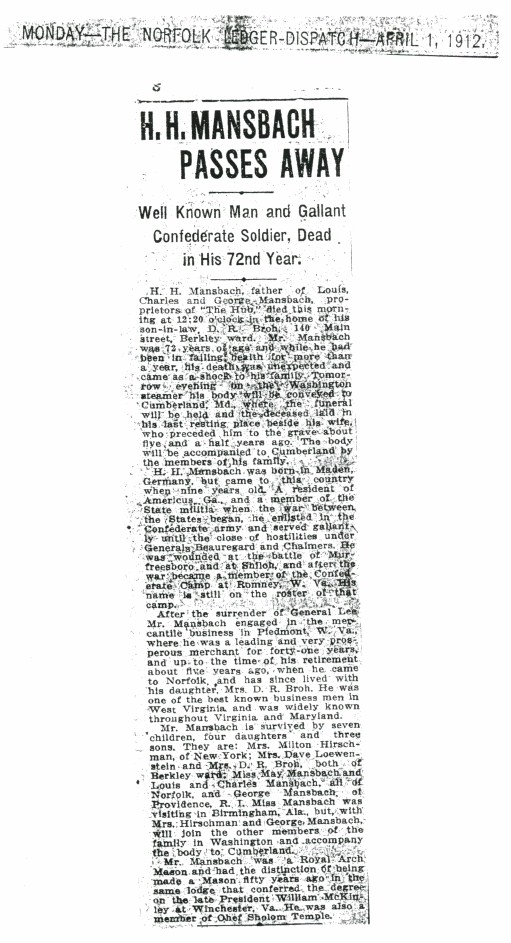
H.H. Mansbach, father of Louis, Charles, and George Mansbach, proprietors of “The Hub,” died this morning at 12:20 o’clock in the home of his son-in-law, D.R. Broh, 140 Main Street, Berkley ward.  Mr. Mansbach was 72 years of age [sic: he was 71] and while he had been in failing health for more than a year, his death was unexpected and came as a shock to his family.  Tomorrow evening on the Washington steamer his body will be conveyed to Cumberland, Md., where the funeral will be held and the deceased laid in his last resting place beside his wife, who preceded him to the grave about five and a half years ago.  The body will be accompanied to Cumberland by the members of his family.

H.H. Mansbach was born in Maden, Germany, but came to his country when nine years old. [There is no record to support this assertion; records instead show that he came in 1856 with his uncle Gerson Katzenstein when he was sixteen; even his older brother was not in the US in 1849 when H.H. would have been nine.]  A resident of Americus, Ga., and a member of the State militia when the war between the States began, he enlisted in the Confederate army and served gallantly until the close of hostilities under Generals Beauregard and Chalmers.  He was wounded at the battle of Murfreesboro and at Shiloh and after the war became a member of the Confederate Cap at Romney, W.Va.  His name is still on the roster of that camp.

After the surrender of General Lee, Mr. Mansbach engaged in the mercantile business in Piedmont, W.Va., where he was a leading and very prosperous merchant for forty-one years, and up to the time of his retirement about five years ago, when he came to Norfolk and has since lived with his daughter, Mrs. D. R. Broh.  He was one of the best known business men in West Virginia and was widely known throughout Virginia and Maryland.

Mr. Mansbach is survived by seven children, four daughters and three sons. [Once again Isaac is not included in the list of survivors; the rest of the children were named and their residence locations as indicated above were identified.]

Mr. Mansbach was a Royal Arch Mason and had the distinction of being a Mason fifty years ago in the same lodge that conferred the degree on the late President William McKinley at Winchester, Va.  He also was a member of Ohef [sic: Oheb] Shalom Temple.

H.H. was survived by his eight children and (eventually) seven grandchildren. He was buried next to his wife Nannie at Eastview Cemetery in Cumberland, Maryland.

His children carried on his business and his name.

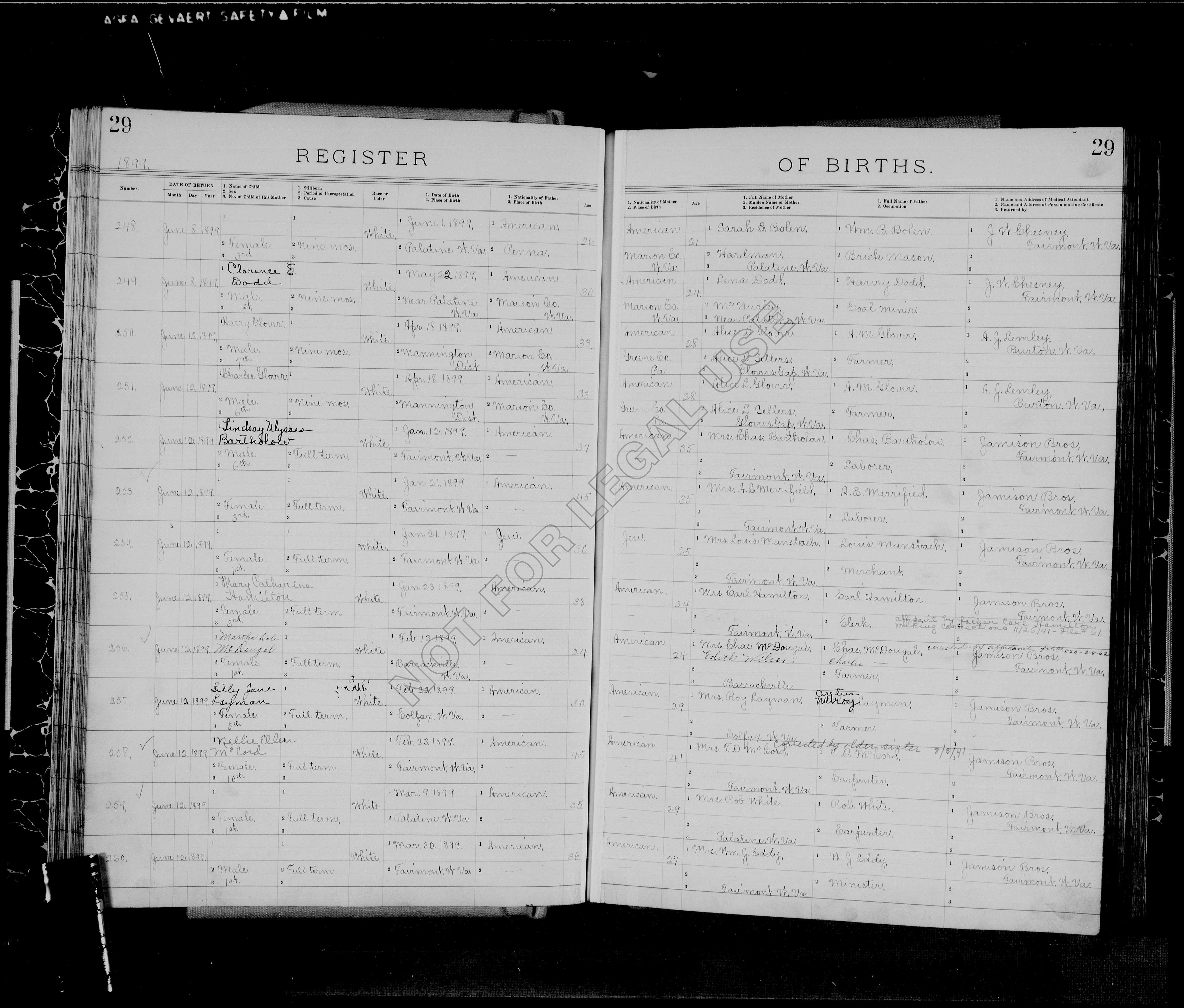
H.H. and Nannie’s youngest child, May, married in 1914; her husband was Sigmund Louis Emanuel, who was born in Gloucester, Massachusetts, in 1876, but had lived most of his life in New York City.  In 1910, when he was 33, he was living with his parents and some of his siblings in Queens, New York, and owned a clothing manufacturing business with his father.

How did he meet May, who was living in Virginia? My guess—the Emanuels supplied clothing to the retail clothing business owned by the Mansbach family, and a connection was made.  Or possibly May’s two sisters Hattie and Bertha who lived in New York set her up with Sigmund.  May and Sigmund would have one child, a daughter Nanette born in 1916 in New York City.

In 1920, four of the Mansbach siblings were living in Norfolk: Louis, Charles, Bertha, and Fannie. In fact, Louis, Fannie, and Bertha were all living in one household, along with Fannie and Bertha’s husbands and children.

Mansbach siblings on 1920 census in Norfolk, VA Year: 1920; Census Place: Norfolk Madison Ward, Norfolk (Independent City), Virginia; Roll: T625_1902; Page: 1B; Enumeration District: 101; Image: 279

Mansbach siblings on 1920 census in Norfolk, VA
Year: 1920; Census Place: Norfolk Madison Ward, Norfolk (Independent City), Virginia; Roll: T625_1902; Page: 1B; Enumeration District: 101; Image: 279

Their brother George was living in Baltimore, sisters May and Hattie in New York, and brother Isaac in the state hospital in Sykesville, Maryland.

The siblings appear to have remained close. In 1920, Louis traveled to St. John’s Newfoundland with Fannie and her family.  In 1923, Louis, Hattie and her family, and Fannie all traveled to England together.   Fannie’s husband Daniel Broh did not travel with them, and three years later he died of stomach cancer at age 60.  According to his death certificate, he had been ill for eight years, so presumably he was not well enough in 1923 to travel with Fannie and her siblings.

Daniel Broh death certificate Ancestry.com. Virginia, Death Records, 1912-2014 [database on-line]. Provo, UT, USA: Ancestry.com Operations, Inc., 2015. Original data: Virginia, Deaths, 1912–2014. Virginia Department of Health, Richmond, Virginia.

Daniel Broh death certificate
Ancestry.com. Virginia, Death Records, 1912-2014 [database on-line]. Provo, UT, USA: Ancestry.com Operations, Inc., 2015.
Original data: Virginia, Deaths, 1912–2014. Virginia Department of Health, Richmond, Virginia.

Charles and Louis traveled to Key West together in 1928.  A year later Charles’ wife Regina died at age 47 of heart disease caused by rheumatic endocarditis, which she had contracted thirty years earlier, according to her death certificate.

Regina Rosenbaum Mansbach death certificate Ancestry.com. Virginia, Death Records, 1912-2014 [database on-line]. Provo, UT, USA: Ancestry.com Operations, Inc., 2015. Original data: Virginia, Deaths, 1912–2014. Virginia Department of Health, Richmond, Virginia.

Regina Rosenbaum Mansbach death certificate
Ancestry.com. Virginia, Death Records, 1912-2014 [database on-line]. Provo, UT, USA: Ancestry.com Operations, Inc., 2015.
Original data: Virginia, Deaths, 1912–2014. Virginia Department of Health, Richmond, Virginia.

Thus, by 1930, three of the eight Mansbach children had lost their spouses: Louis, Charles, and Fannie. Fannie and Louis were living in the same household in Norfolk with their sister Bertha and her husband David Loewenstein and their son in 1930.  None of them was working at that point. Although the census record lists Fannie as “Deborah Danial,” it is evident to me that this is Fannie based on the fact that “Deborah” is described as the sister of the head of household (Louis), is the same age that Fannie would have been in 1930, and was born in West Virginia.  My guess is that the census enumerator heard “Fannie Broh” as “Danial Deborah” and wrote it that way on the form.

Mansbach siblings on 1930 census Norfolk, VA Year: 1930; Census Place: Norfolk, Norfolk (Independent City), Virginia; Roll: 2470; Page: 4B; Enumeration District: 0050; Image: 888.0; FHL microfilm: 2342204

Mansbach siblings on 1930 census Norfolk, VA
Year: 1930; Census Place: Norfolk, Norfolk (Independent City), Virginia; Roll: 2470; Page: 4B; Enumeration District: 0050; Image: 888.0; FHL microfilm: 2342204


Charles, also a widower, was living with his son in Norfolk in 1930, running the department store. Also, by 1930 May and her husband Sigmund Emanuel and their daughter had moved to Norfolk, where Sigmund was working as the treasurer of the department store.  Thus, in 1930 five of the eight siblings were living in Norfolk.

Isaac remained institutionalized, Hattie was still in New York, and George was in Baltimore.  George was living with his wife Bessie, her brother Arthur, and her mother; both he and Arthur listed their occupations as retail clothing merchants.

In 1936, another Mansbach sibling lost a spouse when David Loewenstein, Bertha’s husband, died at age 68 from heart disease; his death certificate also notes that he had suffered from locomotor ataxia for 27 years.

David Loewenstein death certificate Ancestry.com. Virginia, Death Records, 1912-2014 [database on-line]. Provo, UT, USA: Ancestry.com Operations, Inc., 2015. Original data: Virginia, Deaths, 1912–2014. Virginia Department of Health, Richmond, Virginia.

David Loewenstein death certificate
Ancestry.com. Virginia, Death Records, 1912-2014 [database on-line]. Provo, UT, USA: Ancestry.com Operations, Inc., 2015.
Original data: Virginia, Deaths, 1912–2014. Virginia Department of Health, Richmond, Virginia.

As the Mansbach siblings and their spouses entered their seventies in the 1940s, more and more of them passed away.  Louis died November 9, 1940; he was 72 and died from stomach cancer.  His brother-in-law Milton Hirschman, Hattie’s husband, died on April 29, 1942, in New York; he was 78. George Mansbach died August 13, 1946; he was 74.  The Cumberland News (August 15, 1946, p.20), ran this obituary:

George Mansbach obituary

George Mansbach obituary


Again, Isaac is not mentioned as a survivor although he was still living at that time.

Charles Mansbach died four years later on April 4, 1950; he was 75.

charles-mansbach-obit


That left just the four sisters and Isaac still living, and three of the four sisters were widows.  They died in the 1950s: Bertha (1952), Fannie (1958), and Hattie (1959).  They were 76, 85, and 90, respectively.  Isaac died in 1963 at age 84.  May outlived all her siblings and her husband Sigmund, who had died in 1963.  She was 89 when she died in 1976. Unfortunately I was unable to locate obituaries for any of them.

When I think about the life and legacy of my cousin H.H. Mansbach, nephew of my great-great-grandfather Gerson Katzenstein, it is quite remarkable. From the beginning his life was filled with challenges.  His mother died on the day he was born (July 3, 1840).  He came to America as a sixteen year old, sailing with his uncle Gerson and family.  He moved far from the family, living in several states including Georgia, where he joined the Confederate Army in 1861 and was injured twice in his four years of service in the Civil War.

Then he settled in West Virginia, married, and had eight children, meanwhile establishing himself as a very successful merchant.  He lost his father and siblings all within a ten year period from 1883-1893, and then lost his wife Nannie in 1907.  Five years later he was buried beside her at Eastview Cemetery in Cumberland, Maryland, the town where his wife had first lived in the US and where H.H. himself had lived for many years.

H.H. Mansbach Courtesy of John Fazenbaker at FindAGrave http://www.findagrave.com/cgi-bin/fg.cgi?page=pv&GRid=85694927&PIpi=56133066

H.H. Mansbach
Courtesy of John Fazenbaker at FindAGrave
http://www.findagrave.com/cgi-bin/fg.cgi?page=pv&GRid=85694927&PIpi=56133066

His eight children benefited from his remarkable success as a merchant.  Almost all of them were involved in some way in the family’s department store business.  They all lived well.  Many of them lived close to if not with each other in Norfolk, Virginia.  Sadly, many of them also suffered losses— Louis had a child who died as a baby and then lost his wife Clara when she was in her thirties.  Charles also was widowed at a young age as was Fannie.  Isaac lived his entire adult life in a psychiatric facility.

But overall H.H. lived a good life with many successes and accomplishments.  In addition, he was survived by seven grandchildren who continued his legacy.


More Weddings, More Funerals: The Mansbach Family 1900-1910

As we saw in my last post, the years after the Civil War were years of both personal and financial growth for H.H. Mansbach and his family. The first decade of the twentieth century presented many changes and challenges for the Mansbach family, some happy, some not. Here again is a family sheet for H.H.:

family-harry-h-mansbach-page-001

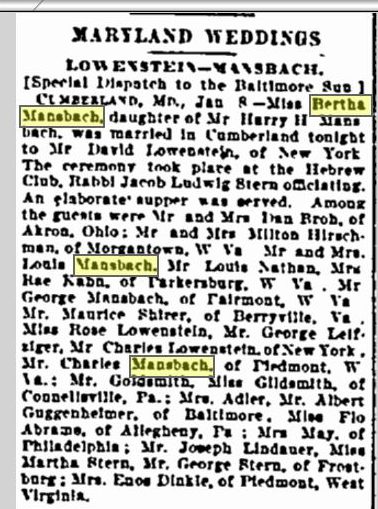
On January 8, 1902, the third daughter Bertha Mansbach married David Loewenstein of New York. David was a German immigrant who was in the clothing business.  From the wedding announcement I am inferring that he had a brother Charles and sister Rose, but I’ve not been able to find out much else about him or his family.

David and Bertha were married in Cumberland followed by an “elaborate supper.”  According to the wedding announcement in the January 9, 1902, Baltimore Sun (p.10), at that time Bertha’s sister Fannie and her husband Daniel Broh were living in Akron, Ohio. The wedding announcement also indicated that Bertha’s sister Hattie and her husband Milton Hirschman were still living in Morgantown, West Virginia, in January, 1902.

bertha-mansbach-david-loewenstein-wedding-announcement-1902

Baltimore Sun, January 9, 1902, p. 10

Missing from this list of guests was Isaac Mansbach, Bertha’s younger brother. By 1902, Isaac Mansbach had joined his parents and sister May in Cumberland, Maryland, where he was practicing law, according to the 1902 Cumberland directory. Why wasn’t he listed at his sister’s wedding? More on that below.

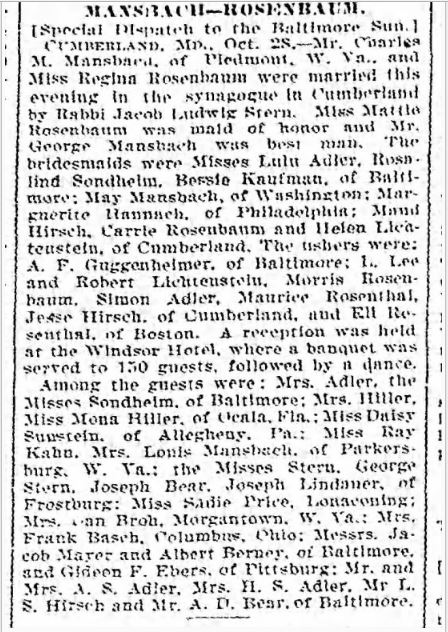
In October, 1903, Charles Milton Mansbach married Regina Rosenbaum in Cumberland. Once again, it appears to have been quite an elaborate occasion.

Baltimore Sun, October 29, 1903, p.10

Baltimore Sun, October 29, 1903, p.10

In 1905 Charles was working as a bookkeeper in the Hirsch family business (his mother’s family) in Cumberland.

In October 1905, George Mansbach married Bessie Frank of Baltimore, Maryland; they settled in Fairmont, West Virginia.

Baltimore Sun, October 26, 1905, p. 7

Baltimore Sun, October 26, 1905, p. 7

That made six weddings for the Mansbach siblings between 1893 and 1905, three of them in the last four years.  Only Isaac and May had not yet married.

In 1907 Fannie (Mansbach) and Daniel Broh were living in Fairmont, West Virginia; according to the 1907 Fairmont directory, Daniel was in the shoe business. George and Bessie were also living in Fairmont, though George was still in business with his brother Louis; perhaps he ran the family store in Fairmont. Thus, in 1907, two of the eight Mansbach children were still in West Virginia.


http://www.gettyimages.com/detail/114526762

Two other siblings had moved to Norfolk, Virginia by 1907.  Louis and his wife Clara were in Norfolk in 1907 as were Charles and his wife Regina. Charles and Louis owned a clothing store in Norfolk called The Hub that was in business for many years.

Meanwhile, H.H. and Nannie continued to live in Cumberland, Maryland, with their youngest child, May, in 1907.

I could not locate the whereabouts of three of the eight Mansbach children between 1902 and 1907: Bertha (also known as Bertie) Mansbach Loewenstein, Hattie Mansbach Hirschman, and Isaac Mansbach, the son who had become a lawyer.  I learned where Bertha and Hattie were living in 1907 when I found this sad article:

Cumberland Evening Times, October 11, 1907, p. 1

Cumberland Evening Times, October 11, 1907, p. 1

Mrs. Nannie Mansbach, wife of Mr. H.H. Mansbach, died suddenly this morning at 6 o’clock at the Mansbach residence, No. 8 Park street.

Mrs. Mansbach was slightly indisposed some two weeks ago, but had recovered and was feeling in her usual good health when she retired last evening.

This morning at 5:30 o’clock Mrs. Mansbach aroused her husband, saying that she was suffering considerable misery.  A physician was hastily summoned, but to no avail, as Mrs. Mansbach passed away a few minutes later.  Death was due to heart failure.

Mrs. Mansbach was 60 years of age and was a Miss Hirsch prior to her marriage.

Mrs. Mansbach’s death came as a great blow to her husband, who is almost prostrate from the shock.

The deceased was one of the best known women in Cumberland.  She was of an amiable and charitable disposition, and her sudden death caused a shock to pervade the entire community and surrounding territory, as she had as unusually large acquaintance.

The greatest portion of her life was spent in this city [Cumberland], although some years were spent in Wheeling and Piedmont, while her husband who is a tailor, was engaged in business in those places.  Besides her husband she is survived by the following children: Messrs. Louis and Charles Mansbach, Norfolk, Va.; Mrs. Milton Hirschman, Morgantown; Mrs. Fannie Brode [sic[, and George Mansbach, Fairmont, W.Va.; Mrs. David Lowenstein [sic], New York city, and Miss May Mansbach, who resides at home.  ….

What a terrible loss this must have been for H.H. and all of the Mansbach children.

I found a few things of particular interest in the obituary.  First, the article describes H.H. as a tailor—in the present tense.  Although H.H. may have started out as a tailor, by 1907 he was well-known as a very successful merchant, as the 1893 Piedmont Dispatch profile of him had reported.  Second, the obituary revealed that Bertha and David Loewenstein were living in New York City, that Hattie and Milton Hirschman were living in Morgantown, West Virginia, and also confirmed the residence location of five of the six other children.

But one child is missing from the list of survivors—Isaac, the Mansbach’s youngest son who had become a lawyer. He also had not been listed as a guest at his sister Bertha’s wedding.  Why would he not have been included? The one record I could find for Isaac between the date of the 1900 census and his mother’s death was the listing of him as a lawyer in the 1902 Cumberland directory.  Where had he gone from there?

1902 Cumberland, MD, directory Title : Cumberland, Maryland, City Directory, 1902 Source Information Ancestry.com. U.S. City Directories, 1822-1995 [database on-line]. Provo, UT, USA: Ancestry.com Operations, Inc., 2011.

1902 Cumberland, MD, directory
Title : Cumberland, Maryland, City Directory, 1902
Source Information
Ancestry.com. U.S. City Directories, 1822-1995 [database on-line]. Provo, UT, USA: Ancestry.com Operations, Inc., 2011.

The 1910 census provided updates on most of the family. Four of the eight Mansbach siblings were now in Norfolk, Virginia.  Louis and his wife Clara were living in Norfolk in a lodging house of some sort; Louis was still in the dry goods business with his brother Charles.  Charles and his wife Regina and their four year old daughter Helene were also living in Norfolk. Fannie and her husband Daniel Broh and daughter Doris had now moved from West Virginia to Norfolk; Daniel listed his occupation as the proprietor of a dry goods business. I don’t know whether he was in business with his brothers-in-law, Louis and Charles, or in his own store.

The family patriarch, H.H. Mansbach, and his youngest child, May, who was now 23, were also living in Norfolk in 1910; although I could not locate them on the 1910 census, they were listed as living at 140 Main Street in Norfolk in the 1910 city directory. That is the same address given for Fannie and Daniel Broh on the 1910 census yet H.H. and May were not listed in their household.

The other children were more dispersed.  Hattie and her husband Milton Hirschman and their children were living in New York City where Milton was a real estate broker in 1910.  Bertha (Birdie) and her husband David Loewenstein and their son were also living in New York City where David was working as an underwear salesman.

George Mansbach was harder to find as for some reason he is listed as George W. Harris on the 1910 census, living in Providence, Rhode Island, working as a clothing merchant.  I only concluded this was the right George based on his birth place in the census (West Virginia), his parents’ birthplaces (Germany), his age and occupation, and because I found George W. Mansbach listed in the Providence, Rhode Island, directories for several years starting in 1911.

George Mansbach ("Harris"), 1910 US census Year: 1910; Census Place: Providence Ward 4, Providence, Rhode Island; Roll: T624_1443; Page: 14B; Enumeration District: 0187; FHL microfilm: 1375456

George Mansbach (“Harris”), 1910 US census
Year: 1910; Census Place: Providence Ward 4, Providence, Rhode Island; Roll: T624_1443; Page: 14B; Enumeration District: 0187; FHL microfilm: 1375456

That left only Isaac, the son who was missing from the list of those attending his sister’s Bertha’s wedding in 1902 and from the list of surviving children on his mother’s obituary in 1907.  I learned of his whereabouts from the 1910 census; Isaac was a patient at the Springfield State Hospital, a psychiatric hospital in Sykesville, Maryland.  From later census reports through 1940, it appears that he remained there for the rest of his life.

Springfield State Hospital By Acroterion (Own work) [CC BY-SA 3.0 (http://creativecommons.org/licenses/by-sa/3.0) or GFDL (http://www.gnu.org/copyleft/fdl.html)], via Wikimedia Commons

Springfield State Hospital
By Acroterion (Own work) [CC BY-SA 3.0 (http://creativecommons.org/licenses/by-sa/3.0) or GFDL (http://www.gnu.org/copyleft/fdl.html)%5D, via Wikimedia Commons

My further research of the family in 1910 revealed sad news.  On October 28, 1910, Clara Nathan Mansbach, wife of Louis Mansbach, died at age 36.  She died in Clifton Springs, New York, according to this death notice from the October 30, 1910 (p. 6) Baltimore Sun:

clara-nathan-death-notice-1910

Since Louis and Clara had been living in Norfolk at the time of the 1910 census just months before, I was surprised to see this as her place of death.  But research revealed that Clifton Springs was the location of a well-known “water cure” sanitarium.  Clifton Springs was once known as Sulfur Springs and had become a place where people came to recover their health. Although I don’t know what ailment Clara suffered from, she apparently had been ill for some time. Perhaps she had never really recovered from the loss of her baby daughter Frances in 1899.

Clifton Springs Sanitarium By Doug Kerr from Albany, NY, United States (Clifton Springs, New York) [CC BY-SA 2.0 (http://creativecommons.org/licenses/by-sa/2.0)], via Wikimedia Commons

Clifton Springs Sanitarium
By Doug Kerr from Albany, NY, United States (Clifton Springs, New York) [CC BY-SA 2.0 (http://creativecommons.org/licenses/by-sa/2.0)%5D, via Wikimedia Commons

Thus, the years 1900 to 1910 brought more weddings and children to the family, but also some losses and difficult challenges.  What would the next decade bring for H.H. Mansbach and his family? More on that in my next post.


Years of Progress and Growth for the Mansbach Family: 1893-1900

By 1893, H.H. Mansbach had lost his father and both his brother and sister.  It’s hard to know what kind of relationship he’d had with them all after serving on the opposing side of the Civil War, though it did appear that the families had some overlapping connections, as pointed out in my last post.  But what happened to H.H. and his family after these losses?

As noted previously, by 1880, H.H. and Nannie had had seven children, and in 1887 they had an eighth child, May.  By that time Nannie was over forty years old, and H.H. was 47.

family-harry-h-mansbach-page-001

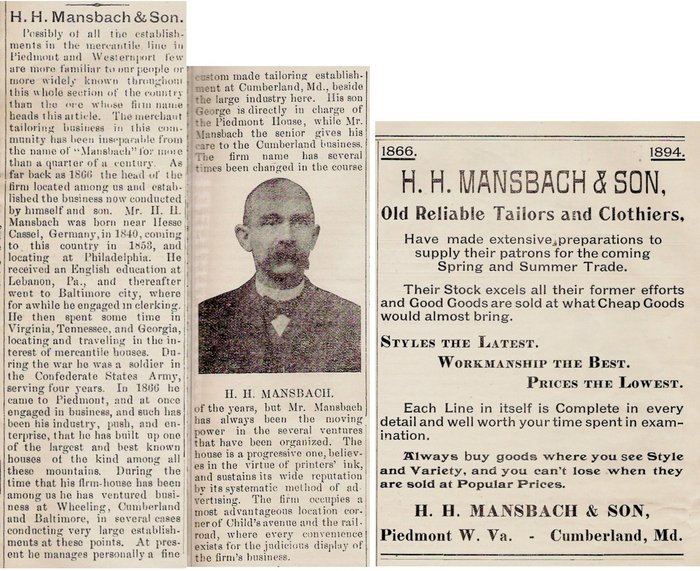
H.H.’s business was doing very well, and according to this article in the April 1893 Piedmont Herald, by that time he had opened stores in Wheeling, West Virginia, as well as Baltimore and Cumberland, Maryland, where Nannie’s family continued to reside.  It also appears from this article that by 1893, H.H. and Nannie were also residing in Cumberland.  A partial transcription of the article (with paragraphing added for readability) appears below:

Possibly of all the establishments in the mercantile line in Piedmont and Westernport few are more familiar to our people or more widely known throughout this whole section of the country than the one whose firm name heads this article.  The merchant tailoring business in this community has been inseparable from the name “Mansbach” for more than a quarter of a century. 

As far back as 1866 the head of the firm located among us and established the business now conducted by himself and son. [biographical information previously described] In 1866 he came to Piedmont, and at once engaged in business, and such has been his industry, push, and enterprise that he has built up one of the largest and best known house of the kind among all these mountains.  During the time this his firm-house has been among us he has ventured business at Wheeling, Cumberland, and Baltimore, in several cases conducting very large establishments at these points.

At present he manages personally a fine custom made tailoring establishment at Cumberland, Md., beside the large industry here.  His son George is directly in charge of the Piedmont House, while Mr. Mansbach the senior gives his care to the Cumberland business.  The firm name has changed in the course of the years, but Mr. Mansbach has always been the moving power in the several ventures that have been organized.  The house is a progressive one, believes in the virtue of printers’ ink, and sustains its wide reputation by its systematic method of advertising. …

H.H. Mansbach Courtesy of John Fazenbaker at FindAGrave http://www.findagrave.com/cgi-bin/fg.cgi?page=pv&GRid=85694927&PIpi=56133066

H.H. Mansbach
Courtesy of John Fazenbaker at FindAGrave
http://www.findagrave.com/cgi-bin/fg.cgi?page=pv&GRid=85694927&PIpi=56133066

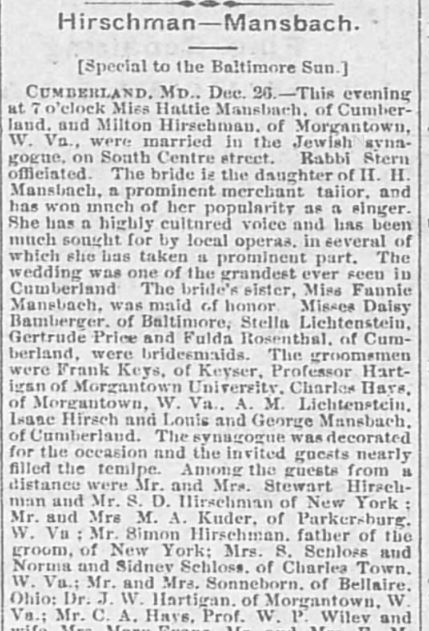
Thus, H.H. by 1893 was quite a successful businessperson. In the 1890s the older Mansbach children began to marry and move out on their own.  Hattie, the oldest daughter, married Milton Hirschman on December 26, 1893.  Milton was born in Pennsylvania, at one time had lived in New York, but was living in Morgantown, West Virginia in 1893.

hirschman-mansbach-wedding-pt-1

Spirit of Jefferson (Charles Town, West Virginia) January 2, 1894, p. 2

Spirit of Jefferson (Charles Town, West Virginia) January 2, 1894, p. 2

This evening at 7 o’clock Miss Hattie Mansbach, of Cumberland, and Milton Hirschman, of Morgantown, were married in the Jewish synagogue on South Centre Street.  Rabbi Stern officiated.  The bride is the daughter of H.H. Mansbach, a prominent merchant tailor, and has won much of her popularity as a singer.  She has a highly cultured voice and has been much sought for by local operas, in several of which she has taken a prominent part. ….

The article then follows with a list of guests.  The only names that I could recognize as being part of the Mansbach/Katzenstein family were Hattie’s siblings Fannie, Louis, and George, who were in the bridal party.  Of course, this was shortly after Henrietta Mansbach Gump had died so perhaps it is not surprising that there are no Gump family members included on the list.

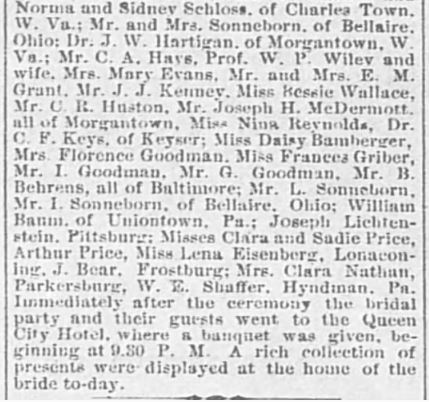
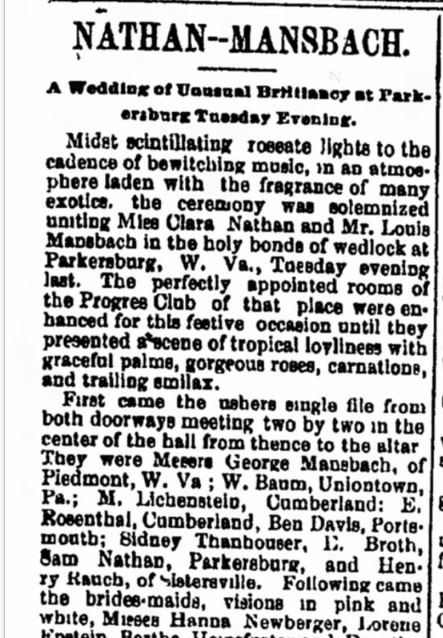
The family had another elaborate wedding on March 29, 1898, in Parkersburg, West Virginia when Louis Mansbach married Clara Nathan.

nathan-mansbach-wedding-1898

nathan-mansbach-wedding-pt-2

Cumberland Evening Times, March 31, 1898, p. 4


Again, the only familiar names here are those of the groom’s immediate family—his parents and his siblings.  None of the children of either Henrietta Mansbach Gump or of Abraham Mansbach were listed among the attendees.  So perhaps there were some lingering bad feelings between H.H. and his relatives.  Hard to know.

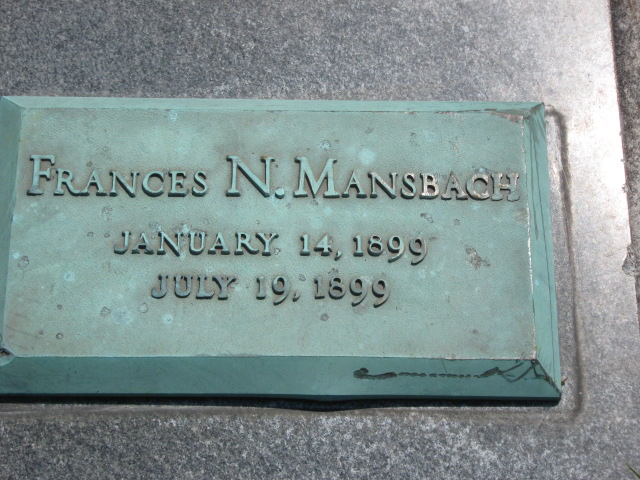
In January 1899, Louis and Clara had a child, Frances N. Mansbach, who died just six months later on July 19, 1899. At first, I was led to believe that Frances was the daughter of Harry H. and Nannie Mansbach because that’s what it indicates on her FindAGrave memorial.  But I was skeptical.  In 1899, Nannie would have been about 53 years old, and she had not had a child in over 12 years.  To me, it seemed more likely that this was the child of Louis Mansbach and his wife Clara.

Not only did Nannie’s advanced age support this conclusion, but on the 1900 census, Clara reported that she had had one child, still alive (see the last column below).  There was, however, no child is living with them.

Louis and Clara Mansbach 1900 census Year: 1900; Census Place: Fairmont Ward 4, Marion, West Virginia; Roll: 1764; Page: 19B; Enumeration District: 0053; FHL microfilm: 1241764

Louis and Clara Mansbach
1900 census
Year: 1900; Census Place: Fairmont Ward 4, Marion, West Virginia; Roll: 1764; Page: 19B; Enumeration District: 0053; FHL microfilm: 1241764

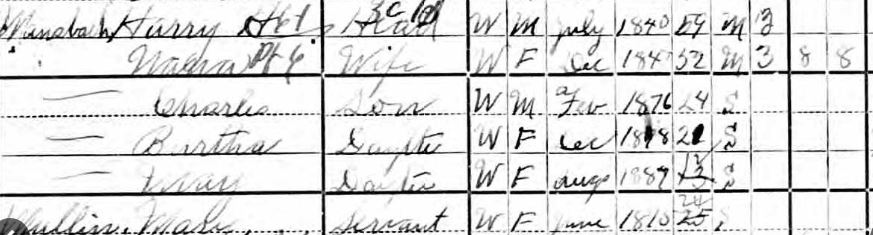
In addition, the 1900 census for H.H. and Nannie Mansbach reported that Nannie had had eight children, eight of whom were still living (last column on Nannie’s line).  Frances would have been a ninth, if she were Nannie’s child.

Harry Mansbach and family 1900 census Source Citation Year: 1900; Census Place: Cumberland Ward 5, Allegany, Maryland; Roll: 604; Page: 1A; Enumeration District: 0128; FHL microfilm: 1240604

Harry Mansbach and family
1900 census
Source Citation
Year: 1900; Census Place: Cumberland Ward 5, Allegany, Maryland; Roll: 604; Page: 1A; Enumeration District: 0128; FHL microfilm: 1240604

Finally, the 1910 census record for Clara Mansbach reported that Clara had had one child, but had no living children. Thus, it seemed to me that Frances Mansbach was the child of Louis and Clara Mansbach, not the child of HH and Nannie Mansbach.

Louis and Clara Mansbach 1910 census Year: 1910; Census Place: Norfolk Ward 2, Norfolk (Independent City), Virginia; Roll: T624_1637; Page: 18B; Enumeration District: 0026; FHL microfilm: 1375650

Louis and Clara Mansbach
1910 census
Year: 1910; Census Place: Norfolk Ward 2, Norfolk (Independent City), Virginia; Roll: T624_1637; Page: 18B; Enumeration District: 0026; FHL microfilm: 1375650

Thanks to Cathy Meder-Dempsey of Opening Doors in Brick Walls, I was able to confirm my hunch that Frances was the child of Louis and Clara (Nathan) Mansbach.  Cathy pointed me to the West Virginia Vital Research Records Project, where I was able to locate both the birth and death records for little Frances Mansbach:

The death record makes it quite clear that Frances was the child of Louis and Clara.  She died of cholera infantum.  How devastating that must have been for the couple, who’d only married a little over a year before their daughter’s death.  They never had another child.

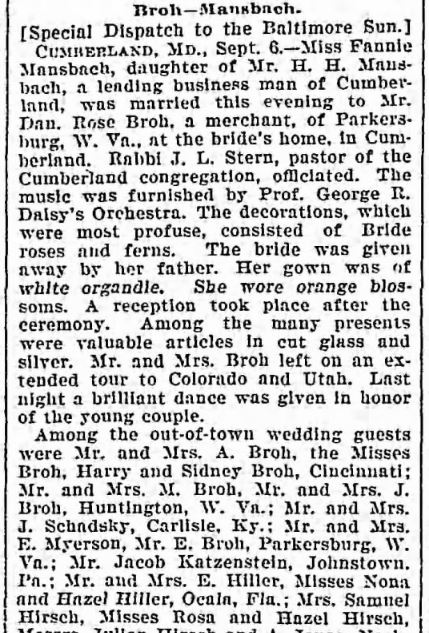
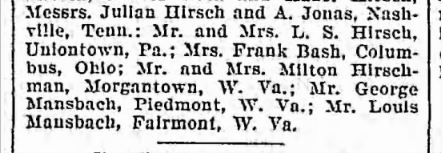
H.H. and Nannie’s second daughter Fannie was the next to marry; she married Daniel Rose Broh of Parkersburg, West Virginia, on September 6, 1898.  Of particular interest in this wedding announcement is the fact that Jacob Katzenstein, Fannie’s first cousin and my great-grandmother Hilda’s brother, attended the wedding, suggesting that H.H. and his family had not severed all ties with their Katzenstein relatives even after his father and siblings had died. But Jacob was the only Katzenstein family member listed, and there were no Gumps or Mansbachs, except for Fannie’s siblings and parents.

broh-mansbach-wedding-pt-1-1898

Baltimore Sun, September 7, 1898, p. 6

Baltimore Sun, September 7, 1898, p. 6


Thus, by 1900, three of the four oldest children of H.H. and Nannie were married.  Where were they and all the other members of the family of HH and Nannie Mansbach living when the 1900 census was taken?

The oldest son Louis Mansbach and his wife Clara were living in Fairmont, West Virginia, where Louis was a clothing merchant.  Hattie (Mansbach) and Milton Hirschman were living with their first child Simon in Morgantown, West Virginia, where Milton was also a clothing merchant. And Fannie and her husband Daniel Broh were living in Parkersburg, West Virginia in 1900 where he also was a clothing merchant.  Thus, by 1900, the three married children of H.H. and Nannie’s children were all living in different towns in West Virginia, where all the men were working as clothing merchants.  In addition, the second oldest son George Mansbach was still living in Piedmont, West Virginia, where he resided in a boarding house; he was working as a bookkeeper.

But by 1900, H.H. and Nannie (Hirsch) Mansbach had relocated with three of their other children, Charles, Bertha, and May, to Cumberland, Maryland, where Nannie’s family still resided.  Charles and his father were working as dry goods merchants in Cumberland.


Embed from Getty Images

As for the Mansbach’s youngest son, Isaac, he was living in Allegheny, Pennsylvania (today part of Pittsburgh), studying law. He had previously been a student at Morgantown University.

Thus, the years after the Civil War were highly successful years for H.H. Mansbach and his family.  His business was thriving, he was able to provide lavish weddings for his children, and he even had a son who was going to be a lawyer.

Harder times were ahead, however, in the 20th century.

****************

I was honored to be interviewed by Michelle Ganus Taggart for Geneabloggers.  You can read the interview here.

After the Civil War: Did the Mansbach Family Come Together?

As we saw in my last post, two of the nephews of my great-great-grandfather Gerson Katzenstein fought on opposite sides of the Civil War.  Abraham Mansbach served (albeit briefly) in the Union army whereas his younger brother Heinemann, aka Henry or Harry or H.H. Mansbach, fought for the Confederacy.  I thought it would be worthwhile to research their post-Civil War lives to see if I could learn what effect, if any, this had on their relationship.

After being injured twice fighting in the Confederate army, H.H. Mansbach settled in Piedmont, West Virginia, where he became a dry goods merchant. By 1868, H.H. had married Nannie Hirsch, who was born in Germany and whose parents had settled in Cumberland, Maryland, which is about 25 miles from Piedmont, West Virginia.  In 1870, Nannie’s parents were still living in Cumberland, Maryland, where her father was a merchant.   As of 1870, H.H. and Nannie had two children, Louis, born in 1868, and Hattie, born in 1869.

H.H. Mansbach and family 1870 US census Year: 1870; Census Place: Piedmont, Mineral, West Virginia

H.H. Mansbach and family 1870 US census
Year: 1870; Census Place: Piedmont, Mineral, West Virginia

Where was the rest of the Mansbach family during this time period? H.H.’s sister Henrietta was, by 1861, living in the United States and married to Gabriel Gump, who was also a German immigrant. By July 1862, they had settled in Morris, Illinois, where their first child Abraham was born. In June 1863 with the Civil War going on, Gabriel, a saloon keeper, registered for the draft in Illinois, so he was on the Union side of the war, opposing Henrietta’s brother H.H.

Gabriel Gump Civil War draft registration National Archives and Records Administration (NARA); Washington, D.C.; Consolidated Lists of Civil War Draft Registration Records (Provost Marshal General's Bureau; Consolidated Enrollment Lists, 1863-1865); Record Group: 110, Records of the Provost Marshal General's Bureau (Civil War); Collection Name: Consolidated Enrollment Lists, 1863-1865 (Civil War Union Draft Records); NAI: 4213514; Archive Volume Number: 2 of 5

Gabriel Gump
Civil War draft registration
National Archives and Records Administration (NARA); Washington, D.C.; Consolidated Lists of Civil War Draft Registration Records (Provost Marshal General’s Bureau; Consolidated Enrollment Lists, 1863-1865); Record Group: 110, Records of the Provost Marshal General’s Bureau (Civil War); Collection Name: Consolidated Enrollment Lists, 1863-1865 (Civil War Union Draft Records); NAI: 4213514; Archive Volume Number: 2 of 5

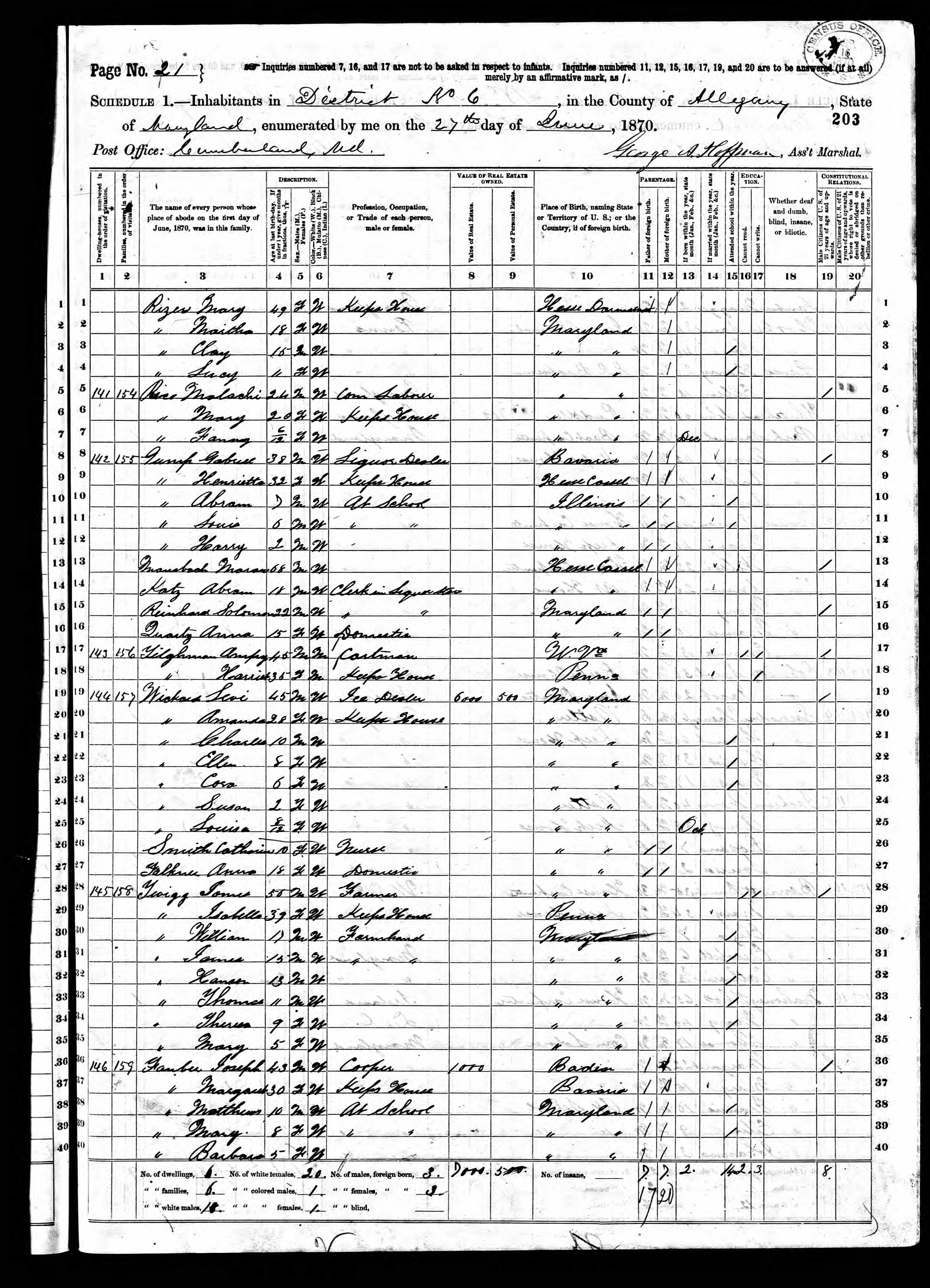
By 1870, Gabriel and Henrietta had moved to Cumberland, Maryland; they had three children at that time, Abraham (7), Louis (6), and Harry (2), all born in Illinois. Also living with them by that time was Henrietta’s father, Marum Mansbach, who had emigrated from Germany on August 6, 1864.[1]

Marum Mansbach on passenger manifest 1864 Staatsarchiv Hamburg; Hamburg, Deutschland; Hamburger Passagierlisten; Microfilm No.: K_1710

Marum Mansbach on passenger manifest 1864
Staatsarchiv Hamburg; Hamburg, Deutschland; Hamburger Passagierlisten; Microfilm No.: K_1710

Gabriel Gump and family 1870 US census Year: 1870; Census Place: District 6, Allegany, Maryland

Gabriel Gump and family
1870 US census
Year: 1870; Census Place: District 6, Allegany, Maryland

Thus, in 1870, H.H. Mansbach’s sister Henrietta and father Marum were living in Cumberland, Maryland, the same town where H.H.’s in-laws were living and where his wife Nannie had lived herself before marrying H.H. in 1868.  I find it hard to believe that this was just coincidence and thus take it as a sign that H.H. still had a relationship with his family despite the fact that he’d fought for the Confederacy while his brother Abraham and his brother-in-law Gabriel had been on the side of the Union.

English: {City of Cumberland, http://www.ci.cu...

Cumberland, Maryland, where the Gump, Mansbach, and Hirsch families were living in 1870. English: {City of Cumberland, http://www.ci.cumberland.md.us} Category:Images of Cumberland (Photo credit: Wikipedia)

As for Abraham Mansbach, brother of H.H. and Henrietta, he had married Eliza Gump in Philadelphia on January 6, 1861.  Eliza was the younger sister of Gabriel Gump, husband of Abraham’s sister Henrietta. Abraham and Eliza had a daughter Mollie, born in October 1866.  I was unable to locate them on the 1870 census, but in 1873, they were living in Baltimore where Abraham was engaged in the wholesale liquor business.

Marriage record for Abraham Mansbach and Eliza Gump Historical Society of Pennsylvania; Philadelphia, Pennsylvania; Collection Name: Historic Pennsylvania Church and Town Records; Reel: 792 Description Organization Name : Congregation Rodeph Shalom

Marriage record for Abraham Mansbach and Eliza Gump
Historical Society of Pennsylvania; Philadelphia, Pennsylvania; Collection Name: Historic Pennsylvania Church and Town Records; Reel: 792
Description
Organization Name : Congregation Rodeph Shalom

Thus, in some way the Hirsch-Mansbach-Gump families were all interconnected by marriage and/or geography. Henrietta (Mansbach) and Gabriel Gump were living in the same town as HH Mansbach’s in-laws in 1870. Abraham Mansbach was married to Gabriel Gump’s sister.  Perhaps they all knew each other from the “old country” or perhaps they’d all just met after immigrating to the US.  But it certainly seems that at a minimum, H.H. had not been banished from the family since he somehow ended up marrying the daughter of his sister’s neighbors in Cumberland.

Between 1870 and 1880, the families of the Mansbach siblings grew. H.H. and Nannie had five more children in that decade: George (1871), Fannie (1873), Charles (1875), Bertha (1876), and Isaac (1879).  Thus, by 1880, there were seven children in the family; they were still living in Piedmont, West Virginia, where Harry continued to work as a merchant.

HH Mansbach and family 1880 US census Year: 1880; Census Place: Piedmont, Mineral, West Virginia; Roll: 1408; Family History Film: 1255408; Page: 152C; Enumeration District: 034

HH Mansbach and family
1880 US census
Year: 1880; Census Place: Piedmont, Mineral, West Virginia; Roll: 1408; Family History Film: 1255408; Page: 152C; Enumeration District: 034

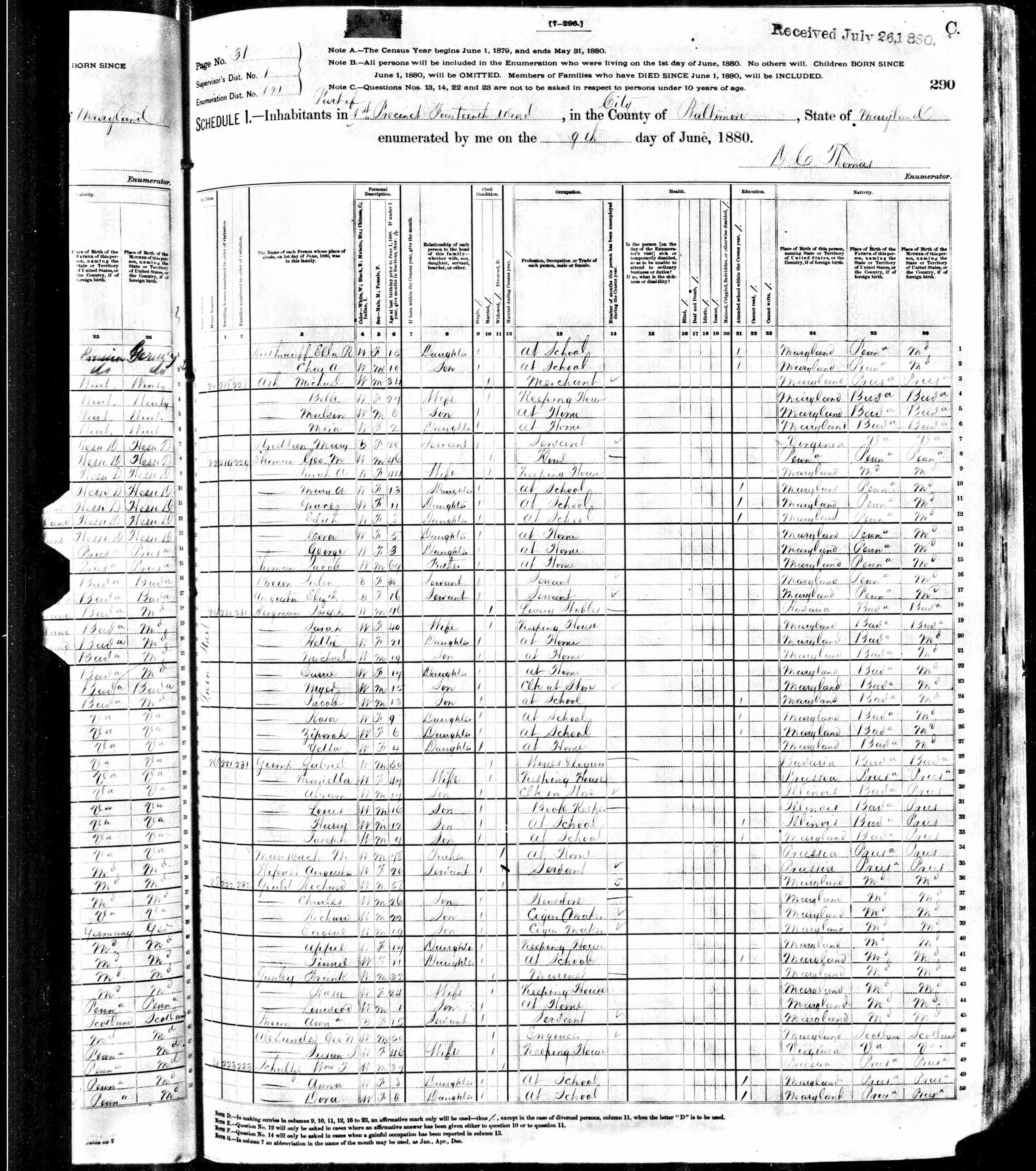
By 1880, Henrietta and Gabriel Gump were no longer living in Cumberland, Maryland.  They had moved to Baltimore where Gabriel was now in the liquor business with his brother-in-law Abraham Mansbach. Henrietta and Gabriel now had four sons: Abraham (17), Louis (16), Harry (12), and Joseph (9).  Marum Mansbach was still living with them as well.

Gabriel Gump and family 1880 census Year: 1880; Census Place: Baltimore, Baltimore (Independent City), Maryland; Roll: 501; Family History Film: 1254501; Page: 290C; Enumeration District: 121; Image: 0760

Gabriel Gump and family
1880 census
Year: 1880; Census Place: Baltimore, Baltimore (Independent City), Maryland; Roll: 501; Family History Film: 1254501; Page: 290C; Enumeration District: 121; Image: 0760

Abraham Mansbach, brother of Henrietta and H.H., was still living in Baltimore in 1880, working in the liquor business with Gabriel, as stated above. Abraham and his wife Eliza (Gump) now had two children: Mollie (fourteen) and Jerome (six months).

Title : Baltimore, Maryland, City Directory, 1880 Source Information Ancestry.com. U.S. City Directories, 1822-1995 [database on-line]. Provo, UT, USA: Ancestry.com Operations, Inc., 2011.

Title : Baltimore, Maryland, City Directory, 1880
Source Information
Ancestry.com. U.S. City Directories, 1822-1995 [database on-line]. Provo, UT, USA: Ancestry.com Operations, Inc., 2011.

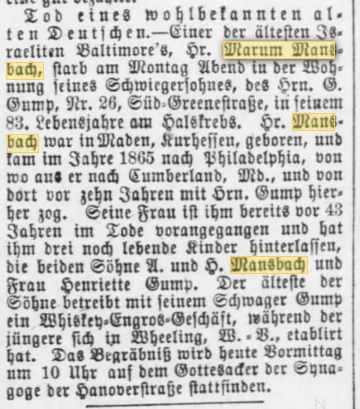
The 1880s saw the Mansbach family suffer two big losses.  First on April 3, 1883, Marum Mansbach died at age 83. The German-language newspaper for Baltimore, the Deutsche Correspondent, ran this obituary and burial notice on April 5 and 6, respectively:

marum-mansbach-second-article-april-5-1883-deutsche-correspondent-baltimore

Der Deutsche Correspondent – 5 Apr 1883, Thu – Page 4

As translated by those at German Genealogy Facebook group, the obituary reads:

Death of a well-known old German man. One of the oldest Jewish men in Baltimore, Marum Mansbach, died of throat cancer in his 83rd year, on Monday evening at the house of his son-in-law G. Gump, 26 South Green St/Rd. Mr Mansbach was born in Maden, Electorate of Hessen, and came to Philadelphia in 1865. From Philadelphia he moved to Cumberland, Md, and then ten years ago he moved here with his son-in-law. His wife died 43 years ago, leaving him three children who are still alive, sons A. and H. Mansback and Mrs Henriette Gump. The elder of the sons runs a Whiskey wholesalers with his brother-in-law Mr Gump, and the younger has settled in Wheeling, W.-V. The funeral will take place this morning at 10 am at the cemetery of the Hanover St/Rd Synagogue.

marum-mansbach-death-notice-april-1883-deutsche-correspondent-baltimore

Der Deutsche Correspondent – 6 Apr 1883, Fri – Page 4

The burial notice was translated to say:

Burial. – The mortal remains of Marum Mansbach were taken yesterday morning from the house of his son-in-law G. Gump, 26 South Greene Road, to his final resting place in the Jewish cemetery on Trapp Road, accompanied by numerous mourners. Rabbi Dr Szold gave a moving funeral address. Pall-bearers were H. Hamburger, N. Frank, J. Eisenberg, S. Dettinger, M. Kaufmann and B. Brettenheimer

Then, just four years later on November 18, 1887, Marum’s son Abraham Mansbach, the first of my Katzenstein relatives to come to the US, died unexpectedly while on business in Virginia.  His obituary ran in English in The Baltimore Sun and in German in the Deutsche Correspondent:

abraham-mansbach-obit-pt-1

abaham-mansbach-obitpt-2

Der Deutsche Correspondent – 21 Nov 1887 – Page 4


Here is a translation of the German version:

At the age of 53 years, on Friday morning, Abraham Mansbach, the senior member of the local spirits company, Mansbach and Gump, died very unexpectedly in Culpeper, Virginia, where he had been engaged in business affairs yesterday for eight days. On Thursday he had written to his business partner, Mr. Gabriel Gump, that he was perfectly well; on Friday, however, the named gentleman received a telegram, saying that Herr Mansbach was seriously ill, and then in the afternoon he received a second telegram, which reported his death. His nephew, Mr. Harry Gump, went to Culpeper, accompanied by Alexander Wegner, a long-time friend of the deceased, to fetch the corpse with which they returned the same night. Mr. Mansbach came from Germany and came to America as a young man, where he first ran a dry goods business in Philadelphia; later, however, he moved to Baltimore, and since 1873 has been involved in the trade of spirits. He was particularly well known for his great kindness, and belonged to several societies, including the “Legion of Honor”, the “Ber. Works” and the “Royal Arcanum-Lodge.”

The English version says essentially the same thing:

The Baltimore Sun - 19 Nov 1887, Sat - Page 4

The Baltimore Sun – 19 Nov 1887, Sat – Page 4

Abraham Mansbach was survived by his wife, Eliza, his daughter, Mollie, age 21, and his son Jerome, who was nine years old.

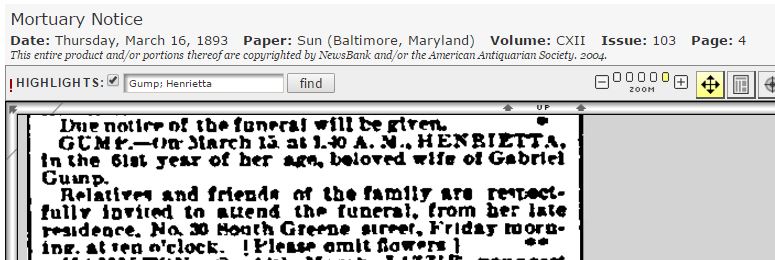
Then six years after Abraham’s death, his sister Henrietta died on March 15, 1893. She was sixty-one years old and was survived by her husband Gabriel Gump and their four adult sons, Abraham, Louis, Harry and Joseph.

henrietta-mansbach-gump-death-notice-1893

Baltimore Sun, March 16, 1893, p. 4

Gabriel Gump and his sister Eliza Gump Mansbach were thus both widowed by 1893, and H.H. Mansbach had lost his father, his brother, and his sister in the ten year period starting in 1883.  Although it is hard to know exactly what relationship H.H. had with his family of origin by then, it nevertheless must have been sad for him to lose them all within such a short period of time.

More on what happened to the families of Henrietta, Abraham, and HH in the 20th century in posts to follow.


[1] Sailing with Marum were two young women: Bertha, age 24, and Elise, age 17.  I’ve not yet determined who they were and what relationship they might have had to Marum.

The American Civil War: Brother against Brother

One of the most puzzling things to me about that 1856 passenger ship manifest for the ship that brought my great-great-grandfather Gerson Katzenstein and his family to America was the entry for a sixteen year old boy named Heinemann Mansbach.  I am quite sure that this was Gerson’s nephew, son of Hannchen Katzenstein and Marum Mansbach, since the age matches the age Heinemann would have been in 1856 and the residence (Maden) matches the place where Marum and Hannchen Mansbach and their family lived.

Ship manifest close up Year: 1856; Arrival: New York, New York; Microfilm Serial: M237, 1820-1897; Microfilm Roll: Roll 164; Line: 1; List Number: 589

Ship manifest close up
Year: 1856; Arrival: New York, New York; Microfilm Serial: M237, 1820-1897; Microfilm Roll: Roll 164; Line: 1; List Number: 589

But why was Heinemann going to “Libanon,” which I assume referred to Lebanon, Pennsylvania, a town about 90 miles west of Philadelphia? In 1850, Lebanon had a population of 2,184.  By 1860, the population had more than doubled—to 4,449. Thus, if Heinemann was headed there in 1856, he was headed to a place that was in a period of remarkable growth.

It is in Lebanon County, and according to the county website, “The original German settlers tilled the valley’s fertile soil, creating an economic base that continues today and blends with the residential, commercial and industrial development presently occurring.  Also reflective of Lebanon County’s “Pennsylvania Dutch” heritage are its pastoral landscape, attractive farms and outstanding dairy and pork products, especially Lebanon Bologna.” Even today Lebanon County is thus not an urban area. I can’t find any explanation for the huge population growth between 1850 and 1860 except that it was a place where German immigrants settled.

Farmstead, Heidelberg Township, Lebanon County.

Farmstead, Heidelberg Township, Lebanon County. (Photo credit: Wikipedia)

I searched the 1860 census records for Lebanon for anyone in the Mansbach or Katzenstein family, but did not find anyone, so Heinemann obviously did not settle there for long.  But according to a profile written about him in the Piedmont Herald (West Virginia) newspaper in April 1893 (when he was known as H.H. Mansbach), Heinemann did spend some time in Lebanon to learn English.  I’ve no idea why he had to go to Lebanon to learn English, as opposed to living with his brother Abraham and the Katzensteins in Philadelphia.  The same profile, however, did say that he had early in his years in the US also lived in Philadelphia and Baltimore as well in Virginia, Tennessee, and Georgia.[1]

When the Civil War came, Heinemann enlisted in the Confederate Army in Macon, Georgia, in March, 1861, using the name Henry H. Mansbach.

harry-h-mansbach_s-confederate-page-001 harry-h-mansbach_s-confederate-page-002

According to the 1893 Piedmont Herald profile, Henry served four years in the Confederate Army.  His obituary in the Norfolk-Ledger Dispatch (April 1, 1912) reported that he had been wounded twice during the war, first in the Battle of Shiloh (Tennessee) and then in the Battle of Murfreesboro (Tennessee).

The Battle of Shiloh occurred in April, 1862, in western Tennessee.  History.com described the battle as follows:

Also known as the Battle of Pittsburg Landing, the Battle of Shiloh took place from April 6 to April 7, 1862, and was one of the major early engagements of the American Civil War (1861-65). The battle began when the Confederates launched a surprise attack on Union forces under General Ulysses S. Grant (1822-85) in southwestern Tennessee. After initial successes, the Confederates were unable to hold their positions and were forced back,resulting in a Union victory. Both sides suffered heavy losses, with more than 23,000 total casualties, and the level of violence shocked North and South alike.

Chromolithograph of the Battle of Shiloh, Amer...

Chromolithograph of the Battle of Shiloh, American Civil War (Photo credit: Wikipedia)

Whatever injuries Henry Mansbach suffered in this battle did not keep him from continuing to serve in the Confederate Army.  Not too long after the Battle of Shiloh, he was injured in the battle at Murfreesboro, Tennessee.

There were actually two battles at Murfreesboro, the first in July, 1862. The National Park Service website provides more insight into the battle:

The major objective was to strike Murfreesboro, an important Union supply center on the Nashville & Chattanooga Railroad, at dawn on July 13. The Murfreesboro garrison was camped in three locations around town and included detachments from four units comprising infantry, cavalry, and artillery, under the command of Brig. Gen. Thomas T. Crittenden who had just arrived on July 12.  Between 4:15 and 4:30 am on the morning of July 13, Forrest’s cavalry surprised the Union pickets on the Woodbury Pike, east of Murfreesboro, and quickly overran a Federal hospital and the camp of the 9th Pennsylvania Cavalry Regiment detachment.  Additional Rebel troops attacked the camps of the other Union commands and the jail and courthouse. By late afternoon all of the Union units had surrendered to Forrest’s force. The Confederates destroyed much of the Union supplies and tore up railroad track in the area, but the main result of the raid was the diversion of Union forces from a drive on Chattanooga.

The second battle at Murfreesboro, also known as the Battle of Stones River, was in December, 1862. It has been described as one of the bloodiest battles of the Civil War.  The history.com website described it as follows:

On December 31, Confederate General Braxton Bragg’s 35,000 troops successfully attacked the 42,000-strong Union force commanded by Major General William Rosecrans. Union troops withstood the assault, but retreated to a defensive position, which they would hold against repeated attacks over the next two days. On January 2, 1863, another Confederate assault was repelled by overwhelming Union artillery fire, forcing Bragg to order a Southern retreat. With approximately 23,000 total casualties, Stones River was one of the deadliest battles of the war. Rosecrans claimed victory and the battle provided a much-needed boost to Union morale following their defeat at Fredericksburg, Virginia.

Illustration of the Battle of Stones River, wh...

Illustration of the Battle of Stones River, which occurred on December 31, 1862 and January 2-3, 1863. Commanding the forces were General Rosecrans for the Union and General Bragg for the Confederacy. (Photo credit: Wikipedia)

I don’t know in which of these two battles Henry H. Mansbach participated and was injured, perhaps both.

Although it was surprising to me that I had a cousin who fought for the Confederacy, what made it particularly disturbing was knowing that Henry’s brother, Abraham, had enlisted on September 11, 1862, in Company E of the Pennsylvania 3rd Infantry Regiment and thus was serving on the Union side just a few months after his brother was injured in battle for the Confederacy in Tennessee.

Although Abraham’s unit was discharged two weeks later, and I’ve no idea whether he joined another unit, just the idea that two brothers had enlisted on opposite sides of the war is mind-boggling.  I’ve read that this happened in many families—especially where families lived in border states like Maryland or Kentucky.  But here we have two young men who had only recently come to the US and who voluntarily joined opposing sides of the war.

I wondered what the long term implications of that were for them and for their families. I decided to search a little more deeply into the post-Civil War lives of Henry Mansbach and Abraham Mansbach. What I learned will be discussed in my next post, after Thanksgiving.

May all of you who celebrate have a wonderful Thanksgiving! Let’s all hope for and work for better things to come in this country and this world. And let’s hope we can find a way to understand each other better so that we never have brothers fighting for opposing sides in a war ever again.


[1] I thank John Fazenbaker from FindAGrave for publishing images from the Piedmont Herald and the Norfolk Ledger-Dispatch about H.H. Mansbach as well as the many headstone photographs he took and posted on FindAGrave.

Will the Real Abraham Mansbach Please Stand Up?

In my prior post about my great-great-grandparents Gerson Katzenstein and Eva Goldschmidt, I was trying to determine whether anyone in either of their families was living in Philadelphia when they immigrated there with their first three children in 1856.  The closest possible relative I could find who might have been there first was someone I thought was Gerson’s nephew Abraham Mansbach, son of his half-sister Hannchen Katzenstein and her husband Marum Mansbach of Maden.

There was an 1852 ship manifest for an Abraham Mansbach, a merchant from Germany, who I thought might be this nephew, but there was no town of origin or age listed on the manifest, so it was hard to know. Also, he had entered the country in Baltimore, not Philadelphia.

abraham-mansbach-1852-immigration-card

Abraham Mansbach 1852 immigration card “Maryland, Baltimore Passenger Lists Index, 1820-1897,” database with images, FamilySearch (https://familysearch.org/pal:/MM9.3.1/TH-1942-37337-15431-34?cc=2173933 : 17 June 2014), NARA M327, Roll 98, No. M462-M524, 1820-1897 > image 2545 of 3335; citing NARA microfilm publication M327 (Washington, D.C.: National Archives and Records Administration, n.d.).

abraham-mansbach-1852-passenger-list

Abraham Mansbach on 1852 passenger list “Maryland, Baltimore Passenger Lists, 1820-1948,” database with images, FamilySearch (https://familysearch.org/pal:/MM9.3.1/TH-1961-32011-12875-22?cc=2018318 : 25 September 2015), 1820-1891 (NARA M255, M596) > 9 – Jun 2, 1852-Aug 29, 1853 > image 503 of 890; citing NARA microfilm publications M255, M596 and T844 (Washington, D.C.: National Archives and Records Administration, n.d.).

The 1860 census, however, shows that living in the household of Gerson Katzenstein was a 25 year old salesman named Abraham Anspach.  Since Gerson’s nephew Abraham was born in 1835, he would have been 25 in 1860.  It seemed to me that this was in fact the son of Hannchen Katzenstein and Marum Mansbach, Abraham Mansbach.

But there was also a 20 year old woman living in the house named Marley Mansbach, and I had at first thought she could be Gerson’s niece and Abraham’s sister Henrietta.  I also thought she was likely the same person who was listed on the 1856 ship manifest right below Gerson Katzenstein and his family: a sixteen year old girl named Malchen Mansbach from Maden. But the ages were off from the birth year I had for Henrietta (1833), and the name Henrietta is quite different from Malchen.  Most Malchens I’d seen adopted the name Amelia or Amalia; most Henriettas had been Jette in Germany, not Malchen.

Plus there was Heinemann Mansbach, the other sixteen year old who had sailed with Gerson and his family and who’d been heading to “Libanon.”  He was not listed on the 1860 census with the Katzenstein family. Who was he, and where was he?

Ship manifest close up Year: 1856; Arrival: New York, New York; Microfilm Serial: M237, 1820-1897; Microfilm Roll: Roll 164; Line: 1; List Number: 589

Ship manifest close up
Year: 1856; Arrival: New York, New York; Microfilm Serial: M237, 1820-1897; Microfilm Roll: Roll 164; Line: 1; List Number: 589

Closeup of Katzensteins and Mansbachs on 1860 census

Closeup of Katzensteins and Mansbachs on 1860 census

So I consulted with David Baron, and what a Pandora’s box that opened! David worked on this Mansbach puzzle quite extensively and discovered that the Katzenstein family was entwined in multiple ways not only with the Mansbach family, but also the Goldschmidt, Jaffa, and Schoenthal families.  Some of this I’d known before, but much of it was new to me and was quite a revelation.  There are siblings who married the siblings of their spouses; cousins who married cousins; and so many overlapping relationships that my head was spinning.  I won’t describe them all here.  I’d lose you all.

But what David sorted out for me did help answer some of the questions posed above. He pointed me to the work done by Hans-Peter Klein on the Mansbach family from Maden. From Hans-Peter’s work I learned that there were FOUR men from Maden named Abraham Mansbach. The first Abraham Mansbach died sometime before 1808.  I will refer to him as Abraham I. He had two sons, Lieser, born in 1770, and Marum, born in either 1769 or 1778 (Marum I).

family-group-sheet-for-abraham-mansbach-i-page-001

Lieser had three sons: Isaak (1799), Marum II (1802), and Abraham II (1809).  So that’s two Abrahams, two Marums.  Still with me? Both Abraham I and Abraham II were clearly born too early to have been the Abraham Mansbach on the 1860 census with Gerson.

family-group-sheet-for-leiser-mansbach-page-001

As a distracting aside, let me mention that Lieser’s son Abraham II married Sarah Goldschmidt, Eva Goldschmidt’s sister, making him the brother-in-law of my great-great-grandparents, Gerson Katzenstein and Eva Goldschmidt.  But that’s a story for another day.

Lieser’s son Marum II is the one who married Hannchen Katzenstein, sister of Gerson, and they had Abraham III in 1835.  He’s the one I believe is listed with Gerson on the 1860 census; he also appears to be the first member of the Katzenstein line to come to the US.

family-group-sheet-for-marum-mansbach-page-001

Finally, Lieser’s brother Marum I had a daughter named Schiele (birth year unknown).  Schiele had two children apparently out of wedlock; both took on the surname Mansbach.  They were Abraham IV, born in 1849, and Malchen/Merla, born in 1840.  Thus, Abraham IV was born fourteen years after Gerson’s nephew, Abraham III, and was far too young to have been the Abraham living with Gerson in 1860 or sailing by himself to America in 1852.

descendants-of-marum-mansbach-i-page-001

Thus, I feel quite certain that the Abraham Mansbach on the census and on the 1852 ship manifest was Abraham Mansbach III, son of Hannchen Katzenstein and thus Gerson Katzenstein’s nephew.

In addition, David Baron believes, and it seems right to me, that the girl named Malchen Mansbach listed with Gerson and his family on the 1856 ship manifest and the 1860 census was not Henrietta Mansbach, daughter of Marum Mansbach II and Hannchen Katzenstein, but instead the daughter of Schiele Mansbach and sister of Abraham Mansbach IV.  Schiele’s daughter Malchen was born in 1840, according to Hans-Peter’s research, and so she would have been sixteen in 1856, as reflected on the manifest, and twenty in 1860, as reflected on the 1860 census.  Abraham Mansbach IV, her brother, did not immigrate to the US until 1864.

Having gone down this deep rabbit hole of the extended Mansbach family, I had to pull myself back up and regain my focus.  After all, other than the children of Marum Mansbach II and Hannchen Katzenstein, none of these other Mansbachs are genetically connected to me.  Their stories are surely important and interesting, but I had to get back to the Katzensteins before I became too distracted.

I now feel fairly confident that the Abraham listed with Gerson in 1860 was in fact his nephew, Abraham Mansbach III, son of Hannchen Katzenstein and Marum Mansbach II, but that Malchen/Marley Mansbach was not their daughter Henrietta and thus not Gerson’s niece.  But I still had questions about Hannchen and Marum’s two other children, Heinemann/Harry and Henrietta. In 1860, where was Heinemann Mansbach, the third child of Hanne and Marum, the one who had sailed with Gerson in 1856 and whose destination was apparently Lebanon, PA? And when, if at all, did Henrietta arrive in the US?

More on that in my next few posts.


The Katzenstein Clan: Who Got Here First?

One of the main questions I had about Gerson Katzenstein, my great-great-grandfather, was why did he come to the United States?  Did he have other relatives who had paved the way, or was he the first in his family to arrive?

When I first did some research about Gerson almost five years ago, I was unable to find any relatives aside from his wife and children, and so I had no information about the rest of his family.  But thanks to the work of Barbara Greve and David Baron, I now have a long list of names of relatives, including the names of Gerson’s siblings.  I thought that there might have been other relatives living in the United States when Gerson arrived that I’d not known about during my initial research several years ago.

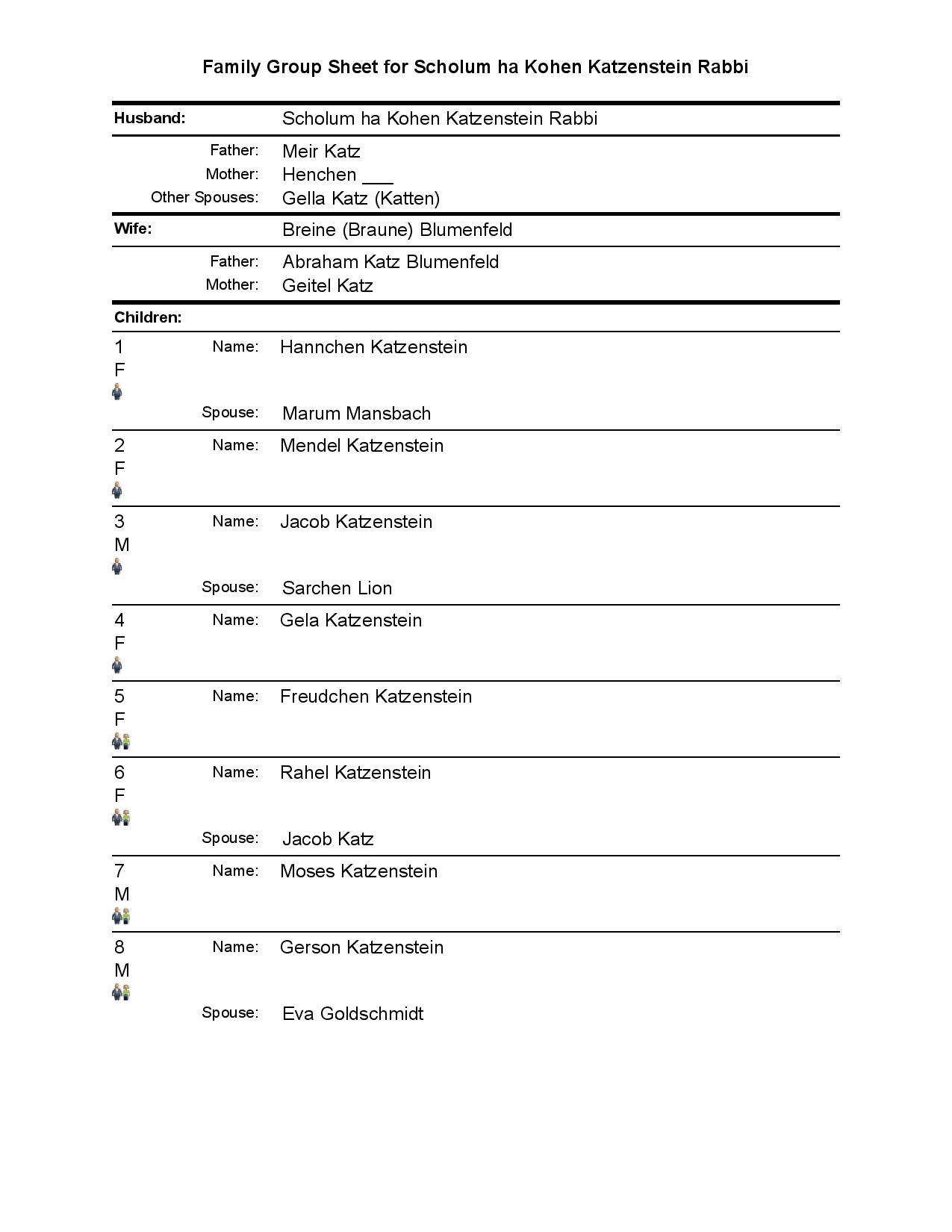
What I learned from Barbara Greve’s work was that Gerson was one of the eight children of Scholem Katzenstein; there were four half-siblings born to Scholem’s first wife, Gella: Hannchen (1798-1840), Mendel, who died as an infant in 1799, Jacob (1803-?), and Gela, who also died as an infant in 1808.  Gerson had three full siblings born to his mother, Breine Blumenfeld: Freudchen (1809-1818), Rahel (1813-1861), and Moses, for whom the only record is a birth record dated November 4, 1814.  Perhaps Moses also had died as an infant. Thus, of the eight children of Scholem Katzenstein, the only ones for whom there are records indicating survival to adulthood are Gerson, Hannchen, Jacob, and Rahel.

family-group-sheet-for-scholum-ha-kohen-katzenstein-rabbi-page-001


Gerson’s birth is recorded as somewhere between 1811 and 1815, depending on the source.  He married Eva Goldschmidt of Oberlistingen sometime before 1848, when their first child, Scholem, was born in Jesberg.  Two more children followed, Jacob in 1851 and Brendina (Branche in German—presumably named for Gerson’s mother) in 1853.

Gerson, Eva, and their three children left Germany and arrived in New York City on July 3, 1856.  On the ship manifest, Gerson listed his occupation as a butcher and their final destination as Philadelphia.

Gerson Katzenstein and family on 1856 ship manifest Year: 1856; Arrival: New York, New York; Microfilm Serial: M237, 1820-1897; Microfilm Roll: Roll 164; Line: 1; List Number: 589

Gerson Katzenstein and family on 1856 ship manifest
Year: 1856; Arrival: New York, New York; Microfilm Serial: M237, 1820-1897; Microfilm Roll: Roll 164; Line: 1; List Number: 589

Just a little over a month later, Eva gave birth to their fourth child, Perry, who was born in Philadelphia on August 19, 1856.  Eva had obviously been far into her pregnancy when they left Germany. Why did they leave then? Why did they go to Philadelphia? Was there another family member there? Had any of Gerson’s siblings preceded them? Or a cousin?[i] Did his wife Eva have family there?

I knew that Eva Goldschmidt had relatives already in the US.  Her uncle Simon Goldschmidt had arrived in 1845 with his wife Fradchen Schoenthal, who was the aunt of Eva’s future son-in-law, Isidore Schoenthal, my great-grandfather.  They were living in Pittsburgh in 1850.  In 1860, Simon, at that point a widower, was living with his son Jacob in Washington, Pennsylvania. But no one from the Goldschmidt family was living in Philadelphia in 1856 when Gerson and Eva and their family arrived, at least as far as I can tell.

I decided to look more closely at Gerson’s siblings to see whether they or their children had emigrated.  According to the work done by Barbara Greve and David Baron, Gerson’s half-brother Jacob married Sarchen Lion in 1829 in Jesberg, and they had nine children: Gelle (1829), presumably named for Jacob’s deceased mother, Michaele (1832), Schalum (1834); Rebecca (1826), Johanna (1838), Pauline (1841), Baruch (1844), Meier (1849), and Levi (1851).  From the Greve/Baron research, it appears that neither Jacob nor any of these children left Germany.

As for Gerson’s sister, Rahel, she married Jacob Katz, and they had six children: Blumchen (1838), Moses (1839), Meier (1842), Abraham (1852), Samuel (1853), and Sanchen (1854). Of these six children, only Abraham and Samuel emigrated from Germany.  According to the 1900 census, Abraham immigrated to the United States in 1872, many years after Gerson’s departure from Jesberg; he lived in Kentucky for many years.

Abraham J Katz and family 1900 US census Year: 1900; Census Place: Louisville Ward 5, Jefferson, Kentucky; Roll: 530; Page: 3A; Enumeration District: 0053; FHL microfilm: 1240530

Abraham J Katz and family 1900 US census, line 39
Year: 1900; Census Place: Louisville Ward 5, Jefferson, Kentucky; Roll: 530; Page: 3A; Enumeration District: 0053; FHL microfilm: 1240530

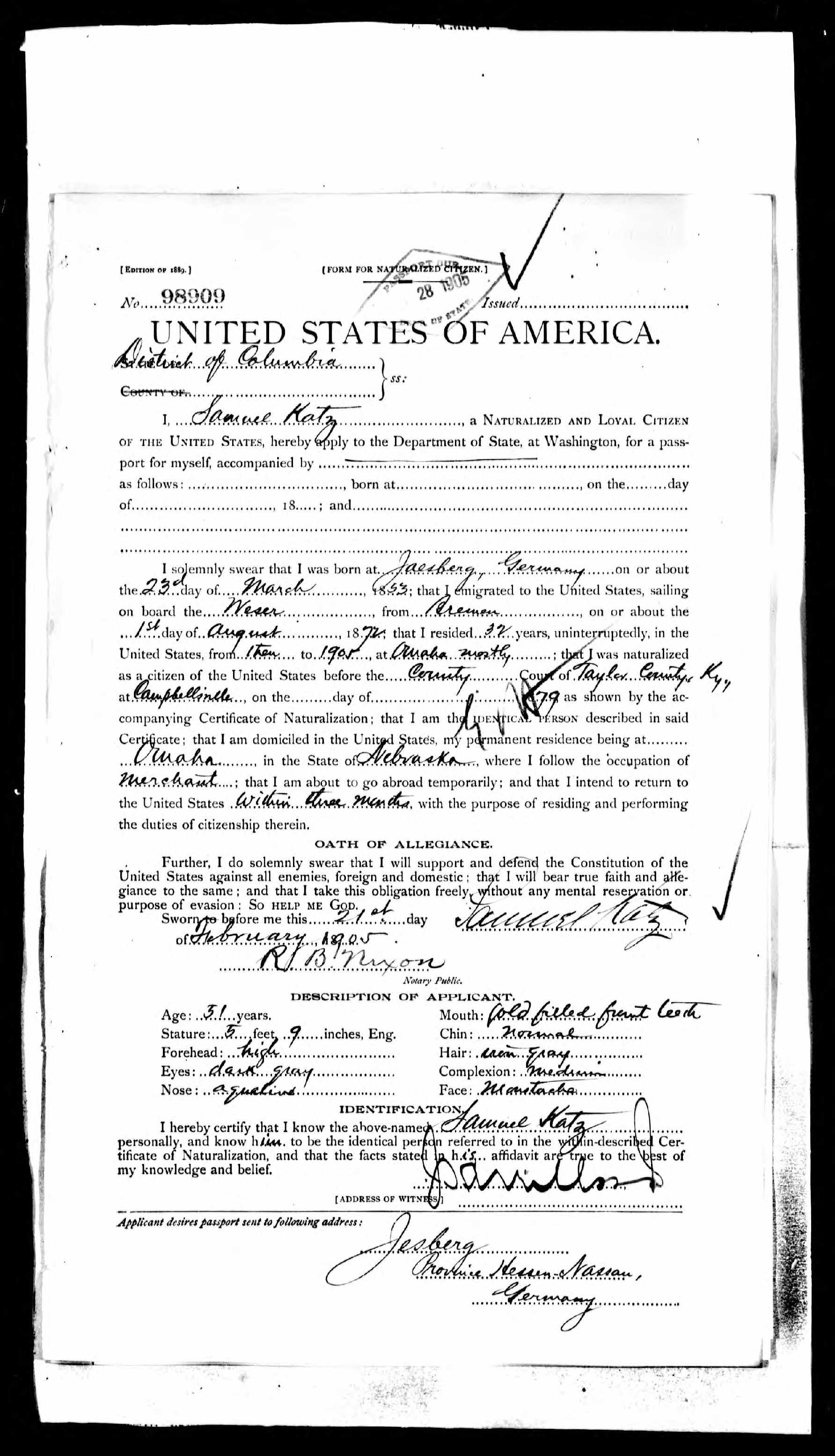
Samuel also emigrated in 1872, and also lived in Kentucky before moving and settling in Omaha, Nebraska. Rahel’s other four children did not leave Germany, although some of the next generation did. Both Samuel and Abraham thus arrived in the United States long after their uncle Gerson had emigrated in 1856, and they settled far from Philadelphia where their uncle was living.

Samuel Katz 1905 passport application National Archives and Records Administration (NARA); Washington D.C.; NARA Series: Passport Applications, 1795-1905; Roll #: 669; Volume #: Roll 669 - 01 Feb 1905-28 Feb 1905

Samuel Katz 1905 passport application
National Archives and Records Administration (NARA); Washington D.C.; NARA Series: Passport Applications, 1795-1905; Roll #: 669; Volume #: Roll 669 – 01 Feb 1905-28 Feb 1905


The remaining sibling who survived to adulthood was Gerson’s half-sister, Hannchen. She married Marum Mansbach, who was from Maden, Germany, which is where Hannchen and Marum lived after marrying.  They had three children born in Maden: Gelle (later Henrietta) (b. 1833), Abraham (b. 1835), and Hendel (later Harry) (b. 1840).  Hannchen died the day Harry was born, so Marum was left with three young children including a newborn to raise on his own. These children and their father ended up in the US, but when had they emigrated? Were they the ones who led the way for Gerson, Eva, and their children in 1856?

I went back to look at the documents relating to Gerson that I’d collected years back, and I started with the ship manifest pictured above.  This time I noticed something I’d not seen before.  Right below the family of Gerson Katzenstein were the names of two more people: Heinemann Mansbach, a sixteen year old male who was a peddler and headed for “Libanon,” and Malchen Mansbach, a sixteen year old female headed to Baltimore.  Both were from Maden, Germany.

Ship manifest close up Year: 1856; Arrival: New York, New York; Microfilm Serial: M237, 1820-1897; Microfilm Roll: Roll 164; Line: 1; List Number: 589

Ship manifest close up
Year: 1856; Arrival: New York, New York; Microfilm Serial: M237, 1820-1897; Microfilm Roll: Roll 164; Line: 1; List Number: 589

I hadn’t seen any connection to the Katzensteins originally since the two Mansbachs were from Maden, not Jesberg, and because they were headed to different cities, not Philadelphia.  Plus I had no reason to see any connection to anyone named Mansbach.  But now, thanks to the Greve/Baron work, I knew that Gerson had a niece and nephew from Maden with the surname Mansbach.  Could Heinemann Mansbach be the person known later as Harry Mansbach? Could Malchen Mansbach be Henrietta, his older sister? She would have been 23 in 1856, not 16, but perhaps she, like so many others, had lied about her age.  Or could this be an entirely different Mansbach not even related to Gerson Katzenstein?

And was there anyone from the Mansbach family already in the US, and if so, where? Why was Malchen going to Baltimore and Heinemann to “Libanon”? And where is “Libanon”?  There is a Lebanon, Pennsylvania about 90 miles west of Philadelphia, so perhaps that is where Heinemann was headed.  But why? A search of the 1860 census for Lebanon, PA, for those born in Germany did not uncover anyone who appears to have been connected to the Mansbach/Katzenstein family.

Map of Pennsylvania highlighting Lebanon County

Map of Pennsylvania highlighting Lebanon County (Photo credit: Wikipedia)

Then I wondered about Hannchen Katzenstein and Marum Mansbach’s older son Abraham. Where was he when his brother was apparently sailing with their uncle Gerson? I searched for him and found an Abraham Mansbach on an 1852 ship manifest; no age was given, but he was a merchant from Hesse. The ship arrived in Baltimore on December 14, 1852. Gerson’s nephew Abraham Mansbach would have been seventeen in 1852.  This could have been him.

abraham-mansbach-1852-passenger-list

Abraham Mansbach on 1852 passenger list “Maryland, Baltimore Passenger Lists, 1820-1948,” database with images, FamilySearch (https://familysearch.org/pal:/MM9.3.1/TH-1961-32011-12875-22?cc=2018318 : 25 September 2015), 1820-1891 (NARA M255, M596) > 9 – Jun 2, 1852-Aug 29, 1853 > image 503 of 890; citing NARA microfilm publications M255, M596 and T844 (Washington, D.C.: National Archives and Records Administration, n.d.).

abraham-mansbach-1852-immigration-card

Abraham Mansbach 1852 immigration card “Maryland, Baltimore Passenger Lists Index, 1820-1897,” database with images, FamilySearch (https://familysearch.org/pal:/MM9.3.1/TH-1942-37337-15431-34?cc=2173933 : 17 June 2014), NARA M327, Roll 98, No. M462-M524, 1820-1897 > image 2545 of 3335; citing NARA microfilm publication M327 (Washington, D.C.: National Archives and Records Administration, n.d.).


So perhaps Abraham Mansbach, Gerson’s nephew, was the first of the Katzenstein clan to come to the US.  I don’t know whether he stayed in Baltimore or not, but by 1860, it appears that he was living in Philadelphia with his uncle Gerson and the other members of the Katzenstein family:

Gerson Katzenstein and family 1860 US census Year: 1860; Census Place: Philadelphia Ward 13, Philadelphia, Pennsylvania; Roll: M653_1163; Page: 519; Image: 105; Family History Library Film: 805163

Gerson Katzenstein and family 1860 US census
Year: 1860; Census Place: Philadelphia Ward 13, Philadelphia, Pennsylvania; Roll: M653_1163; Page: 519; Image: 105; Family History Library Film: 805163


Gerson was working as a salesman and had a personal estate worth $400.  He and Eva had had a fifth child, Hannah, who was a year old.  Their oldest child Scholem was now using the name Joe and was twelve years old; Jacob was nine, Brendina was six, and Perry was three.

Gerson Katzenstein in the 1859 Philadelphia directory

Gerson Katzenstein in the 1859 Philadelphia directory

Living with them were a seventeen year old clerk named Benjamin Levi and a 24 year old bookkeeper named David Frank.  In addition, there was a 25 year old salesman named Abraham Anspach; this could have been Abraham Mansbach, Gerson’s nephew.  Finally, there was a twenty year old domestic named “Marley Manspach;” perhaps this was the same person as the Malchen Mansbach who was listed on the ship manifest.

Closeup of Katzensteins and Mansbachs on 1860 census

Closeup of Katzensteins and Mansbachs on 1860 census

But was Malchen/Marley really the daughter named Henrietta who would have been 29 in 1860, not 20? And where was Heinemann/Harry living if not with his brother and uncle? It’s too bad that the 1860 census did not include information about the relationships among those living in a household.  That might have cleared some of this up.

But what did seem clear was that by 1860 my Katzenstein great-great-grandparents and the first four of their children were living in Philadelphia.  It also seemed likely that at least two of the children of Gerson’s half-sister Hannchen and her husband Marum Mansbach had also arrived in the United States by then.

But many questions remained.  Fortunately, David Baron helped me find some answers.

**************************

I admit that it’s been hard for me to get back into genealogy right now, but I am trying to find ways to deal with all my anger and grief, and while I look for ways of fighting back against Trumpism, I also am trying to find ways of clearing my head.  Genealogy has done that for me before, and I am hoping it will help me now. This post was written before the election, and now I am trying to work on the next one.


[i] I also went through the rest of the family report prepared by David Baron to see if any of the more distant Katzenstein or Katz relatives had arrived in the US before 1856.  There were none who arrived that early, although there were a few who were in the US by the 1890s and more who came after Hitler came to power.