Whose Clothing Were They Wearing?

I recently posted these two photographs of two of the Strolowitz/Adler sisters, Rebecca (Ray) and Leah.

Leah Strolowitz Adler

Leah Strolowitz Adler

Ray Strolowitz Adler

Ray Strolowitz Adler

A number of people asked me questions about the photographs.  In particular, people were struck by the fact that two poor immigrant young women were dressed so well and were able to sit for a formal portrait.  The photograph was dated 1918, so Ray and Leah had only been in the US for about ten years.  They were both working as dressmakers.  How could they afford these luxuries like furs and hats and fancy shoes and a studio photograph?

I did some research online but did not find anything that indicated that photographers provided clothing for customers to wear, although there are many references to the props photographers kept in their studios to add interest to the photographs.  There is also this quote from a website that addresses the question of how to determine the date of a particular photograph:

“Your ancestor may have only owned one nice dress or suit that was used for all sorts of occasions. Perhaps they did not own a nice suit of clothing and borrowed one from the photographer.”

http://www.genealogytoday.com/articles/reader.mv?ID=1149

I also posted a question to the Tracing the Tribe group on Facebook about these issues and received numerous responses that were very helpful.  One commenter pointed out that since Leah and Ray were dressmakers, it was entirely possible that they made these outfits themselves.  The commenter recalled that her own ancestor was able to create fashionable dresses from older clothing and scraps by copying what she had seen in store windows.  Another commenter made the point that furs may not have been that expensive back then.  There was also discussion of the possibility that the furs and hats were props supplied by the photographer to supplement the clothing that belonged to the customers.  And some commenters believed that photographers did have clothing at their studios for the customers to wear.

As to the question of the cost of having a portrait taken, several people pointed out that having portraits done, regardless of your economic status, was very common.  Immigrants wanted to be able to send photographs back to the old country and to mark their own special occasions.  http://gary.saretzky.com/photohistory/resources/photo_in_nj_July_2010.pdf  This website points out that with improved photographic techniques, it was in fact not that expensive to have a formal photograph taken even for a family of limited means.  The early 20th century saw the development of postcard photographs in the size used like the ones of Leah and Ray, and the website states that they were a “cheaper, quicker format for producing prints, made photo portraits available to almost everyone.”

I was also able to locate some information about the photographer.  From the photographs I was able to find his name, Rothman, and address, 186 East 116th Street in New York.  By using the stevemorse.org tool for finding an address on a census, I was able to find Isadore Rothman, recent Russian immigrant, residing at 186 East 116th Street.  In 1916, Mr. Rothman was working for a different studio, Mantor Photographic Studio, according to the 1916 New York directory.  So perhaps Rothman was just starting out on his own when Ray and Leah came to have their pictures taken.  They also all lived in the East Harlem neighborhood.

Isadore Rothman on the 1920 census

Isadore Rothman on the 1920 census

So I don’t know the answer for sure, but it is possible that Leah and Ray made their outfits or borrowed them from the photographer or from someone else or a combination of both.   I guess we will never know.  And it is also possible that these photographs were not that expensive despite their seeming formality and quality.

UPDATE:  I just received this comment from Ava Cohn, an expert in using photographs in genealogical research.  She said, “Photographers did have props that were used in photos. By this time, however, the clothes were usually not part of what was “borrowed” from the photographer. As many have suggested, our Jewish ancestors were tailors in Europe and quite adept at pattern-making and sewing. There were also many companies that produced patterns and sewing one’s own clothes was both a business and a past-time. Studio photos were relatively inexpensive. …  And btw, if you are certain that your photos were taken in 1918, then Ray’s outfit is not the latest fashion. Her skirt length and shape are more typical of the 1916-1917 period.”  You can learn more about Ava Cohn and her services at her website, Sherlock Cohn.

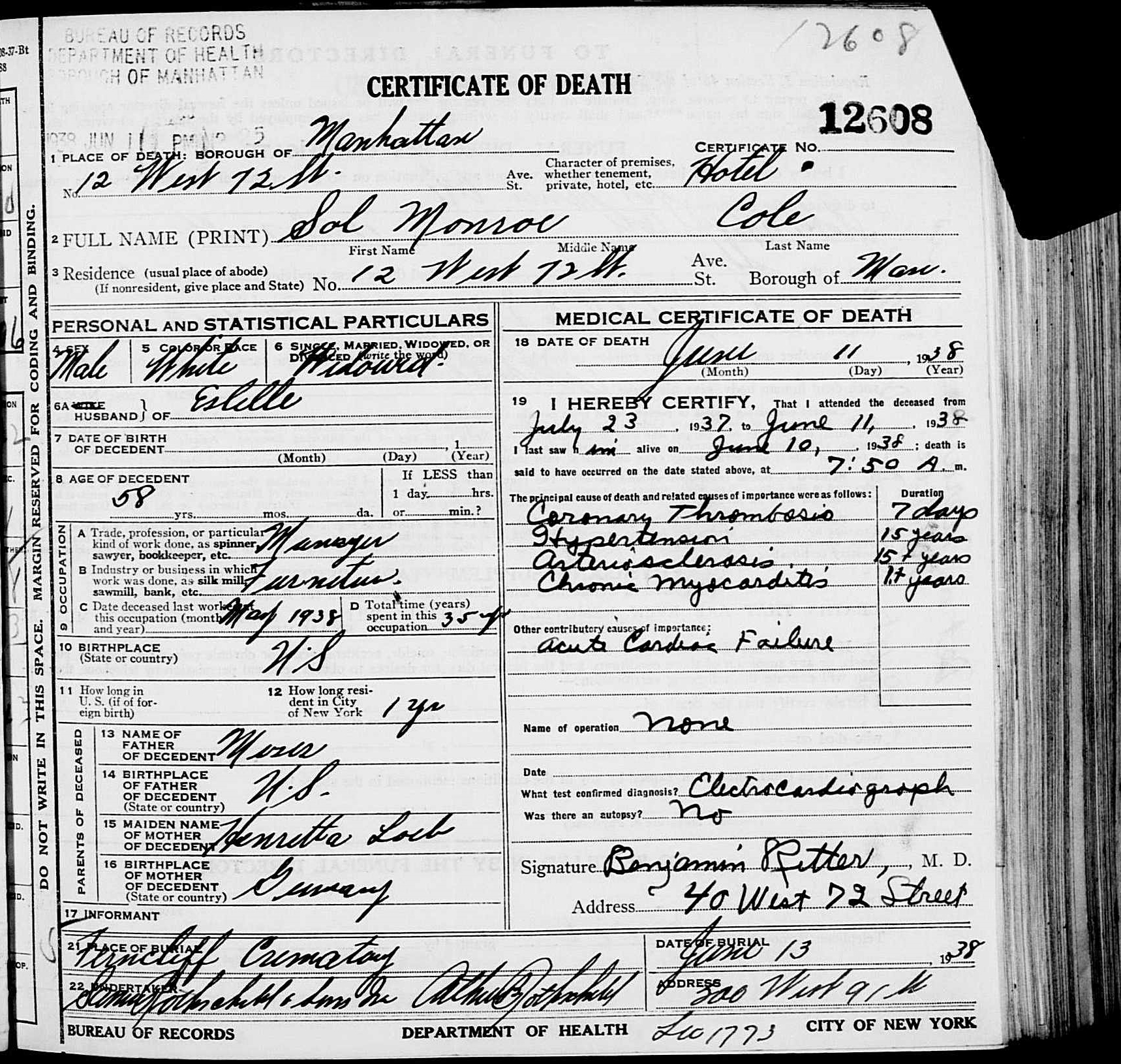
Solomon Monroe Cohen/Cole: Post Script

Yesterday I received a copy of the death certificate of Sol Cole, who died on June 11, 1938.

I learned a number of things from this document.  First, Sol died of heart disease when he was only 58 years old.  He had had hypertension and arteriosclerosis for fifteen years and myocarditis for over a year, and then for a week before he died, he suffered from coronary thrombosis and finally acute cardiac failure.  He had been under the same doctor’s care for close to a year and had been living in New York City for about the same period of time.

sol cole death cert page 1

He had been living at 12 West 72nd Street in what was then a hotel, located less than a block from Central Park.  The certificate indicates that he was working up until a month before he died as a manager in the furniture business, the same industry he had been working in for 35 years, starting in Detroit, then in Columbus, and ultimately in New York City.

sol cole death cert page 2

The certificate also corroborated the fact that Estelle had predeceased him, as he was a widower at the time of his death.  Sol’s remains were cremated by Ferncliff Crematory, and both of his sons, Ralph and Robert, signed a sworn statement to the New York City Department of Health that it had been their father’s wish to be cremated.  I called Ferncliff to see if they had any records for Estelle, but they did not; they only had records for Sol.  Although I cannot be certain, my hunch is that Sol moved to New York after Estelle died since there is no record of her death in New York City nor were her remains handled by the same institution.  I still do not know when or where Estelle died, but I will focus on Ohio as that is where I know she was living as of 1935.

Rachel “Ray” Rosenzweig: Can anyone remember anything else?

I have had amazing luck in finding out something about the lives of all but one of Gustave and Gussie’s children.  I have even been able to connect with descendants of many of them.  There are still holes and unfinished stories for Lillie and Lizzie and Sarah, but I’ve at least been able to trace them through some part of their adult lives.  The only child I have had no luck finding after she left the family home is Rachel or Ray, the youngest child.

I know Ray was born in 1904 and that through 1930 she was living with her mother in Brooklyn, but I have found nothing that reveals what happened to her after her mother died.  I have not been able to find her on the 1940 census, on the NYC marriage index, or on the Social Security Death Index.  I don’t know whether she had any descendants.  I need some assistance.

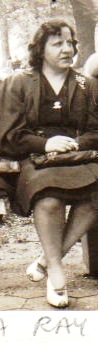
A number of Gussie and Gustave’s descendants remember Ray, and I have been able to obtain these two photographs of Ray from the 1940s.  I know she must have lived at least into the late 1960s since so many of her great-nieces and great-nephews have memories of her.  One remembers that she moved to Florida at some point and thinks she married, but cannot remember her husband’s name.  Another remembers that she lived in New Jersey and married someone with an Italian surname.

Now I am asking to look carefully at these two photos and see if they spark any specific memories—an occupation, a husband, a child, a residence, a date of death—anything that might help me find out more about the youngest child of Gustave and Gussie.

Ray

Ray

Ray 1

Enhanced by Zemanta

Gifts from Doing Genealogy: My Wonderful Cousins

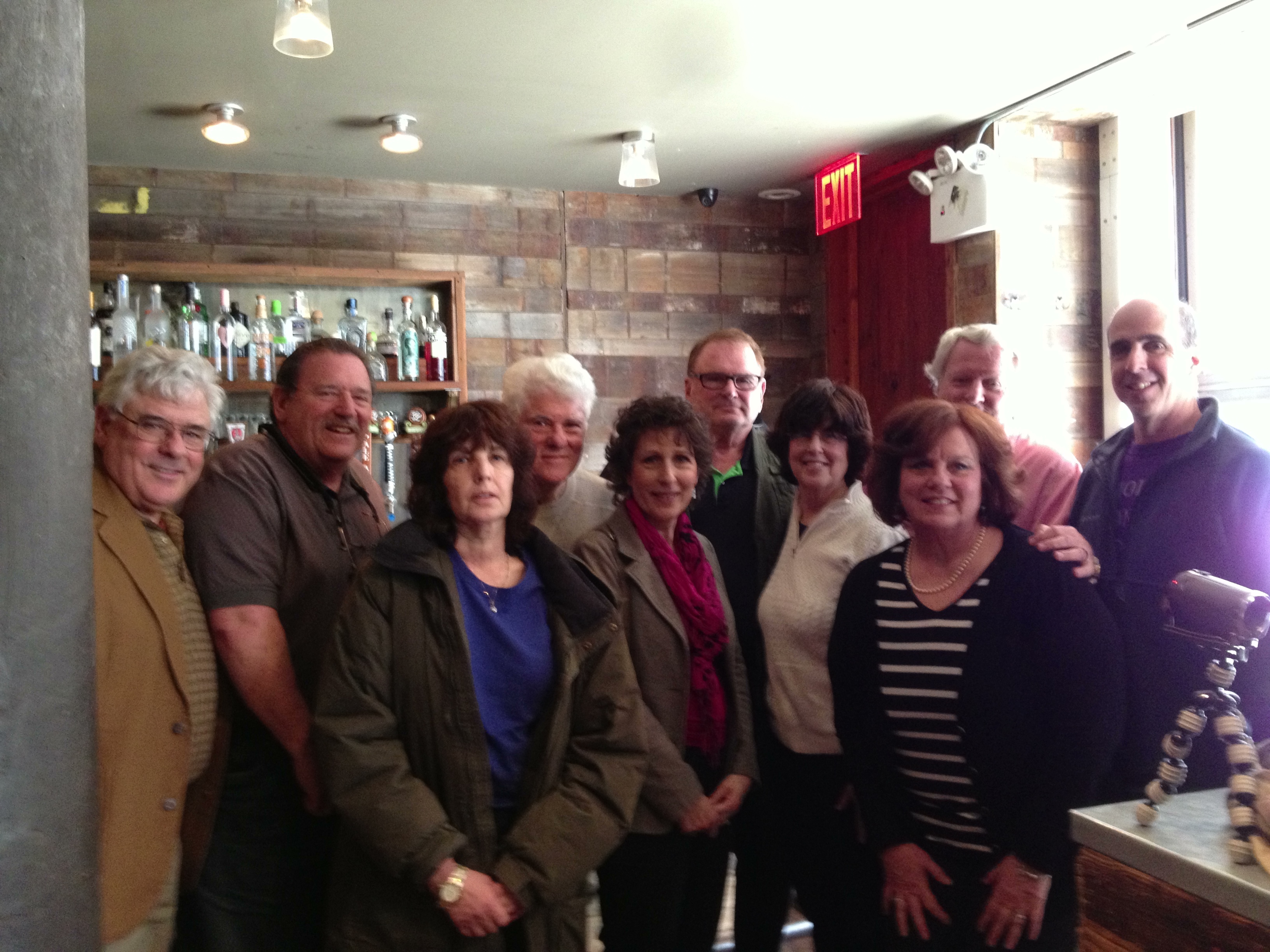
Ten of Joseph and Bessie's great-grandchildren on the Lower East Side

Ten of Joseph and Bessie’s great-grandchildren on the Lower East Side

Lower East Side tenement

Lower East Side tenement (Photo credit: Salim Virji)

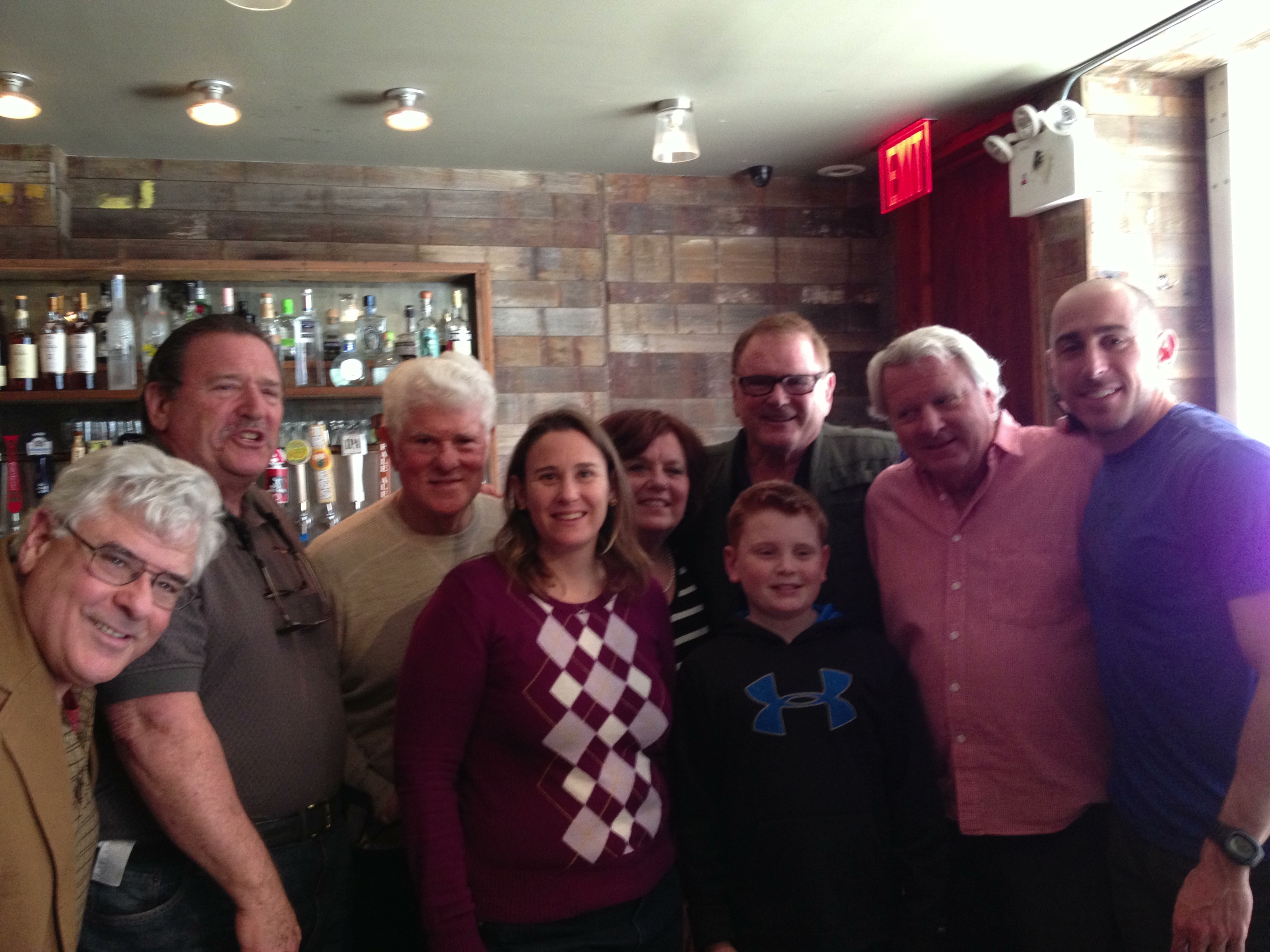
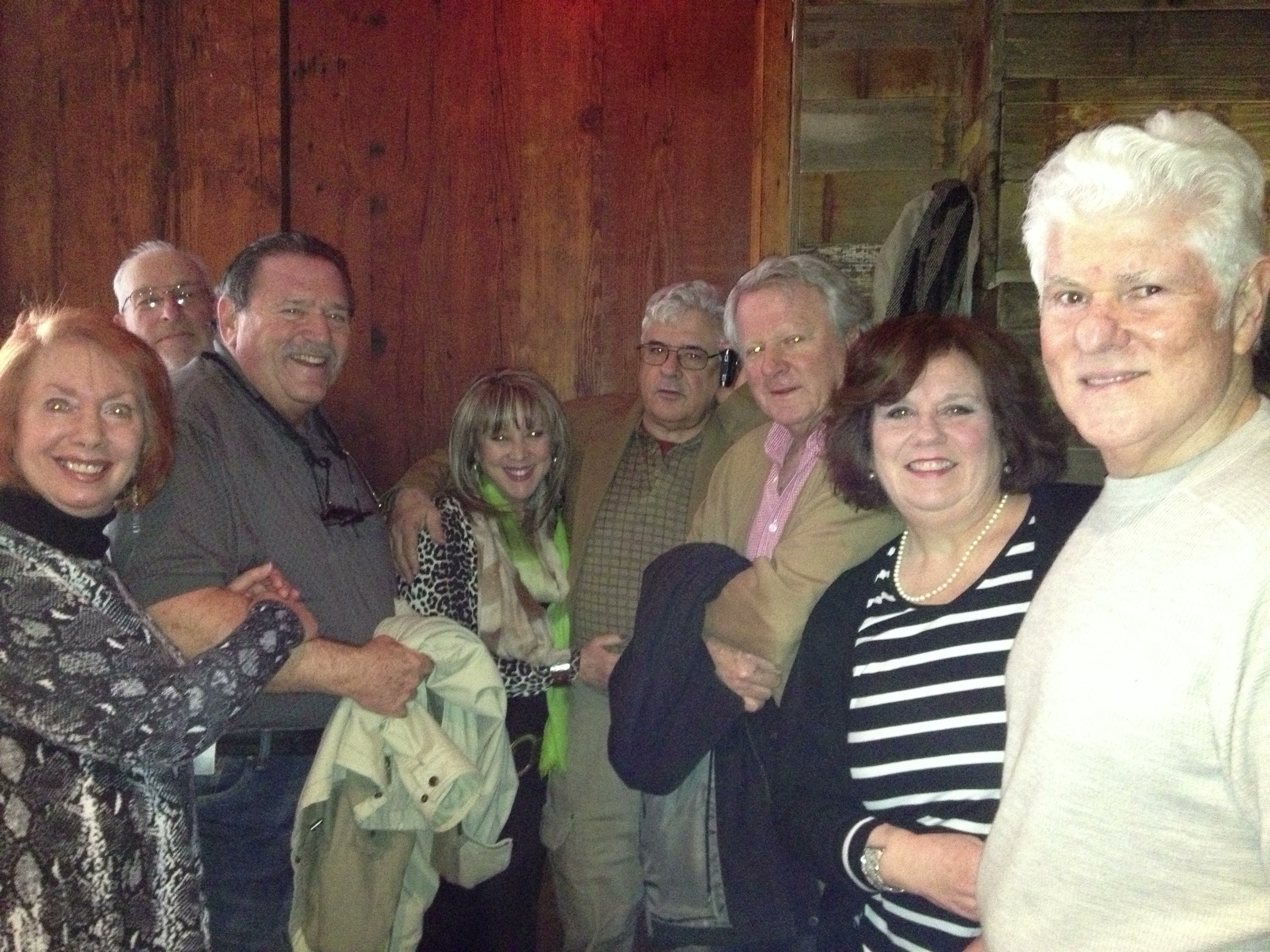
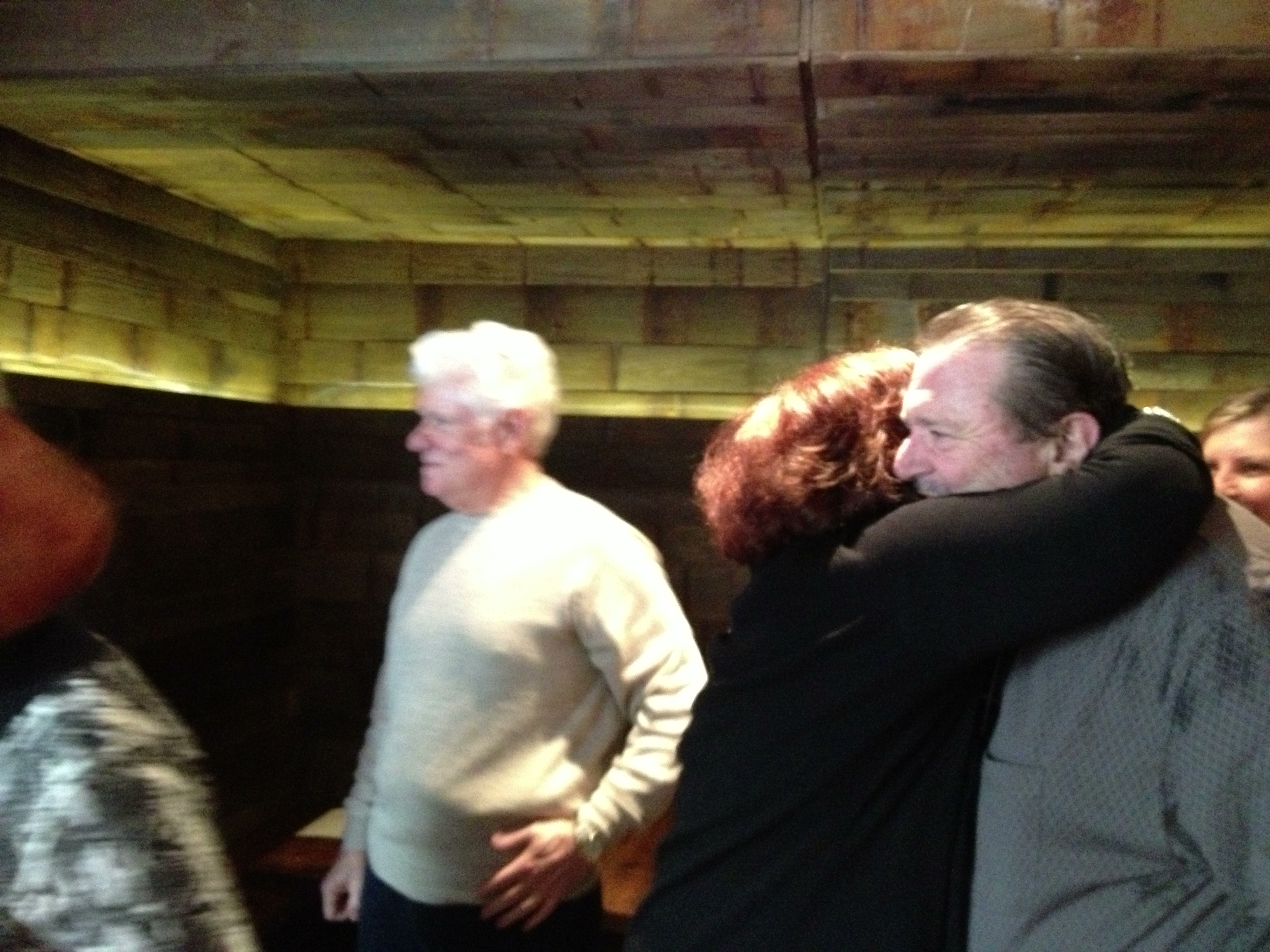
After much planning and anticipation, ten of Joseph and Bessie Brotman’s great-grandchildren, four of their great-great-grandchildren and one great-great-greatgrandchild as well as a number of spouses spent the weekend, talking, eating, laughing and connecting and reconnecting in NYC.  Some of us had known each other all our lives, some had never met at all, and some had not seen each other in many years.  We represented two of Joseph and Bessie’s children, Hyman and Gussie. Although a few people could not make it for various reasons, there were several others who wanted to join us but were unable to do so, including one of Max’s granddaughters and one of hisgreat- granddaughters and one of Abraham’s granddaughters.  We had a wonderful tour of the Tenement Museum and several of us walked along Ridge Street between Rivington and Delancey where our ancestors lived between about 1891 and 1907.

Sign outside Lower East Side Tenement Museum

Sign outside Lower East Side Tenement Museum (Photo credit: Wikipedia)

It was everything I had hoped it would be and more so.  We shared stories about our lives and about our grandparents and parents.  We shared photographs.  We got to know and learned about our children and grandchildren.  We came from as far away as Cleveland and Florida and Massachusetts.   Some lived closer by in New Jersey or even in NYC itself.    There were lots of photos taken. Included here are just a representative few to illustrate the excitement and love that was shared.

Saul and Manny's descendants

Saul and Manny’s descendants

cousins

cousins

photo 4 photo 3

I cannot speak for everyone, but for me it was magical.  A year ago I did not even know I had second cousins.  Through the course of doing family research, I had found all these new wonderful people, people I would have chosen as friends even if they were not my relatives.  We may live far apart, we may have known each other only for a short time, but I know that for me I felt a deep connection.  No, it’s not the same as growing up with a first cousin who shared grandparents and holidays and vacations, but it is nevertheless a real connection.  We all came from the same place, we all are here because Joseph and Bessie decided to leave Galicia and come to America.  We all started somewhere on Ridge Street where our grandparents learned to speak English and the skills that were necessary to rise above the poverty.

Ridge and Broome St

Lower East Side

Lower East Side (Photo credit: InSapphoWeTrust)

I am so grateful for all who were able to make it and all who helped make this dream come true.   I hope that those who were unable to join us will be able to do so another time.  And now I am inspired to starting planning the first Goldschlager-Rosenzweig reunion and then the second Brotman reunion.  These things take time and effort, and I was lucky to have lots of help  with the planning, but I encourage any of my fellow family researchers to reach out and make your family tree more than a two-dimensional document or digital record.  Find a way to meet your cousins and make them a part of your life.


UPDATE: For more photos, click here.

Enhanced by Zemanta

A Romanian Surprise

I am in NYC for the weekend and looking forward to meeting my Brotman cousins.  Pictures and stories to follow.

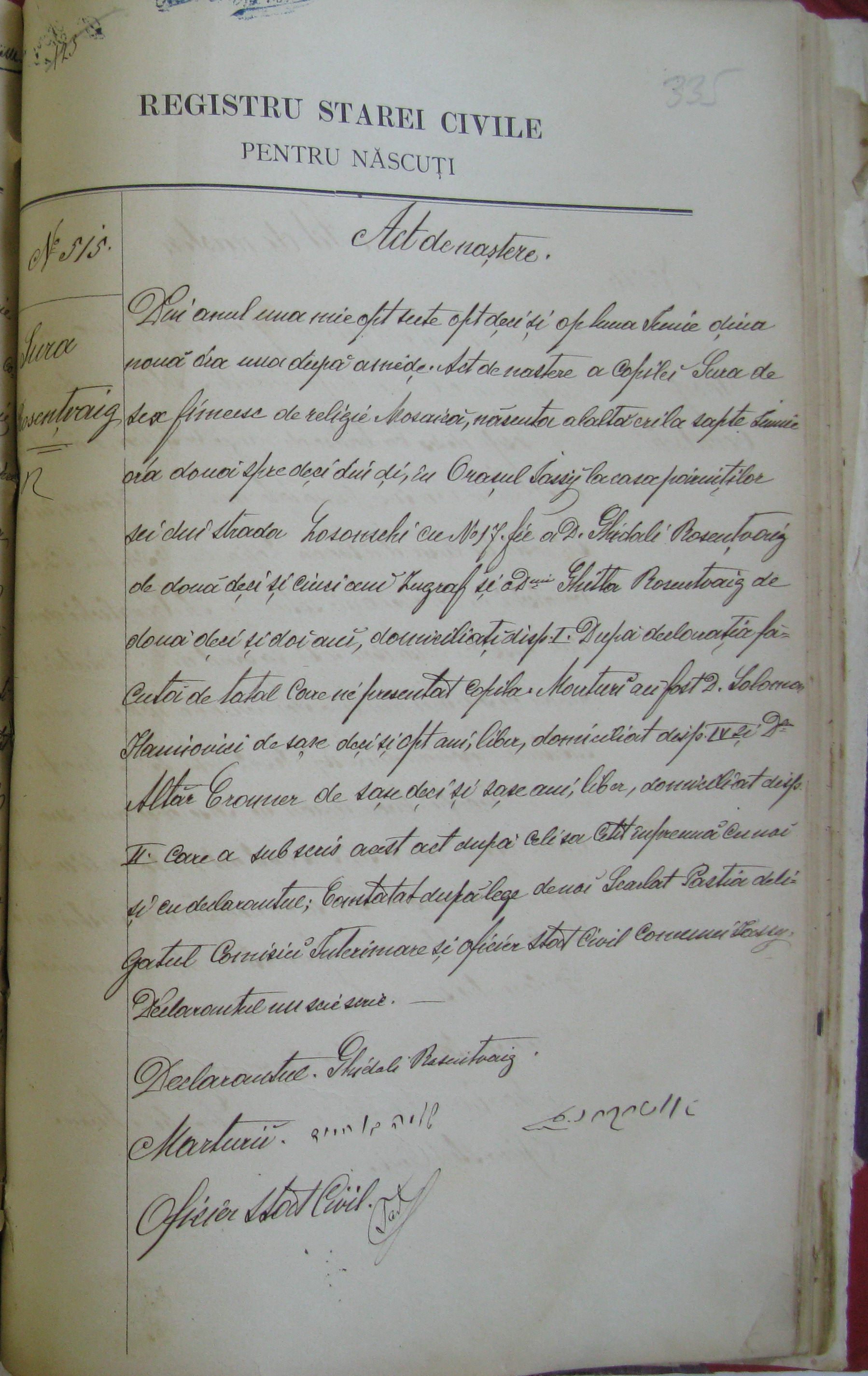
But first, a little Romanian surprise.  I received a few more documents from my Romanian researcher, Marius Chelcu.  One in particular surprised me.  It is a birth record for Sura Rosentvaig, born June 7, 1888, daughter of Ghidale and Ghitla Rosentvaig, of Iasi, Romania.

Sura Rosentvaig birth record

Sura Rosentvaig birth record

Sura Rosentzvaig_Birth record_1888 translation-page-001


The first surprise was that Gustave and Gussie were still living in Iasi as of June, 1888. According to his naturalization papers, Gustave arrived in the US on April 12, 1887.

naturalization petition gustave rosenzweig

naturalization petition gustave rosenzweig

Before 1906, the government did not require strict proof of arrival, and obviously Gustave fudged it a bit.  But when did he actually arrive? I still have not found a ship manifest for him or Gussie or the children, but this will narrow down the dates of my search by assuming they left Romania after June 7, 1888, and arrived before February 12, 1889, when I believe Abraham was born.

One inconsistency here is that according to earlier Romanian records, Gustave was born in 1856 and Gussie in 1864.Ghidale Rosentzveig_Birth record_1856-page-001

translation of marriage record

translation of marriage record

On Sura’s birth record dated 1888, it says Gustave was 25, making his birth year 1863, and Gussie was 22, making her birth year 1866.  I guess it just goes to show that Romanian records are no more reliable than American records.   Gustave and Gussie’s birth records, however, were created at the time of their marriage, not at their birth, whereas Sura’s was created at the time of her birth so presumably is more reliable in terms of her birthdate.

The second surprise is that Sarah, their second daughter, was born in Iasi, not in New York City.  Every census indicates that she was in fact born in New York.  This explains why I could not find a NYC birth record for Sarah, but why is she listed on the census as US-born? Lillie is listed (with one exception) as born in Romania.  Why not Sarah?

Rosenzweig children 1900 census

Rosenzweig children 1900 census

Gustave Rosenzweig family on the 1905 NYS census

Gustave Rosenzweig family on the 1905 NYS census

Rosenzweig family 1910

Rosenzweig family 1910

Kurtz family 1920

Kurtz family 1920

kurtz family 1930

kurtz family 1930

Sam and Sarah Kurtz 1940 census

Sam and Sarah Kurtz 1940 census

I am still searching for Sarah’s descendants and know their names, but have not yet been able to contact them.  I wonder if they know she was born in Romania, not in the US.

Have a good weekend, everyone!


Enhanced by Zemanta

My Grandfather’s Cousin Rebecca: Another Life Cut Short

About ten days ago I posted about my search for Rebecca Rosenzweig, my grandfather’s first cousin and daughter of Gustave and Gussie Rosenzweig.  I had certain hunches about who she married and what happened to her, but was awaiting documentation to confirm those hunches.

The first document provided evidence of Rebecca’s birth on May 27, 1893.

Rebecca Rosenzweig birth certificate 1893

Rebecca Rosenzweig birth certificate 1893

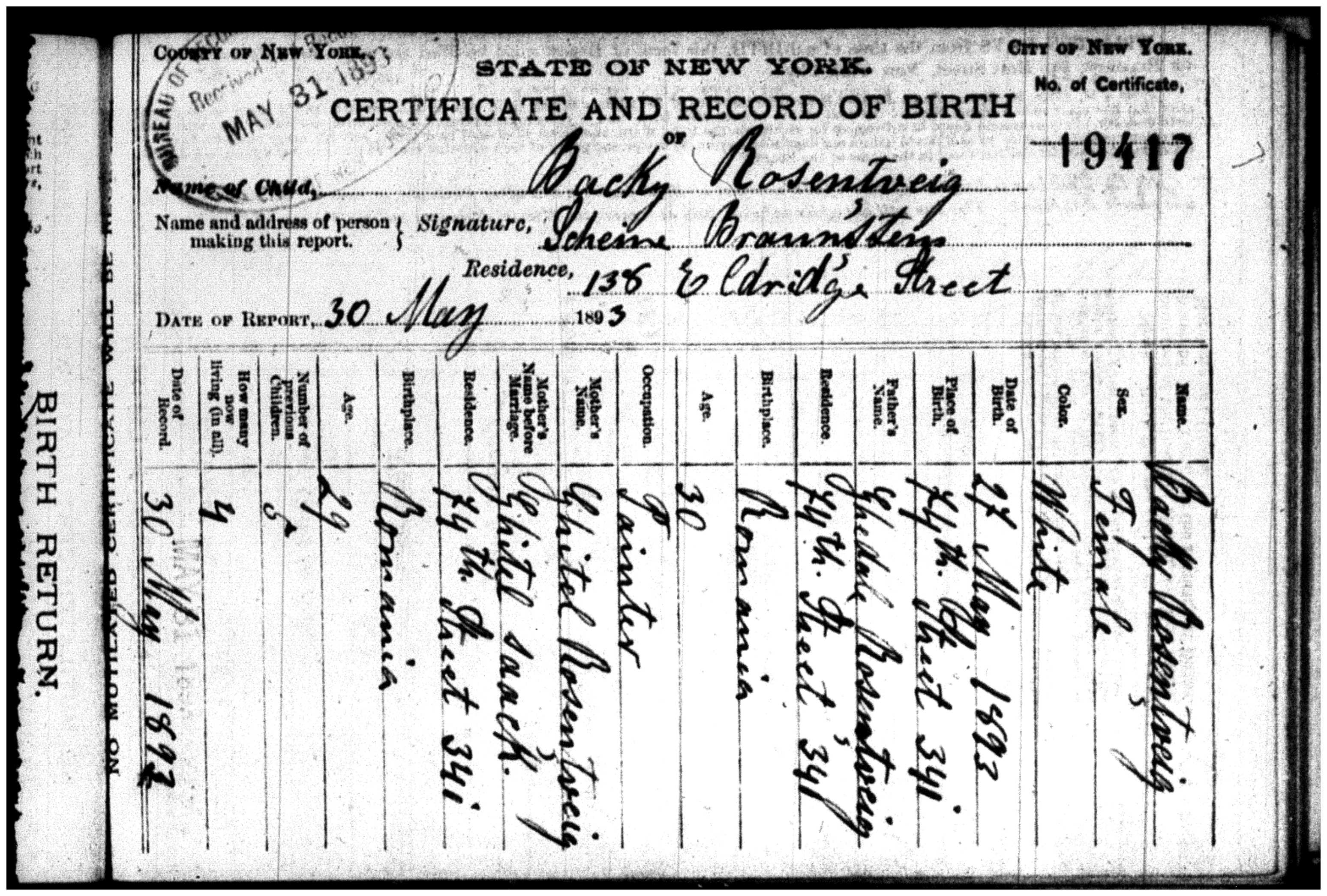
It’s interesting that in 1893 Gustave was still using Ghedale as his first name and Gussie was still using Ghitel, as in Romania; they were spelling the surname Rosentveig.  Gustave was already a painter, and they were living at what seems to be 34i 74th Street in Manhattan. (It was actually 341 East 74th Street, according to a city directory published the following year.)

One mystery raised by the birth certificate is that it reports that Gussie had already had five children, four of whom were then living.  According to my research, in 1893, Gussie had four living children, Lillie, Sarah, Abraham, and Rebecca, and one child who had died, David (1891-1892).  Who could the other child be?  Lillie was probably born in 1885, Sarah probably in 1887, Abraham probably  in 1889, David in 1891.  Was there another child who was born between 1885 and 1893 who was living in 1893 but who died before the 1900 census? A quick search of the NYC death index for children with surnames that sound like Rosenzweig who were born between 1885 and 1893 and who died between 1893 and 1900 turned up a horrifying number of young children who died in that period with surnames similar to Rosenzweig: 366.  My guess is that one of those 366 children was a child of Gustave and Gussie, just adding to the list of children they lost.  I will have to sift through them and search for the death certificates to see if I can figure out which ones might be my lost cousin.

One hunch I’d expressed in my last post was that Rebecca had married a man named Frank Elkin in 1914, based on the fact that there was only one Rebecca Rosenzweig in the NYC marriage index for the appropriate time period.  I was also sure that this was correct because she and Frank ended up living on the same streets as Rebecca’s family on both the 1915 and 1920 census reports. I also wondered whether Rebecca was the one who introduced my grandfather, her cousin, to my grandmother, her neighbor on Pacific Street.   My hunch that this was the right Rebecca was confirmed when I received the marriage certificate.
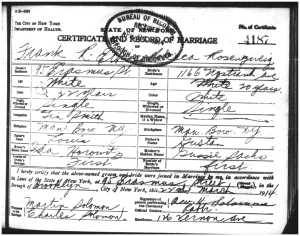
Rebecca and Frank Elkin marriage certificate

Rebecca and Frank Elkin marriage certificate

This is obviously the correct Rebecca, as seen by her parents’ names on the certificate.  Rebecca was living at 1166 Nostrand Avenue, the same address Gustave gave in 1913 when his son Harry died.  Perhaps this means that Gustave and Gussie were still living together in 1914 when Rebecca married Frank.

Having confirmed that I had the correct Rebecca, I now knew that the information on the 1920 census reporting that Rebecca’s parents were from Minsk, Russia, was incorrect, just another example of how unreliable census information can be.
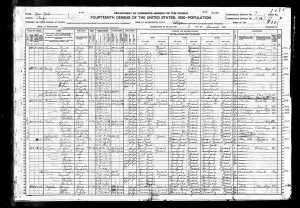
Elkin Family 1920 census

Elkin Family 1920 census

More importantly, I was also now able to trace what happened to Rebecca.  I had not been able to find her on the 1930 census, but I had found a Frank Elkin, living with his parents Louis and Ida and siblings in Brooklyn, along with a woman named Fannie, listed as the daughter-in-law of Louis, and two children, Irwin and Stanley, listed as Louis’ grandsons.

Frank Elkin with his parents 1930 census

Frank Elkin with his parents 1930 census

From the marriage certificate, I now know that the Frank who married Rebecca was the son of Louis and Ida Elkin, so this was clearly the same Frank.  But where was Rebecca? Who was Fannie? And who were Stanley and Irwin?

I could not find a death certificate for Rebecca, but I was able to find a headstone through Jewishdata.com and findagrave.com.  I knew now that Rebecca died on January 22, 1921, just two years after her son Irving was born in 1919 (as per the 1920 census). She was only 27 years old.
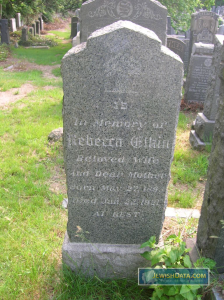
Rebecca Elkin's headstone

Rebecca Elkin’s headstone

Having confirmed that Frank Elkin was in fact Rebecca’s husband, I wanted to figure out who Fannie and Stanley were—were they his second wife and child or the wife and child of one of his brothers, Edward or Matthew? I looked back at the 1920 census and found Frank’s parents Louis and Ida and his siblings.  His brothers were both single and living at home.

Louis Elkin and family 1920 census

Louis Elkin and family 1920 census

I then searched the NYC marriage index for Edward and Matthew Elkin and saw that both were married after 1930.  Thus, I inferred that Fannie was indeed married to Frank as of 1930.  But I could not find a marriage record in NYC for them.

I searched forward to the 1940 census and was able to find a Frank and Frances Elkins with two sons, Irving and Stanley, living in Boston.

Frank Elkin and family 1940 census

Frank Elkin and family 1940 census

Could this be just coincidence? The sons were the right ages—Irving was 20, Stanley was 14.  Frances could certainly be the same as Fannie.  The name was Elkins, not Elkin, but the 1920 census for Frank’s parents also had the surname as Elkins, not Elkin.  But what were they doing in Boston? I thought perhaps Frances had been born in Boston, but the census said that she was born in New Jersey.  (It also says that Frank was born in Massachusetts, but that has to be an error.) It reports that Irving was born in New York and Stanley in Boston.

Then I searched for records of Frank Elkin or Elkins in the Boston area, and I found on the Massachusetts marriage index a listing for a Frank Elkins and Frances Reiner, married in 1922, the year after Rebecca had died.  Perhaps Frank had left NYC to start anew after losing Rebecca? Where had he met Frances? Stanley was born in Massachusetts, so they must have been living there in 1925 when he was born (which also explains why Frank is not found on the 1925 NYS census).  But then they moved back to Brooklyn as of 1930, yet were back in Boston by 1940.

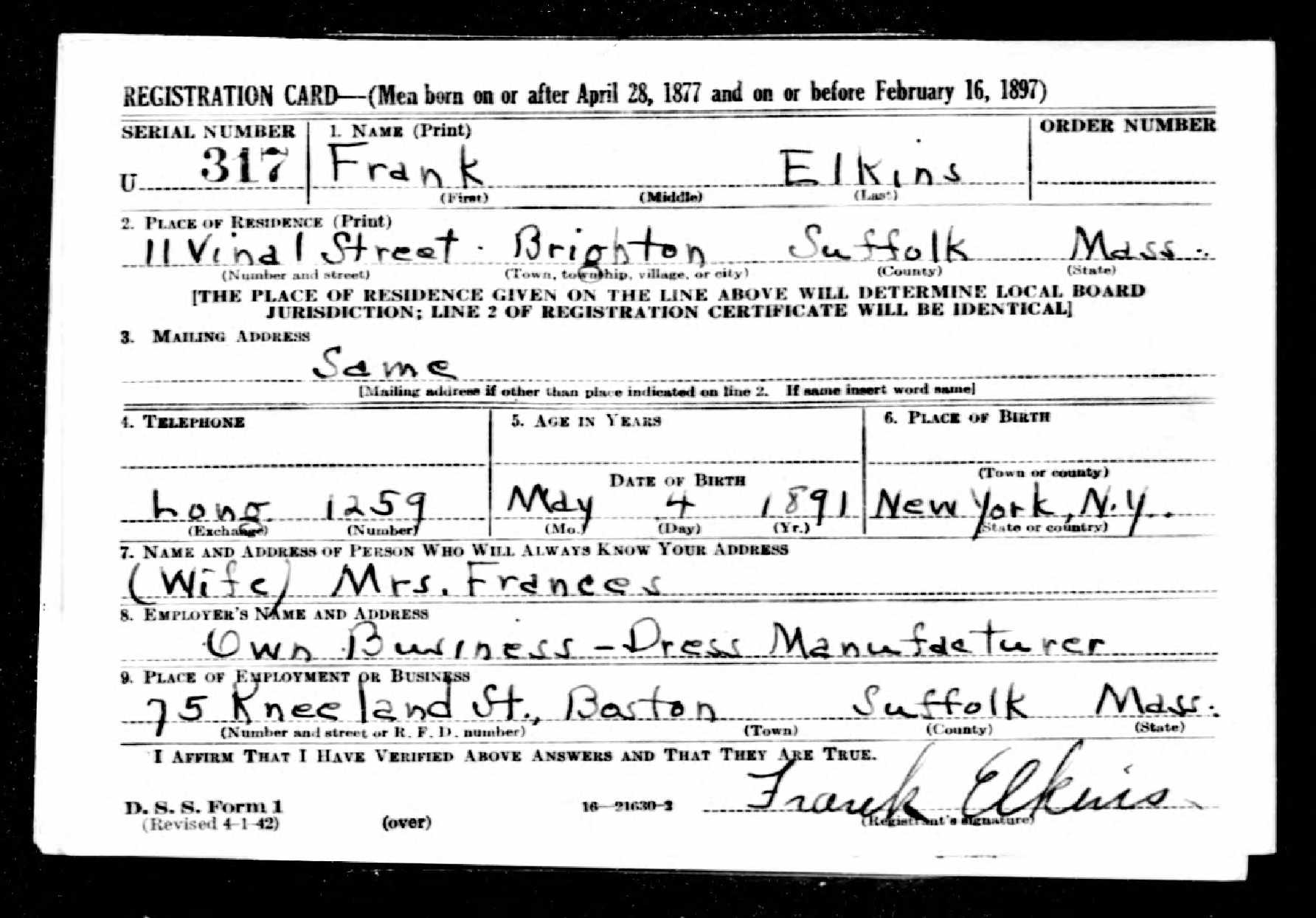
According to his 1942 draft registration for World War II, Frank owned a dressmaking business in Boston.
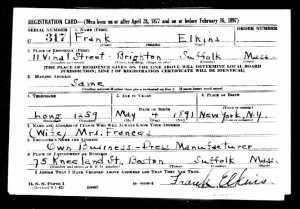
Frank Elkins World War II draft registration

Frank Elkins World War II draft registration

His Mason’s membership card dated 1945 confirms that he was still living in the Boston area (Newton) as of that date.

Mason Membership card

Mason Membership card

I was fortunate to be able to find one of Frank’s grandchildren, who told me that Frank had been a scrapper or bare-handed boxer when he was a young man.  According to family legend, Frank had boxed with his brother, a champion boxer in the Navy himself, over who would get to date Rebecca Rosenzweig.  Frank won that fight and not only dated Rebecca; he married her.  Frank’s grandson also told me that Frank never forgot his first wife although he also loved Frances very deeply.  Apparently Frank and Frances did a wonderful job raising Irwin and Stanley, as they were never thought of as half-brothers, but as brothers.  Frank also must have been a terrific grandfather, as his grandson said he still thinks of him often.

Frank Elkins and two of his grandchildren

Frank Elkins and two of his grandchildren

It appears that the Elkins family ultimately developed strong New England roots.  Irwin, Rebecca’s son, my second cousin once removed, ultimately settled in Brattleboro, Vermont, where he and his wife Muriel were the co-owners of Brattleboro Kiln Drying and Milling Company, which they sold after they retired. They were both devoted to the Brattleboro community and made significant contributions to its growth over the 50 years they lived there, according to Frank’s grandson.   He also told me that Irwin had been able to connect with some of Rebecca’s relatives in Florida late in his life.  Irwin died in 1996 in Boynton Beach, Florida, and is buried along with his wife Muriel in Brattleboro, Vermont.

Irwin and Muriel Elkins

Irwin and Muriel Elkins

Stanley, Irwin’s half-brother, became an influential American history scholar who died only last year.  According to his obituary, Stanley Elkins “graduated from Boston English High School and enlisted in the U.S. Army in 1943, where he served in the 362nd Infantry Regiment in Italy. After the war, Stanley attended Harvard University on the G.I. Bill and married Dorothy Adele Lamken in 1947. He graduated from Harvard in 1949 and received a master’s and a doctorate in American history from Columbia University, where he studied with historian Richard Hofstadter. …  In 1959, Stanley’s doctoral dissertation, “Slavery: A Problem in American Institutional and Intellectual Life”, was published by the University of Chicago Press. His book received widespread attention from scholars, politicians, and students, and is considered a seminal work on the subject of slavery in the United States. Stanley was hired by Smith College in 1960, became the Sydenham Clark Parsons Professor of History in 1969, and continued his career there until his retirement in 1993.”

Stanley Elkins

Stanley Elkins

When I had first seen the name Stanley Elkins on the 1930 census, I had immediately wondered whether this was the same Stanley Elkins whose book on slavery I had read in my American history course on the Civil War during college.  The obituary confirmed for me that it was the same Stanley when it identified Stanley as “the son of Frank and Frances (Reiner) Elkins.”  Discovering that gave me the chills.  Stanley Elkins died only six months ago and lived not far away from me.  He was not a blood relative, but nevertheless he was someone whose work I had read and admired, and he was connected to me through family.

The last bit of research I need to complete regarding Rebecca relates to one of the other questions raised in my original blog post about her life: the child who was born before Frank’s World War I draft registration in 1917 but who died before the 1920 census, Daniel Elkin.  I am still awaiting the death certificate for Daniel Elkin, and in the course of my subsequent research I have learned that a second child also had been born and died before 1920, Milton, so I need to order that death certificate as well.  I also am looking for Rebecca’s death certificate to find out what cut her life short at 27.

Once I obtain those documents, I will have learned a great deal about the short life of Rebecca Rosenzweig Elkin, my first cousin twice removed, my grandfather Isadore’s first cousin, and perhaps the cousin who introduced him to my grandmother.  In her 27 years Rebecca experienced not only the loss of several siblings, but also the loss of two young sons.  She never got to see Irwin, the one son who survived, grow up.  I hope that by recording her life, the grandchildren and great-grandchildren she never knew will get to know a little more about her and her family.

Enhanced by Zemanta

Joseph Rosenzweig: The Process of Elimination

The other day I wrote about the steps I took to narrow down the thirteen possible Abraham Rosenzweigs in the 1915 NYS census to the one who I am reasonably certain was the Abraham who was the son of Gustave and Gussie Rosenzweig and thus my grandfather’s first cousin.  Over the last two days I have been engaged in the same process to determine which of the many Joseph Rosenzweigs I found in the US and NYS census reports was the younger brother of Abraham and also Gustave’s son.  I am once again reasonably certain that I have found the right Joseph, but I want to record the process I used to get there, both for my own record-keeping and to invite others to question my reasoning and my conclusions.

In many ways the search for the right Joseph was easier than the search for Abraham.  For one thing, there were far fewer Joseph Rosenzweigs than there were Abraham Rosenzweigs.  For another, Joseph was born in 1898 and thus was almost ten years younger than Abraham.  That meant that I had five census reports in which Joseph was living with his parents and siblings: 1900, when he was two years old, 1905 (seven years old), 1910 (twelve years old), 1915 (seventeen years old) and 1920 (22 years old).  I also found what is definitely Joseph’s draft registration and World War I service record; I know these are for the same Joseph because his address on these two forms, 1882 Bergen Street in Brooklyn, is the same address where the family was living in 1920 according to the 1920 US census.

From these documents I learned a fair amount about Joseph’s early adult life.  In 1915 he was employed as a driver’s helper, according to the 1915 census.

Rosenzweigs 1915

Rosenzweigs 1915

In 1917 when he registered for the draft he was working for the BRT, or the Brooklyn Rapid Transit Company, which eventually merged into the BMT or Brooklyn-Manhattan Transit Company.  It is difficult to decipher the handwriting, but it looks like he was a guard for the BRT, perhaps the same as being a driver’s helper as he had reported in 1915.

Joseph Rosenzweig draft registration World War I

Joseph Rosenzweig draft registration World War I

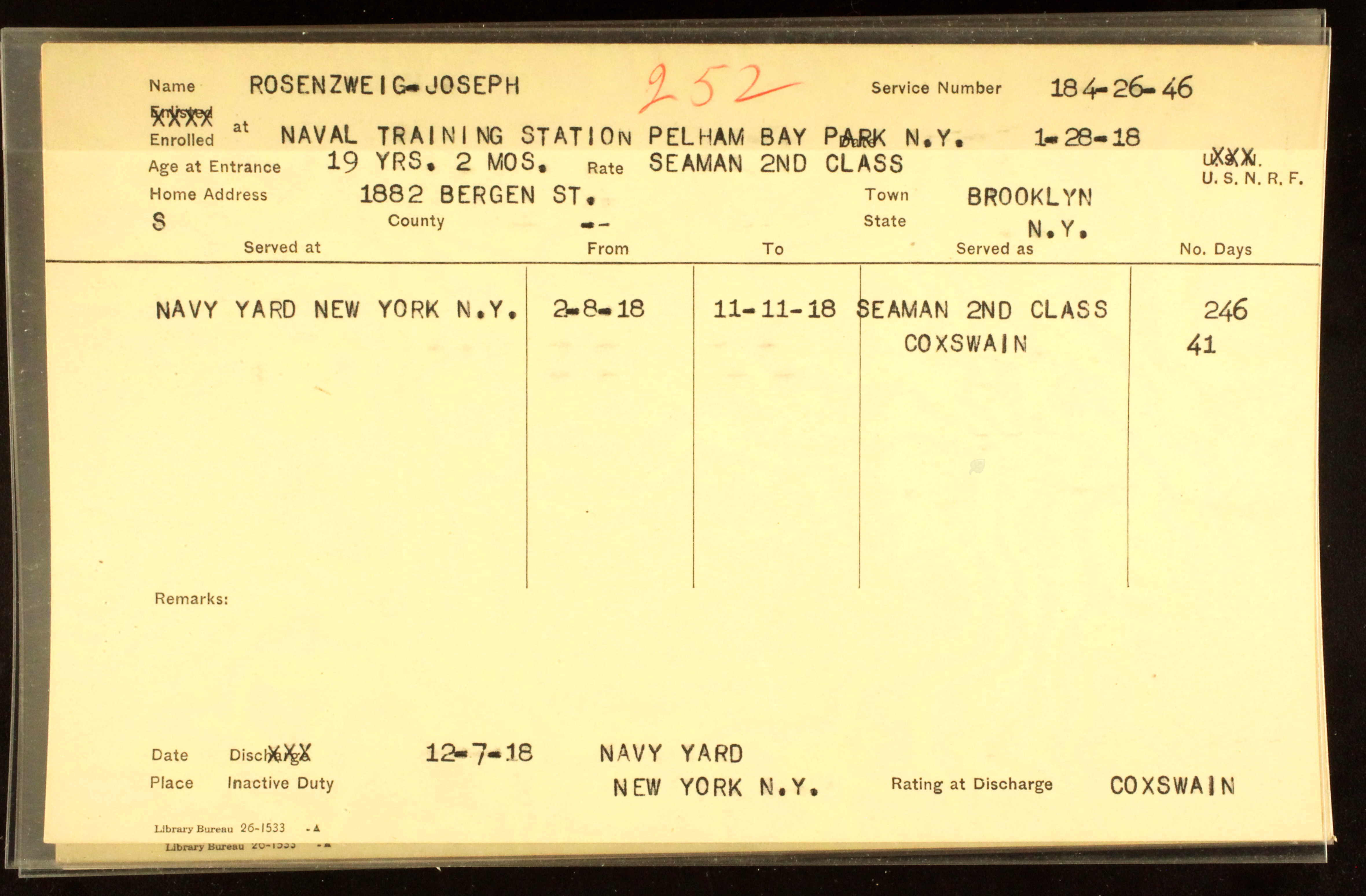
His draft registration also indicated that Joseph was the sole supporter of his mother at this time. By this time Gustave and Gussie had separated or divorced, and on the 1915 census two years before Gussie had been living not only with Joseph, but also with Abraham and Jacob, both already in the US Navy, and Lizzie and Rachel, both still in school and young teenagers. Apparently by 1917, only Joseph was providing support for his mother and presumably his two younger sisters.  According to the 1918 abstract of Joseph’s military service during World War I, he served as a Seaman, Second Class, in the US Navy at the Brooklyn Navy Yard from February 8, 1918 until November 11, 1918, Armistice Day, the end of World War I.

Joseph Rosenzweig military service

Joseph Rosenzweig military service

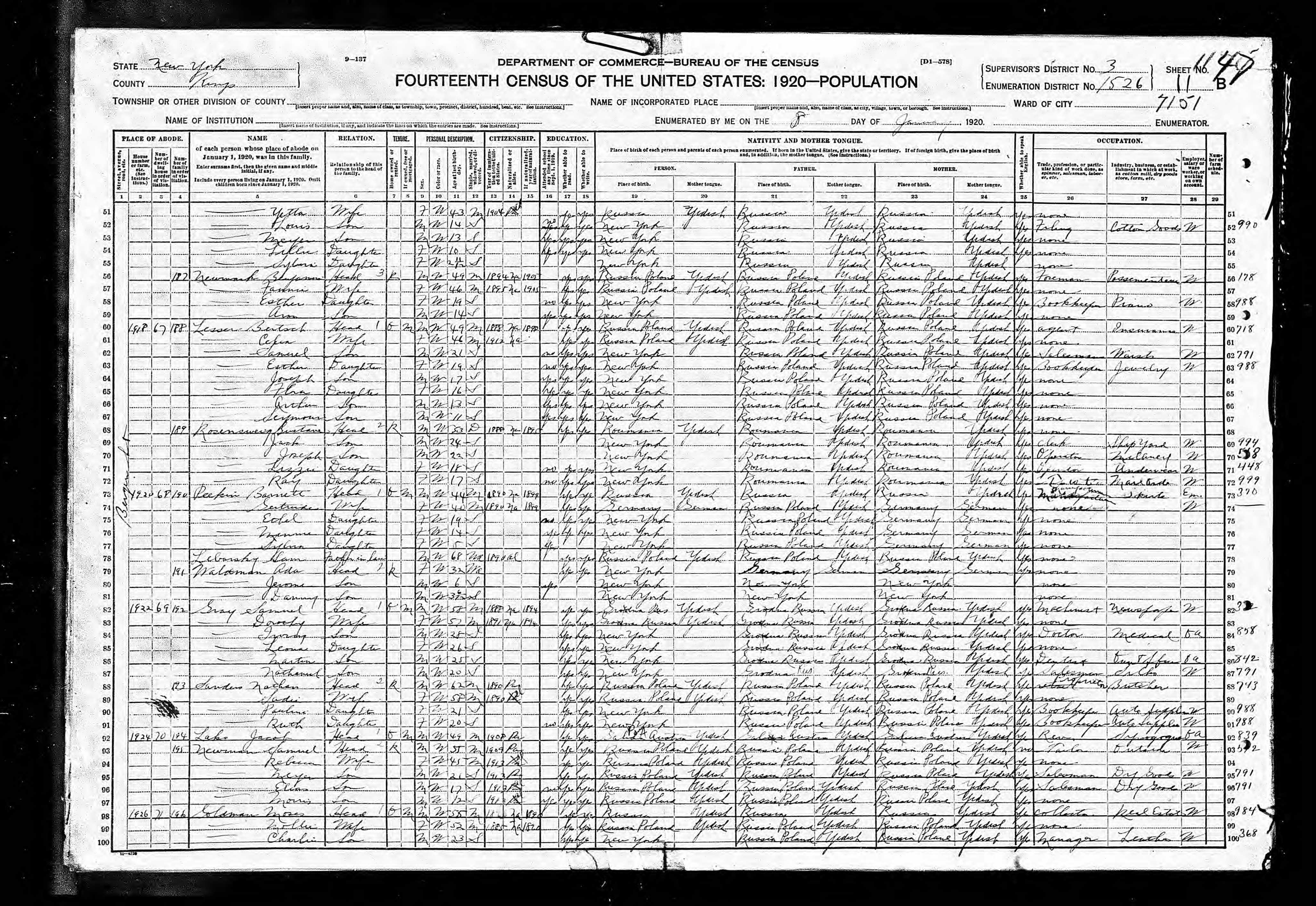
After the war, according to the 1920 US census, Joseph was still living with his mother and Jacob (Jack), Lizzie and Rachel (Ray) at 1882 Bergen Street and working as an operator in a millinery shop; in other words he was a hat maker.  It is this occupation that became critical to my analysis as I moved past the 1920 census to the 1925 NYS census and the 1930 and 1940 US census reports.

There are only two Joseph Rosenzweigs listed on the 1925 NYS census born in New York around 1898.  One was living with his parents, whose names were Aaron and Rose, so clearly not our Joseph.  The other Joseph was married to a woman named Sadie and had a four year old daughter named Irene.  They were living at 308 East 98th Street in Brooklyn, and most importantly, Joseph’s occupation is listed as a hatter.  His wife Sadie had been in the United States for 12 years and was born in Russia.  Although I have yet to find a marriage record for Joseph and Sadie, it appeared that they must have gotten married in 1920 since they already had a four year old child by 1925.  I will continue to search for their marriage certificate as it will provide more definite evidence that the Joseph who married Sadie was the son of Gustave and Gussie Rosenzweig.

Rosenzweigs 1920 census

Rosenzweigs 1920 census

Joseph and Sadie 1925

Joseph and Sadie 1925

Although I would like additional evidence to link this Joseph to Gustave, I am reasonably certain that it must be the right person.  The age and birthplace are correct, the occupation is the same as the occupation held by Joseph when he was still living at home with his mother, and there was only one other Joseph Rosenzweig listed in this age range in the 1925 NYS census.

Thus, I moved on to the 1930 census to see if any other Joseph Rosenzweigs were included there who could match the right criteria.  On the 1930 census I found two Joseph Rosenzweigs.  The first Joseph was born in 1898, but he was living with a brother named David, and Gustave and Gussie did not have a son named David who survived until 1930.  The second Joseph was the Joseph who married Sadie.  The census reported that he was born in 1897 and had been married to Sadie for ten years, making 1920 again the likely year of their marriage.  Sadie’s sister Tilda Kablanski was living with them, and they now had two daughters, Irene (nine years old) and Mildred (four years old).  They were still living on East 98th Street in Brooklyn, and Joseph was still employed as a hat maker.  There was also a John Rosenzweig who had Romanian parents, which looked promising, and he was living on Albany Avenue in Brooklyn, married to Ethel Bloom.  He was working as a postal clerk.  Although he was born in 1890 and thus older than Gustave’s son and had the wrong name, I held him aside as a possibility.

The only information in the 1930 census for the Joseph that married Sadie that conflicts with what I know about Joseph, Gustave’s son, is that it reports that his parents were born in Russia, not Romania.  I would be more troubled by this if I had not already seen so many errors on census reports: my grandmother’s name listed as Maurica when it was Gussie, my great-grandmother’s name given as Pauline when it was Bessie or Pessel, ages that are inaccurate, relationships described incorrectly, and so on.  I had to remind myself not to use this inconsistency to dismiss Joseph and Sadie; genealogists often are reminded that census takers took information often from neighbors or children or anyone who was around when the occupant was not home.  So given that there were only two Joseph Rosenzweigs of the right age born in NYC listed on the 1930 census, I decided that it was still more likely that the Joseph who married Sadie was Gustave’s son than the John who was almost ten years older and working as a postal clerk or the Joseph who was living with a brother named David.

Joseph and Sadie 1930 census

Joseph and Sadie 1930 census

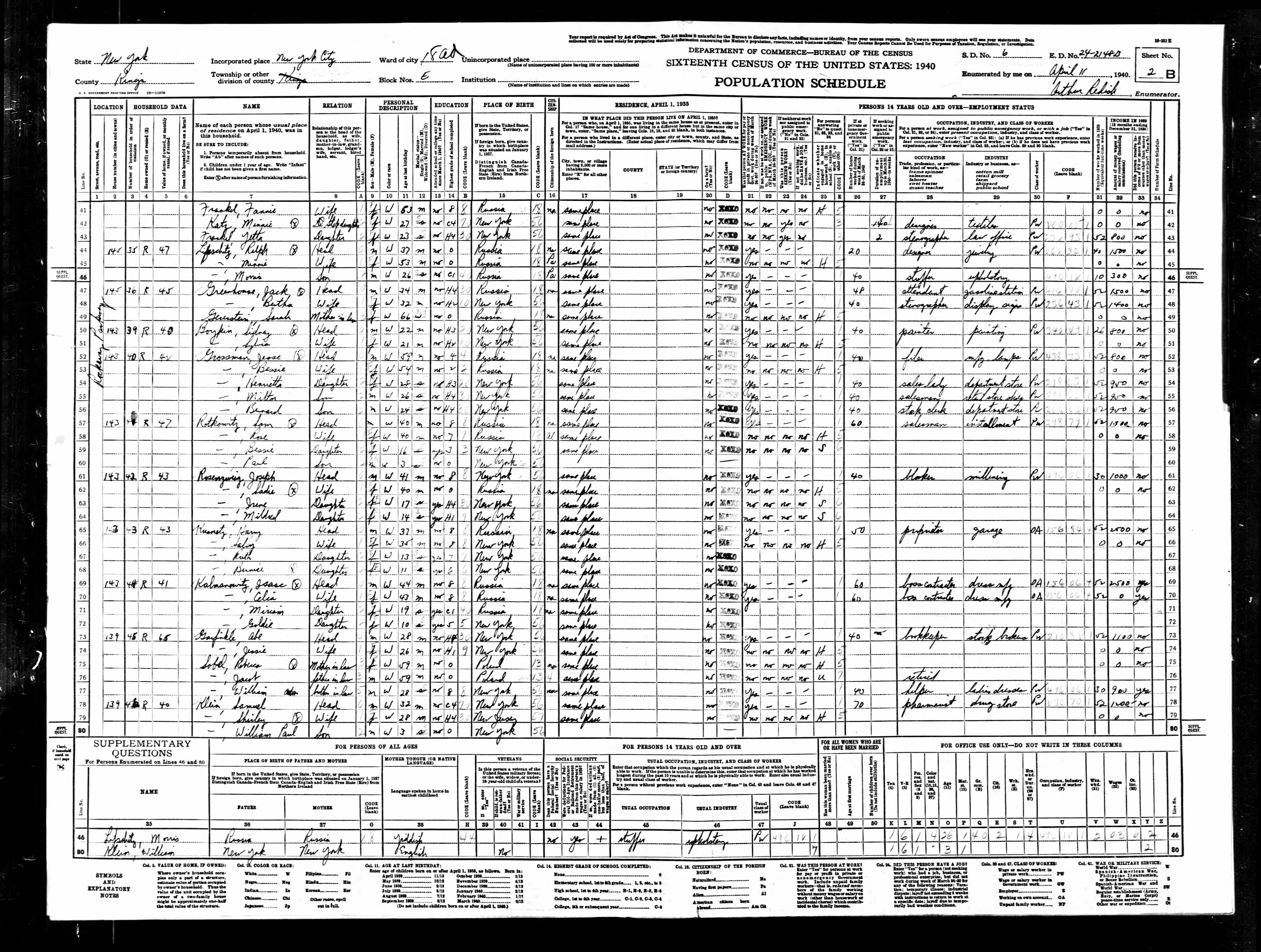
So I moved ahead to the 1940 census to see if I could find anything that would help to nail down the identity of the correct Joseph.  There were four Josephs (plus the John who married Ethel; since his name was listed as John again, I decided that this was not a census taker’s mistake and eliminated him from my pile.)  Once again, there was Joseph who married Sadie, living with their two daughters Irene and Mildred on Rockaway Parkway in Brooklyn.  Joseph’s birth year was given as 1899 this time, and his occupation was still in hat-making.  There was a second Joseph married to a Sadye, living in Manhattan, but he was older (born in 1894). There was a third Joseph married to a Jenny, also living in Manhattan, who was a salesman of knit goods, but he was also older, born in 1893.  And finally there was a Joseph born in 1897, married to Sarah and living in the Bronx.  He was a clerk in a rubber factory.  Of the four Josephs, it still seemed to me that the one who was most likely Gustave’s son was the Joseph who married Sadie: he lived in Brooklyn, where our Joseph grew up; he was a hatter, which our Joseph had been in 1920; and he was the correct age, unlike two of the other three.

Joseph and Sadie 1940

Joseph and Sadie 1940

Obviously I cannot be 100% sure unless and until I can find a marriage certificate for Joseph and Sadie which reveals his parents’ names or unless and until I can find a descendant of Joseph and Sadie who may know whether their great-grandfather was named Gustave and whether their great-grandmother was named Gussie.  I have sent messages to a few of those descendants, and I am hoping that one of them will be able to help.  In the meantime I will continue to search for more evidence linking Joseph to my great-great uncle Gustave Rosenzweig, in particular the marriage certificate or the death certificate for the Joseph who married Sadie.

Enhanced by Zemanta

Brotman Research: Where I am

Having reached the conclusion last week that I was not going to be able to get any further specific information about where in Galicia my Brotman relatives lived and then realizing that even if Tarnobrzeg was the ancestral home that the records there are very limited and too recent to be of much help, yesterday I went back to look over what I have learned and what is left to be learned about my Brotman relatives.

I have learned an incredible amount.  I know much more about my great-grandparents Joseph and Bessie Brotman and about the life they lived in the Lower East Side.  I have found all five of their children—Hyman, Tillie, Gussie, Frieda and Sam– and know what happened to them: who they married, who their children were, where and when, and in most cases, why they died.  I know what they did for a living and where they lived.  I even have been able to trace what happened to their grandchildren and who they married and the names of their children.  I have seen pictures of almost all these people, except Joseph, Abraham, David, and Frieda.   It’s been an incredible experience, so much more rewarding than I ever expected less than a year ago when I first starting dipping my toe into the waters of genealogy.

I’ve also been able to locate three of Joseph’s four children from his first marriage to a woman likely named Chaye Fortgang.  I have found Abraham, Max and David, but not Sophie.  I have also been able to learn a great deal about their lives, occupations, families, and homes and have located their living descendants.  Although there are a few missing holes in David’s life story and a number of years for which I can find no records, I know that he married a woman named Annie Salpeter and that they did not have children.  I know that he came to America with his older brother Abraham and that he died in 1946 of hypertension.  Only Sophie is missing from the picture, but given that I do not know either what her Yiddish name was in Galicia or her married name in the United States, I am not sure what else I can do to locate her.

There are many unanswered questions, but most of them relate to their life in Galicia—where did they live, what did Joseph do for a living, what happened to his first wife? These questions I cannot answer, and that makes me sad.  Also, when did Joseph arrive in the US?  I cannot find him on a ship manifest, but will keep looking.   I will also try and fill the holes in David’s story and look for Sophie, but overall, I think I have to say that I have reached the end of my search for the Brotman family.[1]

So what does that mean? Obviously, I hope to continue to develop my ties to my new cousins (and my old cousins, of course), and I also hope that they will help to fill out the personal side of the stories of their parents and grandparents.  It will make the family story so much more meaningful and interesting if people contribute stories or profiles or letters or pictures that bring to life their relatives.  I cannot do that on my own.  I didn’t know Abraham, Max, Hyman, or Tillie—but those of you who are their grandchildren certainly did.  I also didn’t know any of Joseph’s grandchildren aside from my mother and her siblings, but my second cousins—their children—must have memories and stories that they want to survive.  Let me know, and I will be happy to interview you or help you write something you’d like to share.

Thank you to all the Brotman cousins who helped me get this far—for answering my emails and my questions, for sending me pictures and telling me stories, for providing me with names and contact information, for sharing whatever you were comfortable sharing.  It’s been an amazing experience to share with you all, my Brotman family.

The rest of my personal journey to find my family will continue with the Goldschlager and Rosenzweig lines and eventually my paternal lines: the Cohens, Schoenthals, Seligmans, Katzensteins, Nusbaums, and so on!


[1] There remains, of course, a possibility of a tie to the Brotmanville Brotmans, but my research has hit a brick wall there as well.  Without being able to trace back to Joseph’s parents and grandparents and Moses Brotman’s parents and grandparents, I will never know whether Joseph and Moses were siblings, cousins, or not related at all.  Brotman is and was a much more common name than I had anticipated, and we could be related distantly to all of them or none of them.  Without better European records, there is just no way of knowing.

Enhanced by Zemanta

Questions raised by Headstones

I was reminded of the power of headstones when I received a set of photos from Tillie Strolowitz/Adler’s great-granddaughter Jean.  Jean has been doing genealogy research for many, many years, and it has been wonderful to have a family member who shares this passion.  Jean started in the pre-internet era, and she has been helpful in reminding me to be patient as I wait for documents.  I want immediate gratification, typical of those of us working with modern technology; Jean reminds me that back in the pre-internet era there were no documents that you could view from the comfort of your home just by clicking on a computer.  You had to travel to libraries, government offices, cemeteries, synagogues, and other record-holding institutions—or at best mail away (snail mail) and wait for documents to be returned by snail mail.

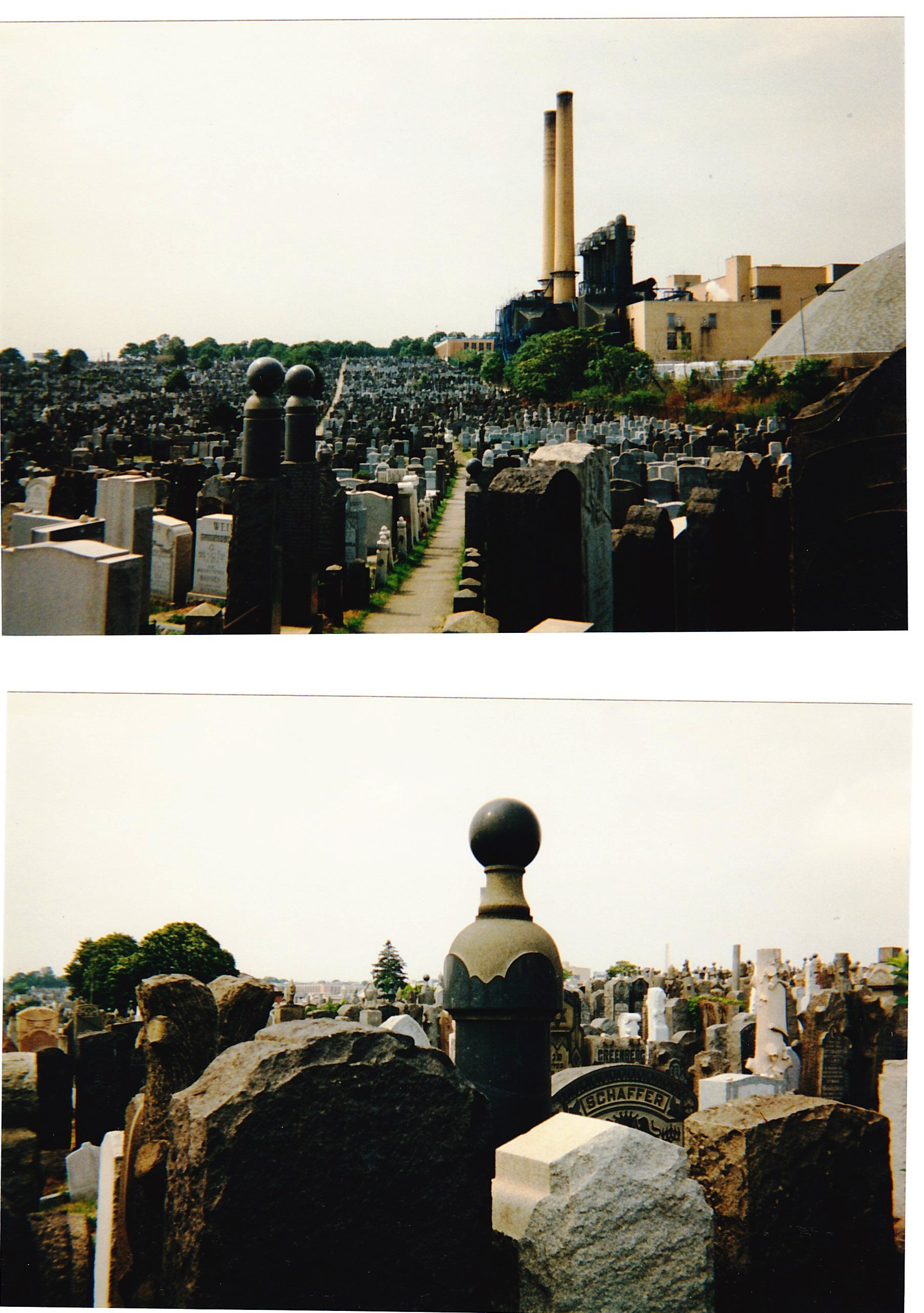
Anyway, Jean wrote to me about her visit to Mt Zion Cemetery back in 1999 to search for her great-grandmother’s headstone.  Her experience was very much like mine when I searched for my great-grandfather Joseph Brotman’s headstone last fall.  The stones are so overcrowded in the old cemetery that it is impossible to walk around without stepping on the gravesites of other people.  It is also very difficult to find a particular headstone.  There are no straight lines, no easy paths, as in other cemeteries.  Here are some photos Jean took back then to capture the feeling.

Mt Sinai cemetery

Mt Zion cemetery

But when you do find the headstone, it is a powerful experience.  You suddenly understand that your long-lost relative is in fact buried there and that someone stood there in mourning to bury them many years ago.  Jean pointed out that Tillie’s headstone only refers to her as a loving mother, not a wife, and that the Strolowitz name is nowhere included on the stone, just the name the family adopted in America, Adler, despite the fact that Tillie’s death certificate is under the Strolowitz name.

Tillie Strolowitz Adler headstone Mt Sinai

Tillie Strolowitz Adler headstone Mt Zion

When Tillie died, two of her sons had already passed away, Isidor and Pincus, and were also buried at Mt Zion under the Adler name.  Had the family erased Jankel from their memory by dropping his name and not including any reference to Tillie as a wife on her headstone?  Does that provide any clues as to what happened to him? One would assume that he, too, was buried at Mt Zion, if he had died shortly after arriving in NYC, but I cannot find anyone with a name similar to his buried there.

I am still waiting for some records that may relate to Jankel and his fate.  I am not optimistic that these will in fact relate to Jankel, but I will be patient, count the days, and hope that these records will help to answer the mystery of Jankel Srulovici.

Enhanced by Zemanta

Zusi Rosenzweig: Some answers, more questions

About ten days ago I wrote about the documentation that confirmed that Zusi Rosenzweig—also known as Sonsa, Ceci, Cecile, Celie, Susie and Susan Mintz—was my great-grandmother’s sister and the aunt who met my grandfather Isadore at Ellis Island in 1904.  I also knew that she had married a man named Harry Mintz in December 1896, but it appeared that Harry had died by the time of 1900 census since Zusi, as Sonsa Mintz, was listed as a widow on the 1900 census, living with Jake and Rachel Reitman.

I also believed that I had found evidence that Zusi had had a son Nathan, born in December, 1897, but had not further evidence of him until he was living with Zusi at the time of the 1915 census.  I believed Nathan had married a woman named Gertrude in 1930 and had had a daughter named Susanne in 1932, one year after his mother Zusi/Susie had died.

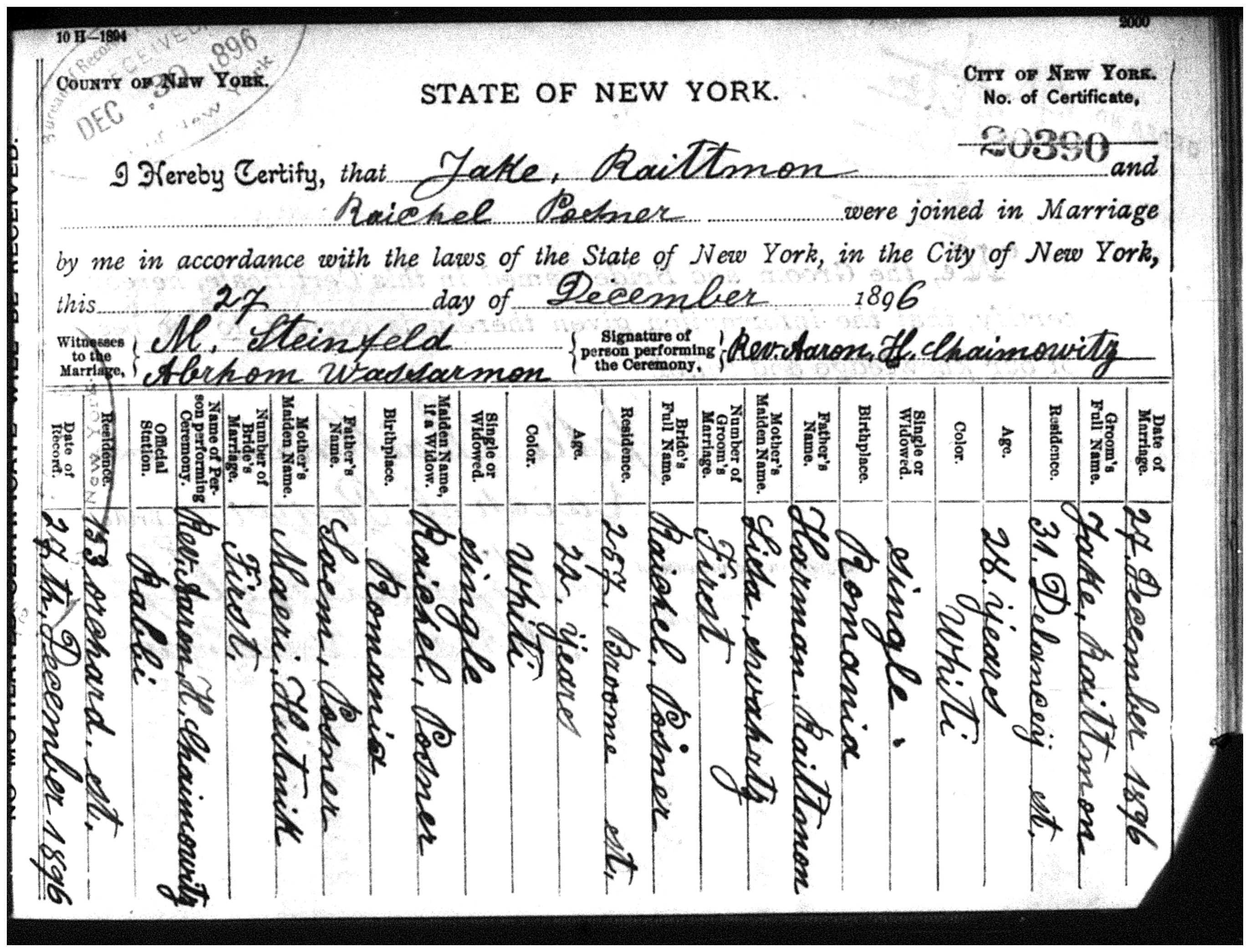
Although I was able to research fairly deeply into Jake and Rachel Reitman from the public records, I could not find any familial link between Zusi and either Jake and Rachel.  On Jake and Rachel’s marriage certificate, their parents’ names are all revealed, and no one has a surname that I can link to the Rosenzweig/Goldschlager/Strolowitz family.  I still don’t know if Sonsa Mintz is in fact Zusi, and if it was, I have no idea why she was living with the Reitmans.
Jake and Rachel Reitman marriage certificate

Jake and Rachel Reitman marriage certificate

I had ordered three more documents: a birth certificate for Nathan Mintz, a marriage certificate for Nathan and Gertrude Mintz, and a death certificate for a Harry Mintz who died in 1924, thinking that perhaps Harry had just “disappeared” and had not died between 1897 and 1900.  Today I received those documents, plus one more.  For the most part, these documents did in fact confirm my hunches.  The Nathan Mintz born in December, 1897, was the child of “Zussie” Rosenzweig, born in Romania, and her husband “Herman” Mintz.

Nathan Mintz birth certificate

Nathan Mintz birth certificate

The Nathan Mintz who married Gertrude in 1930 was the same: son of Susan “Rosenberg” and Harry Mintz.

Nathan and Gertrude marriage certificate

Nathan and Gertrude marriage certificate

Thus, Susanne is Zusi’s granddaughter and her namesake.  The death certificate for Harry Mintz dated 1924 neither confirmed nor contradicted what information I had because it is not the same Harry; this one had only been in the US for four years, was older, from Poland, and married to a woman named Ida.

Harry Mintz death

Harry Mintz death

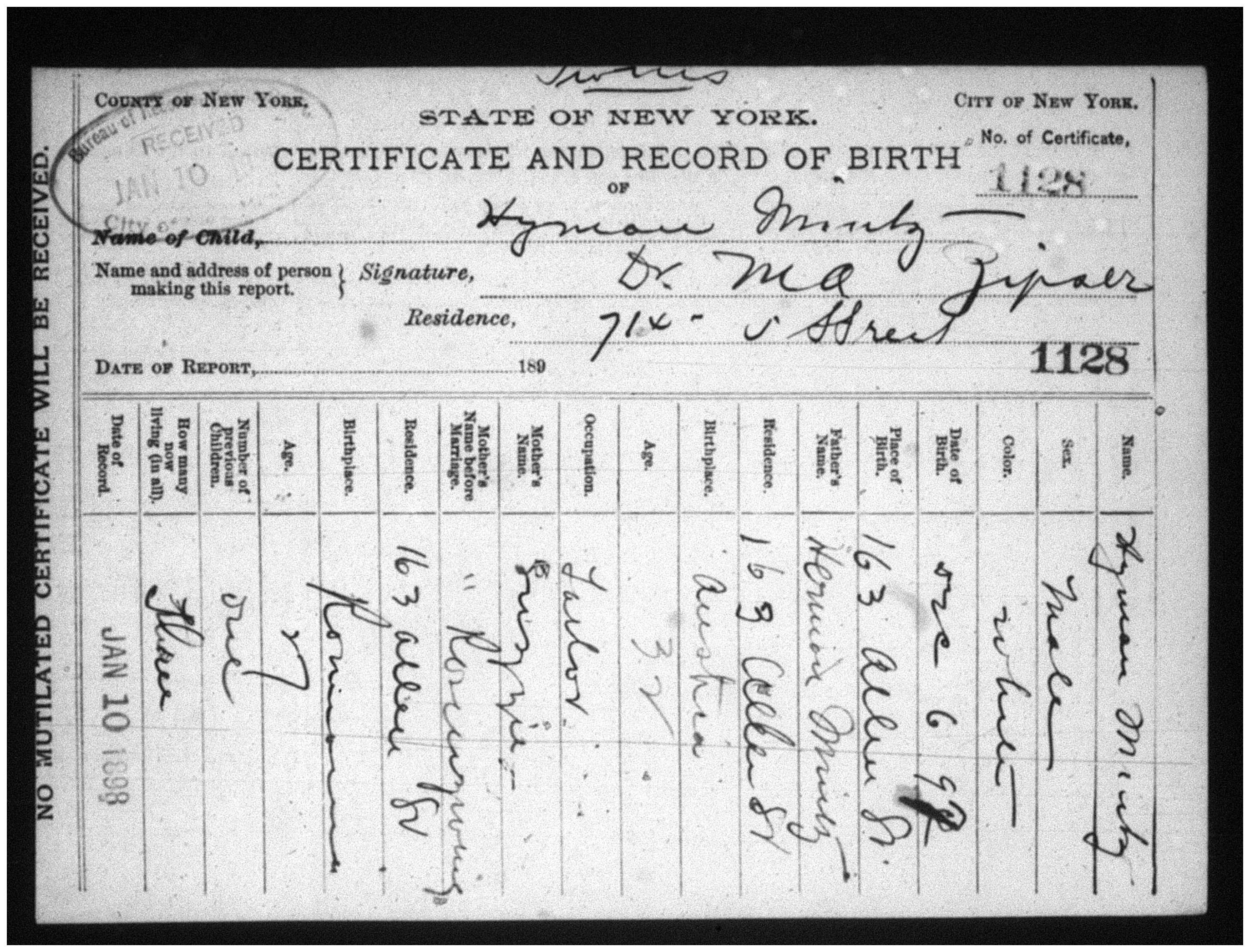
But there were some surprises in the documents; first, I received a second birth certificate for a baby Mintz born in December, 1897, Nathan’s twin, Hyman: same parents, same birth date, same doctor.

Hyman Mintz birth certificate

Hyman Mintz birth certificate

I immediately wondered why I had not seen any future references to Hyman and suspected the worst.  I checked the death index, and Hyman Mintz died in January, 1898, a month old infant.

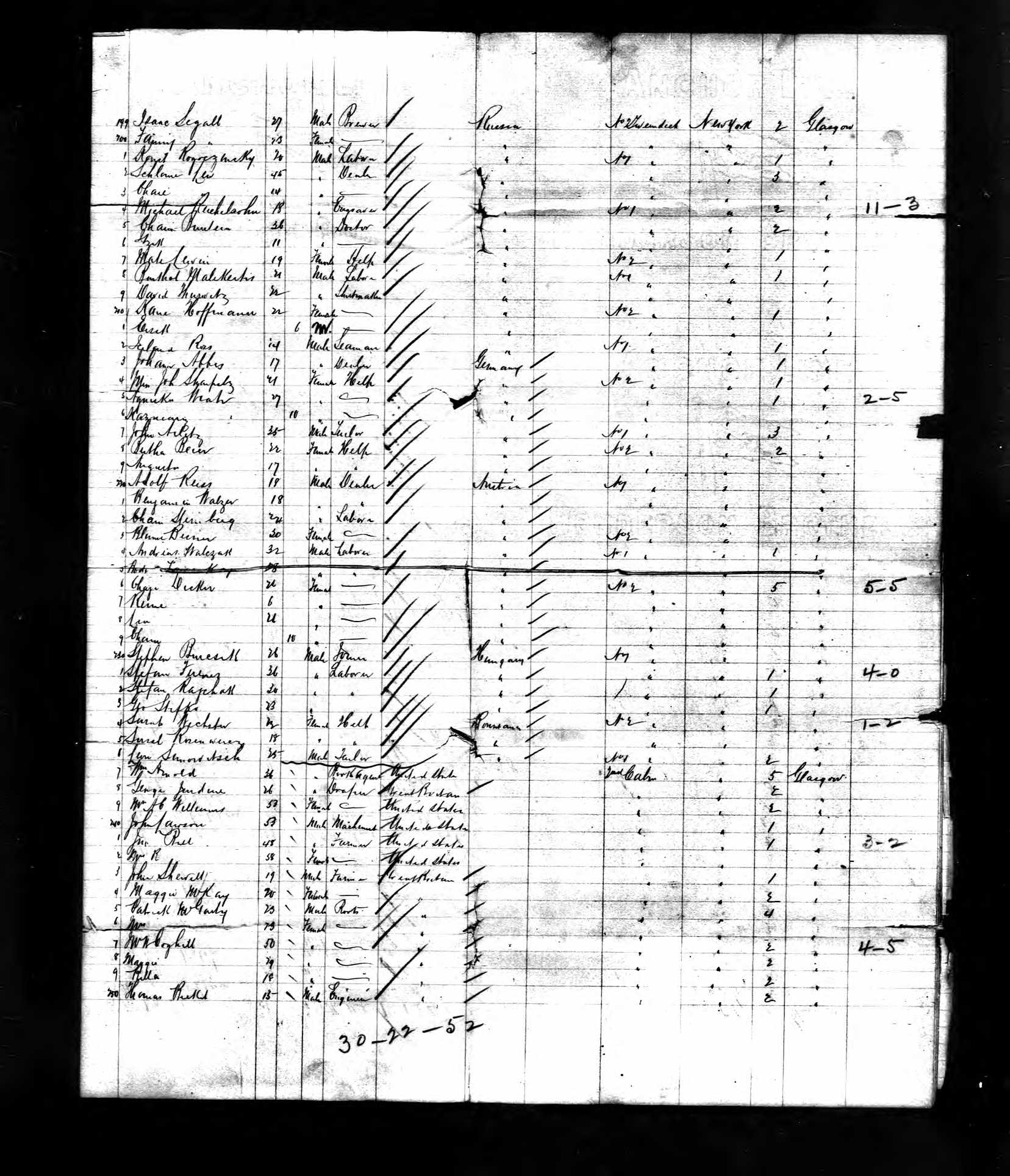
Moreover, the New York City birth certificate form asked how many children were born to this mother before this delivery and how many of those children were still living.  On both Nathan and Hyman’s birth certificates, it says that Zusi had had one prior child and that three were still living.  So who was this first child, and where was she or he living? Zusi and Harry had only been married twelve months when the twins were born, so they could not have had a prior child (well, at least one conceived since they had married).  Zusi had been a 24 year old widow when she married Harry; she must have had a child with her first husband, perhaps in Romania before immigrating to the US.  She was only a teenager when she emigrated.  I have what I think could be the ship manifest listing Zusi as a passenger on the Ethopia, arriving in New York City on September 30, 1890; there is no child with her.

Ship Manifest as Susel Rosenzweig

Ship Manifest as Susel Rosenzweig

Did she leave her child behind in Iasi for her family to raise? Why did she return to her maiden name if she’d been married? Perhaps there never was a marriage?  I can guess, speculate, but not know for certain.

So what do we know and what don’t we know about this woman who met my grandfather at Ellis Island? We know she married Harry Mintz, had twin sons Nathan and Hyman, but only Nathan survived.  Nathan grew up, married Gertrude, and had a daughter in 1932 named Susanne.  Zusi died in 1931. What we don’t know is what happened to Harry or what happened to her first child.  We don’t know where Zusi and Nathan were between 1898 and 1915. And we don’t know whether Nathan and Gertrude had additional children, whether Susanne had children, whether there are any living descendants of the elusive Zusi Rosenzweig.

Enhanced by Zemanta