Auguste Rothschild Feldheim: Another Life Destroyed

As I move on now to the next child of Gerson Rothschild and Fanny Kugelmann, I am struck by the differences in the fates of their eight surviving adult children. Siegmund and his wife and all his children left Germany in time to escape death at the hands of the Nazis. Katchen and her husband and son were all killed by the Nazis. Max and his family escaped to Argentina, but their son Erich died shortly after arriving from cholera; that might not have happened if they hadn’t had to leave Germany. Why were some able to escape while others were not? Fate seems so cruel and unpredictable.

Now I turn to the fourth child, Auguste “Gusta” Rothschild Feldheim. And sadly, Auguste’s fate was more like that of her sister Katchen than that of her brothers Siegmund and Max.

As we saw, Auguste married Wolf Feldheim on March 18, 1919, in Zimmersrode. Wolf was a widower. His first wife Johanna Risch died on April 29, 1916,1 less than a week after giving birth on April 23, 1916, to her fourth child with Wolf, their son  Arthur/Aharon.2 Wolf and Johanna also had three daughters born before Arthur/Aharon: Ruth, Selma, and Else, and all were younger than five years old when their mother died.3

Auguste married Wolf three years after Johanna’s death, and thus Johanna’s four children with Wolf were all still very young when Auguste became their stepmother. Here is a photograph of Auguste with her four stepchildren. Look how sad those children look. It’s heartbreaking.
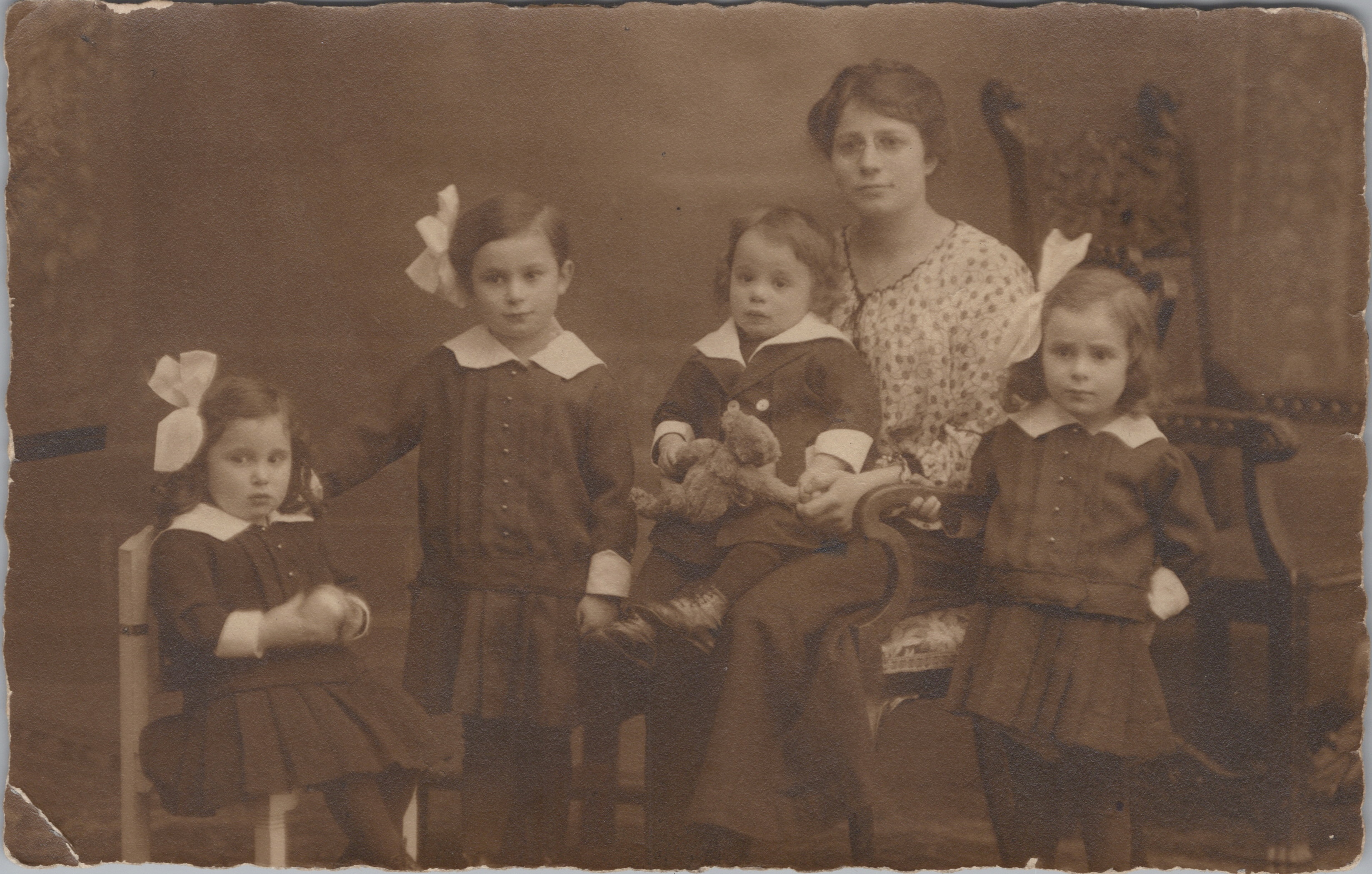
Auguste Rothschild Feldheim with her four stepchildren. Courtesy of the family

And then Wolf and Auguste had their own child together, a son Bruno who was born in Fulda, Germany, on November 12, 1921.4

Auguste’s husband Wolf Feldheim died of a heart attack on October 4, 1940, in Fulda, Germany, where he and Auguste were living. Wolf was 65 years old. Was his death caused directly or indirectly by the Nazi persecution? I don’t know.5

Just over a year later Wolf’s widow Auguste was deported from her home in Fulda to Riga. A Page of Testimony filed at Yad Vashem by her stepson, Aharon Feldheim, reported that he believed she died there on or about December 8, 1941, the day after Pearl Harbor. The Gedenbuch summarized at Yad Vashem says she was deported to Riga on December 9, 1941, and died there in March, 1942.6 And then there is a second Page of Testimony for Auguste filed by her sister-in-law Elise Rothschild, wife of Siegmund Rothschild, saying that Auguste was deported to Bergen-Belsen. I don’t know which date or which place is more accurate. But the bottom line is the same. Auguste Rothschild Feldheim died at the hands of the Nazis.

Page of testimony at Yad Vashem filed by Aharon Feldheim. found at https://collections.yadvashem.org/en/names/13532864
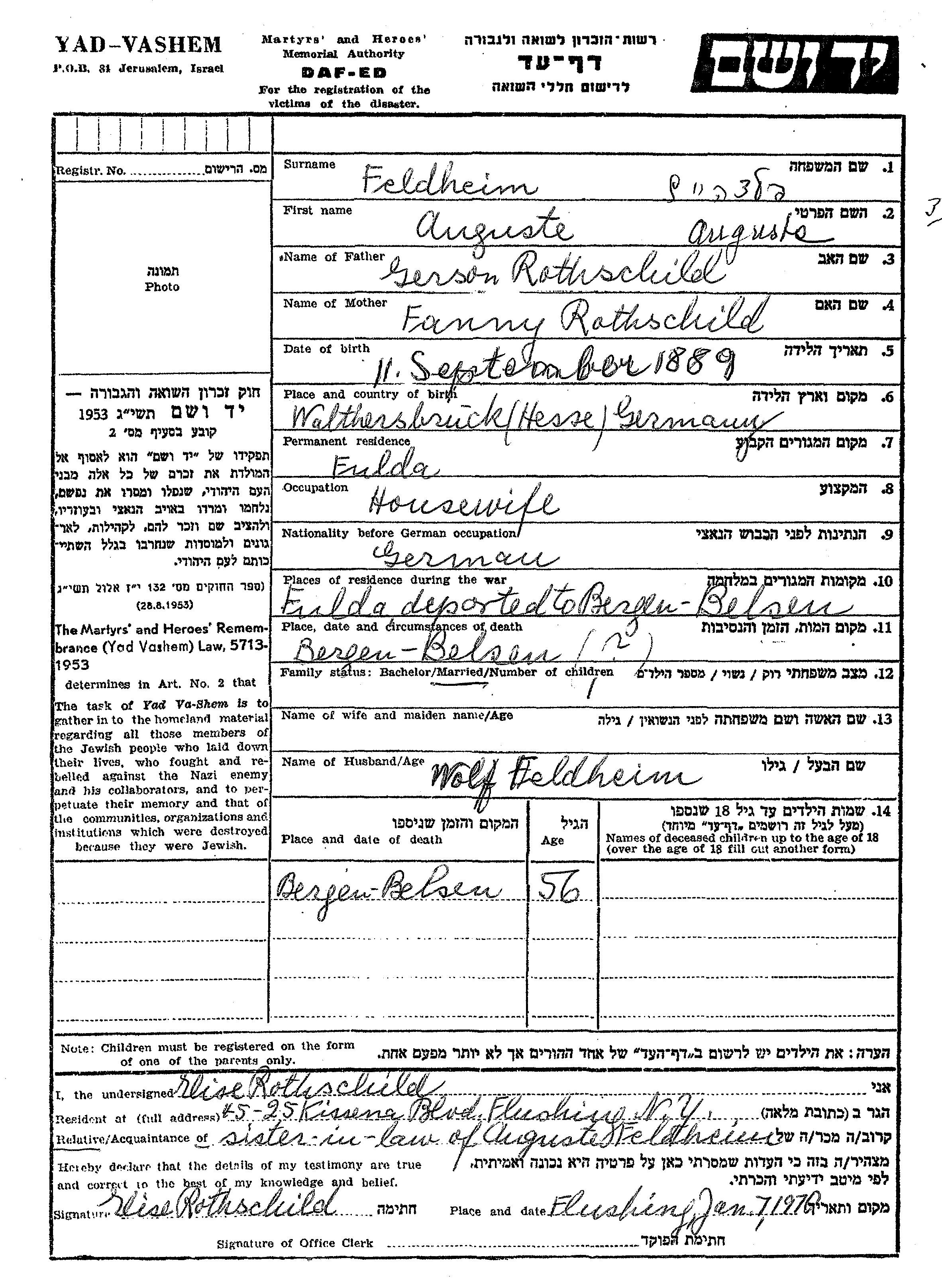
Page of Testimony filed at Yad Vashem by Elise Rothschild, found at https://collections.yadvashem.org/en/names/798469

Bruno Feldheim survived the Holocaust by going to Palestine. His application for citizenship in Palestine in 1946 indicates that he arrived on March 27, 1939, from Fulda.

Bruno Feldheim Palestine immigration papers found at the Israel State Archives at https://search.archives.gov.il/

At some point after the war, Bruno moved to Belgium, where he had a diamond business, according to his cousin Hal Katz. Hal’s tree on Ancestry reports that Bruno died in Belgium on September 16, 2016. He was survived by his children and grandchildren. Here is a photograph of Bruno with his family, courtesy of Judy Katz, his first cousin, once removed.

Bruno Feldheim and family. courtesy of the family

I did not really research in depth the four stepchildren of Auguste, relying primarily on the Ancestry tree created by their stepcousin, Hal Katz. That tree reported that two of those stepchildren, Selma and Aharon, survived the Holocaust and ended up in Israel, but a third, Else, was murdered by the Nazis.

As for the remaining stepchild, Ruth, Wolf and Johanna’s oldest child, I went down a deep rabbit hole to learn what happened to her. It’s a Holocaust story I had not known before and that may not be very widely known.

Ruth was born on October 28, 1912, in Fulda, Germany.7 She married Jonas Tiefenbrunner, who was born in Wiesbaden on June 19, 1914. Sometime after Hitler came to power, Jonas left Germany for Belgium and established a youth home and yeshiva for religious boys in a town near Antwerp. Ruth later also left Germany for Belgium, and she worked as a cook in a different children’s home. According to a recorded interview with their daughter Judith, they had first met in Frankfurter, but reconnected and became a couple in Belgium. Ruth and Jonas were married on May 9, 1940, the day before the Nazis invaded Belgium.8

As told by Jonas and Ruth’s daughter Judith in that interview, after the Nazis invaded, the Queen Mother of Belgium intervened to protect the Jewish children and elderly. She convinced the commandant overseeing the Nazi deportation of Jews back to Germany, purportedly for “work,” that children younger than seventeen and the elderly would not be productive workers and that they should not be sent back to Germany. A number of orphanages and homes for the elderly were established, and Jonas Tiefenbrunner was made the head of one of those orphanages, the one in Brussels and the only one that was observant of Jewish laws and holidays, according to Ruth’s daughter.9

Jonas and Ruth took in up to fifty or sixty children at a time. They faced constant danger of raids by the Nazis, who accused them of hiding children who were over the age of sixteen or children who had not been properly registered with the Nazi regime in Belgium. Jonas was arrested once, but quickly released.10

In 1943, Ruth, Jonas, and their first-born daughter Jeanette had an opportunity to escape from the Nazis and emigrate from Belgium by obtaining what are now known as Mantello certificates. As described on JewishGen:

George Mandel was a Hungarian Jewish businessman who befriended a Salvadoran diplomat, Colonel José Arturo Castellanos, in the years leading up to World War II.  After Castellanos was named El Salvador’s Consul General in Geneva, he appointed Mandel, who had assumed a Spanish-sounding version of his last name, “Mantello,” to serve as the Consulate’s first secretary.  Even in Nazi-occupied Europe, Jews who were citizens of or held official documents from other countries were often able to escape deportation.  With the consent of Castellanos, George Mandel-Mantello used his diplomatic position to issue documents identifying thousands of European Jews as citizens of El Salvador.  He sent notarized copies of these certificates into occupied Europe, in the hope of saving the holders from the Nazis. … Word then spread among representatives of various Jewish organizations, who also approached Mandel-Mantello, each providing data and photographs of the people they wanted to try to save. … In total, Mandel-Mantello may have issued as many as five thousand certificates, many with the names and photographs of several family members.

Jonas and Ruth Tiefenbrunner were among those who received a Mantello certificate, describing them as citizens of El Salvador. They even applied for a Swiss passport relying on the evidence of their Salvadoran citizenship.  They could have left Belgium for a safer country by using those certificates as many others were able to do.

Jonas Tiefenbrunner application for Swiss passport, found at USHMM at https://collections.ushmm.org/search/catalog/pa1169302

But as described by their daughter Judith, they refused. Jonas would not abandon the children he was caring for so the family stayed in Belgium for the duration of the war.11

In August 1944, the Nazis decided to deport all the remaining Jews in Belgium including the children. “Luckily, Jonas received advanced warning and was able to take all the children to a convent run by an acquaintance, Father R.P. Robinet. Two weeks later, Brussels was liberated.”12 In the end, it is estimated that Jonas and Ruth were able to save over one hundred children.

Tragically, Jonas Tiefenbrunner died in Belgium in 1962 from a heart attack when he was only 48 years old. From what I can gather from various sources including Judith’s interview, Ruth and their three daughters all eventually ended up in Israel.13 Unfortunately I have not been able to find further information about Ruth or her daughters.

Although Ruth Feldheim and Jonas Tiefenbrenner were not my genetic relatives, I felt their story was important and wanted to share it with my readers.


  1. Johanna Risch Feldheim death record, Arcinsys Archives of Hessen, HHStAW, 365, 348, p. 11, found at https://digitalisate-he.arcinsys.de/hhstaw/365/348/00011.jpg 
  2. Arthur/Aharon Feldheim immigration papers found in the Israel State Archives at https://search.archives.gov.il/ 
  3. Ruth was born on October 28, 1912, according to this entry at Yad Vashem, https://collections.yadvashem.org/en/names/13474776  Selma was born on April 6, 1913, Selma Feldheim, Enemy Alien Registration card, The National Archives; Kew, London, England; HO 396 WW2 Internees (Aliens) Index Cards 1939-1947; Reference Number: HO 396/172, Piece Number Description: 172: German Internees Released In UK 1939-1942: Fa-Fl, Ancestry.com. UK, World War II Alien Internees, 1939-1945. Else was born on November 5, 1914, Arolsen Archives; Bad Arolsen, Germany; Record Group 1 Incarceration Documents; Reference: 1.1.46.1, Ancestry.com. Germany, Incarceration Documents, 1933-1945 
  4. I still have not found a record linking Bruno to Auguste and Wolf, but Bruno’s first cousin Hal Katz confirmed that Auguste and Wolf did have a son Bruno, and that is certainly a reliable first hand source. Zoom call with Hal Katz on May 8, 2025. 
  5. Wolf Feldheim on a grave registration document found at Arolsen Archives, Digital Archive; Bad Arolsen, Germany; Lists of Persecutees 2.1.1.1, Description
    Reference Code: 02010101 oS, Ancestry.com. Free Access: Europe, Registration of Foreigners and German Persecutees, 1939-1947 
  6. Entry at Yad Vashem for Auguste Rothschild Feldheim, found at https://collections.yadvashem.org/en/names/13532864 
  7. See Note 3, supra. 
  8. The information in this paragraph came from an interview with Ruth and Jonas’ daughter that is available on YouTube at https://www.youtube.com/watch?v=w1q4KCKrMjY Also, see Jonas Tiefenbrunner’s application for a Swiss passport below. 
  9. Ibid. 
  10. Biography of Jonas Tiefenbrunner found at the USHMM website at  https://collections.ushmm.org/search/catalog/pa1144757 
  11. See Note 8, supra. 
  12. See Note 10, supra. 
  13. See Note 8, supra. 

Max Rothschild: Escape to Argentina

Fortunately, the story of the third child of Gerson Rothschild and Fanny Kugelmann, their son Max, does not end as tragically as that of his sister Katchen. Max was born in 1886, and, as we saw, he married Johanna Katz on October 19, 1919, in Zimmersrode, Germany. They had three sons, Erich, Fritz, and Richard. According to his marriage record, Max was a merchant in Zimmersrode.

Max Rothschild and Johanna Katz marriage record, Hessisches Hauptstaatsarchiv; Wiesbaden, Deutschland; Bestand: 920; Laufende Nummer: 9581, Ancestry.com. Hesse, Germany, Marriages, 1849-1930

Max and his family were among those who were able to leave Germany in time and thus survived the Holocaust. Thank you to Donna Levinsohn from the GerSIG Facebook group for finding them on a list of immigrants to Argentina at the CEMLA website. From that website I learned that Max listed his occupation as “agricola” and his sons listed theirs as “practicante agricola,” or in the practice of agriculture. Their date of arrival in Buenos Aires was May 25, 1939, on the ship Cap. Norte. Missing from this list is the third son of Max and Johanna, Fritz. According to Hal Katz. Max’s nephew and first cousin to his sons, Fritz immigrated with his parents and brothers, so I cannot account for the fact that he is missing from this passenger ship manifest index.1

Ship manifest facts for Max Rothschild and family from CEMLA website at https://cemla.com/buscador/

Although the family escaped the tragedy of being murdered by the Nazis, their life was not without tragedy. Just one month after arriving, Erich Rothschild died, perhaps from cholera, according to one tree on Ancestry. He was only eighteen years old. How devastating it must have been for the family to escape safely from Germany only to lose Erich so soon after leaving.

Andra Marx from the GerSIG Facebook group located Erich’s burial record on JewishGen; he was buried in the Jewish section of the cemetery in Moisesville, Argentina.

Erich Rothschild death and burial info from JewishGen, found at https://www.jewishgen.org/databases/cemetery/jowbr.php?rec=J_ARGENTIN_0260737

When I saw the name of the town—-Moisesville—-on that burial record in JewishGen, my immediate reaction was “Moses town,” that is, that it had to be a Jewish settlement in Argentina, and in fact that’s what it was. Interestingly, it was not founded by Jewish refugees from Nazi Germany, but many years before as a refuge for Russian Jews escaping persecution. According to Wikipedia, “Moises Ville was founded by a group of Russian Jewish immigrants who arrived in August 1889 aboard the SS Weser from Kamenetz-Podolsk, Ukraine.” But during the 1930s and 1940s, some German Jewish refugees like my Rothschild cousins were welcomed into that community. At one time there were four synagogues in Moisesville; today there are only 119 Jewish families there.

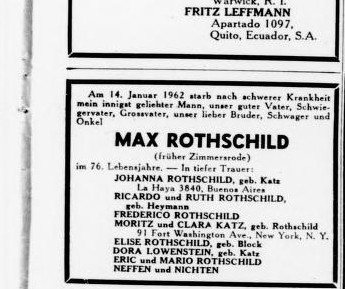
I do not know more about what life was like for Max, Johanna, Fritz (who became Frederico in Argentina), and Richard (who became Ricardo) in Argentina. Andra Marx located a notice in the Aufbau newspaper that announced that Max Rothschild died on January 14, 1962, at the age of 75 after a serious illness. He was mourned by his wife Johanna, who was living in Buenos Aires, his sons Frederico and Ricardo and Ricardo’s wife Ruth Heymann Rothschild, and other family members.

Death notice for Max Rothschild in The Aufbau, January 19, 1962, p. 29, found at https://archive.org/details/aufbau291962germ/page/n46/mode/1up?view=theater

Max is buried in Buenos Aires. His wife Johanna (Juana) survived him by 21 years; she died on December 27, 1983, and is buried next to Max in Buenos Aires. She was 91 years old.

Max Rothschild burial record from JewishGen, found at https://www.jewishgen.org/databases/cemetery/jowbr.php?rec=J_ARGENTIN_0226824

Johanna Katz Rothschild burial record at Jewish Gen, found at https://www.jewishgen.org/databases/cemetery/jowbr.php?rec=J_ARGENTIN_0226822

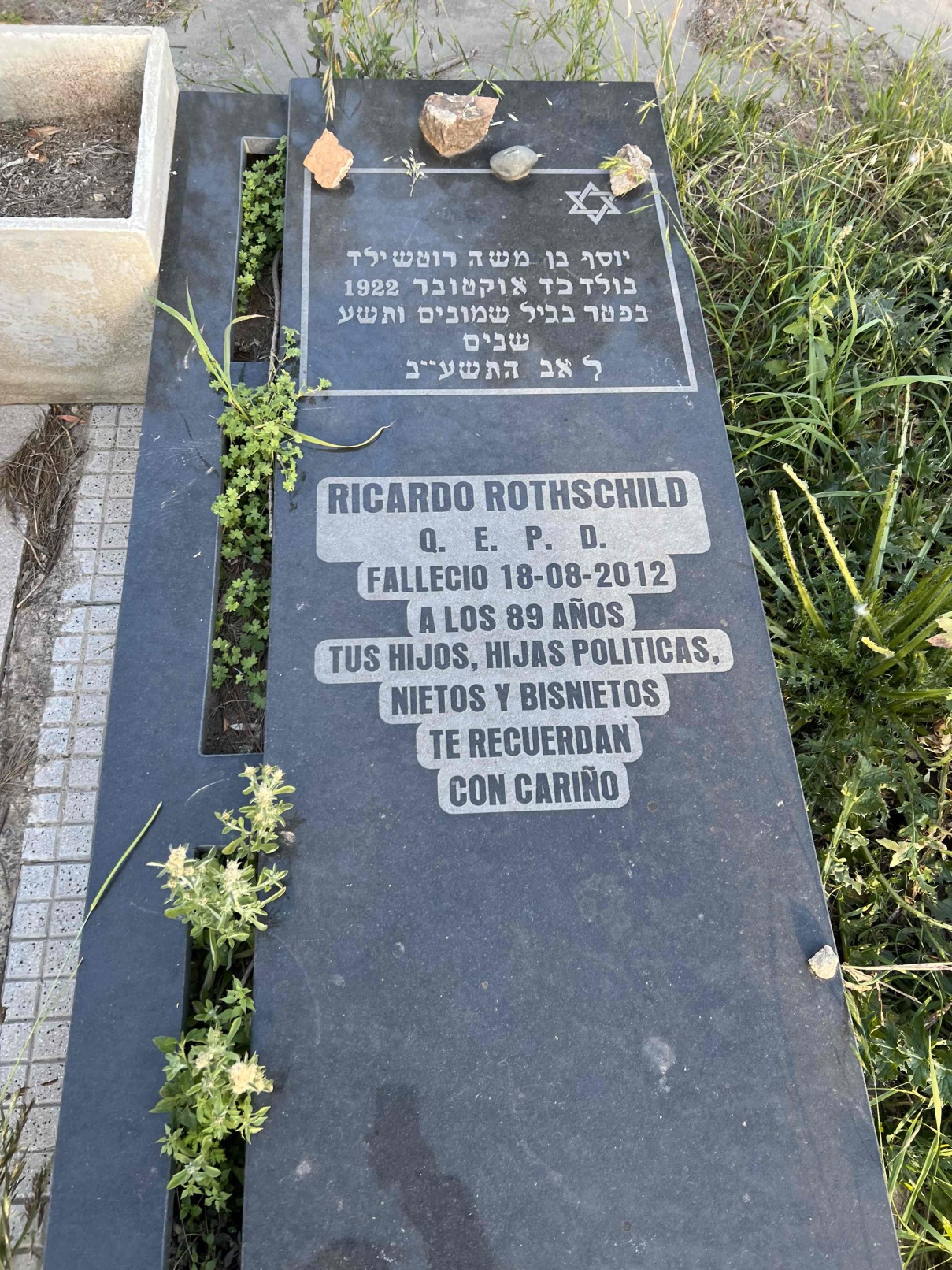
Their son Richard or Ricardo Rothschild died on August 18, 2012, at the age of 89. He is buried in the Jewish cemetery in Palacios Luis, Argentina, where his wife Ruth, who died on April 28, 1995, is also buried.

The inscriptions on both headstones read, “tu esposo/a hijos hijas  politicas y nietos te recuerdan con carino,” or “Your husband/wife, sons, daughters-in-law and grandchildren remember you fondly.” Ricardo and Ruth thus had at least two sons and grandchildren who survived them. I assume the sons are Eric (presumably named for his deceased uncle) and Mario Rothschild, who were named as mourners in the death notice for Max Rothschild.

Judy Katz, Hal Katz’s niece, informed me that Fritz also married and had children and grandchildren. They lived in Argentina and Germany. Fritz died in Germany just a few years ago.2  There are thus living descendants for Max and Johanna and their family.

Thank you again to Donna Levinsohn and to Andra Marx from the GerSIG Facebook group for their help in locating information about the Rothschilds in Argentina. And special thanks to my cousins Hal, Sandy, and Judy for sharing their memories of Max and his family.


  1. Zoom with Hal Katz and family on May 8, 2025. 
  2. Email from Judy Katz, May 8, 2025. 

Katchen Rothschild Hirschberg: A Family Destroyed

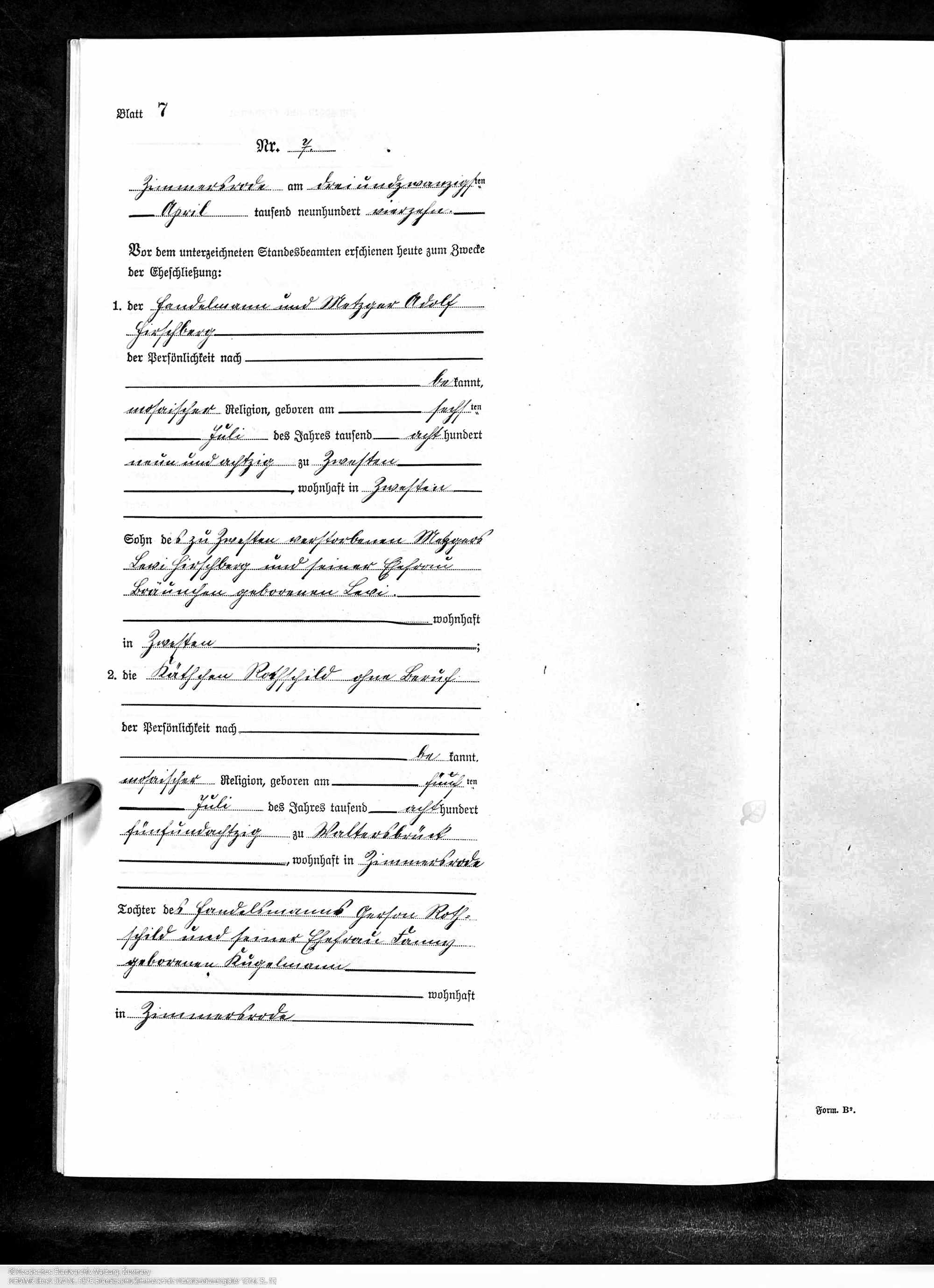
The second oldest child of Gerson Rothschild and Fanny Kugelmann was their daughter Katchen, born in 1885 in Waltersbrueck. As we saw, she married Adolf Hirschberg in 1914, and they had one child, a son Ludwig born in 1920. According to their marriage record, Adolf was a merchant and a butcher. They were living in Kassel, Germany, when Ludwig was born in 1920. Unfortunately, I do not know much more about their lives before the Nazi era. But I know that all three were persecuted and killed during the Holocaust. But the records of where and how they died are in conflict.

Katchen Rothschild and Adolf Hirschberg marriage record, Hessisches Hauptstaatsarchiv; Wiesbaden, Deutschland; Bestand: 920; Laufende Nummer: 9576, Year Range: 1914, Ancestry.com. Hesse, Germany, Marriages, 1849-1930

First, there are records at the Arolsen Archives showing that both Adolf and Ludwig were incarcerated at Buchenwald for some period of time after Kristallnacht in 1938.

Then, according to entries in the Gedenbuch (“Victims of the Persecution of Jews under the National Socialist Tyranny in Germany 1933 – 1945″ prepared by the German Federal Archives) as recorded at Yad Vashem, Katchen, Adolf, and Ludwig Hirschberg were all deported from Kassel on December 9, 1941, to the Riga ghetto in Latvia. As best I can determine from records at Yad Vashem, Katchen died in the Riga ghetto, but no date was given. For Adolf, the Gedenbuch reported that he died there on August 24, 1943.

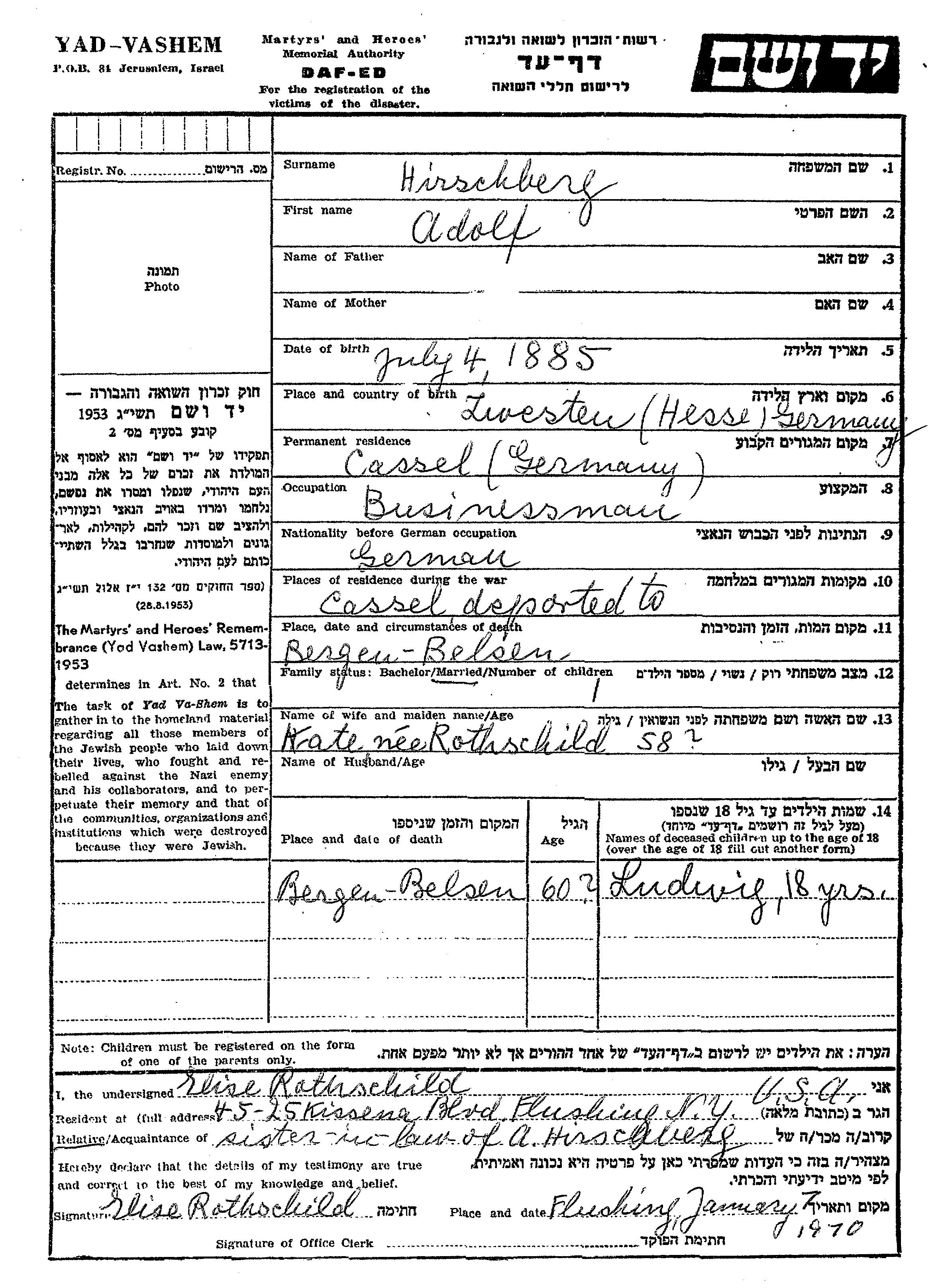
Pages of Testimony were filed at Yad Vashem for Katchen, Adolf, and Ludwig by Katchen’s sister-in-law, Elise Block Rothschild, the wife of Siegmund Rothschild, one of the few siblings to survive the Holocaust. Elise filed many Pages of Testimony for the family members murdered by the Nazis, as we will see. Her Pages of Testimony for Katchen and Adolf state that they died at the Bergen-Belsen concentration camp, but after searching the Arolsen Archives lists of those killed at Bergen-Belsen, I was unable to find either Adolf or Katchen’s name, so I do not know how accurate Elise’s information was. Did they die in Riga, or were they at some point transferred to Bergen-Belsen and killed there? I don’t know.

Adolf Hirschberg Page of Testimony filed at Yad Vashem, found at https://collections.yadvashem.org/en/names/14982438

Katchen Rothschild Hirschberg Page of Testimony filed at Yad Vashem, found at https://collections.yadvashem.org/en/names/645337

As for Ludwig, there is also conflicting information. The Gedenbuch summary at Yad Vashem reports that Ludwig was killed at the Natzweiler-Struthof concentration camp in France on December 24, 1944. A record in the Arolsen Archives also indicates that he died at Natzweiler-Struthof on that date, and there is also a record on Ancestry that seems to confirm that Ludwig was imprisoned at Natzweiler-Struthof during the Holocaust.1 Both records indicate that Ludwig was transferred to Natzweiler-Struthof from the camp in Dautmergen, a town in southwest Germany about 100 miles from Natzweiler-Struthof in France.

Ludwig Hirschberg record at Arolsen Archives, 2 Registration of Foreigners and German Persecutees by Public Institutions, Social Securities and Companies (1939 – 1947) / 2.3 Post-war Evaluations of Various Organizations / 2.3.3 Haut-Commissariat de la République Française en Allemagne / 2.3.3.1 Card file of persecutees in the later French zone and of French persecutees in other areas / Documents without (captured) names and names from A; further sub-structure available /, Reference Code
02030301001.474

But other records on JewishGen and Ancestry2 indicate that Ludwig was at the Stutthof concentration camp in Poland. Those records, however, are confusing because they say “Riga/Stutthof/Natzweiler.” Did they mean Stutthof, or did they mean Struthof/Natzweiler?

But this card from the Arolsen Archives is clearly marked only Stutthof and indicates that Ludwig Hirschberg was incarcerated there.

Ludwig Hirschberg at Stutthof, 1 Incarceration Documents / 1.1 Camps and Ghettos / 1.1.41 Stutthof Concentration Camp / 1.1.41.2 Individual Documents Stutthof / Personal Files – Stutthof Concentration Camp / Files with names from HERZ , Reference Code
01014102 047.243found at https://collections.arolsen-archives.org/en/document/4493200

Could he have been at both camps? Or is one of these records incorrect? After all Struthof and Stutthof could be easily confused. The Page of Testimony filed by Elise Block Rothschild does not resolve this confusion because it only reported that his place of death was unknown.

Ludiwg Hirschberg page of testimony at Yad Vashem, found at https://collections.yadvashem.org/en/names/622945

Only to add to the confusion, the Projekt Judische Leben Frankfurt states that Ludwig was one of the passengers on the St. Louis, the ship that was turned back in 1939 after being refused entry by both Cuba and the United States, and that he was later killed at Auschwitz. I searched the list of St. Louis passengers on file at the US Holocaust Museum and Memorial, however, and did not find Ludwig Hirschberg on that list. Nor does any record at Yad Vashem or on JewishGen or on Ancestry indicate that Ludwig was murdered at Auschwitz.

One might conclude that Ludwig was at Natzweiler-Struthof based on the larger number of records so indicating, but how did he get there from the Riga ghetto? They are more than 1200 miles apart. Not that Riga is close to Stutthof either (469 miles), but still much closer. Also, the JewishGen database devoted to Stutthof includes a description that states, “The Stutthof camp was originally not designed to hold Jews, but, beginning in 1944, substantial numbers (30,000-50,000) of Jews were sent there, primarily from Kovno, Rīga and Auschwitz.” So it would make sense that Ludwig would have been sent from Riga to Stutthof, not to Natzweiler-Struthof.

Unless Ludwig was in fact on the St Louis? Since many of those passengers did end up in France after being turned back by the US and Cuba, that might explain how Ludwig ended up in Natzweiler-Struthof. But if he was on the St Louis in 1939 and then sent to France, how could he have been deported to Riga from Kassel with his parents in 1941? Something didn’t add up.

I was very fortunate to speak with Ludwig’s first cousin Hal Katz on May 8, 2025, and he confirmed that Ludwig was not on the St. Louis. That makes it even less likely that Ludwig ended up in France and thus in Natzweiler-Struthof. My best guess at this point is that Ludwig was sent to Stuffhof along with other prisoners from Riga. My hunch, totally speculative, is that somewhere someone mixed up Struthof and Stutthof and wrote the wrong name on one of Ludwig’s records.

Sadly, in the end, these details do not change the ultimate outcome. Katchen, Adolf, and Ludwig Hirschberg were all murdered by the Nazis during the Holocaust. One family story shared with me in my conversation with Hal Katz and his daughter Sandy and niece Judy is that Ludwig survived in the camp and was shot in cold blood by a guard on the day the camp was to be liberated.

May the names and memories of Katchen, Adolf, and Ludwig be preserved forever.


  1. Name Ludwig Hirschberg, Nationality German Jew, Birth Date 1 Feb 1920
    Transfer Place In Dautmergen, Death Date 24 Dec 1944, Prisoner Number 34908
    Microfilm/Roll/Section A3355/2/4, Alphabetical/Roll/Section A3355/76/GOE-HUA
    Record Number 24120, Irvin Horn, comp. France, Natzweiler-Struthof Concentration Camp Record Book, 1940-1945 
  2. Ludwig Hirschberg, Birth Date 1 Feb 1920, Birth Place Kassel, Residence Kassel, Camp Riga/Stutthof/Natzweiler, Ancestry.com. Poland, German Jews at Stutthof Concentration Camp, 1940-1945. See also the same information at JewishGen found at https://www.jewishgen.org/databases/jgdetail_2.php 

Siegmund Rothschild and His Family: Life in America

After escaping from Nazi Germany to England, the family of Siegmund Rothschild chose to immigrate from England to the United States in September 1940.

First, Siegmund and his younger son Werner left on August 30, 1940, arriving in Boston on September 14, 1940, and then Elise and their older son Ernst left England on September 18, 1940, arrived in Quebec, Canada, on September 27, 1942, then crossed the border into the United States.1 Elise must have been waiting for Ernst to be released from being interned as an enemy alien in England. Both Siegmund and Elise reported on their respective ship manifests that they were teachers, the profession they had practiced in Frankfurt before the Nazi era.

Siegmund and Werner Rothschild ship manifest, The National Archives in Washington, DC; Washington, DC; Series Title: Passenger Lists of Vessels Arriving At Boston, Massachusetts, 1891-1943; NAI Number: 4319742; Record Group Title: Records of the Immigration and Naturalization Service, 1787-2004; Record Group Number: 85; Series Number: T843; NARA Roll Number: 450, Ancestry.com. Massachusetts, U.S., Arriving Passenger and Crew Lists, 1820-1963

Elise and Ernst Rothschild, ship manifest, The National Archives; Kew, Surrey, England; BT27 Board of Trade: Commercial and Statistical Department and Successors: Outwards Passenger Lists; Reference Number: Series BT27-145937, Month: Sep, Ancestry.com. UK and Ireland, Outward Passenger Lists, 1890-1960

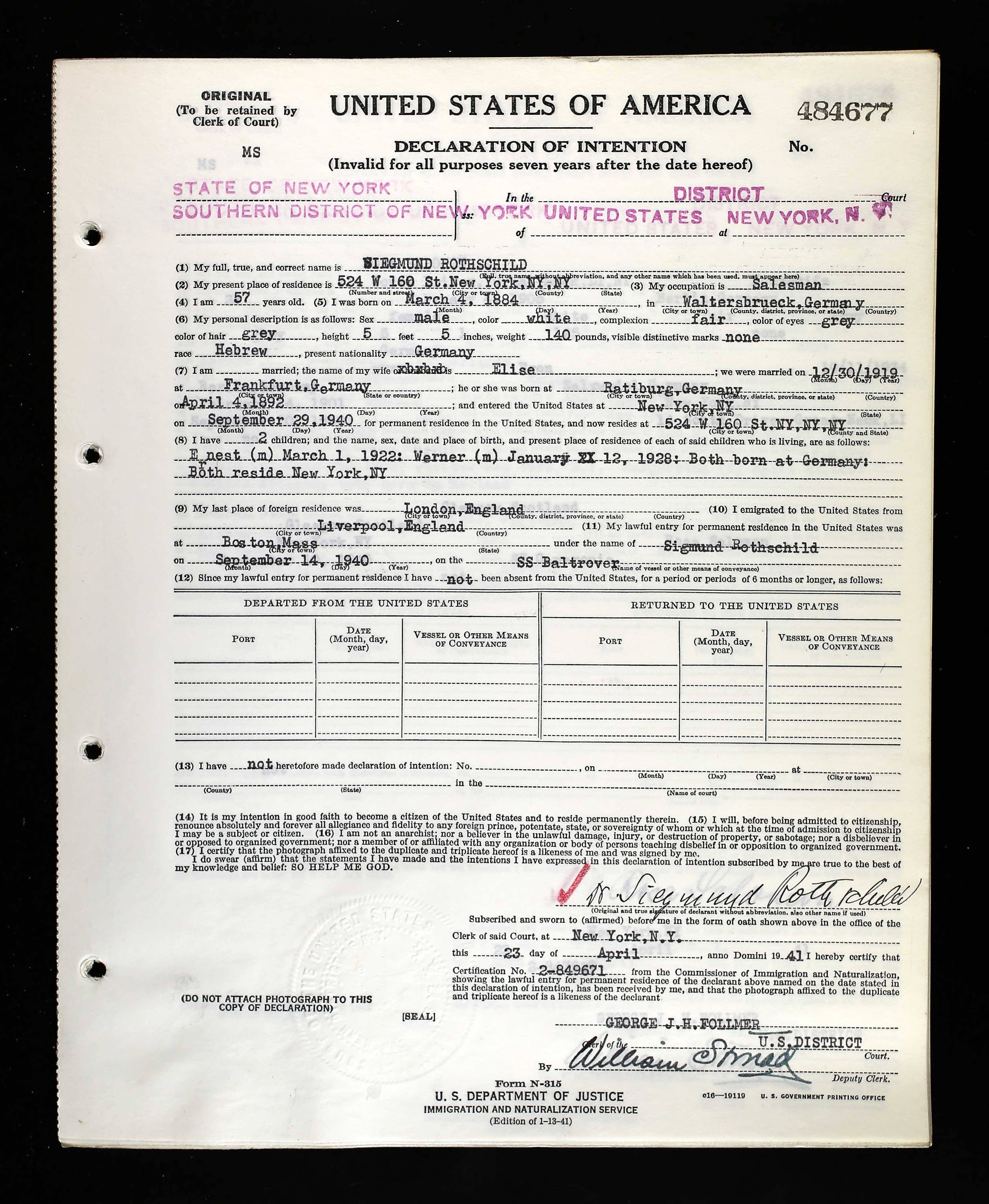
The family settled in New York City where on April 23, 1941, Siegmund filed a Declaration of Intention to become a United States citizen, now listing his occupation as a salesman.

Siegmund Rothschild declaration of intention, The National Archives at Philadelphia; Philadelphia, PA; NAI Title: Declarations of Intention For Citizenship, 1/19/1842 – 10/29/1959; NAI Number: 4713410; Record Group Title: Records of District Courts of the United States, 1685-2009; Record Group Number: 21, Description: (Roll 613) Declarations of Intention For Citizenship, 1842-1959 (No 484001-485000), Ancestry.com. New York, U.S., State and Federal Naturalization Records, 1794-1943

As the Projekt Judische Leben Frankfurt described their early life in America, “The new beginning in the USA was associated with challenging times for the couple. Neither of them could ever be active in the profession they had learned. Siegmund, with a doctorate in philosophy, first worked as a dishwasher. Until the end of his life he mostly kept his head above water with mini jobs.” Imagine how frustrating that must have been for Siegmund and Elise. And what  a waste of their knowledge and skills.

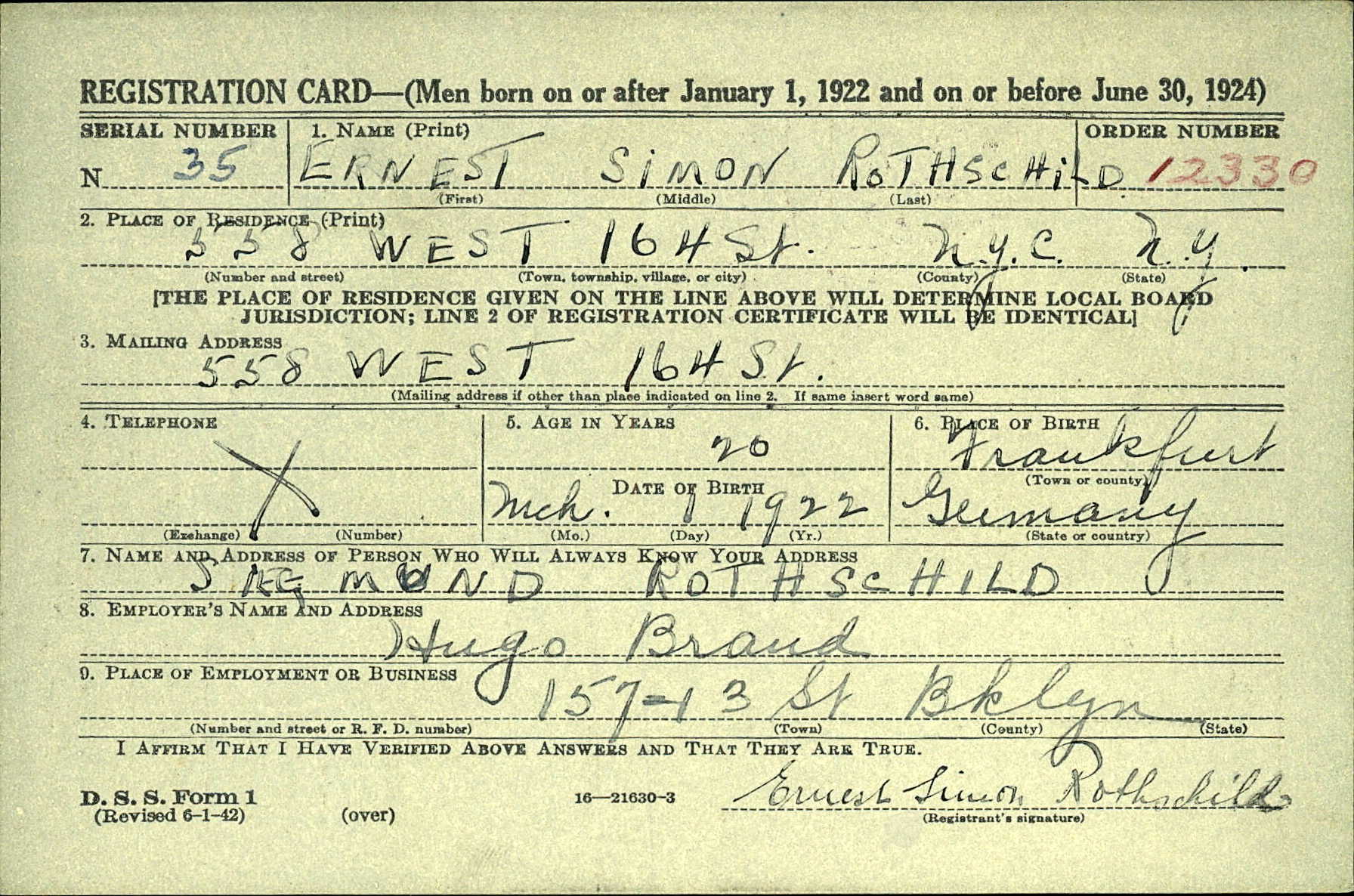
Both Siegmund and his older son Ernst, now using the more Anglicized Ernest, registered for the World War II draft; I haven’t found any evidence that either served in the military during the war. As their registration statements indicate, they were living at 558 West 164th Street in New York City in the Washington Heights neighborhood where so many Jewish refugees from Nazi Germany settled. Siegmund was working for the Gibraltar Manufacturing Company in Jersey City, New Jersey, and Ernest was working for Hugo Brand in Brooklyn.

Siegmund Rothschild, World War II draft registration, The National Archives At St. Louis; St. Louis, Missouri; Record Group Title: Records of the Selective Service System; Record Group Number: 147, Ancestry.com. U.S., World War II Draft Registration Cards, 1942

Ernest Rothschild, World War II draft registration, National Archives at St. Louis; St. Louis, Missouri; Wwii Draft Registration Cards For New York City, 10/16/1940 – 03/31/1947; Record Group: Records of the Selective Service System, 147, Ancestry.com. U.S., World War II Draft Cards Young Men, 1940-1947

Werner may have had the easiest transition to life in the United States. According to the report in the Projekt Judische Leben Frankfurt website, “Werner was 12 years old in 1940 and felt like an American from day one, he emphasized. In order to contribute to the family income, he took various jobs. Early in the morning before school at 5:30 a.m. he delivered bread rolls, delivered meat to the households or brought the clothes from the dry cleaners to the apartments, seven days a week, upstairs and downstairs. He immediately felt like an American in his school too. He studied with 35% Afro-Americans and classmates of different nationalities. Something like normal came back to life.”

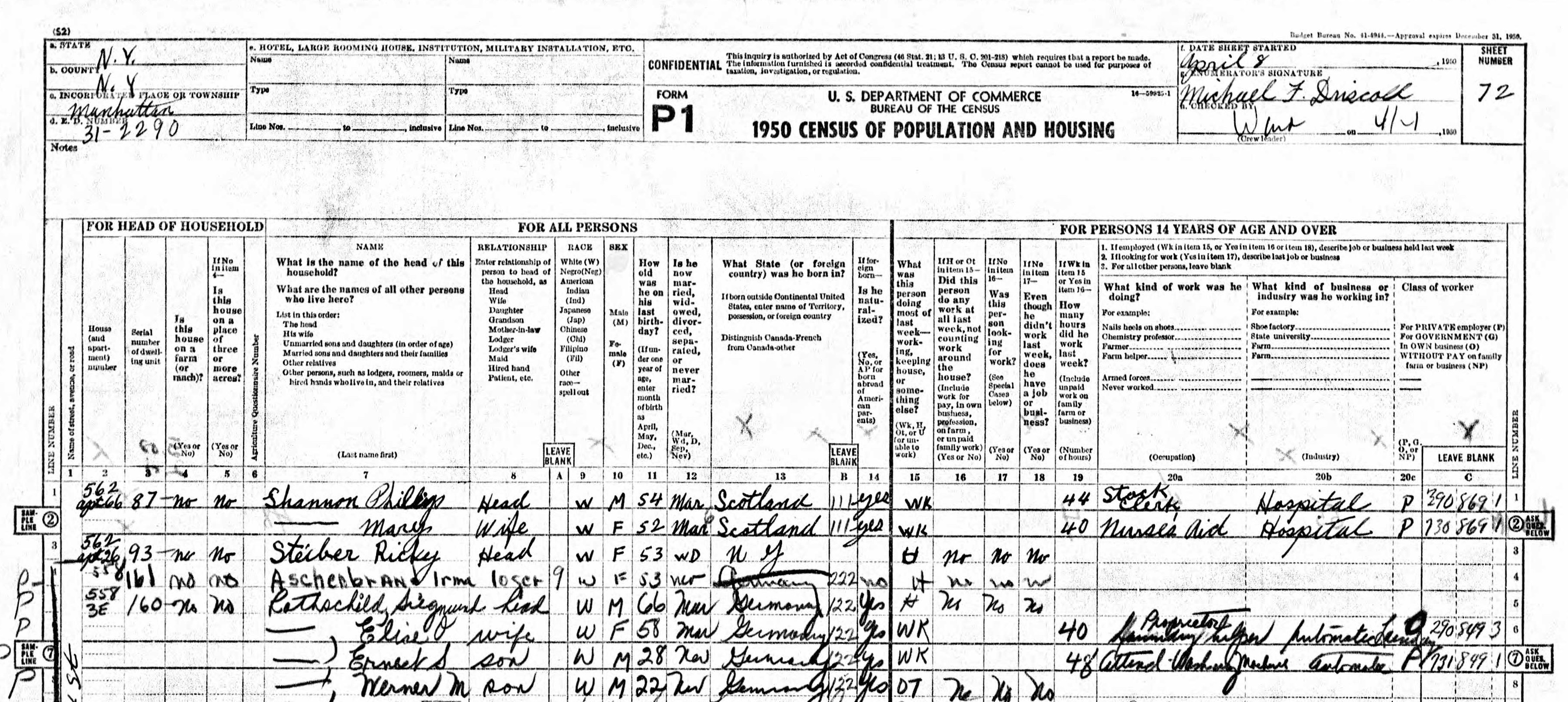
The 1950 US census shows Siegmund without a job, but both Ernst, now 28, and Werner, now 22, were working. Ernst owned a laundry where both young men were working. According to the Projekt Judische Leben Frankfurt website, however, that laundry did not provide much income for the family until a few years later.

Siegmund Rothschild, 1950 US census, National Archives at Washington, DC; Washington, D.C.; Seventeenth Census of the United States, 1950; Year: 1950; Census Place: New York, New York, New York; Roll: 3572; Page: 72; Enumeration District: 31-2290, Ancestry.com. 1950 United States Federal Census

Here is a photograph of Elise and Ernest in their laundromat:

Elise Bloch Rothschild and her son Ernest in their laundromat. Courtesy of the family

Sadly, Siegmund died on October 2, 1952, at the age of sixty-eight.2 According to the Projekt Judische Leben Frankfurt website, he suffered a heart attack after receiving an injection from a contaminated needle.

Ernest Rothschild married Margot Ochs in New York in 1954.3 Margot was born in Duren, Germany, on July 29, 1923,and like her husband Ernest, she had first escaped from Germany to England before immigrating to the US on December 27, 1939.4 Ernest and Margot had one child; he was given the middle name Siegmund presumably in memory of Ernest’s father Siegmund Rothschild.

Werner Rothschild married Audrie Max on December 21, 1958.5 Audrie was born in Allentown, Pennsylvania, on September 18, 1929, to Isadore Max and Minnie Vinkelstein.6 According to the Projekt Judische Leben Frankfurt website, Werner and Audrie met while vacationing in Florida. Werner and Audrie have three children.

The engagement announcement for Audrie and Werner in the Allentown newspaper, The Morning Call, on October 5, 1958 (p. 25) reported that Werner was a graduate of City College of New York and had received a master’s degree in school administration from Columbia University. He was working at that time as a teacher in Levittown, New York. How interesting that Werner pursued the teaching profession, the profession both his parents had lost as a result of Nazi persecution.

Ernest and Werner’s mother Elise Block Rothschild lived to 102, dying on May 2, 1991.7 As reported on the Projekt Judische Leben Frankfurt website, “Elise outlived her husband by 42 years and died very old at 102. She led a very independent life; it wasn’t until the age of 90, after a hip fracture, that she was admitted to the Margaret Tietz Nursing Home. … Elise worked in the family laundromat, taught English to German immigrants, and volunteered at the Young Men’s Hebrew Association, YMHA, library. She fought for compensation for many years and got a small pension from the 1950s onwards. Of course, this amount could not even come close to compensating for the enormous financial losses that had arisen as a result of the Nazi era and emigration and that shaped her life from then on.”

Ernest Rothschild died on December 11, 2011; he was 89 years old.8 His younger brother Werner is living, and I am hoping to be in touch with him soon. His first cousin Hal and Hal’s daughter Sandy and niece Judy are trying to connect me with Werner.

Given what happened to so many of Siegmund’s siblings and their families, Siegmund and his wife and children might by some be considered lucky because they survived. And yes, in some ways that is true. But look at how they also suffered because of Nazi persecution. Both Siegmund and his wife Elise lost their chosen careers as teachers; Ernest never became a dentist. These were psychological losses as well as financial losses. They also lost their homeland and most of their close family members. No one who was touched by Nazi persecution should ever be considered lucky.

For more information and photographs of the family, please see the Projekt Judische Leben Frankfurt website.


  1. Elise and Ernst Rothschild, The National Archives in Washington, DC; Washington, DC, USA; Manifests of Passengers Arriving At St. Albans, Vt, District Through Canadian Pacific and Atlantic Ports, 1895-1954; NAI: 4492490; Record Group: Records of the Immigration and Naturalization Service, 1787 – 2004; Record Group Number: 85; Series Number: M1464; Roll Number: 611, Ancestry.com. U.S., Border Crossings from Canada to U.S., 1895-1960; Elise and Ernst Rothschild, The National Archives at Washington, D.C.; Washington, D.C.; Series Title: Index to Alien Arrivals at Canadian Atlantic and Pacific Seaports; NAI Number: 3000080; Record Group Title: Records of the Immigration and Naturalization Service, 1787-2004; Record Group Number: 85, Ancestry.com. U.S., Index to Alien Arrivals at Canadian Atlantic and Pacific Seaports, 1904-1944 
  2. Siegmund Rothschild, Age 66, Birth Date abt 1886, Death Date 2 Oct 1952
    Death Place Manhattan, New York, New York, USA, Certificate Number 20929, Ancestry.com. New York, New York, U.S., Death Index, 1949-1965 
  3. Ernest Rothschild and Margot Ochs, Marriage License, Ernest Rothschild
    Gender Male, Marriage License Date 1954, Marriage License Place Manhattan, New York City, New York, USA, Spouse Margot Ochs, License Number 7121, New York City Municipal Archives; New York, New York; Borough: Manhattan, Ancestry.com. New York, New York, U.S., Marriage License Indexes, 1907-2018 
  4. Margot Ochs, Declaration of Intention, Margot Ochs, Gender Female, Race
    White, Declaration Age 18 Record Type Naturalization Declaration, Birth Date
    29 Jul 1923, Birth Place Duren, Germany, Departure Place Southampton, England
    Arrival Date, 27 Dec 1939, Arrival Place New York, New York, USA Declaration Date
    24 Apr 1942, Declaration Place New York, Court U.S. District Court for the Southern District of New York, Declaration Number 520250, Box Number 395, The National Archives at Philadelphia; Philadelphia, PA; NAI Title: Declarations of Intention For Citizenship, 1/19/1842 – 10/29/1959; NAI Number: 4713410; Record Group Title: Records of District Courts of the United States, 1685-2009; Record Group Number: 21, Ancestry.com. New York, U.S., State and Federal Naturalization Records, 1794-1943 
  5. Werner Rothschild, Gender Male, Residence Date Abt 1958, Residence Place New York City, Marriage Date 21 Dec 1958, Spouse Audrie Max, The Morning Call; Publication Date: 21/ Dec/ 1958; Publication Place: Allentown, Pennsylvania, USA; URL: https://www.newspapers.com/image/275138958/?article=8c58a828-c766-4dff-8c86-8cceadb65bd&focus=0.38331795,0.5598585,0.4987282,0.6864521&xid=3398
    Ancestry.com. U.S., Newspapers.com™ Marriage Index, 1800s-current 
  6. Audrie M Rothschild, Birth Date 18 Sep 1929, Residence Date 1993, Address 14 Joyce Ln, Residence Woodbury, NY, Postal Code 11797-2115, Ancestry.com. U.S., Public Records Index, 1950-1993, Volume 1; “Rothschild,” South Florida Sun Sentinel (Fort Lauderdale, FL), September 7, 2016, p. B6; Minnie Vinkelstein and Isadore Max marriage announcement, The Times-Tribune, Scranton, PA, November 18, 1919, p. 18; Isadore Max and family, 1930 US census, Year: 1930; Census Place: Allentown, Lehigh, Pennsylvania; Page: 12A; Enumeration District: 0038; FHL microfilm: 2341798, Ancestry.com. 1930 United States Federal Census 
  7. Elise O Rothschild, Birth Date 4 Apr 1892, Death Date 2 May 1994, Claim Date 6 Apr 1957, SSN 080181441, Ancestry.com. U.S., Social Security Applications and Claims Index, 1936-2007 
  8. Ernest Rothschild and Margot Ochs Rothschild gravestones at Find a Grave, database and images (https://www.findagrave.com/memorial/245622521/ernest-rothschild: accessed April 7, 2025), memorial page for Ernest Rothschild (1922–2011), Find a Grave Memorial ID 245622521, citing Beth-El Cemetery, Paramus, Bergen County, New Jersey, USA; Maintained by dalya d (contributor 46972551). 

Siegmund Rothschild: Escape from Nazi Germany

It’s been a few weeks since I wrote about the family of Gelle Blumenfeld Rothschild, given the breaks for some updates, Passover, and our trip to England. Today I return to Gelle’s story, specifically the story of her son Gerson Rothschild. In my last post about Gerson, we saw he died in 1930 and was survived by his wife Fanny Kugelmann and eight children.

In my next series of posts, I will write about the eight surviving children of my cousin Gerson Rothschild and his wife Fanny Kugelmann. Only three of those children survived the Holocaust, making this task a very painful one. But I can start with one of those three who survived, the oldest child of Gerson and Fanny, their son Siegmund.

As we saw, Siegmund married Elise Olga Block on December 22, 1919, in Frankfurt, and they had two sons, Ernst, born March 1, 1922, and Werner, born January 12, 1928, both in Frankfurt. There is a wonderful resource about this family on the Projekt Judische Leben Frankfurt am Main website. Based in part on information obtained during a visit to Frankfurt by Werner Rothschild in 2019, the website details the family’s life before, during, and after the Nazi era. Much of the information in this post came from that website.

According to that website, Siegmund Rothschild moved to Frankfurt in 1911 and was known as “a valued historian with good contacts abroad and president of the liberal main synagogue in Frankfurt.”  He taught at Philanthropin, a free Reform Jewish school founded in 1804 in Frankfurt. An article from the Encyclopedia of Jewish History and Culture abstracted here states that the school was “one of the most significant German Jewish Reform projects in the first half of the 19th century.” Siegmund’s wife Elise also taught at Philanthropin on and off between 1913 and 1939.

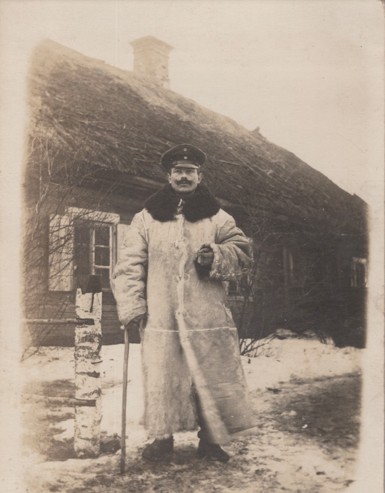
UPDATE: I learned from Siegmund’s grandson Alex that Siegmund fought for Germany during World War I. Here is a photo of him from that time.

Siegmund Rothschild c. 1915
Courtesy of the family

Siegmund and his family were living a good life in Frankfurt, identifying more as German than Jewish, until Hitler came to power in 1933. Siegmund’s son Werner recalled that one friend joined Hitler Youth and stopped talking to him. Another time while visiting family in Borken, he and his cousins were tormented by Hitler Youth.

Here is the family in January 1938:

Siegmund, Werner, Ernst, and Elise (Bloch) Rothschild, January 1938.

As for Ernst, the older son, according to the Projekt Judische Leben Frankfurt website, he had always dreamed of being a dentist, but under Nazi persecution he was not allowed to pursue the studies to reach that goal. Instead he ended up working as an apprentice in a leather dressing business after leaving school in 1937. But when that business was Aryanized in 1938, Ernst lost his job.

The family’s situation became even more dire in November 1938 with Kristallnacht.  As reported on the Projekt Judische Leben website, “For Werner… the worst day of his young life was the so-called “Reichskristallnacht.” He saw furniture fly out of the windows and buildings burn. Immediately afterwards, his father was picked up by the Gestapo. They gave [Siegmund] ten minutes to pack his things, then they deported him to Buchenwald. Fortunately, [Ernst] was not at home or he would have been arrested too.” Elise did everything she could to get Siegmund released; he was released in December 1938 with orders to leave Germany quickly.

The Projekt Judische Leben Frankfurt website continued, “Siegmund was a broken man when he came home and it took weeks and intensive care from his wife before he regained his strength. As soon as his health permitted, he traveled to England with his son Ernst, with ten Marks in his pocket. More was not allowed per person. The only contact there was with two of Elise’s brothers who had emigrated from Ratibor in 1935 and opened a dental practice in London.”

Meanwhile, Elise and Werner remained in Frankfurt until Elise arranged in 1939 for Werner to leave Germany as part of the Kindertransport program. Werner took the train alone to Hamburg and was forced to strip naked so that the Gestapo could check to be sure he wasn’t taking anything prohibited with him. In Hamburg he took a ship to England, where he  was placed in a youth hostel.1

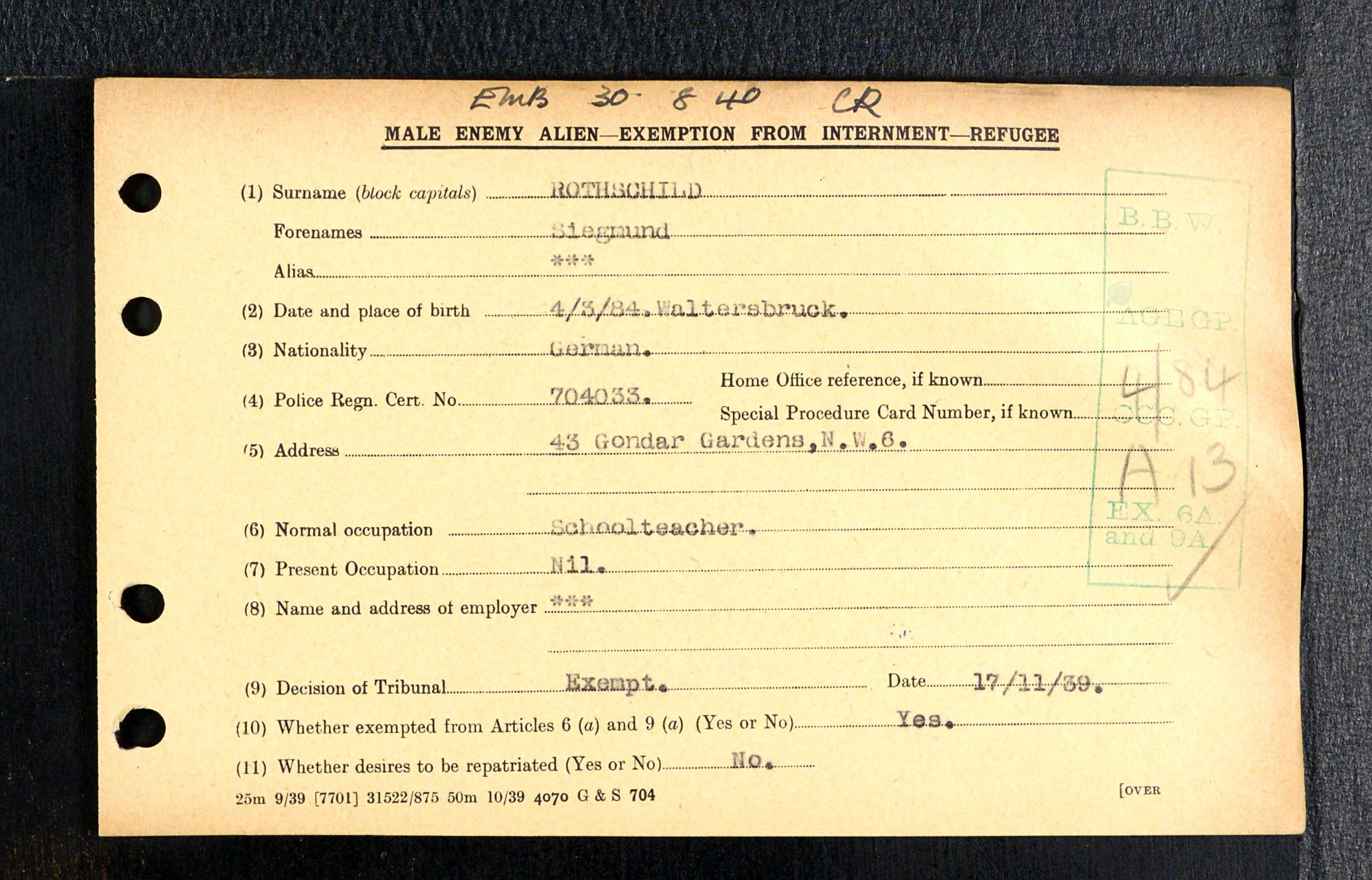
Once Elise also was able to escape to England, the family was reunited in London and Werner was able to attend school.   The 1939 England & Wales Register shows Siegmund and Elise living in London.2 But after the war started against Germany in September 1939, Ernst was interned as an enemy alien; Siegmund and Elise, however, were exempted from internship. Werner was just a child.

Siegmund Rothschild, The National Archives; Kew, London, England; HO 396 WW2 Internees (Aliens) Index Cards 1939-1947; Reference Number: HO 396/238, Piece Number Description: 238: Dead Index (Wives of Germans Etc) 1941-1947: Rosenber-Schitz, Ancestry.com. UK, World War II Alien Internees, 1939-1945

Elise Rothschild, The National Archives; Kew, London, England; HO 396 WW2 Internees (Aliens) Index Cards 1939-1947; Reference Number: HO 396/238, Piece Number Description: 238: Dead Index (Wives of Germans Etc) 1941-1947: Rosenber-Schitz, Ancestry.com. UK, World War II Alien Internees, 1939-1945

Ernst Rothschild, The National Archives; Kew, London, England; HO 396 WW2 Internees (Aliens) Index Cards 1939-1947; Reference Number: HO 396/193, Ancestry.com. UK, World War II Alien Internees, 1939-1945

Ernst was eventually released, and the family was finally able to immigrate to the United States in the summer of 1940, as we will see. Then they had to start their lives all over again. More on their life in the US in the next post.


  1. Werner Rothschild, Gender Male, Record Type Refugee List, Birth Date 12 Jan 1928, Residence Place Frankfurt, Document Date 22 Mär 1939 (22 Mar 1939)
    Permit Number 3813, United States Holocaust Memorial Museum; Washington, D.C.; Series: Selected Records Relating to Kindertransports; Record Group: RG-59.075; File Number: mh55-704.00000088, Ancestry.com. UK, Selected Records Relating to Kindertransport, 1938-1939 (USHMM) 
  2. Siegmund Rothschild, The National Archives; Kew, London, England; 1939 Register; Reference: RG 101/244E, Description Enumeration District: Akde, Ancestry.com. 1939 England and Wales Register 

Two Updates: Why Didn’t Mathilde Rothschild Leave Germany With Her Family? And How did Albert Alexander Meet His Wife?

Before I continue the stories of the children of Gerson Rothschild and Fanny Kugelmann, I have three updates to earlier posts that I’d like to share. All three are possible because other researchers and family members found this blog and contacted me. These are true gifts from the genealogy village. I am so grateful.

Some of you may recall that back in May 2024, I wrote about my relative Hirsch “Harry” Rothschild and his three children, all of whom escaped from Nazi Germany to the United States before World War II started. But unfortunately Harry’s wife Mathilde did not escape with her family and was ultimately murdered by the Nazis.

In my blog post about this family I wondered why Mathilde had not come with Harry and her children when they left Germany. Was she ill, I speculated? I had no answers.

Now I have more information about the family of Harry Rothschild. A man named Fredo Behrens recently contacted me after seeing my blog post. He lives in Oldenburg, Germany, and as he told me in his email, he worked for the “Nordwestdeutsches Museum für Industriekultur” in Delmenhorst for several years 25 years ago, where his area of responsibility was museum education, exhibitions and a regional “Topography of the Nazi Era.” He also is on the board of the “Friends and Supporters of the Jewish Community of Delmenhorst,” and heads the Delmenhorst City History Working Group. More specifically, he has done research into the history of the Jewish people of Delmenhorst, including the Rothschild family.1

Fredo told me about a monograph by Dr. Enno Meyer from 1985 entitled “Die Geschichte der Delmenhorster Juden 1695-1945”, or the History of the Jews of Delmenhorst 1695-1945. Dr. Meyer was the head of “Gesellschaft für christlich-jüdische Zusammenarbeit” (Society for Christian-Jewish Cooperation) for at least 30 years, according to Fredo. Fredo sent me both a copy of Dr. Meyer’s monograph (in German) and also a copy of an article that Fredo himself wrote about the Jews of Delmenhorst that excerpts parts of Meyer’s monograph and adds to it.2 I was able to use DeepL to translate Fredo’s work and learn more about the Rothschild family’s life in Delmenhorst.

According to the works of Meyer and Behrens, Dr. Harry Rothschild came to Delmenhorst from Hesse in 1914 and was the first Jewish doctor to practice in that town. By 1925, he was one of the top two taxpayers in the town. Harry was not active in the organized Jewish community, however, until after the Nazis came to power.3 According to Fredo’s research, the growing antisemitism in the early 1930s prompted Harry to become more involved. By 1933 he was chairman of the local Zionist organization and on the Jewish community board.

When the Nuremberg Laws were adopted and Jews were no longer allowed to employ Aryans, Harry and his Aryan cleaning woman petitioned the mayor for permission to continue their employment relationship, but their petition was rejected.4

Fredo kindly shared with me this photograph showing the street where the Rothschild family lived in Delmenhorst in 1930. The arrow points to where Harry Rothschild practiced medicine and lived before he left Germany in 1939.

Rothschild house and office in Delmenhorst, 1930, courtesy of Fredo Behrens: Jüdisches Leben in der Langen Straße nach 1933. In: Die Lange Straße in Delmenhorst : Biographie einer alten Straße ; Begleitveröffentlichung zur Ausstellung in den Museen der Stadt Delmenhorst auf der Nordwolle vom 24.6. – 2.9.2001. Hg. vom Stadtmuseum Delmenhorst. Isensee, Oldenburg 2001, p. 60

Then on October 10, 1937, Harry and a number of other Jewish residents of Delmenhorst were arrested by the Gestapo without warning or warrants. According to the observations of a fellow prisoner who became Harry’s cellmate, Harry was particularly humiliated by this experience and was called a “dirty stinking Jew” by one of the Gestapo agents. Harry and his cellmate were in solitary confinement, and Harry remained in prison until the spring of 1938. Harry’s condition had deteriorated greatly during his imprisonment.5

On November 10, 1938 in the aftermath of Kristallnacht, Harry was again arrested and was one of fourteen Jewish men who were arrested and sent to the concentration camp at Sachsenhausen.6

By that time all three of Harry and Mathilde’s children had left Germany for the United States. Harry left in the spring of 1939 and went to Cuba, and he was finally able to join his children in the US in December 1939.

But as we know, Mathilde did not come with him, and she was eventually deported to Minsk and died there. Dr. Meyer shed some light on this in his monograph, also quoted in Fredo Behren’s work. On page 85 of his history of the Delmenhorst Jews, Enno Meyer wrote that Mathilde had stayed behind to try and sell the family house; then when the war started in September 1939, she was trapped in Germany and could not leave.7

If only Mathilde had left with Harry and had not tried to sell the family’s home, this family’s story would have had a much happier ending. There may be more to this story that we will never know, but if this account is accurate, it shows how one decision affected an entire family’s fate during the Holocaust.

I want to thank Fredo Behrens again for providing me with the information and the photograph used in this post and for the work he does to preserve the Jewish history of Delmenhorst.


The second update came from two newly found cousins—my fifth cousin Charles Alexander and his daughter Kate. They also found me through my blog. Charles is the grandson of Theresa Rothschild Alexander, and I wrote about that family here. Check out the update there and learn how Charles’ parents, Albert Alexander and Mary Jane Deiches, actually met. My original speculation proved to be incorrect.

Also, I’ve added to that post a photo Charles gave me from his father’s yearbook. I am also adding it here since I could not place it properly in the original post.


Finally, the third update will have to wait until next week.


  1. Email from Fredo Behrens, March 25, 2025. 
  2. Fredo Behrens, “Jüdisches Leben in der Langen Straße nach 1933. In: Die Lange Straße in Delmenhorst : Biographie einer alten Straße; Begleitveröffentlichung zur Ausstellung in den Museen der Stadt Delmenhorst auf der Nordwolle vom 24.6. – 2.9.2001. Hg. vom Stadtmuseum Delmenhorst. Isensee, Oldenburg 2001. 
  3. Enno Meyer, “Die Geschichte der Delmenhorster Juden 1695-1945,” (1985), pp. 48, 55, 60, as cited in Behrens,  Note 2, supra. 
  4. Behrens, Note 2, supra, citing a letter dated November 14, 1936, response from the mayor dated December 3, 1936. Exhibition “Delmenhorst in National Socialism.   based on a letter dated September 24, 1955, affidavit from Wilhelm Schroers for Dr. Rothschild. Exhibition “Delmenhorst under National Socialism.” 
  5. Letter dated September 24, 1955, affidavit from Wilhelm Schroers for Dr. Rothschild. Exhibition “Delmenhorst under National Socialism.” as quoted in Behrens, Note 2, supra. 
  6. Behrens, Note 2, supra. 
  7. Enno Meyer, “Die Geschichte der Delmenhorster Juden 1695-1945,” (1985), p. 85, as cited in Behrens, Note 2, supra. 

Gerson and Fanny Rothschild’s Children: From A Large Family to Small Families

Gerson Rothschild’s wife Fanny gave birth to eleven children between 1883 and 1901, but three of those babies did not survive. Two died at birth, and one died at seven weeks. That left eight surviving children: Siegmund (1884), Katchen (1885), Max (1886), Auguste (1888), Jenny (1890), Clara (1891), Rosa (1893), and Amalie (1901). Two sons, six daughters.

But from such a large family, only one of those eight surviving children would have more than two children, and they all married at a later age than was typical of those times. They almost all married in their thirties. It made me wonder why these siblings delayed marriage and had so few children after coming from such a large family. Were they so close to each other that they didn’t want to leave home? Were the older ones helping to care for the younger ones? Did the fact that three babies did not survive make them wary of having more that one or two children? Or was it simply a matter of economics or the trend in the 1920s in Germany? I don’t know, but here are the facts.

Siegmund, the first born, was 35 when he married Elise Olga Block on December 22, 1919, in Frankfurt. Elise, the daughter of Max Block and Fanny Schaefer, was born in Ratiburg, Germany, on April 4, 1892.

Siegmund Rothschild and Elsa Block marriage record, Hessisches Hauptstaatsarchiv; Wiesbaden, Deutschland; Bestand: 903, Year Range: 1919, Ancestry.com. Hesse, Germany, Marriages, 1849-1930

Siegmund and Elise had two sons: Ernst, born March 1, 1922,1 and Werner, who is still living as far as I’ve been able to determine. Both were born in Frankfurt.

Katchen Rothschild was 28 when she married Adolf Hirshberg on April 23, 1914, in Zimmersrode. Adolf was born July 6, 1889, in Bad Zwesten, Germany, to Levi Hirshberg and Braunchen Levi.

Katchen Rothschild and Adolf Hirschberg marriage record, Hessisches Hauptstaatsarchiv; Wiesbaden, Deutschland; Bestand: 920; Laufende Nummer: 9576, Year Range: 1914, Ancestry.com. Hesse, Germany, Marriages, 1849-1930

Katchen and Adolf had one child, a son Ludwig, born in Kassel, Germany, on February 1, 1920.2

Max Rothschild was 32 when he married Johanna Katz in Zimmersrode on October 19, 1919. Johanna was the daughter of Jacob Katz and Karoline Rosenblatt, and she was born Neuenhain, Germany, on May 1, 1892.

Max Rothschild and Johanna Katz marriage record, Hessisches Hauptstaatsarchiv; Wiesbaden, Deutschland; Bestand: 920; Laufende Nummer: 9581, Year Range: 1919-1920, Ancestry.com. Hesse, Germany, Marriages, 1849-1930

Max and Johanna had two sons: Erich, supposedly born on May 13, 1921, and Richard, supposedly born October 24, 1922, both in Zimmersrode.3

Auguste Rothschild was thirty when she married Wolf Feldheim on March 18, 1919, in Zimmersrode. Wolf was born April 4, 1875 in Graudenz, then part of Prussia, now part of Poland. His parents were Aron Feldheim and Lena London. Wolf had been previously married and had four young children when he married Auguste.

Auguste Rothschild and Wolf Feldheim marriage record, Hessisches Hauptstaatsarchiv; Wiesbaden, Deutschland; Bestand: 920; Laufende Nummer: 9581, Year Range: 1919-1920, Ancestry.com. Hesse, Germany, Marriages, 1849-1930

Auguste and Wolf had one son, Bruno, according to several trees, but I am still looking for a record that ties Bruno to Auguste and Wolf. I did find records for a Bruno Feldheim born in Fulda, Germany, on November 12, 1921, but those records do not identify Bruno as the son of Auguste and Wolf.4

Jenny Rothschild was thirty when she married Salomon Abraham on November 11, 1920, in Zimmersrode. Salomon was born in Durboslar, Germany, on August 14, 1891. I am still looking for a record to confirm the names of his parents.

Jeanette Rothschild and Salomon Abraham marriage record, Hessisches Hauptstaatsarchiv; Wiesbaden, Deutschland; Bestand: 920; Laufende Nummer: 9582, Year Range: 1920-1921, Ancestry.com. Hesse, Germany, Marriages, 1849-1930

Jenny and Salomon had two children, Walter, born September 13, 1921, in Zimmersrode5 and Herta, born August 26, 1928, born in Kassel.6

Clara Rothschild was thirty when she married Moritz Katz in Zimmersrode on November 1, 1921. Moritz was born on November 4, 1894, in Neuenhain, Germany. He was the son of Jakob Katz and Karoline Rosenblatt and the younger brother of Johanna Katz, who had married Clara’s brother Max.

Clara Rothschild and Moritz Katz marriage record, Hessisches Hauptstaatsarchiv; Wiesbaden, Deutschland; Bestand: 920; Laufende Nummer: 9582 Description Year Range: 1920-1921 Source Information Ancestry.com. Hesse, Germany, Marriages, 1849-1930

Clara and Moritz had three children: Otto, born September 5, 1922, in Neuenhain;7 Helmut (later Harold) born in Neuenhain in 1924,8 and Ilse, born on May 19, 1928, in Kassel, Germany.9 Since Harold may still be living, I will not report on his exact birth date.

The last two children of Gerson Rothschild and Fanny Kugelmann, their daughters Rosa and Amalie, married after 1930 and had children after Hitler came to power.  I will write about their husbands and children in a subsequent post.

Isn’t it interesting how late these eight children married and how few children they had after being from such a large family? I’d love to know more about their decisions, but alas, all I have is speculation.

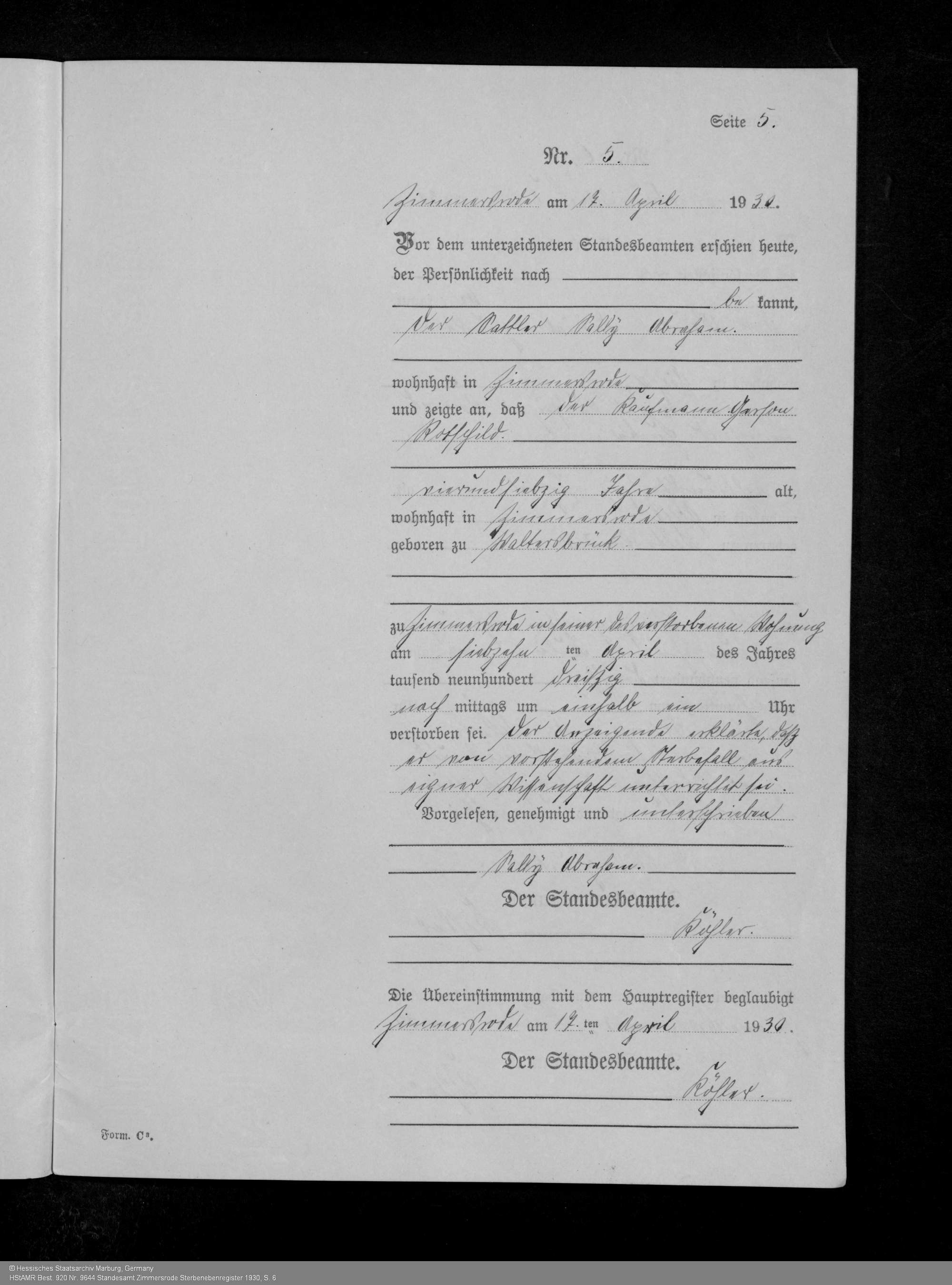
Their father Gerson Rothschild passed away on April 17, 1930, at the age of 74.

Gerson Rothschild death record, LAGIS Hessen Archives, HStAMR Best. 920 Nr. 9644 Standesamt Zimmersrode Sterbenebenregister 1930, S. 6

Gerson had lived to see all eight of his surviving children reach adulthood, and before he died, he saw the six oldest of those children marry and have children of their own. As of his death, Gerson had ten grandchildren. His daughter Rosa would later have one child and his daughter Amalie two, meaning that Gerson and Fanny at one time had thirteen grandchildren from their eight surviving children.

Gerson may have been blessed to die before Hitler came to power and before he would know what would happen to so many of those children and grandchildren.


  1. Ernest Simon Rothschild, Race White, Age 23, Birth Date 1 Mar 1922, Birth Place Frankfort, Germany, Registration Date 30 Jun 1945, Registration Place New York City, New York, Employer Hugo Brand, Next of Kin Siegmund Rothschild,  National Archives at St. Louis; St. Louis, Missouri; Wwii Draft Registration Cards For New York City, 10/16/1940 – 03/31/1947; Record Group: Records of the Selective Service System, 147, Ancestry.com. U.S., World War II Draft Cards Young Men, 1940-1947 
  2. Ludwig Hirschberg J., Gender männlich (Male), Nationality Deutsch Juden
    Record Type Miscellaneous, Birth Date 01 Feb 1920 (1 Feb 1920), Birth Place Kassel
    Residence Place Kassel, Kassel, Notes Lists of judicial and official files concerning foreigners and German Jews, Reference Number 02010101 oS, Document ID 70443311, Arolsen Archives, Digital Archive; Bad Arolsen, Germany; Lists of Persecutees 2.1.1.1, Ancestry.com. Free Access: Europe, Registration of Foreigners and German Persecutees, 1939-1947 
  3. I could not find any actual birth records for Erich Rothschild or Richard Rothschild. There are no online birth records for Zimmersrode for 1921 or 1922. These dates, however, appear on numerous trees on Ancestry. I do not know how reliable that specific information is. I am still searching for birth records for these two sons, but I do have other records for them that place their birthdates as approximately in 1921 and 1922. I will discuss those other records in a later post. In addition, one tree included a third son, Fritz Simon Rothschild, but I have no records that support the existence of that son. 
  4. Bruno Feldheim, Palestine Immigration file, found at the Israel State Archives website at https://search.archives.gov.il/ 
  5. Walter Abraham, Birth Date 13 Sept 1921, Birth Place Zimmerrode, Residence Street Address 26 Johann-Georg-Strasse, Residence Place Berlin, [Halensee]
    Occupation Bãcker [Baker], Description Deportationen, URL https://collections.arolsen-archives.org/de/document/127213170 , Arolsen Archives; Bad Arolsen, Germany; Record Group 1 Incarceration Documents; Reference: 1.2.1.1, Ancestry.com. Germany, Incarceration Documents, 1933-1945 
  6. Herta Abraham, Birth Date 26 Aug 1926, Birth Place Kassel, Residence Kassel
    Camp Riga/Stutthof, Ancestry.com. Poland, German Jews at Stutthof Concentration Camp, 1940-1945 
  7. Otto Katz, Race White, Age 19, Birth Date 5 Sep 1922, Birth Place Neuenhaus [sic], Germany, Registration Date, 15 Feb 1942, Registration Place, New York City, New York, Employer Kenneth Miller, Next of Kin Clara Katz, National Archives at St. Louis; St. Louis, Missouri; Wwii Draft Registration Cards For New York City, 10/16/1940 – 03/31/1947; Record Group: Records of the Selective Service System, 147, Name Range: Katz, Bernard-Katz, Sam, Ancestry.com. U.S., World War II Draft Cards Young Men, 1940-1947 
  8. Helmut Katz [Harold Katz] Race White Age 18 Birth Date 1924, Birth Place Neuenhain, Germany, Registration Date 19 Dec 1942, Registration Place New York City, New York, Employer Student, Next of Kin Clara Katz, National Archives at St. Louis; St. Louis, Missouri; Wwii Draft Registration Cards For New York City, 10/16/1940 – 03/31/1947; Record Group: Records of the Selective Service System, 147, Ancestry.com. U.S., World War II Draft Cards Young Men, 1940-1947 
  9. This date came from Dennis Aron’s Ancestry tree, and Dennis obtained his information from Ilse’s brother, Harold Katz. I have no other source for this, but given that it came from her brother, for now I assume it is accurate. 

Eleven Babies in Eighteen Years

My cousin Gerson Rothschild’s wife Fanny Kugelmann gave birth to eleven children, starting in 1883 with the last one born eighteen years later in 1901. It is impossible for me to imagine what that was like.

Unfortunately, the first baby, a girl, died at birth (or was stillborn) on March 28, 1883:

Stillborn female child, Hessisches Hauptstaatsarchiv; Wiesbaden, Deutschland; Personenstandsregister Sterberegister; Bestand: 8460; Laufende Nummer: 920
Year Range: 1883, Ancestry.com. Hesse, Germany, Deaths, 1851-1958

The note on the death/birth record was translated by my cousin Richard Bloomfield and reads:

Mrs. Fanni Rothschild née Kugelmann of Jewish religion in the apartment of her husband, the merchant Gerson Rothschild of Jewish religion at Waltersbrück in house no. 2 on the eighth and twentieth of March this year in the afternoon at five o’clock birthed a child of female sex and that this child died in childbirth. Mrs. Waßmuth explained that she had been present at the confinement of Mrs. Fanni Rothschild.

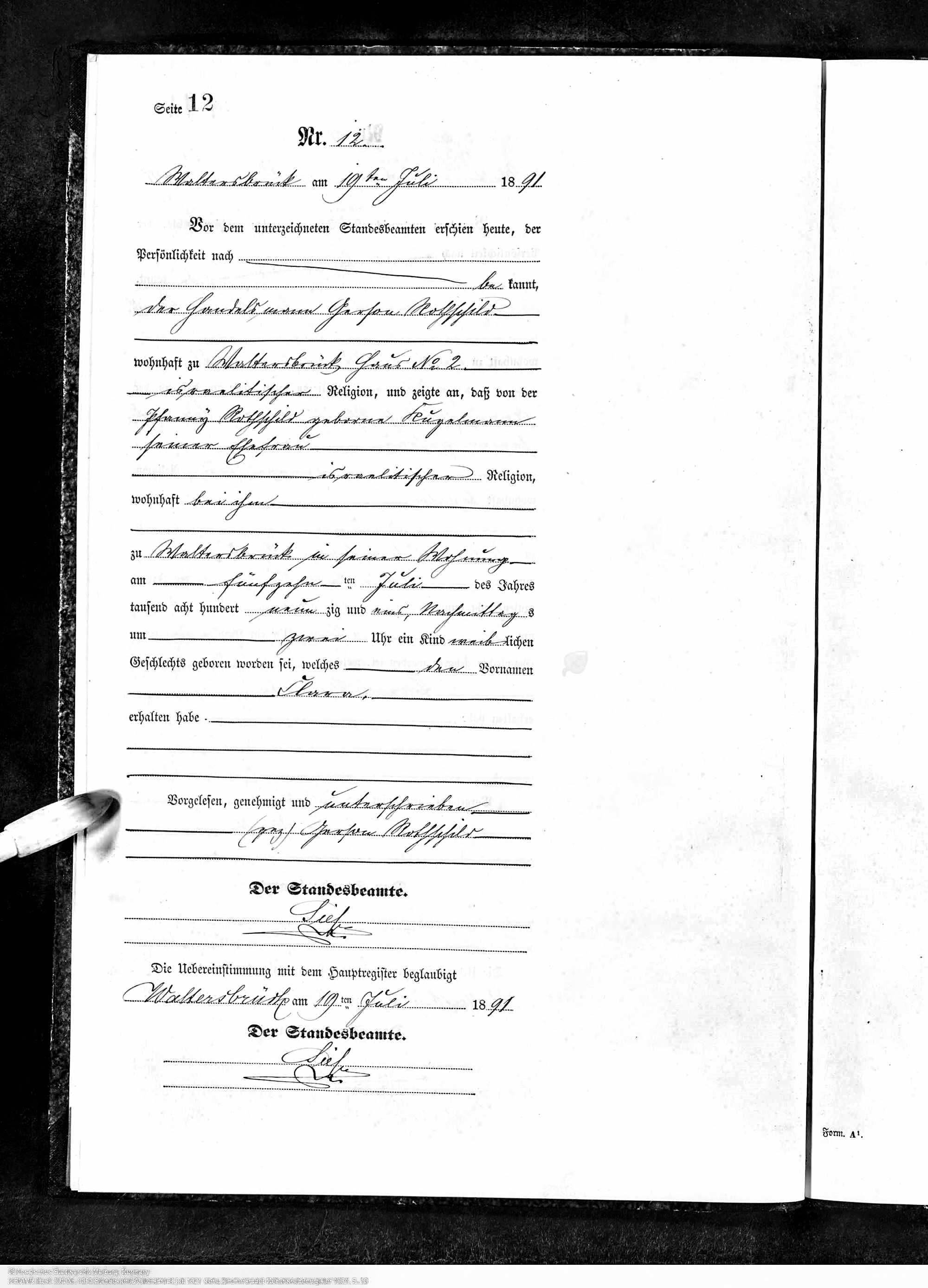
A second child, Siegmund Rothschild, was born less than one year later on March 4, 1884, in Waltersbrueck:

Siegmund Rothschild birth record, Hessisches Hauptstaatsarchiv; Wiesbaden, Deutschland; Bestand: 920; Laufende Nummer: 8386, Year Range: 1884, Ancestry.com. Hesse, Germany, Births, 1851-1901

Sixteen months after Siegmund’s arrival, Fanny gave birth to Katchen Rothschild on July 5, 1885, also in Waltersbrueck:

Katchen Rothschild birth record, Hessisches Hauptstaatsarchiv; Wiesbaden, Deutschland; Bestand: 920; Laufende Nummer: 8387, Year Range: 1885, Ancestry.com. Hesse, Germany, Births, 1851-1901

Sixteen months after Katchen came another son, Max, born November 22, 1886, in Waltersbrueck:

Max Rothschild birth record, Hessisches Hauptstaatsarchiv; Wiesbaden, Deutschland; Bestand: 920; Laufende Nummer: 8388, Year Range: 1886, Ancestry.com. Hesse, Germany, Births, 1851-1901

Then Fanny gave birth to another daughter,  Guste or Auguste, in Waltersbrueck on September 11, 1888. Imagine that—-a gap of almost two years after Max. I wonder whether Fanny had miscarried at some point in between Max and Auguste.

Auguste Rothschild birth record, Hessisches Hauptstaatsarchiv; Wiesbaden, Deutschland; Bestand: 920; Laufende Nummer: 8390, Year Range: 1888, Ancestry.com. Hesse, Germany, Births, 1851-1901

Johanette (“Jenny”) Rothschild, Gerson and Fanny’s sixth child, was born on February 13, 1890, also in Waltersbrueck, seventeen months after Auguste:

Johannette Rothschild birth record, Hessisches Hauptstaatsarchiv; Wiesbaden, Deutschland; Bestand: 920; Laufende Nummer: 8392, Year Range: 1890, Ancestry.com. Hesse, Germany, Births, 1851-1901

Their seventh child Clara was born on July 15, 1891, in Waltersbrueck, seventeen months after Jenny:

Clara Rothschild birth record, Hessisches Hauptstaatsarchiv; Wiesbaden, Deutschland; Bestand: 920; Laufende Nummer: 8393, Year Range: 1891, Ancestry.com. Hesse, Germany, Births, 1851-1901

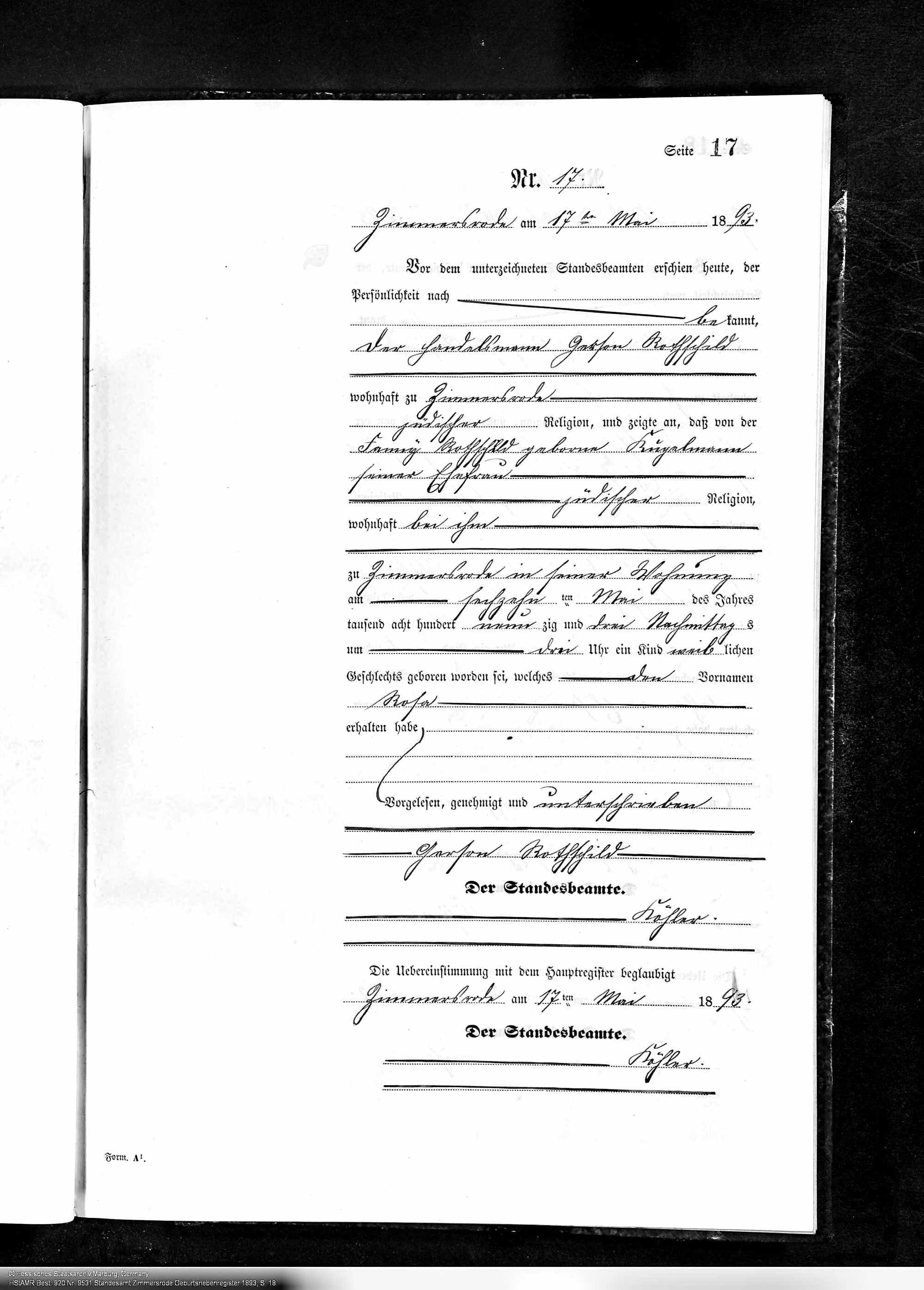
Number eight arrived May 16, 1893, almost two years after Clara; her name was Rosa. She was born in Zimmersrode where the family was now residing. Zimmersrode is a larger town about a mile and a half from Waltersbrueck.

Rosa Rothschild birth record, Hessisches Hauptstaatsarchiv; Wiesbaden, Deutschland; Bestand: 920; Laufende Nummer: 9531, Year Range: 1893, Ancestry.com. Hesse, Germany, Births, 1851-1901

Gerson and Fanny’s ninth child Thoni only lived seven weeks; she was born on April 27, 1895, in Zimmersrode, and died there on June 20, 1895:

Thoni Rothschild birth record, Hessisches Hauptstaatsarchiv; Wiesbaden, Deutschland; Bestand: 920; Laufende Nummer: 9533, Year Range: 1895, Ancestry.com. Hesse, Germany, Births, 1851-1901

Thoni Rothschild death record, Hessisches Hauptstaatsarchiv; Wiesbaden, Deutschland; Personenstandsregister Sterberegister; Bestand: 9610; Laufende Nummer: 920, Year Range: 1895, Ancestry.com. Hesse, Germany, Deaths, 1851-1958

Sadly, their tenth child, like their first child, died at childbirth, this time a boy. Richard also translated the note on this death record for me.

Male Child stillborn of Gerson Rothschild, Hessisches Hauptstaatsarchiv; Wiesbaden, Deutschland; Personenstandsregister Sterberegister; Bestand: 9614; Laufende Nummer: 920
Year Range: 1899, Ancestry.com. Hesse, Germany, Deaths, 1851-1958

Today the personally known tradesman Gerson Rothschild, residing in Zimmersrode, appeared before the undersigned registrar and reported that

The wife of the reporting person of Jewish religion, Fanny Rothschild, née Kugelmann, also of the Jewish religion, gave birth to a male child at two o’clock in the morning on March 28th of this year in the home of the reporting party, and that the child died during birth.

Read, approved and signed

Gerson Rothschild

In a rather creepy coincidence, this baby was delivered on March 28, 1899, exactly sixteen years to the day after Fanny lost her first child in childbirth on March 28, 1883.

Fortunately, Fanny had better fortune with her eleventh and final baby, Amalie Rothschild, born in Zimmersrode on April 26, 1901. I do not have a birth record for Amalie but found her birth date on records from the Nazi era.1

Fanny Kugelmann Rothschild was 43 years old when she gave birth to Amalie, her last child. She had been either pregnant or nursing a baby for almost twenty years. She had suffered losing two of those babies at birth and one at only seven weeks old. But her other eight children survived to adulthood—-until the rise of the Nazis.

Here’s a timeline showing the birth dates of Fanny and Gerson’s eleven babies:

March 28, 1883—March 4, 1884—July 5, 1885—November 22, 1886—September 11, 1888—February 13, 1890—July 15, 1891—May 16, 1893—April 27, 1895—March 28, 1899—April 26, 1901

More on this family in the posts to come.


  1. Amalie Rothschild Stiefel, Arolsen Archives, Digital Archive; Bad Arolsen, Germany; Lists of Persecutees 2.1.1.1, Ancestry.com. Free Access: Europe, Registration of Foreigners and German Persecutees, 1939-1947 

The Blumenfeld-Rothschild Brain Teaser

Here’s a good brain teaser for those of you who like puzzles, especially genealogy relationship puzzles:

Gerson Rothschild was the eighth child born to Gelle Blumenfeld and Simon Rothschild. He was born on May 1, 1855, in Waltersbrueck, Germany.

Gerson Rothschild birth record, Arcinsys Archives of Hesse, HHStAW Fonds 365 No 893, p. 27

Gerson married Frommet “Fanny” Kugelmann on September 13, 1881, in Waltersbrueck. She was born in Wohra, Germany, on September 11, 1857.

Gerson Rothschild marriage to Frommet Kugelmann, Hessisches Hauptstaatsarchiv; Wiesbaden, Deutschland; Bestand: 920; Laufende Nummer: 8407, Ancestry.com. Hesse, Germany, Marriages, 1849-1930

When I saw Frommet Kugelmann’s name, it rang a bell, but I wasn’t sure why. I searched my tree, and sure enough, I had a Frommet Kugelmann already on my tree. I wrote about her here. She had married Isaac Blumenfeld I, Gelle Blumenfeld’s older brother, and had died March 18, 1842, five days after giving birth to her son Abraham Blumenfeld III. She was about twenty years old when she died.

Frommet Kugelmann Blumenfeld death record, Lagis Hessen Archive, HHStAW Abt. 365 Nr. 630, S. 8

But was there a connection between the Frommet Kugelmann who had married Isaac Blumenfeld I and the Frommet Kugelmann who married Isaac’s nephew Gerson Rothschild, Gelle’s son? That was not immediately obvious.

From the marriage record for Gerson and his Frommet (to be referred to hereinafter as Fanny to keep them distinct), I knew that Fanny’s parents were Joseph Kugelmann and Male Katten. After searching for more information about Joseph Kugelmann, I learned that he was the son of Hiskias Kugelmann and Knentel Adorn.1 Flipping back to Isaac Blumenfeld’s wife Frommet, I saw that her parents were also Hiskias Kugelmann and Knentel Adorn.2 In other words, Joseph Kugelmann had named his daughter Frommet Fanny Kugelmann for his deceased sister Frommet Kugelmann, Isaac Blumenfeld’s wife.

Gerson and Fanny were thus related through the marriage of Gerson’s uncle Isaac to Fanny’s aunt and namesake, Frommet Kugelmann.

Gerson and Fanny would have eleven children, though two died at birth and one as an infant.

Here’s the brain teaser.

How were the children of Gerson Rothschild and Fanny Kugelmann related to Abraham Blumenfeld III, the son of Isaac Blumenfeld I and his first wife Frommet Kugelmann?

[Jeopardy! Music plays for thirty seconds…]


Here’s the answer:

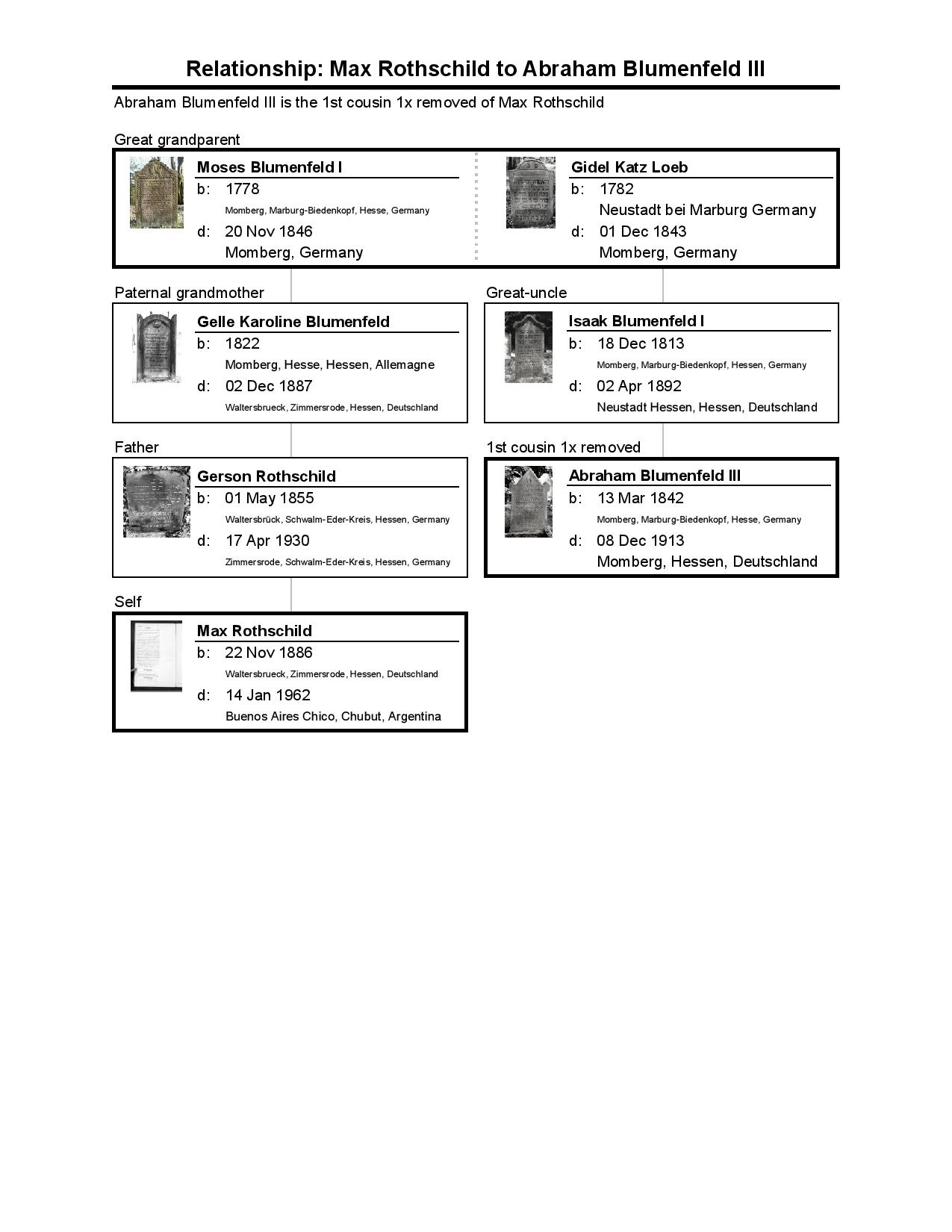
They were his first cousins, once removed, on the Kugelmann side because their mother Fanny was Abraham III’s first cousin; Abraham III’s mother Frommet Kugelmann and Fanny’s father Joseph Kugelmann were siblings.

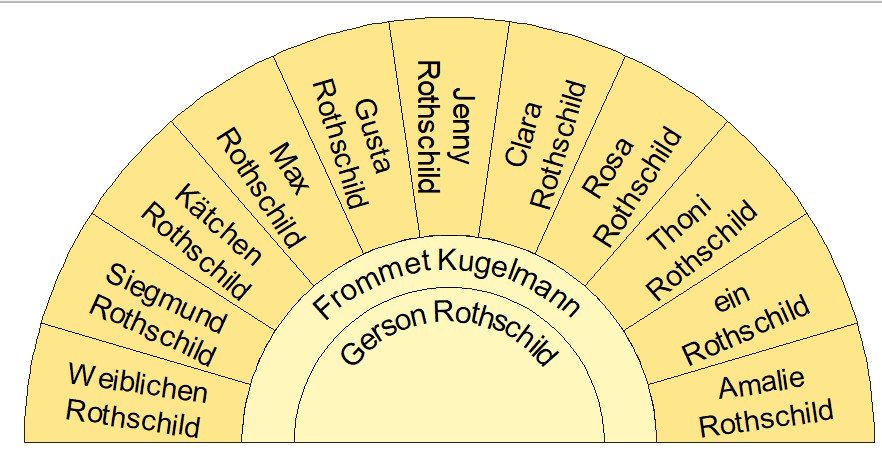
Here’s a chart showing that relationship, using one of Gerson and Fanny’s children (Max Rothschild) as an example:

But they were also related to Abraham III through the Blumenfeld side since Abraham’s father Isaac Blumenfeld I and Gerson’s mother Gelle Blumenfeld Rothschild were siblings, making Abraham and Gerson first cousins, thus making Max Rothschild and  Gerson and Fanny’s other children first cousins, once removed, to Abraham Blumenfeld III through that connection.

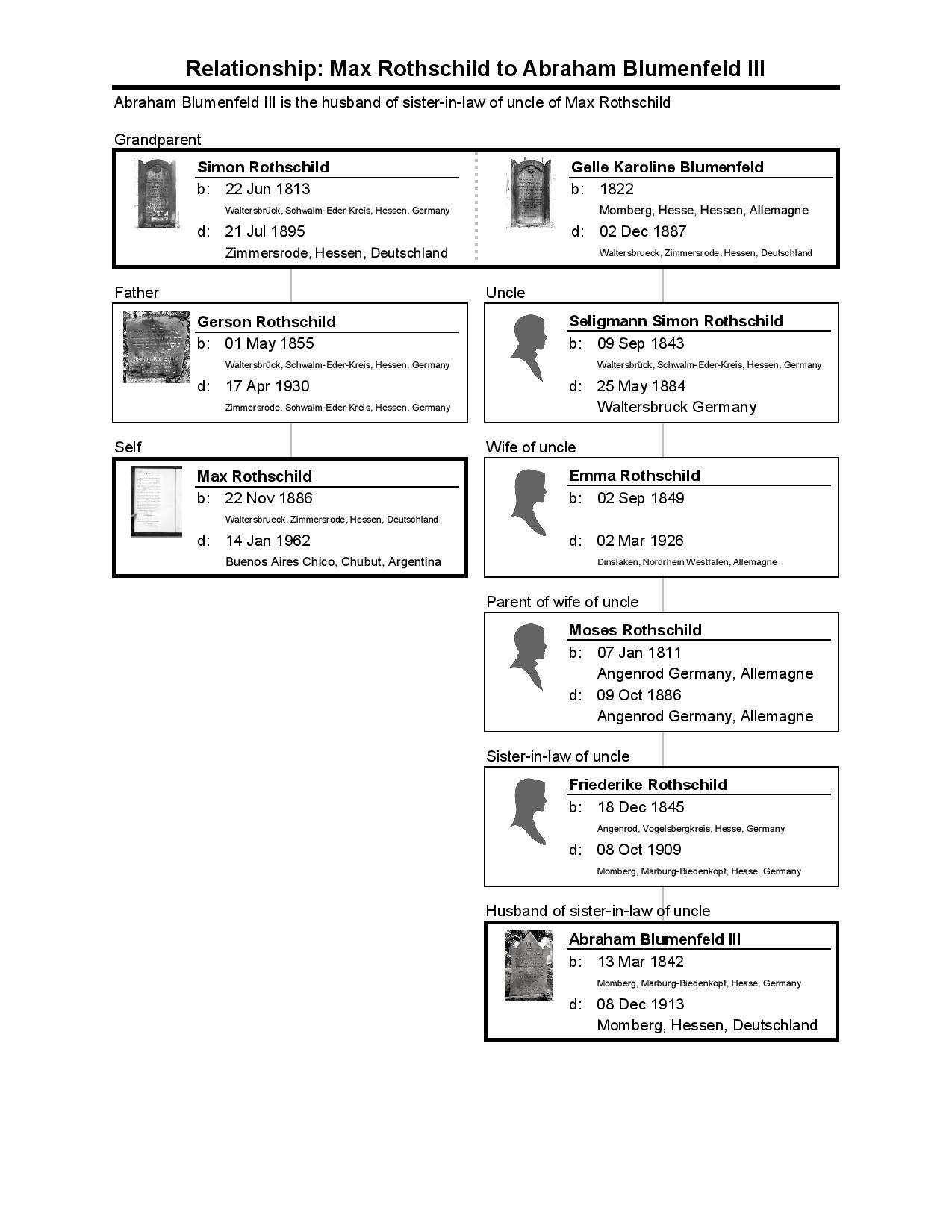
There is a third connection through Abraham Blumenfeld III’s marriage to Friedericke Rothschild—-but I will spare you that one.

OK, since you insist, here’s a chart for that one…

So once again, the family tree twists and groans from the weight of its interconnected branches, twigs, and leaves.

Coming up…the stories of the eleven children of Gerson and Fanny.


  1. Joseph Kugelmann death record, Hessisches Hauptstaatsarchiv; Wiesbaden, Deutschland; Personenstandsregister Sterberegister; Bestand: 9981; Laufende Nummer: 915, Description Year Range: 1900, Ancestry.com. Hesse, Germany, Deaths, 1851-1958 
  2. Frommet Kugelmann Blumenfeld death record, Sterberegister der Juden von Neustadt 1824-1875 (HHStAW Abt. 365 Nr. 630), p. 8. Arcinsys Archives of Hessen, at https://arcinsys.hessen.de/arcinsys/digitalisatViewer.action?detailid=v1900007&selectId=45915616 

Gertrude Rothschild Lancellotti: When and Where Did She Die? Mystery Solved!

Today I will turn to Moses and Mathilde Rothschild’s fourth child Gertrude Rothschild Lancellotti/Lancelot and her family and their lives from 1930 onward. I have records for most of the vital information, except that I cannot find a death record or obituary or any other information about the death of Gertrude herself. If anyone can help, please let me know!

In 1930 Gertrude was living with her husband Charles Lancelot (sometimes it was shortened this way from Lancellotti, which was also sometimes spelled Lancelotti) in the Bronx, and Charles continued to work as an artist. Neither of their two children, Milton and Estelle, was living with them, and I couldn’t find either of them elsewhere on the 1930 census. Milton would have been 22, and Estelle would have been 19. Was this just a mistaken omission? Or were Milton and Estelle living elsewhere? I don’t know.1

I did find a marriage license record for their daughter Estelle and a man named George Hodges taken out on September 1, 1926, when Estelle was only fifteen,2 but that marriage appears to have been over fairly soon as there was a divorce action by Estelle against George Hodges on August 11, 1927. Because Estelle was a minor, her father Charles acted as her representative and guardian in the divorce action. Where Estelle was living in 1930 after that divorce is still unknown.

Estelle Lancelotti divorce action, Year or Volume: Volume L 1914 – 1938, Ancestry.com. Bronx County, New York, U.S., Divorce and Civil Case Records, 1914

Estelle remarried in 1936 when she was 25. She married Dante V. Somma that year in New Jersey.3 Dante was born on February 21, 1904, in New York to Giovanni/John Somma and Eugenia Mortola. He had been previously married to Josephine Blake Clark, but that marriage had not lasted.4 Prior to marrying Estelle, Dante had been working as a furniture salesman and living in the Bronx.5 Dante and Estelle would have have two children.

Estelle’s brother Milton Lancelot also reappeared in 1936 when he married Dolores De Villasante on September 17, 1936, in Manhattan.6 Dolores was born in Bilbao, Spain, on April 13, 1916, and had immigrated to the US in 1930 from Mexico. Her parents were Alberto De Villasante and Maria Luisa Vidal.7 [Thank you to Eilene Lyons for pointing out that Dolores’ mother was living with Milton and Dolores in 1940, leading me to find the names of Dolores’ parents.] Perhaps Milton had been in Mexico in 1930 when the US census was taken and had met Dolores there? Milton and Dolores would have two children.

In 1940, Gertrude and Charles were still living in the Bronx at 1501 Undercliff Avenue, and Charles was still working as an artist.8 Charles’ 1942 World War II draft registration reports that his employer was Standard-Koppel Engraving Company.

Charles Lancelotti, World War II draft registration, The National Archives At St. Louis; St. Louis, Missouri; Record Group Title: Records of the Selective Service System; Record Group Number: 147, Ancestry.com. U.S., World War II Draft Registration Cards, 1942

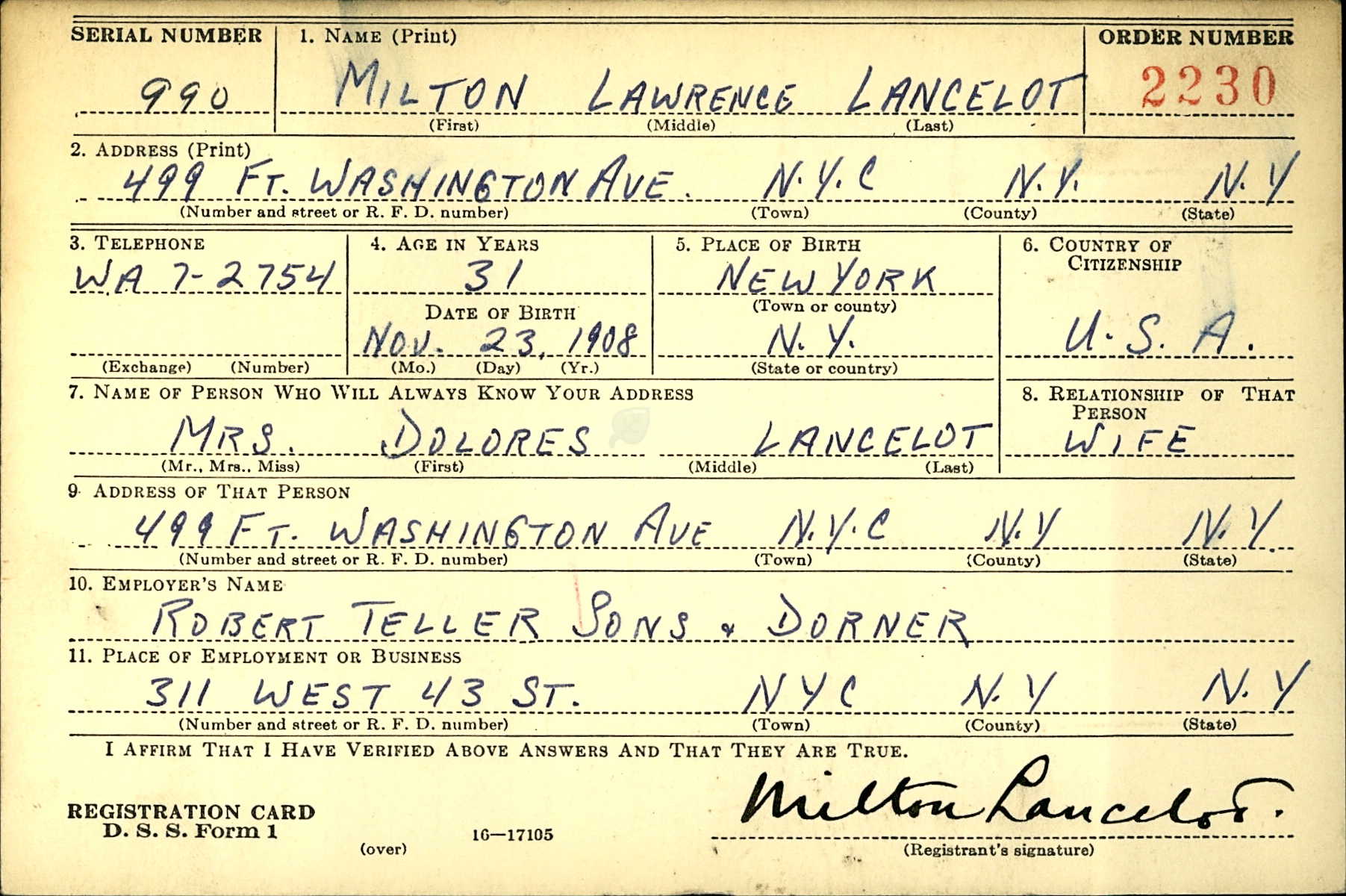
Milton and Dolores were living in Manhattan in 1940 with Dolores’ mother and sister. Milton was a salesman for a lithography company.9 His 1940 World War II draft registration revealed that his employer was Robert Teller Sons & Dorner.

Milton Lancelot, World War II draft registration, National Archives at St. Louis; St. Louis, Missouri; Wwii Draft Registration Cards For New York City, 10/16/1940 – 03/31/1947; Record Group: Records of the Selective Service System, 147, Ancestry.com. U.S., World War II Draft Cards Young Men, 1940-1947

Estelle and Dante were living in the Bronx in 1940, on the same street (1630 Undercliff Avenue) as Estelle’s parents. Dante was a salesman for a decorating business;10 his 1942 World War II draft registration reveals two things: he and Estelle were now living at the same address on Undercliff Avenue (1501) as Gertrude and Charles, and he was working for The Nahon Company.

Dante Somma, World War II draft registration, National Archives at St. Louis; St. Louis, Missouri; Wwii Draft Registration Cards For New York City, 10/16/1940 – 03/31/1947; Record Group: Records of the Selective Service System, 147, Ancestry.com. U.S., World War II Draft Cards Young Men, 1940-1947

Gertrude and Charles were still living at 1501 Undercliff Avenue in the Bronx in 1950. Charles was still a commercial artist. Their daughter Estelle and her husband Dante were also living at that address with their children, and Dante was working as a wholesale furniture salesman.11

Milton, however, had moved by 1950 with his family to the suburbs—to New Rochelle, New York.12 A June 17, 1948, article in the New Rochelle Standard-Star reported that he had purchased a home in that town.13 Milton was still selling lithography. In 1960, Milton legally changed his name from Lancellotti to Lancelot,14 although he had been using that abbreviated version of his surname for many years at that point.

Estelle Lancellotti Somma died on December 26, 1952, at the age of only 41.15 I could not find an obituary or any other document that provided a cause of death. She was survived by her parents Gertrude and Charles, her husband Dante, who died on May 30, 1986,15 and her two children.

Her father Charles Lancellotti died August 31, 1967, in New York; he was 84.16 I could not find any record at all for what happened to Charles’ wife and my cousin Gertrude Rothschild Lancellotti—no death record, no obituary. If anyone knows what happened to Gertrude, I hope they will find me and fill me in.

UPDATE!! Thanks to two researchers, Kaye Prince Hollenberg on Tracing the Tribe and John Schroedel, I now know when Gertrude died! She died on January 1, 1971, in New Rochelle, New York, where her son Milton was then living. John found the document below on FamilySearch, and Kaye found her in the New York State Death Index.

New York, Probate Records, 1629-1971,” images, FamilySearch (https://familysearch.org/ark:/61903/3:1:3QSQ-G99R-NNYM?cc=1920234&wc=Q75G-DPF%3A213305501%2C235998202 : 28 May 2014), Westchester > Wills and letters index 1813-1983 Labate, Luigi-Lawson, Marie G. > image 934 of 3213; county courthouses, New York.

As for Charles and Gertrude’s son Milton, he died on January 4, 1994, in Stamford, Connecticut, at the age of 85.17 According to his obituary, Milton was “an award-winning book designer and author of several books on sports, naval history, and the development of aerial combat” as well as “an avid historian and theater-goer.”18  By googling his name I was able to find several books that are still in print that were authored or co-authored by Milton. Milton was survived by his wife Dolores and their children. Although I could find no death record for Dolores, a brief obituary for her states that she died on July 13, 2018, in New Smyrna, Georgia. (Thank you to Aaron Knappstein for reminding me that I had this obituary!)

This brings me to the last child of Moses Rothschild, his son Aron.


  1. Charles and Gertrude Lancelot, 1930 US census, Year: 1930; Census Place: Bronx, Bronx, New York; Page: 2A; Enumeration District: 0162; FHL microfilm: 2341203, Ancestry.com. 1930 United States Federal Census 
  2. Estelle T Lancelot, Gender Female, Marriage License Date 1 Sep 1926, Marriage License Place Manhattan, New York City, New York, USA, Spouse George M Hodges
    License Number 24473, New York City Municipal Archives; New York, New York; Borough: Manhattan; Volume Number: 10, Ancestry.com. New York, New York, U.S., Marriage License Indexes, 1907-2018 
  3. Estelle Lancelot, Maiden Name Lancelot, Gender Female, Marriage Date 1936
    Marriage Place New Jersey, USA, Spouse Dante Somma, New Jersey State Archives; Trenton, New Jersey; Marriage Indexes; Index Type: Bride; Year Range: 1936; Surname Range: A – Z; Reel Number: 34, Ancestry.com. New Jersey, U.S., Marriage Index, 1901-2016 
  4. Dante Summa, Birth Date 21 Feb 1904, Birth Place Manhattan, New York, USA
    Certificate Number 9980, Ancestry.com. New York, New York, U.S., Extracted Birth Index, 1878-1909; “New York, New York City Marriage Records, 1829-1938”, , FamilySearch (https://www.familysearch.org/ark:/61903/1:1:24W8-SK9 : Mon Mar 11 20:54:31 UTC 2024), Entry for Dante V. Somma and Josephine B. Clark, 14 August 1927. 
  5. Dante Somma, 1930 US census, Year: 1930; Census Place: Bronx, Bronx, New York; Page: 1B; Enumeration District: 0595; FHL microfilm: 2341221, Ancestry.com. 1930 United States Federal Census 
  6. Milton Lancelot, Gender Male, Marriage Date 17 Sep 1936, Marriage Place Manhattan, New York, USA, Spouse Dolores DeVilladante, Certificate Number 23730, Ancestry.com. New York, New York, U.S., Extracted Marriage Index, 1866-1937 
  7. Dolores Lancelot, Race Spanish, Record Type Naturalization Petition, Birth Date 13 Apr 1916, Birth Place Bilbao, Spain, Departure Place Veracruz, Mexico, Arrival Date 21 Oct 1930, Arrival Place New York, New York, Petition Place New York, USA, Spouse
    Milton, Petition Number 301464, The National Archives in Washington, DC; Washington, DC; NAI Title: Index to Petitions For Naturalizations Filed in Federal, State, and Local Courts in New York City, 1792-1906; NAI Number: 5700802; Record Group Title: Records of District Courts of the United States, 1685-2009; Record Group Number: Rg 21, Ancestry.com. New York, U.S., State and Federal Naturalization Records, 1794-1943. Alberto MA. De Villasante, [Alberto Maria De Villasante] Gender Hombre (Male)
    Marriage Age 22 Event Type Marriage Birth Date 1887 Marriage Date 15 feb 1909
    Marriage Place San Cosme y San Damián (San Cosme), Distrito Federal, México
    Spouse Maria de la Paz Vicente Vidal,  Film Number 004023378, Ancestry.com. Mexico, Select Church Records, 1537-1966. 
  8. Charles and Gertrude Lancelot, 1940 US census, Year: 1940; Census Place: New York, Bronx, New York; Roll: m-t0627-02498; Page: 5A; Enumeration District: 3-1473,
    Ancestry.com. 1940 United States Federal Census 
  9. Milton Lancelot and family, 1940 US census, Year: 1940; Census Place: New York, New York, New York; Roll: m-t0627-02675; Page: 4B; Enumeration District: 31-2066,
    Ancestry.com. 1940 United States Federal Census 
  10. Dante Somma and family, 1940 US census, Year: 1940; Census Place: New York, Bronx, New York; Roll: m-t0627-02498; Page: 15A; Enumeration District: 3-1476A, Ancestry.com. 1940 United States Federal Census 
  11. Charles Lancelot and family, 1950 US census, National Archives at Washington, DC; Washington, D.C.; Seventeenth Census of the United States, 1950; Year: 1950; Census Place: New York, Bronx, New York; Roll: 4107; Page: 82; Enumeration District: 3-305, Ancestry.com. 1950 United States Federal Census; Dante Somma and family, 1950 US census, National Archives at Washington, DC; Washington, D.C.; Seventeenth Census of the United States, 1950; Year: 1950; Census Place: New York, Bronx, New York; Roll: 4107; Page: 30; Enumeration District: 3-305, Ancestry.com. 1950 United States Federal Census 
  12. Milton Lancelot and family, 1950 US census, National Archives at Washington, DC; Washington, D.C.; Seventeenth Census of the United States, 1950; Year: 1950; Census Place: New Rochelle, Westchester, New York; Roll: 2089; Page: 10; Enumeration District: 67-24, Ancestry.com. 1950 United States Federal Census 
  13. “13 Homes Sold, Broker Reports,” The New Rochelle (NY) Standard Star, June 17, 1948, p. 10. 
  14. Estelle Somma, Age 42, Birth Date abt 1910, Death Date 26 Dec 1952
    Death Place Manhattan, New York, New York, USA, Certificate Number 27685, Ancestry.com. New York, New York, U.S., Death Index, 1949-1965 
  15. Dante Somma, Age 82, Birth Date 8 Feb 1904, Death Date 30 May 1986
    Death Place Orange City, Essex, New Jersey, USA, New Jersey State Archives; Trenton, New Jersey; New Jersey, Death Indexes, 1904-2000, Ancestry.com. New Jersey, U.S., Death Index, 1848-1878, 1901-2017 
  16. Charles G Lancellotti, Gender Male, Age 84, Birth Date abt 1883, Residence Place New Rochelle, Westchester, New York, USA, Death Date 31 Aug 1967, Death Place New York, USA, Certificate Number 64838, New York State Department of Health; Albany, NY, USA; New York State Death Index; URL: https://www.health.ny.gov/vital_records, Ancestry.com. New York State, U.S., Death Index, 1957-1972 
  17. Milton L Lancelot, Gender Male, Birth Date 23 Nov 1908, Death Date 14 Jan 1994
    Claim Date 14 Aug 1973, SSN 090051155, Ancestry.com. U.S., Social Security Applications and Claims Index, 1936-2007 
  18. “Milton L. Lancelot, Author,” The Portchester (NY) Daily Item, January 16, 1994, p. 26.