Are These My Great-Uncles?

As I wrote about here, while in Denver, I visited Temple Emanuel where the confirmation class photographs of my grandmother Eva Schoenthal and of her brothers Gerson and Harold were posted on the wall.  It was easy for me to find my grandmother in her class photograph as I knew her face well.  But it was more difficult to identify which boys in the other two class photographs were my great-uncles.

When I got home, I asked my father and also compared the one photograph I have of Gerson and several photographs I have of Harold to see if I could pick out Gerson and Harold in the confirmation class photographs.  Now I think I have, but I’d be interested in whether others agree with me.  My father said he really has no memory of Gerson, but agreed with me as to which boy was Harold.

This is Gerson’s class photograph.

Temple Emanuel 1908 confirmation class with Gerson Schoenthal

Temple Emanuel 1908 confirmation class with Gerson Schoenthal

And this is the only photograph I have of Gerson as an adult:

Dad Uncle Gerson Eva

Here are some closer shots of the faces of the boys in that class:

20160524_170000994_iOS

20160524_170007605_iOS 20160524_170011278_iOS

I think Gerson is the tall boy in the center of the top row (first boy on the left in the bottom photograph and the boy to the far right in the top photograph: same boy).  The one photograph I have of Gerson is of terrible quality, but there is something about the shape of the head and the ears that seems most similar to the boy in the middle.  Do you agree?

Here is Harold’s class photograph:

20160524_165822156_iOS

And here are closeups of the boys in that photo:

20160524_165837031_iOS 20160524_165844844_iOS

I think Harold is the first boy on the left in the top picture.  Here are some other photographs of Harold as a young man:

Hilda (Katzenstein) Schoenthal, Eva Schoenthal Cohen, Eva Hilda Cohen, and Harold Schoenthal

Hilda (Katzenstein) Schoenthal, Eva Schoenthal Cohen, Eva Hilda Cohen, and Harold Schoenthal

Harold Schoenthal

Harold Schoenthal


Again, the ears, the shape of the head, and the mouth seem most similar to the boy on the top left of the first photograph of closeups above.  Do you agree?

It would have been so much easier if they had listed the students in the order in which they were standing instead of alphabetically!


Denver and A New Portrait of My Grandmother

About 110 years ago, my great-grandparents Isidore and Hilda (Katzenstein) Schoenthal and their four children, Lester, Gerson, Harold, and my grandmother Eva, moved from Washington, Pennsylvania, to Denver, Colorado.  Gerson had allergies and asthma, and doctors had suggested that the air in Denver would be better for him.  My grandmother was only a few years old, her brother Harold only six, and the two older brothers were teenagers when they moved.  My grandmother spent her childhood in Denver, leaving when she was eighteen to marry my grandfather, John Nusbaum Cohen, of Philadelphia.

As I wrote about here, my great-grandfather had several jobs in Denver, but spent most of his years in Denver working for Carson Crockery, a major distributor of china and other related products.

isidore schoenthal mgr carsonsBy the early 1920s, the family members began to leave Denver. My great-uncle Harold left to go to Columbia University; my grandmother moved to Philadelphia after marrying my grandfather in 1922.  Lester, the oldest son, and his wife Juliet Grace Beck, moved between Indiana and Colorado and back again over the years.  And my great-grandparents moved back east by 1929, settling in Montclair, New Jersey, where their son Harold had moved after finishing college. Eventually Lester and his wife also settled in Montclair.  Only Gerson stayed behind in Denver after the 1920s; he remained there until shortly before his death in 1954 in California, where he and his wife Maude had moved just a month beforehand.

Thus, for about twenty years, Denver was home to my great-grandparents and their children.  So when my friends and I decided to have our reunion in Boulder, Colorado, this year, I knew I had to spend some time in Denver to see the city where my Schoenthal family had lived in the early years of the 20th century.

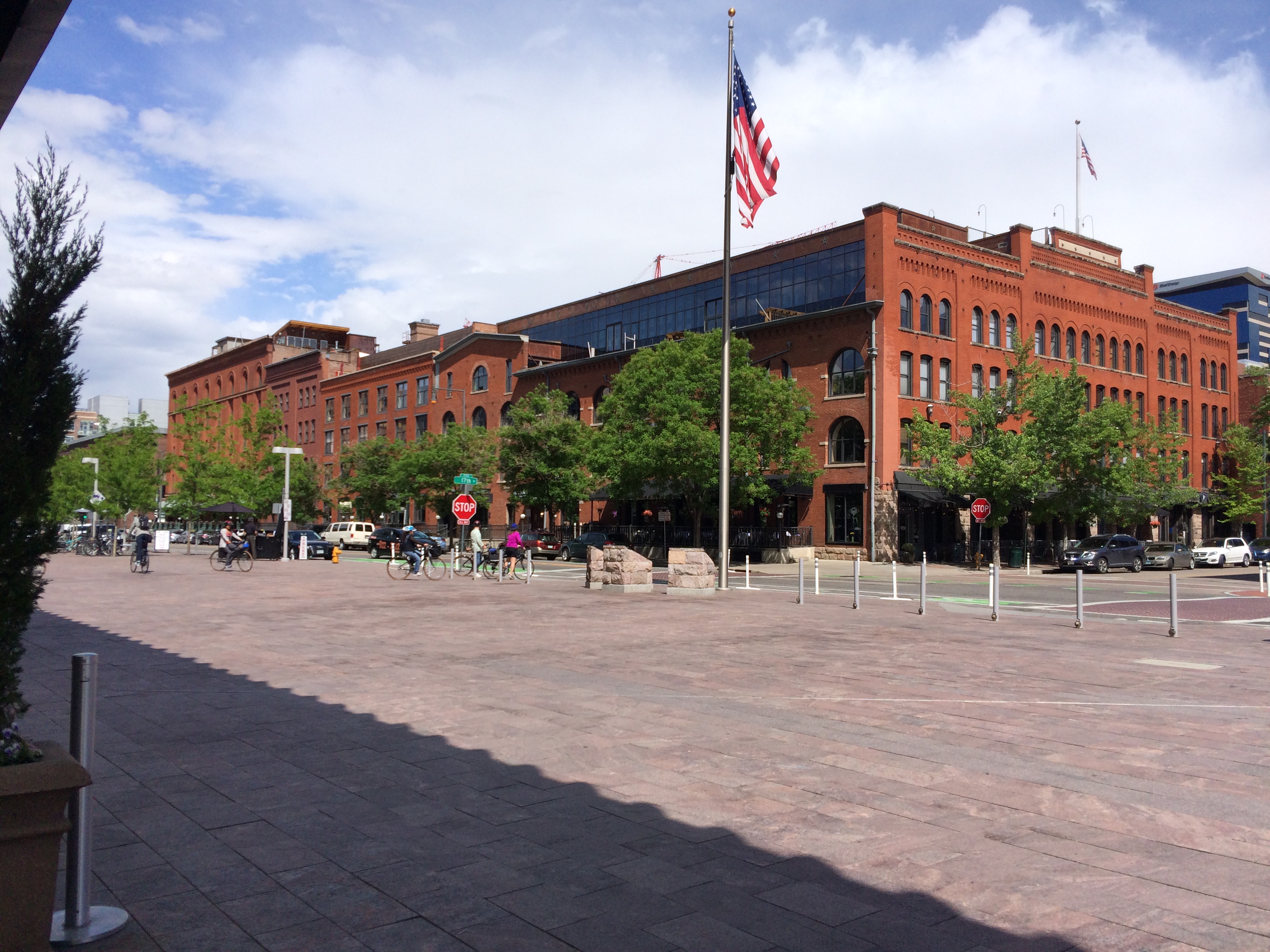
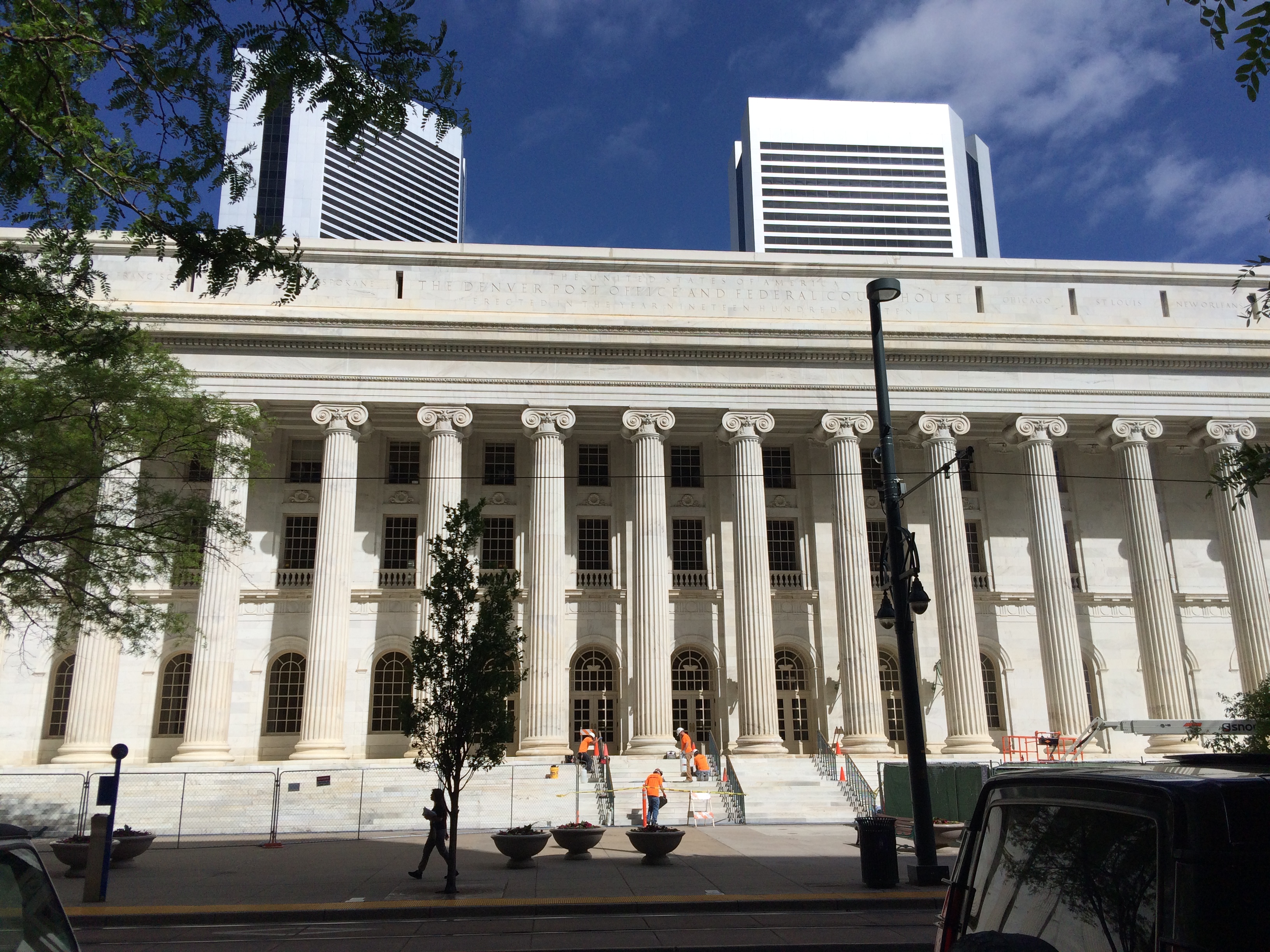
My husband and I didn’t have much time in Denver—just one afternoon and evening and the following morning.  Nevertheless, I think we got a fairly decent feel for the downtown section of the city.  We walked through the downtown area all the way from the Civic Center and State Capitol building to Union Station and the bridge over the river at the opposite end of Sixteenth Street.  Denver is quite obviously a city that has changed dramatically over the last couple of decades, as the mix of older and newer architecture reveals.  Everywhere you look you see new, shiny glass skyscrapers next to older buildings, some of which could date from the era when my great-grandparents lived in the city.  I tried to capture that contrast in these photos.

20160523_211910873_iOS 20160524_144443866_iOS 20160524_145832178_iOS

20160524_152548004_iOS 20160524_153332663_iOS 20160524_154639120_iOS 20160524_155017162_iOS

Although we arrived on a weekday, expecting the bustle of a big city, Denver felt strangely quiet even in the downtown area during a Monday workday, at least as compared to cities like New York or Boston.  Not that the streets were empty, but there was definitely a slower pace and fewer people on the streets than we would have expected.

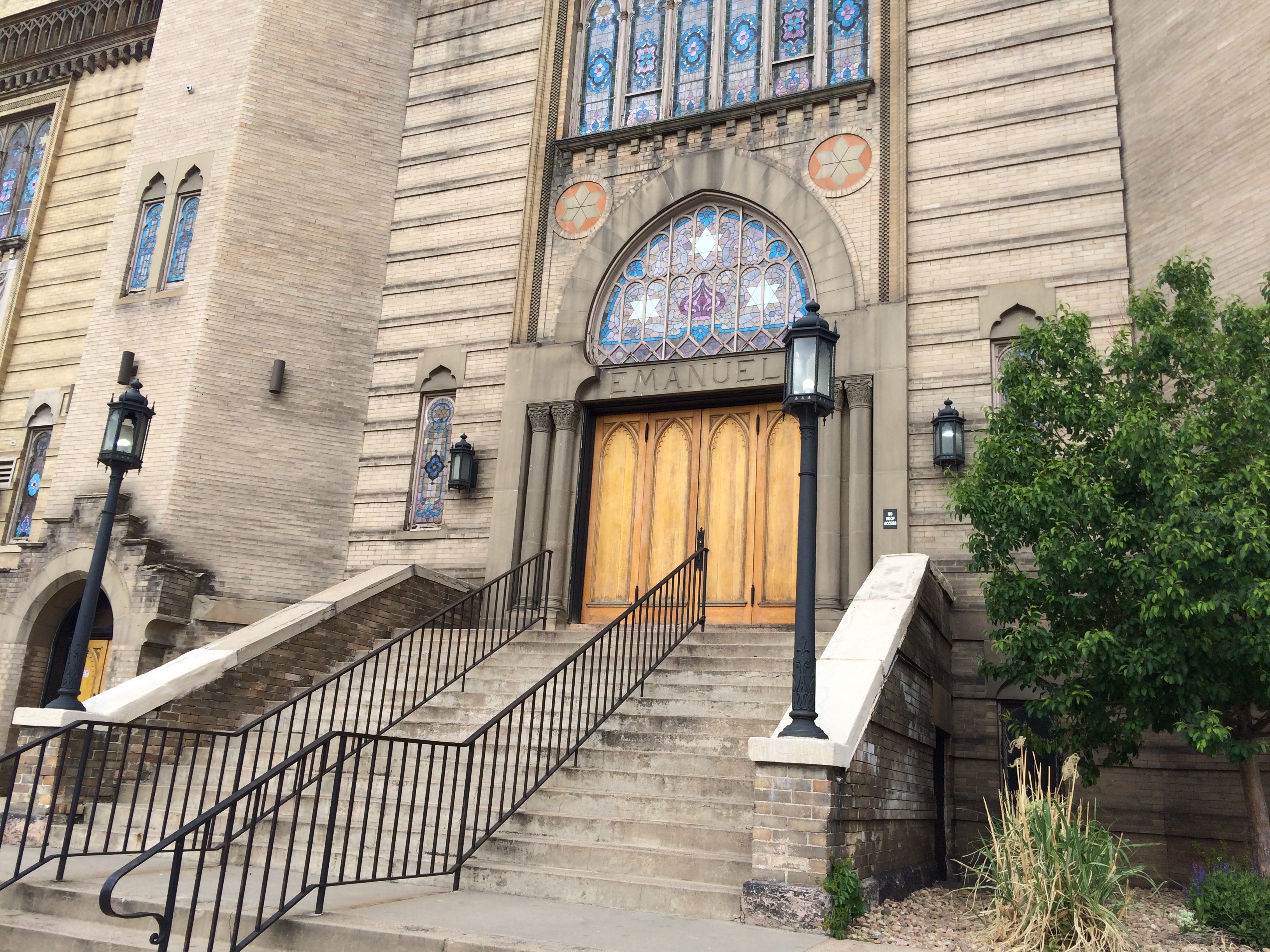
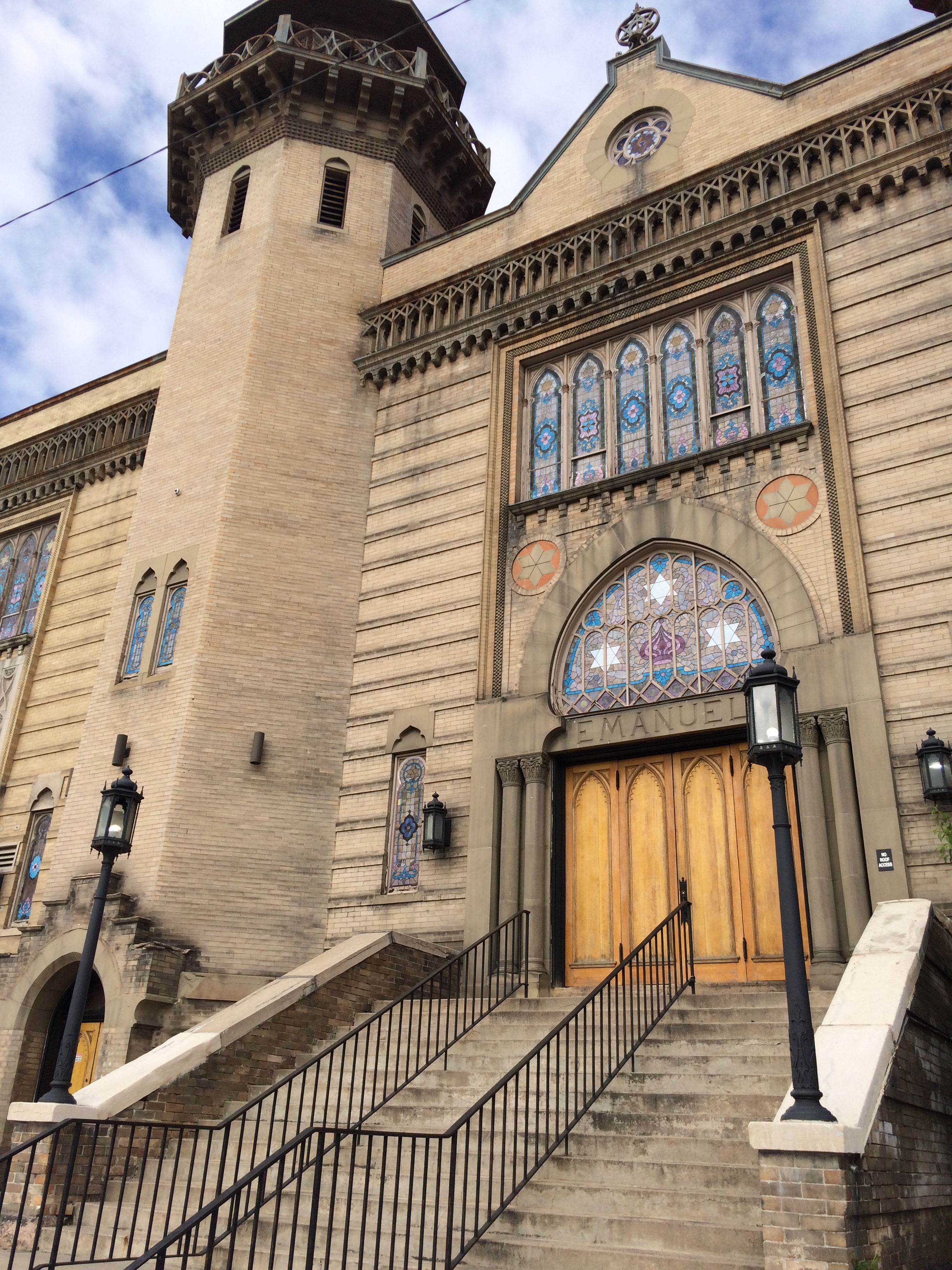
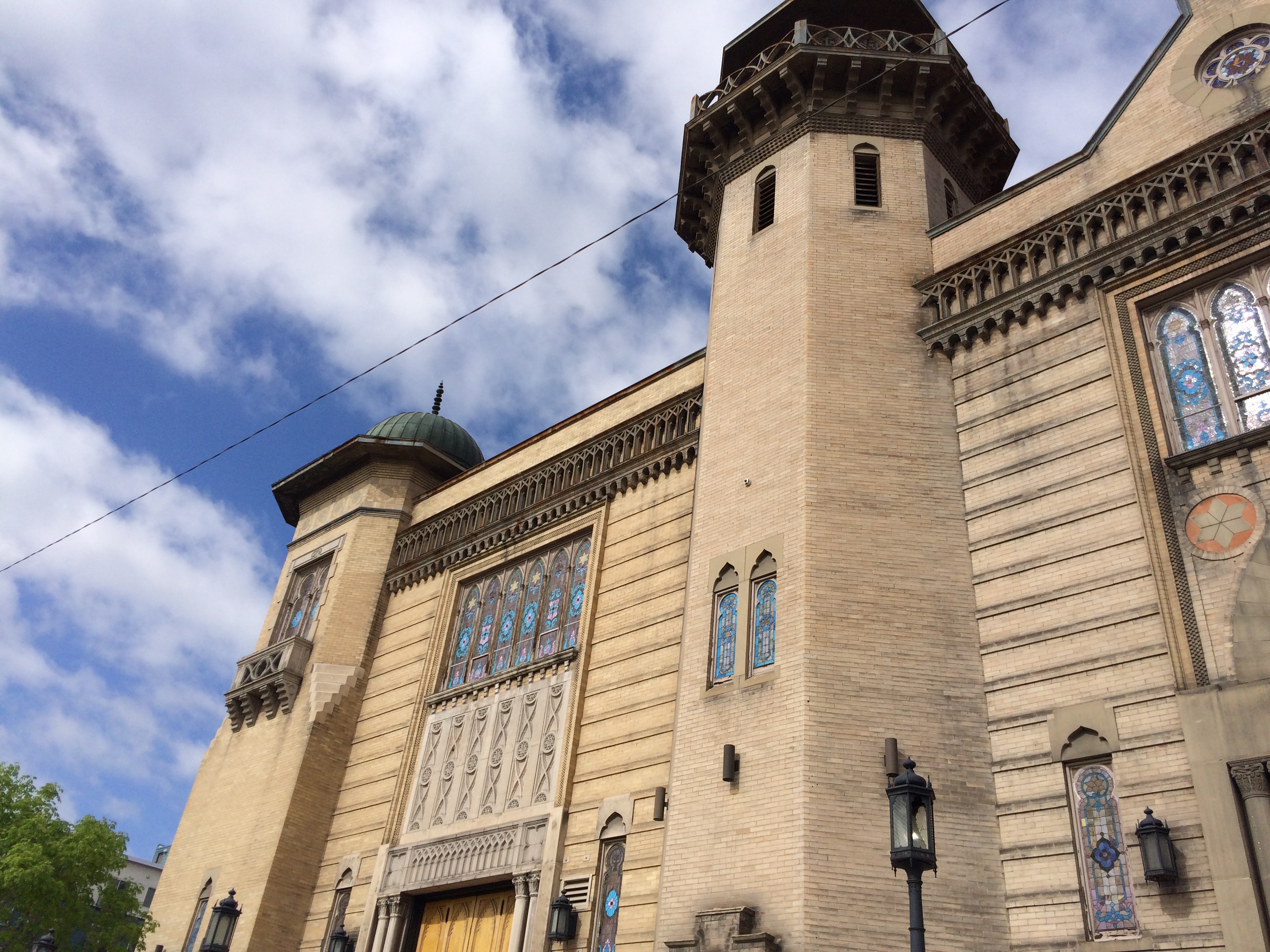
When my great-grandparents were living in Denver, they belonged to Temple Emanuel, where my grandmother and two of her brothers were confirmed. Temple Emanuel was then located on 16th Avenue and Pearl Street, a location about a fifteen minute walk from our hotel.  The building is still there, and it is beautiful. Although the Pearl Street building is now a church, the original building’s exterior has been preserved. (We did not see the interior.) The Star of David still appears in several places on the building, as does the name Emanuel, as you can see from these pictures.

20160524_151155406_iOS 20160524_151205779_iOS 20160524_151306771_iOS 20160524_151313831_iOS 20160524_151343268_iOS

Apparently the years that my family lived in Denver were years of growth for Emanuel as a substantial addition was built in the 1920s.  But after the war, the congregation left this downtown location and built a new building further out.

Before arriving in Denver, I had contacted Steve Stark, the current executive director at Temple Emanuel, to ask whether they would have any records or photographs from the era when my great-grandparents had been members.  He wrote back and told me that the confirmation class photographs from that time period were on the walls of the current building and that I was more than welcome to come to the building to see them.  So we drove out to Temple Emanuel’s current building after leaving downtown that morning.

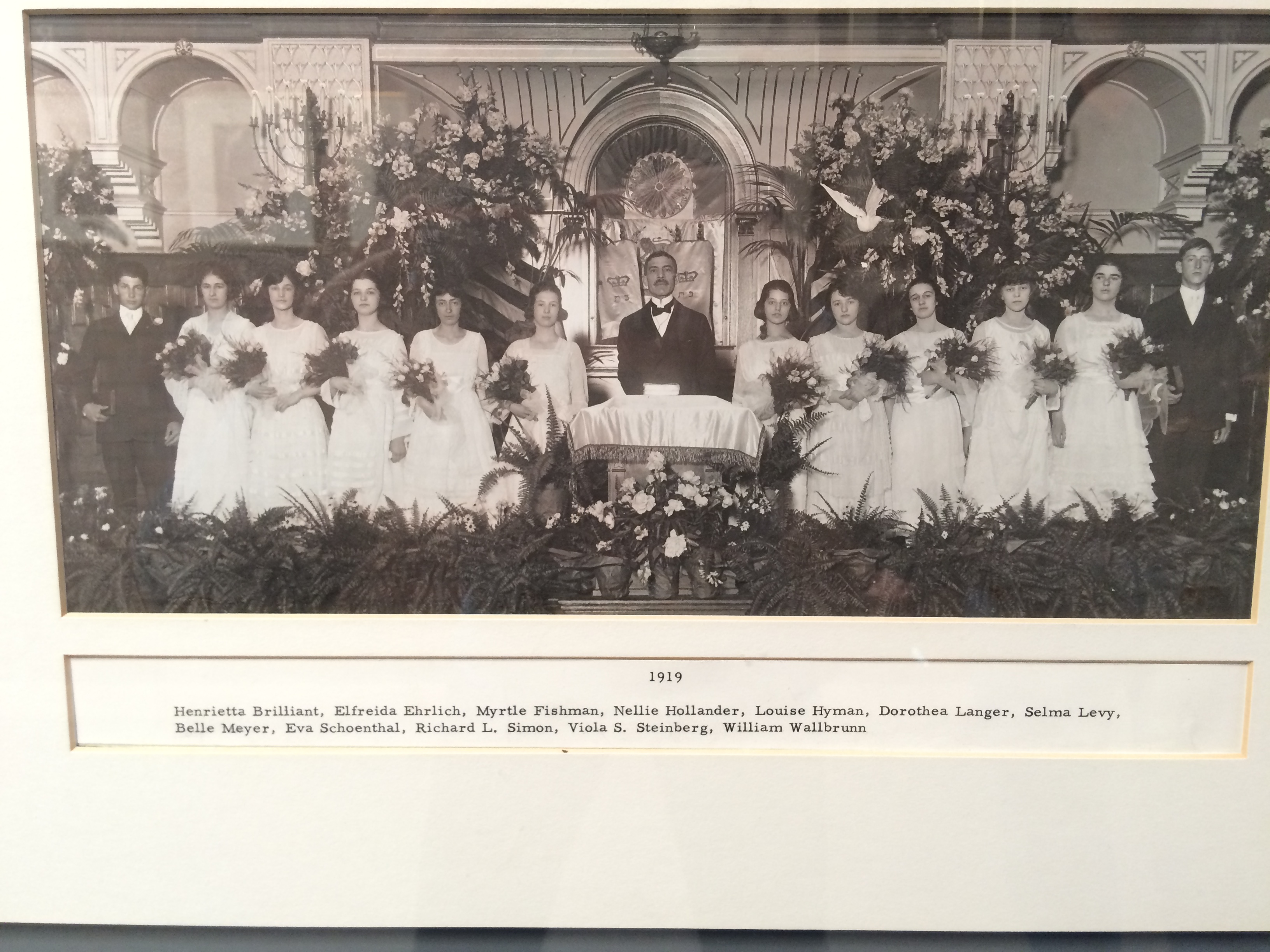
I was very excited when I was able to locate the photographs of the confirmation classes of three of Isidore and Hilda’s children: Gerson, class of 1908, Harold, class of 1916, and my grandmother Eva, class of 1919.  I was struck by how formal and how elegant they all look.  It’s hard to imagine a class of fifteen year olds looking like this today.

Temple Emanuel 1908 confirmation class with Gerson Schoenthal

Temple Emanuel 1908 confirmation class with Gerson Schoenthal

20160524_165822156_iOS

Temple Emanuel 1916 confirmation class with Harold Schoenthal


20160524_165743558_iOS

Temple Emanuel 1919 confirmation class with Eva Schoenthal

Although I was easily able to identify my grandmother in her class photograph, I will need to get my father’s help to pick out Harold and Gerson in their class pictures.

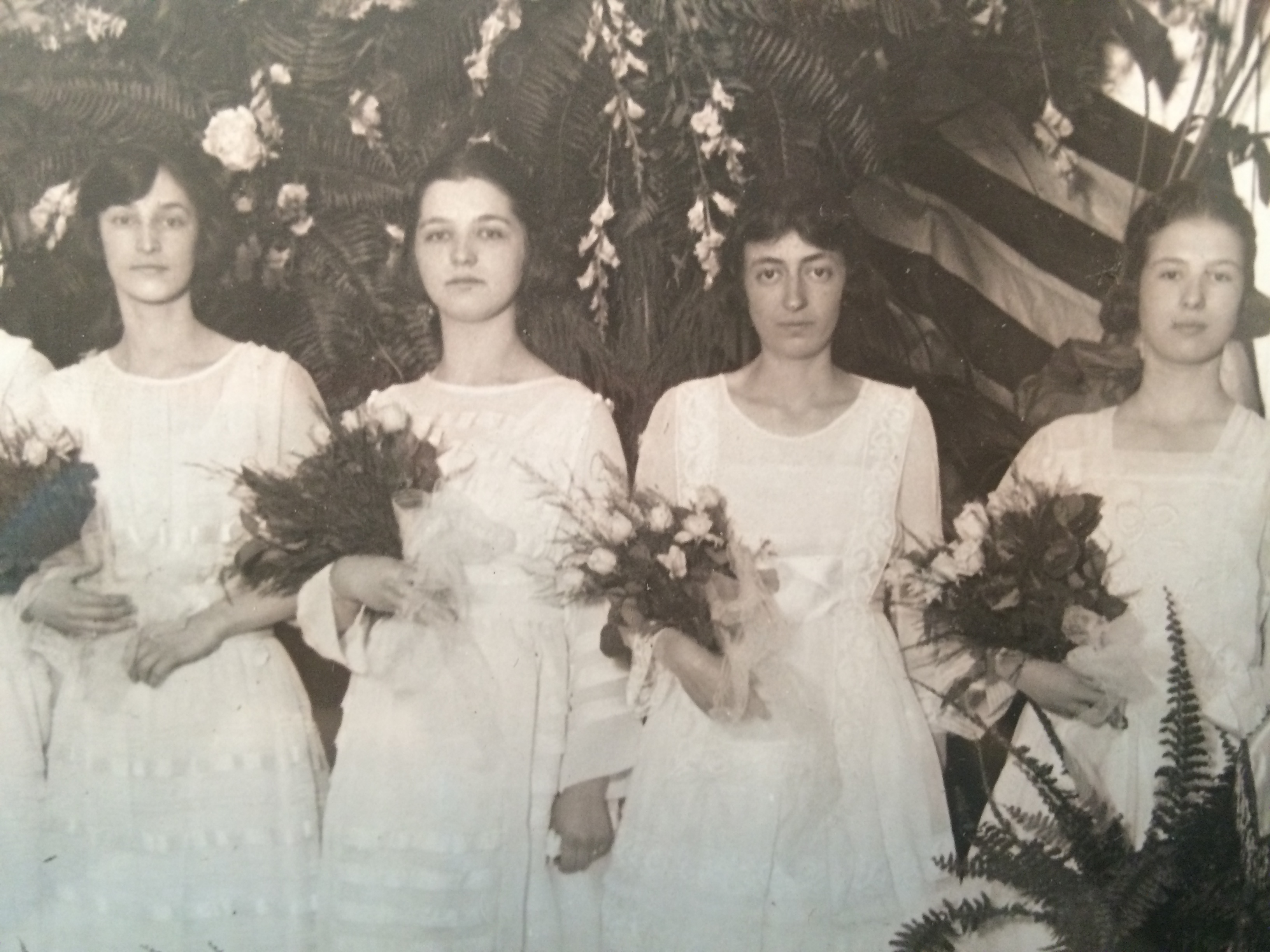
My grandmother Eva Schoenthal, second from left

My grandmother Eva Schoenthal, second from left

We then stopped by the Temple library to see if there were any other records from the early 20th century, but we learned that all records from that time period are archived in a separate storage facility.  However, Rita Dahlke, the assistant principal of the religious school and librarian at Emanuel, very generously gave me a copy of Temple Emanuel of Denver: A Centennial History by Marjorie Horbein (1971).  Although my family is not mentioned in the book, it does describe the years from 1900-1930 as years of significant growth for the congregation.

We also asked Rita about the history of their current building, which was built during the 1950s and officially opened in 1960.  I had seen a photograph of their sanctuary on their website and noted the similarity to the sanctuary of our synagogue, Temple Beth El in Springfield.  We were curious as to whether their building had also been designed by the noted synagogue architect, Percival Goodman, and Rita checked and confirmed that in fact their building was designed by Goodman.  She then took us into their sanctuary so that we could see it for ourselves.  The resemblance is striking.

Percival Goodman sanctuary, Temple Emanuel, Denver, Colorado

Percival Goodman sanctuary, Temple Emanuel, Denver, Colorado

Percival Goodman sanctuary, Temple Beth El, Springfield, Massachusetts

Percival Goodman sanctuary, Temple Beth El, Springfield, Massachusetts

It was a poignant moment for us as our current synagogue is considering changes to our sanctuary to accommodate today’s smaller crowds.  Temple Emanuel took a different path and built a separate smaller chapel in the late 1980s rather than compromise the beauty of Goodman’s design.

I also wanted to see if I could find any of the houses where my relatives had lived, but after checking, I realized that two no longer existed. The one closest to downtown must have been torn down when the Denver Performance Center was built, and the other address no longer has any structure on the site at all.

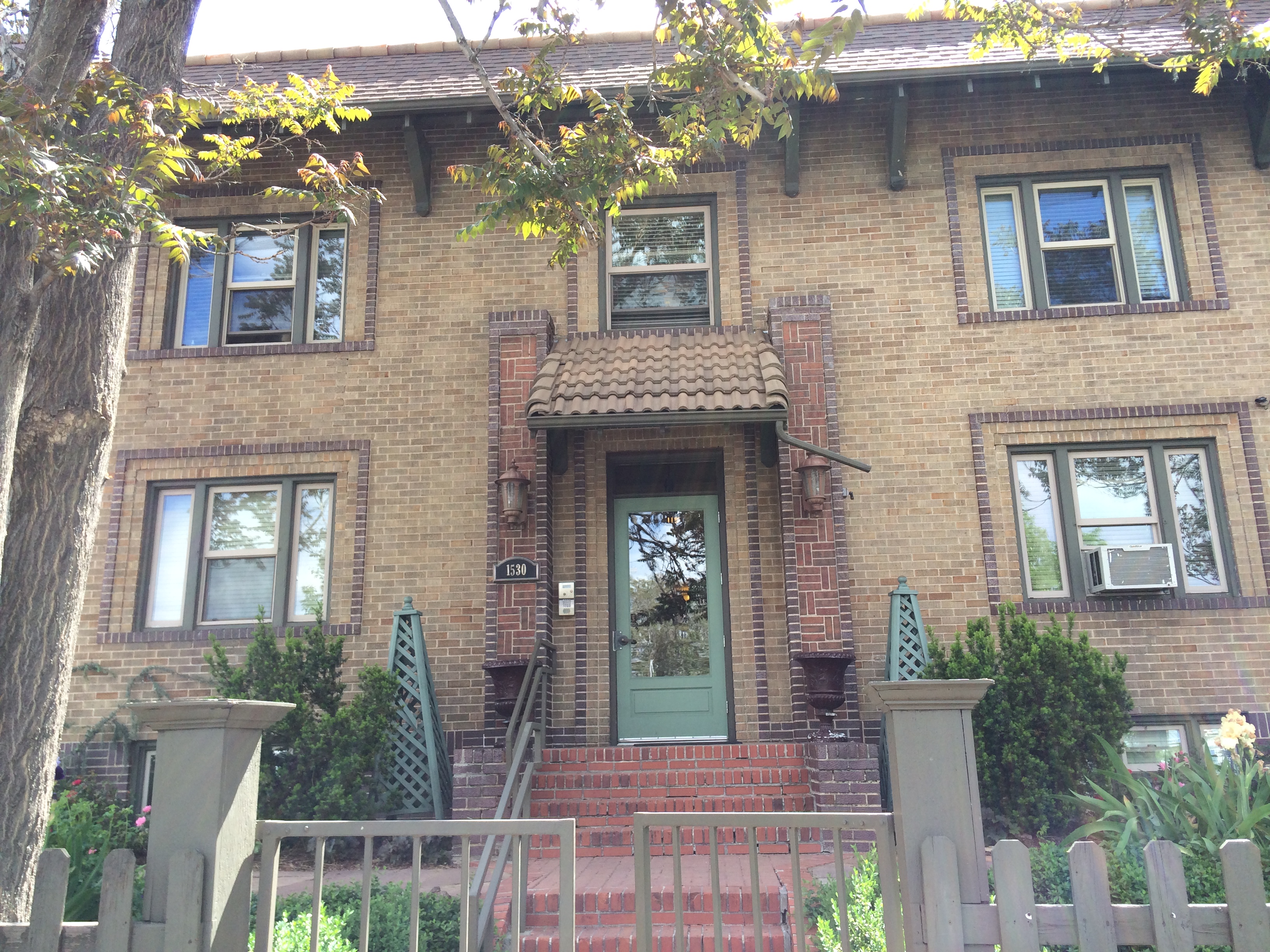
Then we found this lovely building at what I thought was 1550 Downing Street, the address listed as my great-grandparents’ residence in the 1908 Denver directory.  I got out of the car and took a lot of pictures of this building, thinking that this was my grandmother’s home in 1908. Here are two of them:

20160524_163424642_iOS 20160524_163441694_iOS

But I wasn’t sure when the building was built, so in writing this post, I googled 1550 Downing Street to see if I could find that information.  But Google kept showing me a very different house.  I was confused.  So I looked more closely at the house I’d photographed.  You can see that I took pictures of 1530, not 1550.  SIGH.

20160524_163442901_iOS

Here, however, courtesy of the internet, is a photo of 1550.  According to Zillow, it was built in 1888 and sold in March, 2016, for $798, 200.  It appears to have been totally gutted and renovated, and probably the only thing left from the time my grandmother lived there is the claw-footed tub.  You can see more pictures here.

1550 Downing Street better


Our visit to Denver was a touching one—to be able to see the building where my grandmother had been confirmed and acted in plays for the Jewish holidays, to see her photograph on the walls of the new building, to pass the addresses where she and her family once lived.  In my head I could envision my great-grandparents and their four children living in this place a century ago.

Below is an interactive map showing the places where my family lived in Denver and the location of their synagogue.  Click on the red balloons to see more about the location.

In a recent conversation with my father about his mother, he commented that I had presented only a partial representation of her in my writing about her.  In my limited times with her when I was child (she died when I was ten), she had seemed quiet and fragile and somewhat withdrawn.  But my father pointed out that in her youth, she had been very outgoing—someone who had performed in plays both at temple and at her high school.  He described her as very social—someone who had many boyfriends after my grandfather died; she also worked outside the home to support my father and my aunt once she was able to care for them again, working in the china business, making lampshades, and doing drafting for the military during the war.

Grandma Eva 1915 Denver Post photo

Eva Schoenthal, top left, 1915

Eva Schoenthal high school yearbook picture

Eva Schoenthal high school yearbook picture, 1922

John and Eva Cohen c. 1930

John and Eva (Schoenthal) Cohen

Hilda (Katzenstein) Schoenthal, Eva Schoenthal Cohen, Eva Hilda Cohen, and Harold Schoenthal

Hilda (Katzenstein) Schoenthal, Eva Schoenthal Cohen, Eva Hilda Cohen, and Harold Schoenthal

And although I had thought that her parents had moved to Philadelphia to help her care for my father and aunt, in fact the opposite was true.  They moved to Philadelphia so that she could care for them, as they both had become quite ill and needed help in their daily lives.  They moved next door so that she could cook and care for them.   My grandmother was not a timid or weak person, but a woman who had survived the tragic illness of her husband and her own troubles to come back to take care of others.

Fortunately, my father shared these thoughts with me before my trip out west, and so as I walked the streets of Denver, I imagined my grandmother not as I knew her in the later years of her life, but as a young, vibrant, beautiful and happy little girl and young woman, surrounded by her parents and three older brothers, performing on the stage, and actively participating in her school activities.  I am so glad that my father corrected my impressions of her and thus allowed me to envision her childhood in a more positive way.


Coming Back Soon

As our vacation winds down, I am looking backwards at all I’ve seen and done and looking forward to writing about it.  Here’s a sneak preview of our adventures in Colorado and New Mexico.

First, I spent four days with three of my best friends in the world.  We met our freshman year in college and spent four years living in the same dorms, talking, laughing, debating, consoling, sharing, and confiding in each other.  Although it was hard to get together in the years we were all raising families, in the last ten years or so we have gotten together every couple of years.  We got together this time in Boulder, Colorado, where one of my friends now lives.  It was my first time in the Rockies, and we hiked and walked all over Boulder, ate great food, and enjoyed good company and beautiful views.  And as if not one day had passed since we graduated over 40 years ago, we talked and laughed and debated and consoled and shared and confided in each other.

20160520_170549732_iOS

20160521_183012098_iOS


20160519_222807641_iOS


Then I met up with my husband at the Denver airport, and we began our travels together.  We spent about 24 hours in Denver, and in that time we explored downtown Denver and then explored my genealogical roots in the city where my paternal grandmother spent much of her childhood. More on that to come.

20160524_152548004_iOS

20160524_151205779_iOS

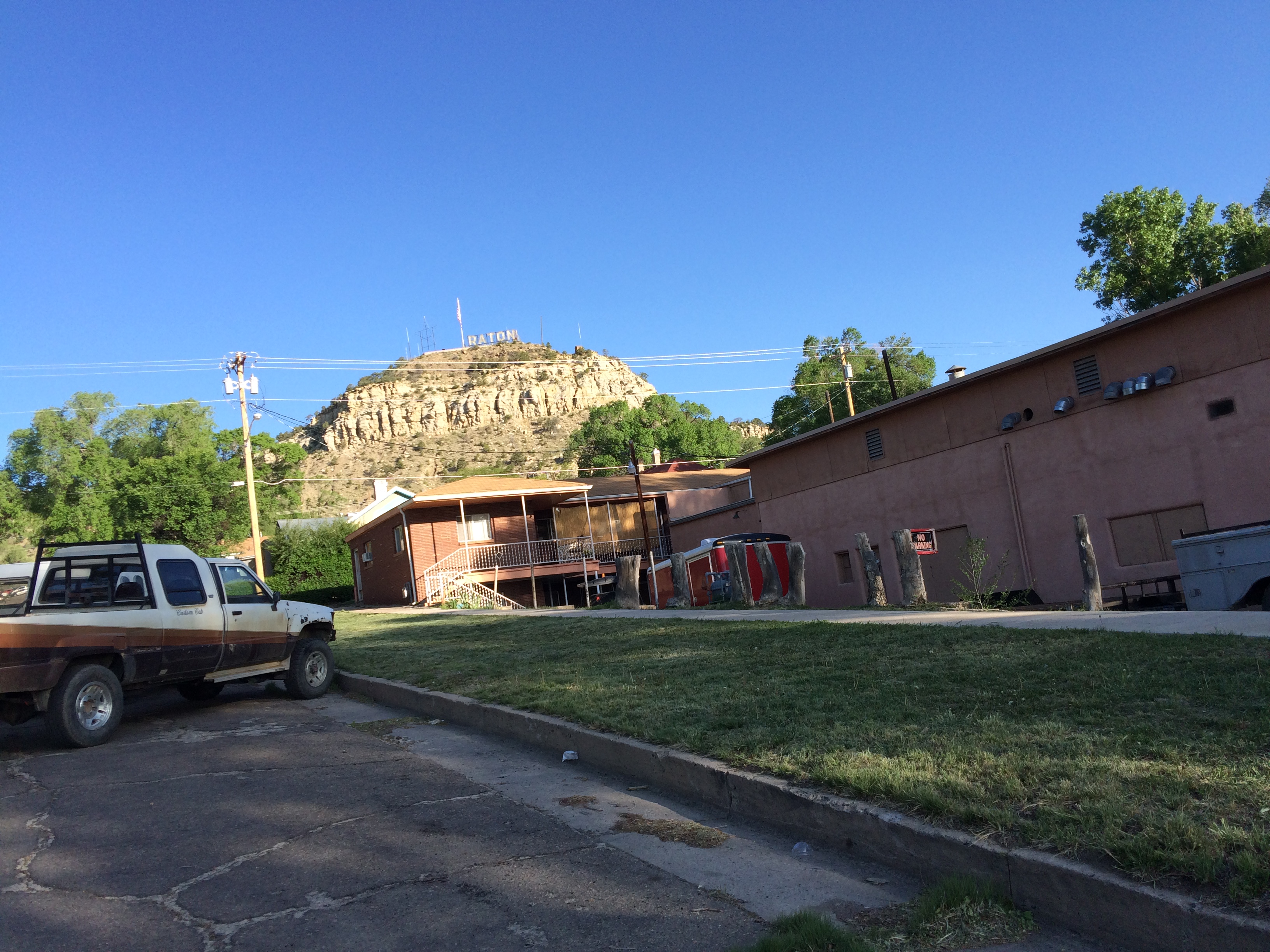
From Denver we drove all the way to Santa Fe, New Mexico, stopping in Raton, New Mexico, for a night, and arriving in Santa Fe the next day by lunch time.  I had lots of thoughts during that drive as we observed a part of the United States I’d never seen before, some of it incredibly beautiful and awe-inspiring and other parts that made me appreciate the struggles that so many Americans experience day to day.  More on that to come as well.

Raton

Raton

20160525_143124185_iOS

And then we got to Santa Fe, the main destination of our trip.  Santa Fe is a city with an incredibly long and rich history, including my Seligman family’s own personal history there, about which I’ve written extensively.  Being in this place that had been the home of my great-great-grandfather and his family—and where they had contributed so much to its commercial and political development—-was very moving and exciting.  And then there is the art, the glorious landscapes, the architecture.

20160526_151032795_iOS

20160527_164958541_iOS

20160527_200612447_iOS

The last leg of our trip took us to Taos where I again was inspired to think about the history of this country as well as its amazing landscapes and vistas.  It’s no wonder that so many artists were inspired by the scenery and the light and the skies over New Mexico.

20160530_150420390_iOS

20160530_155656274_iOS

I will be writing about the trip in the days that follow, and then I will return to the story of my family.  I have much to do after all these days away from research and from blogging.  I have missed the work and my family, my cats, and my friends, but as always, it’s good to get a break, some new perspectives, and a chance to reflect on all the wonders that life brings.

Yom Hashoah—Holocaust Remembrance Day

Today is Yom Hashoah, Holocaust Remembrance Day, a day to remember all those who were killed during the Holocaust.

As a result of my genealogy work, I have learned in the last few years that there were many members of my extended family who were victims of the Nazis.  I had always assumed that all my relatives had left Europe before Hitler came to power—long before he came to power.  So learning about the many members of the Seligmann family who were killed and then more recently about the many members of the Schoenthal and Hamberg families who were killed has been very painful.

The Holocaust touched us all, whether we know it or not, whether we are Jewish or not. Our world lost millions of people.  As each generation learns how cruel and inhumane other people can be, there is once again a loss of innocence.  I dread the day when my grandsons also have to learn this horrible truth.

English: A lit Yom Hashoah candle in a dark ro...

English: A lit Yom Hashoah candle in a dark room on Yom Hashoah (Photo credit: Wikipedia)

Last spring I visited the camps at Terezin and Auschwitz.  I carried with me a list of the names of my relatives who had died at each of the camps so that I could honor their memories.

That list has grown since last spring.  One of the most recent names I’ve had to add to the list of those who died at Auschwitz was Liesel Mosbach Lion, granddaughter of Rosalie Schoenthal Heymann, my great-grandfather’s sister.  Liesel was my father’s second cousin.

I recently posted about Liesel and her family and what happened to them.  Most of what I knew came from the memoir written by Liesel’s husband Ernst Georg Lion, The Fountain at the Crossroads.  I was so moved by his book that I have decided to see whether there is a way to get it published in a format where it will be accessible to more people.  I am now in touch with Ernst’s son Tom.  He sent me photographs of Ernst and his family, including my cousin Liesel.  With his permission, I am posting a few of them here to honor their memory this Yom Hashoah.

The first three are of Ernst’s parents, Leo and Bertha (Weinberg) Lion.  Bertha died from the stress caused by the Nazi treatment of Jews during the 1930s.  Leo was killed in one of the camps.

Ernst Lion parents 1 Ernst Lion father

Ernst Lion parents 2

This is the last photograph taken of Leo Lion before he was arrested and sent to a concentration camp.

Ernst Lion father 2

On the left below is my cousin Liesel Mosbach Lion; she was killed at Auschwitz.  On the right is the wedding picture of Liesel and Ernst, December 18, 1939.

Liesel, her sister Grete, both of her parents, Helene Heymann Mosbach and Julius Mosbach, and her aunt Hilda Heymann were all killed during the Holocaust. Her grandfather Willy Heymann was arrested and taken to Dachau and died soon after being released.

They were all my cousins.

Liesel Mosbach Lion alone and in wedding picture with Ernst

These are various photographs of Ernst from childhood through the war years and afterwards in the US.  His story of suffering and survival is unforgettable.

pictures of Ernst Lion

We live in a time when once again hatred and fear permeate our world and demagogues are seeking power.  We must be vigilant and remember what happened then.  We must do all we can to ensure that genocide does not occur again anywhere.

We must never forget.  Never again.

The Adopted Son: Who Was He?

As I move closer to closure on the family of Levi Schoenthal and Henriette Hamberg, my great-great-grandparents[1], I want to ask for your help regarding a mystery involving a boy I believe was part of Henriette’s family, the Hambergs. I need to know if my thinking about him makes sense.

His name was Samuel Hamberg (spelled Hamburg here), and in 1880 he was twelve years old and living in Washington, Pennsylvania, as the adopted son of my great-great-uncle Henry Schoenthal and Helene Lilienfeld.

Henry Schoenthal and family 1880 census Year: 1880; Census Place: Washington, Washington, Pennsylvania; Roll: 1202; Family History Film: 1255202; Page: 596A; Enumeration District: 271

Henry Schoenthal and family 1880 census
Year: 1880; Census Place: Washington, Washington, Pennsylvania; Roll: 1202; Family History Film: 1255202; Page: 596A; Enumeration District: 271


Who was he? Was he part of my great-great-grandmother’s family?  According to the 1880 census, Samuel was born in 1868 in South Carolina.  Henry Schoenthal, the first of Henriette Hamberg’s children to emigrate from Germany, hadn’t arrived until 1866, two years before Samuel was born.  Henry settled in Pennsylvania.  How would a boy born in a state so far away two years after Henry arrived  in the US have ended up with Henry unless there was a family connection?  The surname Hamberg couldn’t just be a coincidence, could it?

His first name also seemed unlikely to be a coincidence.  Henriette’s father was Moses Hamberg, my three-times great-grandfather.  Moses had a younger brother named Samuel, my four-times great-uncle. Young Samuel could have been named for him.  The name similarities added to my hunch that this Samuel Hamberg was in some way related to my great-great-grandmother and the other Hambergs from Breuna.  I had to figure this one out.

I was able to locate a two year old boy named Samuel Hamberg on the 1870 census living in Columbia, South Carolina, in the household of a Charles Hamberg, age 46, and a Tenah Hamberg, age 21.  Given the birth place, name, and age of the boy, I felt it quite likely that this was the same boy who ten years later was living with Henry Schoenthal in Pennsylvania.  Unfortunately, the 1870 census did not include information describing the relationships among those in a household, but I assumed that Charles and Tenah were the father and mother of little Samuel.  If so, who were they?

Charles Hamberg household 1870 US census Year: 1870; Census Place: Columbia, Richland, South Carolina; Roll: M593_1507; Page: 140B; Image: 287; Family History Library Film: 553006

Charles Hamberg household 1870 US census
Year: 1870; Census Place: Columbia, Richland, South Carolina; Roll: M593_1507; Page: 140B; Image: 287; Family History Library Film: 553006

According to the 1870 census, Charles was born in Prussia 46 (or is it a 40?) years earlier or in 1824 or so. (Breuna was within the boundaries of Prussia from 1866 until the German Federation was created in 1871.)  Charles was working as a “ret gro” merchant, which I interpret to mean a retail grocery merchant. Tenah was born in South Carolina as was Samuel.

I was able to trace Charles back ten more years to the 1860 census, where he was also living in Columbia, South Carolina, but married not to Tenah but a woman named Mary.  According to the 1860 census, Charles was then 28, so born in 1832; according to this census, he was born in Germany and working as a merchant.  Mary was a North Carolina native and 27 years old.

Charles Hamberg and household 1860 US census Year: 1860; Census Place: Columbia, Richland, South Carolina; Roll: M653_1227; Page: 26; Image: 57; Family History Library Film: 805227

Charles Hamberg and household 1860 US census
Year: 1860; Census Place: Columbia, Richland, South Carolina; Roll: M653_1227; Page: 26; Image: 57; Family History Library Film: 805227

I then discovered a marriage record for Charles Hamberg and Mary Hanchey reporting their marriage in 1853 in New Hanover, North Carolina.

Charles Hamberg and Mary Hanchey marriage record 1853 Ancestry.com. North Carolina, Marriage Records, 1741-2011 [database on-line]. Provo, UT, USA: Ancestry.com Operations, Inc., 2015. Original data: North Carolina County Registers of Deeds. Microfilm. Record Group 048. North Carolina State Archives, Raleigh, NC.

Charles Hamberg and Mary Hanchey marriage record 1853
Ancestry.com. North Carolina, Marriage Records, 1741-2011 [database on-line]. Provo, UT, USA: Ancestry.com Operations, Inc., 2015.
Original data: North Carolina County Registers of Deeds. Microfilm. Record Group 048. North Carolina State Archives, Raleigh, NC.

But that was the earliest record I could find for Charles Hamberg.  And I still didn’t know whether he was related to the Hambergs of Breuna, my great-great-grandmother’s family.

Fortunately for me, others, including the noted genealogist Hans-Peter Klein, had already done extensive research of the Hamberg family tree. You can find it here.[2]  There was no Charles Hamberg listed in the records in Breuna.  But there were other men in the family with the surname Hamberg who would have been about the same age as Charles Hamberg.  I had to find out whether any of them came to the United States and perhaps changed his name to Charles.

Moses Hamberg, my 3x-great-grandfather, had five sons:

Juda, who died in Breuna in 1863;

Seligmann, who died in Breuna in 1897;

Salomon, who married and had several children in the 1850s in Breuna (no death record has been located;

Marcus, who died in Breuna in 1846;

And finally, Abraham, born in Breuna in 1828 and for whom there was no marriage or death record in Breuna.

Of Moses Hamberg’s five sons, the only one who might have emigrated by 1853 was Abraham.

As for the sons of Samuel Hamberg, brother of Moses, there were three sons:

another Juda, who died in Breuna in 1863;

Baruch, born in 1824 and for whom there was no marriage or death record;

And Moses, born in 1829 and for whom there was also no marriage or death record in Breuna.

So it was possible that Baruch and/or Moses had emigrated.

The three Hamberg men from Breuna who could have immigrated to the US by 1853 were thus Abraham, Baruch, and Moses: no one named Charles.  All three of those Hamberg men were close in age to the Charles Hamberg in Columbia, South Carolina.  All were born between 1824 and 1829.  But had any of them actually immigrated to the United States? I decided to search for them on ship manifests and other US records and found that all three did in fact leave Germany for the United States before 1853.

Moses Hamberg arrived in New York from Breuna in August, 1846, when he was seventeen, according to the ship manifest.  This is clearly Moses, the son of Samuel Hamberg, who was born in 1829 and thus would have been 17 in 1846.  Moses was a shoemaker, according to the manifest.

Year: 1846; Arrival: New York, New York; Microfilm Serial: M237, 1820-1897; Microfilm Roll: Roll 063; Line: 1; List Number: 680

Year: 1846; Arrival: New York, New York; Microfilm Serial: M237, 1820-1897; Microfilm Roll: Roll 063; Line: 1; List Number: 680

Baruch and his first cousin Abraham arrived in New York together in September 1852.  According to the ship manifest, they were coming from Breuna, and both were 24 years old, meaning they were born in about 1828.  My great-great-grandmother’s brother Abraham was born in 1828; according to Breuna records, Baruch was born in 1824.

Despite the disparity in the ages between the Baruch on the manifest and the Baruch born in Breuna, I believe that the two men on this manifest were in fact Abraham Hamberg, son of Moses Hamberg, and Baruch Hamberg, son of Samuel Hamberg.  The ship manifest reports that their destination in the US was “Sevanna,” which I assume meant Savannah, Georgia.

Year: 1852; Arrival: New York, New York; Microfilm Serial: M237, 1820-1897; Microfilm Roll: Roll 119; Line: 1; List Number: 1321

Year: 1852; Arrival: New York, New York; Microfilm Serial: M237, 1820-1897; Microfilm Roll: Roll 119; Line: 1; List Number: 1321


So did any of these three young men become Charles Hamberg of Columbia, South Carolina?  And if so, which one? Since Abraham and Baruch were headed to a city in the South whereas Moses indicated that New York was his intended destination, my inclination was to focus on Abraham and Baruch as the ones more likely to have become Charles Hamberg.[3]

Searching for further records for Abraham Hamberg led me to the sad discovery that he died not too long after arriving in the US.  He died in Savannah, Georgia, his intended destination, on August 26, 1854, of yellow fever and was buried in that city.  He was my great-great-grandmother Henriette’s younger brother.  He was only 26 years old.

Abraham Hamberg death record 1854 Ancestry.com. Savannah, Georgia, Select Board of Health and Health Department Records, 1824-1864, 1887-1896 [database on-line]. Provo, UT, USA: Ancestry.com Operations, Inc., 2014. This collection was indexed by Ancestry World Archives Project contributors. Original data: City of Savannah, Georgia. Savannah, Georgia, Select Board of Health and Health Department Records, 1822–1864, 1887–1896. Subseries 5600HE-050 and 5600HA-010. Microfilm, 27 reels. City of Savannah, Research Library & Municipal Archives, Savannah, Georgia

Abraham Hamberg death record 1854
Ancestry.com. Savannah, Georgia, Select Board of Health and Health Department Records, 1824-1864, 1887-1896 [database on-line]. Provo, UT, USA: Ancestry.com Operations, Inc., 2014. This collection was indexed by Ancestry World Archives Project contributors.
Original data: City of Savannah, Georgia. Savannah, Georgia, Select Board of Health and Health Department Records, 1822–1864, 1887–1896. Subseries 5600HE-050 and 5600HA-010. Microfilm, 27 reels. City of Savannah, Research Library & Municipal Archives, Savannah, Georgia

Abraham Hamberg burial record Ancestry.com. Savannah, Georgia, Cemetery and Burial Records, 1852-1939 [database on-line]. Provo, UT, USA: Ancestry.com Operations, Inc., 2012. Original data: Savannah Georgia Cemetery and Burial Records. Savannah, Georgia: Research Library & Municipal Archives City of Savannah, Georgia.

Abraham Hamberg burial record
Ancestry.com. Savannah, Georgia, Cemetery and Burial Records, 1852-1939 [database on-line]. Provo, UT, USA: Ancestry.com Operations, Inc., 2012.
Original data: Savannah Georgia Cemetery and Burial Records. Savannah, Georgia: Research Library & Municipal Archives City of Savannah, Georgia.

So what then happened to his cousin Baruch Hamberg? Had he made it to Savannah?

My guess is that somewhere along the way from New York to Savannah, Baruch and Abraham stopped in New Hanover, North Carolina, where Baruch met and married his first wife Mary Hanchey in 1853.  And by then, he had dropped the Hebrew name Baruch and adopted the much more American name Charles.  In fact, his full name was Charles B. Hamberg.  Perhaps that B was for Baruch.

What else supports this conclusion that Baruch Hamberg became Charles Hamberg? Recall that Baruch Hamberg was the son of Samuel Hamberg of Breuna.  And what did Charles Hamberg name his son born in 1868? Samuel.

If I am right, then Charles/Baruch Hamberg was Henriette Hamberg Schoenthal’s first cousin; their fathers Samuel and Moses were brothers.  Charles’ son Samuel was therefore a second cousin to Henriette’s son Henry Schoenthal, the man who had adopted him by 1880.

So does my analysis make sense?  Did Baruch Hamberg become Charles Hamberg?

And if so, why was his son Samuel living with and adopted by Henry Schoenthal in 1880? That question will be addressed in a later post.


[1] And while I wait to talk with my third cousin Betty, who is also their great-great-granddaughter.

[2] I wrote a little bit about the Hambergs of Breuna, Germany here when I described the remarkable story of how I learned that my fifth cousin Rob and I shared not only some DNA,  but had lived at one point just a few miles from each other, and, even more remarkably, were both close friends with the same couple.  We had a lovely dinner back in December hosted by Rob and his wife Ann where all of us—our mutual friends included—had a great evening.  I remain amazed by what a small world it is.   Rob and I are both the four-times great-grandchildren of Jeudah ben Moses, the father of Moses Hamberg and Samuel Hamberg.  Rob is descended from Samuel; I am descended from Moses.

[3] I will follow up on Moses Hamberg in a later post.

Another Delightful Conversation: My Cousin Maxine

I love it when a cousin finds me.  Usually I am the one searching for them, hoping they will be interested and open to sharing their family histories with me.  So when a cousin finds my blog, it is a delightful experience—I know they are interested, and there is none of the awkwardness of trying to explain who I am and that I am not a scammer trying to get money from them or steal their identity.

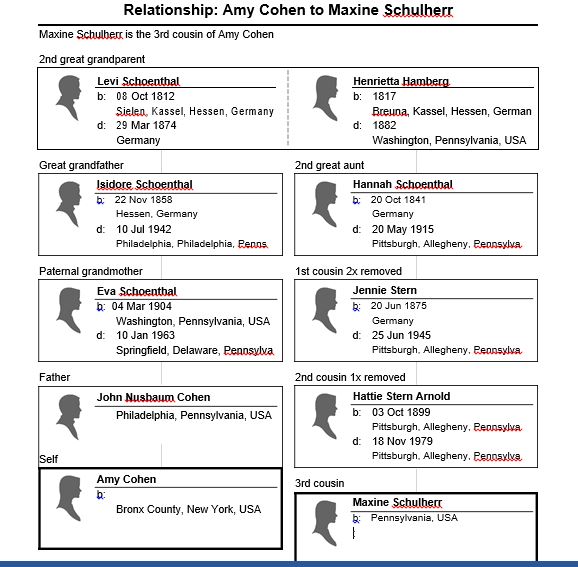
I’ve had that great pleasure again recently when my third cousin Maxine found my blog and left a comment about her connection to me and her family.  Maxine is the daughter of Hattie Arnold and Martin Schulherr, about whom I wrote here.  Maxine’s grandparents were Jennie Stern and Max Arnold, and her great-grandmother was Hannah Schoenthal Stern.  Hannah was my great-grandfather Isidore Schoenthal’s older sister.  Thus, Maxine and I are both the great-great-granddaughters of Levi Schoenthal and Henriette Hamberg.  We are third cousins.

Relationship Amy to Maxine Schulherr


Maxine was born and raised in the Pittsburgh area and has lived there all her life.  We had a wonderful phone conversation and have exchanged many emails since.  Maxine knew many of the cousins about whom I’ve written, including Lee and Meyer Schoenthal, Erna and Werner Haas, and the members of the extended Oestreicher family.  She was able to bring to life many of these people, who thus far had been mostly names and dates and occupations to me.

Her grandmother Jennie lived with Maxine and her parents for a number of years, and Maxine even shared a room with her grandmother during that time.  She knew her well, and so I was hoping that Maxine would have stories about Jennie’s youth.  Jennie came to the United States from Germany in the 1880s with her mother Hannah when she was thirteen years old, and I was interested in hearing any stories about Jennie’s life in Germany or about her experiences as a teenager settling in western Pennsylvania.  But as with so many immigrants, Jennie did not talk about the past.  Maxine said she never heard her grandmother talk about Germany or about her early days in the US.

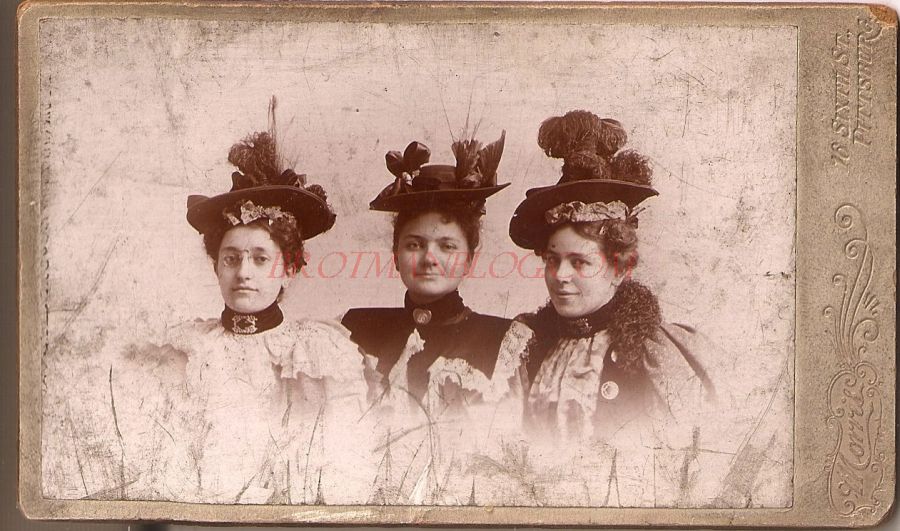
But she did have some old photographs of Jennie with two other women whom we both assume are Jennie’s two sisters, Sarah (on the left) and Edith (on the right). (All photos in this post are courtesy of my cousin Maxine.)

jennie-stern-arnold-and-her-sisters-1

Jennie Stern Arnold, center, and perhaps Sarah Stern Ostreicher on the left and Edith Stern Good on the right

jennie-stern-arnold-and-sisters-2

Stern sisters


Maxine then told me about her grandmother Jennie’s life as an adult in Pennsylvania.  Jennie married Max Arnold, who had originally owned a dairy called Sweet Home Dairy. (Maxine was named for her grandfather Max.)  It was the first dairy to deliver milk to homes in the Pittsburgh area, according to Maxine.  Max had to close the dairy when he had trouble hiring reliable men to come and milk his cows, and he then went into the meat business, as I wrote about here.   Max eventually he retired and his son Sylvan ran the business when Maxine was a child.  Max, Jr., helped his brother Sylvan doing deliveries, but after having several accidents he moved on to other endeavors.

Sylvan closed the meat market when he enlisted in the army during World War II.  He would not have been drafted, given his age, but according to Maxine, Sylvan was looking to get away as his marriage was failing.  He and his first wife Ada divorced, and Sylvan remarried while in the service and stationed in Arkansas.  Based on Maxine’s information, I found a marriage record for Sylvan Arnold and Gladys Evans dated June 20, 1945, in Saline, Arkansas.  He and his second wife Gladys later moved to California, and the family in Pittsburgh never met her.

Here is a photo of Jennie and Max with their first child, Jerome, who was born in 1897.

jennie-stern-and-max-arnold-with-jerome-c-1897-edited

Jennie Stern Arnold, Jerome Arnold, and Max Arnold, Sr. c. 1897


Jennie and Max had five children, and Maxine had this wonderful picture that she believes is of those five:

hattie-arnold-unknown-jerome-max-bernice-and-sylvan-arnold

Children of Jennie Stern Arnold: Hattie, unknown, top; Jerome, possibly Max, Jr., and Bernice, center row; and Sylvan, foreground at bottom, c. 1913

Maxine’s mother Hattie is the girl in the light dress on top next to an unknown girl.  Her uncle Jerome is on the left and her aunt Bernice on the right in the middle row, and her uncle Sylvan is the boy on the ground in the front.

The little boy on the swing might be Max, Junior, but the age seems off, so I’m not sure. Since Jerome looks to be no more than sixteen here, I think this photo is probably dated no later than 1913.  In 1913, Jerome was 16, Hattie 14, Bernice 12, and Sylvan 10, and that does seem to line up with what I think are the maximum ages of the children in the photograph. I actually think they look even younger than those ages.  What do you all think? Are the children older than that?

So if the photo was taken in 1913, Max, Jr. would have been two years old.  Does the little boy on the swing look to be only two years old?  I think he looks at least three or four.  What you think?

From Maxine, I also learned more about the lives of Maxine’s mother Hattie and Hattie’s four siblings. Hattie was very proud to be one of the first women to learn to drive in Pittsburgh.  She was sixteen, and her father brought home a car that he couldn’t drive, but somehow Hattie and her brother Jerome learned to drive it.

Hattie’s sister Bernice was married twice, first to Julius Averback, whom she later divorced.  Maxine was very fond of Julius and recalled that he had taken her to the circus where he bought her a pet chameleon. Maxine told me, “The circus sold chameleons in little boxes with a string around their necks and a  safety pin at the end of the string so you could pin it on your clothes!!”  Even though he was divorced from Bernice at the time, Julius sent Maxine eighteen roses for her eighteenth birthday. Bernice’s second husband was Abe Sultanov.  Bernice did not have children with either husband.

All three of Hattie’s brothers worked in the meat business initially, but Max, Jr. later branched out into the movie theater business, living in Morgantown, West Virginia for some time before returning to the Pittsburgh area where he owned another theater in Verona and then worked in the furniture business after his brother-in-law Abe, Bernice’s second husband, made some connections for him (Abe was a manufacturer’s representative for a line of furniture).  Later on, Max, Jr. owned a drive-in theater in the Pittsburgh area known as the Maple Drive-In.

According to Maxine, her grandmother Jennie as well as Jennie’s older sister Sarah Stern Oestreicher converted to Christian Science at some point in their adult lives. Maxine recalled going to church services with her grandmother.  But Martin and Hattie remained Jewish, and Maxine was confirmed at Rodef Shalom synagogue in 1944, the same synagogue where her mother had been confirmed about thirty years earlier.

Maxine was married to Alan Stein in August, 1948.  She generously shared with me these pictures from her wedding day:


Hattie Martin Maxine Alan Henrietta Stein Alan's mother

Hattie Arnold Schulherr, Martin Schulherr, Maxine Schulherr Stein, Alan Stein, Henrietta Stein (Alan’s mother)

hattie-max-and-bernice

Hattie Arnold Schulherr, Max Arnold, Jr., and Bernice Arnold Averbach Sultanov

Hattie Martin Ceil RIchard Lou Ann daughter of Jerome and ELlen, Maxine, Max. Bernice and Ellen

Hattie Arnold Schulherr, Martin Schulherr, Richard Arnold (son of Max, Jr.), Cecilia Lefkowitz Arnold, Lou Ann Arnold (daughter of Jerome Arnold), Maxine Schulherr Stein, Max Arnold, Jr., Bernice Arnold Averbach Sultanov, and Ellen Schwabrow Arnold

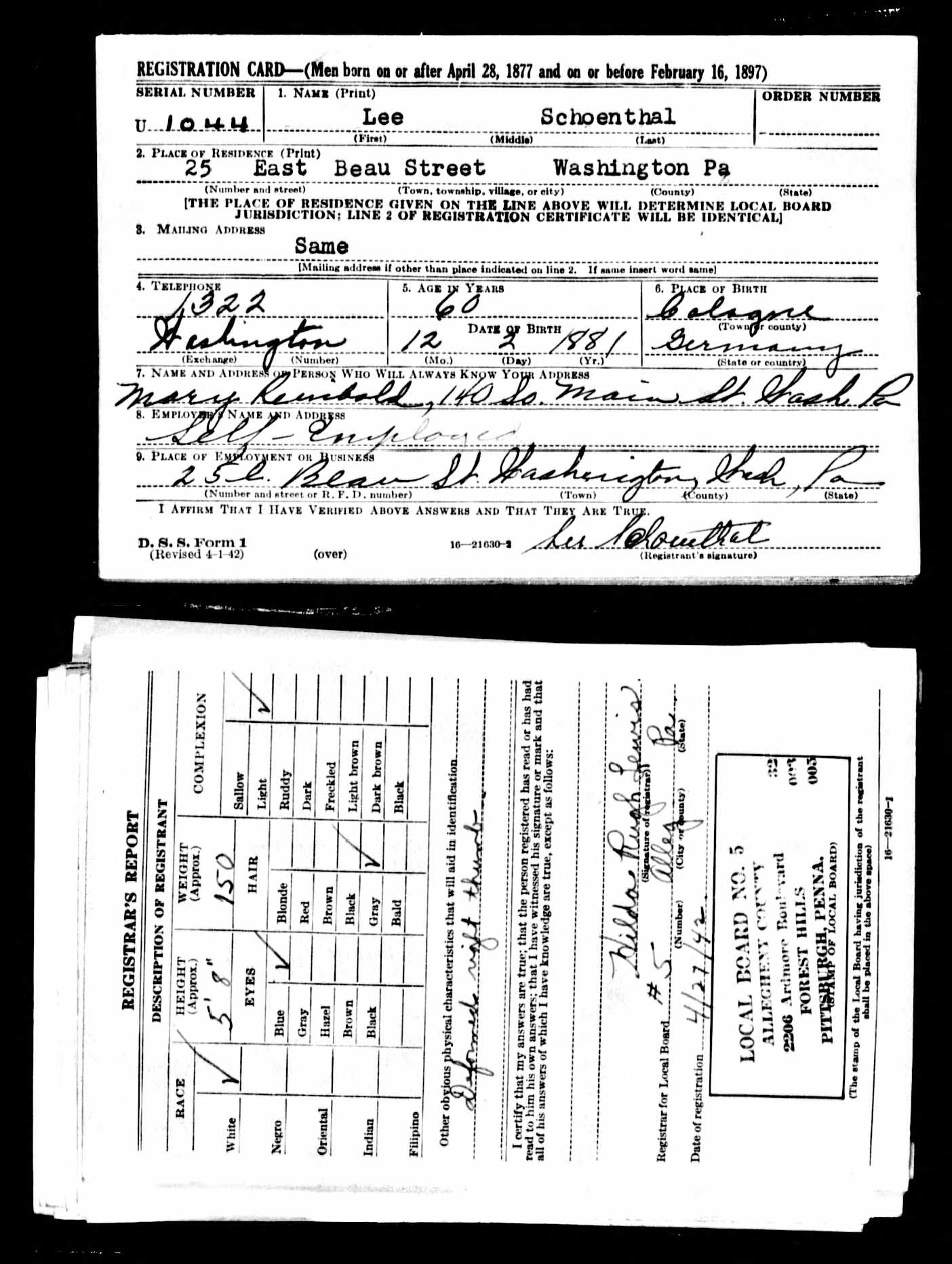
In addition to her grandparents, parents, and aunts and uncles, Maxine also knew our mutual cousins Lee and Meyer Schoenthal quite well, and she was able to answer one of my lingering questions about Lee.  When I wrote about Lee’s draft registration for World War II, I’d been puzzled by the person he’d named as the one who would always know his address, a woman named Mary Reinbold.

Lee Schoenthal World War II draft registration The National Archives at St. Louis; St. Louis, Missouri; World War II draft cards (Fourth Registration) for the State of Pennsylvania; State Headquarters: Pennsylvania; Microfilm Series: M1951; Microfilm Roll: 278

Lee Schoenthal World War II draft registration
The National Archives at St. Louis; St. Louis, Missouri; World War II draft cards (Fourth Registration) for the State of Pennsylvania; State Headquarters: Pennsylvania; Microfilm Series: M1951; Microfilm Roll: 278


Maxine shared with me that Mary Reinbold was Lee’s girlfriend for many years.  They were together a long time but never married because Mary was Catholic and Lee was Jewish.  Maxine recalled that Lee and Mary regularly came to her parents’ home for Sunday dinners.  She remembers them both very fondly.  She said Lee was a successful tailor who sold made-to-order men’s suits; her father Martin owned suits he purchased from Lee.  Lee’s shop was in the basement of building on E. Beau Street in Washington, Pennsylvania.

He must have done quite well, as Maxine told me, “Lee always drove a Lasalle car which in it’s day was in the Cadillac or more expensive class.  And he belonged to a club in  Washington, called the “Arms Club” although he never went hunting.  It was a bar, some tables, slot machines, a dance floor, and other games of chance.” Maxine said that Lee always brought her mother candy that he won at the club.   Her father Martin was also a member of the club, and Maxine visited there as well.  She told me, “I liked to pull the handle on the slot machine and watch the coins come out!!  And Daddy would stand beside me and hand me the quarters.  (I never had to spend my allowance, which then was probably one dollar a week.)”  I just love the images that this anecdote evokes.

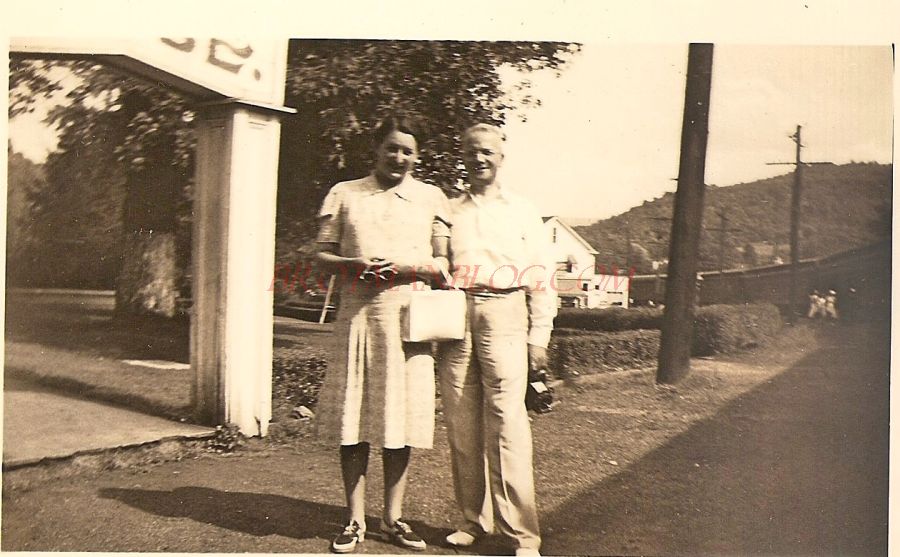
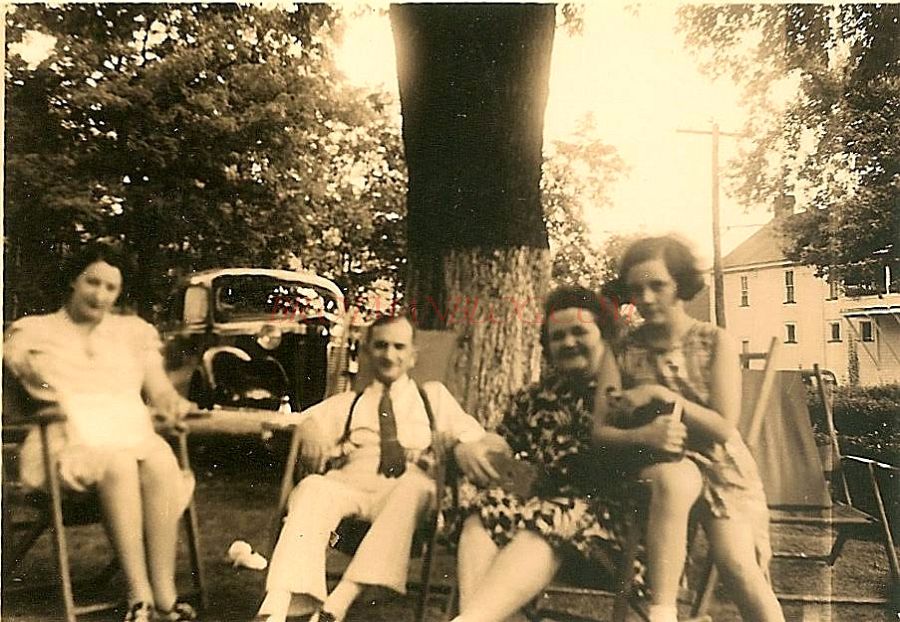
Here are some photographs Maxine shared of Lee, Meyer, Mary, her mother Hattie, and herself as a twelve year old, taken in about 1940.

lee-schoenthal-c-1940s

Lee Schoenthal, c. 1940

mary-reinbold-and-lee-schoenthal

Mary Reinbold and Lee Schoenthal, c. 1940

mary-reinbold-meyer-schoenthal-hattie-arnold-schulherr-maxine-schulherr-stein

Mary Reinbold, Meyer Schoenthal, Hattie Arnold Schulherr, and Maxine Schulherr, c. 1940

It’s just wonderful to be able to see the faces that go with the names.

Maxine also remembers Lee and Meyer’s sister Erna Haas and her son Werner, but does not remember Lee and Meyer’s other sister, Johanna, the one who survived the Gurs internment camp in France and came to the US with her husband in 1947.  Since Johanna outlived Lee and Meyer and also lived in Pittsburgh, I was surprised that Maxine had no recollection of meeting her nor any awareness of this fourth sibling.  Perhaps Johanna’s suffering during the war had made her less able to interact with the extended family.

Maxine also knew members of the Oestreicher family, that is, the family of Sarah Stern and Gustav Oestreicher.  Sarah was her grandmother Jennie’s older sister, as discussed here and here.  Maxine knew Sarah’s son Sidney and his children, Gerald, Betty, and Elaine very well.  She said that Elaine had lived with her family for a while in the 1940s when Sidney and his wife Esther moved to New York and Elaine wanted to finish the school year in Pittsburgh.  But Maxine didn’t know what had happened to Elaine or the rest of the family after that and was curious to learn more about her long-lost second cousins.

I told her I would see what else I could find as I also had not yet been able to learn much about the Oestreicher family after about 1940.  With a few clues from Maxine, I was able to find those long-lost Oestreicher cousins.  I will report on what I’ve learned in a later post after I’ve had a chance to speak with my other third cousins, Betty and Elaine.


Passover 2016: The Exodus

In many ways Jewish history is about one exodus after another.  The Jewish story begins when God tells Abra(ha)m, “Lech Lecha,”  or “Go, Go out.”  He instructs him to leave his father’s land and go to a new land where his children would be as numerous as the stars.

There are many journeys throughout the Bible—Noah’s journey, Jacob’s journey, Joseph’s journey, and, of course, the exodus from Egypt led by Moses, which is recalled and re-enacted every year on Passover.

This Friday evening we will once again remember and re-enact that journey.  We will read the story of the Exodus.  We will drink wine, recline like free people, and eat matza to remember that our ancestors had no time to wait for the dough to rise before exiting from Egypt.  We will eat the bitter herbs to remember the bitterness of slavery, and we will eat the charoset—a mixture of apples, nuts, and wine—to embrace the sweetness of freedom from slavery.

English: Passover Seder Table, Jewish holidays...

English: Passover Seder Table, Jewish holidays עברית: שולחן הסדר, Original Image Name:סדר פסח, Location:חיפה (Photo credit: Wikipedia)


But that exodus was not the last journey our people took to freedom.  Over the centuries Jews kept moving from one land to another, either having been expelled or deciding on their own to seek freedom from oppression, violence, and hatred.  They moved to Babylonia, to Spain, to eastern Europe, to Germany, to places all over the globe, including eventually to the Americas.

I have spent much of the year since last Passover studying the journeys of my paternal relatives from Sielen, Germany—my father’s maternal grandfather’s family, the Schoenthals.  Although I still have a few more stories to share about my Schoenthal cousins, now that I have written about all the children of Levi Schoenthal and Henriette Hamberg, I want to spend this Passover looking back over the story of this particular family.

Levi and Henriette Schoenthal had ten children who survived to adulthood, all born in Sielen, Germany.  Of those ten, eight settled permanently in the US, and all but one of those eight started their lives in America in western Pennsylvania—either in Pittsburgh or the town thirty miles away, known as Little Washington.  Henry, the oldest son, arrived first in 1866, and by 1881, eight of the siblings were living in the US.  Henry over the years was a book seller and a china dealer, but underneath was a deeply religious and well-educated man.

His youngest brother was my great-grandfather Isidore, who arrived in 1881, also settled in Washington, and also worked as a china dealer.

Isidore Schoenthal

Isidore Schoenthal

In between Henry and Isidore were four other brothers in the US plus two sisters.  Over the years almost all of them prospered.  Some moved away from western Pennsylvania.  Simon ended up in Atlantic City, where he and his wife raised nine children, many of whom ended up in the hotel business there; Felix and his wife and two daughters ended up in Boston, where he became successful in the typewriter repair business. Julius lived in Washington, DC, worked as a shoemaker and had four children.  Nathan lived in many different places.  And even Isidore and Henry eventually left Pennsylvania, Isidore for Colorado and Henry for New York.  The two sisters, Hannah and Amalie, stayed in Pittsburgh for most of their lives.  Both were married and had children.

Felix and Margaret Schoenthal from 1919 passport application, National Archives and Records Administration (NARA); Washington D.C.; NARA Series: Passport Applications, January 2, 1906 - March 31, 1925; Roll #: 728; Volume #: Roll 0728 - Certificates: 70500-70749, 19 Mar 1919-20 Mar 1919

Felix and Margaret Schoenthal from 1919 passport application,
National Archives and Records Administration (NARA); Washington D.C.; NARA Series: Passport Applications, January 2, 1906 – March 31, 1925; Roll #: 728; Volume #: Roll 0728 – Certificates: 70500-70749, 19 Mar 1919-20 Mar 1919


Simon Schoenthal, my great-great-uncle

Simon Schoenthal, my great-great-uncle


The next generations wandered even further afield, although many ended up not too far from where their parents had originally settled.  My grandmother, who was born in Washington, PA, and grew up in Denver, spent her whole adult life in Philadelphia and New Jersey.

My Grandma Eva

My Grandmother Eva Schoenthal Cohen

Martin Schoenthal, Gertrude Sch., Hettie Sch Blanche Walter

Walter Schoenthal, Gertrude Schoenthal, Hettie Schoenthal, Blanche Stein and Walter Stein in Arizona


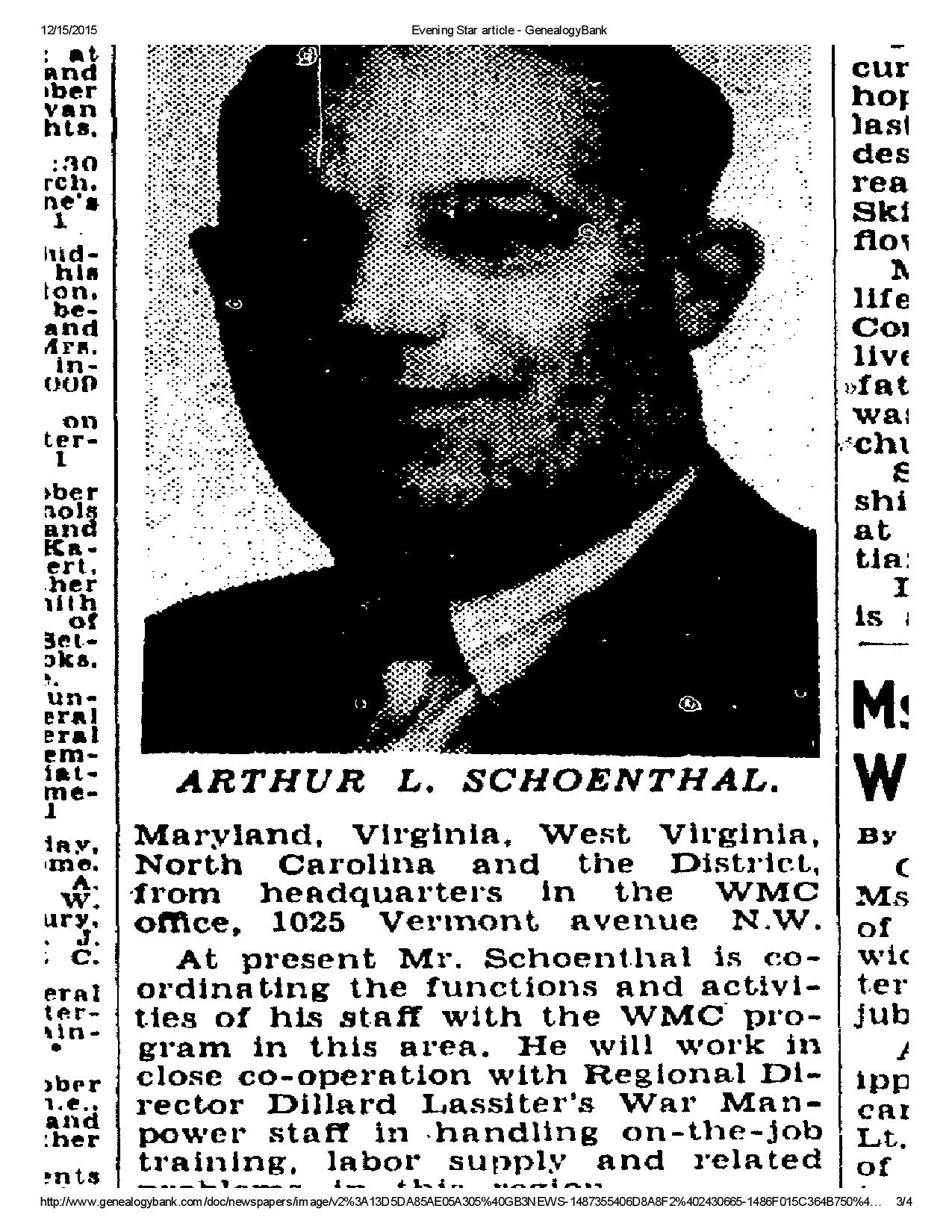
Arthur Schoenthal promoted 1942-page-003


Washington Evening Star, September 14, 1928, p. 9

Washington Evening Star, September 14, 1928, p. 9


Washington Star, December 2, 1928 p. 64

Washington Star, December 2, 1928 p. 64

Washington Evening Star, February 18, 1963, p. 24

Washington Evening Star, February 18, 1963, p. 24


Overall, the Schoenthals in the US prospered; most were successful business owners.  Most of these people appeared to have full and happy lives, although there were some who struggled.  Today there are numerous living descendants of those eight siblings, myself included.

On the other hand, the two siblings who stayed in Germany did not have as happy a legacy.  Jakob died young, and his daughter Henriette was killed in the Holocaust.  His four other children survived and, like their aunts and uncles, ended up in western Pennsylvania. Lee, Meyer, and Erna came before the war.  But Johanna was deported to a camp in Gurs, France, during the war and did not come until 1947.   From these five children, there were just two grandchildren: Helmut Levi, son of Henriette and Julius Levi, and Werner Haas, Erna’s son.  Both grandsons made it to the US before World War II.  Neither had children, however, so there are no living descendants of Jakob Schoenthal and his wife Charlotte Lilienthal.

Jewish Chronicle of Pittsburgh, June 14, 1984, p. 23 ewish+Chronicle+Vol.+23+No.+18 Formed+by+the+union+of:+Jewish+criterion+;++and:+American+Jewish+outlook. http://doi.library.cmu.edu/10.1184/pmc/CHR/CHR_1984_023_018_06141984

Jewish Chronicle of Pittsburgh, June 14, 1984, p. 23
ewish+Chronicle+Vol.+23+No.+18
Formed+by+the+union+of:+Jewish+criterion+;++and:+American+Jewish+outlook.
http://doi.library.cmu.edu/10.1184/pmc/CHR/CHR_1984_023_018_06141984


And finally Rosalie, the youngest child of Levi and Henriette, after living in the US for a few years made the fateful decision to return to Germany to marry Willy Heymann.  They had six children.  Four survived the Holocaust.  The three sons, Lionel, Max, and Walter, settled in Chicago before the war, where Lionel became a well-regarded photographer.   One daughter, Johanna, who was widowed at a young age, followed her stepdaughter Else Mosbach to Sao Paulo, Brazil, to escape the Nazis.

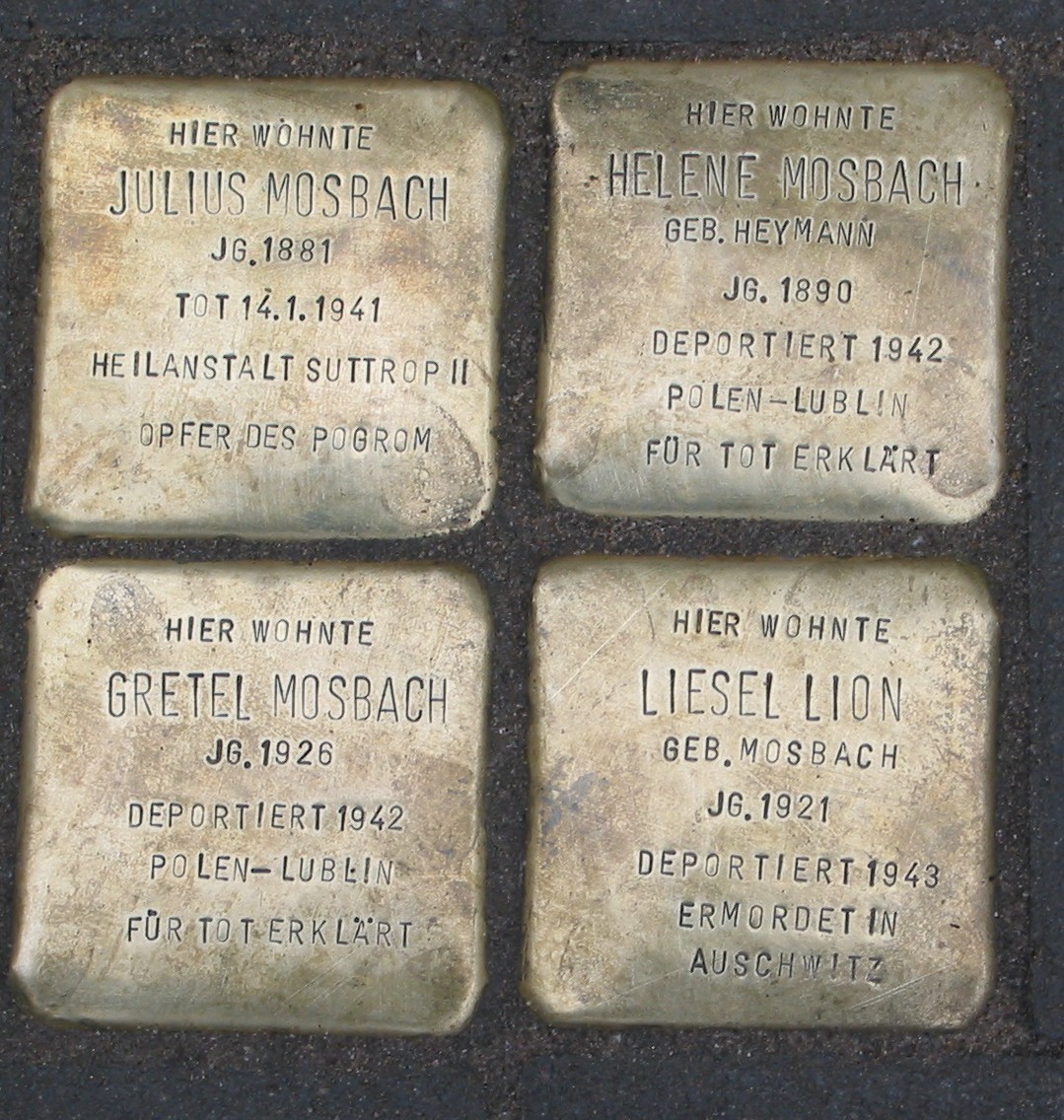
The other two daughters, Helene and Hilda, were murdered in the Holocaust as were Helene’s two daughters, Liesel and Grete.  From Rosalie’s six children, only one grandchild survived, the son of Max Heymann.  I am still hoping to find him.

Stolperstein for Julius Mosbach and family

The Schoenthal story illustrates how one fateful decision can alter the future irrevocably. One decision to take a chance and leave what you know—to listen to the call of Lech Lecha, to venture out to a new land—can make all the difference.  By taking a chance that the sweet charoset of that new land would outweigh the bitterness of leaving a land they knew, my great-grandfather and seven of his siblings changed their own fates and those of their descendants.

What if Jakob and Rosalie had left Germany when their siblings did?

And what if the other eight siblings had never left at all?  This story would have a very different ending.

In fact, it never would have been written.


Quick Update on Lionel Heymann

In my last post, I discussed how I was puzzled to learn that Lionel Heymann had been a well-regarded photographer, but had listed his occupation as a waiter on the census records for 1930 and 1940.  Well, now I have found an explanation.

In the course of looking for a print of one of Lionel’s photographs to purchase (which I’ve not yet been able to locate), I found this bit of information about Lionel online, quoting from the catalog of  the Sixteenth Detroit International Salon of Photography, Photographic Society of Detroit, Detroit Institute of Arts, 1947.

“Started photography as a hobby by joining Fort Dearborn Camera Club in Chicago in 1928. Started professionally January 1945, and conducts a portrait studio in Blackstone Hotel. Conducts a weekly photographic class on portrait and paper negative process. Associated professionally with a photographer in Detroit, 1937-38.”

This explains so much.  First, it explains what Lionel was doing in Detroit when his brother Walter arrived from Germany.  Second, it explains why Lionel did not list photography as his occupation on the 1930 or 1940 census or on his World War II draft registration.  He did not become a professional photographer until 1945.

The Little Sister Who Went Back Home: Rosalie Schoenthal, Part I


Finally I have come to the youngest of my great-grandfather’s siblings, the only one born after he was, his younger sister Rosalie.   Her story is even more tragic than that of her brother Jakob.

Rosalie was born in Sielen, Germany, in 1863, five years after my great-grandfather Isidore.  As I wrote earlier, she came with her mother and Isidore to the United States in 1881 when she was eighteen, but returned to Germany to marry Willy Heymann of Geldern, to whom she was apparently engaged even before leaving Germany. They were married on December 8, 1884, in Geldern.


I was fortunate that there were numerous sources available that provided me with information about Rosalie, Willy, and their family.  Two German websites had biographies of Willy and Rosalie Heymann and their children.  One, a site about the Geldern Jewish community, indicated that Willy and Rosalie had had six children, although it only named two of them, Helene and Hilda.  A second website containing information about the Heymann family was the Steinheim Institute site, which confirmed the fact that there had been six children and provided the names and birth years of all six as well as other pertinent facts that helped me with my research of Rosalie’s children.

From these two sources, I learned that Willy was a horse trader like his father Levi Heymann and was born in Geldern in February, 1857.  Geldern is about 150 miles from Sielen, so I’ve no idea how Rosalie and Willy knew each other; perhaps their fathers had known each other.  Willy and Rosalie settled in Geldern; their six children were: Lionel, born in 1887 and presumably named for Rosalie’s father, my great-great grandfather Levi Schoenthal; Johanna, born in 1889; Helene, born in 1890 (perhaps named for Henriette Hamberg, Rosalie’s mother), Max, 1893; Walter, 1896; and Hilda, born in 1898.

The Geldern site had a photograph of the Heymann home in Geldern, depicted below.


Home of Willy and Rosalie Schoenthal Heymann in Geldern http://hv-geldern.de/images/juden/juden.htm

Home of Willy and Rosalie Schoenthal Heymann in Geldern
http://hv-geldern.de/images/juden/juden.htm

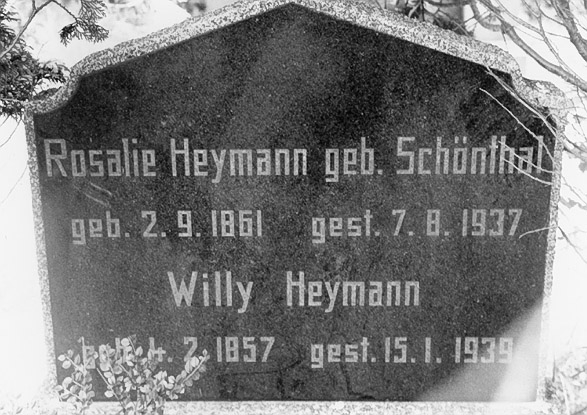
The Steinheim Institute site reported that Rosalie died on August 7, 1937, when she was 74 and that Willy Heymann died on January 15, 1939; it provided this description of his death:

Willy Heymann wurde nach seinem Tod von dem 14jährigen Fritz Davids, der erst kurze Zeit zuvor aus dem KZ Dachau zurückgekehrt war, in das man ihn nach der Pogromnacht mit seinem Vater verschleppt hatte, ganz alleine und heimlich zum Friedhof gebracht und begraben.

Translated by a member of the German Genealogy Facebook group as:

After his death, Willy Heyman was brought secretly to the cemetery and buried by 14 year old Fritz Davids alone, who had returned only a short time before from the concentration camp of Dachau where he had been brought with his father after the [Kristallnacht, Nov. 9, 1938].

How would you interpret that sentence? Does it mean that Willy had died outside of Geldern and been secretly returned by this fourteen year old boy? Had Willy also been at Dachau or just Fritz and his father? Or does it mean that Willy and Fritz’s father had been brought to Dachau after Kristallnacht? Does the “he” in that last phrase refer to Willy or Fritz?  I am inclined to think that Willy was at Dachau because otherwise, why would he have had to have been secretly brought to the Geldern cemetery?

UPDATE:  Thanks to Renate Adolfs and Cathy Meder-Dempsey, I now have more information about what happened to Willy, and it is awful.  Both Renate and Cathy found a link here that describes the terrible fate of Willy Heymann.  As translated by Cathy, this is the full story:

Aus dem KZ zurück, muß Fritz Davids schon zwei Monate später miterleben, wie schlimm es mittlerweile den Juden erging. Selbst vor dem Tod hat man nämlich keine Achtung mehr : Der Jude Willy Heymann war fast 84-jährig verstorben. Da ihn niemand begraben wollte oder konnte, lädt der 14-jährige Fritz die Leiche auf eine Schubkarre und fährt sie im Morgengrauen zum Boeckelter Weg auf den jüdischen Friedhof, wo er, ganz der ‚Würde” der Zeit entsprechend, dem alten Mann ein Grab schaufelt und den Kaddish spricht. Auch David Cain und Jakob Heymann wurden unter solchen entwürdigenden Umständen begraben.

Recently back from the concentration camp, Fritz Davids experienced, two months later, how bad the Jews had fared. There was no respect even for the dead. The Jew Willy Heymann died at the age of almost 84 years old. Since nobody wanted to bury him or could, the 14-year-old Fritz put the corpse in a wheelbarrow and at dawn wheeled it to Boeckelter Weg (street name) to the Jewish cemetery, where he, fully in dignity of the time, shoveled a grave for the old man and spoke the Kaddish. David Cain and Jacob Heymann were also buried under such humiliating circumstances.

Thank you, Renate and Cathy, for allowing me to memorialize Willy Heymann more completely.


The information about Willy and Rosalie and their children was also confirmed by a third source, Juden in der Geschichte des Gelderlandes (2002), a book edited by Gerd Halmanns and Bernhard Keuck that contains information, photographs, articles, documents, and maps of the Jewish communities in Geldern and the surrounding townsRodney Eisfelder from the GermanSIG of JewishGen kindly sent me a copy of page 370 from that book, which lists information about Willy Heymann and his family.  That page also provided me with numerous clues about the Heymann children.
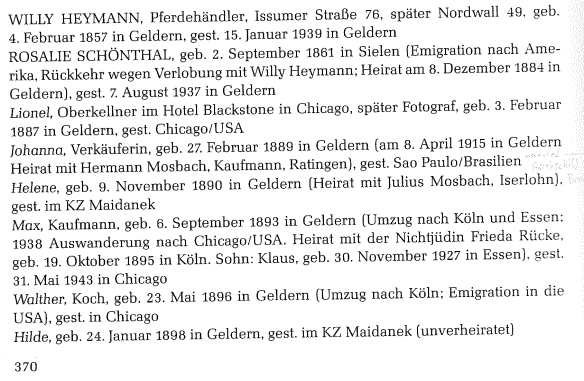
page 370 for blog

From these sources, I knew that Lionel Heymann, the oldest child, had moved to Chicago, but I found out that before he immigrated to the US, he had left Germany for England; he is listed on the 1911 English census as a 24 year old German national, living in London and working as a hotel waiter.


Lionel Heymann 1911 UK census Ancestry.com. 1911 England Census [database on-line]. Provo, UT, USA: Ancestry.com Operations, Inc., 2011. Original data: Census Returns of England and Wales, 1911. Kew, Surrey, England: The National Archives of the UK (TNA), 1911. Data imaged from the National Archives, London, England.

Lionel Heymann 1911 UK census
Ancestry.com. 1911 England Census [database on-line]. Provo, UT, USA: Ancestry.com Operations, Inc., 2011.
Original data: Census Returns of England and Wales, 1911. Kew, Surrey, England: The National Archives of the UK (TNA), 1911. Data imaged from the National Archives, London, England.

In 1912 he sailed from England to Algiers, still a German citizen, but listing his intended future permanent residence as Switzerland.  He was working as a hotel manager, according to the ship manifest.


Lionel Heymann 1912 passenger manifest Ancestry.com. UK, Outward Passenger Lists, 1890-1960 [database on-line]. Provo, UT, USA: Ancestry.com Operations, Inc., 2012. Original data: Board of Trade: Commercial and Statistical Department and successors: Outwards Passenger Lists. BT27. Records of the Commercial, Companies, Labour, Railways and Statistics Departments. Records of the Board of Trade and of successor and related bodies. The National Archives, Kew, Richmond, Surrey, England.

Lionel Heymann 1912 passenger manifest
Ancestry.com. UK, Outward Passenger Lists, 1890-1960 [database on-line]. Provo, UT, USA: Ancestry.com Operations, Inc., 2012.
Original data: Board of Trade: Commercial and Statistical Department and successors: Outwards Passenger Lists. BT27. Records of the Commercial, Companies, Labour, Railways and Statistics Departments. Records of the Board of Trade and of successor and related bodies. The National Archives, Kew, Richmond, Surrey, England.

He next surfaced on a passenger ship manifest for a ship sailing from England to New York in 1924. He was still a German citizen, stating that his last permanent residence was Geldern, Germany, and listing his father “Wilhelm Hyman” of Geldern as his contact in that place.  He said that he was going to his uncle Harry Schoenthal of 260 Riverside Drive in New York City.  At first I was thrown by this, but then realized he must have meant Henry Schoenthal, his mother’s oldest brother, who was in fact living in New York at that time.  Lionel indicated on this manifest that he intended to settle permanently in the United States.


Lionel Heymann 1924 passenger manifest Ancestry.com. New York, Passenger Lists, 1820-1957 [database on-line]. Provo, UT, USA: Ancestry.com Operations, Inc., 2010. Original data: Passenger Lists of Vessels Arriving at New York, New York, 1820-1897. Microfilm Publication M237, 675 rolls. NAI: 6256867.

Lionel Heymann 1924 passenger manifest
Ancestry.com. New York, Passenger Lists, 1820-1957 [database on-line]. Provo, UT, USA: Ancestry.com Operations, Inc., 2010.
Original data: Passenger Lists of Vessels Arriving at New York, New York, 1820-1897. Microfilm Publication M237, 675 rolls. NAI: 6256867.

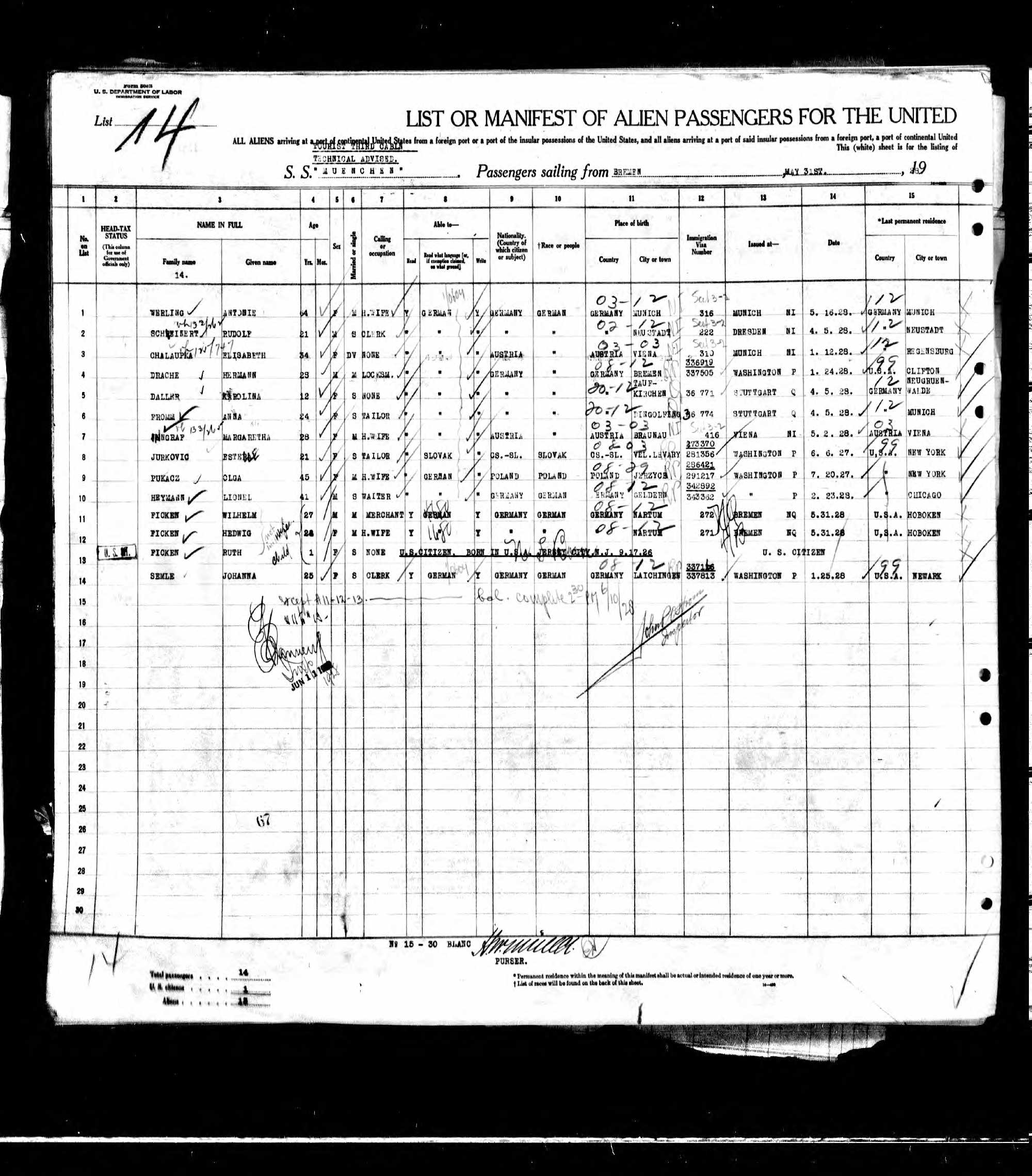
By 1928, Lionel was living in Chicago and working as a waiter, as reflected on this October 30, 1928 passenger manifest.  He was still an alien resident, listing his father again as his contact in Germany, but providing his Chicago address as his permanent address.  He was returning from Germany, so he probably had been visiting his family back home.
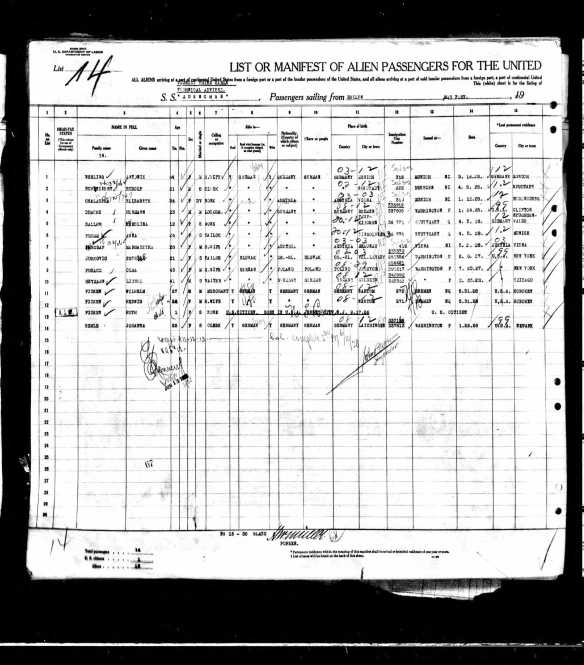
 

Lionel Heymann 1928 passenger manifest Year: 1928; Arrival: New York, New York; Microfilm Serial: T715, 1897-1957; Microfilm Roll: Roll 4280; Line: 1; Page Number: 200

Lionel Heymann 1928 passenger manifest
Year: 1928; Arrival: New York, New York; Microfilm Serial: T715, 1897-1957; Microfilm Roll: Roll 4280; Line: 1; Page Number: 200


Interestingly, Lionel’s younger brother Walter had arrived in the US just a few months earlier in June, 1928.  This was consistent with the information in the above-mentioned  sources—that is,  that Walter also had ended up in Chicago. On the ship manifest for Walter’s arrival it reports that Walter was a cook, that he was 32, that his last residence had been Cologne, Germany, and that he was heading for Chicago where his brother Lionel resided.
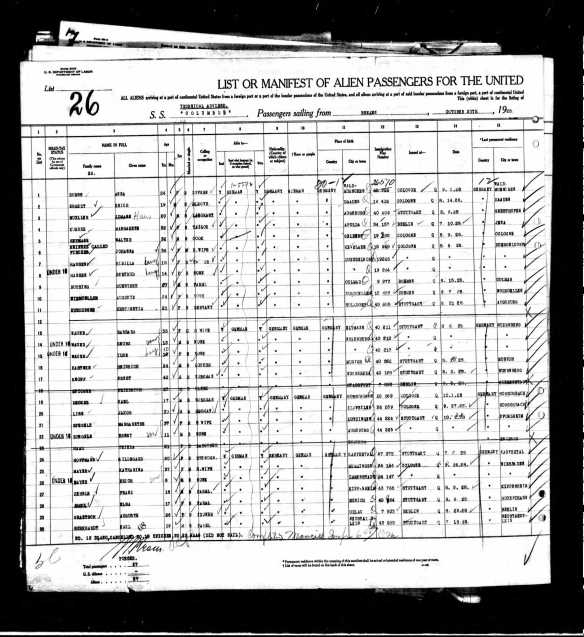
 

Walter Heymann 1928 ship manifest Year: 1928; Arrival: New York, New York; Microfilm Serial: T715, 1897-1957; Microfilm Roll: Roll 4373; Line: 1; Page Number: 141

Walter Heymann 1928 ship manifest
Year: 1928; Arrival: New York, New York; Microfilm Serial: T715, 1897-1957; Microfilm Roll: Roll 4373; Line: 1; Page Number: 141


After searching the 1930 census as many ways as I could, including using Lionel’s address as given on both the 1928 ship manifests and his 1933 naturalization papers (1411 Winnemac Avenue), I concluded that the census enumerator had completely missed that address.  The listings include 1409 and 1413, but not 1411.  Just my luck.

Although I could not find Lionel on the 1930 census, Walter is listed on that census, living as a lodger in Chicago and working as a chef in a hotel.  He was then 34 years old and had been in the US for two years and had filed his papers for citizenship.

As mentioned, Lionel became a naturalized US citizen in 1933.

Ancestry.com. U.S. Naturalization Record Indexes, 1791-1992 (Indexed in World Archives Project) [database on-line]. Provo, UT, USA: Ancestry.com Operations, Inc., 2010.

Ancestry.com. U.S. Naturalization Record Indexes, 1791-1992 (Indexed in World Archives Project) [database on-line]. Provo, UT, USA: Ancestry.com Operations, Inc., 2010.

According to the Cook County, Illinois Marriage Index, Walter Heymann married Lucie Goldschmied on March 16, 1934.  Lucie was born in Frankfurt, Germany, on February 11, 1908, the daughter of Miksa (later Americanized to Michael) Goldschmied, a Hungarian native, and Bertha Hirschberg, a native of Eschbach, Germany.  Lucie first came to the US in 1928, according to the 1930 census, which has her listed as residing at the Moraine Hotel in Highland Park, Illinois (a suburb of Chicago), where she was employed as a pantry servant.  I assume that this was the same hotel where Walter was employed as a chef.

The Chicago Tribune described the history of the Moraine Hotel in an article published on May 11, 1986:

In the early years of this century, the Hotel Moraine-on-the-Lake sparkled as a North Shore glamor resort. Built on 15 acres overlooking Lake Michigan in Highland Park, the hostelry opened in 1900 with 140 rooms.

The Moraine immediately caught the eye of the rich and famous. Glancing through old guest registries (now in the Highland Park Historical Society), you`ll spot some well-known Chicago names–the Marshall Field family, the Swifts, the Pullmans, the Florsheims, and many others.

Guests came from all over the U.S. and even from abroad. Some of the more affluent even traveled with their chauffeurs and maids.

…   The heyday of the Moraine continued into the 1920s, when the increasing number of guests necessitated additions to the hotel. Then came the Depression and even the Moraine was not spared–it declared bankruptcy in 1937.

By 1939, the once-grand hotel had become a barracks for military officers. But sunnier days were just around the corner. In 1942, the hotel was purchased, rehabbed, and reopened. It regained some of its former glory and operated until 1969, when the last guest checked out.

In 1972, the Hotel Moraine-on-the-Lake itself checked out. It was torn down and the site was turned into a public park.

“North Shore Glamor Hotel Reborn,” Chicago Tribune, May 11, 1986


If this is indeed where Walter and Lucie were working when they met, they were certainly working in quite a grand place.

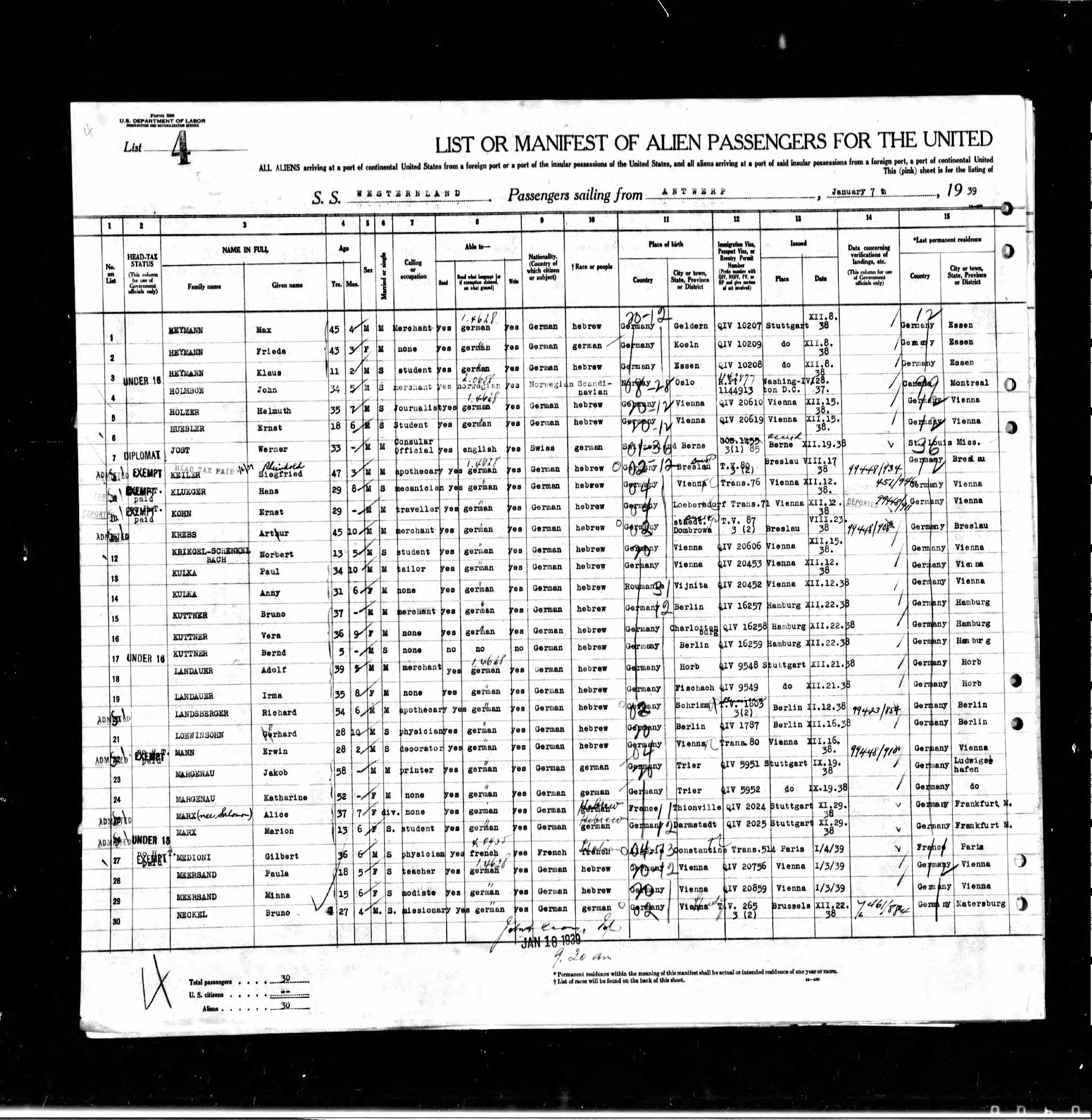
Max Heymann, the middle brother, was still back in Germany during this period, but he finally came to the US with his wife Frieda and their eleven year old son Klaus on January 7, 1939, escaping from Nazi Germany.  They had been most recently living in Essen, Germany, where Klaus was born.  Max listed his occupation as a merchant, his father Willy Heymann as the person he was leaving behind, and his brother Lionel as the person he was going to in the US.  I was surprised to see that Lionel was then living in Detroit, not Chicago.
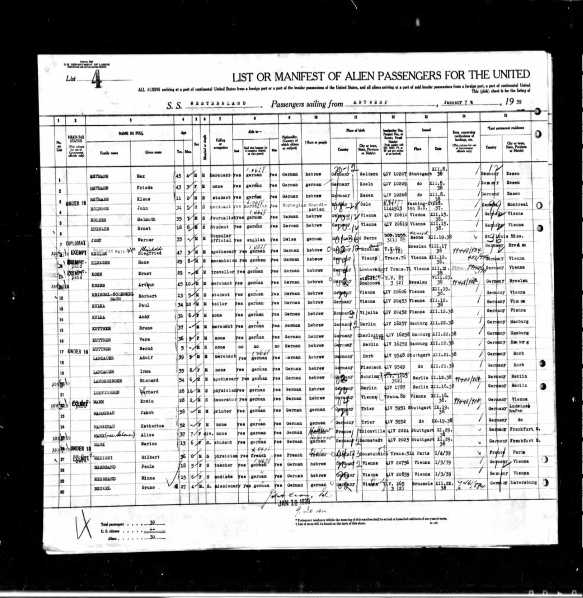
 

Max and Frieda Heymann 1939 ship manifest Year: 1939; Arrival: New York, New York; Microfilm Serial: T715, 1897-1957; Microfilm Roll: Roll 6274; Line: 1; Page Number: 8

Max and Frieda Heymann 1939 ship manifest
Year: 1939; Arrival: New York, New York; Microfilm Serial: T715, 1897-1957; Microfilm Roll: Roll 6274; Line: 1; Page Number: 8


By 1940, all three of the sons of Rosalie Schoenthal and Willy Heymann were living in Chicago.  According to the 1940 census, Lionel was living in the household of his brother Max in 1940, apparently having returned from Detroit.  Lionel was now the head waiter at a hotel, according to the census.  Max was a salesman for a paper box manufacturing company. Lionel, Max, Frieda, and Klaus were living at 1441 Belle Plaine Avenue in Chicago.

Walter and his wife Lucie as well as Lucie’s recently arrived parents, Michael and Bertha Goldschmied, were living a mile away from Max and Lionel at 3325 North Paulina Street in Chicago.  Walter was continuing to work as the cook in a hotel, and Lucie was working as a waitress, perhaps in the same hotel restaurant.  Lucie and Walter did not have any children.

All three brothers registered for the World War II draft in 1942.  According to those registrations, Lionel was still living with Max on Belle Plaine Avenue and working for the Blackstone Hotel.  Max was now working for Parfeit Powder Puff Company in Chicago. Walter was still living on North Paulina Street and working for “Martin,” a restaurant.


Lionel Heymann World War II draft registration Ancestry.com. U.S., World War II Draft Registration Cards, 1942 [database on-line]. Provo, UT, USA: Ancestry.com Operations, Inc., 2010. Original data: United States, Selective Service System. Selective Service Registration Cards, World War II: Fourth Registration.

Lionel Heymann World War II draft registration
Ancestry.com. U.S., World War II Draft Registration Cards, 1942 [database on-line]. Provo, UT, USA: Ancestry.com Operations, Inc., 2010.
Original data: United States, Selective Service System. Selective Service Registration Cards, World War II: Fourth Registration.

Max Heymann World War II draft registration Ancestry.com. U.S., World War II Draft Registration Cards, 1942 [database on-line]. Provo, UT, USA: Ancestry.com Operations, Inc., 2010. Original data: United States, Selective Service System. Selective Service Registration Cards, World War II: Fourth Registration

Max Heymann World War II draft registration
Ancestry.com. U.S., World War II Draft Registration Cards, 1942 [database on-line]. Provo, UT, USA: Ancestry.com Operations, Inc., 2010.
Original data: United States, Selective Service System. Selective Service Registration Cards, World War II: Fourth Registration

Walter Heymann World War II draft registration Ancestry.com. U.S., World War II Draft Registration Cards, 1942 [database on-line]. Provo, UT, USA: Ancestry.com Operations, Inc., 2010. Original data: United States, Selective Service System. Selective Service Registration Cards, World War II: Fourth Registrati

Walter Heymann World War II draft registration
Ancestry.com. U.S., World War II Draft Registration Cards, 1942 [database on-line]. Provo, UT, USA: Ancestry.com Operations, Inc., 2010.
Original data: United States, Selective Service System. Selective Service Registration Cards, World War II: Fourth Registrati

Max died a year later on May 31, 1943.  He was only 49 years old.  Walter died ten years after his brother Max on August 14, 1953; he was only 57.  Did the stress of uprooting themselves and worrying about their relatives back home contribute to their early deaths? I don’t know.

Lionel, the oldest brother, lived the longest.  He died on November 29, 1966, when he was 79 years old.  I was fortunate to find both a death notice and an obituary for Lionel (but none for his brothers).  Those two records revealed more about Lionel than I’d been able to glean from the passenger ship manifests or the census records.  He’d had a whole other life not reported on those documents.

More on that in my next post.

 

The Final Chapter for Jakob Schoenthal and His Descendants

As of 1947, the four surviving children and two grandchildren of Jakob Schoenthal and Charlotte Lilienfeld were all settled in western Pennsylvania, living close to each other, Johanna and Erna in Pittsburgh and Lee and Meyer nearby in Washington, Pennsylvania.  Johanna and Erna had survived the Holocaust, as had Erna’s son Werner Haas and the son of their sister Henriette, Helmut Levi.

The next two decades were, however, not kind to the children of Jakob Schoenthal and Charlotte Lilienfeld.  First, on February 7, 1956, Johanna’s husband Heinrich Stern died at age 79; he’d been suffering from arteriosclerosis for years, according to his death certificate, and had been residing in the Jewish Home for the Aged in Pittsburgh.  His doctor had been caring for him since 1953, so Heinrich must have been in poor health for much of his time in the US.


Heinrich Stern death certificate Ancestry.com. Pennsylvania, Death Certificates, 1906-1963 [database on-line]. Provo, UT, USA: Ancestry.com Operations, Inc., 2014. Original data: Pennsylvania (State). Death certificates, 1906–1963. Series 11.90 (1,905 cartons). Records of the Pennsylvania Department of Health, Record Group 11. Pennsylvania Historical and Museum Commission, Harrisburg, Pennsylvania.

Heinrich Stern death certificate
Ancestry.com. Pennsylvania, Death Certificates, 1906-1963 [database on-line]. Provo, UT, USA: Ancestry.com Operations, Inc., 2014.
Original data: Pennsylvania (State). Death certificates, 1906–1963. Series 11.90 (1,905 cartons). Records of the Pennsylvania Department of Health, Record Group 11. Pennsylvania Historical and Museum Commission, Harrisburg, Pennsylvania.

Then the following year, the oldest sibling, Lee Schoenthal, died at age 75 on May 11, 1957.  He also suffered from arteriosclerosis and died from congestive heart failure.  His doctor had been caring for him since 1949, according to the death certificate.  Lee appears to have been the backbone of the family, the one who employed and housed his younger brother Meyer for some years and who also helped his two younger sisters Johanna and Erna as well as his nephew Helmut Levi come to and settle in the US.


Lee Schoenthal death certificate Ancestry.com. Pennsylvania, Death Certificates, 1906-1963 [database on-line]. Provo, UT, USA: Ancestry.com Operations, Inc., 2014. Original data: Pennsylvania (State). Death certificates, 1906–1963. Series 11.90 (1,905 cartons). Records of the Pennsylvania Department of Health, Record Group 11. Pennsylvania Historical and Museum Commission, Harrisburg, Pennsylvania.

Lee Schoenthal death certificate
Ancestry.com. Pennsylvania, Death Certificates, 1906-1963 [database on-line]. Provo, UT, USA: Ancestry.com Operations, Inc., 2014.
Original data: Pennsylvania (State). Death certificates, 1906–1963. Series 11.90 (1,905 cartons). Records of the Pennsylvania Department of Health, Record Group 11. Pennsylvania Historical and Museum Commission, Harrisburg, Pennsylvania.

It was almost three years later that Meyer himself died.  He was 76 years old, and the principal cause of death was a coronary occlusion.  But looking more closely at the death certificate revealed information that might have explained why Meyer had not appeared in any city directories after 1931 and why his sisters and nephew all listed only Lee as the person they knew in the US and not Meyer. It also explains why Lee had not listed Meyer on his World War II draft registration as the person who would always know his address.


Meyer N Schoenthal death certificate Ancestry.com. Pennsylvania, Death Certificates, 1906-1963 [database on-line]. Provo, UT, USA: Ancestry.com Operations, Inc., 2014. Original data: Pennsylvania (State). Death certificates, 1906–1963. Series 11.90 (1,905 cartons). Records of the Pennsylvania Department of Health, Record Group 11. Pennsylvania Historical and Museum Commission, Harrisburg, Pennsylvania.

Meyer N Schoenthal death certificate
Ancestry.com. Pennsylvania, Death Certificates, 1906-1963 [database on-line]. Provo, UT, USA: Ancestry.com Operations, Inc., 2014.
Original data: Pennsylvania (State). Death certificates, 1906–1963. Series 11.90 (1,905 cartons). Records of the Pennsylvania Department of Health, Record Group 11. Pennsylvania Historical and Museum Commission, Harrisburg, Pennsylvania.

Meyer suffered from manic depression (more commonly referred to as bipolar disorder today), which the doctor described as a contributing factor in his death.  Meyer had been living at Torrance State Hospital in Westmoreland, Pennsylvania, for over two and a half years at the time of his death on January 10, 1960.  In other words, he had been hospitalized shortly after his brother Lee’s death in May 1957.  Lee must have been caring for him up to that point.

Lee and Meyer were buried next to each other in Beth Israel cemetery in Washington, Pennsylvania.


The family’s heartbreak continued two years later when young Werner Haas died from Laennec’s cirrhosis of the liver, a form of cirrhosis associated with alcoholism.  According to the death certificate, he had been suffering for months and died after 48 hours in a hepatic coma.  He was only 36 years old.


Werner Haas death certificate Ancestry.com. Pennsylvania, Death Certificates, 1906-1963 [database on-line]. Provo, UT, USA: Ancestry.com Operations, Inc., 2014. Original data: Pennsylvania (State). Death certificates, 1906–1963. Series 11.90 (1,905 cartons). Records of the Pennsylvania Department of Health, Record Group 11. Pennsylvania Historical and Museum Commission, Harrisburg, Pennsylvania.

Werner Haas death certificate
Ancestry.com. Pennsylvania, Death Certificates, 1906-1963 [database on-line]. Provo, UT, USA: Ancestry.com Operations, Inc., 2014.
Original data: Pennsylvania (State). Death certificates, 1906–1963. Series 11.90 (1,905 cartons). Records of the Pennsylvania Department of Health, Record Group 11. Pennsylvania Historical and Museum Commission, Harrisburg, Pennsylvania.

His life had not been an easy one.  He had lost his father before he was five years old, and he had been uprooted from his home in Darmstadt, Germany, and brought to the US.  Then he had served in the US Navy as a fireman, a skilled technician, during World War II.  After the war he had been briefly married to Lillian Angeloff; at the time of his death he was married to Margaret Rusnack, who was more than ten years older than Werner and had a son from a prior marriage.  He had worked as a salesman before and after the war, but in 1950 he had changed occupations and was a driver.  In 1952 he was a construction worker, and then in 1958 and 1959 he was again a driver.  After that he does not appear in the Pittsburgh directories.

It’s hard to imagine what those years between 1953 and 1962 must have been like for the two remaining siblings.  Johanna lost a husband, two brothers, and a nephew, and Erna also lost her brothers, her brother-in-law, and her son.

Erna then lost her remaining sibling, Johanna, on February 23, 1967.  The only close relative who was left was her nephew Helmut Levi (who by that time was named Henry Lyons).  Henry and his wife Pauline continued to live at the same address in Rego Park, New York, until Henry’s death on December 18, 1986.  He was only 67 years old when he died.


Aufbau February 13, 1987 p. 41

Aufbau, February 13, 1987 p. 41


Erna Schoenthal Haas, the youngest child of Jakob and Charlotte, had outlived her parents, her husband, her siblings, her nieces and nephews, and even her son.  Despite all the terrible losses she had suffered including being widowed at a very young age, escaping from Nazi Germany, and losing her only child, she had persevered and even maintained a positive outlook, as this June 14, 1984 article from the Jewish Chronicle of Pittsburgh reveals:


Jewish Chronicle of Pittsburgh, June 14, 1984, p. 23 ewish+Chronicle+Vol.+23+No.+18 Formed+by+the+union+of:+Jewish+criterion+;++and:+American+Jewish+outlook. http://doi.library.cmu.edu/10.1184/pmc/CHR/CHR_1984_023_018_06141984

Jewish Chronicle of Pittsburgh, June 14, 1984, p. 23
Jewish+Chronicle+Vol.+23+No.+18
Formed+by+the+union+of:+Jewish+criterion+;++and:+American+Jewish+outlook.
http://doi.library.cmu.edu/10.1184/pmc/CHR/CHR_1984_023_018_06141984


Notice that Erna only mentioned one brother, presumably Lee, and also explained how her family knew Daniel-Henry Kahnweiler, the renowned art dealer and collector.

Erna died on January 17, 1989, the only sibling to make it to eighty years old, let alone ninety.  She is buried not where her brothers or her sister or even her son is buried, but at Chesed Shel Emeth cemetery near Pittsburgh.

Writing about the lives of Jakob Schoenthal and his children provided a stark contrast to the experience I had writing about Simon Schoenthal and his children.  These two brothers, born just a year apart, had such different lives and legacies. Both died too young and also just a year apart, Jakob in 1903, Simon in 1904. But although Simon and his wife Rose had suffered heartbreak when their daughter Ida died at a young age, overall their lives and their legacy were happy ones.  Simon’s nine surviving children almost all lived very long and happy lives filled with adventures, long marriages, children, and close relationships with each other.


The nine surviving children of Simon and Rose (Mansbach) Schoenthal Photo courtesy of the family of Hettie Schoenthal Stein

The nine surviving children of Simon and Rose (Mansbach) Schoenthal
Photo courtesy of the family of Hettie Schoenthal Stein


Jakob’s five children, on the other hand, were not so fortunate.  Henriette was killed in the Holocaust along with her husband.  Johanna was deported from her home to a camp in France and then somehow survived, probably hiding in France.  As far as I know, Johanna never had children.   Lee Schoenthal and Meyer Schoenthal never married or had children, and Meyer spent some part of his life struggling with mental illness.

I know of  only two grandchildren of Jakob and Charlotte Schoenthal.  Erna had one son, Werner, who died from liver disease, presumably caused by alcoholism, when he was only 36.  Henriette had a son Helmut, who married but had no children. Thus, neither of Jakob’s two grandsons had children.  There are no descendants to carry on that particular family’s line.

I can’t help but wonder how things might have turned out differently for Jakob and Charlotte and their children if they, like their siblings, had chosen to come to the US instead of staying in Germany.