Irma and Hilde: The Power of Love

In my last post, I shared the story of my cousin Erwin Rothschild and his wife Irma Simon. As we saw, Erwin died from typhoid fever at Bergen-Belsen, but Irma survived. Erwin had done everything he could to keep Irma, her sister Hilde, and Hilde’s husband Simon Eisenmann alive, but in the end only Hilde and Irma survived. They were two young widows in their thirties as the war drew to a close in Europe.

As recounted by Irma in her moving testimony for the Shoah Foundation,1 in the spring of 1945 Irma and Hilde and about 2200 other prisoners at Bergen-Belsen were put on cattle trains by the Nazis with nothing to eat but one turnip each and taken on a long and twisting trip through Germany. When they saw the planes of the Allies flying overhead, they hung white shirts out the window, trying to save themselves from being bombed. As the train neared Frankfurt an der Oder near the Polish border, the Nazi guards abandoned the train, and the Russians came to liberate the people on the train on April 23, 1945. The Russians told the prisoners that they should go to a nearby village called Trobitz, which had been emptied of its residents and would be safe for the survivors.2

They had to walk to the village, but Hilde, who weighed only 70 pounds, was too weak to walk. So Irma and another woman found a wheelbarrow and pushed Hilde to the village. They settled into the village where there was shelter and food. One man died from eating too much food too quickly. Many others—about 600 people—died while living in Trobitz. But Irma and Hilde survived.
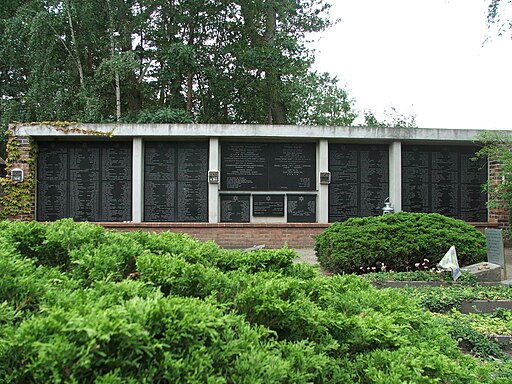
Memorial listing the names of those from the Lost Train who died in Trobitz, LutzBruno, Public domain, via Wikimedia Commons

The people living in Trobitz were taken later by the Allies to Leipzig for a week and then they were allowed to go “home.” Irma and Hilde went back to the southern part of the Netherlands, where Hilde, a Dutch citizen by marriage, lived in a cloister and Irma was interned in a school. They could not return to Amsterdam because northern Holland had not yet been liberated. Once the war ended, the sisters moved to Amsterdam and then immigrated to the US in 1947 with the help of their brother Julius, who lived in Philadelphia. They traveled on the Queen Elizabeth and were able to get kosher food on the ship. Irma and Hilde settled in Washington Heights in New York, and Irma continued her career as a kindergarten teacher.

Both Irma and Hilde remarried in the 1950s, Irma to Nathan Haas, and Hilde to Nathan Meyer, both also German Jewish survivors of the Holocaust. Neither had children. They lived in adjoining apartments in Washington Heights. In 1967 the two couples moved to one house together in Englewood, New Jersey. They all became active in the Orthodox Jewish community there. Their second husbands both died in the 1970s, but Irma and Hilde continued to live together for the rest of their lives.

As reported by Joseph Berger in The New York Times on December 29, 2004,3 Irma and Hilde decided when they were 97 and 94, respectively, that they wanted to live the rest of their lives in Israel in a home for senior citizens in Jerusalem called Beit Barth. Berger described their special relationship and recounted their long lives together during and after the Holocaust:

The two sisters were inseparable….[He then described much of what I’ve reported earlier about their lives during the Holocaust.]

They came to the United States together and lived with their second husbands in adjoining apartment buildings in Washington Heights. … As if that were not close enough, they moved in 1967 into a single suburban ranch house in Englewood, N.J., which they continued to share after their husbands died.

Until yesterday. That was when Irma Haas, 97, and Hilde Meyer, 94, set off from Kennedy International Airport for Israel to spend the remainder of their lives in the same residence for the elderly in Jerusalem.

… With canes across their laps, they sat next to each other in wheelchairs as El Al security hurriedly examined their passports and put them through the requisite grilling about who had packed their bags and whether they had received any gifts. Much of the time, Hilde, looking frightened, clutched Irma’s left arm with her right hand.

“She cannot let go of me,” Irma said, mentioning their wartime terror. “She is afraid she would be brought somewhere and I would not come.”

…Both sisters are slight of build and wear gray shaytls, or wigs. Irma is hardier, Hilde more easily rattled. They were born in Londorf, a town in Hessen, a German state where their family’s roots stretch back hundreds of years. …Irma promised her mother that she would always take care of the more delicate Hilde….

Judy Marcus, their second cousin, who accompanied them on the flight, said the two sisters seemed to have eluded the arrows of sibling rivalry. “They were never jealous of each other,” she said. “They were always happy whatever the other one had.”

About two years ago, Hilde was briefly hospitalized and pleaded that Irma remain at her side. Mrs. Marcus said she told a hospital official: “They are Holocaust survivors. They can’t be separated.”

“They made a special dispensation to allow Irma to sleep in Hilde’s room,” Mrs. Marcus recalled. “But Irma would not have left anyway, even if it meant sitting up in a chair all night.”

Only death separated these two amazing sisters. Hilde died first on May 8, 2005;4 she was 94 and had been in Israel for only five months. Irma Simon Rothschild Haas, who had done so much to care for her younger sister and whose strength got them through the camps, liberation, and immigration to the US, died on April 17, 2009, just six months before she would have turned 102.5 She had outlived her parents, all her siblings, and two husbands. Neither Irma nor Hilde had had children, so there are no direct descendants to remember these two remarkable women. But I will forever, and I hope that you will also.

I wish I had some photos of Irma and Hilde I could share. All I found is this one small photo from the New York Times in 2004 when they moved to Israel. But If you haven’t already, please watch Irma’s Shoah Foundation testimony—if for no other reason than to see Irma with Hilde together near the end of that testimony. I guarantee it will both bring you to tears and lift you up with joy. The power of their love was immeasurable.


  1. Haas, Irma. Interview 32295. Interview by Miriam Horowitz. Visual History Archive, USC Shoah Foundation, 04 August 1997. https://vha.usc.edu/testimony/32295. Accessed 18 Jan 2024. Almost all of the information in this post came from Irma’s testimony, except where noted. 
  2. You can read more about the “lost train” from Bergen-Belsen to Trobitz here, here, and here. 
  3. Joseph Berger, “A Bond the Holocaust and Time Couldn’t Break,” The New York Times, December 29, 2004, page B1. See also “Holocaust Survivors from Englewood Begin Their New Lives in Jerusalem,” The Hackensack Record, December 31, 2004, p. A5. 
  4. Hilde Meyer, Gender Female, Birth Date 30 Sep 1910, Death Date 8 May 2005,
    Claim Date 13 Jul 1972, SSN 081242610, Ancestry.com. U.S., Social Security Applications and Claims Index, 1936-2007 
  5. Find a Grave, database and images (https://www.findagrave.com/memorial/254917717/irma-haas: accessed 18 January 2024), memorial page for Irma Simon Haas (9 Oct 1907–17 Apr 2009), Find a Grave Memorial ID 254917717, citing Har HaMenuchot Cemetery, Jerusalem, Jerusalem District, Israel; Maintained by DTWer (contributor 47953179). 

The Fate of Caroline Blumenfeld Hoxter and Her Children: Final Chapter

As we saw, by the middle of 1940, all three of Caroline Blumenfeld Hoxter’s daughters and their families were safely out of Germany. Toni and Gerda were in the US as were their children, and Betty and her family were in Palestine.

But what about their mother Caroline? Last we knew she, having lost her husband Simon in 1932, had been living in Marburg with Toni and her family after Toni’s husband Sally was driven out of his haberdashery business in Hersfeld by Nazi persecution. But Caroline was not with Toni and Sally when they left for America in 1940 nor was she with Gerda and her family when they left Germany in 1939. Nor was Caroline with her daughter Betty in Palestine.

Tragically, Caroline was still in Germany. At some point she moved to Frankfurt, and in 1942 she was taken to Theriesenstadt where she died on February 17, 1942. Her daughter Betty (here spelled Beti) filed this Page of Testimony with Yad Vashem:

Caroline Hoxter, Page of Testimony at Yad Vashem, filed by her daughter Beti Openheimer, found athttps://yvng.yadvashem.org/nameDetails.html?language=en&itemId=1617046&ind=1

In her speech to middle school students in 2020, Caroline’s granddaughter Jane explained why Caroline had been unable to leave Germany with her family:1

Before we left [Germany], my sister and I went to see our grandmother who was blind and could not come with us. Much later she was deported to Thereisenstadt concentration camp. She was then in her late 80s. We were informed that she died of natural causes. Can you imagine for someone that old to travel for three weeks in a cattle car? It is still very hard for me to think about that and accept it.

Jane rightfully questioned whether her grandmother’s death was in fact from “natural causes.” Subjecting an elderly and blind woman to the conditions she must have experienced on that cattle car and then at Theriesenstadt surely contributed to her death as much as if she’d been gassed or shot by the Nazis.

I am very grateful to Andre Guenther from Tracing the Tribe who located Caroline’s death certificate from Theriesenstadt; she died from “enteritis darmkatarrah” or what we might call gastroenteritis.

At no point during the Shoah Foundation interview with Arthur Goldschmidt,2 did the interviewer ask about the fate of his grandmother Caroline Blumenfeld Hoxter, and Arthur did not bring it up himself. I don’t know whether this was an oversight or whether he simply could not bring himself to speak about what happened to his grandmother. I imagine the family must have been devastated by what happened to her. Peter, Jane’s son, told me that his mother still gets emotional when she talks about her grandmother Caroline and what happened to her.

But Caroline was blessed that her three daughters and her grandchildren all escaped and survived the Holocaust.

Her daughter Toni died in New York on April 21, 1956,[^3] two years after her husband Sol, who died on May 13, 1954, in New York.3 Their daughter Miriam died on January 7, 1988, in Queens, New York,4 followed by her husband Rudolf on January 21, 1993, in Los Angeles.5 They were survived by their daughter and her family.

Their son Arthur Goldschmidt shared this photograph of his parents with the Shoah Foundation:

Toni Hoxter and Sally (Sol) Goldschmidt. Arthur Goldschmidt, Interview 8542,  Visual History Archive, USC Shoah Foundation,  November 10, 1995. Accessed 15 August 2021, from the archive of the University of California Shoah Foundation Institute for Visual History and Education, found at https://sfi.usc.edu/what-we-do/collections

Toni’s sister Betty/Beti lived the rest of her life in Israel and died on December 15, 1975, at the age of 86. She was predeceased by her husband Max, who died May 25, 1961, in Israel. They were survived by their daughter Lotte, who married Theo Kleeman in Israel and who died June 26, 1998, in Israel, and their son Shimon, who died August 14, 2012, in Haifa, Israel. Today they have grandchildren and great-grandchildren in Israel.6

The youngest sister Gerda died in New York on April 13 1974,7 two years after her husband Adolf, who died March 18, 1972.8 They were survived by their two daughters. Their daughter Alice Lore Goldschmidt married Richard Oster,9 with whom she had two children. Alice died on January 13, 2014.10

Their other daughter Jane Inge Goldschmidt married Ralph Keibel on August  11, 1950,11. Peter shared with me his parents’ wedding photograph.

Jane and Ralph had two children, including my cousin Peter. Jane is still living and is 98 years old. Imagine—she gave that speech to the Vermont middle school group when she was almost 97 years old. Just remarkable.

As for Arthur Goldschmidt, whose interview helped me tell this story, after World War II he returned to New York City where he met and married his wife Ruth Herz. As he told the story, they met in January 1950, were engaged by April, and married in August 1950. Ruth was also a refugee from Germany. She was born on April 18, 1922, in Holzheim, Germany, to Eugen Isaak Herz and Lilli Weinberg.12 Her father had died in 1932, and her mother was killed in the Holocaust.

According to her obituary, “Ruth left Germany at age 16 via the Kindertransport and spent nine years on the run, in hiding, in a displaced persons camp, and then came to the US where she was able to build a good life. She met her husband Arthur Goldschmidt on a blind date that blossomed into their beautiful marriage on August 27, 1950.”13 Ruth and Arthur had two children. It was clear from the video of the interview that they both still adored each other 45 years after their marriage began.

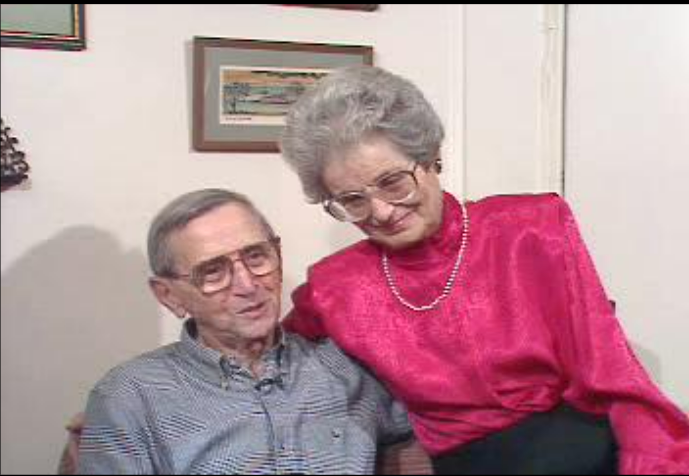
Arthur Goldschmidt and his wife Ruth during the Shoah Foundation interview. Arthur Goldschmidt, Interview 8542,  Visual History Archive, USC Shoah Foundation,  November 10, 1995. Accessed 15 August 2021, from the archive of the University of California Shoah Foundation Institute for Visual History and Education, found at https://sfi.usc.edu/what-we-do/collections

Arthur worked for many years at a dairy company on Long Island, so the skills he learned back in the 1930s from the Zionist organization that prepared him to work on a kibbutz in Palestine/Israel held him in good stead. He died on January 15, 2021, in New York; he was 96 years old.14

It was an honor to watch his interview the Shoah Foundation. He was amazingly matter-of-fact through almost the entire interview, answering questions calmly and saying that he and his family survived because they were able to get out early enough. He didn’t seem angry or resentful at all—until the very end when the interviewer asked him a simple and straightforward question about what he hoped the world had learned. He then broke down in tears, unable to speak, finally saying in essence that we must never forget and that we must never let it happen again.15

Today Caroline Blumenfeld Hoxter has many living descendants in Israel and in the US. She may not have survived the Holocaust, but her daughters and their families did, and they and their descendants carry on her legacy.

I am deeply grateful to my cousin Peter Keibel for sharing so much of his information and his family photographs with me and especially for sharing his mother’s speech about her experiences before and during the Holocaust.


And this brings me to the end of not only Caroline Blumenfeld Hoxter’s story and that of her children and grandchildren, but also to the end of the story of Abraham Blumenfeld IIA since Caroline was the youngest of his eight children. Now I will turn to Abraham’s younger siblings. First, his brother Isaak, the second child of my four-times great-uncle Moses Blumenfeld.


  1. Jane Inge Goldschmidt Keibel, Speech to Hazen School, Hardwick, Vermont, 2020, shared by Peter Keibel. 
  2. Arthur Goldschmidt, Interview 8542,  Visual History Archive, USC Shoah Foundation,  November 10, 1995. Accessed 15 August 2021, from the archive of the University of California Shoah Foundation Institute for Visual History and Education, found at https://sfi.usc.edu/what-we-do/collections 
  3. Toni Goldschmidt, Age: 70, Birth Date: abt 1886, Death Date: 21 Apr 1956, Death Place: Queens, New York, New York, USA, Certificate Number: 4251, Ancestry.com. New York, New York, U.S., Death Index, 1949-1965 
  4. Sol Goldschmidt, Age: 72, Birth Date: abt 1882, Death Date: 13 May 1954, Death Place: Manhattan, New York, New York, USA, Certificate Number: 10469, Ancestry.com. New York, New York, U.S., Death Index, 1949-1965 
  5.  Miriam Lauter, Social Security Number: 112-05-7561, Birth Date: 23 Apr 1911, Issue Year: Before 1951, Issue State: New York, Last Residence: 11375, Flushing, Queens, New York, USA, Death Date: 7 Jan 1988, Social Security Administration; Washington D.C., USA; Social Security Death Index, Master File, Ancestry.com. U.S., Social Security Death Index, 1935-2014 
  6. These dates came from Peter Keibel, Betty’s nephew. Email from Peter Keibel, November 17, 2021.  I have no official records for them. 
  7. Date is from her grandson, Peter Keibel, FamilyTree on Ancestry.com, found at https://www.ancestry.com/family-tree/person/tree/52614823/person/372143503930/facts 
  8. Date is from his grandson, Peter Keibel, FamilyTree on Ancestry.com, found at https://www.ancestry.com/family-tree/person/tree/52614823/person/372143503930/facts 
  9. Alice L Goldsmith, Gender: Female, Marriage License Date: 18 Jul 1950, Marriage License Place: Manhattan, New York City, New York, USA, Spouse: Richard Oster, License Number: 18819, New York City Municipal Archives; New York, New York; Borough: Manhattan; Volume Number: 27, Ancestry.com. New York, New York, U.S., Marriage License Indexes, 1907-2018 
  10. Find a Grave, database and images (https://www.findagrave.com/memorial/130447894/alice-oster : accessed 02 December 2021), memorial page for Alice Oster (unknown–13 Jan 2014), Find a Grave Memorial ID 130447894, citing Mount Hebron Cemetery, Flushing, Queens County, New York, USA ; Maintained by Mom (contributor 48202874) . 
  11. From their son Peter Keibel, https://www.ancestry.com/family-tree/person/tree/52614823/person/372143503829/facts 
  12. Peter Keibel Ancestry Family Tree, https://www.ancestry.com/family-tree/person/tree/52614823/person/372145394061/facts; Ruth Goldschmidt
    Age: 29, Birth Date: 18 Apr 1922, Issue Date: 12 Jun 1951, State: New York
    Locality, Court: Eastern District of New York, District Court, National Archives and Records Administration (NARA); Washington, D.C.; Index to Naturalization Petitions of the United States District Court for the Eastern District of New York, 1865-1957; Microfilm Serial: M1164; Microfilm Roll: 63, Ancestry.com. U.S., Naturalization Records Indexes, 1794-1995. The other information came from Arthur Goldsdchmidt’s Shoah Foundation interview. Arthur Goldschmidt, Interview 8542,  Visual History Archive, USC Shoah Foundation,  November 10, 1995. Accessed 15 August 2021, from the archive of the University of California Shoah Foundation Institute for Visual History and Education, found at https://sfi.usc.edu/what-we-do/collections 
  13. “Goldschmidt, Ruth,” The Baltimore Sun, Baltimore, Maryland, 03 Jan 2021, Sun • Page A14 
  14.  Arthur Goldschmidt, Social Security Number: 099-24-1370, Birth Date: 9 Aug 1913, Issue Year: Before 1951, Issue State: New York, Last Residence: 11415, Jamaica, Queens, New York, Death Date: 15 Jan 2010, Social Security Administration; Washington D.C., USA; Social Security Death Index, Master File, Ancestry.com. U.S., Social Security Death Index, 1935-2014 
  15. Arthur Goldschmidt, Interview 8542,  Visual History Archive, USC Shoah Foundation,  November 10, 1995. Accessed 15 August 2021, from the archive of the University of California Shoah Foundation Institute for Visual History and Education, found at https://sfi.usc.edu/what-we-do/collections 

Leaving Germany: The Family of Toni Hoxter Goldschmidt

By 1930, the three daughters of Caroline Blumenfeld and Simon Hoxter were married, and each had two children. Their son Siegmund had been killed fighting for Germany in World War I, but their lives otherwise as middle-class German Jews must have seemed secure and comfortable. Here is a wonderful photograph of Caroline and Simon, shared by their great-grandson Peter:

Simon and Karoline (Blumenfeld) Hoxter. c. 1930 Courtesy of the family.

The next decade saw the family ripped apart and separated as each daughter and her family had to find a way to escape from Nazi Germany. But even before Hitler came to power, the family faced another loss. Simon Hoxter died in Marburg, Germany, on June 10, 1932, at the age of 79.

Simon Hoxter death record, Personenstandsregister Sterberegister; Bestand: 915; Laufende Nummer: 5739, Year Range: 1932, Ancestry.com. Hesse, Germany, Deaths, 1851-1958

Less than a year later, Hitler came to power, and soon thereafter members of the family began to look for ways to leave Germany. I am grateful to the Shoah Foundation for providing me with access to the interview given by Arthur Goldschmidt, Caroline and Simon’s grandson and the son of Toni Hoexter and Sally Goldschmidt, in which Arthur shared much of the story of how most of his relatives escaped from Germany. Much of the information in this post came from Arthur’s interview, except where noted.1

Arthur and his sister Miriam were among the first to make plans to leave Germany. Arthur, who had been raised in the town of Hersfeld, described a relatively innocent childhood in that town. It was a town of about 12,000 people where most people worked as cattle dealers, but also as lawyers and doctors and merchants and other tradesmen. His father Sally owned a haberdashery store and did business with Jews and non-Jews in the town. Aside from some anti-Semitic taunting on occasion, Arthur experienced no sense of danger and no physical assaults. He went to school with and was friends with both Jewish and non-Jewish children. When he was sixteen, Arthur left school and left Hersfeld. He went to the city of Hamm in Westphalia about three hours from Hersfeld, where he trained in a department store to be a salesman. He was there for four years until Hitler came to power in 1933.

Here is a photograph of Hersfeld that Arthur shared with the Shoah Foundation. The building in the left background with the two little turrets is the house where Arthur and his family lived.

Arthur Goldschmidt. Arthur Goldschmidt, Interview 8542,  Visual History Archive, USC Shoah Foundation,  November 10, 1995. Accessed 15 August 2021, from the archive of the University of California Shoah Foundation Institute for Visual History and Education, found at https://sfi.usc.edu/what-we-do/collections

In October 1933, Arthur joined a cousin in Berlin where a Zionist organization was training young people to become farmers in preparation for immigration to Palestine. Arthur was there until June 1934, working for a farmer who happened to be a Nazi, but who, according to Arthur, was very kind to him and the other Jewish youth. (He did note that they were providing the farmer with free labor.)  From there, Arthur was sent by the Zionist organization to Yugoslavia to continue his training until December 1935 when he received a certificate to go Palestine. He arrived in Palestine in January 1936.

Meanwhile, the rest of his immediate family was also experiencing relocation. His parents Sally Goldschmidt and Toni Hoxter relocated from Hersfeld to Marburg in 1933 after Sally’s haberdashery business began to fail as a result of Nazi persecution. He no longer could do business with non-Jewish residents, and many of the Jewish residents were leaving or planning to leave Germany. They decided to move in with Toni’s mother, Caroline Blumenfeld Hoxter, who still owned her home in Marburg after the death of her husband Simon in 1932.

Their daughter Miriam left Marburg for New York, arriving on November 1, 1934. She listed her occupation on the ship manifest as a clerk and listing her cousin Rosalie Livingston as the person she was going to in the US.2 On September 27, 1936, after settling in New York, she married Rudolf Lauter, who was also a refugee from Germany. Interestingly, Rudolf was born and had last lived in Hamm, Germany, the same city that Miriam’s brother Arthur had lived in from 1929 to 1933. Rudolf was born on April 27, 1906, the son of Isidore Lauter and Helene Schonberger.3

Thus, by 1936 Toni and Sally’s children Arthur and Miriam were safely out of Germany. Arthur was living on a kibbutz near Rehovoth in Palestine, working at the new port in Tel Aviv that had opened after the Arab-controlled port in Jaffa was closed to Jewish businesses. Miriam urged Arthur to come to the US, and in 1938 when she was able to provide an affidavit for her brother, he was able to do that. He arrived on May 31, 1938,4 and after a brief stay with Miriam and Rudolf, he got a job on a farm in upstate New York in the town of Windsor near Binghamton; he was living there with some paternal cousins in 1940.

But Toni Hoxter and Sally Goldschmidt, Arthur and Miriam’s parents, were still in Germany, living in Marburg. According to Arthur’s testimony, his father was taken to Buchenwald. Arthur didn’t know when or for how long, but he said the experience forever changed his father; my guess is that this was after Kristallnacht in November 1938 when thousands of Jewish men were rounded up and taken to Buchenwald. Sally had served for Germany in World War I, earning the Iron Cross. His brother and his brother-in-law Siegmund Hoxter, Toni’s brother, were both killed fighting for Germany in that war, and Sally could never forgive Germany for ignoring his service and those sacrifices just twenty years later, imprisoning him in a concentration camp and destroying his business and his family’s life.

By the spring of 1940, Arthur was able to provide an affidavit for his parents to leave Germany, and on April 29, 1940, Toni and Sally (soon to be known as Sol) arrived in New York.5 According to Arthur, that was the last or one of the last ships allowed to sail from Europe after the war broke out. At that time Arthur’s sister Miriam and her husband Rudolf and their daughter were living in Bridgeport, Connecticut, where Rudolf was working as a butcher.6 Thus, Toni Hoxter Goldschmidt’s family was safely out of Germany by the spring of 1940.

What about Toni’s sisters Betty and Gerda and their families? And what about their mother Caroline? What happened to them? And what happened to Toni and Sol and their children Miriam and Arthur after arriving in the US? Those stories will be told next.

But not until early January 2022. I will be taking the next couple of weeks off from blogging.

Happy Holidays to All! I wish all my readers who celebrate a merry Christmas and a happy New Year to everyone! May 2022 bring us all good health and peace and progress on the many challenges facing us all, globally and personally.


  1. The information in this post, except where otherwise noted, is from the Shoah Foundation interview with Arthur Goldschmidt. Arthur Goldschmidt, Interview 8542,  Visual History Archive, USC Shoah Foundation,  November 10, 1995. Accessed 15 August 2021, from the archive of the University of California Shoah Foundation Institute for Visual History and Education, found at https://sfi.usc.edu/what-we-do/collections 
  2. Miriam Goldschmidt, Gender: Female, Ethnicity/ Nationality: Hebrew, Marital status: Single, Age: 23, Birth Date: abt 1911, Birth Place: Germany, Other Birth Place: Hersfeld, Last Known Residence: Frankfurt, Germany, Departure Port: Hamburg, Germany,Arrival Date: 1 Nov 1934, Arrival Port: New York, New York, USA, Final Destination: Chicago, Illinois, Years in US: Permanently, Citizenship Intention: Yes, Height: 5 Feet, 8 Inches, Hair Color: Blonde, Eye Color: Blue, Complexion: Fair, Money in Possession: 50 Person in Old Country: Sally Goldschmidt, Person in Old Country Relationship: Father Person in Old Country Residence: Marburg.gy, Person in US: Rosalie Livingston, Person in US Relationship: Cousin, Father: Sally Goldschmidt, Ship Name: Manhattan Year: 1934; Arrival: New York, New York, USA; Microfilm Serial: T715, 1897-1957; Line: 12; Page Number: 32, Ancestry.com. New York, U.S., Arriving Passenger and Crew Lists (including Castle Garden and Ellis Island), 1820-1957 
  3. Naturalization papers for Rudolf Lauter and Miriam Goldschmidt, Court District: Southern District, New York, Description: (Roll 1332) Petition No. 383569 – Petition No. 383997, The National Archives and Records Administration; Washington, D.C.; Petitions for Naturalization from the U.S. District Court for the Southern District of New York, 1897-1944; Series: M1972; Roll: 1332, Ancestry.com. New York, U.S., Naturalization Records, 1882-1944. The naturalization papers filed for both Rudolf and Miriam indicate that they were married on September 27, 1936, but that Rudolf did not arrive in the US until December 24, 1936. I had no way to reconcile these two recorded assertions, but I then I found Rudolf on a passenger manifest arriving in New York on August 20, 1936. Given that there was just a month between his arrival and his marriage to Miriam, I believe they must have known each other in Germany before immigrating to the US. Since on that manifest Rudolf indicated he was intending to stay only four months, my hunch is that he then returned to Germany after they married and came back to the US permanently on December 24, 1936, as indicated on his naturalization papers. Rudolf Lauter, Marital status: Single,Age: 30, Birth Date: abt 1906, Birth Place: Germany, Other Birth Place: Hamm, Last Known Residence: Amsterdam, Hamburg??
    Place of Origin: Germany, Departure Port: France, Arrival Date: 20 Aug 1936
    Arrival Port: New York, New York, USA, Years in US: 4 Months, Citizenship Intention: No, Height: 5 Feet, 11 Inches, Hair Color: Brown, Eye Color: Brown, Complexion: Dark
    Money in Possession: $200, Person in Old Country: Helene Lauter, Person in Old Country Relationship: Mother, Person in Old Country Residence: Germany
    Person in US: George H Lauter, Mother: Helene Lauter, Ship Name: Washington
    Year: 1936; Arrival: New York, New York, USA; Microfilm Serial: T715, 1897-1957; Line: 3; Page Number: 108, Ancestry.com. New York, U.S., Arriving Passenger and Crew Lists (including Castle Garden and Ellis Island), 1820-1957 
  4.  Arthur Goldschmidt, Gender: Male, Ethnicity/ Nationality: Hebrew, Marital status: Single, Age: 24, Birth Date: abt 1914, Birth Place: Germany, Other Birth Place: Hersfeld
    Last Known Residence: Telaviv, Palastine, Place of Origin: Palastine, Departure Port: Cherbourg,France, Arrival Date: 31 May 1938, Arrival Port: New York, New York, USA
    Final Destination: L. I., New York, Years in US: Permanently, Citizenship Intention: Yes
    Height: 5 Feet, 9 Inches, Hair Color: Brown, Eye Color: Brown, Complexion: Fair
    Money in Possession: 19.00, Person in Old Country: Sally Goldschmidt, Person in Old Country Relationship: Father, Person in Old Country Residence: Marburg. Person in US: Miriam Lauter, Person in US Relationship: Sister, Father: Sally Goldschmidt
    Sibling: Miriam Lauter, Ship Name: Aquitania, Year: 1938; Arrival: New York, New York, USA; Microfilm Serial: T715, 1897-1957; Line: 18; Page Number: 103, Ancestry.com. New York, U.S., Arriving Passenger and Crew Lists (including Castle Garden and Ellis Island), 1820-1957 
  5. Sally and Toni (Hoxter) Goldschmidt ship manifest, Year: 1940; Arrival: New York, New York, USA; Microfilm Serial: T715, 1897-1957; Line: 9; Page Number: 85, Ancestry.com. New York, U.S., Arriving Passenger and Crew Lists (including Castle Garden and Ellis Island), 1820-1957 
  6. Lauter family, 1940 US census, Year: 1940; Census Place: Bridgeport, Fairfield, Connecticut; Roll: m-t0627-00532; Page: 7A; Enumeration District: 9-92, Ancestry.com. 1940 United States Federal Census 

A Survivor’s Story: The Shoah Foundation Testimony of Inge Goldschmidt Oppenheimer, Part II

By the time she turned sixteen on April 13, 1945, Inge Goldschmidt had been to three concentration camps and beaten by Nazi youth in Kassel and by guards at the concentration camps at Auschwitz and Oederan. She had been separated from her brother, who was sent to the US in October 1938, and then from her parents in 1944 when she was sent from Theriesenstadt to Auschwitz. She had no idea whether her parents were alive and assumed that they were not.1

The day after her sixteenth birthday, she and the others imprisoned at the Oederan camp were transported in cattle wagons away from the Eastern front where Russia was making headway into Germany. They stopped at many camps, and finally on April 21, 1945, Inge and the others were dropped off at Theriesenstadt, the place where she had last seen her parents, Elfriede Engelbert and Rudolf Goldschmidt. She had not seen them in close to a year and did not expect to find them alive. They also assumed she had been killed at Auschwitz.

Someone recognized Inge as she entered Theriesenstadt, and when she told Inge that her parents were still alive and still at Theriesenstadt, Inge passed out. Inge was dangerously sick with typhoid, weighing only sixty pounds. Her mother didn’t recognize her when she saw her. Slowly Inge was nursed back to health and joyfully reunited with her parents.

The war ended, and the Russians took over Theriesenstadt. Even though they were no longer at war, the people had nowhere to go and no way to get anywhere because of the destruction of the train lines and roads by Allied bombing during the war. Inge and her parents stayed at Theriesenstadt until July 1945 when they then returned to Cologne, where they were provided with an apartment.

Transit card from Terezin, Elfriede Goldschmidt, 1945. Courtesy of the family

You can see from their eyes and expressions in this photograph taken after the war some of the effects of their experiences during the Holocaust.

Elfriede, Rudolf, and Inge Goldschmidt c. 1945 Courtesy of the family

Inge joined a youth group of other Jewish survivors; most did not have any family members who survived, and her parents helped many of them, becoming like surrogate parents to her friends. Here is a photograph of her with some of her friends in post-war Cologne.

Inge Goldschmidt and friends in Cologne, c. 1947-1948. Courtesy of the family

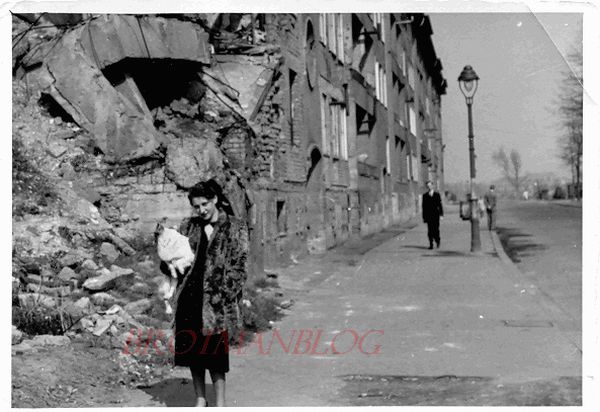
These two photographs of Inge taken in post-war Cologne show some of the rubble caused by the bombing of Cologne.

Inge Goldschmidt, c. 1947-1948, Cologne. Courtesy of the family

Inge Goldschmidt, c. 1949 Courtesy of the family

Inge’s brother Gunther sent her this photograph for her nineteenth birthday in April, 1948.

Gunther Goldschmidt, 1948. Courtesy of the family

Elfriede and Rudolf desperately wanted to get to the US and be reunited with their son Gunther, but because Cologne was in the British Sector, they could not get permission to do so. So for three and a half years they waited until Gunther was able to get his parents out, and then once they arrived in the US, Elfriede and Rudolph were able to get Inge out. Apparently children could get visas for parents and vice versa, but siblings could not get them for siblings.

Rudolf and Elfriede Goldschmidt in Bremen, leaving for the US, 1949. Courtesy of the family

Finally in July 1949, the family was reunited. Inge was now twenty years old. Her parents were working at a hotel in the Catskills and had no money.

Rudolf and Elfriede Goldschmidt in the Catskills (Fleishmans) in the summer of 1949. Courtesy of the family

Inge got a job in a factory in New York, and in the fall her parents joined her in New York also where they all lived in a furnished room together. Gunther was in school in Boston; although he came and lived with his family for some period of time, he remained closest to his foster family, never fully recovering from the long separation from his parents and sister. But this photograph captures Gunther and Inge in a joyful moment together.

Inge and Gunther Goldschmidt c. 1950-1951 Courtesy of the family

Inge married Ernst Oppenheimer on October 14, 1950.2 Ernst was born in Augsburg, Germany, on October 17, 1919, to David Oppenheimer and Maria Kraus.3 Ernst had been sent to Dachau Concentration Camp in November 1938  after Kristallnacht, and after he was released, he was immediately sent to England, where he was in the Kushner displaced person camp until he left for the US in March, 1940. He then served in the US Army, where he was stationed at Fort Knox. He also worked on the Manhattan Project.4 Ernst and Inge had two children. Inge, who had been forced to end her formal education at age ten, passed her GED test and went to college and received not only her bachelor’s degree but also a master’s degree. She became a teacher and a librarian and worked in the New York City schools for many years.

Ernst Oppenheimer and Inge Goldschmidt, 1950 Courtesy of the family

I also learned from Gunther Goldschmidt’s daughter Lisa more about his life after World War II. He married Barbara Cohen on May 16, 1959. They had three children and had moved to southern California by 1962, eventually settling in Encino. Gunther started his own advertising business there and was very successful; more importantly, Lisa described him as a devoted father.He remained close to his foster family for the rest of his life.1

Gunther and Inge’s father Rudolf Goldschmidt died on February 25, 1960, in New York; he was 73 years old.5

Tragically Gunther died from a heart attack when he was only 47; he died on November 30, 1972, in San Francisco, and was survived by his wife and young children.6

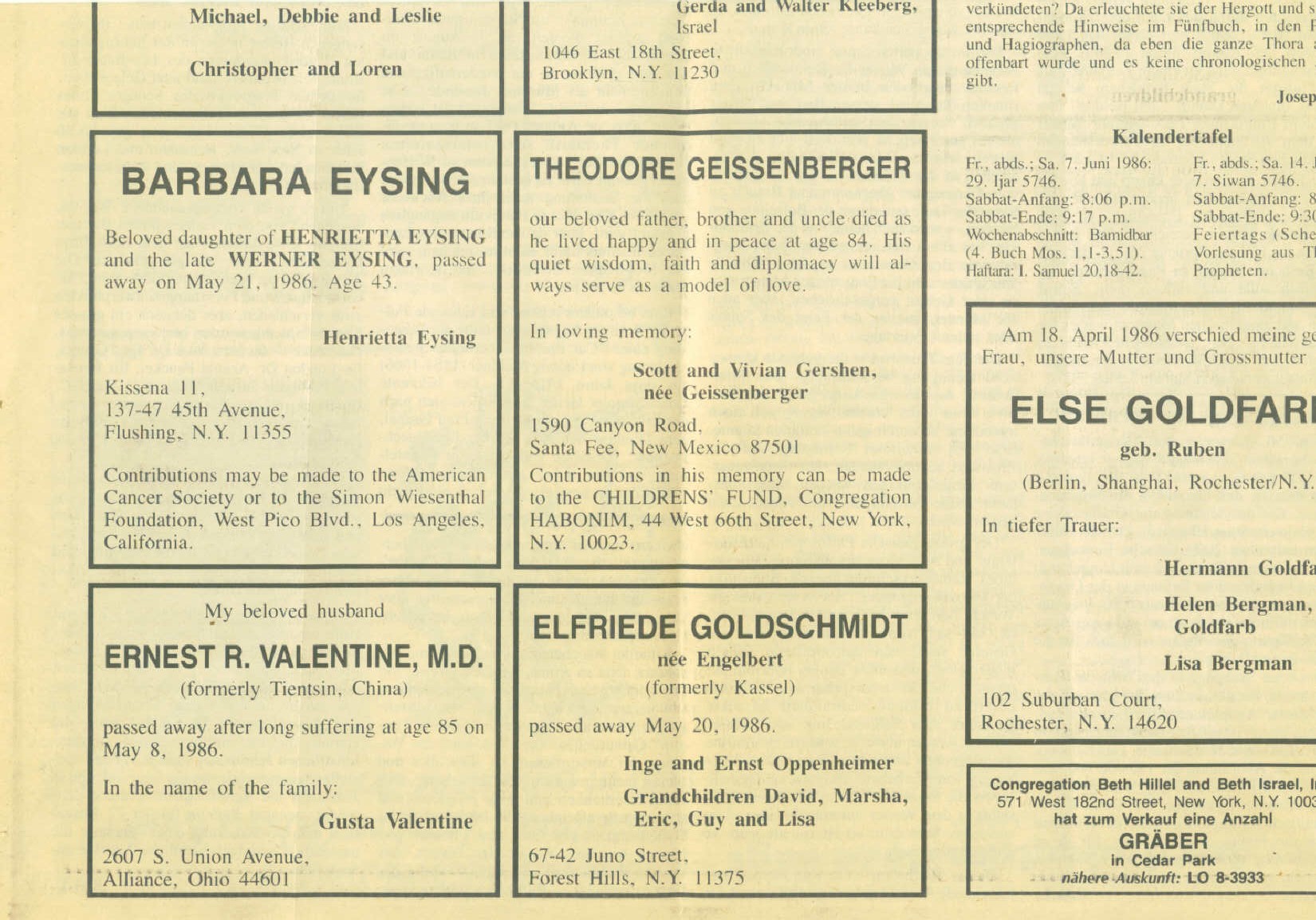
Inge and Gunther’s mother Elfriede Engelbert Goldschmidt made the surprising decision to return to Germany when she grew older. She wanted to live in a Jewish home for the elderly there and not burden her daughter. She died there on May 20, 1986; she was 85 years old.7

Inge Goldschmidt Oppenheimer, who gave this interview in 1996, died twenty years later on January 24, 2016, at the age of 86.8 She was survived by her children and grandchildren, her husband Ernst having died on July 2, 2010,9 when he was ninety years old.

We should all be forever grateful to Inge Goldschmidt Oppenheimer and those like her who shared their stories and allowed us all to understand not only the cruel side of human nature, but also the strength and resilience of human nature. Inge’s will to survive as a young teenager under the worst of circumstances was remarkable, and her ability to move forward—to marry and have children, to go back and receive a college education and to pursue a career as a teacher and librarian—is an inspiration and a lesson in hope for all of us.


  1. The information in this post, except where otherwise noted, is from the Shoah Foundation interview with Inge Oppenheimer. Inge Oppenheimer, Interview 11370. Visual History Archive, USC Shoah Foundation, 1996. Accessed 17 August 2021. The photographs are all courtesy of Marsha Eidlin.
  2. Ernst Oppenheimer, Gender: Male, Marriage License Date: 1950
    Marriage License Place: Manhattan, New York City, New York, USA, Spouse:
    Ingeborg Goldschmidt, License Number: 26365, New York City Municipal Archives; New York, New York; Borough: Manhattan, Ancestry.com. New York, New York, U.S., Marriage License Indexes, 1907-2018. Email from Marsha Eidlin, daughter of Ernst and Inge Oppenheimer, August 31, 2021. 
  3.  Ernst Oppenheimer, Declaration Age: 24, Record Type: Petition, Birth Date: 17 Oct 1919, Birth Place: Rugsburg, Bavaria, Germany, Declaration Date: 13 Jan 1944
    Declaration Place: Jackson, Mississippi, USA, Court District: U.S. District Court for the Jackson Division of the Southern District of Mississippi, Petition Number: 400, The National Archives at Atlanta; Atlanta, Georgia; Record Group Title: Records of District Courts of the United States; Record Group Number: 21, Ancestry.com. Mississippi, U.S., Naturalization Records, 1907-2008. Name: Max Oscar Oppenheimer
    [brother of Ernst Oppenheimer], Gender: Male, Race: White, Birth Date: 19 Apr 1915
    Birth Place: Schrobenhaus, Federal Republic of Germany, Death Date: 16 Oct 2006
    Father: David Oppenheimer, Mother: Maria Kraus, SSN: 092147186, Ancestry.com. U.S., Social Security Applications and Claims Index, 1936-2007. 
  4. Email from Marsha Eidlin, daughter of Ernst and Inge Oppenheimer, August 31, 2021. 
  5. Rudo Goldschmidt, Age: 73, Birth Date: abt 1887, Death Date: 25 Feb 1960
    Death Place: Brooklyn, New York, New York, USA, Certificate Number: 4206, Ancestry.com. New York, New York, U.S., Death Index, 1949-1965 
  6. Gunther Goldschmidt, Social Security #: 488207584, Gender: Male
    Birth Date: 17 Jul 1925, Death Date: 30 Nov 1972, Death Place: San Francisco, Place: San Francisco; Date: 30 Nov 1972; Social Security: 488207584, Ancestry.com. California, U.S., Death Index, 1940-1997. Inge Oppenheimer, Interview 11370. Visual History Archive, USC Shoah Foundation, 1996. Accessed 17 August 2021. 
  7. Inge Oppenheimer, Interview 11370. Visual History Archive, USC Shoah Foundation, 1996. Accessed 17 August 2021. 
  8. New York Times obituary at https://archive.nytimes.com/query.nytimes.com/gst/fullpage-9C04EFD71F3AF932A05752C0A9609D8B63.html; Find a Grave, database and images (https://www.findagrave.com/memorial/214436745/inge-oppenheimer : accessed 12 September 2021), memorial page for Inge Goldschmidt Oppenheimer (unknown–24 Jan 2016), Find a Grave Memorial ID 214436745, citing Beth-El Cemetery, Paramus, Bergen County, New Jersey, USA ; Maintained by Lauren A. Hubberman Cohen (contributor 49135178) Burial Details Unknown. 
  9. Ernest Oppenheimer, Social Security Number: 094-14-0365, Birth Date: 17 Oct 1919, Issue Year: Before 1951, Issue State: New York, Last Residence: 11375, Flushing, Queens, New York, USA, Last Benefit: 11375, Flushing, Queens, New York, USA, Death Date: 2 Jul 2010, Social Security Administration; Washington D.C., USA; Social Security Death Index, Master File, Ancestry.com. U.S., Social Security Death Index, 1935-2014 

  1. Email from Lisa Goldschmidt, September 25, 2021. Gunther Goldschmidt, Spouse: Barbara Anne Cohen, Marriage Date: 2 Sep 1958, Recorded county: Clark, Page: F01, Ancestry.com. Nevada, U.S., Marriage Index, 1956-2005