Another new relative: Gustave Rosenzweig

As I wrote yesterday, I was excited in reading the case file of Jankel Srulovici to see that the principal witness who came forward to vouch for him at the hearing to determine his admission into the US was a brother-in-law named Gustave Rosenzweig.  Gustave is the fourth child of my great-grandparents David Rosenzweig and Esther Gelberman whom I have been able to locate.   He was my great-grandmother Ghitla’s older brother and also Tillie and Zusi’s brother.  I had already noted his name on Bertha Strolowitz’s marriage certificate in 1915, but now I have some verification that he was in fact a member of the same family.  Not simply because he testified for Jankel and helped post the bond for his admission, but because he described Jankel and Tillie in his testimony as his brother-in-law and sister.

I have now done research to learn more about this man, my great-great uncle, who had $6000 in assets in 1908 and a painting supply business in Brooklyn and who had already impressed me with his character for helping out his family.  From various records, I have learned that Gustave was born in Romania in September, 1861.  He married his first wife, Gussie, in 1882, according to the 1900 census.

Gustave Rosenzweig and family 1900 census

Gustave Rosenzweig and family 1900 census

It is not at all clear exactly when Gustave and Gussie arrived in NYC, and I have not yet found a ship manifest for either of them.  On his naturalization papers in January of 1892, Gustave wrote that he had arrived on April 12, 1887.

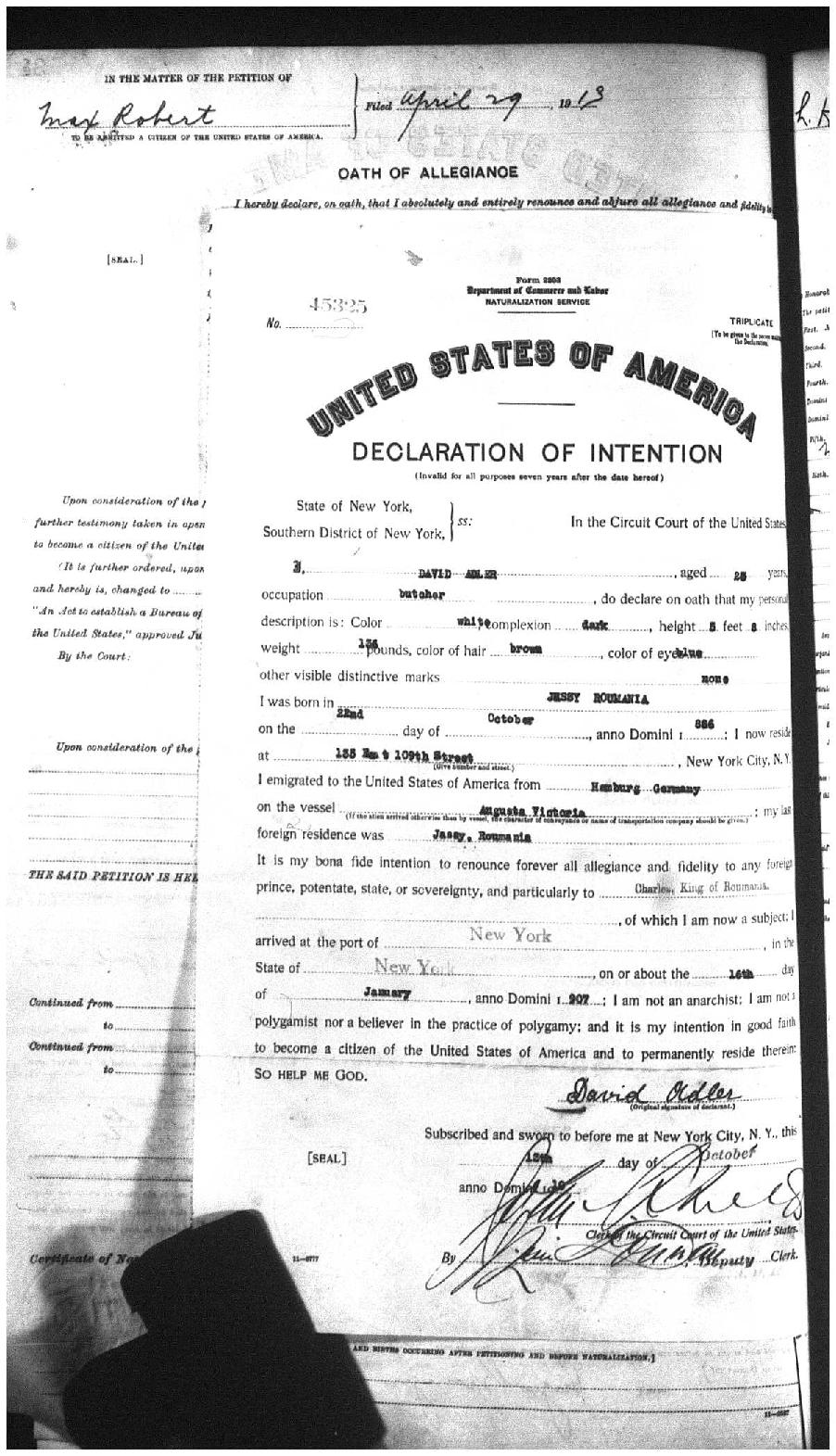
naturalization petition gustave rosenzweig

naturalization petition gustave rosenzweig

Some of the census reports indicate that Gussie and Gustave emigrated in 1881, others say 1888. According to the 1900 census, their first child Lilly was born in Romania in 1884, and if Lilly was born in Romania, the later date seems to be more accurate.  On the other hand, the 1905 and 1910 census reports say that Lilly was born in the United States, and, according to the 1905 census, that Gussie and Gustave had been in the US for 22 years, i.e., since 1883.  At any rate, Gustave and Gussie were certainly in the United States by 1888, and thus he was the earliest of the Rosenzweig children to come to America, at least a few years before Zusi, 13 years before his nephew Isidor Strolowitz, 15 years before my grandfather Isadore Goldschlager, and almost 20 years before Tillie, over 20 years before Ghitla.

Gustave Rosenzweig family on the 1905 NYS census

Gustave Rosenzweig family on the 1905 NYS census

The earliest record I have of Gustave in NYC is an 1892 New York City directory listing him as a painter, living on Eldridge Street in the Lower East Side.  His naturalization papers also indicated that he was a painter, as was Jankel Srulovici and his two sons Isidor and David.  It makes me wonder whether Jankel and Gustave had been in business together as painters back in Iasi.  Jankel would have been about ten years older, so perhaps he trained Gustave and brought him into his business.  Gustave might have felt some sense of gratitude to him as well as brotherly love for his sister Tillie, motivating him even more so to help bring Jankel into the country.
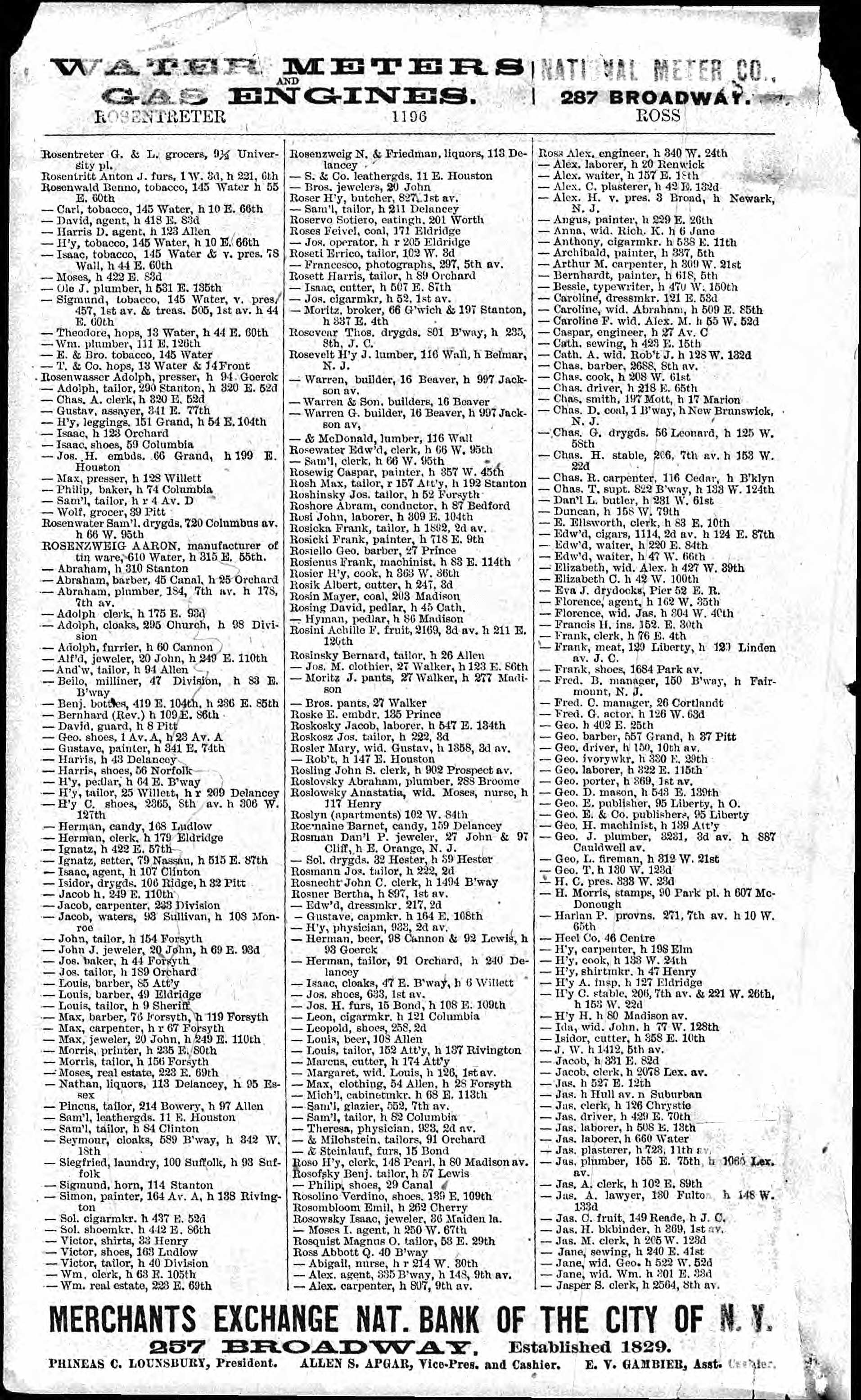
1894 NYC directory

1894 NYC directory

Gussie and Gustave moved several times after 1892—uptown on East 74th Street in 1894, downtown to E. 6th Street in 1900, and to Brooklyn by 1905, where they first lived in Fulton Street and then on Franklin Avenue, where they were living in 1908 at the time of Jankel’s hearing.  Throughout this period of time, Gustav was a painter, eventually owning his own paint supply business, and he and Gussie were having many children: after Lilly came Sarah (1888), Abraham (1890), Rebecca (1894), Jacob (1895), Harry (1897), Joseph (1898), Lizzie (1900) and Rachel (1903).  Apparently there were five others who died, as the 1900 census reports that Gussie had had thirteen children, eight of whom were then living.

It’s mind-boggling on many levels.  First, how did the support and feed all those children and where did they fit them?  And secondly, how did they endure the deaths of five children?  I’ve seen this many times.  In fact, on the 1900 census for Bessie Brotman, my great-grandmother, it reports that she had had nine children, only four of whom where then living.  I cannot imagine how these mothers coped with losing these babies.  Did it make them less able to bond with each newborn, fearing they would not survive, or did it make them cherish each new child even more, knowing how fragile life was and how difficult it was for a child to survive?

In addition, it appears that one of the children who survived infancy, Harry, died as a teenager in 1913.  Perhaps all this did take its toll on the family.  By 1915 it appears that Gustave and Gussie had separated or divorced. Gussie is living alone with the children in 1915; I cannot find Gustav at all on the 1915 census. The census reports for 1920 also had me somewhat confused.  I found Gustave on two reports, one in Brooklyn on Bergen Street, living with the four youngest children, and another in Manhattan on East 110th Street, living as a boarder with another family.  In the Brooklyn census report, Gustave is listed as having no profession; on the Manhattan one it says he was a painter.  And I could not find Gussie anywhere, though the Brooklyn census said that Gustave was divorced.  What I finally concluded was that the Gustave in Brooklyn was really Gussie, despite the fact that it said Gustave and listed him as male.  My guess is that, as was often the case, the census taker was given or heard confusing information and misinterpreted it.   It makes more sense, given the times, that the children would be with their mother and that a woman would not be employed outside the home.  The Manhattan Gustave, the painter, is obviously the actual Gustave Rosenzweig.

Rosenzweigs in Brooklyn 1920

Rosenzweigs in Brooklyn 1920

Gustave Rosenzweig in Manhattan 1920

Gustave Rosenzweig in Manhattan 1920

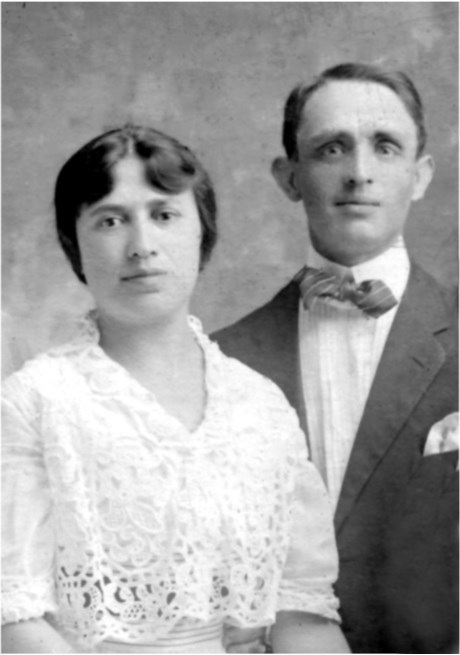
By 1925 Gustave was remarried to a woman named Selma Nadler.  I was able to find a family tree containing Gustave and Selma which included this photograph, apparently of Selma and Gustave.  Selma had also been previously married and had ten children of her own.

Gustave and Selma Rosenzweig

Gustave and Selma Rosenzweig

Between them, Selma and Gustave had nineteen living children in 1925.  Imagine what that family reunion would look like.  The last record I have for Gustave is the 1930 census.  I have not found him yet on the 1940 census.  I have found two death records for men named Gustave Rosenzweig, one in 1942, the other in 1944.  I have ordered them both to determine whether either one is our Gustave.

Meanwhile, Gussie continued to live with one or more of her children in 1925, 1930 and 1940.  I do not yet have a death record for her either.  I have been able to trace the nine children with varying degrees of success.  Lilly appears to have had a child out of wedlock in 1902 named William who was living with Gustave and Gussie for some time in 1905, but who was placed in an orphanage (father listed as Frank with no surname and deceased) for a short time in 1906. William Rosenzweig at Hebrew Orphanage Then Lilly reappears on the 1910 census living with her parents and without William.  I’ve not yet learned what happened to either Lilly or William.

Similarly, the other four daughters Sarah, Rebecca, Rachel and Lizzie, all became untraceable after they left home since I have no idea what their married names were.  As for the sons, Abraham married and had two daughters, who for similar reasons I cannot find after 1940.  Jacob/Jack also had two daughters, and Joseph I’ve not yet found past 1920.   So at the moment I have not located any current descendants, but I will continue to look to see if I can somehow find out the married names of some of Gustave’s granddaughters.  The NYC marriage index only contains records up to 1937, and these grandchildren would not yet have been married by then; thus, I have no readily available public source to find their married names.  It may take a trip to NYC to see if those records are available in person.  Or perhaps I can find a wedding announcement.

UPDATE: Much of the information in the preceding paragraph has been updated here, here, here, here, here, here, and other posts on the blog on Joseph, Jack, Rebecca and Sarah.

So that is the story of Gustave Rosenzweig as I know it to date: a Romanian born painter who married twice, had nine children, real estate and a painting business, and who came to the rescue of his sister and her family.  It would be wonderful to know what happened once they all settled in America.  Gustave obviously stayed in touch with Tillie and her children, as he was present at Bertha’s wedding.  Did he help out Zusi, his little sister, when her husband died? I had hoped to find her living with him on one of those census reports, but did not.  Did he help out my grandfather when he arrived as a 16 year old boy in NYC in 1904? Did he help out my great-grandmother when she arrived in 1910, a widow without any means of support aside from her children? I certainly wish there was some way of knowing the answers to these questions.  From his conduct at the hearing for Jankel in 1908, I’d like to think that Gustave was there for them all, but we will never know.

Enhanced by Zemanta

And A New Branch for the Goldschlager Tree: The Third Rosenzweig Sister

These last few days have been very exciting ones for me.  Not only did I find persuasive evidence of another member of the Brotman family, I also have persuasive evidence of a new member of the Goldschlager family, a third Rosenzweig sister, Zusia, also called Sonsa, Celie, Susie and Susan.  I am still piecing together her life and need to obtain more documentation to do that, but this is what I know so far.

Ghitla Rosenzweig Goldschlager

Ghitla Rosenzweig Goldschlager

First, some background: Moritz Goldschlager, my great-grandfather, married Ghitla Rosenzweig, daughter of David and Esther Rosenzweig, according to the records found by my researcher in Iasi, Romania.  Ghitla, who was also called Gittel, Gussie and Gisella, emigrated to the United States in 1910 with her son David, following my grandfather Isadore in 1904, her husband Moritz in 1909, and her daughter Betty in 1910.  As described before, her husband died in April, 1910, and her two children, Isadore and Betty, moved in with Tillie Strolowitz, herself a widow, and her seven children.  According to Tillie’s death certificate, her birth name was Tillie Rosenzweig, and her parents were also David and Esther Rosensweig.  Tillie had emigrated with her husband and her three youngest children in 1907, following her older children who had emigrated over the years 1901 through 1907.  I was quite excited when I figured out that Tillie was my grandfather’s aunt and had taken him and Betty in after their father had died.

Then a few weeks ago, I reviewed my grandfather’s ship manifest from 1904 (under his brother David’s name) and noticed again that he was supposed to meet an uncle, Morsche or Moische Mintz, in New York City.  I had not been able to find this uncle before, and I was stymied again when I searched for him.  Then I located a document indicating that my grandfather had been shortly detained at Ellis Island, apparently because his uncle had not been able to meet him.  Instead he was met by an aunt Zusie Mintz, who lived at 110 East 117th Street.  But who was she?

Record of Detained Aliens Isadore listed as David Goldschlager

Record of Detained Aliens
Isadore listed as David Goldschlager meeting Zusie Mintz

By searching the NYC marriage index, I was able to locate a Zusie Rosenzweig married to a Harry Mintz and wondered whether this could be the aunt who met Isadore and whether she was another sister of Ghitla and Tillie.   I ordered a copy of the marriage certificate and also looked for further documentation of Zusie Mintz.  I found one census reference for a Sonsa Mintz, living with cousins Jacob and Rachel Reitman in 1900 as a widow.  If this was the same person as Zusie Mintz, it explained why the uncle had not been available in 1904; he had died.  But was Sonsa also Zusie, and who were the Reitmans?

I looked for Zusie or Sonsa or Susie on the later census reports, but could not find her on any of them.  Had she remarried and changed her name? Had she died?

I then looked for and found a death certificate for a Susie Mintz dated March 11, 1931, and I ordered that as well.  At that point I decided to wait for these two documents to arrive before going on what might be a wild goose chase.  I received those documents two days ago, the same day I received the documents evidencing that David Brotman was my great-uncle.  Could I have struck gold twice in one day?

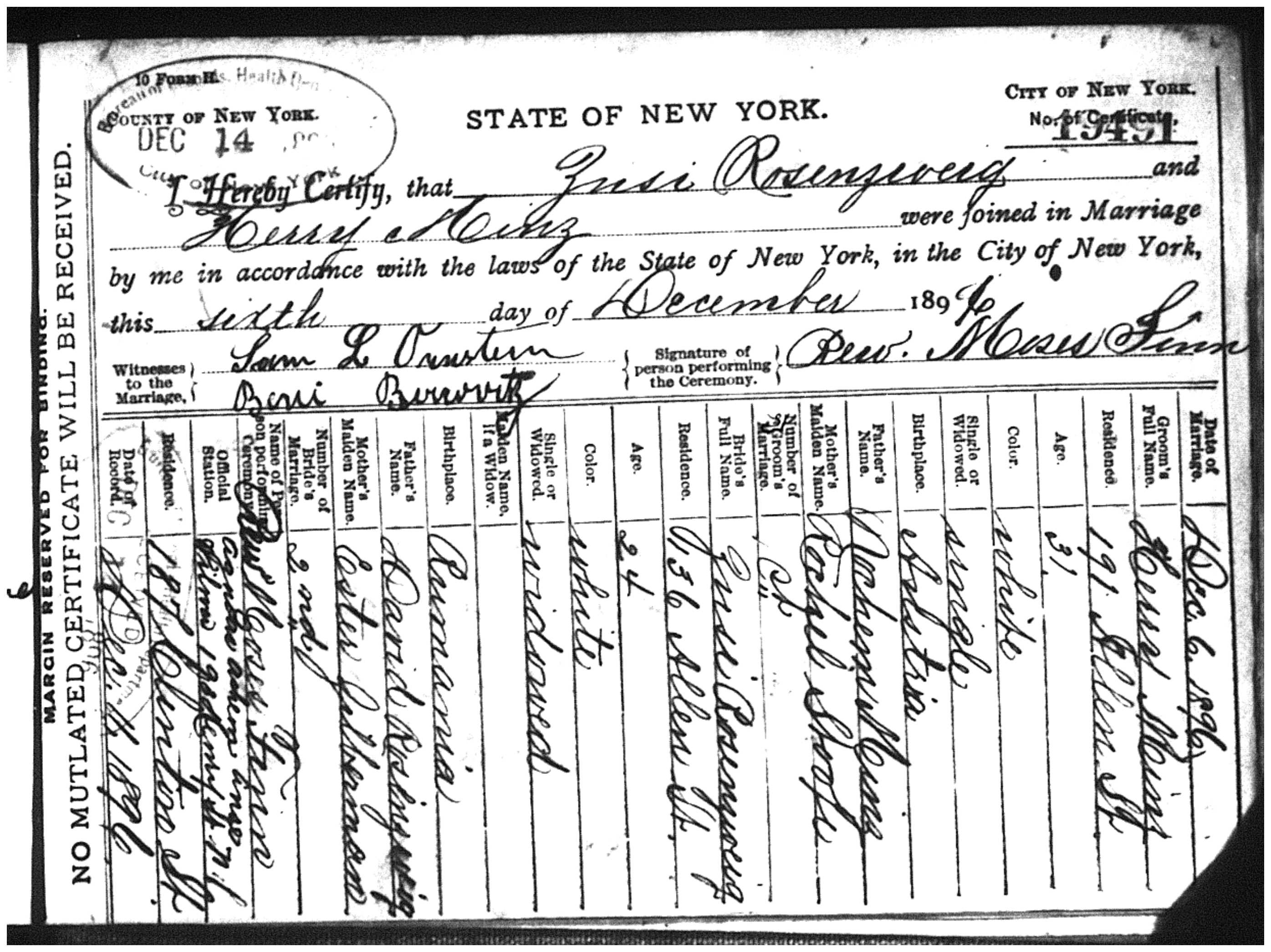
Yes, I could, and I did.  The marriage certificate, dated December 6, 1896, confirmed that the Zusi Rosenzweig who married Harry Mintz was the daughter of David Rosenzweig and Esther Gilberman, revealing for the first time Esther’s birth name.  The certificate confirmed also that Zusi was from Romania.  Zusi had been living at 136 Allen Street, and Harry was living at 191 Allen Street, so presumably they had met in the neighborhood.  Harry was 31 years old, born in Austria, and was marrying for the first time. Zusi was 24 years old, but already a widow.

Zusi Rosenzweig and Harry Mintz marriage certificate

Zusi Rosenzweig and Harry Mintz marriage certificate

Had she married before she left Romania, or since arriving in NYC? Why had she gone back to her birth name, Rosenzweig?  These are questions for which I still do not have answers.

The second document I received, the death certificate for Susie Mintz who died on March 11, 1931, also confirmed that Zusi, now Susie, was the daughter of David and Esther Rosenzweig, born in Romania.  Susie was 54 years old at the time of her death, meaning that she was born in 1877, whereas if she had been 24 in 1896, her birth year would have been 1872.  The death certificate also indicated that she was a widow, and it provided her current address: 523 East 108th Street in the Bronx.

Susie Mintz death certificate

Susie Mintz death certificate

The reverse side of her death certificate contained some surprising information. It revealed that the undertaker had been employed by “Mr. Mintz,” Susie’s son.  Susie had a son? If so, where was he in 1900 when Sonsa was living with Jacob Reitman? Or was that really Susie/Zusi? If Susie had a son, perhaps she had other descendants as well.  But what was her son’s name? When was he born?

reverse of death certificate

reverse of death certificate

Using the address on the death certificate, I worked backwards to see if I could find Susie on the 1930 census, since I assumed she had not moved between the 1930 census and the time of her death in March, 1931.  This took some doing, as you have to scan through all the pages within a specific enumeration district to find the address; there is no index by address.  I finally found her address, and then I found her listing: she was living at the same address, listing herself as  Susan Mintz, 42 years old, a dressmaker, and as married.  Married? She was living with a boarder named Hannah Kassel, an older woman who was a widow.  When I looked at the form more closely, I realized that the M for married also could be a W for widowed.  I think the indexers read it incorrectly, and that Susie was in fact still a widow in 1930, as she was in 1900 and at her death.

Susan Mintz 1930 census

Susan Mintz 1930 census

From the 1930 census, I then went to see if she had been at that address ten years earlier for the 1920 census.  After more scanning and searching, I found her once again at the same address, but now using the name Celie, or at least that is how the census taker recorded it.  She was listed as a widow, a dressmaker, and 42 years old (I guess she did not want to admit being any older ten years later in 1930).  Zusi/Susie/Celie was living alone at that time.

Celie Mintz 1920 census

Celie Mintz 1920 census

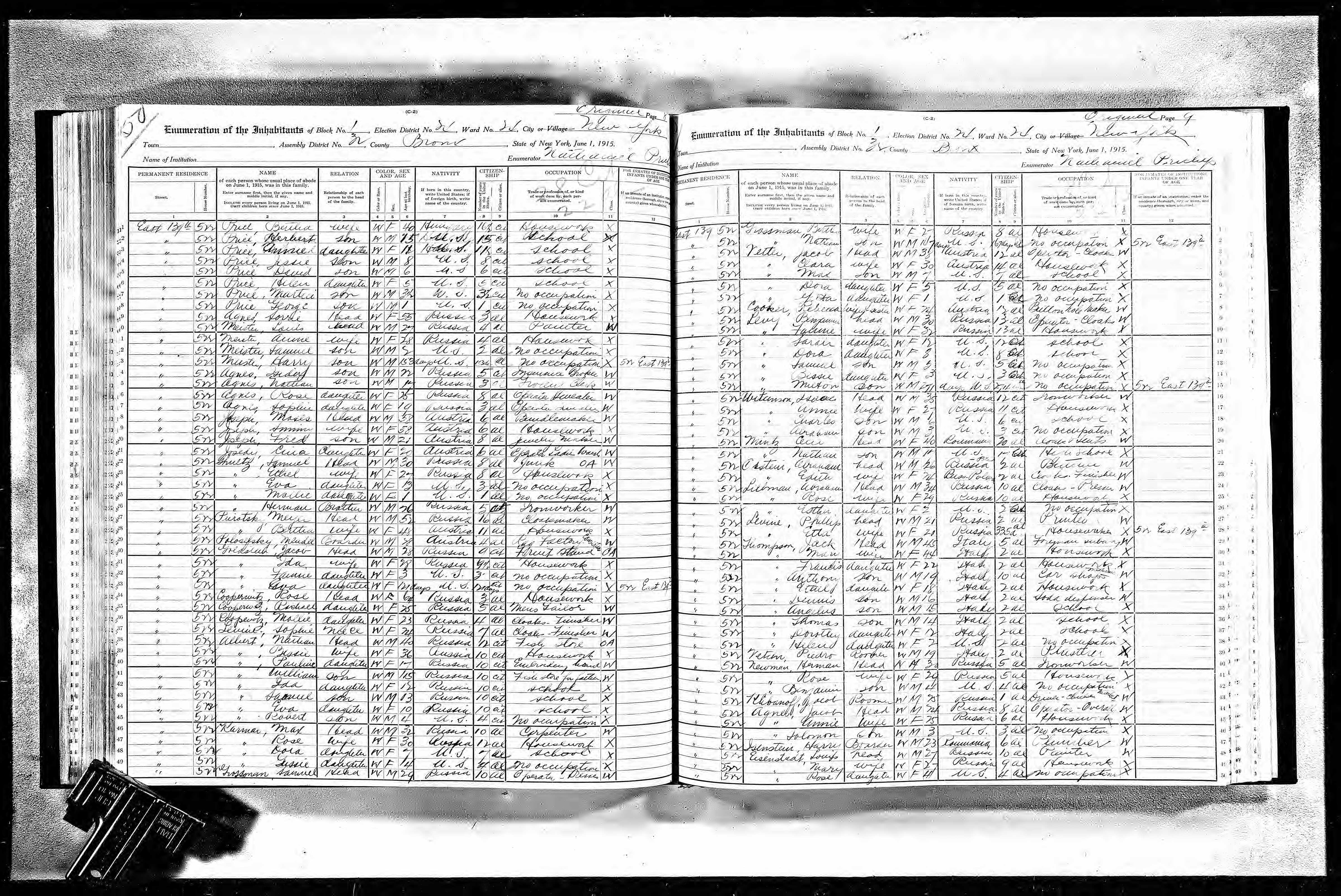
Next came the 1915 New York State census—could I find her again at that address?  I searched for Celie Mintz this time, and without having to scan the census, I found her on the next block at 522 East 139th Street in the Bronx, working at a cloak and suit factory, and living with her son, Nathan.  Her son!  I had found a record for her son.

Celie and Nathan Mintz 1915 NYS census

Celie and Nathan Mintz 1915 NYS census

I could not find either of them on the 1910 census or the 1905 New York State census, at least not yet, but now I had her son’s name and could search for him.

I checked the New York City birth index for a birth certificate for a baby named Nathan Mintz and found one dated December 6, 1897, exactly a year after Harry Mintz had married Zusi Rosenzweig.  This certainly could be the right Nathan, but I now need to obtain that certificate to be sure.

I did find Nathan’s 1917 draft registration for World War I, listing his mother as Cecile Mintz living at 523 East 138th Street in the Bronx, the same address where she was living from 1920 until her death.  Cecile is closer to Zusi and Susie than Celie, and looking at the 1915 census it does look more like Ceci than Celie.  The fact that Nathan’s address in 1917 was the same as that on Susie Mintz’s death certificate confirms that Susie and Cecile and Celie and Susan were all the same woman.

Nathan Mintz draft registration 1917

Nathan Mintz draft registration 1917

I then found a Nathan Mintz who married Gertrude Friedman in 1930. I need to order that certificate as well, but  I suspect that this is the correct Nathan because on the 1940 census, Nathan and Gertrude have an eight year old daughter, born then in 1932, named Susanne.  If this is the right Nathan, it makes perfect sense that he would name his first born child after his mother Susie one year after her death.

Nathan, Gertrude and Susanne Mintz 1940 census

Nathan, Gertrude and Susanne Mintz 1940 census

But there are obviously many unanswered questions.  I can’t find a death certificate for Harry—did he really die, or did he just disappear? Who are Jacob and Rachel Reitman? How, if it all, were they related to Zusi? And where was Nathan living if that was Zusi living with the Reitmans in 1900?  Zusi was the one who met my grandfather at Ellis Island in 1904, but he was living alone in 1905.  Where was Zusi living in 1905? 1910? She was not living with either of her sisters in 1910, so where did she go?   And where was Nathan in those years and between 1917 when he registered for the draft and 1930 when he married Gertrude?

Yes, there are a lot of holes and a lot of questions, but I remain fairly certain that Zusi Rosenzweig Mintz was my great-grandmother’s sister and thus my great-great aunt and that Nathan Mintz was therefore a first cousin to Isadore, David and Betty Goldschlager and to all the Strolowitz children.  Did they know him? And, of course, if Susanne Mintz was Nathan’s daughter, then she would have been my mother’s second cousin.  And if Susanne had children, then they would be my third cousins.

So stay tuned—more to come once I receive more information.

Another Addition to the Brotman Family Tree: David Brotman and his wife Annie

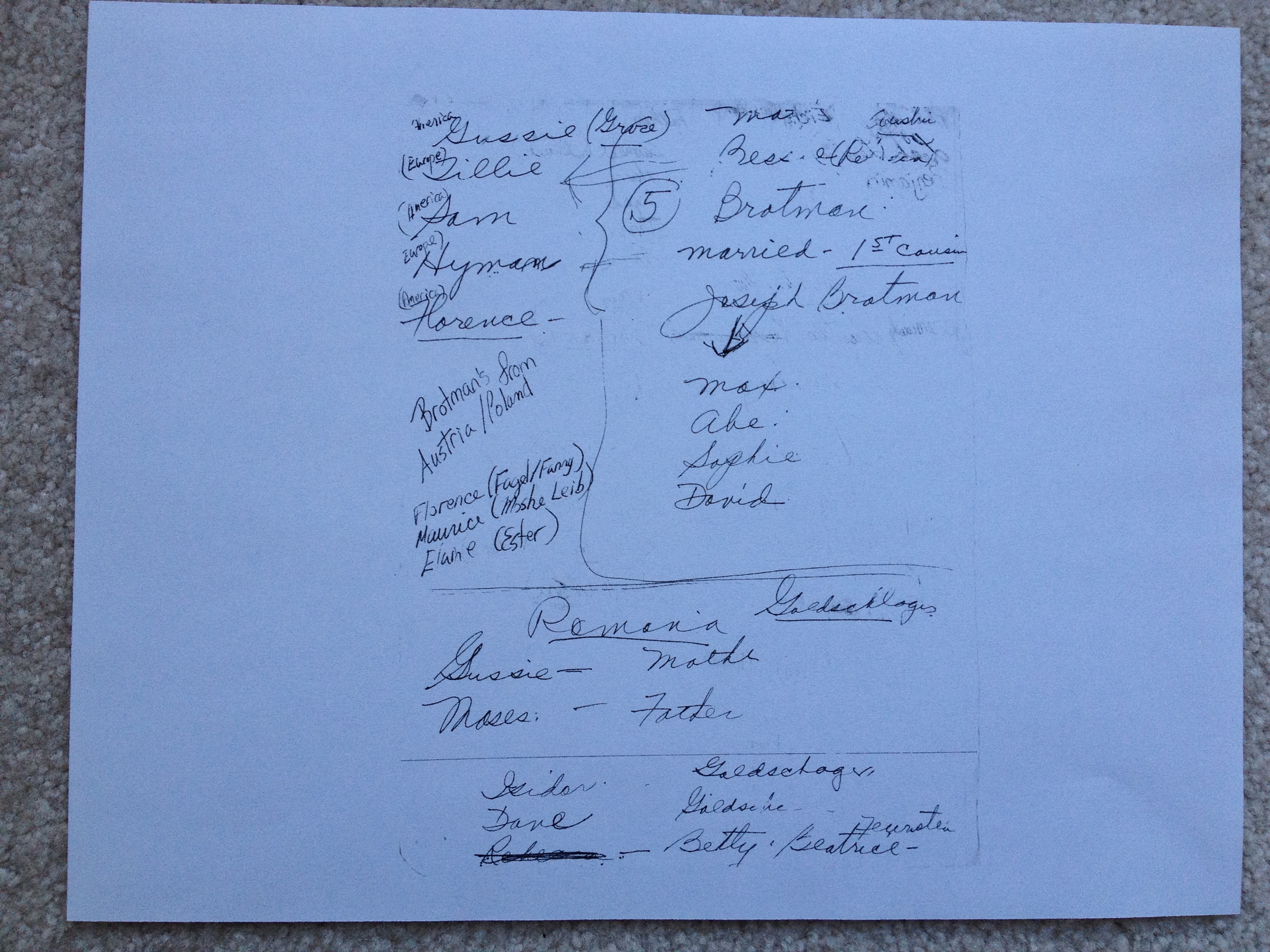
Family Tree drawn by Elaine Goldschlager Lehbraum

Family Tree drawn by Elaine Goldschlager Lehbraum

As you may recall, a couple of weeks ago my cousin Jody made a big discovery: handwritten notes that her mother had made of Joseph Brotman’s children.  It included all the children we already knew about: Bessie’s children Hyman, Tillie, Gussie, Frieda (Florence in her notes) and Sam, as well as the two sons we knew of from Joseph’s first marriage, Abraham and Max.   My brother had recalled that our aunt had said Joseph had had four children from his first marriage, but we did not know the names of the two remaining children, and I had traced every possible Brotman I could find to see if there was a link.  I had hit many dead ends and found nothing that linked these other Brotmans to our family.

My aunt’s notes were a huge discovery because for the first time we had evidence of the names of those two missing children: David and Sophie.  As I wrote when Jody first sent me the tree, I was able to locate a David Brotman from Austria who was a possible match for Joseph’s missing son, but I needed to check further and obtain some documentation in order to be sure.

Well, those documents arrived the other day, and I was so excited to see that on David’s marriage certificate in 1897, he listed his father’s name as Joseph Brotman and his mother’s as Chaye Fortgang.

David Brotman and Annie Salpeter marriage certificate

David Brotman and Annie Salpeter marriage certificate

You may recall that Max had also listed his mother’s name as Chaye on his marriage certificate, so this confirmed that Joseph’s first wife was named Chaye, but now we know her surname as well.

Max Brotman marriage certificate

Max Brotman marriage certificate

In addition, the marriage certificate gave David’s current address as 85 Ridge Street—the same address where Joseph and Bessie were living in 1895 when Gussie was born, according to her birth certificate.

Gussie birth certificate

Gussie birth certificate

This confirmed for me that David was Joseph’s son, Max and Abraham’s full brother, half-brother to Hyman, Tillie, Gussie, Frieda and Sam, and our great-uncle.  I am still in a state of amazement that I was able to find him.  Thank you, Aunt Elaine, for leaving behind this great clue to our family.

Once I had this information confirming the relationship, I located whatever census reports and other records I could find for David and his wife, Annie Salpeter.  I found them on census reports for 1900, 1905, 1910, and 1920.  David was a tailor according to the first three census reports, and he and Annie were living on the Lower East Side until at least 1910. At times Annie’s brother Morris lived with them as well as a cousin Meier, but there were no children listed on any of these census reports.

At the time of his World War I draft registration in 1917, David and Annie had left the Lower East Side and were living at 143 Manhattan Avenue in Brooklyn, which was also their address on the 1920 census report, when David’s occupation was given as a cloak dealer in a “cloak house.”  Annie and David were now 44 years old and still had no children living with them, so I assume that they never had children. So there are no more second cousins to find and probably no pictures of David and Annie.  (But I’ve learned never to say never.)

I’ve yet to find David and Annie on the 1930 or 1940 censuses, but I am still looking.  It seems unlikely that they had left Brooklyn.  I was able to locate a 1946 death certificate for a David Brotman married to Anna living at 10 Sumner Avenue in Brooklyn, and I believe this is the same David, despite the fact that the death certificate has his father’s name as Isaac.  I’ve learned enough to know that death certificates are notoriously unreliable.  I will continue to see if I can find anything about David and Annie after 1920.

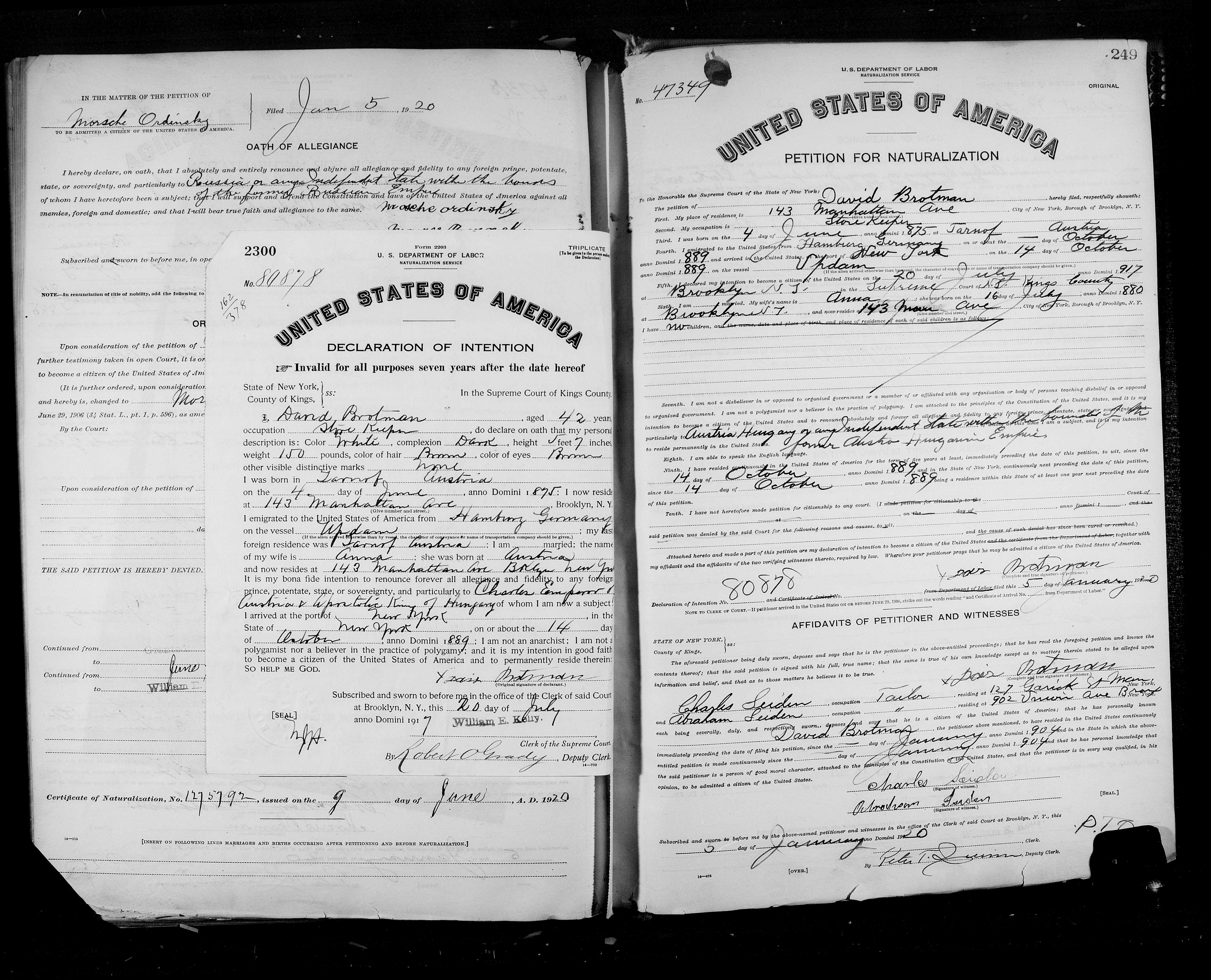
I do have David’s petition for naturalization in 1920, and it indicates that he had arrived in NYC on October 14, 1889, on the “Updam” from Tarnof, Austria.

David Brotman petition for naturalization 1920

David Brotman petition for naturalization 1920

Tarnof could be Tarnow, a city about fifty miles north of Tarnobrzeg/Dzikow and even further from Czchow, the two areas that I have been focusing on as the Brotman hometown based on Hyman’s listing of “Jeekief” and “Giga” on his documents.  But Tarnof could also be Tarnobrzeg, the larger town that is near Dzikow.  So did this new information help our search for our hometown in Galicia or did it just make it more confusing?

That led me to search for the ship manifest for David, now that I knew when he arrived and on what ship.  With some help from Renee, I located a September 4, 1889,  German ship manifest for the Portia, sailing to Rotterdam, listing Dawid Brodmann as a passenger.  I was excited to see that David was traveling with his older brother, Abe Brodmann. I had not previously been able to find Abraham on a ship manifest, so this was another exciting discovery.

David and Abe Brodmann on the Portia 1889

David and Abe Brodmann on the Portia 1889

On the Portia ship manifest, Abe and David are listed as coming from “Grambow, Russland,” not Austria at all, let alone Tarnow, Tarnobrzeg, Dzikow or Czchow.  I would have found this an indication that these were not the right boys, but there is a town right near Tarnobrzeg called Grebow, and according to a 1914 map, Tarnobrzeg was very close to the Russian border. So perhaps our family lived in Grebow? Or maybe that is where Joseph lived with Chaye and then moved to Dzikow when he married Bessie?

On the manifest for the Obdam, sailing from Rotterdam to New York arriving on September 19, 1889, David and Abe are listed as coming from Austria, not Russia, which appears to be correct.

David and Abe Brodman on the Obdam to New York 1889

David and Abe Brodman on the Obdam to New York 1889

There is obviously some confusion and conflict here, but it’s another clue and another place to look for the Brotman home in Galicia. I already have contacted several people researching this area to see if I can uncover more clues.

I have a few more leads to follow to fill in the gaps in David’s life story, and maybe they will even lead me to Sophie, the only remaining child of Joseph to locate.  There is also some potential evidence that will link our family to the Brotmanville Brotmans, but again, I need to do more research before it is worth speculating about that connection.

Enhanced by Zemanta

Update: The Strolowitz/Adler Family, My Grandfather’s Cousins

As I have written, in 1910, after my great-grandfather died the day before his daughter Betty arrived and before my great-grandmother and her son David arrived, Betty and her brother Isadore lived with their aunt Tillie Rosensweig Strolovitz and her seven children on East 109th Street in New York City.  Tillie had arrived with her husband Itic Yankel Srulovici and their three youngest children, Beckie, Pincus and Leah, in late December, 1907.  Their four oldest children had left Iasi, Romania, before them: Isidor in 1901, Bertha and Bella in 1906, and David in January, 1907.

Leah Adler c. 1920

Leah Adler c. 1920

Although I have not yet found a ship manifest for Isidor, the oldest child, I do now have manifests for all the other members of the family, having just located David’s last night.  Among the many documents I received this week were David’s naturalization papers, which provided his date of arrival and the name of the ship.  Although his first name was partially torn off the paper, with a little trick of the trade I learned from Renee, I was able to obtain a copy of the ship manifest as well.  David is listed as “…vid Stubowicz” on the manifest, yet another variation on the family name.  He named his brother, Israel (presumably Isidor) Stubowicz, as the person paying for his ticket and meeting him in New York.   Interestingly, although David’s certificate of arrival has his name as Strubewicz, his petition for naturalization was made under the name David Adler.

David Adler petition for naturalization

David Adler petition for naturalization

I had already found the manifests for Bertha and Bella and for Tillie, Jacob and the other children, and interestingly, every member of the family used some variation of Srulovici/Strubowicz/Strolovitz on the manifests, not Adler.  It appears that the Adler name was not used officially by the family until after they came to the United States.  Whether Isidor had already adopted it and then the others eventually followed I do not know.  In 1910, we know that only David and Isidor were using Adler, but as already discussed, eventually every member of the family was using it at least part of the time.

David Adler and his wife Bertha

David Adler and his wife Bertha

In addition to David’s naturalization papers, I received several other documents related to the Adler family.  (For simplicity sake, I will refer to them as the Adlers, except where the Strolowitz name is relevant for a particular reason.)  I had hoped to find something that would help me learn what had happened to Jacob. To recap what I already knew and did not know, I had not found any record of Itic Yankel after the ship manifest of 1907, and family lore said that he had never left Ellis Island.  The ship manifest, however, indicated that he was admitted, after being briefly detained for a doctor’s examination of his eyes.  There is no record of deportation.  I thought perhaps that he had died shortly thereafter, and I ordered the death certificate of the only Jacob Adler I could find who might fit in terms of age and year of death.  I now have that certificate, but unfortunately it was not for the correct Jacob Adler.  The certificate is for a Jacob Adler from Germany who had been in the US since 1880 at the time of his death in 1910.  So I still have no answers to the question of what happened to Jacob, Tillie’s husband.  I am awaiting his immigration papers from the National Archives and hope that they will provide some clues.

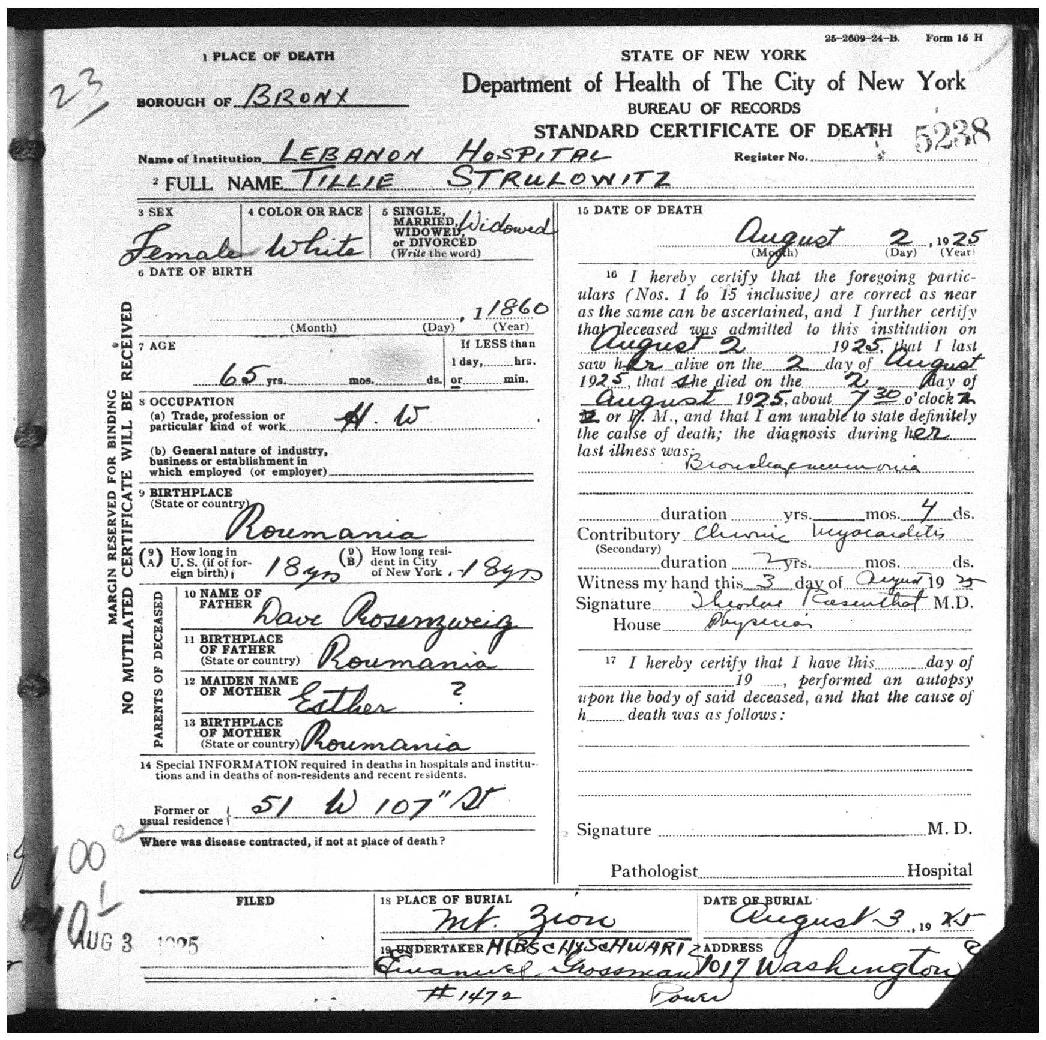
I had requested several other documents in order to confirm what I assumed was true: that Tillie was the sister of my great-grandmother Gisella Rosensweig and that Itic Yankel Srulovici and Jacob Adler were the same person and the father of all of the seven children.  Not surprisingly, they all do confirm one or both of those facts.  First, Tillie’s death certificate lists her parents as David and Esther Rosenzweig (no maiden name for Esther, unfortunately), my great-great grandparents, confirming that Tillie was my great-grandmother Gisella’s sister.  Her death certificate was witnessed by her son David, signing as Strulowitz, confirming that Yankel Srulovici was his father and not some other husband named Adler.  (Tillie is also a Strulowitz on the certificate.)

Tillie Strulowitz death certificate

Tillie Strulowitz death certificate

Second, Isidor’s death certificate confirms that he died young—in 1915 of liver cancer at age 31. Although he is identified as Isidor Adler, his parents’ names are given as Tillie Rosenzweig and Jacob Strulowitz. Bertha’s marriage certificate gives her parents’ names also that way, with Bertha also now using Strulowitz.  On the other hand, Leah’s marriage certificate uses Adler and lists her father’s name as simply Jacob (and her mother as Tillie Rosensweig). Finally, David’s death certificate gives his father’s name as Jacob Adler (and David’s name as David Adler), and his mother’s as Tillie Rosensweig.  Certainly this is enough documentation to prove that Jacob Adler and Yankel Srulovici were the same person and the father of the seven children.

Isidor Adler death certificate

Isidor Adler death certificate

Thus, many open questions were answered by these latest documents, but there remains still the question of what happened to Jacob Srulovici/Strolovitz/Strulowitz/Adler after he arrived at Ellis Island.

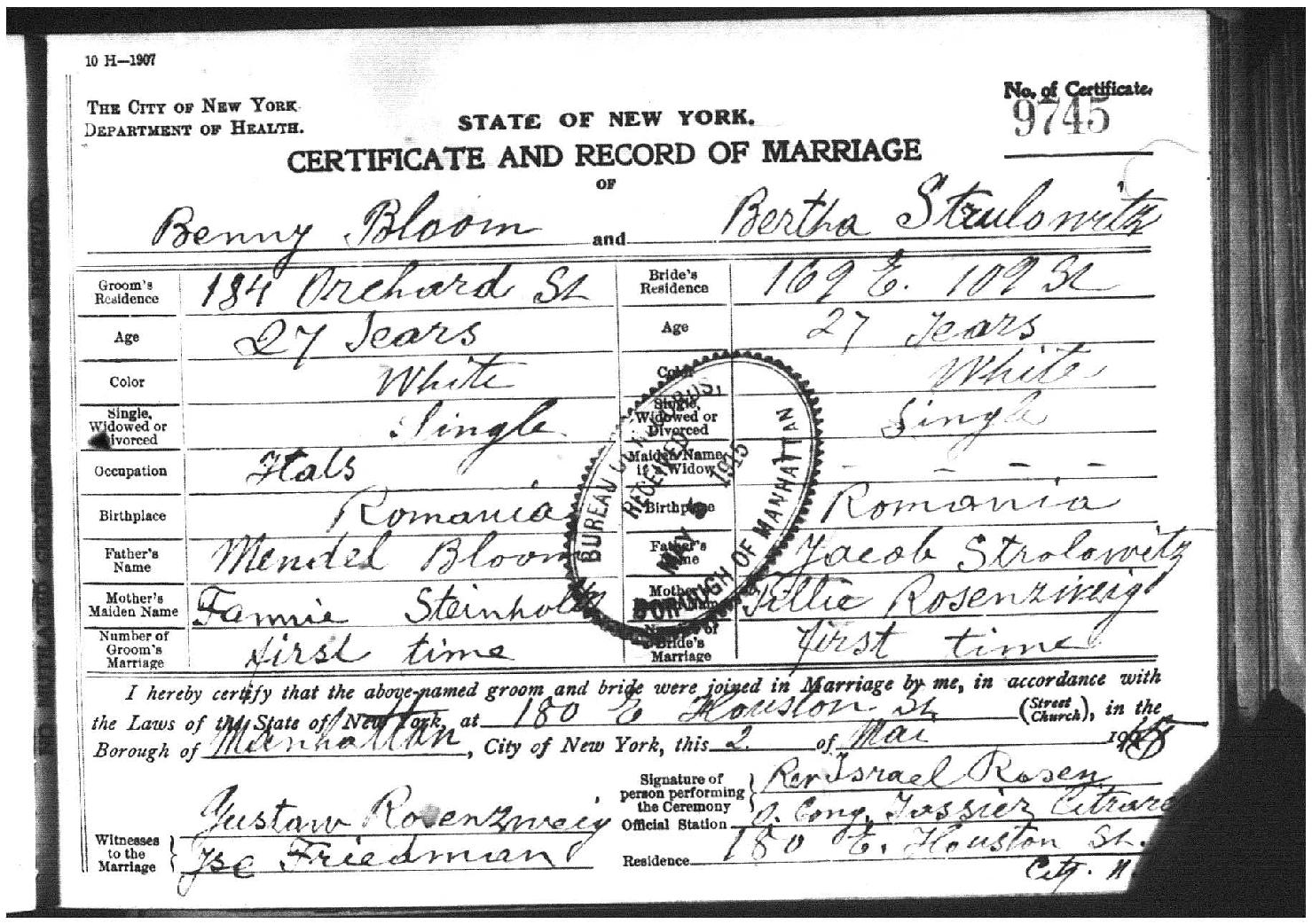
In addition, the marriage certificate of Bertha contains the signature of a Gustav Rosenzweig as a witness to the marriage.  Could this be Tillie and Gisella’s brother? Or a nephew? Cousin? And thus begins yet another search for a possible member of the extended Goldschlager-Rosensweig family.

Bertha Strulowitz marriage certificate witnessed by Gustav Rosensweig

Bertha Strulowitz marriage certificate witnessed by Gustav Rosensweig

Enhanced by Zemanta

The Adler Strolowitz family continued

Although I still don’t have answers to all the questions about the Strolowitz/Adler family, I have made a lot of progress finding the descendants of Tillie Strolowitz Adler and her children, with a lot of assistance from Renee Steinig, who continues to teach me and to amaze me with her ability to find people through various search methods.  So here’s a summary and a description of the process used to find most of these people, including several living descendants who I am now trying to contact.

I’ve not had any success finding Tillie’s son Isidor yet aside from the entry in the 1910 census.  There are numerous Isidor Adlers listed in the NYC marriage index and many also in the US and NY census reports, but I cannot with any degree of certainty identify the right one.  Some are too old or were married and had children before 1910, when the right Isidor was still single and living with his mother.  Some are not from Romania or born in the United States.  I am beginning to think that Isidor either died young or maybe even returned to Romania.  I have found one death record for an Isidor Adler who died April 23, 1915, and the age looks right, so I will send for that death certificate.

I’ve had better luck locating the second son, David Adler.  After a careful process of elimination, I believe that Tilllie’s son David married a woman named Bertha (maiden name not yet found).  Since David also had a sister named Bertha, this created some confusion for me.  David and Bertha had a daughter Tessie, born in 1927 (possibly named for Tillie, who had died in 1925).  Renee found a memorial written about Tessie Adler on the Findagrave.com site, and the date of birth corroborated that this is the correct Tessie.  Tessie and her husband Harry had two sons, David, possibly named for his grandfather David Adler, and Ira.  I am now in touch with Ira, who confirmed that he is Tessie’s son and that she was David’s daughter and Tillie’s granddaughter.

The Strolowitz daughters were much trickier to find, as women tend to be.  Once they get married, they are much harder to find, unless I can find a marriage record which gives me their husband’s name.  I first focused on Bertha, figuring that it was a less common name than Beckie, Bella or Lizzie.  I found a marriage record for Bertha Strulovitz to Benny Bloom in May, 1914.  I then did a census search and found a Bertha and Bernard Bloom living on East 109th Street in 1915.  The “Bernard” threw me, as did the fact that Bertha was 27, meaning she would have been born in 1888, not 1885, as reported on the 1910 census.  But while scanning the page to look for their entry, I saw a listing in the same building for a Tillie Stralowitch and her children, David, Bella, Beckie, Peter (Pincus?) and Lizzie.  This was obviously Tillie Strolowitz, living in the same building as in 1910, with her married daughter Bertha and her new husband Bernard or Ben in their own apartment.  So far, so good.  It also made sense that Bertha was born in 1888, not before David, who was 28 in the 1915 census and thus older than Bertha.  That could explain why David and Isidor were Adlers, while the rest of the children were Strolowitz.  Perhaps Mr. Adler died right after David was born, Tillie remarried to Strolowitz and within a year had Bertha?  Phew!  They acted fast back then!  (Remember Harry Coopersmith…)

But after that, I could not find any references for Bertha Bloom at all.  I was stumped.  I couldn’t find any more references for Tillie Strolowitz either, no matter how I spelled it.  Finally, I decided to look for Tillie Adler, and there she was in the 1920 census, listed as Tillie Adler, living with her three daughters, Bertha, Bella and Leah (Lizzie?) on East 107th Street.  The ages and names matched, but why were they now using Adler? So much for my earlier hypothesis.  Maybe Mr. Adler was the father of all these children? Maybe Mr. Adler and Mr. Strolovitz were the same person? And what happened to Bertha’s husband? Why was she living with her mother?  She is listed as married, not single, on the 1920 census, but not living with Bloom.

In 1925 Tillie, Bertha and Bella were all still living together on East 107th Street under the surname Adler.  There was no question about marital status on this form, but apparently Bertha was still legally married because in 1926 she applied for citizenship.  On the naturalization form she signed as “Bertha Adler known as Bertha Strulovici and Bertha Bloom,” and listed her spouse as Benjamin Bloom.  Her brother David Adler signed as a witness for her.

By 1930, Tillie had died, and Bertha and Bella had moved in with David Adler and his wife Bertha and daughter Tessie.  Imagine—two Bertha Adlers living in one household.  The census taker must have been confused because he listed Bertha, David’s sister, as his mother.  On this census, Bertha (the sister) is now listed as divorced, finally.

In 1940, Bertha was no longer living with David, but now was living with her sister Leah on Grant Avenue in the Bronx.  Leah was married to Benjamin Schwartz, an optometrist, and had two children, Ira and Theodora.  Renee helped me locate Theodora, who is now living in Atlanta where her parents eventually moved and died.

No further luck finding out what happened to Bella or Bertha after 1940, but at least we know what happened to Tillie, David, and Leah, and have located the next generation of third cousins, the great-great grandchildren of David and Esther Rosensweig.

More discoveries in the next post, including some of the most interesting ones of all.  But for now, back to the research.

Enhanced by Zemanta

Hyman and Sophie’s marriage certificate

Finally, after almost two months, the Family History Library is back in service. I’ve received a couple of documents that I will post about. First, I received Hyman and Sophie Brotman’s marriage certificate. Although it provides no new information, it is nevertheless an interesting document. Hyman (who was using Herman by this time on official documents) was only 22 when he was married in 1904; Sophie was only 18. Sometimes I am amazed by the fact that people who married so young were able to have such long marriages. Sophie and Hyman were married 64 years.

Herman and Sophie Brotman

Herman and Sophie Brotman

What I found particularly interesting about this document is that Hyman used his father’s middle name, Jacob, on the certificate. I have never seen Joseph referred to on any document as anything other than Joseph. But, as you may recall, Hyman also referred to his mother as Fanny, her middle name, on his Social Security application, a reference no one else ever used. Here he uses Pesel Broht as his mother’s name, not Fanny. Perhaps he was being somewhat secretive, or perhaps there was some family use of those middle names. After all, Hyman was Herman and Chaim, so he had a flexible attitude towards names. (I’ve also never seen Broht spelled with an H.)

Edit:  I just realized that the front of the form has the groom’s name as Haimy!

The other thing that I find interesting about the marriage certificate is the spelling of “white” as “weit” and the spelling of Manhattan as Manahten. It looks like the rabbi might have filled out the entire form since it seems to match the handwriting of his signature. I also think the rabbi filled out the form because Weiss is spelled with one S on the front of the form, but Sophie spelled it Weiss in her signature. Whoever filled out the form also did not understand the box that asks for number of marriages, as the blank area is filled with an address, not a number. I have no idea what that address refers to, as it is not the address of the bride, the groom or the rabbi. At any rate it does indicate that this was someone who was still learning English.

Also of interest is that we now have a record of Sophie’s father’s name, listed as Moses, later changed to Morris, and her mother’s maiden name. It looks like Linz or Livy Gabler? Does that sound right to any of her grandchildren? Can anyone help decipher the handwriting? Later records have her name as Lena, so Liny or Linz might make sense.

Finally, the one thing I cannot decipher at all is Hyman’s occupation. Can someone please help me read what that says? On the 1900 US Census his occupation was reported to be a button hole maker, but this looks like something different. If you can read it, please leave your response in the comments below.

Edited:  The prize goes to my brother Ira, who deciphered the occupation to be a phonetic spelling of “operator.”  Often those who worked in the sweatshops on the Lower East Side were referred to as operators (i.e., machine operators).  Since Hyman had been working as a button hole maker, it makes sense that this was what he was doing when he married Sophie in 1904.  It also makes sense that someone who spelled white “weit” and Manhattan as Manahten would spell operator phonetically as well.

Hyman and Sophie's marriage certificate 1904

Hyman and Sophie’s marriage certificate 1904

reverse

reverse

Enhanced by Zemanta

Looking back on the first six months: Seven lessons learned by doing genealogy

As my semester has drawn to an end, as the year draws to an end, I want to take some time to reflect on what I have learned in the last six months or so since I began this project in earnest and what I still want to learn and to accomplish as we start a new year.

So first, what have I learned?

1.  I’ve learned that I had two great-uncles whom I’d never known about.  For at least two months of my research, I was sure that Joseph and Bessie had only had five children: Hyman, Tillie, Gussie, Frieda and Sam.  When I kept running into a Max Brotman married to Sophie with children named Rosalie and Renee, I just figured Hyman had changed his name to Max.  My mother didn’t know about her cousins Joseph, Saul and Manny, but she had met Rosalie and Renee, and I was sure they were Hyman’s daughters.  My mother knew that Hyman’s wife’s name was Sophie.  So instead of looking harder, I just assumed Max was Hyman and that the other Hyman Brotman married to a Sophie was not my relative.  Only when I was able to find Max’s granddaughter Judy and Hyman’s grandson Bruce did I learn that Max and Hyman were BOTH my great-uncles, that both had married women named Sophie, and that Rosalie and Renee were the daughters of Max, not Hyman.  That was a HUGE turning point for me and a big lesson.  Lesson learned? Don’t trust memory alone, and don’t assume that documents are wrong just because family memories conflict with those documents.

Herman and Sophie with sons 1920

Herman and Sophie with sons 1920

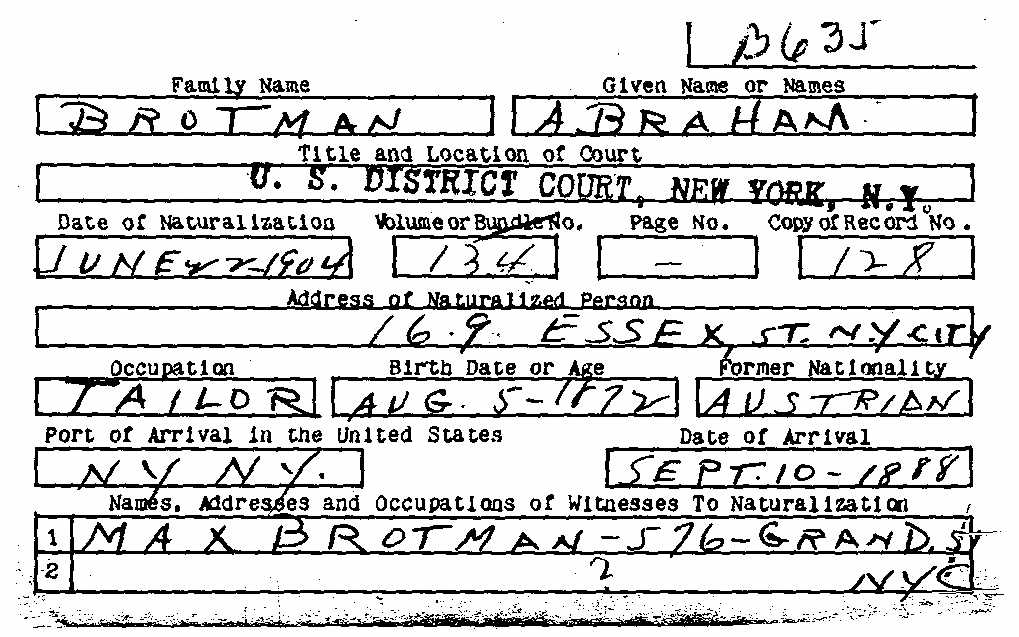
2. The second new great-uncle was Abraham, and finding him was also somewhat of a lucky break.  I ran across many Brotmans in my research, but most I assumed were not our relatives because I could not find any document linking them to our relatives and because no one in our family had ever heard of them.  I can’t even remember all the details, but I recall that it was my brother Ira who found Abraham’s naturalization papers—I think (I am sure he will remember and correct me if I am wrong) it was in the course of looking into the Brotmanville Brotmans.  When I saw Max’s name on those papers, I did not assume it was the same Max.  (There were many Max Brotmans living in NYC at that time.)  Once I checked the address for the Max on Abraham’s card against the address I had for Max on the census form from that same time period, I knew it was in fact “our” Max.  That led me on the search that brought me to Abraham’s headstone and death certificate, indicating that his father was also Joseph Jacob Brotman.  Lesson learned? Don’t dismiss any clue.  You never know where one document may lead you, even if in a direction you never expected.

Naturalization of Abraham Brotman Max as Witness

Naturalization of Abraham Brotman
Max as Witness

3.  Contrary to Lesson #1 and Lesson #2, I have also learned that often you cannot trust documents.  Documents lie.  People lie.  People give bad information, and bureaucrats transcribe information inaccurately.  People who transcribe handwritten documents for indexing purposes make errors.  In particular, our relatives were entirely inconsistent when it came to birth dates and birth places.  I now know why one relative found it so easy to lie about her age.  It was family tradition.  So lesson #3: Don’t assume that because it is written on some “official document” that it is reliable in any way.

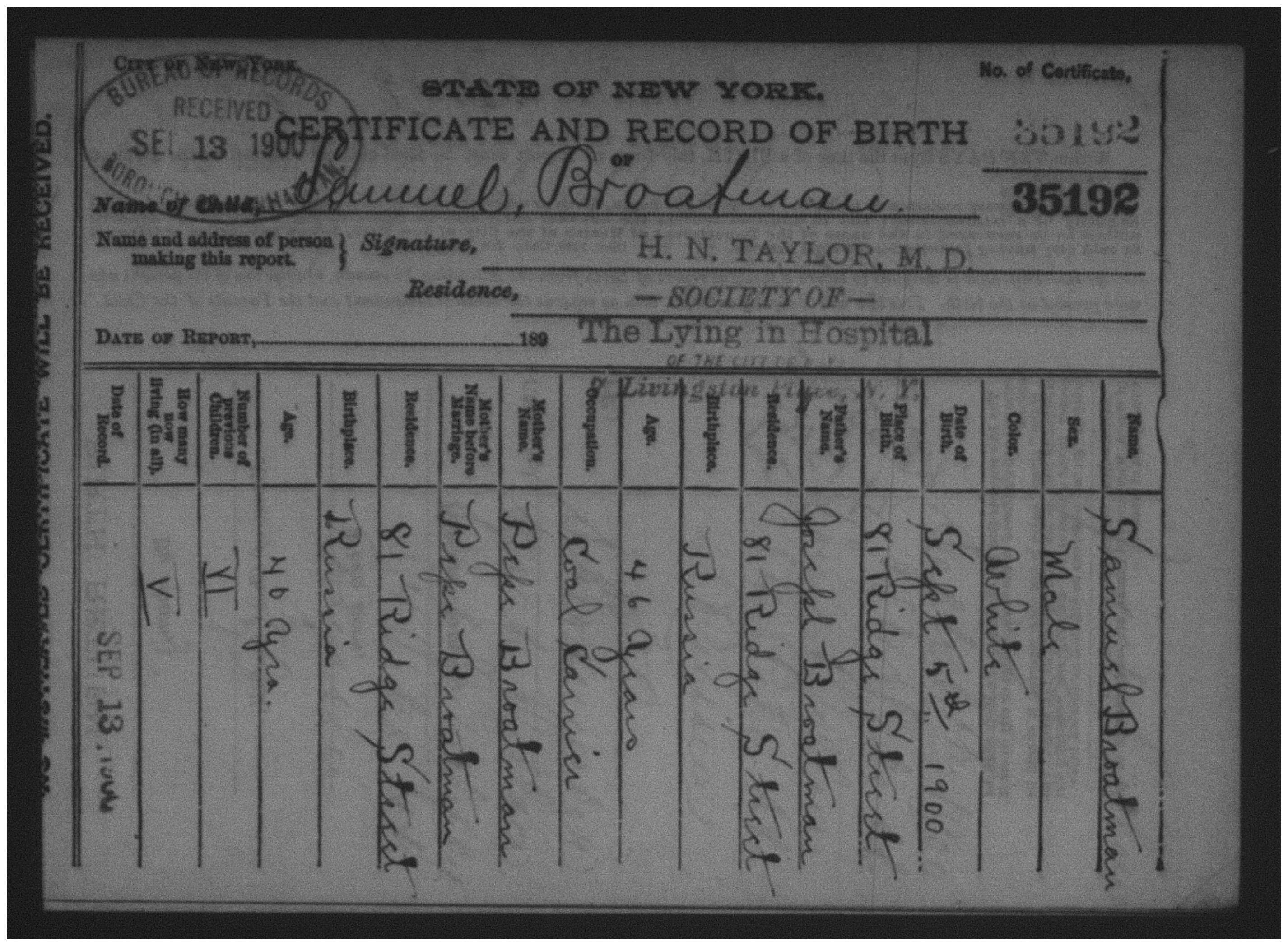
Sam's Birth Certificate Joseph was NOT 42!

Sam’s Birth Certificate
Joseph was NOT 46!

4. One of my most rewarding accomplishments was finding out what happened to Frieda Brotman. Now we know who she married and how she died and even the name of her infant son Max, who only lived one day.    We even know what happened to her husband Harry Coopersmith after she died.  I never thought I’d be able to track down her story.  That experience is what will keep me going as I continue to look for the answers to more questions.  Lesson #4: Do not give up.  Do not give up. Do NOT give up!

Frieda Brotman Coopersmith death certificate

5. There are more helpful and supportive people in the world than there are mean or evil people.  I know we hear all the time about all the evil in the world, and there is far too much of it.  And even if not evil, there are also many people who are rude, incompetent and unhelpful.  We all know that.  But we often forget that there are also many, many more people who are kind, helpful and competent.  In my six months of doing this research, I have gotten help from many strangers—government employees who patiently helped me find a document, FHL volunteers who helped me track down a document request I had made, JewishGen and GesherGalicia members and other genealogists who have gone far out of their way to teach me how to find documents and how to connect with other researchers, who have photographed gravestones and given me directions to gravestones, who have translated documents for me, who have helped me find a clue when I was sure I had hit a brick wall.  I cannot tell you how much these people have touched me and changed my views on human nature.

I want to express special thanks and deep appreciation to Renee Steinig, who contacted me many months ago in response to my cry for help on GesherGalicia and who has truly been my teacher and is now my friend as I have gone from being a total newbie to a fairly competent novice with her guidance. She is the one who found the obituary of Renee that led to me finding Judy.  She is the one who suggested I post an inquiry on a bulletin board that led me to Bruce.  When I look back, in fact, I know it was Renee who got me to where I am today.  Thank you, Renee, for everything.

Lesson #5: If you ask for help, there will be generous and kind people who will reach out and help you.  Don’t do this alone.

6. I have also learned that I have many second cousins and second cousins once and twice removed—people I would never have discovered if I had not started down this path.  This has been probably the biggest gift of all from doing this research.  What a wonderful and interesting group of people I have gotten to know—by email, by phone, by pictures and stories.  When I look at the pictures and see the distinctive Brotman cheekbones shared by so many of you and your parents and your children, it gives me such a great sense of connection.  This may be the best lesson I’ve learned: everyone is looking for connections, everyone is looking to find their place in time and in the world.  I am so glad to have made these connections with so many of you, people who never even knew my name until this fall but whom I now consider not just cousins, but friends.

7. Finally, and in some ways the point of this whole adventure, I have really learned more than I ever could have hoped about my great-grandparents and their children and how they lived in the United States.  Joseph and Bessie were nothing but names to me six months ago; now they are flesh and blood people, my flesh and blood.  Their drive and courage is an inspiration to me, as it must have been to their own children.  After all, Abraham, Hyman and Tillie all named a son for their father Joseph, and perhaps some of the great-grandchildren were named for him as well.  I was so blessed to have been named for Bessie, as were some of you.  Bessie and Joseph—they are the real heroes of this story.  That’s the real lesson.

Joseph's headstone

Joseph’s headstone

Bessie Brotman

Bessie Brotman

Next post: Looking forward to the next six months

Tillie’s Death Certificate

I received Tillie’s death certificate yesterday, and as I expected, it did not contain any new information about where our family lived in Galicia.  It does, however, confirm that she was the daughter of Joseph and Bessie Brotman (not that I had any doubts) and was born in Austria. Of course, it has a different birthdate from other documents; some documents say she was born in 1884, some 1887, and this one says 1882. The ship manifest which lists her as a passenger in 1891 has her age as six years old, giving her a birth year of 1884 or 1885.  The month of her birth is also inconsistent. The 1900 census said her birthday was in February; the death certificate says August.

Tillie Ressler's death certificate

Tillie Ressler’s death certificate

Interestingly, the death certificate itself has two different ages listed for Tillie at her death.  On the left side (filled out by her son Joseph, as far as I can tell), it says she was born in 1882 and was 73 years old at the time of her death, i.e., February 1956, which would be consistent with a birthday of August 23, 1882.  It also says she was a resident of NYC for 71 of those years, however, meaning she arrived when she was two years old, i.e, in 1884.  Well, we know she came in 1891, so that can’t be correct. On the right side, typed in by the hospital, it says her approximate age was 70 years old at the time of her death, meaning she would have been born in 1886.  So…let’s compromise and say she was born in February, 1884, which is what her own parents told the census taker in 1900.

What the certificate really confirmed for me, however, is what an excellent memory my mother has.  She had just told me over Thanksgiving that Tillie had lived on the Grand Concourse with her sons Joe and Harry and that she had died at a hospital on Welfare Island.  I have to say that when I saw both those facts confirmed in the death certificate, I was very impressed (though not surprised) that my mother had remembered such specific details, especially since I often can’t remember things that happened much more recently.

I was curious about Bird S. Coler Hospital where Tillie died because my mother had very sad memories of visiting her aunt there.  It had opened in 1952 as a public hospital on Welfare Island (now called Roosevelt Island) as a rehabilitation and long-term nursing facility, so it was a relatively new hospital at the time Tillie was there.  It still exists today, now called Coler-Goldwater Specialty Hospital and Nursing Facility, and still functions as a public chronic care facility.

I am now just waiting for Hyman and Sophie’s marriage certificate, and I think I will have all the American “vital records” that exist for Joseph and Bessie and their seven children.

Max Brotman: Who was his mother?

Yesterday I received Max Brotman’s death certificate from the City of Mount Vernon.  It has been quite a task tracking down this document.  Although I knew from Judy and the picture of his headstone that he had died in 1946, I could not find any record of his death certificate.  There is a public index of NYC death certificates that runs through 1948, so if he had died in 1946, it should have been there.  But it wasn’t.  Death certificates dated after 1948 from NYC are much harder to obtain; to get Abraham’s I had to use snail mail (!) and a notarized form and fee and self-addressed envelope sent to the NYC Department of Vital Records.  I was hoping that I could just obtain Max’s electronically through the Family History Library, which is faster, easier and free.  Unfortunately, the FHL does not have non-NYC certificates, and I could not find Max in the NYC register.

I was fortunate to find a volunteer in NYC who checked the paper records and found a reference indicating that Max, a NYC resident, had died “upstate.”   But where upstate?  It’s a big state! I recalled that Max had had a summer home in Congers, NY, and since he died in late May, I thought that perhaps he had died while up there. Image I contacted the town registrar in Congers, sent them a written request, check, and envelope, but they sent it back, saying that they had no record for Max Brotman.

So I was stumped.  I asked Renee, my mentor, for advice, and she suggested calling the cemetery where he was buried to see if they had a record for where he had died.  I called Beth David Cemetery on Long Island, and sure enough, they did have such a record and were willing to divulge where he died without a written letter, check and envelope.  They said he had died in Mount Vernon, New York, not far from where I grew up.

I asked Judy if she had any idea what he might have been doing in Mount Vernon at the time of his death.  She didn’t know.  I wrote to Mount Vernon (yes, a notarized letter, check and envelope), and finally received the long-sought-after document yesterday.Image
So what does it say? Well, it explains what he was doing in Mount Vernon.  He was a patient at the Mount Vernon Convalescent Home, where he was suffering from liver cancer.  It looks like he was there for three weeks, as the doctor who signed the certificate had cared for him from May 6 through May 27 when he died.

What else does it report? It lists Joseph Brotman as his father (phew!), but Adda Browman as his mother.  That conflicted with his marriage certificate which said his mother’s name was Chaye. Image And Browman? Is that just a misspelling of Brotman? Or was her maiden name really Browman? I consulted with Renee, and she said that Chaye was often Americanized to Ida, which is close to Adda.  (She said immigrants tended to Americanize even the names of ancestors who never left Europe.)  So maybe Adda is Chaye? Or maybe Richard Jones, who was Max’s son-in-law and the informant on the certificate, misunderstood or was misunderstood.  I don’t know and probably won’t know until I can learn how to research records from Europe.

The good news is that it’s just one more bit of evidence confirming that Max was Joseph’s son.  The bad news is that the document brings us no closer to knowing the town in Galicia from which they all came.

Max Brotman: When was he born?

Here’s another example of the inconsistency of records when it comes to birthdays.  On the 1900 US Census, Max gave his birthday as April, 1878.[1]  [Edited: On his naturalization application in 1900, he listed his birthdate as April 1877.] On the 1910 Census, he reported being thirty years old, meaning he was born around 1880.  On his draft registration in 1918, he gave his birthday as July 7, 1878.  On the 1920 Census, he said he was 45, making his birth year 1875.  In 1930, he said he was 50, meaning he was born in 1880.  In 1940, he claimed to be 60, again meaning he was born in 1880.  On his draft registration in 1942, he put his birthday as March 26, 1880. [2]

Today I received his death certificate.[3]  It has his birthdate as July 27, 1882!  He just kept getting younger (like we all wish we could, I suppose).  Since Hyman was born in either 1882 or 1883 and had a different mother than Max, it seems unlikely that Max was born in 1882.  I am going to assume that the earliest documents are more reliable (when he had less incentive to make himself younger) so that 1878 is the mostly likely year of birth.  As to the month? Who knows? Could be March, April, or July.  As I said in an earlier post, birthdays were not a big deal to Jews in Europe, so maybe he never knew the month, but wouldn’t people know what year they were born? We know Joseph’s age is equally mysterious—he could have been born any time between 1825 and 1855, depending on which document you read.  And Hyman also had two different birth years on his records.

The other inconsistency in these records is the year of immigration for Max.  The 1900 Census says he came in 1888; the 1910 and 1920 say it was 1890.  Finally, the 1930 Census says it was 1893.  I have applied for a copy of his naturalization records (which take 90 days to process, so it will be at least another two months before I get it), so perhaps those will be more accurate. [Edited: The naturalization application said 1882, when Max was at most five years old.]

Sometimes I wonder whether there was a certain level of paranoia among immigrants—people who had faced such hostility and oppression at the hand of the governments of the countries where they were born.  Maybe they just didn’t want to give the US government too much personal information.   Or maybe census takers just weren’t very careful note takers or very good listeners. Or maybe our relatives just liked to lie about their ages.


[1] All the documents are consistent with respect to his place of birth being Austria, though none specifies the town or city. [Edited: The naturalization application said Germany.]

[2] These documents are available on ancestry.com.  If anyone is interested, I can download them and post them on the blog.

[3] More on his death certificate tomorrow.  I want to scan it and won’t get a chance tonight.