Clara Rothschild Katz, Part III: Her Sons at War for America

Once again proving how valuable immigrants have been to this country, Clara Rothschild Katz’s two sons, Otto and Helmut (Harold or Hal) both did outstanding service for their new country against their old country during World War II. These memories of their service during the war were collected by Otto’s daughter and Hal’s niece, Judy Katz, and she generously shared them with me. All of the details below came from Judy’s interviews with her father Otto in 2001 and 2016 and with her uncle Hal in 2019 or from my Zoom calls with Hal and his family this year.

Otto did basic training in Vancouver, Washington, and went overseas in January 1944. He was in training in England until June 1944. Otto told Judy in his 2016 interview that he was first stationed in Bournemouth, England, and then was sent to Plymouth, where they took landing craft to Normandy, landing there two or three days after D-Day (or June 8-9, 1944). Otto described walking through the water to get to the beach, holding onto a rope that extended from the landing craft to the beach and holding his weapon overhead. One soldier in the group took his pants off; the rest got their wool pants wet and were extremely uncomfortable until their pants dried. Then they walked fifteen miles from the beach where they were loaded onto trucks and taken into France towards the front with Germany where they dug foxholes to sleep in. During that summer the Allied troops made substantial progress in moving the German army east out of France and into Germany.

In his 2019 interview with Judy, Hal reported that his brother Otto was in the Quartermaster Corps in the Third Army in France and Germany, commanded by General George Patton. Otto was in a unit stationed near General Patton’s headquarters as the troops battled into France and thus was near the center of the army’s advance through France into Germany. According to several sources, the quartermaster corps was generally in charge of procuring and delivering supplies for the combat units, including food, clothing, fuel, ammunition, and general supplies. They also planned for transportation and handle other logistical matters. And they could often be in danger during combat, serving alongside their fellow soldiers in providing those goods and services to them.

Otto reported that he saw little fire as they moved through France. By the fall of 1944, they were stationed for several months about fifty miles from Metz, France, and by early January, 1945, his division had advanced into Metz, which is about fifty miles from the German border.

They were in Metz until the spring, and Otto reported that the captain of their unit was Jewish and allowed the Jewish soldiers to stay for Passover in Metz. By that time (March 28, 1945) the rest of the unit had begun moving into Germany. They were all reunited in early April in Eisenach, Germany, which was close to the Nazi camp in Buchenwald.1 Otto told Judy in 2001 that the Jewish captain of their unit sent the known antisemites in the unit to Buchenwald, now liberated, to see the results of Nazi persecution, and the soldiers who visited came back very upset by what they had seen. Unfortunately, that did not erase their underlying antisemitism, according to Otto.

Otto’s unit stayed in Eisenach for two weeks. When the war ended on May 8, 1945, he was then stationed near Nuremberg. He was camped in Furth, near Zirndorf, where he and Hal were reunited for a brief visit. This photograph was taken during that visit in July, 1945.

Otto and Hal Katz, July 1945, in Zirndorf, Germany. Courtesy of the family

Otto worked from March 1945 until August 1945 as a sewing machine operator, making snow suits and repairing army clothing. He was then transferred to Reims in France, and then Marseilles, where he waited to be sent to fight in the Pacific Theater. Fortunately, the war ended before he could be sent to the Pacific, and he was transferred to a suburb outside of Antwerp, where from August 1945 until November 1945, he was an inspector in a dry cleaning plant and was able to see Ruth and Jonas Tiefenbrunner. He returned home sometime after that and was discharged from the army on January 19, 1946.
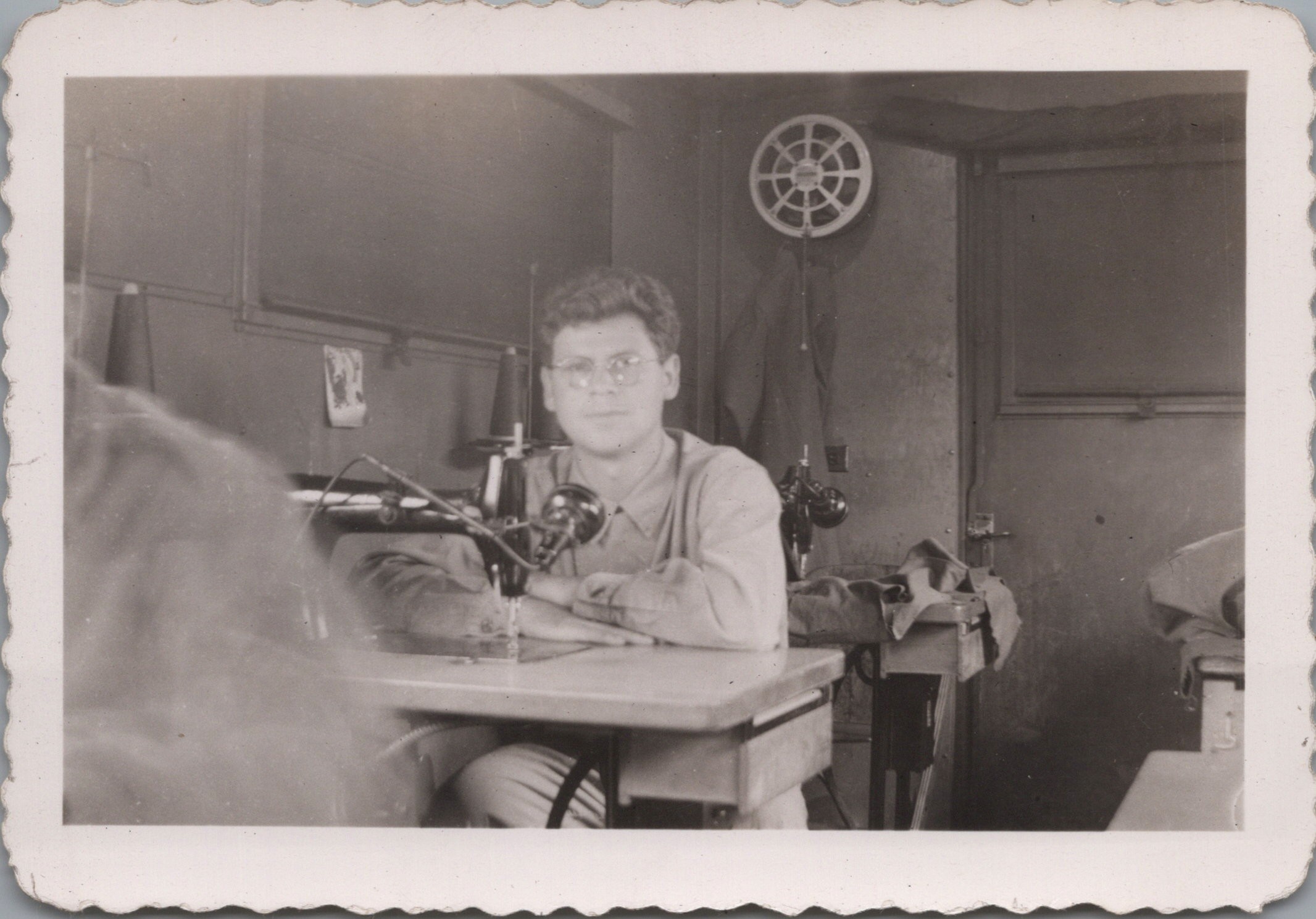
Otto Katz at his sewing machine. Courtesy of the family

Here is a map showing Otto’s path from Normandy to Metz to Eisenach to Zirndorf to Reims to Marseilles and finally to Antwerp.


Meanwhile, Hal also was stationed overseas during the war. He provided Judy with many details about his training and his service during her interview with him in 2019. He was drafted in September 1943 and reported for duty in New York, bringing nothing with him except some underwear and toilet articles. He told Judy that he “wasn’t smart enough to be nervous.” He was not yet nineteen years old at the time.

He was taken by train to Fort Dix in New Jersey and then to Camp Landing in Jacksonville, Florida, for basic training where he learned how to march in formation and how to handle an M1 rifle. He claimed he was terrible at shooting because he couldn’t see the target (Hal wore and wears glasses). He became a low speed radio operator and rifleman. While in Florida he applied for and became a US citizen.

Here is Hal with his rifle:

Hal Katz during World War II. Courtesy of the family

From Florida he was sent to Newport News, Virginia, and after one night there he boarded a Liberty ship with five hundred other GIs. The ship was not built for passengers, and the bunks were stacked four to five high in the cargo hold. They sailed to Naples, Italy—a trip that took 28 days. They were sent to a “Repo Depot,” a replacement depot where the newly arrived soldiers were used to replace those who had been wounded, killed, or captured. He spent two to three weeks there, waiting for assignments and marking time. They lived in tents and slept on cots, ten people to a tent.

Hal became a radio operator in the 88th Division, 351st Regiment, Second Battalion, Company B, in the Fifth Army in Italy. By that time Italy had surrendered to the Allies and had joined them in the war against Germany. The Allies were at the time of Hal’s service trying to drive the Germans out of Italy. His division was assigned to areas in Italy between Naples and Rome, and it was mostly quiet for the sixteen months he was there. In the spring of 1945, his regiment would move forward a couple of miles a day, occasionally having contact with the Germany army, and “sometimes people were shot.”

It was during this time that Hal did something extraordinary for which he received a Bronze Medal, an experience he did not even discuss in his interview with Judy and was reluctant to discuss with me. I will transcribe the citation given when he received medal.
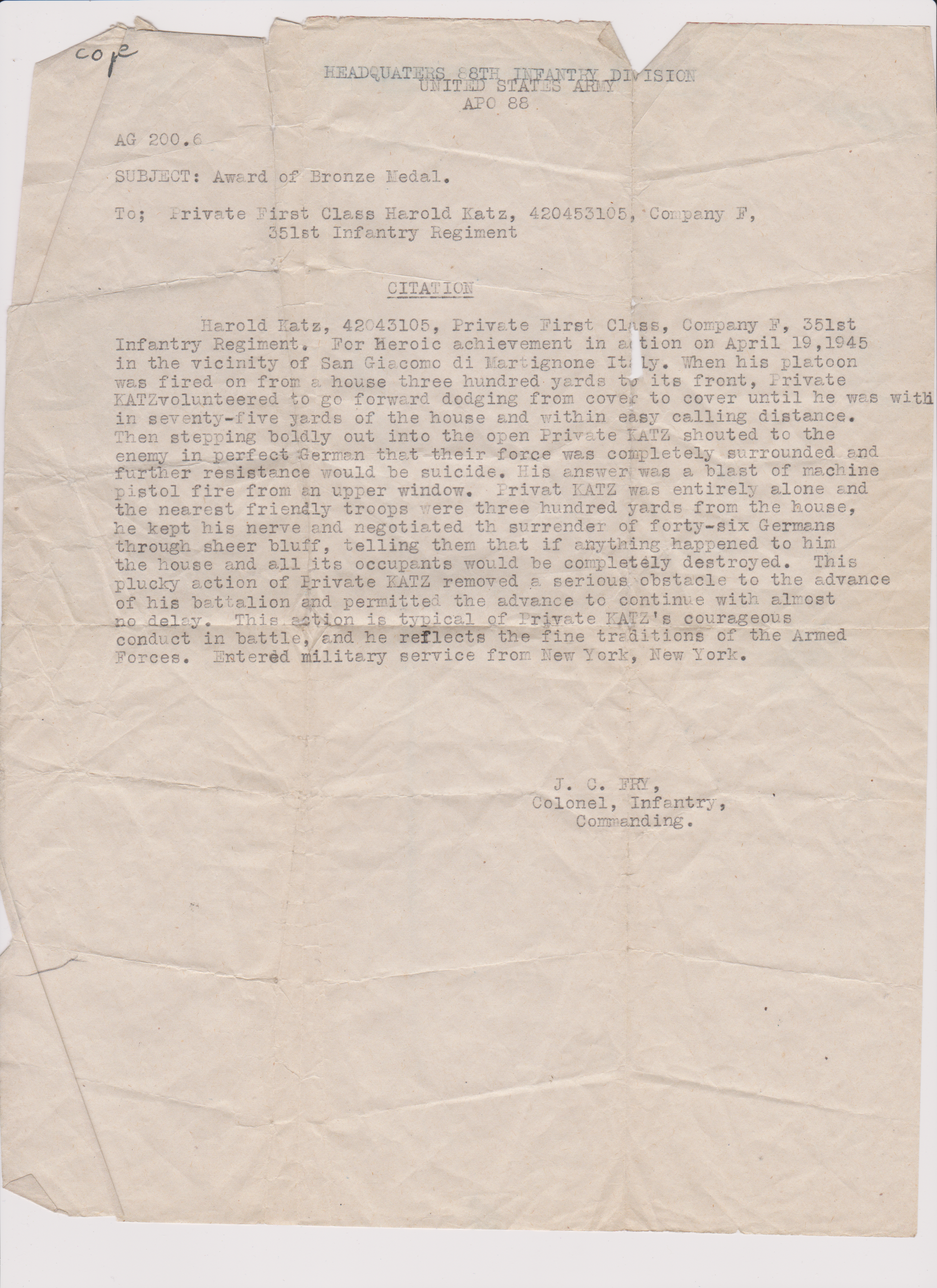
Bronze Star citation for Hal Katz

Headquarters 88th Infantry Division

United States Army

APO 88

SUBJECT: Award of Bronze Medal

To: Private First Class Harold Katz, 42043105, Company F, 351st Infantry Regiment

CITATION

Harold Katz, 42043105, Private First Class, Company F, 351st Infantry Regiment. For heroic achievement in action on April 19, 1945 in the vicinity of San Giacomo di Martignone Italy. When his platoon was fired on from a house three hundred yard to its front, Private KATZ volunteered to go forward dodging from cover to cover until he was within seventy-five yard of the house and within easy calling distance. Then stepping boldly out into the open Private KATZ shouted to the enemy in perfect German that their force was completely surrounded and further resistance would be suicide. His answer was a blast of machine pistol fire from an upper window. Private KATZ was entirely alone and the nearest friendly troops were three hundred yards from the house, he kept his nerve and negotiated the surrender of forty-six Germans through sheer bluff, telling them that if anything happened to him the house and all its occupants would be completely destroyed. This plucky action of Private KATZ removed a serious obstacle to the advance of his battalion and permitted the advance to continue with almost no delay. This action is typical of Private KATZ’s courageous conduct in battle, and he reflects the fine traditions of the Armed Forces. Entered military service from New York, New York.

J.C. FRY, Colonel, Infantry, Commanding

Imagine the scene. A house of Germans shooting at a company of American soldiers. Of the three hundred American GIs there, Hal Katz, all of 5’3 1/2” according to his draft registration, is the one to run up close to the house and yell, in German, that they were surrounded and had to surrender. And the Germans believed him and surrendered to him. I find it hard to imagine how he had the guts to do this.

Hal came home from Europe six months later in early September 1945 and was assigned to Fort Dix and then to Fort Wadsworth on Staten Island. He was able to sleep at home and report to duty at Fort Wadsworth during the day. He was finally discharged from the army on October 31, 1945. He had just turned 21.

As you can probably infer from these summaries of their interviews with Judy, both Otto and Hal spoke very modestly about their service during the war. Both of them played down the dangers they faced and the violence they must have seen. When I asked Hal on Zoom about his medal, he dismissed his heroic act as being just a stupid act by a very young man.

My cousins Otto Katz and Harold “Hal” Katz are two of the many men of the Greatest Generation who helped us defeat the Nazis: two young Jewish men, immigrants from Germany, who fought against Hitler and defended their new homeland here in the United States. We should all be eternally grateful to them.

Otto Katz and Hal Katz. Courtesy of the family


  1. Eisenach was heavily bombed by the Allies during World War II and was taken over by the Americans in April 1945 near the end of the war. It then was taken over by the Soviets and became part of East Germany. See website at https://www.germansights.com/eisenach/#:~:text=Eisenach%20was%20bombed%20heavily%20at,miles%20away%20from%20the%20town). 

Clara Rothschild Katz and Her Family, Part II: Life in America

After Moritz Katz and his fifteen year old son Otto arrived in New York in August, 1937, they shared a furnished room in the Bronx that they rented from some cousins of Moritz. Moritz started working in a meat processing plant, and Otto, who was fifteen, went to school during the day and worked at a grocery store after school. In an interview with his daughter Judy in 2000, Otto told her that he didn’t know any English, and the teacher, who would occasionally speak to him in German, was not a good teacher and didn’t care if the students learned or understood the material.1

Otto quit school after that year and got a full-time job working as a delivery boy at Kenneth Miller Company; he then began doing tracing and sketching designs for the company and was promoted. Otto stayed with that company for his entire career, leaving only during his time in the army during World War II but returning to the company (later called Custom Bed Covers) after he was discharged. He eventually made enough money to buy the company and worked there until 1990 when he retired!

When Clara arrived in New York in late April 1938, with Hal and Ilse (who were thirteen and almost ten, respectively), Moritz rented an apartment for the family in Washington Heights, the neighborhood in Manhattan where many German Jews settled after escaping Nazi Germany. The apartment was quite large, but Ilse shared a room with her parents and Otto and Hal shared another room so that the other rooms could be rented to boarders to generate more income to support the family.

Otto remembered that it was still Passover when his mother and siblings arrived on April 21, 1938 (it was the eighth day, the last day, of the holiday). He also remembered that when the family signed up with Con Edison, the electric company in New York City, they were offered three appliances for twenty-five dollars. They selected a toaster, a radio, a floor lamp, and an iron, and paid off the purchases by paying two dollars a month for a year. Otto seemed particularly excited about the radio since they had not had one in Germany and commented on the “five buttons—one for each station” in his interview with his daughter Judy in 2013.

In that same interview, Otto also recalled that the man who delivered and unloaded the crate that Clara had packed and shipped from Germany broke the legs off her sewing machine when he unloaded it, causing Clara to cry. I wonder whether some of Clara’s sadness was not only about the broken sewing machine, but also about leaving her sisters and her mother Fanny behind in Europe and about her worries about what her life in America would be like.

Hal and Ilse started school in New York and much to Hal’s chagrin, they were placed in first grade because they didn’t know English. Hal was fourteen and humiliated to be in a class with six-year-olds. But soon he was able to move up to a class with his peers.

Here is the family on the 1940 US census, living at 535 West 163rd Street in Washington Heights. Moritz is listed as a butcher in a butcher shop and Otto as a cutter in a factory. They were paying $45 a month in rent, and there were two lodgers living in their apartment.

Moritz Katz and family, 1940 census, Year: 1940; Census Place: New York, New York, New York; Roll: m-t0627-02677; Page: 15A; Enumeration District: 31-2144, Ancestry.com. 1940 United States Federal Census

Moritz worked in the meat packing plant until he was able to buy a small retail shop that sold sweets. He and Clara then worked in their sweet shop, which was called “C & M” for Clara and Moritz.

The United States declared war against Japan, Germany, and Italy in December 1941, joining the Allied powers in World War II. Otto registered for the draft on February 15, 1942. Here is his draft registration:

Otto Katz, World War II draft registration, National Archives at St. Louis; St. Louis, Missouri; Wwii Draft Registration Cards For New York City, 10/16/1940 – 03/31/1947; Record Group: Records of the Selective Service System, 147, Ancestry.com. U.S., World War II Draft Cards Young Men, 1940-1947

Here is Hal’s draft registration dated December 19, 1942; he was eighteen and still using the name Helmut at that time, but had already adopted Harold as his Americanized name. He was a student at the Manhattan High School of Aviation Trades.

Helmut Harold Katz, World War II draft registration, National Archives at St. Louis; St. Louis, Missouri; Wwii Draft Registration Cards For New York City, 10/16/1940 – 03/31/1947; Record Group: Records of the Selective Service System, 147, Ancestry.com. U.S., World War II Draft Cards Young Men, 1940-1947

The two brothers both served overseas in Europe during the war. My next post will describe their time in the service, as told to Judy in three separate interviews, one with Otto in 2001 and another in 2016 and one with Hal in 2019.


  1. The stories and information in this post came from a combination of my Zoom calls with the Katz/Rothschild cousins in May and June 2025 and from interviews Judy Katz did with her father Otto and her uncle Hal over the years. Also, see Part I here

Auguste Rothschild Feldheim: Another Life Destroyed

As I move on now to the next child of Gerson Rothschild and Fanny Kugelmann, I am struck by the differences in the fates of their eight surviving adult children. Siegmund and his wife and all his children left Germany in time to escape death at the hands of the Nazis. Katchen and her husband and son were all killed by the Nazis. Max and his family escaped to Argentina, but their son Erich died shortly after arriving from cholera; that might not have happened if they hadn’t had to leave Germany. Why were some able to escape while others were not? Fate seems so cruel and unpredictable.

Now I turn to the fourth child, Auguste “Gusta” Rothschild Feldheim. And sadly, Auguste’s fate was more like that of her sister Katchen than that of her brothers Siegmund and Max.

As we saw, Auguste married Wolf Feldheim on March 18, 1919, in Zimmersrode. Wolf was a widower. His first wife Johanna Risch died on April 29, 1916,1 less than a week after giving birth on April 23, 1916, to her fourth child with Wolf, their son  Arthur/Aharon.2 Wolf and Johanna also had three daughters born before Arthur/Aharon: Ruth, Selma, and Else, and all were younger than five years old when their mother died.3

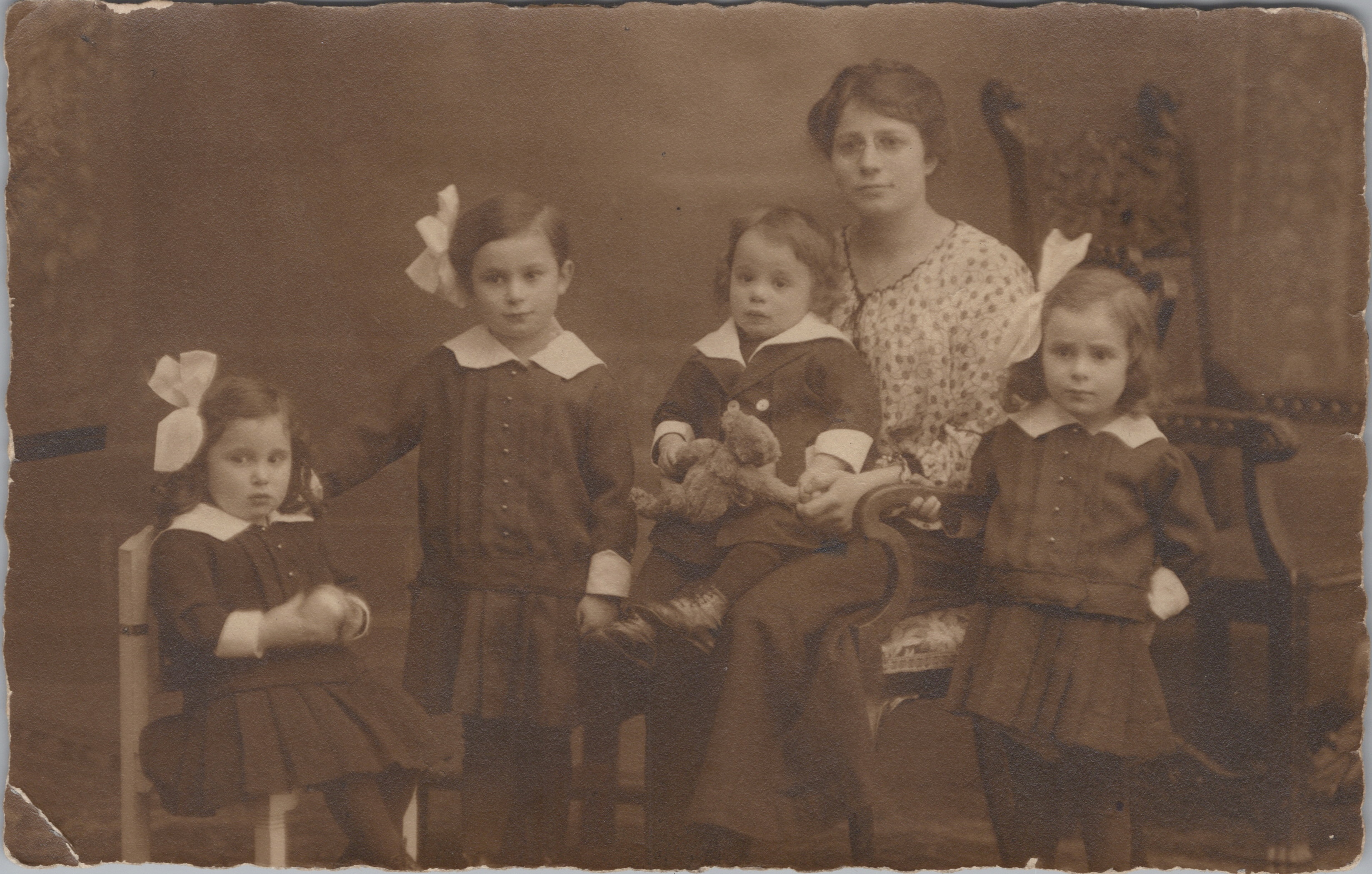
Auguste married Wolf three years after Johanna’s death, and thus Johanna’s four children with Wolf were all still very young when Auguste became their stepmother. Here is a photograph of Auguste with her four stepchildren. Look how sad those children look. It’s heartbreaking.

Auguste Rothschild Feldheim with her four stepchildren. Courtesy of the family

And then Wolf and Auguste had their own child together, a son Bruno who was born in Fulda, Germany, on November 12, 1921.4

Auguste’s husband Wolf Feldheim died of a heart attack on October 4, 1940, in Fulda, Germany, where he and Auguste were living. Wolf was 65 years old. Was his death caused directly or indirectly by the Nazi persecution? I don’t know.5

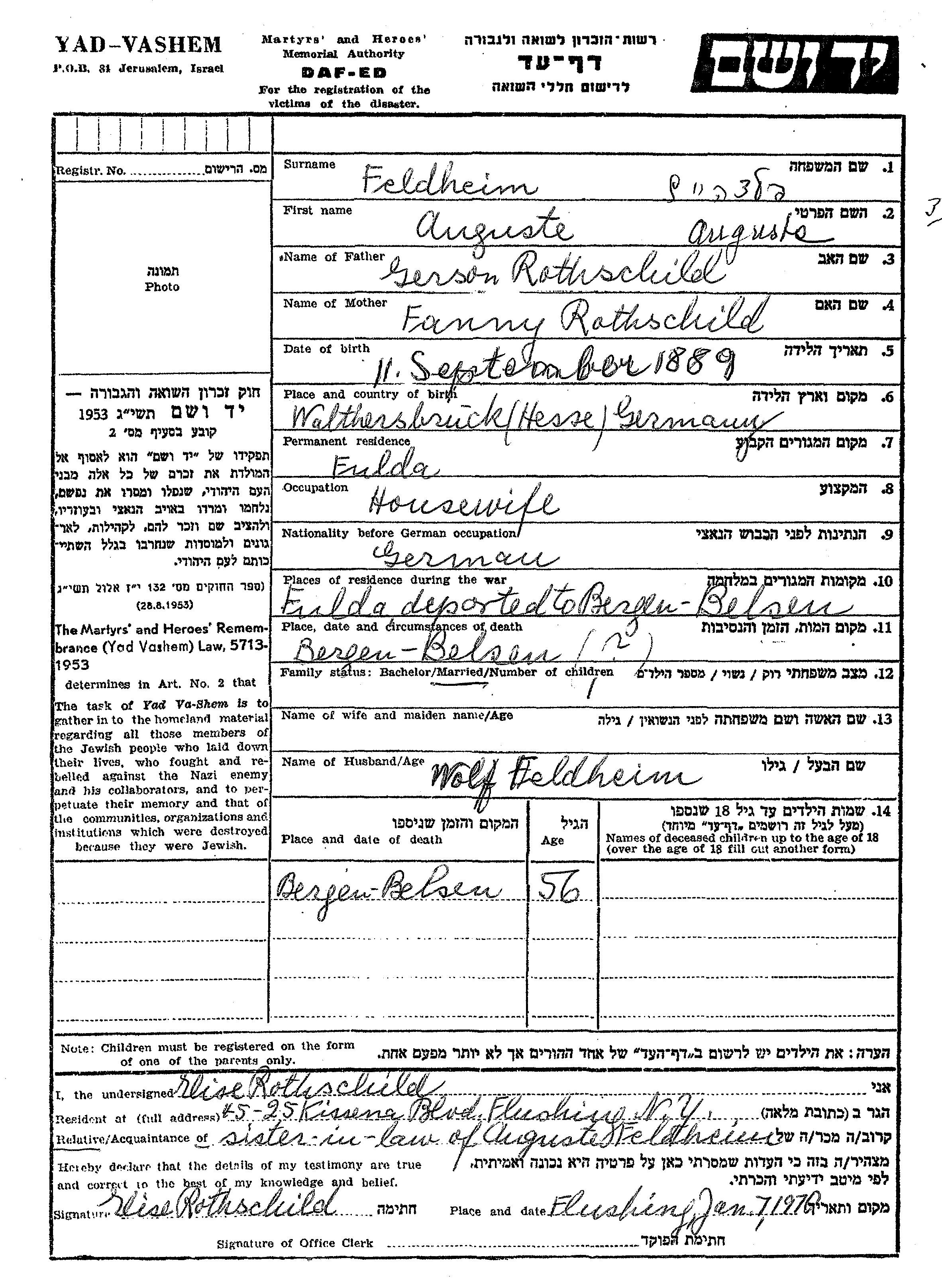
Just over a year later Wolf’s widow Auguste was deported from her home in Fulda to Riga. A Page of Testimony filed at Yad Vashem by her stepson, Aharon Feldheim, reported that he believed she died there on or about December 8, 1941, the day after Pearl Harbor. The Gedenbuch summarized at Yad Vashem says she was deported to Riga on December 9, 1941, and died there in March, 1942.6 And then there is a second Page of Testimony for Auguste filed by her sister-in-law Elise Rothschild, wife of Siegmund Rothschild, saying that Auguste was deported to Bergen-Belsen. I don’t know which date or which place is more accurate. But the bottom line is the same. Auguste Rothschild Feldheim died at the hands of the Nazis.

Page of testimony at Yad Vashem filed by Aharon Feldheim. found at https://collections.yadvashem.org/en/names/13532864

Page of Testimony filed at Yad Vashem by Elise Rothschild, found at https://collections.yadvashem.org/en/names/798469

Bruno Feldheim survived the Holocaust by going to Palestine. His application for citizenship in Palestine in 1946 indicates that he arrived on March 27, 1939, from Fulda.

Bruno Feldheim Palestine immigration papers found at the Israel State Archives at https://search.archives.gov.il/

At some point after the war, Bruno moved to Belgium, where he had a diamond business, according to his cousin Hal Katz. Hal’s tree on Ancestry reports that Bruno died in Belgium on September 16, 2016. He was survived by his children and grandchildren. Here is a photograph of Bruno with his family, courtesy of Judy Katz, his first cousin, once removed.

Bruno Feldheim and family. courtesy of the family

I did not really research in depth the four stepchildren of Auguste, relying primarily on the Ancestry tree created by their stepcousin, Hal Katz. That tree reported that two of those stepchildren, Selma and Aharon, survived the Holocaust and ended up in Israel, but a third, Else, was murdered by the Nazis.

As for the remaining stepchild, Ruth, Wolf and Johanna’s oldest child, I went down a deep rabbit hole to learn what happened to her. It’s a Holocaust story I had not known before and that may not be very widely known.

Ruth was born on October 28, 1912, in Fulda, Germany.7 She married Jonas Tiefenbrunner, who was born in Wiesbaden on June 19, 1914. Sometime after Hitler came to power, Jonas left Germany for Belgium and established a youth home and yeshiva for religious boys in a town near Antwerp. Ruth later also left Germany for Belgium, and she worked as a cook in a different children’s home. According to a recorded interview with their daughter Judith, they had first met in Frankfurter, but reconnected and became a couple in Belgium. Ruth and Jonas were married on May 9, 1940, the day before the Nazis invaded Belgium.8

As told by Jonas and Ruth’s daughter Judith in that interview, after the Nazis invaded, the Queen Mother of Belgium intervened to protect the Jewish children and elderly. She convinced the commandant overseeing the Nazi deportation of Jews back to Germany, purportedly for “work,” that children younger than seventeen and the elderly would not be productive workers and that they should not be sent back to Germany. A number of orphanages and homes for the elderly were established, and Jonas Tiefenbrunner was made the head of one of those orphanages, the one in Brussels and the only one that was observant of Jewish laws and holidays, according to Ruth’s daughter.9

Jonas and Ruth took in up to fifty or sixty children at a time. They faced constant danger of raids by the Nazis, who accused them of hiding children who were over the age of sixteen or children who had not been properly registered with the Nazi regime in Belgium. Jonas was arrested once, but quickly released.10

In 1943, Ruth, Jonas, and their first-born daughter Jeanette had an opportunity to escape from the Nazis and emigrate from Belgium by obtaining what are now known as Mantello certificates. As described on JewishGen:

George Mandel was a Hungarian Jewish businessman who befriended a Salvadoran diplomat, Colonel José Arturo Castellanos, in the years leading up to World War II.  After Castellanos was named El Salvador’s Consul General in Geneva, he appointed Mandel, who had assumed a Spanish-sounding version of his last name, “Mantello,” to serve as the Consulate’s first secretary.  Even in Nazi-occupied Europe, Jews who were citizens of or held official documents from other countries were often able to escape deportation.  With the consent of Castellanos, George Mandel-Mantello used his diplomatic position to issue documents identifying thousands of European Jews as citizens of El Salvador.  He sent notarized copies of these certificates into occupied Europe, in the hope of saving the holders from the Nazis. … Word then spread among representatives of various Jewish organizations, who also approached Mandel-Mantello, each providing data and photographs of the people they wanted to try to save. … In total, Mandel-Mantello may have issued as many as five thousand certificates, many with the names and photographs of several family members.

Jonas and Ruth Tiefenbrunner were among those who received a Mantello certificate, describing them as citizens of El Salvador. They even applied for a Swiss passport relying on the evidence of their Salvadoran citizenship.  They could have left Belgium for a safer country by using those certificates as many others were able to do.

Jonas Tiefenbrunner application for Swiss passport, found at USHMM at https://collections.ushmm.org/search/catalog/pa1169302

But as described by their daughter Judith, they refused. Jonas would not abandon the children he was caring for so the family stayed in Belgium for the duration of the war.11

In August 1944, the Nazis decided to deport all the remaining Jews in Belgium including the children. “Luckily, Jonas received advanced warning and was able to take all the children to a convent run by an acquaintance, Father R.P. Robinet. Two weeks later, Brussels was liberated.”12 In the end, it is estimated that Jonas and Ruth were able to save over one hundred children.

Tragically, Jonas Tiefenbrunner died in Belgium in 1962 from a heart attack when he was only 48 years old. From what I can gather from various sources including Judith’s interview, Ruth and their three daughters all eventually ended up in Israel.13 Unfortunately I have not been able to find further information about Ruth or her daughters.

Although Ruth Feldheim and Jonas Tiefenbrenner were not my genetic relatives, I felt their story was important and wanted to share it with my readers.


  1. Johanna Risch Feldheim death record, Arcinsys Archives of Hessen, HHStAW, 365, 348, p. 11, found at https://digitalisate-he.arcinsys.de/hhstaw/365/348/00011.jpg 
  2. Arthur/Aharon Feldheim immigration papers found in the Israel State Archives at https://search.archives.gov.il/ 
  3. Ruth was born on October 28, 1912, according to this entry at Yad Vashem, https://collections.yadvashem.org/en/names/13474776  Selma was born on April 6, 1913, Selma Feldheim, Enemy Alien Registration card, The National Archives; Kew, London, England; HO 396 WW2 Internees (Aliens) Index Cards 1939-1947; Reference Number: HO 396/172, Piece Number Description: 172: German Internees Released In UK 1939-1942: Fa-Fl, Ancestry.com. UK, World War II Alien Internees, 1939-1945. Else was born on November 5, 1914, Arolsen Archives; Bad Arolsen, Germany; Record Group 1 Incarceration Documents; Reference: 1.1.46.1, Ancestry.com. Germany, Incarceration Documents, 1933-1945 
  4. I still have not found a record linking Bruno to Auguste and Wolf, but Bruno’s first cousin Hal Katz confirmed that Auguste and Wolf did have a son Bruno, and that is certainly a reliable first hand source. Zoom call with Hal Katz on May 8, 2025. 
  5. Wolf Feldheim on a grave registration document found at Arolsen Archives, Digital Archive; Bad Arolsen, Germany; Lists of Persecutees 2.1.1.1, Description
    Reference Code: 02010101 oS, Ancestry.com. Free Access: Europe, Registration of Foreigners and German Persecutees, 1939-1947 
  6. Entry at Yad Vashem for Auguste Rothschild Feldheim, found at https://collections.yadvashem.org/en/names/13532864 
  7. See Note 3, supra. 
  8. The information in this paragraph came from an interview with Ruth and Jonas’ daughter that is available on YouTube at https://www.youtube.com/watch?v=w1q4KCKrMjY Also, see Jonas Tiefenbrunner’s application for a Swiss passport below. 
  9. Ibid. 
  10. Biography of Jonas Tiefenbrunner found at the USHMM website at  https://collections.ushmm.org/search/catalog/pa1144757 
  11. See Note 8, supra. 
  12. See Note 10, supra. 
  13. See Note 8, supra. 

Cousin Meetings: Richard and Max Meet in Merano, Max and I Meet on Cape Cod

One of the greatest gifts I’ve received through my genealogy research is connecting with and getting to know new cousins. Some are as close as second cousins, some as distant as fifth or even sixth cousins. But none of that seems to matter once we have connected.

Sometimes these connections are only through email. Sometimes they are by phone. And sometimes I have been able to connect with cousins and get to see their faces and get to know them through Zoom. There are cousins from all over the US and the world with whom I have emailed, phoned, and/or zoomed—some as far away as Israel, Germany, France, Switzerland, England, and Australia, some as close as right here in Massachusetts.

I’ve been especially blessed when I’ve gotten to meet and spend time with a cousin in person. And that has happened far more times than I’d ever, ever have predicted. I have had meals with cousins in all kinds of places—in western Massachusetts where I once lived and on Cape Cod where I now live, in Florida and in New York City, in Boston and in Philadelphia, and even overseas—in Germany and in London. Each time it has been a truly joyful experience. Even though we had never met before and even though our connection may go back several generations to an ancestor we never knew, there was still something magical about meeting a cousin.

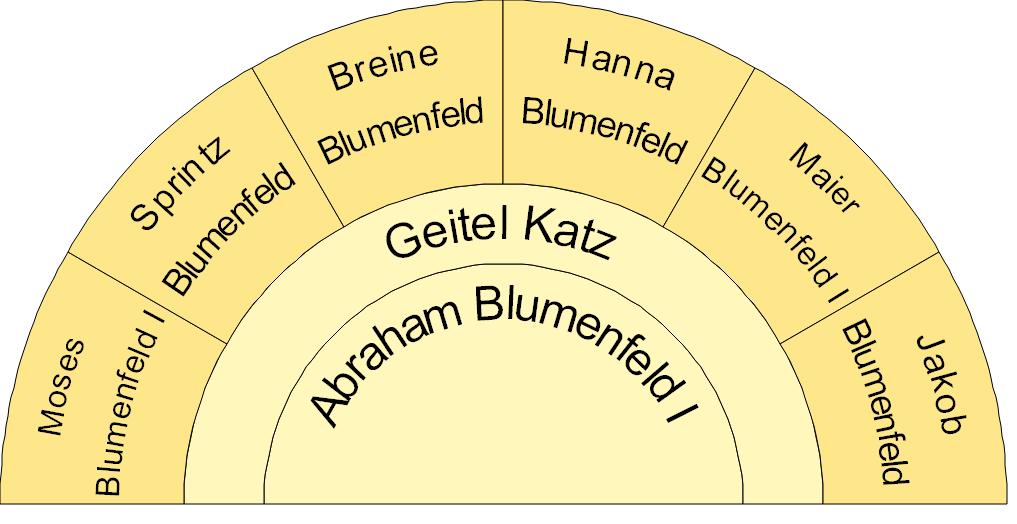
So I was somewhat envious but also thrilled when I learned that two cousins I’d found through my research and then connected to each other—Richard Bloomfield and Max Bermann—were able to meet in Merano, Italy, this past spring. Richard is my fifth cousin through his 3x-great-grandfather Jakob Blumenfeld, a younger brother of my 3x-great-grandmother Breine Blumenfeld; Max is also my fifth cousin, but through his 3x-great-grandfather Moses Blumenfeld, an older brother of Breine Blumenfeld, my 3x-great-grandmother. And Richard and Max are fifth cousins to each other; we are all the 4x-great-grandchildren of Abraham and Geitel (Katz) Blumenfeld.

Although I had zoomed and emailed with Max and Richard many times, I had never met either of them—until last Thursday, that is, when my husband and I had dinner with Max and his wife Glenna here on Cape Cod. Again, it was a magical and joyful experience. The warmth and connection were authentic and immediate, and we found so much to talk about in the three hours we sat at Fin, an amazing restaurant in Dennis. When we looked around at 10 pm, we realized we were the only ones left in the restaurant; the staff were all sitting around the bar politely not disturbing us, but obviously waiting for us to leave. After repeated promises to get together again, we all hugged goodbye, leaving as not just cousins but four new friends.

At dinner Max and Glenna told us about their trip in May, 2024, to Merano and meeting Richard and his wife Irma there. Why, you might ask, did they meet in Merano, Italy, a town not far from the Austrian border when Richard lives in Switzerland and Max in Massachusetts?

Well, that requires some background about Max’s life. I’ve shared Max’s story before on the blog, and I hope you will go back to the earlier blog posts for more details and photographs as well as for my sources for the information below. Also, Richard wrote a comprehensive biography of Max’s family.

But here is a very brief overview of why Max was visiting Merano:

Max’s mother was Edith Blumenfeld, daughter of Max Blumenfeld and Anna Grunwald. She married Joseph Bermann, Max’s father, in 1935.1 Joseph was born in Merano, Italy, where his father Max Bermann was a doctor and the director of the Waldpark Sanitarium. Joseph also became a doctor and worked there as well. After marrying, Edith and Joseph settled in Merano.

My cousin Max, grandson of both Max Blumenfeld and Max Bermann and named for both, was born in Merano a few years after his parents’ marriage. His father Joseph left Merano for the US in 1939 to escape from the Nazi and Fascist persecution and the impending war, intending to send for Edith, Max, and Max’s older sister Margherita once he was settled. But World Was II intervened, and Edith and the children could not get out of Europe.

They soon left Merano for Milan and then for the countryside of Italy where they hid their Jewish identity while Edith worked for the resistance as a courier. Once the war ended, Edith brought the children to the US, and they were reunited with Joseph. The story of how Edith kept herself, her mother, and her children safe during the war is a remarkable one and is described here on my blog and in Richard’s biography of Max’s family.

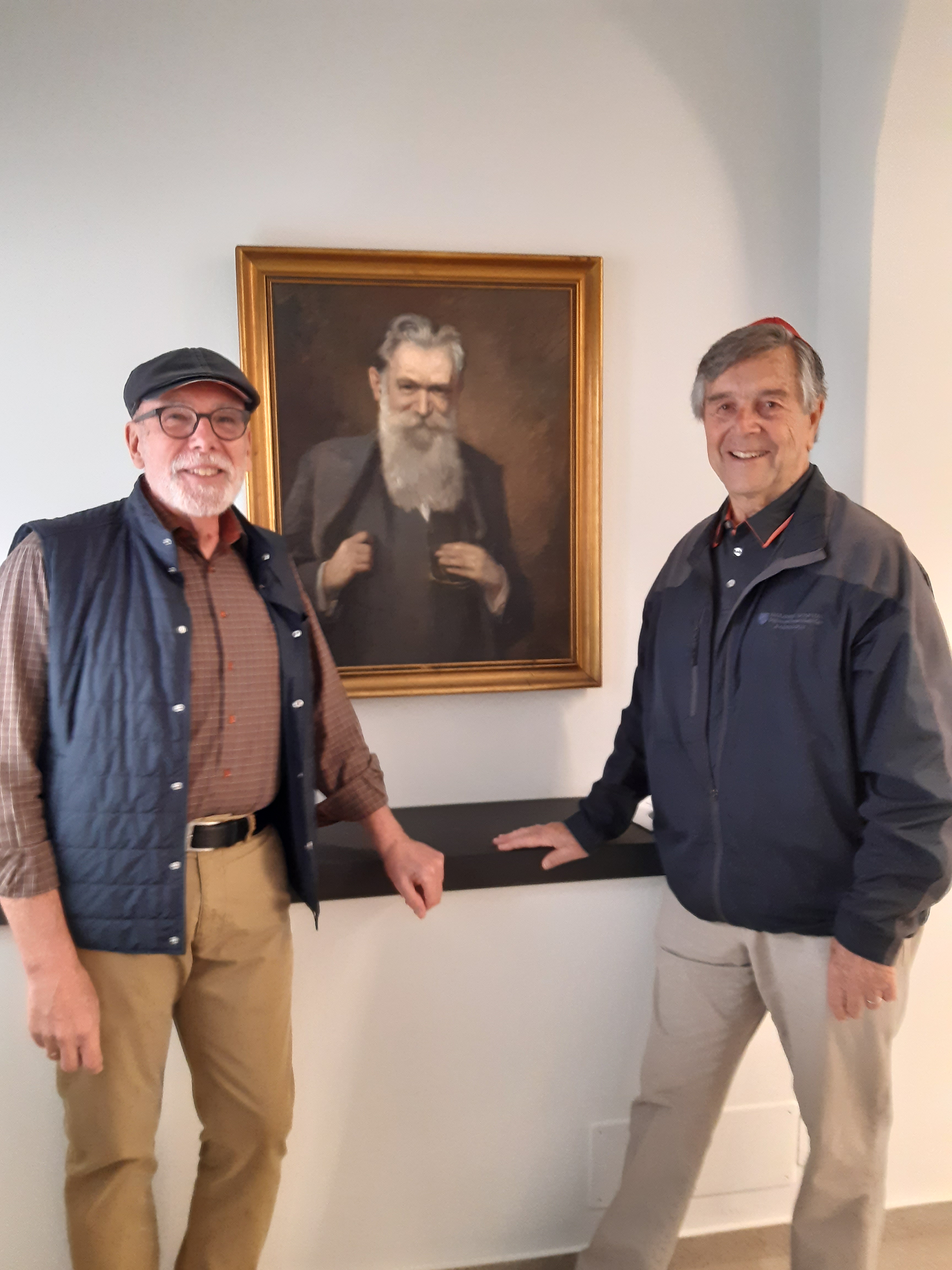
Max had never been back to Merano, his birthplace, after immigrating to the US in 1946, and he and his wife Glenna decided to visit there this year. The visit was motivated in part to see a painting of Max’s paternal grandfather, Max Bermann, a painting that Joseph Bermann had brought with him to the US in 1939 and that had been in Max’s parents’ home in New York City. It had then hung in Max and Glenna’s home for many years. Because he wanted to be sure that the painting was preserved in a safe and appropriate place in perpetuity, Max decided to donate the painting to the Jewish Museum in Merano, his birthplace and his father’s family home for many years. After shipping the painting there last year, Max and Glenna wanted to see it in its new home in Merano.

Meanwhile, Richard, born and raised in the United States, lives near St. Gallen, Switzerland, and thus about five hours from Merano. Richard had helped to connect Max with the Merano Jewish Museum, and when Richard learned that Max and Glenna were coming to Merano, he asked whether he and his wife Irma could meet them there. Max and Glenna were delighted.

Richard has generously shared with me some of the photographs of their meeting and an essay he wrote about the experience. I will quote parts of what he wrote rather than trying to paraphrase it.2 I am also going to include some of his photographs.


Last Sunday we [Richard and Irma, his wife] stood on the balcony of our hotel room in Meran and looked across the Passer River at the Hotel Meraner Hof where Max and Glenna were going to be staying. It had been just two and a half weeks since Max had written me that he and Glenna were going to travel to Meran. Max had donated a painting of his grandfather [Max Bermann] to the Jewish Museum in Meran and wanted to have the experience of seeing it on display. When I asked Max if he would mind if Irma and I came to meet them there, Max wrote that he found that touching. Although we are 5th cousins, i.e. relatives, and had had email and Zoom contact, we didn’t want to intrude on Max’s first trip back to his place of birth since leaving it at age 2.

Our first live encounter took place when we waved to each other from our balcony to their terrasse. Shortly thereafter, we greeted each other with big hugs, sat down for a drink and exchanged the special, personal gifts we had brought for each other. We were joined by Sabine Mayr, researcher and co-worker at the Jewish Museum, and the museum’s director Joachim Innerhofer. Joachim and Sabine welcomed us like VIPs: Max, the long-lost son; I, the person who had connected Max with the museum in Meran and provided them with lots of information from my family research; Glenna and Irma as though they were long lost members of the Jewish community in Meran.

Remembering the adage that the way to the heart is through the stomach, we headed off to a restaurant for dinner. Unfortunately, Joachim had an appointment and couldn’t join us. Maybe we should have had an empty chair at the table for Amy, the person who had done the matchmaking between Max and me (and lots of other cousins!).

Richard, Sabina Mayr, Irma, Glenna, and Max

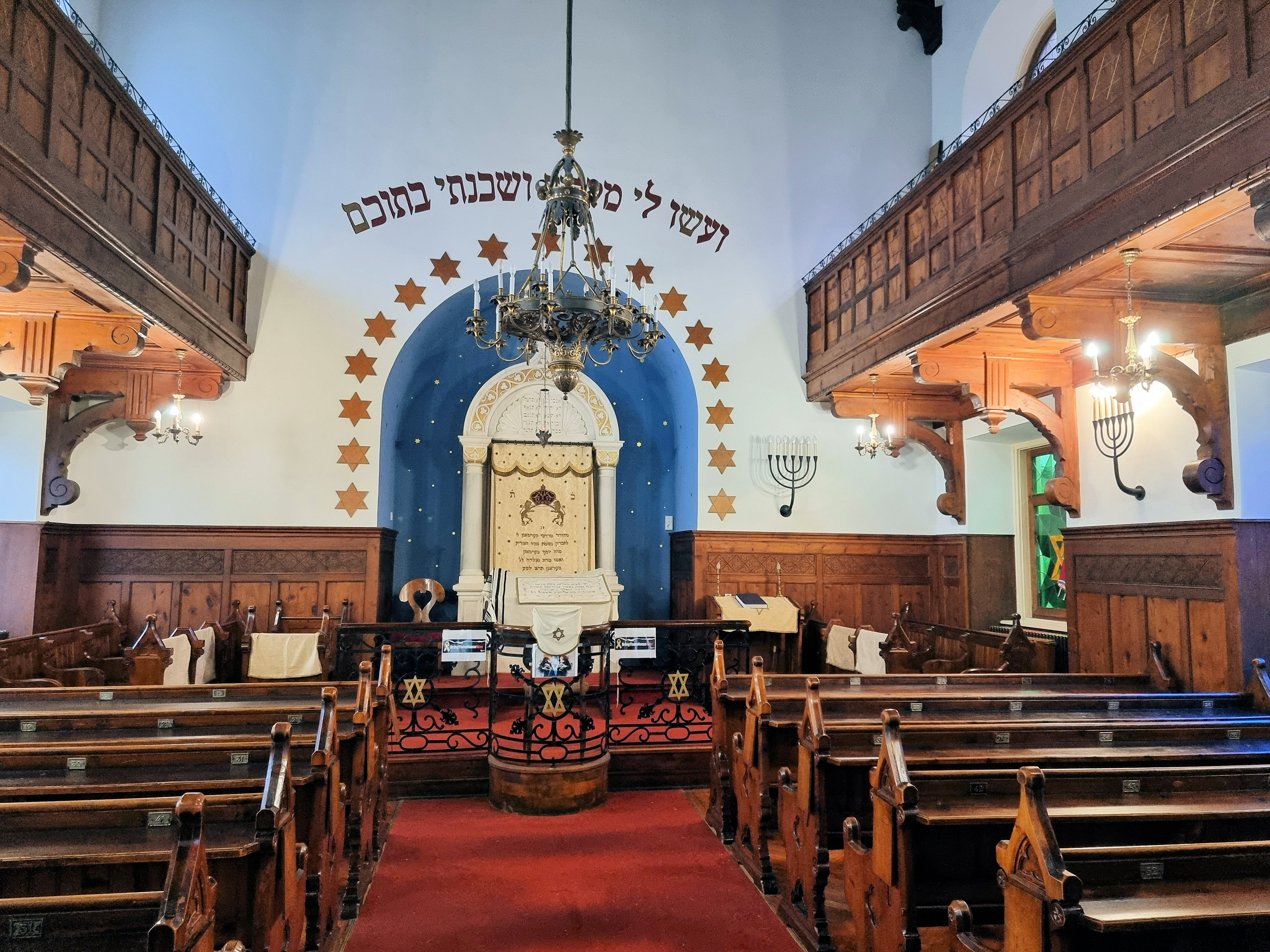
Monday morning we visited the synagogue and museum just behind Max and Glenna’s hotel. The first synagogue in Tirol was dedicated on 27 March 1901 and the interior has survived in its original form. When the Nazis removed the pews to use the room as a horse stall, the people of Meran saved them and returned them after the war. The very attractive Jewish Museum of Meran is located in the same building.

The sanctuary pictured below is warm – comfy – and inviting. Even with just seven rows of pews on the main floor, there is more than enough room for the 50 members of the community. Here is where Max’s family had worshipped. Today services with a rabbi are only held on holidays.

Merano synagogue

Irma, Richard, Max, and Glenna standing in front of the ark in the Merano synagogue

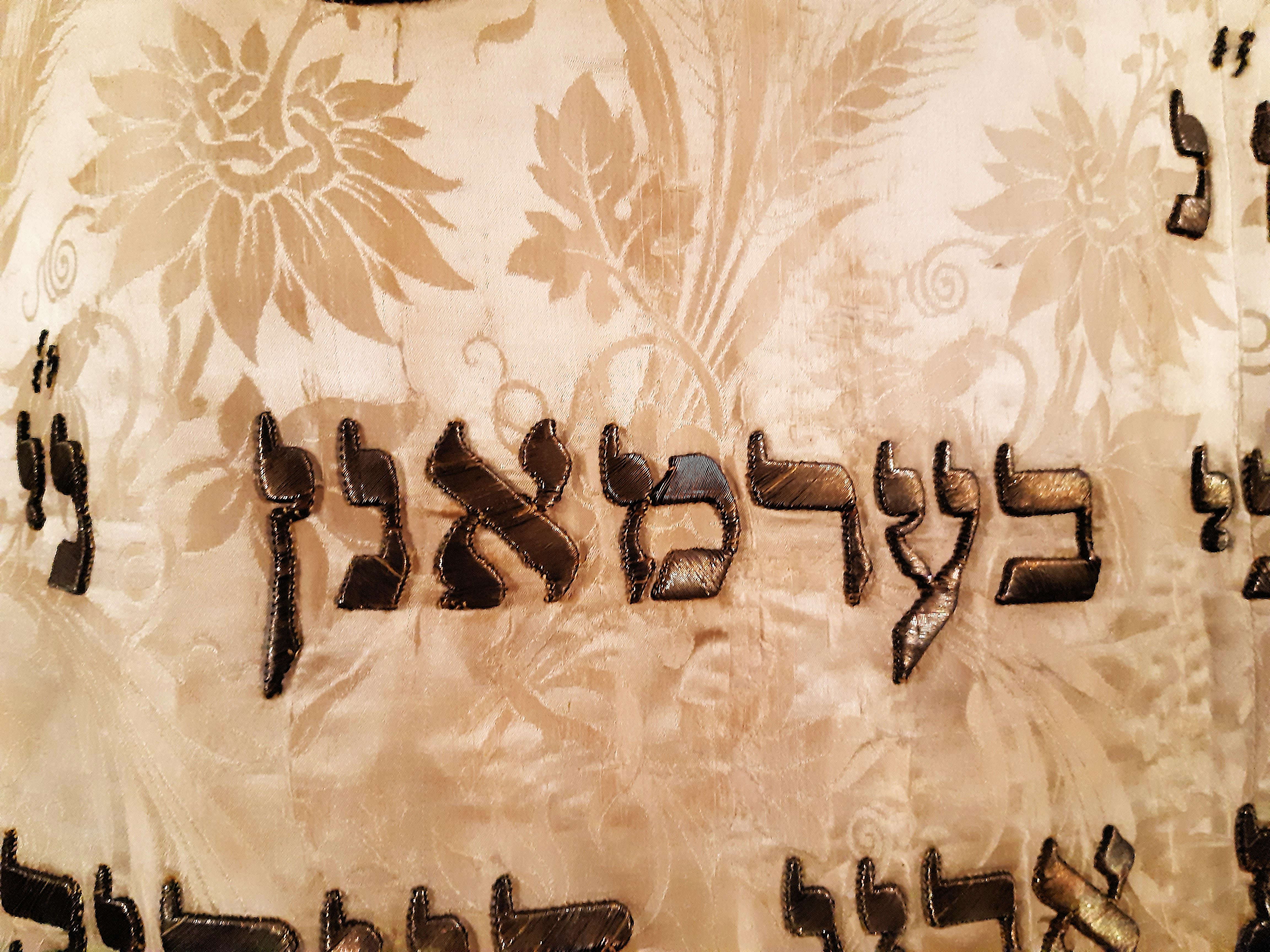
The name Bermann is embroidered into the parochet or curtain that covers the ark

At long last we descended the steps to the museum under the sanctuary. Just around the corner to the right of the entrance Max found his grandfather Max [Bermann]! …

Richard and Max standing in front of the portrait of Max’s paternal grandfather, also named Max Bermann

 This picture of [Max’s relatives’] wedding in 1926 hangs on the other side of the room to the right of [his grandfather] Max’s portrait. When Max saw it, he ex-claimed: “Look, there’s my father!” (1) (1898-1966). Joachim pointed to the right edge of the photo where Max’s grandfather with a long white beard is pictured (2) (1865-1933). “And there’s my grandmother next to him” (3) (1870-1958)….

A rather long and wet walk took us to the Waldpark Sanatorium where Max was born and lived for two years: In 1907, [his grandfather] Doctor Max Bermann acquired the Villa Paulista from John Stoddard and founded the Waldpark Sanatorium, which he ran as a specialist in internal medicine. In the early 1930s, two buildings were added, and in the following years the main building was renovated and enlarged. Claiming that the owners were indebted, the buildings and the large park surrounding them were sold at auction in 1941. (Source: Jewish Meran Walking Tour, Jewish Museum of Meran)

Although Max was only two when he left Meran in 1940, he thinks he remembers a white fence surrounding the Waldpark. Indeed, the fence is still white!

Max’s birthplace in Merano

On Tuesday it did not rain, and the sun eventually came out. A chair lift carried us up to a place above Meran where we had a good view of the city and the surrounding countryside….

….

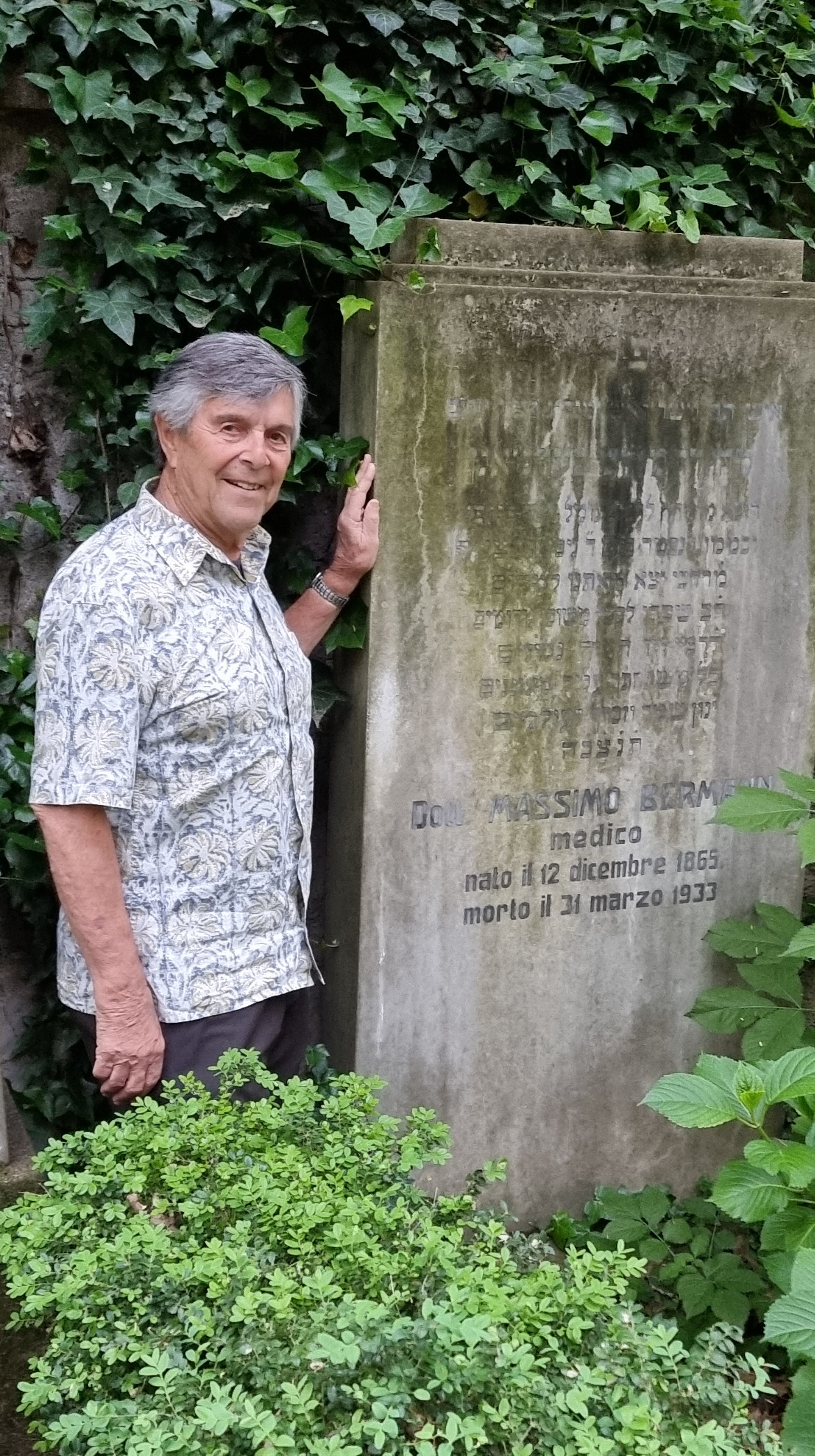
Before dinner we wanted to visit the New (1908!) Jewish Cemetery where members of the Bermann family are buried. After a stop at the memorial for the victims of the Shoah… we went to visit the graves of Max’s grandfathers, Max Bermann and Max Blumenfeld….

Max is standing next to Grandfather Bermann’s headstone, and both of us touched together the gravestone of our common relative Max Blumenfeld (1880-1936). The common roots that Max and I have that we have talked and written about became something living here in the cemetery.”

—————————–

I am so glad that Richard and Max were able to meet and share this moving experience together. It makes me appreciate how fortunate I have been to find so many cousins and to help them find each other.

And now I also have had the special opportunity to spend time with my cousin Max and his wife Glenna and to feel those common roots. His life and mine had such different beginnings—his as a small child hiding from persecution in Italy, mine as a middle class American child growing up in suburban New York after the war, never worrying about antisemitism.

But here we are so many decades later, both living in Massachusetts less than ninety miles apart. In so many ways our lives have taken similar paths despite those very different beginnings, and we have far more in common than those different beginnings would have predicted.

I am so lucky and so grateful for all the gifts that genealogy has brought to my life, especially all my amazing cousins like Richard and Max!


  1. I have seen records that spell his name Joseph, others that spell it Josef. For consistency purposes I have used the American spelling Joseph since he was born Giuseppe and kept that name until he immigrated to the US in 1939. 
  2. Merano was once under Austrian control, but after World War I it became part of Italy. The town uses both the German-Austrian spelling Meran, which Richard uses, and the Italian spelling Merano, which I use. Both are equally acceptable. 

Irma and Hilde: The Power of Love

In my last post, I shared the story of my cousin Erwin Rothschild and his wife Irma Simon. As we saw, Erwin died from typhoid fever at Bergen-Belsen, but Irma survived. Erwin had done everything he could to keep Irma, her sister Hilde, and Hilde’s husband Simon Eisenmann alive, but in the end only Hilde and Irma survived. They were two young widows in their thirties as the war drew to a close in Europe.

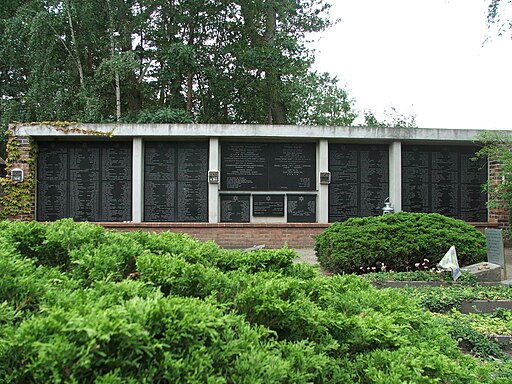
As recounted by Irma in her moving testimony for the Shoah Foundation,1 in the spring of 1945 Irma and Hilde and about 2200 other prisoners at Bergen-Belsen were put on cattle trains by the Nazis with nothing to eat but one turnip each and taken on a long and twisting trip through Germany. When they saw the planes of the Allies flying overhead, they hung white shirts out the window, trying to save themselves from being bombed. As the train neared Frankfurt an der Oder near the Polish border, the Nazi guards abandoned the train, and the Russians came to liberate the people on the train on April 23, 1945. The Russians told the prisoners that they should go to a nearby village called Trobitz, which had been emptied of its residents and would be safe for the survivors.2

They had to walk to the village, but Hilde, who weighed only 70 pounds, was too weak to walk. So Irma and another woman found a wheelbarrow and pushed Hilde to the village. They settled into the village where there was shelter and food. One man died from eating too much food too quickly. Many others—about 600 people—died while living in Trobitz. But Irma and Hilde survived.

Memorial listing the names of those from the Lost Train who died in Trobitz, LutzBruno, Public domain, via Wikimedia Commons

The people living in Trobitz were taken later by the Allies to Leipzig for a week and then they were allowed to go “home.” Irma and Hilde went back to the southern part of the Netherlands, where Hilde, a Dutch citizen by marriage, lived in a cloister and Irma was interned in a school. They could not return to Amsterdam because northern Holland had not yet been liberated. Once the war ended, the sisters moved to Amsterdam and then immigrated to the US in 1947 with the help of their brother Julius, who lived in Philadelphia. They traveled on the Queen Elizabeth and were able to get kosher food on the ship. Irma and Hilde settled in Washington Heights in New York, and Irma continued her career as a kindergarten teacher.

Both Irma and Hilde remarried in the 1950s, Irma to Nathan Haas, and Hilde to Nathan Meyer, both also German Jewish survivors of the Holocaust. Neither had children. They lived in adjoining apartments in Washington Heights. In 1967 the two couples moved to one house together in Englewood, New Jersey. They all became active in the Orthodox Jewish community there. Their second husbands both died in the 1970s, but Irma and Hilde continued to live together for the rest of their lives.

As reported by Joseph Berger in The New York Times on December 29, 2004,3 Irma and Hilde decided when they were 97 and 94, respectively, that they wanted to live the rest of their lives in Israel in a home for senior citizens in Jerusalem called Beit Barth. Berger described their special relationship and recounted their long lives together during and after the Holocaust:

The two sisters were inseparable….[He then described much of what I’ve reported earlier about their lives during the Holocaust.]

They came to the United States together and lived with their second husbands in adjoining apartment buildings in Washington Heights. … As if that were not close enough, they moved in 1967 into a single suburban ranch house in Englewood, N.J., which they continued to share after their husbands died.

Until yesterday. That was when Irma Haas, 97, and Hilde Meyer, 94, set off from Kennedy International Airport for Israel to spend the remainder of their lives in the same residence for the elderly in Jerusalem.

… With canes across their laps, they sat next to each other in wheelchairs as El Al security hurriedly examined their passports and put them through the requisite grilling about who had packed their bags and whether they had received any gifts. Much of the time, Hilde, looking frightened, clutched Irma’s left arm with her right hand.

“She cannot let go of me,” Irma said, mentioning their wartime terror. “She is afraid she would be brought somewhere and I would not come.”

…Both sisters are slight of build and wear gray shaytls, or wigs. Irma is hardier, Hilde more easily rattled. They were born in Londorf, a town in Hessen, a German state where their family’s roots stretch back hundreds of years. …Irma promised her mother that she would always take care of the more delicate Hilde….

Judy Marcus, their second cousin, who accompanied them on the flight, said the two sisters seemed to have eluded the arrows of sibling rivalry. “They were never jealous of each other,” she said. “They were always happy whatever the other one had.”

About two years ago, Hilde was briefly hospitalized and pleaded that Irma remain at her side. Mrs. Marcus said she told a hospital official: “They are Holocaust survivors. They can’t be separated.”

“They made a special dispensation to allow Irma to sleep in Hilde’s room,” Mrs. Marcus recalled. “But Irma would not have left anyway, even if it meant sitting up in a chair all night.”

Only death separated these two amazing sisters. Hilde died first on May 8, 2005;4 she was 94 and had been in Israel for only five months. Irma Simon Rothschild Haas, who had done so much to care for her younger sister and whose strength got them through the camps, liberation, and immigration to the US, died on April 17, 2009, just six months before she would have turned 102.5 She had outlived her parents, all her siblings, and two husbands. Neither Irma nor Hilde had had children, so there are no direct descendants to remember these two remarkable women. But I will forever, and I hope that you will also.

I wish I had some photos of Irma and Hilde I could share. All I found is this one small photo from the New York Times in 2004 when they moved to Israel. But If you haven’t already, please watch Irma’s Shoah Foundation testimony—if for no other reason than to see Irma with Hilde together near the end of that testimony. I guarantee it will both bring you to tears and lift you up with joy. The power of their love was immeasurable.


  1. Haas, Irma. Interview 32295. Interview by Miriam Horowitz. Visual History Archive, USC Shoah Foundation, 04 August 1997. https://vha.usc.edu/testimony/32295. Accessed 18 Jan 2024. Almost all of the information in this post came from Irma’s testimony, except where noted. 
  2. You can read more about the “lost train” from Bergen-Belsen to Trobitz here, here, and here. 
  3. Joseph Berger, “A Bond the Holocaust and Time Couldn’t Break,” The New York Times, December 29, 2004, page B1. See also “Holocaust Survivors from Englewood Begin Their New Lives in Jerusalem,” The Hackensack Record, December 31, 2004, p. A5. 
  4. Hilde Meyer, Gender Female, Birth Date 30 Sep 1910, Death Date 8 May 2005,
    Claim Date 13 Jul 1972, SSN 081242610, Ancestry.com. U.S., Social Security Applications and Claims Index, 1936-2007 
  5. Find a Grave, database and images (https://www.findagrave.com/memorial/254917717/irma-haas: accessed 18 January 2024), memorial page for Irma Simon Haas (9 Oct 1907–17 Apr 2009), Find a Grave Memorial ID 254917717, citing Har HaMenuchot Cemetery, Jerusalem, Jerusalem District, Israel; Maintained by DTWer (contributor 47953179). 

Genealogy Fun: How My Friend and I Discovered We Have Mutual Cousins

One of the first people I ever met who did genealogy research is my friend Amanda Katz Jermyn. I met Amanda through mutual friends over thirty years ago, and we have been members of the same small havurah group for many years now. When Amanda long ago described her genealogy research and the connections and stories she had found, I was amazed. She helped to inspire me to start my own journey.

Amanda and I both have paternal ancestry from Germany, and over the years we’ve wondered whether we would ever find an overlap in our German Jewish ancestry. Well, I finally found one, although it is very attenuated and only by marriage. Nevertheless it was fun to find this connection.1 Here’s the story of my third cousin, twice removed, Moritz Rosenberg, and his wife Berta Blum, Amanda’s third cousin, once removed.

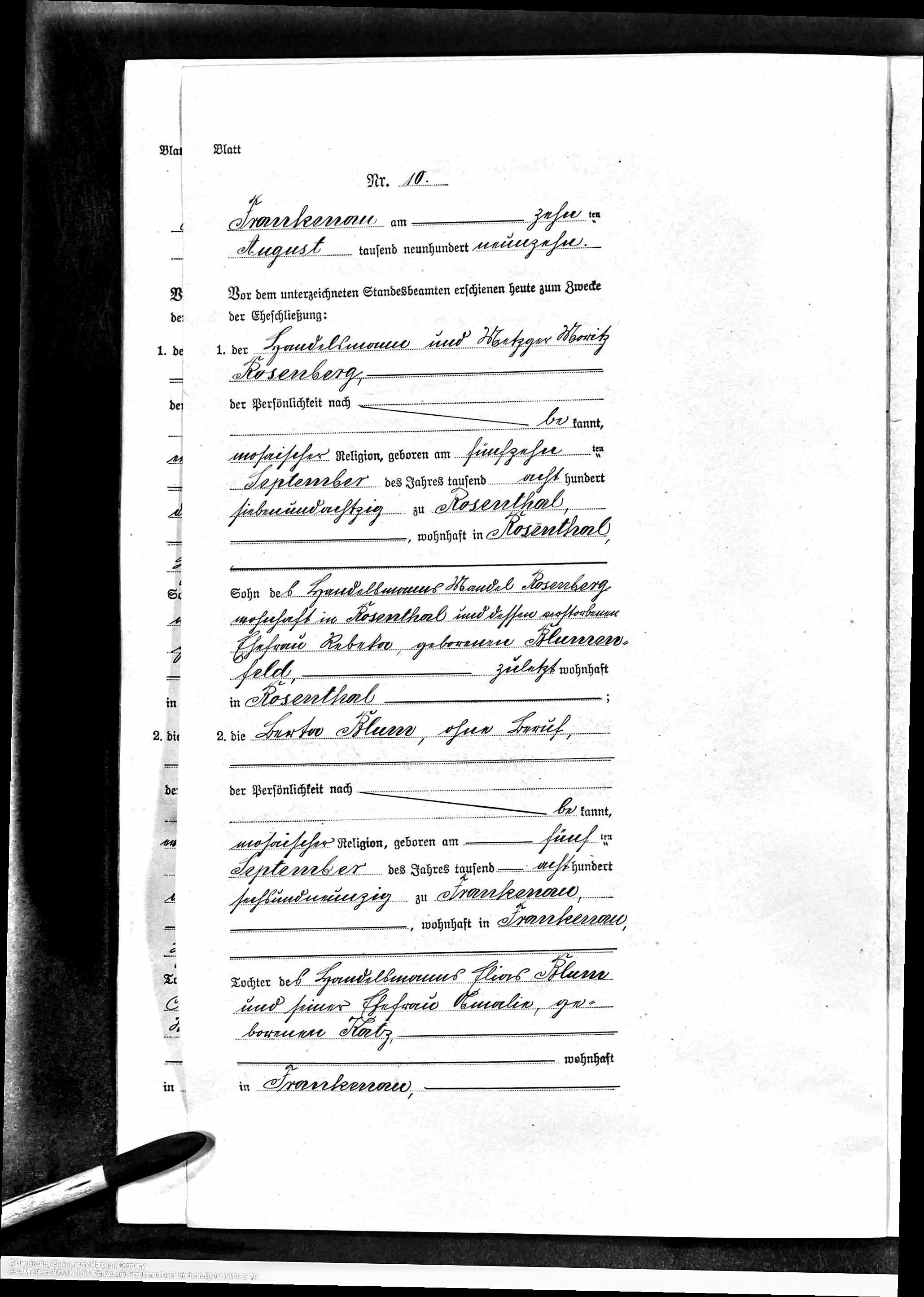
As we saw in my earlier post, Moritz, the third child of Rebecca Blumenfeld and Mendel Rosenberg, was born on September 15, 1887, in Rosenthal, Germany, and married Berta Blum on August 10, 1919, in Frankenau, Germany. Berta was born on September 5, 1896, in Frankenau to Elias Blum and Amalie Katz.

Marriage of Moritz Rosenberg and Berta Blum, Hessisches Hauptstaatsarchiv; Wiesbaden, Deutschland; Signatur: 3254, Year Range: 1919, Ancestry.com. Hesse, Germany, Marriages, 1849-1930

Moritz and Berta had two children, Jacob (later Theodore), born on January 17, 1921,2 and Rebecca (later Ruth), born on January 4, 1925, both in Rosenthal, Germany.3

Moritz and his family were among the very fortunate ones who all were able to escape safely from Nazi Germany. Moritz, Berta, and their 13-year-old daughter Rebecca arrived in New York on September 15, 1938. Moritz listed his occupation as a butcher. Berta’s cousin Herman Blum was listed as the person they knew in the US.4

It took me longer to find out when Jacob arrived in the US because I was searching for him as Jacob, as that is how he was listed on Moritz’s naturalization petition. But the 1940 census has him identified as Theodore (and Rebecca as Ruth),5 and that gave me the necessary clue to find Jacob a/k/a Theodore’s naturalization petition. He arrived in the US as a 16-year-old on May 15, 1937. And on his 1942 petition he used his newly adopted name, Theodore.

Moritz Rosenberg, Declaration of Intention, (Roll 548) Declarations of Intention For Citizenship, 1842-1959 (No 426401-427400), Ancestry.com. New York, U.S., State and Federal Naturalization Records, 1794-1943

Theodore Jack Rosenberg a/k/a Jakob Teo Rosenberg, Declaration of Intention, The National Archives at Philadelphia; Philadelphia, PA; NAI Title: Declarations of Intention For Citizenship, 1/19/1842 – 10/29/1959; NAI Number: 4713410; Record Group Title: Records of District Courts of the United States, 1685-2009; Record Group Number: 21, Description: (Roll 561) Declarations of Intention For Citizenship, 1842-1959 (No 438701-439600), Ancestry.com. New York, U.S., State and Federal Naturalization Records, 1794-1943

The date of his arrival helped me locate Theodore’s ship manifest, where he identified his father as the person he was leaving behind, and his uncle, Herman Blum, as the person he was going to in the US. He is identified as Teo Rosenberg. (See the last line on the image below.)

Teo Rosenberg, ship manifest, The National Archives and Records Administration; Washington, D.C.; Passenger and Crew Lists of Vessels Arriving at and Departing from Ogdensburg, New York, 5/27/1948 – 11/28/1972; Microfilm Serial or NAID: T715, 1897-1957, Ship or Roll Number: Manhattan, Ancestry.com. New York, U.S., Arriving Passenger and Crew Lists (including Castle Garden and Ellis Island), 1820-1957

In 1940, Moritz, Berta, and both of their children were living in New York City. Moritz and Berta were both working as salespeople for a wholesale dress business, and Theodore was a handyman for a venetian blinds company. They also had four lodgers living with them.

Moritz Rosenberg and family, 1940 US Census, Year: 1940; Census Place: New York, New York, New York; Roll: m-t0627-02670; Page: 1A; Enumeration District: 31-1885, Ancestry.com. 1940 United States Federal Census

But while I was searching for information about Theodore/Jacob, I found Moritz and Berta and their children on an Ancestry family tree called the 2020 Jermyn Tree, owned by someone with a memorable name, James Bond. I might have thought that that name was a pseudonym, but fortunately I knew that my friend Amanda had a distant cousin with that name. So seeing the title with her surname and the name of the owner, I assumed there had to be some connection between my relative Moritz Rosenberg and his family and my friend Amanda.

Although Amanda’s name wasn’t revealed on the tree since she is still living, I knew her parents’ names, and they were on the tree. The connection appeared to be through Moritz Rosenberg’s wife Berta Blum, whose mother was Amalie Katz, but I couldn’t quite sort out how Robert Katz, Amanda’s father, was related to Amalie Katz.

I contacted Amanda, and she confirmed the connection and said that Berta Blum was in fact her relative—her third cousin, once removed, through Berta’s mother Amalie Katz and Amanda’s father Robert Katz. Even better, Amanda had been in touch with Moritz and Berta’s daughter Ruth (born Rebecca) and was able to provide me with more information about Ruth and her brother Theodore and their children.

For example, Amanda shared that Ruth had told her that her brother Theodore had enlisted in the US Army in the intelligence division and that the army had him change his surname from Rosenberg to Rogers since he was being sent to Germany. This helped me locate Theodore’s draft registration, which I had had trouble locating when searching for Theodore Rosenberg.

Theodore registered for the draft on February 15, 1942, and was still working for the venetian blinds company at that time. As you can see, he crossed out Rosenberg on his draft registration and inserted Rogers as his surname.

Theodore Rosenberg/Rogers, World War II draft registration, National Archives at St. Louis; St. Louis, Missouri; Wwii Draft Registration Cards For New York City, 10/16/1940 – 03/31/1947; Record Group: Records of the Selective Service System, 147, Ancestry.com. U.S., World War II Draft Cards Young Men, 1940-1947

Ruth Rosenberg married Henry Hammer (born Hammerschlag) after the war; their New York City marriage license is dated June 12, 1945.6 Henry was born on March 29, 1919, in Giessen, Germany.7 In 1950, Ruth and Henry were living in New York City, and Henry was working as a salesman for wholesale dry goods company. Ruth and Henry would have two children.8

Meanwhile, in 1950, Moritz, Berta, and Theodore were living together (along with Berta’s mother Amalie Blum) in New York City. Moritz and Berta now were in the wholesale liquor business together, and Theodore was continuing to sell venetian blinds.

National Archives at Washington, DC; Washington, D.C.; Seventeenth Census of the United States, 1950; Year: 1950; Census Place: New York, New York, New York; Roll: 4547; Page: 3; Enumeration District: 31-1731, Ancestry.com. 1950 United States Federal Census

Theodore didn’t marry until 1960 when he was 39 years old.9 His wife was Sylvia Kapp (originally Kappenmacher), born on February 20, 1938, in Port Elizabeth, South Africa, to Willi Kappenmacher and Erna Wolf. Sylvia and her parents had immigrated to the US on June 8, 1946,10 and were living in New York City in 1950. Theodore and Sylvia had two children born in the 1960s.

Sadly, those children lost their father when they were very young as Theodore died on November 13, 1971, at the age of fifty.11 He was survived not only by his wife and children, but also by both of his parents and his sister Ruth and her family.

Fortunately, Theodore’s father and especially his mother and sister were graced with very long lives. Moritz Rosenberg died on September 22, 1976, five years after his son. He had turned 89 years old just a week before.12

Berta Blum Rosenberg achieved a remarkable distinction—living to 112 years and becoming the oldest living Jewish person in the world at that time, as reported in her obituary in the January 30, 2009, Hackensack (NJ) Record:

Berta Blum Rosenberg obit

The Record Hackensack, New Jersey • Fri, Jan 30, 2009 Page L6

Berta died on January 28, 2009, in New York.13 She was survived by her daughter Ruth and her grandchildren and great-grandchildren.

Her daughter Ruth also lived a long life. She died on March 8, 2021, at the age in 96; her husband Henry Hammer had predeceased her by many years, having passed away on May 17, 1986, at the age of 67.14 Ruth was survived by her children and grandchildren as well as the children and grandchildren of her brother Theodore.

Those children and grandchildren of Ruth and Theodore create a link between my friend Amanda and myself. They are our mutual cousins—the descendants of my cousin, Moritz Rosenberg, and Amanda’s cousin, Berta Blum.

Isn’t genealogy fun?


  1. Amanda also shares some DNA with my husband, but given the different ancestral homes of each of them and the very small amount of DNA shared, it is likely just endogamy. 
  2. Theodore Jack Rosenberg a/k/a Jakob Teo Rosenberg, Declaration of Intention, The National Archives at Philadelphia; Philadelphia, PA; NAI Title: Declarations of Intention For Citizenship, 1/19/1842 – 10/29/1959; NAI Number: 4713410; Record Group Title: Records of District Courts of the United States, 1685-2009; Record Group Number: 21, Description: (Roll 561) Declarations of Intention For Citizenship, 1842-1959 (No 438701-439600), Ancestry.com. New York, U.S., State and Federal Naturalization Records, 1794-1943 
  3. Moritz Rosenberg, Declaration of Intention, (Roll 548) Declarations of Intention For Citizenship, 1842-1959 (No 426401-427400), Ancestry.com. New York, U.S., State and Federal Naturalization Records, 1794-1943 
  4. Ibid. 
  5. Moritz Rosenberg and family, 1940 US Census, Year: 1940; Census Place: New York, New York, New York; Roll: m-t0627-02670; Page: 1A; Enumeration District: 31-1885, Ancestry.com. 1940 United States Federal Census. See image below. 
  6. Ruth R Rosenberg, Gender Female, Marriage License Date 12 Jun 1945
    Marriage License Place Manhattan, New York City, New York, USA, Spouse Henry M Hammer. License Number 14437, New York City Municipal Archives; New York, New York; Borough: Manhattan; Volume Number: 21, Ancestry.com. New York, New York, U.S., Marriage License Indexes, 1907-2018 
  7. Henry Hammerschlag World War II draft registration, National Archives at St. Louis; St. Louis, Missouri; Wwii Draft Registration Cards For New York City, 10/16/1940 – 03/31/1947; Record Group: Records of the Selective Service System, 147, Ancestry.com. U.S., World War II Draft Cards Young Men, 1940-1947 
  8. Henry Hammer and family, 1950 US census, National Archives at Washington, DC; Washington, D.C.; Seventeenth Census of the United States, 1950; Year: 1950; Census Place: New York, New York, New York; Roll: 4377; Page: 19; Enumeration District: 31-2183, Ancestry.com. 1950 United States Federal Census 
  9. Theodore Rogers, Gender Male, Marriage License Date 1960, Marriage License Place Manhattan, New York City, New York, USA, Spouse Sylvia Kapp, License Number 11021, New York City Municipal Archives; New York, New York; Borough: Manhattan, Ancestry.com. New York, New York, U.S., Marriage License Indexes, 1907-2018 
  10. Kappenmacher, ship manifest, The National Archives and Records Administration; Washington, D.C.; Passenger and Crew Lists of Vessels Arriving at and Departing from Ogdensburg, New York, 5/27/1948 – 11/28/1972; Microfilm Serial or NAID: T715, 1897-1957, Ship or Roll Number: Marine Tiger, Ancestry.com. New York, U.S., Arriving Passenger and Crew Lists (including Castle Garden and Ellis Island), 1820-1957.  Erna Kapp, SSACI, Ancestry.com. U.S., Social Security Applications and Claims Index, 1936-2007. 
  11. Theodore Rogers, Birth Date 17 Jan 1921, Death Date 13 Nov 1971, SSN 116105571, Enlistment Branch ARMY, Enlistment Date 3 Mar 1943, Discharge Date 23 Dec 1945, Ancestry.com. U.S., Department of Veterans Affairs BIRLS Death File, 1850-2010 
  12. Moritz Rosenberg, SSDI, Social Security Administration; Washington D.C., USA; Social Security Death Index, Master File, Ancestry.com. U.S., Social Security Death Index, 1935-2014. Headstone at Find a Grave, database and images (https://www.findagrave.com/memorial/36414768/moritz-rosenberg: accessed 07 August 2023), memorial page for Moritz Rosenberg (15 Sep 1887–Sep 1976), Find a Grave Memorial ID 36414768, citing Cedar Park Cemetery, Paramus, Bergen County, New Jersey, USA; Maintained by dalya d (contributor 46972551). 
  13. Berta Rosenberg, SSDI, Social Security Administration; Washington D.C., USA; Social Security Death Index, Master File, Ancestry.com. U.S., Social Security Death Index, 1935-2014 
  14. Henry Hammer, Age 67, Birth Date 29 Mar 1919, Death Date 17 May 1986
    Death Place North Bergen, Hudson, New Jersey, USA, New Jersey State Archives; Trenton, New Jersey; New Jersey, Death Indexes, 1904-2000, Ancestry.com. New Jersey, U.S., Death Index, 1848-1878, 1901-2017 

Hilde Blumenfeld Meinrath, Part II: Leaving Germany and Life in Brazil

As we saw in my prior post, I had learned more about Hilde Blumenfeld Meinrath, thanks to connections made through her granddaughter Gabriela. I learned that after spending four years in New York working as a German-English translator, Hilde decided to return to Germany in 1932 for what was initially supposed to be an extended visit with her family. But then she met and married her husband Ludwig Meinrath and decided to stay longer. She found employment as a translator and secretary for the American author, William March.

But everything began to change after Hitler came to power.

As Hilde reported in her Shoah Foundation interview,  her employer William March was attacked by Nazi youths because he was mistakenly identified as Jewish and ended up in the hospital. He decided to leave Germany and urged Hilde to leave before it was too late; he invited her to come and work for him in New York. .1

Meanwhile, a month after Hitler came to power in April 1933, Hilde’s husband Ludwig, who had  been working as a representative for German companies making ribbons and wool products, lost his job as a sales agent because he was Jewish.. So Hilde and Ludwig agreed it was time to leave Germany.2

But Hilde and Ludwig disagreed about where to go, according to their son Roberto. Hilde wanted to return to New York, but Ludwig feared that he would be unable to make a living there with only a high school education. He had a cousin Helmut in Rio de Janeiro who persuaded him that life was wonderful there, so they went to Brazil in 1934, even though neither of them knew any Portuguese.3

HIlde and Ludwig Meinrath ship manifest, Month: Band 424 (Mär 1934)
Staatsarchiv Hamburg. Hamburg Passenger Lists, 1850-1934

Hilde continued to be a true go-getter. Roberto wrote:

Upon arrival in Rio by ship, and literally one block from the harbor, was Rio’s largest high rise of the day (some 20 stories).  On top of the building was a large advertising poster for US Steel.  My mom walked right into the building to find out whether US Steel would be interested in a German/English secretary, not knowing that at that time Brazilian secretaries were mostly male.  Of course, at that time, Rio was Brazil’s capital and … home to the president of US Steel, who immediately hired her at a salary that was higher than what cousin Helmut was then earning, after a year in Rio.  Anyway, due to my mom’s high salary, my father was able to dedicate his time to learn Portuguese and to become a wholesale textile salesman for several companies.

Hilde and Ludwig’s first child (Gabriela’s father) Pedro John Meinrath was born in 1936; according to Roberto, his mother insisted that Pedro have an American/English middle name, presumably because of her fond memories of living in the United States.

Meanwhile, back in Germany, conditions worsened for Hilde’s parents and her sister Gretel and her family. After Kristallnacht in November, 1938, Salomon Blumenfeld and his son-in-law David Katz were arrested and sent to Buchenwald.4 After they were released, Hilde used her connections and borrowed money to bring her parents to Brazil. Hilde stated in her Shoah Foundation interview that when her parents arrived in Brazil, her father looked emaciated  from his time in Buchenwald, despite the fact that his son-in-law had given Salomon half of his own rations so that Salomon would survive.  5

Hilde’s parents lived with her and her family in Rio for a short time, but according to Hilde, the climate there didn’t agree with them, so she and Ludwig purchased a small house in Petropolis, a city in the mountains north of Rio for her parents, and they moved out of their apartment in Rio and moved to a rented room. When the war in Europe started, Ludwig’s import business suffered, so Hilde had to work full-time to help support the family. Pedro, who was just a four year old at the time, stayed with his grandparents in Petropolis, and Hilde and Ludwig would come on the weekends to be with them all. 6

Here are two photographs that Gabriela shared with me of Pedro with his maternal grandparents Salomon and Malchen Blumenfeld:

Malchen Levi, Pedro Meinrath, and Salomon Blumenfeld c. 1939 Courtesy of the family

Pedro Meinrath with his parents and maternal grandparents c. 1940 Courtesy of the family

Ludwig and Hilde’s second child Roberto came along five years later in 1941—he was, as he wrote, “a surprise baby.” Hilde’s job at the US Embassy ended up being important in saving Roberto’s life.  When Roberto contracted diphtheria when he was three years old, his mother Hilde was able through her job at the American Embassy to obtain life-saving penicillin, which was not otherwise readily available in Brazil at that time because of the war.7

Hilde Blumenfeld Meinrath with her sons c. 1941 Courtesy of the family

Pedro Meinrath, Salomon and Malchen Blumenfeld, Hilde Blumenfeld Meinrath, Roberto Meinrath 1944 in Petropolis Courtesy of the family

According to Roberto, after the war ended in 1945, Ludwig was able to restart his import business, and Hilde and Roberto moved to Petropolis. But Hilde’s parents at that point decided to leave Brazil because there was no kosher food or orthodox synagogue in Petropolis; they went to New York where Hilde’s sister Gretel was living. Hilde and her sons stayed in Petropolis until 1950 when Hilde and Roberto moved back to Rio. Pedro stayed in Petropolis where he went to boarding school until he graduated and went to university.

Malchen and Salomon Blumenfeld USA 1953 Courtesy of the family

Roberto described his life in Rio as an idyllic adventure for a young boy; he sadly described the changes that came to Rio in the 1960s:

I basically grew up as a single child in Rio, right in between Copacabana and Ipanema beaches.  Once or twice a week, I helped fishermen bring in their nets with piles of fish and, as compensation, got a free take home fish.  At that time, Rio had trees everywhere, few cars, cobblestone streets and tramways (which I took every day to school).  With the advent of the car industry in Brazil in the sixties, Rio’s streets were asphalted and widened, trees had to be cut down as most of the buildings had been built without garages and cars had to park on streets and sidewalks.  I miss old Rio, new Rio is sort of a tourist mecca only because of the beaches and the largest city park in the world.

Hilde and Ludwig belonged to a liberal Jewish synagogue in Rio, and Hilde insisted that Roberto attend after school classes in Hebrew and Jewish history. Roberto described an experience that ended up being a turning point in his life:

Because our synagogue was not very large, Rosh Hashanah and Yom Kippur services were held in the headquarters of one of Rio’s great soccer teams… and while watching the team practice during the 1959 Yom Kippur service, I was asked whether I would be interested in representing our congregation in the year-long youth leadership training program in Israel.  I jumped at that, as I sought personal freedom from what I felt to be a fairly strong-willed mom.

Roberto’s trip to Israel in 1960 allowed him to meet and get to know Hilde’s sister Jenny and her husband Sigmund Warburg. And thus he was able to give me information about Jenny and Sigmund and answer the questions I’d been hoping to answer when I wrote the blog post about the three sisters back in May, 2022. More on that in my next post.

But first a photograph that Gabriela shared with me of Hilde and her sons taken at her 100th birthday party in 2011. She died six years later in 2017 at the age of 106. She was truly a remarkable woman.

Pedro Meinrath, Hilde Blumenfeld Meinrath, and Roberto Meinrath 2011 Courtesy of the family


  1. The references in this post to the interview of Hilde Meinrath and the information contained therein are from her interview with the Shoah Foundation, March 18, 1998, which is in the archive of the University of Southern California Shoah Foundation Institute for Visual History and Education. For more information: http://dornsife.usc.edu/vhi  Roberto, Hilde’s son, also told me this story in his emails to me. 
  2. Ibid. 
  3. All the information in this post attributed to Roberto Meinrath as well as the quotations were shared through emails sent between February 11 and February 16, 2023. 
  4. Phone conversation with Michael Katz, March 9, 2023. 
  5. See Note 1, supra. As we will see in a later post, William March helped get Gretel and David Katz out of Germany and into the US. 
  6. See Notes 1 and 3, supra,
  7. See Note 3, supra

Rudolph Meyer: “A Great Man”

Back in late December, a new reader, Candice, left a comment on my blog saying that her grandparents were Rudolph Meyer and Ruth Cohn and that we were related. I love when a new cousin finds my blog and seeks to connect with me.

Candice and I are fifth cousins, once removed, through my Blumenfeld branch. Her grandfather Rudolph was the son of Rebecca Strauss, the grandson of Dusschen Blumenfeld Strauss, the great-grandson of Isaak Blumenfeld I, the great-great-grandson of Moses Blumenfeld I, and the great-great-great-grandson of Abraham Blumenfeld I, my four times great-grandfather. This chart shows Rudolph’s relationship to my father; they were fourth cousins, so Rudolph was my fourth cousin, once removed:

I wrote about Rudolph and his family here, but Candice and her father Albert were able to give me a more complete portrait of Rudolph and his wife Ruth Cohn. I already knew that Rudolph was born in Bonn, Germany, in 1908, and had arrived in the US from Germany in 1937 and settled first in New York City. By 1940 he was living in Albany, New York, and working for Cotrell & Leonard, a manufacturer of graduation caps and gowns.

Rudolph’s son Albert filled in some of the gaps in the story in the obituary he wrote about his father in 1984. Albert wrote in part:

Rudolf Raphael Meyer was born in Bonn, Germany, on March 17, 1908. He was to experience many of the history shaping events which influenced the course of his life and development. As the child of Albert and Rebecca Meyer with his sister Ilse he at the ages through 6-10 went through the trauma of World War I. The war brought hardship to him as did the period following it. The economic chaos of Weimar Germany with its rampant inflation left its mark on him in that no matter how well might do, he felt he never knew if he and his family would have enough just to provide for the basic necessities of life.

As the economic and political situation remained explosive in Germany and with Anti-semitism on the rise, he, his sister, and mother, his father having died, immigrated to the United States. However, life in the new country soon underwent its earthquake also with the coming of the Great Depression and World War II. The Depression only added to his feelings of anxiety regarding economic matters and [he] became a fervent supporter of the new deal with Franklin Delano Roosevelt and then Harry Truman representing the type of leadership he felt a society needed.

During the later years of the 30s he met Ruth Cohn and after a 3 year courtship they were married on August 10, 1941.

Rudolph enlisted in the US Army on September 6, 1943, and successfully petitioned for naturalization three months later in December 1943 from Spartanburg, South Carolina, where he was then stationed. What I did not know was that Rudolph then served overseas in Europe, fighting against the Nazis and the country where he was born.

Candice shared this photograph of her grandfather Rudy (as he was known) in uniform during World War II.

Rudolph Meyer during World War II. Courtesy of the family

Rudy wrote this poem about his outfit in World War II, the Blue Devils. Obviously, he was a proud American soldier out to defeat his former home country.

“Blue Devils,” by Rudolph Meyer c. 1944 (c) Courtesy of the family

What I also had not realized until Candice shared the family story is that Ruth was pregnant when Rudy left for Europe; their son Albert was born while he was abroad, fighting the Nazis. Rudy did not meet his child until after the war was over when Albert was already sixteen months old. Albert addressed this in his 1984 obituary for his father:

[Albert was born] while [Rudolf] was stationed overseas in Italy. The notice of his birth filled him with special joy as can be told by a reading of his letters from the war. As an additional sacrifice he did not get to see his child for another year.

Although the war was difficult and he was certainly not a young man while fighting in both North Africa and Italy for the Allies, his experience in the army gave him great pride. He felt he contributed to the service of his country and had helped to smash the Fascist Beast that had destroyed so many Europeans who could [not] leave and so many of his religious faith.

In fact among the things that gave him pride were his experience as a soldier, his role as a law abiding citizen, a good family provider. His citizenship was marked by regular voting, paying debts, attention by regular public affairs, and occasionally involvement in Democratic Party politics.

Here is a photograph of Albert as a baby taken while his father was away at war:

Albert Meyer Courtesy of the family

Ruth wrote this wonderful tribute to her husband, Rudy, whom she considered a “great man.”

Essay by Ruth Cohn Meyer (c) Courtesy of the family

A Great Man

My choice for the meaning of the word Great would be important. I write of a great man that I knew many years ago. His name was Rudolph Meyer. Now Rudy had a loving wife, and as is the nature of things, she became pregnant—and Rudy and his wife were very happy.

But then came fears of war from a country across the sea—a country from far away which hundreds of people were fleeing for they were afraid of what might now happen at this time. And Rudy and many of his fellow countrymen had found refuge in this country, the good old USA.

Then came the day when their fears for their country were alas confirmed. Atrocities! Tortures—and then War and Holocausts! Rudy immediately went to enlist. But at the recruitment center, he was told that because of his poor eyesight he would have to be rejected. But Rudy insisted—he must fight against the evil ones were who trying to destroy civilization. So—Rudy went to war!

I was sad. I was pregnant—but I knew in my heart that it was for those qualities in him—great devotion to family and country—that I loved him. And though I was sad—I was proud. My Love was a great man.

I waited—I would go to the grocery store. A pound of butter, if you please. Hey, Lady—don’t you know there’s a war on. Ah,yes—there’s a war on over there!

It is 4 years later—the end of the war. Rudy comes home. He holds in his arms a loving wife and 16 mo. old son. A great man has come home to us.

This was obviously a strong and loving marriage that endured for many years after Rudy returned home. This photograph of Ruth and their son Albert was taken after the war.

Albert Meyer and Ruth Cohn Meyer. 1948. Courtesy of the family

As I wrote in my earlier post, Rudy and Ruth moved to the Bronx after the war, and in 1950 they were living in the Bronx, and Rudy was now an accountant for motion pictures distributors. Ruth was an elementary schoolteacher.  Rudy’s mother Rebecca and Ruth’s father Benjamin were also living with Rudy and Ruth and their child, and Benjamin was working as a tailor.

I want to express my gratitude to Candice and her father Albert for sharing these stories and photographs about my cousin Rudolph Meyer, a man who truly lived up to his wife Ruth’s description, a great man.


Gerson Blumenfeld II, Final Chapter: Katinka Blumenfeld Rosenberg and Her Family

This is the final chapter in the story of the children of Gerson Blumenfeld II, son of Isaak Blumenfeld I. It completes the story of the family of Gerson’s daughter, Katinka Blumenfeld Rosenberg. Thank you to my cousin Michael, Katinka’s grandson, and his uncle, Henry, Katinka’s son, for sharing their family’s story.

Michael shared this adorable photograph of Katinka’s three sons, Guenther, Heinz, and Walter, taken in 1931 when they were still in Germany. Walter was ten, Guenther five, and Henry two years old.

Guenther, Heinz, and Walter Rosenberg, 1931. Courtesy of Michael Rosenberg

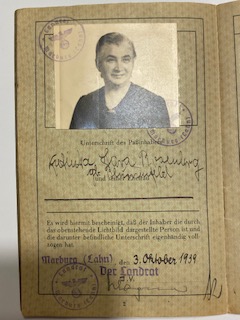
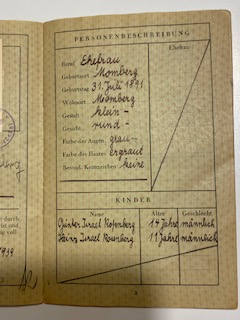
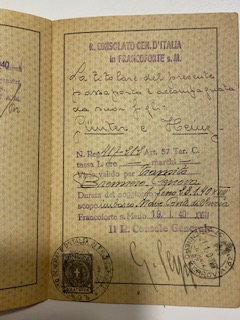
Michael also provided me with scans of his grandmother Katinka’s German passport, which included photographs of Katinka and her two younger sons, Guenther and Heinz.

As we saw, the family arrived in the US in early 1940, and when the 1940 US census was taken, Katinka and her husband Emanuel (known primarily as Emil) Rosenberg and their three sons, Walter, Guenther, and Heinz, now Henry, were living in Manhattan, and Emanuel was a salesman for a retail grocery business. Walter, then 19, was a machine operator in a watch factory. Gunter (14) and Henry (11) were in school.

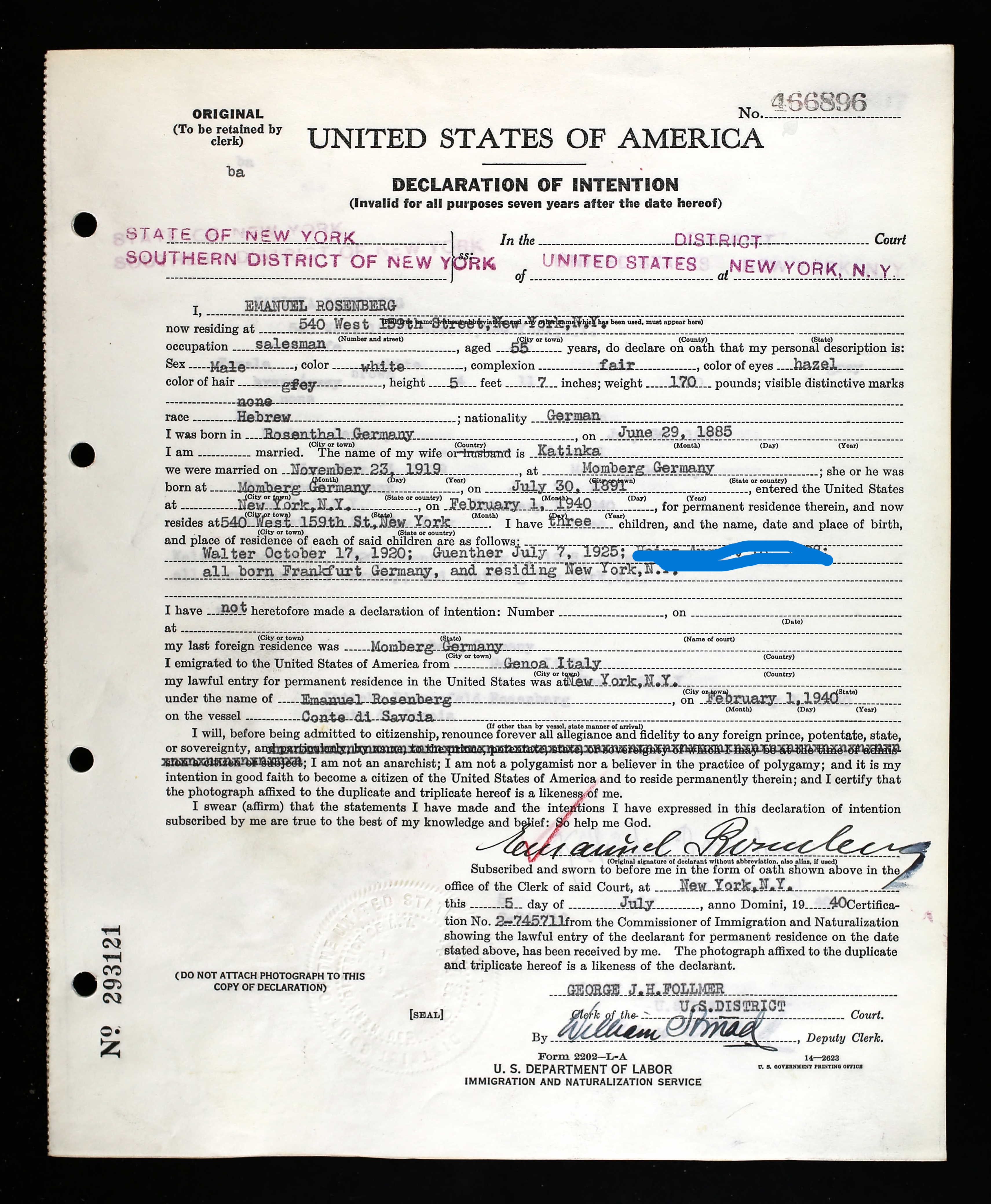
Katinka filed a declaration of intention to become a US citizen on July 5, 1940, as did her husband Emanuel. Their son Walter filed his two weeks later on July 20, 1940.

The National Archives at Philadelphia; Philadelphia, PA; NAI Title: Declarations of Intention For Citizenship, 1/19/1842 – 10/29/1959; NAI Number: 4713410; Record Group Title: Records of District Courts of the United States, 1685-2009; Record Group Number: 21 Source Information Ancestry.com. New York, U.S., State and Federal Naturalization Records, 1794-1943

The National Archives at Philadelphia; Philadelphia, PA; NAI Title: Declarations of Intention For Citizenship, 1/19/1842 – 10/29/1959; NAI Number: 4713410; Record Group Title: Records of District Courts of the United States, 1685-2009; Record Group Number: 21 Source Information Ancestry.com. New York, U.S., State and Federal Naturalization Records, 1794-1943

Walter Rosenberg declaration of intention, The National Archives at Philadelphia; Philadelphia, PA; NAI Title: Declarations of Intention For Citizenship, 1/19/1842 – 10/29/1959; NAI Number: 4713410; Record Group Title: Records of District Courts of the United States, 1685-2009; Record Group Number: 21, (Roll 596) Declarations of Intention For Citizenship, 1842-1959 (No 468501-469500), Ancestry.com. New York, U.S., State and Federal Naturalization Records, 1794-1943

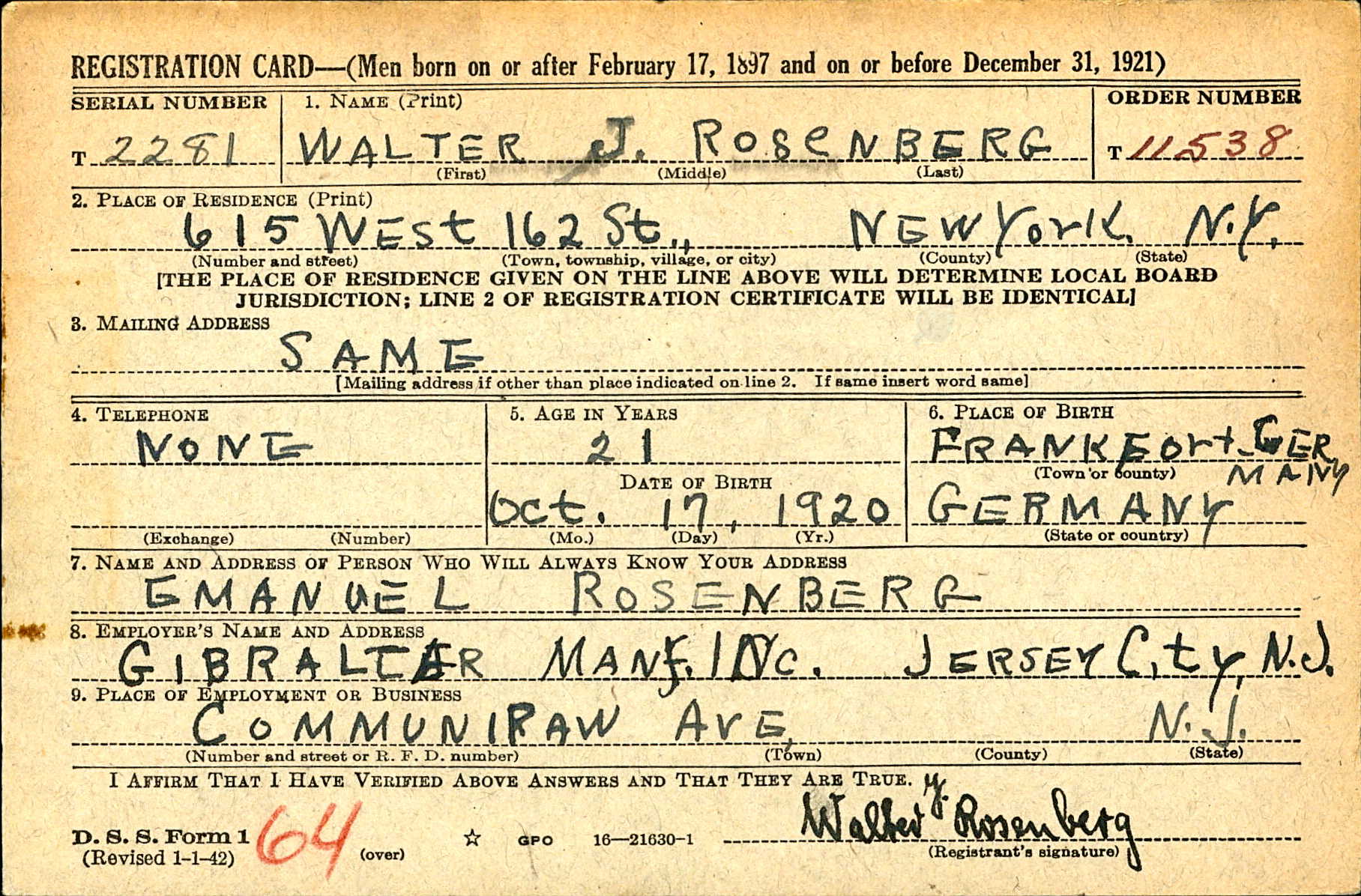
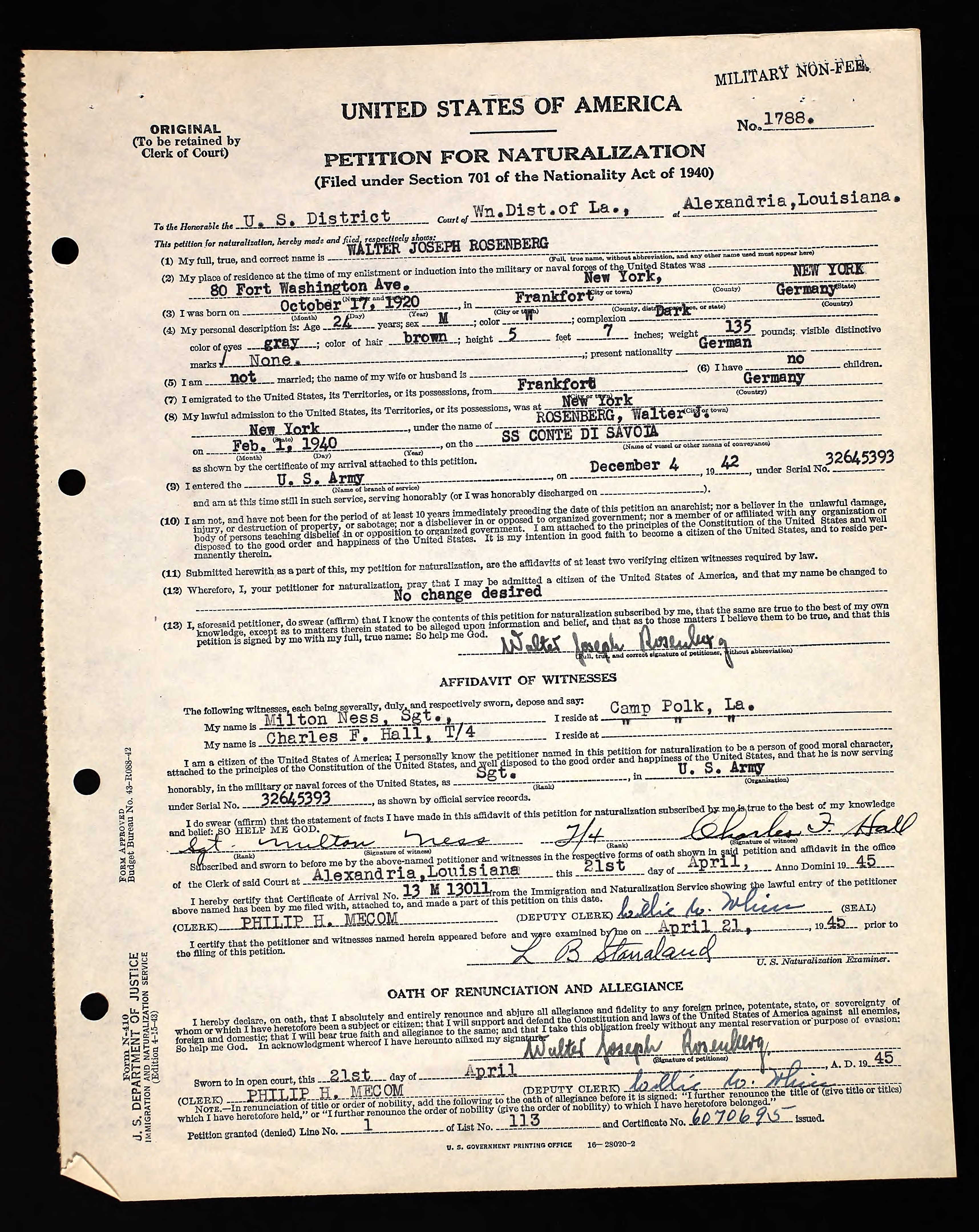
Walter registered for the draft on February 15, 1942. Although the official records from the National Archives and Records Administration show that Walter enlisted on November 27, 1942,1 his petition for naturalization dated April 21, 1945, states that he joined the US Army on December 5, 1942. His petition was granted, and Walter became a US citizen that day in Alexandria, Louisiana, where he was stationed. Because he knew German, he worked as a translator interrogating German POWs.

Walter Rosenberg, World War II draft registration, National Archives at St. Louis; St. Louis, Missouri; WWII Draft Registration Cards for New York City, 10/16/1940 – 03/31/1947; Record Group: Records of the Selective Service System, 147, Ancestry.com. U.S., World War II Draft Cards Young Men, 1940-1947

Walter Rosenberg petition for naturalization, National Archives and Records Administration – Southeast Region (Atlanta); Atlanta, GA; Petitions For Naturalization, Compiled 1922-1964; Series Number: 648598; Record Group Title: Records of District Courts of the United States; Record Group Number: 21 Naturalization Petitions, 1944-1945, Ancestry.com. Louisiana, U.S., Naturalization Records, 1836-2001

On his eighteenth birthday, July 7, 1943, Guenther Rosenberg registered for the draft. He was then working for his cousin, Kurt Simon, son of his aunt Meta Blumenfeld Simon, and living in Wayawanda, New York, where Kurt was also living, as we saw. Guenther entered the US Army on June 28, 1944, and on September 15, 1944, he became a US citizen in Jacksonville, Florida, where he was stationed. He was honorably discharged from the army on November 5, 1944,2 after his foot was injured by a hand grenade.3

Guenther Rosenberg, World War II draft registration, National Archives at St. Louis; St. Louis, Missouri; WWII Draft Registration Cards for New York State, 10/16/1940 – 03/31/1947; Record Group: Records of the Selective Service System, 147 Ancestry.com. U.S., World War II Draft Cards Young Men, 1940-1947

Guenther Rosenberg, petition for naturalization, The National Archives at Atlanta; Atlanta, Ga; ARC Title: Petitions For Naturalization, 1880-1975; NAI Number: 2111793; Record Group Title: Records of District Courts of the United States, 1685-2009; Record Group Number: 21
 Jacksonville Petition and Records, Oct 1944 – Jan 1945 (Roll 190), Ancestry.com. Florida, U.S., Naturalization Records, 1847-1995

Henry (now using that name), the youngest son, also registered for the draft shortly after his eighteenth birthday; he filed his registration on August 22, 1946. He was living at home with his parents in New York and was a student. Fortunately, by that time World War II had ended.

Katinka became a citizen on December 6, 1945.

Katinka Blumenfeld Rosenberg certificate of naturalization. Courtesy of Michael Rosenberg

After Walter was discharged from the US army, he returned to New York and opened up a grocery store with his brother Guenther in 1947, located on Broadway at 163rd Street in Washington Heights and  called Rosenberg Brothers Dairy.4

On July 10, 1949, Walter Rosenberg married Margot Scharlack in New York City. They met when she came into his grocery store.5 Margot was born in Frankfurt, Germany, on May 24, 1924, to Max Scharlack and Recha Hirsch,6 and had immigrated to the US with her family on November 1, 1937.7 In 1940, she and her family were living in San Antonio, Texas, where her father was a bookkeeper for a music store.8

In 1950, Walter and Margot were living in New York City where Walter owned a retail grocery store and Margot was a radio assembler.9 Walter and Margot would have two children, my cousins Michael and Gary.

Michael shared with me these photographs taken in the early 1950s, one of him as a baby with his Uncle Henry and the other with his grandparents Katinka and Emil, and one of his grandparents alone.

Katinka Blumenfeld Rosenberg, Michael Rosenberg, Emil Rosenberg. Courtesy of Michael Rosenberg

Michael Rosenberg and Henry Rosenberg. Courtesy of Michael Rosenberg

Katinka and Emil Rosenberg   Courtesy of Michael Rosenberg

Meanwhile, Katinka, Emanuel (using Emil here), and their other two sons Guenther, here listed as George, and Henry were also living in New York City in 1950, not too far from Walter and Margot. Emil listed his occupation as a shipping clerk for a wholesale grocery store and George reported that he was the proprietor of a retail grocery store, the store he owned with his brother Walter. Henry had no occupation listed.

Emil Rosenberg and family, 1950 US census, United States of America, Bureau of the Census; Washington, D.C.; Seventeenth Census of the United States, 1950; Record Group: Records of the Bureau of the Census, 1790-2007; Record Group Number: 29; Residence Date: 1950; Home in 1950: New York, New York, New York; Roll: 3572; Sheet Number: 7; Enumeration District: 31-2292, Ancestry.com. 1950 United States Federal Census

On June 17, 1951, Guenther/George married Lottie Rosenthal in Napa, California.10 She was the daughter of Frederick Rosenthal and Bella Lorch and was born in Frankfurt, Germany, on May 8, 1929.11 She came with her parents to New York on November 11, 1937,12 but then sailed from New York to San Francisco, California, on November 27, 1937, arriving there on December 13, 1937.13 Lottie and her parents settled in Napa, California, where her father worked as a power machine operator in a garment factory in 1940.14

According to Lottie’s obituary, “[i]n 1950, she traveled to New York City to visit family, and, in turn, met her future husband, George. Married in 1951, they continued in the family business of Rosenthal’s Fresh Ranch Eggs, which later changed to the Rosenthal’s Dried Fruit and Nut business, which is now known as Napa Nuts. In 1953, both Lottie and George along with several other families co-founded Congregation Beth Shalom, where she was an active member for more than 50 years.” George and Lottie had two children born in the 1950s.15

Henry Rosenberg married Victoria Hammerschlag in 1963. Victoria was born in Buenos Aires, Argentina, in 1937, after her parents immigrated there from Germany. Victoria is the second cousin, once removed, of Vera Hammerschlag, who later married Milton Hamburger, Henry’s first cousin, once removed. Henry and Victoria have three children, seven grandchildren, and six great-grandchildren.16

A year after Henry married Victoria, Emil Rosenberg died at age 79 on August 1, 1964.17 Katinka survived her husband by less than three years; she died on April 19, 1967, at the age of 75.18

Photo courtesy of Michael Rosenberg

Their son Guenther/George also did not live to see his eightieth birthday. He died on October 27, 1998, in Napa, California; he was only seventy-three.19 Fortunately, both of his brothers have had greater longevity. Walter Rosenberg was 94 when he died on November 28, 2014, in New York.20 And Henry Rosenberg, with whom I had the great pleasure of speaking, is still alive and well at 94.

Thank you again to my cousins Michael Rosenberg and Henry Rosenberg for sharing their stories, memories, and photographs.

That completes the story of Gerson Blumenfeld II and his family. Tomorrow morning I will be participating in a Blumenfeld Hanukkah Zoom with some of Gerson’s descendants as well as many descendants of other Blumenfeld ancestors. I will be sure to report on that next week.

Happy Hanukkah, everyone!


  1. Walter J Rosenberg, Race: White, Marital Status: Single, with dependents (Single)
    Rank: Private, Birth Year: 1920, Nativity State or Country: Danzig or Germany, Citizenship: Not Yet a Citizen, Residence: New York, New York, Education: 2 years of high school, Civil Occupation: Semiskilled occupations in manufacture of clocks, watches, jewelry, and articles of precious metals, Enlistment Date: 27 Nov 1942
    Enlistment Place: New York City, New York, Service Number: 32645393, Branch: Branch Immaterial – Warrant Officers, USA, Component: Selectees (Enlisted Men)
    Source: Civil Life, Height: 66, Weight: 114, National Archives at College Park; College Park, Maryland, USA; Electronic Army Serial Number Merged File, 1938-1946; NAID: 1263923; Record Group Title: Records of the National Archives and Records Administration, 1789-ca. 2007; Record Group: 64; Box Number: 05442; Reel: 208, Ancestry.com. U.S., World War II Army Enlistment Records, 1938-1946 
  2. Guenther G Rosenberg, Race: White, Marital Status: Single, without dependents (Single), Rank: Private, Birth Year: 1925, Nativity State or Country: Danzig or Germany
    Citizenship: Not Yet a Citizen, Residence: New York, New York, Education: 2 years of high school, Civil Occupation: Skilled occupations in the manufacture of miscellaneous products, Enlistment Date: 28 Jun 1944, Enlistment Place: Camp Upton Yaphank, New York, Service Number: 42138415, Branch: No branch assignment, Component: Selectees (Enlisted Men), Source: Civil Life, National Archives at College Park; College Park, Maryland, USA; Electronic Army Serial Number Merged File, 1938-1946; NAID: 1263923; Record Group Title: Records of the National Archives and Records Administration, 1789-ca. 2007; Record Group: 64; Box Number: 15088; Reel: 20, Ancestry.com. U.S., World War II Army Enlistment Records, 1938-1946 
  3. Email from Michael Rosenberg, November 30, 2022. 
  4. Ibid. 
  5. Ibid. See also Walter J Rosenberg, Gender: Male, Marriage License Date: 5 Jul 1949, Marriage License Place: Manhattan, New York City, New York, USA, Spouse:
    Margot Scharlack, License Number: 18136, New York City Municipal Archives; New York, New York; Borough: Manhattan; Volume Number: 26, Ancestry.com. New York, New York, U.S., Marriage License Indexes, 1907-2018 
  6. Margot Scharlack, [Margot Rosenberg], Gender: Female, Race: White, Birth Date: 24 May 1924, Birth Place: Frankfurt, Federal Republic of Germany, Death Date: 3 Apr 2005, Father: Max Scharlack Mother: Recha Hirsch, SSN: 461261953, Ancestry.com. U.S., Social Security Applications and Claims Index, 1936-2007. 
  7. Margot Scharlack, ship manifest, Year: 1937; Arrival: New York, New York, USA; Microfilm Serial: T715, 1897-1957; Line: 15; Page Number: 81, Ancestry.com. New York, U.S., Arriving Passenger and Crew Lists (including Castle Garden and Ellis Island), 1820-1957 
  8. Scharlack family, 1940 US census, Year: 1940; Census Place: San Antonio, Bexar, Texas; Roll: m-t0627-04206; Page: 3A; Enumeration District: 259-149, Ancestry.com. 1940 United States Federal Census 
  9. Walter Rosenberg, 1950 US census, United States of America, Bureau of the Census; Washington, D.C.; Seventeenth Census of the United States, 1950; Record Group: Records of the Bureau of the Census, 1790-2007; Record Group Number: 29; Residence Date: 1950; Home in 1950: New York, New York, New York; Roll: 3572; Sheet Number: 71; Enumeration District: 31-2291, Ancestry.com. 1950 United States Federal Census 
  10. Guenther G Rosenberg, Gender: Male, Estimated Birth Year: abt 1926
    Age: 25, Marriage Date: 17 Jun 1951, Marriage Place: Napa, California, USA
    Spouse: Lottie Rosenthal Spouse Age: 22, Ancestry.com. California, U.S., Marriage Index, 1949-1959. 
  11. Napa Valley Register (August 19, 2014) , obit for Lottie Rosenberg, GenealogyBank.com (https://www.genealogybank.com/doc/obituaries/obit/14FD71AE3A70B180-14FD71AE3A70B180 : accessed 2 December 2022) 
  12. Rosenthal family, ship manifest, Year: 1937; Arrival: New York, New York, USA; Microfilm Serial: T715, 1897-1957; Line: 15; Page Number: 171, Ancestry.com. New York, U.S., Arriving Passenger and Crew Lists (including Castle Garden and Ellis Island), 1820-1957 
  13. Rosenthal family, ship manifest, The National Archives at Washington, D.C.; Washington, D.C.; Passenger Lists of Vessels Arriving At San Francisco, California; NAI Number: 4498993; Record Group Title: Records of the Immigration and Naturalization Service, 1787-2004; Record Group Number: 85, Ancestry.com. California, U.S., Arriving Passenger and Crew Lists, 1882-1959 
  14. Rosenthal family, 1940 US census, Year: 1940; Census Place: Napa, Napa, California; Roll: m-t0627-00269; Page: 12A; Enumeration District: 28-12A, Ancestry.com. 1940 United States Federal Census 
  15. See Note 11, supra. 
  16. Phone conversation with Henry Rosenberg on October 30, 2022. Email from Michael Rosenberg, November 30, 2022. 
  17.  Emanuel Rosenberg, Social Security Number: 092-16-4853, Birth Date: 29 Jun 1885 Issue Year: Before 1951, Issue State: New York, Death Date: Aug 1964, Social Security Administration; Washington D.C., USA; Social Security Death Index, Master File, Ancestry.com. U.S., Social Security Death Index, 1935-2014 
  18. Find a Grave, database and images (https://www.findagrave.com/memorial/236669638/katinka-rosenberg: accessed 02 December 2022), memorial page for Katinka Rosenberg (1891–1967), Find a Grave Memorial ID 236669638, citing Cedar Park Cemetery, Paramus, Bergen County, New Jersey, USA; Maintained by dalya d (contributor 46972551) . (Headstone has date.) 
  19. Guenther Rosenberg, [George G Rosenberg], [George Rosenberg], Gender: Male
    Race: White, Birth Date: 7 Jul 1925, Birth Place: Frankfurt MA, Federal Republic of Germany, Death Date: 27 Oct 1998, Father: Emil Rosenberg Mother:  Katinka Blumenfeld, SSN: 093129735, Ancestry.com. U.S., Social Security Applications and Claims Index, 1936-2007 
  20. Information from Michael Rosenberg, email dated December 21, 2022. 

Gerson Blumenfeld II: His Surviving Son Friedrich and His Family in America, Keeping Tradition Alive

I have been very fortunate to connect with four more Blumenfeld cousins, Steven, Milton, Alan, and Debbie, four of the grandchildren of Friedrich Blumenfeld, the last surviving son of Gerson Blumenfeld II. Alan has generously shared with me some wonderful family photographs, including the first I’ve seen of Gerson Blumenfeld II, Alan’s great-grandfather.

Gerson Blumenfeld II. Courtesy of his family.

Alan also shared these photos of his grandparents Friedrich and Lina and their two children, Gretel and Guenther (later spelled Gunter).

Fritz Blumenfeld as a young man. Courtesy of the family.

Lina Neuhas and Fritz Blumenfeld at their wedding, October 26, 1921. Courtesy of the family

Guenther and Gretel Blumenfeld, c. 1928 Courtesy of the family

Friedrich (also known as Fritz) and his wife Lina and their two children Gretel and Guenther were safely in the US by 1939 and were living in the Bronx, according to the declaration of intention to become US citizens that Friedrich filed that year.

Friedrich Blumenfeld Declaration of Intention, The National Archives at Philadelphia; Philadelphia, PA; NAI Title: Declarations of Intention For Citizenship, 1/19/1842 – 10/29/1959; NAI Number: 4713410; Record Group Title: Records of District Courts of the United States, 1685-2009; Record Group Number: 21 Roll 567) Declarations of Intention For Citizenship, 1842-1959 (No 444001-444900), Ancestry.com. New York, U.S., State and Federal Naturalization Records, 1794-1943

Alan also shared this photograph of his father Guenther’s immigration card:

Guenther Blumenfeld immigration card, 1939. Courtesy of the family

By 1941 when Gretel filed her own declaration of intention, the family was living in the Washington Heights area of Manhattan. Gretel was then eighteen and working as an “operator.” According to her sons, she was working for a company manufacturing army blankets.1

Gretel Blumenfeld Declaration of Intention, The National Archives at Philadelphia; Philadelphia, PA; NAI Title: Declarations of Intention For Citizenship, 1/19/1842 – 10/29/1959; NAI Number: 4713410; Record Group Title: Records of District Courts of the United States, 1685-2009; Record Group Number: 21 (Roll 622) Declarations of Intention For Citizenship, 1842-1959 (No 492901-493800), Ancestry.com. New York, U.S., State and Federal Naturalization Records, 1794-1943

Her brother Gunter (now using that spelling) registered for the draft on February 23, 1944; they were still living in Washington Heights, and he was a high school student at that time and had just turned eighteen. He enlisted in the US Army on January 30, 1945, and served until August 28, 1946.2

Gunter Blumenfeld, World War II draft registration, National Archives at St. Louis; St. Louis, Missouri; WWII Draft Registration Cards for New York City, 10/16/1940 – 03/31/1947; Record Group: Records of the Selective Service System, 147, Ancestry.com. U.S., World War II Draft Cards Young Men, 1940-1947

Alan shared this photograph of his father Gunter in uniform during World War II:

Gunter Blumenfeld, c. 1945. Courtesy of the family

Gretel Blumenfeld married Joseph Hamburger on January 18, 1946.3 Joseph was born in Heuttengesass, Germany, on February 4, 1915, son of Simon Hamburger and Bertha Adler,4 and had immigrated to the US on April 2, 1936.5 According to his sons Steven and Milton, Joseph would have left earlier, but had to wait until he was twenty-one to leave without his parents’ consent; he had wanted to leave three years earlier when the Nazis prohibited Jews from being butchers, Joseph’s livelihood, but his parents refused. Gretel and Joseph met before the war, but waited to marry until after he came back from serving in World War II.6

In 1950, they were living in New York City, and Joseph was the owner of a kosher butcher shop. Gretel and Joseph had three children.

Joseph Hamburger 1950 US census, United States of America, Bureau of the Census; Washington, D.C.; Seventeenth Census of the United States, 1950; Record Group: Records of the Bureau of the Census, 1790-2007; Record Group Number: 29; Residence Date: 1950; Home in 1950: New York, New York, New York; Roll: 3572; Sheet Number: 71; Enumeration District: 31-2292, Ancestry.com. 1950 United States Federal Census

Gretel’s parents Friedrich and Lina and her brother Gunter were also living in New York City in 1950, and Friedrich was working as merchandise distributor for a clothing manufacturer. Gunter was working as a television mechanic.

Friedrich Blumenfeld 1950 US census, United States of America, Bureau of the Census; Washington, D.C.; Seventeenth Census of the United States, 1950; Record Group: Records of the Bureau of the Census, 1790-2007; Record Group Number: 29; Residence Date: 1950; Home in 1950: New York, New York, New York; Roll: 3572; Sheet Number: 73; Enumeration District: 31-2289, Ancestry.com. 1950 United States Federal Census

Gunter took out a marriage license to marry Hilde Hes on August 14, 1951.7 Hilde was born on April 8, 1931, in Bremen, Germany, and immigrated with her parents Paul Hes and Gertrude Wolff on September 14, 1939.8 Gunter and Hilde would have two children.

The extended family all lived close by in Washington Heights and were very close; Debbie and Alan lived in the same apartment building as their grandparents Fritz and Lina and saw them all the time, including regular shabbat dinners. Debbie shared that Lina was an excellent cook, and she has many warm memories of growing up with her cousins and other relatives.9

Alan shared this photo of Friedrich and Lina at the celebration of their 50th wedding anniversary in 1971:

Lina Neuhaus and Friedrich Blumenfeld, 1971. Courtesy of the family

Friedrich and Lina and their two children all lived relatively long lives and remained in New York City for the rest of their lives. Friedrich was 88 when he died in New York on November 14, 1977.10

Fritz Blumenfeld death notice, Aufbau, November 25, 1977, p. 28, found at https://archive.org/details/aufbau431977germ/page/n677/mode/1up?view=theater

Lina died three years later on December 15, 1980. She was 86. 11

Lina Blumenfeld death notice , Aufbau, Jan 2 1981, p. 24, found at https://archive.org/details/aufbau471981germ/page/n11/mode/1up?view=theater

Gretel Blumenfeld Hamburger died on July 25, 2008, when she was 85;12 her husband Joseph had predeceased her, dying on December 18, 2004, when he was 89.13  Gunter Blumenfeld died on July 16, 2010; he was 84.14

Perhaps some of my favorite photographs of those shared by Alan are these three that show the Sefer Torah (Torah scroll) that had been rescued by Friedrich Blumenfeld during Kristallnacht while the Momberg synagogue was burning and then safely brought to the US from Momberg by the family.15 The photographs were taken at Alan’s son’s bar mitzvah and show Gunter, Alan, and his son Sandy honoring that Sefer Torah during the bar mitzvah service.

c. 2008 Courtesy of the family

c. 2008 Courtesy of the family

c. 2008 Courtesy of the family

Friedrich and Lina are survived by their grandchildren and great-grandchildren and great-great-grandchildren. I was privileged to connect with four of their five grandchildren—Steven, Milton, Alan, and Debbie (and will be talking to the fifth, Kenny, soon during a Blumenfeld family zoom).  Thank you all for sharing  these fabulous photographs and your stories with me and for keeping alive the memories, traditions, and legacy of your family.


  1. Zoom call with Steven Hamburger and Milton Hamburger, November 10, 2022. 
  2. Gunter Blumenfeld, Race White, Marital Status Single, without dependents (Single)
    Rank Private, Birth Year 1926, Nativity State or Country Danzig or Germany, Citizenship Not Yet a Citizen, Residence New York, New York, Education 3 years of high school, Enlistment Date 30 Jan 1945, Enlistment Place New York City, New York, Service Number 42205064, Branch No branch assignment, Component Selectees (Enlisted Men), Source Civil Life, Height 80, Weight 995 [??], National Archives at College Park; College Park, Maryland, USA; Electronic Army Serial Number Merged File, 1938-1946; NAID: 1263923; Record Group Title: Records of the National Archives and Records Administration, 1789-ca. 2007; Record Group: 64; Box Number: 15188; Reel: 30, Ancestry.com. U.S., World War II Army Enlistment Records, 1938-1946 
  3. Gretel Blumenfeld, Gender: Female, Marriage License Date: 18 Jan 1946, Marriage License Place: Manhattan, New York City, New York, USA, Spouse:
    Joseph Hamburger License Number: 2005, New York City Municipal Archives; New York, New York; Borough: Manhattan; Volume Number: 3, Ancestry.com. New York, New York, U.S., Marriage License Indexes, 1907-2018 
  4. Joseph Hamburger, Gender: Male, Race: White, Birth Date: 4 Feb 1915, Birth Place: Huettengesae, Federal Republic of Germany, Death Date: 18 Dec 2004, Father:
    Simon Hamburger, Mother: Bertha Adler, SSN: 077073405, Ancestry.com. U.S., Social Security Applications and Claims Index, 1936-2007 
  5. Joseph Hamburger, passenger manifest, Year: 1936; Arrival: New York, New York, USA; Microfilm Serial: T715, 1897-1957; Line: 20; Page Number: 39, Ancestry.com. New York, U.S., Arriving Passenger and Crew Lists (including Castle Garden and Ellis Island), 1820-1957 
  6. See Note 1, supra. 
  7. Gunter Blumenfeld, Gender: Male, Marriage License Date: 1951, Marriage License Place: Manhattan, New York City, New York, USA, Spouse: Hilde M. Hes, License Number: 21506, New York City Municipal Archives; New York, New York; Borough: Manhattan, Ancestry.com. New York, New York, U.S., Marriage License Indexes, 1907-2018 
  8. Paul Hes, Declaration of Intention, The National Archives at Philadelphia; Philadelphia, PA; NAI Title: Declarations of Intention For Citizenship, 1/19/1842 – 10/29/1959; NAI Number: 4713410; Record Group Title: Records of District Courts of the United States, 1685-2009; Record Group Number: 21, Roll 569) Declarations of Intention For Citizenship, 1842-1959 (No 445801-446600), Ancestry.com. New York, U.S., State and Federal Naturalization Records, 1794-1943 
  9. Email from Debbie Salamon, December 7, 2022. 
  10. Friederich Blumenfeld, Social Security Number: 065-12-8954, Birth Date: 7 Dec 1888, Issue Year: Before 1951, Issue State: New York, Last Residence: 10033, New York, New York, New York, USA, Death Date: Nov 1977, Social Security Administration; Washington D.C., USA; Social Security Death Index, Master File, Ancestry.com. U.S., Social Security Death Index, 1935-2014 
  11. Lina Blumenfeld, Social Security Number: 119-18-7181, Birth Date: 19 Sep 1894, Issue Year: Before 1951, Issue State: New York, Last Residence: 10033, New York, New York, New York, USA, Death Date: Dec 1980, Social Security Administration; Washington D.C., USA; Social Security Death Index, Master File, Ancestry.com. U.S., Social Security Death Index, 1935-2014 
  12. Gretel Hamburger, Social Security Number: 081-12-7517, Birth Date: 21 Aug 1922, Issue Year: Before 1951, Issue State: New York, Last Residence: 10040, New York, New York, New York, Death Date: 28 Jul 2008, Social Security Administration; Washington D.C., USA; Social Security Death Index, Master File, Ancestry.com. U.S., Social Security Death Index, 1935-2014 
  13. Joseph Hamburger, Social Security Number: 077-07-3405, Birth Date: 4 Feb 1915, Issue Year: Before 1951, Issue State: New York, Last Residence: 10040, New York, New York, New York, USA, Death Date: 18 Dec 2004, Social Security Administration; Washington D.C., USA; Social Security Death Index, Master File, Ancestry.com. U.S., Social Security Death Index, 1935-2014 
  14. Gunter Blumenfeld, Social Security Number: 081-20-7923, Birth Date: 22 Feb 1926, Issue Year: Before 1951, Issue State: New York, Last Residence: 10040, New York, New York, New York, Death Date: 16 Jul 2010, Social Security Administration; Washington D.C., USA; Social Security Death Index, Master File, Ancestry.com. U.S., Social Security Death Index, 1935-2014 
  15. Email from Alan Blumenfeld, December 6, 2022.