Marriages and Disappearances

In 1900 Edgar Nusbaum, the fourth child of Ernst Nusbaum and Clarissa Arnold, was living with his wife Viola Barritt, their daughter Celina[1], Viola’s sister, and a boarder at 1520 North 12th Street in Philadelphia.  Edgar was working as a clerk, and Celina was a dressmaker.  Celina was nineteen years old.

On November 30, 1904, Celina married Hamilton Hall Treager Glessner in New York City.  He was the son of Oliver Glessner and Anna Leidigh of Philadelphia.  His father was a printer.  In 1900, Hamilton was nineteen and still in school.  On the 1910 census, Hamilton’s occupation was reported to be an electrical engineer. On March 10, 1906, Celina and Hamilton had a daughter, Marian La Rue Glessner.

Unfortunately, the marriage did not last.  By 1910, Celina and her daughter Marian were living with Celina’s parents, Edgar and Viola, at 707 Electric Avenue.  Edgar was working as a clerk for the “steam” railroad, and Celina was working as a dress designer.

Year: 1910; Census Place: Abington, Montgomery, Pennsylvania; Roll: T624_1377; Page: 9B; Enumeration District: 0064; FHL microfilm: 1375390

Year: 1910; Census Place: Abington, Montgomery, Pennsylvania; Roll: T624_1377; Page: 9B; Enumeration District: 0064; FHL microfilm: 1375390

Although Celina gave her marital status as married, Hamilton (“Hall”) was now living with his parents in Denver, Colorado, and listed his marital status as single.

Source Citation Year: 1910; Census Place: Denver Ward 10, Denver, Colorado; Roll: T624_116; Page: 5B; Enumeration District: 0123; FHL microfilm: 1374129

Source Citation
Year: 1910; Census Place: Denver Ward 10, Denver, Colorado; Roll: T624_116; Page: 5B; Enumeration District: 0123; FHL microfilm: 1374129


By 1915, Celina had married again, this time to Inglis Edward Daniel Cameron.  In 1900, Inglis had been living in Philadelphia with his mother Mary and his two older siblings; Inglis was sixteen years old.  He is listed as a student in the 1908 Philadelphia directory. In 1909, he received his law degree from the University of Pennsylvania.  In 1910, Inglis was working as a lawyer and living with his mother, sister, and niece.  I don’t have a marriage record for Celina and Inglis, but their son Edward James Cameron was born on June 29, 1915.

Eighteen months later, on December 19, 1916, Celina’s mother and Edgar’s wife Viola Barritt Nusbaum died at age 55 from chronic myocarditis.  She was buried at West Laurel Hill cemetery.

Ancestry.com. Pennsylvania, Death Certificates, 1906-1963 [database on-line]. Provo, UT, USA: Ancestry.com Operations, Inc., 2014.

Ancestry.com. Pennsylvania, Death Certificates, 1906-1963 [database on-line]. Provo, UT, USA: Ancestry.com Operations, Inc., 2014.

Two years later at age 60, Edgar remarried.  His second wife was Caroline Saeltzer.  She had been married before and was divorced.  She was 52 years old when she married Edgar on October 24, 1918. In 1920, Edgar, Caroline, and Caroline’s mother Josephine were living at 3847 North 16th Street, and Edgar was now the head clerk for the railroad’s auditing department.

In 1920, Celina and Inglis were living with her daughter Marian, their son Edward James (listed as James), a niece named Ella (presumably Inglis’ niece since Celina was an only child), and a nurse at 7433 Devon Street in Philadephia.  Inglis was practicing law.  As listed in the 1921 Philadelphia directory, he was working for the Cameo Dress Company.
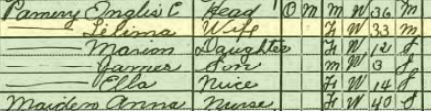
Year: 1920; Census Place: Philadelphia Ward 22, Philadelphia, Pennsylvania; Roll: T625_1624; Page: 7A; Enumeration District: 617; Image: 269

Year: 1920; Census Place: Philadelphia Ward 22, Philadelphia, Pennsylvania; Roll: T625_1624; Page: 7A; Enumeration District: 617; Image: 269

In 1925 I found Inglis E.D. Cameron listed in the New York City directory with an office address at 100 East 42nd Street, but with an indication that his residence was still in Philadelphia.

After that, things get really, really fuzzy for Celina, Inglis, and their children.  I have not been able to find Inglis on any record after that 1925 directory—not on a census or in a directory or in a death record or obituary.  Nothing.  For such an unusual name, you would think something would appear.  Nothing.  I will keep digging, but at the moment I don’t know what happened to Inglis.

Edgar Nusbaum died on May 14, 1924, from arteriosclerosis and bronchitis.  He was 65 years old and was buried at Hillside Cemetery.  His second wife, Carolyn, died at age 93 on November 10, 1959.  She is buried with Edgar at Hillside Cemetery.

Ancestry.com. Pennsylvania, Death Certificates, 1906-1963 [database on-line]. Provo, UT, USA: Ancestry.com Operations, Inc., 2014.

Ancestry.com. Pennsylvania, Death Certificates, 1906-1963 [database on-line]. Provo, UT, USA: Ancestry.com Operations, Inc., 2014.

As for Celina, well, she seems to have married a third time after her marriage to Inglis Cameron ended either with his death or by divorce.  I was quite surprised when I found this death certificate:

Ancestry.com. Texas, Death Certificates, 1903–1982 [database on-line]. Provo, UT, USA: Ancestry.com Operations, Inc., 2013.

Ancestry.com. Texas, Death Certificates, 1903–1982 [database on-line]. Provo, UT, USA: Ancestry.com Operations, Inc., 2013.

This is obviously the right person—her parents are Edgar Nusbaum and Viola Barritt.  She obviously had changed her name to Sally.  And who was Carnes?  And how did she end up in Houston, Texas?  The informant was Marian L. Pattison, which gave me a clue about Celina’s daughter Marian La Rue Glessner.

I was able to find a Sally Carnes married to a Donald Carnes in the 1948 Houston, Texas, city directory.  I also found a Texas death certificate for a Donald Carnes dated November 6, 1948.  He was killed in a car accident in Houston.  There is no mention of a wife’s name, although he was married.  And the informant was his son E.J. Carnes of Pasadens, Texas.  Donald Carnes had been a partner in Carnes Construction Company.

Ancestry.com. Texas, Death Certificates, 1903–1982 [database on-line]. Provo, UT, USA: Ancestry.com Operations, Inc., 2013.

Ancestry.com. Texas, Death Certificates, 1903–1982 [database on-line]. Provo, UT, USA: Ancestry.com Operations, Inc., 2013.

Could E.J. Carnes, his son, be the same person as Edward James Cameron, the son of Celina Nusbaum and Inglis Cameron?  Had Inglis died and had Donald Carnes adopted Edward James? In the 1942 Houston directory there is a listing for an Edward J Carnes, married to Margaret, working as a manager of the Carnes Service Station.  Right above him in the directory is a Donald S. Carnes, a shipyard worker, but with a wife named Kath.

Ancestry.com. U.S. City Directories, 1821-1989 [database on-line]. Provo, UT, USA: Ancestry.com Operations, Inc., 2011.

Ancestry.com. U.S. City Directories, 1821-1989 [database on-line]. Provo, UT, USA: Ancestry.com Operations, Inc., 2011.

The 1951 Houston directory lists an Edward J. Carnes, husband of Margaret, as affiliated with Carnes Construction Company and Carnes Neon Service.  There is no listing for a Celina or Selena or Sally Carnes or for Donald Carnes. I think it’s pretty clear that Edward J. Carnes was the relative of Donald Carnes, given the death certificate and the similar business line.  But was this Donald Carnes the husband of Celina/Sally Carnes who died in 1966? And was this Edward J. Carnes born Edward James Cameron, son of Celina and Inglis?  I don’t know for sure.  What do you think?  I am still searching for more clues.

Since I knew from Celina’s death certificate that her daughter Marian had taken the married name Pattison, it was not that difficult to find her marriage record.  According to that record, Marian Glessner married Carl T. Pattison in 1927 in Philadelphia. In 1930 they were living at 350 East Mt. Airy Avenue in Philadelphia.  Carl was a civil engineer.  His father was an English-born machinist in Philadelphia, and his mother was born in Germany.  Carl, who is sometimes listed as Thomas C., sometimes as Thomas K., sometimes as Karl, and sometimes as Carl T. Pattison, was their youngest child.  Strangely enough, Carl’s mother was also named Selina.

Carl and Marian had two children born in the 1930s who I am trying to locate so that I can learn more.  By 1940, Carl, Marian, and the children were living at 229 Sedgewick Avenue in Philadelphia, and Carl was now trading bonds.  In the 1950 Philadelphia phone directory, he is listed as T. Carl Pattison at the same address on Sedgewick Avenue. I have no certain records for any of them after that.  I have some possibilities, but nothing about which I have enough certainty to feel confident.  I have found nothing for either of their children.

Thus, the daughter and grandchildren of Edgar Nusbaum and Viola Barritt have proven to be quite elusive.  Of all the descendants of Ernst and Clarissa Nusbaum, these have proven to the most difficult to find.

That leaves me with one more child of Ernst and Clarissa Nusbaum to write about—their daughter Fanny.


[1] Sometimes spelled Selena, sometimes Lena, later Sally.

Passover 2015: The American Jewish Story

Handmade shmura matzo used at the Passover Sed...

Handmade shmura matzo used at the Passover Seder especially for the mitzvot of eating matzo and afikoman. (Photo credit: Wikipedia)

A year ago I was feeling disconnected from Passover until I heard my grandson tell us the story of Passover in a way that made it feel new and exciting and different all over again.  This year his little brother will experience his first seder, though at only ten months, that experience will likely be short and quite unfocused.  Just a lot of really noisy people sitting around a table eating food that he neither can nor would want to eat.  But it’s a new reminder that every generation and every child experiences Passover as a new experience, allowing all of us who are jaded and detached to be able to relive our own early experiences with this special holiday.

Last year I entered into Passover thinking about my mother’s ancestors, the Brotmans, the Goldschlagers, and the Rosenzweigs.  I focused on their exodus from the oppression and poverty and anti-Semitism of Galicia and Romania and their courage and the desire for freedom that led them to leave all they knew to cross the continent and then the ocean and come to New York City, where they again lived in poverty but with greater hopes for a life of freedom and economic opportunity.  And they attained their goals if not in that first generation, certainly by the third and fourth generations.

Poor Jews taking home free matzohs, New York

Poor Jews taking home free matzohs, New York (Photo credit: Wikipedia)

For the last year now, I have been researching, studying and writing about my father’s paternal relatives.  It has taken just about a full year to cover the Cohens, the Jacobs (with whom I actually need to do more work), the Seligmans, the Schoenfelds, the Nusbaums, and the Dreyfusses.  Soon I will start my father’s maternal relatives—the Schoenthals and Katzensteins and whatever other surnames pop up along the way.  Researching my father’s families has been so different from my mother’s, and I can go so much further back.  I can’t get back much before 1840 with my mother’s family and have absolutely no records before 1885 or so for any of them.  Although I have a number of Romanian records for my Rosenzweig and Goldschlager relatives, I have no records at all from Europe for my great-grandparents Joseph and Bessie Brotman, despite hours and hours of searching and even DNA testing.

In contrast, my father’s ancestors have provided me with a rich opportunity to learn about Jews in Amsterdam, London, and especially the towns of Gau-Algesheim, Erbes-Budesheim, Bingen, and Schopfloch, Germany.  I have been able to find records all the way back to 1800 or so for almost every line.  I’ve had amazing help along the way on both sides of the Atlantic, and I’ve even learned a little German to boot.  My father’s families were pawnbrokers and peddlers and clothing merchants; they were pioneers and politicians and war heroes.


http://www.gettyimages.com/detail/182866324
Harrisburg Market Square with Leo Nusbaum store

Harrisburg Market Square with Leo Nusbaum store

They came to the United States in the 1840s and 1850s, and most of them suffered terrible heartbreaks, economic struggles, and early deaths.  Most of them settled in Philadelphia and other parts of Pennsylvania and New Jersey, but there were those who went to places that I’d never think a Jewish immigrant would go: Iowa, Texas, Illinois, Michigan, California, and, of course, New Mexico.  Many married outside the Jewish community and assimilated into American culture far more so than my mother’s relatives.  Ultimately, the Cohens/Jacobs and Seligmans/Schoenfelds and Nusbaums/Dreyfusses were successful; they found the American dream, and they embraced it.

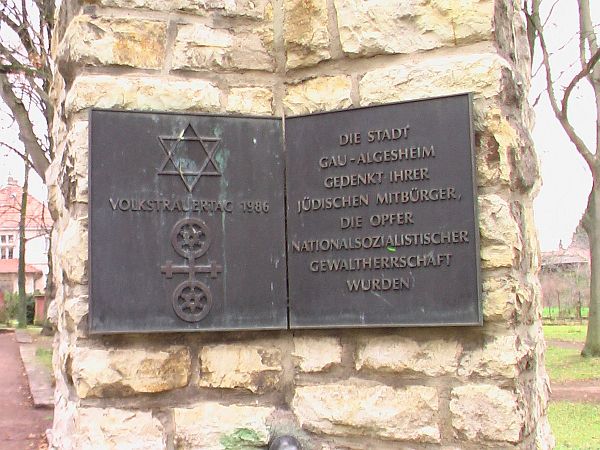
But there is a very sad underside to this story of American success.  It’s the story of those who did not leave Europe.  For the first time in my life I confronted the reality that the Holocaust did not just happen to other families, to other Jews.  Not that I have not been deeply affected by the Holocaust all my life; ever since I read Anne Frank’s diary as a child, I’ve identified with and cried for all those who were murdered by the Nazis.  But I never knew that I had relatives left behind in Germany who were part of that slaughter.  I am still finding more, and I will write about them soon.  The list of names of my cousins who died in the Holocaust grows longer and longer, and I realize more than ever how grateful I should be to Bernard Seligman, John and Jeanette (Dreyfuss) Nusbaum, and Jacob and Sarah (Jacobs) Cohen for leaving Europe and taking a chance on the new country across the ocean.

memorial plaque gau aldesheim

So this year for Passover I will be thinking about that first major migration of Jews from Europe to America.  I will be feeling thankful for the risks my ancestors took, and I will be feeling the loss of not only all those who were killed in the Holocaust, but the loss of all the children and grandchildren who would have been born but for those deaths.

And overall I will be celebrating family, freedom, and faith—faith that the world can be a better place and that human beings can be their best selves and live good and meaningful lives.  May all of you have a wonderful weekend—be it Passover or Easter or perhaps just another weekend in April for you.   Celebrate all the good things in life in whatever way you can.


Embed from Getty Images

The Mystery of Fanny Wiler: Post-script

Two days ago, I posted what I called my final chapter of the mystery of Fanny Wiler.  I had finally learned where and when and why Fanny had died after receiving her death certificate from the Carnegie Library in Pittsburgh.  But I ended that post with the remaining questions that still lingered.  Was the child Bertha born to a Fanny Wieler and Joseph Levi in New York City the daughter of my Fanny?  If so, what happened to her?  Since I could not find the family on either the 1870 or the 1880 census and since the 1890 does not exist, I didn’t know whether Bertha had died, married, or moved away between 1866 and 1900, and I could not find her in 1900 or afterwards either.

But first I had to determine whether this was in fact the child of Fanny Wiler Levy.  There was no point in chasing her down if she wasn’t my cousin.  I’d already spent far too many hours chasing the wrong Fanny Wiler.  So I ordered the birth certificate for the Bertha Levi born in New York in 1866.  It arrived hours after I posted about Fanny.  And I was both excited and a bit exasperated to see that Bertha was in fact the daughter of my Fanny.

Levi, Bertha Birth

Why exasperated?  Because I had no idea what had happened to Bertha.  I half-wanted that baby not to have been my cousin so I could finally really put closure on Fanny Wiler.  I also feared that that baby had died and would thus just be one more sad story to add to the life of Fanny WIler.  But there she was—definitely their child, daughter of Fanny Wieler born in Harrisburg.  It had to be the same Fanny and the same Joseph, despite the misspellings and despite the birth in New York, not Philadelphia.

So back to the books I went, now even more determined to find Bertha.  It took many searches and many different wildcards, databases, and spellings, and I still could not find the family on either the 1870 or 1880 census, but I did find this:

Ancestry.com. Pennsylvania, Death Certificates, 1906-1963 [database on-line]. Provo, UT, USA: Ancestry.com Operations, Inc., 2014. Original data: Pennsylvania (State). Death certificates, 1906–1963. Series 11.90 (1,905 cartons). Records of the Pennsylvania Department of Health, Record Group 11. Pennsylvania Historical and Museum Commission, Harrisburg, Pennsylvania

Ancestry.com. Pennsylvania, Death Certificates, 1906-1963 [database on-line]. Provo, UT, USA: Ancestry.com Operations, Inc., 2014.
Original data: Pennsylvania (State). Death certificates, 1906–1963. Series 11.90 (1,905 cartons). Records of the Pennsylvania Department of Health, Record Group 11. Pennsylvania Historical and Museum Commission, Harrisburg, Pennsylvania

How had this not turned up before? Because Joseph Levy was indexed as “Lery.”  It was only when I searched for the name as “?e?y” that I finally got a hit.  At first I wasn’t certain this was the right person, given that there was no mother’s name and that it said the mother was born in Germany.  But the informant was “A.J. Levy,” and Fanny and Joseph’s oldest son was Alfred J. Levy, so I felt that there was enough here to pursue this Bertha, indexed on Ancestry.com as “Bertha Gellect.”

Well, there was no Bertha Gellect, and I decided that the name Gellert was a more likely option, even though it does look more like a “c” than an “r” on the death certificate. I also knew that in 1917 Bertha Gellert was living in Pottsville, Pennsylvania. Fortunately, my hunch was right, and I soon found Bertha and Jacob Gellert on the 1900 census living in Pottsville.  Jacob was a tailor, born in New York, and he and Bertha had been married for three years or in 1897.  This time the birth places of Bertha’s parents were correct: mother born in Pennsylvania, father in Germany.  And the final clue that I had found the correct Bertha?  Their two year old daughter was named Fanny.

Year: 1900; Census Place: Pottsville, Schuylkill, Pennsylvania; Roll: 1485; Page: 1A; Enumeration District: 0186; FHL microfilm: 1241485

Year: 1900; Census Place: Pottsville, Schuylkill, Pennsylvania; Roll: 1485; Page: 1A; Enumeration District: 0186; FHL microfilm: 1241485

I laughed, smiled, even cried a bit.  My poor Fanny Wiler not only had been found; she had a namesake.  Her daughter Bertha had named her first born child for her mother.  Bertha had only been eleven when her mother died from tuberculosis, and it must have been an awful time for a young girl, watching her mother waste away from this dreadful disease.  Bertha had honored her mother by naming her own daughter Fanny.

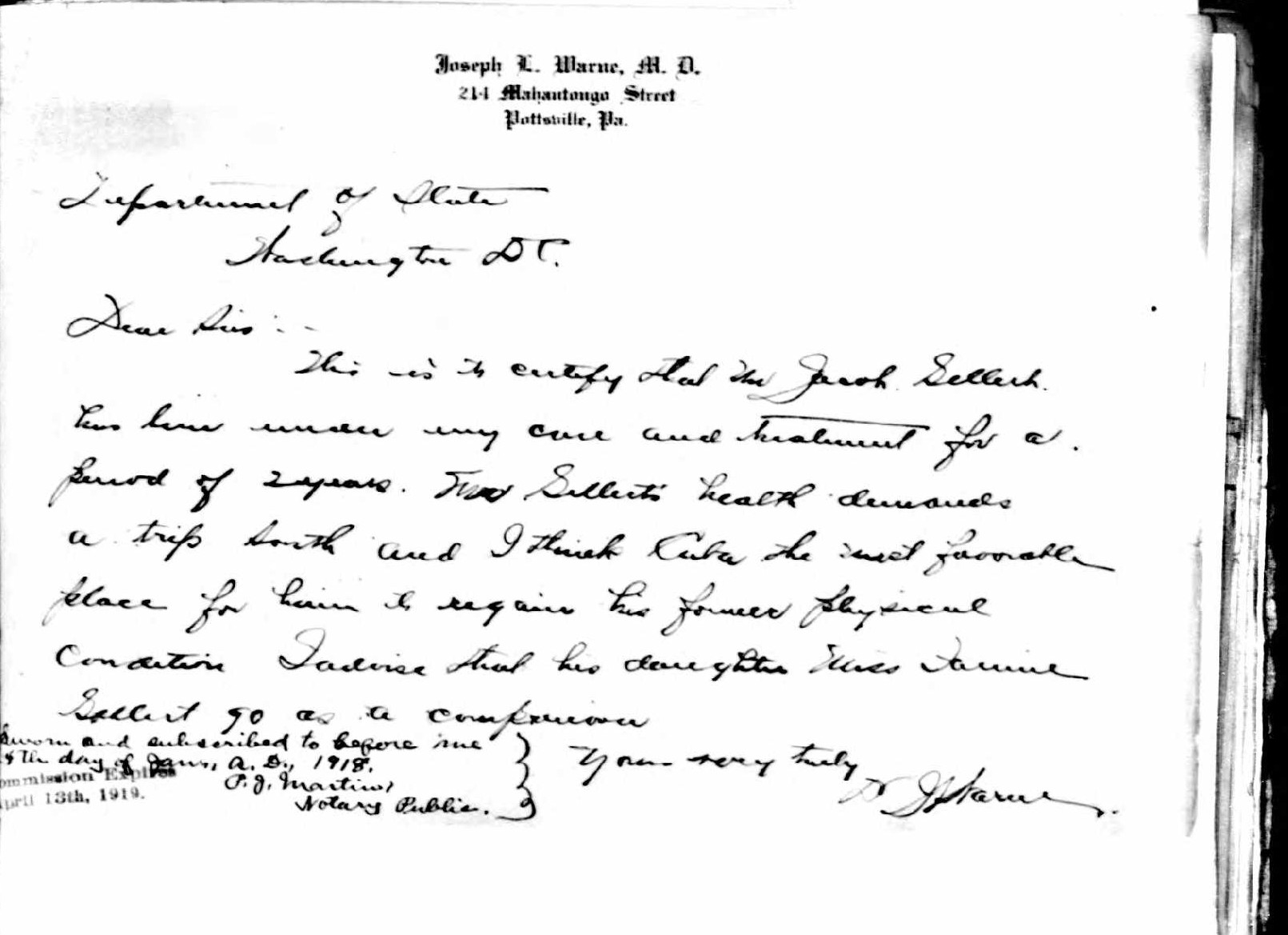
In 1910, Jacob, Bertha and Fanny were still living in Pottsville, but Jacob was now an insurance salesman, not a tailor.  Sadly, as seen above, Bertha died seven years later from diabetes.  She was only 51 years old.  A few months after Bertha’s death, Jacob and Fanny both applied for passports in order to take a trip to Cuba—for “pleasure and rest,” as Jacob wrote on his passport application.  Attached to Fanny’s application was a letter from a doctor, attesting to the health reasons for this trip to Cuba:

Ancestry.com. U.S. Passport Applications, 1795-1925 [database on-line]. Provo, UT, USA: Ancestry.com Operations, Inc., 2007.

Here is Fanny’s photograph from her passport application:

Ancestry.com. U.S. Passport Applications, 1795-1925 [database on-line]. Provo, UT, USA: Ancestry.com Operations, Inc., 2007.

Ancestry.com. U.S. Passport Applications, 1795-1925 [database on-line]. Provo, UT, USA: Ancestry.com Operations, Inc., 2007.

By the 1920 census, however, Jacob and Fanny were back in Pottsville. Jacob was now a widower, and his daughter Fanny was living with him.  Jacob had his own business selling fire insurance.  The following year, Fanny married Lester Guttman Block.  Lester was born in Trenton, New Jersey, in 1895, the son of German immigrants, Daniel and Bertha.  (Yes, his mother’s name was the same as that of his wife’s mother.)  His father was a clothing merchant.  In 1920, Lester was living with his widowed mother and his sister Alice in Trenton, where he worked as a clothing salesman in a retail store.

Fanny Gellert and Lester Block had two daughters born in the 1920s.  Fanny’s father Jacob died from a brain tumor on July 23, 1927; he was 55 years old.  His second wife Reba H. Gellert is named on the death certificate; he had married her by 1922, as they are listed together in the Pottsville directory of that year.  Max Gellert of Pottsville, Jacob’s brother, was named as the informant.  Notice also that Jacob’s mother’s name is given as Fanny Cohen.  Like his daughter, Jacob had married someone whose mother had the same name as his mother.  Could Fanny have been named for both of her grandmothers? Probably not since Jacob’s mother Fanny was still alive long after Jacob and Bertha’s daughter Fanny was born, and ordinarily Jews do not name their children for living grandparents.

Ancestry.com. Pennsylvania, Death Certificates, 1906-1963 [database on-line]. Provo, UT, USA: Ancestry.com Operations, Inc., 2014.

Ancestry.com. Pennsylvania, Death Certificates, 1906-1963 [database on-line]. Provo, UT, USA: Ancestry.com Operations, Inc., 2014.

In 1930 Lester and Fanny were living with their daughters as well as Lester’s mother Bertha.  One of the daughters had a name starting with B, and since Lester’s mother was still alive, I assume that the daughter was named for Bertha Levy Gellert, Fanny’s mother.  Lester was in the real estate and insurance business.  In 1940, the members of the household were the same, and Lester was still an insurance agent, like his father-in-law Jacob.

Lester died on December 18, 1953, and is buried at Greenwood Cemetery in Trenton.  Fanny Gellert Block, the granddaughter of Fanny Wiler Levy,the great-granddaughter of Caroline Dreyfuss Wiler, and my third cousin, twice removed, died on July 9, 1977, when she was 78 years old.  She is buried at Greenwood Cemetery with her husband Lester.

Trenton Evening Times, July 30, 1977, p. 31

Trenton Evening Times, July 30, 1977, p. 31

I am currently trying to contact the descendants of Fanny and Lester.  I am hoping that they also will find meaning in the lives of our mutual ancestors and cousins.


View of Pottsville, Pennsylvania.

View of Pottsville, Pennsylvania. (Photo credit: Wikipedia)


Embed from Getty Images