Unknown's avatar

About Amy

I am interested in genealogy and family research, books, movies, cats, dogs, and baseball.

Milton Goldsmith’s Family Album, Part VIII: Birth Records

This is Part VIII of an ongoing series of posts based on the family album of Milton Goldsmith, so generously shared with me by his granddaughter Sue. See Part I, Part II, Part IIIPart IVPart VPart VI and Part VII at the links.

This record of the births of five of the children of Abraham Goldsmith and Cecelia Adler touched my heart.

I love the florid old script.  Who wrote these entries? Was it Abraham or Cecelia? I wasn’t sure at first, but I was reassured by this record that all the dates I had for the births (and deaths) of these five children were correct.  I loved that the writer added the time of birth, giving a personal touch to the facts.

For the first two entries, there are also Hebrew inscriptions. Thank you to Tracing the Tribe for helping me with these.  For Milton, it says “Mendel Goldsmith born 12 Sivan  5621.” Milton had mentioned on an earlier page that Mendel was his Hebrew name given to him in memory of his maternal grandfather.

The second entry is for Hildegard or Hilda, as she was called on the records I found. How sweet to see the formal name her parents gave her. Hilda died two months before her fourteenth birthday, as I wrote here and as noted on this record. Looking at this entry more carefully, I noted that whoever wrote the entry for her death had also written the entry for her birth.  It is the same handwriting.  And since her mother Cecelia had died in 1874, two years before Hilda died on June 7, 1876, that means that Abraham wrote this entry and all the other birth entries on this record.

No one on Tracing the Tribe was able to translate the Hebrew inscription for Hildegard except to say that it also states her birth date. Her Hebrew name was not legible. I guess Abraham’s Hebrew writing had deteriorated between Milton’s birth and Hilda’s. And the fact that he did not include any Hebrew for the next three children’s birth records may be a sign of his assimilation into secular American society.

It’s also interesting to see how Abraham introduced these entries.  Milton was “our boy.”  Hildegard was “our daughter.” Edwin has no descriptive introduction, nor does Emily, but Rosalinda is “our fourth baby.” (I also never knew that Rose was formally named Rosalinda—what a beautiful name!) I wonder whether Abraham wrote each of these at the time the baby was born or all at once. Since some of these have introductions and others do not, I think each was done separately when each baby was born.

For the last three entries—for Edwin, Rosalinda, and Emily—someone other than Abraham inscribed the information about their deaths. I assume Milton added this information as he outlived all three of those siblings. And there is no death date added to the entry made for Milton.

What is perhaps most perplexing about this page from Milton’s album is the absence of an entry for Abraham and Cecelia’s sixth child, Estelle. Estelle was born on January 20, 1870. Had Abraham lost interest in recording his children’s births by the time his sixth child was born? Or was there a second page that included Estelle (and perhaps Abraham’s four children with his second wife Frances Spanier) that somehow was lost and thus not included in Milton’s album?


A Brother’s Will: A Caring Sibling

By 1910, Lena Goldsmith and her husband Gustavus had passed away, but they were survived by their six children and by nine grandchildren—Frank’s four children, Joel’s three children, and Joseph’s two children. All their children and grandchildren were living in Columbus, Ohio, except for their daughter Ella, who was living with her husband Isidor Shatz in Findlay, Ohio.

Two members of the family died in 1915. First, Jacob Basch died at age 56 from a cerebral hemorrhage on April 5, 1915. He had been suffering from chronic nephritis and myocarditis. His brother Joel was the informant on the death certificate.

Ohio, County Death Records, 1840-2001,” database with images, FamilySearch (https://familysearch.org/ark:/61903/3:1:S3HT-62VC-K3N?cc=2128172&wc=7DZ2-PQ7%3A1296032501%2C1296751602 : 2 October 2014), Franklin > Death certificates, 1915, no 1-1803 > image 995 of 1856; county courthouses, Ohio.

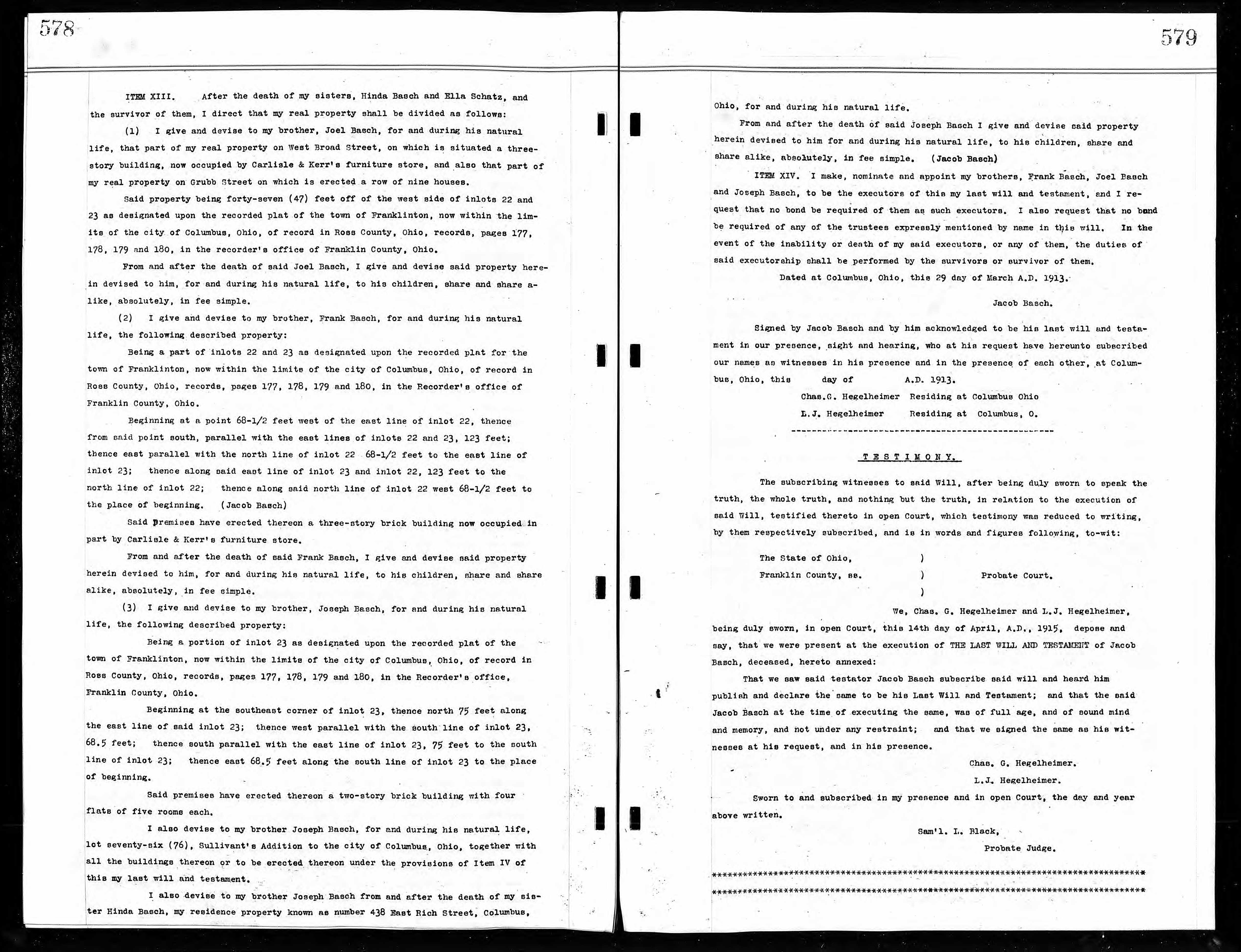
Jacob had never married and had no descendants, but he left a very long and very detailed will, and it is clear from reading it just how close-knit these siblings were. Jacob provided for all five of his siblings and named all three of his brothers to be the executors of his will. It is obvious that he gave a lot of thought to how he wanted his assets divided.


I, Jacob Basch, of the city of Columbus, county of Franklin and state of Ohio, do make this my last will and testament, hereby revoking any and all former wills by me heretofore made:

ITEM I. I direct that all my just debts and funeral expenses be paid out of my estate as soon as practicable after the time of my decease.

ITEM II. I give and bequeath to the National Jewish Hospital for Consumptives in Denver, Colorado, the sum of one thousand dollars ($1000.00).

ITEM III. I give and bequeath to the United Jewish Charities of Columbus, Ohio, the sum of five hundred dollars ($500.00).

ITEM IV. I give and bequeath to my brother Joseph Basch, in trust, the sum of five thousand dollars (5000.00) upon the following trust and purpose, to-wit: to construct and erect, at a cost not to exceed the sum of five thousand dollars ($5000.00) an income producing structure upon the plot of ground described and delineated as lot seventy-six (76), Sullivan’s Addition to the city of Columbus, Ohio, being the piece of ground hereinafter devised to my brother Joseph Basch for and during his natural life, and upon his death, to his children, share and share alike absolutely and in fee simple. I direct that the trust fund provided for in this Item of my will be raised by the sale of such amount of my said securities as shall be necessary. In the event that said structure shall not cost the sum of five thousand dollars ($5000.00), the balance of said trust found shall be distributed among my brothers and sisters, share and share alike.

ITEM V. I give and bequeath to my brother Frank Basch an equal one-fifth (1/5) part of my personal property remaining after the payment of my just debts and funeral expenses and the legacies mentioned in Items II and III of this my last will and testament and the setting aside of the trust fund provided for in Item IV of this my last will and testament.

ITEM VI. I give and bequeath to my brother Joel Basch an equal one-fifth (1/5) part of my personal property remaining after the payment of my just debts and funeral expenses and the legacies mentioned in Items II and III of this my last will and testament and the setting aside of the trust fund provided for in Item IV of this my last will and testament.

ITEM VII. I give and bequeath to my brother Joseph Basch an equal one-fifth (1/5) part of my personal property remaining after the payment of my just debts and funeral expenses and the legacies mentioned in Items II and III of this my last will and testament and the setting aside of the trust fund provided for in Item IV of this my last will and testament.

ITEM VIII. I give and bequeath to my brother Joseph Basch in trust the remaining two-fifths (2/5) part of my personal property remaining after the payment of my just debts and funeral expenses and the legacies mentioned in Items II and III of this my last will and testament and the setting aside of the trust fund provided for in Item IV of this my last will and testament, to be held and used by him during the lives of my sisters Hinda Basch and Ella Schatz and during the life of the survivor of them, upon the following trust, to-wit: To invest and re-invest the proceeds of said personal property in United States, state or municipal bonds or in first mortgages upon improved city real estate, and to pay each of my said sisters Hinda Basch and Ella Schatz during their lives an equal one-half (1/2) of the net income of said investments, and after the death of one of my sisters to pay all the income of said investments to the survivor of them.

After the death of my said sisters Hinda Basch and Ella Schatz and the survivor of them, I give and bequeath said principal sum herein provided to Joseph Basch in trust of my said sisters, to my brothers Frank Basch, Joel Basch and Joseph Basch, share and share alike. In the event of the death of either or any of my said brothers before the death of the survivor of my said sisters Hinda Basch and Ella Schatz, then the share of said principal which would have been received by said deceased brother, if living, shall be distributed among his children, then living, share and share alike.

ITEM IX. In the division of my personal property bequeathed in Items V, VI, VII and VIII of this my last will and testament, I direct that the then value of my personal property be first ascertained and that a sufficient amount in cash to pay the legacy bequeathed to my brother Joseph Basch in trust for my sisters Hinda Basch and Ella Schatz and the survivor of them, be raised by the sale of such amount of my securities as shall be necessary.

I further direct that my said legatees Frank Basch Joel Basch and Joseph Basch may retain by way of investment any securities belonging to my estate at the time of my death, dividing said securities amongst themselves in such manner as to carry out the provisions of Items V, VI, and VII of this my last will and testament. In the event that my said legatees Frank Basch, Joel Basch and Joseph Basch can not agree as to the manner of division of such securities, then I direct that my executors shall sell all of said securities and apportion the proceeds in the manner directed in Items V, VI, and VII of this my last will and testament.

In the event of the death of my said trustee, Joseph Basch, I then appoint my brothers Frank Basch and Joel Basch and the survivor of them to act as such trustees and trustee, with full power to carry out the provisions of said trust.  I further direct that said trustees and trustee shall be bound by the limitations imposed upon my said trustee, Joseph Basch, as to the manner of investing said trust fund.  It is also my will that all future trustees who may be appointed to carry out the provisions of the within trust be likewise bound by said limitation as to the manner of investing said trust fund.

ITEM X. I give and devise to my sister Hinda Basch for and during her natural life my residence property known as 438 East Rich Street, Columbus, Ohio. From and after the death of said Hinda Basch I give and devise said property herein devised to her for and during her natural life to my brother Joseph Basch for and during his natural life. From and after the death of my said brother Joseph Basch, I give and devise said property herein devised to him for his natural life to his children, share and share alike absolutely, in fee simple.

I give and bequeath to my sister Hinda Basch absolutely all furniture, books, pictures and household effects which at the time of my decease shall be in, about or belonging to my aforesaid residence.

ITEM XI. I give and bequeath to my sister Hinda Basch an annuity of twelve hundred dollars ($1200.00) per year, for and during her natural life, payable on the first day of each and every month, and the payment of the same is hereby made a charge upon the realty hereinafter devised to my sister Ella Schatz, for and during her natural life. It is my will and I direct that said annuity of twelve hundred dollars ($1200.00) per year shall be a first and best lien on said real estate hereinafter devised to my said sister, Ella Schatz, for and during her natural life, and in the event said premises shall be destroyed by fire or rendered unfit for habitation so that the income derived from said real estate shall not be sufficient to pay said annuity, then in that event said annuity shall be paid out of the fund or funds realized from the fire insurance on said real estate. It being my will that in any and all events my said sister, Hinda Basch, shall receive an annuity of twelve hundred dollars ($1200.00) per year payable out of the real estate, either income or principal, hereinafter devised to my said sister, Ella Schatz, for and during her natural life.

In the event of the death of my said sister, Hinda Basch, before the death of my said sister, Ella Schatz, it is my will and I so direct, that my said sister Ella Schatz shall enjoy all of the net income of my said real estate hereinafter devised to her for and during her natural life.

ITEM XII. I give and bequeath to my sister Ella Schatz, for and during her natural life, subject to the annuity hereinbefore bequeathed to my sister Hinda Basch, all my real property, except my residence property hereinbefore devised to my sister, Hinda Basch.

My said devisee Ella Schatz shall keep the buildings upon said real estate in good repair and insured against loss by fire, and shall pay for such repairs, premiums of insurance, taxes and charges of every kind which may be lawfully claimed against said real estate. In case of loss by fire or other damage to such buildings and houses, I direct that my said devisee, Ella Schatz, shall rebuild and repair such property and pay for such rebuilding and repairing from the funds received for insurance.

In the event of the death of my said sister, Ella Schatz, before the death of my sister Hinda Basch, then in that event I give, devise and bequeath all of said real estate herein devised to my sister Ella Schatz, for and during her natural life, to my sister Hinda Basch, for and during her natural life.

Last will and testament of Jacob Basch, Will Records, 1805-1918 ; Index, 1805-1905; Probate Place: Franklin, Ohio,  Will Records, Vol Mm-Oo, 1915-1917,
Ancestry.com. Ohio, Wills and Probate Records, 1786-1998

ITEM XIII. After the death of my sisters, Hinda Basch and Ella Schatz, and survivor of them, I direct that my real property be divided as follows: [Each brother is then devised a specific property for their use and benefit during their lives and then to their children.]

ITEM XIV. I make, nominate and appoint my brothers, Frank Basch, Joel Basch and Joseph Basch, to be the executors of this my last will and testament, and I request that no bond be required of them as such executors. I also request that no bond be required of any of the trustees expressly mentioned in this will. In the event of the inability of death of my said executors, or any of them, the duties of said executorship shall be performed by the survivors or survivor of them.

Dated at Columbus, Ohio, this 29 day of March A.D. 1913

                                                            Jacob Basch

Signed by Jacob Basch and by him acknowledged to be his last will and testament in our presence, sight and hearing, who at his request have hereunto subscribed our names as witnesses in his presence and in the presence of each other, at Columbus, Ohio, this day of A.D. 1913

[names of witnesses]


A few observations about this will:

Jacob was apparently quite a well-to-do man, having not only what appears to be a fair amount invested in securities but also substantial real estate holdings. He also had a very sophisticated and specific plan for how he wanted his assets distributed. He appears to have had a slight bias in favor of his youngest sibling Joseph—giving him a special bequest of $5000 to build an income-producing building in addition to the bequest of his one fifth of the residual estate and naming him as the trustee of the trusts for his sisters Hinda and Ella and as their successor in interest after both had died. But overall he provided in his will for all five of his siblings and for his nieces and nephews.

Just seven months after Jacob’s death, his sister Ella lost her husband Isidor Shatz. Isidor was 67 and died on November 18, 1915 from paralytic ileus (an intestinal obstruction) and the suppression of urine followed by uremia. Joseph Basch was the informant on his death certificate. And although Isidor and Ella had been living outside of Columbus for all their married years, Isidor was, like Jacob and his parents, buried at Green Lawn Cemetery in Columbus.

“Ohio Deaths, 1908-1953,” database with images, FamilySearch (https://familysearch.org/ark:/61903/3:1:33SQ-GPFX-SYCQ?cc=1307272&wc=MD9F-XTL%3A287601901%2C294657901 : 21 May 2014), 1915 > 57771-60750 > image 2547 of 3300.

Ella then returned to Columbus and was living with her sister Hinda at 438 East Rich Street, the long-time family residence that Jacob had bequeathed to Hinda. From there  Ella was also in a better position to maintain the real estate that Jacob had left to her.

The Family of Lena Goldsmith Basch 1900-1910: A Tight Circle in Columbus

As of 1900, Lena Goldsmith Basch was living with her husband Gustavus and two of her adult children, Jacob and Hinda, in Columbus, Ohio.  Two of her other children—Frank and Joseph—were also still living in Columbus with their families. And the final two of her six children—Joel and Ella—were living with their families in Findlay, Ohio. Gustavus and Lena had five grandchildren in 1900—Frank’s three children and Joel’s two sons.

On June 27, 1901, Gustavus Basch died in Columbus at the age of 76. According to the Franklin County Record of Deaths, his cause of death was gastroenteritis from which he’d been suffering for six weeks.1

A year and a half later on January 24, 1903, the family suffered a tragic loss when four-year-old Robert Basch, the son of Joel and Jeanette Basch, died.2 According to the February 5, 1903 issue of the local Findlay newspaper, The Weekly Jeffersonian (p.7),  little Robert died from Bright’s disease or what we would now call nephritis—kidney disease. Both Gustavus and Robert were buried at Green Lawn Cemetery in Columbus.

Joel and Jeanette then had another child. Gustavus Mendel Basch was born on April 3, 1904, in Findlay, Ohio.3 He was obviously named for his recently-deceased grandfather. He was not the only grandchild born in this decade. Frank and his wife Freda had a fourth child, Ruth, born May 14, 1905.4 And Joseph and his wife Ida had twins born on April 5, 1906: Elene Rosalie Basch5 and Gustavus Joseph Basch,6 who like his cousin Gustavus Mendel Basch, was clearly named for his grandfather. (Joseph’s son later dropped the first name Gustavus and was known as Joseph, Jr.)

And who was Elene Rosalie named for? Sadly, her grandmother Lena Goldsmith Basch died just two weeks before Elene and Gustavus were born, and Elene must have been named for Lena. Lena was 80 years old and died from cerebral sclerosis from which she’d been suffering for five years, according to her death certificate. She was also buried at Green Lawn Cemetery in Columbus.

Ohio, County Death Records, 1840-2001,” database with images, FamilySearch (https://familysearch.org/ark:/61903/1:1:F6VT-TY1 : 10 March 2018), Lena Basch, 26 Mar 1906; citing Death, Columbus, Franklin, Ohio, United States, source ID 1906 v 2 fn 176, County courthouses, Ohio; FHL microfilm 2,032,443.

The March 27, 1906 issue of the Findlay (OH) Weekly Courier gave more insight into Lena’s demise:

“Died Friday in Columbus,” The (Findlay, OH) Weekly Courier, March 27, 1906, p. 2

Lena and Gustavus were survived by all six of their children and their grandchildren.

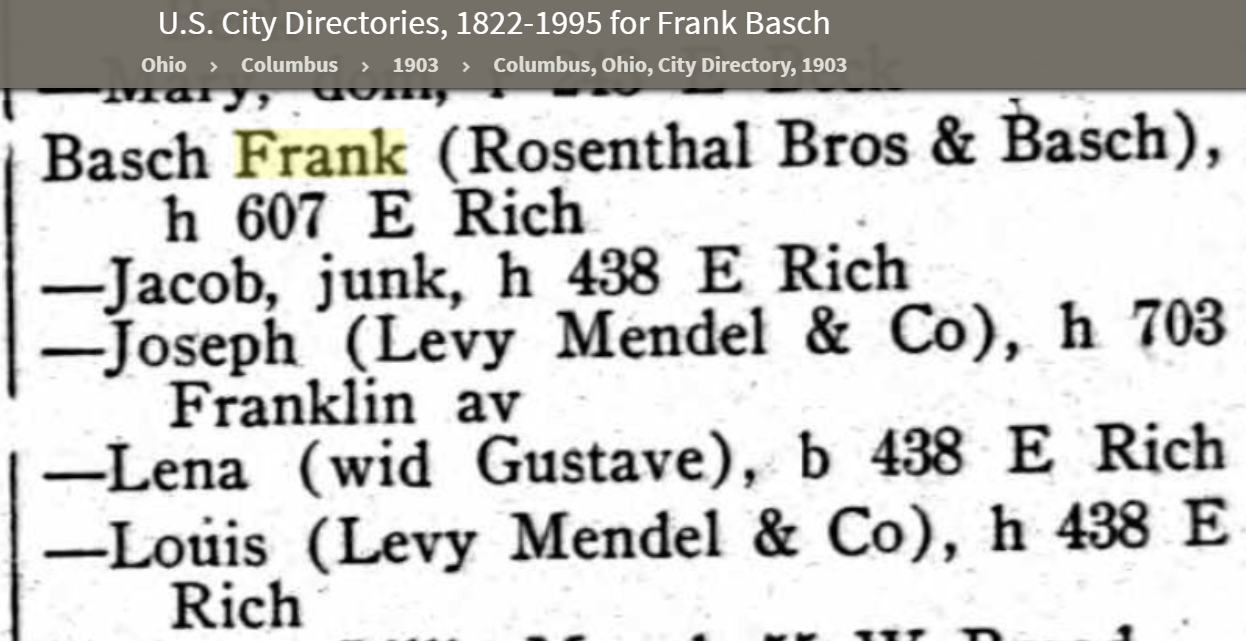
Aside from these births and deaths, the years between 1900 and 1910 were relatively quiet ones for the Basch family.  The directories for 1900-1902 show that Frank and Jacob continued to do business as Basch Brothers and Joseph and the mysterious Louis Basch continued to work at Levy Mendel & Co. In 1903, Frank was now associated with Rosenthal Bros. and Basch, his brother Jacob’s listing merely says “junk,” and Joseph and “Louis” were still at Levy Mendel. The 1904 and 1905 directories are the same, except Louis is missing from the Basch group. In fact, Louis never appears again. Given that Lena was ill for some time before she died in 1906, this seems to support my hypothesis that “Louis” was in fact Lena.7

Columbus, Ohio, City Directory, 1903
Source Information
Ancestry.com. U.S. City Directories, 1822-1995

Not long after his mother’s death in March, 1906, Joel moved back to Columbus. He sold his business in Findlay “at a great sacrifice” in order to return to Columbus, as reported in the Findlay Courier-Union on April 13, 1906 (p. 8); his father-in-law Levy Mendel had died just a month before Lena—on February 10, 1906,8 and apparently with the demise of both his mother and his father-in-law, he was needed back in Columbus to help run Levy Mendel & Company.

“National Buys Basch Stock,” The (Findlay, OH) Courier-Union, April 13, 1906, p. 8

Here is an advertisement that reveals the size and extent of Joel’s business in Findlay. He clearly had recovered from his earlier business failure caused by gambling:

Hancock County (OH) Herald, April 20, 1906, p. 10

Joel is listed in the 1906 Columbus directory, working for Levy Mendel & Co.; his brother Joseph was also still working there as he had been for a number of years.9

The 1906 Columbus directory raised another question for me. Frank is no longer listed with Rosenthal Bros. and Basch and in fact has no occupation listed at all. In 1907 he and Jacob now both have “junk” listed as their occupation, but in 1908 Frank again has no occupation listed though Jacob still lists junk as his occupation. The same is true for 1909 and for 1910.10

In fact, on the 1910 census, Frank reported that he had not worked for the entire year. Was he ill? Or had he just retired? He was only 53 years old in 1910. But since he lived another 24 years and listed that he was retired in 1920, I am inclined to think that Frank had just taken an early retirement. His four children were still quite young in 1910—ranging from five to fourteen years old.  How fortunate he was to be able to retire and spend more time with them.

Frank Basch, 1910 US census, Census Place: Columbus Ward 3, Franklin, Ohio; Roll: T624_1180; Page: 8A; Enumeration District: 0057; FHL microfilm: 1375193
Ancestry.com. 1910 United States Federal Census

His brother and long-time business partner Jacob, however, continued to work in the “iron and rags” business, as reported on the 1910 census. Jacob and his sister Hinda were still living in their family home at 438 East Rich Street in Columbus. Neither ever married.11

Joel Basch continued to work at Levy Mendel & Co., the cigar company. In fact, on the 1910 census, he is reported as an employer so he must have had some ownership or management interest in the business.12

Interestingly, Levy Mendel had named Joseph Basch, not his sons or son-in-law, to be his executor of his estate.13 Joseph had worked at the company for many years and was not an heir, so presumably Levy thought he would be a fair and capable executor. On the 1910 census, Joseph is also listed as an employer at Levy Mendel & Co, so perhaps he also was a part-owner of the business.14

I was very fortunate to find an oral history interview that was done by the Columbus Jewish Historical Society with Alan Weiler, grandson of Joseph Basch, on April 8, 2008. There are other interesting parts of this interview that I may refer to in later posts, but for now, I just wanted to quote this small portion that sheds light on the business in which Joseph, Joel, and their parents Gustavus and Lena had been involved and gives a snapshot of Joseph Basch himself.

My grandfather, Joe Basch owned a tobacco and candy company near the old Union Station on North High Street called the Levi Mendel Tobacco Company. He sold candy bars, which was of course was why I went up to see him. He sold cigars, cigarettes, pipes and there was a wonderful smell about his store. …He lived to be 93. He was called “the general.” He was a very handsome man. At least in my family he was called “the general.”

Finally, the remaining sibling, Ella Basch Shatz, was living in 1910 with her husband Isadore in Findlay, Ohio, where Isadore was a clothing merchant.15 With Joel’s return to Columbus in 1906, five of the six Basch siblings were now living in the same community. Only Ella was living outside of Columbus; she and her husband Isadore Shatz were still in Findlay even after her brother Joel and his family left that city.I wonder what it was like for Ella being the only family member not living in Columbus.  And I wonder whether she spent time visiting her siblings and nieces and nephews who were living about ninety miles away.

She would, however, be moving back to Columbus in the next decade.


  1. “Ohio, County Death Records, 1840-2001,” database with images, FamilySearch (https://familysearch.org/ark:/61903/3:1:3QS7-99ZB-P99X-5?cc=2128172&wc=7DZ2-P3M%3A1296032501%2C1296613814 : 30 September 2014), Franklin > Death records, 1899-1903, vol 3 > image 173 of 402; county courthouses, Ohio. 
  2. Ancestry.com. Web: Columbus, Ohio, Green Lawn Cemetery Index, 1780-2010. 
  3. FHL Film Number: 961484, Ancestry.com. Ohio, Births and Christenings Index, 1774-1973. 
  4. FHL Film Number: 285137, Ancestry.com. Ohio, Births and Christenings Index, 1774-1973 
  5.  Number: 277-34-4589; Issue State: Ohio; Issue Date: 1955, Ancestry.com. U.S., Social Security Death Index, 1935-2014 
  6. SSN: 365167257, Ancestry.com. U.S., Social Security Applications and Claims Index, 1936-2007. Gustavus J. Basch, 1900 US census, Census Place: Columbus Ward 3, Franklin, Ohio; Roll: T624_1180; Page: 6A; Enumeration District: 0059; FHL microfilm: 1375193, Ancestry.com. 1910 United States Federal Census. 
  7. Columbus, Ohio, City Directory, 1901-1905, Ancestry.com. U.S. City Directories, 1822-1995 
  8. Ancestry.com. Web: Columbus, Ohio, Green Lawn Cemetery Index, 1780-2010 
  9. Columbus, Ohio, City Directory, 1906, Ancestry.com. U.S. City Directories, 1822-1995 
  10. Columbus, Ohio, City Directory, 1906-1910, Ancestry.com. U.S. City Directories, 1822-1995 
  11. Jacob Basch and Hinda Basch, 1910 US census, Census Place: Columbus Ward 6, Franklin, Ohio; Roll: T624_1181; Page: 6B; Enumeration District: 0098; FHL microfilm: 1375194, Ancestry.com. 1910 United States Federal Census 
  12. Joel Basch, 1910 US census, Census Place: Columbus Ward 3, Franklin, Ohio; Roll: T624_1180; Page: 5B; Enumeration District: 0060; FHL microfilm: 1375193, Ancestry.com. 1910 United States Federal Census 
  13.  Case Number: 19766, Item Description: Will Records, Vol Z, 1904-1905, Will Records, 1805-1918 ; Index, 1805-1905; Probate Place: Franklin, Ohio, Ancestry.com. Ohio, Wills and Probate Records, 1786-1998 
  14. Joseph Basch, 1910 US census, Census Place: Columbus Ward 3, Franklin, Ohio; Roll: T624_1180; Page: 5B; Enumeration District: 0060; FHL microfilm: 1375193,
    Ancestry.com. 1910 United States Federal Census 
  15. Ella and Isadore Shatz, 1910 US census, Census Place: Findlay Ward 4, Hancock, Ohio; Roll: T624_1187; Page: 11A; Enumeration District: 0075; FHL microfilm: 1375200, Ancestry.com. 1910 United States Federal Census 

Milton Goldsmith’s Family Album, Part VII: Abraham Goldsmith and Cecelia Adler Get Married

This is Part VII of an ongoing series of posts based on the family album of Milton Goldsmith, so generously shared with me by his granddaughter Sue. See Part I, Part II, Part III, Part IV, Part V, and Part VI at the links.

On the page following the photographs of his parents Abraham and Cecelia, Milton included a letter written by his mother on November 5, 1857, which, according to Milton, was shortly before their engagement.

Reading this reminded me of what it was like before cheap phone calls and email made handwritten letters obsolete. When my husband and I were dating the year before our engagement, we also wrote letters back and forth. Of course, we were living several hundred miles apart (but still tried to see each other every weekend) whereas Abraham and Cecelia both were living in Philadelphia. But perhaps letters were the only places they had any ability to communicate privately.

Here is Cecelia’s letter:

Some words were cut off on the right margin and at the bottom, but I have tried to transcribe it as best I can and added some punctuation and capitalization for purposes of clarity. Cecelia was a few weeks short of her nineteenth birthday when she wrote this letter, and Abraham was twenty-five.


                                                                                                         Phil. Nov. 5th

Dear Ab,

The few lines you have written to me give me a great deal of pleasure, for informing me of your health & good night’s rest. I passed an excellent night as[?] my cold is a great deal better though I am rather hoarse yet.  My Dear, I forgot to give you Henrietta’s [?] shawl last night, but it will and[?] as well tonight. I would send over the boy with it, but I am afraid he can not find the place. I am obliged for sending me the book & will look through it as soon as possible. Come early this evening, if you can.

I remain yours forever,

                                                                                                         Cely

If you hear of any thing important & have time, write me a note this [?].


If anyone can read it any better than I did, please let me know.

Appropriately, Milton placed the invitation to his parents’ wedding on the page that followed:

Note that the invitation is dated January 1, 1858, for a wedding to take place on January 27, 1858—less than four weeks later. Today it seems that wedding invitations arrive at least two months in advance (often preceded by Save the Date cards). Also, the wedding was to take place at Cecelia’s parents’ home at 440 North Second Street in Philadelphia, not in a fancy catering hall or hotel or resort, as many are these days. Life was so much simpler back then.

But life was also so much harder. Cecelia died less than seventeen years later on November 8, 1874, from apoplexia nervosa, or a stroke. She was only 35 and left behind her husband Abraham and six children ranging in age from Estelle, who was four, to Milton, who was thirteen.

Gustavus and Lena Goldsmith Basch 1890-1900: Who Was Louis Basch?

In 1890, Lena Goldsmith Basch and her husband Gustavus Basch and four of their six children were living in Columbus, Ohio, where she and Gustavus were involved in a cigar business called Levy Mendel & Company. Their son Joseph was also working there in 1890. Their older sons Frank and Jacob were in the junk business together,  doing business as Basch Brothers. Daughter Hinda was also living with her parents and brothers at 407 East Rich in Columbus.

Columbus, Ohio, City Directory, 1890
Ancestry.com. U.S. City Directories, 1822-1995

Two of Gustavus and Lena’s children had left Columbus by 1890. Their younger daughter Ella had married Isadore Shatz in 1888 and moved to Cincinnati. Their third oldest son Joel was living first in Lima, Ohio, and then in Findlay, Ohio, but in 1890, his business in Findlay had failed after he had incurred some substantial gambling debts.

But Joel was not back in Columbus in 1891. The Columbus directory for that year lists Gustavus in the cigar business, presumably Levy Mendel & Co, where “Lina” and their son Joseph were also working. Jacob and Frank were still doing business as the Basch Brothers.1

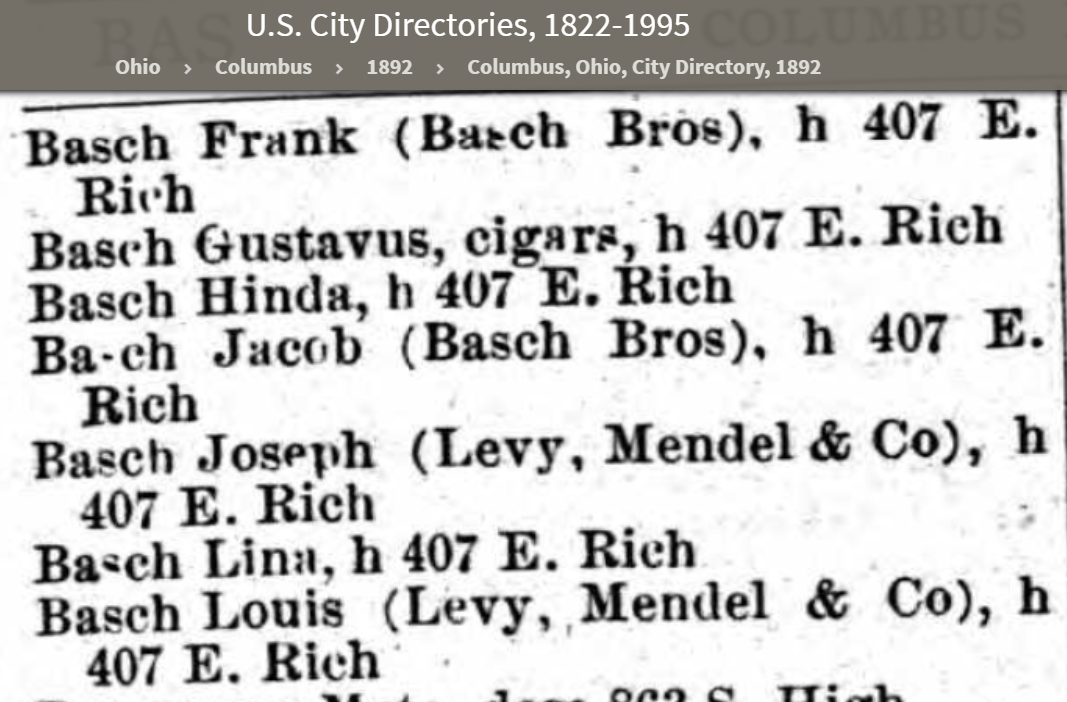
The 1892 directory is essentially the same, except for an entry that completely confused me:

Columbus, Ohio, City Directory, 1892
Source Information
Ancestry.com. U.S. City Directories, 1822-1995

Look at that last entry for Basch—Louis Basch, living at the same address—407 E. Rich—as the other family members and working for Levy Mendel & Co. Louis Basch also appears in the 1893 Columbus directory.2 Who was he? My search for a Louis Basch led me nowhere. There were a few men named Louis Basch, but they were all born much too late to be this Louis Basch or were living too far away.

So then who was Louis Basch? There was never a Louis Basch living in the same household as Gustavus and Lena on any census record. I did notice that Lena was not listed in most of the directories for the later 1890s, but Louis Basch was. Had she taken on the pseudonym of Louis Basch? After all, as reported in the prior post, the family’s junk business had once been known as L. Basch & Sons, where the L was apparently for Lena. Perhaps to disguise the fact that the business was run by a woman the family had created a male pseudonym? What do you think?

On January 25, 1893, Joel became the second of Gustavus and Lena’s children to marry. He married Jeanette Mendel, and guess whose daughter she was? Yes, Levy Mendel, the owner of the cigar company where Joel’s parents Gustavus and Lena and his brother Joseph and the mysterious “Louis” were then associated. 3 I would think that Levy Mendel must have been familiar with Joel’s past gambling issues and would not have permitted his daughter to marry Joel if he believed those problems persisted. So perhaps Joel had cleaned up his act and had been working for his future father-in-law’s business in the years before his wedding to Jeanette. As far as I can tell, Joel had no further gambling issues in his life.

Lima (OH) News, January 10, 1893, p. 8.

By 1894 Joel was was living with his wife and family in Findlay, Ohio, ninety miles away from Columbus. He and Jeanette had two sons born in the 1890s, Sidney Louis Basch on December 7, 1894,4 and Robert Basch on June 26, 1898.5  Both boys were born in Findlay, Ohio. In 1900, he and Jeanette and their two young sons were living in Findlay, and Joel listed his occupation as a merchant.

Joel Basch and family, 1900 US census, Census Place: Findlay Ward 4, Hancock, Ohio; Page: 7; Enumeration District: 0061; FHL microfilm: 1241283
Ancestry.com. 1900 United States Federal Census

By 1900, two more of Gustavus and Lena’s children were married. Their oldest child Frank married Freda Rosenthal in 1895. Freda was born in Germany in 1869 and immigrated to the US in 1887, according to the 1900 census.6 Unfortunately, I do not have any earlier records for Freda. Some Ancestry trees show her born in Cumberland, Maryland, but those trees provide no sources for that assertion, so for now I will rely on what is reported on the 1900 census. That census reported that Frank was a dealer in old iron and brass. Frank and Freda had two daughters born in the 1890s: Rachel (known as Rae), born September 3, 1896, in Ohio (presumably Columbus),7 and Coryne, born January 25, 1898, in Columbus.8  A third child, a son Lewis, was born on May 4, 1900.9

Frank Basch and family, 1900 US census, Census Place: Columbus Ward 6, Franklin, Ohio; Page: 4; Enumeration District: 0065; FHL microfilm: 1241268, Ancestry.com. 1900 United States Federal Census

Joseph Basch, the youngest of Gustavus and Lena’s six children, also married before the 1900 census. He married Ida S. Steinhauser on April 11, 1899, in Columbus. Ida was the daughter of Arnold Steinhauser and either Louisa Weichler or  Sarah Wechsler; sources conflict, and I don’t know which name was correct. Ida was born on September 2, 1872, in Franklin County, Ohio.10 In 1900, Joseph and Ida were living in Columbus, where Joseph was a tobacco merchant. More specifically, he was working for Levy Mendel & Company, as seen on the 1901 directory.11

Joseph and Ida Basch, Ancestry.com. Ohio, County Marriage Records, 1774-1993

In 1900, Ella Basch and her husband Isadore Shatz were living in Findlay, Ohio, as was her brother Joel. Isadore was a merchant.  They did not have any children after twelve years of marriage.12

In 1900, Gustavus and Lena were living with Jacob and Hinda and a servant; Gustavus reported that he was a landlord on the 1900 census, and Jacob was an iron merchant.13  Gustavus and Lena had five grandchildren by 1900—Frank’s three children and Joel’s two sons. More would arrive in the next decade.

But that first decade of the 20th century would also bring some painful losses.


  1. Columbus, Ohio, City Directory, 1891, Ancestry.com. U.S. City Directories, 1822-1995 
  2. Columbus, Ohio, City Directory, 1893, Ancestry.com. U.S. City Directories, 1822-1995 
  3. Mendel family, 1880 US census, Census Place: Columbus, Franklin, Ohio; Roll: 1016; Page: 147D; Enumeration District: 026, Ancestry.com and The Church of Jesus Christ of Latter-day Saints. 1880 United States Federal Census 
  4. Sidney Louis Basch, World War I draft registration,Registration State: Ohio; Registration County: Franklin; Roll: 1832018; Draft Board: 1, Ancestry.com. U.S., World War I Draft Registration Cards, 1917-1918 
  5. Robert Basch, FHL Film Number: 961484, Ancestry.com. Ohio, Births and Christenings Index, 1774-1973 
  6. Frank Basch and family, 1900 US census, Census Place: Columbus Ward 6, Franklin, Ohio; Page: 4; Enumeration District: 0065; FHL microfilm: 1241268, Ancestry.com. 1900 United States Federal Census 
  7. Rachel Basch, FHL Film Number: 285136, Ancestry.com. Ohio, Births and Christenings Index, 1774-1973 
  8.  Ancestry.com. Web: Columbus, Ohio, Green Lawn Cemetery Index, 1780-2010, Original data: Green Lawn Cemetery Burials. Columbus, Ohio. Joe and Dick Fleshman. http://greenlawn.delaohio.com/greenlawn/Greenlawn/index.htm: accessed 09 February 2012. 
  9. Lewis Basch, Number: 273-36-5982; Issue State: Ohio; Issue Date: 1956-1958, Ancestry.com. U.S., Social Security Death Index, 1935-2014 
  10. Ida Steinhauser, FHL Film Number: 285135, Ancestry.com. Ohio, Births and Christenings Index, 1774-1973. 
  11. Joseph and Ida Basch, 1900 US census, Census Place: Columbus Ward 7, Franklin, Ohio; Page: 8; Enumeration District: 0070; FHL microfilm: 1241268, Ancestry.com. 1900 United States Federal Census. Columbus, Ohio, City Directory, 1901, Ancestry.com. U.S. City Directories, 1822-1995 
  12. Ella and Isadore Shatz, 1900 US census, Census Place: Findlay Ward 4, Hancock, Ohio; Page: 7; Enumeration District: 0061; FHL microfilm: 1241283, Ancestry.com. 1900 United States Federal Census 
  13. Gustavus Basch and family, 1900 US census, Census Place: Columbus Ward 6, Franklin, Ohio; Page: 3; Enumeration District: 0068; FHL microfilm: 1241268, Ancestry.com. 1900 United States Federal Census 

Lena Goldschmidt Basch, Wife, Mother, and Businesswoman: 1880-1890

With my last Goldsmith post, I finished the saga of Jacob Goldsmith and his fourteen children. Now I will turn to Jacob’s sister, Lena Goldschmidt Basch and her story.

We’ve already seen that Lena, who was born to my 4-times great-uncle Simon Goldschmidt and his first wife Eveline Katzenstein in Oberlistingen on April 17, 1828, immigrated to the US in the 1850s and married Gustavus Basch in 1856. They first lived in Connellsville, Pennsylvania, then in Pittsburgh, and finally by 1878 had relocated to Columbus, Ohio, where they remained for the rest of their lives.

Lena and Gustavus had six children: Frank (1857), Jacob (1858), Hinda (1860), Joel (1863), Ella (1865), and Joseph (1867). According to the 1880 census, all of them except Jacob were then living with their parents in Columbus. Gustavus and his oldest son Frank were working in a vinegar factory; Lena and the other children were all at home. Jacob was living and working as a clerk for a hotel in Hamilton, Ohio, which is about a hundred miles southwest of Columbus.1

Gustavus Basch and family, 1880 US census, Census Place: Columbus, Franklin, Ohio; Roll: 1016; Page: 201D; Enumeration District: 029, Ancestry.com and The Church of Jesus Christ of Latter-day Saints. 1880 United States Federal Census

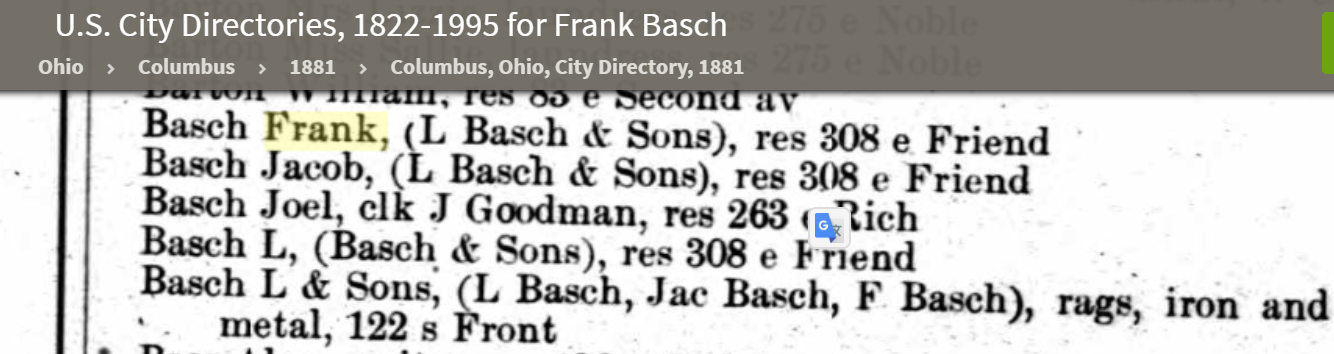
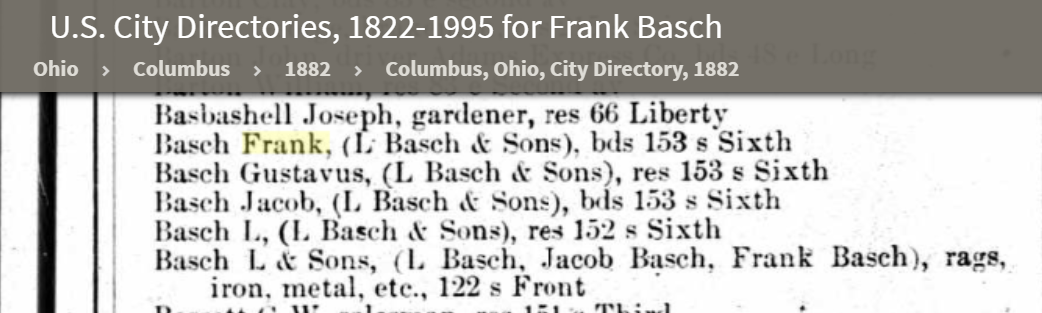
The Columbus directories in the 1880s, however, had me confused. The 1880 directory listed Gustavus as the agent for “L. Basch Vinegar Works” and residing at 308 e Friend; there were also separate listings for Frank and Joel residing at the same address and identified as “vinegar makers.” The 1881 directory did not list Gustavus at all, but listed Frank and Jacob and “L.Basch” as working for L. Basch & Sons in the rags, iron, and metal business. Those three were all still residing at 308 e Friend. Joel now was listed as a clerk for J. Goodman and residing at 268 e Friend. In 1882, Gustavus reappeared and is listed along with Frank and Jacob as working for L. Basch & Sons and now all residing at 153 e Sixth; there is also a listing for the mysterious L. Basch, also working for L.Basch & Sons and living at 152 e Sixth.2

1881 Columbus directory

1882 Columbus directory

So who was L.Basch? At first I thought it might be Gustavus’ father, whose name was Louis. But there is no listing in the 1880 census or any other census for an L. Basch who could have been Gustavus’ father. I don’t think he ever left Germany. Had Gustavus named the business in honor or memory of his father?

Or could the L stand for Lena? That certainly would have been unusual—to have a business named for a mother and her sons, especially since Gustavus was still alive and well.

The 1884 directory seemed to answer that question:

Columbus, Ohio, City Directory, 1884
Ancestry.com. U.S. City Directories, 1822-1995

So “L. Basch” was Lena! How interesting that she was the one for whom this business was named, not her husband. In fact, in 1884, Gustavus isn’t even listed with the L. Basch & Sons business; Lena must have been the one in charge.

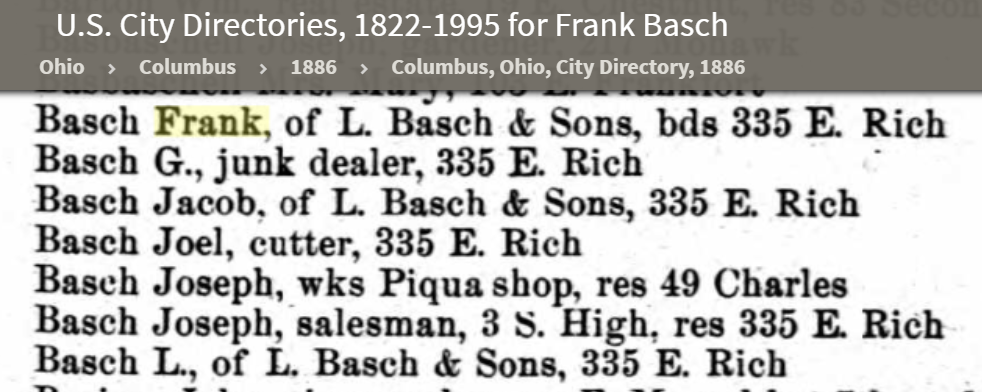
In 1886, Gustavus is back in the listings as G. Basch, junk dealer, and now the family is residing at 335 E. Rich.  Frank and Jacob were now working at L. Basch & Sons; Joel was working as a cutter, and Joseph was a salesman.

Columbus, Ohio, City Directory, 1886
Ancestry.com. U.S. City Directories, 1822-1995

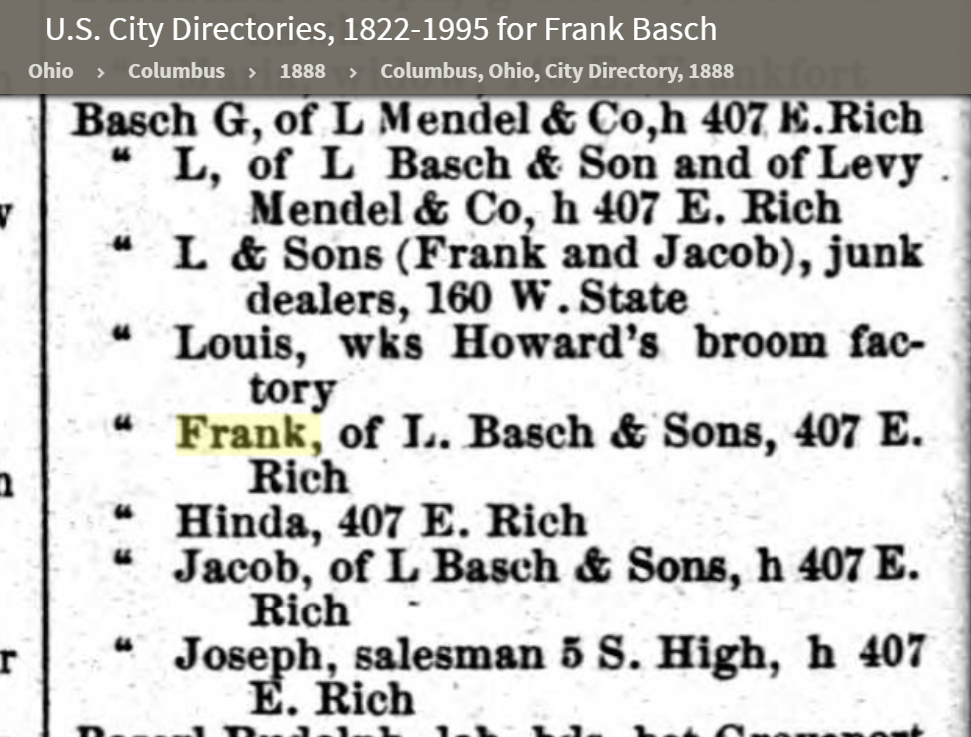
By 1888, things had changed a bit:

Columbus, Ohio, City Directory, 1888
Ancestry.com. U.S. City Directories, 1822-1995

Now Gustavus was associated with Levy Mendel & Co, as was “L[ena] Basch;” Frank and Jacob were still in the L.Basch & Sons junk business, and Joseph continued to work as a salesman. They all, as well as Hinda, were living at 407 E. Rich. Only Joel and Ella were not listed. Where were they?

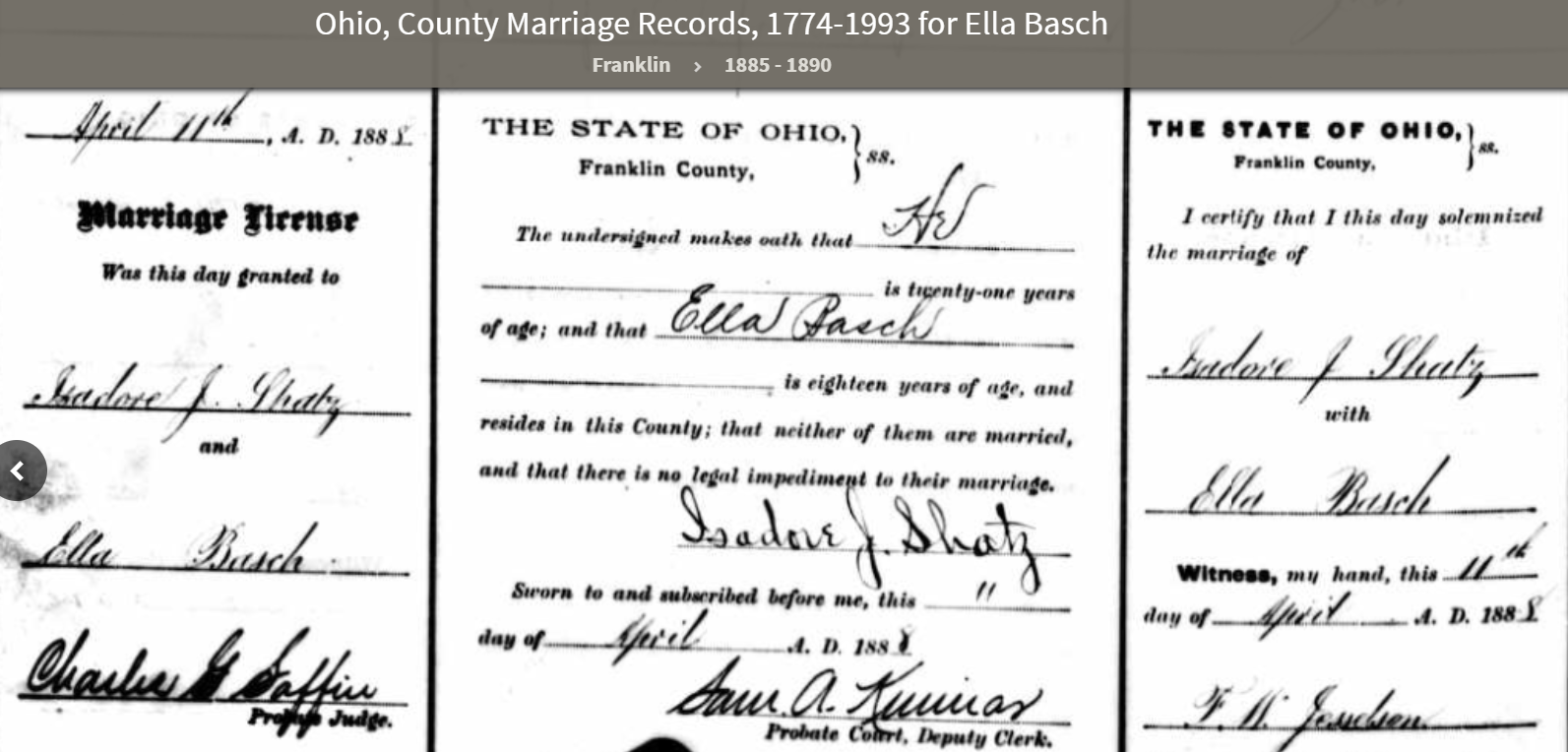
Ella, the fifth of Gustavus and Lena’s six children, was the first to get married. She married Isadore Shatz on April 11, 1888, in Columbus. He was thirty, she was 22. Isadore was born on December 25, 1857, in Austria- Hungary,3 and immigrated to the US when he was six in 1863 with his parents David and Fannie Shatz.4 They settled in Cincinnati where David Shatz was working as a stone cutter in 1870.5 In 1880, Isadore was working as a clerk and living with his family in Cincinnati.6 The 1886 Cincinnati directory lists Isadore as a salesman, his father David as a foreman cutter.7

Ella Basch and Isadore Shatz, Ancestry.com. Ohio, County Marriage Records, 1774-1993

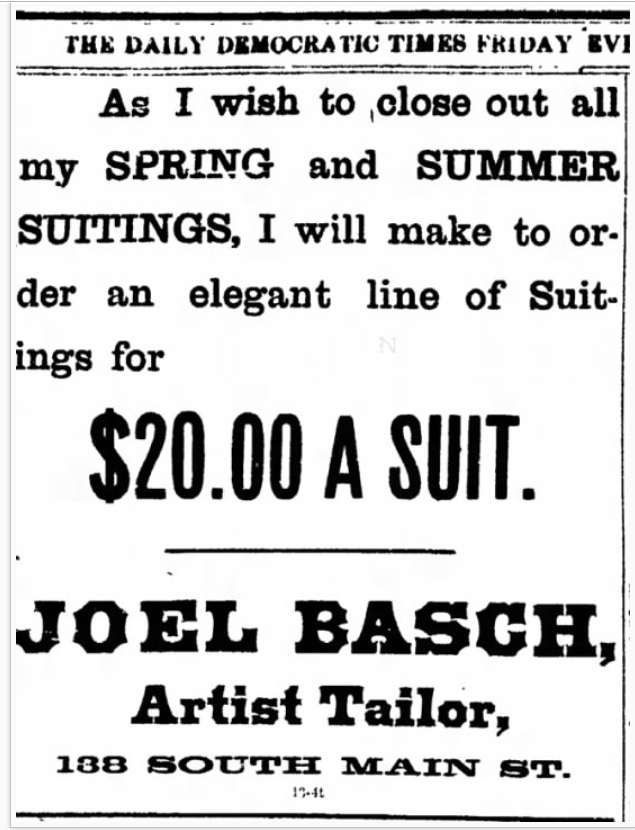
As for Joel, I could not find him in the Columbus directories after 1886, so I turned to the newspaper databases to see if I could locate him. From this ad in The Lima News of June 29, 1888 (p.4), I knew that Joel had moved to Lima, Ohio, where he was an “artist tailor” making men’s suits for $20. Twenty dollars—imagine that! Lima is approximately 90 miles from Columbus.

In fact, Joel had been in Lima for a while because this article from the January 17, 1888, Lima News (p. 4) revealed that Joel had suffered $2500 worth of smoke and water damage due to a fire at his store in Lima. Fortunately his losses were covered by insurance:

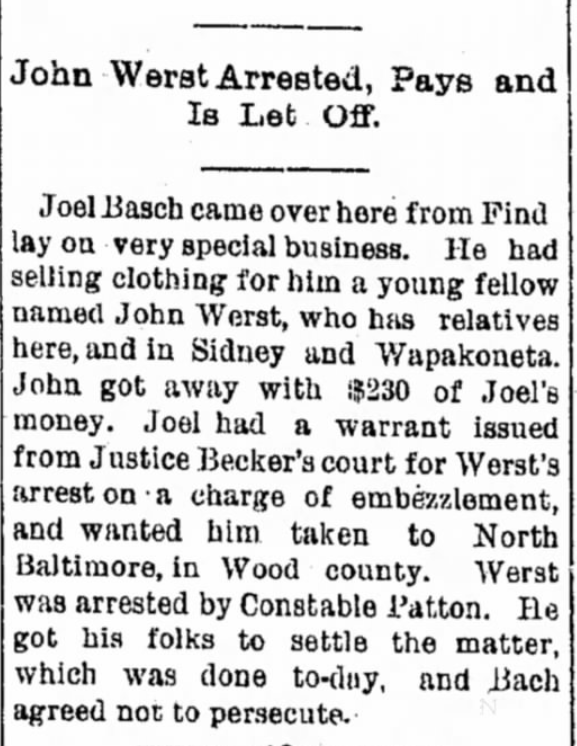
By 1889 Joel had apparently left Lima and was working in Findlay, Ohio, which is 34 miles from Lima and 92 miles from his family in Columbus. This article reports that one of Joel’s employees had embezzled $230 from Joel.

“John Werst Arrested, Pays and Is Let Off,” Lima (OH) News, August 15, 1889, p. 4

Was all this just bad luck, or was something else going on? I ask because of the next article from the February 6, 1890 Lima News (p. 4). Apparently Joel was a bit of a gambler, and after losing a considerable amount of money, his family shut down his Findlay store:

Given that ending to his Findlay business, I wondered whether the fire and reported embezzlement were also schemes engineered by Joel to cover gambling debts.

Looking at Gustavus’ work record beginning in 1860 raises some questions about his business acumen as well. In 1860, he was a clothing merchant in Connellsville. In 1870, he was working for H. Bier & Company, a brass foundry in Pittsburgh. In 1880, he was in Columbus working for a vinegar company. In the 1880s he worked for some of the time in L. Basch & Sons, a junk dealership run by his wife Lena, and then for Levy Mendel & Company, a cigar company.  There are some directories where he had no occupation listed. That is quite a list of businesses over a thirty year period with no real consistency in the industries in which he worked—clothing to brass to vinegar to junk to cigars. The fact that he also moved with his family several times also creates a sense of instability.

But once the family settled in Columbus in the 1880s, for the most part they stayed put. Maybe Gustavus was a renaissance business man, using his skills in numerous varied enterprises, and not a flighty man who couldn’t find his niche. It’s hard to know.


UPDATE on Rebecca Goldsmith Levy: I was able to obtain a copy of her death certificate from Colorado. Please see this post for more information.


  1. Jacob Basch, 1880 US census, Census Place: Hamilton, Butler, Ohio; Roll: 997; Page: 409B; Enumeration District: 036, Ancestry.com and The Church of Jesus Christ of Latter-day Saints. 1880 United States Federal Census 
  2.  Columbus, Ohio, City Directory, 1880, 1881, 1882, Ancestry.com. U.S. City Directories, 1822-1995 
  3. Ohio Deaths, 1908-1953,” database with images, FamilySearch (https://familysearch.org/ark:/61903/3:1:33SQ-GPFX-SYCQ?cc=1307272&wc=MD9F-XTL%3A287601901%2C294657901 : 21 May 2014), 1915 > 57771-60750 > image 2547 of 3300. 
  4. Shatz, 1900 US census, Census Place: Findlay Ward 4, Hancock, Ohio; Page: 7; Enumeration District: 0061; FHL microfilm: 1241283, Ancestry.com. 1900 United States Federal Census 
  5. Shatz, 1870 US census, Census Place: Cincinnati Ward 1, Hamilton, Ohio; Roll: M593_1209; Page: 99A; Family History Library Film: 552708, Ancestry.com. 1870 United States Federal Census 
  6. Shatz, 1880 US census, Census Place: Cincinnati, Hamilton, Ohio; Roll: 1028; Page: 15B; Enumeration District: 166, Ancestry.com and The Church of Jesus Christ of Latter-day Saints. 1880 United States Federal Census 
  7. Cincinnati, Ohio, City Directory, 1886, Ancestry.com. U.S. City Directories, 1822-1995 

Milton Goldsmith’s Family Album, Part VI: His Parents, Abraham and Cecelia

This is Part VI of an ongoing series of posts based on the family album of Milton Goldsmith, so generously shared with me by his granddaughter Sue. See Part I, Part II, Part III, Part IV and Part V at the links.

Now that we have seen the pages Milton devoted to his maternal and paternal grandparents, we can turn our attention to those devoted to his parents, Abraham Goldsmith and Cecelia Adler.

First, there is this page:Although they are not labeled, the paired photographs at the bottom must be Cecelia Adler and Abraham Goldsmith. I know this because the photograph on the upper right is one I’ve seen before—I received it from my cousin Julian Reinheimer over a year ago,  labeled as Julian’s great-grandfather, Abraham Goldsmith. So I know that the upper photograph is Abraham, and he is certainly the same man as the man in the photograph at the lower right.

Abraham Goldsmith, courtesy of Julian Reinheimer

I also know that the woman on the left is Cecelia because Julian also sent me this photograph of his great-grandmother Cecelia, and she is the same woman as the woman on the left in the photograph above:

Cecelia Adler, courtesy of Julian Reinheimer

Could the two framed photographs be their wedding photographs?

Cecelia was only nineteen in 1858 when they married, Abraham was six years older or twenty-five. Somehow they look older than that in these photographs, but I am terrible at determining age in these old photographs when people dressed so formally and posed so stiffly without smiling. It’s obvious, however, that these two photographs were taken at the same studio and likely at the same time, given that the same table appears in both. I wonder if there was a date on the reverse, but it is not worth trying to remove the photograph from the album to check.

According to Milton, his grandfather Samuel Adler was not successful in business, but Cecelia certainly is dressed very well in this photograph and is wearing what appears to be a large cameo pendant, similar or perhaps the same as the one in the photograph I received from Julian, seen above. Was this taken after she married Abraham, who was in fact very successful in business? Which photograph appears to be earlier?

Cecelia Adler Goldsmith, courtesy of Sue Jacobson

Finally, there is the photograph labeled “The Homestead in Oberlistingen.” This must have been the house where Abraham and his family lived before he and almost all his siblings immigrated to the United States beginning in the 1840s. So who is the woman standing on the stairs in front of the house? My first hope was that this was Hinka Alexander Goldschmidt, my three-times great-grandmother and Abraham Goldsmith’s mother, Milton’s paternal grandmother.

But then I realized this could not be Hinka. She died in 1860. This looks like a casual snapshop, and thus not something that could have been taken in those early days of photography. In fact, according to the Smithsonian:

Photography emerged in the early 19th century, but well into the 1880s it was a difficult, ponderous thing to do. The reigning forms of photography recorded onto chemically treated plates and paper. Taking a picture required the subjects to sit still for a half minute or more—“torture,” as the social critic Walter Benjamin recalled. Families trooped into studios to get portraits taken, but they were a study in stiffness: everyone sitting ramrod straight, afraid to move—or even to change their expression—for fear of blurring the photo.….Things changed dramatically in 1888 when George Eastman introduced the Kodak camera. A small hand-held box, it cost only $25—about the price of a higher-end iPad in today’s money, which put it in the range of the well-off middle class. And it offered simplicity…

So much to my disappointment, I concluded that this was not Hinka, but some other woman posing on the front steps of what had been the Goldschmidt home in Oberlistingen.

Milton did not write much about Hinka, mentioning her only to say that several girls in the family were named for her (including my great-grandmother Hilda Katzenstein Schoenthal, who was the daughter of Eva Goldschmidt Katzenstein and granddaughter of Hinka Alexander Goldschmidt). Milton obviously never met his grandmother Hinka, who never left Germany and died a year before Milton was born. And unlike the heroic war stories passed down about his grandfather Seligmann Goldschmidt, there were likely no such stories shared about his grandmother. Like women of those times, her life was not in the public sphere, but in the home. So all we know about her is when she was born, who she married, what children were born to her and raised by her, and when she died.

It’s thus not surprising that my heart wanted that to be a photograph of Hinka standing in front of her home, but alas, my brain knew otherwise. I do, however, have this photograph or drawing of Hinka, provided by David Baron and Roger Cibella, who is also her descendant:

Hinka Alexander Goldschmidt. Courtesy of David Baron and Roger Cibella

It’s Spring Break! And Happy Purim!

See you next week!

Milton Goldsmith’s Family Album, Part V: A Love Letter

This is Part V of an ongoing series of posts based on the family album of Milton Goldsmith, so generously shared with me by his granddaughter Sue. See Part I, Part II, Part III and Part IV at the links.

As promised, today I am sharing a letter that Samuel Adler wrote to his beloved fiancée, Sarah Kargau, shortly before their marriage in 1837.

Once again, I am indebted to Matthias Steinke for his generous help in transcribing this letter:

Würzburg, den 6ten November 1837

Meine Geliebte!
Voll unbeschreiblicher Sehnsucht zähle ich mit dir jede Stunde. Ja, mit heisser Sehnsucht sehe auch ich dem heiligen Momente unserer Einsegnung, unserer ewigen Verbindung entgegen. Nur noch wenige Tage und wir haben das Ziel unserer Wünsche erreicht. O, wie freue ich mich darauf! Schneller durchströmt bei diesem Gedanken das Blut meine Adern, heftiger schlägt bei diesen Gefühlen mein Herz. Ja, dieses Blättchen würde nicht hinreichen, die alle meine dieshaltigen(?) Gefühle zu schildern, und ich will daher davon abbrechen. Ich habe nun noch eine Bitte: Wir werden nämlich an unserem Hochzeitstage nur eine Vase (Chaise?) mit nach Fürth bringen,

The letter must have continued on the back of the page, as Sue could see there was writing on the reverse side. But she did not want to risk damaging this 182-year-old letter by trying to remove it from the album, so we don’t know how Samuel closed out the letter.

Using Google Translate and my rudimentary knowledge of German, I was able to translate the letter as follows:

Würzburg, November 6, 1837

My beloved! Full indescribable longing I count with you every hour. Yes, with a hot longing I too see the holy moments of our consecration, our eternal connection. Only a few days left and we have reached the goal of our wishes. Oh, how happy I am! The blood rushes through my veins faster at this thought, my heart beats harder with these feelings. Yes, this leaflet would not suffice to describe all of my heartfelt (?) Feelings, and I therefore want to stop it. I have one more request: we will bring only one vase (chaise?) to Fürth on our wedding day,

What a passionate letter! This was no marriage of convenience arranged by parents or a matchmaker. This was a true affair of the heart. I admit to being surprised by the ardor expressed so openly in this letter—the desire is palpable. Samuel was certainly a man in love (or at least in lust). But what was the vase or chaise reference all about? I guess some things are best left to the imagination.

Samuel Adler


Jacob Goldsmith, The final chapter: What happened to his son Frank?

As of 1930, only six of Jacob Goldsmith’s fourteen children were still living: Annie, Celia, Frank, Rebecca, Florence, and Gertrude. As seen in my prior posts, Eva died in 1928. In addition, I have written about the deaths of Gertrude in 1937 and Rebecca in 1940. There remain therefore just four siblings to discuss, and by 1945, they were all deceased.

Annie and Celia, the two oldest remaining siblings, both died in 1933. Celia, who’d been living with her sister Florence and her family in 1930, died on January 15, 1933, in Denver, and was buried in Philadelphia on January 18, 1933. She was 73 years old.  Celia never married and has no living descendants.1

Her sister Annie died four months later, on May 29, 1933, in San Francisco.2 She was 77 and was survived by her three children, Josephine, Harry, and Fanny. Sadly, Harry did not outlive his mother by much more than a year. He died at 53 on August 4, 1934, in San Francisco.3 He was survived by his wife Rose, who died in 1969, and his two sisters, Josephine and Fanny. But Josephine also was not destined for a long life. She died less than three years after her brother Harry on April 23, 1937; she was 59. Like their father Augustus who’d died when he was fifty, Josephine and Harry were not blessed with longevity.

Find A Grave, database and images (https://www.findagrave.com : accessed 05 March 2019), memorial page for Fannie Mendelsohn Frank (unknown–1 Sep 1974), Find A Grave Memorial no. 100371723, citing Home of Peace Cemetery and Emanu-El Mausoleum, Colma, San Mateo County, California, USA ; Maintained by Diane Reich (contributor 40197331) .

Of Augustus and Annie’s children, only Fanny lived a good long life. She was 93 when she died on September 1, 1974.4 According to her death notice in the San Francisco Chronicle, she had been a dealer in Oriental art objects.5 Like Josephine, Fanny had never married and had no children, nor did their brother Harry. Thus, there are no living descendants of Annie Goldsmith Frank.

Find A Grave, database and images (https://www.findagrave.com : accessed 05 March 2019), memorial page for Fannie Mendelsohn Frank (unknown–1 Sep 1974), Find A Grave Memorial no. 100371723, citing Home of Peace Cemetery and Emanu-El Mausoleum, Colma, San Mateo County, California, USA ; Maintained by Diane Reich (contributor 40197331) .

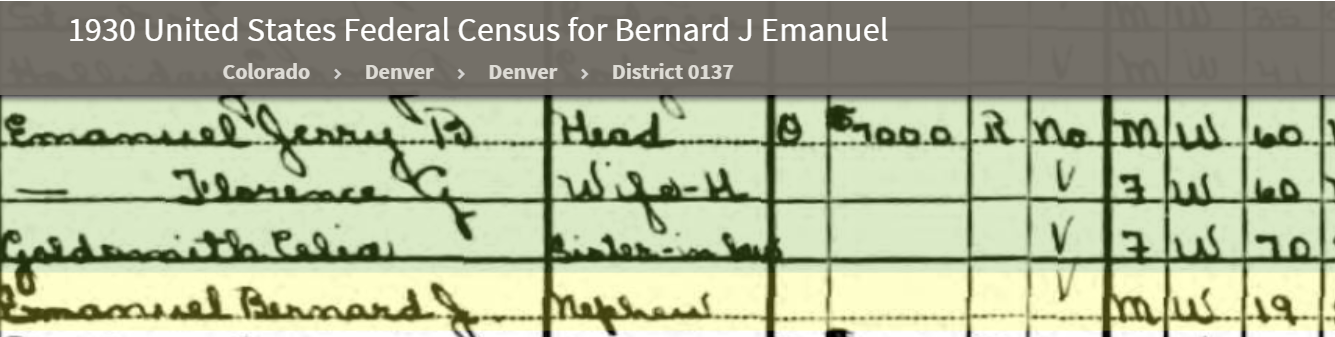
The third remaining child of Jacob Goldsmith was Florence Goldsmith Emanuel. In 1930, Florence was living with her husband Jerry Emanuel in Denver as well as their nephew Bernard, the son of Gertrude Goldsmith and Jacob Emanuel, and Florence’s sister Celia. Jerry was working as a clerk in a wholesale tobacco business. In 1940, they were still living in Denver, now with Jerry’s sister Grace in their home, and Jerry was working as a salesman for a wholesale liquor business.6

Emanuel family, 1930 US census, Census Place: Denver, Denver, Colorado; Page: 2A; Enumeration District: 0137; FHL microfilm: 2339973
Ancestry.com. 1930 United States Federal Census

Florence Goldsmith Emanuel died on August 4, 1942, at the age of 73. Her husband Jerry survived her by another seventeen years. He died on June 16, 1959, and is buried with Florence in Denver. He was 89. Florence and Jerry did not have children, so like so many of Florence’s siblings, there are no living descendants.7

That brings me to the last remaining child of Jacob Goldsmith and Fannie Silverman, their son Frank. In 1930, Frank and his wife Barbara were living in Atlantic City, and Frank was retired.8 On July 25, 1937, Barbara died in Philadelphia; she was 67. Like Frank’s parents and many of his siblings, she was buried at Mt Sinai cemetery in Philadelphia; in fact, she was buried in the same lot as Celia and Rachel Goldsmith and one lot over from her in-laws Jacob and Fannie Goldsmith.9

I mention this because for the longest time I was having no luck finding out when or where Frank Goldsmith died or was buried. In 1940, he was living as a widower in the Albemarle Hotel in Atlantic City, and the 1941 Atlantic City directory lists Frank as a resident.9 But after that he disappeared. I couldn’t find any obituaries or death records, but what really mystified me was that there was no record of his burial with his wife Barbara and his other family members at Mt Sinai cemetery.

I contacted Mt Sinai and learned that the plot that had been reserved for Frank is still unused. Barbara is buried with Frank’s sisters Celia and Rachel and one lot over from Frank’s parents. But Frank is not there. Here are two of the Mt Sinai burial records showing that Barbara and Celia are buried right near each other in lots owned by Frank.

Historical Society of Pennsylvania; Philadelphia, Pennsylvania; Historic Pennsylvania Church and Town Records,  Mt· Sinai Cemetery, Ancestry.com. Pennsylvania and New Jersey, Church and Town Records, 1669-2013

I also hired a researcher to search the New Jersey death certificates in Trenton (since they are not available online). She came up empty. So what had happened to Frank?

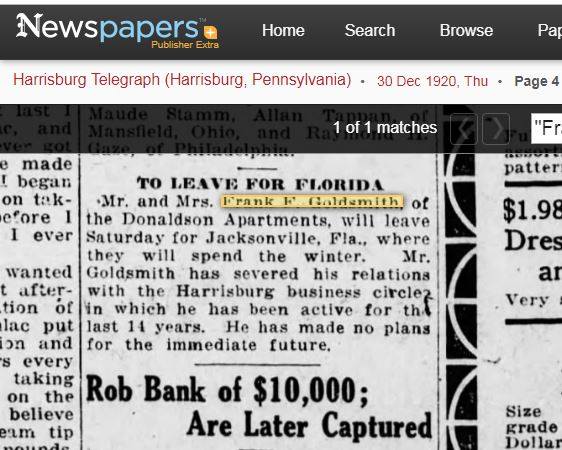
Well, once again Tracing the Tribe, the Jewish genealogy Facebook group, came to the rescue. I posted a question there and received many responses, most of them suggestions for things I’d already done. But one member,  Katherine Dailey Block, found a 1920 newspaper article that mentioned Frank that I had never seen:

“To Leave for Florida,” Harrisburg Telegraph, December 30, 1920, p. 4.

That raised the possibility that Frank might have spent time in Florida more than this one time. I had made the mistake of assuming that, having lived his whole life in Pennsylvania and New Jersey, he must have died in one of those two states. Now I broadened the search to Florida. (Doing a fifty-state search was not helpful since the name Frank Goldsmith is quite common, and I had no way to figure out whether any of them was my Frank.) And this result came up:

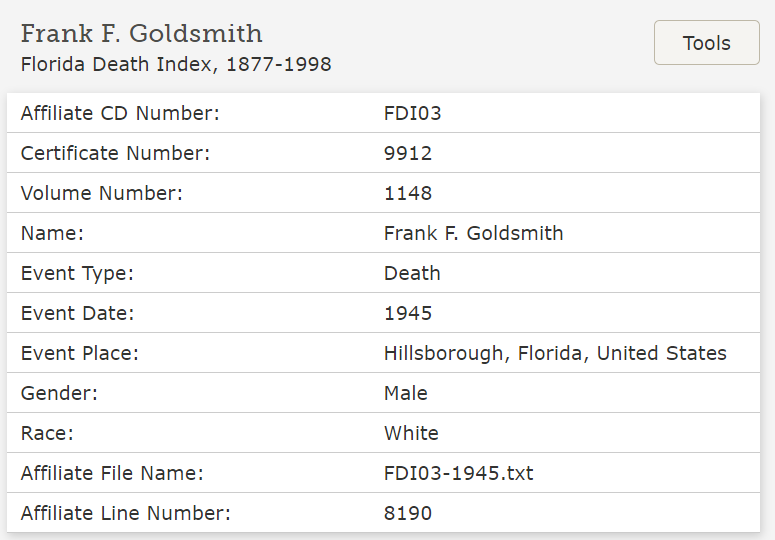
Florida Death Index, 1877-1998,” database, FamilySearch (https://familysearch.org/ark:/61903/1:1:VV91-P84 : 25 December 2014), Frank F. Goldsmith, 1945; from “Florida Death Index, 1877-1998,” index, Ancestry (www.ancestry.com : 2004); citing vol. 1148, certificate number 9912, Florida Department of Health, Office of Vital Records, Jacksonville.

A Frank F. Goldsmith had died in Tampa, Florida in 1945. Could this be my Frank? Tampa is on the opposite coast from Jacksonville as well as much further south. That made me doubt whether this was the same Frank F. Goldsmith. But then I found this record from the 1945 Florida census; notice the second to last entry on the page:

Census Year: 1945, Locality: Precinct 2, County: Hillsborough, Page: 43, Line: 32
Archive Series #: S1371, Roll 20, Frank F. Goldsmith 65
Ancestry.com. Florida, State Census, 1867-1945

There was Frank F. Goldsmith, and when I saw that he was born in Pennsylvania, I was delighted, figuring that this could be my Frank. On the other hand, the census reported that this Frank was 65 years old in 1945 whereas my Frank would have been 82. But it seemed worth ordering a copy of the death certificate from the Florida vital records office to see if it contained information that would either confirm or disprove my hope that this was my cousin Frank.

Unfortunately, here is the death certificate:

As you can see, it has no information about this Frank F. Goldsmith’s wife, parents, birth place, occupation, or much of anything that would help me tie him to my Frank F. Goldsmith. In fact, the age and birth date on the certificate are inconsistent with my Frank Goldsmith, who was born in June 1863, according to the 1900 census, not June of 1878.

Despite these blanks and inconsistencies, my hunch is that this is my Frank. Why? Both Franks have a birth date in June. And on later census records, Frank’s estimated birth year based on his reported age moved later than 1863—1868 in 1910, 1876 in 1920, and 1870 in 1930 and 1940. He seemed to be getting younger as time went on. Maybe by 1945, he was giving a birth year of 1878. And by 1945 there was no one left to inform the hospital of his family’s names or his birth date or age so perhaps whoever completed the death certificate (looks like someone from the funeral home) was just guessing at his age and birth date.

In addition, there is no other Frank F. Goldsmith who fits the parameters of the Frank on the death certificate. Finally, this Frank was to be buried in the “Jew cemetery,” so we know that he was Jewish.

So what do you think? Is this enough to tie the Frank F. Goldsmith who died in Florida to my Frank F. Goldsmith? I know these are thin reeds upon which to make a case, but I think they may have to be enough.

In any event, like his sisters Rachel, Celia, Annie, Emma, Eva and Florence, and his brother Felix, Frank Goldsmith has no living descendants. In fact, it is quite remarkable how few living descendants Jacob Goldsmith and Fannie Silverman have, considering that they had had fourteen children. Five of those fourteen children did not have children of their own: Emma, Rachel, Celia, Frank, and Florence. Four of Jacob and Fannie’s children had no grandchildren: Annie had three children, but none of them had children. Eva had one son, Sidney, who did not have any children, and the same was true of Gertrude’s son Bernard and Felix’s two children Ethel and Clarence. From fourteen children, Jacob and Fannie had twenty grandchildren and only twelve great-grandchildren, and a number of those great-grandchildren also did not have children. From my count, there were only ten great-great-grandchildren. With each generation, instead of growing, the family became smaller.

But that is not the legacy of Jacob and Fannie Goldsmith. Rather, theirs is the remarkable story of two young German immigrants settling in western Pennsylvania and then Philadelphia, raising fourteen children who eventually spanned the continent. From all appearances, many of those fourteen children stayed close, both geographically and presumably emotionally. Many of them lived together, especially the daughters who spent years in Denver together. Like so many first-generation Americans, these fourteen children provided evidence to their parents that the risks they took leaving their home country behind and crossing the ocean were worthwhile. Yes, there was plenty of heartbreak along the way, but overall Jacob, Fannie, and their fourteen children lived comfortably and free from oppression.


  1. Historical Society of Pennsylvania; Philadelphia, Pennsylvania; Historic Pennsylvania Church and Town Records, Ancestry.com. Pennsylvania and New Jersey, Church and Town Records, 1669-2013 
  2. Ancestry.com. California, Death Index, 1905-1939 
  3. Ancestry.com. California, Death Index, 1905-1939 
  4.  Number: 562-66-4663; Issue State: California; Issue Date: 1962, Ancestry.com. U.S., Social Security Death Index, 1935-2014 
  5. San Francisco Chronicle, September 4, 1974, p. 35 
  6. Florence Emanuel, 1940 US census, Census Place: Denver, Denver, Colorado; Roll: m-t0627-00490; Page: 9A; Enumeration District: 16-221B, Ancestry.com. 1940 United States Federal Census 
  7. JewishGen, comp. JewishGen Online Worldwide Burial Registry (JOWBR) 
  8. Frank Goldsmith, 1930 US census, Census Place: Atlantic City, Atlantic, New Jersey; Page: 19B; Enumeration District: 0011; FHL microfilm: 2341043, Ancestry.com. 1930 United States Federal Census 
  9. Historical Society of Pennsylvania; Philadelphia, Pennsylvania; Historic Pennsylvania Church and Town Records,  Mt· Sinai Cemetery, Ancestry.com. Pennsylvania and New Jersey, Church and Town Records, 1669-2013