Unknown's avatar

About Amy

I am interested in genealogy and family research, books, movies, cats, dogs, and baseball.

The Genealogy Village Comes Through Once Again

As I mentioned in my last post, my great-grandfather Isidore Schoenthal was one of twelve children.  He and his siblings were born in Sielen, Germany, the children of Levi Schoenthal and Henrietta Hamberg.  The first helpful source I found about his family was a biography written about Isidore’s older brother Henry in 1893 as part of a commemorative book[1] celebrating Washington County in Pennsylvania, where Henry and Isidore both had settled after immigrating to the United States (the “Beers biography”).  Given that the Beers biography was written while both Henry and Isidore were still living in Washington, Pennsylvania, I was inclined to give it significant weight as a credible summary of Henry’s life to that point and of the background of his family.  I will refer to it in more depth when I focus on Henry himself, but for now I am referring to its assertions regarding the family of Levi and Henrietta (Hamberg) Schoenthal.

English: City Hall in Washington, Pennsylvania...

English: City Hall in Washington, Pennsylvania (in Washington County). (Photo credit: Wikipedia)

According to the Beers biography, Levi Schoenthal was born in 1813 and worked as a shoemaker.  He and his wife Henrietta had twelve children—nine boys and three girls.  Two of their sons died in infancy, but the other ten children survived to adulthood.  Of those ten, nine immigrated to the United States, and eight stayed here.  (The youngest child, Rosalie, returned to Germany to marry, and one son, Jacob, never left Germany.)  Of those who stayed in the United States permanently, my great-grandfather Isidore was the youngest and arrived last, along with his mother and Rosalie, in 1881.

Despite believing that this biography was probably fairly accurate, given that it was written so close to the time of the events reported, I nevertheless wanted to find some original German sources to verify the information.  Fortunately, I was able to verify quite a bit (but not all of it) by searching through the Hessen Archives as well as US records.  I was very lucky to have help from Dorothee Lottmann-Kaeseler (who correctly reminded me after my last post that she had first mentioned Sielen as my Schoenthal ancestral town), Hans-Peter Klein, Matthias Steinke, JewishGen, and the Hessian Archives.

Based first on a search through JewishGen, I was able to find birth records for almost all of the children of Levi and Henrietta in the Hessian State Archives.  The archived birth records available start in 1846, so I could not find records for the three children born before 1846 (Hannah, 1841; Henry, 1843; Julius, 1845), but using JewishGen and then manually scanning through the records, I was able to find birth records for seven of the other nine, including one for one of the two baby boys who had died in infancy.  So far I had not found any birth record for the other baby who died in infancy according to the Beers biography or for Jacob.

The fact that I was able to locate birth records for seven of the children astounded me.  Here are six of the birth records I found:

Amelia (Malchen) Schoenthal birth record January 2, 1847 Hessen Archives HHStAW 365 No 772

Amelia (Malchen) Schoenthal birth record January 2, 1847
Hessen Archives HHStAW 365 No 772


Simon (Sieman) Schoenthal birth record February 14, 1849

Simon (Sieman) Schoenthal birth record February 14, 1849   Hessen Archives HHStAW 365 No 772


Marcus Schoenthal birth record January 26, 1853

Marcus Schoenthal birth record January 26, 1853 Hessen Archives HHStAW 365 No 772

Sadly, Marcus died just ten days later:

Marcus Schoenthal death record Febuary 5, 1853 HHStAW fonds 365 No 773

Marcus Schoenthal death record Febuary 5, 1853
HHStAW fonds 365 No 773


Nathan Schoenthal birth record August 6, 1854

Nathan Schoenthal birth record August 6, 1854 HHStAW 365 No 772

 

Felix birth for blog

Felix (Seligmann) Schoenthal birth record December 15, 1856 Hessen Archives HHStAW 365 No 772


Rosalie Schoenthal birth record August 17, 1863

Rosalie Schoenthal birth record August 17, 1863 Hessen Archives HHStAW 365 No 772

One of the last birth records I found was the one for my great-grandfather Isidore.  I had scanned through the pages several times looking for his birth record, the one that mattered the most to me, of course.  But I hadn’t seen it, and I started wondering whether he’d been born outside of Sielen.  But then, giving it one last chance, I looked at every baby born in 1858, the birth year I had for Isidore, and saw one with the birth date November 22, 1858.  That date seemed familiar (though first I thought only because that was the day of the year JFK was assassinated in 1963), and when I saw that in fact other records had Isidore’s birth as November 22, 1858, I looked more closely at the record.  The entry was written in more traditional German script than many of the others, but I thought I could make out a word that just might be Levi.

Isidore birth for blog

Isidore (Isaak) Schoenthal birth record November 22, 1858 Hessen Archives HHStAW 365 No 772

So I posted a snapshot of the record to the German Genealogy group on Facebook, and sure enough my always helpful friend Matthias Steinke jumped right in and translated it for me.  Matthias said that for the baby, it says, “Male Gender, Isaac,” and for the parents, “Lewie (??) Schonthal shoemaker and Aesther (??) born Hamberg, legitimate parents.”  It was clear to me that this was the birth record for my great-grandfather.  His Hebrew name must have been Isaac—his secular name Isidore.  My guess is that Henrietta’s Hebrew name was Esther or that it actually says Jhette, which was Henrietta’s name in Germany; and I assume that “Lewie” is actually Levi.  I was very excited that I now had my great-grandfather’s birth record as well as those of most of his siblings.

I was still searching for a birth record for Jacob, however.  I had scoured through the Sielen birth records now multiple times without finding it, but according to a genealogy report prepared by Hans-Peter Klein, Jacob was born in December, 1850.  I went back one more time and found this record:

Jacob Schoenthal birth record December 1850

Jacob Schoenthal birth record December 1850

As you can see, although this reports a baby boy named Jacob born in December, 1850, on the left side of the page, the page with the parents’ information on the right is illegible, at least as scanned by the archives.  But I thought that this must be the record that Hans-Peter relied upon to obtain Jacob’s birthdate.  In addition, however, Hans-Peter located a marriage certificate for Jacob Schoenthal and his wife Charlotte (Lottchen) Lilienfeld, and that also included his birth date as December 22, 1850, as translated by my Facebook friend Matthias Steinke:

Eine Vervielfältigung oder Verwendung dieser Seite in anderen elektronischen oder gedruckten Publikationen und deren Veröffentlichung (auch im Internet) ist nur nach vorheriger Genehmigung durch das Hessische Staatsarchivs Marburg, Friedrichsplatz 15, D-35037 Marburg, Germany gestattet.

Marriage record of Jacob Schoenthal and Charlotte (Lottechen) Lilienfeld HStAMR Best. 920 Nr. 2610 Standesamt Gudensberg Heiratsnebenregister 1879, S. 11

Marriage record of Jacob Schoenthal and Charlotte (Lottechen) Lilienfeld
HStAMR Best. 920 Nr. 2610 Standesamt Gudensberg Heiratsnebenregister 1879, S. 11

5 – Gudensberg the 1st September 1879 – To the below signing registrar came for a marriage 1. the merchant Jacob Schönthal, at the moment shop-assistant in Cologne, identified by the shown certificates and in person by the present Beisen(?) Engelbert, israelic religion, born the 22 December 1850 in Sielen, residing in Cologne, son of the in Sielen deceased shoemaker Levi Schönthal and his wife Jettchen nee Hamberg, residing in Sielen and 2. the Lottchen (called Charlotte) Lilienfeld, known personally, israelic religion, born the 6th April 1855 in Gudensberg in house nr. 215 at her parents. Daughter of the cantor Meyer Lilienfeld I and his wife Hannchen nee Meiberg, residing in Gudensberg. As witnesses were present: 3. the merchant Beisen (?) Engelbert, personally know, 59 years old, residing in Gudensberg in house nr. 218, 4. the shop-assistant Michel Lilienfeld, known personally, 23 years old, residing in Halberstadt. Followed by the sentence whether they intend to marry each other and the signatures.

But it wasn’t over.  Now that I had all these birth records for their children, I wanted to know more about Levi and Henrietta and their parents.  I was very fortunate that Dorothee had recommended that I contact Hans-Peter Klein because he was able to provide me with some of that additional information.  He sent me a copy of the marriage record for Levi Schoenthal and Henrietta Hamberg:

Marriage record for Levi Schoenthal and Jhette Hamberg HHStAW, 365, 386

Marriage record for Levi Schoenthal and Jhette Hamberg
HHStAW, 365, 386

Once again, Matthias came through for me and translated this document:

nr 3, date of marriage 24 July 1839 – groom Levi Schönenthal, shoemaker in Sielen – bride: Jette Hamberg – unmarried in Bräuna(Breuna) age of the groom: 26 years, 9 month and 16 days – age of the bride: 22 years – parents of the groom: Heinemann Schönenthal, merchant in Sielen and Handel nee Beerenstein – parents of the bride: Moses Hamberg, merchant in Bräuna and Gutchen nee Rosenberg. entered in Breuna the 25th July 1839 by Itzig Eichholz

From this record I could now see that Levi (born October 8, 1812)  was the son of Heinemann Schoenthal and Handel Beerenstein, who lived in Sielen, and that Henrietta was the daughter of Moses Hamberg and Guetchen Rosenberg, who lived in Breuna, a town located less than 30 km from Sielen. (More on Breuna and the Hambergs in my next post.)

Now I had another family and three more surnames—Beerenstein, Hamberg, and Rosenberg— to add to my family tree, names I’d never known were those of my ancestors until now.  I now had the names of two more sets of my great-great-great-grandparents.  I now know the names and something about almost half of my great-great-great-grandparents.  I didn’t know any of their names at all when I first started doing genealogy. In fact, I only knew the names of two of my great-great-grandparents.

So thank you from the bottom of my heart to Matthias Steinke, Dorothee Lottmann-Kaeselar, and Hans-Peter Klein for helping me find another generation and another branch of my family.


.


[1] Beers, J. H. and Co., Commemorative Biographical Record of Washington County, Pennsylvania (Chicago: J. H. Beers & Co., 1893). Transcribed March 1997 by Neil and Marilyn Morton of Oswego, IL as part of the Beers Project. Published March 1997 on the Washington County, PA USGenWeb pages at http://www.chartiers.com/.  See http://www.chartiers.com/beers-project/articles/schoenthal-1057.html
It’s My Blogiversary! Time to Reflect

It was two years ago tomorrow that I posted my first blog post.  It is also the 120th anniversary of my grandmother Gussie Brotman Goldschlager’s birth tomorrow.  And tonight is the beginning of Yom Kippur, the Jewish Day of Atonement and a long fast day for those who observe.  That’s a lot to process in one day!


Embed from Getty Images

It’s hard to believe I’ve been doing the blog for two years (although I really started doing genealogy about two years before that).  In some ways it feels much longer because it has become such a big part of my daily life—-doing the research, thinking about it, pulling my notes together, writing up the posts, editing them, adding photos and documents, responding to comments and questions, and reading the blogs of so many other wonderful people.  The blog has provided me with so many more benefits than I had imagined back in September 2013 when my cousin Judy got me started by setting up the template on WordPress.  Not only has it helped me organize my thoughts and record my research, it has made me focus on not just collecting names and dates on a family tree but on the larger questions: who were these people and what were their lives like? Where did they live, and what were those places like? What historical and economic conditions affected their lives? What legacy did they pass down to their descendants, and how has that affected the person I am today?

The blog also has been a magnet that has allowed others to find me.  Every time I get a comment from someone who just happened to find the blog while searching for their family history, I am amazed by what the internet can do. Imagine if my cousin Wolfgang had not found my blog?  I would not know even half of what I now know about the Seligmann family.

jeff gussie amy 1955 abt

My grandmother was born 120 years ago, and she died just over forty years ago.  She was the only grandparent I knew very well, and I loved her very much.  She had a hard and sad childhood, which scarred her in many ways for life, but with her grandchildren she was loving and funny and affectionate.  We probably brought out the best in her.  As I continue to write my novel about her life and that of my grandfather, I hope I am doing her justice and honoring her memory while also capturing the sad underside to her life.

Amy Gussie and Isadore

And as for Yom Kippur, it’s a day for me to contemplate the year gone by and the mistakes I’ve made along the way.  Although I try my best to respect and honor all my relatives, living and dead, when writing the blog, I always worry that someone will be offended or upset by something I have written.  If so, please accept my apologies.

Also, I hope I have expressed my appreciation to all those who have helped me with my research, and I hesitate to make a list for fear of forgetting someone who helped me months ago and whose name might slip through my ever-worsening memory (getting older does really stink).  But let me try to remember as best I can and thank some of those who have provided me with so much research support in the past year:

my wondeful cousins Lotte Furst, Wolfgang Seligmann, Bob Cohn, Steven Seligman, Suzanne and Stephen Michel, Pete Scott, Phyllis Rosner, and Angelika Oppenheimer,  all of whom have provided me with photographs, stories, and insights into our extended family in the past year (as well as all those who helped the year before);

my amazing contacts in Germany who helped me find and understand documents and other resources: Dorothee Lottman-Kaeseler, Matthias Steinke, Helmut Schmahl, Beate Goetz, Gerd Braun, as well as Ralph Baer here in the US;

my DNA tutors, Julie Mulroy, Svetlana Hensmann, and Leah Larkin;  the many people in the Tracing the Tribe and the German Genealogy groups on Facebook, and the members of the GerSig listserv on JewishGen. Also, thank you to my friend Rene Reich-Grafe for answering my endless questions about Germany, its history, culture, and geography.

To all of you, if I have not expressed my gratitude before sufficiently, I apologize.  You’ve really made this journey so much more meaningful and so much more interesting.

Finally, to my family, friends, fellow bloggers, and other readers, thank you for being there.  I would do what I am doing even if no one was paying attention, but it is so much better knowing that others are interested in these stories about people who really were strangers to us all.

For all of you who are observing Yom Kippur, may it be an easy fast and a meaningful and thoughtful day.


Embed from Getty Images


The Schoenthals: Where They Came From

Deutsch: Deutsche Bundesländer Karte.

Deutsch: Deutsche Bundesländer Karte. (Photo credit: Wikipedia) (Note the location of Hessen in blue on this map.)

My great-grandfather Isidore Schoenthal came to the United States in 1881; he arrived in New York City on September 3 of that year on the ship Rhein when he was 22 years old.  I had known that he came from Germany, but not exactly where.  His death certificate said he was born in “Celand, Hess, Germany,” and from various other sources about him and his siblings, I concluded that the town where he was born was in fact Sielen, a small town in the Kassel district in the Hesse region of Germany.  Today’s post will focus on what I’ve learned about Sielen, the home town of my Schoenthal ancestors.

Sielen, Germany

Sielen, Germany

It was not that easy to find out very much about Sielen.  The town is so small (510 inhabitants as of 2011[1]) that it doesn’t even have a Wikipedia entry.  The closest major city is Frankfurt, and it is over 200 kilometers away, as are Dusseldorf and Cologne.  From what I can see on Google Maps, Sielen is surrounded for miles and miles by farmland.  The closest town is Trendelburg, which is about four kilometers away. It merits its own Wikipedia page, though that entry is all of three sentences and tells nothing of the history of the town.

Wikipedia reports that the population of Trendelburg was over 5000 people as of 2011, based on this website.  But according to the town’s official website, that number reflects not just the village of Trendelburg itself but the neighboring towns, including Sielen.  Trendelburg proper has just over 1100 residents.   Sielen has 552. Sielen is now considered a district within the larger town of Trendelburg.

Deutsch: Stadt Trendelburg

Deutsch: Stadt Trendelburg (Photo credit: Wikipedia)


From the Trendelburg official website, I was able to learn some information about the history of the town, though relying on Google Translate makes reading the German always somewhat bewildering.  Assuming I am reading most of the general information correctly, the history of Trendelburg as a separate entity began when a castle was built there in the 13th century by Konrad the III, Schoeneburg .  The location was already an important trade center for that region as it was close to a good fording spot on the Diemel River.   Over the next several centuries, the castle was used for many different purposes: a hunting lodge, the offices of the Prussian Forestry Department, and today as a privately-owned hotel and restaurant.

Die Trendelburg - Gesamtansicht, Hessen, Germany

Die Trendelburg – Gesamtansicht, Hessen, Germany (Photo credit: Wikipedia)

The hotel’s website includes some more detailed history of the castle:

With many twists and turns, the Diemel River meanders towards the Weser River. Right by Trendelburg Castle, there is a sharp bend around a rocky ridge which the locals called “Trindirberg” many years ago, probably naming the “mountain” after the village Trende, at the time situated to the west of the ridge but now completely vanished.

Sometime before 1300, Konrad the III of Schöneberg constructed a castle on this “mountain” to protect the main road from Kassel to Bremen. The settlement outside the castle also dates from this period.

Around 1305, Landgrave Heinrich I and the Bishop of Paderborn each purchased one half of the castle. The part belonging to Hessen was a Paderborn fief; the town’s official representatives were the Stoghusens, who lived in the castle for four generations.

In 1443 and 1456, the fortifications were renewed following serious fires. After their reconstruction, Trendelburg Castle was also changed, taking on the shape you see today. The fortifications were extended by a 38 metre high keep with four bretèches and a curtain wall in the shape of a pentagon with four small round towers. In the living quarters, which were erected in the 15th and the 17th century respectively, the remains of a late Gothic chapel with ribbed vaults have been preserved; the Trendelburg register office now uses this space for its civil wedding ceremonies. 

In the Thirty Years’ War, the castle was occupied by Tilly’s troops, and in 1637, it was destroyed by the Croats. In the Seven Years’ War, Trendelburg Castle was occupied by the French until they were driven off by Ferdinand V, the Duke of Brunswick, through artillery fire.

In 1901, military man Oberst Adalbert von Stockhausen, in all likelihood a descendant of the Stoghusens of old, bought the castle.

Taken over by the Dr. Lohbeck Group in 1996, the castle’s long-term future was secured by its conversion into a hotel for discerning visitors.

According to the hotel’s website, this is the castle where Rapunzel lived and let down her hair.  There is even a weekly “re-enactment” of this fairy tale at the castle.


Embed from Getty Images

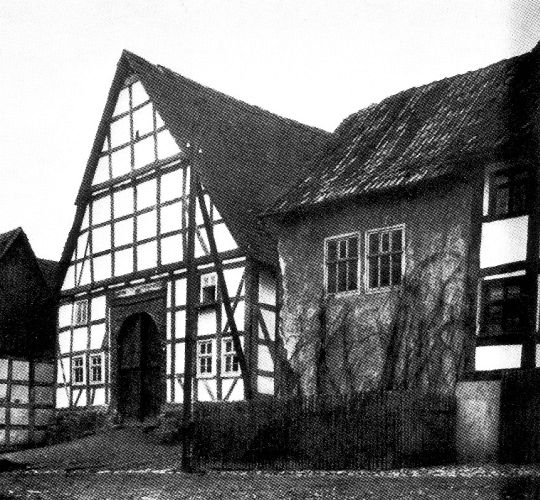
The Trendelburg official website also contains some information about the history of Sielen itself. The village is bordered on one side by the Diemel River and surrounded by limestone hills. According to the website, a stone ax found in Sielen dated back to 6000 years ago, and a cemetery back to 1000 B.C.E.  A mill dating from 1243 remains as a ruin.

So what were my ancestors doing in this tiny village back in the 19th century and maybe before?  What kind of Jewish life could there have been? According to the Alemannia-Judaica website, there was a very small Jewish community in Sielen at least from the early 19th century.  In 1835, there were 38 Jewish residents; in 1861, there were 48.  By 1905, there were only fourteen Jewish residents, and by 1924, there were just four Jewish residents remaining. Like my own relatives, the Jewish residents either had emigrated outside of Germany or moved to the bigger cities.  During the Nazi era, those few remaining Jews in Sielen either left the area or were killed during the Holocaust.

Despite the tiny size of the Jewish community, there was a synagogue in Sielen from about 1817.  Originally a home owned by Moses Herzbach was used for prayer services, but in 1817, seven Jewish families sought permission from town officials to build a synagogue as an addition to Herzbach’s home.  Permission was granted, and Herzbach financed the construction of the synagogue.

There was also a Jewish school and a cemetery.  According to Alemannia-Judaica, at first Jews were buried in a cemetery in Trendelburg, but around 1846, a separate cemetery was established in Sielen on the road between Sielen and Trendelburg.  There are 26 graves there, including that of my great-great-grandfather Levi Schoenthal, as I will discuss in a later post.

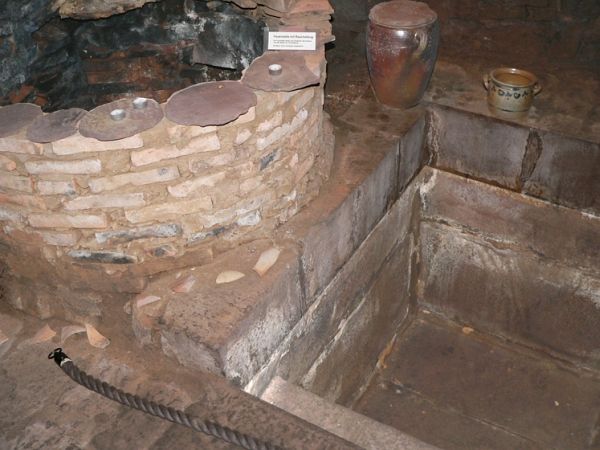
Down the road in Trendelburg there was also a Jewish community with its own synagogue, cemetery, and school.  That community dates back to 1676, but also was quite small.  In 1731 there were 21 Jewish residents; the Jewish population peaked in 1827 at 31, but was down to just 12 by 1895.  There was a Jewish school in Trendelburg, where my great-grandfather’s brother Henry Schoenthal was a teacher before he immigrated to the United States.  There was also a mikveh, the ruins of which were discovered in 2001 during renovations and which can now be seen as a tourist attraction.  By Hitler’s time, there were only a handful of Jews remaining in Trendelburg, and they died in the Holocaust.

How did these Jews make a living in these small towns where the number of Jewish residents was so small? What were their lives like? I can’t say that I am surprised that my great-grandfather Isidore Schoenthal and almost all of his siblings left Sielen by the 1880s; my great-grandfather had ten siblings who survived to adulthood.  What kind of opportunities could they find in this small, rural town? Probably very few, and so they left and ended up all over the United States: Pennsylvania, New York, New Jersey, Colorado, Arizona, California, Illinois, Ohio, Florida, and so on.  They learned English, they worked hard and survived, and they became Americans.    Like Joseph and Bessie Brotman, Isadore Goldschlager, Bernard Seligman, John Nusbaum and Jeanette Dreyfuss, and Jacob Cohen and Sarah Jacobs, they took the risk of leaving behind what they knew so that they could make a better life for themselves and their descendants.  How fortunate I am to be one of those descendants.

English: Location of Trendelburg in district K...

English: Location of Trendelburg in district Kassel, Hesse, Germany Deutsch: Lage von Trendelburg im Landkreis Kassel, Hessen, Deutschland (Photo credit: Wikipedia)


[1]   http://www.citypopulation.de/php/germany-settlements-hessen.php?cityid=06633025_0B18

[i] http://www.citypopulation.de/php/germany-settlements-hessen.php?cityid=06633025_0B18

I Am Still Here


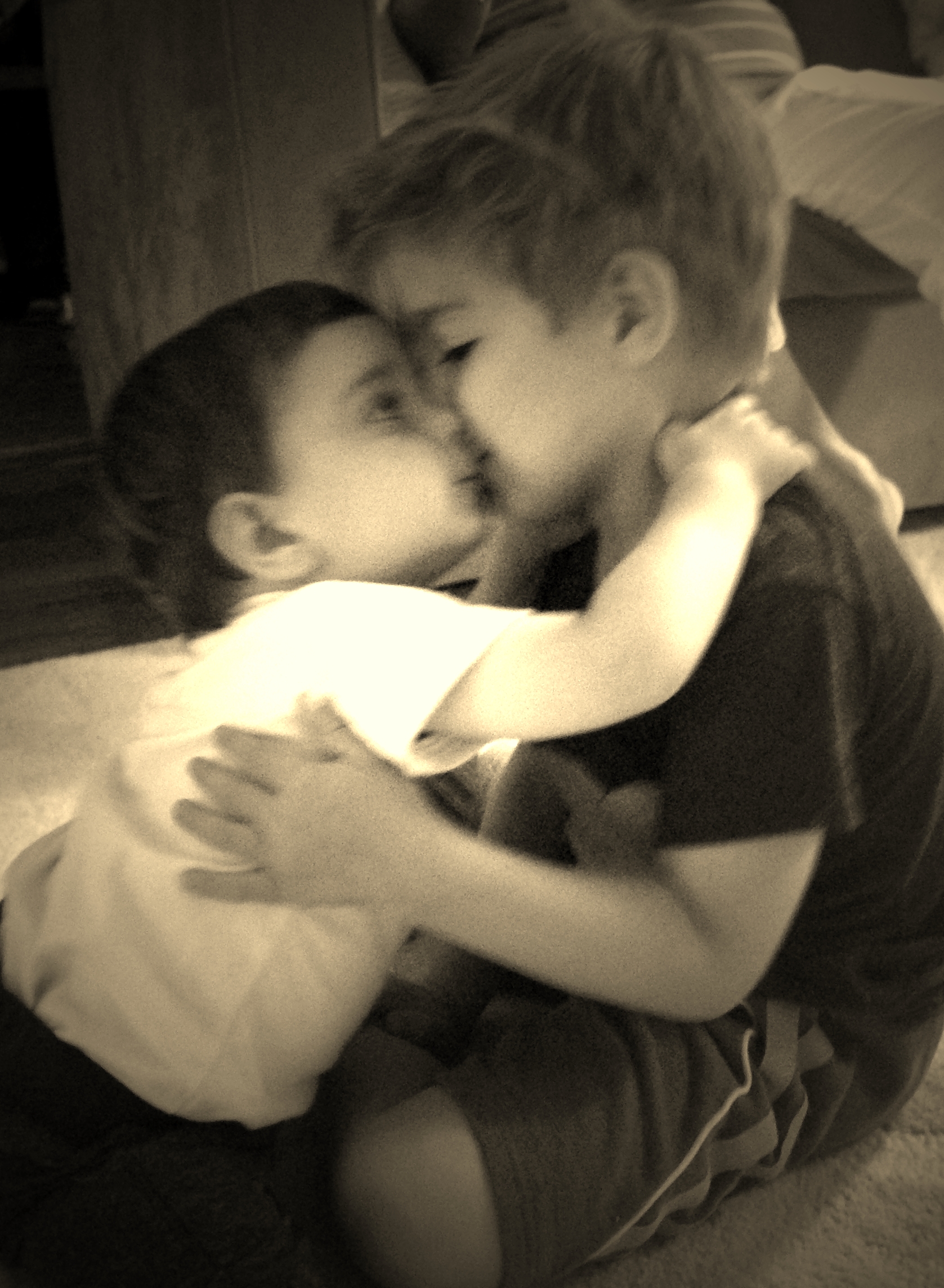
I haven’t disappeared.  As I said in my last post, it’s a hectic time of year, and I have been busy with non-blog-related matters.  Like spending time with these two, the sweetest little boys you will ever meet (and I am not biased):

Sepia Remy and Nate kissing


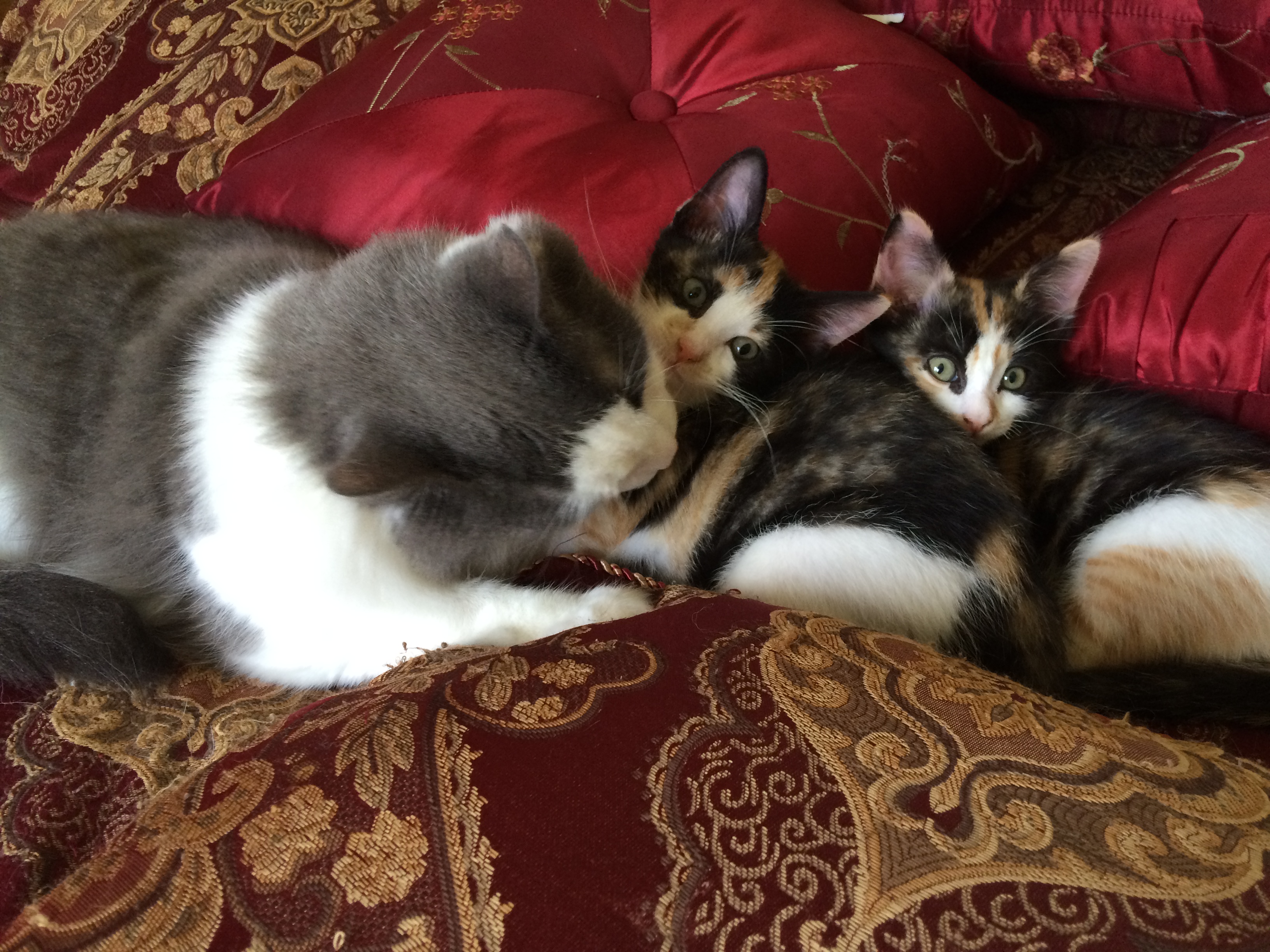
And with these three:

Three cats


And with my two September birthday girls (back in the 1980s):

Rebecca and Maddy


And then there’s the holidays.  Lots of eating and catching up with friends, less contemplation and introspection than expected.  But that’s okay.  Yom Kippur is next week.  There’s still time.

But in between all those activities, I have been hard at work researching my great-grandfather Isidore Schoenthal and his family.  I’ve found an incredible amount of information in a fairly short time (though much of the groundwork had been done much earlier).  Some of that is due to the fact that others had already researched some of the family lines; some is due to the new databases that have become available since I first started doing family history research.  Today I even found online some digitized German records of the births and deaths of some of the Schoenthals.

So I am hoping to start being able to pull together my notes and my thoughts and start blogging about the Schoenthals within the next week.  From what I’ve already learned, I think they will prove to be an interesting group to write about and, I hope, to read about.

Be back soon.

Shana Tova—A Good Year to All


Embed from Getty Images

Once again I find myself in the midst of the early September craziness after a long, relaxing summer: several family birthdays and anniversaries, school starting (well, not for me anymore, but for my husband), and preparation for the Jewish holidays.  In my spare time, I am trying to put together the pieces of my Schoenthal research slowly but surely.  But for the next week or so, I won’t have much time to write anything coherent about my research, so I will be taking a short break.

That seems appropriate as this is the time of year when I am supposed to be contemplating the year past and making decisions about the year to come.  It’s a time to be thoughtful and thankful.  A time of making amends and making resolutions.

So I wish all who celebrate a wonderful holiday with time for your families and your thoughts.  And for everyone, I wish a new year filled with gratitude, happiness, good health, and love.  And for the world, I will hope for peace and for a way to protect and shelter all those people all over the world who have been uprooted and seen their lives and families destroyed by war, poverty, and hatred.  Today is the 14th anniversary of the day that showed us all what hatred can do. May we finally learn from it.

WTC memorial lights

WTC memorial lights (Photo credit: Wikipedia)

May it be a year when somehow people everywhere find a way to accept differences and respect and honor the humanity of each other.

Shana tova.  A good year to all.


Embed from Getty Images

My Grandmother, Eva Schoenthal Cohen

It’s time to turn another page in the history of my family, or I suppose I should say, to climb another branch on the family tree.  Thus far I have researched my mother’s maternal and paternal sides as far back as I’ve been able (not far enough yet, but as far as I can, given the lack of documentation) and my father’s paternal side as far as I’ve been able.  Now I turn my focus to my father’s maternal side—his mother’s parents and their ancestors.  His mother’s father was Isidore Schoenthal; his mother’s mother was Hilda Katzenstein.  I am going to start with the Schoenthal family and explore and learn what I can about my great-grandfather, his parents, his siblings, and his children, including my paternal grandmother Eva Schoenthal Cohen.

My Grandma Eva

My Grandma Eva

My grandmother Eva was a beautiful and refined woman.  She was born on March 4, 1904, in Washington, Pennsylvania, but the family moved to Denver, Colorado, by the time she was six years old because one of Eva’s brothers had allergies and the doctors had recommended the drier climate out West.  After graduating from high school in Denver in 1922, Eva traveled to Philadelphia to visit with some of her mother’s family who lived there.

Eva Schoenthal high school yearbook picture

Eva Schoenthal high school yearbook picture

My grandfather John Nusbaum Cohen, who was born and raised in Philadelphia, met her at a social event there, and he was so taken with her that he followed her back to Colorado to woo her and ask her to marry him.  She was very young when they met—only eighteen and right out of high school; my grandfather was nine years older.  Eva accepted his proposal, and they settled in Philadelphia after marrying in Denver on January 7, 1923.

Eva Schoenthal and John Cohen, Jr. 1923

Eva Schoenthal and John Nusbaum Cohen, Sr. 1923

John and Eva Cohen c. 1930

John and Eva (Schoenthal) Cohen
c. 1930

Their first child, my aunt Eva Hilda Cohen, was born a year later on January 13, 1924, and my father was born almost three years after that.

My grandmother Eva Schoenthal Cohen and my aunt Eval Hilda Cohen

My grandmother Eva Schoenthal Cohen and my aunt Eva Hilda Cohen

My grandmother and my father

My grandmother and my father

In 1930, they were living at 6625 17th Street in Philadelphia, and my grandfather was a merchant, selling jewelry and clothing at a store called The Commodore, as I’ve written about previously.  They even had a servant living with them named Frances Myers, according to the 1930 census.

Year: 1930; Census Place: Philadelphia, Philadelphia, Pennsylvania; Roll: 2133; Page: 41B; Enumeration District: 1034; Image: 588.0; FHL microfilm: 2341867

Year: 1930; Census Place: Philadelphia, Philadelphia, Pennsylvania; Roll: 2133; Page: 41B; Enumeration District: 1034; Image: 588.0; FHL microfilm: 2341867

But not long afterwards, their life as a family suffered two major blows.  My grandfather was diagnosed with multiple sclerosis, and by 1936 had to be admitted to a veteran’s hospital where he lived the rest of his life.  Meanwhile, my grandmother Eva, a fragile and sensitive woman probably overwhelmed by what was happening to her, had herself been hospitalized and when released was not able to take care of her two young children.  As I’ve written before, my father’s paternal grandmother Eva May Seligman Cohen took care of my father and my aunt for several years.  After my great-grandmother died in 1939, my grandmother was well enough to move back to Philadelphia to live with my father and aunt.  In 1940, the three of them were living at 2111 Venango Street, and my grandmother was employed as a saleswoman in the wholesale china business, according to the 1940 census.

Year: 1940; Census Place: Philadelphia, Philadelphia, Pennsylvania; Roll: T627_3732; Page: 11A; Enumeration District: 51-1431

Year: 1940; Census Place: Philadelphia, Philadelphia, Pennsylvania; Roll: T627_3732; Page: 11A; Enumeration District: 51-1431

The 1940s must have been very difficult for my grandmother.  Her mother died in 1941, her father the following year.  My father and my aunt both served in the military during World War II and went away to college.  My grandmother remarried after World War II.  Her second husband, Frank Crocker, was the only “grandfather” I knew on that side of my family.  He was a kind and talkative man, much more outgoing than my shy, reserved grandmother.

My father and my grandmother at his college graduation in 1952

My father and my grandmother at his college graduation in 1952

Even as a child, I sensed that that my grandmother was a bit insecure and unsure of herself and perhaps uncomfortable around her three grandchildren.  I found her beautiful and refined,  and also somewhat mysterious.  Of course, as a child I knew nothing about her life.  Only by stepping into the family history and asking my father more questions did I develop a better understanding of who she was.

My grandmother died on January 10, 1963, when I was ten years old.  Her death was the first one I ever experienced.  (Although my mother’s father Isadore Goldschlager died when I was four years old, I really have no memory of his death.)  I remember being frightened and worried about my father and also confused because no one really talked about it before she died or after.  We weren’t (and still aren’t) too good at those things.

So as I start to delve now more deeply into her family history, I do it with the perspective of trying to understand who my grandmother was, where she came from, what her family was like, and how that all fits with the woman I remember.

Lotte’s Story: A Post-Script

The response I received to the writings of my cousin Lotte was overwhelming.  People were very moved by her life story and by her writing. (You can find her story here, here, and here.)  Lotte has generously shared some additional writings and photographs about her family and her life, which I will share with you, with her consent.  (All of Lotte’s writings are protected by copyright and may not be reproduced without her permission.)

First, a reminder of how I am related to Lotte:

Lotte to me


For those who have not read the first installment of Lotte’s story, a brief recap:  Lotte grew up in Mannheim, Germany, with her parents, Joseph and Aennie (Winter) Wiener and her older sister Doris.  Her father Joseph was a doctor in Mannheim, and her family was living a comfortable life there.  Lotte was an excellent student and was enjoying a good life until the Nazis came to power in 1933.

Aenne Wiener and Doris

Aenne and Doris Wiener c. 1916

Joseph Wiener earlier picture

Dr. Joseph Wiener

Her grandparents, Laura (Seligmann) and Samuel Oscar Winter lived not too far away in Neunkirchen, where her grandfather was in business with his brother-in-law, Laura’s brother Jakob Seligmann.  Lotte described what it was like to visit her grandparents:

MY GRANDPARENTS’ HOUSE

Neunkirchen

It was a foregone conclusion that I spent most of my Christmas and Easter and also a couple of summer vacations at my grandparents’ house. I never was asked whether I wanted to go there. If so, the answer would have been “yes”. I liked them.

They lived in Neunkirchen in the Saarland, an area of coal mining and steel production administered by the League of Nations at that time. Their three-story attached row house was at Moltkestrasse 23, a nice residential neighborhood. A buzzer would open the front door after which another door with a glass panel opened to a short corridor. To the right on the first floor, called parterre, there was a fairly large carpeted and well-furnished salon and a quite formal dining room. Both rooms were dark and hardly ever used. The smelled a bit dank and musty. But to the left of the dining room a glass-beaded curtain opened to a long, enclosed, bright veranda where my grandmother kept a number of house plants including some she called amaryllis, her pride and joy. And yes, there was a rope-operated dumb-waiter from the kitchen above to the dining room. I used to love pulling those ropes and playing with it.

A toilet with a small hand basin and a spindle full of squares of cut newspaper, hardly to be called toilet tissue, was located half-way up the stairway  to the middle floor, the actual living quarters. The living room was fairly bright and not anywhere as elegant as the downstairs salon. The main attraction were my grandfather’s rocking chair and the blue and white KKL (Jewish National Fund) box filled with a number of coins. I liked to manipulate them out with a knitting needle. Of course I replaced them immediately. I knew the money was for a far-away country called Palestine.

Gilabrand at en.wikipedia [CC BY 3.0 (http://creativecommons.org/licenses/by/3.0)], from Wikimedia Commons

Gilabrand at en.wikipedia [CC BY 3.0 (http://creativecommons.org/licenses/by/3.0)%5D, from Wikimedia Commons

Next to the living room was the fairly spacious master bedroom, dark and gloomy and actually taboo for me. But the bathroom was bright and big and quite an attraction for me because I could come in while my grandfather was still brushing his teeth and whistling while doing so. He used to announce that he was the only person with that capacity because he had false teeth. Oh, and of course the kitchen was on that floor but I did not spend much time in it and don’t remember the details, except that it opened up to a balcony where we would sometimes eat. On those occasions we had to constantly wipe off the ever-present soot that came from the coal mines.

The landing half-way up to the third floor featured an ice box. Not much food was stored in it. Certainly nothing kept there tasted fresh. We had to watch out for the sound of drip-drip-dripping water which meant the molten ice had filled the basin below it almost to capacity.

I slept in the first of the three bedrooms on the third floor, up a creaky stairway. It was pretty dark too with a large bed and a dresser. It also smelled pretty musty and the bed springs were making all kinds of noises. A large limp rag doll with a porcelain head and eyes that would open and close greeted me on the bed. It was the ugliest thing I can remember, but my grandmother thought I would like to play with it since it had been my mother’s. I hated it and tucked it away in a drawer very quickly. Early in the morning I could hear the crowing of roosters. Kickeri-kee they went. Kickeri-kee. On Sunday mornings that sound was joined by the ringing of several church bells. After all, Neunkirchen means nine churches. It did not wake me since I was not asleep any more but had to stay upstairs until I could get into the bathroom. On the way downstairs I was greeted by the aroma of freshly brewed coffee.

Two more rooms were located on that floor. One was a large storage room, mostly unused. The other was the former bedroom of my uncle, my mother’s brother, who was killed early in World War I. I was not allowed to enter that room. Probably it was locked. I believe it was kept exactly the way my uncle had left it. My grandparents never talked about it but never got over it. My grandmother only wore black or grey clothes.

Of course the house also featured a basement. There were at least two parts to it, one a coal cellar, unpleasant with a dusty smell all of its own, and a fruit cellar. That was a delightful place. I loved to go downstairs and inhale the aroma of apples, yeast cakes, apple pies and other goodies which were stored in the cool basement room.

The house really was quite gloomy and I probably was bored during my visits. But I never felt unhappy there. That was the way it was. And my grandparents certainly loved my visits and I loved them for it.

Her writing is so vivid that I can easily picture this large and dark house that she visited as a small child.  It’s incredible to me how clearly she remembers this house and these visits.

Samuel, Laura, and Anna Winter and Jakob Seligmann

Lotte’s grandparents Samuel and Laura Winter, her mother Anna (Winter) Wiener, and her great-uncle Jakob Seligmann


Lotte also has painted a wonderful portrait in words of her great-uncle Jakob Seligmann, depicted above, far right:

Onkel Jakob

He was a good-looking man. Portly and erect. He had a rosy complexion, a well cared-for short white beard, short white hair surrounding his mostly bold pate, an aquiline nose. Portly, I said. His belly protruded just enough to display a heavy golden watch on a chain. That was Onkel Jakob, my grandmother’s brother and thus my mother’s uncle. He was my grandfather’s business partner.

He was very fastidious. His shoes were always shined and a crisp handkerchief was tucked in his left upper coat pocket. He spoke clearly and slowly in a baritone voice. He showed up at the office at exactly the same time every day. On Sundays at 10 o’clock he walked to the train station, about 20 minutes from where he lived, in order to check the correct time and reset his watch if necessary. He wanted to make sure his gold watch, so prominently displayed on his belly, was correct. Once the watch was set, he might pick me up at my grandparent’s house in Neunkirchen. He took me and perhaps my sister too for a walk in the nearby woods, right behind my grandparent’s store. Sometimes Herr Eisenbeis, the owner of the building, would join us. He was a hunter and carried a long rifle. He actually was looking for deer in the birch woods. I never saw him shooting any but I did see a number of deer. Herr Eisenbeis was stocky and short. He was dressed in a green hunter’s outfit. He spoke in staccato sentences and was very abrupt and very Prussian. I did not like him very much.

But back to Onkel Jakob. I did like him and I also liked Tante Anna, his wife, who was quite beautiful and a wonderful cook. She served different kinds of food from those my grandmother made because she was not Jewish and was born in Hamburg in northern Germany. She had a brother in Kalamazoo. I remember because that name sounded very funny.

Onkel Jakob’s life seemed to be run strictly by the rules. He was pedantic, to say the least. But something went utterly against those rules. He never brought Tante Anna to my grandparent’s house. Somehow I found out that she was not welcome there because she was a shikse and because she had been Onkel Jakob’s housekeeper for many years and that they had only recently been married. It was not fair. She was a good woman who went with Onkel Jakob when he had to leave Neunkirchen to move to Luxembourg during the Hitler years. She was the one who kept in touch with my mother as long as she could after World War II broke out. Through her we learned that my grandmother collapsed on the doorsteps and died when the Nazis marched in. That my grandfather had been deported. And that Onkel Jakob had died before the same fate could happen to him. That both he and my grandmother were buried in the Jewish cemetery in Luxembourg for which she supplied the address. She finally moved back to Hamburg where she had some family. After that we did not hear from her again.

I remember Onkel Jakob as a very pedantic man. But along with him I also remember Tante Anna who was a kind and good woman.

As she wrote in Part II of her story, her grandparents and her great-uncle all moved to Luxembourg around 1935 to escape the Nazis.  They were, however, unable to come to the United States when Lotte and her parents left in 1939, and all three died during the Holocaust.  There is a memorial stone for the three of them in Luxembourg.

Winter stone


Fortunately, Lotte, her sister, and her parents were able to move first from Germany to Luxembourg and then to the United States in 1939 where Lotte successfully completed nursing school.


Lotte

Lotte

I was curious about what had happened to her father Joseph Wiener after he came to the US.  He’d been a doctor in Germany, and I asked Lotte whether he had been able to continue practicing medicine after coming to the US to escape the Nazis.  She shared this essay:

FACING DIFFICULTIES

Imagine having to learn a new language, having to take difficult tests in it, living in a completely new environment and under completely different circumstances, and making the best of it, all at the age of 56 which was considered “getting there” agewise at the time? That’s what happened to my father.

Under duress he had to give up his medical practice in Germany. Other than his native German he knew a little French and of course had studied Latin and Greek in highschool. In Luxembourg where we lived for a year he had no way of working in his profession. Knowing that it was just an interim stop he began to study English. “1000 Words of English” was his first textbook. It was over-simplified and actually quite hilarious. “Do you like this girl?” was the beginning of one of the dialogues. “I not only like her, I love her” it went on. “She has millions of dollars”. That kind of thing really was not adequate , but he learned. My mother who did speak English fairly well taught him some more. And then we left for America.

He felt very strange but he knew he had to make the best of it. He learned that he would have to take the New York State Boards in order to practice medicine. Anatomy, physiology, pharmacology, psychology, the whole works. He plowed right into it. The English language came “as you go” so to speak. He might have taken a course or two, I don’t quite remember. His pronunciation was not great, but then neither was mine.

Meanwhile I started nursing school. Since I had a few of the same courses, though in drastically abridged form, I helped him some whenever I had a chance to get home. He really worked hard at it. He also found time to play the stock market, thanks to two very good advisors whom he knew from before. Whatever little money my parents had managed to smuggle or take out of Germany needed to be augmented in order provide for a decent living. He had no illusions about the income from his medical practice, whenever that would materialize. But the war had started, the market was going up, and as I said, he had some very good advisors who went for safety and not for speculation.

After studying for almost two years my father applied for the State Boards. Miraculously he passed almost all of the difficult courses. All except one in a course called “Hygiene”. The Board, consisting of physicians eager to keep out the new competition g by German immigrants, could not in good conscience let him pass. So he had to take a refresher course and an additional exam, fortunately just in the one subject.

Now he would be able to hang out his shingle. My parents moved from apartment B61, on the sixth floor of the Park Chateau building at 8409 Talbot Street,  Kew Gardens, to a spacious five-room one on the ground floor in the A building. My sister, her husband and their little girl, who had been sharing the upstairs apartment with my parents, moved to their own place a  convenient distance away. My father bought second-hand equipment for his office. He posted a sign reading “Joseph Wiener, M.D. Physician” or something like that at the front of the building. I must explain that it was and probably still is quite customary for New York physicians to practice out of their living accommodations. No need to rent a special office space.

I remember the “Field of Dreams” movie with the theme “when you build it, they will come”. Well my father opened his office and a few patients came. Not too many, but at least it was a start. By now he was 58 or 59 years old and not too anxious to establish a large practice. He definitely did not to drive a car any more. His clients would have to live in walking distance. That worked out just fine. The neighborhood with its small homes and working-class occupants which started right behind the Park Chateau building turned out to be just what he needed. They did not come in droves. Just enough to keep him happily satisfied. He charged $3.00 for an office visit. Sometimes he did not charge anything. He made house calls by walking there. He joined the local AMA chapter and enjoyed going to their meetings. I suppose he was glad to get away from home once in a while. He also looked forward to what they called “collation” on the invitations. It took a while to figure out that meant refreshments. For several summers he worked  as the physician at a summer camp in the Catskills. The kids and also heir parents loved him and respected him. He had a great time there.

But then his health gave out. His arteriosclerotic heart grew weary. It took a few years before it went into failure. A few critical episodes followed. And yet he was determined to face this fact. Released after an early April stay in an oxygen tent at the local hospital, he proceeded to file his income tax. He knew his house was in order. He knew my mother was well provided for. And then he went to sleep. No longer did he have to face any difficulties.

Joseph Wiener MD

Dr. Joseph Wiener

You can see the sadness in Joseph’s eyes (as well as his strength) in this later photograph as compared to the one above that was taken in the pre-Hitler era.

I also asked Lotte about her own adjustment—in particular, how she was able to do so well in her studies, given that English was not even her first language.  She shared with me this essay:

MOTHER TONGUE

It is obvious. The moment I open my mouth, people recognize my accent. “Charming”, they may say. “Annoying”, it seems to me. I can’t hear it myself, except when I listen to my own phone message. “That’s me?” It sure does not sound like it. It sounds like a stranger.

Whether I like it or not, German is my mother tongue. That’s what I spoke exclusively until I was seventeen. That’s what my schooling and much of my thinking are based on. That’s what influenced my formative years. But that’s not what I spoke for many years. After all, I left Germany under the pressure of the Hitler years. When I left, I was sure I would never look back, never return again and never want to be involved with anything German. I had to start a new life. And when I met my husband who was from Vienna which after all is not Germany, we hardly ever spoke German. It was during the war, and the language was not welcome. Besides, in Austria they use a number of different terms for everyday common things, and we would begin to argue who was right. So we dropped it and just spoke English.

Learning English was not difficult for me. For a while I took English as an elective in high school.At age sixteen I took some private lessons at a Berlitz School where you are immersed in the foreign language. My courses included conversation, shorthand  and commercial correspondence. With my German and a strong background in French it came easily. The study of Latin and Greek was very handy to understand grammar and vocabulary. But the pronunciation! German is a phonetic language while English is not. That caused – and causes – some trouble. While I pride myself in being completely fluent in English, I still may pronounce certain words the way I think they should be pronounced, the way I can sound them out. That is especially true with proper names many of which have been anglicized, for no good reason so it seems. Why for example should Verdi be pronounced “Voedy” when in Italian it is VERDI, or “Aphrodite” sound like “Aphrodaite” while the I in Greek is just that: “EE”? Well, so much for that.

I do think and figure almost exclusively in English. But sometimes an old German adage creeps in. And oh how many such words can be found in that language. There is a saying of wisdom for just about everything. And certain words simply cannot be translated – they are idiomatic. Just like the Yiddish schlemiel, or chutzpah. There is no English word for that.

I can still converse fairly fluently in my erstwhile mother tongue. People who did not know about my background would comment that for an American I spoke very good German. Little did they know. But when it comes to writing it becomes more difficult. For many years I had a lively correspondence with one of my high school friends who did not speak English. Often I would have to beat around the bush, so to speak, and find some alternate, perhaps awkward way to describe what I wanted to say. And reading German books or communications. Those convoluted intertwined interminably long sentences. English is much more direct.

Somehow I cannot think of English as being my mother tongue. It is not, although it is what I use almost exclusively. Somewhere, deep in the crevices of my brain my German background prevails. Sometimes it comes to the fore. After all, that is my mother tongue.

There is no question that Lotte has mastered the English language; very few of us for whom English is our mother tongue can express ourselves as well as she does in her adopted language.

Once again, I was and continue to be struck by how determined and how positive Lotte was as a young woman and how she has remained so to this day.  These more recent photographs of her show her indomitable spirit in her smile and in the light in her eyes.

Uli and Lotte 1988

Lotte and her husband Uli 1988

Lotte Furst in 2006

Lotte in 2006


Why I Have to Write About Gun Control

I couldn’t say it any better.

zicharon's avatarzicharonot

It has been a bizarre week in Kansas.   First has been the trial of the man who killed two people at the Jewish Community Campus and one at Village Shalom in April 2014. I know his name, but it is not worth saying. He wants the publicity. He is a sick demented man who was able to get guns and act out on his baseless hatred.

Second it is the anniversary of the killing of five innocent people in a quiet cul de sac. I knew one of them. I saw her brother and sister in law when they came to our synagogue to say Kaddish for her yahrzeit two weeks ago. Her death was shocking, happening just five months after the JCC shootings. I think the entire Kansas City metro was in shock after these two mass killing events.

Finally, it is something her nephew posted. Saying that his…

View original post 616 more words

One New Database, A Whole Lot of Answers: The Social Security Applications and Claims Index


Back in January when I was researching my Nusbaum relatives, I ran into a dead end.  My great-great-grandmother Frances Nusbaum had a sister Miriam.  Miriam married Gustavus Josephs and had a daughter named Florence born in Philadelphia in 1880.  Florence had married Louis Siegel in 1903; Louis was also from Philadelphia and was working as a traveling salesman.  I found Louis and Florence on the 1910 US census, but after that, things got fuzzy.

I wrote then:

Sometime thereafter, Louis must have become ill.  He died on September 30, 1915, at the State Hospital for the Insane in Norristown, Pennsylvania.  According to his death certificate, he had been ill for three years and had been hospitalized since November 19, 1913.  His cause of death was general paralysis of the insane or paresis.  He was only 43 years old.

Although I only have one document to support this, it appears that in 1913, Florence and Louis had had a child, a daughter Marion.  On the 1920 census, Florence Siegel was living with her father Gustavus Josephs and her brother Jean Josephs, both of whom were working at a mill as manufacturers, presumably of fabrics, as discussed in an earlier post.  Included in the household was a seven year old girl named Marion Siegel.  Although she is described as the daughter of the head of household, it seems apparent that Marion was Florence’s daughter, given her age and her surname.

Gustavus Josephs 1920 census

When her father Gustavus died in May 1924, Florence continued to live in the home at 2020 North Park Avenue; she is listed as a dressmaker in the 1925 Philadelphia directory residing at that address.  Unfortunately, that is the last document I have for Florence.  I cannot find a marriage record or a death record for her, nor can I find any definitive document for her daughter Marion.

Despite searching for every Marion with a mother named Florence, I could not find either of them on any document after that 1920 census and the 1925 directory.

And then just about a month ago, Ancestry.com added a new database to its collection—the U.S., Social Security Applications and Claims Index, 1936-2007 (“SSACI”).  Ancestry describes the new database this way: “This database picks up where the Social Security Death Index (SSDI) leaves off by providing more details than those included in the SSDI. It includes information filed with the Social Security Administration through the application or claims process, including valuable details such as birth date, birth place, and parents’ names. While you will not find everybody who is listed in the SSDI in this database, data has been extracted for more than 49 million people.”

I was a bit overwhelmed.  This could be an incredibly helpful tool, but it meant going back and searching through it for any and all ancestors who were alive in the 1930s when Social Security was enacted and who might have applied for its benefits.  That’s a lot of ancestors!  But I slowly plodded through, and for the most part, I found either confirmation of what I already knew or a tidbit of information that was interesting on its own, but not terribly helpful in terms of further research.

But with Marion Siegel, the daughter of Florence Josephs, I hit the jackpot.  Here is Marion’s record in the SSACI:

Ancestry.com. U.S., Social Security Applications and Claims Index, 1936-2007 [database on-line]. Provo, UT, USA: Ancestry.com Operations, Inc., 2015. Original data: Social Security Applications and Claims, 1936-2007.

Ancestry.com. U.S., Social Security Applications and Claims Index, 1936-2007 [database on-line]. Provo, UT, USA: Ancestry.com Operations, Inc., 2015.
Original data: Social Security Applications and Claims, 1936-2007.

What did I learn from this? Well, it confirmed that Florence Josephs and Louis Siegel did have a daughter, as the 1920 census record suggested.  It also gave me her birth date, birth place, her date of death, and, most importantly, her married name—Kane.  I then was able to search for a marriage record and found this one from the Philadelphia, Pennsylvania Marriage Index on Ancestry:

Pennsylvania, Philadelphia Marriage Index, 1885–1951." Index. FamilySearch, Salt Lake City, Utah, 2009. Philadelphia County Pennsylvania Clerk of the Orphans' Court. "Pennsylvania, Philadelphia marriage license index, 1885-1951." Clerk of the Orphans’ Court, Philadelphia, Pennsylvania.

Pennsylvania, Philadelphia Marriage Index, 1885–1951.” Index. FamilySearch, Salt Lake City, Utah, 2009. Philadelphia County Pennsylvania Clerk of the Orphans’ Court. “Pennsylvania, Philadelphia marriage license index, 1885-1951.” Clerk of the Orphans’ Court, Philadelphia, Pennsylvania.

So now I knew that Marion Siegel had married Louis Kane in 1932. [See UPDATE below; they were actually married on January 1, 1933.]  Since they were married in Philadelphia, I assumed that they were living there after getting married, but I could not find them at all on the 1940 census in Philadelphia.  But then I found a 1952 ship manifest for a cruise from the West Indies to New York with three passengers with the last name Kane: Louis Kane, Marion Kane, and Lois Kane.  The ages for Louis and Marion were correct, and Marion’s birthplace in New Jersey was also correct.  And they were living at 573 Washington Street in Brookline, Massachusetts—a neighborhood I know well since my daughter once lived right near there as does a close friend from college.

Year: 1952; Arrival: New York, New York via West Indies; Microfilm Serial: T715, 1897-1957; Microfilm Roll: Roll 8085; Line: 1; Page Number: 237

Year: 1952; Arrival: New York, New York via West Indies; Microfilm Serial: T715, 1897-1957; Microfilm Roll: Roll 8085; Line: 1; Page Number: 237

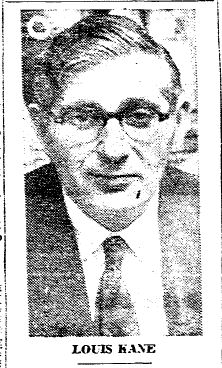
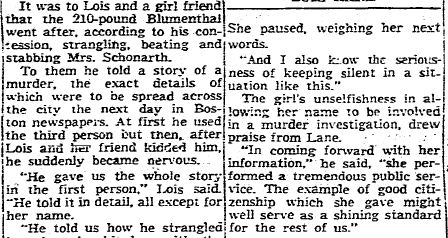
Knowing now that Louis was born in Connecticut and that the family was living in the Boston area, I was able to find a number of additional records for Louis and Marion Kane and their daughter Lois. In 1930, Louis was living with his parents in Newton, Massachusetts, according to the census of that year.  Louis was the son of Harry and Jessie Kane, both of whom were born in Connecticut and were the children of Russian immigrants.  Harry Kane was the owner of a furniture business, Kane Furniture, which further research revealed later belonged to Louis.  It was apparently quite successful, as this article  from the April 18, 1954 Boston Herald indicates.

Kane photo

Kane furniture text

By then finding Louis and Marion Kane in several directories and passenger manifests, I learned Louis’ precise birth date, which then led me to the SSDI, where I learned that he had died in October 1963.  Unfortunately, I could not find an obituary for him.  He was only 53 when he died, and Marion was just 51.  What happened to her between 1963 and 1994 when she died?  I did not yet know.

UPDATE: On July 2, 2020, many years after writing this blog post, I received a message from Jackie at Temple Beth El of Hollywood, Florida, who told me that Louis and Marion had joined that synagogue in July 1961 and that she had further information. From Jackie I learned that Louis and Marion had been members from July 1961 until December 7, 1984, when Marion resigned from the synagogue. According to their application for membership, Marion and Louis were married on January 1, 1933, not in 1932 as the Ancestry record indicated.  Most importantly, Jackie had a letter in the file sending condolences to Marion on the death of her mother Florence. The letter was dated June 28, 1968, and with that additional information I was finally able to find an obituary for Florence Josephs Siegel Hageman in The Philadelphia Inquirer stating that she died on June 18, 1968. Thank you, Jackie!

While searching for information about Louis and Marion, I also found an article revealing that their daughter Lois Kane had played an important part in the prosecution of a murder case in Boston in 1954 when she was just a teenager.  As described in many newspaper articles, eighteen year old Ronald Blumenthal had committed a brutal murder of 53 year old Ora Schornath in July, 1954; he had beaten, stabbed, and strangled her in her home.  Blumenthal had then described the murder to Lois Kane and another friend, suggesting that he had committed it.  When the victim’s body was discovered and the crime was described in the newspapers, Lois realized that Blumenthal’s story could in fact be true.  She informed the police, and Blumenthal was arrested.  He ultimately confessed and pled guilty to second degree murder on October 1, 1954.  He was sentenced to life in prison, but was paroled in 1967, over the objections of Schornath’s brother.

Lois Kane part 1

Lois Kane part 2

Lois Kane part 3Lois Kane part 4

Boston Herald, July 31, 1954, p. 4.  (For more information on this case, see also “Boy Tells Thrill Killing,” Boston Daily Record, July 30, 1954, pp. 3, 6; “Ronnie Pleads 2d Degree Murder Guilt, Gets Life,” Boston American, October 1, 1954 (p. 3); “Killer’s Parole Opposed,” Boston Record American, October 6, 1966, p. 5; “Brookline ‘Thrill Killer’ Wins Parole,” Boston Record American, February 2, 1967.)

I then searched for more information about Lois Kane.  I wanted to know what had happened to this courageous young woman. Once again, the SSCAI was a valuable resource.  I found this entry.

Ancestry.com. U.S., Social Security Applications and Claims Index, 1936-2007 [database on-line]. Provo, UT, USA: Ancestry.com Operations, Inc., 2015.

Ancestry.com. U.S., Social Security Applications and Claims Index, 1936-2007 [database on-line]. Provo, UT, USA: Ancestry.com Operations, Inc., 2015.

I now had her birth and death dates and locations, and I had two married names, suggesting that she had married twice, once to someone named Sisson and once to someone named Brooner.  In the Florida Marriage index, I found a listing for a Lois F. Kane who married H. Michael Sisson in November 1960 in Dade County.  Unfortunately I have had no luck yet finding out anything about Michael Sisson; I cannot find him on any documents that predate or postdate their marriage in 1960.   But I will keep looking.

Either Michael Sisson died before January 1, 1982, or he and Lois had divorced by then, because on that date Lois Florence Sisson married James C. Brooner in Broward County, Florida.  Seeing that Lois’ middle name was Florence confirmed for me that I had the right person, based on the SSACI.  I knew from the SSACI that Lois died in 2006, but as with her father Louis, I’ve had no luck finding an obituary.  I don’t know what she did after the Blumenthal case or how she ended up in Florida or whether she had children.

One thing that bothered me about the entry for Lois on the SSACI was the listing for her mother’s name: Marion Hageman. Even though I was reasonably confident that I had the correct Louis, Marion, and Lois Kane, I had to find out why the SSACI listing had Marion’s name as Hageman, not Siegel, which was her birth name.

Searching for Marion Hageman answered a number of the unresolved questions.  In particular, it told me more about what had happened to Florence Josephs after her first husband Louis Siegel died in 1915.  On the 1930 census I found a Marion Hageman listed as the daughter of Ely and Florence Hageman, who were living in Philadelphia, Florence Joseph’s hometown.  I was pretty sure that this was Marion and Florence (Josephs) Siegel, given the birth places listed for them and their parents and the ages.  It seemed that Florence had married someone named Ely Hageman.

Year: 1930; Census Place: Philadelphia, Philadelphia, Pennsylvania; Roll: 2136; Page: 26B; Enumeration District: 1075; Image: 53.0; FHL microfilm: 2341870

Year: 1930; Census Place: Philadelphia, Philadelphia, Pennsylvania; Roll: 2136; Page: 26B; Enumeration District: 1075; Image: 53.0; FHL microfilm: 2341870

Ely Hageman is listed on the 1930 census as born in Florida, but later documents indicate he was born in Virginia.  He was working as a salesman for a furniture company in 1930.  (Looking back at what I already knew about Marion’s then future husband Louis Kane, I wondered whether her stepfather Ely introduced her to Louis, who after all was living in the Boston area, quite far from Philadelphia where Marion had been living.)

I was able to locate a marriage record on the Philadelphia marriage index indicating that Ely Hageman and Florence Siegel had married in 1929.  In 1940, Ely and Florence were still living in Philadelphia, where Ely was still working in the furniture business.  Sadly, four years later Ely died from a coronary occlusion brought on hepatitis and diabetes, according to his death certificate.  He was 67 years old.

Ancestry.com. Pennsylvania, Death Certificates, 1906-1963 [database on-line]. Provo, UT, USA: Ancestry.com Operations, Inc., 2014. Original data: Pennsylvania (State). Death certificates, 1906–1963. Series 11.90 (1,905 cartons). Records of the Pennsylvania Department of Health, Record Group 11. Pennsylvania Historical and Museum Commission, Harrisburg, Pennsylvania.

Ancestry.com. Pennsylvania, Death Certificates, 1906-1963 [database on-line]. Provo, UT, USA: Ancestry.com Operations, Inc., 2014.
Original data: Pennsylvania (State). Death certificates, 1906–1963. Series 11.90 (1,905 cartons). Records of the Pennsylvania Department of Health, Record Group 11. Pennsylvania Historical and Museum Commission, Harrisburg, Pennsylvania.

I do not know what happened to Florence after Ely died.  She did take a trip with her granddaughter, daughter, and son-in-law in 1953, as this passenger manifest indicates.

Ancestry.com. Massachusetts, Passenger and Crew Lists, 1949-1957 [database on-line]. Provo, UT, USA: Ancestry.com Operations, Inc., 2014.

Ancestry.com. Massachusetts, Passenger and Crew Lists, 1949-1957 [database on-line]. Provo, UT, USA: Ancestry.com Operations, Inc., 2014.

But I have not found any record after that indicates what happened to Florence after that.  Did she move to Boston to be closer to Marion, her only child, and Lois, her only grandchild? Or did she move to Florida, where her granddaughter Lois had married by 1960 and lived thereafter? I don’t know.  Yet.  [See UPDATE above. I know now that Florence died on June 18, 1968, in Philadelphia.]

But isn’t it amazing how one new database entry led to so much more information?  Thank you, Ancestry, for adding the SSCAI.


My Cohn Cousins: Journalism, Sports, and, Most Importantly, Family and Love


The first post about my cousin Bob Cohn and his family discussed the lives of his grandparents—both Joseph and Rose (Kornfeld) Cohn, his paternal grandparents, and Minnie and Moses Kremenko, his maternal grandparents.  It also discussed his parents, Harold and Teddi (Kremenko) Cohn and their untimely deaths, which left Bob and his brother Paul as orphans at a young age.  Bob and Paul went to live with their aunt and uncle, Beatrice (Kremenko) and Sol Berman, after their mother’s death in 1945.

Despite these tragic losses, both Bob and Paul went on to enjoy successful careers and full family lives.  Bob wrote:

Seven years later [in 1952] I joined the United States Air Force for four years and served in Texas, Alaska, and Montgomery [Alabama] editing base newspapers.  When I was discharged from Maxwell Air Force Base in Montgomery I used the GI Bill to enroll at the University of Alabama where I met [my wife] June in 1959.

I asked Bob how he became interested in journalism, and he told me he was inspired by his role model and uncle, Barney Kremenko.  Bob had told me that his Uncle Barney was a famous sportswriter, but I had no idea how famous until I read this entry about him at Baseball-Reference.com, one of the best resources for information about baseball.

Barney Kremenko was a sports writer with the New York Journal American; there, he covered Willie Mays’ first – and the Giants’ final – seven seasons and was, reputedly, the one responsible for Mays’ famous nickname, The Say-Hey Kid. 

Upon joining the Journal some years before, Kremenko’s initial assignment had been Madison Square Garden, where he covered hockey, college hoops and track and field. In relatively short order, however, he would find his metier when chosen to succeed outgoing Giants’ beat writer, Pat Lynch.

When the Giants left New York in 1958, Kremenko led the campaign to restore National League baseball to New York. When that call was finally heeded in 1962, he was the logical choice to cover the fledgling Mets. Thus, the eulogy delivered many years later by UPI’s Carl Lundquist: “Barney was with the Giants, the Mets, and now he’s with the Angels.”

By 1966, however, the Journal was absorbed in a three-way merger. Kremenko continued with the short-lived World Journal Tribune, but when that paper went under in 1967, he went to work in a PR capacity for both the NHL’s New York Islanders and the NBA’s New Jersey Nets. At the time of his death in 1990, he was still listed as a communications consultant in the Islanders’ guide.

Throughout those final years, however, Kremenko maintained his membership in the Baseball Writers’ Association of America and continued to edit The Scorebook, the journal presented annually to those attending the BBWAA’s New York chapter dinner. As fate would have it, Kremenko’s death came exactly one day before 1990’s New York dinner.

Paul C. Barton, Barney Klemenko, and Bob Cohn Photo courtesy of Bob Cohn

Paul C. Barton, Barney Klemenko, and Bob Cohn
Photo courtesy of Bob Cohn

After reading this, it was no surprise to me that Bob was inspired to be a journalist.  He was very close to his uncle, who often took him to sporting events as a child, and remained close to him as an adult.  At the University of Alabama, Bob became the editor of the student newspaper and after graduating got a job at the Montgomery Adviser in Montgomery, Alabama, covering the civil rights movement during the 1960s. Bob wrote:

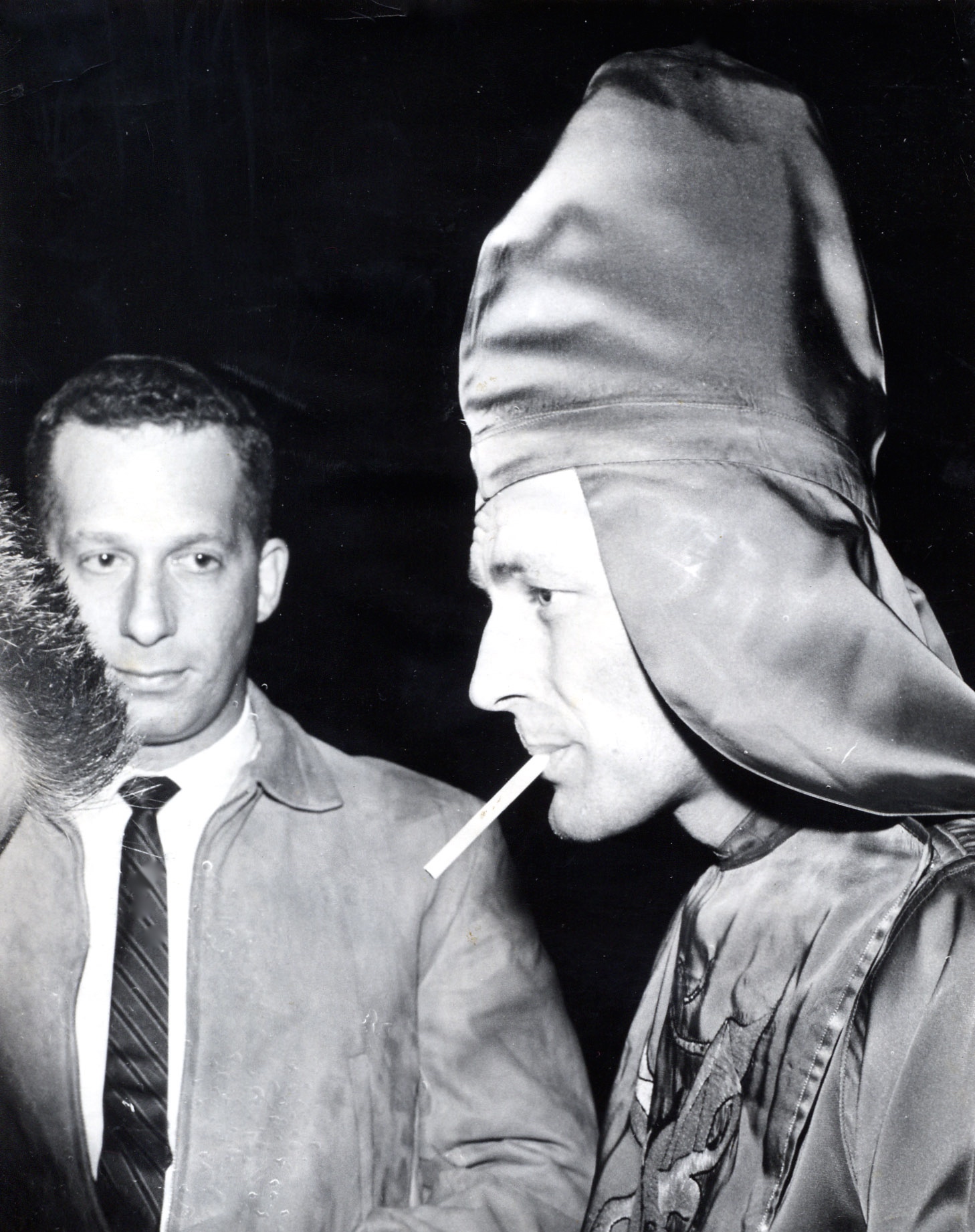
As a Jewish kid from Brooklyn, N.Y., I was improbably assigned to cover the Montgomery Police Department.  I was such an underdog that two brothers who were officers “adopted” me and made certain I got all the breaks on news stories.  Montgomery was the hotbed of racial violence and black protest.  It was there that the Dr. Martin Luther King, Jr., lived and preached.  It was in Montgomery that the “Freedom Riders” were beaten at the Greyhound Bus Station by the Ku Klux Klan while the police were deliberately absent from the scene.  I was there reporting on the violence.

Bob Cohn and Bobby Shelton, Imperial Wizard of the KKK, Montgomery, Alabama

Bob Cohn and Bobby Shelton, Imperial Wizard of the KKK, Montgomery, Alabama

I would love to hear more about Bob’s experiences during that time.

Eventually, Bob became the bureau chief in Atlanta for Morris Publishing, which owned several daily newspapers in the region.  His brother Paul had also settled in Atlanta after graduating from Emory University there.  Paul had changed his name from Paul Barton Cohn to Paul C. Barton after the bombing of the Temple, a Reform synagogue, on October 12, 1958, by white supremacists angry with that synagogue for its support of the civil rights movement.  Concerned about anti-Semitism, Paul decided to change his name to something less obviously Jewish.

Bob's brother Paul

Bob’s brother Paul C. Barton  Courtesy of Bob Cohn

Both Bob and Paul married women they met in college. Paul met his wife Joan Belger at Emory, and they had three children, Harris, Todd, and Jennifer.

Jennifer, Todd and Harris Barton Photo courtesy of Bob Cohn

Jennifer, Todd and Harris Barton
Photo courtesy of Bob Cohn

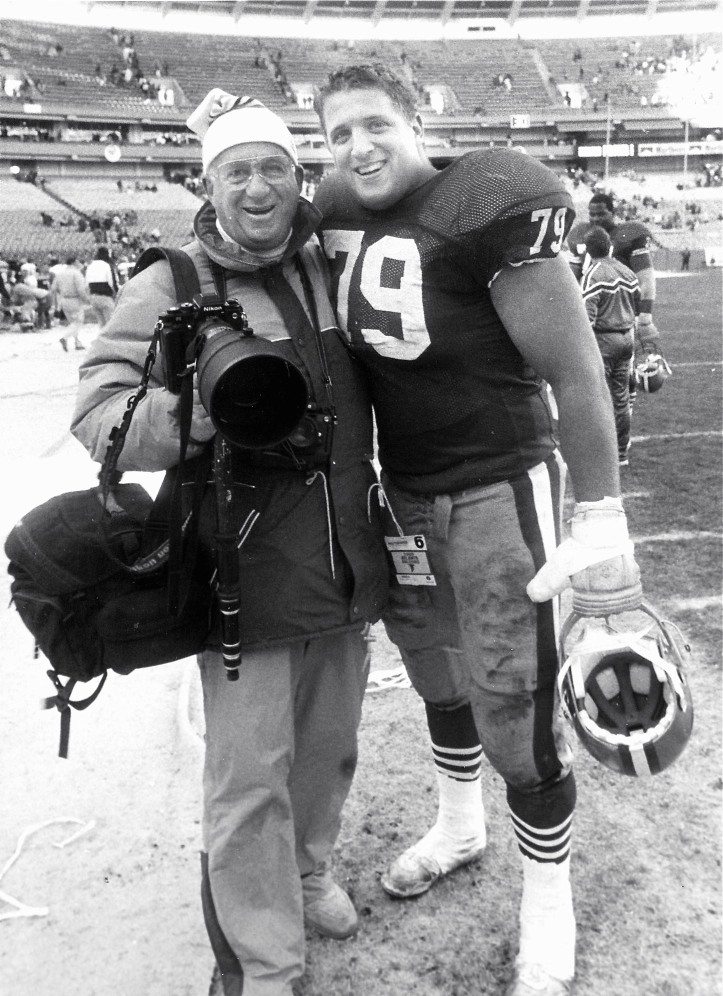
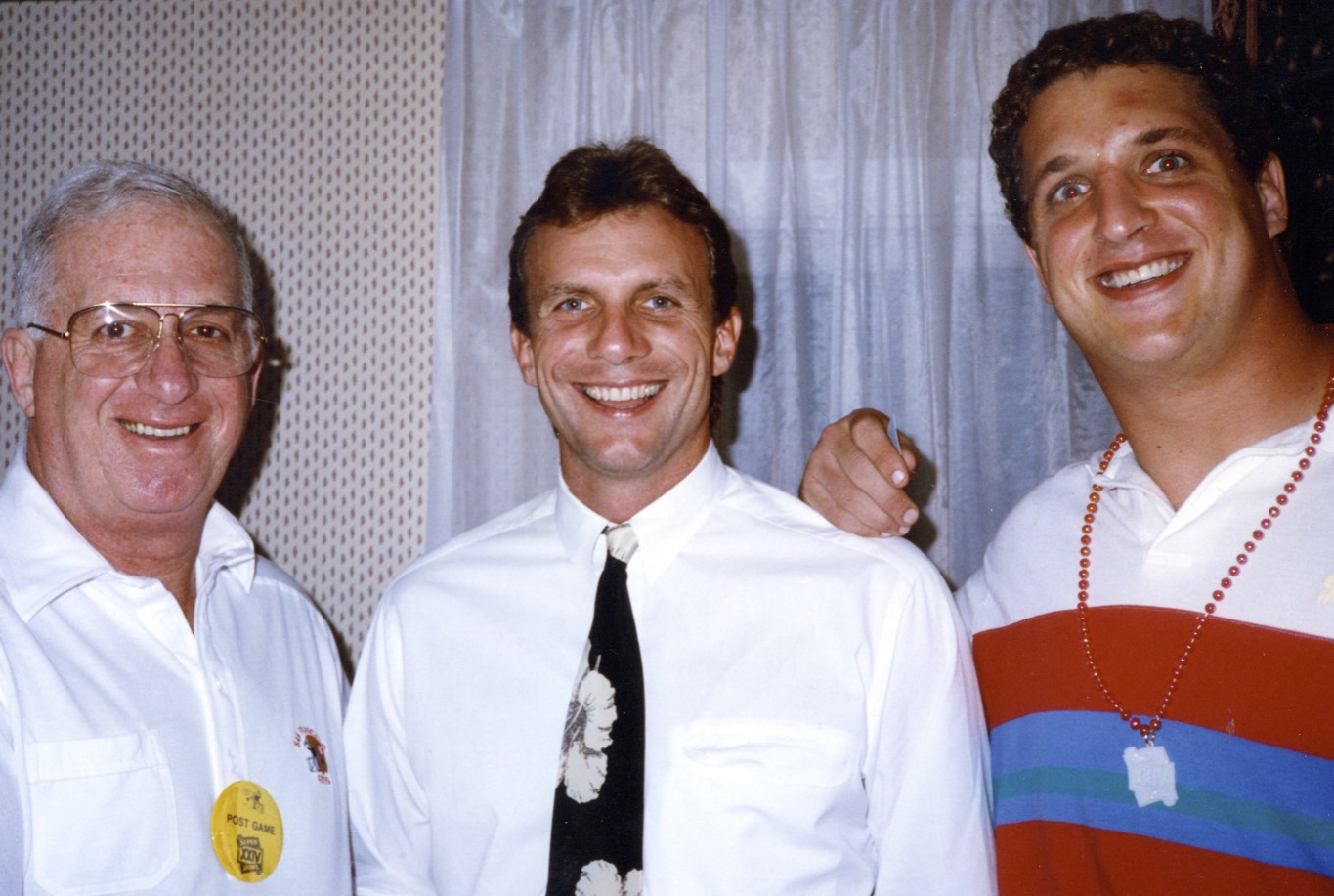
Their son Harris Barton was a star player for the San Francisco 49ers, definitely the first cousin I’ve found who had a career as a professional athlete.  Here is the entry from International Jewish Sports Hall of Fame website:

San Francisco 49ers offensive tackle Harris Barton was a Natiional Football League All-Pro selection four consecutive years: first team in 1991, 1992 and 1993, and 2nd team in 1990. He played in the 1993 Pro Bowl. Barton anchored the storied offensive line for superstar quarterbacks Joe Montana and Steve Young that provided the foundation for three 49er Super Bowl victories–1989, 1990, 1995. During his ten-year pro career, 1987-1996, Barton played 138 career NFL games, including 89 consecutive games. The 1986 University of North Carolina All-America was the 49er’s #1 draft choice in 1987. In his first season with the 49ers, Barton was named to the NFL’s All-Rookie team by the UPI, Pro Football Writers of America, and Pro Football Weekly.

Bob Cohn and Harris Barton after the NFC Championship game in Chicago

Bob Cohn and Harris Barton after the NFC Championship game in Chicago  Photo courtesy of Bob Cohn


Wikipedia also has a detailed entry as does the Pro-Football Reference website.   This article, from the Los Angeles Times and written in 1993 after Harris learned that his father was diagnosed with terminal brain cancer, reveals how important his father was to him.  Titled “The Good Son : 49er Lineman Harris Barton Discovers What Really Matters Is His Father,” the article, dated December 7, 1993,and written by Bill Plaschke, describes how learning of his father’s illness affected Harris and his focus on football.  Although Harris continued to play well, his priorities had shifted.

Barton also believes he is having a good year–as the right tackle, he has done well protecting left-handed Steve Young’s blind side.  But suddenly, preventing sacks is not as important as making sure his father can live the rest of his life in peace and dignity.

“When it comes to my family, football is on the back burner,” Barton said. “If anything comes out of me talking about this, it is that people should appreciate their parents while they still have them. Appreciate them now.”

Paul C. Barton died on May 25, 1994, at the age of 56.  Ten years later his wife Joan died from the same horrible disease, brain cancer.  She was 62.  They are survived today by their three children and seven grandchildren.


Bob Cohn with Joe Montana and Harris Barton Photo courtesy of Bob Cohn

Bob Cohn with Joe Montana and Harris Barton
Photo courtesy of Bob Cohn


 As for Bob, as noted above, he met his wife June at the University of Alabama.  Bob wrote this about June:  “She was a student from a small Alabama town about 17 miles from Tuscaloosa and she was (and is) gorgeous.” They married on June 5, 1960.
Bob and June's wedding

Bob and June’s wedding Photo courtesy of Bob Cohn

Bob and June Cohn in more recent days Photo courtesy of Bob Cohn

Bob and June Cohn in more recent days
Photo courtesy of Bob Cohn

They had three children.  As Bob described it:

Our first child, Terri Paula, was born [in 1961] in Montgomery and delivered by Dr. Robert Lightfoot whom I had met at a train wreck.  I was officially introduced to fatherhood when I held Terri in my lap and she peed on me.  … Susan was born in Augusta and Greg in Atlanta.  June noticed that every time we moved we had another child so she didn’t want to move again.

Terri, Greg, and Susan Cohn

Terri, Greg, and Susan Cohn Photo courtesy of Bob Cohn

With three children to raise and a need to earn more money, Bob left journalism in 1970 and founded his own public relations firm, which later became a partnership named Cohn & Wolfe.  It must have been difficult to leave his chosen field, especially after winning fourteen awards from the Associated Press and United Press.  But Bob’s decision proved to be a wise one as he had incredible success with his new business.  The firm was sold to Young & Rubicam in 1998 and now has 71 offices all over the world and still uses its original name despite the fame and reputation of its parent company.

Bob and June’s children were highly successful students and athletes, as are his grandchildren.  He wrote:

Both of my daughters were captains of their tennis teams at Lakeside High School. Terri was a finalist in the state tennis tournament. My son Greg, a pitcher, went to the University of Virginia on a baseball scholarship. During his runup to that he played on teams that won so many championships… I can’t remember how many. His three children—Grace (high school volleyball), Samantha (soccer, basketball, volleyball  and fast pitch softball) and Owen (football, basketball, an all-star baseball player and now playing lacrosse for the first time. Samantha’s team finished third this summer for the soccer national championships in Tulsa, OK. She and her team travel all over the country—San Fran, San Diego, Chicago, New York, Florida, etc. since she was 9 years old. Teams from Jacksonville and Orlando are in town this coming weekend to play Sam’s Tophat team, No. 1 in the state of Georgia. Samantha was tapped by the Olympic Development Program in soccer and is one of 60 girls in the South so honored, including Texas and Oklahoma.

Greg pitching for the U. of Virginia

Greg pitching for UVa

terri skiing

Terri and her husband David skiing

Suzie Cohn Polay

Susan cheerleading

The photos below are of Bob and June’s grandchildren engaged in various athletic endeavors.

DSC_0078 2 DSC_4134 DSC_5530 (3) copy DSC_5807 DSC_5978 DSC_7575 Scan 5.zzjpeg-2


Tragically, Bob and June’s daughter Susan died at age 46 on May 11, 2011.  She is survived by her husband Robert and their two sons, who continue to live in Atlanta.  Bob and June also continue to live in Atlanta as do their two surviving children, Terri and Greg, their spouses, and their five grandchildren.

Despite losing his parents at such a young age and then losing his brother prematurely and his daughter as well, Bob is a man of incredibly positive energy.  Listening to him talk about his family, his marriage, his children,and his nieces and nephews and all of his grandchildren, you can only hear a man who is filled with love and gratitude for what he has and no bitterness about what he lost.

I will close this post with some photographs of the next generations in the line going backwards from Harold Cohn and Teddi Kremenko to Joseph Cohn and Rose Kornfeld to Mary Seligman and Oscar Kornfeld to Marx Seligmann and Sarah Koppel to Jacob Seligmann and Martha Mayer, my 4x great-grandparents from Gaulsheim, Germany.

The next generation

Photos courtesy of Bob Cohn

next generation 2