Oh, Happy Day! Tillie Hecht Mystery, Part II

I was just about to throw in the towel.  I couldn’t find one additional clue about Taube Brotman Hecht and whether she was related to me.  There were no records online to help.

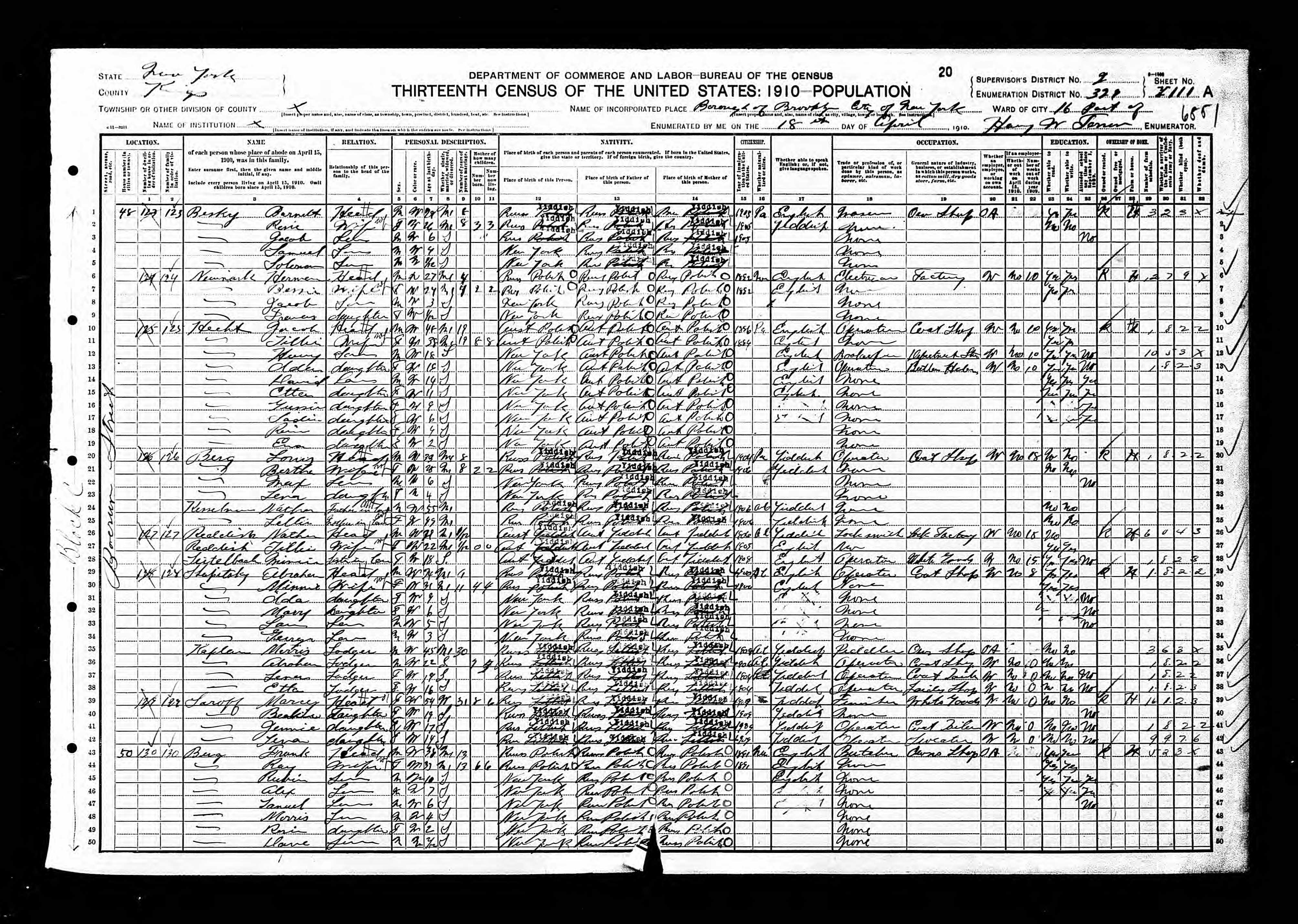
According to the 1900 and 1905 census records, Jacob Hecht and his wife Tillie lived in the Lower East Side and then by 1910 had moved to Brooklyn.  Jacob was a tailor, and in 1910 their son Harry was working as a bookkeeper in a department store and their daughter Ida was also employed, but I can’t quite make out her job: operator in a button or butter something?

jacob-and-tillie-hecht-1910-census

Jacob and Tillie Hecht 1910 US census Year: 1910; Census Place: Brooklyn Ward 16, Kings, New York; Roll: T624_964; Page: 8A; Enumeration District: 0329; FHL microfilm: 1374977

Ida Hecht occupation on 1910 census

Ida Hecht occupation on 1910 census

In 1913, Ida married Julius Goldfarb, as noted in an earlier post.  In 1915, Jacob and Tillie Hecht and their other seven children were living in the same building as Sam and Sarah Goldfarb, Ida’s in-laws, and Hyman and Sophie Brotman, my grandmother’s brother and his wife.  Jacob was working as a tailor, and Harry was working as a salesman; the other children were still in school.

sam-goldfarb-and-family-1915-ny-census-bottom-left-and-top-right

Hecht family 1915 NY census;  New York State Archives; Albany, New York; State Population Census Schedules, 1915; Election District: 18; Assembly District: 06; City: New York; County: New York; Page: 85

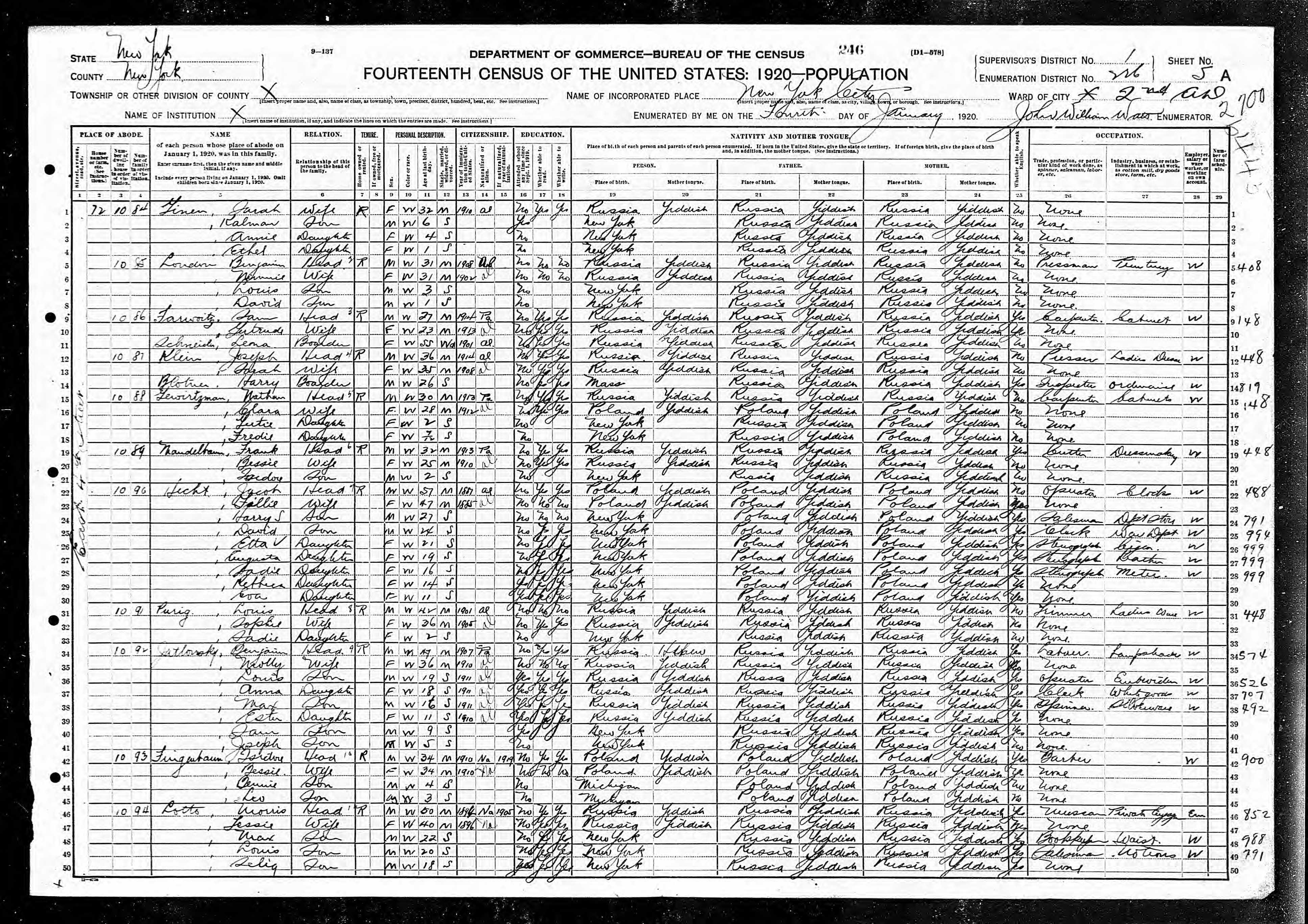
Jacob and Tillie Hecht still had the seven other children living with them in 1920, now on East 4th Street in New York City; Jacob continued to work as an operator in a cloak factory and Harry as a salesman in a department store.  David Hecht was working as a clerk for the War Department, and Etta, Gussie (listed as Augusta here) and Sadie were all working as stenographers.  The two youngest children, Rose (listed as Rebecca here) and Eva, were not yet employed.

jacob-and-tillie-hecht-1920-us-census

Jacob and Tillie Hecht and family, 1920 US census Year: 1920; Census Place: Manhattan Assembly District 2, New York, New York; Roll: T625_1188; Page: 5A; Enumeration District: 226; Image: 1055

Meanwhile, Ida and her husband Julius Goldfarb and their children had by 1920 moved to Jersey City, NJ, where Julius was in the liquor business.  Within five years, almost all of the Hecht family had followed them to Jersey City, including Jacob and Tillie.  As you can see from this segment from the 1925 Jersey City directory, Jacob and Tillie were now living at 306 4th Street, and right above their listing is a listing for their son Harry.  He was working as a clerk for none other than Herman Brotman: my great-uncle, my grandmother’s brother Hymie.  Another piece of the puzzle was fitting together.

Hechts in 1925 Jersey City directory Title : Jersey City, New Jersey, City Directory, 1925 Source Information Ancestry.com. U.S. City Directories, 1822-1995 [database on-line]. Provo, UT, USA: Ancestry.com Operations, Inc., 2011.

Hechts in 1925 Jersey City directory
Title : Jersey City, New Jersey, City Directory, 1925
Source Information
Ancestry.com. U.S. City Directories, 1822-1995 [database on-line]. Provo, UT, USA: Ancestry.com Operations, Inc., 2011.

But there were two other Hechts listed here at the same address as Jacob and Tillie: Jean and Shirley, both working as stenographers.  I wasn’t sure which daughter was now using Jean and which was now using Shirley, but I guessed that Jean was probably Gussie and Shirley was probably Sadie. David, Etta, Rose, and Eva were not listed.  I could not find them elsewhere either.  Was Etta married? Rose and Eva were young enough that they could have still been in school, but where was David, who would have been 29 in 1925?

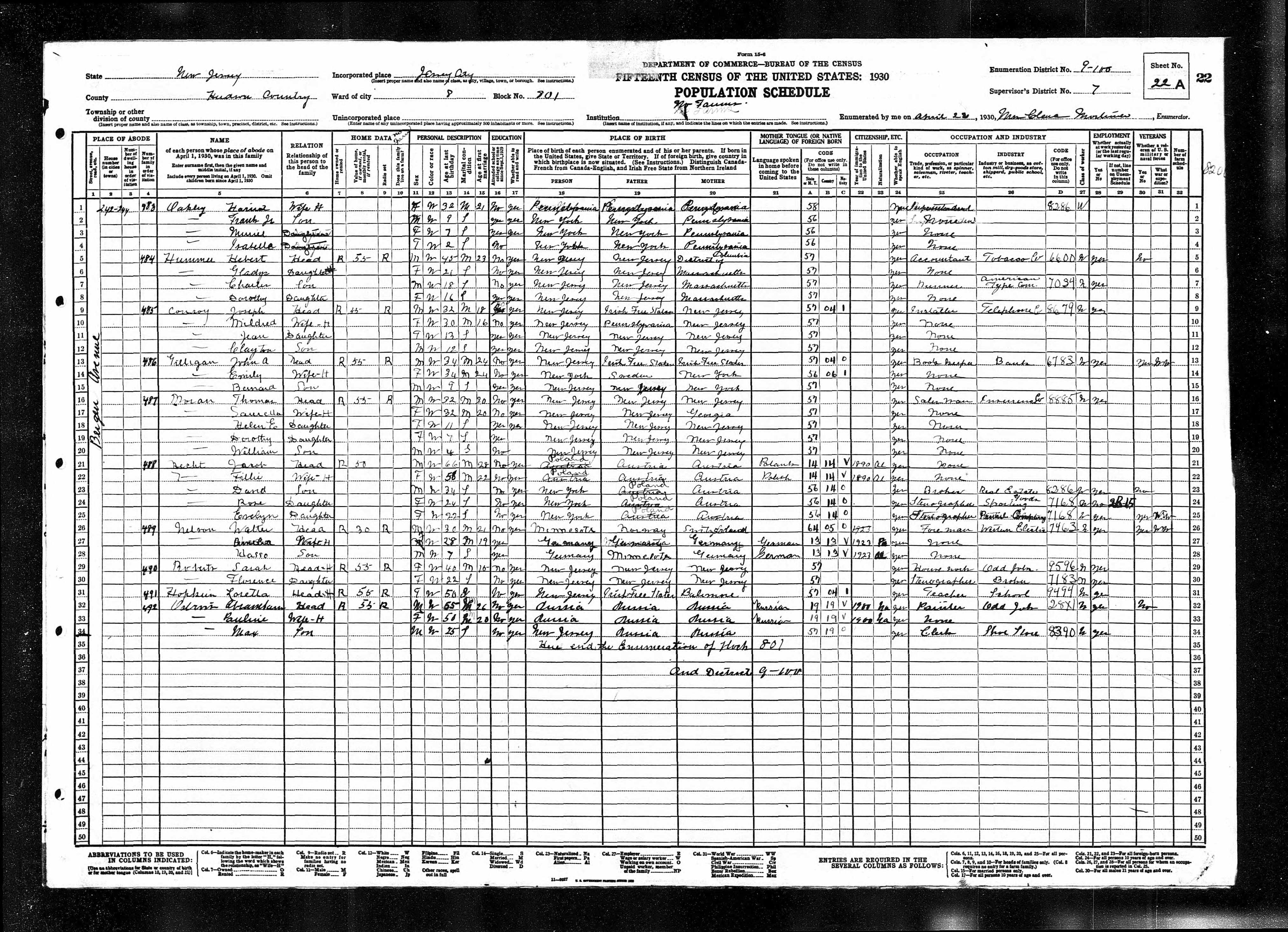
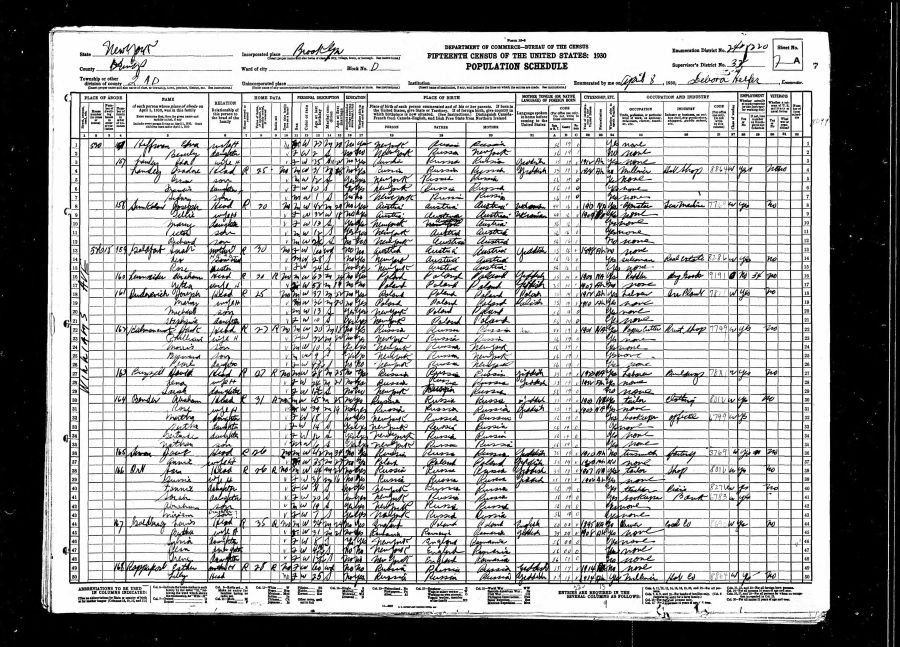
Fortunately, I was able to find a few of the Hechts on the 1930 census, which answered some of those questions.  In 1930, Jacob and Tillie were still living in Jersey City with David, Rose, and Eva (listed as Evelyn here).  Jacob was no longer working, but David was working as a real estate broker and Rose and Eva were both working as stenographers.

Jacob and Tillie Hecht 1930 US census Year: 1930; Census Place: Jersey City, Hudson, New Jersey; Roll: 1353; Page: 22A; Enumeration District: 0100; Image: 602.0; FHL microfilm: 2341088

Jacob and Tillie Hecht 1930 US census
Year: 1930; Census Place: Jersey City, Hudson, New Jersey; Roll: 1353; Page: 22A; Enumeration District: 0100; Image: 602.0; FHL microfilm: 2341088

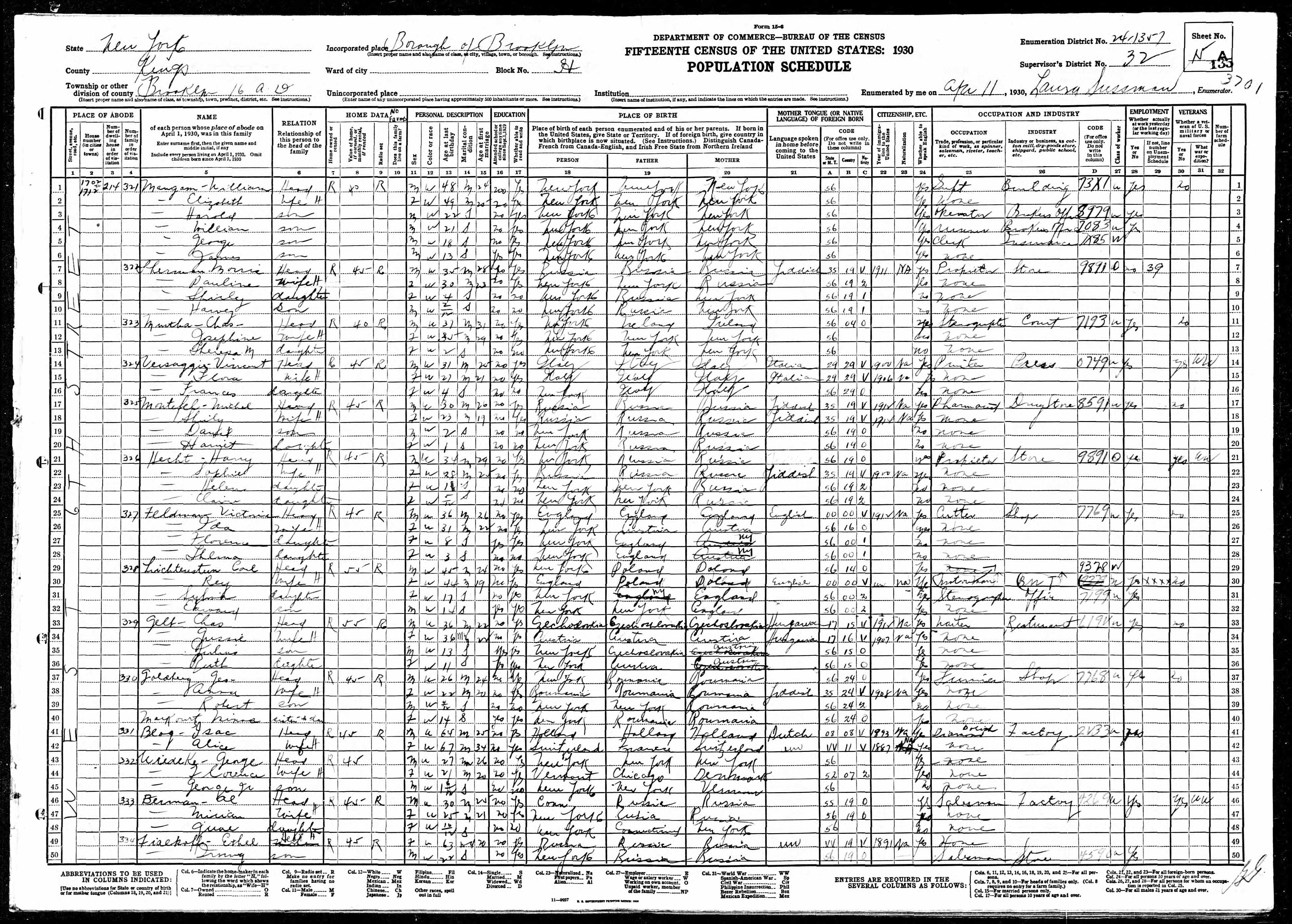
Their son Harry Hecht had moved to Brooklyn by 1930 and was now married to a woman named Sophie; they had two children.  Harry was the proprietor of a store.

Harry Hecht and family 1930 US census Year: 1930; Census Place: Brooklyn, Kings, New York; Roll: 1522; Page: 15A; Enumeration District: 1357; Image: 271.0; FHL microfilm: 2341257

Harry Hecht and family 1930 US census
Year: 1930; Census Place: Brooklyn, Kings, New York; Roll: 1522; Page: 15A; Enumeration District: 1357; Image: 271.0; FHL microfilm: 2341257

As for Etta, Gussie, and Sadie, I assumed they were married, but I couldn’t find them.  And at that point I hit a wall. I could not find any of the Hecht daughters on the NYC marriage index.  Because the family had moved to New Jersey, and New Jersey has so far refused to put even an index of its birth, marriage, or death records online, there was no simple way for me to find marriage records for them in New Jersey. I assumed that Gussie/Jean and Sadie/Shirley had married between 1925 and 1930 and that Etta had married between 1920 and 1925, but paying for a search for these certificates did not seem like a wise use of my resources.

I already had two documents that said that Tillie Hecht’s birth name had been Taube or Toba Brotman: her son Harry’s birth certificate and her daughter Ida’s marriage certificate; there was also a ship manifest for a Taube Brodt from Tarnobrzeg.    In addition, I had found this entry on the SSACI for a Jean Gross, giving me not only information about Jean Hecht’s married name, but also another confirmation that Taube’s birth name was Toba Brotman:

Ancestry.com. U.S., Social Security Applications and Claims Index, 1936-2007 [database on-line]. Provo, UT, USA: Ancestry.com Operations, Inc., 2015.

Ancestry.com. U.S., Social Security Applications and Claims Index, 1936-2007 [database on-line]. Provo, UT, USA: Ancestry.com Operations, Inc., 2015.

The additional marriage certificates for the remaining daughters might have given me further confirmation that their mother’s birth name was Taube/Toba Brotman, but what I really wanted to know was who Taube’s parents were.  And that meant finding either her marriage certificate or her death certificate, not her children’s marriage certificates.  But before I could do that, I wanted some rough idea of when she died so that I could make a reasonable request of my researcher in Trenton.

That meant finding the 1940 census to see if Tillie Hecht was still alive in 1940.  The New Jersey archives allows public access to death certificates up to 1955; I had to hope that Tillie had died in New Jersey before 1955.


I was able to find Tillie Hecht on the 1940 census; she was still living in Jersey City at 306 East 4th Street.

Tillie Hecht and family 1940 US census Year: 1940; Census Place: Jersey City, Hudson, New Jersey; Roll: T627_2401; Page: 3B; Enumeration District: 24-50

Tillie Hecht and family 1940 US census
Year: 1940; Census Place: Jersey City, Hudson, New Jersey; Roll: T627_2401; Page: 3B; Enumeration District: 24-50

She was now a widow, so Jacob had died since the 1930 census. It also says she was sixty years old whereas Tillie would really have been at least sixty-four.  There were two adult children living with her: Dave, who was listed as 35 and not employed, and Ruth, who was 26 and working as an assistant in a doctor’s office.  David Hecht should have been 45 in 1950, and Rose would have been 36. Had Rose changed her name from Rebecca (1930) to Ruth in 1940?  Had Tillie shaved ten years off the ages of herself and both of her children, or was there possibly another Tillie Hecht living in Jersey City, born in Austria?

I decided to assume for search purposes that this was the right Tillie Hecht and to ask my researcher to see if she could find a death certificate for a Taube or Tillie Hecht between 1940 and 1955.  And then I waited.

But while I was waiting, I also emailed Tillie’s great-granddaughter Sue and asked her what she knew about her Hecht relatives: what were the married names of her grandmother’s sisters? When did Jacob and Tillie and their children die? Did she know anything else that might help me find out how Tillie Brotman Hecht was related to my Brotmans, if at all?

Sue then spoke to her cousin Renee, one of Tillie’s grandchildren (Jean Hecht’s daughter), and filled me in on what Renee had told her.  It was an email filled with a great deal of information, but the part that was most critical to solving my question about Tillie Hecht was this one:

Tillie (Toba) Brotman came to U.S. at 10 years of age she thinks. 2 brothers were already here…redheads …or at least one was. The brothers sent Tillie to a house in St. Louis…to work…learn English, or both. Renee remembers her mother and Aunt Etta (also a Hecht girl) taking the subway to Brooklyn to see “The Uncle” who must have been one of Tillie’s brothers.

I read this paragraph several times, trying to sort out what it meant.  First, the fact that Tillie had come to the US at ten was consistent with the Taube Brodt I’d found on the 1887 ship manifest, listing Taube as eleven at that time.

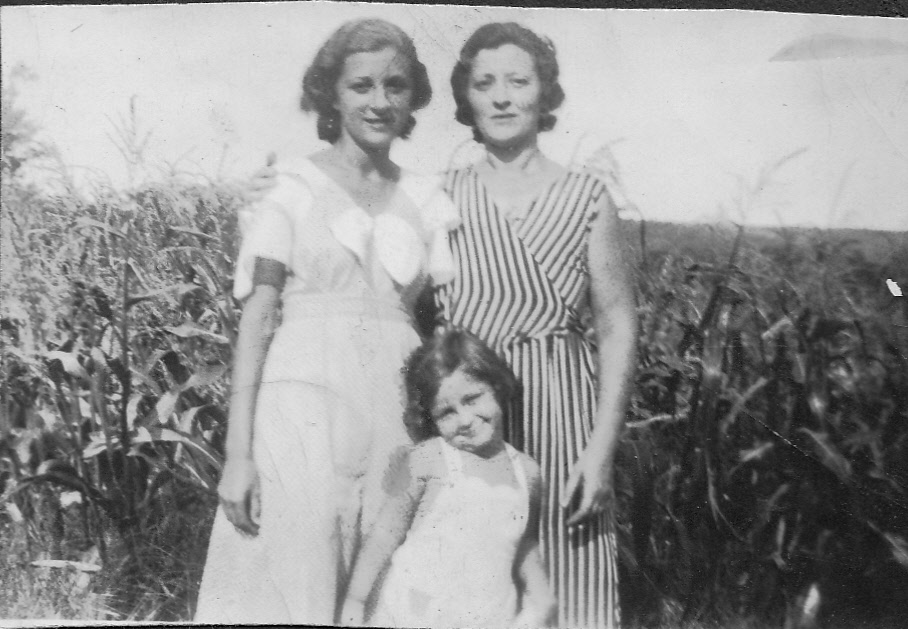
Second, Renee reported that Taube had had two brothers here already— and that they were redheads.  That stopped me in my tracks—my mother, my aunt, my grandmother, my grandmother’s sisters—all were redheads.  Red hair is recessive and not all that common.  Could this just be coincidence? A Brotman from Tarnobrzeg with red hair had to be related to my family.

My grandmother with her two daughters, my Aunt Elaine and my mother 1933

My grandmother with her two daughters, my Aunt Elaine and my mother 1933.  All redheads.

But who were these two brothers? And why did they send Taube to St. Louis? I had no record of any Brotman from my family arriving before 1887 when Taube Brodt arrived.

I then read Sue’s email again.  This time a different paragraph jumped out at me:

Renee recalls meeting a cousin also named Renee who she thinks was the daughter of one of Tillie’s brothers. As she recalls, they owned a hardware store on Lexington Ave. and 59th in NYC.  Renee thought that both Renees were named for an Aunt Irene.

A big, loud bell went off in my slow-witted brain.  I knew who that second Renee was.  She was Renee Brotman, daughter of Max Brotman, my grandmother’s older half-brother.  Renee had married Charles Haber, and they owned a hardware store on Lexington Avenue and 59th Street in New York City.  I emailed Renee’s daughter Judy to confirm that that was in fact the address.

Max, Sophie, Rosalie and Renee

Max, Sophie, Rosalie and Renee Brotman. Max was my grandmother’s half-brother.

Suddenly I knew exactly who Toba Brotman, aka Taube Brodt, aka Tillie Hecht, was.

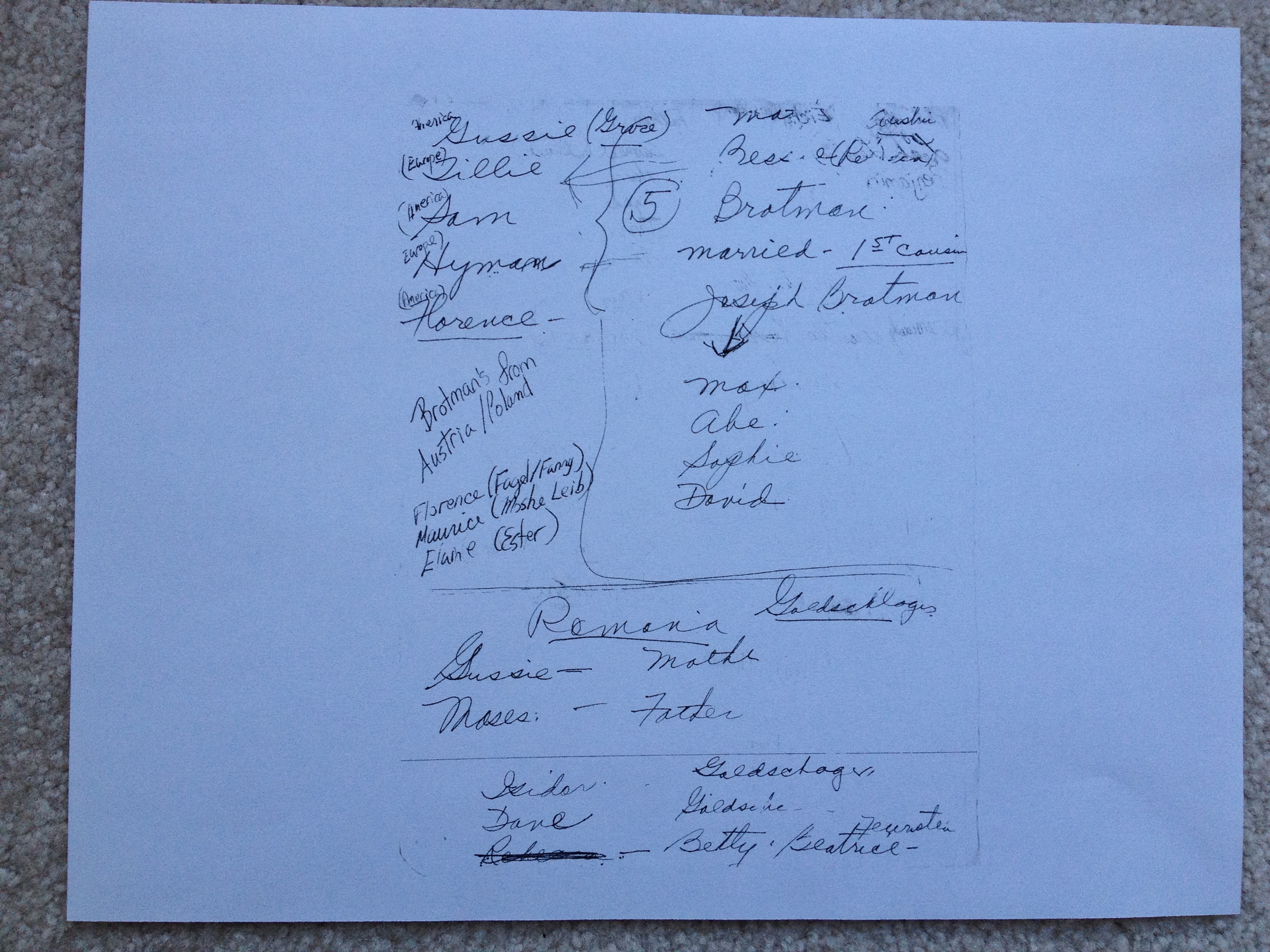
She was my grandmother’s half-sister, the missing sibling I had long ago, years ago, given up on ever finding.  I had searched and searched and found not one shred of a clue.  I only knew she existed because my Aunt Elaine had listed all of the children of Joseph Brotman, including those with his first wife Chaye, on her family tree.  There had been a daughter named Sophie, according to my aunt.

Family Tree drawn by Elaine Goldschlager Lehbraum

Family Tree drawn by Elaine Goldschlager Lehbraum

max mason

My aunt had all the other names right—could she have been mistaken about Sophie’s name? Was it really Toba or Taube or Tillie?

Plus there was another thing that troubled me: if Tillie Hecht was really my grandmother’s sister, it meant that my grandmother had two sisters using the name Tillie: her full sister Tillie, the one my mother knew well, Tillie Brotman Ressler, and this other half-sister Tillie Brotman Hecht.  How could there be two sisters with the same first name?

Tilly Ressler 1944

Tilly Brotman Ressler 1944.  My grandmother’s sister. And also a redhead.

But then I thought some more.  Tillie Hecht’s original name had been Toba; Tillie Ressler’s original name had been Tema.  They were not given the same name at birth; they both had just adopted the same Americanized nickname in the United States.  Maybe that’s why my aunt thought of Tillie Hecht as Sophie? Maybe some in the family still called her Toba or Taube and that sounded like Sophie to my aunt? (Those of us who knew her well knew how my Aunt Elaine could mangle a name.)

And who was this Aunt Irene that the two Renees were named for? A clue for that came from my cousin Judy; she said her mother Renee had originally been named Ida, but it was changed to Irene soon after she was born.  Irene then evolved into Renee.  When I saw “Ida,” I recalled that Ida was often a secular name for girls named Chaye.  Chaye was the name of Joseph Brotman’s first wife, the mother of Abraham, David, Max, and “Sophie.” Max Brotman had named his daughter Ida (then Irene) for his mother Chaye.  If Tillie Brotman Hecht was in fact “Sophie,” it made sense that she also named her first daughter Ida for her mother Chaye.

It all made sense.  But I knew better than to rely on family lore.  I needed some kind of official record to back up my hypothesis.

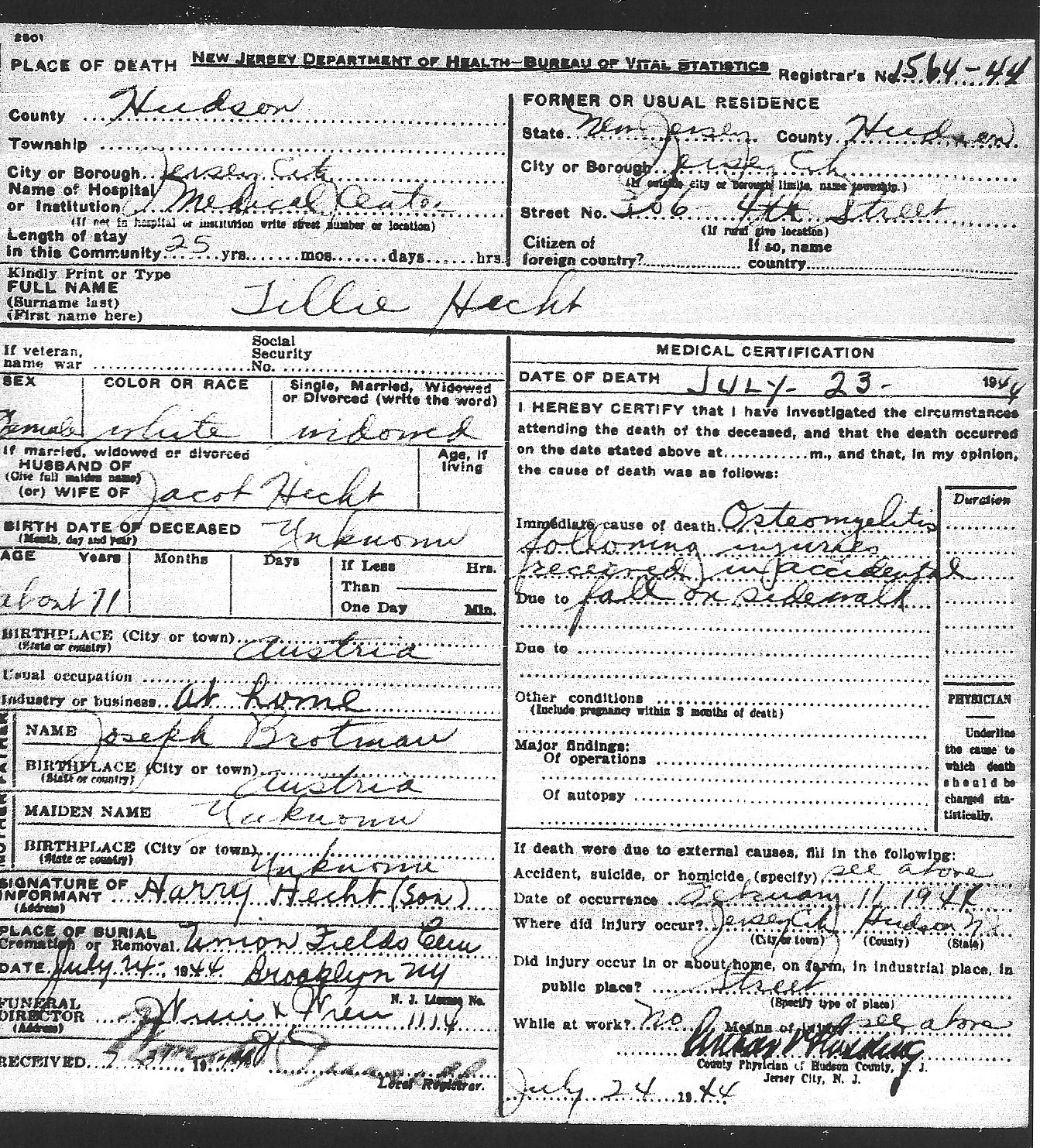
And then it arrived.  Tillie Hecht’s death certificate:

tillie-hecht-death-certificate

Her father was Joseph Brotman, my great-grandfather. Tillie Hecht, born Toba Brotman, was my grandmother’s half-sister.  The Hecht children, all eight of them, were my mother’s first cousins.  I had found the long missing Sophie, only she was really Toba.

There were still questions to address, but for the moment, I just was content to wallow in the joyous mud of discovery.


Who was Tillie Hecht? Another Brotman Mystery

If you had asked me three years ago when I started this blog whether I’d still be finding new Brotman relatives three years later, I’d have laughed. I had so little information about even my great-grandparents.  And yet here I am in 2016 having found a whole new Brotman/Brod family of relatives based on a name in a baby book from 1917.

The discovery of Julius Goldfarb and his family, in particular his mother Sarah Brotman/Brod, was a true blessing.  Now I have corroboration of where my great-grandparents lived in Poland, and I have a better picture of my grandmother’s extended family and the people who were part of her life when she was a child and an adult.  I also have several newly discovered living cousins who have already enriched my life.

Even more amazing to me is the most recent discovery of Taube Hecht because that discovery was even more far-fetched.  Remember that in my aunt’s baby book the last name on the list of visitors was Mrs. Taube Hecht.  At first I’d had no idea who she was.

Aunt Elaine baby book 5

Then while researching Julius Goldfarb to figure out how he was related to my grandmother, I obtained a copy of his marriage certificate.  Julius Goldfarb had married Ida Hecht, and on their marriage certificate it said her father was Jacob Hecht and her mother’s name was originally Taube Brotman, now Taube Hecht.  I had wondered whether Ida’s mother was also somehow related to my grandmother’s family.

goldfarb-hecht-marriage-page-3

In researching Taube Brotman Hecht, I learned that she was also known as Tillie and that she’d had eight children with Jacob Hecht: Harry (1892); Ida (1894); David (1896); Gussie (1899?); Etta (1900); Sadie (1903); Rose (1906); and Eva (1908).

On the 1915 New York State census, the Hecht family was living in the same building on Avenue C in New York City as Sam and Sarah Brotman/Brod Goldfarb and as Hyman Brotman, my great-uncle, and his family.  It certainly seemed possible that Taube was related to my Brotman great-grandparents and to Sarah Brotman/Brod Goldfarb.

sam-goldfarb-and-family-1915-ny-census-bottom-left-and-top-right

1915 NYS census with the Hecht family, the Goldfarb family, and the family of Hyman Brotman

So I jumped for joy—perhaps another relative, another set of clues about my Brod/Brotman relatives.  And then I jumped back into the research, hoping that Taube Brotman Hecht would provide more clues about my elusive relatives from Galicia.  I figured that with eight Hecht children to research, I would undoubtedly find more clues from birth, marriage, and death certificates.  But alas, the Hechts proved to be far more elusive than I’d hoped.

I started by searching for birth certificates.  Since I knew from the Goldfarb family records provided to me by my cousin Sue that Ida Hecht Goldfarb was born in New York City on October 19, 1894, and that the Hechts were still living in New York City in 1910 when the US census was taken, it seemed quite likely that all eight children, born between 1892 and 1908, were also born in New York City.  I searched the New York City birth records databases on Ancestry, FamilySearch, and Steve Morse’s website, and I could only find birth records listed for two of those eight children: the firstborn, Harry, and the last born child, Eva.  The other six children are just not there at all, no matter how I spelled their names, no matter how many wildcards I used.  Jacob and Taube must not have filed a birth certificate at all for those other six children.

In addition, when I asked my regular researcher at the Family History Library in Salt Lake City to find Harry’s birth certificate, she was unable to do so because it was a certificate marked “S,” meaning a later filed certificate.  Those are not on the microfilms at the FHL.  Instead I had to ask someone in NYC to go to the archives there to dig up Harry’s birth certificate.  It hadn’t been filed until 1906 when Harry was already fourteen years old.  I wonder what would have prompted the family to file it at that point in time.

harry-hecht-birth-certificate-resized

But the certificate is quite interesting.  It shows that in 1892, Jacob and Taube (“Toba” here, the Hebrew name) were living at 33 East Houston Street in New York City, that they were both born in Austria, and that Jacob (like Sam Goldfarb) was a cloaks operator.  Jacob was 25 when Harry was born, Toba only twenty, meaning they were born in about 1867 and 1872, respectively.

And most importantly, Harry’s birth certificate records Toba’s name before marriage as Toba Brotman.  Brotman! I was right that Ida’s marriage certificate said “Brotman,” not Braitmer as it had been indexed.  And, of course, this meant that there was a real chance that Toba, like Sarah Goldfarb, was related to my great-grandparents in some way.

And then I looked at the certificate I’d ordered for Eva Hecht.

eva-hecht-birth-certificate-resized

She was born on January 30, 1908, at 38 Montrose Avenue in Brooklyn.  On the 1910 census, the Hecht family was living at 48 Boerum Street in Brooklyn, which is right around the block from 38 Montrose Avenue.  So far, so good.  But then I looked at her parents’ names: JOSEPH Hecht and Tillie ROTHMAN.  Was this in fact the same Eva Hecht? The father was 40 years old, meaning born in about 1868; the mother was 37, so born about 1871. Those years were very close to the ages Jacob and Taube would have been in 1908.  Both parents were born in Austria, as were Jacob and Taube.  And the father “Joseph” was a tailor, as was Jacob Hecht.

Given all these similarities and the fact that by that time Taube was using Tillie on the census records, I have to believe that this is in fact a birth certificate for Eva Hecht, daughter of Jacob and Tillie/Taube/Toba Hecht.  And if it has Jacob’s first name wrong, it could very well have Tillie’s birth surname wrong.  Rothman does sound like Brotman, and many family members spelled Brotman as Brothman.  Perhaps the person filing the birth certificate, Mrs. Ida Goldman, just had bad hearing or the family’s accents were hard for her to understand.

So I had one new solid piece of evidence that Taube Hecht was born Toba Brotman and one rather shaky document that was at least somewhat supportive of that assumption. And, of course, I had Ida’s marriage certificate as well.  What else might I find? If there were no more birth certificates, could I find other marriage certificates or death certificates? Would the census records provide any more clues? So I decided to start from the beginning and search for records about the Hecht family.

The earliest census on which they appear is the 1900 US census.  The family was then living at 64 Broome Street on the Lower East Side.  The information for Jacob Hecht (spelled “Hect” here and indexed by Ancestry as “Hast,” making this a tough one to find) has some inconsistencies.   His birth year is 1870, so a year or two later than the other records indicated.  His birth place is Russia, not Austria.  But he is working as a tailor.  His wife’s name is listed as Mitilda, which certainly could be Tillie, and she also is listed as born in Russia, not Austria.  Her birth year is given as 1875, also several years later than her children’s birth records indicated.

Hecht family 1900 US census Year: 1900; Census Place: Manhattan, New York, New York; Roll: 1094; Page: 14A; Enumeration District: 0290; FHL microfilm: 1241094

Hecht family 1900 US census
Year: 1900; Census Place: Manhattan, New York, New York; Roll: 1094; Page: 14A; Enumeration District: 0290; FHL microfilm: 1241094

The names of their children also have some consistencies, some differences.  The first born, Harry, was born in 1892; that was consistent with Harry Hecht’s birth record.  The second child, however, is listed as Annie, born in 1893.  That should be Ida, the second child, who, according to the Goldfarb family papers, was born in 1894.  The third child, David, was reported to be four years old (the birth year is not very legible); that is consistent with David’s name and birth year on later census reports.  The fourth child is Yetta, who is listed on later reports as Etta; she is reported to have been seven months old when the census was enumerated in June 9, 1900, meaning she would have been born in October, 1899, not October 1889, as the census record has it recorded.  A birth year of 1899 is consistent with later census reports for Etta.

What this census record also revealed was that Jacob and “Miltilda” had been married for nine years, or in 1891.  It also said that Jacob had been in the US for only twelve years and arrived in 1887 (though it looks like 1777).  “Mitilda” had arrived earlier and had been in the country for fifteen years or since 1885 (though it looks like 1875 was written over it).  With this additional information, I searched for both a marriage record for Jacob and Taube/Tillie/Mitilda and for immigration records.

I had no luck finding a marriage record in the New York City marriage databases on Ancestry, FamilySearch, or Steve Morse’s website.  I guess it’s not surprising that a couple who failed to file birth certificates for their children also had failed to file a marriage record.  I am still hoping that some record will show up.

As for immigration records, I am fairly certain that I found the ship manifests for Taube.  I found two manifests, first a German manifest for the ship Moravia, dated July 9, 1887, sailing to New York from Hamburg.  On that manifest is a passenger named Taube Brodt, an eleven year old girl, and her name is bracketed with two other passengers, Eva Singer, a 38 year old woman, and an eleven month old baby named Ascher Singer, presumably the son of Eva.  And all three are listed as last residing in “Tarnobchek.”  That is, Tarnobrzeg—the home of my great-grandparents Joseph Brotman and Bessie Brod.

Taube Brodt ship manifest 1887 Staatsarchiv Hamburg; Hamburg, Deutschland; Hamburger Passagierlisten; Microfilm No.: K_1736 Description Month : Direkt Band 059 (3 Jul 1887 - 29 Dez 1887)

Taube Brodt ship manifest 1887
Staatsarchiv Hamburg; Hamburg, Deutschland; Hamburger Passagierlisten; Microfilm No.: K_1736
Description
Month : Direkt Band 059 (3 Jul 1887 – 29 Dez 1887)

The second manifest is also for the Moravia, but is the American manifest, written in English, and dated July 21, 1887, the arrival date in New York; it also lists Taube Brodt and the Singers as coming from Tarnobchek.

Taube Brodt 1887 NY ship manifest Year: 1887; Arrival: New York, New York; Microfilm Serial: M237, 1820-1897; Microfilm Roll: Roll 509; Line: 1; List Number: 911

Taube Brodt 1887 NY ship manifest
Year: 1887; Arrival: New York, New York; Microfilm Serial: M237, 1820-1897; Microfilm Roll: Roll 509; Line: 1; List Number: 911

But who were Eva and Ascher Singer? And why was this eleven year old child traveling with them? My great-grandfather arrived in 1889, my great-grandmother 1891; Sarah Brod/Brotman Goldfarb didn’t arrive until 1896.  So if Taube Brodt was their relative, who was she going to and why was she leaving home at such a young age? And where did Taube Brodt and Eva and Ascher Singer end up after they disembarked in New York City in July 1887?

Although I can find many women named Eva Singer, there is only one born in Austria who arrived in 1887 and who had a son who would have been born in 1886.  But that Eva’s son’s name is Herman, and that Eva was older than the one who sailed on the Moravia with Taube.  Maybe that is the right Eva, and Ascher became Herman.  That Eva’s birth name was Goldman, according to the listings in the SSCAI for two of her children.

And I had little luck finding an Ascher Singer.  The only record I could find that might fit was a marriage record dated 1910 for an Ascher Singer marrying Lena Laufer.  I ordered that marriage record, and it shows that Ascher’s parents were Seide Singer and Taube Druckman.

singer-laufer-marriage-page-1

When I saw the name Taube, I wondered—could Ascher have been Taube Brodt’s baby, not Eva’s? Maybe Taube wasn’t only eleven.  Taube’s age on the census records and her children’s birth certificates suggest she was born in 1871 or 1872, not 1876, as the ship manifest would suggest.  So maybe she was really fifteen, not eleven, when she emigrated.

But that is the only record I can find for Ascher Singer, and there is no way to know for sure whether it is the same person who sailed with Taube on the Moravia in 1887 or whether Taube Druckman was really Taube Brodt.

Plus even if this is the right Eva or the right Ascher, I’ve no idea how they are connected to Taube Brodt or anyone else in my family. And maybe they weren’t.  Maybe Taube just happened to be traveling with them.  But then where was she going and to whom? And was this even the same person who married Jacob Hecht in about 1891? If so, she would have been only 15 in 1891 if she was eleven in 1887.  Maybe Taube Brodt isn’t even Toba/Taube/Tillie Brotman Hecht?

Now what could I do?  Besides pull my hair out.  I kept on looking.

And then the most amazing thing happened. One of my toughest brick walls came tumbling down and when I least expected it.


Who was Sarah Goldfarb? The Plot Thickens

My search for answers as to how Sarah Goldfarb was related to my grandmother’s family had thus far led me to conflicting evidence.  Three of her children had listed her birth name as a version of Brotman on their marriage records, and the death record of her daughter Gussie also listed Sarah’s birth name as Brotman. Brotman, of course, was my great-grandfather Joseph’s surname.

katz-gussie-death

Two records, however, indicated that her birth name might have been Brod.  The birth record of her daughter Rosie in 1902 indicated that her birth name was something different—Braud, which appeared to be a phonetic equivalent to Brod. Brod or Brot was what I believed was the birth name of my great-grandmother Bessie.  And the marriage record of Sarah’s son Morris in 1919 reported Sarah’s birth name to have been Brod.

goldfarb-grinbaum-marriage-page-1

So was Sarah a sister of Joseph or a sister of Bessie? Since she had named one child Bessie and one Joseph, the naming patterns weren’t helpful and were in fact bewildering.  Was neither Joseph nor Bessie her sibling?

And their residences in the US also presented confusing evidence.  Sarah first had lived near the Brotmans, who settled in Pittsgrove, New Jersey; then she and Sam had moved across the street from my great-grandmother Bessie after Joseph Brotman died in 1901.  Had Sarah moved to help her sister? Or her sister-in-law? Nothing was definitive.

As I indicated in my last post, a great-grandchild of Sam and Sarah Goldfarb, my cousin Sue, sent me extensive family history notes that someone in her extended family had compiled back in the 1980s.  I will refer to these materials as the “Goldfarb family research.” There were no original documents in these papers, but rather handwritten charts and notes that someone had recorded based on the research he or she had done.

I scoured those notes looking for additional clues.  Most of the information about Sam and Sarah Goldfarb confirmed what I’d already found.  There was also a lot of information about Sam Goldfarb’s siblings and their families and descendants.  Although these were not my genetic relatives, I nevertheless added them to my family tree and looked at the notes carefully, thinking that this information might also lead me to clues about my own relatives. Most importantly, the genealogist who compiled the Goldfarb family research agreed with my conclusion that the Sam and Sarah had come from Grebow, Poland, the same town I had visited in 2015 and the town that my great-uncles David and Abraham Brotman had listed as their home on their ship manifest in 1889.  That was reassuring.

David and Abe Brodmann on the Portia 1889

David and Abe Brodmann on the Portia 1889 Staatsarchiv Hamburg; Hamburg, Deutschland; Hamburger Passagierlisten; Microfilm No.: S_13156

Perhaps the most useful part of the Goldfarb family research were the notes that reflected more recent marriages and births and deaths than I had yet located and the names of descendants and their spouses. For example, although I had been able to find information that indicated that Joseph Goldfarb, Sam and Sarah’s fifth child, had married a woman named Rebecca “Betty” Amer, I did not know when or where they had married. According to the Goldfarb family research, Joe and Betty had married on September 17, 1922, in Brooklyn.  But I cannot find any entry in the NYC marriage index on either Ancestry or FamilySearch or through Steve Morse’s website to confirm that.

Since their first child Marvin was born in Jersey City, New Jersey, in 1923, I thought that perhaps Joe and Betty had married in New Jersey, not Brooklyn.  I asked my researcher in New Jersey whether she could find a marriage record for them in New Jersey, but after a diligent search, she was unable to find a marriage record there either. Perhaps Joe and Betty never filed a marriage certificate?

Meanwhile, I continued searching for the Goldfarbs going forward from 1920 where I’d left off.  In 1925, Sam and Sarah were still living on Williams Avenue in Brooklyn with their daughter Rose, who was now 22.  Sam (listed here as Solomon) was no longer working.  Living at the same address were Sam and Sarah’s son Morris and his family; Morris was a grocery store owner.

Sam and Sarah Goldfarb 1920 US census Year: 1920; Census Place: Brooklyn Assembly District 2, Kings, New York; Roll: T625_1146; Page: 9A; Enumeration District: 82; Image: 21

Sam and Sarah Goldfarb 1920 US census
Year: 1920; Census Place: Brooklyn Assembly District 2, Kings, New York; Roll: T625_1146; Page: 9A; Enumeration District: 82; Image: 21

In 1925, Julius and Ida Goldfarb were living in Jersey City, according to the Jersey City directory for that year.  Listed right above Julius is a Joseph Goldfarb, and listed right below him is a Leo Goldfarb.  Although I could not be sure, I assumed that these were Julius’ brothers Joe and Leo (especially since Leo was not living with his parents in Brooklyn according to the 1925 NY census).

Jersey City directory 1925 Ancestry.com. U.S. City Directories, 1822-1995 [database on-line]. Provo, UT, USA: Ancestry.com Operations, Inc., 2011. Original data: Original sources vary according to directory

Jersey City directory 1925
Ancestry.com. U.S. City Directories, 1822-1995 [database on-line]. Provo, UT, USA: Ancestry.com Operations, Inc., 2011.
Original data: Original sources vary according to directory

That was then confirmed when I searched for their sister Bessie (Goldfarb) and her husband Meyer Malzberg.  I had not been able to find them on the 1920 US census nor on the 1925 NY census, but when I saw that their child Burton was born in 1923 in Jersey City, I decided to check that 1925 Jersey City directory for the Malzberg family.  Sure enough, there they were living at 247 Montgomery Street in Jersey City, the same address listed for Leo Goldfarb.  So in 1925, four of Sam and Sarah’s six surviving children were living in Jersey City; only Rose and Morris were still living in Brooklyn.

1925 Jersey City directory Ancestry.com. U.S. City Directories, 1822-1995 [database on-line]. Provo, UT, USA: Ancestry.com Operations, Inc., 2011. Original data: Original sources vary according to directory.

1925 Jersey City directory
Ancestry.com. U.S. City Directories, 1822-1995 [database on-line]. Provo, UT, USA: Ancestry.com Operations, Inc., 2011.
Original data: Original sources vary according to directory.

Then on October 4, 1926, Sam (Solomon) Goldfarb died at age seventy.  I ordered a copy of his death certificate:

goldfarb-samuel-death-page-1

Sam had died from heart disease.  His father’s name was Julius; obviously, Sam and Sarah had named their firstborn son for Sam’s father.

But the one item that made me stop when I obtained this record was Sam’s birthplace: “Tarnobjek, Austria.”  I knew this must have been Tarnobrzeg—the very town I had visited in 2015, the place also known as Dzikow, the place I had long assumed was the home of my great-grandparents, Bessie Brod and Joseph Brotman, and that is only a few miles from Grebow.  Here was one more piece of the puzzle helping me corroborate that Tarnobrzeg and its immediate environs was where my great-grandparents had lived before emigrating from Galicia.

After Sam died, Sarah continued to live on Williams Avenue with her daughter Rose, and by 1930 her son Leo had moved back there as well.  He was working as real estate salesman. Morris was also still living on Williams Avenue, though now in a different building down the block; he was still the owner of a grocery store.

Sarah Goldfarb 1930 US census

Sarah Goldfarb 1930 US census Year: 1930; Census Place: Brooklyn, Kings, New York; Roll: 1493; Page: 7A; Enumeration District: 1220; Image: 15.0; FHL microfilm: 2341228

Julius and Joe Goldfarb and their families were still living in Jersey City in 1930; Julius was the owner of a real estate business, and Joe was working as a salesman for a biscuit company.  Bessie was also living in New Jersey in North Bergen where her husband Meyer Malzberg owned a delicatessen.

Julius Goldfarb and family 1930 US census, lines 40-45 Year: 1930; Census Place: Jersey City, Hudson, New Jersey; Roll: 1352; Page: 29A; Enumeration District: 0075; Image: 209.0; FHL microfilm: 2341087

Julius Goldfarb and family 1930 US census, lines 40-45
Year: 1930; Census Place: Jersey City, Hudson, New Jersey; Roll: 1352; Page: 29A; Enumeration District: 0075; Image: 209.0; FHL microfilm: 2341087

Bessie Goldfarb and Meyer Malzberg 1930 US census

Bessie Goldfarb and Meyer Malzberg 1930 US census Year: 1930; Census Place: North Bergen, Hudson, New Jersey; Roll: 1358; Page: 20A; Enumeration District: 0351; Image: 859.0; FHL microfilm: 2341093

Joseph Goldfarb and family 1930 US census

Joseph Goldfarb and family 1930 US census Year: 1930; Census Place: Jersey City, Hudson, New Jersey; Roll: 1355; Page: 24A; Enumeration District: 0152; Image: 753.0; FHL microfilm: 2341090

Sarah Goldfarb, like her husband Sam, died when she was seventy years old; she died on July 2, 1937.  Her death certificate was the most important and the most revealing of all the vital records I ordered for the Goldfarb family:

goldfarb-sarah-death-page-1 goldfarb-sarah-death-page-2-resized

Her son Joseph, the informant on the death certificate, reported that Sarah, who died from hypertension complicated by diabetes, was the daughter of Joseph Brod and Gittel Schwartz. I stared at this record for many minutes.  This was a huge revelation.

Joseph is the same name listed on my great-grandmother Bessie’s death certificate as the name of her father.  That certificate had named her mother as Bessie Broat, but I was and remain convinced that the informant, Bessie’s bereaved second husband Philip Moskowitz, was confused and thought he’d been asked for Bessie’s maiden name, not her mother’s maiden name.  Notice also that Bessie, like Sarah, suffered from diabetes.

Bessie was Joseph's second wife and mother of five children

Bessie Brotman Moskowitz

In addition, on Bessie’s marriage certificate from her marriage to Philip, she had given her father’s name as Josef Brotman and her mother’s as Gitel Brotman.

bessie philip marriage certificate

Things were starting to make more sense—to some degree.  It was starting to look like Sarah Goldfarb was my great-grandmother’s sister, not my great-grandfather’s sister.  Sarah and Bessie both had parents named Joseph and Gittel.  They both had suffered from diabetes. They both had daughters named Gussie or Gittel.

The naming patterns are fascinating.  In Eastern Europe, Ashkenazi Jews followed certain traditions in naming their children.  First, a child was to be named for a deceased relative, not a living relative.  Second, although there were no strict rules, generally children were named for the closest deceased relative—a parent, grandparent, sibling, aunt, uncle, and so on.

Sam and Sarah named their first son Julius for Sam’s father; their second son Morris was not named for Sarah’s father Joseph, suggesting that Joseph Brod was still alive when Morris was born.  But when her third son was born in 1897, she did name him Joseph, presumably for her father, who must have by that time died. That would mean that my presumed great-great-grandfather Joseph Brod died between 1886 and 1897.

The same rules would generally apply to the naming of daughters. Sam and Sarah named their first daughter Gittel, presumably for Sarah and Bessie’s mother Gittel Schwartz Brod.  Gittel (Gussie) Goldfarb was born in 1890, suggesting that Sarah and Bessie’s mother was deceased by then. My great-grandmother Bessie named her first daughter Tillie in 1884, which might indicate that her mother Gittel was still alive.  But when she had my grandmother in 1895, her second daughter, she named her Gittel, presumably for her mother. Thus, Gittel Schwartz, my presumed great-great-grandmother, must have died between 1884 when Tillie was born and 1890 when Gittel Goldfarb was born.

So at first I thought I had solved the mystery and thought that Sarah had to have been Bessie’s sister.  But then things started getting murky again.  Why did some records refer to Sarah’s birth name as Brotman, some as Brod? Why did records sometimes refer to Bessie’s birth name as Brot or Brod, sometimes as Brotman? What the heck did this all mean? Were these really two versions of the same name?

And then I recalled that the ship manifest that I had assumed was possibly the one listing my great-grandfather used the name Yossel Brod.  I wasn’t sure this was in fact my great-grandfather, but if it was, why was he using the name Brod, not Brotman?

Joseph Brotman ship manifest

Yossel Brod on ship manifest Staatsarchiv Hamburg; Hamburg, Deutschland; Hamburger Passagierlisten; Microfilm No.: S_13155

I know that family lore says that my great-grandparents, Joseph Brotman and Bessie Brod, were cousins.  I know also that sometimes children in Eastern Europe used their mother’s names as surnames, not their father’s names.  Could Joseph Brotman, my great-grandfather, have been the son of a woman named Brod who was a sibling of the Joseph Brod who fathered Sarah and Bessie? Or was it the other way around? I have no record for Joseph Brotman’s mother’s name aside from the reference on his death certificate to “Yetta.” Moses Brotman’s death certificate lists his mother as Sadie Burstein.  Neither helps me here at all. And I’ve no idea how accurate either is anyway.

Unfortunately, the Goldfarb family research papers did not shed any further light on this question either, but merely contained the same information I’d found on the actual records about Sam and Sarah.

What am I to make of this? I have asked one of the Goldfarb descendants to take a DNA test, but given my experiences with DNA testing, I don’t hold out hope for much clarity from the results. But it’s worth a try.  If anyone else has any ideas or reactions, please let me know your thoughts.

The big question remains: was Sarah Brot(man) Goldfarb a sibling of my great-grandmother Bessie? Or a sibling of my great-grandfather Joseph? What do you think?

And perhaps even more importantly, are Brod/Brot/Brodman/Brothman/Brotman all really the same surname?

But the story continues when I turned to the question of … who was Taube Hecht? And it gets even better.


Who was Sarah Goldfarb? Searching for Answers

In my last post, I described the research path I followed to determine whether and how Julius and Joe Goldfarb were related to my grandmother Gussie Brotman. After much searching, I had established the following with some degree of certainty:

Julius and Joseph Goldfarb were both sons of Sam and Sarah Goldfarb.  Sarah and Sam had lived in Grombow/Grebow, Poland, before immigrating to the United States, which was the same town my great-uncles Abraham Brotman and David Brotman had listed as their home on the ship manifest when they immigrated in 1889.  Sam Goldfarb had arrived in 1892, Sarah in 1896.  Sarah came with four children, Julius (Joel), Morris (Moische), Gussie (Gitel), and Bessie (Pesie).  They had sailed to Philadelphia, and in 1900, they were living in Pittsgrove, New Jersey, where my great-grandfather’s brother Moses Brotman was also residing.  By that time, Sarah and Sam (called Solomon on the 1900 census) had had two more children: Joseph and Leo (or Lewis).  Sam was working as a tailor, perhaps even in my grandmother’s first cousin Abraham Brotman’s factory in Pittsgrove, New Jersey.

Sam Goldfarb and family 1900 US census Year: 1900; Census Place: Pittsgrove, Salem, New Jersey; Roll: 993; Page: 17B; Enumeration District: 0179; FHL microfilm: 1240993

Sam Goldfarb and family 1900 US census
Year: 1900; Census Place: Pittsgrove, Salem, New Jersey; Roll: 993; Page: 17B; Enumeration District: 0179; FHL microfilm: 1240993

By 1902, Sam and Sarah had moved to the Lower East Side of New York City where their seventh child, Rosie, was born on February 9, 1902.  They were living across the street from my grandmother and her family on Ridge Street; my great-grandmother Bessie (Brod) Brotman was then a widow, as my great-grandfather Joseph Brotman had died in 1901.  According to the 1905 census, Sam Goldfarb was working as a cloak maker.

Sam Goldfarb and family 1905 NY census New York State Archives; Albany, New York; State Population Census Schedules, 1905; Election District: A.D. 12 E.D. 06; City: Manhattan; County: New York; Page: 32

Sam Goldfarb and family 1905 NY census
New York State Archives; Albany, New York; State Population Census Schedules, 1905; Election District: A.D. 12 E.D. 06; City: Manhattan; County: New York; Page: 32

In 1910, the Goldfarbs were living on Avenue C in New York, and Sam was still working as a tailor in a cloak factory.  Their son Julius was working as a conductor on a street car, and Morris as a cutter in a neckwear factory.

Sam Goldfarb and family 1910 US census, lines 8-17 Year: 1910; Census Place: Manhattan Ward 11, New York, New York; Roll: T624_1012; Page: 17A; Enumeration District: 0259; FHL microfilm: 1375025

Sam Goldfarb and family 1910 US census, lines 8-17
Year: 1910; Census Place: Manhattan Ward 11, New York, New York; Roll: T624_1012; Page: 17A; Enumeration District: 0259; FHL microfilm: 1375025

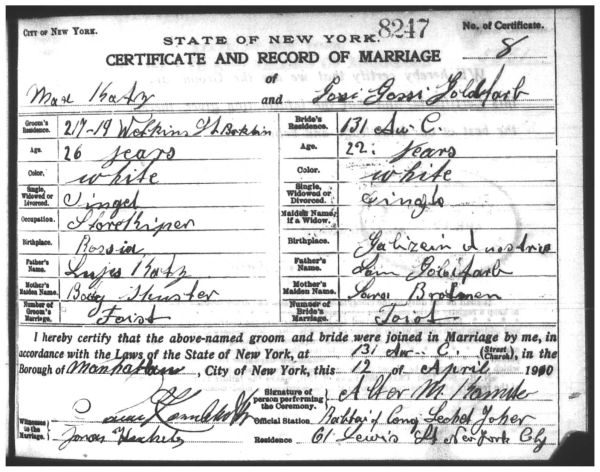
In April 1910, Sam and Sarah’s daughter Gussie married Max Katz, a window decorator who was born in Russia; on the 1910 census, Gussie and Max are listed as living with Max’s parents in Brooklyn. According to the marriage index on FamilySearch, Gussie Goldfarb’s mother’s birth name was “Brohmen,” one of the clues that made me think that Sarah was a relative of my great-grandfather, Joseph Brotman.

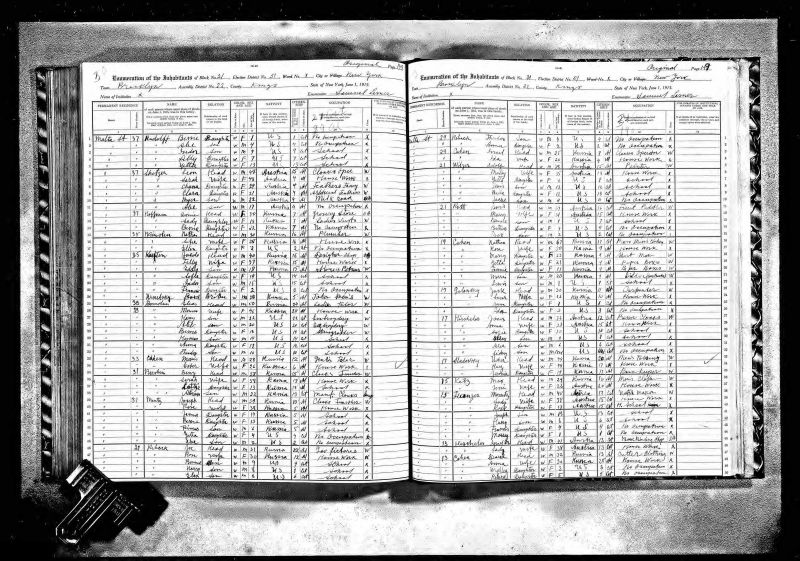
In 1915, Gussie and Max had moved out on their own and were living on Malta Street in Brooklyn.  Max was working in the men’s clothing business.

Gussie Goldfarb and Max Katz 1915 NY census New York State Archives; Albany, New York; State Population Census Schedules, 1915; Election District: 51; Assembly District: 22; City: New York; County: Kings; Page: 148

Gussie Goldfarb and Max Katz 1915 NY census
New York State Archives; Albany, New York; State Population Census Schedules, 1915; Election District: 51; Assembly District: 22; City: New York; County: Kings; Page: 148

I found another clue for Sarah’s birth name on her son Julius’ marriage license, as indexed on FamilySearch: Sarah Brothman.  Julius married Ida Hecht in November, 1913. In 1915, Sam and Sarah and the remaining five unmarried children (Morris, Bessie, Joe, Leo, and Rose) were still living on Avenue C in the same building as my great-uncle Hyman Brotman and his family.  Sam was still working as a tailor, as was his son Morris.

Based on these two New York City marriage index listings, one for the marriage of Gussie Goldfarb and one for the marriage of Julius Goldfarb, it looked like their mother Sarah’s birth name was Brothman or Brohmen.  To find out more, I would need to order the actual records plus any other vital records that might reveal Sarah’s parentage and family.  So I ordered these two marriage records; I also ordered the birth record for Sarah and Sam’s last child, Rosie.

The marriage record for Gussie was consistent with the information on the NYC marriage index, except that it was evident that Gussie’s mother’s name was not spelled Brohmen, but Brotmen, on the actual certificate.

katz-goldfarb-marriage-page-1 katz-goldfarb-marriage-page-2

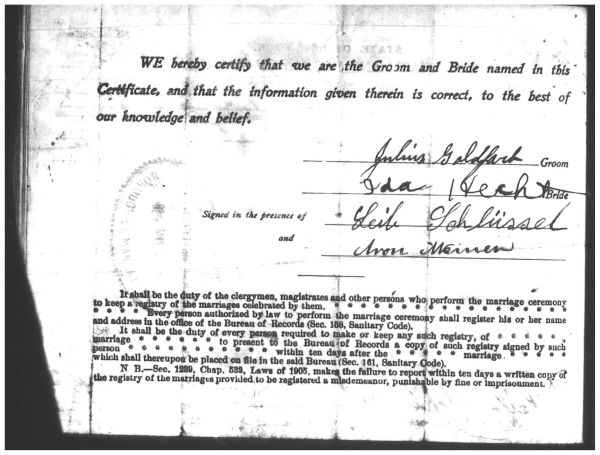
The actual marriage record for Julius Brotman and Ida Hecht was also consistent with what I’d seen on the index in terms of Sarah’s birth name—Brothman.  But the record revealed a new mystery.

goldfarb-hecht-marriage-page-3 goldfarb-hecht-marriage-page-4

Ida’s mother’s birth name certainly looks like it was Taube Brotman, doesn’t it? (The index said Braitmer.) Who was this? Perhaps Taube Hecht had come to see my aunt as a baby not simply because her daughter Ida was married to my grandmother’s cousin Julius; maybe she came because she herself was a Brotman relative.  I decided to put that mystery aside for the time being and focus on Sarah Goldfarb.

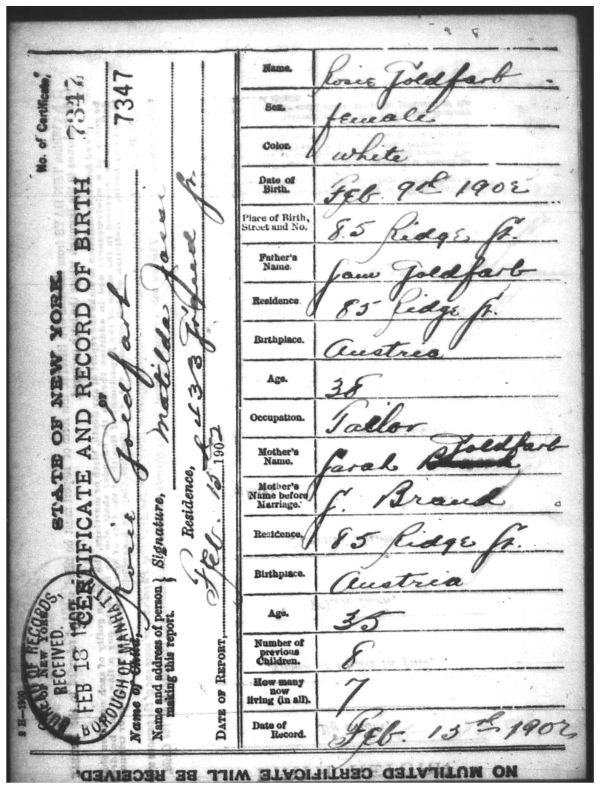
And Rosie Goldfarb’s birth record made me really scratch my head. It gave Sarah Goldfarb’s name before marriage as S. Braud or maybe Brand.  Not Brotman or Brothman or Brotmen.  I was confused.  Was it Brod? Was Sarah actually my great-grandmother Bessie Brod’s sister, and not the sister of my great-grandfather Joseph Brotman.  Obviously I needed to do more digging.

goldfarb-rosie-birth

Having first worked backward in time, I now worked from 1915 forward to see what else I might find to help me determine if Sarah Goldfarb was a Brod or a Brotman.  Both Julius and his brother Morris registered for the draft in World War I.  I’d already seen the draft registration card for Julius, but had not seen the card for Morris.  It added no new information, but confirmed that he was born in “Grombow Galicia Austria.”[1]

morris-goldfard-ww1-draft-reg

Morris Goldfarb World War I draft registration Registration State: New York; Registration County: New York; Roll: 1765780; Draft Board: 104

On February 2, 1919, Morris married Anna Grinbaum in Brooklyn, according to the NYC marriage index.  I ordered a copy of his marriage record, and his record listed his mother’s birth name as Sarah Brod.  Now I had two records that indicated Sarah’s birth name was not Brotman, like my great-grandfather, but Brod, like my great-grandmother.  I wanted to hit my head against the wall!

goldfarb-grinbaum-marriage-page-1


Tragedy struck the Goldfarb family when Sarah and Sam’s oldest daughter, Gussie, died on May 13, 1919 at age 29 from acute lobar pneumonia.  As far as I can tell, Gussie and her husband Max Katz had not had any children.  On Gussie’s death certificate, her parents’ names are listed as Solomon Goldfarb and Sarah Brotman.  Another point for Brotman.

katz-gussie-death

In 1920, Sam and Sarah only had three children still living with them: Joe (22), Leo (20), and Rose (18).  Joe and Leo were both working as clerks for an express company, and Rose was working as a dressmaker.  Sam was no longer working; he was now 64 years old. They were living on Williams Avenue in Brooklyn; I now knew that the “S. Goldfarb” on Williams Avenue listed in my grandfather’s notebook had to be either Sam or Sarah Goldfarb.

Sam and Sarah Goldfarb 1920 US census Year: 1920; Census Place: Brooklyn Assembly District 2, Kings, New York; Roll: T625_1146; Page: 9A; Enumeration District: 82; Image: 21

Sam and Sarah Goldfarb 1920 US census
Year: 1920; Census Place: Brooklyn Assembly District 2, Kings, New York; Roll: T625_1146; Page: 9A; Enumeration District: 82; Image: 21

Grandpa notebook 13 more addresses Joe Goldfarb

But where was their daughter Bessie? She had been living with the family in 1915, so I assumed she had married sometime between 1915 and 1920.  I searched for her in the NYC marriage index, but there was no listing for a Bessie Goldfarb.  Instead I found this record from the Michigan marriage database on Ancestry:

meyer-malzberg-and-bessie-goldfarb-marriage-record-from-michigan-p-1

Meyer Malzberg and Bessie Goldfarb marriage record 1914 Ancestry.com. Michigan, Marriage Records, 1867-1952 [database on-line]. Provo, UT, USA: Ancestry.com Operations, Inc., 2015. Original data: Michigan, Marriage Records, 1867–1952. Michigan Department of Community Health, Division for Vital Records and Health Statistics.

Meyer Malzberg and Bessie Goldfarb marriage record 1914
Ancestry.com. Michigan, Marriage Records, 1867-1952 [database on-line]. Provo, UT, USA: Ancestry.com Operations, Inc., 2015.
Original data: Michigan, Marriage Records, 1867–1952. Michigan Department of Community Health, Division for Vital Records and Health Statistics.

The top image shows the bride and groom, Bessie Goldfarb and Meyer Malzberg, their ages, and that they were residing in Detroit.  It also shows their birthplaces, and for Bessie it is Austria.  The lower image shows the father’s first name, Sam for Bessie, and then the mother’s birth names.  Although it is partly hidden by the fold on the page, it definitely looks like “ah Brothman.”

This is most definitely my cousin Bessie Goldfarb: she was born in “Austria,” her father was named Sam, her mother Sarah Brothman.  But why was she a resident of Detroit? And how did she knew Meyer Malzberg?  And most confusing, if she married him on August 9, 1914 as this record reports, was she really living back in Brooklyn when the NY census was taken in 1915?

It got even more bewildering.  In 1910, Meyer Malzberg was living with his father and sister in New York City, working as a stock clerk in a department store.  In fact, although he was born in Russia, he and his family had been living in New York City since their arrival in about 1900 (records conflict).  So what were he and Bessie doing in Detroit in 1914?

In June, 1917, when Meyer registered for the World War I draft, he was still living in Detroit, working as a driver for the Detroit Creamery Company.  He also claimed an exemption from service because he was supporting his father, his wife, and a child.  So by 1917, Meyer and Bessie had had a child.

Meyer Malzberg World War I draft registration Registration State: Michigan; Registration County: Wayne; Roll: 2024027; Draft Board: 06

Meyer Malzberg World War I draft registration
Registration State: Michigan; Registration County: Wayne; Roll: 2024027; Draft Board: 06

But if Meyer and Bessie had had a child between 1914 and 1917, why was Bessie living with her parents in New York in 1915 while Meyer was still apparently living in Detroit? A little more research revealed that that first child, a son named Norman, was born in New York in May, 1915; although the NY census is dated on the form as June 1, 1915, it must have been actually enumerated before then since the baby is not listed.

sam-goldfarb-and-family-1915-ny-census-bottom-left-and-top-right

My best guess is that Bessie had come back to New York to have her baby where her family was living while Meyer stayed in Detroit to earn a living.  Unfortunately, I was unable to find Bessie and Meyer on the 1920 census, but their second child Gustave was born in Brooklyn in 1919 and their two youngest sons Burton and Saul were born in Jersey City in the 1920s.

Obviously, the stay in Detroit was relatively short-lived, and Meyer and Bessie had returned to the New York metropolitan area before 1920.  In fact, when I looked back at my grandfather’s notebook, I noticed that there was an entry for M. Malzberg at 361 2d Street, JC, or Jersey CIty:

Grandpa notebook 13 more addresses Joe Goldfarb

Bessie’s brother Julius and his family were also living in Jersey City in 1920, and Julius was continuing to work in the liquor business; by 1920, they had two young daughters, Sylvia and Gertrude.

Julius Goldfarb and family 1920 US census lines 70-73 Year: 1920; Census Place: Jersey City Ward 3, Hudson, New Jersey; Roll: T625_1043; Page: 17B; Enumeration District: 135; Image: 1104

Julius Goldfarb and family 1920 US census
lines 70-73
Year: 1920; Census Place: Jersey City Ward 3, Hudson, New Jersey; Roll: T625_1043; Page: 17B; Enumeration District: 135; Image: 1104

To review: as of 1920, Sam and Sarah Goldfarb were living with their children Joe, Leo, and Rose in Brooklyn; Julius and Ida were living in Jersey City; Morris and Anna were probably living in Brooklyn; Gussie was deceased; and Bessie and Meyer were living in either Jersey City or in Brooklyn.

At this point in my research, I started to move beyond 1920 and to look for living descendants to see what I might learn about the family and specifically about Sarah Goldfarb.  I was very fortunate to find two of the descendants of Julius and Ida (Hecht) Goldfarb.  And they provided me with extensive family history notes that a member of the Goldfarb family had researched years before.  More on what I learned from that research in my next post.

But for now, a summary of the clues I’d found so far about Sarah Goldfarb’s connection to my grandmother: three marriage records and one death record for Sarah’s children indicated that Sarah’s birth name had been “Brot(h)man,” but one marriage record for Morris and one birth record for Rose said it was “Brod” or “Braud.”

The evidence seemed to weigh in favor of Sarah being perhaps a sibling of my great-grandfather Joseph Brotman.  Also pointing in that direction was the fact that when they first came to the US, Sam and Sarah had lived in the same town as Moses Brotman, my great-grandfather’s brother.

But then by 1902, Sarah and Sam had moved across the street from my great-grandmother after my great-grandfather had died.  Did that suggest that Sarah was Bessie’s sister and had moved to New York to be closer to her widowed sister? Was Sarah a Brod, not a Brotman, as the wedding certificate for Morris and Rose’s birth certificate indicated?

Plus there were some conflicting clues raised by the naming pattern.  If Sarah had a sister named Bessie (my great-grandmother), would she have named a child Bessie? But Sarah also had a son named Joseph who was born before my great-grandfather Joseph Brotman died.  Would she have given a son the same name as her brother?  Ashkenazi Jews don’t name their children after living relatives, so these name choices certainly confused the matter.

The evidence certainly was not conclusive.  I needed more.


[1] Although the documents I found spelled the town several different ways, Grembow, Grombow, and Grebow, I believe that the last is the correct spelling.  I searched JewishGen, and the only town with a name similar to those names that had had a Jewish community before the Holocaust was Grebow, the town I visited in 2015, the town right near Tarnobrzeg.

Searching for Gold….farbs: A Brotman Genealogy Adventure

Today is my grandmother Gussie Brotman Goldschlager’s birthday; she was born on this day in 1895.  And so it is very appropriate that on this day, which also is the third anniversary of this blog, I return to my Brotman family story.  This is the story of the mystery cousins I discovered last fall—the Goldfarbs.

Back on December 7, 2015, I wrote about my aunt’s baby book from 1917, and I mentioned that on the list of those who came to see my aunt as a newborn were a couple named Mr. and Mrs. Julius Goldfarb.  When I asked my mother if she knew who they were, she vaguely recalled that they were somehow cousins of my grandmother, but she wasn’t sure whether the actual cousin was Julius or his wife, whose name she thought might have been Ida.

Aunt Elaine baby book 5

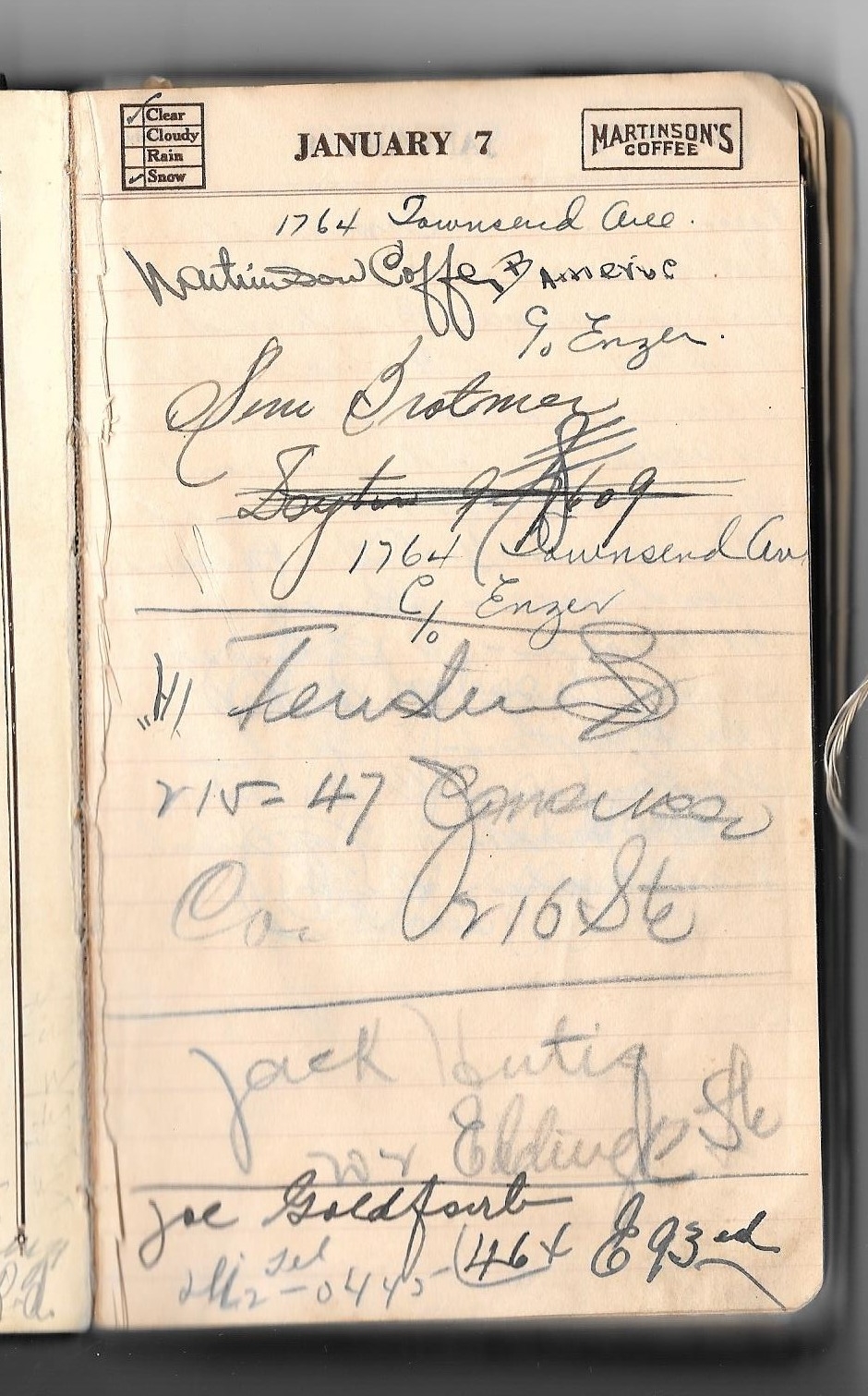
I also wrote back in December about my grandfather’s pocket calendar and notebook and all the wonderful information and insights I found there.  Among those bits of information were addresses for two other people named Goldfarb: S. Goldfarb, who lived at 577 Williams Avenue, and two entries for Joe Goldfarb, one at 464 East 93rd Street and one at 191 Amboy Street.  I assumed these were relatives connected to Julius, but had no idea how.

Grandpa notebook 13 more addresses Joe Goldfarb

Grandpa Notebook page 1 addresses Joe Goldfarb

With those limited hints, I started researching, and I found quite a bit.  In fact, I connected with two of the descendants of Julius and Ida Goldfarb, and I fully intended to write about the Goldfarbs sooner, but somehow the Schoenthals took over my blog, and poor cousin Julius was shelved for over ten months.  Now it’s time to return to this story and reveal what I learned from these tidbits of information.

First, I searched for Julius and Ida Goldfarb because I had two names to work with and because Julius Goldfarb seemed like it would be less common than Joe Goldfarb.  I easily found Julius and Ida and their children on the 1940, 1930, and 1920 census reports; all three reports had them living in Jersey City, New Jersey.  In 1920, Julius was working in a liquor business; in 1930 he was the proprietor of a real estate business, but in 1940 he was again in the liquor business, now working on his own account.

Julius Goldfarb and family 1920 US census lines 70-73 Year: 1920; Census Place: Jersey City Ward 3, Hudson, New Jersey; Roll: T625_1043; Page: 17B; Enumeration District: 135; Image: 1104

Julius Goldfarb and family 1920 US census
lines 70-73
Year: 1920; Census Place: Jersey City Ward 3, Hudson, New Jersey; Roll: T625_1043; Page: 17B; Enumeration District: 135; Image: 1104

The 1920 census said that Julius was born in Austria and was 33 (so born in about 1887); the 1930 census reports his age as 42 and birthplace as Poland.

Julius Goldfarb and family 1930 US census, lines 40-45 Year: 1930; Census Place: Jersey City, Hudson, New Jersey; Roll: 1352; Page: 29A; Enumeration District: 0075; Image: 209.0; FHL microfilm: 2341087

Julius Goldfarb and family 1930 US census, lines 40-45
Year: 1930; Census Place: Jersey City, Hudson, New Jersey; Roll: 1352; Page: 29A; Enumeration District: 0075; Image: 209.0; FHL microfilm: 2341087

On the 1940 census he is 52 and reports his birthplace as Austria.  Julius and Ida had four daughters: Sylvia (1915), Gertrude (1917), Ethel (1923), and Evelyn (1925).

Julius Goldfarb and family 1940 census lines 13-17 Year: 1940; Census Place: Jersey City, Hudson, New Jersey; Roll: T627_2406; Page: 7A; Enumeration District: 24-197

Julius Goldfarb and family 1940 census lines 13-17
Year: 1940; Census Place: Jersey City, Hudson, New Jersey; Roll: T627_2406; Page: 7A; Enumeration District: 24-197

All of this was very interesting, but it didn’t help me figure out if this was the right Julius Goldfarb or how he was related to my grandmother. Or was it Ida who was the relative? So I continued searching.

Julius’ World War I draft registration contained no new information, except the fact that his liquor business in 1917 was a saloon and that he and his family lived at the same address as the saloon: 27 Cole Street.  The draft registration also provided me with a more precise birthdate for Julius, March 18, 1885.

Julius Goldfarb World War I draft registration Registration State: New Jersey; Registration County: Hudson; Roll: 1712213; Draft Board: 10

Julius Goldfarb World War I draft registration
Registration State: New Jersey; Registration County: Hudson; Roll: 1712213; Draft Board: 10

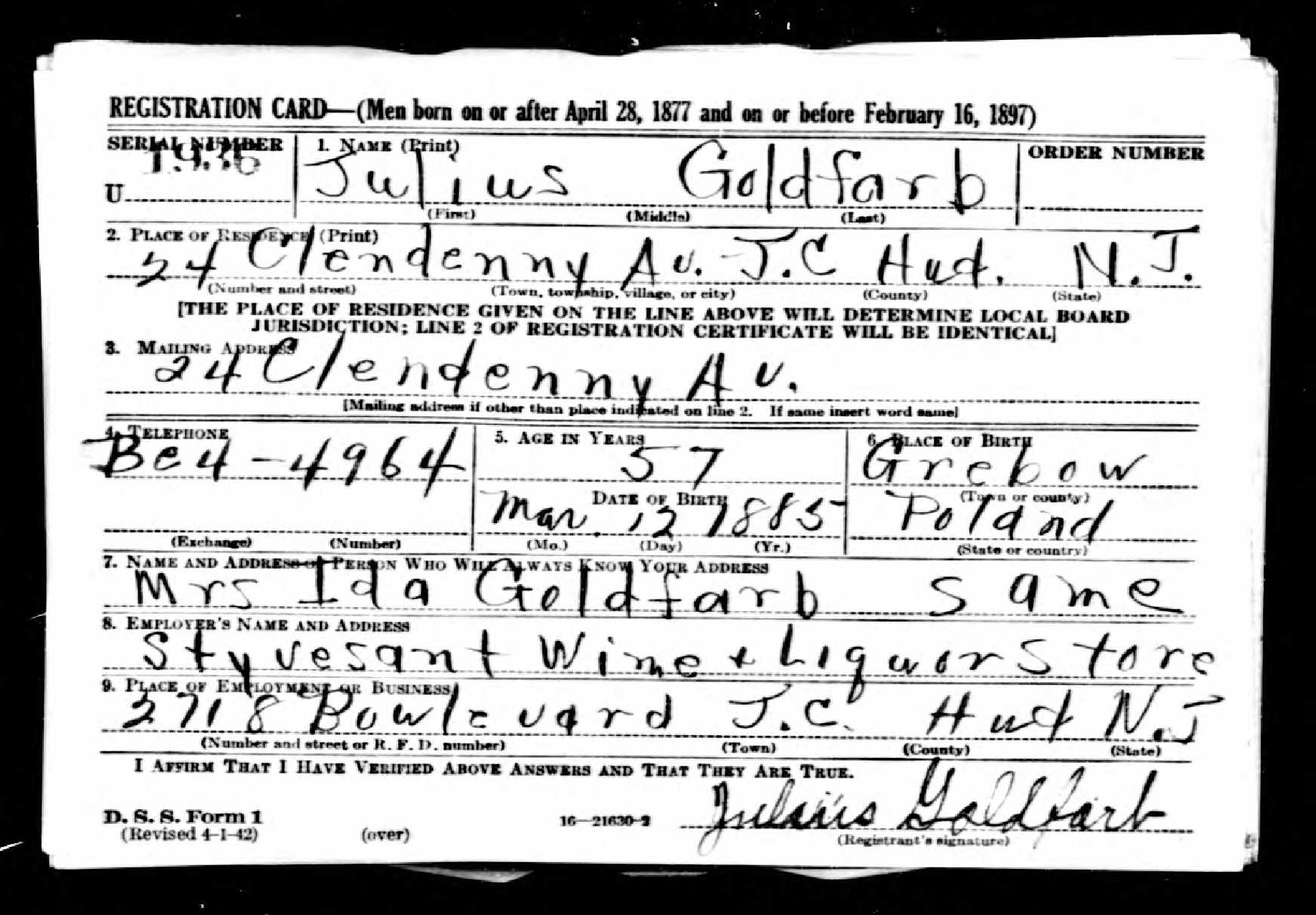
Then things started to get more interesting. I located the World War II draft registration for Julius, and although it had a different birthday, March 12, 1885, instead of March 18, I knew this was the right person, given that the address was the same as the address on the 1940 census for Julius as was the occupation (liquor store) and his wife’s name (Ida).  But the big revelation here was Julius’ birthplace—Grebow, Poland, the same place that my great-uncles Abraham and David Brotman had listed as their residence on the ship manifest when then immigrated to the US.  My heart skipped a beat.  It definitely looked more and more possible that Julius was a cousin.

Julius Goldfarb World War II draft registration The National Archives at St. Louis; St. Louis, Missouri; Draft Registration Cards for Fourth Registration for New Jersey, 04/27/1942 - 04/27/1942; NAI Number: 2555983; Record Group Title: Records of the Selective Service System; Record Group Number: 147

Julius Goldfarb World War II draft registration
The National Archives at St. Louis; St. Louis, Missouri; Draft Registration Cards for Fourth Registration for New Jersey, 04/27/1942 – 04/27/1942; NAI Number: 2555983; Record Group Title: Records of the Selective Service System; Record Group Number: 147

So I searched then for a marriage record for Julius and Ida, and on FamilySearch I found the index listing for it, and now I was truly excited.  According to the index on FamilySearch, Julius Goldfarb’s mother was named Sarah Brothman.  I’d seen my great-grandfather’s name spelled that way instead of Brotman (and sometimes Brodman), and it seemed more and more likely that Julius Goldfarb was my relative, probably through my great-grandfather’s side of the family.

The index listing also included Ida’s birth name—Hecht.  I recalled from my aunt’s baby book that there was a visitor named Mrs. Taube Hecht (see the last name listed on the image above).  Now I knew that that was Ida’s mother.

But more importantly, I now knew the names of Julius Goldfarb’s parents, Sam and Sarah, and that enabled me to search for them and find additional records.

On the 1910 census, Sam and Sarah Goldfarb were living on Avenue C in New York City with six children, including Julius, who was then 25.  The others were Morris (23), Bessie (18), Joseph (12), Leo (11), and Rosie (9).  Joe and Leo were born in New Jersey and Rosie in New York, but the rest of the family were listed as born in Austria.  Sam was working as a tailor in a coat factory, Julius as a conductor for a car company (I assume a streetcar company), and Morris as a cutter in a neckwear factory.

From this census record, I now knew that Joe Goldfarb, who was listed twice in my grandfather’s list of addresses, was a brother of Julius and that he was born in about 1898. The 1910 census also revealed when Sam and Sarah had immigrated.  Sam had arrived in 1892, Sarah and the European born children in 1896.

Sam Goldfarb and family 1910 US census, lines 8-17 Year: 1910; Census Place: Manhattan Ward 11, New York, New York; Roll: T624_1012; Page: 17A; Enumeration District: 0259; FHL microfilm: 1375025

Sam Goldfarb and family 1910 US census, lines 8-17
Year: 1910; Census Place: Manhattan Ward 11, New York, New York; Roll: T624_1012; Page: 17A; Enumeration District: 0259; FHL microfilm: 1375025

Knowing the names of the other children of Sam and Sarah Goldfarb helped me locate them on other census records.  The 1915 New York census record proved quite revealing.  Sam and Sarah were still living at 131 Avenue C in New York City with Morris, Bessie, Joseph, Leo, and Rose (Julius was now married), and Sam was still working as a tailor, as was Morris.  When I looked down the page from where Rose Goldfarb is listed at the top of the right hand side of the page, I saw a very familiar name—Hyman Brotman, my grandmother’s brother Hymie.  Hyman and his wife Sophie (spelled Soffie here) and their three sons were living at the same address, in the same building, as the Goldfarbs.

Sam Goldfarb and family 1915 NY census New York State Archives; Albany, New York; State Population Census Schedules, 1915; Election District: 18; Assembly District: 06; City: New York; County: New York; Page: 84

Sam Goldfarb and family 1915 NY census
New York State Archives; Albany, New York; State Population Census Schedules, 1915; Election District: 18; Assembly District: 06; City: New York; County: New York; Page: 84

And then right below the Brotman family was the Hecht family—Jacob and Tillie Hecht and their children.  I assume these were the parents of Ida Hecht Goldfarb, Sam Goldfarb’s wife. (Tillie is often an alternative name for Taube.)  They also were living at 131 Avenue C in the same building as Hyman Brotman and his family and Sarah and Sam Goldfarb.  The coincidences were clearly not just coincidences.

And it only got better.  I found Sam and Sarah Goldfarb on the 1905 New York census, living with seven children—Julius, Morris, Bessie, Joseph, Leo, and Rose, plus another daughter, Gussie, who was seventeen, two years younger than Morris and two years older than Bessie.

Sam Goldfarb and family 1905 NY census New York State Archives; Albany, New York; State Population Census Schedules, 1905; Election District: A.D. 12 E.D. 06; City: Manhattan; County: New York; Page: 32

Sam Goldfarb and family 1905 NY census
New York State Archives; Albany, New York; State Population Census Schedules, 1905; Election District: A.D. 12 E.D. 06; City: Manhattan; County: New York; Page: 32

I assumed that this newly discovered daughter named Gussie had married between the 1905 NY census and the 1910 US census since she was not living with the family in 1910, and my search revealed that she had married Max Katz on April 12, 1910.  I found her marriage on FamilySearch indexed as Josi Gossi Goldfarb, daughter of Sam Goldfarb and “Sarah Brohmen.”  Another piece of the puzzle tying Sarah Goldfarb to my great-grandfather.

But what was even more exciting about the 1905 New York census was what it revealed about where Sam and Sarah Goldfarb and their children were living: 85 Ridge Street in New York City. Why was that exciting? Because my great-grandmother Bessie Brod Brotman was living across the street at 84 Ridge Street in 1905 with my grandmother Gussie and her siblings, Tillie, Frieda, and Sam.  There seemed to be no denying the fact that Sarah Goldfarb was somehow related to my grandmother’s family.

1905-ny-census-for-bessie-brotman-and-family

(My great-grandmother’s name is badly butchered here as Pearl Brauchman, but there’s no question that this is Bessie Brotman and her children, Tilly, Gussie, Frieda, and Sam; when Bessie married Philip Moskowitz, her second husband, in 1908, her address was 84 Ridge Street.)

I also now understood why Julius and Joe Goldfarb would have been listed in the baby book and the address list. In 1905 when she was ten years old, my grandmother was living right across the street from Julius and Joe Goldfarb and their siblings. Joe was just a year or two younger, and like my grandmother, he was the first American born child of his parents.  Of course, Joe Goldfarb would be listed in the address book. Twice, in fact. Of course, Julius and Ida would have come to see my grandparents’ new baby in 1917.

There was still one prior census to find: the 1900 US census.  The Goldfarbs were a little harder to find on this one because Sam was listed as Solomon here, and several of the other names don’t quite match.  Although Sarah is listed as Sarah and Bessie as Bessie, there are two sons listed as Joseph; one, I assume, was Julius, given the approximate age. Morris was listed as Moses, Leo is Lewis, and Gussie as … Kate? Despite these discrepancies, I am quite certain that these are the right Goldfarbs. The immigration years are consistent with the 1910 census; Sam (Solomon) is a tailor.  The parents and older children were born in Austria, and the ages are close if not precisely the same.

Sam Goldfarb and family 1900 US census Year: 1900; Census Place: Pittsgrove, Salem, New Jersey; Roll: 993; Page: 17B; Enumeration District: 0179; FHL microfilm: 1240993

Sam Goldfarb and family 1900 US census
Year: 1900; Census Place: Pittsgrove, Salem, New Jersey; Roll: 993; Page: 17B; Enumeration District: 0179; FHL microfilm: 1240993

Again, what is particularly interesting here is where they were living: in Pittsgrove, New Jersey, where Moses Brotman and his extended family were living in 1900.  In fact, Moses Brotman and his family are listed on the very next page of the census report in 1900. And Moses Brotman was the brother of my great-grandfather Joseph Brotman.  One more piece of evidence that Sarah was a Brotman and related to me through my great-grandfather Joseph Brotman.

Moses Brotman 1900 census

Moses Brotman 1900 census Year: 1900; Census Place: Pittsgrove, Salem, New Jersey; Roll: 993; Page: 18A; Enumeration District: 0179; FHL microfilm: 1240993

I had one more type of document to search for before moving forward and finding more recent records for the Goldfarb family, and those were ship manifests for the Goldfarbs. Although I’ve not yet been able to locate one for Sam Goldfarb, I did find one for Sarah and the children who were born in Europe, Julius, Morris, Gussie, and Bessie.

Sarah Goldfarb and children on ship manifest 1896 The National Archives at Washington, D.C.; Washington, D.C.; Series Title: Passenger Lists of Vessels Arriving at Philadelphia, Pennsylvania; NAI Number: 4492386; Record Group Title: Records of the Immigration and Naturalization Service, 1787-2004; Record Group Number: 85; Series: T840; Roll: 25

Sarah Goldfarb and children on ship manifest 1896
The National Archives at Washington, D.C.; Washington, D.C.; Series Title: Passenger Lists of Vessels Arriving at Philadelphia, Pennsylvania; NAI Number: 4492386; Record Group Title: Records of the Immigration and Naturalization Service, 1787-2004; Record Group Number: 85; Series: T840; Roll: 25

Once again the names don’t match exactly. Sarah is Surah, a Yiddish version of Sarah.  Julius is Joel— Julius must have been the Americanized version of the Hebrew name Joel.  Morris was Moische—again a Yiddish name they changed in America.  Gussie was originally Gitel—as was the case with my grandmother Gussie.  And Bessie was originally Pesie.  The manifest indicates that they were all detained, and I need to find out more about that. It also says that they were going to Surah’s husband, Shlomo Goldfarb.  Shlomo is a Yiddish version of Solomon.  My guess is that Shlomo became “Sam” as the family Americanized their names.  (I also think the enumerator in 1900 heard Gitel as “Kate.”)

And the icing on the cake is that the manifest lists their last residence as Grembow—or more likely, Grebow as Julius listed it on his draft registration almost fifty years later.

So these were my cousins.  I was sure of it.  But was Sarah Brothman/Brohmen Goldfarb my great-grandfather’s sister? How could I determine the answer to that question?  I needed to order some actual records, search more deeply.  More in my next post.


My Cousin Ben’s Bar Mitzvah

I was privileged last weekend to experience something I never would have been able to share if I hadn’t started on this genealogy journey over four years ago.  If you’ve been reading this blog for a while (or even just know its title), then you know that the first family I researched was that of my maternal grandmother, Gussie Brotman.  From my mother and my aunt, I knew some of the names of my grandmother’s siblings—Hymie, Tillie, Frieda, and Sam. And eventually I found three of her half-siblings as well—Abraham, David, and Max.

Gussie Brotman

Gussie Brotman, my grandmother

But my mother had long ago lost touch with her cousins, the children of her mother’s siblings, and had no idea in many cases of their names, let alone their whereabouts.  So I set out to find them, and as I’ve described elsewhere, the first two long lost cousins I located just about four years ago were my second cousin Judy, granddaughter of Max Brotman, and my second cousin Bruce, grandson of Hymie (Herman) Brotman. From Judy and Bruce, I learned so much about the family and also was able to find all my other Brotman second cousins.

Max Brotman

Max Brotman, my great-uncle

Hyman Brotman

Hyman Brotman, my great-uncle

A little over three years ago, some of the grandchildren of Hyman Brotman and some of my grandmother’s grandchildren met in New York City and had a wonderful reunion—or more accurately for some of us—a first meeting.  It remains one of the most rewarding and exciting experiences I’ve had since starting to research my family history.  And thanks to the miracle of email and Facebook, I’ve managed to stay in touch as best I can with many of these new second cousins.

Celebrating Ben's bar mitzvah---the Brotman cousins, all descendants of Joseph Brotman and Bessie Brod

Celebrating Ben’s bar mitzvah—some of the Brotman cousins, all descendants of Joseph Brotman and Bessie Brod, and their spouses

So I was thrilled and honored to be invited to the bar mitzvah of my cousin Benjamin—my second cousin, once removed.  As I sat in the sanctuary of his family’s friendly congregation, I marveled at the fact that I was sitting in this place with many of my second cousins, sharing in a Jewish tradition that dates back long before the time when our great-grandparents lived in Galicia.  What would our great-grandparents Joseph Brotman and Bessie Brod have thought about this whole thing?

Bessie Brotman

Bessie Brotman, Ben’s great-great-grandmother

As Ben led us through the prayer that includes the phrase L’dor v’dor, from one generation to another, I got goosebumps. I realized that our great-grandparents could have sat in that sanctuary and felt very comfortable, hearing prayers that would have been just as familiar to them as they are to me and as they are now to Ben.  Would our great-grandparents have ever expected that over 120 years after they came to the United States their great-great-grandchildren would still be learning these ancient prayers, reading from the Torah, and chanting the Haftorah?

Surely they would have been amazed to see that sharing in this experience in the synagogue that morning were not just other Jewish people, but people of all different  faiths and backgrounds, all learning from the wonderful rabbi about Jewish practices and values. Everyone was welcome, and everyone there wanted to be there.

Joseph and Bessie would likely smile to think that they had made the right decision coming to the US, despite all their travails, because today in 2016 not only do their ancient traditions survive, they also can be practiced openly in creative, inclusive ways without fear of persecution.

L’dor v’dor.  The family and the traditions continue.  Mazel tov, Ben!

(I just realized this is my 500th post on Brotmanblog—how appropriate!)


Why I Love the Internet: The World Wide Web

Internet

Internet (Photo credit: Wikipedia)

The Internet continues to provide me with so much more than access to information.  Through my blog, Ancestry, Facebook, Google, and ordinary old email, I continue to find and be found by cousins all over the world.  In the last two weeks, I have seen my network of cousins expand and greatly enrich my knowledge and understanding of my family history.  So a few updates.

First, I heard from a relative of Margaret Swem, the wife of Felix Schoenthal, my Boston relative, and she filled me in on the background and family of Margaret.  Quite interesting information that I will add to the post about Felix and his family.  Once again, having a blog proved useful because Margaret’s relative found my blog by Googling Margaret Swem’s name.

Second, an Israeli second cousin, once removed, of my husband found me through my tree on Ancestry.  I haven’t even done very much yet on my husband’s family, but through this new cousin we’ve learned a great deal about the Shrage family in Zabarazh, a town once in Galicia but now part of Ukraine.  It’s been very exciting learning from our new Israeli cousin.

Third, I’ve heard from a descendant of Hettie Schoenthal, one of Simon Schoenthal’s younger children about whom I’ve yet to blog.  This new cousin has shared some of Hettie’s own remembrances of her life as well as other stories.  I am looking forward to incorporating some of those into the blog as well as some photographs.

Fourth, I’ve been in touch with two British relatives of the UK Selinger cousins, relatives of Julius, Alfred, and Frederick Selinger, all of whom married my Cohen relatives.  I then put the two of them in touch as they had not previously known each other despite being cousins.  That gave me great satisfaction, and now all three of us are hunting for answers about the connections among some of the Selingers.

Fifth, I am in touch with a Goldfarb cousin and hoping to learn more about this recently discovered branch of my Brotman family line.  I just received a huge package of information that I need to go through, enter into my tree, and research.

Sixth, another Hamberg cousin just contacted me this morning.

And last but definitely not least, my cousin Wolfgang in Germany sent me new information about our Seligmann family line.  He and his mother received four new documents about our ancestors.  The first reveals two more generations back in the line of Jacob Seligmann, my four-times great-grandfather from Gaulsheim, Germany.  I will be blogging separately about these documents and what they revealed in the next few days before I return again to the children of Simon Schoenthal.

English: internet Español: internet

English: internet Español: internet (Photo credit: Wikipedia)

Turning on my computer in the morning has become a real treat, waiting to see who has found me, who has responded to my inquiries, and which cousin has new information to share.  Sometimes I feel overwhelmed by my good fortune.  Sure, there are still many people who don’t reply to my emails or Facebook messages, but for every person I have found or who has found me, I am so deeply grateful.  The family tree keeps growing, and with it so does the world-wide web of fascinating and generous people whom  I can call my cousins.

My Grandfather’s Notebook: A Post-Script, And Merry Christmas to All Who Celebrate!

Although I do not celebrate Christmas, I always enjoy the lights and trees and music and spirit of these days, and it struck me as entirely consistent with that spirit when I received the following comment on my last post from TK, a fellow genealogy blogger:

Amy, I enjoyed your post, and I’ve staged a little concert for you based on your grandfather’s list of musical pieces. It’s on my blog, Before My Time. It’s video-intensive, so it takes time to load. I found videos for all but four of the songs. Enjoy!

You can see TK’s blog post here and listen to all the music yourself. What a truly generous and kind gift this was—a compilation of the music listed in my grandfather’s little pocket calendar.  Thank you so much, TK!  I truly enjoyed listening to every piece of music.

One thing that struck me after reading TK’s blog post and listening to the music was that many of these pieces of music seemed to be student pieces, fairly short and simple pieces of music that a student taking piano lessons might play. But my grandparents certainly did not have a piano in the house, nor had I ever heard of anyone in the family playing the piano.

But I then thought about my cousin Beth’s comment on Facebook that her father, my uncle, had played the violin for many years and was quite accomplished.  Were these pieces that he played?

I decided to go back and examine the handwriting more carefully.  After comparing the writing to that of my grandfather, grandmother, aunt, uncle, and mother, I now think that my uncle probably wrote the list.  What do you all think?

Here is the music page (you will have to click and zoom to see the handwriting clearly enough):

Grandpa notebook music

Here is my grandfather’s writing:

Grandpa notebook page 7 more notes about Maurice and hospital

This is what I thousht was my aunt’s handwriting as a child, which also looks somewhat like that on the music page: adult:

Grandpa Notebook 3 aunt elaine playing school

But this is her handwriting as an adult, and it’s very different, so maybe that’s not my aunt’s writing above?


Grandpa notebook Aunt Elaine names 1


My uncle wrote this page:

Grandpa notebook 8 maurice hunting notes 1934

This is my mother’s handwriting as a young child:

Grandpa Notebook 2 Mom note about teacher

And my grandmother wrote this page later in life in her 60s and probably wrote some of the entries on the page below it when she was in her 40s:

Grandpa notebook 1964 notes by Grandma

Grandpa Notebook 5 more addresses

So who wrote the page with all the pieces of music listed?  Anyone care to venture an opinion?

****************

For all of you who celebrate, I wish you a wonderful and joyous Christmas.  And if I may borrow and paraphrase the traditional saying, may there be peace on earth and good will to all.


My Grandfather’s Notebook: More than Names, Dates, and Addresses

Notebook cover

Among the other treasures that turned up in the shoebox of “old papers” that had belonged to my Aunt Elaine was a Martinson Coffee pocket calendar for the year 1930.  My aunt would have been twelve going on thirteen, my Uncle Maurice ten going on eleven, and my mother not yet born when 1930 began. Here’s a photograph of my grandmother and her three children taken in 1931 when that pocket calendar was still relatively new:


Goldschlagers 1931

Goldschlagers 1931

This calendar, however, had to be around for many years as a place where members of the family scribbled notes of all kinds because even my mother eventually made contributions to it. In fact, the most recent entries seem to have been made by my grandmother in 1965 long after my grandfather had died and all her children had married.

Grandpa notebook 1964 notes by Grandma

I don’t know for sure what “Johen” meant, but I wonder if my grandmother was referring to my father, whose name is John Cohen.

It amazes me that my grandparents kept this little book for so long, and I wonder why it became the repository of so many family notes. I can’t imagine how it stayed around and was used by so many members of the family beginning in 1930 up to 1965.  Today that notebook probably would not have lasted a year (well, it wouldn’t exist since we’d use our smartphones and computer calendars instead.)

For example, my grandparents used it not only as a calendar but as an address book.  I already posted two of the pages of addresses in an earlier post:

Grandpa Notebook page 1 addresses Joe Goldfarb Grandpa notebook 13 more addresses Joe Goldfarb

Here are a few more:

Grandpa Notebook 4 more addresses Ressler

Leo Ressler was my mother’s first cousin, son of Tillie Brotman Ressler, my grandmother’s sister.  His wife was Mildred Phillips, and the notebook page records both their wedding anniversary and Mildred’s birthday.  Unfortunately there is no year given for the marriage, but Mildred was still single and living with her mother and stepfather in New Haven, Connecticut, on the 1930 census.  She and Leo lived in Hartford during the late 1930s, and so this entry of an address for Bridgeport must have been long after the 1930 date on this calendar. (They were living in Bridgeport as of the 1940 US census.)  Leo and Mildred owned a dress shop in Connecticut for many years before retiring to Florida.  My mother recalls that Mildred was considered high class by my grandparents and that my aunt was invited to come visit them so she could learn some of Mildred’s sophisticated ways.

Leo Ressler

Leo Ressler

(I don’t know who Francis Coen would be— another name to research.)

The next two pages had three addresses for my mother’s uncle, Sam Brotman—my grandmother’s brother.  Apparently he moved around a bit, given all the crossed out addresses the notebook includes for him. (There are two more on the first page, above.) I don’t know very much about Uncle Sam except that he was a cab driver and lived alone all his adult life. Yet all these addresses include a “in care of” reference so perhaps he was living with someone named Weinstein for some period of time and someone named Enzer at other times.

Grandpa Notebook 5 more addresses

Sam Brotman

Sam Brotman

Joe Brotman, the other name on this page, was another of my mother’s first cousins, the son of Hyman Brotman, my grandmother’s brother. I have six different Joseph Brotmans in my family tree, including my great-grandfather, but Hyman’s son is the only one who lived in Queens, where he was living when this address was recorded.

Hyman (second from left) and Joe (far right) and two unknown men

Hyman (second from left) and Joe (far right) and two unknown men

My grandfather also used the calendar to record birthdays for family members.  There are notes on the dates for his birthday as well as that of my grandmother, my aunt, and my mother.  (The pages for June were torn out, so there is none for my uncle.) My mother was born during 1930, and on the appropriate date my grandfather simply wrote, “My daughter’s birthday, Florence, born—-.”

One of my favorite pages (although very hard to read) is the one where my grandfather apparently listed all his favorite pieces of music.  I know that music was one of his passions, one of the few things he remembered fondly about his childhood in Iasi, Romania:

Grandpa notebook music

I can’t make out the names of most of the pieces, but he has works by Beethoven (whose name he wrote with such a flourish on the opposite page), Brahms, Bizet, and Grieg as well as several others.

He also used the notebook as an account book, and there are many pages where he records his paychecks, his Social Security benefits, and Welfare Fund payments.  My grandfather was active in his union, and I assume that the Welfare Fund was administered by the union.  In addition, he kept a record of people they visited or who visited them and other events.

Grandpa notebook money and visits

The notebook also contains a number of notes my grandfather made about his health and various other matters.  For example, on these pages he not only recorded financial information; he interspersed notes about the times my uncle came home to visit during his military service in World War II  with notes about his own operations and hospitalizations.

Grandpa Notebook 6 notes about Maurice in service

Grandpa notebook page 7 more notes about Maurice and hospital

Again, all of these were obviously written long after 1930 and as late as 1951 when he had surgery for polyps.  He died just six years later on May 3, 1957.

But perhaps the most interesting and entertaining parts of the notebook are those contributed by my aunt, my uncle, and my mother.  There are many pages like this one with a list of names and then what looks like grades.  My mother believes that my aunt used the notebook to play school, listing her classmates and even her brother and herself as the students and then “grading” them in different subjects.

Grandpa Notebook 3 aunt elaine playing school

My aunt also liked to practice writing her name and doodling all over the pages (the top one might have been written by my mother or someone else; I am not sure):

GRandpa notebook Aunt Elaine names earlier

Grandpa notebook Aunt Elaine names 1

These pages were obviously written after my aunt was married as she used her married name (Lehrbaum) and included her husband, my Uncle Phil. The second page also includes my uncle’s wife, my Aunt Lynn, and they weren’t married until 1945, several years after Aunt Elaine had married.  I find it fascinating that even after she was married and out of the house, my aunt still somehow found this notebook a place to scribble.

I found the pages my uncle wrote in 1934 about his adventures shooting at chipmunks, squirrels, and rabbits with his friend Blackie both amusing and disturbing.  First, the idea that my uncle was carrying around a real gun at age fifteen is rather horrifying.  Secondly, I always knew my uncle as an animal lover.  He always had a dog (a schnauzer named Schnopsie is the one I remember best), and later on he had several dogs and cats as well as various other animals.  How could he shoot harmless chipmunks, squirrels, and rabbits? But when I asked my cousin Beth about this, she said he always liked to shoot, so she was not surprised.

Grandpa notebook 8 maurice hunting notes 1934 Grandpa notebook 9 more hunting Maurice 1934 Grandpa notebook 10 more hunting notes Grandpa notebook 11 hunting notes and final comment in 1939 Grandpa notebook 12 Maurice comment 1939

But it’s amusing also because I can imagine my uncle as a fifteen year old boy having a wild time with his friend Blackie and competing to see who would shoot the most animals that summer.  Below is a photo of my uncle, my aunt, and my mother as well as my grandmother about a year after the summer that my uncle was writing about his hunting adventures.

Goldschlagers 1935

Goldschlagers 1935

I found the note he wrote four and a half years later on February 24, 1939, when he was almost twenty years old particularly touching and revealing:

As I recall it now I have recorded on these last nine pages possibly one of the happiest phases of my life.  As I sit here and look back four and a half years it seems incredible that time could fly by so quickly on the wings of joy and sorrow, (yes, we’ve had our share of sorrows).

What were those sorrows? I don’t know what my uncle was referring to specifically or whether he only meant between 1934 and 1939, but in his lifetime, in 1924 his aunt Frieda had died after childbirth as had her baby; his aunt Tillie had lost her husband Aaron, and his grandmother Bessie had died in May 1934, shortly before he wrote about his hunting adventures.  I also imagine that those Depression years were challenging for my grandparents like they were for so many people.

My uncle also must have liked baseball because he kept a box score from a game in the notebook.  Being a baseball fan, I was determined to figure out not only what teams these were, but what game it was:

Grandpa notebook 15 box score

After studying the names on team listed on top I realized that it was the Detroit Tigers, probably around 1935.  As soon as I saw Greenberg, I knew it had to be Hank Greenberg and thus the Tigers.  After all, how many baseball players have there been named Greenberg?

English: 1934 Goudey baseball card of Henry &q...

English: 1934 Goudey baseball card of Henry “Hank” Greenberg of the Detroit Tigers #62. PD-not-renewed. (Photo credit: Wikipedia)

The team at the bottom took some more digging because my uncle’s spelling was, shall we say creative? But the Deroch was a big clue—I assumed it was Leo Durocher, and once I looked up his career and saw that in 1935 he was playing on the St. Louis Cardinals with a catcher named Bill Delancey, an infielder named Collins and another named Frisch, I knew I had found the right team.

English: 1933 Goudey baseball card of Leo Duro...

English: 1933 Goudey baseball card of Leo Durocher of the Cincinnati Reds #147. PD-not-renewed (Photo credit: Wikipedia)


But the National League Cardinals wouldn’t have been playing the American League Tigers in 1935 unless they were in the World Series (oh, for the days before endless post-season playoffs and in-season interleague play!).  So this couldn’t be 1935 because the Tigers played the Cubs in the 1935 World Series.  After a bit more research, I concluded that this was a game from the 1934 World Series between the St. Louis Cardinals and the Detroit Tigers.

http://www.gettyimages.com/detail/573856419


http://www.gettyimages.com/detail/573867867

Since my uncle recorded the final score of the game he was following (presumably on the radio) as 10-4, it wasn’t hard to find out which game this was from the 1934 World Series: Game 4 on October 6, 1934, at Sportsmen’s Park in St. Louis.  Here is a link to the box score of that game as recorded by the Baseball-Reference website. The Tigers evened the series 2-2 by winning that game and then won Game 5 to go up 3-2 in the Series, but badly lost Games 6 and 7 to lose the Series.  I wonder which team my uncle, a boy from Brooklyn, was rooting for. Perhaps the one with the first Jewish player elected to the Baseball Hall of Fame?

Finally, there are a few short notes from my mother, the baby in the family.  Here she wrote about her big brother teasing her:

My brother is such a pest he calls me all sorts [?] of names for instance fatso, horse, baby and so many and I call him names to.”  I guess my uncle was always a tease—he certainly was as an adult also!

Grandpa notebook 14 Florence comment about Maurice


I wonder how much later she wrote the comment that follows: “When I look at this now I think it silly.  It is childish.”

When she was eleven, she wrote about a favorite teacher, Mrs. Alice Handelsman, who was “just like a mother” to her class, and her boyfriend Myron.  On his birthday in the calendar, she listed a favorite cousin, Sanford (or Sandy), Leo and Mildred Ressler’s son; my mother to this day talks about what a beautiful little boy he was and how kind he was to my grandmother.

Grandpa Notebook 2 Mom note about teacher

Grandpa notebook 16 Florence comment re Sandy Ressler


What a gift this little book from 1930 has turned out to be.  It gives me a snapshot into the childhood of my mother and her siblings and some insights into my grandfather as well.  He was obviously a very careful man when it came to money, recording so painstakingly his income and his expenses. These were the Depression years, and my grandfather worked as a driver for a milk company.   My grandparents were not poverty stricken, but they lived from paycheck to paycheck and for many years lived in a small apartment in Brooklyn and then a one bedroom apartment in Parkchester when my mother was a teenager and her siblings were married and out of the house. My grandfather worked the night shift for the milk company, and my mother would share the bed with my grandmother until my grandfather got home in the morning and she got up for school.  But my mother says she never thought of herself as poor because she always had food and clothing and a roof over her head.

We take so much for granted today with our cars and houses and televisions and computers and smartphones. We throw everything away and litter our landfills with our junk.  Our children and grandchildren have iPads and scooters and bikes and more toys and books than all the children in one tenement building in Brooklyn combined had back in the 1930s.  But my mother and her siblings had their imaginations and their friends and their teachers and their families.  And this one little notebook gives us a peak into how they entertained themselves and how they lived together as a family.  It, like my aunt’s baby book, is a real treasure.


A Brotman, Goldschlager, and Rosenzweig Update: The Baby Book

As you know if you’ve been following this blog for a while, my Aunt Elaine preceded me as the family historian for my maternal side.  Several times notes she made or information she gave to others has led me to more information.  Her information has almost without exception proven to be accurate.  For example, she provided me—indirectly—with the names of my grandmother Gussie Brotman’s half-siblings, Abraham, David, Sophie, and Max.  She provided me with the clue that the Brotmanville Brotmans were our close relatives.  She told me how my grandparents met each other in Brooklyn.

Well, she has done it again.  This time, however, it was not information or notes that she provided, but rather her baby book, which my cousin found in a shoebox of old papers.  It was partially filled out when my aunt was born on October 14, 1917.  Although most of it is blank, the few pages that were filled provide not only further confirmation of relationships about which I was previously aware, but hints at some new ones.

Elaine 1926

Elaine 1926

Here are the pages of the book that have been filled in:

Aunt Elaine baby book p 1

This is my grandfather’s beautifully florid handwriting.  His daughter, my aunt, also had fancy handwriting like this.


Aunt Elaine baby book p 2

My grandmother was never called Grace, always Gussie.  But family lore is that my grandfather’s family thought Grace was more American.


Aunt Elaine baby book 3

My two maternal great-grandmothers!


Aunt Elaine baby book 4

Who are these people?

Tillie Ressler—my grandmother’s older sister

Mr. and Mrs. H. Brotman—my grandmother’s brother Hymie and his wife Sophie

Rebecca Rosenzweig—my grandfather’s cousin, daughter of his mother’s brother Gustav Rosenzweig

Mr. and Mrs. D. Goldschlager—my grandfather’s brother David and his wife Rebecca

Mrs. and Miss G. Goldschlager—my great-grandmother Ghitla Rosenzweig Goldschlager and her daughter Betty

Mrs. and Miss B. Moskowitz—my great-grandmother Bessie Brotman Moskowitz and her daughter Frieda

The next two are not familiar, but provide new paths to research.  Can anyone help me decipher the names?

UPDATE: The last two must have been friends.  Mr. and Mrs. Leon and Ray Kiok and her mother Mrs. Frances Azeraad.  I found them all living together in Brooklyn, but not near my grandparents. I am not sure where they would have met.  Leon was born in Poland in 1886, and Ray’s parents were born in Spain.

Finally, Mr. and Mrs. M. Brotman: my grandmother’s half-brother Max Brotman and his wife Sophie

On the following page were more names.

Aunt Elaine baby book 5

Miss E. Shapiro and fiancé—not known yet

Sam Brotman—my grandmother’s younger brother

Mrs. A. Peter and son—I do not know

Mr. and Mrs. A. Brotman—-my grandmother’s half-brother Abraham Brotman and his wife Bessie

Mrs. D. Brotman—Annie nee Salpeter, wife of David Brotman, my grandmother’s half-brother

Mr. and Mrs. Julius Goldfarb—more on them below

The next three are not familiar—Mrs. Louis (?) Yassky, Miss Rose Botomick (?), and Mrs. Tsulie (?) Hecht.  As far as I can tell, these were not relatives, but friends.

I just loved seeing all these names.  Names that I have researched and know are my family, but names I’d not seen in something like this, something that makes it clear that these people were all really connected to my grandparents in a personal way.  I know that sounds odd.  These were the siblings, mothers, and cousins.  But since I grew up without hearing many of these names, it still was wonderful to see them all listed as the first visitors to see my aunt as a newborn in 1917.

I also found the list of gifts fascinating.  My grandparents did not have money for silver and silk, but someone was very generous in giving these items to them for their first-born child.

One final page—the inside of the back cover:

Aunt Elaine baby book 6
A. Rosenzweig—-my grandfather’s cousin, Abraham Rosenzweig, Rebecca’s brother.  I have speculated, based again on a story conveyed by notes from my Aunt Elaine, that it was either Abraham or Rebecca or Sarah who was accompanying my grandfather Isadore on Pacific Street in Brooklyn when he first laid eyes on my grandmother and declared he was going to marry her.

Back to Mr. and Mrs. Julius Goldfarb.  I asked my mother who they were because in a second old item—a notebook my grandfather used for various purposes that was also used by all three of his children at one time or another[1]—the name Joe Goldfarb appeared twice.  Who were these Goldfarbs?

Grandpa Notebook page 1 addresses Joe Goldfarb

Grandpa notebook 13 more addresses Joe Goldfarb

(There’s more great stuff on this page—Sam Brotman is my great-uncle Sam, Feuerstein B. is my great-aunt Betty Goldschlager Feuerstein, Leo Ressler is my mother’s first cousin, her Aunt Tillie’s son; Rae Rosenzweig and Lizzie Horowitz are my grandfather’s first cousins, sisters of Abraham and Rebecca. And there is an S. Goldfarb in addition to Joe.)

My mother said all she could remember was that either Julius or his wife was my grandmother Gussie’s first cousin.  I’d never heard the name Goldfarb before, so what did I do? What all genealogy addicts would do.  I immediately started searching.  And the results of that search will be discussed in a later post once I have filled in more gaps in that story.

But for now, I once again can hear my aunt cheering me on, telling me to keep digging and finding the family stories.

elaine and amy 1953

Aunt Elaine and me 1953


[1] I will share more of that notebook in later posts also.