My Grandfather’s Notebook: More than Names, Dates, and Addresses

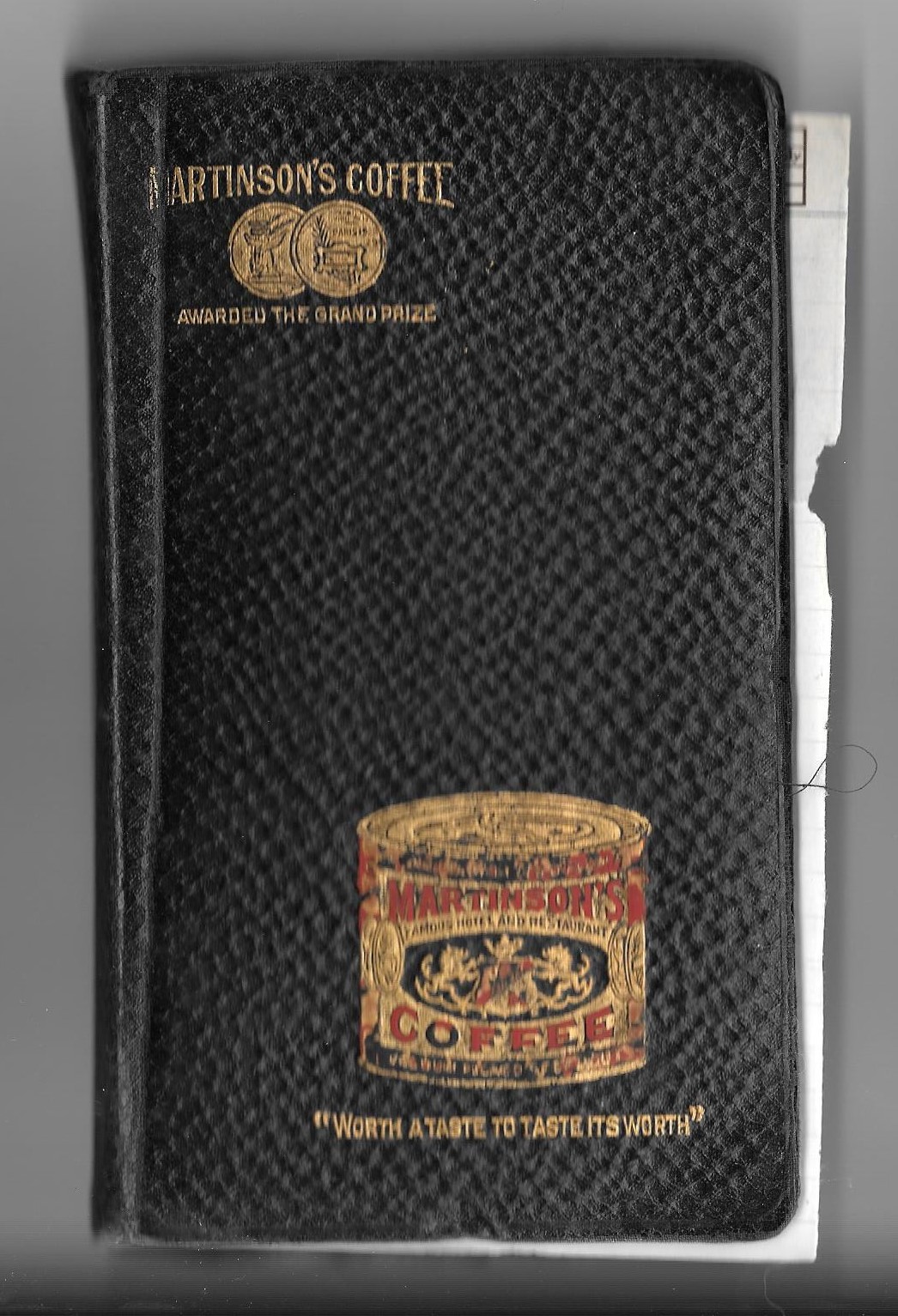
Notebook cover

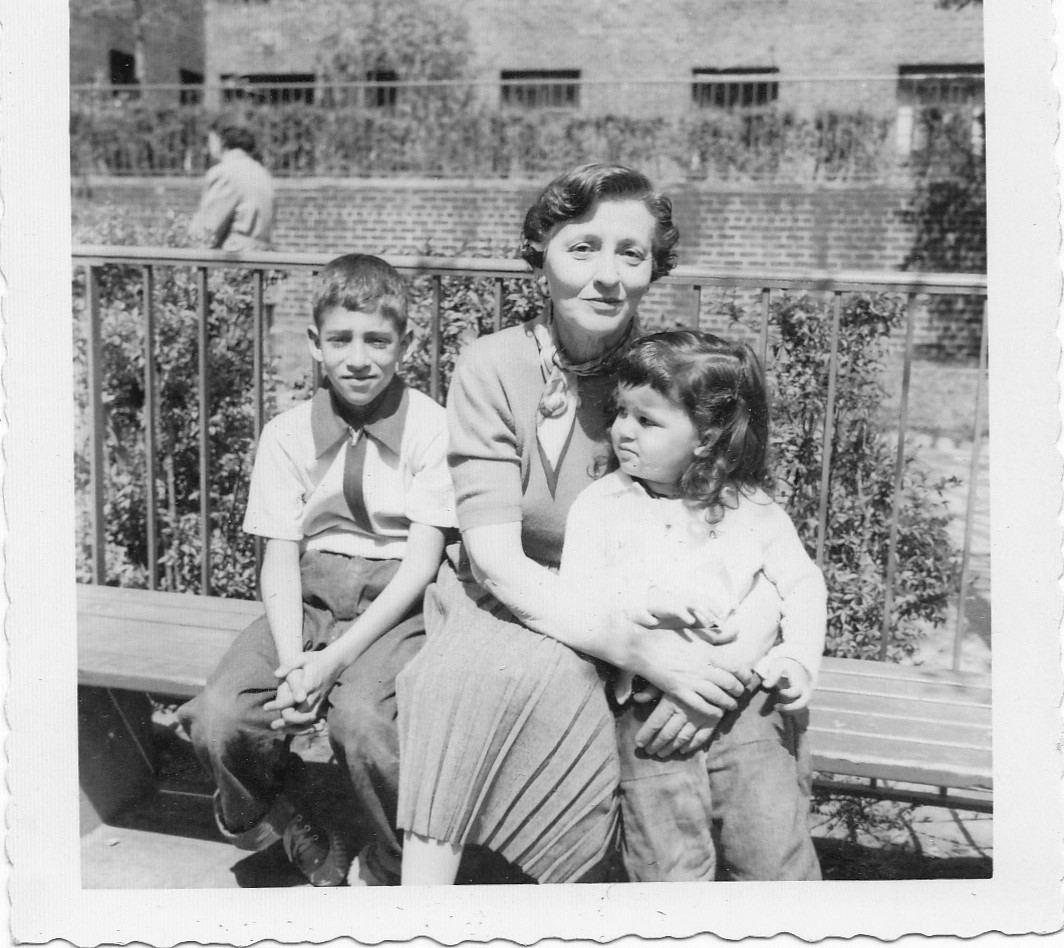
Among the other treasures that turned up in the shoebox of “old papers” that had belonged to my Aunt Elaine was a Martinson Coffee pocket calendar for the year 1930.  My aunt would have been twelve going on thirteen, my Uncle Maurice ten going on eleven, and my mother not yet born when 1930 began. Here’s a photograph of my grandmother and her three children taken in 1931 when that pocket calendar was still relatively new:


Goldschlagers 1931

Goldschlagers 1931

This calendar, however, had to be around for many years as a place where members of the family scribbled notes of all kinds because even my mother eventually made contributions to it. In fact, the most recent entries seem to have been made by my grandmother in 1965 long after my grandfather had died and all her children had married.

Grandpa notebook 1964 notes by Grandma

I don’t know for sure what “Johen” meant, but I wonder if my grandmother was referring to my father, whose name is John Cohen.

It amazes me that my grandparents kept this little book for so long, and I wonder why it became the repository of so many family notes. I can’t imagine how it stayed around and was used by so many members of the family beginning in 1930 up to 1965.  Today that notebook probably would not have lasted a year (well, it wouldn’t exist since we’d use our smartphones and computer calendars instead.)

For example, my grandparents used it not only as a calendar but as an address book.  I already posted two of the pages of addresses in an earlier post:
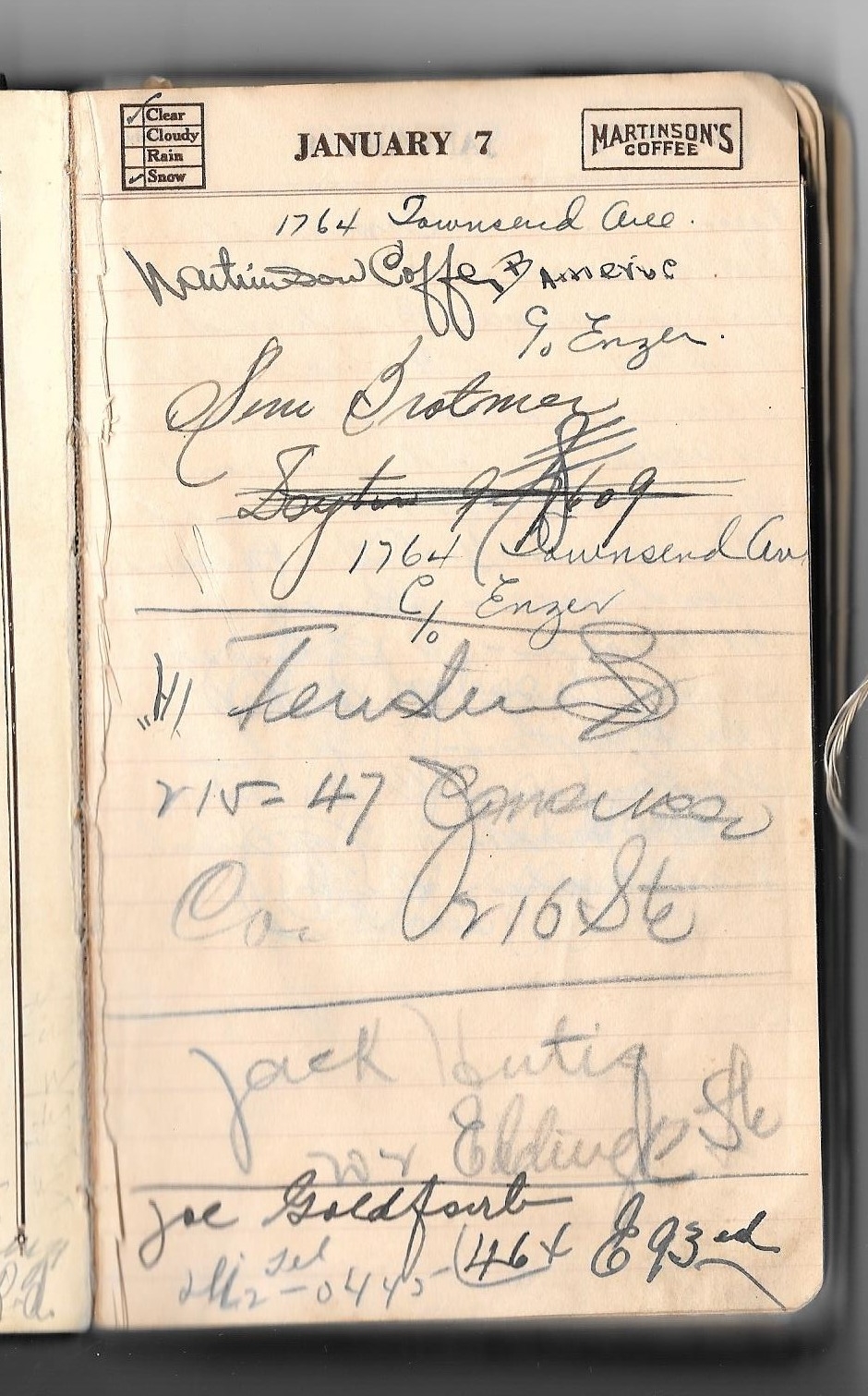
Grandpa Notebook page 1 addresses Joe Goldfarb Grandpa notebook 13 more addresses Joe Goldfarb

Here are a few more:

Grandpa Notebook 4 more addresses Ressler

Leo Ressler was my mother’s first cousin, son of Tillie Brotman Ressler, my grandmother’s sister.  His wife was Mildred Phillips, and the notebook page records both their wedding anniversary and Mildred’s birthday.  Unfortunately there is no year given for the marriage, but Mildred was still single and living with her mother and stepfather in New Haven, Connecticut, on the 1930 census.  She and Leo lived in Hartford during the late 1930s, and so this entry of an address for Bridgeport must have been long after the 1930 date on this calendar. (They were living in Bridgeport as of the 1940 US census.)  Leo and Mildred owned a dress shop in Connecticut for many years before retiring to Florida.  My mother recalls that Mildred was considered high class by my grandparents and that my aunt was invited to come visit them so she could learn some of Mildred’s sophisticated ways.

Leo Ressler

Leo Ressler

(I don’t know who Francis Coen would be— another name to research.)

The next two pages had three addresses for my mother’s uncle, Sam Brotman—my grandmother’s brother.  Apparently he moved around a bit, given all the crossed out addresses the notebook includes for him. (There are two more on the first page, above.) I don’t know very much about Uncle Sam except that he was a cab driver and lived alone all his adult life. Yet all these addresses include a “in care of” reference so perhaps he was living with someone named Weinstein for some period of time and someone named Enzer at other times.

Grandpa Notebook 5 more addresses

Sam Brotman

Sam Brotman

Joe Brotman, the other name on this page, was another of my mother’s first cousins, the son of Hyman Brotman, my grandmother’s brother. I have six different Joseph Brotmans in my family tree, including my great-grandfather, but Hyman’s son is the only one who lived in Queens, where he was living when this address was recorded.

Hyman (second from left) and Joe (far right) and two unknown men

Hyman (second from left) and Joe (far right) and two unknown men

My grandfather also used the calendar to record birthdays for family members.  There are notes on the dates for his birthday as well as that of my grandmother, my aunt, and my mother.  (The pages for June were torn out, so there is none for my uncle.) My mother was born during 1930, and on the appropriate date my grandfather simply wrote, “My daughter’s birthday, Florence, born—-.”

One of my favorite pages (although very hard to read) is the one where my grandfather apparently listed all his favorite pieces of music.  I know that music was one of his passions, one of the few things he remembered fondly about his childhood in Iasi, Romania:

Grandpa notebook music

I can’t make out the names of most of the pieces, but he has works by Beethoven (whose name he wrote with such a flourish on the opposite page), Brahms, Bizet, and Grieg as well as several others.

He also used the notebook as an account book, and there are many pages where he records his paychecks, his Social Security benefits, and Welfare Fund payments.  My grandfather was active in his union, and I assume that the Welfare Fund was administered by the union.  In addition, he kept a record of people they visited or who visited them and other events.

Grandpa notebook money and visits

The notebook also contains a number of notes my grandfather made about his health and various other matters.  For example, on these pages he not only recorded financial information; he interspersed notes about the times my uncle came home to visit during his military service in World War II  with notes about his own operations and hospitalizations.

Grandpa Notebook 6 notes about Maurice in service

Grandpa notebook page 7 more notes about Maurice and hospital

Again, all of these were obviously written long after 1930 and as late as 1951 when he had surgery for polyps.  He died just six years later on May 3, 1957.

But perhaps the most interesting and entertaining parts of the notebook are those contributed by my aunt, my uncle, and my mother.  There are many pages like this one with a list of names and then what looks like grades.  My mother believes that my aunt used the notebook to play school, listing her classmates and even her brother and herself as the students and then “grading” them in different subjects.

Grandpa Notebook 3 aunt elaine playing school

My aunt also liked to practice writing her name and doodling all over the pages (the top one might have been written by my mother or someone else; I am not sure):

GRandpa notebook Aunt Elaine names earlier

Grandpa notebook Aunt Elaine names 1

These pages were obviously written after my aunt was married as she used her married name (Lehrbaum) and included her husband, my Uncle Phil. The second page also includes my uncle’s wife, my Aunt Lynn, and they weren’t married until 1945, several years after Aunt Elaine had married.  I find it fascinating that even after she was married and out of the house, my aunt still somehow found this notebook a place to scribble.

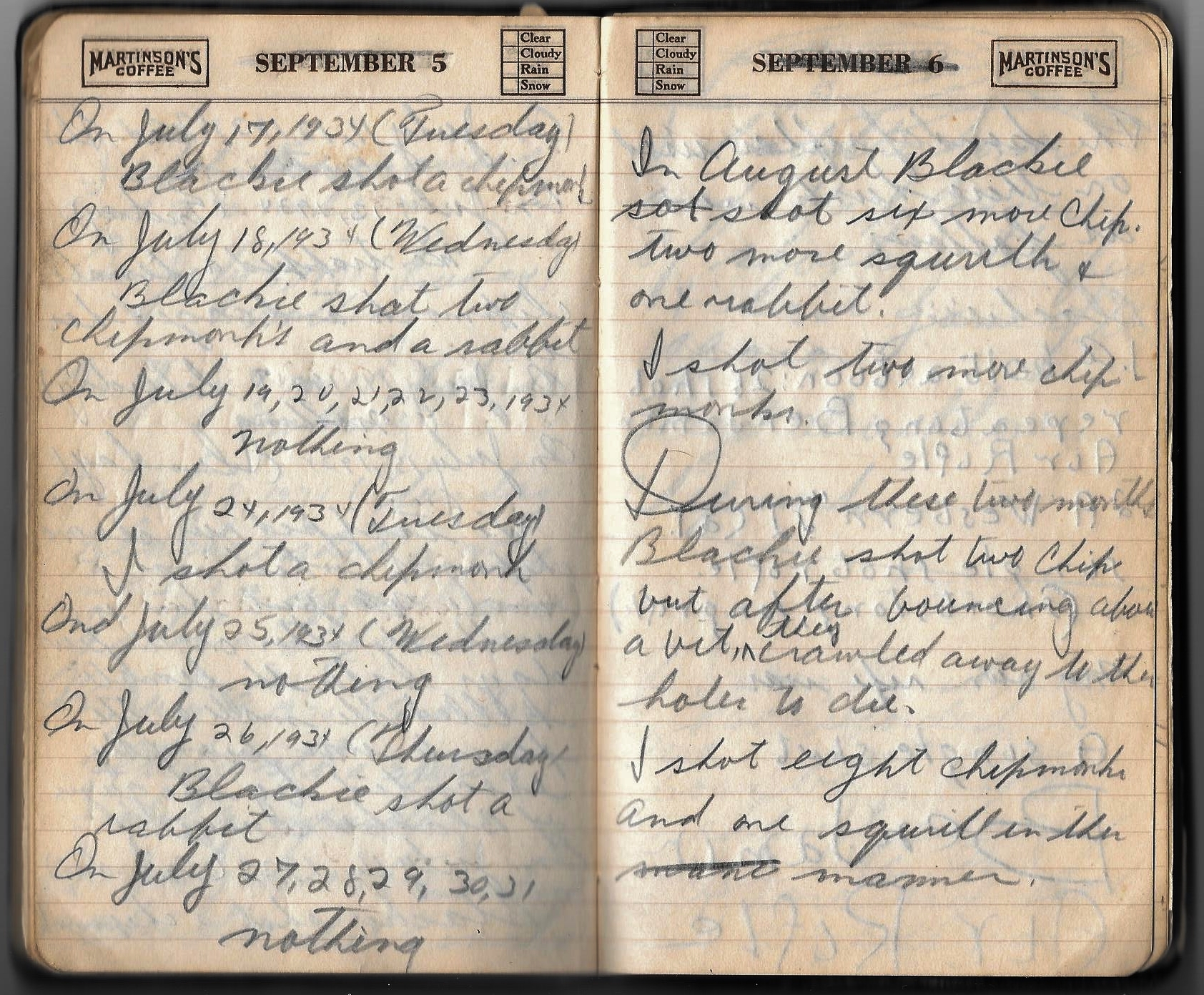
I found the pages my uncle wrote in 1934 about his adventures shooting at chipmunks, squirrels, and rabbits with his friend Blackie both amusing and disturbing.  First, the idea that my uncle was carrying around a real gun at age fifteen is rather horrifying.  Secondly, I always knew my uncle as an animal lover.  He always had a dog (a schnauzer named Schnopsie is the one I remember best), and later on he had several dogs and cats as well as various other animals.  How could he shoot harmless chipmunks, squirrels, and rabbits? But when I asked my cousin Beth about this, she said he always liked to shoot, so she was not surprised.

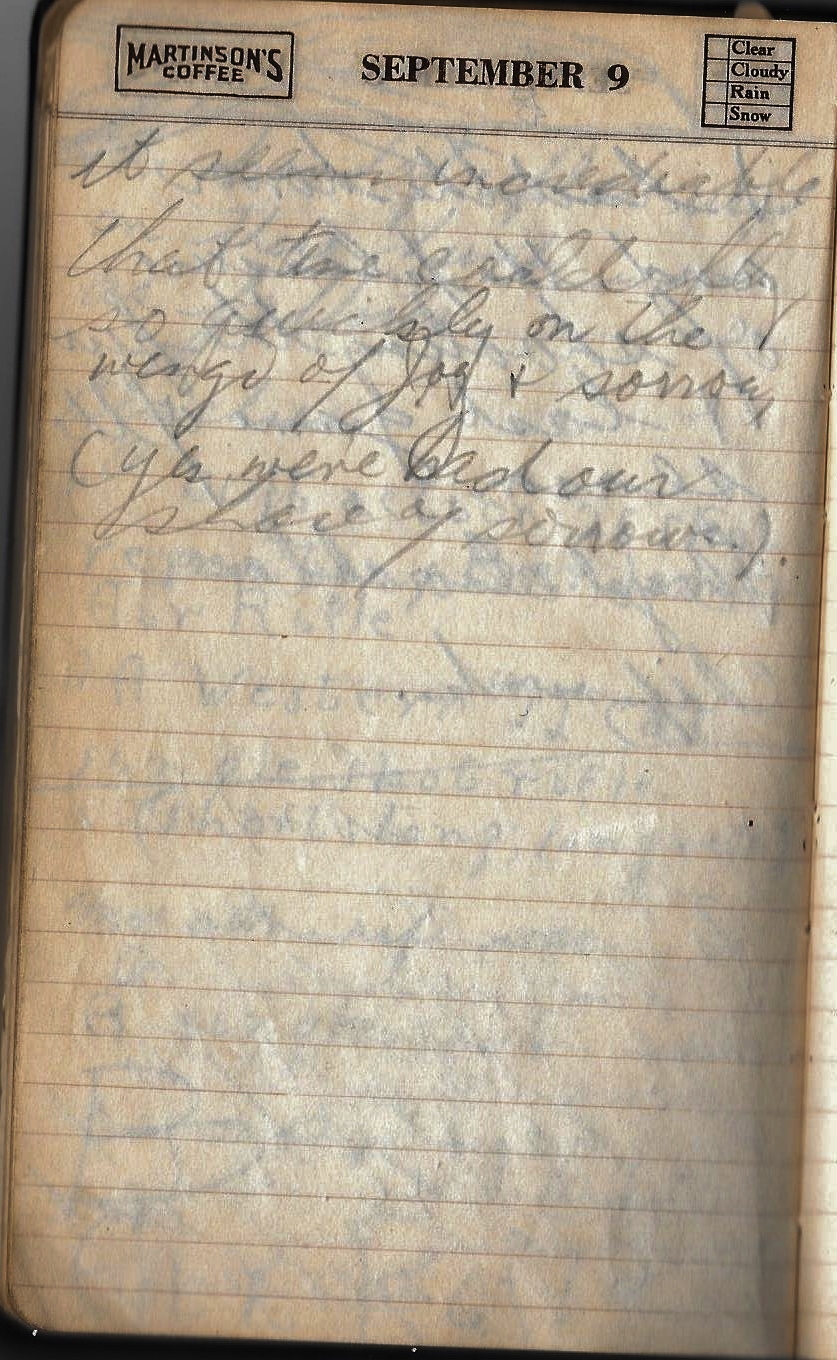
Grandpa notebook 8 maurice hunting notes 1934 Grandpa notebook 9 more hunting Maurice 1934 Grandpa notebook 10 more hunting notes Grandpa notebook 11 hunting notes and final comment in 1939 Grandpa notebook 12 Maurice comment 1939

But it’s amusing also because I can imagine my uncle as a fifteen year old boy having a wild time with his friend Blackie and competing to see who would shoot the most animals that summer.  Below is a photo of my uncle, my aunt, and my mother as well as my grandmother about a year after the summer that my uncle was writing about his hunting adventures.

Goldschlagers 1935

Goldschlagers 1935

I found the note he wrote four and a half years later on February 24, 1939, when he was almost twenty years old particularly touching and revealing:

As I recall it now I have recorded on these last nine pages possibly one of the happiest phases of my life.  As I sit here and look back four and a half years it seems incredible that time could fly by so quickly on the wings of joy and sorrow, (yes, we’ve had our share of sorrows).

What were those sorrows? I don’t know what my uncle was referring to specifically or whether he only meant between 1934 and 1939, but in his lifetime, in 1924 his aunt Frieda had died after childbirth as had her baby; his aunt Tillie had lost her husband Aaron, and his grandmother Bessie had died in May 1934, shortly before he wrote about his hunting adventures.  I also imagine that those Depression years were challenging for my grandparents like they were for so many people.

My uncle also must have liked baseball because he kept a box score from a game in the notebook.  Being a baseball fan, I was determined to figure out not only what teams these were, but what game it was:

Grandpa notebook 15 box score

After studying the names on team listed on top I realized that it was the Detroit Tigers, probably around 1935.  As soon as I saw Greenberg, I knew it had to be Hank Greenberg and thus the Tigers.  After all, how many baseball players have there been named Greenberg?

English: 1934 Goudey baseball card of Henry &q...

English: 1934 Goudey baseball card of Henry “Hank” Greenberg of the Detroit Tigers #62. PD-not-renewed. (Photo credit: Wikipedia)

The team at the bottom took some more digging because my uncle’s spelling was, shall we say creative? But the Deroch was a big clue—I assumed it was Leo Durocher, and once I looked up his career and saw that in 1935 he was playing on the St. Louis Cardinals with a catcher named Bill Delancey, an infielder named Collins and another named Frisch, I knew I had found the right team.

English: 1933 Goudey baseball card of Leo Duro...

English: 1933 Goudey baseball card of Leo Durocher of the Cincinnati Reds #147. PD-not-renewed (Photo credit: Wikipedia)


But the National League Cardinals wouldn’t have been playing the American League Tigers in 1935 unless they were in the World Series (oh, for the days before endless post-season playoffs and in-season interleague play!).  So this couldn’t be 1935 because the Tigers played the Cubs in the 1935 World Series.  After a bit more research, I concluded that this was a game from the 1934 World Series between the St. Louis Cardinals and the Detroit Tigers.

http://www.gettyimages.com/detail/573856419


http://www.gettyimages.com/detail/573867867

Since my uncle recorded the final score of the game he was following (presumably on the radio) as 10-4, it wasn’t hard to find out which game this was from the 1934 World Series: Game 4 on October 6, 1934, at Sportsmen’s Park in St. Louis.  Here is a link to the box score of that game as recorded by the Baseball-Reference website. The Tigers evened the series 2-2 by winning that game and then won Game 5 to go up 3-2 in the Series, but badly lost Games 6 and 7 to lose the Series.  I wonder which team my uncle, a boy from Brooklyn, was rooting for. Perhaps the one with the first Jewish player elected to the Baseball Hall of Fame?

Finally, there are a few short notes from my mother, the baby in the family.  Here she wrote about her big brother teasing her:

My brother is such a pest he calls me all sorts [?] of names for instance fatso, horse, baby and so many and I call him names to.”  I guess my uncle was always a tease—he certainly was as an adult also!

Grandpa notebook 14 Florence comment about Maurice


I wonder how much later she wrote the comment that follows: “When I look at this now I think it silly.  It is childish.”

When she was eleven, she wrote about a favorite teacher, Mrs. Alice Handelsman, who was “just like a mother” to her class, and her boyfriend Myron.  On his birthday in the calendar, she listed a favorite cousin, Sanford (or Sandy), Leo and Mildred Ressler’s son; my mother to this day talks about what a beautiful little boy he was and how kind he was to my grandmother.

Grandpa Notebook 2 Mom note about teacher

Grandpa notebook 16 Florence comment re Sandy Ressler


What a gift this little book from 1930 has turned out to be.  It gives me a snapshot into the childhood of my mother and her siblings and some insights into my grandfather as well.  He was obviously a very careful man when it came to money, recording so painstakingly his income and his expenses. These were the Depression years, and my grandfather worked as a driver for a milk company.   My grandparents were not poverty stricken, but they lived from paycheck to paycheck and for many years lived in a small apartment in Brooklyn and then a one bedroom apartment in Parkchester when my mother was a teenager and her siblings were married and out of the house. My grandfather worked the night shift for the milk company, and my mother would share the bed with my grandmother until my grandfather got home in the morning and she got up for school.  But my mother says she never thought of herself as poor because she always had food and clothing and a roof over her head.

We take so much for granted today with our cars and houses and televisions and computers and smartphones. We throw everything away and litter our landfills with our junk.  Our children and grandchildren have iPads and scooters and bikes and more toys and books than all the children in one tenement building in Brooklyn combined had back in the 1930s.  But my mother and her siblings had their imaginations and their friends and their teachers and their families.  And this one little notebook gives us a peak into how they entertained themselves and how they lived together as a family.  It, like my aunt’s baby book, is a real treasure.
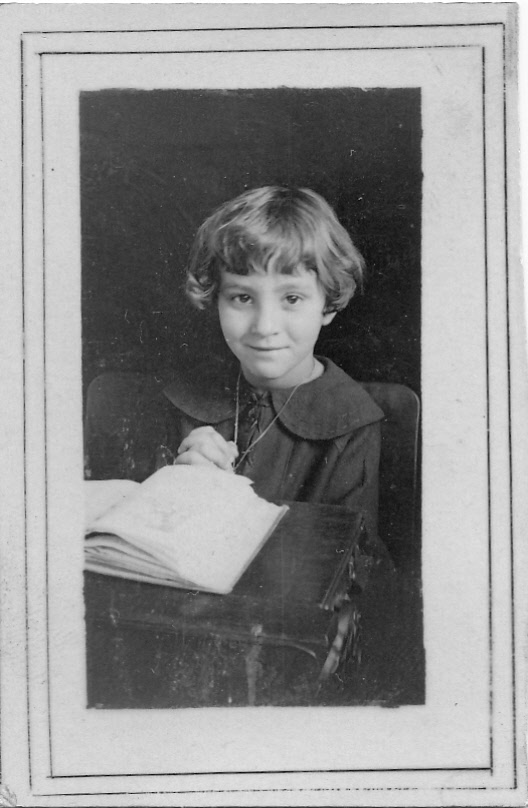


A Brotman, Goldschlager, and Rosenzweig Update: The Baby Book

As you know if you’ve been following this blog for a while, my Aunt Elaine preceded me as the family historian for my maternal side.  Several times notes she made or information she gave to others has led me to more information.  Her information has almost without exception proven to be accurate.  For example, she provided me—indirectly—with the names of my grandmother Gussie Brotman’s half-siblings, Abraham, David, Sophie, and Max.  She provided me with the clue that the Brotmanville Brotmans were our close relatives.  She told me how my grandparents met each other in Brooklyn.

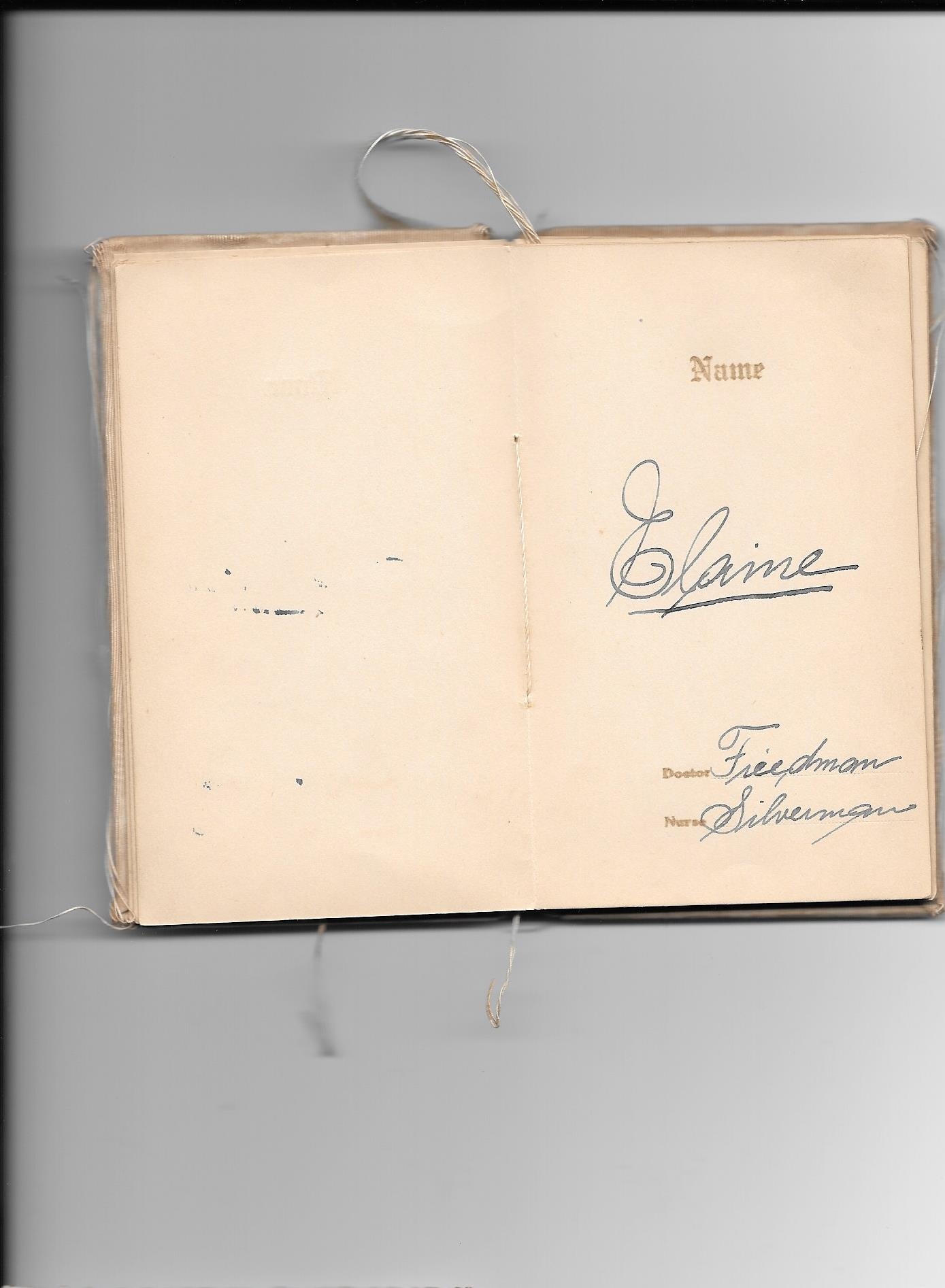
Well, she has done it again.  This time, however, it was not information or notes that she provided, but rather her baby book, which my cousin found in a shoebox of old papers.  It was partially filled out when my aunt was born on October 14, 1917.  Although most of it is blank, the few pages that were filled provide not only further confirmation of relationships about which I was previously aware, but hints at some new ones.

Elaine 1926

Elaine 1926

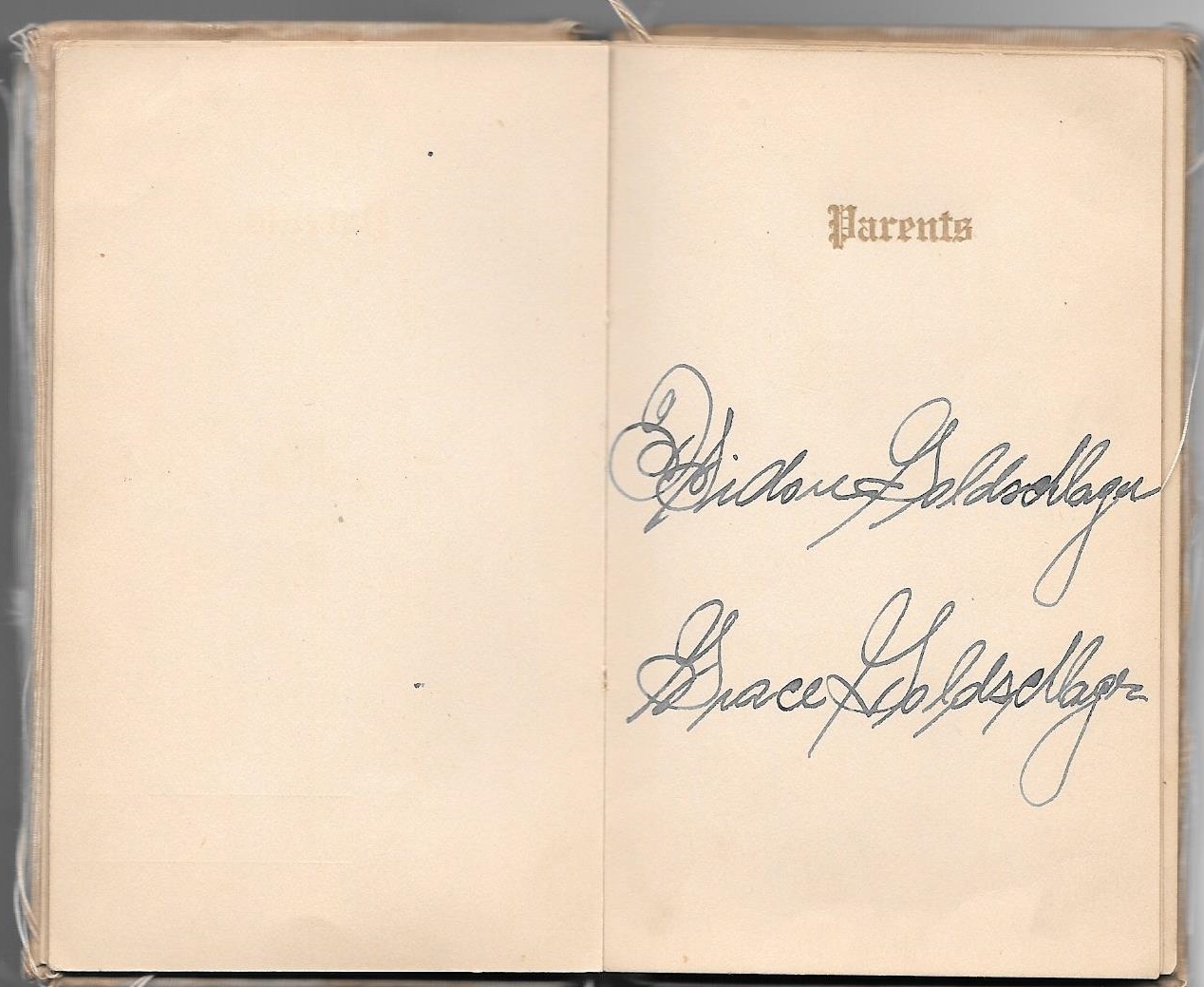
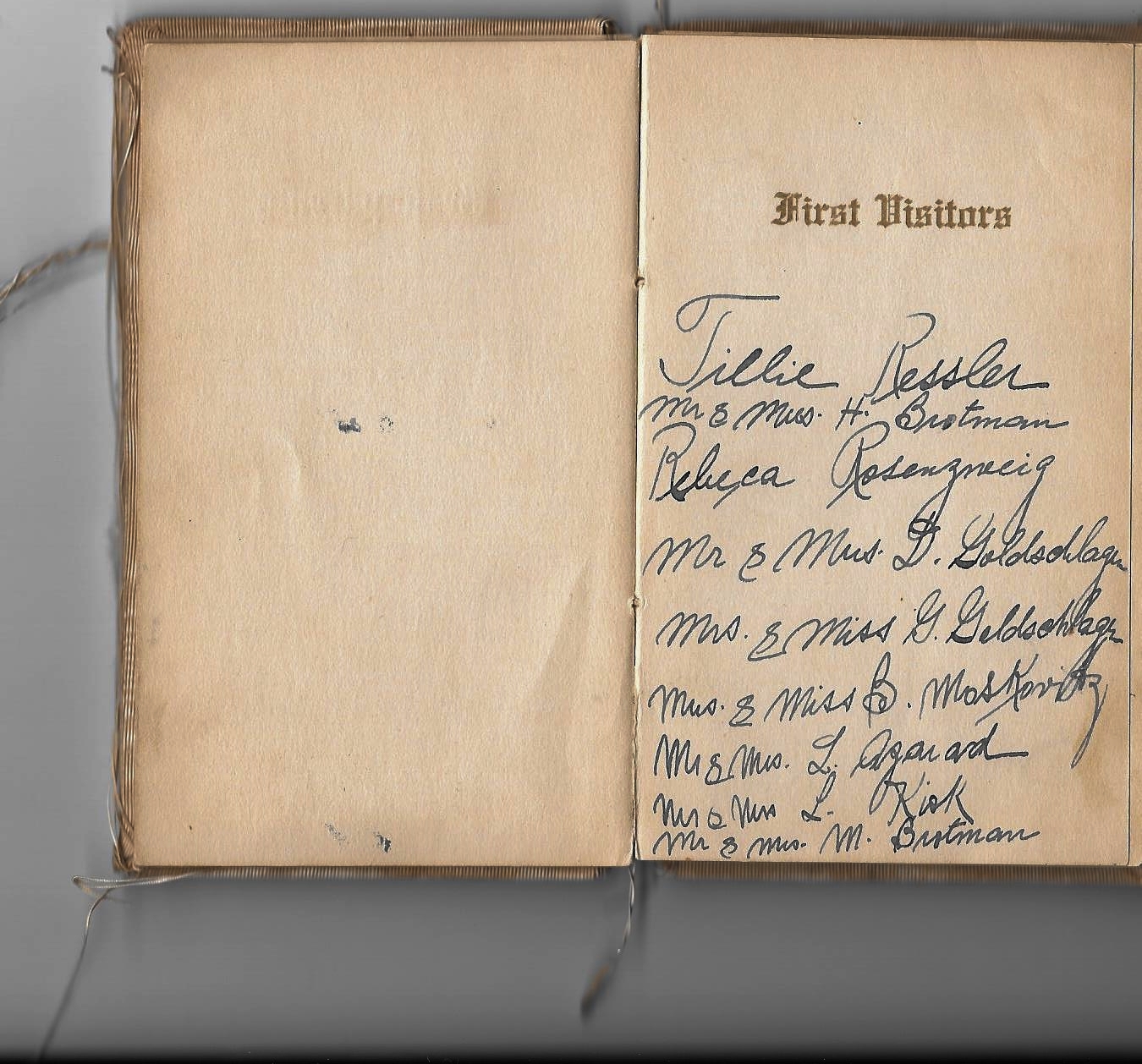
Here are the pages of the book that have been filled in:

Aunt Elaine baby book p 1

This is my grandfather’s beautifully florid handwriting.  His daughter, my aunt, also had fancy handwriting like this.


Aunt Elaine baby book p 2

My grandmother was never called Grace, always Gussie.  But family lore is that my grandfather’s family thought Grace was more American.


Aunt Elaine baby book 3

My two maternal great-grandmothers!


Aunt Elaine baby book 4

Who are these people?

Tillie Ressler—my grandmother’s older sister

Mr. and Mrs. H. Brotman—my grandmother’s brother Hymie and his wife Sophie

Rebecca Rosenzweig—my grandfather’s cousin, daughter of his mother’s brother Gustav Rosenzweig

Mr. and Mrs. D. Goldschlager—my grandfather’s brother David and his wife Rebecca

Mrs. and Miss G. Goldschlager—my great-grandmother Ghitla Rosenzweig Goldschlager and her daughter Betty

Mrs. and Miss B. Moskowitz—my great-grandmother Bessie Brotman Moskowitz and her daughter Frieda

The next two are not familiar, but provide new paths to research.  Can anyone help me decipher the names?

UPDATE: The last two must have been friends.  Mr. and Mrs. Leon and Ray Kiok and her mother Mrs. Frances Azeraad.  I found them all living together in Brooklyn, but not near my grandparents. I am not sure where they would have met.  Leon was born in Poland in 1886, and Ray’s parents were born in Spain.

Finally, Mr. and Mrs. M. Brotman: my grandmother’s half-brother Max Brotman and his wife Sophie

On the following page were more names.

Aunt Elaine baby book 5

Miss E. Shapiro and fiancé—not known yet

Sam Brotman—my grandmother’s younger brother

Mrs. A. Peter and son—I do not know

Mr. and Mrs. A. Brotman—-my grandmother’s half-brother Abraham Brotman and his wife Bessie

Mrs. D. Brotman—Annie nee Salpeter, wife of David Brotman, my grandmother’s half-brother

Mr. and Mrs. Julius Goldfarb—more on them below

The next three are not familiar—Mrs. Louis (?) Yassky, Miss Rose Botomick (?), and Mrs. Tsulie (?) Hecht.  As far as I can tell, these were not relatives, but friends.

I just loved seeing all these names.  Names that I have researched and know are my family, but names I’d not seen in something like this, something that makes it clear that these people were all really connected to my grandparents in a personal way.  I know that sounds odd.  These were the siblings, mothers, and cousins.  But since I grew up without hearing many of these names, it still was wonderful to see them all listed as the first visitors to see my aunt as a newborn in 1917.

I also found the list of gifts fascinating.  My grandparents did not have money for silver and silk, but someone was very generous in giving these items to them for their first-born child.

One final page—the inside of the back cover:

Aunt Elaine baby book 6
A. Rosenzweig—-my grandfather’s cousin, Abraham Rosenzweig, Rebecca’s brother.  I have speculated, based again on a story conveyed by notes from my Aunt Elaine, that it was either Abraham or Rebecca or Sarah who was accompanying my grandfather Isadore on Pacific Street in Brooklyn when he first laid eyes on my grandmother and declared he was going to marry her.

Back to Mr. and Mrs. Julius Goldfarb.  I asked my mother who they were because in a second old item—a notebook my grandfather used for various purposes that was also used by all three of his children at one time or another[1]—the name Joe Goldfarb appeared twice.  Who were these Goldfarbs?

Grandpa Notebook page 1 addresses Joe Goldfarb

Grandpa notebook 13 more addresses Joe Goldfarb

(There’s more great stuff on this page—Sam Brotman is my great-uncle Sam, Feuerstein B. is my great-aunt Betty Goldschlager Feuerstein, Leo Ressler is my mother’s first cousin, her Aunt Tillie’s son; Rae Rosenzweig and Lizzie Horowitz are my grandfather’s first cousins, sisters of Abraham and Rebecca. And there is an S. Goldfarb in addition to Joe.)

My mother said all she could remember was that either Julius or his wife was my grandmother Gussie’s first cousin.  I’d never heard the name Goldfarb before, so what did I do? What all genealogy addicts would do.  I immediately started searching.  And the results of that search will be discussed in a later post once I have filled in more gaps in that story.

But for now, I once again can hear my aunt cheering me on, telling me to keep digging and finding the family stories.

elaine and amy 1953

Aunt Elaine and me 1953


[1] I will share more of that notebook in later posts also.

It’s My Blogiversary! Time to Reflect

It was two years ago tomorrow that I posted my first blog post.  It is also the 120th anniversary of my grandmother Gussie Brotman Goldschlager’s birth tomorrow.  And tonight is the beginning of Yom Kippur, the Jewish Day of Atonement and a long fast day for those who observe.  That’s a lot to process in one day!


Embed from Getty Images

It’s hard to believe I’ve been doing the blog for two years (although I really started doing genealogy about two years before that).  In some ways it feels much longer because it has become such a big part of my daily life—-doing the research, thinking about it, pulling my notes together, writing up the posts, editing them, adding photos and documents, responding to comments and questions, and reading the blogs of so many other wonderful people.  The blog has provided me with so many more benefits than I had imagined back in September 2013 when my cousin Judy got me started by setting up the template on WordPress.  Not only has it helped me organize my thoughts and record my research, it has made me focus on not just collecting names and dates on a family tree but on the larger questions: who were these people and what were their lives like? Where did they live, and what were those places like? What historical and economic conditions affected their lives? What legacy did they pass down to their descendants, and how has that affected the person I am today?

The blog also has been a magnet that has allowed others to find me.  Every time I get a comment from someone who just happened to find the blog while searching for their family history, I am amazed by what the internet can do. Imagine if my cousin Wolfgang had not found my blog?  I would not know even half of what I now know about the Seligmann family.

jeff gussie amy 1955 abt

My grandmother was born 120 years ago, and she died just over forty years ago.  She was the only grandparent I knew very well, and I loved her very much.  She had a hard and sad childhood, which scarred her in many ways for life, but with her grandchildren she was loving and funny and affectionate.  We probably brought out the best in her.  As I continue to write my novel about her life and that of my grandfather, I hope I am doing her justice and honoring her memory while also capturing the sad underside to her life.

Amy Gussie and Isadore

And as for Yom Kippur, it’s a day for me to contemplate the year gone by and the mistakes I’ve made along the way.  Although I try my best to respect and honor all my relatives, living and dead, when writing the blog, I always worry that someone will be offended or upset by something I have written.  If so, please accept my apologies.

Also, I hope I have expressed my appreciation to all those who have helped me with my research, and I hesitate to make a list for fear of forgetting someone who helped me months ago and whose name might slip through my ever-worsening memory (getting older does really stink).  But let me try to remember as best I can and thank some of those who have provided me with so much research support in the past year:

my wondeful cousins Lotte Furst, Wolfgang Seligmann, Bob Cohn, Steven Seligman, Suzanne and Stephen Michel, Pete Scott, Phyllis Rosner, and Angelika Oppenheimer,  all of whom have provided me with photographs, stories, and insights into our extended family in the past year (as well as all those who helped the year before);

my amazing contacts in Germany who helped me find and understand documents and other resources: Dorothee Lottman-Kaeseler, Matthias Steinke, Helmut Schmahl, Beate Goetz, Gerd Braun, as well as Ralph Baer here in the US;

my DNA tutors, Julie Mulroy, Svetlana Hensmann, and Leah Larkin;  the many people in the Tracing the Tribe and the German Genealogy groups on Facebook, and the members of the GerSig listserv on JewishGen. Also, thank you to my friend Rene Reich-Grafe for answering my endless questions about Germany, its history, culture, and geography.

To all of you, if I have not expressed my gratitude before sufficiently, I apologize.  You’ve really made this journey so much more meaningful and so much more interesting.

Finally, to my family, friends, fellow bloggers, and other readers, thank you for being there.  I would do what I am doing even if no one was paying attention, but it is so much better knowing that others are interested in these stories about people who really were strangers to us all.

For all of you who are observing Yom Kippur, may it be an easy fast and a meaningful and thoughtful day.


Embed from Getty Images


Old Friends: Braided Forever

My mother has often spoken about how sad she was when her family decided to move from Brooklyn to the Bronx when she was about twelve years old.  There were many reasons she was upset.  For one, she had to leave her dog Sparky behind.  That broke her heart, and she still can’t talk about it without getting emotional.

Sparky 1934


But also she had to leave her best friend Beatty behind. Beatty lived in the same four-family house at 1010 Rutland Road in Brooklyn; she lived right down the hall from my mother.  They had been close friends all through childhood, and although they tried to stay in touch after my mother moved, back in the 1940s that was not at all easy.  Phone calls were expensive, and the trip from Brooklyn to Parkchester in the Bronx was a long one, especially for two young girls.  So over time, they lost touch.

Beatty and my mother c. 1940

Beatty and my mother c. 1940

Not too long ago my mother asked me if I could find Beatty.  She knew her first and last name from when she’d last seen her over 70 years earlier, but she had no idea where she was living or whom she might have married.  I tried to find her, but with so little information I had no luck.  If Beatty had married, it was after the last year of the publicly available NYC marriage index (1937).  The only information I could find related to her siblings, who had passed away.

So you can imagine how excited I was to receive a message on the blog last week from Beatty herself.  She was looking for my mother after seeing her pictures and childhood name on the blog.  I contacted Beatty, and I called my mother.  And I gave them each other’s contact information, and now they are reconnected after over 70 years.  I get the chills (and a warm feeling) whenever I think about it.

One of the stories my mother shared with me was about Passover at Beatty’s house.  Her father led the seder in a very serious way, and as many of us know, a traditional seder can get quite long and quite boring, especially for young children.  To keep themselves from misbehaving and talking, my mother and Beatty would braid the fringes on the beautiful tablecloth that adorned the seder table.  When my mother shared this memory with Beatty, she said that she also had shared that story with her children.
The tablecloth still exists, and even more remarkable, the braids made by my mother and her best friend Beatty are still there as well.  Here is the photograph to prove it.

Beatty's tablecloth

Beatty’s tablecloth

tablecloth with braids 2

My mother was once my Girl Scout troop leader, and one of the songs we sang had the lyrics, “Make new friends, but keep the old.  One is silver, and the other gold.”  My mother and Beatty certainly know the truth of that message.

Walking in the Shadows of My Brotman Great-Grandparents

My third day in Poland was undoubtedly the highlight of the trip for me.  Visiting the town where my great-grandparents lived was the initial motivation for going to Central Europe in the first place.  The stops in Prague, Budapest, and Vienna were the icing on the cake, but the cake was Poland and, more specifically, Tarnobrzeg.  (I finally learned how to pronounce it, thanks to our guide Tomasz: TarNOBjeg.)  I had high and emotional expectations; they were exceeded by the reality.

First, some background.  When I first started doing genealogy research, I had no idea where my maternal grandmother’s family had lived in Europe other than they were Galitzianers—from Galicia.  My mother had no idea what town in Galicia had been their home, and for a long time the only location given on the records I could find was Austria, which made sense since Galicia was part of the Austria-Hungary Empire when the Brotmans lived there.

Then a few pieces came together—first, I obtained my great-uncle Hyman Brotman’s naturalization application giving his home town as Jeekief, which is a decent phonetic spelling of Dzikow, once a separate village but later incorporated into Tarnobrzeg, a much larger town.  Then I found a ship manifest for Yossel Brod, most likely my great-grandfather, from Tarnobchiek, another phonetic spelling, this time of Tarnobrzeg.  The ship manifests for my great-uncles Abraham and David Brotman gave their home town at Grebow, a small village less than ten miles from Tarnobrzeg.  It seemed clear to me that Tarnobrzeg was the area where my Brotman ancestors had lived in Galicia.  And I had to go there.

SelectedU.S.NaturalizationRecords-OriginalDocuments1790-1974ForHermanBrotman

Hyman Brotman’s Naturalization Application (Click twice to zoom in.)


David and Abe Brodmann on the Portia 1889

David and Abe Brodmann on the Portia 1889


Joseph Brotman ship manifest

Joseph Brotman ship manifest

I had originally hoped that there might be some records left in Tarnobrzeg that had not yet been digitized and put on line by JewishGen, Gesher Galicia, or JRI Poland, but our guide Tomasz warned me that he believed that whatever records still existed had in fact been found already and that we would not find any more in the town.  I adjusted my expectations accordingly, and I decided to enjoy the trip for the experience of being there rather than as a research opportunity.

Tomasz picked us up at our hotel at 9 am that morning, and we got to meet my recently found cousin Phyllis for the first time.  Phyllis and I had connected through DNA testing, which showed us as third cousins and showed her aunt Frieda and my mother as second cousins.  By comparing our family trees we had reached the conclusion that the likely connection was through my great-grandmother Bessie Brot Brotman and her grandmother Sabina Brot, whose father we believe was my great-grandmother’s brother.  Sabina’s home town in Galicia was Radomysl nad Sanem, another town about ten miles from Tarnobrzeg, which we would also visit that day.  The common surname and the proximity of residences seemed to support our hypothesis.  We quickly connected in person, chatting excitedly about our research, our travels, and our hopes for that day.

IMG_2705 cousins

As we drove from Krakow to Tarnobrzeg, Tomasz spoke about the history of Jews in Poland. By the 19th century Jews made up 10% of the population of Poland, and they lived all over the country—in the cities and in small towns and in villages.  The land we drove through was mostly rural even today, and Tomasz said that Jews were often invited by the kings or the aristocracy to live in the towns to support the local economy; Jews had the education and the skills to provide bookkeeping, trade, banking, and other economic necessities to the farmers who lived in these regions.  In Tarnobrzeg it was the Tarnowski family that owned the land and invited the Jews to come live there.


Castle of the Tarnowski family in Tarnobrzeg

Castle of the Tarnowski family in Tarnobrzeg


IMG_2697

When I asked him about the level of religious observance of the Jewish residents who lived in places like Tarnobrzeg, Tomasz said that there was a diverse range of religious observance—-from Hasidim to more traditional Orthodox to more liberal Jews and to secular Jews. Other sources point out that Tarnobrzeg was an important Hasidic center with well-regarded Hasidic leaders and rabbis.

Tomasz also spoke about the fact that Tarnobrzeg was one of the leading Jewish population and industrial centers in Galicia outside of Krakow.  The main industry aside from agriculture was the production of sulfur, a product that it still important to the local economy of the region.  Tarnobrzeg is located where two rivers meet—the Vistula (which also runs through Krakow) and the San, and thus was an important trade location.  It also is very close to what was once the border with the Russian Empire, and when Russia obtained that land, families were often separated, some living in Austria-Hungary, some in the Russian Empire.  In the 19th century when my great-grandparents lived there, the population of Tarnobrzeg was more than 75% Jewish.  There were about 2800 Jews living there in the 1880s when my great-grandparents decided to leave.

I asked Tomasz why people like my great-grandparents would ever have left a place like Tarnobrzeg, where Jews were doing well and treated well and were more than a majority of the town’s residents.  He said that in the late 19th century, there was both an economic crisis in Poland and a significant increase in the population. (There was also a great deal of anti-Semitism in Poland, as other sources describe.)  Jews and non-Jews left for greater economic opportunities.  When I pondered how a family would be able to tear themselves away from their home, both emotionally and financially, Tomasz explained that there were emigration agents facilitating these departures.  They would circulate brochures touting the advantages of going to America, and the fact that many others were leaving made it easier for a family like mine to make a similar choice.  I asked how they would actually leave, and Tomasz said there was a train that came to Tarnobrzeg that would take them to one of the port cities, like Gdansk or Hamburg, where they would catch a ship for America.  It would be costly, but the potential benefits made it all seem worth the risk.

Finally we arrived in Tarnobrzeg itself.  It was not exactly what I expected, as it is a large town, not a little shtetl, and it is a thriving town—lots of people, lots of stores, lots of cars.  Not a quiet little romantic village out of Fiddler on the Roof at all.  There was even a Lego store right on the main square.


Lego store on main square in Tarnobrzeg

Lego store on main square in Tarnobrzeg

But once we got out of the car and started to walk around, I felt some almost eerie connection—that this was a place where my great-grandparents had walked, had shopped, had worked.  Many of the buildings that surround the square were there back in the 1870s and 1880s when my great-grandparents and their children lived there.  Maybe one of those buildings contained a shop where my great-grandfather worked (on that ship manifest his occupation was given as “kaufmann” or merchant).  Maybe my family lived in one of them.


Main square in Tarnobrzeg

Main square in Tarnobrzeg


IMG_2657 old buildings on square in Tarnobrzeg


I stood in that square, imagining it 150 years ago as a place filled with families like my own, Jewish families of all sorts, living in a safe and comfortable way in a safe and comfortable place. I could imagine my great-uncle Chaim who became Hyman and then Herman and my great-aunt Tema who became Tillie, just small children, holding their mother’s hands as they walked through that square.   I could block out the Lego store and the ugly modern supermarket and see just the old buildings as they might have looked in the 1880s.


IMG_2663 Tomasz our guide in Tarnobrzeg

Our guide Tomasz Cebulski leading the way in Tarnobrzeg


IMG_2658 square in Tarnobrzeg IMG_2662 street in Tarnobrzeg IMG_2664 my ancestral town

Tomasz took us to the building which was once the synagogue. According to the official Tarnobrzeg website, it was heavily damaged by the Nazis and used to store grain.  It was renovated in the 1970s into a public library, and there is almost no sign today that it was ever a synagogue building.  The windows were changed, and inside where there was once a prayer hall and aron kodesh are now stacks filled with books.  When we asked in the library whether they had any photographs or books or records about the synagogue or the former Jewish community, all they could find was one copy of a brochure that had only been created a few years ago.

IMG_2659 where the prayer hall stood, now a library

Space where the prayer hall once was in the Tarnobrzeg synagogue

IMG_2661 former synagogue building

Exterior of building where the synagogue entrance had been


Tarnobrzeg Synagogue

Tarnobrzeg Synagogue (Photo credit: Wikipedia)

Here are some photographs of the building when it was a synagogue:

The only visible sign that the building was built as a synagogue is a small plaque on the exterior of the building in a location that almost no one could ever see or read if they were not looking for it.  We had to walk around the building through the lawn to get this photograph. The only small comfort was that the building was being used for books and education, not for commerce or worse.

IMG_2660 marker on library marking it as location of synagogue

Memorial plaque on the former synagogue building


Tomasz also pointed out that the first Jewish cemetery was located just a block away, but was now a parking lot for the shopping area that now exists there.  According to this video prepared in 2008, the Nazis destroyed the synagogue and used the headstones to pave a road. (I suggest downloading the hi-def version and watching it; it will give you a better sense of the town and its history.)

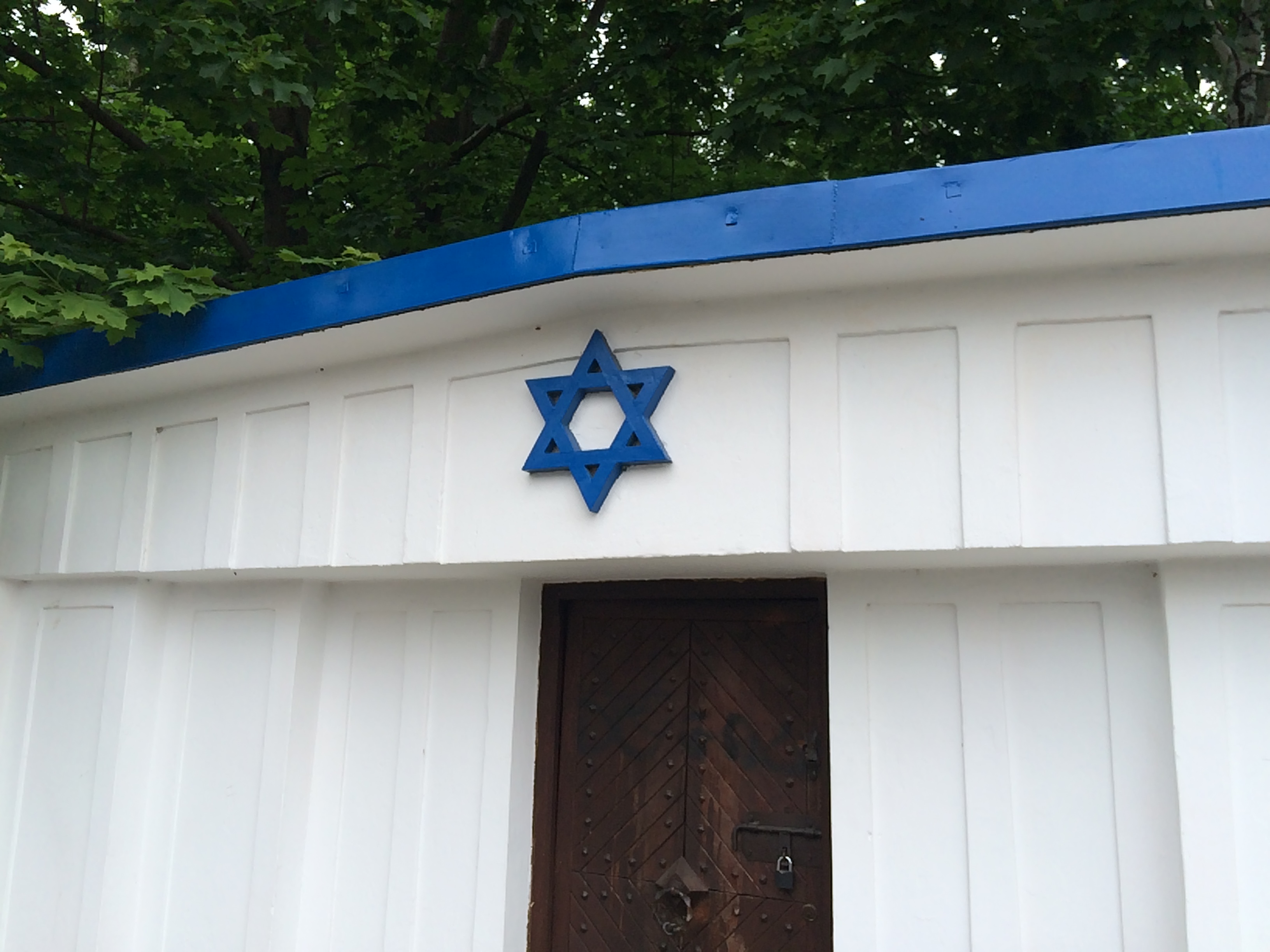
We then drove to the other Jewish cemetery in Tarnobrzeg, which was opened in the 20th century and  where there is still an ohel with a Star of David.  Sadly, the cemetery is not maintained at all, and there are just a handful of headstones still standing, most covered with weeds and snails.  I took photographs of as many as I could and now hope to get these translated.

IMG_2665 ohel for cemetery Tarnobrzeg IMG_2666 cemetery in Tarnobrzeg cemetery IMG_2668 IMG_2669 IMG_2670 IMG_2671 IMG_2672 IMG_2673 birdhouse in the cemetery IMG_2674 cemetery

After visiting the cemetery, we went to a small museum Tomasz knew about, where we met with an incredibly helpful woman who did not speak any English, but when Tomasz explained why I was there, she was very excited and anxious to help.  She provided us with some books with drawings and  photographs of Tarnobrzeg before World War II.

IMG_2677 images from books at the museum in Dzykow IMG_2678 IMG_2679 IMG_2685

The woman at the museum also explained where Dzikow had been located before it merged into Tarnobrzeg, so we drove there and saw some very old homes, built almost like log cabins.  I was enchanted and wondered whether one of these buildings had once been my great-grandparents’ home.

IMG_2690 IMG_2692 IMG_2693

As we left Tarnobrzeg, Tomasz told us what had happened to the Jews there during the Holocaust. Many were shot and killed just outside of town and buried there.  Many others were taken to the San River and shot, their bodies falling into the water.  The rest were eventually transported to a concentration camp or a death camp.  If any survived, they have not returned to Tarnobrzeg.  There are no known Jews living there today.  What would my great-grandparents, both of whom died before the Holocaust, have thought if they returned to their hometown today? It would no longer be the place they knew in almost any way, except for the old buildings that survive.

Nazis rounding up the Jews of Tarnobrzeg 1939

Nazis rounding up the Jews of Tarnobrzeg near the San River 1939


I could have stayed and wandered around Tarnobrzeg for hours, but we had two more stops to make: Radomysl nad Sanem and Grebow.  We headed first to Radomysl nad Sanem, where Phyllis’ grandmother had lived. It is on the other side of the San River and is a very small little town with a small town square and municipal building and perhaps fifty homes, if that many.  Its Jewish population before World War II was less than 400 people, and the village was mostly Jewish.  We drove from one end of the town to the other, and it took only a few minutes.  Even more so than in Tarnobrzeg, there is no sign that there were ever Jews there.  Phyllis was able to obtain some brochures about the town from the library there, but nothing that discussed the former Jewish community.

IMG_2698 Radomysl nad Sanem where Sabina Brot lived IMG_2699 IMG_2700 IMG_2701 IMG_2703


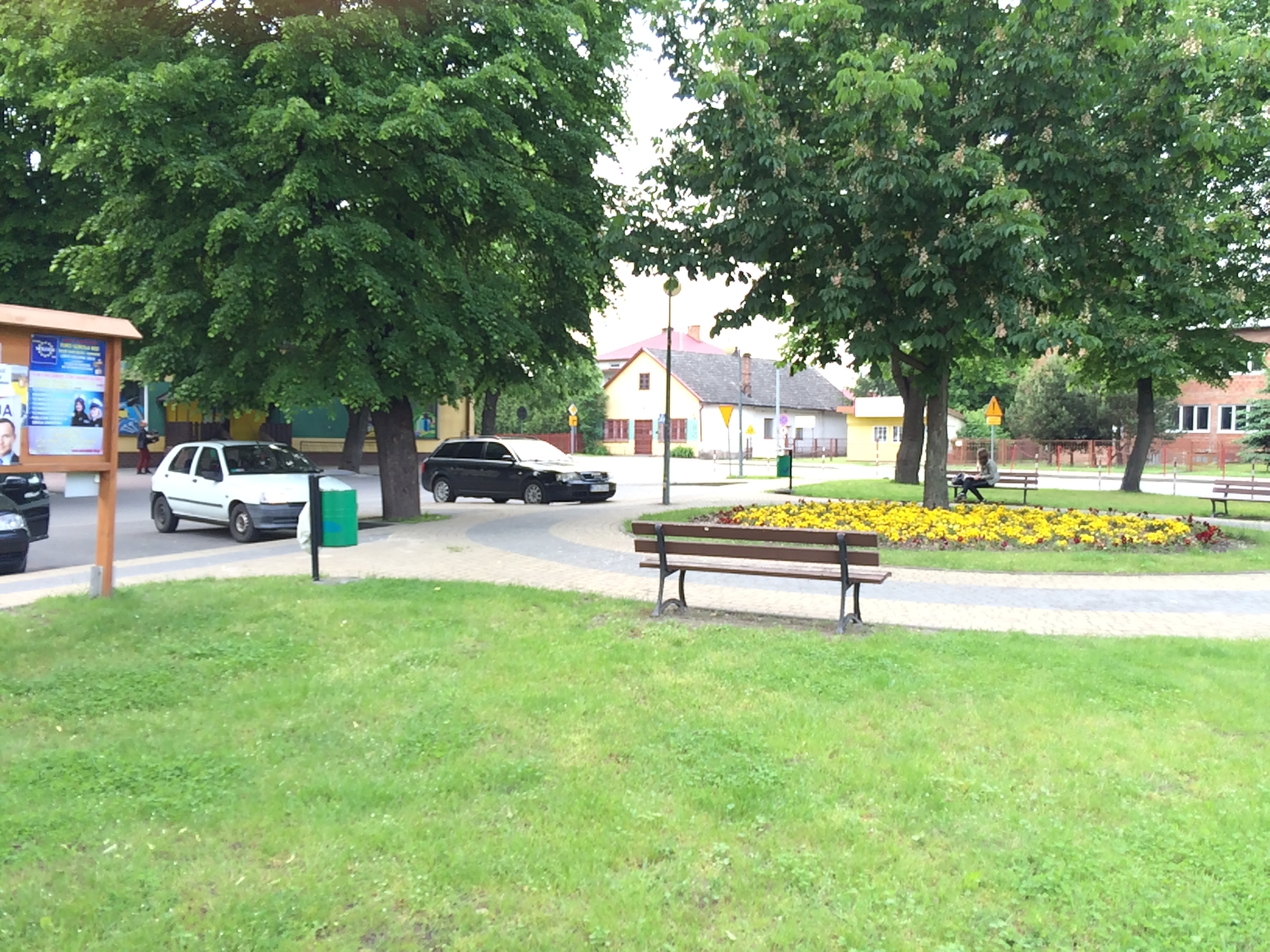
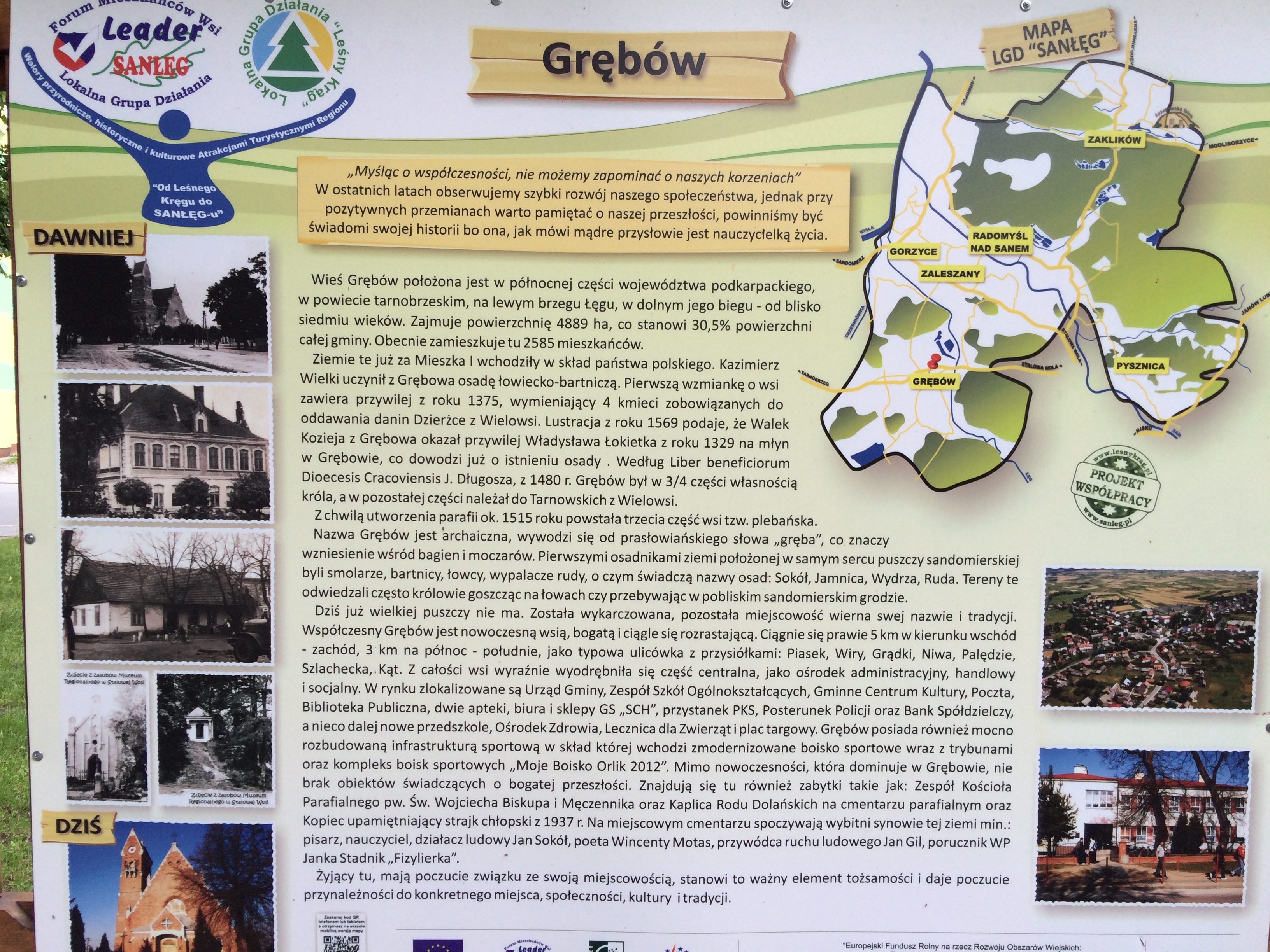
Our last stop was a quick one in Grebow, a town even smaller than Radomysl nad Sanem where there was not even a library we could visit.  I don’t know whether this was where Abraham and David Brotman were born or simply where they were living at the time they emigrated.  Perhaps they had moved here for greater opportunities than they could find in Tarnobrzeg.  I don’t know.  It’s such a tiny village that all I can do is imagine them living there and then wonder what they must have thought when they landed in a place as large and crowded and dirty as late 19th century New York City’s Lower East Side.

IMG_2706 tiny town of Grebow IMG_2707 Grebow IMG_2709 public building Grebow IMG_2710


We then headed back to Krakow.  I was exhausted and emotionally drained and filled with thoughts and feelings.  We were taking another night train that night, this time to Budapest.  As we ate a quick dinner at our hotel, I found myself overwhelmed with emotion in a way that surprised me.  My eyes filled with tears—tears for the people who had been killed, tears for my great-grandparents who had left this country for better things, tears of gratitude that they had done that, and tears of sadness that I was leaving a place that part of me truly felt was my homeland.


Home Sweet Home

We are back from our trip, and I have so much to say that I don’t even know where or how to start.  Traveling to a different place can change your whole view of the world, of your place in the world, and of yourself.  This trip did that in so many different ways.  I have hundreds of photographs to sort and label, a lot of notes to transcribe and ponder, and so many thoughts and memories floating through my head that I need to write them all down before I forget them.  So I can’t just start blogging in detail about the trip right away.  I will certainly report about the parts of the trip that related directly to my own family—the trip to Poland in particular—once I have it all digested.

For now I have these overall thoughts and a few photographs to share.  First, standing in the former Jewish quarters in Prague, Krakow, Budapest, and Vienna, some of which still have several synagogues (a few even still in operation), is a chilling and horrifying experience.  For me, these places that once bustled with Jewish grandparents, mothers, fathers, and children, going to work and going to school and going to shul, were a graphic and vivid reminder of what the world lost in the Holocaust.  Had it not been for the Nazis, these Jewish communities could and likely would still exist, adding to the culture and economy of these places and of the world just as they did for hundreds of years before their Jewish citizens were murdered.

A street in the former Jewish Quarter of Krakow

A street in the former Jewish Quarter of Krakow

Nothing made this more painfully vivid for me than standing in Tarnobrzeg, the town where my Brotman great-grandparents lived, a town that was once 75% Jewish and where not one Jew lives today.  The only signs that there were once Jews there were a small plaque on the library, a building that had once been the synagogue, and a Star of David near the gate to the neglected Jewish cemetery, where only a handful of headstones remain.

gravestone on the ground in the Jewish cemetery in Tarnobrzeg

gravestone on the ground in the Jewish cemetery in Tarnobrzeg

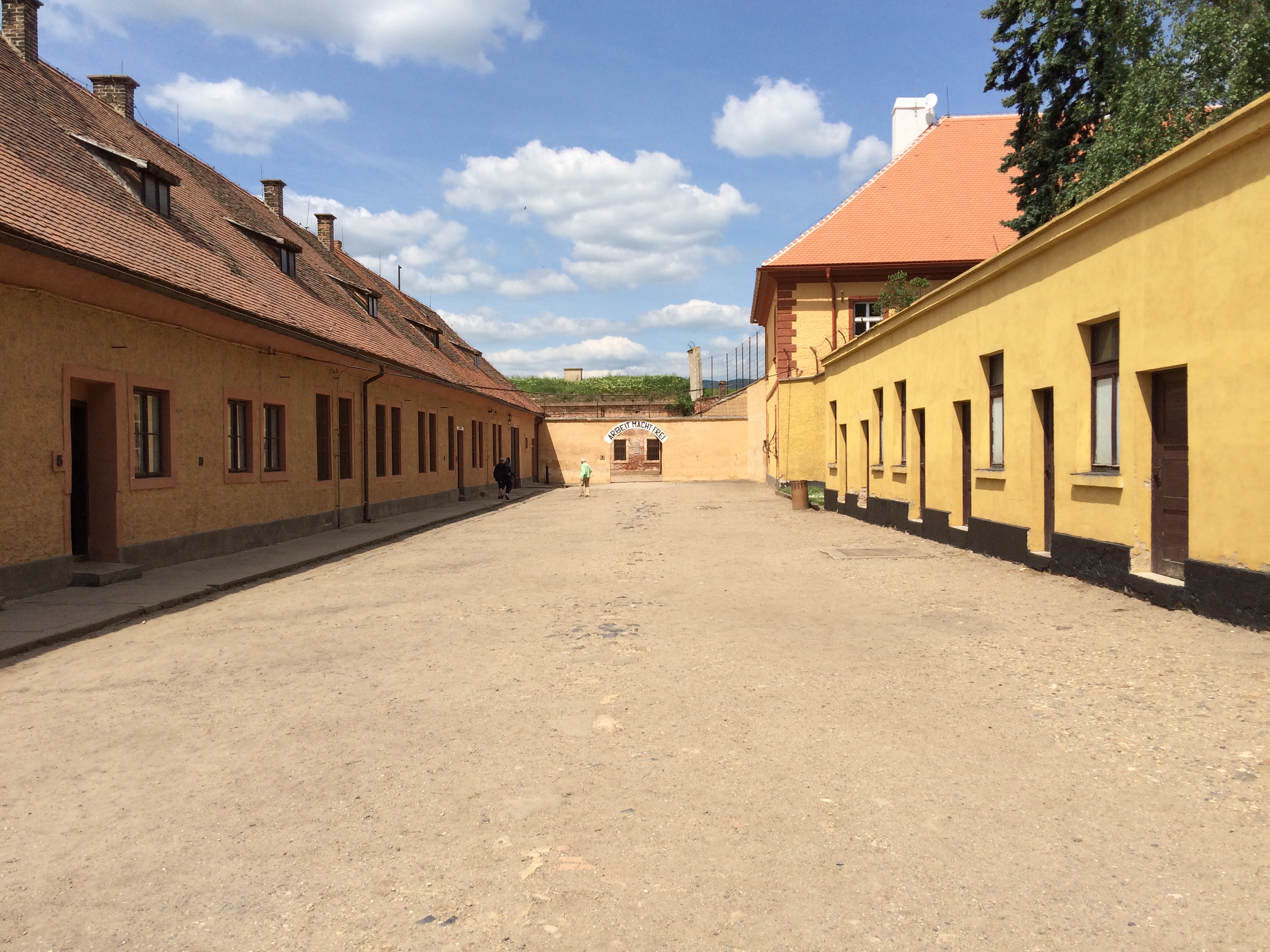
Second, every person, Jewish or not, should visit Terezin and Auschwitz.  I cannot say more.  The places say it all.  You cannot go to these places and not be changed.  No matter what you may have read or seen or heard about the Holocaust, you cannot be prepared for what you experience walking in those places of terror and death.  I have only two photographs of Terezin and no photographs of Auschwitz.  I could not bear to think about taking a photograph while standing where so many were slaughtered.

Terezin

Terezin

Third, I had little idea what life was like under Soviet domination in the Czech Republic, Poland, and Hungary until we met several people who had lived during that era.  We were lucky to have guides in Prague, Poland, and Budapest who had witnessed the changes and were able to describe to us how different life was before and after the Soviets left in the late 1980s, early 1990s.  Today all these places are clearly capitalist, for better in many ways, for worse in others.  Seeing Starbucks and McDonalds and KFC everywhere amidst the old buildings in these gorgeous cities is jolting, but much better than seeing empty store windows and children forced to march at rallies to support the “state.”

Despite all the sadness that we felt as we learned about the past in these places, overall we experienced these cities as places of joyfulness, liveliness, and overall comfort.  Yes, there were beggars and homeless people, especially in Budapest, and I am sure that outside the areas where tourists congregate there is plenty of poverty and misery.  But each of the cities we visited were beautiful places filled with incredible and fascinating architecture, a huge number of cafes and restaurants and bars, museums teeming with people, cobblestone streets crowded with tourists and tour groups, and the sounds of happy, excited people.  There was music everywhere—in the streets, in the churches, and in the concert halls.

Dohany Synagogue in Budapest

Dohany Synagogue in Budapest

We had an incredible time.  Our tears and sadness were well-balanced with times of pure joy—climbing the tower to see all of Prague, clapping to Klezmer music in Krakow, walking along the river in Budapest, and eating unbelievable pastries in Vienna.  We heard music in every city, we stood in awe in Gothic cathedrals, we watched people laughing and drinking and eating in the cafes, and we walked and walked and walked until our feet were numb.  We had an incredible time.

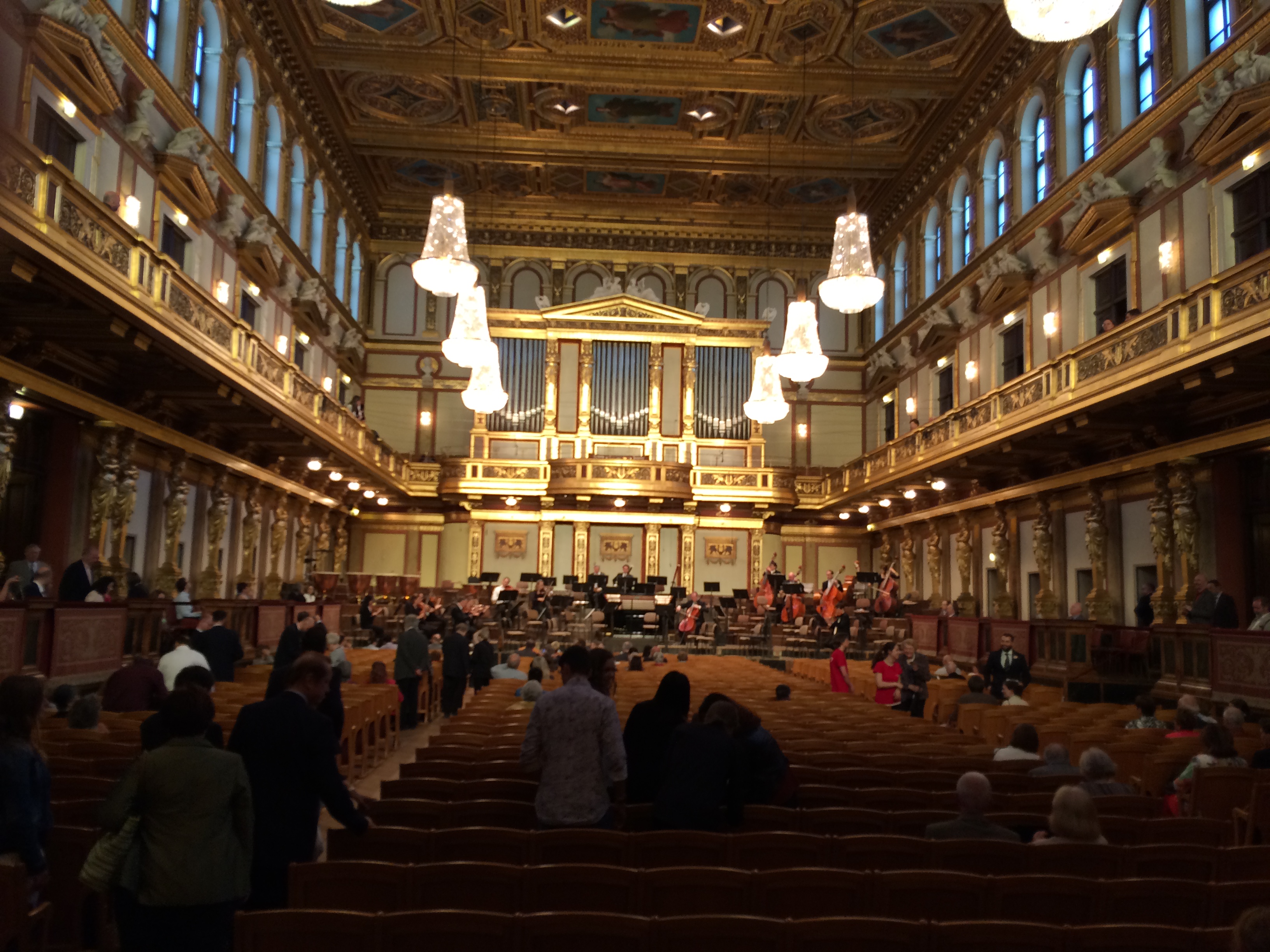
Musikverein in Vienna

Musikverein in Vienna


One for the Road: How I Found Another Brotman

This will be my last post before we leave on our trip.  I wanted to leave on a high note with a new discovery—a Brotman line I’d not discovered until the last week or so.  Perhaps this is a good omen for what I might find when in Poland.  I might post a bit while away—depends on internet access, time, and energy.  But I will report on the trip either as it unfolds or after I return, so stay tuned.

*********

In my last post I reported on the conflicting results of my search through the records of the families of Moses and Abraham Brotman of Brotmanville, New Jersey.  I was looking for any shred of evidence that might reveal where they, and thus perhaps my great-grandparents, had lived in Europe.  What I found was that some records said Moses was born in Austria, some said Russia.  Same for Abraham.  And not one record named a town or city.  Thus, I had not gotten any closer to any answers.

But while reviewing the documents I had and checking and double-checking my tree, I did find something somewhat anomalous.  In doing my initial research of Moses’ family, I had not been able to find them on the 1920 census, as I mentioned in my last post.  In trying to find the family, I had searched for each of the children separately, and I had found a Joseph Brotman living in Davenport, Iowa, according to the 1915 Iowa state census.  I admit that I had not looked very carefully (BIG mistake) and had jumped to the conclusion that Moses’ son Joseph had been shipped out to Iowa to live with another family since I couldn’t find Moses or Ida or any of the siblings listed on that census.  (This is one reason I keep my tree private on Ancestry—I’d hate to mislead someone else while I am doing preliminary research.)

But in now reviewing my original preliminary research, this just struck me as strange.  So I went back to look more carefully.  First, I pulled up the census record for Joseph.  Instead of being a list or register as with other census reports, Iowa had separate cards for each resident.  Here is the one for Joseph Brotman:

Joseph Brotman 1915 Iowa census  Ancestry.com. Iowa, State Census Collection, 1836-1925 [database on-line]. Provo, UT, USA: Ancestry.com Operations Inc, 2007. Original data: Microfilm of Iowa State Censuses, 1856, 1885, 1895, 1905, 1915, 1925 as well various special censuses from 1836-1897 obtained from the State Historical Society of Iowa via Heritage Quest

Joseph Brotman 1915 Iowa census
Ancestry.com. Iowa, State Census Collection, 1836-1925 [database on-line]. Provo, UT, USA: Ancestry.com Operations Inc, 2007.
Original data: Microfilm of Iowa State Censuses, 1856, 1885, 1895, 1905, 1915, 1925 as well various special censuses from 1836-1897 obtained from the State Historical Society of Iowa via Heritage Quest

You can see why I made that initial mistake.  He was born the right year (1902) and the right place (New Jersey).  He was Jewish, his father was born in Austria, mother in Russia.  All those facts certainly seemed to suggest that he was the son of Moses and Ida Brotman.  So I had entered this record for Joseph on to my tree in Ancestry.

But this time I took the next step—were there other Brotmans in Davenport on that census? First I saw a Lillian Brotman.  I thought, “Hmmm, maybe two siblings were sent to Iowa?” Remember—Moses had a daughter named Lillian, as did Abraham.  So I looked at Lillian’s entry in the 1915 census.

Lillian Brotman 1915 Iowa census  Ancestry.com. Iowa, State Census Collection, 1836-1925 [database on-line]. Provo, UT, USA: Ancestry.com Operations Inc, 2007. Original data: Microfilm of Iowa State Censuses, 1856, 1885, 1895, 1905, 1915, 1925 as well various special censuses from 1836-1897 obtained from the State Historical Society of Iowa via Heritage Quest.

Lillian Brotman 1915 Iowa census
Ancestry.com. Iowa, State Census Collection, 1836-1925 [database on-line]. Provo, UT, USA: Ancestry.com Operations Inc, 2007.
Original data: Microfilm of Iowa State Censuses, 1856, 1885, 1895, 1905, 1915, 1925 as well various special censuses from 1836-1897 obtained from the State Historical Society of Iowa via Heritage Quest.

She was living at the same address as Joseph, was also born in New Jersey, and had a father born in Austria, a mother in Russia.  Like Joseph, she had been in Iowa for three years.  So I thought that this had to be Joseph’s sister.  But this Lillian was 16 years old, and Moses’ daughter Lillian was born in 1892, so she would have been 23 in 1915. Could it be Abraham’s daughter Lillian? She was the right age, but somehow that just didn’t make much sense.

I decided to go through the cards in the census by flipping backwards from Joseph’s card and then found several other Brotmans at the same address: Albert (2), Eva (37), and May (10).  May also had been born in New Jersey, Albert in Iowa, and Eva in Russia. Who were these people? Were they related to MY Brotmans in some way? I assumed Eva was the mother of these four children, but who was the father? And where was he?

So I searched for the family by using Eva’s names and the names of the children, and I found them on the 1910 census living in Philadelphia.  The husband’s name was Bennie, wife Eva (32), and four children: Lily (11), Florence (10), Joe (8), and May (6).  These ages lined up with the ages of the children on the Iowa census five years later, but the census record said these children were born in Pennsylvania, not New Jersey. The father, Bennie, was 33, born in Austria with parents born in Russia, and had immigrated in 1894, according to the census.  He was a cutter in a clothing business.  He and his wife had been married for 12 years or since 1898.

Bennie Brotman 1910 census

Bennie Brotman 1910 census Source Citation Year: 1910; Census Place: Philadelphia Ward 1, Philadelphia, Pennsylvania; Roll: T624_1386; Page: 11B; Enumeration District: 0019; FHL microfilm: 1375399

Bennie Brotman 1910 census
Source Citation
Year: 1910; Census Place: Philadelphia Ward 1, Philadelphia, Pennsylvania; Roll: T624_1386; Page: 11B; Enumeration District: 0019; FHL microfilm: 1375399

What had happened to their daughter Florence? And where had they been in 1900? Were they related to my Brotmans? I first searched for their missing daughter, and I found an entry in the Iowa, Select Deaths and Burials 1850-1990 database:

Name: Flora Brotman
Gender: Female
Marital Status: Single
Age: 13
Birth Date: 1900
Birth Place: Philadelphia
Death Date: 23 Aug 1913
Death Place: Davenport, Iowa
Burial Date: 24 Aug 1913
Father: Ben Brotman
Mother: Eva Siegel
FHL Film Number: 1480948
Reference ID: p186 r59


This document provided me with Eva’s birth name and Flora’s birthplace.  I thought that the family must have been living in Philadelphia in 1900 if that is where Flora was born, but I could not find them on the 1900 census living in Philadelphia.  I searched again for Flora, and this time found a birth record—not in Philadelphia or even in Pennsylvania, as the death record and 1910 census had reported.  Rather, she was born in, of all places, Pittsgrove, Salem County, New Jersey, on July 19, 1900, to Benj. Brotman (born in Austria) and Eva Sigel (born in Russia).  Once I saw Pittsgrove, my heart beat a little faster.  This more and more seemed like a member of the Brotmanville Brotman family—someone I had not ever located or researched before.  Who was he? How was he related, if at all, to Moses and Abraham?

Name: Flora Brotman
Gender: Female
Birth Date: 19 Jul 1900
Birth Place: PIT, Salem County, New Jersey
Father’s name: Benj Brotman
Father’s Age: 24
Father’s Birth Place: Aug.
Mother’s name: Eve Sigel
Mother’s Age: 22
Mother’s Birth Place: Russia
FHL Film Number: 494247


I searched for them on the 1900 census again, but this time in Pittsgrove, New Jersey.  It took some doing, but finally found Benjamin listed as Bengeman Brotman, listed at the very bottom of the same page as Moses Brotman, just a few households away.  The census reported that he was 24, a cutter, and married for one year.  It stated that he and his parents were born in Austria, that he had immigrated in 1888, and that he was a naturalized citizen.  At the top of the next page were the listings for his wife Eva and daughter Lilly, just a year old.  The other children had not yet been born.

Bengeman Brotman 1900 US census

Bengeman Brotman 1900 US census

Ben Brotman's family 1900 census Year: 1900; Census Place: Pittsgrove, Salem, New Jersey; Roll: 993; Page: 18B; Enumeration District: 0179; FHL microfilm: 1240993

Ben Brotman’s family 1900 census
Year: 1900; Census Place: Pittsgrove, Salem, New Jersey; Roll: 993; Page: 18B; Enumeration District: 0179; FHL microfilm: 1240993


From this census, I knew that Benjamin Brotman had lived in Pittsgrove right near Moses Brotman, had married Eva Siegel and had had at least two children in Pittsgrove before moving to Philadelphia, where they were living in 1910.  By 1913, the family was living in Davenport, Iowa, where their daughter Flora died.  But where was Benjamin in 1915 when the Iowa census was taken? And was he related to Moses Brotman?

Looking one more time, I found him listed in the 1914 Davenport, Iowa, directory as a peddler, living with his wife Eva at the same address where she and the children were listed in the 1915 Iowa census. I also found him in the 1915 directory at that address, but with no occupation listed, and in the 1918 directory at a new address, 1323 Ripley, the same address given for his son Joseph, listed as a chauffeur, and his daughter Lillian, listed as a bookkeeper. A very similar series of entries appears in the 1919 directory. In both Benjamin still had no occupation listed.  If he was living in Davenport in 1914, 1915, 1918 and 1919, why wasn’t he in the Iowa census?

One more search of the I0wa 1915 census produced this result:

Benjamin Brotman 1915 Iowa census Ancestry.com. Iowa, State Census Collection, 1836-1925 [database on-line]. Provo, UT, USA: Ancestry.com Operations Inc, 2007. Original data: Microfilm of Iowa State Censuses, 1856, 1885, 1895, 1905, 1915, 1925 as well various special censuses from 1836-1897 obtained from the State Historical Society of Iowa via Heritage Quest.

Benjamin Brotman 1915 Iowa census
Ancestry.com. Iowa, State Census Collection, 1836-1925 [database on-line]. Provo, UT, USA: Ancestry.com Operations Inc, 2007.
Original data: Microfilm of Iowa State Censuses, 1856, 1885, 1895, 1905, 1915, 1925 as well various special censuses from 1836-1897 obtained from the State Historical Society of Iowa via Heritage Quest.

At first, I didn’t know why this card was separated from the family’s cards.  Looking at this card, however, revealed the reason: Benjamin is described as an invalid, and under “Remarks” it says, “Tuberculosis Hospital.”  He was not living with his family. Benjamin was sick with the dreadful disease that caused suffering for so many and their families.  Perhaps that is also what killed his daughter Flora.  Of note on this card is that his birthplace was Austria and that he had been in the US for 27 years, that is, since 1888, consistent with the 1900 census though not the 1910 census.  Also, as with the other members of the family, Ben had been in Iowa for three years or since about 1912.

But what happened to Ben after 1915? Did he recover? Is that why he appears in the 1918 and 1919 directories? On the 1920 census Ben is listed with Eva and three of their surviving children, Lillian, Joseph, and Albert, and a new son Merle, only four years old.  It would seem that Ben had not only recovered, but had returned home and fathered another child.

Benjamin Brotman 1920 census Year: 1920; Census Place: Rock Island Precinct 4, Rock Island, Illinois; Roll: T625_402; Page: 16A; Enumeration District: 128; Image: 1078

Benjamin Brotman 1920 census
Year: 1920; Census Place: Rock Island Precinct 4, Rock Island, Illinois; Roll: T625_402; Page: 16A; Enumeration District: 128; Image: 1078

The family was living in Rock Island, Illinois, right across the Mississippi River from Davenport, Iowa.  Ben was not employed, but Lillian was a bookkeeper and Joseph a salesman at a general store.  Their daughter May was listed on the 1920 census as an inmate at the Institution for Feeble-Minded Children in Glenwood, Iowa, over 300 miles away from Rock Island.  She was still there ten years later according to the 1930 census.

English: Downtown Davenport, Iowa looking acro...

English: Downtown Davenport, Iowa looking across the Mississippi River from Rock Island, Illinois (Photo credit: Wikipedia)

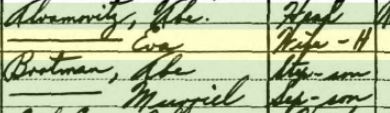
As I followed the family forward into the 1920s, Benjamin seemed to have died or disappeared.  In the 1921 Rock Island directory, Eva Brotman is listed as a widow. And in the Illinois, County Marriages 1810-1934 database on FamilySearch, I found a marriage listing for Eva Brotman and Abe Abramovitz on July 26, 1923, in Rock Island.  In 1930, Eva was living with her second husband Abe and her two youngest sons, Albert (listed incorrectly as Abe) and Merle (listed incorrectly as Muriel), who were then 18 and 15, respectively.  They were all still living together ten years later, according to the 1940 census.

Eva Siegel Brotman Abromovitz and sons 1930 census Year: 1930; Census Place: Rock Island, Rock Island, Illinois; Roll: 553; Page: 5B; Enumeration District: 0084; Image: 716.0; FHL microfilm: 2340288

Eva Siegel Brotman Abromovitz and sons 1930 census
Year: 1930; Census Place: Rock Island, Rock Island, Illinois; Roll: 553; Page: 5B; Enumeration District: 0084; Image: 716.0; FHL microfilm: 2340288

It seemed I had reached the end of the line for Benjamin Brotman, but I had no death record, and I still had no idea whether he was related to me or to the Brotmanville Brotmans.  I kept searching for a death record, and instead I found this:

Ben Brotman World War I draft registration Registration State: Colorado; Registration County: Denver; Roll: 1544482; Draft Board: 1

Ben Brotman World War I draft registration
Registration State: Colorado; Registration County: Denver; Roll: 1544482; Draft Board: 1

A World War I registration for a Ben Brotman born in 1876, no birthplace listed, living in Denver, Colorado.  I might not have given it much thought but for the name given as his nearest relative: Moses Brotman of Alliance, New Jersey, his father.  Moses Brotman of Alliance is the Brotmanville Moses Brotman (Alliance was the name of the community where the Brotmans settled, part of Pittsgrove, now called Brotmanville.).  This Ben Brotman was his son. The age fit exactly—the Ben Brotman living in Pittsgrove in 1900 was 24, thus born in 1876, just like the Ben Brotman living in Colorado in 1918, son of Moses. I had no child listed for Moses named Benjamin, and if this was in fact his son, he was born before Moses married Chaya/Ida/Clara Rice.  That is, this could be Abraham’s full brother from Moses’ first wife, whose name I did not know.

But could I be sure that this was the Ben Brotman who had lived in Pittsgrove, then Philadelphia, then Davenport, Iowa? And if so, what was he doing in Colorado in 1918 when this draft registration was filed? After all, Ben Brotman, Eva’s husband, had been listed in the 1918 and 1919 Davenport directories.

The draft registration listed the Colorado Ben Brotman as a porter at Oakes Home in Denver.  I googled that name and found that Oakes Home in Denver was an institution for patients suffering from tuberculosis.   Was Ben really an employee there or was he a patient?  There is no indication on his draft registration that he was in poor health and not able to serve in the military.  Had he gone there as a patient and recovered sufficiently to be employed but not yet enough to return to Iowa?

As you might imagine, I was now more than a bit confused.  If this was the same Ben, had he then returned to Iowa at some point in 1918, been there in 1919 and 1920, and then died by 1921, as Eva’s listing in the 1921 Rock Island directory suggested? I needed to find his death certificate, and I had no luck searching online in Iowa, Illinois, or Colorado.  As I’ve done before, I turned to the genealogy village for assistance.

I went to the Tracing the Tribe group on Facebook and found a number of people who volunteered to help me.  One person found an entry on Ancestry from the JewishGen Online World Burial Registry for a Bera Brotman who died on January 4, 1922, who was born about 1877, and who was buried at the Golden Hills Cemetery in Lakewood, Colorado.  It seemed like a long shot.  Was Bera even a man? The birth year was close enough, but if Eva was a widow in 1921, the death date was too late.  There was a phone number for a contact person at the cemetery listed on the entry, so I called him.

Name: Bera Brotman
Birth Date: abt 1877
Death Date: 4 Jan 1922
Age at Death: 45
Burial Plot: 10-097
Burial Place: Lakewood, Colorado, United States
Comments: No gravestone
Cemetery: Golden Hill Cemetery
Cemetery Address: 12000 W. Colfax
Cemetery Burials: 3839
Cemetery Comments: Contact: Neal Price (303) 836-2312

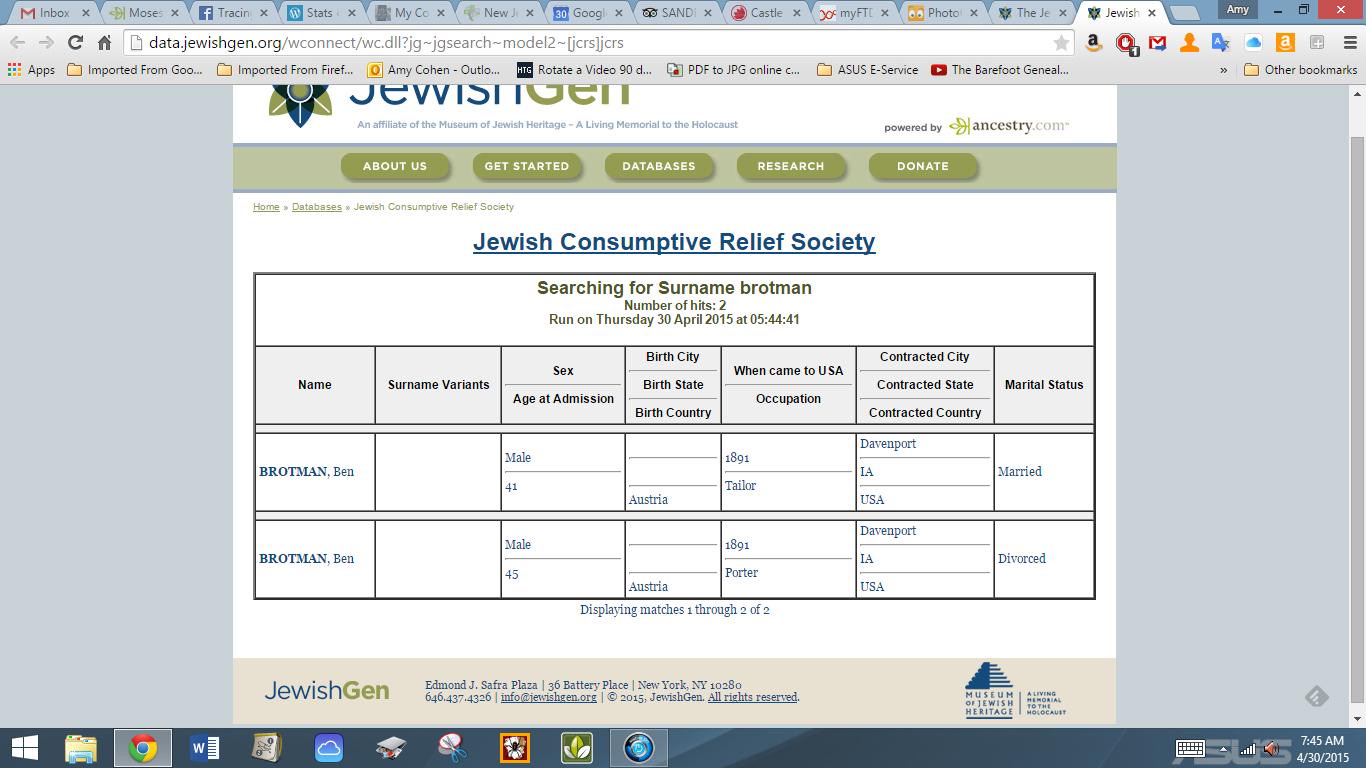
The contact person checked the cemetery records and confirmed the information listed on JOWBR, but gave me one more bit of critical information: Bera’s last residence was the Jewish Consumptive Relief Society in Denver.  By googling the JCRS, I found that JewishGen had a database of records from there, and when I searched for Ben Brotman on the JCRS database, I found this record:

JCRS record for Ben Brotman from JewiishGen

JCRS record for Ben Brotman from JewiishGen

This Ben Brotman had to be the one who had been at one time living in Pittsgrove, New Jersey, and then had moved to Davenport, Iowa.  This was the Ben who had married Eva and had six children.  He had twice been a patient at the JCRS.  First, he’d been admitted when he was 41 or in 1917, when he listed his status as married, and then he’d been admitted again when he was 45 or in 1921, when he listed his status as divorced.  The pieces were starting to come together.  Perhaps Ben had in fact been in Denver in 1917, recovered enough to register for the draft there in 1918, then returned to his family in Davenport sometime in 1918 through 1920.  He then had to return to the JCRS in Denver in 1921, where he died in January, 1922.  By 1921 he and Eva had divorced, and Eva had listed herself as a widow in the directory, as many divorced women did in those days when divorce was stigmatizing.

I emailed the cemetery contact person and explained that I thought Bera was really Ben, and he agreed to change the records.  But I still had some nagging doubts.  Was the Ben Brotman who had died in Colorado in January, 1922, and who had lived in Davenport also the one who was the son of Moses Brotman, as indicated on the draft registration?  I needed the death certificate to be sure, and perhaps it would also tell me where Ben was born, helping to answer the question that had started me down this path in the first place.

I ordered the death certificate, and it finally arrived just the other day.

Benjamin Brotman death certificate

Benjamin Brotman death certificate

Ben Brotman died on January 4, 1922, of pulmonary tuberculosis at the J.C.R.S Sanitorium.  He was 45 years old and born in 1876, and he had been a tailor.  He had contracted TB in Davenport, Iowa, and had had it for ten years, or since 1912, which would mean around the time the family had moved to Iowa.  (That makes me wonder even more whether his daughter Flora had also died of TB, since she died in 1913.)  The doctor at JCRS who signed the death certificate said that he had attended Ben since September 7, 1921, which must have been when he was admitted the second time.  The certificate stated that Ben had been a Denver resident for three months and 28 days, indicating that he had been elsewhere before returning in September.  It also reported his marital status as divorced.  Finally, his place of birth was given as Austria, and his parents were also reported to have been born in Austria.

And then the answer I’d been seeking: his father’s name was Moses.  This was then most definitely the same Benjamin Brotman I had traced from Pittsgrove to Philadelphia to Davenport to Denver to Rock Island and back to Denver.  This was the son of Moses Brotman, my great-grandfather’s brother.

And then the (hopefully accurate) big revelation:  his mother’s name was Lena.  For the first time I had a record of the name of Moses’ wife prior to Ida/Chaya/Clara Rice.  Lena.  She very well might have been the mother of Abraham Brotman.  I don’t know.  There is a big gap between Abraham’s presumed birth year of 1863 and Benjamin’s birth year of 1876.  There must have been other children in between, I’d think.  Or perhaps Lena was Benjamin’s mother, and Abraham’s mother was an even earlier wife of Moses. But since both Abraham and Benjamin named their first daughters Lillian and at around the same time, I think that both of these girls were named for their grandmother Lena, who must have died before 1884 when Moses married his second wife Chaya.

I made one more look back at the records I had for Moses and for Abraham and realized that I had not re-checked the 1895 New Jersey census.  Since it only listed names, not ages or birthplaces, I had not thought it important in my search for where they’d lived in Europe.  Moses and his family are listed on the page before Abraham and his family on that census.   Abraham is listed with Minnie and their first three children, Joseph, Samuel, and Kittella (presumably Gilbert).

Abraham Brotman 1895 NJ census Ancestry.com. New Jersey, State Census, 1895 [database on-line]. Provo, UT, USA: Ancestry.com Operations Inc, 2007. Original data: New Jersey Department of State. 1895 State Census of New Jersey. Trenton, NJ, USA: New Jersey State Archives. 54 reels.

Abraham Brotman 1895 NJ census
Ancestry.com. New Jersey, State Census, 1895 [database on-line]. Provo, UT, USA: Ancestry.com Operations Inc, 2007.
Original data: New Jersey Department of State. 1895 State Census of New Jersey. Trenton, NJ, USA: New Jersey State Archives. 54 reels.

Moses is listed with Clara and the five children they had had by 1895: Sadie, Katie, Lillie, Samuel, and “Abraham.”[1] But also listed with Moses is a name I had overlooked during my preliminary research: Bennie.  He was listed in the 5-20 year old category, and if this was the Ben Brotman of Iowa and Denver, he would have been 19 years old in 1895.  There he was—Benjamin Brotman, the son I had overlooked and who very well could have been the full brother of Abraham Brotman.

Moses Brotman 1895 NJ census Ancestry.com. New Jersey, State Census, 1895 [database on-line]. Provo, UT, USA: Ancestry.com Operations Inc, 2007. Original data: New Jersey Department of State. 1895 State Census of New Jersey. Trenton, NJ, USA: New Jersey State Archives. 54 reels.

Moses Brotman 1895 NJ census
Ancestry.com. New Jersey, State Census, 1895 [database on-line]. Provo, UT, USA: Ancestry.com Operations Inc, 2007.
Original data: New Jersey Department of State. 1895 State Census of New Jersey. Trenton, NJ, USA: New Jersey State Archives. 54 reels.

What I don’t know and will likely never know is why Ben and Eva left New Jersey. Why did he go to Davenport, Iowa?[2]  The whole story is rather sad. He doesn’t even have a headstone at the Golden Hills cemetery.  I have identified some of his descendants, and perhaps when I return, I will try and contact them.

Although I was very excited to find this lost Brotman, unfortunately I still don’t have any record identifying a specific town or city where the Brotmanville Brotmans lived in Europe.  But soon I will head off to Tarnobrzeg, Poland, the town I still think is the most likely ancestral home of my great-grandparents Joseph and Bessie Brotman.


[1] I found this very strange—did Moses really have another son named Abraham? The Abraham listed on the 1895 New Jersey census was five years old or younger, meaning he was born in 1890 or later.  Samuel was born in 1889, but must not yet have turned five; Lily was born in 1892.  The only other child born between 1890 and 1894 was Isaac (who became Irving), not Abraham, so I assume this entry on the 1895 census was a mistake and that “Abraham” was really Isaac.

[2] In doing this research I kept tripping over another Brotman family—a family living in Rock Island that owned the theaters in town.  However, they do not appear to be related.  The patriarch of that family, Jacob Brotman, was born in 1848 in Minsk, Russia, and had lived in London before emigrating to the US sometime after 1901.   Since Joseph and Moses were born around the same time but somewhere in Galicia, it seems unlikely that Jacob was a close relative.  But anything is possible.

My Brotmanville Cousins: Searching for Answers

One thing I have been trying to do as part of my preparations for our visit to Tarnobrzeg and the surrounding towns is a last ditch effort to find some other clues as to where my Brotman ancestors lived.  I have gone back through the research I’ve done on my great-grandparents and their Galician born children, Abraham, Max, David, Hyman, and Tillie, and have found no new clues.  Then I realized that now that I have some DNA confirmation that my great-grandfather Joseph was the brother of Moses Brotman of Brotmanville, I needed to go through their records as well to see if I could find some new clues.  I had done an initial search a few years ago, but had not yet gone back and checked it more thoroughly.

Moses Brotman

Moses Brotman courtesy of his granddaughter Elaine

What I already knew was that Moses Brotman had had many children, some born in Europe, some born in the US.  His oldest (known) child was his son Abraham, who was born in Europe.  Abraham Brotman had originally settled in New York City and established a cloak factory there, but was invited by those who created the Alliance Colony in Pittsgrove Township, New Jersey, to start a factory there to employ the residents when the farming season ended.  Eventually, a section of Pittsgrove was named Brotmanville in his honor.[1]

At this point I will not tell the full story of the Brotmanville family in America; that will have to wait. My immediate objective in reviewing my research of the Brotmanville Brotmans was to see if I could find any records that revealed where Moses and his family had lived before arriving in the US.  So I had to focus first on those who had been born in Europe, not those who were born in the US, although that meant also looking for records for the children born here to see if those records revealed the birthplaces of their European born parents

What I knew from the descendants and from my earlier research was that Moses had been married twice and Abraham had been the child of his first marriage.  Although the census records for Abraham are in conflict about his birthdate, the earliest to include his age, the 1900 census, reported his birthdate to be November 1863, long before Moses married Ida, the woman with whom he immigrated to America.

1900 US Census for Abraham Brotman

1900 US Census for Abraham Brotman Year: 1900; Census Place: Pittsgrove, Salem, New Jersey; Roll: 993; Page: 17A; Enumeration District: 0179; FHL microfilm: 1240993

Looking at the 1900 census report for Abraham, by 1900 he and his wife, Minnie Hollender, had been married for 13 years and had had six children, five of whom were still alive.  All six children were born in the US.  Abraham reported that he had arrived in the US in 1884, three years before marrying Minnie.  Their children as of 1900 were Joseph (10), Samuel (7), Gilbert (6), Nephtaly (later Herman) (4), and Leah (2).  They were living in Pittsgrove, New Jersey, and Abraham was working as a manufacturer.[2]

The 1910 census for Abraham and his family is only somewhat consistent with that of the 1900:  his age is 47, still giving him a birth year of 1863, but now his birthplace is reported as Russia. He and Minnie now reported that they had had eleven children, nine of whom were still alive.  In addition to the five listed above, there were three more daughters and one more son.

Abraham Brotman 1910 US census

Abraham Brotman 1910 US census Year: 1910; Census Place: Pittsgrove, Salem, New Jersey; Roll: T624_908; Page: 15B; Enumeration District: 0154; FHL microfilm: 1374921

The 1920 census reported one more child and once again had Abraham’s birthplace as Austria.  However, he now claimed to be 48, thus born in 1872, not 1863 as previously reported.  Later records also made him ten years younger than had been reported on the 1900 and 1910 census reports.  Genealogists generally assume that the records closest in time are more likely to be accurate than those later in time (and people are more likely to make themselves younger as they get older), so I am inclined to assume that Abraham was born in 1863.  It also makes more sense that he was 21 when he immigrated, not 11.  But where was he born? Austria? Russia? And in what city or town?

Since both the 1930 and the 1940 census reported his birthplace as Austria, I am inclined to discount the 1910 and assume that the 1900, 1920, 1930 and 1940 census reports indicating his birthplace as Austria are more accurate.  And, of course, “Austria” meant within the Austria-Hungary Empire, just as it did for my great-grandparents and many other immigrants from that region, including Galicia.

But then where more specifically was he born? Unfortunately, I’ve not been able to find a death record for Abraham, and the death records I have for his children are no more specific.  For example, the death certificate for his oldest child, Joseph, only reports that his father’s birthplace was Austria.

Joseph Brotman death certificate Ancestry.com. Pennsylvania, Death Certificates, 1906-1963 [database on-line]. Provo, UT, USA: Ancestry.com Operations, Inc., 2014. Original data: Pennsylvania (State). Death certificates, 1906–1963. Series 11.90 (1,905 cartons). Records of the Pennsylvania Department of Health, Record Group 11. Pennsylvania Historical and Museum Commission, Harrisburg, Pennsylvania.

Joseph Brotman death certificate
Ancestry.com. Pennsylvania, Death Certificates, 1906-1963 [database on-line]. Provo, UT, USA: Ancestry.com Operations, Inc., 2014.
Original data: Pennsylvania (State). Death certificates, 1906–1963. Series 11.90 (1,905 cartons). Records of the Pennsylvania Department of Health, Record Group 11. Pennsylvania Historical and Museum Commission, Harrisburg, Pennsylvania.

Samuel’s death certificate says that his father’s birthplace was Russia.

Samuel Brotman death certificate Ancestry.com. Pennsylvania, Death Certificates, 1906-1963 [database on-line]. Provo, UT, USA: Ancestry.com Operations, Inc., 2014. Original data: Pennsylvania (State). Death certificates, 1906–1963. Series 11.90 (1,905 cartons). Records of the Pennsylvania Department of Health, Record Group 11. Pennsylvania Historical and Museum Commission, Harrisburg, Pennsylvania.

Samuel Brotman death certificate
Ancestry.com. Pennsylvania, Death Certificates, 1906-1963 [database on-line]. Provo, UT, USA: Ancestry.com Operations, Inc., 2014.
Original data: Pennsylvania (State). Death certificates, 1906–1963. Series 11.90 (1,905 cartons). Records of the Pennsylvania Department of Health, Record Group 11. Pennsylvania Historical and Museum Commission, Harrisburg, Pennsylvania.

Abraham’s youngest child, Aaron, who was born in 1911, died as a young man in 1939 from heart disease.  His death certificate indicates that his father was born in Austria.

Aaron Brotman death certificate Ancestry.com. Pennsylvania, Death Certificates, 1906-1963 [database on-line]. Provo, UT, USA: Ancestry.com Operations, Inc., 2014. Original data: Pennsylvania (State). Death certificates, 1906–1963. Series 11.90 (1,905 cartons). Records of the Pennsylvania Department of Health, Record Group 11. Pennsylvania Historical and Museum Commission, Harrisburg, Pennsylvania.

Aaron Brotman death certificate
Ancestry.com. Pennsylvania, Death Certificates, 1906-1963 [database on-line]. Provo, UT, USA: Ancestry.com Operations, Inc., 2014.
Original data: Pennsylvania (State). Death certificates, 1906–1963. Series 11.90 (1,905 cartons). Records of the Pennsylvania Department of Health, Record Group 11. Pennsylvania Historical and Museum Commission, Harrisburg, Pennsylvania.

Those were the only sources I have located so far that reflect anything about where Abraham was born.  I also had no records of what his mother’s name was nor did I have any indication of full siblings for Abraham, only the half-siblings born through his father’s second marriage.  So I then turned to Abraham’s father Moses and his children to see if there was more to learn through their records.

The earliest record I had found for Moses was his petition for naturalization, filed in 1894.  It had his birthplace as Russia.  It also said that he had arrived in the US in 1885.

Moses Brotman petition for Naturalization

Moses Brotman Petition for Naturalization “New Jersey, County Naturalization Records, 1749-1986,” images, FamilySearch (https://familysearch.org/pal:/MM9.3.1/TH-1971-29863-26750-98?cc=2057433&wc=M73R-4NL:351145001,351187001 : accessed 14 May 2015), Salem > Petitions for naturalization 1888-1895 > image 95 of 96; county courthouses, New Jersey.

The 1900 US census reported his birthplace and date as Austria in November 1844.  It also reported that he had immigrated in 1886 and that he was a farmer.  Like his son Abraham, he was living in Pittsgrove, New Jersey with his wife “Chay”  (probably Chaya), to whom he’d been married for sixteen years.  (Abraham was already 37 in 1900, indicating that Abraham was not Chaya’s son.) Moses and Chaya had had eight children, seven of whom were alive, according to the 1900 census.  The seven were Sadie (16), Katie (13), Samuel (10), Lilly (7), Isaac (5), Bessy (2), and Lewis (three months)[It is spelled “Lewis” on the census, but according to his grandson, his name was actually spelled “Louis.”]  The youngest four were born in New Jersey, Katie in New York, and Sadie and Samuel reportedly in Austria.  Of course, that made no sense to me—if Katie was older than Samuel, how could he have been born in Austria if she was born in New York? Had Moses and Chaya returned to Europe at the time Katie was born? Or was the census just in error?  If they really had immigrated in 1886 and if Samuel was 10 in 1900, he must have been born in the US.

Moses Brotman 1900 census

Moses Brotman 1900 census Year: 1900; Census Place: Pittsgrove, Salem, New Jersey; Roll: 993; Page: 18A; Enumeration District: 0179; FHL microfilm: 1240993

The other thing that struck me as very strange about this report was the fact that Moses had a son named Samuel as did his son Abraham.  In 1900 Moses’ Samuel was ten; Abraham’s was seven.  So Abraham’s son Samuel had an uncle three years older with the same name.  When I turned to the 1910 census report for Moses and his family, that became even stranger, as now Moses had had another child, a son named Joseph, who was seven as of 1910.  Abraham also had a son named Joseph, who was seventeen in 1910. So Abraham’s son Joseph had an uncle Joseph who was ten years younger than he was.  In addition, both Moses and Abraham had daughters named Lilly or Lillian; Moses’ daughter was born in February 1892; Abraham’s daughter was born September 5, 1898. Why would Moses and Abraham have given their children the same names? Perhaps they were named for the same ancestors, but it must have been awfully confusing in Pittsgrove to have two Samuel Brotmans., two Joseph Brotmans, and two Lilly Brotmans running around that small community.  It sure doesn’t help genealogists either.

The 1910 census report for Moses now had his wife’s name as Ida, which was a common Americanization of Chaya.  Moses was now working as a presser in a clothing factory, presumably the one owned by his son Abraham.  As with the 1900 census for Abraham, Moses’ birthplace is now given as Russia, not Austria.  He and Ida had six of their children living with them: Samuel (20), Lilly (15), Isaac (14), Bessie (12), Lewis/Louis (10), and the above-mentioned Joseph (7).  The birthplace for all the children was New Jersey, except for Samuel, whose birthplace was reported as Russia, same as his parents. Sadie and Katie were no longer living with their parents. Unfortunately, I have not yet found any records for what happened to Sadie or Katie, although their father’s obituary revealed their married names and their residence as of 1935 in Philadelphia.

Moses Brotman 1910 census

Moses Brotman 1910 census Year: 1910; Census Place: Pittsgrove, Salem, New Jersey; Roll: T624_908; Page: 15A; Enumeration District: 0154; FHL microfilm: 1374921

It took me forever to track down Moses Brotman and his family on the 1920 census, and although I am not 100% certain this is the right family, I am fairly certain that it is.  The head of household is Morris Brotman, wife Clara—another common Americanization of Chaya.  Morris was reported to be 70 years old, so born around 1850, not far off from his birthdate on the 1900 census.  Birthplace is given as Russia for Morris, Austria for Clara, and it reported that immigrated in 1887, close to the 1886 reported in 1900.  The most convincing support for this being the right family are the names and ages of the children: Lillian (21), Louis (20), Bessie (19), and Joseph (17).  Although Lilly would have been 25 and Bessie 22, the sons’ ages are accurate; maybe they lied about the daughters’ ages to make them appear more “marriageable.”  The family was now living in Philadelphia, not New Jersey, which at first I found odd.

Moses Brotman 1920 US census Year: 1920; Census Place: Philadelphia Ward 32, Philadelphia, Pennsylvania; Roll: T625_1634; Page: 12B; Enumeration District: 1095; Image: 530

Moses Brotman 1920 US census
Year: 1920; Census Place: Philadelphia Ward 32, Philadelphia, Pennsylvania; Roll: T625_1634; Page: 12B; Enumeration District: 1095; Image: 530

But then I checked for the older sons, Samuel and Isaac (now Irving) and found that both had married between 1910 and 1920 and were living in Philadelphia.  Although I still have not located the two older daughters Sadie and Katie, perhaps they also had married by then and moved to Philadelphia.  Maybe Moses and Ida/Clara/Chaya also moved there to be closer to all their children.

Thus, I now had conflicting birthplaces for Moses—one census said Austria, two said Russia.  I looked at the 1930 census, and once again there was a conflict.  Now Moses’ birthplace was reported as Austria-Hungary, then crossed out with “Europe” written above it. His parents’ birthplace, however, was given as Austria-Hungary.  Moses was now 80 years old, and he and his wife (now Ida again) and their youngest son Joseph (28) were living in Vineland, New Jersey, near Pittsgrove. So as with Abraham, the birthplace for Moses fluctuated back and forth between Russia and Austria with no specific town or city mentioned. Perhaps Moses really did not know where in Europe he was actually born.

Moses Brotman 1930 US census

Moses Brotman 1930 US census Year: 1930; Census Place: Vineland, Cumberland, New Jersey; Roll: 1327; Page: 13A; Enumeration District: 0060; Image: 434.0; FHL microfilm: 2341062

Moses died on September 23, 1935.  His death certificate said he was born in Austria in 1847 and that his parents were named Abraham Brotman and Sadie Berstein, also born in Austria.  His grandson Aaron Brotman was the informant, Abraham’s youngest son who would die himself just a few years later.  Moses’ wife’s name was given as Rachel Rice.  This has caused considerable confusion for the family.  Was this a third wife? A mistake?

Moses Brotman death certificate_0001_NEW

In the obituary for Moses, it says he was survived by his widow, but did not name her.  It did, however, name all his children (including the married names for Sadie and Katie, as indicated above) and their residences.

Moses Brotman obituary

Moses Brotman obituary Courtesy of his granddaughter Elaine, source unknown

I found the death certificate for his youngest child, Joseph, who died less than a year after his father on July 26, 1936, from bacterial endocarditis.  He was only 34 years old.  On his death certificate, Moses’ birthplace is once again given as Russia, and Joseph’s mother’s name is reported to be Rachael Rice. The informant was Joseph’s half-brother, Abraham Brotman.

Joseph Brotman (Moses' son) death certificate Ancestry.com. Pennsylvania, Death Certificates, 1906-1963 [database on-line]. Provo, UT, USA: Ancestry.com Operations, Inc., 2014. Original data: Pennsylvania (State). Death certificates, 1906–1963. Series 11.90 (1,905 cartons). Records of the Pennsylvania Department of Health, Record Group 11. Pennsylvania Historical and Museum Commission, Harrisburg, Pennsylvania.

Joseph Brotman (Moses’ son) death certificate
Ancestry.com. Pennsylvania, Death Certificates, 1906-1963 [database on-line]. Provo, UT, USA: Ancestry.com Operations, Inc., 2014.
Original data: Pennsylvania (State). Death certificates, 1906–1963. Series 11.90 (1,905 cartons). Records of the Pennsylvania Department of Health, Record Group 11. Pennsylvania Historical and Museum Commission, Harrisburg, Pennsylvania.

Since Moses’ wife on the 1910 census was Ida and since Joseph was born in 1902, it would seem likely that Ida was Joseph’s mother.  Or could Chaya have been Rachel Rice and then died after Joseph was born? Was Ida a third wife? And was she the same woman as Clara, the wife listed on the 1920 census, or was that a fourth wife? My own personal hunch was that Rachel, Chaya, Ida and Clara are all one and the same person.

Although I was able to find the death certificate for Irving Brotman, it had no information for the name of his mother, had his father’s name as Morris, and had no information for their birthplaces.  I was, however, able to find the following entries in the New Jersey, Births and Christening Index on Ancestry.com for two of Moses’ children:

Name: Liza Brotman
Gender: Female
Birth Date: 2 Feb 1892
Birth Place: Pit, Salem, New Jersey
Father’s name: Moritz Brotman
Mother’s name: Chai Reis
FHL Film Number: 494224
Name: Brotman
Gender: Female
Birth Date: 12 May 1897
Birth Place: Pit , Salem, New Jersey
Father’s name: Moses Brotman
Father’s Age: 45
Father’s Birth Place: Austria
Mother’s name: Clara Rice
Mother’s Age: 30
Mother’s Birth Place: Austria
FHL Film Number: 494236

Notice that the mother’s name was Chai Reis on the first, then the more Americanized Clara Rice on the later one.  These were both created before the 1900 census listing of Moses’ wife as Chaya, the 1910 listing as Ida, the 1920 listing as Clara, or the 1930 listing again as Ida.  Notice that the surname is Reis/Rice, the same surname given for Moses’ wife on his death certificate in 1935 and that of his son Joseph in 1936.  I find this last bit of evidence enough to conclude that Rachel Rice was the same woman who married Moses in 1884 or so, immigrated with him and their first two children, and gave birth to and raised nine children from Sadie, born in 1884, through Joseph, born in 1902.  In 1940 after Moses had died, Ida (aka Chaya-Clara-Rachel) was living with her son Lewis/Louis and his wife Jean and their daughter Elaine in Vineland, New Jersey.  According to Elaine, Ida died about three years later.  Unfortunately I have not yet located a death record or obituary for Ida.

Lewis Brotman 1940 US census Year: 1940; Census Place: Vineland, Cumberland, New Jersey; Roll: T627_2327; Page: 10B; Enumeration District: 6-76

Lewis/Louis Brotman 1940 US census
Year: 1940; Census Place: Vineland, Cumberland, New Jersey; Roll: T627_2327; Page: 10B; Enumeration District: 6-76

Thus, reviewing all the records I had found had not brought me any closer to learning exactly where Moses Brotman or Abraham Brotman had been born or where they had lived in Europe.  But while searching, I stumbled upon something else.  I will report on that as my last post before I leave for my trip.

[1] Relatives of the Brotmanville Brotmans say family lore is that the family was from Preszyml, a town about 90 miles from Tarnobrzeg, Grebow, and Radomysl nad Sanem, the other ancestral towns where possible family members lived. But I have not found any record supporting that family lore.

[2] A few geographical facts are necessary to understand the locations discussed in this post.  Brotmanville is an unincorporated community within the township of Pittsgrove so Pittsgrove is listed on the census records, not Brotmanville.  The colony where Baron de Hirsch and others created the farming settlement for poor Jewish immigrants was called the Alliance Colony. Vineland is a neighboring community where many of the Brotmans lived over the years.

Where Am I? Where Am I Going? Tarnobrzeg


Polski: Tarnobrzeg, Panorama nocna osiedla Ser...

Polski: Tarnobrzeg, Panorama nocna osiedla Serbinow (Photo credit: Wikipedia)

It’s time to take stock and figure out where I am and where I have been and, of course, where I am going next.  I have “finished” my research on the Dreyfuss and Nusbaum families, and when I say “finished,” I know that as with all my family lines, I am never finished.  I always have more to do—whether it is trying to go back further in time or trying to connect with descendants.  There are a number of unanswered questions, as there always are and always will be.  I will write up something to bring some closure to what I know about these two family lines within the next several days.  But for today, I just want to think about where I am more generally.

I have now done many of my father’s paternal lines.  Starting with the Cohens, I’ve also covered the Seligmans, the Schoenfelds, the Nusbaums, and the Dreyfusses (Dreyfi?), and, of course, all the other names that came with later generations: Sluizer, Weil, Selinger, Bacharach,  Wiler, Simon, Meyers, Dinkelspiel, Hano, and so on.   I’ve also missed a few lines.  I haven’t yet focused on the line that starts with Hart Levy Cohen’s wife, Rachel Jacobs, or with Jacob Cohen’s wife, Sara Jacobs.  I haven’t looked at all at the line that begins with Voegele Welsch, wife of Amson Nusbaum.  And I am sure there are other maternal lines I need to explore.  Of course, those are often the hardest because the names have disappeared from the family, and each of those ancestors dates back close to 200 years ago.  But eventually I will get there.

And next I will explore my father’s maternal lines, the Schoenthals and Katzensteins: more German Jews who came to Pennsylvania in the 1840s or so.  Who knows what stories, what adventures, what heartbreaks I will discover along the way.

But before I turn to the Schoenthal and Katzenstein families, I have several other questions to research and address.  The Seligmann family tree continues to grow both backwards in time and horizontally, thanks to my cousin Wolfgang and all the research he has done.  Their stories continue to fascinate and also horrify me.  I am also in touch with the daughter of Fred and Ilse Michel, and she has shared stories and photographs with me.

There are also lingering questions regarding the Goldschlagers, now that I’ve found two other families with that name and roots in Romania.  We are hoping to hire a Romanian researcher to help us learn more.

And finally, there are those ever elusive Brotmans.  Although I am not putting any more hope (or much time) into using DNA as a tool to find my Brotman ancestors, I still have hope that something will turn up.  Just this past week someone contacted me, asking about Chaye Fortgang, Joseph Brotman’s first wife and the mother of the first four Brotman children, Abraham, Sophie, David, and Max.  He has Fortgang family from Grebow, a town less than ten miles from Tarnobrzeg and also the town that David and Abraham Brotman gave as their home on the ship manifest when immigrating to the US.  Perhaps by researching the Fortgang family, I will also learn about Joseph Brotman and his family.  In addition, I am focused on the Brotmanville Brotmans, hoping that that line will lead to more answers.

English: Gmina Grębów COA Polski: Herb gminy G...

English: Gmina Grębów COA Polski: Herb gminy Grębów (Photo credit: Wikipedia)

In addition, I will be visiting Tarnobrzeg in person in just about a month.  We will be hiring a guide who also does genealogy research, and we will be joined by my newly-found cousin Phyllis, the niece of Frieda, the woman who matched my mother as a close cousin through DNA testing.  Phyllis and I have chosen to believe that our grandmothers were in fact first cousins, and we are hoping to find some evidence to corroborate it.  So although I am not writing about it on the blog, much of my time right now is spent researching for this trip.  Once I am there, I will share my experiences on the blog, so stay tuned.

Photograph of Tarnobrzeg Main Square.

Photograph of Tarnobrzeg Main Square. (Photo credit: Wikipedia)


Losing the DNA Wars

So many people use DNA to find their lost relatives.  I have read absolutely amazing stories of people finding parents, siblings, and cousins.  People write about breaking down brick walls and finding their great-great-great-grandparents on someone’s tree and suddenly learning about five more generations.  One man wrote an entire blog that mostly focuses on how he used DNA to find his grandfather.

But not me.  I don’t have any truly amazing stories to tell.  It is true that I was able to use DNA to corroborate the family stories that my great-grandfather Joseph Brotman and Moses Brotman of Brotmanville were brothers.  Not only did Elaine match my mother as a second cousin as expected, but another Brotmanville Brotman, Larry, also came up as a match at the expected level.  Plus I found Phyllis and Frieda through DNA.  As discussed earlier, we are hypothesizing that their ancestor Sabina Brot and my grandmother were first cousins through my great-grandmother Bessie’s family.

second revision family chart for blog

Now I am not at all suggesting that those connections are not important. I was very excited to make these connections and hope to learn more from them as time goes on.  But what I was ultimately hoping for was that I would find some new third or fourth cousin on the Brotman side who would have names and maybe even records of my Brotman ancestors—that I would learn where Joseph and Bessie were born, whether they had siblings, who their parents and grandparents were, and where and when they lived and died.  At a minimum I hoped I would learn where Joseph and Bessie lived with more certainty than I’ve been able to establish through US records alone.

But alas, it was not to be, and I am about to surrender in the DNA wars.  Let me tell you what I’ve done, what I’ve tried.  Maybe someone out there will have a better idea.  First, as I mentioned before, I found three amazing women to help me—-Leah, Julie, and Lana.  Leah and Julie are biologists, and Lana is an IT/math whiz.  They pored over my data and tried to find patterns in the matches.  We had DNA results from my mother, brother, second cousin Bruce, the Brotmanville cousins, and Frieda and Phyllis. I even tested myself to add to the mix.  We had all the tools on GEDmatch.  We used every tool available—triangulating, segment matching, one to ones, one to many, chromosome browsers.  (If these terms aren’t familiar to you, maybe you are lucky.)  I learned about DNA.  We contacted experts on Ashkenazi genetics and genealogy.  We banged our heads together, we argued, we laughed, and we became friends.

We made lists and spreadsheets.  I emailed more people than I can remember, setting out why I was writing to them, listing what my ancestral names and towns were, and asking for input.  Some people never even responded.  Most did, but once we got beyond the niceties, there was not one time when we could figure out why or how we might be related.  There was no pattern.  There were matches from Germany, Lithuania, Ukraine, Hungary, Russia, and so on.  There were none from Romania.  There were none from Galicia.  There were some from far-away places in Poland, but not anywhere near Tarnobrzeg.

And there were no common surnames.  No Brotmans, Brots, Rosenzweigs, Gelbermans, Goldschlagers.

So great—I have hundreds of possible second to fourth cousins (I didn’t even bother looking at those predicted to be further out), but I can’t prove how I am connected to any of them.  Even Frieda is a guess, a hope.  At least with Frieda I know the family name was Brot and the location was near Tarnobrzeg.  But the others?  Not. A. Clue.

English: The structure of DNA showing with det...

English: The structure of DNA showing with detail showing the structure of the four bases, adenine, cytosine, guanine and thymine, and the location of the major and minor groove. (Photo credit: Wikipedia)

Sure, maybe my ancestors moved from Lithuania or Ukraine or Germany.  Maybe they all adopted different surnames in 1810 or so.  So what good does that do me?  It’s like saying I must be related to Jon Stewart because after all, I am sure he had ancestors who also traipsed around Europe.  I am sure if he tested, we’d share some DNA.  So, yay!  I am Jon Stewart’s eighth cousin or something.  I can’t prove it.  And I can’t prove that any of those supposed cousins on FamilyTreeDNA or 23andme or GEDmatch are really my cousins.

The problem is endogamy.  Most Ashkenazi Jews share at least some DNA with almost all other Ashkenazi Jews.  We all come from the same roots, and our people have been marrying each other for generations upon generations.  My experts have concluded that as a result, a lot of the “matches” are really false matches in the sense that the amount of DNA shared is just not an accurate predictor of the relationship between the two people who match.  I had matches who shared close to or more than 100 cM, meaning we should be second to fourth cousins, but there is no way that we are.  Maybe 6th cousins or even further.  And we can’t trace back to our 6th or 7th great-grandparents in any way that will tell us since there were no surnames back then in most Jewish communities.

So…I am throwing in the towel at least for now.  The DNA stuff has eaten up endless hours of my time.  It’s been fun.  It’s been educational.  But it’s gotten me nowhere.  I will still chat with my new buddies, and I am still learning new things all the time.  The science is fascinating. I am still excited to find my brain challenged by new ways of thinking. (I haven’t taken a science class in 45 years.)  I’ve even gotten my friend and fellow blogger at Bernfeld Family from Galicia and More involved in our shenanigans. In fact, she has a great post today about her DNA adventures.

But I am raising the white flag on finding Brotman relatives.  I am not emailing any more long shot cousins.  I can’t find the Brotmans this way.  At least not for now.

Now…on the other hand…maybe I CAN find a connection to those Goldschlagers if one of them decided to do a DNA test.  Hmmmm….

Damn, the stuff is irresistible.