
An update of a seven year old post:
Almost seven years ago I wrote about my grandmother Eva Schoenthal Cohen’s second cousin, Bertha Katzenstein, the great-granddaughter of Seligmann Goldschmidt, my three-times great-grandfather. Bertha was born on April 23, 1892, in New York City, to Adolf Katzenstein and Bertha Metz, who died less than two weeks after giving birth to her namesake Bertha.
As I wrote back in 2018, Bertha must have been living abroad for some part of her childhood with her father Adolf and stepmother. She was married on February 9, 1913, in Harburg, Germany, to Hermann Nathan. She was only twenty when she married, and six years later they were divorced on July 3, 1919, in Hannover, Germany.


Ancestry.com. Hamburg, Germany, Marriages, 1874-1920.
Original data: Best. 332-5 Standesämter, Personenstandsregister, Sterberegister, 1876-1950, Staatsarchiv Hamburg, Hamburg, Deutschland. Certificate Number: 62
Reference Number: 332-5_11409
That was the last document or record I had for Bertha Katzenstein for almost seven years. I didn’t know whether she’d returned to the US or stayed in Germany, but I couldn’t find her in the US or in Germany—not as Bertha Nathan or Bertha Katzenstein. If she remarried, I had no record of it.
And now, seven years later, I have learned more, thanks to Ines Weber, who left a comment on my original post revealing that Bertha had remarried. That led me to learn a lot more about Bertha’s life.
On January 14, 1921, she married Friedrich “Fritz” Wilhelm Langebartels. He was born in Hamburg, Germany, on June 5, 1894, the son of Rudolph Friedrich Albert Langebartels and Margaretha Johanna Henriette Dreyer.
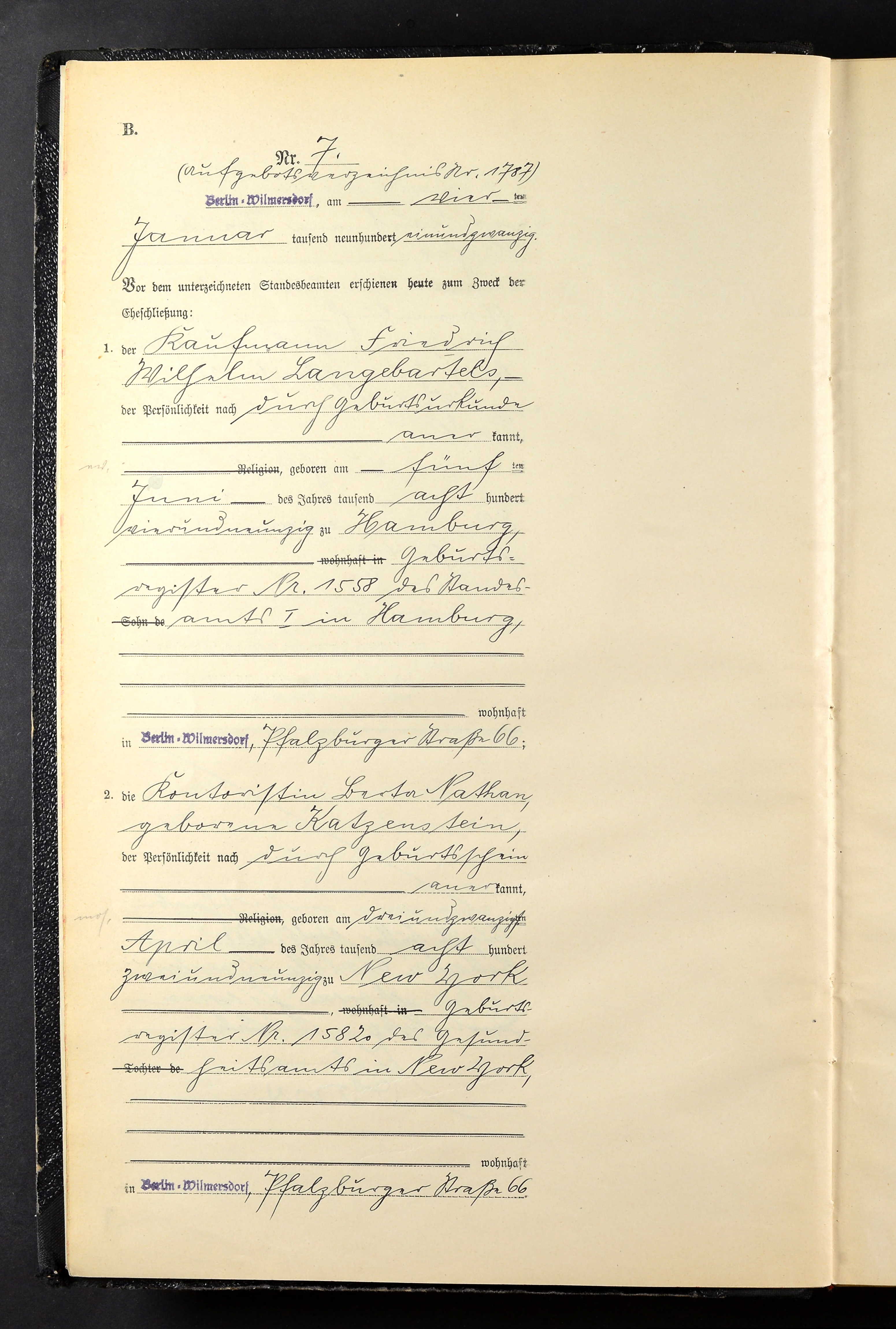
Bertha Katzenstein Nathan marriage to Friedrich Wilhelm Langebartels, Landesarchiv Berlin; Berlin, Deutschland; Personenstandsregister Heiratsregister, Register Year or Type: 1921 (Erstregister), Ancestry.com. Berlin, Germany, Marriages, 1874-1940
On October 15, 1926, Friedrich and Bertha arrived in New York City after living in Berlin. Friedrich filed a declaration of intention to become a US citizen on June 14, 1927, listing Bertha as his wife.
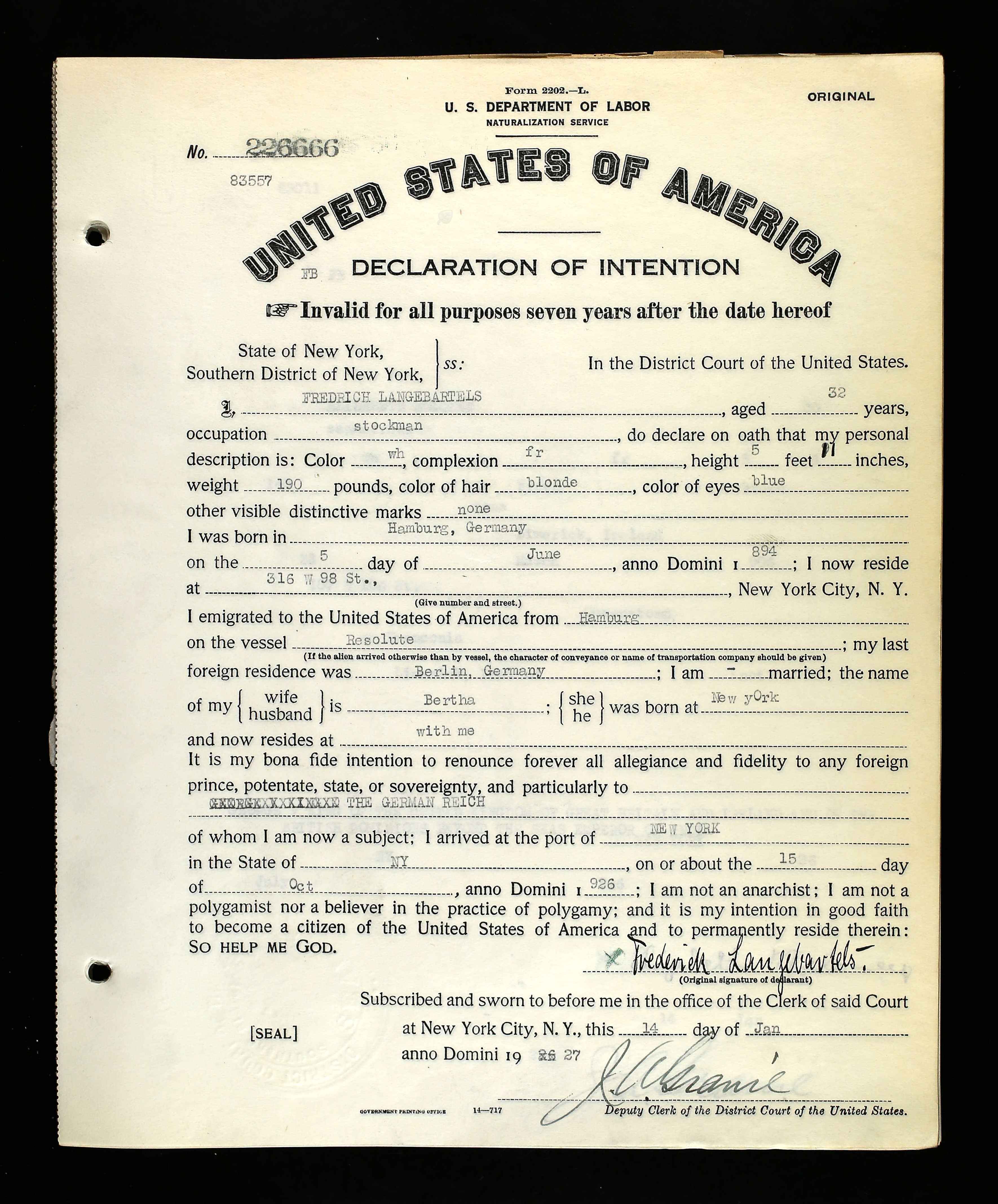
Friedrich Langebartels declaration of intention, The National Archives at Philadelphia; Philadelphia, PA; NAI Title: Declarations of Intention For Citizenship, 1/19/1842 – 10/29/1959; NAI Number: 4713410; Record Group Title: Records of District Courts of the United States, 1685-2009; Record Group Number: 21, Roll 357) Declarations of Intention For Citizenship, 1842-1959 (No 226101-227150), Ancestry.com. New York, U.S., State and Federal Naturalization Records, 1794-1943
But what really puzzled me was this document: a petition for naturalization filed by Bertha herself. She was born in New York! Why was she filing for naturalization? It even says right on the petition that she was born in New York. I was mystified.

Bertha Katzenstein Langebartels Weber petition for naturalization, The National Archives and Records Administration; Washington, D.C.; Petitions For Naturalization From the U.s. District Court For the Southern District of New York, 1897-1944; Series: M1972; Roll: 542, Archive Roll Descriptions: (Roll 0542) Petition No· 124777-Petition No· 125042, Ancestry.com. New York, U.S., Naturalization Records, 1882-1944
And so I asked about this in the Facebook group Tracing the Tribe and learned that at one time, if a woman born in the US and thus a natural born citizen married a foreign born man, she forfeited her American citizenship. The 1907 Expatriation Act read in part: “That any American woman who marries a foreigner shall take the nationality of her husband…” Act of Mar. 2, 1907, ch. 2534, §3, 34 Stat. 1228.
Thus, under American law Bertha took her husbands’ German nationality when she married first Hermann and then Friedrich in Germany and thereby lost her US citizenship. That meant she had to apply for naturalization to become (again) a US citizen.
However, after women gained suffrage, a new statute overturned that provision. The Cable Act of 1922, Section 3 (ch. 411, 42 Stat. 1021), provided:
That a woman citizen of the United States shall not cease to be a citizen of the United States by reason of her marriage after the passage of this Act, unless she makes a formal renunciation of her citizenship before a court having jurisdiction over naturalization of aliens..[emphasis added]
But this didn’t apply to Bertha because she’d married Hermann in 1913 and Friedrich in 1921 before the Cable Act took effect.
After learning all this, I realized something—this also applied to my maternal grandmother Gussie Brotman, who was born in New York but married my Romanian-born grandfather Isadore Goldschlager in 1916. She lost her US citizenship once she married him. I was horrified, and that led me to try and determine whether my grandmother also had to petition for citizenship despite having been born in the US.
What I found was that my grandfather petitioned for naturalization and was sworn in as a citizen on May 18, 1920. Thus, by virtue of HIS naturalized citizenship, my grandmother once again automatically became a US citizen. What a crazy sexist world it was. Still is in many ways, but not as bad as it was back then.
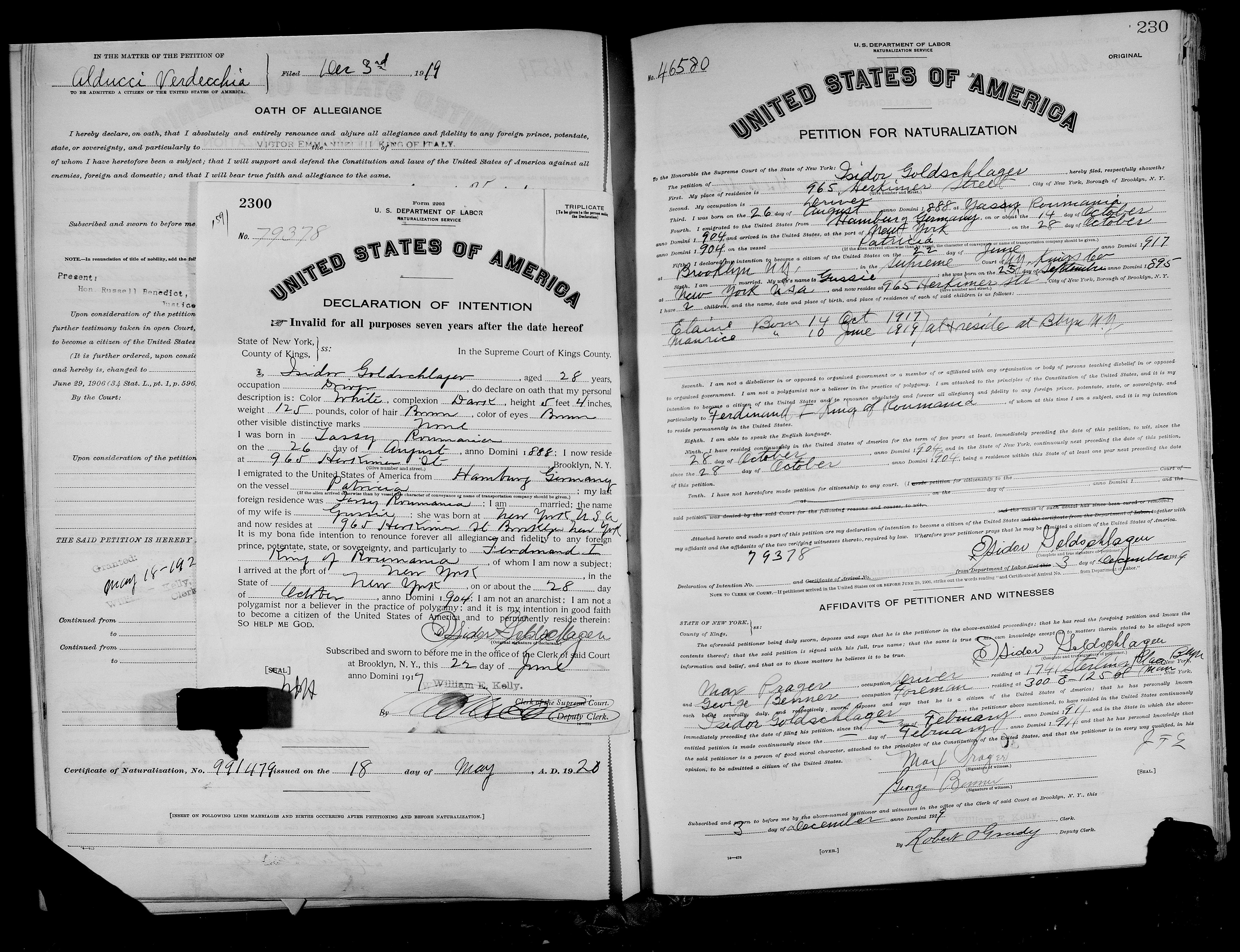
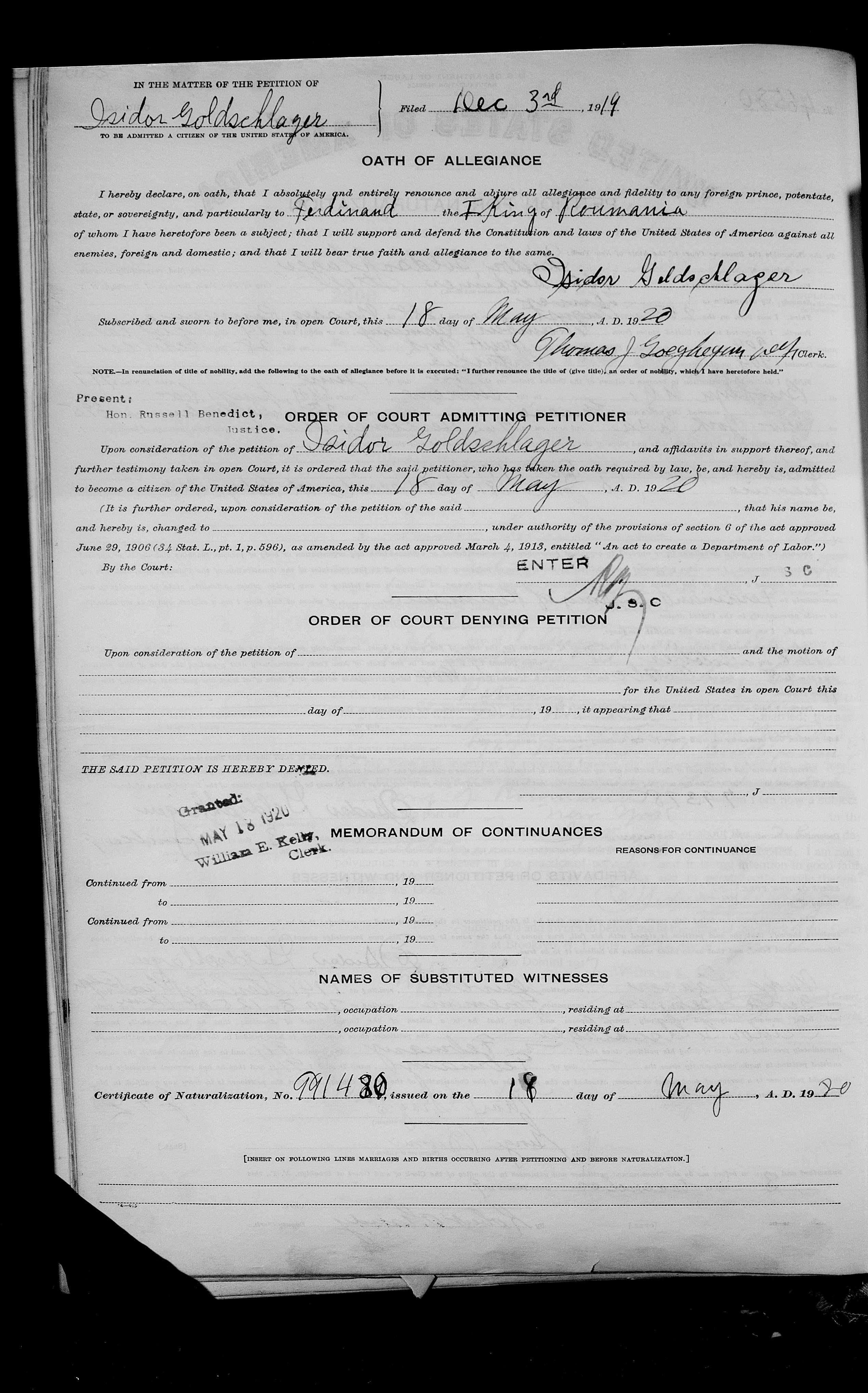
Anyway, returning to Bertha Katzenstein Nathan Langebartels…
There are two other interesting things about Bertha’s petition: One, I learned that Bertha had had a child with her first husband, Hermann Nathan; Lotte Nathan was born on May 1, 1915, in Germany, and was still living in Germany in 1927 when Bertha filed the petition. I will follow up with what I have learned about Lotte in a subsequent post.
Also, it appears from this document that Bertha was known as both Bertha Langebartels and Bertha Weber. But why Weber? Who was that? I found a Friedrich Langebartels-Weber from Hamburg listed in a database of those injured fighting for Germany during World War I. So Weber appears to have been part of his name.1
I found his birth record, thinking that perhaps Weber was his mother’s birth name, but it was Dreyer.
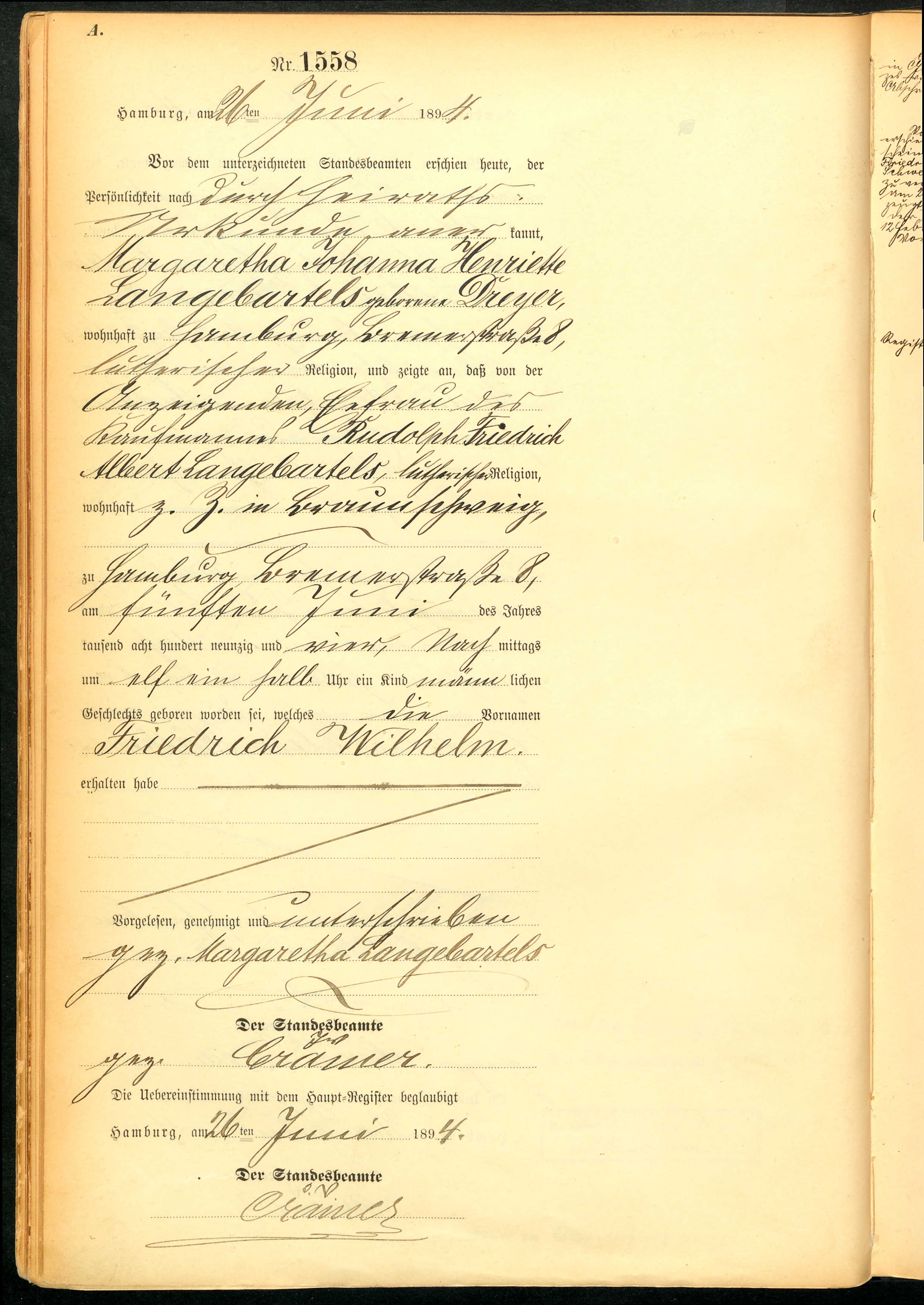
Friedrich Langebartels birth record, Year Range and Volume: 1894 Band 04, Ancestry.com. Hamburg, Germany, Births, 1874-1901
I asked Ines about this, and she told me that the Weber came from Friedrich’s mother’s second husband, whom she married in 1905 when Friedrich was only eleven years old.
But then Bertha disappeared again. I cannot find anything later than her naturalization record seen above. I can’t find Bertha and Friedrich on the 1930 US census, but Ines found Friedrich as Fred Weber on his 1942 World War II draft registration. This appears to be the right person, given the birth date and birth place.

Fred Weber World War II draft registration, The National Archives At St. Louis; St. Louis, Missouri; World War Ii Draft Cards (Fourth Registration) For the State of New York; Record Group Title: Records of the Selective Service System; Record Group Number: 147; Box or Roll Number: 650, Ancestry.com. U.S., World War II Draft Registration Cards, 1942
But notice that Fred/Friedrich was now married to a woman named Erna, not Bertha. They also appeared as a married couple on the 1940 US census.2 And doing a full-text search on FamilySearch brought up Fred Weber’s second Declaration of Intention, and on that form he reported that he was married to Erna on December 20, 1940, in West New York, New Jersey.3 I also found Erna’s Declaration of Intention and learned her surname was Barsig before she married Fred.
So where was Bertha? Had she died? Were she and Friedrich divorced? Had she returned to Germany? I wish I knew. I cannot find any references or records or even unsourced trees that reveal what happened to Bertha Katzenstein Nathan Langebartels Weber. She just seems to have disappeared. The search will continue.
-
Friedrich Langebartels-Weber, Residence Year 1914, Residence Country Deutschland (Germany), List Date 07 Nov 1917 (7 Nov 1917). List Number 1701
Volume 1917_XVI, Ancestry.com. Germany, World War I Casualty Lists, 1914-1919. ↩ - Fred Weber, 1940 US census, Year: 1940; Census Place: New Rochelle, Westchester, New York; Roll: m-t0627-02810; Page: 61B; Enumeration District: 60-243, Ancestry.com. 1940 United States Federal Census ↩
- Fred Weber, Petition for Naturalization, “New York, U.S. District and Circuit Court Naturalization Records, 1824-1991”, FamilySearch (https://www.familysearch.org/ark:/61903/1:1:65DG-STLP : Tue Apr 15 00:10:46 UTC 2025), Entry for Fred or Fritz Weber or Langebartels and Erna, 18 May 1944. ↩












 Brotmanblog: A Family Journey