
Category Archives: Family Names
More Gifts from Doing Genealogy: The Gau-Algesheim Seligmanns and New Friends in Germany
11
As I’ve been researching and writing about my American Seligman relatives, I’ve also been busy trying to learn more about my German ancestors. I wrote to about five different people in Gau-Algesheim, names I found on websites or through contacts from JewishGen or two Facebook groups, Tracing the Tribe and German Genealogy, including Klaus Cook. I’d been trying since September 7 to find someone to help me learn whether there were any records of Jewish births, marriages and/or deaths from the town where I knew Sigmund, Bernard and Adolph Seligman were born. I had gotten no responses—not even one saying that they had no such records.

Coat of arms of Gau-Algesheim (Photo credit: Wikipedia)
I also contacted a woman named Dorothee Lottman-Kaeseler. I had found her name on the website describing the restoration of the Gau-Algesheim cemetery, and she did write back to me. She was very helpful and eventually she managed to find someone to pay attention to my emails. Imagine my delight when the other morning I woke up to this email:
On behalf of our registrar, Frau Hemmkeppler, I am hereby replying to your genealogy request, which we have received on 15. Oct. 2014 via email.
At first, please note, that due to age, we do not have any electronic archives of our historical records. However, we have put in extra efforts and were able to manually trace the following information related to the name of Seligmann:
Siegesmund Seligmann, DOB: 24. Dec.1829 in Gau-Algesheim, Reg-Nr. 67/1829
Salomon Seligmann, DOB: 15. Mar.1832 in Gau-Algesheim, Reg-Nr. 19/1832
Carolina Seligmann, DOB: 18. Mar.1833 in Gau-Algesheim, Reg-Nr. 25/1833
Benjamin Seligmann, DOB: 10. May 1835 in Gau-Algesheim, Reg-Nr. 36/1835
Bernhard Seligmann, DOB: 23. Nov.1837 in Gau-Algesheim, Reg-Nr. 49/1837
Hyronimus Seligmann, DOB: 14. Dec.1839 in Gau-Algesheim, Reg-Nr. 75/1839
August Seligmann, DOB: 10. Dec.1841 in Gau-Algesheim, Reg-Nr. 88/1841
Adolph Seligmann, DOB: 29. Sep. 1843 in Gau-Algesheim, Reg-Nr. 52/1843
Mathilde Seligmann, DOB: 31. Jan. 1845 in Gau-Algesheim, Reg-Nr. 4/1845
Paulina Seligmann, DOB: 29.01.1847 in Gau-Algesheim, Reg-Nr. 5/1847
All the beforementioned persons are the children of Moritz and Eva Seligmann (born as Eva Schoenfeld). ….
Sincerely,
B. Brettschneider
IT-Administrator
There was the birth record of my great-great-grandfather Bernard, his brothers Sigmund and Adolph, and seven other siblings, all born in Gau-Algesheim, all the children of Moritz and Eva Schoenfeld Seligmann. I was so excited. I now had seven more relatives to learn about and, most importantly, the names of my great-great-great-grandparents, Moritz Seligmann and Eva Schoenfeld.
I have now been in touch again with Bernie Brettschneider and hope to obtain copies of these records and also to learn if there are any other records of these individuals or of others who might be their children, spouses, and so on.

Gau-Algesheim in MZ (Photo credit: Wikipedia)
I am deeply grateful to Klaus Cook and the other people in the Facebook groups and JewishGen, to Dorothee Lottmann-Kaeseler and to Bernie Brettschneider for their assistance, and I am excited to see what else I can learn about this part of my family. I am also in touch with Walter Nathan, who was the man behind the cemetery restoration in Gau-Algesheim. Walter and I are trying to find what connections there may be between my Seligmanns and his Seligmann family, and I am learning more and more about how Jews lived in Germany in the 19th century.
When I started down this path less than three years ago, I never imagined how much I would learn about the world and its history by simply researching my own little family. I never imagined I would make contact with people in Germany and Romania and Poland, have cousins all over the world and talk to people whose lives have been so interesting. The gifts I receive from genealogy continue to surprise me and warm my heart.
And I now am thinking that someday in the not too distant future I will visit Gau-Algesheim and see where my Seligmann ancestors lived. And Iasi to see where my Goldschlager and Rosenzweig ancestors lived. And Tarnobrzeg, Poland, to see where my Brotman ancestors lived. In fact, that last one is being planned for this coming spring. And then there are all the places right here in the US where I can go to walk in the places where my ancestors lived—New York City, Philadelphia, Washington, Santa Fe, Colorado, and who knows where else? The adventures continue.
Related articles

Morton Tinslar Seligman 1895-1967: A Hero’s Life Subject to Ongoing Questions
Did my cousin Morton Tinslar Seligman leak classified information to a reporter during World War II?
In my last post, I summarized the background to the story of Chicago Tribune reporter Stanley Johnston and his article about the Battle of Midway that revealed that the US Navy had had advance knowledge of the names and locations of various Japanese ships, helping the US Navy to secure victory in that battle. One of the key issues in that story was the question of how Johnston had obtained that information and whether he had obtained it from my cousin, Morton T. Seligman, from a secret dispatch from Admiral Nimitz. Michael Sweeney and Patrick Washburn’s excellent monograph on this topic, “ ‘Aint Justice Wonderful’ The Chicago Tribune’s Battle of Midway Story and the Government’s Attempt at an Espionage Indictment in 1942,” Journalism & Communication Monographs (2014), provides a thorough and carefully researched analysis of this matter.
As I wrote last time, the first government document mentioned in the Sweeney and Washburn article that names my cousin Morton T. Seligman as a possible source of Johnston’s access to classified information was a July 14, 1942 memorandum to the Attorney General and the Secretary of the Navy by William D. Mitchell, the chief prosecutor for the government’s case against the Tribune and its employees. Mitchell’s memorandum claimed that two unnamed officers had seen Commander Morton Seligman writing down a list of the Japanese ships located in the area near Midway. The Mitchell memorandum then noted that Seligman had stated that he did not remember making such a list, but that he might have done so. Sweeney and Washburn, p. 48.
In their research of this matter, Professors Sweeney and Washburn found that Seligman was also mentioned in files from the Tribune’s own internal investigation, files Sweeney and Washburn obtained from the Tribune and its attorneys, Kirkland and Ellis. According to Sweeney and Washburn, “only one officer is repeatedly mentioned in its internal investigation documents as being linked to Johnston—Commander Morton Seligman….Aboard the Barnett, the two of them had bunks that opened onto a common room and the Barnett’s mess set up coffee urns there that made it a popular place for men to gather.” Ibid. at 53.

According to Sweeney and Washburn, “[e]xtensive notes in the legal archive [of the Tribune] make it clear that Seligman shared sensitive information with Johnston aboard the Barnett, but memory problems cause by battle injuries on the Lexington may have prevented him from remembering the details. The memoranda underscore Johnston’s desire to avoid harming the career of any naval officer and they make it clear that he specifically tried to cover for Seligman.” Ibid., at pp. 53-54.
The Tribune/Kirkland Ellis files contained information indicating that Seligman had called the Tribune at least three times between July 17 and August 11, including twice in the days shortly after his meeting with Mitchell. The memoranda describing these phone calls, cited as “Dear Howard, Memorandum” and “Maloney-Seligman Phone Conversation” in the Kirkland and Ellis files, are probably the most damning evidence against Seligman in the Sweeney and Washburn article, albeit quite circumstantial and not originating with Seligman.
In the memoranda describing these phone calls, Seligman is depicted as anxious about the investigation, having been questioned by the Navy and then by the FBI several times in June while he was in the hospital recuperating from his injuries. He called the Tribune to speak with Johnston, and according to these memoranda, was assured by both a Tribune editor and by Johnston that his name had not been revealed to any of the authorities and that they would protect him. According to the memoranda, Seligman told the Tribune that he had told the FBI that he could not remember the Nimitz dispatch or any of the other details they were investigating as a result of his injuries and their effect on his memory. Ibid. at 55. The impression left is that Seligman had revealed something to Johnston or that he feared he had, but could not remember the details.
A final memorandum from the Kirkland and Ellis files dated August 11 that has no named author or recipient and that does not even name Seligman specifically but refers to “S,” a person who appears to be Seligman, also refers to Seligman’s memory problems and his statement that he neither remembered seeing the Nimitz dispatch nor discussing the planned Japanese attack on Midway. Sweeney and Washburn at pp.55-56.

The Gothic Revival Tribune Tower in Chicago (Photo credit: Wikipedia)
When the case went to the grand jury in August, 1942, Seligman was one of eight naval officers who testified, but I cannot find anything that describes his testimony or whether he was questioned about the Nimitz dispatch or about providing Johnston with any other information. On August 19, 1942, the grand jury concluded that there was not enough evidence to indict the Tribune or its employees, and the case was closed. Ibid., pp. 64-69.
Over 30 years later, a naval officer named Robert E. Dixon, who had been a lieutenant commander aboard the Lexington during the Battle of the Coral Sea and then had been aboard the Barnett after the battle, apparently confided to a newspaper editor named Robert Mason that Seligman had arranged to have decoded copies of Japanese radio transmissions delivered and that Seligman had regularly shown these messages to Johnston. Dixon also told Mason that he had seen Johnston taking extensive notes on these decoded messages. Dixon claimed he did not then immediately report this because Seligman was his superior officer. He claimed, however, that he did disclose all of this to the FBI once Johnston’s Midway story appeared in print. Ibid., pp. 71-72.
This conversation, revealed by Mason in a letter to the editor in 1982 to a naval publication called Proceedings, is not corroborated by any other document in the FBI files or elsewhere uncovered by Sweeney and Washburn and thus remains a hearsay statement by Mason in 1982 about what he claims he was told by Dixon in 1975 about what Dixon claims he saw Johnston and Seligman doing aboard the Barnett in 1942. It may in fact be true, but it is hardly very persuasive evidence at this point. Sweeney and Washburn themselves pose the question in their conclusion: “Did the FBI and Navy believe Dixon or did they believe Seligman? Did they know what Seligman had done or merely suspect it?” Ibid., p. 73. We will probably never know the answer to either question.
There thus remain even now numerous questions about how Johnston got the information and whether Seligman revealed it to him deliberately. Since Seligman clearly was suffering from memory impairment in June and July of 1942, one has to assume that he was also suffering from some impairment in May while aboard the Barnett. If he did reveal the information, it might have been due to carelessness resulting from his medical condition. Even if he revealed it deliberately, it might have been due to some confusion caused by the shock and the injuries he had just suffered. Johnston, who was apparently known even by the Tribune to have been investigated by several governments in Europe for some questionable behavior as a journalist there before he came to the US, might have taken advantage of Seligman’s trust and his impairments to get this information from him. Ibid., at pp.18-21.
Another possibility is that Seligman revealed the information to Johnston off the record, assured that Johnston would not reveal it. One of the quotes from a conversation that Seligman had with Maxwell, a Tribune editor, is consistent with this theory. According to one of the memoranda from the Kirkland and Ellis files, Maxwell stated that Seligman had said to him, “I told [Stanley Johnston] he’d get me in trouble if he used anything we talked about.” Sweeney and Washburn, p. 55. Thus, perhaps Seligman had confided in Johnston, but with the express agreement that it was all off the record and not to be disclosed publicly. Johnston’s disclosure might have been in bad faith or he might have assumed that the Navy censors would block any classified information; it’s not clear whether Johnston knew that the article was not going to be submitted to the Navy for clearance before publication.
Since all the principal actors in the story are no longer alive, all we can do is speculate about the actual events. I certainly do not know what happened, and I admit to some bias in favor of my long-lost cousin. But everything else in his record reflects integrity and honor. He was a man who had already served in the Navy for over twenty years. He had risked his own life a number of times in the course of that service. Why would he ever have done anything deliberately that could be seen as a betrayal of the Navy, an institution to which he had devoted his life, and of the United States during wartime? It makes no sense to me.

From Pinfeather, US Navy Cruise Book (1943) for US Naval Air Station Bunker Indiana, p. 3 , at http://www.fold3.com/image/303178517/
After his hospital stay, Morton Seligman continued his naval service. He was assigned to the Naval Air Station in Peru, Indiana, where he was welcomed as a war hero. Nothing in the press coverage suggests that there was any public knowledge of the accusations made against him. (“Captain Seligman Will Command U.S. Navy Base,” The Kokomo Tribune (September 19, 1942), p. 1; “Lexington Officer to Command Air Post,” Washington Evening Star (September 26, 1942), p.13.)
His service there was marked by further heroic efforts. In May, 1943, there had been a major flood in Kokomo, Indiana, and Commander Seligman was commended for his help in rescuing citizens from th flood waters. The Kokomo mayor praised his leadership, saying, “The commander and his boys, without sleep or rest, braved the dark and cold throughout many long hours until the job was done.” (“Flood Rescue Brings Praise for Coronadan,” San Diego Union (June 24, 1943), p. 1, Section B)
Not long after the flood, Seligman must have returned to San Diego where he was assigned to the post of executive officer of the Alameda Naval Air Station in Long Beach, California. (“Flood Rescue Brings Praise for Coronadan,” San Diego Union (June 24, 1943), p. 1, Section B; photograph, Long Beach Independent, August 31, 1943)

Long Beach Independent, August 31, 1943
As of November 1, 1944, he was retired from the Navy and was granted a retirement promotion to Captain. Morton lived the rest of his life in the San Diego area with his wife Adela. Morton Tinslar Seligman died from a stroke on July 9, 1967; he was 72 years old. He was survived by his wife and his mother; he had no children.

San Diego Union, July 11, 1967, p. A9
When I look back at Morton’s life, I feel a deep sense of sadness. He was a man who dedicated his life to service and faced incredible dangers; he lost his sister at a young age, he lived far from his family from the time he was 18 years old, and his first marriage ended in divorce. The Navy must have been the most important part of his life as an adult. Some might say he got away with leaking classified information; I would say he got away with nothing. He suffered both physically and professionally after the Battle of the Coral Sea. The premature end to his military career at age 49 must have been very painful for him. Since there is no evidence of any malicious intent on his part, I believe that he paid a big price for acts that were perhaps caused by injuries he suffered in the line of duty or by the betrayal or carelessness of a reporter he thought he could trust. Whatever the truth, he deserved better after his many years of faithful service.
Morton Tinslar Seligman: Naval Hero, Part I

Midshipman Morton Tinslar Seligman c. 1918
Courtesy of Arthur Scott
The story of Morton Tinslar Seligman is a fascinating one. Morton, the son of James Leon and Ruth Seligman and my first cousin twice removed, was a decorated Navy hero in World War I and in World War II, but his name is also clouded by accusations that he leaked important classified information to a member of the press after the Battle of the Coral Sea during World War II.
Morton was born on July 1, 1895, in Salt Lake City, but grew up in Santa Fe, attended the University of New Mexico and then the US Naval Academy, from which he graduated in June, 1918, as described earlier. After he graduated from Annapolis, he was commissioned as an ensign and was assigned to the U.S.S. Manchuria transport service. By July, 1918, he was overseas engaged in submarine patrol off the coast of England and France. After the war ended, he was promoted to lieutenant j.g., and from December, 1918, until October, 1919, he was engaged in an operation to clear the North Sea of mines. He returned to New York in November, 1919, having overseen twenty subchasers in his command. Of those twenty, one was lost at sea due to explosions and fire, one was damaged so severely that it was not safe to sail it back to the US, and one was damaged but did eventually return. No crew members were lost as a result of these damages, and his mission was completed successfully.


New Mexico Commission of Public Records, State Records Center and Archives; Santa Fe, New Mexico; Series Title: Service Reports; Series Number: 18.1.6; Box Number: 10899; Collection Name: New Mexico Adjutant General Records; Collection Number: 1973-019
For his service, Morton was awarded the Navy Cross for distinguished service. (“Servicemen Cheer Hero at Canteen,” San Francisco Chronicle, August 21, 1943, p. 18) His commendation read:
The President of the United States of America takes pleasure in presenting the Navy Cross to Lieutenant, Junior Grade Morton Tinslar Seligman (NSN: 0-34590), United States Navy, for exceptionally meritorious and distinguished service in the line of his profession as Commanding Officer of the U.S.S. C-272, engaged in the important and hazardous duty of sweeping for and removing the mines of the North Sea Barrage during World War I.
http://projects.militarytimes.com/citations-medals-awards/recipient.php?recipientid=10339
I am not sure where Morton was stationed once he returned to the US, but as of August 19, 1925, he was stationed in Honolulu as part of the aviation corps, according to a wedding announcement in the San Francisco Chronicle. On that date, Morton married Eleanor Reynolds, the daughter of Ziba Wells Reynolds, who had been a pay director in the Navy; her brother Lieutenant Stewart Reynolds was also serving in the Navy. The article, reprinted below with a photograph of the bride, reported that Morton was assigned to Honolulu for the next three years. (Another article stated that his Honolulu assignment was for two years, and that appears to have been more accurate. “Sail from San Pedro,” San Francisco Chronicle, September 2, 1925, p. 14)

San Francisco Chronicle, August 10, 1925, page 14
On August 29, 1925, Morton and Eleanor sailed out of Los Angeles to Hawaii on the SS Calawaii, arriving in Honolulu on September 5, 1925. (National Archives and Records Administration (NARA); Washington, D.C.; Passenger Lists of Vessels Arriving at Honolulu, Hawaii, compiled 02/13/1900 – 12/30/1953; National Archives Microfilm Publication: A3422; Roll: 083; Record Group Title: Records of the Immigration and Naturalization Service, 1787 – 2004; Record Group Number: RG 85)
Two years later they returned to California on the SS City of Honolulu, departing June 18, 1927, for Wilmington, California, where Morton was assigned to V.F. Squadron 6, a fighter squadron, part of the US Navy Battle Fleet. (Ancestry.com. U.S., Military Registers, 1862-1985[database on-line]. Provo, UT, USA: Ancestry.com Operations, Inc., 2013.)
Although he is listed as residing in San Diego in the 1929 San Diego city directory, he must have been reassigned during that year to Washington, DC, with the Bureau of Aeronautics. (“Mrs. Seligman Leaves for Washington, D.C.,” San Diego Union, September 23, 1929.)
It seems that the marriage did not survive long thereafter because by April 3, 1930, the date of the 1930 census, Morton was divorced, and he was living with a fellow Navy aviator in Washington, DC. He was still with the Bureau of Aeronautics in 1931, according to the Washington city directory of that year, although he was temporarily attached to the US Marine Corps as part of a special assignment to transport aircraft to Port au Prince, Haiti, in October, 1931. ( Ancestry.com. U.S. Marine Corps Muster Rolls, 1798-1958 [database on-line]. Provo, UT, USA: Ancestry.com Operations Inc, 2007.) He returned from Haiti on November 2, 1931, giving the Wardman Park Hotel in Washington as his address. (Year: 1931; Arrival: New York, New York; Microfilm Serial: T715, 1897-1957; Microfilm Roll: Roll 5067; Line: 7; Page Number: 64.)
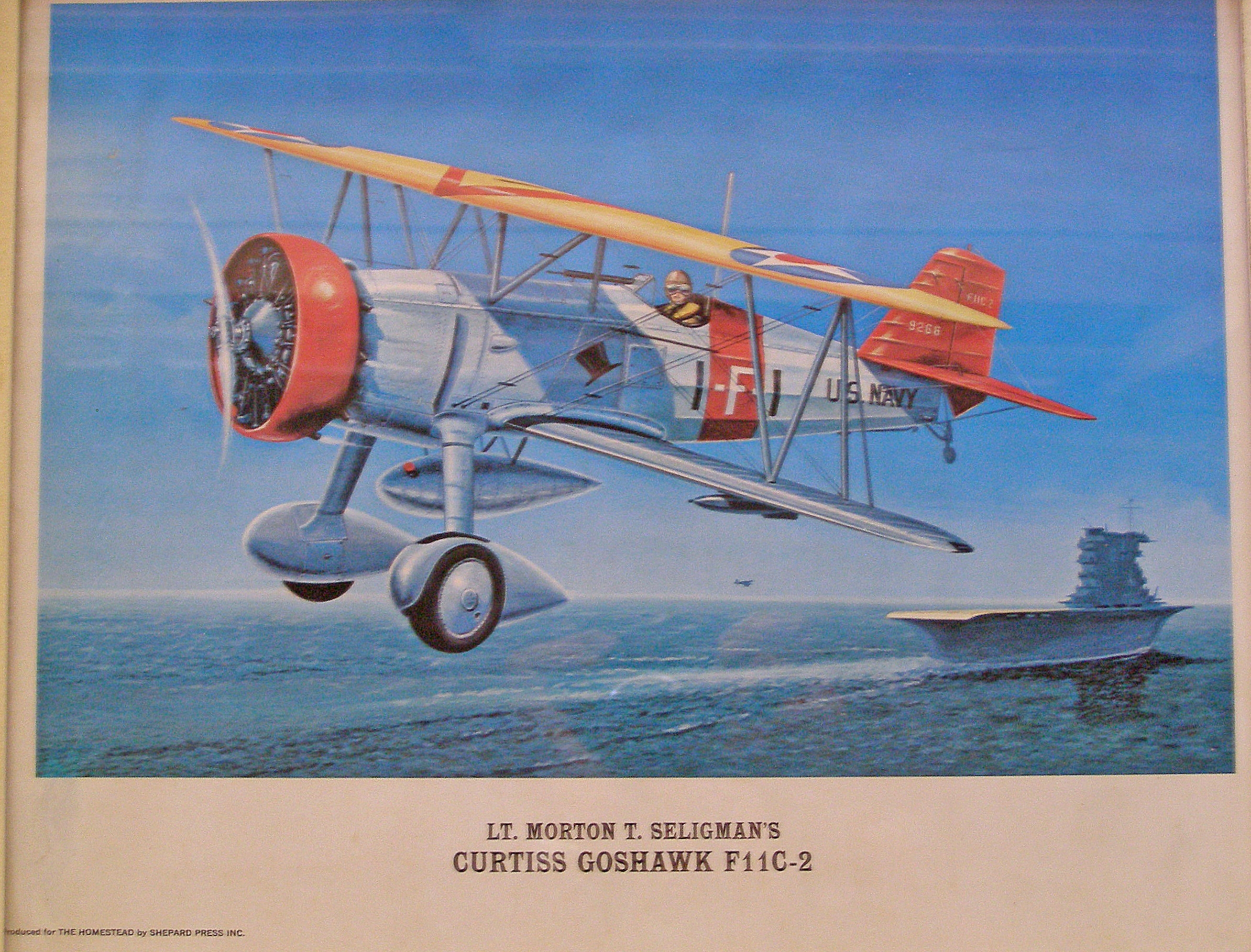
Lt. Morton Seligman c. 1932
Courtesy of Arthur Scott
By 1933, Morton was living in San Diego and was remarried to a woman named Adela. I cannot find a marriage record or any other document that reveals Adela’s birth name, but she is listed with him as his wife on the 1933 San Diego city directory. He was now a Lieutenant Commander with the VF-1-B squadron, according to the U.S. Military Register for the year. He and Adela were still living in San Diego as of 1939, according to that year’s directory, and Morton was still serving in the US Navy. According to the US Military Register for 1939, Morton was now a commander at the Naval Air Station in San Diego. The 1940 census also has Morton and Adela living in San Diego, Morton’s occupation still as a naval aviator. By this time, Morton was 44, Adela was 41. Morton had been serving in the Navy for over 20 years. (Ancestry.com. U.S. Marine Corps Muster Rolls, 1798-1958 [database on-line]. Provo, UT, USA: Ancestry.com Operations Inc, 2007.)
In October, 1941, Morton risked his life in an unsuccessful attempt to rescue two naval aviators who died when their plane crashed into the bay off the coast of San Diego. According to the San Diego Union:
“Comdr. Morton T. Seligman, Naval Air station executive officer, made a dramatic attempt to rescue the fliers a few minutes after the crash. Speeding to the scene of the accident in a crash boat, Cmdr. Seligman discovered that no one aboard was a diver. Despite the fact that he had never donned a diving helmet in his entire navy career, the officer put on the helmet and diving suit, instructed the crew of the crash boat how to operate the air pumps and then dived overboard.
“In 25 feet of water, Cmdr. Seligman discovered the bodies of the airmen in the smashed plane. In trying to extricate them, Cmdr. Seligman suffered severe cuts on his left hand from jagged pieces of metal and wood.” (“Two Fliers Die As Navy Plane Falls Into Bay,” San Diego Union, October 5, 1941, p. 1)
Two months later, the US would enter World War II after the bombing of Pearl Harbor on December 7, 1941, a place where Morton had once served. Not long after, Morton was an officer on the USS Lexington, which was destroyed during the Battle of the Coral Sea, which took place from May 4 through May 8, 1942. The battle was described as follows on the official US Navy website Naval History and Heritage Command: http://www.history.navy.mil/photos/events/wwii-pac/coralsea/coralsea.htm
“The Battle of the Coral Sea, fought in the waters southwest of the Solomon Islands and eastward from New Guinea, was the first of the Pacific War's six fights between opposing aircraft carrier forces. Though the Japanese could rightly claim a tactical victory on "points", it was an operational and strategic defeat for them, the first major check on the great offensive they had begun five months earlier at Pearl Harbor. The diversion of Japanese resources represented by the Coral Sea battle would also have immense consequences a month later, at the Battle of Midway. …..
“Preliminary operations on 3-6 May and two days of active carrier combat on 7-8 May cost the United States one aircraft carrier, a destroyer and one of its very valuable fleet oilers, plus damage to the second carrier. However, the Japanese were forced to cancel their Port Moresby seaborne invasion. In the fighting, they lost a light carrier, a destroyer and some smaller ships. Shokaku received serious bomb damage and Zuikaku’s air group was badly depleted. Most importantly, those two carriers were eliminated from the upcoming Midway operation, contributing by their absence to that terrible Japanese defeat.”

English: Battle of the Coral Sea (Photo credit: Wikipedia)
The website also notes that “The U.S. Navy [was] tipped off to the enemy plans by superior communications intelligence” that helped them in their fight against the Japanese in this battle.
As for Morton’s role, a US Navy Cruise Book described the battle and the USS Lexington’s role in that battle in great detail. According to this source, on the morning of May 7, 1942, the aircraft carrier was hit by five torpedoes and numerous bombs. Although seriously damaged, the ship did not sink, and by 1 pm it was on even keel and only had one fire burning. Then another major explosion occurred, caused by gasoline vapors igniting below the deck. Several fires started, and by 5 pm the commanding office of the ship, Admiral Fitch, ordered the crew to abandon ship. After the admiral and the crew had left, “Captain Sherman and his Executive Office, Commander Morton T. Seligman made a final inspection of their vessel amid flying debris, smoke and flames. They then slid down a line, with the commanding officer being the last to leave—just as the torpedo head locker exploded, shaking both from the line and into the sea. All but 26 officers and 190 men were rescued (including seven brothers aboard named Patten), and it is thought that none of these casualties occurred by drowning after abandoning ship.”
(Ancestry.com. U.S. Navy Cruise Books, 1918-2009 [database on-line]. Provo, UT, USA: Ancestry.com Operations, Inc, 2011. Original data: United States Navy. Various U.S. Navy Cruise Books. Navy Department Library, Washington, D.C.)

English: USS Lexington (CV-2), burning and sinking after her crew abandoned ship during the Battle of Coral Sea, 8 May 1942. Note planes parked aft, where fires have not yet reached. Removed caption read: Photo # NH 51382 USS Lexington burning during the Battle of Coral Sea, May 1942 (Photo credit: Wikipedia)
For his service and heroism aboard the Lexington, Seligman was awarded a Gold Star in lieu of a second Navy Cross. His citation read:
The President of the United States of America takes pleasure in presenting a Gold Star in lieu of a Second Award of the Navy Cross to Commander Morton Tinslar Seligman (NSN: 0-34590), United States Navy, for extraordinary heroism and distinguished service in the line of this profession as Executive Officer of the Aircraft Carrier U.S.S. LEXINGTON (CV-2), in action on 7 and 8 May 1942, during the Battle of the Coral Sea. During and after that battle Commander Morton directed the damage control and fire fighting parties, inspecting and visiting all critical parts of the ship. He personally assisted in removing all the wounded in many places. His distinguished leadership and timely decisions contributed greatly to the success of our forces and was largely responsible for the small loss of life that occurred when the ship was abandoned. Commander Seligman’s conduct throughout was in keeping with the highest traditions of the Navy of the United States.
http://projects.militarytimes.com/citations-medals-awards/recipient.php?recipientid=10339

Navy Cross
A month later, Morton Seligman would be caught up in a controversy involving another major Pacific battle, the Battle of Midway. More on that in Part II.
My Great-grandmother’s Brother James Leon Seligman: Philadelphia to Santa Fe to Salt Lake to Santa Fe
My great-great-grandparents Frances Nusbaum and Bernard Seligman had three children who survived to adulthood: my great-grandmother Eva, whose adult life I’ve written about here, and her two younger brothers, James and Arthur, my great-great-uncles. First, I will write about James and his family.
As I’ve already written, James was born on August 11, 1868, in Philadelphia, attended Swarthmore, and lived in Salt Lake City for a number of years between 1888 and 1900. He married Ruth V.B. Stevenson in 1893, and they had two children: Morton Tinslar, born in 1895, and Beatrice Grace, born in 1898.

The east side of Main Street (also known as East Temple Street) in Salt Lake City, Utah. The photo was taken in the 1890s by photographer Charles Roscoe Savage.. (Photo credit: Wikipedia)
By 1900 James had brought his family to live in Santa Fe. According to the 1900 census, James and Ruth and their two young children were living with James’ parents Bernard and Frances, and James was working as a clerk in a dry goods store—obviously, Seligman Brothers. James also became involved in Santa Fe politics and was elected in October, 1900, to serve on the executive committee of the Santa Fe County Democratic Central Committee. (“Democratic Central Committee,” Santa Fe New Mexican, October 24, 1900, p. 4)
It must have been not long afterwards that Bernard and Frances left Santa Fe and moved to Philadelphia, where Bernard spent the last few years of his life before dying in 1903. In 1903 James became president and general manager of Seligman Brothers when the business incorporated and his uncle Adolph left the company. In a very short amount of time, James had become a leader in the Santa Fe political and business community.
In 1910, James listed his occupation on the census as a retail merchant of dry goods and as an employer (as did his brother Arthur). By 1917, however, he was serving as the postmaster for Santa Fe. (“Troops Are Disappointed,” Albuquerque Journal, March 31, 1917, p. 3, mentioning James L. Seligman as postmaster of Santa Fe.) I do not know whether this was a full time position or whether he also continued to work at the family business. His entry on the 1920 census only listed his position as postmaster as his occupation. (His brother Arthur was the mayor for some of these same years, making me wonder who was really in charge of the Seligman Brothers business at that time.)
James’ entry in the 1920 Swarthmore Register lists many of his activities and does not even mention Seligman Brothers::

James Seligman in Swarthmore Register 1920
Meanwhile, James and Ruth’s children were growing up. Morton, after starting college at the University of New Mexico, was notified in May, 1914, that he had been accepted into Annapolis, the US Naval Academy. He enrolled that June and graduated in June, 1918, in the top third of his class.[1] His long career with the Navy will be discussed in my next blog post.

Midshipmen walking to class at the US Naval Academy in Annapolis (Photo credit: Wikipedia)
Morton’s younger sister Beatrice also went away to school, The Wolcott School for Girls in Denver. In May, 1917, she appeared in Shakespeare’s Comedy of Errors at the school, according to the May 13, 1917, Denver Post (p. 10). I thought it a little surprising that Beatrice was so far from home, but then found the following news article:
“Word was received here last night of the death of Miss Beatrice Seligman, daughter of Postmaster and Mrs. James Seligman. Miss Seligman has been ill for some time and was in Denver in the hopes of gaining better health through special treatment. Mrs. Seligman has been with her daughter and Mr. Seligman left this morning for Denver.” (“Miss Seligman, Santa Fe Girl, Dies in Denver,” Wednesday, July 28, 1920, Albuquerque Journal, p. 4)
Although I do not know what illness Beatrice was fighting, it must have been very hard for her parents to send her so far away in hopes of improving her health. No matter how many times I read about a parent losing a child, it never fails to upset me and make me wonder how those parents coped with the loss.

Beatrice Seligman headstone http://www.findagrave.com/cgi-bin/fg.cgi?page=gr&GSln=Seligman&GSiman=1&GScid=38062&GRid=114937292&
As I wrote in my prior post, the 1920s were not good years for the Seligman Brothers business. Although Seligman Brothers was still listed in the Santa Fe directory in 1928, the general manager was someone named Evelyn Conway, not anyone named Seligman. James and Ruth Seligman had started a new venture, Old Santa Fe Trading Post, filed with the State of New Mexico in March, 1929. http://www.bizapedia.com/nm/OLD-SANTA-FE-TRADING-POST-INC.html James described his occupation on the 1930 census as a merchant in the antiques business. The 1930 directory for Santa Fe listed James as the president and his wife Ruth as the secretary-treasurer of the Old Santa Fe Trading Post, as did the directories for 1932, 1934, 1936, and 1938. On the 1940 census, James again listed his occupation as an antiques dealer.
It would be interesting to know why James left Seligman Brothers and formed a different business. As we will see, Arthur also had moved on to different ventures by the 1920s. Did the business fail because the brothers lost interest, or did they move on because the business was failing? Somehow I think it is more likely the former as both James and Arthur seemed to have other interests, both having served in public office.
James Leon Seligman died on December 15, 1940. He was 72 years old. He was buried in Fairview Cemetery in Santa Fe. His wife Ruth lived another 28 years; she was 95 years old and died in Coronado, California, where her son Morton lived for many years. She was buried with her husband James back in Santa Fe at Fairview Cemetery.

UPDATE: My cousin Pete wrote about James Seligman, our mutual relative, on his website. You can see it here.
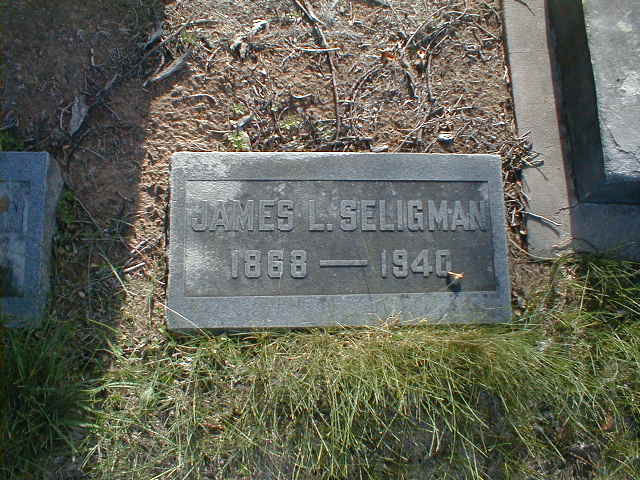
James L. Seligman headstone
http://www.findagrave.com/cgi-bin/fg.cgi?page=gr&GSln=Seligman&GSiman=1&GScid=38062&GRid=114937292&
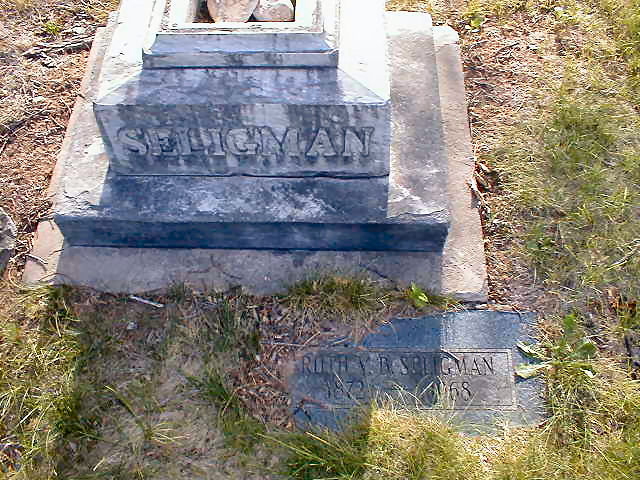
Ruth V.B. Stevenson Seligman headstone
http://www.findagrave.com/cgi-bin/fg.cgi?page=gr&GSln=Seligman&GSiman=1&GScid=38062&GRid=114937258&
[1] “Morton Seligman Is Notified that He Has Passed Examination,” Albuquerque Journal, May 8, 1914, p.3; Annual Register of the United States Naval Academy 1918-1919 (US Government Printing Office), pp/172-173 at https://archive.org/details/annualregiste19181919unse
Seligman Brothers Company 1849-1928: The Rise and Fall of an American Business

Although not a human member of my family tree, Seligman Brothers Company was a tremendous factor influencing the history of my Seligman family. Because this business was such a huge part of the family history, I decided to devote a separate post to the history and development of the business over time.
As described here, Sigmund Seligman had started the business in 1849 with Charles Clever. Then Clever had left to pursue a career in law, and Bernard had joined with his brother in the business. Later, their younger brother Adolph joined the business. Bernard withdrew, at least in name, for a while, and after Sigmund died in 1876, Adolph took over running the company. The business thrived, using the Santa Fe Trail to bring goods from the East to Santa Fe and the surrounding territory.

Sign for Santa Fe National Historic Trail. (Photo credit: Wikipedia)
The Santa Fe New Mexican ran an article on January 21, 1903, discussing the history of the business. The article described the way business had operated before the Santa Fe Railway system connected Santa Fe to other markets by train beginning in the 1880s:
“[A]ll goods brought into New Mexico were freighted by wagons drawn by oxen, mules and horses over the famous Santa Fe Trail from Kansas City. Santa Fe was then the business center of the territory. This was the distributing point for the entire region. Money was plentiful, there were no banks…. Gambling and speculation consequently ran riot. Goods were freighted in once a year and mails were received from the east once a month….” (“The Oldest Firm in the Southwest,” Santa Fe New Mexican, January 21, 1903, p. 1)

English: “Arrival of the caravan at Santa Fe” — Copy of original lithograph ca. 1844 (Photo credit: Wikipedia)
Marc Simmons, an expert on the history of the Santa Fe Trail, wrote, “Before the first bank was chartered in Santa Fe in 1870, Seligman Bros., in addition to its mercantile activities, engaged in private banking. … The firm also helped finance construction of the Denver and Rio Grande Railroad.” http://www.santafetrail.org/publications/wagon-tracks/pdf/V.%203%2088-89.pdf

Logo (Photo credit: Wikipedia)
Another article written in the Santa Fe New Mexican in 1915 gave more detail about the early nature of the business:
“In the early years of its existence the old firm was engaged in a general merchandise business and bought and sold everything needed by the Indians and the Spanish and American settles of that period. There was much bartering with the Indians and early settlers, as there was comparatively little actual money in the country and goods of all kinds were traded for skins, blankets, goods of all kinds, whatever the people had to offer and which could be turned into money in the markets of the East by the venturesome traders.” (“New Store at the End of the Santa Fe Trail Recalls the Ancient and Honorable History of Seligman Bros. Institution,” Santa Fe New Mexican, March 29, 1915)
The store moved in 1856 and then returned to its original location in 1890. The 1903 article pointed out that although the store had originally carried a wide range of items including not just dry goods, but also groceries, hardware and crockery, after the move in 1890 it had limited its inventory to dry goods (clothing, hats, shoes, boots, carpets and “kindred lines”).
The 1915 article described the growth of Seligman Brothers wholesale business after the arrival of the railroad and the growth that followed:
“While Seligman Brothers carried on a retail business, the rapid development of the surrounding country and the establishment of stores in the new settlements formed in the outlying districts made it necessary that an immense stock be carried from which to supply the needs of the country merchants. This led to the building up of a wholesale business which in its day and generation was a marvel to the jobbers and manufacturers of the more populous trading centers of the East and North who could not understand how it was that a single concern in the sparsely populated country around Santa Fe could possibly need stocks of goods aggregating a quarter million of dollars in value, yet Seligman Brothers had, in fact, nearly always had, that much money invested in merchandise in order to be able to take of the country merchants who depended up them for supplies.” (“New Store at the End of the Santa Fe Trail Recalls the Ancient and Honorable History of Seligman Bros. Institution,” Santa Fe New Mexican, March 29, 1915)

English: Comparison map showing the Santa Fe Trail and the Atchison. Scanned from: Santa Fe Railroad (1922), By the Way – A condensed guide of points of interest along the Santa Fe lines to California, Rand McNally and Company, Chicago, Illinois. Category:Atchison Category:Historical maps of the United States Category:Railroad maps (Photo credit: Wikipedia)
Thus, Seligman’s was successful on both a retail and a wholesale level. As I wrote in my last post, in 1903 Adolph Seligman withdrew from Seligman and Brothers, and the business was then incorporated as Seligman Brothers Company. Bernard’s older son James became a stockholder and the president and general manager of the business with Bernard’s younger son Arthur, also a stockholder, serving as the treasurer and secretary. The 1903 Santa Fe New Mexican article reported on the change in ownership and the withdrawal of Adolph from the business, observing that “the business of the corporation will be continued is all respects as heretofore” and that “The firm of Seligman Bros. is the oldest in the southwest. It is well and favorably known through the section and has a high reputation for fair dealing and honesty. The members are progressive and up-to-date, and there is no doubt that it will command a high percentage of the favor of the public and secure a large share of business. It has done so for fifty years and indications are that it will do so for many years to come.” (“The Oldest Firm in the Southwest,” Santa Fe New Mexican, January 21, 1903, p. 1)
The 1915 article reported on another relocation of the business and, like the article written twelve years earlier, predicted continuing growth and success for the business. (“New Store at the End of the Santa Fe Trail Recalls the Ancient and Honorable History of Seligman Bros. Institution,” Santa Fe New Mexican, March 29, 1915)
Despite that optimism, it appears that the 1920s were not very good for the business. A few ads indicate that things perhaps were not going as well as they once had.

1920 Seligman Bros. ad

Seligman Bros ad May 5, 1922 Santa Fe New Mexican
Although I do not have any source explaining specifically why or when the business closed, in 1928 it was still listed in the Santa Fe city directory, but with a woman named Evelyn Conway as its general manager. James and Arthur had moved on to different lines of business, as I will discuss. By 1930 Seligman Brothers Company was no longer listed in the directory and presumably was out of business. Perhaps competition from those other stores had had an impact on Seligman’s business. Whatever the cause, it is sad that after more than seventy-five years as one of the first and most important businesses in Santa Fe, the store disappeared forever.[1]
Thanks once again to my cousin Arthur “Pete” Scott, who provided me with most of the news clippings discussed in this post. For more on the history of the buildings where Seligman Brothers was located from 1849-1926, see his article here. There are also additional photographs located at that site. In addition, Pete wrote an article about the history of the company, located here.
[1] William Seligman,son of Adolph Seligman, did continue for at least some time the family tradition in the dry goods business in Santa Fe. He operated a store in Santa Fe under the name Seligman’s from at least 1948-1959. In 1960, the store was listed in the Santa Fe Directory as simply Willie’s Shop for Men. (“New Haberdashery to Open at La Fonda,” Santa Fe New Mexican, November 30, 1958.) I do not know how much longer the store stayed in business. There is no business called Seligman’s currently listed in the Santa Fe business directory.
English Laws of Intestacy: Why James Seligman’s American Relatives Inherited Money Fifty Years after He Died
I was puzzled by the story of James Seligman’s estate. Why did his great-great-nieces and great-great-nephews inherit from his estate fifty years after he died? Although I still do not know, I did find out something about English intestacy laws, i.e., the rules for distribution of an estate when the deceased did not leave a will.
According to the gov.uk website, when a person’s estate exceeds £250,000 and there are no children, grandchildren, or great-grandchildren, the surviving spouse or civil partner inherits all the property up to £450,000 and all the personal possessions without limitation, plus 50% of any property in excess of £450,000. The remainder is divided among the surviving siblings of the deceased person. If the siblings have died, their children inherit their parent’s share. See also http://en.wikipedia.org/wiki/Intestacy#England_and_Wales
So let’s assume that James Seligman left an estate worth £458,000 when he died. His widow Clara would inherit £450,000 plus half of the 8,000 excess or £4,000. That would have left £4,000 to be distributed among James’ siblings or their children, if a sibling had died. From the family tree prepared by the agency hired to investigate James’ family, it looks like they only found two siblings, Bernard and Adolph. (It’s possible there were other trees that I did not see.) Since both Bernard and Adolph had died before James died, their children would have inherited their share of James’ estate, or £2000 to Bernard’s children and £2000 to Adolph’s children. Bernard had three surviving children when he died, Eva, James Leon, and Arthur. Each would inherit one third of that £2000, or £667.
But for some reason it seems that nothing was distributed at the time of James’ death in 1930. Instead, the estate was not distributed until after Clara, his widow, died in 1977. By then, Eva, James Leon, and Arthur had died, and in fact, all of their children had died by then except for Eva’s son Stanley Cohen. I assume that therefore the estate would have been shared by Stanley and his brothers’ children (my father and his sister and the two sons of Maurice Cohen) and by Arthur’s grandchildren. Since James Leon did not have any children or grandchildren who were still alive in 1977, I assume his share would fail.
So assuming my purely hypothetical numbers, Stanley would get one third of Eva’s share (£222), my father, my aunt, and Maurice’s two sons would each get one sixth of Eva’s share (£111), and Arthur’s share (£667) would have been divided among his grandchildren.
What I don’t understand is why this distribution would not have been made in 1930 when James died. According to Wikipedia, if James and Clara had had children, “the spouse or civil partner inherits all personal belongings of the deceased, the first £250,000 of the estate and a lifetime’s interest in half of the amount above £250,000.“ That would mean that Clara had only a life estate in half of the excess over £250,000. She could have used the interest on that excess, but not used the principal itself. That excess would then be distributed to the other heirs after she died. But James and Clara did not have children. They were only married for a few months, and there is no indication of any children conceived before James died. So this provision would not seem to apply, and if it did, presumably that child would inherit the excess, not James’ great-great-nephews/nieces.
Perhaps someone out there knows more about the English law of intestate succession and can explain.
Related articles


“Brothers and Sisters in England and in Germany” and My Lost Inheritance
When Bernard Seligman died in 1903, his obituary listed among his survivors not only his brother Adolph, but also “other brothers and sisters in England and in Germany.” Thus far, I have only found one other definite sibling, a brother named James, and one possible sibling, a brother named August. I am still working on locating records from Gau-Algesheim to see if I can locate any other siblings or other relatives of my great-great-grandfather.
My belief that August may be a sibling is based on two records I found on ancestry.com. One is a birth record for August Seligmann, born on December 10, 1841, in Algesheim, Rheinhessen, Germany, to Maritz Seligmann and Barbara Schonfeld. The second is a marriage record for August Seligmann to Rosa Bergmann on March 5, 1875, in Frankfort-Main. I know that this record is for the same August Seligmann as the birth record because the birth date and the parents’ names match those on the birth record. Why do I think that August Seligmann was Bernard’s brother? Because Adolph’s death certificate said his father’s name was Morris and because other sources state that Bernard’s parents’ names were Moritz and Babette. The place of birth and the date of birth also make it likely that August was my great-great-great-uncle and that Maritz Seligmann and Barbara Schonfeld were my three-times great-grandparents. Now if I could only get access to Gau-Algesheim records, I might find the other missing family members. If anyone has any suggestions, please let me know. Meanwhile, I will continue to scour the resources I have to see if I can find them.

Gau-Algesheim. Langgasse. (Photo credit: Wikipedia)
The one other brother I know of for certain I only know about because of my cousin Pete. Pete informed me about James Seligman, our English relative, and he himself only had known about James because of an estate settlement back in the 1980s involving James’ estate. (I do not know whether my father or my aunt Eva or my cousin Marjorie ever were contacted about this inheritance, but given the amount at stake and how much time has passed, it’s not worth the trouble of finding out. Pete said his share was a little more than $100, and it took years before he received payment.)
James Seligman was born in about 1853 in Germany, and by 1881 he had settled in Kilpin, Yorkshire, England and was living as a “visitor” in Kilpin Lodge, according to the 1881 England and Wales census. (England and Wales Census, 1881,” index, FamilySearch (https://familysearch.org/pal:/MM9.1.1/X3FK-ZVF : accessed 30 Sep 2014), James Seligmare in household of George H Anderton, Kilpin, Yorkshire (East Riding), England; citing “1881 England, Scotland and Wales census,” index and images, findmypast.co.uk (www.findmypast.co.uk : Brightsolid, n.d.); PRO RG 11/, p. , The National Archives of the UK, Public Record Office, Kew, Surrey) The census listed his occupation as a wine merchant. On May 21, 1886, James became a naturalized British citizen. He was residing in Lewisham, Kent County, England at that time, unmarried, and employed as wine merchant.
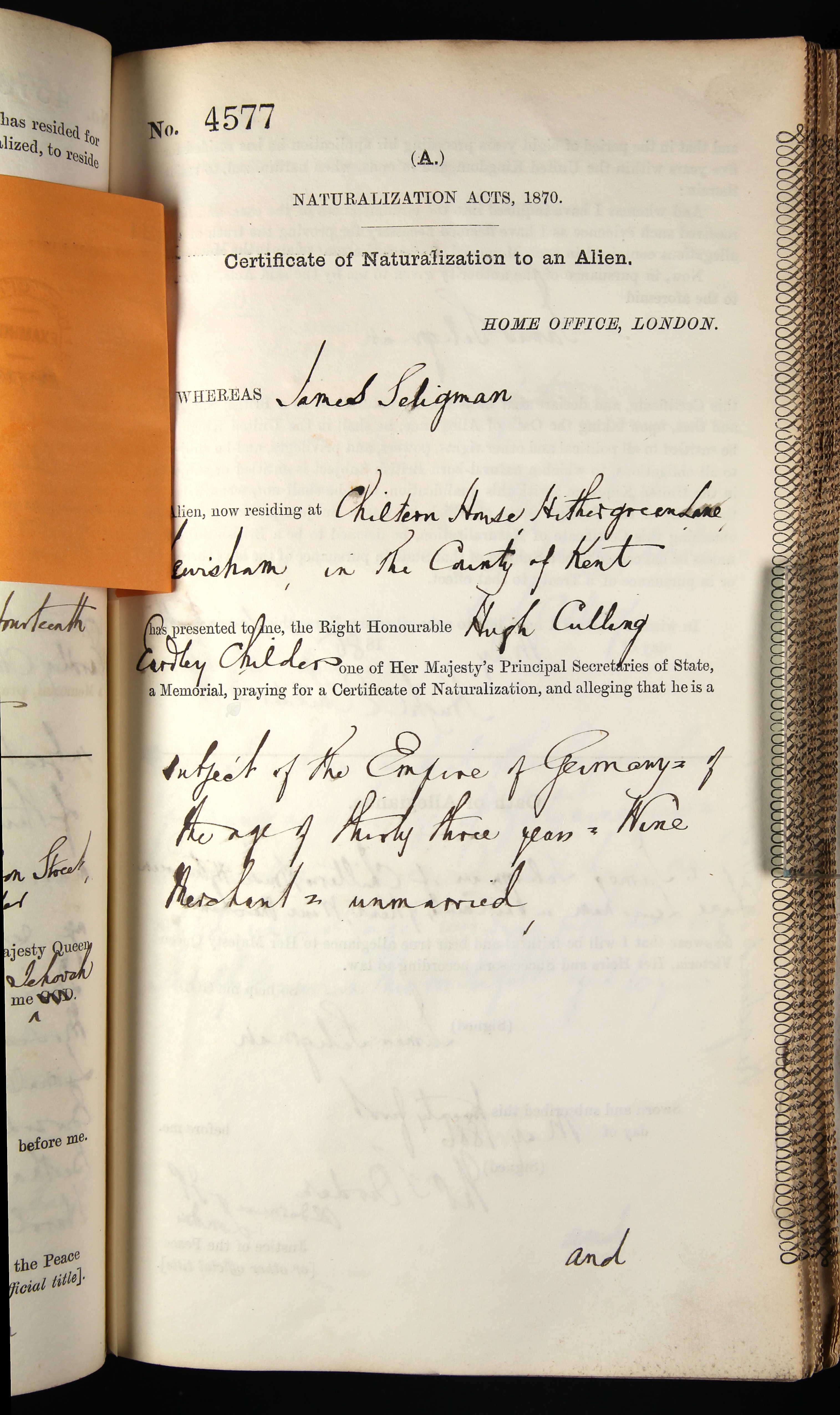
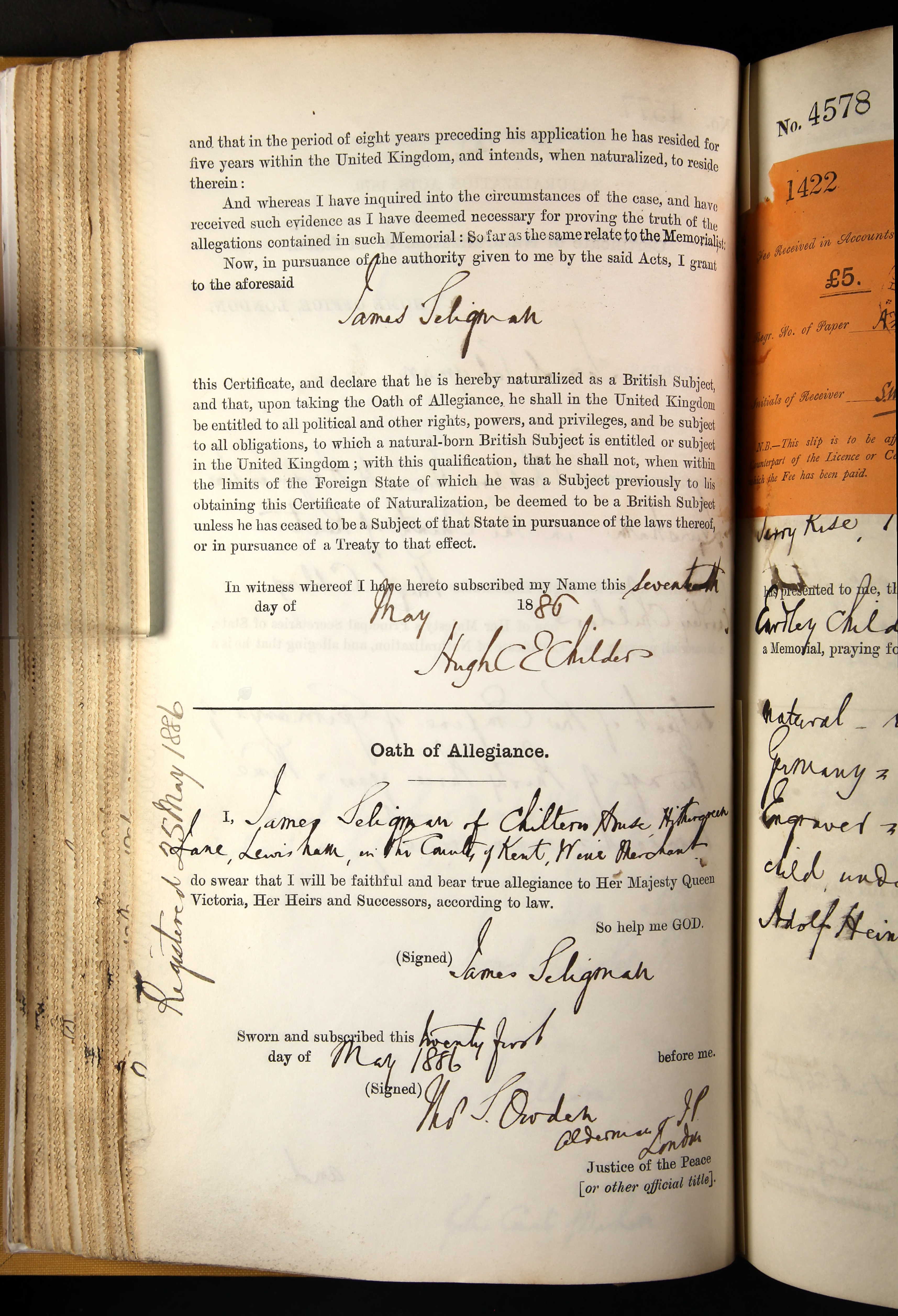
The National Archives; Kew, Surrey, England; Duplicate Certificates of Naturalisation, Declarations of British Nationality, and Declarations of Alienage; Class: HO 334; Piece: 13.
James married Henrietta Walker Templeton in 1887 in the Marylebone district of London. In 1901 they were living on Buchanan Street in Glasgow, Scotland, where James was now employed as a “hotel keeper,” according to the 1901 Scotland census. From the census record it appears that there were about thirty people residing in this hotel. James and Henrietta did not have any children listed as living with them, and according to Pete, they never did have any children, and I did not find any children listed on the BMD index who might have been their children.

Buchanan Street, Glasgow, Scotland. (Photo credit: Wikipedia)
I don’t have another record for James after 1901 until 1922 when he and Henrietta are listed as residing at 11 Woodbourne Road in Birmingham, England, on the Midlands, England, Electoral Register for that year. They also appear at the same address on the 1925 and 1927 electoral registers.

11 Woodbourne Road, Birmingham, England https://www.google.com/maps/@52.470453,-1.952537,3a,90y,235h,93.94t/data=!3m3!1e1!3m1!2e0!6m1!1e1
Henrietta died on October 4, 1928, and is buried in Harborne, Stafford, England. About a year later, James married Clara Elizabeth Parry. He was seventy-six at that time, and his new bride was thirty years old, so like his brother Adolph in Santa Fe, James also married a much younger woman in this second marriage. He died less than six months later on March 31, 1930, in Birmingham, and, like his first wife Henrietta, was buried in Harborne.
Clara, his young widow, did not die until about 1977. It was after then that a search was made for James’ heirs, as Clara and James had not had any children, and James had died intestate. Here is a copy of the letter that Pete’s sister received in January, 1980, regarding the estate of James Seligman.

An investigation was done to find James’ heirs, and a family tree was created that included my father, his sister, and his cousin Marjorie as well as the other grandchildren of Bernard Seligman and the descendants of Adolph Seligman as the potential heirs to this estate. There are several errors and omissions on this tree, which makes me wonder about the thoroughness of the search. I would post the tree except that there are references to living people with their birth dates and other identifying information and so out of concern for their privacy, I am not posting it.
That, unfortunately, is all I know about James Seligman and about August Seligman. I have nothing specific to tie James to Bernard aside from this estate settlement and only those two German records to connect August with Bernard. I remain hopeful that I will at some point find more records for the other Seligman(n)s who were my great-great-grandfather’s siblings and parents and other relatives.
Adolph Seligman: A Rift in the Family?
Before I continue to write about the children of Bernard and Frances Seligman, I want to write about Bernard’s other siblings, most importantly Adolph Seligman, the third Seligman brother who settled in Santa Fe. I am aware of one other brother, James, who settled in England, but there may have been and probably were other siblings. Bernard’s obituary referred to siblings in Germany and in England who survived him, and the age gaps between Sigmund (1830), Bernard (1837), Adolph (1840 to 1845), and James (1853) suggest that there may have been other children born in the gaps between those years. I have found one other record for an August Seligman (1841), who may have been another sibling, but I have only two mentions in German indices for August to rely on.
For now, however, I will focus on the life of Adolph Seligman. Adolph was born between 1840 and 1845, according to various records, and he arrived in the US in 1863, as seen on the two ship manifests below. The first indicates that he was born in Gau-Algesheim, was a merchant, and was 20 years old. He sailed from Hamburg on the Germania on August 22, 1863, and arrived in New York on September 7, 1863.
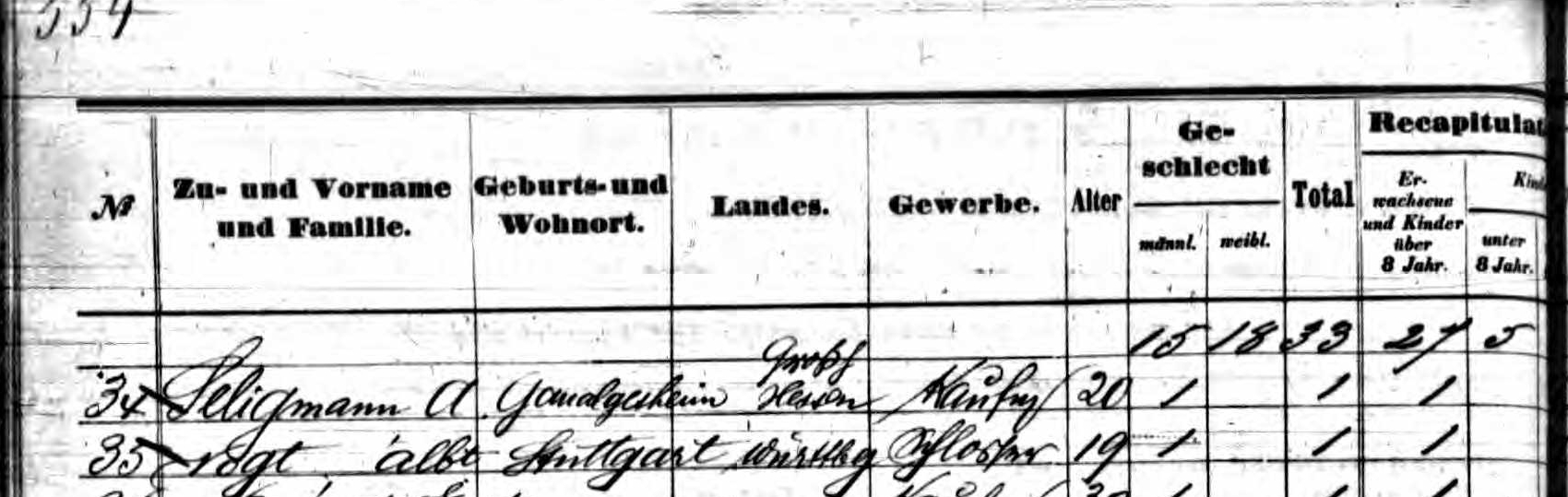
Staatsarchiv Hamburg; Volume: 373-7 I, VIII A 1 Band 017; Seite: 545 Description Month : Direkt Band 017 (10 Jan 1863 – 26 Dez 1863) The Germania, Departure from Hamburg to New York on August 22, 1863

New York, Passenger Lists, 1820-1891,” index and images, FamilySearch (https://familysearch.org/pal:/MM9.3.1/TH-1-16955-70464-13?cc=1849782 : accessed 09 Oct 2014), 233 – 3 Sep 1863-3 Oct 1863 > image 63 of 409; citing National Archives, Washington D.C. Arrival September 7, 1863
This was apparently the maiden voyage for this ship. To see a photo of the ship and more about it, click here.
Although Adolph landed in New York City, he was definitely in New Mexico by 1868 because he appears on the IRS tax assessment records there for that year, residing in Elizabethtown. On the 1870 census he appears as a dry goods merchant living in Colfax, New Mexico.
By 1873, he was residing in Santa Fe, and he is listed with his brother Sigmund and with Julius Nusbaum, Bernard’s brother-in-law, as one of the principals in Seligman Brothers and Company on the 1873 IRS tax assessment list. (As discussed here, Bernard withdrew from the business in 1873, and Adolph and Julius took his place as owners of the company.)

1873 IRS Tax Assessment for Adolph Seligman The National Archives and Records Administration; Washington, D.C.; Internal Revenue Assessment Lists for the Territory of New Mexico, 1862-1870, 1872-1874; Series: M782; Roll: 1; Description: Monthly and Special Lists; 1869-1874; Record Group: 58, Records of the Internal Revenue Service, 1791 – 2006.
On the 1880 US census, Adolph was living with Bernard and his family in Santa Fe; both Bernard and Adolph listed their occupation as general merchants. (In addition to Adolph, Bernard also was providing a home for his father-in-law John Nusbaum, my three-times great-grandfather, and Simon Nusbaum, his brother-in-law, that year.)

1880 Census for Bernard Seligman and household Year: 1880; Census Place: Santa Fe, Santa Fe, New Mexico; Roll: 804; Family History Film: 1254804; Page: 27A; Enumeration District: 040; Image: 0056.
Adolph was still living with Bernard and his family (and Simon Nusbaum) in 1885. On April 6, 1886, Adolph was appointed postmaster for Santa Fe and continued in that position until at least July, 1889.
In 1890, Adolph was elected president and his nephew Arthur Seligman and two other men were elected officers of a corporation organized for a mining venture. According to an article dated April 26, 1890, in the Santa Fe Sun, the mine, called the Chester mine, was “a fine mine and its development will disclose ore of startling richness. The last fifty-six sacks of ore taken from this mine yielded the owners $1,700 per ton in Denver. The gentlemen engaged in this enterprise are all energetic men of business and well deserve the success that is sure to follow their work.”

Santa Fe Sun, April 26, 1890
It seems that Adolph must have struggled with some health issues during the late 1890s as I found two news articles, one dated 1900 after a trip to Europe and one dated 1898 after a trip to Santa Rosalia Hot Springs, Chihuahua, both mentioning how his health was improved after these vacations.

Date: Saturday, November 10, 1900 Paper: New Mexican (Santa Fe, NM) Volume: 37 Issue: 226 Page: 4
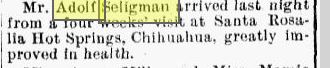
(The 1900 trip may explain why I cannot find Adolph on the 1900 US census.)
Adolph then went through some transitions at the Seligman’s family business. The Santa Fe New Mexican of January 21, 1903, announced that Adolph had withdrawn from the business as of December 31, 1902, and that a new corporation had been formed under the name Seligman Brothers Company with Frances, James, and Arthur Seligman as stockholders. James was to be the president and general manager and Arthur the secretary and treasurer of the newly formed corporation. Bernard was described as the senior member of the company, representing its business as a buyer in the east (as by that time Bernard and Frances were living in Philadelphia, as discussed here).
So what happened to Adolph? Had he been pushed out, or he had retired for health reasons? Was there a rift in the family or just an independent decision to leave? I don’t know. In the 1903 New Mexico city directory, Adolph is listed as a saloon owner in Santa Fe. An ad in the May 2, 1904 Santa Fe New Mexican reveals that at that time, Adolph was back in the dry goods business, selling men’s, women’s, and children’s shoes.

May 2, 1904 Santa Fe New Mexican
In fact, during the next decade or more, Adolph appears to have been in competition with his brother’s company, as seen in this ad from the Santa Fe New Mexican in 1911. Notice that the clipping has an ad for Seligman Brothers on the left side and one for Adolph Seligman Dry Goods on the right side.

October 2, 1911 Santa Fe New Mexican
Meanwhile, Adolph’s personal life had also changed around the same time as these changes in his work life. Adolph was single until 1902, and then when he was about sixty years old, he married Lucille Gorman, who was only nineteen years old at the time. Did this change in his personal life have anything to do with his withdrawal from Seligman Brothers? I do not know.
Adolph and Lucille had a daughter Minnie in 1903, the year after they married, and then had five more children: Jacob and Adolph, Jr. (1909),[1] William (1911), Gladys (1915), and Mildred (1919).
On the 1920 census when he was reported to be 76 years old, Adolph reported no occupation; Lucille was working as a seamstress.

Adolph Seligman and family 1920 US census Year: 1920; Census Place: Santa Fe, Santa Fe, New Mexico; Roll: T625_1080; Page: 11B; Enumeration District: 129; Image: 123
Adolph died soon after this census was taken. He died on February 12, 1920, from locomotor ataxia. He was about 76 years old, although his death certificate reported his birth date to be September 29, 1840, and his age to be 79.

New Mexico, Deaths, 1889-1945,” index, FamilySearch (https://familysearch.org/pal:/MM9.1.1/FLTH-K9Y : accessed 06 Sep 2014), Adolf Seligman, 12 Feb 1920; citing Santa Fe, Santa Fe, New Mexico, reference Item 3, Bureau of Vital Records and Health Statistic
I am not sure whether this birthdate is accurate, given the ages on all the other records, and also given that the death certificate said his birthplace was Cologne, Germany, which is inconsistent with earlier records placing his birth in the Hesse-Darmstadt region just like his brothers Sigmund and Bernard. The ship manifest for his trip from Hamburg in 1863 also said that he was from Gau-Algesheim.
Lucille was left with six children ranging in ages from a year old to seventeen years old, and she herself was only 37 when Adolph died. In 1930 she was listed as a widow on the census with no occupation, but her three oldest children were employed, Minnie as a salesperson, Adolph, Jr., as a tailor, and Jake as an electrician. All six children were still living with her, now ages eleven to 27 (although Minnie’s age was listed as 23 on the census). Sometime after the census was taken but during 1930, Lucille remarried. She is listed as Lucille, wife of Frank C. Daniels, in the 1930 Santa Fe city directory.
Adolph, Jr., died the following year on June 13, 1931; he was only 22 years old. I was not able to access a death certificate to determine his cause of death. Lucille died a year after her son on November 10, 1932, under the name Lucille S. Daniels. She was 40 years old. I don’t know her cause of death either.
Her widower Frank Daniels, who had married Lucille just two years earlier, took on the responsibility for her three daughters and her son William, all of whom were still living with him as late as 1940, some using the surname Daniels. Frank was working as a carpenter for a building supply company. Minnie was now 37 (35 on the census) and working as bookkeeper for a building supply company; William, 28, was also working as a bookkeeper for a building supply company. (I assume that Frank, Minnie, and William were all working for the same company.) Gladys was 24 and working as a cashier for the power company. Mildred was 21 and had no occupation listed.
Jake, who had been living with his siblings and stepfather Frank in 1932 according to the Santa Fe city directory of that year, married Adela Roybal sometime soon thereafter. He continued to work as an electrician. He and Adela had one child. Two of Adolph’s children never married or had children, Minnie and Gladys. William married Mae Leeper, and they had four children. William served as a city councilman in Santa Fe. Mildred married David Roberson and had one child. Many of Adolph and Lucille’s descendants continue to live in Santa Fe.
There are many unanswered questions about Adolph and his life after 1902. Like his brothers Sigmund and Bernard, he was a risk-taker and a pioneer, both following in his older brothers’ footsteps and also finding his own path.
——————–
[1] Although several records indicate that both Jacob and Adolph, Jr., were born in 1909, neither appears on the 1910 census, and on the 1920 census, Adolph was reported to be eleven whereas Jake was said to be only ten. The 1930 census has Adolph as 21 (meaning a birth year of 1909), but has Jacob’s age as 18, meaning a birth year of 1912. Adolph’s headstone has a birth year of 1909. Jacob’s obituary states that he was born on September 9, 1909, as does his entry in the SSDI. I will have to request a search from the New Mexico Bureau of Vital Records to determine the exact birth dates, which will take as much as 12 weeks to process.
Related articles

My Seligman Great-Great-Grandparents: Two Pioneers Who Made A Difference with Integrity and Kindness

Bernard Seligman http://swja.arizona.edu/content/bernard-seligman-family
By the 1890s, my great-great-grandparents were “empty nesters.” Their daughter Eva, my great-grandmother, was married to Emanuel Cohen and raising her family in Philadelphia. (I’ve written about my Cohen great-grandparents here.) Their son James was working as a draftsman for the Department of Interior in Salt Lake City, Utah; he would marry Ruth V.B. Stevenson in 1893 in Salt Lake City, and have two children, Morton Tinslar Seligman, born July 1, 1895, in Salt Lake City, and Beatrice Grace Seligman, born December 4, 1898, also in Salt Lake City. By 1900, however, James, Ruth and the children had moved to Santa Fe, where they were living next door to Bernard and Frances. James was working as a clerk in a dry goods store, presumably the Seligman store.

Bernard Seligman and James Seligman and families 1900 US census Year: 1900; Census Place: Santa Fe Ward 4, Santa Fe, New Mexico; Roll: 1002; Enumeration District: 0126; FHL microfilm: 1241002
Arthur, the youngest child of Bernard and Frances, had returned to Santa Fe after college in Philadelphia, and in 1896, he married a widow named Frankie E. Harris in Cleveland, Ohio.

Marriage certificate of Arthur Seligman and Frankie E. Harris Cuyahoga County Archive; Cleveland, Ohio; Cuyahoga County, Ohio, Marriage Records, 1810-1973; Volume: Vol 42-43; Page: 489; Year Range: 1892 Sep – 1896 Jul
Frankie had an eight year old daughter Richie from her first marriage who became a part of the Seligman family. In fact for her ninth birthday on August 3, 1897, Bernard and Frances hosted a birthday party for Richie and 42 of her friends in their Santa Fe home.

City News Items Date: Tuesday, August 3, 1897 Paper: New Mexican (Santa Fe, NM) Volume: 34 Issue: 138 Page: 4
(This same “gossip column” also reported that Arthur and James Seligman and some friends were going on a two week fishing trip soon after this birthday party.)
Arthur and Frankie had a son together just a year later; Otis Perry Seligman was born on February 14, 1898, in Santa Fe. Thus, by 1900, Bernard and Frances had four grandchildren living in Santa Fe plus three more grandsons living in Philadelphia, including my grandfather John Nusbaum Cohen.
On the professional side, I could not find any specific references to Bernard’s political activities or his business activities during the 1890s although the 1900 census listed his occupation as a dry goods merchant. In 1894 he seems to have taken an extended trip to Europe, including to Germany and to Italy.

Saturday Small Talk Date: Saturday, October 27, 1894 Paper: New Mexican (Santa Fe, NM) Volume: 31 Issue: 214 Page: 4
From this clipping it is hard to know whether or not he was traveling with Frances. I also wonder who the relatives were in Italy and who he was visiting on the Rhine. Was this purely for pleasure or was it a business trip? I don’t know.
At some point after this trip, however, Bernard and Frances moved back to Philadelphia. Bernard was living in Philadelphia when he died on February 3, 1903, at age 65 from myocarditis. He was residing at 1606 Diamond Street at the time.

When I looked back to see where my great-grandmother Eva was living at that time, I was hardly surprised to see that she, her husband Emanuel Cohen, and their three sons were also living at 1606 Diamond Street as of the 1900 census. In fact, in 1900, Emanuel’s brother Isaac and nephew were also living at 1606 Diamond Street after the death of Isaac’s wife. Thus, Eva and Emanuel Cohen, my great-grandparents, were housing not only their three children, but also at least four other family members, Eva’s parents and Emanuel’s brother and nephew.
According to his obituary, Bernard (and presumably Frances) had moved back to Philadelphia three years before his death, to “recuperate from over-work.” The obituary goes on to say that Bernard had been doing well until sometime in the prior year when he had a “severe stroke of paralysis which weakened him considerably.” The paper noted, however, that he had been improving and that no one thought that he was near death. The obituary described his death as “shocking” and reported that the day before his death he had appeared fine and had even sent a dispatch relating to business matters to his son Arthur.

“A Good and True Man Called Hence,” Santa Fe New Mexican, February 3, 1903, p. 1
The obituary recounts all of Bernard’s many accomplishments, both political and business, and describes him as follows:
“Mr. Seligman was a pioneer in New Mexico, and during his residence of over forty years in this city and territory, was one of the most progressive, shrewdest and brightest businessmen and citizens of the commonwealth. He was a man of the strongest integrity and keen perception and high courage, public spirited and thoroughly posted on public affairs, indeed a valuable and good citizen in every sense of the word, a loving husband and a kind and indulgent, yet at the same time, a firm and sensible father. He was a prominent and important factor in the building up of the commercial, educational, civic, moral, and material interests in this city and county and of the entire territory. A good and true man has gone to the great beyond.”
What can I possibly add to that? Only that I wish that I had known him. I stand a bit taller knowing that I am descended from Bernard Seligman.
Just two years later, my great-great-grandmother Frances Nusbaum Seligman also died. She died in Philadelphia on July 27, 1905, at age 59.

She had been living at 1431 Diamond Street at the time of her death. Again, I checked to see where my great-grandparents Eva and Emanuel Cohen were living, and 1905 Philadelphia directory, their address was, not surprisingly, 1431 Diamond Street, and they still had their three sons and Isaac living with them in 1910 as well.
Frances was described in her obituary in very loving terms:
“She was a beautiful and accomplished woman, as good as she was beautiful and as beautiful as she was good, and of a most lovable and gentle disposition. She was an exemplary wife, a fond and good mother, and a dutiful and loving daughter. Indeed she was all that is implied in the phrase ‘a thoroughly good and moral woman.’ … She will be especially remembered by the poor people of [Santa Fe], to whom she was particularly kind. Many and many truly charitable deeds have been put to her credit.”
The obituary further commented:
“From the moment of her arrival to within a few years ago, when she commenced to spend most of her time in Philadelphia, she was a social leader, admired, respected and popular. She was a woman without guile and always ready to lend a helping hand in social as well as in charitable work.”

(“Gentle, Good Woman Gone,” Santa Fe New Mexican, July 27, 1905, p. 1)
While I was impressed and proud when I read my great-great-grandfather’s obituary, I was very moved and emotional in reading about my great-great-grandmother Frances. The words “good,” “gentle,” and “kind” are the same words that I have heard my father and my cousin Marjorie use to describe their grandmother, Eva Seligman Cohen, the daughter of Frances Nusbaum and Bernard Seligman. She seems to have inherited or learned those very traits from her parents, two people who left the city of Santa Fe a better place by the time and the effort that they spent in caring for their community while they lived there. As I will describe, their surviving children also left their mark, my great-grandmother Eva by her kindness and caring for others, and her two brothers James and especially Arthur by their service to Santa Fe and New Mexico.

Bernard Seligman
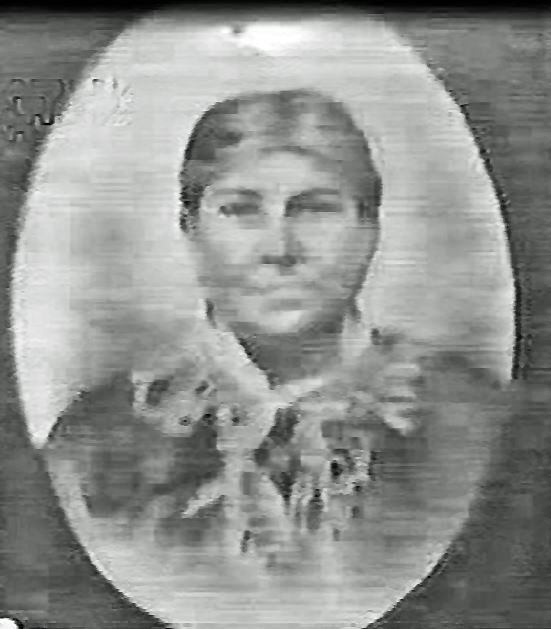
Frances Nusbaum Seligman
These two photos were given to me by my cousin Arthur Scott. They were taken from a video made by his sister of family photos in their home. The one of my great-great-grandmother Frances is so far the only photograph I have of her.


 Brotmanblog: A Family Journey