Update: Baby Rose Schoenthal—Did She Ever Exist? Do I Stop Looking for Her?

I need your advice.  I’ve hit a brick wall, and this time, I am not sure I should try and go further.  Please let me know what you think.

Some of you may recall the mystery of Baby Rose Schoenthal, the daughter of Jacob Schoenthal and his wife Florence who appeared on the 1930 census in Atlantic City as their fifteen month old child, but then disappeared.  She was not on the 1940 census; there was no death record for her in Pennsylvania or New Jersey, and she was not buried with Jacob and Florence or with her grandparents.  She was not named as a survivor in Jacob’s will.

Atlantic City Press February 18, 1976 p 16

Atlantic City Press February 18, 1976 p 16

I was left concluding that either she had been adopted and thus had taken on a new name or had never even existed.  I haven’t yet tried searching for adoption records because it does not appear that I have legal standing to do that, given that I am not Rose, her child, her parents, or any other close relative. I also am not sure where I should search: New Jersey, Pennsylvania, or any of the other states in the country where a child might have been adopted. And even more to the point, petitions to unseal adoption records are intended to reveal the birth name of an adoptee.  I can’t find any way to search for records of a birth child who was adopted if I don’t know the adoptive name.

I did, however, request a search of New Jersey’s birth records for 1928 and 1929, hoping that a birth certificate for a Rose Schoenthal would appear.  I now have received the report back from New Jersey, and they had no birth certificate for a Rose Schoenthal born between January 1, 1928, and December 31, 1929.  What does that mean? Well, it means either Rose was never born and the census report is just wrong.  Or it means she was adopted and the birth certificate was changed to her adoptive name.

Which seems more likely? Since the census record is so specific—says she was 1 and 3/12, born in New Jersey, and gives her full name, Rose Maxine Schoenthal—I am inclined to think it was accurate (unless Jacob and Florence had an imaginary child a la Who’s Afraid of Virginia Woolf?).

Jacob Schoenthal and family 1930 US census Year: 1930; Census Place: Atlantic City, Atlantic, New Jersey; Roll: 1308; Page: 10B; Enumeration District: 0003; Image: 129.0; FHL microfilm: 2341043

Jacob Schoenthal and family 1930 US census
Year: 1930; Census Place: Atlantic City, Atlantic, New Jersey; Roll: 1308; Page: 10B; Enumeration District: 0003; Image: 129.0; FHL microfilm: 2341043

So that brings me back to the adoption possibility.  Now I need to figure out how to search for an adoption when you know the birth name but not the adoptive name.  I also have to consider whether I should try to find an adoption record. Rose could very well still be alive; she’d only be 86 or so.  It feels inappropriate for me to invade her privacy, if she is in fact alive.  I am inclined to let this one go.

What do you think? Should I leave well enough alone? Or should I pursue this further?

Are These My Great-Uncles?

As I wrote about here, while in Denver, I visited Temple Emanuel where the confirmation class photographs of my grandmother Eva Schoenthal and of her brothers Gerson and Harold were posted on the wall.  It was easy for me to find my grandmother in her class photograph as I knew her face well.  But it was more difficult to identify which boys in the other two class photographs were my great-uncles.

When I got home, I asked my father and also compared the one photograph I have of Gerson and several photographs I have of Harold to see if I could pick out Gerson and Harold in the confirmation class photographs.  Now I think I have, but I’d be interested in whether others agree with me.  My father said he really has no memory of Gerson, but agreed with me as to which boy was Harold.

This is Gerson’s class photograph.

Temple Emanuel 1908 confirmation class with Gerson Schoenthal

Temple Emanuel 1908 confirmation class with Gerson Schoenthal

And this is the only photograph I have of Gerson as an adult:

Dad Uncle Gerson Eva

Here are some closer shots of the faces of the boys in that class:

20160524_170000994_iOS

20160524_170007605_iOS 20160524_170011278_iOS

I think Gerson is the tall boy in the center of the top row (first boy on the left in the bottom photograph and the boy to the far right in the top photograph: same boy).  The one photograph I have of Gerson is of terrible quality, but there is something about the shape of the head and the ears that seems most similar to the boy in the middle.  Do you agree?

Here is Harold’s class photograph:

20160524_165822156_iOS

And here are closeups of the boys in that photo:

20160524_165837031_iOS 20160524_165844844_iOS

I think Harold is the first boy on the left in the top picture.  Here are some other photographs of Harold as a young man:

Hilda (Katzenstein) Schoenthal, Eva Schoenthal Cohen, Eva Hilda Cohen, and Harold Schoenthal

Hilda (Katzenstein) Schoenthal, Eva Schoenthal Cohen, Eva Hilda Cohen, and Harold Schoenthal

Harold Schoenthal

Harold Schoenthal


Again, the ears, the shape of the head, and the mouth seem most similar to the boy on the top left of the first photograph of closeups above.  Do you agree?

It would have been so much easier if they had listed the students in the order in which they were standing instead of alphabetically!


Denver and A New Portrait of My Grandmother

About 110 years ago, my great-grandparents Isidore and Hilda (Katzenstein) Schoenthal and their four children, Lester, Gerson, Harold, and my grandmother Eva, moved from Washington, Pennsylvania, to Denver, Colorado.  Gerson had allergies and asthma, and doctors had suggested that the air in Denver would be better for him.  My grandmother was only a few years old, her brother Harold only six, and the two older brothers were teenagers when they moved.  My grandmother spent her childhood in Denver, leaving when she was eighteen to marry my grandfather, John Nusbaum Cohen, of Philadelphia.

As I wrote about here, my great-grandfather had several jobs in Denver, but spent most of his years in Denver working for Carson Crockery, a major distributor of china and other related products.

isidore schoenthal mgr carsonsBy the early 1920s, the family members began to leave Denver. My great-uncle Harold left to go to Columbia University; my grandmother moved to Philadelphia after marrying my grandfather in 1922.  Lester, the oldest son, and his wife Juliet Grace Beck, moved between Indiana and Colorado and back again over the years.  And my great-grandparents moved back east by 1929, settling in Montclair, New Jersey, where their son Harold had moved after finishing college. Eventually Lester and his wife also settled in Montclair.  Only Gerson stayed behind in Denver after the 1920s; he remained there until shortly before his death in 1954 in California, where he and his wife Maude had moved just a month beforehand.

Thus, for about twenty years, Denver was home to my great-grandparents and their children.  So when my friends and I decided to have our reunion in Boulder, Colorado, this year, I knew I had to spend some time in Denver to see the city where my Schoenthal family had lived in the early years of the 20th century.

My husband and I didn’t have much time in Denver—just one afternoon and evening and the following morning.  Nevertheless, I think we got a fairly decent feel for the downtown section of the city.  We walked through the downtown area all the way from the Civic Center and State Capitol building to Union Station and the bridge over the river at the opposite end of Sixteenth Street.  Denver is quite obviously a city that has changed dramatically over the last couple of decades, as the mix of older and newer architecture reveals.  Everywhere you look you see new, shiny glass skyscrapers next to older buildings, some of which could date from the era when my great-grandparents lived in the city.  I tried to capture that contrast in these photos.

20160523_211910873_iOS 20160524_144443866_iOS 20160524_145832178_iOS

20160524_152548004_iOS 20160524_153332663_iOS 20160524_154639120_iOS 20160524_155017162_iOS

Although we arrived on a weekday, expecting the bustle of a big city, Denver felt strangely quiet even in the downtown area during a Monday workday, at least as compared to cities like New York or Boston.  Not that the streets were empty, but there was definitely a slower pace and fewer people on the streets than we would have expected.

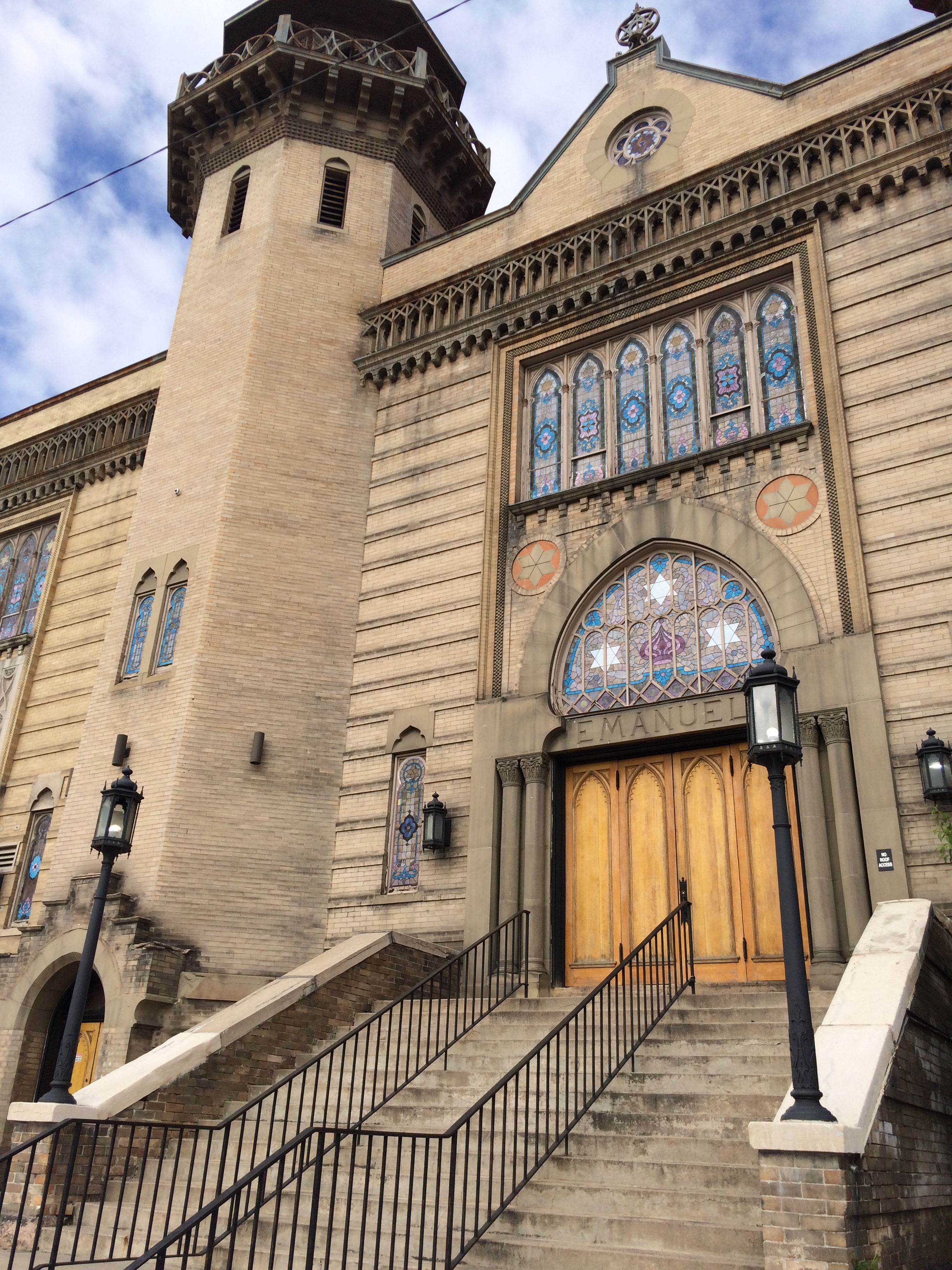
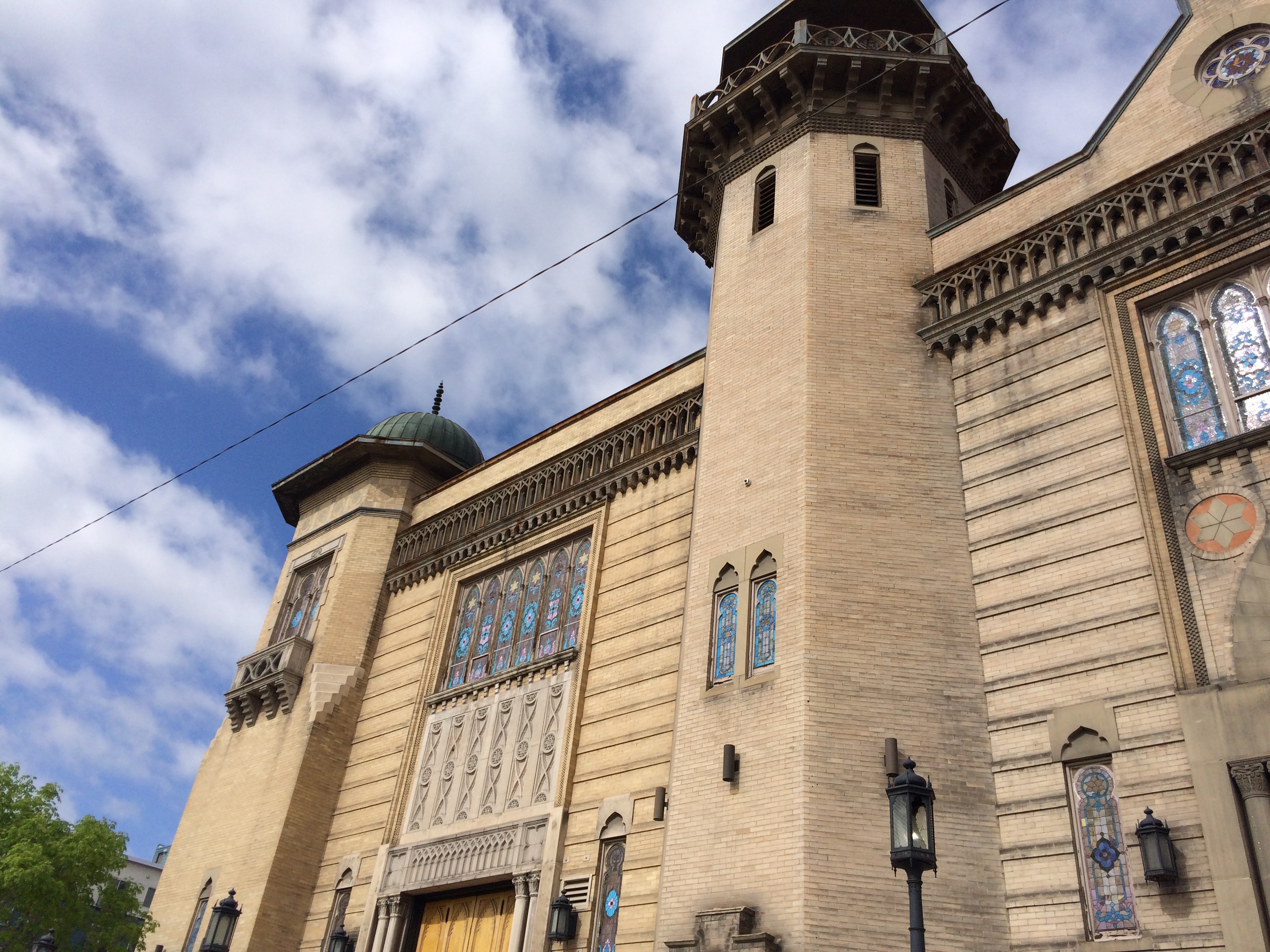
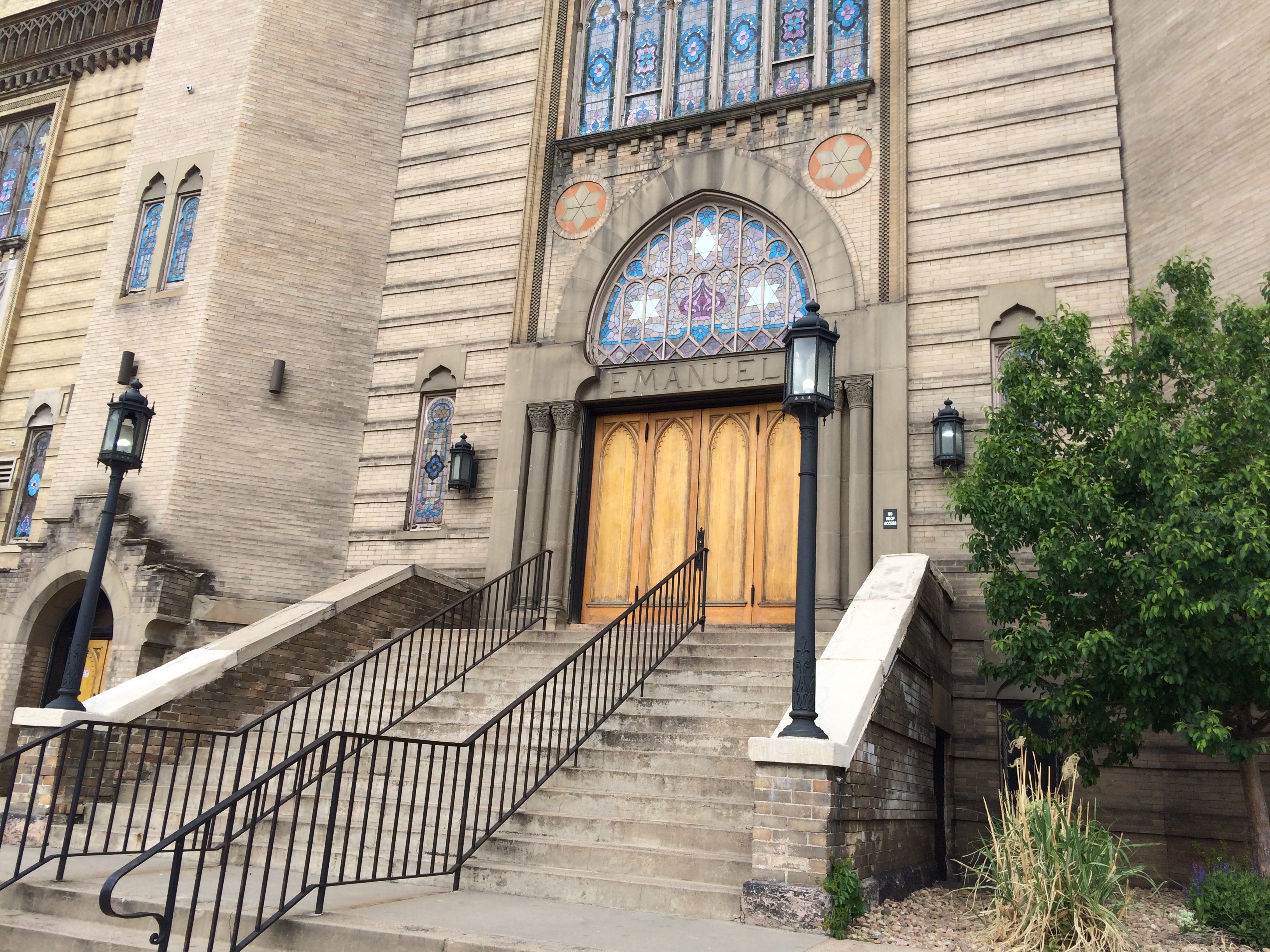
When my great-grandparents were living in Denver, they belonged to Temple Emanuel, where my grandmother and two of her brothers were confirmed. Temple Emanuel was then located on 16th Avenue and Pearl Street, a location about a fifteen minute walk from our hotel.  The building is still there, and it is beautiful. Although the Pearl Street building is now a church, the original building’s exterior has been preserved. (We did not see the interior.) The Star of David still appears in several places on the building, as does the name Emanuel, as you can see from these pictures.

20160524_151155406_iOS 20160524_151205779_iOS 20160524_151306771_iOS 20160524_151313831_iOS 20160524_151343268_iOS

Apparently the years that my family lived in Denver were years of growth for Emanuel as a substantial addition was built in the 1920s.  But after the war, the congregation left this downtown location and built a new building further out.

Before arriving in Denver, I had contacted Steve Stark, the current executive director at Temple Emanuel, to ask whether they would have any records or photographs from the era when my great-grandparents had been members.  He wrote back and told me that the confirmation class photographs from that time period were on the walls of the current building and that I was more than welcome to come to the building to see them.  So we drove out to Temple Emanuel’s current building after leaving downtown that morning.

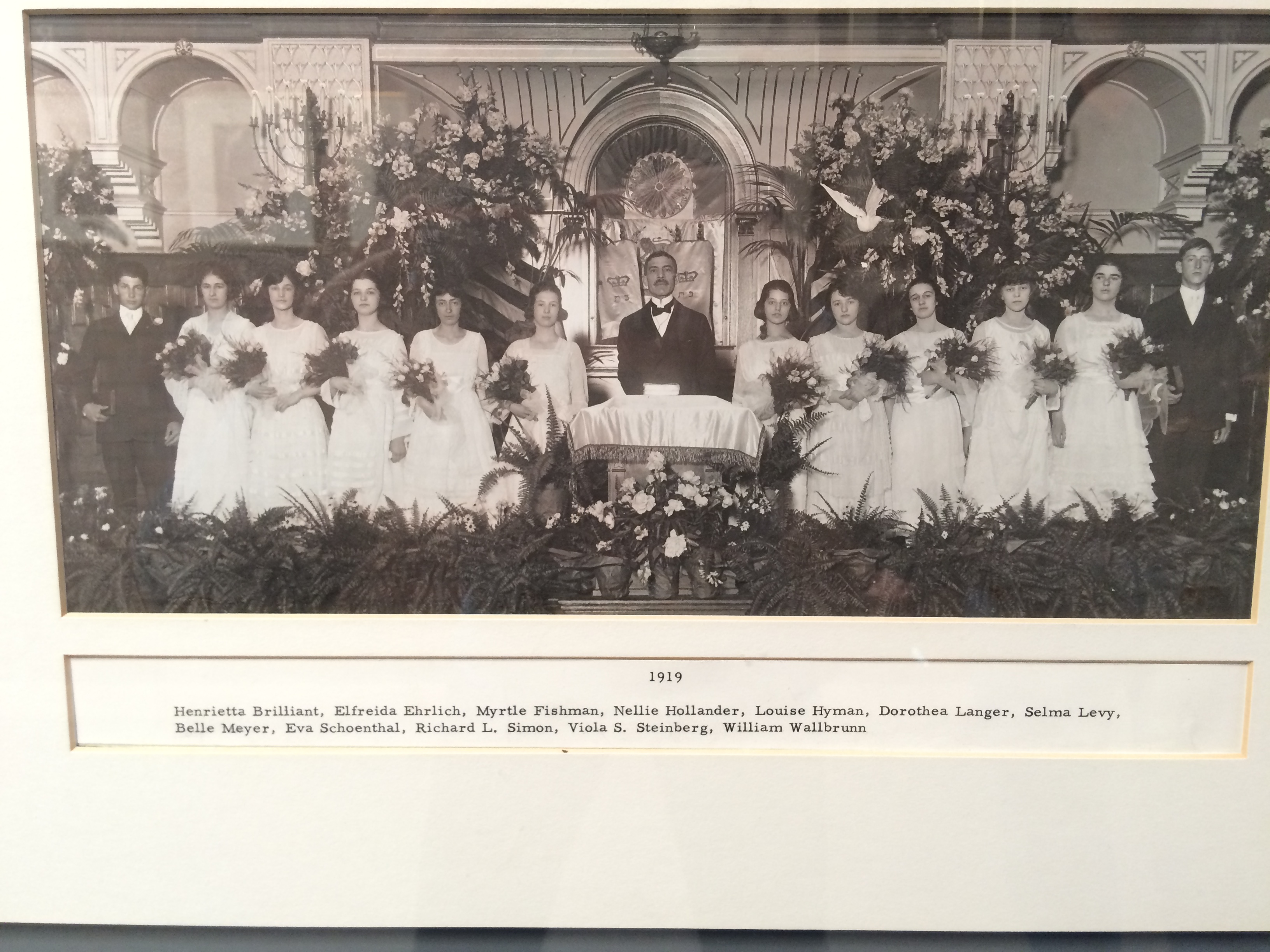
I was very excited when I was able to locate the photographs of the confirmation classes of three of Isidore and Hilda’s children: Gerson, class of 1908, Harold, class of 1916, and my grandmother Eva, class of 1919.  I was struck by how formal and how elegant they all look.  It’s hard to imagine a class of fifteen year olds looking like this today.

Temple Emanuel 1908 confirmation class with Gerson Schoenthal

Temple Emanuel 1908 confirmation class with Gerson Schoenthal

20160524_165822156_iOS

Temple Emanuel 1916 confirmation class with Harold Schoenthal


20160524_165743558_iOS

Temple Emanuel 1919 confirmation class with Eva Schoenthal

Although I was easily able to identify my grandmother in her class photograph, I will need to get my father’s help to pick out Harold and Gerson in their class pictures.

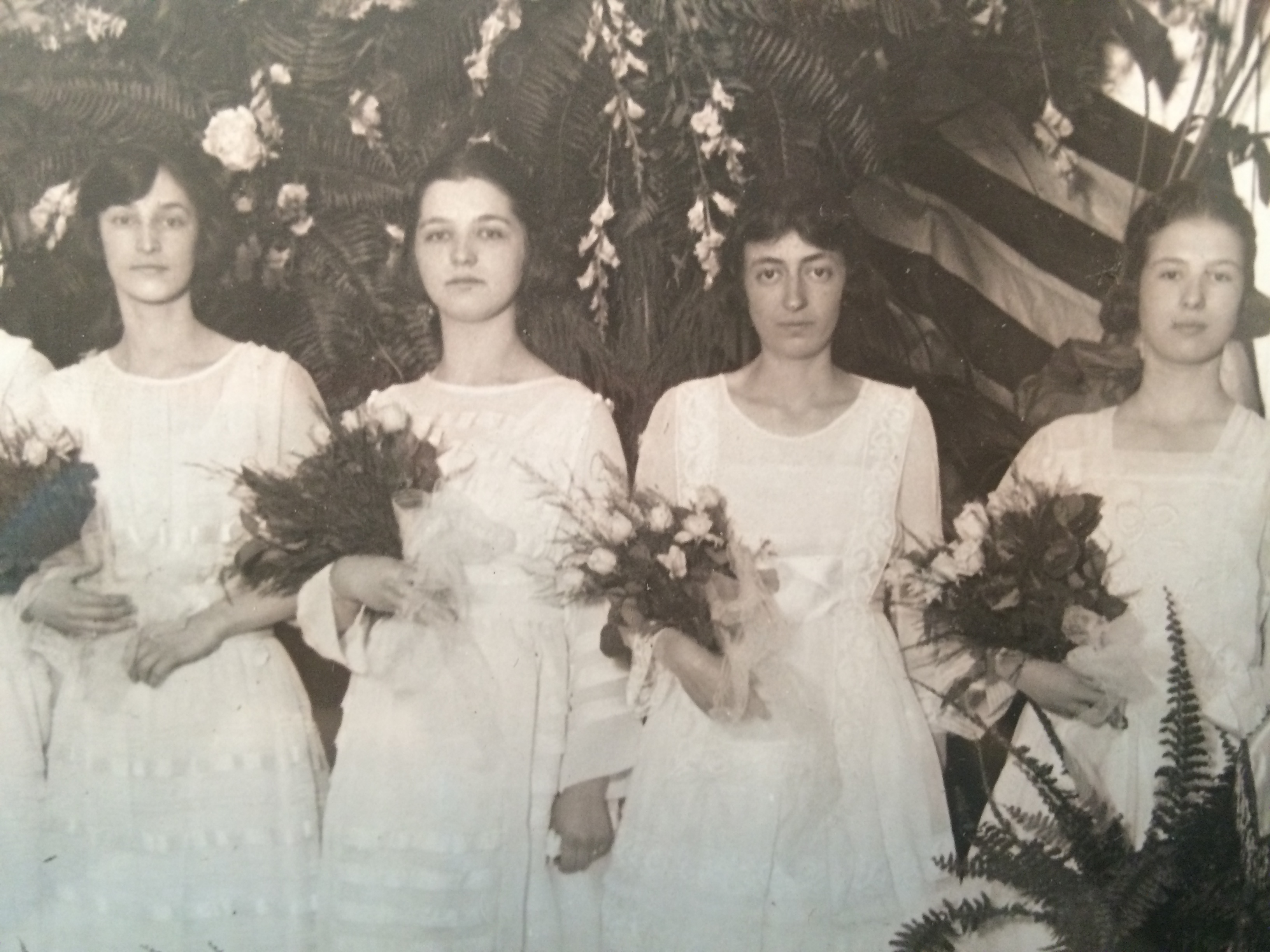
My grandmother Eva Schoenthal, second from left

My grandmother Eva Schoenthal, second from left

We then stopped by the Temple library to see if there were any other records from the early 20th century, but we learned that all records from that time period are archived in a separate storage facility.  However, Rita Dahlke, the assistant principal of the religious school and librarian at Emanuel, very generously gave me a copy of Temple Emanuel of Denver: A Centennial History by Marjorie Horbein (1971).  Although my family is not mentioned in the book, it does describe the years from 1900-1930 as years of significant growth for the congregation.

We also asked Rita about the history of their current building, which was built during the 1950s and officially opened in 1960.  I had seen a photograph of their sanctuary on their website and noted the similarity to the sanctuary of our synagogue, Temple Beth El in Springfield.  We were curious as to whether their building had also been designed by the noted synagogue architect, Percival Goodman, and Rita checked and confirmed that in fact their building was designed by Goodman.  She then took us into their sanctuary so that we could see it for ourselves.  The resemblance is striking.

Percival Goodman sanctuary, Temple Emanuel, Denver, Colorado

Percival Goodman sanctuary, Temple Emanuel, Denver, Colorado

Percival Goodman sanctuary, Temple Beth El, Springfield, Massachusetts

Percival Goodman sanctuary, Temple Beth El, Springfield, Massachusetts

It was a poignant moment for us as our current synagogue is considering changes to our sanctuary to accommodate today’s smaller crowds.  Temple Emanuel took a different path and built a separate smaller chapel in the late 1980s rather than compromise the beauty of Goodman’s design.

I also wanted to see if I could find any of the houses where my relatives had lived, but after checking, I realized that two no longer existed. The one closest to downtown must have been torn down when the Denver Performance Center was built, and the other address no longer has any structure on the site at all.

Then we found this lovely building at what I thought was 1550 Downing Street, the address listed as my great-grandparents’ residence in the 1908 Denver directory.  I got out of the car and took a lot of pictures of this building, thinking that this was my grandmother’s home in 1908. Here are two of them:

20160524_163424642_iOS 20160524_163441694_iOS

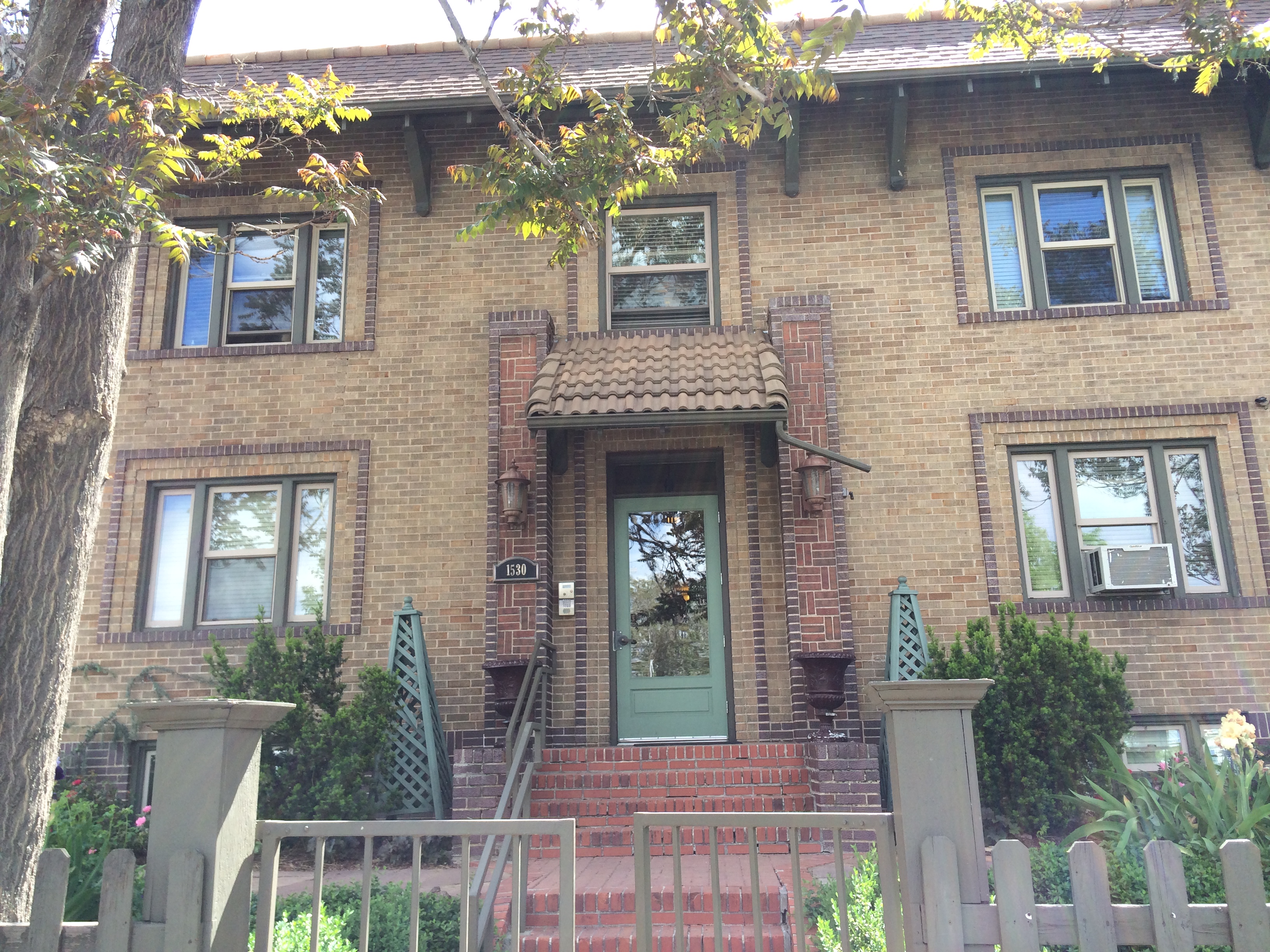
But I wasn’t sure when the building was built, so in writing this post, I googled 1550 Downing Street to see if I could find that information.  But Google kept showing me a very different house.  I was confused.  So I looked more closely at the house I’d photographed.  You can see that I took pictures of 1530, not 1550.  SIGH.

20160524_163442901_iOS

Here, however, courtesy of the internet, is a photo of 1550.  According to Zillow, it was built in 1888 and sold in March, 2016, for $798, 200.  It appears to have been totally gutted and renovated, and probably the only thing left from the time my grandmother lived there is the claw-footed tub.  You can see more pictures here.

1550 Downing Street better


Our visit to Denver was a touching one—to be able to see the building where my grandmother had been confirmed and acted in plays for the Jewish holidays, to see her photograph on the walls of the new building, to pass the addresses where she and her family once lived.  In my head I could envision my great-grandparents and their four children living in this place a century ago.

Below is an interactive map showing the places where my family lived in Denver and the location of their synagogue.  Click on the red balloons to see more about the location.

In a recent conversation with my father about his mother, he commented that I had presented only a partial representation of her in my writing about her.  In my limited times with her when I was child (she died when I was ten), she had seemed quiet and fragile and somewhat withdrawn.  But my father pointed out that in her youth, she had been very outgoing—someone who had performed in plays both at temple and at her high school.  He described her as very social—someone who had many boyfriends after my grandfather died; she also worked outside the home to support my father and my aunt once she was able to care for them again, working in the china business, making lampshades, and doing drafting for the military during the war.

Grandma Eva 1915 Denver Post photo

Eva Schoenthal, top left, 1915

Eva Schoenthal high school yearbook picture

Eva Schoenthal high school yearbook picture, 1922

John and Eva Cohen c. 1930

John and Eva (Schoenthal) Cohen

Hilda (Katzenstein) Schoenthal, Eva Schoenthal Cohen, Eva Hilda Cohen, and Harold Schoenthal

Hilda (Katzenstein) Schoenthal, Eva Schoenthal Cohen, Eva Hilda Cohen, and Harold Schoenthal

And although I had thought that her parents had moved to Philadelphia to help her care for my father and aunt, in fact the opposite was true.  They moved to Philadelphia so that she could care for them, as they both had become quite ill and needed help in their daily lives.  They moved next door so that she could cook and care for them.   My grandmother was not a timid or weak person, but a woman who had survived the tragic illness of her husband and her own troubles to come back to take care of others.

Fortunately, my father shared these thoughts with me before my trip out west, and so as I walked the streets of Denver, I imagined my grandmother not as I knew her in the later years of her life, but as a young, vibrant, beautiful and happy little girl and young woman, surrounded by her parents and three older brothers, performing on the stage, and actively participating in her school activities.  I am so glad that my father corrected my impressions of her and thus allowed me to envision her childhood in a more positive way.


From Orphan to Pharmacist and Then?

In two recent posts I shared the sad story of Charles Hamberg and his life in Columbia, South Carolina, which ended with his suicide in 1879.  His son Samuel was only eleven when his father died.  Samuel’s mother Lena had died two years earlier.  Charles’ cousin Amalia Hamberg administered his estate, and then somehow Charles’ son Samuel came to live in western Pennsylvania where he was adopted by his second cousin, my great-grandfather’s brother, Henry Schoenthal.
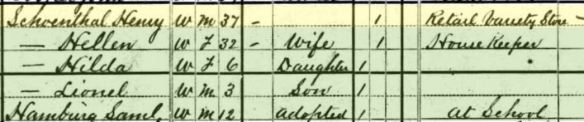
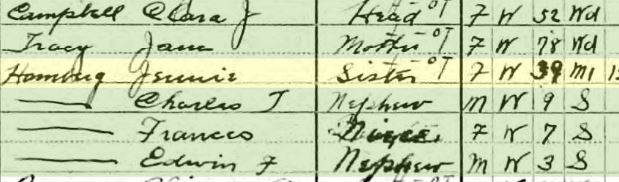
Henry Schoenthal and family 1880 census Year: 1880; Census Place: Washington, Washington, Pennsylvania; Roll: 1202; Family History Film: 1255202; Page: 596A; Enumeration District: 271

Henry Schoenthal and family 1880 census
Year: 1880; Census Place: Washington, Washington, Pennsylvania; Roll: 1202; Family History Film: 1255202; Page: 596A; Enumeration District: 271


In 1886 when Samuel was then eighteen years old, he was working as a clerk at 5 East Beau Street in Washington and living at the corner of Beau and Lincoln in that town, according to the 1886 directory for Washington, Pennsylvania.  According to that same source, my great-grandfather Isidore Schoenthal, who had arrived in Washington in 1881, was living at 203 East Beau Street that same year; looking at Google Maps, I see that 203 East Beau Street is located at the corner of Lincoln and Beau.

[Thanks to Lara of Lara’s Jewnealogy, I now know how to use Google Maps more effectively.  See her great post here.]

Thus, Samuel Hamberg was probably living with my great-grandfather.  I imagine that they lived and maybe even worked together, my great-grandfather watching over his younger second cousin.  Perhaps Samuel helped my great-grandfather learn English and adjust to American ways.

By 1889, Samuel, now 21 years old, had moved to Philadelphia.  He is listed in the directory for that year as Samuel T. Hamberg, a manager, residing at “134 E. Orthodox, FKD.”  FKD stands for Frankford, a neighborhood in northeast Philadelphia about six miles from the center of the city.  I wondered what had taken him there.

It took me a very long time to find out, but when I finally decided, after exhausting traditional genealogy sources, to Google “Samuel T. Hamberg” as a last ditch effort to learn more, I found these two entries in Google Books:

P.W. Bedford, Pharmaceutical Record and Weekly Market Review, Volume 10, April 21, 1890, p. 163, found here (list of graduates of the Philadelphia College of Pharmacy).

26th Annual Report of the Alumni Association of the Philadelphia College of Pharmacy (1890), found here.

Class of 1890, Philadelphia College of Pharmacy Alumni Association Report, p. 194

Class of 1890, Philadelphia College of Pharmacy
Alumni Association Report, p. 194

Samuel T. Hamberg, the boy who had lost both his parents before his twelfth birthday, had graduated from the four-year program at the Philadelphia College of Pharmacy in 1890 when he was 22 years old. The Philadelphia College of Pharmacy was the first pharmacy school in the United States and still exists today.

Not only had Samuel graduated from this prestigious institution, but a further search into both of the above sources revealed that his middle name was Tilden,[1] that he had written his thesis on nitroglycerin, that he had played the guitar to open the commencement exercises as part of a musical ensemble (perhaps his musical adoptive brother Lionel Schoenthal with whom he’d lived in Washington had given him music lessons), and that he had been selected to be the Class Poet.  The poem he read at the school’s commencement exercises in 1890 is filled with references to professors and specific memories of the school years, but this particular verse seemed a more personal statement:

Sorrows and losses may be borne,

Be baffled and dismayed,

Feel the sharp pang of many a thorn

By our own follies made.

But hope and effort may improve

And help us to thankful be,

It surely did in this case

It helped us—in a degree.

(Samuel Tilden Hamberg, 1890, as published in the Alumni Report, cited above, p.124.)

Samuel Tilden Hamberg certainly had suffered sorrows and losses, though not by his “own follies made.”  But it seems with the love of his family in Washington, Pennsylvania, he had in fact borne those sorrows and losses and succeeded in coming through them as a grateful and successful young man.

Philadelphia College of Pharmacy See page for author [CC BY 4.0 (http://creativecommons.org/licenses/by/4.0)], via Wikimedia Commons

Philadelphia College of Pharmacy
See page for author [CC BY 4.0 (http://creativecommons.org/licenses/by/4.0)%5D, via Wikimedia Commons

Samuel stayed on in Philadelphia after graduating. In the 1892 directory for Philadelphia, Samuel T. Hamberg is listed as a clerk, living now at 6933 Hagerman Avenue.  Two years later in 1894 he lists his occupation as druggist, living at 824 Somerset.  In 1895 and 1896 there are numerous advertisements listing Samuel T. Hamberg as a pharmacist in the Philadelphia Inquirer.

Samuel T. Hamberg married Jane E. Tracey on November 20, 1898, at the Zion Episcopal Church in Philadelphia.  At the time they married, Samuel had been residing in Camden, New Jersey, according to the marriage record.  His wife had been living in Philadelphia where she was born in December, 1869.  Jane, or Jennie as she was generally identified on most records, was the daughter of Edwin Tracey (often spelled Tracy) and Jane Irwin.  Edwin was a Philadelphia native and a shoemaker according to the 1880 census; his wife Jane was born in Ireland.  Jennie was the seventh of nine children.

Marriage record of Samuel Hamberg and Jane Tracey November 20, 1898, Zion Protestant Episcopal Church, Philadelphia Historical Society of Pennsylvania; Philadelphia, Pennsylvania; Collection Name: Historic Pennsylvania Church and Town Records; Reel: 978

Marriage record of Samuel Hamberg and Jane Tracey November 20, 1898, Zion Protestant Episcopal Church, Philadelphia
Historical Society of Pennsylvania; Philadelphia, Pennsylvania; Collection Name: Historic Pennsylvania Church and Town Records; Reel: 978


In 1900, Samuel and Jennie were living in Philadelphia in the household of Jennie’s brother Albert Tracy along with Jennie’s mother Jane and her three sisters.  Samuel was working as a hospital supplies salesman.  I know this is the correct Samuel Hamberg because his birth place is given as South Carolina, his father’s as Germany, his mother’s as South Carolina.  (I found it interesting that Samuel reported the birth places of his birth parents, Charles and Lena, not those of his adoptive parents.)

Samuel Hamberg 1900 census Year: 1900; Census Place: Philadelphia Ward 29, Philadelphia, Pennsylvania; Roll: 1472; Page: 12A; Enumeration District: 0748; FHL microfilm: 1241472

Samuel Hamberg 1900 census
Year: 1900; Census Place: Philadelphia Ward 29, Philadelphia, Pennsylvania; Roll: 1472; Page: 12A; Enumeration District: 0748; FHL microfilm: 1241472


On September 4, 1900, Samuel and Jennie had their first child, a son named Charles, presumably named for Samuel’s father Charles.

The family must have soon thereafter moved to Camden, New Jersey, for Samuel is listed as a salesman in the 1901 Camden directory.  Samuel and Jennie are also listed in the 1902 and 1903 Camden directories at 3010 Westfield Street; Samuel is still listed as a salesman.  A second child was born that year, Frances D. Hamberg, born in January, 1903, in New Jersey.  Samuel and Jennie were still living at the same address in 1904 and in 1905.

Then things start getting a little confusing.  In 1906 Samuel T. Hamberg is listed in the Philadelphia directory as a salesman residing at 27 North 60th Street in that city.  There is no listing for him in the Camden directory for that year.  But the following year Samuel is listed as a salesman in the Camden directory, residing at 126 Dudley Street.  Then in 1908, the listing is only in Jennie’s name—Jennie Hamberg at 126 Dudley Street.

Meanwhile in October 1907, a third child had been born to Samuel and Jennie—Edwin F. Hamberg.  Had Samuel and Jennie separated in 1906, reconciled and had a third child in 1907, and then separated again in 1908? Jennie is again listed alone at 126 Dudley in Camden in 1909, this time with an occupation, dressmaker.

But where was Samuel in 1908 and 1909? He is not listed in the Camden directory.  There are two Samuel Hambergs listed in Philadelphia in 1909, but they are father and son and listed as pawnbrokers, so neither of them seems to be the right Samuel.  There are no Samuel Hambergs listed in the directories for those years for Pittsburgh or Washington, Pennsylvania, or Baltimore.

In 1910, Samuel reappears on the 1910 census in Baltimore, Maryland, living as a boarder and working as a pharmacist in a drugstore.  I know this is my Samuel because he is Samuel T. Hamberg, born in South Carolina, father born in Germany, mother in South Carolina.  But why is he in Baltimore?  He is still listing himself as married, so maybe he went to Baltimore to find work.   Since he had been working as a salesman while living in Camden, maybe he wanted to return to being a regular pharmacist.
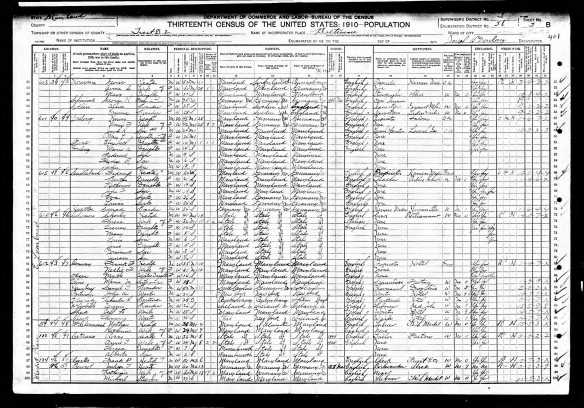
Samuel Hamberg 1910 census Year: 1910; Census Place: Baltimore Ward 4, Baltimore (Independent City), Maryland; Roll: T624_553; Page: 3B; Enumeration District: 0036; FHL microfilm: 1374566

Samuel Hamberg 1910 census Line 85
Year: 1910; Census Place: Baltimore Ward 4, Baltimore (Independent City), Maryland; Roll: T624_553; Page: 3B; Enumeration District: 0036; FHL microfilm: 1374566

Jennie and the three children were still living at 126 Dudley in Camden in 1910.  According to the census, they were living with Jennie’s sister Clara Campbell and her mother Jane Tracy.  Like Samuel, Jennie still reported herself as married.  Although Jennie reported no occupation on the 1910 census, the 1910 and 1911 Camden directories list her as a dressmaker.
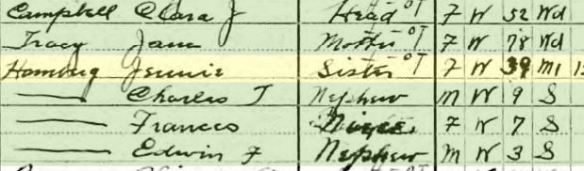
Jennie Hamberg and children 1910 census Year: 1910; Census Place: Camden Ward 12, Camden, New Jersey; Roll: T624_874; Page: 13A; Enumeration District: 0080; FHL microfilm: 1374887

Jennie Hamberg and children 1910 census
Year: 1910; Census Place: Camden Ward 12, Camden, New Jersey; Roll: T624_874; Page: 13A; Enumeration District: 0080; FHL microfilm: 1374887


Samuel is listed in the 1911 Baltimore directory, but then he again disappears.  I couldn’t find him in any newspaper article or any directory after 1911 during the decade of the 1910s.

Jennie, however, continued to be listed in the Camden directories from 1910 through 1916.  In 1915, she and her children are listed on the New Jersey census, once again living with her sister Clara and her mother Jane; Samuel is not part of their household.

Jennie Tracey Hamberg died from heart disease on March 4, 1917.  She was only 47 years old, and she left behind three children.  Charles was not yet sixteen, Frances not yet fourteen, and Edwin not yet ten years old.  Like their father Samuel, they lost their mother at a young age.
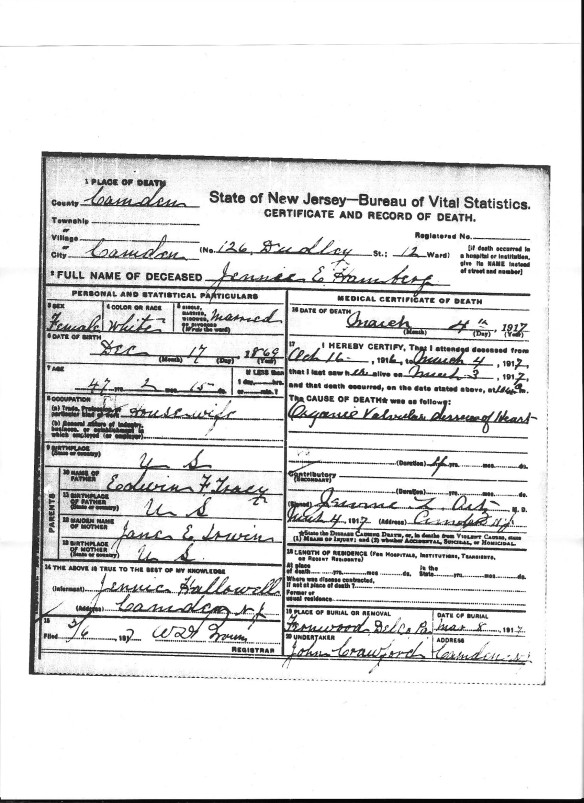
Jennie Tracey Hamberg death certificate

Jennie Hamberg burial record Fernwood Cemetery, Yeardon, PA Historical Society of Pennsylvania; Philadelphia, Pennsylvania; Collection Name: Historic Pennsylvania Church and Town Records

Jennie Hamberg burial record
Fernwood Cemetery, Yeardon, PA
Historical Society of Pennsylvania; Philadelphia, Pennsylvania; Collection Name: Historic Pennsylvania Church and Town Records

So where was their father? I could not find him on the 1920 census or anywhere during the 1920s until I searched for “Samuel T. Hamberg” in Google.  And along with the links noted above relating to his education as a pharmacist, I found several links indicating that in 1920 Samuel was in Pittsburgh working for the state of Pennsylvania as a temporary investigator doing fair price work.  Even knowing this additional information, I could not locate Samuel on the 1920 census or in any directory in the 1920s.
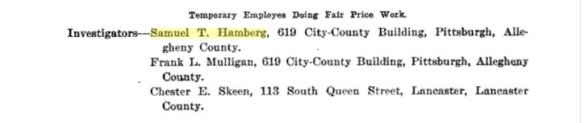
Samuel Hamberg investigator 1920

Herman P. Miller, Snull’s Legislative Handbook and Manual of the State of Pennsylvania, 1920, p. 144, found here.

But Samuel T. Hamberg does reappear on the 1930 census.  He is listed as Sam T. Hamberg, 62 years old (the correct age), married at age 30 (the correct age), widowed (Jennie was dead), born in South Carolina, father born in Germany, mother in South Carolina (all correct).  Clearly this is the right person.  He was now living in Philadelphia, working as a novelty salesman, and living with his “sister” Cecelia Link. What had happened to his pharmacy career? His work as a state investigator? And who was Cecelia Link?

Samuel Hamberg 1930 census Year: 1930; Census Place: Philadelphia, Philadelphia, Pennsylvania; Roll: 2125; Page: 14A; Enumeration District: 0777; Image: 969.0; FHL microfilm: 2341859

Samuel Hamberg 1930 census
Year: 1930; Census Place: Philadelphia, Philadelphia, Pennsylvania; Roll: 2125; Page: 14A; Enumeration District: 0777; Image: 969.0; FHL microfilm: 2341859

Samuel did not have any sisters except for his adoptive sister Hilda Schoenthal, the daughter of Henry Schoenthal.  Cecelia was twenty years younger than Samuel, according to the 1930 census, born in Pennsylvania, single, and working as a telephone operator.  Cecelia answered the enumerator’s questions as indicated by the H on the line where her name is. Who was she, and why was she living with Samuel?

I found a Celia Link living with her mother and two sisters (and a brother-in-law) in Pittsburgh on the 1920 census.  Celia was forty years old, single, and working as a telephone operator.  It seemed like an unlikely coincidence that there were two women with just about the same name, both born in Pennsylvania, and both working as telephone operators.  (Remember that Samuel was living in Pittsburgh in 1920.)

So I looked for more about this Celia Link.  The 1916 Pittsburgh directory had her listed as Cecelia Link working as a telephone operator, so now we had the exact same name.  The 1910 census has her again as Celia, living with her parents, working as a telephone operator, and 33 years old.  Going back yet another ten years, the 1900 census lists her as Cecilia, age 22, with a birth date of March 1878, and no occupation.

Then I found her death certificate.  Cecelia Link died of chronic myocarditis on May 6, 1934, at “abt age 48,” according to her sister, the informant.  Assuming that Cecelia was 22 in 1900, she would have been 56 in 1934.  Even in 1920, she reported to be 40, making her 54 in 1934.  She was therefore only about ten years younger than Samuel, not twenty.  Note also that she was born in Washington, Pennsylvania.

Cecilia Link death certificate Ancestry.com. Pennsylvania, Death Certificates, 1906-1963 [database on-line]. Provo, UT, USA: Ancestry.com Operations, Inc., 2014. Original data: Pennsylvania (State). Death certificates, 1906–1963. Series 11.90 (1,905 cartons). Records of the Pennsylvania Department of Health, Record Group 11. Pennsylvania Historical and Museum Commission, Harrisburg, Pennsylvania.

Cecilia Link death certificate
Ancestry.com. Pennsylvania, Death Certificates, 1906-1963 [database on-line]. Provo, UT, USA: Ancestry.com Operations, Inc., 2014.
Original data: Pennsylvania (State). Death certificates, 1906–1963. Series 11.90 (1,905 cartons). Records of the Pennsylvania Department of Health, Record Group 11. Pennsylvania Historical and Museum Commission, Harrisburg, Pennsylvania.

I assume that Samuel met Cecelia when he was working in Pittsburgh as an investigator. And that they were more than “brother and sister.”  I think Cecelia lied both about her age and her relationship to Charles.

But Cecelia died in 1934 back in Pittsburgh.  What happened to Samuel before and after her death? And where were his children?

More questions to answer.


[1] There is no earlier indication that Samuel’s middle name was Tilden.  Did he adopt this middle name himself? In 1868 when Samuel Hamberg was born in Columbia, South Carolina, Samuel Tilden was probably not a nationally known figure.  He was from New York State and a supporter of the Union during the Civil War.  After the war he was active in reforming the Democratic party.  Would Charles Hamberg have known of him and named his son for him? Unlikely.

But Samuel Tilden was the Democratic party’s nominee in the 1876 Presidential election; the results of the election were disputed when several states turned into multiple sets of return.  The Presidency was determined by a partisan commission established by Congress, and Tilden lost to Rutherford B. Hayes, even though he had won the popular vote.  I think it is more likely that Samuel Hamberg adopted Tilden’s name as his middle name sometime as a young adult after Tilden was more of a household name.  Tilden died in 1886, and the first use I’ve seen of the middle initial T by Samuel Hamberg was while he was in pharmacy school in the late 1880s.  For more on Samuel Tilden, see here and here and here.

Yom Hashoah—Holocaust Remembrance Day

Today is Yom Hashoah, Holocaust Remembrance Day, a day to remember all those who were killed during the Holocaust.

As a result of my genealogy work, I have learned in the last few years that there were many members of my extended family who were victims of the Nazis.  I had always assumed that all my relatives had left Europe before Hitler came to power—long before he came to power.  So learning about the many members of the Seligmann family who were killed and then more recently about the many members of the Schoenthal and Hamberg families who were killed has been very painful.

The Holocaust touched us all, whether we know it or not, whether we are Jewish or not. Our world lost millions of people.  As each generation learns how cruel and inhumane other people can be, there is once again a loss of innocence.  I dread the day when my grandsons also have to learn this horrible truth.

English: A lit Yom Hashoah candle in a dark ro...

English: A lit Yom Hashoah candle in a dark room on Yom Hashoah (Photo credit: Wikipedia)

Last spring I visited the camps at Terezin and Auschwitz.  I carried with me a list of the names of my relatives who had died at each of the camps so that I could honor their memories.

That list has grown since last spring.  One of the most recent names I’ve had to add to the list of those who died at Auschwitz was Liesel Mosbach Lion, granddaughter of Rosalie Schoenthal Heymann, my great-grandfather’s sister.  Liesel was my father’s second cousin.

I recently posted about Liesel and her family and what happened to them.  Most of what I knew came from the memoir written by Liesel’s husband Ernst Georg Lion, The Fountain at the Crossroads.  I was so moved by his book that I have decided to see whether there is a way to get it published in a format where it will be accessible to more people.  I am now in touch with Ernst’s son Tom.  He sent me photographs of Ernst and his family, including my cousin Liesel.  With his permission, I am posting a few of them here to honor their memory this Yom Hashoah.

The first three are of Ernst’s parents, Leo and Bertha (Weinberg) Lion.  Bertha died from the stress caused by the Nazi treatment of Jews during the 1930s.  Leo was killed in one of the camps.

Ernst Lion parents 1 Ernst Lion father

Ernst Lion parents 2

This is the last photograph taken of Leo Lion before he was arrested and sent to a concentration camp.

Ernst Lion father 2

On the left below is my cousin Liesel Mosbach Lion; she was killed at Auschwitz.  On the right is the wedding picture of Liesel and Ernst, December 18, 1939.

Liesel, her sister Grete, both of her parents, Helene Heymann Mosbach and Julius Mosbach, and her aunt Hilda Heymann were all killed during the Holocaust. Her grandfather Willy Heymann was arrested and taken to Dachau and died soon after being released.

They were all my cousins.

Liesel Mosbach Lion alone and in wedding picture with Ernst

These are various photographs of Ernst from childhood through the war years and afterwards in the US.  His story of suffering and survival is unforgettable.

pictures of Ernst Lion

We live in a time when once again hatred and fear permeate our world and demagogues are seeking power.  We must be vigilant and remember what happened then.  We must do all we can to ensure that genocide does not occur again anywhere.

We must never forget.  Never again.

The Tragic Story of Charles Hamberg: Gun Violence in South Carolina

Last week I wrote about Samuel Hamberg, the twelve year old boy who appeared in the household of my great-great-uncle Henry Schoenthal in 1880 as his adopted son.  As I described in that post, I had determined that Samuel was the son of Charles Hamberg of Columbia, South Carolina; he appeared on the 1870 census living in Charles Hamberg’s household along with a woman named Tenah Hamberg and a servant also with the first name Tenah.

Through my research, I concluded that Charles Hamberg was in fact born Baruch Hamberg, the son of the first Samuel Hamberg, my great-great-grandmother Henriette Hamberg Schoenthal’s uncle, her father’s younger brother.

Relationship of Henrietta Hamberg and Charles Hamberg

Baruch had left Breuna, Germany, in 1852, with his first cousin Abraham, who died in Savannah, George, in 1854.  Baruch, I postulated, became Charles and had married a woman named Mary E. Hanchey in New Hanover, North Carolina, in March, 1853.

Charles Hamberg and Mary Hanchey marriage record 1853 Ancestry.com. North Carolina, Marriage Records, 1741-2011 [database on-line]. Provo, UT, USA: Ancestry.com Operations, Inc., 2015. Original data: North Carolina County Registers of Deeds. Microfilm. Record Group 048. North Carolina State Archives, Raleigh, NC.

Charles Hamberg and Mary Hanchey marriage record 1853
Ancestry.com. North Carolina, Marriage Records, 1741-2011 [database on-line]. Provo, UT, USA: Ancestry.com Operations, Inc., 2015.
Original data: North Carolina County Registers of Deeds. Microfilm. Record Group 048. North Carolina State Archives, Raleigh, NC.

But why did Samuel end up with my great-great-uncle Henry in Washington, Pennsylvania, in 1880? What had happened to his father? His mother? And who was his mother? Was it Mary Hanchey, the woman Charles married in 1853 and with whom he was living in 1860? Or was it “Tenah,” the woman he was living with in 1870?

First, I focused on Mary, the first wife.  Searching on Ancestry, I found this entry:

Record of Deaths in Columbia South Carolina page 80 [p.80] Mrs. Mary A. Hamberg , wife of Charles Hamberg died in Col’a So. Ca. Novr 18, 1866, having been shot [page 166] by a man, Toland A. Bass, a few days previous.

Unfortunately, the database had no further information about this terrible incident, but I was determined to learn more about Mary’s death.  Was it accidental? A murder? What happened to Toland Bass?

After much searching, I found this article from the November 20, 1866 issue of The Daily Phoenix, the Columbia, South Carolina, daily paper (p. 2):

Daily Phoenix article 11 20 1866 p 2


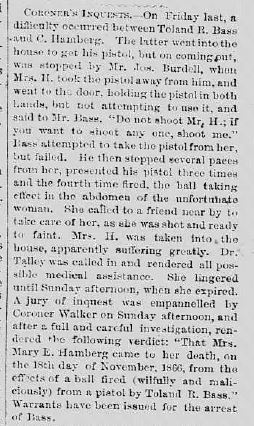
Coroner’s Inquests.—On Friday last, a difficulty occurred between Toland R. Bass and C. Hamberg.  The latter went into the house to get his pistol, but on coming out, was stopped by Mr. Jos. Burdell, when Mrs. H. took the pistol away from him and went to the door, holding the pistol in both hands, but not attempting to use it, and said to Mr. Bass, “Do not shoot Mr. H.; if you want to shoot any one, shoot me.”  Bass attempted to take the pistol from her, but failed.  He then stepped several paces from her, presented his pistol three times and the fourth time fired, the ball taking effect in the abdomen of the unfortunate woman. 

She called to a friend near by to take care of her, as she was shot and ready to faint.  Mrs. H. was taken into the house apparently suffering greatly.  Dr. Talley was called in and rendered all possible medical assistance.  She lingered until Sunday afternoon, when she expired.  A jury of inquest was empannelled by Coroner Walker on Sunday afternoon, and after a full and careful investigation, rendered the following verdict: “That Mrs. Mary E. Hamberg came to her death, on the 18th of November, 1866, from the effects of a ball fired (willfully and maliciously) from a pistol by Toland R. Bass.” Warrants have been issued for the arrest of Bass.

Who was Toland Bass, and why did he kill Mary Hanchey Hamberg? Why did Mary suggest that he should shoot her, not her husband?

The only thing I could find about Mr. Bass was that he served as a private in the Confederate Army during the Civil War in Company H of the South Carolina Cavalry Regiment.


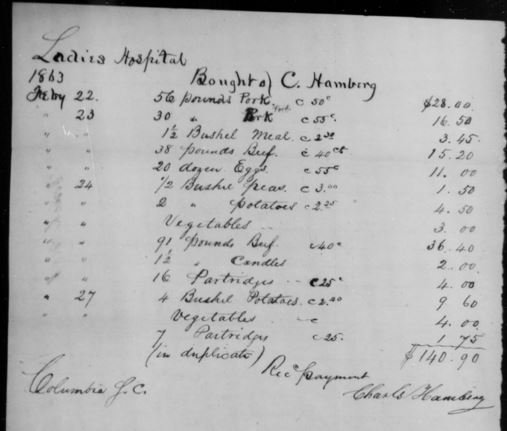
Charles Hamberg, on the other hand, appears to have been a private citizen in Columbia, South Carolina, during the Civil War, selling provisions to the Ladies Hospital.  Here is an example of an invoice he submitted:

Page 15 Confederate Citizens File - Fold3 https://www.fold3.com/image/31347220?xid=1945

Page 15 Confederate Citizens File – Fold3
https://www.fold3.com/image/31347220?xid=1945


I don’t know what might have precipitated this altercation between Bass and the Hambergs; all I can do is speculate.  Columbia, South Carolina, had suffered much damage during the Civil War.  The Union Army occupied the city during the last months of the war in 1865.  As described in Wikipedia:

On February 17, 1865, Columbia surrendered to Sherman, and Wade Hampton’s Confederate cavalry retreated from the city. Union forces were overwhelmed by throngs of liberated Federal prisoners and emancipated slaves. Many soldiers took advantage of ample supplies of liquor in the city and began to drink. Fires began in the city, and high winds spread the flames across a wide area. Most of the central city was destroyed, and municipal fire companies found it difficult to operate in conjunction with the invading army, many of whom were also fighting the fire. The burning of Columbia has engendered controversy ever since, with some claiming the fires were accidental, a deliberate act of vengeance, or perhaps set by retreating Confederate soldiers who lit cotton bales while leaving town. On that same day, the Confederates evacuated Charleston. On February 18, Sherman’s forces destroyed virtually anything of military value in Columbia, including railroad depots, warehouses, arsenals, and machine shops.

English: The Burning of Columbia, South Caroli...

English: The Burning of Columbia, South Carolina, February 17, 1865 (Photo credit: Wikipedia)

You can read more about the Columbia fires here and here.  In the aftermath of the war and during Reconstruction, places like Columbia struggled to rebuild their economy and their infrastructure.  There was widespread poverty.  Perhaps Toland Bass was an embittered Southern veteran; perhaps he resented Charles Hamberg as a merchant who not only didn’t serve in the war but made money during it.  Or maybe it is something much more personal that created the animosity that led to the gruesome murder of Mary Hanchey Hamberg. I don’t know.

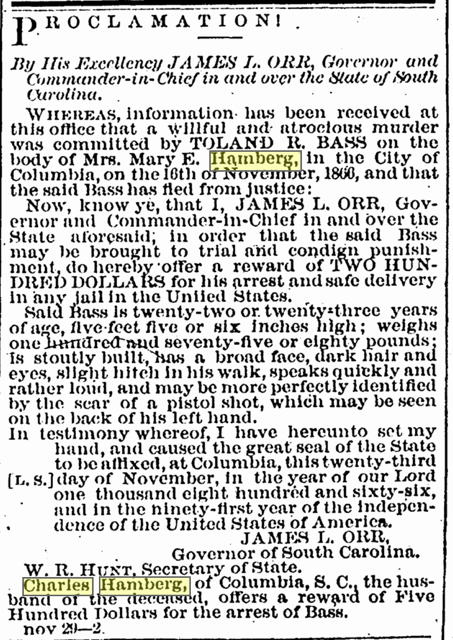
After the murder, Toland Bass ran off to avoid arrest, and the governor of South Carolina, James L. Orr, issued a proclamation offering an award of $200 for his arrest and delivery to South Carolina for trial. Charles Hamberg offered a separate award of $500 for his arrest. (Thank you to Ann Meddin Hellman of the Jewish Historical Society of South Carolina for helping me locate some of these articles

Proclamation about Mary Hamberg's murder

Thursday, November 29, 1866 Paper: (Charleston, South Carolina)


Bass eluded arrest for four months until he was finally found and arrested in New York in March, 1867.

Arrest of Toland Bass


I could not find any record of a trial or any other proceeding involving Bass, but I did find this news item announcing his death from cholera on July 15, 1867.

Death of Toland R Bass


Meanwhile, Charles Hamberg had moved on.  Thanks to my blogging friend Cathy Meder-Dempsey, I know that Charles married Lena Goodman on April 6, 1867, in Charleston, South Carolina.

I believe that Lena was incorrectly entered as “Tenah” on the 1870 census and that she was the mother of Samuel Hamberg, the boy later adopted by Henry Schoenthal.  Although I do not have an exact birthdate for Samuel, the 1900 census reported that he was born in February 1868, that is, about eleven months after the marriage of Charles Hamberg and Lena Goodman.

Even after remarrying, Charles seemed to have troubles in Columbia.  In September, 1869, he was involved in another rather unpleasant altercation:

Charles Hamberg assault

There was also a dispute at his store:

CHarles Hamberg unruly customer

Charles also charged a police officer with inappropriate conduct (public drunkenness) and engaged in a citizen’s arrest.  He seemed to have a tendency to get involved in conflicts.

In the 1870s, Charles advertised his wood and coal business regularly in the Columbia newspaper, The Daily Phoenix.

Charles Hamberg coal


He also participated in a Purim celebration in Columbia, dressing up as Jocko the Ape.  (Purim is a Jewish holiday where children and adults dress up in costumes and celebrate the triumph of the Jews over the evildoer Haman who sought to kill the Jews in ancient Persia.)

The Daily Phoenix, March 26, 1872, p. 2

The Daily Phoenix, March 26, 1872, p. 2


So whatever his troubles, Charles seemed to be living a somewhat ordinary life in Columbia.

So what happened that caused little Samuel to be adopted by Henry Schoenthal? Tragically, both of Samuel’s parents died before 1880.  His mother Lena died in 1877 and is buried in the cemetery of the Columbia Hebrew Benevolent Society.  She was only 28 years old.  I’ve been unable to locate a death certificate or obituary yet, but will continue to look.  (I contacted the cemetery, but they did not have any further information.)

chbs1HambergLena

Headstone for Lena Hamberg at the Hebrew Benevolent Society cemetery in Columbia, SC http://jhssc.org/hebrew-benevolent-society-cemetery/


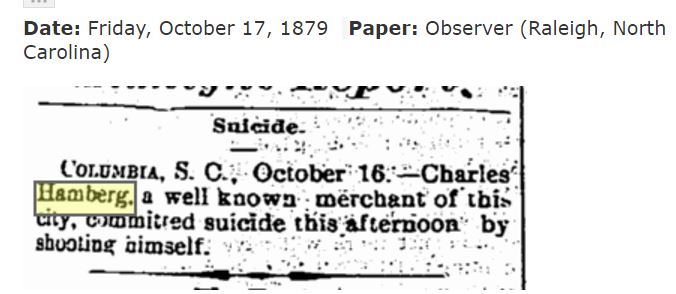
Two years later on October 16, 1879, Charles Hamberg ended his own life, apparently due to financial difficulties, although I would venture that having had one wife murdered and a second dying at a very young age might also have given him sufficient reason for some desperation.  His suicide made the papers even beyond Columbia.

Charles Hamberg suicide Charles Hamberg suicide 3 Charles Hamberg suicide 2


Can you imagine today identifying someone by their religious background for no apparently relevant reason?

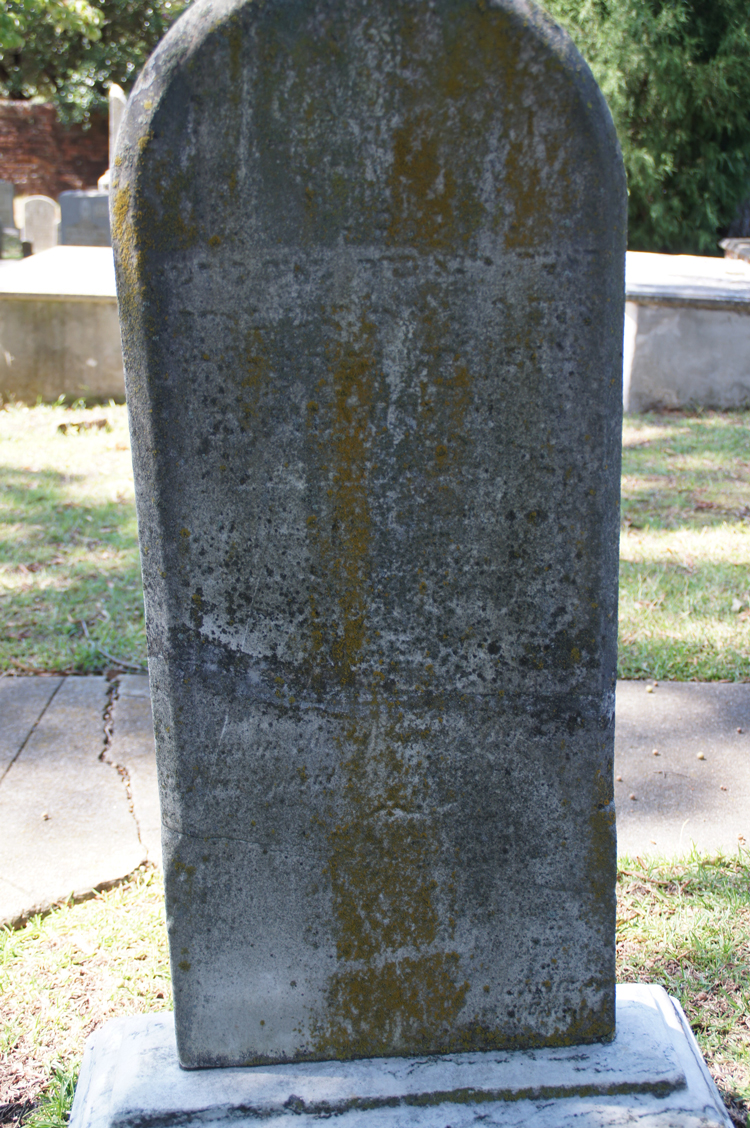
Charles is also buried in the Columbia Hebrew Benevolent Society cemetery, next to Lena.

Charles Hamberg headstone

Headstone of Charles Hamberg at Hebrew Benevolent Society cemetery in Columbia, SC http://jhssc.org/hebrew-benevolent-society-cemetery/

What a hard life Charles Hamberg had once coming to the US.  He lost his cousin Abraham in 1854, his wife Mary was murdered in 1866, his second wife Lena died in 1877, and he suffered financial problems and took his own life in 1879.   I imagine that that was not the life he dreamed of when he left Breuna, Germany, in 1852.  For him the American dream did not come to be.

His son Samuel was just eleven years old and had lost his mother and his father.   He ended up in Pennsylvania with Henry Schoenthal, his second cousin.  How did he end up there?  That leads to the next mystery.

Another Delightful Conversation: My Cousin Maxine

I love it when a cousin finds me.  Usually I am the one searching for them, hoping they will be interested and open to sharing their family histories with me.  So when a cousin finds my blog, it is a delightful experience—I know they are interested, and there is none of the awkwardness of trying to explain who I am and that I am not a scammer trying to get money from them or steal their identity.

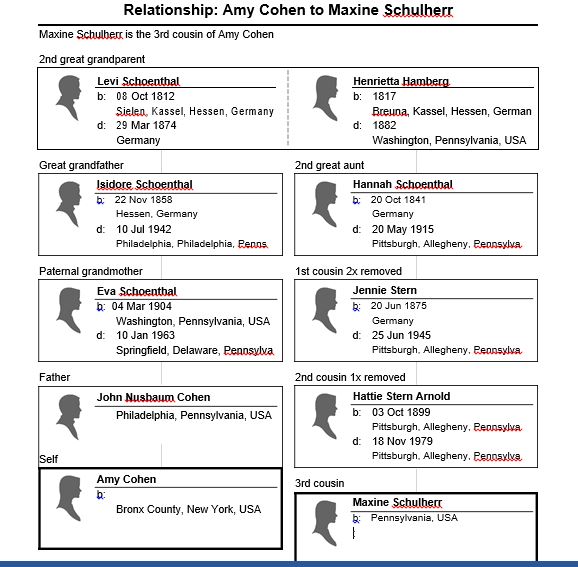
I’ve had that great pleasure again recently when my third cousin Maxine found my blog and left a comment about her connection to me and her family.  Maxine is the daughter of Hattie Arnold and Martin Schulherr, about whom I wrote here.  Maxine’s grandparents were Jennie Stern and Max Arnold, and her great-grandmother was Hannah Schoenthal Stern.  Hannah was my great-grandfather Isidore Schoenthal’s older sister.  Thus, Maxine and I are both the great-great-granddaughters of Levi Schoenthal and Henriette Hamberg.  We are third cousins.

Relationship Amy to Maxine Schulherr


Maxine was born and raised in the Pittsburgh area and has lived there all her life.  We had a wonderful phone conversation and have exchanged many emails since.  Maxine knew many of the cousins about whom I’ve written, including Lee and Meyer Schoenthal, Erna and Werner Haas, and the members of the extended Oestreicher family.  She was able to bring to life many of these people, who thus far had been mostly names and dates and occupations to me.

Her grandmother Jennie lived with Maxine and her parents for a number of years, and Maxine even shared a room with her grandmother during that time.  She knew her well, and so I was hoping that Maxine would have stories about Jennie’s youth.  Jennie came to the United States from Germany in the 1880s with her mother Hannah when she was thirteen years old, and I was interested in hearing any stories about Jennie’s life in Germany or about her experiences as a teenager settling in western Pennsylvania.  But as with so many immigrants, Jennie did not talk about the past.  Maxine said she never heard her grandmother talk about Germany or about her early days in the US.

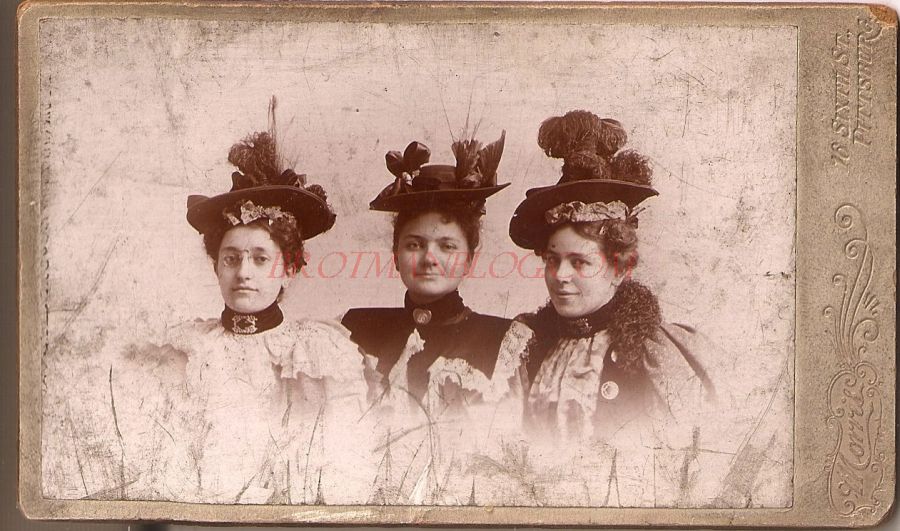
But she did have some old photographs of Jennie with two other women whom we both assume are Jennie’s two sisters, Sarah (on the left) and Edith (on the right). (All photos in this post are courtesy of my cousin Maxine.)

jennie-stern-arnold-and-her-sisters-1

Jennie Stern Arnold, center, and perhaps Sarah Stern Ostreicher on the left and Edith Stern Good on the right

jennie-stern-arnold-and-sisters-2

Stern sisters


Maxine then told me about her grandmother Jennie’s life as an adult in Pennsylvania.  Jennie married Max Arnold, who had originally owned a dairy called Sweet Home Dairy. (Maxine was named for her grandfather Max.)  It was the first dairy to deliver milk to homes in the Pittsburgh area, according to Maxine.  Max had to close the dairy when he had trouble hiring reliable men to come and milk his cows, and he then went into the meat business, as I wrote about here.   Max eventually he retired and his son Sylvan ran the business when Maxine was a child.  Max, Jr., helped his brother Sylvan doing deliveries, but after having several accidents he moved on to other endeavors.

Sylvan closed the meat market when he enlisted in the army during World War II.  He would not have been drafted, given his age, but according to Maxine, Sylvan was looking to get away as his marriage was failing.  He and his first wife Ada divorced, and Sylvan remarried while in the service and stationed in Arkansas.  Based on Maxine’s information, I found a marriage record for Sylvan Arnold and Gladys Evans dated June 20, 1945, in Saline, Arkansas.  He and his second wife Gladys later moved to California, and the family in Pittsburgh never met her.

Here is a photo of Jennie and Max with their first child, Jerome, who was born in 1897.

jennie-stern-and-max-arnold-with-jerome-c-1897-edited

Jennie Stern Arnold, Jerome Arnold, and Max Arnold, Sr. c. 1897


Jennie and Max had five children, and Maxine had this wonderful picture that she believes is of those five:

hattie-arnold-unknown-jerome-max-bernice-and-sylvan-arnold

Children of Jennie Stern Arnold: Hattie, unknown, top; Jerome, possibly Max, Jr., and Bernice, center row; and Sylvan, foreground at bottom, c. 1913

Maxine’s mother Hattie is the girl in the light dress on top next to an unknown girl.  Her uncle Jerome is on the left and her aunt Bernice on the right in the middle row, and her uncle Sylvan is the boy on the ground in the front.

The little boy on the swing might be Max, Junior, but the age seems off, so I’m not sure. Since Jerome looks to be no more than sixteen here, I think this photo is probably dated no later than 1913.  In 1913, Jerome was 16, Hattie 14, Bernice 12, and Sylvan 10, and that does seem to line up with what I think are the maximum ages of the children in the photograph. I actually think they look even younger than those ages.  What do you all think? Are the children older than that?

So if the photo was taken in 1913, Max, Jr. would have been two years old.  Does the little boy on the swing look to be only two years old?  I think he looks at least three or four.  What you think?

From Maxine, I also learned more about the lives of Maxine’s mother Hattie and Hattie’s four siblings. Hattie was very proud to be one of the first women to learn to drive in Pittsburgh.  She was sixteen, and her father brought home a car that he couldn’t drive, but somehow Hattie and her brother Jerome learned to drive it.

Hattie’s sister Bernice was married twice, first to Julius Averback, whom she later divorced.  Maxine was very fond of Julius and recalled that he had taken her to the circus where he bought her a pet chameleon. Maxine told me, “The circus sold chameleons in little boxes with a string around their necks and a  safety pin at the end of the string so you could pin it on your clothes!!”  Even though he was divorced from Bernice at the time, Julius sent Maxine eighteen roses for her eighteenth birthday. Bernice’s second husband was Abe Sultanov.  Bernice did not have children with either husband.

All three of Hattie’s brothers worked in the meat business initially, but Max, Jr. later branched out into the movie theater business, living in Morgantown, West Virginia for some time before returning to the Pittsburgh area where he owned another theater in Verona and then worked in the furniture business after his brother-in-law Abe, Bernice’s second husband, made some connections for him (Abe was a manufacturer’s representative for a line of furniture).  Later on, Max, Jr. owned a drive-in theater in the Pittsburgh area known as the Maple Drive-In.

According to Maxine, her grandmother Jennie as well as Jennie’s older sister Sarah Stern Oestreicher converted to Christian Science at some point in their adult lives. Maxine recalled going to church services with her grandmother.  But Martin and Hattie remained Jewish, and Maxine was confirmed at Rodef Shalom synagogue in 1944, the same synagogue where her mother had been confirmed about thirty years earlier.

Maxine was married to Alan Stein in August, 1948.  She generously shared with me these pictures from her wedding day:


Hattie Martin Maxine Alan Henrietta Stein Alan's mother

Hattie Arnold Schulherr, Martin Schulherr, Maxine Schulherr Stein, Alan Stein, Henrietta Stein (Alan’s mother)

hattie-max-and-bernice

Hattie Arnold Schulherr, Max Arnold, Jr., and Bernice Arnold Averbach Sultanov

Hattie Martin Ceil RIchard Lou Ann daughter of Jerome and ELlen, Maxine, Max. Bernice and Ellen

Hattie Arnold Schulherr, Martin Schulherr, Richard Arnold (son of Max, Jr.), Cecilia Lefkowitz Arnold, Lou Ann Arnold (daughter of Jerome Arnold), Maxine Schulherr Stein, Max Arnold, Jr., Bernice Arnold Averbach Sultanov, and Ellen Schwabrow Arnold

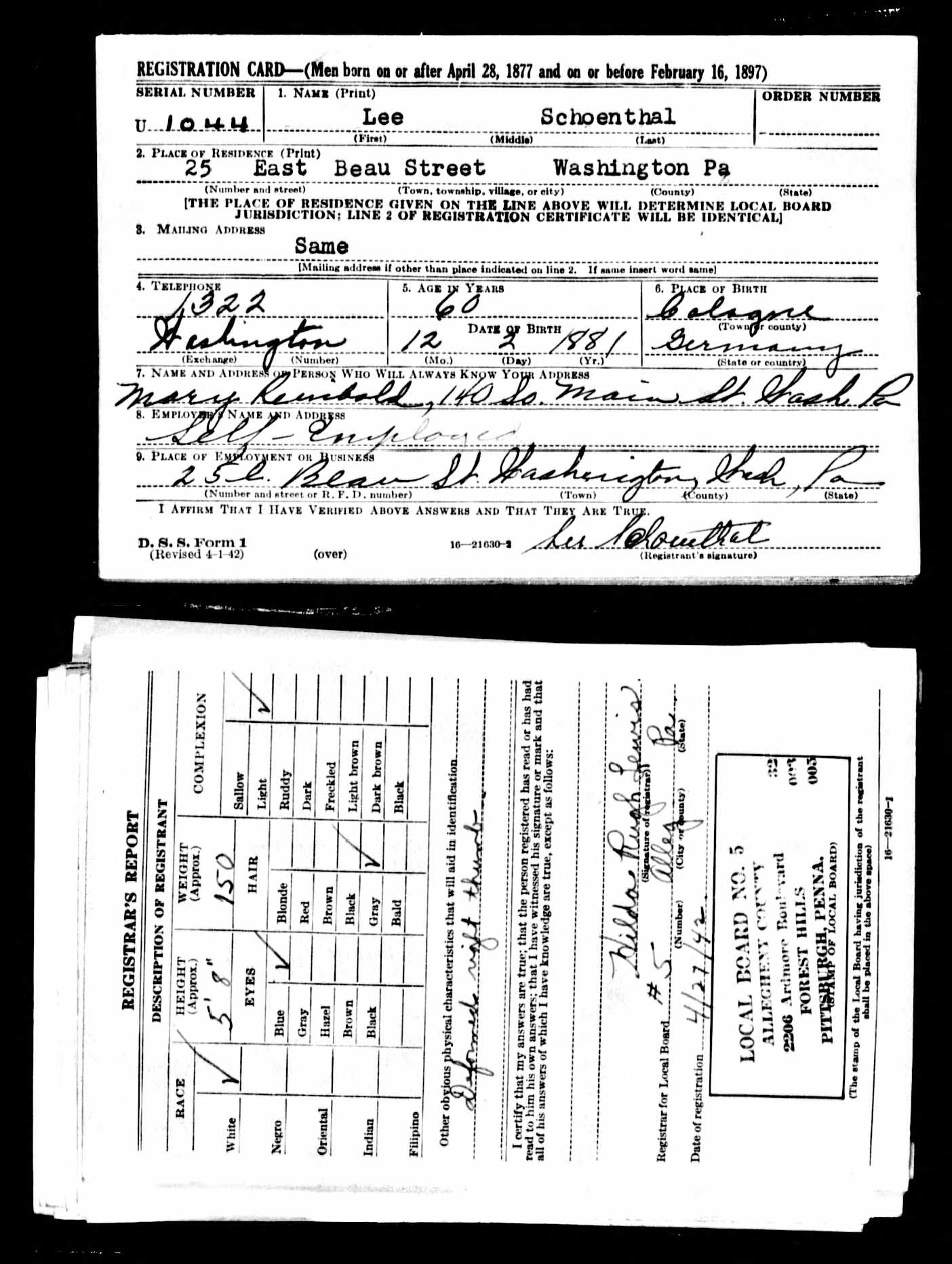
In addition to her grandparents, parents, and aunts and uncles, Maxine also knew our mutual cousins Lee and Meyer Schoenthal quite well, and she was able to answer one of my lingering questions about Lee.  When I wrote about Lee’s draft registration for World War II, I’d been puzzled by the person he’d named as the one who would always know his address, a woman named Mary Reinbold.

Lee Schoenthal World War II draft registration The National Archives at St. Louis; St. Louis, Missouri; World War II draft cards (Fourth Registration) for the State of Pennsylvania; State Headquarters: Pennsylvania; Microfilm Series: M1951; Microfilm Roll: 278

Lee Schoenthal World War II draft registration
The National Archives at St. Louis; St. Louis, Missouri; World War II draft cards (Fourth Registration) for the State of Pennsylvania; State Headquarters: Pennsylvania; Microfilm Series: M1951; Microfilm Roll: 278


Maxine shared with me that Mary Reinbold was Lee’s girlfriend for many years.  They were together a long time but never married because Mary was Catholic and Lee was Jewish.  Maxine recalled that Lee and Mary regularly came to her parents’ home for Sunday dinners.  She remembers them both very fondly.  She said Lee was a successful tailor who sold made-to-order men’s suits; her father Martin owned suits he purchased from Lee.  Lee’s shop was in the basement of building on E. Beau Street in Washington, Pennsylvania.

He must have done quite well, as Maxine told me, “Lee always drove a Lasalle car which in it’s day was in the Cadillac or more expensive class.  And he belonged to a club in  Washington, called the “Arms Club” although he never went hunting.  It was a bar, some tables, slot machines, a dance floor, and other games of chance.” Maxine said that Lee always brought her mother candy that he won at the club.   Her father Martin was also a member of the club, and Maxine visited there as well.  She told me, “I liked to pull the handle on the slot machine and watch the coins come out!!  And Daddy would stand beside me and hand me the quarters.  (I never had to spend my allowance, which then was probably one dollar a week.)”  I just love the images that this anecdote evokes.

Here are some photographs Maxine shared of Lee, Meyer, Mary, her mother Hattie, and herself as a twelve year old, taken in about 1940.

lee-schoenthal-c-1940s

Lee Schoenthal, c. 1940

mary-reinbold-and-lee-schoenthal

Mary Reinbold and Lee Schoenthal, c. 1940

mary-reinbold-meyer-schoenthal-hattie-arnold-schulherr-maxine-schulherr-stein

Mary Reinbold, Meyer Schoenthal, Hattie Arnold Schulherr, and Maxine Schulherr, c. 1940

It’s just wonderful to be able to see the faces that go with the names.

Maxine also remembers Lee and Meyer’s sister Erna Haas and her son Werner, but does not remember Lee and Meyer’s other sister, Johanna, the one who survived the Gurs internment camp in France and came to the US with her husband in 1947.  Since Johanna outlived Lee and Meyer and also lived in Pittsburgh, I was surprised that Maxine had no recollection of meeting her nor any awareness of this fourth sibling.  Perhaps Johanna’s suffering during the war had made her less able to interact with the extended family.

Maxine also knew members of the Oestreicher family, that is, the family of Sarah Stern and Gustav Oestreicher.  Sarah was her grandmother Jennie’s older sister, as discussed here and here.  Maxine knew Sarah’s son Sidney and his children, Gerald, Betty, and Elaine very well.  She said that Elaine had lived with her family for a while in the 1940s when Sidney and his wife Esther moved to New York and Elaine wanted to finish the school year in Pittsburgh.  But Maxine didn’t know what had happened to Elaine or the rest of the family after that and was curious to learn more about her long-lost second cousins.
I told her I would see what else I could find as I also had not yet been able to learn much about the Oestreicher family after about 1940.  With a few clues from Maxine, I was able to find those long-lost Oestreicher cousins.  I will report on what I’ve learned in a later post after I’ve had a chance to speak with my other third cousins, Betty and Elaine.


Passover 2016: The Exodus

In many ways Jewish history is about one exodus after another.  The Jewish story begins when God tells Abra(ha)m, “Lech Lecha,”  or “Go, Go out.”  He instructs him to leave his father’s land and go to a new land where his children would be as numerous as the stars.

There are many journeys throughout the Bible—Noah’s journey, Jacob’s journey, Joseph’s journey, and, of course, the exodus from Egypt led by Moses, which is recalled and re-enacted every year on Passover.

This Friday evening we will once again remember and re-enact that journey.  We will read the story of the Exodus.  We will drink wine, recline like free people, and eat matza to remember that our ancestors had no time to wait for the dough to rise before exiting from Egypt.  We will eat the bitter herbs to remember the bitterness of slavery, and we will eat the charoset—a mixture of apples, nuts, and wine—to embrace the sweetness of freedom from slavery.

English: Passover Seder Table, Jewish holidays...

English: Passover Seder Table, Jewish holidays עברית: שולחן הסדר, Original Image Name:סדר פסח, Location:חיפה (Photo credit: Wikipedia)


But that exodus was not the last journey our people took to freedom.  Over the centuries Jews kept moving from one land to another, either having been expelled or deciding on their own to seek freedom from oppression, violence, and hatred.  They moved to Babylonia, to Spain, to eastern Europe, to Germany, to places all over the globe, including eventually to the Americas.

I have spent much of the year since last Passover studying the journeys of my paternal relatives from Sielen, Germany—my father’s maternal grandfather’s family, the Schoenthals.  Although I still have a few more stories to share about my Schoenthal cousins, now that I have written about all the children of Levi Schoenthal and Henriette Hamberg, I want to spend this Passover looking back over the story of this particular family.

Levi and Henriette Schoenthal had ten children who survived to adulthood, all born in Sielen, Germany.  Of those ten, eight settled permanently in the US, and all but one of those eight started their lives in America in western Pennsylvania—either in Pittsburgh or the town thirty miles away, known as Little Washington.  Henry, the oldest son, arrived first in 1866, and by 1881, eight of the siblings were living in the US.  Henry over the years was a book seller and a china dealer, but underneath was a deeply religious and well-educated man.

His youngest brother was my great-grandfather Isidore, who arrived in 1881, also settled in Washington, and also worked as a china dealer.

Isidore Schoenthal

Isidore Schoenthal

In between Henry and Isidore were four other brothers in the US plus two sisters.  Over the years almost all of them prospered.  Some moved away from western Pennsylvania.  Simon ended up in Atlantic City, where he and his wife raised nine children, many of whom ended up in the hotel business there; Felix and his wife and two daughters ended up in Boston, where he became successful in the typewriter repair business. Julius lived in Washington, DC, worked as a shoemaker and had four children.  Nathan lived in many different places.  And even Isidore and Henry eventually left Pennsylvania, Isidore for Colorado and Henry for New York.  The two sisters, Hannah and Amalie, stayed in Pittsburgh for most of their lives.  Both were married and had children.

Felix and Margaret Schoenthal from 1919 passport application, National Archives and Records Administration (NARA); Washington D.C.; NARA Series: Passport Applications, January 2, 1906 - March 31, 1925; Roll #: 728; Volume #: Roll 0728 - Certificates: 70500-70749, 19 Mar 1919-20 Mar 1919

Felix and Margaret Schoenthal from 1919 passport application,
National Archives and Records Administration (NARA); Washington D.C.; NARA Series: Passport Applications, January 2, 1906 – March 31, 1925; Roll #: 728; Volume #: Roll 0728 – Certificates: 70500-70749, 19 Mar 1919-20 Mar 1919


Simon Schoenthal, my great-great-uncle

Simon Schoenthal, my great-great-uncle


The next generations wandered even further afield, although many ended up not too far from where their parents had originally settled.  My grandmother, who was born in Washington, PA, and grew up in Denver, spent her whole adult life in Philadelphia and New Jersey.

My Grandma Eva

My Grandmother Eva Schoenthal Cohen

Martin Schoenthal, Gertrude Sch., Hettie Sch Blanche Walter

Walter Schoenthal, Gertrude Schoenthal, Hettie Schoenthal, Blanche Stein and Walter Stein in Arizona


Arthur Schoenthal promoted 1942-page-003


Washington Evening Star, September 14, 1928, p. 9

Washington Evening Star, September 14, 1928, p. 9


Washington Star, December 2, 1928 p. 64

Washington Star, December 2, 1928 p. 64

Washington Evening Star, February 18, 1963, p. 24

Washington Evening Star, February 18, 1963, p. 24


Overall, the Schoenthals in the US prospered; most were successful business owners.  Most of these people appeared to have full and happy lives, although there were some who struggled.  Today there are numerous living descendants of those eight siblings, myself included.

On the other hand, the two siblings who stayed in Germany did not have as happy a legacy.  Jakob died young, and his daughter Henriette was killed in the Holocaust.  His four other children survived and, like their aunts and uncles, ended up in western Pennsylvania. Lee, Meyer, and Erna came before the war.  But Johanna was deported to a camp in Gurs, France, during the war and did not come until 1947.   From these five children, there were just two grandchildren: Helmut Levi, son of Henriette and Julius Levi, and Werner Haas, Erna’s son.  Both grandsons made it to the US before World War II.  Neither had children, however, so there are no living descendants of Jakob Schoenthal and his wife Charlotte Lilienthal.

Jewish Chronicle of Pittsburgh, June 14, 1984, p. 23 ewish+Chronicle+Vol.+23+No.+18 Formed+by+the+union+of:+Jewish+criterion+;++and:+American+Jewish+outlook. http://doi.library.cmu.edu/10.1184/pmc/CHR/CHR_1984_023_018_06141984

Jewish Chronicle of Pittsburgh, June 14, 1984, p. 23
ewish+Chronicle+Vol.+23+No.+18
Formed+by+the+union+of:+Jewish+criterion+;++and:+American+Jewish+outlook.
http://doi.library.cmu.edu/10.1184/pmc/CHR/CHR_1984_023_018_06141984


And finally Rosalie, the youngest child of Levi and Henriette, after living in the US for a few years made the fateful decision to return to Germany to marry Willy Heymann.  They had six children.  Four survived the Holocaust.  The three sons, Lionel, Max, and Walter, settled in Chicago before the war, where Lionel became a well-regarded photographer.   One daughter, Johanna, who was widowed at a young age, followed her stepdaughter Else Mosbach to Sao Paulo, Brazil, to escape the Nazis.

The other two daughters, Helene and Hilda, were murdered in the Holocaust as were Helene’s two daughters, Liesel and Grete.  From Rosalie’s six children, only one grandchild survived, the son of Max Heymann.  I am still hoping to find him.

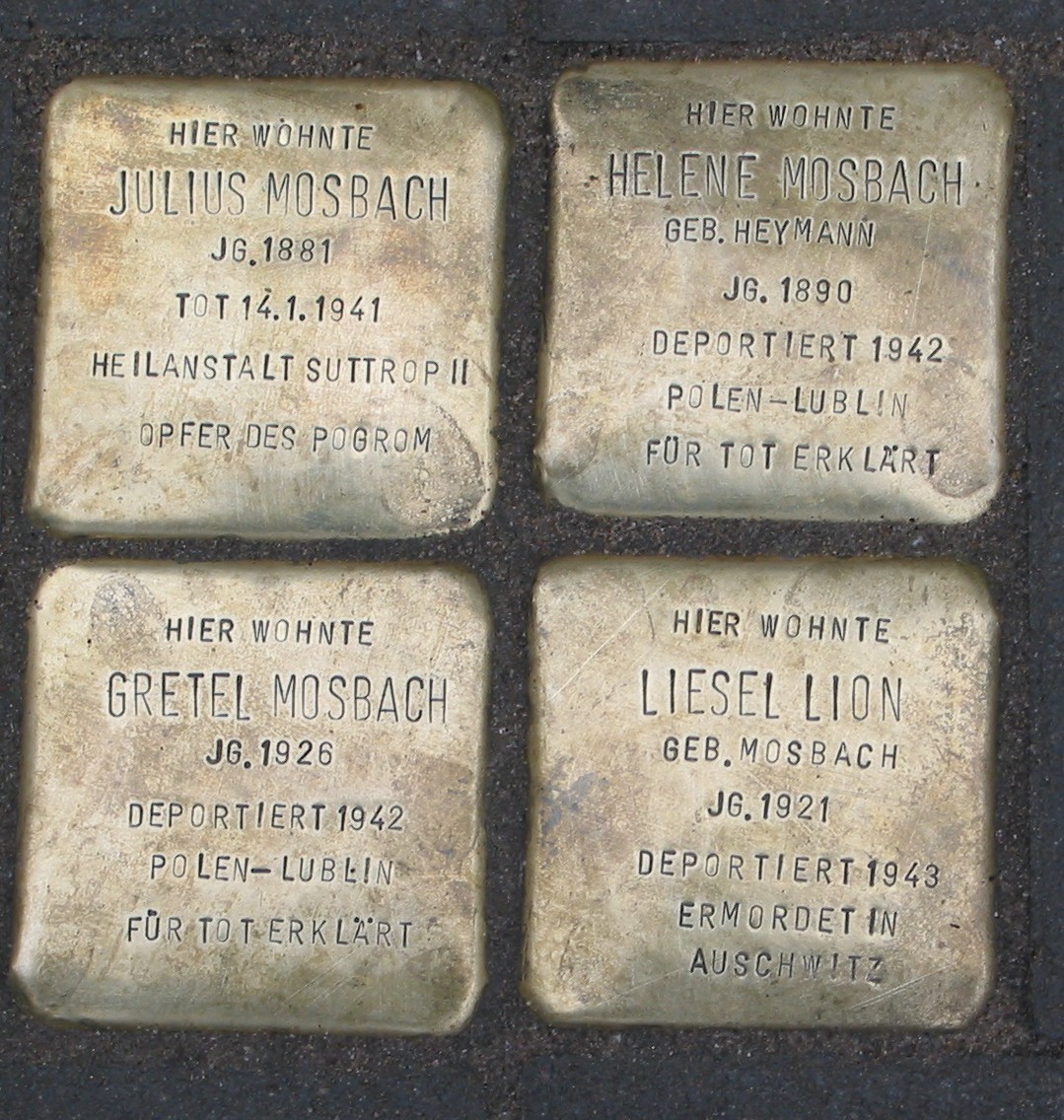
Stolperstein for Julius Mosbach and family

The Schoenthal story illustrates how one fateful decision can alter the future irrevocably. One decision to take a chance and leave what you know—to listen to the call of Lech Lecha, to venture out to a new land—can make all the difference.  By taking a chance that the sweet charoset of that new land would outweigh the bitterness of leaving a land they knew, my great-grandfather and seven of his siblings changed their own fates and those of their descendants.

What if Jakob and Rosalie had left Germany when their siblings did?

And what if the other eight siblings had never left at all?  This story would have a very different ending.

In fact, it never would have been written.


Blog Update: The Mystery of Baby Rose Schoenthal of Atlantic City

Before I move on from the Schoenthal family line, I have a few updates to write about, including some newly discovered cousins and some wonderful photos.  But first an update to one mystery.   Unfortunately an update but not a solution.

Remember the mystery of Baby Rose Schoenthal, the daughter of Jacob Schoenthal and Florence Truempy? She had appeared on the 1930 census as a fifteen month old child living with her parents in Atlantic City.

Jacob Schoenthal and family 1930 US census Year: 1930; Census Place: Atlantic City, Atlantic, New Jersey; Roll: 1308; Page: 10B; Enumeration District: 0003; Image: 129.0; FHL microfilm: 2341043

Jacob Schoenthal and family 1930 US census
Year: 1930; Census Place: Atlantic City, Atlantic, New Jersey; Roll: 1308; Page: 10B; Enumeration District: 0003; Image: 129.0; FHL microfilm: 2341043

Then she disappears.  She does not appear on the 1940 census with her parents or elsewhere as far as I can tell, and there is no death record for her in either New Jersey or Pennsylvania, no obituary for her, no news articles that mention her.  Nothing at all.

Jacob Schoenthal and family 1940 census Year: 1940; Census Place: Atlantic City, Atlantic, New Jersey; Roll: T627_2300; Page: 9A; Enumeration District: 1-9

Jacob Schoenthal and family 1940 census
Year: 1940; Census Place: Atlantic City, Atlantic, New Jersey; Roll: T627_2300; Page: 9A; Enumeration District: 1-9

And she wasn’t buried with her parents.  Nor was she buried with her grandparents.  She just seemed to disappear.

Many people gave me suggestions on where else to look.  Some people thought Rose had been given up for adoption or sent to live elsewhere or institutionalized.  Others thought she was just omitted from the 1940 census and that she might have married and changed her name sometime later.  But I haven’t found any records with her birth name or her parents’ names to link her to a different name, whether she was adopted, institutionalized, or married.

Someone suggested I see if Rose was mentioned in Florence or Jacob’s will or obituary.  I wrote to the Atlantic City public library and asked them to do an obituary search.  Neither obituary mentioned a child.

Atlantic CIty Press July 5, 1967 p 5

Atlantic CIty Press July 5, 1967 p 5


Atlantic City Press February 18, 1976 p 16

Atlantic City Press February 18, 1976 p 16


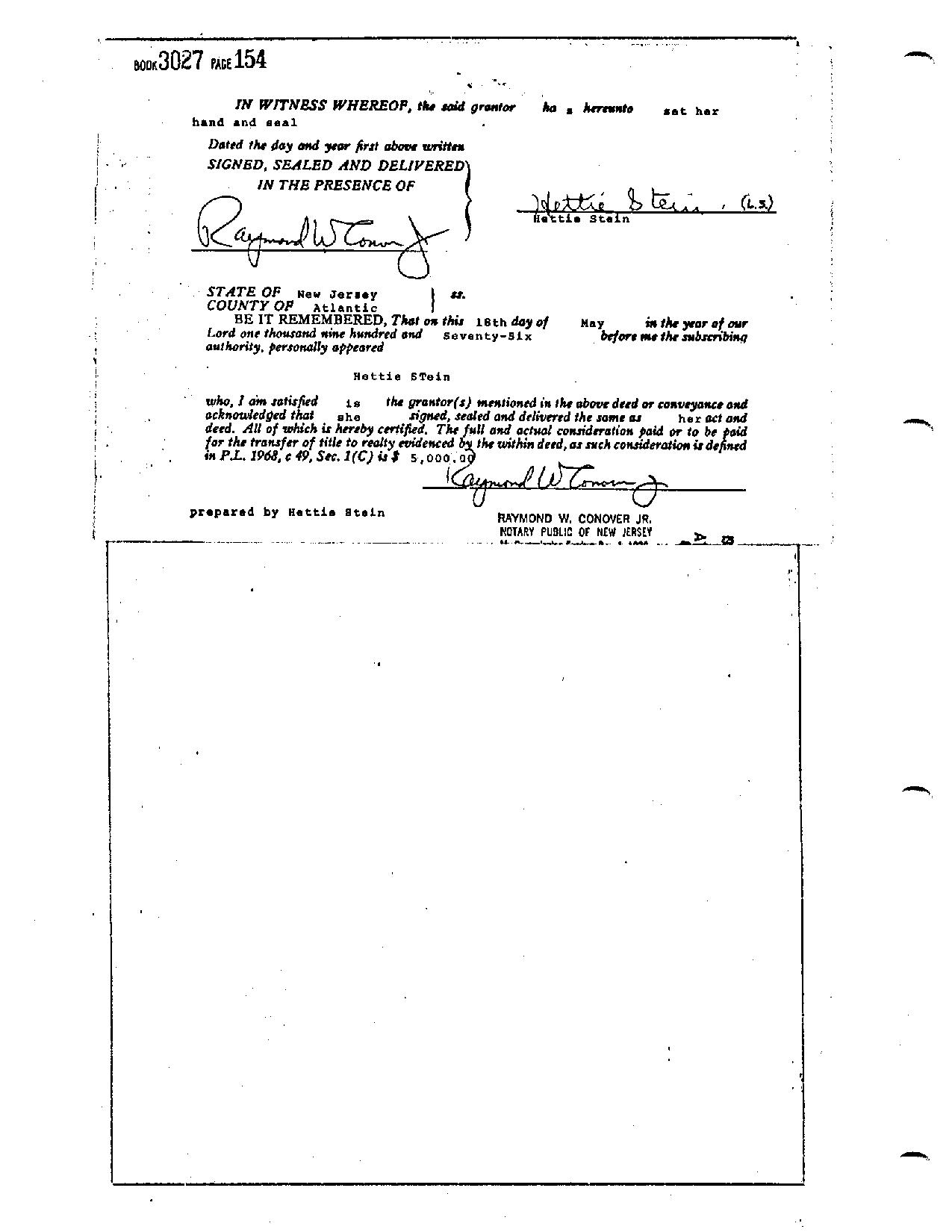
Then I searched the online land records for Atlantic County, and found a record for a May, 1976 transfer of land owned by Jacob Schoenthal.  The transfer had been handled by the executrix of Jacob’s estate, who was not his daughter Rose, but his sister, Hettie Schoenthal Stein.   That meant that Jacob had had a will.


Deed of Jacob Schoenthal s land in Atlantic City-page-001


Deed of Jacob Schoenthal s land in Atlantic City-page-002

Transfer of Deed of Land Belonging to Jacob Schoenthal


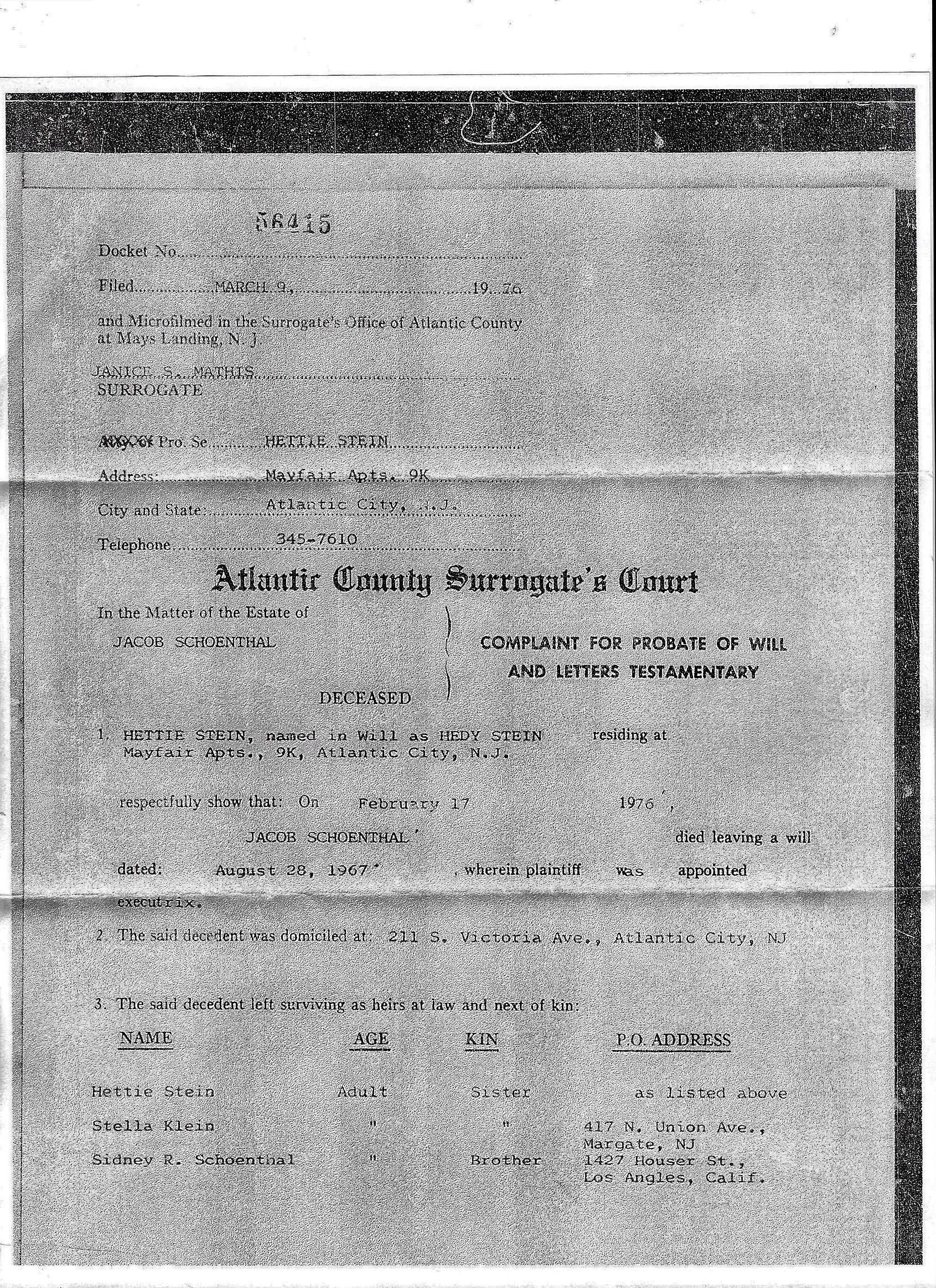
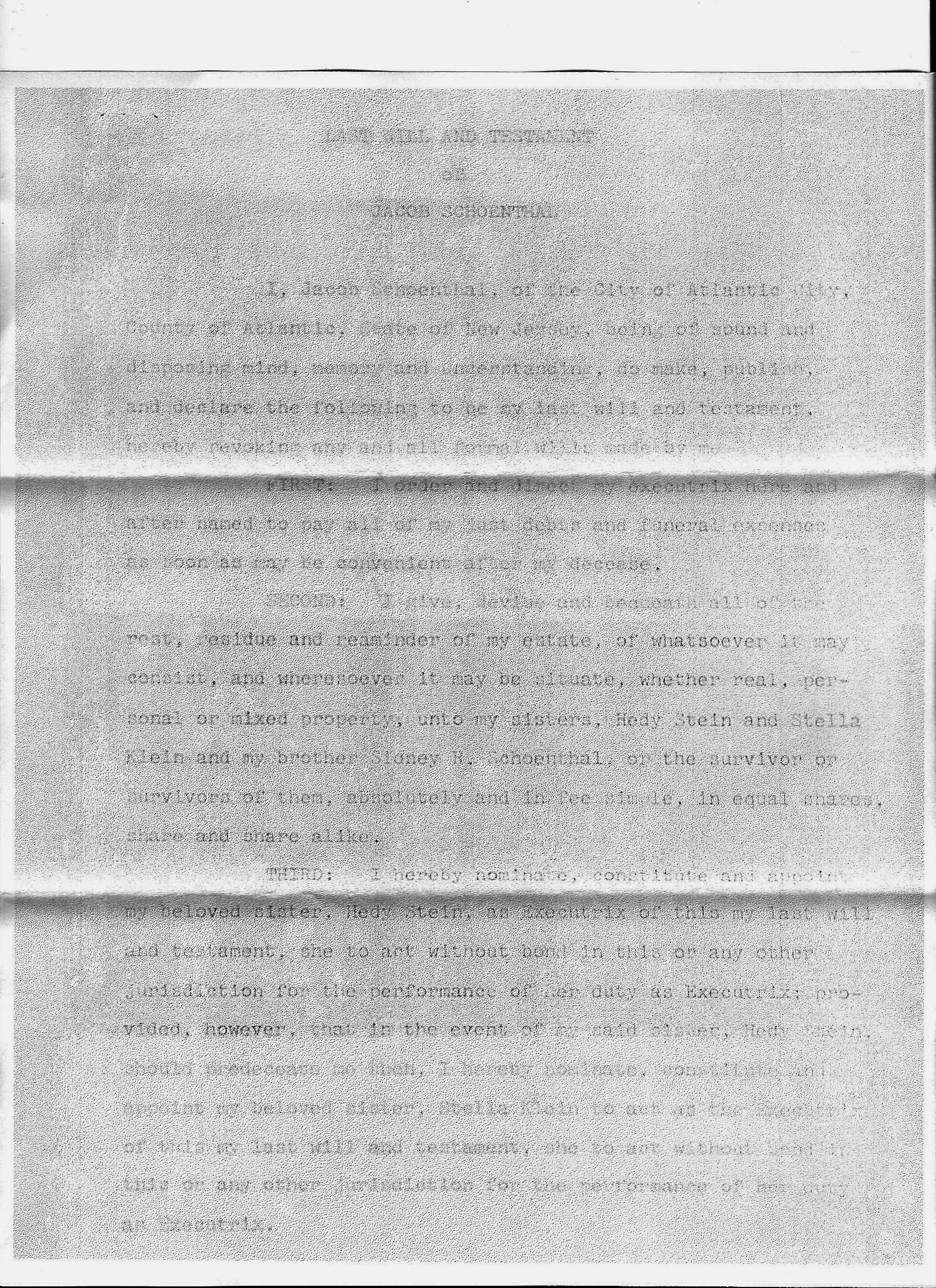
I decided to request a copy of his will from the Atlantic County Surrogate’s Court.  That will, seen below though not easily read as reproduced, named the following people as his heirs at law and next of kin: his sister Hettie Schoenthal Stein, his sister Estella Schoenthal Klein, and his brother Sidney Schoenthal.  According to the will, there were no other surviving heirs or next of kin.  There was no mention of Rose or any other child.  (All of Jacob’s other siblings and his wife Florence had already died as of the time of his death in February, 1976.)

Jacob Schoenthal will Jacob will p 2

jacob will p 3

jacob will 4


Thus, Jacob’s daughter Rose either was no longer alive at the time of his death or she had been given up for adoption and thus was no longer his legal kin.  Unfortunately, I don’t know which is the case.  Next step is to check for adoption records.  I’ve contacted the appropriate office and am waiting to see if I am even eligible to request such records.  I frankly think it’s a real long shot, and I think this will remain one of those unsolved mysteries.

But I remain open to other suggestions.


More Names to Remember and Never Forget

As I move towards closure on my Schoenthal family history, this post has been the hardest one to write.  It is a tragic chapter in that history.

As I’ve already written, four of the six children of my great-great-aunt Rosalie Schoenthal and her husband Willy Heymann left Germany before they could be killed by the Nazis. The three sons went to Chicago, and the oldest daughter Johanna went to Sao Paulo. They all survived.  The other two daughters were not so lucky.

The second oldest daughter, Helene, was born in Geldern in November 9, 1890, a year after Johanna.  She married Julius Mosbach, who was the younger brother of Johanna’s first husband, Hermann Mosbach.  After marrying, Julius and Helene were living in Iserlohn, a town about 80 miles east of Geldern.  According to an article written in 2000 by the archivist of Iserlohn, Gotz Bettge, Julius and Helene Mosbach owned a fruit and vegetable business in the town square in Iserlohn.  They had two daughters: Liesel, who was born March 8, 1921, and Gretel, born October 26, 1926.


Iserlohn By No machine-readable author provided. Asio otus assumed (based on copyright claims). [GFDL (http://www.gnu.org/copyleft/fdl.html), CC-BY-SA-3.0 (http://creativecommons.org/licenses/by-sa/3.0/) or CC BY-SA 2.5-2.0-1.0 (http://creativecommons.org/licenses/by-sa/2.5-2.0-1.0)], via Wikimedia Commons

Iserlohn
By No machine-readable author provided. Asio otus assumed (based on copyright claims). [GFDL (http://www.gnu.org/copyleft/fdl.html), CC-BY-SA-3.0 (http://creativecommons.org/licenses/by-sa/3.0/) or CC BY-SA 2.5-2.0-1.0 (http://creativecommons.org/licenses/by-sa/2.5-2.0-1.0)%5D, via Wikimedia Commons


On December 18, 1939, Liesel married Ernst Georg Lion. From the incredibly moving autobiography written by Ernst Lion entitled The Fountain at the Crossroads and available online here, I was able to learn a great deal about his life and also about the lives of Julius, Helene, and their daughters.  All the information and quotes below are from his book unless otherwise indicated.  (Special thanks to Dorothee Lottmann-Kaeseler for sending me some of the additional links and information.)

Ernst was born December 15, 1915, in Brambauer, the son of Leo Lion and Bertha Weinberg Lion.  When Ernst was a very young child, his father Leo was badly injured while serving in the German army during World War I.   Leo Lion considered himself a German patriot.

Ernst grew up as the only Jewish child in Brambauer during the hard years of the Weimar Republic, but his childhood was overall quite happy. Then Hitler came to power, and his life was forever changed.  The Nazis tried to impose a boycott on his father’s business by having a Gestapo member stand in the doorway and take photographs of those who patronized his store.  Ernst’s father insisted that the man leave, even threatening to beat him up.  He did not think the Nazis would be in power for very long.  But then when the Nuremberg laws were enacted in 1935, the family had to sell their home and their store for less than their value and move to Dortmund.

Many members of the extended Lion/Weinberg family left Germany around that time, but Ernst had difficulty getting the necessary visas and permits to go elsewhere even though he had an affidavit of support from a cousin in New York.  Then on November 9, 1938, Ernst was one of thousands of German Jews who were arrested and sent to Buchenwald in the aftermath of Kristallnacht.  In his autobiography he described in graphic detail his experiences there.  It’s horrifying.

Ernst was released a few weeks later and told to leave the country within three weeks.  All the Jewish businesses were now closed, and he was forced to work on street repairs while waiting to emigrate.


Buchenwald Watch Tower undesarchiv, Bild 183-1983-0825-303 / CC-BY-SA 3.0 [CC BY-SA 3.0 de (http://creativecommons.org/licenses/by-sa/3.0/de/deed.en)], via Wikimedia Commons

Buchenwald Watch Tower
undesarchiv, Bild 183-1983-0825-303 / CC-BY-SA 3.0 [CC BY-SA 3.0 de (http://creativecommons.org/licenses/by-sa/3.0/de/deed.en)%5D, via Wikimedia Commons


But then he met Liesel Mosbach in Iserlohn.  He was introduced by his Aunt Selma who lived there, and they immediately took a liking for each other.  At that time Liesel’s family was living in the apartment above their former business, which had been confiscated by the Nazis.  Julius Mosbach had suffered a nervous breakdown as a result of the harassment by the Nazis and the loss of his business, and he was doing very poorly.

Ernst moved to Iserlohn in 1939, where his aunt was able to help him get a job at a metal working company owned by a family that was unsympathetic to the Nazi government and its policies; the owners even provided Ernst with extra food to supplement the very restrictive allotments allowed to the Jews by the Nazis.

When the Nazis then imposed travel restrictions and required Jews to wear the yellow Star of David, Ernst was no longer able to get to Dortmund to visit his parents.  His mother died shortly thereafter, having given up on life, according to his father; Ernst was not even allowed to go to her funeral.

Yellow badge Star of David called "Judens...

Yellow badge Star of David called “Judenstern”. Part of the exhibition in the Jewish Museum Westphalia, Dorsten, Germany. The wording is the German word for Jew (Jude), written in mock-Hebrew script. (Photo credit: Wikipedia)


On December 18, 1939, Ernst and Liesel were married.  As Ernst wrote, although they had no idea what the future would bring, “The secret of maintaining one’s sanity under those conditions is to live as normal a life as one can.” (p. 18)   Unfortunately, that became more and more difficult to do.  Conditions for the Jews continued to worsen, and there was less food available.  People were beginning to hear about Jews being arrested and sent away.

In January, 1941, Julius Masbach was admitted to a mental hospital and died shortly thereafter.  Ernst wrote (p.15):

We soon discovered that we should have opposed the doctor’s decision [to hospitalize Julius], for the Nazis had decided that all institutionalized, so-called “insane” persons no longer had the right to live and had become a burden to society.  They were led into sheds equipped with gasoline engines, which were installed in reverse fashion: the exhaust escaped to the inside of the building.  After they were asphyxiated, the bodies were burned and the ashes delivered to the surviving families.  No one realized that this activity was the rehearsal for later mass destruction of humans.

On April 28, 1942, Helene Heymann Mosbach, my grandmother’s first cousin, and her daughter Gretel, just sixteen years old, were arrested and sent to Zamosc, near Lublin, Poland.  They were never heard from again.  Ernst’s father Leo Lion was also arrested around this time, and Ernst never heard from him again either.

To add to this heartbreaking account, Helene’s sister Hilda, the youngest of the six children of Rosalie Schoenthal and Willy Heymann, was also killed by the Nazis.  Although she is not mentioned in Ernst Lion’s autobiography or on the website memorializing the Mosbach family, according to Yad Vashem, Hilda also had been living in Iserlohn before being sent Zamosc where her sister Helene and niece Gretel had been deported.   I assume that Hilda had moved to Iserlohn to live with her sister Helene after both her mother Rosalie (1937) and her father Willy (1939) had died.

I had not heard of Zamosc before, and my friend Dorothee Lottmann-Kaeseler sent me this link that reveals the absolutely horrifying story of this place.  There are no records of what happened specifically to Helene, Gretel, and Hilda, but it is possible that they were killed in Zamosc itself or deported to the death camp at Majdanek or Belzec or Sobibor, where they were killed.


Crematoria at Majdanek death camp near Lublin, Poland Deutsche Fotothek‎ [CC BY-SA 3.0 de (http://creativecommons.org/licenses/by-sa/3.0/de/deed.en)], via Wikimedia Commons

Crematoria at Majdanek death camp near Lublin, Poland
Deutsche Fotothek‎ [CC BY-SA 3.0 de (http://creativecommons.org/licenses/by-sa/3.0/de/deed.en)%5D, via Wikimedia Commons

On February 26, 1943, Ernst and Liesel received orders to report to a school in Dortmund with just one suitcase each.  There were about a thousand people at the school that night, and everyone was forced to sleep on the floor. Ernst wrote, “They took our wedding bands and watches, telling us that we would not need them where we were going.” (p. 19)

The next morning they were put on a freight train (pp.19-20):

I found myself inside such a freight car among a hundred men, women and children.  The doors were locked; there were no windows to look through.  This precaution would keep us from recognizing our route or destination.  A few buckets for relief, no food or water.  This should be a short ride, I mused.

… Liesel was shoved on this train with me.  At least we were together.  Just twenty-three, she was a thin, wiry lady, strong and energetic.  Her dark eyes expressed the will to endure.  I was twenty-four.  Where was our future?

Although they were told they were being taken to a safe place for resettlement, Ernst was skeptical, as he had good reason to be.  They were being taken to Auschwitz-Birkenau.  When they arrived, they were told to leave their suitcases on the train; then they stepped onto the platform surrounded by SS guards and prisoners in striped uniforms who were helping with the unloading.

Then the men and women were separated.

Ernst wrote, “All the women were led away.  My wife looked at me for one last time before she disappeared.  It was dark now, and I saw her walk away like a shadow.”

He never saw her again.  Liesel Mosbach Lion, my father’s second cousin, was murdered at Auschwitz.


English: Aushwitz I crematoria memorial

English: Aushwitz I crematoria memorial (Photo credit: Wikipedia)


I consider the entire family to be victims of the Holocaust: Rosalie, Willy, Helene, Julius, Liesel, Gretel, and Hilda as well as Leo and Bertha Lion.


Stolperstein for Julius Mosbach and family


Ernst Lion, however, survived.  The story of how he survived is remarkable.  It’s a tale of incredible courage, strength, persistence, and luck. It’s also a horrifying, nightmarish account of how cruel human beings can be to one another.  You should all read it.  I cannot do it justice in a blog post.  You must read it.  Again, you can find it here.  Please read it.

I am so grateful that Ernst, Liesel’s husband, survived and recorded his story and their story for us all to read.  We must never forget.