Jacob G. Cohen, Almost State Treasurer, and his descendants: A Sad Ending and a Loose End

The third child of Moses, Jr., and his wife Henrietta was Jacob G. Cohen.  As I wrote previously, Jacob had married Ida Siegel in 1894 and had moved to New York City, where he first worked as a bookkeeper. Just this week I received a copy of their marriage certificate.

Jacob G. Cohen and Ida Siegel marriage certificate

Jacob G. Cohen and Ida Siegel marriage certificate


1894 14 Apr Cohen-Segel marriage cert#4384  pg2  007586923_00397

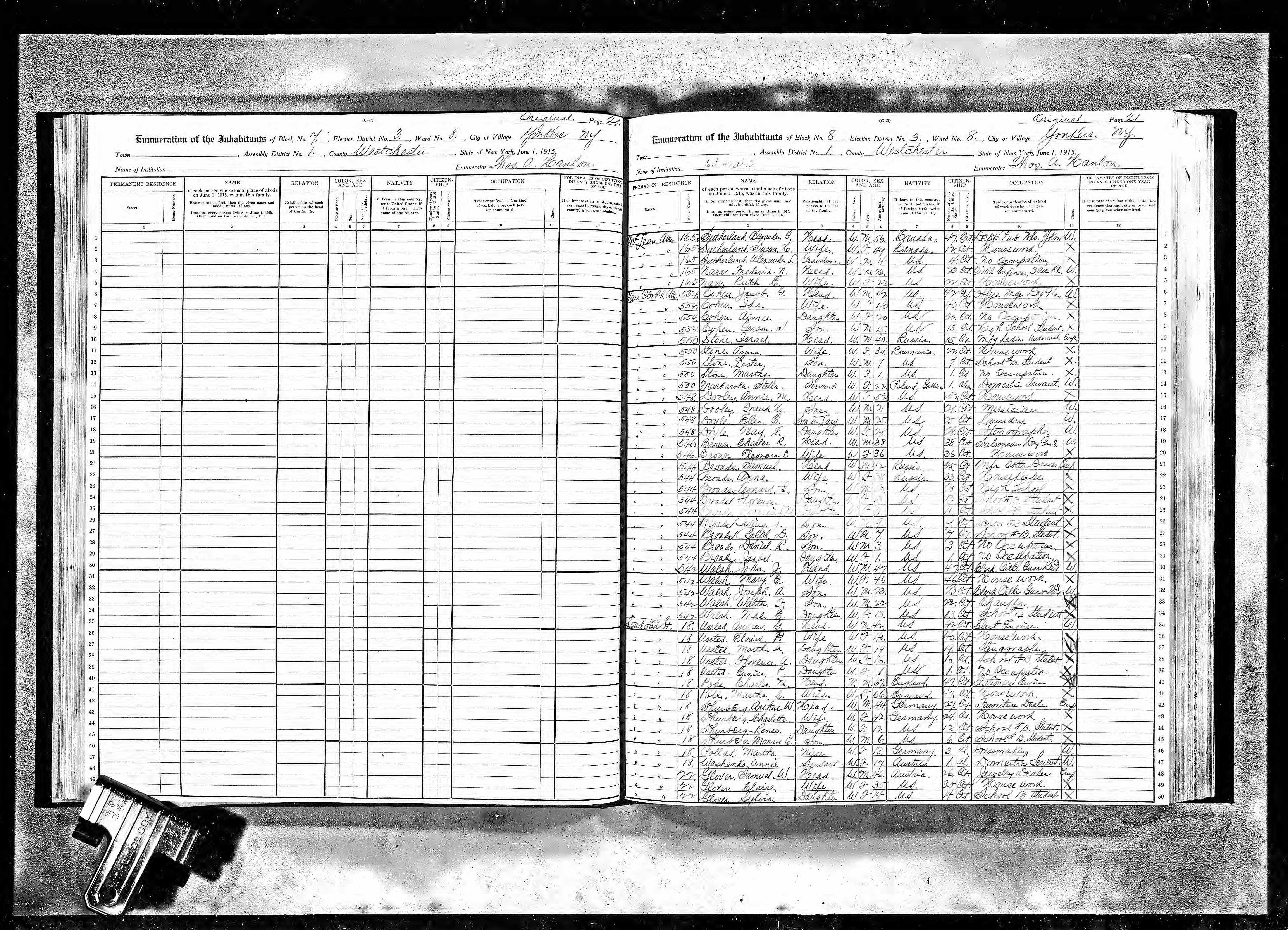
Jacob and Ida had two children, Aimee and Gerson, and by 1910 had moved to Yonkers, New York, where Jacob worked as the manager of a dry goods store, according to the 1910 census.  In 1912, Jacob and Ida traveled overseas, and in 1915 Jacob’s occupation was an office manager for a business that is not legible to me.  Maybe someone else can decipher it?  Ida’s obituary said he was the treasurer of a department store at some point, so perhaps this says department store?

UPDATE:  Thank you to Gil Weeder!  He read it as Dry Goods, and now that I look at it, I think that’s right, and it makes sense!

Jacob and Ida Cohen and family 1915 NY census

Jacob and Ida Cohen and family 1915 NY census

On February 12, 1917, their daughter Aimee married Lester Wronker, who was working in the leather goods industry.  Aimee and Lester had a son, Robert, who was born in April, 1919.  In 1920, the family was living in Manhattan.

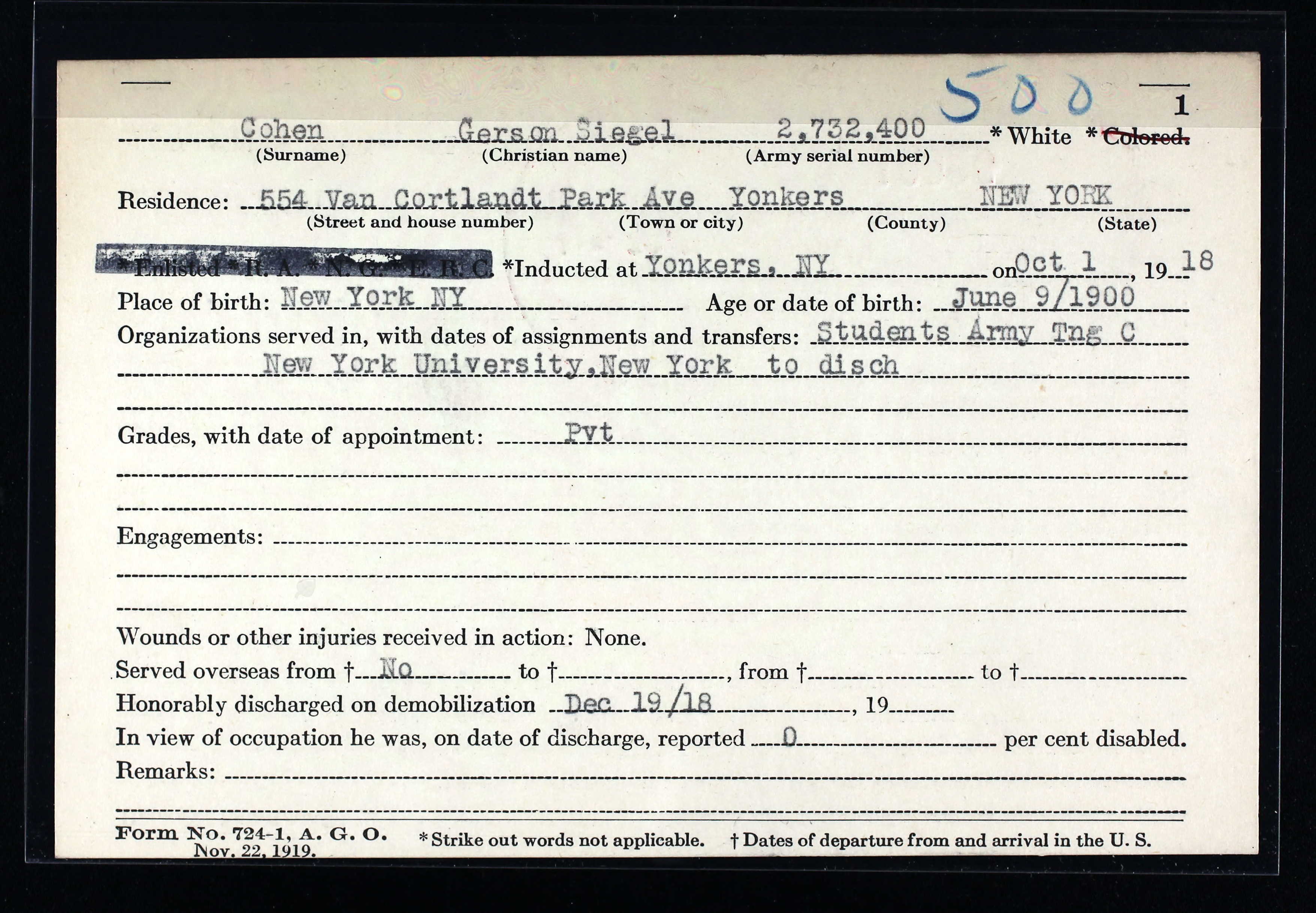
Ida and Jacob’s son Gerson was a student at New York University at the time he registered for the draft in 1917.  He was inducted into the US Army on October 1, 1918, and was discharged on December 19, 1918, without ever serving overseas.  He was part of the NYU student training corps.

Gerson Siegel Cohen military record

Gerson Siegel Cohen military record

In 1918, Jacob G. Cohen ran as a Democrat for New York State Treasurer on the same ticket as Alfred E. Smith.  Although Smith won the governor’s seat, Jacob was defeated in the general election, losing to the Republican candidate, James L.Wells, 839,777 votes to 1,028,752 votes.   Although Smith and the Democratic candidate for Lieutenant Governor, Harry C. Walker, were victorious, all the other Democratic candidates on the slate were defeated by the Republican candidates.


Alfred E. Smith, Governor of New York

Al Smith served four terms as governor of New York State and in 1928 became the first Catholic nominated by a major party as a candidate for President of the United States.  He was soundly defeated by Herbert Hoover.  But imagine if Jacob had won and served as NYS treasurer with Al Smith—and imagine if Smith had won in 1928—my cousin Jacob G. Cohen might have become the US Treasury Secretary.  If he had won the election for New York State Treasurer, he would have been one of the first Jews to hold statewide office in New York.

Instead, Jacob returned to civilian life as a businessman.  In 1920, Jacob and Ida were living in Chicago as lodgers in what appears to have been a very large boarding house or hotel. Jacob was working as the manager of a department store.  Did he leave New York to escape after losing the election? In 1925 Jacob and Ida were back in New York, living in Manhattan, and Jacob was working as an insurance agent.  Their daughter Aimee and her husband Lester and their son Robert were now living in Yonkers, and Lester was working in the silk industry.  I was not able to locate Gerson on the 1920 US census or the 1925 New York State census.

Jacob died on February 13, 1930, according to a death notice in the New York Times.Jacob Cole death notice

(Obituary No. 5, February 15, 1930, New York Times, p. 17)

For a long time I could not find any records for Jacob or Ida after 1925, but then by searching for “Wronker” in the New York Times archives, I was able to find this death notice for Jacob, which revealed why I had not been able to find them: they had changed their surname from Cohen to Cole sometime between 1925 and 1930.

Gerson had also changed his last name to Cole and also his first name to Gary.  (Even searching for him under Gary Cole has not provided me with any information about his whereabouts between 1918 and 1930 or after 1930.)  After Jacob died, Ida moved in with Aimee and her family in Yonkers, where Lester continued to work as a sales manager in the silk industry.

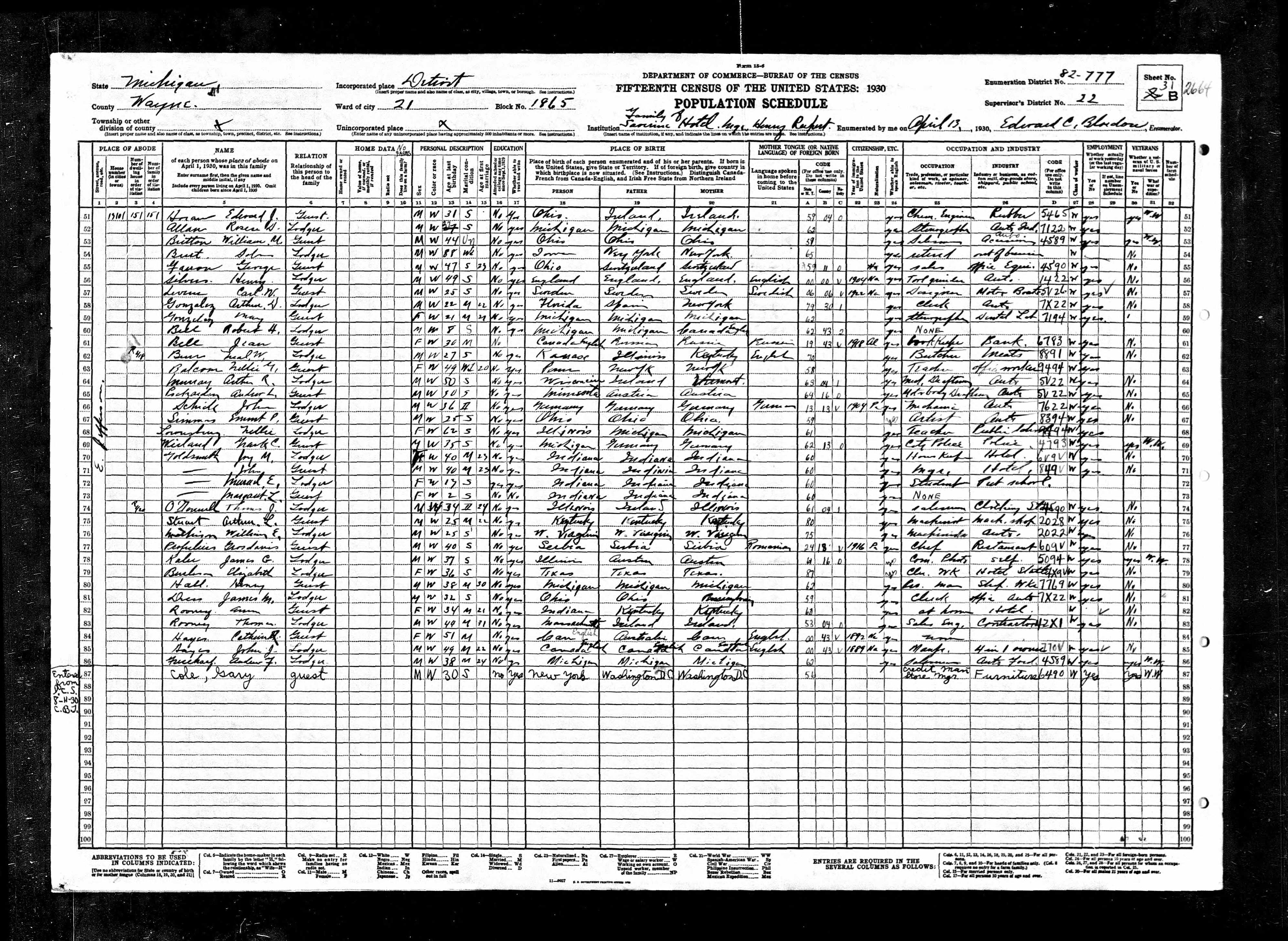
Gerson, now Gary Cole, finally reappeared in 1930 in Detroit as a credit manager for a furniture business.  I believe this is the same Gary Cole/Gerson Cohen based on his age (30), birth place (New York), and birth places of his parents (Washington, DC.)  He was living in what seems to be a hotel as a guest.

Gary Cole 1930 census

Gary Cole 1930 census

In 1940, Ida was still living with Aimee and Lester in Yonkers.  Lester was now an executive in the silk business, according to the 1940 census.

Robert, now 20, was a student at Princeton, although he was still listed as living in his parents’ residence on the 1940 census.  (Although the Princeton yearbook lists his address as being in the village of Tuckahoe, the census considered that same address to be in Yonkers.)  According to several editions of the Princeton yearbook, Bric a Brac, found in the ancestry.com database, Robert played the oboe in the university band, was on the editorial staff of the Princeton Tiger, was a member of the Princeton Liberal Club and a member of the Nassau Literary Review (“the oldest undergraduate literary review in the country”), and was on the executive committee of the Princeton Anti-War Society in 1939, presumably a group arguing against the United States’ entry into World War II.  Robert graduated from Princeton in 1940.   The photo below is of Robert as an associate editor of the Nassau Literary Review.

Robert Wronker Ancestry.com. U.S. School Yearbooks [database on-line]. Provo, UT, USA: Ancestry.com Operations, Inc., 2010. Original data: Various school yearbooks from across the United States.

Robert Wronker Ancestry.com. U.S. School Yearbooks [database on-line]. Provo, UT, USA: Ancestry.com Operations, Inc., 2010. Original data: Various school yearbooks from across the United States.

Despite his anti-war feelings, Robert enlisted in the military on March 18, 1941, listing his occupation as an “author, editor, reporter,” not surprising given his activities at Princeton.

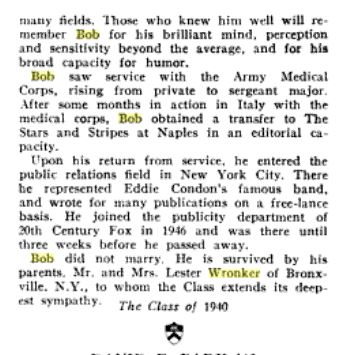
During the war, Robert served in the medical corps in Italy and then became an editor of the Mail Call column in Stars and Stripes, while stationed in Naples, Italy.  After the war he wrote several short pieces for the New York Times, and in 1955 he was working as a feature writer for the publicity department of 20th Century Fox.

After that he, like his uncle Gary Cole, disappeared.  I could not find anything, which was surprising given the unusual name and his interest in writing and journalism. I wondered: Did he also change his name? Did he die?  He is not listed under Robert Wronker on the SSDI or anywhere else. Once again, I was left with a loose end, a brick wall.

So I called on my mentor Renee Steinig once again for some direction, and damn, she found him so fast I was blown away.  She was able to find a death notice for Robert in the New York Times as well as a death notice in the Princeton alumni magazine that I had not found.  Robert had died on August 20, 1956, after a long illness.  He was only 37 years old.

Here is what the Princeton Alumni Weekly wrote about him:


robert wronker death notice princeton alumni weekly vol 57 pt 1

Wronker princeton death notice pt 2

(Princeton Alumni Weekly, Volume 57 (1956) )

What a waste.  Such a young and bright and talented person taken so young.  His mother Aimee died only three years later in January, 1959, when she was 64 years old.  His father Lester lived until October 1976, having survived both his wife and their only child.

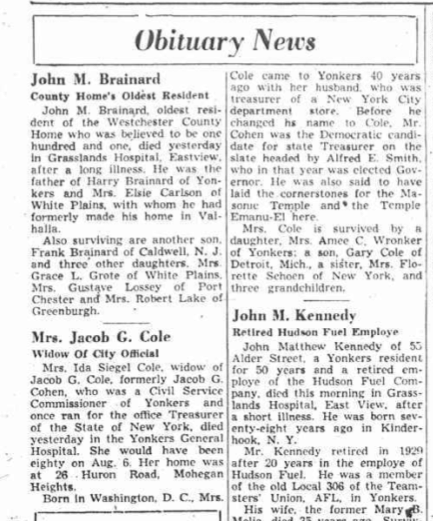
Renee also helped me find this obituary of Ida Cole, who died July 25, 1949.

Ida Cole obituary Yonkers Herald Stateman July 26, 1949. p.  2

Ida Cole obituary Yonkers Herald Stateman July 26, 1949. p. 2

Since Ida was survived by three grandchildren and Aimee only had one child, Robert, Gary must have had two children.  I will continue to try and find Gary Cole/Gerson Siegel Cohen in hopes that the line of Jacob G. Cohen/Cole and his wife Ida did not end with the untimely death of their grandson Robert Wronker.

When I think about all the “what ifs” with Jacob and with his descendants, I feel very wistful about how this line might have ended.


Jews in Iowa? Cohens on the Prairie 1880-1900

“Sioux Falls panorama 1908 1” by G.W. Fox – This image is available from the United States Library of Congress’s Prints and Photographs division under the digital ID pan.6a09880. Licensed under Public domain via Wikimedia Commons – http://commons.wikimedia.org/wiki/File:Sioux_Falls_panorama_1908_1.jpg#mediaviewer/File:Sioux_Falls_panorama_1908_1.jpg

Although the descendants of Moses and Adeline Cohen stayed close to Washington until 1880, in the next two decades many of them ventured further away.  I’ve already written about the children of Moses, Jr., four of whom left DC, three for NYC, and one for Baltimore.  But his siblings and their children ventured even further away, although for some it was just a temporary move.

The real adventurer seems to have been Jacob M. Cohen, apparently known as JM.  JM married a woman from Cuyahoga, Ohio, named Belle Lehman, on August 19, 1877.  Their first daughter, Fannie Sybil, was born in Washington, DC, in 1879, but sometime after 1880, JM and his wife and young daughter left town and moved west to the Dakota Territory where the second child, Seba Maude, was born in 1882.  I wish I knew what drew JM away from Washington and off to the prairie and how he met a woman from Ohio in the first place.  Was it a desire to be a pioneer or a desire to strike out on his own away from his family?  I don’t know, but I was certainly surprised to see “Dakota” as the birthplace of his second child.

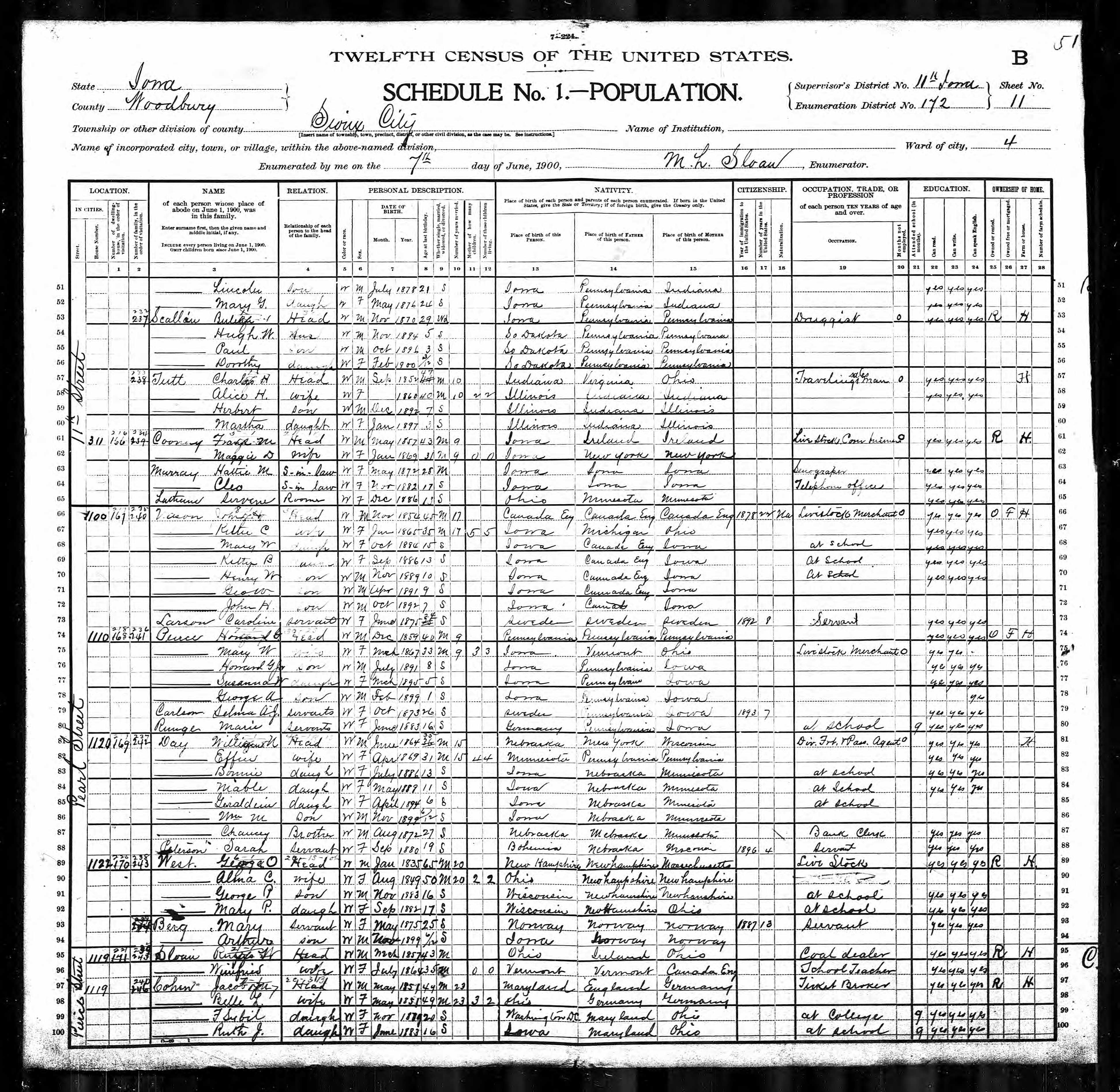
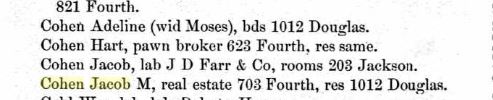
Not long after Seba’s birth, the family must have moved again because a third daughter, Ruth Josephine, was born on June 8, 1883, in Sioux City, Iowa.  Sioux City seems to be where JM and Belle established deeper roots. They lived there until at least 1905, and their fourth child and only son Arthur was born there in 1885.  According to the 1885 Iowa state census, JM was working as a pawnbroker; in the 1888 directory for Sioux City, he is listed as being in real estate, but in 1900 his occupation on the census is a ticket broker.  Perhaps the census taker heard that incorrectly; perhaps he was still a pawnbroker.  Or maybe a real estate broker.

JM Cohen and family 1885 Iowa census

JM Cohen and family 1885 Iowa census

JM Cohen and family 1900 US census

JM Cohen and family 1900 US census

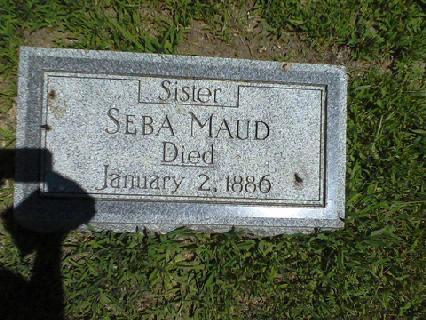
JM and Belle suffered a terrible loss when their daughter Seba died on January 2, 1886; she was not even four years old.

Seba Maude Cohen headstone

I fear that their son Arthur, born in 1885, also died young.   He does not appear on the 1895 census or the 1900 census when one would assume he would have been only ten and then fifteen years old and presumably living with his family.  On the other hand, I cannot find a death record for him in Iowa or elsewhere, nor is he buried where Seba and his parents were buried in Sioux City.

I wondered whether there were any other Jews in Sioux City at that time and was able to locate a book by Simon Glazer entitled The Jews in Iowa: A Complete History and Accurate Account of Their Religious, Social, Economical and Educational Progress in this State; a History of the Jews of Europe, North and South America in Modern Times, and a Brief History of Iowa, published in 1904 by Koch Brothers Printing Company and now available as a free e-book on Google.  According to Glazer, there were only 25 Jews in Sioux City in 1869, but by 1904 there were over two thousand, including my relatives. In fact, when the Jewish community decided to form a cemetery association, the Mt Sinai Cemetery Association, in 1884, JM Cohen, my cousin, was one of the founding members.  (Glazer, p. 295)  Moreover, that same year JM’s wife Belle was the leader of a movement among the Jewish women to create a fund-raising organization to help the poor and to raise money to build a house of worship. (Glazer, p. 296)  Despite this burst of energy in 1884, there was no formal congregation until 1898.  As described by Glazer:

“The Jewish spirit which kept them together was a mere ghost of little more consequence than a shadow. Everything they had gained during their childhood, everything their parents had imbued within them vanished form [sic] their memories, and nothing new could come and knock at their gates since no effort was endeavored prior to 1898, to form a congregation and engage the services of a minister.” (p. 297)

According to Glazer, “Their temple was built largely through the efforts of the ladies, and the man [sic] frankly admit that had it not been for the heroic efforts of the Jewish women no such place for Judaism in Sioux City would as yet have been made a matter of fact. Their first services were conducted at the Masonic Temple, which is, indeed, very complimentary to both, the Masons and the Jews.” (p. 300)

JM Cohen was listed by Glazer as one of the ten officers and leaders of Mt Sinai Congregation in those early days.

Mt Sinai Synagogue, Sioux CIty, Iowa From Wikimedia Commons, the free media repository

Glazer then described the influx of Russian and Eastern European Jews in the late 1880s and thereafter and the divisions between the older assimilated population which had established Mt Sinai, the Reform congregation, and the newcomers who were more Orthodox.  He concluded his chapter on Sioux City by saying, “The Jewry of Sioux City is as yet in its infancy, but it has plenty of mettle to make itself a stronghold of both Orthodox and Reform Judaism in the northwest.” (p. 302)

So my cousin Jacob M. Cohen was a pioneer.  He left the comforts of a well-established Jewish community in Washington, DC, where his older brother Moses, Jr., was a leader in the Washington Hebrew Congregation, a well-established synagogue, and went out to the prairie lands of the Midwest (the northwest in 1904 when Glazer was writing) to become a Jewish leader there.

JM also succeeded in getting two of his siblings and his mother Adeline to move to Iowa, if for only a short time. Adeline, who was born in Baden, Germany, had immigrated to Baltimore, raised four children on her own when her husband Moses died in 1860, and supported them herself in Washington, DC.  Adeline again uprooted herself and left a safe, settled urban world to live in Iowa.   In 1888 she was living with JM in Sioux City, according to the city directory.  I don’t know how long she lived there, but she did return to Washington, DC, by 1894.

Title : Sioux City, Iowa, City Directory, 1888 Source Information Ancestry.com. U.S. City Directories, 1821-1989

Title : Sioux City, Iowa, City Directory, 1888
Source Information
Ancestry.com. U.S. City Directories, 1821-1989

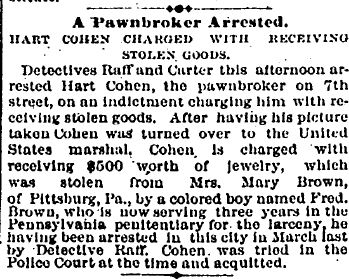
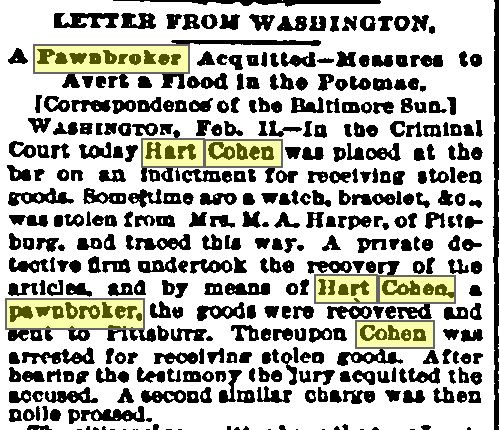
In that same 1888 Sioux City directory is a listing for Hart Cohen as well, JM’s older brother.  The first half of the 1880s for Hart and his wife Henrietta brought two more children to their family, Isadore Baer, born in 1883, and Jacob M. II, born in 1885, in addition to Frances, who was born in 1878, and Munroe, born in 1880.  Hart, like his brother JM, was a pawnbroker, and like his first cousin Hart in Philadelphia, he was charged in 1885 with receipt of stolen goods in the course of his business; he was acquitted of the charges in 1886.


Hart DC Cohen arrested 1885 snip

(“A Pawnbroker Arrested,” Wednesday, March 25, 1885, Critic-Record (Washington (DC), DC),Issue: 5,187, Page: 3)

Letter from Washington. A Pawnbroker Acquitted - Measures to Avert a Flood in the Potomac Date: Friday, February 12, 1886  Paper: Sun (Baltimore, MD)   Volume: XCVIII   Issue: 76   Page: 4

Letter from Washington. A Pawnbroker Acquitted – Measures to Avert a Flood in the Potomac
Date: Friday, February 12, 1886 Paper: Sun (Baltimore, MD) Volume: XCVIII Issue: 76 Page: 4

It might have been in the aftermath of these criminal proceedings that Hart decided to join his brother JM in Sioux City.  He was there at least until 1895, as on the 1895 Iowa census he and his entire family are included.  His occupation at that time was described as a jeweler.

Hart Cohen and family 1895 Iowa census

Hart Cohen and family 1895 Iowa census

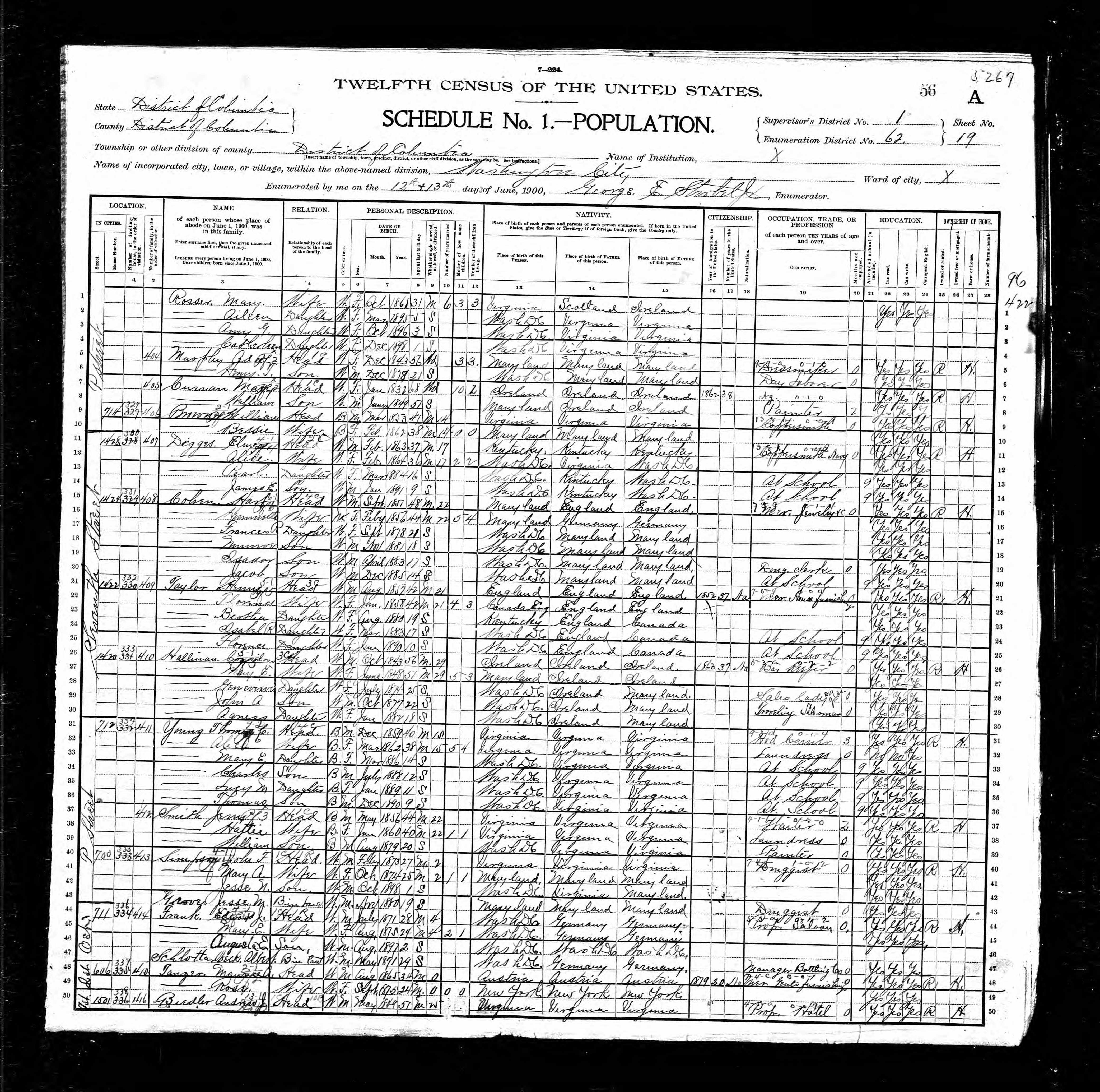
By 1900, however, Hart and his family had returned to Washington, DC, where he was still working as a jeweler.  His children were now all at least teenagers, ranging in age from 14 (Jacob) to Frances (21), and perhaps he felt like he had gotten his life in order and could return to his hometown.  They were living at 1424 Seventh Street, NW, in 1900.

Hart Cohen and family 1900 census

Hart Cohen and family 1900 census

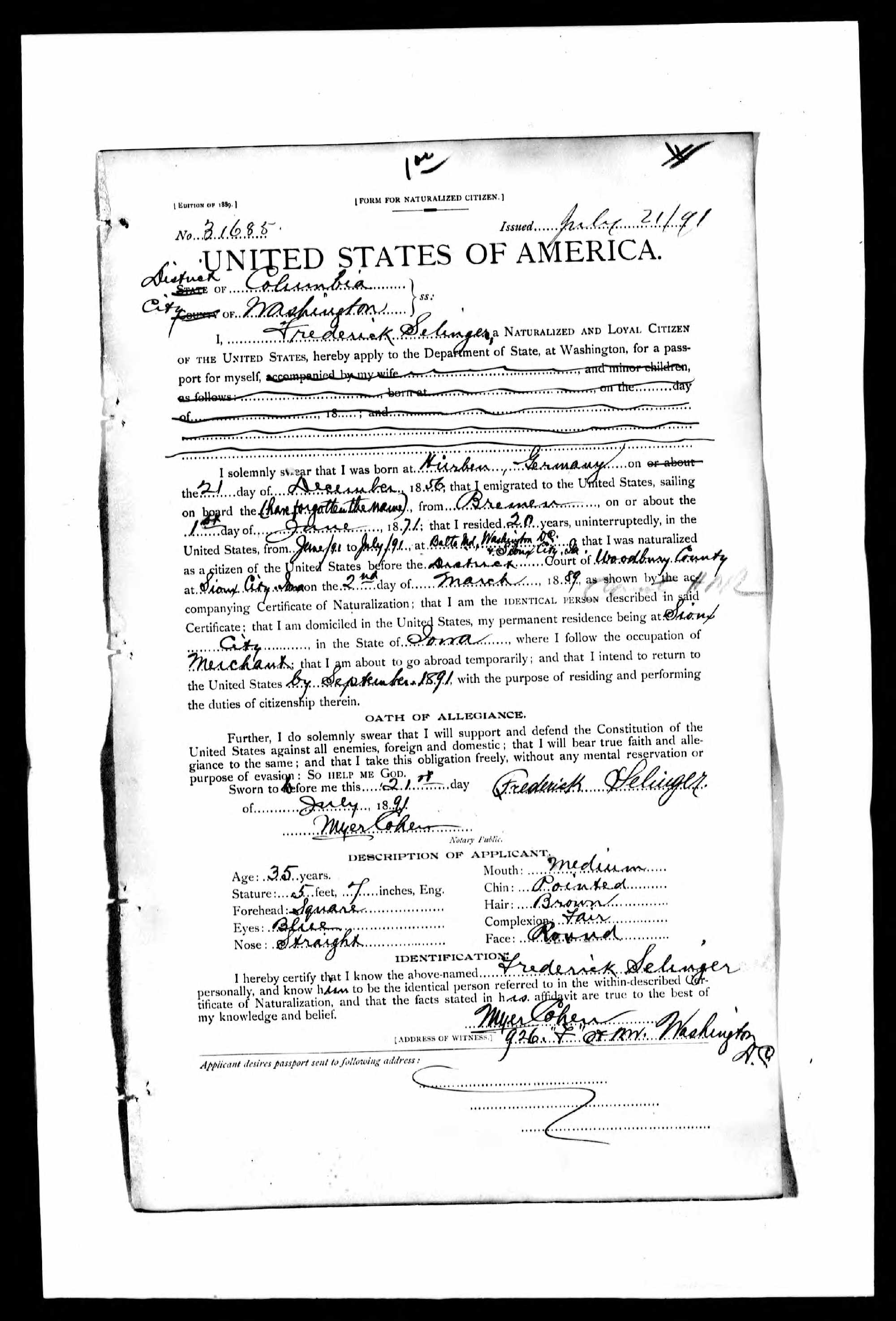
JM even lured his sister Rachel to come to Iowa for some time.  Rachel had been newly married to Frederick Selinger in 1880, and in 1882 they had their first child, Fannie Selinger, in Washington, DC.  Their second child, Monroe, was born in 1888 in Washington as well, but in 1891 when Frederick applied for a passport, they were living in Sioux City, Iowa.  (Interestingly, the witness on the application was Myer Cohen of Washington, DC, his wife’s nephew, son of her brother Moses, Jr.)

Frederick Selinger passport application 1891

Frederick Selinger passport application 1891

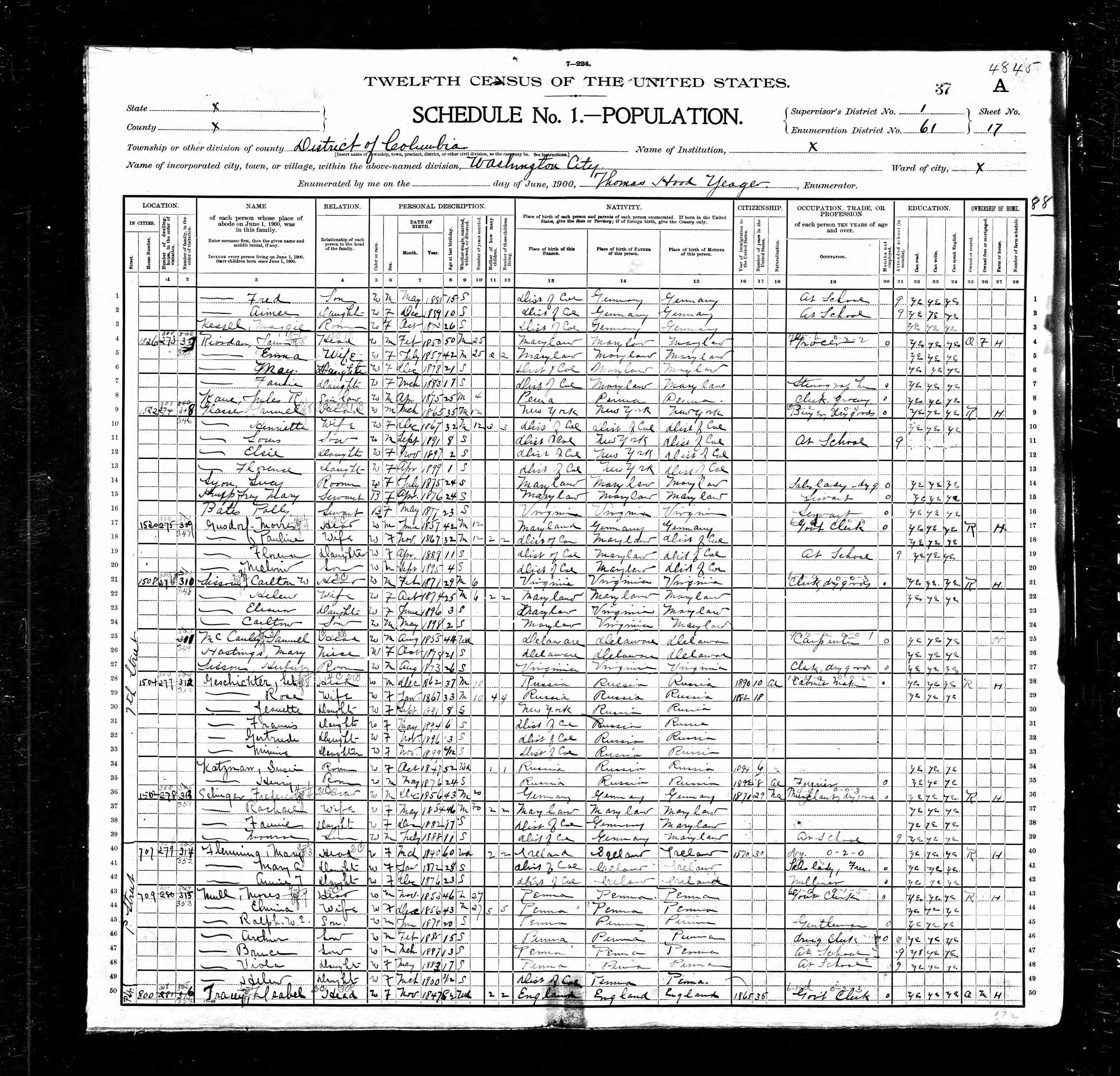
Frederick is also listed in directories for Sioux City from 1890 through 1892.  Like Hart and Adeline, however, Rachel and Frederick returned to Washington, DC, where in 1900 the family was living at 1502 Seventh Street, NW.

Frederick and Rachel Selinger and family 1900 census

Frederick and Rachel Selinger and family 1900 census

Thus, by 1900, the great experiment of living out in Sioux City had ended for all of the DC Cohens except for JM and his family, who would never return to Washington, DC.  All the rest of the Moses Cohen family—from Adeline (until her death in 1895) to Moses, Jr., to Hart, to Rachel– were living within five or six blocks of each other in the Northwest section of Washington, DC, in 1900.

The twentieth century was about to begin, and with it came new challenges and new family members.  The story will continue…


A Brick Wall Tumbles, Thanks Once Again to the Genealogy Village

When I learned that my brother’s Y-DNA did not match the Y-DNA of a descendant of Moses Cohen of Washington, DC, I was sorely disappointed.  I was sure that all the circumstantial and documentary evidence I had found supported my hunch that Moses was the brother of my great-great-grandfather Jacob Cohen and son of my three-times great-grandfather, Hart Levy Cohen.  But DNA does not lie, and I was very surprised by the results.

I had one small glimmer of hope when I learned about a family story that indicated that Moses Cohen, Sr., was not the biological father of Moses Cohen, Jr., who was in fact the biological great-great-grandfather of the living descendant whose DNA had been compared to that of my brother.  But how would I ever prove that?  It seemed hopeless.

Nevertheless, I decided to see what I could find that might help answer some of my questions.  Where and when was Moses, Jr., born? When and where did Moses, Sr., marry his mother Adeline Himmel? I could not find any American records showing a marriage or an immigration record for Adeline and her son Moses, Jr.  All I had were census records from 1850 and 1860 showing that Moses, Sr. and Adeline were already married by 1850 and that in 1850, Moses, Jr., was eleven years old.  Later census records indicated that both Moses, Jr., and Adeline were born in Germany and that Moses, Sr., was born in England (though a few later census reports filed after Moses, Sr.’s death by his children said he was also born in Germany).  Some of Moses, Jr.’s and Adeline’s records were even more specific, several naming Baden as her place of birth.

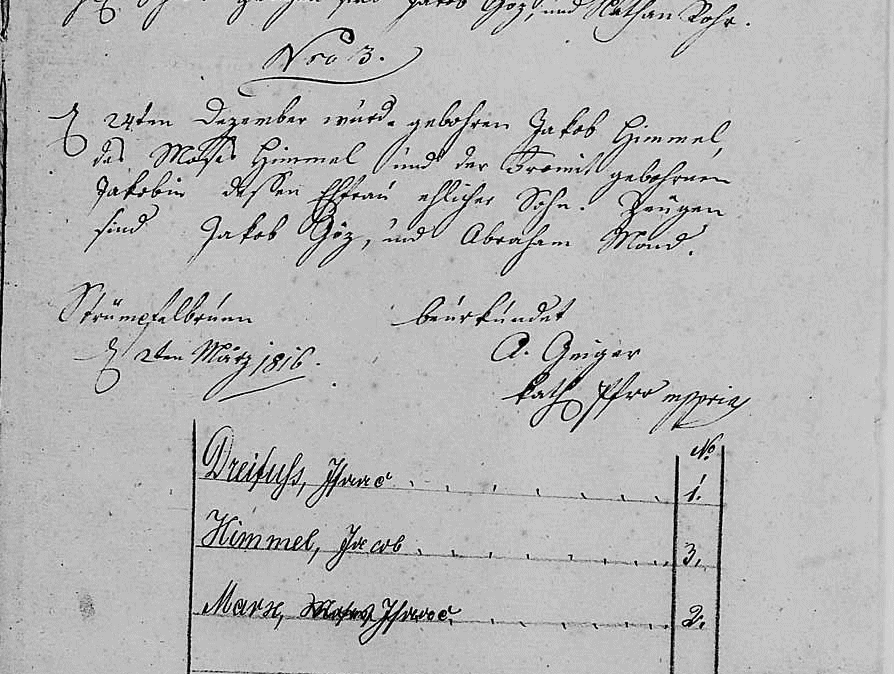
Several months ago when I first discovered the DC branch of the Cohen family, I had tried without success to find where in Baden Adeline had lived.  I sent a message on the GerSIG listserv (German Special Interest Group) of JewishGen.org asking for help.  I received many suggestions, but the most helpful one was from a man named Rodney.  First, he looked up the surname Himmel in Lars Menk’s “Dictionary of German-Jewish Surnames” and found that there was only one Jewish community in Germany where the name Himmel appeared, in  the Eberbach region of Baden.  Then he pointed me to a website that compiled various birth, death and marriage records from various towns in Germany, the Landesarchiv, and specifically to a book of the Jewish records for a town in Eberbach called Strumpfelbrunn where Rodney found a birth record for Jacob Himmel that he translated for me.  The record said, “On the 24th December 1815 was born Jakob Himmel, legitimate son of Moses Himmel and his wife Bromit nee Jakobin(?). Witnesses are Jakob Goez and Abraham Mond.”

(Generallandesarchiv Karlsruhe 390 Nr. 1137, Bild 8
Permalink: http://www.landesarchiv-bw.de/plink/?f=4-1121353-8
Standesbücher / (1691-) 1775-1875 (-1958)
Kernlaufzeit 1810-1870 > Amtsgerichtsbezirk Eberbach >
Strümpfelbrunn, israelitische Gemeinde: Standesbuch 1810-1866 / 1810-1866)

Jacob Himmel birth record

Jacob Himmel birth record

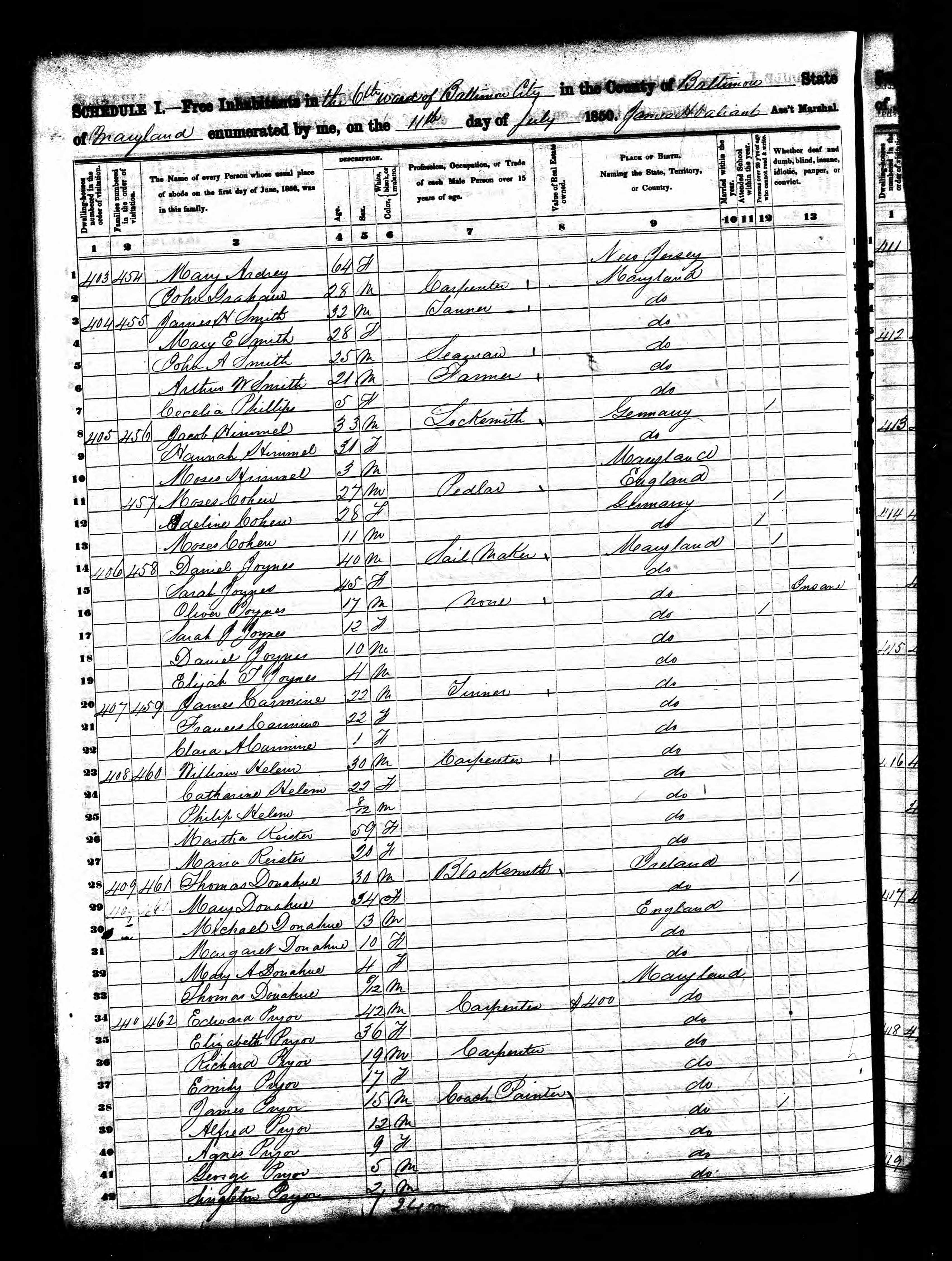
I immediately wondered whether this Jakob Himmel could be the same as the one living next door to Moses, Adeline, and Moses, Jr., in Baltimore in 1850, the one I suspected was the brother of Adeline.

Moses Cohen and family 1850 census

Moses Cohen and family and Jacob Himmel and family  1850 census

Rodney suggested that I look for other records in the Strumpfelbrunn book, but it was written in old German script that looks like what you see above.  I wouldn’t even recognize my own name written in that script.  I tried my best, but after a few pages, I gave up and said that there had to be an easier way.  But there was not.  These records are not digitized or translated anywhere yet.  So I returned to American records and moved on, figuring I’d either never find Moses, Jr.’s records or I’d find them some other way.

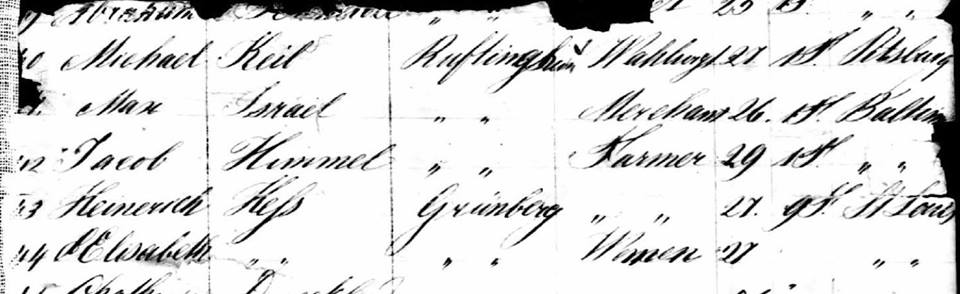
Then in the last few weeks I found the passenger manifest for Jacob Himmel.

Jacob Himmel ship manifest

Jacob Himmel ship manifest

Detail

Detail

I posted it to a Facebook group called Baden Genealogy for help in deciphering the town listed as Jacob’s place of last residence, which looked like Rutlingheim to me and to most others.  But there was no such town in Baden, no town that had a name that looked even close.  I tried searching for the two men who appeared to be traveling with Jacob from “Rutlingheim” and had no luck at all locating them in the US.  Then two days ago, I posted again to the Baden Facebook group, asking whether the town could be Billigheim, a town reasonably close to Strumpfelbrunn where a Jacob Himmel had been born.

Monica, a member of that group, responded, and when I explained why Strumpfelbrunn was my point of reference, she invited me to send her the birth record I had and the source where I had found it and she would translate it for me.  Her translation was consistent with that of Rodney except that she read Jacob’s mother’s name as Fromit, not Bromit.  She, like Rodney, said I should look for other mentions of Himmel in the record.  The book is close to 300 pages long, and I told her that I just could not decipher the old German script.  Then she made a brilliant suggestion; she sent me a link to the font for that old script, had me install it into Word, and then suggested I type out Himmel and any other relevant names in the script and compare it to what I could find on the pages of the records book.

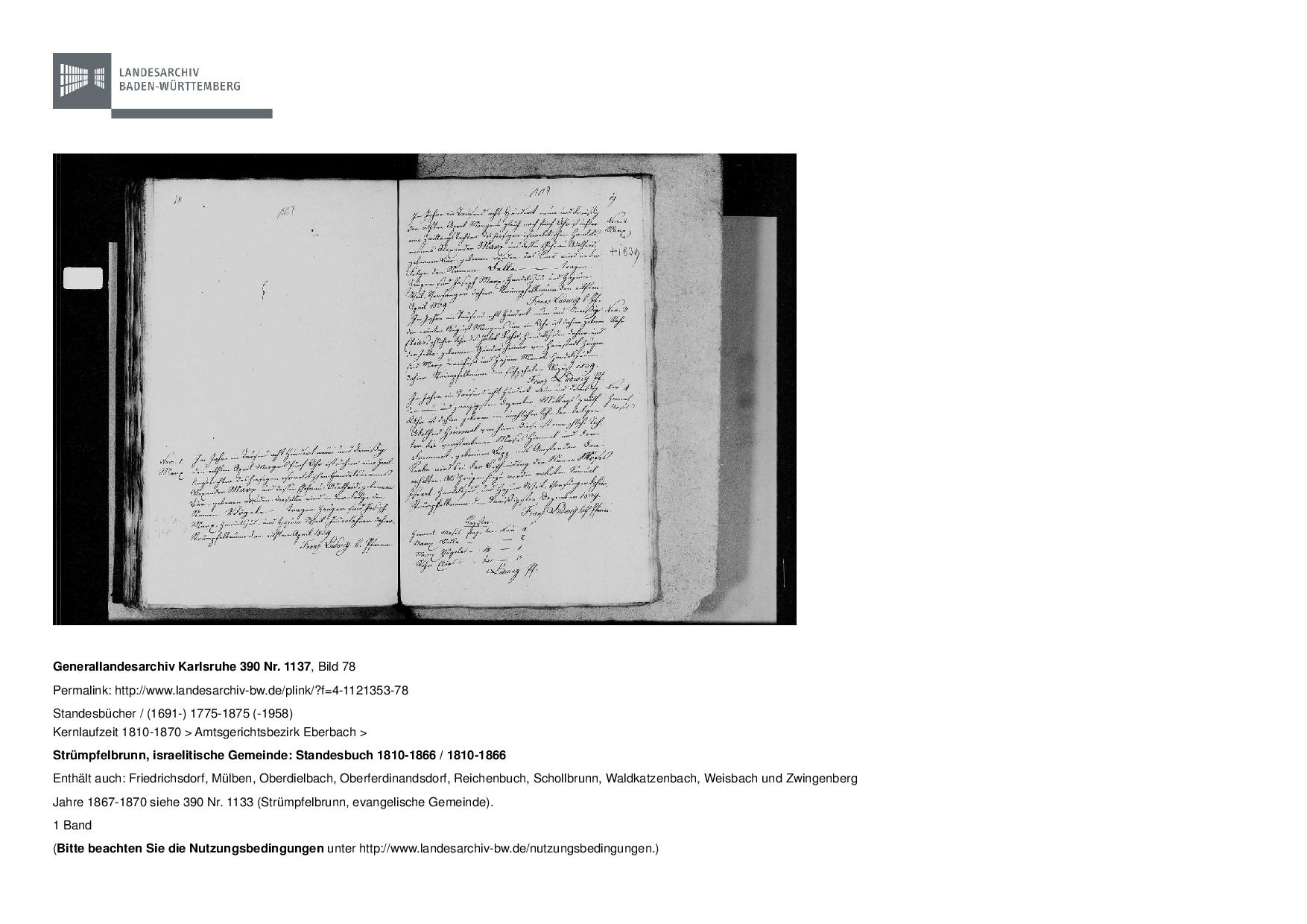
And so I did, and on page 78, I found a record that looked like it had the name Moses Himmel in that old script.

Moses Himmel birth record 1839

Moses Himmel birth record 1839

Moses Himmel birth record 1839 detail

Moses Himmel birth record 1839 detail

I sent it to Monica, who translated it as follows: “In the year 1839 29th Dec at noon an illegitimate son of the spinster Adelheid Himmel was born.  She is the legitimate daughter of the deceased Moses Himmel and of Frommat nee Lagg from Amsterdam.  The boy will be named Moses at his circumcision.”  It then names some witnesses.

When I received that email with the translation, I felt those bricks tumbling down.  Could this be anyone other than Adeline Himmel Cohen and her son Moses? Does this not provide evidence that the family story that Moses, Jr., was not the biological child of Moses Cohen, Sr., is reliable? Doesn’t it explain why Moses, Jr.’s great-great-grandson does not share DNA with my brother, who is a direct descendant of Hart Levy Cohen, who was Moses, Sr.’s father, but not the biological grandfather of Moses, Jr.?

I then found another page, 26, that also seemed to have the name Himmel.  Monica translated that one as well.  “On the 5th of May 1820 in the morning 4 o’clock he died and was buried at noon.  Moses Himmel was married with Fromat Lagg (or Lugg or Legg) from Holland.  Age forty and four years.”  This was the death notice for Moses Himmel, the father of Adelheid or Adeline Himmel.  She named her illegitimate son for her father, not as a junior for Moses Cohen, the man she would later marry, probably in the United States.

Moses Himmel the grandfather of Moses Himmel

Moses Himmel the grandfather of Moses Himmel

Of course, there are many questions remaining.  I still don’t know when Moses, Sr., married Adeline.  Nor can I be 100% certain this is the right Adeline, though it certainly would appear to be so.  These discoveries also open up some new doors for my research.  If Adeline’s mother was named Fromat Lagg or Lugg or Legg and she lived in Holland, perhaps there is a connection to my Dutch ancestors in Amsterdam.  Her name was given as Jakobin on Jacob’s birth record; perhaps she was part of the same family as Rachel and/or Sarah Jacobs, my three-times and two-times great-grandmothers.  Now I need to return to the Dutch research and see what I can find.

In any event, once again the generosity of my fellow genealogy researchers has been demonstrated.  I never could have done this without the help of Rodney and Monica, two people I’ve never met, and the larger GerSIG and Baden Genealogy Facebook group communities.  It is astonishing what can be accomplished when people work together instead of fighting and killing each other.


The Family of Moses, Jr. and Henrietta Cohen 1880-1900: Years of Growth and Change

Moses Jr and Henrietta Cohen and children c. 1900

Moses Jr and Henrietta Cohen and children c. 1904 Seated left to right: Myer, Mabel, Henrietta, Moses, Jr., and Augusta; standing left to right: Fannie, Solomon, Grace, Jacob, and Florence. Insert: Ella Photo courtesy of Jane and Scott Cohen

The years from 1880 through 1900 were years of continued growth for the children of Moses and Adeline Cohen, as their children had more children and as their grandchildren grew and had families of their own as well.  It was also a time of change, as some of the family members left the Washington, DC, area for other parts of the country.

I will focus first on the family of Moses, Jr. and Henrietta (Loeb) Cohen since he was the oldest of Moses and Adeline’s children by more than ten years. As I wrote last time, by 1880 he and Henrietta already had a large family of eight children, the oldest being Augusta who was already a teenager and the youngest being Solomon, who was just born in 1879. (There also were apparently two other children who died in infancy, but I have no documentation of their births, names, or deaths.)  They would have one more child, Mabel, who was born in 1883 when Henrietta was already 41 years old.  As reported to me by a direct descendant of Moses, Jr. and Henrietta, Mabel had Down’s syndrome, perhaps not all that surprising given the age of her mother when she was born. Sometime after 1880, Moses had switched from selling clothing to being a sexton for his synagogue and also a collector (a bill collector, I assume), according to city directories for Washington, DC, during that period.

The year after their last child Mabel was born, Moses and Henrietta saw their first child get married.  Augusta married Julius Selinger on June 10, 1884, when she was only eighteen years old.  Although I do not yet have any record to prove it, my hunch is that Julius was a brother or cousin of Frederick Selinger, the husband of Augusta’s aunt Rachel, her father’s sister.  Like Frederick, Julius was born in Hubern, Germany, according to his passport application. Julius had emigrated only a year or so before marrying Augusta. The two Selinger men were only three years apart in age.    By 1900, Augusta and Julius had five children: Sidney (1885), Harry (1888), Jerome (1889), Maurice (1893), and Eleanor (1894).  Julius was working as a jeweler, and his oldest son Sidney was an apprentice watchmaker.  The family was living in DC at 1157 8th Street, NW. [All addresses in this post are in the NW section of DC.]

Augusta and Julius Selinger 1900 census

Augusta and Julius Selinger 1900 census

During this same time period, Moses and Henrietta’s second child, Myer, was obtaining an education and building his career as well as his family.  Myer might be the very first Cohen to get a law degree (or the first I’ve found so far).  According to a 1917 alumni directory for George Washington University, Myer Cohen received an LL.B. in 1886 as well as an LL. M. in 1887, and was a lawyer in Washington, DC.

Ancestry.com. U.S., College Student Lists, 1763-1924 [database on-line]. Provo, UT, USA: Ancestry.com Operations, Inc., 2012. Original data: College Student Lists. Worcester, Massachusetts: American Antiquarian Society.

Ancestry.com. U.S., College Student Lists, 1763-1924 [database on-line]. Provo, UT, USA: Ancestry.com Operations, Inc., 2012.
Original data: College Student Lists. Worcester, Massachusetts: American Antiquarian Society.

Myer married Helen Wolf on January 14, 1890.  Helen was also a DC native, and her father Simon Wolf  had been president of Washington Hebrew congregation where Moses Cohen was a member and the shammes for many years.  Helen and Myer must have known each other for years before marrying.

Simon Wolf was a very well-known and well-regarded lawyer known for advocating for Jews and Jewish causes; one source described him as “a friend of Presidents from Abraham Lincoln to Woodrow Wilson.”[1] Myer joined his father-in-law’s practice, which became known as Wolf and Cohen; Simon Wolf had also started an insurance business in 1878, which also became known as Wolf and Cohen.[2]  It was the first insurance brokerage business in the Washington, DC, area.

Between 1890 and 1900, Myer and Helen had four children: Ruth (1891), Edith (1893), Marjorie (1896), and Roger (1898).  Another son, Myer, Jr., would be born in 1907.  The family was living at 1711 S Street in DC in 1900.

Myer Cohen Sr. 1900 census

Myer Cohen Sr. 1900 census

The third child of Moses and Henrietta was Jacob G. Cohen.  He married Ida Slegh in 1894; she was also a DC native. They had a daughter, Aimee, born in 1895, perhaps the first ever “Amy Cohen” in the family (although they spelled it the French way).  In 1900, their son Gerson was born. The family was living at 1 West 115th Street in New York City, and Jacob was employed as a bookkeeper.

Jacob G. Cohen and family 1900 census

Jacob G. Cohen and family 1900 census

A third Selinger joined the family in 1893 when Fannie Cohen, the fourth child, married Alfred Selinger.  Like Julius and Frederick, Alfred was born in Germany.  He immigrated to the US in October, 1888, and in 1891, he and Julius were both living at the same address, 810 I Street, according to a DC directory for that year, certainly an indication that the two were related and probably brothers.  In 1892, Julius and his family traveled abroad along with Alfred, according to a society item in the Washington Evening Star on June 17, 1892.  (Friday, June 17, 1892, Evening Star (Washington (DC), DC)   Page 3)  Fannie Cohen married Alfred a year later on June 10, 1893. Alfred and Fannie had one child, Selma, who was born in March, 1894.  According to the 1900 census, Alfred was a tailor, and the family was living at 711 I Street in DC.

Fannie and Alfred Selinger 1900 census

Fannie and Alfred Selinger 1900 census

Moses, Jr. and Henrietta must have had quite a wedding budget because in 1895 their fifth child, Ella, married Jacob Bernard Greenberg.  Ella and Jacob had a daughter Marjorie Ruth the following year, and in 1900 they were living in New York City at 140 West 100th Street, not too far from Ella’s brother Jacob G. Cohen. Her husband Jacob was employed as a freight clerk.

Ella and Jacob Greenberg 1900 census

Ella and Jacob Greenberg 1900 census

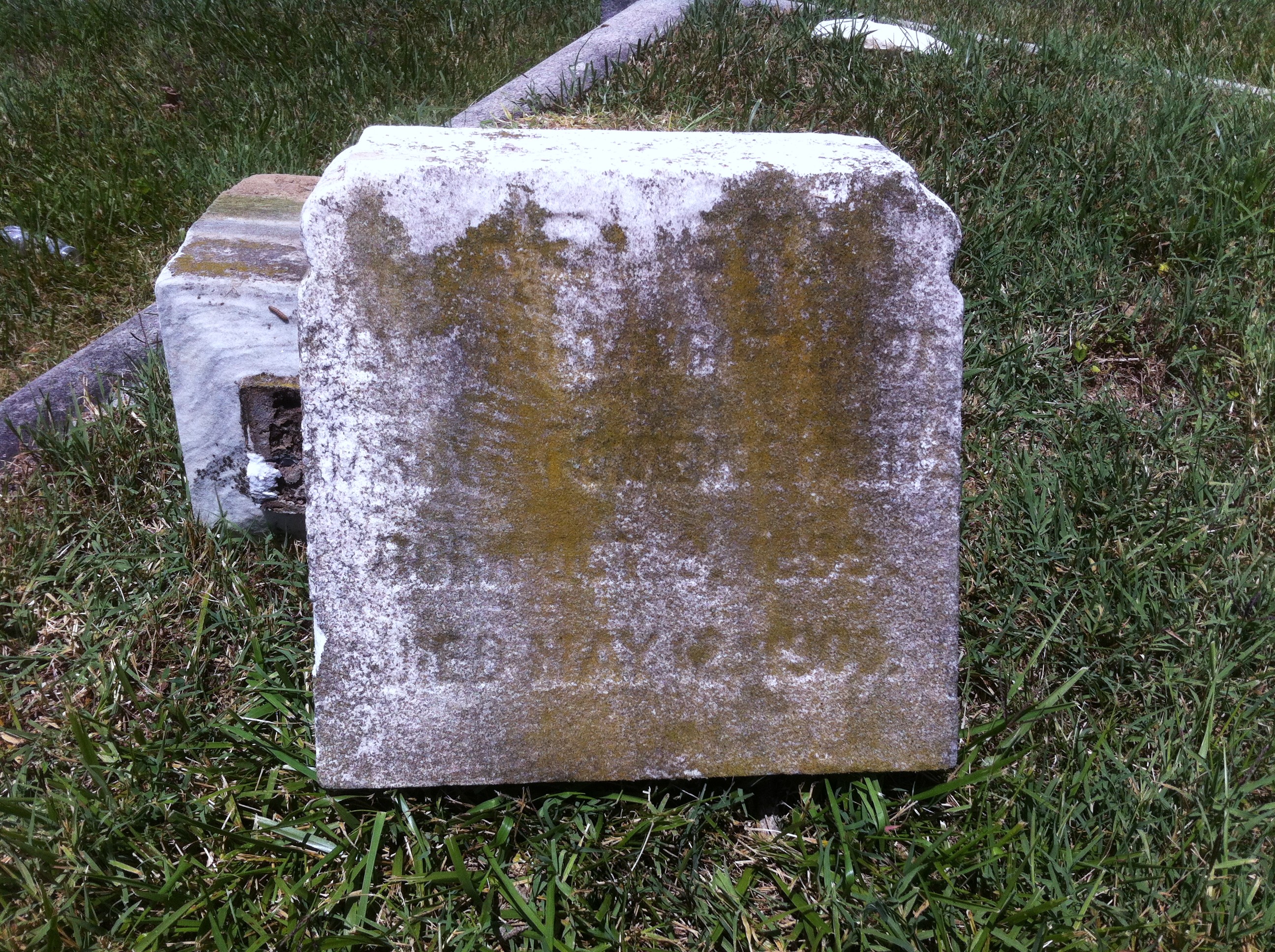
The weddings did not end there.  In 1898, Florence, the sixth child, married Harry Panitz.  Harry was a salesman from Baltimore, where the couple lived in 1898 and thereafter.  I thought that they did not have a child until 1902 when their daughter Aline was born, but when my brother visited Washington Hebrew Cemetery to look for the headstones for Moses Cohen, Sr., and his family, he saw one overturned headstone in the same area as other Cohen graves and picked it up.  It was very hard to read even in person, but he was able to edit the photo below to highlight the dates.

Headstone for Helen Panitz October 2, 1899 to May 12, 1900

Headstone for Helen Panitz October 2, 1899 to May 12, 1900 Photo courtesy of Ira Cohen

From those dates, I was able to search the death indices and found that Helen Panitz, less than one year old, had died in Fayetteville, North Carolina, on May 12, 1900, and was buried in Washington, DC, on May 14, 1900.  I do not know what they were doing in Fayetteville, nor do I know why Helen died so young. They were not living in Fayetteville as of December 27, 1899, because the Washington Evening Star reported on that day that Grace Cohen, Florence’s sister, had just returned from a visit to Baltimore to see Florence and Harry Panitz perhaps to see the ill-fated baby Helen.  (Wednesday, December 27, 1899, Evening Star (Washington (DC), DC), Page 7)

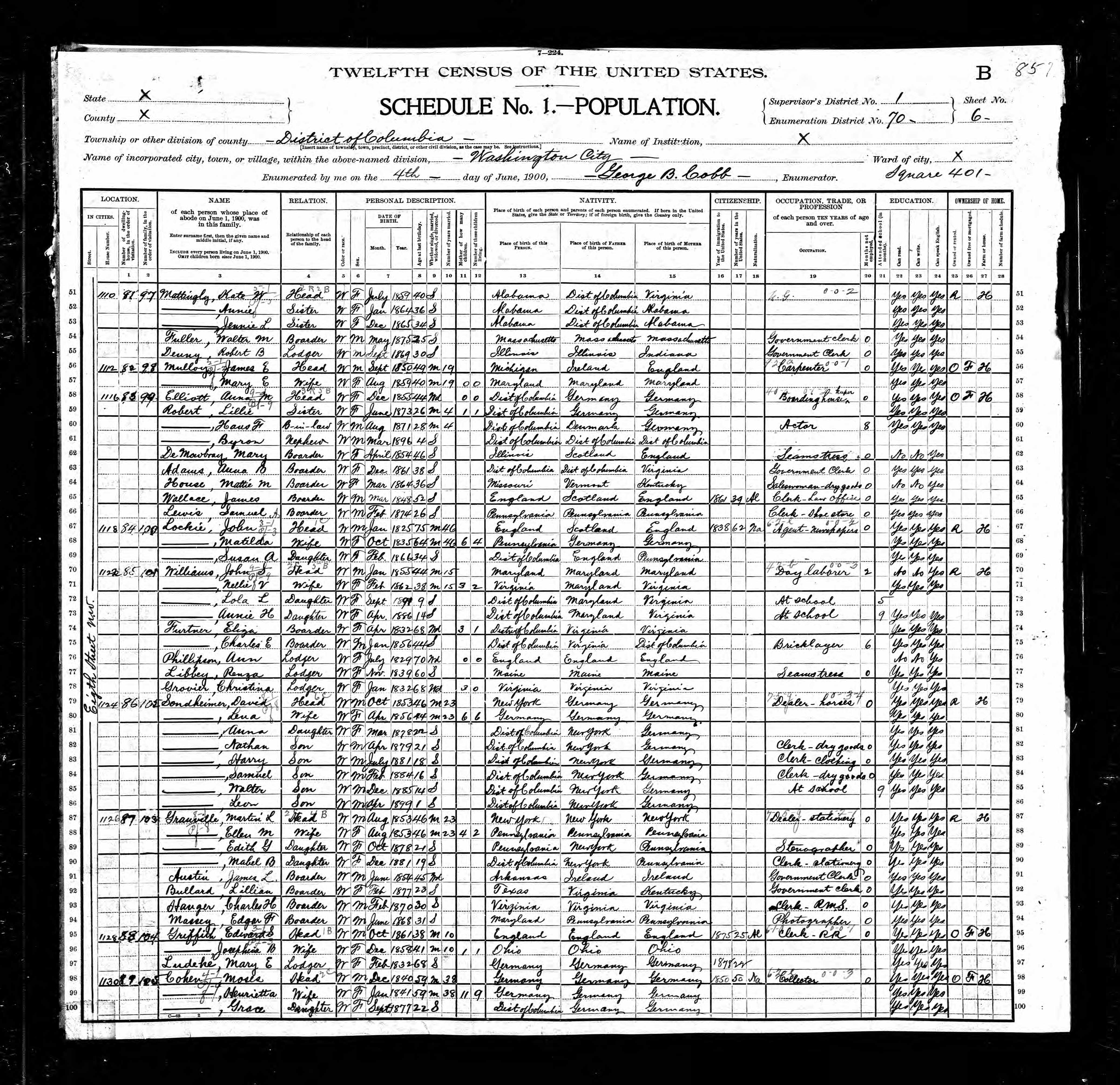
As of the 1900 census, Grace and her sister Mabel were still living with their parents, Moses, Jr. and Henrietta, at 1130 8th Street, just down the street from Augusta and Julius and their five children, some of whom were not much younger than their two aunts.

Moses Cohen, Jr. and family 1900 census

Moses Cohen, Jr. and family 1900 census

Moses and Henrietta’s youngest son Solomon was living on his own in New York City in 1900; he was 20 years old and working as a clerk.  He was living at 20 West 115th Street and boarding with a family named Pawel.  Solomon’s brother Jacob was living at 1 West 115th Street, the building across the street, and his sister Ella just a mile away, so Solomon had plenty of family to look after him in New York.

Solomon Cohen 1900 census

Solomon Cohen 1900 census

So by 1900, almost all of Moses, Jr’s nine children had married and/or moved out on their own.  Several had left Washington, DC—three to New York City and one to Baltimore.  There were many births and not too many deaths or other tragedies.  Moses and Henrietta had a son who was a lawyer and many grandchildren and more to come.  From the outside, it looks like life was very good for the entire clan.

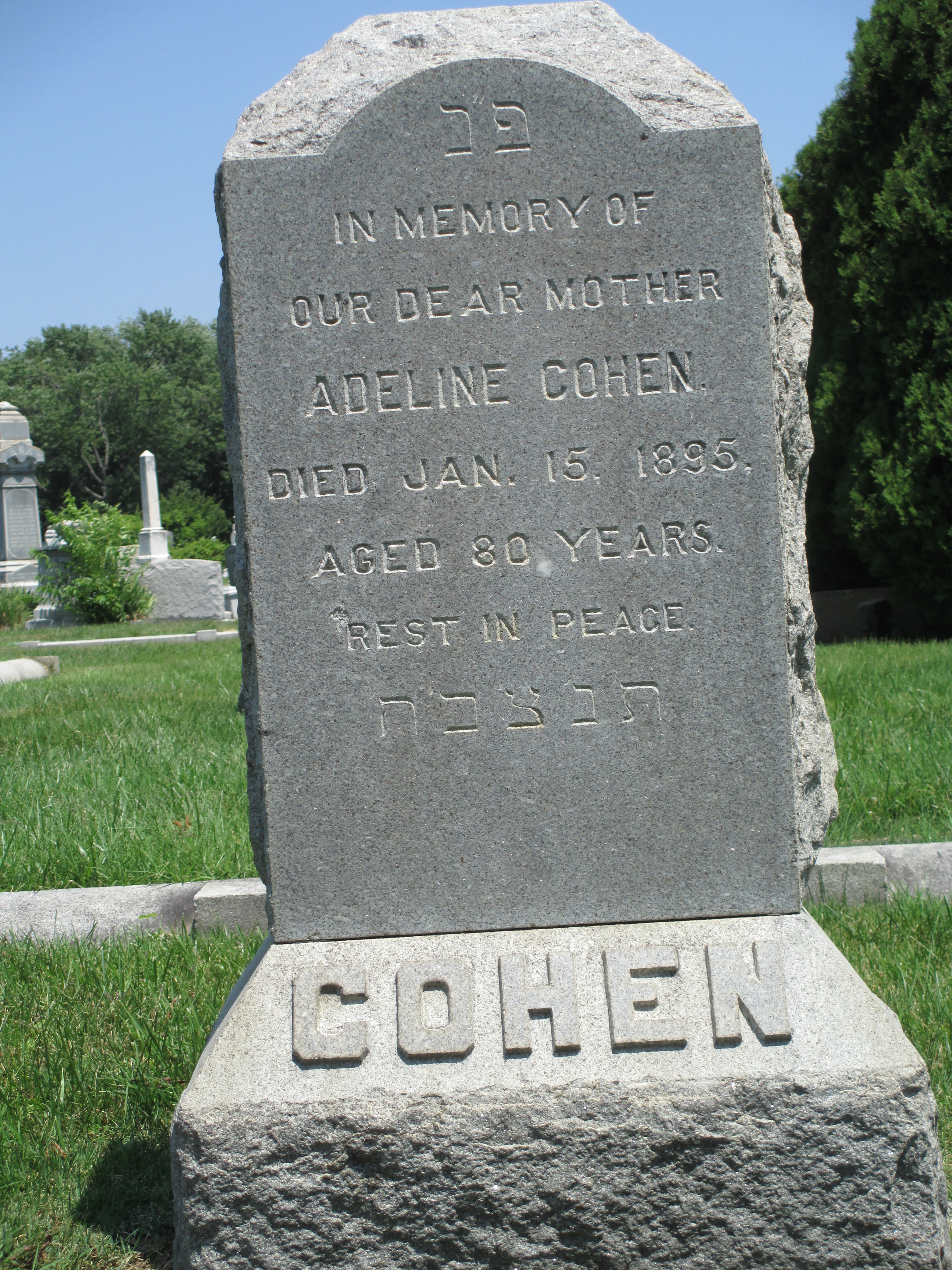
There was, however, one major loss suffered by the family during this period. On January 15, 1895, the family matriarch, Adeline Himmel Cohen, died.  She had survived the loss of her husband Moses 35 years earlier and had essentially raised the four younger children on her own and perhaps Moses, Jr., as well before she married Moses, Sr. Adeline had worked outside the home to support her children, selling second hand clothing and carrying on the work that her husband Moses, Sr., had been doing before his death.   She must have been a very strong and determined woman to have weathered so many storms in her life.

Adeline Cohen headstone

Adeline Cohen headstone Photo courtesy of Jane and Scott Cohen


[1] Website of the Goethe Institute at http://www.goethe.de/ins/us/lp/kul/mag/deu/ewy/per/en6791595.htm

[2] The insurance business still exists today and was partially acquired by the Meltzer Group. See Related articleshttp://www.prnewswire.com/news-releases/the-meltzer-group-inc-acquires-certain-assets-of-wolf–cohen-life-insurance-inc-55350942.html

Cohens in the Nation’s Capital: 1860-1880

As I continue to work on finding out when and where Moses Cohen, Sr., married Adeline Himmel and where and when Moses, Jr., was born and whether he was the biological son of Moses, Sr., I am operating under the assumption that Moses Cohen, Sr., was the brother of my great-great grandfather Jacob and the son of Hart Levy Cohen and Rachel Jacobs Cohen, my great-great-great grandparents.

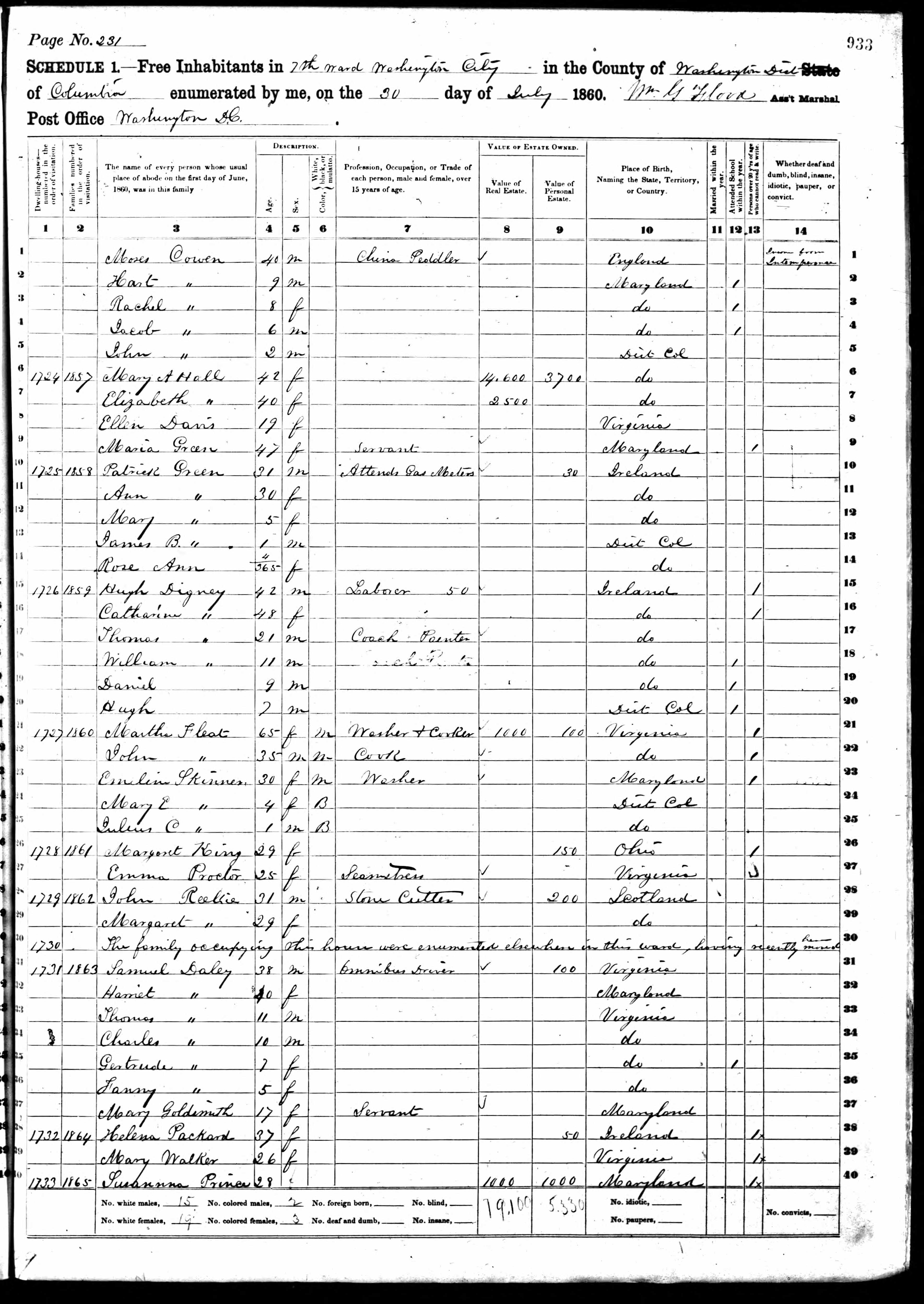
Two months ago I wrote about the death of Moses Cohen, Sr., in 1860 and the decade that followed for his widow and children.  To recap, on the 1860 census, Moses, Sr., was listed as a forty year old china peddler, born in England; he was also described as “insane from intemperance.”  Perhaps that alcoholism is what led to his early demise just over two months later on October 2, 1860, at age 32, according to his headstone, or at most age 40, if his age on the 1860 census is more accurate.  He left his widow Adeline with four children under ten: Hart (9), Rachel (8), Jacob (6), and John (2).  In addition, he was survived by Moses Cohen, Jr, who was twenty years old.

Moses Cohen and family 1860 census

Moses Cohen and family 1860 census


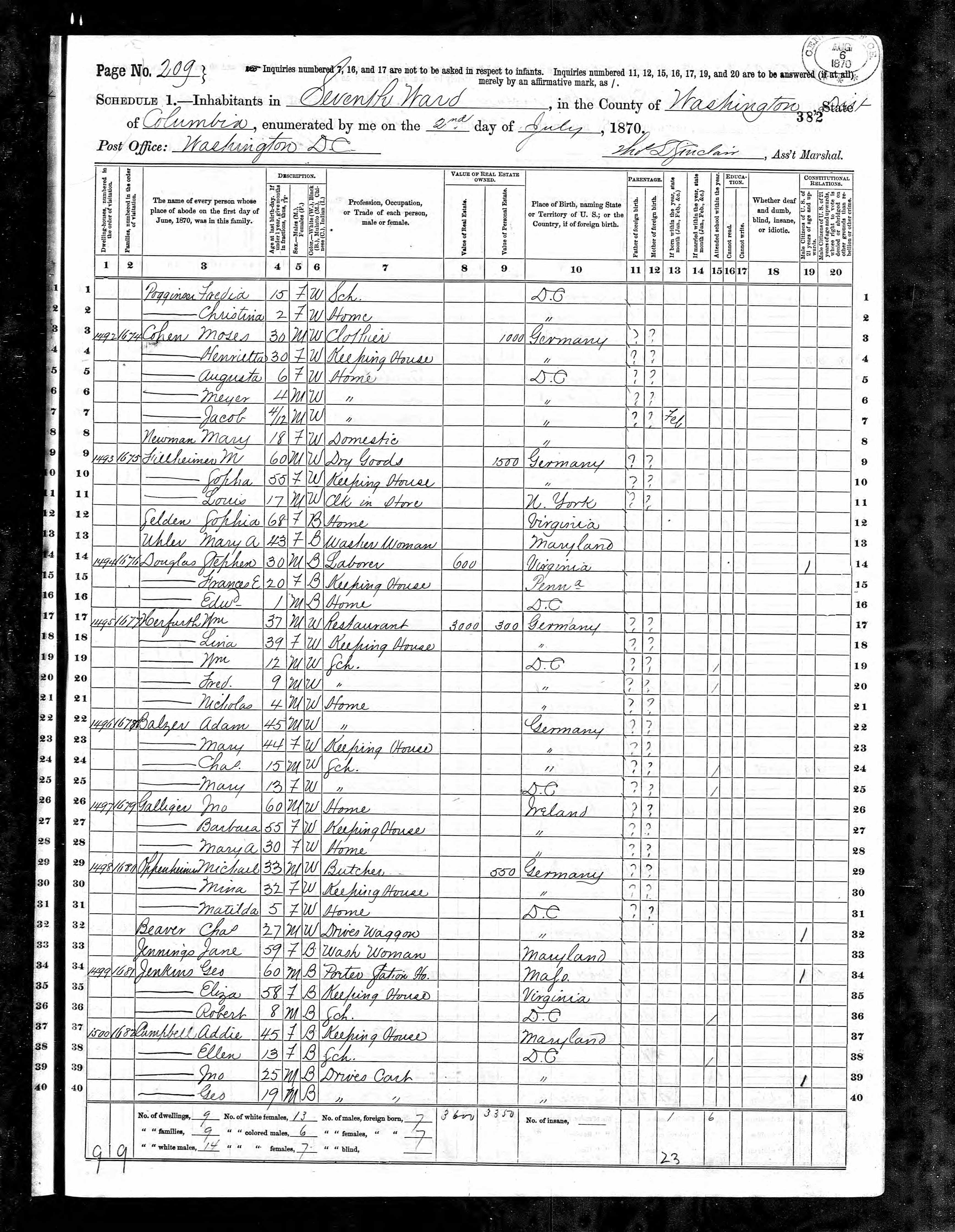
After Moses, Sr., died, Adeline had gone to work out of the home as a merchant of second hand clothing, and Moses, Jr., was also in the clothing business. Moses married Henrietta Loeb on August 16, 1862, and by 1870, Moses and Henrietta had three children, Augusta (6), Myer (4), and Jacob (4 months). Moses was still a clothier.

Moses, Jr. and family 1870 census

Moses, Jr. and family 1870 census

Adeline in 1870 was still living with the four younger children; Hart was working as a pawnbroker and Jacob as a clerk. The other two children were still at home.  Interestingly, although on both the 1850 and 1860 census, Adeline had indicated she could not read or write (English, I assume), by 1870 that box was no longer checked off.

Adeline Cohen and family 1870 census

Adeline Cohen and family 1870 census

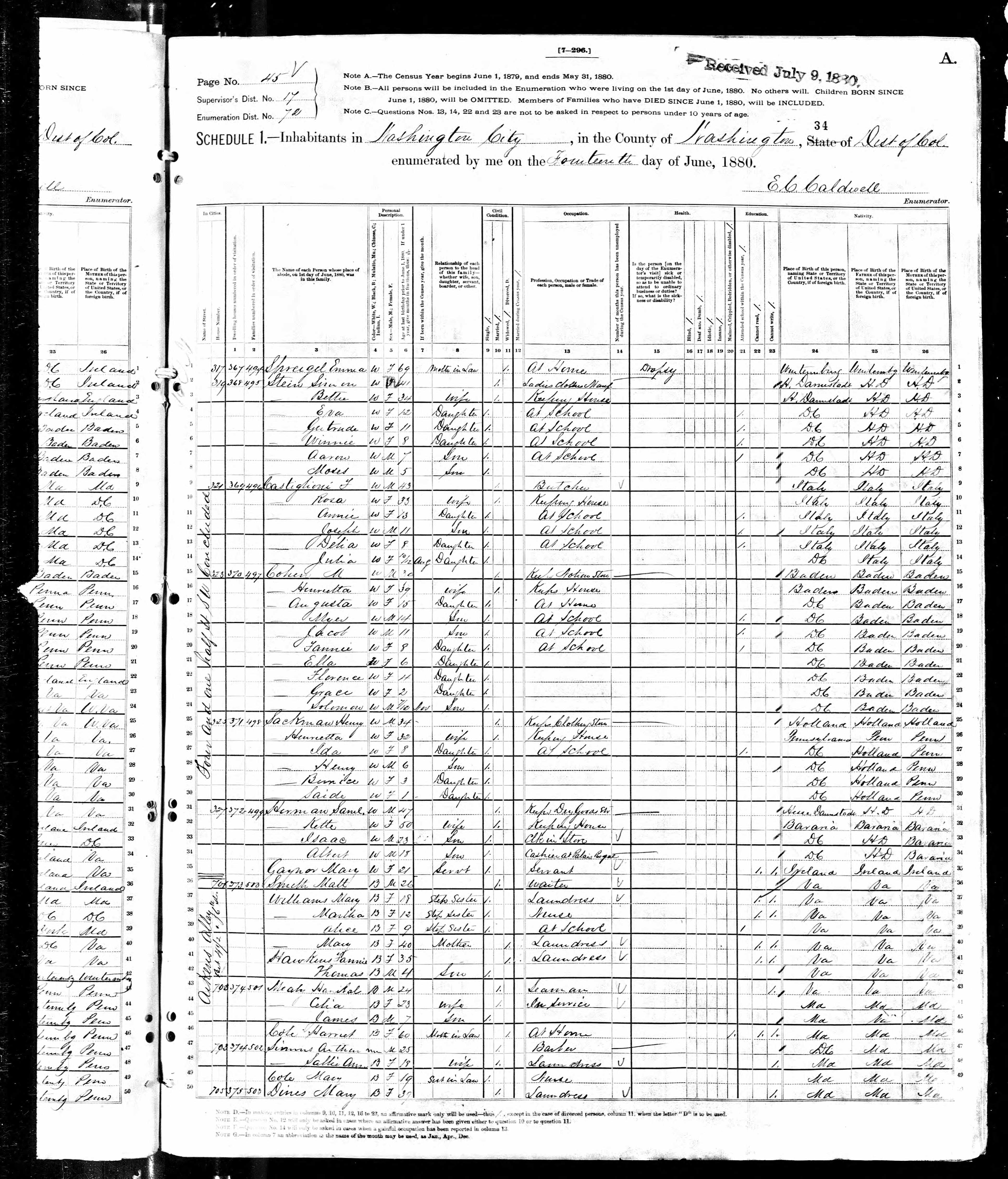
Between 1870 and 1880, there was a lot of growth in the family.  Moses, Jr., and Henrietta had five more children: Fannie (1872), Ella (1874), Florence (1876), Grace (1877), and Solomon (1879), bringing their family to eight children, ranging in age from one year to fifteen years old.  Moses was working at or owned a notions store in 1880.

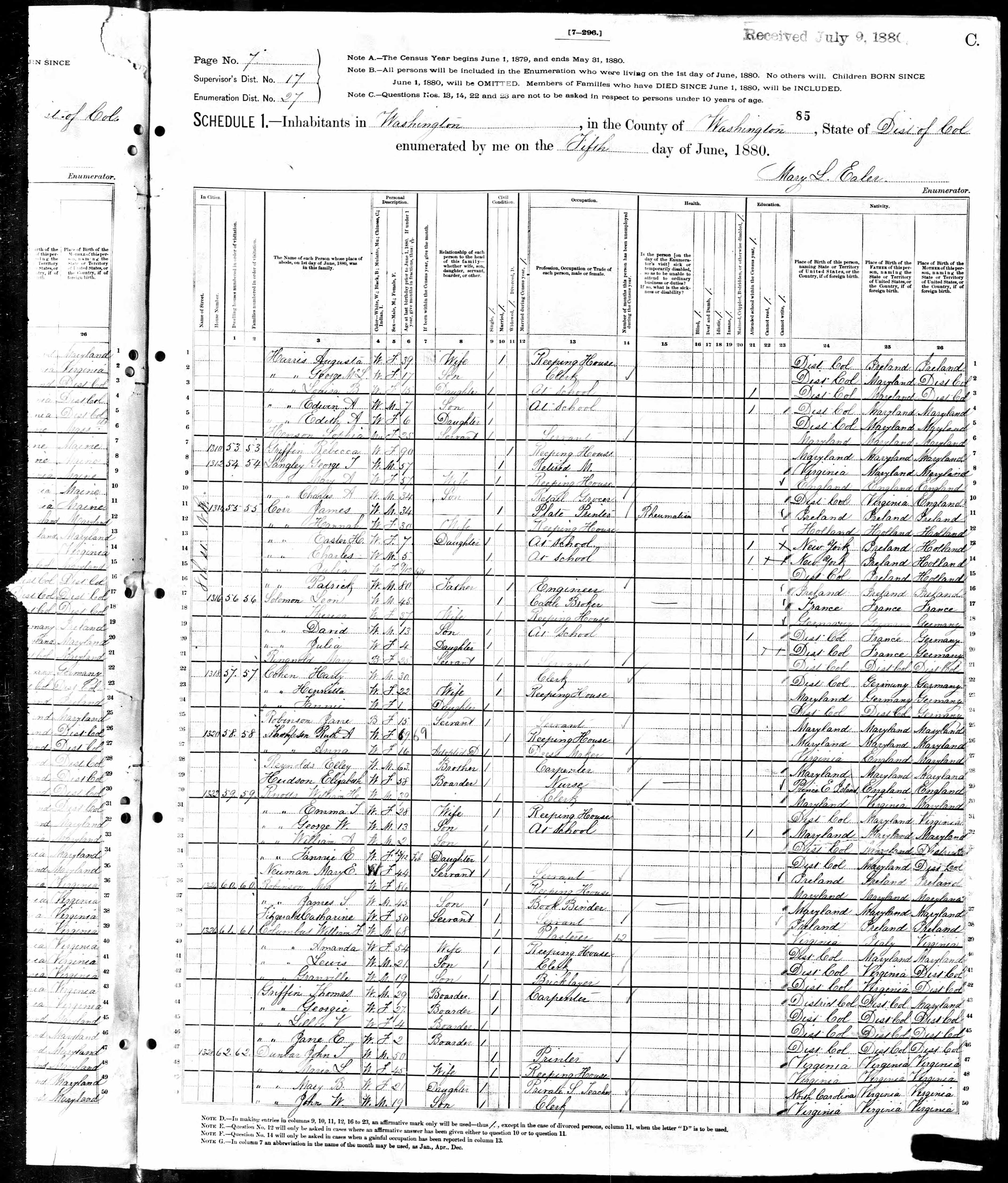
Moses Cohen, Jr., and family 1880 census

Moses Cohen, Jr., and family 1880 census

Moses, Jr.’s brother Hart married Henrietta Baer in 1878, and they had their first child, Frances, later that year.  Hart was working as a clerk, presumably in a pawnshop.  A son Munroe was born on November 5, 1880, after the 1880 census had been taken.

Hart Cohen and family 1880 census

Hart Cohen and family 1880 census

Jacob M. Cohen, the next child of Moses, Sr., and Adeline, was married to Belle Lehman in 1877 in Cuyahoga, Ohio, where Belle’s family resided.  They had a daughter, Fannie Sybil Cohen, born on November 7, 1879.  As of the 1880 census, Jacob was working in a “loan office.”

Jacob M. Cohen and family 1880 census

Jacob M. Cohen and family 1880 census

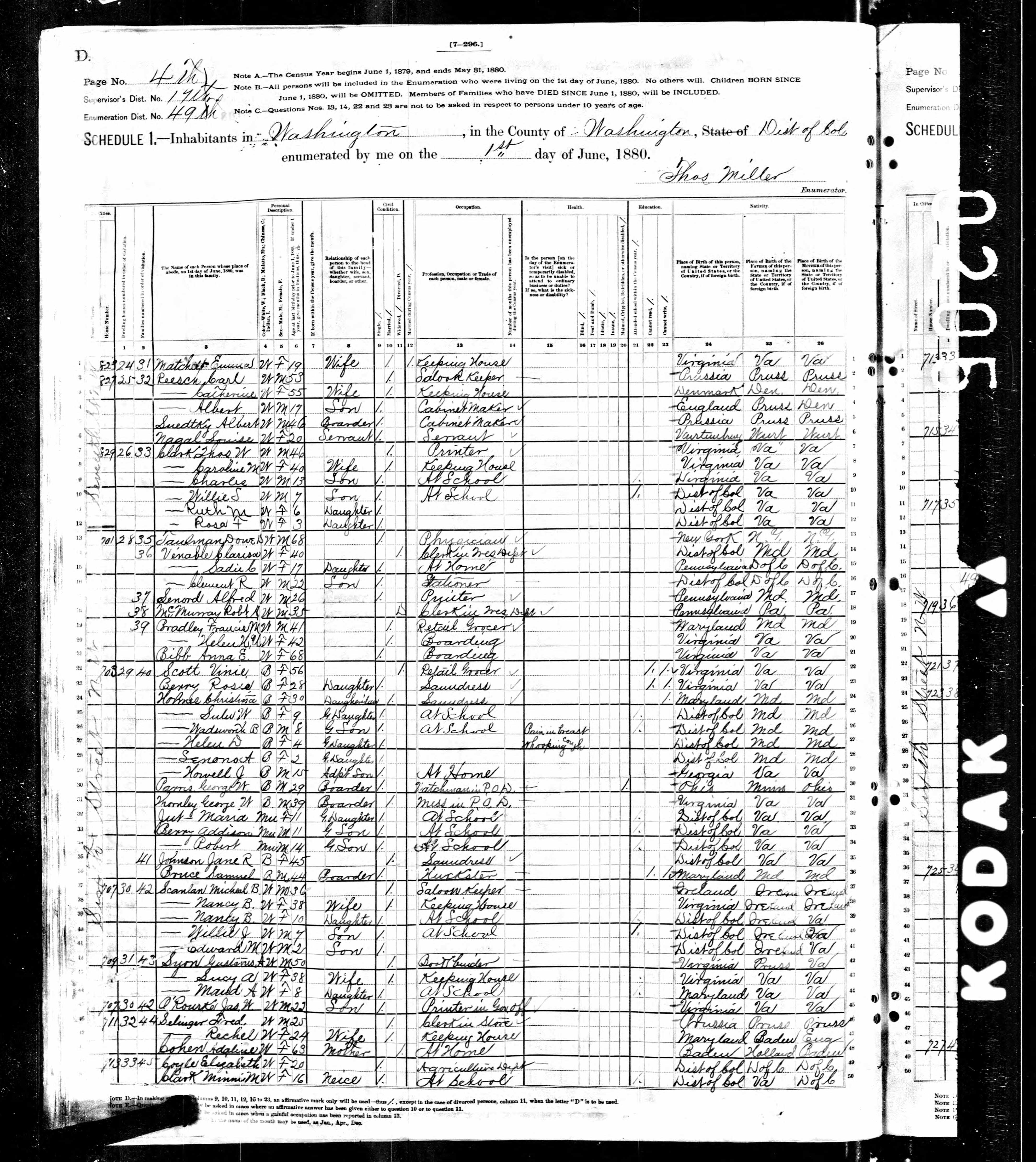
Moses, Sr., and Adeline’s only daughter, Rachel, was also married by the end of the decade.  She married Frederick Selinger on January 10, 1880.  Frederick was born in Hurben, Germany, and had emigrated from Germany to the US in 1871, according to his passport application.  According to the 1880 census, Frederick was working as a “clerk in store.”   Adeline Cohen, Moses, Sr.’s widow, was living with her daughter Rachel and son-in-law Frederick Selinger.

Frederick and Rachel Cohen Selinger and Adeline Cohen on 1880 census

Frederick and Rachel Cohen Selinger and Adeline Cohen on 1880 census

The only member of the family I cannot locate between 1870 and 1880 or thereafter is the youngest child, John.  He was twelve as of the 1870 census, but I cannot find him at all on the 1880 census, nor can I find a marriage record or a death record.  He seems to have just disappeared.

Thus, as of 1880, Adeline and Moses, Sr.’s four oldest children were all married, and Adeline already had eleven grandchildren with more to come.  All of the children were living in Washington, DC, and it would seem that life was fairly routine for the four young families and their matriarch, Adeline Cohen.  It seemed that Adeline’s children had thrived despite losing their father at such an early age.

Things would start to change in the 1880s, as members of the extended family faced crises and changes.


A Delightful Conversation: Cousin Marjorie 

There are so many joys that come with doing genealogy work: solving family mysteries, learning about your roots, reliving the lives of those who came before you, working with other researchers and learning and teaching each other, and many other benefits.  But perhaps the greatest joy for me has been finding and meeting new cousins.  My reunion with my Brotman cousins last April was more than I’d ever expected, and the phone conversations, email exchanges, and meetings I’ve had with other cousins have also all been so much fun and so rewarding.

But this cousin connection was particularly special to me.  Cousin Marjorie is my father’s first cousin and close to him in age.  They knew each other as children, but have not been in contact for over sixty years.  In order to contact this cousin, I could not rely on email or Facebook.  I had to do it the old-fashioned way, a handwritten letter.  Fortunately, I was able to find her address on line and took a chance that she would still be able to respond and that she would want to respond.

When I did not hear back for nearly two weeks, I assumed that she either could not or did not want to respond, and I resigned myself to the fact that I would not hear from her.  Then one day last week my cell phone rang, and a number came up that was not familiar.  I answered the phone, and a woman who sounded like someone in her 20s said, “Amy?  You will never guess who this is.”  I said that I had no idea, and she said, “This is your cousin Marjorie.”

What then followed was an hour long conversation, followed up with another hour long conversation the other day.  Marjorie’s memory is remarkable; she was able to confirm a number of dates and addresses and stories that I had found online through public documents, but she had them at her fingertips.  She also had memories of my great-grandmother, my grandfather, my great-uncles and great-aunts, stories I had not known before.  And she had wonderful stories about her own life and her parents’ lives as well.   Our conversations ranged from the particular to the universal, discussing everything from Winston Churchill (from whom she has a signed letter), Queen Elizabeth (to whom she sends a birthday card every year and receives a thank you in return), and how she learned to drive, to current politics and social issues like legalizing drugs and sexual mores and her current day-to-day life with her cat Scarlett and her many friends.

Out of respect for her privacy, I do not want to discuss too many of the details of her own life on the blog, but suffice it to say that she is a very bright, articulate, and opinionated woman.  She told me that she had graduated from Trinity College (D.C.) and that she had traveled the world as part of her career working for the American Automobile Association.  She is still volunteering one day a week for the local historical society in her neighborhood.

As for some of the family memories, Marjorie did not remember her grandfather Emanuel well since she was only about three years old when he died, but she does remember her grandmother, Eva May Seligman Cohen, lovingly and clearly.  She said Bebe, as the grandchildren called her, had been a brilliant woman.  Her brother, Arthur Seligman, was the governor of New Mexico (more on that when I get to the Seligman line), and he had been invited to speak one year at Valley Forge.  When he had to cancel his plans, my great-grandmother Eva May spoke as his replacement.  Marjorie had not been able to attend, but wished that she had been there.  Marjorie said that not only was Bebe brilliant, she was kind and giving and would do anything for her family.  I shared with her the fact that Eva May and Emanuel had opened their home to Emanuel’s brother Isaac and his son when his wife died, and she was not surprised.  Like my father, Marjorie remembers exactly when her beloved grandmother passed away in October, 1939.

I also asked Marjorie what she remembers of my grandfather, her Uncle John, and she said that she has no memory of him before he became disabled, but remembers driving with her parents to Coatesville, Pennsylvania, once a month to visit him at the VA hospital there.  She described him as very good looking, thin, with black hair.

She also remembered going to occasional Sunday dinners at her grandmother’s house when my father and my aunt were living there and going to the movies with her cousins.  She said that somewhere she has a street photograph of the three cousins—my father, my aunt, and Marjorie—walking in Philadelphia.  Marjorie also told me that about 25 years ago she got a call out of the blue from her cousin Buddy, Maurice’s son, saying that he was back east from California and wanted to see her.  He and his wife (whom she remembered as being Norwegian) came to visit, and she said she and Buddy stayed in touch until he died in 1995.

Marjorie also spoke adoringly of her parents, Stanley and Bessie Cohen.  She said that although they were brought up in different faiths—her father a Reform Jew, her mother a High Episcopalian, they were an ideal match and had a wonderful marriage for well over 60 years.  She quoted to me several sayings that her mother used to convey her values to her daughter—as Marjorie described them, common sense statements about the value of an education and the importance of good health.  She said her mother was a sweet and kind person who always saw the good in other people.  Her father, my great-uncle Stanley, she described as a broad-minded man who had a bit of a temper, but who adored his wife and daughter.  He lived to be 98 years old and had good health all the way until the very end.   Marjorie said her parents had a very large circle of friends and were very well-regarded in their community.

At the end of our conversation, I told Marjorie that I would stay in touch.  She said that I had made her day, and I told her that she had made mine as well.  And I meant it from the bottom of my heart.

Two of Marjorie’s heroes:

English: Sir Winston Churchill.

English: Sir Winston Churchill. (Photo credit: Wikipedia)


HMTQ Landing Page Burnley

Queen Elizabeth II

Elizabeth Cohen’s Descendants: The Story Continued

In an earlier post, I detailed the difficult search for the story of Elizabeth Cohen and the lucky break I had in finding one little newspaper mention of a charitable donation that opened the door to the rest of her story: that she had first married Benjamin Heyman and had two children, Florence and Herbert, that Benjamin had died before Herbert was two years old, and that Elizabeth later married Bernard Sluizer with whom she had another child, Mervyn Sluizer.  That was where the post ended.

I have been very lucky again in finding one of Bernard and Elizabeth Sluizer’s great-granddaughters, Janet Elizabeth Sluizer (named for her great-grandmother, Elizabeth Cohen Sluizer).  I now know more about Bernard and about their descendants including some photographs that bring these names to life.  Bernard was the first born child of Meyer and Margaret (nee Lince) Sluizer, who were both born in Holland in the early 1830s.  The records conflict as to when they arrived in the US, but by 1860 they were certainly living in Philadelphia as Meyer filed a Declaration of Intent to become a citizen that year and Bernard was also born in Philadelphia in 1860.  Meyer was first a tobacconist and later became a china dealer, according to several Philadelphia directories.  He and Margaret had six more children, the last born in 1877.  Meyer died in 1880, leaving Margaret with many young children still at home.  Margaret lived to be 88, dying on August 20, 1921.

Bernard, who was twenty when his father died, was employed as a salesman in 1880, but no specific business was given on the 1880 census.  He remained a salesman of some kind at least until he married my great-grandaunt Elizabeth Cohen in 1892, when not surprisingly he became a pawnbroker.  As I’ve already written, Bernard took in Elizabeth’s two children from her prior marriage to Benjamin Heyman, and then in 1893, Bernard and Elizabeth had a child of their own, Mervyn.

Mervyn married Irma Wise in 1916 when he was 23 years old and she was 21.

Mervyn Sluizer, Sr.

Mervyn Sluizer, Sr.

Irma Wise Sluizer

Irma Wise Sluizer

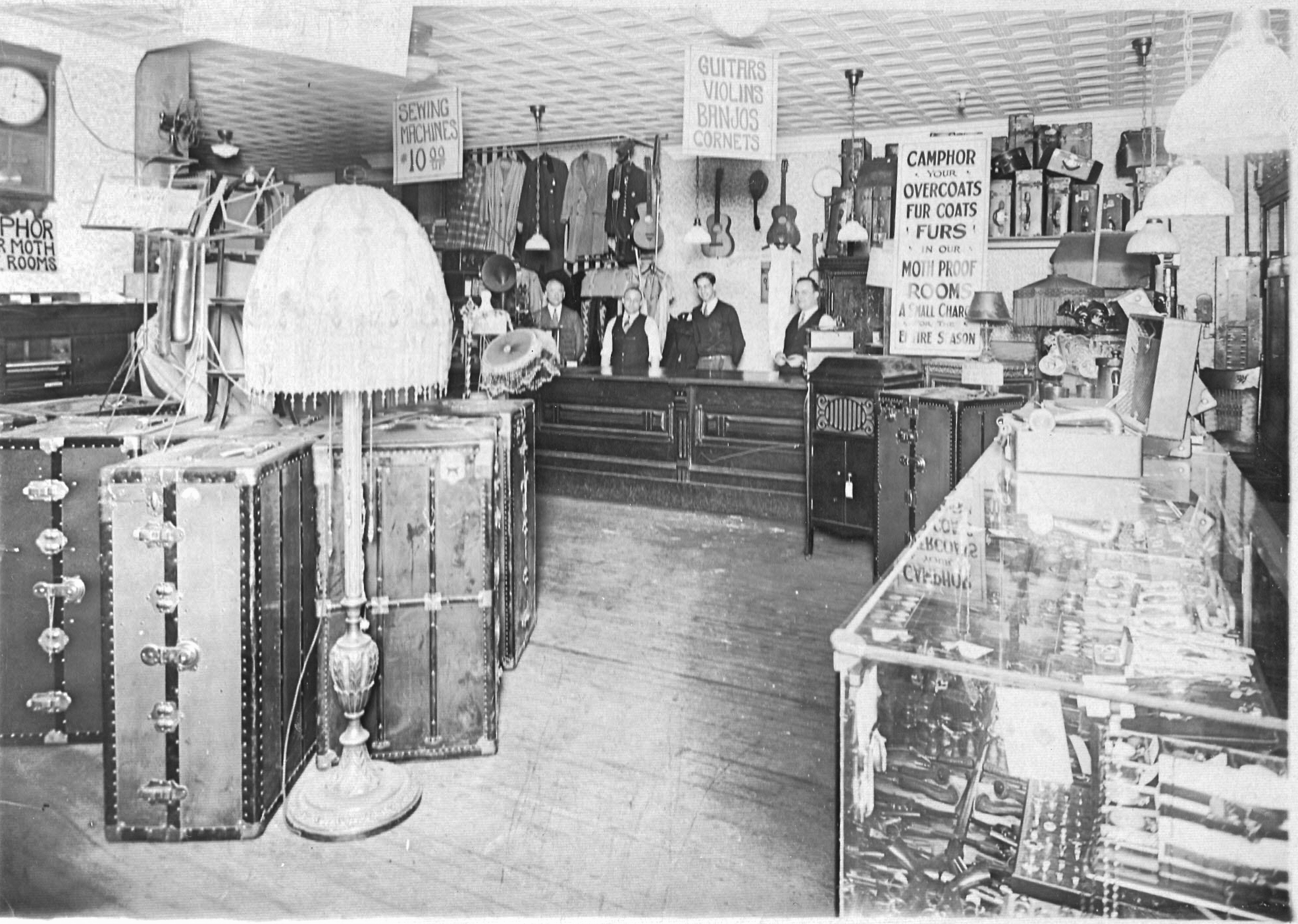
Mervyn also became a pawnbroker, working in his father’s store. Here is a wonderful photograph of Bernard (far left) and his son Mervyn (far right), working in his pawnshop.  This is the first photograph I have seen of one of the many family pawnshops.  I love the musical instruments in the background, the huge trunks in the foreground, and all the other signs and details that help convey a sense of what these stores were like.

Bernard Sluizer's pawnshop Bernard, far left; his son, Mervyn, Sr., far right

Bernard Sluizer’s pawnshop
Bernard, far left; his son, Mervyn, Sr., far right

Mervyn and Irma had two children, Mervyn, Jr., born in 1920, and Margaret, born in 1924.  Margaret must have been named for Mervyn’s grandmother, Bernard’s mother, Margaret.  It is a little surprising that Mervyn did not name his daughter for his mother, Elizabeth, who had died in 1923, instead of his grandmother, but perhaps it was just too close to the time she had died.  In 1930, Bernard, now a widower, was living with Mervyn, Irma, and their children.

Sometime between 1932 and 1935, Mervyn and Irma divorced, according to their granddaughter Jan Sluizer.  On the 1940 census, Irma was living with her two children, Mervyn, Jr. and Margaret.  Mervyn, Sr., had remarried by 1940 and was living with his new wife, Anne, and her two children from a prior marriage, Bernard and Sidney Riskin.  Mervyn Sr.’s father Bernard was also living with him and his new family.  Mervyn, Sr., and Anne moved to Atlantic City sometime after the census and were living there for several years.

Mervyn Sluizer's house in Atlantic City

Mervyn Sluizer’s house in Atlantic City

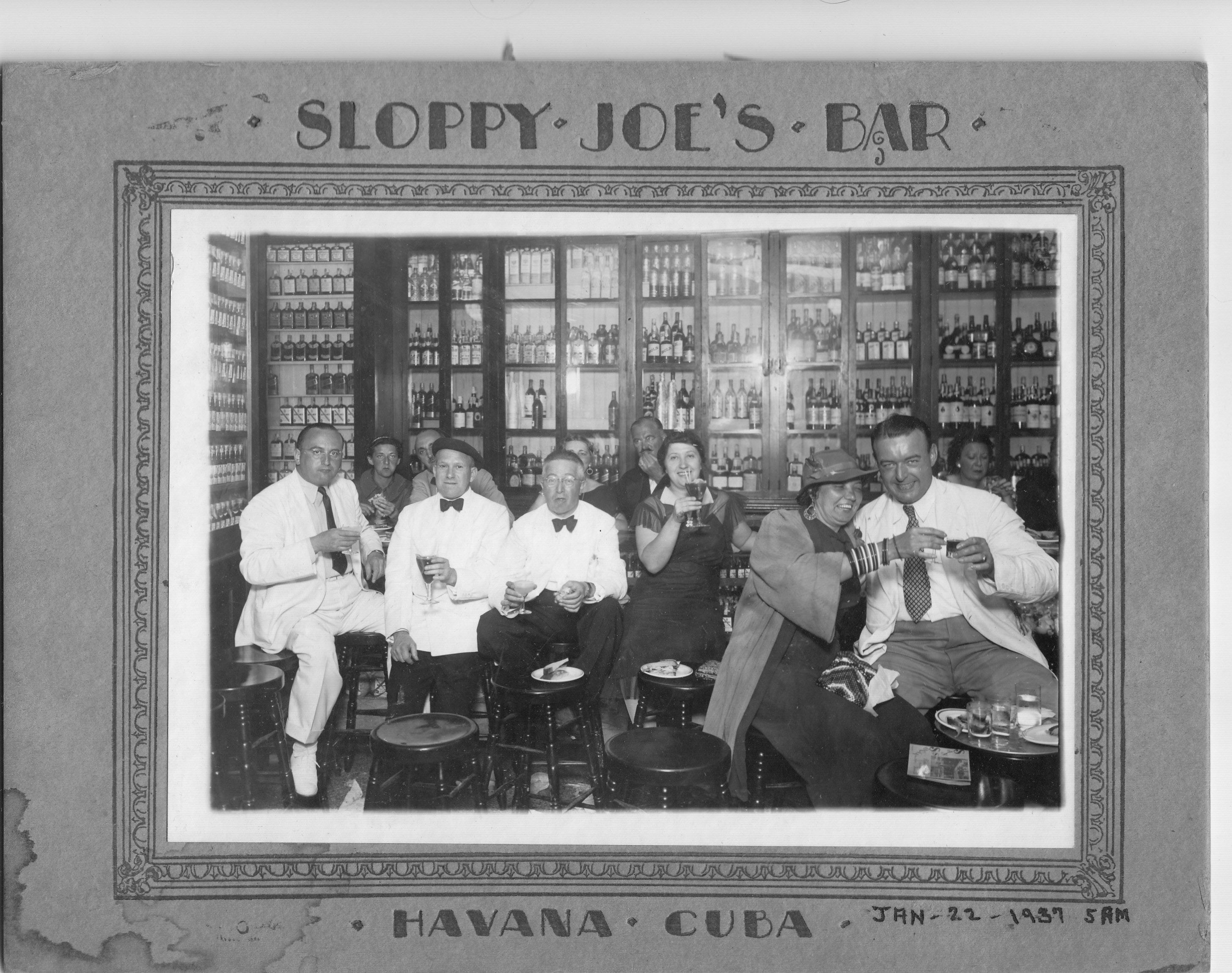
Mervyn, Sr. (far left) and Anne (center) in Havana, 1937

Mervyn, Sr. (far left) and Anne (center) in Havana, 1937

Mervyn Sluizer, Sr., third from right

Mervyn Sluizer, Sr., third from right

Anne and Mervyn Sluizer, Sr., far left

Anne and Mervyn Sluizer, Sr., far left

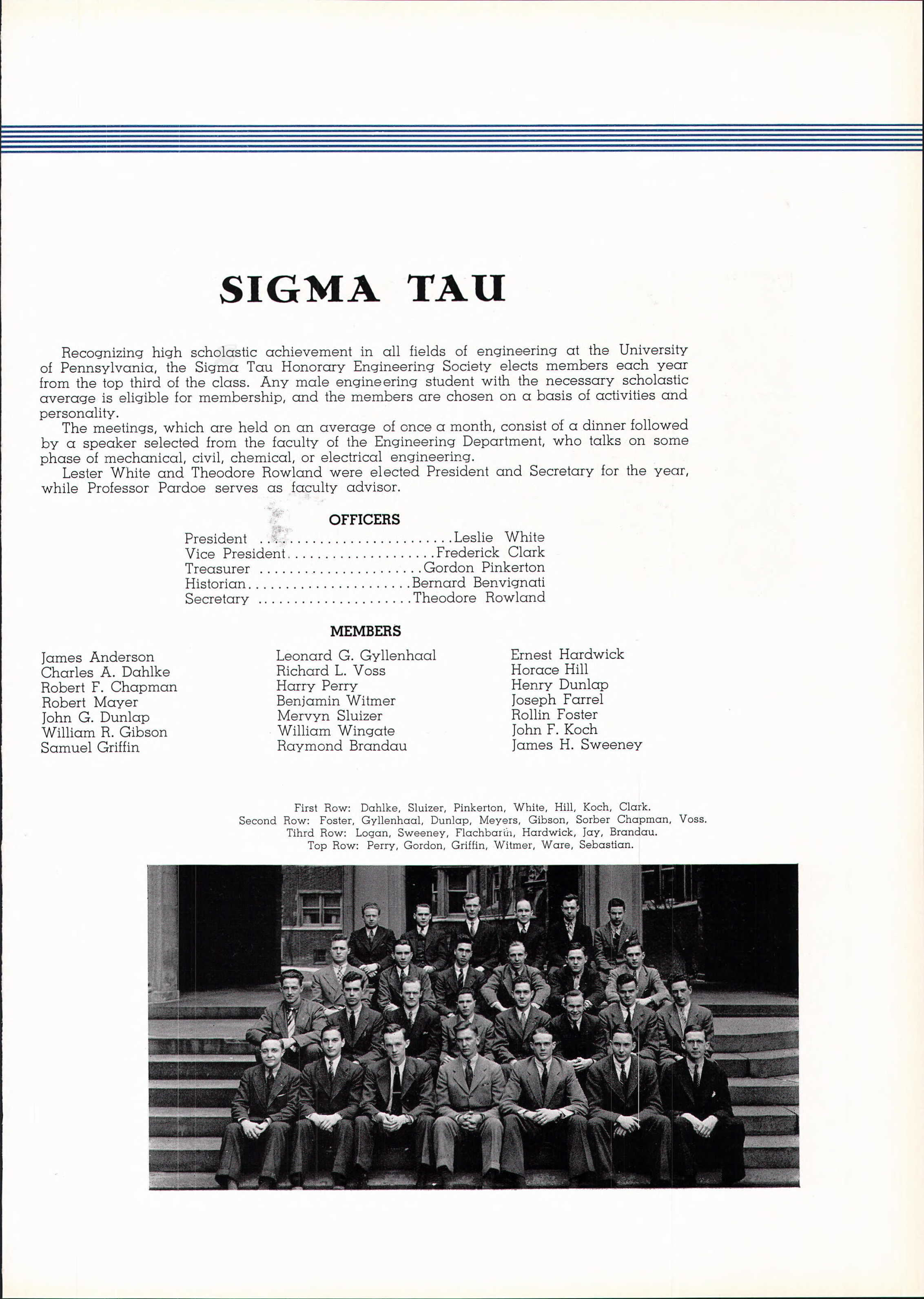
In 1941, Merv, Jr., graduated from the University of Pennsylvania, where he was an engineering student and a member of Sigma Tau, the engineering honor society.

1940 University of Pennsylvania Yearbook

1940 University of Pennsylvania Yearbook

Merv Penn 2

(Ancestry.com. U.S. School Yearbooks [database on-line]. Provo, UT, USA: Ancestry.com Operations, Inc., 2010.
Original data: Various school yearbooks from across the United States.)

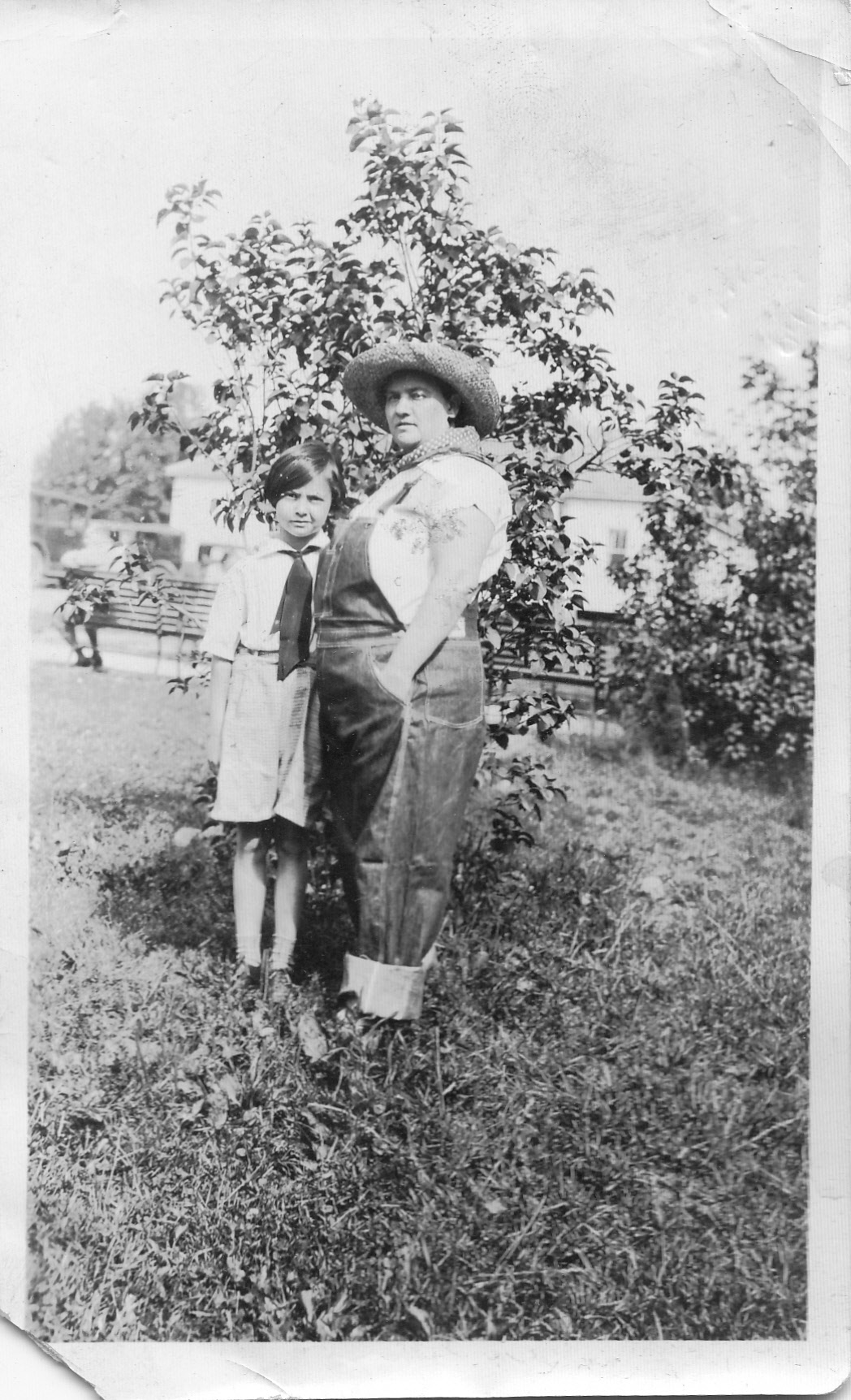
His grandfather Bernard died in 1944, and six years later his father Mervyn, Sr., died also.  Mervyn, Sr., was only 57 years old.  Meanwhile, in 1942 Mervyn, Jr., had married Shirley Harkaway, whom he had met at the University of Pennsylvania.  Here is a picture of Shirley as a young child with her mother Ida,  as well as a picture of Ida as a child with her sisters:

Shirley Harkaway with her mother Ida Lutsky Harkaway

Shirley Harkaway with her mother Ida Lutsky Harkaway

Ida Lutsky, rear center, with her sisters

Ida Lutsky, rear, right, with her sisters


Mervyn, Jr. and Shirley had two children, including Jan, the cousin who has supplied me with all of the wonderful photos posted here.

Mervyn Sluizer, Jr.

Mervyn Sluizer, Jr.

Mervyn, Jr.’s sister Margaret also married and had three children.  Her husband, Dr. Manfred Goldwein, had been one of the children who had been taken out of Europe to England on the Kinder Transport to escape the Nazis; the rest of his family was killed in the Holocaust.  He became a medical doctor and one of the top rated doctors in Philadelphia.

Jan also provided me with two newspaper articles about her father, Mervyn, Jr., including his obituary.  Both portray a man who was a lifelong volunteer in his community and one who had a special passion for the Boy Scouts. The first article, published by the Philadelphia Jewish Exponent in August, 1962, when Mervyn, Jr., was 42, described his history of service to his community.  According to this article, Mervyn, Jr., was active in the Allied Jewish Appeal in Philadelphia and had recently been named Chairman of its Metropolitan Division after serving as Vice Chairman and also playing an active role in the organization since 1948.  He also was active in B’Nai Brith and on the national board of trustees of his college fraternity.   He had been actively involved in scouting since he was a boy and was at that time the scoutmaster of Troop 185, which was affiliated with Adath Jeshurun synagogue.  Mervyn Jr.’s grandfather, August Wise, his mother’s father, had been one of the founding members of Adath Jeshurun.  Mervyn was himself a member of Beth Tikvah synagogue and served at one time as its president.

Mervyn Sluizer, Jr.

Mervyn Sluizer, Jr.

Philadelphia Jewish Exponent August 1962

Philadelphia Jewish Exponent August 1962

Irma Wise Sluizer (1895-1969)

Irma Wise Sluizer
(1895-1969)

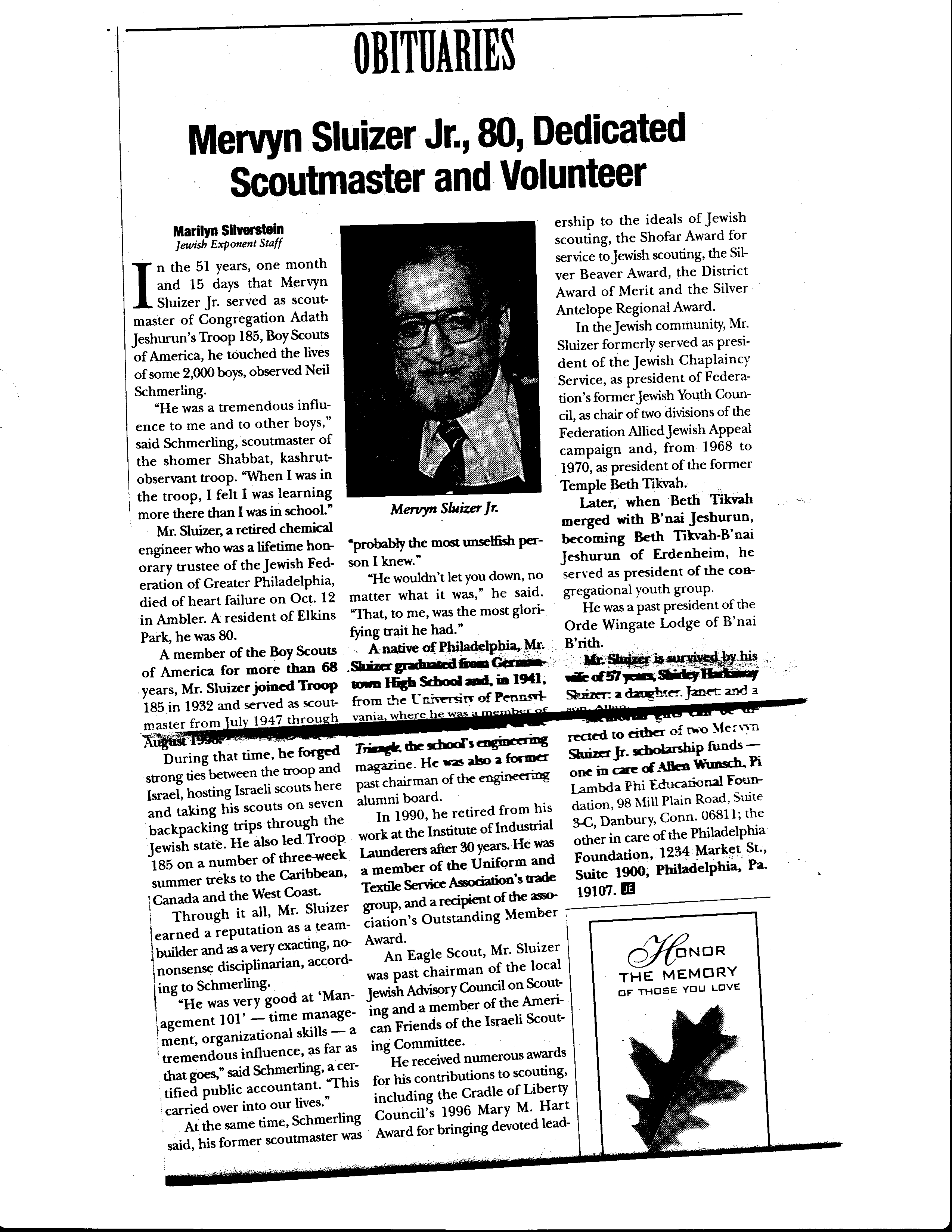
Mervyn Sluizer, Jr., died on October 12, 2000.  He was eighty years old.  The obituary below, which appeared in the Philadelphia Jewish Exponent, also portrays a man who lived a full life, dedicated to service and to his profession as well as to his family.  There is a scholarship in his name created by alumni of his troop, Philadelphia Troop 185, to honor his memory and to provide financial support for Philadelphia area Boy Scouts pursuing higher education. It is specifically provided to Eagle Scouts, as Mervyn spent a great deal of time helping scouts achieve that difficult level of scouting.   There is also a second scholarship in his name sponsored by his fraternity at the University of Pennsylvania, Pi Lambda Phi.

Mervyn Sluizer, Jr. obituary

Mervyn Sluizer, Jr. obituary

My great-grandaunt Elizabeth Cohen, who died when her grandson Mervyn, Jr., was only three years old, would undoubtedly have been very proud that he grew up to be such a generous and decent man, a college educated professional, one of the first in the family, and a man who gave so much to his community.  He would have turned 94 just this past weekend on July 12.


How They Met: The Cohens

In a much earlier post, I wrote about how some of my maternal relatives met—my grandparents, my aunts and uncles, my parents, and others.  When researching my great-grandparents Emanuel and Evalyn Cohen and my grandparents John and Eva Cohen, I wondered how they had met.  Fortunately, my brother had heard the stories years ago and shared them with me.

My great-grandmother Evalyn Seligman Cohen was born in Philadelphia in 1866, but her family had moved to Santa Fe, New Mexico, before 1880 (more on that at a later time).   Evalyn (later Eva May) was probably the first woman in my family to go to college.  She came back to Philadelphia to start college at Swarthmore College and met Emanuel Cohen.  They fell in love and married in 1886, and Evalyn never finished college.  (Maybe if she had, Swarthmore would have accepted me back in 1970 when I applied there. But then again, if she had, I would never have been born.)  She was only twenty years old when they married.  If not for her ambitious and independent spirit, she might never have traveled east and met my great-grandfather.

Swarthmore College

Swarthmore College (Photo credit: Wikipedia)


My grandparents also only met because my grandmother Eva Schoenthal Cohen was willing to make the long trip back east.  She also was born in Pennsylvania, but her parents, Isadore and Hilda Schoenthal, had moved west to Denver, Colorado, by the time Eva was six years old.  Sometime in 1922 when she was eighteen years old (she had graduated from high school that June, so perhaps over the summer), she came east to visit with some of her family in Philadelphia.  She met my grandfather John Cohen at some social event while visiting Philadelphia, and as the family story goes, he was so smitten with her that he followed her back to Colorado to woo her and ask her to marry him.  She accepted his proposal, and they were married on January 7, 1923, when he was 27 and she was 19 years old.  As with her mother-in-law, if my grandmother had not been brave enough to travel from Denver to Philadelphia, my grandparents might never have met.

Denver Capital building

My father, the third Cohen man to fall in love quickly and marry a very young woman, also only met my mother because of her willingness to travel, although not across the country.  As I’ve recounted before, they met at Camp Log Tavern in the Poconos where my father was working as a waiter at an adult camp in the summer of 1950.  My mother, who was nineteen and living in the Bronx, came for a vacation, and my father fell in love with her at first sight.  She was less interested, so he had to track her down in the Bronx phonebook after she left.  They married in 1951 when she was twenty years old and he was twenty-four.  They will be celebrating their 63rd anniversary this September.

Camp Log Tavern Milford, PA

Camp Log Tavern Milford, PA

Do you see a pattern here? Not only the serendipity of how each couple met, but both my father and my grandfather had to pursue the woman they loved, my grandfather by taking a train across the country, my father by searching through phonebooks to find my mother.  Thank goodness for those impulsive and determined Cohen men and the traveling women they met and married, or my siblings and I would not be here today.

Florence and John Cohen 1951

Florence and John Cohen 1951


The Eleventh Child of Jacob and Sarah Cohen:  My Great-Grandfather Emanuel (FINALLY!)

About a month ago, my father (who reads the blog regularly) asked me when I was going to get to his grandparents.  Although I wanted to get there also, my linear mind would not let me “skip ahead.”  I knew that if I did, I’d get too caught up in my direct ancestors and not want to return to all the “lateral” relatives.  So I have stuck, more or less, to my plan and taken each of Jacob and Sarah’s children in birth order.  (Yes, I had to skip Reuben and Arthur while waiting to hear from descendants, but otherwise, I went in order.)  There are still two more children to do after my great-grandfather, Jonas and Abraham, so I still have to resist the temptation to move on to my great-grandmother’s Seligman line.  Also, I still have to return to Jacob’s brother Moses and his family and also some of Jacob and Sarah’s grandchildren whom I’ve yet to research or discuss.

But for now, I finally get to talk about my father’s grandfather Emanuel and his family.  Sadly, my father never knew Emanuel because he died just a few months after my father was born.  There is no one else left for me to ask about Emanuel since there are no other descendants still alive who would remember him.  But my father knew his grandmother, Emanuel’s wife Eva May Seligman, very well, and he remembers other family members as well, although he has not seen or been in touch with them for more than 60 years.  And I never knew any of his Cohen relatives other than my aunt, Eva H. Cohen, who died in 2011.  I never met my father’s father or his uncles or his cousins.

Thus, most of what I know about Emanuel and his sons and their families is based on the same kind of resources I’ve relied upon in all my other research, sprinkled with some family stories from my father or indirectly from my aunt as my brother remembers them.  As I was writing this post, my father also sent me copies of pages from a  family bible that revealed some other dates of births, marriages, and deaths.  There is also a suitcase filled with photographs and papers in my parents’ garage that I have not yet had a chance to examine.  I hope to get to that suitcase soon, but it may have to wait until after the summer.

That means that right now I have no pictures of my Cohen great-grandparents and only a few of my grandfather.  I have none of his brothers or their children.  Of course, it is in part because of this lack of knowledge that I started doing this work in the first place.  I knew so little about any of my grandparents, less about my great-grandparents, and nothing about my great-great-grandparents.  Now I am working hard to fill in those gaps.

So let me start to tell the story of my great-grandparents Emanuel and Eva Seligman Cohen, and eventually I will have to come back and add some pictures and other materials, assuming some exist in that suitcase.

My great-grandfather Emanuel was the eleventh child of Jacob and Sarah Cohen, born June 10, 1862, during the Civil War.  (The family bible has a different date—June 14, 1860, but given that I have eight other sources indicating he was born in 1862, including his death certificate, I will stick with the 1862 date.)   In 1870, when he was eight years old, he was living with his parents and ten of his twelve siblings at 136 South Street in Philadelphia. I imagine that his childhood was a happy one.  His father’s business was successful, and he was surrounded by siblings.  His oldest sister Fanny was married when Emanuel was only four, and he had nieces who were only a little older than he was in addition to all his siblings.  His brother Lewis was only two years older and his brother Jonas two years younger.  It must have been quite a household.

Jacob Cohen and family 1870 US census

Jacob Cohen and family 1870 US census

By 1880, his life had changed.  His mother Sarah had died in 1879, and only five of his siblings were still living at home: two of his older sisters, Hannah and Elizabeth, and his three brothers closest to him in age, Lewis, Jonas, and Abraham.  Emanuel was working as a clerk in one of the pawnshops.  He was eighteen years old.

Jacob Cohen and family 1880 US census

Jacob Cohen and family 1880 US census

On January 27,  1886, Emanuel married my great-grandmother, Evalyn Seligman, who was later known as Eva May and as Bebe by her grandchildren after my aunt called her that when she was a toddler.  I don’t know how my great-grandparents met.  He was 24, she was 20.  In 1886, they were living at 404 South Second Street, and Emanuel was working for his father’s pawnbroker business.  Their first child, Herbert S. Cohen, was born on either January 28 (family bible) or March 5, 1887 (Philadelphia birth index). On this one, I will rely on the bible as the entry was made by Herbert’s mother, Eva May, who would best know when her child was born.  Their second child, Maurice Lester Cohen, was born on February 27, 1888 (both sources agree here), and the family was living at 1313 North 8th Street, and Emanuel was working at 901 South 4th Street.

On October 17 (bible) or 22, 1889, two and a half year old Herbert died from typhoid fever, as had several of his little cousins.  Just two weeks later, a third son, Stanley Isaac, was born on November 4, 1989.  How terrible it must have been for my great-grandparents to be mourning one child while another was born.  How did they find a way to celebrate that birth and manage through those difficult, early weeks of infancy while their hearts were broken?

Herbert Cohen death certificate 1889

Herbert Cohen death certificate 1889

In 1890, the family was still living at 1313 North 8th Street, and Emanuel was still working as a pawnbroker at 901 South 4th Street.  They were still there in 1893 because when Emanuel’s uncle, Jonas H. Cohen, died in January, 1893, the funeral took place at Emanuel and Eva May’s residence.  I wonder why, of all the nephews and nieces of Jonas, Emanuel was the one to have the funeral at his home.

funeral at emanuels

(“Mortuary Notice,” Thursday, January 26, 1893, Philadelphia Inquirer (Philadelphia, PA)   Volume: 128   Issue: 26   Page: 6)

By 1895, the family had moved.  Emanuel’s brother Isaac had also lost his wife Emma in 1893, and as of 1895, Emanuel and his family had moved into Isaac’s house at 1606 Diamond Street, presumably to help Isaac take care of his teenage son, Isaac W. On December 6, 1895, my grandfather, John Nusbaum Cohen, was born, completing Emanuel and Eva’s family.  Emanuel continued to work at the 901 South 4th Street pawnshop.
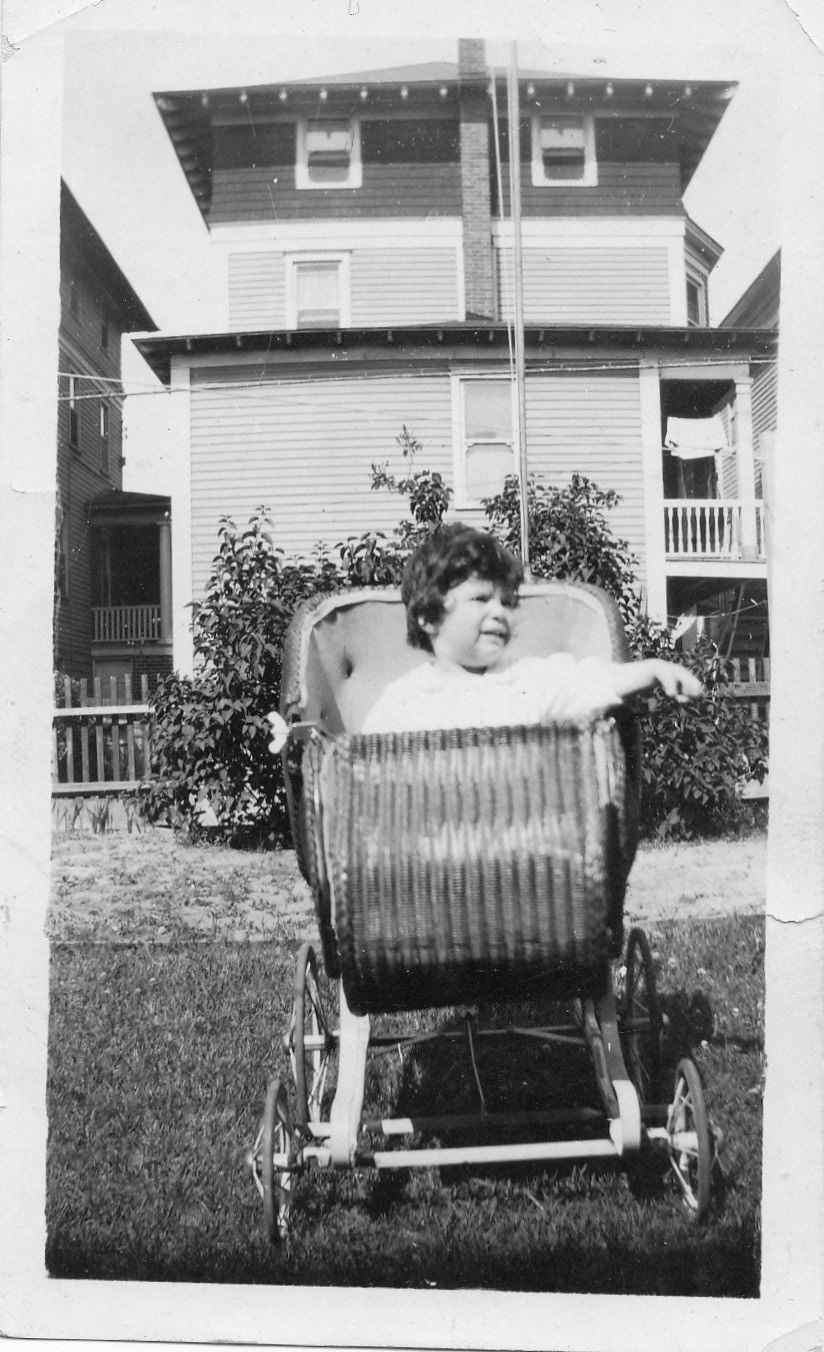
John Cohen as a baby

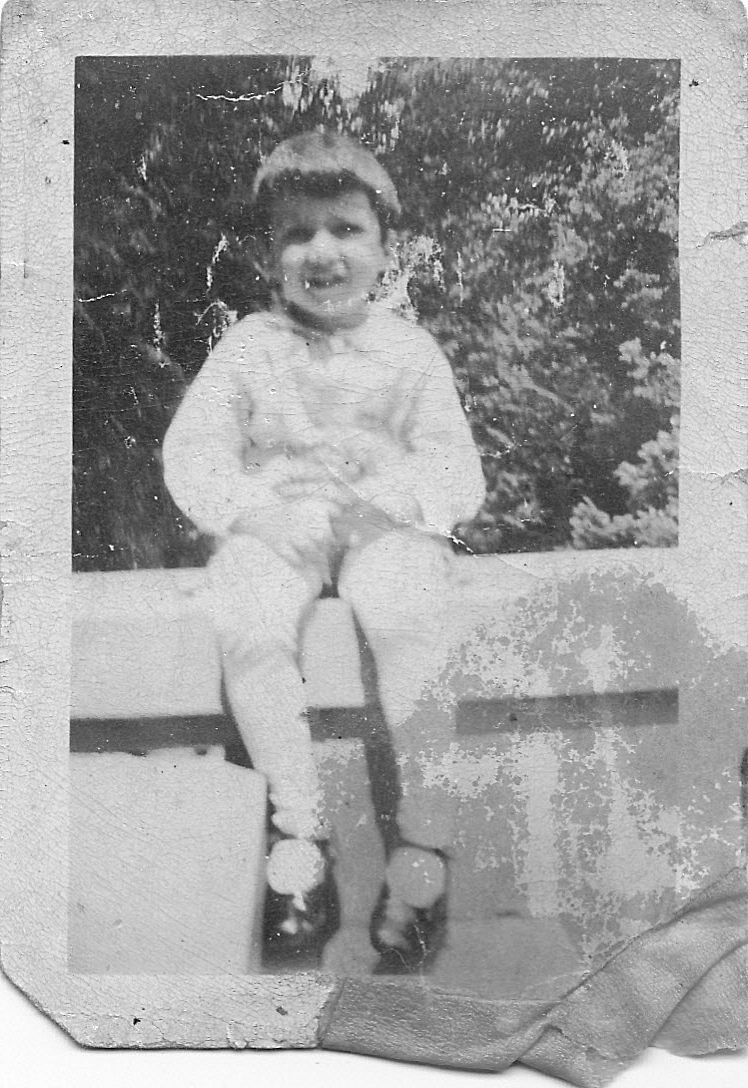
John Nusbaum Cohen about 1896

As I wrote about previously, Isaac was sixteen years older than Emanuel, so I am not sure why, of all the siblings, he chose to live with his much younger brother Emanuel.  I think it says a lot about what kind of people Emanuel and Eva May were, taking in these two family members while also raising three boys of their own.  Emanuel and Eva had also been the ones who opened their home for the funeral for Emanuel’s uncle Jonas. According to the 1900 census, they did, however, also have two servants helping them in the home so perhaps it was not as onerous as it might seem; perhaps they were the best situated to do these things.

Emanuel Cohen and family 1900 census

Emanuel Cohen and family 1900 census

I would imagine that the 1890s were overall not an easy decade for the extended Cohen family.  First, the family patriarch, Jacob, died on April 24, 1888, just two months after Maurice was born. His brother Jonas H. Cohen, the last of Hart and Rachel’s children, died five years later on 1893. Also, a number of Jacob’s young grandchildren died during this decade, including many of Reuben and Sallie’s children and also Benjamin Levy, Maria’s son. His brother Isaac had lost his wife Emma. On the other hand, there were many children born, many siblings married, and business overall seemed to be thriving for the family pawnshops.

As of 1905, Emanuel and his family had moved down the street to 1441 Diamond Street.  On the 1910 census, they are listed as living at 1431 Diamond Street, and Isaac, Emanuel’s brother, was still part of the household, along with Eva, all three of Emanuel’s sons, and two servants. Maurice, who was 22, was working as a salesman for a clothing business; Stanley (20) and John (14) were not employed outside the home.

Emanuel Cohen and family 1910 census

Emanuel Cohen and family 1910 census

In the 1913 and 1914 city directories Emanuel is listed as a pawnbroker at 1800 South 15th Street.  His brother Isaac died in 1914, and as of 1917 the family had moved again, this time to 2116 Green Street.

His oldest son Maurice married Edna Mayer on January 19, 1915.  Their son Maurice Lester, Jr., was born January 30, 1917.   According to the 1917 city directory, they were living at 4248 Spruce Street, and Maurice was working at the South Philadelphia Loan Office; on his draft registration that same year he described himself as self-employed as a broker.

Maurice Cohen World War I draft registration

Maurice Cohen World War I draft registration


On the 1920 census they were still living on Spruce Street, and Maurice’s occupation was pawnbroker.

Maurice Cohen and family 1920 census

Maurice Cohen and family 1920 census

In 1917 Stanley was still living at home and was the proprietor of a pawnshop at 2527 South 13th Street, according to his World War I draft registration.  In the 1917 city directory he is listed as working at the South Philadelphia Money Loan Office, the same business where his brother Maurice was working and presumably the shop located at 2526 South 13th Street.  He is also listed at the same business in 1921, living at 2114 [sic?] Green Street.

Stanley Cohen World War I draft registration

Stanley Cohen World War I draft registration

In 1917 my grandfather John was also living at home at 2116 Green Street and employed as an advertising salesman for the Morning Bulletin, according to his World War I draft registration.

John Cohen Sr. World War I draft registration

John Cohen Sr. World War I draft registration

According to the 1918 city directory, John was in the United States Navy at that time.  I have not yet found anything more specific about his military service.

In 1920, Emanuel, Eva (listed incorrectly as Edith), Stanley, John, and two servants were living at 2116 Green Street.

Emanuel Cohen and family 1920 census

Emanuel Cohen and family 1920 census

Interestingly, in the 1921 city directory, Emanuel’s business was now classified as watches and jewelry.  Had he left the pawnbroker business between 1920 and 1921, or was this just another way of describing his business?

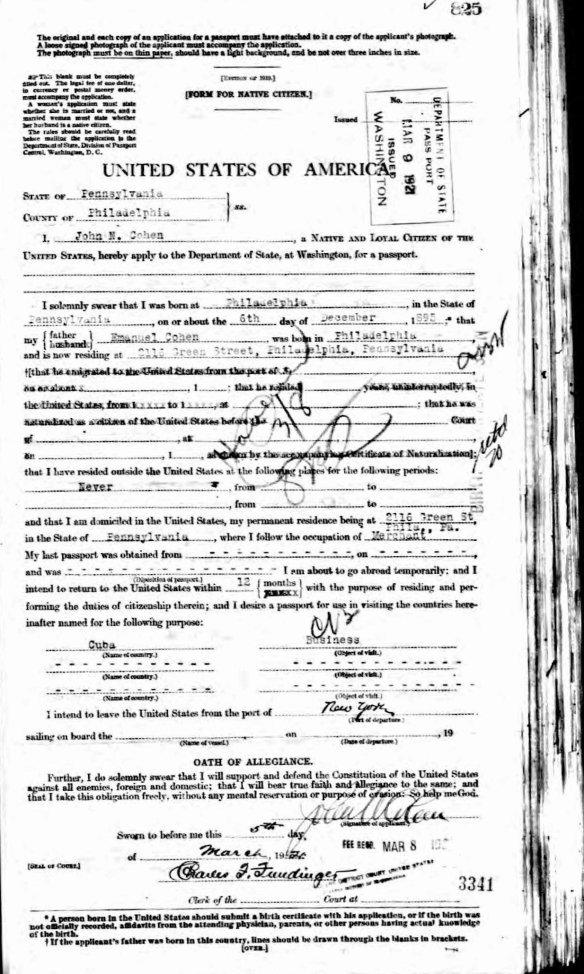
I didn’t think I would be able to find the answer, but then, to be honest, I stumbled upon it.  I had found my grandfather John’s 1921 passport application almost a year ago and found it interesting that he was applying for a passport to go to Cuba for up to twelve months. I also found the similarity between his signature and my father’s signature rather remarkable.
John Cohen passport app cropped

John N. Cohen passport application 1921

I had noticed that the page facing his application had a photograph of someone else, the person whose application preceded his in the database.  So I went to the following page to see if his photograph appeared on that page, and sure enough it did.  It also had a physical description of my grandfather: 5’ 6” tall, with a high forehead, straight nose, grey eyes, regular mouth, round chin, dark brown hair, dark complexion, and an oval face.
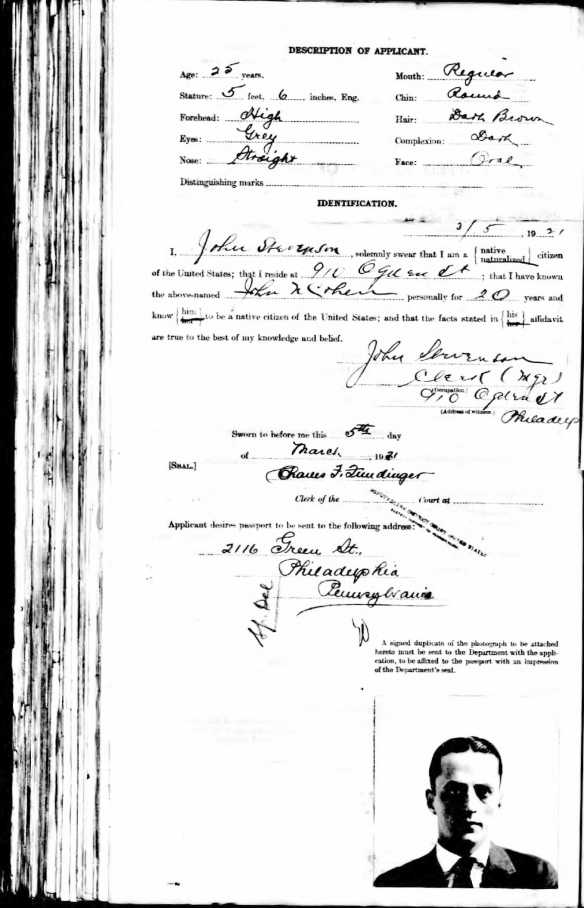
John N Cohen passport application page 2

John N Cohen passport application page 2

What I had not noticed the first time I studied this document was the letter that appears on the facing page—a letter signed by my great-grandfather Emanuel, certifying that his son, John N. Cohen, was going to represent the interests of the “Commodore” in Cuba.  The letter was on the stationery of the Commodore, located at 13th Street and Moyamensing Avenue, with the slogan “Our Policy One Price for All.”  I had never heard this business mentioned or seen it named on any other document.

Letter by Emanuel Cohen  March 5, 1921

Letter by Emanuel Cohen May 21, 1921

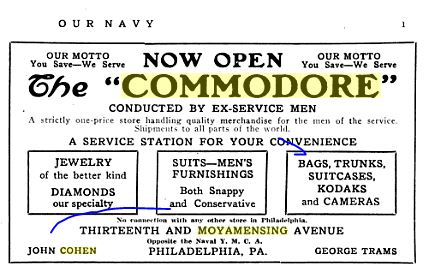
After some work on newspapers.com, genealogybank.com and Google, I finally found an advertisement for the business:

The Commodore ad from Our Navy, vol. 13

This was a business owned or at least managed by my grandfather when he returned from the Navy to provide merchandise to veterans at a fair price. I found this ad interesting in several ways.  First, I love that he sold suits “both snappy and conservative.” I also found it interesting that the ad proclaims that it has “no connection with any other store in Philadelphia.”  Was this my grandfather’s way of asserting his independence from the family pawnshop business?  Or was this some trademark issue involving a store with a similar name?  (I did see ads for a furniture store advertising a living room set as The Commodore.)  My father had never heard the store referred to by this name, but said he did recall that his father had a Navy friend whom he referred to as the Commodore who was his connection to the Navy Yard in Philadelphia.  My father does remember visiting the store years later when his grandmother was managing it and selling only jewelry, not men’s clothing, snappy or otherwise.

The years between 1920 and 1930 were years of growth for Emanuel and Eva’s sons.  In 1922, Maurice and Edna had a second son, Emanuel.  On January 5, 1923, Stanley married Bessie Craig, who was fourteen years younger than Stanley. Their daughter Marjorie was born two years later in 1925.

My grandparents, John Nusbaum Cohen, Sr., and Eva Schoenthal, were married on January 7, 1923, according to the family bible. (I assume they were married outside Pennsylvania since there is no marriage record in the Pennsylvania index for them) My aunt, Eva Hilda Cohen, was born January 13, 1924, and my father John, Jr., was born two years later.  My father recalls that the family was also living on Green Street in 1924 when his sister was born and at 6625 North 17th Street when he was born.  (There were no city directories available online for the years between 1922 and 1926.)  (The fact that there were two Emanuels, two Maurices, three Evas, and two Johns in their family must have created some confusion, though Maurice, Jr, was called Junior and Emanuel II was called Buddy. My father was always called Johnny.)

This is the only picture I have of my grandparents together.  They were certainly a handsome couple.  And they were certainly wearing  “snappy” clothing!  I am struck by the Star of David that my grandmother is wearing; they were not religious people, but obviously she felt a strong enough Jewish connection to be wearing such a large star.
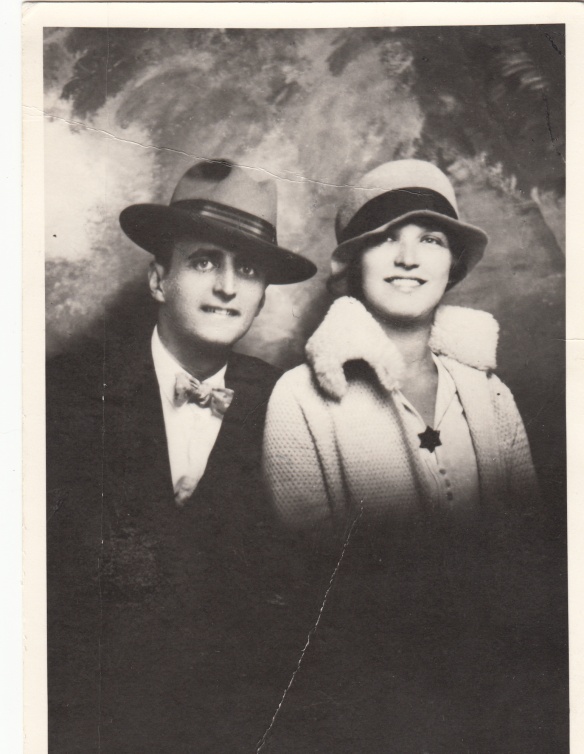
John and Eva Cohen  c. 1930

John and Eva Cohen, My Paternal Grandparents
c. 1930

Eva Hilda Cohen

Eva Hilda Cohen

I have always loved this picture of my father; his face really has not changed in many ways.  He still has those beautiful, piercing blue eyes.

My father at 9 months old

My father at 9 months old

Reverse of John Jr at 8 months but 9 months

The reverse side of the photo above—inscribed “Taken a about 9 months, Johnny”

Another wonderful picture, capturing my father as a happy little toddler.

John Jr


Although the next photograph is badly damaged, I am including it in large part to show the inscription on the back, “Johnny Boy.”  My father said that his grandmother Eva May was the one to label the photographs, just as she was the one who made the entries for her children and grandchildren in the family bible.  I like to think that I have inherited her role as a family historian and photograph archivist.

Johnny Boy reverse of John Jr as child

“Johnny Boy”

John Jr little boy


This photograph below captures my aunt as a young girl.  She was a strong and independent person who always stood up for herself and knew what she wanted.


Eva Hilda Cohen

My Aunt, Eva Hilda Cohen

If the 1920s were years of growth, they were also years of loss.  On February 21, 1927, my great-grandfather Emanuel died after a cholecystectomy (gall bladder removal, according to my ever-reliable medical consultant).  It looks like the principal cause of death was pneumonia and either anemia or a hernia.  It also says he suffered from diabetes mellitus.  He was only 64 years old.

Emanuel Cohen death certificate 1927

Emanuel Cohen death certificate 1927

These were also years of loss for the larger Cohen family; by the time Emanuel died in 1927, he had lost all but two of his siblings, Hannah and Abraham, and Hannah would die just a few months later.  Although Jonas had died in 1902, Hart and Fanny in 1911, and Isaac in 1914, between 1923 and 1927 the family lost eight siblings: Joseph (1923), Elizabeth (1923), Lewis (1924), Maria (1925), Rachel (1925), Reuben (1926), and then Emanuel and Hannah in 1927.  Of the thirteen children of Jacob and Sarah Cohen, only one remained after Emanuel and Hannah died, the baby Abraham.

The next decade, the 1930s, were also very challenging years for Eva, Emanuel’s widow, and her three sons. According to the 1930 census, Stanley was now working as a broker. My grandfather John listed his occupation as a clothing and jewelry merchant on the 1930 census, perhaps still working at The Commodore; he and his family were still living at 6625 North 17th Street at that time, which was about fifteen miles north of the Commodore location.

My grandparents, my aunt and my father on the 1930 census

My grandparents, my aunt and my father on the 1930 census

I could not find Maurice on the 1930 census, unless he is the Maurice L. Cohen listed as living with a wife Celia, a son Lester, and a daughter Nannette.  I dismissed this household many times, but since I cannot find him elsewhere and since his son’s middle name was Lester and his other son was Emanuel, which could have been heard by a census taker as Nanette, I suppose, I am inclined to think that this is probably Maurice’s listing, but perhaps not.  At any rate, I was able to find Maurice’s death certificate.  He died from a self-inflicted gunshot wound to the head on August 14, 1931; family lore is that he had been suffering from cancer.  He was only 43 years old, and his sons were fourteen and nine years old when he died.

Maurice Cohen death certificate 1931

Maurice Cohen death certificate 1931

Some years after Maurice’s death, his widow Edna moved to southern California.  According to the 1940 census, she and her two sons, Maurice, Jr., and Emanuel, now called Philip, were living in Los Angeles, although the census indicates they were all still living in Philadelphia in 1935.  My father recalls going to camp with both of his cousins in 1938, so I assume it was sometime after that that Edna and her sons moved away.  My father said he never saw them again.

Edna Cohen and sons 1940 census

Edna Cohen and sons 1940 census

Maurice was not the only one to face serious medical problems during this time period.  My grandfather John contracted multiple sclerosis also during this period.  My grandmother, a sensitive and fragile person, was herself hospitalized and unable to care for her husband or her children, and so John, Sr., and his two children were taken care of by his mother, Emanuel’s widow, Eva May Seligman Cohen.  Once again my great-grandmother opened her heart and her doors to care for family members as she had done over 25 years earlier for her brother-in-law Isaac and his son.

In 1936, my grandfather was admitted to a Veteran’s Administration facility in Coatesville, Pennsylvania, over forty miles away from Philadelphia.  He lived the rest of his life until he died on May 2, 1946.  He was 50 years old.

John Cohen, Sr. 1940 census

John Cohen, Sr. 1940 census

My great-grandmother continued to care for his children, my father and his sister, until she died on October 31, 1939, from heart disease.  My father and aunt then lived with various other relatives until their mother was able to care for them again.

Eva May Seligman Cohen death certificate

Eva May Seligman Cohen death certificate

Stanley, Maurice and John’s brother, did not face the terrible health issues faced by his brothers.  In 1940 he was working as a pawnbroker, and according to his World War II draft registration in 1942, he was self-employed, calling his business Stanley’s Loan Office.

Stanley Cohen World War II draft registration

Stanley Cohen World War II draft registration

In the 1950s, Stanley and Bessie moved to Atlantic City, where he lived for the rest of his life. Bessie died in April, 1983, and Stanley died in July, 1987.  He was 97 years old.  I have located where his daughter was last residing and hope to find a way to contact her.

As for Maurice’s family, I don’t know very much about what happened to them after they moved to California.  Edna died in 1979, and Maurice, Jr., in 1988.  Both were still living in California when they died.  Emanuel Philip was harder to track down, but I eventually found him as Bud Colton in the California death index.  How, you might wonder, did I know that Bud Colton was the same person as Emanuel Cohen? Well, the death index listed his father’s surname as Cohen and his mother’s birth name as Mayer.  In addition, he was always called Buddy by the family.  Colton is fairly close to Cohen in pronunciation, and there was some family lore that he had in fact changed his name to something else.  Bud served in the army during World War II as Bud Colton.  He married Helga Jorgensen in April, 1957, when he was 34 and she was 49.  Bud died in February, 1995, and is buried as a veteran at Los Angeles National Cemetery.  I did not find any children of either Bud or Maurice, Jr.; although I found a few Maurice Cohens in the California marriage index, only one of those marriages seemed to have resulted in a child, and her birth certificate revealed that her father Maurice Cohen was not the one related to me.  The other two Maurice Cohen marriages would have been fairly late in Maurice’s life (if in fact it was the same Maurice Cohen), and I found no evidence of any children from those marriages.  Given the age of Helga when she married Bud, it also seems unlikely that that marriage resulted in any children.

It is rather sad that we know so little about my father’s paternal first cousins, but this was all I could find up to this point.  I will keep looking and hope that more information will turn up.  Perhaps in that mysterious suitcase I will find more pictures, more documents, more answers.  Nevertheless, I know a great deal more now than I once did about my great-grandparents Emanuel and Eva Cohen and my paternal grandfather John Nusbaum Cohen.

Below is the headstone for my great-grandparents Emanuel and Eva May and for my grandfather, John N. Cohen, Sr., who were buried at Mt. Sinai Cemetery in Philadelphia.  Maurice is also buried there, one section over.

headstone for emanuel, eva and john n cohen


Genealogy Ethics: What and Who Do You Tell the Things You Learn?

question

question (Photo credit: cristinacosta)

This past Sunday the New York Times ran an article about a reporter who learned that his great-great-grandfather, a New York City police officer, had killed a man under questionable circumstances, but had never gone to trial.  The reporter tracked down the descendant of the victim and told him the story.  That descendant had never known that his great-grandfather had been killed.  I found this story interesting, but it also raised a number of questions about the ethics of uncovering a family secret.  What lines should I draw when I learn something that might be upsetting to a descendant?

It doesn’t even have to be something involving criminal conduct.  It could be learning about financial troubles, medical issues, family issues—all of which can be discovered in public sources like newspapers, census reports, vital records, wills, court documents, and other records that anyone, whether related or not, can find.  Does the fact that these are publicly available facts make a difference in terms of disclosure and privacy?

Is there some point in time when revealing that information is clearly appropriate?  Is there some point in time when those events are not remote enough in time?  Does it matter whether the family involved never even asked you to do the research versus a situation where they asked but had no knowledge of the troubling information? Are there times you definitely should reveal information? Are there times that you definitely should not?  What about putting things on a publicly accessible source such as a blog? What are the proper lines in that context?

I am seriously interested in these questions and what others think about them.  Whether you are a genealogy person or not, I would really like to know what you think.  Please leave your thoughts here.  I really think this issue merits serious discussion.