Three Days in Budapest

Although leaving Poland was hard, arriving in Budapest was delightful.  We weren’t even ripped off by the cabbie this time.  We arrived at our hotel at 9 am after another overnight train, and when we walked into our hotel, the Boscolo, we were a bit in awe.  We’ve never been in a hotel as beautiful as the Boscolo.  The atrium in the lobby is glamorous and gorgeous.  It may be a bit ornate for our usual taste, but there was no denying the way that large, well-lit, and finely decorated space made us feel.  After a breakfast in their famous New York café, we were able to get an early check-in to our room, which also stopped us in our tracks—-a very large and well-appointed room with a little balcony.  It felt like we were in some fantasy world.

The Boscolo

The Boscolo

Breakfast at the New York Cafe in the Boscolo

Breakfast at the New York Cafe in the Boscolo

IMG_2729 atrium IMG_2731 skylight

Although it would have been tempting just to enjoy our surroundings, we had things to see and do.  Although the concierge at the hotel warned us that our destinations would require a long walk, we were not intimidated.  And as it turned out, although we walked quite a bit, we did not regret it.  We love walking in cities (and beaches and just about anywhere); only by walking do you get a feel for the scale of a city and its buildings and only by walking do you make eye to eye contact with the people around you.  So we ventured out for our first day in Budapest.

First, we went to the House of Terror, a museum that primarily tells the story of what life was like in Budapest under Soviet domination.  The museum is in the building which the Soviets used as their headquarters and where they also imprisoned, interrogated, and tortured prisoners.   The cells and the instruments of torture are still there.  It is a powerful museum; the use of symbols is particularly effective.  We were very moved by our experience there.

Our next stop was the Budapest Opera House, where we had tickets for a tour and a mini-concert.  The opera house was impressive and uplifting, especially after the darkness of the House of Terror.  The gold and red colors which ran throughout the building gave it a truly regal feeling.  And the mini-concert was fun—one opera singer came out and performed two arias for us.  (Don’t ask me what they were—-I am not really an opera fan.)

Hungarian State Opera House

Hungarian State Opera House

IMG_2741 Budapest Opera IMG_2748 opera house boxes IMG_2749 mini opera

We headed to our final stop for the afternoon, the Parliament, where we also had tickets for a tour.  The Parliament is huge—I don’t think I’ve ever seen such a large building.  It sits right on the Danube River, extending fairly far along its shore, and there is a huge open plaza surrounding the building.  We strolled around, looking at the not-at-all blue Danube and across the river to Buda and then entered the building in time for our tour.

Hungarian Parliament

Hungarian Parliament

IMG_2754 Danube

Danube River

The security to enter the building was more intense than what we had gone through at any airport, which was a bit unnerving.  But once we were in, the guide led our group through the building, which was originally intended to be finished for the 1896 Millennial Celebration, but was not finished in time.  Hungarians believe that the Magyars arrived from Asia to the Carpathian plains where Hungary is located around 895, but because plans for the millennial could not be completed in time for 1895, they postponed it a year and claim now that the country was founded in 896.  Like so many countries in Central Europe, Hungary was subjected to many invasions and wars over the year, eventually becoming part of the Austria-Hungary Empire as the result of a compromise with the Habsburgs in 1867.  The Parliament building was originally meant to be the Habsburg’s palace, but after World War I and the end of the Austria-Hungary Empire, it became the home of the Hungarian Parliament.

Like the Opera House and the hotel and many of the other buildings we would see in Budapest, it is an ornate and beautiful building, conveying a sense of prosperity and power.  The crown jewels sit in a case under a large dome (we were not allowed to photograph them), evidence of the royalty who once ruled the land.  We also saw the chambers of the Parliament, equipped with modern digital voting machines at each desk—a strange mix of the old and the new.  It was a very interesting tour and gave us a quick overview of Hungarian history.

IMG_2758 parliament budapest IMG_2760 Parliament staircase IMG_2764 chamber

By that time we were a bit tired and hungry and ready to find a place to eat.  We strolled along the river watching the Viking Cruise and other companies’ “river boats,” then turned to walk through the center of the city, where we happened upon a restaurant called Rezkaka.  The menu looked creative, and the atmosphere seemed relaxing, so we took a chance.  It was our best meal of the trip.  The violin and piano playing in the background didn’t hurt either.

As we left the restaurant, the night sky was getting dark (it was about 9 pm), the ferris wheel in the city center was lit up as were many of the buildings.  It was magical.  We decided to keep on walking (despite what the concierge had said), and we passed the Dohany Synagogue, all lit up.  We were using the GPS on my iPhone to guide us back to the hotel, and it led us through the Jewish quarter, which has become a hip place, filled with “ruin bars” patronized by 20-somethings.  It was an entertaining walk back, and by the time we reached the hotel, we were quite proud of ourselves for the distance we had walked and quite enamored with Budapest.

St Stephen's Basilica, Budapest

St Stephen’s Basilica, Budapest

IMG_2777

Dohany Synagogue

IMG_2774

Our next day started with a tram ride (we decided to give our feet a little break) to the Central Market in Budapest—an amazing place filled with fresh fruit, vegetables, meat of all kinds, paprika, and flowers.  And it’s a real market—not a tourist joint.  We could see regular people with shopping bags and carts, buying their groceries.

IMG_2786 IMG_2787 IMG_2788 IMG_2789 IMG_2790

From there we walked somewhat aimlessly through several streets and squares, passing the university buildings, a street of touristy shops, a street of high fashion designer shops, and the second McDonalds to open behind the Iron Curtain.

McDonalds in Budapest

We were aiming for the Holocaust Memorial on the river.  During the Holocaust, Jews were rounded up and brought to the river, where three people would remove their shoes, be tied together, and one would be shot, forcing all three to fall into the river and die.  The memorial captures this atrocity very simply and poignantly with sculptures of many pairs of empty shoes, lining the wall that abuts the river.

Holocaust Memorial, Budapest

Holocaust Memorial, Budapest

IMG_2798


plaque

For the afternoon we had signed up for a tour of the Budapest Jewish Quarter with Budapest Jewish Heritage Tours.  It was supposed to be a group tour, but luckily for us, no one else had signed up at that time, so we ended up with a private tour.  We actually had three guides.  Ann, our first guide, gave us a general introduction; she then brought us to the Jewish Museum, which is right next to the Dohany synagogue.  At the museum we were guided by Esther, who works for the museum.  After we finished at the museum, Fatima met us to take us to see the synagogues in the quarter.  Each guide was knowledgeable and personable, and we learned a great deal about the history of Budapest’s Jewish community.

There were Jews in Budapest from as early as Roman times, though not a permanent settlement.  As in the other countries in Central Europe we visited, Jews came to Hungary as traders and bankers.  They faced a great deal of violence and anti-Semitism, and for a long time were required to live on the Buda side of the river while working on the Pest side.  Eventually they were allowed to live on the Pest side, but outside the city walls.  The area where they settled in the 18th century became the Jewish Quarter where even today there are numerous active synagogues, kosher restaurants, and other Jewish institutions.  The community flourished in the 19th century, and by the 1930s there were over 200,000 Jews in Budapest.

Perhaps the best indication of the size and prosperity of the Jewish community in Budapest is the Dohany Synagogue, the second largest synagogue in the world and a magnificent structure built in the middle of the 19th century.  It was built for a congregation that wanted to be more modern in its practice of Judaism. They called themselves Neologs (new law).  Although men and women were still separated for services, there was an organ (played by Franz Liszt at the inauguration of the building), and the interior was designed to be more church-like than like a traditional synagogue.  Like the Spanish Synagogue in Prague, the design reflects a Moorish influence both inside and out.

Dohany Synagogue

Dohany Synagogue

IMG_2801 IMG_2806 IMG_2809

Our guides pointed out, however, that Hungary had a long history of anti-Semitism, and in the 1920s a law was passed establishing quotas at the universities.  In the 1930s. Hungary adopted laws stripping Jews of their rights even before the Nazis began their occupation of the country.  Although Hungarian Jews were among the last to be deported to concentration camps, our guide in Poland, Tomasz, had explained that that was simply because the Hungarians wanted to exploit the Jews for free labor, not because they were trying to protect them.  In the end, most of Hungary’s 600,000 Jews were killed, 400,000 of them at Auschwitz on some of the last transports to arrive there.

The Dohany Synagogue survived the war because it was used by the Nazis both for storage and as a place for radio towers since it had the two high spires on its roof.  Behind the Dohany Synagogue is a memorial garden dedicated to those who were killed in the Holocaust.  I found the sculpture of the Tree of Life that resembles an upside down menorah particularly moving.

IMG_2813

We saw two other synagogues after leaving the Dohany.  First we visited the Orthodox synagogue, built in 1912, another very beautiful building, and then we saw the Rumbach Street synagogue.  From what Vatima told us, this last synagogue was formed by a group that spit off from the Neologs; they felt the Neologs had moved too far away from traditional Judaism, but they also did not agree with the strict practice of the Orthodox synagogue.  This building was under renovation and not open to visitors, so we only got to see its exterior, which was quite beautiful.

IMG_2817 IMG_2820 IMG_2821 IMG_2822

Rumbach Synagogue

Rumbach Synagogue

Overall, our experience in the Jewish Quarter in Budapest was much more uplifting than in either Prague or Krakow in large part because we learned that there is still a very substantial and active Jewish community in Budapest, consisting of about 80,000 people.  Although that is less than half of the Jewish population of Budapest in 1939, it is nevertheless a promising sign of rebirth and hope for the future.

Our day in Budapest ended with a quick dinner and an organ concert at St. Stephen’s Basilica, the largest church in Budapest—and yet again, a magnificent building.

St Stephen's Basilica

St Stephen’s Basilica

IMG_2832 IMG_2835

For our third and last day in Budapest, we had arranged for a driving tour to see those sites that really are too far for walking, even for us.  Our guide Magdi took us out to Heroes Square and through the City Park, two more spaces that were developed specifically for the Millennial Celebration in 1896. We saw Hungarian soldiers practicing for a parade while we were there.

IMG_2850

Legend says if you touch this guy’s pen, your writing will be successful. FIgured it was worth a try….

IMG_2839 IMG_2840 IMG_2847 IMG_2848


Then we crossed the Danube to Buda where the Castle is—where once again we learned that almost everything there was either built or redone for the Millennial Celebration.  What impressed us most were the incredible panoramic views we could see from the Fishermen’s Bastion and from the Castle itself.  Magdi did point out some older buildings in Buda that dated back to earlier times, but overall most of what we saw dated from 1896 or so.  The glaring (literally and figuratively) exception was the Hilton, a modern building of reflective glass that just does not fit into the setting.

IMG_2868 IMG_2866 IMG_2861 IMG_2852 IMG_2851

IMG_2869

Finally we went to Gellert Hill, where we were able to view Budapest from yet another perspective and see the fortress built there.

IMG_2875 IMG_2877 IMG_2878 IMG_2879

Our tour ended by dropping us off at the Gellert Spa and Baths.  Everyone had told us that we had to try the baths while in Budapest, and so we did.  It was an interesting experience—soaking in a hot pool with a bunch of elderly Hungarian women who did not really look so pleased to have us invading their space.  But we were glad we tried it, and that hot water was very relaxing.  After all the walking we had done in our three days in Budapest, our feet certainly deserved the break!

Looking back on our time in Budapest, I would say it was the city where we had the most light-hearted moments in our trip.  Maybe we just needed to focus more on the beauty, less on the tragic, after seeing Terezin, Krakow, and Auschwitz.  Maybe it was the Hungarian people or the energy of the city, where the streets were crowded with young people at night.  Maybe it was all the beautiful buildings and breath-taking views and sights we saw.  For whatever reason, we left Budapest the next morning feeling uplifted.

IMG_2889 IMG_2890 IMG_2891

Our trip was almost over.  We had a train ride to Vienna and a day and a half in that city before returning home.   And home was starting to sound like a good place to be.


Walking in the Shadows of My Brotman Great-Grandparents

My third day in Poland was undoubtedly the highlight of the trip for me.  Visiting the town where my great-grandparents lived was the initial motivation for going to Central Europe in the first place.  The stops in Prague, Budapest, and Vienna were the icing on the cake, but the cake was Poland and, more specifically, Tarnobrzeg.  (I finally learned how to pronounce it, thanks to our guide Tomasz: TarNOBjeg.)  I had high and emotional expectations; they were exceeded by the reality.

First, some background.  When I first started doing genealogy research, I had no idea where my maternal grandmother’s family had lived in Europe other than they were Galitzianers—from Galicia.  My mother had no idea what town in Galicia had been their home, and for a long time the only location given on the records I could find was Austria, which made sense since Galicia was part of the Austria-Hungary Empire when the Brotmans lived there.

Then a few pieces came together—first, I obtained my great-uncle Hyman Brotman’s naturalization application giving his home town as Jeekief, which is a decent phonetic spelling of Dzikow, once a separate village but later incorporated into Tarnobrzeg, a much larger town.  Then I found a ship manifest for Yossel Brod, most likely my great-grandfather, from Tarnobchiek, another phonetic spelling, this time of Tarnobrzeg.  The ship manifests for my great-uncles Abraham and David Brotman gave their home town at Grebow, a small village less than ten miles from Tarnobrzeg.  It seemed clear to me that Tarnobrzeg was the area where my Brotman ancestors had lived in Galicia.  And I had to go there.

SelectedU.S.NaturalizationRecords-OriginalDocuments1790-1974ForHermanBrotman

Hyman Brotman’s Naturalization Application (Click twice to zoom in.)


David and Abe Brodmann on the Portia 1889

David and Abe Brodmann on the Portia 1889


Joseph Brotman ship manifest

Joseph Brotman ship manifest

I had originally hoped that there might be some records left in Tarnobrzeg that had not yet been digitized and put on line by JewishGen, Gesher Galicia, or JRI Poland, but our guide Tomasz warned me that he believed that whatever records still existed had in fact been found already and that we would not find any more in the town.  I adjusted my expectations accordingly, and I decided to enjoy the trip for the experience of being there rather than as a research opportunity.

Tomasz picked us up at our hotel at 9 am that morning, and we got to meet my recently found cousin Phyllis for the first time.  Phyllis and I had connected through DNA testing, which showed us as third cousins and showed her aunt Frieda and my mother as second cousins.  By comparing our family trees we had reached the conclusion that the likely connection was through my great-grandmother Bessie Brot Brotman and her grandmother Sabina Brot, whose father we believe was my great-grandmother’s brother.  Sabina’s home town in Galicia was Radomysl nad Sanem, another town about ten miles from Tarnobrzeg, which we would also visit that day.  The common surname and the proximity of residences seemed to support our hypothesis.  We quickly connected in person, chatting excitedly about our research, our travels, and our hopes for that day.

IMG_2705 cousins

As we drove from Krakow to Tarnobrzeg, Tomasz spoke about the history of Jews in Poland. By the 19th century Jews made up 10% of the population of Poland, and they lived all over the country—in the cities and in small towns and in villages.  The land we drove through was mostly rural even today, and Tomasz said that Jews were often invited by the kings or the aristocracy to live in the towns to support the local economy; Jews had the education and the skills to provide bookkeeping, trade, banking, and other economic necessities to the farmers who lived in these regions.  In Tarnobrzeg it was the Tarnowski family that owned the land and invited the Jews to come live there.


Castle of the Tarnowski family in Tarnobrzeg

Castle of the Tarnowski family in Tarnobrzeg


IMG_2697

When I asked him about the level of religious observance of the Jewish residents who lived in places like Tarnobrzeg, Tomasz said that there was a diverse range of religious observance—-from Hasidim to more traditional Orthodox to more liberal Jews and to secular Jews. Other sources point out that Tarnobrzeg was an important Hasidic center with well-regarded Hasidic leaders and rabbis.

Tomasz also spoke about the fact that Tarnobrzeg was one of the leading Jewish population and industrial centers in Galicia outside of Krakow.  The main industry aside from agriculture was the production of sulfur, a product that it still important to the local economy of the region.  Tarnobrzeg is located where two rivers meet—the Vistula (which also runs through Krakow) and the San, and thus was an important trade location.  It also is very close to what was once the border with the Russian Empire, and when Russia obtained that land, families were often separated, some living in Austria-Hungary, some in the Russian Empire.  In the 19th century when my great-grandparents lived there, the population of Tarnobrzeg was more than 75% Jewish.  There were about 2800 Jews living there in the 1880s when my great-grandparents decided to leave.

I asked Tomasz why people like my great-grandparents would ever have left a place like Tarnobrzeg, where Jews were doing well and treated well and were more than a majority of the town’s residents.  He said that in the late 19th century, there was both an economic crisis in Poland and a significant increase in the population. (There was also a great deal of anti-Semitism in Poland, as other sources describe.)  Jews and non-Jews left for greater economic opportunities.  When I pondered how a family would be able to tear themselves away from their home, both emotionally and financially, Tomasz explained that there were emigration agents facilitating these departures.  They would circulate brochures touting the advantages of going to America, and the fact that many others were leaving made it easier for a family like mine to make a similar choice.  I asked how they would actually leave, and Tomasz said there was a train that came to Tarnobrzeg that would take them to one of the port cities, like Gdansk or Hamburg, where they would catch a ship for America.  It would be costly, but the potential benefits made it all seem worth the risk.

Finally we arrived in Tarnobrzeg itself.  It was not exactly what I expected, as it is a large town, not a little shtetl, and it is a thriving town—lots of people, lots of stores, lots of cars.  Not a quiet little romantic village out of Fiddler on the Roof at all.  There was even a Lego store right on the main square.


Lego store on main square in Tarnobrzeg

Lego store on main square in Tarnobrzeg

But once we got out of the car and started to walk around, I felt some almost eerie connection—that this was a place where my great-grandparents had walked, had shopped, had worked.  Many of the buildings that surround the square were there back in the 1870s and 1880s when my great-grandparents and their children lived there.  Maybe one of those buildings contained a shop where my great-grandfather worked (on that ship manifest his occupation was given as “kaufmann” or merchant).  Maybe my family lived in one of them.


Main square in Tarnobrzeg

Main square in Tarnobrzeg


IMG_2657 old buildings on square in Tarnobrzeg


I stood in that square, imagining it 150 years ago as a place filled with families like my own, Jewish families of all sorts, living in a safe and comfortable way in a safe and comfortable place. I could imagine my great-uncle Chaim who became Hyman and then Herman and my great-aunt Tema who became Tillie, just small children, holding their mother’s hands as they walked through that square.   I could block out the Lego store and the ugly modern supermarket and see just the old buildings as they might have looked in the 1880s.


IMG_2663 Tomasz our guide in Tarnobrzeg

Our guide Tomasz Cebulski leading the way in Tarnobrzeg


IMG_2658 square in Tarnobrzeg IMG_2662 street in Tarnobrzeg IMG_2664 my ancestral town

Tomasz took us to the building which was once the synagogue. According to the official Tarnobrzeg website, it was heavily damaged by the Nazis and used to store grain.  It was renovated in the 1970s into a public library, and there is almost no sign today that it was ever a synagogue building.  The windows were changed, and inside where there was once a prayer hall and aron kodesh are now stacks filled with books.  When we asked in the library whether they had any photographs or books or records about the synagogue or the former Jewish community, all they could find was one copy of a brochure that had only been created a few years ago.

IMG_2659 where the prayer hall stood, now a library

Space where the prayer hall once was in the Tarnobrzeg synagogue

IMG_2661 former synagogue building

Exterior of building where the synagogue entrance had been


Tarnobrzeg Synagogue

Tarnobrzeg Synagogue (Photo credit: Wikipedia)

Here are some photographs of the building when it was a synagogue:

The only visible sign that the building was built as a synagogue is a small plaque on the exterior of the building in a location that almost no one could ever see or read if they were not looking for it.  We had to walk around the building through the lawn to get this photograph. The only small comfort was that the building was being used for books and education, not for commerce or worse.

IMG_2660 marker on library marking it as location of synagogue

Memorial plaque on the former synagogue building


Tomasz also pointed out that the first Jewish cemetery was located just a block away, but was now a parking lot for the shopping area that now exists there.  According to this video prepared in 2008, the Nazis destroyed the synagogue and used the headstones to pave a road. (I suggest downloading the hi-def version and watching it; it will give you a better sense of the town and its history.)

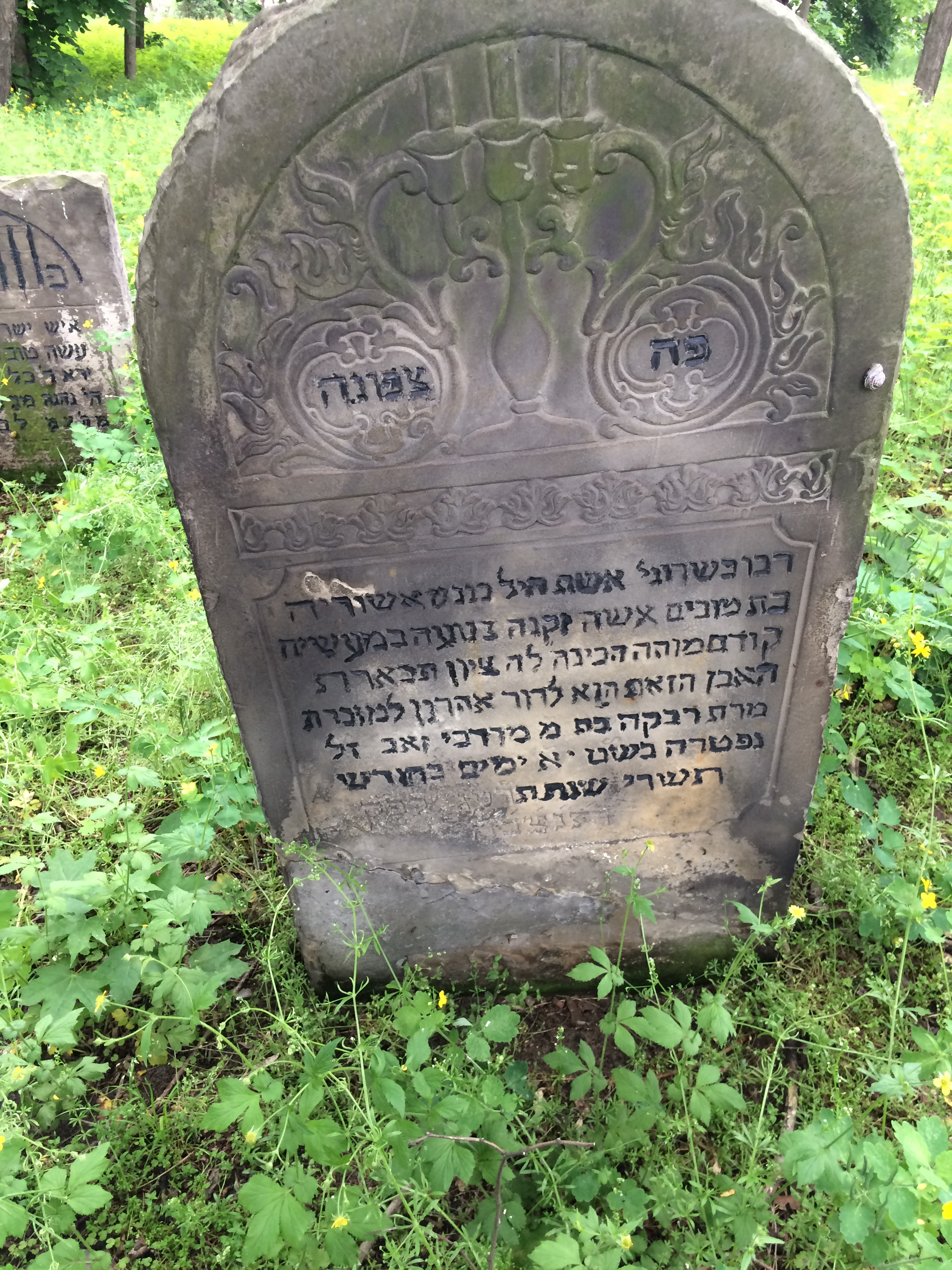
We then drove to the other Jewish cemetery in Tarnobrzeg, which was opened in the 20th century and  where there is still an ohel with a Star of David.  Sadly, the cemetery is not maintained at all, and there are just a handful of headstones still standing, most covered with weeds and snails.  I took photographs of as many as I could and now hope to get these translated.

IMG_2665 ohel for cemetery Tarnobrzeg IMG_2666 cemetery in Tarnobrzeg cemetery IMG_2668 IMG_2669 IMG_2670 IMG_2671 IMG_2672 IMG_2673 birdhouse in the cemetery IMG_2674 cemetery

After visiting the cemetery, we went to a small museum Tomasz knew about, where we met with an incredibly helpful woman who did not speak any English, but when Tomasz explained why I was there, she was very excited and anxious to help.  She provided us with some books with drawings and  photographs of Tarnobrzeg before World War II.

IMG_2677 images from books at the museum in Dzykow IMG_2678 IMG_2679 IMG_2685

The woman at the museum also explained where Dzikow had been located before it merged into Tarnobrzeg, so we drove there and saw some very old homes, built almost like log cabins.  I was enchanted and wondered whether one of these buildings had once been my great-grandparents’ home.

IMG_2690 IMG_2692 IMG_2693

As we left Tarnobrzeg, Tomasz told us what had happened to the Jews there during the Holocaust. Many were shot and killed just outside of town and buried there.  Many others were taken to the San River and shot, their bodies falling into the water.  The rest were eventually transported to a concentration camp or a death camp.  If any survived, they have not returned to Tarnobrzeg.  There are no known Jews living there today.  What would my great-grandparents, both of whom died before the Holocaust, have thought if they returned to their hometown today? It would no longer be the place they knew in almost any way, except for the old buildings that survive.

Nazis rounding up the Jews of Tarnobrzeg 1939

Nazis rounding up the Jews of Tarnobrzeg near the San River 1939


I could have stayed and wandered around Tarnobrzeg for hours, but we had two more stops to make: Radomysl nad Sanem and Grebow.  We headed first to Radomysl nad Sanem, where Phyllis’ grandmother had lived. It is on the other side of the San River and is a very small little town with a small town square and municipal building and perhaps fifty homes, if that many.  Its Jewish population before World War II was less than 400 people, and the village was mostly Jewish.  We drove from one end of the town to the other, and it took only a few minutes.  Even more so than in Tarnobrzeg, there is no sign that there were ever Jews there.  Phyllis was able to obtain some brochures about the town from the library there, but nothing that discussed the former Jewish community.

IMG_2698 Radomysl nad Sanem where Sabina Brot lived IMG_2699 IMG_2700 IMG_2701 IMG_2703


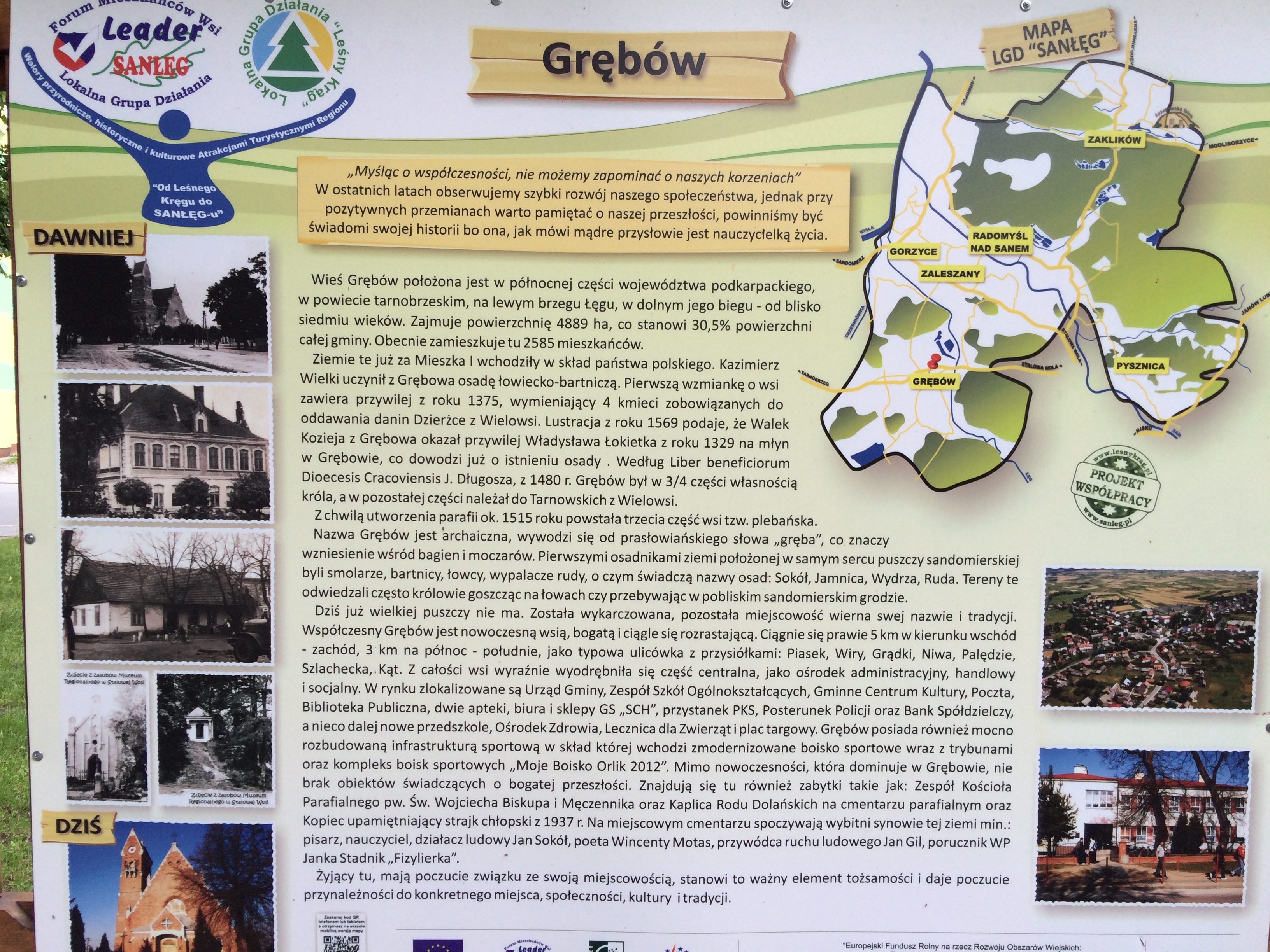
Our last stop was a quick one in Grebow, a town even smaller than Radomysl nad Sanem where there was not even a library we could visit.  I don’t know whether this was where Abraham and David Brotman were born or simply where they were living at the time they emigrated.  Perhaps they had moved here for greater opportunities than they could find in Tarnobrzeg.  I don’t know.  It’s such a tiny village that all I can do is imagine them living there and then wonder what they must have thought when they landed in a place as large and crowded and dirty as late 19th century New York City’s Lower East Side.

IMG_2706 tiny town of Grebow IMG_2707 Grebow IMG_2709 public building Grebow IMG_2710


We then headed back to Krakow.  I was exhausted and emotionally drained and filled with thoughts and feelings.  We were taking another night train that night, this time to Budapest.  As we ate a quick dinner at our hotel, I found myself overwhelmed with emotion in a way that surprised me.  My eyes filled with tears—tears for the people who had been killed, tears for my great-grandparents who had left this country for better things, tears of gratitude that they had done that, and tears of sadness that I was leaving a place that part of me truly felt was my homeland.


Krakow

We arrived in Krakow after a pretty much sleepless night on the train, and the weather was nasty—very cool and raining hard.  Once again, we overpaid a cabdriver (though not by nearly as much) to get to our hotel at 7 am, where our room was, as expected, not ready.  (Check-in wasn’t until 3 pm.)  But the young man at the reception desk was so friendly and helpful that it immediately changed my outlook.  I highly recommend the Metropolitan Boutique Hotel in Krakow—a small and friendly hotel with an incredibly professional, efficient, and friendly staff.  Although the location on a small side street at first seemed odd, we soon realized how ideal that location was—about ten minutes from the main square in Krakow and even closer to the Jewish Quarter in Kazimierz.

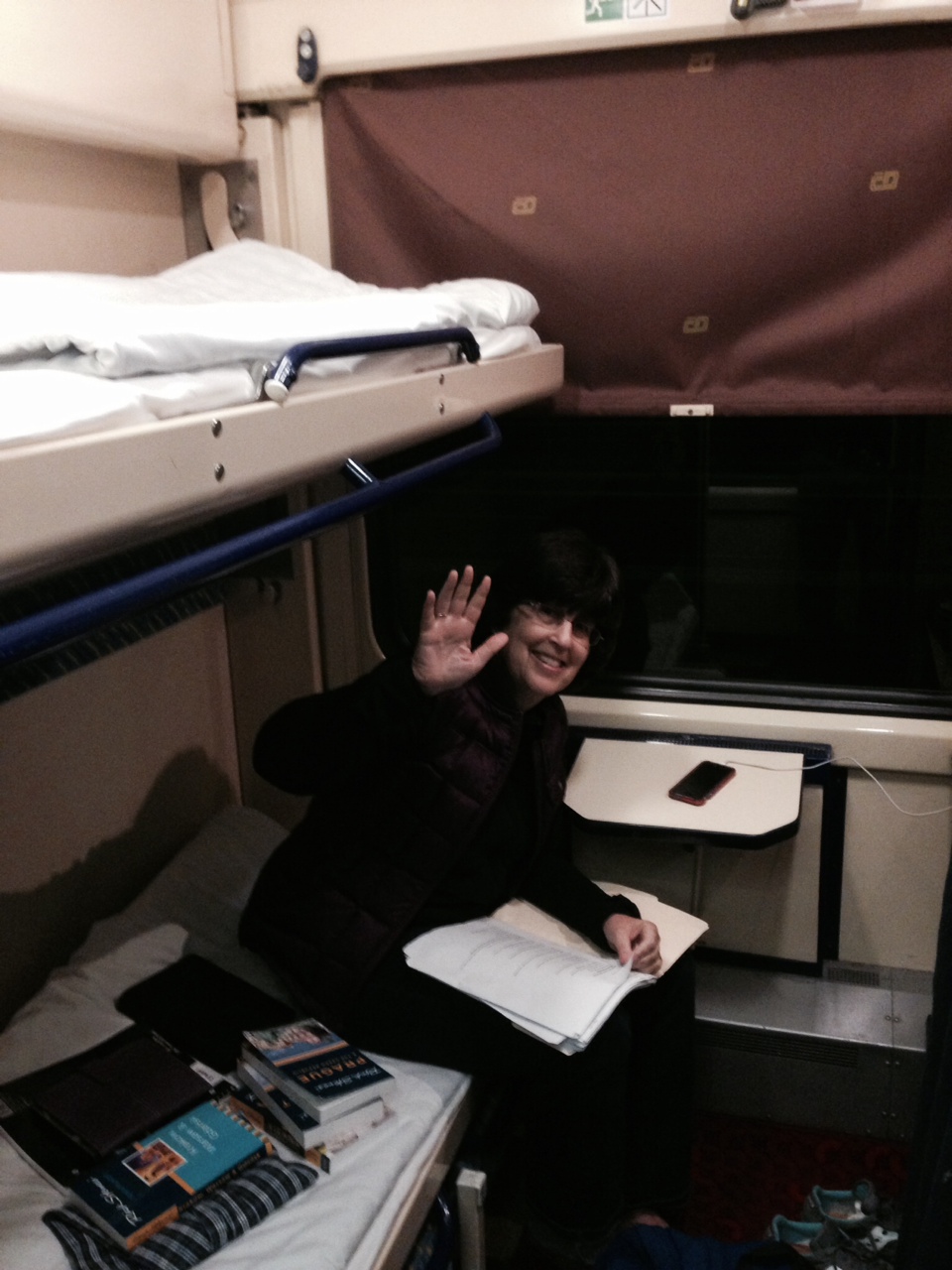
Our sleeping accommodations from Prague to Krakow

Our sleeping accommodations from Prague to Krakow

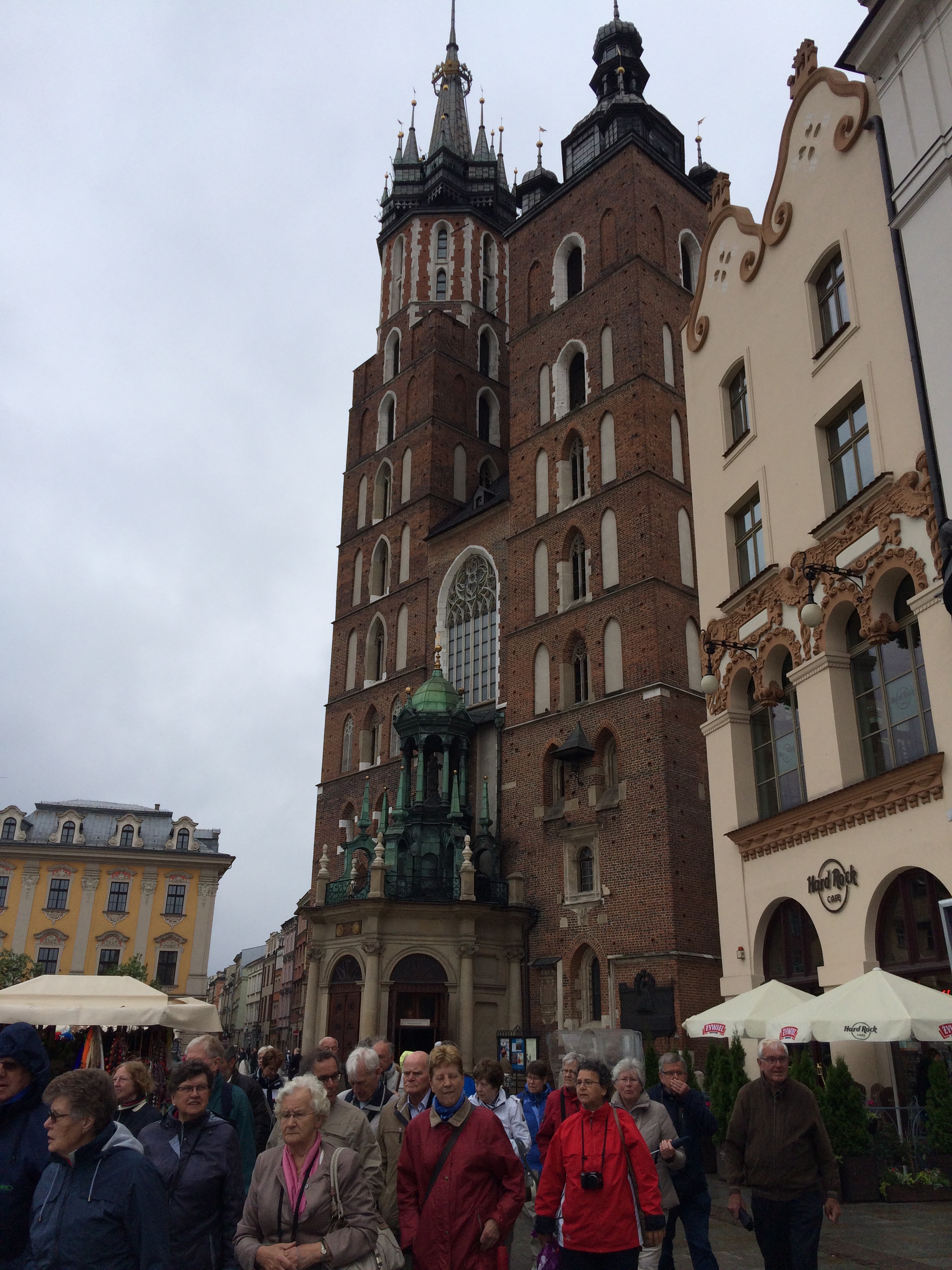
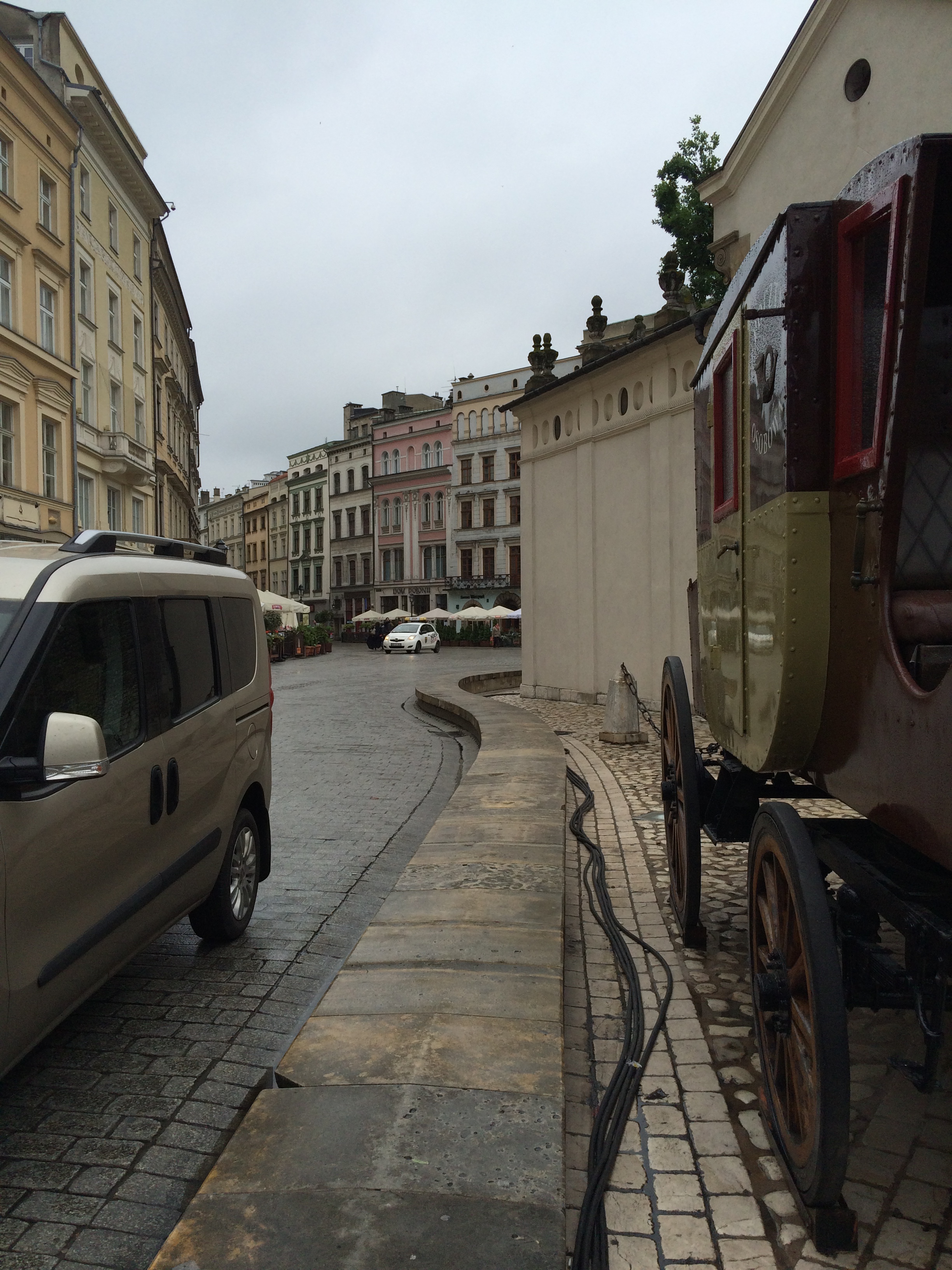
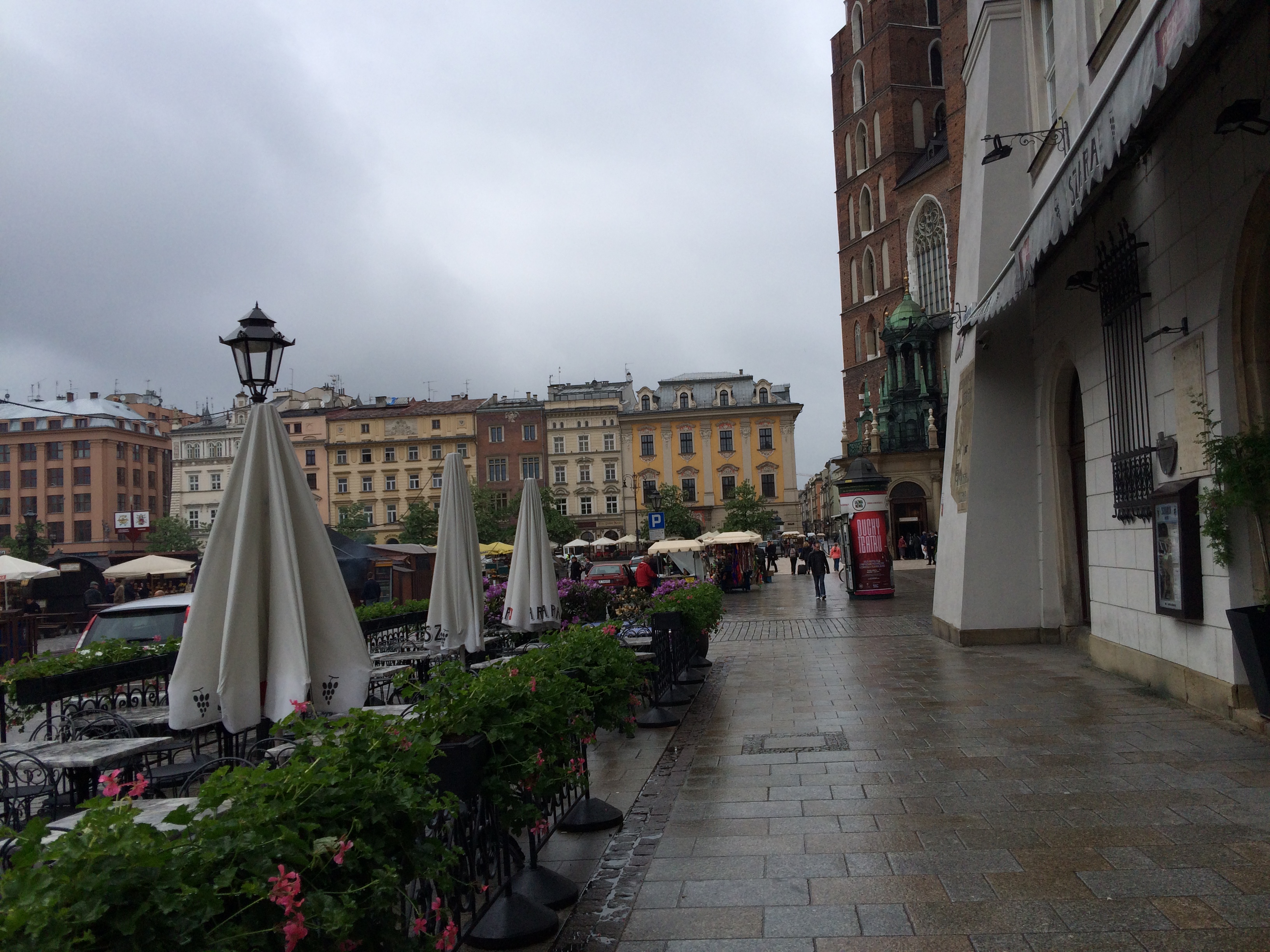
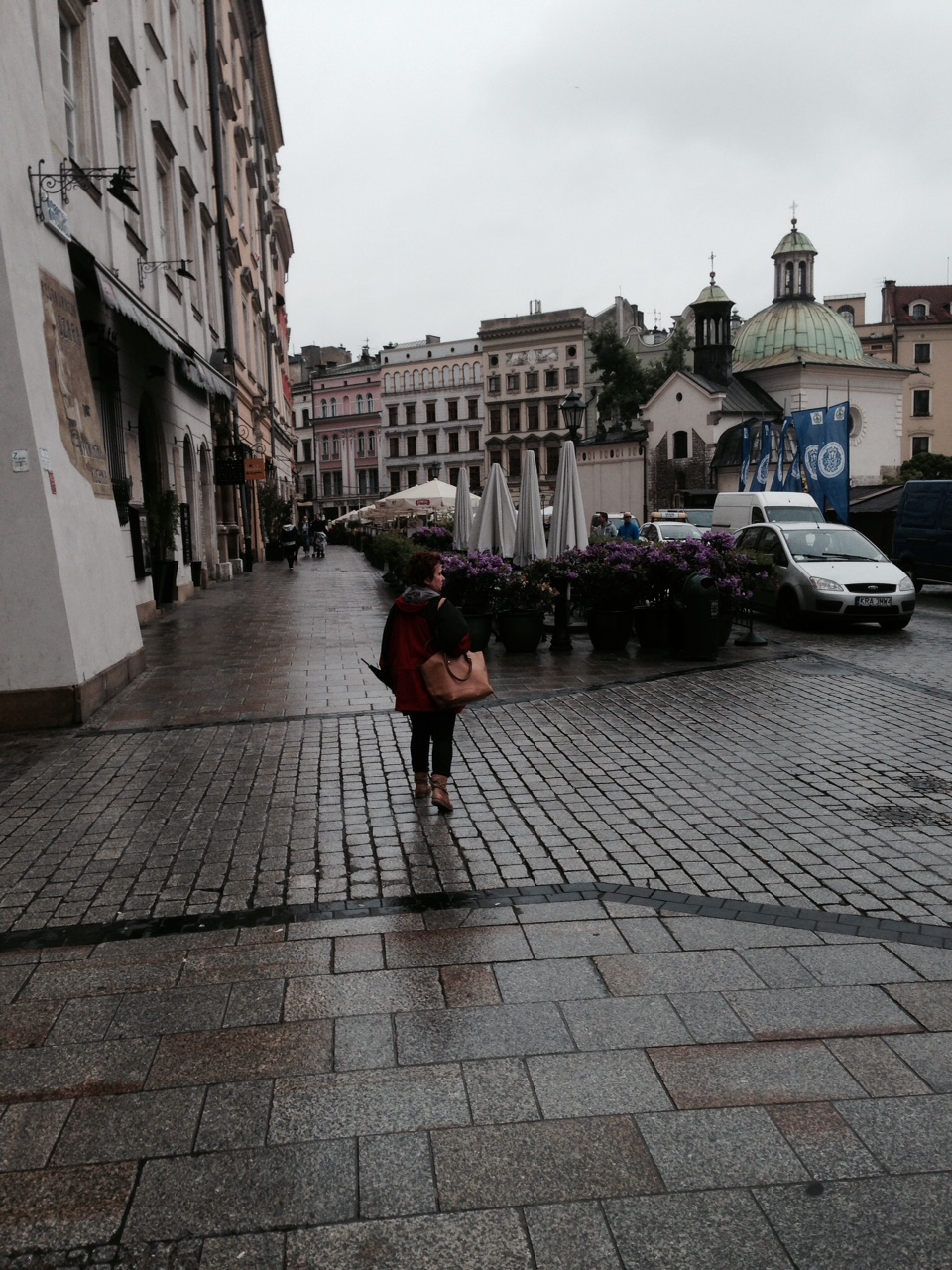
After breakfast at the hotel, we decided to venture out and see the city.  We took umbrellas, but fortunately we never had to open them; the skies never turned blue, but the rain was gone.  We walked to the market in the main square of Krakow where we had planned to go on two group walking tours that day, one of the Old Town, the other of the Jewish quarter.  When we got to the main square, vendors were just starting to open their stands, and the square itself was fairly empty.  The square is magnificent in size—reportedly, the largest public square in Europe.  There are cafes and shops surrounding the square as well as a number of churches and government buildings.  We wandered around a bit, and there was almost a Fanueil Hall feel to the place—a large indoor market lined with souvenir stands.  Unfortunately, the weather really was not great, but we did take a few photographs.

IMG_2625 Main Square Old Town Krakow 5 24 IMG_2626 Cloth Hall Main Square Old Town Krakow IMG_2627 Krakow Street IMG_2628 Krakow Street scene

Krakow main square krakow

After some deliberation, we decided to go on a tour of the Jewish Quarter in the morning and Old Town in the afternoon with SeeKrakow.  Our tour guide was a middle-aged Polish man who spoke English well, and the group of about sixteen people was quite diverse in background.  We were the only people from an English speaking country.  There were people from Spain, France, Belgium, and Switzerland.  They all understood English; it was embarrassing.  We were the only people in the group who could not speak a second language.  Most of the others could speak three.  The American educational system is an utter failure in preparing our children for the global world we live in.

Anyway, we marched off with our leader (whose name escapes me, perhaps for good reason), and after a few stops, I realized that he was not a good fit for me.  Maybe it was the contrast to Andrea and Helena, our guides in Prague; maybe it was the nature of being on a group rather than private tour.  The tour leader was knowledgeable and pleasant, but I felt that he had a personal agenda to promote instead of providing an in-depth and historical view of the Jewish Quarter.  Over and over his message seemed to be that Poland had always been tolerant and accepting of its Jewish citizens and that the Polish people were also victims of the Holocaust.  What he said is historically accurate in many ways, but it was the way he delivered his message and his seeming defensiveness that troubled me.

After about the first hour, I started to think that (a) I didn’t want to go on the Old Town afternoon tour with this guide, and (b) I didn’t want to continue on the Jewish Quarter tour with this guide.  When we realized that his tour would not give us a chance to enter into any of the synagogues we passed (which he did describe, but at times showed us only the back or side of the building), we made a decision to leave the tour and explained to the guide that we wanted to spend more time in the Quarter rather than continue with the group.

Unfortunately, I had made one serious error in planning our itinerary—I had failed to check a Jewish calendar beforehand, and I had not realized that our one day in Krakow would be the holiday of Shavuot.  That meant that many of the synagogues, at least those still operating as synagogues, would not be open to the public for tours that day.  (It was also the Catholic holiday Pentecost, meaning that many stores and offices were also closed that day.)  If I could have changed one thing on our trip itinerary, I would have added at least another day to our stay in Krakow—not only because of the conflict with Shavuot, but also because we just did not have enough time to do the city justice.

But when you are traveling, you do what you can do.  So over lunch, we realized that we did not have time to see many of the sites in Krakow outside the Jewish Quarter—the Wawel Castle and the churches and other buildings we’d only glimpsed in Old Town.  We also realized that our sleepless night was catching up with us.  So we spent the afternoon wandering through the Jewish Quarter, soaking up what we could, and visiting the places we could enter.  I hope that someday we can return to Krakow and see the city in more depth.

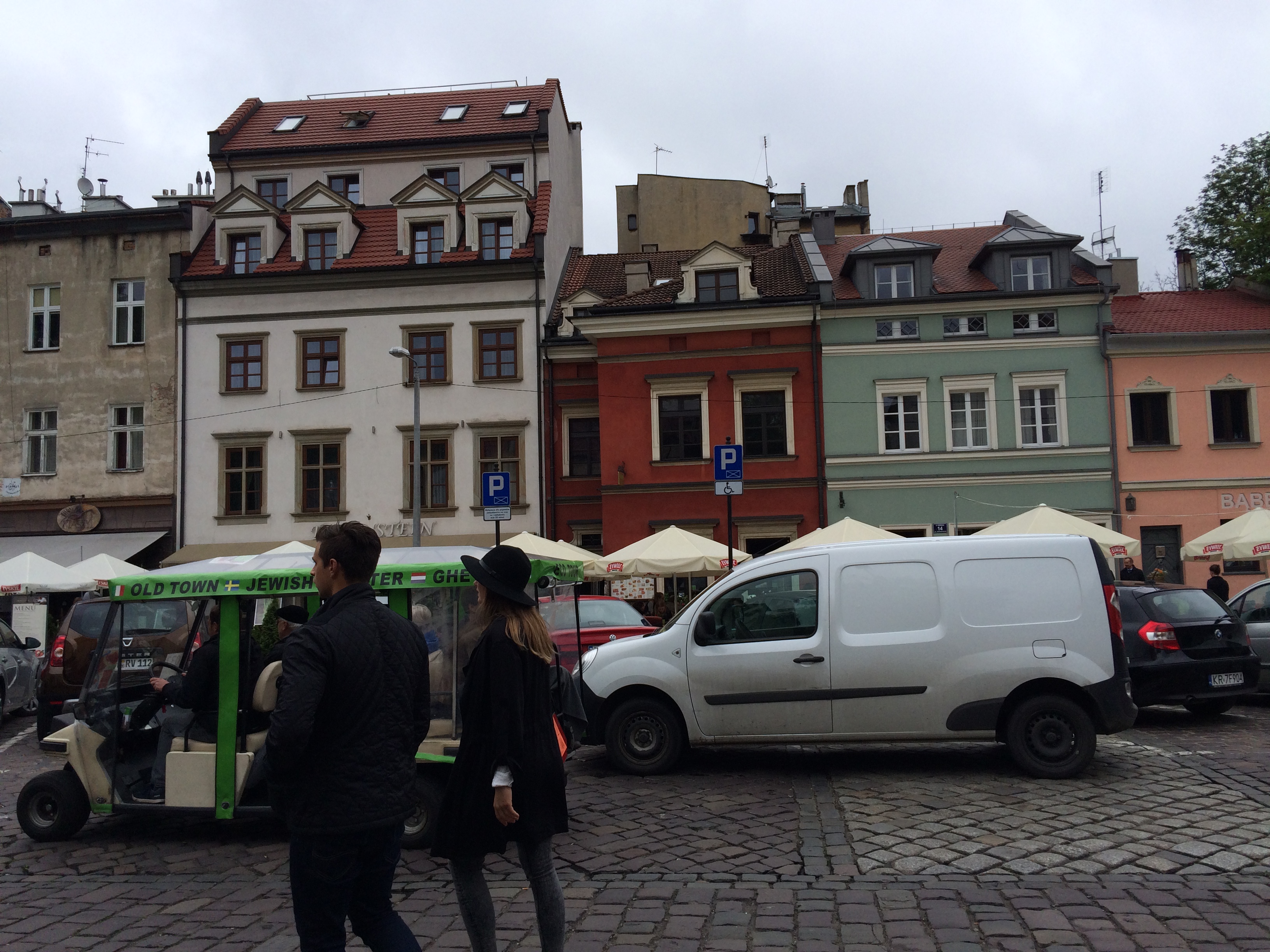
Unlike the Jewish Quarter in Prague, which as I wrote was substantially torn down in the late 19th century, most of the structures from the original Jewish Quarter in Krakow are still standing—the winding cobblestones streets and old worn buildings have been there for hundreds of years.  As our guide said, Krakow’s Jewish quarter is much more “authentic” than that in Prague because it reflects the way the ghetto looked when it was a ghetto. It also reflects more of the wear and tear of time, neglect, and the war.  Here are some photos of the square where the Jewish market once operated; it still operates as a market—a flea market when we were there, although, of course, there are no Jewish vendors or customers today.

IMG_2631 former Jewish marketplace, still a market 5 24 IMG_2633 former Jewish marketplace

We saw six still-existing buildings in the Krakow Jewish Quarter that were once operating synagogues. As with the synagogues in Prague, the only reason they are still standing is that the Nazis found the spaces useful for storage.  The oldest of the existing synagogue buildings, appropriately referred to as the Old Synagogue, was built at the beginning of the 15th century.  Its interior was destroyed by the Nazis, and it was then used for storage during their occupation of Poland.  Today the building is operated as a museum, displaying Jewish ritual objects and a historical exhibition of Krakow before and during the Nazi occupation.

IMG_2641 Old Synagogue IMG_2642 front of Old Synagogue old synagogue 2 old synagogue krakow

The second oldest synagogue still standing is the Remu’h Synagogue.  It is still an active congregation, so we were not able to enter it during our visit, nor we could enter the Old Jewish cemetery that is located adjacent to the synagogue building.  All I could get was the one photograph through the gate.  The Remu’h synagogue was built in the mid-16th century, and its interior also was substantially destroyed by the Nazis and then used for storage.

Remu'h Synagogue

Remu’h Synagogue

Both the Old and the Remu’h synagogues are located on what was the main square in the Jewish quarter where today there are numerous restaurants, many providing “Jewish” dishes on their menus (but not kosher) and klezmer music at night.  It’s a very pretty square, but the faux Jewishness is clearly intended to manipulate Jewish tourists like us, coming to see a world that no longer exists.

IMG_2643 main square in Jewish Quarter Krakow 5 24 IMG_2644 Jewish Quarter Krakow

The High Synagogue was the third synagogue built in Krakow, sometime after the Remu’h but also in the 16th century.  It was called the High Synagogue because the prayer hall was located upstairs.  We were able to climb those stairs and visit the former prayer hall because today it is a museum.  The exhibit there was very moving.  Several families of former Krakow Jews provided photographs to the museum of their families, depicting what their lives were like in the 1920s and 1930s before the Nazis arrived.  I was surprised to see very modern-looking families, engaged in activities like skiing and boating, as opposed to the images I had had in my head of ultra-Orthodox men with payes and long black coats.  As in Prague, by the early 20th century Jews in Krakow were full citizens, no longer required to live in a ghetto.  Many were quite successful merchants, and their families lived very comfortable and modern lives.

IMG_2639 High Synagogue IMG_2640 Jewish quarter Jewish school

Of course, it doesn’t matter whether they were Hasidim or assimilated, but I have to admit it made it easier for me to identify with these people, knowing their lives were not unlike mine.  Reading the stories of what happened to these families was heartbreaking.  Even though someone survived in these families and was thus able to preserve the photographs and the stories, each of these families lost many members during the Holocaust.

The only other synagogue building we could enter was that of the former Kupa Synagogue.  It was built in the 17th century, and like the other synagogues, was severely damaged by the Nazis.  We were able to enter the building and see the prayer hall, where people seemed to be setting up for some event.  We are not sure exactly how this synagogue is used today since it was open for visitors on the holiday.

Back of Kupa Synagogue

Back of Kupa Synagogue showing the ghetto wall


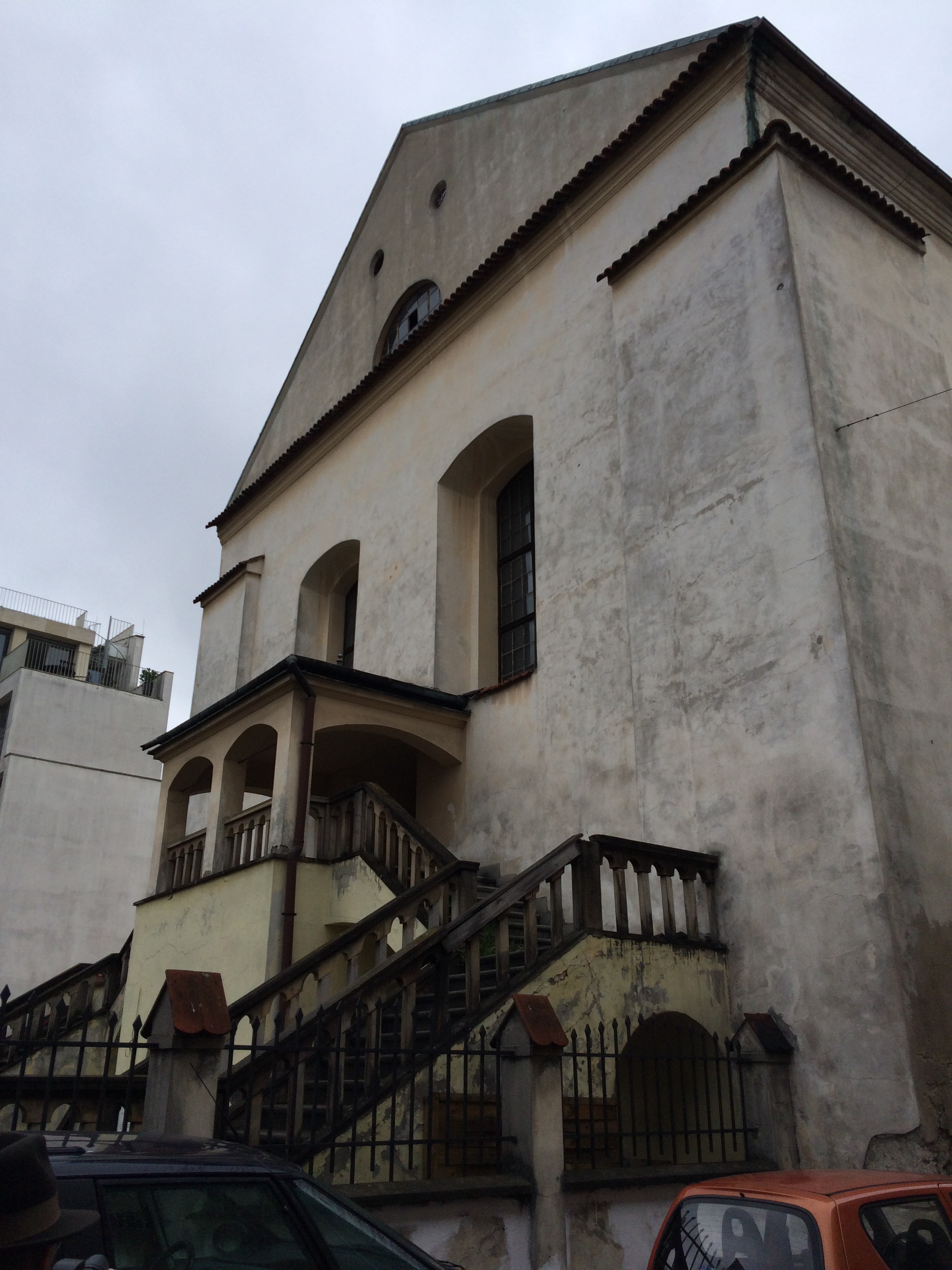
We also stopped to see the outside of the Isaac Synagogue, also built in the 17th century and now the headquarters for Chabad in Krakow, and the newest of the synagogues, the Tempel Synagogue, a Reform synagogue built in the mid-19th century.  Neither was open to visitors.

Tempel Synagogue

Tempel Synagogue

IMG_2638 Izaak Synagogue now Chabad

Isaac Synagogue


But next to the Tempel Synagogue is the JCC of Krakow, which was open and where we spoke with a woman at the reception desk.  She told us that they have 500 members, although only 120 are “registered” Jews.  The JCC provides educational and cultural programming, Shabbat dinners, and holiday celebrations, and aims to revive a Jewish community in Krakow.  It was uplifting to be in this new building and see some signs of hope for the very small Jewish community that exists today in Krakow.

jcc krakow

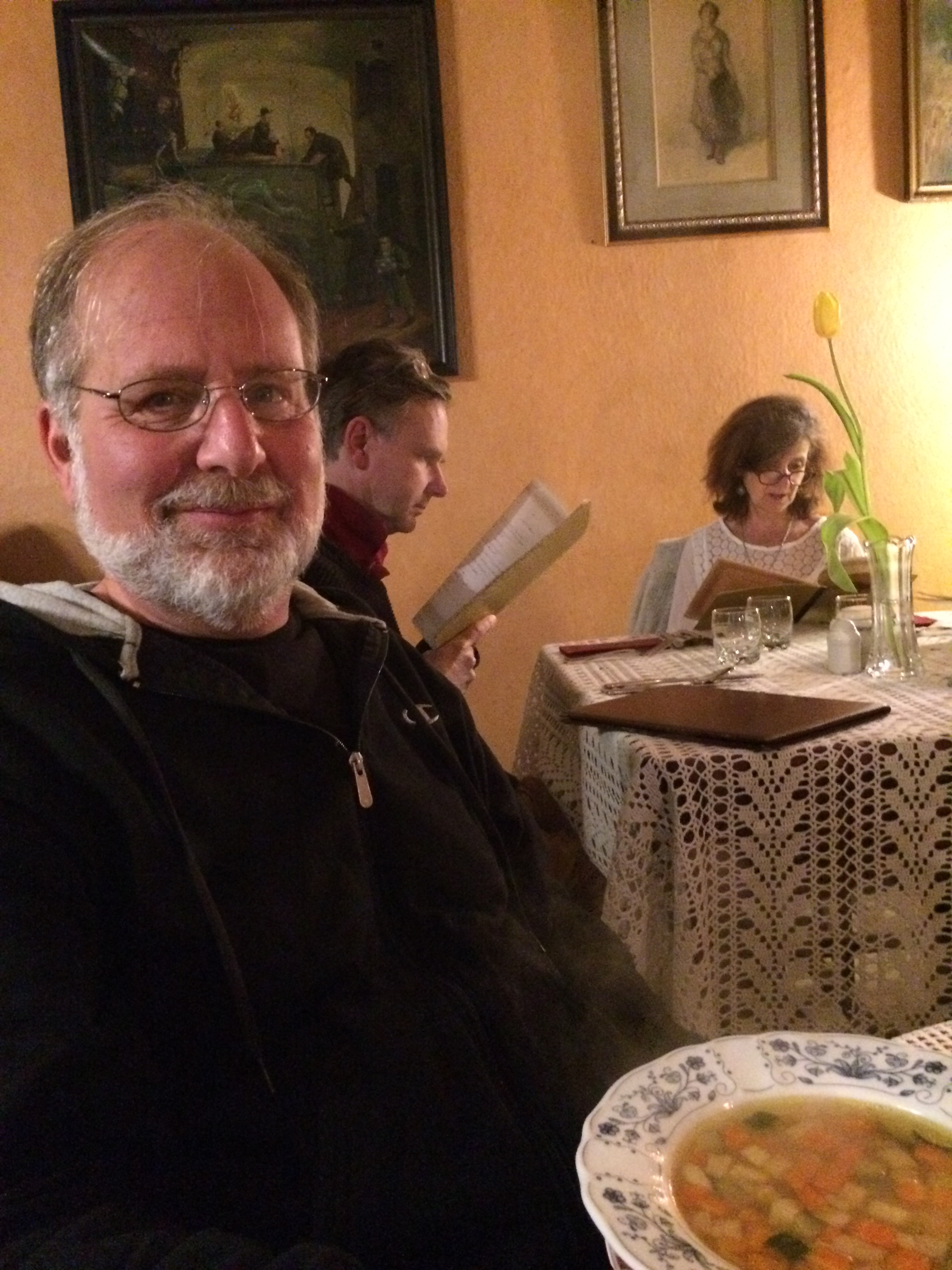
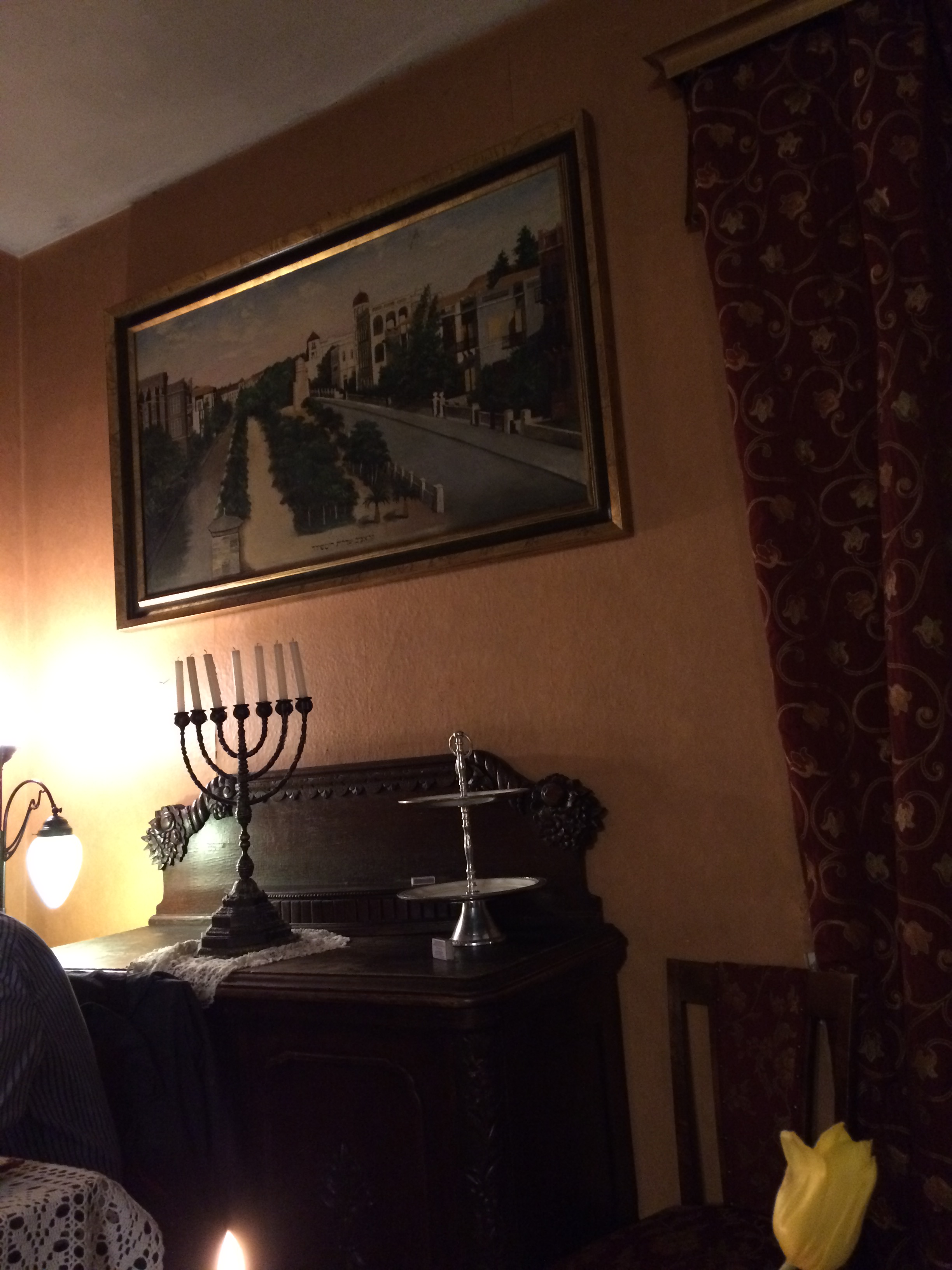
We ended our walk through the Jewish Quarter on that somewhat high note.  We later returned for dinner at the Klezmer Huis, where we ate “Jewish-style” food and listened to Klezmer music (sung by three young people who I assume are not Jewish, but who were excellent).

IMG_2646 Klezmer Huis IMG_2648 Klezmer Huis harvey IMG_2649 interior of Klezmer Huis IMG_2650 IMG_2652 Klezmer peformers

But although that was fun (if somewhat corny), it did not really cover up the reality.  Before World War II, there were about 65,000 Jews in Krakow, and they made up about 25% of the city’s population.  Today, as I said, there are 120 Jews living in Krakow.  Walking those streets and seeing the old houses once occupied by Jewish families, entering those once flourishing synagogues that are now just museums, seeing those photographs of the families who were destroyed, I could not help but feel thousands of ghosts following us around.  What would Krakow be like today if the descendants of those 65,000 people were alive? My day in Krakow left me angry and very sad.

The second day of our visit to Poland we learned more about what happened to those people.  More on that in my next post.


Prague, Part III: Italian Music and Italian Food in the Czech Republic?

Our last day in Prague we were on our own and revisited Old Town and the Charles Bridge and then meandered around Lesser Town, the district below the Castle. It was a day to recover from the experiences we’d had the day before and to absorb all we had seen in Prague.

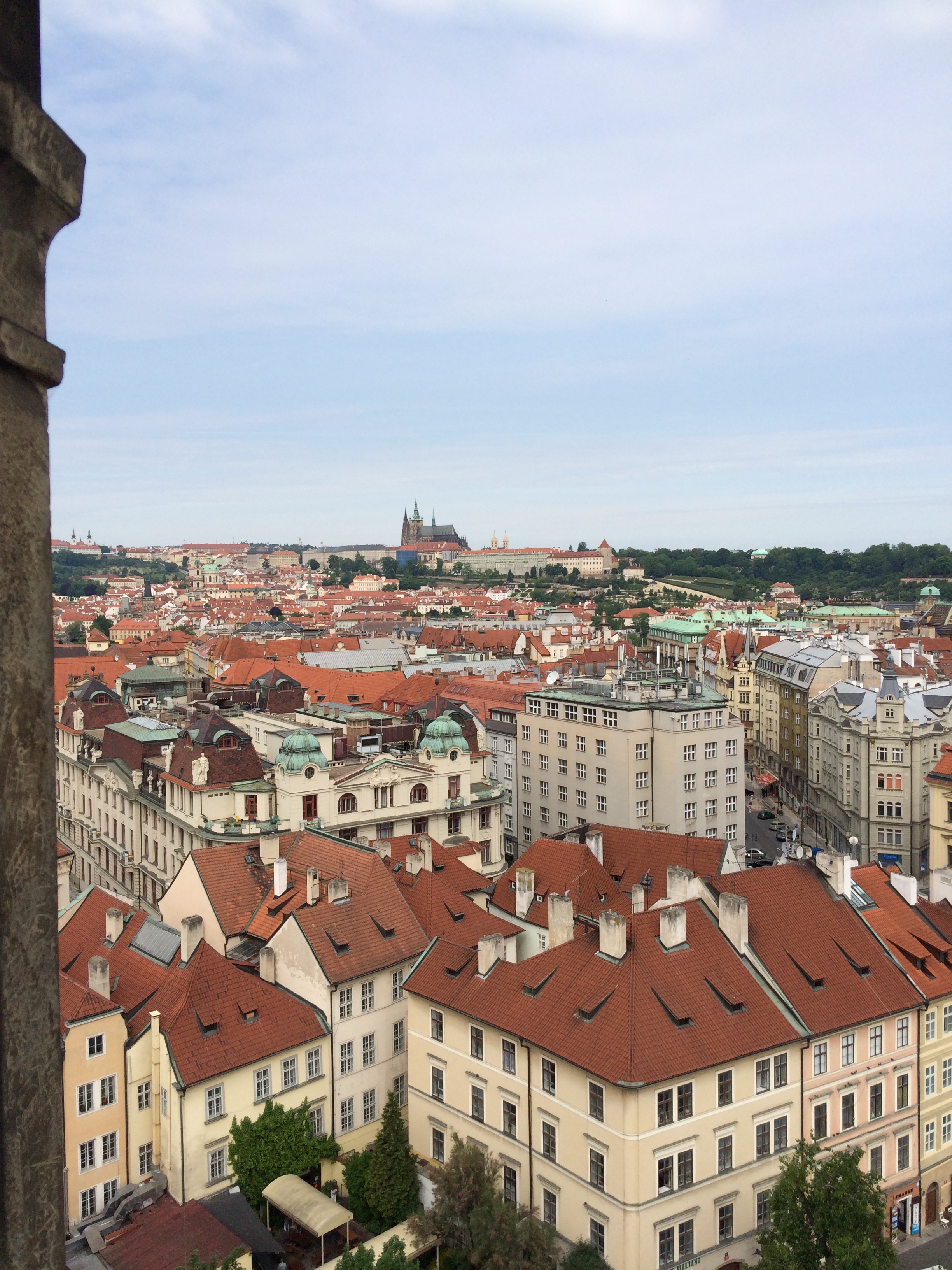
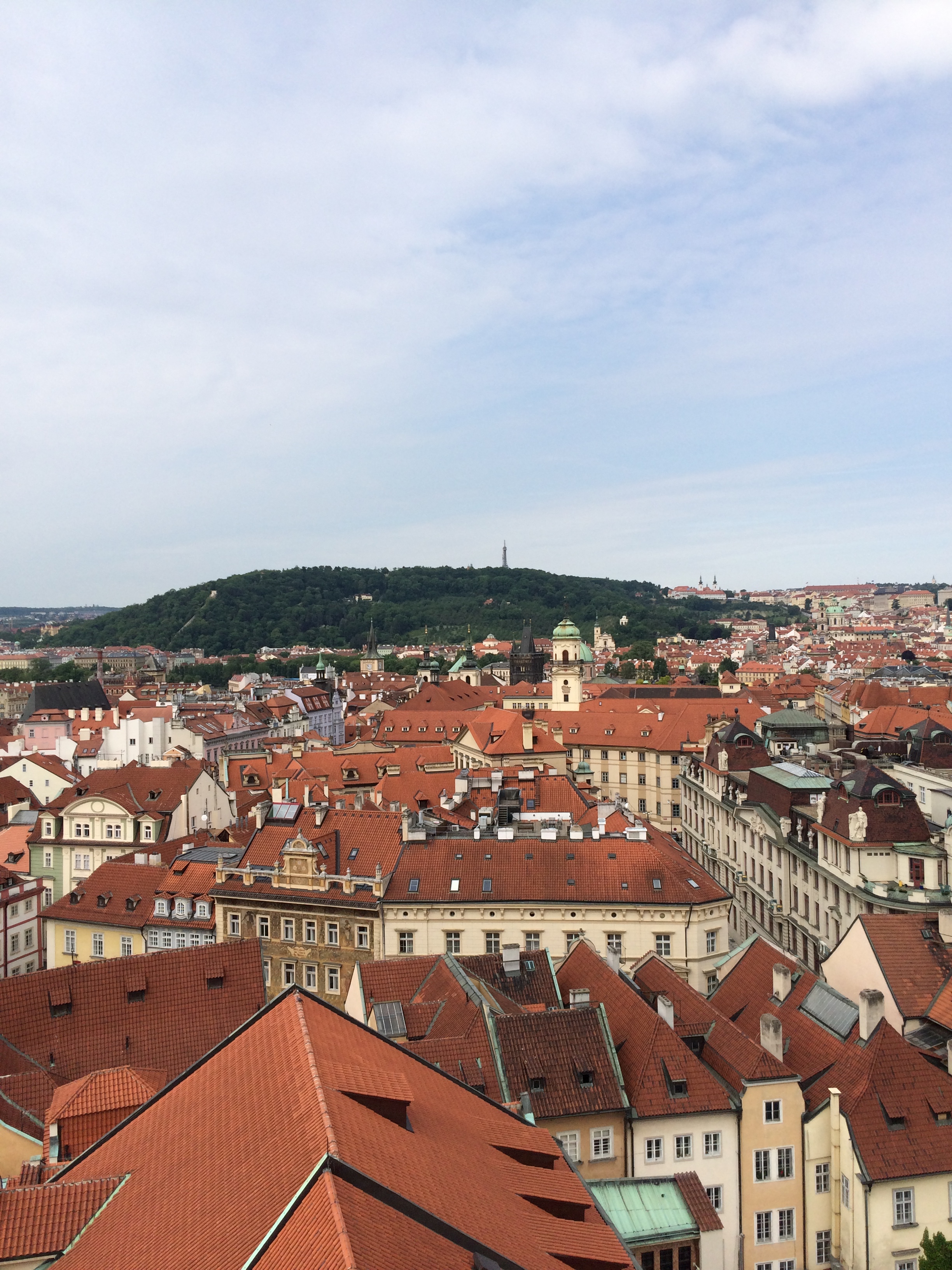
We climbed (yes, we actually climbed) the clock tower in Old Town where we had views of Prague in every direction.

IMG_2576 tower view IMG_2577 Tyn church IMG_2581 panorama 2 IMG_2589 IMG_2591

IMG_2586 us in the tower

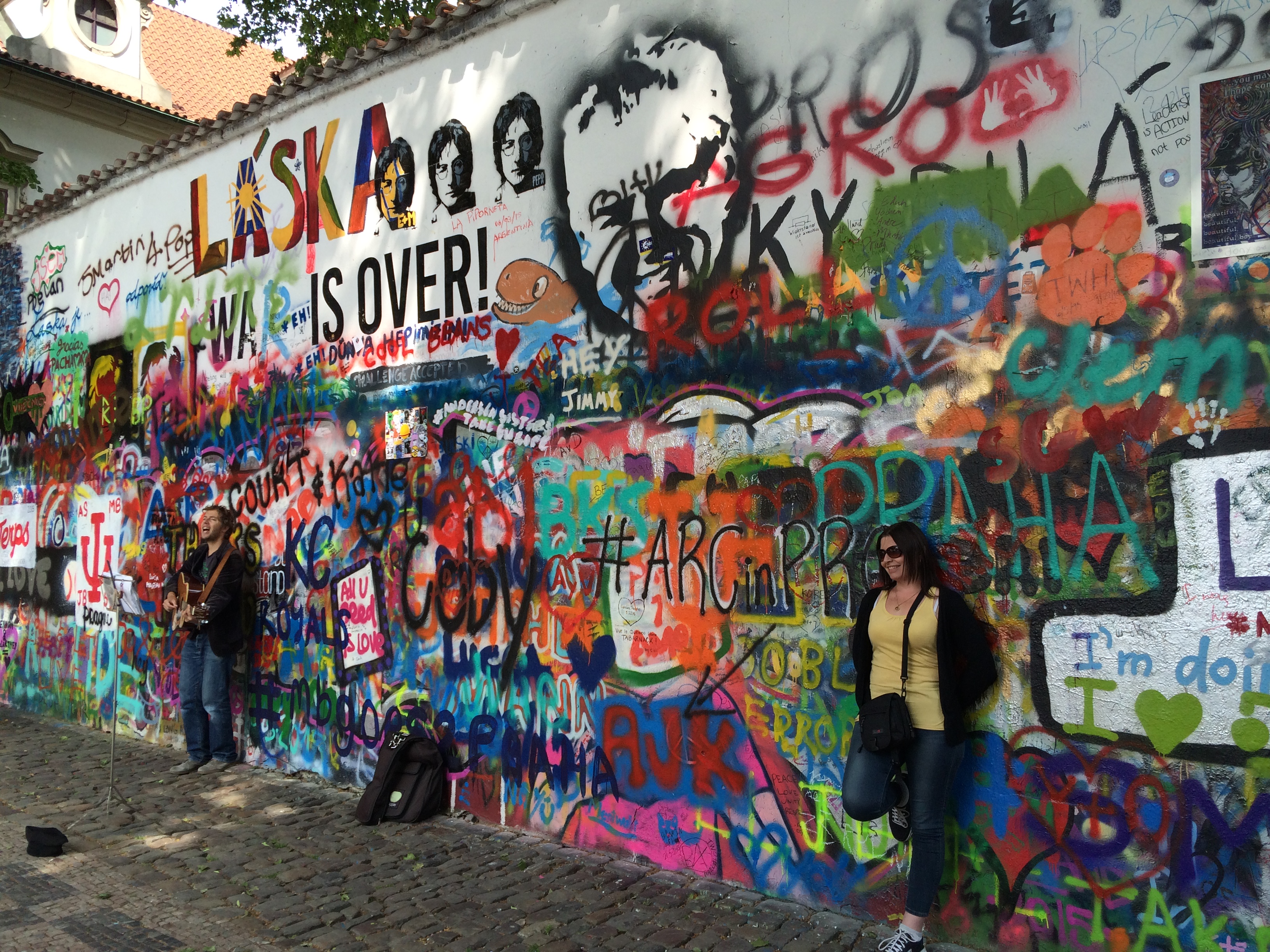
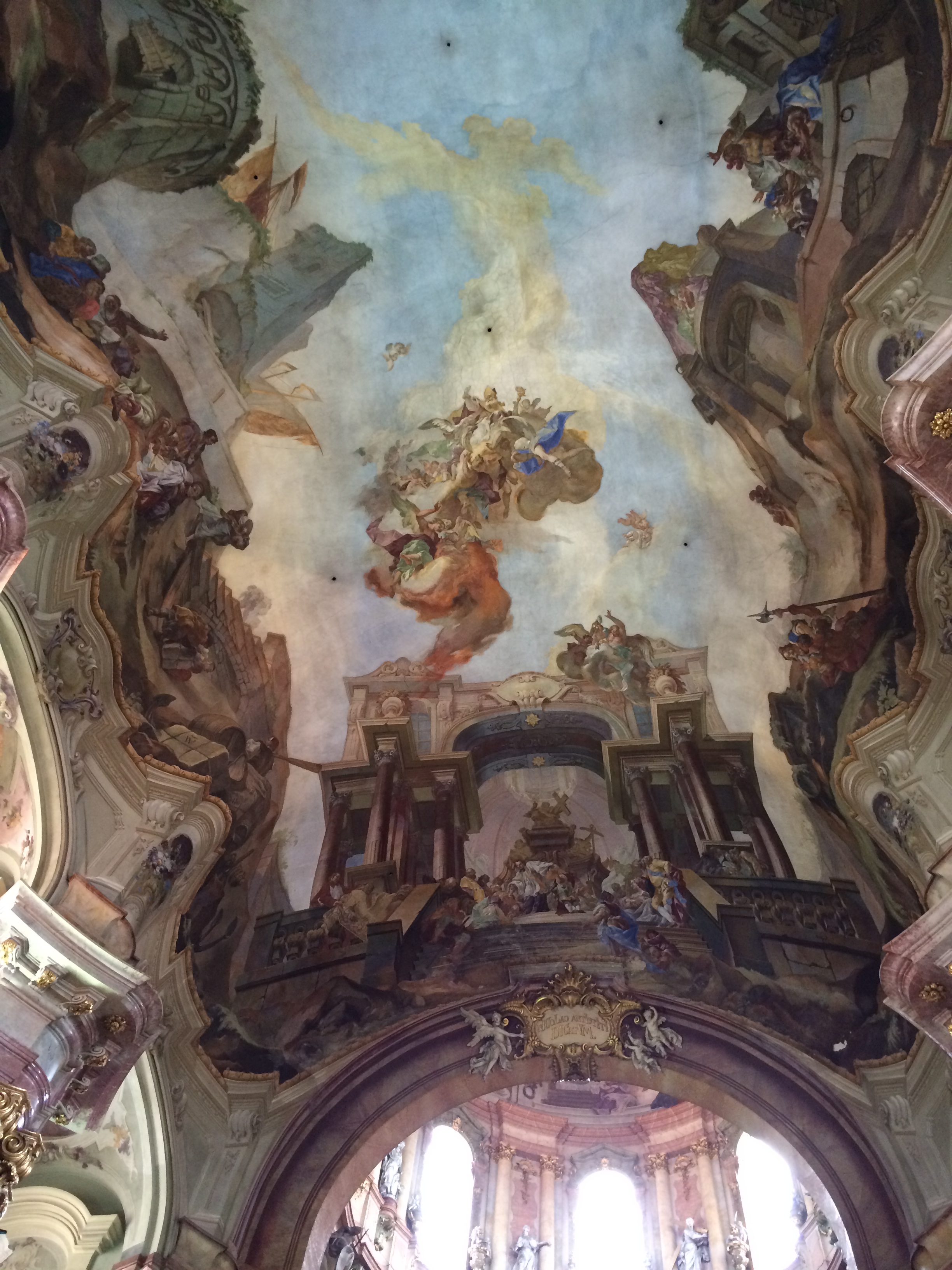
We crossed the river and saw the wall covered with graffiti dedicated to John Lennon and the ornate St. Nicholas Church in Lesser Town.

IMG_2594 Vlatava RIver Prague

Vtlava River

IMG_2595 Wall for John Lennon

John Lennon wall

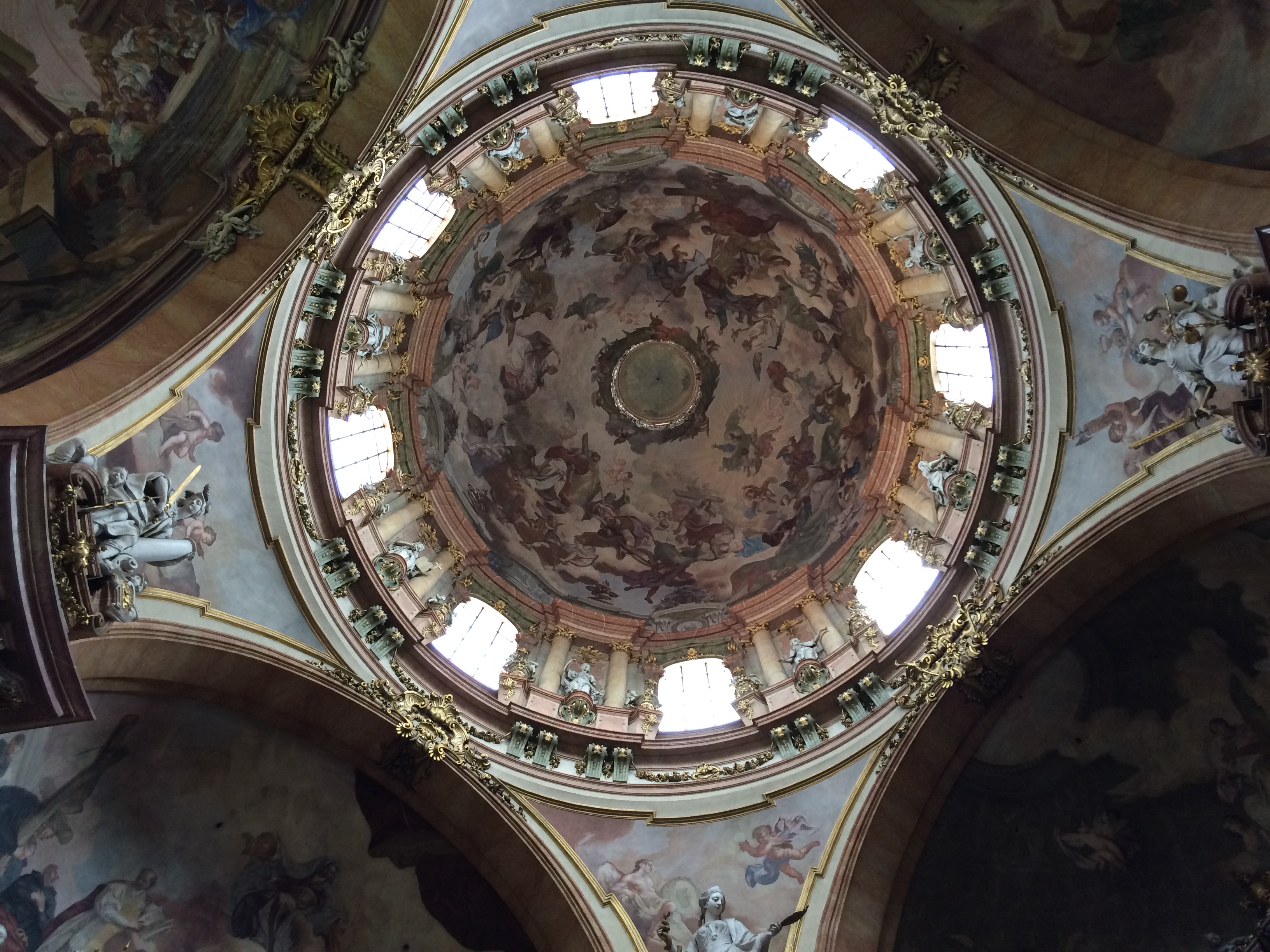
IMG_2598 St Nicholas Church in Lesser Town 5 23

Inside St. Nicholas Church, Lesser Town

IMG_2600 IMG_2603 dome in St NIcholas Church Prague Lesser TOwn

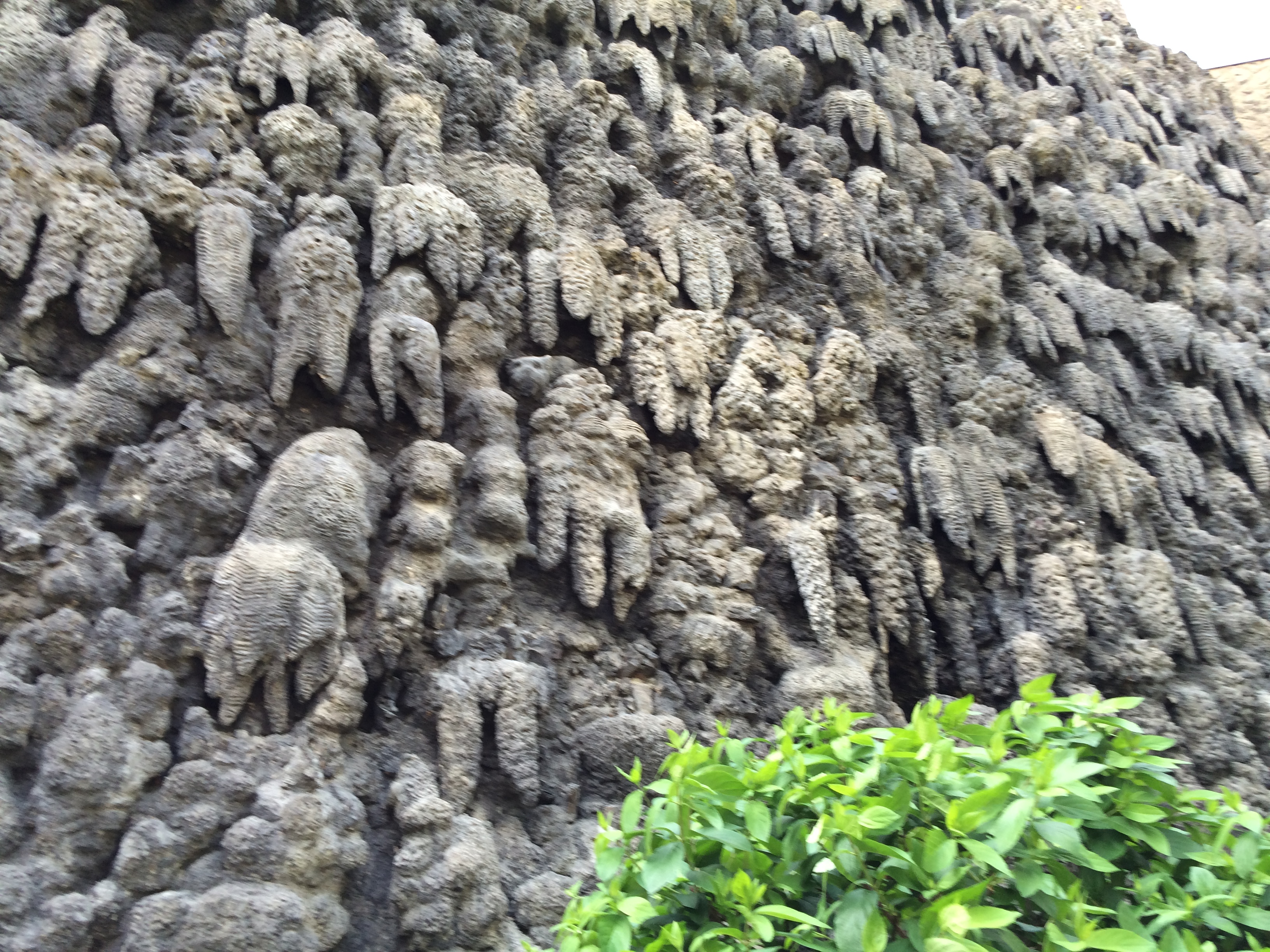
We wandered through the Wallenstein gardens, where we saw peacocks and a very weird grotto wall with sculptures of animals hidden throughout.

IMG_2608

In the Wallenstein Gardens


IMG_2614 IMG_2615 IMG_2616 IMG_2620


We had lunch at a restaurant on the river; the walkway from the street to the restaurant was so narrow that they had a “traffic light” at either end so that two people wouldn’t get stuck in the middle, neither being able to pass.  Of course, we didn’t notice that on our way down.  Fortunately, the man coming up was only a few steps up and graciously went back down.

Walkway to Cafe Certenova

Walkway from Cafe Certenova

We also experienced the way that music permeates everything in Prague.  We had been to a concert our second night at the Municipal House’s Smetana Hall, hearing the Prague Symphony Orchestra play Gustav Mahler’s 5th Symphony, a moving and emotional piece of music that I’d never really heard before in its entirety.  For our last night we decided we would try and get to another concert.  Walking through Prague we discovered that wherever we went, people were handing out flyers for concerts at churches and other venues.  What was a bit bizarre though was that in many of these venues the program included Vivaldi’s Four Seasons.  We were baffled—was it Vivaldi’s birthday?  He was Italian, not Czech.  Why would all these places be playing the same piece of music?  My best guess is that it’s a piece that is well-known and well-loved and thus a good selection to attract an audience.  We returned to Smetana Hall that night, and yes, we heard the Four Seasons.  It was lovely.

Street performers---can anyone tell me how they do this??

Street performers—can anyone tell me how they do this??

We were also surprised by how good the food was in each of the other places we ate while in Prague—-Giovanni’s Trattoria, RYBI (great fish), and Pasta Fresca (yeah, we like Italian food, as apparently does most of the world since every city we visited seemed to have more Italian restaurants than anything else, other than their own local cuisine).

Overall, our time in Prague was fascinating—fun, uplifting, educational, upsetting, insightful, entertaining, and stimulating. It was good to end the trip seeing all the beauty and good that human beings can create and appreciate instead of the evil and horrors we’d witnessed the day before.  Prague is a wonderful city, and we definitely could have spent more time there.  But it was time to move on to our next stop.

We boarded an overnight train to Krakow.  It wasn’t the most comfortable sleeping accommodation on the trip, but when we woke up, we were in what was once Galicia, the homeland of my Brotman ancestors.

The Faces of My Past: The Magic of Photography

I received some remarkable photographs from my cousin Suzanne, the daughter of Fred and Ilse Michel.  Fred, as I wrote about here, was the grandson of August Seligmann, who was my great-great-grandfather Bernard Seligman’s brother.  Fred would have been my grandfather John Nusbaum Cohen’s second cousin, making him my second cousin, twice removed.  Suzanne is thus my third cousin, once removed.

Suzanne sent me a number of photographs, including some taken of prints that had hung in her childhood home in Scranton, Pennsylvania.  For example, here are two prints of Bingen, Germany, the town where Fred Michel lived and also where our mutual ancestor Moritz Seligmann lived (in Gaulsheim, now part of Bingen) before moving to Gau-Algesheim.  It is also close to where my cousin Wolfgang now lives, and he identified the location and some of the structures depicted therein.

Courtesy of the Family of Fred and Ilse Michel

Courtesy of the Family of Fred and Ilse Michel

Courtesy of the Family of Fred and Ilse Michel

Courtesy of the Family of Fred and Ilse Michel

Bingen 3

Courtesy of the Family of Fred and Ilse Michel

These prints show the city of Bingen’s location at the intersection of the Rhine River and the Nahe River.  According to Wolfgang, the tower in the river is called the Mäuseturm or “tower of mice,” and the church on the hill in the top print is the Rochuskapelle or the chapel on Rochus Hill.  Wolfgang said that his grandfather Julius and his family survived the last part of World War II in the Rochus chapel. Wolfgang told me that much of the city of Bingen was destroyed by British bombers in November, 1944.  The bombs destroyed the apartment whereJulius Seligmann and his wife and sons lived, so they moved to the Rochuskappelle, which the monks had opened for those who had lost their homes and their possessions.

On the reverse of the top print is written, “So that you always think of Bingen and your friends: ???-Kathi-Rainer und Christa Güttler. Bingen, Nov,11, 1974.”  The reverse of the second print says, “The loving Ize and his wife to remember Bingen from Gret and Kath Scharer.”   Based on the captions on these photographs from an album that belonged to Fred Michel, these were close friends.

Courtesy of the family of Fred and Ilse Michel

Courtesy of the family of Fred and Ilse Michel

scharers in album

These prints of Bingen before the war and the photographs of Fred’s friends made me think about what was lost during the war.  Not just all the millions of people who died, but also the landscape, the history, and, for the many who were lucky enough to emigrate, their homeland.  Perhaps these old prints and the pictures of his friends helped keep some of those happier memories alive for Fred Michel.

Here is a photograph of Fred Michel and his mother Franziska Seligmann Michel taken when Fred was a young boy, when he likely could never foresee leaving Germany and moving to a place called Scranton:

Fred Michel and Franziska Seligmann Michel  Courtesy of the Family of Fred and Ilse Michel

Fred Michel and Franziska Seligmann Michel
Courtesy of the Family of Fred and Ilse Michel

Here is a photograph of Franziska’s headstone.  She died four years before Fred left for America.

Courtesy of the Family of Fred and Ilse Michel

Courtesy of the Family of Fred and Ilse Michel

I believe these are photographs of Fred as a young man, taken in Munich in 1928, according to the caption:

Courtesy of the Family of Fred and Ilse Michel

Courtesy of the Family of Fred and Ilse Michel

Although he is not identified in the photographs above, here is a photograph of Fred with Ilse and his children sometime around 1960, and it appears to be the same man many years later:

Courtesy of the Family of Fred and Ilse Michel

Courtesy of the Family of Fred and Ilse Michel

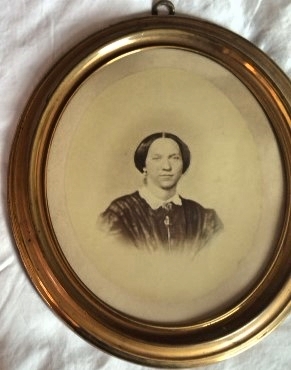
I was quite excited about these two portraits. I know who is in these photographs because of the inscriptions on the reverse:

August Seligmann

August Seligmann Courtesy of the Family of Fred and Ilse Michel

Rosa Goldmann Seligmann

Rosa Bergmann Seligmann Courtesy of the Family of Fred and Ilse Michel

Courtesy of the Family of Fred and Ilse Michel

Courtesy of the Family of Fred and Ilse Michel

August was my great-great-granduncle, the brother of Bernard Seligman.  Here is a picture of Bernard, my great-great-grandfather.  Can you see any resemblance between the two brothers?

Bernard Seligman

Bernard Seligman

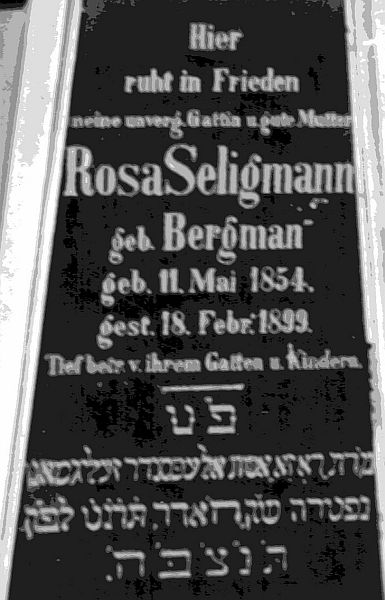
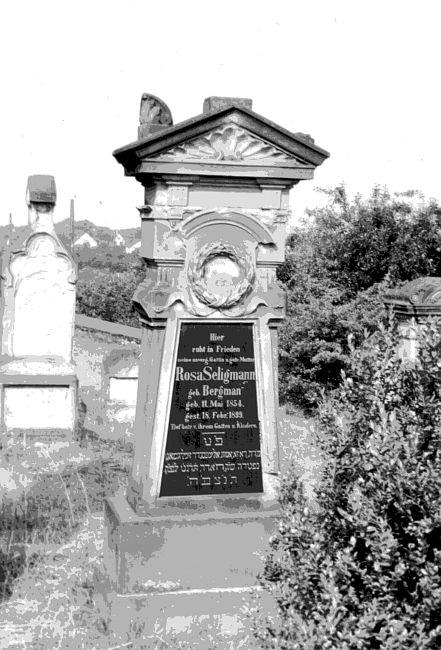
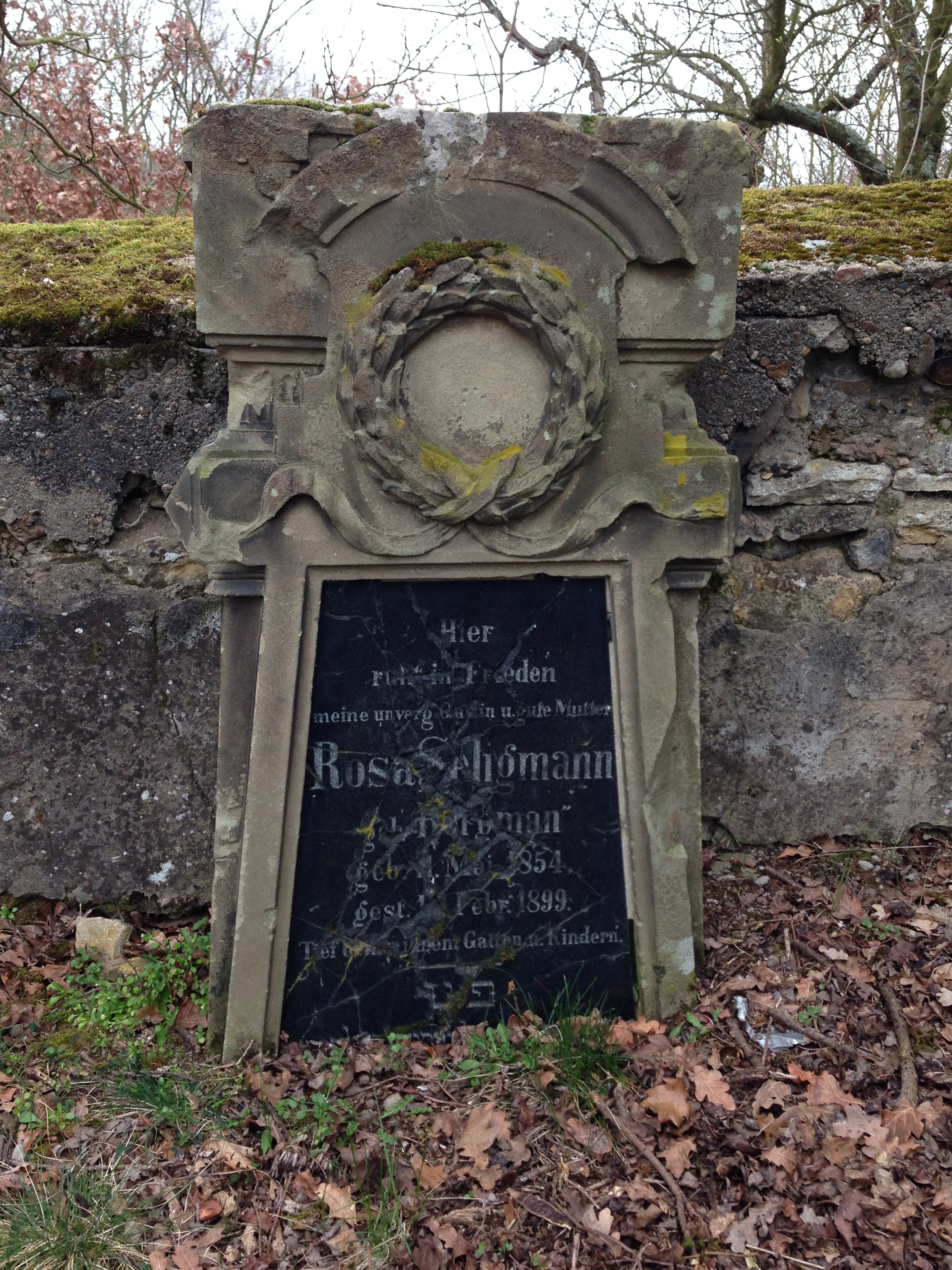
Rosa’s headstone is the one that was terribly defaced in the Gau-Algesheim cemetery.

closeup of Rosa Seligmann headstone

And here are the portraits that intrigue me the most.

Courtesy of the Family of Fred and Ilse Michel

Courtesy of the Family of Fred and Ilse Michel

Courtesy of the Family of Fred and Ilse Michel

Courtesy of the Family of Fred and Ilse Michel

Who are these people?

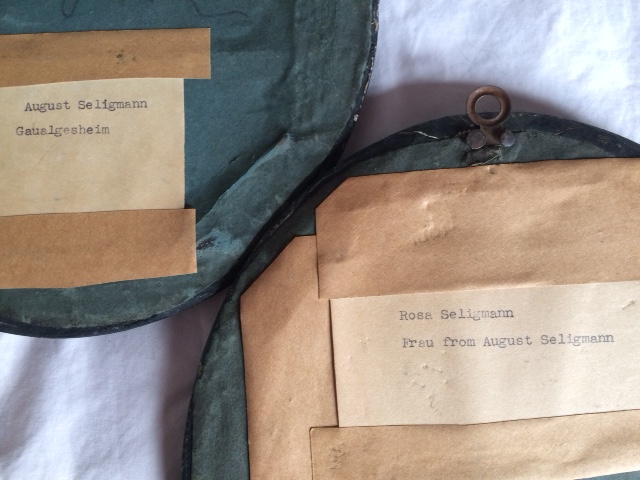
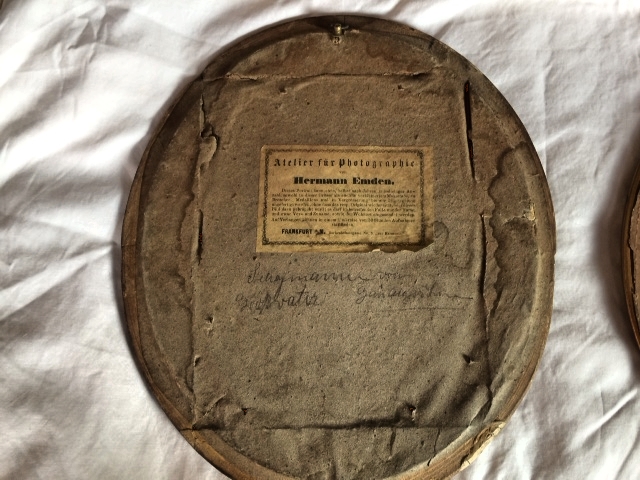
On the reverse of one of these is the following:

Courtesy of the Family of Fred and Ilse Michel

Courtesy of the Family of Fred and Ilse Michel

By editing and zooming and enlarging the script below the photographer’s information, I was able to see more clearly what was written there:

enhanced snip photo 2

I could decipher Seligmann there as well as von Gau-Algesheim to the right, but I was not able to read the word underneath Seligmann.  I posted the snip of this to the German Genealogy group on Facebook, and two people there confirmed that the word was the German word for “grandfather.”  One of the two also insisted that the name was Schafmann, not Seligmann, but I still am sure that it says Seligmann, and not only because I know that was the family’s name.  What do you think?

So if this man was a Seligmann and a grandfather, who was he?  Since the portrait belonged to Fred Michel, I would have assumed that it was his grandfather, that is, August Seligmann.  But the man in this portrait does not appear to be the same person as the man in the portrait above, which was clearly labeled August Seligmann.  So my thought/hope was that this was the grandfather of Fred’s mother Franzeska, who must have given these old pictures to her only child.  If that is the case, then these two portraits depict my great-great-great-grandparents, Moritz Seligmann and Babetta nee Schonfeld.

But Moritz was born in 1800 and Babetta in 1810.  I wondered whether there would even have been photography portraits like these in their lifetime.  I looked again at the label on the back of the photograph of Moritz and saw that the photographer was Hermann Emden of Frankfort.  I took a chance and googled the name, not expecting anything.  I was quite surprised and happy to get numerous hits for Hermann Emden.  His full name was Hermann Seligmann Emden, and he was a very well-known and successful Jewish photographer and artist.  Here is the entry from the Jewish Encyclopedia for Hermann Seligmann Emden:

German engraver and photographer; born at Frankfort-on-the-Main Oct. 18, 1815; died there Sept. 6, 1875. Early evincing a love for art and unable to afford an academic education, he entered an engraving and lithographic establishment as an apprentice, endeavoring especially to perfect himself in the artistic side of his work. In 1833 he left Frankfort and went to Hersfeld, Darmstadt, and Bonn. His portrait-engraving of Pope Pius IX. and his views of Caub, Bornhofen, and the Maxburg belong to this period. He also turned his attention to photography, then in its infancy, and was one of the first to establish a studio at Frankfort-on-the-Main. He made his reputation as photographer by the work “Der Dom zu Mainz und Seine Denkmäler in 36 Originalphoto-graphien,” to which Lübke refers several times in his “History of Art.” Emden was the first to compose artistic photographic groups (“Die Rastatter Dragoner,” “Die Saarbrücker Ulanen,” etc.), and was also among the first to utilize photography for the study of natural science.

You can see some of his more famous works here.

Once I saw that Emden died in 1875, I was even more certain that these were portraits of Moritz and Babetta Seligmann.  August would have only been 34 when Emden died, and the man in that portrait is quite clearly older than 34.  It has to be his father Moritz. Moritz and Babetta had to be quite comfortable, I would think, having their photographs taken by such a successful photographer.  I also wonder whether Emden was a relative.  Seligmann was a fairly common name, and it was often used as a first name as well as a surname.  But perhaps further research will reveal some familial connection.

But for me what is most important is that I am looking at the faces of my three-times great-grandparents.  I never ever thought that would be possible.

My Goldschlager Cousins: New Connections and New Photos

Lately it’s been sort of raining Goldschlagers.  First, I received an email from someone named Jeanne who matched me very distantly on the DNA testing website, but who’d spotted that one of my ancestral names was Goldschlager.  Jeanne had had an aunt named Anne Goldschlager; although her aunt was an aunt by marriage only, not genetically, Jeanne had loved her greatly and wondered whether we might be related since Anne Goldschlager’s family also had ties to Romania.

According to Jeanne, Anne’s father Max had moved to Dresden in the early 20th century where Anne and her sister Sabina were born.  In 1939, Max, his wife, and Sabina left Germany to go to Romania (I assume they thought it would be safer), and they left Anne behind.  She was 15 years old.  Somehow Anne got to England and survived the war, but her sister was killed in one of the concentration camps. Her parents survived the war and emigrated to Israel. Here is Sabina’s Page of Testimony at Yad Vashem, which includes this photograph:

Unfortunately, Anne has no biological descendants, and Jeanne knew nothing more about her family tree, so I don’t think I can get any further back to determine if her Goldschlagers were related to mine.

Then around the same time that I heard from Jeanne, my cousin Jim and his wife Jodi emailed me to say that their son Michael was in Spain for the Model UN and had met a fellow student named Eva Goldschlager.  Michael wanted to know if Eva could be related to our Goldschlagers.  After obtaining Eva’s father’s contact information, he and I have emailed several times.  His Goldschlager family is also from Romania—from the town of Siret, which is a little more than 100 miles from Iasi where my grandfather was born.  We’ve not gotten any further than that so far, but are trying to figure out how to learn more.

And then finally just the other day I received a whole bunch of new photographs from my cousin Richard, who lives in Australia but was in the US visiting his parents.  Richard is my second cousin; his father Murray is the son of David Goldschlager, my grandfather’s younger brother.  Although Murray changed his surname a long time ago, he is nevertheless a Goldschlager.  Here are some of the photographs Richard sent me of his grandparents.

Here are three photographs of David and Becky as young people.

David Goldschlager

David Goldschlager


Rebecca Schwartz

Rebecca Schwartz

Rebecca and David Goldschlager

Rebecca and David Goldschlager

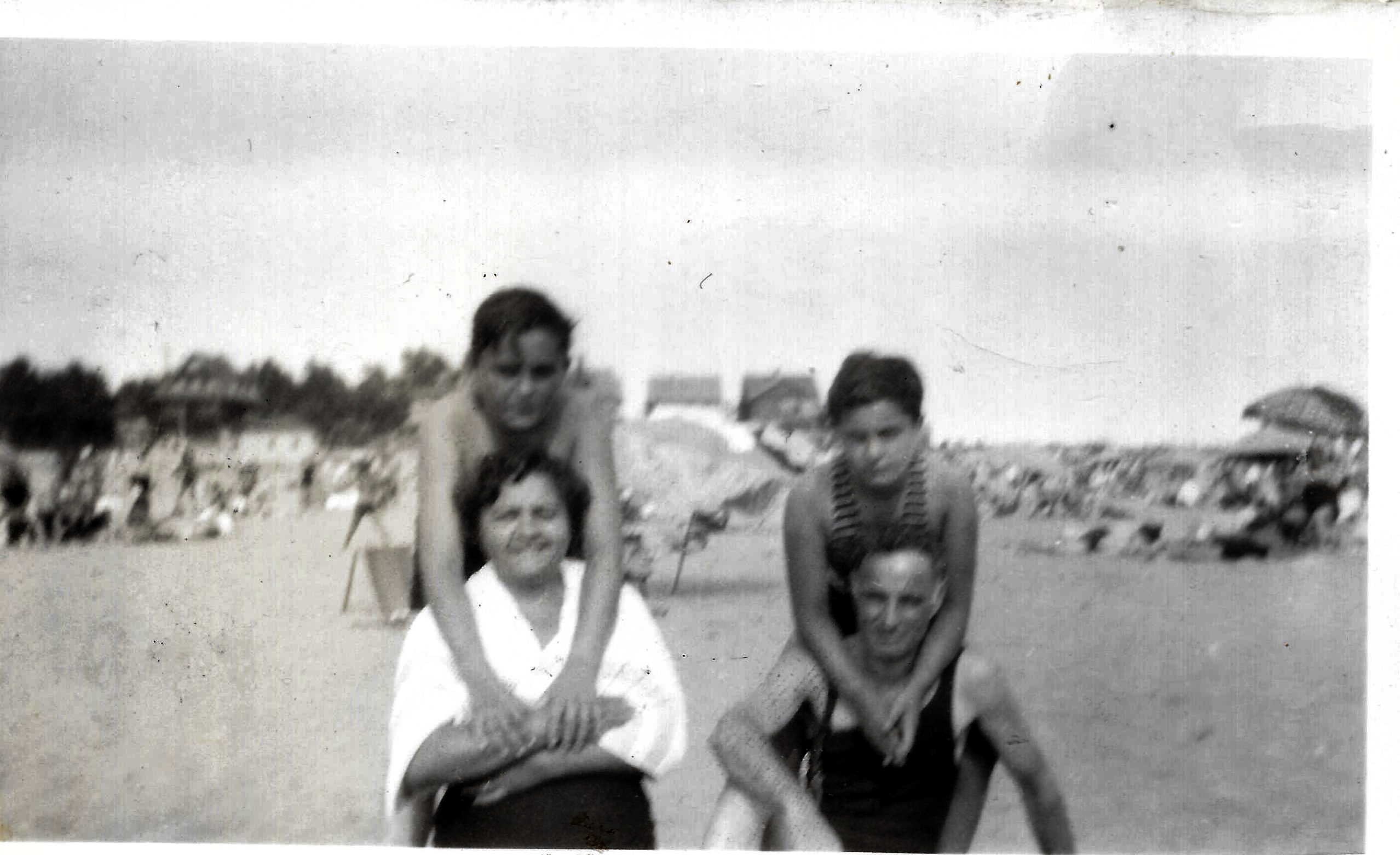
Here they are with their sons Murray and Sidney  at Brighton Beach probably in the 1930s:

David and Murray Goldschlager

David and Murray Goldschlager

David Rebecca Sidney and Murray at Brighton Beach

All four Goldschlagers at Brighton Beach


The others were taken when David and Becky had moved to Arizona where Murray and his wife Edna and their son Richard lived.

Richard Leonard and David Goldschlager

Richard and his grandfather David Goldschlager

Richard with his grandparents at his bar mitzvah

At Richard’s bar mitzvah

David and Becky at Richard's bar mitzvah David and Rebecca Goldschlager


Thank you so much to my cousin Richard who so generously shared these photographs with me.  I am so happy to have more pictures of my grandfather’s brother David and his family.


Our Ancestral Towns Seen Through My Cousin’s Eyes

My newly-discovered cousin Wolfgang Seligmann lives close to our shared ancestral towns of Gau-Algesheim and Erbes-Budesheim.  Erbes-Budesheim is where Babetta Schoenfeld was born and raised; Babetta is my 3-x great-grandmother and Wolfgang’s great-great-grandmother.  Babetta married Moritz Seligmann, and together they settled in Gau-Algesheim where they had a number of children, including Bernard Seligmann, my great-great-grandfather, and August Seligmann, Wolfgang’s great-grandfather.

Here is a recent photo of Wolfgang with his wife Barbela and daughter Milena—my beautiful German cousins.

Barbela, Milena and Wolfgang Seligmann

Wolfgang went to both Gau-Algesheim and Erbes-Budesheim recently to take some photographs of the towns and to look for the houses where our ancestors lived.  In Erbes-Budesheim, he looked for the houses at 77 and 80 Hauptstrasse where the Schoenfelds lived almost 200 years ago, but unfortunately those houses must have been torn down, and now a new street and a factory stand where those houses must have stood.  But Wolfgang took some photographs of other houses, including one at 50 Hauptstrasse, to capture what the Schoenfeld house might have looked like and also to depict the type of homes they saw on their street.

hauptraße Nr 50 Nr 50a


Wolfgang also visited the Jewish cemetery in Erbes-Budesheim.  He reported that there were only a few headstones left and none for the Schoenfelds.  Here are some photographs he took of the cemetery.  It looks like such a peaceful and scenic spot.

Friedhof 1 Friedhof 2 Friedhof 3

Although Wolfgang did not locate any Schoenfeld headstones there, this older video taken in 2010 does show some headstones with the Schoenfeld name, so I wonder whether these have been destroyed since that video was taken.

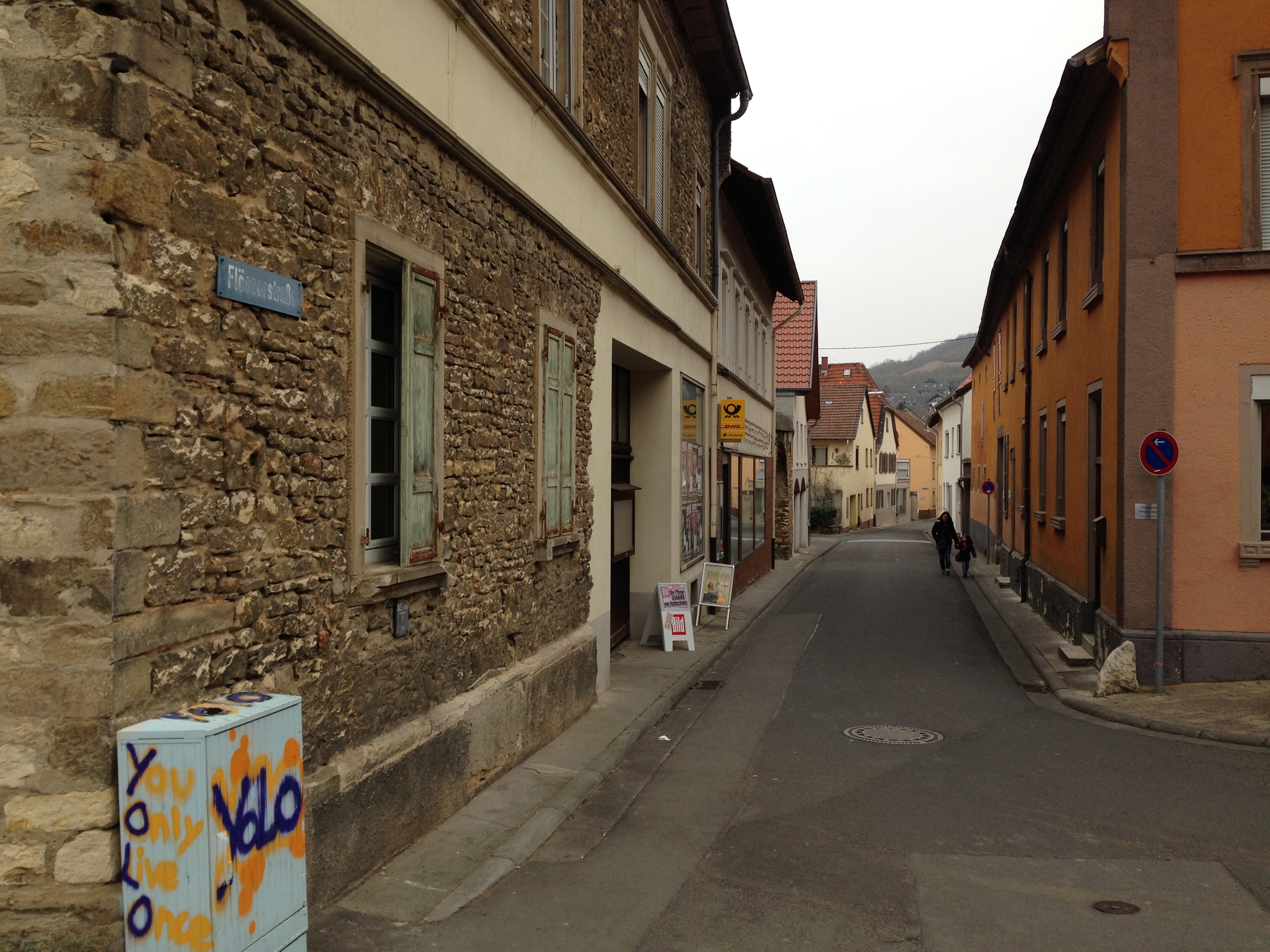
Wolfgang also visited Gau-Algesheim and took some photographs there.  First is a photo of Flosserstrasse, one of the main streets in Gau-Algesheim.  Our ancestors Moritz and Babetta and their children lived on Flossergasse, which no longer seems to exist, but must have either been a prior name or a smaller street off of the main street.
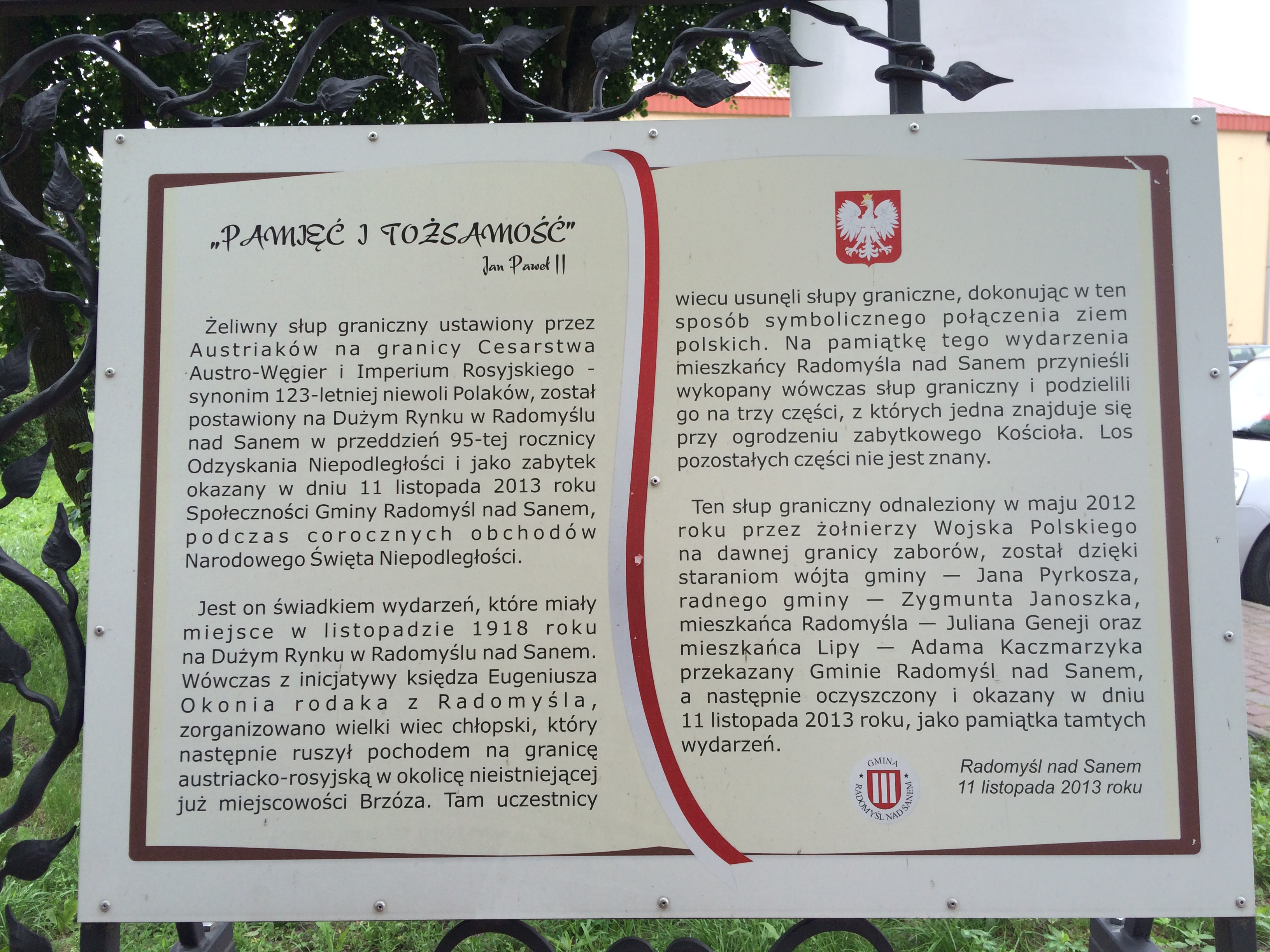
Flosserstrasse

Flosserstrasse

The other main street in Gau-Algesheim is Langgasse.  The store owned by Wolfgang’s great-grandfather August and his grandfather Julius was on this street, and the house where Julius and his wife Magdalena lived until relocating to Bingen was also located on Langgasse. Because the original building is no longer there, Wolfgang also sent me this newspaper clipping which depicts on the left what Langgasse looked like in 1900 and when Julius lived and worked there.

Langgasse in 1900

Langgasse in 1900

Langgasse

Langgasse today

This is the town center where Langgasse and Flosserstrasse meet.

Gau Algesheim


Finally, Wolfgang also visited the Jewish cemetery in Gau-Algesheim.
Jewish cemetery in Gau-Algesheim

Jewish cemetery in Gau-Algesheim

There was only one headstone with the Seligmann name on it, and it was for Rosa Bergmann Seligmann, the wife of August Seligmann and Wolfgang’s great-grandmother.  He must have been quite disturbed by what he saw there.  Here are two photographs of Rosa’s headstone taken in the 1950s and posted on the alemannia-judaica website:


This is what the headstone looks like today as captured by Wolfgang, Rosa’s great-grandson:

Rosa headstone another of Rosa Seligmann's headstone closeup of Rosa Seligmann headstone Rosa Seligmann headstone

According to Wolfgang, the cemetery was vandalized in 1998 by “some idiots,” as Wolfgang described them.  He commented that even today there is some anti-Semitism in Germany.  Although Wolfgang noted that there are not many who feel this way, it only takes a few to do damage like this.

I am so very grateful to my cousin Wolfgang for taking these photographs.  There is something very touching and special about seeing these towns through the eyes of my cousin, a fellow descendant of Moritz Seligmann and Babetta Schoenfeld.  I know he looks at these places with the same sense of connection that I would feel if I were standing in those places, and I look forward to standing there with him in the hopefully not too far off future.

All photographs on this post except the two from alemannia-judaica are courtesy of Wolfgang Seligmann.


Family Wedding: My Great-Aunt Betty Goldschlager Feuerstein and Her Children

Betty Goldschlager

Betty Goldschlager

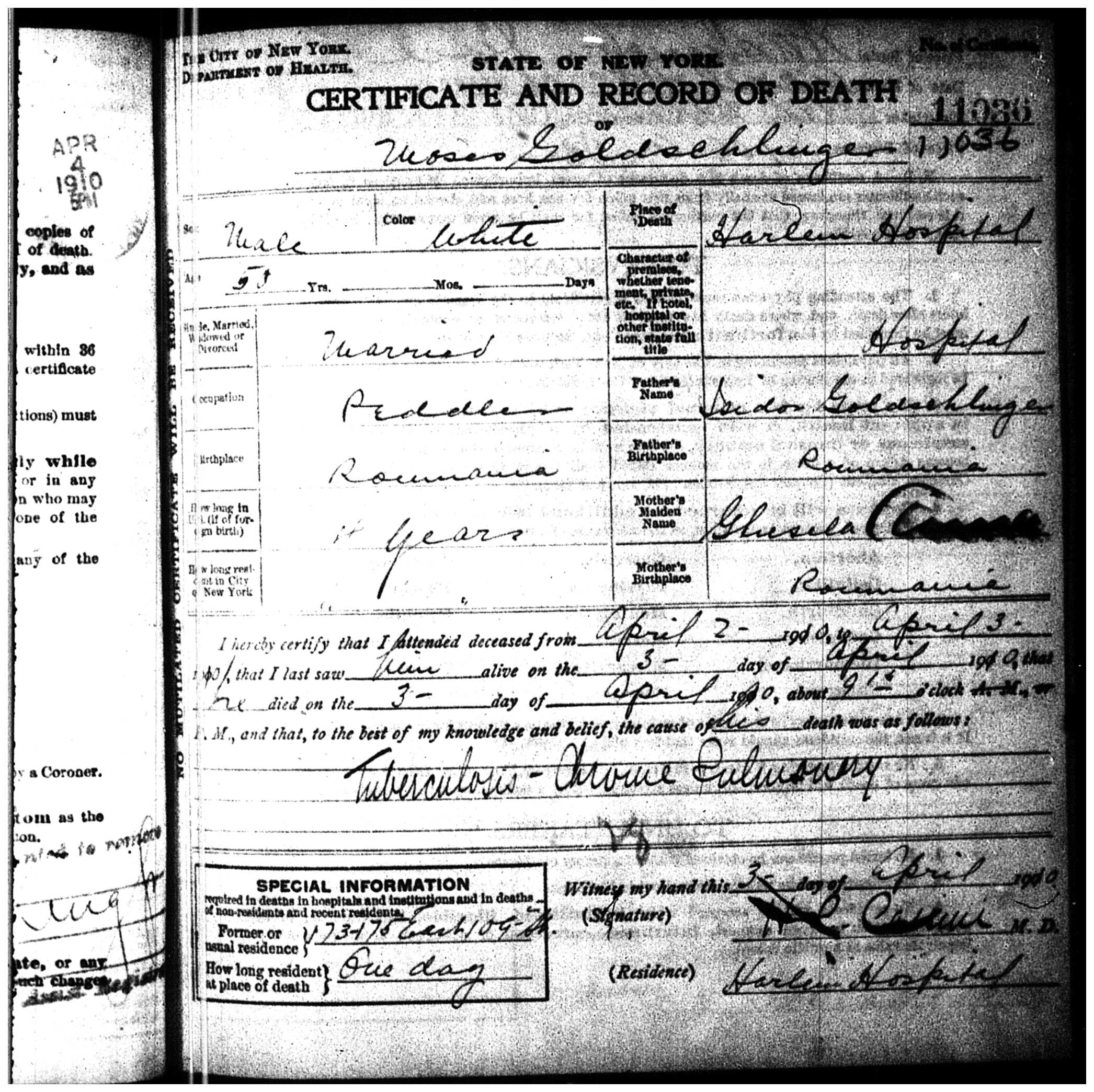
I’ve told the heartbreaking story before of my grandfather Isadore’s little sister Betty Goldschlager.  After sailing alone from Iasi, Romania, just thirteen years old, she arrived at Ellis Island on April 4, 1910, expecting her father Moritz, my great-grandfather, to meet her at the boat.  What she did not know was that her father had died the day before, April 3, 1910, from tuberculosis, just eight months after he himself had arrived in New York.  Betty was detained for a day at Ellis Island until her aunt, Tillie Strolowitz, could meet her and have her discharged.  Only then could Betty have learned that she had missed seeing her father alive by just one day.

Morris Goldschlager death certificate.pdf


betty goldschlager ship manifest part 1

Betty Goldschlager ship manifest part 2

Year: 1910; Arrival: New York, New York; Microfilm Serial: T715, 1897-1957; Microfilm Roll: Roll 1444; Line: 1; Page Number: 193

But Betty Goldschlager survived and in fact thrived in the United States.  She married Isidor Feuerstein in 1921, and they had two daughters, my mother’s first cousins.  Betty’s grandson Barry shared this photograph of his parents’ wedding in 1950.  My great-aunt Betty is standing to the far left.

courtesy of Barry Kenner

courtesy of Barry Kenner

When I look at this photograph, I marvel at the fact that that little girl, who sailed across the ocean by herself and then arrived only to learn that her father had died, somehow had the strength to endure all that and adapt to a foreign country and make a good life for herself, her husband, and her children.

Four Degrees of Separation from FDR

That’s my great-granduncle Arthur Seligman, son of my great-great-grandparents Frances Nusbaum and Bernard Seligman, standing with the then governor of New York who would soon be President of the United States, Franklin Delano Roosevelt.  This was taken while FDR was campaigning in New Mexico in September, 1932.

FDR with Arthur Seligman

(Was FDR really that tall, or were all those politicos from the West really that short?)

(I just looked it up.  FDR was 6′ 2″.  Those guys must have been at least 8″ shorter.  I am not surprised my relative was short; we are not a tall family.  But all three of them together?  Didn’t they feed people well out West?)

And I once thought I was the member of my family who’d gotten closest to a future US President when I shook Jimmy Carter‘s hand very early in his run for President.  At the time, I’d never heard anything about him and never thought he’d end up as President.  I was just being polite to a man who’d come to speak at the school I was attending. And no one took our photograph.

Thanks to my cousin Pete for sharing this.  More about the photo can be found here.

Who is the little boy?

For my first 2015 post, I have some wonderful new photos from my cousin Lou.  These are photos he scanned from our mutual cousin Marjorie’s photo collection, but we don’t yet know who some of the people are in these photos.  We are hoping Marjorie will be able to tell us.  Some of these are quite intriguing as I am hoping that they will be photographs of family members I’ve never seen before.

For example, here is a photograph of my great-grandmother, Eva Seligman Cohen, wife of Emanuel Cohen, daughter of Bernard Seligman and Frances Nusbaum.  But who is the man to her right? And who is the little boy to her left? Or is the little boy a little girl? Possibly Marjorie?

I showed my father the photograph, and he could not identify either person.  Could the man be Emanuel Cohen, my great-grandfather?  That would be the first photograph I’ve ever seen of him.  The little boy might be one of my father’s first cousins, Maurice Cohen, Junior, or Emanuel “Buddy” Cohen. If the older man is Emanuel, the photograph had to be taken in 1926 or before, as he died in February, 1927, and this is a photograph taken in the summertime.  Junior was born in 1917, Buddy in 1922, so it is possible that this is my great-grandparents standing with one of their grandsons.  I hope Marjorie can help us.

Eva Seligman Cohen with unknown man and boy

Here is another photograph of that little boy.  The man to his left is Stanley Cohen, my great-uncle, Marjorie’s father.   Marjorie album 58


But who is the man to his right?  Could it be my other great-uncle, Maurice Cohen, Senior?  I’ve never seen a picture of him nor have I seen a picture of either of his two sons, Junior and Buddy.  Maurice died in 1931; if this was taken in 1926 or so, this certainly could be him.  Maurice would have been 38 in 1926, Stanley would have been 37.

Finally, there is this photograph of the little boy.  Marjorie album 19

Who is that man?  It’s not the same man standing with my great-uncle Stanley in the prior photograph.  He seems to be a fair amount younger than both that other man and Stanley.

All those photographs seem to have been taken on the same day in Atlantic City, maybe around the same time as this photograph taken in 1932:

Eva M. Cohen, center, 1932 (Arthur Seligman, right)

Eva M. Cohen, center, 1932 (Arthur Seligman, right)

It looks like my great-grandmother was wearing the same or a similar hat and outfit to those she was wearing in the first photograph.

I am anxious to hear what Lou learns from Marjorie when he sees her.