My Cousin Wolfgang and The Lessons of History: Will We Ever Learn Those Lessons?

When I started this blog back in October, 2013, I never anticipated that it would help family members find me.  But that has proven to be an incredible unexpected benefit of publishing this blog.  This is one of those stories.

Several weeks ago, I received a comment on the blog from a man named Wolfgang Seligmann, saying he was the son of Walter Seligmann, that he lived near Gau-Algesheim, and that he had found my blog while doing some research on his family.  He asked me to email him, which I did immediately, and we have since exchanged many emails and learned that we are third cousins, once removed:  his great-great-grandparents were Moritz Seligmann and Babetta Schoenfeld, my great-great-great-grandparents.  His great-grandfather August was the brother of Sigmund, Adolph and Bernard Seligman, the three who had settled in Santa Fe in the mid-19th century.   Wolfgang sent me a copy of August’s death certificate.
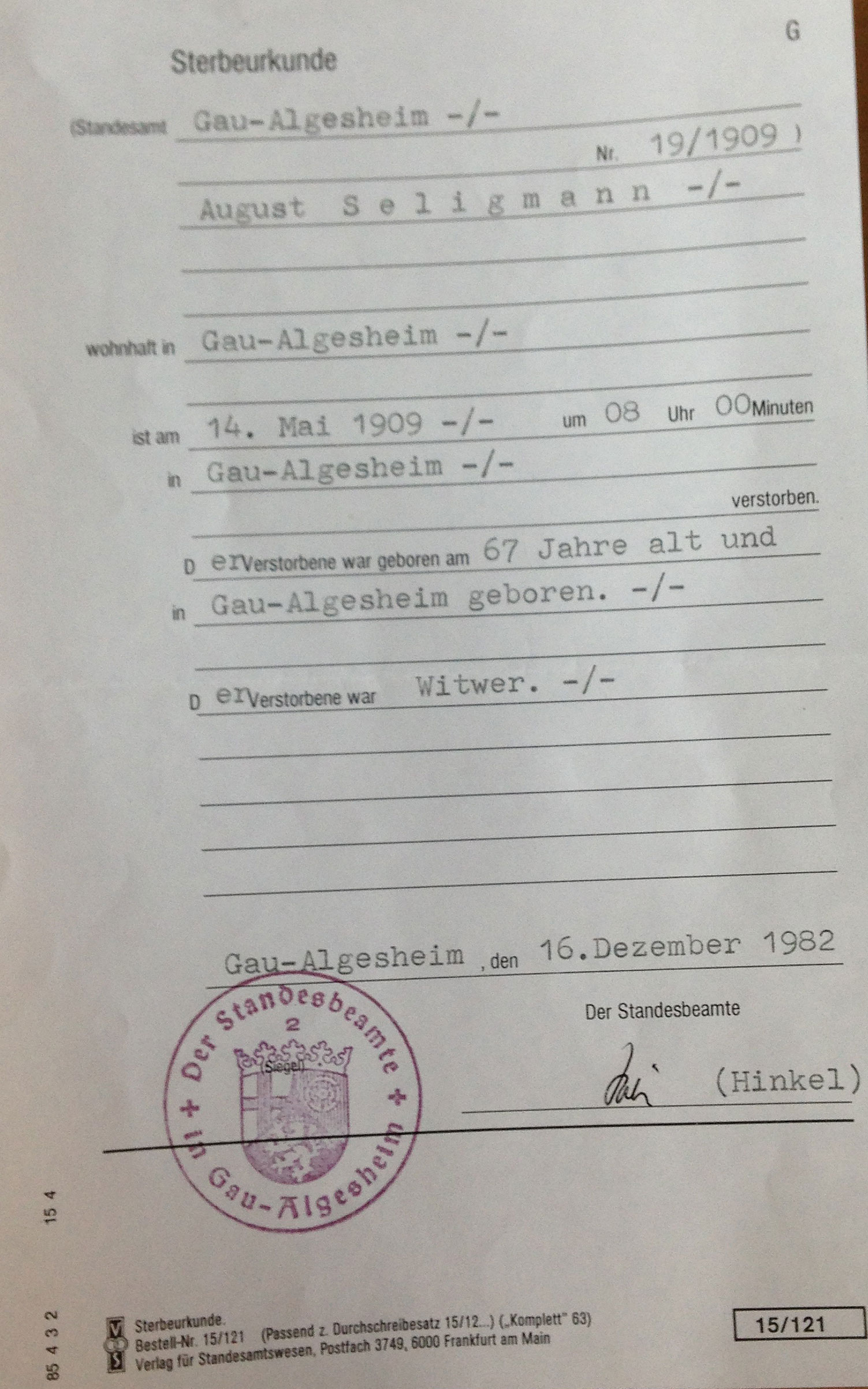
August Seligmann death certificate

August Seligmann death certificate

(Translations in this post courtesy of Wolfgang Seligmann except where noted: Registry-Office Gau-Algesheim: August Seligmann, living in Gau-Algesheim died the 14th of May 1909 at 8 a.m. in Gau-Algesheim. He was 67 years old and born in Gau-Algesheim. He was a widower.)

Our families had probably not been in touch since Bernard died in 1902 (or perhaps when Adolph died in 1920).  And now through the miracle of the internet and Google, Wolfgang had found my blog with his family’s names in it and had contacted me.  What would our mutual ancestors think of that?  It even seems miraculous to me, and I live in the 21st century.

Fortunately, Wolfgang’s English is excellent (since my knowledge of German is…well, about five words), and so we have been able to exchange some information about our families, and I have learned some answers to questions I had about the Seligmanns who stayed in Germany.  With Wolfgang’s permission, I would like to share some of those stories.

Wolfgang’s grandfather was Julius Seligmann, the second child and oldest son of August Seligmann and his wife Rosa Bergmann.  Julius was born in 1877 in Gau-Algesheim.  As I wrote about here, Julius was one of the Seligmanns written about in Ludwig Hellriegel’s book about the Jews of Gau-Algesheim.  He had been a merchant in the town.  On December 1, 1922, Julius had married a Catholic woman named Magdalena Kleisinger, who was born in Gau-Algesheim on July 9, 1882, and had himself converted to Catholicism.  Julius and Magdalena had two sons, Walter, who was born February 10, 1925, and Herbert, born July 27, 1927.  Julius and his family had left Gau-Algesheim for Bingen in 1939 after closing the store in 1935.

I had wondered why Julius had closed the store and then relocated to Bingen, and I asked Wolfgang what he knew about his grandfather’s life.  According to Wolfgang, his father Walter and uncle Herbert did not like to talk about the past, but Wolfgang knew that when Julius married and converted to Catholicism, his Jewish family was very upset and did not want to associate with him any longer.  In fact, Julius was forced to pay his siblings a substantial amount of money for some reason relating to his store in Gau-Algesheim, and that payment caused him and his family a great deal of financial hardship.  According to Wolfgang, Julius no longer had enough money to pay for his own home, and thus he and his family moved to Bingen in 1939 where they lived with Magdalena’s family or friends for some time.

Julius and Magdalena Seligmann

Julius and Magdalena Seligmann 1960s  Courtesy of Wolfgang Seligmann

The Hellriegel book also made some puzzling (to me) references to the military records of Wolfgang’s father and uncle, saying that they had been “allowed” to enlist in the army, but then were soon after dismissed.  Wolfgang explained that the German authorities did not know how to treat Catholic citizens with Jewish roots.  Wolfgang said that his father Walter had trained to be a pharmacist, but the Nazis would not allow him to work with anything poisonous.  In addition,  his father was not permitted to be in the army; instead  he was ordered by the authorities to work on the Siegfried Line, which was  originally built as a defensive line by the Germans during World War I.  In August 1944, Hitler ordered that it be strengthened and rebuilt, and according to Wikipedia, “20,000 forced labourers and members of the Reichsarbeitsdienst (Reich Labour Service), most of whom were 14–16-year-old boys, attempted to re-equip the line for defence purposes.”  Walter Seligmann was one of those forced laborers.

Map of the Siegfried line.

Map of the Siegfried line. (Photo credit: Wikipedia)

Here is a photograph of Walter Seligmann, Wolfgang’s father:
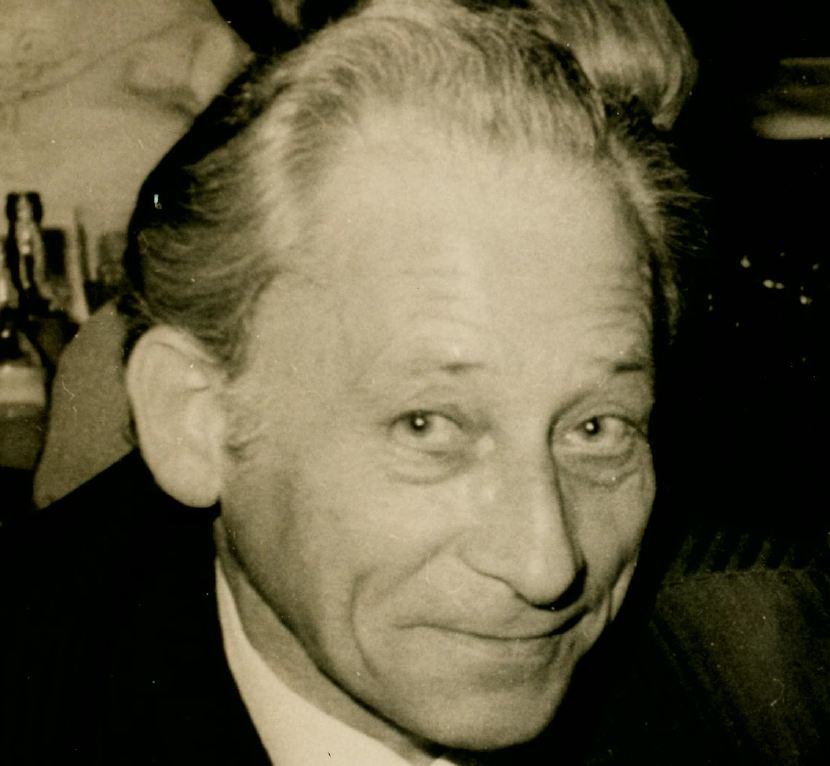
Walter Seligmann  Photo courtesy of Wolfgang Seligmann

Walter Seligmann Photo courtesy of Wolfgang Seligmann

As for Wolfgang’s uncle Herbert, he was sent by the local police to the army, but the army would not accept him.  He was dismissed and sent back to Bingen, where he was required to work in a warehouse until the war ended.

Herbert Seligmann courtesy of Christoph Seligmann

Herbert Seligmann courtesy of Christoph Seligmann

Julius Seligmann died in 1967, and his wife Magdalena died the following year.  Walter Seligmann died in 1993, and his brother Herbert died in 2001.
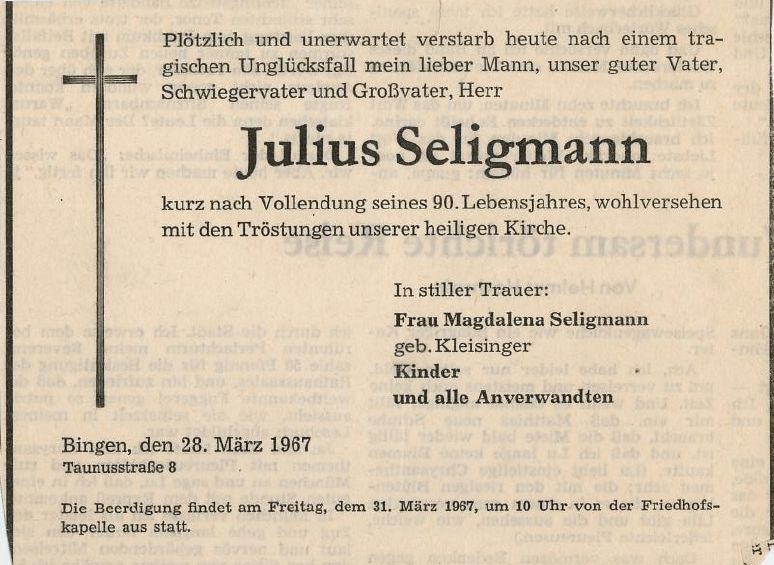
Julius Seligmann death notice

Julius Seligmann death notice

Magdalena Seligmann death notice

There are some very bitter ironies in these stories.  Julius and his family were not accepted by his Jewish family because they were Catholic, but the Nazis did not accept them either because they had Jewish roots.  As I commented to Wolfgang, prejudice of any sort is so destructive and unacceptable.  His family experienced it from two different directions.

Not that the two examples here can be equated in any way.  Although all prejudice is wrong, prejudice that leads to genocide is utterly reprehensible, an evil beyond comprehension for anyone who has a moral compass.  I have already written about my own personal horror and pain when I realized that I had family who had been murdered by the Nazis.  Wolfgang told me more about some of those who lost their lives to Hitler and his evil forces.

One victim was his great-uncle Moritz Seligmann (the grandson of Moritz Seligmann, my 3x-great-grandfather, and a son of August Seligmann).  My information about his fate comes from two websites that Wolfgang shared with me. According to these two sites, Moritz Seligmann, Julius’ younger brother, was born on June 25, 1881.  He fought in World War I for Germany, spent two years in captivity, and was honored with the Hindenburg Cross or Cross of Honor for his service.  Despite this, in the aftermath of Kristallnacht, on November 11, 1938, Moritz was arrested in Konigstein, where he had been living since 1925.  He was sent to the concentration camp at Buchenwald.

German Cross of Honour 1914-1918

German Cross of Honour 1914-1918 (Photo credit: Wikipedia)

Moritz wrote to the authorities in Konigstein, pointing out that he was the recipient of the Hindenburg Cross.  He was released from Buchenwald in December on the condition that he emigrate by March 31, 1939.  He was required to report to the police in Konigstein twice a week until then, and if he had not emigrated by the deadline, he was to be arrested.  On March 28, 1939, however, the Gestapo lifted the emigration order and the reporting requirement in light of Moritz’s service during World War I.

Here is a copy of the Gestapo letter, lifting the emigration order.  I found this a particularly chilling document to see.

Gestapo letter re Moritz Seligmann

Wolfgang helped me translate this letter as follows: Frankfort, March 20, 1939. Concerning: the “Aktionsjude” Moritz Seligmann born June 25, 1881, Gau-Algesheim, residing in Konigstein.  Seligmann has provided proof that he was a soldier in the World War as a combatant.  Therefore the reporting obligation and emigration order is lifted for him. I would ask the emigration (?) to supervise and notify us here.

As explained to me by Wolfgang and by Wikipedia,  the “Aktionsjude” referred to 26,000 Jews who were deported in the aftermath of Kristallnacht, as was Moritz Seligmann, as part of an effort to frighten other Jews to leave Germany.  Unfortunately, not enough of them did.

Despite the lifting of the order to emigrate, Moritz had hoped to immigrate to the US.  For various bureaucratic reasons described here, he was unable to get clearance to emigrate.  On June 10, 1942, he was picked up by the Nazis and transported somewhere to the east.  Exactly where and when he died is not known.

Wolfgang and his family, after researching the fate of Moritz, informed the town of Konigstein of their findings, and the town agreed to place a “stolperstein” in memory of Moritz Seligmann near his home in Konigstein.  A stolperstein (literally, a stumbling blog) is a memorial stone embedded in the ground to memorialize a victim of the Holocaust.  Here is a photograph of Wolfgang at the ceremony when Moritz Seligmann’s stolperstein was installed in Konigstein.
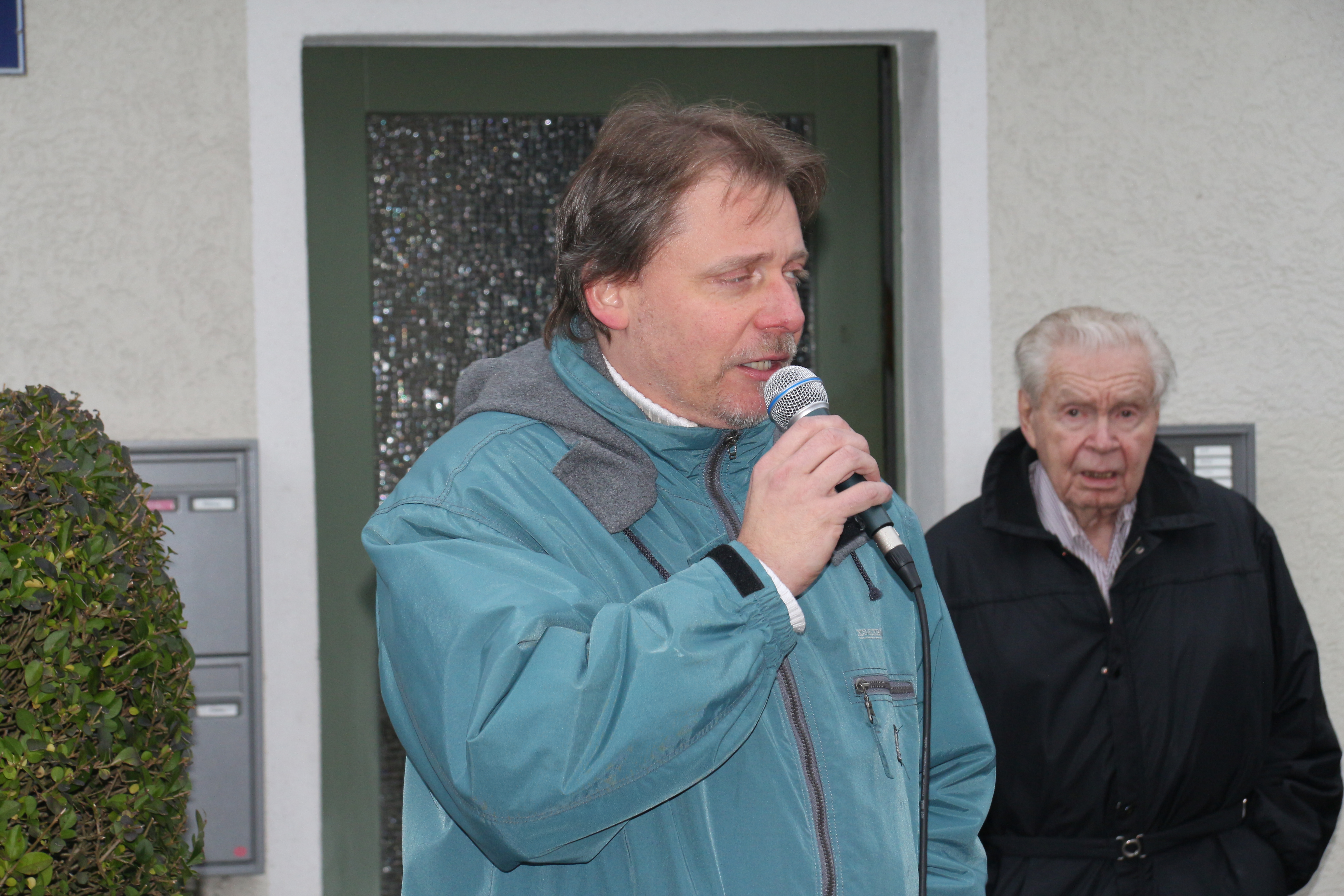
Wolfgang Seligmann

Wolfgang Seligmann  Courtesy of Wolfgang Seligmann

Behind him is a man who knew Moritz and remembered when Moritz was initially arrested in 1938, clinging to his Hindenburg Cross, believing it would save him from the murderous forces of the Nazis.  It may have stalled his murder, but it did not save him.

Wolfgang also told me about the fate of another sibling of his grandfather Julius, his younger sister Anna.  Anna, born in Gau-Algesheim in 1889, had married Hugo Goldmann, and they had a daughter Ruth, born in 1924 in Neunkirchen, a town about 80 miles southwest of Gau-Algesheim, where Anna and Hugo had settled. Between 1939 and 1940, many people from this area near the border with France were evacuated to locations in central Germany, and Anna, Hugo, and Ruth ended up in Halle, Germany, 350 miles to the northeast of Neunkirchen.  On June 1, 1942, they were all deported from Halle to the Sobibor concentration camp where they were all killed.  Click on each name to see the memorial pages established by the town of Halle in memory of Anna, Hugo, and Ruth.

Finally, Wolfgang told me about another member of the family.  Moritz Seligmann (the elder) had had a daughter Caroline with his first wife, Eva Schoenfeld.  Caroline was the half-sister of my great-great-grandfather Bernard. She had married a man named Siegfried Seligmann, perhaps a cousin.  Their son, Emil, died in Wiesbaden on August 9, 1942, when he was 78 years old.

Death record of Emil Seligmann, husband of Carolina Seligmann

Death record of Emil Seligmann, husband of Carolina Seligmann

(Wiesbaden: The Emil Jakob Israel Seligmann, without profession, “israelitisch”  [presumably meaning Jewish], living in Wiesbaden, Gothestraße Nr. 5, died on 9th of August 1942 in his Apartment. He  was born on 23th of December 1863 in Mainz.

Father: Siegfried Seligmann, deceased.  Mother: Karoline Seligmann, nee Seligmann, deceased.  He was widower of Anna Maria Angelika born as Illien. The death was announced by Emil Seligmann, his son, living Goethestraße Nr.5.

The stamp in the left hand margin says:  Wiesbaden, 31th of May 1949.  The “Zwangsvorname”Israel is deleted.  Zwangsvorname translates as “forced first name,” meaning that the name Israel had been required by the Nazis, I assume as a way to identify him as Jewish.

Emil had a son, also named Emil, who died in Buchenwald, as this record attests.

Emil Seligmann-KZ (1)

(To: Miss Christine Seligmann, Wiesbaden, Goethestr. Nr. 5,1

From: Special registry-office in Arolsen-Waldeck, department Buchenwald

Subject: death-certification for Emil-Jakob Seligmann, Your letter from the 1. of March 1950

Based on the documents of the International Tracing Service in Arolsen it is proved, that your brother died on 14th of February 1945 in the Concentration Camp Buchenwald. )

I imagine that this is not the end of the list of the Seligmanns who were murdered during the Holocaust, and I imagine that there are also many other family members I never knew about who were killed by the Nazis, whether they were named Schoenfeld, Nussbaum, Dreyfuss, Goldschlager, Rosenzweig, Cohen, or Brotman or something else.  I just haven’t found them yet.

Wolfgang and I plan to keep on exchanging stories, pictures, documents, and other information.  We have also already talked about meeting someday and walking in the footsteps of our mutual ancestors.  What an honor it will be to be with him as we share our family’s story.

New Seligmann Discoveries: Erbes-Budesheim and the Schoenfelds, Part I

While you all may have thought that for the last several months I was obsessed with Nusbaums and Dreyfusses (and I guess I was), there were several other things happening in my genealogy life (not to mention my actual life) that I haven’t had a chance to blog about yet.  One of the biggest things was the discovery of documents and information about another line of my family, the Schoenfelds, and another ancestral town, Erbes-Budesheim.

Erbes-Büdesheim in January 2006

Erbes-Büdesheim in January 2006 (Photo credit: Wikipedia)

Who are the Schoenfelds?  Moritz Seligmann, my 3-x great-grandfather from Gau Algesheim, married two Schoenfeld sisters (not at the same time, of course).  First, he married Eva Schoenfeld and had four children with her, and then he married her younger sister, Babetta, my 3-x great-grandmother, the mother of Bernard Seligman, my great-great-grandfather.  Moritz and Babetta had seven children together in addition to the four born to Eva.

Because the birth names of women often disappear, it is all too easy to overlook the family names and lines that end when a woman changes her name to that of her husband.  Although I was always aware of the family names of Goldschlager, Brotman, Cohen, Nusbaum, and Seligman (as well as those from my paternal grandmother’s side, not yet covered on the blog), I had no awareness of a family connection to the names Rosenzweig, Dreyfuss, Jacobs, and Schoenfeld.  Discovering the Schoenfeld name, like discovering those others, was an exciting revelation and addition to my extended family tree.

So how did this happen?  As I wrote back on December 1, Ludwig Hellriegel’s book about the Jews of Gau Algesheim revealed that Moritz Seligmann was born in Gaulsheim and had moved to Gau Algesheim as an adult.  That discovery had led me to the Arbeitskreis Jüdisches Bingen and a woman named Beate Goetz.  Beate sent me the marriage record for Moritz Seligmann and Eva Schoenfeld, which revealed that Eva was the daughter of Bernhard Schoenfeld and Rosina Goldmann from Erbes-Budesheim.  (Now I also know another maternal name—Goldmann.)

Marriage record for Moritz Seligmann and Eva Schoenfeld February 27, 1829 Gaulsheim, Germany

Marriage record for Moritz Seligmann and Eva Schoenfeld February 27, 1829 Gaulsheim, Germany

From there I contacted the registry in Erbes-Budesheim to ask about records for my Schoenfeld ancestors, and within a short period of time, I received several emails from a man named Gerd Braun with an incredible treasure trove of information and records about my Schoenfeld ancestors.

But first, a little about Erbes-Budesheim.  Erbes-Budseheim is a municipality in the Alzey-Worms district of the Rhineland-Palatine state in Germany.  It is located about 25 miles south of Gaulsheim where Moritz Seligmann was born and grew up and about 27 miles south of Gau Algesheim where Moritz and his family eventually settled.  The closest major city is Frankfort, about 46 miles away.

Erbes-Büdesheim in AZ

Erbes-Büdesheim in AZ (Photo credit: Wikipedia)

The town has an ancient history, dating back to the Stone Age, according to Wikipedia.  Like many regions in Germany, it was subject to various wars and conquerors throughout much of its history.  During the Napoleonic era in the late 18th, early 19th century, Erbes-Budesheim and the entire Alzey region were annexed as part of France; after 1815 it was under the control of the Grand Duchy of Hesse.

Although originally a Catholic community, after the Reformation Erbes-Budesheim became a predominantly Protestant community.  Some sources say that there was a small Jewish community in Erbes-Budesheim as early as the 16th century, but as of 1701, there were only 15 Jews (two families) living in the town.  A third family lived there in 1733, but even as late as 1824 and throughout the entire 19th century, the population did not exceed 23 people.  The Jews in Erbes-Budesheim for much of that history joined with Jews from neighboring communities for prayer, education, and burial.

By 1849, however, one Jewish resident named Strauss had dedicated the first floor of his home for prayer services, and it was furnished with the essential elements for a synagogue: Torah scrolls, an ark, a yad, and a shofar, for example.  Perhaps this is where my 4-x great-grandfather Bernhard Schoenfeld went to daven [pray] when he and his family lived in Erbes-Budesheim.

Strauss home where the Erbes-Budesheim Synagogue was located  http://www.alemannia-judaica.de/erbes_buedesheim_synagoge.htm

Strauss home where the Erbes-Budesheim Synagogue was located
http://www.alemannia-judaica.de/erbes_buedesheim_synagoge.htm


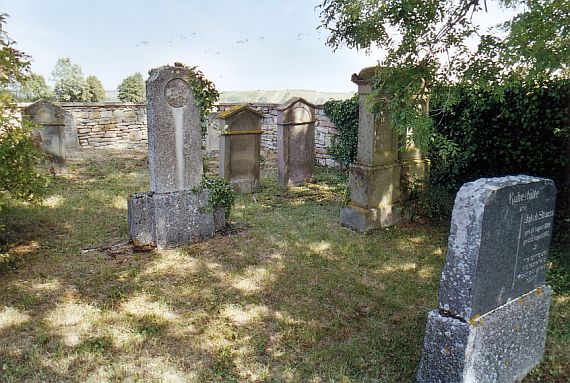
There is also a Jewish cemetery in Erbes-Budesheim.

On this video you can some headstones with the name Schoenfeld from the Erbes-Budesheim cemetery.

By 1939, there were only eight Jews left in the town, and it would appear from the allemannia-judaica website that none of these survived the Holocaust.

Thus, Erbes-Budesheim was never a place where a substantial Jewish community existed, and it makes me wonder what would have brought my ancestors there.  Why would anyone want to be one of a handful of Jews in a community?  In my next post, I will consider that question and share the documents I received from Erbes-Budesheim.

More Blessings and More Insight into My Seligmann Ancestors

This morning I woke up to another email that made me smile to start my day. But to understand why, I need to backtrack a bit.

One of the passages that was translated by Ralph Baer from Ludwig Hellriegel’s book on the history of the Jews of Gau-Algesheim indicated that Moritz Seligmann had originally come from Gaulsheim, a town that is only five miles from Gau-Algesheim.  In this passage, Hellriegel described Moritz Seligmann’s attempt to get permission to move to Gau-Algesheim in 1828.  He was denied permission the first time because the mayor concluded that there were already too many Jews in the town.  He then appealed, and although the mayor still wanted to deny him permission, Seligmann prevailed because he was legally entitled to move to the town.

This passage gave me a clue as to where Moritz, my three-times great-grandfather, might have been born, and Ralph suggested I contact the archives in Gaulsheim for more information.  I found an organization called Arbeitskreis Judische Bingen, or a study group of Jews in Bingen. (Bingen now includes the town of Gaulsheim.)  I wrote to the organization, asking for any information that they might have on Moritz Seligmann or his family.

And that brings me to my happy morning email.  A woman from the Arbeitskreis named Beate Goetz sent me a copy of the marriage record for Moritz Seligmann and Eva Schoenfeld.  Not only did this email confirm that Moritz was born in Gaulsheim (on January 10, 1800) and that he married Eva Schoenfeld (on February 27, 1829), it told me the names of my four-times great-grandparents, Jacob Seligmann and Martha nee Jacob/Mayer (my guess is that Mayer was the surname adopted by her father Jacob when surnames were required in the early 19th century).

In addition, I know now when Eva Schoenfeld was born (June 2, 1806) and where she was born (in Erbes-Budenheim), and I know her parents’ names: Bernhard Schoenfeld and Rosina Goldmann.  Assuming that Eva and Babetta, Moritz’s second wife, were sisters, Bernhard and Rosina were also my four-times great-grandparents.  Now I need to see what records I can find in Erbes-Budenheim to determine if in fact Eva and Babetta were sisters.  Beate said that she would also continue to look for a birth record for Moritz (who was born Moises) and any other relevant records.

Marriage record for Moritz Seligmann and Eva Schoenfeld February 27, 1829 Gaulsheim, Germany

Marriage record for Moritz Seligmann and Eva Schoenfeld February 27, 1829 Gaulsheim, Germany

I also know from Ralph’s additional translation of the marriage record that Jacob Seligmann and Bernhard Schoenfeld were both traders as was Moritz.  The record also indicated that the bride’s parents did not attend the wedding; as Ralph explained, this was probably a second ceremony for purposes of civil law and thus not as important as the religious wedding ceremony, which presumably the couple’s parents did attend.

Thus, thanks to Ralph Baer’s translation of a passage in the Hellriegel book, I now have learned the names of four more of my ancestors.

The Hellriegel book just continues to be a treasure chest of information.  Thanks to Matthias Steinke, I also have a translation of another few passages of Ludwig Hellriegel’s book, which shed some additional light on the character of my ancestor Moritz Seligmann.

In one passage, Hellriegel discussed the education of Jewish children in Gau-Algesheim.  He reported that until 1841, Jewish boys were taught Hebrew and other important subjects by their fathers, but in 1841 they were permitted to attend the Christian school in town.  Apparently, this was difficult for the Jewish children, so Moritz Seligmann applied in 1850 to remove his children from the school.  He then hired a private teacher named Benjamin Mayer from Essenheim to come to Gau-Algesheim to teach the children. (Essenheim is about ten miles from Gau-Algesheim.)

Apparently, however, Mayer ran into trouble in Gau-Algesheim for speaking badly about the Catholic Church, saying in front of the children and two other witnesses that those who believe in the Catholic faith are “downright stupid.”  He reportedly left Gau-Algesheim shortly after this incident.

I found this passage interesting in many ways, but mostly for what it told me about my great-great-great-grandfather Moritz.  He was a man who was determined to see that his children received a good education and in a setting where they were comfortable. That is a value that has certainly been passed down the generations in my family.  Moritz also was apparently a man of some means since he had the money to hire a private teacher.

Coat of arms of Gau-Algesheim

Coat of arms of Gau-Algesheim (Photo credit: Wikipedia)

Matthias also helped me better understand a passage about Moritz and his knowledge of German.  According to Matthias’ reading of this paragraph, Moritz had some role in the synagogue as an educated man.  He was in charge of writing the lists of Hebrew prayers to be assigned to those who made contributions to the synagogue.  (This is somewhat unclear to me.  Perhaps these were prayers for certain members to lead or perhaps these were prayers for the benefit of certain members, or maybe the book is referring to payment in order to receive the honor of reading Torah in synagogue.)

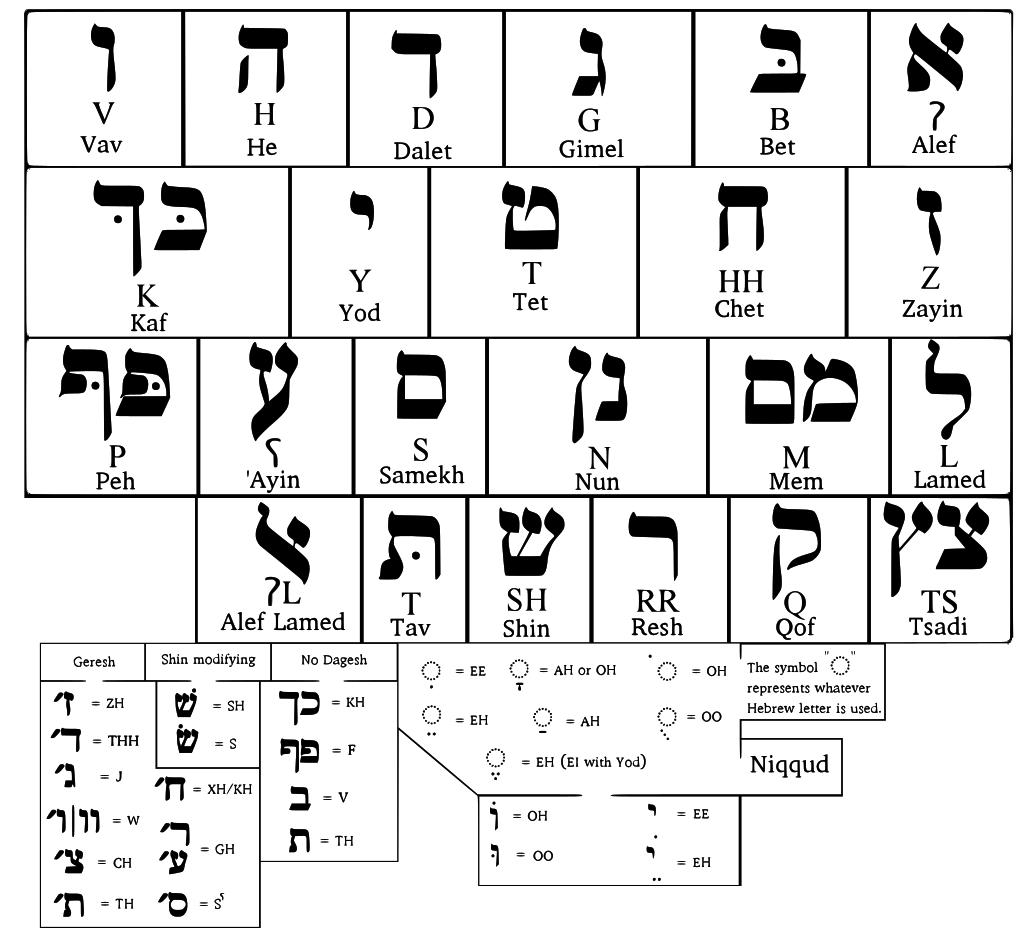
A man from Mainz, Mr. Landauer, commented that Moritz was able to write German very well in compiling these lists, but that he had trouble with “unpunctured” Hebrew.  I asked Ralph Baer what he thought unpunctured would mean in this context, and he explained that the German word could also be translated as undotted and that the reference to undotted Hebrew most likely meant that Moritz had a hard time reading Hebrew without vowel markings.  So Moritz was more fluent in writing and reading in German than he was in Hebrew.

1024px-Hebrew_Alphabet.svg

By Assyrio (Own work) [Public domain], via Wikimedia Commons


The final passage that Matthias helped me understand involved Julius Seligmann, the grandson of Moritz and son of August Seligmann, discussed previously.  He was the Seligmann who converted to Catholicism upon marrying a Catholic woman.  What I had not been able to understand before were references to Julius closing his business in 1935 in Gau-Algesheim and being the last Jew in Gau-Algesheim when he and his family left in 1939.  He and his family moved to Bingen, and the book states that there the police chief did nothing against him and that his two sons Herbert and Walter were even allowed to enlist in the army, although dismissed shortly afterwards.

With a better idea of what the words say, I now think that I understand the significance of this passage.  It seems that Julius, despite converting, was still seen as a Jew when the Nazis came to power and thus was forced to close his business.  However, once he relocated to Bingen, he was not harassed by the police, perhaps because they did not know he was Jewish.  And perhaps the significance of the sons being able to enlist also relates to this ability to deny their Jewish roots, at least for a short time.

I am obviously still reading between the lines, and without being able to read the entire book and read everything in context, I fear that I may be misreading some of these isolated passages.  It’s a long term project to be able to understand the whole book and the whole story of the Jews of Gau-Algesheim.  But already this little book has enabled me to learn so much more about my Seligmann ancestors.

By the way, Seligmann means “blessed man” in German.  The more I learn about the Seligman(n)s, both German and American, the more it seems to be an appropriate surname for the family to have adopted, especially for those Seligmans who were fortunate enough to have left Germany before the Holocaust.


A Package from Germany, Part II: Did Moritz Seligmann Have Two Wives?

Gau-Algesheim, Rathaus am Marktplatz

Gau-Algesheim, Rathaus am Marktplatz (Photo credit: Wikipedia) (Town Hall)

As I mentioned in my last post, the package I received from Germany included both a book about Gau-Algesheim and photocopies of the birth records for Bernard Seligman and his siblings.  Unfortunately for me, the birth records were all in German and were half in Germanic font and half in handwritten old German script.  I could pick out names, and most meaningfully, I could see the signature of my great-great-great-grandfather Moritz Seligmann on all the records.  But I could not read any of the text.  Not the typeface print on the form, and certainly not the handwritten script.

Bernard Seligman's birth record

Bernard Seligman’s birth record

JewishGen has a function called ViewMate where you can upload documents and ask JewishGen members for help in translation.  I decided to try that first.  Unfortunately, ViewMate limits the size of the documents you can upload to a relatively small size, and once I reduced the records to the requisite size, they were hardly legible.  Plus ViewMate takes several days; your document has to be submitted to the site, approved, and then it will be posted.  Then you have to send an email to the listserv and ask for help in translating the documents up uploaded.  Then you have to wait for someone to see your email and respond.  And you can only do five documents in a week.  This seemed a bit frustrating for me in this day of instant communications.

So I turned once again to Facebook.  There is a group on Facebook for German Genealogy, and I asked a question about obtaining translations of German records.  Someone there referred me to a different group that exists just for that purpose: German Genealogy Transcriptions.  I joined the group, and I posted the record for Bernhard Seligmann depicted above, asking if anyone could help me translate it and other records like it.

Within two hours, I heard from a group member, Matthias Steinke, who translated that first document and then spent the next couple of hours—no exaggeration—helping me with all the others.  I was just blown away by his generosity as well as his ability to decipher that script from a small scanned photograph of the document.  Matthias, if you are reading this, once again I thank you from the bottom of my heart.

So what does that birth record for Bernhard Seligmann say?  This is the translation Matthias provided, as modified based on some of the later records he reviewed:

In the year thousand eighteen hundred thirtyandseven, the twentythird November at eleven o´clock pre midday came to me, Quirin Ewen, mayor and official for the civil registration of the comunity Gau-Algesheim, county Ober-Ingelheim, Moritz Seligmann, thirtyseven years old, merchant, residing in Gau-Algesheim and declared, that at the twentythird November Eighteen hundred thirtyseven at one o´clock in the morning in the Blosselgasse nr. 98, Babetta nee Schönfeld, twentyseven years old, wife of the named Moritz Seligmann, here residing gave birth to a child of male sex, who was showed to me and who got the first name Bernhard. The declaration and showing happened in presence of the witnesses: 1. Johann Kleissinger, thirty years old, church-clerk in Gau-Algesheim residing 2. Johann Wessel (?), thirtyfive years old, tax-messenger in Gau-Algesheim residing. [signatures]

There were nine records all together, and for the others I only needed the basic data: names, ages, dates, and addresses, since I now knew what the form template was asking based on this first translation.  All the basic dates and names for the children were consistent with the information I had been originally provided by Bernie Brettschneider from Gau-Algesheim, but now I had copies of the actual records to verify that information.

Plus I now had an address for where the family was living during the years from Sigmund’s birth in 1829 until Paulina’s birth in 1847.  Although the house numbers vary, throughout all those years the Seligmann family was living on Flossergasse (apparently rafter alley). (Bernard’s said Blossergasse, but all the others said Flossergasse.)   I was able to locate Flosserstrasse on the map as well as Langgasse where August and Hyronimus later lived.  I assume Flossergasse was either off of Flosserstrasse or the street was renamed at some point.


But the records also revealed a mystery.  For Sigmund (1829), Carolina (1833), and Benjamin (1835), the mother’s name is Eva nee Schonfeld.  But starting with Bernhard in 1837, the mother’s name is given as Babetta or Barbara nee Schonfeld for Bernhard (1837), Hyronimus (1839), August (1841), Adolph (1843), Mathilde (1845), and Paulina (1847).

At first I thought that Eva had changed her name, but Matthias pointed out that the ages did not quite line up.  Not all the birth records included a reference to the age of the mother, but in  March, 1833 Eva was 26, meaning a birth year of 1806/7, depending on the month of her birthday. In May, 1835, she was 28, so that is consistent with the same birth year range.  But on Bernhard’s birth record, Babette nee Schonfeld is 27 in 1837, meaning a birth year of 1809 or 1810.  Two years later on December 14, 1839, she was 30, meaning her birth year was most likely in 1809.  The other birth records are also consistent with a birth year for Babette in 1809.

So unless Eva both changed her name and lied about her age on the later birth records, it would appear that Sigmund, Carolina, and Benjamin had a different mother than their younger siblings and also perhaps that Moritz married Eva’s younger sister sometime between 1835 when Benjamin was born and 1837 when my great-great-grandfather was born.

Thanks again to Matthias Steinke for his incredible generosity and great skills in transcribing and translating from German to English.  Thank you also to Ralph Baer who has also  been a tremendous help. Ralph is the JewishGenner who has been helping me with my Nussbaum/Dreyfuss relatives as well as generally with German records and German translations.  Both Ralph and Matthias are also helping me with the Gau-Algesheim book as I try and confirm and understand the passages about the Seligmanns.

As Thanksgiving approaches, I am filled with gratitude for all the help I have received as I continue on this path to find my family—from the readers who comment and send me helpful suggestions to the people on Facebook who jump in to help, to the people at various libraries and historical societies who respond to my inquiries, and to the people at JewishGen who have helped me solve many mysteries.  As I’ve said several times, the generosity of the genealogy community is an inspiration.  If only the whole world was as giving and helpful as the people I have met in the genealogy world.


A Package from Germany and More Sobering Revelations: A Seligmann Update

Coat of arms of Gau-Algesheim

Coat of arms of Gau-Algesheim (Photo credit: Wikipedia)

A few days ago I received a package from Gau-Algesheim with photocopies of the birth records of Bernard Seligman and his siblings as well as a book about the Jews of Gau-Algesheim, Die Geschichte der Gau-Algesheimer Juden by Ludwig Hellriegel (1986, revised 2008)[The History of the Jews of Gau-Algesheim].  Of course, the records were in German, as is the book.  And the documents were also in Germanic font and in the old German script.   Completely unintelligible to me.  Here is an example, the birth certificate of my great-great-grandfather, Bernard Seligman or Bernhard Seligmann, as it was originally spelled.

Bernard Seligman's birth record

Bernard Seligman’s birth record

And so I started with the book, which is at least printed in regular font.  I first went through the entire book (about 110 pages), looking for the name Seligmann, not really expecting to find it.  But there on page 52 was the name Moritz Seligmann, and there again a few pages later, and then a list of Seligmanns a few pages after that, and then a few paragraphs here and a few paragraphs there.  But I can’t read German.

I painstakingly entered the passages that mention Seligmann into Google Translate and mostly got gibberish.  Google Translate does not like umlauts or those funny double S symbols used in German, and typing in German is very hard when you do not know the language.  Google Translate can do a word, but putting down a whole sentence leads to verbs and nouns and prepositions in places that just make it almost impossible to know what you are reading.

For example, what does this sentence mean?

Mr. Landauer of the Israelite Religious Community in Mainz has found that Moritz Seligmann who has led this protocol , although writes excellent German , but his burden with the Hebrew has unpunctured .

That is how Google Translate translated this sentence:  Herr Landauer von der israelitischen Religionsgemeinde in Mainz hat festgestellt, dass Moritz seligmann, der dieses protokoll gefuhrt hat, zwar ausgezeichnet deutsch schreibt, aber seine Last mit dem unpunktierten Hebraisch hat.

So if there are any readers out there who can help me with translation, please let me know.  I have no clue what that means except that perhaps my great-great-great-grandfather was very proficient in German.  The sentence that follows discusses the fact that the Jews in Gau-Algesheim did not speak or read Hebrew except for religious purposes.

Now I am working on getting a better translation program or finding someone to translate the book for me.  But here are a few random tidbits of information that I am pretty sure I did understand from my very poor translation of some of the passages.

Perhaps the most informative section revealed the livelihoods of two of my great-great-grandfather’s brothers, August and Hyronimus, and a third Seligmann whose name was Jacob, for whom I have no earlier record.  August opened a business in October, 1891, for iron and also spices and playing cards.  (That’s what Google Translate says anyway.)  August died on May 14, 1909.  Hyronimus also was in the iron and spice business as well in the wine trade; he opened his business on May 22, 1892.  Jacob was also in the iron trade and the wine and spirits trade; his business opened June 5, 1898.

I also know from the book that at one time August and Hyronimus both lived and/or did business on Langgasse or Long Alley.  I had posted this photo before without realizing that this was the street were some of my family lived or worked.

Gau-Algesheim. Langgasse.

Gau-Algesheim. Langgasse. (Photo credit: Wikipedia)

The paragraph that follows the one about the three Seligmanns and their businesses was a bit hard to follow with Google Translate, but from what I can decipher, August had a son named Julius born in 1877.  Julius married a Catholic woman and converted to Catholicism.  He had a hardware store in Gau-Algesheim as well as a spice business.  If I am reading the German correctly, he closed the store on December 9, 1935 and moved with his family to Bingen on September 15, 1939.  He had two sons, Herbert and Walter, who were both apparently still alive when the book was written.  Julius also survived the war, but was killed in a fatal car accident on his way to church on March 28, 1967.

Burg Klopp in Bingen am Rhein, Germany

Burg Klopp in Bingen am Rhein, Germany (Photo credit: Wikipedia)

Julius had an older sister Frances, born on December 26, 1875, who married Max Michel, but divorced him and moved to Bingen.  Frances died on December 19, 1933; her son Fred escaped to the United States in 1937.

The third child of August Seligmann was named Moritz, and he participated in the town’s cycling association. Moritz Seligmann, his grandfather’s namesake, was born in June 25, 1881.  The book seems to be describing the skills of various members and seems to be praising the skills of young Moritz, who was nineteen when he joined the club.  The end of this passage about Moritz says that he was single and had moved to Koenigsberg and that it was believed he was killed in 1941 in Theresienstadt.

The fourth child of August Seligmann was his daughter Anna.  She was born on November 30, 1889, in Gau-Algesheim.  She had moved with her husband Hugo Goldmann to Neunkirchen in Saarland.  They and their three children, Ruth, Heinz, and Gretel, were all killed in the Holocaust.

There is also an entry for Elizabeth nee Seligman Arnfeld, who was born March 17, 1875.  She had moved to Mulheim on the Ruhr in 1938 and wanted to emigrate to the United States.  A woman named Leonara Morreau[1] had vouched for them, but for unknown reasons they were never able to emigrate.  Elizabeth died on January 23, 1943 at Theresienstadt.  Her son Heinz survived the war.  The book did not identify the parents of Elizabeth Seligman Arnfeld, but she could have been the daughter of Salomon or Benjamin, who unfortunately are not mentioned in the book, or of Hyronimus or Jacob.

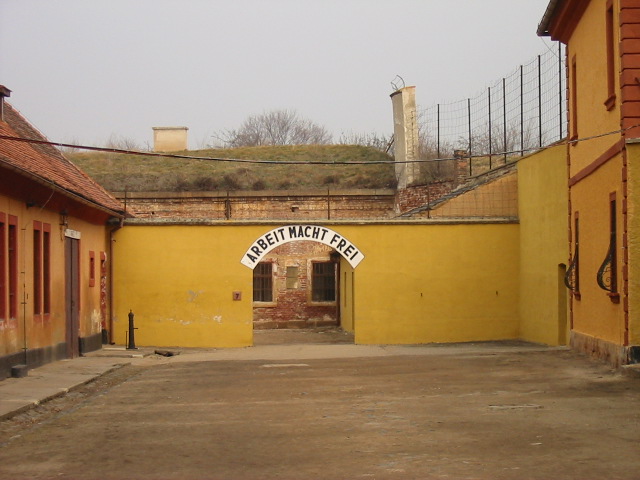
Theresienstadt

Theresienstadt concentration camp

Now that I have more names and more recent relatives, I am hoping that perhaps I can find out more about these people.  I also now know that many of them moved to Bingen, so there may be records from that larger town that will tell me more about the Seligmanns who stayed in Germany. And from several other entries in the book, I know where they lived in Gau-Algesheim.

I would love to be able to read the entire book and learn more about the history and lives of Jews in Gau-Algesheim, but it took me a good part of two days just to translate these few passages, and those translations are not very reliable.  It seems hiring someone to translate the whole book could cost me as much as $1000, and that is not in my genealogy budget by a long shot.  If someone has any brilliant ideas on how to get the book translated for free or for a really reasonable price, please let me know.

What I did learn from the passages I struggled to translate is that my family was not untouched by the Holocaust, as I once believed, but that we lost many people just from Gau-Algesheim alone.   I am hoping that I can find the descendants of the few who seem to have survived—Heinz Arnfeld and Fred Michel and Herbert and Walter Seligmann—and learn more.

In my next post I will discuss the birth records I received for the Seligmanns and how I was able to translate them.  Then I will return to the Nusbaums.

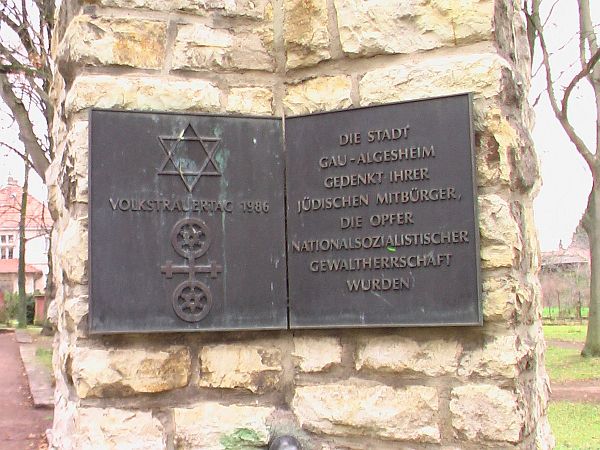
memorial plaque gau aldesheim

Holocaust Memorial plaque in Gau-Algesheim

[1] I found Leonara Morreau’s obituary and researched her a bit, but know of no reason that she would have had a connection to the Seligmanns in Germany.  She was born, married, and lived in Cleveland.  Her husband died in 1933, and she died in 1947.  As far as I can tell, they never traveled to Germany.  Leonara’s brother was Isaac Heller, who was also born in Cleveland, as was their father, Charles Heller.  Although their grandfather was born in Germany, it was not even in the same region as the Seligmanns.  Perhaps Leonara was active in trying to bring German Jews to the United States during Hitler’s reign, but I can find no evidence of that.  Her obituary only states that she was active in charitable and religious causes.

More Gifts from Doing Genealogy: The Gau-Algesheim Seligmanns and New Friends in Germany

As I’ve been researching and writing about my American Seligman relatives, I’ve also been busy trying to learn more about my German ancestors.  I wrote to about five different people in Gau-Algesheim, names I found on websites or through contacts from JewishGen or two Facebook groups, Tracing the Tribe and German Genealogy, including Klaus Cook.  I’d been trying since September 7 to find someone to help me learn whether there were any records of Jewish births, marriages and/or deaths from the town where I knew Sigmund, Bernard and Adolph Seligman were born.  I had gotten no responses—not even one saying that they had no such records.

Coat of arms of Gau-Algesheim

Coat of arms of Gau-Algesheim (Photo credit: Wikipedia)

I also contacted a woman named Dorothee Lottman-Kaeseler.  I had found her name on the website describing the restoration of the Gau-Algesheim cemetery, and she did write back to me.  She was very helpful and eventually she managed to find someone to pay attention to my emails.  Imagine my delight when the other morning I woke up to this email:

On behalf of our registrar, Frau Hemmkeppler, I am hereby replying to your genealogy request, which we have received on 15. Oct. 2014 via email. 

At first, please note, that due to age, we do not have any electronic archives of our historical records.  However, we have put in extra efforts and were able to manually trace the following information related to the name of Seligmann: 

Siegesmund Seligmann, DOB: 24. Dec.1829 in Gau-Algesheim, Reg-Nr. 67/1829


Salomon Seligmann, DOB: 15. Mar.1832 in Gau-Algesheim, Reg-Nr. 19/1832


Carolina Seligmann, DOB: 18. Mar.1833 in Gau-Algesheim, Reg-Nr. 25/1833


Benjamin Seligmann, DOB: 10. May 1835 in Gau-Algesheim, Reg-Nr. 36/1835


Bernhard Seligmann, DOB: 23. Nov.1837 in Gau-Algesheim, Reg-Nr. 49/1837


Hyronimus Seligmann, DOB: 14. Dec.1839 in Gau-Algesheim, Reg-Nr. 75/1839


August Seligmann, DOB: 10. Dec.1841 in Gau-Algesheim, Reg-Nr. 88/1841


Adolph Seligmann, DOB: 29. Sep. 1843 in Gau-Algesheim, Reg-Nr. 52/1843


Mathilde Seligmann, DOB: 31. Jan. 1845 in Gau-Algesheim, Reg-Nr. 4/1845


Paulina Seligmann, DOB: 29.01.1847 in Gau-Algesheim, Reg-Nr. 5/1847 

All the beforementioned persons are the children of Moritz and Eva Seligmann (born as Eva Schoenfeld). …. 

Sincerely,

B. Brettschneider

IT-Administrator


There was the birth record of my great-great-grandfather Bernard, his brothers Sigmund and Adolph, and seven other siblings, all born in Gau-Algesheim, all the children of Moritz and Eva Schoenfeld Seligmann.  I was so excited.  I now had seven more relatives to learn about and, most importantly, the names of my great-great-great-grandparents, Moritz Seligmann and Eva Schoenfeld.

I have now been in touch again with Bernie Brettschneider and hope to obtain copies of these records and also to learn if there are any other records of these individuals or of others who might be their children, spouses, and so on.

Gau-Algesheim in MZ

Gau-Algesheim in MZ (Photo credit: Wikipedia)

I am deeply grateful to Klaus Cook and the other people in the Facebook groups and JewishGen, to Dorothee Lottmann-Kaeseler and to Bernie Brettschneider for their assistance, and I am excited to see what else I can learn about this part of my family.  I am also in touch with Walter Nathan, who was the man behind the cemetery restoration in Gau-Algesheim.  Walter and I are trying to find what connections there may be between my Seligmanns and his Seligmann family, and I am learning more and more about how Jews lived in Germany in the 19th century.

When I started down this path less than three years ago, I never imagined how much I would learn about the world and its history by simply researching my own little family. I never imagined I would make contact with people in Germany and Romania and Poland, have cousins all over the world and talk to people whose lives have been so interesting.  The gifts I receive from genealogy continue to surprise me and warm my heart.

And I now am thinking that someday in the not too distant future I will visit Gau-Algesheim and see where my Seligmann ancestors lived.  And Iasi to see where my Goldschlager and Rosenzweig ancestors lived.  And Tarnobrzeg, Poland, to see where my Brotman ancestors lived.  In fact, that last one is being planned for this coming spring.  And then there are all the places right here in the US where I can go to walk in the places where my ancestors lived—New York City, Philadelphia, Washington, Santa Fe, Colorado, and who knows where else?  The adventures continue.


“Brothers and Sisters in England and in Germany” and My Lost Inheritance

When Bernard Seligman died in 1903, his obituary listed among his survivors not only his brother Adolph, but also “other brothers and sisters in England and in Germany.”  Thus far, I have only found one other definite sibling, a brother named James, and one possible sibling, a brother named August.  I am still working on locating records from Gau-Algesheim to see if I can locate any other siblings or other relatives of my great-great-grandfather.

My belief that August may be a sibling is based on two records I found on ancestry.com.  One is a birth record for August Seligmann, born on December 10, 1841, in Algesheim, Rheinhessen, Germany, to Maritz Seligmann and Barbara Schonfeld.  The second is a marriage record for August Seligmann to Rosa Bergmann on March 5, 1875, in Frankfort-Main.  I know that this record is for the same August Seligmann as the birth record because the birth date and the parents’ names match those on the birth record.  Why do I think that August Seligmann was Bernard’s brother? Because Adolph’s death certificate said his father’s name was Morris and because other sources state that Bernard’s parents’ names were Moritz and Babette.  The place of birth and the date of birth also make it likely that August was my great-great-great-uncle and that Maritz Seligmann and Barbara Schonfeld were my three-times great-grandparents.  Now if I could only get access to Gau-Algesheim records, I might find the other missing family members.  If anyone has any suggestions, please let me know.  Meanwhile, I will continue to scour the resources I have to see if I can find them.

Gau-Algesheim. Langgasse.

Gau-Algesheim. Langgasse. (Photo credit: Wikipedia)

The one other brother I know of for certain I only know about because of my cousin Pete.  Pete informed me about James Seligman, our English relative, and he himself only had known about James because of an estate settlement back in the 1980s involving James’ estate.  (I do not know whether my father or my aunt Eva or my cousin Marjorie ever were contacted about this inheritance, but given the amount at stake and how much time has passed, it’s not worth the trouble of finding out.  Pete said his share was a little more than $100, and it took years before he received payment.)

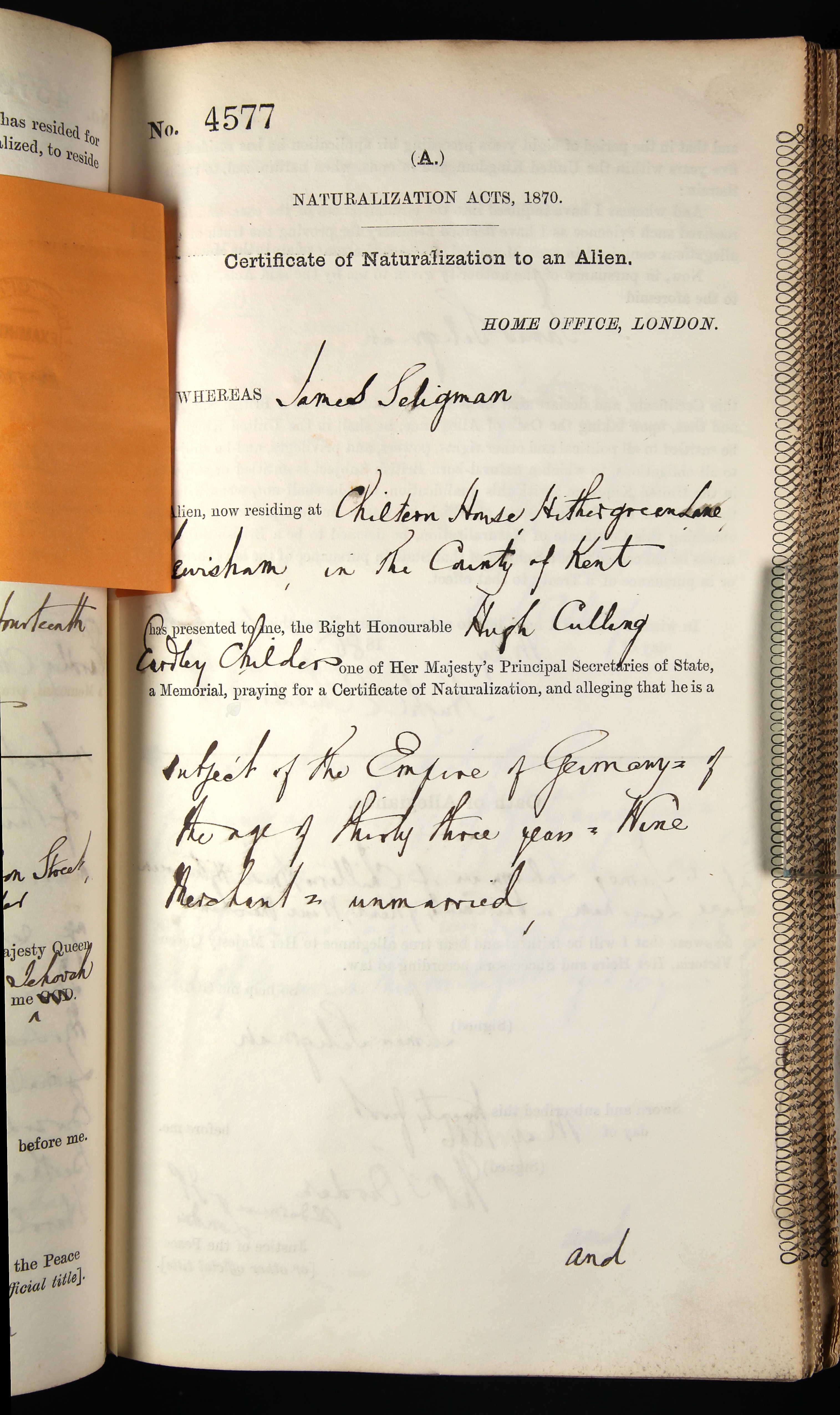
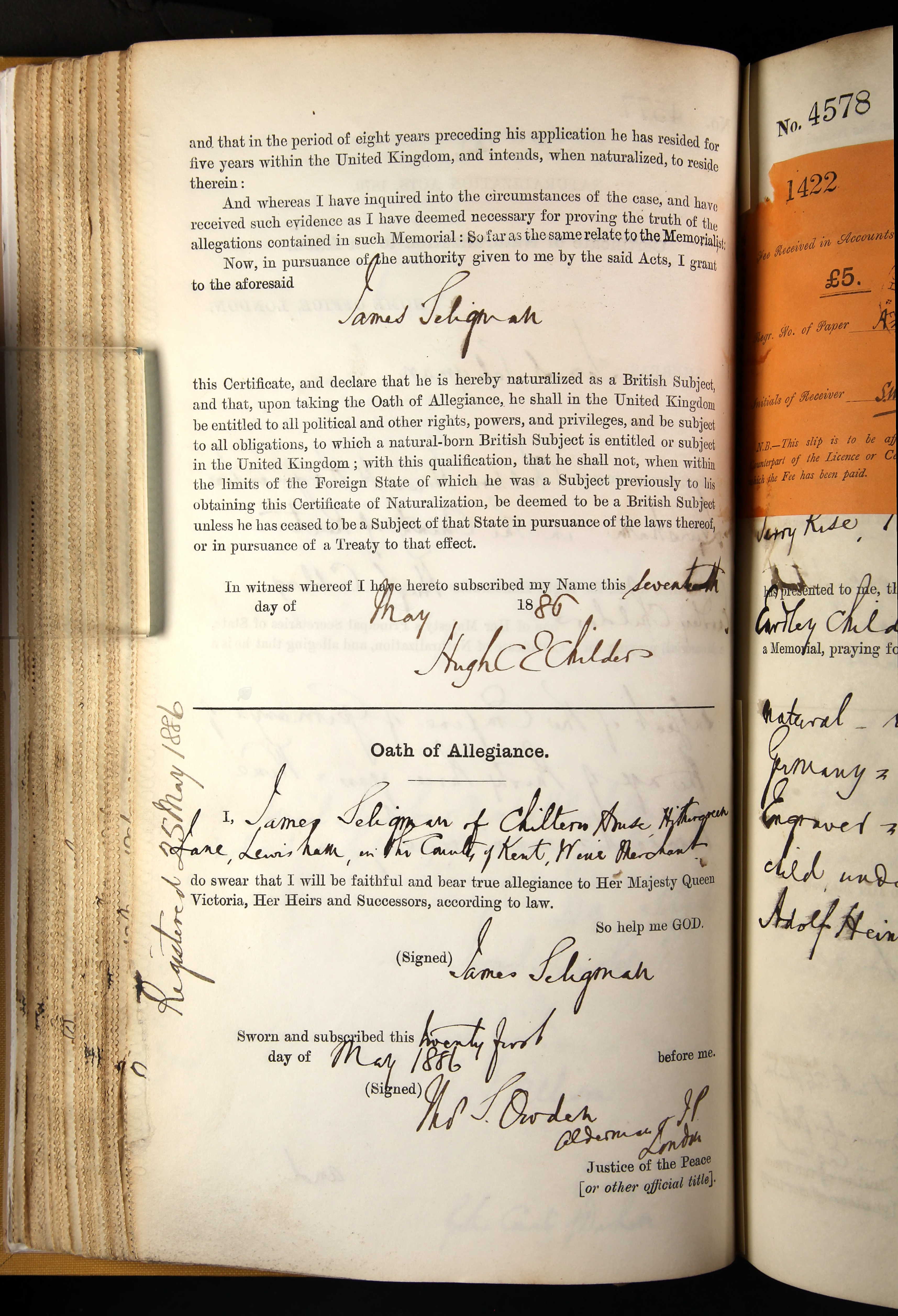
James Seligman was born in about 1853 in Germany, and by 1881 he had settled in Kilpin, Yorkshire, England and was living as a “visitor” in Kilpin Lodge, according to the 1881 England and Wales census. (England and Wales Census, 1881,” index, FamilySearch (https://familysearch.org/pal:/MM9.1.1/X3FK-ZVF : accessed 30 Sep 2014), James Seligmare in household of George H Anderton, Kilpin, Yorkshire (East Riding), England; citing “1881 England, Scotland and Wales census,” index and images, findmypast.co.uk (www.findmypast.co.uk : Brightsolid, n.d.); PRO RG 11/, p. , The National Archives of the UK, Public Record Office, Kew, Surrey)  The census listed his occupation as a wine merchant.  On May 21, 1886, James became a naturalized British citizen.  He was residing in Lewisham, Kent County, England at that time, unmarried, and employed as wine merchant.

James Seligman naturalization UK

James Seligman naturalization p 2

The National Archives; Kew, Surrey, England; Duplicate Certificates of Naturalisation, Declarations of British Nationality, and Declarations of Alienage; Class: HO 334; Piece: 13.

James married Henrietta Walker Templeton in 1887 in the Marylebone district of London.  In 1901 they were living on Buchanan Street in Glasgow, Scotland, where James was now employed as a “hotel keeper,” according to the 1901 Scotland census.  From the census record it appears that there were about thirty people residing in this hotel.  James and Henrietta did not have any children listed as living with them, and according to Pete, they never did have any children, and I did not find any children listed on the BMD index who might have been their children.

Buchanan Street, Glasgow, Scotland.

Buchanan Street, Glasgow, Scotland. (Photo credit: Wikipedia)

I don’t have another record for James after 1901 until 1922 when he and Henrietta are listed as residing at 11 Woodbourne Road in Birmingham, England, on the Midlands, England, Electoral Register for that year.  They also appear at the same address on the 1925 and 1927 electoral registers.


Henrietta died on October 4, 1928, and is buried in Harborne, Stafford, England.  About a year later, James married Clara Elizabeth Parry.  He was seventy-six at that time, and his new bride was thirty years old, so like his brother Adolph in Santa Fe, James also married a much younger woman in this second marriage.  He died less than six months later on March 31, 1930, in Birmingham, and, like his first wife Henrietta, was buried in Harborne.

Clara, his young widow, did not die until about 1977.  It was after then that a search was made for James’ heirs, as Clara and James had not had any children, and James had died intestate.  Here is a copy of the letter that Pete’s sister received in January, 1980, regarding the estate of James Seligman.

Jan 22 1980 bank to joan

An investigation was done to find James’ heirs, and a family tree was created that included my father, his sister, and his cousin Marjorie as well as the other grandchildren of Bernard Seligman and the descendants of Adolph Seligman as the potential heirs to this estate. There are  several errors and omissions on this tree, which makes me wonder about the thoroughness of the search. I would post the tree except that there are references to living people with their birth dates and other identifying information and so out of concern for their privacy, I am not posting it.

That, unfortunately, is all I know about James Seligman and about August Seligman.  I have nothing specific to tie James to Bernard aside from this estate settlement and only those two German records to connect August with Bernard.  I remain hopeful that I will at some point find more records for the other Seligman(n)s who were my great-great-grandfather’s siblings and parents and other relatives.


Adolph Seligman: A Rift in the Family?

Before I continue to write about the children of Bernard and Frances Seligman, I want to write about Bernard’s other siblings, most importantly Adolph Seligman, the third Seligman brother who settled in Santa Fe.   I am aware of one other brother, James, who settled in England, but there may have been and probably were other siblings.  Bernard’s obituary referred to siblings in Germany and in England who survived him, and the age gaps between Sigmund (1830), Bernard (1837), Adolph (1840 to 1845), and James (1853) suggest that there may have been other children born in the gaps between those years.  I have found one other record for an August Seligman (1841), who may have been another sibling, but I have only two mentions in German indices for August to rely on.

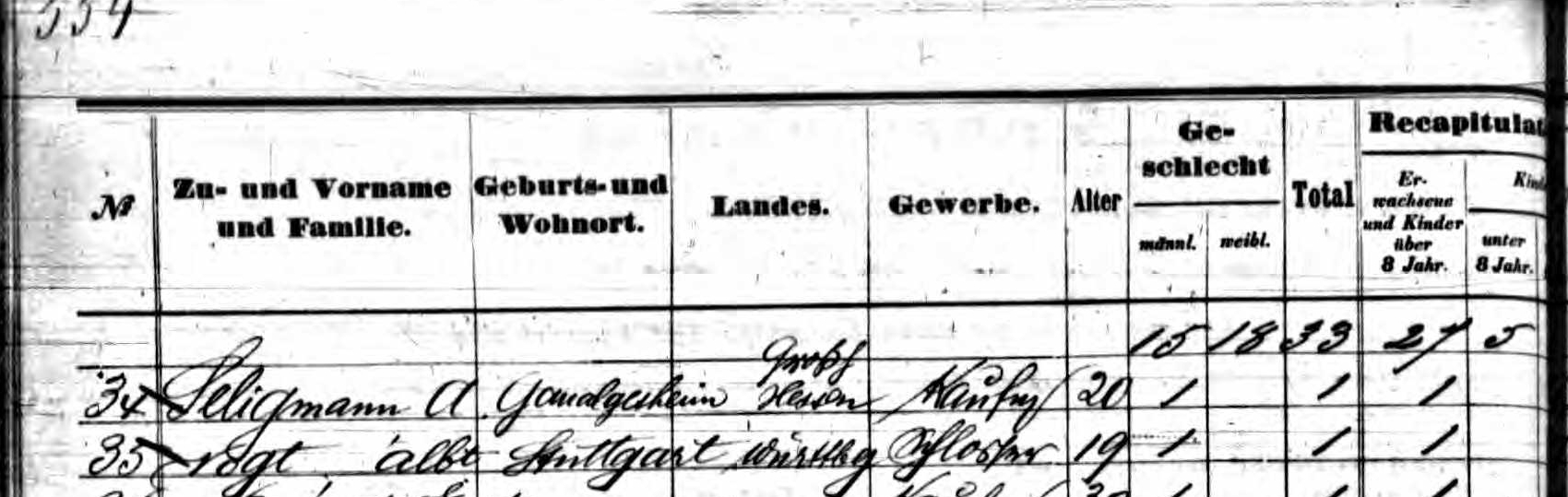
For now, however, I will focus on the life of Adolph Seligman.  Adolph was born between 1840 and 1845, according to various records, and he arrived in the US in 1863, as seen on the two ship manifests below.  The first indicates that he was born in Gau-Algesheim, was a merchant, and was 20 years old.  He sailed from Hamburg on the Germania on August 22, 1863, and arrived in New York on September 7, 1863.

Adolph Seligman lines

Staatsarchiv Hamburg; Volume: 373-7 I, VIII A 1 Band 017; Seite: 545 Description Month : Direkt Band 017 (10 Jan 1863 – 26 Dez 1863) The Germania, Departure from Hamburg to New York on August 22, 1863

New York, Passenger Lists, 1820-1891," index and images, FamilySearch (https://familysearch.org/pal:/MM9.3.1/TH-1-16955-70464-13?cc=1849782 : accessed 09 Oct 2014), 233 - 3 Sep 1863-3 Oct 1863 > image 63 of 409; citing National Archives, Washington D.C.

New York, Passenger Lists, 1820-1891,” index and images, FamilySearch (https://familysearch.org/pal:/MM9.3.1/TH-1-16955-70464-13?cc=1849782 : accessed 09 Oct 2014), 233 – 3 Sep 1863-3 Oct 1863 > image 63 of 409; citing National Archives, Washington D.C.  Arrival September 7, 1863

This was apparently the maiden voyage for this ship.  To see a photo of the ship and more about it, click here.

Although Adolph landed in New York City, he was definitely in New Mexico by 1868 because he appears on the IRS tax assessment records there for that year, residing in Elizabethtown.  On the 1870 census he appears as a dry goods merchant living in Colfax, New Mexico.

By 1873, he was residing in Santa Fe, and he is listed with his brother Sigmund and with Julius Nusbaum, Bernard’s brother-in-law, as one of the principals in Seligman Brothers and Company on the 1873 IRS tax assessment list. (As discussed here, Bernard withdrew from the business in 1873, and Adolph and Julius took his place as owners of the company.)

Adolph 1873 tax assessment

1873 IRS Tax Assessment for Adolph Seligman The National Archives and Records Administration; Washington, D.C.; Internal Revenue Assessment Lists for the Territory of New Mexico, 1862-1870, 1872-1874; Series: M782; Roll: 1; Description: Monthly and Special Lists; 1869-1874; Record Group: 58, Records of the Internal Revenue Service, 1791 – 2006.

On the 1880 US census, Adolph was living with Bernard and his family in Santa Fe; both Bernard and Adolph listed their occupation as general merchants.  (In addition to Adolph, Bernard also was providing a home for his father-in-law John Nusbaum, my three-times great-grandfather, and Simon Nusbaum, his brother-in-law, that year.)

Seligman and Nusbaums on 1880 US census santa fe

1880 Census for Bernard Seligman and household Year: 1880; Census Place: Santa Fe, Santa Fe, New Mexico; Roll: 804; Family History Film: 1254804; Page: 27A; Enumeration District: 040; Image: 0056.

Adolph was still living with Bernard and his family (and Simon Nusbaum) in 1885.  On April 6, 1886, Adolph was appointed postmaster for Santa Fe and continued in that position until at least July, 1889.

In 1890, Adolph was elected president and his nephew Arthur Seligman and two other men were elected officers of a corporation organized for a mining venture.  According to an article dated April 26, 1890, in the Santa Fe Sun, the mine, called the Chester mine, was “a fine mine and its development will disclose ore of startling richness.  The last fifty-six sacks of ore taken from this mine yielded the owners $1,700 per ton in Denver.  The gentlemen engaged in this enterprise are all energetic men of business and well deserve the success that is sure to follow their work.”

Santa Fe Sun, April 26, 1890

Santa Fe Sun, April 26, 1890

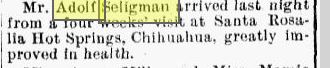
It seems that Adolph must have struggled with some health issues during the late 1890s as I found two news articles, one dated 1900 after a trip to Europe and one dated 1898 after a trip to Santa Rosalia Hot Springs, Chihuahua, both mentioning how his health was improved after these vacations.

adolf 1894 europe trip

Date: Saturday, November 10, 1900 Paper: New Mexican (Santa Fe, NM) Volume: 37 Issue: 226 Page: 4

Adolf 1898 trip health july 11 1898 SF NM p 4


(The 1900 trip may explain why I cannot find Adolph on the 1900 US census.)

Adolph then went through some transitions at the Seligman’s family business. The Santa Fe New Mexican of January 21, 1903, announced that Adolph had withdrawn from the business as of December 31, 1902, and that a new corporation had been formed under the name Seligman Brothers Company with Frances, James, and Arthur Seligman as stockholders.  James was to be the president and general manager and Arthur the secretary and treasurer of the newly formed corporation.  Bernard was described as the senior member of the company, representing its business as a buyer in the east (as by that time Bernard and Frances were living in Philadelphia, as discussed here).

So what happened to Adolph?  Had he been pushed out, or he had retired for health reasons? Was there a rift in the family or just an independent decision to leave?  I don’t know.  In the 1903 New Mexico city directory, Adolph is listed as a saloon owner in Santa Fe.  An ad in the May 2, 1904 Santa Fe New Mexican reveals that at that time, Adolph was back in the dry goods business, selling men’s, women’s, and children’s shoes.

May 2, 1904 Santa Fe New Mexican

May 2, 1904 Santa Fe New Mexican


In fact, during the next decade or more, Adolph appears to have been in competition with his brother’s company, as seen in this ad from the Santa Fe New Mexican in 1911. Notice that the clipping has an ad for Seligman Brothers on the left side and one for Adolph Seligman Dry Goods on the right side.

1911 aselnmexoct12.1911.jpg

October 2, 1911 Santa Fe New Mexican


Meanwhile, Adolph’s personal life had also changed around the same time as these changes in his work life.  Adolph was single until 1902, and then when he was about sixty years old, he married Lucille Gorman, who was only nineteen years old at the time. Did this change in his personal life have anything to do with his withdrawal from Seligman Brothers?  I do not know.

Adolph and Lucille had a daughter Minnie in 1903, the year after they married, and then had five more children:  Jacob and Adolph, Jr. (1909),[1] William (1911), Gladys (1915), and Mildred (1919).

On the 1920 census when he was reported to be 76 years old, Adolph reported no occupation; Lucille was working as a seamstress.

Adolph Seligman and family 1920 US census

Adolph Seligman and family 1920 US census Year: 1920; Census Place: Santa Fe, Santa Fe, New Mexico; Roll: T625_1080; Page: 11B; Enumeration District: 129; Image: 123

Adolph died soon after this census was taken.  He died on February 12, 1920, from locomotor ataxia.  He was about 76 years old, although his death certificate reported his birth date to be September 29, 1840, and his age to be 79.

adolph Seligman death cert

New Mexico, Deaths, 1889-1945,” index, FamilySearch (https://familysearch.org/pal:/MM9.1.1/FLTH-K9Y : accessed 06 Sep 2014), Adolf Seligman, 12 Feb 1920; citing Santa Fe, Santa Fe, New Mexico, reference Item 3, Bureau of Vital Records and Health Statistic

I am not sure whether this birthdate is accurate, given the ages on all the other records, and also given that the death certificate said his birthplace was Cologne, Germany, which is inconsistent with earlier records placing his birth in the Hesse-Darmstadt region just like his brothers Sigmund and Bernard. The ship manifest for his trip from Hamburg in 1863 also said that he was from Gau-Algesheim.

Lucille was left with six children ranging in ages from a year old to seventeen years old, and she herself was only 37 when Adolph died.  In 1930 she was listed as a widow on the census with no occupation, but her three oldest children were employed, Minnie as a salesperson, Adolph, Jr., as a tailor, and Jake as an electrician.  All six children were still living with her, now ages eleven to 27 (although Minnie’s age was listed as 23 on the census).  Sometime after the census was taken but during 1930, Lucille remarried.  She is listed as Lucille, wife of Frank C. Daniels, in the 1930 Santa Fe city directory.

Adolph, Jr., died the following year on June 13, 1931; he was only 22 years old.  I was not able to access a death certificate to determine his cause of death.  Lucille died a year after her son on November 10, 1932, under the name Lucille S. Daniels.  She was 40 years old.  I don’t know her cause of death either.

Her widower Frank Daniels, who had married Lucille just two years earlier, took on the responsibility for her three daughters and her son William, all of whom were still living with him as late as 1940, some using the surname Daniels. Frank was working as a carpenter for a building supply company.  Minnie was now 37 (35 on the census) and working as bookkeeper for a building supply company; William, 28, was also working as a bookkeeper for a building supply company.  (I assume that Frank, Minnie, and William were all working for the same company.) Gladys was 24 and working as a cashier for the power company.  Mildred was 21 and had no occupation listed.

Jake, who had been living with his siblings and stepfather Frank in 1932 according to the Santa Fe city directory of that year, married Adela Roybal sometime soon thereafter.  He continued to work as an electrician.  He and Adela had one child. Two of Adolph’s children never married or had children, Minnie and Gladys.  William married Mae Leeper, and they had four children.  William served as a city councilman in Santa Fe.  Mildred married David Roberson and had one child.  Many of Adolph and Lucille’s descendants continue to live in Santa Fe.

There are many unanswered questions about Adolph and his life after 1902.  Like his brothers Sigmund and Bernard, he was a risk-taker and a pioneer, both following in his older brothers’ footsteps and also finding his own path.

——————–

[1] Although several records indicate that both Jacob and Adolph, Jr., were born in 1909, neither appears on the 1910 census, and on the 1920 census, Adolph was reported to be eleven whereas Jake was said to be only ten.  The 1930 census has Adolph as 21 (meaning a birth year of 1909), but has Jacob’s age as 18, meaning a birth year of 1912.  Adolph’s headstone has a birth year of 1909.  Jacob’s obituary states that he was born on September 9, 1909, as does his entry in the SSDI.  I will have to request a search from the New Mexico Bureau of Vital Records to determine the exact birth dates, which will take as much as 12 weeks to process.

Jews on the Santa Fe Trail 1848-1871:  My Great-Great-Grandfather Bernard Seligman and his Brothers


Sign for Santa Fe National Historic Trail.

Sign for Santa Fe National Historic Trail. (Photo credit: Wikipedia)


My great-great-grandfather Bernard Seligman was born on November 23, 1837 in Gau-Algesheim, Germany.  When I learned about the small town in Germany where my great-great-grandfather Bernard Seligman was born, I was not surprised that he had decided to move away when he reached adulthood.  Gau-Algesheim was itself a very small town, and the Jewish population was tiny—perhaps 60-80 people during the 1840s and 1850s when Bernard was growing up.  The opportunities for a young Jewish man must have been very limited—socially and economically.  My research of the town indicated that by 1900 the Jewish population had declined dramatically.  My great-great-grandfather and his brothers were therefore not unlike many others who moved out of their small hometown to seek greater opportunities.

Before leaving Germany, Bernard received what was described as a “first class education in the public and commercial schools of his native land where he also gained considerable actual business experience while employed a wholesale establishment there.”[1]  According to a book written in 1925 by Ralph Emerson Twitchell, then the official state historian for New Mexico, Bernard Seligman had been associated with the Rothschild banking house in Frankfort-on-the-Main before coming to the US.[2]

Bernard was not the first of the Seligman brothers to arrive in the United States. His older brother Sigismund or Sigmund, born in 1830 in Gau-Algesheim, had arrived in Santa Fe in 1849.  At first, Sigmund found work as a photographer, running a daguerreotype portrait studio for a few years.[3]  But within a few years he and another recent German immigrant named Charles Clever “formed a business partnership … under the firm name and style of Seligman and Clever, engaging in general merchandizing and freighting over the old [Santa Fe] Trail.”[4]

This photo is claimed to be the oldest photograph of Santa Fe, taken about 1855.  You can see the sign for Seligman and Clever on the right.  At one time one of the streets in this photograph was called Seligman Street.


Sigmund’s younger brother Bernard, my great-great-grandfather, arrived in the United States on March 23, 1857, coming aboard the ship Mercury and landing in New York.  On the record for the passenger manifest it says that his occupation was a merchant.[5] Twitchell wrote that Bernard initially settled near Philadelphia and worked for a cotton manufacturing business.[6]  He is said to have arrived in Santa Fe in 1858, taking a position in his brother Sigmund’s business, according to Bernard’s obituary. [7]

When Sigmund’s partner Charles Clever resigned from the business a few years later to become a lawyer, Bernard became a partner with his brother Sigmund in the business, and it was renamed S. Seligman and Bro.  Some years later a third brother, Adolph, born in 1845, also settled in Santa Fe and joined his brothers’ business in the 1860s.[8]

As described by William J. Parish in “The German Jew and the Commercial Revolution in Territorial New Mexico 1850-1900,” New Mexico Historical Review, Vol. 35, p. 1 (1960), until the arrival of Jewish German immigrants like the Seligmans, the trade conditions in the New Mexico territory were quite rudimentary, a few small stands relying upon traveling merchants to provide them with merchandise.  According to Parish, heavy taxes and the high cost and risk of travel made many reluctant to deal in the region.  Storekeepers could not rely on these traveling merchants to supply an adequate inventory of goods.  Thus, few merchants established permanent roots in the area.

English: "Arrival of the caravan at Santa...

English: “Arrival of the caravan at Santa Fe” — Copy of original lithograph ca. 1844 (Photo credit: Wikipedia)

These conditions provided a substantial opportunity for Jewish German immigrants like my ancestors, the Seligmans. Beginning in the 1840s around the time that Sigmund immigrated, there were a number of recent Jewish German immigrants who brought a thriving economic base to Santa Fe and other New Mexican cities based on transporting goods from the eastern United States over the Santa Fe trail to the New Mexican territory recently acquired by the US after the Mexican War ended.[9]

As postulated by Parish, German Jews came to the US with a particularly good background to take advantage of these entrepreneurial opportunities.  Parish discusses how historically Jews in Western Europe, although foreclosed from entering many trades, had been allowed to take on the role of the moneylender, a livelihood to which Christians had an aversion and, in some cases, a religious opposition, thus leaving that unpopular job for their Jewish neighbors.  Although this created some hostility and resentment (as seen, of course, in The Merchant of Venice and the character of Shylock), it also provided Jewish men with the opportunity to develop skills in banking, business, and capitalism.  Jewish immigrants brought these skills with them to the US wherever they settled, and, as Parish points out, those who came to New Mexico had a profound impact on the fledgling economy that existed there.

This is a photograph of my great-great-grandfather Bernard Seligman (far left) with two other Santa Fe merchants,  Zadoc Staab and Lehman Spiegelberg,  and  two Kiowa Indian scouts.

Bernard Seligman and other merchants

Freighters on the Santa Fe Trail, Bernard Seligman, Zadoc Staab, Lehman Spiegelberg and Kiowa Indian scouts Palace of the Governors Photo Archives, New Mexico History Museum, Santa Fe


The growth of the economy is illustrated by the growth in the number of Jewish merchants in Santa Fe from 1850 to 1870.  In 1850 there were eight such merchants; by 1860 that number had doubled to sixteen.[10]  By 1870 it had doubled again to 32; clearly, my relatives had arrived at the right place at the right time.[11]  These merchants were not transient traveling merchants.  They established permanent businesses and stayed in the community.

Twitchell provided this vivid description of the scale of the Seligman brothers’ business:

“A Fair exemplar of the magnitude of the business of this firm is recorded in the fact that one caravan, conducted by firm, loaded at the Missouri river eighty-three wagons of merchandise consigned to the firm at Santa Fé, each wagon carrying not less than three tons of high class freight.  Another record in the books of the firm shows the payment of $30,000 in transportation charges on one caravan alone, all of the merchandise having been disposed of to New Mexican buyers within the brief period of three weeks after arrival in Santa Fé[. N]early three quarters of a century disclose an aggregate of more than fifteen millions of dollars.”[12]


Thus, by the 1860s, the Seligman Brothers’ business was thriving.  They and the other Jewish merchants had brought a reliable source of goods to Santa Fe for the first time.

These merchants, however, were not involved in any of the traditional practices of Jewish life.  According to Henry J. Tobias, the author of The History of the Jews in New Mexico, although these men identified as Jews, there was no evidence of any regular Jewish observance in Santa Fe during those early days—no evidence of a synagogue or any form community prayer or celebration, no observance of dietary laws.[13]  The Jewish population was less than five percent of one percent of the overall population at that time, and the Jews had to adapt to living in a culture where they were such a tiny segment of the community.

Most of the Jewish residents in the 1860s were single men, although a few women and families were starting to arrive.  In 1860 there was a celebration of Yom Kippur at the home of Levi Spiegelberg, another Jewish merchant, who had recently married a Jewish woman from Germany.  Tobias speculated that perhaps the arrival of Spiegelberg’s bride, one of only two Jewish women in the town at that time, made the others nostalgic for the traditions from back home and thus inspired this day long observance of fasting and prayer.[14]

After the Civil War[15] and after his younger brother Adolph had arrived in Santa Fe, Bernard moved back east to Philadelphia for several years.  Parish pointed out that there were no Jewish single women in Santa Fe in the 1850s and 1860s, and that while some Jewish men intermarried, most went back east to find a Jewish woman to marry.[16]  Sigmund never married, and Adolph did not marry until he was in his 60s, but Bernard went back east and found a Jewish woman from Pennsylvania, my great-great-grandmother Frances Nusbaum.  She was born in Harrisburg, Pennsylvania, in 1845, but by 1860 she and her family had moved to Philadelphia.  Bernard and Frances married on March 28, 1865, and my great-grandmother Eva (named Evalynn at birth) was born the following year on May 27, 1866 in Philadelphia.  According to the Philadelphia city directories for 1867, Bernard was in business with his Nusbaum in-laws at that time.

On August 17, 1867, Bernard and Frances had a second daughter, Florence; the baby only lived five weeks and died on September 26, 1867.  She was buried at Mt. Sinai cemetery in Philadelphia, along with many of the Nusbaum family members (and also many of my Cohen relatives).  A third child, James Leon Seligman, was born on August 11, 1868, and then another daughter, Minnie, was born on October 31, 1869.  All of these children were born in Philadelphia, and Bernard, Frances and the three surviving children are all listed in the 1870 census as living in Philadelphia in the 13th Ward. Bernard is also listed in 1871 in the Philadelphia directory.

Bernard, however, must have been traveling back and forth between Santa Fe and Philadelphia because he is also listed in Santa Fe on the 1870 census, living with his brother Sigmund and two clerks.  Bernard is listed as owning $25,000 worth of real estate and $20,000 in personal property. (Strangely, Sigmund only claimed $20,000 in personal property and no real estate, despite being the founder of the store and the full time resident.)

At some point, however, in 1871, Bernard and Frances and their children relocated to Santa Fe, and their last child, Arthur Seligman, was born on June 14, 1871, in Santa Fe, the first family member to be born in that city.  According to Twitchell, Frances Nusbaum Seligman was one of only eight women living in Santa Fe at that time who did not come from a Spanish background.  Twitchell described my great-great-grandmother as “a woman of rare beauty, great intelligence and charming personality.”[17]  Although I will write about the Nusbaum family at a later time, for now I can say that they were a large and successful Philadelphia family with a German Jewish background; it must have been very difficult for Frances to leave her family behind and move all the way to Santa Fe, a frontier town far different from Philadelphia.

My great-grandmother Eva was only five years old when she made that cross-country trip with her parents and her siblings, leaving Philadelphia temporarily behind. She lived there for ten years, and when she was fifteen years old, she returned to Philadelphia for college and married my great-grandfather Emanuel Cohen when she was twenty.  She lived in Philadelphia for the rest of her life.  But most of the Seligman family developed and maintained deep roots in Santa Fe, ties that still exist today for many of their descendants.


In my posts to follow, I will first write about the years that my great-grandmother lived in Santa Fe, 1871-1881, and about her family.  Then I will write about the years that followed, including the story of my great-great-uncle Arthur Seligman and his career as a political leader and ultimately governor of New Mexico.


Santa Fe Trail around 1845 plus connecting tra...

Santa Fe Trail around 1845 plus connecting trading routes to commercial hubs and ports in the USA (Photo credit: Wikipedia)


[1] “A Good and True Man Called Home,” Santa Fe New Mexican, February 3, 1903.


[2] Ralph Emerson Twitchell, Old Santa Fe: The Story of New Mexico’s Ancient Capital (The Rio Grande Press 1925), pp 476-478.  I found a few errors in Twitchell’s account of Bernard Seligman, including the birth year of his brother Sigmund and the birth places of his first three children.  I cannot independently verify some of his other assertions, unfortunately, but report them here as they were reported in Twitchell’s book.


[3] Arthur Scott, “My Grandfather’s Birthplace on the Santa Fe Plaza,” found at http://www.vocesdesantafe.org/index.php/explore-our-history/santa-fe/item/1090-my-grandfathers-birthplace-on-the-santa-fe-plaza

[4] Twitchell, p. 477.  It is important to note that there was an entirely separate Seligman family that settled in Bernalillo, New Mexico around the same time that my Seligman ancestors were settling in Santa Fe.  As far as I can tell, there is no familial relationship between the two families and the “other” Seligmans came from a different region in Germany, but one never knows.  Henry Tobias and Sarah Payne, “Jewish Pioneers of New Mexico: The Seligman Family” (The New Mexico Jewish Historical Society, 2005).


[5] United States Germans to America Index, 1850-1897,” index, FamilySearch (https://familysearch.org/pal:/MM9.1.1/KDWS-R3N : accessed 20 Sep 2014), Bernhard Seligmann, 23 Mar 1857; citing Germans to America Passenger Data file, 1850-1897, ARC identifier 1746067; Ship Mercury, departed from Havre, arrived in New York, New York, New York, United States, National Archives and Records Administration, Washington D.C.)


[6] Twitchell, p. 477.  Bernard’s obituary claimed that he had come to Santa Fe directly after immigrating, but it makes sense that he would have spent some time in the east since he arrived in NY in 1857 and is said to have arrived in Santa Fe in 1858.  Also, perhaps it was that initial stay in Philadelphia that caused him to return to Philadelphia some years later and to meet and marry my great-great-grandmother.


[7] “A Good and True Man Called Home,” Santa Fe New Mexican, February 3, 1903.


[8] Arthur Scott, “Seligman Brothers—Pioneer Jewish Entrepreneurs of Santa Fe and the New Mexico Territory,” http://www.newmexicohistory.org/people/seligman-brothers-pioneer-jewish-entrepreneurs-of-santa-fe-and-the-new-mexi


[9] Parish; also,  Gunther Paul Barth, Instant Cities: Urbanization and the Rise of San Francisco and Denver


(Oxford University Press, 1975), pp. 71-73.


[10] Parish, p. 15.  See also Henry J. Tobias, A History of the Jews of New Mexico (Univ. N. Mex. Press. 1990), p. 40-41.


[11] Parish, p. 15


[12] Twitchell, p.477.


[13] Tobias, pp. 43-44.


[14] Tobias, pp. 42-43.


[15]  During the Civil War, Bernard served as a captain and quarter master for the Union Army.   Arthur Scott, “Seligman Brothers—Pioneer Jewish Entrepreneurs of Santa Fe and the New Mexican Territory,” at http://www.newmexicohistory.org/people/seligman-brothers-pioneer-jewish-entrepreneurs-of-santa-fe-and-the-new-mexi   See also Tobias, p. 54.


[16] Parish, p. 23, 129.


[17] Twitchell, p. 477.