
Sara and Moses’ Five Younger Children Back in Germany

[FYI—this post should have preceded the one posted yesterday. Sorry about that! I will blame being in Florida…]

We have seen that the oldest three children of Sara Rothschild and Moses Adler—Louis, Sigmund, and Julius—all came to the US around the turn of the century as teenagers. But what about their younger siblings? And their parents?

Back in Germany, Caroline Grete Rothschild, the second oldest daughter, married Albert Abraham Mandelstein on October 23, 1911, in Grebenstein. Albert was born in Grebenstein on June 2, 1855, to Berr Mandelstein and Sarchen Katzenstein. He was 56 years old when he married Caroline while she was only 22. (Albert was a widower.) Caroline and Albert had one child, a son Kurt Siegfried Mandelstein, born on July 15, 1916, in Kassel, Germany.1
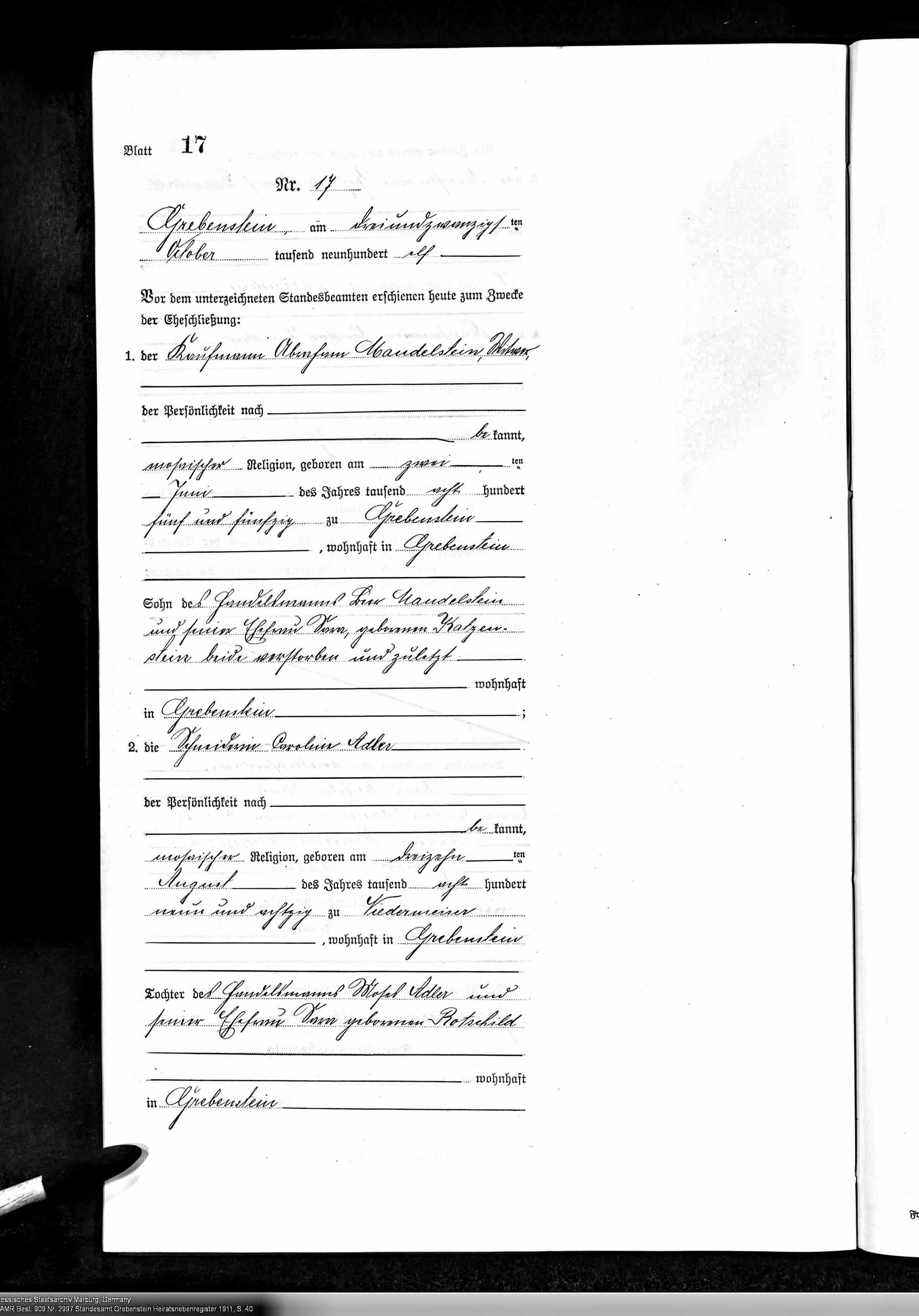
Caroline Adler and Albert Mandelstein marriage record, Hessisches Hauptstaatsarchiv; Wiesbaden, Deutschland; Signatur: 2997, Year Range: 1911, Ancestry.com. Hesse, Germany, Marriages, 1849-1930

The next child to marry was the third oldest daughter Emmi. She married Robert Speier on August 26, 1919, in Grebenstein. Robert was born on September 15, 1889, in Guxhagen, Germany to Levi Speier and Mina Lange. Emmi and Robert had two children, Senta, born on September 7, 1920, and Elsie, born August 23, 1931.2
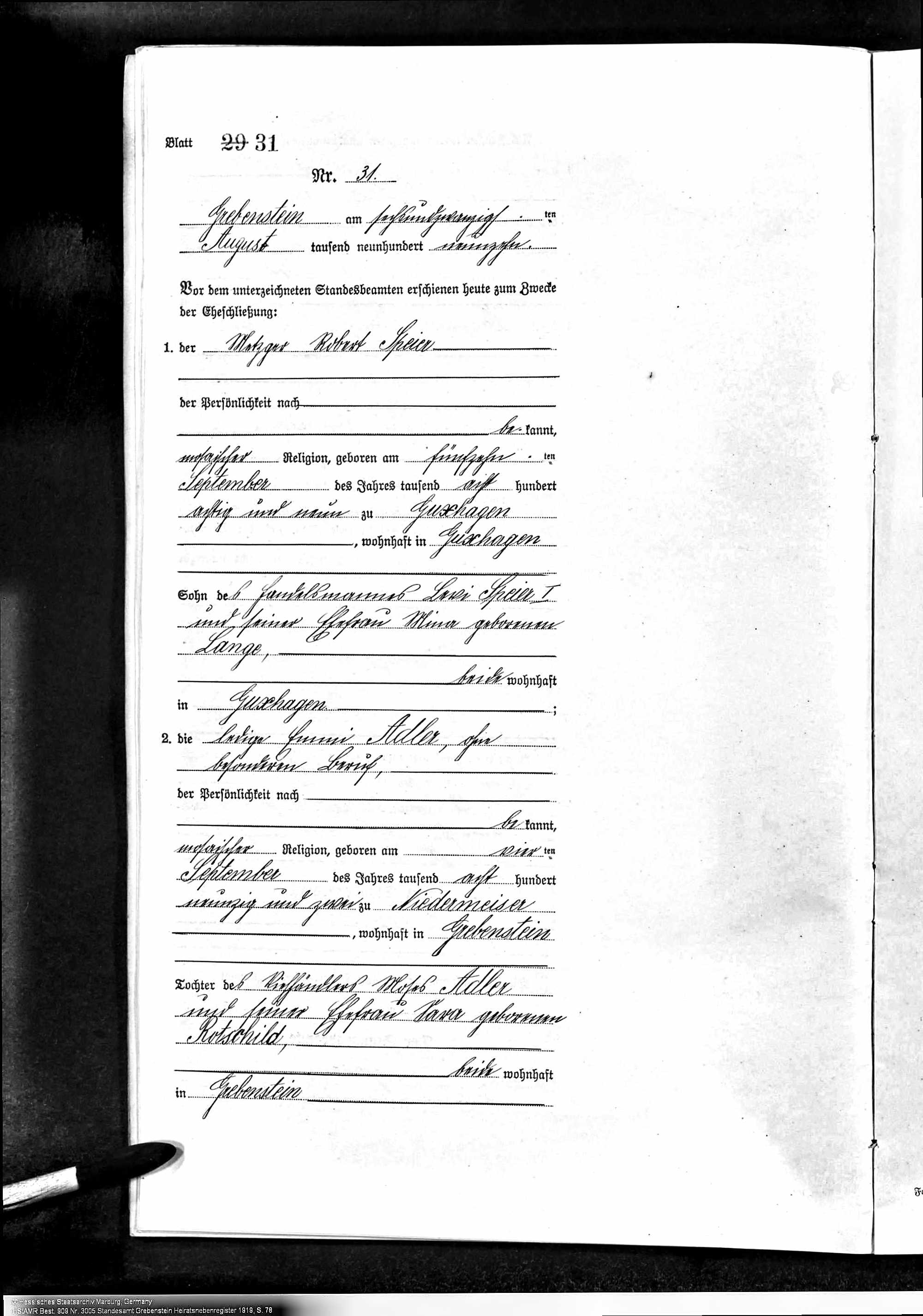
Emmi Adler and Robert Speier marriage record, Hessisches Hauptstaatsarchiv; Wiesbaden, Deutschland; Signatur: 3005, Year Range: 1919, Ancestry.com. Hesse, Germany, Marriages, 1849-1930

Less than three months after Emmi’s wedding, her mother Sara Rothschild Adler died in Grebenstein on November 10, 1919, at the age of sixty.

Sara Rothschild Adler death record, Hessisches Hauptstaatsarchiv; Wiesbaden, Deutschland; Personenstandsregister Sterberegister; Signatur: 3065; Laufende Nummer: 909, Year Range: 1919, Ancestry.com. Hesse, Germany, Deaths, 1851-1958

The next child to marry was the oldest daughter Malchen. She married Fritz David Apolant on December 24, 1920, in Grebenstein. Fritz was born on December 23, 1880, in Stettin, Germany (now a city in Poland). I am not certain of his parents’ names; one unsourced tree on Ancestry records their names as Samuel and Minna Apolant, but I don’t know if that is accurate. Malchen and Fritz did not have any children.
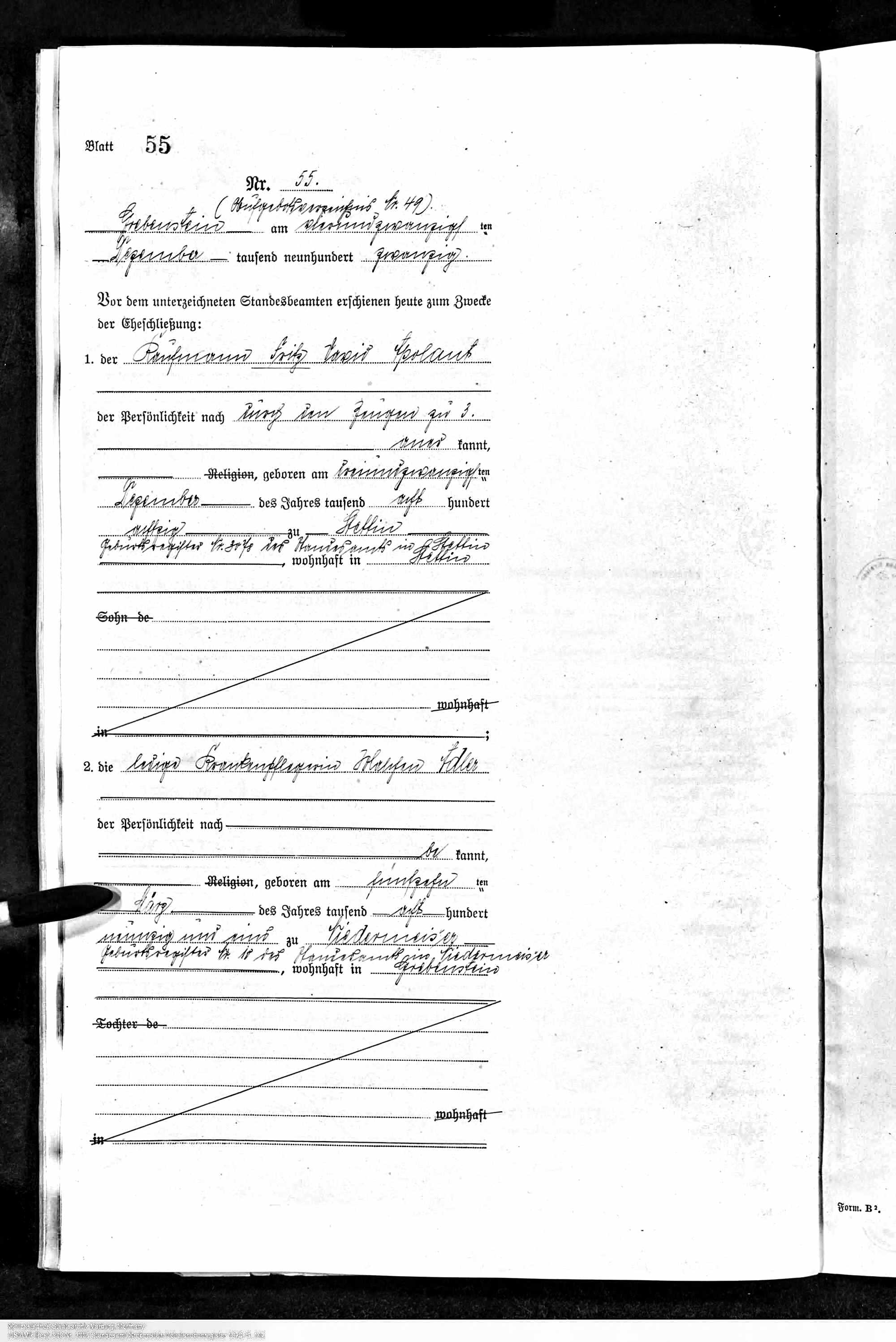
Malchen Adler and Fritz David Apolant marriage record, Hessisches Hauptstaatsarchiv; Wiesbaden, Deutschland; Signatur: 3006, Year Range: 1920, Ancestry.com. Hesse, Germany, Marriages, 1849-1930

David Theodore Adler, the eighth of Sara and Moses’ children, married Emma Suss, on February 7, 1921, in Watzenborn-Steinberg, Germany. Emma was the daughter of Joseph and Johanna Suss and was born on September 19, 1894, in Watzenborn. Emma and David Theodore (known later primarily as Theodore) had two children, Kurt, born October 25, 1922, and Lydia, born August 15, 1927, both in Watzenborn.3

David Theodore Adler and Emma Suss marriage record, Hessisches Hauptstaatsarchiv; Wiesbaden, Deutschland; Bestand: 905; Laufende Nummer: 1407, Year Range: 1915-1925, Ancestry.com. Hesse, Germany, Marriages, 1849-1930

Finally, the last child to marry was Bettt Adler. She married Marx Regenstein on June 24, 1921, just a few months after her brother David Theodore was married. Marx was born September 5, 1895, in Leeheim, Germany, to Joseph Regenstein and Johannette Wolf.4 Bettt and Marx had two children, Lucie Johanna, born March 31, 1923, and Eric, born March 3, 1926, both in Grebenstein, Germany.5

Betti Adler and Marx Regenstein marriage record, Hessisches Hauptstaatsarchiv; Wiesbaden, Deutschland; Signatur: 3007, Year Range: 1921, Ancestry.com. Hesse, Germany, Marriages, 1849-1930

Moses Adler died in Grebenstein on June 21, 1927.5 He was 69. He had outlived his wife Sara Rothschild and two of his ten children.  By 1927, all eight of his surviving children were married (three in the US, five in Germany) and almost all of his grandchildren were born.

Moses Adler died before Hitler came to power and disrupted all of their lives. He and Sara didn’t live to know that their five children still in Germany would escape from Nazi Germany and join their brothers in the United States as Americans. They didn’t know that all of their children and almost all of their grandchildren would survive the Holocaust.

Those stories continue in the next post.


  1. Kurt Ste Mandelstein, Gender Male, Race White, Birth Date 15 Jul 1916, Birth Place Federal Republic of Germany, Death Date 16 Sep 1988, Father Albert Mandelstein, Mother Greta Adler, SSN 360014041, Ancestry.com. U.S., Social Security Applications and Claims Index, 1936-2007; Caroline Grete Mandelstein, Declaration of Intention, National Archives at Chicago; Chicago, Illinois; ARC Title: Petitions For Naturalization, 1906-1991; NAI Number: M1285; Record Group Title: Records of District Courts of the United States, 1685-2009; Record Group Number: Rg 21, Petitions, V· 1079-1081, No· 268890-269400, 1942, Ancestry.com. Illinois, U.S., Federal Naturalization Records, 1856-1991 
  2. Emmi Adler Speier, Petition for Naturalization, National Archives at Chicago; Chicago, Illinois; ARC Title: Petitions For Naturalization, 1906-1991; NAI Number: M1285; Record Group Title: Records of District Courts of the United States, 1685-2009; Record Group Number: Rg 21; Petitions, V· 1180-1183, No· 295150-295735, 1943, Ancestry.com. Illinois, U.S., Federal Naturalization Records, 1856-1991 
  3. David Theodore Adler, Petition for Naturalization, National Archives at Chicago; Chicago, Illinois; ARC Title: Petitions For Naturalization, 1906-1991; NAI Number: M1285; Record Group Title: Records of District Courts of the United States, 1685-2009; Record Group Number: Rg 21, Petitions, V· 1223-1226, No· 305014-305575, 1944, Ancestry.com. Illinois, U.S., Federal Naturalization Records, 1856-1991 
  4. Marx Regenstein birth record, Hessisches Hauptstaatsarchiv; Wiesbaden, Deutschland; Bestand: 906; Laufende Nummer: 346, Ancestry.com. Hesse, Germany, Births, 1851-1901 
  5. Moses Adler, Death Age 69, Birth Date abt 1858, Death Date 21 Jun 1927
    Death Place Grebenstein, Hessen (Hesse), Deutschland​​​ (Germany), Civil Registration Office Grebenstein, Certificate Number 31, Hessisches Hauptstaatsarchiv; Wiesbaden, Deutschland; Personenstandsregister Sterberegister; Signatur: 3073; Laufende Nummer: 909, Ancestry.com. Hesse, Germany, Deaths, 1851-1958 

Selig Goldschmidt, Part I: Loving Son, Husband, and Father

If you have a really, really good memory and have been reading this blog for over a year, you may remember that back in October 2019—before COVID!—I wrote my first blog post about my 4x-great-uncle, Meyer Goldschmidt, and relied heavily as a source of information about Meyer and his family on a book created in honor of his son Selig Goldschmidt.

The book, Selig Goldschmidt: A Picture of A Life,  was published in Israel by Selig’s descendants in 1996 (hereinafter referred to as the Selig Goldschmidt book),1 and it includes remembrances, letters, and obituaries that were originally compiled by Selig’s son Meyer and that were then translated from German to English by the later generation in order to preserve and honor the memory of Selig Goldschmidt.

Last year I relied on the Selig Goldschmidt book to tell the story of Selig’s parents, Meyer Goldschmidt and Lea Katzenstein, and about the childhood of Selig and his siblings, but now I am returning to the book to focus more exclusively on what it reveals about Selig himself as he grew from a child and spent his adult life in Frankfurt, Germany.

First, some background. Selig was born on March 16, 1828, in Grebenstein, Germany, the fifth child and second son of his parents Meyer and Lea. (I have already written about the first four: Ella, Sarah, Jacob, and Amalie.)

Selig Goldschmidt birth record, Arcinsys Hessen, HHStAW, 365, 375 Jüdische Personenstandsregister von Grebenstein: Geburtsregister der Juden von Grebenstein, p. 36

As described in the book, the family was quite poor when Selig was a child, and his father Meyer suffered from poor health, exacerbating the precariousness of their financial position. Then Selig’s mother Lea Katzenstein Goldschmidt died on September 28, 1839 (after having given birth to two more sons after Selig, Joseph, who died when he was six in 1836, and Falk, who was born in 1836). Selig was only eleven years old, and as I wrote about here, he and his siblings had to take on a lot of responsibility for each other and for the youngest sibling, Falk, who was only three.

Once the older siblings began to marry and have households of their own, the financial pressure was reduced. After the youngest sister Amalie married Juda Katzenstein in 1853 and her father Meyer moved with them to Eschwege, Selig and his brother Jacob sold the family home in Grebenstein and moved to Frankfurt,2 where the two brothers established the firm J&S Goldschmidt, which grew to be one of the most famous and successful art and antique dealerships in Germany and perhaps in Europe. More on that to come. But it’s important to remember that Selig and his siblings grew up in poverty before building their business to what must have been unimaginable success.

According to the civil record below, on May 27, 1857, Selig married Clementine Fuld in Frankfurt. She was born in Frankfurt on January 8, 1837, to Herz Fuld and Caroline Schuster, and, as I noted in my prior post, she was the sister of Salomon Fuld, who would later marry Selig’s niece Helene Goldschmidt, daughter of Selig’s brother Jacob Meier Goldschmidt.

Marriage of Selig Goldschmidt and Clementine Fuld, Certificate Number: 30
Hessisches Hauptstaatsarchiv; Wiesbaden, Deutschland
Ancestry.com. Hesse, Germany, Marriages, 1849-1930

However, it appears that Selig and Clementine had been married under religious law nine months earlier. The Selig Goldschmidt book includes a facsimile of their ketubah as well as a translation in English of their marriage contract, and it indicated that they were married on August 20, 1856.3

A letter written by Selig to Clementine on August 31, 1856, reveals that this was a love match; it also suggests how busy Selig was and how often he had to travel for work. Selig, who was away on business in Dinkelspiel at that time, wrote in part:4

Dearest Clementine

I have received your most welcome letter just after my arrival here. [He then described how he spent Shabbos in Dinkelspiel.]… The afternoon passed pleasantly in conversation until after the evening service in the synagogue when I was alone once again. I missed you very much, dear Clementine, and would have gladly paid a lot of money in exchange for half an hour’s conversation with you, if that could have been instantly arranged. Since that was impossible, I did the same as Friday night and went to bed at eight o’clock. I dreamed I was with you, dear Clementine, and I had such a pleasant talk with you and was so happy to be near you that the time passed very quickly. [Selig then wrote that he would be delayed returning to Frankfurt because of business.] … However, early in the following week, please G-d, the happy day of our reunion will arrive. Then, dear Clementine, we will enjoy ourselves and chat enough to compensate for everything we have missed. Yet that joy can only last for two or three days because then I must set out on my journey to Leipzig. Thus man’s happiness is always limited, just as his existence is only brief. However, of what use is such nonsense? After all, that is part of my occupation and you yourself have told me not to neglect my business. We must utilize properly the short time allotted to us, for such is life! If only one would use this time assigned to oneself well, surely the whole world would be a happier place. …

Dear Clementine, please accept sincere greetings and kisses from your affectionate and faithful

               Selig

Selig and Clementine had six children—five daughters and one son, all born in Frankfurt. First born was Helene, born on February 28, 1858.

Helene Goldschmidt birth record, Hessisches Hauptstaatsarchiv; Wiesbaden, Deutschland; Bestand: 903; Signatur: 903_8812, Ancestry.com. Hesse, Germany, Births, 1851-1901

A year later Flora was born on March 17, 1859.

Flora Goldschmidt birth record, Hessisches Hauptstaatsarchiv; Wiesbaden, Deutschland; Bestand: 903; Signatur: 903_8814, Ancestry.com. Hesse, Germany, Births, 1851-1901

Hedwig was born two years later on February 27, 1861.

Hedwig Goldschmidt birth record, Hessisches Hauptstaatsarchiv; Wiesbaden, Deutschland; Bestand: 903; Signatur: 903_8818
Ancestry.com. Hesse, Germany, Births, 1851-1901

And Recha followed two years after Hedwig. She was born on June 11, 1863.

Recha Goldschmidt birth record, Hessisches Hauptstaatsarchiv; Wiesbaden, Deutschland; Bestand: 903; Signatur: 903_8824
Ancestry.com. Hesse, Germany, Births, 1851-1901

Selig and Clementine’s only son Meyer Selig Goldschmidt was born on October 6, 1865. He was obviously named for his grandfather Meyer.

Meyer Selig Goldschmidt birth record, Hessisches Hauptstaatsarchiv; Wiesbaden, Deutschland; Bestand: 903; Signatur: 903_8830
Ancestry.com. Hesse, Germany, Births, 1851-1901

The last child, Johanna, was born on December 18, 1867. Johanna grew up to marry her first cousin Abraham Stern, the son of Selig’s sister Sarah, and her story has already been told in great detail when I wrote about Abraham and their family so I will not tell it again.

Johanna Goldschmidt birth record, Hessisches Hauptstaatsarchiv; Wiesbaden, Deutschland; Bestand: 903; Signatur: 903_8837
Ancestry.com. Hesse, Germany, Births, 1851-1901

In the preface to the Selig Goldschmidt book, Selig’s son Meyer described what his childhood was like and how the family was bound in love:5

The ideals of children, grandchildren and the wider family circle were all in tune; thus an incomparable, blissful harmony prevailed in our family. It was constantly sustained by love, affection and enthusiasm for all that is noble and good which emanated from the head of our family. Before meals on Friday evening in winter and on Shabbos evenings after the meal, a large number of the more distant family would assemble in our home. There were so many people that it is difficult to understand, in view of the relatively small size of the rooms, how comfortable and happy everyone felt. It may have been due to a certain simplicity which was deliberately cultivated there. In the main room a big bowl of fruit stood on the table at which we sat, and anyone who wished could help himself.

Imagine if all children were as blessed as the six children of Selig Goldschmidt and Clementine Fuld and able to grow up surrounded by so much joy and love.

This portrait of Selig and Clementine’s children appears on page 37 of the Selig Goldschmidt book. It appears to have been taken in 1872 based on the ages of the children (the daughters are identified by their married names).

Selig Goldschmidt’s children


  1. Selig Goldschmidt: Picture of A Life (1996, Elmar Printers Ltd. and Bezalel Bookbinders, Jerusalem, Israel)(limited edition of 300 copies) 
  2. “The Story of A Ring,” Selig Goldschmidt: Picture of A Life (1996, Elmar Printers Ltd. and Bezalel Bookbinders, Jerusalem, Israel)(limited edition of 300 copies), p.22 
  3. “The Man,” Selig Goldschmidt: Picture of A Life (1996, Elmar Printers Ltd. and Bezalel Bookbinders, Jerusalem, Israel)(limited edition of 300 copies), pp. 34-39 
  4. “The Man,” Selig Goldschmidt: Picture of A Life (1996, Elmar Printers Ltd. and Bezalel Bookbinders, Jerusalem, Israel)(limited edition of 300 copies), pp. 32-33. 
  5. “Preface,” Selig Goldschmidt: Picture of A Life (1996, Elmar Printers Ltd. and Bezalel Bookbinders, Jerusalem, Israel)(limited edition of 300 copies), pp. 4-5. 

Meyer Goldschmidt: A Man with a Pure Soul

After Meyer Goldschmidt’s wife Lea died in 1839 in Grebenstein, Germany, Meyer and his children worked together to support each other. At that time the oldest daughter Ella was about seventeen and the youngest child Falk was only three.  The two sons, Selig and Jacob, were still young boys, but went to work to help the family, and Ella ran a millinery business from their home.1

But Ella eventually decided that she had to leave Grebenstein and seek a better life in the United States. In remembering her decision to leave, her brother Selig wrote that “Ella, who had received many compliments for her beauty while she was learning her trade in Cassel had, perhaps, become a little more selfish.”2

Selig continued:3

After she had run her own little business for about a year, during which time she probably encountered many difficulties, she realized that she would have no future in Grebenstein. Conditions were bad indeed for all of us; so she quickly decided, I believe even against our father’s wishes, to emigrate to America, together with several cousins. For me it was a great shock at that time. I borrowed as much money as I could from school friends in order to help her with her travel expenses. I think it only amounted to two and a half Groschen. After she had been gone for about one hour, I told myself I had to see her just once more. I ran after for two hours, weeping softly, but did not meet her again. 

Selig’s description of his emotions about her leaving moved me and brought home the reality of the impact these departures had on a family.

Ella Goldschmidt was the only one of Meyer Goldschmidt’s six surviving children to leave Germany and settle permanently in the US. According to the 1900 US census, Ella immigrated in 1849, but that cannot be right because she married Albert Sigmund, another German immigrant, on April 26, 1846, in Baltimore, Maryland:

Marriage record of Albert Sigmund and “Helena Goldsmith.” Maryland County Marriages, 1658-1940,” database, FamilySearch (https://familysearch.org/ark:/61903/1:1:F4JC-GYH : 16 March 2018), Albert Sigmond and Helena Goldsmith, 25 Apr 1846; citing Baltimore, , Maryland, United States, clerk of the circuit court from various counties; FHL microfilm 13,694.

I will be devoting many posts to Ella and her life in the US, but for now let’s return to Grebenstein and the rest of Meyer’s children.

Selig wrote that once Ella left, times were challenging for the rest of the family.4

Our dear father was very weak and sickly. His constant prayer was “G-d Almighty do not let me die before I have repaid my debts.” This constant prayer gave us an added incentive to work day and night with all our energy. The just and noble man did not realise how the future prosperity of his children would spring forth from hidden roots. 

But Meyer’s financial burdens were reduced as the children became adults and married and moved away. Sarah, or Sarchen, whom Selig described as “our angel of a sister,” married Salomon Stern on August 1, 1849. Salomon was born on May 24, 1815, in Ziegenhain, Germany, to Abraham Stern and Keile Maier.

In 1852, Falk Goldschmidt, Meyer’s youngest son, who was only sixteen at the time, traveled to the US5 and in 1860 was living with his older sister Ella and her family.6 Falk did return to Germany, however, by 1870, as we will see in a later post.

Meyer’s youngest daughter Malchen married in June, 1853, according to David Baron’s research. Malchen married Juda Callman Katzenstein of Eschwege, Germany. He was born there in 1824, the son of Callman Katzenstein and Jettchen Katzenstein. As Selig wrote in the Selig Goldschmidt book, after marrying Juda, Malchen moved to live with him in Eschwege.5

Her brother Jacob married Jettchen Cahn one month later in Frankfurt. She was the daughter of Aaron Simon Cahn and Minna Gamburg, and Jettchen was born on April 13, 1830, in Frankfurt.

Marriage record of Jacob Goldschmidt and Jettchen Cahn, Hessisches Hauptstaatsarchiv; Wiesbaden, Deutschland, Ancestry.com. Hesse, Germany, Marriages, 1849-1930

Selig wrote that after Malchen married and moved to Eschwege, the family sold everything they had in Grebenstein, and Meyer moved to Eschwege to live with Malchen and Juda. Selig noted that they did this because Selig and his brother Jacob were traveling often for business and not able to be in Grebenstein to care for their father. Selig described the outpouring of love Meyer received when he moved away from his long-time home in Grebenstein:6

Poor and rich came to the station to see him off, and when the train departed, the sound of sobbing and weeping could be heard. Wealthy neighbours had offered to give him whatever he wanted if he would stay there. However, we did not wish him to stay in Grebenstein all by himself. 

Selig was the next child to marry. On May 27, 1857, he married Clementine Fuld in Frankfurt. She was born in Frankfurt on January 8, 1837, to Herz Fuld and Caroline Schuster.

Marriage record of Selig Goldschmidt and Clementine Fuld, Certificate Number: 30
Hessisches Hauptstaatsarchiv; Wiesbaden, Deutschland, Ancestry.com. Hesse, Germany, Marriages, 1849-1930

After marrying, Selig and Clementine settled in Frankfurt and soon moved Meyer to Frankfurt to live with them. Selig wrote:6

I was determined to let him live with me as soon as I married, in order to brighten the days of his old age and give him joy, with G-d’s help, and in order to compensate him for all the suffering he had endured. I was enabled to do this, thanks to my good and noble wife who loved and admired by dearest father so sincerely. Clementine arranged a beautiful and comfortable room for him.  He moved in with us in Frankfurt and we, as well as he, were extremely happy together. 

Meyer was not destined to stay in Frankfurt for very long. Selig told the heartwarming story of why his father returned to Eschwege. Meyer had befriended and taken care of a blind man while living in that town, and the man wrote to Meyer, asking him to return to Eschwege. The man said that Meyer had given him comfort and restored his spirit and that without him, he was lost. Meyer was determined to move back to Eschwege so that he could help this man who needed him and asked for his help. He felt it was the most important thing he could do at that point in his life.7

But sadly Meyer did not live much longer himself. He died on November 5, 1868, in Eschwege. He was 74 years old, according to his death certificate, and was deeply mourned.

Meyer Goldschmidt death record, HHStAW Fonds 365 No 146, p. 36

His children set up a foundation to honor their parents, Meyer and Lea, and his congregation in Eschwege wrote this about Meyer in their obituary for him:8

The deceased had gained the love, respect and admiration of all members of the congregation through his exemplary way of life, his generosity and his sincere Jewish religious dedication. Hence, all of us endeavored to bring him relief on his sickbed, to cheer him up with friendly advice and, finally, to provide the last rites.

The editors of the Selig Goldschmidt book, Meyer’s descendants, wrote this about their ancestor:9

Pure was the soul of Meyer Goldschmdit when he passed away to follow the soul of his departed wife. In spite of adverse circumstances his mind had managed to attain the tranquil and unshakable repose of genuine Jewish wisdom. He realized that the pursuit of earthly comforts and physical pleasures are not the main content and aim of life. Only the acquisition of the goods which G-d desires, namely the fulfillment of the Mitzvos can bring lasting peace of mind. Thus, the existence of the village dweller had gradually become enriched and ennobled, until his life drew to a worthy end with an almost heroic act of Jewish humane love. 

From Selig Goldschmidt: Picture of A Life, p. 15

UPDATE: One reader asked for a translation of the headstone, and Leah of the Tracing the Tribe group kindly provided this translation:

An upright man who enlightened/educated the poor
“He left behind him a legacy of blessings (?)
“He established a good thing for the poor, H”H (HaRav HaGaon)
“K”H Meir, son of K”H Yaakov
”When his days were full
“He returned to his palace? at a ripe old age
“On the even of Shabbat, the 25th, and he was buried
“In an ‘auspicious hour’/with a good name on Day 1 (Sunday), the 30th
“Of MarChesvan, on the first day of Rosh Chodesh
“[Kislev?] . . .”

Meyer Goldschmidt was clearly a good and well-loved man by his family and his community. His children and descendants carried on this legacy in Germany and in the United States, as we will see as I now examine the lives of each of them, starting with Meyer and Lea’s oldest child, Ella Goldschmidt Sigmund.


  1. “The Story of A Ring,” Selig Goldschmidt: Picture of A Life (1996, Elmar Printers Ltd. and Bezalel Bookbinders, Jerusalem, Israel)(limited edition of 300 copies), p.19-21 
  2. “The Story of A Ring,” Selig Goldschmidt: Picture of A Life (1996, Elmar Printers Ltd. and Bezalel Bookbinders, Jerusalem, Israel)(limited edition of 300 copies), p. 21 
  3. “The Story of A Ring,” Selig Goldschmidt: Picture of A Life (1996, Elmar Printers Ltd. and Bezalel Bookbinders, Jerusalem, Israel)(limited edition of 300 copies), pp.21-22. 
  4. “The Story of A Ring,” Selig Goldschmidt: Picture of A Life (1996, Elmar Printers Ltd. and Bezalel Bookbinders, Jerusalem, Israel)(limited edition of 300 copies), p.22. 
  5. Juda Callman Katzenstein death record, Certificate Number: 175, Personenstandsregister Sterberegister; Bestand: 923; Laufende Nummer: 1941, Ancestry.com. Hesse, Germany, Deaths, 1851-1958. Selig Goldschmidt: Picture of A Life,(1996, Elmar Printers Ltd. and Bezalel Bookbinders, Jerusalem, Israel)(limited edition of 300 copies)  p, 22. 
  6. “The Story of A Ring,” Selig Goldschmidt: Picture of A Life (1996, Elmar Printers Ltd. and Bezalel Bookbinders, Jerusalem, Israel)(limited edition of 300 copies), p.23. 
  7. Ibid. 
  8. “Obituary,” Selig Goldschmidt: Picture of A Life (1996, Elmar Printers Ltd. and Bezalel Bookbinders, Jerusalem, Israel)(limited edition of 300 copies), p.15. The use of the term “last rites” should not be confused with the Catholic tradition of giving last rites; under Jewish law there are certain rules and practices for the treatment of the deceased’s body between the time of death and burial. That must be what the obituary meant by “last rites.” 
  9. “Of Noble Origins,” Selig Goldschmidt: Picture of A Life (1996, Elmar Printers Ltd. and Bezalel Bookbinders, Jerusalem, Israel)(limited edition of 300 copies), p.10.