Gerson Blumenfeld II, Part II: Two Sons Killed in World War I Fighting for Germany

In the summer of 1914 after the assassination of the Archduke Franz Ferdinand of Austria-Hungary, the countries of Europe and of the wider world declared war on each other based on mutual protection agreements those countries had previously formed. On one side were the Central Powers including Austria-Hungary, Germany, and Turkey; on the other side were the Allies, including France, England, Italy, Russia, Japan, and later the US.

The three sons of Gerson Blumenfeld II and his wife Berta Alexander—Moritz, Friedrich, and Isaak—all served in the German army for the Central Powers. But only one of those sons came home alive.

Moritz, their oldest son, was killed on the Eastern Front of the War in Niedzieliska, Poland, on December 11, 1914, according to his German death record.1 The report of his death came from the commander of his reserve infantry unit, as indicated on the death record, and stated that he’d been shot in the abdomen.2

Moritz Blumenfeld, Death Age: 27, Birth Date: abt 1887, Death Date: 11. Dez 1914 (11 Dec 1914)
Death Place: Momberg, Hessen (Hesse), Deutschland (Germany), Civil Registration Office: Momberg, Father: Gerson Blumenfeld, Mother: Bertha Blumenfeld, Certificate Number: 1, Hessisches Hauptstaatsarchiv; Wiesbaden, Deutschland; Personenstandsregister Sterberegister; Bestand: 6225; Laufende Nummer: 915, Ancestry.com. Hesse, Germany, Deaths, 1851-1958

Niedzieliska was a small village about 42 miles east of Krakow. During the summer and into the fall of 1914, the Russians were successfully fighting the German and Austrian troops in that general area, winning an important battle in Lemberg (now Lviv) in the late summer of 1914 and then moving west and capturing Przemysl in the spring of 1915.

I am very grateful to Eric Feinstein of the GerSIG Facebook group for providing me with access to a description of the battle of Niedzieliska from a book entitled (as translated) Reserve Infantry Regiment No. 83: edited from official and private war diaries by Hans Wahrenburg, published in 1924 by Stalling Verlag in Berlin. Eric pointed me to page 42 which describes the Niedzieliska battle, and I used DeepL to translate it, though some of the references are not clear.

At 12:12, II and III Battalions will be moved out of the forward line during the morning and III Battalion will be housed and fed at Niedzieliska. At 1.30 a.m. the II Battalion also follows there, while at the same time the III Battalion from the eastern exit of the Dorsel is deployed for another assault against the Russian position at the windmill Wszeliwn in the subsection of the 49 RJB.

Heavy flank fire from the right initially hampered the advance of the companies and only after the arrival of II Battalion on the obstructed right wing did the assault proceed briskly, especially since the enemy apparently had little artillery, but was able to bring the assault to a halt with even more intense infantry and M.C. fire.

Exhausting effort! 4 o’clock in the morning the position on the Wszelimn-Dsief road was taken by assault, during which, among others, the leader of 12 Company, Captain a D Rudel, and by roughing up the enemy MC Sergeant Emilius and Muss. Cohn 11 Compagnie, Ref. Zinf. Kriegsfreim. Ludwig and Ref. harms 12th Compagnie and Ref. Deja quite particularly distinguish.

About 1500 prisoners and 12 MC find the spoils of the day. I Battalion advanced as a division reserve to the west exit of Niedzieliska, but failed to enter.

It was sometime during this battle that Moritz Blumenfeld II, oldest child of Gerson Blumenfeld II and Berta Alexander, was mortally wounded.

His younger brother Isaak was killed on the Western Front. Although I do not have a death certificate for Isaak, I have information from the lists of German casualties located on Ancestry and elsewhere. Isaak died in a field hospital in Sainghin-en-Weppes in the north of France on January 8, 1915, after being seriously wounded. He was only 21 at the time.

Isaack Blumenfeld, Residence Year: 1914, Residence Country: Deutschland (Germany)
List Date: 30. Jan 1915 (30 Jan 1915), List Number: 0345, Volume: 1915_VII, Ancestry.com. Germany, World War I Casualty Lists, 1914-1919

Isaack Blumenfeld Residence Year: 1914 Residence Country: Deutschland (Germany) List Date: 20. Jan 1915 (20 Jan 1915) List Number: 0331 Volume: 1915_VII, Ancestry.com. Germany, World War I Casualty Lists, 1914-1919

Like Niedzieska where Moritz was killed, Sainghin was just a small village with no obvious strategic importance, but it was located in the region of France where during this time period, thousands of soldiers on both sides were killed during trench warfare where the two sides were essentially deadlocked, going back and forth slaughtering each other’s young soldiers and others.

This UK website on World War I described it in these terms:

By the end of 1914 the battles of movement in the first weeks of the war had been  brought to a halt. The fierce defence of strategic landmarks by the Allied forces resulted in a situation which became one of deadlock. Carefully selecting the most favourable high ground the Imperial German Army began the construction of a strong defensive line from early in 1915.

The consolidation of the Front Lines consisted of trenches, wire defences, mined dugouts and deep bunkers, reinforced concrete emplacements and selected strongpoints, usually a reinforced farm, in an Intermediate, Second and Third defensive line. Gradually the building and digging was carried on on both sides of the wire along a distance of approximately 450 miles, creating a more or less continous line of trenches separating the warring belligerents along the length of The Western Front.

In 1915, 1916 and 1917 both sides made attempts to break the deadlock with major battle offensives. The characteristics of siege warfare which developed on the Western Front in these three years created conditions never witnessed before. Instead of expecting to achieve objectives at a considerable distance from the start of an offensive, the type of trench warfare fighting created a situation where attacks were carried out in phases with short distance objectives and usually following a bombardment of enemy trench lines beforehand. This strategy led to prolonged periods of fighting with success counted in gains hundreds of yards rather than miles. The human cost of casualties and dead in such a grinding type of siege warfare would be recorded in the thousands in the space of a single day.

Isaak Blumenfeld, Gerson II and Berta’s youngest son, was killed during the early days of this period of warfare, less than a month after the death of his brother Moritz.

A January 29, 1914 article in the Frankfurter Israelitisches Familienblatt reported, “The G. Blumenfeld family was hit by a heavy loss. Two hopeful sons both suffered heroic deaths for their fatherland. Both stood out from the enemy with their outstanding bravery honored, the eldest carried a seriously wounded man out of the most terrible shell fire at great risk to his life. The youngest last stood as a teacher in Petershagen on the Weser.”

The deaths of Moritz and Isaak left Gerson and Berta with just one surviving son, their middle son Friedrich. But Friedrich also served in the German armed forces. His great-nephew Michael Rosenberg shared with me Friedrich’s military record, including translations of the information on each page done by Richard Bloomfield.

As translated by Richard, this record indicates that Friedrich began his military service for Germany on August 24, 1915, just months after the deaths of both of his brothers. He was transferred to the homeland and away from the front in January 1917, perhaps because the family had already lost Isaak and Moritz. Friedrich was discharged from service on December 26, 1918, six weeks after the war ended, and came home alive.

His father Gerson Blumenfeld II, however, died in Momberg on July 29, 1919, just seven months after Friedrich returned home. Although Gerson was 66 and thus was not particularly young for that era when he died, I nevertheless wonder whether losing two of this three sons in some way hastened his death.

UPDATE: My cousin Gary Rosenberg, Gerson II’s great-grandson, shared these images of Gerson II’s grave and also translated the Hebrew side for me. It reads:

Here Is buried A man that was unblemished (or complete) from an early age, a Tzadik in all his ways and a Chasid in all his doings, Father to the poor and to orphans – Gershon the son of Yitzchak the Cohen who died on the 2nd day of the month of Av 5679  And was buried with great honor on the 4th day of Av May his soul be bound up in the bond of eternal life.

Gravestone of Gerson Blumenfeld II Courtesy of Gary Rosenberg

Gravestone of Gerson Blumenfeld II Courtesy of Gary Rosenberg

One might have thought that sacrificing two sons to the cause of Germany in World War I would have somehow kept the rest of this family safe from the Nazis, but it was not to be, as we will see.


  1. At least one secondary source reports that his death occurred on December 12, 1914, but I am relying on his actual death record. See the list of Jewish World War I casualties for Germany at http://denkmalprojekt.org/verlustlisten/rjf_orte_m_wk1.htm 
  2. Thank you to the members of the GerSIG: German Jewish Genealogy Special Interest Group on Facebook for transcribing and translating this record. 

Gerson Blumenfeld II, Part I: Two Marriages, Three Daughters, Three Sons

As I turn to the next child of Isaak Blumenfeld and Gelle Straus, Gerson Blumenfeld, I am fortunate to have not only the support and research of Richard Bloomfield, whose work I’ve already noted numerous times on the blog, but also of a direct descendant of Gerson Blumenfeld, his great-grandson Michael Rosenberg. Michael and I have been in touch for quite a while, and he also, like Richard, has been helpful to me in researching other aspects of the Blumenfeld family tree. But now I have finally reached Michael’s direct line, and I am excited that I will be able to work with him and learn from him.

Gerson Blumenfeld, the son of Isaak and Gelle, will be referred to as Gerson Blumenfeld II on my tree and on the blog; his first cousin, once removed, also named Gerson Blumenfeld I, was married to Giedel Blumenfeld, daughter of Isaak and Gelle and sister of Gerson II, as I wrote about here.

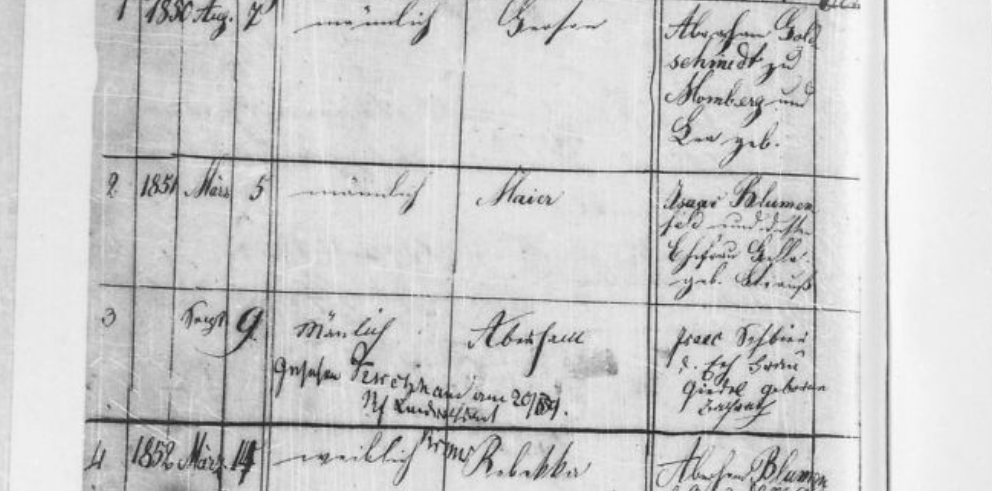
Gerson II was born on April 29, 1853, in Momberg, Germany.

Geburtsregister der Juden von Momberg (Neustadt) 1850-1874 (HHStAW Abt. 365 Nr. 608)AutorHessisches Hauptstaatsarchiv, WiesbadenErscheinungsjahr1850-1874, p. 4

On August 23, 1883, he married Mina Katz, daughter of Joseph Feist Katz and Brendel Katz. Mina was born on June 7, 1860, in Jesberg, Germany.

Hessisches Hauptstaatsarchiv; Wiesbaden, Deutschland; Bestand: 920; Laufende Nummer: 3838
Year Range: 1883, Ancestry.com. Hesse, Germany, Marriages, 1849-1930

As soon as I saw that Mina was born in Jesberg and was a Katz, I figured she must also be related to me. Mina is my third cousin, three times removed, and is descended from my five-times great-grandfather Schalum Katz of Jesberg through his son Salomon Katz. So both Mina and Gerson II were my cousins, but they were not related to each other as far as I have been able to determine.


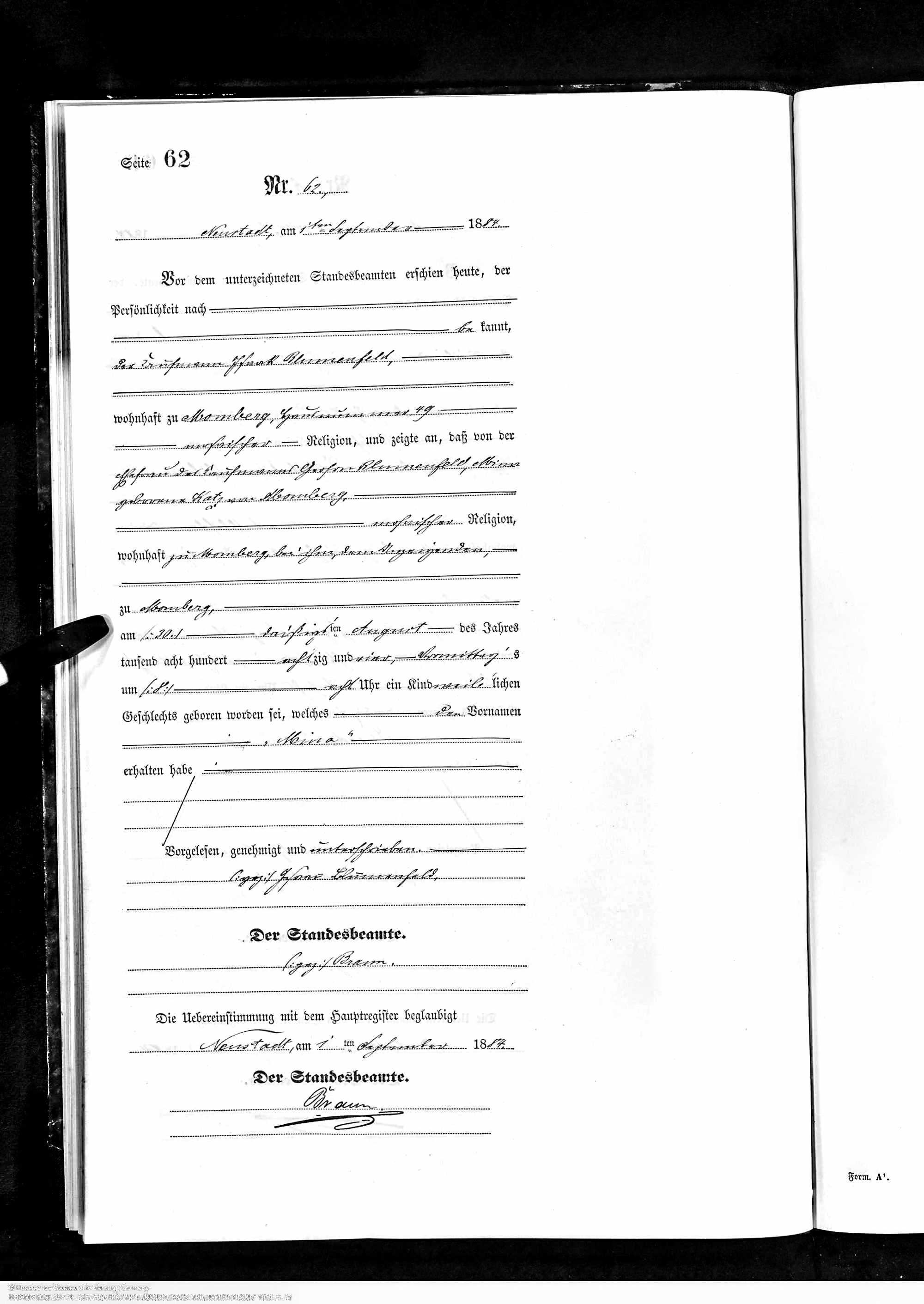
Gerson II and Mina had a daughter born in Momberg on August 30, 1884, and tragically Mina died the following day, presumably from complications from childbirth. She was only twenty-four years old. Their one-day old infant was named for her mother Mina.

Mina Blumenfeld birth record, Hessisches Hauptstaatsarchiv; Wiesbaden, Deutschland; Bestand: 915; Laufende Nummer: 6467, Year Range: 1884, Ancestry.com. Hesse, Germany, Births, 1851-1901

Mina Katz Blumenfeld death record, Hessisches Hauptstaatsarchiv; Wiesbaden, Deutschland; Personenstandsregister Sterberegister; Bestand: 6551; Laufende Nummer: 915, Year Range: 1884
Ancestry.com. Hesse, Germany, Deaths, 1851-1958

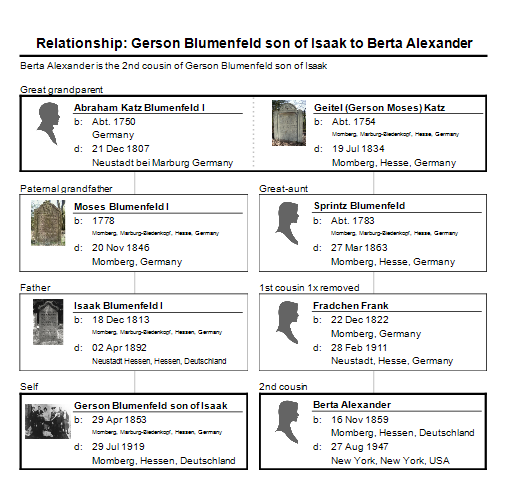
Gerson II remarried two years later on June 2, 1886. His second wife was Berta Alexander. She was born on November 16, 1859, and was the daughter of Joseph Alexander and Fradchen Frank, and like Gerson II’s first wife, Berta was also my cousin, specifically my second cousin, three times removed. Berta was the great-granddaughter of Abraham Katz Blumenfeld and Geitel Katz, my four-times great-grandparents. She also was a second cousin to her husband Gerson II, who was also a great-grandchild of Abraham Katz Blumenfeld.

Gerson Blumenfeld marriage to Berta Alexander, Hessisches Hauptstaatsarchiv; Wiesbaden, Deutschland; Bestand: 915; Laufende Nummer: 6496, Year Range: 1886, Ancestry.com. Hesse, Germany, Marriages, 1849-1930

Thus, all the children of Gerson II and Berta were not just siblings, but also each other’s third cousins. And the descendants of Gerson II and Mina were my double cousins since I was related to both of them. Oy vey! No wonder I can’t sort out my DNA matches…

But onto the children of Gerson II and Berta. Their first child Moritz was born on March 16, 1887, in Momberg, Germany.

Moritz Blumenfeld II birth record, Hessisches Hauptstaatsarchiv; Wiesbaden, Deutschland; Bestand: 915; Laufende Nummer: 6470, Year Range: 1887, Ancestry.com. Hesse, Germany, Births, 1851-1901

Their second child, Siegmond Friedrich “Fritz” Blumenfeld, was born on December 7, 1888, in Momberg, Germany.

Siegmund Friedrich Blumenfeld birth record,Hessisches Hauptstaatsarchiv; Wiesbaden, Deutschland; Bestand: 915; Laufende Nummer: 6471, Year Range: 1888, Ancestry.com. Hesse, Germany, Births, 1851-1901

Katinka, their third child and oldest daughter, was born in Momberg on July 30, 1891.

Katinka Blumenfeld birth record, Hessisches Hauptstaatsarchiv; Wiesbaden, Deutschland; Bestand: 915; Laufende Nummer: 6474, Year Range: 1891, Ancestry.com. Hesse, Germany, Births, 1851-1901

Isaak Blumenfeld (labeled III on my tree) was born September 24, 1893, in Momberg.

Isaak Blumenfeld III birth record, Hessisches Hauptstaatsarchiv; Wiesbaden, Deutschland; Bestand: 915; Laufende Nummer: 6476, Year Range: 1893, Ancestry.com. Hesse, Germany, Births, 1851-1901

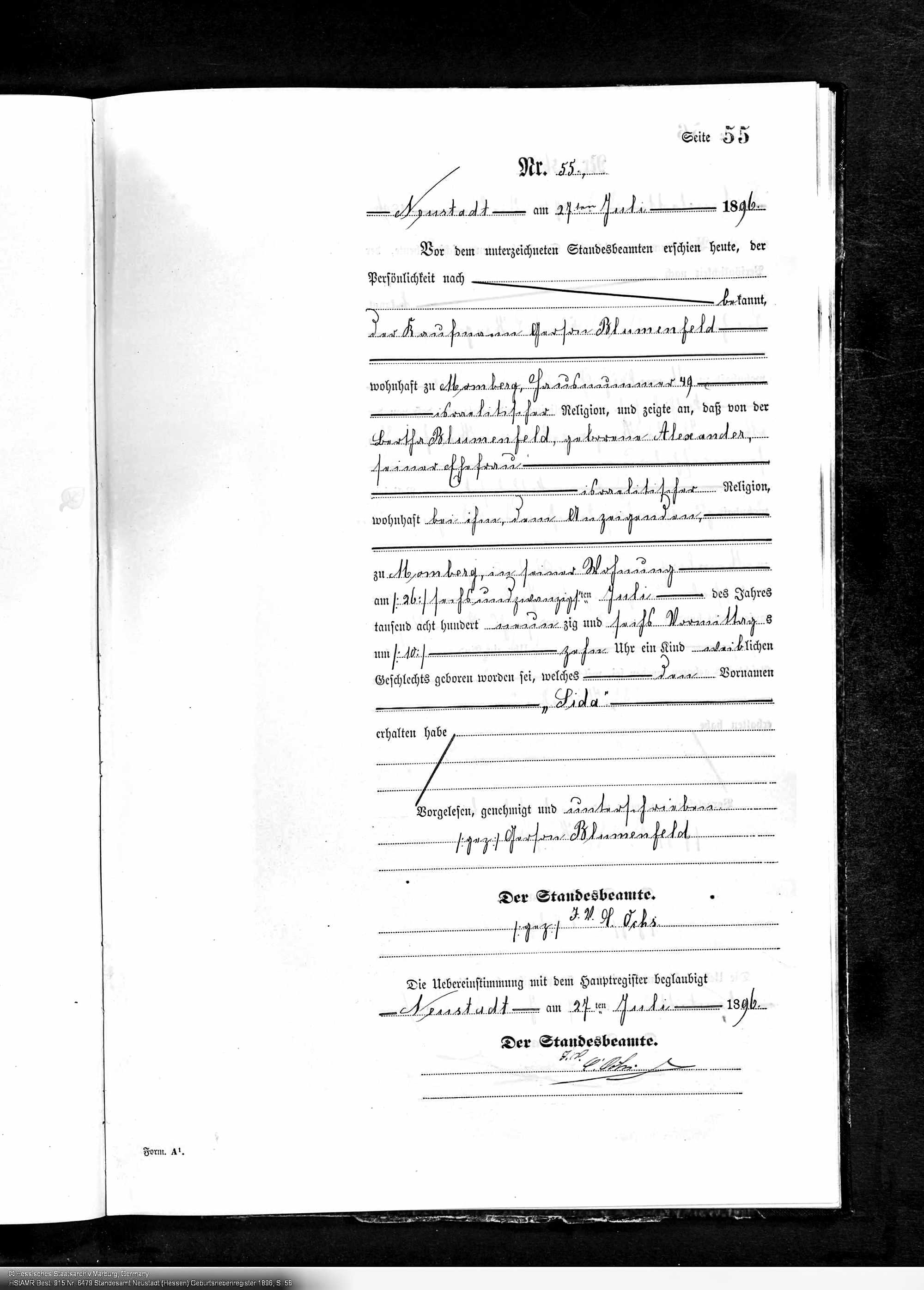
The fifth and youngest child of Gerson II and Berta was their daughter Sida (sometimes spelled Sitta), born in Momberg on July 26, 1896.

Birth record for Sida Blumenfeld, Hessisches Hauptstaatsarchiv; Wiesbaden, Deutschland; Bestand: 915; Laufende Nummer: 6479, Year Range: 1896, Ancestry.com. Hesse, Germany, Births, 1851-1901

Mina Blumenfeld, Gerson II’s daughter with his wife Mina Katz, married Albert Simon on October 31, 1910, in Momberg. Albert was the son of Joseph Simon and Guste Aumann, and he was born on November 17, 1879, in Hermannstein, Germany.

Mina Blumenfeld marriage to Albert Simon, Hessisches Hauptstaatsarchiv; Wiesbaden, Deutschland; Bestand: 915; Laufende Nummer: 6195, Year Range: 1910, Ancestry.com. Hesse, Germany, Marriages, 1849-1930

Mina and Albert had four children.

UPDATE: I just located a death record for a fifth child of Mina and Albert born before Julius. That child, a son named Dedo, died on January 16, 1912, in Hermannstein. He was only a day old.

Dedo Simon death record, Hessisches Hauptstaatsarchiv; Wiesbaden, Deutschland; Personenstandsregister Sterberegister; Bestand: 4342; Laufende Nummer: 911
Description
Year Range: 1912
Source Information
Ancestry.com. Hesse, Germany, Deaths, 1851-1958

Their second child, Julius, was born in 1913 and died when he was only two years old on May 31, 1915.

Julius Simon death record, Hessisches Hauptstaatsarchiv; Wiesbaden, Deutschland; Personenstandsregister Sterberegister; Bestand: 4345; Laufende Nummer: 911, Year Range: 1915
Ancestry.com. Hesse, Germany, Deaths, 1851-1958

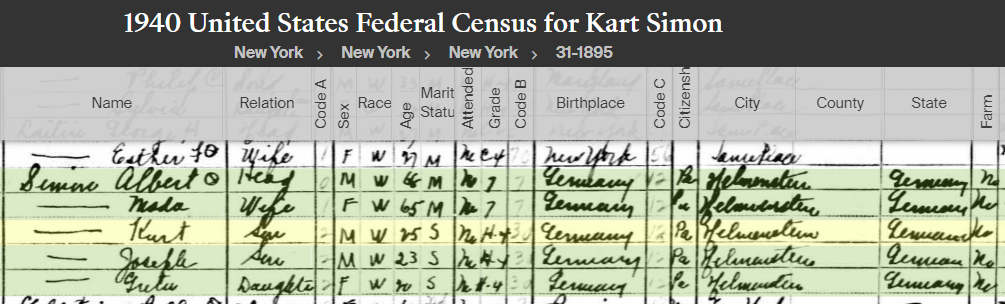
Mina and Albert’s third child Kurt was born on November 10, 1914.1 Their fourth son Joseph was born on October 26, 1916.2 And their fifth child and only daughter Grete was born December 23, 1919.3 Fortunately, these three children all survived to adulthood.

My cousin Michael shared with me this beautiful photograph taken before World War I of Gerson II and Berta with their five children as well as Gerson’s daughter Mina from his first marriage.

Gerson and Berta Blumenfeld and their children c. 1911

From left to right in the back row, they are Isaak, Fritz, Mina, Katinka, Moritz, and Sida. Berta and Gerson are seated in front of them, and the family dog lies at their feet. How can I not love a family that includes their dog in the family portrait?


  1. Kurt Simon, Gender: Male, Birth Date: 10 Nov 1914, Death Date: Jun 1969, Claim Date: 17 Jul 1969, SSN: 131102677, Ancestry.com. U.S., Social Security Applications and Claims Index, 1936-2007 
  2. Josef Simon, [Joe Simon], Gender: Male, Race: White, Birth Date: 26 Oct 1916
    Birth Place: Hermanuskin, Federal Republic of Germany, Death Date: 30 Oct 2001
    Father: Albert Simon, Mother: Meta Blumenfeld, SSN: 116034007, Ancestry.com. U.S., Social Security Applications and Claims Index, 1936-2007. 
  3.  National Archives at Boston; Waltham, Massachusetts; ARC Title: Petitions and Records For Naturalization, 10/1911-9/1991; NAI Number: 615479; Record Group Title: Records of District Courts of the United States, 1685-2009; Record Group Number: Rg 21, Description: Vol173-175, Petition No 40197, Paul Saban, 24 Mar 1944 – Petition No 407321, Sophie Bursack, 16 June 1944, Ancestry.com. Connecticut, U.S., Federal Naturalization Records, 1790-1996 

Meier Blumenfeld IIB, Part I: Of His Five Children, Only Three Survived Childhood

I am now up to the sixth child of Isaak Blumenfeld and his wife Gelle Strauss, their son Meier, whom I’ve labeled Meier Blumenfeld IIB to distinguish him from his first cousin Meier Blumenfeld IIA and the other Meier Blumenfelds on my tree.

Meier IIB was born on March 5, 1851, in Momberg, Germany.

Meier Blumenfeld IIB, birth record, Geburtsregister der Juden von Momberg (Neustadt) 1850-1874 (HHStAW Abt. 365 Nr. 608)AutorHessisches Hauptstaatsarchiv, WiesbadenErscheinungsjahr1850-1874, p. 3

He married Sarchen or Sarah Moses on November 27, 1877, in Treysa, Germany, where Sarchen was born on May 13, 1846, to Moses Moses and Roschen Schwalmberg.

Meier Blumenfeld IIB, marriage record, Hessisches Hauptstaatsarchiv; Wiesbaden, Deutschland; Bestand: 920; Laufende Nummer: 7986, Year Range: 1877, Ancestry.com. Hesse, Germany, Marriages, 1849-1930.

Meier IIB and Sarchen had five children. Their first, Moses (labeled Moses Blumenfeld III to distinguish him for all the other Moses Blumenfelds on my tree) was born on May 16, 1879, in Neustadt, Germany, where Meier IIB and Sarchen had settled.

Moses Blumenfeld III, birth record, Hessisches Hauptstaatsarchiv; Wiesbaden, Deutschland; Bestand: 915; Laufende Nummer: 6462, Ancestry.com. Hesse, Germany, Births, 1851-1901

The second child was Hermann (labeled Hermann Blumenfeld III), born the following year in Neustadt on August 8, 1880.

Herman Blumenfeld IV birth record, Hessisches Hauptstaatsarchiv; Wiesbaden, Deutschland; Bestand: 915; Laufende Nummer: 6463, Ancestry.com. Hesse, Germany, Births, 1851-1901

Then came Rosa, Meier IIB and Sarchen’s only daughter. She was born in Neustadt on July 10, 1883.

Rosa Blumenfeld II birth record, Hessisches Hauptstaatsarchiv; Wiesbaden, Deutschland; Bestand: 915; Laufende Nummer: 6466,Year Range: 1883, Ancestry.com. Hesse, Germany, Births, 1851-1901

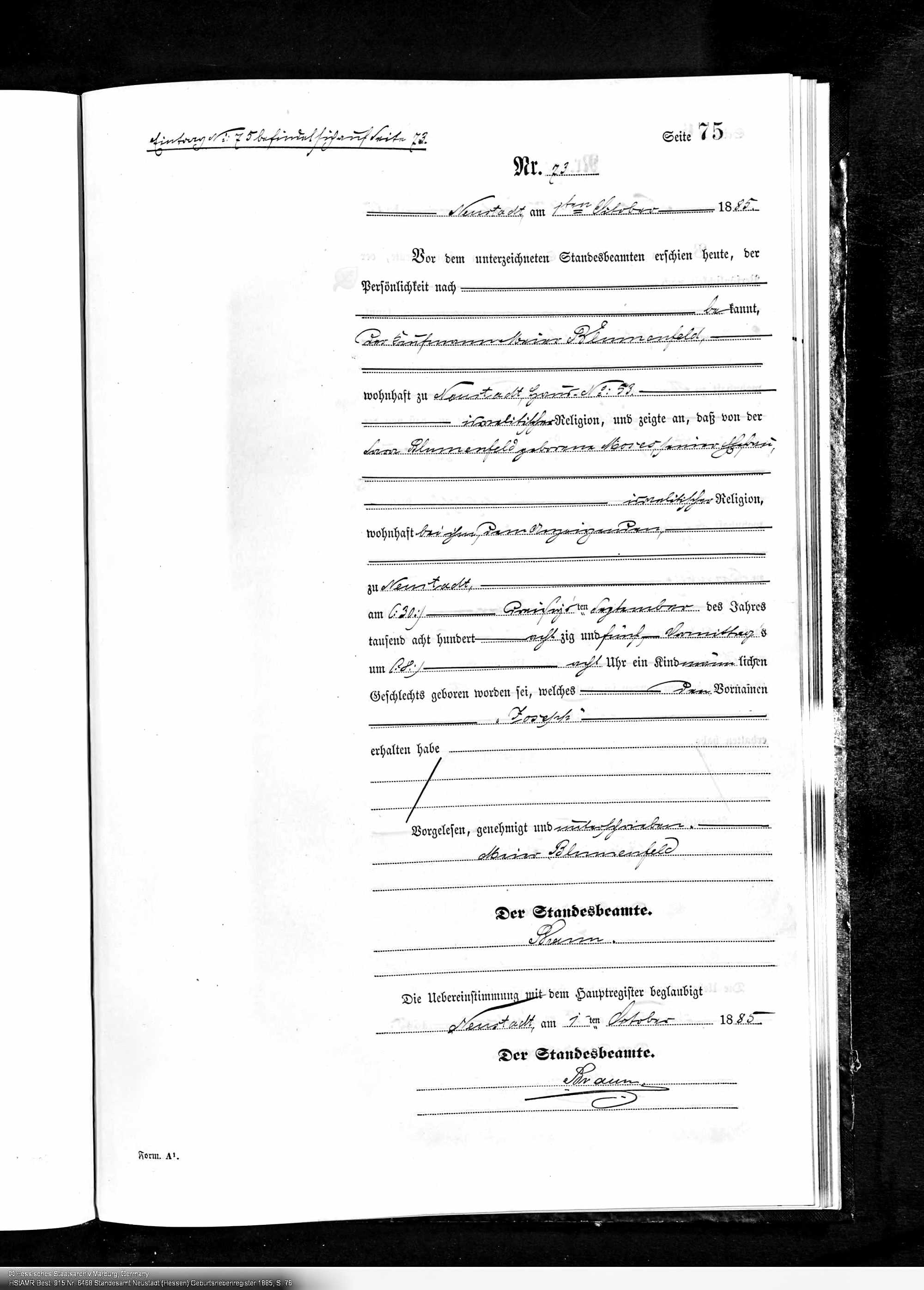
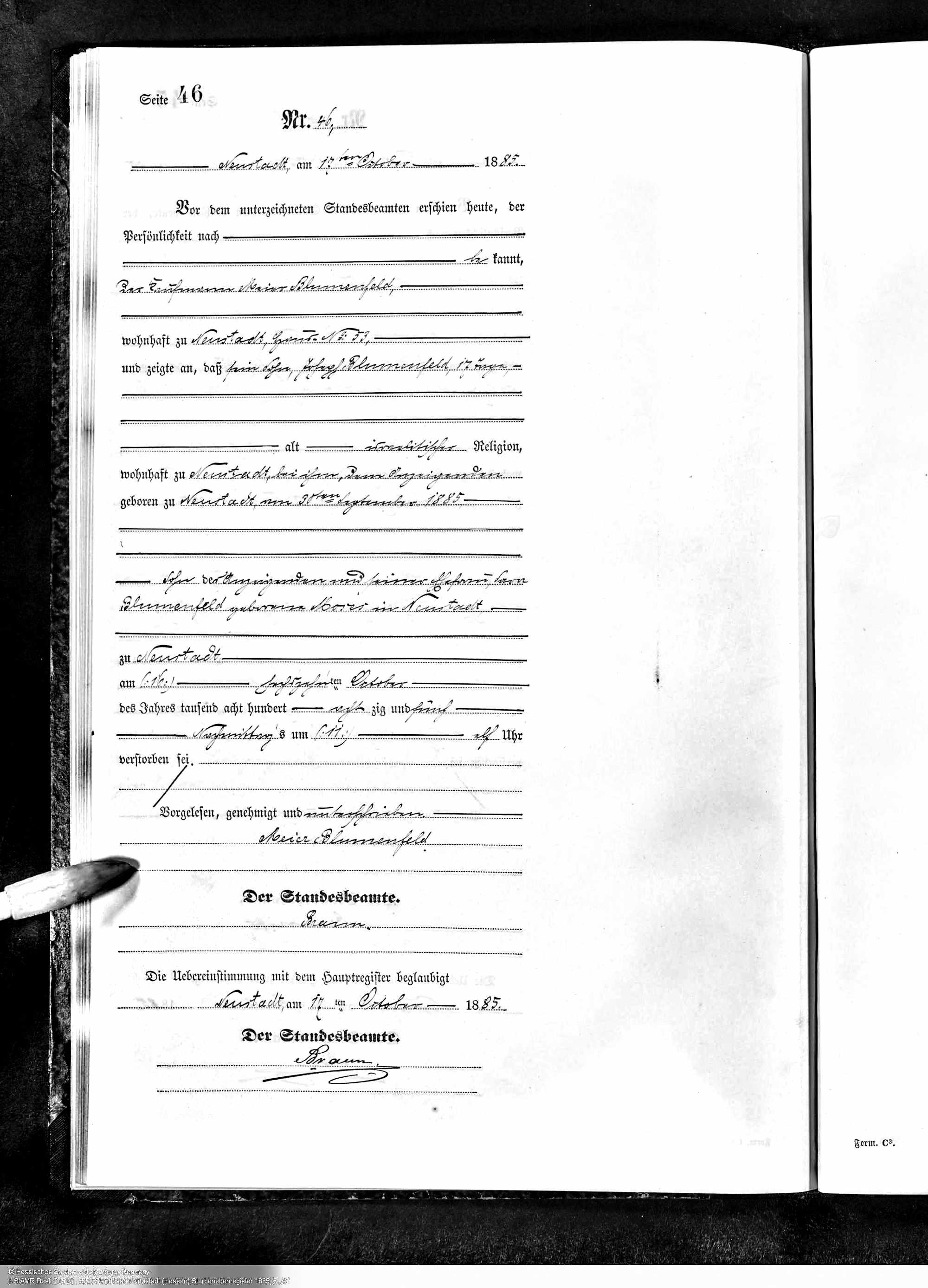
Two more sons followed Rosa, but neither survived to adulthood. Joseph was born on September 30, 1885, but died just sixteen days later on October 16, 1885, in Neustadt.

Joseph Blumenfeld birth record, Hessisches Hauptstaatsarchiv; Wiesbaden, Deutschland; Bestand: 915; Laufende Nummer: 6468, Year Range: 1885, Ancestry.com. Hesse, Germany, Births, 1851-1901

Joseph Blumenfeld death record, Hessisches Hauptstaatsarchiv; Wiesbaden, Deutschland; Personenstandsregister Sterberegister; Bestand: 6552; Laufende Nummer: 915, Ancestry.com. Hesse, Germany, Deaths, 1851-1958

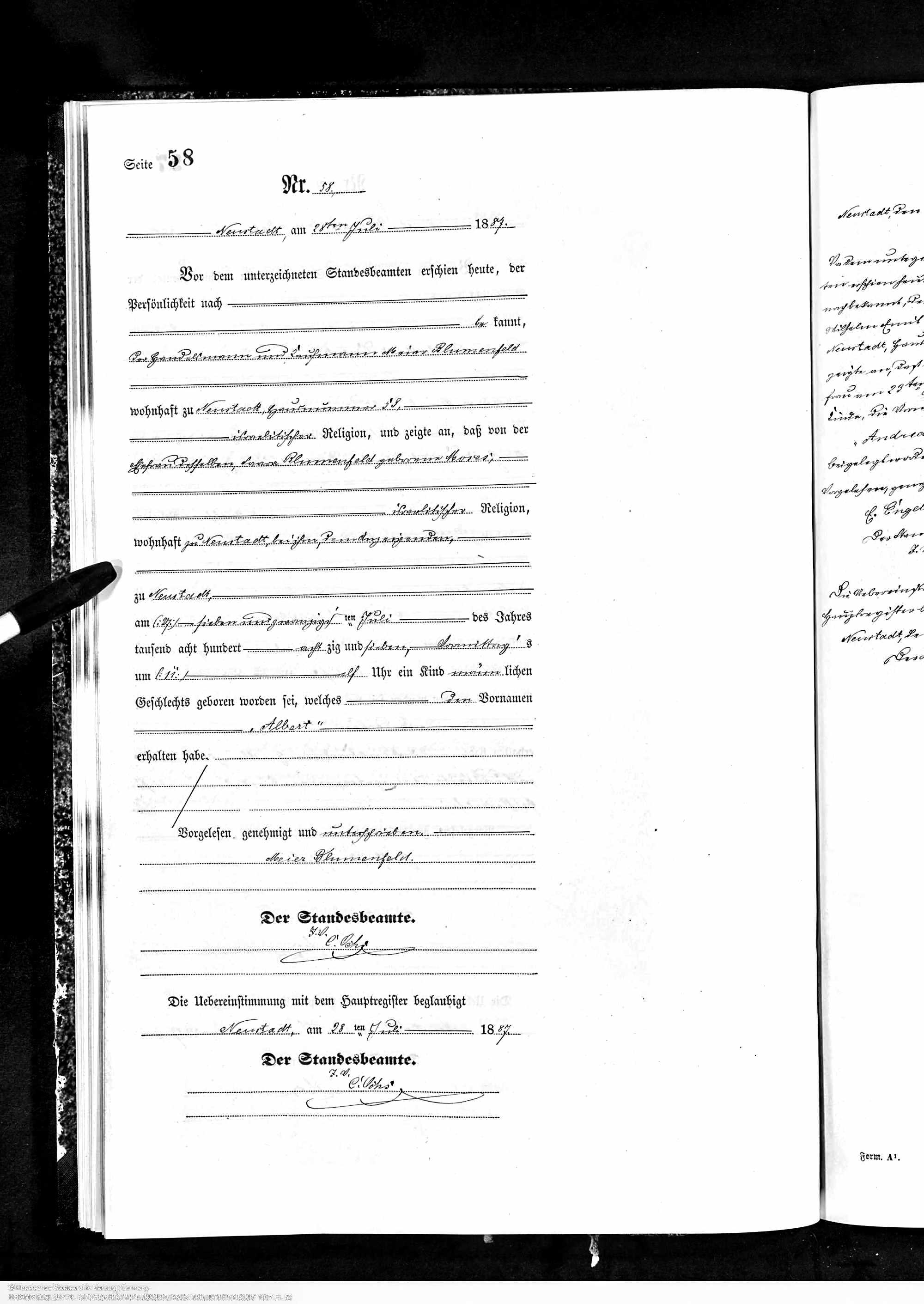
And Albert was born on July 17, 1887, in Neustadt, and died on November 29, 1890, in Neustadt. He was only three years old.

Albert Blumenfeld birth record, Hessisches Hauptstaatsarchiv; Wiesbaden, Deutschland; Bestand: 915; Laufende Nummer: 6470, Year Range: 1887, Ancestry.com. Hesse, Germany, Births, 1851-1901

Albert Blumenfeld death record, Hessisches Hauptstaatsarchiv; Wiesbaden, Deutschland; Personenstandsregister Sterberegister; Bestand: 6557; Laufende Nummer: 915
Description Year Range: 1890, Ancestry.com. Hesse, Germany, Deaths, 1851-1958

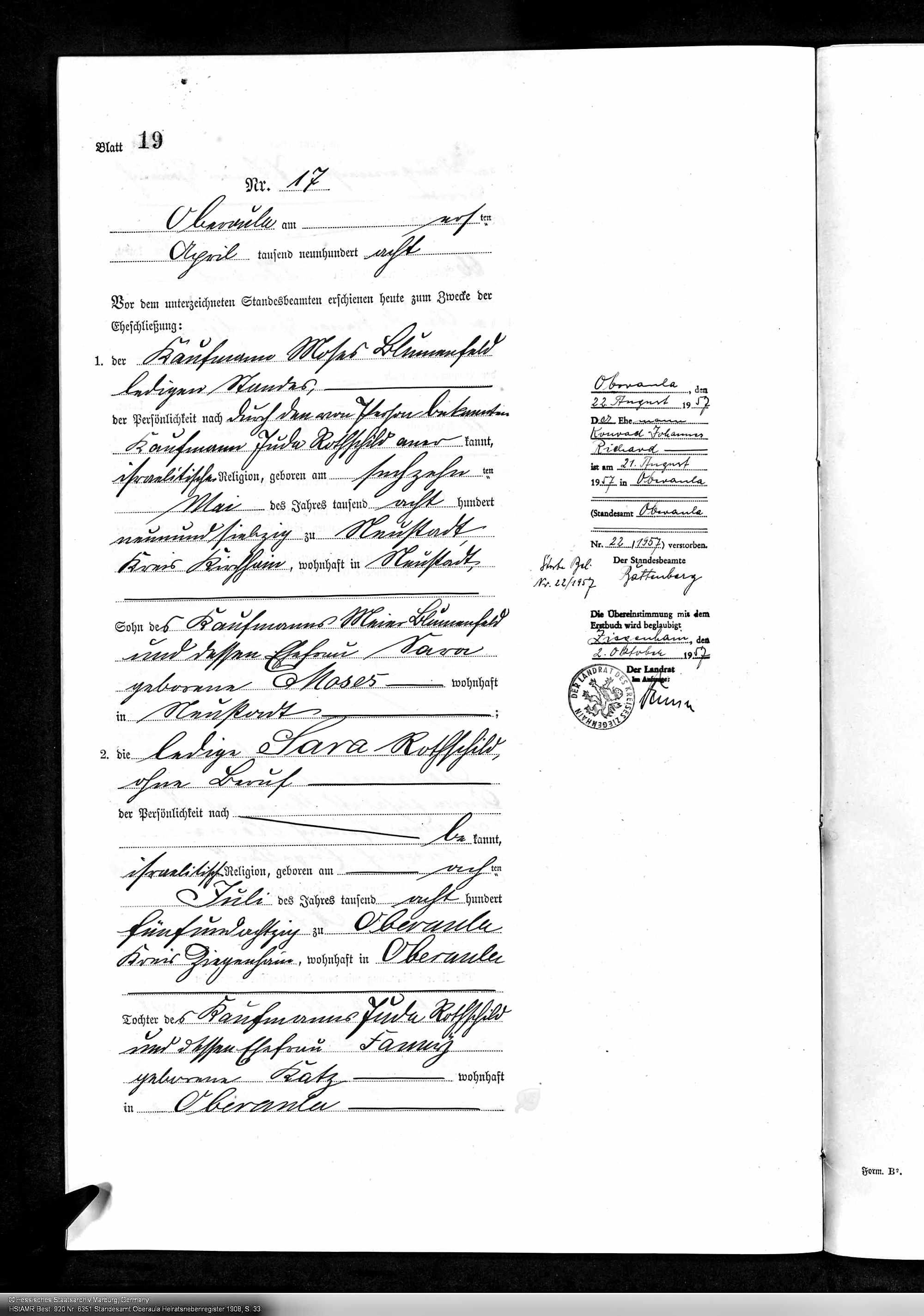
The three children who survived all married. Moses III married Sara Rothschild on April 1, 1908, in Oberaula, Germany. She was born to Juda Rothschild and Fanny Katz on July 8, 1885, in Oberaula.

Moses Blumenfeld III marriage record, Hessisches Hauptstaatsarchiv; Wiesbaden, Deutschland; Bestand: 920; Laufende Nummer: 6351, Ancestry.com. Hesse, Germany, Marriages, 1849-1930

Although I have no records to substantiate the date, other family trees report that Moses III and Sara had one child, a son Julius (labeled Julius Blumenfeld III on my tree) born April 4, 1909. More on Julius to come in my next post.

Moses III’s brother Hermann Blumenfeld III married Else Rosa Drucker on November 20, 1911, in Battenberg, Germany. Else was born in Battenberg on June 30, 1888, to Jakob Drucker and Julie LeBach.

Hermann Blumenfeld IV marriage record, Hessisches Hauptstaatsarchiv; Wiesbaden, Deutschland; Signatur: 1036, Year Range: 1911, Ancestry.com. Hesse, Germany, Marriages, 1849-1930

Hermann III and Else had three children. Erich was born in Neustadt, Germany, on April 4, 1913 or 1914 (documents differ).1 His sister Hilde was born on June 18, 1915, in Neustadt.2 And Liselotte Brilea Ingeborg Blumenfeld was born on November 23, 1917, in Marburg, Germany.3

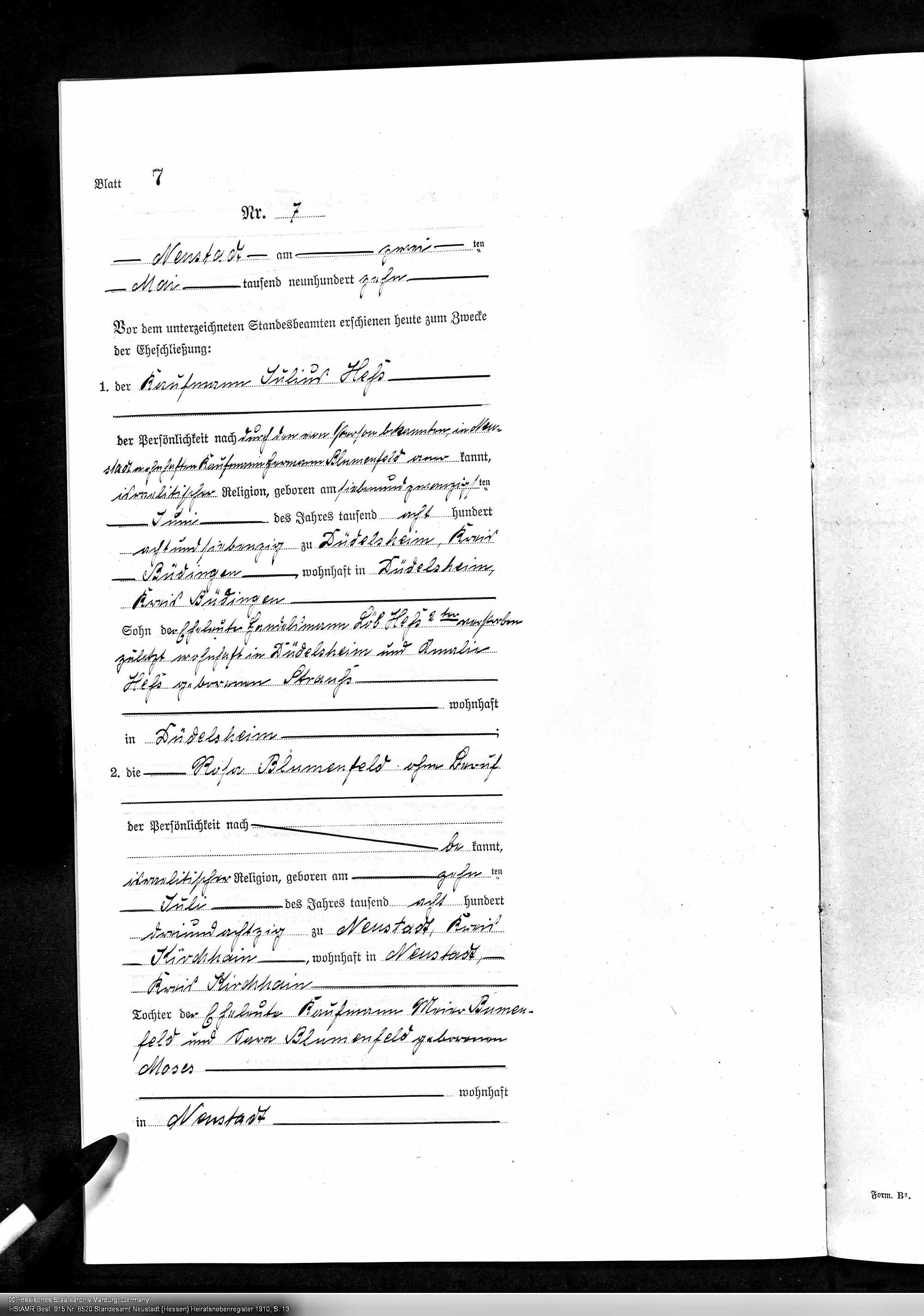
The third surviving child of Meier IIB and Sarchen, Rosa Blumenfeld II, married Julius Hess on May 2, 1910, in Neustadt. He was born in Duedelsheim, Germany, to Loeb Hess and Amalia Strauss on June 27, 1878. As far as I’ve been able to determine, Rosa and Julius did not have any children.

Rosa Blumenfeld II marriage record, Hessisches Hauptstaatsarchiv; Wiesbaden, Deutschland; Bestand: 915; Laufende Nummer: 6520, Year Range: 1910, Ancestry.com. Hesse, Germany, Marriages, 1849-1930

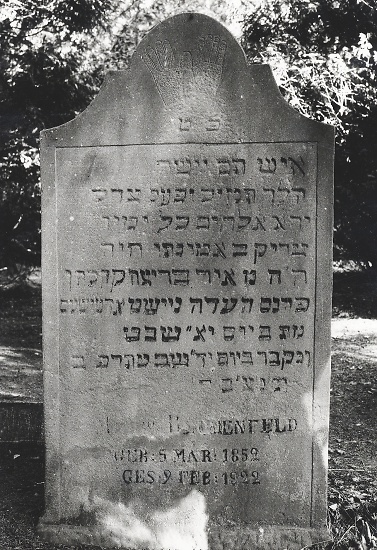
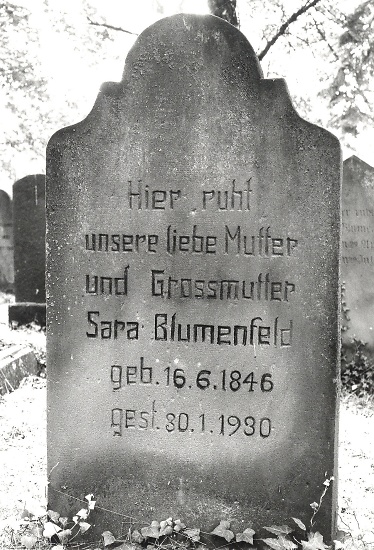
Meier Blumenfeld IIB died on February 9, 1922, in Neustadt, at the age of seventy. His wife Sarchen died eight years later on January 30, 1930, in Duedelsheim, where her daughter Rosa was living. Meier and Sarchen were predeceased by their sons Joseph and Albert and survived by their other three children, Moses, Hermann, and Rosa, and their four grandchildren, Julius, Erich, Hilde, and Liselotte.

Meier Blumenfeld IIB gravestone, found at the LAGIS Hessen Jewish Cemetery website at https://www.lagis-hessen.de/en/subjects/idrec/sn/juf/id/5416

Meier IIB and Sarchen were fortunate not to live to see what happened to those three children and one of those grandchildren.

TO BE CONTINUED


  1. For April 4, 1913, I have this source: Erich Blümenfeld
    Birth Date: 4 Apr 1913, https://www.wiewaswie.nl/personen-zoeken/zoeken/document/srcid/062981177#011, Regionaal Archief Zutphen; Den Haag, Nederland; Bevolkingsregisters, Ancestry.com. Netherlands, Population Registers Index, 1720-1944. For 1914, I have Erich’s Palestine immigration files, found at https://www.archives.gov.il/archives/Archive/0b07170680034dc1/File/0b07170680f4a85c 
  2. Amsterdam City Archives, located at https://archief.amsterdam/indexen/deeds/9853344d-c3b0-56a3-e053-b784100ade19; Yad Vashem entry, found at https://yvng.yadvashem.org/nameDetails.html?language=en&itemId=899652&ind=1 
  3. Liselotte Blumenfeld, Declaration of Intention, The National Archives at Atlanta; Atlanta, GA; Petitions For Naturalization , Compiled 1906-1978; NAI: 1275754; Record Group Title: Records of District Courts of the United States; Record Group Number: 21, Petitions For Naturalization, Compiled 1906-1978, Ancestry.com. Kentucky, U.S., Naturalization Records, 1906-1991 

Dusschen Blumenfeld Strauss, Part II: Escaping from Germany

I know it’s been a while since my last genealogy post. Between the death of my cat Smokey and all the chaos involved with moving, I’ve had neither the time nor the inclination. But now I am dipping my toe back in genealogical waters.

As seen in my last Blumenfeld post, three of the seven children of Dusschen Blumenfeld and Isaac Strauss left Germany in the late 19th, early 20th century for the United States. Moritz, the oldest son, left in 1889 and married there and had two children. Bertha, the oldest daughter, married in New York in 1901 and had her first child there, but returned to Germany by 1909 when her second child was born. And Meier, the third son and fifth child of Dusschen and Isaac, immigrated to the US in 1904 and remained, marrying and having two children born in the US.

During that same period, most of Dusschen and Isaac’s children who were still in Germany also married and had children. But unfortunately, the youngest child of Dusschen and Isaac, their son Sali (spelled Sally on this gravestone), died at a young age. He was only twenty years old when he died on February 12, 1906.

Hermann, the second son and fourth child, married Julie (Julchen) Alexander in Wetter on June 22, 1906. Julchen was born to Abraham Alexander and Roschen Rosenblatt on May 30, 1881, in Waltersbruck, Germany.

Marriage record of Hermann Strauss and Julchen Alexander,Hessisches Hauptstaatsarchiv; Wiesbaden, Deutschland; Bestand: 915; Laufende Nummer: 9573, Year: 1906, Ancestry.com. Hesse, Germany, Marriages, 1849-1930

Hermann and Julchen had three children. Sally (later Robert) was born in Wetter on July 3, 1907.1 He was presumably named for Hermann’s brother Sally who had died the year before. A second child Max was born to Hermann and Julchen on May 28, 1910, in Wetter.2 And their daughter Ilse was born in Marburg on February 3, 1915.3

Dusschen and Isaac’s sixth child Rebekah married Albert Meyer on May 14, 1907, in Bonn, Germany. Albert was born in Bonn on July 18, 1872.4 Rebekah and Albert had two children: Rudolph Raphael, born in Bonn on March 17, 1908,5 and Ilse, born in Bonn on August 20, 1910.6

Thus, by 1915, Dusschen and Isaac had nine grandchildren with two more to be born between 1916 and 1920. Four of those grandchildren were in the US with their parents, and the others were all in Germany.

Sadly, Isaac Strauss did not live to see the births of those last two grandchildren. He died on October 2, 1916, in Wetter.7 He was survived by his wife Dusschen Blumenfeld Strauss, who died twelve years later on October 11, 1928. They were survived by six of their seven children, four of whom were still living in Germany when Hitler came to power in 1933.

Dusschen Blumenfeld Strauss death record, Hessisches Hauptstaatsarchiv; Wiesbaden, Deutschland; Personenstandsregister Sterberegister; Bestand: 9652; Laufende Nummer: 915
Year Range: 1928, Ancestry.com. Hesse, Germany, Deaths, 1851-1958

Fortunately, three of those remaining in Germany were lucky to leave in time to escape being killed in the Holocaust. Hermann, the only surviving brother who was still in Germany, arrived in the US on November 28, 1934, with his wife Julchen and daughter Ilse. Their younger son Max had preceded them by nine months, immigrating to the US on February 5, 1934.8

Hermann Strauss ship manifest, Year: 1934; Arrival: New York, New York, USA; Microfilm Serial: T715, 1897-1957; Line: 11; Page Number: 83,Ship or Roll Number: Manhattan, Ancestry.com. New York, U.S., Arriving Passenger and Crew Lists (including Castle Garden and Ellis Island), 1820-1957

Their older son Sally had immigrated years before, arriving on October 28, 1926, when he was nineteen. When he filed a Declaration of Intention to become a US citizen on October 19, 1927, he was using the name Sol, working as a salesman, and living in New York City.9 He became a naturalized citizen in 1933 in Rockford, Illinois, and changed his name to Robert Sally Strauss.

Robert Sally Strauss naturalization record, National Archives at Chicago; Chicago, Illinois; ARC Title: Petitions for Naturalization for the United States District and Circuit Courts, Northern District of Illinois and Immigration and Naturalization Service District 9, 1840-1950; NAI Number: M1285; Record Group Title: Records of the Immigration and Naturalization Service; Record Group Number: RG 85  Description: Index to Naturalization Petitions, S-352 H· to S-362 Vyncenz, Ancestry.com. Illinois, U.S., Federal Naturalization Records, 1856-1991

Hermann’s sister Bertha Strauss Herz, who had previously lived and married in New York, returned to the US with her husband Morris (Moritz on the manifest) Herz on August 16, 1936. Their daughter Henrietta arrived on the same ship with her husband Alfred Gaertner and their eleven-year-old daughter Ingeborg. Both Alfred and Morris listed their occupations as tailors on the ship manifest. Alfred, who was born in Brohl, Germany, on August 9, 1895, had married Henrietta in Bonn on July 29, 1923, and their daughter Ingeborg was born on February 22, 1925.10

Herz and Gaetner families, ship manifest, Year: 1936; Arrival: New York, New York, USA; Microfilm Serial: T715, 1897-1957; Line: 10; Page Number: 47, Ship or Roll Number: Britannic
Ancestry.com. New York, U.S., Arriving Passenger and Crew Lists (including Castle Garden and Ellis Island), 1820-1957

Bertha and Morris Herz’s son Manfred Edgar Herz did not immigrate until July 28, 1939. On the ship manifest he listed his occupation as auto mechanic and his last residence as Frankfurt.11

Rebekka Strauss Meyer was the last sibling to come to the US, arriving on March 25, 1938.12 She had lost her husband Albert on May 26, 1928, in Bonn. Rebekka’s children had arrived before her, Rudolph on April 12, 1937, listing his occupation as an insurance agent,13 and Ilse on May 9, 1937. Ilse was working as a nursemaid in New York when she filed her declaration of intention on August 4, 1937.14

Only one sibling remained in Germany as of 1939, the third child of Dusschen Blumenfeld and Isaac Strauss, their daughter Kathinka, who had never married. She died on November 8, 1940, in the Krankenhaus Judische Kultusvereinigung (the Jewish Religious Association Hospital) in Frankfurt from a bile duct obstruction and jaundice. She was 65 years old. Kathinka was survived by her five surviving siblings and their children.

Kathinka Strauss death record, Hessisches Hauptstaatsarchiv; Wiesbaden, Deutschland; Personenstandsregister Sterberegister; Signatur: 11114; Laufende Nummer: 903, Year Range: 1940, Ancestry.com. Hesse, Germany, Deaths, 1851-1958

All five of those siblings and all the grandchildren of Dusschen Blumenfeld and Isaac Strauss were safely out of Germany by that time and survived the Holocaust. More on their lives in the US in the next two posts.


  1. Sol Strauss, Declaration of Intention, he National Archives at Philadelphia; Philadelphia, Pennsylvania; NAI Title: Declarations of Intention for Citizenship, 1/19/1842 – 10/29/1959; NAI Number: 4713410; Record Group Title: Records of District Courts of the United States, 1685-2009; Record Group Number: 21, Description
    Description: (Roll 379) Declarations of Intention for Citizenship, 1842-1959 (No 248601-249750), Ancestry.com. New York, U.S., State and Federal Naturalization Records, 1794-1943 
  2. Max Strauss, Gender: Male, Race: White, Marital Status: Single, Marriage Age: 28
    Birth Date: 28 May 1910, Birth Place: Walter Germany, Marriage Affidavit Date: 2 May 1939, Marriage Date: 7 May 1939, Marriage Place: New York, Manhattan, New York, New York, USA, Residence Street Address: 4520 Broadway, Residence Place: New York, Manhattan, Occupation: Route Salesman, Father: Hermann Strauss, Mother:
    Julie Strauss, Spouse: Betty Heinemann, Certificate Number: 5322, Current Marriage Number: 0, New York City Department of Records & Information Services; New York City, New York; New York City Marriage Licenses; Borough: Manhattan; Year: 1939, Ancestry.com. New York, New York, Index to Marriage Licenses, 1908-1910, 1938-1940 
  3. Ilse Strauss, [Ilse Strauss Wurzburger], Gender: Female, Race: White, Birth Date: 3 Feb 1915, Birth Place: Federal Republic of Germany, Death Date: 23 Feb 2006, Father: Herman Strauss, Mother: Julia Alexander, SSN: 059077009, Ancestry.com. U.S., Social Security Applications and Claims Index, 1936-2007 
  4. Rebecka Meyer, Declaration of Intention, The National Archives at Philadelphia; Philadelphia, Pennsylvania; NAI Title: Declarations of Intention for Citizenship, 1/19/1842 – 10/29/1959; NAI Number: 4713410; Record Group Title: Records of District Courts of the United States, 1685-2009; Record Group Number: 21, Ancestry.com. New York, U.S., State and Federal Naturalization Records, 1794-1943 
  5. Rudolph Raphael Meyer, Record Type: Naturalization, Birth Date: 17 Mar 1908
    Birth Place: Bonn, Prussia, Germany, Arrival Date: 12 Apr 1937, Arrival Place: New York NY, Naturalization Place: Tennessee, USA, Spouse: Ruth Cohn Meyer, National Archives and Records Administration; Washington, D.c.; Record Group Title: Records of District Courts of the United States; Record Group Number: 21, Ancestry.com. Tennessee, U.S., Naturalization Records, 1888-1992 
  6. Ilse Meyer, Record Type: Petition, Birth Date: 20 Aug 1910, Birth Place: Germany
    Arrival Date: 1937, Residence Place: New York, USA, Petition Date: 4 Aug 1937, Petition Place: New York, USA, Court: District Court, Court District: Southern District, New York, Description: (Roll 1449) Petition No. 433501 – Petition No. 433836, The National Archives and Records Administration; Washington, D.C.; Petitions for Naturalization from the U.S. District Court for the Southern District of New York, 1897-1944; Series: M1972; Roll: 1449, Ancestry.com. New York, U.S., Naturalization Records, 1882-1944; Rebecka Meyer, Declaration of Intention, The National Archives at Philadelphia; Philadelphia, Pennsylvania; NAI Title: Declarations of Intention for Citizenship, 1/19/1842 – 10/29/1959; NAI Number: 4713410; Record Group Title: Records of District Courts of the United States, 1685-2009; Record Group Number: 21, Ancestry.com. New York, U.S., State and Federal Naturalization Records, 1794-1943 
  7.  Hessisches Hauptstaatsarchiv; Wiesbaden, Deutschland; Personenstandsregister Sterberegister; Bestand: 9640; Laufende Nummer: 915, Ancestry.com. Hesse, Germany, Deaths, 1851-1958 
  8. Max Strauss ship manifest, Year: 1934; Arrival: New York, New York, USA; Microfilm Serial: T715, 1897-1957; Line: 3; Page Number: 120, Ancestry.com. New York, U.S., Arriving Passenger and Crew Lists (including Castle Garden and Ellis Island), 1820-1957 
  9. See Note 1, supra. 
  10. Alfred Gaertner, Declaration of Intention, The National Archives at Philadelphia; Philadelphia, Pennsylvania; NAI Title: Declarations of Intention for Citizenship, 1/19/1842 – 10/29/1959; NAI Number: 4713410; Record Group Title: Records of District Courts of the United States, 1685-2009; Record Group Number: 21, Description: (Roll 514) Declarations of Intention for Citizenship, 1842-1959 (No 392101-393200), Ancestry.com. New York, U.S., State and Federal Naturalization Records, 1794-1943 
  11. Manfred Herz, ship manifest, Year: 1939; Arrival: New York, New York, USA; Microfilm Serial: T715, 1897-1957; Line: 19; Page Number: 37, Description Ship or Roll Number: New York, Ancestry.com. New York, U.S., Arriving Passenger and Crew Lists (including Castle Garden and Ellis Island), 1820-1957 
  12. See Note 4, supra. 
  13. See Note 4, supra. 
  14. See Note 5, supra. 

Dusschen Blumenfeld Strauss and Her Seven Children, Part I: Three Who Went to America

I have been busy with moving to a new house, but will now return to the Blumenfeld branch of my family tree and to Dusschen Blumenfeld, the fourth child of Isaac Blumenfeld, who was the second child of Moses Blumenfeld I, my four-times great-uncle. As I wrote about here, there were two granddaughters of Moses Blumenfeld I with the name Dusschen Blumenfeld, the other being the daughter of Abraham Blumenfeld IIA. To keep them straight, I am referring to Abraham’s daughter as Dora and Isaac’s daughter as Dusschen, although Isaac’s daughter was also sometimes known as Dora.

Dusschen Blumenfeld was born on December 25, 1848, in Momberg, Germany.

Dusschen Blumenfeld birth record, LAGIS Hessen Archives, Geburtsregister der Juden von Neustadt 1824-1884 (HHStAW Abt. 365 Nr. 628)

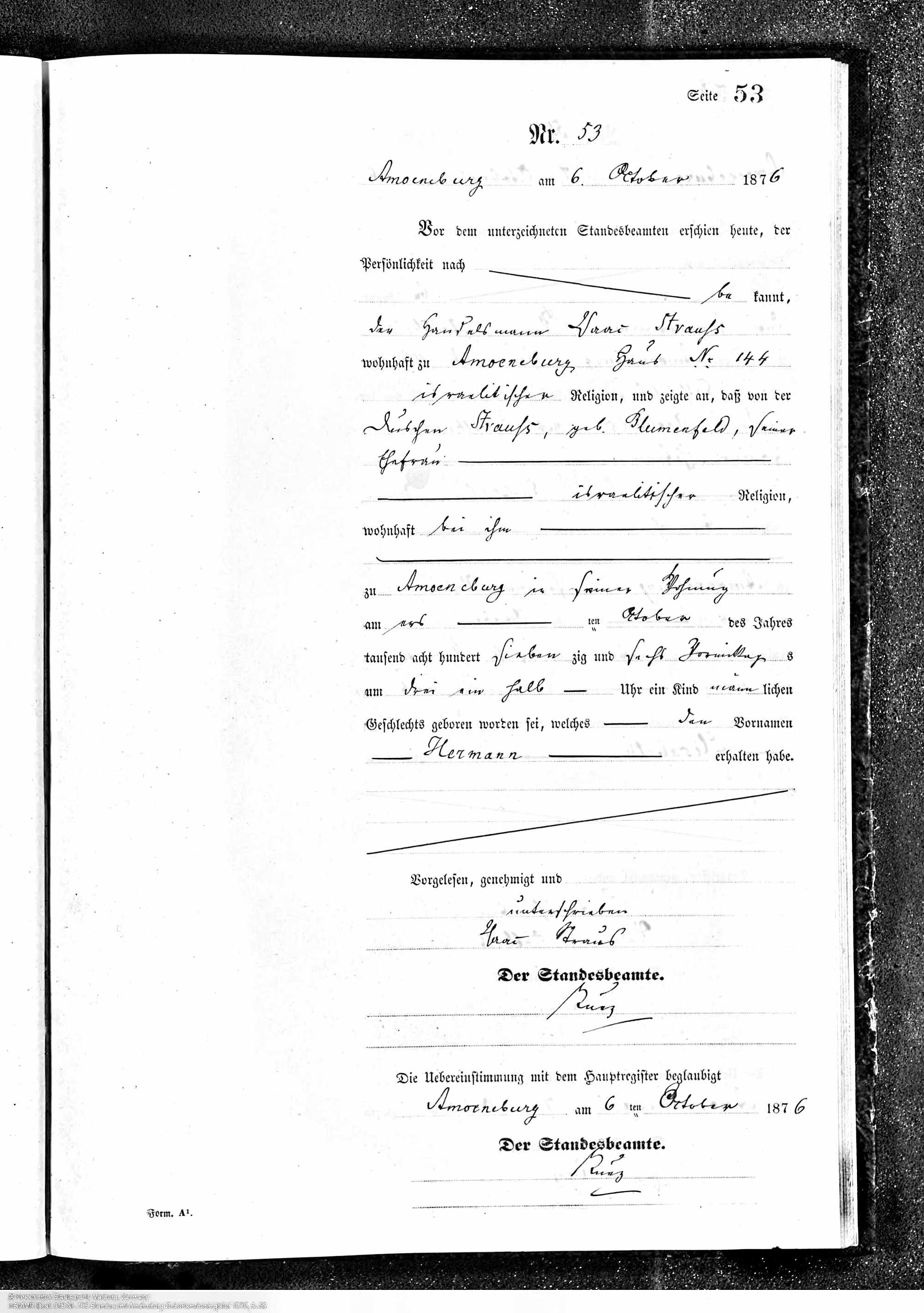
She was 21 when she married Isaac Strauss on May 19, 1870, in Amoeneburg.  Isaac was born in Amoeneburg on January 23, 1839, to Samuel Strauss and Jettchen Rosenbaum,1 and he was Dusschen’s first cousin since his father Samuel Strauss and Dusschen’s mother Gelle Strauss were brother and sister.

Marriage record of Isaac Strauss and Dusschen Blumenfeld, Archives of Hesse, HHStAW Abt. 365 Nr. 50, p. 12

Isaac had been previously married.2 His first wife, Bettchen Reis, died on April 17, 1869, in Amoeneburg3 after giving birth to their second child Emanuel, who was born on April 12, 1869, and died two weeks later on April 26, 1869.4 Isaac was left to raise his daughter Jettchen Strauss, who was not yet three years old when her mother and infant brother died. Isaac married Dusschen a year after losing his first wife Bettchen.

Dusschen and Isaac had seven children together, the first five all born in Amoeneburg.

Their first born was Bertha, born on July 20, 1871.

Berta Strauss birth record, Arcinsys Hesse Archives, HHStAW Fonds 365 No 49 p 11

Second was Moses, also known as Moritz, born on January 19, 1873.

Moses Strauss birth record, Arcinsys Hesse Archives, HHStAW Fonds 365 No 49, p. 11

Then came Kathinka, born December 18, 1874.

Kathinka Strauss birth record, Hessisches Hauptstaatsarchiv; Wiesbaden, Deutschland; Bestand: 915; Laufende Nummer: 173, Year Range: 1874, Ancestry.com. Hesse, Germany, Births, 1851-1901

The fourth child was Hermann, born October 1, 1876.

Hermann Strauss birth record, Hessisches Hauptstaatsarchiv; Wiesbaden, Deutschland; Bestand: 915; Laufende Nummer: 175, Year Range: 1876, Ancestry.com. Hesse, Germany, Births, 1851-1901

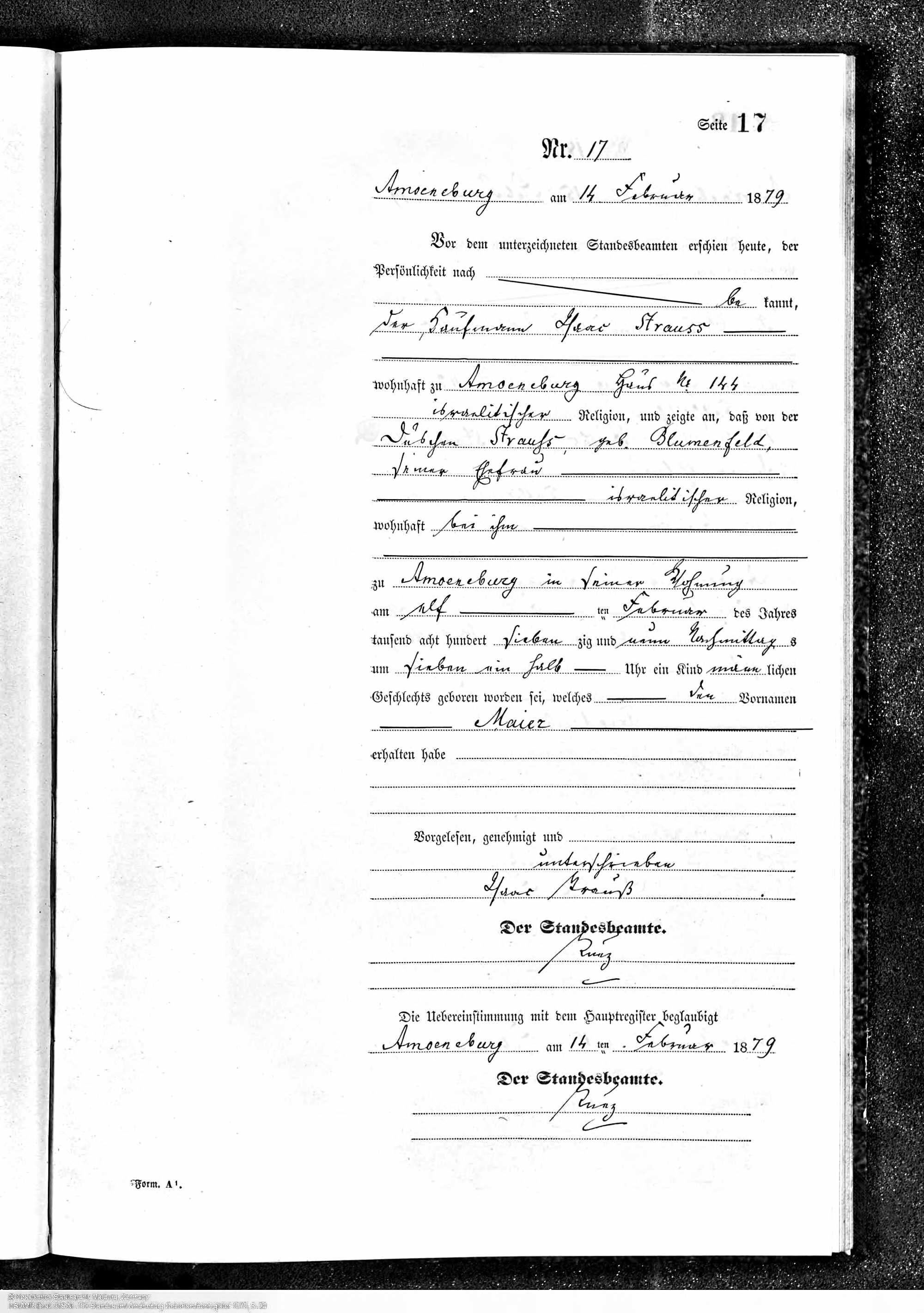
Maier, also known as Max, came next; he was born on February 12, 1879.

Maier Strauss birth record, Hessisches Hauptstaatsarchiv; Wiesbaden, Deutschland; Bestand: 915; Laufende Nummer: 178, Year Range: 1879, Ancestry.com. Hesse, Germany, Births, 1851-1901

The sixth child was Rebekka, and she was born in Wetter, Germany, on February 8, 1881, so the family must have relocated from Amoeneburg by that time.

Rebekka Strauss birth record, Hauptstaatsarchiv; Wiesbaden, Deutschland; Bestand: 915; Laufende Nummer: 9521, Year Range: 1881, Ancestry.com. Hesse, Germany, Births, 1851-1901

Finally, the seventh and last child born to Dusschen and Isaac was their son Sali, born May 29, 1885, also in Wetter.

Sali Strauss birth record, Hessisches Hauptstaatsarchiv; Wiesbaden, Deutschland; Bestand: 915; Laufende Nummer: 9525, Year Range: 1885, Ancestry.com. Hesse, Germany, Births, 1851-1901

Several of Isaac and Dusschen’s children left for the United States in the late 19th century. Just four years after his youngest sibling Sali’s birth in 1885, the oldest son Moritz left Germany for the United States. He was only sixteen when he arrived in New York City on May 30, 1889.5 On June 7, 1896, Moritz Strauss married Therese Wolff, daughter of Israel Wolff and Sarah Lion, in New York. Therese was also an immigrant from Germany; she was born in Nalbach, Saarland, in 1873.6

Moritz and Therese had two children born in New York. Blanche was born on April 8, 1897.7 In 1900, the family was living in New York City, and Moritz, now known as Morris, was working as a butcher. Their second child Irving was born  on August 24, 1901.8

Morris Strauss 1900 US Census, Year: 1900; Census Place: Manhattan, New York, New York; Roll: 1097; Page: 15; Enumeration District: 0340; FHL microfilm: 1241097, Ancestry.com. 1900 United States Federal Census

On August 5, 1904, Morris became a naturalized citizen.9 By 1910, Morris and his family had moved to the Bronx, and Moritz owned his own butcher shop. He must have felt that he had achieved the American dream.

Morris Strauss 1910 US census, Year: 1910; Census Place: Bronx Assembly District 30, New York, New York; Roll: T624_996; Page: 17B; Enumeration District: 1405; FHL microfilm: 1375009
Ancestry.com. 1910 United States Federal Census

Then tragedy struck when Irving Strauss, just thirteen years old, died on February 7, 1915. According to his death certificate, Irving died from acute osteomyelitis of the humerus, “cause unknown.” The humerus in the long bone in our arms, and osteomyelitis is inflammation of a bone or bone marrow caused by an infection. Pyemia, or blood poisoning from bacteria, was a contributory cause; my guess is that the infection spread from the blood stream to his bone. Even today such an infection is not a simple one to treat, but it’s much less likely that young Irving would die from it today than in 1915.

Irving Strauss death certificate, Certificate No. 919, New York City Department of Records & Information Services; New York City, New York; New York City Death Certificates; Borough: Bronx; Year: 1915

In 1920, the surviving members of the family, Morris, Therese, and Blanche, were living in the Bronx, and Morris was still working as a butcher.10 Blanche, now 22 years old, was working as a teacher in the New York City public schools. Blanche was still living with her parents in the Bronx and teaching in 1930, and her father Morris was still working as a butcher at that time.11

Moritz was not the only child of Dusschen Blumenfeld and Isaac Strauss to come to the United States. Moritz’s older sister Bertha also came to New York City.  She married Morris Herz there on January 27, 1901. Morris was born on February 18, 1875, in Bonn, Germany. He was the son of Max Herz and Susanna Weber.12 I don’t know when he or Bertha arrived in New York. Their first child Henrietta was born in New York on November 14, 190113, but their second child, Manfred Edgar Herz, was born on February 18, 1909, in Frankfurt, Germany.14 So Bertha and Moritz must have returned to Germany between the births of their two children, and, as we will see, they remained there until the 1930s.

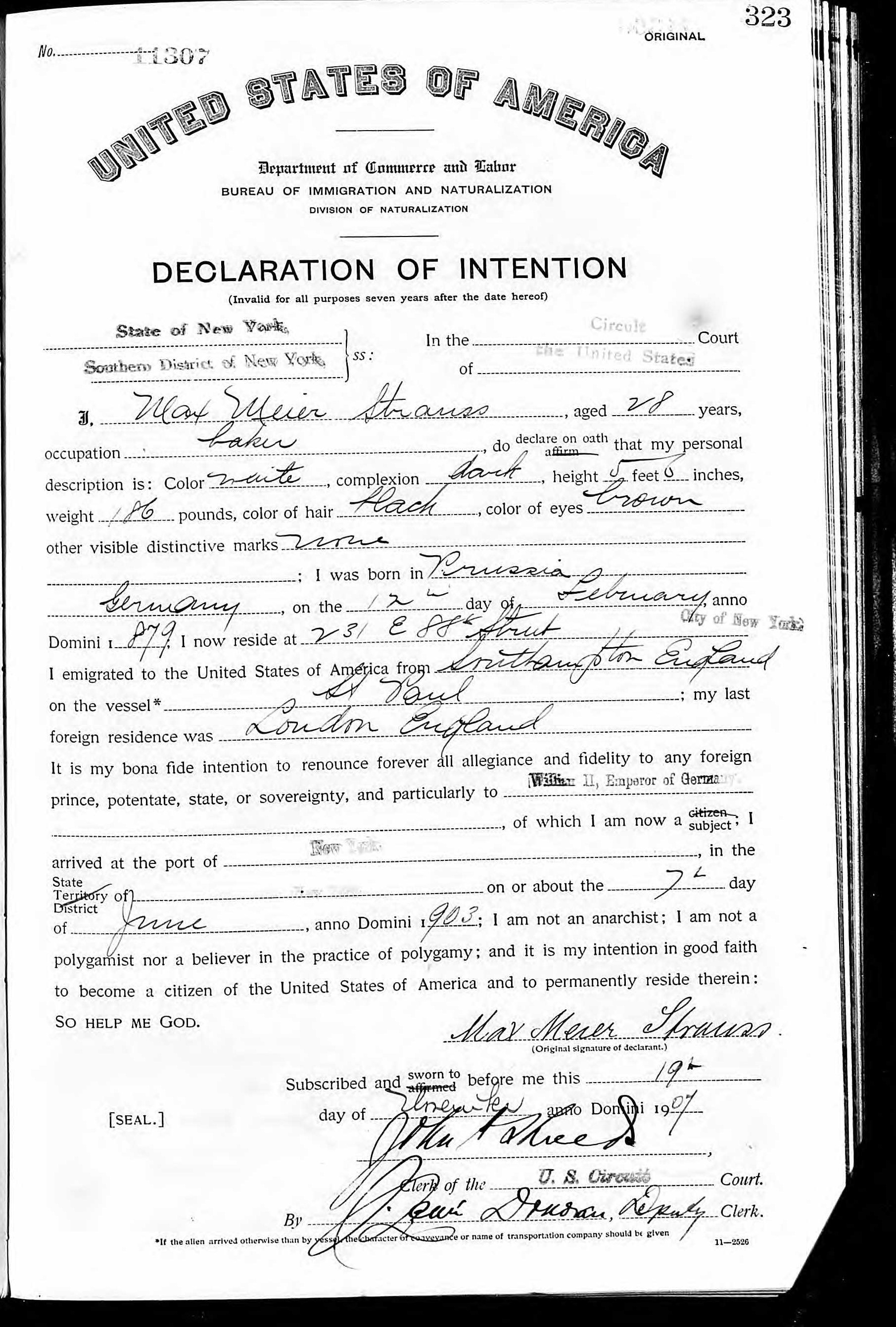
But the third oldest son of Dusschen and Isaac Strauss, like his brother Moritz, came to the US to stay.  Maier (also spelled Meier or Meyer and later known as Max) Strauss arrived in New York on June 7, 1903. He was 24 and had last been living in London. He was working as a baker when he filed his declaration of intention to become a US citizen four years later on November 19, 1907.

Max Meier Strauss declaration of intention, National Archives and Records Administration; Washington, DC; NAI Title: Index to Petitions for Naturalizations Filed in Federal, State, and Local Courts in New York City, 1792-1906; NAI Number: 5700802; Record Group Title: Records of District Courts of the United States, 1685-2009; Record Group Number: RG 21, Vol 021-023 19 Oct-23 Nov 1907 (No 9985-11484), Ancestry.com. New York, U.S., State and Federal Naturalization Records, 1794-1943

Max Meier married Augusta Schoenmann in New York on October 7, 1914. Augusta was born in Odenheim, Germany, on June 13, 1888, to Elias Schoenmann and Karolina Mannheimer.15

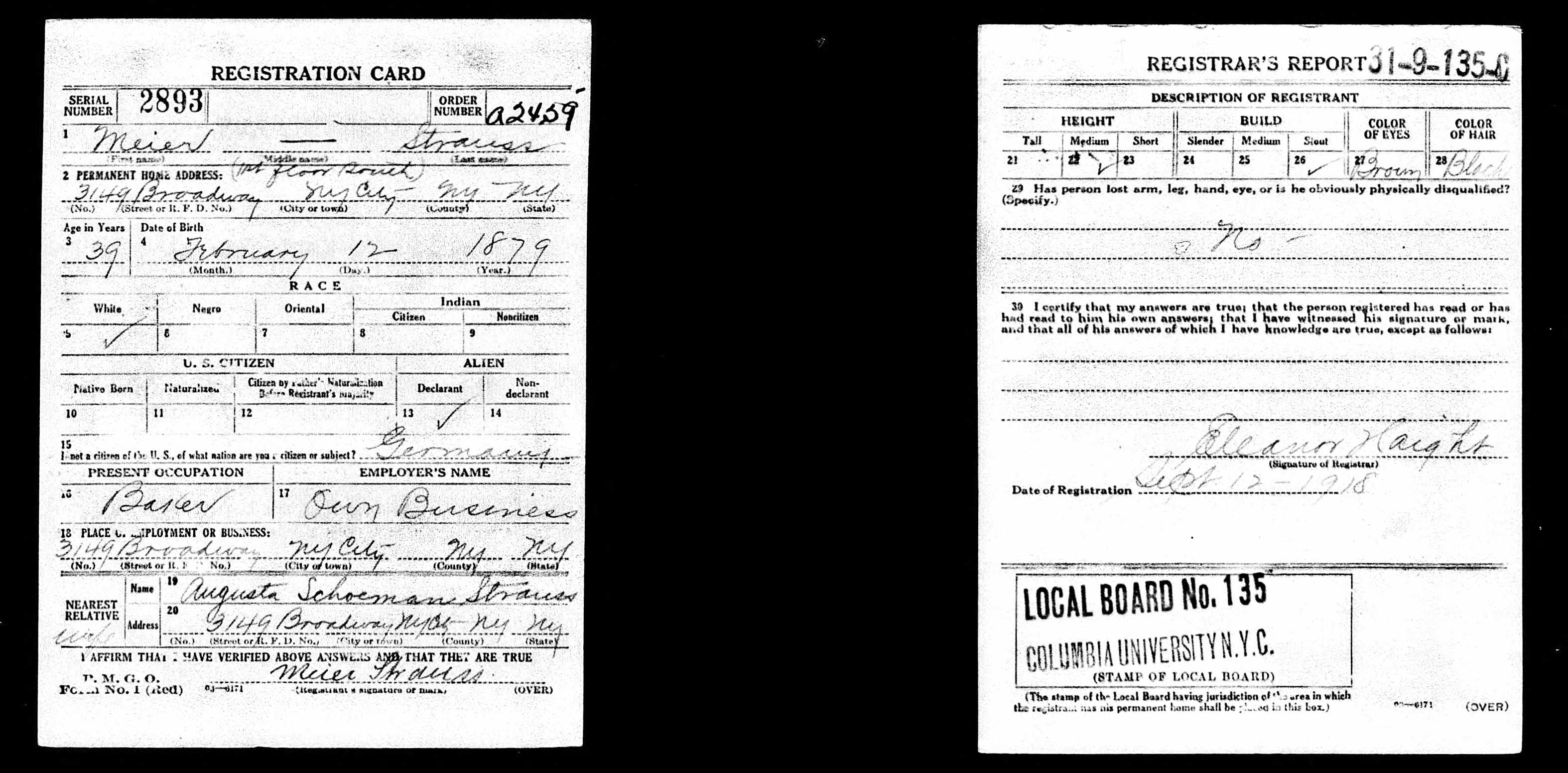
Meier and Augusta’s first child, Irving, was born February 8, 1917.16 When Meier registered for the World War I draft on September 12, 1918, he owned his own bakery in New York, and his family was living at the same address as the bakery.

Meier Strauss, World War I draft registration, Registration State: New York; Registration County: New York, Ancestry.com. U.S., World War I Draft Registration Cards, 1917-1918

A second child, Herbert, was born to Meier and Augusta on September 26, 1919, in New York.17 In 1920, the family was still living at the address of the bakery listed on Meier’s draft registration, and Meier was still working as a baker.18 But by 1930, the family had moved to Hoboken, New Jersey. Meier, now listed as Max, was still a baker.19

Back in Germany, meanwhile, the rest of the family of Dusschen Blumenfeld and Isaac Strauss was also expanding during these years.


  1. Isaac Strauss birth record, Arcinsys Archives of Hessen, HHStAW Fonds 365 No 49, found at https://arcinsys.hessen.de/arcinsys/digitalisatViewer.action?detailid=v1510942 
  2. Marriage of Isaac Strauss and Bettchen Reis, Trauregister der Juden von Amöneburg 1824-1893 (HHStAW Abt. 365 Nr. 50) p.11 
  3. Death record of Bettchen Reis Strauss, Arcinsys Archives of Hesse,  HHStAW Fonds 365 No 51, p. 8 
  4. Birth record of Emanuel Strauss, Arcinsys Archives of Hesse,HHStAW Abt. 365 Nr. 49, p. 10; Death record of Emanuel Strauss, Arcinsys Archives of Hesse, HHStAW Abt. 365 Nr. 51, p. 8 
  5.  National Archives and Records Administration; Washington, DC; NAI Title: Index to Petitions for Naturalizations Filed in Federal, State, and Local Courts in New York City, 1792-1906; NAI Number: 5700802; Record Group Title: Records of District Courts of the United States, 1685-2009; Record Group Number: RG 21, Description: US District Court for the Eastern District of New York (058-059), Ancestry.com. New York, U.S., State and Federal Naturalization Records, 1794-1943 
  6. Moritz Strauss, Gender: Male, Marriage Date: 7 Jun 1896, Marriage Place: Manhattan, New York, USA, Spouse: Therese Wolff, Certificate Number: 9594, Ancestry.com. New York, New York, U.S., Extracted Marriage Index, 1866-1937; “New York, New York City Marriage Records, 1829-1940”, database, FamilySearch (https://www.familysearch.org/ark:/61903/1:2:997Z-4HVD : 21 June 2022), Entry for Moritz Strauss and Theresa Wolff, 1896. 
  7. Blanche Strauss, Gender: Female, Race: White, Birth Date: 8 Apr 1897, Birth Place: Manhattan, New York City, New York, New York, USA, Certificate Number: 17565
    Father: Moritz Strauss, Mother: Theresa Strauss, Mother Maiden Name: Wolf, New York City Department of Records & Information Services; New York City, New York; New York City Birth Certificates; Borough: Manhattan; Year: 1897, Ancestry.com. New York, New York, U.S., Index to Birth Certificates, 1866-1909 
  8. Irving Strauss, Gender: Male, Race: White, Birth Date: 24 Aug 1901, Birth Place: Manhattan, New York City, New York, New York, USA, Residence Address: E. 10 Str 364, Certificate Number: 33487, Father: Maurice Strauss, Mother: Theresa Strauss
    Mother Maiden Name: Wolff, New York City Department of Records & Information Services; New York City, New York; New York City Birth Certificates; Borough: Manhattan; Year: 1901, Ancestry.com. New York, New York, U.S., Index to Birth Certificates, 1866-1909 
  9. Moritz Strauss, Petition Age: 31, Record Type: Petition, Birth Date: 19 Jan 1873, Birth Place: Germany, Arrival Date: 30 May 1889, Arrival Place: New York, New York
    Petition Date: 5 Aug 1904, Petition Place: Kings, New York, USA, National Archives and Records Administration; Washington, DC; NAI Title: Index to Petitions for Naturalizations Filed in Federal, State, and Local Courts in New York City, 1792-1906; NAI Number: 5700802; Record Group Title: Records of District Courts of the United States, 1685-2009; Record Group Number: RG 21, Ancestry.com. New York, U.S., State and Federal Naturalization Records, 1794-1943 
  10. Morris Strauss, 1920 US census, Year: 1920; Census Place: Bronx Assembly District 5, Bronx, New York; Roll: T625_1137; Page: 9B; Enumeration District: 286, Enumeration District: 0286; Description: Bronx, Assembly District 5, Tract 121 (part) bounded by Westchester Ave, Whitlock Ave, E 165th, Ancestry.com. 1920 United States Federal Census 
  11. Morris Strauss, 1930 US census, Year: 1930; Census Place: Bronx, Bronx, New York; Page: 22B; Enumeration District: 0625; FHL microfilm: 2341222; Ancestry.com. 1930 United States Federal Census 
  12. “New York, New York City Marriage Records, 1829-1940”, database, FamilySearch (https://www.familysearch.org/ark:/61903/1:2:997C-9L4Q : 21 June 2022), Entry for Morris Herz and Bertha Strauss, 1901. 
  13. “New York, New York City Births, 1846-1909,” database, FamilySearch (https://familysearch.org/ark:/61903/1:2:9979-QK94 : 11 February 2018), Entry for Henrietta Hertz, 14 Nov 1901; citing Manhattan, New York, New York, United States, reference cn 44441 New York Municipal Archives, New York; FHL microfilm 1,983,411. 
  14. Manfred Edgar Herz, Record Type: Naturalization, Birth Date: 18 Feb 1909, Birth Place: Frankfurt Am Main, Germany, Arrival Date: 28 Jul 1939, Arrival Place: New York NY, Naturalization Place: Tennessee, USA, National Archives and Records Administration; Washington, D.c.; Record Group Title: Records of District Courts of the United States; Record Group Number: 21, Ancestry.com. Tennessee, U.S., Naturalization Records, 1888-1992 
  15. “New York, New York City Marriage Records, 1829-1940”, database, FamilySearch (https://www.familysearch.org/ark:/61903/1:2:997C-CG23 : 21 June 2022), Entry for Meier Strauss and Auguste Schoemann, 1914. Mrs Augusta Strauss
    Gender: Female, Age: 35, Birth Date: 13 Jun 1888, Birth Place: Odenbeim Bei Bruchal, Baden, Germany, Residence Place: New York, Passport Issue Date: 21 Mar 1924
    Spouse: Max Strauss, Has Photo: Yes, Certificate Number: 381929, National Archives and Records Administration (NARA); Washington D.C.; Roll #: 2449; Volume #: Roll 2449 – Certificates: 381850-382349, 21 Mar 1924-22 Mar 1924, Ancestry.com. U.S., Passport Applications, 1795-1925 
  16. Irvin Strauss, Race: White, Age: 23, Relationship to Draftee: Self (Head). Birth Date: 8 Feb 1917. Birth Place: New York City, New York, USA. Residence Place: Washington, District of Columbia, USA, Registration Date: 16 Oct 1940, Registration Place: Washington, District of Columbia, USA,Next of Kin: Max Strauss, National Archives at St. Louis; St. Louis, Missouri; WWII Draft Registration Cards for District of Columbia, 10/16/1940-03/31/1947; Record Group: Records of the Selective Service System, 147; Box: 221, Ancestry.com. U.S., World War II Draft Cards Young Men, 1940-1947 
  17. Herbert Milton Strauss, Race: White, Age: 21, Birth Date: 26 Sep 1919, Birth Place: New York City, New York, Registration Date: 16 Oct 1940, Registration Place: New York City, Bronx, New York, Next of Kin: Augusta Strauss, National Archives at St. Louis; St. Louis, Missouri; WWII Draft Registration Cards for New York City, 10/16/1940 – 03/31/1947; Record Group: Records of the Selective Service System, 147, ncestry.com. U.S., World War II Draft Cards Young Men, 1940-1947 
  18. Meier Strauss and family, 1920 US census, Year: 1920; Census Place: Manhattan Assembly District 13, New York, New York; Roll: T625_1209; Page: 4B; Enumeration District: 957, Ancestry.com. 1920 United States Federal Census 
  19. Max Strauss and family, 1930 US census, Year: 1930; Census Place: Hoboken, Hudson, New Jersey; Page: 6A; Enumeration District: 0262; FHL microfilm: 2341084,
    Ancestry.com. 1930 United States Federal Census 

Moritz Werner And Family, Part III: After The War

After the war Max Werner, now 25 years old, married Klara Reiss on January 5, 1947, in London, England.1 Klara (known by the family as Klari) was born in Vienna, Austria, on September 27, 1920, to Ida Spergel and Salomon Reiss. According to his granddaughter Joyce:2

Salomon Reiss had made a fortune in Vienna and was a well-known multi-millionaire. After the Anschluss (March 1938) [he] was arrested at the seder table [and] stripped of his Austrian wealth, and the family managed to escape to Prague (not at the time under German control and where my grandfather owned assets).

Klara’s brothers were able to immigrate to Palestine, but Klara didn’t want to leave her parents so stayed with them in Prague. But as things became more dire, she was able to obtain a visa to go to England, as seen on her exit visa from Prague shown below. As Joyce noted, Klara left Prague “quite late in August 1939. Her entry Visa in Dover is stamped 30st August. The curtain came down [two days later started on September 1, 1939, when Germany invaded Poland and World War II started.]”

Klara Reiss 1939 visa for travel to England

Klara’s parents were, however, stuck in Prague once the war started and unable to escape. They were eventually deported to Theriesenstadt and then from there on one of the last transports from Theriesenstadt to Auschwitz, where they were murdered.3

Klara met Max Werner eight years later in England. As Joyce tells the story,

Our parents met at a friend of Moritz and Jenny on a Shabbat afternoon in 1946. The couple were cousins of Klari’s father and, apparently, when [Max] got home, he told his parents he had met the girl he was going to marry. He was two years younger than Klari, involved with Klari’s cousin, and Klari told him to go away. Repeatedly. My father did not take no for an answer and pursued her relentlessly. She gave in and went on a date with him. The rest is history.

Judith provided these additional insights:

My mother liked my Dad when they met but felt that as a sophisticated dress designer she was way too old for the very young looking Max. She had a career path that she had worked very hard to carve out for herself and was in line to go to Paris for her firm.  She wasn’t interested in marriage at that point in her life especially after learning what happened to her parents. I believe her long range plan was to join her brothers in Israel. When however my Dad persisted, she relented…. They were married 6 months later on 5th January, 1947.

Joyce and Judith shared these photographs of their parents Max and Klara:

Max and Klara Werner Courtesy of the family

Max and Klara Werner Courtesy of the family

At the time of his marriage, Max was working for his father Moritz in the Benlo company in London. In 1949, Moritz was able to buy back LS Brinkmann from the man who purchased it. As his son Max told the story (and as I previously shared here),

A Catholic named Rhode from Kassel, who produced goods for the armaments industry, had bought L.S. Brinkmann. After the war, when Rhode was terminally ill, he developed feelings of remorse and tracked down my father Moritz in England. Mr. Rhode asked for a visit and my father and he made a contract, i.e. my father bought the company back – that was at a time when there was no official reparation! In 1949 the takeover was perfected. …

When my father had celebrated his 25th anniversary with the company in 1931, the staff had donated a bronze plate with a dedication and two knitting hands for him. During the forced sale [1939] the plate suddenly disappeared.

In 1949, when my father was sitting in his office again for the first time, there was a knock at the door and a small delegation of employees came in… They struggled to carry a box containing this bronze plate. Before taking over the company, these employees had fastened the plate in the chimney with strong wires and thus hidden it.

Joyce and Judith shared this photograph of the plaque that had been given to honor Moritz in 1931 and then hidden by his employees to keep it safe from the Nazis.

Moritz and Jenny did not remain in Germany, but Moritz did continue to oversee LS Brinkmann from England. He gave a large share of the business to his sister Elsa Werner Loewenthal, wife of Julius Loewenthal, whom I wrote about here.

Meanwhile, according to Judith, there were problems within the partnership of Benlo; contrary to an informal agreement between Moritz and his partner, the partner brought a new partner into the business, and together they took over control of the business and away from Moritz. Eventually, the two other partners drove Moritz out of the business and moved his son Max from company headquarters in London to a sales job, which he found to be unsatisfying and a dead end position.

Here is a photograph of Max and Klara in the early 1950s:

Max and Klara Werner c. 1953 Courtesy of the family

Thus, in 1953, Max decided to move to Germany and take over LS Brinkmann after his father Moritz retired. By that time, both Judith and Joyce were born, and Judith was already in school. Max, Klara, and Joyce went to Eschwege, and Judith stayed behind with her grandparents Moritz and Jenny in England to continue her schooling. Under Max’s leadership, LS Brinkmann once again became a highly successful knitware company.

But after a relatively short time, Klara and Joyce returned to England as Klara was not happy living in Eschwege, where there was no longer a Jewish community after the Holocaust. Max would come to England periodically, usually for Jewish holidays, and Klara and their daughters would spend the summers in Eschwege.

Joyce and Judith have wonderful memories of spending summers in Eschwege. Judith wrote:

Part of the perks of working for LSB was reduced rental flats on the factory property. It was great fun for us children of the workers. Every afternoon and early evening when the workday was over we would gather in the courtyard and play all kinds of games, including hide and seek and different ball games.

Judith shared this photograph of the LS Brinkmann grounds along with this description:

On the far left are the worker residences including ours. Bottom right is the green house. The larger tree in front of the white knitting operation was a delicious pear tree under which our pet dog Cracky was buried. The other greenery were apple, pear, plum, and cherry (not seen) trees. We had all kinds of berries that I used to spend many hours picking and eating. In the distance is the very picturesque town of Eschwege.

LS Brinkmann factory grounds Courtesy of the family

Joyce added this memory:

I also remember those holidays as a time of freedom. We played with local children as Judy said and were left largely to our own devices. Judy and some of the older kids would take me along to the local swimming pool or they Iet me trail along and join in with whatever they did. My own age group was a group of dare-devil boys. In the foreground (front left side) [of the photograph] is a grey roof above the dustbins [trash cans] with a drop of about 6 to 7 feet to the rear exit road below. All the boys and I used to play a ‘chicken’ type game jumping off with as much bravado as possible.

By 1958, Moritz Werner’s health had declined, and he and Jenny decided to leave England for a better climate and move to Lugano, Switzerland. He died eight years later in 1966 at the age of 78. This photograph of Moritz was taken at the celebration of the 100th anniversary of LS Brinkmann’s founding in 1965.

Moritz Werner 1965 Courtesy of the family

Jenny kept the apartment in Lugano and remained there, although she spent the first year after Moritz’s death living with Klara and the girls in London. Eventually, when she could no longer live alone, she moved to an assisted living facility in Zurich, where she died in November 1987 at the age of 93. Here is a beautiful photograph of Jenny:

Jenny Kahn Werner Courtesy of the family

Max Werner eventually retired from LS Brinkmann and returned to England. Judith shared this memory with me:

My father had a fantasy of living in Devon, England on the coast. He had fallen in love with the Devon and Cornwall coastline when he was a very young man. So when he was about 55 [about 1977], he sold [the home in] London and bought a house in Devon. He proceeded to knock most of it down and rebuilt it to his own specifications. This home was on the top of the hill that he owned overlooking the channel. On this hill he had an area for a pool and a rock garden. And when we swam in this pool, you could overlook this beautiful seaway.

Max Werner and his wife Klara died within eight months of each other. Klara died at age 90 in April 2011 in Devon, England, and Max died in December of that year, also in Devon, England. He was 89.4

I am so deeply grateful to Judith and Joyce for sharing their family’s stories and photographs. The story of their grandparents and parents is one of persistence and strength despite being subjected to harassment, theft of their business, and loss of their home and their homeland. Somehow they rebuilt their lives and their business and found ways to survive both before, during, and after World War II.


  1.  Max H Werner, Registration Date: Jan 1947, Registration Quarter: Jan-Feb-Mar, Registration District: Hendon, Inferred County: Middlesex, Spouse: Amalia K Reiss, Volume Number: 5f, Page Number: 529General Register Office; United Kingdom; Volume: 5f; Page: 529, Ancestry.com. England & Wales, Civil Registration Marriage Index, 1916-2005 
  2. As with the two prior posts, most of the information in this post came from a series of emails exchanged among Max and Klara’s daughters Judith, and Joyce and myself during May and June, 2022. 
  3. https://yvng.yadvashem.org/nameDetails.html?language=en&itemId=4788092&ind=1; https://yvng.yadvashem.org/nameDetails.html?language=en&itemId=4783626&ind=1 
  4. These dates came from Max and Klara’s daughters Joyce and Judith. 

Moritz Werner and Family, Part II: From Comfort to Escape 1922-1945

When Max Werner II was born on September 5, 1922, in Eschwege, Germany, to Moritz Werner and Jenny Kahn, his paternal grandparents Max Werner I and Helene Katzenstein had both passed away. His father Moritz was one of the owners of the LS Brinkmann Knitwear Company, and the family was living a very comfortable life.

Max’s daughter Joyce described her father as “an indulged only child from a wealthy local family.” Her sister Judith noted that their father “was an only child, and he was a very solitary child. His main companions were the chauffeur Petach and his dog.”1

Here are some photos of Max as a child including two with the dog, two in the garden of the family’s home in Eschwege, and one with his nurse or nanny.

Max Werner with nurse Courtesy of the family

Max Werner Courtesy of the family

Max Werner in the garden of his family home in Eschwege Courtesy of the family

Max Werner in the garden of his family home in Eschwege Courtesy of the family

Max and his dog Courtesy of the family

Max Werner c. 1934

But everything changed with the rise of the Nazis. Joyce and Judith both shared what they knew about the way life changed for their father and grandparents. Judith wrote, “Things became more and more difficult at school for my father, but he never complained to his parents. Except one day the kids from his school surrounded him with knives, and my father was seen fending them off with his leather satchel by friends of my grandparents.”

Joyce shared additional details about that incident:

Our father, a tall, strong pre-teen, was having terrible trouble at school. Not only did he face taunting and attacks from boys in the Hitler Youth, but teachers also joined in the Jew baiting. I recall that he told me on one occasion that another Jewish boy (small and reedy) had been beaten up by some classmates and the child made the mistake of telling the teacher. The teacher got out his strap and announced to the class, ‘Now I will show you how you should beat a Jew.’ Our father in general held his own well and was known to be strong and aggressive, and classmates generally steered clear of him. However, the incident Judy described was a final straw – especially as during the ensuing fray which took place on the school stairwell after class, he picked up the lead troublemaker and hurled him down a few stairs causing a broken nose. At home, he couldn’t hide the marks of the fight, confessed all and was sent that same night to Zurich to his Aunt Rosa [Werner] Wormser [sister of their grandfather Moritz Werner].

Max spent four or five years living away from his parents in Zurich. Although he was generally happy and became very close to his cousin Julius Wormser during those years, Joyce described the deeper impact these experiences had on Max:

The experience was formative for him. Although he had many good memories of his life in Zurich, he was separated from his home, parents, and his former life. I think the main lesson he learned was ‘fight back’. Sadly (in my opinion) he also learned that, in reality, ‘might is right’. I believe it was this which affected his personality. Used to getting his own way as an adored (and unexpected) child, seeing the brutality of life in Germany and the fact that bullies get what they want and the weak suffer, he made a decision there and then. It shaped him as a person who was determined and uncompromising. He was logical and intelligent, but when he was crossed or disagreed with someone, he could be very aggressive – both verbally and physically.

Meanwhile, Max’s parents Moritz and Jenny were still in Eschwege, Germany. Judith wrote that:

My grandfather was generous with everybody and was always ready to help those in need whether Jewish or not. He and my grandmother for many years helped to support and educate a young boy whose father had died and whose mother needed assistance. In the 1930s, my grandfather … was helping members of the family and others leave Germany but he himself did not believe that Nazism would survive in Germany. My grandmother, on the other hand, was ready in 1933 and packed. But they did put a lot of money into antiques and Old Master pictures. They were aware that they were not allowed to take much money but were allowed to take personal possessions.

Joyce also described the way their grandparents differed in their reactions to the rise of Hitler:

Our grandmother Jenny was alert to the danger Hitler posed from the very start. She believed his rhetoric and said that if he came to power, he would enact every threat against the Jews he had scapegoated for Germany’s ills. Our grandfather Moritz, like so many, believed such things would never happen in the ‘fatherland’ for which he had fought at great personal cost and for which his brother had given his life.  Consequently, she quietly prepared for emigration by investing in ‘movable assets’ e.g. art and antiques.

Here’s a photo of their grandmother, Jenny:

Under Hitler’s Aryanization program, Moritz was forced to sell LS Brinkmann in 1938, as I wrote about here. According to Judith, shortly before World War II started in September 1939,

The Bishop of the area came to my grandpa and told him it was time for him to leave. That it was too dangerous for him to stay. … So after that my grandfather went to the area comandante in Kassel in order to get a pass to exit the country. This person happened to be somebody who had served in the first World War under my grandfather in the cavalry. So this gentleman gave my grandfather a bit of a problem, and my grandfather, who had the use of a stick, banged it on the man’s desk and gave him a thorough dressing down. He got his pass. Then my grandparents took the chauffeur driven car up to either Hamburg or Bremen and took a ship to England.

Max soon thereafter joined his parents in England and attended school and then Leeds University, where he studied engineering. Moritz and Jenny were able to sell some of the art and antiques they took with them from Germany not only to support themselves, but to invest in a new company in England. Joyce wrote:

My grandfather – with extraordinary energy and determination in my opinion – found a couple of partners and started a new company ‘Benlows’ selling cigarette lighters. It became so successful that after the war it became a public company floated on the Stock Exchange.

Thus, Moritz, Jenny, and Max were able to escape from Nazi Germany and survive the Holocaust. But not without enduring a forced sale of their successful business, harassment and violence, displacement from their home in Eschwege, and a long separation of Max from his parents. As Joyce wrote, this had a lasting impact on Max and presumably also on Moritz and Jenny.

In the next post, Joyce and Judith will share the story of what happened to the family after World War II ended in 1945.


  1. Again as in the last post, the quotes, photos, stories, and information from Joyce and Judith came from a series of emails we all exchanged during May and June, 2022.  I am so grateful for all their help and generosity. 

Moritz Werner and Family Revisited, Part I

I will return to the Blumenfeld saga soon, but first I want to share another chapter in my Goldschmidt family history. In early May I received a comment on my blog from a woman named Joyce who turned out to be my fifth cousin on the Goldschmidt branch of my family tree. Since finding my blog, Joyce and her sister Judith have both been in touch and have been incredibly generous in sharing the stories and many photographs of their branch of the Goldschmidt family tree.1

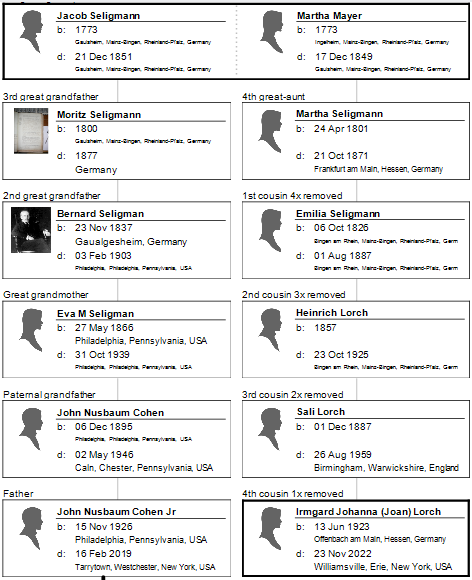
Joyce and Judith and I are all descended from Jacob Falcke Goldschmidt and Eva Seligmann, our mutual four-times great-grandparents. Joyce and Judith are descended from their son Meyer Goldschmidt, and I am descended from their son Seligmann Goldschmidt. This chart shows our relationship to each other with my line of descent to my father John Cohen on the left and Judith and Joyce’s line of descent to their father Max Werner on the right.

I was particularly pleased to hear from Joyce and Judith because I had, as the title of this post reveals, many unanswered questions about their grandfather Moritz Werner and his family. To recap what I did know, as you can see in greater detail and with citations and images in my earlier posts, Helene Katzenstein, the daughter of Amalie Goldschmidt, had first married Moritz Brinkmann, son of Susskind Brinkmann, who had founded the successful knitwear company LS Brinkmann. Moritz and his brother Levi Brinkmann were also partners in LS Brinkmann. (Levi Brinkmann was married to Lina Stern, daughter of Sarah Goldschmidt, Amalie Goldschmidt’s sister, so Levi and Moritz married two women who were first cousins.)

Joyce and Judith shared these photographs of Susskind Brinkmann, Levi Brinkmann, and Moritz Brinkmann.

Susskind Brinkmann Courtesy of the family

Levi Brinkmann Courtesy of the family

Moritz Brinkmann Courtesy of the family

Sadly, Moritz Brinkmann died just six years after marrying Helene on September 8, 1878, at the age of thirty-two. Three years later on February 7, 1881, Helene married Max Werner, who was also partner in LS Brinkmann.

Helene and Max had five children, and Joyce and Judith’s grandfather Moritz, born in 1888, was their fourth child and first son and was named, according to the family, in honor of Helene’s first husband Moritz Brinkmann. I find that an incredibly generous and loving gesture on the part of Max Werner—to have his own son named in memory of his wife’s first husband. But obviously Max had also worked with Moritz Brinkmann and thus had his own relationship with him.

Mortiz Brinkmann and Max Werner, the two husbands of Helene Katzenstein  Courtesy of the family

Helene Katzenstein Werner died on December 31, 1912, when she was 58. Here are a few photographs of Max and Helene Katzenstein Brinkmann Werner, courtesy of their great-granddaughters.

Max Werner Courtesy of the family

Helene Katzenstein Werner Courtesy of the family

Max and Helene Werner Courtesy of the family

Max and Helene Werner Courtesy of the family

Max and Helene Werner Courtesy of the family

Helene and Max’s youngest child and second son Karl was killed on September 25, 1916, fighting for Germany in World War I, as I wrote about in greater detail here. Joyce and Judith shared this wonderful photograph of Karl in uniform (far right) with his parents Max and Helene and one of his sisters sitting in a carriage.

Karl Werner, far right. Max and Helene Werner in rear seat. Driver and a Werner daughter in front. Courtesy of the family

They also sent me these photographs of Karl’s gravestone and the memorial notice published in his memory by his parents.

Joyce translated the memorial notice as follows:

On 25th September our hopeful and beloved son, our brother, nephew, uncle and in-law, our pride and joy, went on patrol.

Underofficer

Karl Werner

Of the defence and infantry regiment


At the young age of barely 23 years died a hero’s death for his fatherland.

He was a son full of life, a faithful comrade. Those who knew him know what we have lost.

His sorely tried and bereft

(father)

Max Werner

Reading that conveys so painfully even after 106 years what the family lost and how heartbroken they were by this loss.

What I did not know before Joyce contacted me was that Max and Helene’s only other son, Moritz, also served in the German army during World War I, and he suffered grievous injuries during his service. Joyce was not certain about how he was injured, but he suffered a crushed hip perhaps from being run over by a tank or the wheels of a gun carriage while serving in France. He was physically impaired for the rest of his life, relying on crutches and later a wheelchair to get around.

Here are some photographs of Moritz before his injury and then afterwards.

Moritz Werner in World War I uniform Courtesy of the family

Moritz Werner in World War I uniform Courtesy of the family

Moritz Werner in World War I uniform Courtesy of the family

Moritz Werner in World War I uniform Courtesy of the family

Moritz Werner after suffering injuries in World War I Courtesy of the family

But before he was sent off to fight for Germany, Moritz had met a young woman named Jenny Kahn and fallen deeply in love. As Moritz’s granddaughters Joyce and Judith tell the story, Jenny’s father Moses Kahn arranged for Jenny to meet eligible men, but warned her not to make any commitments until after the war, fearing that the man she chose would be severely injured during the war. He allowed her to meet Moritz Werner since he came from a respectable Orthodox family and was a friend of Jenny’s brother.

Well, according to Joyce and Judith, Jenny and Moritz fell in love at first sight. She was taken by his good looks and his piercing dark eyes, and when he proposed that very afternoon, she accepted, ignoring her father’s request that she hold off making any commitments until after the war.

And then Moritz went off to war, and as Moses Kahn had feared, suffered a devastating injury. He wrote to Jenny from the field hospital, releasing her from their engagement and telling her to keep the ring and find someone else. According to Joyce, Jenny’s response was something like, “The engagement is off when I say it’s off!”

And so they were married on August 19, 1918. Joyce and Judith shared a photograph of their wedding. You can see that Moritz has a cane in his hands. According to his granddaughters, he had to be carried to the chuppah.

Wedding of Moritz Werner and Jenny Kahn 1918 Courtesy of the family

Four years later on September 5, 1922, Jenny gave birth to their only child, Max Werner, named for his grandfather Max Werner, who had died on October 2, 1919, a year after his son’s wedding. Here is a photo of Jenny, one of Max, and one of the entire family.

Jenny Kahn Werner Courtesy of the family

Max Werner c. 1926  Courtesy of the family

Moritz, Jenny, and Max Werner c. 1928

Of course, the world would change for this family like so many in the 1930s. I wrote a bit about that in my earlier post, but there were many questions I could not answer that Joyce and Judith have now answered. More on that and more photos in my next post.


  1. All references to the stories shared by Joyce and Judith came in several emails exchanged during May and June 2022. 

The Search for Max Blumenfeld: It Took A Village, Part I

The search for what happened to Max Blumenfeld, son of Moses IIB, was not an easy one. It was a lesson in persistence and in the value of working with other researchers. My cousin Richard Bloomfield contributed a great deal to the research of the life of Max Blumenfeld as did David Lesser, my new research friend from Tracing the Tribe.

Finding Max’s birth and marriage records was easy. As I’ve already written, he was born in Kirchhain on June 13, 1880, and married Johanna Grunwald in Berlin on March 16, 1906.

But finding out what happened next was not as easy. Did they have children? Did Max and Johanna survive the Holocaust? Neither was listed in Yad Vashem, so I felt hopeful that they did. But I couldn’t find them anywhere else either. There were no records in the Arolsen Archives. There were no US immigration records or other records placing them in the US. There were no Palestinian immigration records for them either. Where else could they have gone? Did they die before the Nazi era? If so, I couldn’t find any German death records.

When I looked at other trees on Ancestry and at Geni and MyHeritage, there were similar holes in the information for Max and Johanna—-there was nothing after their marriage in 1906. I only found one tree that had more information, and fortunately for me, it was the tree of my fifth cousin and fellow researcher Richard Bloomfield. According to Richard’s tree, Max had emigrated to Italy in 1933 and died there, Johanna had died in Israel sometime after 1947, and they had a son named Fritz who died in about 1977 in Israel.

I contacted Richard to ask where he’d gotten the information, and he said he’d gotten the information from someone else’s tree. So he and I began to see if we could verify any of that information.

Richard noted that on Max’s marriage record his occupation was given as “Waisenhausinspektor” or orphanage inspector and that he was living in Graudenz at the time of his marriage. But since Max and Johanna were married in Berlin, Richard had a hunch that Max had become the Waisenhausdirektor for the Jewish orphanage in Berlin and decided to search old Berlin directories. He found Max listed as the Waisenhausdirektor in those directories for a number of years, including 1934, 1935, and 1936. Thus, we knew that Max had not immigrated to Italy in 1933, but was still in Berlin at least until the 1936 directory was compiled.1

Max Blumenfeld, Title: Amtliches Fernsprechbuch für Berlin und Umgegend, 1936, Ancestry.com. German Phone Directories, 1915-1981

On a very recent trip to Berlin, Richard took and shared these photos of the building where the Judische Waisenhaus once stood.

Judische Waisenhause building in Berlin. Photo courtesy of Richard Bloomfield

Photo courtesy of Richard Bloomfield

Richard and I then started to see if we could find any evidence of Fritz Blumenfeld, the supposed son of Max and Johanna. Richard located a record on the IGRA website that indicated that a Fritz Blumenfeld, son of Max, born in 1910,was registered as a voter in Palestine in 1939 and living in En Harod.

Found at the Israel Genealogy Research Association website at https://genealogy.org.il/AID/index.php

Then I located a Fritz Blumenfeld who had Palestine immigration papers at the Israel Archives website. Fritz was born in Graudenz, Germany, on July 13, 1910, the same town where Max had been living when he married Johanna in 1906. He was married to Dora Salpeter and working as a locksmith. He had first entered Palestine on June 28, 1937.

Fritz Blumenfeld and Dora Salpeter immigration file found at Israel State Archives at https://www.archives.gov.il/en/

Richard found directories for Graudenz that listed Max as a teacher there in 1905, as a teacher and orphanage inspector in 1907, and as the Waisenhausinspektor there in 1909, 1911, and 1913. Thus, Max and Johanna were living in Graudenz when Fritz Blumenfeld was born. This certainly seemed to be their son.2

And then I found the record that definitely tied Fritz to Max and Johanna. Returning to the IGRA website, I located Fritz Blumenfeld’s marriage record. Fritz married Devorah on August 15, 1940, in Israel, and his marriage record indicated that he was a locksmith, which was consistent with his Palestinian citizenship application. On those Palestinian immigration papers, I learned that Devorah’s name was originally Dora Salpeter.

Most importantly, Fritz’s parents were listed as Max and Hanna, confirming for me that this was the son of Max Blumenfeld and (Jo)hanna Grunwald. Since it appears that Johanna was better known as Hanna or Anna, I will use the name Anna to refer to her going forward.

That marriage record gave me two other critical pieces of information. It said the groom’s parents lived in Italy—although it took help from Tracing the Tribe for me to learn that the Hebrew I was reading as Atelah was in fact Italia in Hebrew. The marriage record also indicated that Anna was at home, but Max was deceased. Thus, we now knew that Max had died sometime before Fritz married on August 15, 1940, and presumably had died in Italy.

Fritz Blumenfeld marriage record, found at the Israel Genealogy Research Association website at https://genealogy.org.il/AID/

I didn’t think we would get any further than that since I had no idea how to research deaths in Italy. But once again Richard came to the rescue. He found two more sources. One was a German book, Das Jüdische Waisenhaus in Pankow (2001) by Inge Lammel, about the Jewish orphanage in Berlin where Max had been the Waisenhausdirektor. Lammel’s book included this passage, as translated by Richard:3

When Isidor Grunwald [Johanna’s father] died in February 1925, his son-in-law, Max Blumenfeld, took over the directorship of the house. Martin Davidsohn [long-time teacher at the Second Jewish Orphanage] says that he brought a more liberal spirit into the educational process, democratic structures, such as an opportunity to utter grievances and a trainees’ adjudicatory council elected by secret ballot, which gave the trainees more self-confidence.

Richard paraphrased the information about Isidor Grunwald that he found in the book:4

Max’s father-in-law had been an officer in the army and carried the army’s manner of doing things over into his work at the orphanage. He patrolled the large dormitory hall carrying his ring of large keys to enforce discipline. He had the boys line up each night in front of his apartment in the house according to height, shook their hands and wished them good night. In addition to physical education, he had the boys do drills led by a drill sergeant and sometimes accompanied by flute and drum music
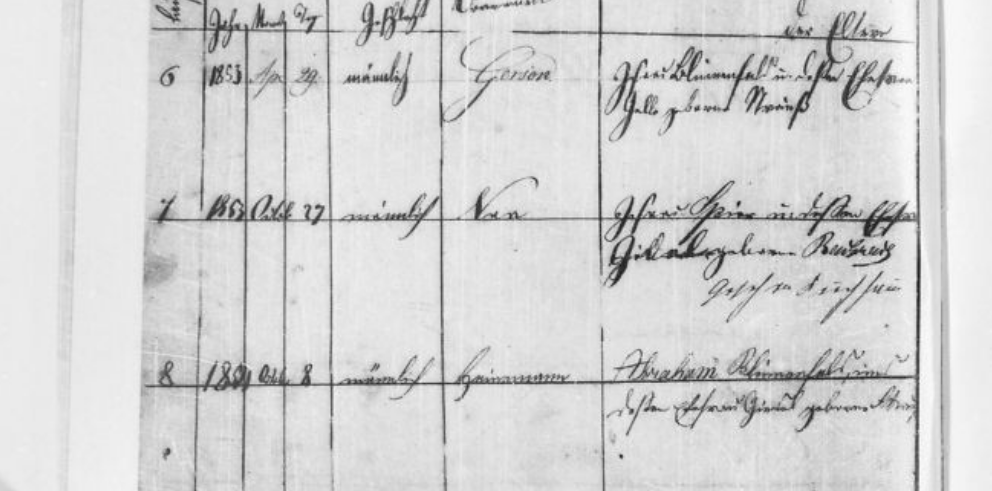
Here is a photo from the book showing Max standing with some of the children and staff at the orphanage in about 1933; he is the man in the dark suit in the foreground.

From Inge Lammel, Das Jüdische Waisenhaus in Pankow, 2001

In addition to obtaining a copy of this book, Richard also located Max’s obituary, which not only provided us with the date and place of Max’s death (March 8, 1936, in Merano, Italy), but also more information about his life:

“Max Blumenfeld,” Gemeindeblatt der Jüdischen Gemeinde zu Berlin, March 15, 1936, page 7

Richard translated the obituary as follows:5

Last Sunday the director of the Second Orphanage of the Jewish Congregation in Berlin, Max Blumenfeld, died in Merano [Italy] where he was taking time for rest and recreation. Blumenfeld died young at the age of 56. He was originally a teacher whose excellent teaching abilities drew the attention of leading personalities, and when his father-in-law [Isidor Grunwald] died about ten years ago, Max Blumenfeld became his successor as director of the Jewish Orphanage in Pankow. Blumenfeld dedicated himself to the traditional task of the institution of training its students as craftsmen. Blumenfeld demonstrated a personal interest in each of the youth in his care, each of them could recon with his support and encouragement. He combined with kindness and friendliness decisiveness and consistence in the execution of his task.

These two documents discovered by Richard Bloomfield have given us a much fuller picture of our cousin Max Blumenfeld. He certainly left his mark and obviously was a kind and generous person.

Unfortunately, the obituary did not include information about his survivors. Was Fritz their only child? Did Johanna stay in Italy, as their son Fritz’s 1940 marriage certificate suggests? Did she return to Berlin? Immigrate to Palestine?

Well, the story of Max Blumenfeld doesn’t end here nor does the story of the collaboration it took to find the rest of that story.

More to come.


  1. Amtliches Fernsprechbuch für Berlin und Umgebun, 1934, 1935, 1936.  Ancestry.com. The one depicted I found on Ancestry for 1935. 
  2. I have tried to recreate Richard’s search through the Graudenz directories. He sent me to the GenWiki website section for directories, and although I found the Graudenz directories, I still need more lessons in how to search through those directories to find Max. 
  3. Inge Lammel, Das Jüdische Waisenhaus in Pankow (2001), p. 50. 
  4. Ibid, p. 48, as paraphrased by Richard Bloomfield, attachment to email May 1, 2022. 
  5. “Max Blumenfeld,” Gemeindeblatt der Jüdischen Gemeinde zu Berlin, March 15, 1936, page 7. 

Salomon Blumenfeld: An Entire Blumenfeld Family Who Survived the Holocaust

Moses IIB’s third child Salomon Blumenfeld and his wife Malchen Levi and their three daughters all left Germany in time and avoided being killed by the Nazis and thus were much more fortunate than Salomon’s siblings, Hermann, Bertha, and Clementine, and their families.

In fact, Salomon’s middle daughter Hilde left Germany even before Hitler came to power. In May 1929, when she was only seventeen, Hilde sailed from Hamburg to New York, listing an uncle, her mother’s brother Salli Levi, as the person she was going to and her occupation as a clerk.

Hilde Blumenfeld 1929 ship manifest, Year: 1929; Arrival: New York, New York, USA; Microfilm Serial: T715, 1897-1957; Line: 2; Page Number: 42, Ancestry.com. New York, U.S., Arriving Passenger and Crew Lists (including Castle Garden and Ellis Island), 1820-1957

When she filed a declaration of intention to become a US citizen on June 2, 1931, she was living in New York City and listed her occupation as a German-English stenographer.

HIlde Blumenfeld Declaration of Intention, The National Archives at Philadelphia; Philadelphia, Pennsylvania; NAI Title: Declarations of Intention for Citizenship, 1/19/1842 – 10/29/1959; NAI Number: 4713410; Record Group Title: Records of District Courts of the United States, 1685-2009; Record Group Number: 21, Ancestry.com. New York, U.S., State and Federal Naturalization Records, 1794-1943

But Hilde apparently never became a US citizen and did not remain in the US. Sometime before March 1934, she married Ludwig Felix Meinrath, and together they immigrated to Brazil. Ludwig was born in Cologne, Germany, in 1902, and immigrated with his parents Leopold and Anni and siblings to Antwerp, Belgium sometime before 1916.1 I don’t know whether they stayed in Belgium or where and when Ludwig and Hilde were married. But in 1934 they left for Brazil where they remained. They had at least one child, who was born in the 1930s.

Ludwig and Hilde Meinrath 1934 ship to Rio de Janeiro, Staatsarchiv Hamburg; Hamburg, Deutschland; Hamburger Passagierlisten; Volume: 373-7 I, VIII A 1 Band 424; Page: 385; Microfilm No.: K_2003, Staatsarchiv Hamburg. Hamburg Passenger Lists, 1850-1934

Hilde’s parents Salomon and Amalie/Malchen followed her to Brazil several years later. They arrived on March 29, 1939. Salomon listed his occupation as “comerciante” or merchant.

Salomon Blumenfeld, Digital GS Number: 004909061, Ancestry.com. Rio de Janeiro, Brazil, Immigration Cards, 1900-1965

Amalie Blumenfeld, Digital GS Number: 004913595, Ancestry.com. Rio de Janeiro, Brazil, Immigration Cards, 1900-1965

Meanwhile, Hilde’s older sister Gretel had married David Katz on January 24, 1930, in Kirchhain; David was the son of Mendel Katz and Jettchen Levi and was born in Nenterhausen, Germany, on February 11, 1897.

Marriage record of Gretel Blumenfeld and David Katz, Hessisches Hauptstaatsarchiv; Wiesbaden, Deutschland; Bestand: 915; Laufende Nummer: 5058, Year Range: 1930, Ancestry.com. Hesse, Germany, Marriages, 1849-1930

This remarkable photograph, which had a long caption labeling all those in it, was found on several Ancestry trees as well as on Geni. It was taken at Gretel and David’s wedding and shows many members of the two families. Of particular interest to my research, the middle row shows Salomon Blumenfeld on the far left next to David’s mother Jettchen, then the bride Gretel and groom David, then Gretel’s mother Amalie and at far right David’s father Mendel. In the bottom row, Salomon and Amalie’s daughter Jenny is seated second from the left, and Lilli Abraham, Salomon’s niece, is seated fourth from the left.2

Wedding of Gretel Blumenfeld and David Katz Source: Unknown

Gretel and David had one child born in 1931. They all immigrated to the US on August 18, 1939. David listed his occupation as teacher.

Katz family, ship manifest, Year: 1939; Arrival: New York, New York, USA; Microfilm Serial: T715, 1897-1957; Line: 1; Page Number: 19, Ship or Roll Number: Hamburg, Ancestry.com. New York, U.S., Arriving Passenger and Crew Lists (including Castle Garden and Ellis Island), 1820-1957

In 1940 they were living in New York City with several lodgers, and David was working as a schoolteacher.3

In August 1946, Gretel’s parents Salomon and Amalie sailed from Brazil to New York, Salomon arriving on August 14 and Amalie on August 29. Salomon’s entry on his manifest indicates that he was going to his daughter Gretel in New York and that he intended to stay permanently. It also indicated that he needed cataract surgery and had other medical issues.4 Amalie’s manifest similarly reported that she was going to Gretel, intended to stay permanently, and had a medical issue.5

Many trees report that the other daughter of Salomon and Amalie, Jenny, married Siegmund Rudolf Warburg on July 25, 1933, and that Siegmund was born in Berlin on May 26, 1896, to Otto Warburg and Bertha Cohen. But something doesn’t add up.

I found the birth record for Siegmund.

Siegmund Warburg birth record, Landesarchiv Berlin; Berlin, Deutschland; Personenstandsregister Geburtsregister; Laufendenummer: 95, Ancestry.com. Berlin, Germany, Births, 1874-1908

But I also found (after some searching because Ancestry had them indexed to the wrong image) a Siegmund Warburg with a different wife, Ilse, and two children, Gabriel and Thomas, sailing from Hamburg to New York on August 31, 1933. Was this a different Siegmund Warburg, also born in 1896 (37 years old) and having last lived in Berlin? Entirely possible.

Warburg family, ship manifest, Month: Band 417 (Aug 1933), Staatsarchiv Hamburg. Hamburg Passenger Lists, 1850-1934

Yet I cannot find any record attaching Jenny Blumenfeld to a man named Siegmund Warburg. The only references I could find (other than the unsourced trees) was a Shoah Foundation interview with Jenny’s sister Hilde that lists a “Geny Varbuk” as her sister.6 I requested access to the interview, hoping this would answer my questions, but alas, it was in Portuguese, and I can’t understand it. I am hoping I can get a transcript and translate it, but I don’t know if that exists. Also, Richard Bloomfield found Jenny’s gravestone on Billiongraves, and it has her name (in Hebrew) as Jenny Warburg.

Jenny Warburg, Yekhi’am cemetery, Akko, Israel, found at Billiongraves.com at https://billiongraves.com/grave/%D7%92%D7%A0%D7%99-%D7%95%D7%A8%D7%91%D7%95%D7%A8%D7%92/22732522

But when I searched on Billiongraves at that same cemetery, I could not find anyone named Siegmund Warburg. That, of course, doesn’t mean anything since Billiongraves doesn’t include everyone, but it also doesn’t help connect Jenny to Siegmund.

Perhaps Jenny was Siegmund’s second wife, but then she didn’t marry him in July 1933. Or maybe she married someone else named Siegmund Warburg and not the one married to Ilse. I don’t know, and I am still searching for answers. Maybe someone who knows Portuguese will listen to the Shoah Foundation testimony and hear Jenny’s sister talk about Jenny’s marriage and fill me in.

UPDATE: Thanks to Richard Bloomfield, I now have one piece of evidence that ties Jenny Blumenfeld to Siegmund Warburg. Richard found on the Israel Genealogy Research Association (IGRA) website a recently uploaded list of Haifa voters from 1950 that has Jenny Warburg and Siegmund Warburg listed together (see lines 168 and 169); we believe these are the right people because their birth years match what we have from other records. Although it isn’t truly enough to prove their relationship, it is certainly another piece in the puzzle supporting the conclusion that Jenny ended up in Israel and was married to Siegmund Warburg.

In any event, Salomon Blumenfeld’s entire family escaped Germany in time and were not killed by the Nazis, unlike Salomon’s siblings Hermann, Bertha, and Clementine.

The story of the remaining child of Moses Blumenfeld IIB, Max, was harder to uncover and will be discussed in my next series of posts.


  1. Louis Felix Meinrath, Birth Date: 1902, Birth Place: Keulen, Immigration Date: 1901-1915, Immigration Place: Antwerpen, Belgium, File Number: 119901, Page: 438
    FHL Film Number: 2234442, Ancestry.com. Belgium, Antwerp Police Immigration Index, 1840-1930 
  2. The photograph may have first appeared on Geni on the profile of David Katz. I have written to the manager of that profile to ask for the photo’s source, but have not heard back. 
  3. Katz family, 1940 US census, Year: 1940; Census Place: New York, New York, New York; Roll: m-t0627-02675; Page: 1A; Enumeration District: 31-2085, Ancestry.com. 1940 United States Federal Census 
  4. “New York, New York Passenger and Crew Lists, 1909, 1925-1957,” database with images, FamilySearch (https://familysearch.org/ark:/61903/3:1:3QSQ-G94V-SWMS?cc=1923888&wc=MFK4-H6D%3A1030138201 : 2 October 2015), 7158 – vol 15390-15391, Aug 14, 1946 > image 1317 of 1489; citing NARA microfilm publication T715 (Washington, D.C.: National Archives and Records Administration, n.d.). 
  5. Malchen Blumenfeld, ship manifest, Year: 1946; Arrival: New York, New York, USA; Microfilm Serial: T715, 1897-1957; Line: 12; Page Number: 63, Ancestry.com. New York, U.S., Arriving Passenger and Crew Lists (including Castle Garden and Ellis Island), 1820-1957 
  6. Interview with Hilde Meinrath, USC Shoah Foundation; Los Angeles, California; Visual History Archive: The Holocaust, Free Access: USC Shoah Foundation, Holocaust – Jewish Survivor Interviews