Lotte Nathan: Carrying and Passing on Family Trauma

Although I couldn’t find out what happened to Bertha Katzenstein Nathan Langebartels, I learned from her naturalization papers that Bertha had had a child with her first husband, Hermann Nathan, named Lotte. Lotte, according to the naturalization petition, was born on May 1, 1915, in Hamburg, Germany. She would have been only eleven years old when her mother and stepfather immigrated to the US in 1926, but she did not come with them. The naturalization petition stated that she “lives in Germany.” The petition also indicated that Friedrich and Bertha had last resided in Hamburg before coming to the United States. I hoped to find Lotte as another way of learning what happened to her mother.

Bertha Katzenstein Langebartels Weber petition for naturalization, The National Archives and Records Administration; Washington, D.C.; Petitions For Naturalization From the U.s. District Court For the Southern District of New York, 1897-1944; Series: M1972; Roll: 542
Description
Archive Roll Descriptions: (Roll 0542) Petition No· 124777-Petition No· 125042
Source Information
Ancestry.com. New York, U.S., Naturalization Records, 1882-1944

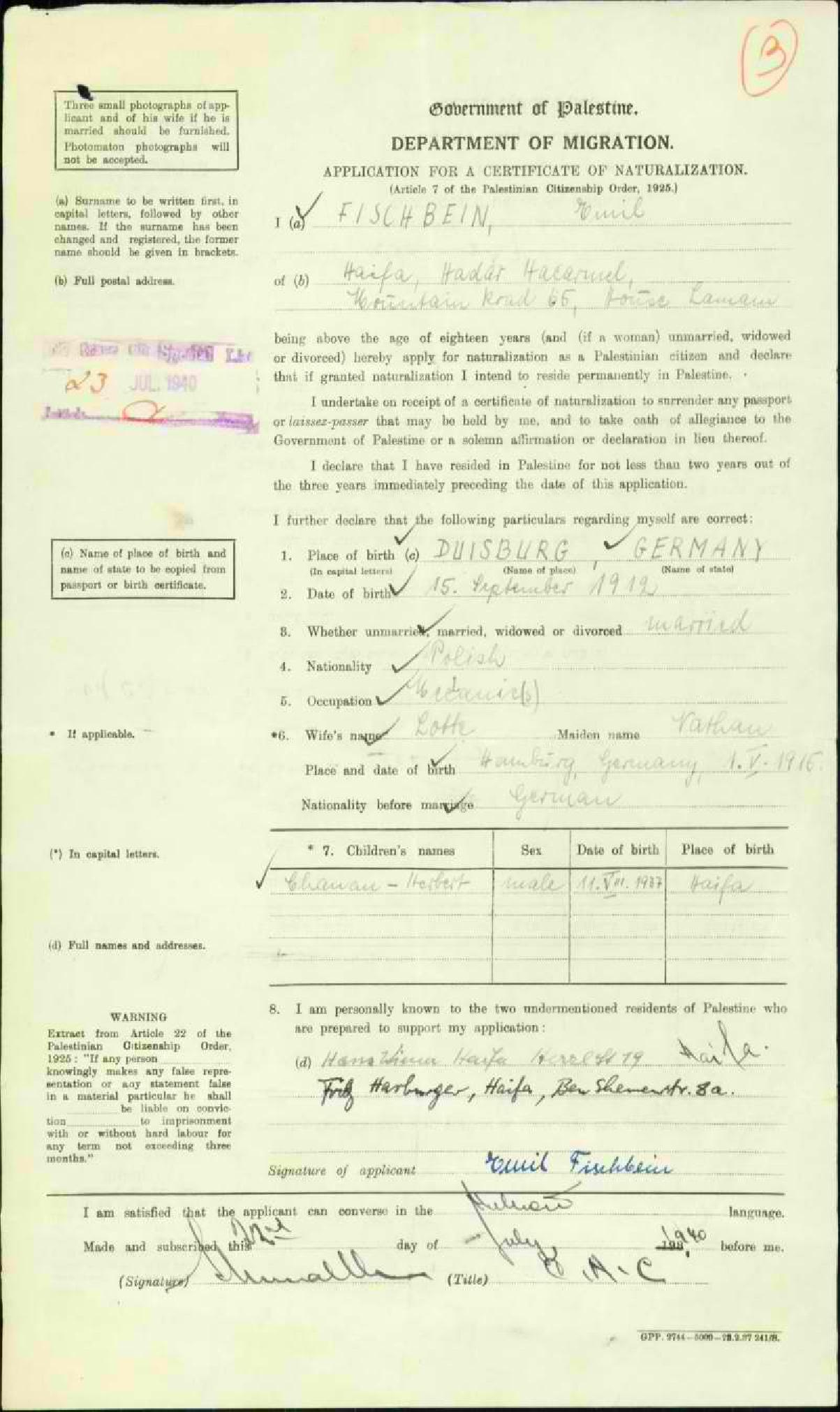
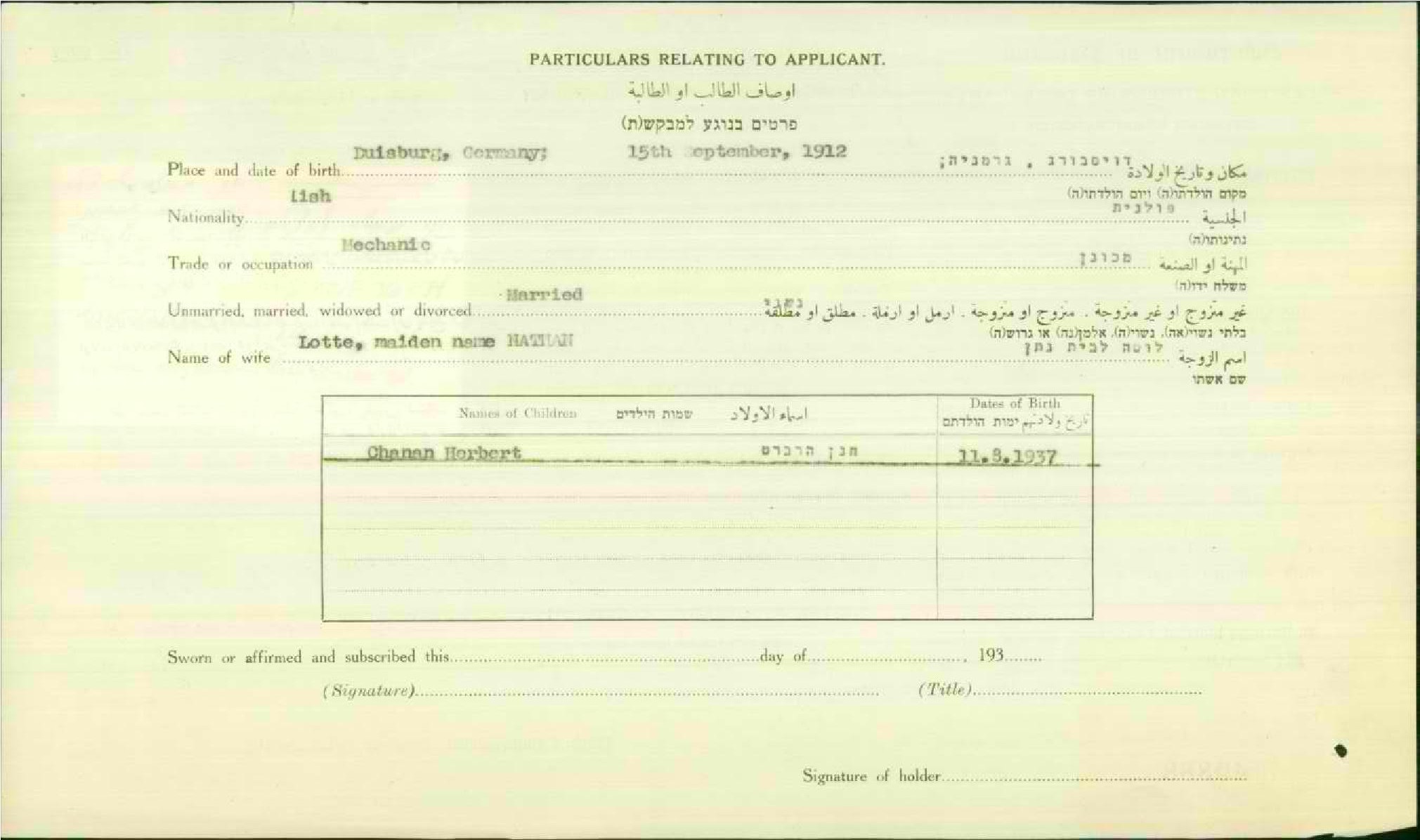
My hunch is that Lotte stayed behind with her father Hermann Nathan, but I can’t be certain. But I do know that sometime during or before 1936 Lotte married Emil Fischbein because on September 8, 1936, they left Germany and immigrated to Palestine as a married couple.1 Emil was born in Duisburg, Germany, on September 15, 1912, but was of Polish nationality, according to his Palestine immigration documents; one tree on MyHeritage created by his great-grandson Gil reports that Emil’s parents were Isaak and Esther Fischbein, both born in what is now Poland. German law at that time provided that children born to non-German parents were not considered German.

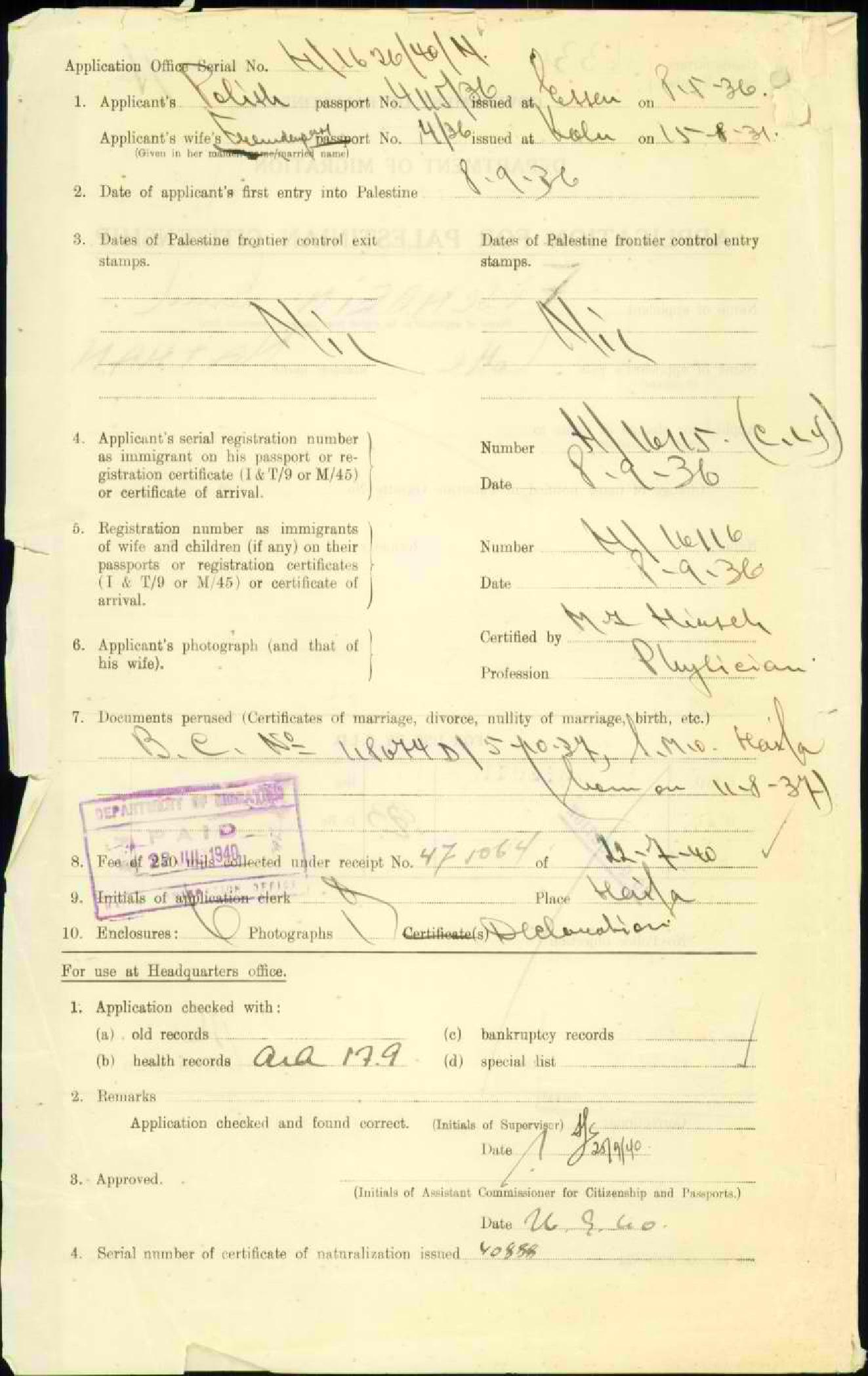
Emil and Lotte’s Palestine immigration documents also include Lotte’s passport,2 which was issued as a Fremdenpass, or a passport issued by the German government to non-Germans living in Germany. Lotte was not eligible for a regular German passport—either because she had married a “foreigner” or because she was Jewish. Jews whose citizenship had been revoked also were granted Fremdenpasses, not regular German passports.

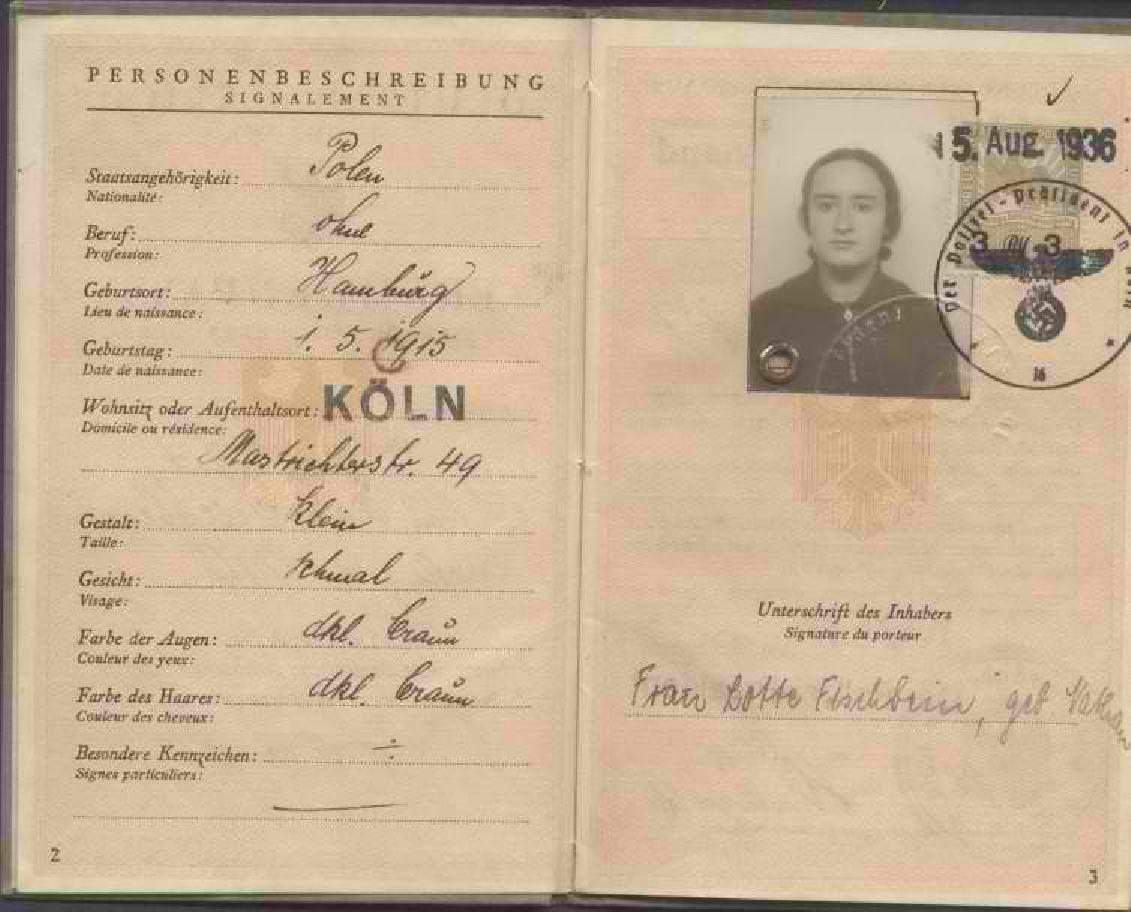
Lotte’s passport was issued on August 15, 1931, from Koeln (Cologne), which suggests that she was living in the German state of North Rhine Westphalia in 1931, not in Hamburg where she was born and where her mother and stepfather had been living before going to the US. It also appears that Lotte’s father Hermann Nathan was not living in North Rhine Westphalia; he was born in Wittingen3 and in 1939 was living in Hildesheim, both of which are located in the German state of Lower Saxony. Emil, however, was born in Duisburg, which is in North Rhine Westphalia, so perhaps that is where they connected with each other.

By October 15, 1940, when Lotte and Emil obtained Palestinian citizenship, they were living in Haifa and had a son, Hanan, who was born on August 11, 1937, in Haifa.4 Through MyHeritage, I located one of their descendants to learn more about Lotte and her family. Gil is Lotte’s great-grandson; his grandfather was Hanan, the baby born in Haifa in 1937. He told me that family lore is that Lotte left Emil and Hanan when Hanan was a child and went to England with an English soldier.

Some trees on Ancestry and MyHeritage indicate that she married Ronald Francis George Buchanan and died in England in 1971. There is a death record on Ancestry for  Lotte Emma B. Buchanan born on May 1, 1915, the day Lotte Nathan was born; the index indicated that she died in the fall of 1971 in Nottingham, England.5 Another record on Ancestry indicates that she died on November 21, 1971, and was cremated in Nottinghamshire on November 24, 1971.6

Lotte Nathan Fischbein Buchanan had a family history and personal history that was difficult. Her grandmother Bertha Metz died from complications of childbirth just two weeks after giving birth to Lotte’s mother Bertha Katzenstein in New York. Bertha Katzenstein was then taken by her father Adolf to Germany, away from her mother’s family.

Then Lotte’s mother Bertha married Hermann Nathan and had Lotte in 1915, only to be divorced from Hermann in 1919 and to marry Friedrich Langebartels in 1921. In 1926 Bertha and Friedrich came to the US and were there at least long enough to file for US citizenship in 1927, leaving Lotte behind in Germany at eleven years old. I don’t know what happened to Bertha after 1927 or whether Lotte ever reunited with her mother.

We know that there is truth to the concept of generational trauma—how the traumas and tragedies suffered by earlier generations are passed down to the children, grandchildren, and so forth of those earlier generations. Bertha Katzenstein grew up without a mother and was taken from the US to Germany as a child by her father, far from her maternal relatives. We don’t know how that trauma affected her, but in some ways her daughter Lotte suffered a similar trauma when her mother Bertha divorced her father, remarried, and left Lotte behind after moving to the US with her second husband. And then Lotte inflicted a similar trauma on her son Hanan, leaving him behind when she remarried and moved to England.

How tragic it is that the scars of one generation can be so easily passed on to the later generations.


  1. Emil and Lotte’s application for citizenship in Palestine in 1940 was found at the Israel State Archives website, temporarily found at https://search.archives.gov.il/, after a cyberattack on their main site. 
  2. See Note 1, supra. 
  3. Hermann Nathan and Bertha Katzenstein marriage record, Year Range and Volume: 1913 Band 01, Ancestry.com. Hamburg, Germany, Marriages, 1874-1920 
  4. See Palestine immigration documents above. 
  5. Name Lottie Emma B Buchanan, Death Age 56, Birth Date 1 May 1915, Registration Date Oct 1971, [Nov 1971] [Dec 1971], Registration Quarter Oct-Nov-Dec, Registration District Nottingham, Inferred County Nottinghamshire, Volume 3c
    Page 1274, General Register Office; United Kingdom; Volume: 3c; Page: 1274, Ancestry.com. England & Wales, Civil Registration Death Index, 1916-2007 
  6. Name Lottie Emma Bertha Buchanan, Register Type Cremation, Death Date 21 Nov 1971, Burial or Cremation Date 24 Nov 1971, Burial or Cremation Place Nottinghamshire, Deceased Online; Kettering, England, UK; Deceased Online Burial Indexes, Ancestry.com. Web: UK, Burial and Cremation Index, 1576-2024 

The Devastating Effects of Terrorism

Today I am honored and moved to share an essay written by my fourth cousin, once removed, Miki Katzenstein Dror. Miki is the daughter of Arie Katzenstein1, an Israeli who was killed by terrorists on February 10, 1970, at the Munich airport while he was traveling with his father Heinz on business.

As I wrote here and here, Arie sacrificed his own life by throwing his body on a grenade, thus saving the lives of many others, including his father, who had fled to Israel from Nazi Germany in the 1930s. Miki and her two siblings were just young children at the time. Because of this horrible act of terror, they grew up without their beloved and courageous father.

Arye Katzenstein Courtesy of his family

As Miki wrote almost a year a half ago, the city of Munich decided to create a memorial to honor the memory of her father Arie and the others who were injured and terrorized on that day in 1970. On February 10, 2025, Miki and her siblings and other family members traveled to Munich to participate in the dedication of that memorial.

This video, in Hebrew but with English subtitles, includes interviews with Miki and her siblings and more information about Arie Katzenstein’s tragic murder. This video in German shows what the memorial looks like and also some images from the ceremony itself, including images of Miki and her brother and sister speaking at the ceremony. It also has some historic footage from coverage of the attack in 1970. Richard Bloomfield has provided me with this translation of the text of the second video.

55 years ago, members of a Palestinian terrorist organization tried to hijack an El Al Israeli airline plane. The victims and the heroes of the attack were commemorated today at the former tower.

Three golden clocks symbolize the times of the three detonations on February 10, 1970. They are located in front of the tower of the former airport in Munich-Riem. The artist Alicja Kwade created the work of art. At today’s inauguration of the memorial, Arie Katzenstein’s three children commemorated their father, who, through his courage, saved the lives of others exactly 55 years ago by throwing himself on a hand grenade. Palestinian terrorists had attacked the passengers during a stopover in Munich, killing the German-Israeli Katzenstein and injuring others. The captain of the aircraft also put up a courageous fight. The extent of the terrorist act had been clearly underestimated, said the mayor of Munich.

[The mayor] “However, I also find it shameful that it has taken half a century for us to finally publicly commemorate the terrible attack here in Munich on February 10, 1970. For this, I apologize. I am glad that we have finally found a worthy way to commemorate it.”

Brainlab, which is now located at the former tower, the city and the family worked closely together.

[Arie’s son] “It will remind people who come here of what happened. And it will make them think.”

A memorial plaque and a website [https://munich1970.de/en/] provide information about the attack. This is to keep the memory of the victims and heroes of Munich-Riem alive.

Here’s a photograph of the memorial:

I asked Miki if she would share with me and my readers her thoughts and feelings about the dedication and the memorial itself. This is what she wrote:

Finally, after fifty-five years, our heroic father was commemorated at the site of his murder in Munich, Germany.

On the afternoon of February 10, 1970, EL AL Flight 435 landed in Munich on its way to London. While waiting for the connecting flight, a squad of three terrorists attacked the passengers by firing pistols and throwing hand grenades.

Our father, the late Arie Katzenstein, who flew with his late father Heinz, for business, threw himself at one of the hand grenades that were thrown at the passengers, thus saving many others, but was killed on the spot.

At his death, he left behind a young widow and three small children between the ages of three months and six years: Miki Dror, Tami Meirovich and Ofer Katzenstein.

About a decade after his death, our mother received a letter from the President of Israel at the time, the late Yitzhak Navon, in which he wrote, among other things, that the State of Israel would cherish the memory of our father among its other heroes. Unfortunately, this promise was never kept, despite our many inquiries on the subject.

On the other hand, about five years ago, representatives of the Munich municipality contacted us, following a request from our German friends. They announced that the municipality intended to commemorate our father at the site of the attack – the old airport in Munich–Riem. As the Germans are using a newer airport these days, the old one is used as a big convention center and a high-tech park. From that moment on, a long process of conversations, meetings and discussions began between us and the Munich municipality regarding the manner of commemoration. At an early point, the high-tech company Brainlab joined the effort. Its offices are currently located in the area where the attack took place.

The company expressed its most generous consent to the existence of the memorial site on its premises and funded a work of art by the famous internationally acclaimed artist Alicja Kwade, to be displayed there.

On February 10, 2025, exactly fifty-five years after the murder of our father, the inauguration ceremony was held in the presence of the President of the Bavarian Parliament, Mrs. Ilse Aigner, the Mayor of Munich, Mr. Dieter Reiter, Founder of Brainlab, Mr. Stefan Viltsmeier, the Consul General of Israel in Munich, Ms. Talia Lador, the artist Alicja Kwade, family members of our Germans friends, other families of the victims and many, many more.

From left to right: Ms. Talia Lador, Consul of Israel to Munich; Mrs. Ilse Aigner, President of Bavarian Parliament; Ofer Katzenstein; Tami Katzenstein; Mr. Dieter Reiter, Mayor of Munich; Miki Katzenstein Dror;  and Mr. Stefan Viltsmeier, founder of Brainlab

During the ceremony, the German dignitaries gave moving speeches, and we, his three children, spoke about our father, his absence, and the long journey that had brought us to this day. In addition, we thanked the German government and their ambassador in Israel for their support in the struggle for the release of the Israeli hostages from Gaza and asked that they not give up until the last of the abductees was brought home.

The Katzenstein family attending the memorial dedication in Munich, February 10, 2025

The singing of opera singers Hagar Sharvit and Noa Beinart and pianist Amiel Bushkevich did not leave a dry eye.

We arrived to the ceremony with a full family lineup, including all of our father’s grandchildren, but unfortunately our mother Bilha, who passed away not long ago, did not get to attend this exciting event. At the end of the ceremony, we read Kaddish, and laid flowers, an Israeli flag, and a scarf of the Hapoel Haifa soccer team – which our father loved so much.

Ofer Katzenstein saying Kaddish at the memorial site for his father Arie Katzenstein

For us, this is a moment of partial closure and unparalleled excitement. After so many years of action, our father’s sacrifice is finally officially recognized.

Now, we have a place where we can come to with our families, relate to, and remember. We couldn’t have asked for more.

We would like to take this opportunity to thank everyone who has helped us over the past few years to get to know our father better, to speak about him and to spread his heroic deeds.

And finally, I’m writing this post on the day that Hamas, the terror organization, released the bodies of Kfir and Ariel Bibas, two babies who were taken to Gaza as hostages more than a year ago. So sad that after 55 years it seems as if nothing has changed, and terror still strike Jews, in Israel and in the world.

When I received the email from Miki sharing this essay, I also was struck by the fact, as Miki observed, that this was the same day that the bodies of the two Bibas children were returned to Israel—two beautiful, innocent babies who were murdered by Hamas after they and their parents were kidnapped by Hamas on October 7, 2023. After first sending the wrong remains, Hamas later released the actual remains of their mother, Shiri Bibas. Their father Yarden Bibas survived his capture and confinement and was released back to Israel, but without his wife and children. Like the children of Arie Katzenstein and so many others, Yarden Bibas has had his family destroyed by terrorism.

Terrorism against Jews began centuries ago with the pogroms that chased some of my ancestors out of Europe, continued with the murder of six million Jews, including many of my relatives, during the Holocaust, and tragically continues to this very day with the nightmare of October 7, 2023, and its aftermath.

And it isn’t only Jews who have suffered because of the hatred, violence, and terror inflicted on one group by another. We still are seeing across the globe the bloodshed and tragedy that hatred produces.

How many more children will grow up without a parent? How many more parents will have to mourn their children? Will we ever learn?

May the memory of Arie Katzenstein be for a blessing, as well as the memories of Kfir, Ariel, and Shiri Bibas, and all the other victims of October 7. And may we someday finally learn, to paraphrase Martin Luther King, that only love can drive out hatred, only light can drive out darkness.


  1. Sometimes transliterated from Hebrew as Aryeh or Arye. 

Levi Rothschild’s Children Part III: Escaping The Holocaust to South Africa, New York, and Palestine/Israel

Of the six children of Levi Rothschild and Clara Jacob who lived to adulthood in Germany, amazingly all but one escaped from Germany in time to avoid being killed by the Nazis. Only the youngest sibling Frieda was not as fortunate. But that doesn’t mean that there wasn’t suffering and loss endured by the other five. This post will focus on the three oldest children: Sigmund, Betti, and Moses.

Sigmund Rothschild and his wife Fanny Rosenbaum escaped to South Africa. I don’t know when or how they immigrated there, but Fanny died there on August 20, 1942, in Capetown at the age of  62.

Fanny Rosenbaum Rothschild death record, Municipality or Municipality Range: Cape Town
Ancestry.com. Cape Province, South Africa, Civil Deaths, 1895-1972

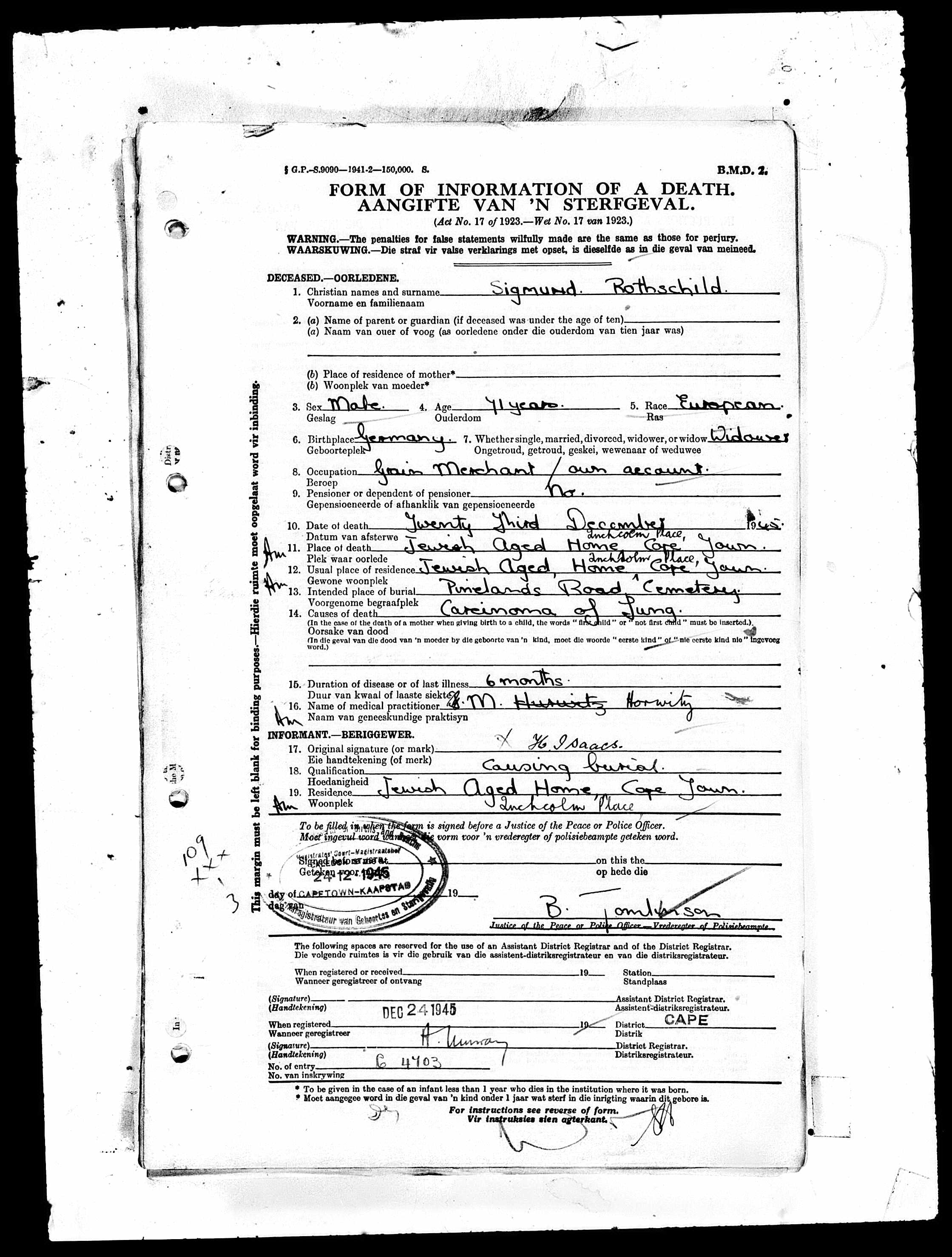
Her husband Sigmund died in Capetown three years later on December 23, 1945; he was 71.

Sigmund Rothschild death record, Municipality or Municipality Range: Cape Town
Ancestry.com. Cape Province, South Africa, Civil Deaths, 1895-1972

As for Sigmund and Fanny’s son Kurt, I have very little information. An entry in the England & Wales Civil Registration Death Index on Ancestry shows that he died in Lancaster, England, and that the death was registered in September 1997.1 A FindAGrave entry shows his gravestone with the date of death as August 30, 1997.

Find a Grave, database and images (https://www.findagrave.com/memorial/81923216/kurt-rothschild: accessed April 19, 2024), memorial page for Kurt Rothschild (1910–3 Sep 1997), Find a Grave Memorial ID 81923216, citing Lytham Park Cemetery and Crematorium, Lytham Saint Annes, Fylde Borough, Lancashire, England; Maintained by ProgBase (contributor 47278889).

The Ancestry tree that appears to have been created by Kurt’s daughter-in-law shows that Kurt married Erna Erdmann and had one child, who is the home person on that tree. I have not been able to find a marriage record for Kurt and Erna Erdmann or a birth record for their child, so I am hoping that the owner of that tree will respond to the message I sent to help me find out what happened to Kurt Rothschild and his family. But since it’s been well over two months at this point, I am not optimistic that I will hear from her anytime soon.

The second child of Levi and Klara, their daughter Betti, lost her husband Emanuel Hirschmann on November 4, 1932. He died in Fulda, Germany, and was 64.

Emanuel Hirschmann death record, Hessisches Hauptstaatsarchiv; Wiesbaden, Deutschland; Personenstandsregister Sterberegister; Signatur: 2470, Year Range: 1932, Ancestry.com. Hesse, Germany, Deaths, 1851-1958

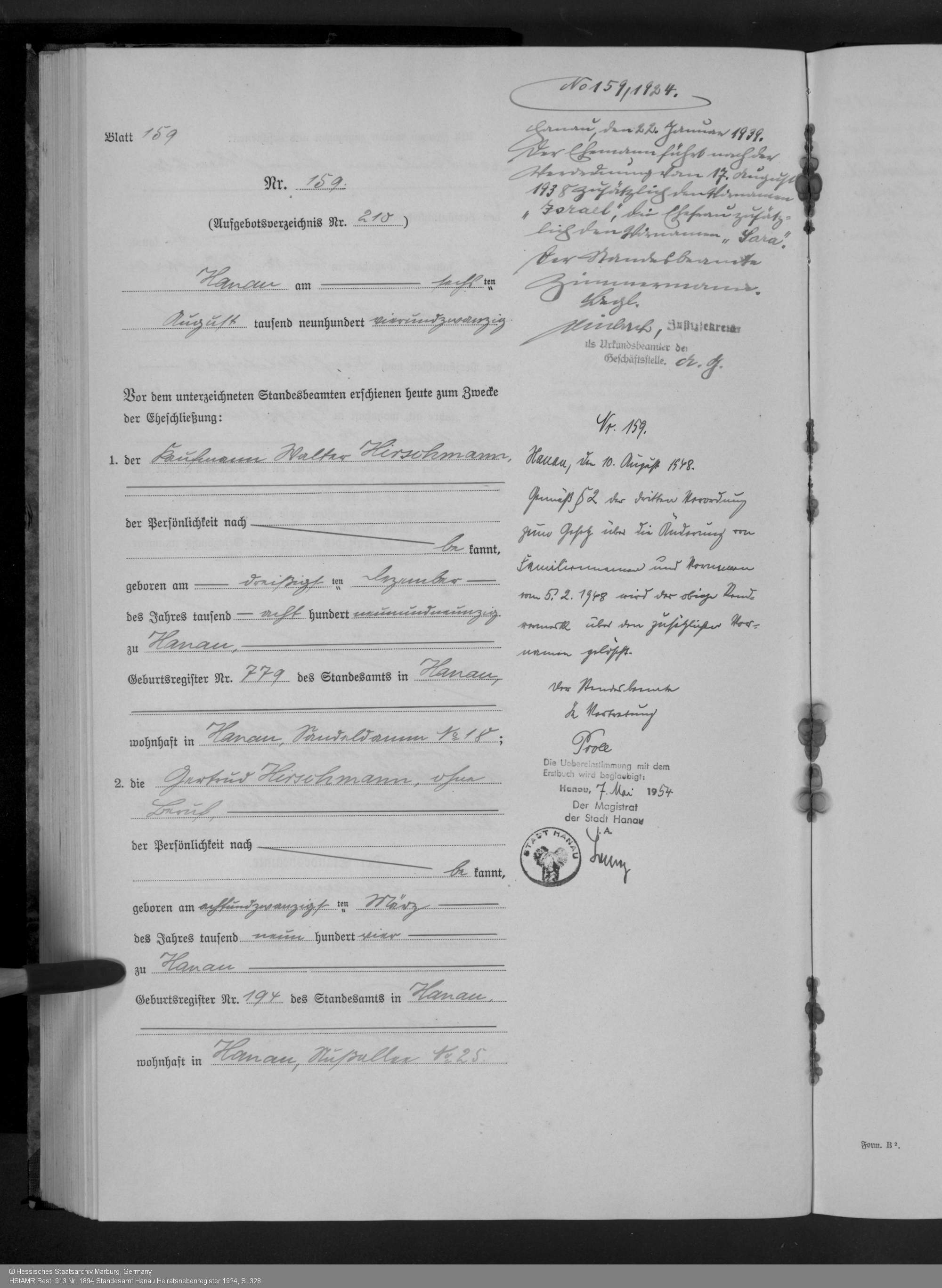
Their son Walter had married Gertrud Hirschmann on August 6, 1924, in Hanau, Germany. Gertrud was born in Hanau on March 28, 1904, according to their marriage record, but that record does not include her parents’ names. It would appear that Gertrud was likely a relative given the surname and her birth place, but so far I’ve not found any way to connect her to Walter’s Hirschmann relatives.

Walter Hirschmann and Gertrude Hirschmann marriage record, LAGIS Hessen Archives, Standesamt Hanau Heiratsnebenregister 1924 (HStAMR Best. 913 Nr. 1894)AutorHessisches Staatsarchiv MarburgErscheinungsortHanauErscheinungsjahr1924, p. 328

Walter Hirschmann and Gertrude Hirschmann marriage record, p. 2

Walter and Gertrud and their twelve year old daughter immigrated to the US on a December 15, 1938. Walter listed his occupation as a banker and their last residence as Frankfurt, Germany, where his mother “B. Hirschmann” was still residing. They were heading to a friend, L. Schwarzchild, in New York.2

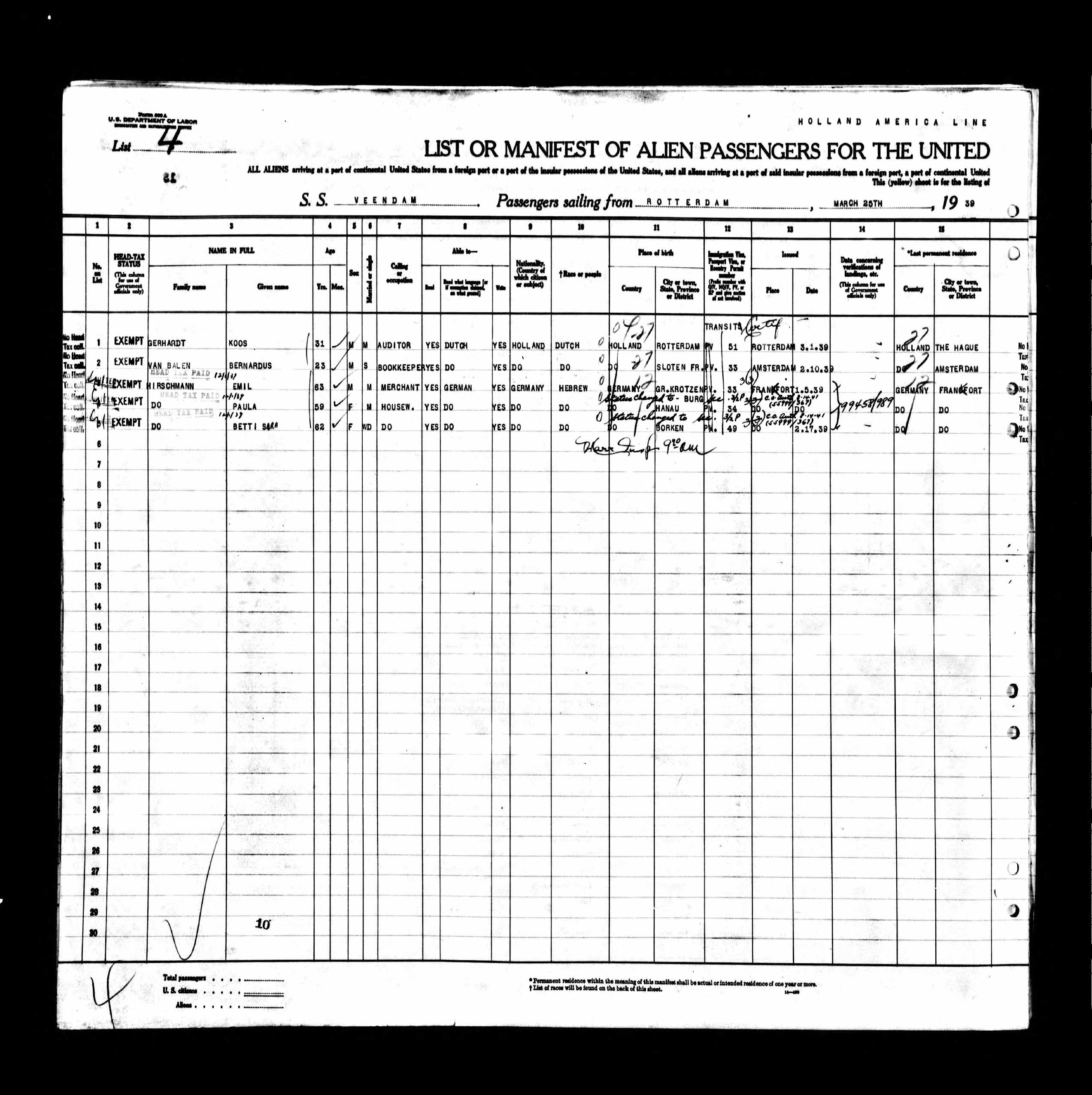
Walter’s mother Betti Rothschild Hirschmann immigrated to the US on March 25, 1939, with a cousin of her husband, Emil Hirschmann, and his wife Paula.

Betti Rothschild passenger manifest, The National Archives in Washington, DC; Washington, DC, USA; Passenger and Crew Lists of Vessels Arriving at New York, New York, 1897-1957; Microfilm Serial or NAID: T715; RG Title: Records of the Immigration and Naturalization Service, 1787-2004; RG: 85, Ship or Roll Number: Veendam, Ancestry.com. New York, U.S., Arriving Passenger and Crew Lists (including Castle Garden and Ellis Island), 1820-1957

On the 1940 census, Betti was living as a lodger in the household of Helena Pessel in New York City, but in the same building as her son Walter and his family at 670 Riverside Drive in New York City. Walter was employed as a salesman.3

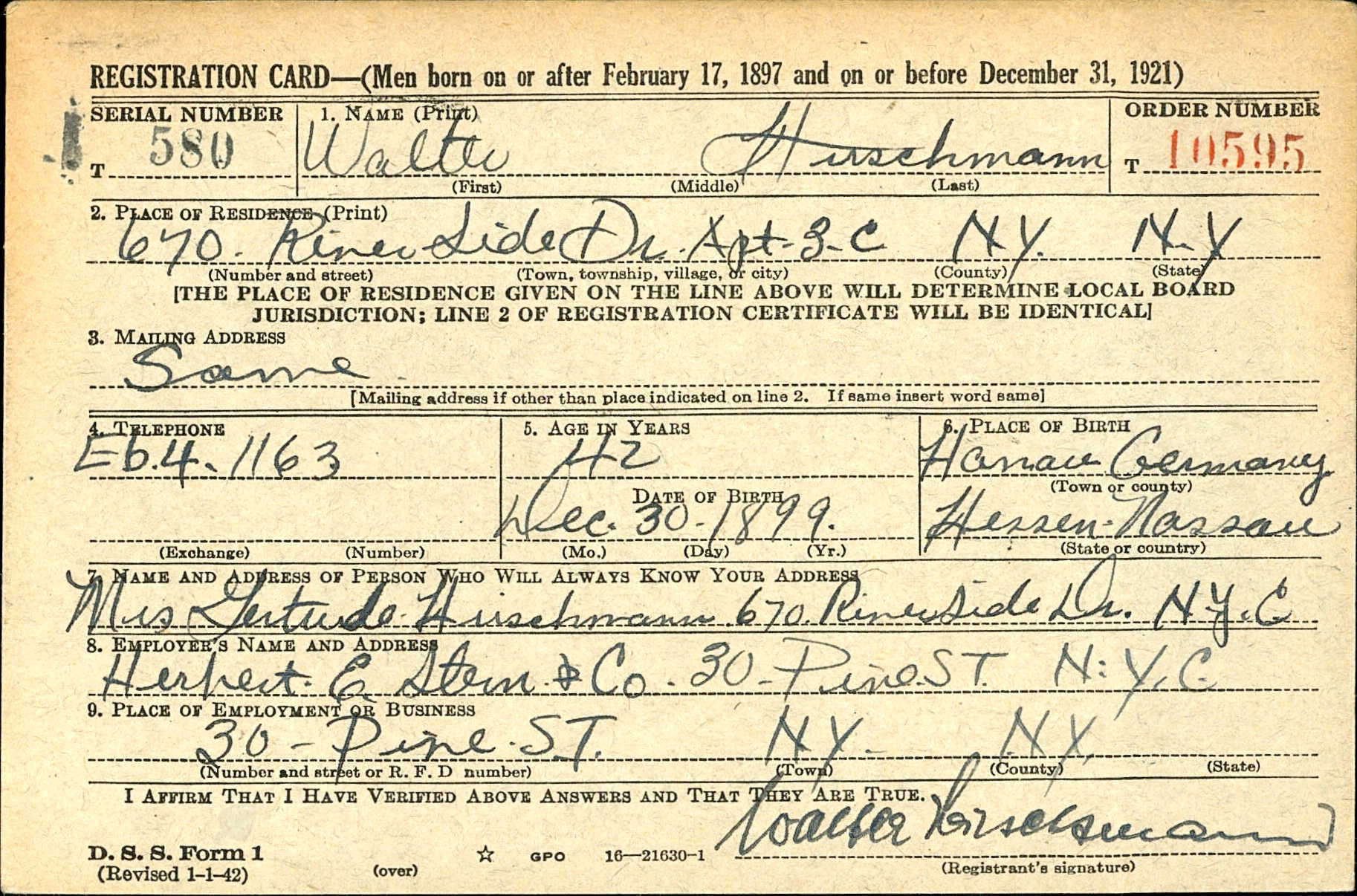
On his World War II draft registration, Walter identified his employer as Herbert E. Stern & Company. From his obituary I learned that Herbert E. Stern was also a refugee from Nazi Germany and an investment banker.4

Walter Hirschmann World War II draft registration, National Archives at St. Louis; St. Louis, Missouri; Wwii Draft Registration Cards For New York City, 10/16/1940 – 03/31/1947; Record Group: Records of the Selective Service System, 147, Name Range: Hirsch, Walfgang-Hobbs, Robert, Ancestry.com. U.S., World War II Draft Cards Young Men, 1940-1947

In 1950 Betti was still living in the same building as her son Walter and his family. Walter was still working as a broker and banker. I am very grateful to Eric Ald of Tracing the Tribe who found the 1950 census record for Betti and also a listing on Ancestry in the New York, New York Death Index for a Betty Hirschmann who died on February 15, 1956.5

Walter Hirschmann and Betty Hirschmann, 1950 US census, National Archives at Washington, DC; Washington, D.C.; Seventeenth Census of the United States, 1950; Year: 1950; Census Place: New York, New York, New York; Roll: 6203; Page: 75; Enumeration District: 31-1900, Ancestry.com. 1950 United States Federal Census

Her son Walter Hirschmann died on June 24, 1977, at the age of 77.6 He had been predeceased by his wife Gertrud, who died in December 1966 7 and was survived by their daughter and grandchildren.

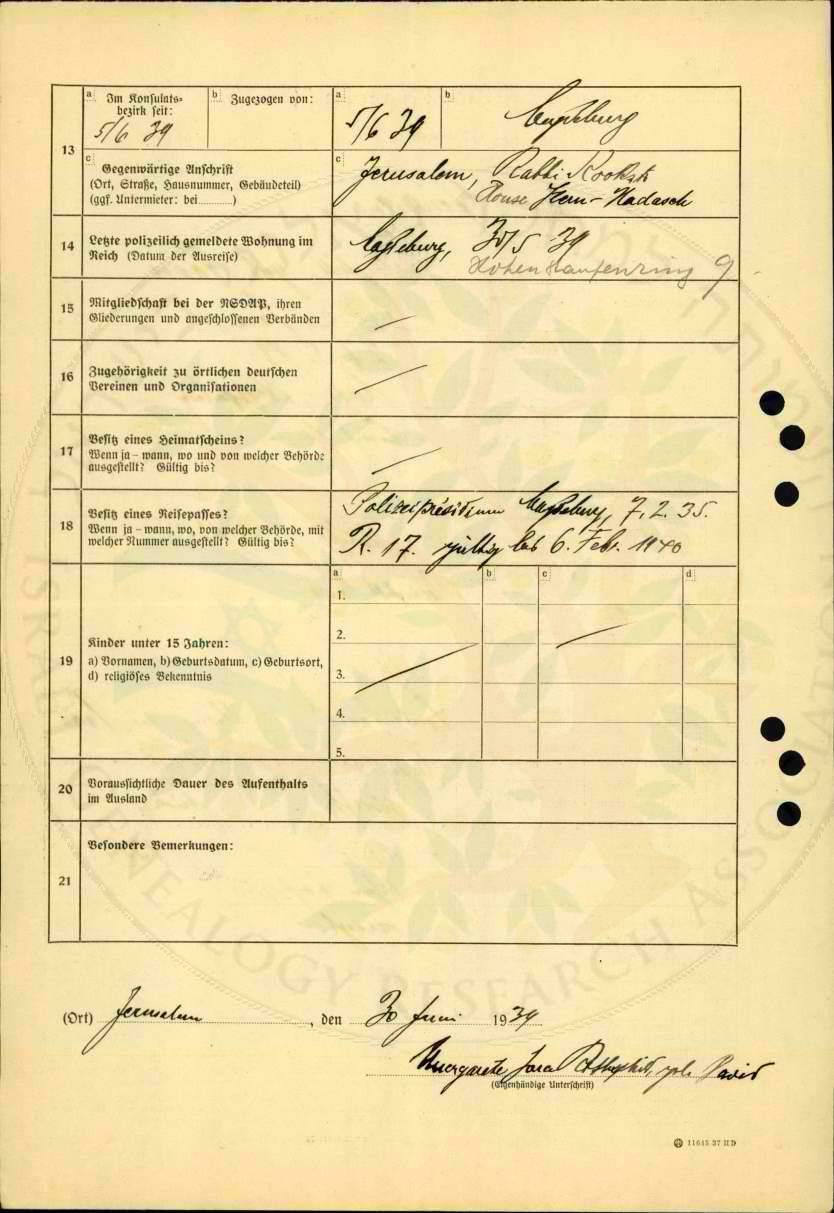
Sigmund and Betti’s brother Moses/Moritz Rothschild and his wife Margarete David ended up in Israel/Palestine in the 1930s along with their two children, Ruth, born October 8, 1914, in Magdeburg, Germany, and Herbert (later Yehuda), born December 10, 1921, in Magdeburg. The documents below are immigration documents showing that Moritz and Margarete were in Jerusalem by June 30, 1939; these and the others that follow were found at the Israel Genealogy Research Association website.

Registration form for Margarete David Rothschild reporting to the German Embassy Legation at the German Consulate General Consulate Bizekonsult in Jerusalem, A-B (טפסי הרשמה: A-B), part of the Residents 1938-1939 (תושבים 1938-1939) database, system number פ-500/5, IGRA number 1459. The original records are from Israel State Archives (ארכיון המדינה), and found at the IGRA website.

Registration form for Margarete David Rothschild reporting to the German Embassy Legation at the German Consulate General Consulate Bizekonsult in Jerusalem, A-B (טפסי הרשמה: A-B), part of the Residents 1938-1939 (תושבים 1938-1939) database, system number פ-500/5, IGRA number 1459. The original records are from Israel State Archives (ארכיון המדינה), and found at the IGRA website.

Registration form for Moses Moritz Rothschild, This record comes from the Meldeblaetter: A-B (טפסי הרשמה: A-B), part of the Residents 1938-1939 (תושבים 1938-1939) database, system number פ-500/5, IGRA number 1462. The original records are from Israel State Archives (ארכיון המדינה), and found at the IGRA website.

Registration form for Moses Moritz Rothschild, This record comes from the Meldeblaetter: A-B (טפסי הרשמה: A-B), part of the Residents 1938-1939 (תושבים 1938-1939) database, system number פ-500/5, IGRA number 1462. The original records are from Israel State Archives (ארכיון המדינה), and found at the IGRA website.

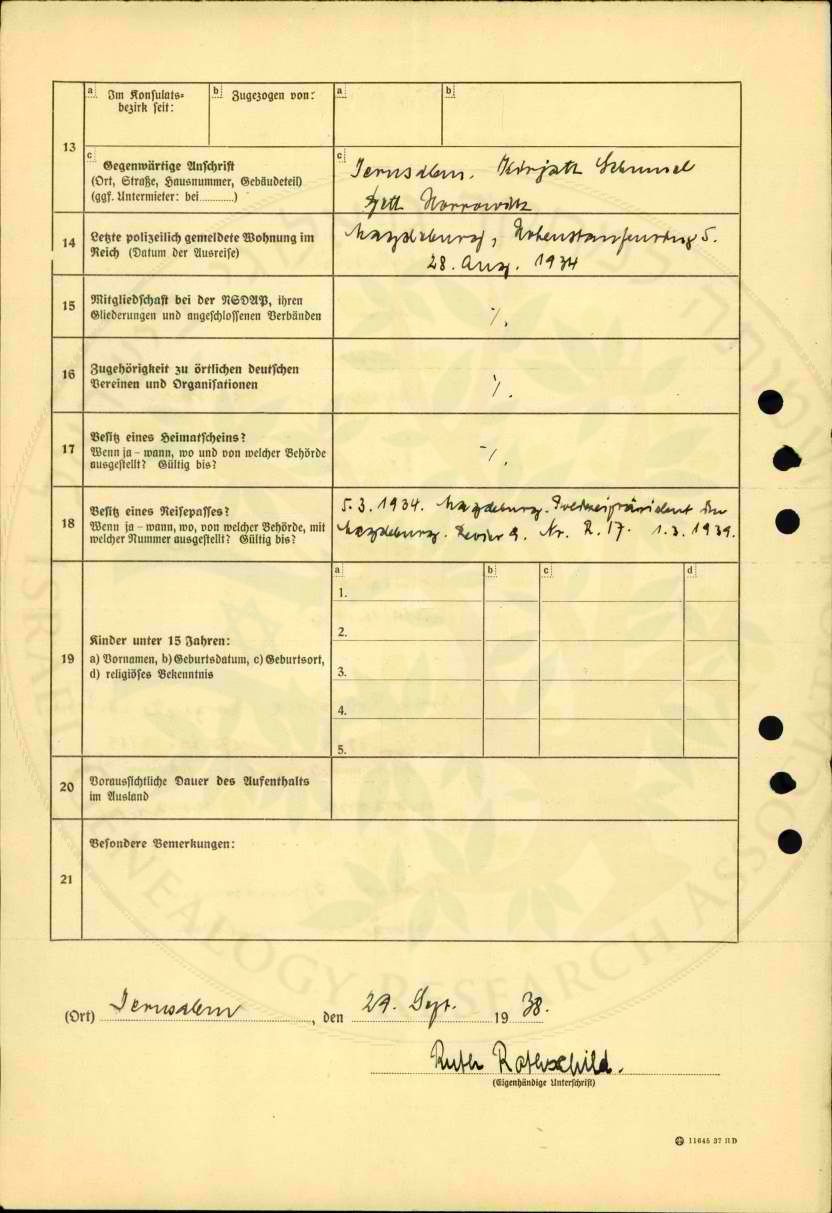
Their daughter Ruth had arrived by September 29, 1938.

Registration form for Ruth Rothschild reporting to the German Embassy Legation at the German Consulate General Consulate Bizekonsult in Jerusalem, A-B (טפסי הרשמה: A-B), part of the Residents 1938-1939 (תושבים 1938-1939) database, system number פ-500/5, IGRA number 1465. The original records are from Israel State Archives (ארכיון המדינה), as found at the IGRA website.

Registration form for Ruth Rothschild reporting to the German Embassy Legation at the German Consulate General Consulate Bizekonsult in Jerusalem, A-B (טפסי הרשמה: A-B), part of the Residents 1938-1939 (תושבים 1938-1939) database, system number פ-500/5, IGRA number 1465. The original records are from Israel State Archives (ארכיון המדינה), as found at the IGRA website.

Although I was unable to find a comparable record for Herbert/Yehuda, I found a record showing that he and his father Moritz were on the voter registration list and living at Kfar Yedidya in 1942:

Moritz and Yehuda Rothschild on 1942 Knesset register, This record comes from the Voters List Knesset Israel 1942 (פנקס הבוגרים של כנסת ישראל תש”ב), part of the Voters Knesset Israel 1942 (בוגרים של כנסת ישראל 1942) database, system number 001mush, document number 119, line 59, IGRA number 1107. The original records are from Israel State Archives (ארכיון המדינה), and was found at the IGRA website.

Yehuda married Ruth Hesin, daughter of Avraham and Hava, on April 17, 1949, in Haifa, Israel. She was 22 years old, he was 27.

Yehuda Rothschild marriage record, Marriage/Divorce Certificates (תעודות נישואין / גירושין), part of the Marriages and Divorces 1921-1948 Palestine British (נישואין וגירושין 1948-1921 ארץ ישראל) database, document number 91714, IGRA number 507. The original records are from Israel State Archives (ארכיון המדינה), and was found at the IGRA website.

At this time I have no further records for this family, but we know that at least they escaped from Germany in time to survive the Holocaust.

Thus, the first three children of Levi Rothschild and Clara Jacob all escaped from Nazi Germany in time, but look at what they lost. They were all spread across the globe: Sigmund in South Africa, Betti in the United States, and Moses in Palestine/Israel.

The fourth child of Levi and Klara, their son Hirsch Rothschild, also escaped. He and his wife Mathilde Rosenbaum and their three children Gertrude, Edith, and Edmund ended up, like Betti, in the US. I will write about Hirsch and his family in my next post.


  1. Kurt Rothschild, Death Age 87, Birth Date 30 Mar 1910, Registration Date Sep 1997, Registration district Lancaster, Inferred County Lancashire, Register Number A58B, District and Subdistrict 5871A, Entry Number 166, General Register Office; United Kingdom, Ancestry.com. England & Wales, Civil Registration Death Index, 1916-2007 
  2. Walter Hirschmann and family, passenger manifest, The National Archives in Washington, DC; Washington, DC, USA; Passenger and Crew Lists of Vessels Arriving at New York, New York, 1897-1957; Microfilm Serial or NAID: T715; RG Title: Records of the Immigration and Naturalization Service, 1787-2004; RG: 85, Ancestry.com. New York, U.S., Arriving Passenger and Crew Lists (including Castle Garden and Ellis Island), 1820-1957 
  3. Betti Hirschmann, 1940 US census, Year: 1940; Census Place: New York, New York, New York; Roll: m-t0627-02671; Page: 7B; Enumeration District: 31-1929, Ancestry.com. 1940 United States Federal Census. Walter Hirschmann and family, 1940 US census, Year: 1940; Census Place: New York, New York, New York; Roll: m-t0627-02671; Page: 7A; Enumeration District: 31-1929, Ancestry.com. 1940 United States Federal Census 
  4. “Herbert E. Stern Dead, An Investment Banker,” The New York Times, August 6, 1973, p. 32. 
  5. Betty Hirschmann, Age 75, Birth Date abt 1881, Death Date 15 Feb 1956, Death Place Manhattan, New York, New York, USA, Certificate Number 3638, Ancestry.com. New York, New York, U.S., Death Index, 1949-1965. Although there is a listing for Betti on the SSCAI with her Social Security Number, there is no listing on the SSDI for her under that number or under that date or under her name. Betty Sara Hirschmann, [Betty Sara Rohserild], Gender Female, Race White, Birth Date 14 Sep 1876, Birth Place Borken Hesse, Federal Republic of Germany, Father Levi Rohserild
    Mother, Clara Jacob, SSN 057200860, Notes Feb 1943: Name listed as BETTY SARA HIRSCHMANN, Ancestry.com. U.S., Social Security Applications and Claims Index, 1936-2007. 
  6. Walter Hirschmann death notice, The New York Times, June 27, 1977, p, 30. Walter Hirschmann, Social Security Number 092-14-5701, Birth Date 30 Dec 1899
    Issue year Before 1951, Issue State New York, Last Residence 10023, New York, New York, New York, USA, Death Date Jun 1977 Social Security Administration; Washington D.C., USA; Social Security Death Index, Master File,  Ancestry.com. U.S., Social Security Death Index, 1935-2014 
  7. Gertrud Hirschmann death notice, The New York Times, December 16, 1966, p. 47. 

Did Jenny Blumenfeld marry Siegmund Warburg? A Brick Wall Tumbles

As I wrote in my last post about the family of Salomon Blumenfeld, Roberto Meinrath, my fifth cousin and the younger son of Hilde Blumenfeld Meinrath, left Brazil in 1960 after being selected by his congregation in Rio de Janeiro to spend a year in Israel in a leadership training program. I was hoping that Roberto might be able to provide information to answer questions I had about his mother’s sister Jenny Blumenfeld, who had immigrated to Israel (then Palestine) to escape Nazi Germany.

Back in May 2022, I wrote that many trees on Ancestry and elsewhere “report that … Jenny, married Siegmund Rudolf Warburg on July 25, 1933, and that Siegmund was born in Berlin on May 26, 1896, to Otto Warburg and Bertha Cohen.” I found Siegmund’s birth record, but I could find no record attaching Siegmund and Jenny; I had found “a Siegmund Warburg with a different wife, Ilse, and two children, Gabriel and Thomas, sailing from Hamburg to New York on August 31, 1933.” But was that the same Siegmund who supposedly married Jenny?

Siegmund Warburg birth record, Landesarchiv Berlin; Berlin, Deutschland; Personenstandsregister Geburtsregister; Laufendenummer: 95, Ancestry.com. Berlin, Germany, Births, 1874-1908

Warburg family, ship manifest, Month: Band 417 (Aug 1933), Staatsarchiv Hamburg. Hamburg Passenger Lists, 1850-1934, Staatsarchiv Hamburg; Hamburg, Deutschland; Hamburger Passagierlisten; Volume: 373-7 I, VIII A 1 Band 417; Page: 2211; Microfilm No.: K_2000
Staatsarchiv Hamburg. Hamburg Passenger Lists, 1850-1934, Ancestry.com

My cousin Richard Bloomfield then found what we believe is Jenny’s gravestone on Billiongraves based on the birth date on the stone, and it has her name as Jenny Warburg; Richard also found a 1950 list of registered voters in Haifa, Israel, that listed Jenny Warburg and Siegmund Warburg together. But none of that definitively proved that it was Jenny Blumenfeld who married Siegmund Warburg.

Jenny Warburg, Yekhi’am cemetery, Akko, Israel, found at Billiongraves.com at https://billiongraves.com/grave/%D7%92%D7%A0%D7%99-%D7%95%D7%A8%D7%91%D7%95%D7%A8%D7%92/22732522

So I asked Roberto what he knew about his aunt Jenny, and he was able to provide further evidence that she had married Siegmund Warburg because while living in Israel in 1960, Roberto spent time with his aunt Jenny and her husband Siegmund. Thus, Roberto was able to confirm that in fact that Jenny had married Siegmund. Roberto also said he knew “for sure” that Jenny and Siegmund did not have any children. Roberto also informed me that his grandmother Malchen/Amalie had gone to Israel after Salomon Blumenfeld died and was living at the same kibbutz as Jenny and Siegmund.1

Roberto wasn’t certain, but he thought that Siegmund may have had a son from a prior marriage also living in Israel. I thought that that might explain how Siegmund appeared on a ship manifest in 1933 with a wife named Ilse and two children, traveling to the US. Perhaps he and his family with Ilse had later immigrated to Palestine/Israel.

I decided to search on the Israel Genealogy Research Association website and found several relevant records. In 1938 Siegmund Warburg, son of Otto (so the same Siegmund born in Berlin on May 28, 1896) is listed with Ilse Warburg on the Haifa registered voters list, proving that the Siegmund who was sailing with Ilse and their children to the US in 1933 had immigrated to Palestine/Israel with Ilse by 1938. Then I found Ilse and Sigmund listed together as Haifa registered voters in 1941.2

Voters List Knesset Israel 1938 (פנקס הבוגרים של כנסת ישראל בחיפה 1938), part of the Voters Knesset Israel 1938 (בוגרים של כנסת ישראל 1938) database, system number גל-7408/5, line 42, IGRA number 12178. The original records are from Israel State Archives found at https://genealogy.org.il/AID/

But in 1942 Sigmund is listed without Ilse, and we know from Richard’s research that in 1950 Siegmund and Jenny were listed together as Haifa voters.3

Voters List – Local (רשימת הבוחרים למועצה המקומית), part of the Voters Local Authorities 1942 (בוחרים למועצות המקומיות 1942) database, document number 297, page 8946, IGRA number 32087. The original records are from City Archives – Haifa (ארכיון העיר – חיפה), found at https://genealogy.org.il/AID/

What does all this mean? It means that although I have no marriage record for Jenny Blumenfeld and Siegmund Warburg, one can presume that Siegmund came to Israel/Palestine with his wife Ilse and their children sometime before 1938, eventually divorced Ilse, and married Jenny sometime before 1950. I could not prove it, but I was persuaded that that’s what happened based on the circumstantial evidence.

I decided to post on the Tracing the Tribe group page on Facebook to see if someone knew where I might find a marriage record for Jenny and Siegmund, and I was surprised to receive a comment from my fifth cousin Simeon Spier, whose mother Gisela Spier I wrote about here. Simeon not only knew that Jenny had married Siegmund Warburg—he knew Jenny well as she and his mother Gisela had been very close.

Simeon wrote that Siegmund Warburg’s father Otto Warburg was an important early Zionist as well as a renowned botanist—something that I had not realized while searching for information about Siegmund. I found more information about Otto and his life and career from his obituary here and from other articles here and here.4

Simeon also told me that Siegmund’s marriage to Jenny was his second marriage; it was Jenny’s first marriage. So that corroborated both what Roberto remembered and what I found in my research. Simeon also confirmed that Siegmund had three children from his first marriage.

Simeon shared these two photographs of Jenny with Siegmund.

Jenny Blumenfeld and Siegmund Warburg Courtesy of Simeon Spier

Siegmund Warburg and Jenny Blumenfeld Courtesy of Simeon Spier

Simeon also shared two photographs of Jenny with his own family. The first one shows Jenny with her cousin Gisela Spier Cohen and Gisela’s children Sitta and Simeon in Haifa in 1965.

Sitta Cohen, Gisela Spier Cohen, Jenny Blumenfeld Warburg, Simeon Spier (Cohen) in Haifa, 1965 Courtesy of the family

This one shows Jenny with Simeon and his sisters when they visited her in Israel in 1974.

Jenny Blumenfeld with the children of Gisela Spier Cohen 1974   Courtesy of Simeon Spier

Simeon has fond memories of visiting Jenny in Israel and when she visited them in Toronto. He described her fondly as a “very orderly and proper woman.” He wrote:4

Jenny had a tiny but well-appointed apartment on the Carmel in Haifa. … The small living room was filled with Sigmund’s books and his furniture from Germany.  She used the covered balcony as her dining room.  She was an exquisite cook and she was proud of it!!  In fact, we have a saying in our family: “Jenny, I think I’ll come again.”  Jenny would taste her delicious cooking before serving it and comment: “Jenny, I think I’ll come again!”

You can see Sigmund’s large collection of books in the first photograph above. Unfortunately, we can’t sample Jenny’s cooking. But we can imagine it.

Jenny’s marriage to Siegmund was further confirmed when I connected with her great-nephew Michael Katz, the grandson of Jenny’s sister Gretel. Michael also met Jenny in Israel. So that was a third confirmation of the marriage.

And then, as yet another confirmation, I received the translation of Hilde’s Shoah Foundation testimony by Manuel Steccanella and Richard Bloomfield.5 In her testimony, Hilde said that Jenny left Germany and first went to England, where she met Siegmund Warburg and his family. They did not marry, however, until they were in Palestine/Israel. Hilde also stated that she herself went to Israel sometime after the end of the war and worked at a kibbutz for two months as arranged by Siegmund Warburg’s children.6

I have searched for a record showing that Jenny was in England before immigrating to Palestine/Israel, but so far have not located any. And I am still hoping someday to obtain an actual marriage certificate for Jenny and Siegmund (I’ve written to the kibbutz where they lived in 1960, but have gotten no response yet), but I am now convinced based on the statements of four witnesses, Roberto, Simeon, Michael,  and Hilde, as well as the photographs shared by Simeon that Jenny Blumenfeld was married to Siegmund Warburg, the son of Otto Warburg.

Thank you to my cousins Gabriela, Roberto, Simeon, and Michael for helping to break down this brick wall. Special thanks to Richard Bloomfield and Manuel Steccanella for translating Hilde’s Shoah Foundation testimony.


  1. Email from Roberto Meinrath, February 11, 2023. 
  2. Voters List – Local (רשימת הבוחרים למועצה המקומית), part of the Voters Local Authorities 1941 (בוחרים למועצות המקומיות 1941) database, system number 6/272, page 14, IGRA number 743. The original records are from City Archives – Haifa (ארכיון העיר – חיפה), found at https://genealogy.org.il/AID/ 
  3. Voters’ Ledgers Haifa Municipality 1950 (פנקס הבוחרים לעירית חיפה 1950), part of the Voters Local Authorities 1948-1953 (בוחרים רשויות מקומיות 1953-1948) database, list קלפי 26, page 1, line 169, IGRA number 21461. The original records are from City Archives – Haifa (ארכיון העיר – חיפה), found at https://genealogy.org.il/AID/.  I also found on the IGRA website an index of a record for the 1947 marriage of Hanna Warburg, twenty-one year old daughter of Zigmund Warburg, in Haifa, and one for the marriage of  Gavriel Warburg, son of Ilza and Shimon Warburg, dated February 23, 1949. He was 21 at the time, so born in about 1928. 
  4. Email from Simeon Spier, February 23, 2023. 
  5. The references in this post to the interview of Hilde Meinrath and the information contained therein are from her interview with the Shoah Foundation, March 18, 1998, which is in the archive of the University of Southern California Shoah Foundation Institute for Visual History and Education. For more information: http://dornsife.usc.edu/vhi 
  6. Ibid. 

Arye Katzenstein

I have researched and written about hundreds of relatives (maybe thousands?) over the almost ten years that I’ve been writing this blog. And aside from my own direct ancestors, of those many, many cousins and great-aunts and great-uncles going back over two hundred years, there are only a small number whose stories are so compelling and unforgettable that when I see their name, I immediately remember the details of their lives.

One of those cousins is my fourth cousin Arye Katzenstein, whose heroic story I wrote about here. During a terrorist attack at the Munich Airport on February 10, 1970, Arye threw himself on a grenade released by the Palestinian terrorists and sacrificed his own life so that he could save the life of his father, Heinz Katzenstein, and the lives of all the other travelers. He was only 32 years old.

So when I received a comment on my blog from a woman named Miki saying her father was Arye Katzenstein, I gasped. I’d had no idea that Arye had had children when he was killed. I immediately wrote to Miki and learned that after more than fifty years, the city of Munich is finally providing a memorial for Arye on the grounds where the attack occurred. The land is now owned by a private company, BrainLab, and together with that company, the city, and the family of Arye Katzenstein, a proper memorial is being established. BrainLab has commissioned an art work by Alicia Kwade, an internationally known artist, and the family is creating a website and informational materials for the site, which will be dedicated sometime in 2024.

From Miki, I learned a great deal more about her father and his family and his life. As I already knew, Arye was born in Haifa (then Palestine, now Israel) on November 23, 1937, after his parents fled from Nazi Germany. But I learned from Miki that he had spent time in Germany as a student. In 1959 he came to Munich to study veterinary medicine, but later returned to study engineering. He had married his wife Bilha on October 22, 1961, and their first child, my cousin Miki, was born in Munich a few years later. The family returned to Israel before the 1967 war and had two more children there, a son and another daughter.

Thus, Arye left behind not only his parents and siblings, but also his wife and three very young children. It’s hard to imagine the pain and suffering that his death must have caused his loved ones. But his legacy is one of heroism and courage.

Miki shared with me several photographs of her family. First is a photograph of her father Arye as a young man traveling in Europe.

Arye Katzenstein Courtesy of his family

This is a photograph taken at Arye and Bilha’s wedding. Bilha is third from our left, then Arye next to her. Next to Arye are his parents Mania (Miriam) Dorf and Heinz Katzenstein.

Wedding of Arye Katzenstein Courtesy of the family

This chilling photograph is of Arye’s notebook taken after the terrorist attack that killed him. It was returned to the family by El Al after Arye’s death.

Arye Katzenstein notebook returned to family by El Al Courtesy of the family

This photograph was taken on the 53rd yahrzeit (anniversary) of Arye’s death in 2023, just a month ago. Arye’s gravestone reads: “Here lies our dear, noble spirited Arye Katzenstein, son of Miriam and Jacob Hacohen, who sacrificed his live during the attack on El Al passengers.”

Gravestone of Arye Katzenstein Courtesy of the family

The stones for Miki’s grandparents appear below:

Gravestones of Heinz and Miriam Katzenstein Courtesy of the family

Finally, Miki shared with me this photograph of her family—her husband, her children, and herself. I don’t usually include photographs of living people, but in this case I do so to honor the memory of Arye Katzenstein and to recognize the resilience of his family and the hope for a better future where all of us can live in peace and without fear of terrorism.

Miki Katzenstein Dror and family Courtesy of the family


Finding Max Blumenfeld and His Family: A Postscript

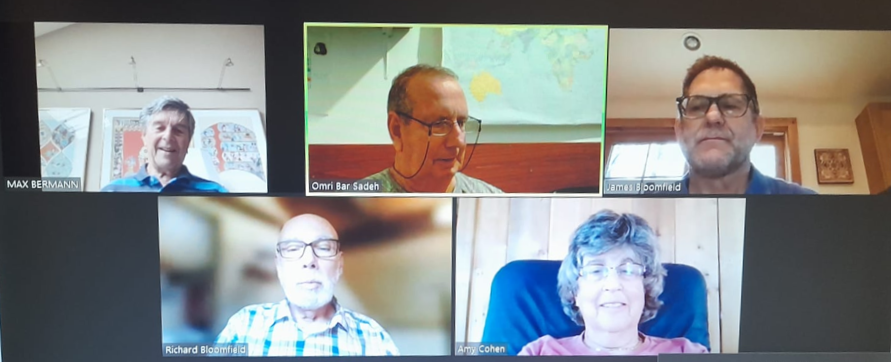
Yesterday I Zoomed with four of my Blumenfeld cousins—Richard, whose been my research partner for quite a while now, his first cousin Jim, who is also a wonderful genealogy researcher, and the two surviving grandchildren of Max Blumenfeld, Max and Omri. We spanned three continents—Omri in Israel, Richard in Switzerland, and Max, Jim, and I in New England. We chatted for an hour, but could have gone on much longer and hope to continue the conversation another time.

During our conversation, we uncovered the answer to a question we still had been unable to answer despite all our research: when did Anna Grunwald Blumenfeld, Max Blumenfeld’s widow and Omri and Max’s grandmother, leave Italy and immigrate to Israel/Palestine? The records that Richard had obtained from Merano said she’d left in 1939, but Max had pointed out that that wasn’t possible since he and his sister were cared for by their grandmother Anna during World War II while their mother Edith worked with the Italian Resistance. Their father Josef had immigrated to the United States on November 1939.

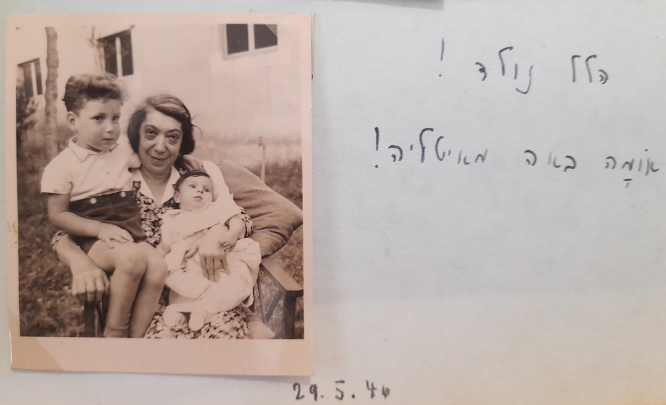
For our Zoom, Omri had prepared a wonderful slide show of family photographs, some of which I’ve already shared on this blog, and some that were new to me. Among those photographs was one that helped to answer the question of when Anna arrived in Palestine. The photograph shows Anna in Palestine with two of her grandsons, Omri’s brothers Gideon and Hillel. Anna was holding Hillel, who was just a very small baby, and the photo was inscribed in Hebrew with the words, “Hillel is born! Oma [Anna] arrives! 29 May 1946.” So now we knew that Anna had only recently arrived in Palestine in May of 1946.

Here is another photo taken the same day showing Anna with Gideon and Hillel and their parents Fritz and Dora.

But then how do we explain the records that said Anna had left Merano in 1939? Well, Max had the answer to that question. Max explained that Anna and her daughter Edith and the two grandchildren, Max and his sister Margherita, all left Merano in 1939 and moved to Milan. Max has no memories of life in Merano since he was only a toddler when the family moved. But that would explain why the Merano records report that Anna left that place in 1939.

Max and his family stayed in Milan for several years, and then when Italy adopted laws persecuting the Jews in about 1942, his mother Edith was able to use her connections to obtain permission to leave Milan and move to the countryside outside of Milan.  The family remained there for the duration of the war, hiding the fact that they were Jews. They spoke Italian (although they all could also speak German) so that they could pass as Italian, and Max and his sister went to church on Sundays. In fact, Max and Margherita were not aware of the fact that they were Jewish and also didn’t know that their father was still alive—all to prevent the children from accidentally revealing the fact that they were Jews.

After the war, Edith took her children to America so they could all be reunited with Josef, and Anna went to Palestine to be with her son Fritz and his family, as depicted in the photograph above.

We spoke of many other interesting things during our Zoom, and there were many stories and many moments of laughter interspersed. It was truly a delightful hour and one I will always cherish and remember.

Thank you to Omri, Max, Richard, and Jim—all of whom are my fifth cousins, four people I never would have known if not for doing genealogy research.

And that, dear readers, is the magic of genealogy.

Finding Max Blumenfeld, Part III: Finding His Grandsons

Although my cousin Richard and I had learned that Max Blumenfeld died in Merano, Italy, in 1936, we still didn’t know where and when his wife Anna died. We had some hints, but nothing definite. Her son Fritz’s marriage record in 1940 seemed to suggest she was still living in Italy. But her daughter Edith’s failure to list her mother on the 1946 ship manifest as her nearest relative in Italy, the place Edith had last resided, seemed to indicate that either Anna had died by then or had left Italy.

We were hoping that one of Max and Anna’s grandchildren might know the answers, and so I turned to locating those grandchildren. We knew that Max and Anna’s daughter Edith had two children with her husband Joseph Bermann, so I started to search for them. They all appear together on the 1950 US census, living in New York City. Joseph was practicing medicine, and Edith was working as a secretary for a general export business. Their two children Margherita (spelled Margaret on the census) and Max were 14 and 12.1 As of 1958, Edith and Joseph were still living in New York City.

Joseph Bermann, passenger manifest, The National Archives At Washington, D.C.; Washington, D.C.; Series Title: Passenger Manifests of Airplanes Arriving At San Juan, Puerto Rico; NAI Number: A3534; Record Group Title: Records of the Immigration and Naturalization Service, 1787-2004; Record Group Number: 85, Ancestry.com. Puerto Rico, U.S, Arriving Passenger and Crew Lists, 1901-1962

According to FindAGrave, Joseph died on May 1, 1966; he was 68.2 Edith died two years later on August 12, 1968. She was only 61.3 They were both buried in Westchester Hills Cemetery in Hastings-on-Hudson, New York. They were survived by their two children. Their daughter Margherita died on August 21, 2008;4 she was 72. Max, however, was as best I could tell, still living.

After using Google and other online tools, I finally located what I assumed was Max Bermann’s Facebook page. I noticed that he had a Facebook friend named Omri Bar Sadeh. You may recall that Hermann Blumenfeld, Max Blumenfeld’s older brother, had a son Hans who had changed his name to Hanan Bar Sadeh after immigrating to Israel/Palestine. I used the Google Translate tool and learned that “sadeh” means a cultivated field. So Bar Sadeh means son of a cultivated field. Since Blumenfeld translated from German as field of flowers, it made sense that Hanan had adopted a name that meant he was the son of a cultivated field, or a field of flowers, or a “Blumenfeld.”

So when I saw that Max Bermann had a Facebook friend with the surname Bar Sadeh, I assumed that this other person must be a descendant of Edith’s first cousin, Hanan Bar Sadeh. But David Lesser had reported that Hanan had no children, so I was not certain. Was it just a coincidence that Edith’s son Max had a friend with that surname? Or was this Facebook friend one of his cousins?

On Omri Bar Sadeh’s Facebook page, there was a video in Hebrew. I could not understand it, but I could translate the comment that had been included with the post, and it indicated that the video was about Omri Bar Sadeh’s brother Gideon Bar Sadeh. When I googled that name, I found this page:

Bar-Sadeh, Gideon

Son of Moses HaKohen and Devorah. He was born in Ein Harod on June 16, 1942, and completed his twelfth grade at the Kibbutz Ha-Meuchad School there. He had a penchant for drawing and found talent in his paintings. He would decorate his notebooks and make handsome posters and posters. He was quiet and humble in his ways. Was an animal breeder and loved them. Was drafted into the Israel Defense Forces in October 1960. On October 18, 1962, he fell in the line of duty and was brought to eternal rest in Ein Harod.

I knew that Edith Blumenfeld Bermann had listed her brother Fritz on her ship manifest in 1946 indicating that he was residing in “En Charod,” Palestine. Could Gideon have been Fritz’s son, I wondered? Fritz had married a woman named Devorah so that fit the puzzle. But then why did it say Gideon’s father was named Moses?

Then I remembered seeing on the IGRA website that in 1942 Fritz Blumenfeld, residing in En Harod, had been identified as “Moshe (Fritz) Blumenfeld, son of Max.” And given that Max’s father’s name had been Moses, it made sense that Fritz’s Hebrew name was Moshe and that he was named for his grandfather and adopted that name as his primary name in Israel.

Record located on the Israel Genealogy Research Association website at https://genealogy.org.il/AID/

With that additional insight, I realized that I had found the family of Fritz Moshe Blumenfeld and that Fritz, like his cousin Hanan, had changed his surname from Blumenfeld to Bar Sadeh for the same reasons. Just to be sure, I asked David Lesser if he would watch the video posted on Facebook about Gideon, and he confirmed that the video says that Gideon’s parents were Fritz and Devorah.

I sent messages to both of the surviving grandsons of Max and Anna (Grunwald) Blumenfeld, hoping that I would eventually learn what happened to Anna and the rest of the story of their family. Much to my delight, I heard from both of them.

Max Bermann, Edith’s son, was born in Merano, Italy, where his father Giuseppe (later Joseph) Bermann was born. That’s where the family was living (along with Anna) after Joseph left for the US in 1939. Although the family was originally supposed to follow once Joseph was settled, the war intervened, and they could not leave Italy. Max was just a toddler at the time. His grandmother Anna became the primary caregiver for his sister and him because their mother Edith was often away. Max later learned from his sister that Edith was acting as a courier for the partisans during the war.

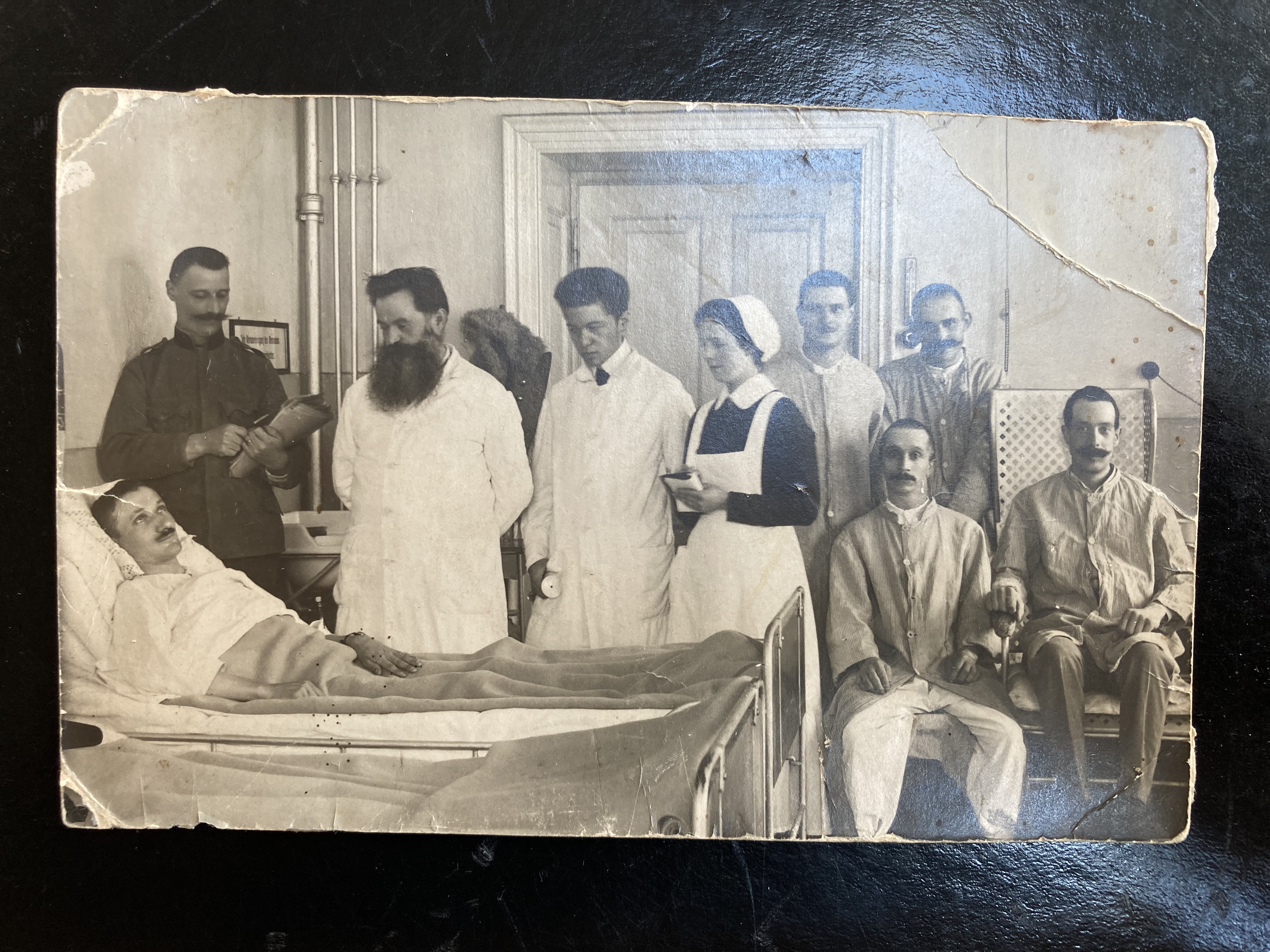
Max shared with me this photograph of Merano, where he and his father were born, as well as this photograph of his father and his father’s father, Max Bermann, both of whom were doctors at the Waldpark Sanitorium in Merano. The elder Max Bermann is the man with the long black beard and his son Joseph/Giuseppe Bermann, the younger doctor in the white coat, is standing next to him.

Dr Max Bermann and his son Dr Joseph Bermann in Waldpark Sanitorium, Merano, Italy. Courtesy of the family

When the war ended, Edith brought her children to the US, but Anna went to live with her son Fritz and his family in Ein Harod in Palestine. Neither Omri nor Max knew exactly when Anna immigrated, but as I was doing some of the final edits for this post, Richard emailed me with new information he’d found online—a database of information about the Jews of Merano.

There was an entry for Anna Grunwald Blumenfeld that reported that “Anna Grünwald-Blumenfeld came from Berlin and lived in Merano since 23.4.1936. On 22.8.1938 she was recorded in the census of “Jews” living in Italy by the fascist authorities as permanently resident in Merano. On 13.2.1939 her file received the note: “di razza ebraica”. On 1.4.1939 she fled to an unknown place, according to the registration office of the municipality of Merano. Later, April 1939 is given as the date of the flight abroad.”5 Thus, it would appear from this record that Anna left Merano for Palestine in April, 1939.

But as noted by Max and by my reader Teresa, this cannot be accurate. Max knows that his grandmother did not leave in 1939 because she cared for him during the war years. It appears more likely that these Merano records are inaccurate and that Anna was in Italy at least until the end of the war.

Now that I knew that Anna had survived the war and had immigrated to Palestine, I searched again on the Israel Genealogical Research Association website and found this record:

Anna Grunwald Blumenfeld died on September 7, 1946, in Ein Harod; she was only 61 years old. She had survived the move from Germany to Italy, the loss of her husband Max in 1936, World War II, and then a move from Italy to Palestine. She was survived by her daughter Edith and her family and her son Fritz and his family.

Anna and Max Blumenfeld’s grandson Max Bermann shared these lovely photographs of his family. First, some photographs of Anna and Max:

Anna Grunwald Blumenfeld Courtesy of the family

Anna Grunwald Blumenfeld and Max Blumenfeld Courtesy of the family

Max Blumenfeld Courtesy of the family

This photograph is of Max and Anna’s children Fritz and Edith as well as, on the right, Fritz’s wife Dora Salpeter Blumenfeld.

Fritz Blumenfeld, Edith Blumenfeld Bermann, and Dora Salpeter Blumenfeld Courtesy of the family

And this final photograph from Max shows him and his sister Margherita with a soldier they met when they visited Palestine (now Israel) with their mother after the war.

Margherita and Max Bermann in Italy shortly after the end of World War II with a soldier from Palestine. Courtesy of the family

Omri also shared some photographs, including this one of his grandmother Anna’s gravestone.

Anna Blumenfeld, Ein Harod Photo courtesy of Omri Bar Sadeh

In addition, he shared photographs of the gravestones of his parents Fritz (Moshe) and Dora/Devorah and his two brothers Gideon and Hillel.

Gideon, as we saw, died fighting for Israel on October 18, 1962.

Gideon Bar Sadeh, Ein Harod Photo courtesy of Omri Bar Sadeh

Omri’s father Fritz Moshe Blumenfeld Bar Sadeh died December 12, 1977 in Ein Harod; he was 67. Devorah Salpeter Blumenfeld Bar Sadeh, outlived her husband by almost 23 years and died at 92 on November 27, 2000, in Ein Harod.

Dora and Fritz Bar Sadeh, Ein Harod Photo courtesy of Omri Bar Sadeh

Fritz and Devorah’s middle child, their son Hillel, died from cancer on December 30, 1996, in Ein Harod. He was only 50 and left behind a wife and four children.

Hillel Bar Sadeh, Ein Harod Photo courtesy of Omri Bar Sadeh

I am so grateful to my fifth cousins Max and Omri for sharing their family’s stories and their own stories and their photographs with me and allowing me to share them with you. I now have answers to all the questions I had when I first started searching for what happened to Max Blumenfeld after he married Anna Grunwald in 1906, thanks to the incredible help of Richard Bloomfield, David Lesser, Max Bermann, and Omri Bar Sadeh.


  1. Joseph Bermann family, 1950 US census, United States of America, Bureau of the Census; Washington, D.C.; Seventeenth Census of the United States, 1950; Record Group: Records of the Bureau of the Census, 1790-2007; Record Group Number: 29; Residence Date: 1950; Home in 1950: New York, New York, New York; Roll: 5665; Sheet Number: 72; Enumeration District: 31-675, Ancestry.com. 1950 United States Federal Census 
  2. Find a Grave, database and images (https://www.findagrave.com/memorial/173690239/joseph-bermann : accessed 18 May 2022), memorial page for Joseph Bermann (unknown–1 May 1966), Find a Grave Memorial ID 173690239, citing Westchester Hills Cemetery, Hastings-on-Hudson, Westchester County, New York, USA ; Maintained by BKGeni (contributor 46895980) . 
  3. Find a Grave, database and images (https://www.findagrave.com/memorial/173690238/edith-bermann : accessed 18 May 2022), memorial page for Edith Bermann (unknown–12 Aug 1968), Find a Grave Memorial ID 173690238, citing Westchester Hills Cemetery, Hastings-on-Hudson, Westchester County, New York, USA ; Maintained by BKGeni (contributor 46895980) . 
  4.  Margherita M. Bermann, Social Security Number: 085-30-0023, Birth Date: 22 Aug 1935, Issue Year: 1954-1956, Issue State: New York, Last Residence: 12550, Newburgh, Orange, New York, Death Date: 21 Aug 2008, Social Security Administration; Washington D.C., USA; Social Security Death Index, Master File, Ancestry.com. U.S., Social Security Death Index, 1935-2014 
  5.  There were also entries for Max and for their two children Fritz and Edith. Max’s entry confirmed that he died on March 7, 1936 and is buried in the Jewish cemetery in Merano. Edith’s entry reported that she had “married Josef Bermann on January 30, 1935. After a stay in London in the spring of 1935, she lived in Merano from April 8, 1935. On August 22, 1938, Edith Bermann was included in the census of “Jews” living in Italy by the fascist authorities. On February 13, 1939, her file received the note: “di razza ebraica”. Edith Bermann, who stayed in Milan again and again, fled to Milan.” Fritz’s entry in the Merano Jewish database reported that he “had lived in Merano since October 3, 1936, where his sister was married to the doctor Josef Bermann. On August 22, 1938, Fritz Blumenfeld was recorded by the fascist authorities as permanently residing in Merano in the census of “Jews” living in Italy. According to the registration office of the municipality of Merano, Fritz Blumenfeld fled to Palestine on May 15, 1939.” 

The Search for Max Blumenfeld: It Took A Village, Part I

The search for what happened to Max Blumenfeld, son of Moses IIB, was not an easy one. It was a lesson in persistence and in the value of working with other researchers. My cousin Richard Bloomfield contributed a great deal to the research of the life of Max Blumenfeld as did David Lesser, my new research friend from Tracing the Tribe.

Finding Max’s birth and marriage records was easy. As I’ve already written, he was born in Kirchhain on June 13, 1880, and married Johanna Grunwald in Berlin on March 16, 1906.

But finding out what happened next was not as easy. Did they have children? Did Max and Johanna survive the Holocaust? Neither was listed in Yad Vashem, so I felt hopeful that they did. But I couldn’t find them anywhere else either. There were no records in the Arolsen Archives. There were no US immigration records or other records placing them in the US. There were no Palestinian immigration records for them either. Where else could they have gone? Did they die before the Nazi era? If so, I couldn’t find any German death records.

When I looked at other trees on Ancestry and at Geni and MyHeritage, there were similar holes in the information for Max and Johanna—-there was nothing after their marriage in 1906. I only found one tree that had more information, and fortunately for me, it was the tree of my fifth cousin and fellow researcher Richard Bloomfield. According to Richard’s tree, Max had emigrated to Italy in 1933 and died there, Johanna had died in Israel sometime after 1947, and they had a son named Fritz who died in about 1977 in Israel.

I contacted Richard to ask where he’d gotten the information, and he said he’d gotten the information from someone else’s tree. So he and I began to see if we could verify any of that information.

Richard noted that on Max’s marriage record his occupation was given as “Waisenhausinspektor” or orphanage inspector and that he was living in Graudenz at the time of his marriage. But since Max and Johanna were married in Berlin, Richard had a hunch that Max had become the Waisenhausdirektor for the Jewish orphanage in Berlin and decided to search old Berlin directories. He found Max listed as the Waisenhausdirektor in those directories for a number of years, including 1934, 1935, and 1936. Thus, we knew that Max had not immigrated to Italy in 1933, but was still in Berlin at least until the 1936 directory was compiled.1

Max Blumenfeld, Title: Amtliches Fernsprechbuch für Berlin und Umgegend, 1936, Ancestry.com. German Phone Directories, 1915-1981

On a very recent trip to Berlin, Richard took and shared these photos of the building where the Judische Waisenhaus once stood.

Judische Waisenhause building in Berlin. Photo courtesy of Richard Bloomfield

Photo courtesy of Richard Bloomfield

Richard and I then started to see if we could find any evidence of Fritz Blumenfeld, the supposed son of Max and Johanna. Richard located a record on the IGRA website that indicated that a Fritz Blumenfeld, son of Max, born in 1910,was registered as a voter in Palestine in 1939 and living in En Harod.

Found at the Israel Genealogy Research Association website at https://genealogy.org.il/AID/index.php

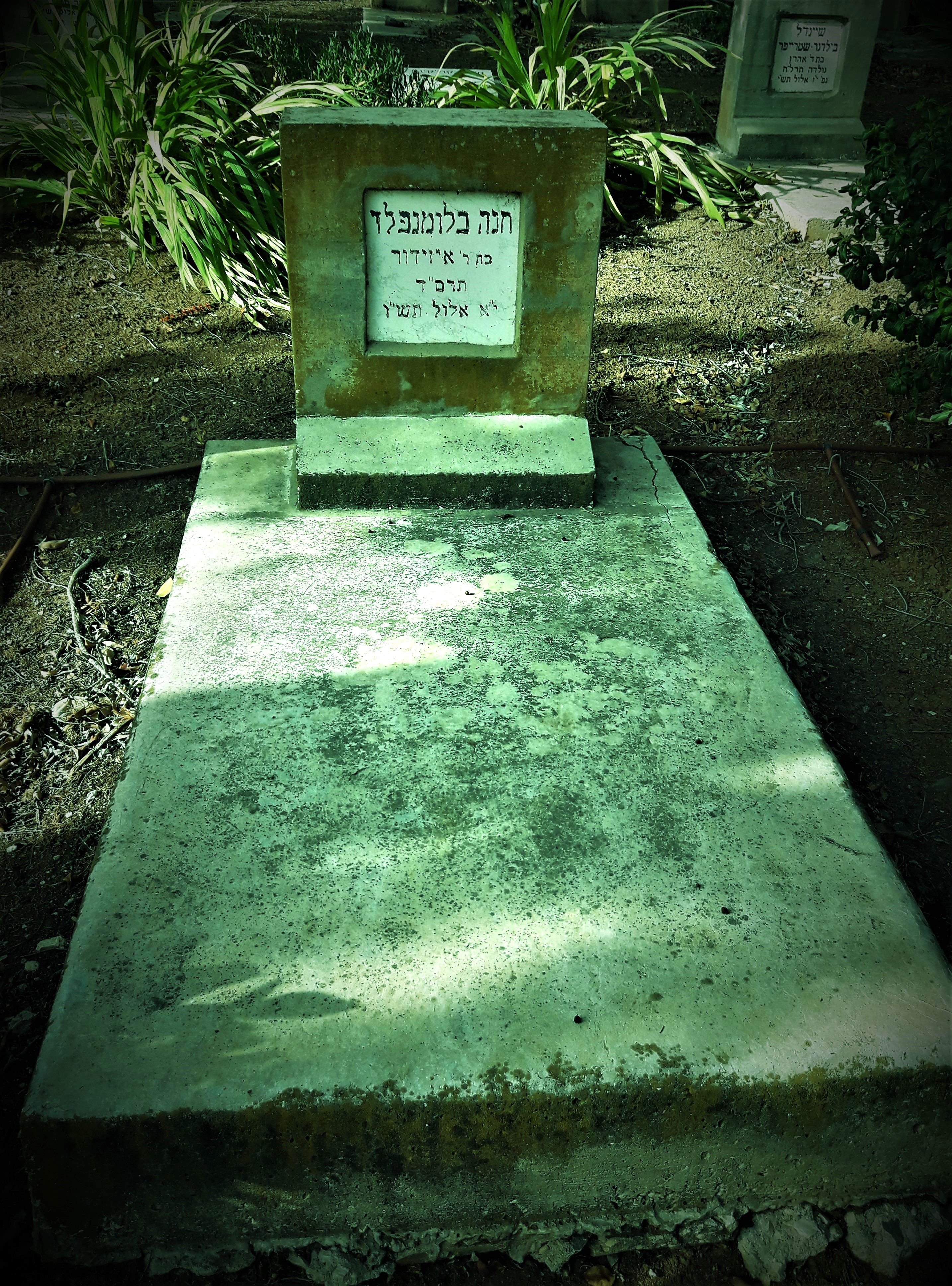
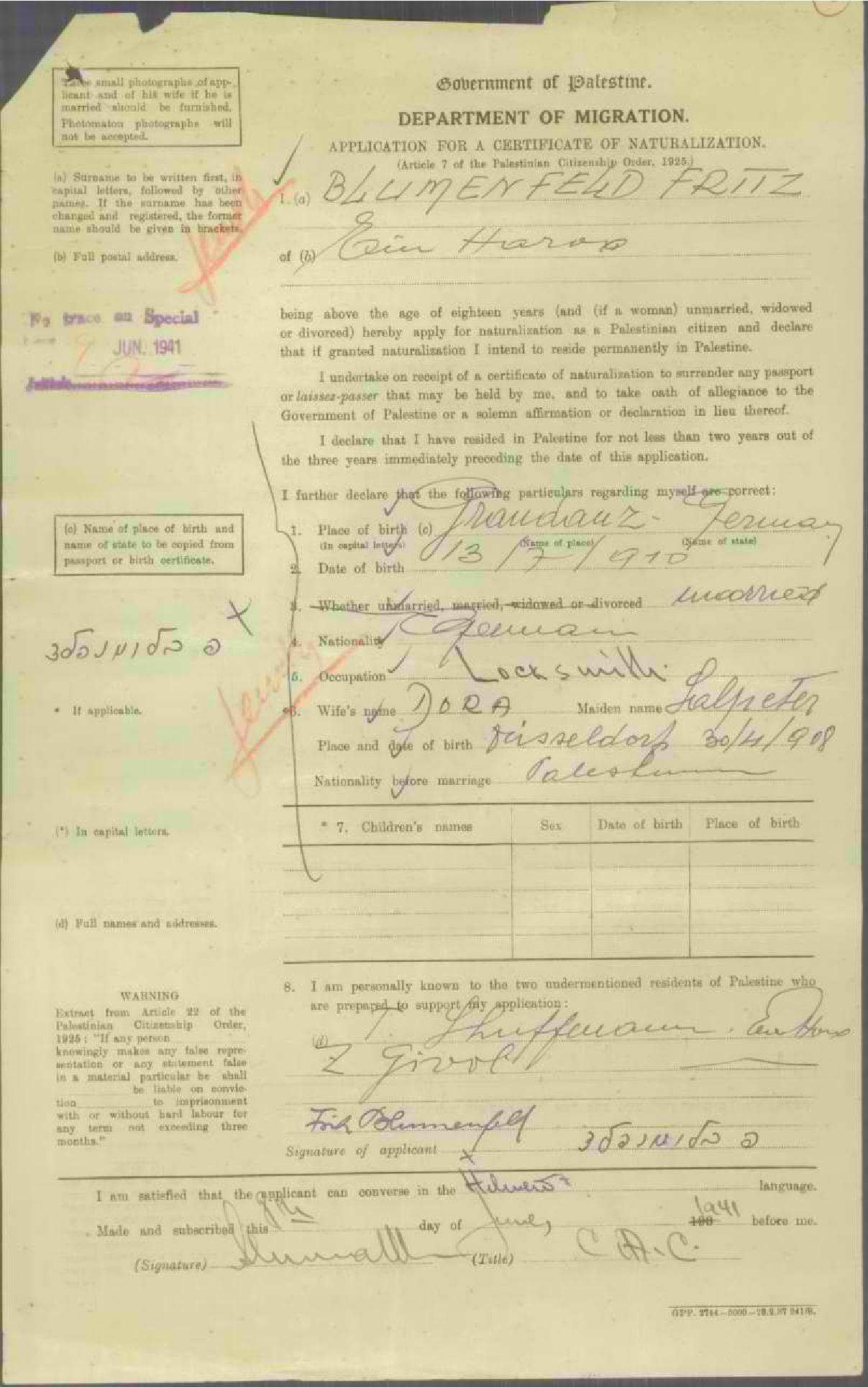
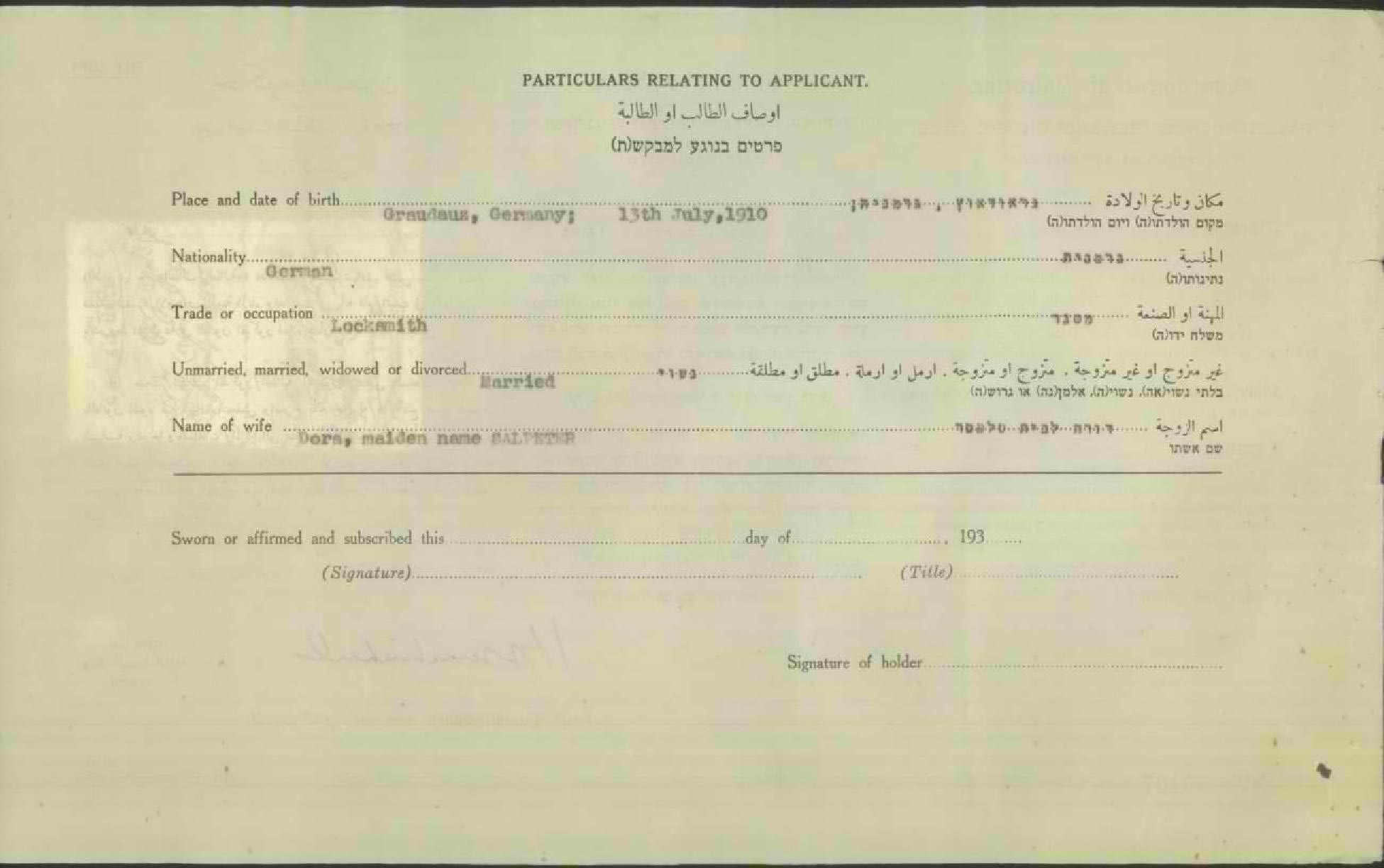
Then I located a Fritz Blumenfeld who had Palestine immigration papers at the Israel Archives website. Fritz was born in Graudenz, Germany, on July 13, 1910, the same town where Max had been living when he married Johanna in 1906. He was married to Dora Salpeter and working as a locksmith. He had first entered Palestine on June 28, 1937.

Fritz Blumenfeld and Dora Salpeter immigration file found at Israel State Archives at https://www.archives.gov.il/en/

Richard found directories for Graudenz that listed Max as a teacher there in 1905, as a teacher and orphanage inspector in 1907, and as the Waisenhausinspektor there in 1909, 1911, and 1913. Thus, Max and Johanna were living in Graudenz when Fritz Blumenfeld was born. This certainly seemed to be their son.2

And then I found the record that definitely tied Fritz to Max and Johanna. Returning to the IGRA website, I located Fritz Blumenfeld’s marriage record. Fritz married Devorah on August 15, 1940, in Israel, and his marriage record indicated that he was a locksmith, which was consistent with his Palestinian citizenship application. On those Palestinian immigration papers, I learned that Devorah’s name was originally Dora Salpeter.

Most importantly, Fritz’s parents were listed as Max and Hanna, confirming for me that this was the son of Max Blumenfeld and (Jo)hanna Grunwald. Since it appears that Johanna was better known as Hanna or Anna, I will use the name Anna to refer to her going forward.

That marriage record gave me two other critical pieces of information. It said the groom’s parents lived in Italy—although it took help from Tracing the Tribe for me to learn that the Hebrew I was reading as Atelah was in fact Italia in Hebrew. The marriage record also indicated that Anna was at home, but Max was deceased. Thus, we now knew that Max had died sometime before Fritz married on August 15, 1940, and presumably had died in Italy.

Fritz Blumenfeld marriage record, found at the Israel Genealogy Research Association website at https://genealogy.org.il/AID/

I didn’t think we would get any further than that since I had no idea how to research deaths in Italy. But once again Richard came to the rescue. He found two more sources. One was a German book, Das Jüdische Waisenhaus in Pankow (2001) by Inge Lammel, about the Jewish orphanage in Berlin where Max had been the Waisenhausdirektor. Lammel’s book included this passage, as translated by Richard:3

When Isidor Grunwald [Johanna’s father] died in February 1925, his son-in-law, Max Blumenfeld, took over the directorship of the house. Martin Davidsohn [long-time teacher at the Second Jewish Orphanage] says that he brought a more liberal spirit into the educational process, democratic structures, such as an opportunity to utter grievances and a trainees’ adjudicatory council elected by secret ballot, which gave the trainees more self-confidence.

Richard paraphrased the information about Isidor Grunwald that he found in the book:4

Max’s father-in-law had been an officer in the army and carried the army’s manner of doing things over into his work at the orphanage. He patrolled the large dormitory hall carrying his ring of large keys to enforce discipline. He had the boys line up each night in front of his apartment in the house according to height, shook their hands and wished them good night. In addition to physical education, he had the boys do drills led by a drill sergeant and sometimes accompanied by flute and drum music

Here is a photo from the book showing Max standing with some of the children and staff at the orphanage in about 1933; he is the man in the dark suit in the foreground.

From Inge Lammel, Das Jüdische Waisenhaus in Pankow, 2001

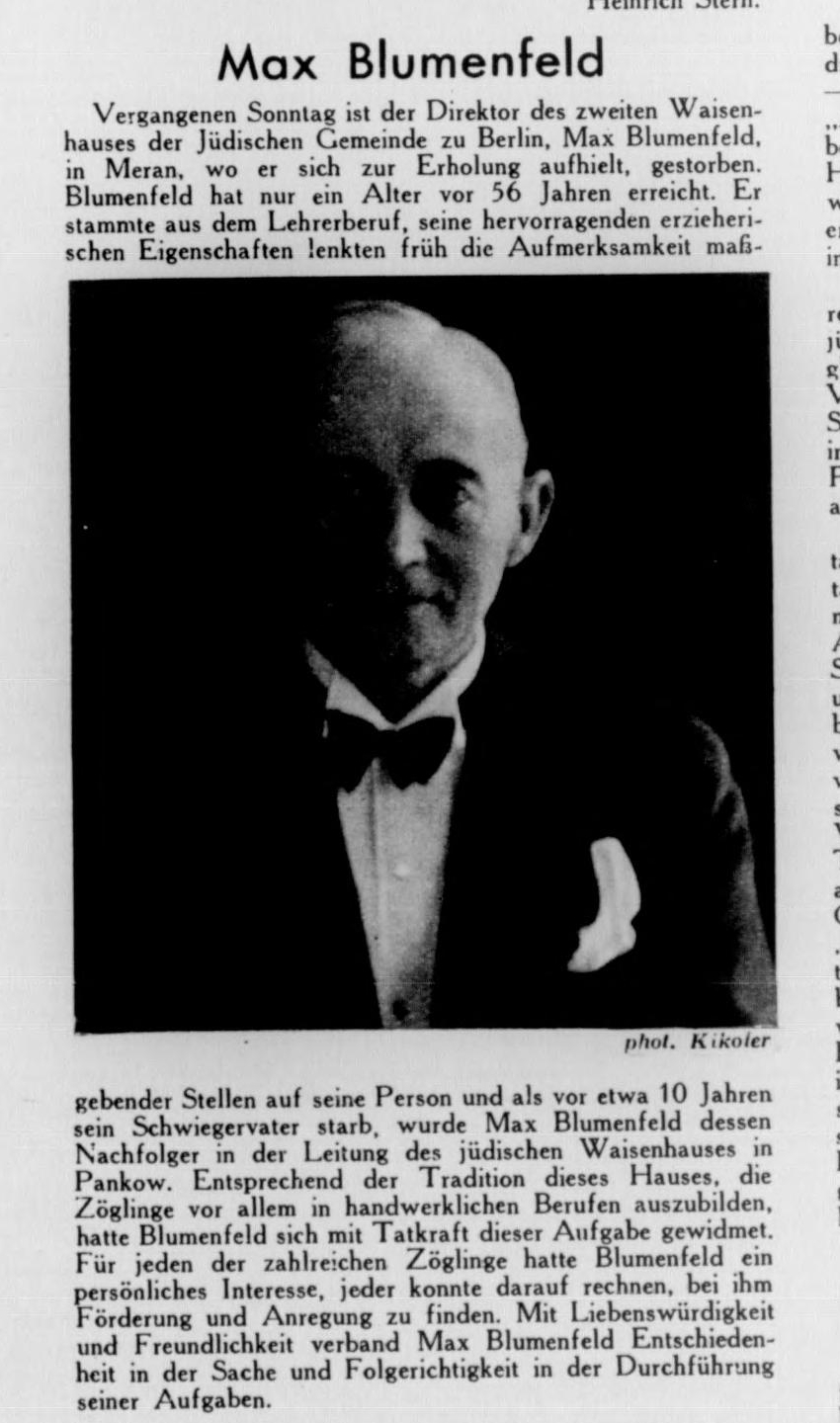
In addition to obtaining a copy of this book, Richard also located Max’s obituary, which not only provided us with the date and place of Max’s death (March 8, 1936, in Merano, Italy), but also more information about his life:

“Max Blumenfeld,” Gemeindeblatt der Jüdischen Gemeinde zu Berlin, March 15, 1936, page 7

Richard translated the obituary as follows:5

Last Sunday the director of the Second Orphanage of the Jewish Congregation in Berlin, Max Blumenfeld, died in Merano [Italy] where he was taking time for rest and recreation. Blumenfeld died young at the age of 56. He was originally a teacher whose excellent teaching abilities drew the attention of leading personalities, and when his father-in-law [Isidor Grunwald] died about ten years ago, Max Blumenfeld became his successor as director of the Jewish Orphanage in Pankow. Blumenfeld dedicated himself to the traditional task of the institution of training its students as craftsmen. Blumenfeld demonstrated a personal interest in each of the youth in his care, each of them could recon with his support and encouragement. He combined with kindness and friendliness decisiveness and consistence in the execution of his task.

These two documents discovered by Richard Bloomfield have given us a much fuller picture of our cousin Max Blumenfeld. He certainly left his mark and obviously was a kind and generous person.

Unfortunately, the obituary did not include information about his survivors. Was Fritz their only child? Did Johanna stay in Italy, as their son Fritz’s 1940 marriage certificate suggests? Did she return to Berlin? Immigrate to Palestine?

Well, the story of Max Blumenfeld doesn’t end here nor does the story of the collaboration it took to find the rest of that story.

More to come.


  1. Amtliches Fernsprechbuch für Berlin und Umgebun, 1934, 1935, 1936.  Ancestry.com. The one depicted I found on Ancestry for 1935. 
  2. I have tried to recreate Richard’s search through the Graudenz directories. He sent me to the GenWiki website section for directories, and although I found the Graudenz directories, I still need more lessons in how to search through those directories to find Max. 
  3. Inge Lammel, Das Jüdische Waisenhaus in Pankow (2001), p. 50. 
  4. Ibid, p. 48, as paraphrased by Richard Bloomfield, attachment to email May 1, 2022. 
  5. “Max Blumenfeld,” Gemeindeblatt der Jüdischen Gemeinde zu Berlin, March 15, 1936, page 7. 

Clementine Blumenfeld Abraham’s Family: Her Sons Escaped; She, Her Husband, Daughter, Son-in-Law, and Grandson Did Not

I have returned from my break, and unfortunately, I have another sad post to publish about my third cousin, twice removed, Clementine Blumenfeld Abraham. Clementine was the youngest child of Moses Blumenfeld IIB, and like her siblings Hermann and Bertha, she and much of her family were killed in the Holocaust.

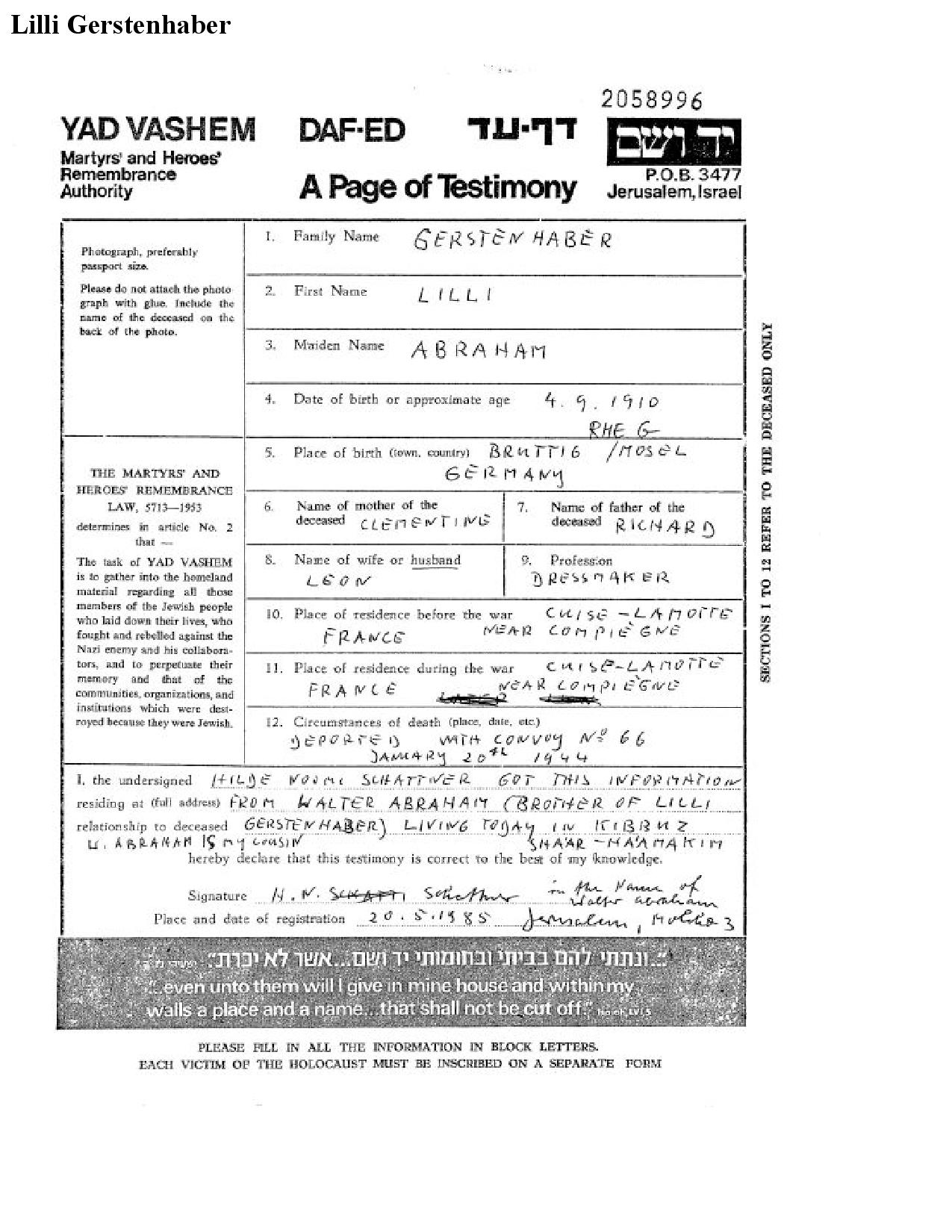
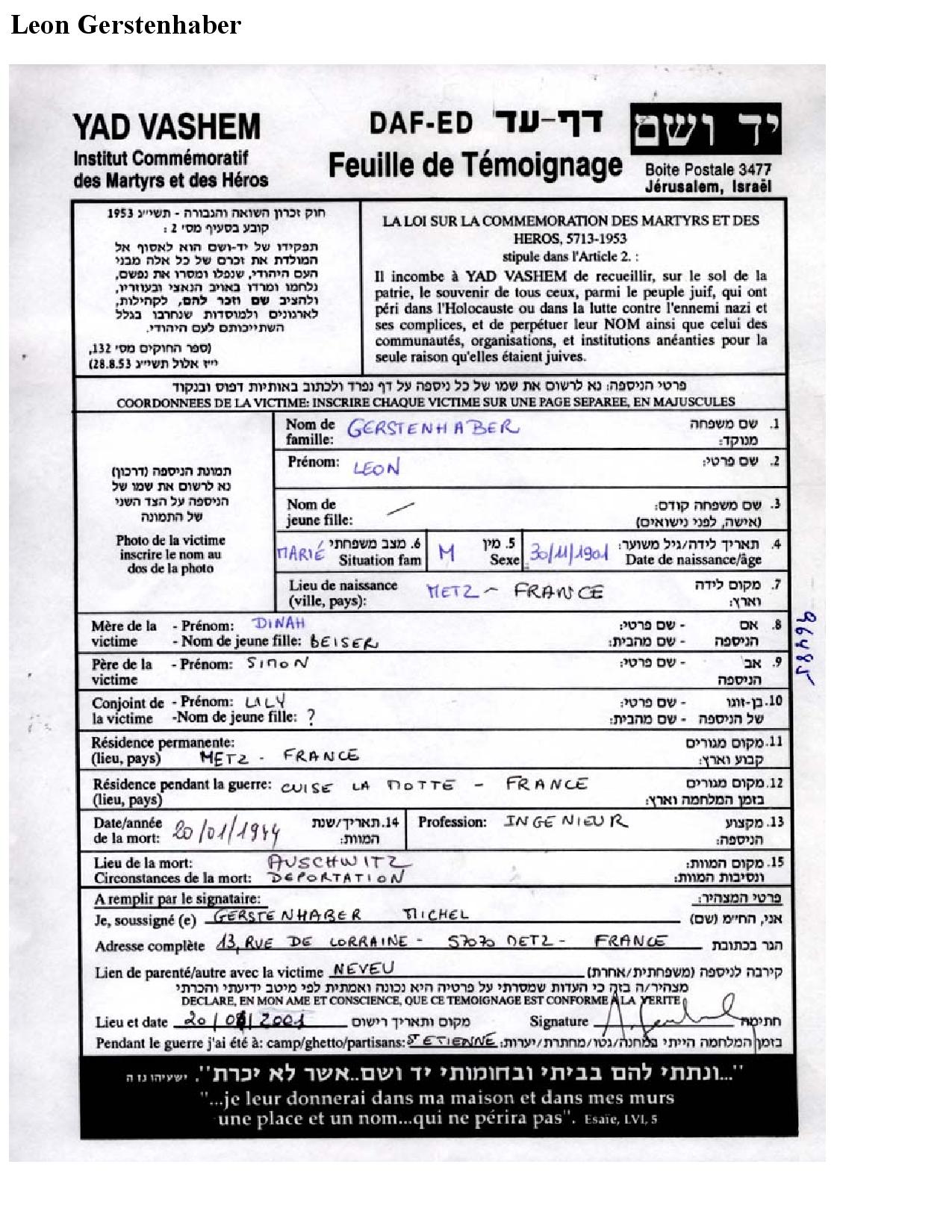
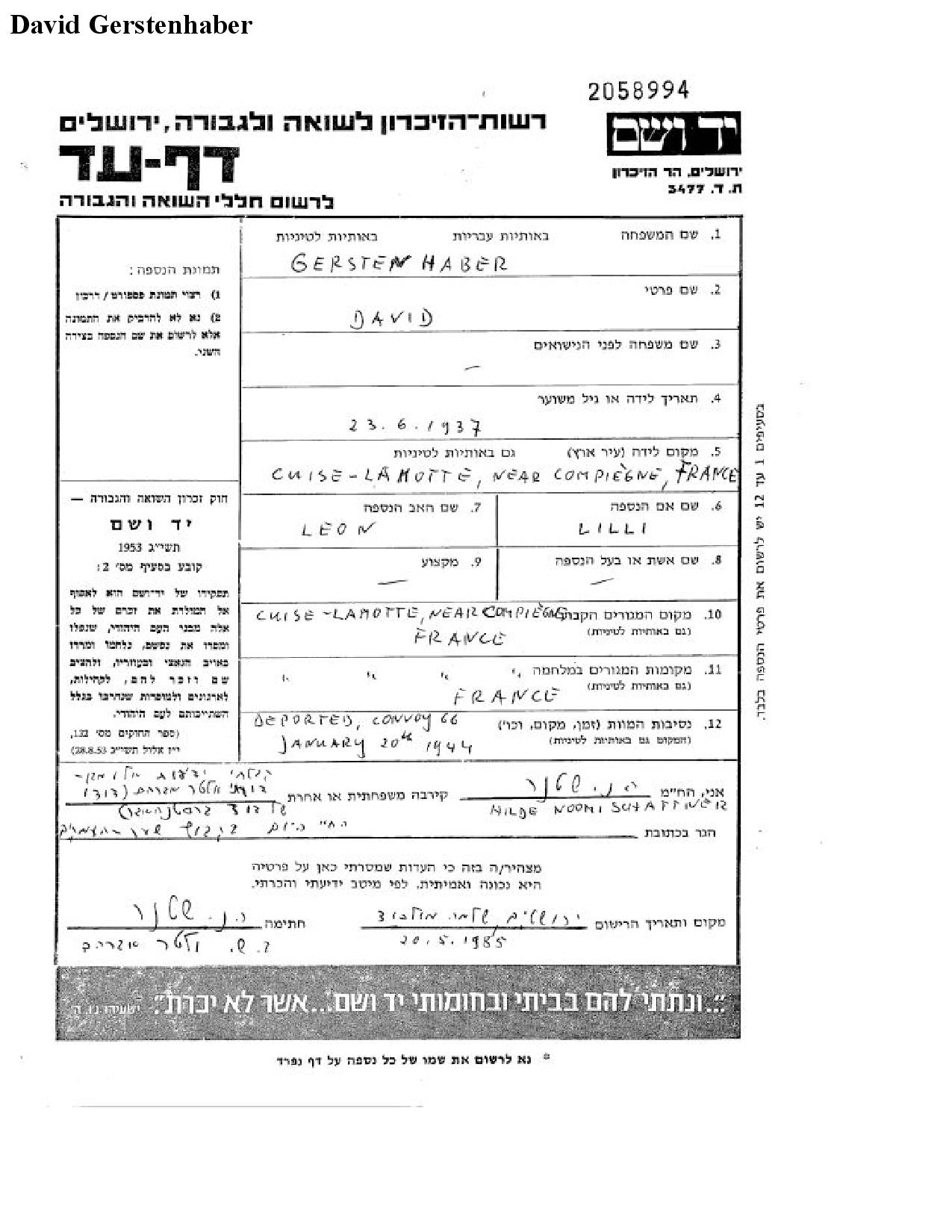
Clementine’s daughter Lilli married Leon Gerstenhaber sometime before June 23, 1937, when their son David was born in Metz, France.1 Leon was also born in Metz, France; he was born to Simon Gerstenhaber and Dinah Beiser on November 31, 1901.2

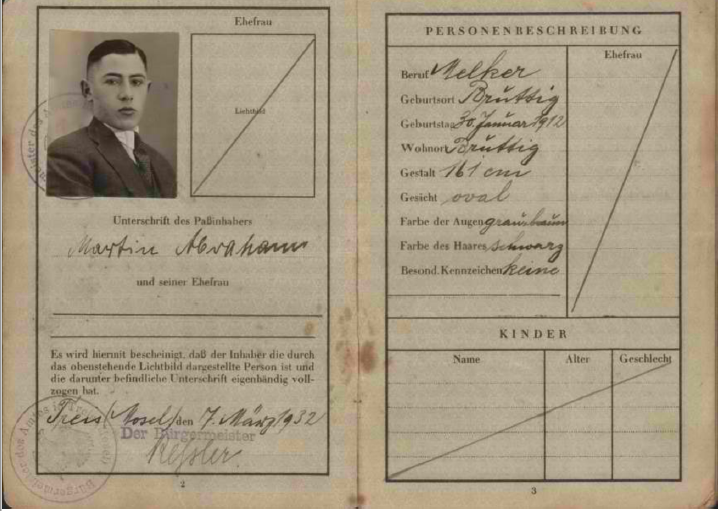
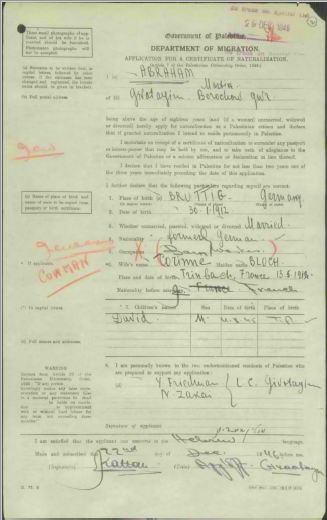
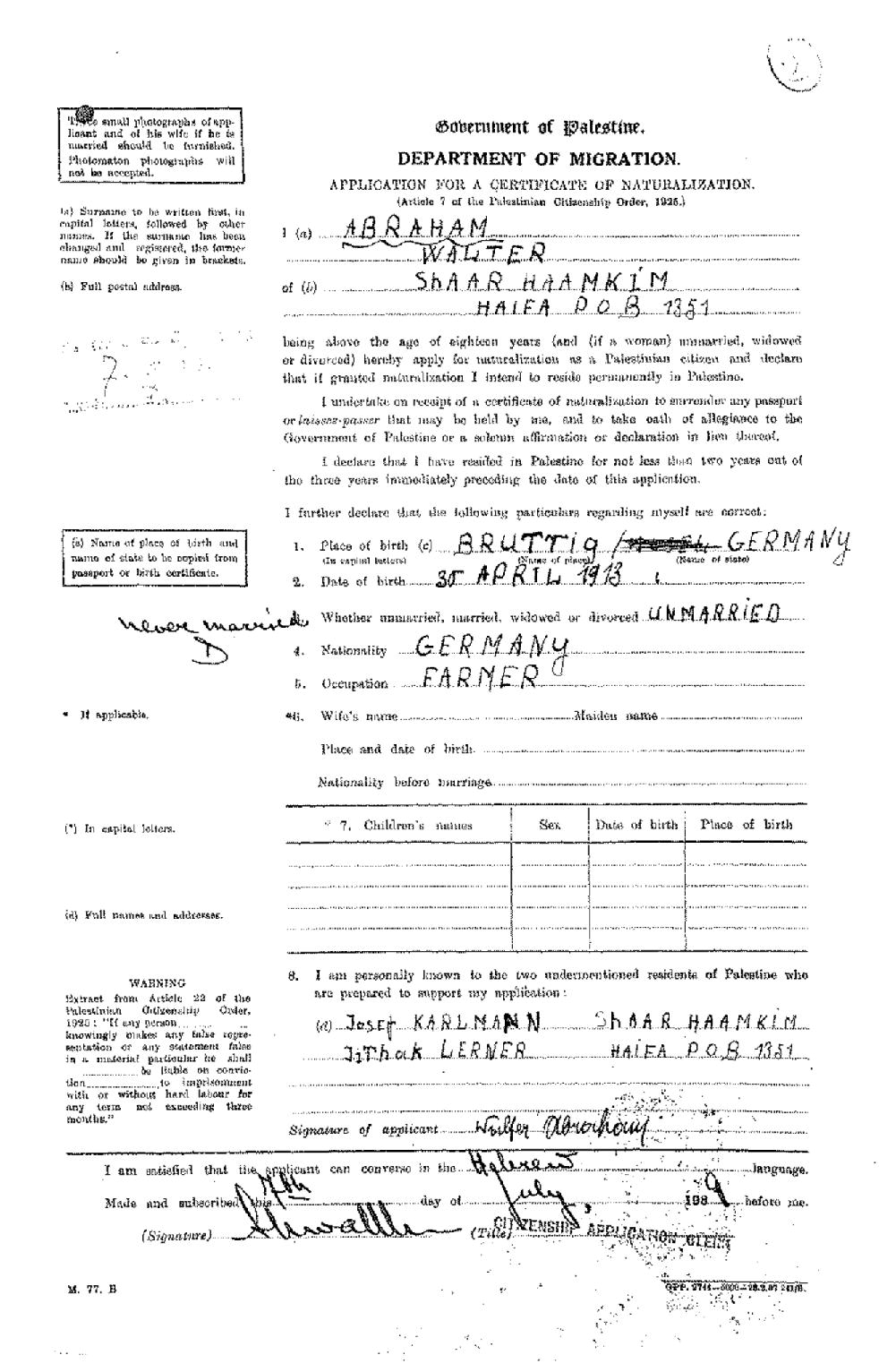
Martin Abraham, Clementine’s older son, traveled from Germany to France in 1932, perhaps to visit his sister Lilli, and then in the spring of 1936, he immigrated to Palestine. The documents below including his German passport are from his Palestinian immigration file found at the Israel State Archives. Martin married Corinne Bloch, who was born in Trimbach, France, on May 13, 1912. She immigrated to Palestine in 1938, and they had one child together born in the 1940s.


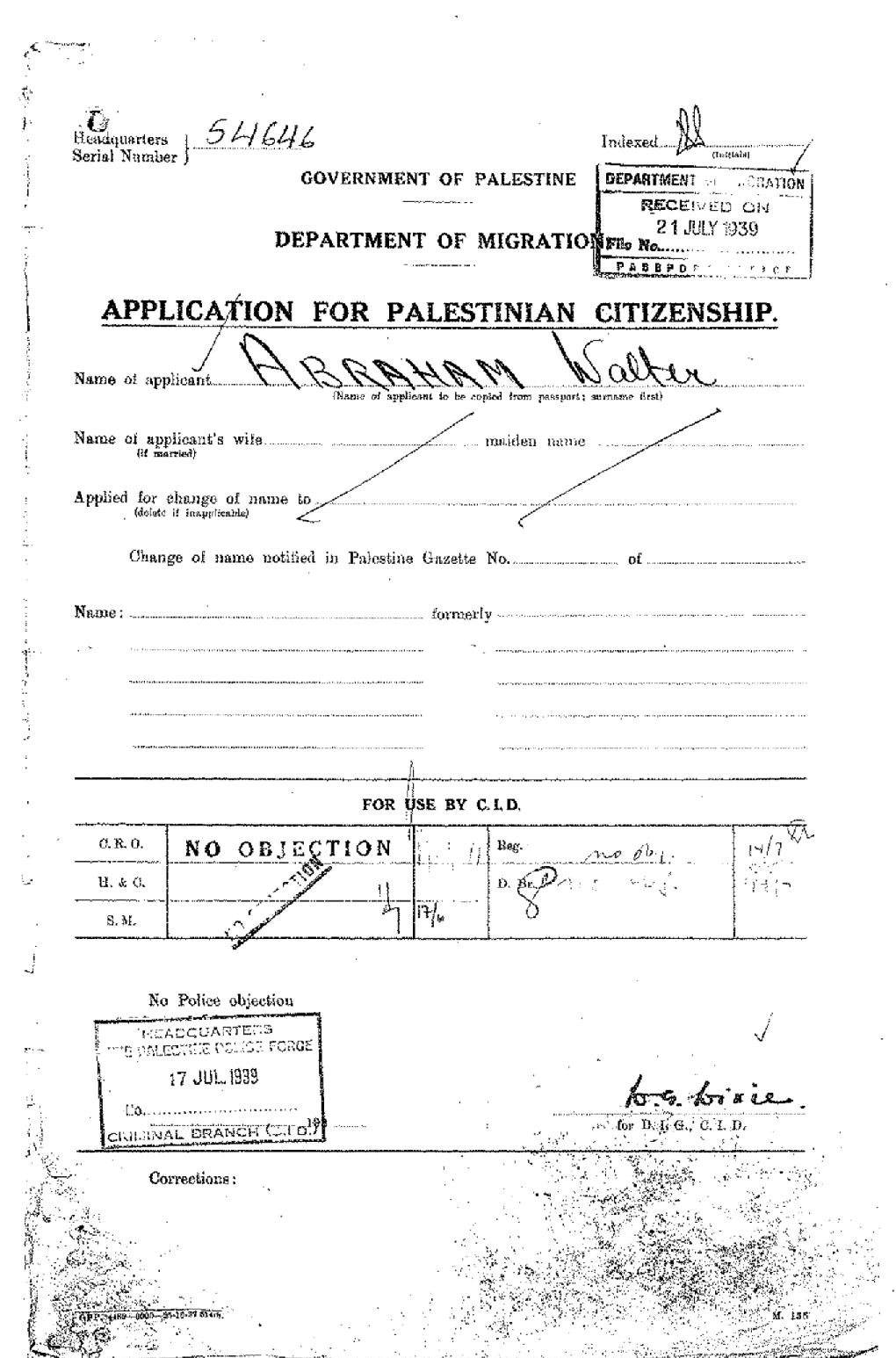
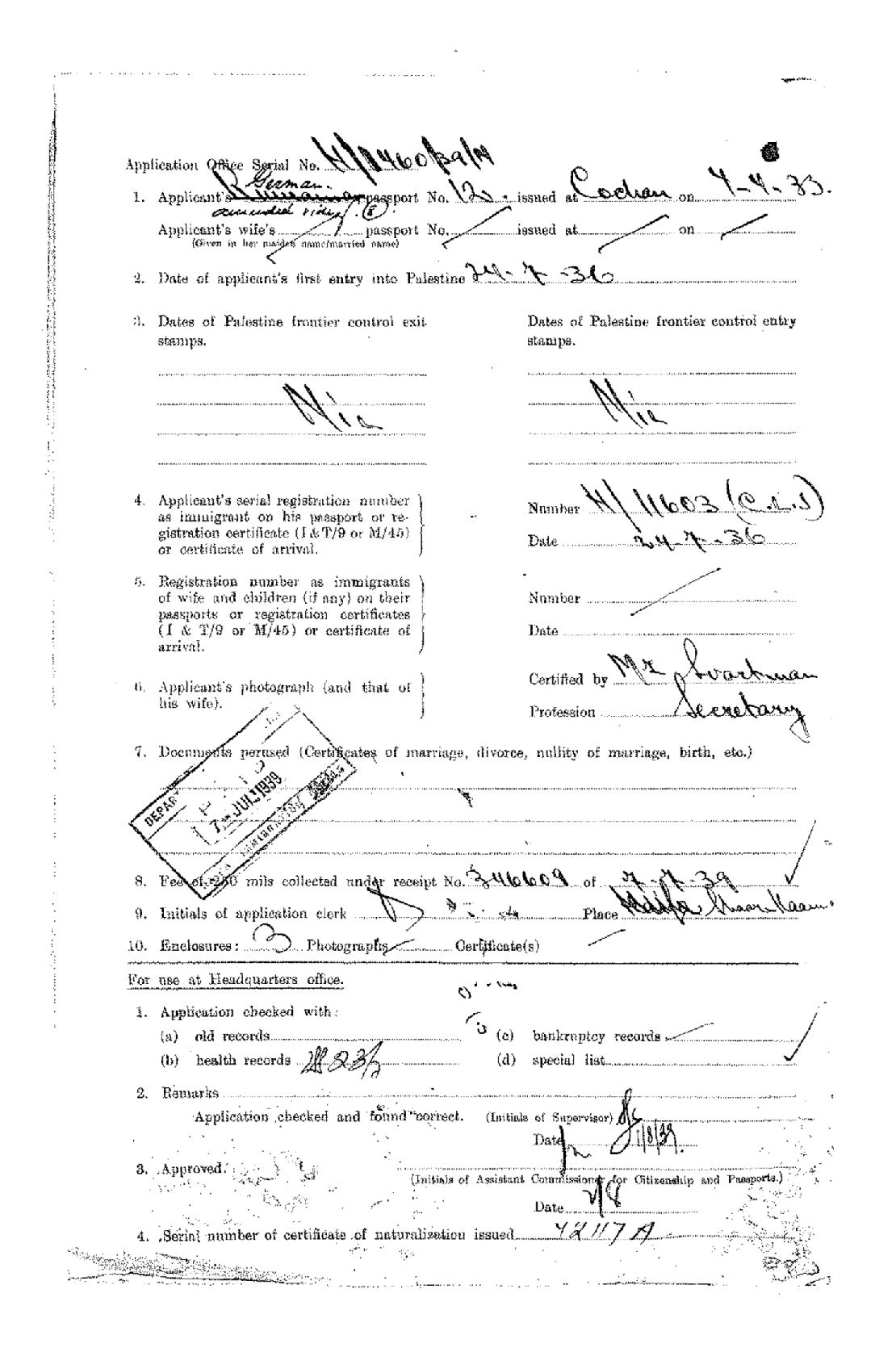
Martin’s brother Walter also immigrated to Palestine, arriving just a couple of months after Martin on July 24, 1936, as seen in these documents from the Israel State Archives.

Unfortunately, Clementine, her husband Richard Abraham, their daughter Lilli, and her husband Leon and their son David did not follow Martin and Walter to Palestine. They were all killed at Auschwitz. Richard was deported from the Drancy concentration camp to Auschwitz on Transport 40 on November 4, 1942. Clementine was also deported from the Drancy Camp to Auschwitz on Transport 62 on November 20, 1943. Lilli and her family were also sent from the Drancy concentration camp in France to Auschwitz on January 20, 1944 on Transport 66.

Clementine Blumenfeld Abraham, Page of Testimony at Yad Vashem found at https://yvng.yadvashem.org/nameDetails.html?language=en&itemId=612790&ind=2

Richard Abraham Page of Testimony at Yad Vashem, found at https://yvng.yadvashem.org/nameDetails.html?language=en&itemId=612794&ind=2

Lilli Abraham Gerstenhaber Page of Testimony at Yad Vashem, https://yvng.yadvashem.org/nameDetails.html?language=en&itemId=1949660&ind=2

Leon Gerstenhaber Page of Testimony at Yad Vashem, found at https://yvng.yadvashem.org/nameDetails.html?language=en&itemId=13857240&ind=1

David Gerstenhaber, Page of Testimony at Yad Vashem, found at https://yvng.yadvashem.org/nameDetails.html?language=en&itemId=1390876&ind=2

Thus, three of Moses IIB’s five surviving children—Hermann, Bertha, and Clementine—and most of their children and grandchildren were killed by the Nazis. I am totally drained by telling their stories and reading these Pages of Testimony. I am also so grateful that Israel exists to provide a sanctuary for those who escaped.

The remaining two children of Moses IIB and Sara Blumenfeld, Salomon and Max, were more fortunate than their other siblings.


  1. See Page of Testimony for David Gerstenhaber filed by Hilde Schattner at Yad Vashem, found at https://yvng.yadvashem.org/nameDetails.html?language=en&itemId=1390876&ind=2 
  2. See Page of Testimony for Leon Gerstenhaber filed by nephew Michael Gerstenhaber at Yad Vashem, found at https://yvng.yadvashem.org/nameDetails.html?language=en&itemId=13857240&ind=1 

Does Hermann Blumenfeld Have Any Living Descendants?

Before I move on to Bertha Blumenfeld and her family, I have an update to my last post. One of my loyal readers, my dear friend Laurel, wanted to know whether either of the two children of Hermann and Helma (Lillienstein) Blumenfeld, Hilde Nomi and Hanan/Hans, had children. Were there living descendants of Hermann and Helma and their two children? My first response was I don’t know, and I’ve no idea how to find out.

But I mentioned this question to David Lesser, the Tracing the Tribe member who so generously helped me find the information about Hanan’s second marriage, and he once again offered to help. He contacted someone in Israel who provided him with some information.

Hanan did not have children, according to the research done by David’s contact. Hilde Nomi, however, did have a child with her husband Isaac Schattner. I was delighted to hear that and hope to be able to contact him.

David then went a few steps further and researched Hilde’s husband, Isaac Schattner, who was a well-known and well-regarded professor of geography at Hebrew University in Jerusalem. According to Wikipedia (as translated by Google Translate):

Yitzhak Shatner studied geography and history at the University of Vienna , received his doctorate in 1925 and worked there at the Geographical Institute. At the same time he devoted himself to Zionist activity and prepared for immigration to Eretz Israel….

In 1936 , Yitzhak Shatner immigrated to Eretz Israel. His first professional steps in the Land of Israel included part-time mapping work in the Department of Geology at the Hebrew University, as well as advising the Jewish Agency on land-settlement relations.….In 1947 he was responsible for the collection of maps and aerial photographs of the Haganah in Jerusalem, and after the establishment of the state he served in the decipherment unit of the IDF.

In 1949, Shatner joined the faculty of the Department of Geography at the Hebrew University, founded by his colleague David Amiran . The establishment of the department is considered a turning point in the development of geography as an academic discipline in Israel and the beginning of rapid change in study and research…..

During the late fifties and early sixties , Shatner taught physical geography at the Hebrew University, during which time he authored the first Hebrew textbook in geomorphology. Some see the education of generations of Israeli geomorphologists as the main scientific legacy of Yitzhak Shatner, who continued to guide students and colleagues even after his retirement in 1968 and encouraged them to follow the paths of revolutions that changed the face of geomorphology.

Isaac Schattner found athttps://he.wikipedia.org/wiki/%D7%99%D7%A6%D7%97%D7%A7_%D7%A9%D7%98%D7%A0%D7%A8

David also found several newspaper notices about Hilde and Isaac’s deaths and about the bar mitzvah of their son as well as information about some of Isaac’s family members.

Thus, I now can answer Laurel’s question, thank to the generous assistance of David Lesser. There is at least one living descendant of Hermann and Helma Blumenfeld. Thank you so much, David!