Blanka Rosenberg and Hugo Blumenfeld, Or How I Learned I’d Made An Error

Searching for information about Blanka Rosenberg, the first child born to Rebecca Blumenfeld and Mendel Rosenberg, revealed a mistake and a gap in my earlier research, and I am indebted to my cousin Richard Bloomfield for helping me to correct that mistake and find accurate information about Blanka and her family.

So let me take you down my crooked path. When I started searching for information about Blanka, I easily found her birth and death records on Ancestry.  I knew it was the right death record because the birthdate and birth place matched Blanka, and I could see on that death record that Blanka had married someone named Blumenfeld.

Blanka Rosenberg birth record, LAGIS Hessen Archives, Standesamt Rosenthal Geburtsnebenregister 1882 (HStAMR Best. 922 Nr. 9638)AutorHessisches Staatsarchiv MarburgErscheinungsortRosenthalErscheinungsjahr1882, p. 35

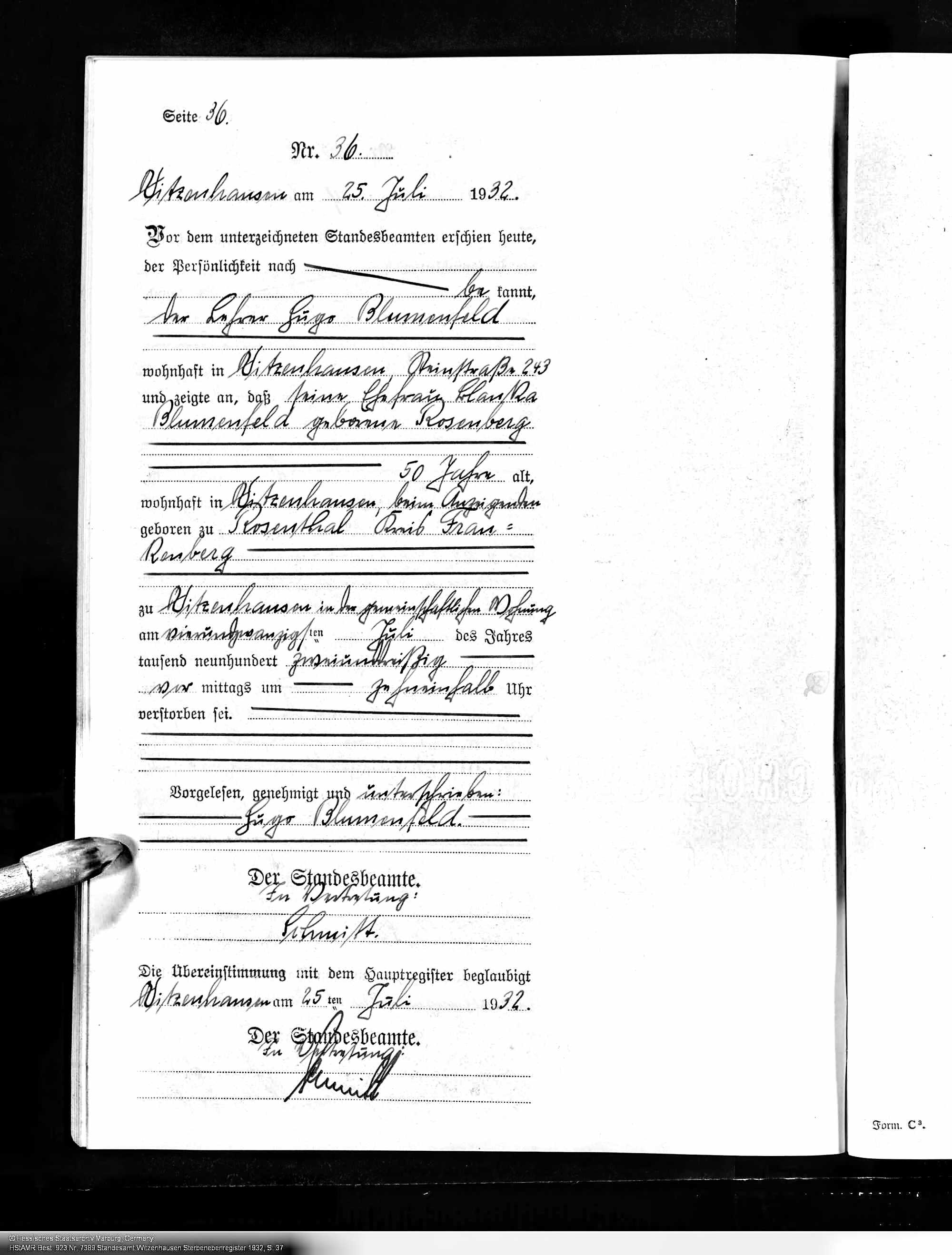
Blanka Rosenberg Blumenfeld death record, Hessisches Hauptstaatsarchiv; Wiesbaden, Deutschland; Personenstandsregister Sterberegister; Bestand: 7389; Laufende Nummer: 923
Year Range: 1932, Ancestry.com. Hesse, Germany, Deaths, 1851-1958

But I could not find a marriage record for Blanka. I noticed that several Ancestry trees had her married to Hugo Blumenfeld—which I couldn’t decipher myself from the death record— but even with his full name, I couldn’t find a marriage record.

I had a Hugo Blumenfeld on my tree; he was the son of Abraham Blumenfeld III and Friedericke Rothschild and the grandson of Isaak Blumenfeld I and his first wife, Frommet Kugelmann. But when I’d researched that Hugo, I had concluded that he never married or had children. I now realized I might have been wrong if those Ancestry trees for Blanka Rosenberg were right.

But since I don’t trust the trees on Ancestry without corroboration with actual records or at least reliable secondary sources, I was reluctant to add Hugo Blumenfeld as Blanka Rosenberg’s husband. I turned to my cousin Richard Bloomfield for help, and he first pointed out that Blanka’s death record revealed that her husband’s name was in fact Hugo. This was another time that my struggles with reading the German script hampered the progress of my research.

So I was now persuaded that Blanka had married a man named Hugo Blumenfeld, but was it the same Hugo whom I had concluded had never married? And where was their marriage record? I had assumed that Blanka would have married in Rosenthal where her family lived since almost all the German Jewish marriages I’d researched took place where the bride’s family lived, but my search through the Hessen archives for Rosenthal did not turn up a marriage record.

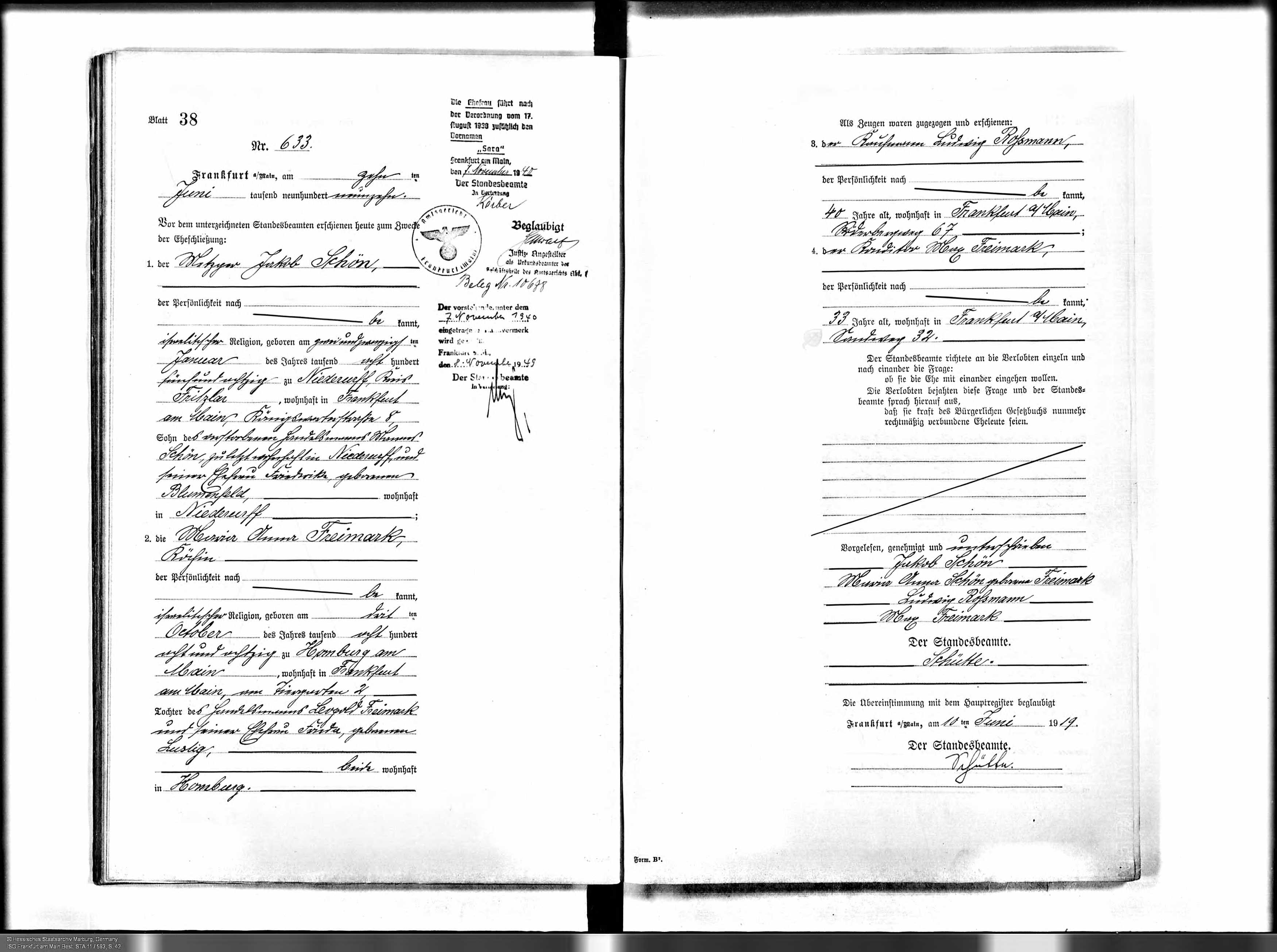
Richard, however, located the marriage in the records for the town of Frankenau, which is fifteen miles from Rosenthal. They were married there on July 23, 1907.  And that record confirmed that Blanka was the daughter of Rebecca Blumenfeld and Mendel Rosenberg and that Hugo was the son of Abraham Blumenfeld III and Friedericke Rothschild.

Marriage of Hugo Blumenfeld and Blanka Rosenberg, Arcinsys Hessen Archives, HHStAW Fonds 365 No 175, p. 11

Blanka and Hugo were, of course, therefore related. They were both grandchildren of Isaak Blumenfeld I, but only half-first cousins since Hugo’s father Abraham III was Isaak’s son from his first marriage and Blanka’s mother Rebecca was Isaak’s daughter from his second marriage.

With Richard’s help, I was able to locate three children born to Blanka and Hugo, all born in Frankenau. Julius was born on March 7, 1908. Erwin Jacob was born on May 29, 1911, and Martin was born January 6, 1913 (all found on the same page in the Frankenau birth records).

Birth record of Julius Blumenfeld, Arcinsys Archives of Hessen, HHStAW Fonds 365 No 174, p. 25

Birth record of Erwin Jakob Blumenfeld, Arcinsys Archives of Hessen, HHStAW Fonds 365 No 174

Birth record of Martin Blumenfeld, Arcinsys Archives of Hessen, HHStAW Fonds 365 No 174

Blanka died before any of her sons were married. She was only fifty years old when she died on July 24, 1932, in Witzenhausen, Germany, which is about sixty miles northeast of Frankenau. From the death record (seen above), it appears that she and Hugo were living in Witzenhausen at the time of her death. According to a document Richard located, Hugo was teaching in a Jewish school there.1

Blanka’s middle son Erwin Jakob Rosenberg married Martha Schoendelen on September 21, 1938, in Hannover, Germany. Martha was born on June 17, 1915, in Krefeld, Germany. Erwin and Martha escaped from Nazi Germany and immigrated to the US on April 1, 1940.2

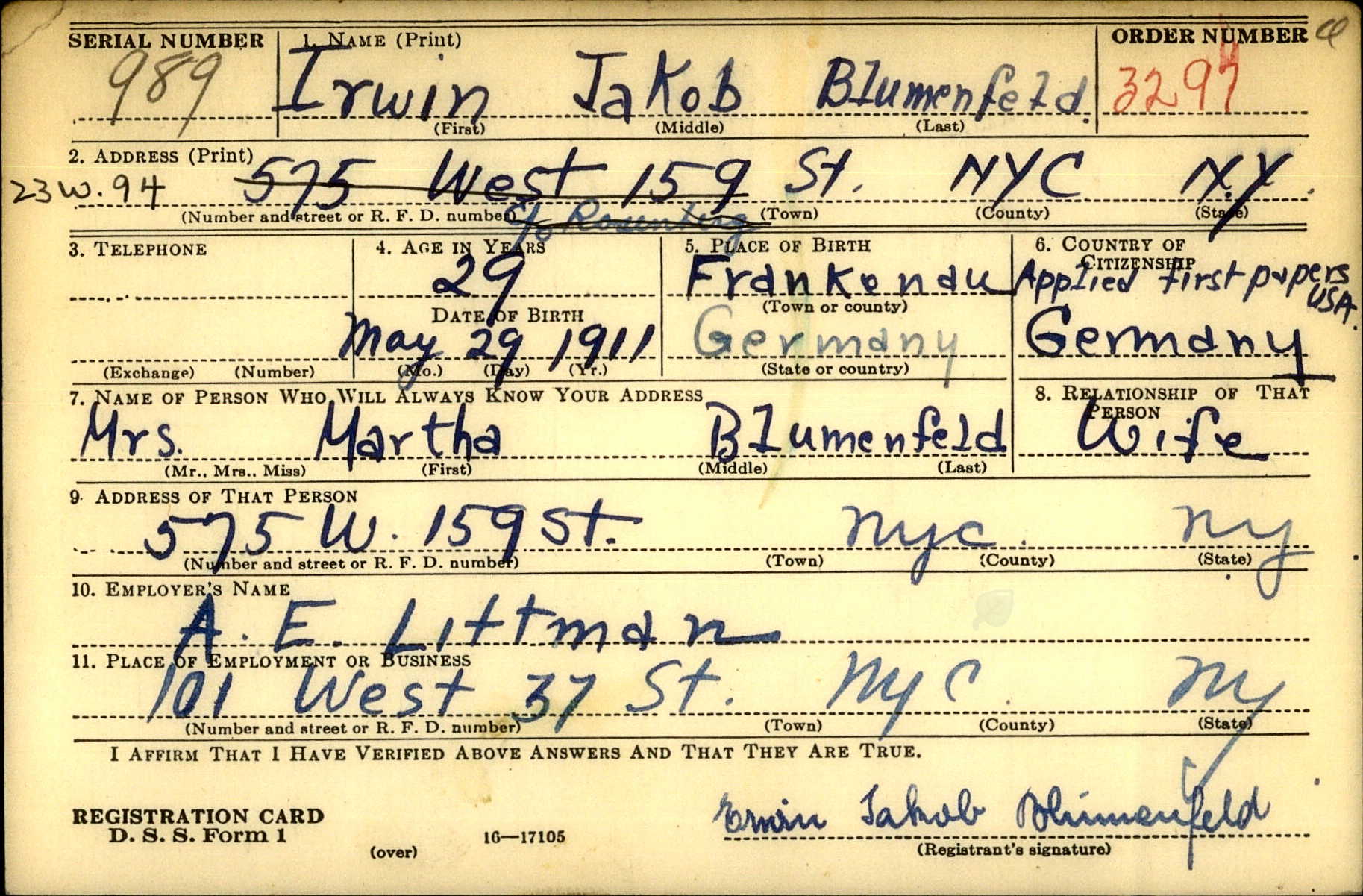
They settled in New York City where, at the time of the 1940 census, Erwin was looking for work as an auto mechanic.3 When he registered for the draft on October 16, 1940, he was working for A.E. Littman.

Irwin Jakob Blumenfeld, World War II draft registration, National Archives at St. Louis; St. Louis, Missouri; Wwii Draft Registration Cards For New York City, 10/16/1940 – 03/31/1947; Record Group: Records of the Selective Service System, 147. Ancestry.com. U.S., World War II Draft Cards Young Men, 1940-1947

Erwin entered the US Army on June 25, 1943, and was stationed at Fort Meade in Maryland, where he petitioned for and was granted naturalization on December 15, 1943.

Erwin Jakob Blumenfeld Naturalization Petition, The National Archives at Philadelphia; Philadelphia, Pa; Petitions For Naturalization, 1903-1972; NAI Number: 654310; Record Group Title: Records of District Courts of the United States, 1685-2009; Record Group Number: 21
Description: Petitions 24751-25075, Ancestry.com. Maryland, U.S., Federal Naturalization Records, 1795-1931

In 1950, Erwin was working as a buyer for a wholesale clothing business, and he and Martha and their daughter were living in New York City.4 Erwin was 63 when he died on August 27, 1974.5 He was survived by his wife Martha, who died on November 6, 2006,6 and their daughter.

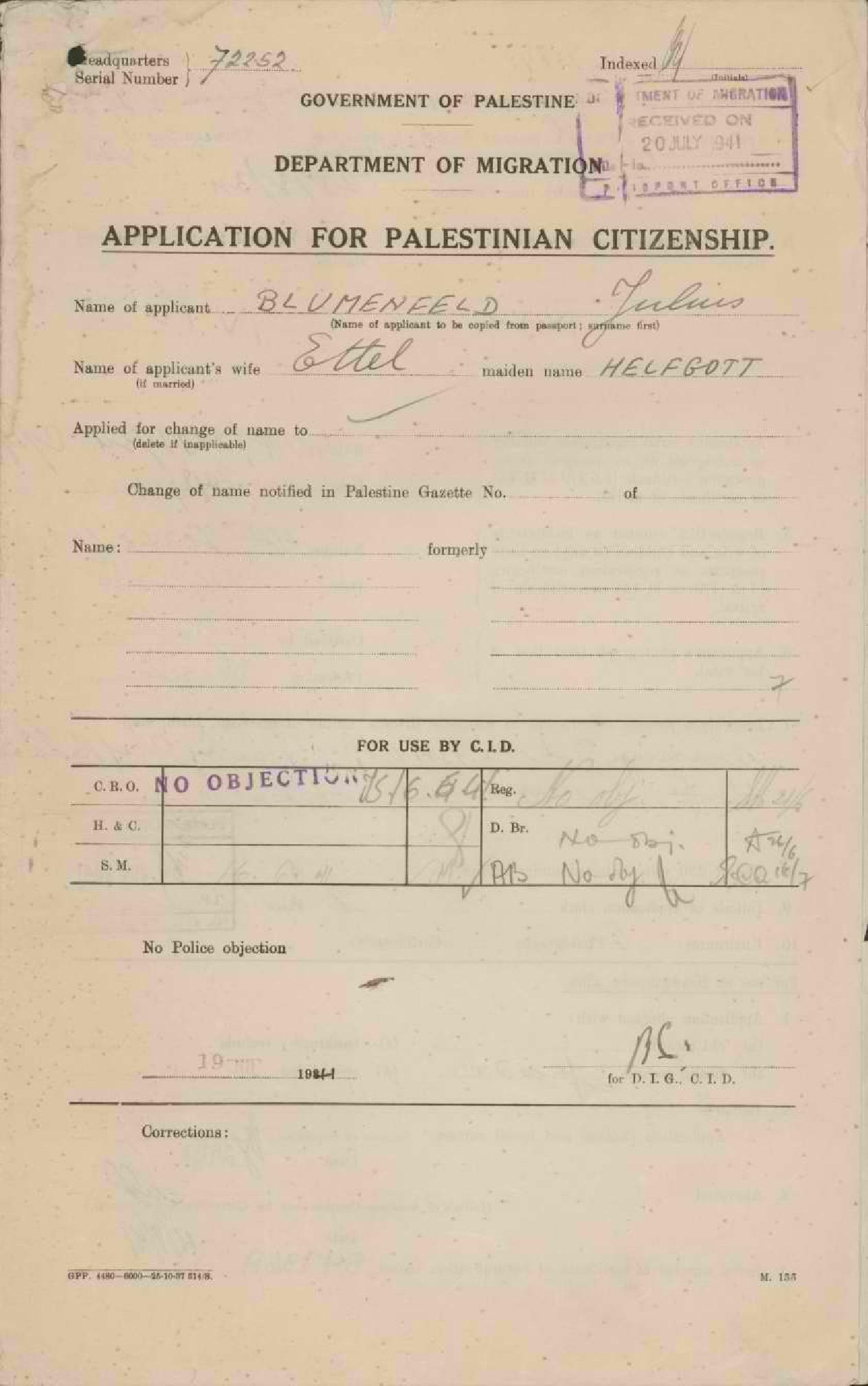
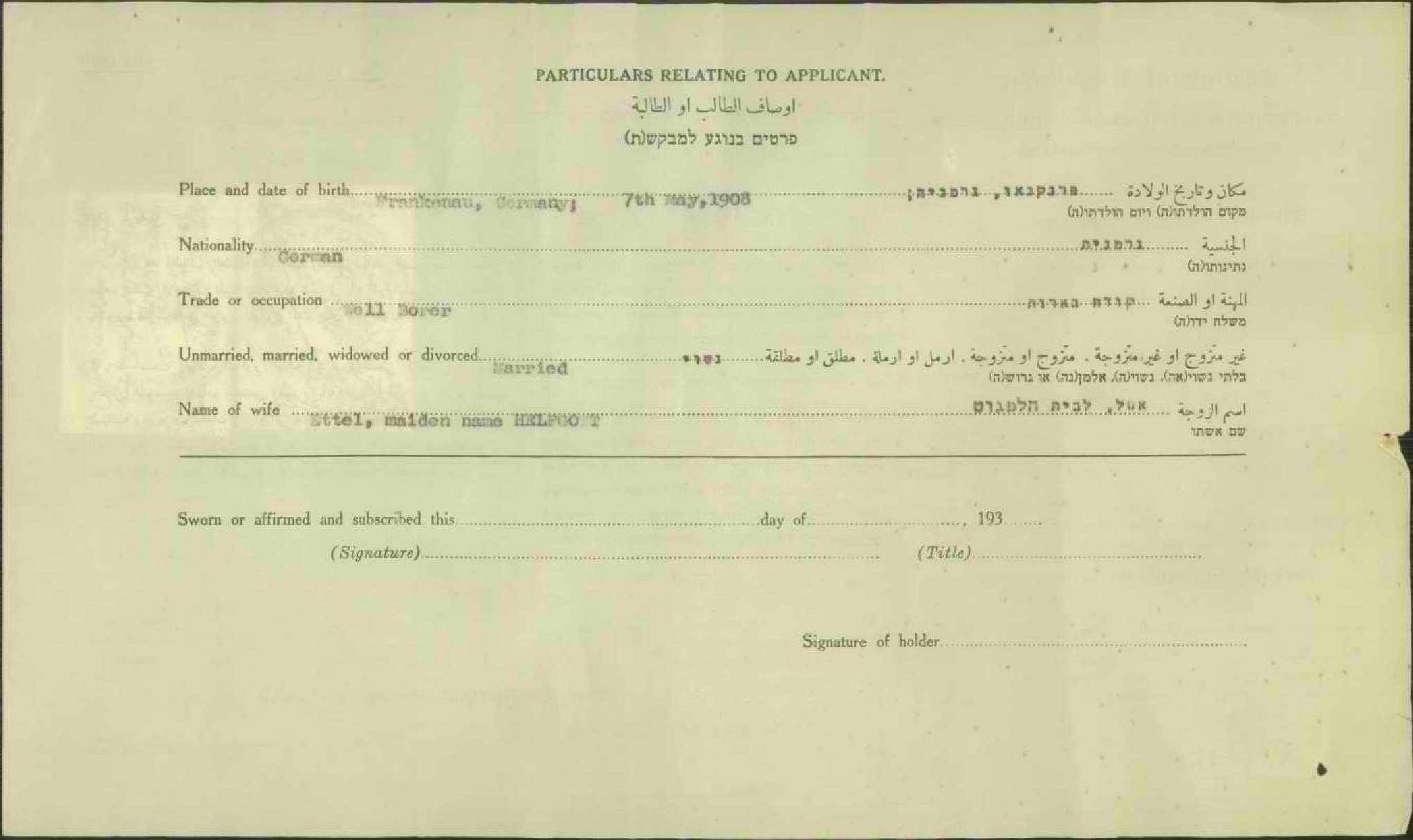
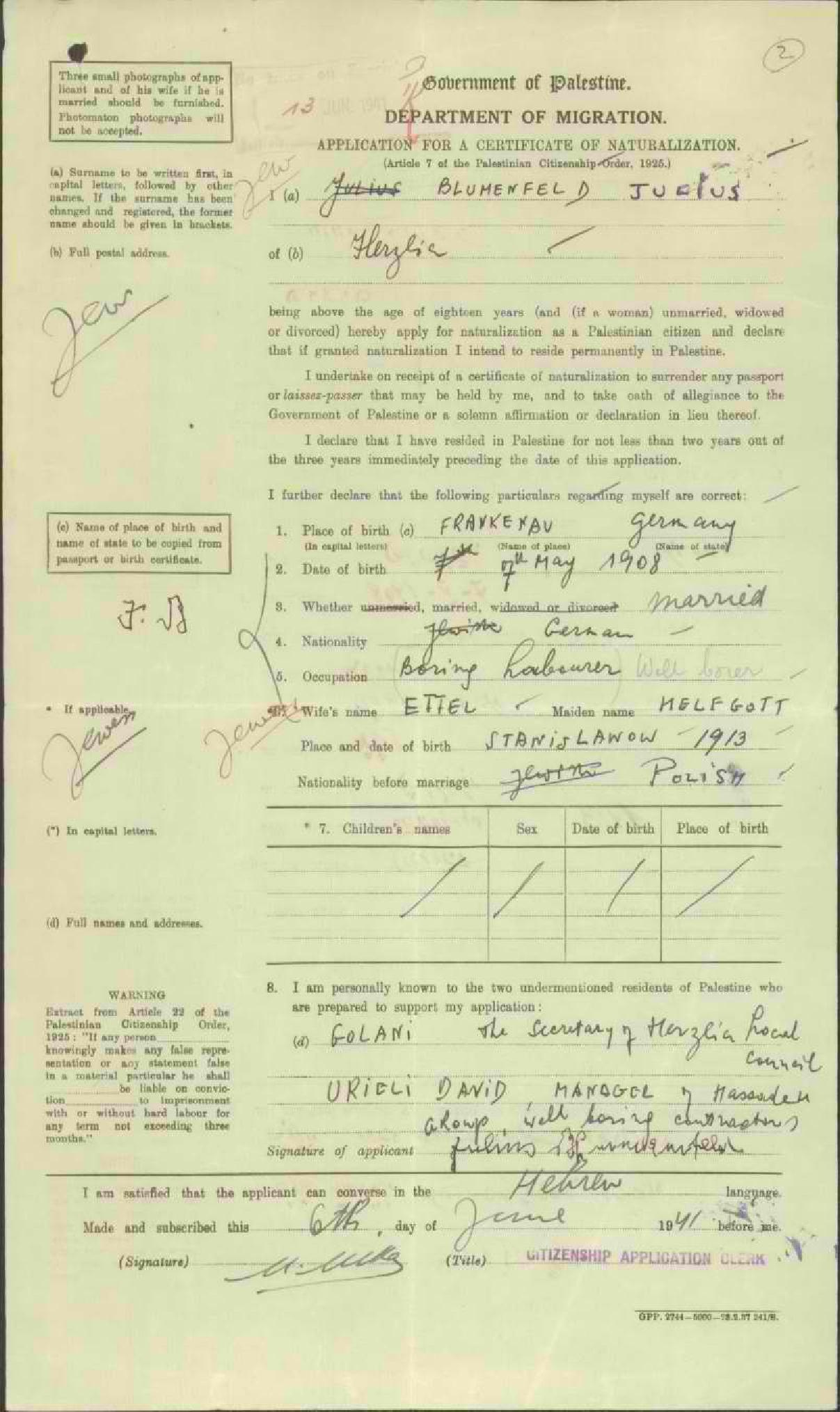
Blanka’s two other sons immigrated to Palestine/Israel in the 1930s. Julius arrived on August 23, 1934, and married Ettel Helfgott on March 26, 1940, in Haifa. On his naturalization application, Julius reported that his occupation was a well borer.

Julius Blumenfeld Palestine immigration file from the Israel State Archives, at https://www.archives.gov.il/en/

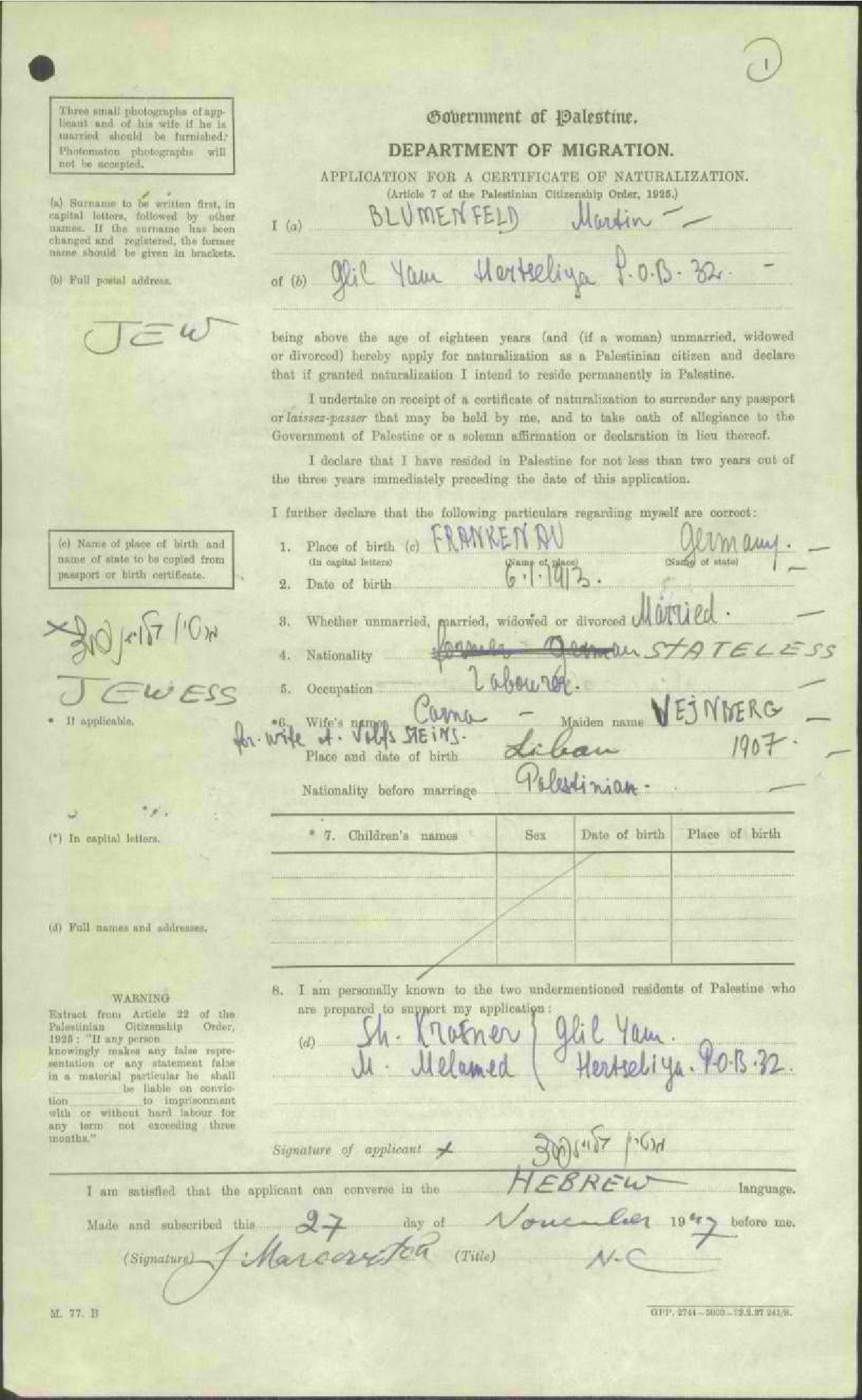
I don’t have an exact date for Martin’s arrival, but he married Carna Weinberg in Petah Tikvah on December 19, 1939, so must have arrived sometime before then. I have no further information about either Julius or Martin or their families at this point.

UPDATE! I now have some additional information about Julius. See my post here.

Martin Blumenfeld Palestine immigration file from the Israel State Archives, at https://www.archives.gov.il/en/

Although all three of his sons escaped from Nazi Germany in time, Hugo Blumenfeld himself was not as fortunate. He had remarried after Blanka died; his second wife was Frieda Stern, who was born on May 31, 1896, in Zimmersrode, Germany.7 I wrote back on February 8, 1922, that Hugo “was deported from Frankfurt to Theriesenstadt on August 14, 1942, and then to Auschwitz on October 16, 1944, where he was killed.” I did not know then that he was accompanied by his second wife Frieda and that she was also killed at Auschwitz.8 I also did not know that he was survived by three sons, all of whom had escaped from Nazi Germany.

I am so grateful to Richard Bloomfield for helping me not only to find information about our cousin Blanka Rosenberg, but also for helping me find information to correct and complete the story of our cousin Hugo Blumenfeld.


  1. Führer durch die Jüdische Gemeindeverwaltung und Wohlfahrtspflege in Deutschland 1932-1933, p. 180. (Guide to the Jewish Community Administration and Welfare in Germany 1932-1933). 
  2. Erwin Jakob Rosenberg, Declaration of Intention, The National Archives at Philadelphia; Philadelphia, PA; NAI Title: Declarations of Intention For Citizenship, 1/19/1842 – 10/29/1959; NAI Number: 4713410; Record Group Title: Records of District Courts of the United States, 1685-2009; Record Group Number: 21, Description: (Roll 648) Declarations of Intention For Citizenship, 1842-1959 (No 516701-517600), Ancestry.com. New York, U.S., State and Federal Naturalization Records, 1794-1943 
  3. Erwin and Martha Blumenfeld, 1940 US census, Year: 1940; Census Place: New York, New York, New York; Roll: m-t0627-02641; Page: 9A; Enumeration District: 31-763, Ancestry.com. 1940 United States Federal Census 
  4. Erwin Blumenfeld, 1950 US census, United States of America, Bureau of the Census; Washington, D.C.; Seventeenth Census of the United States, 1950; Record Group: Records of the Bureau of the Census, 1790-2007; Record Group Number: 29; Residence Date: 1950; Home in 1950: New York, New York, New York; Roll: 4546; Sheet Number: 15; Enumeration District: 31-1703, Ancestry.com. 1950 United States Federal Census 
  5. Erwin Blumenfeld, Gender Male, Birth Date 29 May 1911, Death Date Aug 1974
    Claim Date 16 Sep 1974, SSN 093169515, Ancestry.com. U.S., Social Security Applications and Claims Index, 1936-2007 
  6. Martha Blumenfeld, Social Security Number 064-18-2853, Birth Date 27 Jun 1915
    Issue year Before 1951, Issue State New York, Last Residence 10034, New York, New York, New York, Death Date 6 Nov 2006, Social Security Administration; Washington D.C., USA; Social Security Death Index, Master File, Ancestry.com. U.S., Social Security Death Index, 1935-2014 
  7. Birth record of Frieda Stern, Hessisches Hauptstaatsarchiv; Wiesbaden, Deutschland; Bestand: 920; Laufende Nummer: 9534, Year Range: 1896, Ancestry.com. Hesse, Germany, Births, 1851-1901 
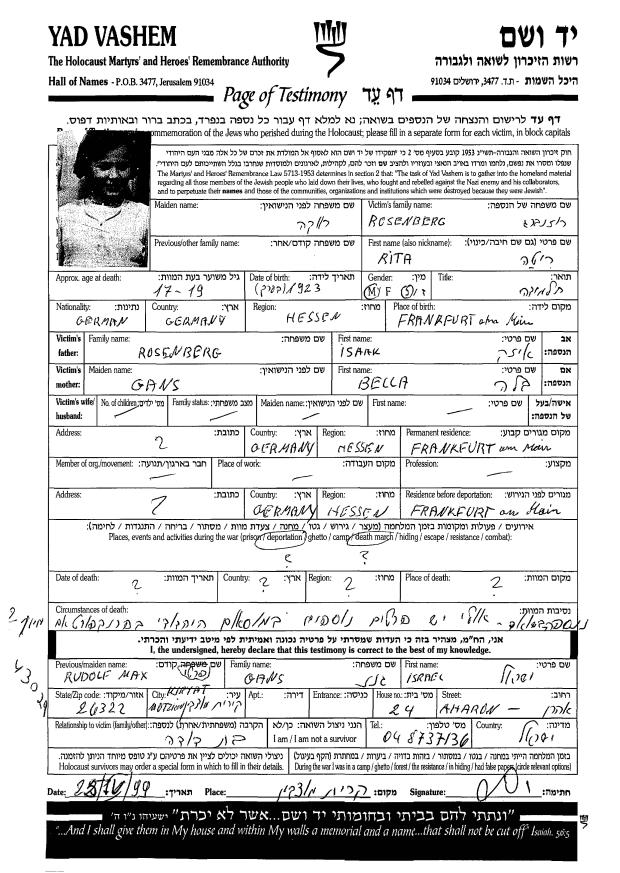
  8. Entry at Yad Vashem for Frieda Stern Blumenfeld, found at  https://yvng.yadvashem.org/nameDetails.html?language=en&itemId=11476884&ind=1 

Rebecca Blumenfeld Rosenberg and Her Family, Part I

It’s been a really, really long time since I continued the story of the children of my four times great-grandparents Abraham Blumenfeld and Geitel Katz (other than with the updates about those I’d already discussed). I left off with the story of the ten children of the second child (Isaak Blumenfeld I) of the oldest child (Moses Blumenfeld I) of the six children of my four-times great-grandparents.

Here’s a chart showing where I am in reporting on the descendants of Abraham and Geitel. As you can see, I have a long, long way to go.

I am now up to Isaak Blumenfeld’s eighth child, Rebecca Blumenfeld, who was born on August 23, 1856, in Momberg Germany.

LAGIS Hessen Archives, Geburtsregister der Juden von Momberg (Neustadt) 1850-1874 (HHStAW Abt. 365 Nr. 608), p. 4

On August 9, 1881, she married Mendel Rosenberg, son of Jacob Rosenberg and Betti Kaufmann. Mendel was born in Rosenthal, Germany, on May 19, 1854, and was the uncle of Emanuel Rosenberg, who later married Katinka Blumenfeld, Rebecca’s niece (her brother Gerson II’s daughter).

Rebecca Blumenfeld and Mendel Rosenberg marriage record, Hessisches Hauptstaatsarchiv; Wiesbaden, Deutschland; Bestand: 915; Laufende Nummer: 6491, Year Range: 1881, Ancestry.com. Hesse, Germany, Marriages, 1849-1930

Rebecca and Mendel had five children.

Blanka was born in Rosenthal on July 9, 1882.

Blanka Rosenberg birth record, LAGIS Hessen Archives, Standesamt Rosenthal Geburtsnebenregister 1882 (HStAMR Best. 922 Nr. 9638)AutorHessisches Staatsarchiv MarburgErscheinungsortRosenthalErscheinungsjahr1882, p. 35

Joseph was born in Rosenthal on February 4, 1886.

Joseph Rosenberg birth record, LAGIS Hessen Archives, Standesamt Rosenthal Geburtsnebenregister 1886 (HStAMR Best. 922 Nr. 9642)AutorHessisches Staatsarchiv MarburgErscheinungsortRosenthalErscheinungsjahr1886, p. 7

Moritz was born in Rosenthal on September 15, 1887.

Moritz Rosenberg birth record, LAGIS Hessen Archives, Standesamt Rosenthal Geburtsnebenregister 1887 (HStAMR Best. 922 Nr. 9643), p. 40

Willi was born in Rosenthal on April 24, 1889.

Willi Rosenberg birth record, LAGIS Hessen Archives, Standesamt Rosenthal Geburtsnebenregister 1889 (HStAMR Best. 922 Nr. 9645)AutorHessisches Staatsarchiv MarburgErscheinungsortRosenthalErscheinungsjahr1889, p. 17

And finally, Isaak was born in Rosenthal on June 15, 1892.

Isaak Rosenberg birth record, LAGIS Hessen Archives, Standesamt Rosenthal Geburtsnebenregister 1892 (HStAMR Best. 922 Nr. 9648)AutorHessisches Staatsarchiv MarburgErscheinungsortRosenthalErscheinungsjahr1892, p. 32

For now I will just identify the spouses of those children and their marriage dates, and then I will return to their stories in subsequent posts.

Blanka married Hugo Blumenfeld on July 23, 1907, in Frankenau, Germany.

Marriage of Hugo Blumenfeld and Blanka Rosenberg, Arcinsys Hessen Archives, HHStAW Fonds 365 No 175, p. 11

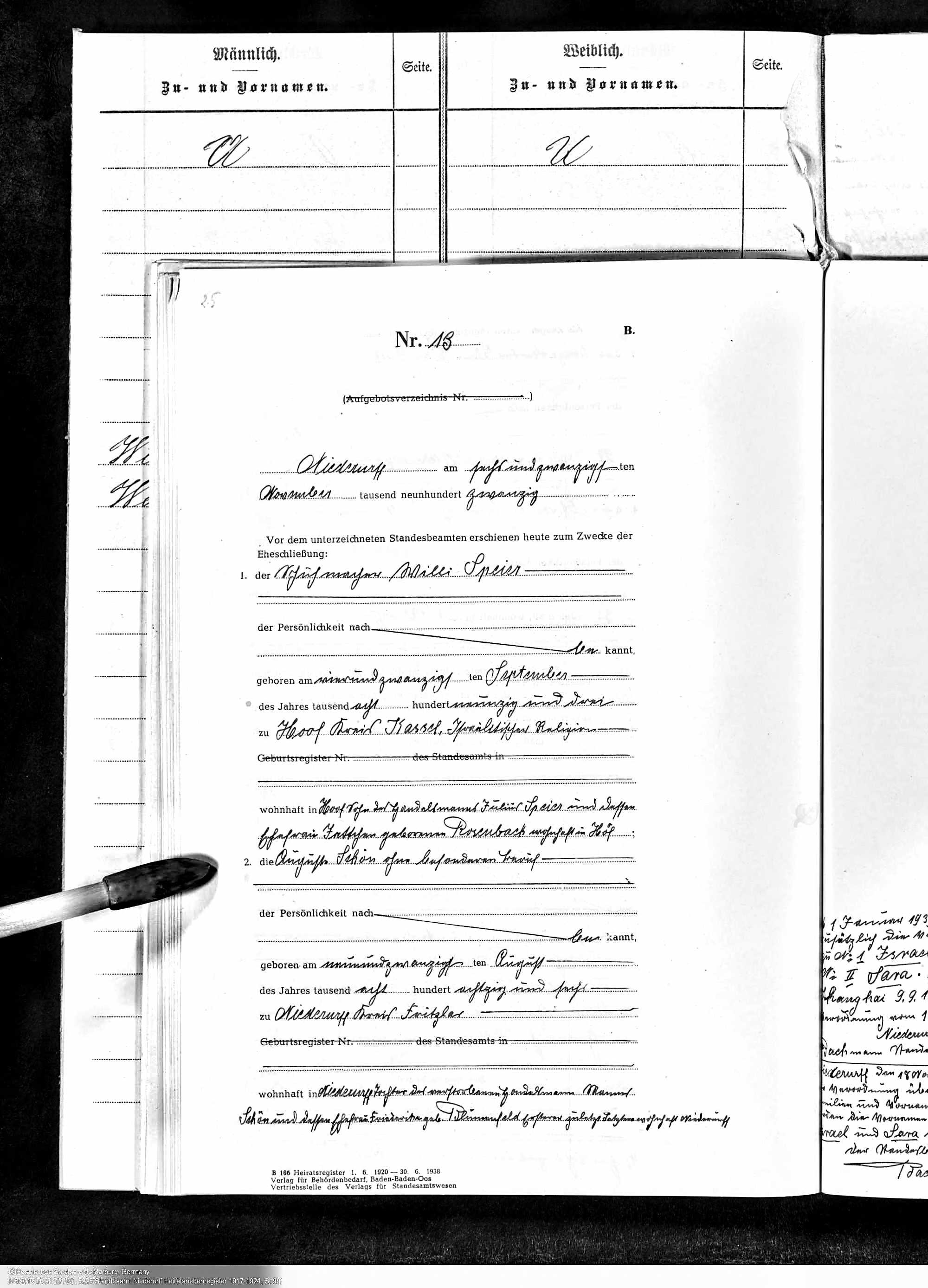
Joseph married Bella Oppenheim on February 21, 1913, in Bad Hersfeld, Germany. They had one child, a son Kurt, born on April 20, 1914, in Sobernheim, Germany,1 a town in the Rhine Palatinate region of Germany about 160-170 miles from Bad Hersfeld and Momberg where Bella and Joseph were born, respectively.

Marriage of Joseph Rosenberg and Bella Oppenheim, Hessisches Hauptstaatsarchiv; Wiesbaden, Deutschland; Bestand: 907, Year Range: 1913, Ancestry.com. Hesse, Germany, Marriages, 1849-1930

Unfortunately, Rebecca and Mendel’s family then had two losses over the next two and a half years. Willi Rosenberg was only 25 when he died on December 31, 1914. I wondered whether he was killed fighting for Germany in World War I, but I’ve found no record indicating that that was the case.

Willi Rosenberg death record, Hessisches Hauptstaatsarchiv; Wiesbaden, Deutschland; Personenstandsregister Sterberegister; Signatur: 9757
Source Information
Ancestry.com. Hesse, Germany, Deaths, 1851-1958

A year and a half later Rebecca Blumenfeld Rosenberg died in Rosenthal on June 6, 1915. She was 58 years old.

Rebecca Blumenfeld death record, Hessisches Hauptstaatsarchiv; Wiesbaden, Deutschland; Personenstandsregister Sterberegister; Signatur: 9757, Year Range: 1915, Ancestry.com. Hesse, Germany, Deaths, 1851-1958

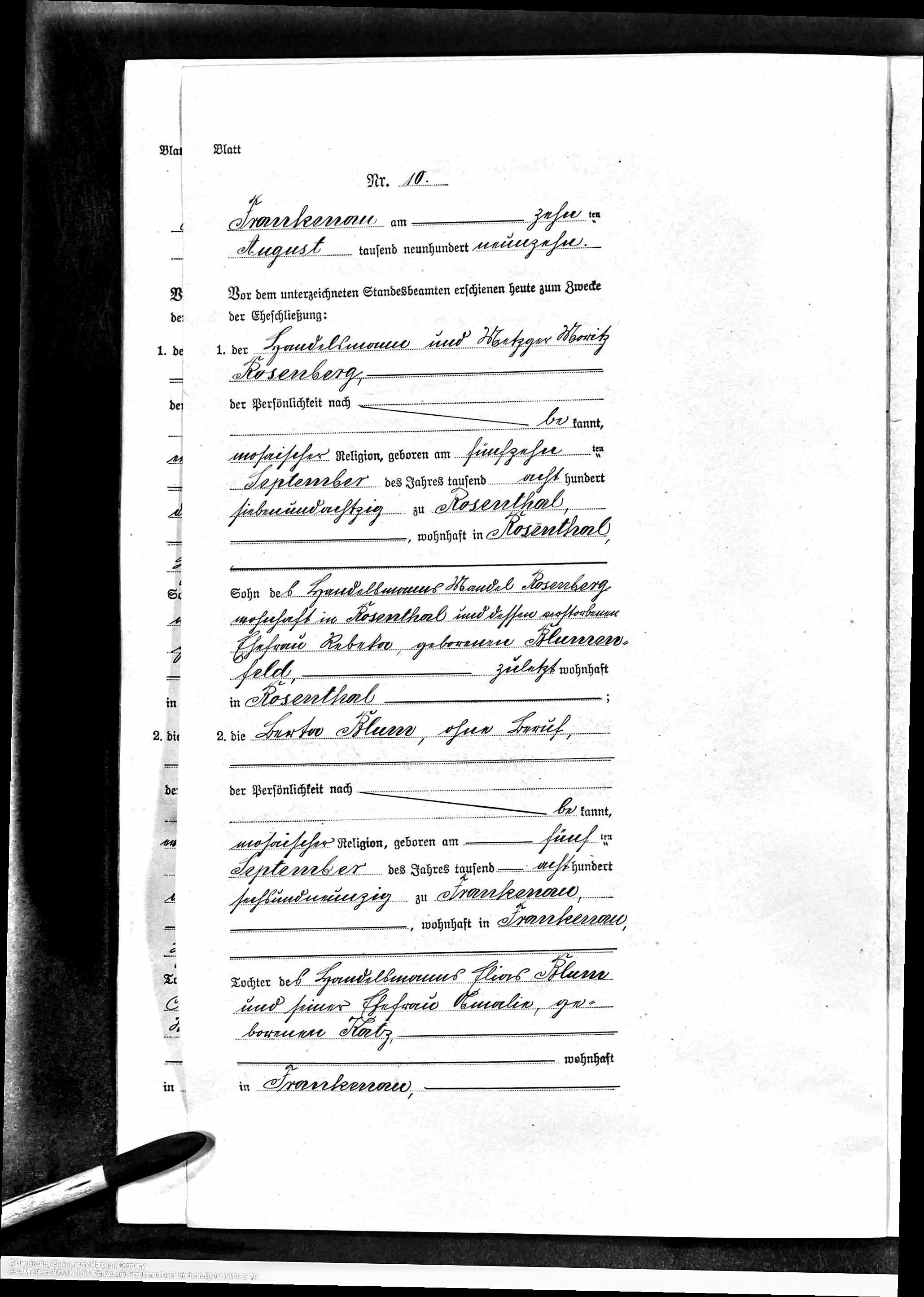
Her son Moritz married Berta Blum on August 10, 1919, in Frankenau.

Marriage of Moritz Rosenberg and Berta Blum, Hessisches Hauptstaatsarchiv; Wiesbaden, Deutschland; Signatur: 3254, Year Range: 1919, Ancestry.com. Hesse, Germany, Marriages, 1849-1930

And then the family suffered another tragic loss when Joseph Rosenberg, the second oldest sibling, died at the age of 36 on May 4, 1922, as seen on his headstone below. Thank you to my cousin Michael Rosenberg for locating this image. According to the headstone, Joseph was a doctor.

Joseph was survived by his wife Bella Oppenheim and their son Kurt. More on their story in a post to come.

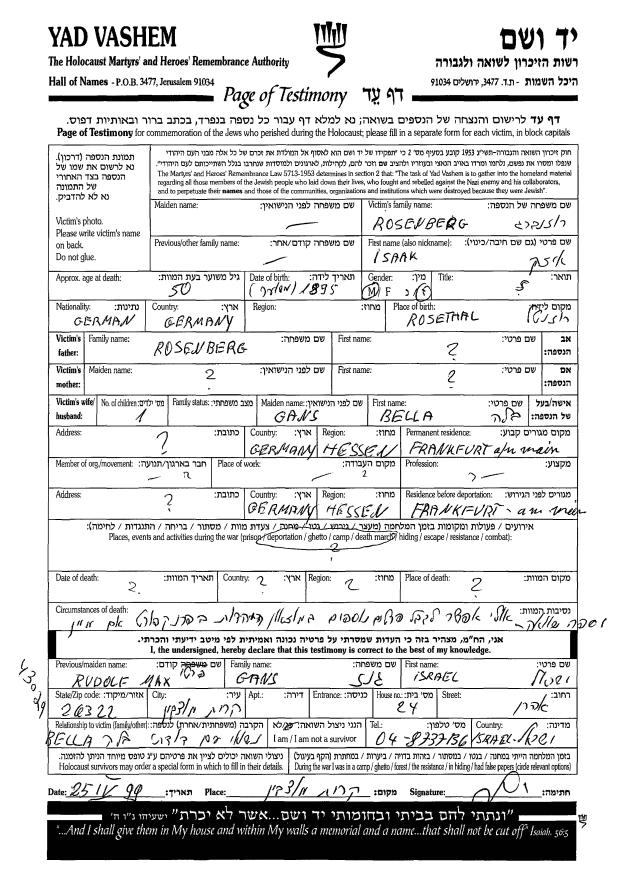
Finally, Isaac Rosenberg, the youngest child of Rebecca Blumenfeld and Mendel Rosenberg, married Bella Gans on December 22, 1922, in Niederaula, Germany.

saak Rosenberg marriage to Bella Gans, Hessisches Hauptstaatsarchiv; Wiesbaden, Deutschland; Bestand: 907; Laufende Nummer: 3665, Year Range: 1922, Ancestry.com. Hesse, Germany, Marriages, 1849-1930

When I look at the names of the daughter and the three daughters-in-law of Rebecca and Mendel—Blanka, Bella, Berta, and Bella—I have to wonder how confusing it must have been when they were all together. I can hear my mother-in-law running through the four names repeatedly before reaching the right one! (Click on the image immediately above to see the names of Rebecca’s family more clearly.)

Mendel Rosenberg died on December 22, 1928, in Marburg. He was 74 and was survived by three of his five children and, as we will see, many grandchildren.

Mendel Rosenberg death record, Hessisches Hauptstaatsarchiv; Wiesbaden, Deutschland; Personenstandsregister Sterberegister; Bestand: 5732; Laufende Nummer: 915, Ancestry.com. Hesse, Germany, Deaths, 1851-1958


  1. Kurt Rosenberg, World War II draft registration, National Archives at St. Louis; St. Louis, Missouri; Wwii Draft Registration Cards For New York City, 10/16/1940 – 03/31/1947; Record Group: Records of the Selective Service System, 147, Ancestry.com. U.S., World War II Draft Cards Young Men, 1940-1947 

Good for A Single Journey by Helen Joyce: A Review of A Wonderful New Book and An Interview with the Author

Today I have the great pleasure of sharing my virtual interview with author Helen Joyce. She has recently published a family history novel titled Good for A Single Journey, a moving and beautifully written telling of her maternal family’s story. Joyce’s great-grandparents were living in a small town in what was then Galicia in Eastern Europe in the early 20th century when oppression and poverty forced them to relocate to Vienna, where they hoped to have greater freedom and economic security. And they did find great success there. But like so many Jewish families, they eventually suffered from the horrors of the Holocaust. Although many, including Joyce’s mother, survived, many others were murdered, and all suffered from persecution and financial loss. And those who survived were once again forced to relocate and start all over in a new country.

Joyce has combined what she learned from her mother and other relatives with historical research to create a fascinating and illuminating look at the history of this era and its effect on one Jewish family. The book is a mix of fact and fiction, some parts totally created from her imagination and other parts entirely based on fact. The book reads like a novel. She has created wonderful three-dimensional characters, each with distinctive and memorable personalities and stories. I highly recommend this book to anyone interested in history and in Jewish history in particular. It is appropriate for young adults as well as adults and available for purchase on Amazon and Barnes & Noble here.

Good for a Single Journey has received a finalist’s award in the 2023 Next Generation Indie Book Awards and has also received a highly favorable review from Neville Teller in the June 12, 2023, issue of The Jerusalem Report. You can also learn more about Helen Joyce and her book at her website found here.  And in the interest of full disclosure, I should reveal that she is my fifth cousin on her paternal side; we are both descended from Jacob Falcke Goldschmidt and Eva Seligmann, our mutual four-times great-grandparents.

And now, let me introduce you to Helen Joyce and her wonderful book, Good for a Single Journey..

Thank you so much for agreeing to do this interview with me and to share more about your book, Good for a Single Journey.  Have you ever written a book or other fiction/non-fiction before?

No! I have written the odd article, contributed a chapter to two each of two academic books, and edited a community magazine which often entailed tightening the contributions of others. Otherwise, no formal writing experience.

So what made you decide to write this book at this time?

Old age! I always wanted to write an account of my mother’s life and never found the right time. Work, kids, and life in general always interfered. That and the self-defeating belief that the project was beyond me; that I was deluding myself if I thought I could write an account/memoir/novel of the type I imagined would do justice to her story. Finally, the reality of the fact that I was not getting any younger and triggered by taking our youngest granddaughter on a trip to Vienna where we visited my mother’s birthplace proved to be the catalyst for getting to work.

The author’s parents Max and Klari. Courtesy of Helen Joyce

I really enjoyed reading the book, and it reads like fiction. But I know that the book is based on the real lives of your parents, grandparents, and great-grandparents as well as many aunts, uncles, and cousins. How much of the book is fictionalized and how much is non-fiction?

It would take a long time to unravel fact from fiction but basically, I knew the ‘bare bones’ of the stories of all the characters. In the case of the two brothers, Chiel and Beresh, I knew very little indeed beyond the fact that they made Aliyah to pre-State Israel long around WWI. Therefore, I invented their adventures. I gave them experiences and put them in situations which were factually correct and allowed some of the history of the early Yishuv to come to light. I knew a little about Peppi, my grandmother’s sister, and of course the story of Suzanne became legendary!

Zissel, my other great-uncle, was a closed book to me until I unlocked the memoir of his son Yitzchak. That gave me the details of not only his travels across Europe and today’s Ukraine before reaching the shores of British mandate Palestine, but also revealed the entire saga of his grandparents’ (my great grandparents’) flight from Rozwadów to Ukraine and onwards to Siberia. I knew a great deal about my grandparents from my mother’s tales and, again through her, background details about day-to-day life in Vienna and the market town of Rozwadów, which she visited frequently on trips to her grandparents. The rags to riches story of my grandfather is true. Accounts of the flight from Vienna, the period in Prague, my mother’s experiences in London are also from my mother’s various shared memories.

My independent sources of research (apart from the internet and the cousin’s memoir which I mentioned) were my mother’s diaries and a stash of family letters collated and self-printed by my late uncle which charted the agony of desperation and fear as various members of the family tried to help and find ways to get those still trapped in Europe out. Obviously the most fictionalized accounts are those of the imagined conversations and emotions displayed by the various characters. The best I could do was to try and imagine I was them and put myself in their place at that time. What would I feel? How would I react?

How did you decide where to create fictional elements versus non-fiction?

Honestly, I don’t know! It just sort of flowed seamlessly. I wove elements of drama and fiction around the basic facts I knew. For example, I needed to get the two brothers from Vienna to Palestine during WWI. How would they have gone? What might they have done? WWI was raging so I thought it would be interesting to place them into an Austro-Hungarian unit which ended up in Palestine. When I started researching that possibility, I learned a great deal about the involvement of Jewish soldiers in the army, the unit I put them in was a real one (as was the officer which commanded it). The facts surrounding Aaron Aaronsohn, NILI, and their role in helping the British defeat the Ottomans in
Palestine and how these contributed to the fact of the Balfour Declaration was too good an opportunity to miss including. So, I did! Throughout the book I also wanted to give the lie to the myth that Jews were passive, never fought in armies and were pale scholars led to slaughter like sheep. Jews fought bravely (on all sides) in every theatre of war.

How did you research the parts of the book that are fact-based?

I read several books on WWI, biographies about Aaron Aaronsohn and NILI as well as books about the history of the Middle East. My mother’s cousin’s memoir was also very helpful. The internet is also a phenomenal resource. What was the weather like in Gallipoli in November 1915 – click. What train routes were available on the Chemins de fer Orientaux during WWI – click! What date was Rosh Hashanah in 1914 – click. All there in your hand-held mobile phone!

Your book begins with your great-grandparents leaving Rozwadów. Why did you decide to begin there?

The book begins with a train journey, the journey of my great grandparents fleeing their hometown in Galicia. I decided to start with that train ride as it gave me the opportunity to introduce all the main characters as well as a major theme of the book. Migration and journeys. The entire book is about the journey of individuals, families, and the Jewish people. Trains feature quite prominently. That opening train ride. Greetings and goodbyes at train stations. The brothers’ train ride to war and onwards to Palestine. The train ride carrying my great grandparents and their youngest son to Siberia. The train ride my mother took to Scotland to meet her brother serving in the Jewish Brigade of the British army and of course the final horrific train rides to the death camps.

You include some living people and some recently deceased people in the book. How did you approach the issues of privacy with respect to those people? Were there things you had to change or avoid to protect the interests of your family?

Yes, absolutely. A lot was excluded! However, in discussion with as many of my cousins as I could track down, I realized they were quite happy for me to give details of their stories. I offered each of them drafts so they could check they were happy with what I had written. However, as nearly all the family descendants live in Israel, many of them do not read in English. That said, they were quite happy to know I had written some account and did not mind if it was fictionalized. The Israeli branch is very easy going! I gave my sister an early draft and she enjoyed the first half but did have some comments and suggestions about the second half of the book. I have tried to accommodate her feelings on this but, ultimately, we agreed that the book was a fictionalized novel.

Your family endured many of the challenges and horrors faced by many Jewish families in the 20th century: immigration to new countries (several times), World War I, and Nazi persecution and the Holocaust. What impact do you think that history has had on you and the other living descendants of your great-grandparents?

It’s hard to speak about this in general. The impact is surely quite different for each family and on each individual. For me, knowing what previous generations lived and died for made me want to cling to a Jewish lifestyle replete with the traditions that Hitler tried so hard to erase. I didn’t want to give Hitler any kind of posthumous victory and so I have tried to raise a Jewishly faithful family. Beyond that? I guess a sense of the importance of justice and the need to respect equality of all people regardless of gender, race, or religion.

You ultimately decided to leave England and make Aliyah to Israel. What in your family history contributed to that decision? Have you made connections to the cousins who were refugees to Israel during the Nazi era?

Many factors contributed to that decision. My husband comes from a very ‘English’ Jewish family but his mother, eldest of ten, was the only child left in the UK after the creation of the State of Israel. The rest were all pioneers in Israel (although two had died before that was possible). So, he already has a huge network of family here. Our son made Aliyah twenty years ago and was raising his children here and of course we wanted to be close to them. We have a daughter with special needs and she made Aliyah with us – we couldn’t contemplate leaving her behind and she is so very happy here with excellent care. Our youngest child followed us five years ago and so, to our delight, all our children and grandchildren are here. Yes, I have contact with some of my many cousins, but they are numerous and spread out so we do not meet that often although I do meet my first cousins more frequently.

Your book has many themes and covers many topics: different ways to practice Judaism, antisemitism, Zionism, mental health, marriage, parental love, and so on. Was there a specific point or theme that mattered most to you?

They all mattered and, in a way, I suppose several of them nestle into each other like a set of Russian matryoshka dolls! Parental love leads to stability and contributes to the type of marriage partnership one is likely to create as does a strong sense of community and belonging. Antisemitism and Zionism also have a kind of Yin and Yang partnership! If I had to choose one (you didn’t ask me that!) maybe I would say resilience and survival!

Who did you see as the audience for your book? Your own family and descendants? Young adults? Jewish readers? The entire universe of adult readers?

The entire universe! My family and their descendants were not really the target audience. Had they been, the book would have been far more factual and memoir-based. I hoped it would appeal to young adults and prove educational and am being told that teenagers are totally gripped by the story – which, given the amount of history in it – is great! However, I would dearly love the non-Jewish world to gain insight about a Jewish way of life, the history of persecution and the holocaust but also the historical underpinnings of the State of Israel under international law which was brought about together with the dismantling of previous empires. If Israel is to be accused of being a ‘colonialist enterprise’ then equally so is Syria, Lebanon, Jordan, Saudi Arabia and Iraq. Not to mention the many ‘new’ European countries created in the wake of WWI. Without understanding the impact of WWI, nothing about the modern world makes sense (including current events in Ukraine!)

This book focused on your maternal family. Do you plan to write a book about your paternal side?

Yes! And your blog will be a fantastic resource for me!!! However, marketing this book is taking up a lot of time at the moment. I have been invited to take part in Jewish Book Week School Events for schools around the UK which is fantastic. Events can be online so I can do them from here. This is really part of my dream – to bring the reality of the Jewish experience to a wider audience.

The author, Helen Joyce. Courtesy of Helen Joyce

Thank you again for taking the time to answer my questions, and I look forward to reading your next book and hope that my research will be helpful to you! Best of luck in your marketing efforts—your book deserves a wide and large audience.


My Grandson’s Bar Mitzvah

This past weekend I had the overwhelming pleasure of watching my grandson Nate become a bar mitzvah. His utter joy in participating as an adult in a Jewish service—reading the prayers, the Torah, and the haftorah—was infectious. He didn’t just do this to fulfill his parents’ expectations or to please his grandparents; he did it with a full heart. His smiles, the vibrato in his voice, the way his body swayed to the music and the prayers all revealed just how much this all meant to him.

Although I could do little more than marvel and smile and cry a bit while I shared these moments in real time, in the aftermath as I processed it more deeply, I thought of all of Nate’s ancestors going back hundreds of years—all those for whom Jewish practice had been an anchor of safety and meaning in times of oppression, poverty, dislocation, and isolation.

Nate was carrying forward that thread of meaning, that connection to history and to community. He lives in a world where antisemitism still exists and where culture wars make identity even more fraught with danger, but also a world where he has more choices than his ancestors did. And he has chosen to embrace their traditions and carry them forward into the next generation not in a strictly traditional way, but in his own way, investing them with what is meaningful to him. I am both proud of him and excited for him as he now ventures forth into adulthood.

Watching Nate and being moved by his joyful adoption of these traditions and rituals has reminded me of my purpose in doing this research and in writing this blog: to honor and remember all those who came before me and to keep that history alive so that future generations will also honor and remember them and the traditions and rituals they followed.

Nate wearing the tallit that belonged to his great-grandfather Nathan, for whom he is named. Standing behind him is his grandfather Harvey, Nathan’s son.


Update on Jenny Blumenfeld Warburg from World Jewish Relief, A New (to Me) Research Tool

In my April 25, 2023, post about my cousin Jenny Blumenfeld Warburg, I described how I was able to establish through the anecdotal evidence from several cousins and from records from Israel that Jenny had married Siegmund Warburg in Israel/Palestine sometime between 1940 and 1950, but I had not been able to locate an actual marriage record. I still haven’t. But I have been able to find one more document that may relate to Jenny’s life.

I wrote in that earlier post that “In her [Shoah Foundation] testimony, [Jenny’s sister] Hilde [Blumenfeld Meinrath] said that Jenny left Germany and first went to England, where she met Siegmund Warburg and his family. They did not marry, however, until they were in Palestine/Israel.” I also wrote that I had not been able to find any record for Jenny in England. But now, thanks to the World Jewish Relief organization, I think I have.

First, let me tell you about this organization and how it can be a helpful research tool for anyone searching for information about relatives who escaped Nazi Germany to England in the 1930s and thereafter. According to their literature, World Jewish Relief was “[f]ounded in 1933 as the Central British Fund for German Jewry (CBF) … [and] helped bring around 65,000 Jewish refugees, predominantly from Germany and Austria, to Britain. Once here, [they] provided a welfare system, helping refugees find housing, employment, receive medical care and making sure they had enough money to survive. Through this work, the charity established a trusted relationship with the Home Office and lobbied Parliament to allow them to instigate schemes such as the Kindertransport, which rescued 10,000 children, and The Kitchener Camp, which was a means to bring approximately 4,500 Jewish men into the country, many from concentration camps.”

After the war, the organization continued to provide relief to Jewish survivors, bringing children who had survived the camps to England for care and education and rehabilitation. According to their literature, the charity “continued to help Jewish refugees throughout the twentieth century, including those fleeing Egypt, Iran, Czechoslovakia and Bosnia. From funding flights to finding them accommodation, we always provided a safe place for our global Jewish family.”

The charity changed its name to World Jewish Relief in the 1990s and has continued its mission of providing aid and assistance to people of all backgrounds from all over the world who have “survive[d] the consequences of conflict and disaster, to thrive and rebuild their lives.”

In addition to this important charitable work, the organization also provides research assistance to those like me who are looking for information about their family members who escaped to England as refugees from Nazi Germany. Although its files are not comprehensive, there are registration slips for 65,000 refugees and case files for about 35,000 of those refugees.

For Jenny Blumenfeld, there was not a complete case file, just a registration slip. But it provided me with a few more snippets of information about a woman named Jenny Blumenfeld, who probably was my cousin.

Jenny Blumenfeld registration slip from World Jewish Relief

From this brief document, I learned that a Jenny Blumenfeld arrived in England on May 2, 1934, and left for Palestine in 1935. Of course, this document isn’t necessarily for the same Jenny Blumenfeld. The one entry that gives me pause is that she was last living in Lueneburg, Germany, which is 230 miles from Kirchhain, where my Jenny was born and raised. What would a young single Jewish woman have been doing there in 1934? The card also doesn’t have an exact birth date, just an age, 26. Jenny was born on June 23, 1907, so would have been 26 (almost 27) on May 2, 1934.

I am not sure what the other two dates on the card refer to. There is a notation of “16-2-42” that is crossed out. And then on the reverse it says “Addr[ess?] Unknown rce?. reh? left? 24-5-44.” I don’t know the relevance of those two dates, but I know that Jenny was by that time living in Palestine. I asked Sharon Adler, the volunteer with the World Jewish Relief Archives who sent me the registration card, what she thought the dates meant, and she hypothesized that it might have been times that others were inquiring about Jenny’s whereabouts. But she could not be certain.

It’s too bad that World Jewish Relief does not have a complete file on Jenny so that I could be more certain that this is my cousin Jenny Blumenfeld Warburg. But since Hilde did say that Jenny first went to England before going to Palestine, there is enough here to give me some reason to believe that Jenny left Germany and went to England on May 2, 1934, and then left for Palestine the following year. Maybe these dates will lead to more information. If anyone has any ideas, let me know.

I am grateful to Sharon and the World Jewish Relief organization for their help, and I hope other researchers will also take advantage of this wonderful resource.


Blog Update

When I decided I needed a break from screens back in January and stopped blogging for a few weeks, I never anticipated that during that time (and since) I would be contacted by numerous cousins who found me through my blog. It’s been a wonderful time, connecting with all these people and learning more about their families—and mine. I’ve already written about many of these new cousins and their stories, and there are even more stories and family information that I haven’t yet processed enough to write about.

For example, a new cousin found me with information about a whole branch of my Hamberg tree that I didn’t know existed. A Katzenstein cousin found me, and we had a Zoom session with him, his grandmother, his mother, his aunt, his brother, and another cousin. And a Goldschmidt cousin contacted me, but he and I still haven’t found a good time to talk since our schedules aren’t in sync.

All of this has been amazing and rewarding. It also means I’ve stalled on doing much new research into the Blumenfeld family.

And I am still finding that being online for too many hours is not good for me. So my posting schedule may now become less frequent. But I will still be here, just moving more slowly, as I continue to learn about my Blumenfeld family and connect with cousins from all over my family tree.

The Magic of Finding Family Connections: Guest Post by My Cousin Ellen Mandelberg

Just over a year ago, I wrote a post about the family of Moritz Blumenfeld, my second cousin, three times removed, and concluded at the end that none of his five children had had any children and that therefore there were no descendants. But I concluded that post by saying, “there is always the possibility that I just haven’t found those descendants yet.”

Well, a year later I heard from one of those descendants. A woman named Ellen Mandelberg contacted me and told me that she was the granddaughter of Moritz’s Blumenfeld’s daughter Flora Blumenfeld  Vorchheimer. You can imagine my delight. Moritz did have descendants. And Ellen shared with me several stories about Flora. I’ve invited her to tell those stories in her own voice as well as to share some of her photos. So today’s post is by my newly found fifth cousin Ellen.


Through the Google galaxy, and a spur-of-the-moment decision to see if there was anything out there written about my paternal grandmother, Flora Blumenfeld Vorchheimer, I found Amy’s blog earlier this year. I saw that she did not know that Flora had descendants and contacted her to share the good news. I am one of those descendants.

Flora Blumenfeld did have family; by marrying recent immigrant Felix Viktor Vorchheimer in late 1940 and raising his motherless son Umberto (who became Bert in Vineland, NJ, in the 40s), Flora became a wife, mother, constant helpmate on a chicken farm in Vineland, NJ, and, later, a deeply kind and loving grandmother to two little girls, my sister and me.

Flora Blumenfeld Vorchhiemer Courtesy of the family

Felix Vorchheimer Courtesy of the family

Here is a photograph of young Bert with his father Felix and maternal grandmother before Felix and Bert left for America in 1940; it was the last time he saw her. Flora’s father, Moritz, had suffered early maternal loss, as had Flora, and this must have made her especially sensitive as she raised young Bert. 

Umberto V. on left (age 7); Karolina Schild Kahn, Umberto’s maternal grandmother in middle; Felix V. on right.
Courtesy of the family

Flora became a loving Oma in 1958 and 1960, when Bert and his wife had two daughters, my sister and me.

Flora, Ellen, and Felix Vorchheimer c. 1958
Courtesy of the family

Flora cooked wonderful German-Jewish dishes, kept a candy dish of dark chocolates on the table for all guests, and was observant in a quiet and accepting way. Each time her family came to visit, before they left, she would bless us girls, placing her hands on our heads, whispering quietly in Hebrew a prayer that she never shared in English with us. At 4’10”, she would place her hands on our heads and murmur the blessing, making us feel protected and loved.

Flora blessing Ellen c 1970
Courtesy of the family

After Felix died, at age 69, in 1965, Flora lived with her older sister Gerda in an apartment in Washington Heights until her death in 1974 at age 75. Flora continued to be the epitome of chesed, or lovingkindness. Her memory is always a blessing.

Flora and Felix Vorchheimer in Vineland, New Jersey
Courtesy of the family

Years later, in 1996, a surprising encounter brought connections to my extended Blumenfeld family and much joy into my life. That year, my husband and I, after living in West Hartford, CT, for 14 years, and having belonged to a chavurah, decided we needed to join a synagogue that would provide a Hebrew school for our kids, who were 11 and 7 at that time. We decided to join Congregation Tikvoh Chadoshoh in Bloomfield, CT, which had been founded by German-Jewish refugees.

On Simchat Torah, with the music and everyone swirling about in small circles, I asked an “older” woman to dance; pulling people into the circle is something I’ve always done. The woman hesitated and asked me if I was Israeli.

Something possessed me to blurt out, “No, I’m not Israeli; I’m half-German, and my maiden name is Vorchheimer.”

The woman blurted out, “Vorchheimer, I know that name….I made the shidduch!”

I asked her, “Really? Tell me!”

So she continued, “Well, there was a widower with a little boy who had just come to America, and I matched up my cousin with him! I was at the wedding! In 1940!”

It felt like time stood still, and I said, “Was your cousin’s name Flora Blumenfeld?”

She said, “Well, yes, how do you know?!”

I pointed to my son, then 7, born on 2/4, my father’s birthday, and said, “Look, my son is the same exact age my father was when you last saw him in 1940! And that widower was my Opa Felix. Your cousin was my beloved Oma Flora, whom my daughter is named after!”

That woman, Grete Simon Spanier, was my grandmother Flora’s second cousin, as I later learned from Amy. They were both great-granddaughters of Isaak Blumenfeld and Gelle Strauss.

It was a remarkable and life-affirming moment. What are the odds? What if I’d just pulled Grete into the circle, and said, no, I’m not Israeli!?

Grete had been lost to my family for 56 years until that moment. Grete told me how Julius Vorchheimer, my grandfather’s brother, part of the Washington Heights community, had asked her if she had a relative who might be a suitable match for his recently-arrived brother Felix, and she’d thought of her cousin Flora.

Grete married Erwin Spanier shortly after attending my grandfather’s wedding to Flora and moved to West Hartford. She lost touch with Flora; Flora was very busy working on a chicken farm and raising a little boy who had been through much loss, and she was married to a man who had also seen too much loss, in both his native Germany and the place he moved to after he fought in WWI for the Germans, Milan, Italy, before emigrating to America in 1940.

The only part of this story I knew all my life was that my grandfather Felix had gotten his older brother Julius out of Dachau in 1934/35, going to the Nazis with some line (and probably money) about “How dare you imprison the brother of an Italian citizen?”

Felix freed his brother in 1934/5; Julius returned the favor by being a matchmaker in 1940. It was that chance Simchat Torah dance that brought Grete back to my family.

It felt like a curtain was pulled back on mystery, allowing me to see the invisible hand of fate in life.

Getting to know Grete and her daughters was an unexpected and wonderful gift. Grete’s memory is always a blessing.


I am so grateful to Ellen for finding me and sharing her story and photographs on my blog. The magic of family connections continues to inspire me to keep searching for all my long lost relatives.


Did Jenny Blumenfeld marry Siegmund Warburg? A Brick Wall Tumbles

As I wrote in my last post about the family of Salomon Blumenfeld, Roberto Meinrath, my fifth cousin and the younger son of Hilde Blumenfeld Meinrath, left Brazil in 1960 after being selected by his congregation in Rio de Janeiro to spend a year in Israel in a leadership training program. I was hoping that Roberto might be able to provide information to answer questions I had about his mother’s sister Jenny Blumenfeld, who had immigrated to Israel (then Palestine) to escape Nazi Germany.

Back in May 2022, I wrote that many trees on Ancestry and elsewhere “report that … Jenny, married Siegmund Rudolf Warburg on July 25, 1933, and that Siegmund was born in Berlin on May 26, 1896, to Otto Warburg and Bertha Cohen.” I found Siegmund’s birth record, but I could find no record attaching Siegmund and Jenny; I had found “a Siegmund Warburg with a different wife, Ilse, and two children, Gabriel and Thomas, sailing from Hamburg to New York on August 31, 1933.” But was that the same Siegmund who supposedly married Jenny?

Siegmund Warburg birth record, Landesarchiv Berlin; Berlin, Deutschland; Personenstandsregister Geburtsregister; Laufendenummer: 95, Ancestry.com. Berlin, Germany, Births, 1874-1908

Warburg family, ship manifest, Month: Band 417 (Aug 1933), Staatsarchiv Hamburg. Hamburg Passenger Lists, 1850-1934, Staatsarchiv Hamburg; Hamburg, Deutschland; Hamburger Passagierlisten; Volume: 373-7 I, VIII A 1 Band 417; Page: 2211; Microfilm No.: K_2000
Staatsarchiv Hamburg. Hamburg Passenger Lists, 1850-1934, Ancestry.com

My cousin Richard Bloomfield then found what we believe is Jenny’s gravestone on Billiongraves based on the birth date on the stone, and it has her name as Jenny Warburg; Richard also found a 1950 list of registered voters in Haifa, Israel, that listed Jenny Warburg and Siegmund Warburg together. But none of that definitively proved that it was Jenny Blumenfeld who married Siegmund Warburg.

Jenny Warburg, Yekhi’am cemetery, Akko, Israel, found at Billiongraves.com at https://billiongraves.com/grave/%D7%92%D7%A0%D7%99-%D7%95%D7%A8%D7%91%D7%95%D7%A8%D7%92/22732522

So I asked Roberto what he knew about his aunt Jenny, and he was able to provide further evidence that she had married Siegmund Warburg because while living in Israel in 1960, Roberto spent time with his aunt Jenny and her husband Siegmund. Thus, Roberto was able to confirm that in fact that Jenny had married Siegmund. Roberto also said he knew “for sure” that Jenny and Siegmund did not have any children. Roberto also informed me that his grandmother Malchen/Amalie had gone to Israel after Salomon Blumenfeld died and was living at the same kibbutz as Jenny and Siegmund.1

Roberto wasn’t certain, but he thought that Siegmund may have had a son from a prior marriage also living in Israel. I thought that that might explain how Siegmund appeared on a ship manifest in 1933 with a wife named Ilse and two children, traveling to the US. Perhaps he and his family with Ilse had later immigrated to Palestine/Israel.

I decided to search on the Israel Genealogy Research Association website and found several relevant records. In 1938 Siegmund Warburg, son of Otto (so the same Siegmund born in Berlin on May 28, 1896) is listed with Ilse Warburg on the Haifa registered voters list, proving that the Siegmund who was sailing with Ilse and their children to the US in 1933 had immigrated to Palestine/Israel with Ilse by 1938. Then I found Ilse and Sigmund listed together as Haifa registered voters in 1941.2

Voters List Knesset Israel 1938 (פנקס הבוגרים של כנסת ישראל בחיפה 1938), part of the Voters Knesset Israel 1938 (בוגרים של כנסת ישראל 1938) database, system number גל-7408/5, line 42, IGRA number 12178. The original records are from Israel State Archives found at https://genealogy.org.il/AID/

But in 1942 Sigmund is listed without Ilse, and we know from Richard’s research that in 1950 Siegmund and Jenny were listed together as Haifa voters.3

Voters List – Local (רשימת הבוחרים למועצה המקומית), part of the Voters Local Authorities 1942 (בוחרים למועצות המקומיות 1942) database, document number 297, page 8946, IGRA number 32087. The original records are from City Archives – Haifa (ארכיון העיר – חיפה), found at https://genealogy.org.il/AID/

What does all this mean? It means that although I have no marriage record for Jenny Blumenfeld and Siegmund Warburg, one can presume that Siegmund came to Israel/Palestine with his wife Ilse and their children sometime before 1938, eventually divorced Ilse, and married Jenny sometime before 1950. I could not prove it, but I was persuaded that that’s what happened based on the circumstantial evidence.

I decided to post on the Tracing the Tribe group page on Facebook to see if someone knew where I might find a marriage record for Jenny and Siegmund, and I was surprised to receive a comment from my fifth cousin Simeon Spier, whose mother Gisela Spier I wrote about here. Simeon not only knew that Jenny had married Siegmund Warburg—he knew Jenny well as she and his mother Gisela had been very close.

Simeon wrote that Siegmund Warburg’s father Otto Warburg was an important early Zionist as well as a renowned botanist—something that I had not realized while searching for information about Siegmund. I found more information about Otto and his life and career from his obituary here and from other articles here and here.4

Simeon also told me that Siegmund’s marriage to Jenny was his second marriage; it was Jenny’s first marriage. So that corroborated both what Roberto remembered and what I found in my research. Simeon also confirmed that Siegmund had three children from his first marriage.

Simeon shared these two photographs of Jenny with Siegmund.

Jenny Blumenfeld and Siegmund Warburg Courtesy of Simeon Spier

Siegmund Warburg and Jenny Blumenfeld Courtesy of Simeon Spier

Simeon also shared two photographs of Jenny with his own family. The first one shows Jenny with her cousin Gisela Spier Cohen and Gisela’s children Sitta and Simeon in Haifa in 1965.

Sitta Cohen, Gisela Spier Cohen, Jenny Blumenfeld Warburg, Simeon Spier (Cohen) in Haifa, 1965 Courtesy of the family

This one shows Jenny with Simeon and his sisters when they visited her in Israel in 1974.

Jenny Blumenfeld with the children of Gisela Spier Cohen 1974   Courtesy of Simeon Spier

Simeon has fond memories of visiting Jenny in Israel and when she visited them in Toronto. He described her fondly as a “very orderly and proper woman.” He wrote:4

Jenny had a tiny but well-appointed apartment on the Carmel in Haifa. … The small living room was filled with Sigmund’s books and his furniture from Germany.  She used the covered balcony as her dining room.  She was an exquisite cook and she was proud of it!!  In fact, we have a saying in our family: “Jenny, I think I’ll come again.”  Jenny would taste her delicious cooking before serving it and comment: “Jenny, I think I’ll come again!”

You can see Sigmund’s large collection of books in the first photograph above. Unfortunately, we can’t sample Jenny’s cooking. But we can imagine it.

Jenny’s marriage to Siegmund was further confirmed when I connected with her great-nephew Michael Katz, the grandson of Jenny’s sister Gretel. Michael also met Jenny in Israel. So that was a third confirmation of the marriage.

And then, as yet another confirmation, I received the translation of Hilde’s Shoah Foundation testimony by Manuel Steccanella and Richard Bloomfield.5 In her testimony, Hilde said that Jenny left Germany and first went to England, where she met Siegmund Warburg and his family. They did not marry, however, until they were in Palestine/Israel. Hilde also stated that she herself went to Israel sometime after the end of the war and worked at a kibbutz for two months as arranged by Siegmund Warburg’s children.6

I have searched for a record showing that Jenny was in England before immigrating to Palestine/Israel, but so far have not located any. And I am still hoping someday to obtain an actual marriage certificate for Jenny and Siegmund (I’ve written to the kibbutz where they lived in 1960, but have gotten no response yet), but I am now convinced based on the statements of four witnesses, Roberto, Simeon, Michael,  and Hilde, as well as the photographs shared by Simeon that Jenny Blumenfeld was married to Siegmund Warburg, the son of Otto Warburg.

Thank you to my cousins Gabriela, Roberto, Simeon, and Michael for helping to break down this brick wall. Special thanks to Richard Bloomfield and Manuel Steccanella for translating Hilde’s Shoah Foundation testimony.


  1. Email from Roberto Meinrath, February 11, 2023. 
  2. Voters List – Local (רשימת הבוחרים למועצה המקומית), part of the Voters Local Authorities 1941 (בוחרים למועצות המקומיות 1941) database, system number 6/272, page 14, IGRA number 743. The original records are from City Archives – Haifa (ארכיון העיר – חיפה), found at https://genealogy.org.il/AID/ 
  3. Voters’ Ledgers Haifa Municipality 1950 (פנקס הבוחרים לעירית חיפה 1950), part of the Voters Local Authorities 1948-1953 (בוחרים רשויות מקומיות 1953-1948) database, list קלפי 26, page 1, line 169, IGRA number 21461. The original records are from City Archives – Haifa (ארכיון העיר – חיפה), found at https://genealogy.org.il/AID/.  I also found on the IGRA website an index of a record for the 1947 marriage of Hanna Warburg, twenty-one year old daughter of Zigmund Warburg, in Haifa, and one for the marriage of  Gavriel Warburg, son of Ilza and Shimon Warburg, dated February 23, 1949. He was 21 at the time, so born in about 1928. 
  4. Email from Simeon Spier, February 23, 2023. 
  5. The references in this post to the interview of Hilde Meinrath and the information contained therein are from her interview with the Shoah Foundation, March 18, 1998, which is in the archive of the University of Southern California Shoah Foundation Institute for Visual History and Education. For more information: http://dornsife.usc.edu/vhi 
  6. Ibid. 

An Amazing Day!

No stories about my distant relatives today because my heart is too full with love and pride for my daughters to think about the past—though I realize and recognize that my daughters wouldn’t be who they are but for all those ancestors who came before them—all those who were brave enough and optimistic enough to take all those steps that made it possible for my children to be here. So forgive me for indulging today in parental pride as I bask in the glow of yesterday.

Yesterday was such an amazing day. Both of our daughters were at their very best. And as their parents, we were both excited and worried about how their days would go. Maddy was going to run her third Boston marathon (and her fourth marathon overall), and Rebecca was going to testify before a Congressional committee. How were we going to juggle both and be able to focus on each of them fully?

Well, fortunately Rebecca’s testimony was in the morning, and Maddy’s start for the marathon wasn’t until 11:15, so we were able to watch most of the Congressional hearing before Maddy even started to run. It was an exhausting but exhilarating day from start to finish.

Rebecca was asked to testify before the House Judiciary Committee on behalf of New Yorkers Against Gun Violence, the non-profit organization for which she is the executive director. The hearing was ostensibly called as a hearing to determine what could be done for the victims of violent crime in New York City, but as many of the Democrats on the Committee stated and as media outlets also recognized, it was actually called by the committee chair, Republican Representative Jim Jordan of Ohio, as an attempt to intimidate and punish the Manhattan DA Alvin Bragg for his office’s prosecution of Donald Trump. Since violent crime rates are higher in many places, including Ohio, than they are in New York City, it was obvious that this was a set-up, not a good faith investigation of violent crime.

As Rebecca said in her testimony, if the committee and Congress were truly concerned about victims of violent crime, then they would be focused on taking actions to prevent gun violence. She stated:

“To make a significant change, we need bipartisan support in Congress to fight violent crime and make our communities safer.  Congress can combat the national gun trafficking crisis plaguing New York City and the state by passing federal gun reform laws that are modeled after New York State’s.  We need to close loopholes in the federal background check system, protect victims and survivors of domestic violence, strengthen extreme risk protection order laws, promote safe storage laws, crack down on ghost guns and hold rogue, reckless gun dealers accountable.  Our federal, state, and local governments need to invest more in community violence intervention and prevention programs, invest more in housing, healthcare, and education.  Our state and our cities need more funding for victim services. And Congress must support and fund federal law enforcement efforts to investigate gun crimes and hold the highest drivers of crime and gun trafficking accountable.”

You can see Rebecca’s full opening statement here.

Rebecca faced questioning by the members of the committee, both Democrats and Republicans, and was steadfast in her position and persuasive in articulating the position that it is the easy access to guns that leads to most violent crime, not the actions of a prosecutor’s office. Surrounded by other witnesses hand-picked by the Republicans to pursue their political agenda, Rebecca stayed calm, resolute, and professional. We couldn’t have been prouder.

Meanwhile, as we were watching Rebecca on my laptop, we were also keeping our eyes on our phones and the Boston Athletic Association app that allows people to track runners in the marathon. Maddy started the race at 11:18 am, and we began to track her progress. You can imagine our excitement and our stress—both daughters testing themselves in challenging and extraordinary circumstances.

Just as last year and the year before, we were staying at the Lenox Hotel in Boston where Maddy is now the general manager of the restaurants. She has worked there for over 16 years, starting as a host and working her way to the general manager’s position. She is passionate about the hospitality business, making sure that all guests receive the best service and feel welcome and appreciated whenever they come to one of the restaurants in the hotel. As we had lunch in one of those restaurants and walked through the lobby and stood outside to watch the runners crossing the finish line a few hundred feet away, over and over we heard from everyone, “We love Maddy.” From the servers in the restaurant to the hotel staff to the many “regulars” who eat there often, we heard how wonderful Maddy is to everyone.

And then, as we tracked the app and watched her progress, we stood outside in the cool and sometimes rainy weather, waiting anxiously to see her finish the race. We watched as she made her paces through Hopkinton, Ashland, Wellesley, Natick. We saw her pace slow a bit as she ran up and down the hills of Newton—the infamous Heartbreak Hill. And then we saw her gain speed again as she went through Brookline and finally crossed the Boston city line. My heart was pounding as I saw her turn right on Hereford Street and then left for the final stretch down Boylston Street. And then there she was, smiling, jubilant, and seemingly unfatigued by the 26.2 mile run.

And then there was the excitement of seeing her return to the hotel and the loud cheers and hugs and flowers and love that greeted her—not only by us, her parents, but by all those friends, co-workers, and guests who were there to cheer for her and support her.

What a day! These are the days that you dream about when you have children—the days that make all the worrying and hard work and sleepless nights worth it. The days that make you grateful for the gifts your children have given you with their passion, their love, their strength, and their commitment to being good and kind people determined to make the world better in many different ways.


Hilde Blumenfeld Meinrath, Part II: Leaving Germany and Life in Brazil

As we saw in my prior post, I had learned more about Hilde Blumenfeld Meinrath, thanks to connections made through her granddaughter Gabriela. I learned that after spending four years in New York working as a German-English translator, Hilde decided to return to Germany in 1932 for what was initially supposed to be an extended visit with her family. But then she met and married her husband Ludwig Meinrath and decided to stay longer. She found employment as a translator and secretary for the American author, William March.

But everything began to change after Hitler came to power.

As Hilde reported in her Shoah Foundation interview,  her employer William March was attacked by Nazi youths because he was mistakenly identified as Jewish and ended up in the hospital. He decided to leave Germany and urged Hilde to leave before it was too late; he invited her to come and work for him in New York. .1

Meanwhile, a month after Hitler came to power in April 1933, Hilde’s husband Ludwig, who had  been working as a representative for German companies making ribbons and wool products, lost his job as a sales agent because he was Jewish.. So Hilde and Ludwig agreed it was time to leave Germany.2

But Hilde and Ludwig disagreed about where to go, according to their son Roberto. Hilde wanted to return to New York, but Ludwig feared that he would be unable to make a living there with only a high school education. He had a cousin Helmut in Rio de Janeiro who persuaded him that life was wonderful there, so they went to Brazil in 1934, even though neither of them knew any Portuguese.3

HIlde and Ludwig Meinrath ship manifest, Month: Band 424 (Mär 1934)
Staatsarchiv Hamburg. Hamburg Passenger Lists, 1850-1934

Hilde continued to be a true go-getter. Roberto wrote:

Upon arrival in Rio by ship, and literally one block from the harbor, was Rio’s largest high rise of the day (some 20 stories).  On top of the building was a large advertising poster for US Steel.  My mom walked right into the building to find out whether US Steel would be interested in a German/English secretary, not knowing that at that time Brazilian secretaries were mostly male.  Of course, at that time, Rio was Brazil’s capital and … home to the president of US Steel, who immediately hired her at a salary that was higher than what cousin Helmut was then earning, after a year in Rio.  Anyway, due to my mom’s high salary, my father was able to dedicate his time to learn Portuguese and to become a wholesale textile salesman for several companies.

Hilde and Ludwig’s first child (Gabriela’s father) Pedro John Meinrath was born in 1936; according to Roberto, his mother insisted that Pedro have an American/English middle name, presumably because of her fond memories of living in the United States.

Meanwhile, back in Germany, conditions worsened for Hilde’s parents and her sister Gretel and her family. After Kristallnacht in November, 1938, Salomon Blumenfeld and his son-in-law David Katz were arrested and sent to Buchenwald.4 After they were released, Hilde used her connections and borrowed money to bring her parents to Brazil. Hilde stated in her Shoah Foundation interview that when her parents arrived in Brazil, her father looked emaciated  from his time in Buchenwald, despite the fact that his son-in-law had given Salomon half of his own rations so that Salomon would survive.  5

Hilde’s parents lived with her and her family in Rio for a short time, but according to Hilde, the climate there didn’t agree with them, so she and Ludwig purchased a small house in Petropolis, a city in the mountains north of Rio for her parents, and they moved out of their apartment in Rio and moved to a rented room. When the war in Europe started, Ludwig’s import business suffered, so Hilde had to work full-time to help support the family. Pedro, who was just a four year old at the time, stayed with his grandparents in Petropolis, and Hilde and Ludwig would come on the weekends to be with them all. 6

Here are two photographs that Gabriela shared with me of Pedro with his maternal grandparents Salomon and Malchen Blumenfeld:

Malchen Levi, Pedro Meinrath, and Salomon Blumenfeld c. 1939 Courtesy of the family

Pedro Meinrath with his parents and maternal grandparents c. 1940 Courtesy of the family

Ludwig and Hilde’s second child Roberto came along five years later in 1941—he was, as he wrote, “a surprise baby.” Hilde’s job at the US Embassy ended up being important in saving Roberto’s life.  When Roberto contracted diphtheria when he was three years old, his mother Hilde was able through her job at the American Embassy to obtain life-saving penicillin, which was not otherwise readily available in Brazil at that time because of the war.7

Hilde Blumenfeld Meinrath with her sons c. 1941 Courtesy of the family

Pedro Meinrath, Salomon and Malchen Blumenfeld, Hilde Blumenfeld Meinrath, Roberto Meinrath 1944 in Petropolis Courtesy of the family

According to Roberto, after the war ended in 1945, Ludwig was able to restart his import business, and Hilde and Roberto moved to Petropolis. But Hilde’s parents at that point decided to leave Brazil because there was no kosher food or orthodox synagogue in Petropolis; they went to New York where Hilde’s sister Gretel was living. Hilde and her sons stayed in Petropolis until 1950 when Hilde and Roberto moved back to Rio. Pedro stayed in Petropolis where he went to boarding school until he graduated and went to university.

Malchen and Salomon Blumenfeld USA 1953 Courtesy of the family

Roberto described his life in Rio as an idyllic adventure for a young boy; he sadly described the changes that came to Rio in the 1960s:

I basically grew up as a single child in Rio, right in between Copacabana and Ipanema beaches.  Once or twice a week, I helped fishermen bring in their nets with piles of fish and, as compensation, got a free take home fish.  At that time, Rio had trees everywhere, few cars, cobblestone streets and tramways (which I took every day to school).  With the advent of the car industry in Brazil in the sixties, Rio’s streets were asphalted and widened, trees had to be cut down as most of the buildings had been built without garages and cars had to park on streets and sidewalks.  I miss old Rio, new Rio is sort of a tourist mecca only because of the beaches and the largest city park in the world.

Hilde and Ludwig belonged to a liberal Jewish synagogue in Rio, and Hilde insisted that Roberto attend after school classes in Hebrew and Jewish history. Roberto described an experience that ended up being a turning point in his life:

Because our synagogue was not very large, Rosh Hashanah and Yom Kippur services were held in the headquarters of one of Rio’s great soccer teams… and while watching the team practice during the 1959 Yom Kippur service, I was asked whether I would be interested in representing our congregation in the year-long youth leadership training program in Israel.  I jumped at that, as I sought personal freedom from what I felt to be a fairly strong-willed mom.

Roberto’s trip to Israel in 1960 allowed him to meet and get to know Hilde’s sister Jenny and her husband Sigmund Warburg. And thus he was able to give me information about Jenny and Sigmund and answer the questions I’d been hoping to answer when I wrote the blog post about the three sisters back in May, 2022. More on that in my next post.

But first a photograph that Gabriela shared with me of Hilde and her sons taken at her 100th birthday party in 2011. She died six years later in 2017 at the age of 106. She was truly a remarkable woman.

Pedro Meinrath, Hilde Blumenfeld Meinrath, and Roberto Meinrath 2011 Courtesy of the family


  1. The references in this post to the interview of Hilde Meinrath and the information contained therein are from her interview with the Shoah Foundation, March 18, 1998, which is in the archive of the University of Southern California Shoah Foundation Institute for Visual History and Education. For more information: http://dornsife.usc.edu/vhi  Roberto, Hilde’s son, also told me this story in his emails to me. 
  2. Ibid. 
  3. All the information in this post attributed to Roberto Meinrath as well as the quotations were shared through emails sent between February 11 and February 16, 2023. 
  4. Phone conversation with Michael Katz, March 9, 2023. 
  5. See Note 1, supra. As we will see in a later post, William March helped get Gretel and David Katz out of Germany and into the US. 
  6. See Notes 1 and 3, supra,
  7. See Note 3, supra