Under the Boardwalk: My Cousins, the Atlantic City Hoteliers

I admit it. I have been avoiding Simon Schoenthal.  Not for any bad reason, but simply because he and his wife Rose Mansbach had ten children. Ten.  I just couldn’t get myself motivated to follow up on their ten children, each of whom was my first cousin, twice removed.  That is, those ten children were my grandmother Eva Schoenthal Cohen’s first cousins.  And once she married and moved to Philadelphia in 1923, she was living not far from most of these cousins.  Maybe she knew them well.  I should be more motivated, but I’ve been procrastinating simply because I was overwhelmed by the number of children to research.

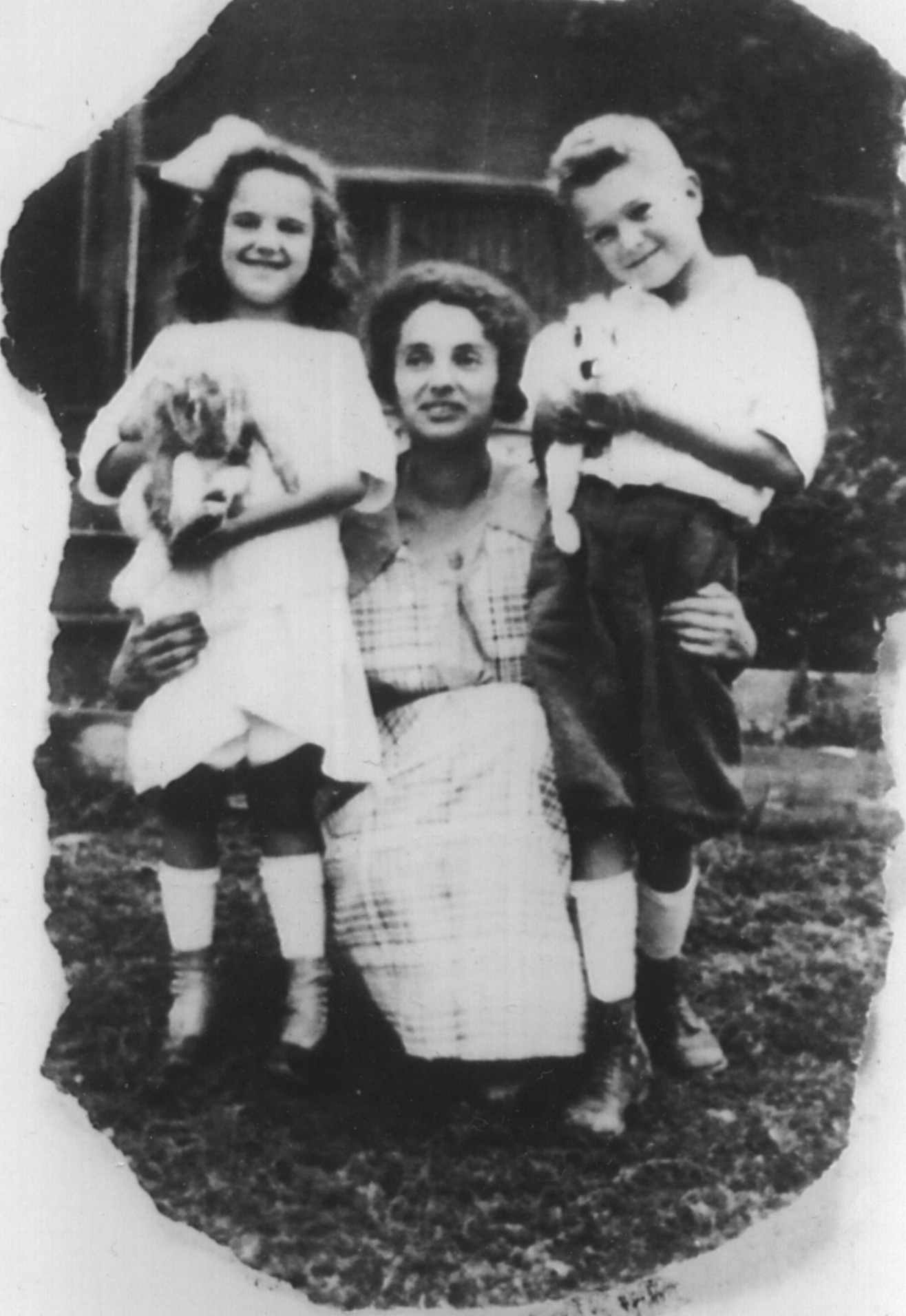
The nine surviving children of Simon and Rose (Mansbach) Schoenthal Photo courtesy of the family of Hettie Schoenthal Stein

The nine surviving children of Simon and Rose (Mansbach) Schoenthal
Photo courtesy of the family of Hettie Schoenthal Stein

But it’s a new year, and the time is now, so here we go.  First, to recap what I’ve already written about Simon and Rose and their children.  Simon was the fifth child of Levi Schoenthal and Henriette Hamberg and was born on February 14, 1849.  He was nine years older than my great-grandfather, his brother Isidore.  Along with his sister Amalie, Simon arrived in Washington, Pennsylvania, in 1867, a year after their older brother Henry had settled there. Simon was a bookbinder and occupied in that trade for many years after he first came to the US.  In 1872, Simon married Rose Mansbach, and in the 1870s they had five children: Ida (1873), Harry (1873), Gertrude (1875), Louis (1877), and Maurice (1878).

By 1880, Simon, Rose and their children had moved to Philadelphia, where Simon continued to work as a bookbinder.  They had five more children in Philadelphia: Martin (1881), Jacob (1883), Hettie (1885), Estelle (1888), and Sidney (1891).  Their oldest daughter, Ida, twin of Harry, died in 1887 from heart disease, leaving nine living children.

Simon Schoenthal with twins Harry and Ida 1875 Courtesy of the family of Hettie Schoenthal Stein

Simon Schoenthal with twins Harry and Ida 1875
Courtesy of the family of Hettie Schoenthal Stein

In the 1890s, Simon left the bookbinding business and turned to other fields.  He sold cigars early in the decade, and then by 1898 he and his family had relocated to Atlantic City, where he had a “bric-a-brac” store.

What brought them to Atlantic City? In fact, what had led Simon and Rose to move from Philadelphia to Atlantic City in the first place? I’ve been to Atlantic City twice since its revitalization in the 1980s, and I’ve played Monopoly since I was a little girl and know many of the famous street names from that game—Pacific, Illinois, Indiana, Mediterranean, Park Place, and, of course, the Boardwalk.  But I didn’t know much about the history of the city or what it was like in the late 19th century and early decades of the 20th when Simon Schoenthal and his children were living and working there.


http://www.gettyimages.com/detail/114528288

The official website for Atlantic City provides a fairly detailed history of the city.  Up until the mid-19th century, the island upon which Atlantic City was built was a fairly unsettled place.  Originally settled by the Lenni-Lenape Indians, the first permanent settlement by non-native Americans was not established until 1785 when Jeremiah Leeds settled there.  As late as 1850, there were only seven permanent homes on the island, all belonging to Leeds and his descendants.  Then in 1854, the first railroad line was completed, connecting Atlantic City to Camden, New Jersey, and in 1870 the first official road was completed.


http://www.gettyimages.com/detail/121332673

At that point, Atlantic City was attracting visitors:

By 1878, one railroad couldn’t handle all the passengers wanting to go to the Shore, so the Narrow Gauge Line to Philadelphia was constructed. At this point massive hotels like the United States and the Surf House, as well as smaller rooming houses, had sprung up all over town. The first commercial hotel the Belloe House, located at Massachusetts and Atlantic Ave., was built in 1853, and operated till 1902. The United States Hotel took up a full city block between Atlantic, Pacific, Delaware, and Maryland (the current site of the Showboat Parking lot). These grand hotels were not only impressive in size, but featured the most updated amenities, and were considered quite luxurious for the time.

There were beautiful hotels, elegant restaurants, and convenient transportation, but the businessmen of Atlantic City had one big problem to contend with…SAND. It was everywhere, from the train cars to the hotel lobbies. In 1870, Alexander Boardman, a conductor on the Atlantic City-Camden Railroad, was asked to think up a way to keep the sand out of the hotels and rail cars. Boardman, along with a hotel owner Jacob Keim, presented an idea to City Council. In 1870, and costing half the town’s tax revenue that year, an eight foot wide wooden foot walk was built from the beach into town. This first Boardwalk, which was taken up during the winter, was replaced with another larger structure in 1880.

….

On Weds. June 16, 1880, Atlantic City was formally opened. With fanfare the likes few in the area had seen, a resort was born. By the census of 1900, there were over 27,000 residents in Atlantic City, up from a mere 250 just 45 years before.


The PBS website provided this description of Atlantic City in its early days:

The city boasted a prototype rollercoaster by the late 1880s. In the decades around the turn of the twentieth century, middle and working class Philadephians, and soon others from up and down the East Coast, would come to play by the seaside. Vendors hawked their wares. James’ Saltwater Taffy became “Famous the World Over.” Mechanical marvels took tourists on daring rides that made their stomachs turn. Children rode carousels, and families dined in seaside cafes. Concerts were held on the sand every evening and the many hotels up and down the shore held gala dances.

Atlantic City seemed to have developed two personalities. On the one hand, the resort was promoted as a restful and wholesome vacation spot, offering sun and surf. On the other hand, tourists reveled in the boisterous atmosphere spawned by a festival of midways, numerous amusement piers (such as the one H.J. Heinz purchased to popularize his 57 varieties of pickles), and a selection of rollicking rides.

English: Glossy postcard reads "A Mile St...

English: Glossy postcard reads “A Mile Straightaway Stretch of the World-famous Atlantic City Boardwalk.” Back is divided. Published by Chilton Company, Phila., Pa., U.S.A. 4 (Photo credit: Wikipedia)

Thus, my relatives arrived as the city was booming, and it must have seemed a place of great opportunities for them and their children. In 1900, the older children of Simon and Rose Schoenthal were young adults. Harry was a student at Juniata College in Huntingdon, Pennsylvania; Louis, Martin, and Jacob were still living at home with their parents, but working: Louis was selling cigars, and Martin and Jacob were working in the laundry business. Maurice was not listed in the 1900 census, as far as I can tell, but he also was living in Atlantic City in the early 1900s, according to the 1904 Atlantic City directory.  In fact, four of the brothers appeared to be working in a related business at that time.  All four brothers were living at 22 Delaware Avenue in Atlantic City.  It appears that Martin and Jacob were running a laundry called Incomparable Laundry at 1432-1434 Atlantic Avenue and that Louis was running a cigar, tobacco, stationery and sporting goods business at the same location.  Louis also listed a billiards and pool hall on “S Virginia av n Beach.”  Maurice is listed as a manager at “S Virginia av, Ocean end.” The three youngest children, Hettie, Sidney, and Estelle, were still young and living at home in 1900.

English: Postcard published by the Post Card D...

English: Postcard published by the Post Card Distributing Co., Atlantic City, New Jersey, USA. Back is divided. (Photo credit: Wikipedia)


The oldest daughter, Gertrude, had married Jacob Miller in 1898, and they were living in Pima, Arizona, where they would have three children: Juliette (1900), Harry (1902), and Sylvester (1905).  The last child, Sylvester, was likely named for Simon Schoenthal, who died on March 26, 1904, when he was only 55 years old.

So what happened to the nine surviving children of Simon Schoenthal after he died?  For one thing, most of them lived long lives, especially for that generation.  Martin lived to only 67, but Hettie lived to be 103 and Sidney lived to be 100.  All the rest at least lived into their 80s.[1]  Almost all of them were married and had children and then grandchildren.  That’s a lot of years and a lot of people. You can see why I was procrastinating.

So let me start with the oldest, Harry, who was born in 1873, and as of 1902, was working for the Atlantic Wine and Liquor Company and living at 931 Atlantic Avenue in Atlantic City.  (His brothers Jacob, Louis, and Martin were living at 1434 Atlantic Avenue.)

Harry Schoenthal Courtesy of the family of Hettie Schoenthal Stein

Harry Schoenthal
Courtesy of the family of Hettie Schoenthal Stein

Harry does not appear in the Atlantic City directories between 1903 and 1910, whereas his younger brothers are listed in those years.  Harry does appear, however, in the 1910 census, living in Philadelphia, where he was boarding with a family named Wirtschafter.  The head of the household, Joseph Wirtschafter, and his wife and three children had several other boarders living in their household in addition to Harry.  Harry’s occupation is listed as the owner of a retail saloon, and Joseph’s occupation was a laborer in a liquor establishment.  Perhaps Harry’s landlord was working for him.

This photograph, shared with me by the family of Harry’s sister Hettie, is labeled “Uncle Harry’s Beer Business ? Philadelphia,” so I assume it refers to the liquor business owned by Harry Schoenthal.

Uncle Harry's Beer Business Courtesy of the family of Hettie Schoenthal Stein

Uncle Harry’s Beer Business
Courtesy of the family of Hettie Schoenthal Stein

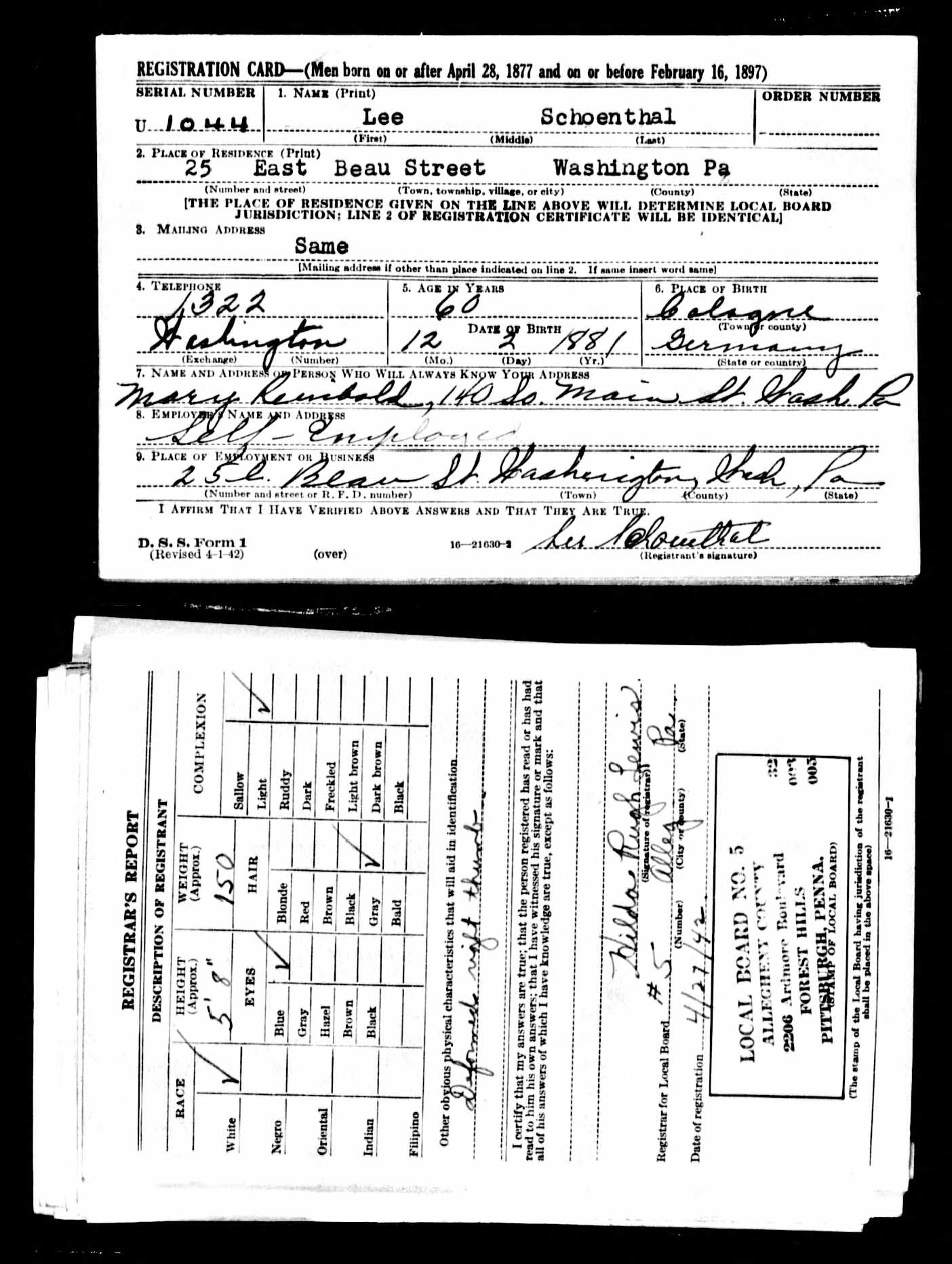
One of Joseph Wirtschafter’s children on the 1910 census was a 21 year old daughter named Esther.  Later that year, Harry, who was sixteen years older than Esther, married her.  In 1912, their first child, Sylvan Harry Schoenthal, was born (presumably named for Harry’s father Simon) and in 1914, their second son, Norman, was born.   In 1918, they were living in Philadelphia at 2153 North Howard Street, according to Harry’s draft registration for World War I.  Harry listed his occupation as “merchant” and was self-employed.

Registration State: Pennsylvania; Registration County: Philadelphia; Roll: 1907615; Draft Board: 12

Registration State: Pennsylvania; Registration County: Philadelphia; Roll: 1907615; Draft Board: 12

By 1920, however, Harry’s circumstances had changed. His in-laws, Joseph and Jennie Wirtschafter, had relocated to Atlantic City and were the proprietors of a hotel located at 139 St. James Place. According to the Atlantic City directory, the name of the hotel at that address was the St. James Hotel.  Harry and Esther and their two sons were also living at the same address in Atlantic City, where Harry was now employed as a clerk in the hotel. His mother Rose and his thirty year old sister Estelle (listed as Stella) were also living with them.  The 1922 Atlantic City directory lists Esther Schoenthal and her brother Charles Wirtschafter as the hotel proprietors at 139 St. James Place.

According to Wikipedia, this was a good time to be in the hospitality business in Atlantic City:

The 1920s, with tourism at its peak, are considered by many historians as Atlantic City’s golden age. During Prohibition, which was enacted nationally in 1919 and lasted until 1933, much liquor was consumed and gambling regularly took place in the back rooms of nightclubs and restaurants. It was during Prohibition that racketeer and political boss Enoch L. “Nucky” Johnson rose to power. Prohibition was largely unenforced in Atlantic City, and, because alcohol that had been smuggled into the city with the acquiescence of local officials could be readily obtained at restaurants and other establishments, the resort’s popularity grew further. The city then dubbed itself as “The World’s Playground”. [footnotes omitted]

The city’s website reports a similar view of the city’s popularity in this era:

Atlantic City became “the” place to go. Entertainers from vaudeville to Hollywood graced the stages of the piers. Glamorous Hotels like Haddon Hall, The Traymore, The Shelburne and The Marlborough-Blenheim drew guests from all over the world.

PBS had this to say about Atlantic City in the 1920s and 1930s:

By the 1920s, Atlantic City also had become a pre-Broadway show tryout town, a practice that continued until 1935. With the entrance of show business, the resort increasingly attracted celebrities who added a special element of glamour. Even as the city declined as a Broadway showcase, the celebrities continued to grace the city in the decades to come. Over the years people like Sophie Tucker, Jimmy Durante, Fanny Brice, Harry Houdini, Milton Berle, Martha Raye, Guy Lombardo, Irving Berlin, Frank Sinatra, Dean Martin, Jerry Lewis, Marilyn Monroe, and many more would be spotted around town.

Its tourism and light-hearted revelry made Atlantic City the perfect spot to hold the first Miss America Pageant on September 8th, 1921.

Though the economy hit hard times in the 1930s, people continued to flock to Atlantic City. It became even more well known when it became the city featured in the Depression-era hit game, Monopoly, where players handled large sums of money and strategized to buy the best property along the boardwalk.

Monopoly board on white bg

Monopoly board on white bg (Photo credit: Wikipedia)


According to a passenger manifest dated February 16, 1925, Harry and Esther were living at the Hotel Raleigh, located at 170 St. Charles Place in Atlantic City.  This is consistent with the 1930 census record for Harry and Esther, which has them living at 170 St. Charles Place in a hotel.  The census reports that they were the father-in-law and mother-in-law of the heads of household, which had me quite confused for a while.

Year: 1930; Census Place: Atlantic City, Atlantic, New Jersey; Roll: 1308; Page: 18A; Enumeration District: 0007; Image: 402.0; FHL microfilm: 2341043

Year: 1930; Census Place: Atlantic City, Atlantic, New Jersey; Roll: 1308; Page: 18A; Enumeration District: 0007; Image: 402.0; FHL microfilm: 2341043

Harry and Esther had sons who were eighteen and sixteen in 1930, so it made little sense.  Reading through the record of all those listed at 170 St. Charles Place, I found that the head of the household was Charles Wirtschafter, Esther’s brother.  Harry, now 56, was listed as retired, and Charles must have been running the hotel.  Esther and Charles’ father Joseph Wirtschafter, now a widower, was also living in the hotel.  So Harry and Esther were actually brother-in-law and sister of the head of household.

Raleigh Hotel, Atlantic City, found at http://www.monopolycity.com/ac_earlyhotels.html

Raleigh Hotel, Atlantic City, found at http://www.monopolycity.com/ac_earlyhotels.html

As for their two sons Sylvan and Norman, neither one was listed as living with their parents on the 1930 census.  In 1930-1931, Sylvan, then 18-19, was a freshman at Franklin and Marshall, according to the F&M 1931 yearbook. But where was he when the census was taken early in 1930? Norman was only sixteen in 1930—where could he have been? Boarding school? Living somewhere else? Just skipped by the enumerator?  I don’t know.  But neither appears on the 1930 census.

I found this family Jewish New Year’s greeting in the September 11, 1931 issue of the Jewish Chronicle of Newark, New Jersey (p. 28) in which Norman and Sylvan were included as well as their parents and the family of Charles Wirtschafter, all apparently still associated with the Hotel Raleigh:

1931 Rosh Hashanah greetings Harry Schoenthal and family


But then I also found this little social news item in the November 20, 1932 issue of the Washington (DC) Evening Star (p. 33):

Sylvan and Norman Schoenthal 1932 in DC paper

If Sylvan and Norman were going to Atlantic City for Thanksgiving, the implication is that neither son was living in Atlantic City at that point but rather presumably in Washington, DC, where the newspaper was published.  I did find Sylvan listed in both the 1933 and 1934 Washington, DC, city directory; in both years he was working at in the Shoreham Hotel and living at 2709 Woodley Road.  According to the 1940 census, Sylvan was still living in Washington, DC, in 1935.

As for Norman, he is not listed in the Washington, DC, city directories during the 1930s.   The earliest directory listing I have for him is the 1938 Atlantic City directory where both he and his brother Sylvan are listed as working at the Villa D’Este  hotel (located at 3100 Pacific Avenue) and living at 102 South Chelsea Street in that city.  Well, actually there is no separate listing for Sylvan, but rather one for a Mrs. Sylvan Schoenthal at that same address.  I believe that the directory editor mistakenly thought Sylvan was a woman and the wife of Norman Schoenthal.

Harry, Esther, Norman, and Sylvan Schoenthal 1938 Atlantic City directory Ancestry.com. U.S. City Directories, 1822-1995 [database on-line]. Provo, UT, USA: Ancestry.com Operations, Inc., 2011. Original data: Original sources vary according to directory.

Harry, Esther, Norman, and Sylvan Schoenthal 1938 Atlantic City directory
Ancestry.com. U.S. City Directories, 1822-1995 [database on-line]. Provo, UT, USA: Ancestry.com Operations, Inc., 2011.
Original data: Original sources vary according to directory.

In this same listing, you can see that Norman and Sylvan’s parents, Harry and Esther (Wirtschafter) Schoenthal, were also residing at 102 South Chelsea Street, but still working at the Hotel Raleigh.

In March 1938, there was a fire at the Villa D’Este hotel operated by Sylvan and Norman Schoenthal:

JPG Villa deste fire 1938 Sylvan and Norman Schoenthal-page-001

As the article indicates, the Villa D’Este hotel was not owned by the Schoenthal brothers, but managed by them.

In 1940, Harry, Esther, Sylvan and Norman were all still living together in Atlantic City, but no street address is indicated on the census record.  The record also has some of the relationships confused.  Sylvan is listed as the head of the household (and as single, making me doubt even more the 1938 directory listing for a “Mrs. Sylvan Schoenthal”); Norman is listed as the manager.  Their mother Esther is listed as the assistant manager, and their father Harry is listed as “Brother.”  How many think that Harry was the manager and Norman the brother? Or was Harry really the head of household and Sylvan the manager?  One thing is certain:  Harry was not Sylvan’s brother.

Year: 1940; Census Place: Atlantic City, Atlantic, New Jersey; Roll: T627_2301; Page: 82A; Enumeration District: 1-62

Year: 1940; Census Place: Atlantic City, Atlantic, New Jersey; Roll: T627_2301; Page: 82A; Enumeration District: 1-62

In addition, the census identified Sylvan as the hotel proprietor, Norman and Esther as partners, and has no occupation or title given for Harry.  I am not sure what to make of that, but my guess is that the line for “Harry” was really describing Norman and vice versa.  Also, the news article above indicated that Sylvan did not own the Hotel D’Este, so was this a different hotel? Or had he purchased it since 1938? Or is the census record inaccurate on this point as well?  I don’t know.

Year: 1940; Census Place: Atlantic City, Atlantic, New Jersey; Roll: T627_2301; Page: 82A; Enumeration District: 1-62

Year: 1940; Census Place: Atlantic City, Atlantic, New Jersey; Roll: T627_2301; Page: 82A; Enumeration District: 1-62


Sigh.  More errors and ambiguities in census records….

Although the 1940 census record for Harry and his family did not include a street address or hotel name, in 1941, all four family members are listing in the Atlantic City directory as residing still at 102 South Chelsea Street, and Sylvan and Harry have the notation “Villa D’Este” next to their names, as they did in the 1938 directory.  So the fire did not result in closing down the hotel.

Both Sylvan and Norman served in the military during World War II; Norman enlisted in the army on February 24, 1942, for the duration of the war, and his brother Sylvan enlisted on September 5, 1942, also for the duration of the war.  Norman’s record with the Jewish Welfare Board about his military service indicates that he was wounded during his time in the service, but I could not find any further details.

Ancestry.com. U.S., WWII Jewish Servicemen Cards, 1942-1947 [database on-line]. Provo, UT, USA: Ancestry.com Operations, Inc. Original data: Alphabetical Master Cards, 1942–1947; Series VI, Card Files—Bureau of War Records, Master Index Cards, 1943–1947; National Jewish Welfare Board, Bureau of War Records, 1940–1969; I-52; boxes 273–362. New York, New York: American Jewish Historical Society, Center for Jewish History.

Ancestry.com. U.S., WWII Jewish Servicemen Cards, 1942-1947 [database on-line]. Provo, UT, USA: Ancestry.com Operations, Inc.
Original data: Alphabetical Master Cards, 1942–1947; Series VI, Card Files—Bureau of War Records, Master Index Cards, 1943–1947; National Jewish Welfare Board, Bureau of War Records, 1940–1969; I-52; boxes 273–362. New York, New York: American Jewish Historical Society, Center for Jewish History.

After the war, both Sylvan and Norman returned to their parents’ home at 102 South Chelsea Street.  Sylvan was now married to a woman named Rose, according to the 1946 Atlantic City directory, and Norman was still associated with the Villa D’Este hotel.  But the 1950 directory only includes Sylvan and Rose, still at 102 South Chelsea and still associated with the Villa D’Este. In 1952, Sylvan continued to be the manager of the Villa D’Este hotel, as seen in this advertisement; note that he is described as the “owner-mgr,” so perhaps he had purchased the hotel after the 1938 fire and thus the 1940 census record could be correct in describing him as the proprietor of a hotel:

Sylvan Schoenthal ad villa deste 1952 Richmond VA paper


Harry, Esther, and Norman are not listed in the 1950 Atlantic City directory. It is not really too surprising that they had left Atlantic City by then.  As the city’s own website reports:

Atlantic City’s future seemed bright, until World War II. After the war, the public seemed to stop its love affair with The World’s Favorite Playground. Possibly because of the public’s access to national air travel, the shift of the population westward, the general deterioration of the city, or a shift in the public’s taste for more sophisticated entertainment, Atlantic City lost much of its shine; and most of its tourists.

It appears that Norman moved to West Palm Beach, Florida, sometime after 1946.  He is listed in the 1951 and 1953 directories for that city with a wife named Harriet.  In both directories, he is listed as the manager of Spanish Courts.  A search on newspapers.com brought up this article from the December 13, 1950, Palm Beach Post (p. 4):

Normal Schoenthal buys Spanish Courts Palm Beach Post article

Interestingly, it appears that Norman had been in Florida before the war, returned after the war to Atlantic City, and then again returned to Florida.  Norman became active in the local business association and was elected president of the Palm Beach County Chapter of the Florida State Motor Courts Association, according to the April 27, 1951, issue of the Palm Beach Post (p. 15).

Norman’s parents, Harry and Esther Schoenthal, must have also moved to Florida in the 1950s because Harry died in Palm Beach on September 23, 1954.  He was 81 years old.  According to the records at Mt. Sinai cemetery in Philadelphia where he was buried, he had been a resident of West Palm Beach, Florida, when he died.  He was buried near his parents, Simon and Rose (Mansbach) Schoenthal.

Historical Society of Pennsylvania; Philadelphia, Pennsylvania; Collection Name: Historic Pennsylvania Church and Town Records

Historical Society of Pennsylvania; Philadelphia, Pennsylvania; Collection Name: Historic Pennsylvania Church and Town Records

Norman and Harriet divorced in 1954, and she relocated to NYC, where she became a very well-known publicist in the furniture industry and was president of Harriet Schoenthal Inc., a New York advertising, marketing and public relations firm. As far as I can tell, Norman and Harriet had not had any children.  On October 26, 1954, the Palm Beach Post (p. 1) reported that Norman had sold the Spanish Courts motor court for $175,000.  (Later news articles reveal that in 2002 there were plans to tear down the Spanish Courts motel for a new development, but that must not have happened because as recently as 2013, the Palm Beach Post reported new plans to raze the site for redevelopment.)

Sadly, a year later Norman Schoenthal died on September 15, 1955; he was only 41 years old.   He also was buried at Mt. Sinai in Philadelphia where his father and his grandparents were buried.  According to the cemetery records, he was a resident of Atlantic City when he died and thus I assumed he must have returned there after his divorce and the sale of his business.

Historical Society of Pennsylvania; Philadelphia, Pennsylvania; Collection Name: Historic Pennsylvania Church and Town Records

Historical Society of Pennsylvania; Philadelphia, Pennsylvania; Collection Name: Historic Pennsylvania Church and Town Records

But he was only 41, and I wondered what had been the cause of his death.  I could not find an obituary or a death certificate online.  I thought he might have died in New Jersey, which does not have death records online, so I asked my New Jersey researcher to check the archives in Trenton, but she reported back that there was no death certificate for Norman Schoenthal in New Jersey.  I was stumped, so I turned to Tracing the Tribe, the Jewish genealogy group on Facebook, and as always received great assistance.   One group member there, Stacy, located Norman’s death certificate in the Delaware records:

Norman C. Schoenthal death certificate Delaware Death Records, 1855-1961," database with images, FamilySearch (https://familysearch.org/ark:/61903/1:1:KX3F-P3J : accessed 14 January 2016), Norman C Schoenthal, 15 Sep 1955; citing Wilmington, New Castle, Delaware, United States, Hall of Records, Dover; FHL microfilm

Norman C. Schoenthal death certificate
Delaware Death Records, 1855-1961,” database with images, FamilySearch (https://familysearch.org/ark:/61903/1:1:KX3F-P3J : accessed 14 January 2016), Norman C Schoenthal, 15 Sep 1955; citing Wilmington, New Castle, Delaware, United States, Hall of Records, Dover; FHL microfilm

There is a lot to digest here.  First, this is obviously the right person, given the parents’ names, occupation, informant’s name, burial place, and former wife’s name.  But what was he doing in Delaware? And why is his residence address in Washington, DC, not Atlantic City or Florida or Delaware?  Mt. Sinai’s records reported his residence as Atlantic City.  The address in Washington, 3801 Connecticut Avenue, is an apartment building.

The cause of death is very disturbing.  Norman was run over by a truck, resulting in a fractured skull and crushed chest.  The coroner originally typed “accident” on the death certificate, but then that was crossed out and “suicide” was handwritten above it.  What had happened that led the coroner to change his conclusion? The certificate states that the injuries occurred in Farnhurst, Delaware.  When I Googled Farnhurst, the first thing that popped up was “Farnhurst Delaware State Hospital,” once known as the Delaware State Hospital for the Insane at Farnhurst.  Had Norman been a patient there? I could not find a Fairview Avenue in Farnhurst on current maps, only one in Wilmington, which is about six miles from Farnhurst.  I am hoping to learn more and have contacted the Wilmington Public Library Reference Department to see if they can locate a news article about Norman’s terrible death.

As for his survivors, his mother Esther had returned to Atlantic City after living in Florida; she is listed in the 1957 Atlantic City directory.  As the informant on his brother Norman’s death certificate, Sylvan had given his address as the Hotel Mark in Atlantic City. Sylvan had married a woman named Rose by 1954, as they are listed together in that year’s Atlantic City directory as well as in the 1956 directory for that city.  But they are not listed in the 1957 Atlantic City directory.  It seems that Sylvan and Rose had moved to Florida.  In January 1960, Sylvan and Rose were divorced in Dade County, Florida. It must not have been an amicable divorce as there was some post-divorce litigation. See Schoenthal v. Schoenthal, 138 So.2d 802 (Fla. Dist. Ct. App. 1962).

Sylvan remained in Florida after his divorce.  There are two entries in the Florida Marriage Index and one in the Florida Divorce Index indicating that Sylvan was married and divorced again and then married one more time in 1971 to Doris Lippman, to whom he was married for 27 years until he died. (Although the Marriage Index indicates that her name was Dorothy Rosner, I am quite certain that it was in fact Doris Lippman; Doris’ stepfather was named Rosner, and Sylvan’s obituary indicates that he and Doris were married in the same year as the index entry for Sylvan’s marriage to “Dorothy Rosner.”)

Esther Wirtschafter Schoenthal died on October 21, 1969; she was 80 years old.  She was buried with her husband Harry and her son Norman in Mt. Sinai cemetery in Philadelphia.  Her burial record indicates that she was still residing in Atlantic City at the time of her death.

Historical Society of Pennsylvania; Philadelphia, Pennsylvania; Collection Name: Historic Pennsylvania Church and Town Records

Historical Society of Pennsylvania; Philadelphia, Pennsylvania; Collection Name: Historic Pennsylvania Church and Town Records

Sylvan Schoenthal, the only remaining member of his immediate family, continued to live in Miami, Florida, for the rest of his life.  He died on December 28, 1998, when he was 86 years old, according to his obituary in the December 31, 1998, issue of the Palm Beach Post (p. 95).  According to the obituary, Sylvan had moved to Miami in 1942, but that is not consistent with the directories and other sources I located.  He apparently was also in the hotel business in Florida.  In addition, he had three children, whom I am now trying to locate.  I have been in touch with his step-great-granddaughter, who reported that he was a kind man, well-loved by her great-grandmother’s family.  It would be interesting to hear any family stories about the Schoenthal family’s life in the hotel business in Atlantic City in its heyday.


[1] As we will see, I could not find anything about when Maurice died, so I don’t know how long he lived.

Photo Analysis: Why You Should Ask an Expert

Sometimes you need to hire an expert to help with hard questions.  With the help of the genealogy village—my fellow bloggers and the members of the various Facebook groups and JewishGen—I have been able to find and learn more than I ever imagined.  But when it came to some of those mystery photos that bewildered and frustrated me, I decided it was time to find an expert, and the expert who came highly recommended—for good reason—is Ava Cohn, a/k/a Sherlock Cohn, the Photo Genealogist.

I had originally sent Ava this photo of my grandfather Isadore Goldschlager because I was curious about identifying the other people in the photograph.

Isadore Goldschlager and unknown others

Isadore Goldschlager and unknown others

But Ava and I discussed it, and she concluded that without more information and more photographs, it would be impossible to make much progress identifying total strangers who lived over a hundred years ago. I really appreciated Ava’s honesty, and when she asked if I had any other photographs that might be more amenable to her analysis, I looked back to consider some other options.

I sent her this photograph from Fred Michel’s album, which I had discussed here and here and here, but about which I remained somewhat mystified.

Uncle Adolf and Grandmother Gau Algesheim

I had concluded tentatively from my own analysis and comparison to other photographs and the inscriptions on the photograph that the older woman was probably my three-times great-grandmother Babetta Schoenfeld Seligmann, and the two men labeled Onkel Adolf and Onkel Jakob were probably Babetta’s sons, Adolf and James, brothers of my great-great grandfather Bernard Seligman.  Adolf, like my great-great-grandfather Bernard, had left Germany and settled in Santa Fe, New Mexico, and James had moved to Great Britain.  I had learned that James was not a common name for boys in Germany in the 19th century so it was likely that he was born Jakob and adopted the name James after emigrating.  Also, my cousin Lotte, who had met James Seligman when she was a young girl, thought that “Onkel Jakob” resembled the man she remembered as James Seligman.

But I was not at all sure who the two younger women were, especially the woman to the left in the photograph.  I’d asked on the blog if anyone could read the inscription near her picture, but no one was certain what it said.  The woman in the center appeared to be labeled Anna Oppenheimer, but I couldn’t understand why she would be in the photo.  Anna Oppenheimer was the daughter of Pauline Seligmann and Maier Oppenheimer and the granddaughter of Babetta.  But why of all the grandchildren would only she be in this photograph, especially since her mother was not included, just two of her uncles?

Ava studied the photograph as well as my blog posts, my family tree for the Seligmann family, and other photographs of the Seligmann family, and then sent me a detailed and thorough analysis of her own conclusions, which I found well-founded, fascinating, and persuasive.  With her permission, I am sharing some of her report.

I thought Ava’s analysis of the overall relationships among those in the photograph based on traditional posing in studio photographs of families was quite interesting:

In the mystery photograph, the family is posed in a typical family grouping of five individuals seated and standing around a large library table upon which is a dog, perhaps the family pet. The photo has been taken in a photographer’s studio with an appropriate backdrop for the time period. The two individuals on the left hand side appear to be a married couple while the elderly woman seated on the right could be mother or grandmother to one or more of the individuals in the photo. The man on the right, probably a son and the young woman in the center holding the dog could be related but are not married to each other.

Ava concluded that the photograph was taken in 1896-1897.  Here is part of the reasoning for her conclusion:

To establish a year for the photograph, I looked at the clothing worn. Since what we know of the family’s comfortable economic status, it is logical that they are wearing up-to-date fashions, for the most part. The elderly woman, as is customary for many older women, is not as fashionable as the two younger women. Her dress, with multiple small buttons down the bodice, is a typical style of the 1880s as is her bonnet. The other two women are wearing clothing from the latter half of the1890s, post 1895. By this point in time the enormous leg-o-mutton sleeves of the 1893-1895 time period have become less full with the vestige of fullness above the elbow.  The man on the left is wearing a high Imperial collar, common in the 1890s.

Ava agreed that it was reasonable to conclude that the elderly woman labeled “Grossmutter Gau Algesheim” was Babetta Schoenfeld Seligmann and that the man on the right, labeled Onkel Adolf, was her son Adolf Seligman, brother of Bernard and a resident of Santa Fe in the 1890s.  At that time Adolf was in his fifties (born in 1843) and unmarried.  Ava thought that the man labeled Onkel Adolf in the photo appeared to be in his mid-fifties. Ava did not think the woman in the center was Adolf’s wife, Lucy, since Lucy would have been only about fourteen in the mid-1890s and did not marry Adolf until 1902.


Onkle Adolf

Rather, Ava opined that the woman in the center was in fact Anna Oppenheimer as labeled.  She would have been nineteen or twenty in 1896-1897:

It appears that she is wearing a wedding or engagement ring in the photograph. The writer of the inscription has used Anna’s maiden name, Oppenheimer, as opposed to her married name, Anna Kaufman, so, along with the absence of Max Kaufman in the photograph, I believe that this photo was taken before her marriage to Max. Again, having a marriage certificate for Anna and Max could confirm why the writer used Anna’s maiden name here instead of her married name.

Unfortunately, I do not have a marriage record for Anna, and there is no record of any children born to her and her husband Max Kaufman so it is impossible to determine when exactly they married.

Anna Oppenheimer maybe

That left the two remaining people in the photograph: Onkel Jakob and the woman sitting on the left side of the picture whose name I could not decipher in the inscription.  Ava agreed that “Onkel Jakob” was James Seligman. So who was the other woman?

Ava believes that she was James/Jakob Seligman’s wife, Henrietta Walker Templeton, who was born in England in 1866 and married James Seligman in London in October 1887.  Ava read the inscription next to the woman to be “Tante Heni:”

Tante Glori


Heni is a nickname for Henrietta and clearly shows the relationship with the writer of the inscription because of the informal use of a nickname. Tante (Aunt) could be one by marriage not necessarily by blood. In the mystery photo Heni appears to be about age 30-31.

In addition, Ava interpreted the posing as indicative of a marital relationship between Jakob and the woman seated in front of him, saying, “The manner in which he is posed with his arm around the back of Heni’s chair suggests their relationship.”

This made perfect sense to me.  Ava speculated that perhaps James and Henrietta had come to Gau-Algesheim to celebrate their tenth anniversary with the Seligmann family, which would have been in 1897.  I also recalled that Lotte had mentioned in an email dated July 6, 2015, that James and his English wife (whom Lotte referred to as Hedy) had visited “the continent” once.  Lotte was born in 1921, so would not remember a visit in the 1890s, but the fact that James and his wife visited during Lotte’s lifetime in Germany makes it even more likely that they had in fact visited on earlier occasions.  Lotte also said that James returned after Henrietta’s death in 1928.

Ava even analyzed the dog in the photo.

Given that the same dog appears in both the mystery photograph and the one of Bettina Arnfeld nee Seligmann (born 1875), I thought I’d include that here. It is clearly the same dog. I had considered that the dog may have belonged to the photographer but given how calm he/she appears in the photographs, I believe he was a family pet. The photo of Bettina was taken roughly 3 years after this one, circa 1900. The photo of Bettina may have been an engagement picture as she and Adolf Arnfeld married in 1900.

Bettina Arnfeld nee Seligmann

Bettina Arnfeld nee Seligmann

Anna Oppenheimer maybe

Bettina Seligmann Arnfeld was the daughter of Hyronimus Seligmann, Babetta’s son and brother of Bernard, Adolf, and James, among others.  She was Anna Oppenheimer’s first cousin.  So whose dog was it? Certainly not James or Adolf since neither lived in Germany.  Perhaps the dog belonged to Babetta? She is the only common link between the two young women pictured with the dog.  Babetta died 1899; if Ava is correct and the photograph of Bettina was taken in 1900, perhaps Bettina inherited the dog from her grandmother?

I was quite satisfied and persuaded by Ava’s analysis of the family photograph.  But she didn’t stop there.  I had also supplied her with additional photographs to help with her analysis of the family photograph.  For example, I sent her this one, which I believed was a photograph of Babetta as a young woman.

Uncertain see ava report

I had based that conclusion on the fact that another photograph that I paired with the one of the woman was labeled Grossvatter and thus presumably was my three-times great-grandfather Moritz Seligmann.

Courtesy of the Family of Fred and Ilse Michel

Courtesy of the Family of Fred and Ilse Michel

But Ava disagreed about the identity of the young woman:

I did a comparison of the older photograph of a young woman that you supplied. This photograph is roughly dated circa 1859-1861 based on clothing and hairstyle as well as the type of image, most probably a daguerreotype popular in the 1850s and very early 1860s. The young woman appears to be in her teens and no more than 20 years of age. This eliminates the possibility that this earlier likeness is Babetta who would have been 49-51 years old. But there is a possibility given the provenance of the photograph and the resemblance to Babetta that this is one of her daughters, Pauline or Mathilde. It is unlikely to be her niece/stepdaughter, Caroline. Given that the photo was obtained from the Michel descendants, Pauline is the most likely candidate. Further research, documentation and comparison photographs would be needed to make a positive identification. 

Although I was quite disappointed to think that this was not Babetta, the more I considered Ava’s analysis and the more I looked at the photograph of the young woman and the one of Moritz, the more I realized my error.  The frames on the two photographs are quite different as is the style and the posing.  I had just jumped to the conclusion that because Suzanne had sent these two photographs in the same email that they were of a couple.  That’s why sometimes you need to hire an expert!

Finally, Ava also did an analysis of the wonderful photograph that my cousin Davita had sent of a man she said was her grandfather, Adolf Seligman, and his favorite sister, Minnie, riding camels in Egypt:

gramdfather Adolph and great aunt Minnie_rev

I was quite surprised but also persuaded by what Ava had to say about the identity of the people in this photograph; she is quite certain that the woman is in fact Henrietta Walker Templeton, and the more I studied the photograph, the more I agreed.

The Egypt photo is roughly dated based on her suit and hat as being taken in 1910. That would make Heni 44 years old. Her face has aged from the earlier photo and she’s put on a bit of weight, not uncommon approaching middle age.  She is very stylish in the 1897 photo and likewise in the 1910 one. In both, she has chosen an up-to-date suit rather than a dress. Her dark hair is the same style. Notice the “dip” in her bangs on the right side of her forehead. It’s the same as the earlier photo.  Her eyebrows, nose and mouth are the same as is the overall attitude captured by the photographer.

Tante Heni

Tante Heni


Minnie Seligmann

After I read Ava’s comment, I checked the emails that Lotte had sent me and saw that she had described James’ wife as “big and pompous.”  The woman Ava concluded was Henrietta certainly does have a certain air of superiority in both of the photographs.

Also, I have absolutely no record of any kind supporting the existence of a Seligmann sister named Minnie, so already had had questions about Davita’s description. Thus, I was open to the idea that it was not Minnie, but someone else.  I hadn’t considered Henrietta since I believed that the man was Adolf, as Davita said.  Why would Henrietta from England be riding a camel in Egypt with her brother-in-law Adolf, who lived in Santa Fe?

But Ava raised a question as to whether this was in fact Adolf. If the photograph was taken in 1910, why would Adolf, who had married in 1902 and had three children by 1910, be traveling to Egypt? The more I looked at the earlier photographs of Adolf and Jakob/James, the more I became convinced that the man on the camel is in fact James, not Adolf.  Ava also agreed that it seems quite likely that it is James, not Adolf, in the photograph, but that without more information, we can’t be entirely sure, especially since Davita, the source of the Egypt photograph, believed that it was her grandfather Adolf. (Adolf died before Davita was born, so she had never met him in person and only had this one photograph that she had been told was of her grandfather.)

Adolph Seligman in Egypt

James or Adolf?

Onkel Jakob

James Seligman

Onkle Adolf

Adolf Seligman

Thus, although without more photographs and/or records we cannot be 100% certain, I am persuaded that Ava’s conclusions are correct about the likely identities of the people in the group photograph, the portrait of the young woman, and the Egypt photograph.

It was well worth the fee I paid to have the benefit of Ava’s expertise.  I highly recommend her to anyone who has questions about an old photograph.  If you are interested, you can email Ava at Sherlock.cohn@comcast.net or check out her website at http://sherlockcohn.com/  You will probably have to wait quite a while because her services are very much in demand and she devotes a great deal of time to each project, but it will be worth the wait.

[I was not paid or required by my contract with Ava to advertise her services; I am writing this blog post as a service to others who might be interested.]


.


Part III: My Grandmother and Her Brothers 1942-2004


As I wrote in my last post, my Schoenthal great-grandparents died in 1941 and 1942.  At that time, three of their children were living on the East Coast: Harold in Montclair, New Jersey, Lester in Upper Darby, Pennsylvania, and my grandmother Eva in Philadelphia.

Gerson/Gary, the son whose asthma had taken them to Denver in 1907, continued to live in Denver with his wife Maude for many years, but in May, 1954 they decided to move to Desert Hot Springs, California, due to Gerson’s continuing health problems. The Desert Sentinel of Desert Hot Springs reported on June 10, 1954, p. 4, that, “Mr. and Mrs. Gary Sheridan are the lovely couple renting the Herb Ecclestone cottage for the summer. They are enamored of the village and will build a home here.” Sadly, within a few months of moving there, Gerson’s asthma finally took its toll, and he died at age 62.  As this article from the July 1, 1954, Desert Sentinel reported, it appears he and Maude had quickly made friends in their new home.

Gerson Schoenthal death Desert Sentinel July 1, 1954 p 1 Desert Hot Springs CA

How very sad that a fluke in the weather contributed to his death from the asthma he had battled for so many years.

Lester died five years later in August 1959, when he was seventy years old and had retired to Florida with his wife Juliet Grace “Julia” Beck.  She lived another fourteen years, dying in 1983, dying in and buried in Livingston County, Michigan.

Neither Lester nor Gerson had ever had children and thus have no descendants living today.  I never met Gerson or Lester, although I was two when Gerson died and seven when Lester died.  I had known virtually nothing about their lives before I started doing this research.


Harold Schoenthal

Harold Schoenthal


I did meet my great-uncle Harold, however. He had lived with his parents until they moved to Philadelphia in 1941 and had remained single.  When he was in his late 40s, he married May Gunther, and they had one child, my second cousin June.  Harold was in many ways a role model and mentor for my father.  He encouraged my father to pursue architecture, and my father took his advice and following in his footsteps, going to Columbia to study architecture.  Harold was not only a designer; he wrote poetry and painted.  He lived to 103, dying in 2004, in Montclair, New Jersey, where he had lived for almost eighty years.  Although I only saw him a handful of times, I remember him as a very gentle and kind man with a good sense of humor and a positive outlook on life.  I wish that I had been interested then in family history because he would have been an amazing source of information.


My Aunt Eva, my father, May and Harold Schoenthal

My Aunt Eva, my father, May and Harold Schoenthal

Uncle Harold and Aunt Eva

Aunt Eva and Great-Uncle Harold

Uncle Harold older


As for my grandmother, I knew almost nothing about her childhood before I started my research.  When I found the pictures and news stories about her in the Denver papers and in her high school yearbook, it made me think that she might have had a happy childhood growing up in Denver.  But her life was filled with challenges once she left Denver.  She was only eighteen and just out of high school when she married a man she had known for only half a year and who was nine years older than she was; within a year she had had a child and before she was twenty-three, she had two children.  She was living halfway across the country, far from her parents and two oldest brothers.  Only Harold was nearby.

Eva Schoenthal Cohen

Eva Schoenthal Cohen

Then her husband became disabled, and she just was not strong enough to deal with it all.  When she finally started getting her life back together in the early 1940s, she lost both of her parents within a year of each other. Soon thereafter both of her children became adults and left home.  She remarried in the 1950s to a very nice man named Frank Crocker who cared for her until she died in 1963 when she was 58 years old.

It was when she was married to Frank that I knew her, and we would see her a few times a year when we would make day trips to Philadelphia to visit. My clearest memory involves Frank more than my grandmother; he and I watched a Dodgers-Phillies game together on television during one of those visits, and if I remember correctly, Sandy Koufax was pitching.   I thought of that day when I saw last week that Sandy Koufax had turned eighty years old.

My memory of my grandmother is of someone who was fragile and insecure with a reserved and genteel presence.  But to be honest, I really did not know her well at all.  Doing this research has given me a somewhat fuller picture, and although she remains largely a mystery to me, at least I now know more about her brothers and her parents and the lives they led as well as more about her and her life.

My father and my grandmother at his graduation from Columbia, 1952

My father and my grandmother at his graduation from Columbia, 1952


Going Back East: My Schoenthal Great-grandparents and their Family 1924-1942

Happy New Year! I am still on vacation, but had this post 90% ready before we left, so with a cloudy morning I was able to get it finished.  Here is the remainder of the story of my Schoenthal great-grandparents; I have one more post almost done which will wrap up the story of my grandmother and her brothers.

….

By the mid-1920s, my grandmother Eva Schoenthal and her brother Harold had left Denver and moved east.  My grandmother had married my grandfather John Nusbaum Cohen and moved to Philadelphia in 1923. She had two children by the end of 1926.

My aunt Eva Hilda Cohen and my grandmother Eva Schoenthal Cohen, c. 1925

My aunt Eva Hilda Cohen and my grandmother Eva Schoenthal Cohen, c. 1925


My father and his mother, Eva Schoenthal Cohen, c. 1927

My father and his mother, Eva Schoenthal Cohen, c. 1927


My great-uncle Harold was in college at Columbia University, studying architecture; he would graduate in 1927.

The rest of the Schoenthal family was still in Denver, where as seen in the 1924 and in 1925 Denver directories, they were still in the same occupations in which they’d been employed earlier in the decade: my great-grandfather Isidore was still working for Carson Crockery; Lester was still a traveling salesman, and Gerson was a salesman for the Sunland Sales Cooperative Association.

Ancestry.com. U.S. City Directories, 1822-1995 [database on-line]. Provo, UT, USA: Ancestry.com Operations, Inc., 2011.

Ancestry.com. U.S. City Directories, 1822-1995 [database on-line]. Provo, UT, USA: Ancestry.com Operations, Inc., 2011. 1925 Denver directory

In 1926, however, my great-grandparents and their son Gerson and his wife Gratice were the only family members listed in the Denver directory.  Lester is not listed in the Denver directory and does not reappear in a directory in the Ancestry database again until 1929, when he is listed in the Richmond, Indiana directory as a manufacturer’s agent; his wife is now listed as Grace. By that time Lester and Juliet Grace had moved back and forth between Denver and Indiana twice.  It’s hard to know whether Lester kept moving for jobs or because he and his wife couldn’t decide whether to be closer to her family or his.

1929 Directory, RIchmond, Indiana Ancestry.com. U.S. City Directories, 1822-1995 [database on-line]. Provo, UT, USA: Ancestry.com Operations, Inc., 2011.

1929 Directory, Richmond, Indiana Ancestry.com. U.S. City Directories, 1822-1995 [database on-line]. Provo, UT, USA: Ancestry.com Operations, Inc., 2011.

On June 15, 1928, my great-uncle Gerson  was divorced from Gratice.

Ancestry.com. Colorado, Divorce Index, 1851-1985 [database on-line]. Provo, UT, USA: Ancestry.com Operations, Inc., 2015.

Ancestry.com. Colorado, Divorce Index, 1851-1985 [database on-line]. Provo, UT, USA: Ancestry.com Operations, Inc., 2015.

Also around this time, my great-grandparents left Denver and followed their two youngest children back to the east.  They settled in Montclair, New Jersey, where their son Harold was working as a designer after completing his undergraduate degree at Columbia.  They were all living together at 16 Forest Street in Montclair in 1929, 1930, and 1931, according to the city directories for those years, yet they are not listed in the 1930 US census at that address or elsewhere.  The enumerator did include other people who were living at that address (presumably an apartment building), but not my relatives.  According to those directories, Isidore was working at The China Shop and Harold was a designer.  A later news article about Harold indicated that in 1931 he was working at the interior design firm Schulz and Behrle.

Hilda (Katzenstein) Schoenthal, Eva Schoenthal Cohen, Eva Hilda Cohen, and Harold Schoenthal

Hilda (Katzenstein) Schoenthal, Eva Schoenthal Cohen, Eva Hilda Cohen, and Harold Schoenthal


My grandparents, Eva (Schoenthal) and John Cohen, and their two children were living at 6625 17th Street in Philadelphia, according to the 1930 US census; my aunt was six, my father three and a half.  My grandfather was a clothing and jewelry merchant. But not long after the 1930 census, my grandparents’ lives changed dramatically.   My grandfather was diagnosed with MS, and in the aftermath of that diagnosis, my grandmother suffered a breakdown and was unable to care for her children. My grandmother ended up living with her parents and brother Harold in Montclair, New Jersey.  Her children were living with their ailing father and his mother, my great-grandmother Eva Mae Seligman Cohen, in Philadelphia, as I wrote about here and here.

As for Lester, he and his wife  were living in Richmond, Indiana, in 1930.  Lester was a traveling salesman and Juliet (listed on the 1930 census as Grace) an office manager for an insurance company, according to the 1930 census.  A year later, they had moved again.  In 1931, Lester and his wife (listed here as Julia G.) were living in Dayton, Ohio.  Lester was still a salesman. They are not, however, in the 1932 Dayton directory.  I do not know where they were until in 1935, when, according to the 1940 US census, they were living in Montclair, NJ, where my great-grandparents and great-uncle Harold were also living.

Thus, by 1930, Gerson was the only Schoenthal left in Denver. Gerson must have visited his family back East around 1930. That is my father in the photograph, and he appears to be about three or four years old in that picture.

Dad Uncle Gerson Eva

My father, his uncle Gerson Schoenthal, and his sister Eva Hilda Cohen


Although Gerson is listed in the 1930, 1931 , and 1932 Denver directories, like his parents and brother Harold in Montclair, NJ, he seems to have been missed by the census enumerator. Gerson is also missing from the Denver directories in 1934 and 1935, and when he reappears in the 1936 directory for Denver, he is listed with a wife named Maude.

Maude Sheridan was born in May 11, 1883, in Salt Creek Township, Kansas.  Her father died when she was just a young child, and she and her mother lived in Kansas until at least 1905.  By 1910, she and her mother had moved to Colorado Springs, where they were living with Maude’s father’s brother, Patrick Sheridan, a leather retailer.  Maude was working as a public school teacher.  She became a school principal in Colorado Springs, Colorado, around 1912, and had great success there.  In 1916, she signed a long term contract with Colorado Agricultural College, and she and her mother were living in Fort Collins, Colorado, in 1920.  Maude was working as a college instructor.

Maude Sheridan principal


By 1930 Maude had left her education career and was the owner of a restaurant in Alamosa, Colorado.  She was still single and no longer living with her mother.  Then sometime between 1930 and 1936, Maude married my great-uncle Gerson Schoenthal.  In 1936, she would have been 53, he would have been 44.

Meanwhile, back in Montclair, New Jersey, in 1935, my great-grandfather was continuing to work for The China Shop, and his son Harold continued to work as a designer, living with his parents at 16 Forest Street in Montclair and working in Newark. My grandmother was also living with her parents in Montclair. Lester and Grace also continued to live in Montclair where Lester worked as a salesman.  All of them were still in Montclair for the rest of the 1930s, although my great-grandparents and Harold moved to 97 North Fullerton Avenue by 1937.

Upper Montclair NJ

Upper Montclair NJ (Photo credit: Wikipedia)

In 1939, my grandmother moved back to Philadelphia to live with her children, who were then sixteen and thirteen.  Their father was in a long term care facility by that time, and their paternal grandmother Eva Seligman Cohen had died on   October 31,  1939.  According to the 1940 census, my grandmother was working as a saleswoman in the wholesale china business at that time.

Her parents and brother Harold were still living in Montclair where in 1940 my great-grandfather was retired and Harold was working as a designer in the interior decorating business.  Lester and Juliet had moved once again, this time to Upper Darby, Pennsylvania, where according to the 1940 census, Lester was working as a refrigeration engineer for a wholesale refrigeration business.

As for Gerson, for a long time I could not find him on the 1940 census.  Then when Ancestry added the Social Security Applications and Claims Index to its database collection, the mystery was solved.  This is what I saw:

Ancestry.com. U.S., Social Security Applications and Claims Index, 1936-2007 [database on-line]. Provo, UT, USA: Ancestry.com Operations, Inc., 2015. Original data: Social Security Applications and Claims, 1936-2007.

Ancestry.com. U.S., Social Security Applications and Claims Index, 1936-2007 [database on-line]. Provo, UT, USA: Ancestry.com Operations, Inc., 2015.
Original data: Social Security Applications and Claims, 1936-2007.

Obviously, Gerson had changed his name to Gary Sheridan sometime between the 1938 Denver directory and the 1940 US census.  And for some reason he had changed his mother’s birth name (and his middle name) from Katzenstein to Kay.  Why? To sound less Jewish, I’d assume. Or maybe to sound less German as Europe and eventually the US were at war against Germany. Sheridan had been Maude’s birth name, and Gerson kept his initials the same, but otherwise he’d taken on a whole different identity.

Once I knew his new name, I found Gerson a/k/a Gary and his wife Maude on the 1940 census.  He was working as a salesman for the American Automobile Association, and Maude was working a manager of a tea room in Denver.

Year: 1940; Census Place: Denver, Denver, Colorado; Roll: T627_488; Page: 8A; Enumeration District: 16-148

Year: 1940; Census Place: Denver, Denver, Colorado; Roll: T627_488; Page: 8A; Enumeration District: 16-148

In early 1941, my great-grandparents moved to Philadelphia to help my grandmother with her children and lived next door to them on Venango Street.  My great-grandmother Hilda Katzenstein Schoenthal died not long after on August 17, 1941; she had only been living in Philadelphia for seven months when she died, according to her death certificate.  She was 77 years old and died from pneumonia.

Hilda Katzenstein Schoenthal death certificate Ancestry.com. Pennsylvania, Death Certificates, 1906-1963 [database on-line]. Provo, UT, USA: Ancestry.com Operations, Inc., 2014. Original data: Pennsylvania (State). Death certificates, 1906–1963. Series 11.90 (1,905 cartons). Records of the Pennsylvania Department of Health, Record Group 11. Pennsylvania Historical and Museum Commission, Harrisburg, Pennsylvania.

Hilda Katzenstein Schoenthal death certificate
Ancestry.com. Pennsylvania, Death Certificates, 1906-1963 [database on-line]. Provo, UT, USA: Ancestry.com Operations, Inc., 2014.
Original data: Pennsylvania (State). Death certificates, 1906–1963. Series 11.90 (1,905 cartons). Records of the Pennsylvania Department of Health, Record Group 11. Pennsylvania Historical and Museum Commission, Harrisburg, Pennsylvania.

My great-grandfather Isidore died a year later on July 10, 1942; he was 83 when he died; he also died from pneumonia.

Isidore Schoenthal death certificate 1942 Ancestry.com. Pennsylvania, Death Certificates, 1906-1963 [database on-line]. Provo, UT, USA: Ancestry.com Operations, Inc., 2014. Original data: Pennsylvania (State). Death certificates, 1906–1963. Series 11.90 (1,905 cartons). Records of the Pennsylvania Department of Health, Record Group 11. Pennsylvania Historical and Museum Commission, Harrisburg, Pennsylvania.

Isidore Schoenthal death certificate 1942
Ancestry.com. Pennsylvania, Death Certificates, 1906-1963 [database on-line]. Provo, UT, USA: Ancestry.com Operations, Inc., 2014.
Original data: Pennsylvania (State). Death certificates, 1906–1963. Series 11.90 (1,905 cartons). Records of the Pennsylvania Department of Health, Record Group 11. Pennsylvania Historical and Museum Commission, Harrisburg, Pennsylvania.

When I think about my great-grandfather’s life, I am left with many questions.  He was the second youngest child in a large family and the youngest son.  Of those who emigrated from Germany, he was among the last members of his family to arrive. He watched, one by one, as his older brothers and sisters moved away. Then he finally came to the US himself with his mother and younger sister Rosalie.  He lived in the small town of Washington, Pennsylvania, for the first 25 years of his years in the US, a town where his older brother Henry was a recognized leader both in the business and Jewish community.  Isidore had most of his siblings relatively close by once again.

Then suddenly in his late 40s he moved far away from his entire family, taking his wife and his four children far from everything they knew to start again in order to give his son Gerson a healthier place to live. He started over working in the china business. And then he started over one more time when he returned to the east coast twenty years later to be closer to his two youngest children.  In the end he and his wife Hilda ended up helping to care for his daughter and his grandchildren, including my father.  By the time my great-grandfather died, he had lost every one of his nine siblings as well as his wife and his parents.


Cologne, after bombing of World War II By U.S. Department of Defense. Department of the Army. Office of the Chief Signal Officer. [2] [Public domain], via Wikimedia Commons HTML Attribution not legally required

Cologne, after the bombing of World War II
By U.S. Department of Defense. Department of the Army. Office of the Chief Signal Officer. [2] [Public domain], via Wikimedia Commons

My father recalls him as a very quiet man. He has a vivid memory of his grandfather Isidore crying when he learned of the bombing of Cologne by the Allies in May, 1942, during World War II.  My father had assumed that Isidore had lived in Cologne, and although his brother Jacob had lived in that city, there is nothing to indicate that Isidore had ever lived anywhere but Sielen when he lived in Germany.  Perhaps it was more the notion that his homeland was at war with his adopted country and that the land of his birth and his childhood was being devastated by Allied bombing that made him cry. Perhaps he had visited Jacob in Cologne and remembered what a beautiful city it was. Or maybe he was just crying for the memories of his nine siblings and his parents, living in Germany, when he was a child.

My father said that his grandfather didn’t talk about it, just sat with tears running down his face. He died just two months later. I will always wonder what stirred beneath the surface of this man who had led what seemed to be a quiet life but with so many twists and turns and so many losses.

In Part III, I will follow up with what happened to Lester, Gerson, Harold, and my grandmother Eva after 1942.

My Grandmother’s Family in Denver, and A New Year’s Wish

When I last wrote about my great-grandfather Isidore Schoenthal, he and my great-grandmother Hilda (Katzenstein) and their four children, Lester, Gerson, Harold, and my grandmother Eva had moved from Washington, Pennsylvania, to Denver, Colorado, around 1907, when my grandmother was just three, and her brothers were nineteen (Lester), fifteen (Gerson), and six (Harold).  They moved out west because Gerson had severe allergies and asthma and the doctors had recommended a drier climate than western Pennsylvania. My great-grandfather, who had been a glass and china merchant in Pennsylvania, became a salesman and then a store manager for the Carson Crockery Company out in Denver.

I wasn’t sure what kind of Jewish community existed in Denver in the early 20th century, but I learned from a newspaper search that my great-grandparents had joined a synagogue, Temple Emanuel, when they relocated, as evidenced first by this article listing my great-uncle Gerson as a member of the 1908 confirmation class:


Gerson Schoenthal confirmation 1908 Denver Post


Temple Emanuel in Denver has in fact a long and distinguished history, as described in their website:

Temple Emanuel is the oldest Jewish congregation in the state of Colorado, founded in 1874. It is the largest Jewish congregation between Kansas City and the West Coast. It had its early beginnings in a burial and prayer society that was organized in 1866. By 1874, two years before Colorado became a state, the congregation was officially incorporated by 22 members. Within the first year membership was almost doubled and on September 28, 1875, its first synagogue was dedicated. This was located at what is now the corner of 19th and Curtis streets. Early in 1876, the congregation engaged its first full-time rabbi.

The congregation grew and prospered with the community. It soon outgrew its original home. By 1882 a new synagogue was erected at 24th and Curtis Streets. Even though this structure was gutted by fire in 1897, the building still stands today. After the fire, the congregation decided to build at another location because many of its members no longer lived near Temple. The location at 16th Avenue and Pearl streets was chosen. In January of 1899, our third home was dedicated. In 1924 this building was doubled in size.

By Jeffrey Beall (Own work) [CC BY-SA 3.0 (http://creativecommons.org/licenses/by-sa/3.0)], via Wikimedia Commons

Temple Emanuel on Pearl Street, Denver.  By Jeffrey Beall (Own work) [CC BY-SA 3.0 (http://creativecommons.org/licenses/by-sa/3.0)%5D, via Wikimedia Commons

Denver thus had a thriving Jewish community by the time my great-grandparents arrived in the early 20th century.  According to several sources, one reason for the surge in the Jewish population of Denver was that it had become a popular location for tuberculosis treatment.  Just as my family moved there because of Gerson’s asthma, many others were attracted to the dry climate as a possible cure for tuberculosis.  (Some may recall the story of my cousin Ben Brotman who went to Denver for treatment and ultimately died there.)

Many Orthodox Jews settled in Denver seeking a cure for tuberculosis, the “white plague.” Two Jewish institutions were founded to respond to their needs and other sufferers of consumption from around the country. The National Jewish Hospital for Consumptives was opened in 1899. Its name was changed in 1985 to the National Jewish Center for Immunology and Respiratory Medicine. It is now the National Jewish Medical and Research Center, with a worldwide reputation in the research and treatment of allergy and pulmonary diseases. The Jewish Consumptives Relief Society was established just outside of Denver in 1904 to serve the religious needs of suffering Orthodox Jews.

The B'nai B'rith Building at National Jewish H...

The B’nai B’rith Building at National Jewish Hospital in Denver, Colorado. (Photo credit: Wikipedia)


One of the most well-known Jewish residents of Denver was Golda Meir:

The Golda Meir House Museum is where the future Israeli Prime Minister (1898-1978) lived with her sister and brother-in-law Shayna and Sam Korngold and niece Judith during 1913 and 1914, after she ran away from parents’ home in Milwaukee—she learned that they had a husband picked out for her…and that married women were not allowed to teach there. In her 1975 autobiography, My Life, she states, “It was in Denver that my real education began…” The Korngold house was considered a social and intellectual haven by numerous Jewish immigrants from Russia (Golda’s family had left Kiev in 1906), most of whom had traveled out west for medical treatment. In this environment, Goldie discussed politics, met her future husband Morris Meyerson and developed her future political philosophy. She became deeply involved with Zionism and made the decision to emigrate to what was then Palestine.

English: , Israeli PM. עברית: ראש הממשלה הרביע...

English: , Israeli PM. עברית: ראש הממשלה הרביעית של ישראל. Português: , Primeira Ministra Israelense Türkçe: İsrail’in dördüncü başbakanı Golda Meir. (Photo credit: Wikipedia)

Golda was only a teenager when she moved to Denver, not much younger than my great-uncle Gerson and only three years older than my great-uncle Harold.  I wonder if she or the Korngolds ever crossed paths with my relatives.

In 1910, my great-grandfather continued to work as the manager of the crockery store. Lester, now 22, was in the US Navy, working at a hospital, and Gerson, 18, was working as a clerk in an office, according to the census record. Both were still living at home with their parents.

My grandmother and her brother Harold made the local newspaper in 1910; they are the adorable little girl and boy in Picture #3 below:

Denver Post,

Denver Post, July 27, 1910, p. 9


In 1915, when he was fourteen, my great-uncle Harold was busy with the Boy Scouts:

JPG Denver Rocky Mountain News article - Harold Schoenthal with pic BSA 1915-page-002

Denver Rocky Mountain News, November 20, 1915, p. 12

Boy Scouts continued to be a big part of his life, as I found several news articles listing him as a member of the Scouts.

Meanwhile, in December 1915, his sister, my grandmother Eva, then eleven years old, played the Old Woman Who Lived in a Shoe in the Temple Emanuel Hanukkah play.  She is the girl in the bonnet on the far left, top row:

Grandma Eva 1915 Denver Post photo

Grandma Eva 1915 Denver Post cast listing

Denver Post, December 5, 1915, p. 34


While Harold and Eva were still growing up, the other family members were busy working.  My great-grandfather Isidore and his middle son Gerson were employed in various ways during the 1910s, while Lester spent much of those years in the Navy.  In 1913 Gerson was a clerk for the Sam Lang Importing Company, and my great-grandfather Isidore now seemed to be in the insurance business.  (Interestingly, his brother Henry, who had also been a merchant for many years, had also turned to the insurance business after 1910.) The following year, 1914, Isidore was a bookkeeper for Court Place Liquor Company.  But in 1915, Isidore is listed once again working for the Carson Crockery Company as a foreman, and Gerson was a salesman for the Sam Lang Importing Company.  Even Harold, now fifteen, had a separate listing in the 1916 Denver directory, but without an occupation listed  as he was still in school.

Schoenthals 1916 directory p 1

1916 Denver directory Ancestry.com. U.S. City Directories, 1822-1995 [database on-line]. Provo, UT, USA: Ancestry.com Operations, Inc., 2011.

1916 Denver directory

Harold was confirmed at Temple Emanuel in the spring of 1916; he was fifteen.

JPG Denver Post article - Harold Schoenthal confirmation 1916-page-002

Denver Post, June 9, 1916, p. 8


On June 30, 1917,  Lester Schoenthal married Juliet Grace Beck, sometimes referred to in later documents as Grace and sometimes as Julia.  Although Juliet was from Richmond, Indiana, and Lester from Denver, they were married in Deadwood, South Dakota, by an Episcopal rector.  Lester, no longer in the Navy, had been living at home and working as a traveling salesman for the Carson Crockery Company, according to the 1917 Denver city directory.  Perhaps he had met Juliet while traveling for work.

Lester Schoenthal and Juliet Beck marriage record Ancestry.com. South Dakota, Marriages, 1905-2013 [database on-line]. Provo, UT, USA: Ancestry.com Operations Inc, 2005. Original data: South Dakota Department of Health. South Dakota Marriage Index, 1905-1914, 1950-2013 and South Dakota Marriage Certificates, 1905-1949. Pierre, SD, USA: South Dakota Department of Health.

Lester Schoenthal and Juliet Beck marriage record
Ancestry.com. South Dakota, Marriages, 1905-2013 [database on-line]. Provo, UT, USA: Ancestry.com Operations Inc, 2005.
Original data: South Dakota Department of Health. South Dakota Marriage Index, 1905-1914, 1950-2013 and South Dakota Marriage Certificates, 1905-1949. Pierre, SD, USA: South Dakota Department of Health.

She was the daughter of Charles Benton Beck and Inez Cockayne, both of whom were born and raised in Indiana.  Her father was a salesman in a retail store in Richmond, Indiana, in 1910, and perhaps Lester had worked with him as the representative of Carson Crockery. Juliet was only 18 and had already been married briefly when she married Lester in 1917.

But why were they married in Deadwood, South Dakota? It’s true that Deadwood was a thriving town back then.  It had grown from a frontier town with a lot of gambling and prostitution at the time of the Black Hills gold rush in the 1870s to a well-settled town of over 3,000 by the time Lester and Juliet were married there.  The railroad by then connected Deadwood to the east and west, but that still doesn’t explain why they would have gotten married there. Deadwood is almost 400 miles from Denver and almost 1200 miles from Richmond, Indiana.  Did Lester and Juliet elope? Perhaps my great-grandparents didn’t approve of Lester marrying someone who wasn’t Jewish and/or Juliet’s parents didn’t approve of her marrying someone who was?  It sure seemed a long distance to go to get married in a place where neither family lived, especially in the era before planes and destination weddings.

Bella Union Saloon in Deadwood, South Dakota

Bella Union Saloon in Deadwood, South Dakota (Photo credit: Wikipedia)


Lester and Juliet settled in Colorado Springs after the wedding where, according to the 1918 directory for that city, Lester was working as a manager for the Boss Rubber Company.

My grandmother continued to participate in dramatic performances for the synagogue, taking part in the Hanukkah production again in December, 1917.  She is depicted here on the far right of the top row. She was then thirteen.

JPG Denver Post article -Eva SChoenthal 1917 in Hanukah play-page-001

In June, 1919, she followed in the footsteps of Gerson and Harold and was confirmed at Temple Emanuel:

JPG Denver Rocky Mountain News article - Eva Schoenthal confirmation-page-001

In 1919,  Lester and his wife had moved from Colorado Springs to Denver, where he was now working as a salesman for the Frankel Carbon & Ribbon Manufacturing.  His brother Gerson was a buyer for the Golden Eagle, and his father Isidore is listed as a clerk for the Carson Crockery Company. Lester was living with his parents at 1029 13th Avenue in Denver where they had been living for several years, but Gerson had moved out and was living at 530 St. Paul Street.


Schoenthals in the 1919 Denver directory Ancestry.com. U.S. City Directories, 1822-1995 [database on-line]. Provo, UT, USA: Ancestry.com Operations, Inc., 2011.

Schoenthals in the 1919 Denver directory
Ancestry.com. U.S. City Directories, 1822-1995 [database on-line]. Provo, UT, USA: Ancestry.com Operations, Inc., 2011.

In 1920, my great-grandparents had only their two youngest children living at home: my great-uncle Harold, who was now eighteen, and my grandmother Eva, who was fifteen, as of the date of the census. According to the census, Isidore was a manager for the crockery company (I assume the 1919 directory was mistaken in listing him as a clerk).

Isidore, Hilda, and Eva Schoenthal (woman in back unknown) about 1920

Isidore, Hilda, and Eva Schoenthal (woman in back unknown) about 1920

As for their oldest son, Lester, as of the 1920 census, he and Juliet had moved to Richmond, Indiana, where they were living with Juliet’s parents and siblings.  Lester was working as a representative for a rubber company. His father-in-law, Charles Beck, was now the postmaster in Richmond.

I have two listings for Gerson on the 1920 census.  On one, which is dated January 10, 1920, Gerson was listed at 530 St. Paul Street as he was in the 1919 Denver directory, and he was married to a woman named Gratice.  Gratice was born in Iowa, and her parents, Frank and Maude Johnson, were born in Missouri.  They had moved to Colorado by 1900 when Gratice was three.


Gerson Schoenthal 1920 census with Gratice

Gerson Schoenthal 1920 census with Gratice ear: 1920; Census Place: Denver, Denver, Colorado; Roll: T625_162; Page: 10B; Enumeration District: 288; Image: 947


But there is a second listing for Gerson on the 1920 census that is not dated.  On that record Gerson was living on 19th Street in Denver in a large lodging house, was working as a commercial salesman, and was listed as single.  I would have assumed that this was an earlier record since he was not yet married, but since the census record listing him with Gratice at that address is dated January 10, 1920, it would seem unlikely that the undated census was taken before January 10.  Plus since he was living at 530 St. Paul Street in the 1919 directory and as of January 10, 1920, it seems unlikely that Gerson had moved from 530 St. Paul Street to 19th Street and then back to St. Paul Street by January 10.   At any rate, Gerson was married to Gratice in subsequent years, so the January 10, 1920 record appears to be accurate. I’ve no idea what to make of the other census record.

Gerson Schoenthal in 1920 census, single Year: 1920; Census Place: Denver, Denver, Colorado; Roll: T625_160; Page: 12B; Enumeration District: 165; Image: .

Gerson Schoenthal in 1920 census, single
Year: 1920; Census Place: Denver, Denver, Colorado; Roll: T625_160; Page: 12B; Enumeration District: 165; Image: .


The family continued to have a role at Temple Emanuel even after all of the children had been confirmed, as indicated by this brief article that mentions that my great-uncle Harold led junior congregation services there in April, 1921:

Harold Schoenthal leading services 1921 Denver


In 1922, my great-grandfather continued to work for the Carson Crockery Company as a department manager, and Gerson was working as a commercial traveler for the Sun-Maid Raisin Growers (a product I add to my cereal every morning).  Lester and Juliet had returned from Indiana to Denver, and he was working as a manufacturer’s agent; his wife Juliet (Julia G here) was working as stenographer.  Even my grandmother was included in the listing.  Only Harold was missing; he must have left for college at that point.  Harold started his college studies at the University of Colorado and finished at Columbia University, where he studied architecture.


1922 Denver directory

1922 Denver directory Ancestry.com. U.S. City Directories, 1822-1995 [database on-line]. Provo, UT, USA: Ancestry.com Operations, Inc., 2011.

1922 was an important year for my grandmother.  She graduated from East Denver High School that year where she had been part of the Progressive Club (a music group, not a political group, as I had initially thought), a Big Sister, and a member of the Drama Club.  I guess her roles in the Hanukkah plays were just a small part of her teenage acting career.

Eva Schoenthal high school yearbook picture

Eva Schoenthal high school yearbook picture Ancestry.com. U.S., School Yearbooks, 1880-2012 [database on-line]. Provo, UT, USA: Ancestry.com Operations, Inc., 2010. Original data: Various school yearbooks from across the United States.

It was after graduating from high school in 1922 that my grandmother went on a trip to Philadelphia to visit her relatives there and met my grandfather, John Nusbaum Cohen, who followed her back to Colorado to court her.  They were married in Denver on January 7, 1923.  Eva was only 18 years old, and my grandfather was 27. She moved back east with him to Philadelphia where their first child, my aunt Eva Hilda (for her two grandmothers, not really as a “junior”), was born on January 13, 1924.  My father was born almost three years later.   My grandmother, although the youngest, was the first of her siblings to have children, and her children were the only grandchildren her parents ever knew.  (Harold would eventually have a child, but she was not born until long after both of my great-grandparents had died.)


John and Eva Cohen c. 1930

John and Eva Cohen
c. 1930

As the 1920s moved on to the 1930s, much was going to change for my grandmother and her family.  I will pick up with that part of the story after I return from a short break away from blogging.

In the meantime, happy New Year to you all.  May 2016 bring everyone peace and good health and happiness.  And may the world find some way to preserve our planet, to create a world where our children and grandchildren can be safe at home and at school and elsewhere, and to protect all its people from terrorism and despots and demagogues and from prejudice and hatred and fear.   We all wish for that, don’t we? There must be a way we can get there without all the rancor and stupidity and fear-mongering that seems to dominate our air waves and our political process.  At least I hope we can.


My Grandfather’s Notebook: A Post-Script, And Merry Christmas to All Who Celebrate!

Although I do not celebrate Christmas, I always enjoy the lights and trees and music and spirit of these days, and it struck me as entirely consistent with that spirit when I received the following comment on my last post from TK, a fellow genealogy blogger:

Amy, I enjoyed your post, and I’ve staged a little concert for you based on your grandfather’s list of musical pieces. It’s on my blog, Before My Time. It’s video-intensive, so it takes time to load. I found videos for all but four of the songs. Enjoy!

You can see TK’s blog post here and listen to all the music yourself. What a truly generous and kind gift this was—a compilation of the music listed in my grandfather’s little pocket calendar.  Thank you so much, TK!  I truly enjoyed listening to every piece of music.

One thing that struck me after reading TK’s blog post and listening to the music was that many of these pieces of music seemed to be student pieces, fairly short and simple pieces of music that a student taking piano lessons might play. But my grandparents certainly did not have a piano in the house, nor had I ever heard of anyone in the family playing the piano.

But I then thought about my cousin Beth’s comment on Facebook that her father, my uncle, had played the violin for many years and was quite accomplished.  Were these pieces that he played?

I decided to go back and examine the handwriting more carefully.  After comparing the writing to that of my grandfather, grandmother, aunt, uncle, and mother, I now think that my uncle probably wrote the list.  What do you all think?

Here is the music page (you will have to click and zoom to see the handwriting clearly enough):

Grandpa notebook music

Here is my grandfather’s writing:

Grandpa notebook page 7 more notes about Maurice and hospital

This is what I thousht was my aunt’s handwriting as a child, which also looks somewhat like that on the music page: adult:

Grandpa Notebook 3 aunt elaine playing school

But this is her handwriting as an adult, and it’s very different, so maybe that’s not my aunt’s writing above?


Grandpa notebook Aunt Elaine names 1


My uncle wrote this page:

Grandpa notebook 8 maurice hunting notes 1934

This is my mother’s handwriting as a young child:

Grandpa Notebook 2 Mom note about teacher

And my grandmother wrote this page later in life in her 60s and probably wrote some of the entries on the page below it when she was in her 40s:

Grandpa notebook 1964 notes by Grandma

Grandpa Notebook 5 more addresses

So who wrote the page with all the pieces of music listed?  Anyone care to venture an opinion?

****************

For all of you who celebrate, I wish you a wonderful and joyous Christmas.  And if I may borrow and paraphrase the traditional saying, may there be peace on earth and good will to all.


My Grandfather’s Notebook: More than Names, Dates, and Addresses

Notebook cover

Among the other treasures that turned up in the shoebox of “old papers” that had belonged to my Aunt Elaine was a Martinson Coffee pocket calendar for the year 1930.  My aunt would have been twelve going on thirteen, my Uncle Maurice ten going on eleven, and my mother not yet born when 1930 began. Here’s a photograph of my grandmother and her three children taken in 1931 when that pocket calendar was still relatively new:


Goldschlagers 1931

Goldschlagers 1931

This calendar, however, had to be around for many years as a place where members of the family scribbled notes of all kinds because even my mother eventually made contributions to it. In fact, the most recent entries seem to have been made by my grandmother in 1965 long after my grandfather had died and all her children had married.

Grandpa notebook 1964 notes by Grandma

I don’t know for sure what “Johen” meant, but I wonder if my grandmother was referring to my father, whose name is John Cohen.

It amazes me that my grandparents kept this little book for so long, and I wonder why it became the repository of so many family notes. I can’t imagine how it stayed around and was used by so many members of the family beginning in 1930 up to 1965.  Today that notebook probably would not have lasted a year (well, it wouldn’t exist since we’d use our smartphones and computer calendars instead.)

For example, my grandparents used it not only as a calendar but as an address book.  I already posted two of the pages of addresses in an earlier post:

Grandpa Notebook page 1 addresses Joe Goldfarb Grandpa notebook 13 more addresses Joe Goldfarb

Here are a few more:

Grandpa Notebook 4 more addresses Ressler

Leo Ressler was my mother’s first cousin, son of Tillie Brotman Ressler, my grandmother’s sister.  His wife was Mildred Phillips, and the notebook page records both their wedding anniversary and Mildred’s birthday.  Unfortunately there is no year given for the marriage, but Mildred was still single and living with her mother and stepfather in New Haven, Connecticut, on the 1930 census.  She and Leo lived in Hartford during the late 1930s, and so this entry of an address for Bridgeport must have been long after the 1930 date on this calendar. (They were living in Bridgeport as of the 1940 US census.)  Leo and Mildred owned a dress shop in Connecticut for many years before retiring to Florida.  My mother recalls that Mildred was considered high class by my grandparents and that my aunt was invited to come visit them so she could learn some of Mildred’s sophisticated ways.

Leo Ressler

Leo Ressler

(I don’t know who Francis Coen would be— another name to research.)

The next two pages had three addresses for my mother’s uncle, Sam Brotman—my grandmother’s brother.  Apparently he moved around a bit, given all the crossed out addresses the notebook includes for him. (There are two more on the first page, above.) I don’t know very much about Uncle Sam except that he was a cab driver and lived alone all his adult life. Yet all these addresses include a “in care of” reference so perhaps he was living with someone named Weinstein for some period of time and someone named Enzer at other times.

Grandpa Notebook 5 more addresses

Sam Brotman

Sam Brotman

Joe Brotman, the other name on this page, was another of my mother’s first cousins, the son of Hyman Brotman, my grandmother’s brother. I have six different Joseph Brotmans in my family tree, including my great-grandfather, but Hyman’s son is the only one who lived in Queens, where he was living when this address was recorded.

Hyman (second from left) and Joe (far right) and two unknown men

Hyman (second from left) and Joe (far right) and two unknown men

My grandfather also used the calendar to record birthdays for family members.  There are notes on the dates for his birthday as well as that of my grandmother, my aunt, and my mother.  (The pages for June were torn out, so there is none for my uncle.) My mother was born during 1930, and on the appropriate date my grandfather simply wrote, “My daughter’s birthday, Florence, born—-.”

One of my favorite pages (although very hard to read) is the one where my grandfather apparently listed all his favorite pieces of music.  I know that music was one of his passions, one of the few things he remembered fondly about his childhood in Iasi, Romania:

Grandpa notebook music

I can’t make out the names of most of the pieces, but he has works by Beethoven (whose name he wrote with such a flourish on the opposite page), Brahms, Bizet, and Grieg as well as several others.

He also used the notebook as an account book, and there are many pages where he records his paychecks, his Social Security benefits, and Welfare Fund payments.  My grandfather was active in his union, and I assume that the Welfare Fund was administered by the union.  In addition, he kept a record of people they visited or who visited them and other events.

Grandpa notebook money and visits

The notebook also contains a number of notes my grandfather made about his health and various other matters.  For example, on these pages he not only recorded financial information; he interspersed notes about the times my uncle came home to visit during his military service in World War II  with notes about his own operations and hospitalizations.

Grandpa Notebook 6 notes about Maurice in service

Grandpa notebook page 7 more notes about Maurice and hospital

Again, all of these were obviously written long after 1930 and as late as 1951 when he had surgery for polyps.  He died just six years later on May 3, 1957.

But perhaps the most interesting and entertaining parts of the notebook are those contributed by my aunt, my uncle, and my mother.  There are many pages like this one with a list of names and then what looks like grades.  My mother believes that my aunt used the notebook to play school, listing her classmates and even her brother and herself as the students and then “grading” them in different subjects.

Grandpa Notebook 3 aunt elaine playing school

My aunt also liked to practice writing her name and doodling all over the pages (the top one might have been written by my mother or someone else; I am not sure):

GRandpa notebook Aunt Elaine names earlier

Grandpa notebook Aunt Elaine names 1

These pages were obviously written after my aunt was married as she used her married name (Lehrbaum) and included her husband, my Uncle Phil. The second page also includes my uncle’s wife, my Aunt Lynn, and they weren’t married until 1945, several years after Aunt Elaine had married.  I find it fascinating that even after she was married and out of the house, my aunt still somehow found this notebook a place to scribble.

I found the pages my uncle wrote in 1934 about his adventures shooting at chipmunks, squirrels, and rabbits with his friend Blackie both amusing and disturbing.  First, the idea that my uncle was carrying around a real gun at age fifteen is rather horrifying.  Secondly, I always knew my uncle as an animal lover.  He always had a dog (a schnauzer named Schnopsie is the one I remember best), and later on he had several dogs and cats as well as various other animals.  How could he shoot harmless chipmunks, squirrels, and rabbits? But when I asked my cousin Beth about this, she said he always liked to shoot, so she was not surprised.

Grandpa notebook 8 maurice hunting notes 1934 Grandpa notebook 9 more hunting Maurice 1934 Grandpa notebook 10 more hunting notes Grandpa notebook 11 hunting notes and final comment in 1939 Grandpa notebook 12 Maurice comment 1939

But it’s amusing also because I can imagine my uncle as a fifteen year old boy having a wild time with his friend Blackie and competing to see who would shoot the most animals that summer.  Below is a photo of my uncle, my aunt, and my mother as well as my grandmother about a year after the summer that my uncle was writing about his hunting adventures.

Goldschlagers 1935

Goldschlagers 1935

I found the note he wrote four and a half years later on February 24, 1939, when he was almost twenty years old particularly touching and revealing:

As I recall it now I have recorded on these last nine pages possibly one of the happiest phases of my life.  As I sit here and look back four and a half years it seems incredible that time could fly by so quickly on the wings of joy and sorrow, (yes, we’ve had our share of sorrows).

What were those sorrows? I don’t know what my uncle was referring to specifically or whether he only meant between 1934 and 1939, but in his lifetime, in 1924 his aunt Frieda had died after childbirth as had her baby; his aunt Tillie had lost her husband Aaron, and his grandmother Bessie had died in May 1934, shortly before he wrote about his hunting adventures.  I also imagine that those Depression years were challenging for my grandparents like they were for so many people.

My uncle also must have liked baseball because he kept a box score from a game in the notebook.  Being a baseball fan, I was determined to figure out not only what teams these were, but what game it was:

Grandpa notebook 15 box score

After studying the names on team listed on top I realized that it was the Detroit Tigers, probably around 1935.  As soon as I saw Greenberg, I knew it had to be Hank Greenberg and thus the Tigers.  After all, how many baseball players have there been named Greenberg?

English: 1934 Goudey baseball card of Henry &q...

English: 1934 Goudey baseball card of Henry “Hank” Greenberg of the Detroit Tigers #62. PD-not-renewed. (Photo credit: Wikipedia)

The team at the bottom took some more digging because my uncle’s spelling was, shall we say creative? But the Deroch was a big clue—I assumed it was Leo Durocher, and once I looked up his career and saw that in 1935 he was playing on the St. Louis Cardinals with a catcher named Bill Delancey, an infielder named Collins and another named Frisch, I knew I had found the right team.

English: 1933 Goudey baseball card of Leo Duro...

English: 1933 Goudey baseball card of Leo Durocher of the Cincinnati Reds #147. PD-not-renewed (Photo credit: Wikipedia)


But the National League Cardinals wouldn’t have been playing the American League Tigers in 1935 unless they were in the World Series (oh, for the days before endless post-season playoffs and in-season interleague play!).  So this couldn’t be 1935 because the Tigers played the Cubs in the 1935 World Series.  After a bit more research, I concluded that this was a game from the 1934 World Series between the St. Louis Cardinals and the Detroit Tigers.

http://www.gettyimages.com/detail/573856419


http://www.gettyimages.com/detail/573867867

Since my uncle recorded the final score of the game he was following (presumably on the radio) as 10-4, it wasn’t hard to find out which game this was from the 1934 World Series: Game 4 on October 6, 1934, at Sportsmen’s Park in St. Louis.  Here is a link to the box score of that game as recorded by the Baseball-Reference website. The Tigers evened the series 2-2 by winning that game and then won Game 5 to go up 3-2 in the Series, but badly lost Games 6 and 7 to lose the Series.  I wonder which team my uncle, a boy from Brooklyn, was rooting for. Perhaps the one with the first Jewish player elected to the Baseball Hall of Fame?

Finally, there are a few short notes from my mother, the baby in the family.  Here she wrote about her big brother teasing her:

My brother is such a pest he calls me all sorts [?] of names for instance fatso, horse, baby and so many and I call him names to.”  I guess my uncle was always a tease—he certainly was as an adult also!

Grandpa notebook 14 Florence comment about Maurice


I wonder how much later she wrote the comment that follows: “When I look at this now I think it silly.  It is childish.”

When she was eleven, she wrote about a favorite teacher, Mrs. Alice Handelsman, who was “just like a mother” to her class, and her boyfriend Myron.  On his birthday in the calendar, she listed a favorite cousin, Sanford (or Sandy), Leo and Mildred Ressler’s son; my mother to this day talks about what a beautiful little boy he was and how kind he was to my grandmother.

Grandpa Notebook 2 Mom note about teacher

Grandpa notebook 16 Florence comment re Sandy Ressler


What a gift this little book from 1930 has turned out to be.  It gives me a snapshot into the childhood of my mother and her siblings and some insights into my grandfather as well.  He was obviously a very careful man when it came to money, recording so painstakingly his income and his expenses. These were the Depression years, and my grandfather worked as a driver for a milk company.   My grandparents were not poverty stricken, but they lived from paycheck to paycheck and for many years lived in a small apartment in Brooklyn and then a one bedroom apartment in Parkchester when my mother was a teenager and her siblings were married and out of the house. My grandfather worked the night shift for the milk company, and my mother would share the bed with my grandmother until my grandfather got home in the morning and she got up for school.  But my mother says she never thought of herself as poor because she always had food and clothing and a roof over her head.

We take so much for granted today with our cars and houses and televisions and computers and smartphones. We throw everything away and litter our landfills with our junk.  Our children and grandchildren have iPads and scooters and bikes and more toys and books than all the children in one tenement building in Brooklyn combined had back in the 1930s.  But my mother and her siblings had their imaginations and their friends and their teachers and their families.  And this one little notebook gives us a peak into how they entertained themselves and how they lived together as a family.  It, like my aunt’s baby book, is a real treasure.


Disappearing Daughters and An Estranged Son? The Children of Julius Schoenthal, Part II

Sometimes genealogy research moves along smoothly, and all seems to fall right into place.  Then other times people disappear and other strange things happen. In my prior post I wrote about the two older children of Julius Schoenthal and Minnie Dahl, Leo and Rose. Their stories were easy to trace.  This post catches up with the two younger children and their families from 1920 forward.  They proved more elusive.

Sylvester Schoenthal

Although it was not hard to follow the life of Sylvester Schoenthal, the third child of Julius Schoenthal and Minnie Dahl, tracing the lives of his two daughters has proven to be quite challenging.

In 1920, Sylvester and Bessie (nee Rose) Schoenthal were living at 24 Randolph Place in DC with their two young daughters, Margaret and Helen, and five lodgers.  Sylvester was still working for the railroad, now identified as a carpenter. In 1930, the family was still at 24 Randolph Place; now Sylvester’s occupation was reported as mill foreman for the railroad.  His wife Bessie and his daughter Margaret (15) were living with him, as well as his sister-in-law Annie (more on that below), but there is no listing of his daughter Helen. Helen would only have been twelve years old in 1930, so where could she have been? I cannot find her anywhere else on the 1930 census, so perhaps the enumerator just somehow forgot to record her in the household.

Sylvester Schoenthal and family 1930 US census Year: 1930; Census Place: Washington, Washington, District of Columbia; Roll: 293; Page: 2A; Enumeration District: 0049; Image: 431.0; FHL microfilm: 2340028

Sylvester Schoenthal and family 1930 US census
Year: 1930; Census Place: Washington, Washington, District of Columbia; Roll: 293; Page: 2A; Enumeration District: 0049; Image: 431.0; FHL microfilm: 2340028

In 1932, Sylvester was listed in the directory for Alexandria, Virginia, as a car repairman for the “RF&PRRR,” (the Richmond, Fredericksburg and Potomac Railroad) , but also as residing in Washington, DC.

The Richmond, Fredericksburg, and Potomac Rail...

The Richmond, Fredericksburg, and Potomac Railroad – train starting out from Richmond, Virginia. (Photo credit: Wikipedia)

On February 28, 1933, Sylvester and Bessie’s daughter Margaret married John I. Wivel.  Margaret was only 18, and John just 21. In 1930 John had been listed on the census as a clerk in “Landsburg’s” [sic] department store and was living with his parents and siblings in the household of a cousin.  John was born in New Jersey, and his parents were natives of Maryland.  They were living on Randolph Place, the same street where the Schoenthals were living in 1930, so I assumed that was how Margaret and John met, but it was a different enumeration district so perhaps it was just coincidence.

In 1935 John and Margaret were living at 24 Randolph Place, and John was now a salesman at Hecht’s department store.

John Wivel and Margaret Schoenthal 1935 DC directory Ancestry.com. U.S. City Directories, 1822-1995 [database on-line]. Provo, UT, USA: Ancestry.com Operations, Inc., 2011.

John Wivel and Margaret Schoenthal 1935 DC directory
Ancestry.com. U.S. City Directories, 1822-1995 [database on-line]. Provo, UT, USA: Ancestry.com Operations, Inc., 2011.

 Sylvester and Bessie had moved to Alexandria by then, so Margaret and her husband had taken over the home where she had grown up.  They were still living there in 1936, but in 1937, John is listed (without Margaret’s name attached) as residing in Takoma Park, Maryland, and working as an investigator for a retail credit company.  He has a similar listing in the 1938 and 1939 directories for DC, and I cannot find him or Margaret at all on the 1940 census.  John joined the military in 1942, but I have no record for Margaret at all after the 1936 directory listing.

By 1940, Sylvester and Bessie had returned to 24 Randolph Place in DC, and Sylvester was working as a foreman for the Pennsylvania Railroad.  Neither Margaret nor Helen was listed as living with them on the 1940 census. (Note the butchered spelling of Schoenthal; this was a challenge to find.  I had to do it by the address, not the name.)

Year: 1940; Census Place: Washington, District of Columbia, District of Columbia; Roll: T627_553; Page: 2B; Enumeration District: 1-28

Year: 1940; Census Place: Washington, District of Columbia, District of Columbia; Roll: T627_553; Page: 2B; Enumeration District: 1-28

On May 21, 1941, Bessie Rose Schoenthal died; she was 59 years old and was buried at Cedar Hill Cemetery in Suitland, Maryland.

Bessie Rose Schoenthal memorial notice

Washington Evening Star, May 21, 1944, p. 14

Four years later, Sylvester died on June 14, 1945. He also was buried at Cedar Hill Cemetery.  He was 67 years old when he died. Like his brother Leo and other family members, his death was described as sudden.

Sylvester Schoenthal death notice June 15 1945 p 8 Washington Evening Star

Washington Evening Star, June 15, 1945, p. 8


As for their daughters, that remains a mystery.  As I noted above, I could not find any record for Margaret after the 1936 directory that listed her as married to John Wivel and living at 24 Randolph Place in DC.  On her father’s death notice in 1945, she is listed as Margaret Ricks, not Margaret Wivel, and since she was not listed with John in the 1937 directory or those in 1938 or 1939, it would seem that that marriage had not lasted. In a 1945 memorial for her mother, her name was given as Margaret Rose Rick.  But who was Ricks or Rick?  Although I have found many women named Margaret Ricks in the 1940 census, none seems to fit with Margaret Schoenthal.  So the search continues.

Bessie Schoenthal memorial notice 1945

Helen Schoenthal is even more mysterious.  As noted above, she is not even listed with the family on the 1930 census.  On her mother’s memorial notices dated 1944 and 1945, she is identified as simply Jackie. Or is Jackie someone else? “Daughter” in the 1945 notice is singular so could just refer to Margaret.  Then who is Jackie?  On Sylvester’s death notice dated a month after Bessie’s 1945 memorial notice, his daughters are identified as Margaret Ricks and Minnie Fox.  So did Helen become Jackie and then Minnie? I have tried searching with all different name combinations, but so far have not found anyone who I am certain was the younger daughter of Sylvester and Bessie (Rose) Schoenthal.  So that search continues as well.  If anyone has any tips, please pass them on.

Thus, for now I do not know if there are any living descendants of Sylvester Schoenthal.

Moretta Schoenthal

Moretta Schoenthal also proved to be a bit of a challenge.  You would think that someone with that name would be easy to find.  I have no idea where that name came from.  It’s not a first name I’ve run across at all in my research, although I’ve seen it as a surname.  On the 1880 census when he was just an infant, his name was listed as Maurice, but by 1900 when he was twenty, his name is spelled Moretto, and he was working as a cabinet maker, according to the census record. (It was also spelled that way on both the 1896 and 1897 DC directory listings.) On the marriage index in 1901, his name is spelled Moretta. On the 1910 census he is listed simply as M A Schoenthal; he was still a cabinet maker.  He was Moretta on his World War draft registration and working an insurance agent for the Life Insurance Company of Virginia.

Moretta Schoenthal draft registration for World War I Registration State: District of Columbia; Registration County: Washington; Roll: 1556835; Draft Board: 05

Moretta Schoenthal draft registration for World War I
Registration State: District of Columbia; Registration County: Washington; Roll: 1556835; Draft Board: 05

That brings me to 1920 when Moretta was living with his wife Annie and son Arthur as well as Annie’s brother William Heath.  Moretta was working as an assistant superintendent of an insurance company. His son Arthur was 17 years old and working at the Navy Yard as a machinist, as was his uncle William Heath.

Moretta Schoenthal and family 1920 US census Year: 1920; Census Place: Washington, Washington, District of Columbia; Roll: T625_207; Page: 3B; Enumeration District: 113; Image: 979

Moretta Schoenthal and family 1920 US census
Year: 1920; Census Place: Washington, Washington, District of Columbia; Roll: T625_207; Page: 3B; Enumeration District: 113; Image: 979

After that things got a little foggier.   Although Moretta was listed an insurance agent or salesman in every DC directory from 1922 through 1928, he is not listed in 1929, and I could not find Moretta on the 1930 census. Annie was still listed as his wife in the 1928 directory, but as noted above, his wife Annie was recorded on the 1930 census as living with Moretta’s brother Sylvester and his family; she was working as a child’s nurse.  She is also listed in the 1931 DC directory as a nurse, living at 24 Randolph Place, the same address given for Sylvester, but not Moretta, for that year.

As for Moretta and Annie’s son Arthur, he married Mazie Marie Connor on October 16, 1924.

Washington Evening Star, October 19, 1924, p. 58

Washington Evening Star, October 19, 1924, p. 58

Aside from the mention of the fact that Arthur was the son of Mr. and Mrs. Schoenthal and a description of his mother’s dress, I could not find one member of the family listed in the description of the wedding.  His best man was not a cousin; the ushers were the bride’s brothers. The bridesmaids also do not appear to have been Arthur’s relatives.  The wedding was in a church; had the other Schoenthals disapproved? That seems unlikely since Sylvester had married someone who wasn’t Jewish, as had his daughter Margaret, as far as I can tell. Arthur was an only child, but he did have first cousins and other relatives who might have participated.

Although I cannot find Arthur and Mazie on the 1930 census, they are listed as living at 323 Quackenbos Road in the 1929, 1931, and 1934 DC directories.  Arthur’s occupation shifted from a stone contractor to an engineer to a business agent in those three directories.

So where was Moretta in 1930? If his wife was living with his brother and listing her status as married, had Moretta died? It does not seem that that was the case as I found two records reporting that he died on March 21, 1940: a FindAGrave record for his grave at Cedar Hill Cemetery in Suitland, Maryland (where his brother Sylvester and sister-in-law Bessie would later be buried; they are, however, the only other Schoenthals buried there) and a listing in the Social Security Applications and Claims index.  If Moretta therefore was still living in 1930, where was he?  Both his wife and his son were still living in DC, so where could he have gone if he was still alive?

Then I found a death notice for Moretta:

Moretta Schoenthal death notice 1940

Washington Evening Star, March 23, 1940, p. 13

Two things struck me when I read this.  First, he died in Hagerstown, Maryland.  Second, neither his wife nor his son was listed as a survivor, only his brother Sylvester and sister Rose (Mrs. Joseph Pach).  A year later Sylvester and Rose published a memorial notice in remembrance of Moretta, and again there was no mention of his wife or son.

Moretto Schoenthal memorial notice by siblings

(Notice also the spelling of his name as Moretto, whereas the death notice had it spelled as Moretta.)

I decided to see if I could find an obituary for Moretta.  Since I knew he had died in Hagerstown, I looked to see if either of my newspaper databases included a paper for that town.  Newspapers.com did have the Hagerstown Daily Mail for the pertinent years, so I searched for Moretta Schoenthal, and I found nothing.  So I decided to search page by page for the issues dated around March 21, 1940, and found this obituary in the March 22, 1940, issue.  You can see why my search for Moretta Schoenthal failed; one letter off, and the search engine missed it:

Moretto Schoenthal obit in MD 1940

Once again, there is no mention of either a wife or a son.  Moretta had lived in Hagerstown for twelve years, which is consistent with his disappearance from the DC directories after 1928.  And he also seemed to have left the insurance business by 1940 to work for the Hughes Motor Company.

Knowing now that Moretta had been living in Hagerstown in 1930, I searched the 1930 census, looking for him in that location, and finally found him as M A Shoenthal, working as a carpenter in a door factory.  That is, Moretta had returned to his first career, doing carpentry.

M A Shoenthal 1930 US census Year: 1930; Census Place: Hagerstown, Washington, Maryland; Roll: 880; Page: 25A; Enumeration District: 0024; Image: 1070.0; FHL microfilm: 2340615

M A Shoenthal 1930 US census
Year: 1930; Census Place: Hagerstown, Washington, Maryland; Roll: 880; Page: 25A; Enumeration District: 0024; Image: 1070.0; FHL microfilm: 2340615


I do not know what took him to Hagerstown, or why, if his marriage was over, his wife Annie was living with his brother Sylvester and Bessie in 1930 and 1931, more than two years after he’d moved to Hagerstown.  Moretta is listed as single on the 1930 census, but Annie still listed herself as married.  I don’t know what happened to Annie Heath Schoenthal after 1931; perhaps she remarried because I cannot find anyone named Annie or Anna Schoenthal who would fit the right person.  Maybe she even died before 1940, thus explaining why she isn’t mentioned as a survivor.

But Moretta’s son Arthur was definitely still alive in 1940 when his father died.  In the 1940 census, he, his wife Mazie, and their young son were listed as living still at 323 Quackenbos Street.  Arthur was the business representative for the stone and marble mason’s union.  Now the earlier directory listings made more sense; he was a stone mason who had become a leader in his union.  (I still am not sure why one directory listed him as an engineer.)

In 1937, Arthur was appointed to the DC Wage Board as a representative of labor to help draft regulations for minimum wage provisions in the District of Columbia.

Arthur L Schoenthal to Wage Board 1937-page-002

Arthur L Schoenthal to Wage Board 1937-page-003

Arthur L Schoenthal to Wage Board 1937-page-004

Washington Evening Star, June 11, 1937, p.21


He left that position in 1940, garnering much praise for his work:

Washington Evening Star, December 18, 1940, p. 2

Washington Evening Star, December 18, 1940, p. 2

The board chairperson, Mrs. William Kittle (despite her position, still named by her husband’s first name), said the following about Arthur:

Loss of Mr. Schoenthal as labor representative on the board will be keenly felt. During his entire service, his attitude was reasonable, sympathetic and steadfast.  I can’t speak too highly of the contribution he made in establishing confidence in wage standards set by the board.

As that article described, he had become a field representative in the Apprentice Training Service for the Department of Labor in DC and Virginia.  In 1942, he became the regional supervisor of the Apprentice Training Service for the War Manpower Commission:

Washington Evening Star, November 1, 1942, p 21

Washington Evening Star, November 1, 1942, p 21

Arthur Schoenthal promoted 1942-page-003 Arthur Schoenthal promoted 1942-page-004

By May 1944, he was the Deputy Director of the Washington, DC, office of the War Manpower Commission.  In 1953, he was the Labor Department’s foreign labor chief.

According to his obituary, Arthur L. Schoenthal worked for the US Labor Department for over twenty years before retiring.  He and his wife Mazie relocated to Florida. Arthur died in San Francisco on September 20, 1974.  He was 71 years old.  He was buried at Queen of Heaven Cemetery in Pompano Beach, Florida.

Arthur Leo Schoenthal death notice 1974

Washington Evening Star, September 24, 1974, p. 19


It is somewhat remarkable to me that the grandson of Julius Schoenthal, who had served in the US Army in the Signal Corps in the 1870s and who had wanted to work for the US government afterwards but had been rejected, had a grandson who worked for many years for that government.  More importantly, his grandson Arthur worked to promote the interests of workers—perhaps he knew of his grandfather’s frustrating struggles to have his pension payments increased based on his alleged disabilities. In any event, I imagine that Julius Schoenthal would have been quite proud of his grandson’s accomplishments.


The Goat, the Photographer, and the Daughter: The Children of Julius Schoenthal, Part I

Although I have written about Julius Schoenthal up to his death in 1919, I ended that post saying that I would return later to write about his children and other descendants.  So here I am.  Just to recap, Julius was the Schoenthal sibling who spent most of his years in the US in Washington, DC, as opposed to western Pennsylvania.  He had served both in the German army and the US army, had worked as a shoemaker like his father Levi, and had had four children with his wife Minnie Dahl: Leo, Rosalia, Sylvester, and Moretta, all born between 1875 and 1879.

His wife Minnie died in 1899.  All of their children were married by 1905, and although the three sons remained in Washington, DC, Rosalia (called Rose) and her husband Joseph Pach settled in Uniontown, Alabama, where Julius died, presumably while visiting them, in 1919.

I will discuss each child and his family separately beginning with 1920.  Today I will discuss Leo and Rose; the next post will cover Sylvester and Moretta.

Leo Schoenthal

In 1920, Leo Schoenthal was working as the chief inspector for the DC Division of Weights and Measures, where he had been working for many years.  He and his wife Fannie (nee Pach, sister of Joseph Pach, Rose’s husband) were living on Westminster Street in DC with their daughter Minnie (17) and five boarders.

Leo’s long and distinguished career with the Division of Weights and Measures came to an unfortunate end in May 1922.  According to the two news articles reprinted below, Leo had been disappointed when the Commissioner of the Division, James F. Oyster, had passed him over for a promotion to superintendent of the division.  Leo himself admitted that he was dissatisfied with that decision.  It then seems that Leo, who was planning to start a publication called The Goat allegedly to discuss suffrage issues, wrote a series of notes that made serious accusations regarding Commissioner Oyster; the content of those notes was not revealed in either of the news articles although apparently they included attacks on his “integrity, morals, and personality” as well as charges of irregularities in the operations of the office.  The notes were found torn into pieces in Leo’s trash basket in his office, and although he claimed that he never intended to publish them, he was dismissed from his position.  Leo also said that he had planned to resign his position anyway after he had been passed over for the superintendent’s position.

Leo Schoenthal fired 1922 pt 1


Washington Evening Star, May 3, 1922, p. 18

Washington Evening Star, May 3, 1922, p. 18


Headline Leo Schoenthal fired

Leo Schoenthal fired Washington Times 1922

Washington Times, May 3, 1922, pp. 1,2

Washington Times, May 3, 1922, pp. 1,2

Thus, after 29 years with the Division, Leo was fired seemingly without much opportunity to defend himself.  The article from the Washington Times ended with these words: “The discharged chief was declared to be one of the most capable men in the weights and measures office.” What a sad way for Leo to end such a distinguished tenure in that office.

But Leo apparently bounced back.  In the 1923 directory for Washington, DC, Leo listed his occupation as “Westminster Press.”  Although I cannot find any specific information about this business, I assume it was a printing business owned and managed by Leo, based on information from the obituaries of both Leo and his wife Fannie (see below).  I also assume they named it for the street where many of the Schoenthals had once lived in Washington, including Hilda, their cousin, daughter of Henry Schoenthal.

1914 directory for Washington, DC Ancestry.com. U.S. City Directories, 1822-1995 [database on-line]. Provo, UT, USA: Ancestry.com Operations, Inc., 2011.

1914 directory for Washington, DC
Ancestry.com. U.S. City Directories, 1822-1995 [database on-line]. Provo, UT, USA: Ancestry.com Operations, Inc., 2011.

Five years later on September 13, 1928, when he was just 53 years old, Leo Schoenthal died suddenly while on vacation at a resort in Atlantic City.  He was buried at Washington Hebrew Cemetery.

Washington Evening Star, September 14, 1928, p. 9

Washington Evening Star, September 14, 1928, p. 9

In his will, Leo left his estate to his wife Fannie.

Ancestry.com. Washington, D.C., Wills and Probate Records, 1737-1952 [database on-line]. Provo, UT, USA: Ancestry.com Operations, Inc., 2015.

Ancestry.com. Washington, D.C., Wills and Probate Records, 1737-1952 [database on-line]. Provo, UT, USA: Ancestry.com Operations, Inc., 2015.

He wrote:

I give, devise, and bequest to my wife, Fannie Pach Schoenthal, all my property, real and personal, of whatever nature possessed.

I am not forgetful of the best interests of my daughter, Minnie Pauline Schoenthal, but feel confident that my wife will always be mindful of the best interests of my daughter, and I leave it to my wife’s judgment and discretion to give to my daughter any part of my estate she sees fit and able to give.

Three months later on December 2, 1928, the Washington Evening Star announced Minnie’s engagement to Myron Hess, the son of Fred and Marcianna Hess of Atlantic City.  According to the 1920 census, Myron was then working in his father’s photography business in Atlantic City.

Washington Star, December 2, 1928 p. 64

Washington Star, December 2, 1928 p. 64

Minnie Pauline Schoenthal married Myron Samuel Hess on January 6, 1929, at her mother’s home in Washington, DC, on Garfield Street.  The article below describes it as a small but elegant wedding attended only by the relatives of the bride and groom.

Washington Evening Star, January 13, 1929, p.46

Washington Evening Star, January 13, 1929, p.46

So who were those out of towners named as guests at the wedding?

Gus Oestreicher, who gave away the bride, was the husband of Sarah Stern, Hannah Schoenthal’s oldest child.  Sarah was Minnie’s first cousin, once removed.

Mr. and Mrs. Lehman Goldman were Flora Wolfe and her husband.  Flora was the daughter of Amalie Schoenthal and also Minnie’s first cousin, once removed.

Mrs. Jennie Arnold was also the daughter of Hannah Schoenthal and thus also Minnie’s first cousin, once removed.

Mrs. Julius Afferbacker was, I believe, Mrs. Julius Averbach or Bernice Arnold, Jennie Arnold’s daughter, and thus Minnie’s second cousin.

The others must either have been the groom’s relatives or  Fannie Pach’s relatives or people I have not yet found.  But even this small list gave me a sense of how connected the overall Schoenthal clan continued to be as of 1929.  Jennie, Flora, and Sarah were my grandmother Eva Schoenthal’s first cousins as was Leo Schoenthal.  Minnie was her first cousin, once removed.  But it does not appear that my grandmother attended this wedding.  Of course, by 1929 my grandmother had two young children and was living in Philadelphia and also had spent her childhood far away from the Schoenthal clan on the East Coast.  Nevertheless, it is a bit sad that she and her parents were not at this wedding (or at least not included on the list reported in the newspaper).

Minnie moved to Margate, New Jersey, near Atlantic City, after marrying Myron where he continued to work in the family photography business.  They would have two daughters during the 1930s, and in 1940 they were still living in Margate and Myron was still in the photography business.  Here is a photograph taken by Fred Hess & Son Photographers.

8904309974_6d80a1024e_n

Strolling the Boardwalk at Atlantic City by Fred Hess & Son. Date unknown, but looks like the 1920s. https://www.flickr.com/photos/28025169@N08/

Leo’s widow Fannie Pach Schoenthal took over Westminster Press after Leo died.  On the 1930 census she was living alone in Washington, DC, and listed her occupation as president of a printing business.  By 1940 she appears to have left Westminster Press; she was still living on Garfield Street, but now with five lodgers in her home.  Her occupation was listed as a lodging house keeper.  On October 19, 1946,   Fannie died unexpectedly from a heart attack while she was at the Wardman Park Hotel in DC (a place I have stayed in Washington); she was seventy years old.

Washington Evening Star, October 21, 1946, p, 8

Washington Evening Star, October 21, 1946, p, 8

Minnie Schoenthal Hess’s husband Myron died four years later on November 6, 1950, a month before his 52nd birthday.  His daughters were just teenagers when he died. In 1955, five years after Myron died, Minnie remarried; her second husband was A. Jay Trilling, who owned a paint company.  He died in 1983. Minnie lived to age 95, passing away on August 15, 1998. According to her obituary, she took over Myron’s photography business after he died.

TRILLING, HESS, SCHOENTHAL, MINNIE, who came to Margate as a bride in 1929 and lived in the same house in Marven Gardens for sixty-five years, died at Manor Care Nursing Home in Potomac, Maryland, on August 15, after a long illness. She was 95.

Mrs. Trilling was born in Washington, D.C. and moved to Atlantic City when she married Myron Hess. She took over as head of Fred Hess & Son Photography Studio following the death of Mr. Hess in 1950. In 1955 she married A. Jay Trilling, president of Trilling Paint Co. and former president of the Greater Atlantic City Chamber of Commerce as well as president of Temple Beth Israel. He died in 1983.

Mrs. Trilling served as president of the Women’s Division of the Chamber of Commerce, president of the Exchangettes, and she was a member of Soroptomist International, Beth Israel Sisterhood, Betty Bacharach Auxiliary, and the Ladies’ Auxiliary of the Children’s Seashore Home. She was a member for 77 years of the Order of the Eastern Star. Mrs. Trilling was especially proud that she was responsible for the beautification and restoration of Marven Gardens in the late 70’s.

(“Press of Atlantic City, The”, New Jersey, GenealogyBank.com (http://www.genealogybank.com/doc/obituaries/obit/0FB5351CB13A6EA1-0FB5351CB13A6EA1 : accessed 14 December 2015) TRILLING, HESS, SCHOENTHAL, MINNIE)

Thus, both Minnie and her mother Fannie became widows at a young age, and both took over their husbands’ business after their husbands died.   They were not only survivors; they were women who took on the responsibility of running a business to support their families.

Rosalia or Rose Schoenthal Pach

As noted above, in 1920 Rose and her husband Joseph Pach lived in Uniontown, Alabama.  Joseph was a dry goods merchant there. By 1930, however, they had returned to Washington, DC.  Joseph was now a commercial traveler selling ginger ale.  I wonder if they returned after Leo died to be closer to the rest of the family.  Rose and Joseph did not have any children, and perhaps they were lonely with no family close by in Uniontown; or maybe Joseph’s store wasn’t doing well.  In 1940, they were still living in DC, and Joseph was now a wholesale wine dealer.  On June 13, 1941, Joseph Pach died suddenly at home; he was sixty years old. (His sister Fannie Pach Schoenthal, Leo’s wife, also died unexpectedly in 1946.)

Rose died almost ten years later on January 23, 1951. She was 74.  Rose and Joseph had not had any children, so there were no descendants.  When Rose died, she had already lost not only her parents and her husband, but also all three of her brothers and at least two of her sisters-in-law.  There seemed to be a fair number of “sudden” or “unexpected” deaths in the family.

More on the younger two brothers in my next post.


Henry Schoenthal: His Final Years and His Legacy

Although I have completed as best I can the stories of five of the children of my great-great-grandparents Levi and Henriette (Hamberg) Schoenthal (Hannah, Amalie, Felix, Julius and Nathan), I still need to complete the stories of Henry, Simon, and, of course, my great-grandfather Isidore.[1]  In addition, there were two siblings living in Germany whose stories I’ve yet to tell, Jakob and Rosalie.  First, I want to return to Henry, the brother who led the way for the others.

As I wrote here, after living for over 40 years in Washington, Pennsylvania, Henry Schoenthal moved with his wife Helen (nee Lilienfeld) to New York City in 1909 to be closer to their son Lionel. Lionel had moved to NYC to work as a china buyer, first working for one enterprise, but eventually working for Gimbels department store.  Lionel was married to Irma (nee Silverman), and they had a daughter Florence, born on March 22, 1905.

In 1910, Henry and Helen’s other son Meyer had married Mary McKinnie, the daughter of a wealthy industrialist from Colorado. Meyer and Mary had met while Mary was a student at a girl’s boarding school, Washington Seminary, in Washington, Pennsylvania.  After marrying, they were living in Los Angeles, and Meyer was working for an investment company.

Hilda Schoenthal, Henry and Helen’s daughter, was working as a stenographer in Washington, DC, in 1911. She was living on the same street as her uncle Julius Schoenthal and cousin Leo Schoenthal, the 900 block of Westminster Avenue.


1911 directory for Washington, DC Ancestry.com. U.S. City Directories, 1822-1995 [database on-line]. Provo, UT, USA: Ancestry.com Operations, Inc., 2011.

1911 directory for Washington, DC
Ancestry.com. U.S. City Directories, 1822-1995 [database on-line]. Provo, UT, USA: Ancestry.com Operations, Inc., 2011.

According to her obituary (see below), Hilda moved to DC to work for a patent attorney.    In 1914, she was working as a bookkeeper for Karl P. McElroy, who appears to have been the patent attorney, as her brother Meyer later worked for him as well, as noted below in his obituary.

1914 directory for Washington, DC Ancestry.com. U.S. City Directories, 1822-1995 [database on-line]. Provo, UT, USA: Ancestry.com Operations, Inc., 2011.

1914 directory for Washington, DC
Ancestry.com. U.S. City Directories, 1822-1995 [database on-line]. Provo, UT, USA: Ancestry.com Operations, Inc., 2011.

In 1915, Henry and Helen were still living with Lionel (called Lee on this census, as he often was in other documents and news articles), Irma, and Florence on Riverside Drive in New York City.  Lee was still working as a buyer, and no one else was employed outside the home.  Lee’s draft registration for World War II shows that in 1918 he was still working for Gimbels, living on Riverside Drive.

Lionel (Lee) Schoenthal World War I draft registration Registration State: New York; Registration County: New York; Roll: 1786675; Draft Board: 141

Lionel (Lee) Schoenthal World War I draft registration
Registration State: New York; Registration County: New York; Roll: 1786675; Draft Board: 141


Thanks to the assistance of the Heinz History Center in Pittsburgh, I was able to obtain a copy of a letter that Henry Schoenthal wrote to his granddaughter Florence in December, 1918, when she was almost fourteen years old:

Henry letter to Florence 1918 1

Henry letter to Florence 1918 2


My darling Florence, I told you yesterday that I was mad at you, but I aint. Beg pardon, I mean I am not. I love you just as much as ever, but I would have been so happy if you had stayed a few days with us.  Of course I will have to send word to President Wilson that you went home and that you could not come to see him.  Maybe after a while when we have a home of our own here you will come and stay with us for quite a while.  We will show you that Washington, for natural beauty, beats any city you saw in the many foreign countries you have visited. Will you write me a little letter? Lovingly yours, Grandpa.

I love the teasing tone of this sweet letter to his granddaughter; it shows yet another facet of this interesting great-great-uncle of mine.  His diaries from his early years in Washington were all very serious, and the speech he gave on a return trip to Washington, PA, in 1912 revealed his spiritual and sentimental side.  Here we get to see some of his sense of humor and the affection he felt for his only grandchild, Florence, who probably like most teenagers was anxious to get home to her friends rather than spend more time with her grandparents.

I was at first a bit confused as to where Henry was living when he wrote this letter.  He refers to the natural beauty of Washington, but it’s not clear whether he is referring to Washington, PA, or Washington, DC.  I concluded, however, that he meant DC because his daughter Hilda was living there and perhaps he and Helen were planning to relocate there.  Also, the reference to seeing President Wilson makes no sense unless he and Helen were in DC.

Not long after the writing of this letter, the Schoenthal family suffered a sad loss. Henry’s son Meyer was living with his wife Mary in Blythe, California, working as a lumber merchant, when he registered for the draft on September 12, 1918.  Just three months later, Mary died on December 24, 1918.  She was only 31 years old.  They had been married for just eight years.  There were no children.


On the 1920 census, Meyer is listed as a widow, living alone, and still working in the lumber business. He had moved from Blythe to Palo Verde, California.

If Henry and Helen Schoenthal did move to DC for a period of time, by 1920 they had returned to NYC and were again living with their son Lee and his family on Riverside Drive, according to the 1920 census record.  Lee was still working as a buyer.  Hilda Schoenthal, their daughter, was still living in Washington DC, but was now working as a law clerk for the patent attorneys, according to the 1920 census.

On October 19, 1921, Meyer L. Schoenthal married for a second time.  His second wife was Caroline S. Holgate (sometimes spelled Carolyn).  By that time Meyer was considered a “prominent lumber dealer” and was president of the Blythe, California, chamber of commerce; his new bride was also “prominent socially” and had been president of the Sunshine Society in Blythe.

Riverside Daily Press article - Meyer Schoenthal 2d marriage 1921-page-001

Riverside Daily Press, October 20, 1921, p. 8


Caroline was also apparently a talented soprano, as I found numerous articles referring to her performances at various social events.  Here’s just one example.

Riverside Daily Press article -Mrs Meyer Schoenthal soprano-page-002

Riverside Daily Press article -Mrs Meyer Schoenthal soprano-page-003

Riverside Daily Press, January 28, 1924, p. 9


Perhaps she also sang at the celebration of the 50th wedding anniversary  of her new in-laws, Henry and Helen Schoenthal, which took place on May 8, 1922, in Atlantic City, New Jersey, although they were not among the guests listed in this news item.

Henry Helen SChoenthal 50th anniversary celebration 1922

Washington DC Evening Star, May 7, 1922, p.31

For that occasion,  Lionel/Lee Schoenthal wrote these very loving lines of verse in honor of his parents:

SchoenthalFamilyScans-page-002

Lionel (Lee) Schoenthal 1922

Lionel (Lee) Schoenthal 1922 passport photograph National Archives and Records Administration (NARA); Washington D.C.; NARA Series: Passport Applications, January 2, 1906 – March 31, 1925; Roll #: 1829; Volume #: Roll 1829 – Certificates: 117226-117599, 09 Feb 1922-10 Feb 1922


(I haven’t transcribed the poem or translated the German lines here, but you can always click and zoom if you want to read it.)

Sadly, three years later, the Schoenthal family lost both Henry and his son Lionel.  Henry died on October 22, 1925, from heart and kidney disease.  He was 82 years old and had lived a good and long life for a man of his generation.  After training as a Jewish teacher and scholar in Germany, he had immigrated from Sielen, Germany, to Washington, Pennsylvania,the first of his siblings to do so .  Later, he had brought his young bride Helen Lilienfeld from Gudensberg, Germany, to Pennsylvania, and they had raised three children together after losing one as a baby.  In Washington, PA, he’d been a successful businessman and respected citizen.  When his son Lionel moved to New York City, Henry and his wife Helen moved there also to be near his son and his only grandchild, Florence.  He had lived there for the last sixteen years of his life, working for some of that time as an insurance salesman, as indicated on his death certificate.  He was buried at Westchester Hills Cemetery in Hastings-on-Hudson, less than fifteen miles from where my parents are living. Perhaps one day I will pay him a visit.

Schoenthal, Henry death page 1


The family must have been in complete shock when Lee Schoenthal died of pneumonia on December 5, 1925,  just six weeks after his father had died; Lee was only 48 years old, and his daughter Florence was only 20 years old when he died.

Schoenthal, Lee death page 1


Here is part of a long and detailed obituary from the December 10, 1925 issue of The Pottery, Glass, and Brass Salesman (p. 153):

SchoenthalFamilyScans-page-003

I will transcribe some of the content:

Lee Schoenthal, supervisor of the china, glassware and allied departments of Gimbel Brothers’ associated stores, passed away at his home in New York City early on Saturday morning, December 5, following an acute illness of two weeks.  [There is then a detailed description of Lee’s poor health, referring to his dedication to his job and overwork as contributing factors to his death.] …

Lee Schoenthal was born in Washington, Pa., April 12, 1877.  His father and mother, who were born in Germany, had come to this country some years before and Henry Schoenthal—Lee’s father—had built up a nice retail business in Washington.  Lee attended the schools of his native town and then his parents, themselves highly cultured, made the effort to give their son a collegiate training, sending him to Washington and Jefferson College, located in Washington.  During his college career he stood well in his classes and was particularly noted for his musical accomplishments, being leader of the college orchestra for several years.  As a matter of fact, it is entirely possible that if he had devoted himself wholeheartedly to music instead of to commerce he might have become a musical celebrity.  …

Some twenty years ago Mr. Schoenthal came to New York to “seek his fortune.” [Then follows a detailed description of Lee’s business career, first with the Siegel-Cooper Company and then with Gimbels.]…

Mr. Schoenthal, for a man of his comparative youth, probably developed more men as successful buyers of china and glassware than anyone else in the country.  He had that rare gift of imparting knowledge and that quality of the really big man of business that he never feared to impart all information he could to those who worked with him.  Modest to a degree, he could not help being conscious of his compelling influence and ability, so the thought never entered his mind that he might be jeopardizing his own position by teaching others all they could absorb from his store of knowledge and wisdom.

[The obituary then describes Lee’s interests outside of work, in particular his love of music, but also art and architecture.] Himself a deeply religious Jew of the modernist type, he could talk more familiarly of the history of the Catholic cathedrals and their adornments than many men of the Christian faith.

[Finally, the obituary described his family life: his happy marriage, his talented daughter, and his devotion to his parents, for whom he had provided a home for many years.]

The obituary thus focused not only on Lee’s distinguished business career, but also on his broad intellectual and cultural interests, his musical talents, and his religious and personal life.  It described him as a “deeply religious Jew of the modernist type” and as a man devoted to his family.  His family must have been very proud of him.

Both deaths were noted in Meyer Schoenthal’s home paper in Riverside, California:

Lionel Schoenthal death re Meyer 1925


Two years later on October 19, 1927, Florence Schoenthal, the grandchild of Henry and Helen Schoenthal and daughter of Lee Schoenthal, married Verner Bickart Callomon in New York City.  Verner Callomon was the son of a German Jewish immigrant, Bernhardt Callomon, who had settled in Pittsburgh and worked for Rodef Shalom synagogue there, the same synagogue to which Henry Schoenthal had once belonged.  Verner was a doctor, and his career was described as follows by the Rauh Jewish Archives at the Heinz History Center in Pittsburgh:

Verner Callomon (1892-1977) graduated with honors from the University of Pennsylvania in 1915 with a degree in medicine. He served as a junior lieutenant in World War I and returned to Pittsburgh to practice internal medicine. He was a pulmonary disease specialist and researcher at Allegheny General Hospital and Montefiore Hospital for nearly 60 years and was the chief of medicine at both institutions at different times during his long career. His research contributed to changes in the treatment of pneumonia. He was known both for his professionalism and for his compassion. In order to visit weather-bound patients, he rowed down Liberty Avenue during the 1936 St. Patrick’s Day flood and secured an Army jeep during the November 1950 snowstorm.

As far as I can tell, Florence and Verner settled in Pittsburgh after they married since that is where Verner is listed in the 1929 directory for Pittsburgh and also were their first child was born in 1929.

(The Rauh website also includes links to several articles about the Callomon family.  Of particular interest to me was the oral history interview with Jane Callomon, one of the children of Florence (Schoenthal) and Verner Callomon, on file at the University of Pittsburgh Library (“Pittsburgh and Beyond: The Experience of the Jewish Community,” National Council of Jewish Women, Pittsburgh Section, Oral History Collection at the University of Pittsburgh).)

In 1927, following her husband’s death, Helen Lilienfeld Schoenthal moved to Washington, DC, from NYC to live with her daughter Hilda.  They were living at 3532 Connecticut Avenue NW in 1927, and Hilda was still working for K.P. McElroy, now as a bookkeeper and notary public.

Meyer Schoenthal continued to prosper in California and was elected a vice-president of the California Association of Commercial Secretaries in 1928 (“Fresno Chosen Next Meeting Place California Commercial Secretaries,” Riverside Daily Press, January 14, 1928, p, 2) ; in 1929 he and his wife Caroline took an eleven-week trip to the East Coast, visiting not only his sister and mother in Washington, DC, but also his birthplace, Washington, PA, and many other locations.

Riverside Daily Press, August 5, 1929, p. 4

Riverside Daily Press, August 5, 1929, p. 4

Riverside Daily Press article - Meyer Schoenthal road trip 1929-page-003

Although Meyer and Caroline were still living in Riverside, California, on April 2, 1930, when the census was taken, by September, 1930, they had moved east permanently:

Riverside Daily Press, September 8, 1930, p. 7

Riverside Daily Press, September 8, 1930, p. 7


Note that Meyer was going to work for the same business that had long employed his sister Hilda, K.P. McElroy.

In 1930, Hilda and her mother were living in the Broadmoor Apartments at 3601 Connecticut Avenue. By 1932, Meyer and his wife had moved in with them, as listed in the 1932 directory for Washington, DC, and he and his wife were still living there with them in 1937.   Both Hilda and Meyer were working for K.P. McElroy, Hilda as his personal secretary, Meyer as the office manager.

Ancestry.com. U.S. City Directories, 1822-1995 [database on-line]. Provo, UT, USA: Ancestry.com Operations, Inc., 2011.

Ancestry.com. U.S. City Directories, 1822-1995 [database on-line]. Provo, UT, USA: Ancestry.com Operations, Inc., 2011.

In April 1930, Florence Schoenthal Callomon appeared in a production of C.B. Fernald’s “The Mask and the Face” at the Y Playhouse in New York City; a noted Shakespearean actor led the cast, B. Iden Payne.  Florence was a woman of many talents, it appears.  She also was an artist who had worked as an advertising illustrator for Gimbels before she married. I cannot find Verner or Florence on the 1930 census in either Pittsburgh or NYC, but regardless of where she was living, I am not sure how she pulled off appearing in this production since she had a one year old child at the time.


On October 10, 1937, the family matriarch Helen Lilienfeld Schoenthal died.  She was almost 89 years old (despite the headline on her obituary, she was one month short of her 90th year).  She was buried with her husband at Westchester Hills Cemetery:

Washington Evening Star, October 11, 1937, p. 12

Washington Evening Star, October 11, 1937, p. 12


Riverside Daily Press, October 18, 1937, p. 3

Riverside Daily Press, October 18, 1937, p. 3

From the second obituary in the Riverside Daily Press, it appears that Meyer and Caroline Schoenthal had by October 1937 moved to their own place at 2700 Rodman Road in DC.

By 1940, Meyer and Caroline were living as lodgers in a home with thirteen other residents at 2700 Quebec Street; Meyer, 56 years old, was still working for the patent firm.  His sister Hilda, now 65, was also still working at the patent firm and still living at 3601 Connecticut Avenue.

Florence Schoenthal Callomon and her husband Verner Callomon were living in Pittsburgh in 1940; Verner was a doctor in private practice.  They now had two children.

Hilda Schoenthal died on June 6, 1962.  She was 87 years old.

Washington Evening Star, June 6, 1962, p. 41

Washington Evening Star, June 6, 1962, p. 41


According to her obituary, sometime after 1940 she had left K.P. McElroy, her longtime employer, to work for Gulf Oil in their patent department.  If times had been different, I have a feeling that Hilda would have become a patent lawyer herself. On the personal side, she seems to have had an active social life with many friends and relatives with whom she traveled and socialized, according to several news items from the society pages of the Washington Evening Star.  Hilda was buried at Westchester Hills Cemetery, where her parents were interred.

Less than a year later, on February  16, 1963, the last remaining child of Henry and Helen Schoenthal,  Meyer Lilienfeld Schoenthal, died.  He was 79.

Washington Evening Star, February 18, 1963, p. 24

Washington Evening Star, February 18, 1963, p. 24


He died from a heart attack; unlike his sister Hilda and his parents, he was buried in Massachusetts, where his wife Carolyn/Caroline was born.  She outlived him by 20 years, dying in January, 1983, when she was 84.

The obituary revealed a few things that I otherwise would not have known about Meyer: that he had helped build a “noted nature trail” in the Southwest and that he was a philatelist (stamp collector).  It is interesting that, like his sister Hilda, he had gone to work at Gulf Oil Corporation after working for many years for K.P. McElroy.

The only surviving descendants of Henry Schoenthal after 1963 were his granddaughter Florence Schoenthal Callomon and her children.  Florence died in 1994 when she was 89 years old.  According to the Rauh Archives, she had been “a member and officer of many Pittsburgh and Pennsylvania organizations, including the Western Pennsylvania Women’s Golf Association, the Women’s Committee of The Carnegie Museum of Art, the Pittsburgh Symphony Association and the Rodef Shalom Sisterhood, among others.” From the oral history interview their daughter Jane referenced above, it is clear that both Florence and Verner were involved in many aspects of the Pittsburgh community.

Thus, Henry and Helen Schoenthal left quite a legacy.  Their three children all were successful in their careers and ventured far beyond little Washington, PA, where they’d been born: Hilda to DC, Lionel/Lee to NYC, and Meyer to California and then to DC.  Things came almost full circle when Florence Schoenthal Callomon, their granddaughter, returned to western Pennsylvania where her German immigrant grandparents had settled and where her father and aunt and uncle had been born and raised.  Pittsburgh is where Florence and her husband Verner raised their children and where those children stayed as even as adults.

I’d imagine that my great-great-uncle Henry would have been very proud of his three children and his granddaughter for all that they accomplished.  Even in 1912 he knew how blessed he had been in his life when he addressed his friends in Washington, PA, and told them:

I gratefully acknowledge that God has been very gracious unto me and that he has blessed me beyond my merits.

I feel very blessed to have been able to learn so much about my great-great-uncle Henry and his family, and I hope someday to be able to connect with his descendants.


[1]   Two of twelve children of Levi Schoenthal and Henriette Hamberg did not survive to adulthood.  Of the other ten, eight immigrated to the United States, including my great-grandfather.  One of the siblings remained in Germany, Jakob, and Rosalie returned to Germany to marry after a few years in the US.