New for 2025!

Happy New Year to all my friends, family, and readers! I hope you all had a joyful and safe New Year’s Eve.

My first big news of 2025 is that my newest family history novel will be released at the end of January just thirty days from now. It’s titled Simon’s Story and was inspired by the story of my three-times great-grandfather’s younger brother Simon Goldschmidt. Although Simon’s life was the spark that led me to write this novel, the book itself is fiction wrapped around the skeleton of Simon’s life.

As described on Amazon, “Simon … came to the United States from Germany, a poor Jewish man whose first wife had died, leaving him with young children. After he remarried, he and his new wife and the children came to the United States. But Simon had a secret that he kept from his children. His daughter Hannah struggled all her life to understand her mysterious and aloof father. Why was he so cold, so withdrawn? What made him the way he was?”

The book is available for pre-order on Kindle now and you can find the link here. The paperback version will also be sold on Amazon and will be available on January 31, 2025.

I hope you will consider reading Simon’s Story, and if you enjoy it, please let me know and also please leave a review on Amazon.

Cousin Meetings: Richard and Max Meet in Merano, Max and I Meet on Cape Cod

One of the greatest gifts I’ve received through my genealogy research is connecting with and getting to know new cousins. Some are as close as second cousins, some as distant as fifth or even sixth cousins. But none of that seems to matter once we have connected.

Sometimes these connections are only through email. Sometimes they are by phone. And sometimes I have been able to connect with cousins and get to see their faces and get to know them through Zoom. There are cousins from all over the US and the world with whom I have emailed, phoned, and/or zoomed—some as far away as Israel, Germany, France, Switzerland, England, and Australia, some as close as right here in Massachusetts.

I’ve been especially blessed when I’ve gotten to meet and spend time with a cousin in person. And that has happened far more times than I’d ever, ever have predicted. I have had meals with cousins in all kinds of places—in western Massachusetts where I once lived and on Cape Cod where I now live, in Florida and in New York City, in Boston and in Philadelphia, and even overseas—in Germany and in London. Each time it has been a truly joyful experience. Even though we had never met before and even though our connection may go back several generations to an ancestor we never knew, there was still something magical about meeting a cousin.

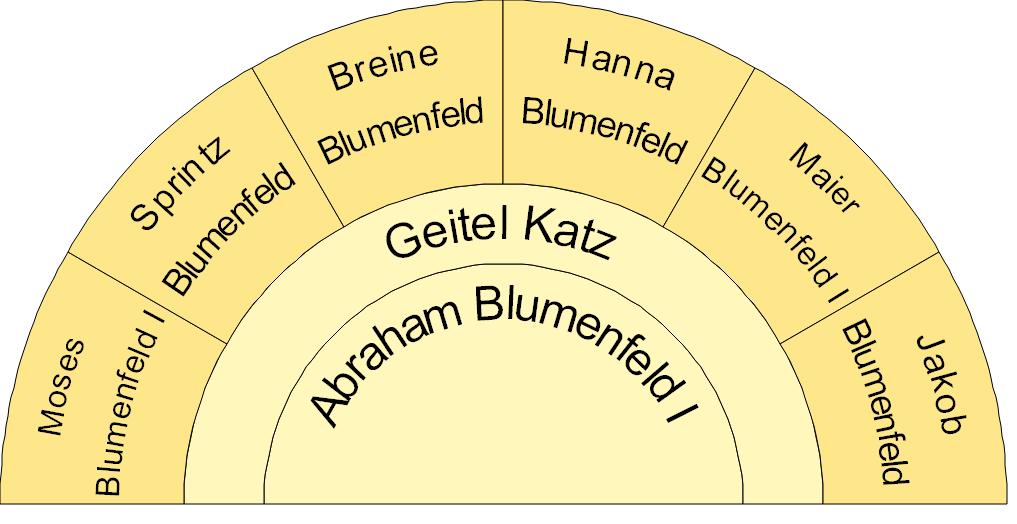
So I was somewhat envious but also thrilled when I learned that two cousins I’d found through my research and then connected to each other—Richard Bloomfield and Max Bermann—were able to meet in Merano, Italy, this past spring. Richard is my fifth cousin through his 3x-great-grandfather Jakob Blumenfeld, a younger brother of my 3x-great-grandmother Breine Blumenfeld; Max is also my fifth cousin, but through his 3x-great-grandfather Moses Blumenfeld, an older brother of Breine Blumenfeld, my 3x-great-grandmother. And Richard and Max are fifth cousins to each other; we are all the 4x-great-grandchildren of Abraham and Geitel (Katz) Blumenfeld.

Although I had zoomed and emailed with Max and Richard many times, I had never met either of them—until last Thursday, that is, when my husband and I had dinner with Max and his wife Glenna here on Cape Cod. Again, it was a magical and joyful experience. The warmth and connection were authentic and immediate, and we found so much to talk about in the three hours we sat at Fin, an amazing restaurant in Dennis. When we looked around at 10 pm, we realized we were the only ones left in the restaurant; the staff were all sitting around the bar politely not disturbing us, but obviously waiting for us to leave. After repeated promises to get together again, we all hugged goodbye, leaving as not just cousins but four new friends.

At dinner Max and Glenna told us about their trip in May, 2024, to Merano and meeting Richard and his wife Irma there. Why, you might ask, did they meet in Merano, Italy, a town not far from the Austrian border when Richard lives in Switzerland and Max in Massachusetts?

Well, that requires some background about Max’s life. I’ve shared Max’s story before on the blog, and I hope you will go back to the earlier blog posts for more details and photographs as well as for my sources for the information below. Also, Richard wrote a comprehensive biography of Max’s family.

But here is a very brief overview of why Max was visiting Merano:

Max’s mother was Edith Blumenfeld, daughter of Max Blumenfeld and Anna Grunwald. She married Joseph Bermann, Max’s father, in 1935.1 Joseph was born in Merano, Italy, where his father Max Bermann was a doctor and the director of the Waldpark Sanitarium. Joseph also became a doctor and worked there as well. After marrying, Edith and Joseph settled in Merano.

My cousin Max, grandson of both Max Blumenfeld and Max Bermann and named for both, was born in Merano a few years after his parents’ marriage. His father Joseph left Merano for the US in 1939 to escape from the Nazi and Fascist persecution and the impending war, intending to send for Edith, Max, and Max’s older sister Margherita once he was settled. But World Was II intervened, and Edith and the children could not get out of Europe.

They soon left Merano for Milan and then for the countryside of Italy where they hid their Jewish identity while Edith worked for the resistance as a courier. Once the war ended, Edith brought the children to the US, and they were reunited with Joseph. The story of how Edith kept herself, her mother, and her children safe during the war is a remarkable one and is described here on my blog and in Richard’s biography of Max’s family.

Max had never been back to Merano, his birthplace, after immigrating to the US in 1946, and he and his wife Glenna decided to visit there this year. The visit was motivated in part to see a painting of Max’s paternal grandfather, Max Bermann, a painting that Joseph Bermann had brought with him to the US in 1939 and that had been in Max’s parents’ home in New York City. It had then hung in Max and Glenna’s home for many years. Because he wanted to be sure that the painting was preserved in a safe and appropriate place in perpetuity, Max decided to donate the painting to the Jewish Museum in Merano, his birthplace and his father’s family home for many years. After shipping the painting there last year, Max and Glenna wanted to see it in its new home in Merano.

Meanwhile, Richard, born and raised in the United States, lives near St. Gallen, Switzerland, and thus about five hours from Merano. Richard had helped to connect Max with the Merano Jewish Museum, and when Richard learned that Max and Glenna were coming to Merano, he asked whether he and his wife Irma could meet them there. Max and Glenna were delighted.

Richard has generously shared with me some of the photographs of their meeting and an essay he wrote about the experience. I will quote parts of what he wrote rather than trying to paraphrase it.2 I am also going to include some of his photographs.


Last Sunday we [Richard and Irma, his wife] stood on the balcony of our hotel room in Meran and looked across the Passer River at the Hotel Meraner Hof where Max and Glenna were going to be staying. It had been just two and a half weeks since Max had written me that he and Glenna were going to travel to Meran. Max had donated a painting of his grandfather [Max Bermann] to the Jewish Museum in Meran and wanted to have the experience of seeing it on display. When I asked Max if he would mind if Irma and I came to meet them there, Max wrote that he found that touching. Although we are 5th cousins, i.e. relatives, and had had email and Zoom contact, we didn’t want to intrude on Max’s first trip back to his place of birth since leaving it at age 2.

Our first live encounter took place when we waved to each other from our balcony to their terrasse. Shortly thereafter, we greeted each other with big hugs, sat down for a drink and exchanged the special, personal gifts we had brought for each other. We were joined by Sabine Mayr, researcher and co-worker at the Jewish Museum, and the museum’s director Joachim Innerhofer. Joachim and Sabine welcomed us like VIPs: Max, the long-lost son; I, the person who had connected Max with the museum in Meran and provided them with lots of information from my family research; Glenna and Irma as though they were long lost members of the Jewish community in Meran.

Remembering the adage that the way to the heart is through the stomach, we headed off to a restaurant for dinner. Unfortunately, Joachim had an appointment and couldn’t join us. Maybe we should have had an empty chair at the table for Amy, the person who had done the matchmaking between Max and me (and lots of other cousins!).

Richard, Sabina Mayr, Irma, Glenna, and Max

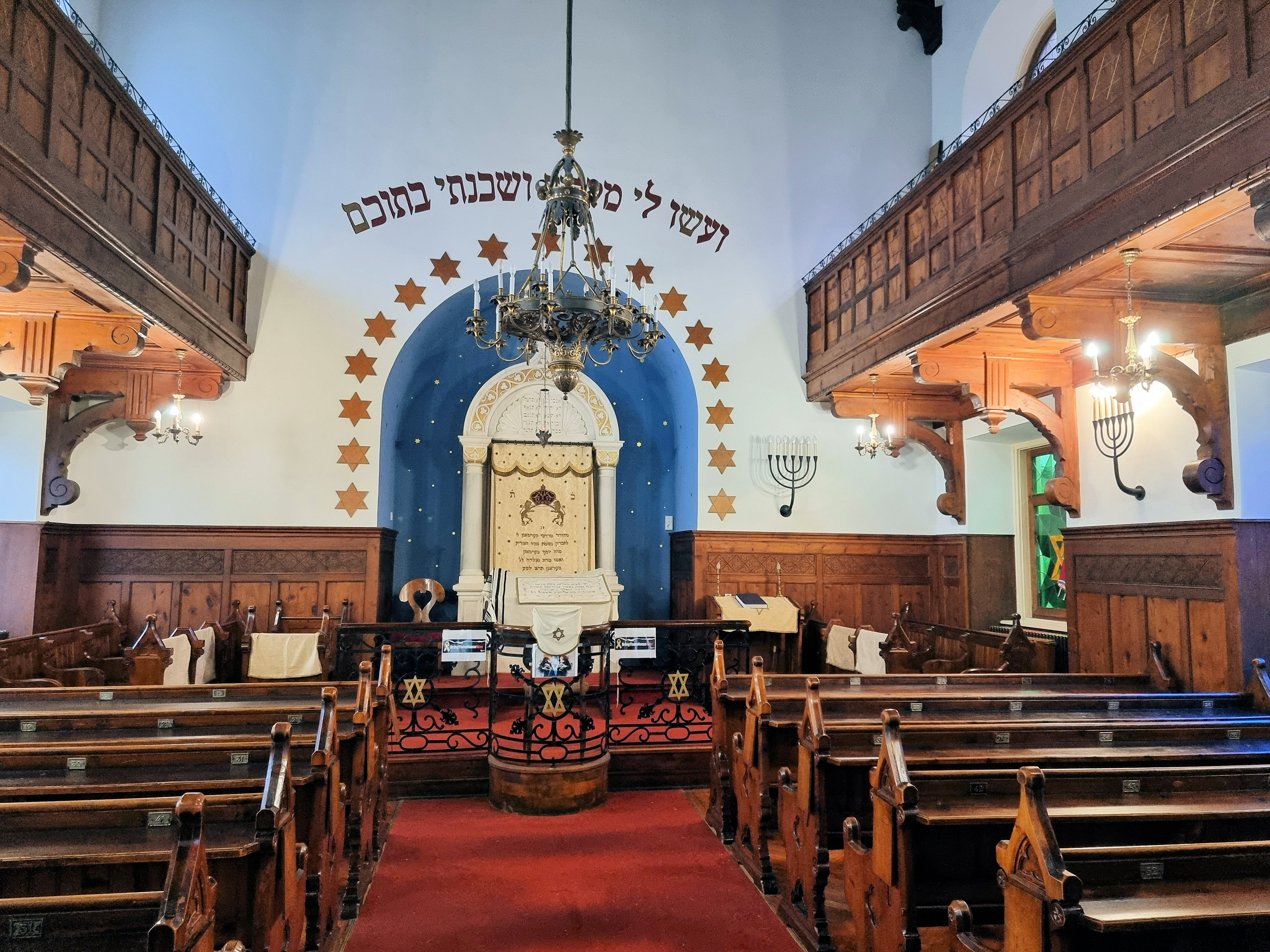
Monday morning we visited the synagogue and museum just behind Max and Glenna’s hotel. The first synagogue in Tirol was dedicated on 27 March 1901 and the interior has survived in its original form. When the Nazis removed the pews to use the room as a horse stall, the people of Meran saved them and returned them after the war. The very attractive Jewish Museum of Meran is located in the same building.

The sanctuary pictured below is warm – comfy – and inviting. Even with just seven rows of pews on the main floor, there is more than enough room for the 50 members of the community. Here is where Max’s family had worshipped. Today services with a rabbi are only held on holidays.

Merano synagogue

Irma, Richard, Max, and Glenna standing in front of the ark in the Merano synagogue

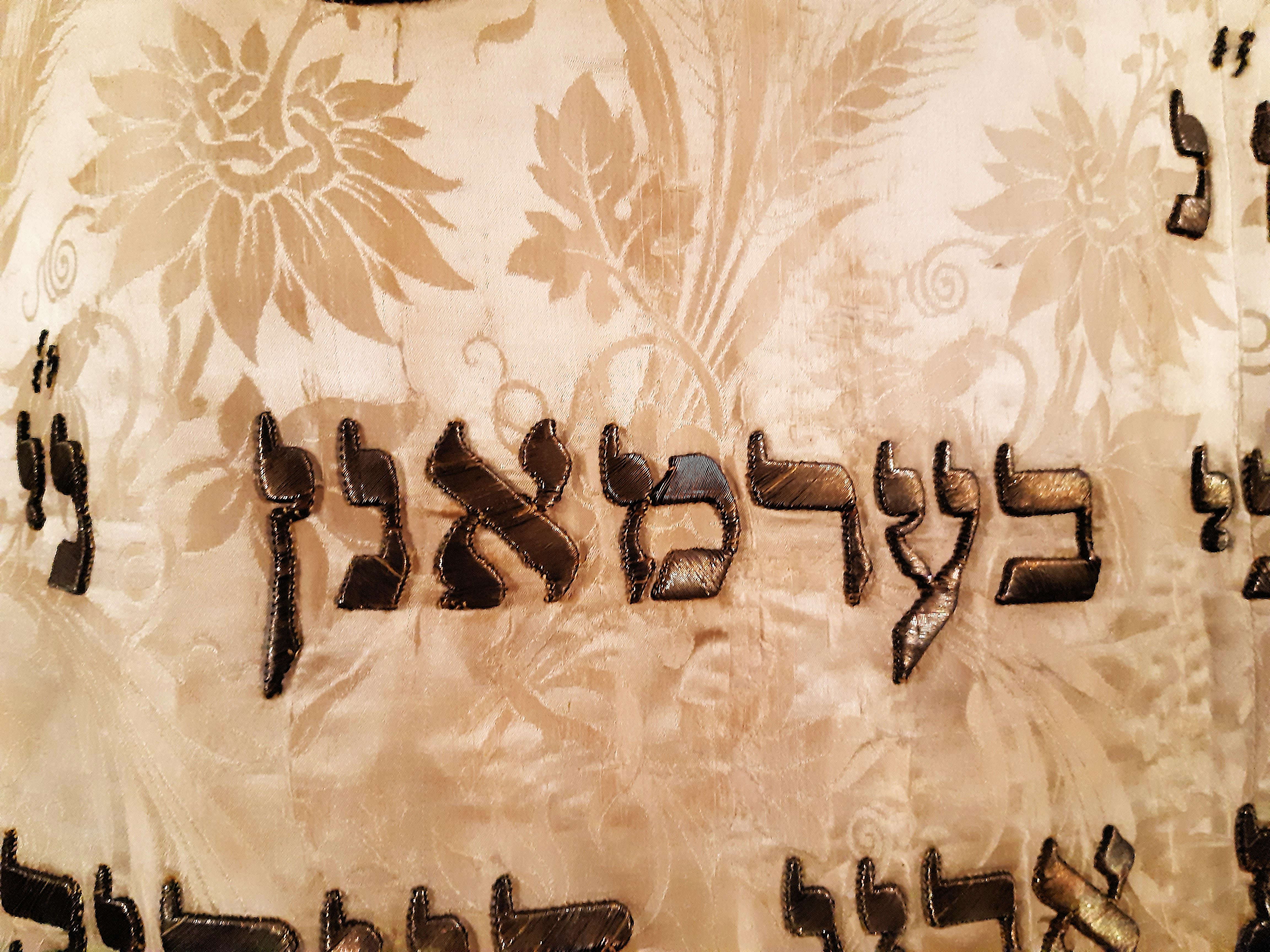
The name Bermann is embroidered into the parochet or curtain that covers the ark

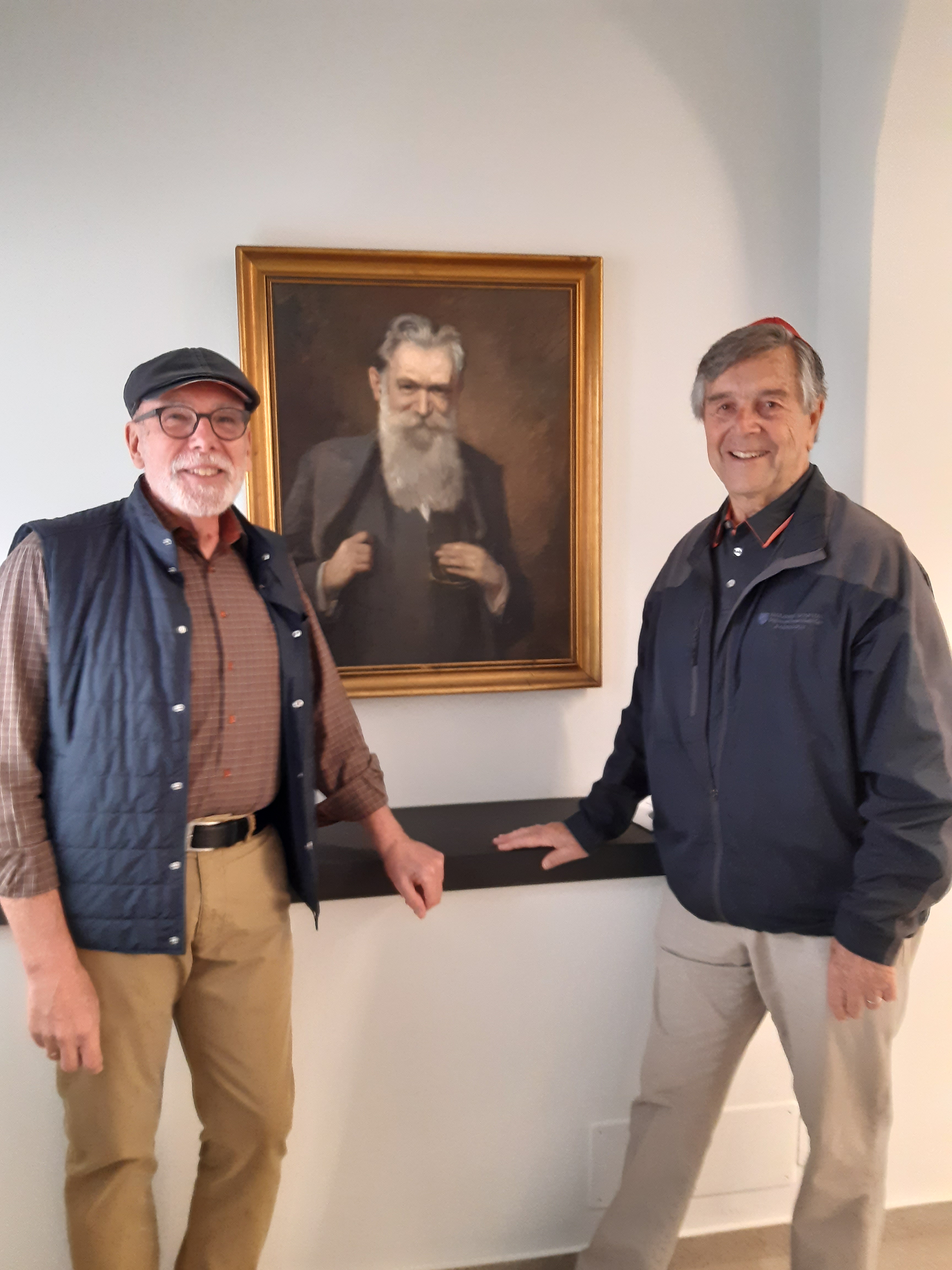
At long last we descended the steps to the museum under the sanctuary. Just around the corner to the right of the entrance Max found his grandfather Max [Bermann]! …

Richard and Max standing in front of the portrait of Max’s paternal grandfather, also named Max Bermann

 This picture of [Max’s relatives’] wedding in 1926 hangs on the other side of the room to the right of [his grandfather] Max’s portrait. When Max saw it, he ex-claimed: “Look, there’s my father!” (1) (1898-1966). Joachim pointed to the right edge of the photo where Max’s grandfather with a long white beard is pictured (2) (1865-1933). “And there’s my grandmother next to him” (3) (1870-1958)….

A rather long and wet walk took us to the Waldpark Sanatorium where Max was born and lived for two years: In 1907, [his grandfather] Doctor Max Bermann acquired the Villa Paulista from John Stoddard and founded the Waldpark Sanatorium, which he ran as a specialist in internal medicine. In the early 1930s, two buildings were added, and in the following years the main building was renovated and enlarged. Claiming that the owners were indebted, the buildings and the large park surrounding them were sold at auction in 1941. (Source: Jewish Meran Walking Tour, Jewish Museum of Meran)

Although Max was only two when he left Meran in 1940, he thinks he remembers a white fence surrounding the Waldpark. Indeed, the fence is still white!

Max’s birthplace in Merano

On Tuesday it did not rain, and the sun eventually came out. A chair lift carried us up to a place above Meran where we had a good view of the city and the surrounding countryside….

….

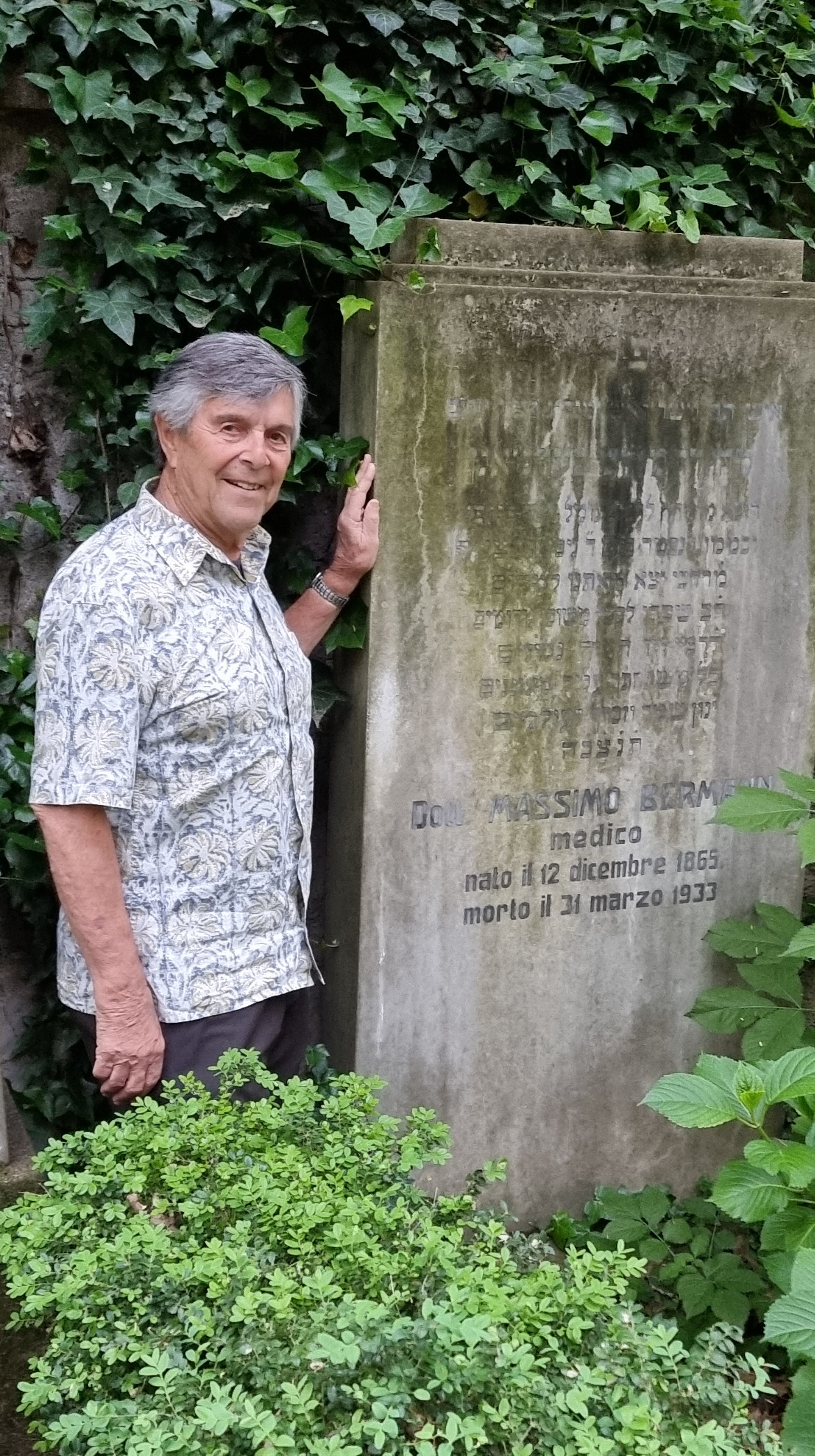
Before dinner we wanted to visit the New (1908!) Jewish Cemetery where members of the Bermann family are buried. After a stop at the memorial for the victims of the Shoah… we went to visit the graves of Max’s grandfathers, Max Bermann and Max Blumenfeld….

Max is standing next to Grandfather Bermann’s headstone, and both of us touched together the gravestone of our common relative Max Blumenfeld (1880-1936). The common roots that Max and I have that we have talked and written about became something living here in the cemetery.”

—————————–

I am so glad that Richard and Max were able to meet and share this moving experience together. It makes me appreciate how fortunate I have been to find so many cousins and to help them find each other.

And now I also have had the special opportunity to spend time with my cousin Max and his wife Glenna and to feel those common roots. His life and mine had such different beginnings—his as a small child hiding from persecution in Italy, mine as a middle class American child growing up in suburban New York after the war, never worrying about antisemitism.

But here we are so many decades later, both living in Massachusetts less than ninety miles apart. In so many ways our lives have taken similar paths despite those very different beginnings, and we have far more in common than those different beginnings would have predicted.

I am so lucky and so grateful for all the gifts that genealogy has brought to my life, especially all my amazing cousins like Richard and Max!


  1. I have seen records that spell his name Joseph, others that spell it Josef. For consistency purposes I have used the American spelling Joseph since he was born Giuseppe and kept that name until he immigrated to the US in 1939. 
  2. Merano was once under Austrian control, but after World War I it became part of Italy. The town uses both the German-Austrian spelling Meran, which Richard uses, and the Italian spelling Merano, which I use. Both are equally acceptable. 

Levi Rothschild’s Daughters Thekla Rothschild Weinberg and Frieda Rothschild Phillipsohn: One Survived, One Did Not

This is the story of the last two children of Levi Rothschild and Clara Jacob who lived to adulthood, their daughters Thekla and Frieda. Both have heartbreaking stories though Thekla survived and Frieda did not.

The fifth child of Levi and Clara, their daughter Thekla, married Manuel Edward Weinberg on August 19, 1907, in Borken. Manuel was born in Lichenroth, Germany, to Lazarus Weinberg and Karoline Oppenheimer on October 11, 1880.

Thekla Rothschild and Manuel Weinberg marriage record, Hessisches Hauptstaatsarchiv; Wiesbaden, Deutschland; Bestand: 920; Laufende Nummer: 843, Ancestry.com. Hesse, Germany, Marriages, 1849-1930

Thekla and Manuel had a son Hans Herbert Weinberg born in Frankfurt, Germany, on November 2, 1908.1

After Kristallnacht in November 1938, Manuel Weinberg was imprisoned at Buchenwald for a short time,2 and that may have motivated the family to leave Germany. By 1940 if not before, the family had left Germany for France, and according to Yad Vashem, Thekla’s husband Manuel was deported in 1940 to the internment camp near Toulouse, France known as the Recebedou camp.3

According to one website, the camp of Recebedou was created in July 1940 to receive refugees and those who had been evacuated. It was turned into a hospital camp in February 1941. But conditions in the camp deteriorated over time due to the lack of adequate medical care and a shortage of food. By late 1941, there were 739 interns, many of whom were over 60 and ill; 118 of them died in the winter of 1941-1942. Manuel Weinberg was one of those who died; he died on March 4, 1942.4

I don’t know for certain whether Thekla or their son Herbert, as he came to be known, were also interned at Recebedou because there are no documents I can find that indicate that they were. However, I do know that they must have been in France because Herbert and his wife, Edith Seckbach, had a daughter Yvonne born in Toulouse, France sometime in 1943.5  I could not find a marriage record for Herbert and Edith, but according to other records, Edith was born in Wiesbaden, Germany, in about 1918. 6

Wherever they were in France, somehow Thekla, Herbert, Edith, and their baby daughter survived. A document on Ancestry’s collection of Munich, Vienna and Barcelona Jewish Displaced Persons and Refugee Cards, 1943-1959 (JDC) indicates that as of November 1942, Thekla, Herbert, Edith, and Yvonne were in Vigo, Spain, which is almost seven hundred miles from Toulouse, France. How they got there in the midst of the war is a story I do not know.

Ancestry.com. Munich, Vienna and Barcelona Jewish Displaced Persons and Refugee Cards, 1943-1959 (JDC)

From Vigo they went to Madrid as of December 26, 1943. The Refugee Card lists two people as the “parents,” which I assume really means sponsors in this situation. One was Walter Hirschmann, Thekla’s nephew, the son of her sister Betti Rothschild Hirschmann.7 The other, Jacob Bleibtreu, was a banker and later a governor of the New York Stock Exchange who had immigrated to the US from Germany as a young man in 1909. He also was on the Greater New York Army and Navy Committee of the Jewish Welfare Board. Perhaps he knew Walter from the banking and broker business and agreed to help rescue his aunt and other family members.8

On March 23, 1944, Thekla, Herbert, Edith, and Yvonne all arrived in Philadelphia after sailing from Lisbon, Portugal. The ship manifest shows that they all had last been residing in Madrid, Spain, and were heading to Montreal, Canada under the sponsorship of the Joint Distribution Committee. Herbert reported that he was a chemist by occupation.

Thekla Weinberg and family passenger manifest, The National Archives at Washington, D.C.; Washington, D.C.; Series Title: Passenger Lists of Vessels Arriving at Philadelphia, Pennsylvania; NAI Number: 4492386; Record Group Title: Records of the Immigration and Naturalization Service, 1787-2004; Record Group Number: 85; Series: T840; Roll: 177, Ancestry.com. Pennsylvania, U.S., Arriving Passenger and Crew Lists, 1798-1962

Herbert’s wife Edith must not have lived very long after their voyage from Portugal to Philadelphia because on September 8, 1946, Herbert married his second wife, Anna or Anya Grodzky, in Hochelaga, Quebec, Canada. Anna was born in Russia on June 18, 1910, and was a beautician. Herbert is listed as a widower on their marriage record and as a chemist by trade.

Hans Herbert Weinberg marriage to Anna Grodsky, Marriage Sep 8 1946 Westmount, Québec, Canada, Groom Herbert Hans Weinberg, Groom’s birth 1908 Germany, Bride Anna Goodsky, Certificate number upd46-128967, Quebec Marriage Returns, 1926-1997, found at https://www.myheritage.com/research/record-10723-1831907/herbert-hans-weinberg-and-anna-goodsky-in-quebec-marriage-returns

The family all settled in Montreal, where Thekla died on March 11, 1962, at the age of 76.9 Herbert lost his second wife Anna on July 9, 1976.10 He died February 12, 2001, at the age of 92, and was survived by his third wife Sally Lazoff Bailen.11

I have not found any further information about Herbert’s daughter Yvonne despite searching everywhere I could and receiving help from members of Tracing the Tribe. I don’t know whether she died, married, or moved from Canada and changed her name. There just is no trace of her after a mention in her stepmother Anna’s obituary in 1976. She is not mentioned in her father’s obituary in 2001.12

Although Thekla Rothschild Weinberg survived the Holocaust, she lost her husband, her homeland, and, as we will now see, her sister Frieda to the Holocaust.

Frieda was born May 31, 1993, in Borken, Germany.  As we saw, she first married Leonard Marxsohn and was widowed and then married Paul Phillipsohn, with whom she had a daughter Hannelore, born December 3, 1926.

Unfortunately, I have no happy ending for Frieda, Paul, or Hannelore. On June 11, 1942, they were all deported to Theriesenstadt. None of them survived. According to Yad Vashem, Paul died on December 20, 1942. I have no exact dates for Frieda or Hannelore, only that they also died in about 1942.13

Thus ends the story of Levi Rothschild’s family. Although most of them survived the Holocaust and made it to the US, Israel, or Canada, they were scattered across the globe, and their lives were all forever changed. The family members who were killed must have left holes in their hearts forever.


  1. Hans Herbert Kaufmann Weinberg, Gender männlich (Male), Record Type Inventory, Birth Date 02 Nov 1908 (2 Nov 1908), Birth Place Frankfurt am Main,
    Last Residence Frankfurt am Main, Residence Place Frankfurt am Main, Father
    Edmund Weinberg, Mother Thekla Weinberg, Spouse Edith Seckbach, Notes Inventories of personal estates of foreigners and especially German Jews
    Reference Number 02010101 oS, Document ID 70370883, Arolsen Archives, Digital Archive; Bad Arolsen, Germany; Lists of Persecutees 2.1.1.1, Ancestry.com. Free Access: Europe, Registration of Foreigners and German Persecutees, 1939-1947 
  2. Arolsen Archives, 1 Incarceration Documents / 1.1 Camps and Ghettos / 1.1.5 Buchenwald Concentration Camp / 1.1.5.3 Individual Documents male Buchenwald / Individual Files (male) – Concentration Camp Buchenwald / Files with names from SYS and further sub-structure / Files with names from WECK /, Personal file of WEINBERG, EMANEL, born on 11-Oct-1880, Reference Code, 01010503 002.042.476, Number of documents, 1, found at https://collections.arolsen-archives.org/en/document/7388346 
  3. Yad Vashem entries for Manuel Weinberg, found at  https://collections.yadvashem.org/en/names/13545516 and at https://collections.yadvashem.org/en/names/3229127 
  4. See Note 3, supra. 
  5. Yvonne Miriam Weinberg, passenger manifest, The National Archives at Washington, D.C.; Washington, D.C.; Series Title: Passenger Lists of Vessels Arriving at Philadelphia, Pennsylvania; NAI Number: 4492386; Record Group Title: Records of the Immigration and Naturalization Service, 1787-2004; Record Group Number: 85; Series: T840; Roll: 177, Ancestry.com. Pennsylvania, U.S., Arriving Passenger and Crew Lists, 1798-1962 
  6. Edith Weinberg, passenger manifest, The National Archives at Washington, D.C.; Washington, D.C.; Series Title: Passenger Lists of Vessels Arriving at Philadelphia, Pennsylvania; NAI Number: 4492386; Record Group Title: Records of the Immigration and Naturalization Service, 1787-2004; Record Group Number: 85; Series: T840; Roll: 177, Ancestry.com. Pennsylvania, U.S., Arriving Passenger and Crew Lists, 1798-1962. See also Edith Weinberg geb. Seckbach, Arolsen Archives, Digital Archive; Bad Arolsen, Germany; Lists of Persecutees 2.1.1.1, Description Reference Code: 02010101 oS,
    Ancestry.com. Free Access: Europe, Registration of Foreigners and German Persecutees, 1939-1947 
  7. It was Walter’s name on this card that led me to discover that he was the child of Betti and Emanuel Hirschmann. 
  8. “Jacob Bleibtreu, Former Governor of New York Stock Exchange, 90,” The New York Times, December 6, 1976. 
  9. Thekla Weinberg death notice, The Montreal Star, Montreal, Quebec, Canada, Mon, Mar 12, 1962, Page 16. 
  10. Anna (Anya) Weinberg death notice, The Montreal Star, Montreal, Quebec, Canada, Sat, Jul 10, 1976, Page 10. 
  11. Marriage of Herbert Weinberg to Sally Lazoff, Nov 15 1980, Côte St Luc, Québec, Canada, Groom Herbert Weinberg, Groom’s birth Nov 5 1908, Germany, Groom’s age 72, Bride Sally Lazoff, Bride’s birth Aug 15 1917, Québec, Canada, Bride’s age 63, Groom’s father Manuel Weinberg, Groom’s father’s birth Germany, Groom’s mother Thekla Rothschild, Groom’s mother’s birth Germany, Bride’s father Gedaliah Lazoff
    Bride’s father’s birth Russia, Bride’s mother Telia Brasgold, Bride’s mother’s birth Russia
    Certificate number upd80-141452, Quebec Marriage Returns, 1926-1997, found at https://www.myheritage.com/research/record-10723-2419633/herbert-weinberg-and-sally-lazoff-in-quebec-marriage-returns. Herbert Weinberg death notice, The Gazette
    Montreal, Quebec, Canada, Mon, Feb 12, 2001, Page 35. 
  12. Anna (Anya) Weinberg death notice, The Montreal Star, Montreal, Quebec, Canada, Sat, Jul 10, 1976, Page 10. Herbert Weinberg death notice, The Gazette, Montreal, Quebec, Canada, Mon, Feb 12, 2001, Page 35. 
  13. See Yad Vashem entries at https://collections.yadvashem.org/en/names/11607287 for Frieda, https://collections.yadvashem.org/en/names/14969310 for Paul, and https://collections.yadvashem.org/en/names/11607287 for Hannelore. 

Levi Rothschild’s son Hirsch: Leaving Germany with a Heavy Heart

Levi Rothschild’s fourth child, Hirsch (also known as Harry) and his three children Gertrude, Edith, and Edmund all managed to leave Germany in time to survive the Holocaust. His wife and their mother Mathilde Rosenbaum, however, did not.

Gertrude, Hirsch’s oldest child, was the first member of the family to come to the US although her husband preceded her. She had married Gustav Rosbasch sometime before 1933, the year their first child was born. Gustav was born in Kremenchug, Russia (maybe now Ukraine?) on August 12, 1901. Gustav, a surgeon, came to the US on October 10, 1934, listing his last residence as Delmenhorst, Germany, a town in the Saxony state of Germany.  He reported his wife Gertrude as the person he had left behind in Delmenhorst, and his uncle Phillip Rosbasch of Rochester, New York, as the person he was going to in the US. 1

Gertrude arrived almost a year later with their two-year-old daughter. They arrived on September 8, 1935, listing their prior residence as Delmenhorst and listing “G. Rosbasch” in Rochester as the person they were going to; “H. Rothschild,” Gertrud’s father, was listed as the person they had left behind in Delmenhorst.2 Gustav and Gertrude had a second child in Rochester a few years after Gertrude’s arrival.

The next member of the family to escape to the US was Edith, Gertrude’s younger sister. She arrived in New York on May 28, 1937, listing her destination as Rochester, New York, where her sister Gertrude was living, and listing her father, “Dr. Rothschild” as the person she’d left behind in Delmenhorst, her prior residence.3

Edith and Gertrud’s brother Edmund arrived a year after Edith on June 24, 1938, in New York with his destination being New York City where his uncle Karl Rosenbaum, his mother’s brother, was living. Edmund identified his occupation as a physician, like his father and his brother-in-law Gustav, and listed his father “Dr. Harry Rothschild” of Delmenhorst as the person he left behind, but Edmund gave his last residence as Basel, Switzerland, not Delmenhorst.4

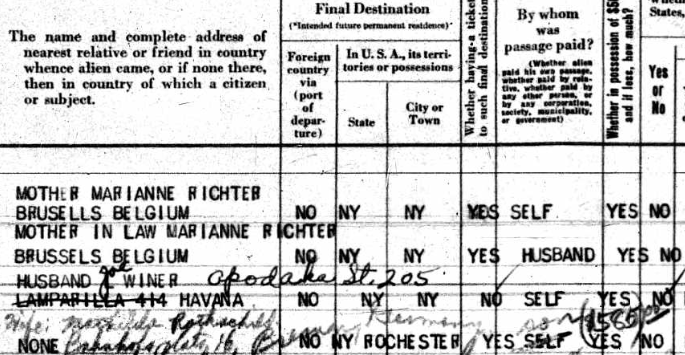
Thus, the three children of Hirsch and Mathilde Rothschild had all arrived before Kristallnacht in November 1938. Their father Hirsch did not arrive for over another year. His ship sailed from Havana, Cuba, and arrived in Miami on December 17, 1939, three months after World War II had begun. Hirsch listed his occupation as a physician and the person he was going to as his son “Edw. Rothschild” in Rochester, New York. He also listed his last residence as Delmenhorst.

Hirsch Rothschild passenger manifest, The National Archives At Washington, D.c.; Washington, D.c.; Series Title: Passenger Lists of Vessels Arriving At Miami, Florida; NAI Number: 2788508; Record Group Title: Records of the Immigration and Naturalization Service, 1787 – 2004; Record Group Number: 85, Roll Number: 086, Ancestry.com. Florida, U.S., Arriving and Departing Passenger and Crew Lists, 1898-1963

There is a notation on Hirsch’s line on the passenger manifest that reads, “Admitted on appeal 1-3-40.”  Also for the section listing the person left behind in the prior country, where the word None had been typed, someone added in handwriting, “Wife Mathilde Rothschild” living in Bremen, Germany. Another handwritten change indicates that his son had paid his passage; “self” was crossed out.

Were these additions of Mathilde’s name and the fact that his son was paying his way what helped Hirsch win his appeal? Why wouldn’t he have listed Mathilde before? Why was she living in Bremen, not Delmenhorst? When did Hirsch actually leave for Germany? How long had he been in Cuba before sailing from Havana to Miami in December 1939?

These are questions for which I currently do not have answers, just some speculation. Was Mathilde ill and hospitalized in Bremen? Is that why she hadn’t come with Hirsch to the US?

I don’t know, but we do know that by early 1940, Hirsch and his three children and his son-in-law and granddaughter were all safely in the US. Gustav and Gertrude and their two children were living in Rochester, New York, where Gustav was a doctor.5 Edith was also in Rochester, working as a housekeeper for another family.6 Edmund was working as a doctor at the Monroe County (New York) Infirmary and Home for the Aged in Brighton, New York, only four miles from Rochester.7 I could not locate Hirsch/Harry on the 1940 US census, but on April 25, 1942, when he registered for the World War II draft, he was at that time living in Rochester with Gertrude and Gustav and unemployed.

Harry Hirsch Rothschild, World War II draft registraiton, The National Archives At St. Louis; St. Louis, Missouri; World War Ii Draft Cards (Fourth Registration) For the State of New York; Record Group Title: Records of the Selective Service System; Record Group Number: 147; Box or Roll Number: 522, Name Range: Rosser, Roscoe – Rought, Walter, Ancestry.com. U.S., World War II Draft Registration Cards, 1942

But not long after that Hirsch/Harry must have moved to New Rochelle, New York, 350 miles from his children in Rochester, where he found work as the house physician for the Jewish Home for the Aged in New Rochelle. Harry died on April 18, 1945, in New Rochelle; he was 64. Heartbreakingly, his obituary revealed that as of that date with Germany’s surrender just a few weeks away, Harry and his children did not yet know what had happened to Mathilde, their wife and mother. The obituary states that Harry’s wife Mathilde “remained in Germany when Dr. Rothschild left the country. Relatives here have been trying through the Red Cross to learn her fate.”

“Death Claims Ex-Physician to Aged Jews,” Rochester Democrat and Chronicle, April 14, 1945, p. 17

Yad Vashem, however, reveals what had happened to Mathilde. On November 18, 1941, she had been deported to the Minsk ghetto in Belarus where she was murdered on July 28, 1942. She was 57 years old. It must have been devastating for the family to learn this.8

But Mathilde and Harry were survived by all three of their children and by their grandchildren. Their daughter Gertrude and her husband Gustav remained in Rochester, New York, for the rest of their lives, where Gustav continued to practice medicine. He died on January 7, 1992, at the age of 90.9 Gertrude outlived him by five and a half years; she died on July 4, 1997; she was 86 years old.10 They were survived by their children and grandchildren.

Gertrud’s sister Edith married Abram Solomon (Jalomek) in 1943.11 As far as I can tell, they did not have children as none are listed in either of their obituaries. Edith died July 28, 2003, in Rochester, at the age of 92;12 her husband Abram died many years before on June 9, 1971, in Rochester.13

Edmund Rothschild, the youngest child of Hirsch and Mathilde, had registered for the draft on October 16, 1940.

Edmund Rothschild, World War II draft registration, National Archives at St. Louis; St. Louis, Missouri; Wwii Draft Registration Cards For New York State, 10/16/1940 – 03/31/1947; Record Group: Records of the Selective Service System, 147, Name Range: Roth, Cletus-Rotonde, Nicholas
Ancestry.com. U.S., World War II Draft Cards Young Men, 1940-1947

He married Helene Lois Brown on August 17, 1941, in Buffalo, New York.  She was the daughter of David Brown and Lucile Manheim.14 Edmund and Helene would have two children. Edmund served in the US Army during World War II from August 27, 1943, until March 11, 1946.15 Edmund and his family then settled in Springville, New York, where he continued to practice medicine.16

Later Edmund and Helene retired to Fort Myers, Florida, where Helene died at age 71 on April 24, 1993.17 Edmund died in Cleveland, Ohio, almost exactly a year later on April 21, 1994; he was 81.18 According to his obituary in the Springville Journal, Edmund “was an old-fashioned family physician [who] cared not only for his patients but also for their families and their community. His home was always equipped to see patients after hours and house calls were made often.” The obituary also noted that he was a gifted artist. Edmund and Helene are survived by their children and grandchildren.19

The story of the family of Hirsch Rothschild and his family reminds me of how much the US gained when Germany’s persecution of the Jews forced so many to come here. Hirsch, his son Edmund, and his son-in-law Gustav were all doctors educated and trained in Europe. They came to this country as refugees, and Americans benefited from those skills and that education and dedication. But Mathilde Rosenbaum Rothschild’s death at the hands of the Nazis must remind us that the gifts we Americans may have received from those refugees were not given by them without enduring terrible heartbreak and loss on their part.


  1. Gustav Rosbasch, World War II draft registration, National Archives at St. Louis; St. Louis, Missouri; Wwii Draft Registration Cards For New York State, 10/16/1940 – 03/31/1947; Record Group: Records of the Selective Service System, 147, Ancestry.com. U.S., World War II Draft Cards Young Men, 1940-1947; Gustav Rosbasch, passenger manifest, The National Archives in Washington, DC; Washington, DC, USA; Passenger and Crew Lists of Vessels Arriving at New York, New York, 1897-1957; Microfilm Serial or NAID: T715; RG Title: Records of the Immigration and Naturalization Service, 1787-2004; RG: 85, Ship or Roll Number: Scythia, Ancestry.com. New York, U.S., Arriving Passenger and Crew Lists (including Castle Garden and Ellis Island), 1820-1957 
  2. Gertrude Rosbasch, passenger manifest, The National Archives in Washington, DC; Washington, DC, USA; Passenger and Crew Lists of Vessels Arriving at New York, New York, 1897-1957; Microfilm Serial or NAID: T715; RG Title: Records of the Immigration and Naturalization Service, 1787-2004; RG: 85, Ancestry.com. New York, U.S., Arriving Passenger and Crew Lists (including Castle Garden and Ellis Island), 1820-1957 
  3. Edith Rothschild, passenger manifest, The National Archives in Washington, DC; Washington, DC, USA; Passenger and Crew Lists of Vessels Arriving at New York, New York, 1897-1957; Microfilm Serial or NAID: T715; RG Title: Records of the Immigration and Naturalization Service, 1787-2004; RG: 85, Ship or Roll Number: New York, Ancestry.com. New York, U.S., Arriving Passenger and Crew Lists (including Castle Garden and Ellis Island), 1820-1957 
  4. Edmund Rothschild, passenger manifest, The National Archives in Washington, DC; Washington, DC, USA; Passenger and Crew Lists of Vessels Arriving at New York, New York, 1897-1957; Microfilm Serial or NAID: T715; RG Title: Records of the Immigration and Naturalization Service, 1787-2004; RG: 85, Ship or Roll Number: New York, Ancestry.com. New York, U.S., Arriving Passenger and Crew Lists (including Castle Garden and Ellis Island), 1820-1957 
  5. Gustav Rosbasch and family, 1940 US census, Year: 1940; Census Place: Rochester, Monroe, New York; Roll: m-t0627-02848; Page: 4B; Enumeration District: 65-232, Ancestry.com. 1940 United States Federal Census 
  6. Edith Rothschild, 1940 US census, Year: 1940; Census Place: Rochester, Monroe, New York; Roll: m-t0627-02842; Page: 6B; Enumeration District: 65-22, Ancestry.com. 1940 United States Federal Census 
  7. Edmund Rothschild, 1940 US census, Year: 1940; Census Place: Brighton, Monroe, New York; Roll: m-t0627-02678; Page: 14A; Enumeration District: 28-9, Ancestry.com. 1940 United States Federal Census 
  8. Yad Vashem entry found at https://collections.yadvashem.org/en/names/11619667 
  9. Gustav Rosbasch, Social Security Administration; Washington D.C., USA; Social Security Death Index, Master File, Ancestry.com. U.S., Social Security Death Index, 1935-2014 
  10. Gertrude Rosbasch, [Gertrude Rothschild], Gender Female, Birth Date 3 Sep 1910, Birth Place Gudensberg, Death Date 4 Jul 1997, Claim Date 17 May 1973
    Father Harry Rothschild, Mother Mathilde Rosenbaum, Ancestry.com. U.S., Social Security Applications and Claims Index, 1936-2007 
  11. “Marriage Licenses,” Rochester Democrat and Chronicle, October 26, 1943, p. 12 
  12. Edith Miriam Solomon, [Edith Miriam Rothschild], Gender Female, Race White, Birth Date 4 Jul 1911, Birth Place Gudensberg, Federal Republic of Germany, Death Date 28 Jul 2003, Claim Date 19 Jan 1976, Father Harry Rothschild, Mother Mathilde Rosenbaum, Ancestry.com. U.S., Social Security Applications and Claims Index, 1936-2007. 
  13. Abram Solomon, Social Security Number 128-09-6834, Birth Date 18 Nov 1899,
    Issue year Before 1951, Issue State New York, Last Residence 14617, Rochester, Monroe, New York, USA, Death Date Jun 1971, Social Security Administration; Washington D.C., USA; Social Security Death Index, Master File,  Ancestry.com. U.S., Social Security Death Index, 1935-2014 
  14. “Dr. Edward [sic] Rothschild to be Married Soon,” Bradford Evening Star and The Bradford Daily Record, Bradford, Pennsylvania · Friday, August 01, 1941, p. 5; Helene Brown Rothschild, Gender Female, Birth Date 30 Jul 1921, Birth Place Minneapolis, Minnesota, Death Date 24 Apr 1993, Father David Brown, Mother Lucile S Manheim,
    SSN 057382510, Ancestry.com. U.S., Social Security Applications and Claims Index, 1936-2007. 
  15. Edmund S Rothschild, Birth Date 30 Jul 1912, Death Date 21 Apr 1994, Cause of Death Natural, SSN 114342498, Enlistment Branch ARMY, Enlistment Date 27 Aug 1943, Discharge Date 11 Mar 1946, Page number 1, Ancestry.com. U.S., Department of Veterans Affairs BIRLS Death File, 1850-2010. 
  16. “Founder of Medical Group Dies,” Springville Journal, Springville, New York · Thursday, May 05, 1994, p. 6. 
  17. “Helene L. Brown Rothschild,” News-Press, Fort Myers, Florida · Tuesday, April 27, 1993, p. 19; Helene Brown Rothschild, Gender Female, Birth Date 30 Jul 1921, Birth Place Minneapolis, Minnesota, Death Date 24 Apr 1993, Father David Brown, Mother Lucile S Manheim, SSN 057382510, Ancestry.com. U.S., Social Security Applications and Claims Index, 1936-2007. 
  18. See Notes 15 and 16, supra. 
  19. See Note 16, supra. 

Erwin Rothschild As Remembered By His Wife Irma

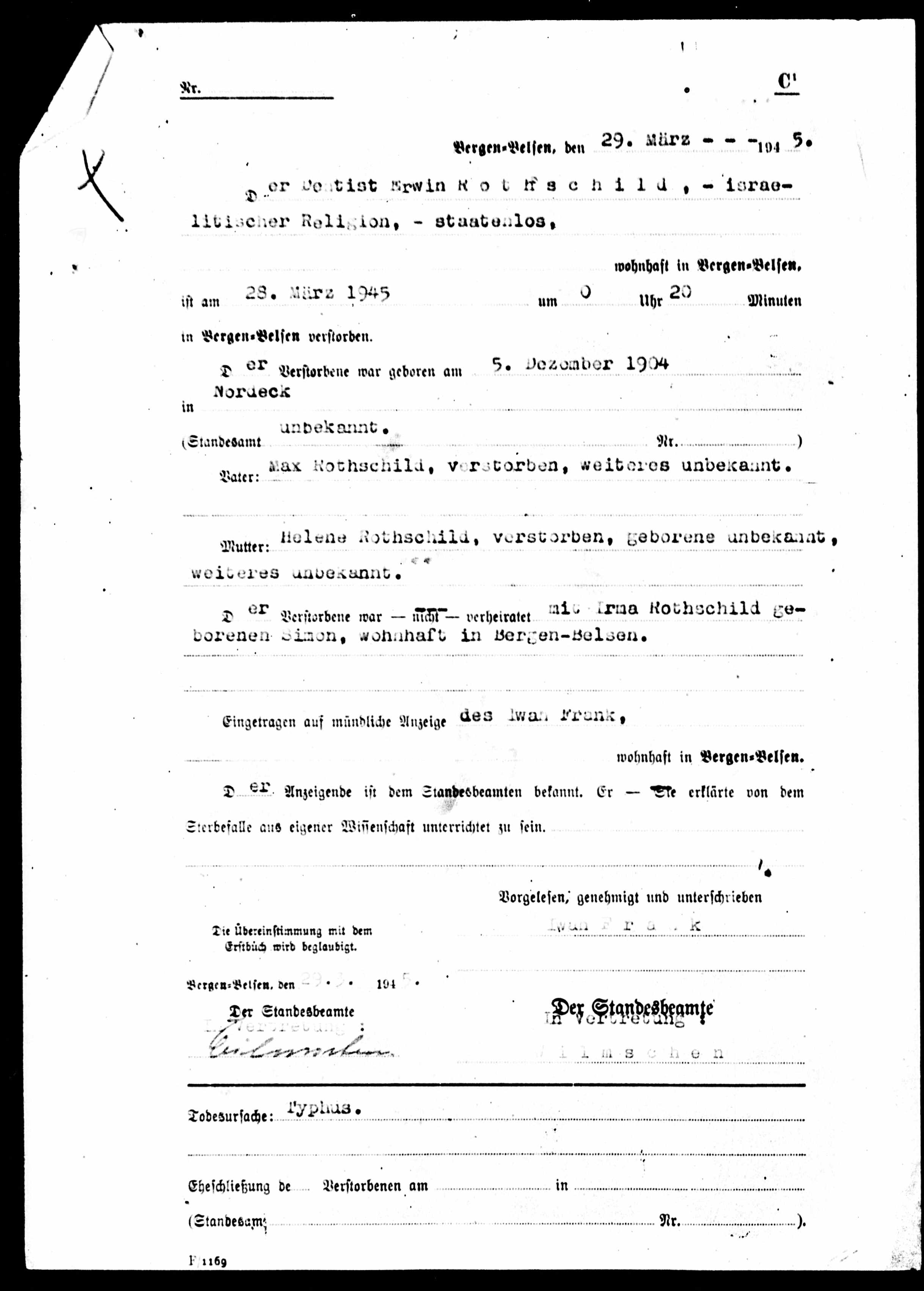
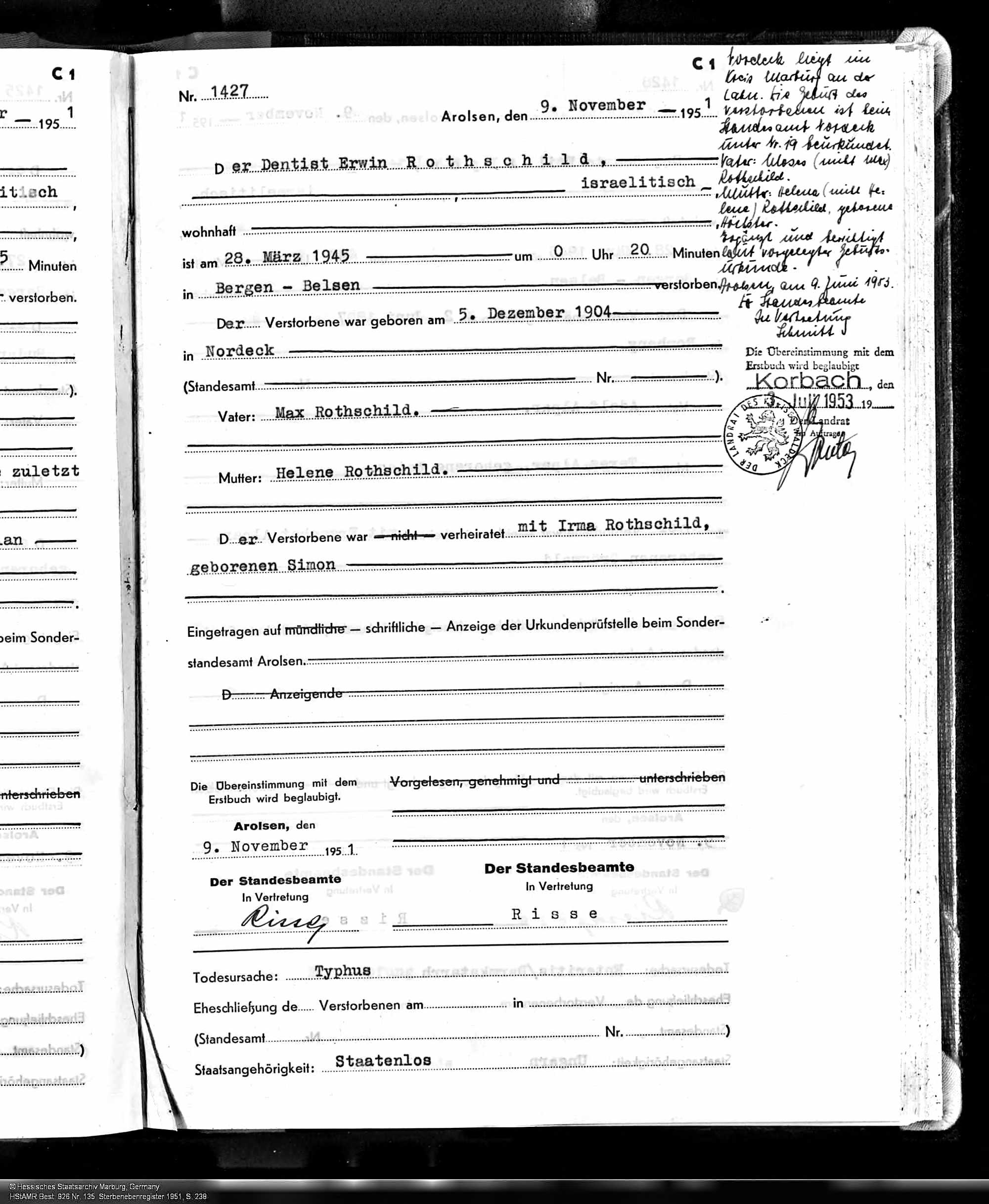
Although two daughters of Moses Max Rothschild appear to have survived the Holocaust, his son Erwin was not as fortunate. The only official records I have for Erwin Rothschild are two that relate to his death, but they also include his birth date and his parents’ names. He was born on December 5, 1904, in Nordeck, Germany, and he died of typhus on March 28, 1945, in the Bergen-Belsen concentration camp. These two records also both provide evidence that Erwin was a dentist and that he was married to Irma Simon. But not much else can be discerned about Erwin’s life from these two documents.

Erwin Rothschild death record from the Bergen Belsen Concentration Camp, The National Archives at College Park; College Park, Maryland; Microfilm: A3355; ARC: 596972; Title: Lists and Registers of German Concentration Camp Inmates, 1946 – 1958; Record Group: 242; Record Group Title: National Archives Collection of Foreign Records Seized, 1675 – 1958
Source Information
Ancestry.com. Germany, Concentration Camp Records, 1937-1945

Erwin Rothschild death certificate, Hessisches Hauptstaatsarchiv; Wiesbaden, Deutschland; Personenstandsregister Sterberegister; Signatur: 135; Laufende Nummer: 926
Year Range: 1951, Ancestry.com. Hesse, Germany, Deaths, 1851-1958

Fortunately, Erwin’s widow Irma Simon Rothschild Haas gave testimony to the Shoah Foundation and filled in the details of Erwin’s life as well has her own quite moving and amazing life story. I am so grateful to the Shoah Foundation for recording and preserving these stories.

Irma was 89 years old when she was interviewed on August 4, 1997. But you would never know it from the sharpness of her mind, the depth and precision of her memories, and her ability to answer probing and difficult questions. She was an incredible storyteller, and I felt like I was with her during those awful years of the Holocaust. I started out wanting to learn more about Erwin, but by the end of Irma’s testimony I was moved to tears by not only what I’d learned about Erwin, but by what I’d learned from Irma about the best side of human nature. Find two hours in your busy lives and listen to what Irma has to say. You also will never forget her. 1

Although I cannot do justice to Irma’s testimony in a brief paraphrasing of its content, I want to tell the story of Erwin and Irma as best I can. Irma Simon was born on October 9, 1907, in the small town of Londorf, Germany. Irma had two older brothers, Siegfried and Julius, and a younger sister Hilde.

Irma went to school to become a kindergarten teacher and worked in Cologne, Frankfurt, and Berlin before the Nazi era. She was working in a children’s home for 150 children in 1935 outside of Berlin when the Nuremberg Laws were enacted and the home was no longer able to obtain kosher meat. Irma left the home and found a new job teaching in Berlin. She lived with an unnamed cousin of Erwin Rothschild, and I assume that that is how she met Erwin. He was practicing dentistry in Berlin at that time.

After Kristallnacht in November 1938, the school where Irma had been working closed, and Erwin and Irma and her parents tried to get out of Germany . One of her brothers, Julius, was already in the US, her sister Hilde was married to Simon Eisenmann and living in Amsterdam, and her other brother Siegfried had been arrested after Kristallnacht and sent to Sachsenhausen. With Irma’s help and a visa obtained by her sister Hilde in Holland, Siegfried was released and left for South America. Later, Hilde was also able to get a visa for their parents and for her sister Irma to come to Holland.

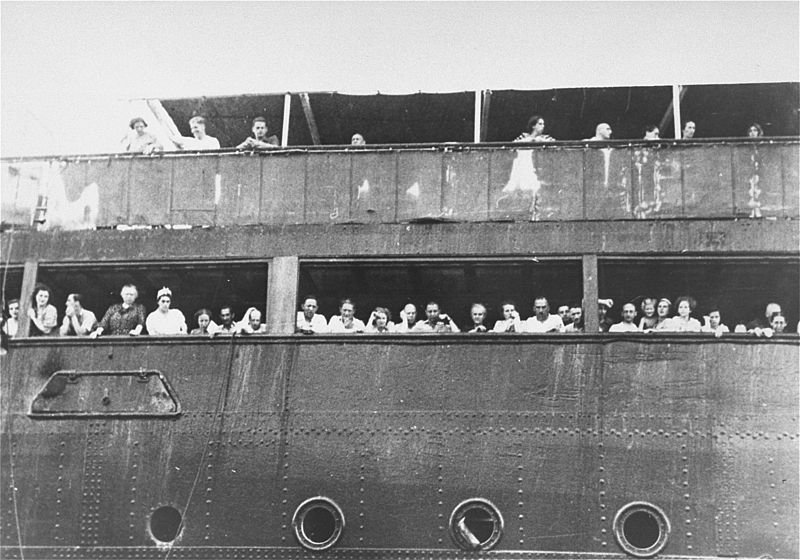
Meanwhile, Erwin Rothschild, who was now engaged to Irma Simon, had gotten a ticket to leave Germany on the ill-fated ship, the St. Louis in the spring of 1939. I’ve previously told the story of the St. Louis, the ship that was turned away from Cuba and from the US and had to sail back to Europe in June, 1939, returning its passengers to a likely death in the Holocaust. Erwin ended up in Holland where Irma and her family were living.

Jewish refugees aboard the SS St. Louis attempt to communicate with friends and relatives in Cuba, who were permitted to approach the docked vessel in small boats. |Source=USHMM, courtesy of National Archives and Records Adminis (public domain)

But Erwin was not able to live in Amsterdam where Irma was living; as a refugee from the St Louis, he was required by the Dutch to live in the internment camp in Westerbork. But he was free to work as a dentist in Amsterdam and to see Irma, who was working at a children’s home in Amsterdam.

However, when the Nazis invaded Holland in May, 1940, the school was forced to close and the children were evicted. Irma helped find homes for 130 of those children with families in Amsterdam. The Nazis also took over the camp at Westerbork where Erwin was living.

Nazi troops and supporters in front of De Bijenkorf, Dam Square, Amsterdam, The Netherlands, 1941 (crop of original 1941 public domain photo). 47thPennVols, CC0, via Wikimedia Commons

In 1942 Erwin and Irma married, but Irma stayed with her parents in Amsterdam because they all believed she would be safer there. But by the end of that year her parents were taken to Westerbork. To avoid being taken to a concentration camp at Vught where conditions were worse, Irma voluntarily moved to Westerbork to be with her husband Erwin as well as her parents and her sister Hilde and brother-in-law Simon. Conditions at Westerbork were at that time not bad at all, and Irma became a dental assistant working with Erwin.

In September 1943, Irma’s parents were put on a transport to Bergen-Belsen, where conditions were much worse. Then Irma’s sister Hilde and her husband Simon Eisenmann were put on a list for transport despite having certificates to go to Palestine, which were supposed to keep them (and Erwin and Irma) off the transport lists. Erwin figured out that there was confusion regarding a different man named Eisenmann and got Hilde and Simon off the list.

In December 1943, they were told that the Westerbork camp was to be dissolved and all those with Palestine certificates would go to a Red Cross camp, but in fact  Erwin, Irma, Hilde, and Simon and the others were all sent to Bergen-Belsen, arriving there on February 1, 1944, just a day after Irma’s parents had been transferred from Bergen-Belsen to Theresienstadt. Irma was heartbroken not to have had a chance to see her parents. She never saw them again. They died at Theresienstadt.

The conditions at Bergen-Belsen were terrible. Irma, Erwin, Hilde, and Simon all worked in a quarry, where Erwin feared his hands would be so damaged from smashing rocks that he would never practice dentistry again. But then one of the older camp dentists died, and Erwin was drafted into being a camp dentist. That meant he could live in the hospital with the doctors with better living conditions than being in the barracks.

Women and Children at Bergen Belsen Concentration Camp, 1945, No 5 Army Film & Photographic Unit, Morris (Sgt), Public domain, via Wikimedia Commons

When a young SS officer who was also a dentist needed dental care one day, he asked Erwin to help him. At first Erwin refused, saying he was not allowed to treat Aryans. But the officer insisted, saying the other (non-Jewish) dentist was not as good. So Erwin treated him, and the officer arranged to have Irma become his assistant and to live in the hospital with the nurses.

But Hilde and her husband Simon were still in the barracks, and in November 1944, Simon died from typhoid fever. Hilde was bereft, and Erwin and Irma did everything they could to give her support. But she became very sick, and Erwin, without permission, had her brought to the camp hospital. Although he was caught and punished for doing that, he saved Hilde’s life.

But unfortunately, Erwin could not save his own life. In early 1945, a camp was set up near Bergen-Belsen for women who had been transferred from Auschwitz. Erwin was sent there to provide dental care for these women and contracted typhoid fever from them. He died from the disease on March 28, 1945,2 leaving Irma, like her sister Hilde, a young widow still imprisoned at Bergen-Belsen.

I will tell the rest of Irma and Hilde’s story in my next post. But this post is to honor the memory of my cousin Erwin Rothschild, a man who not only cared for those at Westerbork and Bergen-Belsen, but who managed to keep his wife Irma and her sister Hilde safe. From the way Irma spoke about him more than 50 years after he died, I could tell that theirs was a true love story and that Erwin was a good, decent, courageous, and compassionate man. How tragic that he died caring for others just a few weeks before the war ended in Europe.


  1. Haas, Irma. Interview 32295. Interview by Miriam Horowitz. Visual History Archive, USC Shoah Foundation, 04 August 1997. https://vha.usc.edu/testimony/32295. Accessed 14 Jan 2024.  You do not need to download Irma’s testimony; it is available online at the citation above. All the information in this post came from Irma’s testimony. 
  2. In her testimony Irma said that Erwin died on March 27, 1945, but the death records above both indicate that he died on March 28. I don’t know which is more accurate, but I am using the recorded date. 

Friederike Blumenfeld Schoen, Part IV: Her Children in Shanghai

As we saw, Friederike Blumenfeld Schoen had five children. They all had their lives and destinies changed by the Holocaust. Her oldest child Jakob died in 1937, and his widow and daughter were killed in the Holocaust. Friederike’s second oldest son, Moritz, immigrated with his family to the US in the late 1930s to escape the Nazis.

The other two surviving children of Friederike Blumenfeld Schoen, Auguste and Isaak, ended up in Shanghai, China, during the war. I don’t have any details about how they got to Shanghai or what their lives were like there, but there have been many books1, articles2, and memoirs3 written about the experience of Jewish refugees in Shanghai, and there was even an exhibit about Jewish refugee life in Shanghai in August 2023 in New York City.

I have read some of the articles, but not the books, so I can only briefly touch on the outline of this period in history to give context to what happened to Auguste, her husband Willi, their son Julius, and her brother Isaak, but in the footnotes I have listed sources for those who may want to learn more about the Shanghai Jewish community during the Nazi era.

When I first heard many years ago that Shanghai had been a place that many Jews sought refuge during the Nazi era, I was surprised. I’ve since learned that there was in fact a small Jewish community in Shanghai even before the 1930s, most of whom had fled from Russia after the Russian Revolution in 1917. But it was not until the 1930s that the Jewish population in Shanghai grew to about 20,000 refugees. Why Shanghai? One reason was that unlike most other places in the world including the United States, no visas were required to enter Shanghai until August 1939.4

In 1937, after a fierce battle with the Chinese, the Japanese took control of large sections of Shanghai and created a ghetto in a section called Hongkew, where Jewish refugees lived in poverty-stricken conditions. They were not allowed to leave or enter the ghetto without passes and were often mistreated by the Japanese officials who oversaw the ghetto. The Chinese residents of Shanghai also were persecuted and suffered greatly during this occupation, which lasted until the end of World War II when Japan was defeated and required to leave China.5

Jewish Ghetto Memorial in Shanghai, gruntzooki, CC BY-SA 2.0 <https://creativecommons.org/licenses/by-sa/2.0&gt;, via Wikimedia Commons

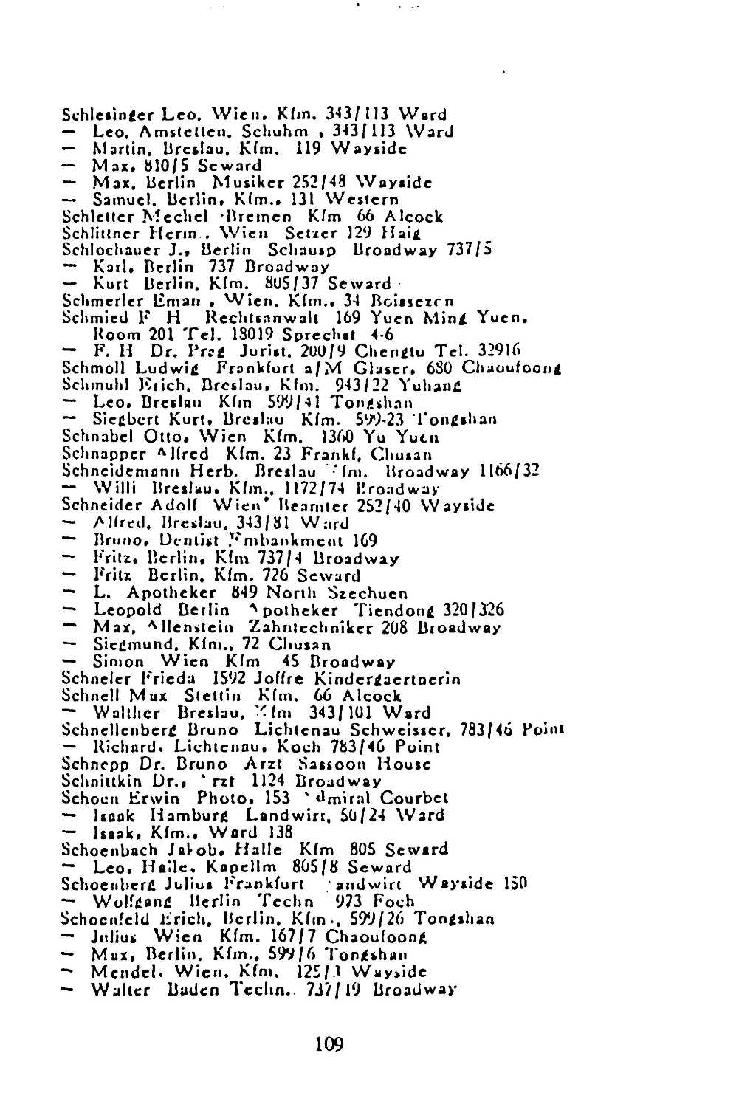
I wish I knew more about the experiences of my relatives Auguste Schoen Speier and her family and her brother Isaak Schoen in Shanghai, but aside from finding their names on various lists and in a 1939 directory for Shanghai located by Richard Bloomfield, I know no details other than that at some point they arrived there from Germany and lived there until after the war.

Auguste, Willi, and Julius Speier and Isaak Schoen are all listed on a 1950 list of Jewish refugees in Shanghai who were helped by the American Jewish Joint Distribution Committee, an organization that continues to exist today for those in need.

I also found them all here in a collection of records of Shanghai refugees made in 1944.

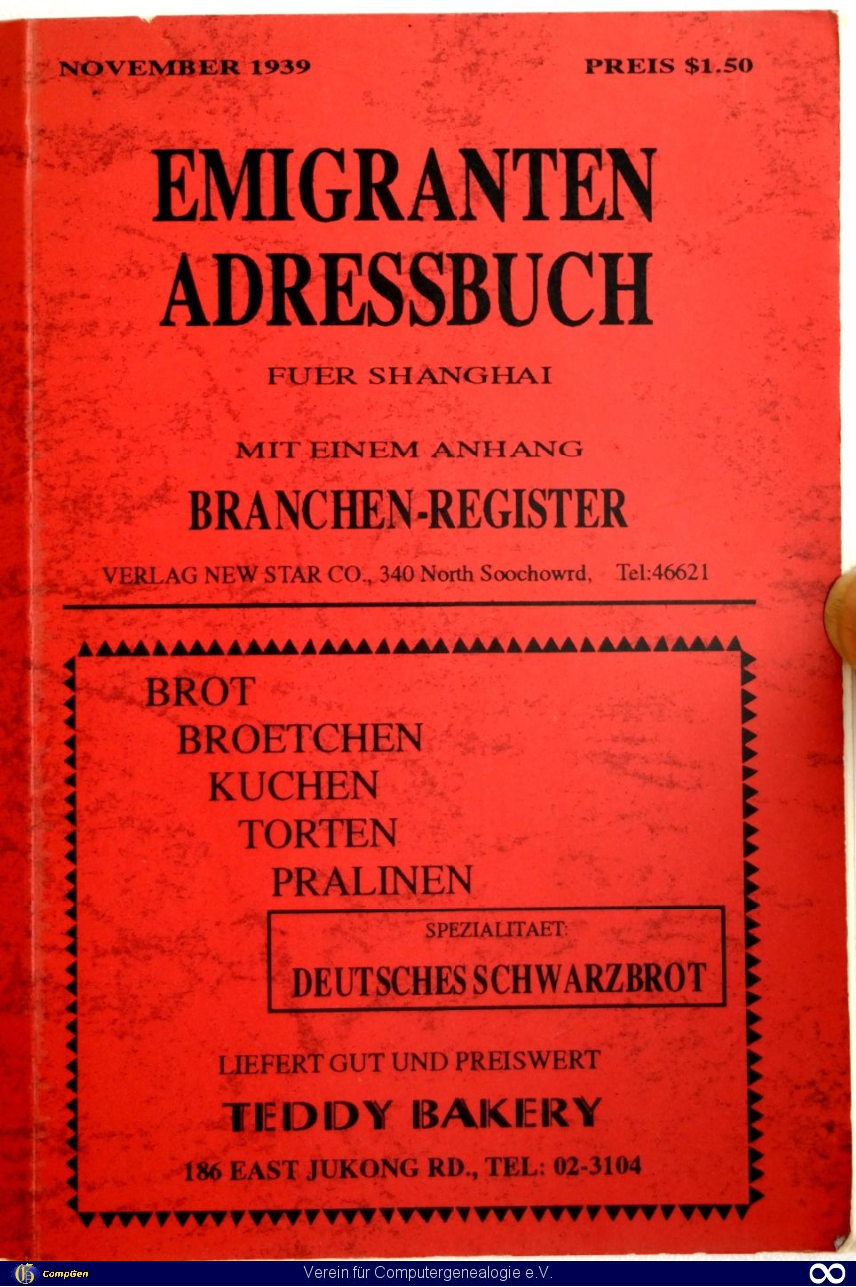
Richard located them in this November 1939 directory of emigrants in Shanghai, so obviously they had immigrated there by November 1939:

But I could not locate them on this list of refugees who had arrived in Shanghai between 1937 and 1944, so perhaps they had arrived before 1937.

In his interview with the US Holocaust Memorial and Museum, Kurt Schoen, Moritz’s son, mentioned that one of his cousins had died from typhoid while living in Shanghai, but I have no record or even a name of that cousin. He or she does not appear on any of the lists cited above. Maybe that cousin had passed away before these lists were compiled. Or maybe Kurt was confused.6

In any event, it is clear that Auguste, Willi, Julius and Isaak all ended up in Shanghai, and then after the war, they all immigrated to the US.

Auguste’s son Julius was the first to make it to the US. He arrived in San Francisco on March 19, 1947, with his wife Hildegarde Gabriel. They had married in Shanghai on December 9, 1945.7 Hildegarde was the daughter of Julius Gabriel and Berta Gross and was born on September 8, 1919, in Bromberg in what was then part of Prussia but is now in Poland.8

On the ship manifest, Julius listed his father Willi as the person he was leaving behind, Hildegarde listed her father Julius. They both listed Moritz Schoen, Auguste’s brother, as the person they were going to in the US and listed their destination as New York City. Julius listed his occupation as a shoemaker, and Hildegarde listed hers as a nurse.

Julius and Hildegarde Speier ship manifest, he National Archives at Washington, D.C.; Washington, D.C.; Passenger Lists of Vessels Arriving At San Francisco, California; NAI Number: 4498993; Record Group Title: Records of the Immigration and Naturalization Service, 1787-2004; Record Group Number: 85, NARA Roll Number: 388, Ancestry.com. California, U.S., Arriving Passenger and Crew Lists, 1882-1959

Julius’ parents Auguste (Schoen) and Willi Speier arrived in San Francisco six months later on September 24, 1947. The ship manifest indicates that they were headed to New York City where their son Julius was residing. Like his son Julius, Willi was a shoemaker or “cobbler,” as listed on the manifest. The person they were leaving behind in Shanghai was Auguste’s brother Isaak.9

Isaak himself arrived just a few months later on December 17, 1947. He also entered the US in San Francisco, indicating that he also was heading to New York City where his brother Moritz was living. He listed his occupation as a salesman.10

Auguste and Willi did end up in New York City, where in 1950 Willi was working as a “platform spotter” in a shoe factory. I don’t know what that means, but I would guess that it means he watched shoes on an assembly line. If anyone has any other ideas, please let me know.11 I’ve been unable to locate their son Julius and his wife Hildegarde on the 1950 census nor can I locate Isaak Schoen on that census.

Thus, three of Friederike Blumenfeld and Mannes Schoen’s children and four of their grandchildren had escaped Nazi Germany and survived World War II. Their lives after 1950 will be discussed in my next post.


  1. See, e.g., Alex Ross, Escape to Shanghai: A Jewish Community in China (1993, Free Press); Gao Bei, Shanghai Sanctuary: Chinese and Japanese Policy Toward European Jewish Refugees During World War II (2016, Oxford University Press); Irene Eber, Wartime Shanghai and the Jewish Refugees From Central Europe: Survival, Co-Existence, and Identity in a Multi-Ethnic City (2012, DeGruyter). 
  2. See, e.g., the articles at the following links:  https://www.smithsonianmag.com/smart-news/how-holocaust-survivors-found-refuge-shanghai-told-through-stories-and-photos-180978235/  and https://www.nbcnews.com/news/asian-america/jewish-wwii-refugees-found-safety-shanghai-are-focus-new-exhibit-rcna96478 and https://encyclopedia.ushmm.org/content/en/article/german-and-austrian-jewish-refugees-in-shanghai and https://www.npr.org/2023/08/06/1192118339/jewish-refugees-shanghai-world-war-ii&#160;
  3. E.g., Ernest Heppner, Shanghai Refuge: A Memoir of the World War II Jewish Ghetto (1995, University of Nebraska Press); Berl Falbaum, ed., Shanghai Remembered…: Stories Of Jews Who Escaped To Shanghai From Nazi Europe (2005, Momentum Books, LLC.); Sigmund Tobias, Strange Haven: A Jew­ish Child­hood in Wartime Shanghai (2009, University of Illinois Press). 
  4. See Note 2, above. 
  5. See Note 2, above. 
  6. Kurt L. Schoen, July 24, 2004 interview,  Accession Number: 1997.A.0441.512 | RG Number: RG-50.462.0512, United States Holocaust Memorial Museum Collection, Gift of the Gratz College Holocaust Oral History Archive, found at https://collections.ushmm.org/search/catalog/irn566135. There was another puzzling thing about Kurt’s interview. He mentioned that his father had one sister (Auguste) and one unmarried brother (Isaak), but did not mention Jakob, his father’s older brother.  Jakob, as we saw, had died in 1937 when Kurt was ten, and his wife and daughter were killed in the Holocaust. Had Kurt never known his uncle Jakob and his family? Had Moritz never mentioned them? Or was it just too painful for Kurt to talk about what had happened to his uncle, aunt, and cousin? 
  7. Marriage notice for Julius Speier and Hildegarde Gabriel, The Jewish Voice in Jüdisches Nachrichtenblatt, 23. November 1945, p. 8 
  8. Hildegard Speier, Gender Female, Race White, Birth Date 8 Sep 1919, Birth Place Bromberg Pos, Federal Republic of Germany, Death Date Aug 1994, Father Julius Gabriel, Mother Berta Gross, SSN 079242443, Ancestry.com. U.S., Social Security Applications and Claims Index, 1936-2007 
  9. Willi and Auguste Speier, ship manifest, The National Archives at Washington, D.C.; Washington, D.C.; Passenger Lists of Vessels Arriving At San Francisco, California; NAI Number: 4498993; Record Group Title: Records of the Immigration and Naturalization Service, 1787-2004; Record Group Number: 85, NARA Roll Number: 392, Ancestry.com. California, U.S., Arriving Passenger and Crew Lists, 1882-1959 
  10. Isaak Schoen ship manifest, The National Archives at Washington, D.C.; Washington, D.C.; Passenger Lists of Vessels Arriving At San Francisco, California; NAI Number: 4498993; Record Group Title: Records of the Immigration and Naturalization Service, 1787-2004; Record Group Number: 85, Ancestry.com. California, U.S., Arriving Passenger and Crew Lists, 1882-1959 
  11.  National Archives at Washington, DC; Washington, D.C.; Seventeenth Census of the United States, 1950; Year: 1950; Census Place: New York, New York, New York; Roll: 4546; Page: 18; Enumeration District: 31-1702, Ancestry.com. 1950 United States Federal Census 

Friederike Blumenfeld Schoen, Part III: Her Son Moses Escapes to America

I have been unable to do any new research in these last few weeks since the horrendous massacre in Israel by Hamas on October 7. I just can’t seem to focus on research right now. Fortunately I had several blog posts ready in my queue and will publish those, including this one. Perhaps the best way I can support Israel right now is to educate and remind people about the long history of persecution of Jews and antisemitism so that they best understand why Israel exists and why it must survive.


Although Friederike’s oldest child Jakob died in 1937 and his widow and daughter were killed by the Nazis, her other three surviving children all managed to escape the Nazis.

Friederike’s son Moses, more commonly known as Moritz, wanted to leave Germany quite early. As described by his son Kurt Leopold Schoen in the oral history interview he did with the US Holocaust Memorial and Museum, Moritz had had a successful wholesale and retail shoe business in Kassel, but once the Nazis came to power the business suffered. Non-Jews boycotted the store, and Moritz had to close the business and work as a shoemaker.1

But leaving Germany was difficult. The family needed affidavits from someone in the US to get a visa to enter the country, and the relatives in the US were reluctant to sponsor a family with three young children. Fortunately, Moritz and Else’s fourteen-year-old daughter Alice was given an opportunity to leave when the National Council of the Jewish Women in the US organized a rescue mission that brought many children out of Germany.2 Alice came to the US on May 13, 1938, and was sent to live with a Jewish family in San Antonio, Texas, the Rosenbergs, as seen on the 1940 US census.3

Alice Schoen passenger manifest, The National Archives and Records Administration; Washington, D.C.; Passenger and Crew Lists of Vessels Arriving at and Departing from Ogdensburg, New York, 5/27/1948 – 11/28/1972; Microfilm Serial or NAID: T715, 1897-1957
Ancestry.com. New York, U.S., Arriving Passenger and Crew Lists (including Castle Garden and Ellis Island), 1820-1957

The website for the Holocaust Memorial Museum of San Antonio reported that Abe and Bella Rosenberg “took [Alice] into their lives as if she were a long lost relative. The Rosenberg children, Miriam and Stanley, and a host of aunts, uncles, and cousins who treated her with affection and kindness made her adjustment to a new life easier.” In his oral history interview, Alice’s brother Kurt mentioned that the Rosenbergs were a very nice family, but nevertheless Alice was naturally very homesick.  She did not see her family again until 1940.4

But Alice was able to get help from the Rosenberg family to bring her father Moritz to the US from Germany. As reported on the website for the Holocaust Memorial Museum of San Antonio, they signed affidavits pledging financial support for him.

Once he had an affidavit from the Rosenbergs, Moritz was able to go to the US consulate in Germany and receive a visa. But before he could leave, he was arrested during the Kristallnacht riots in November, 1938. According to his son Kurt, Moritz was not sent to Buchenwald like so many other Jewish men were after Kristallnacht because he already had a visa to leave Germany. He was released within a day or two from police custody in Kassel and prepared to leave for the US.5

Moritz arrived on December 3, 1938, seven months after Alice’s arrival, and settled in New York City. His ship manifest lists his wife Else as the person he was leaving behind in Kassel, Germany, and his sister-in-law Betty Lutz (born Babette Freimark) as the person he was going to in the US. He listed his occupation as a shoemaker.6

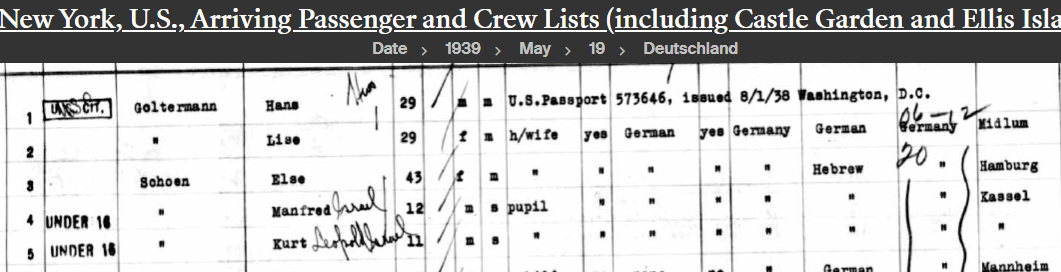
Meanwhile, back in Germany, Else and her two young sons Manfred and Kurt moved to Frankfurt; the boys were sent to a Jewish orphanage and Else moved in with one of her sisters. Kurt described the orphanage as a place where he and his brother were well treated. They went to school and learned English. Finally in April 1939, they were released and reunited with their mother and allowed to leave Germany for the US. Kurt, who was eleven at the time, recalled that the Nazis tore through their luggage and stole everything Else had packed except one small teapot.7

Else arrived in New York with Manfred and Kurt (listed as Kurt Leopold Israel on the manifest) on May 19, 1939.

Else Schoen and children, passenger manifest, The National Archives and Records Administration; Washington, D.C.; Passenger and Crew Lists of Vessels Arriving at and Departing from Ogdensburg, New York, 5/27/1948 – 11/28/1972; Microfilm Serial or NAID: T715, 1897-1957
Ship or Roll Number: Deutschland, Ancestry.com. New York, U.S., Arriving Passenger and Crew Lists (including Castle Garden and Ellis Island), 1820-1957

The family moved into a small apartment riddled with bed bugs; Moritz worked doing shoe repairs and barely made a living. But as Kurt said, they were happy to be out of Germany and safely living in New York. They moved frequently from one apartment to another in order to get the benefit of one or two free months of rent being offered by landlords. Manfred and Kurt started school where they quickly learned English and rose from the lower levels of their grade to the highest within a year.8

Alice was reunited with her parents and brothers sometime in 1940 when the Rosenberg family brought her to New York after taking a trip to Canada to see the Dionne Quintuplets. She married just three years later when she was nineteen, according to her brother Kurt.9 Her husband, Albert Bernhard Schwarz, was born on October 22, 1922, in Busenberg, Germany, to Alfred Lazarus Schwarz and Berta Levy. Like Alice, he was refugee from Germany; he had arrived on August 13, 1938.10 He was the only member of his family to survive. His parents and all his siblings were killed by the Nazis.11

Albert entered the US Army on March 26, 1943, listing his marital status as single.12 He and Alice must have married later that year. According to one biography of Albert, he was assigned to Camp Ritchie in Maryland and trained for military intelligence. As a Ritchie Boy, as they were known, Albert was trained to interrogate German prisoners of war. Starting in October 1944 he was with the 7th Armored Division of the II English Army in France and the northern part of Belgium. On November 5-6, 1944, during the Battle of the Bulge, Albert’s jeep hit a German mine near a bridge over the Meuse River. Albert suffered severe head injuries from which he suffered the rest of his life. He was in a coma for over a month in a English military hospital and remained there until February, 1945. He returned to the US in the spring of 1945, but was hospitalized until July. On Aug. 02, 1945, he was discharged from military service at Camp Edward, Massachusetts.13

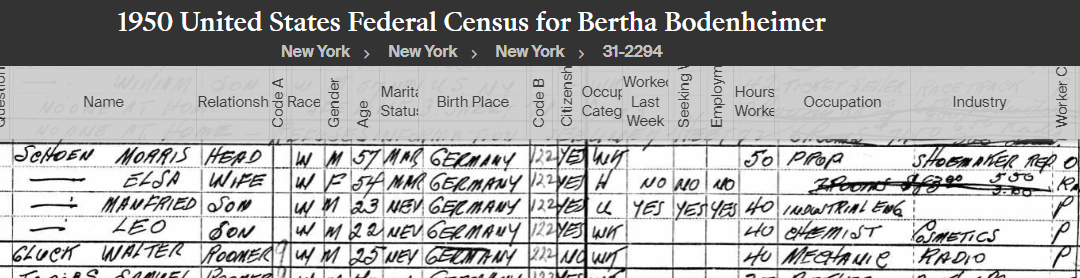
Alice and Albert had three children born after the war. In 1950 they were living in New York City, and Albert was working as a butcher.14 Alice’s parents Moritz and Else Schoen and her brothers Manfred and Kurt (listed as Leo here) were also living in New York City. Moritz now owned his own shoemaking business. Manfred was an industrial engineer, and Leo/Kurt was a chemist in a cosmetics company.

Morris Schoen and family, 1950 US census, National Archives at Washington, DC; Washington, D.C.; Seventeenth Census of the United States, 1950; Year: 1950; Census Place: New York, New York, New York; Roll: 3572; Page: 9; Enumeration District: 31-2294, Ancestry.com. 1950 United States Federal Census

Meanwhile, Moritz’s two remaining siblings had survived the war in Shanghai, China. More on that in my next post.

  1. Many of the personal details in this post came from Kurt Leopold Schoen’s interview with the USHMM. Kurt L. Schoen, July 24, 2004 interview, Accession Number: 1997.A.0441.512 | RG Number: RG-50.462.0512, United States Holocaust Memorial Museum Collection, Gift of the Gratz College Holocaust Oral History Archive, found at https://collections.ushmm.org/search/catalog/irn566135.  Although Kurt is listed as Leopold or Leo on many US records, he used the name Kurt for most of his adult life in the US and will be referred to here as Kurt for that reason. 
  2. See Note 1, supra. 
  3. Alice Schoen, 1940 US Census, Year: 1940; Census Place: San Antonio, Bexar, Texas; Roll: m-t0627-04201; Page: 61A; Enumeration District: 259-6, Ancestry.com. 1940 United States Federal Census 
  4. See Note 1, supra. 
  5. See Note 1, supra. 
  6. Moses Schoen, passenger manifest, The National Archives and Records Administration; Washington, D.C.; Passenger and Crew Lists of Vessels Arriving at and Departing from Ogdensburg, New York, 5/27/1948 – 11/28/1972; Microfilm Serial or NAID: T715, 1897-1957, Ship or Roll Number: Hamburg, Ancestry.com. New York, U.S., Arriving Passenger and Crew Lists (including Castle Garden and Ellis Island), 1820-1957 
  7. See Note 1, supra. 
  8. See Note 1, supra. 
  9. See Note 1, supra. 
  10. Albert Schwarz, Declaration of Intention, The National Archives at Philadelphia; Philadelphia, PA; NAI Title: Declarations of Intention For Citizenship, 1/19/1842 – 10/29/1959; NAI Number: 4713410; Record Group Title: Records of District Courts of the United States, 1685-2009; Record Group Number: 21, Description
    Description: (Roll 610) Declarations of Intention For Citizenship, 1842-1959 (No 481301-482200), Ancestry.com. New York, U.S., State and Federal Naturalization Records, 1794-1943 
  11. Family history of Schwarz family, Arbeitskreis Judentum im Wasgau, Elisabeth & Otmar Weber, Schillerstraße 10b, 66994, found at /https://judentum-im-wasgau.de/images/geschichte/jugemeinden/jufbusenberg/02_schwarz_jakob_hauptstr_49_bu.pdf 
  12. Albert B Schwarz, Race White, Marital Status Single, without dependents (Single)
    Rank Private, Birth Year 1922, Nativity State or Country Danzig or Germany, Citizenship Not Yet a Citizen, Residence New York, New York, Education 2 years of high school
    Civil Occupation Stock clerks, Enlistment Date 26 Mar 1943, Enlistment Place New York City, New York, Service Number 32874464, Branch No branch assignment, Component Selectees (Enlisted Men), National Archives at College Park; College Park, Maryland, USA; Electronic Army Serial Number Merged File, 1938-1946; NAID: 1263923; Record Group Title: Records of the National Archives and Records Administration, 1789-ca. 2007; Record Group: 64; Box Number: 05772; Reel: 241, Ancestry.com. U.S., World War II Army Enlistment Records, 1938-1946 
  13. See Note 11, supra. 
  14. Albert Schwarz and family, 1940 US census, National Archives at Washington, DC; Washington, D.C.; Seventeenth Census of the United States, 1950; Year: 1950; Census Place: New York, New York, New York; Roll: 6203; Page: 6; Enumeration District: 31-1913, Ancestry.com. 1950 United States Federal Census 

For My Cousins in Israel

For all my cousins in Israel and their children and their families and their friends, my heart is with you. I am so blessed to have found you, and I will continue to stay in touch and hope for your safety and for peace. Please know that you are all in my thoughts—Omri, Ravid, Rafi, Joyce, Ester, Ariela, and Miki. And all your families and friends.

I wrote a short essay about Israel three days ago intending to post it here on my blog. But I was hurting too much, and since the blog is public, not private, I decided not to post. I did not want to invite anti-Israel, antisemitic posts by members of the public. Instead I posted on Facebook, limiting my audience to my Facebook friends. Fortunately, the responses I received were all sensitive and supportive from both my Jewish and non-Jewish friends.
I am still hurting too much. But I’ve decided to share this more publicly now. Because it’s important to speak up. Because now that Israel is fighting back, I know that the tide of public opinion will start to shift for many. I am not indifferent to the suffering of the people in Gaza. I understand that many of them are not terrorists. Many are children. But I also know that Israel has over and over again been convinced to walk away and agree to ceasefires only to once again have Hamas fire rockets and engage in terrorism to kill innocent people in Israel.

There is a lot of history here. It didn’t start in 1948 or 1967 or 1973. And it certainly didn’t start with Israel’s current response to the October 7 massacres. I can’t begin to summarize all the times that Israel has tried to find peace with the Palestinians only to find that violence and hatred are all they get in response. Of course, it’s not all Palestinians. It’s the leadership and the extremists who refuse to accept Israel’s right to exist. But it’s the leadership and the extremists who control whether or not there will be peace, and they refuse to take the steps that will bring peace, thus endangering the lives of not only Israelis but also their own people.

I am not a historian, but in the last week I’ve read many different articles outlining that history. For now I will only recommend two articles, one written in 2021 by Michael Oren that details the long history of Gaza and one published this week by David Brooks about more recent attempts to find peace between Israel and the Palestinians.

In that context, here are the words I posted on Facebook earlier this past week.


I can’t get the beautiful faces of the Israeli teens out of my head. My Facebook newsfeed contains one photo after another—of a teen taken hostage by Hamas or worse killed by Hamas. Or of the mother with her two young children. Or the elderly great-grandmother holding her great-grandchild. I can’t stop thinking about them all. And I can’t help but associate those faces with the names and faces of the many relatives I’ve researched who were killed by the Nazis. It’s all mixed up in my head.

I am not one who has been blind to Israel’s faults. I have often criticized the way Palestinians have been treated by Israel; I do not defend the oppression of others. I have been disappointed and angered by the way Netanyahu and the right-wing coalition he panders to have undermined liberal democracy and liberal Judaism in Israel. But those criticisms of Israel don’t mean that I don’t care about the people in and future of Israel just as it doesn’t mean I don’t care about America’s people and America’s future when I criticize it for its racism, the pandering to the white supremacists and the MAGA cult by Republicans, the failure to address poverty, the corporate greed, the gun violence, and so on. You can criticize without hating or being indifferent. You can love without being blind to the faults of those you love.

So right now my heart is with Israel and with its people. We can wonder later about how security failed or why or how this all happened. But no matter whatever criticisms anyone has of Israel, the terrorism of Hamas cannot be considered acceptable or understandable or justifiable. We need to stand together—and by “we” I don’t mean just Jews. I mean everyone. If you are silent or indifferent, you are part of the problem. If you can just scroll past all those beautiful faces and not feel anything, you are part of the problem.

When hatred starts to spread its poison and people remain silent, then we are all responsible for what happens next. Remember the six million. Please do not let it happen again.


Isaak Rosenberg: A Family With No Survivors

The youngest child of Rebecca Blumenfeld and Mendel Rosenberg was their son Isaak. As we saw, Isaak was born in Rosenthal, Germany, on June 15, 1892, and on December 22, 1922, he married Bella Gans, daughter of Jacob Gans and Esther Ehrenreich, in Niederaula, Germany.

Isaak and Bella had one child, a daughter Rita Rosenberg, born on April 29, 1924 in Frankfurt.

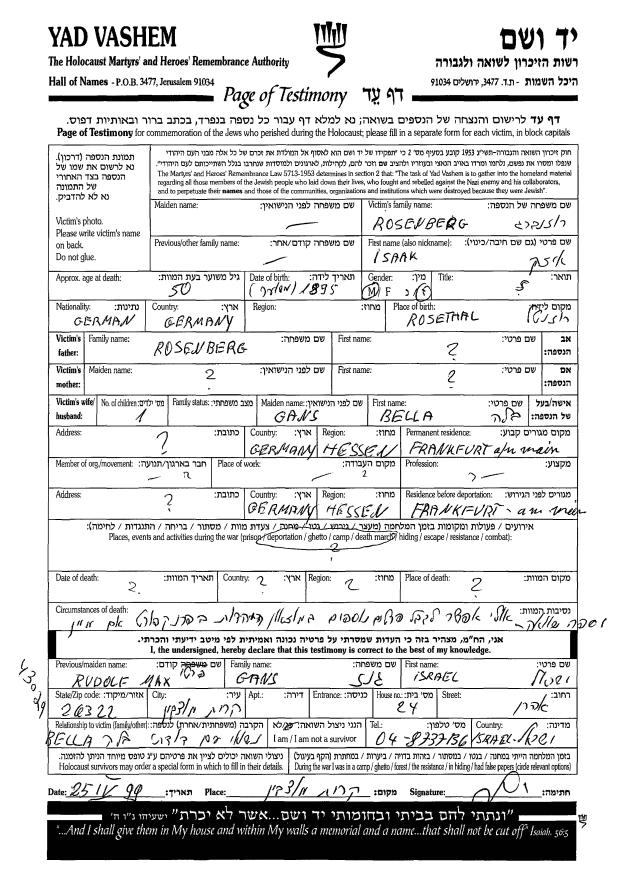
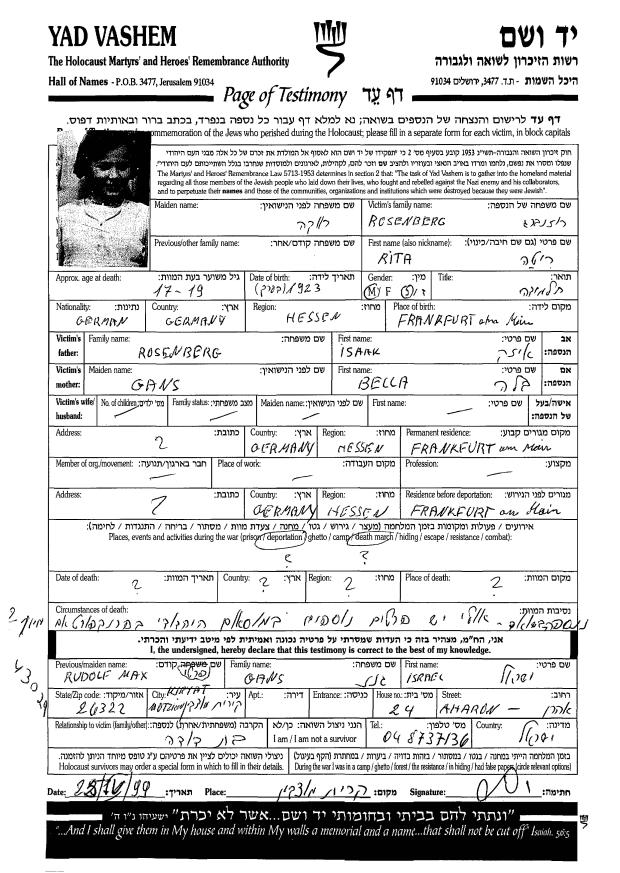
Unfortunately, all of them—Isaak, Bella, and Rita—were murdered by the Nazis. According to Yad Vashem, Isaak was deported from Frankfurt on August 10, 1942, and sent to the concentration camp in Majdanek, Poland, where he was murdered. His wife Bella’s nephew Israel Gans filed this Page of Testimony at Yad Vashem in his memory. The Hebrew written where it says “circumstances of death” merely says “perished in the Holocaust.” (Thank you to Hanna Gafni of Tracing the Tribe on Facebook for translating this line on this Page and the two below.)

The information available regarding the fates of Bella and Rita is far less specific. The Gedenbuch (Memorial Book) only reports that Bella was deported to Poland and killed there; perhaps she was deported on the same date as Isaak and to the same camp, but that isn’t stated. Nor does the Page of Testimony filed at Yad Vashem by Bella’s nephew Israel Gans provide any further details. The line for “Circumstances of Death” translates as “deported to Poland. Her fate is not known. Perished in the Holocaust.”

The information about Rita is even more limited. The Gedenbuch doesn’t even have information about where she was deported to or killed nor does her cousin Israel Gans’ Page of Testimony for her. The Hebrew written where it says “circumstances of death” says “perished in the Holocaust.”


This may be the first time that I have learned of family members who were killed in the Holocaust for whom there are no recorded details of their fates. Did Bella and Rita accompany Isaak to Majdanek? Or was the family separated? The lack of information somehow makes their deaths sting even more. The fact that the Nazis didn’t even document their murders makes it more likely that those deaths would have been somehow swept under the rug. So it is my task here to make sure that their lives and their murders are not forgotten.


That brings me to the end of the story of Rebecca Blumenfeld Rosenberg, the seventh child of Isaak Blumenfeld I and Gelle Strauss. Although Rebecca lost one son, Willi, as a young adult, and her son Isaak and his family were all murdered in the Holocaust, she was survived by seven grandchildren and has descendants still living today in Israel and the United States.

Next I turn to Rebecca’s younger sister, Friederike Blumenfeld, the eighth child of Isaak Blumenfeld I and Gelle Strauss and the last of their children to live to adulthood.

Good for A Single Journey by Helen Joyce: A Review of A Wonderful New Book and An Interview with the Author

Today I have the great pleasure of sharing my virtual interview with author Helen Joyce. She has recently published a family history novel titled Good for A Single Journey, a moving and beautifully written telling of her maternal family’s story. Joyce’s great-grandparents were living in a small town in what was then Galicia in Eastern Europe in the early 20th century when oppression and poverty forced them to relocate to Vienna, where they hoped to have greater freedom and economic security. And they did find great success there. But like so many Jewish families, they eventually suffered from the horrors of the Holocaust. Although many, including Joyce’s mother, survived, many others were murdered, and all suffered from persecution and financial loss. And those who survived were once again forced to relocate and start all over in a new country.

Joyce has combined what she learned from her mother and other relatives with historical research to create a fascinating and illuminating look at the history of this era and its effect on one Jewish family. The book is a mix of fact and fiction, some parts totally created from her imagination and other parts entirely based on fact. The book reads like a novel. She has created wonderful three-dimensional characters, each with distinctive and memorable personalities and stories. I highly recommend this book to anyone interested in history and in Jewish history in particular. It is appropriate for young adults as well as adults and available for purchase on Amazon and Barnes & Noble here.

Good for a Single Journey has received a finalist’s award in the 2023 Next Generation Indie Book Awards and has also received a highly favorable review from Neville Teller in the June 12, 2023, issue of The Jerusalem Report. You can also learn more about Helen Joyce and her book at her website found here.  And in the interest of full disclosure, I should reveal that she is my fifth cousin on her paternal side; we are both descended from Jacob Falcke Goldschmidt and Eva Seligmann, our mutual four-times great-grandparents.

And now, let me introduce you to Helen Joyce and her wonderful book, Good for a Single Journey..

Thank you so much for agreeing to do this interview with me and to share more about your book, Good for a Single Journey.  Have you ever written a book or other fiction/non-fiction before?

No! I have written the odd article, contributed a chapter to two each of two academic books, and edited a community magazine which often entailed tightening the contributions of others. Otherwise, no formal writing experience.

So what made you decide to write this book at this time?

Old age! I always wanted to write an account of my mother’s life and never found the right time. Work, kids, and life in general always interfered. That and the self-defeating belief that the project was beyond me; that I was deluding myself if I thought I could write an account/memoir/novel of the type I imagined would do justice to her story. Finally, the reality of the fact that I was not getting any younger and triggered by taking our youngest granddaughter on a trip to Vienna where we visited my mother’s birthplace proved to be the catalyst for getting to work.

The author’s parents Max and Klari. Courtesy of Helen Joyce

I really enjoyed reading the book, and it reads like fiction. But I know that the book is based on the real lives of your parents, grandparents, and great-grandparents as well as many aunts, uncles, and cousins. How much of the book is fictionalized and how much is non-fiction?

It would take a long time to unravel fact from fiction but basically, I knew the ‘bare bones’ of the stories of all the characters. In the case of the two brothers, Chiel and Beresh, I knew very little indeed beyond the fact that they made Aliyah to pre-State Israel long around WWI. Therefore, I invented their adventures. I gave them experiences and put them in situations which were factually correct and allowed some of the history of the early Yishuv to come to light. I knew a little about Peppi, my grandmother’s sister, and of course the story of Suzanne became legendary!

Zissel, my other great-uncle, was a closed book to me until I unlocked the memoir of his son Yitzchak. That gave me the details of not only his travels across Europe and today’s Ukraine before reaching the shores of British mandate Palestine, but also revealed the entire saga of his grandparents’ (my great grandparents’) flight from Rozwadów to Ukraine and onwards to Siberia. I knew a great deal about my grandparents from my mother’s tales and, again through her, background details about day-to-day life in Vienna and the market town of Rozwadów, which she visited frequently on trips to her grandparents. The rags to riches story of my grandfather is true. Accounts of the flight from Vienna, the period in Prague, my mother’s experiences in London are also from my mother’s various shared memories.

My independent sources of research (apart from the internet and the cousin’s memoir which I mentioned) were my mother’s diaries and a stash of family letters collated and self-printed by my late uncle which charted the agony of desperation and fear as various members of the family tried to help and find ways to get those still trapped in Europe out. Obviously the most fictionalized accounts are those of the imagined conversations and emotions displayed by the various characters. The best I could do was to try and imagine I was them and put myself in their place at that time. What would I feel? How would I react?

How did you decide where to create fictional elements versus non-fiction?

Honestly, I don’t know! It just sort of flowed seamlessly. I wove elements of drama and fiction around the basic facts I knew. For example, I needed to get the two brothers from Vienna to Palestine during WWI. How would they have gone? What might they have done? WWI was raging so I thought it would be interesting to place them into an Austro-Hungarian unit which ended up in Palestine. When I started researching that possibility, I learned a great deal about the involvement of Jewish soldiers in the army, the unit I put them in was a real one (as was the officer which commanded it). The facts surrounding Aaron Aaronsohn, NILI, and their role in helping the British defeat the Ottomans in
Palestine and how these contributed to the fact of the Balfour Declaration was too good an opportunity to miss including. So, I did! Throughout the book I also wanted to give the lie to the myth that Jews were passive, never fought in armies and were pale scholars led to slaughter like sheep. Jews fought bravely (on all sides) in every theatre of war.

How did you research the parts of the book that are fact-based?

I read several books on WWI, biographies about Aaron Aaronsohn and NILI as well as books about the history of the Middle East. My mother’s cousin’s memoir was also very helpful. The internet is also a phenomenal resource. What was the weather like in Gallipoli in November 1915 – click. What train routes were available on the Chemins de fer Orientaux during WWI – click! What date was Rosh Hashanah in 1914 – click. All there in your hand-held mobile phone!

Your book begins with your great-grandparents leaving Rozwadów. Why did you decide to begin there?

The book begins with a train journey, the journey of my great grandparents fleeing their hometown in Galicia. I decided to start with that train ride as it gave me the opportunity to introduce all the main characters as well as a major theme of the book. Migration and journeys. The entire book is about the journey of individuals, families, and the Jewish people. Trains feature quite prominently. That opening train ride. Greetings and goodbyes at train stations. The brothers’ train ride to war and onwards to Palestine. The train ride carrying my great grandparents and their youngest son to Siberia. The train ride my mother took to Scotland to meet her brother serving in the Jewish Brigade of the British army and of course the final horrific train rides to the death camps.

You include some living people and some recently deceased people in the book. How did you approach the issues of privacy with respect to those people? Were there things you had to change or avoid to protect the interests of your family?

Yes, absolutely. A lot was excluded! However, in discussion with as many of my cousins as I could track down, I realized they were quite happy for me to give details of their stories. I offered each of them drafts so they could check they were happy with what I had written. However, as nearly all the family descendants live in Israel, many of them do not read in English. That said, they were quite happy to know I had written some account and did not mind if it was fictionalized. The Israeli branch is very easy going! I gave my sister an early draft and she enjoyed the first half but did have some comments and suggestions about the second half of the book. I have tried to accommodate her feelings on this but, ultimately, we agreed that the book was a fictionalized novel.

Your family endured many of the challenges and horrors faced by many Jewish families in the 20th century: immigration to new countries (several times), World War I, and Nazi persecution and the Holocaust. What impact do you think that history has had on you and the other living descendants of your great-grandparents?

It’s hard to speak about this in general. The impact is surely quite different for each family and on each individual. For me, knowing what previous generations lived and died for made me want to cling to a Jewish lifestyle replete with the traditions that Hitler tried so hard to erase. I didn’t want to give Hitler any kind of posthumous victory and so I have tried to raise a Jewishly faithful family. Beyond that? I guess a sense of the importance of justice and the need to respect equality of all people regardless of gender, race, or religion.

You ultimately decided to leave England and make Aliyah to Israel. What in your family history contributed to that decision? Have you made connections to the cousins who were refugees to Israel during the Nazi era?

Many factors contributed to that decision. My husband comes from a very ‘English’ Jewish family but his mother, eldest of ten, was the only child left in the UK after the creation of the State of Israel. The rest were all pioneers in Israel (although two had died before that was possible). So, he already has a huge network of family here. Our son made Aliyah twenty years ago and was raising his children here and of course we wanted to be close to them. We have a daughter with special needs and she made Aliyah with us – we couldn’t contemplate leaving her behind and she is so very happy here with excellent care. Our youngest child followed us five years ago and so, to our delight, all our children and grandchildren are here. Yes, I have contact with some of my many cousins, but they are numerous and spread out so we do not meet that often although I do meet my first cousins more frequently.

Your book has many themes and covers many topics: different ways to practice Judaism, antisemitism, Zionism, mental health, marriage, parental love, and so on. Was there a specific point or theme that mattered most to you?

They all mattered and, in a way, I suppose several of them nestle into each other like a set of Russian matryoshka dolls! Parental love leads to stability and contributes to the type of marriage partnership one is likely to create as does a strong sense of community and belonging. Antisemitism and Zionism also have a kind of Yin and Yang partnership! If I had to choose one (you didn’t ask me that!) maybe I would say resilience and survival!

Who did you see as the audience for your book? Your own family and descendants? Young adults? Jewish readers? The entire universe of adult readers?

The entire universe! My family and their descendants were not really the target audience. Had they been, the book would have been far more factual and memoir-based. I hoped it would appeal to young adults and prove educational and am being told that teenagers are totally gripped by the story – which, given the amount of history in it – is great! However, I would dearly love the non-Jewish world to gain insight about a Jewish way of life, the history of persecution and the holocaust but also the historical underpinnings of the State of Israel under international law which was brought about together with the dismantling of previous empires. If Israel is to be accused of being a ‘colonialist enterprise’ then equally so is Syria, Lebanon, Jordan, Saudi Arabia and Iraq. Not to mention the many ‘new’ European countries created in the wake of WWI. Without understanding the impact of WWI, nothing about the modern world makes sense (including current events in Ukraine!)

This book focused on your maternal family. Do you plan to write a book about your paternal side?

Yes! And your blog will be a fantastic resource for me!!! However, marketing this book is taking up a lot of time at the moment. I have been invited to take part in Jewish Book Week School Events for schools around the UK which is fantastic. Events can be online so I can do them from here. This is really part of my dream – to bring the reality of the Jewish experience to a wider audience.

The author, Helen Joyce. Courtesy of Helen Joyce

Thank you again for taking the time to answer my questions, and I look forward to reading your next book and hope that my research will be helpful to you! Best of luck in your marketing efforts—your book deserves a wide and large audience.