The Genealogy Village: An Update on Maria Cohen and William Levy

Over three weeks ago, I blogged about Maria Cohen, Jacob and Sarah’s seventh child, and her life.  She had married William Levy, and they had had four sons, one of whom committed suicide as a teenager, and two others who predeceased her, Lewis, who died when he was 38 in 1915 only five years after marrying Emma Fogle, and Jacob, who died the following year when he also was only 38.  Only one son, Isaac, survived her.

At the time I wrote the blog, I could not find any records for Maria or William after 1900, except as names on their sons’ death certificates.  I did not know when either of them died.  In addition, although I had a death certificate for their son Lewis and was able to find his headstone through FindAGrave, I was confused by the fact that the headstone referred to Lewis and his wife Emma as father and mother, but I had no record of any child born to Lewis and Emma.  I put those questions aside after much searching, figuring I would return.

So I returned to Maria and William after the updates to the Pennsylvania death certificate database earlier this week.   First, I called Adath Jeshurun cemetery in Philadelphia to see if Maria and William were buried there.  Since all three of the sons who had died were buried there, I assumed that Maria and William would have been also, and that hunch paid off.  The very helpful woman at Adath Jeshurun gave me the dates that Maria and William died and were buried.

William had died September 10, 1906 when Maria was only 49 and had already lost her son Benjamin.  She would lose two more sons in the next ten years.  Maria herself died March 24, 1925.  I now had their dates of death, but still no death certificates.  Even with the new update, I could not find a death certificate for either William or Maria even though both had died before 1944.  I was bewildered.

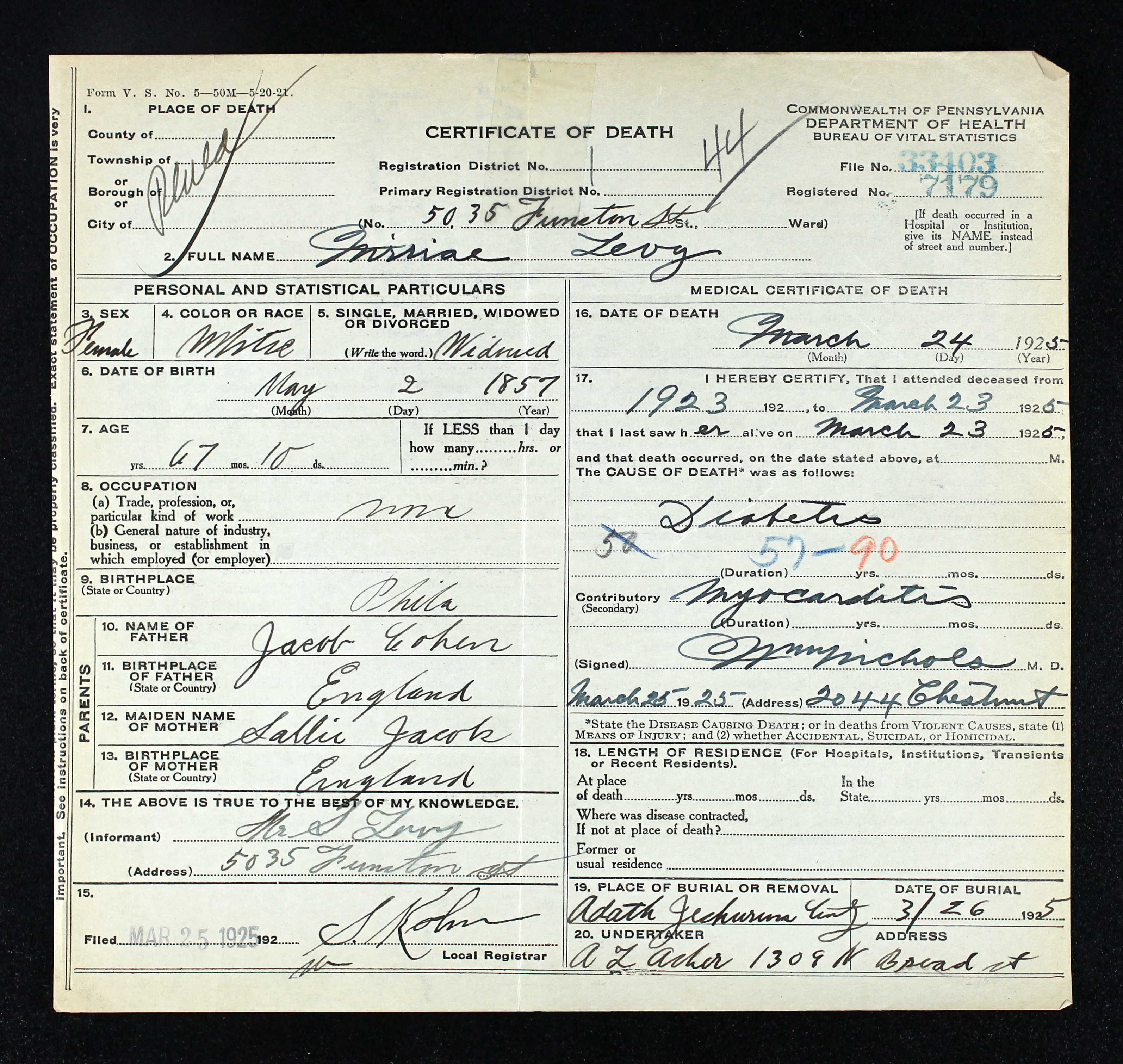
I then searched for all people named Levy who died in 1925 and finally found Maria—spelled Mrriac in the ancestry.com index.  What?? Mrriac?? No wonder I couldn’t find it.  But it was clearly Maria—daughter of Jacob Cohen and “Sallie Jacob.”  She had died from diabetes and myocarditis and had been living at 5035 Funston Street in Philadelphia at the time of her death.  The informant on the certificate was Mr. S. Levy of the same address.  Since her only surviving child was her son Isaac Harry Levy, I had no idea who S. Levy was, unless he was the son of Lewis and Emma Levy.

Maria Cohen death certificate 1925

Maria Cohen death certificate 1925

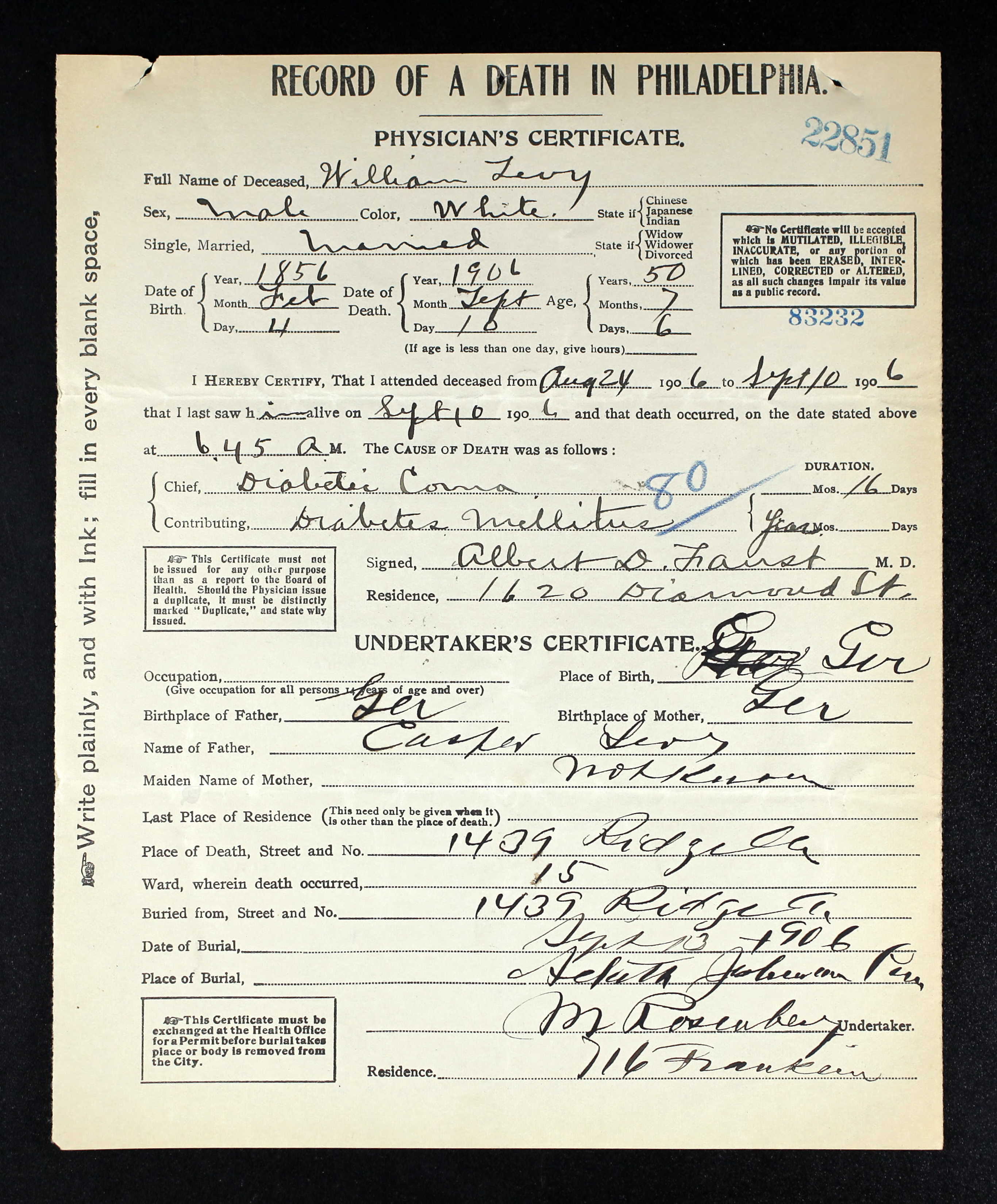
I still could not find William Levy’s death certificate nor could I figure out how to find Lewis and Emma’s child.  I turned to others for help.  There is a Pennsylvania Genealogy group on Facebook and also a Tracing the Tribe group focused on Jewish genealogy.  I posted my questions on both groups, and within a few minutes, someone on the TTT group suggested I search the Pennsylvania death index by William’s date of death instead of by his name, and tada! There it was.  William also had died from diabetes.

William Levy death certificate 1906

William Levy death certificate 1906

But that still left me without an answer to the next question: who was the child of Emma and Lewis Levy?  Another half hour later I had that answer as well.  Somehow someone else with fresh eyes found Emma Levy, a widow, on the 1920 census, living with an eight year old daughter named Henrietta as well as two relatives named Fogel.  This was obviously the right Emma, and I now knew her daughter’s name.

Emma Levy 1920 census

Emma Levy 1920 census

They also appeared together on the 1930 census, but on the 1940 census, Henrietta was gone.  Now I need to find her married name.  Two kind people from the Pennsylvania group are continuing to help me.

I still do not know who Mr. S. Levy was on Maria’s death certificate, nor do I know what happened to Henrietta. I also have not found Maria on the 1920 census.  But with the help of others, I am able to put some closure on the sad life of Maria and William Levy.

A Man of Character and Integrity: A Profile of Reuben Cohen, The Pawnbroker

Reuben Cohen

Reuben Cohen

In 1921, The Literary Digest published a profile of Reuben Cohen, Sr., and his career as a pawnbroker.  As I posted previously,  I had a skeptical view of pawnbrokers before I started researching my Cohen ancestors.  Certainly some of that research has been consistent with that view, but overall my opinion of the pawnbroker business has changed dramatically, especially after reading from Wendy Woloson’s In Hock, Pawning in America from Independence through the Great Depression (2006).

There appears to be no reason to doubt the integrity or the character of most of the Cohen men who went into the pawnbroker business in Philadelphia, starting with my great-great-grandfather Jacob and carried on by his sons, sons-in-law, and grandsons.

The profile of Reuben Cohen, Jacob’s son, my great-grandfather’s brother, provides a fitting end to my telling of the story of Reuben and Sallie and their seventeen children.  It appeared in the Literary Digest for April 23, 1921, pages 48, 50, just five years before Reuben died.  Most of the article consists of direct quotes from Reuben himself, making it a valuable piece of family history for me and for all my Cohen cousins and relatives.

Reuben is portrayed as an honest, good, man, an articulate and thoughtful man, a man who believed that his work was not only about making money for himself and his family, but also about helping people who needed money and were not able to get that money from a traditional bank.  I am quoting the article in full because I hope that it helps to preserve the legacy of Reuben Cohen and also to provide a more positive view of the role of the pawnbroker.

PEOPLE AND PLEDGES THAT COME TO A PAWNBROKER

COFFINS, false teeth, wooden legs, anvils, anchors, horses, and auto mobiles—that sounds like an extract from the catalog of a museum of contemporary times, but, really, it is a partial list of odds and ends taken in by a Philadelphia pawnbroker. For fifty years, we are told, Reuben Cohen has performed the office of “uncle” to an innumerable army of more or less distant relatives whose ways of living, or misfortunes, led them to establish a connection with him. Once, he avers, it was an undertaker, to whom the continued good health of the community had meant serious financial loss. The undertaker had become overstocked with coffins, and needed hard cash for the butcher and groceryman he had failed to bury. At another time it was a horse dealer, who needed ready money more than a mount. At another time, still, it was a man who found that he could get along temporarily without his underpinning provided he could get something under his belt. False teeth form a ready article of sale and are more easily disposed of than anchors. But even an anchor may find a temporary resting-place in the back room of a pawnshop.

During his half century under the sign of the three balls Mr. Cohen evidently turned few away from his door. And he found that it isn’t only the poor who seek to be tided over an unlucky financial venture, or to raise money for an unexpected need. Sometimes people who are reputed rich ring the bell after nightfall, and come in lugging the family silver or a bagful of ancient heirlooms. Reuben Cohen has been “uncle” to them all, and he has had a rare opportunity to study all phases of human nature. Said he recently to a reporter for the Philadelphia Public Ledger:

“A woman who had all the appearance of class came into my place one day and pawned a fine silver set. It was after I had been in business long enough to have saved enough money to take a real vacation.

“My wife and I went down to the old Hotel Stockton, at Cape May, three days later. And whom should I see, as I walked into the lobby, but that woman who had pawned the silverware. She was drest in the height of fashion. No, she didn’t recognize me then, and she never recognized me many other times when I saw her there. But I recognized her. Incidentally, she never redeemed her silverware.

“Now you don’t want to get the idea that everyone who comes to a pawn broker’s shop is a waster, a spender, improvident, you know, and all that. Maybe some of those with that richness bluff are that way, but the majority of the people who come to me are poor.

“I think a reputable pawnbroker can be described as the poor man’s banker. Poor people can not get loans from banks. Still there are lots of times when a poor family that has only so much income coming in each week has to have what is to them a large sum at one time. They go to a pawnbroker then, and there’s no reason why they shouldn’t.

“Then there are some really well-to do people who can get loans from banks, but have real misfortunes and find themselves unable to pay off the bank loan. Then they pawn some stuff to get the money to pay off the bank loan.

“That was the case with the last fellow who pledged an automobile with me. He had to meet a note on a Camden bank, and he begged me to take the automobile as a pledge. I got stung on that deal, too. I had to sell that automobile later for a good deal less than I lent that man.

“I can tell the value of most things pretty well, but I don’t think I’ll take a chance on another automobile. I might still take a horse, but no more of them are being offered. I took quite a few in my day.”

Mr. Cohen gave a reminiscent chuckle as he told about the time an undertaker had pledged several coffins and some coffin trimmings: 

“My assistant was out when the coffins came in,” he said. “The coffins were stood up at the back of the store. When I heard my assistant coming in, I ran back and stood up in one of the coffins. When he saw me there, he gave a frightened jump and might have run out of the place if I hadn’t stept out and laughed. That undertaker’s business must have picked up, for he redeemed the coffins and the trimmings, and you can be sure I was thankful for that.

“Talking about business ups and downs, I had a funny experience one night ’way back. In those days Saturday nights were our busiest times. One Saturday night when old Maxwell Stevenson was running for Congress in this district he made a speech on the corner right across from my place.

“He talked for hours—in fact, until I closed in disgust. He must have been a wonderful speaker, for not a single customer entered my shop while that other attraction was running across the way. 

The veteran money-lender became curious when he was led into a discourse on the ethics of the business.  He said that he knew that the popular picture of the man in the establishment that advertised itself with the three golden balls was that of a merciless gouger.  That there were some of that type he did not doubt.

“But I know there are others.  Since you are asking me about my experience, I will tell you that the time with the automobile was not the only time I have been stung.  I took that machine at a value that I knew was higher than its true one because the fellow needed a certain amount of money to meet his note.  And the bank wasn’t going to wait for its money.

“The fellow promised, of course, to redeem the automobile, but I never said more than once, and, altho after each time I made up my mind to be more cautious, I’d make the same mistake, because I couldn’t resist the appeal some smooth tongued rascals could make. And, mind you, I don‘t pose as being unique in my business. I take great pride in the small success I have been able to make because I have always tried to get the confidence of my customers, and I am sure that is the reason for my success.”

Mr. Cohen is large, broad-shouldered and for all his sixty-seven years, presents a ruddy, healthy, well-preserved picture of a man who might well be taken for a prosperous insurance broker, the business of one of his sons. He has a cheerful appearance and a bluff, hearty manner.

He has never moved out of the neighborhood in which he grew up. He lives in a little house next door to his place of business. Despite his laughing good nature, he contest that he has had his share of sorrows. Of the eighteen children born to him and his wife only seven are living, four sons and three daughters.

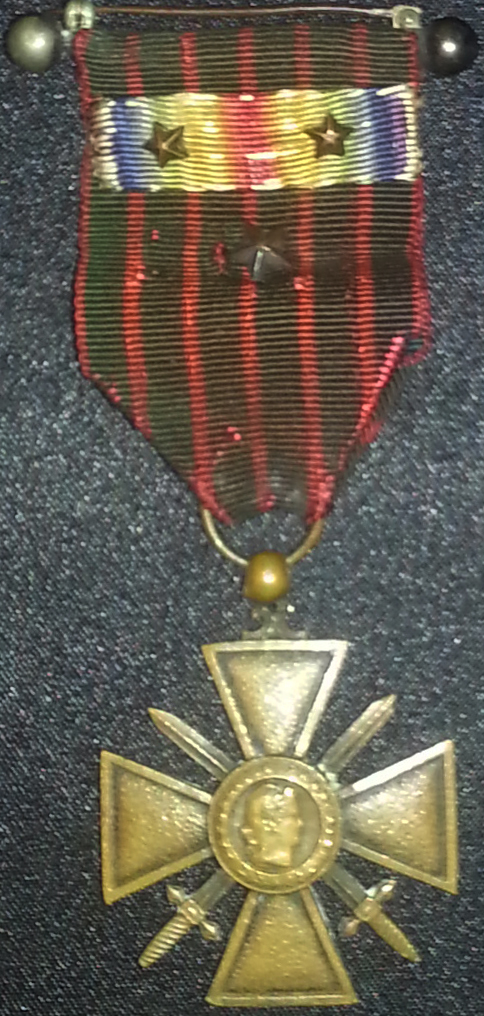
There are two things of which he boasts. One is that his son, Simon L. Bloch Cohen, was a member of the First Division, and gassed, shell-shocked, and twice wounded, and was decorated with the Croix do Guerra by Marshal Foch. The other is that his lifelong friend, Warden Robert McKenty, of the Eastern Penitentiary, named one of his sons Reuben Cohen McKenty. 

Reuben died five years later, and thanks to Pennsylvania’s release of more recent death certificates, I now have access to his death certificate:

Reuben Cohen, Sr. death certificate 1926

Reuben Cohen, Sr. death certificate 1926

In Reuben’s memory and in memory of his son Simon of whom he was so proud, I will end this small chapter of my family history with a photograph of Simon’s Croix de Guerre and with the famous symbol of the pawnbroker, the three gold balls.

Croix-de-Gurre-Back Simon LB Cohen

Croix-de-Guerre awarded to Simon L B Cohen 1918

Croix-de-Guerre awarded to Simon L B Cohen 1918

Tradition symbol of pawnbrokers--three connect...

Arthur Lewis Wilde Cohen 1890-1955: Family Lore and The Tricks of Memory

Arthur Lewis Wilde Cohen, Sr.

Arthur Lewis Wilde Cohen, Sr.


When I first started researching my Cohen relatives about a year and a half ago, I was very fortunate to find one branch on that tree already recorded on ancestry.com by one of the direct descendants of Reuben Cohen, my great-granduncle.  The tree was created by the grandchild of Reuben and Sallie’s son Arthur Lewis Wilde Cohen.  I contacted the tree’s owner, and we exchanged a series of emails that established our family connection and that provided me with some wonderful background on Arthur Lewis Wilde’s children and grandchildren as well as some photographs.  This newly found third cousin of mine, Jim, was very helpful when it came to his father’s generation, but said he knew very little about the lives of his grandfather Arthur Lewis Wilde Cohen, Sr.,or his great-grandfather Reuben.

I filed away all the information and the photos my new cousin Jim shared with me, and then began to focus on my Brotman relatives, putting the Cohen research to the side for many months.  When I returned to the Cohens this spring, I dug up the information I’d gotten from Jim. In researching more deeply into the life of Arthur Lewis Wilde Cohen and his family, I experienced what all family researchers experience—that although family stories can almost always be very helpful in providing clues and richness to family history, you have to take into account that details often get blurry as stories are passed down from one generation to the next and that some facts are lost along the way. It took me some doing to untangle the family stories and find the facts, but with more research and more email conversations with Jim, I think I can now piece together the life of Arthur Lewis Wilde Cohen and his family.

Number eleven out of seventeen, Arthur Lewis Wilde was born on February 26, 1890.  In 1910, he was a clerk in a “brokerage.”  At first I thought this referred to the pawnbroker business, but since his two brothers Reuben, Jr. and Lewis II, were listed as clerks in a loan office, not a brokerage, I was not sure.  Apparently he was an insurance broker, as I found out from his draft registrations.

In December 1915, when he was 25, Arthur became engaged to Gertrude Fanny Bowman of Richmond, Virginia, and they were married on March 27, 1916, in Richmond.

arthur engagement

(“Will Hold Reception December 26,” Date: Sunday, December 19, 1915 Paper: Philadelphia Inquirer (Philadelphia, PA) Volume: 173 Issue: 172 Section: News Page: 5)

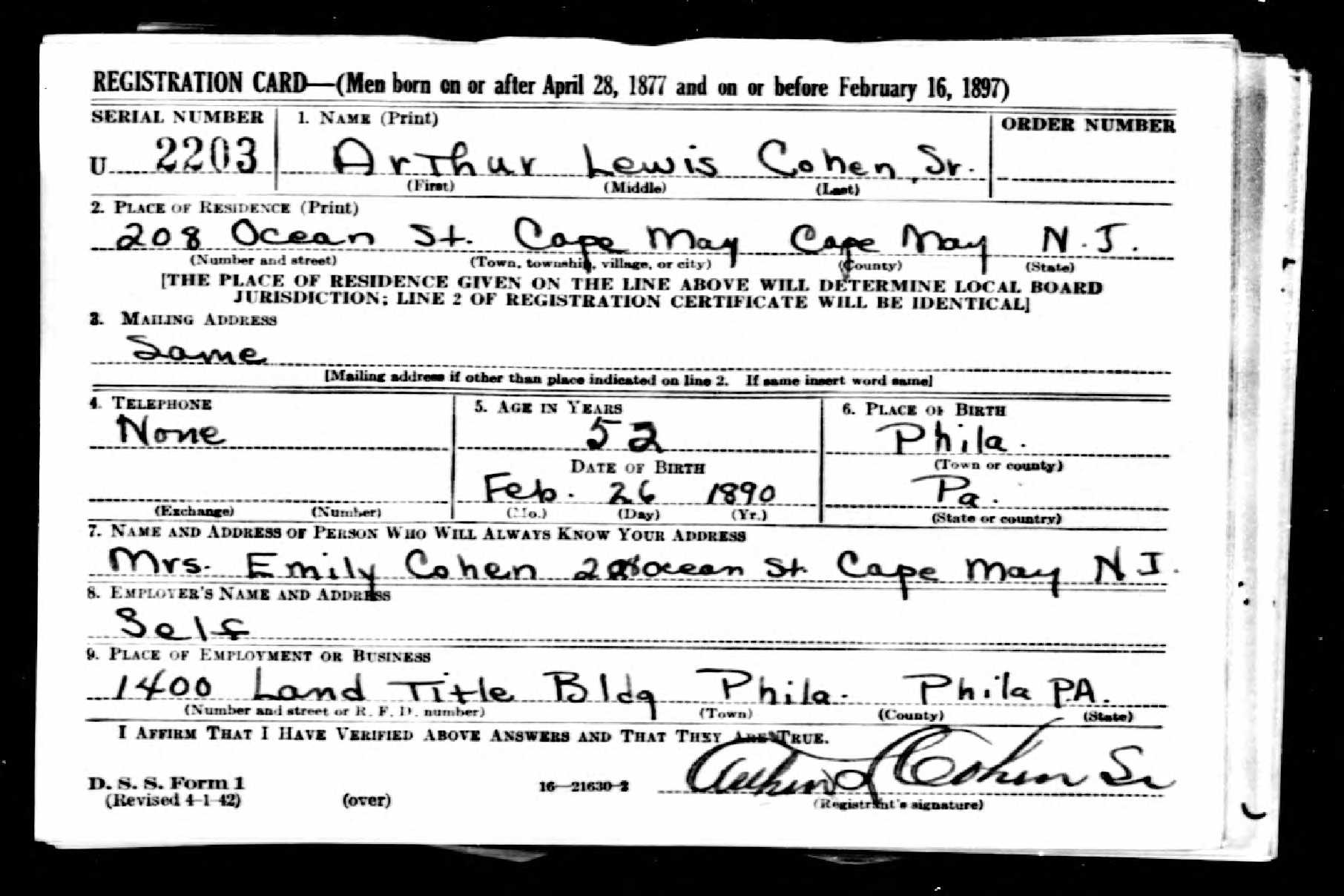
According to his 1917 World War I draft registration, Arthur was self-employed as an insurance broker, and he and his wife Gertrude were living in Philadelphia at 2250 North 20th Street.

Arthur LW Cohen, Sr. World War I draft registration

Arthur LW Cohen, Sr. World War I draft registration


Arthur enlisted in the Navy in April, 1918, and was honorably discharged in December, 1920.  By 1920, however, Gertrude was back in Richmond, living with her sister and identifying as single and working as a stenographer.

Gertrude Fanny Bowman 1920 census

Gertrude Fanny Bowman 1920 census

I cannot find Arthur on the 1920 census as he was serving in the military and perhaps overseas, but presumably the marriage with Gertrude was over.  Gertrude apparently never remarried and died in 1963 in Richmond.

Emilie Wiley Cohen

Emilie WIley Cohen

By 1930 Arthur had married a woman named Emilie Wiley, who had also been previously married.  Emilie had married Frank G. Brown in 1905 and had had two daughters with him, Dorothy, born in 1906, and Jean or Jenette, born in 1908.  Emilie also was divorced or separated by 1920, and sometime after the 1920 census she married Arthur LW Cohen.  They had two children, Arthur, Jr., and Emilie, who were 8 and almost 5, respectively, at the time of the 1930 census.

Living with Arthur and Emilie in 1930 in Philadelphia, in addition to their two own children Arthur, Jr. and Emilie,  were Emilie’s mother, aged 81, Emilie’s daughter Jean Harral, and Jean’s son Richard Harral, Jr.  Emilie’s older daughter, Dorothy (or Dot, according to my cousin) had married Leroy Lewis in 1928 in Norristown, Pennsylvania, and was living out that way in 1930.  She and Leroy had one daughter, and Dot lived in Norristown until her death in 1992.

Jean had also married sometime before 1927 when Richard Harral, Jr. was born.  Although she still listed her status as married in 1930, she was apparently no longer living with Richard Harral, Sr., who eventually remarried and lived in Upper Darby, Pennsylvania for the rest of his life with his second wife and their two children.

Sometime after 1930, Arthur and Emilie moved permanently to Cape May, New Jersey, where they lived in the house at 208 Ocean Street that had been in Arthur’s family for many years as the summer home of Reuben and Sallie and their children when Arthur was growing up.  Although I cannot find Arthur on the 1940 census, according to his World War II draft registration, he was still living at 208 Ocean Street in 1942 and was self-employed, working at the Land Title Building in Philadelphia.

ALWC ww2 reg

Arthur Sr’s grandson Jim believed that his grandfather had been a jeweler, but I cannot find any evidence of that in the records as it appears that at least up until 1942, Arthur Sr. was still working in the insurance business in Philadelphia. What Jim did share with me was that his grandfather was well-respected and loved by many people.  He was a very humble and generous man who never wanted recognition for his generosity.

Arthur, Sr, was also someone who fought off death several times.  According to Jim, “He was erroneously pronounced dead four separate times (shades of Simon), all as a result of heart attacks. According to stories told by my father and aunt, on one of the occasions he woke as an orderly was wheeling him to the morgue. When he did, the orderly fainted.  The fifth and final pronouncement was also from heart attack he suffered in the family home on Ocean St. This time, it was permanent.”

He died in 1955 at age 65 and was buried at Presbyterian Cemetery in Cold Spring, New Jersey, less than four miles from the family home at 208 Ocean Street.

His widow Emilie applied for a military headstone for Arthur and requested a Christian, not a Hebrew, symbol to be placed on that headstone.  Although his mother Sallie may not have been Jewish, as noted earlier, Arthur had been confirmed in Mickve Israel Synagogue in Philadelphia when he was fifteen years old.  Then again, his father Reuben had made a donation to the Episcopal Church in Cape May.  I asked Jim about the family’s religious affiliation, and he told me that he was not sure whether his grandmother Emilie was born Jewish, but that both of his grandparents practiced Christianity after they were married. Despite this, Jim said that his father, Arthur LW Cohen, Jr., was Jewish and Jim himself is Jewish.  As Jim described his parents’ approach, I was amazed by how inclusive his parents were in their approach, letting each of their children find a path that worked for them, each parent maintaining their own chosen path but also sharing in and respecting the other’s chosen path.   Apparently his grandparents had done the same.

Arthur L W Cohen, Sr. Military Headstone application

Arthur L W Cohen, Sr.
Military Headstone application

Jim was able to tell me a great deal about Arthur and Emilie’s children, Arthur, Jr., and his sister Emilie.  With his permission, I am quoting directly from his messages to me about his parents:

My father, Arthur, Jr. (“Bud”), was also a jeweler. After he came home from World War II, he opened a repair and retail jewelry store on the first floor of the family home at 208 Ocean St. in Cape May, NJ. It remained open for the next 48 years until his death in 1991.

Arthur Lewis Wilde Cohen, Jr.

Arthur Lewis Wilde Cohen, Jr.

He was very active in the Cape May community and loved the city dearly. He was president of the Mall Merchant’s Association for over 20 years, was instrumental in having the entire city declared a National Historic Landmark (it’s one of the few full towns registered as such) for its standing Victorian-era homes and history; and if there was any event – from silly pet parades to building dedications, Memorial Day ceremonies, Easter, Halloween, Christmas parades, and so on, you name it – he was always the Master of Ceremonies. He had a fatal heart attack in the early-morning hours of February 18, 1991.

My mother, Martha, was a music teacher and opera Soprano who attended the Juilliard School of Music. She retired from her opera career almost as soon as it started so that she could marry my father. She became a music teacher and sang at many events and functions. The Goodyear family always contacted her to sing at their family events – mainly weddings and funerals (which always amused me). She died in 2005 following a series of strokes.

He also told me this about his Aunt Emilie:

Aunt Emily Marion Cohen-Brown (who went by “Marion” or, as a nickname I’ve never understood, “Mitchell”), was a first-class florist and lived here in Cape May until her death from cancer in 2003. She had one son, Gary, who lived in Oregon and made unbelievable fudge. I know he had a wife and kids, but we’ve lost contact. He predeceased her, also from cancer. I never met her husband, Harry, who died before I was born. She made the absolute best Navy bean soup you could ever taste, and I wish I had the recipe.

Although not a genetic relative of the Cohens, the story of Arthur Sr.’s stepdaughter Jean Harral and her son Richard is part of the family lore of Arthur Lewis Wilde Cohen and his descendants, so I will share it here.  Richard was mentally disabled, and at some point he and his mother Jean moved to New York City together.  Richard was working as a messenger for a company in New York, and his favorite pastime was sailing a model sailboat on the pond in Central Park.  In November, 1975, he was stabbed to death, apparently by a friend.  I could find no record of a trial or further development in the case aside from these few news articles from the New York Times.

Richard Harral murder part 1-page-001


Richard Harral murder-page-001

In December, 1975, just a month after Richard’s murder, his mother Jean died; accordingly to family lore, she starved herself to death out of grief over the death of her son.

I am deeply indebted to my cousin Jim for sharing his family’s stories with me as well as the photographs posted here.  There is nothing more meaningful for me in doing this project than hearing about my long-lost relatives from those who knew them best.


Family Heirloom: Jacob’s Ring

Jacob-Ring-2

I was told by its current owner, my third cousin, that the ring depicted above is rose gold with an onyx table and diamonds in the initial.  I was also told that it once belonged to my great-great-grandfather Jacob Cohen, the successful Philadelphia pawnbroker, father of thirteen children including my great-grandfather Emanuel.  According to my third cousin, the ring was passed down from Jacob to his son Reuben, who gave it to his son Arthur Lewis Wilde Cohen, Sr., who then passed it on to his son Arthur Lewis Wilde Cohen, Jr., who gave it to his son, my third cousin, for his twenty-first birthday.  Jim shared with me the following story about the ring:

This ring is deeply important to me. The story behind it is as follows:

I found it one day while, as a kid who was doing precisely something he was told not to do (because, we do that kind of thing as kids), I was looking in my father’s jewelry cabinet in my parents’ room. For some reason the ring just grabbed me. I really loved it right from the start.

When I got older, and it actually fit closely enough to wear, I kept swiping it to wear it, and he would always catch me with it.

He’d give me the stern warning and ground me. I think he probably came to view this recurrent situation with some amusement. I think it was pretty obvious that I really had a thing for this ring, and if he had been truly angry the groundings would have been a LOT longer. So he must have known that, aside from swiping it, I wasn’t going to be irresponsible with it.

Then one day, I went to swipe it again, and it was gone. I thought, “I can’t believe he hid it!”

On my birthday, after our party, he took me aside, away from my twin brother and handed me a quite large box. It was covered all over in clear packing tape – and inside that was another box, and another, all wrapped in clear packing tape. Apparently, he wanted me to really work to get into the last box, and every time another box came into view, he laughed.

And then I got to the final box, opened it, and there was the ring. He had taken it, polished and cleaned it, replaced stones that had gone missing over the years, and sized it to fit my finger “for real.”

So yes, this was my 21st birthday present, and it meant a great deal on its own.

Then, he had a fatal heart attack two weeks before my 22nd birthday.

This ring, and its story and history, are the last birthday present I ever received from my father.

How lucky my cousin is to have something that once belonged to Jacob, our mutual great-great-grandfather.  I wish I knew more about the story behind the ring and more about the men who have owned it.  I wonder why Jacob gave it to Reuben of all his sons.  Or did each child inherit something similar from Jacob and Sarah? If my great-grandfather Emanuel did inherit a family heirloom, I have no idea where or what that would have been.

I’ve never been one to care about jewelry for its material value, but I care deeply about the sentimental value of any jewelry that has been given to me.  I have no idea what Jacob’s ring is worth in monetary terms, but to me the fact that it once belonged to my great-great grandfather, that it was once worn by my great-grandfather’s older brother Reuben and then by his son and grandson and now his great-grandson, makes it priceless in my eyes.  I’d gladly trade a new piece of jewelry worth far more in material terms for one small “worthless” trinket that had come from one of my ancestors.

Jacob-Ring-1


The Surviving Children of Reuben and Sallie Cohen, Part I: Minnie, Rae, Reuben, Jr., Lewis and Violet Mae

As I wrote last week, Reuben and Sallie Cohen had seventeen children, but ten of them predeceased their parents. Eight of the children died before they were four years old of various illnesses or, in the case of one child, as a result of a horrific accident.  Two of the children survived to adulthood, but then succumbed to illnesses in the early years of their adult lives.

That meant that Reuben and Sallie had only seven of their seventeen children alive when they died.  All but one of those children lived relatively full lives, living at least into their sixties if not beyond.  I will try and capture those lives, going in birth order.

The fourth child born after Sallie R., Jacob, and Hart, all of whom had died before their parents, was Minnie.  Minnie was born on September 25, 1882, and lived with her family in Philadelphia and Cape May.  On August 5, 1900, the Philadelphia Inquirer made this comment about Minnie in an article about summer visitors to Cape May:  “Miss Minnie Cohen is one of the prettiest girls at the resort.  Her bathing costume is always the picture of neatness.”  (“Cape May’s August Days,” Sunday, August 5, 1900, Philadelphia Inquirer (Philadelphia, PA)   Volume: 143   Issue: 36)

It was not until eighteen years later when she was almost 36 that Minnie married Harry Frechie in February, 1918.  The Philadelphia Inquirer had this to say about her wedding:

Minnie wedding

(“Matrimony Notice,” Friday, February 15, 1918, Philadelphia Inquirer (Philadelphia, PA)   Volume: 178   Issue: 46   Page: 10)  Mrs. S. Rosenblatt was her sister Rae, discussed below.  Violet Mae was her youngest sister, also discussed below.

Minnie and Harry were married for many years, but did not have any children. Like his father-in-law and many other family members, Harry was a pawnbroker. They appear to have traveled quite a bit, including a Caribbean cruise in 1939.  I have not yet been able to find a death record for Harry, but the 1950 Philadelphia city directory has a listing for Mrs. Harry Frechie alone, suggesting that Harry may have died sometime between the 1940 census and 1950. I also could not find a World War II draft registration for Harry, which could suggest he died before 1942.

UPDATE: With the release of the Pennsylvania death certificates through 1944, I am now able to update this post and the information regarding Harry Frechie.  Harry did die before 1942; he died on September 27, 1940.  No cause of death was given as there was a pending coroner’s inquest.  I will have to see if I can learn more about that.

Harry Frechie death certificate 1940

Harry Frechie death certificate 1940

At any rate, Minnie appears to have lived a life without much controversy as I cannot find any newspaper references to either Harry or Minnie aside from the wedding notice.  Minnie died in Philadelphia in 1977 when she was 95 years old.

Minnie’s sister and matron of honor, Rae, was the next child who survived.  She was born in 1886.  Rae married Samuel Rosenblatt in 1910.[1]  Sam was in the business of dress manufacturing according to the 1920 census, more specifically children’s dresses according to both the 1930 and 1940 census reports. They had one son, Samuel Rosenblatt, Jr., born in 1913, who died in July, 1933.  I have not found anything yet to explain why Samuel, Jr., died at such a young age.  The Philadelphia death certificates through 1944 are supposed to be online soon, so I am hoping to find out eventually what happened to Rae and Samuel’s only child.  Rae died in 1959 at age 73.  Her husband Samuel died in 1973.

UPDATE:  As noted above, I now have access to the Pennsylvania death certificates through 1944, including that of Samuel Rosenblatt, Jr.  Sadly, Samuel died from leukemia.

Samuel Rosenblatt, Jr. death certificate 1933

Samuel Rosenblatt, Jr. death certificate 1933


The next child of Sallie and Reuben Cohen to survive his parents was Reuben Cohen, Jr., born November 5, 1888.  Although at age 21 he was working as a clerk in a loan office according to the 1910 census, he appears not to have stayed in the pawnbroker business for his entire career.  In 1914, he married Leona Mayer, and according to the 1915 Philadelphia directory, he was a notary public by occupation at that time.  I don’t know how that would be a full time occupation, so perhaps he was still working in the “loan office” at that time as well.  In fact, on his World War I draft registration he listed his employer as his father, Reuben Cohen, Sr., so he must have still been working the pawnshop at that time.  In 1920, his occupation on the census is described as manager of a brokerage house, presumably a pawn brokerage, not a stock brokerage.  But in 1930 Reuben’s occupation was listed as a textile designer, and then in 1940 he is described as a salesman in textile manufacturing.  On his 1942 World War II draft registration, he listed his employment as “own business.”  Thus, it appears that Reuben, Jr., went out on his own and left the Cohen family pawnbroker business.

Reuben, Jr., and Leona had one child, Elinor Cohen, born in April, 1915, who married Melvin Beard.  I am now trying to contact their descendants.  Reuben Cohen, Jr. died January 28, 1958, when he was 69 years old.  His wife Leona died in 1970 at age 78.  Their daughter Elinor died thirteen years ago in 2001.

Reuben Jr.’s younger brother Arthur was the next sibling to survive their parents, but I am going to defer telling his story until I get a little more information from one of his descendants.

Of the seven surviving children, the one I have had the hardest time tracking is Lewis Cohen, who was born in September, 1892, the thirteenth child of Reuben and Sallie.  According to his World War I draft registration in 1917, he suffered from “nervous trouble.”

Lewis Cohen World War I draft registration

Lewis Cohen World War I draft registration


He was working as a real estate broker, and I was able to find a number of his real estate broker’s advertisements in the Philadelphia Inquirer as well as a news story about a large real estate transaction he brokered for a client in 1922.  On the 1920 census he was still living at his parents’ home at age 28, and as far as I can tell, he never married or had children.

It’s very odd, but I cannot find Lewis on either the 1930 census or the 1940 census, and at first I thought that perhaps he had died.  Then I found his 1942 World War II registration, in which he described himself as self-employed.  He was then living at the Roosevelt Hotel in Rittenhouse Square in Philadelphia, and his emergency contact person was a woman named Hilda Eskin, also at that location.

Lewis Cohen World War II draft registration

Lewis Cohen World War II draft registration

Where was he between 1920 and 1942?    I just cannot seem to find him. Is there any significance to the scar on his left wrist? To the fact that he was cross-eyed?  And who was Hilda Eskin? The only Hilda Eskin I could find in 1940 in Philadelphia was a divorced 45 year old woman, living with her parents; she owned a millinery shop.  She and her parents were living in 1940 at 329 South 63rd Street, about four miles west and across the Schuylkill River from the Roosevelt Hotel.  Since Hilda was not an employee of the hotel in 1940 and owned her own business, my hunch is that she was Lewis’ girlfriend in 1942, living with him at the Roosevelt Hotel.  I could not find Lewis living at that address in 1940.  I did find one Lewis Cohen as a prisoner at the Eastern State Penitentiary in Philadelphia whose age, birth place, and parents’ birth places all fit my Lewis Cohen, but then there were many Lewis Cohens living in Philadelphia who could have been the one in prison.  Maybe I can find something more about the person in prison?

The only other records I found for Lewis related to his death in November, 1964.  He is buried at Beverly National Cemetery in Burlington, NJ, as a veteran who served in the US Navy during World War I. So despite whatever the reference to “nervous trouble” meant on his draft registration for that war, he did serve in the Navy and was buried as a veteran of that war.  I will continue to look to see if I can fill the gaps in Lewis’ life and military service.

The youngest daughter of Sallie and Reuben Cohen was Violet Mae.  She was born May 7, 1895, and was living at home until 1921 when she married Abram E. Stern, who was born and lived in Washinton, DC.  Violet and Abram lived in Washington, DC, where Abram worked in the store fixture manufacturing business. They had two children in the years after they first married.  By 1940, they had divorced, and Abram was remarried.  Violet Mae died in December, 1974, in Silver Spring, MD, at the age of 79.  I am hoping I can track down her descendants and learn more about her.

Simon, the youngest child of Sallie and Reuben Cohen, did not live as long a life as the other six siblings who survived their parents. His story is another I will tell in a subsequent post once I get more information from one of Reuben’s descendants.

These five children of Reuben and Sallie Cohen all lived relatively long lives for those times and, in the case of Minnie, a very long life.    They all also lived lives that were, at least as far as I can tell, relatively trauma and drama free.  Yes, Violet was divorced, Rae lost her son when he was only 20, and certainly Lewis, Reuben, Jr., and Minnie must have also had some difficult times in their lives.  But given the family tragedies their parents endured, losing so many children, it is somewhat remarkable that these five led fairly quiet and, at least outwardly, regular lives.  But who knows what happened beneath the cold hard facts of census reports and city directories? Certainly losing ten siblings must have had some impact on these people.  Did Minnie not have children for fear of losing them as her parents had? Is that also why Rae and Reuben, Jr., each had just one child?  Did Lewis suffer from “nervous trouble” as a result of experiencing so many deaths?  I don’t know, but I have to believe that growing up as they did, seeing death occur over and over again, had to have affected all of them.


[1] There was also an entry on the Philadelphia marriage index for a Rae W. Cohen who married Isador Landau in 1913, but since I cannot find any other evidence of Mr. Landau and since Rae and Samuel Rosenblatt were together on the 1920, 1930, and 1940 census reports, I have to assume this was an error in indexing.

A Little More on Reuben and Sallie Cohen

Reuben Cohen

Reuben Cohen

Since ancestry.com was still not fully functional and I thus could not get access to many of the documents I need to complete the story of the children of Reuben and Sallie Cohen, I spent time  looking for news articles about the family on genealogybank.com, a site that has remained untouched by the attack on ancestry.  Here are a few interesting additional little peeks into their lives.

First, I was excited to find the picture above of Reuben Cohen published in the Philadelphia Inquirer on April 1, 1917, in honor of his birthday. (Sunday, April 1, 1917, Philadelphia Inquirer (Philadelphia, PA)   Volume: 176   Issue: 91   Section: News   Page: 2)  It’s always good to be able to visualize what someone looked like, and since I have not been able to locate many photographs of any of these relatives, this was an exciting find.

Reuben and Sallie were also at least twice the victims of crimes.  In 1885 Reuben was the victim of an assault and battery while trying to stop a thief.  He was commended by the judge for his conduct. The accused was sentenced to eighteen months in prison for stealing a $7 roll of cloth.  It’s not clear whether he stole it from Reuben’s store or whether Reuben was just trying to aid in his arrest. I also found it disturbing that the defendant’s race was mentioned for no possible relevant reason other than the blatant racism of those times. (” Civil and Criminal. Suits and Prosecutions from the Court Reports,”  Wednesday, November 11, 1885 Philadelphia Inquirer (Philadelphia, PA) Volume: CXIII Page: 3 )

reuben assault story


Then in 1903 Reuben and Sallie were themselves the victims of theft when a household employee of theirs stole a diamond ring in a “grip” belonging to Sallie when she asked him to carry it for her when she returned to Philadelphia from Cape May.  The accused admitted the theft and also admitted that he had been stealing from the Cohens for some time.  (“Says He Stole Jewelry,” Sunday, August 30, 1903, Philadelphia Inquirer (Philadelphia, PA)   Volume: 149   Issue: 61   Section: First   Page: 6)


jewelry stolen


Finally, I was puzzled by this news item, describing a donation by Reuben to the Episcopal Church in Cape May of a silver plate to be used for communion.

church donation

Why was Reuben making a gift to the church?  Although Sallie may not have been Jewish, it does seem that they raised their children as Jews for here is an article announcing the confirmation of their son Arthur at Mickve Israel synagogue. (“A Minute’s Chat,” Wednesday, February 25, 1903, Philadelphia Inquirer (Philadelphia, PA) Volume: 148 Issue: 56 Page: 8 )

arthur confirmation

In addition, Reuben, Sallie, and all of the ten children who predeceased them are all buried in Mickve Israel cemetery.  Was this just a generous gift to an important institution in Cape May? Or were the Cohens also church members? Perhaps I can do some research of the church records to find out more.

There were also other articles about anniversary parties, trips to Cape May, and other family events and celebrations. This series of news stories reveals a little more of Reuben’s character and of his social and financial standing in the Philadelphia and Cape May communities.  It also reveals that despite all the heartbreak his family endured, they also continued to prosper socially and economically and apparently to enjoy life.

An Important Clue Buried in A Wedding Announcement

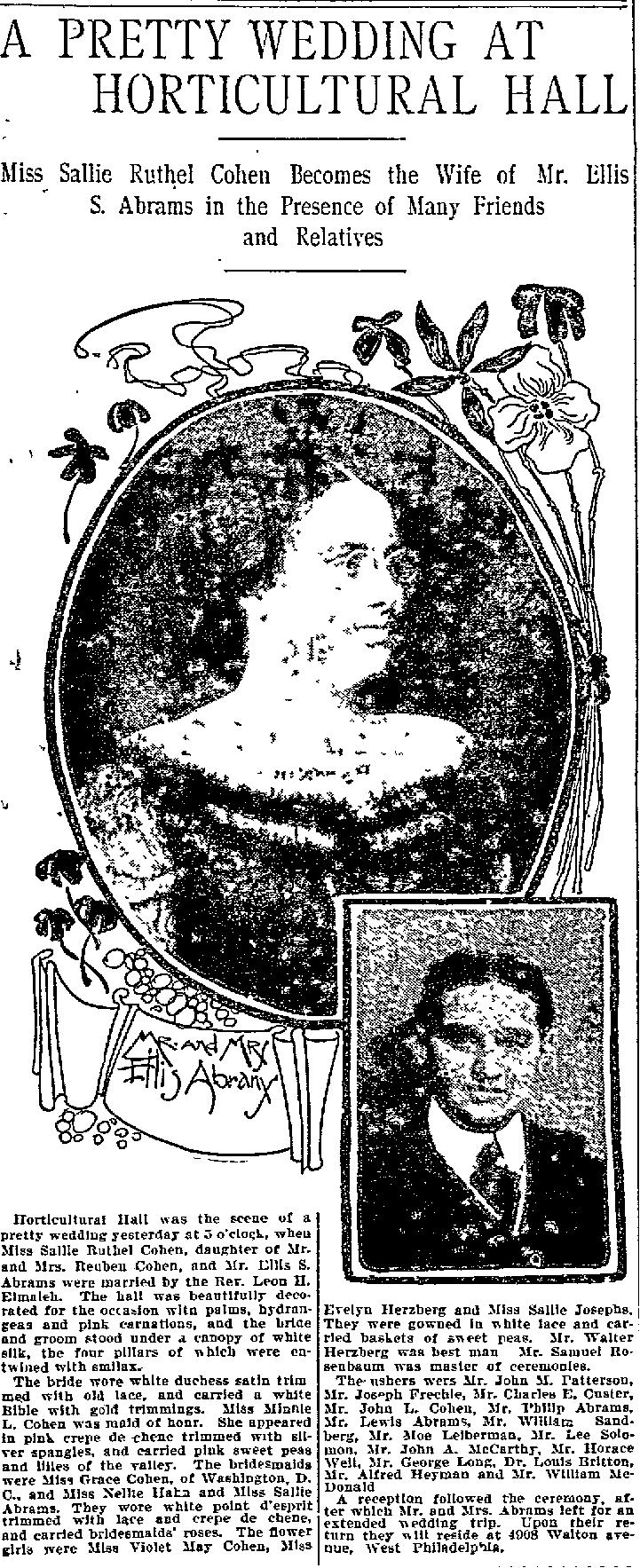
As I was finishing up my research on Sallie R. Cohen and her life, I found this article in the Philadelphia Inquirer about her wedding:

Sallie R. Cohen and Ellis Abrams wedding story

Sallie R. Cohen and Ellis Abrams wedding story

(“Matrimony Notice,”  Tuesday, May 22, 1900,Philadelphia Inquirer (Philadelphia, PA) Volume: 142 Issue: 142 Page: 2)

Not only does this provide further evidence of the social and economic success of Reuben and Sallie Cohen, it also provides a very important clue to one of my biggest questions about the Cohen clan.  Remember the two Hart Cohens that had me confused a few weeks ago—one in Philadelphia and one in Washington, DC? After much searching and thinking I had developed a strong hunch that they were first cousins and that Jacob Cohen of Philadelphia and Moses Cohen, Sr., of Washington were brothers, both sons of my great-great-great grandparents Hart Levy Cohen and Rachel Jacobs.  I am in touch with Moses Cohen’s descendant Scott, and we are awaiting DNA test results to see whether he and my brother share enough DNA to conclude that we are all in fact descended from Hart Levy Cohen.

But now I have another fairly persuasive bit of evidence linking the Moses Cohen family in DC to my Philadelphia Cohens.  If you can read the announcement, you will see that one of the bridesmaids is Grace Cohen of Washington, DC.  Grace Cohen was the daughter of Moses Cohen, Jr., and his wife Henrietta.  She was born in 1877, two years before Sallie R. Cohen, daughter of Reuben Cohen, and was  thus her second cousin, assuming that Jacob and Moses were brothers and thus their respective sons, Reuben and Moses, Jr., were first cousins.

This is the kind of almost accidental discovery that just makes my day.  It’s the kind of thing that I could easily have missed or read and not thought about carefully.  Although the DNA test results may provide more scientific evidence that DC Moses and my great-great grandfather Jacob were brothers, this little tidbit in a wedding announcement is certainly fairly persuasive evidence on its own.

Elizabeth Cohen 1859-1923: Twists and Turns in Life and in Genealogy

In my post about Hannah Cohen, I wrote about how difficult it can be to research a woman’s life once her name was changed at marriage.  Some women, like some of the Rosenzweig women, I have not yet found at all.  Sometimes, as when marriage records are searchable by a bride’s name, it is relatively easy.  And sometimes it just takes a little luck and some good hunches to find her married name. In the case of Elizabeth Cohen, the ninth child and youngest daughter of my great-great-grandparents, it took both some good hunches and a lot of luck.  It also involved some misdirection and some confusion.

Elizabeth was born on December 25, 1859, in Philadelphia.  When I did a search for records for her on ancestry.com, she appeared with her parents on the census reports of 1860, 1870, and 1880. But then I could not find anything for an Elizabeth Cohen after those reports until I happened upon her death certificate.  It’s odd to find the death certificate first, to see how a life ended before knowing the earlier years, but her death certificate appeared because it had her father’s name on it.  Ancestry.com had the certificate listed under both her birth name (Elizabeth Cohen) and her married name, “Shirzer.”   At least, that’s how it was spelled on the ancestry index. I was certain that this was the right person based on her father’s name, his birthplace, her birthplace, and her age.  I also thus knew that she had been related, perhaps married, to someone named Bernard Shirzer, the informant on the certificate.

Elizabeth Cohen death certificate 1923

Elizabeth Cohen death certificate 1923


I then started searching for her as Elizabeth Shirzer and also searching for Bernard Shirzer.  I found nothing under either name, but wild card searches led me to the 1900 census where they were indexed as Sluizer and the 1920 where they were indexed as Shezer.  I stared and studied the handwriting on the death certificate and these two census reports, but still wasn’t sure which, if any, of these were their actual names.  I was able, however, to learn the names of their children.  In 1900 they were living with three children: Florence (15), Herbert (10), and Mervyn (3).  In 1920 Bernard and Elizabeth were empty nesters, living alone.  I could not and still have not find them in 1910.

Elizabeth and Bernard Sluizer 1900 census

Elizabeth and Bernard Sluizer 1900 census

Elizabeth and Bernard Sluizer 1920 census

Elizabeth and Bernard Sluizer 1920 census

From the ages of the children, I assumed that Bernard and Elizabeth had to have married sometime before 1885.  I could not locate a marriage record in the online index, but since the index available online starts in 1885, that did not trouble me.

I decided to search for the two sons to see if I could find something that would confirm which name was the actual name, and since Mervyn seemed relatively unusual, I focused on him, and using again various wildcard searching techniques, found several records, including his draft registration forWorld War II with the name spelled Sluizer that also included his father’s name, Bernard Sluizer.  The birth year and place and the first name and Bernard’s name were sufficient clues to confirm that the name was Sluizer.

Mervyn Sluizer World War II draft registration

Mervyn Sluizer World War II draft registration

I then went back to look for Bernard Sluizer to be sure this was the right one and found some early records for him that also seemed to corroborate that this was the correct name and thus Elizabeth Cohen’s married name.  But then I found a record on the marriage index showing that Bernard Sluizer had married Elizabeth Heyman in 1892.  It seemed so unlikely that there were two Bernard Sluizers married to Elizabeths that I was truly confused.  Could the name on the marriage index be wrong?  Of course, it could.  But how could the date also be wrong? Bernard had to have married Elizabeth before 1885 if Florence was born in 1885.

The other problem was that I could not find any record for either Florence Sluizer or Herbert Sluizer after 1900.  Not being able to find Florence was not troubling; I assumed she married and had changed her name.  But where was Herbert? I couldn’t find one trace—not a draft record, not a marriage record, not a death record.  Nothing. I was mystified.

I figured it was worth a search on genealogybank.com for newspaper articles that might reveal more about the Sluizers.  And that’s where luck helped me out.  Searching for Bernard Sluizer, I found an article about a charity raising money for the Doylestown Farm School, and listed among the donations was a reference to a donation by Bernard Sluizer in memory of his son, Herbert Heyman. (“$50,000 Donated to Aid Progress of Farm School Donations for Doylestown Institution One Feature of Anniversary,” Monday, June 10, 1907, Philadelphia Inquirer (Philadelphia, PA) Volume: 156 , Issue: 161, Page: 4, 1 )  Herbert Heyman? How could he have a son with a different surname?  Sons don’t change their names.

When I searched for Herbert Heyman, knowing he had died before June 10, 1907 , the date of the newspaper article, I found his death certificate, which identified his mother as Elizabeth Cohen, but his father as Benjamin Heyman.  Who was he??

Herbert Heyman death certificate

Herbert Heyman death certificate

My search then for Benjamin Heyman uncovered a death certificate for someone of that name who had died of uremia on July 23, 1890, at age 30.

Benjamin Heyman death certificate

Benjamin Heyman death certificate

This must have been Elizabeth Cohen’s first husband.  It explained both of the confusing records.  Bernard Sluizer had married Elizabeth Heyman; that was her married name when she married him, but she was born Elizabeth Cohen.  And Bernard Sluizer had been in many ways, even if not legally, the father of Herbert Heyman because he had married Elizabeth in 1892 when Herbert was only three years old.  Herbert’s biologicial father Benjamin had died when he was only a year old.

Having finally found all the little pieces of the puzzle, I think I now have the story of Elizabeth’s life.  She must have married Benjamin Heyman sometime before 1885 and had two children with him: Florence, born in 1885, and Herbert, born in 1889.  Then her first husband died in 1890, leaving her with two very young children.  She married Bernard Sluizer in 1892 and had a third child, Mervyn, with him the following year.  The 1900 census indicates that Bernard was a salesman; the 1920 census is more specific—a salesman for a pawnbroker.  Another relative in the family business.

Having lost her first husband so tragically young, Elizabeth then endured a second terrible loss when her son Herbert died from pneumonia in 1906 when he was sixteen.  What a sad, short life he had lived, losing his father when he was not even two years old and dying before he was seventeen years old.

Elizabeth herself died on September 28, 1923, when she was only 63 years old from “cancer of the womb.” Her husband Bernard continued to work as a pawnbroker and was living with their son Mervyn and his wife and children in 1930.  Bernard had remarried in 1928, but appears not to have been married as of the time of the 1930 census.  He died on September 2, 1944, at age 84.

Elizabeth’s life story, like those of so many other women, would have disappeared, and I might never have been able to figure it out, if not for the fact that her husband Bernard Sluizer made a donation to a charity in memory of his stepson Herbert Heyman.  If there had been no such donation, I might never have been able to figure out that Elizabeth had had a first husband who died at a very young age leaving her with two young children.  I would never have been able to figure out that the Elizabeth Heyman who married Bernard Sluizer was born Elizabeth Cohen but for the fact that her son Herbert Heyman died and her birth name was on his death certificate.  So in a very sad twist of fate, the fact that Herbert died so young enabled me to preserve the story of not only his life but that of his mother, my great-grandaunt Elizabeth Cohen.

My Great-Great-Grandparents’ Marriage Certificate: Small Details Reveal So Much

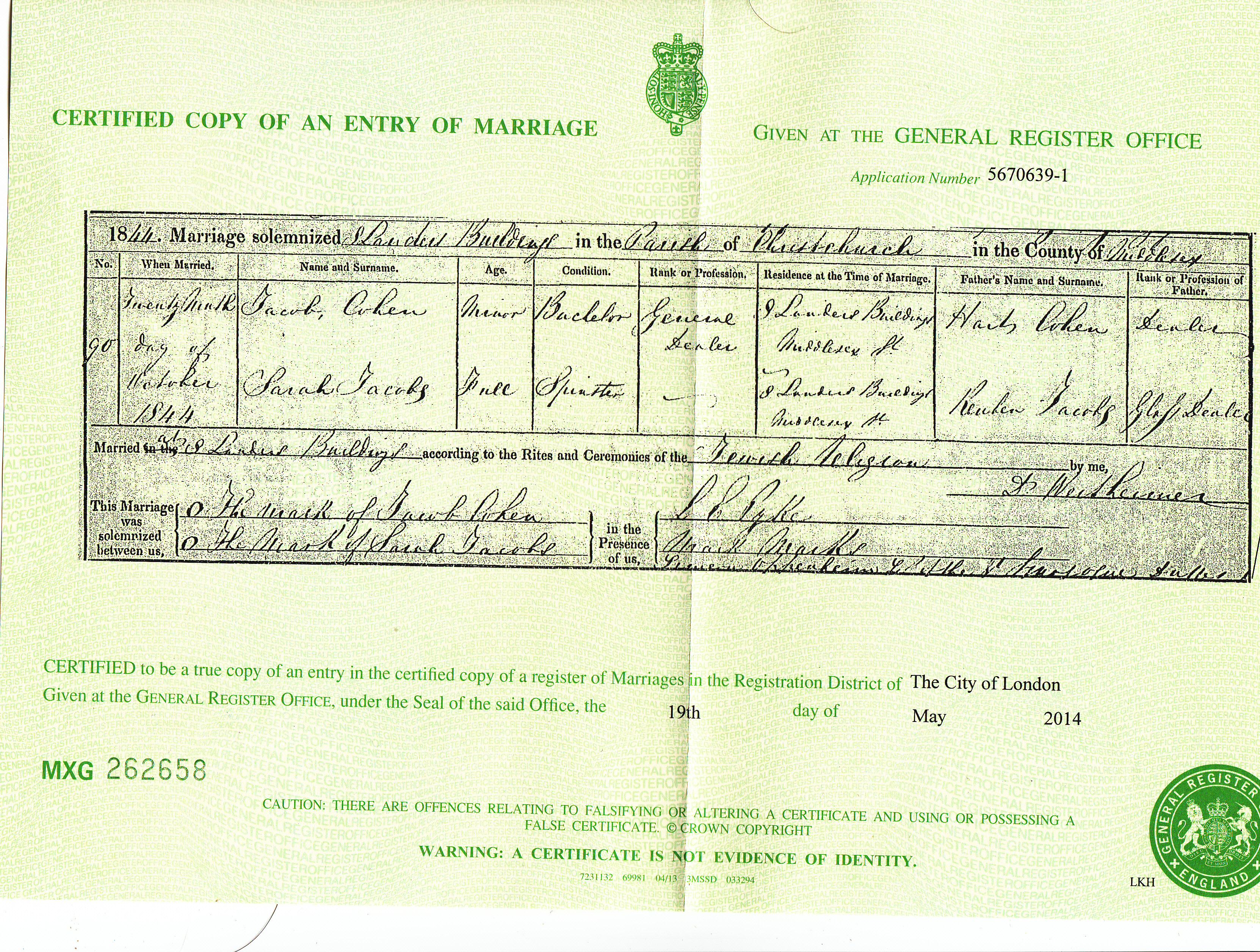
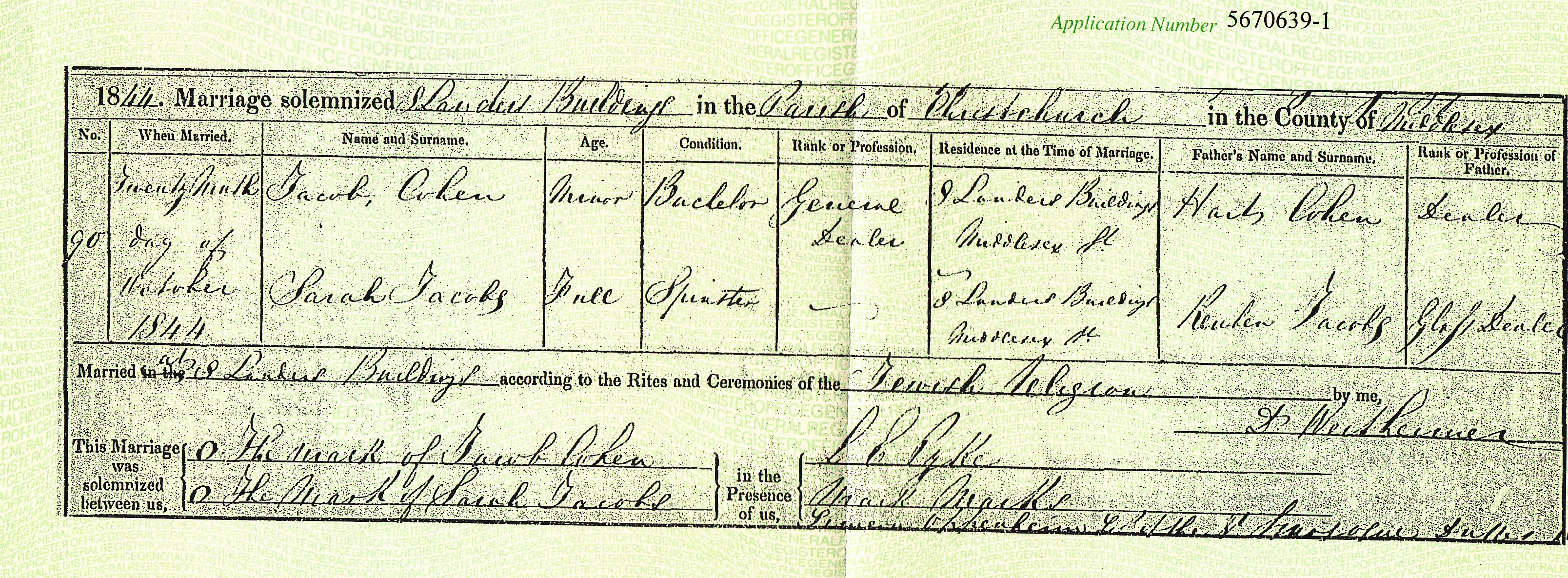
As I celebrate the newest member of my extended family, I am also thinking about my great-great-grandparents, Jacob and Sarah Cohen.  A while back I had sent for their marriage certificate from the General Register Office in England, and the certificate arrived just a few days before Remy was born.  It confirms a number of facts I already knew—that Sarah’s birth name was Jacobs, that her father’s first name was Reuben, that she and Jacob married on October 24, 1844, that Hart, Jacob’s father, was a dealer as was Reuben Jacobs, Sarah’s father (a glass dealer?) and Jacob himself, and that they all lived in Spitalfields, Christchurch, Middlesex County, in England.  But the marriage certificate also revealed a few other interesting details.

Jacob Cohen and Sarah Jacobs marriage certificate

Jacob Cohen and Sarah Jacobs marriage certificate

For example, according to the certificate, Jacob was still a minor, but Sarah was of “full” age.  All the documents I have for Sarah, both from England and the US, place her at least two years younger than Jacob.  I wondered: Was the age of majority younger for women in England in 1844 than it was for men?  The 1841 census puts Rachel’s age that year as 15, meaning she was 18 when she married Jacob, whereas Jacob was only 20.  (When I think about how young they were and then how many children their marriage produced and how many years they were married, it is astounding.)

I did a little research and learned that although a girl could marry at 12 and a boy at 14, parental consent was necessary if either was under 21.  Both men and women were considered minors before they were 21; there was not a double standard.[1] That leaves me perplexed. Was Rachel older or younger than Jacob?  Was the marriage certificate right and all the other documents wrong? One would think that a marriage certificate would be more accurate than census reports, but perhaps this was just a mistake.

Sarah and Jacob marriage cropped

The certificate also indicates that, as with Hart Levy Cohen on his wife Rachel’s death certificate, Jacob and Sarah could not sign the document, but only left their marks on it.  Another question is thus raised: how literate was the population of England at this time?

A little quick research revealed that the literacy rate in England in 1840 was somewhere between 67% and 75% for the working class population.[2]  Another source indicated that based on the ability of brides and bridegrooms to sign their marriage certificates, the literacy rate was even lower among women at that time—around 50%, .  That same source, however, suggested that since writing was taught after reading, simply because someone could not sign his or her name did not mean that he or she could not read.[3]

A third interesting detail on the certificate is that it appears that both Jacob and Sarah were residing at 8 Landers Building at the time they were married.  Since it is not likely they were living together before they were married, this would mean that their families were living in the same building.  Were they childhood friends?  Had their parents as neighbors arranged the marriage? Were they all related in some way? It also appears that the marriage had taken place at this same location, not at a synagogue.  But the record from Synagogue Scribes indicated that they were married at the Great Synagogue, as were Hart and Rachel.  I assume that this was this just a civil certificate completed to comply with civil, not religious, law.  I find it interesting that it states that the ceremony was done “according to the rites and ceremonies of the Jewish religion” despite the fact that it is not a religious document.

It is quite amazing to me how much information and how many questions can be mined from one simple document.  Receiving this document was very exciting, as with receiving Rachel’s death certificate from England.  It ties me directly to my ancestors—people who were born almost 200 years ago, but with whom I have a direct and easily established connection.


[1] See the discussion on RootsChat at http://www.rootschat.com/forum/index.php?topic=643885.0 and also at BritishGenealogy.com at http://www.british-genealogy.com/forums/showthread.php/57256-Age-at-Marriage-Minor

[2]  R.S. Schofield, “Dimensions of Illiteracy in England, 1750-1850) in Literacy and Social Development In the West: A Reader (edited by Harvey J. Graff) (1981), p.201.

[3] “Introduction,” Aspects of the Victorian Book, at http://www.bl.uk/collections/early/victorian/pr_intro.html

Enhanced by Zemanta

Hannah Cohen 1858-1927: A Life to Remember

The further I delve into the story of my ancestors, the more aware I am of how much the lives of women have changed in the last 100 years—actually, more like the last 50 years, but since I am focusing on the women born between 1850 and 1900 right now, the 100 year line seems more appropriate.  I’ve said numerous times that women are harder to research because they changed their names when they married.  If you cannot figure out who they married, then they just disappear and their stories are never completed.

I obviously have a personal perspective on the question of taking on a new name when you marry.  When I married back in 1976, most women still took their husband’s names when they married, but some women were starting to resist and keeping their birth names.  Some women argued that keeping your father’s name was just as much a concession to male dominance as taking your husband’s name.  I struggled with this issue; I was never a radical or a pioneer.  But in the end, I wanted to keep my name.  My reasons were varied; some of it was definitely based on the values of the women’s movement that was exploding around me during my years in college.  Mostly, however, it was just about holding on to my identity, the one I had had for over twenty years.  How could I not be Amy Cohen?  It just felt wrong.

So I kept my name.  And despite the occasional strange looks I got (and sometimes still get) from people who think it odd and despite the awkwardness of making calls on behalf of my children and having to use two different surnames to identify who they were and who I was, I am very glad that I did.  Especially now when I see how many women disappeared into thin air historically when they changed their names, I realize how much it can matter to have your own identity, including your own name.

In the case of Jacob and Sarah Cohen’s daughters, I was actually able to figure out their married names, and so they did not disappear into thin air.  Sometimes it was really easy to find them because there was an entry in the online marriage records that revealed both the groom’s and bride’s names.  Other times it was rather serendipitous.

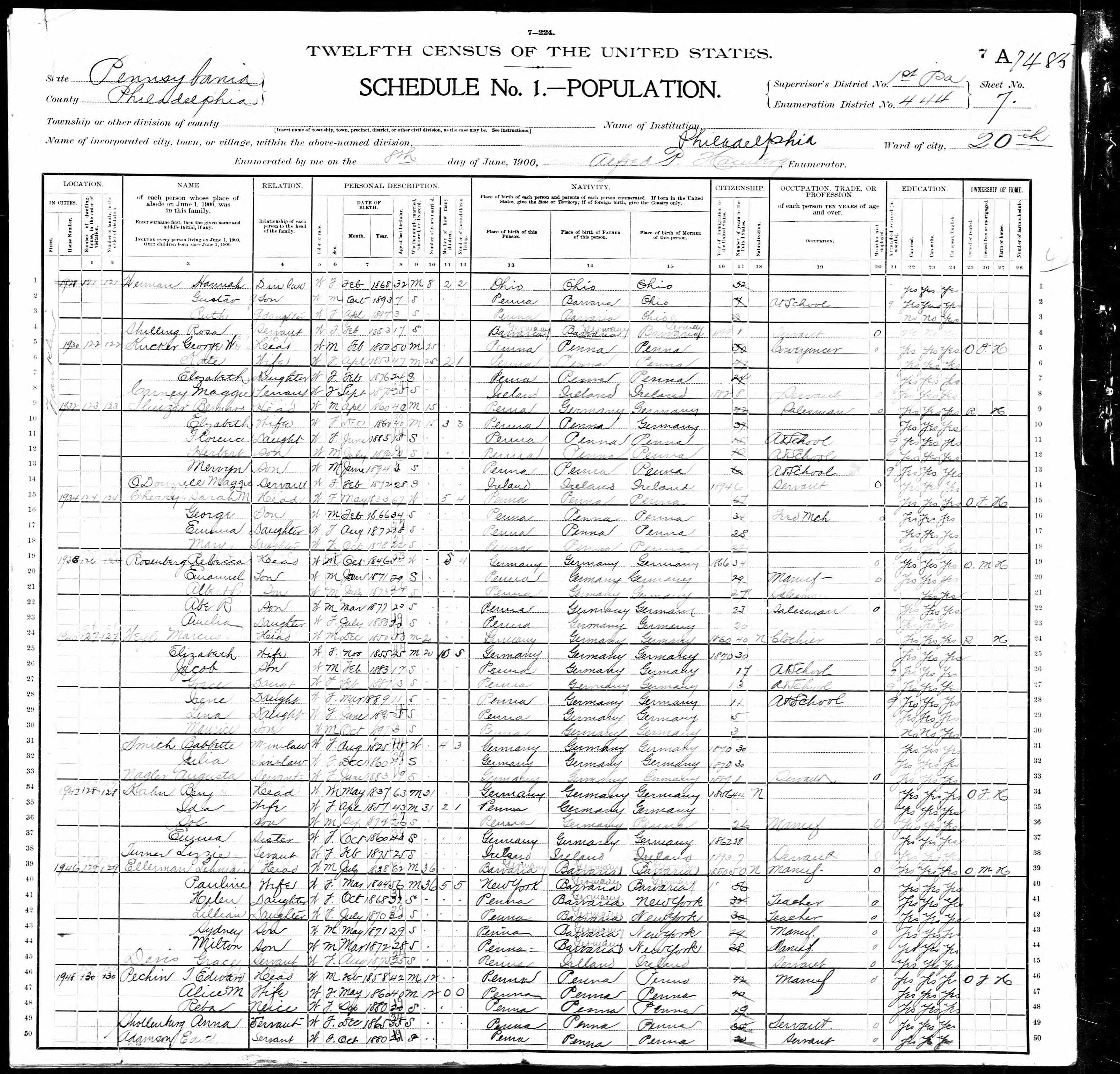
For example, in the case of Hannah Cohen, Jacob and Sarah’s eighth child, it was a tiny little death notice for Hannah’s troubled brother Hart that caught my eye.  I wasn’t even researching Hannah at the time, but the death notice made reference to calling hours for Hart being at the home of Mrs. Martin Wolf.  I thought that Mrs. Martin Wolf might very well be one of Hart’s many sisters.  I searched for Martin Wolf on ancestry.com and FamilySearch, and I found one in Philadelphia on the 1900 census with a wife named Hannah.
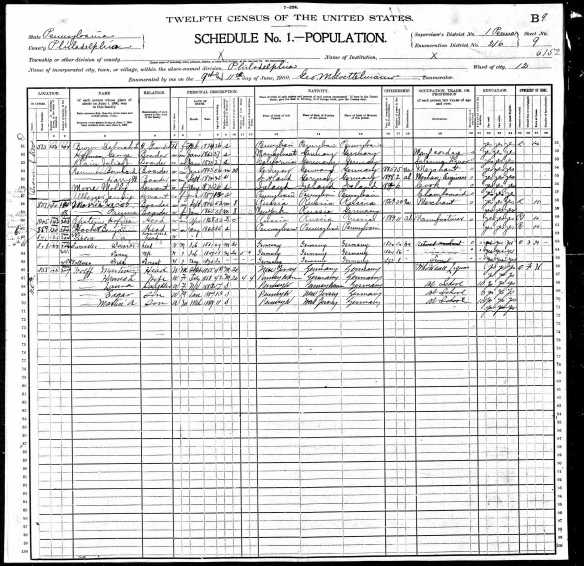
Hannah and Martin Wolf and family 1900 census

Hannah and Martin Wolf and family 1900 census


According to the 1900 census, Martin and Hannah had been married for 20 years.   Hannah’s birth year on the 1900 census was consistent with earlier census reports.  Martin and Hannah had three children living with them in 1900: Laura (1882), Edgar (1885), and Martin A. (1889). Martin was in the wholesale liquor business, apparently his family’s business as the city directories list him as working for S. Wolf and Sons, and Martin’s father’s name was Solomon Wolf.  It appears that he worked for this business for all or almost all of his adult life.

As I was researching Hannah and Martin’s life, at first it seemed that their life would be like Hannah’s sister Rachel’s life—fairly uneventful.  But as I researched more deeply, unfortunately it seemed her life had plenty of unhappy events, though not as overwhelmingly sad as that of her sister Maria.

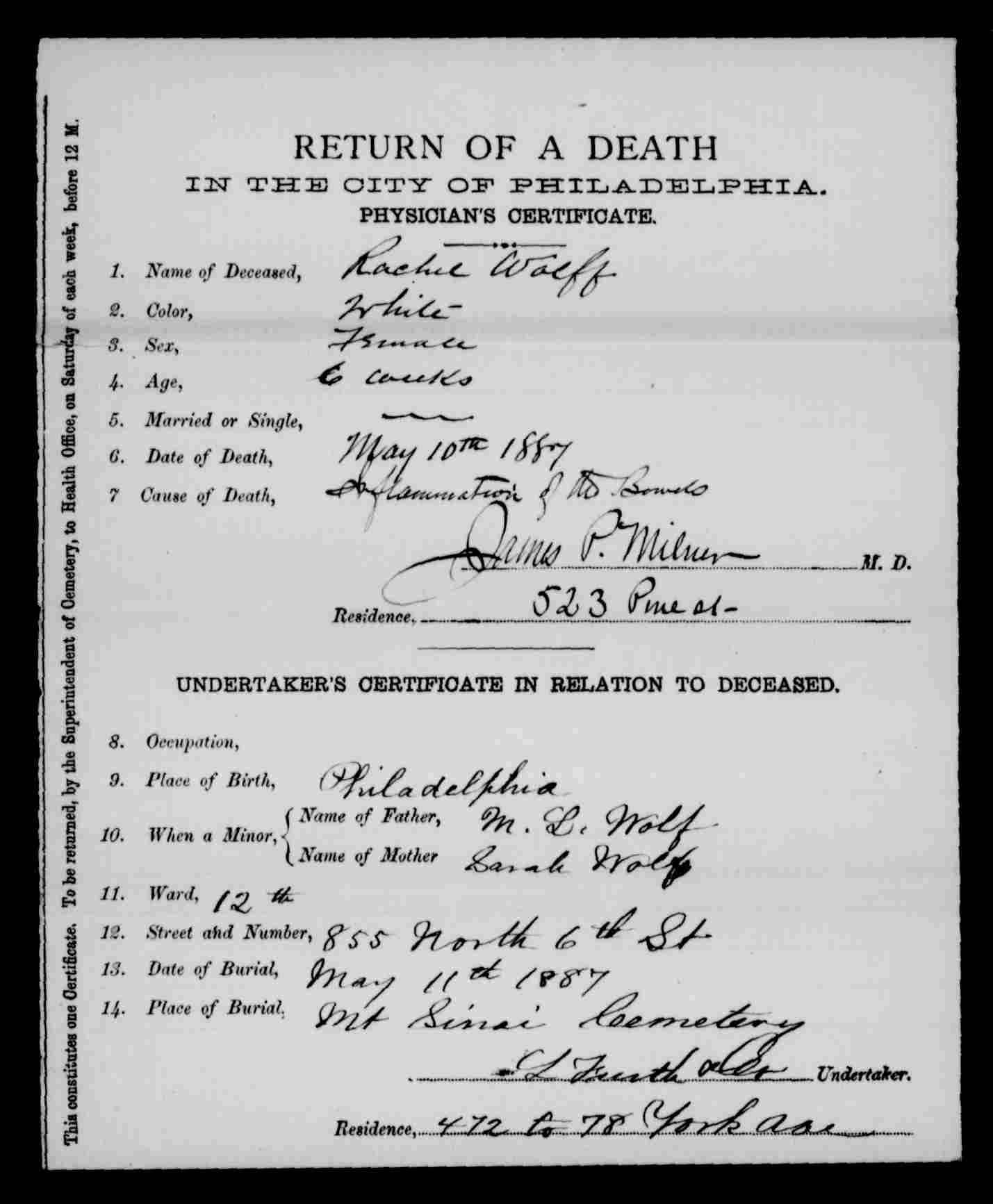
First, I saw on burial records at Mt Sinai that there was an entry for a fifteen day old infant “Ray Wolf” who died in 1887 located in the same lot as Hart Cohen (Hannah’s brother) and other members of the Wolf family.  I found a death certificate for a Rachel Wolff who died on May 10, 1887, at six weeks, daughter of M.L. Wolf and Sarah Wolf, living at 855 North 6th Street, the same address in the city directory for Martin L. Wolf of S. Wolf and Son in that year.  Despite the error in the mother’s name and the inconsistent age at death, this is obviously the child of Martin and Hannah.  Little Rachel died of inflammation of the bowels.
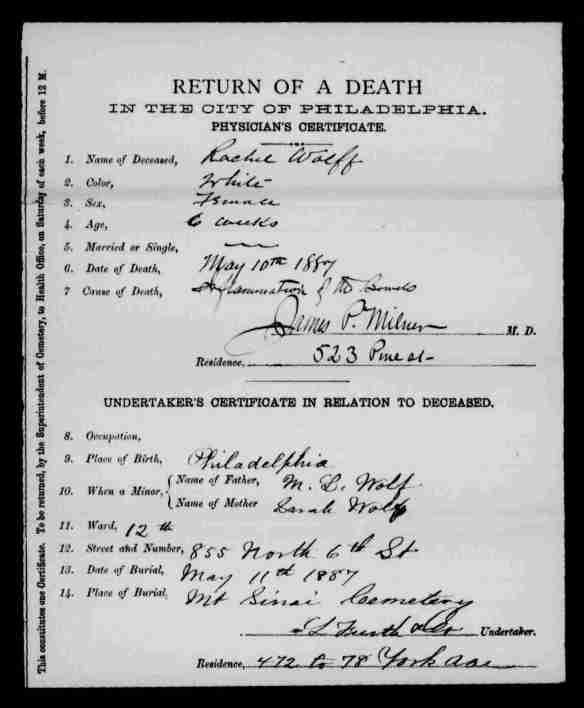
Rachel Wolf death certificate 1887

Rachel Wolf death certificate 1887

Those same burial records also included an entry for a Carrie Wolf, aged three years, who died in 1894.  Once again, further research revealed another terrible loss for Hannah and Martin.  Their daughter Caroline died from typhoid fever, the disease that had also killed two of her first cousins, a child of Fanny and Ansel Hamberg and a child of Joseph and Caroline Cohen.  If little Caroline was named in honor of her aunt Caroline, that must have been an awful irony to see her niece die from the same disease that had killed their son Hart.
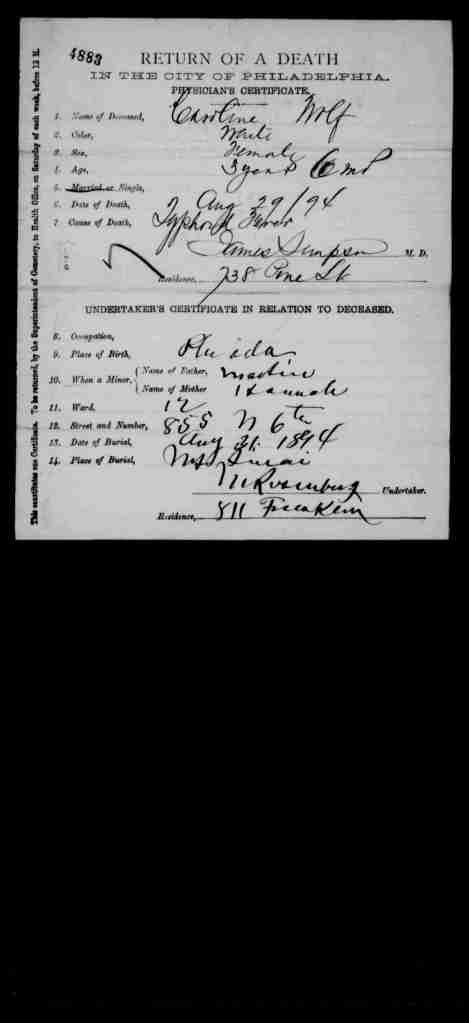
Caroline Wolf death certificate 1894

Caroline Wolf death certificate 1894

So between 1887 and 1894, Hannah and Martin had lost two young children.  Somehow they continued on, Martin continuing to work in his family’s liquor business and Hannah home with the remaining children, who by 1900 ranged in age from 11 to 17.  In 1901 and 1902, the family was living in Atlantic City, where Martin was still involved in the liquor business.  Perhaps his family business was expanding, or perhaps the family just needed a change of scenery.  Laura, their oldest daughter,married Albert Hochstadter in 1901 when she was nineteen years old.  Albert was a hotel proprietor in Atlantic City, so perhaps she had met him while her family was living there.  Albert and Laura had a son, Martin Hochstadter, born in 1904.

It might have seemed that life had settled down and that the worst was over, but then there were more changes and losses ahead.  On the 1910 census, Laura, married only nine years before, was living at home with her parents (who had returned to Philadelphia by 1903) and, according to the census report, widowed.
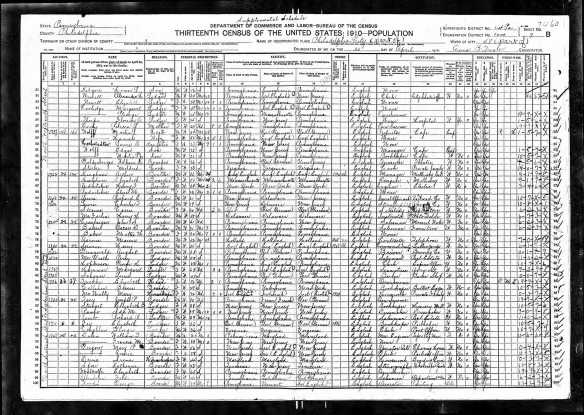
Hannah and Martin Wolf and family 1910 census

Hannah and Martin Wolf and family 1910 census

At first I thought, “How awful.  Her husband died before they were married ten years,” but I said she was widowed “according to the census report” because I found a death certificate for Albert Hochstadter, dated June 5, 1912. Albert was still alive at the time of the 1910 census when Laura claimed to be a widow.  Moreover, his death certificate says that he was divorced.  Did Laura lie to the census taker, embarrassed to be divorced, or did the census taker just get it wrong? At any rate, it’s a bit eerie that Albert did in fact die just two years later when he was only 46 years old.  His cause of death was reported to be uremia.
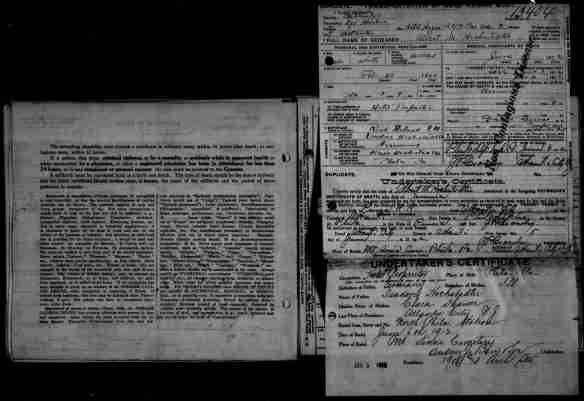
Albert Hochstadter death certificate 1912

Albert Hochstadter death certificate 1912

Laura had quickly moved on and was already remarried by the time her first husband Albert had died.  On the 1910 census, when Laura was living with her parents in Philadelphia, there was a boarder living there named William K. Goldenberg who was a treasurer for a theater.  Within a year, Laura had married William, and by 1920, Laura, William, and Laura’s son Martin Hochstadter were living together.  William had advanced to become the manager of the theater, an occupation he continued to hold for many years.
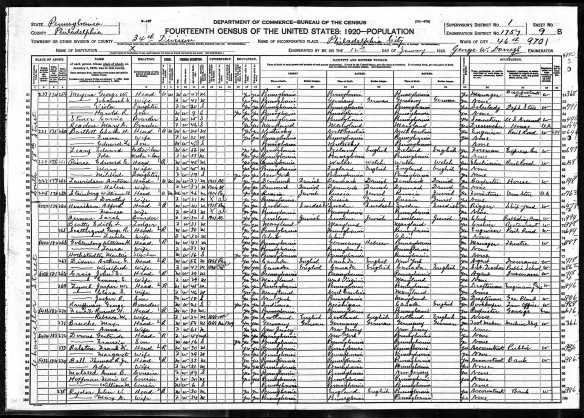
Laura and William Goldenberg 1920 census

Laura and William Goldenberg 1920 census

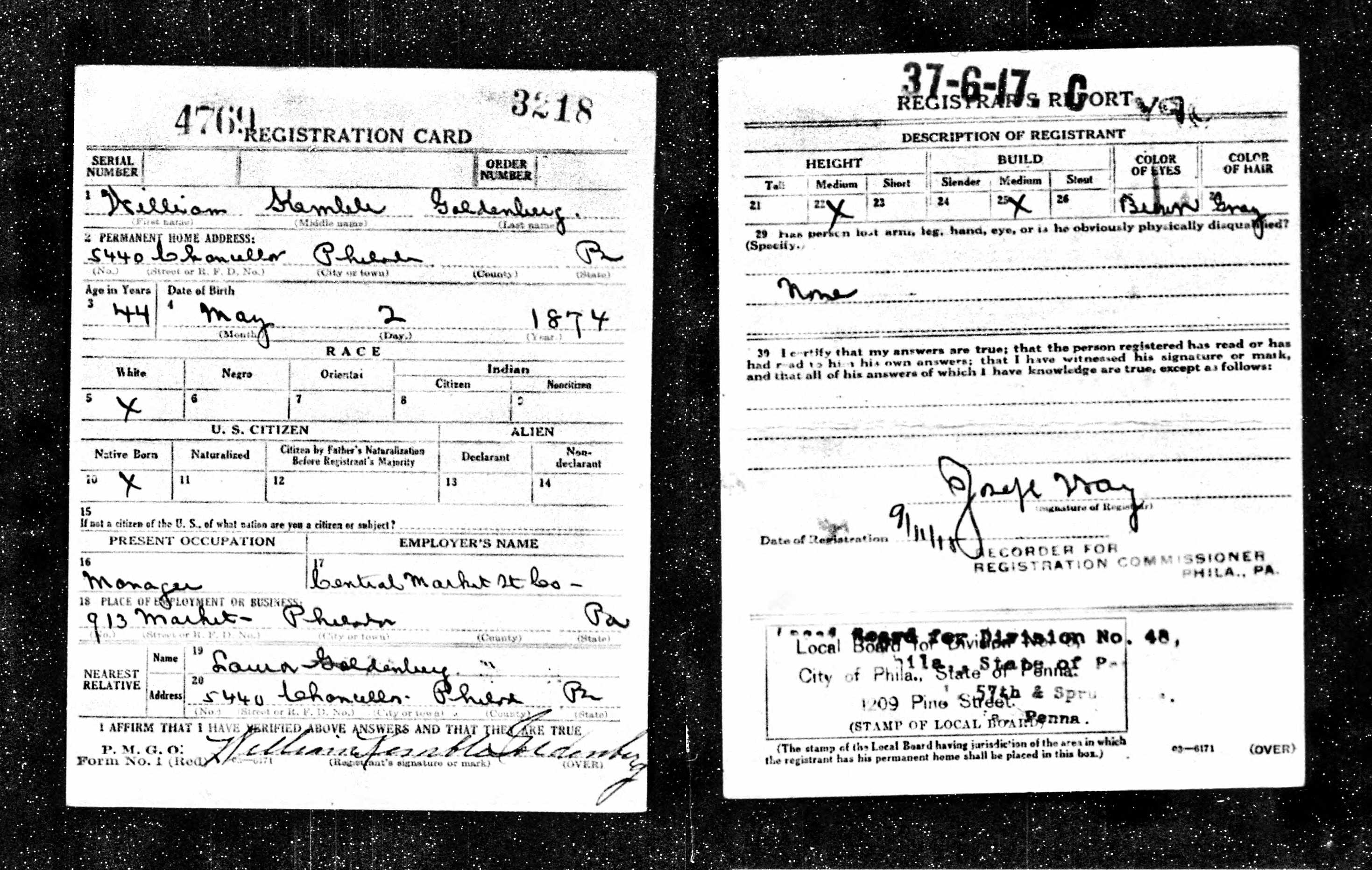
Both of Martin’s sons registered with the draft, and both were employed at the Central Market Street Company at the time of their registration, as was their brother-in-law William Goldenberg.  I assume that that was the company that owned the theater where William was the manager.  It seems he took good care of his brothers-in-law by providing them with employment.
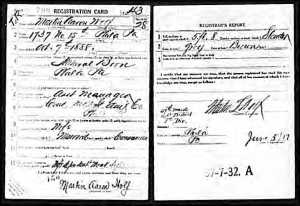
martin a ww1 edgar ww1 William ww1

But in 1918 the family suffered another loss.  Hannah’s husband Martin died from acute myocarditis, an inflammation of the heart, while in Eddystone, Pennsylvania, which is about 16 miles south of Philadelphia (and once the hometown of Jennifer Aniston, for you trivia fans). The certificate is definitely for the same Martin L. Wolf; it indicates that Martin’s former or usual residence was 1737 North 15th Street in Philadelphia, the same address listed for Martin L. Wolf in the 1918 city directory and in the 1912 directory that also provided his business address for the liquor business.
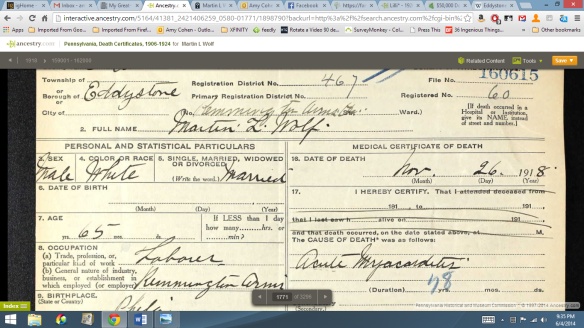
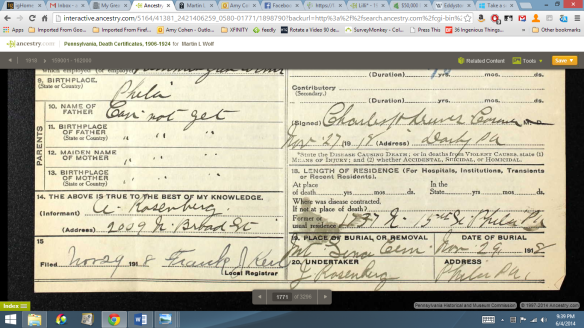
Screenshot (7) Screenshot (8)

But the certificate raises some questions.  It says that Martin’s occupation was as a laborer for Remmington Arms in Eddystone.  According to Wikipedia, Remmington Arms, the rifle manufacturer, had opened a plant there during World War I, and “a large portion of the rifles used by American soldiers in France during World War I were made at Eddystone.”  What was Martin doing there?  He was 63 years old, too old to be drafted and serve in the war.  Was this his way of making a contribution to the war effort?  Or perhaps more likely the social forces that eventually succeeded in leading to the 18th Amendment and nationwide prohibition of liquor sales had already led to a decline in Martin’s liquor sales, thus causing him to get a job in the munitions industry during the war.  It’s total speculation, but it does seem very strange that after a career in the liquor business Martin would have taken up work in Eddystone making rifles.

Nine years later in 1927, Hannah also died from myocarditis, arteriosclerosis, and diabetes.  She was sixty-nine years old.
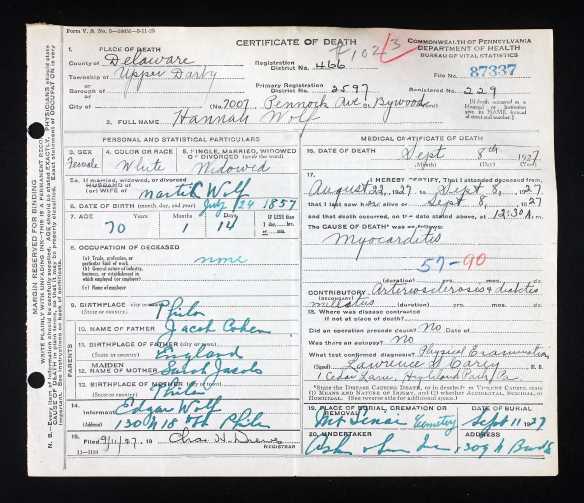
Hannah Cohen Wolf death certificate 1927

Hannah Cohen Wolf death certificate 1927

She and Martin were both buried at Mt Sinai with their two daughters Caroline and Rachel.
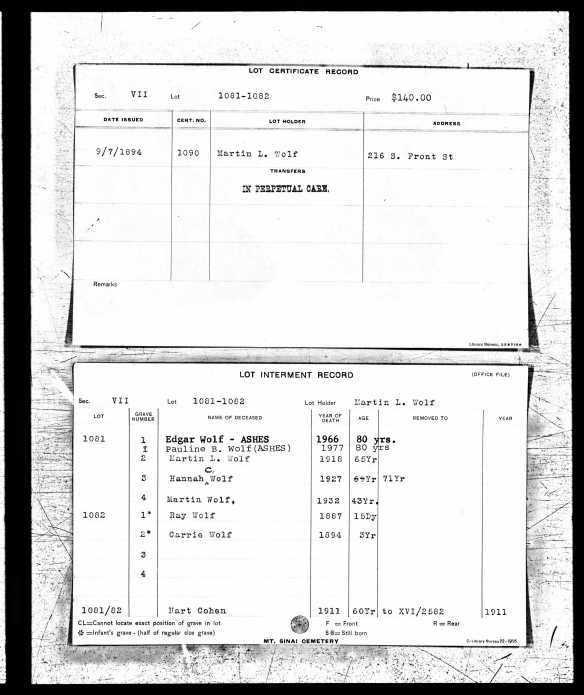
Mt Sinai burial records

Mt Sinai burial records

In some ways the timing of  Hannah’s death may have been a blessing because three years later her daughter Laura died at age 47 from complications of diabetes on February 10, 1930, leaving her husband and her 26 year old son, Martin, who had already lost his father when he was only eight years old.
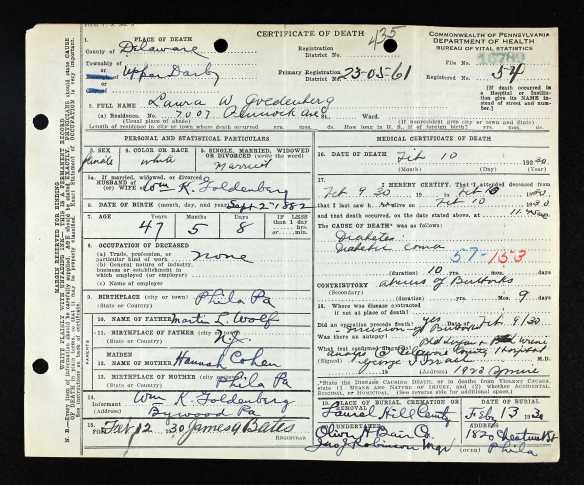
Laura Wolf Goldenberg death certificate 1930

Laura Wolf Goldenberg death certificate 1930

On the 1930 census Martin was listed as William’s son and had adopted his surname Goldenberg as well.  He was also employed as a theater manager, another member of the family finding employment through William Goldenberg. Martin married later that year, and in 1940 he was continuing to work as a theater manager.
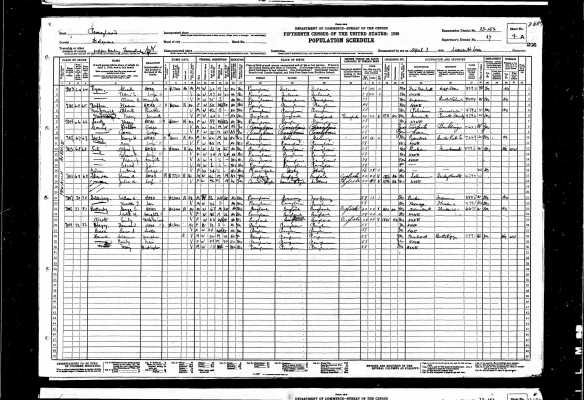
William and Martin Goldenberg 1930 census

William and Martin Goldenberg 1930 census

Two years after Laura died, her brother Martin A. Wolf died from chronic ulcerative colitis on September 20, 1932, at age 43.  He also left behind a wife and a nine-year old son.  Martin A. also had continued to work as a theater manager.  His wife Marie died seven years later in 1939, leaving their son Martin without parents at age sixteen. On the 1940 census he was living as a lodger with a couple named Magee and working as an usher, following in the footsteps of his father and other relatives.
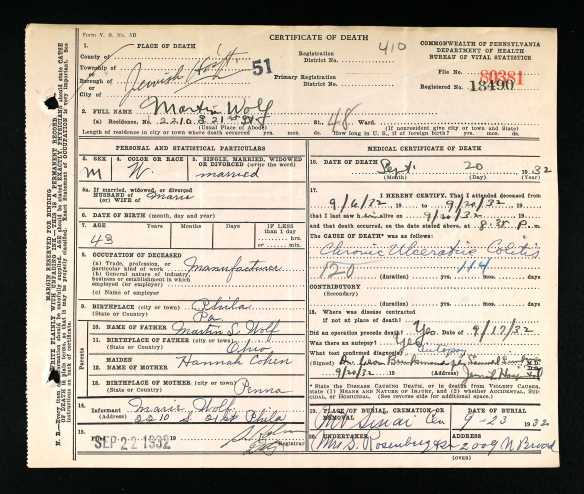
Martin A Wolf death certificate 1932

Martin A Wolf death certificate 1932

That left Edgar as the only surviving child of the five children of Hannah and Martin Wolf.  Edgar had married in 1916 and had had a son in 1921, and like his brother Martin, his brother-in-law William Goldenberg, and his nephews Martin Goldenberg and Martin A. Wolf, he also continued to work as a theater manager in Philadelphia.  Edgar died in 1966.  He was eighty years old and was the only one of his siblings to live a full and long life.  No one else had made it to 50, let alone 80.

When I look back on Hannah’s life, as with the lives of so many of the women I have researched, I realize how completely a woman’s life was defined by her husband and her children in those days.  Whereas I can report on the men’s occupations and their military careers, for the women I seem only to be able to mention where they lived, who they married, and how many children they had.  Unless a woman remained unmarried, she did not work outside the home. These women had hard times and raised their families under often difficult circumstances, losing babies and children to disease and having more pregnancies and childbirths than I can imagine, and probably even more than are reported.  It was the way women lived for most of history: family and home centered and dependent financially on their fathers and then their husbands.  It is a very different life from the one most women I know live today, for better in many ways, but also for worse in other ways.

If women’s lives and their value was based primarily on their children, then losing a child must have been especially awful for these mothers, losing two unimaginable. At least Hannah did not live to see that two more of her children would die prematurely. She had lost two babies and her husband. Nine of her siblings, including some younger than she, had predeceased her.  Those are enough losses for any person to have to endure.
If I had not found that little death notice mentioning a Mrs. Martin Wolf, Hannah Cohen might never have been found.  As you will see, it was an equally serendipitous discovery that allowed me to learn the story of her younger sister Elizabeth. Hannah’s life was a life with plenty of heartbreak.  She did not make any scientific discoveries or make a lot of money or change the world.  It was nevertheless a life that should not disappear simply because she changed her name when she married or because she never worked outside the home.  I am glad that I was able to help to preserve her name and her life for posterity.