I’m Ba-a-a-ck! With an Update on Lillian Rosenzweig

After a week away in the beautiful Florida Keys where we were able to put the miserable New England winter weather behind us and enjoy the outdoors, kayaking, swimming, walking, and seeing wildlife including dolphins and alligators, I am back in New England with the miserable winter temperatures outside, but happy knowing that spring is at least here on the calendar if not in the weather quite yet.  It has to get above freezing soon, doesn’t it?

While I was away I received a number of documents, mostly confirming the hunches I’d had about Lillian and Rebecca Rosenzweig.  Today I will focus on Lillian.  About ten days ago I posted what I knew and thought I knew about Lillian.  I believed that she had married Toscano Bartolini in July, 1901, had had a son William born in March, 1902, and then lost her husband in 1904.  All of those facts are now confirmed by the marriage certificate, William’s birth certificate, and Toscano’s death certificate, all of which I received late last week.

First, as you can see from the marriage certificate, Lillian and Toscano were married by an alderman, not a rabbi, on July 6, 1901. This is clearly the right Lillian Rosenzweig, as her parents’ names are Gustav and Gussie nee Sagg.  According to the certificate, Lillian was then eighteen years old, which would have made her birth date 1883—a year before her parents married.  Lillian must have lied about her age in order to get married without parental consent.  I have speculated elsewhere that she was likely born in 1885 since her parents were married in June, 1884.  Also, Lillian’s address is given as 320 East 9th Street—not in Brooklyn where her parents were living.  She must have moved out before she married Toscano, who was living on Sullivan Street at that time.  These inferences are consistent with the family story that Lillie’s marriage to someone who was not Jewish led to disapproval and perhaps some estrangement from her family.

Bartolini Rosenzweig marriage certificate

Bartolini Rosenzweig marriage certificate

From William’s birth certificate, another inference seems possible.  William was born on March 9, 1902, just eight months after Lillie and Toscano had married.  Perhaps Lillie was already pregnant at the time of the wedding, although I am not sure she would have known that at the time since she would have been just one month pregnant.  It is, of course, entirely possible that William was a month premature. William was born at home—177 Houston Street in NYC.  Interestingly, Lillie’s age is now reported as seventeen—a year younger than she had reported on her marriage certificate a year earlier.  If she was in fact seventeen in March, 1902, her birth year would have been 1885, as I suspected.  It also means she was only sixteen when she married Toscano.

William Bartolini birth certificate

William Bartolini birth certificate

The other interesting fact gathered from this certificate is that Lillie had already had a child before William’s birth, but that that child was no longer living.  When could she have had that child?  Her marriage certificate reported that her marriage to Toscano was her first marriage.  Had she had a child with him before they married? Had she had an out-of-wedlock child with someone else? Had that child really died or had she given that child up for adoption and simply reported it as if he had died?  I have no idea and no idea how to try and figure that out. (It’s also sad that on the 1910 census when Lillie was back living with her parents, she is listed as single and having no children.)

The third document in this trilogy is Toscano’s death certificate.  Toscano died on April 27, 1904, from chronic nephritis, kidney disease, at age 27.  He’d been working as a bartender and died at 69 Carmine Street in NYC.  He had only been in the US for five years, had been married for less than three years, and left behind his 19 year old wife and 2 year old son.  I don’t know what causes chronic nephritis, although it looks like uremia is given as a contributing cause of death.   But I’ve never heard of someone dying at age 27 from that today.

Toscano Bartolini death certificate

Toscano Bartolini death certificate

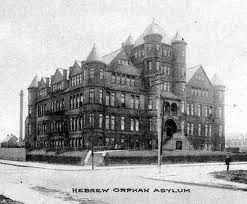
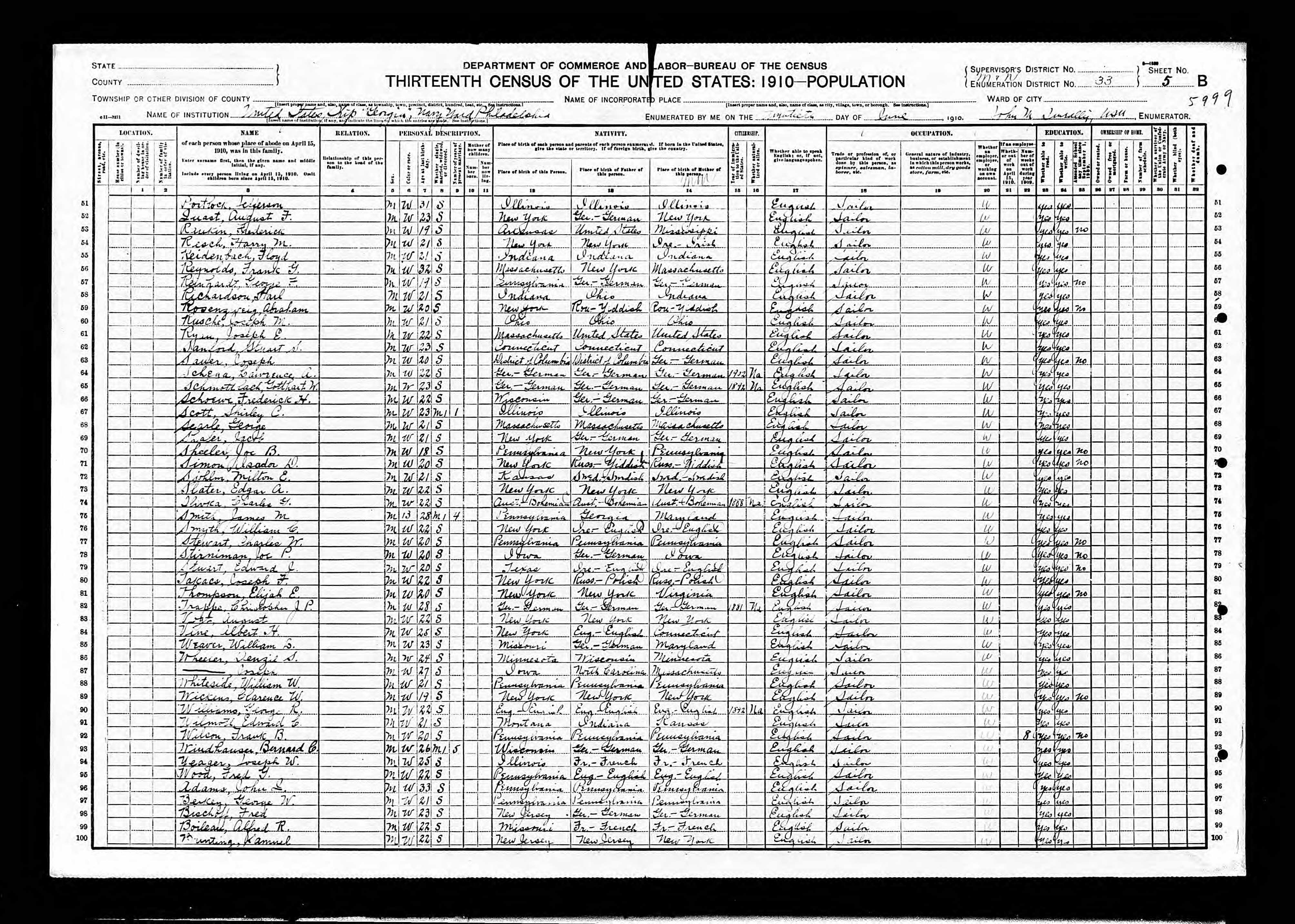
The rest of the story, as reported earlier, shows a family in disarray.  Lillie and William moved back to Brooklyn and were living with Gustave and Gussie and the family in 1905, indicating at least a temporary reconnection.  In 1906, however, William was living at the Brooklyn Hebrew Orphanage.  Although it appeared that he was released back to his mother for some time, by 1910 William was living at St. John’s Home in Brooklyn and in 1915 at the NY Catholic Protectory.  Lillian, who was living with her parents in 1910 without William, then disappears from the records.

I still have not found either William or Lillian after that.  I don’t know what happened to either of them.  Joseph’s grandchildren told me that at some point Lillie was back in touch with her siblings, but no one knows anything more specific than that.  I will keep looking for some new clue, but for now I’ve hit the proverbial brick wall with Lillie and William Bartolini.

What I do know is an incredibly sad story of a young woman, emigrating with her family from Romania when she was only a young child, having two children before she was eighteen years old, losing one apparently to death and another to institutional care, losing a young husband after just a few years of marriage, and losing the support of her family as well for at least some period of time.  It’s a story to contrast with the story of Leah Strolowitz Adler, the daughter of Tillie Rosenzweig and Jacob Srulovici, who also came to the US as young girl but found the American dream.

The story of Lillie Rosenzweig raises so many questions: how did she, a young Jewish immigrant living in Brooklyn, meet and get involved with a young Italian immigrant who was living in the Lower East Side, not Brooklyn? Who was the father of her first child, and what happened to that child? What happened to William after he left the Catholic Protectory? Did he have any contact with his mother or her family? And what happened to Lillie after 1910? Did she remarry and regain custody of William? Did she also die at a tragically young age? These loose ends make me crazy—I want some endings to the story, but I may have to accept that I may never know what happened.

Enhanced by Zemanta

Women are Difficult…to Find and Track, Part I: Lillian Rosenzweig

One thing that has been clear to me for a long time is that women are much harder to track in vital records than men, largely because they traditionally changed their names when they married. The Rosenzweig daughters are a case in point.

I have now located and tracked from birth to death the five sons of Gustave and Gussie: Abraham, David, Jacob, Harry and Joe. For those who survived to adulthood, I know who they married, where they lived, and what they did for a living and their military service.  I still need to trace the children of Abraham and Jack, but I wanted to see what I could find about the five daughters of Gustave and Gussie first.  I’ve been looking all along, but kept hitting walls and so decided to focus on one daughter at a time.  Here’s what I know about Lillian.

The oldest child and the only one born in Romania was Lillie or Lillian.  According to the 1900 census, she was born in July, 1884, in Romania, but since that was only a month after Gustave and Gussie’s marriage, it seems likely that this was an error and that Lilly was probably born during 1885. The census also says that Lillie arrived in 1884, but her father’s naturalization papers say that he arrived in 1887.  In 1900 when she was only fifteen years old, Lillie was working as a typist while her younger siblings were all in school.

Gustave Rosenzweig and family 1900 census

Gustave Rosenzweig and family 1900 census

In 1905 the family had moved to Fulton Street in Brooklyn, and Lillian, now 21 according to the census, was doing housework as her employment.  In addition to the siblings listed on the 1900 census, there were now two additions, Rachel, who was four, and William, who was three.  William is described as a son of the head of the household, which led me to believe that he was another child of Gustave and Gussie.  I was unable, however, to locate William on the birth index as William Rosenzweig, nor did he reappear on the 1905 or 1910 census with the family.

Gustave Rosenzweig family on the 1905 NYS census

Gustave Rosenzweig family on the 1905 NYS census

Once again I searched the death index for a child of Gustave and Gussie, but could not find a death record for William Rosenzweig either.  If he was not living with his “parents” and siblings in 1905, where could he be? I searched on ancestry.com for William Rosenzweig and found him living at the Brooklyn Hebrew Orphanage in 1906.  I knew it was the right boy by his age (four years old), the address from where he was taken (1021 Fulton Street, Brooklyn), and his mother’s name—Lillian nee Rosenzweig.

William Rosenzweig at the Brooklyn Hebrew Orphanage in 1906

William Rosenzweig at the Brooklyn Hebrew Orphanage in 1906

Brooklyn Hebrew Orphanage

Brooklyn Hebrew Orphanage

William was not Gustave and Gussie’s son, but Lillian’s son.  His father is only identified as “Frank (dead),” with no surname.  For the other children listed, their father’s first name is also all that is supplied, but that’s because the child presumably has that surname.  For William, his surname is the same as his mother’s—Rosenzweig, and no surname is given for his father.  I could not find any marriage record for a Lillie or Lillian Rosenzweig between 1900 and 1902 to a Frank, so had Lillian had William out of wedlock? Who was Frank? Was he really dead?

I did find a Frank Cramer who died between 1902 and 1906 and a William Cramer born on March 2, 1902, the birth date provided for William on the orphanage records.  I sent for the birth certificate for William Cramer, but unfortunately that William’s parents were not named Frank and Lillian.

Then last night I went back once again to the marriage index and looked again for a marriage record for Lillian Rosenzweig, but this time I did not limit my search to grooms named Frank.  I restricted the dates to 1900 to 1902, based on the fact that Lillie was single in the 1900 census and that William was born in March, 1902.  I found one marriage of a Lillie Rosenzweig in July, 1901, to a Toscano Bartolini.  Could Frank have been his more American nickname?  I turned to the death index and searched for a death record, and there it was—Toscano Bartolini had died on April 27, 1904, at 27 years old.  Finally I looked for a birth record for a William Bartolini and found one—born March 9, 1902, a mere eight months after Lillie’s wedding to Toscano in July, 1901.  It was all starting to come together.  I obviously have to send away for all these records to be sure that Lillie is Gustave’s daughter and that William is Lillie’s son, but it certainly seems likely that the records will back up my hunches here.  In fact, I checked today on FamilySearch for Toscano Bartolini and found a more thorough description of the marriage record, including a reference to the bride’s parents’ names, Gustav and Gussie.  I will still order a copy of the certificate, but I am now certain that Lillie married Toscano, who died just a few years later, leaving her with a two year old son named William.

UPDATE:  All these facts were confirmed by the documents.  See my more recent post with images of the documents.

After finding all this, I remembered something that Joe’s grandson Ron had told me—that one of Gustave’s daughters had married someone who wasn’t Jewish, and Ariela had said she thought one of the sisters had married someone with an Italian name.  Ron had told me that the family was not happy about this, and that for a long time there was some estrangement.  Despite whatever they felt, however, in 1905 after Frank/Toscano died, Gustave and Gussie took both Lillian and her son into their home.

It also occurred to me that perhaps the reason Lillie used the name Rosenzweig for William and not Bartolini was based on the fact that he was being taken to a Jewish institution.  Obviously Rosenzweig would seem more clearly Jewish than Bartolini.

But why he was taken from the home in 1906 is not explained by the records. The orphanage record indicates that William was discharged to his mother on September 3, 1906, and reports that her address was then 307 East 120th Street in Manhattan, so perhaps there was a falling out with the family.   But in 1910, Lillian was living again with her parents and siblings in Brooklyn, and William was not living with her.  Lillian’s occupation was listed as a trained nurse at a hospital, and she was listed as single, not widowed.  But where was William?

Gustave Rosenzweig and family 1910 census

Gustave Rosenzweig and family 1910 census

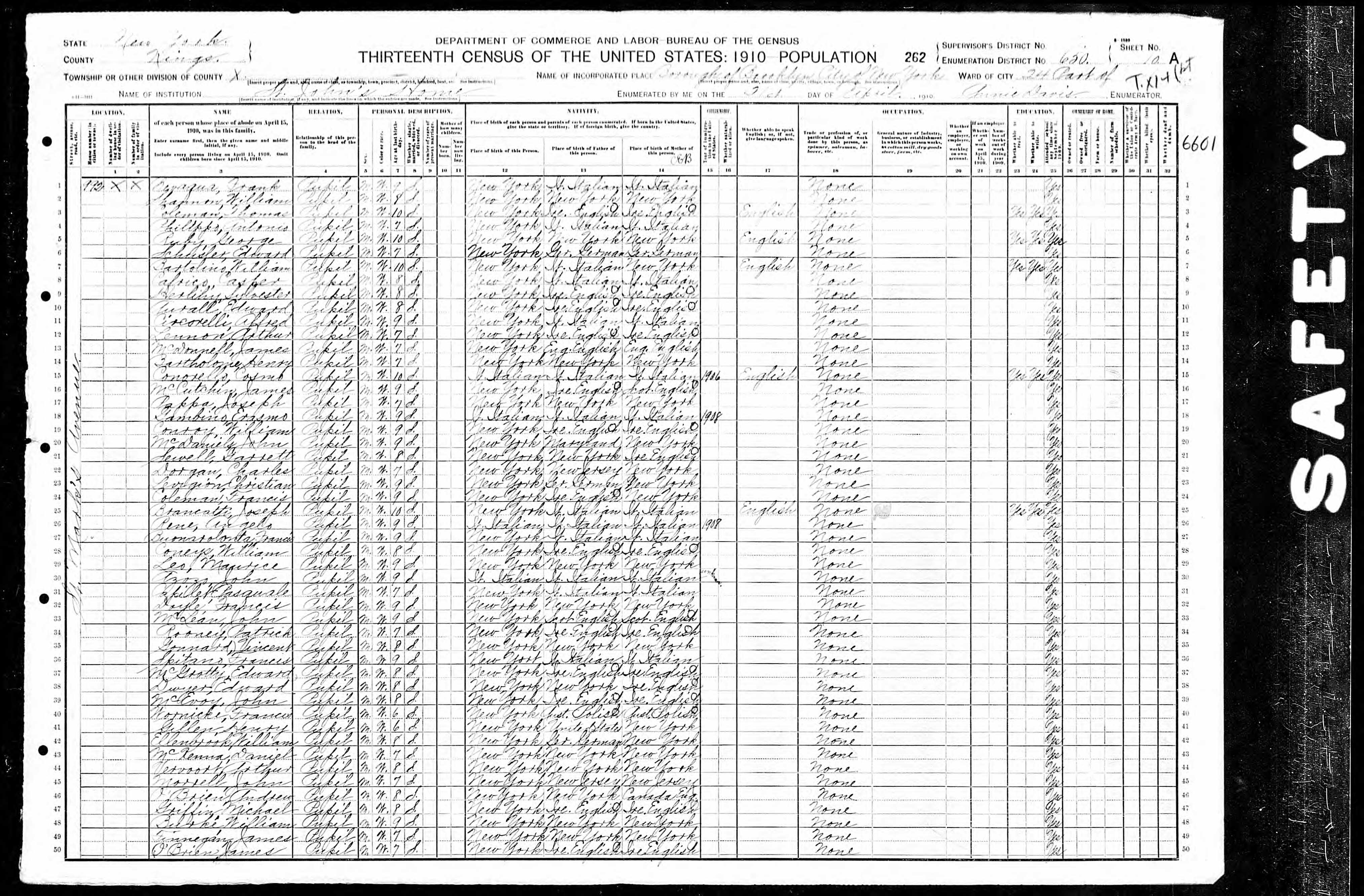
I had not been able to find him as William Rosenzweig in the 1910 census, but now I searched for William Bartolini and found him, living at a residential facility, St. John’s Home in Brooklyn.

William Bartolini 1910 at St John's Home, Brooklyn

William Bartolini 1910 at St John’s Home, Brooklyn

Maybe Lillie placed him there so that she could get training to be a nurse.  Perhaps she just could not take care of him.  Perhaps I can find some records from St John’s Home.

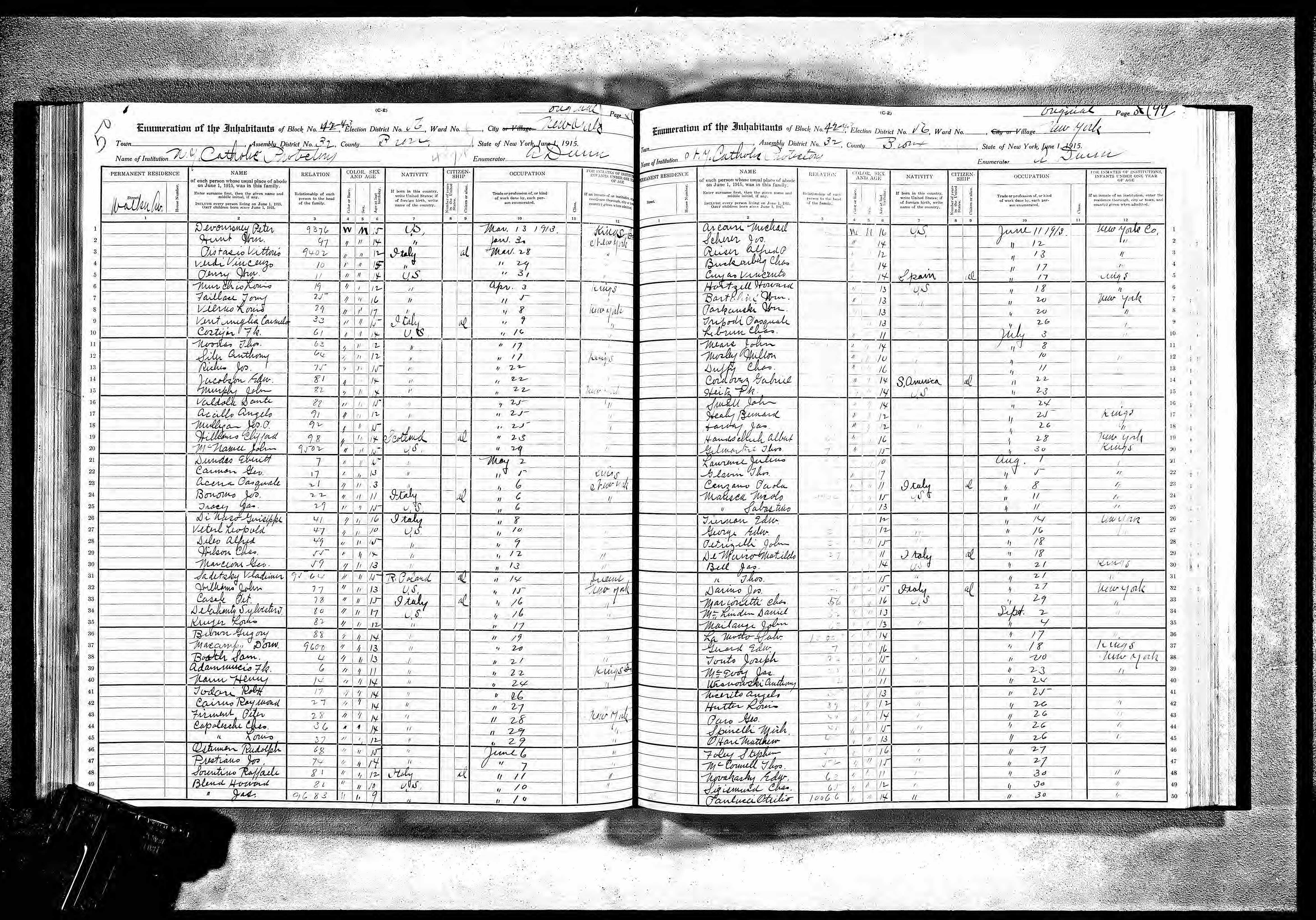
I also was able to find where William was in 1915: another home for children, this one the New York  Catholic Protectory, in the Bronx. (Interestingly, this facility was located where Parkchester is today; Parkchester is an apartment building complex developed by Metropolitan Life Insurance Company in the Bronx and is where my grandparents, my aunt and uncle, and my parents once lived; I lived there also until I was four and half years old.)

William Bartolini 1915 Catholic Protection Bronx

William Bartolini 1915 Catholic Protecory Bronx

It seems that in both 1910 and 1915 William had been placed in Catholic institutions after being at a Jewish orphanage briefly in 1906.  Had Lillie given up her parental rights? Was neither set of grandparents interested or able to take care of the boy? Was William troubled or disabled in some way that made caring for him at home a problem for everyone?  I don’t know the answers, but will try to find out what happened to William after 1915.  Apparently you can order microfilm from the Family History Library and see the actual records for the children who resided there, which I plan to do.

And I cannot find Lillie in 1910 or thereafter.  She was not living with her mother and siblings in 1915 or in 1920.  I cannot find her as Lillie Rosenzweig or as Lillie Bartolini.  Perhaps she remarried and changed her name, but I have not yet found a marriage record.  But now I know that I just have to keep looking.  I almost gave up after Frank Cramer did not pan out.  And then last night I looked a different way and found Toscano Bartolini. I hope I can eventually uncover what happened to Lillie and to William.

Enhanced by Zemanta

Document Updates on David and Jack Rosenzweig

Last week I wrote about Gustave and Gussie’s one year old son David, who died on December 25, 1892.  Today I received David’s death certificate, and it confirmed that this was their son.  It also revealed his cause of death: meningitis.  Having known a young child who had meningitis when he was just a few months old, reading this caused me to stop and once again be thankful that we live in an era of modern medicine where most children survive what were once deadly illnesses, although meningitis remains a danger to children and adults.

David Rosenzweig death certificate

David Rosenzweig death certificate

I also am not sure what to make of the notation here that a contributing cause to his death was teething.  Really?  Teething? I will have to ask my brother whether there is or was anything that linked teething to meningitis and/or death.

The certificate also indicates that the doctor had cared for David from December 6 until December 18, but had not seen the baby in his last week.  He wrote, “Child lingered hopelessly for the last week therefore no MD was called in during last days.” How awful that must have been—to watch a one year old child just literally pass away and not be able to do anything about it.

I also received the marriage certificate for Jacob/Jack/John Rosenzweig and Ethel Bloom, confirming that this was the correct Jacob, as indicated by the names of his parents provided on the certificate.

Jacob Rosenzweig and Ethel Bloom marriage certificate

Jacob Rosenzweig and Ethel Bloom marriage certificate

Interestingly, Jack and Ethel each gave the same residence: 327 Howard Avenue.  I doubt they were living together before they were married (it was 1923), so either they were providing their expected address for after the wedding or they had been living in the same building on Howard Avenue.  Jack was 28 years old, and although he had been living with his family on Bergen Street in 1920, perhaps he had moved out on his own to Howard Avenue and met Ethel there.

Enhanced by Zemanta

Another Sad Story: Harry Rosenzweig

I have already told the story of Gustave and Gussie’s son David who died shortly after his first birthday.  I’ve also talked about the records that indicate that Gustave and Gussie suffered the loss of many infants—perhaps as many as nine babies who did not survive.  But I have not yet told the story of their son Harry Rosenzweig.

Harry was born in July 1897, two years after Jacob and a year before Joseph.  He appeared on the census reports with the family in 1900, 1905, and 1910, but then he disappeared from the records.  He is not on the 1915 census or any later census report.  Since he would have been eighteen in 1915, I thought perhaps he was serving in the military like his brothers Abraham and Jack, but I could not find any military record or draft registration with his name.  Where could he have been?

Fearing the worst, I checked the death index for NYC and sadly saw that indeed a Harry Rosenzweig had died on July 9, 1913. He would only have been sixteen years old—could this be the same Harry? If so, why did he die so young?  I sent for the death certificate, which I received the other day.

Harry Rosenzweig death certificate

Harry Rosenzweig death certificate

As you can see, it is in fact the death certificate for Harry, the son of Gustave Rosenzweig and Gussie Sachs.  His cause of death is given as drowning.

I then searched for and found this brief news article from the Brooklyn Standard Union of July 8, 1913, p. 6, which explains some of the circumstances surrounding Harry’s death.

Brooklyn Standard Union July 8, 1913 page 6

Brooklyn Standard Union July 8, 1913 page 6

Can you imagine what his father must have felt, going to the police station and seeing his son’s clothing? Why was Harry off by himself, swimming alone and away from the others in his gray flannel bathing suit? The article almost seems to imply that there was something suspicious about his behavior.  Was his drowning other than accidental? The police obviously did locate his body the next day, as indicated on the death certificate, but the rest of the story remains a mystery.

The other question that lingers for me is whether or not Harry’s death occurred before or after Gustave and Gussie had separated. By the time of the 1915 census, Gussie and Gustave were apparently separated, as Gustave is not listed as living at 1914 Pacific Street with Gussie, Abraham, Jacob, Joseph, Lizzie and Ray.  I have yet to find Gustave anywhere on the 1915 census.  I searched the address given in the news report on Harry’s drowning in 1913, 1166 Nostrand Avenue, and Gustave is not listed as living at that address in 1915.  In 1910 the family was living at 677 Franklin Avenue in Brooklyn and in 1905 they were living on Fulton Street in Brooklyn.  Had they moved to Nostrand Avenue between 1910 and 1913 and then moved again between 1913 and 1915 to Pacific Street? Or had Gustave already left the home by 1913 and thus was living by himself on Nostrand Avenue?  Where was he then in 1915? I will have to keep searching.  By 1920 he seemed to be living in upper Manhattan as a boarder, and by 1920 he was remarried.

If Harry died before Gustave and Gussie separated, one has to wonder whether his death precipitated the end of their marriage.  And if he died after they separated, one has to wonder whether the end of their marriage was in any way a factor in his swimming alone, away from everyone else on the beach.

Of course, his death could have been an accident, or he might have been swimming alone for any number of possible reasons.  Whichever version of the story is true, the death of Harry Rosenzweig as a young teenager must have been a terrible tragedy for his family, a family which had already suffered the deaths of so many of their children.

Which makes it even more remarkable that at least some of his surviving siblings grew up to be such loving, warm and fun-loving adults, as my post tomorrow will discuss.

Enhanced by Zemanta

It Takes A Village: Mystery Solved!

Immigrant children, Ellis Island, New York.

Immigrant children, Ellis Island, New York. (Photo credit: Wikipedia)

I received a lot of exciting documents today, but I cannot write about them all at once.  I want to write first about the one that resolved a longstanding mystery I had almost despaired of ever solving.

Just to refresh your recollection (or to tell you the story for the first time), my great-great aunt Tillie Strulowitz arrived at Ellis Island with her husband Jankel and three of her seven children, the older four having already emigrated.  They were detained at Ellis Island because of questions about Jankel’s health, and I was able to obtain, with the help of the generous people at JewishGen, the file for the immigration hearing. From that I knew that he had been admitted to the United States and had not been deported or died before arriving in the US, as some of his descendants believed.

But I still could find no evidence of what happened to him after January, 1908, when he was admitted.  He was not on the 1910 census with Tillie and the children. Tillie was listed as a widow, but I could not find a death certificate or a cemetery burial that proved he had died. I began to wonder whether Jankel had abandoned them or been institutionalized or returned to Romania.

I wrote to the JewishGen discussion group for a second time to ask for help, and I received many very helpful and creative suggestions.  I pursued each one of them, but with no success.  The only one that I had still not been able to put closure on was a suggestion from a man named Barry Chernick who had found a death recorded for a Jankof Israelwitch in April 1908.  Barry hypothesized that this might be Jankel because Israelwitch could be an Americanization of Strulowitz or Srulovici.  Since Srul is Yiddish for Israel, perhaps the family had switched their name after leaving Ellis Island.  It seemed like a long shot, but I figured it was worth a try and wrote away for the death certificate.

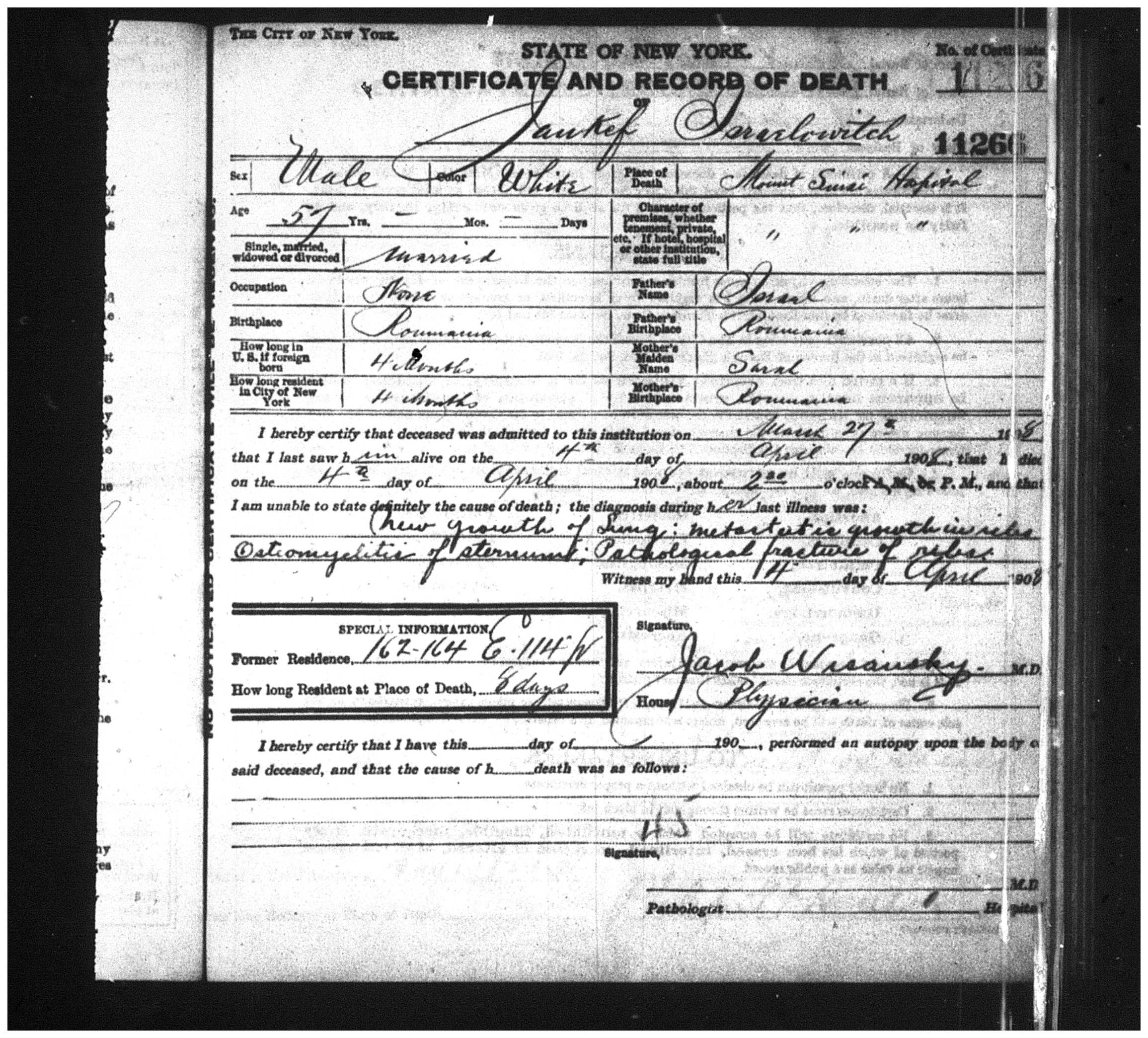
Well, today I received the death certificate for Jankof Israelwitch, and I am certain that it is the death certificate for Jankel Srulovici.  My conclusion is based on the following clues: his birth place (Romania), length of time in the US (4 months—he died in April 1908 and arrived in the US at the very end of December 1907), his father’s name (Israel—Jankel’s first born son was named Israel or Srul in Romania), his residence (East Harlem, where his family was living from 1910 and afterwards), and his age (57).

Jankel Srulovici death certificate

Jankel Srulovici death certificate

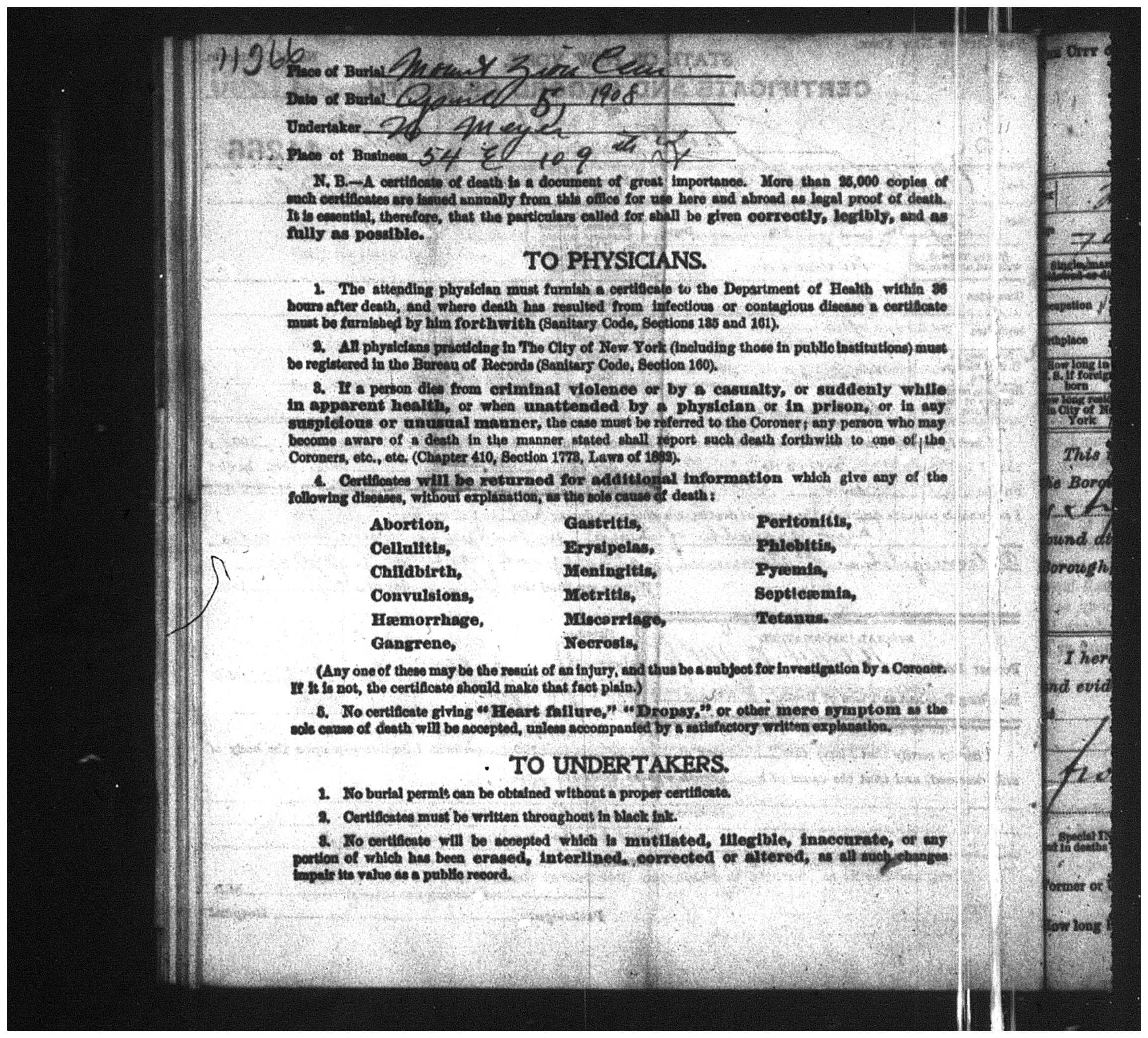
The death certificate also revealed on the reverse side that he was buried at Mt Zion cemetery, so I went to their website and searched for Jankof Israelwitch, and there I was now able to find that he is in fact buried there under that name.  The fact that Tillie and Isidor and Pincus are also buried at Mt Zion (though not in the same sections) is further corroboration that this is the right person.

reverse side

reverse side

And so now, thanks to the assistance of so many people at JewishGen and especially Renee and Barry, I can put closure on the life of Jankel Srulovici.  He did not abandon his family, he was not deported, he was not institutionalized, he did not divorce Tillie.  No, he died what must have been a painful death from a metastatic growth in his ribs.

Like my great-grandfather Moritz, Jankel’s brother-in-law, Jankel died soon after arriving in America.  How awful it must have been for the two sisters, Tillie and Ghitla, to lose their husbands after making the brave and difficult decision to leave home and start anew in this country.  Yet somehow they both continued on, they raised their children, and they made a life for themselves as widows in the United States.  I continue to be amazed by the resilience of the immigrant generation.

Enhanced by Zemanta

Questions raised by Headstones

I was reminded of the power of headstones when I received a set of photos from Tillie Strolowitz/Adler’s great-granddaughter Jean.  Jean has been doing genealogy research for many, many years, and it has been wonderful to have a family member who shares this passion.  Jean started in the pre-internet era, and she has been helpful in reminding me to be patient as I wait for documents.  I want immediate gratification, typical of those of us working with modern technology; Jean reminds me that back in the pre-internet era there were no documents that you could view from the comfort of your home just by clicking on a computer.  You had to travel to libraries, government offices, cemeteries, synagogues, and other record-holding institutions—or at best mail away (snail mail) and wait for documents to be returned by snail mail.

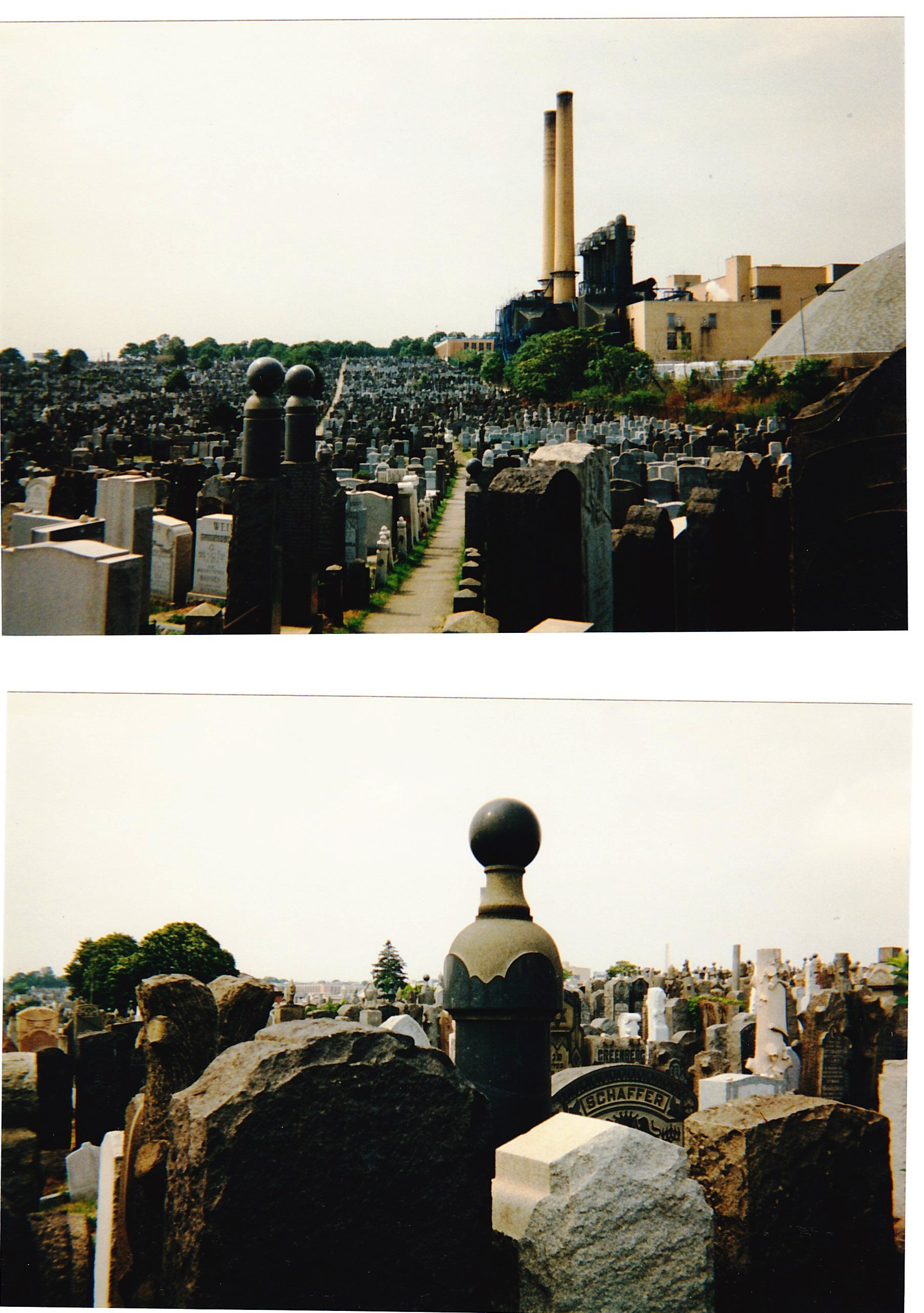
Anyway, Jean wrote to me about her visit to Mt Zion Cemetery back in 1999 to search for her great-grandmother’s headstone.  Her experience was very much like mine when I searched for my great-grandfather Joseph Brotman’s headstone last fall.  The stones are so overcrowded in the old cemetery that it is impossible to walk around without stepping on the gravesites of other people.  It is also very difficult to find a particular headstone.  There are no straight lines, no easy paths, as in other cemeteries.  Here are some photos Jean took back then to capture the feeling.

Mt Sinai cemetery

Mt Zion cemetery

But when you do find the headstone, it is a powerful experience.  You suddenly understand that your long-lost relative is in fact buried there and that someone stood there in mourning to bury them many years ago.  Jean pointed out that Tillie’s headstone only refers to her as a loving mother, not a wife, and that the Strolowitz name is nowhere included on the stone, just the name the family adopted in America, Adler, despite the fact that Tillie’s death certificate is under the Strolowitz name.

Tillie Strolowitz Adler headstone Mt Sinai

Tillie Strolowitz Adler headstone Mt Zion

When Tillie died, two of her sons had already passed away, Isidor and Pincus, and were also buried at Mt Zion under the Adler name.  Had the family erased Jankel from their memory by dropping his name and not including any reference to Tillie as a wife on her headstone?  Does that provide any clues as to what happened to him? One would assume that he, too, was buried at Mt Zion, if he had died shortly after arriving in NYC, but I cannot find anyone with a name similar to his buried there.

I am still waiting for some records that may relate to Jankel and his fate.  I am not optimistic that these will in fact relate to Jankel, but I will be patient, count the days, and hope that these records will help to answer the mystery of Jankel Srulovici.

Enhanced by Zemanta

And A New Branch for the Goldschlager Tree: The Third Rosenzweig Sister

These last few days have been very exciting ones for me.  Not only did I find persuasive evidence of another member of the Brotman family, I also have persuasive evidence of a new member of the Goldschlager family, a third Rosenzweig sister, Zusia, also called Sonsa, Celie, Susie and Susan.  I am still piecing together her life and need to obtain more documentation to do that, but this is what I know so far.

Ghitla Rosenzweig Goldschlager

Ghitla Rosenzweig Goldschlager

First, some background: Moritz Goldschlager, my great-grandfather, married Ghitla Rosenzweig, daughter of David and Esther Rosenzweig, according to the records found by my researcher in Iasi, Romania.  Ghitla, who was also called Gittel, Gussie and Gisella, emigrated to the United States in 1910 with her son David, following my grandfather Isadore in 1904, her husband Moritz in 1909, and her daughter Betty in 1910.  As described before, her husband died in April, 1910, and her two children, Isadore and Betty, moved in with Tillie Strolowitz, herself a widow, and her seven children.  According to Tillie’s death certificate, her birth name was Tillie Rosenzweig, and her parents were also David and Esther Rosensweig.  Tillie had emigrated with her husband and her three youngest children in 1907, following her older children who had emigrated over the years 1901 through 1907.  I was quite excited when I figured out that Tillie was my grandfather’s aunt and had taken him and Betty in after their father had died.

Then a few weeks ago, I reviewed my grandfather’s ship manifest from 1904 (under his brother David’s name) and noticed again that he was supposed to meet an uncle, Morsche or Moische Mintz, in New York City.  I had not been able to find this uncle before, and I was stymied again when I searched for him.  Then I located a document indicating that my grandfather had been shortly detained at Ellis Island, apparently because his uncle had not been able to meet him.  Instead he was met by an aunt Zusie Mintz, who lived at 110 East 117th Street.  But who was she?

Record of Detained Aliens Isadore listed as David Goldschlager

Record of Detained Aliens
Isadore listed as David Goldschlager meeting Zusie Mintz

By searching the NYC marriage index, I was able to locate a Zusie Rosenzweig married to a Harry Mintz and wondered whether this could be the aunt who met Isadore and whether she was another sister of Ghitla and Tillie.   I ordered a copy of the marriage certificate and also looked for further documentation of Zusie Mintz.  I found one census reference for a Sonsa Mintz, living with cousins Jacob and Rachel Reitman in 1900 as a widow.  If this was the same person as Zusie Mintz, it explained why the uncle had not been available in 1904; he had died.  But was Sonsa also Zusie, and who were the Reitmans?

I looked for Zusie or Sonsa or Susie on the later census reports, but could not find her on any of them.  Had she remarried and changed her name? Had she died?

I then looked for and found a death certificate for a Susie Mintz dated March 11, 1931, and I ordered that as well.  At that point I decided to wait for these two documents to arrive before going on what might be a wild goose chase.  I received those documents two days ago, the same day I received the documents evidencing that David Brotman was my great-uncle.  Could I have struck gold twice in one day?

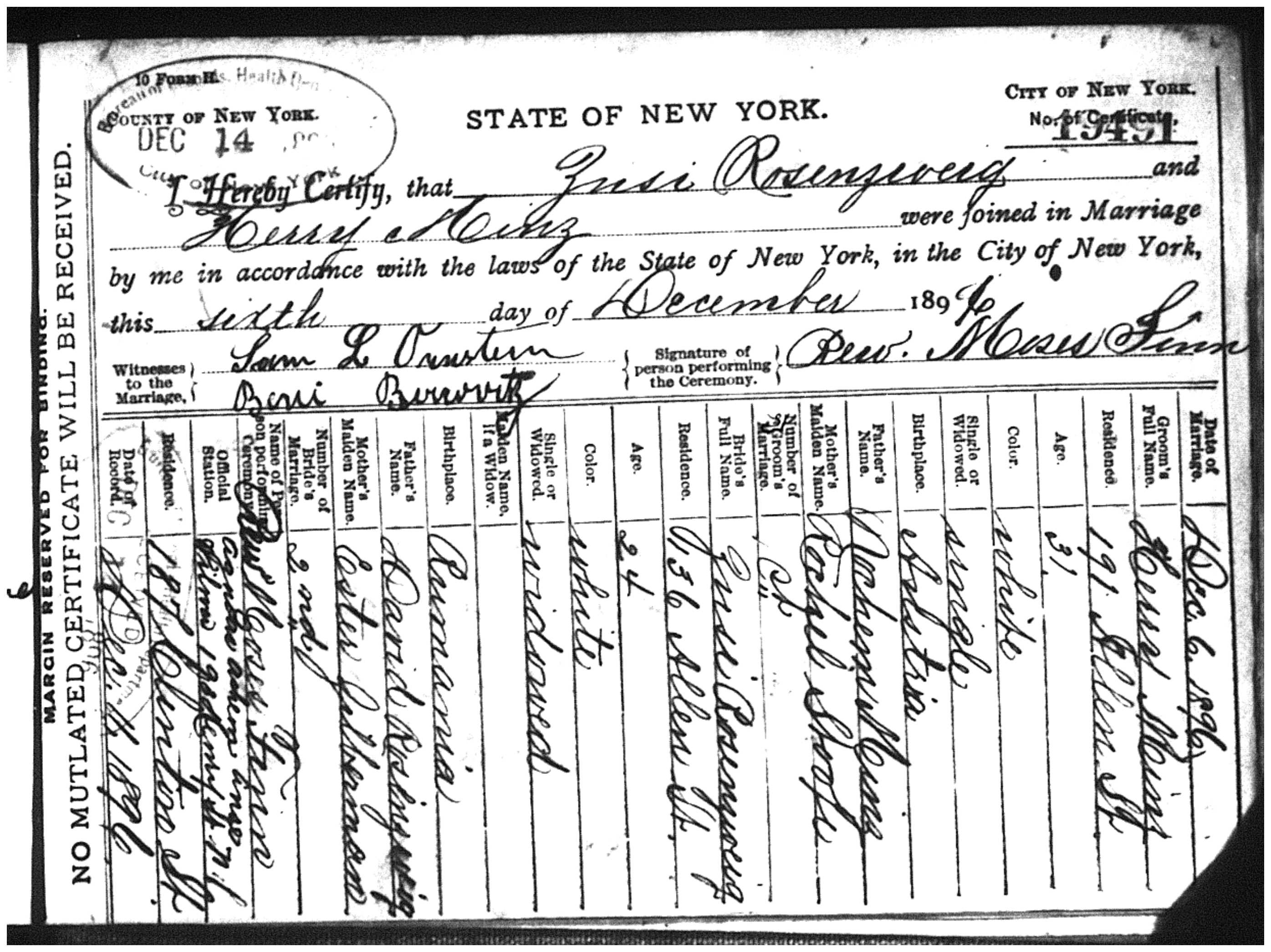
Yes, I could, and I did.  The marriage certificate, dated December 6, 1896, confirmed that the Zusi Rosenzweig who married Harry Mintz was the daughter of David Rosenzweig and Esther Gilberman, revealing for the first time Esther’s birth name.  The certificate confirmed also that Zusi was from Romania.  Zusi had been living at 136 Allen Street, and Harry was living at 191 Allen Street, so presumably they had met in the neighborhood.  Harry was 31 years old, born in Austria, and was marrying for the first time. Zusi was 24 years old, but already a widow.

Zusi Rosenzweig and Harry Mintz marriage certificate

Zusi Rosenzweig and Harry Mintz marriage certificate

Had she married before she left Romania, or since arriving in NYC? Why had she gone back to her birth name, Rosenzweig?  These are questions for which I still do not have answers.

The second document I received, the death certificate for Susie Mintz who died on March 11, 1931, also confirmed that Zusi, now Susie, was the daughter of David and Esther Rosenzweig, born in Romania.  Susie was 54 years old at the time of her death, meaning that she was born in 1877, whereas if she had been 24 in 1896, her birth year would have been 1872.  The death certificate also indicated that she was a widow, and it provided her current address: 523 East 108th Street in the Bronx.

Susie Mintz death certificate

Susie Mintz death certificate

The reverse side of her death certificate contained some surprising information. It revealed that the undertaker had been employed by “Mr. Mintz,” Susie’s son.  Susie had a son? If so, where was he in 1900 when Sonsa was living with Jacob Reitman? Or was that really Susie/Zusi? If Susie had a son, perhaps she had other descendants as well.  But what was her son’s name? When was he born?

reverse of death certificate

reverse of death certificate

Using the address on the death certificate, I worked backwards to see if I could find Susie on the 1930 census, since I assumed she had not moved between the 1930 census and the time of her death in March, 1931.  This took some doing, as you have to scan through all the pages within a specific enumeration district to find the address; there is no index by address.  I finally found her address, and then I found her listing: she was living at the same address, listing herself as  Susan Mintz, 42 years old, a dressmaker, and as married.  Married? She was living with a boarder named Hannah Kassel, an older woman who was a widow.  When I looked at the form more closely, I realized that the M for married also could be a W for widowed.  I think the indexers read it incorrectly, and that Susie was in fact still a widow in 1930, as she was in 1900 and at her death.

Susan Mintz 1930 census

Susan Mintz 1930 census

From the 1930 census, I then went to see if she had been at that address ten years earlier for the 1920 census.  After more scanning and searching, I found her once again at the same address, but now using the name Celie, or at least that is how the census taker recorded it.  She was listed as a widow, a dressmaker, and 42 years old (I guess she did not want to admit being any older ten years later in 1930).  Zusi/Susie/Celie was living alone at that time.

Celie Mintz 1920 census

Celie Mintz 1920 census

Next came the 1915 New York State census—could I find her again at that address?  I searched for Celie Mintz this time, and without having to scan the census, I found her on the next block at 522 East 139th Street in the Bronx, working at a cloak and suit factory, and living with her son, Nathan.  Her son!  I had found a record for her son.

Celie and Nathan Mintz 1915 NYS census

Celie and Nathan Mintz 1915 NYS census

I could not find either of them on the 1910 census or the 1905 New York State census, at least not yet, but now I had her son’s name and could search for him.

I checked the New York City birth index for a birth certificate for a baby named Nathan Mintz and found one dated December 6, 1897, exactly a year after Harry Mintz had married Zusi Rosenzweig.  This certainly could be the right Nathan, but I now need to obtain that certificate to be sure.

I did find Nathan’s 1917 draft registration for World War I, listing his mother as Cecile Mintz living at 523 East 138th Street in the Bronx, the same address where she was living from 1920 until her death.  Cecile is closer to Zusi and Susie than Celie, and looking at the 1915 census it does look more like Ceci than Celie.  The fact that Nathan’s address in 1917 was the same as that on Susie Mintz’s death certificate confirms that Susie and Cecile and Celie and Susan were all the same woman.

Nathan Mintz draft registration 1917

Nathan Mintz draft registration 1917

I then found a Nathan Mintz who married Gertrude Friedman in 1930. I need to order that certificate as well, but  I suspect that this is the correct Nathan because on the 1940 census, Nathan and Gertrude have an eight year old daughter, born then in 1932, named Susanne.  If this is the right Nathan, it makes perfect sense that he would name his first born child after his mother Susie one year after her death.

Nathan, Gertrude and Susanne Mintz 1940 census

Nathan, Gertrude and Susanne Mintz 1940 census

But there are obviously many unanswered questions.  I can’t find a death certificate for Harry—did he really die, or did he just disappear? Who are Jacob and Rachel Reitman? How, if it all, were they related to Zusi? And where was Nathan living if that was Zusi living with the Reitmans in 1900?  Zusi was the one who met my grandfather at Ellis Island in 1904, but he was living alone in 1905.  Where was Zusi living in 1905? 1910? She was not living with either of her sisters in 1910, so where did she go?   And where was Nathan in those years and between 1917 when he registered for the draft and 1930 when he married Gertrude?

Yes, there are a lot of holes and a lot of questions, but I remain fairly certain that Zusi Rosenzweig Mintz was my great-grandmother’s sister and thus my great-great aunt and that Nathan Mintz was therefore a first cousin to Isadore, David and Betty Goldschlager and to all the Strolowitz children.  Did they know him? And, of course, if Susanne Mintz was Nathan’s daughter, then she would have been my mother’s second cousin.  And if Susanne had children, then they would be my third cousins.

So stay tuned—more to come once I receive more information.

Another Addition to the Brotman Family Tree: David Brotman and his wife Annie

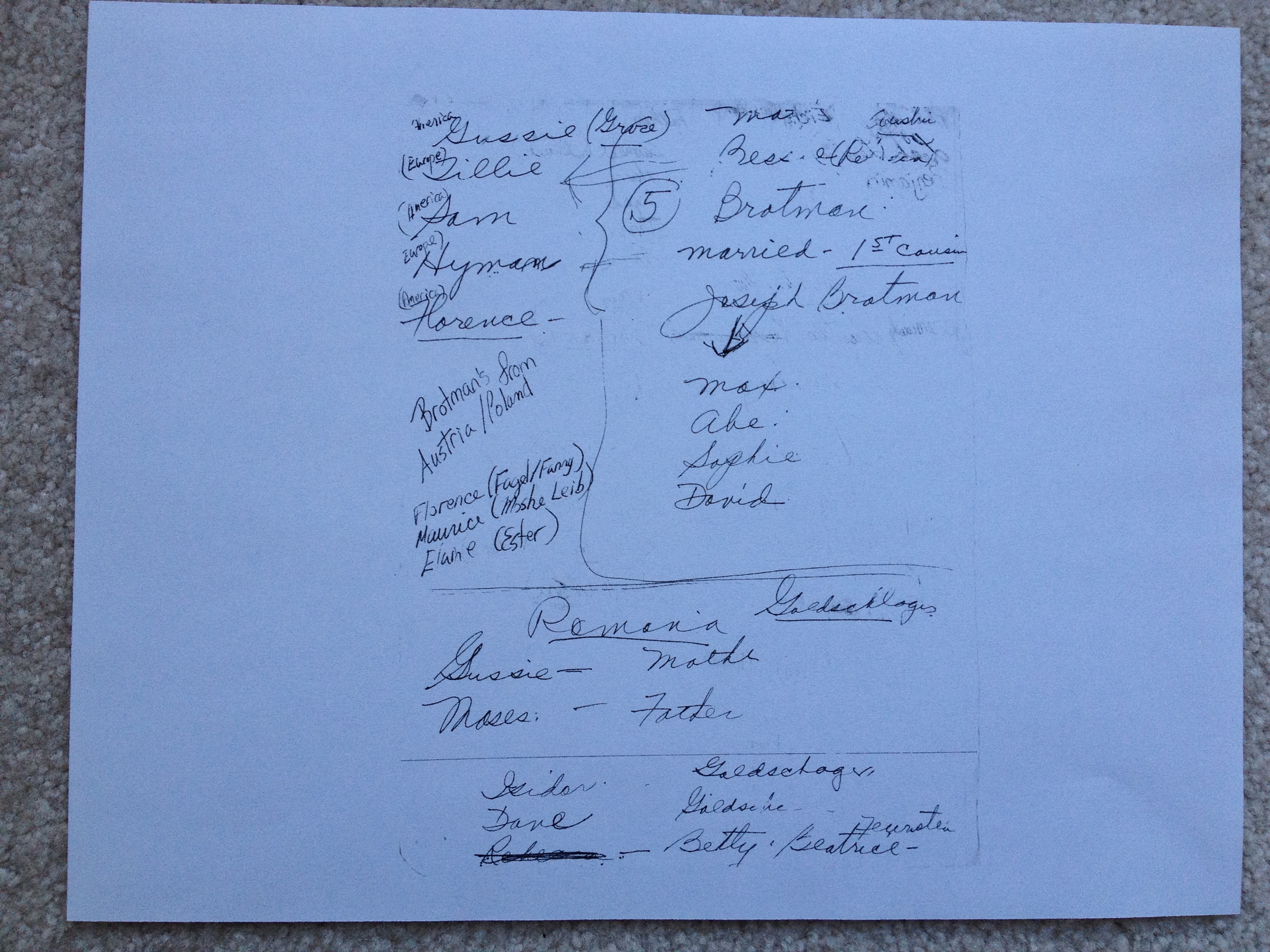
Family Tree drawn by Elaine Goldschlager Lehbraum

Family Tree drawn by Elaine Goldschlager Lehbraum

As you may recall, a couple of weeks ago my cousin Jody made a big discovery: handwritten notes that her mother had made of Joseph Brotman’s children.  It included all the children we already knew about: Bessie’s children Hyman, Tillie, Gussie, Frieda (Florence in her notes) and Sam, as well as the two sons we knew of from Joseph’s first marriage, Abraham and Max.   My brother had recalled that our aunt had said Joseph had had four children from his first marriage, but we did not know the names of the two remaining children, and I had traced every possible Brotman I could find to see if there was a link.  I had hit many dead ends and found nothing that linked these other Brotmans to our family.

My aunt’s notes were a huge discovery because for the first time we had evidence of the names of those two missing children: David and Sophie.  As I wrote when Jody first sent me the tree, I was able to locate a David Brotman from Austria who was a possible match for Joseph’s missing son, but I needed to check further and obtain some documentation in order to be sure.

Well, those documents arrived the other day, and I was so excited to see that on David’s marriage certificate in 1897, he listed his father’s name as Joseph Brotman and his mother’s as Chaye Fortgang.

David Brotman and Annie Salpeter marriage certificate

David Brotman and Annie Salpeter marriage certificate

You may recall that Max had also listed his mother’s name as Chaye on his marriage certificate, so this confirmed that Joseph’s first wife was named Chaye, but now we know her surname as well.

Max Brotman marriage certificate

Max Brotman marriage certificate

In addition, the marriage certificate gave David’s current address as 85 Ridge Street—the same address where Joseph and Bessie were living in 1895 when Gussie was born, according to her birth certificate.

Gussie birth certificate

Gussie birth certificate

This confirmed for me that David was Joseph’s son, Max and Abraham’s full brother, half-brother to Hyman, Tillie, Gussie, Frieda and Sam, and our great-uncle.  I am still in a state of amazement that I was able to find him.  Thank you, Aunt Elaine, for leaving behind this great clue to our family.

Once I had this information confirming the relationship, I located whatever census reports and other records I could find for David and his wife, Annie Salpeter.  I found them on census reports for 1900, 1905, 1910, and 1920.  David was a tailor according to the first three census reports, and he and Annie were living on the Lower East Side until at least 1910. At times Annie’s brother Morris lived with them as well as a cousin Meier, but there were no children listed on any of these census reports.

At the time of his World War I draft registration in 1917, David and Annie had left the Lower East Side and were living at 143 Manhattan Avenue in Brooklyn, which was also their address on the 1920 census report, when David’s occupation was given as a cloak dealer in a “cloak house.”  Annie and David were now 44 years old and still had no children living with them, so I assume that they never had children. So there are no more second cousins to find and probably no pictures of David and Annie.  (But I’ve learned never to say never.)

I’ve yet to find David and Annie on the 1930 or 1940 censuses, but I am still looking.  It seems unlikely that they had left Brooklyn.  I was able to locate a 1946 death certificate for a David Brotman married to Anna living at 10 Sumner Avenue in Brooklyn, and I believe this is the same David, despite the fact that the death certificate has his father’s name as Isaac.  I’ve learned enough to know that death certificates are notoriously unreliable.  I will continue to see if I can find anything about David and Annie after 1920.

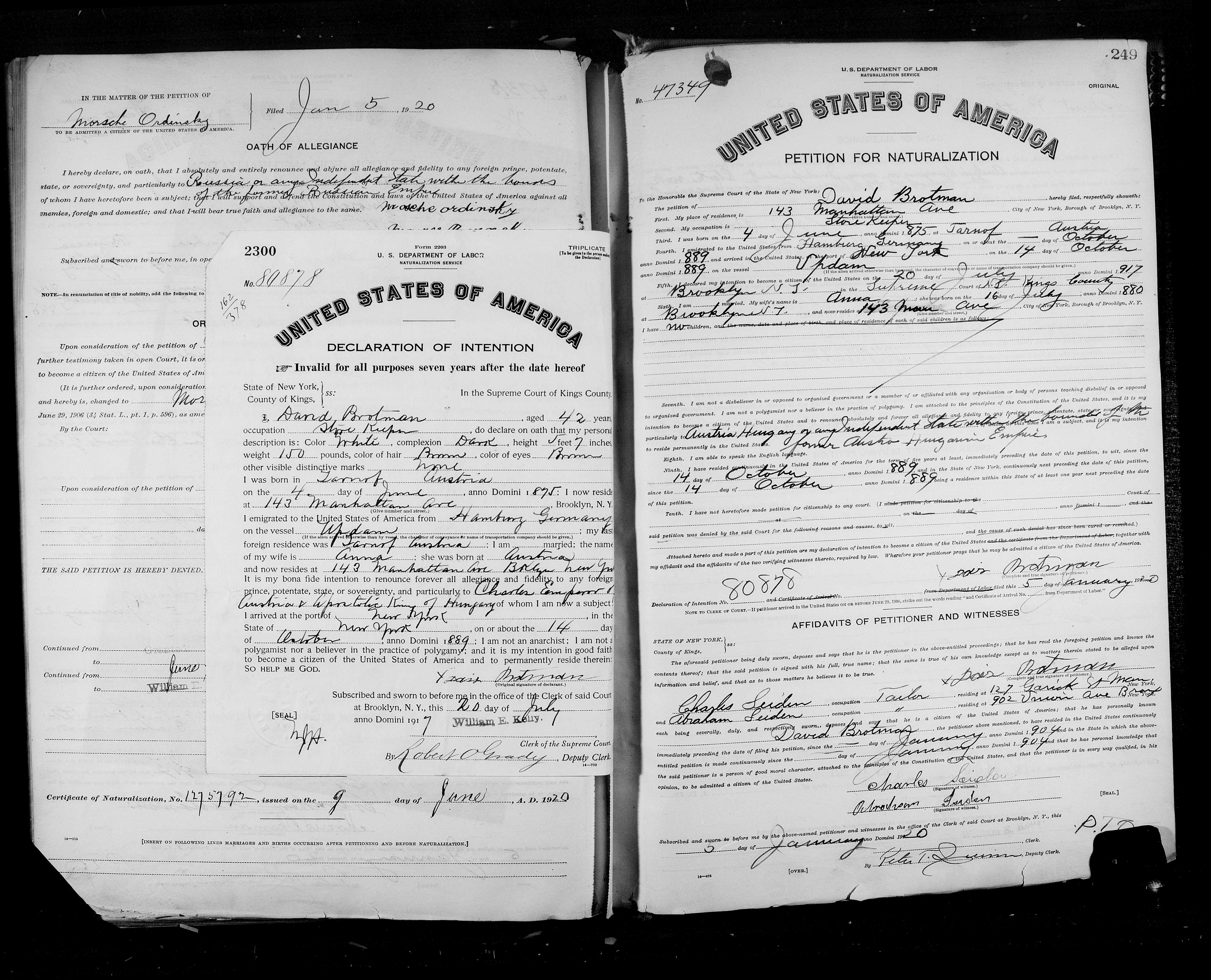
I do have David’s petition for naturalization in 1920, and it indicates that he had arrived in NYC on October 14, 1889, on the “Updam” from Tarnof, Austria.

David Brotman petition for naturalization 1920

David Brotman petition for naturalization 1920

Tarnof could be Tarnow, a city about fifty miles north of Tarnobrzeg/Dzikow and even further from Czchow, the two areas that I have been focusing on as the Brotman hometown based on Hyman’s listing of “Jeekief” and “Giga” on his documents.  But Tarnof could also be Tarnobrzeg, the larger town that is near Dzikow.  So did this new information help our search for our hometown in Galicia or did it just make it more confusing?

That led me to search for the ship manifest for David, now that I knew when he arrived and on what ship.  With some help from Renee, I located a September 4, 1889,  German ship manifest for the Portia, sailing to Rotterdam, listing Dawid Brodmann as a passenger.  I was excited to see that David was traveling with his older brother, Abe Brodmann. I had not previously been able to find Abraham on a ship manifest, so this was another exciting discovery.

David and Abe Brodmann on the Portia 1889

David and Abe Brodmann on the Portia 1889

On the Portia ship manifest, Abe and David are listed as coming from “Grambow, Russland,” not Austria at all, let alone Tarnow, Tarnobrzeg, Dzikow or Czchow.  I would have found this an indication that these were not the right boys, but there is a town right near Tarnobrzeg called Grebow, and according to a 1914 map, Tarnobrzeg was very close to the Russian border. So perhaps our family lived in Grebow? Or maybe that is where Joseph lived with Chaye and then moved to Dzikow when he married Bessie?

On the manifest for the Obdam, sailing from Rotterdam to New York arriving on September 19, 1889, David and Abe are listed as coming from Austria, not Russia, which appears to be correct.

David and Abe Brodman on the Obdam to New York 1889

David and Abe Brodman on the Obdam to New York 1889

There is obviously some confusion and conflict here, but it’s another clue and another place to look for the Brotman home in Galicia. I already have contacted several people researching this area to see if I can uncover more clues.

I have a few more leads to follow to fill in the gaps in David’s life story, and maybe they will even lead me to Sophie, the only remaining child of Joseph to locate.  There is also some potential evidence that will link our family to the Brotmanville Brotmans, but again, I need to do more research before it is worth speculating about that connection.

Enhanced by Zemanta

The Adler Strolowitz family continued

Although I still don’t have answers to all the questions about the Strolowitz/Adler family, I have made a lot of progress finding the descendants of Tillie Strolowitz Adler and her children, with a lot of assistance from Renee Steinig, who continues to teach me and to amaze me with her ability to find people through various search methods.  So here’s a summary and a description of the process used to find most of these people, including several living descendants who I am now trying to contact.

I’ve not had any success finding Tillie’s son Isidor yet aside from the entry in the 1910 census.  There are numerous Isidor Adlers listed in the NYC marriage index and many also in the US and NY census reports, but I cannot with any degree of certainty identify the right one.  Some are too old or were married and had children before 1910, when the right Isidor was still single and living with his mother.  Some are not from Romania or born in the United States.  I am beginning to think that Isidor either died young or maybe even returned to Romania.  I have found one death record for an Isidor Adler who died April 23, 1915, and the age looks right, so I will send for that death certificate.

I’ve had better luck locating the second son, David Adler.  After a careful process of elimination, I believe that Tilllie’s son David married a woman named Bertha (maiden name not yet found).  Since David also had a sister named Bertha, this created some confusion for me.  David and Bertha had a daughter Tessie, born in 1927 (possibly named for Tillie, who had died in 1925).  Renee found a memorial written about Tessie Adler on the Findagrave.com site, and the date of birth corroborated that this is the correct Tessie.  Tessie and her husband Harry had two sons, David, possibly named for his grandfather David Adler, and Ira.  I am now in touch with Ira, who confirmed that he is Tessie’s son and that she was David’s daughter and Tillie’s granddaughter.

The Strolowitz daughters were much trickier to find, as women tend to be.  Once they get married, they are much harder to find, unless I can find a marriage record which gives me their husband’s name.  I first focused on Bertha, figuring that it was a less common name than Beckie, Bella or Lizzie.  I found a marriage record for Bertha Strulovitz to Benny Bloom in May, 1914.  I then did a census search and found a Bertha and Bernard Bloom living on East 109th Street in 1915.  The “Bernard” threw me, as did the fact that Bertha was 27, meaning she would have been born in 1888, not 1885, as reported on the 1910 census.  But while scanning the page to look for their entry, I saw a listing in the same building for a Tillie Stralowitch and her children, David, Bella, Beckie, Peter (Pincus?) and Lizzie.  This was obviously Tillie Strolowitz, living in the same building as in 1910, with her married daughter Bertha and her new husband Bernard or Ben in their own apartment.  So far, so good.  It also made sense that Bertha was born in 1888, not before David, who was 28 in the 1915 census and thus older than Bertha.  That could explain why David and Isidor were Adlers, while the rest of the children were Strolowitz.  Perhaps Mr. Adler died right after David was born, Tillie remarried to Strolowitz and within a year had Bertha?  Phew!  They acted fast back then!  (Remember Harry Coopersmith…)

But after that, I could not find any references for Bertha Bloom at all.  I was stumped.  I couldn’t find any more references for Tillie Strolowitz either, no matter how I spelled it.  Finally, I decided to look for Tillie Adler, and there she was in the 1920 census, listed as Tillie Adler, living with her three daughters, Bertha, Bella and Leah (Lizzie?) on East 107th Street.  The ages and names matched, but why were they now using Adler? So much for my earlier hypothesis.  Maybe Mr. Adler was the father of all these children? Maybe Mr. Adler and Mr. Strolovitz were the same person? And what happened to Bertha’s husband? Why was she living with her mother?  She is listed as married, not single, on the 1920 census, but not living with Bloom.

In 1925 Tillie, Bertha and Bella were all still living together on East 107th Street under the surname Adler.  There was no question about marital status on this form, but apparently Bertha was still legally married because in 1926 she applied for citizenship.  On the naturalization form she signed as “Bertha Adler known as Bertha Strulovici and Bertha Bloom,” and listed her spouse as Benjamin Bloom.  Her brother David Adler signed as a witness for her.

By 1930, Tillie had died, and Bertha and Bella had moved in with David Adler and his wife Bertha and daughter Tessie.  Imagine—two Bertha Adlers living in one household.  The census taker must have been confused because he listed Bertha, David’s sister, as his mother.  On this census, Bertha (the sister) is now listed as divorced, finally.

In 1940, Bertha was no longer living with David, but now was living with her sister Leah on Grant Avenue in the Bronx.  Leah was married to Benjamin Schwartz, an optometrist, and had two children, Ira and Theodora.  Renee helped me locate Theodora, who is now living in Atlanta where her parents eventually moved and died.

No further luck finding out what happened to Bella or Bertha after 1940, but at least we know what happened to Tillie, David, and Leah, and have located the next generation of third cousins, the great-great grandchildren of David and Esther Rosensweig.

More discoveries in the next post, including some of the most interesting ones of all.  But for now, back to the research.

Enhanced by Zemanta

Who was Tillie Srulowitz? Another mystery solved?

As I mentioned in my post about the ship manifests, Betty Goldschlager was released from Ellis Island to someone she identified as her aunt, Tillie Srulowitz.  I had no idea who this could be when I first saw this many months ago.

In reviewing my Goldschlager research this past week or so, however, I looked more closely at the census report from 1910, as seen below.

The Strolovitz Adler family with Isadore and Betty in 1910

The Strolovitz Adler family with Isadore and Betty in 1910

Isadore and “Bella” Goldschlager are listed as boarders living with….Tillie Strolowitz and her many children.  When I first looked at this, I had no idea who the Strolowitz family was and just assumed that Isadore and Betty were living there as boarders, not relatives.  This time I remembered the name on the ship manifest and made the connection: this was the aunt that met Betty at Ellis Island.

So who were these people?  Tillie was listed as a widow and had five children named Strolowitz: Beckie, Bertha, Bella, Lizzie and Pincus.  She also had two sons with the last name Adler, David and Isidor.  I assumed David and Isidor were children of a first marriage, and the others children of her second marriage, but since David is younger than Bertha, that did not make sense.  Of course, knowing how unreliable census reports are, it is also likely that that is just an error and that David was in fact older than Bertha.  The census also reports that Tillie’s present marriage was 26 years old, but I don’t know whether that means she’d been married to Mr. Strolovitz for 26 years when he died or whether it had been 26 years since she had married him.  All her children named Strolovitz were younger than 26, whereas Isidor was 27.
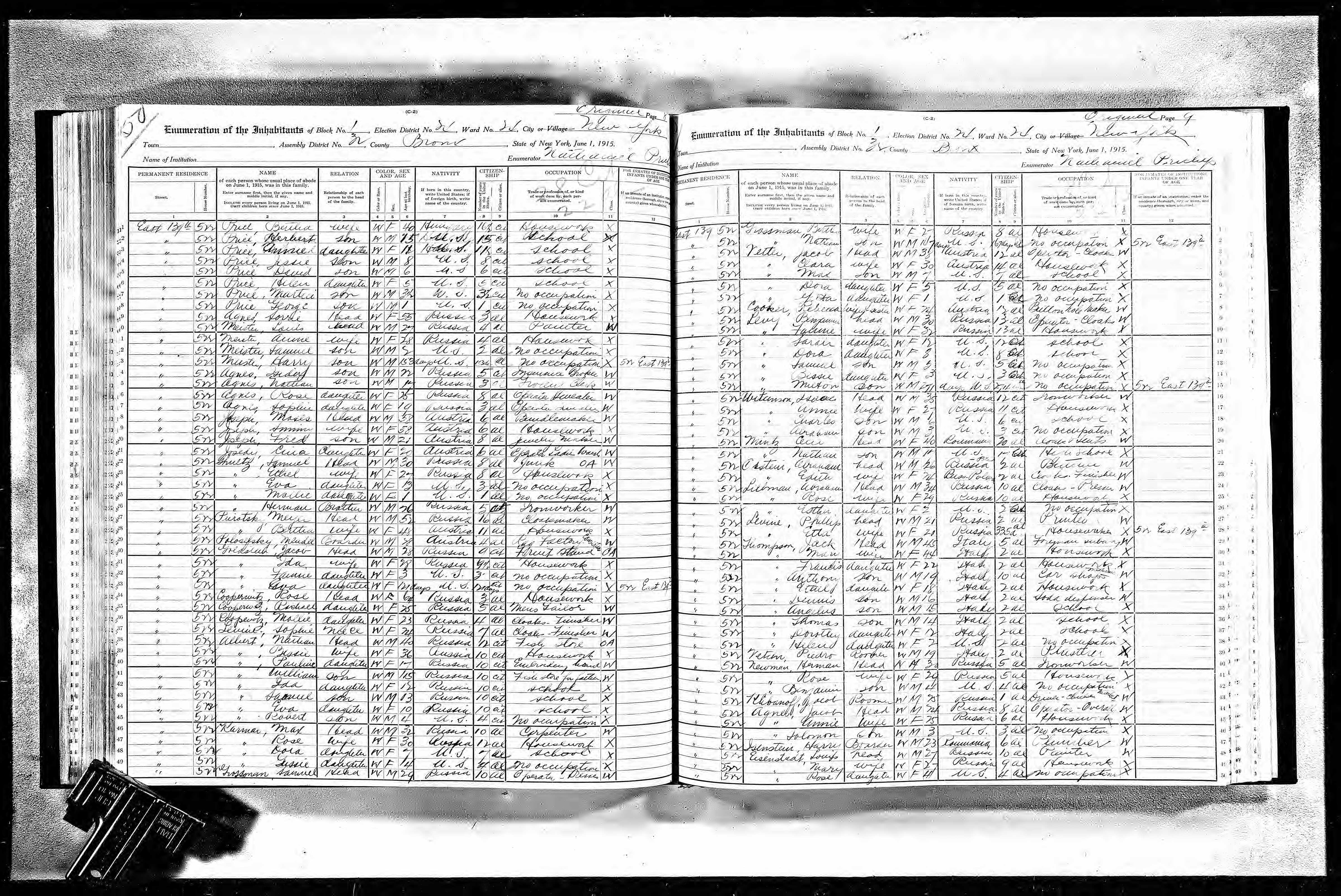
I then decided to see what I could find about the Strolovitz family and the possible connection to the Goldschlager family.  On the Ellis Island site, I found entries for two sisters, Betty and Bruche Strulovici from Jassy, who arrived together in 1906 on the Noordam when Betty was 17 and Bruche was 20 with thirty dollars between them.  That information matched the ages and dates of arrival for Bella and Bertha Strolovitz on the 1910 census, so it could very well be them.  I so far have not been able to locate any other Ellis Island records for Tillie Strolovitz’s family.

When I searched for later US census records, I could find almost nothing at first for anyone named Strolovitz with similar first names or for Szrulowitz or Strulowitz or any other reasonable variation.  I then turned to search for David and Isidor Adler and ran into the problem of too many people with those names and no certain way of determining which ones were Tillie’s sons.  I think I have narrowed it down, but am still not certain that I have found the right David or Isidor.

On the other hand, while searching for Adlers on the US census I found this one:

Tillie, Bertha, Bella and Leah Adler 1920

Tillie, Bertha, Bella and Leah Adler 1920

Tillie, Bertha, Bella and Leah Adler, listed as mother and daughters, of the approximate ages that Tillie Strolovitz and her daughters would have been in 1920, from Romania.  This seemed too unlikely to be a coincidence, and I feel fairly certain that for some reason, Tillie and her daughters had changed from being Strolovitz to Adler.  I could not find any records under either last name for Tillie or the daughters, except for death certificate for a Tillie Adler dated 1925 for a woman of the correct age.  I have ordered that certificate and will wait to see what it contains.

Having concluded that Tillie and her daughters were now using Adler, I thought that perhaps her son Pincus had also switched from Strolovitz to Adler, so I searched for him.  I found a South Carolina death certificate for Pincus Adler dated July, 1919, age 19, born in Romania, whose father’s name was Jacob Adler, and whose mother’s maiden name was Tillie Rosensweig.

Pincus Adler Death Certificate 1919

Pincus Adler Death Certificate 1919

The informant on the death certificate was David Adler of West 68th Street, New York, New York.   I am fairly certain that this is the same David Adler and the same Pincus Strolovitz AKA Pincus Adler, although the age may be off by a year or so (not anything surprising in these records).  Everything else lines up: mother is Tillie and brother is David Adler from NYC.  Pincus Adler was also buried at Mount Zion cemetery in Queens, not in South Carolina.  Perhaps Pincus ended up in South Carolina after World War I.  I’ve yet to find a draft registration under either name, but am continuing to look.

So why does any of this matter? When I first saw what Tillie’s maiden name, it didn’t mean anything to me.  Like so many other times in the research, I had to move away from it. Several hours later, while doing something completely unrelated, a lightbulb went off.  Rosensweig was Gisella Goldschlager’s maiden name also! Gisella and Tillie were sisters—Tillie, after all, was listed as Betty’s (and thus, David’s and Isadore’s) aunt on that Ellis Island form.  Her children—Bertha, Bella, Beckie, Pincus, Lizzie, David and Isidor— were my grandfather’s first cousins.

I still have more work to do to figure out the Strolovitz/Adler family.  Why did they use two different last names?  I found a Tillie Strulowitz buried at Mount Zion on August 4, 1925, the day after the date of death for Tillie Adler; this must be the same person, but one place she is Adler, the other she is Strulowitz.  Why is Jacob Adler listed by David Adler as Pincus’ father?  Was there ever a Mr. Strolovitz or was Jacob Adler the father of all seven children? Why did Tillie switch back and forth? Why did her daughters become Adlers?

This stuff just never gets boring to me; there is always another mystery, another surprise around each corner.

Enhanced by Zemanta