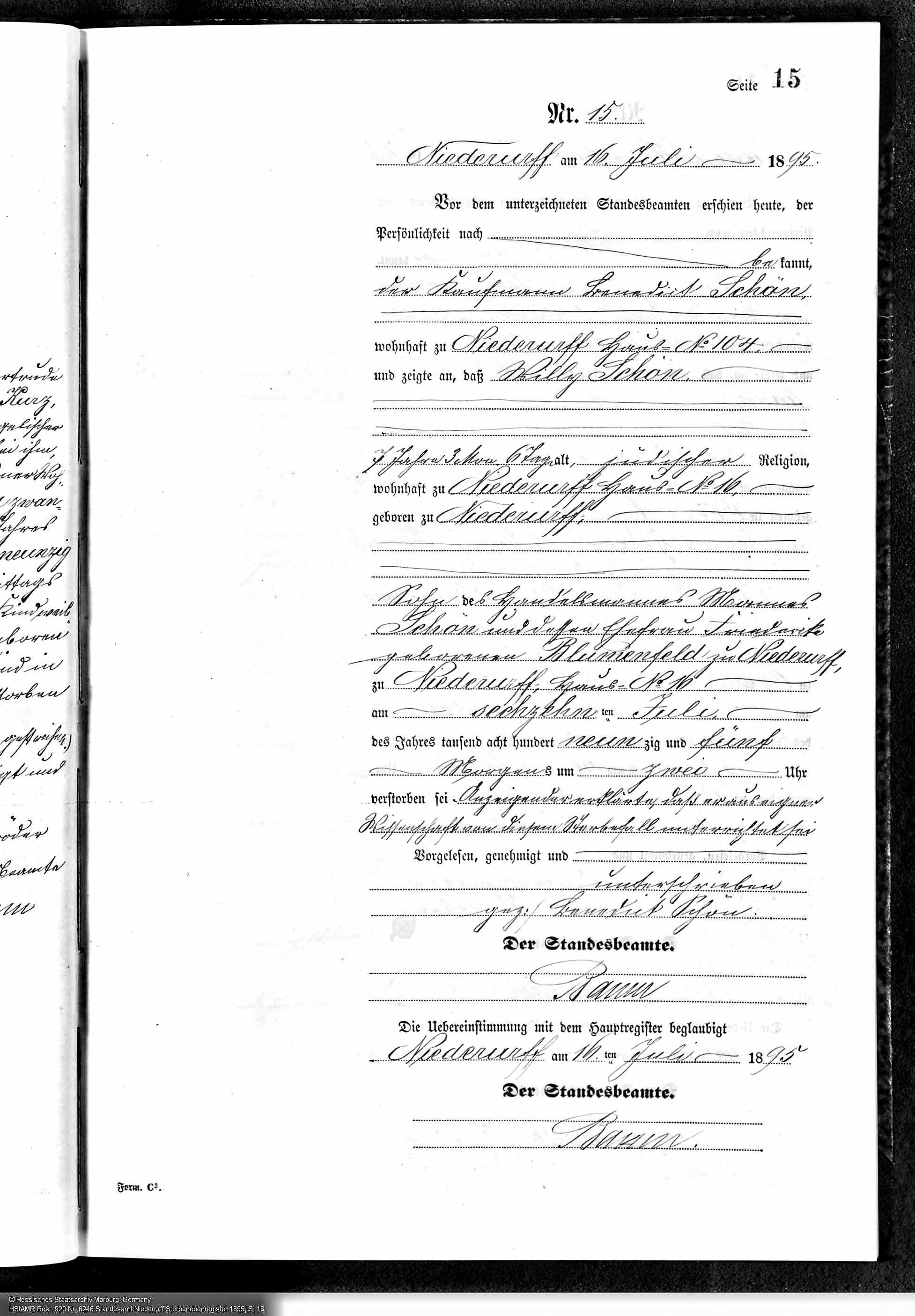
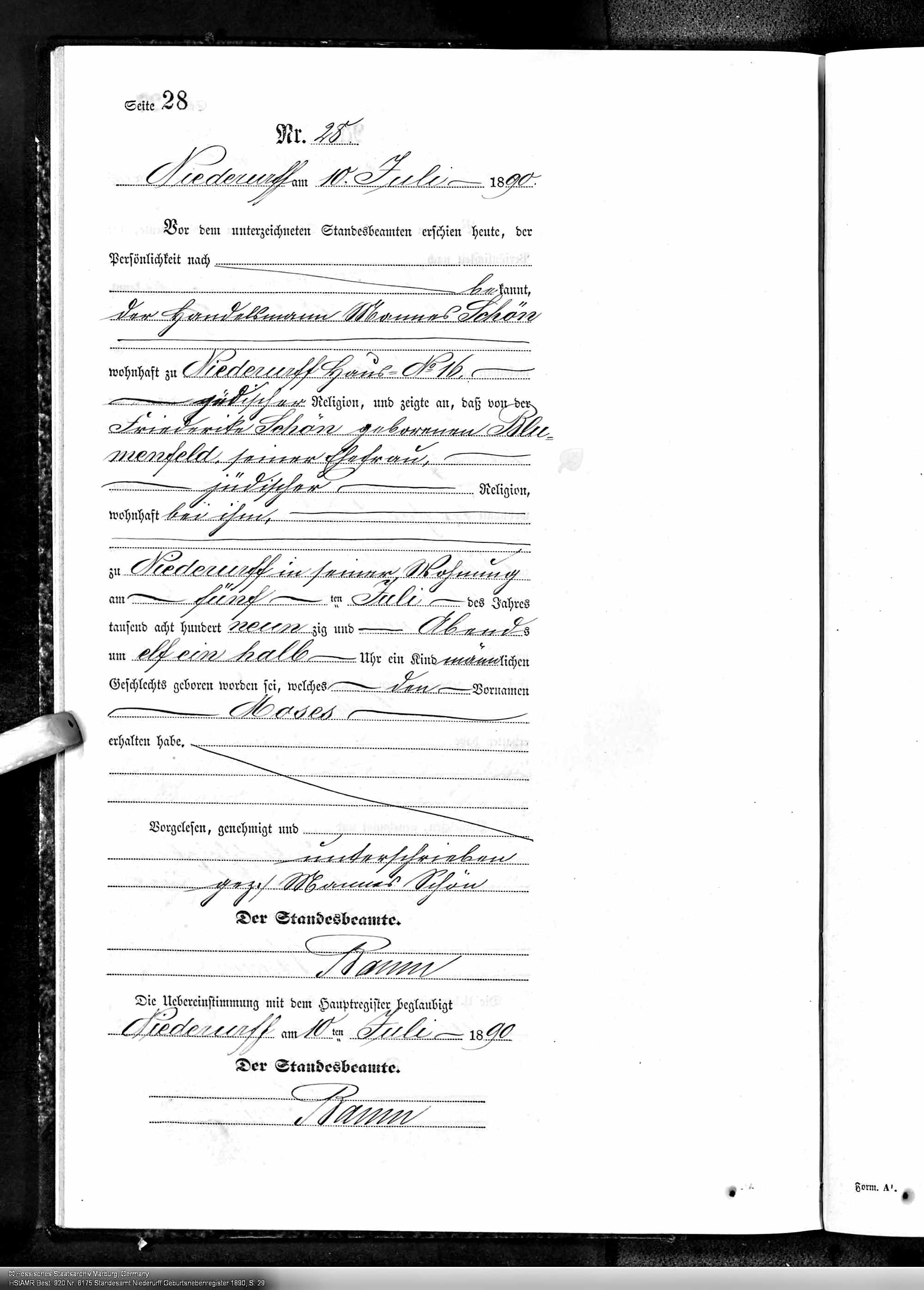
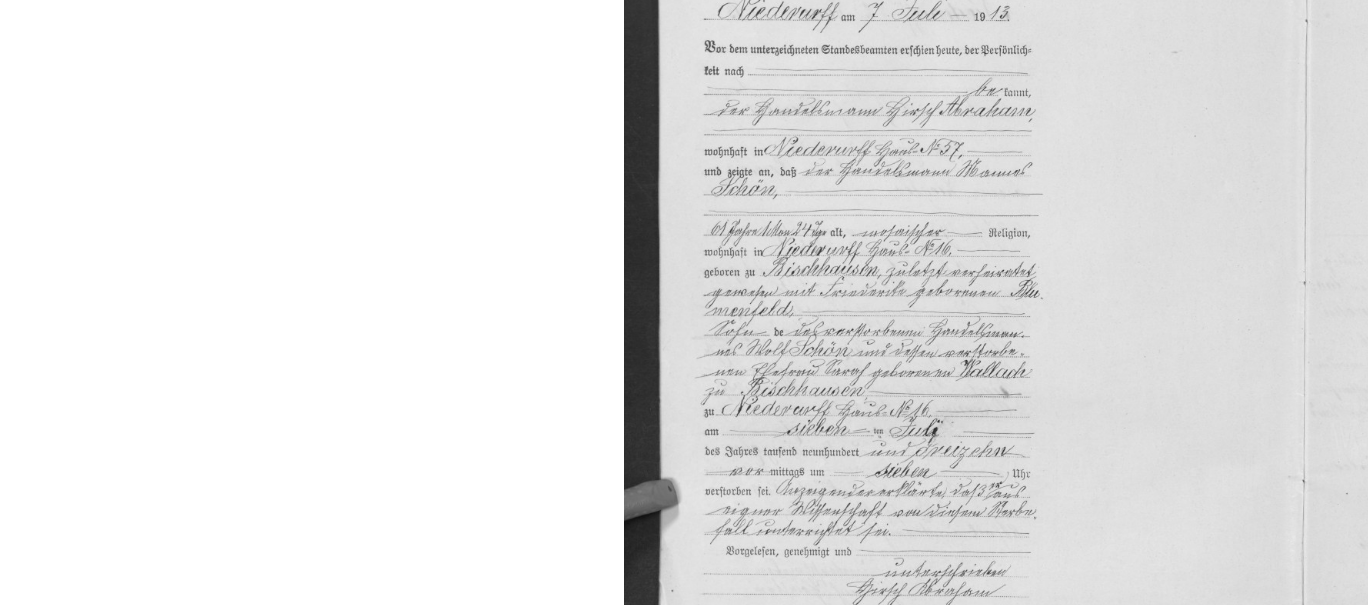
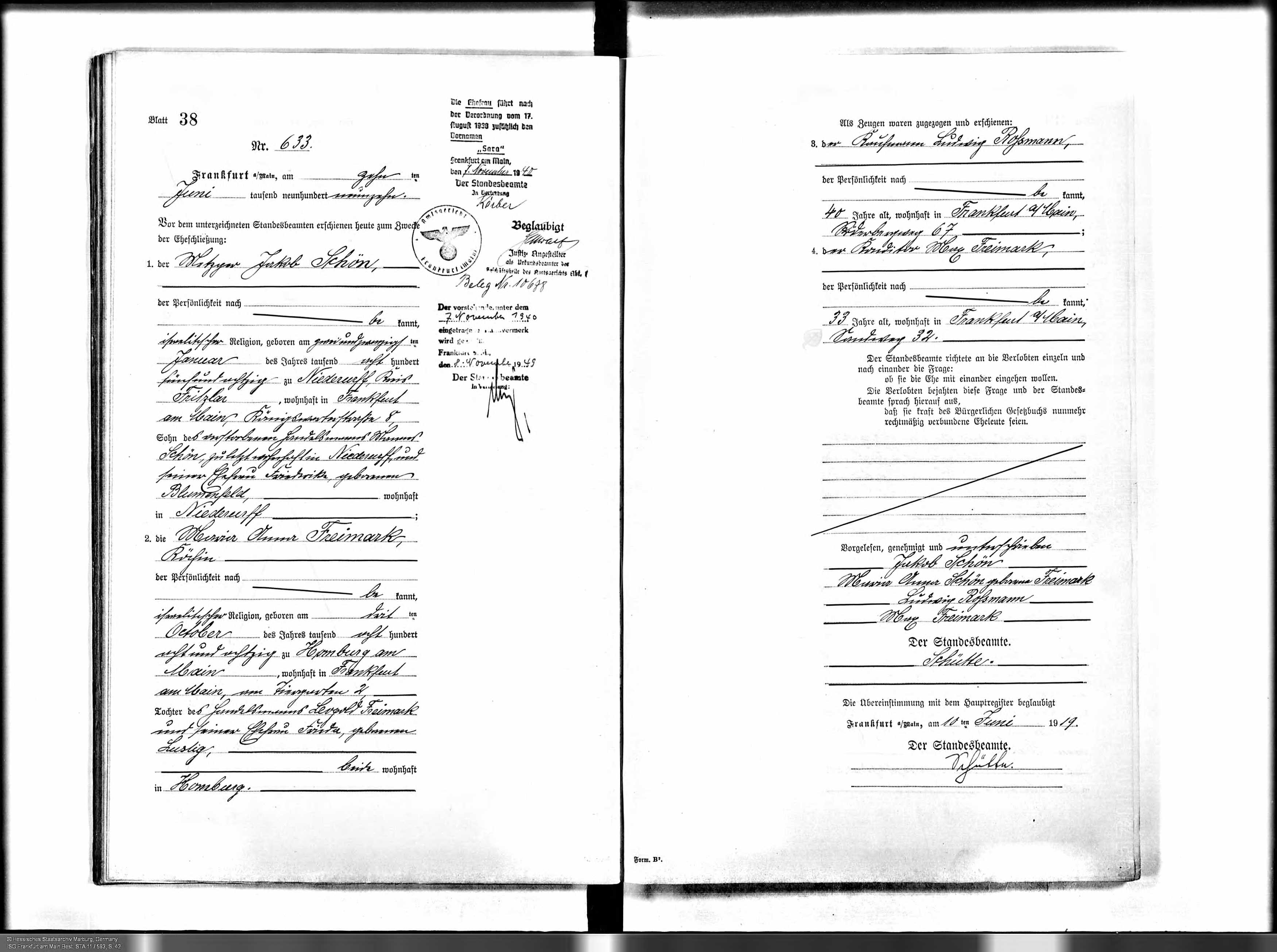
Genealogy Fun: How My Friend and I Discovered We Have Mutual Cousins

One of the first people I ever met who did genealogy research is my friend Amanda Katz Jermyn. I met Amanda through mutual friends over thirty years ago, and we have been members of the same small havurah group for many years now. When Amanda long ago described her genealogy research and the connections and stories she had found, I was amazed. She helped to inspire me to start my own journey.

Amanda and I both have paternal ancestry from Germany, and over the years we’ve wondered whether we would ever find an overlap in our German Jewish ancestry. Well, I finally found one, although it is very attenuated and only by marriage. Nevertheless it was fun to find this connection.1 Here’s the story of my third cousin, twice removed, Moritz Rosenberg, and his wife Berta Blum, Amanda’s third cousin, once removed.

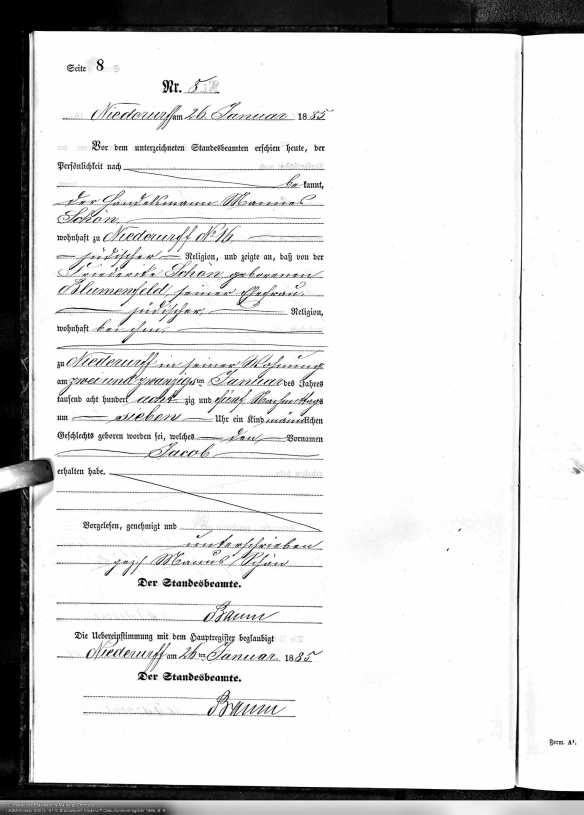
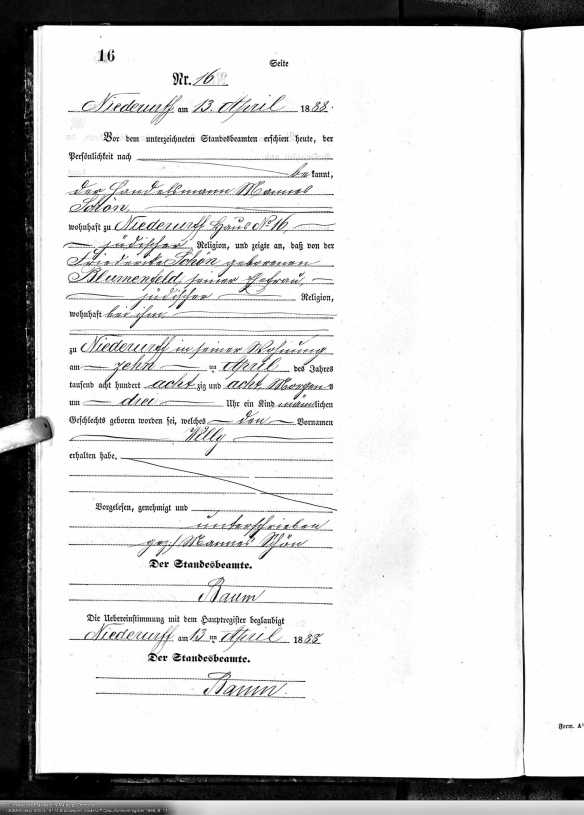
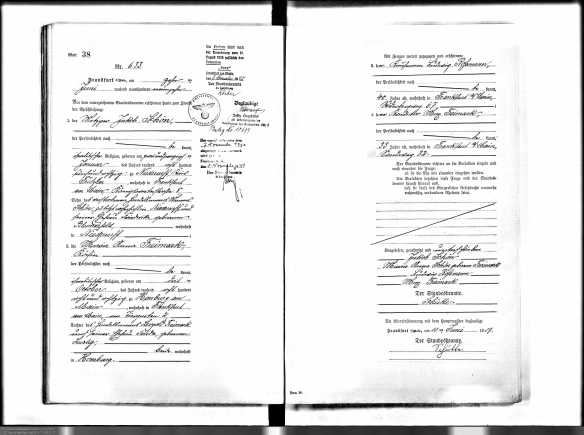
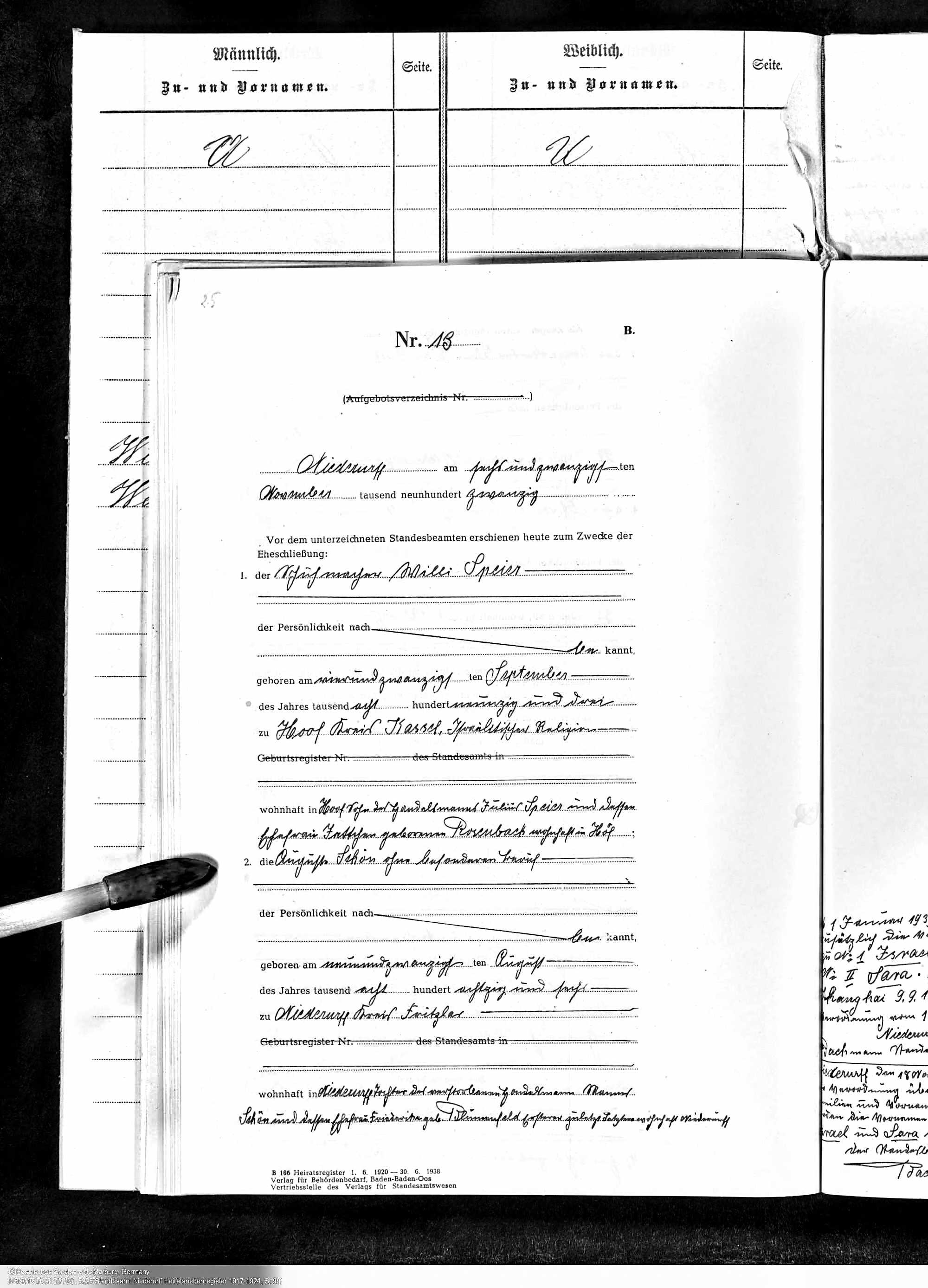
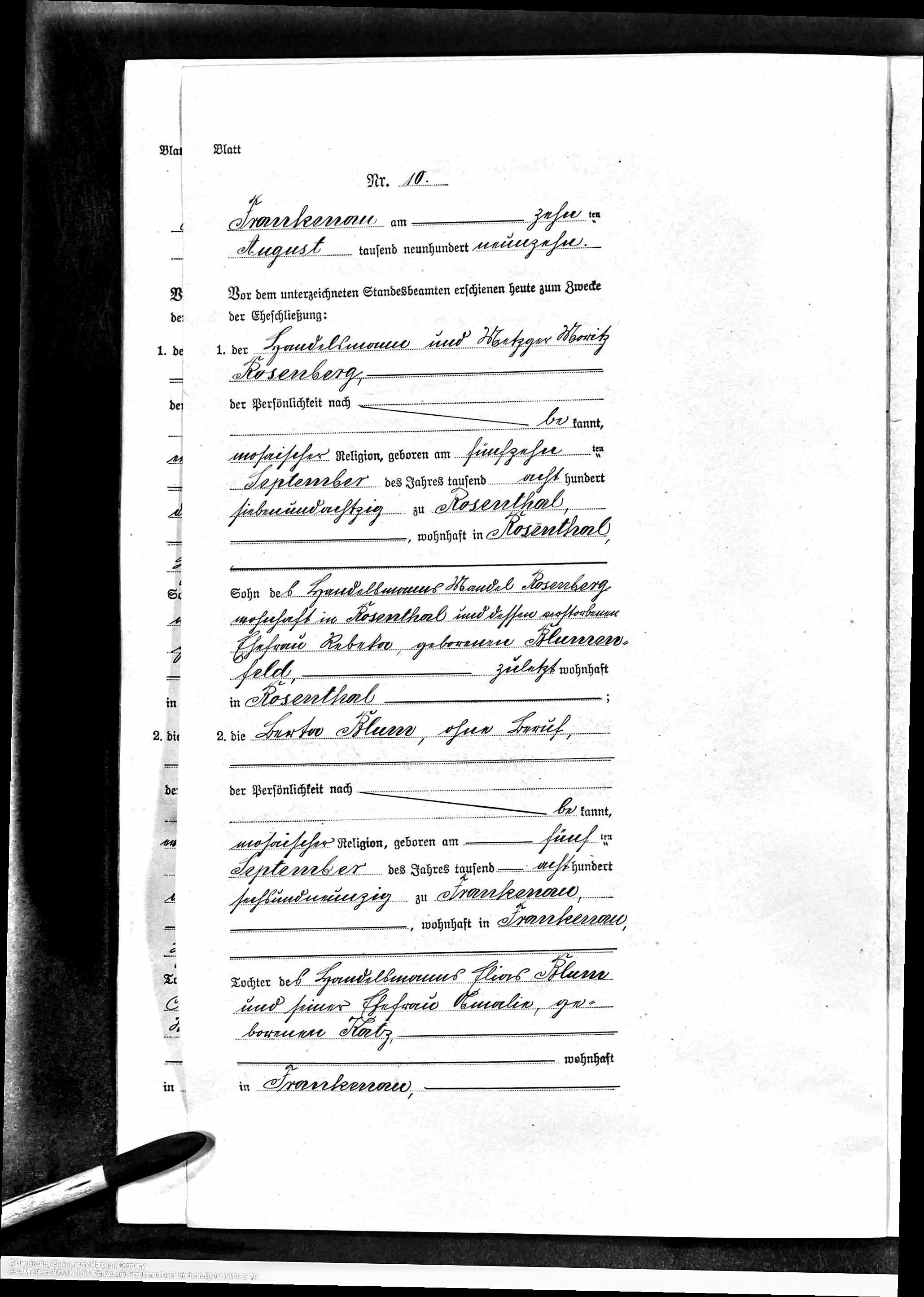
As we saw in my earlier post, Moritz, the third child of Rebecca Blumenfeld and Mendel Rosenberg, was born on September 15, 1887, in Rosenthal, Germany, and married Berta Blum on August 10, 1919, in Frankenau, Germany. Berta was born on September 5, 1896, in Frankenau to Elias Blum and Amalie Katz.

Marriage of Moritz Rosenberg and Berta Blum, Hessisches Hauptstaatsarchiv; Wiesbaden, Deutschland; Signatur: 3254, Year Range: 1919, Ancestry.com. Hesse, Germany, Marriages, 1849-1930

Moritz and Berta had two children, Jacob (later Theodore), born on January 17, 1921,2 and Rebecca (later Ruth), born on January 4, 1925, both in Rosenthal, Germany.3

Moritz and his family were among the very fortunate ones who all were able to escape safely from Nazi Germany. Moritz, Berta, and their 13-year-old daughter Rebecca arrived in New York on September 15, 1938. Moritz listed his occupation as a butcher. Berta’s cousin Herman Blum was listed as the person they knew in the US.4

It took me longer to find out when Jacob arrived in the US because I was searching for him as Jacob, as that is how he was listed on Moritz’s naturalization petition. But the 1940 census has him identified as Theodore (and Rebecca as Ruth),5 and that gave me the necessary clue to find Jacob a/k/a Theodore’s naturalization petition. He arrived in the US as a 16-year-old on May 15, 1937. And on his 1942 petition he used his newly adopted name, Theodore.

Moritz Rosenberg, Declaration of Intention, (Roll 548) Declarations of Intention For Citizenship, 1842-1959 (No 426401-427400), Ancestry.com. New York, U.S., State and Federal Naturalization Records, 1794-1943

Theodore Jack Rosenberg a/k/a Jakob Teo Rosenberg, Declaration of Intention, The National Archives at Philadelphia; Philadelphia, PA; NAI Title: Declarations of Intention For Citizenship, 1/19/1842 – 10/29/1959; NAI Number: 4713410; Record Group Title: Records of District Courts of the United States, 1685-2009; Record Group Number: 21, Description: (Roll 561) Declarations of Intention For Citizenship, 1842-1959 (No 438701-439600), Ancestry.com. New York, U.S., State and Federal Naturalization Records, 1794-1943

The date of his arrival helped me locate Theodore’s ship manifest, where he identified his father as the person he was leaving behind, and his uncle, Herman Blum, as the person he was going to in the US. He is identified as Teo Rosenberg. (See the last line on the image below.)

Teo Rosenberg, ship manifest, The National Archives and Records Administration; Washington, D.C.; Passenger and Crew Lists of Vessels Arriving at and Departing from Ogdensburg, New York, 5/27/1948 – 11/28/1972; Microfilm Serial or NAID: T715, 1897-1957, Ship or Roll Number: Manhattan, Ancestry.com. New York, U.S., Arriving Passenger and Crew Lists (including Castle Garden and Ellis Island), 1820-1957

In 1940, Moritz, Berta, and both of their children were living in New York City. Moritz and Berta were both working as salespeople for a wholesale dress business, and Theodore was a handyman for a venetian blinds company. They also had four lodgers living with them.

Moritz Rosenberg and family, 1940 US Census, Year: 1940; Census Place: New York, New York, New York; Roll: m-t0627-02670; Page: 1A; Enumeration District: 31-1885, Ancestry.com. 1940 United States Federal Census

But while I was searching for information about Theodore/Jacob, I found Moritz and Berta and their children on an Ancestry family tree called the 2020 Jermyn Tree, owned by someone with a memorable name, James Bond. I might have thought that that name was a pseudonym, but fortunately I knew that my friend Amanda had a distant cousin with that name. So seeing the title with her surname and the name of the owner, I assumed there had to be some connection between my relative Moritz Rosenberg and his family and my friend Amanda.

Although Amanda’s name wasn’t revealed on the tree since she is still living, I knew her parents’ names, and they were on the tree. The connection appeared to be through Moritz Rosenberg’s wife Berta Blum, whose mother was Amalie Katz, but I couldn’t quite sort out how Robert Katz, Amanda’s father, was related to Amalie Katz.

I contacted Amanda, and she confirmed the connection and said that Berta Blum was in fact her relative—her third cousin, once removed, through Berta’s mother Amalie Katz and Amanda’s father Robert Katz. Even better, Amanda had been in touch with Moritz and Berta’s daughter Ruth (born Rebecca) and was able to provide me with more information about Ruth and her brother Theodore and their children.

For example, Amanda shared that Ruth had told her that her brother Theodore had enlisted in the US Army in the intelligence division and that the army had him change his surname from Rosenberg to Rogers since he was being sent to Germany. This helped me locate Theodore’s draft registration, which I had had trouble locating when searching for Theodore Rosenberg.

Theodore registered for the draft on February 15, 1942, and was still working for the venetian blinds company at that time. As you can see, he crossed out Rosenberg on his draft registration and inserted Rogers as his surname.

Theodore Rosenberg/Rogers, World War II draft registration, National Archives at St. Louis; St. Louis, Missouri; Wwii Draft Registration Cards For New York City, 10/16/1940 – 03/31/1947; Record Group: Records of the Selective Service System, 147, Ancestry.com. U.S., World War II Draft Cards Young Men, 1940-1947

Ruth Rosenberg married Henry Hammer (born Hammerschlag) after the war; their New York City marriage license is dated June 12, 1945.6 Henry was born on March 29, 1919, in Giessen, Germany.7 In 1950, Ruth and Henry were living in New York City, and Henry was working as a salesman for wholesale dry goods company. Ruth and Henry would have two children.8

Meanwhile, in 1950, Moritz, Berta, and Theodore were living together (along with Berta’s mother Amalie Blum) in New York City. Moritz and Berta now were in the wholesale liquor business together, and Theodore was continuing to sell venetian blinds.

National Archives at Washington, DC; Washington, D.C.; Seventeenth Census of the United States, 1950; Year: 1950; Census Place: New York, New York, New York; Roll: 4547; Page: 3; Enumeration District: 31-1731, Ancestry.com. 1950 United States Federal Census

Theodore didn’t marry until 1960 when he was 39 years old.9 His wife was Sylvia Kapp (originally Kappenmacher), born on February 20, 1938, in Port Elizabeth, South Africa, to Willi Kappenmacher and Erna Wolf. Sylvia and her parents had immigrated to the US on June 8, 1946,10 and were living in New York City in 1950. Theodore and Sylvia had two children born in the 1960s.

Sadly, those children lost their father when they were very young as Theodore died on November 13, 1971, at the age of fifty.11 He was survived not only by his wife and children, but also by both of his parents and his sister Ruth and her family.

Fortunately, Theodore’s father and especially his mother and sister were graced with very long lives. Moritz Rosenberg died on September 22, 1976, five years after his son. He had turned 89 years old just a week before.12

Berta Blum Rosenberg achieved a remarkable distinction—living to 112 years and becoming the oldest living Jewish person in the world at that time, as reported in her obituary in the January 30, 2009, Hackensack (NJ) Record:

Berta Blum Rosenberg obit

The Record Hackensack, New Jersey • Fri, Jan 30, 2009 Page L6

Berta died on January 28, 2009, in New York.13 She was survived by her daughter Ruth and her grandchildren and great-grandchildren.

Her daughter Ruth also lived a long life. She died on March 8, 2021, at the age in 96; her husband Henry Hammer had predeceased her by many years, having passed away on May 17, 1986, at the age of 67.14 Ruth was survived by her children and grandchildren as well as the children and grandchildren of her brother Theodore.

Those children and grandchildren of Ruth and Theodore create a link between my friend Amanda and myself. They are our mutual cousins—the descendants of my cousin, Moritz Rosenberg, and Amanda’s cousin, Berta Blum.

Isn’t genealogy fun?


  1. Amanda also shares some DNA with my husband, but given the different ancestral homes of each of them and the very small amount of DNA shared, it is likely just endogamy. 
  2. Theodore Jack Rosenberg a/k/a Jakob Teo Rosenberg, Declaration of Intention, The National Archives at Philadelphia; Philadelphia, PA; NAI Title: Declarations of Intention For Citizenship, 1/19/1842 – 10/29/1959; NAI Number: 4713410; Record Group Title: Records of District Courts of the United States, 1685-2009; Record Group Number: 21, Description: (Roll 561) Declarations of Intention For Citizenship, 1842-1959 (No 438701-439600), Ancestry.com. New York, U.S., State and Federal Naturalization Records, 1794-1943 
  3. Moritz Rosenberg, Declaration of Intention, (Roll 548) Declarations of Intention For Citizenship, 1842-1959 (No 426401-427400), Ancestry.com. New York, U.S., State and Federal Naturalization Records, 1794-1943 
  4. Ibid. 
  5. Moritz Rosenberg and family, 1940 US Census, Year: 1940; Census Place: New York, New York, New York; Roll: m-t0627-02670; Page: 1A; Enumeration District: 31-1885, Ancestry.com. 1940 United States Federal Census. See image below. 
  6. Ruth R Rosenberg, Gender Female, Marriage License Date 12 Jun 1945
    Marriage License Place Manhattan, New York City, New York, USA, Spouse Henry M Hammer. License Number 14437, New York City Municipal Archives; New York, New York; Borough: Manhattan; Volume Number: 21, Ancestry.com. New York, New York, U.S., Marriage License Indexes, 1907-2018 
  7. Henry Hammerschlag World War II draft registration, National Archives at St. Louis; St. Louis, Missouri; Wwii Draft Registration Cards For New York City, 10/16/1940 – 03/31/1947; Record Group: Records of the Selective Service System, 147, Ancestry.com. U.S., World War II Draft Cards Young Men, 1940-1947 
  8. Henry Hammer and family, 1950 US census, National Archives at Washington, DC; Washington, D.C.; Seventeenth Census of the United States, 1950; Year: 1950; Census Place: New York, New York, New York; Roll: 4377; Page: 19; Enumeration District: 31-2183, Ancestry.com. 1950 United States Federal Census 
  9. Theodore Rogers, Gender Male, Marriage License Date 1960, Marriage License Place Manhattan, New York City, New York, USA, Spouse Sylvia Kapp, License Number 11021, New York City Municipal Archives; New York, New York; Borough: Manhattan, Ancestry.com. New York, New York, U.S., Marriage License Indexes, 1907-2018 
  10. Kappenmacher, ship manifest, The National Archives and Records Administration; Washington, D.C.; Passenger and Crew Lists of Vessels Arriving at and Departing from Ogdensburg, New York, 5/27/1948 – 11/28/1972; Microfilm Serial or NAID: T715, 1897-1957, Ship or Roll Number: Marine Tiger, Ancestry.com. New York, U.S., Arriving Passenger and Crew Lists (including Castle Garden and Ellis Island), 1820-1957.  Erna Kapp, SSACI, Ancestry.com. U.S., Social Security Applications and Claims Index, 1936-2007. 
  11. Theodore Rogers, Birth Date 17 Jan 1921, Death Date 13 Nov 1971, SSN 116105571, Enlistment Branch ARMY, Enlistment Date 3 Mar 1943, Discharge Date 23 Dec 1945, Ancestry.com. U.S., Department of Veterans Affairs BIRLS Death File, 1850-2010 
  12. Moritz Rosenberg, SSDI, Social Security Administration; Washington D.C., USA; Social Security Death Index, Master File, Ancestry.com. U.S., Social Security Death Index, 1935-2014. Headstone at Find a Grave, database and images (https://www.findagrave.com/memorial/36414768/moritz-rosenberg: accessed 07 August 2023), memorial page for Moritz Rosenberg (15 Sep 1887–Sep 1976), Find a Grave Memorial ID 36414768, citing Cedar Park Cemetery, Paramus, Bergen County, New Jersey, USA; Maintained by dalya d (contributor 46972551). 
  13. Berta Rosenberg, SSDI, Social Security Administration; Washington D.C., USA; Social Security Death Index, Master File, Ancestry.com. U.S., Social Security Death Index, 1935-2014 
  14. Henry Hammer, Age 67, Birth Date 29 Mar 1919, Death Date 17 May 1986
    Death Place North Bergen, Hudson, New Jersey, USA, New Jersey State Archives; Trenton, New Jersey; New Jersey, Death Indexes, 1904-2000, Ancestry.com. New Jersey, U.S., Death Index, 1848-1878, 1901-2017 

Blanka Rosenberg and Hugo Blumenfeld, Or How I Learned I’d Made An Error

Searching for information about Blanka Rosenberg, the first child born to Rebecca Blumenfeld and Mendel Rosenberg, revealed a mistake and a gap in my earlier research, and I am indebted to my cousin Richard Bloomfield for helping me to correct that mistake and find accurate information about Blanka and her family.

So let me take you down my crooked path. When I started searching for information about Blanka, I easily found her birth and death records on Ancestry.  I knew it was the right death record because the birthdate and birth place matched Blanka, and I could see on that death record that Blanka had married someone named Blumenfeld.

Blanka Rosenberg birth record, LAGIS Hessen Archives, Standesamt Rosenthal Geburtsnebenregister 1882 (HStAMR Best. 922 Nr. 9638)AutorHessisches Staatsarchiv MarburgErscheinungsortRosenthalErscheinungsjahr1882, p. 35

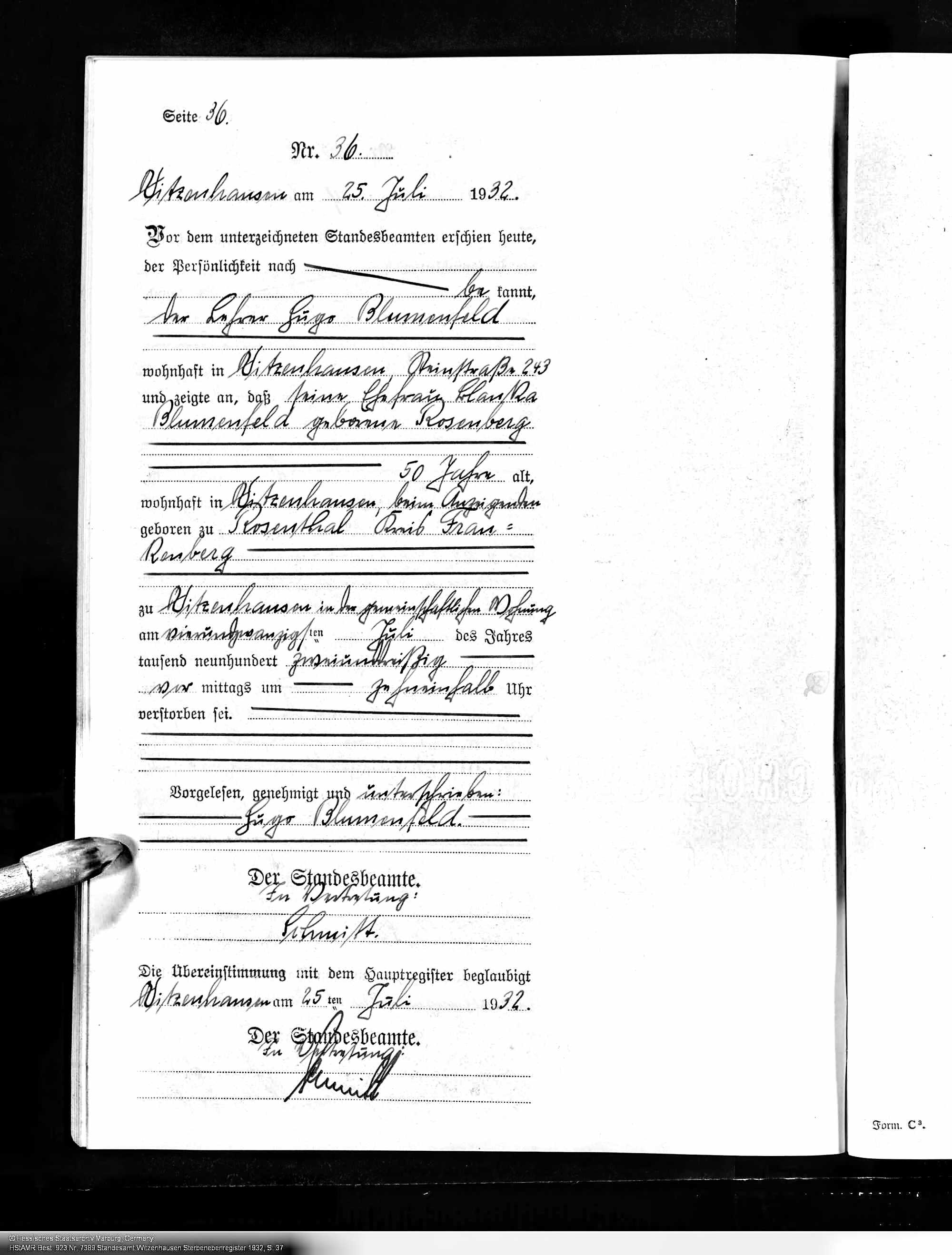
Blanka Rosenberg Blumenfeld death record, Hessisches Hauptstaatsarchiv; Wiesbaden, Deutschland; Personenstandsregister Sterberegister; Bestand: 7389; Laufende Nummer: 923
Year Range: 1932, Ancestry.com. Hesse, Germany, Deaths, 1851-1958

But I could not find a marriage record for Blanka. I noticed that several Ancestry trees had her married to Hugo Blumenfeld—which I couldn’t decipher myself from the death record— but even with his full name, I couldn’t find a marriage record.

I had a Hugo Blumenfeld on my tree; he was the son of Abraham Blumenfeld III and Friedericke Rothschild and the grandson of Isaak Blumenfeld I and his first wife, Frommet Kugelmann. But when I’d researched that Hugo, I had concluded that he never married or had children. I now realized I might have been wrong if those Ancestry trees for Blanka Rosenberg were right.

But since I don’t trust the trees on Ancestry without corroboration with actual records or at least reliable secondary sources, I was reluctant to add Hugo Blumenfeld as Blanka Rosenberg’s husband. I turned to my cousin Richard Bloomfield for help, and he first pointed out that Blanka’s death record revealed that her husband’s name was in fact Hugo. This was another time that my struggles with reading the German script hampered the progress of my research.

So I was now persuaded that Blanka had married a man named Hugo Blumenfeld, but was it the same Hugo whom I had concluded had never married? And where was their marriage record? I had assumed that Blanka would have married in Rosenthal where her family lived since almost all the German Jewish marriages I’d researched took place where the bride’s family lived, but my search through the Hessen archives for Rosenthal did not turn up a marriage record.

Richard, however, located the marriage in the records for the town of Frankenau, which is fifteen miles from Rosenthal. They were married there on July 23, 1907.  And that record confirmed that Blanka was the daughter of Rebecca Blumenfeld and Mendel Rosenberg and that Hugo was the son of Abraham Blumenfeld III and Friedericke Rothschild.

Marriage of Hugo Blumenfeld and Blanka Rosenberg, Arcinsys Hessen Archives, HHStAW Fonds 365 No 175, p. 11

Blanka and Hugo were, of course, therefore related. They were both grandchildren of Isaak Blumenfeld I, but only half-first cousins since Hugo’s father Abraham III was Isaak’s son from his first marriage and Blanka’s mother Rebecca was Isaak’s daughter from his second marriage.

With Richard’s help, I was able to locate three children born to Blanka and Hugo, all born in Frankenau. Julius was born on March 7, 1908. Erwin Jacob was born on May 29, 1911, and Martin was born January 6, 1913 (all found on the same page in the Frankenau birth records).

Birth record of Julius Blumenfeld, Arcinsys Archives of Hessen, HHStAW Fonds 365 No 174, p. 25

Birth record of Erwin Jakob Blumenfeld, Arcinsys Archives of Hessen, HHStAW Fonds 365 No 174

Birth record of Martin Blumenfeld, Arcinsys Archives of Hessen, HHStAW Fonds 365 No 174

Blanka died before any of her sons were married. She was only fifty years old when she died on July 24, 1932, in Witzenhausen, Germany, which is about sixty miles northeast of Frankenau. From the death record (seen above), it appears that she and Hugo were living in Witzenhausen at the time of her death. According to a document Richard located, Hugo was teaching in a Jewish school there.1

Blanka’s middle son Erwin Jakob Rosenberg married Martha Schoendelen on September 21, 1938, in Hannover, Germany. Martha was born on June 17, 1915, in Krefeld, Germany. Erwin and Martha escaped from Nazi Germany and immigrated to the US on April 1, 1940.2

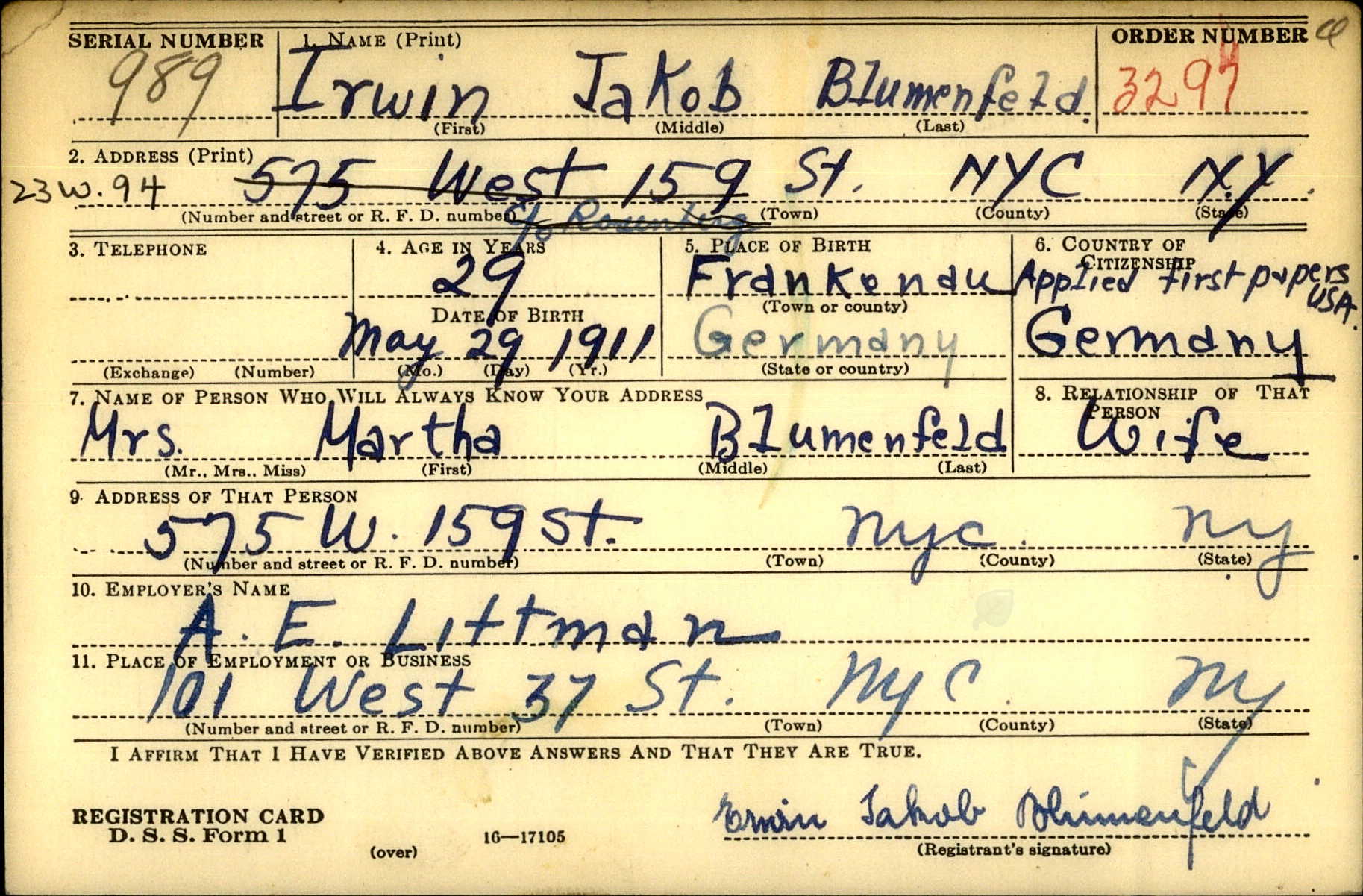
They settled in New York City where, at the time of the 1940 census, Erwin was looking for work as an auto mechanic.3 When he registered for the draft on October 16, 1940, he was working for A.E. Littman.

Irwin Jakob Blumenfeld, World War II draft registration, National Archives at St. Louis; St. Louis, Missouri; Wwii Draft Registration Cards For New York City, 10/16/1940 – 03/31/1947; Record Group: Records of the Selective Service System, 147. Ancestry.com. U.S., World War II Draft Cards Young Men, 1940-1947

Erwin entered the US Army on June 25, 1943, and was stationed at Fort Meade in Maryland, where he petitioned for and was granted naturalization on December 15, 1943.

Erwin Jakob Blumenfeld Naturalization Petition, The National Archives at Philadelphia; Philadelphia, Pa; Petitions For Naturalization, 1903-1972; NAI Number: 654310; Record Group Title: Records of District Courts of the United States, 1685-2009; Record Group Number: 21
Description: Petitions 24751-25075, Ancestry.com. Maryland, U.S., Federal Naturalization Records, 1795-1931

In 1950, Erwin was working as a buyer for a wholesale clothing business, and he and Martha and their daughter were living in New York City.4 Erwin was 63 when he died on August 27, 1974.5 He was survived by his wife Martha, who died on November 6, 2006,6 and their daughter.

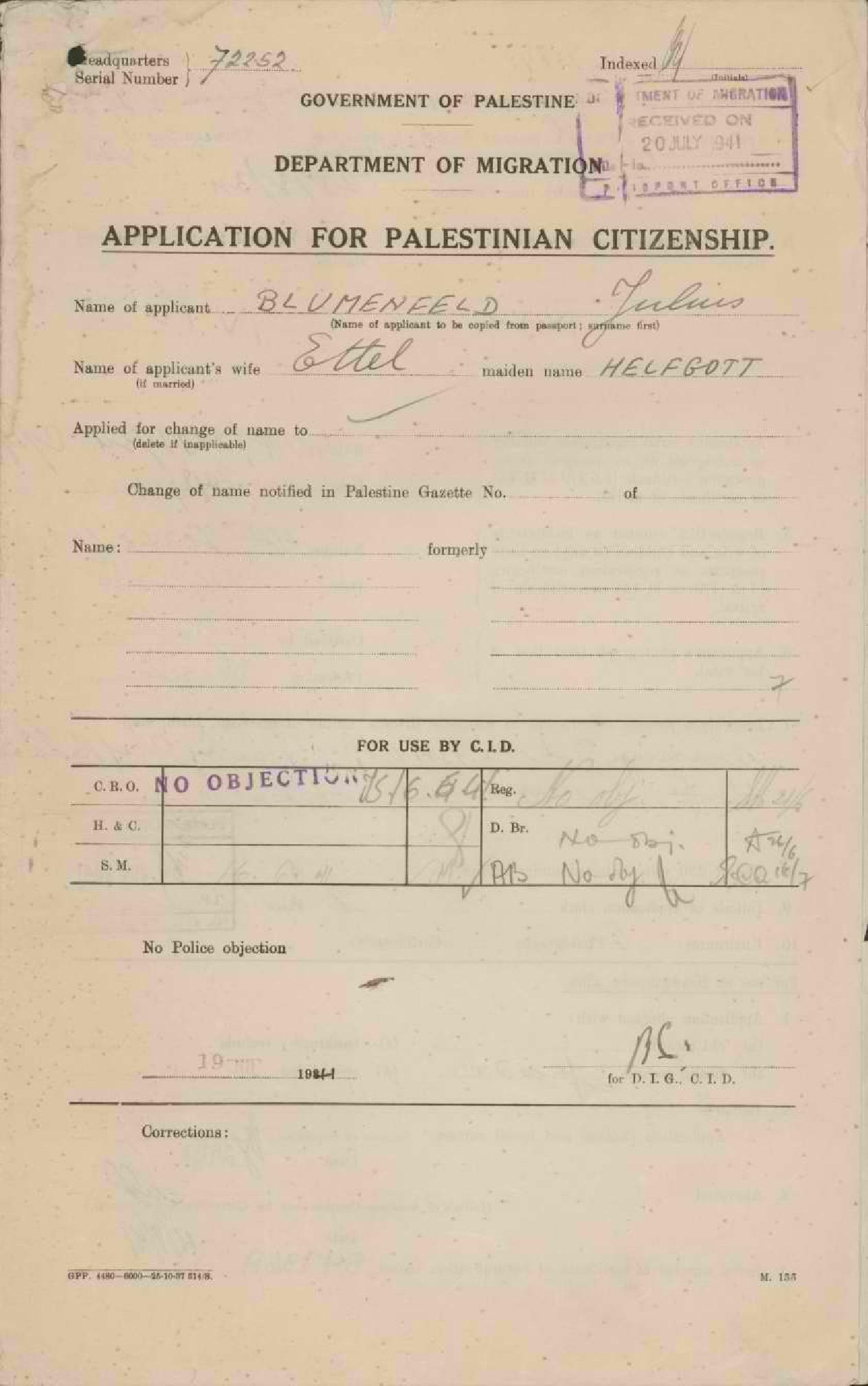
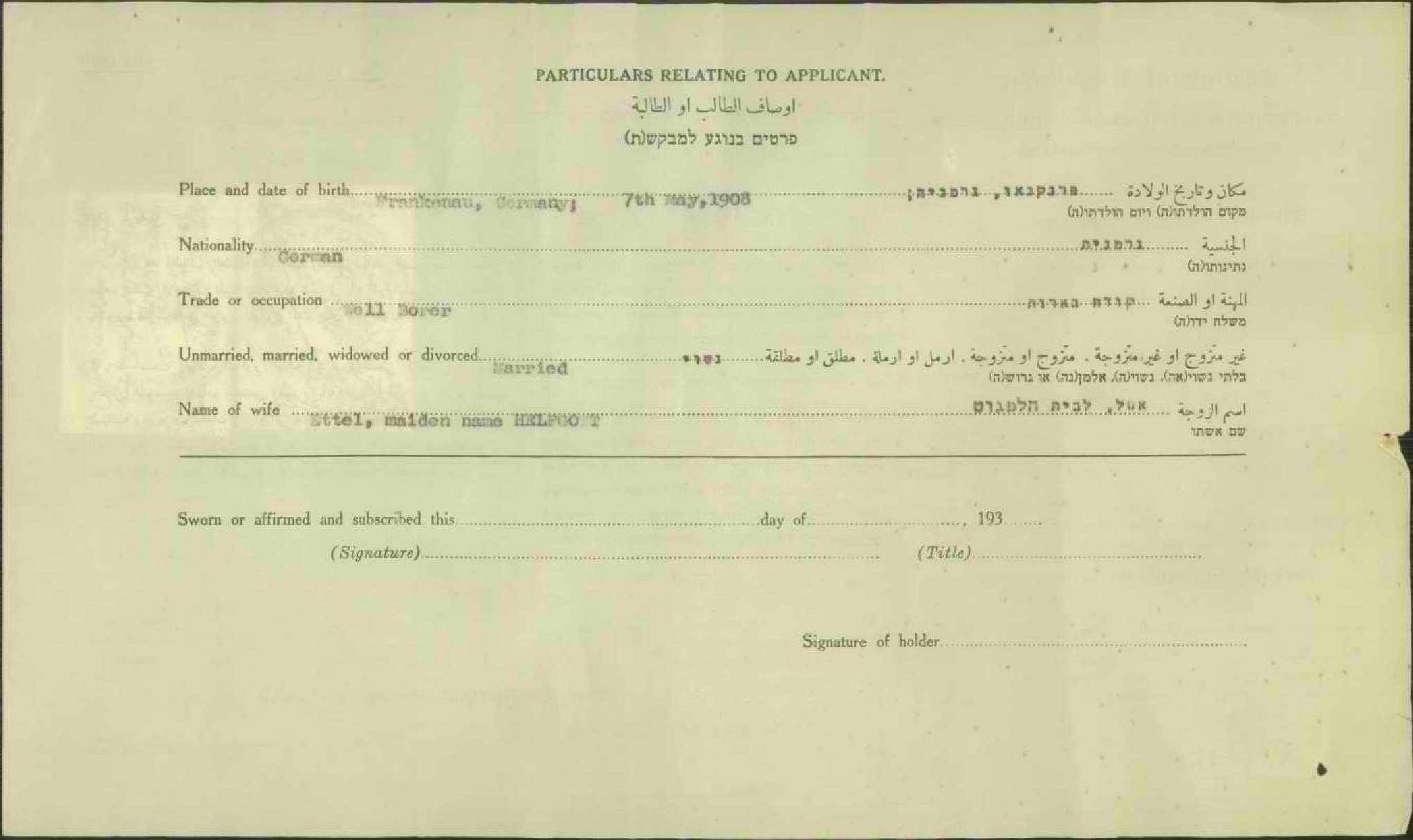
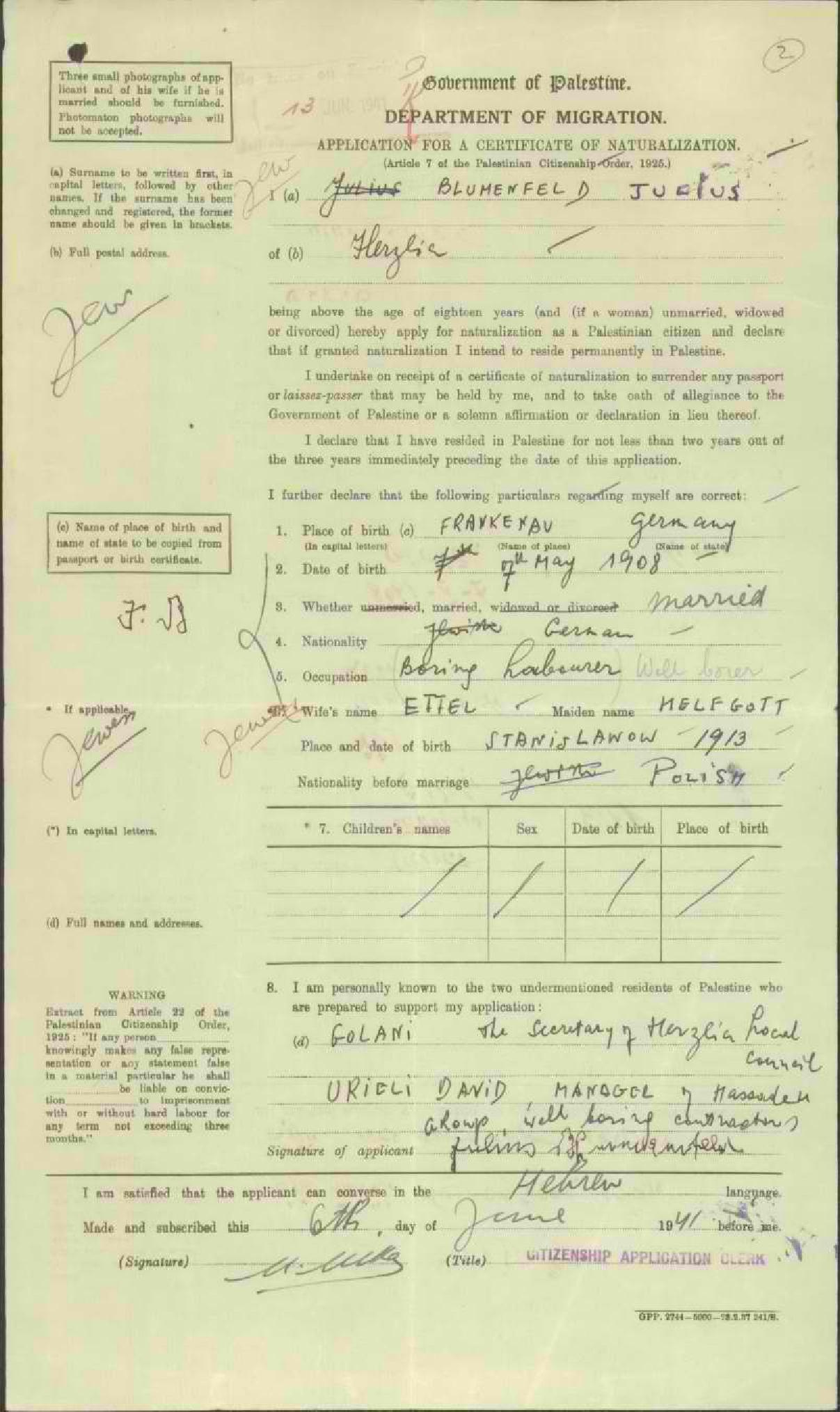
Blanka’s two other sons immigrated to Palestine/Israel in the 1930s. Julius arrived on August 23, 1934, and married Ettel Helfgott on March 26, 1940, in Haifa. On his naturalization application, Julius reported that his occupation was a well borer.

Julius Blumenfeld Palestine immigration file from the Israel State Archives, at https://www.archives.gov.il/en/

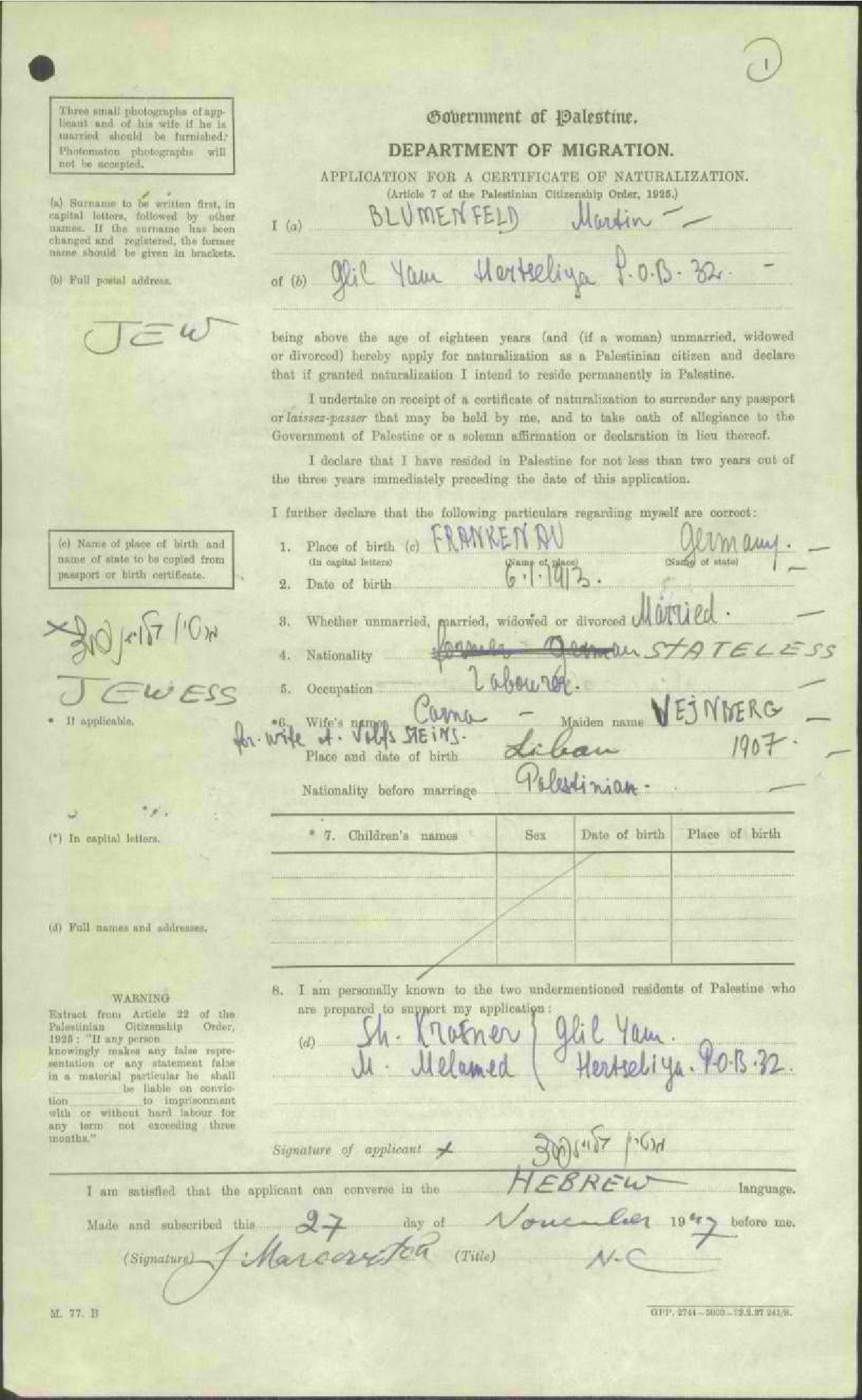
I don’t have an exact date for Martin’s arrival, but he married Carna Weinberg in Petah Tikvah on December 19, 1939, so must have arrived sometime before then. I have no further information about either Julius or Martin or their families at this point.

UPDATE! I now have some additional information about Julius. See my post here.

Martin Blumenfeld Palestine immigration file from the Israel State Archives, at https://www.archives.gov.il/en/

Although all three of his sons escaped from Nazi Germany in time, Hugo Blumenfeld himself was not as fortunate. He had remarried after Blanka died; his second wife was Frieda Stern, who was born on May 31, 1896, in Zimmersrode, Germany.7 I wrote back on February 8, 1922, that Hugo “was deported from Frankfurt to Theriesenstadt on August 14, 1942, and then to Auschwitz on October 16, 1944, where he was killed.” I did not know then that he was accompanied by his second wife Frieda and that she was also killed at Auschwitz.8 I also did not know that he was survived by three sons, all of whom had escaped from Nazi Germany.

I am so grateful to Richard Bloomfield for helping me not only to find information about our cousin Blanka Rosenberg, but also for helping me find information to correct and complete the story of our cousin Hugo Blumenfeld.


  1. Führer durch die Jüdische Gemeindeverwaltung und Wohlfahrtspflege in Deutschland 1932-1933, p. 180. (Guide to the Jewish Community Administration and Welfare in Germany 1932-1933). 
  2. Erwin Jakob Rosenberg, Declaration of Intention, The National Archives at Philadelphia; Philadelphia, PA; NAI Title: Declarations of Intention For Citizenship, 1/19/1842 – 10/29/1959; NAI Number: 4713410; Record Group Title: Records of District Courts of the United States, 1685-2009; Record Group Number: 21, Description: (Roll 648) Declarations of Intention For Citizenship, 1842-1959 (No 516701-517600), Ancestry.com. New York, U.S., State and Federal Naturalization Records, 1794-1943 
  3. Erwin and Martha Blumenfeld, 1940 US census, Year: 1940; Census Place: New York, New York, New York; Roll: m-t0627-02641; Page: 9A; Enumeration District: 31-763, Ancestry.com. 1940 United States Federal Census 
  4. Erwin Blumenfeld, 1950 US census, United States of America, Bureau of the Census; Washington, D.C.; Seventeenth Census of the United States, 1950; Record Group: Records of the Bureau of the Census, 1790-2007; Record Group Number: 29; Residence Date: 1950; Home in 1950: New York, New York, New York; Roll: 4546; Sheet Number: 15; Enumeration District: 31-1703, Ancestry.com. 1950 United States Federal Census 
  5. Erwin Blumenfeld, Gender Male, Birth Date 29 May 1911, Death Date Aug 1974
    Claim Date 16 Sep 1974, SSN 093169515, Ancestry.com. U.S., Social Security Applications and Claims Index, 1936-2007 
  6. Martha Blumenfeld, Social Security Number 064-18-2853, Birth Date 27 Jun 1915
    Issue year Before 1951, Issue State New York, Last Residence 10034, New York, New York, New York, Death Date 6 Nov 2006, Social Security Administration; Washington D.C., USA; Social Security Death Index, Master File, Ancestry.com. U.S., Social Security Death Index, 1935-2014 
  7. Birth record of Frieda Stern, Hessisches Hauptstaatsarchiv; Wiesbaden, Deutschland; Bestand: 920; Laufende Nummer: 9534, Year Range: 1896, Ancestry.com. Hesse, Germany, Births, 1851-1901 
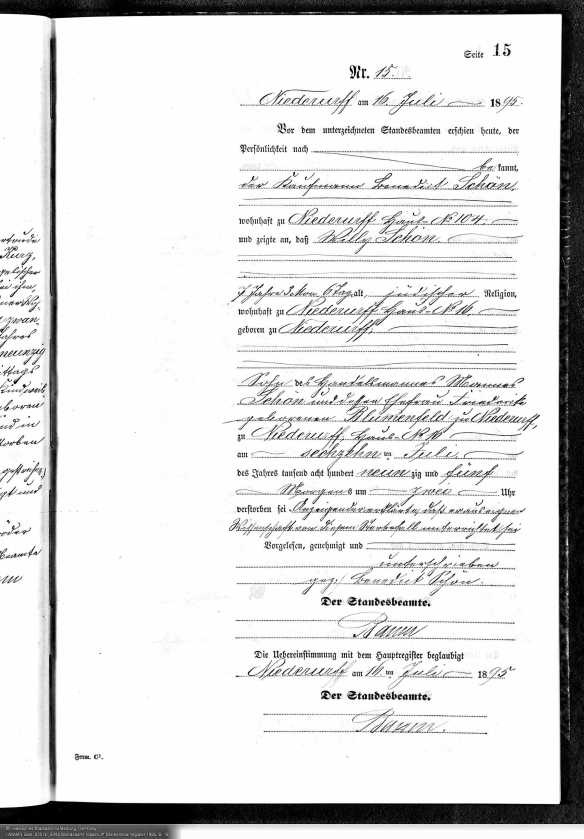
  8. Entry at Yad Vashem for Frieda Stern Blumenfeld, found at  https://yvng.yadvashem.org/nameDetails.html?language=en&itemId=11476884&ind=1 

Rebecca Blumenfeld Rosenberg and Her Family, Part I

It’s been a really, really long time since I continued the story of the children of my four times great-grandparents Abraham Blumenfeld and Geitel Katz (other than with the updates about those I’d already discussed). I left off with the story of the ten children of the second child (Isaak Blumenfeld I) of the oldest child (Moses Blumenfeld I) of the six children of my four-times great-grandparents.

Here’s a chart showing where I am in reporting on the descendants of Abraham and Geitel. As you can see, I have a long, long way to go.

I am now up to Isaak Blumenfeld’s eighth child, Rebecca Blumenfeld, who was born on August 23, 1856, in Momberg Germany.

LAGIS Hessen Archives, Geburtsregister der Juden von Momberg (Neustadt) 1850-1874 (HHStAW Abt. 365 Nr. 608), p. 4

On August 9, 1881, she married Mendel Rosenberg, son of Jacob Rosenberg and Betti Kaufmann. Mendel was born in Rosenthal, Germany, on May 19, 1854, and was the uncle of Emanuel Rosenberg, who later married Katinka Blumenfeld, Rebecca’s niece (her brother Gerson II’s daughter).

Rebecca Blumenfeld and Mendel Rosenberg marriage record, Hessisches Hauptstaatsarchiv; Wiesbaden, Deutschland; Bestand: 915; Laufende Nummer: 6491, Year Range: 1881, Ancestry.com. Hesse, Germany, Marriages, 1849-1930

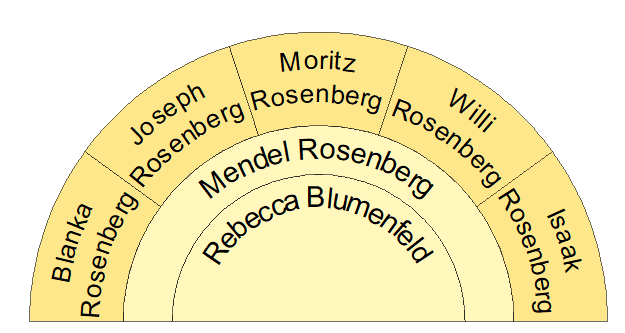
Rebecca and Mendel had five children.

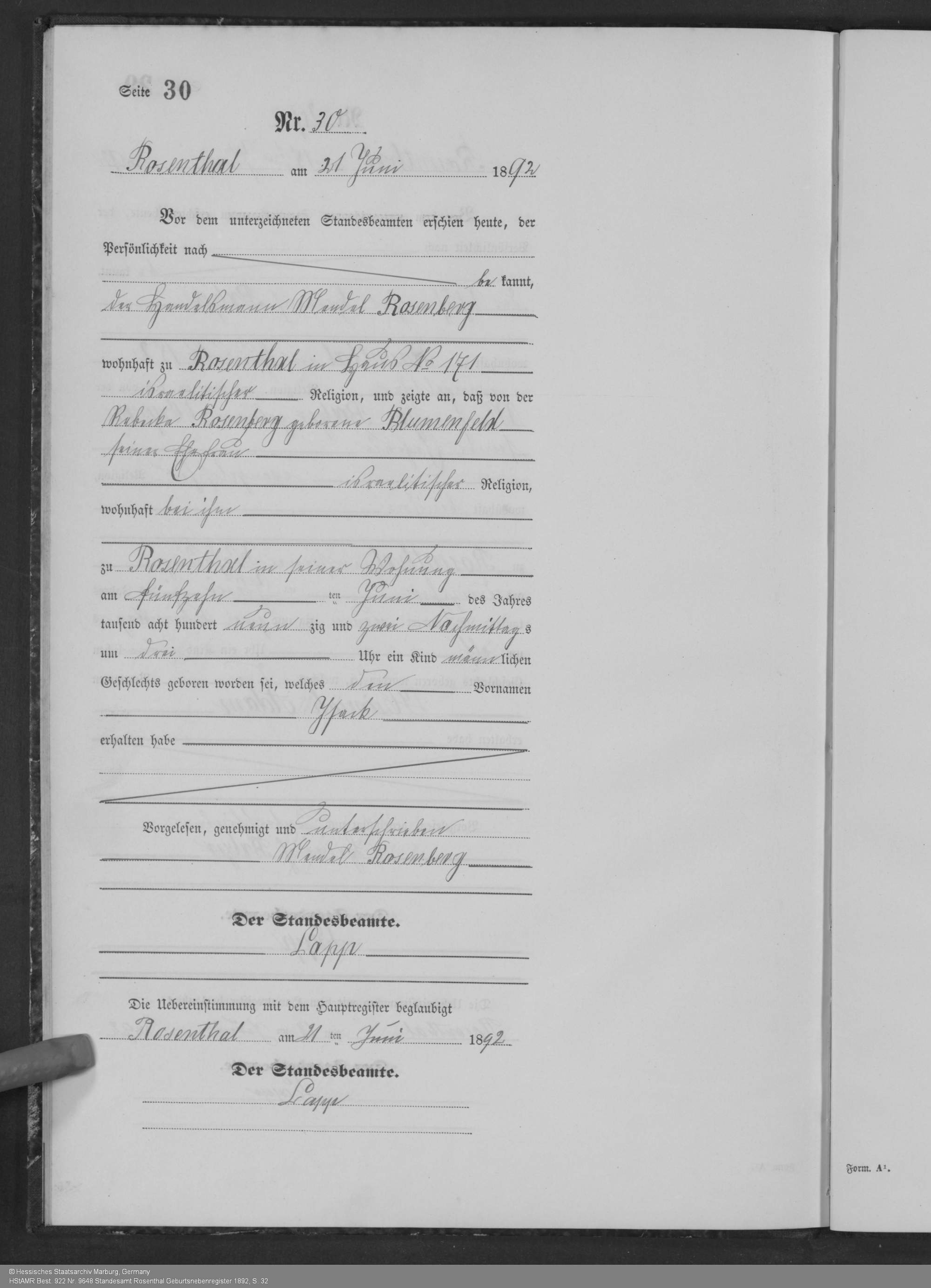
Blanka was born in Rosenthal on July 9, 1882.

Blanka Rosenberg birth record, LAGIS Hessen Archives, Standesamt Rosenthal Geburtsnebenregister 1882 (HStAMR Best. 922 Nr. 9638)AutorHessisches Staatsarchiv MarburgErscheinungsortRosenthalErscheinungsjahr1882, p. 35

Joseph was born in Rosenthal on February 4, 1886.

Joseph Rosenberg birth record, LAGIS Hessen Archives, Standesamt Rosenthal Geburtsnebenregister 1886 (HStAMR Best. 922 Nr. 9642)AutorHessisches Staatsarchiv MarburgErscheinungsortRosenthalErscheinungsjahr1886, p. 7

Moritz was born in Rosenthal on September 15, 1887.

Moritz Rosenberg birth record, LAGIS Hessen Archives, Standesamt Rosenthal Geburtsnebenregister 1887 (HStAMR Best. 922 Nr. 9643), p. 40

Willi was born in Rosenthal on April 24, 1889.

Willi Rosenberg birth record, LAGIS Hessen Archives, Standesamt Rosenthal Geburtsnebenregister 1889 (HStAMR Best. 922 Nr. 9645)AutorHessisches Staatsarchiv MarburgErscheinungsortRosenthalErscheinungsjahr1889, p. 17

And finally, Isaak was born in Rosenthal on June 15, 1892.

Isaak Rosenberg birth record, LAGIS Hessen Archives, Standesamt Rosenthal Geburtsnebenregister 1892 (HStAMR Best. 922 Nr. 9648)AutorHessisches Staatsarchiv MarburgErscheinungsortRosenthalErscheinungsjahr1892, p. 32

For now I will just identify the spouses of those children and their marriage dates, and then I will return to their stories in subsequent posts.

Blanka married Hugo Blumenfeld on July 23, 1907, in Frankenau, Germany.

Marriage of Hugo Blumenfeld and Blanka Rosenberg, Arcinsys Hessen Archives, HHStAW Fonds 365 No 175, p. 11

Joseph married Bella Oppenheim on February 21, 1913, in Bad Hersfeld, Germany. They had one child, a son Kurt, born on April 20, 1914, in Sobernheim, Germany,1 a town in the Rhine Palatinate region of Germany about 160-170 miles from Bad Hersfeld and Momberg where Bella and Joseph were born, respectively.

Marriage of Joseph Rosenberg and Bella Oppenheim, Hessisches Hauptstaatsarchiv; Wiesbaden, Deutschland; Bestand: 907, Year Range: 1913, Ancestry.com. Hesse, Germany, Marriages, 1849-1930

Unfortunately, Rebecca and Mendel’s family then had two losses over the next two and a half years. Willi Rosenberg was only 25 when he died on December 31, 1914. I wondered whether he was killed fighting for Germany in World War I, but I’ve found no record indicating that that was the case.

Willi Rosenberg death record, Hessisches Hauptstaatsarchiv; Wiesbaden, Deutschland; Personenstandsregister Sterberegister; Signatur: 9757
Source Information
Ancestry.com. Hesse, Germany, Deaths, 1851-1958

A year and a half later Rebecca Blumenfeld Rosenberg died in Rosenthal on June 6, 1915. She was 58 years old.

Rebecca Blumenfeld death record, Hessisches Hauptstaatsarchiv; Wiesbaden, Deutschland; Personenstandsregister Sterberegister; Signatur: 9757, Year Range: 1915, Ancestry.com. Hesse, Germany, Deaths, 1851-1958

Her son Moritz married Berta Blum on August 10, 1919, in Frankenau.

Marriage of Moritz Rosenberg and Berta Blum, Hessisches Hauptstaatsarchiv; Wiesbaden, Deutschland; Signatur: 3254, Year Range: 1919, Ancestry.com. Hesse, Germany, Marriages, 1849-1930

And then the family suffered another tragic loss when Joseph Rosenberg, the second oldest sibling, died at the age of 36 on May 4, 1922, as seen on his headstone below. Thank you to my cousin Michael Rosenberg for locating this image. According to the headstone, Joseph was a doctor.

Joseph was survived by his wife Bella Oppenheim and their son Kurt. More on their story in a post to come.

Finally, Isaac Rosenberg, the youngest child of Rebecca Blumenfeld and Mendel Rosenberg, married Bella Gans on December 22, 1922, in Niederaula, Germany.

saak Rosenberg marriage to Bella Gans, Hessisches Hauptstaatsarchiv; Wiesbaden, Deutschland; Bestand: 907; Laufende Nummer: 3665, Year Range: 1922, Ancestry.com. Hesse, Germany, Marriages, 1849-1930

When I look at the names of the daughter and the three daughters-in-law of Rebecca and Mendel—Blanka, Bella, Berta, and Bella—I have to wonder how confusing it must have been when they were all together. I can hear my mother-in-law running through the four names repeatedly before reaching the right one! (Click on the image immediately above to see the names of Rebecca’s family more clearly.)

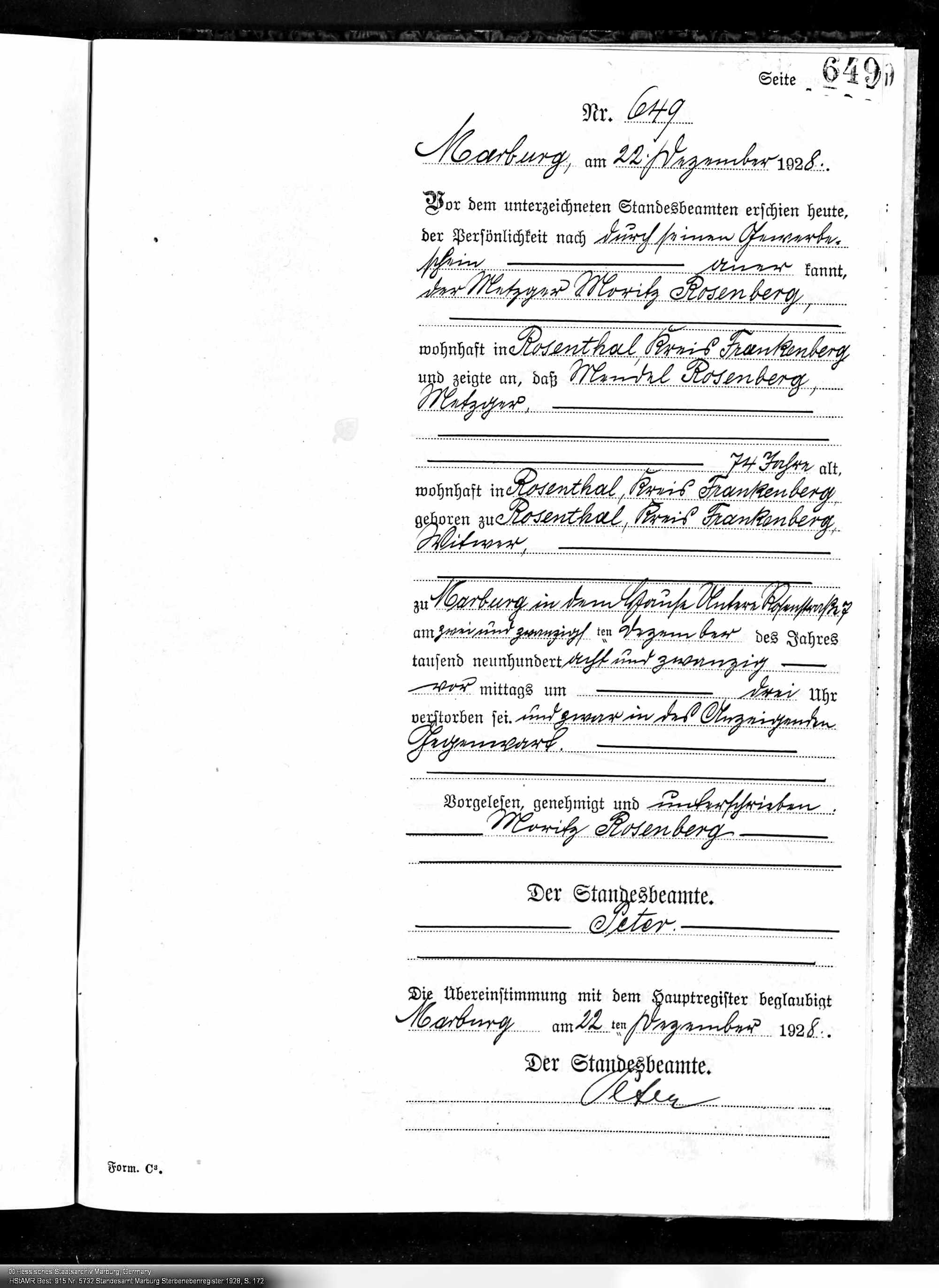
Mendel Rosenberg died on December 22, 1928, in Marburg. He was 74 and was survived by three of his five children and, as we will see, many grandchildren.

Mendel Rosenberg death record, Hessisches Hauptstaatsarchiv; Wiesbaden, Deutschland; Personenstandsregister Sterberegister; Bestand: 5732; Laufende Nummer: 915, Ancestry.com. Hesse, Germany, Deaths, 1851-1958


  1. Kurt Rosenberg, World War II draft registration, National Archives at St. Louis; St. Louis, Missouri; Wwii Draft Registration Cards For New York City, 10/16/1940 – 03/31/1947; Record Group: Records of the Selective Service System, 147, Ancestry.com. U.S., World War II Draft Cards Young Men, 1940-1947 

Good for A Single Journey by Helen Joyce: A Review of A Wonderful New Book and An Interview with the Author

Today I have the great pleasure of sharing my virtual interview with author Helen Joyce. She has recently published a family history novel titled Good for A Single Journey, a moving and beautifully written telling of her maternal family’s story. Joyce’s great-grandparents were living in a small town in what was then Galicia in Eastern Europe in the early 20th century when oppression and poverty forced them to relocate to Vienna, where they hoped to have greater freedom and economic security. And they did find great success there. But like so many Jewish families, they eventually suffered from the horrors of the Holocaust. Although many, including Joyce’s mother, survived, many others were murdered, and all suffered from persecution and financial loss. And those who survived were once again forced to relocate and start all over in a new country.

Joyce has combined what she learned from her mother and other relatives with historical research to create a fascinating and illuminating look at the history of this era and its effect on one Jewish family. The book is a mix of fact and fiction, some parts totally created from her imagination and other parts entirely based on fact. The book reads like a novel. She has created wonderful three-dimensional characters, each with distinctive and memorable personalities and stories. I highly recommend this book to anyone interested in history and in Jewish history in particular. It is appropriate for young adults as well as adults and available for purchase on Amazon and Barnes & Noble here.

Good for a Single Journey has received a finalist’s award in the 2023 Next Generation Indie Book Awards and has also received a highly favorable review from Neville Teller in the June 12, 2023, issue of The Jerusalem Report. You can also learn more about Helen Joyce and her book at her website found here.  And in the interest of full disclosure, I should reveal that she is my fifth cousin on her paternal side; we are both descended from Jacob Falcke Goldschmidt and Eva Seligmann, our mutual four-times great-grandparents.

And now, let me introduce you to Helen Joyce and her wonderful book, Good for a Single Journey..

Thank you so much for agreeing to do this interview with me and to share more about your book, Good for a Single Journey.  Have you ever written a book or other fiction/non-fiction before?

No! I have written the odd article, contributed a chapter to two each of two academic books, and edited a community magazine which often entailed tightening the contributions of others. Otherwise, no formal writing experience.

So what made you decide to write this book at this time?

Old age! I always wanted to write an account of my mother’s life and never found the right time. Work, kids, and life in general always interfered. That and the self-defeating belief that the project was beyond me; that I was deluding myself if I thought I could write an account/memoir/novel of the type I imagined would do justice to her story. Finally, the reality of the fact that I was not getting any younger and triggered by taking our youngest granddaughter on a trip to Vienna where we visited my mother’s birthplace proved to be the catalyst for getting to work.

The author’s parents Max and Klari. Courtesy of Helen Joyce

I really enjoyed reading the book, and it reads like fiction. But I know that the book is based on the real lives of your parents, grandparents, and great-grandparents as well as many aunts, uncles, and cousins. How much of the book is fictionalized and how much is non-fiction?

It would take a long time to unravel fact from fiction but basically, I knew the ‘bare bones’ of the stories of all the characters. In the case of the two brothers, Chiel and Beresh, I knew very little indeed beyond the fact that they made Aliyah to pre-State Israel long around WWI. Therefore, I invented their adventures. I gave them experiences and put them in situations which were factually correct and allowed some of the history of the early Yishuv to come to light. I knew a little about Peppi, my grandmother’s sister, and of course the story of Suzanne became legendary!

Zissel, my other great-uncle, was a closed book to me until I unlocked the memoir of his son Yitzchak. That gave me the details of not only his travels across Europe and today’s Ukraine before reaching the shores of British mandate Palestine, but also revealed the entire saga of his grandparents’ (my great grandparents’) flight from Rozwadów to Ukraine and onwards to Siberia. I knew a great deal about my grandparents from my mother’s tales and, again through her, background details about day-to-day life in Vienna and the market town of Rozwadów, which she visited frequently on trips to her grandparents. The rags to riches story of my grandfather is true. Accounts of the flight from Vienna, the period in Prague, my mother’s experiences in London are also from my mother’s various shared memories.

My independent sources of research (apart from the internet and the cousin’s memoir which I mentioned) were my mother’s diaries and a stash of family letters collated and self-printed by my late uncle which charted the agony of desperation and fear as various members of the family tried to help and find ways to get those still trapped in Europe out. Obviously the most fictionalized accounts are those of the imagined conversations and emotions displayed by the various characters. The best I could do was to try and imagine I was them and put myself in their place at that time. What would I feel? How would I react?

How did you decide where to create fictional elements versus non-fiction?

Honestly, I don’t know! It just sort of flowed seamlessly. I wove elements of drama and fiction around the basic facts I knew. For example, I needed to get the two brothers from Vienna to Palestine during WWI. How would they have gone? What might they have done? WWI was raging so I thought it would be interesting to place them into an Austro-Hungarian unit which ended up in Palestine. When I started researching that possibility, I learned a great deal about the involvement of Jewish soldiers in the army, the unit I put them in was a real one (as was the officer which commanded it). The facts surrounding Aaron Aaronsohn, NILI, and their role in helping the British defeat the Ottomans in
Palestine and how these contributed to the fact of the Balfour Declaration was too good an opportunity to miss including. So, I did! Throughout the book I also wanted to give the lie to the myth that Jews were passive, never fought in armies and were pale scholars led to slaughter like sheep. Jews fought bravely (on all sides) in every theatre of war.

How did you research the parts of the book that are fact-based?

I read several books on WWI, biographies about Aaron Aaronsohn and NILI as well as books about the history of the Middle East. My mother’s cousin’s memoir was also very helpful. The internet is also a phenomenal resource. What was the weather like in Gallipoli in November 1915 – click. What train routes were available on the Chemins de fer Orientaux during WWI – click! What date was Rosh Hashanah in 1914 – click. All there in your hand-held mobile phone!

Your book begins with your great-grandparents leaving Rozwadów. Why did you decide to begin there?

The book begins with a train journey, the journey of my great grandparents fleeing their hometown in Galicia. I decided to start with that train ride as it gave me the opportunity to introduce all the main characters as well as a major theme of the book. Migration and journeys. The entire book is about the journey of individuals, families, and the Jewish people. Trains feature quite prominently. That opening train ride. Greetings and goodbyes at train stations. The brothers’ train ride to war and onwards to Palestine. The train ride carrying my great grandparents and their youngest son to Siberia. The train ride my mother took to Scotland to meet her brother serving in the Jewish Brigade of the British army and of course the final horrific train rides to the death camps.

You include some living people and some recently deceased people in the book. How did you approach the issues of privacy with respect to those people? Were there things you had to change or avoid to protect the interests of your family?

Yes, absolutely. A lot was excluded! However, in discussion with as many of my cousins as I could track down, I realized they were quite happy for me to give details of their stories. I offered each of them drafts so they could check they were happy with what I had written. However, as nearly all the family descendants live in Israel, many of them do not read in English. That said, they were quite happy to know I had written some account and did not mind if it was fictionalized. The Israeli branch is very easy going! I gave my sister an early draft and she enjoyed the first half but did have some comments and suggestions about the second half of the book. I have tried to accommodate her feelings on this but, ultimately, we agreed that the book was a fictionalized novel.

Your family endured many of the challenges and horrors faced by many Jewish families in the 20th century: immigration to new countries (several times), World War I, and Nazi persecution and the Holocaust. What impact do you think that history has had on you and the other living descendants of your great-grandparents?

It’s hard to speak about this in general. The impact is surely quite different for each family and on each individual. For me, knowing what previous generations lived and died for made me want to cling to a Jewish lifestyle replete with the traditions that Hitler tried so hard to erase. I didn’t want to give Hitler any kind of posthumous victory and so I have tried to raise a Jewishly faithful family. Beyond that? I guess a sense of the importance of justice and the need to respect equality of all people regardless of gender, race, or religion.

You ultimately decided to leave England and make Aliyah to Israel. What in your family history contributed to that decision? Have you made connections to the cousins who were refugees to Israel during the Nazi era?

Many factors contributed to that decision. My husband comes from a very ‘English’ Jewish family but his mother, eldest of ten, was the only child left in the UK after the creation of the State of Israel. The rest were all pioneers in Israel (although two had died before that was possible). So, he already has a huge network of family here. Our son made Aliyah twenty years ago and was raising his children here and of course we wanted to be close to them. We have a daughter with special needs and she made Aliyah with us – we couldn’t contemplate leaving her behind and she is so very happy here with excellent care. Our youngest child followed us five years ago and so, to our delight, all our children and grandchildren are here. Yes, I have contact with some of my many cousins, but they are numerous and spread out so we do not meet that often although I do meet my first cousins more frequently.

Your book has many themes and covers many topics: different ways to practice Judaism, antisemitism, Zionism, mental health, marriage, parental love, and so on. Was there a specific point or theme that mattered most to you?

They all mattered and, in a way, I suppose several of them nestle into each other like a set of Russian matryoshka dolls! Parental love leads to stability and contributes to the type of marriage partnership one is likely to create as does a strong sense of community and belonging. Antisemitism and Zionism also have a kind of Yin and Yang partnership! If I had to choose one (you didn’t ask me that!) maybe I would say resilience and survival!

Who did you see as the audience for your book? Your own family and descendants? Young adults? Jewish readers? The entire universe of adult readers?

The entire universe! My family and their descendants were not really the target audience. Had they been, the book would have been far more factual and memoir-based. I hoped it would appeal to young adults and prove educational and am being told that teenagers are totally gripped by the story – which, given the amount of history in it – is great! However, I would dearly love the non-Jewish world to gain insight about a Jewish way of life, the history of persecution and the holocaust but also the historical underpinnings of the State of Israel under international law which was brought about together with the dismantling of previous empires. If Israel is to be accused of being a ‘colonialist enterprise’ then equally so is Syria, Lebanon, Jordan, Saudi Arabia and Iraq. Not to mention the many ‘new’ European countries created in the wake of WWI. Without understanding the impact of WWI, nothing about the modern world makes sense (including current events in Ukraine!)

This book focused on your maternal family. Do you plan to write a book about your paternal side?

Yes! And your blog will be a fantastic resource for me!!! However, marketing this book is taking up a lot of time at the moment. I have been invited to take part in Jewish Book Week School Events for schools around the UK which is fantastic. Events can be online so I can do them from here. This is really part of my dream – to bring the reality of the Jewish experience to a wider audience.

The author, Helen Joyce. Courtesy of Helen Joyce

Thank you again for taking the time to answer my questions, and I look forward to reading your next book and hope that my research will be helpful to you! Best of luck in your marketing efforts—your book deserves a wide and large audience.


How Eugene Goldsmith Met May Jacobs

Over four and a half years ago, I wrote about Eugene Goldsmith, my great-grandmother Hilda Katzenstein Schoenthal’s first cousin.

Eugene was born in 1859 and had lived with his parents, Meyer Goldschmidt/Goldsmith and Helene Hohenfels, and his brother Maurice all his life, first growing up in Philadelphia and then in New York City. Then in 1913 at the age of 54, he married May Jacobs, who was 41.

One of the questions I had about Eugene was how he met his wife May Jacobs. I wrote then:

In 1913, Eugene married May Jacobs in Philadelphia. He was 54, she was 41. May was the daughter of Michael Jacobs and Alice Arnold, both of whom were born in Pennsylvania. May’s father died when she was just a young child, and she and her three sisters were all living together with their mother in Philadelphia in 1910. I’d love to know how May connected with Eugene, who had by that time been living in New York City for over twenty years.

Well, four and a half years after posting that question, I heard from a cousin of May Jacobs, and she may have found the answer. Lynn Hsu wrote to me on the blog that she was the great-granddaughter of Oscar Arnold, who was a first cousin of May Jacobs. Lynn wrote that Oscar was in the business of manufacturing umbrellas in New York City, and since Eugene and his brother Maurice were in the business of selling umbrellas in New York City, we hypothesized that Eugene knew Oscar from business and that Oscar set up Eugene with his cousin May, who was living in Philadelphia.

But Lynn actually had found several other hints that suggested that there were numerous earlier connections between her Arnold/Jacobs cousins and my Goldsmith cousins. On August 5, 1892, the Philadelphia Jewish Exponent reported that May Jacobs was on the same Atlantic City sailing party as Rose and Florence Goldsmith, the two younger sisters of Eugene Goldsmith. So as early as 1892, some 21 years before Eugene married May, there was a meeting of May Jacobs and Eugene’s sisters Florence and Rose. Whether they had already known each other before the sailing trip isn’t clear, but certainly they did once that trip was over.

Philadelphia Jewish Exponent, August 5, 1892, p. 8

Also, three years before May married Eugene, she attended his mother’s funeral, as reported by the Philadelphia Jewish Exponent on March 4, 1910:

Philadelphia Jewish Exponent, March 4, 1910, p. 14

Why it took Eugene and May until 1913, when he was 54 and she was 41, to decide to get married will remain a mystery. My only hypothesis is that Eugene waited until both his parents had died before “striking out on his own.” His mother died in 1910, his father in 1911. And then Eugene married May in 1913. His brother Maurice never married.

There was one other unexpected bonus connection that I learned about as a result of connecting with Lynn. May Jacobs Goldsmith, the daughter of Alice Arnold Jacobs, was the niece of Clarissa Arnold, Alice’s sister. Clarissa was married to Ernst Nusbaum, younger brother of my three-times great-grandfather John Nusbaum, namesake of my grandfather John Nusbaum Cohen and my father John Nusbaum Cohen, Jr. I wrote about Clarissa and Ernst and their family here and in many other of the posts that follow that one.

So the tree continues to twist! And thanks to Lynn, I now know even more about the Goldsmith/Goldschmidt and Nusbaum families.


Back to the Blogosphere

It’s been over a month since I last posted on the blog—the longest break I’ve ever taken. But I really needed it.

But in the month I’ve been away from blogging (and pretty much away from the laptop), I’ve nevertheless learned a great deal related to my extended family tree. In these five weeks, I have heard from numerous new cousins who found me through the blog. So even while I was taking a break from new research, the blog has been doing its work, helping me find new cousins and new information.

So in the weeks to come I will introduce these new cousins and share the stories and photos and new information they’ve shared with me about their parents and grandparents and great-grandparents.  I have been moved by all of them and am so grateful that they’ve all reached out to me and made these connections.

Two sad notes. My cousin Henry Rosenberg died earlier this month at the age of 94. I had had a lovely conversation with Henry back in the fall, and he was engaged and warm and friendly and so willing to share his life story with me. I was shocked and saddened to learn that he had passed away. I wrote about Henry and my conversation with him here, here, and here. He was related to me through our mutual ancestors Abraham and Geitel Katz Blumenfeld, Henry through their son Moses and me through their daughter Breine.

Also, on November 27, 2022, my cousin Joan Lorch Staple passed away after living a remarkable life for more than 99 years. Joan was related to me through our mutual ancestors, Jacob Seligmann and Martha Mayer, she through their daughter Martha and me through their son Moritz, my three-times great-grandfather. I will share more about Joan’s remarkable life in my next post.

Losing these two wonderful cousins—both of whom were born in Germany in the 1920s and escaped from the Nazis with their families as young people, both of whom went on to live very long and productive lives—reminded me once again of the urgency of the task of finding cousins and learning their history before it is too late.

And so I return to blogging with a renewed commitment to tell the stories of those in my extended family tree.

See you next week!

Blumenfeld Cousins Hanukkah Zoom

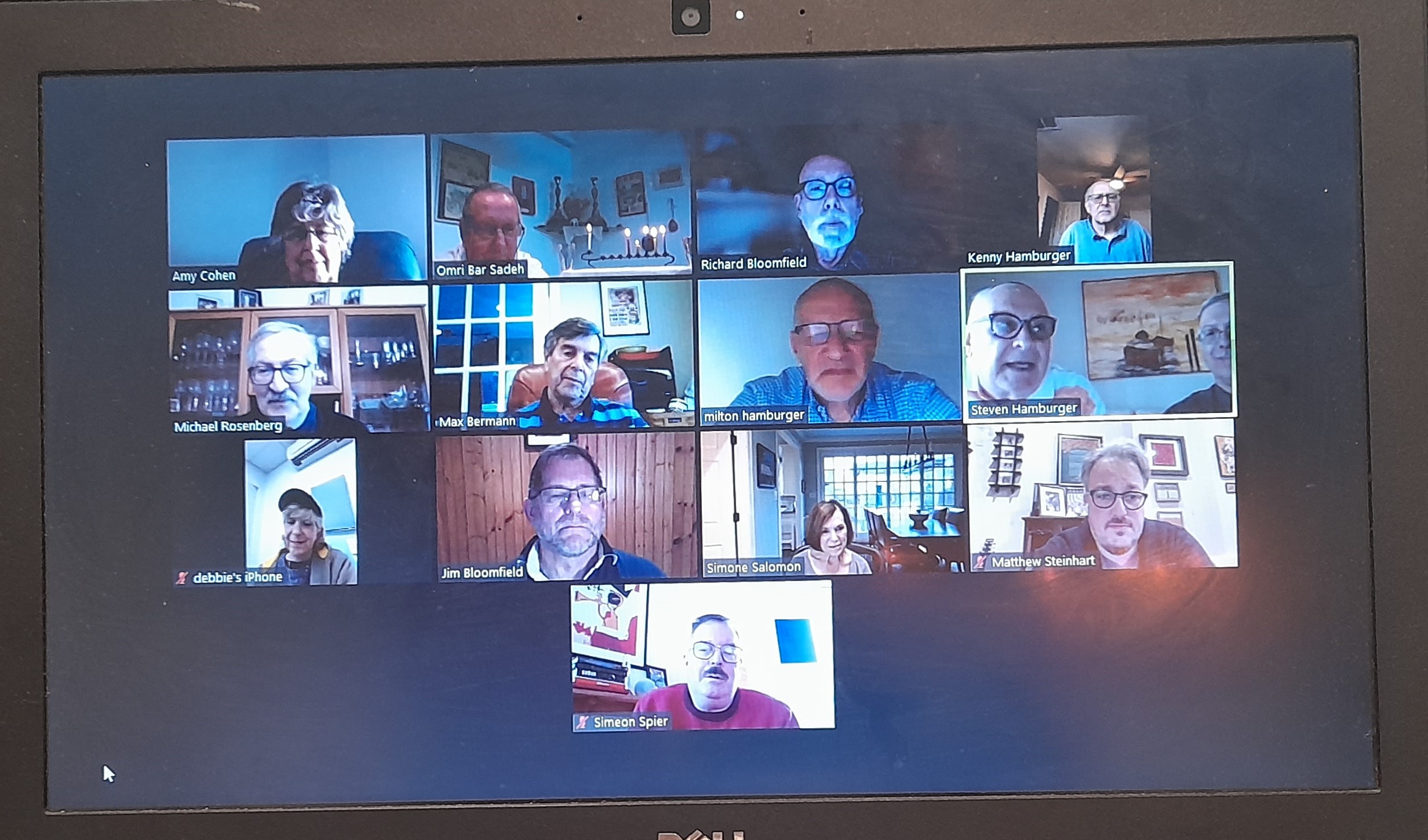
Last Thursday I was fortunate to be able to Zoom with thirteen of my Blumenfeld cousins—Omri, Richard, Jim, Steven, Milton, Kenny, Alan, Debbie, Simeon, Simone, Matthew, Max, and Michael. Some members of the group had known others for their entire lives; others of us had never met in person or otherwise before the Zoom. Most of the group are my fifth cousins—we are all descended from Abraham Katz Blumenfeld and Geitel Katz, who lived in Momberg, Germany, in the late 18th and early 19th centuries.

We span the globe—Omri from Israel, Richard from Switzerland, and the rest of us from the eastern seaboard of the US from as far north as Maine all the way to Florida. We come from a range of backgrounds—some of us (like me) having roots in the US since the mid-19th century, many of us the children of Holocaust survivors, and three of us born outside the US, one in Israel, one in Canada, and one in Italy. Our religious backgrounds also range from Orthodox Judaism to Christianity. Almost all of us fall into the Baby Boomer generation.

Yet despite our differences, our commonalities far outweigh those differences. We were moved by Omri’s lighting of the Hanukkiah from Israel and our combined voices singing Maoz Tzur. We shared stories of our own lives and the lives of our parents and grandparents. We found much to talk about and to learn from each other, including family heirlooms and family history. For some, learning that they had cousins, albeit distant, was a wonderful revelation because their own family story had not been connected to the larger Blumenfeld family tree.

My only regret is that in the midst of all the warmth, laughter, and stories, I forgot to take a screenshot of all of us on Zoom together. You will have to use your imagination. But here at least is a chart showing the descendants of Abraham Blumenfeld and Geitel Katz to the sixth generation (for most of us, our parents’ generation). It’s quite remarkable to see just how many people one couple generated through their children, grandchildren, and so on.

Overall, it was a wonderful hour for me—to share with those I’ve found through my research (or who found me through my blog or through other cousins) is the best reward of doing family history research. It helps to keep me motivated to continue the search.

UPDATE! Both Omri and Matthew did capture a screenshot of at least part of the group, so I can add these to the post.

Thank you to all who joined in. And I hope all my cousins, friends, and readers had a happy and meaningful holiday, whichever one you celebrated, and I wish you all a new year filled with love, peace, light, and meaning.


The Search for Max Blumenfeld: It Took A Village, Part I

The search for what happened to Max Blumenfeld, son of Moses IIB, was not an easy one. It was a lesson in persistence and in the value of working with other researchers. My cousin Richard Bloomfield contributed a great deal to the research of the life of Max Blumenfeld as did David Lesser, my new research friend from Tracing the Tribe.

Finding Max’s birth and marriage records was easy. As I’ve already written, he was born in Kirchhain on June 13, 1880, and married Johanna Grunwald in Berlin on March 16, 1906.

But finding out what happened next was not as easy. Did they have children? Did Max and Johanna survive the Holocaust? Neither was listed in Yad Vashem, so I felt hopeful that they did. But I couldn’t find them anywhere else either. There were no records in the Arolsen Archives. There were no US immigration records or other records placing them in the US. There were no Palestinian immigration records for them either. Where else could they have gone? Did they die before the Nazi era? If so, I couldn’t find any German death records.

When I looked at other trees on Ancestry and at Geni and MyHeritage, there were similar holes in the information for Max and Johanna—-there was nothing after their marriage in 1906. I only found one tree that had more information, and fortunately for me, it was the tree of my fifth cousin and fellow researcher Richard Bloomfield. According to Richard’s tree, Max had emigrated to Italy in 1933 and died there, Johanna had died in Israel sometime after 1947, and they had a son named Fritz who died in about 1977 in Israel.

I contacted Richard to ask where he’d gotten the information, and he said he’d gotten the information from someone else’s tree. So he and I began to see if we could verify any of that information.

Richard noted that on Max’s marriage record his occupation was given as “Waisenhausinspektor” or orphanage inspector and that he was living in Graudenz at the time of his marriage. But since Max and Johanna were married in Berlin, Richard had a hunch that Max had become the Waisenhausdirektor for the Jewish orphanage in Berlin and decided to search old Berlin directories. He found Max listed as the Waisenhausdirektor in those directories for a number of years, including 1934, 1935, and 1936. Thus, we knew that Max had not immigrated to Italy in 1933, but was still in Berlin at least until the 1936 directory was compiled.1

Max Blumenfeld, Title: Amtliches Fernsprechbuch für Berlin und Umgegend, 1936, Ancestry.com. German Phone Directories, 1915-1981

On a very recent trip to Berlin, Richard took and shared these photos of the building where the Judische Waisenhaus once stood.

Judische Waisenhause building in Berlin. Photo courtesy of Richard Bloomfield

Photo courtesy of Richard Bloomfield

Richard and I then started to see if we could find any evidence of Fritz Blumenfeld, the supposed son of Max and Johanna. Richard located a record on the IGRA website that indicated that a Fritz Blumenfeld, son of Max, born in 1910,was registered as a voter in Palestine in 1939 and living in En Harod.

Found at the Israel Genealogy Research Association website at https://genealogy.org.il/AID/index.php

Then I located a Fritz Blumenfeld who had Palestine immigration papers at the Israel Archives website. Fritz was born in Graudenz, Germany, on July 13, 1910, the same town where Max had been living when he married Johanna in 1906. He was married to Dora Salpeter and working as a locksmith. He had first entered Palestine on June 28, 1937.

Fritz Blumenfeld and Dora Salpeter immigration file found at Israel State Archives at https://www.archives.gov.il/en/

Richard found directories for Graudenz that listed Max as a teacher there in 1905, as a teacher and orphanage inspector in 1907, and as the Waisenhausinspektor there in 1909, 1911, and 1913. Thus, Max and Johanna were living in Graudenz when Fritz Blumenfeld was born. This certainly seemed to be their son.2

And then I found the record that definitely tied Fritz to Max and Johanna. Returning to the IGRA website, I located Fritz Blumenfeld’s marriage record. Fritz married Devorah on August 15, 1940, in Israel, and his marriage record indicated that he was a locksmith, which was consistent with his Palestinian citizenship application. On those Palestinian immigration papers, I learned that Devorah’s name was originally Dora Salpeter.

Most importantly, Fritz’s parents were listed as Max and Hanna, confirming for me that this was the son of Max Blumenfeld and (Jo)hanna Grunwald. Since it appears that Johanna was better known as Hanna or Anna, I will use the name Anna to refer to her going forward.

That marriage record gave me two other critical pieces of information. It said the groom’s parents lived in Italy—although it took help from Tracing the Tribe for me to learn that the Hebrew I was reading as Atelah was in fact Italia in Hebrew. The marriage record also indicated that Anna was at home, but Max was deceased. Thus, we now knew that Max had died sometime before Fritz married on August 15, 1940, and presumably had died in Italy.

Fritz Blumenfeld marriage record, found at the Israel Genealogy Research Association website at https://genealogy.org.il/AID/

I didn’t think we would get any further than that since I had no idea how to research deaths in Italy. But once again Richard came to the rescue. He found two more sources. One was a German book, Das Jüdische Waisenhaus in Pankow (2001) by Inge Lammel, about the Jewish orphanage in Berlin where Max had been the Waisenhausdirektor. Lammel’s book included this passage, as translated by Richard:3

When Isidor Grunwald [Johanna’s father] died in February 1925, his son-in-law, Max Blumenfeld, took over the directorship of the house. Martin Davidsohn [long-time teacher at the Second Jewish Orphanage] says that he brought a more liberal spirit into the educational process, democratic structures, such as an opportunity to utter grievances and a trainees’ adjudicatory council elected by secret ballot, which gave the trainees more self-confidence.

Richard paraphrased the information about Isidor Grunwald that he found in the book:4

Max’s father-in-law had been an officer in the army and carried the army’s manner of doing things over into his work at the orphanage. He patrolled the large dormitory hall carrying his ring of large keys to enforce discipline. He had the boys line up each night in front of his apartment in the house according to height, shook their hands and wished them good night. In addition to physical education, he had the boys do drills led by a drill sergeant and sometimes accompanied by flute and drum music

Here is a photo from the book showing Max standing with some of the children and staff at the orphanage in about 1933; he is the man in the dark suit in the foreground.

From Inge Lammel, Das Jüdische Waisenhaus in Pankow, 2001

In addition to obtaining a copy of this book, Richard also located Max’s obituary, which not only provided us with the date and place of Max’s death (March 8, 1936, in Merano, Italy), but also more information about his life:

“Max Blumenfeld,” Gemeindeblatt der Jüdischen Gemeinde zu Berlin, March 15, 1936, page 7

Richard translated the obituary as follows:5

Last Sunday the director of the Second Orphanage of the Jewish Congregation in Berlin, Max Blumenfeld, died in Merano [Italy] where he was taking time for rest and recreation. Blumenfeld died young at the age of 56. He was originally a teacher whose excellent teaching abilities drew the attention of leading personalities, and when his father-in-law [Isidor Grunwald] died about ten years ago, Max Blumenfeld became his successor as director of the Jewish Orphanage in Pankow. Blumenfeld dedicated himself to the traditional task of the institution of training its students as craftsmen. Blumenfeld demonstrated a personal interest in each of the youth in his care, each of them could recon with his support and encouragement. He combined with kindness and friendliness decisiveness and consistence in the execution of his task.

These two documents discovered by Richard Bloomfield have given us a much fuller picture of our cousin Max Blumenfeld. He certainly left his mark and obviously was a kind and generous person.

Unfortunately, the obituary did not include information about his survivors. Was Fritz their only child? Did Johanna stay in Italy, as their son Fritz’s 1940 marriage certificate suggests? Did she return to Berlin? Immigrate to Palestine?

Well, the story of Max Blumenfeld doesn’t end here nor does the story of the collaboration it took to find the rest of that story.

More to come.


  1. Amtliches Fernsprechbuch für Berlin und Umgebun, 1934, 1935, 1936.  Ancestry.com. The one depicted I found on Ancestry for 1935. 
  2. I have tried to recreate Richard’s search through the Graudenz directories. He sent me to the GenWiki website section for directories, and although I found the Graudenz directories, I still need more lessons in how to search through those directories to find Max. 
  3. Inge Lammel, Das Jüdische Waisenhaus in Pankow (2001), p. 50. 
  4. Ibid, p. 48, as paraphrased by Richard Bloomfield, attachment to email May 1, 2022. 
  5. “Max Blumenfeld,” Gemeindeblatt der Jüdischen Gemeinde zu Berlin, March 15, 1936, page 7. 

At a Crossroads: The Future of My Blog

I am at a crossroads.

I have been thinking a lot about the future of my blog lately because I am feeling a bit blocked, a bit overwhelmed. Some of my sense of being blocked comes from the fact that too much of what I have been researching recently is overwhelmingly sad. So many of the families I am now focused on were killed in the Holocaust. Each time I need to search Yad Vashem to find out what happened to some cousin, it takes something out of me. Even though these are all very distant relatives, each name is real. I feel compelled to tell their stories, but it does have a real impact on me.

Yet how dare I complain, given what so many of them experienced? I know how important it is to tell these stories and to remember what happened and to honor all of them and their lives. But it is truly wearing me down.

For almost nine years, writing this blog has been a true labor of love for me, and it’s given me the opportunity to do numerous things I love to do: research, writing, connecting with friends and family members, and connecting with fellow family historians and genealogy bloggers. I still love the research, and I still love the writing. I still love connecting with others who are interested in what I write.

But for the first time since I started blogging in 2013, I am having a hard time finishing the posts I’ve already researched and written—that is, doing the technical work where I add all the footnotes and images before hitting publish. It is very time-consuming and frankly boring.

Also, I have noticed a substantial drop in the number of people blogging about genealogy. People who used to post frequently and regularly have either stopped posting completely or are posting very infrequently. The community of genealogy bloggers has become smaller and smaller, and that is a loss for me. I enjoy reading about the work of others almost as much as I enjoy having them read about mine. And if others have lost interest in their own research, it makes sense that they will have less interest in my research also.

But I am not going away or stopping. I started the Blumenfeld branch of my tree back in August 2021, starting with my 4th great uncle Moses Blumenfeld, brother of my three-times great-grandmother Breine Blumenfeld Katzenstein. Breine had five siblings, so there are four more to do after Moses. And Moses had three children, and I am only on his second child, Isaak. And Isaak had ten children, and I am only up to Isaak’s son Moses IIB, the fourth of those ten.

So there is still so, so much to do on the Blumenfeld family. I will complete the Blumenfeld family story no matter how long it takes. I’ve made some wonderful connections recently, and I want to share those on the blog. That’s the most rewarding part of this whole endeavor.

But to help me balance all that is going on and give me a break from the constant pace of preparing posts, I’ve decided to cut back to posting about once a week instead of twice a week.

What about you, fellow bloggers? Are you feeling some burn out? How do you stay motivated?

1950 Census Day!

I was going to post more about the Blumenfelds today, but I am too distracted and excited because the 1950 US census has been released, and I just want to dive right in and start looking for all my family and friends who were born before 1950. I’ve already found my mother and maternal grandparents and my husband’s parents and brother, but that’s just the tip of the iceberg.

My grandparents and my 19 year old mother on the 1950 US census

So I’ll be happily buried in the search page which you can find here. Even if you aren’t a family history/genealogy geek like I am, I bet you will be interested in finding all those pre-1950 people you know.