Abraham Blumenfeld III’s Children: Sisters and Brothers Marrying Sisters and Brothers, and Down the Rabbit Hole I Fell

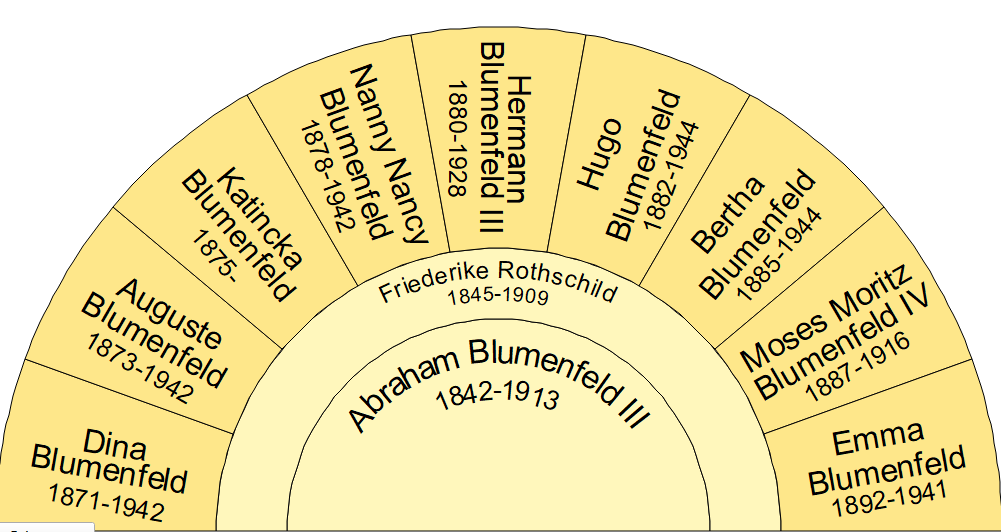
As we saw, Abraham Blumenfeld III and his wife Friedericke Rothschild had nine children born between 1871 and 1892. By 1894, the older children were beginning to marry and have children of their own while Abraham and Friedericke were still raising their younger children.

The oldest child of Abraham III and Friedericke was their daughter Dina, born on February 1, 1871. She married Salomon Heldenmuth on November 27, 1894. Salomon, the son of Samuel Heldenmuth and Auguste Katz, was born in Altenkirchen, Germany, on May 16, 1866.

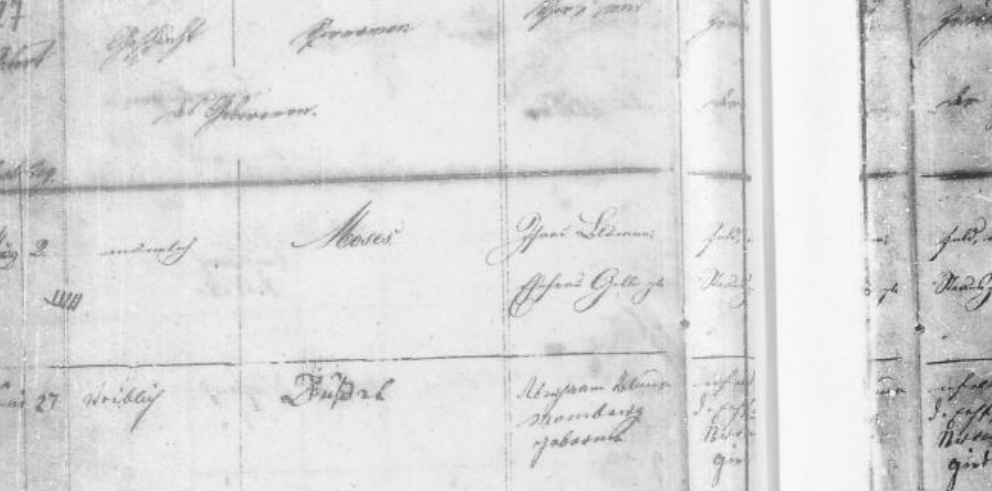
Marriage of Dina Blumenfeld and Salomon Heldenmuth, Hessisches Hauptstaatsarchiv; Wiesbaden, Deutschland; Bestand: 915; Laufende Nummer: 6504, Ancestry.com. Hesse, Germany, Marriages, 1849-1930

Dina and Salomon had three children. Leopold was born on December 5, 1895, in Altenkirchen.

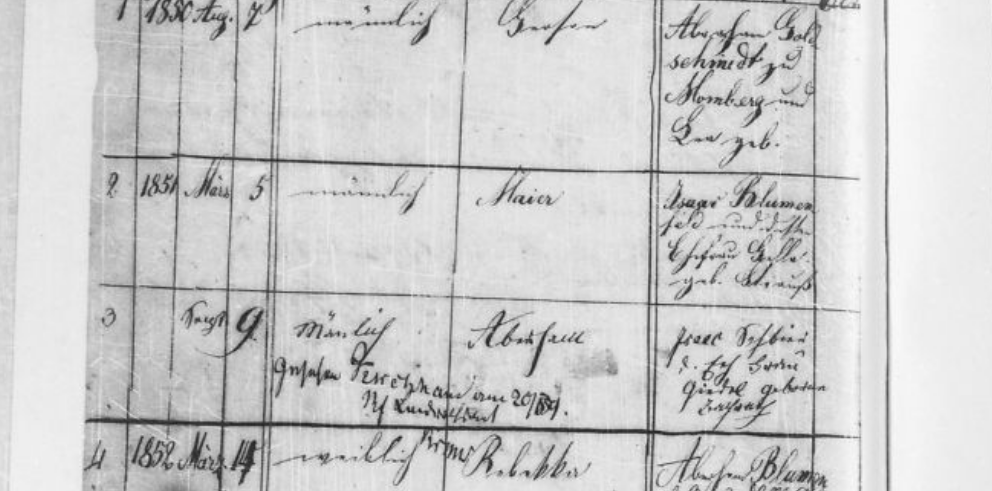
Leopold Heldenmuth birth record, Hessisches Hauptstaatsarchiv; Wiesbaden, Deutschland; Bestand: 911; Laufende Nummer: 4624, Year Range: 1895, Ancestry.com. Hesse, Germany, Births, 1851-1901

Gertrude was born on July 31, 1897, in Altenkirchen.

Gertrud Heldenmuth birth record, Hessisches Hauptstaatsarchiv; Wiesbaden, Deutschland; Bestand: 911; Laufende Nummer: 4626, Year Range: 1897, Ancestry.com. Hesse, Germany, Births, 1851-1901

And Siegfried was born March 21, 1902, also in Altenkirchen.1

Auguste, the second child of Abraham Blumenfeld III and Friedericke Rothschild, born on June 13, 1873, married Menko Stern on December 19, 1900. Menko was the son of Wolf Stern and Minna Hirsch and was born in Niederurff on March 30, 1872.

Marriage record of Auguste Blumenfeld and Menko Stern, Hessisches Hauptstaatsarchiv; Wiesbaden, Deutschland; Bestand: 920; Laufende Nummer: 8009, Year Range: 1900, Ancestry.com. Hesse, Germany, Marriages, 1849-1930

Auguste and Menko had two children born in Treysa, Germany. Max was born on November 7, 1901.

Birth record, Max Stern, Arcinsys Archives Hessen, HHStAW Fonds 365 No 792, p. 52

Julius was born on February 1910 in Trysa.

Birth record of Julius Stern, Arcinsys Archives Hessen, HHStAW Fonds 365 No 792, p. 55

The third child of Abraham III and Friedericke, Katincka, was born September 5, 1875, and she married Samuel Heymann on November 28, 1902, in Greifenstein, Germany. He was born in Biskirchen, Germany, on March 10, 1872, to Heimann Heymann and Betty Moses.

Marriage record of Katincka Blumenfeld and Samuel Heymann, Hessisches Hauptstaatsarchiv; Wiesbaden, Deutschland; Bestand: 911; Laufende Nummer: 7199, Year Range: 1902, Ancestry.com. Hesse, Germany, Marriages, 1849-1930

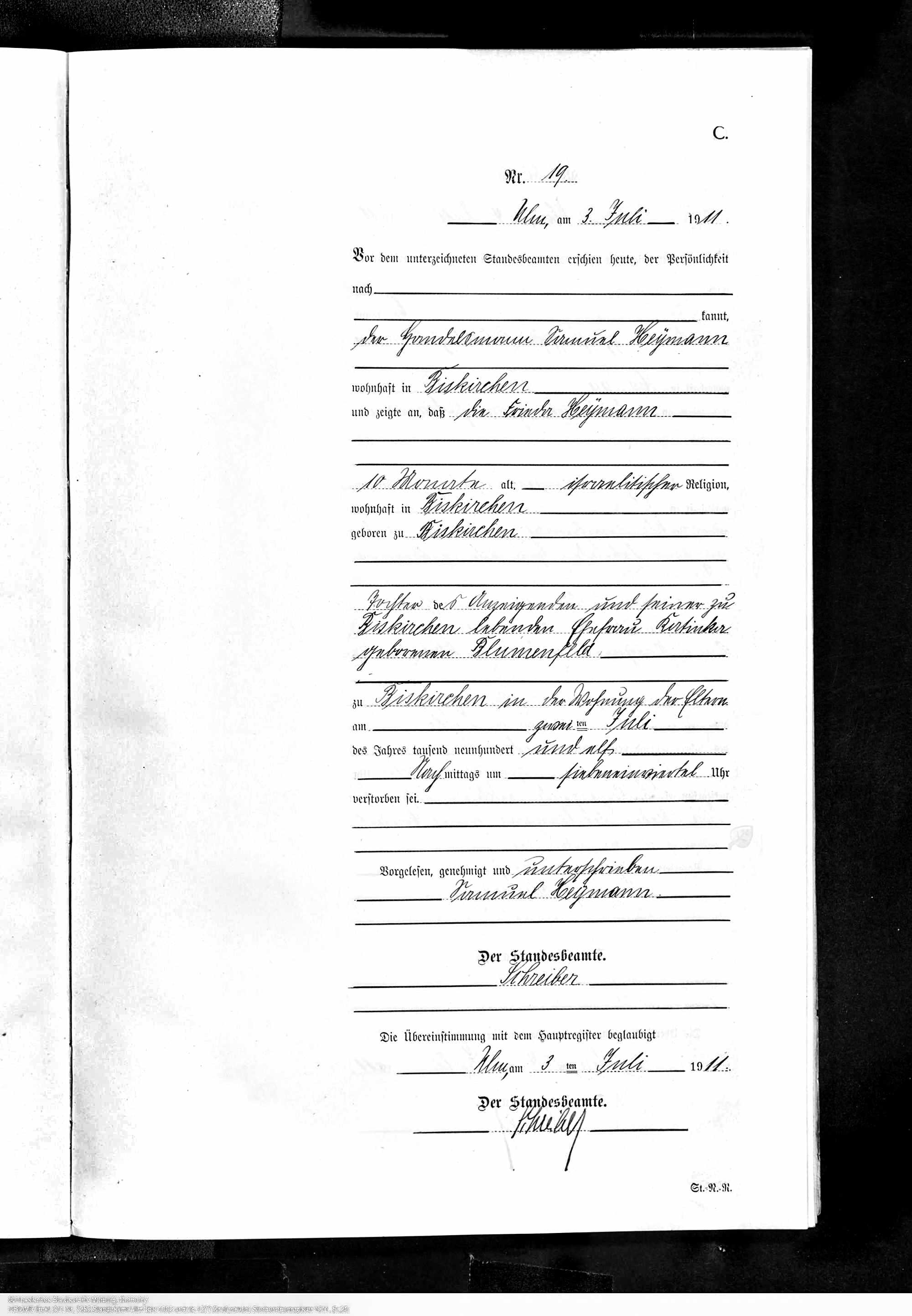
Katincka and Samuel had one child, Frieda, who died when she was ten months old on July 2, 1911.

Death record of Frieda Heymann, Personenstandsregister Sterberegister; Bestand: 911; Laufende Nummer: 7256, Year Range: 1911, Ancestry.com. Hesse, Germany, Deaths, 1851-1958

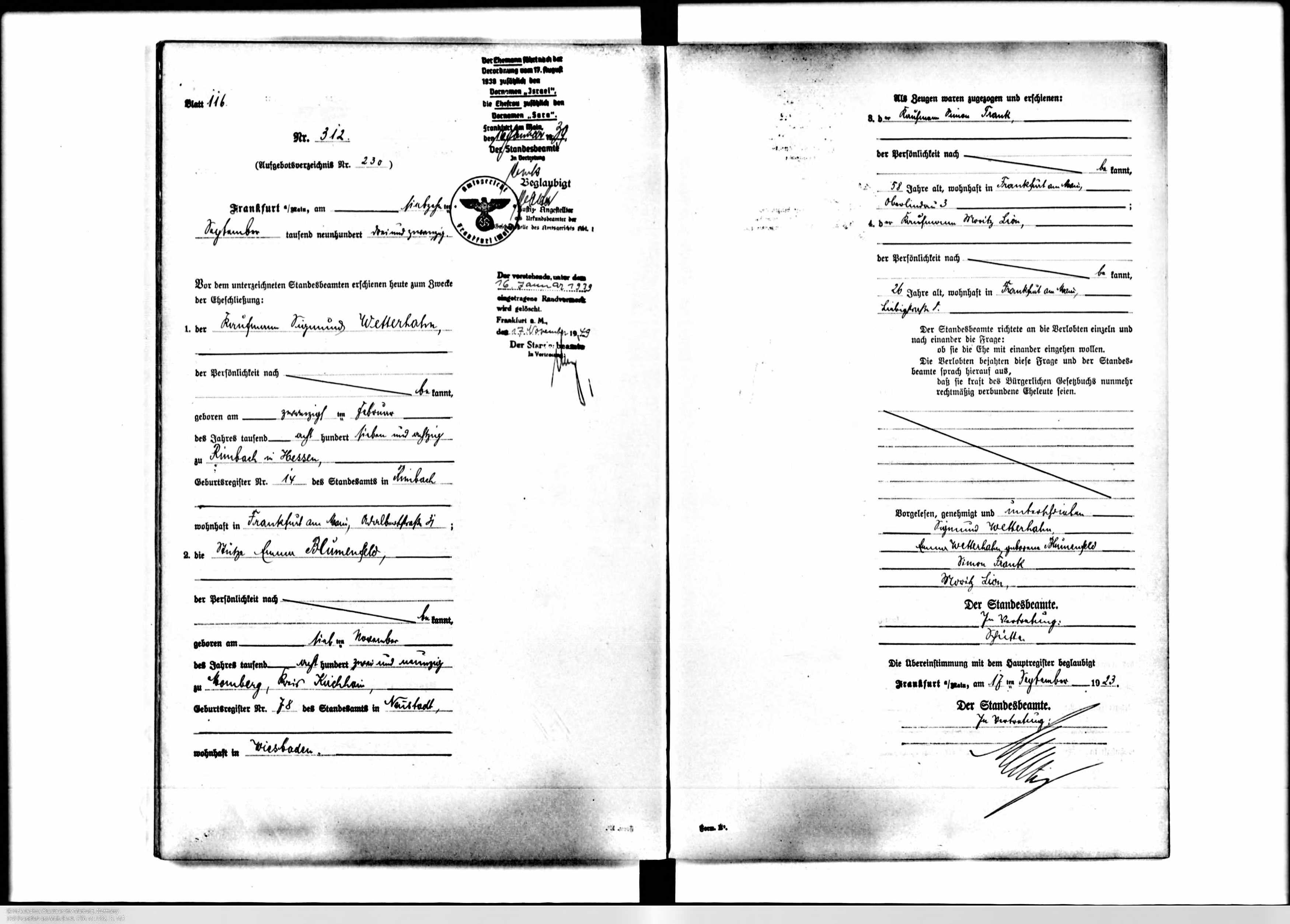
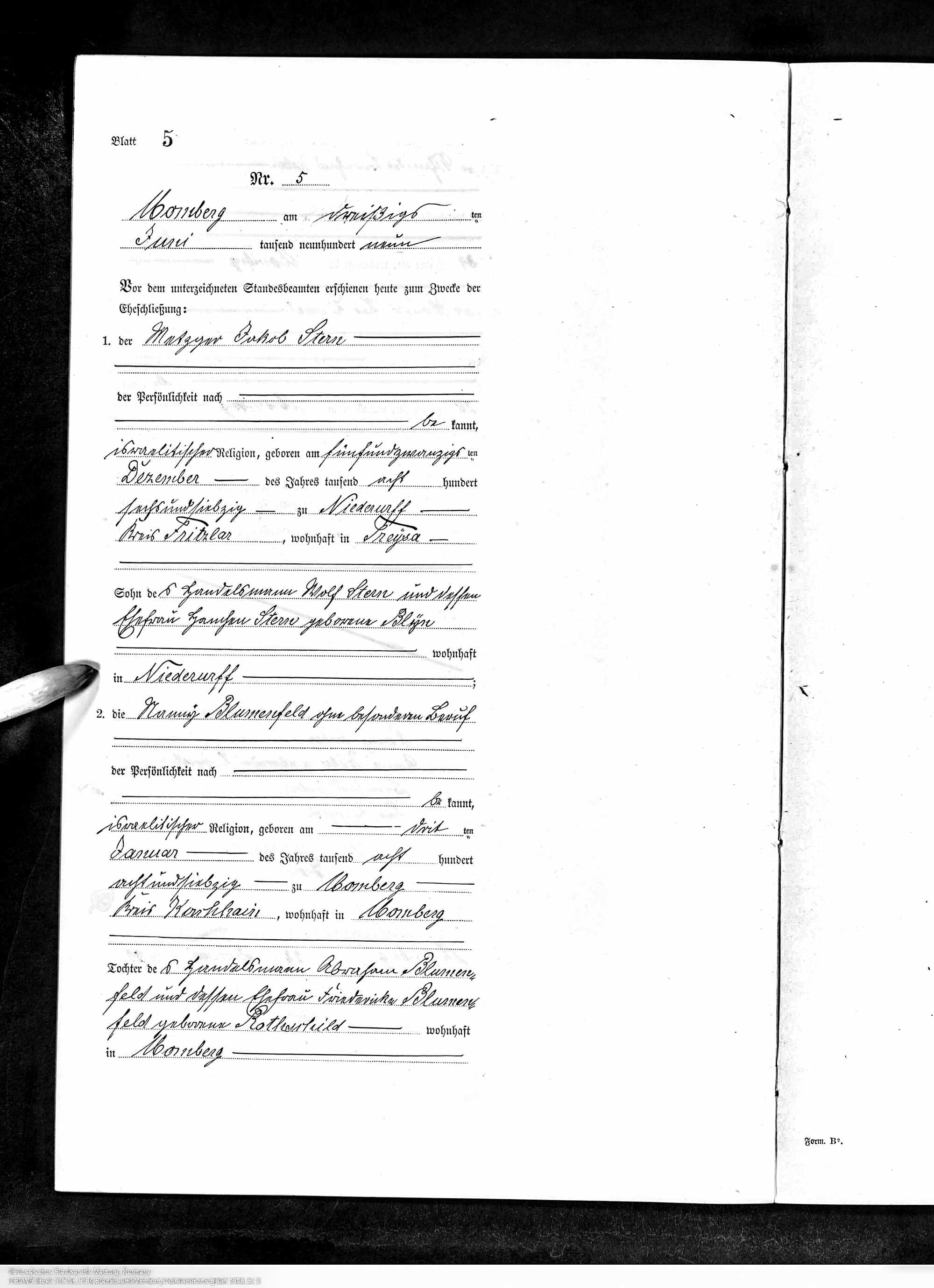
Abraham III and Friedericke’s fourth child, their daughter Nanny, who was born on January 3, 1878, in Momberg married Jakob Stern on June 30, 1909, in Momberg.  He was born in Niederurff on December 25, 1876, to Wolf Stern and Hannah Blyn.

Nanny Blumenfeld Jakob Stern marriage record, Hessisches Hauptstaatsarchiv; Wiesbaden, Deutschland; Bestand: 915; Laufende Nummer: 6194, Year Range: 1909, Ancestry.com. Hesse, Germany, Marriages, 1849-1930

There was actually a double/double wedding on June 30, 1909, the day Nanny Blumenfeld married Jakob Stern because Nanny’s brother Hermann married Jakob’s sister Jeannette Stern that day. Jeannette, also known as Johannette, was also the child of Wolf Stern and Hannah Blyn and was born in Niederurff on January 23, 1883.

Marriage of Hermann Blumenfeld and Jeannette Stern, Hessisches Hauptstaatsarchiv; Wiesbaden, Deutschland; Bestand: 915; Laufende Nummer: 6194, Year Range: 1909, Ancestry.com. Hesse, Germany, Marriages, 1849-1930

But then the question came to me: were Jeanette Stern and Jakob Stern related to Menko Stern, who’d married Auguste Blumenfeld, the sister of Hermann and Nanny Blumenfeld?

I went down quite a rabbit hole trying to ascertain whether the Wolf Stern who was the father of Menko Stern was the same Wolf Stern who was the father of Jakob Stern and Jeannette Stern. Knowing how names repeat in Jewish families, it could very well have been possible that there were two Wolf Sterns from Niederurff who were cousins or not even related. To answer this question, I needed to know the names of the parents of the two “Wolf Stern” entries on my tree, and so I looked for marriage records for Wolf Stern and Minna Hirsch and for Wolf Stern and Hannah Blyn and/or for birth records for Wolf Stern.

Unfortunately, I had no luck. I looked for records in the towns where Minna Hirsch was born (Sachsenhausen) and where Hannah Blyn was born (Niederurff)2 since marriages often took place in the brides’ hometowns. I was hampered to some extent by which records were available online for each of these towns.

I consulted with Dennis Aron, who has the same Wolf Stern married to both Minna and Hannah (not at the same time, of course) on his Ancestry tree. He sent me a link to the page for Wolf Stern’s gravestone on the LAGIS Jewish cemetery website, which reports as follows (translation by Google Translate):

Wolf Stern, butcher; born on September 4th, 1843 in Niederurff; Parents: Meier Stern, butcher and trader, and his first wife, Fradchen (Fratchen), born Rothschild, from Gilserberg, living in Niederurff;

married in first marriage legally (officially) in Jesberg on May 21, 1869, born in Minchen, Hirsch from Sachsenhausen (Waldeck), born there on April 11, 1839, daughter of the married couple Michel Hirsch and Süschen, born in Löwenstern;

married in second marriage judicially (officially) in Jesberg on November 8th, 1872 Hanna née Blyn [Stein No. 132] from Zwesten;

died on May 5th, 1922 in Niederurff at the stated age of 78 years, 8 months and 1 day.

That sent me to the marriage records for Jesberg online, but again I had no luck because those years are not included in the online archives for Jesberg on any of the sites for Jewish records in Hesse. I also was puzzled as to why a man born in Niederurff marrying women born in Sachsenhausen and Niederurff would have married them in Jesberg. Jesberg is under four miles from Niederurff and 22 miles from Sachsenhausen.

I also had no luck locating a death record for Minna Hirsch, which might have given me evidence of why Wolf Stern married Hanna Blyn just three years after supposedly marrying Minna.

I finally crawled out of the rabbit hole, thinking, “Does it matter if Jakob and Johannette Stern were the half-siblings of Menko Stern?” I decided to accept that the best I could do was rely on the information on the LAGIS Jewish cemetery website and assume that they were.

It was only after I’d given up on finding an answer that I located an article about the Stern family of Treysa written when Stolpersteine were installed for them in Treysa. According to that article, Jakob and Menko were brothers and in business together as butchers, living and working in the same house.

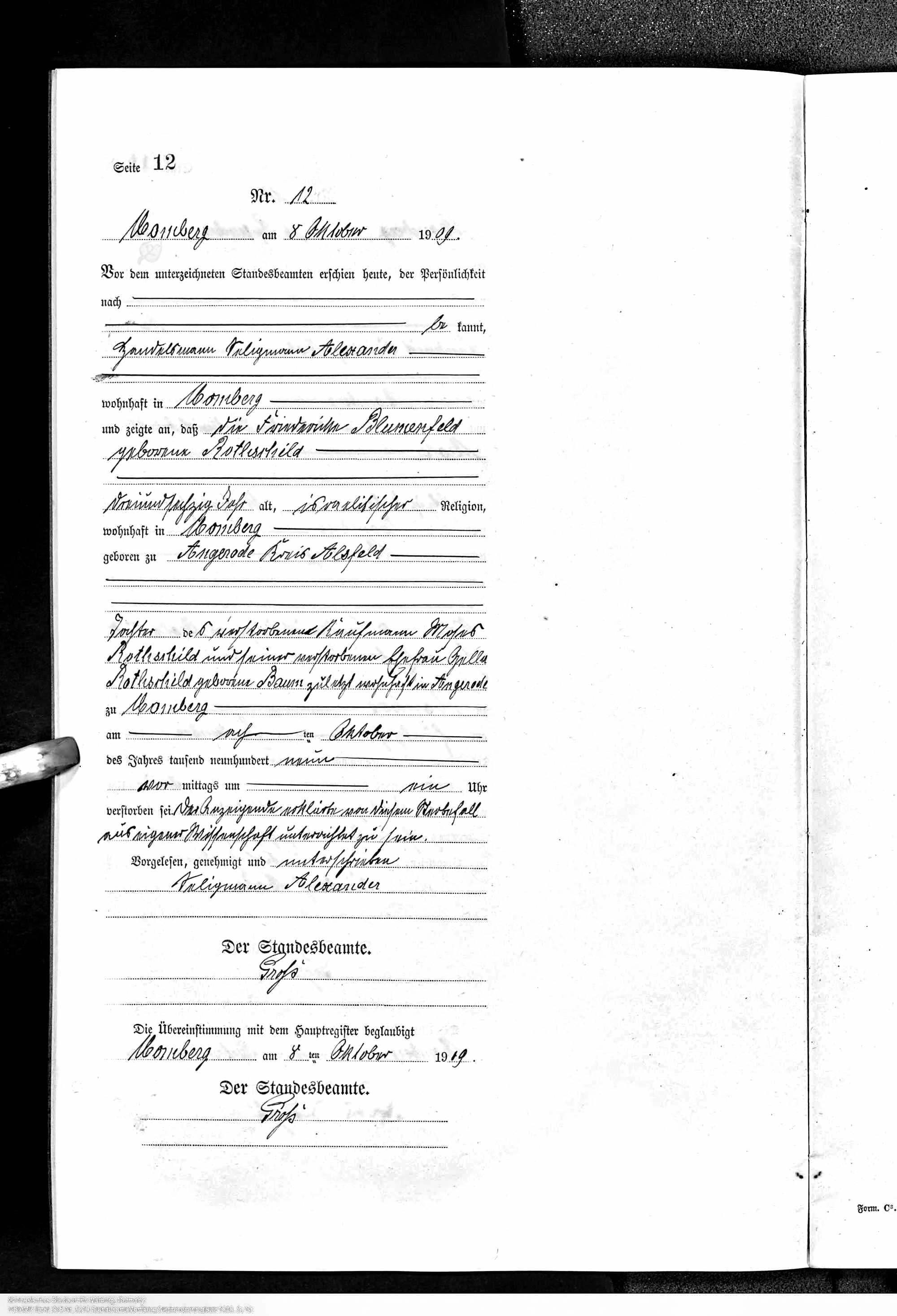
Thus, as of June 30, 1909, five of the children of Abraham Blumenfeld III and Friedericke Rothschild were married, and there were already quite a few grandchildren.  But just over three months later Friedericke, the mother of nine who gave birth over a twenty-one year period, died at the age of 63 on October 8, 1909, in Niederurff. Her youngest child Emma was still a teenager at the time, just a month shy of her seventeenth birthday.

Death of Friedericke Rothschild Blumenfeld, Personenstandsregister Sterberegister; Bestand: 915; Laufende Nummer: 6219, Year Range: 1909, Ancestry.com. Hesse, Germany, Deaths, 1851-1958

Unfortunately, Friedericke’s death in 1909 started a long period of many losses for the family of Abraham Blumenfeld III.


  1.  Siegfried Heldenmuth, Gender: Male, Declaration Age: 38, Record Type: Declaration, Birth Date: 21 Mar 1902, Birth Place: Altenkirchen, Germany,
    Arrival Date: 28 May 1940, Arrival Place: New York New York, Declaration Date: 15 Feb 1941, Declaration Place: Northampton, Hampshire, Massachusetts, USA, Declaration Number: 4912, Has Photo: Y, National Archives At Boston; Waltham, Massachusetts; ARC Title: Naturalization Record Books, 12/1893 – 9/1906; NAI Number: 2838938; Record Group Title: Records of District Courts of the United States, 1685-2009; Record Group Number: Rg 21, Ancestry.com. Connecticut, U.S., Federal Naturalization Records, 1790-1996 
  2. The birth places of Minna Hirsch and Hannah Blyn were found on the LAGIS Jewish graves website here

Isaak Blumenfeld’s Ten Children, Or How I Found Myself Overwhelmed With Repeating Names!

I am slowly working through the research of my Blumenfeld relatives, a branch of the tree that sometimes seems overwhelming. I have completed the blogging (for now) about only the first branch of the first sibling of my 3x-great-grandmother Breine Blumenfeld Katzenstein, that is, the oldest child (Abraham IIA) of the oldest brother of Breine, Moses Blumenfeld I. I will now turn to the second child of Moses Blumenfeld I, his son Isaak.

There are two different dates recorded for Isaak’s birth. First, on a family register compiled for the Neustadt region which includes Momberg where he was born, his birth is given as December 13, 1814.

Family register for Moses Blumenfeld, Arcinsys Archives Hessen, HHStAW Abt. 365 Nr. 631, S. 18

On the other hand, his death record filed many years later says he was born on December 18, 1813.1

Which is right? I don’t know. But given the general principle that the record created closest in time to the event is presumed to be more reliable, I will assume that Isaak was born on December 13, 1814.

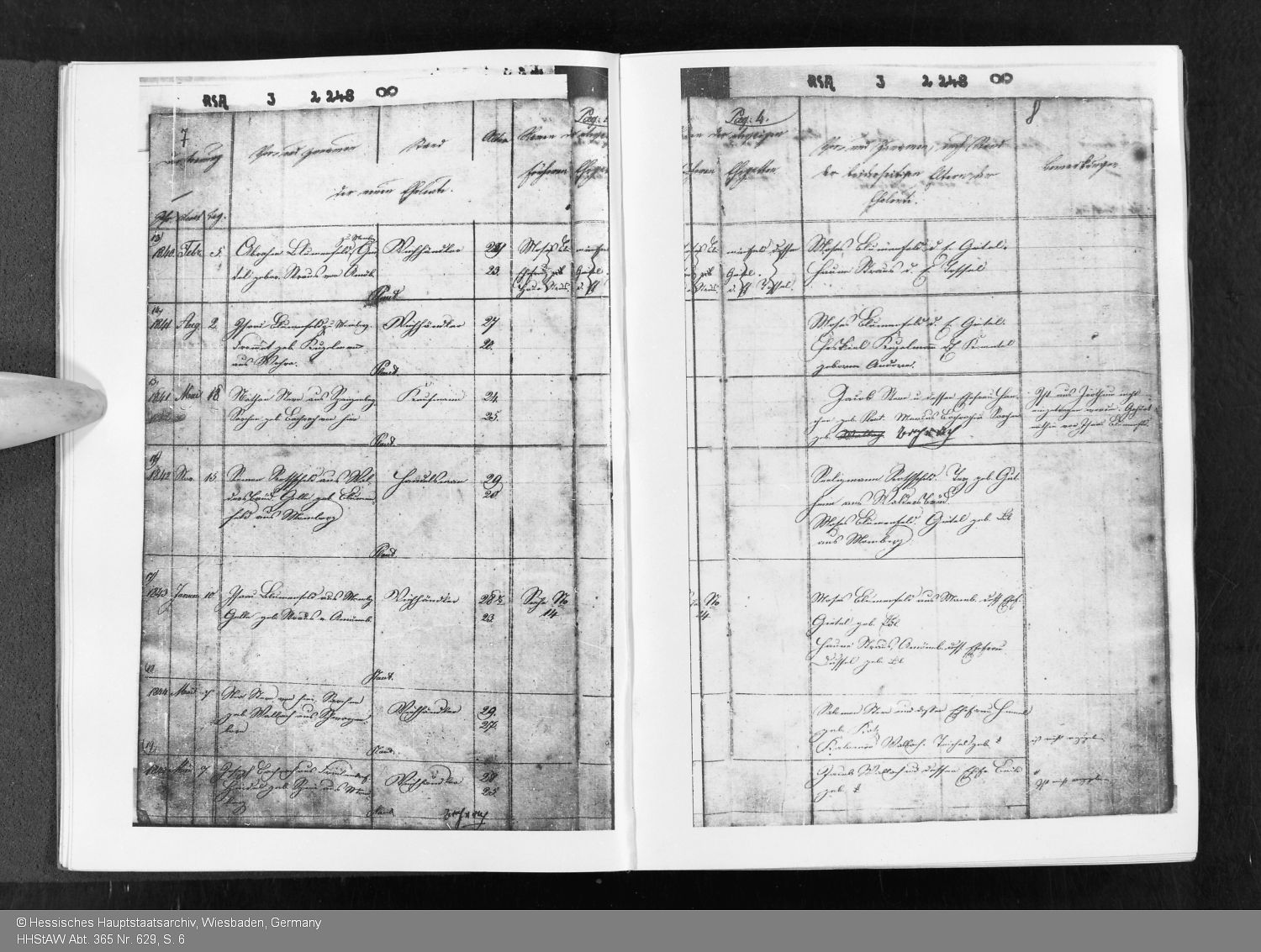
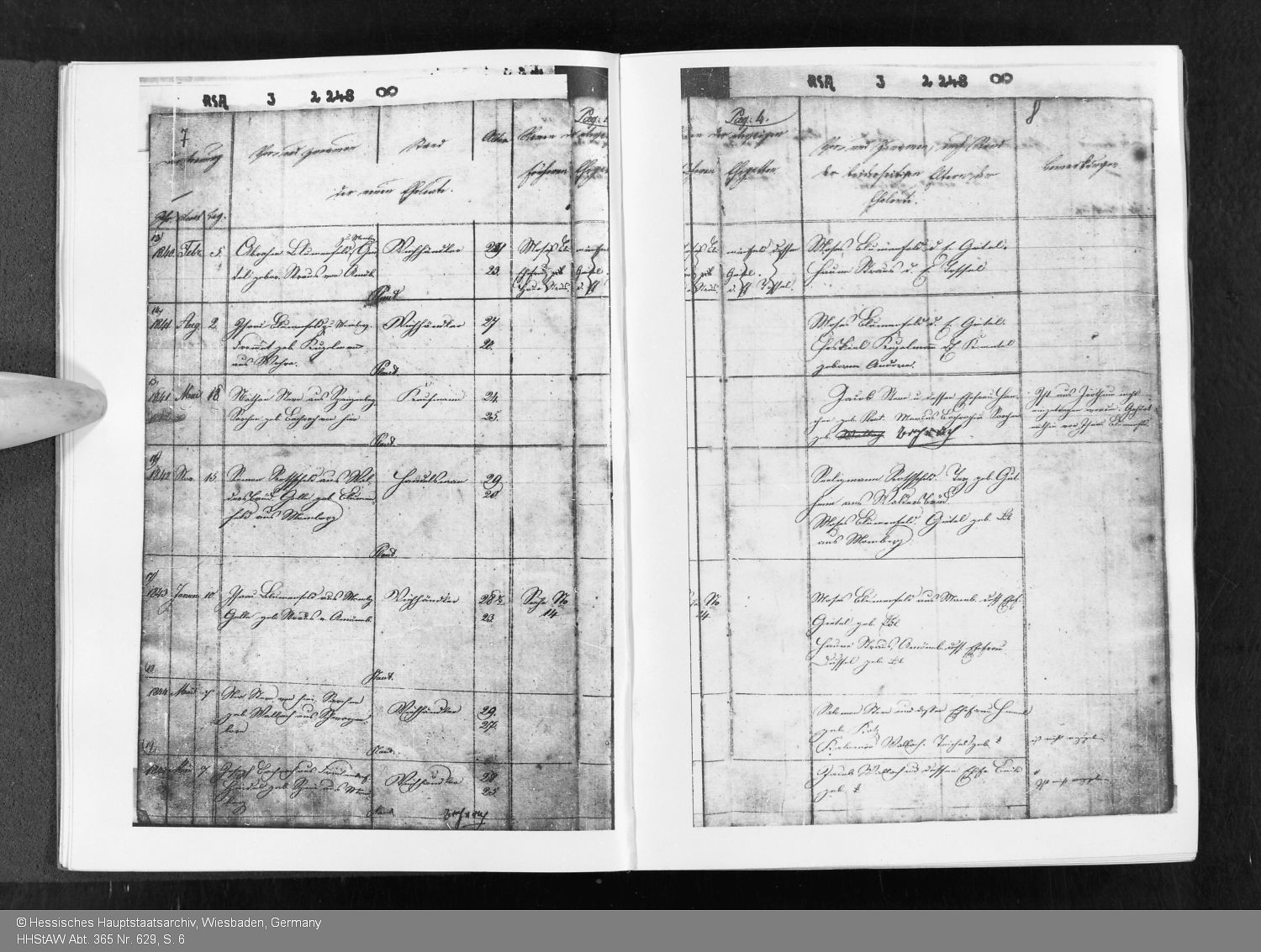
Isaak was a butcher, like his father and his brother Abraham IIA. He married Frommet Kugelmann on August 27, 1841, in Neustadt. Frommet was the daughter of Hiskias (Hezekiah) Kugelmann and Knendel Andorn, and she was born in about 1821 in Wohrda. I have no actual birth record, but her marriage record reports that she was 20 when she married Isaak.2

Marriage of Isaak Blumenfeld and Frommet Kugelmann, Arcinsys Archives Hessen, HHStAW Abt. 365 Nr. 629, S. 6

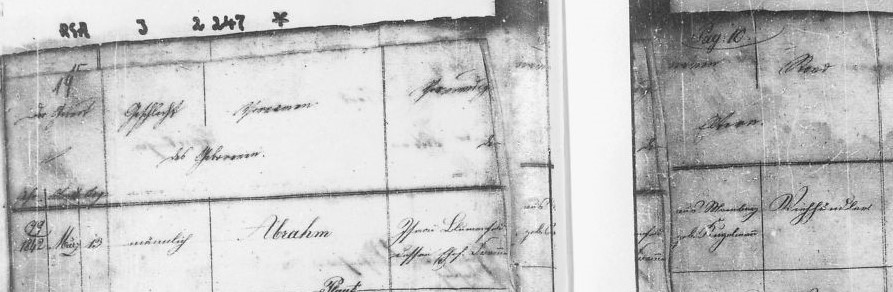
Sadly, Frommet died on March 18, 1842, just five days after giving birth on March 13, 1842, to her first and only child, Abraham Blumenfeld, named presumably for his great-grandfather Abraham Katz Blumenfeld, the patriarch of this line in my tree and my four-times great-grandfather. According to her death record, Frommet was nineteen when she died, meaning either her marriage record or her death record is incorrect.

Frommet Kugelmann Blumenfeld death record, Arcinsys Archives Hessen, HHStAW Abt. 365 Nr. 630, S. 8

I will refer to her son as Abraham III to distinguish him from his great-grandfather and from his uncle, Abraham Blumenfeld IIA, Isaak’s brother, as well as the other four Abraham Blumenfelds on my tree.

Abraham Blumenfeld III birth record, Arcinsys Archives Hessen, HHStAW Abt. 365 Nr. 628, S. 12

Ten months after Frommet’s death, on January 10, 1843, Isaak married again. His second wife was Gelle Straus, sister of Giedel Straus, the wife of Isaak’s brother Abraham IIA. So two brothers were now married to two sisters. Gelle was born on November 6, 1819, in Amoeneburg, to Hahne Straus and Dusel Loewenstein.

Marriage of Isaak Blumenfeld and Gelle Straus, Arcinsys Archives Hessen, HHStAW Abt. 365 Nr. 629, S. 6

Gelle and Isaak had nine children together, meaning that Isaak had ten children altogether. Unfortunately, the first child born to Gelle and Isaak, an unnamed baby boy, did not survive. He was born and died on January 24, 1844, in Momberg.

Unnamed child, LAGIS Hessen Archives, Geburtsregister der Juden von Neustadt 1824-1884 (HHStAW Abt. 365 Nr. 628), p. 13

Just eleven months after losing that first baby, Gelle gave birth to her second baby, a girl named Giedel, born on December 16, 1844. I assume that Giedel was not named for her aunt, Gelle’s sister, but for one of the many other women with that name on the family tree.

Giedel Blumenfeld birth, LAGIS Archives, Geburtsregist Neustader der Juden vont 1824-1884 (HHStAW Abt. 365 Nr. 628)AutorHessisches Hauptstaatsarchiv, WiesbadenErscheinungsjahr1824-1884, p. 14

And guess what they named their next child, a boy born on May 2, 1847, in Momberg? Moses! Yes, another Moses Blumenfeld, one of six on this tree. I will refer to this one as Moses Blumenfeld IIB to distinguish him from his first cousin Moses Blumenfeld IIA, son of Abraham Blumenfeld II.

Moses Blumenfeld birth record, LAGIS Hessen Archives, Geburtsregister der Juden von Neustadt 1824-1884 (HHStAW Abt. 365 Nr. 628)AutorHessisches Hauptstaatsarchiv, WiesbadenErscheinungsjahr1824-1884, p. 16

Next born was another Dusschen Blumenfeld, not to be confused with her first cousin Dusschen Dora Blumenfeld, daughter of Abraham Blumenfeld IIA. I was confused about these two Dusschens for some time. To keep them straight, I called Abraham’s daughter Dora; I will refer to this one as Dusschen. She was born on December 25, 1848.

Dusschen Blumenfeld birth record, LAGIS Hessen Archives, Geburtsregister der Juden von Neustadt 1824-1884 (HHStAW Abt. 365 Nr. 628), p. 16

Then came Meier Blumenfeld, born on March 5, 1851, in Momberg. Like his siblings Moses and Dusschen, he also shared his first name with a first cousin, Meier Blumenfeld IIA, son of his uncle Abraham IIA. I will refer to Isaak’s son as Meier Blumenfeld IIB.

Meier Blumenfeld birth record, LAGIS Hessen Archives, Geburtsregister der Juden von Momberg (Neustadt) 1850-1874 (HHStAW Abt. 365 Nr. 608), p. 3

Isaak and Gelle’s sixth child was named Gerson. He was born on April 29, 1853, in Momberg. You might think that unlike his older siblings, Gerson didn’t have to share a name with a first cousin since we haven’t yet talked about another Gerson Blumenfeld. But in fact, there was another Gerson Blumenfeld, the son of Meier Blumenfeld I, younger brother of Moses Blumenfeld. That Gerson Blumenfeld was born in 1834, and guess what? He would later marry Isaak’s daughter (and Gerson’s sister) Giedel! But I am getting ahead of myself. Isn’t this fun? Anyway, Isaak’s son Gerson will be referred to as Gerson II.

Gerson Blumenfeld birth record, LAGIS Hessen Archives, Geburtsregister der Juden von Momberg (Neustadt) 1850-1874 (HHStAW Abt. 365 Nr. 608)AutorHessisches Hauptstaatsarchiv, WiesbadenErscheinungsjahr1850-1874, p. 4

The seventh child born to Isaak and Gelle was born on August 23, 1856, in Momberg. Her name was Rebecca, and she also shared her name with a first cousin, Rebecca Blumenfeld, the daughter of Abraham IIA. So I will refer to this Rebecca as Rebecca II.

Rebecca Blumenfeld birth record, LAGIS Hessen Archives, Geburtsregister der Juden von Momberg (Neustadt) 1850-1874 (HHStAW Abt. 365 Nr. 608), p. 4

Finally with their eighth child, Isaak and Gelle selected a name that was not shared by any of that child’s close relatives. Fradchen Friedericke Blumenfeld was born on November 2, 1858, in Momberg.

Fradchen Blumenfeld birth record, LAGIS Hessen Archives, Geburtsregister der Juden von Momberg (Neustadt) 1850-1874 (HHStAW Abt. 365 Nr. 608)AutorHessisches Hauptstaatsarchiv, WiesbadenErscheinungsjahr1850-1874, p. 5

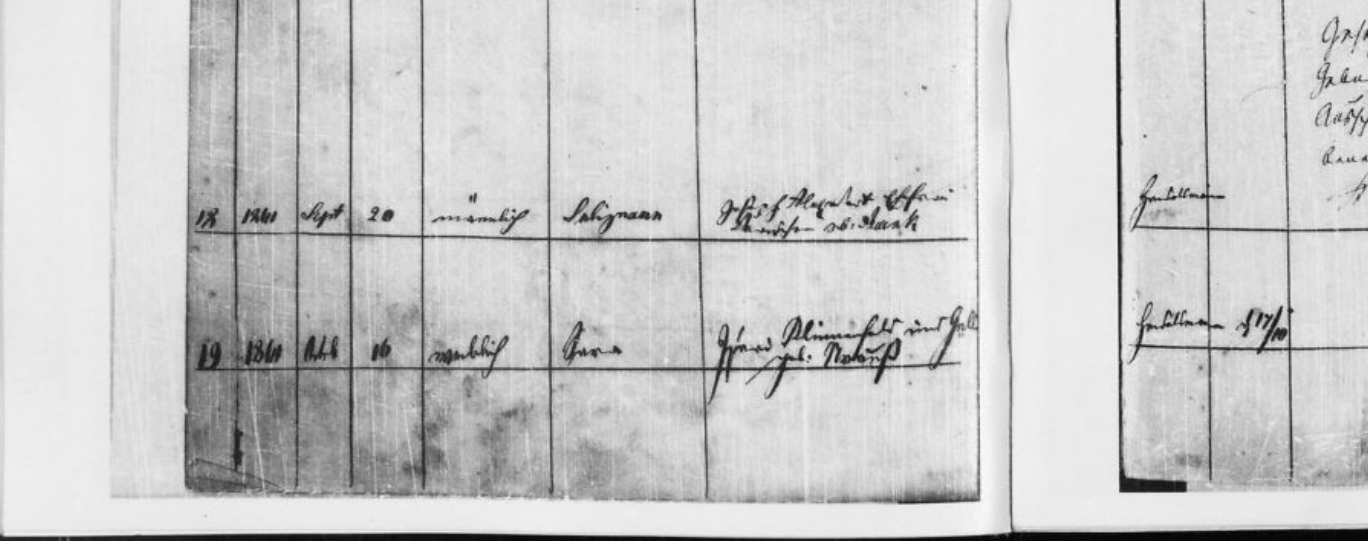
That brings me to the ninth and last child born to Gelle and Isaak, Sara, born on October 16, 1861, when Gelle was 42 years old. Unfortunately Sara died when she was only eight years old on July 11, 1870.

Sara Blumenfeld birth record, LAGIS Hessen Archives, Geburtsregister der Juden von Momberg (Neustadt) 1850-1874 (HHStAW Abt. 365 Nr. 608)AutorHessisches Hauptstaatsarchiv, WiesbadenErscheinungsjahr1850-1874, p. 5

Sara Blumenfeld death record, LAGIS Hessen Archives, Sterberegister der Juden von Momberg (Neustadt) 1851-1873 (HHStAW Abt. 365 Nr. 609)AutorHessisches Hauptstaatsarchiv, WiesbadenErscheinungsjahr1851-1873, p. 5

Thus, Isaak Blumenfeld had ten children, one with his first wife Frommet and nine with his second wife Gelle. Eight of those children lived to adulthood, and their stories will be told in the posts to come. Let’s hope I can keep them all straight from their identically named cousins!


  1. Isak Blumenfeld, Age: 79. Birth Date: 18. Dez 1813 (18 Dec 1813), Death Date: 2. Apr 1892 (2 Apr 1892), Death Place: Neustadt Hessen, Hessen (Hesse), Deutschland (Germany), Civil Registration Office: Neustadt (Hessen), Father: Moser Blumenfeld, Mother: Giedes Blumenfeld, Personenstandsregister Sterberegister; Bestand: 915; Laufende Nummer: 6559, Ancestry.com. Hesse, Germany, Deaths, 1851-1958 
  2. To learn Frommet’s parents’ names other than from the information on the LAGIS cemetery website here, I looked at the birth records for Wohrda in the Arcinsys Archives, but they start in 1825 so too late to include Frommet. I found a birth record for one of her siblings, however, and asked on the GerSIG Facebook group for help in deciphering the script. Thanks to Bernhard Kukatzki for doing so and revealing the names of their parents. 

Baruch Blumenfeld: Where and When Did He Die, Part II

The mystery of where and when Baruch Blumenfeld died led me down several rabbit holes to answer several questions. Did Baruch Blumenfeld move to New York and leave his wife Emma and his daughters and his grandchildren behind? Was the 1920 census accurate in reporting that he had immigrated to the US in 1869 and become a US citizen in 1875? If so, how did he marry Emma in 1872 and father two children between 1872 and 1875? And did he really die in New York City in 1923?

I turned to several Facebook groups for further help to confirm that this was the correct Baruch. First, I asked on Tracing the Tribe for help finding more information about the Baruch Blumenfeld who died in New York. My fellow Blumenfeld cousin Tova Levi suggested that I try and find a connection to the family with whom Baruch was living in 1920. That led me to search for Getta and Emma Neuberger and their place of origin, including locating their extended family in New York and searching for naturalization records that might reveal where they came from in Germany.

Baruch Blumenfeld, 1920 US census, Year: 1920; Census Place: Manhattan Assembly District 14, New York, New York; Roll: T625_1212; Page: 2B; Enumeration District: 1047 Source Information Ancestry.com. 1920 United States Federal Census

After hours of searching and getting help from the New York City genealogy group, the German genealogy group, and the GerSIG group, including from Sandy Hahn Lanman and Matt Luders, I concluded that the Neuberger family came from Thalmassig in Bavaria, not anywhere near Hesse where Baruch had lived, and that thus it was unlikely that my Baruch would have known them before coming to the US.

Steph Mayer, one of the members of the German Genealogy group, also was very helpful. She made several suggestions, including sending me a link to the entry for Baruch Blumenfeld on genealogy.net, an important Germany genealogy website. Steph recommended that I email the contact person, Hartwig Faber, to see if he had any additional information.

And so I did, and Hartwig helped solve one part of this mystery. He noted that on the 1900 marriage record for Baruch’s daughter Charlotte, Baruch is described as living at an unknown distance. That is, by 1900 Baruch’s whereabouts were no longer known by his family.

Marriage record of Charlotte Jeanette Blumenfeld and Hermann Hammel, Hessisches Hauptstaatsarchiv; Wiesbaden, Deutschland; Bestand: 915; Laufende Nummer: 6510
Year Range: 1900, Ancestry.com. Hesse, Germany, Marriages, 1849-1930

Here is the transcription and translation of that part of the record:

Tochter des in unbekannter Ferne weilenden Kaufmanns Baruch Abraham Blumenfeld und der nochlebenden Ehefrau Emma geb. Docter wohnhaft in Neustadt.

Daughter of the merchant Baruch Abraham Blumenfeld, living in unknown distance, and the still living wife Emma, née Docter, living in Neustadt.

That record supports the possibility that Baruch did immigrate to the US and did die in New York in 1923.

But I can’t still cannot find a Baruch Blumenfeld on any ship manifest even when I search without limiting by dates or with wildcards on the name.

I also have had no luck finding any naturalization papers for him. I’ve gone through indexed and unindexed records on Ancestry and FamilySearch, and the only citizenship record that came close was a declaration of intention dated October 8, 1873 by a Baruch Blum. In that era declarations carried no identifying information other than the name and country of origin, so that doesn’t help very much. And I remain skeptical that Baruch would have been in the US at that time, given that he married Emma in 1872 and had a baby later that year and a second three years later.

I also cannot find a Baruch Blumenfeld on any census record in the US except the 1920 census. If he really immigrated to the US in 1869, he should have appeared on the 1870, 1880, 1900, and 1910 US census enumerations.

I did find a German-born Benny Blumenfeld living as a boarder in New York in 1915 on the New York State census of that year. He was 72, so born in or close to 1843. He had no occupation. Could that be Baruch? Maybe. It says he’s been in the US for 32 years or since 1883. That would make a lot more sense than 1869, the year given on the 1920 census. There’s even a young man listed below, also a boarder in the same household, who was a butcher. Do you think this could be my Baruch?

Benny Blumenfeld 1915 NYS census, New York State Archives; Albany, New York; State Population Census Schedules, 1915; Election District: 10; Assembly District: 10; City: New York; County: New York; Page: 38, District: A·D· 10 E·D· 10, Ancestry.com. New York, U.S., State Census, 1915

But there is no one else with a similar name and age that I could locate on the 1900 or 1910 US census. My working hypothesis at this point is that Baruch Blumenfeld took on an assumed name when he immigrated and then changed it back years later.

When I received the copy of the actual death certificate for the Baruch Blumenfeld who died in New York in 1923, I was even more certain that he was the same person as my cousin Baruch Blumenfeld.

The first page of that certificate first of all made it clear that his mother’s surname was Strauss, not Lhauss. Secondly, his age is given as 80 years and eight months. Since he died in September, 1923, that means he was born in January, 1843. My Baruch was born on January 29, 1843. This definitely supports the conclusion that this was my Baruch Blumenfeld.

One other interesting bit of information is included on first page of the certificate. It reports that he had been living in the US and in New York for 42 years or since 1881. That would make a lot more sense than the year given on the 1920 census—1869. By 1881 both of Baruch’s daughters were born, and he very well might have left Germany around that time.

I was feeling pretty excited that I had enough information to confirm that this was my cousin Baruch Blumenfeld—until I looked at the reverse side of the certificate.

It indicated that Mary Farley, a sister of the deceased, had hired the undertaker to take care of Baruch’s burial. Mary Farley? A sister? There were many Mary Farleys living in the US 1923—too many to count. If I limited my search to New York City, I found 32 registered to vote in New York in 1924.1 I also searched for a Mary Farley born in Germany living in or near New York who might be the woman named on the death certificate. I only found one woman with that name born in Germany; she lived in Bridgeport, Connecticut, and was married to a native-born American named John Farley. Her maiden name was Richardt, not Blumenfeld.

UPDATE!! Thank you so much to Lisa K of the GerSIG group on Facebook for pointing out that this is NOT the reverse of the death certificate for Baruch Blumenfeld, but for someone named James Graham. So Mary Farley must have been HIS sister. I’ve now ordered a correct version of the reverse of Baruch’s death certificate.

I very much doubt any one of the many possible Mary Farleys was Baruch’s sister. Friend, neighbor, whatever—she likely said she was the sister so she could arrange the burial for him.

What do you think? Have I convinced you that the Baruch Blumenfeld who died in New York in 1923 was the same man born in Momberg, Germany, on January 29, 1843, to Abraham Blumenfeld II and Giedel Strauss? Please share you thoughts in the comments.

I am so very grateful to the genealogy village for all the help I’ve received to try and learn what happened to my cousin Baruch Blumenfeld.

The Growing Family of Taube Brotman and Jacob Hecht: An Exercise in Deciphering Census Records

Although the evidence of Taube Brotman’s life before 1892 is very limited, beginning with her son Harry’s birth certificate, we have evidence of her life after arriving in the US, probably in 1887.

Harry Hecht birth certificate

The birth record for Harry indicates that he was born at 33 East Houston Street in New York City on May 24, 1892, that his parents were Jacob Hecht and Toba Brotman and that they were living at that same address. Jacob was 25 and working as a cloaks operator, that is, in a sweatshop, and Toba was 20, suggesting a birth year of 1872. Both reported that they were born in Austria. Harry was Toba’s first child.

Where it says there are now seven children living, you might be puzzled. But this birth certificate was not filed until 1906, fourteen years after Harry’s birth, for reasons that are not clear. As we will see, Jacob and Taube Hecht were not very conscientious about filing records with the city. But by 1906, Jacob and Taube did in fact have seven children.

The 1900 census is the next source of information about Taube’s early years in the US.  It is rich with information, but also filled with errors and almost illegible cross outs. First, it gives Taube’s name as Mitilda—probably because she was already using Tillie at that time. They were living at 64 Broome Street in New York City, about a block away from Taube’s father, my great-grandfather, Joseph Brotman, and his family (including my grandmother Gussie, Taube’s sister) at 81 Ridge Street.


According to the census, Taube had been married to Jacob Hecht (spelled Hect here) for nine years at the time of enumeration, meaning they were likely married in about 1891. Unfortunately, I cannot find a marriage record for them. Jacob was working as a tailor, probably meaning he was still a cloak maker in a sweatshop on the Lower East Side.

Contrary to Harry’s birth record, the 1900 census reported that Jacob and Taube were both born in Russia, not Austria. Of course, neither is strictly accurate since Taube was born in Galicia, a province of the Austrian-Hungary Empire that bordered what was then Russia (now Ukraine). According to the census, Jacob had been in the US for twelve years, yet it says he immigrated in what looks like 1880? Or 1887? And the census says that Taube had been here for fifteen years, but then says she immigrated in 1875, written over 1885. Oy, that poor enumerator… he must have had a really hard time understanding whoever was giving him the information.

By 1900, Jacob and Taube had four children, all living with them: Harry was eight, born in 1892; “Annie” (actually Ida) was seven, born in May 1893; David was four, and although the year is crossed out, he likely was born in 1896, and Yette (later Etta) was seven months old and born in October 1889. Obviously that should be 1899 or Yette would have been eleven years old, not seven months old. As I discussed here, I have been unable to find birth records for three of those four children, only the later-filed certificate for Harry shown above.

Hecht family 1900 US census
Year: 1900; Census Place: Manhattan, New York, New York; Roll: 1094; Page: 14A; Enumeration District: 0290; FHL microfilm: 1241094

Five years later, the Hecht family had moved to 22 Mangin Street, about a half mile from where they’d been living in 1900, according to the 1905 New York State census. This enumerator seems to have had an easier time recording the family information. Taube is now listed as Tillie, as she was known in the US. Her age is reported as 35, meaning she was born in 1870; Jacob was 42, and now both once again report their birthplace as Austria. Jacob had been in the US for 17 years, Taube for 20. Neither was yet a citizen of the United States. Jacob was still making cloaks.

Hecht family, 1905 NYS census, New York State Archives; Albany, New York; State Population Census Schedules, 1905; Election District: A.D. 12 E.D. 14; City: Manhattan; County: New York; Page: 64, Ancestry.com. New York, U.S., State Census, 1905

They now had six children, two daughters having been born since 1900: Harry was 13, Ida 11, David 9, Etta 6, and the two most recent additions were Gussie (later Jean), who was five, and Sadie {later Shirley), who was two. Also living with them was another Sadie, listed as Jacob’s mother. She was 65 and had been in the US for 12 years. I find it rather odd that Taube and Jacob would have named a child Sadie if Jacob’s mother was Sadie and still living. And I cannot find any other record for the older Sadie Hecht, so I am wondering whether this was an enumeration error.

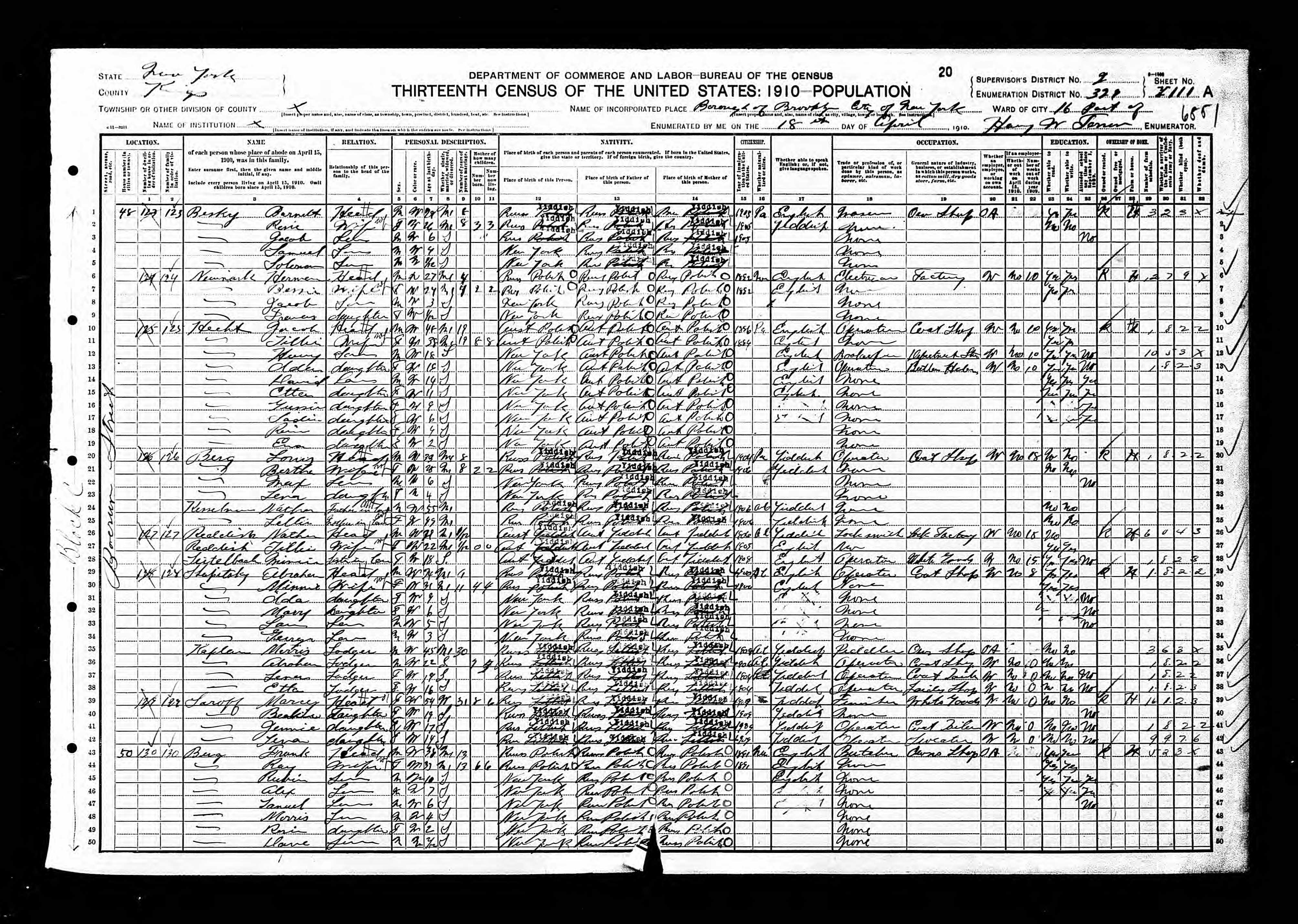
By 1910, the family had moved again and grown again. They now were living at 48 Boerum Street in Brooklyn. Jacob was still working as an operator in a coat shop and had filed his papers to become a citizen. On this census, both he and Taube (Tillie) gave “Aust Polish” as their birthplace. Jacob was 48, Taube 38. He had immigrated in 1886, she in 1884, according to the census record. And they’d been married for nineteen years, or in 1891, consistent with what was reported on the 1900 census.

Hecht family, 1910 US census, Year: 1910; Census Place: Brooklyn Ward 16, Kings, New York; Roll: T624_964; Page: 8A; Enumeration District: 0329; FHL microfilm: 1374977 Description Enumeration District: 0329 Source Information Ancestry.com. 1910 United States Federal Census

There were now eight children. Harry, now eighteen, was working as a bookkeeper in a department store. Ida was seventeen and a “button holer” operator. David was 14, Etta 11, Gussie 9, and Sadie was six. The two new additions were Rose (later Ruth), four years old, and Eva (later Evelyn), who was two. Eva is the only other Hecht child for whom I have a birth record:

Eva Hecht birth certificate

Eva was born on January 30, 1908, at 38 Montrose Avenue in Brooklyn, where the family was then residing, so they had moved again between 1908 and 1910 when they were living on Boerum Street. Note the errors on this record: Jacob is identifed as Joseph, and Taube’s birth name is listed as Rothman, not Brotman. Taube’s age is given as 37 here, meaning a birth year of 1872. Both Taube and Jacob reported that they were born in Austria.

With Eva’s birth, the Hecht family was complete. There were eight children ranging from Harry born in 1892 to Eva born sixteen years later in 1908. The next decade would see most of those children join the work force and one marry and have children of her own.

I Am Back!

After two glorious weeks with my kids on the Cape, I am back to my blog and my family history work.

While I was researching and writing about my Goldfarb cousins, a few other interesting discoveries came in on other matters. Before I turn to my next big topic—the family of my great-aunt Toba/Taube/Tille Brotman Hecht—I want to share these other discoveries.

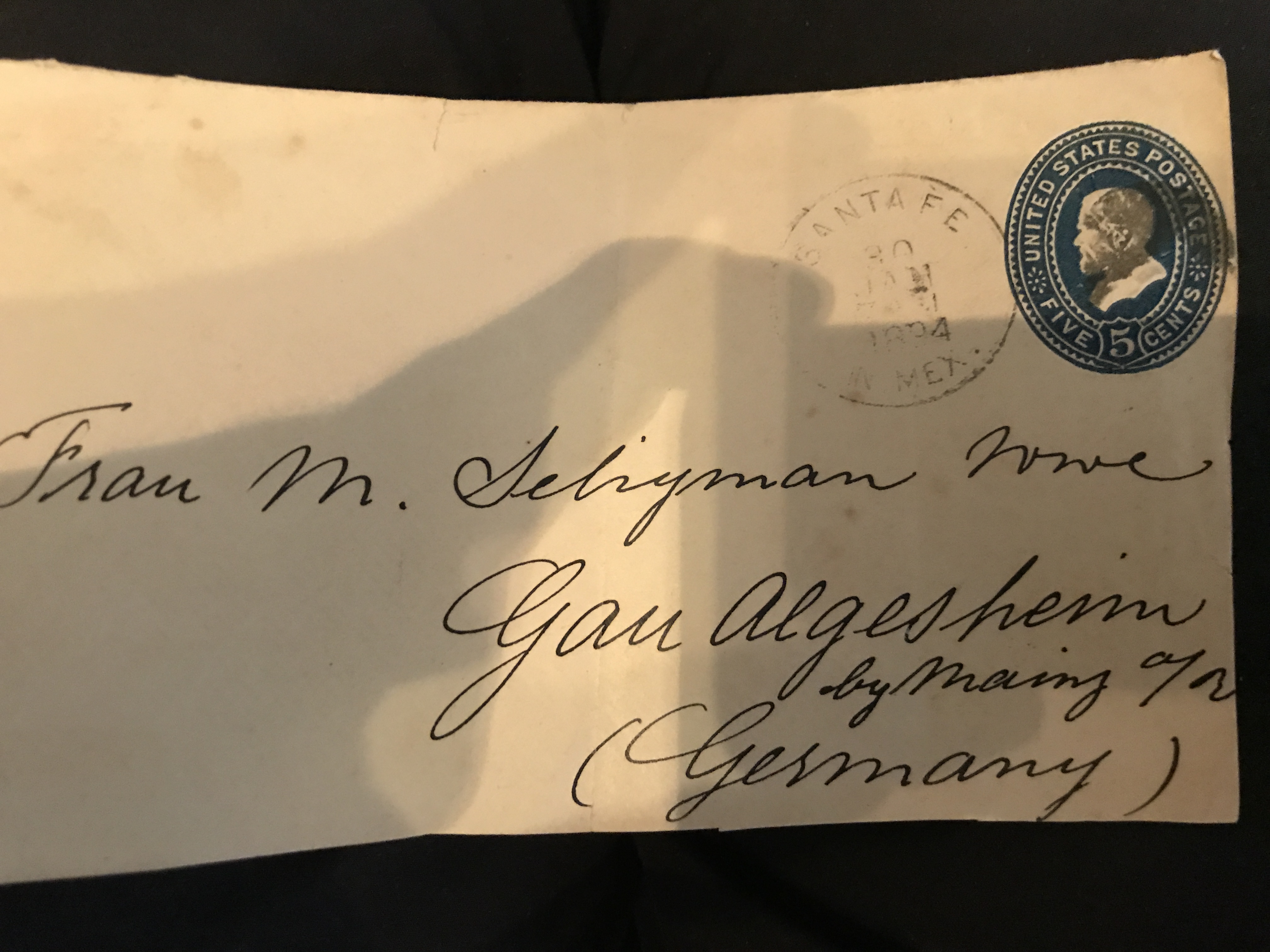
First, my cousin Wolfgang found an envelope that I found very exciting in the “magic suitcase” of Seligmann family history documents .

You can see that it is addressed to Frau M. Seligman in Gau-Algesheim, Germany, and postmarked on January 30, 1894, from Santa Fe, New Mexico.  This was most likely a letter from my great-great-grandfather Bernard Seligman to his mother, Babette Schoenfeld Seligmann, or Frau Moritz Seligmann. It could also have been a letter from Bernard’s brother Adolf to his mother or a letter from one of Bernard’s children to his or her grandmother. Unfortunately, there was no letter inside the envelope. But it is evidence that the American Seligmans were still in touch with their family back in Gau -Algesheim many decades after leaving Germany and coming to the US.

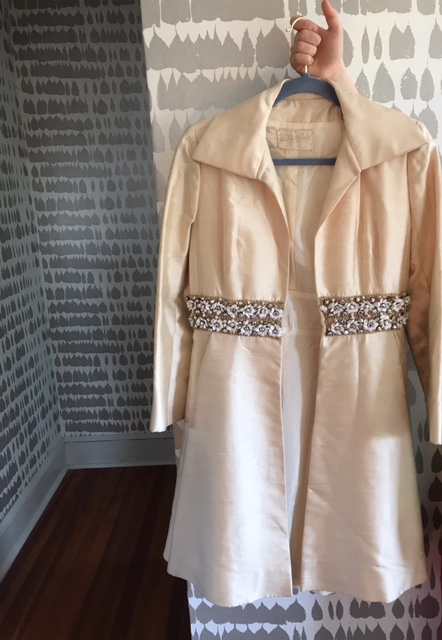
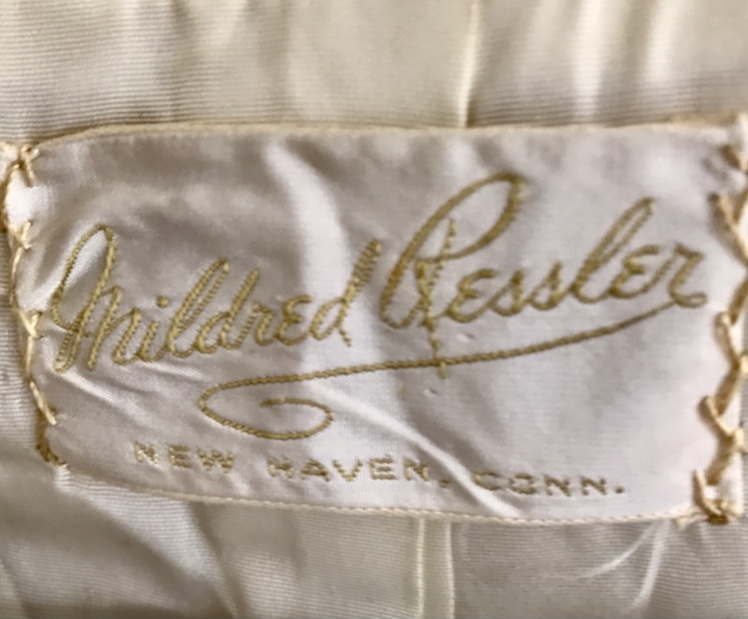
The other interesting discovery related to my great-aunt Tillie Brotman Ressler’s family. Her son Leo and his wife Mildred owned a dress shop in New Haven, Connecticut for many years. A woman was cleaning out her mother’s closet and found the dress depicted below. She googled the name Mildred Ressler and found my blog and then was so kind to contact me and share these photos of the dress. I shared them with Leo and Mildred’s son Peter, my second cousin. We were both very moved by seeing these pictures.

I love to see these little mementos capturing part of the lives of my relatives. The material objects somehow makes those lives real to me in ways that are different from photographs.

One Thousand Posts

This is the 1000th post I’ve published on this blog. It all started almost eight years ago when my cousin Judy Ruzicka, a Brotman second cousin, suggested that instead of emailing my research discoveries to all the Brotman cousins, I create a blog where people could subscribe and see my research. I had at that time read and followed a few blogs, but had never thought about creating one. Judy did the initial setup on WordPress, and I started to publish. Haltingly at first. Posting one census record or death record and adding a few words.

This was my first post. No commentary or analysis, just an image.

Bessie was Joseph's second wife and mother of five children

Bessie Brod Brotman Moskowitz—the first image I posted back in September 2013

And then it grew. I started realizing that I could tell stories about the relatives I was researching. I could put together narratives, and when I started doing that, I could see where I had holes in my research or where I needed more sources. And suddenly I found that I had more than my Brotman cousins reading along. I had other bloggers reading as well. And I started reading their blogs, and that gave me ideas for my own research and my own writing.

From there I discovered I could share my blog on Facebook and connect with more researchers and learn even more about family history research. The blog became a bigger and bigger part of my life. I at one point was posting three or four times a week and writing posts that were sometimes 3000 words. But I then learned that sometimes too much is too much. People didn’t want to read that much in one day or that often. So I cut my publishing schedule to twice a week and my post lengths to about 1000 words.

Then the best part started to happen. Cousins started to find me through my blog. Someone would Google their grandfather’s name or their great-grandmother’s name and find them mentioned on my blog. They would contact me, and I would learn more about that part of my family—often leading to photographs, letters, documents, and memoirs and memories. The blog itself became a way of advancing my research. Today I have connected with well over 200 living cousins, many because they found my blog.

Joseph Brotman’s headstone, the avatar I use for WordPress and for my blog

So as I post Number 1000, I wanted to stop and recognize and thank all those who have supported this endeavor by reading, commenting, sharing, and finding my blog. From Judy Ruzicka, who started it all, to all the family members, friends, and fellow genealogy and other bloggers who read the blog—whether periodically or regularly—thank you for giving me this platform to share and expand my family history project.

Now—on to post 1001! I will be taking a break to spend some time with my kids, but I’ll be back in a couple of weeks.


Who Was Bessie Goldfarb Named For? A Study in Naming Patterns

Before I write about Bessie Goldfarb Malzberg and her family, I want to explore a question that bothered me since I first learned her name.

It struck me as odd that Sarah Brod Goldfarb named a daughter Bessie since that was her sister’s name—my great-grandmother Bessie Brod Brotman. Even their Yiddish names were the same. On the ship manifest for Sarah and her four children, Sarah’s second daughter is listed as Pesie, and my great-grandmother Bessie was listed as Pessel on her ship manifest. I assume Pesie was a nickname for Pessel. Incidentally, Pessel is also my Yiddish name—in honor of my great-grandmother Bessie.

The National Archives at Washington, D.C.; Washington, D.C.; Series Title: Passenger Lists of Vessels Arriving at Philadelphia, Pennsylvania; Record Group Title: Records of the Immigration and Naturalization Service, 1787-2004; Record Group Number: 85; Series: T840
Ancestry.com. Pennsylvania, U.S., Arriving Passenger and Crew Lists, 1800-1962

Year: 1891; Arrival: New York, New York, USA; Microfilm Serial: M237, 1820-1897; Line: 29; List Number: 73, Ancestry.com. New York, U.S., Arriving Passenger and Crew Lists (including Castle Garden and Ellis Island), 1820-1957

Since Eastern European Ashkenazi Jews did not name children for living relatives, I assumed that Sarah’s Bessie was named for either the same person her sister Bessie had been named for or for a relative on Sam’s side of the family. But who was that person?

I decided to explore the naming patterns in the Goldfarb and Brod families a bit further to see if they provided any clues. Sam and Sarah’s first son was Julius (Joel was his Hebrew name), and it appears obvious that he was named for Sam’s father who was also named Julius Goldfarb.1 I will refer to Sam’s father as Julius I and Sam’s son as Julius II.

Sam and Sarah’s second son Morris (Moische), born in 1886, could have been named for a relative on Sarah’s side, and that’s possible here, but since four of Sam’s siblings—his brother Louis and his half-brothers Max, Meier, and Julius 2—all had sons named Morris Goldfarb,3 I think it’s more likely that Morris was also named for an ancestor on Sam’s side though I don’t know who that would be. Perhaps an uncle or a great-grandfather.

Then came Gussie (Gittel) Goldfarb, born in 1888. My grandmother Gussie Brotman was born in 1895, and she was a first cousin to Gussie Goldfarb. Sarah’s death certificate states that her mother was named Gittel, and her sister Bessie’s second marriage certificate says her mother was Gittel, so both Gussies—Gussie Goldfarb and my grandmother Gussie—were named for their maternal grandmother Gittel, my great-great-grandmother. (My daughter carries on the naming pattern as her Hebrew name is Rivka Gittel for my grandmother.)

New York, New York City Municipal Deaths, 1795-1949″, database, FamilySearch (https://www.familysearch.org/ark:/61903/1:1:2WT7-T1D : 3 June 2020), Sarah Goldfarb, 1937.

Certificate Number: 22138, Ancestry.com. New York, New York, U.S., Extracted Marriage Index, 1866-1937

That brings me to Bessie. She was born in 1890, and I don’t know who she was named for. Sam’s mother was Dora Kleinman. Dora died not long after Sam’s brother Louis (Lazar) was born in 1859. Louis Goldfarb named his first daughter Dora in 1889 for his mother. It seems odd that Sam didn’t have a daughter named for his mother.4 It makes me think Sam and Sarah may have had another daughter named for Dora who died before they left Europe—unless Dora Kleinman had a double name and Bessie was named for her other name.

Julius I’s second wife was named Rebecca Kirschenbaum,5 so did Sam name Bessie for his stepmother Rebecca? Or was Bessie named for a Brod, possibly the same unknown ancestor for whom my great-grandmother Bessie was named? I don’t know.

After Bessie came Joseph. I don’t see any Josephs on the Goldfarb side, and Sarah Brod and Bessie Brod’s father was named Joseph Brod according to the two records depicted above. So I think it’s very likely that Joseph Goldfarb was named for his maternal grandfather, Joseph Brod.

Leo was the next son, born in 1899. I don’t have any clues as to his namesake. On the  1900 census, Leo  was listed as Lewis, and on the 1905 NYS census he was Louis. Only in 1910 did his name appear as Leo. Sam’s brother Louis was still living when Leo was born, but maybe Leo was named for the same ancestor for whom his uncle Louis was named.  Sam’s half-brother Max had a son named Lewis born in 1901, so perhaps he also was named for the same ancestor.6  I don’t see anyone else with an L name in the Brod family so I think Leo was named for a Goldfarb, not a Brod.

Sam and Sarah’s last child was Rose, and that’s a name that appears four times among Sam’s relatives.  Sam’s brother Louis named his second daughter Rose born in 1891. Sam’s half-brother Max named a daughter Rose in 1901, and Julius Jr. had a daughter named Rose born in 1919. I would assume that Max and Julius, Jr. named their daughters for their mother Rebecca, but who did Sam and Louis name their daughters Rose for? I don’t know. Perhaps their stepmother Rebecca, or perhaps a great-grandmother or other female relative.7

Just to add to the data set here, my great-grandmother Bessie had five children with my great-grandfather Joseph Brotman—Tillie, Chaim (Hyman), my grandmother Gussie, Frieda, and Sam. With his first wife Chaye, Joseph Brotman had four children: Abraham, David, Max, and Taube. Only the name Gussie is repeated among her sister Sarah’s children although Max Brotman, like Morris Goldfarb, was Moische in Europe.

To summarize my assumptions: Sam and Sarah’s son Julius was named for Sam’s father Julius. Their daughter Gussie and son Joseph were named for Sarah’s parents, Gittel and Joseph.  Morris and Rose are names that occur frequently in the Goldfarb family so those two children probably were named for a Goldfarb relative. Leo was originally Louis, a name that appears in the Goldfarb family, so I am inclined to think he was named for a Goldfarb.

But I am without a clue about the ancestor for whom Bessie was named. If my assumptions are correct, it would mean that four of Sarah and Sam’s children were named for a Goldfarb ancestor and only two were named for a Brod ancestor. That makes me think Bessie might have been named for a Brod, and maybe for the same relative for whom her aunt, my great-grandmother Bessie, was named. But I can’t be sure.

And sadly without records for those earlier generations, I probably never will know.


  1. KLG family history and various other sources and records. 
  2. Sam’s father Julius I had a son with his second wife Rebecca who was also named Julius; I will refer to him as Julius, Jr. That seems quite odd—unless Julius I died before Rebecca gave birth to Julius, Jr. Unfortunately I have no records to know for sure. What I do have is a family history compiled by Kay Goldfarb.  Kay’s book says that Julius died 1879-1880 and that Julius, his son, was born in 1880. So it seems probable that in fact Julius I did die before his son Julius Jr. was born. 
  3. KLG family history and various other sources and records. 
  4. Ibid. 
  5. Ibid. 
  6. Ibid. 
  7. Ibid. 

(Re)-introducing the Goldfarbs

Although I wrote a great deal several years ago about how I discovered my great-grandmother’s sister Sarah Brod Goldfarb, and although I told much of their story, I told it in piecemeal as I was trying to put together the pieces of a mystery. How was Sarah Goldfarb related to me? I solved that mystery and know now that she was my great-grandmother Bessie Brod Brotman’s sister, but I never fully told the stories of those Goldfarb cousins.

Now that I have discovered through DNA testing several more of my Goldfarb cousins, confirming by science that my research was correct, I am returning to Sarah Brod and Sam Goldfarb and their children to tell the fuller story of their lives.

What do I know about the life of my great-grandmother’s sister Sarah Brod Goldfarb before she came to the US? Not very much. Because I have no European records for Sarah Brod and Sam Goldfarb, I need to rely on information from US records to tell the little I can report about their lives before arriving in the US.

According to the 1900 US census, Sam  (going by Solomon at that time) was born in April 1860, and Sarah was born in May 1866. They were thus reported as being forty and thirty-six at that time. The census indicated both were born in “Austria,” but in fact they were born in or near Tarnobrzeg in what is today Poland in what was then part of the Austria-Hungary Empire.1 That is the same town where my great-grandparents Joseph and Bessie (Brod) Brotman lived.

But Sam and Sarah’s ages on the 1900 census appear to be debatable. Sam’s death certificate says he was born on August 2, 1856,2 not in 1860. In 1910, he reported his age as 56, meaning he was born in 1864.3 In 1920, he said he was 64, giving him a birth year of 1856, same as that on his death certificate.4

Sarah’s age also jumps around, though not as wildly as Sam’s. In 1910, she is reported as 45, meaning she was born in 1865.5 In 1920, she is listed as 54, meaning she was born in 1866,6 but in 1930 her age is given as 60, meaning she was born in 1870.7 And her 1937 death certificate indicates she was 70 when she died, meaning a birth year of 1867.8 Overall, Sarah seems likely to have been born in 1866 or so, and Sam was likely born in about 1860 or maybe earlier.

One date that is consistent across several census records is the date of Sam’s immigration—1892. He reported that year not only on the 1900 census, but also on the 1910 and 1920 census records.9 Yet I could not find him on any ship manifest for 1892 or even within several years of 1892. There were some names that were close, and I found one Samuel Goldfarb who arrived in Philadelphia in 1891, born 1865, but I’ve no way to verify if that was the right person, though it seems possible.10

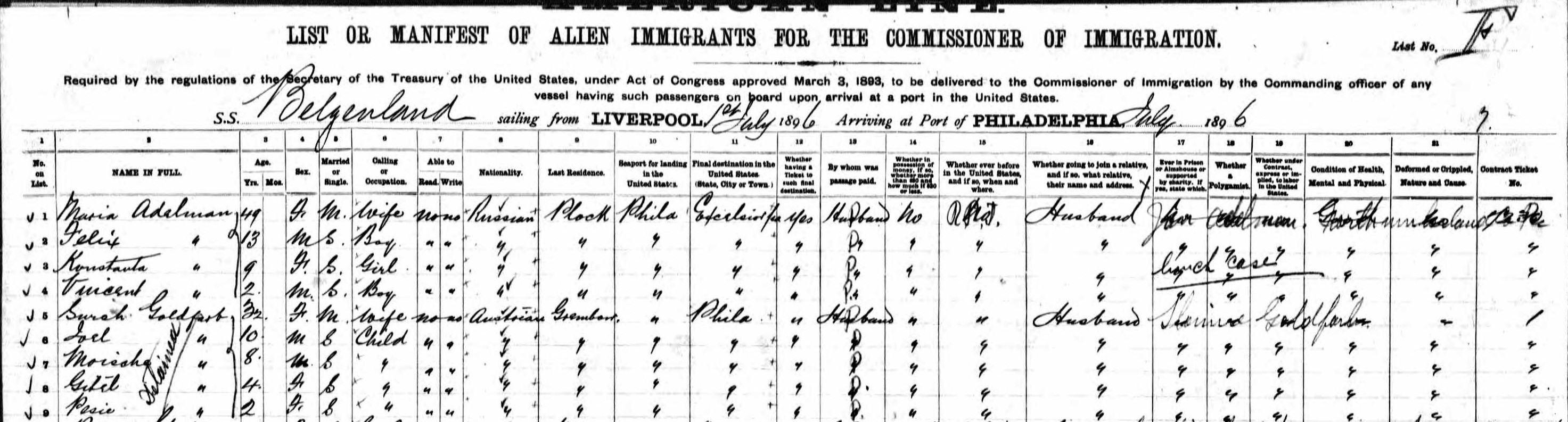
I did, however, find Sarah Brod Goldfarb’s ship manifest. She arrived with four of her children—Joel (later Julius), Moische (later Morris), Gitel (later Gussie), and Pesie (later Bessie)—on July 13, 1896, in Philadelphia. She reported her age as 32 (meaning born in 1864). Joel was 10, Moische 8, Gitel was 4, and Pesie was 2. Can you imagine traveling with four young children for weeks on a ship overseas?

The manifest indicated that they were headed to Philadelphia, that their prior residence was Grembow, “Austria” (now Poland), and that her husband Schmuel Goldfarb had paid their fare.

Sarah Goldfarb and her four children, The National Archives at Washington, D.C.; Washington, D.C.; Series Title: Passenger Lists of Vessels Arriving at Philadelphia, Pennsylvania; Record Group Title: Records of the Immigration and Naturalization Service, 1787-2004; Record Group Number: 85; Series: T840, Roll Number: 25, Ancestry.com. Pennsylvania, U.S., Arriving Passenger and Crew Lists, 1800-1962

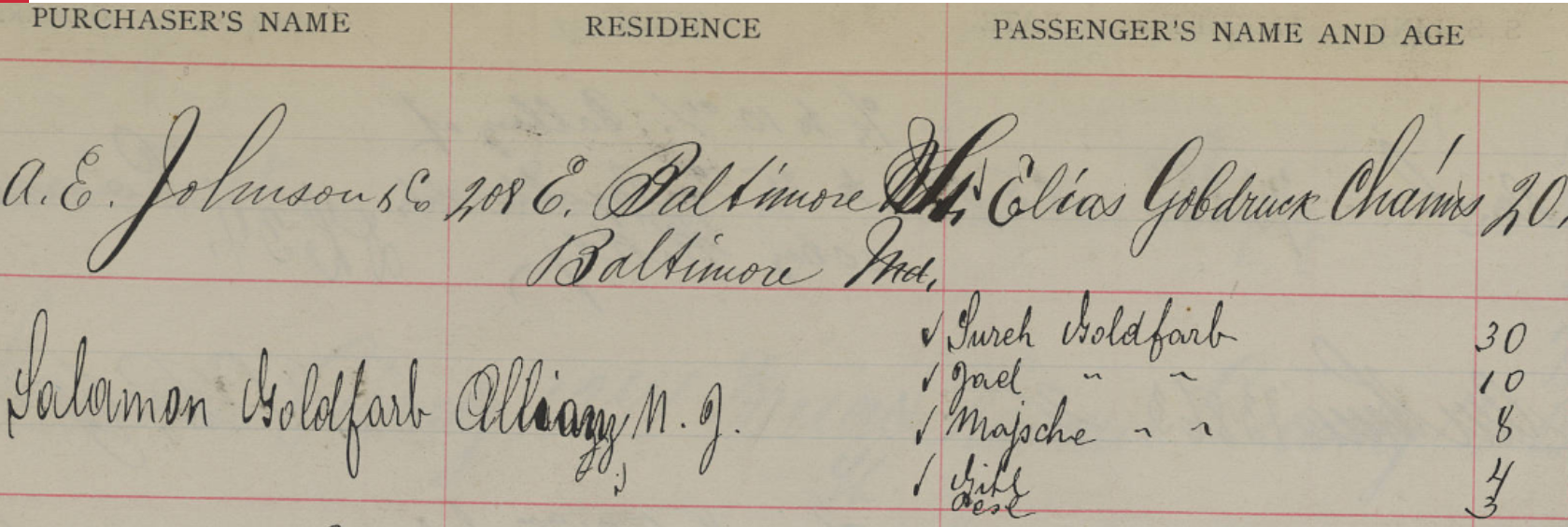
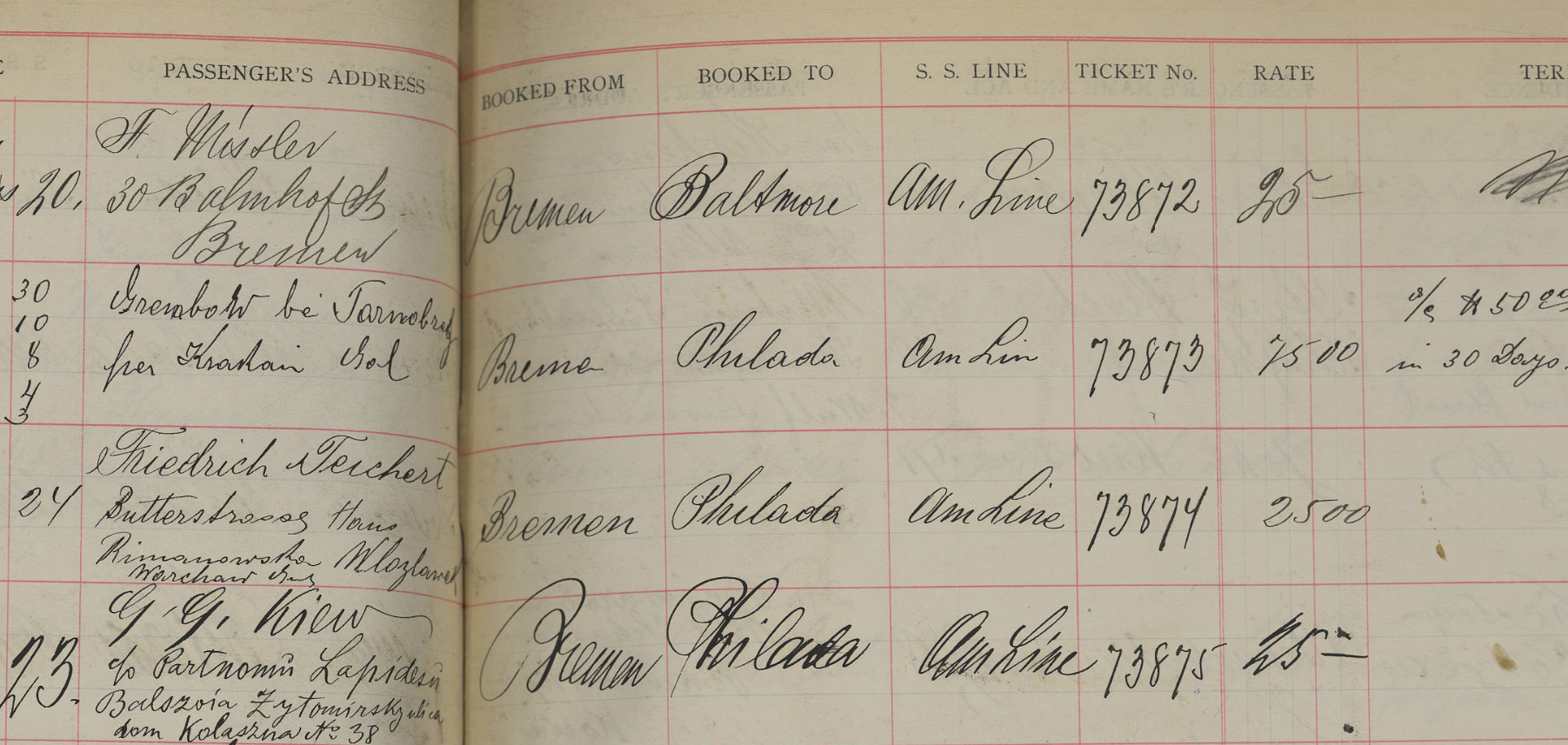
Thank you to Frank of Tracing the Tribe for locating this record showing that Sam (Solomon) Goldfarb purchased the tickets in Philadelphia for Sarah and his four children to sail to the US from Grembow via Tarnobrzeg to Philadelphia on the Am(erican?) Line for $75. Note also that Sam was living in Alliance, New Jersey. More on that in my next post.

Steamship ticket registry, Rosenbaum Volume 04, Date 1895, Steamship Agent
M. Rosenbaum and Co., Volume 4, Order Number Range, 1-32451, Number of Pages
171, Alphabetical index of passenger names at beginning of volume; Page 1-135, order #1-1736. Page 136, order #17856-17860, 32439. Page 137, order #18557, 32445-32451. Pages 138-141 are blank. Page 142, order #17321-17322, Manuscripts, Ledgers (account books),  Repository:
Temple University Libraries, Special Collections Research Center, Repository Collection
HIAS Pennsylvania, Collection ID, SCRC 94, Digital Collection, Steamship Ticket Purchase Ledgers, Digital Publisher Philadelphia, PA: Temple University Libraries, found at https://digital.library.temple.edu/digital/collection/p16002coll16/id/5045/rec/4

The manifest indicated that Sarah and her children were detained. There are no records to explain why they were detained, but members of Tracing the Tribe explained that it likely only meant that they were being held until someone, presumably Sam, met them at the port of entry in Philadelphia.

Thus, we know that by July, 1896, my great-grandmother’s sister Sarah and four of her children had arrived in America. In the posts to follow I will talk about their lives in the US.


  1. Solomon Goldfarb and family, Year: 1900; Census Place: Pittsgrove, Salem, New Jersey; Page: 17; Enumeration District: 0179; FHL microfilm: 1240993, Ancestry.com. 1900 United States Federal Census. According to his death certificate, Sam was born in Tarnobrzeg in what is now Poland, and Sarah was born in Dzikow (now part of Tarnobrzeg), according to family records provided by my cousin Sue Wartur. New York, New York City Municipal Deaths, 1795-1949, database, FamilySearch (https://www.familysearch.org/ark:/61903/1:1:2W5B-2M4 : 3 June 2020), Samuel Goldfarb, 1926. 
  2. New York, New York City Municipal Deaths, 1795-1949″, database, FamilySearch (https://www.familysearch.org/ark:/61903/1:1:2W5B-2M4 : 3 June 2020), Samuel Goldfarb, 1926. 
  3. Samuel Goldfarb and family, Year: 1910; Census Place: Manhattan Ward 11, New York, New York; Roll: T624_1012; Page: 17A; Enumeration District: 0259; FHL microfilm: 1375025, Ancestry.com. 1910 United States Federal Census 
  4. Sam Goldfarb and family, Year: 1920; Census Place: Brooklyn Assembly District 2, Kings, New York; Roll: T625_1146; Page: 9A; Enumeration District: 82, Ancestry.com. 1920 United States Federal Census 
  5. See note 3. 
  6. See note 4. 
  7. Sarah Goldfarb, Year: 1930; Census Place: Brooklyn, Kings, New York; Page: 7A; Enumeration District: 1220; FHL microfilm: 2341228, Ancestry.com. 1930 United States Federal Census 
  8. New York, New York City Municipal Deaths, 1795-1949″, database, FamilySearch (https://www.familysearch.org/ark:/61903/1:1:2WT7-T1D : 3 June 2020), Sarah Goldfarb, 1937. 
  9. See notes 1, 3, and 4 above. 
  10. Samuel Goldfarb, age 26, Place: New York, New York; Year: 1891; Page Number: 250, Ancestry.com. U.S. and Canada, Passenger and Immigration Lists Index, 1500s-1900s 

Of DNA Testing and The Magic of Photographs: Who is That Woman?

As many of you know, I have not had much success using DNA as a genealogy research tool. Because I have thousands of matches on each of the major DNA testing sites (Ancestry, 23andme, FamilyTreeDNA, and MyHeritage), finding a true match—not one just based on endogamy—is like looking for a needle in a haystack. Over time I have found some “real” matches, but I usually only know they’re real because I’ve already found those cousins through traditional genealogical research. Finding that the DNA confirms what I already knew is nice, but not really helpful in terms of advancing my research. Even when I look at the matches that cousin shares with me, I am not making progress because our shared matches also number in the hundreds if not thousands.

Nevertheless, I periodically check my matches on each of the sites to see if any truly close matches have appeared. A couple of weeks ago I checked with 23andme and discovered a new third cousin match, Alyce, who also shared a family surname that appears on my tree—Goldfarb. Since the Goldfarbs are related to my Brotman line, I was quite excited. My Brotman line is one of my biggest brickwalls. I cannot get beyond the names of my great-great-grandparents.

Some background: my maternal grandmother’s parents were Joseph Brotman and Bessie Brod. But sometimes Joseph’s surname is listed as Brod, sometimes Bessie’s is listed as Brotman. Family lore is that Bessie, Joseph’s second wife, was his first cousin. Various US records revealed that Joseph’s parents were Abraham Brotman and maybe Yette Sadie Burstein; Bessie’s parents were Joseph Brod and Gittel Schwartz. But I have no records from Poland where they once lived to verify those names, nor can I get any further back to determine if Joseph and Bessie were in fact first cousins.

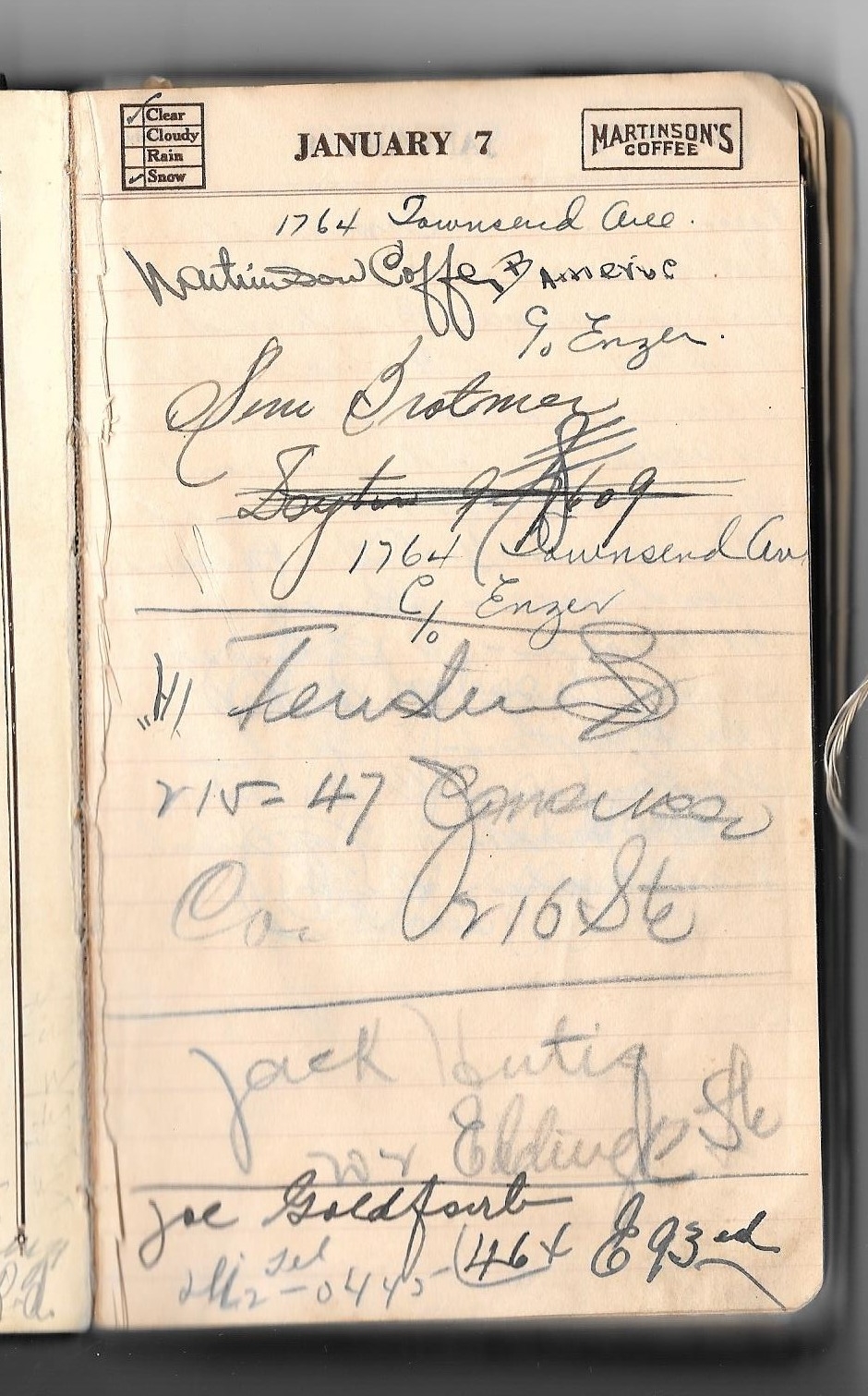
Then years later I discovered the Goldfarb cousins after seeing the names Joe and Julius Goldfarb and Taube Hecht in my grandfather’s address book and my aunt’s baby book.

After much digging, I learned that my great-grandmother Bessie Brod had a sister Sarah Brod (or Brotman) who married Sam Goldfarb. Joe and Julius Goldfarb were two of their sons, my grandmother’s first cousins. And Taube Hecht was my grandmother’s half-sister Taube Brotman, daughter of Joseph Brotman and his first wife. Taube’s daughter Ida had married Julius Goldfarb.

Through more research I was able to locate cousins descended from the Goldfarb line and from the Hecht line—Sue, a granddaughter of Julius Goldfarb and Ida Hecht, and Jan, a descendant of Taube Brotman Hecht line through her son Harry. They tested, but the results didn’t help me advance my research. I still couldn’t determine if my great-grandparents were in fact first cousins, and I still hadn’t found anything to expand the reach of my Brotman/Brod family tree.

Then a few weeks ago I found Alyce, a granddaughter of Joe Goldfarb and his wife Betty Amer and thus a pure Goldfarb (non-Hecht) cousin. She connected me with a few other Goldfarb cousins—descendants of Joe or one of his siblings. That’s a lot more DNA to work with, and I am hoping that I can get someone who’s more expert at parsing these things to help me use the DNA of these new cousins to advance my research. So far all I can do is stare at chromosome browsers and see overlaps, but I have no idea how to parse out the Goldfarb (Brod) DNA from the Hecht (Brotman) DNA to get any answers.

All of this I will return to at some point when I have more to say about what the DNA reveals. For now I want to talk about the photographs that Alyce shared with me of my Goldfarb relatives. Alyce sent me over twenty photographs. She was able to identify the people in many of them, but unfortunately a number are unlabeled. Also the quality of some of the photos is quite poor. I won’t post them all, but I will post a few today and more in a later post.

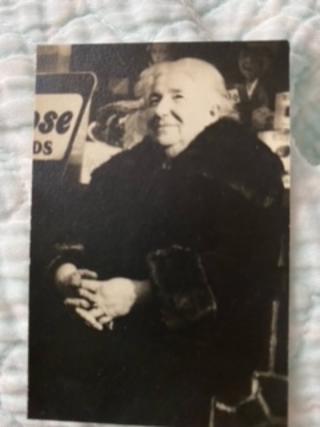
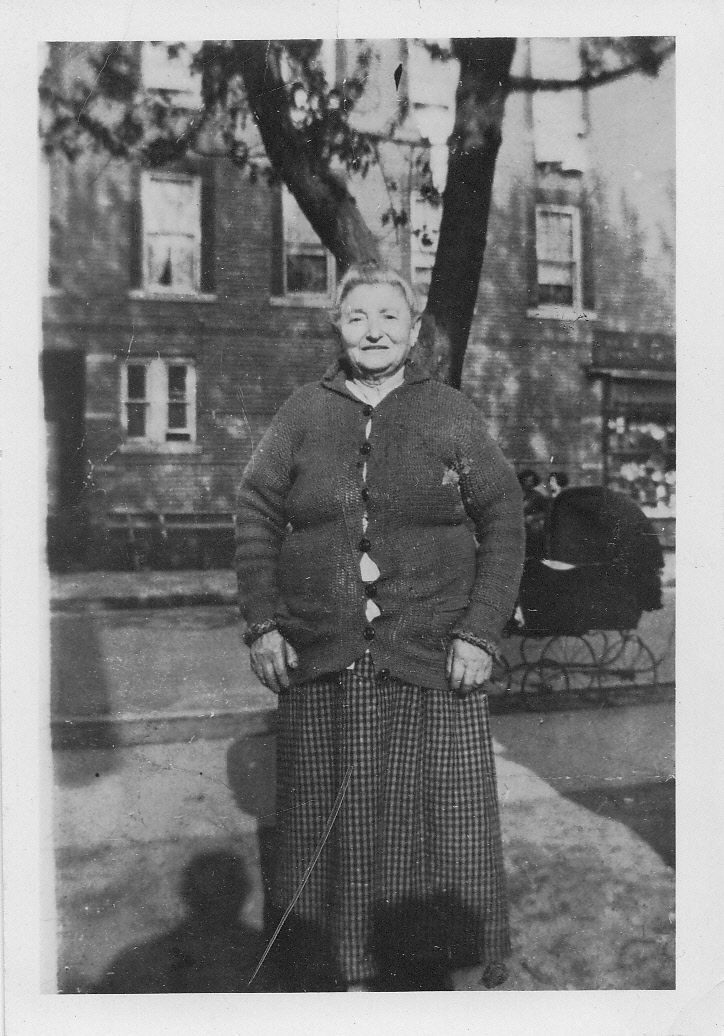
First, in Alyce’s collection was this photograph she labeled “I think this is Grandpa’s mother Sarah Brothman. I could be wrong.” (Brothman was yet another variation on how Joseph, Bessie, and Sarah spelled their surname.)

“Sarah Brothman” Courtesy of Alyce Shapiro Kunstadt

I almost fell off my chair. I had that exact same photograph, but in our collection the photograph was said to be of my great-grandmother Bessie Brod Brotman.

My great-grandmother Bessie Brotman (or so I was told)

I wasn’t sure who had the right label for the photograph, but just the fact that Alyce and I had in our possession copies of the same photograph seemed to confirm what the DNA and all my research had already told me—we were cousins!

Alyce had other photographs of her great-grandmother Sarah, and when I saw those I thought that in fact that first photograph was of Sarah, not Bessie. Here are her other photographs of Sarah, all courtesy of Alyce, and then another photograph I had of my great-grandmother Bessie.

Sarah Brod/Brotman Goldfarb and her son Leo Goldfarb. Courtesy of Alyce Shapiro Kunstadt

Bessie Brotman

Bessie Brotman

It seems to me that Bessie had a rounder and softer edged face than the woman seated in front of the grocery store, so I think that woman was indeed Sarah, Bessie’s sister.

So somehow my family ended up with a photograph of Bessie’s sister Sarah. And we never would have known if I hadn’t found Alyce and she hadn’t shared her copy of the photograph.

I slowly flipped through the rest of Alyce’s photos, noting the faces of my grandmother’s Goldfarb first cousins Joe and Leo and their wives and children, hoping I could identify some of the unknowns in Alyce’s collection, when I came to this photograph. This time my jaw dropped.

Rose Goldfarb, Joe Goldfarb, Gussie Brotman

Alyce labeled this photograph, “Grandpa Joe. I think that could be Aunt Rose [the youngest child of Sarah Brod and Sam Goldfarb] on the left. Not sure who’s on the right.”

But I knew who was on the right. I had no doubt. That woman was my grandmother, Gussie Brotman Goldschlager, posing with two of her first cousins, Joe and Rose Goldfarb. I was blown away. How could Alyce, who until just a few days earlier was unknown to me, have a photograph of my grandmother—a photograph I’d never seen before?

I sent the photograph to my brother for confirmation, and he agreed. I ran the photograph through Google’s face identification software, and Google agreed. Here are some other photographs of my grandmother.

Gussie Brotman

Goldschlagers 1935

Jeff and Gussie c. 1946

I think you also will agree.  Alyce, my third cousin, had a photograph of her grandfather Joe and my grandmother Gussie together. Wow.

Santa Fe Love Song: A Family History Novel

I am delighted to announce that my newest novel, Santa Fe Love Song, has been published and is available in both paperback and e-book format on Amazon here. Like my first novel, Pacific Street, Santa Fe Love Song was inspired by the lives of real people—in this case, my great-great-grandparents Bernard Seligman and Frances Nusbaum—and informed by my family history research. But as with my first book, Santa Fe Love Song is first and foremost a work of fiction.

Bernard Seligman, my great-great-grandfather

Frances Nusbaum Seligman, my great-great-grandmother

It is a double love story—a story of Bernard’s passion for his newly adopted home in New Mexico and of his deep love for a young woman in Philadelphia. How will he resolve the conflict between those two loves? That is the heart of the novel.

But this is also an adventure story because the first part of the book tells of Bernard’s arrival from Gau-Algesheim, Germany, his adjustment to life in Philadelphia, and then his challenging and exciting trip on the Santa Fe Trail when he moves out west to work with his brother Sigmund. On that trip Bernard faces many different obstacles and learns to love the American landscape. He transforms from a German Jewish immigrant into an American pioneer and businessman.

Upper left, Bernard Seligman with other merchants and Indians on the Santa Fe Trail

As with Pacific Street, I wrote Santa Fe Love Song with my children and grandchildren in mind. This time I also decided to get my grandsons involved in the project. Nate, 10, and Remy, 6, became my illustrators. As I told them stories about Bernard and Frances, they created drawings that told those stories visually. I am ever so grateful to my two wonderful grandsons for their work, and I hope that someday their grandchildren will cherish these books and the illustrations and honor the memories of their ancestors Bernard and Frances.

I hope that you also will find Santa Fe Love Song a worthwhile and enjoyable read. If you do, please leave a review on Amazon. Thank you! I appreciate all your support.