One Thousand Posts

This is the 1000th post I’ve published on this blog. It all started almost eight years ago when my cousin Judy Ruzicka, a Brotman second cousin, suggested that instead of emailing my research discoveries to all the Brotman cousins, I create a blog where people could subscribe and see my research. I had at that time read and followed a few blogs, but had never thought about creating one. Judy did the initial setup on WordPress, and I started to publish. Haltingly at first. Posting one census record or death record and adding a few words.

This was my first post. No commentary or analysis, just an image.

Bessie was Joseph's second wife and mother of five children

Bessie Brod Brotman Moskowitz—the first image I posted back in September 2013

And then it grew. I started realizing that I could tell stories about the relatives I was researching. I could put together narratives, and when I started doing that, I could see where I had holes in my research or where I needed more sources. And suddenly I found that I had more than my Brotman cousins reading along. I had other bloggers reading as well. And I started reading their blogs, and that gave me ideas for my own research and my own writing.

From there I discovered I could share my blog on Facebook and connect with more researchers and learn even more about family history research. The blog became a bigger and bigger part of my life. I at one point was posting three or four times a week and writing posts that were sometimes 3000 words. But I then learned that sometimes too much is too much. People didn’t want to read that much in one day or that often. So I cut my publishing schedule to twice a week and my post lengths to about 1000 words.

Then the best part started to happen. Cousins started to find me through my blog. Someone would Google their grandfather’s name or their great-grandmother’s name and find them mentioned on my blog. They would contact me, and I would learn more about that part of my family—often leading to photographs, letters, documents, and memoirs and memories. The blog itself became a way of advancing my research. Today I have connected with well over 200 living cousins, many because they found my blog.

Joseph Brotman’s headstone, the avatar I use for WordPress and for my blog

So as I post Number 1000, I wanted to stop and recognize and thank all those who have supported this endeavor by reading, commenting, sharing, and finding my blog. From Judy Ruzicka, who started it all, to all the family members, friends, and fellow genealogy and other bloggers who read the blog—whether periodically or regularly—thank you for giving me this platform to share and expand my family history project.

Now—on to post 1001! I will be taking a break to spend some time with my kids, but I’ll be back in a couple of weeks.


Who Was Bessie Goldfarb Named For? A Study in Naming Patterns

Before I write about Bessie Goldfarb Malzberg and her family, I want to explore a question that bothered me since I first learned her name.

It struck me as odd that Sarah Brod Goldfarb named a daughter Bessie since that was her sister’s name—my great-grandmother Bessie Brod Brotman. Even their Yiddish names were the same. On the ship manifest for Sarah and her four children, Sarah’s second daughter is listed as Pesie, and my great-grandmother Bessie was listed as Pessel on her ship manifest. I assume Pesie was a nickname for Pessel. Incidentally, Pessel is also my Yiddish name—in honor of my great-grandmother Bessie.

The National Archives at Washington, D.C.; Washington, D.C.; Series Title: Passenger Lists of Vessels Arriving at Philadelphia, Pennsylvania; Record Group Title: Records of the Immigration and Naturalization Service, 1787-2004; Record Group Number: 85; Series: T840
Ancestry.com. Pennsylvania, U.S., Arriving Passenger and Crew Lists, 1800-1962

Year: 1891; Arrival: New York, New York, USA; Microfilm Serial: M237, 1820-1897; Line: 29; List Number: 73, Ancestry.com. New York, U.S., Arriving Passenger and Crew Lists (including Castle Garden and Ellis Island), 1820-1957

Since Eastern European Ashkenazi Jews did not name children for living relatives, I assumed that Sarah’s Bessie was named for either the same person her sister Bessie had been named for or for a relative on Sam’s side of the family. But who was that person?

I decided to explore the naming patterns in the Goldfarb and Brod families a bit further to see if they provided any clues. Sam and Sarah’s first son was Julius (Joel was his Hebrew name), and it appears obvious that he was named for Sam’s father who was also named Julius Goldfarb.1 I will refer to Sam’s father as Julius I and Sam’s son as Julius II.

Sam and Sarah’s second son Morris (Moische), born in 1886, could have been named for a relative on Sarah’s side, and that’s possible here, but since four of Sam’s siblings—his brother Louis and his half-brothers Max, Meier, and Julius 2—all had sons named Morris Goldfarb,3 I think it’s more likely that Morris was also named for an ancestor on Sam’s side though I don’t know who that would be. Perhaps an uncle or a great-grandfather.

Then came Gussie (Gittel) Goldfarb, born in 1888. My grandmother Gussie Brotman was born in 1895, and she was a first cousin to Gussie Goldfarb. Sarah’s death certificate states that her mother was named Gittel, and her sister Bessie’s second marriage certificate says her mother was Gittel, so both Gussies—Gussie Goldfarb and my grandmother Gussie—were named for their maternal grandmother Gittel, my great-great-grandmother. (My daughter carries on the naming pattern as her Hebrew name is Rivka Gittel for my grandmother.)

New York, New York City Municipal Deaths, 1795-1949″, database, FamilySearch (https://www.familysearch.org/ark:/61903/1:1:2WT7-T1D : 3 June 2020), Sarah Goldfarb, 1937.

Certificate Number: 22138, Ancestry.com. New York, New York, U.S., Extracted Marriage Index, 1866-1937

That brings me to Bessie. She was born in 1890, and I don’t know who she was named for. Sam’s mother was Dora Kleinman. Dora died not long after Sam’s brother Louis (Lazar) was born in 1859. Louis Goldfarb named his first daughter Dora in 1889 for his mother. It seems odd that Sam didn’t have a daughter named for his mother.4 It makes me think Sam and Sarah may have had another daughter named for Dora who died before they left Europe—unless Dora Kleinman had a double name and Bessie was named for her other name.

Julius I’s second wife was named Rebecca Kirschenbaum,5 so did Sam name Bessie for his stepmother Rebecca? Or was Bessie named for a Brod, possibly the same unknown ancestor for whom my great-grandmother Bessie was named? I don’t know.

After Bessie came Joseph. I don’t see any Josephs on the Goldfarb side, and Sarah Brod and Bessie Brod’s father was named Joseph Brod according to the two records depicted above. So I think it’s very likely that Joseph Goldfarb was named for his maternal grandfather, Joseph Brod.

Leo was the next son, born in 1899. I don’t have any clues as to his namesake. On the  1900 census, Leo  was listed as Lewis, and on the 1905 NYS census he was Louis. Only in 1910 did his name appear as Leo. Sam’s brother Louis was still living when Leo was born, but maybe Leo was named for the same ancestor for whom his uncle Louis was named.  Sam’s half-brother Max had a son named Lewis born in 1901, so perhaps he also was named for the same ancestor.6  I don’t see anyone else with an L name in the Brod family so I think Leo was named for a Goldfarb, not a Brod.

Sam and Sarah’s last child was Rose, and that’s a name that appears four times among Sam’s relatives.  Sam’s brother Louis named his second daughter Rose born in 1891. Sam’s half-brother Max named a daughter Rose in 1901, and Julius Jr. had a daughter named Rose born in 1919. I would assume that Max and Julius, Jr. named their daughters for their mother Rebecca, but who did Sam and Louis name their daughters Rose for? I don’t know. Perhaps their stepmother Rebecca, or perhaps a great-grandmother or other female relative.7

Just to add to the data set here, my great-grandmother Bessie had five children with my great-grandfather Joseph Brotman—Tillie, Chaim (Hyman), my grandmother Gussie, Frieda, and Sam. With his first wife Chaye, Joseph Brotman had four children: Abraham, David, Max, and Taube. Only the name Gussie is repeated among her sister Sarah’s children although Max Brotman, like Morris Goldfarb, was Moische in Europe.

To summarize my assumptions: Sam and Sarah’s son Julius was named for Sam’s father Julius. Their daughter Gussie and son Joseph were named for Sarah’s parents, Gittel and Joseph.  Morris and Rose are names that occur frequently in the Goldfarb family so those two children probably were named for a Goldfarb relative. Leo was originally Louis, a name that appears in the Goldfarb family, so I am inclined to think he was named for a Goldfarb.

But I am without a clue about the ancestor for whom Bessie was named. If my assumptions are correct, it would mean that four of Sarah and Sam’s children were named for a Goldfarb ancestor and only two were named for a Brod ancestor. That makes me think Bessie might have been named for a Brod, and maybe for the same relative for whom her aunt, my great-grandmother Bessie, was named. But I can’t be sure.

And sadly without records for those earlier generations, I probably never will know.


  1. KLG family history and various other sources and records. ↩
  2. Sam’s father Julius I had a son with his second wife Rebecca who was also named Julius; I will refer to him as Julius, Jr. That seems quite odd—unless Julius I died before Rebecca gave birth to Julius, Jr. Unfortunately I have no records to know for sure. What I do have is a family history compiled by Kay Goldfarb.  Kay’s book says that Julius died 1879-1880 and that Julius, his son, was born in 1880. So it seems probable that in fact Julius I did die before his son Julius Jr. was born. ↩
  3. KLG family history and various other sources and records. ↩
  4. Ibid. ↩
  5. Ibid. ↩
  6. Ibid. ↩
  7. Ibid. ↩

(Re)-introducing the Goldfarbs

Although I wrote a great deal several years ago about how I discovered my great-grandmother’s sister Sarah Brod Goldfarb, and although I told much of their story, I told it in piecemeal as I was trying to put together the pieces of a mystery. How was Sarah Goldfarb related to me? I solved that mystery and know now that she was my great-grandmother Bessie Brod Brotman’s sister, but I never fully told the stories of those Goldfarb cousins.

Now that I have discovered through DNA testing several more of my Goldfarb cousins, confirming by science that my research was correct, I am returning to Sarah Brod and Sam Goldfarb and their children to tell the fuller story of their lives.

What do I know about the life of my great-grandmother’s sister Sarah Brod Goldfarb before she came to the US? Not very much. Because I have no European records for Sarah Brod and Sam Goldfarb, I need to rely on information from US records to tell the little I can report about their lives before arriving in the US.

According to the 1900 US census, Sam  (going by Solomon at that time) was born in April 1860, and Sarah was born in May 1866. They were thus reported as being forty and thirty-six at that time. The census indicated both were born in “Austria,” but in fact they were born in or near Tarnobrzeg in what is today Poland in what was then part of the Austria-Hungary Empire.1 That is the same town where my great-grandparents Joseph and Bessie (Brod) Brotman lived.

But Sam and Sarah’s ages on the 1900 census appear to be debatable. Sam’s death certificate says he was born on August 2, 1856,2 not in 1860. In 1910, he reported his age as 56, meaning he was born in 1864.3 In 1920, he said he was 64, giving him a birth year of 1856, same as that on his death certificate.4

Sarah’s age also jumps around, though not as wildly as Sam’s. In 1910, she is reported as 45, meaning she was born in 1865.5 In 1920, she is listed as 54, meaning she was born in 1866,6 but in 1930 her age is given as 60, meaning she was born in 1870.7 And her 1937 death certificate indicates she was 70 when she died, meaning a birth year of 1867.8 Overall, Sarah seems likely to have been born in 1866 or so, and Sam was likely born in about 1860 or maybe earlier.

One date that is consistent across several census records is the date of Sam’s immigration—1892. He reported that year not only on the 1900 census, but also on the 1910 and 1920 census records.9 Yet I could not find him on any ship manifest for 1892 or even within several years of 1892. There were some names that were close, and I found one Samuel Goldfarb who arrived in Philadelphia in 1891, born 1865, but I’ve no way to verify if that was the right person, though it seems possible.10

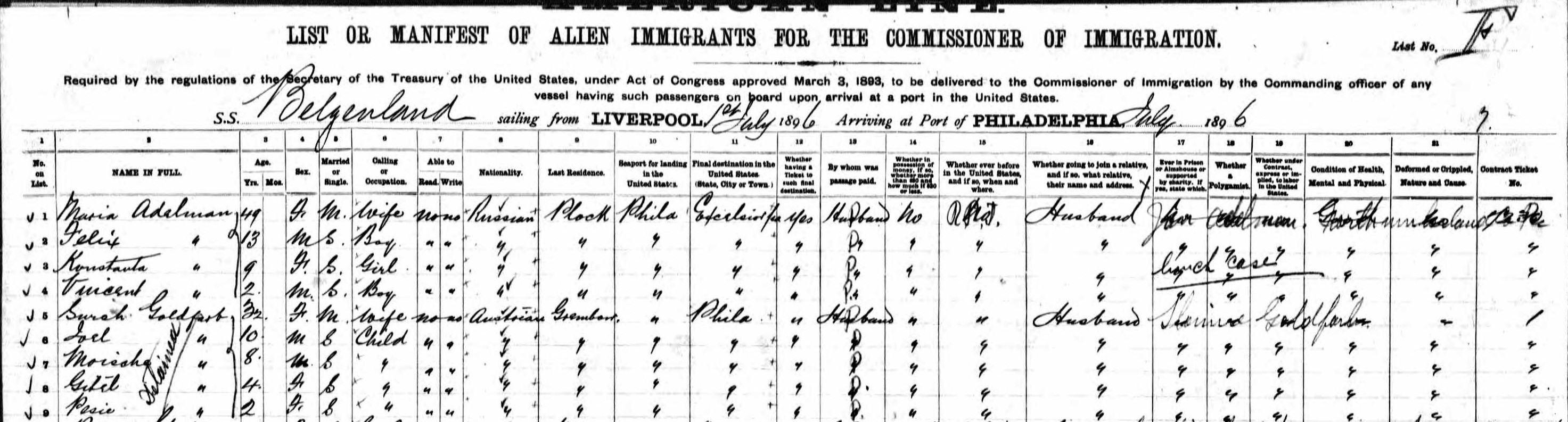
I did, however, find Sarah Brod Goldfarb’s ship manifest. She arrived with four of her children—Joel (later Julius), Moische (later Morris), Gitel (later Gussie), and Pesie (later Bessie)—on July 13, 1896, in Philadelphia. She reported her age as 32 (meaning born in 1864). Joel was 10, Moische 8, Gitel was 4, and Pesie was 2. Can you imagine traveling with four young children for weeks on a ship overseas?

The manifest indicated that they were headed to Philadelphia, that their prior residence was Grembow, “Austria” (now Poland), and that her husband Schmuel Goldfarb had paid their fare.

Sarah Goldfarb and her four children, The National Archives at Washington, D.C.; Washington, D.C.; Series Title: Passenger Lists of Vessels Arriving at Philadelphia, Pennsylvania; Record Group Title: Records of the Immigration and Naturalization Service, 1787-2004; Record Group Number: 85; Series: T840, Roll Number: 25, Ancestry.com. Pennsylvania, U.S., Arriving Passenger and Crew Lists, 1800-1962

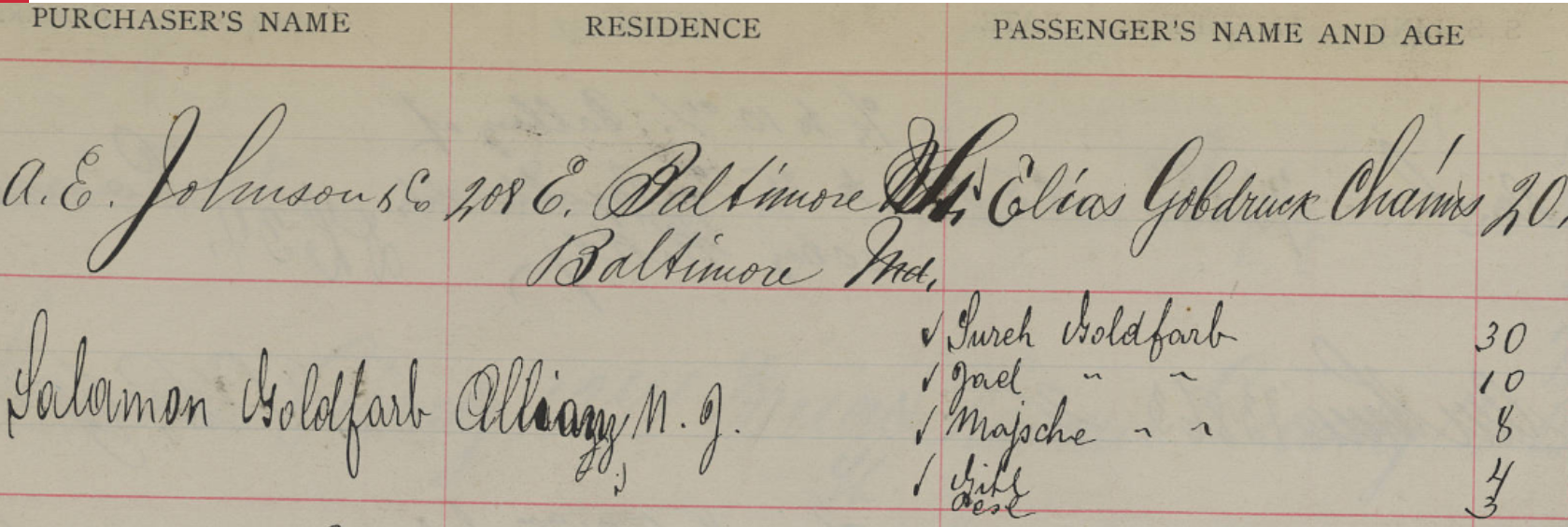
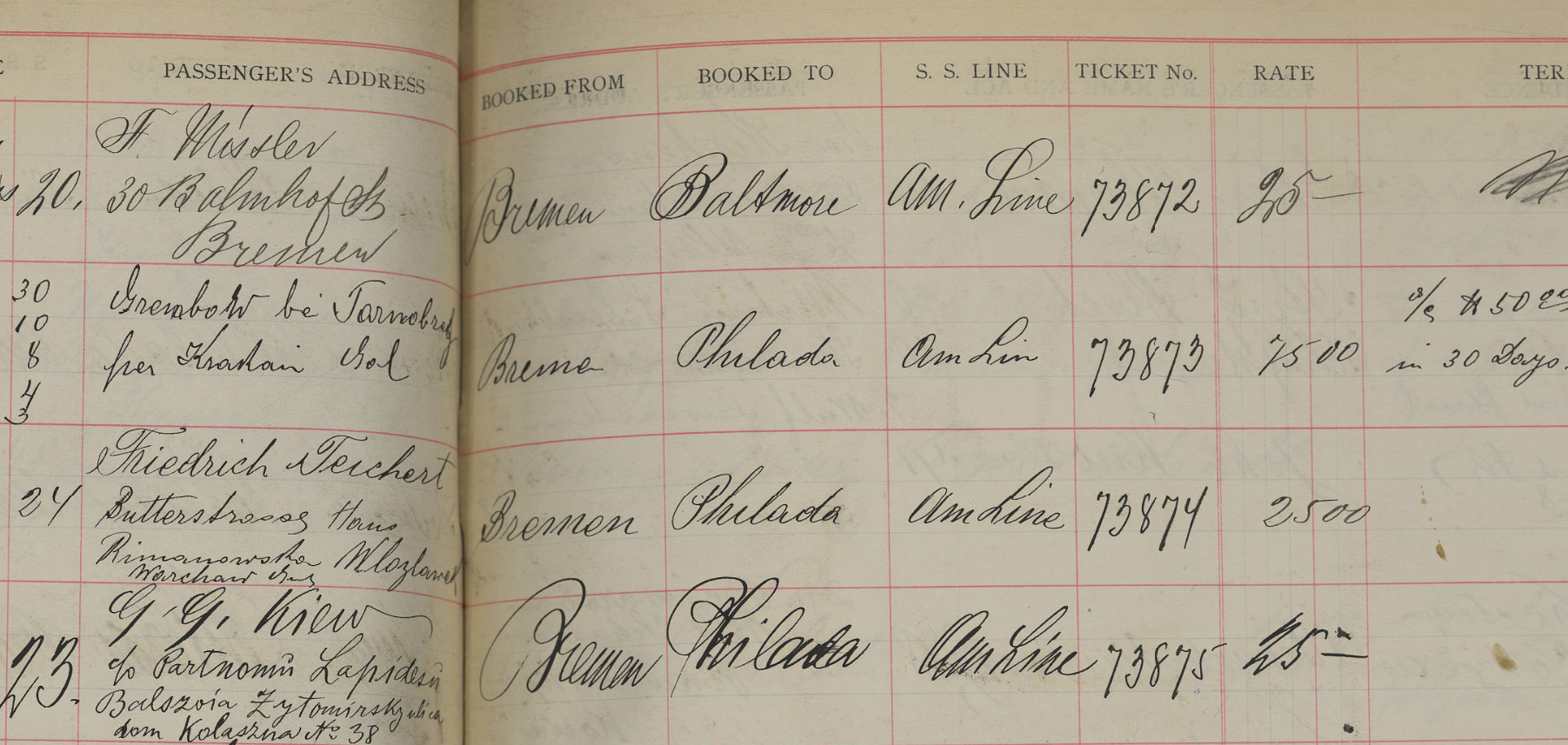
Thank you to Frank of Tracing the Tribe for locating this record showing that Sam (Solomon) Goldfarb purchased the tickets in Philadelphia for Sarah and his four children to sail to the US from Grembow via Tarnobrzeg to Philadelphia on the Am(erican?) Line for $75. Note also that Sam was living in Alliance, New Jersey. More on that in my next post.

Steamship ticket registry, Rosenbaum Volume 04, Date 1895, Steamship Agent
M. Rosenbaum and Co., Volume 4, Order Number Range, 1-32451, Number of Pages
171, Alphabetical index of passenger names at beginning of volume; Page 1-135, order #1-1736. Page 136, order #17856-17860, 32439. Page 137, order #18557, 32445-32451. Pages 138-141 are blank. Page 142, order #17321-17322, Manuscripts, Ledgers (account books),  Repository:
Temple University Libraries, Special Collections Research Center, Repository Collection
HIAS Pennsylvania, Collection ID, SCRC 94, Digital Collection, Steamship Ticket Purchase Ledgers, Digital Publisher Philadelphia, PA: Temple University Libraries, found at https://digital.library.temple.edu/digital/collection/p16002coll16/id/5045/rec/4

The manifest indicated that Sarah and her children were detained. There are no records to explain why they were detained, but members of Tracing the Tribe explained that it likely only meant that they were being held until someone, presumably Sam, met them at the port of entry in Philadelphia.

Thus, we know that by July, 1896, my great-grandmother’s sister Sarah and four of her children had arrived in America. In the posts to follow I will talk about their lives in the US.


  1. Solomon Goldfarb and family, Year: 1900; Census Place: Pittsgrove, Salem, New Jersey; Page: 17; Enumeration District: 0179; FHL microfilm: 1240993, Ancestry.com. 1900 United States Federal Census. According to his death certificate, Sam was born in Tarnobrzeg in what is now Poland, and Sarah was born in Dzikow (now part of Tarnobrzeg), according to family records provided by my cousin Sue Wartur. New York, New York City Municipal Deaths, 1795-1949, database, FamilySearch (https://www.familysearch.org/ark:/61903/1:1:2W5B-2M4 : 3 June 2020), Samuel Goldfarb, 1926. ↩
  2. New York, New York City Municipal Deaths, 1795-1949″, database, FamilySearch (https://www.familysearch.org/ark:/61903/1:1:2W5B-2M4 : 3 June 2020), Samuel Goldfarb, 1926. ↩
  3. Samuel Goldfarb and family, Year: 1910; Census Place: Manhattan Ward 11, New York, New York; Roll: T624_1012; Page: 17A; Enumeration District: 0259; FHL microfilm: 1375025, Ancestry.com. 1910 United States Federal Census ↩
  4. Sam Goldfarb and family, Year: 1920; Census Place: Brooklyn Assembly District 2, Kings, New York; Roll: T625_1146; Page: 9A; Enumeration District: 82, Ancestry.com. 1920 United States Federal Census ↩
  5. See note 3. ↩
  6. See note 4. ↩
  7. Sarah Goldfarb, Year: 1930; Census Place: Brooklyn, Kings, New York; Page: 7A; Enumeration District: 1220; FHL microfilm: 2341228, Ancestry.com. 1930 United States Federal Census ↩
  8. New York, New York City Municipal Deaths, 1795-1949″, database, FamilySearch (https://www.familysearch.org/ark:/61903/1:1:2WT7-T1D : 3 June 2020), Sarah Goldfarb, 1937. ↩
  9. See notes 1, 3, and 4 above. ↩
  10. Samuel Goldfarb, age 26, Place: New York, New York; Year: 1891; Page Number: 250, Ancestry.com. U.S. and Canada, Passenger and Immigration Lists Index, 1500s-1900s ↩

Of DNA Testing and The Magic of Photographs: Who is That Woman?

As many of you know, I have not had much success using DNA as a genealogy research tool. Because I have thousands of matches on each of the major DNA testing sites (Ancestry, 23andme, FamilyTreeDNA, and MyHeritage), finding a true match—not one just based on endogamy—is like looking for a needle in a haystack. Over time I have found some “real” matches, but I usually only know they’re real because I’ve already found those cousins through traditional genealogical research. Finding that the DNA confirms what I already knew is nice, but not really helpful in terms of advancing my research. Even when I look at the matches that cousin shares with me, I am not making progress because our shared matches also number in the hundreds if not thousands.

Nevertheless, I periodically check my matches on each of the sites to see if any truly close matches have appeared. A couple of weeks ago I checked with 23andme and discovered a new third cousin match, Alyce, who also shared a family surname that appears on my tree—Goldfarb. Since the Goldfarbs are related to my Brotman line, I was quite excited. My Brotman line is one of my biggest brickwalls. I cannot get beyond the names of my great-great-grandparents.

Some background: my maternal grandmother’s parents were Joseph Brotman and Bessie Brod. But sometimes Joseph’s surname is listed as Brod, sometimes Bessie’s is listed as Brotman. Family lore is that Bessie, Joseph’s second wife, was his first cousin. Various US records revealed that Joseph’s parents were Abraham Brotman and maybe Yette Sadie Burstein; Bessie’s parents were Joseph Brod and Gittel Schwartz. But I have no records from Poland where they once lived to verify those names, nor can I get any further back to determine if Joseph and Bessie were in fact first cousins.

Then years later I discovered the Goldfarb cousins after seeing the names Joe and Julius Goldfarb and Taube Hecht in my grandfather’s address book and my aunt’s baby book.

After much digging, I learned that my great-grandmother Bessie Brod had a sister Sarah Brod (or Brotman) who married Sam Goldfarb. Joe and Julius Goldfarb were two of their sons, my grandmother’s first cousins. And Taube Hecht was my grandmother’s half-sister Taube Brotman, daughter of Joseph Brotman and his first wife. Taube’s daughter Ida had married Julius Goldfarb.

Through more research I was able to locate cousins descended from the Goldfarb line and from the Hecht line—Sue, a granddaughter of Julius Goldfarb and Ida Hecht, and Jan, a descendant of Taube Brotman Hecht line through her son Harry. They tested, but the results didn’t help me advance my research. I still couldn’t determine if my great-grandparents were in fact first cousins, and I still hadn’t found anything to expand the reach of my Brotman/Brod family tree.

Then a few weeks ago I found Alyce, a granddaughter of Joe Goldfarb and his wife Betty Amer and thus a pure Goldfarb (non-Hecht) cousin. She connected me with a few other Goldfarb cousins—descendants of Joe or one of his siblings. That’s a lot more DNA to work with, and I am hoping that I can get someone who’s more expert at parsing these things to help me use the DNA of these new cousins to advance my research. So far all I can do is stare at chromosome browsers and see overlaps, but I have no idea how to parse out the Goldfarb (Brod) DNA from the Hecht (Brotman) DNA to get any answers.

All of this I will return to at some point when I have more to say about what the DNA reveals. For now I want to talk about the photographs that Alyce shared with me of my Goldfarb relatives. Alyce sent me over twenty photographs. She was able to identify the people in many of them, but unfortunately a number are unlabeled. Also the quality of some of the photos is quite poor. I won’t post them all, but I will post a few today and more in a later post.

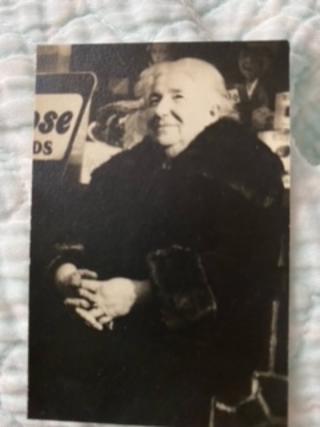
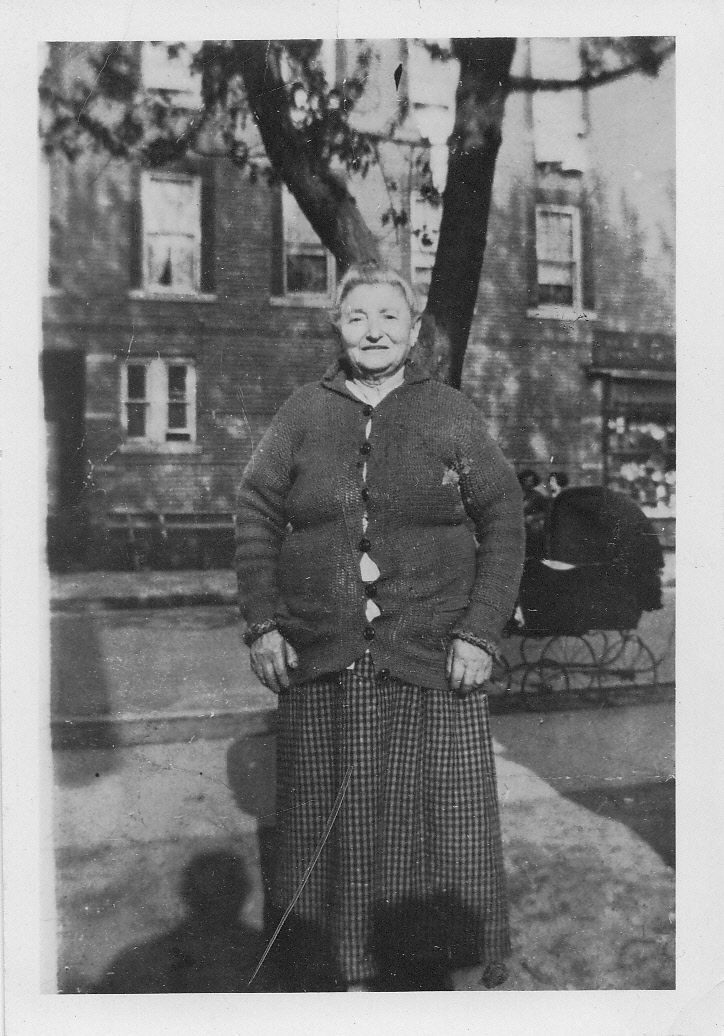
First, in Alyce’s collection was this photograph she labeled “I think this is Grandpa’s mother Sarah Brothman. I could be wrong.” (Brothman was yet another variation on how Joseph, Bessie, and Sarah spelled their surname.)

“Sarah Brothman” Courtesy of Alyce Shapiro Kunstadt

I almost fell off my chair. I had that exact same photograph, but in our collection the photograph was said to be of my great-grandmother Bessie Brod Brotman.

My great-grandmother Bessie Brotman (or so I was told)

I wasn’t sure who had the right label for the photograph, but just the fact that Alyce and I had in our possession copies of the same photograph seemed to confirm what the DNA and all my research had already told me—we were cousins!

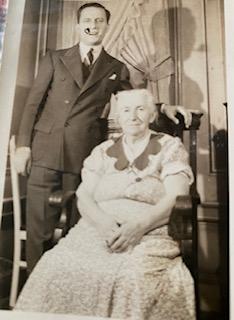
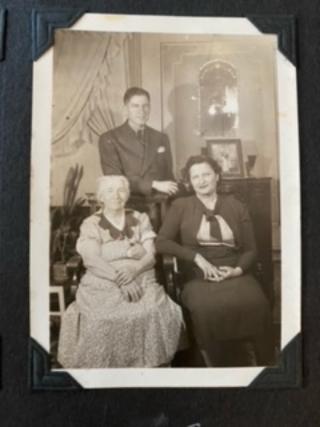
Alyce had other photographs of her great-grandmother Sarah, and when I saw those I thought that in fact that first photograph was of Sarah, not Bessie. Here are her other photographs of Sarah, all courtesy of Alyce, and then another photograph I had of my great-grandmother Bessie.

Sarah Brod/Brotman Goldfarb and her son Leo Goldfarb. Courtesy of Alyce Shapiro Kunstadt

Bessie Brotman

Bessie Brotman

It seems to me that Bessie had a rounder and softer edged face than the woman seated in front of the grocery store, so I think that woman was indeed Sarah, Bessie’s sister.

So somehow my family ended up with a photograph of Bessie’s sister Sarah. And we never would have known if I hadn’t found Alyce and she hadn’t shared her copy of the photograph.

I slowly flipped through the rest of Alyce’s photos, noting the faces of my grandmother’s Goldfarb first cousins Joe and Leo and their wives and children, hoping I could identify some of the unknowns in Alyce’s collection, when I came to this photograph. This time my jaw dropped.

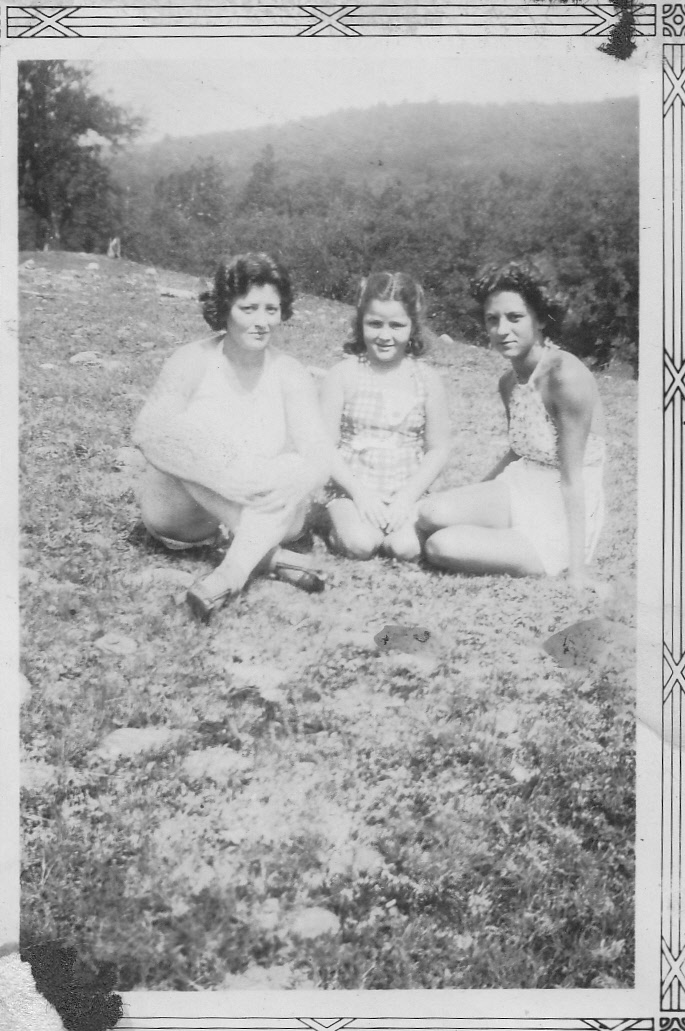
Rose Goldfarb, Joe Goldfarb, Gussie Brotman

Alyce labeled this photograph, “Grandpa Joe. I think that could be Aunt Rose [the youngest child of Sarah Brod and Sam Goldfarb] on the left. Not sure who’s on the right.”

But I knew who was on the right. I had no doubt. That woman was my grandmother, Gussie Brotman Goldschlager, posing with two of her first cousins, Joe and Rose Goldfarb. I was blown away. How could Alyce, who until just a few days earlier was unknown to me, have a photograph of my grandmother—a photograph I’d never seen before?

I sent the photograph to my brother for confirmation, and he agreed. I ran the photograph through Google’s face identification software, and Google agreed. Here are some other photographs of my grandmother.

Gussie Brotman

Goldschlagers 1935

Jeff and Gussie c. 1946

I think you also will agree.  Alyce, my third cousin, had a photograph of her grandfather Joe and my grandmother Gussie together. Wow.

Santa Fe Love Song: A Family History Novel

I am delighted to announce that my newest novel, Santa Fe Love Song, has been published and is available in both paperback and e-book format on Amazon here. Like my first novel, Pacific Street, Santa Fe Love Song was inspired by the lives of real people—in this case, my great-great-grandparents Bernard Seligman and Frances Nusbaum—and informed by my family history research. But as with my first book, Santa Fe Love Song is first and foremost a work of fiction.

Bernard Seligman, my great-great-grandfather

Frances Nusbaum Seligman, my great-great-grandmother

It is a double love story—a story of Bernard’s passion for his newly adopted home in New Mexico and of his deep love for a young woman in Philadelphia. How will he resolve the conflict between those two loves? That is the heart of the novel.

But this is also an adventure story because the first part of the book tells of Bernard’s arrival from Gau-Algesheim, Germany, his adjustment to life in Philadelphia, and then his challenging and exciting trip on the Santa Fe Trail when he moves out west to work with his brother Sigmund. On that trip Bernard faces many different obstacles and learns to love the American landscape. He transforms from a German Jewish immigrant into an American pioneer and businessman.

Upper left, Bernard Seligman with other merchants and Indians on the Santa Fe Trail

As with Pacific Street, I wrote Santa Fe Love Song with my children and grandchildren in mind. This time I also decided to get my grandsons involved in the project. Nate, 10, and Remy, 6, became my illustrators. As I told them stories about Bernard and Frances, they created drawings that told those stories visually. I am ever so grateful to my two wonderful grandsons for their work, and I hope that someday their grandchildren will cherish these books and the illustrations and honor the memories of their ancestors Bernard and Frances.

I hope that you also will find Santa Fe Love Song a worthwhile and enjoyable read. If you do, please leave a review on Amazon. Thank you! I appreciate all your support.

My Goldschmidt Family Project: Looking Back and Looking Forward

With this post, I come to the end of my Goldschmidt research—at least until I get new updates or make new discoveries. I’ve done my best to find whatever records, stories, and photographs exist for Jacob Falcke Goldschmidt and Eva Reuben Seligmann, my four-times great-grandparents, and their descendants.1

I started blogging about my Goldschmidt relatives a little over three years ago on January 12, 2018, making it the longest of any of my family research projects.  And it’s been such a rich and rewarding journey. I’ve connected with Goldschmidt/Goldsmith cousins in France, England, and all over the United States. Some of those cousins have roots in the US that are as deep as mine—going back to the 1840s when Simon Goldschmidt/Goldsmith arrived or the 1850s when my great-great-grandmother Eva Goldschmidt Katzenstein arrived; some are the children of those who were born and raised in Frankfurt, Germany, and were forced to leave their comfortable and successful lives to escape from the Nazis as recently as the 1930s or 1940s.

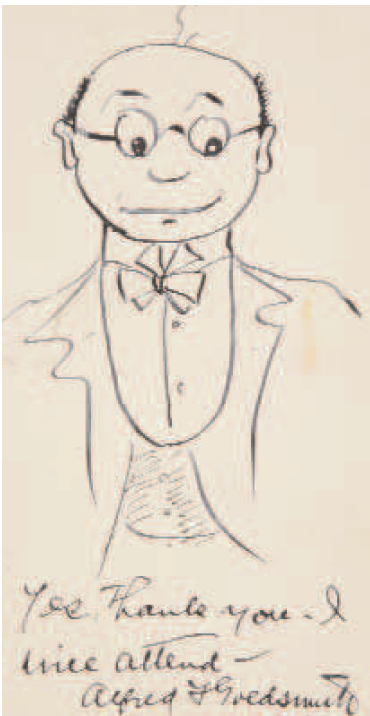
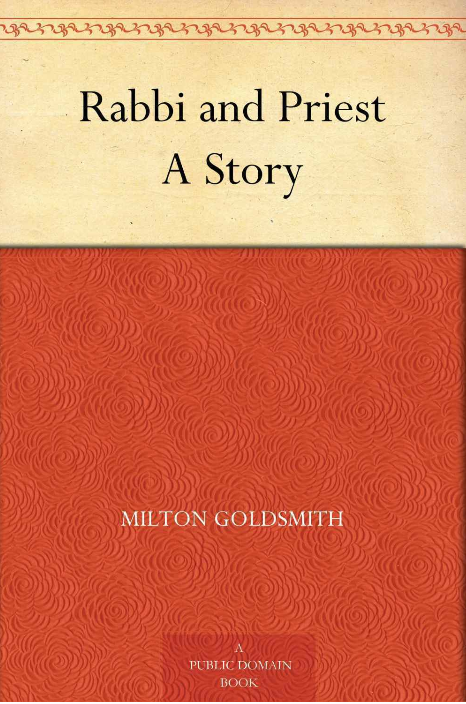
One thread that runs through so much of the Goldschmidt family is an interest in the arts and literature—whether in writing, as with Milton Goldsmith and Anna Seghers, or an interest in antiquarian books, as with Alfred Goldsmith and Emil Offenbacher, or in music like Florence Goldsmith, or  in creating art like William Sigmund and Martha Loewenthal Wolff, or by working as an art historian and curator like Yvonne Hackenbroch, and, of course, then there are the many, many Goldschmidt family members involved in collecting and dealing in art—from the Goldschmidt brothers Jacob Meier and Selig to Julius Falk Goldschmidt to the Freres Tedesco family and so on.

Alfred Goldsmith self-portrait, Joseph J. Felcone, The Old Book Table. A Record of its First Seventy-Five Years, 1931–2005 (New York: The Old Book Table, 2006), p. 5.

Painting by Martha Loewenthal Wolff

Of course, there were also many merchants, entrepreneurs, doctors, lawyers, engineers, and scientists in the Goldschmidt clan. But when I think of my father’s artistic ability and his passion for art, architecture, music, and literature, I attribute it to his Goldschmidt DNA. His mother was artistic, and she was the granddaughter of Eva Goldschmidt. My great-uncle Harold Schoenthal, also a grandchild of Eva Goldschmidt, was also an artist and an architect. My daughter is also very artistic, though she did not pursue it as a career. When I see my grandsons drawing, I think, “It must be their Goldschmidt DNA.” I may not be artistic, but I’d like to think that my love of reading and writing comes from that Goldschmidt DNA as well.

The Seventh Cross by Anna Seghers

The Rabbi and The Priest by Milton Goldsmith

After three years of research, it’s hard to boil down in one post all that I have learned. That research has exposed me to so much of American Jewish history and German Jewish history—from the late eighteenth century right up to 2020. The Goldschmidts kept my brain busy during this pandemic time, and they provided me with some truly memorable Zoom calls with cousins.

It has been an amazing experience. I am indebted to so many of my Goldschmidt cousins that I fear if I make a list, I will leave someone out. But thank you to all of you who shared your family’s photographs, letters, memoirs, documents, and stories. I hope that I’ve served our extended family well by recording the stories of their lives for posterity. And please stay in touch! I want to meet as many of you as I can in person someday soon.

Jean-Baptiste-Camille Corot, Madame Stumpf and Her Daughter, 1872. Courtesy of the National Gallery.
Once owned by the Freres Tedesco Gallery, Paris

A work from the Guelph Treasure
Reliquary of the arm of Saint Blaise (Herzog Anton Ulrich Museum, Dankwarderode Castle). User:Brunswyk, CC BY-SA 3.0 , via Wikimedia Commons. Once owned by J&S Goldschmidt

It’s bittersweet to reach this point and know it’s time to move on to the next project. But I’ve gone as far as I can go in the Goldschmidt research—at least for now.  I need to decide what to do next. I’ve been dipping my toes in several ponds to see which one grabs my attention.

Before I reveal where I am going next, however, I need to take a break for a bit to catch my breath and to catch up on the research it will take to start that new project, whatever it may be. But first, I will introduce my new novel. So stay tuned!


  1. I would be remiss in my duties as a family historian if I didn’t mention that in addition to their four sons Meyer, Seligmann, Lehmann, and Simon, whom I’ve studied in depth, my four-times great-grandparents Jacob Falcke Goldschmidt and Eva Seligmann had a daughter Jette Goldschmidt. She married David Gruenwald of Poembsen, Germany, and they had two children. One died as an infant or was stillborn, but the other, Jacob Gruenwald, was born in 1820, lived to adulthood, married Sarah Nethe, and had fourteen children born between 1847 and 1872. All of this information, however, is based purely on a secondary source, a report in the Alex Bernstein Collection at the Leo Baeck Institute. I’ve tried to locate more information about Jette’s descendants, but so far have not succeeded. If the day comes when I can, I will add Jette’s family to the blog. ↩

Two Cousins Whose Lives Tell the Overall Story of the Goldschmidts

As I draw to the close of my Goldschmidt family history project, it seemed quite appropriate that I recently received photographs of two members of that family who  exemplify two very different stories of this family’s history, my cousins Herman Goldsmith and Hannah Goldsmith. Hannah was born in America in 1848 and lived until 1939, and Herman was born in Germany in 1912 and lived until 2016.

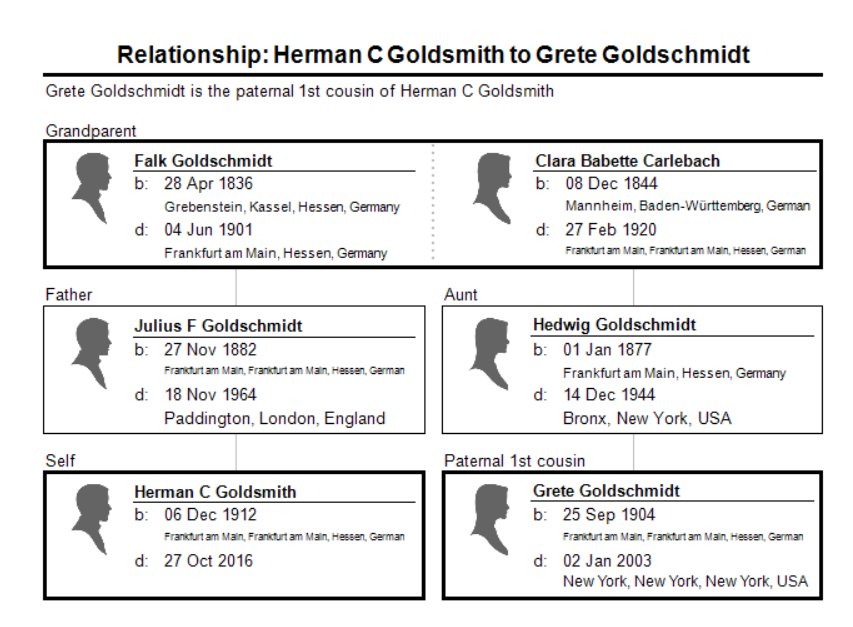
First I received this photograph of Herman Goldsmith and my cousin Susan and her husband Richard. Susan said it was taken in June 2013 when Herman was 100 years old. He would turn 101 on December 6, 2013, and live until October 27, 2016, just a little over a month before he would have turned 104.

Richard and Susan (Vogel) Neulist and Herman Goldsmith, June 2013. Courtesy of Susan Neulist

I wrote about Herman here. He was the son of Julius Falk Goldschmidt and Helene “Leni” Goldschmidt. Julius Falk Goldschmidt was the son of Falk Goldschmidt, and Leni Goldschmidt was the granddaughter of Jacob Meier Goldschmidt. Since Falk and Jacob Meier were brothers, Julius and Leni were first cousins, once removed, making Herman his own cousin.

After escaping from Nazi Germany to the US in the 1930s, Herman settled in New York City where so many Goldschmidt family members ended up. He remained in touch with his Goldschmidt relatives. Susan said he visited her grandmother, Grete Goldschmidt Heimerdinger, every week for many years.

Grete was also a double cousin as she was the daughter of Marcel (Maier) Goldschmidt, son of Jacob Meier Goldschmidt, and Hedwig Goldschmidt, daughter of Falk Goldschmidt. Hedwig and Marcel were first cousins, and so like Herman, Grete was her own cousin.

And since Hedwig Goldschmidt, Grete’s mother, and Julius Falk Goldschmidt, Herman’s father, were siblings, Grete and Herman were first cousins, both the grandchildren of Falk Goldschmidt.

But they were also both descended from Jacob Meier Goldschmidt, Herman’s great-grandfather and Grete’s grandfather, so they were also first cousins, once removed, through Herman’s mother Helene “Leni” Goldschmidt and Grete’s father Marcel Goldschmidt. Oy vey! No wonder they were so close! Susan described Herman as “quite the gentleman and full of wonderful stories.” I wish I knew more of his stories.

I also received a wonderful photograph from my cousin, Bruce, the great-great-great-grandson of Fradchen Schoenthal, sister of my great-great-grandfather Levi Schoenthal, and also the great-great-grandson of Simon Goldschmidt, brother of my three-times great-grandfather Seligmann Goldschmidt.

So Bruce is my double cousin. He’s my fourth cousin, once removed, through our Schoenthal side and my fifth cousin through our Goldschmidt side.

Isn’t Jewish genealogy fun?

Anyway, Bruce’s great-great-grandmother was Hannah Goldsmith Benedict, daughter of the above-mentioned Simon Goldschmidt. Hannah and her brother Henry were the first Goldschmidts born in the US, Henry in 1847 and Hannah in 1848. I’ve written much about Hannah and her family—here and here and here  and here and here and here and here. Hannah married Joseph Benedict in 1867, and they had five children, including Jacob Benedict, Bruce’s great-grandfather. Jacob had two daughters with his wife Clara Kaufman: Helen, born in 1907, and Marian, born in 1908. Helen was Bruce’s grandmother.

Bruce told me that this photograph was dated August 24, 1908, and shows Hannah Goldsmith Benedict with her husband Joseph and their two granddaughters Helen and Marian. At that time Jacob Benedict and his family were living in Paducah, Kentucky, and Hannah and Joseph were living in Pittsburgh. Jacob’s brother Herschel was living in Pittsburgh, and his brother Harry was living in Michigan by 1910.  But the photograph was apparently taken in Kenosha, Wisconsin. I wonder how that happened….

Joseph Benedict, Helen Benedict, Marian Benedict, and Hannah Goldsmith Benedict. August 24, 1908. Courtesy of Bruce Velzy

Another mystery to solve. But seeing one of my earliest American-born relatives with her granddaughters is very exciting.

It’s so fitting to close my Goldschmidt family blog posts with photographs of these two members of the family. Hannah Goldsmith and Herman Goldsmith were first cousins, twice removed, since Hannah’s father Simon Goldschmidt and Herman’s great-grandfather Meyer Goldschmidt were brothers.

Hannah was born in the United States when the country was still very young. She lived through the Civil War, World War I, the Roaring Twenties, and the Great Depression, dying in November 1939 while her German cousins were being persecuted and fleeing from Nazi Germany. She was 91 years old.

Just two months before Hannah died, her cousin Herman arrived in the US as one of those cousins escaping from Germany. Herman Goldsmith was born in 1912 in Frankfurt, Germany, and had grown up in the comfort of the large and well-to-do Goldschmidt family. Unlike Hannah, his life was radically changed by the events of the 1930s. But like Hannah, he saw so much in his lifetime, living until he was almost 104. He not only lived through World War I, the Weimar Republic years, the Depression, and World War II—he saw the radical changes that came after the war—the creation of the state of Israel, the Cold War, the assassination of JFK, the civil rights movement, the women’s movement, the moon landing, the gay rights movement, the rise of the internet, 9/11, and the election of the first Black man to serve as president of the US.

Can you imagine the stories Herman and Hannah could tell each other as well as us?  They lived such different lives in such different places and times, overlapping in time between only 1912 and 1939, but on different continents. But together the lives of Hannah Goldsmith and Herman Goldsmith tell us so much not only about the richness of the Goldschmidt family’s story, but also about the history of Jews in America and in Germany.

Thank you to Susan and to Bruce for sharing these photographs. And thank you to each and everyone of my Goldschmidt cousins who have helped me understand and appreciate our shared history.


The Children of Falk Goldschmidt and Clara Babetta Carlebach

Falk Goldschmidt and his wife Clara Babetta Carlebach had five children, all born in Frankfurt. First born was Meier Falk Goldschmidt, born on August 8, 1870.

Meier Falk Goldschmidt, birth record, Hessisches Hauptstaatsarchiv; Wiesbaden, Deutschland; Bestand: 903; Signatur: 903_8845, Year Range: 1870, Ancestry.com. Hesse, Germany, Births, 1851-1901

Then came their daughter Helene born on September 26, 1871:

Helene Goldschmidt, birth record, Hessisches Hauptstaatsarchiv; Wiesbaden, Deutschland; Bestand: 903; Signatur: 903_8849, Year Range: 1871, Ancestry.com. Hesse, Germany, Births, 1851-1901

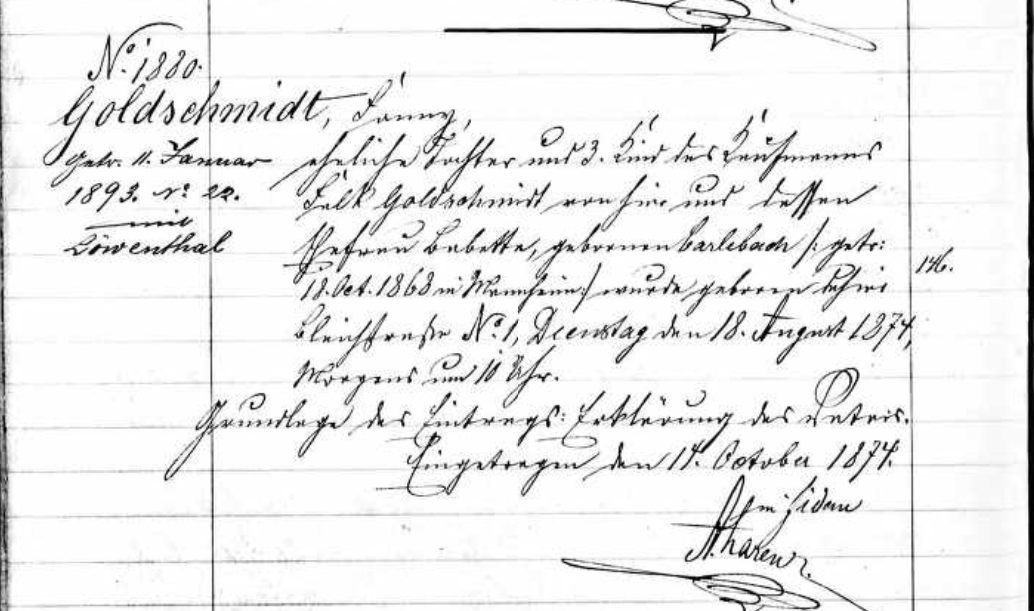
Third born was Fanny on August 18, 1874.

Fanny Goldschmidt, birth record, Hessisches Hauptstaatsarchiv; Wiesbaden, Deutschland; Bestand: 903; Signatur: 903_8858, Year Range: 1874, Ancestry.com. Hesse, Germany, Births, 1851-1901

Their fourth child was Hedwig; she was born on January 1, 1877.

Hedwig Goldschmidt, birth record, Hessisches Hauptstaatsarchiv; Wiesbaden, Deutschland; Bestand: 903; Laufende Nummer: 143, Year Range: 1877, Ancestry.com. Hesse, Germany, Births, 1851-1901

And finally, their youngest child Julius Falk Goldschmidt was born November 27, 1882.

Julius Falk Goldschmidt, birth record, Hessisches Hauptstaatsarchiv; Wiesbaden, Deutschland; Bestand: 903; Signatur: 903_8972, Year Range: 1882, Ancestry.com. Hesse, Germany, Births, 1851-1901

That makes the fifth Meier/Meyer Goldschmidt, the fourth Helene Goldschmidt, the fifth Hedwig Goldschmidt, and the third Julius Goldschmidt on my tree. And that doesn’t even count all the Goldsmiths with those first names. No wonder Meier and Julius used their middle name Falk to identify themselves.

Meier Falk Goldschmidt, their oldest child, immigrated to New York in about 1888 to 1890. I could not find a ship manifest for his first arrival in the US, but those were the dates listed on the 1910 and 1920 census records for Meier.1 Also, on an 1895 ship manifest for his return to the US, he indicated that he was already by that time a US citizen.2 Unfortunately, I could not find naturalization documents for Meier to corroborate that assertion.

I also could not find Meier on the 1900 census. I asked for help from Tracing the Tribe, but no one there was able to find him on that census, nor could they find a ship manifest or naturalization record to establish his date of arrival. Meier just seems to be one of those elusive relatives who does not want to be found.

Fortunately, Meier does appear on both the 1910 and 1920 US census. In 1910 he was single, living in Queens as a boarder, and working as a ribbon salesman.3 In 1920, Meier was living in Manhattan, still single, still working as a ribbon salesman. Although he is listed here as Clair F. Goldschmidt, I am quite certain that this is Meier as all the other facts add up.4

Meier died two years later on February 22, 1922. He was 51 years old. He was buried in New York. As far as I can tell, he never married.5

Meanwhile, Meier’s four younger siblings were all still in Germany. His sister Helene married Bernhard Igersheimer on November 1, 1889. He was the son of Jonas Igersheimer and Sara Dreyfus and was born in Mergentheim, Germany, on April 18, 1856.

Helene Goldschmidt marriage to Bernard Igersheimer, Hessisches Hauptstaatsarchiv; Wiesbaden, Deutschland; Signatur: 9481, Year Range: 1889
Ancestry.com. Hesse, Germany, Marriages, 1849-1930

Helene and Bernard had two children. Fanny Flora Igersheimer was born in Frankfurt on October 6, 1890.

Fanny Flora Igersheimer birth record, Hessisches Hauptstaatsarchiv; Wiesbaden, Deutschland; Bestand: 903; Signatur: 903_9076, Year Range: 1890, Ancestry.com. Hesse, Germany, Births, 1851-1901

Her brother Franz Jonas Igersheimer was born on March 20, 1895, in Frankfurt.

Franz Jonas Igersheimer birth record, Hessisches Hauptstaatsarchiv; Wiesbaden, Deutschland; Bestand: 903; Signatur: 903_9151, Year Range: 1895, Ancestry.com. Hesse, Germany, Births, 1851-1901

Falk and Clara Babetta’s second daughter Fanny married Siegfried Loewenthal on January 6, 1893 in Frankfurt. Siegfried was born in Wiesbaden on March 27, 1864, to Meyer Loewenthal and Regine Kahn.

Fanny Goldschmidt and Siegfried Loewenthal marriage record, Hessisches Hauptstaatsarchiv; Wiesbaden, Deutschland; Bestand: 903, Year Range: 1893,
Ancestry.com. Hesse, Germany, Marriages, 1849-1930

Fanny and Siegfried had two sons. Julius Loewenthal was born on December 6, 1893, in Frankfurt.

Julius Loewenthal birth record, Hessisches Hauptstaatsarchiv; Wiesbaden, Deutschland; Bestand: 903; Signatur: 903_9125, Year Range: 1893, Ancestry.com. Hesse, Germany, Births, 1851-1901

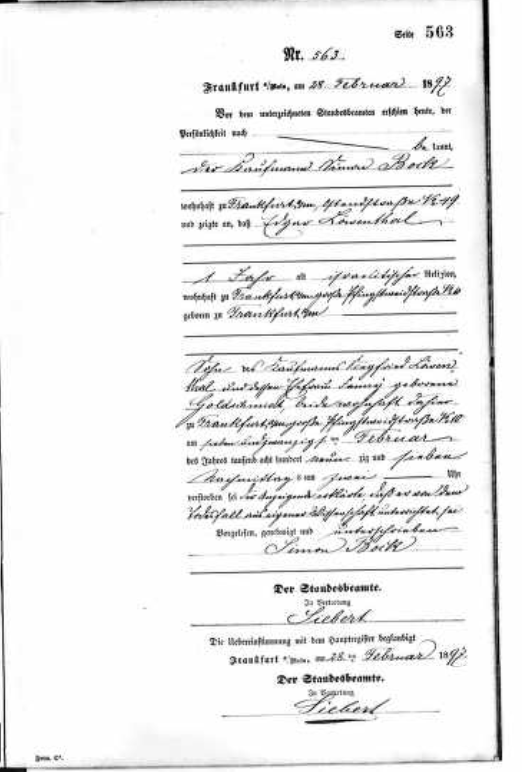
And Edgar Loewenthal was born January 16, 1896.6 Sadly, Edgar died just over a year later on February 27, 1897.

Edgar Loewenthal death record, Personenstandsregister Sterberegister; Bestand: 903; Signatur: 10503, Year Range: 1897, Ancestry.com. Hesse, Germany, Deaths, 1851-1958

The two youngest children of Falk and Clara Babetta I’ve already written about. Their daughter Hedwig married her first cousin Marcel Goldschmidt, son of Falk’s brother Jacob Meier Goldschmidt. They, as I wrote, had four children: Jacob, Nelly, Else, and Grete. Since writing about Hedwig and Marcel, I’ve connected with some of Grete’s descendants and will have an update on that part of the family in a post to follow.

And Falk and Clara Babetta’s youngest child, Julius Falk Goldschmidt, married his first cousin, once removed, Helene “Leni” Goldschmidt, the granddaughter of Jacob Meier Goldschmidt. I’ve also written extensively about them and their two sons, Felix and Herman.

The post to follow will focus on Falk and Clara Babetta and their two other daughters—Helene Goldschmidt Igersheimer and Fanny Goldschmidt Loewenthal—and their families during the 20th century.


  1. Meyer Goldsmith, 1910 US census, Year: 1910; Census Place: Queens Ward 5, Queens, New York; Roll: T624_1068; Page: 5A; Enumeration District: 1248; FHL microfilm: 1375081, Ancestry.com. 1910 United States Federal Census; Clair F. Goldschmidt, 1920 US census, Year: 1920; Census Place: Manhattan Assembly District 15, New York, New York; Roll: T625_1214; Page: 16B; Enumeration District: 1099, Ancestry.com. 1920 United States Federal Census ↩
  2. M.F. Goldschmidt, ship manifest, Year: 1895; Arrival: New York, New York, USA; Microfilm Serial: M237, 1820-1897; Line: 15; Page Number: 4, Ship or Roll Number: Fürst Bismarck, Ancestry.com. New York, U.S., Arriving Passenger and Crew Lists (including Castle Garden and Ellis Island), 1820-1957 ↩
  3. See note 1, above. ↩
  4. See note 1, above. ↩
  5. New York, New York City Municipal Deaths, 1795-1949,” database, FamilySearch (https://familysearch.org/ark:/61903/1:1:2WLT-K79 : 10 February 2018), Meyer F. Goldschmidt, 22 Feb 1922; citing Death, Bronx, New York, New York, United States, New York Municipal Archives, New York; FHL microfilm 2,167,577. ↩
  6.  Edgar Löwenthal, Gender: männlich (Male), Birth Date: 16 Jan 1896, Birth Place: Frankfurt am Main, Hessen (Hesse), Deutschland (Germany), Civil Registration Office: Frankfurt am Main, Father: Siegfried Löwenthal, Mother: Fannÿ Löwenthal, Certificate Number: 288, Hessisches Hauptstaatsarchiv; Wiesbaden, Deutschland; Bestand: 903; Laufende Nummer: 152, Ancestry.com. Hesse, Germany, Births, 1851-1901 ↩

The Mystery of Falk Goldschmidt’s Wife: A Lesson in German Vital Records

Researching the marriage of the last child of the last sibling of my three-times great-grandfather Seligmann Goldschmidt took me on a wild and exciting and ultimately successful research journey, thanks to two very helpful members of the genealogy village. But let me start from the beginning.

With this post, I start the final chapter in the saga of my Goldschmidt ancestors and relatives, the story of Meyer Goldschmidt’s youngest child, Falk Goldschmidt. Falk was born on April 28, 1836, in Grebenstein, Germany.

Falk Goldschmidt, birth record, HHStAW Abt. 365 Nr. 375, S. 43

As I wrote in an earlier post, Falk was one of only two of Meyer’s seven children to leave Germany, the other being the oldest child, Ella. On July 10, 1852, when he was sixteen, Falk arrived in New York.

Falk Goldschmidt, passenger manifest, Year: 1852; Arrival: New York, New York; Microfilm Serial: M237, 1820-1897; Microfilm Roll: Roll 116; Line: 24; List Number: 912, Ancestry.com. New York, Passenger and Crew Lists (including Castle Garden and Ellis Island), 1820-1957

He is listed on the 1860 US census, living in Baltimore with his sister Ella and working as a clerk.1 But I knew that sometime between 1860 and 1870 Falk had returned to Germany because his oldest child was born that year. But when and whom did he marry?

And that’s where the puzzle begins. I knew from the birth records of Falk’s children that their mother’s name was Babetta Carlebach. As you’ll be able to see on those records when I include them in my next post, Babetta Carlebach is the name given on the birth records for all five of their children.  But I could not find a marriage record for Falk and Babetta nor could I find a birth record for Babetta.

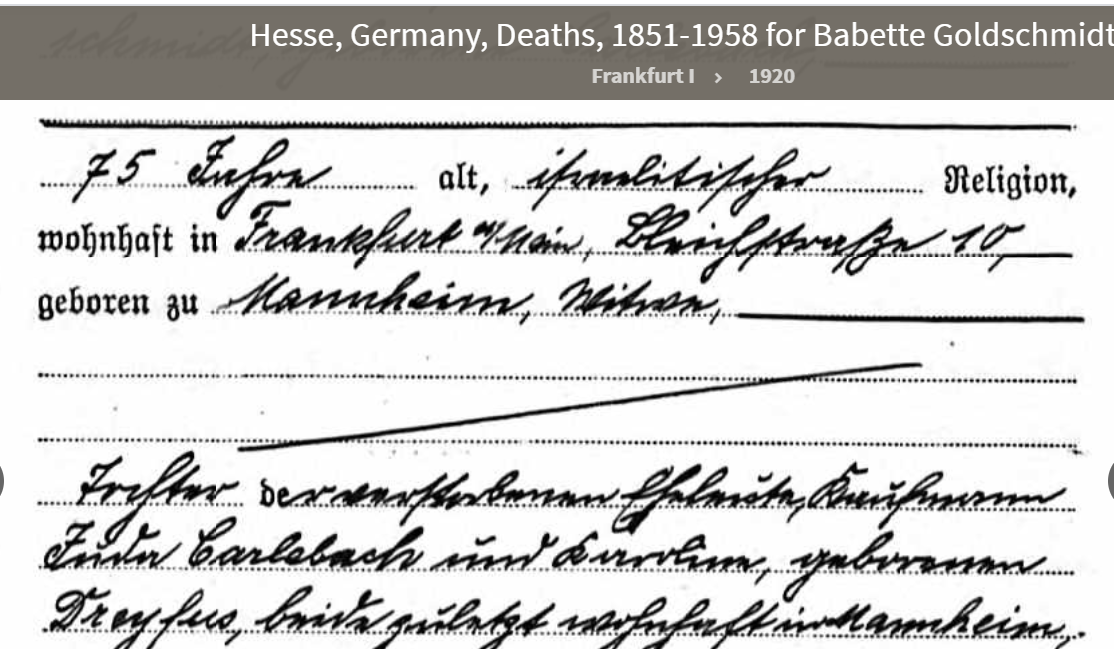
I did have her death record, which showed that she was born in Mannheim in about 1845 and that she was the daughter of Juda Carlebach and Caroline Dreyfus.

Portion of the death record of Babetta Carlebach Goldschmidt, Personenstandsregister Sterberegister; Bestand: 903; Signatur: 10828, Ancestry.com. Hesse, Germany, Deaths, 1851-1958

And that was consistent with many of the other trees I found on Ancestry, though most listed her as Pauline Babetta Carlbach and had her mother with a different surname—either Jeidel or Feidel.

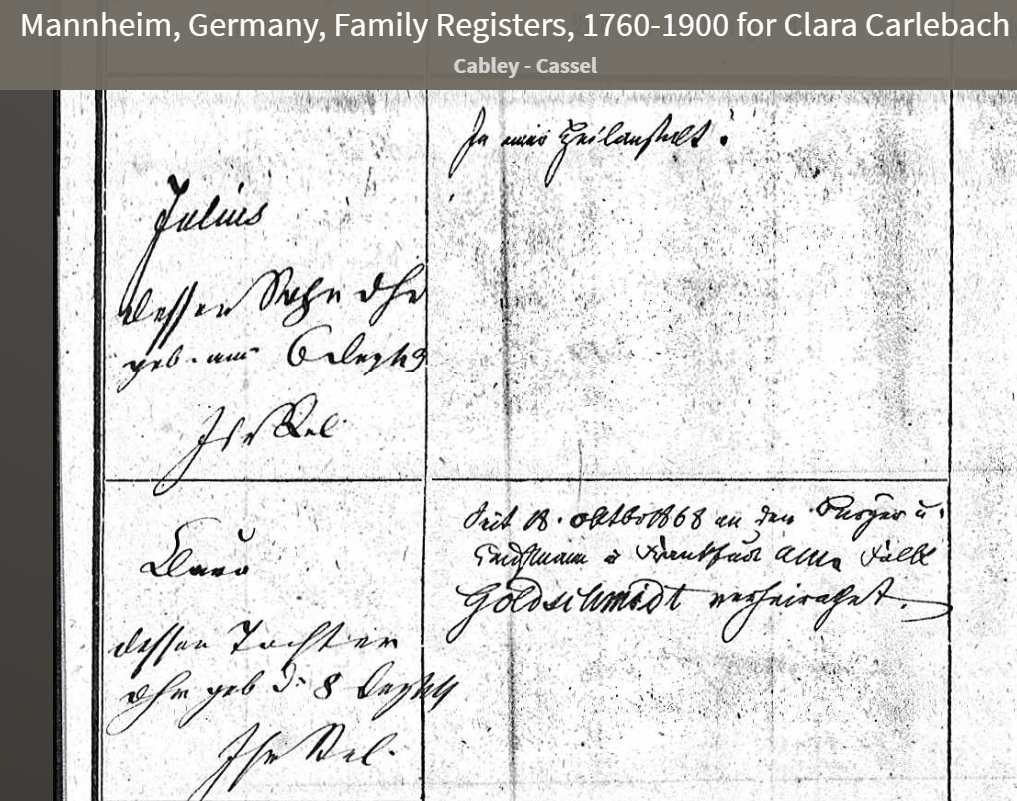
I then located two entries that seemed relevant to Falk and Babetta in Ancestry’s database of Mannheim Family Registers. Here’s the first one:

Julius Carlebach family, Ancestry.com. Mannheim, Germany, Family Registers, 1760-1900.
Original data:Polizeipräsidium Mannheim Familienbögen, 1800-1900. Digital images. Stadtarchiv Mannheim — Institut für Stadtgeschichte, Mannheim, Germany.

Note that in this one she is listed as the daughter of Julius, which I assumed was Juda’s secular name. I couldn’t decipher the first name, but Ancestry indexed this as an entry for Clara Carlebach, and that seemed reasonable. It says she was born on December 8, and I could see that she married Falk Goldschmidt on October 18, 1868. So was Babetta really named Clara?

But I became really confused when I found this second entry in the Mannheim Family Registers:

David Carlebach, family register, Ancestry.com. Mannheim, Germany, Family Registers, 1760-1900. Original data:Polizeipräsidium Mannheim Familienbögen, 1800-1900. Digital images. Stadtarchiv Mannheim — Institut für Stadtgeschichte, Mannheim, Germany.

The fourth family member listed is Pauline (Babetta) Carlebach, but her father is David Carlebach, not Juda. She was born July 30, 1845, so the right age for my Babetta, according to her death record.  And she also married Falk Goldschmidt on October 18, 1868.

It felt like a game of Truth or Consequences. Will the real wife of Falk Goldschmidt please stand up?

To try and get help on these two records, I posted them to the JewishGen GerSIG group on Facebook, and Michael, a member of that group, came to my rescue.  Within minutes of my post, he posted the actual marriage record of Falk and “Clara gennant Babetta” Carlebach, that is, Clara known as Babetta. And then he found Clara’s actual birth record. These images are included later in this post.

How had he found those records so quickly? And why did the Family Register for Pauline Babetta Carlebach say she was also married to Falk Goldschmidt on October 18, 1838?

The second question is one for which there is no definite answer except to say…it’s a mistake. Even though many of the trees on Ancestry label Falk’s wife as Pauline Babetta, that Babetta had different parents from Clara Babetta, the actual wife of my cousin Falk Goldschmidt.

But I still had other questions. How did Michael find those records? And what did they say in full? I couldn’t decipher the script at all, and I wanted to be sure I had all the relevant dates and names.

For those questions I turned to my friend and fellow genealogy blogger Cathy Meder- Dempsey of Opening Doors in Brick Walls. She kindly agreed to translate the records and to explain how to find them. Cathy is a wonderful teacher and had recently helped another family historian who wanted to know how to find Luxembourgian records, so I was delighted that she would not just give me a fish, but show me how to fish, as the Chinese philosopher Lao Tzu recommended centuries ago.

Well, I am not sure Cathy knew what a task she was taking on when she agreed not only to transcribe and translate the records that Michael had located, but also to teach me how to find them myself.

Cathy wrote me detailed instructions on how I could have found these records on my own so that the next time I would be able to do it myself. Cathy has shared those instructions on her blog today in post entitled, “Teaching a Friend to Find Records on FamilySearch,” which you can find here.

I followed her instructions, and soon realized that I faced a difficult hurdle trying to read the script on the page. It’s the old German script and even Cathy, who is quite experienced with that script, said these particular records were hard to decipher. I need to work on learning that script if I am going to catch my own fish.

Cathy also located additional records for Clara Babetta Carlebach, including a second birth record and a record showing that her name was changed from Clara to Babetta.

Here are the images and Cathy’s transcriptions and translations of the birth and marriage records for Clara Babetta Carlebach Goldschmidt.

Here is one version of her birth record:

Clara Carlebach birth record, Geburten, Heiraten, Tote 1815-1859, Image 458, Matrikel 1805-1870, database with images, Jüdische Gemeinde Mannheim, Family Search (https://www.familysearch.org/ark:/61903/3:1:3Q9M-CS63-JSYB-8?i=457&cat=84118)

Nachts von seibenten zum achten dezember um drei viertel auf zwölf würde Clara, eheliche Tochter der Bürger und # (Handelsmannes) J. # (Juda) H. Carlebach und der Carolina gebr. Jeidels dahier. Zeugen Dr. # (Friederich) Nötling Amtschirurg, und David Carlebach, Bürger und Handelsmann dahier.
H. Traub

Ende des Jahres 1844

In the night from the 7th to 8th of December, Clara, daughter of the citizens and # (merchant) J. # (Juda) H. Carlebach and Carolina born Jeidels from here. Witness Dr. # (Friederich) Nötling official surgeon, and David Carlebach, citizen and merchant from here.
H. Traub

End of the year 1844

(Cathy indicated that # denotes annotations made in the margin, and missing words are in parentheses for all her transciptions and translations posted here.)

Here is a second version of her birth record:

Clara Carlebach birth record, Geburten, Heiraten, Tote 1815-1859, Image 451, Matrikel 1805-1870, database with images, Jüdische Gemeinde Mannheim, Family Search (https://www.familysearch.org/ark:/61903/3:1:3Q9M-CS63-JSYL-Z?i=450&cat=84118)

Den siebenten (#Dezember) Nachts drei viertel auf zwölf wurde (#geboren) Clara eheliche Tochter der Burger und Handelsmannes Juda Hirz Carlebach und der Carolina gebr. Jeidels dahier Zeugen: Dr. Friedrich Nötling

The seventh # (December) at three quarters to twelve was # (born) Clara, the legitimate daughter of the citizen and merchant Juda Hirz Carlebach and Carolina gebr. Jeidel’s witnesses: Dr. Friedrich Nötling

Note that on both of these records Babetta’s mother was not Caroline Dreyfus as indicated on her death record above, but Caroline Jeidels. Also, notice that Clara was born late in the evening of December 7, not on December 8 as the Mannheim Family Register (and her marriage record below) report. That makes multiple errors on German vital records for one person—and that’s so surprising since we’ve all been told that the Germans have always been impeccable record-keepers.

On the page following the second birth record, Cathy found this additional entry:

Clara Carlebach birth record, Geburten, Heiraten, Tote 1815-1859, Image 451, Matrikel 1805-1870, database with images, Jüdische Gemeinde Mannheim, Family Search (https://www.familysearch.org/ark:/61903/3:1:3Q9M-CS63-JSYL-Z?i=450&cat=84118)

Im Jahre ein tausend acht hundert vier und vierzig 

Amtschirurg und David Carlebach Bürger und Handelsmann

dahier. Bemerkung

Der hier gedachte Name Clara würde nach einsehende Dupplikate
der Standesbücher bei GroßH ( Großherzogthum Hessen?) Stadtamte von den Eltern Babetta
umgeändert.

Geburten deren Bekundung in das Jahr 1845 fallen
sind nicht vorgekommen.

H. Traub

Ende des Jahres 1844

In the year one thousand eight hundred forty-four (top of each page)

Official surgeon and David Carlebach citizen and merchant from here.

Remark:

The name Clara intended here, after inspecting duplicates of the registry books at the city offices of the Grand Duchy of Hesse, would be changed to Babetta by the parents.

Births whose manifestation fell in the year 1845 did not occur.

H. Traub

End of the year 1844

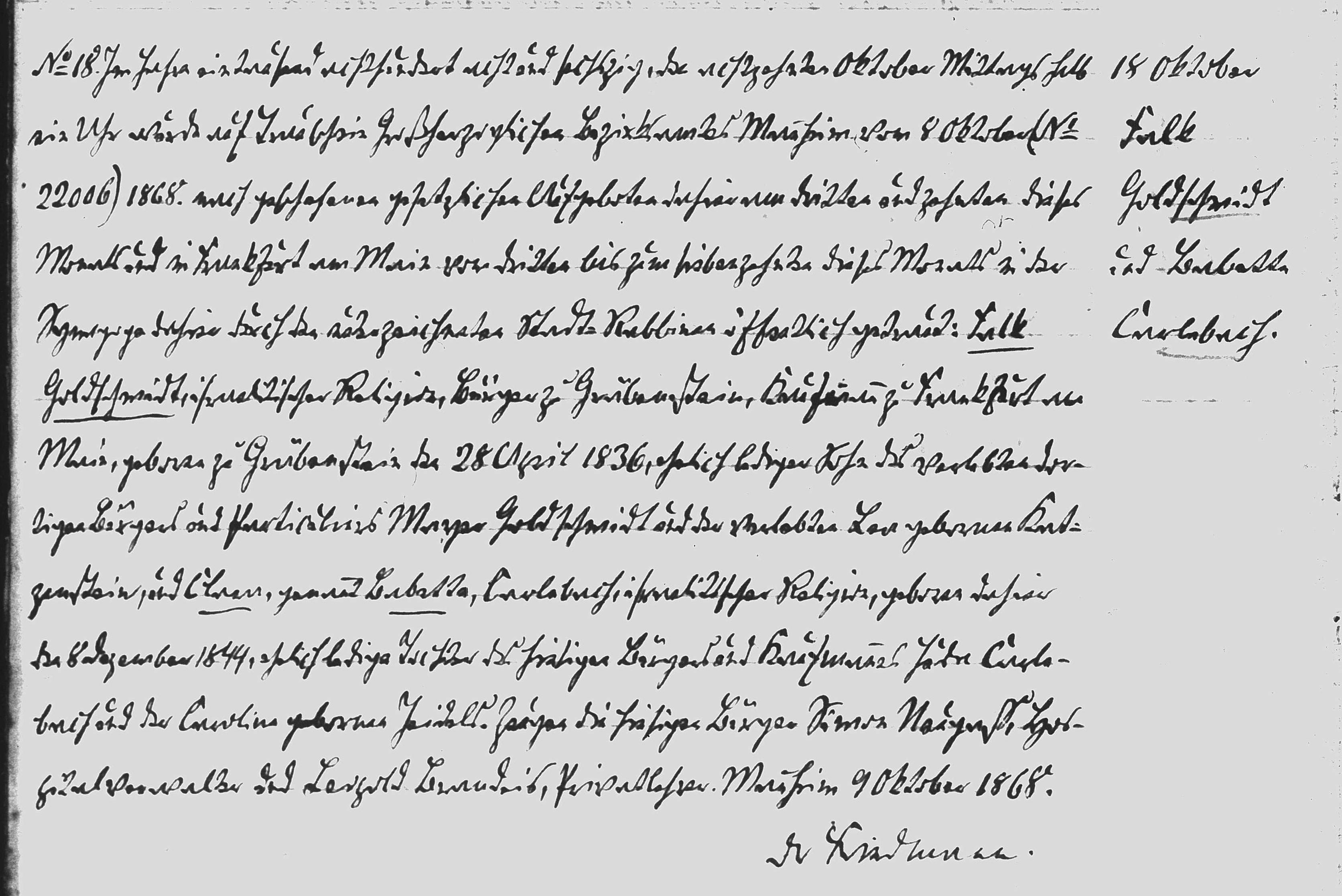
And here is the marriage record for Falk Goldschmidt and (Clara) Babetta Carlebach:

Marriage record of Falk Goldschmidt and Babetta Carlebach, Matrikel 1815-1870, Heiraten, Tote 1866-1868 r. S. Geburten 1864-1868 r. S. Geburten, Heiraten, Tote 1869-1870 r. S. Heiraten, Tote 1866-1868 l. S. Geburten 1864-1868 l. S. Geburten, Heiraten, Tote 1869-1870 l. S.
https://www.familysearch.org/ark:/61903/3:1:3Q9M-CS67-GC7W-W?cat=285995
Bottom record on image 240.

This one was particularly hard to read, and I am so grateful to Cathy for taking the time and the care to decipher as much of this as was possible. Here is her translation of the most important parts of this record:

In the year 1868, the 18th of October, in the afternoon at 3:30… The banns were read in Frankfurt/Main on the 3rd and 10th of October and published in Mannheim from the 3rd until 17th of October. 

Falk Goldschmidt, of the Jewish faith, citizen of Grebenstein born there on 28 April 1836, the single son of the deceased citizen and merchant Mayer Goldschmidt and his “remaining” wife Lea born Katzenstein, AND Clara, also called Babetta, Carlebach, of the Jewish faith, born here [Mannheim] on 8 December 1844, the single daughter of the local citizen and merchant Juda Carlebach and Caroline born Jeidels. …

So that makes it very clear that Falk married Clara Babetta on October 18, 1868, daughter of Juda and Caroline, and not her cousin Pauline Babetta.

But why did Clara’s parents change their daughter’s name to Babetta? And why did David Carlebach name his daughter Babetta as well?  My hunch was that David Carlebach, Pauline’s father, and Juda Carlebach, Clara’s father, were brothers and that they were related to and maybe the sons of a woman named Babetta Carlebach who had died sometime after Clara’s birth in December 1844 and Pauline’s birth in July 1845.

So now, equipped with the tools Cathy had given me, I went fishing. And I found—all on my own—the index that included a Babetta Carlebach’s death and then her death record. I am so proud and so grateful to Cathy!

Here it is:

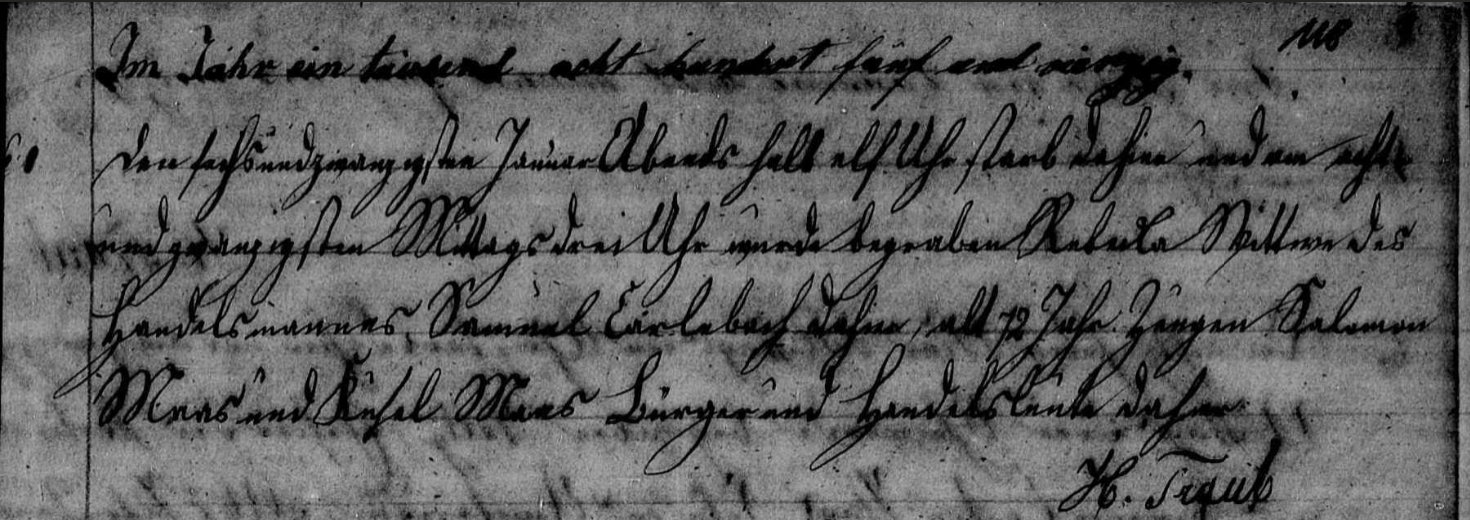
Babetta Carlebach (widow of Samuel) death record, Geburten, Heiraten, Tote 1815-1859, Image 484, Matrikel 1805-1870, database with images, Jüdische Gemeinde Mannheim, Family Search (https://www.familysearch.org/ark:/61903/3:1:3Q9M-CS63-JSYL-7?cat=84118)

Cathy confirmed that I’d found the right record and also told me that Babetta was the widow of Samuel Carlebach, was 72, and had died on 26 January 1845. So the older Babetta had died just a month and a half after Clara’s birth and six months before Pauline’s birth. Both must have been named in her memory.

Cathy also found a record that showed that David and Juda were brothers, but that record also revealed that their mother was not Babetta.2 So she was not the mother of David and Juda, but perhaps their grandmother or an aunt or cousin who died so close to the births of their daughters that they chose to honor her by naming a child for her.1

Thank you so much to Cathy Meder-Dempsey for her extraordinary patience and generosity in teaching me these new skills, doing additional research, and translating the documents for me.

So now I know to whom, when, and where my cousin Falk Goldschmidt was married: Clara Babetta Carlebach, daughter of Juda Carlebach and Caroline Jeidels, first cousin of Pauline Babetta Carlebach, on October 18, 1868, in Mannheim, Germany.


  1. United States Census, 1860″, database with images, FamilySearch (https://familysearch.org/ark:/61903/1:1:M69Z-5QX : 12 December 2017), Albert Sigman, 1860. Census Place: Baltimore Ward 13, Baltimore (Independent City), Maryland; Roll: M653_464; Page: 101; Family History Library Film: 803464, Ancestry.com. 1860 United States Federal Census ↩
  2. Familienstandsbogen, 1807-1900, Mannheim (Baden). Standesamt, Film # 008244102, Image2 143, 144, FamilySearch database with images (https://www.familysearch.org/ark:/61903/3:1:3Q9M-CSPX-5S5T-6?cat=132671) ↩

  1. I also successfully located the death record for Hirz Carlebach, the father of Juda and David Carlebach, but it did not include his parents’ names, so I can’t determine if Babetta was the grandmother of Juda and David Carlebach. ↩

Hedwig Goldschmidt Cramer’s Three Sons: Can You Help Me Find More Records?

In the last post we saw that Hedwig Goldschmidt Cramer’s daughter Rosa Cramer Oppenheimer died young, her grandson William Oppenheimer died very young, and her son-in-law Arthur Oppenheimer also died young. But Rosa and Arthur’s three remaining children survived those losses and also survived the Holocaust.

This post will look at Hedwig’s three sons, Max, Sally, and Herbert Cramer, and their families in the 20th century. Unfortunately, there are many places in this post where I had to rely on secondary sources, which I am always reluctant to do, but I was unable to find many primary sources for the Cramer sons and their descendants. If anyone has suggestions—especially for finding Israeli birth, marriage, and death records and some English death records—please let me know.

UPDATE: Thank you to the many people who reached out to help, including Yehuda  from Tracing the Tribe, Anne from the German Genealogy Group on Facebook, Shirley, my cousin by marriage and friend, and a blog reader BRegenstein. I am updating this post with some of the new information and records I’ve received from them.

I was, however, able to learn more about the three Cramer sons from the book written by their nephew Arnold Selig Oppenheimer, and that source provided more inisghts into these three men. It also included some wonderful images including these portraits of Selig Goldschmidt and his wife Clementine Fuld and two photographs of their daughter Hedwig Goldschmidt Cramer:

From Arnold S Oppenheimer, The Story of My Life (2007)

From Arnold S Oppenheimer, The Story of My Life (2007)

Now, the story of Hedwig’s sons in the 20th century.

Max Cramer

From Arnold S. Oppenheimer, The Story of My Life (2007)

Max Cramer married Sidonie Charlotte Gestetner, the daughter of David Gestetner and Sophie Lazarus, in 1908.1 Sidonie was born in Islington, England, on March 12, 1888,2 and that’s where the two married.

Max and Sidonie settled in Frankfurt where their first child Ilse Caroline Cramer was born on September 17, 1909.3 Her sister Ellen was also born in Frankfurt, two years later on September 21, 1911.4 A third daughter Hilda was born on February 3, 1916,5 followed almost exactly two years later by Max and Sidonie’s fourth daughter Nelli Else, born February 13, 1918.6

When the Nazis took power in Germany, Max and his children all left Germany. Max went to Palestine. According to his Palestinian immigration papers, Max Cramer and his first wife Sidonie divorced in May, 1935, and Sidonie returned to England. Max then went to Palestine on October 21, 1935, first as a visitor, but he ultimately decided to stay and become a citizen. In 1949, he married Elfriede Sachs Gluecksohn in Israel.7 Max died in Jerusalem on July 22, 1952, according to his profile on Geni.

UPDATE: Thank you to Yehuda from TTT for locating Max’s headstone on Gravez, which confirms his date of death.

Max Cramer, Palestine Immigration File, Israel Archives, found at https://www.archives.gov.il/en/archives/Archive/0b07170680034dc1/File/0b07170680ee723e

As for the children of Max and Sidonie, their oldest daughter, Ilsa Caroline Cramer, was the only one who did not immigrate to England, according to various secondary sources. According to the research of David Baron and Roger Cibella, Ilsa married Marcel Fruchter Peri in Palestine in 1939, had one child, and died on March 21, 1954, in Tel Aviv, Israel. Profiles on My Heritage list her husband as Walter Skotzki and with no children, but with the same year of death. I’ve been unable to locate any primary source to verify any of these facts other than other profiles on My Heritage, Geni, and Ancestry.

Max and Sidonie’s three other daughters ended up in England with their mother Sidonie, who married Hans Feibusch, an artist, in 1935 right after her divorce from Max Cramer.8  The 1939 England and Wales Register lists Sidonie, Hans, and the three Cramer daughters in one household living in London. Hilda was working as a secretary-copywriter, Nelli was not employed, and Ellen was a studio photographer, listed under the surname Kay.

Sidonie Cramer Feibusch and family , The National Archives; Kew, London, England; 1939 Register; Reference: RG 101/467I, Enumeration District: AROJ, Ancestry.com. 1939 England and Wales Register

According to Baron and Cibella, Ellen Theresa Cramer had married Leo Knoepfelmacher in Prague, Czechoslovakia (today, the Czech Republic) on April 15, 1933. Leo was born on October 23, 1904, in Ostrava, Czechoslovakia. I have no marriage record for Ellen and Leo. They had two sons born in the 1930s, one in Vienna, one in Tel Aviv.9

I located a ship manifest for Ellen and her two sons dated September 21, 1936, showing that she and her sons were residents of Palestine, sailing to England to become permanent residents. It also indicates that she and her sons were Czech citizens. Leo was not sailing with them.

Ellen Cramer Knoepfelmacher, ship manifest, The National Archives of the UK; Kew, Surrey, England; Board of Trade: Commercial and Statistical Department and successors: Inwards Passenger Lists.; Class: BT26; Piece: 1110, Month: Sep, Ancestry.com. UK and Ireland, Incoming Passenger Lists, 1878-1960

So by 1939, as suggested by the 1939 England and Wales Register shown above, Ellen and Leo were apparently no longer together and she had changed her suname to Kay. But where were her sons on the 1939 register? And where was Leo?

He married a second time in England in 1942 to Elizabeth Irvine,9 but died less than four years later in England in March 1946 when he was only 41.10 Ellen Cramer Kay died June 28, 1962, in England; her listing on the probate calendar names her sisters Nelli and Hilda, but not her sons.11 I cannot find any record for either of them after that 1936 ship manifest.

UPDATE: Shirley located a marriage listing for one of the sons, showing he married in 1961. Since he may still be living, however, I won’t publish the specific details. Thank you, Shirley!

UPDATE: I have recently (May 2026) been in touch with one of Ellen’s sons, and he and I have together confirmed this information as well as other details.

As for Ellen’s two sisters who survived her, Nelli and Hilda, Hilda married Frank Werth in London on March 24, 1950.12 They had two children in the 1950s. Frank died December 2, 1990.13 I’ve not been able to locate any record of Hilda’s death. Perhaps she is still living at 104.

UPDATE: Thank you to Anne from the German Genealogy Group on Facebook for alerting me to the fact that the General Register Office in the UK had updated its listings for births and deaths. Anne located Hilda Werth’s death on that index as being registered in the first quarter of 2013. To know the exact date, I need to order a copy of the record itself. I also searched for a death notice in The Gazette, as BRegenstein suggested, but unfortunately have not found one.

Nelli Cramer, the youngest of Max Cramer’s daughters, married Alfred Bozwiecki, who according to Baron and Cibella was born in Warsaw, Poland, on February 18, 1899.14 Alfred died in London on September 30, 1971,15 and Nelli died five years later on February 4, 1976, also in London.16 She was 57. As far as I can tell, Nelli and Alfred had not had children.

Sally Cramer

From Arnold S. Oppenheimer, The Story of My Life (2007)

As with Max Cramer, I am missing many records for his brother Sally. I’d love help tracking them down. For example, I have no marriage record, only information from his nephew Arnold Oppenheimer’s book and from Baron and Cibella. Like his older brother Max who married a woman from England, Sally Cramer married a woman from a foreign country. Baron and Cibella report that on January 29, 1911, he married Felicitas Weil in Strasbourg, France. Felicitas was born in Strasbourg on August 10, 1889.17 According to Arnold Oppenheimer, Felicitas became nearly blind after a failed operation, but had a “vivacious educated personality and played the piano well.”18

Like Max, Sally returned to Germany, and Sally and Felicitas had two children born there. A daughter Marion was born in Frankfurt on April 3, 1913,19 and a son Robert was born December 29, 1918, in Bad Neuheim, Germany.20

By 1939, Sally and Felicitas had escaped from Nazi Germany and were living in London. On the 1939 England and Wales Register, Sally described his occupation as a “veterinary preparations maker.” I have absolutely no idea what that means!

Sally Cramer and family, The National Archives; Kew, London, England; 1939 Register; Reference: RG 101/827H, Enumeration District: BKEN, Ancestry.com. 1939 England and Wales Register

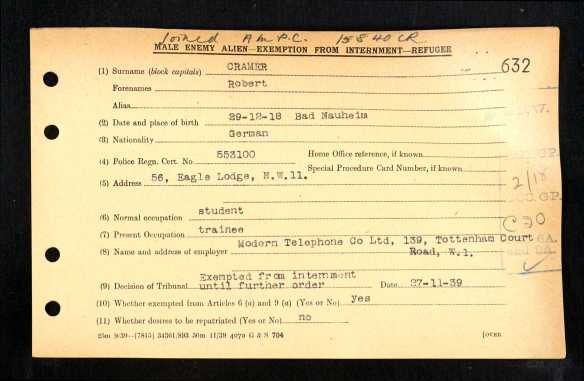
There is one line blacked out on the register, which I assume was for their son Robert. I only have two records for Robert. One is the card from the index of those whose German nationality was nullified by the Nazis, and the other is the card exempting him from being interned as an enemy alien by England in 1939. That card shows that Robert was training with the Modern Telephone Company and was living at the same address—26 Eagles Lodge—as his parents in 1939. Robert would marry Elizabeth Rosenberg in London in 1950, and they had two children born in London.21

Robert Cramer, The National Archives; Kew, London, England; HO 396 WW2 Internees (Aliens) Index Cards 1939-1947; Reference Number: HO 396/14, Piece Number Description: 014: Internees at Liberty in UK 1939-1942: Cohn-Cz, Ancestry.com. UK, World War II Alien Internees, 1939-1945

Marion, Sally and Felicitas’ daughter, was already married and living in New York by 1939. She had immigrated to New York on September 2, 1937, and married Fritz Ludwig (Fred) Wolf in New York two and a half weeks later on September 19, 1937. Fritz was born on October 23, 1911, in Hamburg, Germany.  On her declaration of intention, Marion’s occupation is listed as interpreter/housewife. That was also true on her ship manifest, where she indicated that Fritz Wolf, her fiance, was the person she was traveling to in New York.22

Marion Cramer Wolf, declaration of intention, The National Archives at Philadelphia; Philadelphia, Pennsylvania; NAI Title: Declarations of Intention for Citizenship, 1/19/1842 – 10/29/1959; NAI Number: 4713410; Record Group Title: Records of District Courts of the United States, 1685-2009; Record Group Number: 21, Description: (Roll 529) Declarations of Intention for Citizenship, 1842-1959 (No 407701-408700), Ancestry.com. New York, U.S., State and Federal Naturalization Records, 1794-1943

On the 1940 census, Marion and Fritz were living in Queens, New York, and Fritz was working as a “customer man” for a stock brokerage and Marion as a private secretary for an architect. Marion indicated that she had been living in Hamburg in 1935 while Fritz said he’d been living in Paris. He and Marion had two children born after the 1940 census.23

I don’t have much information about Sally and his family after 1940.  According to the English Probate Calendar, Sally died on June 12, 1951, in London, but Arnold Oppenheimer wrote that he died in the US while visiting his daughter Marion24. His widow Felicitas died on October 24, 1983.25 I could not find any record of deaths for either of their children. Marion and Robert would both be over one hundred years old now.

UPDATE: Thank you to Anne from the German Genealogy Group on Facebook for pointing out that I misread this! Sally’s probate notice does say he died in the US.

UPDATE: I went back and found an obituary for Marion Cramer Wolf. She died on July 26, 2017, at the age of 104. Death notice, New York Times, August 4, 2017. The notice described Marion as “Former Guggenheim museum reading room librarian. Lover of the arts, books and everything beautiful.” It can be found here.

Herbert Cramer

From Arnold S Oppenheimer, The Story of My Life (2007)

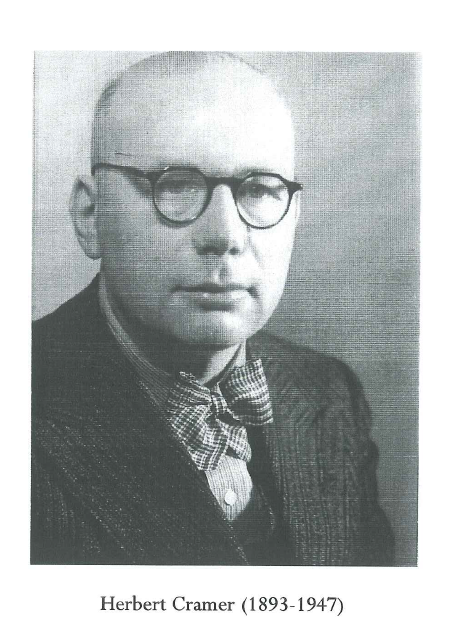
The youngest child of Hedwig Goldschmidt and Hirsch Cramer, Herbert, volunteered for the German army in World War I and served at the front. After the war he opened a small art gallery in Frankfurt.25 He married Elsa Seligmann on August 6, 1920, in Frankfurt. Elsa was the daughter of Leopold Seligmann and Anna Bockmann and was born on July 11, 1894, in Frankfurt.

Herbert Cramer marriage record, Hessisches Hauptstaatsarchiv; Wiesbaden, Deutschland; Bestand: 903, Ancestry.com. Hesse, Germany, Marriages, 1849-1930

Herbert and Elsa had one child, a daughter Ruth born in Frankfurt, on August 14, 1921.26

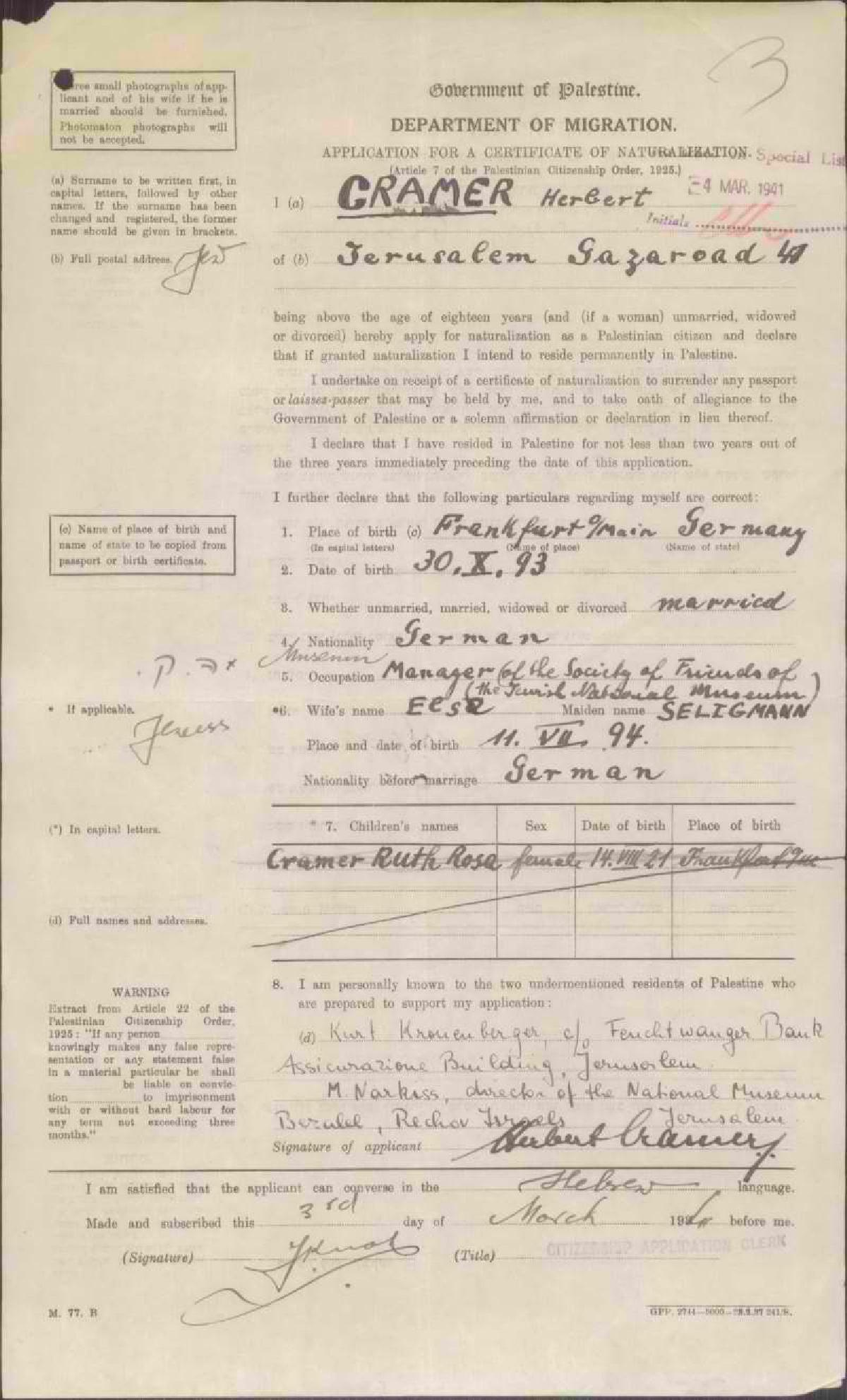
In the 1930s Herbert organized the first exhibit of Chagall paintings in Frankfurt. Then in 1933 he and his family left Germany for Italy.27 From there they immigrated to Palestine on March 2, 1939, and became naturalized citizens of Palestine on April 16, 1941. He listed his occupation as manager of the Society of the Friends of the Jewish National Museum on his application for Palestinian citizenship.
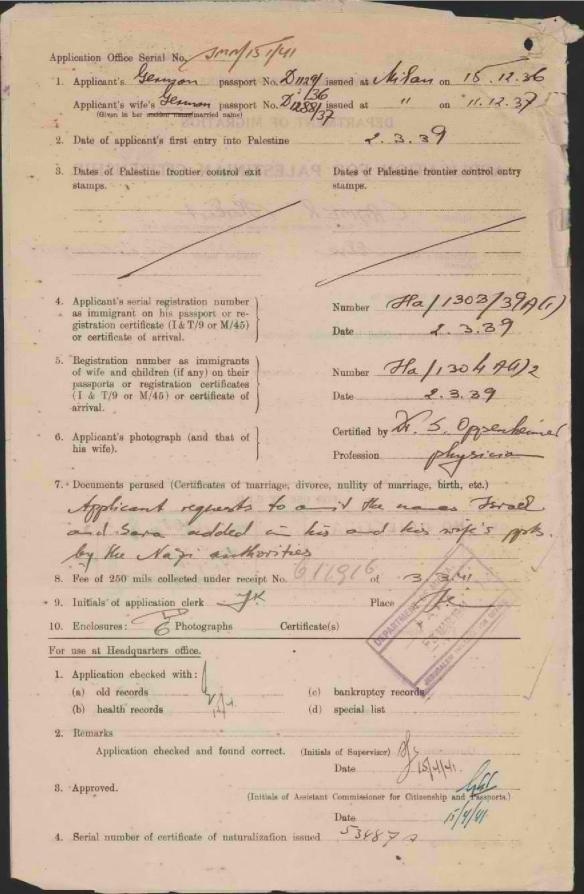
Herbert Cramer, Palestine Immigration File, Israel Archives, https://www.archives.gov.il/en/archives/Archive/0b07170680034dc1/File/0b07170680b58628

Sadly, Herbert died just six years later on April 24, 1947, in Jerusalem, according to a profile on My Heritage. His nephew Arnold Oppenheimer wrote that Herbert was killed when a convoy he was traveling with was ambushed by Arabs.27 His widow Else and daughter Ruth and Ruth’s husband Charles Taubes moved to Australia where Else died in 198328 and Ruth in 2011.29 They were survived by Ruth’s daughter.

UPDATE: Thank you to Yehuda from TTT for locating Herbert’s gravestone on Gravez and Ruth Cramer’s marriage record.

Thus, Hedwig Goldschmidt Cramer’s children and descendants ended up spread all over the world—to Israel, England, the United States, and Australia. Now if I only could find more records for them.

UPDATE: Once again, thanks to those who helped. I am still looking for the birth records for Max Cramer’s children born in the 1920s in Frankfurter, marriage records for Ilse Cramer, Max’s daughter, a marriage and death record for Robert Cramer, who may have died in Israel or in England. I will keep looking.



  1. Max Meyer Cramer, Registration Year: 1908, Registration Quarter: Apr-May-Jun
    Registration District: Islington, Inferred County: London, Volume: 1b, Page: 707
    Max Meyer Cramer, Sidonie Charlotte Gestetner, FreeBMD. England & Wales, Civil Registration Marriage Index, 1837-1915 ↩
  2. Sidonie Charlotte Gestetner, Registration Year: 1888, Registration Quarter: Apr-May-Jun, Registration District: Islington, Inferred County: London
    Volume: 1b, Page: 394, FreeBMD. England & Wales, Civil Registration Birth Index, 1837-1915. Sidonie Feibusch, Gender: Female, Marital Status: Married, Birth Date: 12 Mar 1888, Residence Year: 1939, Address: 8 Westminster Court, Residence Place: St Marylebone, London, England, Occupation: Unpaid Domestic Duties, Line Number: 15
    Schedule Number: 8, Sub Schedule Number: 2, Enumeration District: AROJ, Borough: St Marylebone, Registration district: 7/3, Inferred Spouse: Hans N Feibusch, The National Archives; Kew, London, England; 1939 Register; Reference: RG 101/467I, Ancestry.com. 1939 England and Wales Register ↩
  3. I have no actual biirth records for any of Max Cramer’s children, but had to rely on secondary sources.  MyHeritage profile, https://www.myheritage.com/research/record-1-217644591-1-543485/ilse-caroline-skotzki-born-cramer-in-myheritage-family-trees ↩
  4.  Ellen Theres Kay, Gender: Female, Marital Status: Married, Birth Date: 21 Sep 1911, Residence Year: 1939, Address: 8 Westminster Court, Residence Place: St Marylebone, London, England, Occupation: Studio Photographer, Line Number: 19
    Schedule Number: 8, Sub Schedule Number: 6, Enumeration District: AROJ
    Borough: St Marylebone, Registration district: 7/3, The National Archives; Kew, London, England; 1939 Register; Reference: RG 101/467I, Ancestry.com. 1939 England and Wales Register. ↩
  5.  Name: Hilde Clementine Cramer, Gender: Female, Birth Date: 3 Feb 1916
    Birth Place: Frankfurt a/M, Germany, The National Archives; Kew, London, England; HO 396 WW2 Internees (Aliens) Index Cards 1939-1947; Reference Number: HO 396/220,
    Ancestry.com. UK, World War II Alien Internees, 1939-1945 ↩
  6.  Nelli Cramer, Birth Date: 13 Feb 1918, Birth Place: Frankfurt am Main, Last Residence: Frankfurt am Main, National Archives and Records Administration (NARA); Washington, DC; Name Index of Jews Whose German Nationality Was Annulled by the Nazi Regime (Berlin Documents Center); Record Group: 242, National Archives Collection of Foreign Records Seized, 1675 – 1958; Record Group ARC ID: 569; Publication Number: T355; Roll: 2, Brüll, Erna – Fränkel, Werner, Ancestry.com. Germany, Index of Jews Whose German Nationality was Annulled by Nazi Regime, 1935-1944 ↩
  7. David Baron and Roger Cibella, Goldschmidt Family Report. Arnold S. Oppenheimer, The Story of My Life (2007, Jerusalem), p. 5. ↩
  8.  Sidonie C Cramer, Registration Quarter: Jul-Aug-Sep, Registration District: Marylebone, Inferred County: Middlesex, Spouse: Hans N Feibusch, Volume Number: 1a, Page Number: 1783, General Register Office; United Kingdom; Volume: 1a; Page: 1783, Ancestry.com. England & Wales, Civil Registration Marriage Index, 1916-2005 ↩
  9.  Leo Knopfelmacher, Registration Quarter: Jul-Aug-Sep, Registration District: Bradford, Inferred County: Yorkshire West Riding, Spouse: Elizabeth E Irvine, Volume Number: 9b, Page Number: 267, General Register Office; United Kingdom; Volume: 9b; Page: 267, Ancestry.com. England & Wales, Civil Registration Marriage Index, 1916-2005 ↩ ↩
  10.  Leo Knoppelmacher, Death Age: 41, Birth Date: abt 1905, Registration Quarter: Jan-Feb-Mar, Registration District: Pancras, Inferred County: London, Volume: 1b, Page: 75, General Register Office; United Kingdom; Volume: 1b; Page: 75, Ancestry.com. England & Wales, Civil Registration Death Index, 1916-2007 ↩
  11.  Ellen T Kay, Death Age: 50, Birth Date: abt 1912, Registration Quarter: Jul-Aug-Sep, 1962 Registration District: Paddington, Inferred County: London, Volume: 5d
    Page: 122, General Register Office; United Kingdom; Volume: 5d; Page: 122,
    Ancestry.com. England & Wales, Civil Registration Death Index, 1916-2007. Ellen Theresa Kay, Death Date: 28 Jun 1962, Death Place: London, England, Probate Date: 12 Oct 1962, Probate Registry: London, England, Ancestry.com. England & Wales, National Probate Calendar (Index of Wills and Administrations), 1858-1995 ↩
  12. Ancestry.com. England, Andrews Newspaper Index Cards, 1790-1976; Hilda C Cramer, Registration Quarter: Jan-Feb-Mar 1950, Registration District: Marylebone
    Inferred County: Middlesex, Spouse: Frank E Werth Or Wertheimer, Volume Number: 5d, Page Number: 713, General Register Office; United Kingdom; Volume: 5d; Page: 713, Ancestry.com. England & Wales, Civil Registration Marriage Index, 1916-2005 ↩
  13.  Frank Edward Werth, Death Age: 72, Birth Date: 26 Apr 1918, Registration Date: Dec 1990, Registration District: Camden, Inferred County: Greater London., Volume: 14
    Page: 1849, General Register Office; United Kingdom; Volume: 14; Page: 1849, Ancestry.com. England & Wales, Civil Registration Death Index, 1916-2007; Frank Edward Werth, Death Date: 2 Dec 1990, Death Place: London, Probate Date: 25 Jun 1991, Probate Registry: London, Ancestry.com. England & Wales, National Probate Calendar (Index of Wills and Administrations), 1858-1995 ↩
  14. David Baron and Roger Cibella, Goldschmidt Family Report. ↩
  15. Alfred Norbert Wit Bzowiecki, Death Date: 30 Sep 1971, Death Place: London
    Probate Date: 21 Nov 1972, Probate Registry: London, Ancestry.com. England & Wales, National Probate Calendar (Index of Wills and Administrations), 1858-1995 ↩
  16. Nellia Elsa Bzowiecka, Death Date: 4 Feb 1976, Death Place: London
    Probate Date: 4 Feb 1976, Probate Registry: London, Ancestry.com. England & Wales, National Probate Calendar (Index of Wills and Administrations), 1858-1995 ↩
  17.  Felicitas Fanny Cramer, Birth Date: 10 Aug 1889, Birth Place: Straßburg, Elsass (Alsace), Last Residence: Hamburg, National Archives and Records Administration (NARA); Washington, DC; Name Index of Jews Whose German Nationality Was Annulled by the Nazi Regime (Berlin Documents Center); Record Group: 242, National Archives Collection of Foreign Records Seized, 1675 – 1958; Record Group ARC ID: 569; Publication Number: T355; Roll: 2, Brüll, Erna – Fränkel, Werner, Ancestry.com. Germany, Index of Jews Whose German Nationality was Annulled by Nazi Regime, 1935-1944 ↩
  18. Oppenheimer, note 7, p. 5. ↩
  19. Marion Wolf, [Marion Cramer], Gender: Female, Declaration Age: 24, Record Type: Declaration, Birth Date: 3 Apr 1913, Birth Place: Frankfurt a/m Germany
    Arrival Date: 2 Sep 1937, Arrival Place: New York, New York, USA, Declaration Date: 13 Jan 1938, Declaration Place: New York, Court: U.S. District Court for the Southern District of New York, Spouse: Fritz, Declaration Number: 408397, Box Number: 273
    The National Archives at Philadelphia; Philadelphia, Pennsylvania; NAI Title: Declarations of Intention for Citizenship, 1/19/1842 – 10/29/1959; NAI Number: 4713410; Record Group Title: Records of District Courts of the United States, 1685-2009; Record Group Number: 21, Ancestry.com. New York, U.S., State and Federal Naturalization Records, 1794-1943 ↩
  20. Robert Cramer, Birth Date: 29 Dez 1918, Birth Place: Bad Nauheim
    Last Residence: Hamburg, National Archives and Records Administration (NARA); Washington, DC; Name Index of Jews Whose German Nationality Was Annulled by the Nazi Regime (Berlin Documents Center); Record Group: 242, National Archives Collection of Foreign Records Seized, 1675 – 1958; Record Group ARC ID: 569; Publication Number: T355; Roll: 2, Brüll, Erna – Fränkel, Werner, Ancestry.com. Germany, Index of Jews Whose German Nationality was Annulled by Nazi Regime, 1935-1944 ↩
  21. Baron and Cibella, Goldschmidt Family Report. ↩
  22. Marion Cramer, ship manifest, Year: 1937; Arrival: New York, New York, USA; Microfilm Serial: T715, 1897-1957; Line: 4; Page Number: 4, Ancestry.com. New York, U.S., Arriving Passenger and Crew Lists (including Castle Garden and Ellis Island), 1820-1957 ↩
  23. Fritz and Marion Wolf, 1940 US census, Year: 1940; Census Place: New York, Queens, New York; Roll: m-t0627-02725; Page: 5B; Enumeration District: 41-242,
    Ancestry.com. 1940 United States Federal Census ↩
  24. Salomon Sally Cramer, Death Date: 12 Jun 1951, Death Place: Lancashire, England, Probate Date: 20 Dec 1951, Probate Registry: London, England, Ancestry.com. England & Wales, National Probate Calendar (Index of Wills and Administrations), 1858-1995. See also Oppenheimer, note 7, p. 5. ↩
  25. Oppenheimer, note 7, p. 6. ↩ ↩
  26. David Baron and Roger Cibella, Goldschmidt Family Report ↩
  27. Oppenheimer, note 7, p. 6. ↩ ↩
  28. The Sydney Morning Herald – 1 Dec 1984 – Page 136 ↩
  29. https://www.findagrave.com/memorial/145293304/ruth-tadmore ↩