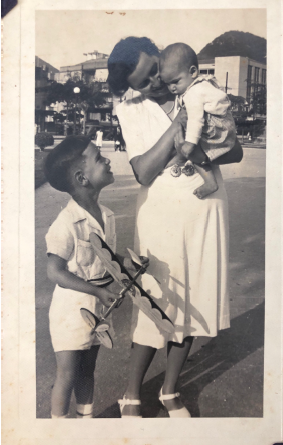
Moses Max Rothschild and His Family: One Daughter Escaped to America

Returning now to the family of Gelle Blumenfeld, what do I know for certain about the life of her grandson Moses Max Rothschild after his marriage in 1897 and the births of his children in the years that followed? As you may recall, the records for this family were quite limited and trees provided few or no sources. So I know very little for sure about Moses Max Rothschild, but more about two of his children.

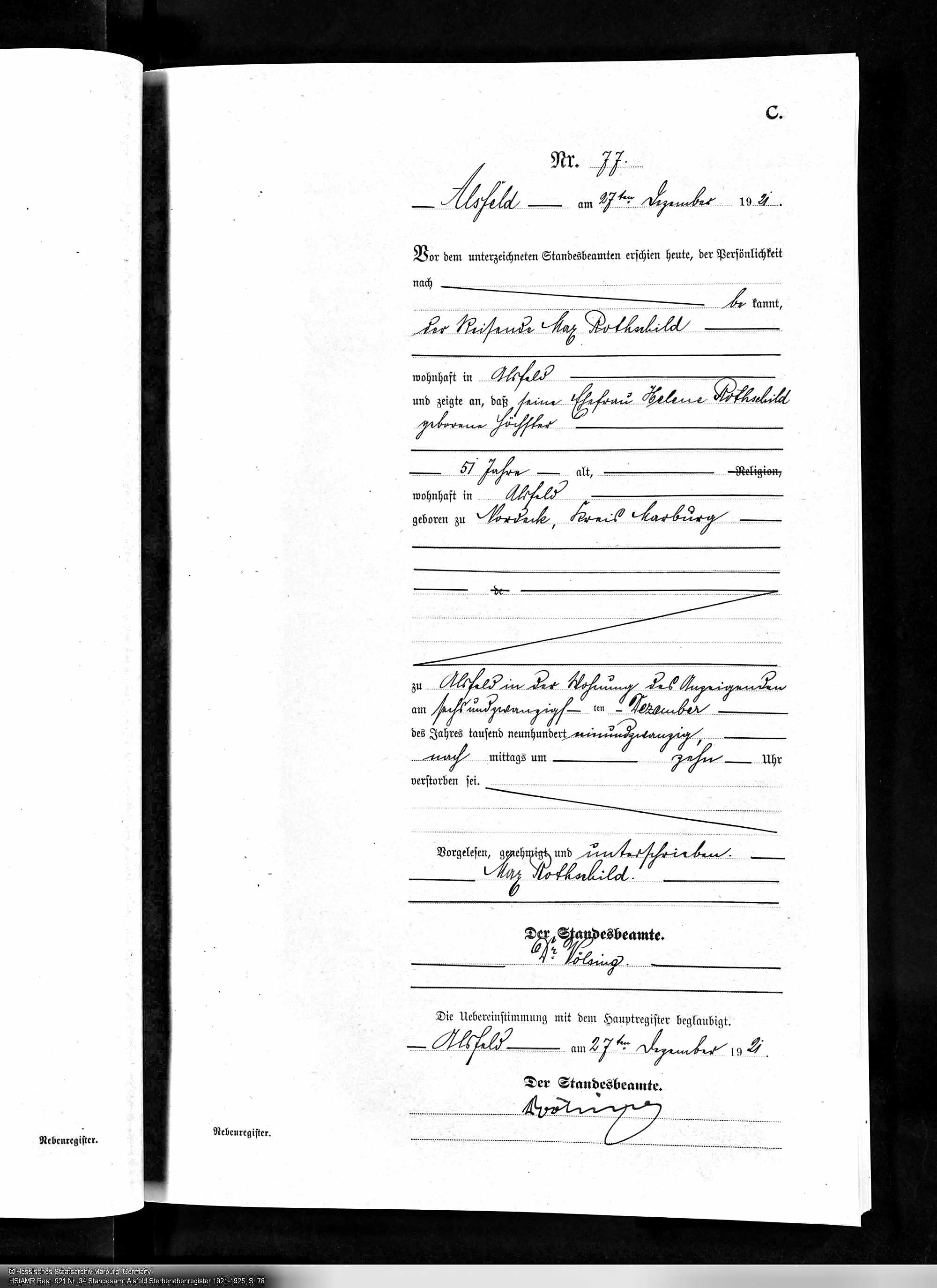
I know that his wife Helene Hoechster died on December 26, 1921, at the age of 51, and that she is buried in the Alsfeld Jewish cemetery.

Helene Hoechster Rothschild death record, Hessisches Hauptstaatsarchiv; Wiesbaden, Deutschland; Personenstandsregister Sterberegister; Bestand: 34; Laufende Nummer: 921
Year Range: 1921-1925, Ancestry.com. Hesse, Germany, Deaths, 1851-1958

Find a Grave, database and images (https://www.findagrave.com/memorial/172987583/helene-rothschild: accessed 11 January 2024), memorial page for Helene Höchster Rothschild (3 Sep 1870–26 Dec 1921), Find a Grave Memorial ID 172987583, citing Alsfeld Jewish Cemetery, Alsfeld, Vogelsbergkreis, Hessen, Germany; Maintained by Looking For Loved Ones (contributor 50883347).

Geneanet says that Moses died in 1938, but I have no source for that despite searching in the online records for both Alsfeld and Nordeck. There is no entry for Moses on FindAGrave at the Alsfeld Jewish cemetery, but that doesn’t mean he isn’t buried there, just that no one has added a listing for his gravesite on FindAGrave.

As for the children of Moses and Helene, as noted in my prior post, although some trees show five children, I only have records for three of them that tie them to Moses and Helene: Gertrude, Erna, and Erwin. According to Geneanet, Gertrude married Eric Voos and ended up in Israel where she died in about 1980. But I found no records for them at the Israel Genealogy Research Association website, and sadly the Israel State Archives was the subject of a cyberattack and their records are not online at this time. So I have no sources for Gertrude after her birth record.

For her sister Erna, however, I have had better success. On February 25, 1930, in Berlin, she married Rabbi Moritz Winter. He was born on November 9, 1886, in Magdeburg, Germany, to Salomon Winter and Hulda Abraham.1

Erna Rothschild and Moritz Winter marriage record, Landesarchiv Berlin; Berlin, Deutschland; Personenstandsregister Heiratsregister, Register Year or Type: 1930 (Erstregister), Ancestry.com. Berlin, Germany, Marriages, 1874-1936

Moritz Winter had been previously married to Ernestine Abraham, who died on November 8, 1929, in Berlin.2 Four months later he married Erna Rothschild. Moritz had a son Salomon Fritz Winter with his first wife; he was born on December 11, 1914, in Konigsberg, Germany.3 Moritz and Erna then had their own child, Walter Theodor Winter, born on April 3, 1931, in Berlin.4

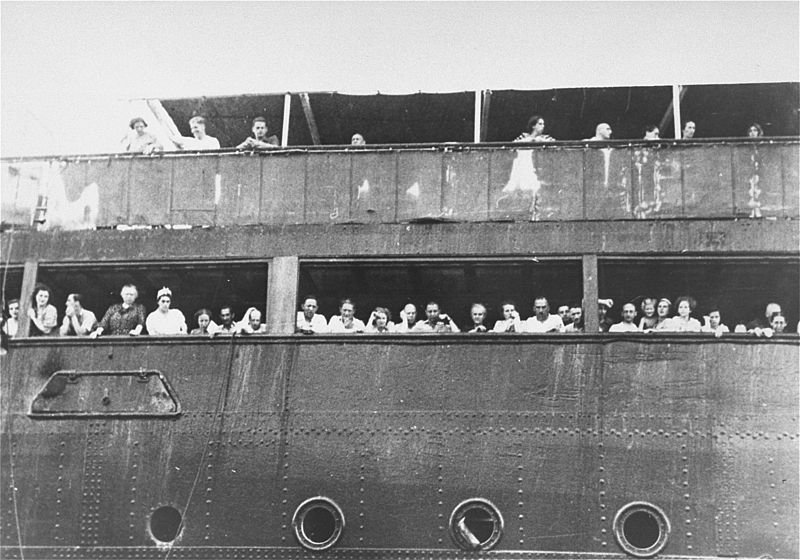
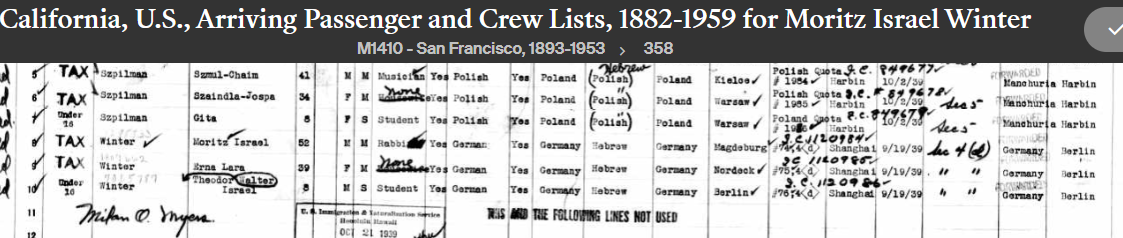
Fortunately, Erna, Moritz, and Walter all left Germany early enough to survive the Holocaust. According to one article, they left after Kristallnacht when Moritz’s synagogue was burned. They first escaped to Shanghai, China, but then immigrated to the US, arriving in San Francisco on October 27, 1939.5

Moritz Winter and family ship manifest, The National Archives at Washington, D.C.; Washington, D.C.; Passenger Lists of Vessels Arriving At San Francisco, California; NAI Number: 4498993; Record Group Title: Records of the Immigration and Naturalization Service, 1787-2004; Record Group Number: 85, NARA Roll Number: 358, Ancestry.com. California, U.S., Arriving Passenger and Crew Lists, 1882-1959

Meanwhile, Erna’s stepson Salomon Fritz Winter immigrated to Uruguay where he was, like his father, a rabbi. He was interviewed by the Shoah Foundation, but his interview is in Spanish, so I need to find someone who can translate it for me.6

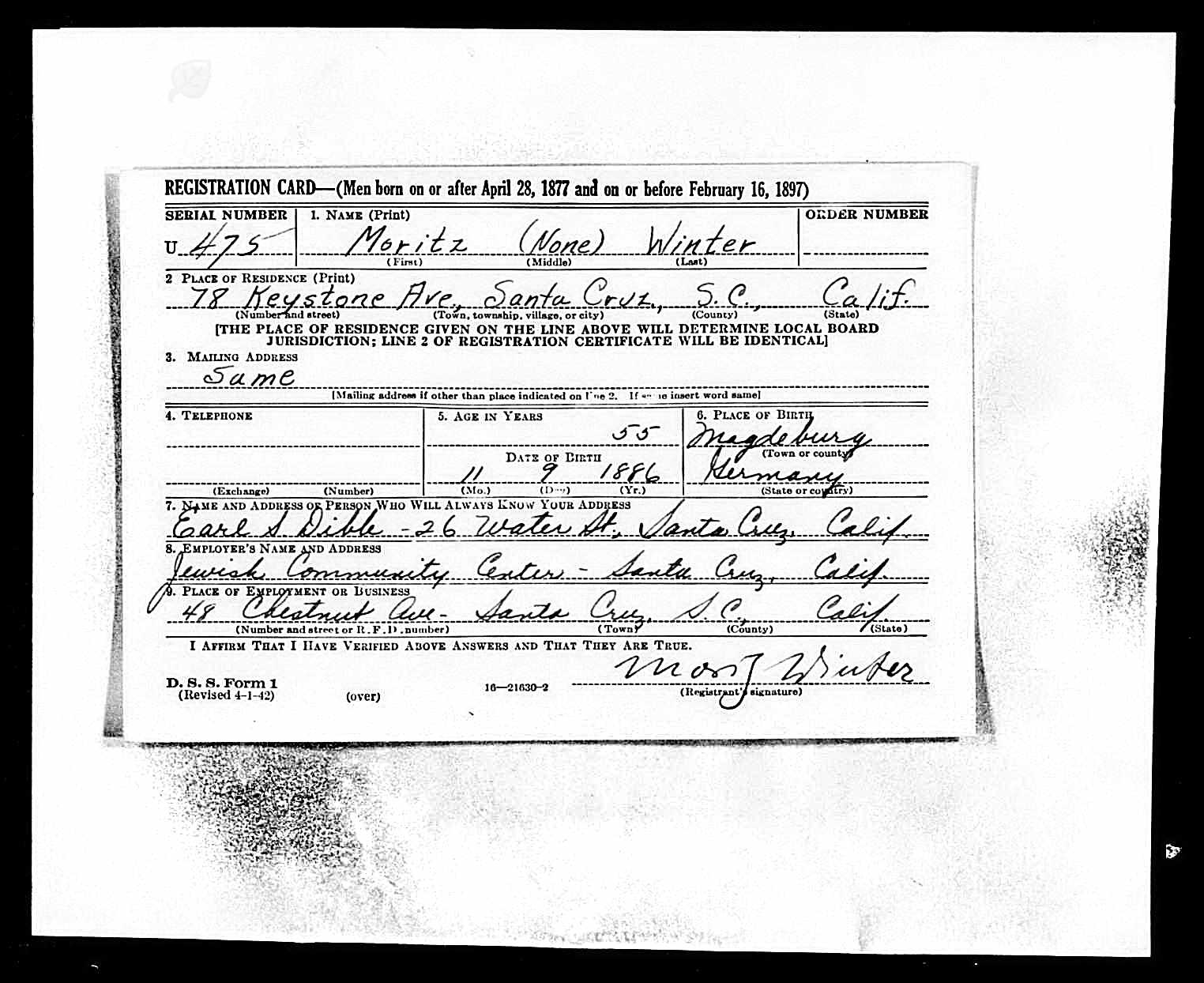
Erna, Moritz, and Walter settled in San Francisco, where they are listed on the 1940 US census, Moritz’s occupation being described as a rabbi at a “Jewish church.” 7 On April 26, 1942, Moritz registered for the World War II draft and listed his address in Santa Cruz, California, and his employer as the Jewish Community Center there.

Moritz Winter, World War II draft registration, The National Archives At St. Louis; St. Louis, Missouri; World War Ii Draft Cards (4th Registration) For the State of California; Record Group Title: Records of the Selective Service System; Record Group Number: 147, Name Range: Franceschini, Francesco – Woehl, Charles, Ancestry.com. U.S., World War II Draft Registration Cards, 1942

By 1947, Moritz was working at the Oakland, California, Jewish Community Center, where he was an instructor in Hebrew studies, customs, and rituals. In 1950 the family was living in Oakland, and Moritz was a Hebrew teacher and librarian at the Jewish Community Center.8

Their son Walter went to the local Oakland schools and then to the City College of San Francisco and Golden Gate University School of Law; he passed the California bar exam in 1957. Walter became a highly successful divorce lawyer, litigating thousands of cases. If you Google “Walter T Winter,” you will see many cases where he is listed as one of the lawyers. Walter also wrote three books on divorce law. He also served in the US Marines.9

His mother Erna Rothschild Winter died on June 29, 1969, in Oakland. She was 69 years old.10 Her husband Rabbi Moritz Winter died in Oakland two years later on July 14, 1971; he was 84.11 They are buried next to each other at the Home of Peace cemetery in Oakland.

Find a Grave, database and images (https://www.findagrave.com/memorial/159031124/moritz-winter: accessed 11 January 2024), memorial page for Dr Moritz Winter (9 Nov 1886–14 Jul 1971), Find a Grave Memorial ID 159031124, citing Home of Peace Cemetery, Oakland, Alameda County, California, USA; Maintained by Stephen C. Miller (contributor 47963213).

Their son Walter did not live a long life. He died on April 15, 1985, when he was only 54.12 He was survived by his two children and his half-brother Rabbi Salomon Fritz Winter in Uruguay.

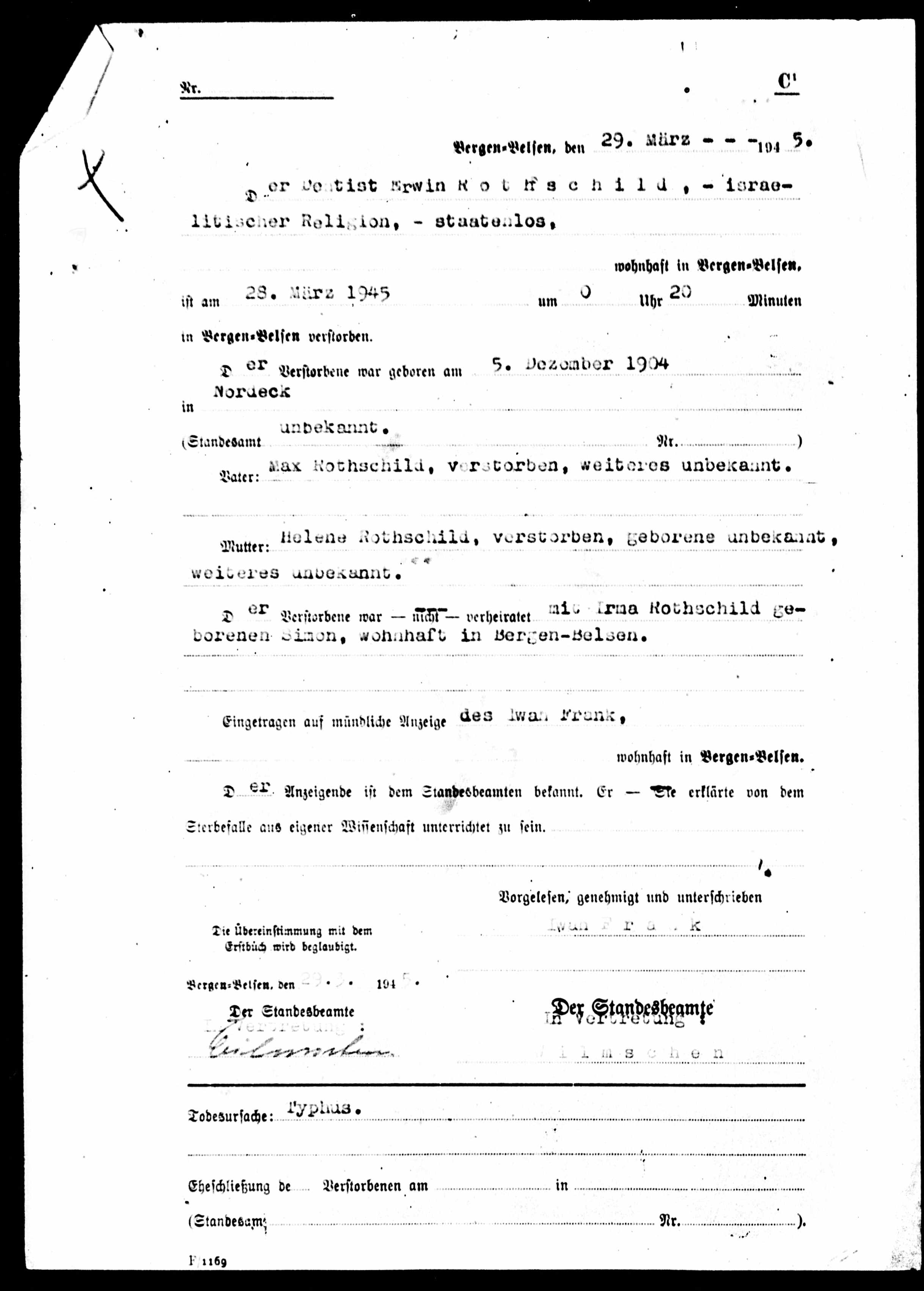
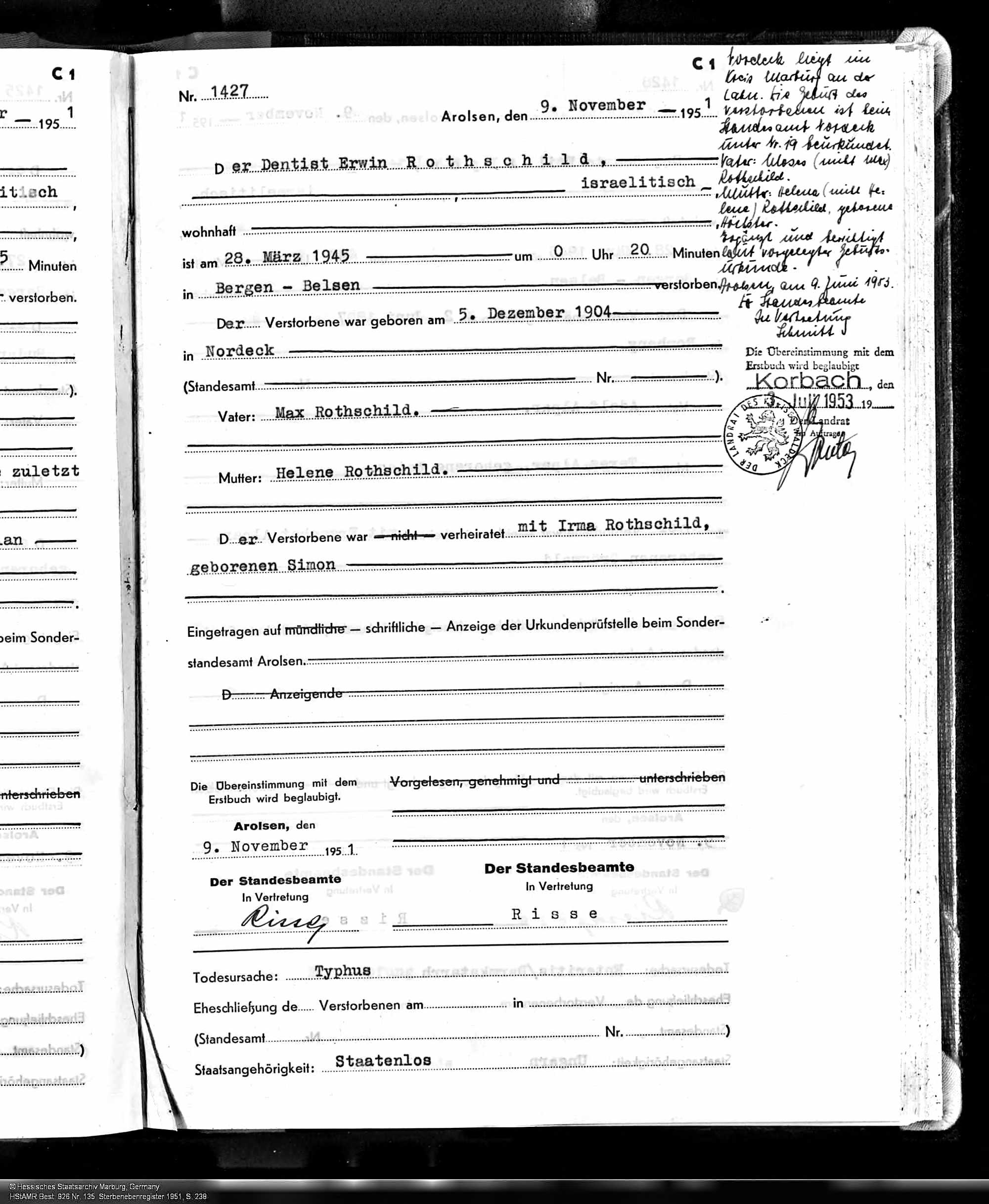
The third child of Moses Max Rothschild and Helene Hoechster for whom I have records was their son Erwin, and I do have information on Erwin’s life and death. I will tell his story in my next post.


  1. Moritz Winter birth record, Ancestry.com. Magdeburg, Germany, Births, 1874-1903 
  2. Ernestine Abraham Winter death record, Landesarchiv Berlin; Berlin, Deutschland; Personenstandsregister Sterberegister, Registration Year or Type: 1929 (Erstregister), Ancestry.com. Berlin, Germany, Deaths, 1874-1955 
  3. Salomon Fritz Winter, Gender Male, Marital Status Married,Birth Date 11 de dez de 1914 (11 Dec 1914), Birth Place Konigsberg, Arrival Date 1961, Arrival Place Rio de Janeiro, Rio de Janeiro, Brazil, Father Moritz Winter, Mother Ernestine Abraham, Traveling With Children No, FHL Film Number 004920148, Ancestry.com. Rio de Janeiro, Brazil, Immigration Cards, 1900-1965 
  4. Walter Winter, Gender Male, Race White, Birth Date 3 Apr 1931, Birth Place Berlin, Federal Republic of Germany, Death Date Apr 1985, Father Moritz Winter, Mother Erna Rothschild, SSN 550383707, Ancestry.com. U.S., Social Security Applications and Claims Index, 1936-2007 
  5. “Rites Held for Erna Winter, 69,” Oakland (CA) Tribune, July 2, 1969, p. 22. 
  6. Rabbi Fritz Salomon Winter, [Rabbi Rav ben Moshe Winter], [Rabbi Shlomo Winter], Gender Male, Birth Date 11 Dec 1914, Birth Place Königsberg, Germany
    Interview Date 9 Jun 1997, Interview Place Montevideo, Montevideo, Uruguay
    Relationship Self (Head), Role Interviewee, USC Shoah Foundation; Los Angeles, California; Visual History Archive: The Holocaust, Free Access: USC Shoah Foundation, Holocaust – Jewish Survivor Interviews 
  7. Moritz Winter and family, 1940 US census, Year: 1940; Census Place: San Francisco, San Francisco, California; Roll: m-t0627-00319; Page: 7B; Enumeration District: 38-522, Ancestry.com. 1940 United States Federal Census 
  8. “Summer Program of ‘Fun’ Camp to be Previewed,” Oakland (CA) Tribune, 26 Jun 1947, Thu ·Page 7. 
  9. “Walter Winter,” The San Francisco Examiner, San Francisco, California , Fri, Apr 19, 1985, Page 27 
  10. Erna Winter, Social Security # 567300066, Gender Female, Birth Date 25 Nov 1899, Death Date 29 Jun 1969, Death Place Alameda, Mother’s Maiden Name Hoechster, Place: Alameda; Date: 29 Jun 1969; Social Security: 567300066, Ancestry.com. California, U.S., Death Index, 1940-1997 
  11. Moritz Winter, Gender Male, Birth Date 9 Nov 1886, Death Date 14 Jul 1971, Death Place Alameda, Place: Alameda; Date: 14 Jul 1971, Ancestry.com. California, U.S., Death Index, 1940-1997 
  12. Walter Theodor Winter, Gender Male, Birth Date 3 Apr 1931, Birth Place Other Country, Death Date 15 Apr 1985, Death Place Marin, Mother’s Maiden Name Rothschild, Place: Marin; Date: 15 Apr 1985, Ancestry.com. California, U.S., Death Index, 1940-1997. See also Note 9, supra. 

The Children of Katincka Blumenfeld Heymann: Lost and Found and Lost Again

Thanks once again to a new reader of my blog and a newly found cousin, I have updates to two of my earlier posts. I am so grateful to my new cousin Ofra for telling me about additional relatives I’d not been able to find and for giving me the records to verify that these were in fact our mutual cousins.

This new information all relates to the descendants of Abraham Blumenfeld III and his wife Fredericke Rothschild. I wrote back on February 8, 2022, over two years ago, that their daughter Katincka Blumenfeld and her husband Samuel Heymann “immigrated to Brazil in the summer of 1939 just before World War II started. I have no further information about their lives, but they had no children after their daughter Frieda died in 1911 at ten months of age. There are no descendants of Katincka and Samuel.” But I was wrong. Although they had no children after Frieda died, they had had other children before she was born.

As Ofra pointed out, Katincka and Samuel had at least three other children born before their daughter Frieda, all born in Biskirchen, Germany: Isidor, born June 9, 1905, Hedwig, born December 2, 1906, and Jakob, born May 24, 1909.1 Tragically, all three were killed in the Holocaust. Although I was able to find records for all three of these individuals on Yad Vashem, none of those records mentioned the names of their parents. And the birth records for Biskirchen start in 1910, so there are no birth records for these children online. I asked Ofra if she had any records that identified these three people as the children of Katincka and Samuel Heymann. And she did.2

Here are two Arolsen Archives documents that show that Isidor and Jakob Heymann were the sons of Samuel Heymann. Notice also that they were both living at the same address.

Arolsen Archives, DocID: 6096427 (ISIDOR HEYMANN) DeepLink: https://collections.arolsen-archives.org/en/document/6096427

Arolsen Archives, DocID: 6096431 (JAKOB HEYMANN)
DeepLink: https://collections.arolsen-archives.org/en/document/6096431

Although Ofra did not have a similar document tying Hedwig to Katincka and Samuel Heymann, she did provide me with links to pages showing the Stolpersteine established for Hedwig and other members of her family in Biskirchen, Germany. From one of those pages I learned the following:

Henriette Neter (*1906) was married to Isidor Heymann (*1905). The couple was deported from Gildehaus (Bielefelder Transport). Henriette was murdered in Stutthof in 1943, her husband on October 24, 1944 in the Landsberg/Lech camp.…

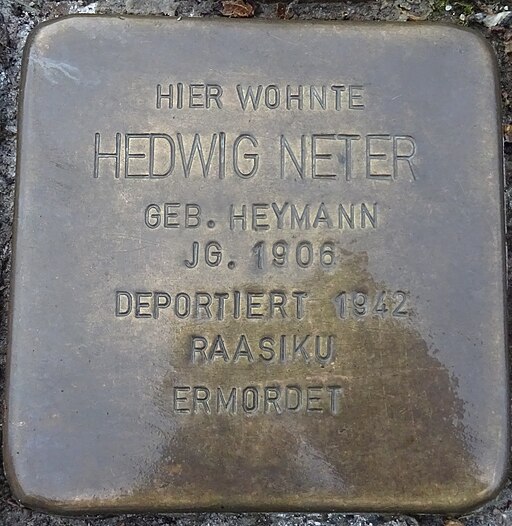
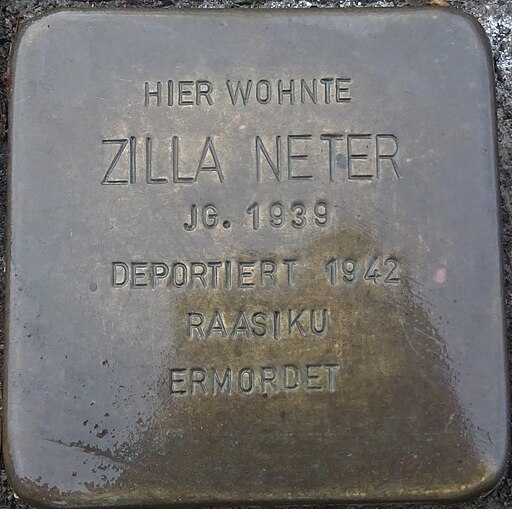
Erich Neter (*1913) married Isidor Heymann’s sister, Hedwig Heymann (*1906), in his first marriage. They had two children. Zilla Neter – 4 years old – and Semi Neter – 1½ years old – were shot together with their mother in December 1943 near Riga.

Erich Neter survived and later remarried and had two more children.3

Although this is not an official record, it is sufficient in my mind to establish that Hedwig was Isidor Heymann’s sister and thus also the child of Katincka Blumenfeld and Samuel Heymann.

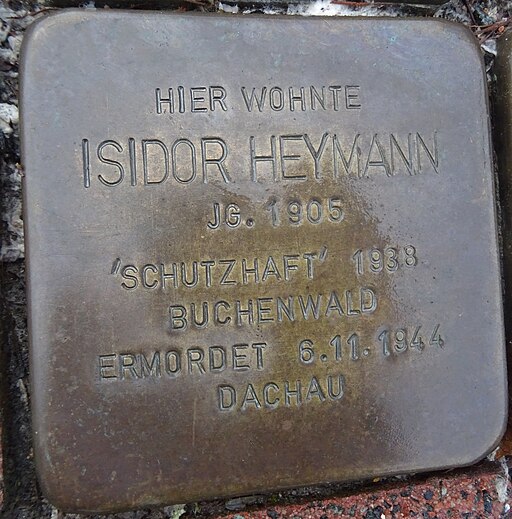
But what a terrible, heartbreaking story to have to add to my family history. Isidor and his wife and his sister Hedwig and her two young children were murdered by the Nazis. The Nazis also killed Jakob Heymann. All of those newly found cousins were killed in the Holocaust. Here are the Stolpersteine placed in their memory in Biskirchen.

Meikel1965, CC BY-SA 4.0 <https://creativecommons.org/licenses/by-sa/4.0&gt;, via Wikimedia Commons

Meikel1965, CC BY-SA 4.0 <https://creativecommons.org/licenses/by-sa/4.0&gt;, via Wikimedia Commons

Meikel1965, CC BY-SA 4.0 <https://creativecommons.org/licenses/by-sa/4.0&gt;, via Wikimedia Commons

Meikel1965, CC BY-SA 4.0 <https://creativecommons.org/licenses/by-sa/4.0&gt;, via Wikimedia Commons

Meikel1965, CC BY-SA 4.0 <https://creativecommons.org/licenses/by-sa/4.0&gt;, via Wikimedia Commons

In addition to helping me document and add these additional children of Katincka and Samuel to my tree, Ofra also had information about another descendant of Abraham Blumenfeld III and Fredericke Rothschild—their grandson Julius Blumenfeld, the son of Hugo Blumenfeld and Blanka Rosenberg. I had written that Julius had emigrated to Palestine/Israel on August 23, 1934, and married Ettel Helfgott on March 26, 1940, in Haifa, but I had no further information about him. Ofra sent me a link to an obituary of Julius that reported that Julius had died of illness while serving in the IDF on May 31, 1954. He was only 46 years old and left behind his wife and two children, whose names were not given in the obituary.

Once again, I want to thank Ofra for all her help in allowing me to update this blog as well as my family tree. Although all these lives ended far too soon, I am glad that I can honor all of their memories.


  1. Although Yad Vashem has Jakob’s birthdate as April 24, 1909, the Arolsen Archive document reproduced below says his birthdate was May 24, 1909. Since Jakob signed that document, I assume it is more accurate. 
  2. Ofra also named a fifth child of Katincka and Samuel, a son named Max Heymann who was born January 12, 1908, and who emigrated to the United States and/or Brazil. I am still trying to locate information for Max. 
  3. Yad Vashem has different information about the death of Isidor Heymann. It says he was killed at Dachau on November 6, 1944, as does the Stolpersteine shown above. 

The Legacy of Thekla Blumenfeld Gruenbaum: Family Photos

I mentioned in my last blog post that I have recently connected with another cousin, Robin Kravets, the great-granddaughter of Thekla Blumenfeld Gruenbaum. Robin is my fifth cousin, once removed. We are both descendants of Abraham Blumenfeld and Geitel Katz, Robin through their son Moses and me through their daughter Breine.

Robin has generously shared with me a collection of photographs of her family, and I am delighted to be able to share them with you. All the photos in this post are courtesy of my cousin Robin. I am providing a summary of what I posted two years ago about Robin’s direct ancestors to provide context to the photos and to add some additional insights Robin shared with me. The blog posts from 2021 contain more details and my sources.

Salomon Blumenfeld, Robin’s great-great-grandfather, first married Caecilie Erlanger, but she died when she was only 24 years old, leaving behind two very young children: Thekla (Robin’s great-grandmother), not yet two, and Felix, just seven months old. Two years after his first wife Caecilie died, Salomon married Emma Bendheim and had a third child, Moritz, in 1877. And then sometime within the next five or six years, Salomon left Germany for Spain with Emma and Moritz, leaving his first two children, Thekla and Felix, behind. As best I can tell, Thekla and Felix, still both young children, must have been raised by their mother’s family, the Erlangers, in Marburg.

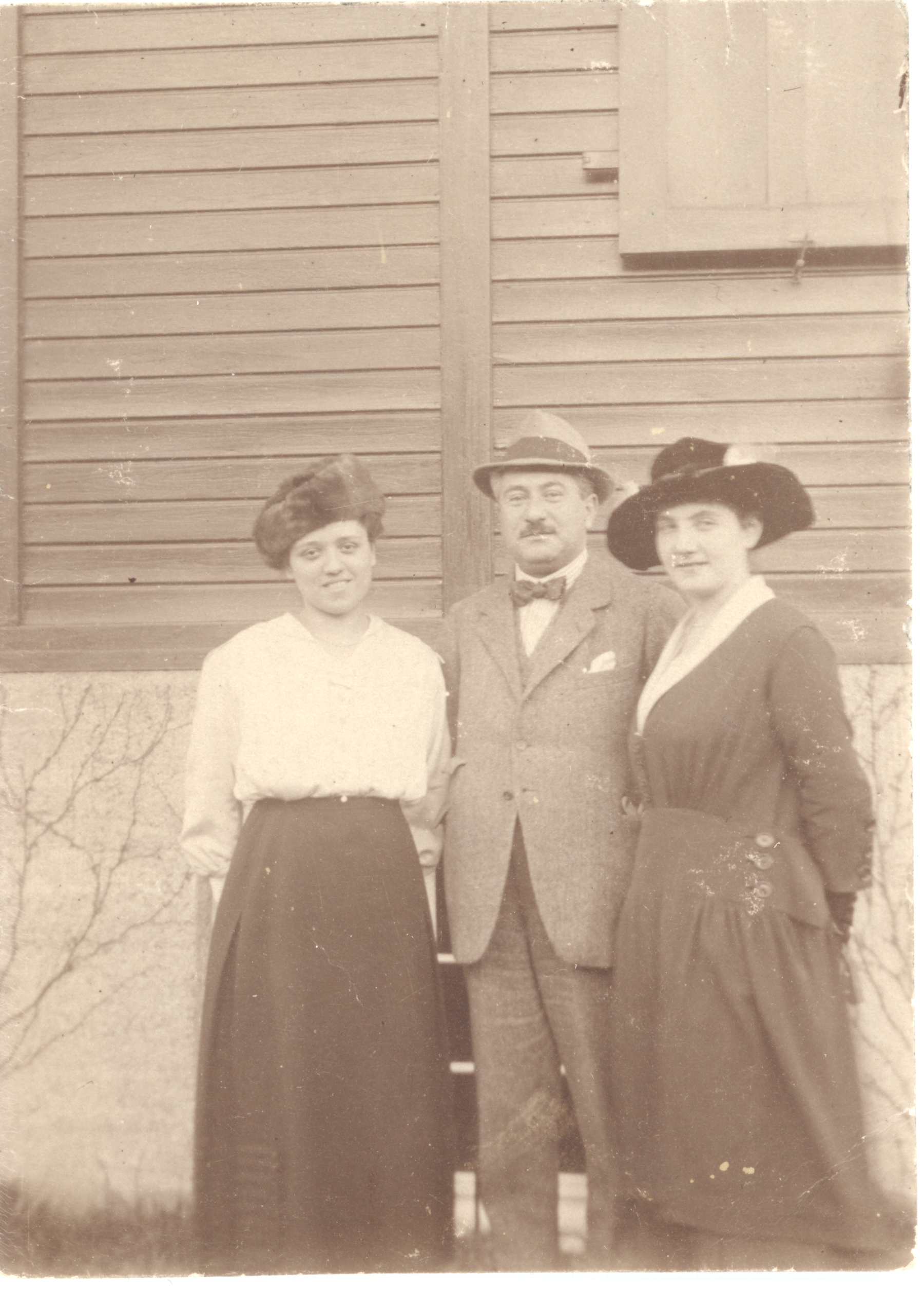
I had wondered whether Salomon or his son from his second marriage, Moritz, had remained in touch with Thekla and Felix. Robin provided this photograph of Moritz with his half-niece Cecilie, Thekla’s daughter, and another unidentified woman, so there is some evidence that at least Moritz had some contact with his half-sister Thekla and her family.

Moritz Blumenfeld and Cecilie Gruenbaum (with unknown woman on the left)
Courtesy of Robin H Kravets

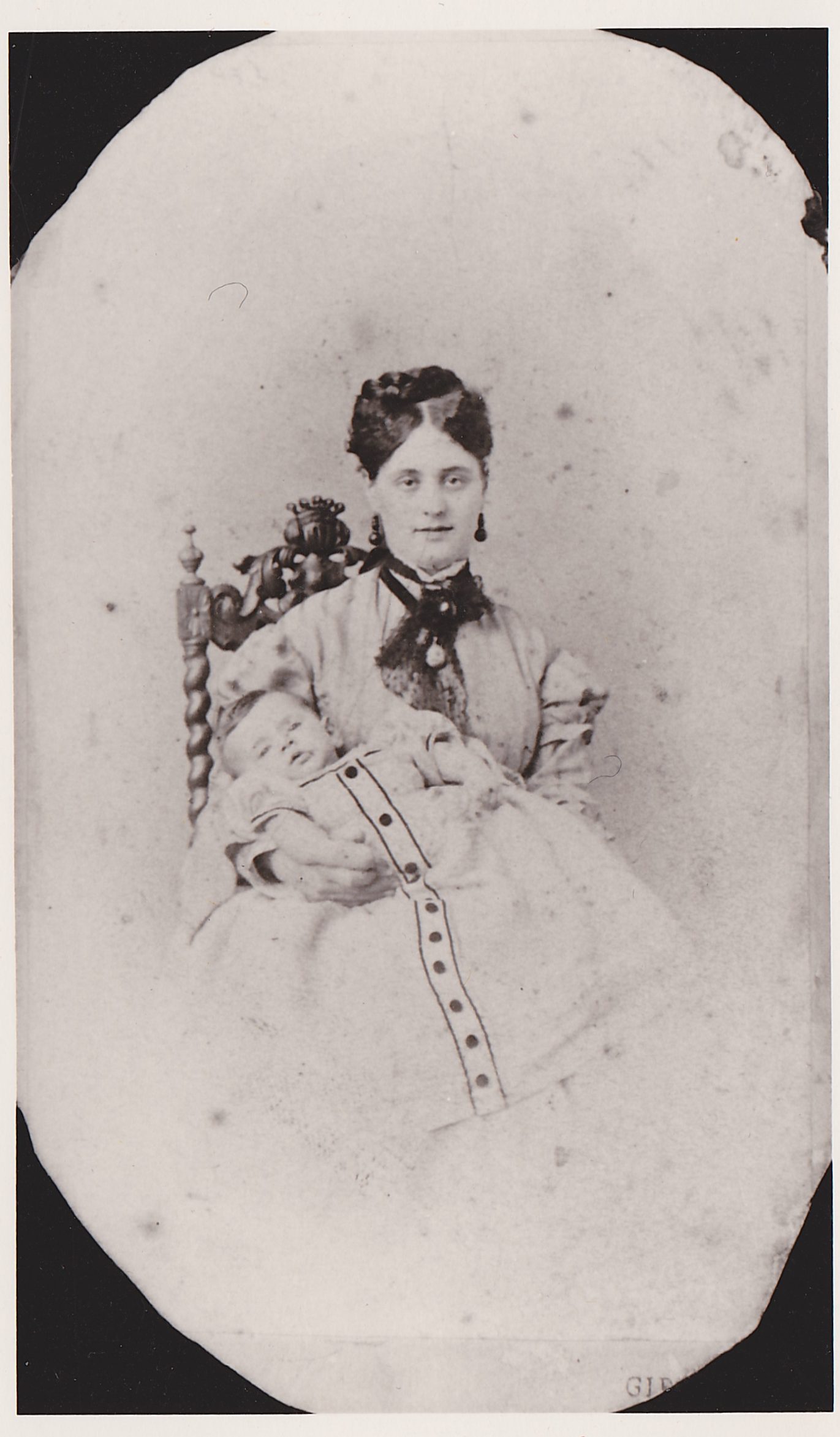
This is the oldest photograph in Robin’s collection. It shows Thekla as an infant with her mother, Caecilie Erlanger Blumenfeld and must have been taken in about 1872 when Thekla was born. Thank you to Ava Cohn, aka Sherlock Cohn, The Photogenealogist, for pointing out the correct dating of this photograph.

Caecilie Erlanger Blumenfeld with Thekla Blumenfeld, c. 1872 Courtesy of Robin H Kravets

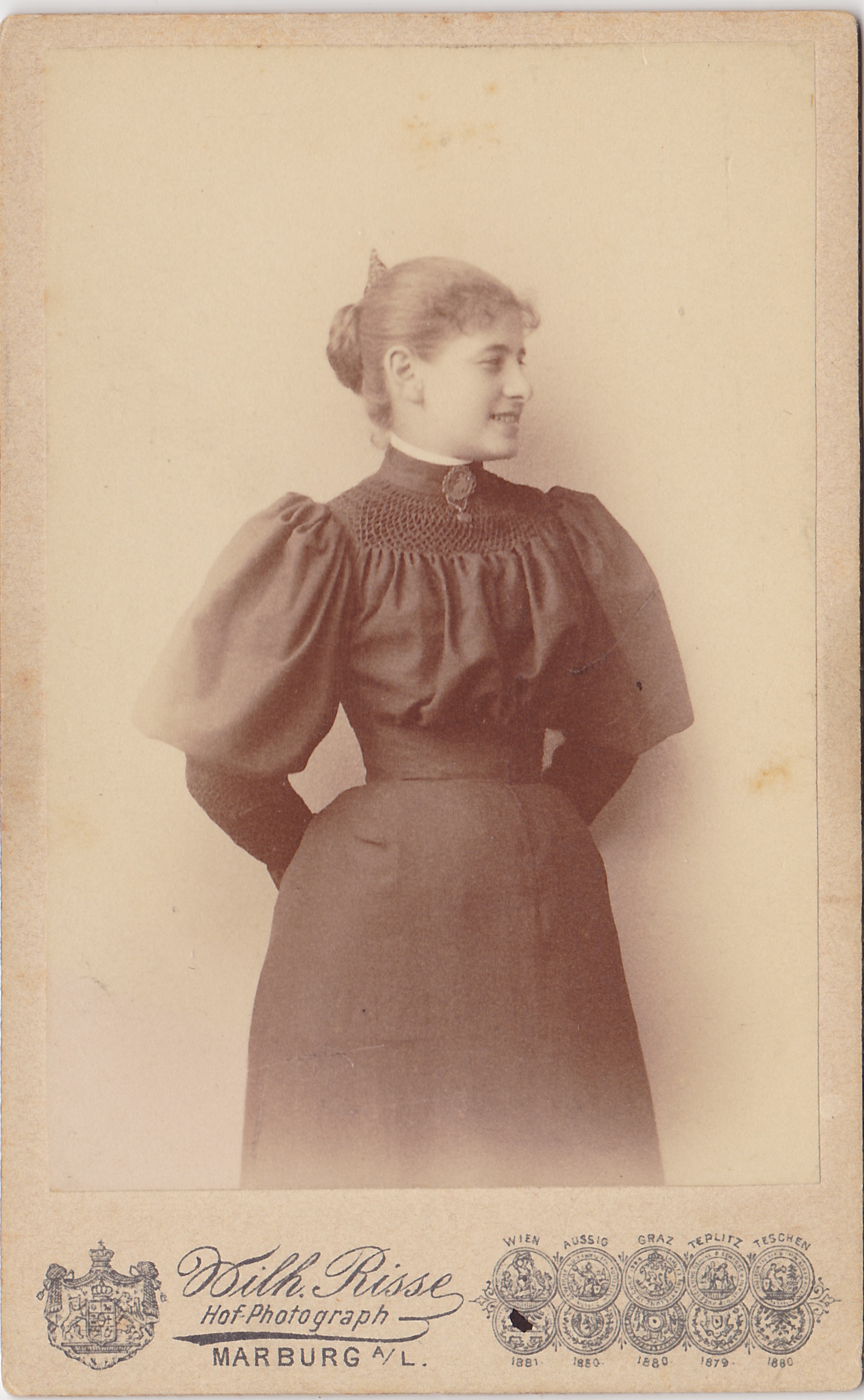
Here are two beautiful photographs of Thekla as a young woman.

Thekla Blumenfeld, courtesy of Robin H Kravets

Thekla Blumenfeld, courtesy of Robin H Kravets

Thekla married Max Gruenbaum in 1894. Here is a photograph of them taken in 1895.

Thekla Blumenfeld and Max Gruenbaum 1895
Courtesy of Robin H Kravets

Thekla and Max had four children: Cecilie (1895), Curt (1897), Franz (1899), and Rosemarie, Robin’s grandmother (1912).

Cecilie, Curt, and Franz Gruenbaum c. 1908 Courtesy of Robin H Kravets

Courtesy of Robin H Kravets

Cecilie, Franz, Rosemarie and Curt Gruenbaum, 1918  Courtesy of Robin H Kravets

Thekla’s brother Felix married Thekla Wertheim in 1902, and they had two sons, Edgar (1903) and Gerhard (1906). Robin had just a few photos of Felix; he appears to be in uniform during World War I in these first two. The caption on the first translates as “to commemorate the first nailing of the Zaitenstock.” I am not sure what that means, but Wikipedia explains (as translated by Google) that zaitenstocke were part of the pipe systems used to carry water into the cities.

Felix Blumenfeld, 1915 Courtesy of Robin H Kravets

detail from photo above

Felix Blumenfeld, 1916
Courtesy of Robin H Kravets

detail from photo above

As I wrote in my earlier posts, both Felix and his sister Thekla lost their spouses at relatively young ages. Thekla’s husband Max Gruenbaum died in 1917, and Felix’s wife Thekla died in 1923.

But even more tragically, both Felix and Thekla were among the six million who were killed in the Holocaust, Felix by suicide in 1942, as detailed here, when he was in despair and had no hope in surviving, and Thekla at Treblinka in 1943.

Felix Blumenfeld
Courtesy of Robin H Kravets

Thekla had refused to leave Germany, and her daughter Cecilie would not leave her mother behind. Robin wrote that “[Cecilie] was very smart and saw the writing on the wall but her mother would not leave.  I remember my family talking about them having tickets on a boat somewhere. But the boat was cancelled.”1 Fortunately, Cecilie’s children were safely in England.

But Cecilie and her husband Walter Herzog were sent to the concentration camp in Riga in 1941. Walter did not survive, but against all odds, Cecilie did even after being sent to Stutthof, a camp where the conditions were truly horrible, as I wrote about here. When I asked Robin whether she had any information as to how Cecilie had survived, she wrote that “since she was trained as a nurse during WWI, she used her skills to help people in the camps. I have always believed it gave her a purpose to survive. The story I heard as a child was that when the Allies liberated the camp, she knew she had to get west. She collected a group of people and helped them make their way west. As a nurse, she knew that they needed to be very careful about overeating after being in the camps and made sure they did not die from bloating.”2 As was not uncommon with Holocaust survivors, Cecilie never wanted to talk about her experiences.

Cecilie Gruenbaum Herzog Courtesy of Robin H Kravets

The other children of Thekla Blumenfeld Gruenbaum and Felix Blumenfeld had all managed to escape Germany before it was too late, as I wrote about here. Robin’s grandmother Rosemarie, the youngest of Thekla’s children, had married while still in Germany. In fact, as Robin explained, she had married her husband Ernest Heymann in absentia as Ernest was in England at the time, having gone there on business and then realizing it was not safe to return. I’d never heard of being married in absentia, but apparently Rosemarie’s nephew stood in as a surrogate groom.3

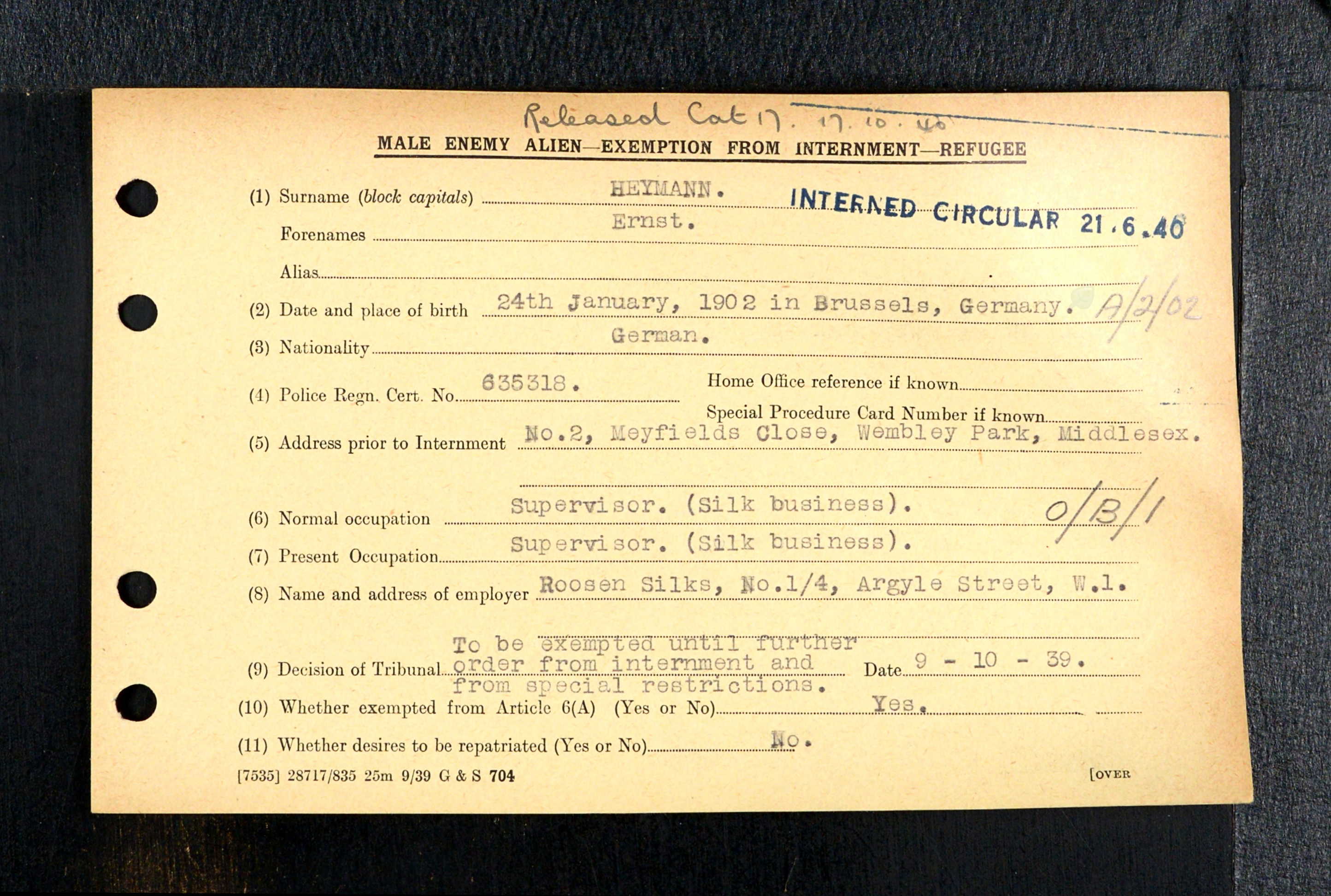
Rosemarie was able to get out of Germany and join Ernest in London where their first child, Robin’s mother, was born. After the war started, Ernest was one of the many Jewish refugees who was sent to an internment camp as a “enemy alien.” He was interned from June 21, 1940, until October 17, 1940.

Ernst Heymann, he National Archives; Kew, London, England; HO 396 WW2 Internees (Aliens) Index Cards 1939-1947; Reference Number: Ho 396/178
Piece Number Description: 178: German Internees Released in Uk 1939-1942: Hertzke-Hoj
Ancestry.com. UK, World War II Alien Internees, 1939-1945

After he was released, he and Rosemarie and their daughter immigrated to the US and settled in New York. They had another child in New York after the war.

Rosemarie’s sister Cecilie made it to the US in 1946 and went to live with Rosemarie and her family in New York. The two sisters lived together for the rest of their lives and remained close to their brothers Curt and Franz (later known as Frank), who visited them often from Massachusetts.  Cecilie lived to 95, dying in 1990, and Rosemarie to 91, dying in 2004.3

The story of Thekla Blumenfeld Gruenbaum is tragic: motherless as toddler, left behind by her father, widowed at a young age, and then killed by the Nazis. The fact that Thekla’s two daughters Cecilie and Rosemarie lived together and survived into their 90s is quite a tribute to the strength their mother must have had and that they both had.

Thekla with her daughter Rosemarie Courtesy of Robin H Kravets

Thekla Blumenfeld Gruenbaum  Courtesy of Robin H Kravets

Thekla Blumenfeld Gruenbaum  Courtesy of Robin H Kravets


  1. Email from Robin H. Kravets, September 10, 2023. 
  2. Ibid. 
  3. Emails from Robin H. Kravets, September 10, 2023, and October 27, 2023. 

Friederike Blumenfeld Schoen, Part IV: Her Children in Shanghai

As we saw, Friederike Blumenfeld Schoen had five children. They all had their lives and destinies changed by the Holocaust. Her oldest child Jakob died in 1937, and his widow and daughter were killed in the Holocaust. Friederike’s second oldest son, Moritz, immigrated with his family to the US in the late 1930s to escape the Nazis.

The other two surviving children of Friederike Blumenfeld Schoen, Auguste and Isaak, ended up in Shanghai, China, during the war. I don’t have any details about how they got to Shanghai or what their lives were like there, but there have been many books1, articles2, and memoirs3 written about the experience of Jewish refugees in Shanghai, and there was even an exhibit about Jewish refugee life in Shanghai in August 2023 in New York City.

I have read some of the articles, but not the books, so I can only briefly touch on the outline of this period in history to give context to what happened to Auguste, her husband Willi, their son Julius, and her brother Isaak, but in the footnotes I have listed sources for those who may want to learn more about the Shanghai Jewish community during the Nazi era.

When I first heard many years ago that Shanghai had been a place that many Jews sought refuge during the Nazi era, I was surprised. I’ve since learned that there was in fact a small Jewish community in Shanghai even before the 1930s, most of whom had fled from Russia after the Russian Revolution in 1917. But it was not until the 1930s that the Jewish population in Shanghai grew to about 20,000 refugees. Why Shanghai? One reason was that unlike most other places in the world including the United States, no visas were required to enter Shanghai until August 1939.4

In 1937, after a fierce battle with the Chinese, the Japanese took control of large sections of Shanghai and created a ghetto in a section called Hongkew, where Jewish refugees lived in poverty-stricken conditions. They were not allowed to leave or enter the ghetto without passes and were often mistreated by the Japanese officials who oversaw the ghetto. The Chinese residents of Shanghai also were persecuted and suffered greatly during this occupation, which lasted until the end of World War II when Japan was defeated and required to leave China.5

Jewish Ghetto Memorial in Shanghai, gruntzooki, CC BY-SA 2.0 <https://creativecommons.org/licenses/by-sa/2.0&gt;, via Wikimedia Commons

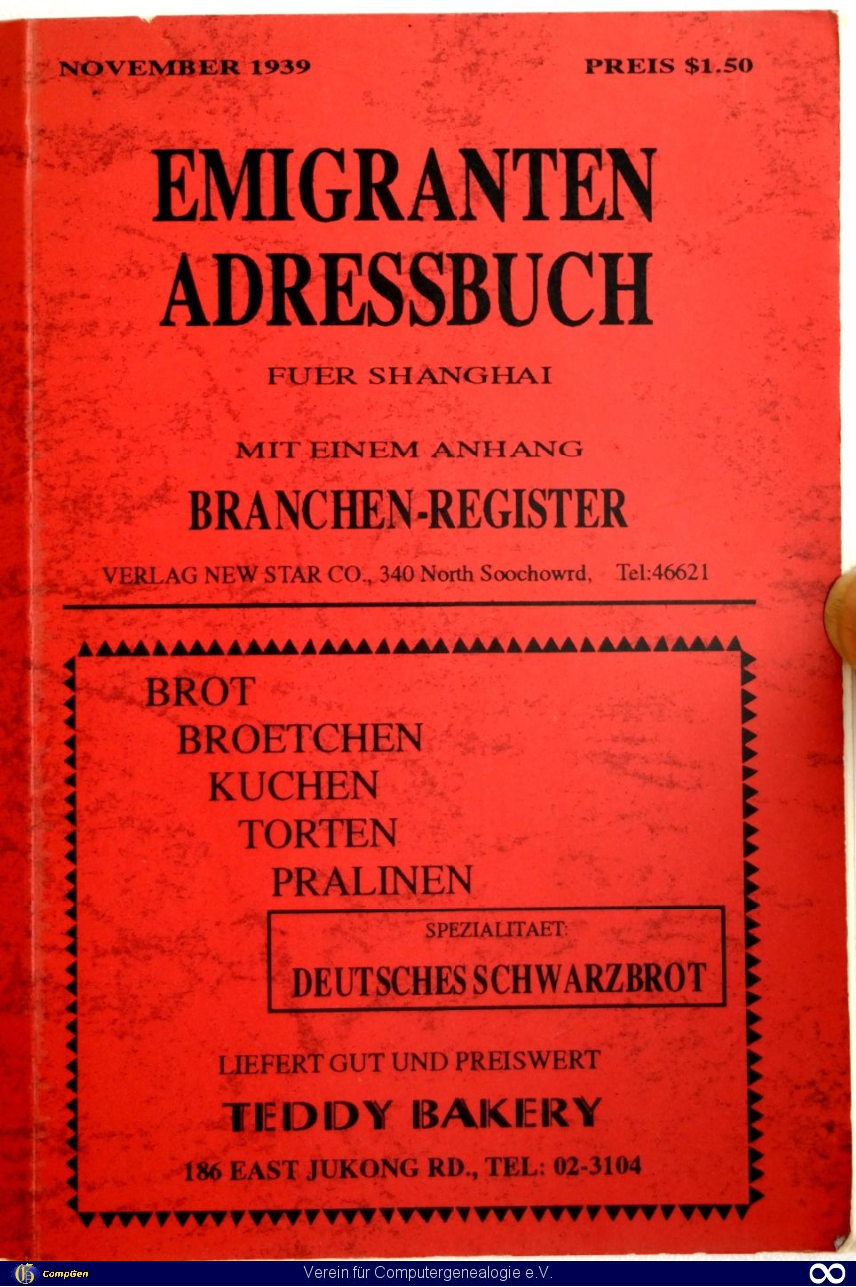
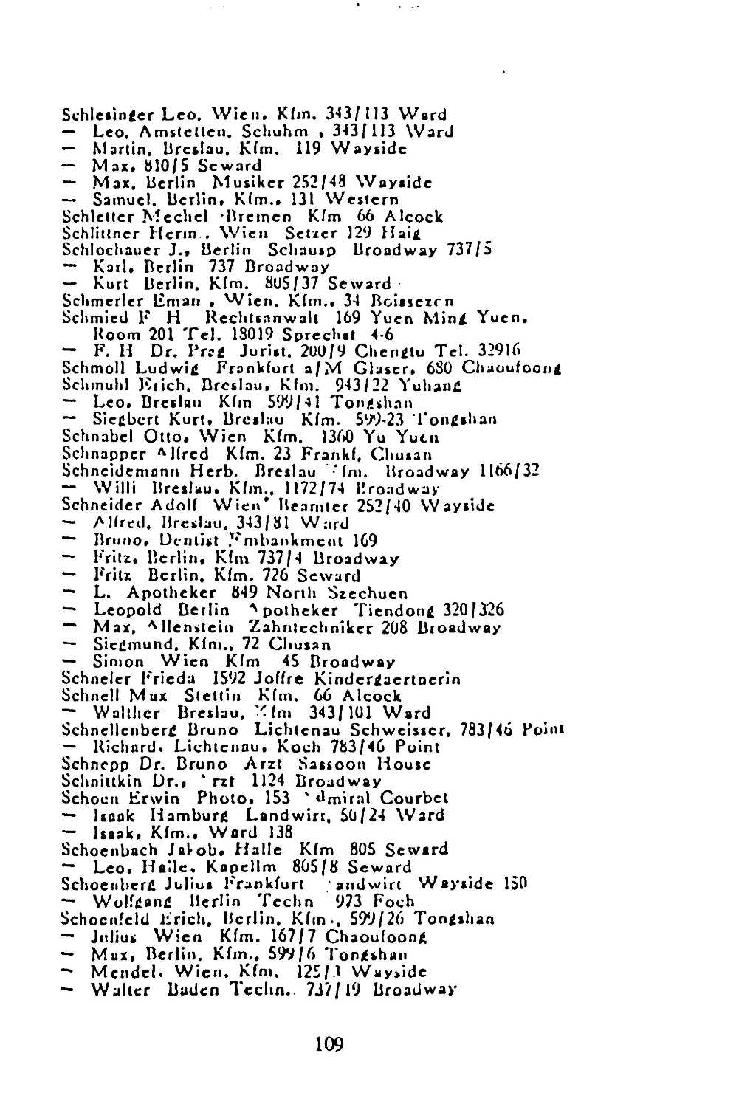
I wish I knew more about the experiences of my relatives Auguste Schoen Speier and her family and her brother Isaak Schoen in Shanghai, but aside from finding their names on various lists and in a 1939 directory for Shanghai located by Richard Bloomfield, I know no details other than that at some point they arrived there from Germany and lived there until after the war.

Auguste, Willi, and Julius Speier and Isaak Schoen are all listed on a 1950 list of Jewish refugees in Shanghai who were helped by the American Jewish Joint Distribution Committee, an organization that continues to exist today for those in need.

I also found them all here in a collection of records of Shanghai refugees made in 1944.

Richard located them in this November 1939 directory of emigrants in Shanghai, so obviously they had immigrated there by November 1939:

But I could not locate them on this list of refugees who had arrived in Shanghai between 1937 and 1944, so perhaps they had arrived before 1937.

In his interview with the US Holocaust Memorial and Museum, Kurt Schoen, Moritz’s son, mentioned that one of his cousins had died from typhoid while living in Shanghai, but I have no record or even a name of that cousin. He or she does not appear on any of the lists cited above. Maybe that cousin had passed away before these lists were compiled. Or maybe Kurt was confused.6

In any event, it is clear that Auguste, Willi, Julius and Isaak all ended up in Shanghai, and then after the war, they all immigrated to the US.

Auguste’s son Julius was the first to make it to the US. He arrived in San Francisco on March 19, 1947, with his wife Hildegarde Gabriel. They had married in Shanghai on December 9, 1945.7 Hildegarde was the daughter of Julius Gabriel and Berta Gross and was born on September 8, 1919, in Bromberg in what was then part of Prussia but is now in Poland.8

On the ship manifest, Julius listed his father Willi as the person he was leaving behind, Hildegarde listed her father Julius. They both listed Moritz Schoen, Auguste’s brother, as the person they were going to in the US and listed their destination as New York City. Julius listed his occupation as a shoemaker, and Hildegarde listed hers as a nurse.

Julius and Hildegarde Speier ship manifest, he National Archives at Washington, D.C.; Washington, D.C.; Passenger Lists of Vessels Arriving At San Francisco, California; NAI Number: 4498993; Record Group Title: Records of the Immigration and Naturalization Service, 1787-2004; Record Group Number: 85, NARA Roll Number: 388, Ancestry.com. California, U.S., Arriving Passenger and Crew Lists, 1882-1959

Julius’ parents Auguste (Schoen) and Willi Speier arrived in San Francisco six months later on September 24, 1947. The ship manifest indicates that they were headed to New York City where their son Julius was residing. Like his son Julius, Willi was a shoemaker or “cobbler,” as listed on the manifest. The person they were leaving behind in Shanghai was Auguste’s brother Isaak.9

Isaak himself arrived just a few months later on December 17, 1947. He also entered the US in San Francisco, indicating that he also was heading to New York City where his brother Moritz was living. He listed his occupation as a salesman.10

Auguste and Willi did end up in New York City, where in 1950 Willi was working as a “platform spotter” in a shoe factory. I don’t know what that means, but I would guess that it means he watched shoes on an assembly line. If anyone has any other ideas, please let me know.11 I’ve been unable to locate their son Julius and his wife Hildegarde on the 1950 census nor can I locate Isaak Schoen on that census.

Thus, three of Friederike Blumenfeld and Mannes Schoen’s children and four of their grandchildren had escaped Nazi Germany and survived World War II. Their lives after 1950 will be discussed in my next post.


  1. See, e.g., Alex Ross, Escape to Shanghai: A Jewish Community in China (1993, Free Press); Gao Bei, Shanghai Sanctuary: Chinese and Japanese Policy Toward European Jewish Refugees During World War II (2016, Oxford University Press); Irene Eber, Wartime Shanghai and the Jewish Refugees From Central Europe: Survival, Co-Existence, and Identity in a Multi-Ethnic City (2012, DeGruyter). 
  2. See, e.g., the articles at the following links:  https://www.smithsonianmag.com/smart-news/how-holocaust-survivors-found-refuge-shanghai-told-through-stories-and-photos-180978235/  and https://www.nbcnews.com/news/asian-america/jewish-wwii-refugees-found-safety-shanghai-are-focus-new-exhibit-rcna96478 and https://encyclopedia.ushmm.org/content/en/article/german-and-austrian-jewish-refugees-in-shanghai and https://www.npr.org/2023/08/06/1192118339/jewish-refugees-shanghai-world-war-ii&#160;
  3. E.g., Ernest Heppner, Shanghai Refuge: A Memoir of the World War II Jewish Ghetto (1995, University of Nebraska Press); Berl Falbaum, ed., Shanghai Remembered…: Stories Of Jews Who Escaped To Shanghai From Nazi Europe (2005, Momentum Books, LLC.); Sigmund Tobias, Strange Haven: A Jew­ish Child­hood in Wartime Shanghai (2009, University of Illinois Press). 
  4. See Note 2, above. 
  5. See Note 2, above. 
  6. Kurt L. Schoen, July 24, 2004 interview,  Accession Number: 1997.A.0441.512 | RG Number: RG-50.462.0512, United States Holocaust Memorial Museum Collection, Gift of the Gratz College Holocaust Oral History Archive, found at https://collections.ushmm.org/search/catalog/irn566135. There was another puzzling thing about Kurt’s interview. He mentioned that his father had one sister (Auguste) and one unmarried brother (Isaak), but did not mention Jakob, his father’s older brother.  Jakob, as we saw, had died in 1937 when Kurt was ten, and his wife and daughter were killed in the Holocaust. Had Kurt never known his uncle Jakob and his family? Had Moritz never mentioned them? Or was it just too painful for Kurt to talk about what had happened to his uncle, aunt, and cousin? 
  7. Marriage notice for Julius Speier and Hildegarde Gabriel, The Jewish Voice in Jüdisches Nachrichtenblatt, 23. November 1945, p. 8 
  8. Hildegard Speier, Gender Female, Race White, Birth Date 8 Sep 1919, Birth Place Bromberg Pos, Federal Republic of Germany, Death Date Aug 1994, Father Julius Gabriel, Mother Berta Gross, SSN 079242443, Ancestry.com. U.S., Social Security Applications and Claims Index, 1936-2007 
  9. Willi and Auguste Speier, ship manifest, The National Archives at Washington, D.C.; Washington, D.C.; Passenger Lists of Vessels Arriving At San Francisco, California; NAI Number: 4498993; Record Group Title: Records of the Immigration and Naturalization Service, 1787-2004; Record Group Number: 85, NARA Roll Number: 392, Ancestry.com. California, U.S., Arriving Passenger and Crew Lists, 1882-1959 
  10. Isaak Schoen ship manifest, The National Archives at Washington, D.C.; Washington, D.C.; Passenger Lists of Vessels Arriving At San Francisco, California; NAI Number: 4498993; Record Group Title: Records of the Immigration and Naturalization Service, 1787-2004; Record Group Number: 85, Ancestry.com. California, U.S., Arriving Passenger and Crew Lists, 1882-1959 
  11.  National Archives at Washington, DC; Washington, D.C.; Seventeenth Census of the United States, 1950; Year: 1950; Census Place: New York, New York, New York; Roll: 4546; Page: 18; Enumeration District: 31-1702, Ancestry.com. 1950 United States Federal Census 

Friederike Blumenfeld Schoen, Part III: Her Son Moses Escapes to America

I have been unable to do any new research in these last few weeks since the horrendous massacre in Israel by Hamas on October 7. I just can’t seem to focus on research right now. Fortunately I had several blog posts ready in my queue and will publish those, including this one. Perhaps the best way I can support Israel right now is to educate and remind people about the long history of persecution of Jews and antisemitism so that they best understand why Israel exists and why it must survive.


Although Friederike’s oldest child Jakob died in 1937 and his widow and daughter were killed by the Nazis, her other three surviving children all managed to escape the Nazis.

Friederike’s son Moses, more commonly known as Moritz, wanted to leave Germany quite early. As described by his son Kurt Leopold Schoen in the oral history interview he did with the US Holocaust Memorial and Museum, Moritz had had a successful wholesale and retail shoe business in Kassel, but once the Nazis came to power the business suffered. Non-Jews boycotted the store, and Moritz had to close the business and work as a shoemaker.1

But leaving Germany was difficult. The family needed affidavits from someone in the US to get a visa to enter the country, and the relatives in the US were reluctant to sponsor a family with three young children. Fortunately, Moritz and Else’s fourteen-year-old daughter Alice was given an opportunity to leave when the National Council of the Jewish Women in the US organized a rescue mission that brought many children out of Germany.2 Alice came to the US on May 13, 1938, and was sent to live with a Jewish family in San Antonio, Texas, the Rosenbergs, as seen on the 1940 US census.3

Alice Schoen passenger manifest, The National Archives and Records Administration; Washington, D.C.; Passenger and Crew Lists of Vessels Arriving at and Departing from Ogdensburg, New York, 5/27/1948 – 11/28/1972; Microfilm Serial or NAID: T715, 1897-1957
Ancestry.com. New York, U.S., Arriving Passenger and Crew Lists (including Castle Garden and Ellis Island), 1820-1957

The website for the Holocaust Memorial Museum of San Antonio reported that Abe and Bella Rosenberg “took [Alice] into their lives as if she were a long lost relative. The Rosenberg children, Miriam and Stanley, and a host of aunts, uncles, and cousins who treated her with affection and kindness made her adjustment to a new life easier.” In his oral history interview, Alice’s brother Kurt mentioned that the Rosenbergs were a very nice family, but nevertheless Alice was naturally very homesick.  She did not see her family again until 1940.4

But Alice was able to get help from the Rosenberg family to bring her father Moritz to the US from Germany. As reported on the website for the Holocaust Memorial Museum of San Antonio, they signed affidavits pledging financial support for him.

Once he had an affidavit from the Rosenbergs, Moritz was able to go to the US consulate in Germany and receive a visa. But before he could leave, he was arrested during the Kristallnacht riots in November, 1938. According to his son Kurt, Moritz was not sent to Buchenwald like so many other Jewish men were after Kristallnacht because he already had a visa to leave Germany. He was released within a day or two from police custody in Kassel and prepared to leave for the US.5

Moritz arrived on December 3, 1938, seven months after Alice’s arrival, and settled in New York City. His ship manifest lists his wife Else as the person he was leaving behind in Kassel, Germany, and his sister-in-law Betty Lutz (born Babette Freimark) as the person he was going to in the US. He listed his occupation as a shoemaker.6

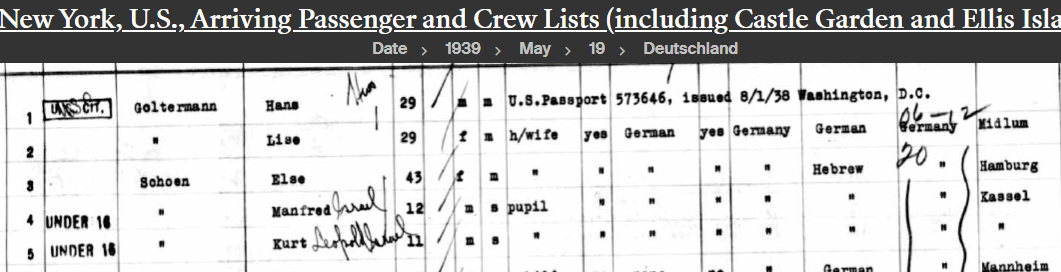
Meanwhile, back in Germany, Else and her two young sons Manfred and Kurt moved to Frankfurt; the boys were sent to a Jewish orphanage and Else moved in with one of her sisters. Kurt described the orphanage as a place where he and his brother were well treated. They went to school and learned English. Finally in April 1939, they were released and reunited with their mother and allowed to leave Germany for the US. Kurt, who was eleven at the time, recalled that the Nazis tore through their luggage and stole everything Else had packed except one small teapot.7

Else arrived in New York with Manfred and Kurt (listed as Kurt Leopold Israel on the manifest) on May 19, 1939.

Else Schoen and children, passenger manifest, The National Archives and Records Administration; Washington, D.C.; Passenger and Crew Lists of Vessels Arriving at and Departing from Ogdensburg, New York, 5/27/1948 – 11/28/1972; Microfilm Serial or NAID: T715, 1897-1957
Ship or Roll Number: Deutschland, Ancestry.com. New York, U.S., Arriving Passenger and Crew Lists (including Castle Garden and Ellis Island), 1820-1957

The family moved into a small apartment riddled with bed bugs; Moritz worked doing shoe repairs and barely made a living. But as Kurt said, they were happy to be out of Germany and safely living in New York. They moved frequently from one apartment to another in order to get the benefit of one or two free months of rent being offered by landlords. Manfred and Kurt started school where they quickly learned English and rose from the lower levels of their grade to the highest within a year.8

Alice was reunited with her parents and brothers sometime in 1940 when the Rosenberg family brought her to New York after taking a trip to Canada to see the Dionne Quintuplets. She married just three years later when she was nineteen, according to her brother Kurt.9 Her husband, Albert Bernhard Schwarz, was born on October 22, 1922, in Busenberg, Germany, to Alfred Lazarus Schwarz and Berta Levy. Like Alice, he was refugee from Germany; he had arrived on August 13, 1938.10 He was the only member of his family to survive. His parents and all his siblings were killed by the Nazis.11

Albert entered the US Army on March 26, 1943, listing his marital status as single.12 He and Alice must have married later that year. According to one biography of Albert, he was assigned to Camp Ritchie in Maryland and trained for military intelligence. As a Ritchie Boy, as they were known, Albert was trained to interrogate German prisoners of war. Starting in October 1944 he was with the 7th Armored Division of the II English Army in France and the northern part of Belgium. On November 5-6, 1944, during the Battle of the Bulge, Albert’s jeep hit a German mine near a bridge over the Meuse River. Albert suffered severe head injuries from which he suffered the rest of his life. He was in a coma for over a month in a English military hospital and remained there until February, 1945. He returned to the US in the spring of 1945, but was hospitalized until July. On Aug. 02, 1945, he was discharged from military service at Camp Edward, Massachusetts.13

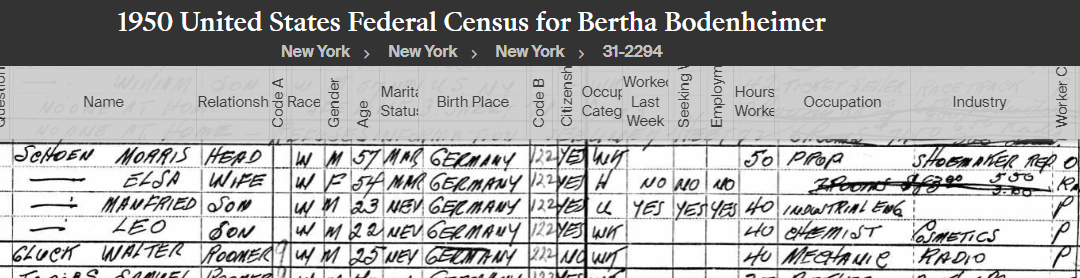
Alice and Albert had three children born after the war. In 1950 they were living in New York City, and Albert was working as a butcher.14 Alice’s parents Moritz and Else Schoen and her brothers Manfred and Kurt (listed as Leo here) were also living in New York City. Moritz now owned his own shoemaking business. Manfred was an industrial engineer, and Leo/Kurt was a chemist in a cosmetics company.

Morris Schoen and family, 1950 US census, National Archives at Washington, DC; Washington, D.C.; Seventeenth Census of the United States, 1950; Year: 1950; Census Place: New York, New York, New York; Roll: 3572; Page: 9; Enumeration District: 31-2294, Ancestry.com. 1950 United States Federal Census

Meanwhile, Moritz’s two remaining siblings had survived the war in Shanghai, China. More on that in my next post.


  1. Many of the personal details in this post came from Kurt Leopold Schoen’s interview with the USHMM. Kurt L. Schoen, July 24, 2004 interview, Accession Number: 1997.A.0441.512 | RG Number: RG-50.462.0512, United States Holocaust Memorial Museum Collection, Gift of the Gratz College Holocaust Oral History Archive, found at https://collections.ushmm.org/search/catalog/irn566135.  Although Kurt is listed as Leopold or Leo on many US records, he used the name Kurt for most of his adult life in the US and will be referred to here as Kurt for that reason. 
  2. See Note 1, supra. 
  3. Alice Schoen, 1940 US Census, Year: 1940; Census Place: San Antonio, Bexar, Texas; Roll: m-t0627-04201; Page: 61A; Enumeration District: 259-6, Ancestry.com. 1940 United States Federal Census 
  4. See Note 1, supra. 
  5. See Note 1, supra. 
  6. Moses Schoen, passenger manifest, The National Archives and Records Administration; Washington, D.C.; Passenger and Crew Lists of Vessels Arriving at and Departing from Ogdensburg, New York, 5/27/1948 – 11/28/1972; Microfilm Serial or NAID: T715, 1897-1957, Ship or Roll Number: Hamburg, Ancestry.com. New York, U.S., Arriving Passenger and Crew Lists (including Castle Garden and Ellis Island), 1820-1957 
  7. See Note 1, supra. 
  8. See Note 1, supra. 
  9. See Note 1, supra. 
  10. Albert Schwarz, Declaration of Intention, The National Archives at Philadelphia; Philadelphia, PA; NAI Title: Declarations of Intention For Citizenship, 1/19/1842 – 10/29/1959; NAI Number: 4713410; Record Group Title: Records of District Courts of the United States, 1685-2009; Record Group Number: 21, Description
    Description: (Roll 610) Declarations of Intention For Citizenship, 1842-1959 (No 481301-482200), Ancestry.com. New York, U.S., State and Federal Naturalization Records, 1794-1943 
  11. Family history of Schwarz family, Arbeitskreis Judentum im Wasgau, Elisabeth & Otmar Weber, Schillerstraße 10b, 66994, found at /https://judentum-im-wasgau.de/images/geschichte/jugemeinden/jufbusenberg/02_schwarz_jakob_hauptstr_49_bu.pdf 
  12. Albert B Schwarz, Race White, Marital Status Single, without dependents (Single)
    Rank Private, Birth Year 1922, Nativity State or Country Danzig or Germany, Citizenship Not Yet a Citizen, Residence New York, New York, Education 2 years of high school
    Civil Occupation Stock clerks, Enlistment Date 26 Mar 1943, Enlistment Place New York City, New York, Service Number 32874464, Branch No branch assignment, Component Selectees (Enlisted Men), National Archives at College Park; College Park, Maryland, USA; Electronic Army Serial Number Merged File, 1938-1946; NAID: 1263923; Record Group Title: Records of the National Archives and Records Administration, 1789-ca. 2007; Record Group: 64; Box Number: 05772; Reel: 241, Ancestry.com. U.S., World War II Army Enlistment Records, 1938-1946 
  13. See Note 11, supra. 
  14. Albert Schwarz and family, 1940 US census, National Archives at Washington, DC; Washington, D.C.; Seventeenth Census of the United States, 1950; Year: 1950; Census Place: New York, New York, New York; Roll: 6203; Page: 6; Enumeration District: 31-1913, Ancestry.com. 1950 United States Federal Census 

Friederike Blumenfeld Schoen’s Son Jakob: Another Family Lost in the Holocaust

Friederike Blumenfeld Schoen died in 1927, as we saw, leaving behind her four surviving children, Jakob, Auguste, Moses, and Isaac, and her grandchildren. Thus, she was spared from experiencing the Holocaust and seeing what would happen to her children and their families.

Her oldest child, Jakob, was living a good life with his wife Hannah Freimark (sometimes known as Johanna, sometimes as Maria Anna.) Their daughter Ruth was born on New Year’s Day in 1924, as seen in this birth announcement published in Der Israelit newspaper in Frankfurt on January 3, 1924.

Der Israelit, 3 January 1924, page 7

Thank you once again to my cousin Richard Bloomfield who located this notice and the others in this post and translated them for me. The birth announcement says, “Jakob Schön and wife Hanna, née Freimark are delighted to announce the healthy [lit. happy, successful] birth of a daughter. Frankfurt am Main, Baumweg 22, 1 January 1924 / 24. Tebet 5684.”

Jakob was working as a successful butcher in Frankfurt. The ad below says, “Wanted for my store, closed on Shabbat and holidays, a young journeyman. Meat Market Jakob Schön, Frankfurt am Main, Uhlandstrasse 50.”

1925-08-27 Der Israelit, page 7

And then his life was cut short when he died on June 22, 1937, at the age of 52. His daughter Ruth was only 13 years old.

Jakob Schoen death record, Hessisches Hauptstaatsarchiv; Wiesbaden, Deutschland; Personenstandsregister Sterberegister; Signatur: 11071; Laufende Nummer: 903
Year Range: 1937, Ancestry.com. Hesse, Germany, Deaths, 1851-1958

Jakob’s obituary reflects how well loved he was by his family and his  community. Richard Bloomfield, who located this obituary as well as the ads and notices above, graciously translated the obituary for me as follows:

Der Israelit, July 1, 1937, p. 11

Suddenly and without warning Jakob Schön’s successful and industrious life came to an end. Together with his wife and daughter a large circle of friends mourns this dutiful man known for his unbending character and his scrupulous business practices. With hard work and great zeal Jakob Schön and his like-minded wife built up his meat market from its small beginnings into a remarkably prospering business which brought him the complete trust of the rabbinate and the supervisory board of the IRG, as well as the respect and friendship of his customers. The Reichsbund Jüdischer Frontsoldaten [National Association of Frontline Soldiers] loses with Jakob Schön an active and faithful member. In earlier years the deceased was a valuable member of the Synagogue Choir of the Jewish Community who gladly gave of his time and energy for the enriching of the worship services. May the family’s intense grief be alleviated by knowing that his memory will last and his S’chus [merit] will live on forever.

It appears that Jakob died suddenly, perhaps of a heart attack or stroke. Although there is nothing in the obituary discussing this, I wonder what effect Nazi oppression and the Nuremburg Laws had on his business and on him personally. Did the stress of dealing with persecution contribute to his sudden death? Was Jakob an uncounted victim of the Holocaust?

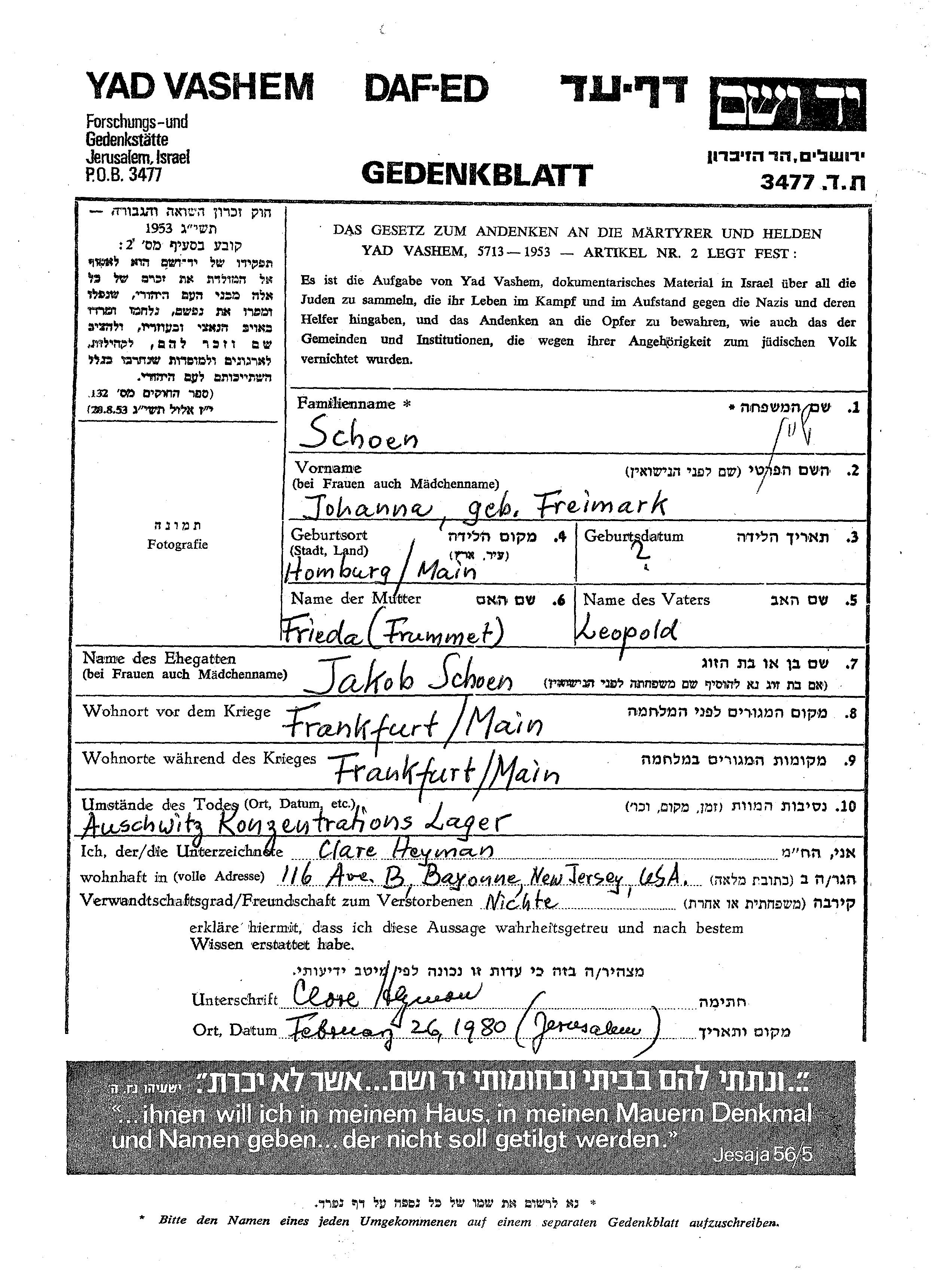
In any event, at least he was spared knowing what would happen to his wife and daughter in the years to come. They did not leave Germany in time, and both were murdered by the Nazis. They were deported from Frankfurt to Theriesenstadt on September 15, 1942, and then to Auschwitz, where they were murdered on October 12, 1944. Hannah was 56, and Ruth only twenty years old.

Johanna Freimark Schoen Page of Testimony, found at https://yvng.yadvashem.org/nameDetails.html?language=en&itemId=1414651&ind=1

May their lives be remembered. May we never forget.


Isaak Rosenberg: A Family With No Survivors

The youngest child of Rebecca Blumenfeld and Mendel Rosenberg was their son Isaak. As we saw, Isaak was born in Rosenthal, Germany, on June 15, 1892, and on December 22, 1922, he married Bella Gans, daughter of Jacob Gans and Esther Ehrenreich, in Niederaula, Germany.

Isaak and Bella had one child, a daughter Rita Rosenberg, born on April 29, 1924 in Frankfurt.

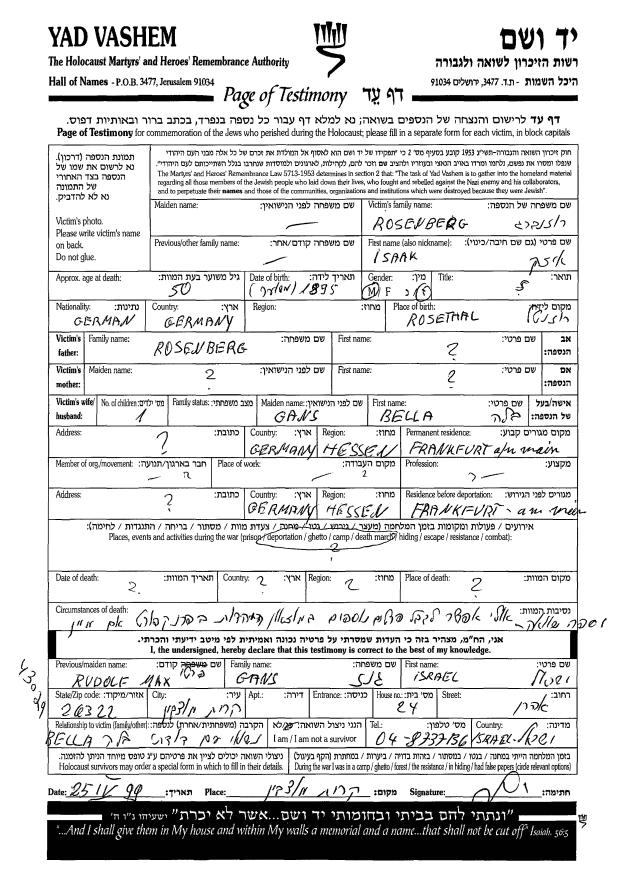
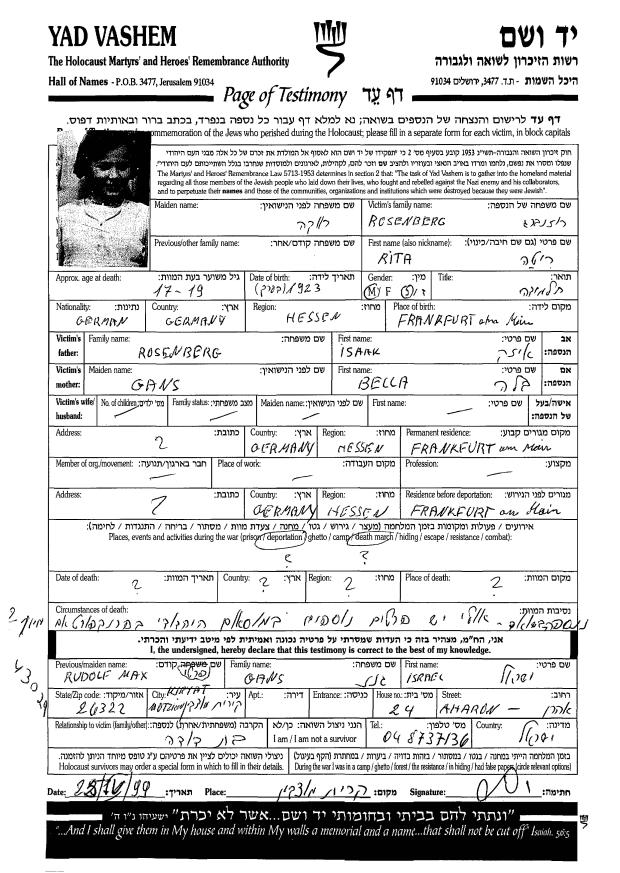
Unfortunately, all of them—Isaak, Bella, and Rita—were murdered by the Nazis. According to Yad Vashem, Isaak was deported from Frankfurt on August 10, 1942, and sent to the concentration camp in Majdanek, Poland, where he was murdered. His wife Bella’s nephew Israel Gans filed this Page of Testimony at Yad Vashem in his memory. The Hebrew written where it says “circumstances of death” merely says “perished in the Holocaust.” (Thank you to Hanna Gafni of Tracing the Tribe on Facebook for translating this line on this Page and the two below.)

The information available regarding the fates of Bella and Rita is far less specific. The Gedenbuch (Memorial Book) only reports that Bella was deported to Poland and killed there; perhaps she was deported on the same date as Isaak and to the same camp, but that isn’t stated. Nor does the Page of Testimony filed at Yad Vashem by Bella’s nephew Israel Gans provide any further details. The line for “Circumstances of Death” translates as “deported to Poland. Her fate is not known. Perished in the Holocaust.”

The information about Rita is even more limited. The Gedenbuch doesn’t even have information about where she was deported to or killed nor does her cousin Israel Gans’ Page of Testimony for her. The Hebrew written where it says “circumstances of death” says “perished in the Holocaust.”


This may be the first time that I have learned of family members who were killed in the Holocaust for whom there are no recorded details of their fates. Did Bella and Rita accompany Isaak to Majdanek? Or was the family separated? The lack of information somehow makes their deaths sting even more. The fact that the Nazis didn’t even document their murders makes it more likely that those deaths would have been somehow swept under the rug. So it is my task here to make sure that their lives and their murders are not forgotten.


That brings me to the end of the story of Rebecca Blumenfeld Rosenberg, the seventh child of Isaak Blumenfeld I and Gelle Strauss. Although Rebecca lost one son, Willi, as a young adult, and her son Isaak and his family were all murdered in the Holocaust, she was survived by seven grandchildren and has descendants still living today in Israel and the United States.

Next I turn to Rebecca’s younger sister, Friederike Blumenfeld, the eighth child of Isaak Blumenfeld I and Gelle Strauss and the last of their children to live to adulthood.

Rebecca Blumenfeld Rosenberg’s Daughter-in-Law Bella: An Admirable Woman

Rebecca Blumenfeld and Mendel Rosenberg’s second child was their son Joseph. As we saw, Joseph was born on February 4, 1886, in Rosenthal, Germany, and married Bella Oppenheim on February 21, 1913, in Bad Hersfeld, Germany. Bella was born there on June 8, 1891, to Aron Oppenheim and Hannchen Klebe. Bella’s sister Emma Oppenheim had married Meier Blumenfeld III on April 5, 1905, in Bad Hersfeld. Meier, the son of Giedel Blumenfeld and Gerson Blumenfeld, her first cousin, once removed, was thus Joseph Rosenberg’s first cousin, since their mothers Giedel and Rebecca were sisters.

Joseph and Bella had one child, Kurt, born in Sobernheim, Germany, on April 20, 1914.1 As I wrote in my earlier post, Sobernheim is not in the Hesse region where both Joseph and Bella were born and raised and where they married, but over 160 miles away in the Rhine Palatinate region.

Tragically, as we saw, Joseph, who was a doctor, died on May 4, 1922, at the age of 36, and was buried in Frankfurt, so perhaps he and his family had relocated from Sobernheim. His son Kurt was only eight years old when he lost his father.

Bella remarried a year after losing Joseph. Her second husband was Arthur Marx, born in Kempten, Germany, on August 4, 1890. They married in Frankfurt on June 22, 1923, in Frankfurt, and were living in Frankfurt.

Marriage of Bella Oppenheim Rosenberg to Arthur Marx, Hessisches Hauptstaatsarchiv; Wiesbaden, Deutschland; Bestand: 903, Year Range: 1923, Ancestry.com. Hesse, Germany, Marriages, 1849-1930

Kurt immigrated to the United States on October 16, 1937, when he was 23.2 His mother Bella and stepfather Arthur left Germany for the United States on May 27, 1938, and arrived in New York on June 2, 1938.

Arthur and Bella Marx passenger manifest, Year: 1938; Arrival: New York, New York, USA; Microfilm Serial: T715, 1897-1957; Line: 5; Page Number: 142, Ship or Roll Number: Europa, 
Ancestry.com. New York, U.S., Arriving Passenger and Crew Lists (including Castle Garden and Ellis Island), 1820-1957

Bella Oppenheim Rosenberg Marx then played a pivotal role in saving her niece Ruth Blumenfeld, the daughter of Emma Oppenheim and Meier Blumenfeld III, as I wrote about here. According to Ruth’s grandson Matthew, Bella, Ruth’s aunt, sponsored Ruth’s entry into the United States on March 4, 1940. Ruth was the only member of Emma and Meier’s family to survive the Holocaust. Her parents and her two sisters and their families were murdered by the Nazis. Matthew shared this photograph of Bella with her niece Ruth and Ruth’s husband Leo Friedman.

Bella Oppenheim Marx, Leo Friedman, and Ruth Blumenfeld Friedman. Courtesy of Matthew Steinhart

On the 1940 census, Bella and Arthur were living in Brooklyn, New York, and Arthur was working as a bank clerk and Bella as a practical nurse. They had two boarders living with them in addition to a niece (not Ruth), but not their son Kurt.

Arthur Marx and family 1940 US census, Year: 1940; Census Place: New York, Kings, New York; Roll: m-t0627-02580; Page: 4B; Enumeration District: 24-1310, Ancestry.com. 1940 United States Federal Census

Kurt, like his father Joseph, had become a doctor and was residing at Boulevard Hospital in Queens, New York, at the time of the 1940 census.2 He registered for the draft on October 16, 1940.

Kurt Rosenberg World War II draft registration, National Archives at St. Louis; St. Louis, Missouri; Wwii Draft Registration Cards For New York City, 10/16/1940 – 03/31/1947; Record Group: Records of the Selective Service System, 147, Ancestry.com. U.S., World War II Draft Cards Young Men, 1940-1947

After the war Kurt married Gertrude Stein,3 and in 1950 they were living in Queens and Kurt was practicing medicine.4 Kurt and Gertrude would have three children.

Unfortunately, like his father before him, Kurt died too young. He was 56 years old when he died suddenly on January 28, 1970, at the hospital where he worked as a gynecologist in Queens, New York. He was survived by his wife and children as well as his mother Bella.5

Bella died at the age of 94 on December 22, 1985.6 She had outlived her first husband Joseph Rosenberg and then her second husband Arthur Marx, who died on November 14, 1963, as well her son Kurt.7 She also had outlived her niece Ruth Blumenfeld Friedman, whose life she had helped to save back in 1940. Although she was only related to me by her marriage to my cousin Joseph Rosenberg, I feel a deep respect and a connection to her because of the life she lived and the things she endured along the way.


  1. Kurt Rosenberg, World War II draft registration, National Archives at St. Louis; St. Louis, Missouri; Wwii Draft Registration Cards For New York City, 10/16/1940 – 03/31/1947; Record Group: Records of the Selective Service System, 147, Ancestry.com. U.S., World War II Draft Cards Young Men, 1940-1947 
  2. Kurt Rosenberg, 1940 US census, Year: 1940; Census Place: New York, Queens, New York; Roll: m-t0627-02721; Page: 7A; Enumeration District: 41-105, Ancestry.com. 1940 United States Federal Census 
  3.  New York City Municipal Archives; New York, New York; Borough: Queens, Ancestry.com. New York, New York, U.S., Marriage License Indexes, 1907-2018 
  4. Kurt Rosenberg and family, 1950 US census, United States of America, Bureau of the Census; Washington, D.C.; Seventeenth Census of the United States, 1950; Record Group: Records of the Bureau of the Census, 1790-2007; Record Group Number: 29; Residence Date: 1950; Home in 1950: New York, Queens, New York; Roll: 4301; Sheet Number: 10; Enumeration District: 41-1012, Ancestry.com. 1950 United States Federal Census 
  5. Obituary for Kurt Rosenberg, Daily News, New York, New York, Thu, Jan 29, 1970
    Page 318. Kurt Rosenberg, Gender Male, Birth Date 20 Apr 1914, Death Date Jan 1970
    Claim Date 7 Mar 1970, SSN 072164680, Ancestry.com. U.S., Social Security Applications and Claims Index, 1936-2007 
  6. Bella Marx, Social Security Number 079-22-4508, Birth Date 8 Jun 1891, Issue year Before 1951, Issue State New York, Last Residence 11375, Flushing, Queens, New York, USA, Death Date Dec 1985, Social Security Administration; Washington D.C., USA; Social Security Death Index, Master File, Ancestry.com. U.S., Social Security Death Index, 1935-2014; Find a Grave, database and images (https://www.findagrave.com/memorial/77845632/bella-marx: accessed 29 May 2023), memorial page for Bella Marx (unknown–22 Dec 1985), Find a Grave Memorial ID 77845632, citing Mount Hebron Cemetery, Flushing, Queens County, New York, USA; Maintained by Athanatos (contributor 46907585). 
  7. Arthur Marx, Age 73, Birth Date abt 1890, Death Date 14 Nov 1963, Death Place Queens, New York, New York, USA, Certificate Number 14536, Ancestry.com. New York, New York, U.S., Death Index, 1949-1965 

Hilde Blumenfeld Meinrath, Part II: Leaving Germany and Life in Brazil

As we saw in my prior post, I had learned more about Hilde Blumenfeld Meinrath, thanks to connections made through her granddaughter Gabriela. I learned that after spending four years in New York working as a German-English translator, Hilde decided to return to Germany in 1932 for what was initially supposed to be an extended visit with her family. But then she met and married her husband Ludwig Meinrath and decided to stay longer. She found employment as a translator and secretary for the American author, William March.

But everything began to change after Hitler came to power.

As Hilde reported in her Shoah Foundation interview,  her employer William March was attacked by Nazi youths because he was mistakenly identified as Jewish and ended up in the hospital. He decided to leave Germany and urged Hilde to leave before it was too late; he invited her to come and work for him in New York. .1

Meanwhile, a month after Hitler came to power in April 1933, Hilde’s husband Ludwig, who had  been working as a representative for German companies making ribbons and wool products, lost his job as a sales agent because he was Jewish.. So Hilde and Ludwig agreed it was time to leave Germany.2

But Hilde and Ludwig disagreed about where to go, according to their son Roberto. Hilde wanted to return to New York, but Ludwig feared that he would be unable to make a living there with only a high school education. He had a cousin Helmut in Rio de Janeiro who persuaded him that life was wonderful there, so they went to Brazil in 1934, even though neither of them knew any Portuguese.3

HIlde and Ludwig Meinrath ship manifest, Month: Band 424 (Mär 1934)
Staatsarchiv Hamburg. Hamburg Passenger Lists, 1850-1934

Hilde continued to be a true go-getter. Roberto wrote:

Upon arrival in Rio by ship, and literally one block from the harbor, was Rio’s largest high rise of the day (some 20 stories).  On top of the building was a large advertising poster for US Steel.  My mom walked right into the building to find out whether US Steel would be interested in a German/English secretary, not knowing that at that time Brazilian secretaries were mostly male.  Of course, at that time, Rio was Brazil’s capital and … home to the president of US Steel, who immediately hired her at a salary that was higher than what cousin Helmut was then earning, after a year in Rio.  Anyway, due to my mom’s high salary, my father was able to dedicate his time to learn Portuguese and to become a wholesale textile salesman for several companies.

Hilde and Ludwig’s first child (Gabriela’s father) Pedro John Meinrath was born in 1936; according to Roberto, his mother insisted that Pedro have an American/English middle name, presumably because of her fond memories of living in the United States.

Meanwhile, back in Germany, conditions worsened for Hilde’s parents and her sister Gretel and her family. After Kristallnacht in November, 1938, Salomon Blumenfeld and his son-in-law David Katz were arrested and sent to Buchenwald.4 After they were released, Hilde used her connections and borrowed money to bring her parents to Brazil. Hilde stated in her Shoah Foundation interview that when her parents arrived in Brazil, her father looked emaciated  from his time in Buchenwald, despite the fact that his son-in-law had given Salomon half of his own rations so that Salomon would survive.  5

Hilde’s parents lived with her and her family in Rio for a short time, but according to Hilde, the climate there didn’t agree with them, so she and Ludwig purchased a small house in Petropolis, a city in the mountains north of Rio for her parents, and they moved out of their apartment in Rio and moved to a rented room. When the war in Europe started, Ludwig’s import business suffered, so Hilde had to work full-time to help support the family. Pedro, who was just a four year old at the time, stayed with his grandparents in Petropolis, and Hilde and Ludwig would come on the weekends to be with them all. 6

Here are two photographs that Gabriela shared with me of Pedro with his maternal grandparents Salomon and Malchen Blumenfeld:

Malchen Levi, Pedro Meinrath, and Salomon Blumenfeld c. 1939 Courtesy of the family

Pedro Meinrath with his parents and maternal grandparents c. 1940 Courtesy of the family

Ludwig and Hilde’s second child Roberto came along five years later in 1941—he was, as he wrote, “a surprise baby.” Hilde’s job at the US Embassy ended up being important in saving Roberto’s life.  When Roberto contracted diphtheria when he was three years old, his mother Hilde was able through her job at the American Embassy to obtain life-saving penicillin, which was not otherwise readily available in Brazil at that time because of the war.7

Hilde Blumenfeld Meinrath with her sons c. 1941 Courtesy of the family

Pedro Meinrath, Salomon and Malchen Blumenfeld, Hilde Blumenfeld Meinrath, Roberto Meinrath 1944 in Petropolis Courtesy of the family

According to Roberto, after the war ended in 1945, Ludwig was able to restart his import business, and Hilde and Roberto moved to Petropolis. But Hilde’s parents at that point decided to leave Brazil because there was no kosher food or orthodox synagogue in Petropolis; they went to New York where Hilde’s sister Gretel was living. Hilde and her sons stayed in Petropolis until 1950 when Hilde and Roberto moved back to Rio. Pedro stayed in Petropolis where he went to boarding school until he graduated and went to university.

Malchen and Salomon Blumenfeld USA 1953 Courtesy of the family

Roberto described his life in Rio as an idyllic adventure for a young boy; he sadly described the changes that came to Rio in the 1960s:

I basically grew up as a single child in Rio, right in between Copacabana and Ipanema beaches.  Once or twice a week, I helped fishermen bring in their nets with piles of fish and, as compensation, got a free take home fish.  At that time, Rio had trees everywhere, few cars, cobblestone streets and tramways (which I took every day to school).  With the advent of the car industry in Brazil in the sixties, Rio’s streets were asphalted and widened, trees had to be cut down as most of the buildings had been built without garages and cars had to park on streets and sidewalks.  I miss old Rio, new Rio is sort of a tourist mecca only because of the beaches and the largest city park in the world.

Hilde and Ludwig belonged to a liberal Jewish synagogue in Rio, and Hilde insisted that Roberto attend after school classes in Hebrew and Jewish history. Roberto described an experience that ended up being a turning point in his life:

Because our synagogue was not very large, Rosh Hashanah and Yom Kippur services were held in the headquarters of one of Rio’s great soccer teams… and while watching the team practice during the 1959 Yom Kippur service, I was asked whether I would be interested in representing our congregation in the year-long youth leadership training program in Israel.  I jumped at that, as I sought personal freedom from what I felt to be a fairly strong-willed mom.

Roberto’s trip to Israel in 1960 allowed him to meet and get to know Hilde’s sister Jenny and her husband Sigmund Warburg. And thus he was able to give me information about Jenny and Sigmund and answer the questions I’d been hoping to answer when I wrote the blog post about the three sisters back in May, 2022. More on that in my next post.

But first a photograph that Gabriela shared with me of Hilde and her sons taken at her 100th birthday party in 2011. She died six years later in 2017 at the age of 106. She was truly a remarkable woman.

Pedro Meinrath, Hilde Blumenfeld Meinrath, and Roberto Meinrath 2011 Courtesy of the family


  1. The references in this post to the interview of Hilde Meinrath and the information contained therein are from her interview with the Shoah Foundation, March 18, 1998, which is in the archive of the University of Southern California Shoah Foundation Institute for Visual History and Education. For more information: http://dornsife.usc.edu/vhi  Roberto, Hilde’s son, also told me this story in his emails to me. 
  2. Ibid. 
  3. All the information in this post attributed to Roberto Meinrath as well as the quotations were shared through emails sent between February 11 and February 16, 2023. 
  4. Phone conversation with Michael Katz, March 9, 2023. 
  5. See Note 1, supra. As we will see in a later post, William March helped get Gretel and David Katz out of Germany and into the US. 
  6. See Notes 1 and 3, supra,
  7. See Note 3, supra

My Fifth Cousin Matthew, Ruth Blumenfeld Friedman’s Grandson

Happy 2023, everyone! For today’s post I am updating a post I wrote back in April 2022. Thank you to my cousin Matthew Steinhart for making this post possible.

Back on April 22, 2022, I wrote about the children of Meier Blumenfeld III and Emma Oppenheim and the teamwork it took to locate their three daughters, Gertrud, Ruth (also known as Bertha), and Hanna. Meier, my second cousin, three times removed, was the son of Giedel Blumenfeld, Isaak’s daughter, and her first cousin, once removed, Gerson Blumenfeld I (not to be confused with Giedel’s brother Gerson Blumenfeld II, whose story I just completed.)

Meier and Emma and their family were destroyed by the Holocaust. Of the five of them, only Ruth managed to escape from Germany in time to survive the Holocaust. The others were all murdered by the Nazis.

Ruth immigrated to the US and settled in New York City, where she married Leo Friedman on March 21, 1942, as I wrote about here. Ruth and Leo had two children, and I was recently contacted by one of Ruth and Leo’s grandsons, Matthew Steinhart, son of Eileen Dinah Friedman Steinhart.

Matthew works in video production and is the manager of the video production team at the United States Holocaust Museum and Memorial in Washington, DC.1 He created three short videos about his search to learn more about his grandparents and their families. With his permission and courtesy of the USHMM, I can provide links to those three videos. They are very touching, and I highly recommend you spend the time watching them.

Matthew also shared some wonderful photographs of his grandmother and her family and generously has allowed me to share them on the blog. He also shared some family stories and other information to fill in some of the holes in the story of Ruth and her family that were left unanswered in my April 22, 2022 post.

One of those unanswered questions involved the fate of Ruth’s sister Gertrud. Yad Vashem reported that she had been killed in the Holocaust, but an Arolsen Archive document indicated that she and two children had left for the US. Which was true? Sadly, Matthew confirmed for me that the Yad Vashem information was accurate. He wrote that “the story I was told of Gertrud was that she and her husband and children intended to leave but Erwin, her husband, had an eye condition which prevented him from emigrating. Gertrud refused to leave without him, and eventually all four were deported to Lodz. All four perished.”2

I also asked Matthew about Ruth’s younger sister Hanna because again there were records that suggested she had escaped the Holocaust because she had a visa for Cuba. But Matthew had to confirm that Hanna was in fact killed in the Holocaust. He wrote that he was told that “she and her husband [Siegfried Levi] took a train to Portugal with the intent to emigrate to Cuba. In fact, Hanna had sent some of her furniture and clothing to Ruth in anticipation for her eventual arrival to the US. Apparently, this train was stopped and turned around to France. Both were put into slave labor camps. Hanna was eventually deported to Auschwitz and died. Her husband survived and emigrated from Luxembourg.”3

Matthew’s grandmother Ruth was sponsored by her aunt Bella Oppenheim Marx, her mother’s sister, and was the only one who was able to leave Germany and get to the US safely.4

Matthew has a large collection of old photographs of the family, but unfortunately, he has been only able to identify the people in a limited number of those photographs. I am sharing only those he could label with certainty. Most of those are of his grandparents, Ruth Blumenfeld and Leo Friedman.

Here are two photographs of Ruth, one as a baby and the other as a toddler.

Ruth Blumenfeld, c. 1920. Courtesy of Matthew Steinhart

Ruth Blumenfeld, c. 1922 Courtesy of Matthew Steinhart

These two photos show Ruth as a younger adult, but are undated. They may have been taken in the US since Ruth was nineteen when she immigrated, but they also might have been taken in Germany. We do not know who the woman is on the left in the first photo or who the child is in the second.

Ruth Blumenfeld on right. Date and place unknown. Courtesy of Matthew Steinhart

Ruth Blumenfeld with unknown child. Courtesy of Matthew Steinhart

The next photograph is of Ruth and Leo with Ruth’s aunt, Bella Oppenheim Marx, the woman who sponsored Ruth when she left Germany in 1940. I am sorry the image is so small.

Bella Oppenheim Marx, Leo Friedman, and Ruth Blumenfeld Friedman. Courtesy of Matthew Steinhart

This next group of photographs were taken in 1972 when Ruth and Leo visited their respective hometowns in Germany. Unfortunately we cannot identify who the couple is standing with Ruth or where these photos were taken—presumably either Bad Hersfeld, where Ruth grew up, or Crailsheim, Leo’s hometown.

Ruth Blumenfeld and Leo Friedman, 1972, in Germany. Courtesy of Matthew Steinhart

Ruth and Leo in Germany, 1972 Courtesy of Matthew Steinhart

Ruth with unknown couple, 1972, in Germany. Courtesy of Matthew Steinhart

Speaking of Bad Hersfeld, here is a postcard depicting the town sent to the family of Leo Friedman in Forest Hills, New York, from someone named Minna.. I can’t decipher the date on the postmark, but it must have been written after June 1, 1963, because that is when the US adopted zip codes.

Thank you to Simone Simiot of the GerSIG Facebook group for translating the message on the card; she said that Minna wrote that she had moved and gave her new address. She said it was fine that she moved because Dudenstrasse had become too busy and noisy. She also said that she could have moved in with her son Josef but she doesn’t want to be away/move from her pretty Bad Hersfeld. And she sent regards to Tante Bella—Aunt Bella Oppenheim Marx. I don’t know who Minna is, but if she was a relative, she must have been related to Ruth’s mother.

Since there are so many other photographs that Matthew cannot provide labels for, I have suggested that he contact Ava Cohn a/k/a Sherlock Cohn, the photogenealogist, for help in identifying the people in the other photographs. I hope that he has success doing that.

I am very grateful to my cousin Matthew for sharing his videos, his photographs, and his stories with me. It is always good to be able to have faces to put with the names and answers to questions, but it is especially meaningful to be able to connect with a new cousin who can share all this with me.


  1. Email from Matthew Steinhart, September 24, 2022. 
  2. Email from Matthew Steinhart, October 11, 2022. 
  3. Ibid. 
  4. Ibid. I will be writing more about Bella in an upcoming post.