Walter and Max Katz: Two Outstanding Americans

When I spoke with Fred Katz, I had many questions about what it was like to come to the US in 1938, a nine year old boy leaving the small town of Jesberg, arriving in New York City, and then settling in Oklahoma. Fred made it seem as though this was not a very difficult adjustment for him, although he said it was harder for his parents. I asked how he felt about leaving Germany, and he said that he had been very excited to come to the US although sad to leave the family’s horse behind.  He said he learned English quickly and adjusted easily to school in Oklahoma, and he said the family felt comfortable in Oklahoma, having so many other family members around, most of whom had been either born in or living in the US for quite some time.

So what happened to the rest of the family of Karl and Jettchen Katz after immigrating to America in the late 1930s? What happened to Fred’s two older brothers, Walter and Max?

On September 24, 2000, two graduate students at Wichita State University, Janice Rich and Paul Williams, conducted an oral history interview of Walter Katz. That interview, which remains unpublished, is the source of much of the information in this post.

In the interview Walter spoke about the family’s decision to leave Germany after 1933. He told the interviewers that boys who had been his friends before Hitler came to power ganged up on him and threw dirt clods at him, giving him a black eye; after 1935, his father and uncle were not legally allowed to engage in their cattle trading business, but they persisted illegally at great risk. He also shared the story that Fred had told of the difficulties the family had getting visas from the American consulate and of Fred’s rescue of the Torah scroll after Kristallnacht.

Walter also noted that his uncle Jake in Oklahoma had facilitated Max and Walter’s departure from Germany by submitting affidavits to support their applications for exit visas. When Walter left Germany, he sailed to New York, stayed with relatives there for a few days, and then took a train to St. Louis where he was met by his uncle Jake. Obviously Jake was very instrumental in saving Karl’s family from the Nazis.

Walter Katz on passenger manifest, line 29, Year: 1937; Arrival: New York, New York; Microfilm Serial: T715, 1897-1957; Microfilm Roll: Roll 6055; Line: 1; Page Number: 50
Description
Ship or Roll Number : Roll 6055
Source Information
Ancestry.com. New York, Passenger Lists, 1820-1957

Jake brought him back to Stillwater where he was enrolled in school and was quickly put on the football team (he was seventeen, but because he did not yet know English, he was placed in junior high school).

Walter’s younger brother Max arrived in New York on July 21, 1938, and also listed that he was going to his uncle in Stillwater, Oklahoma:

Max Katz passenger manifest
Year: 1938; Arrival: New York, New York; Microfilm Serial: T715, 1897-1957; Microfilm Roll: Roll 6188; Line: 1; Page Number: 101
Description
Ship or Roll Number : Roll 6188
Source Information
Ancestry.com. New York, Passenger Lists, 1820-1957

Finally, Max and Walter’s parents and brother Fred arrived on November 30, 1938:

Karl Katz passenger manifest, Year: 1938; Arrival: New York, New York;Microfilm Serial: T715, 1897-1957;Microfilm Roll: Roll 6258; Line: 1; Page Number: 16
Ancestry.com. New York, Passenger Lists, 1820-1957 [database on-line]. Provo, UT, USA: Ancestry.com Operations, Inc., 2010.

The family of Karl Katz and Jettchen Oppenheimer was finally reunited in Stillwater, Oklahoma.

The Family of Karl Katz reunited in Stillwater: Max, Jettchen, Karl, Fred, and Walter

In 1939, Walter moved to Wichita, Kansas, where he worked at a men’s clothing store owned by two of his Youngheim cousins.  In 1942, he was drafted and inducted into the army at Fort Leavenworth in Kansas. He was then transferred to Camp Cook in California (now Vantenberg Air Force Base) and was soon naturalized as a United States citizen, as he described in the oral history interview.

Walter Katz in the US Army during World War II, courtesy of his family

Walter was assigned first to the 5th Armored Division and worked in company supply because of his retail experience.  He trained in Tennessee and in New York and was then transferred to intelligence school at Camp Ritchie in Maryland where he received two months of intensive training to prepare him to interrogate POWs.  He and 300 other servicemen from his base were then sent to the UK for seven months more of training. After that he was stationed in France, Belgium, and Germany. In France Walter became entangled in the Battle of the Bulge in December 1944; while en route to Paris to pick up jeeps, he learned that the Germans had broken through Allied lines, and his unit, which had been stationed in Reims, France, was relocated to Belgium.

In Germany Walter was part of the Counter Intelligence Corps (CIC) where his job after the war was to interview and arrest civilian officials who had been Nazis and to see that they were replaced with those who had not been affiliated with the Nazis.  Walter told his interviewers that the people he interviewed all denied being Nazis and claimed they had no choice but to follow orders.

While in Germany, Walter met up with his cousin Jack Katz, Aron’s son, who was stationed in Wiesbaden. The two cousins attended high holiday services in 1945 at a restored synagogue in Bad Nauheim. In one of those eerie small world stories, a teenage boy who participated in the service later married one of Walter’s cousins.  Walter did not know of this coincidence until visiting that cousin in New York years later.

Walter and Jack also visited Jesberg while they were stationed in Germany. Walter was distressed by the state of the cemetery, which had been vandalized during the war, and he demanded that the mayor restore the stones that had been toppled and clean up the damage, which was done by the next time he visited. Walter and Jack also met a young Jewish woman they’d known in Jesberg who had been in one of the camps and wanted to live in Jesberg again.  She had no money, so Walter went to the man who had been the local Nazi official responsible for the damage to the synagogues and Jewish homes and businesses and demanded that this woman be provided with everything she needed.

Walter and Jack visiting the former Jesberg synagogue after World War II, courtesy of the Katz family

Walter Katz and Jack Katz in Jesberg after World War II
Courtesy of the Katz family

Although Walter had an opportunity to stay in Germany and work for the State Department, he wanted to return to the US.  He returned to Wichita and to his work in his cousin’s men’s clothing store, The Hub, which he eventually purchased.  He married his wife Barbara Matassarin in Denver on July 7, 1950.  Barbara had been a nurse training in Wichita when she met Walter and had enlisted in the US Army as a second lieutenant in early 1950. When she was assigned to a hospital in Denver, they decided to get married. Walter and Barbara lived, however, in Wichita with their daughter for most of the rest of their lives, and Walter remained in the men’s clothing business until he retired.

Walter Katz at his store in Wichita, 1950s.
Courtesy of the Katz family

Walter’s brother Max also served in the US army during World War II.  He served in the Army Air Corps from 1942 until 1945, according to his obituary. Like Walter, he became a US citizen while serving in the armed forces.  According to his brother Fred, Max was stationed stateside during the war and did not fight overseas.

Max Katz in the US Army during World War II

After the war, Max returned to Oklahoma and attended Oklahoma A&M for two years, receiving a certificate in business.  He worked in the meat packing industry for several years before starting his own cattle trading business in 1953.

Military discharge papers for Max Katz

According to his obituary, “in 1973, Max began buying pasture land throughout Payne County and feeding his own cattle, in addition to commission buying. At any given time, Max usually had about 3,000 head of cattle either on pasture or in feed lots. Max retired from the cattle business in 2009.” Tulsa World, January 1, 2011.

Walter, Max, and Fred Katz lost their father Karl in 1966 and their mother Jettchen in 1979. Both had remained in Stillwater, where they are buried.

Katz family members buried at the Stillwater cemetery

Walter Katz died in Israel on November 5, 2007; his wife Barbara had predeceased him on July 1, 2000. They are buried in Israel. Max Katz died in Tulsa, Oklahoma, on December 30, 2010; he is buried in Stillwater.

According to his obituary, Max Katz “was known far and wide as a superior cattle buyer and rancher who created a successful 56-year career in the cattle business by relying on a keen eye, a razor-sharp business sense, honest dealings, and above all, pure hard work. His generosity and willingness to help others in need became his hallmark and reputation.” Tulsa World, January 1, 2011.

Walter Katz, when asked in 2000 by his interviewers what he would say to the youth of America, said “First, you are lucky to be born in the United States. Second of all, you can do anything here that you want to do if you put your mind to it. The opportunity for anything you want to do is here if you want to do it. Work hard and stay with it and be good and honest. Live a good honest life and you will make it!”

Although those words do not necessarily reflect the experiences of everyone in this country, they do reflect the experiences and the values of Walter Katz and of his brother Max. Both Walter and Max had escaped from Germany as teenagers and traveled by themselves to the United States; they both had contributed greatly to their adopted country. They served in its military during a war against their country of birth, and they worked hard to become successful businessmen.

And yet these were two men who almost did not get into this country because of some bureaucrats dealing with immigration in the 1930s.  How many more could have been saved? How many more were turned away because of ignorance, fear, and prejudice? Will we ever learn?

Happy 4th of July!

English: Statue of Liberty Gaeilge: Dealbh na ...

English: Statue of Liberty Gaeilge: Dealbh na Saoirse (Photo credit: Wikipedia)

Happy 4th to all of you who live in the US!

I know my country isn’t perfect. I have never been blind to the mistakes our country has made nor am I blind to our continuing problems with racism, sexism, homophobia, poverty, and violence. And I know, especially after traveling this summer, that people all over the world love their countries and are proud of their history, their culture, and their heritage despite the mistakes and problems of  those countries.

But this is my home, and I am deeply grateful to my brave ancestors who had the courage to come here to seek a better life and freedom from oppression and prejudice and violence.  I am so grateful to my immigrant ancestors: Hart Levy Cohen, Jacob Cohen and Rachel Jacobs, Bernard Seligman, John Nusbaum and Jeanette Dreyfuss, Gerson Katzenstein and Eva Goldschmidt, Isadore Schoenthal, Joseph and Bessie Brotman, and my grandfather Isadore Goldschlager, who came by himself as a teenage boy and walked across Romania to get to this country, leaving his parents and siblings behind.  How can I ever take that for granted?

So today I say happy birthday to the United States of America and thank you for giving my ancestors a place of refuge and opportunity and a home for their children, their grandchildren, and all their descendants.

English: Fireworks on the Fourth of July

English: Fireworks on the Fourth of July (Photo credit: Wikipedia)


Passover 2015: The American Jewish Story

Handmade shmura matzo used at the Passover Sed...

Handmade shmura matzo used at the Passover Seder especially for the mitzvot of eating matzo and afikoman. (Photo credit: Wikipedia)

A year ago I was feeling disconnected from Passover until I heard my grandson tell us the story of Passover in a way that made it feel new and exciting and different all over again.  This year his little brother will experience his first seder, though at only ten months, that experience will likely be short and quite unfocused.  Just a lot of really noisy people sitting around a table eating food that he neither can nor would want to eat.  But it’s a new reminder that every generation and every child experiences Passover as a new experience, allowing all of us who are jaded and detached to be able to relive our own early experiences with this special holiday.

Last year I entered into Passover thinking about my mother’s ancestors, the Brotmans, the Goldschlagers, and the Rosenzweigs.  I focused on their exodus from the oppression and poverty and anti-Semitism of Galicia and Romania and their courage and the desire for freedom that led them to leave all they knew to cross the continent and then the ocean and come to New York City, where they again lived in poverty but with greater hopes for a life of freedom and economic opportunity.  And they attained their goals if not in that first generation, certainly by the third and fourth generations.

Poor Jews taking home free matzohs, New York

Poor Jews taking home free matzohs, New York (Photo credit: Wikipedia)

For the last year now, I have been researching, studying and writing about my father’s paternal relatives.  It has taken just about a full year to cover the Cohens, the Jacobs (with whom I actually need to do more work), the Seligmans, the Schoenfelds, the Nusbaums, and the Dreyfusses.  Soon I will start my father’s maternal relatives—the Schoenthals and Katzensteins and whatever other surnames pop up along the way.  Researching my father’s families has been so different from my mother’s, and I can go so much further back.  I can’t get back much before 1840 with my mother’s family and have absolutely no records before 1885 or so for any of them.  Although I have a number of Romanian records for my Rosenzweig and Goldschlager relatives, I have no records at all from Europe for my great-grandparents Joseph and Bessie Brotman, despite hours and hours of searching and even DNA testing.

In contrast, my father’s ancestors have provided me with a rich opportunity to learn about Jews in Amsterdam, London, and especially the towns of Gau-Algesheim, Erbes-Budesheim, Bingen, and Schopfloch, Germany.  I have been able to find records all the way back to 1800 or so for almost every line.  I’ve had amazing help along the way on both sides of the Atlantic, and I’ve even learned a little German to boot.  My father’s families were pawnbrokers and peddlers and clothing merchants; they were pioneers and politicians and war heroes.


http://www.gettyimages.com/detail/182866324
Harrisburg Market Square with Leo Nusbaum store

Harrisburg Market Square with Leo Nusbaum store

They came to the United States in the 1840s and 1850s, and most of them suffered terrible heartbreaks, economic struggles, and early deaths.  Most of them settled in Philadelphia and other parts of Pennsylvania and New Jersey, but there were those who went to places that I’d never think a Jewish immigrant would go: Iowa, Texas, Illinois, Michigan, California, and, of course, New Mexico.  Many married outside the Jewish community and assimilated into American culture far more so than my mother’s relatives.  Ultimately, the Cohens/Jacobs and Seligmans/Schoenfelds and Nusbaums/Dreyfusses were successful; they found the American dream, and they embraced it.

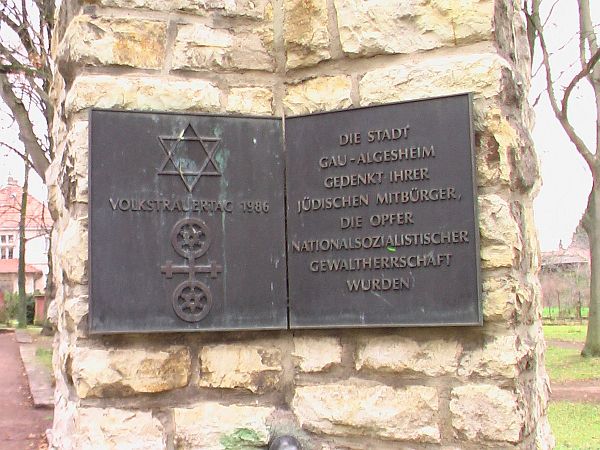
But there is a very sad underside to this story of American success.  It’s the story of those who did not leave Europe.  For the first time in my life I confronted the reality that the Holocaust did not just happen to other families, to other Jews.  Not that I have not been deeply affected by the Holocaust all my life; ever since I read Anne Frank’s diary as a child, I’ve identified with and cried for all those who were murdered by the Nazis.  But I never knew that I had relatives left behind in Germany who were part of that slaughter.  I am still finding more, and I will write about them soon.  The list of names of my cousins who died in the Holocaust grows longer and longer, and I realize more than ever how grateful I should be to Bernard Seligman, John and Jeanette (Dreyfuss) Nusbaum, and Jacob and Sarah (Jacobs) Cohen for leaving Europe and taking a chance on the new country across the ocean.

memorial plaque gau aldesheim

So this year for Passover I will be thinking about that first major migration of Jews from Europe to America.  I will be feeling thankful for the risks my ancestors took, and I will be feeling the loss of not only all those who were killed in the Holocaust, but the loss of all the children and grandchildren who would have been born but for those deaths.

And overall I will be celebrating family, freedom, and faith—faith that the world can be a better place and that human beings can be their best selves and live good and meaningful lives.  May all of you have a wonderful weekend—be it Passover or Easter or perhaps just another weekend in April for you.   Celebrate all the good things in life in whatever way you can.


Embed from Getty Images

Family Wedding: My Great-Aunt Betty Goldschlager Feuerstein and Her Children

Betty Goldschlager

Betty Goldschlager

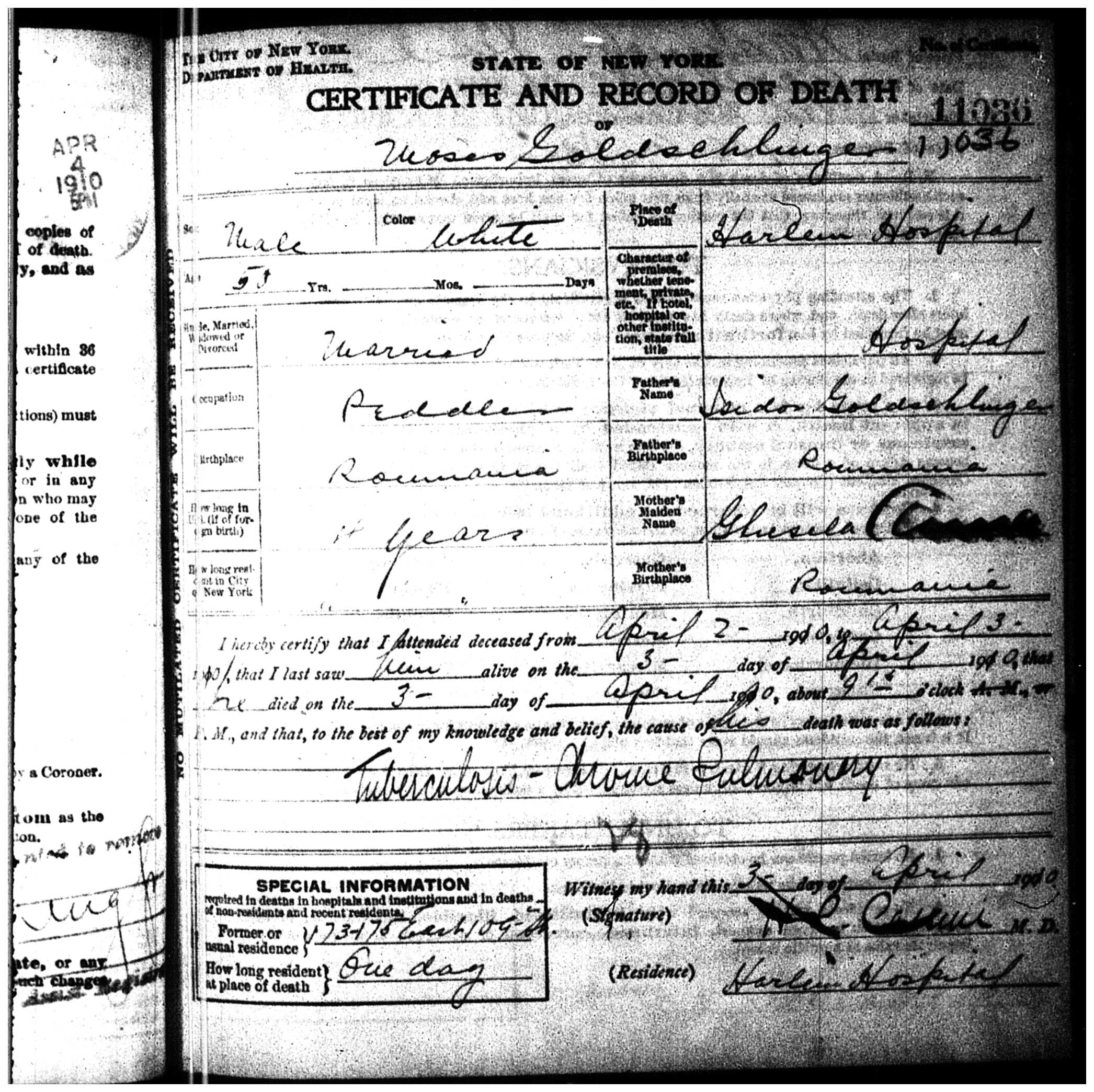
I’ve told the heartbreaking story before of my grandfather Isadore’s little sister Betty Goldschlager.  After sailing alone from Iasi, Romania, just thirteen years old, she arrived at Ellis Island on April 4, 1910, expecting her father Moritz, my great-grandfather, to meet her at the boat.  What she did not know was that her father had died the day before, April 3, 1910, from tuberculosis, just eight months after he himself had arrived in New York.  Betty was detained for a day at Ellis Island until her aunt, Tillie Strolowitz, could meet her and have her discharged.  Only then could Betty have learned that she had missed seeing her father alive by just one day.

Morris Goldschlager death certificate.pdf


betty goldschlager ship manifest part 1

Betty Goldschlager ship manifest part 2

Year: 1910; Arrival: New York, New York; Microfilm Serial: T715, 1897-1957; Microfilm Roll: Roll 1444; Line: 1; Page Number: 193

But Betty Goldschlager survived and in fact thrived in the United States.  She married Isidor Feuerstein in 1921, and they had two daughters, my mother’s first cousins.  Betty’s grandson Barry shared this photograph of his parents’ wedding in 1950.  My great-aunt Betty is standing to the far left.

courtesy of Barry Kenner

courtesy of Barry Kenner

When I look at this photograph, I marvel at the fact that that little girl, who sailed across the ocean by herself and then arrived only to learn that her father had died, somehow had the strength to endure all that and adapt to a foreign country and make a good life for herself, her husband, and her children.

Caps for Sale: Peddlers and Merchants

As I wrote in my last post, by 1852 or before, five of the eight children of Amson and Voegele Nusbaum had settled in Pennsylvania.  Two of the siblings had settled in Harrisburg, one in Lewistown, one in Blythe, and one in Philadelphia.  According to the 1850 census, John Nusbaum was a merchant in Harrisburg, and his brother-in-law Isaac Dinkelspiel was a peddler there, married to John’s sister Mathilde.  Leopold Nusbaum was a butcher in Blythe, Maxwell was a merchant in Lewistown, and Ernst was a merchant in Philadelphia.

It is not surprising to me that Ernst would have settled in Philadelphia, which, as I have written about in the context of my Cohen ancestors, had a fairly large German Jewish community by the mid 1800s.  But why were John Nusbaum and Isaac Dinkelspiel and their families in Harrisburg?  Even more surprising, what were Leopold and Maxwell doing in relatively small towns like Lewistown and Blythe?  What would have taken these new German Jewish immigrants away from the big cities and to smaller towns and cities in Pennsylvania?

The choice of Harrisburg is not really that surprising.  By the time John Nusbaum arrived in the US, perhaps as early as 1840 or even before but certainly by 1850, Harrisburg had been the Pennsylvania state capital for many years already, i.e., since 1812.  It had been settled in the early 18th century and because of its location on the Susquehanna River where there was an opening between the mountains, it had developed into an important trading post for trade and expansion to the west.  By the 1830s the railroad and the Pennsylvania Canal passed through Harrisburg, further increasing its economic importance for westward expansion.  By 1840 the population of Harrisburg was almost six thousand people.  By comparison, the population of Philadelphia in 1840 was over 93,000 people.


Capitol. (Harrisburg, Pennsylvania.), by A. G....

Capitol. (Harrisburg, Pennsylvania.), by A. G. Keet (Photo credit: Wikipedia)

Jewish immigrants began to arrive in Harrisburg in the 1840s, primarily from Germany and England.  The first synagogue, Ohev Sholom, was begun in 1853, first as an Orthodox congregation, and then in 1867 it became a Reform congregation.   The Jewish population, however, was not very large.  There were sixteen members of the congregation in 1853, and even as late as 1900 there were only 35 members.

So how would my three-times great-grandfather John Nusbaum have ended up here?  I do not know for sure, but I can speculate that like many German Jewish immigrants, he arrived in Harrisburg as a peddler and, once finding a strong and stable economic base there, eventually opened his own store.  Harrisburg was obviously an important location for trade not only for its residents but also for those who stopped there as they moved westward in the United States.  It was likely an ideal location for a merchant.  Unlike his three-times great-granddaughter (and her immediate relatives), he must have been a very able entrepreneur.

This pathway to economic success—from peddler to merchant—was quite common among German Jewish immigrants.  According to Hasia Diner in “German Jews and Peddling in America,” (hereinafter “Peddling”) located here:

In Nashville, 23 percent of the adult male Jews in 1860 peddled, as did 25 percent of those in Boston between 1845 and 1861. In Easton, Pennsylvania, a town which occupied the strategic meeting point of the Delaware and Lehigh Rivers, 46 percent peddled in 1840, but just five years later, the number jumped to 70 percent. By 1850 the number had dropped to 55 percent, still a significant figure for any one occupation among a relatively small number of people. Of the 125 Jewish residents in Iowa in the 1850s, 100 peddled around the state, as did two-thirds of all the Jews in Syracuse, New York in that same decade before the Civil War.

See also  Rudolf Glanz, “Notes on Early Jewish Peddling in America,” Jewish Social Studies ( Indiana University Press, Vol. 7, No. 2, April,  1945)  located here.

In a different article, “German Immigrant Period in the United States,” (hereinafter “German Immigrant”) located here in the Jewish Women’s Archive, Hasia Diner explained why peddling was so widespread among German Jewish immigrants.

Americans in the hinterlands had little access to finished goods of all sorts, since few retail establishments existed outside the large cities. Jewish men overwhelmingly came to these remote areas as peddlers, an occupation that required little capital for start-up and that fit the life of the single man. In the large regional cities, Jewish immigrant men would load themselves up with a pack of goods, weighing sometimes as much as one hundred pounds, and then embark on a journey by foot, or eventually, if a peddler succeeded, by horse and wagon.

In “German Immigrant,” Diner opined that because many of these German Jewish immigrants came as single men, they were not tied down to families in a particular location when they first arrived and could thus take on the itinerant life of the peddler.  In her “Peddling” article, Diner further explained the popularity of peddling, pointing out that many of these German Jewish men came from families in Germany where their fathers had been peddlers.  That was certainly true for John Nusbaum and his brothers; their father Amson had been a peddler.  This was an occupation with which they were familiar.  Diner also stated that the Jewish German immigrants had networks of families and friends who could extend credit and help them get started on a peddling business.

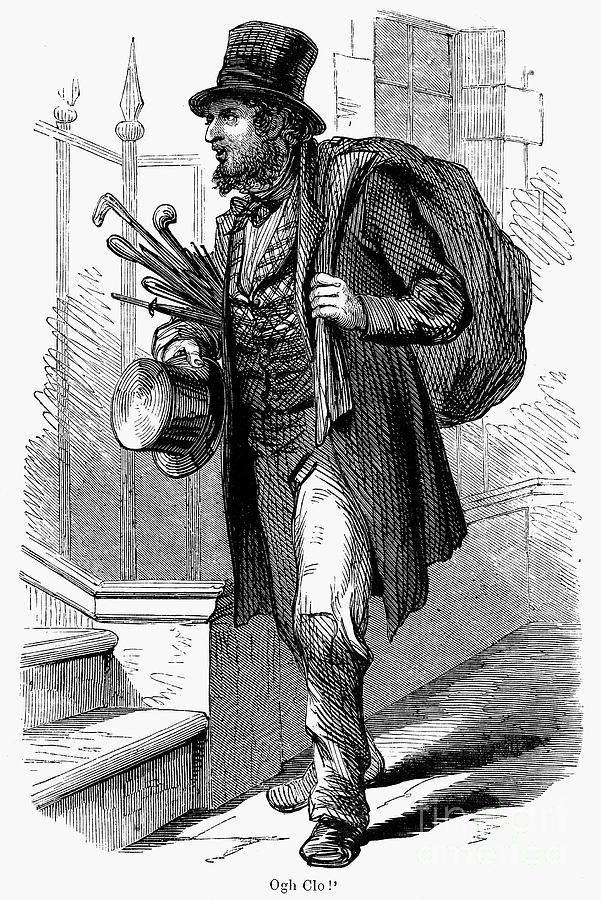
19th century etching of a peddler by Granger found at http://fineartamerica.com/featured/1-peddler-19th-century-granger.html

19th century etching of a peddler by Granger found at http://fineartamerica.com/featured/1-peddler-19th-century-granger.html

In “Peddling,” Diner provided this vivid description of the life of the peddler:

The peddlers operated on a weekly cycle. They left their base on Sunday or Monday, depending on how far they had to go. They would, if necessary, take the railroad or canal barges to get to their territories.  They peddled all week and on Friday headed back to the town from which they had gotten their goods. Here on the Jewish Sabbath and, depending on geography, on Sundays as well, they rested, experiencing fellowship with the other immigrant Jewish peddlers who also operated out of this town. The peddlers engaged with the settled Jewish families, some of whom either operated boarding houses for peddlers or merely extended home hospitality to the men during their brief respites off the road. On the weekends the peddlers could partake of Sabbath religious services and consume some of the good food associated with Jewish holy time, food prepared in the distinctive manners of the various central European regions. Saturday night, after sundown, when the restrictions of the Sabbath lifted, the peddlers came to the shopkeepers and or other creditors to whom they owed money, paid up from the goods they had sold that week, and then filled up their bags, ready for another week on the road.

Rudolf Glanz wrote in “Notes on Early Jewish Peddling in America,” Jewish Social Studies ( Indiana University Press, Vol. 7, No. 2, April,  1945) located here, that these that peddlers played a crucial role in the economic growth and population growth in the unsettled parts of the United States in the 19th century because they provided the pioneers with access to goods that they otherwise would not have had.  This freed the pioneers from having to carry or manufacture these products themselves as they migrated west, thus enabling them to survive and adapt to the frontier conditions.  Glanz, pp. 121-122.  Diner described in “Peddling” the types of goods these peddlers generally sold:

The peddlers did not sell food or fuel. Rather they sold a jumble of goods that might be considered quasi-luxuries. In their bags they carried needles, threads, lace, ribbons, mirrors, pictures and picture frames, watches, jewelry, eye glasses, linens, bedding, and other sundry goods, sometimes called “Yankee notions.” They carried some clothing and cloth, as well as patterns for women to sew their own clothes, and other items to be worn. At times they carried samples of clothes and shoes, measured their customers, and then on return visits brought the finished products with them. When the peddlers graduated from selling from packs on their backs to selling from horse and wagon, they offered more in the way of heavy items, such as stoves and sewing machines.

As Diner points out, often these peddlers were the first Jews in a particular town or village.  Once a peddler had saved enough money to start a permanent store and become a merchant, they would often pick one of these towns where they had had success as peddlers, gotten to know the residents, and established a rapport and a reputation.  Both Diner and Glanz discuss this evolution from peddler to merchant.   According to Diner in “Peddling,” most peddlers did not peddle for long periods, but were able to become storeowners, marry, and start families within a reasonably short period of time. Most became at least moderately successful, and some became the owners of some of the biggest department stores in the US, such as Gimbel’s and Macy’s.

My hypothesis is that John Nusbaum also started out as a peddler.  He must have started from Philadelphia or perhaps New York as a single man and peddled goods through Pennsylvania until he accumulated enough capital and was able to settle in Harrisburg, a prime location for a merchant for the reasons stated above.  Perhaps it was only once he had done so that he married Jeanette and started a family in the 1840s.

When his brother-in-law Isaac Dinkelspiel arrived with his wife Mathilde Nusbaum Dinkelspiel sometime later, it would have made sense for them to settle in Harrisburg.  Since Isaac also started out as a peddler, as seen on the 1850 census, as a married peddler with children, it is not surprising that they would have moved to a place where Mathilde would have had family nearby while her husband Isaac was on the road.  In addition, it is very likely that John was supplying Isaac with the products he was peddling.  According to Diner, it was Jewish merchants who supplied the peddlers with the goods that they then carried out to the less settled regions to sell to those who lived there.  Jewish peddlers needed Jewish merchants for their inventory, and Jewish merchants benefited from the increased market they could reach through the peddlers.

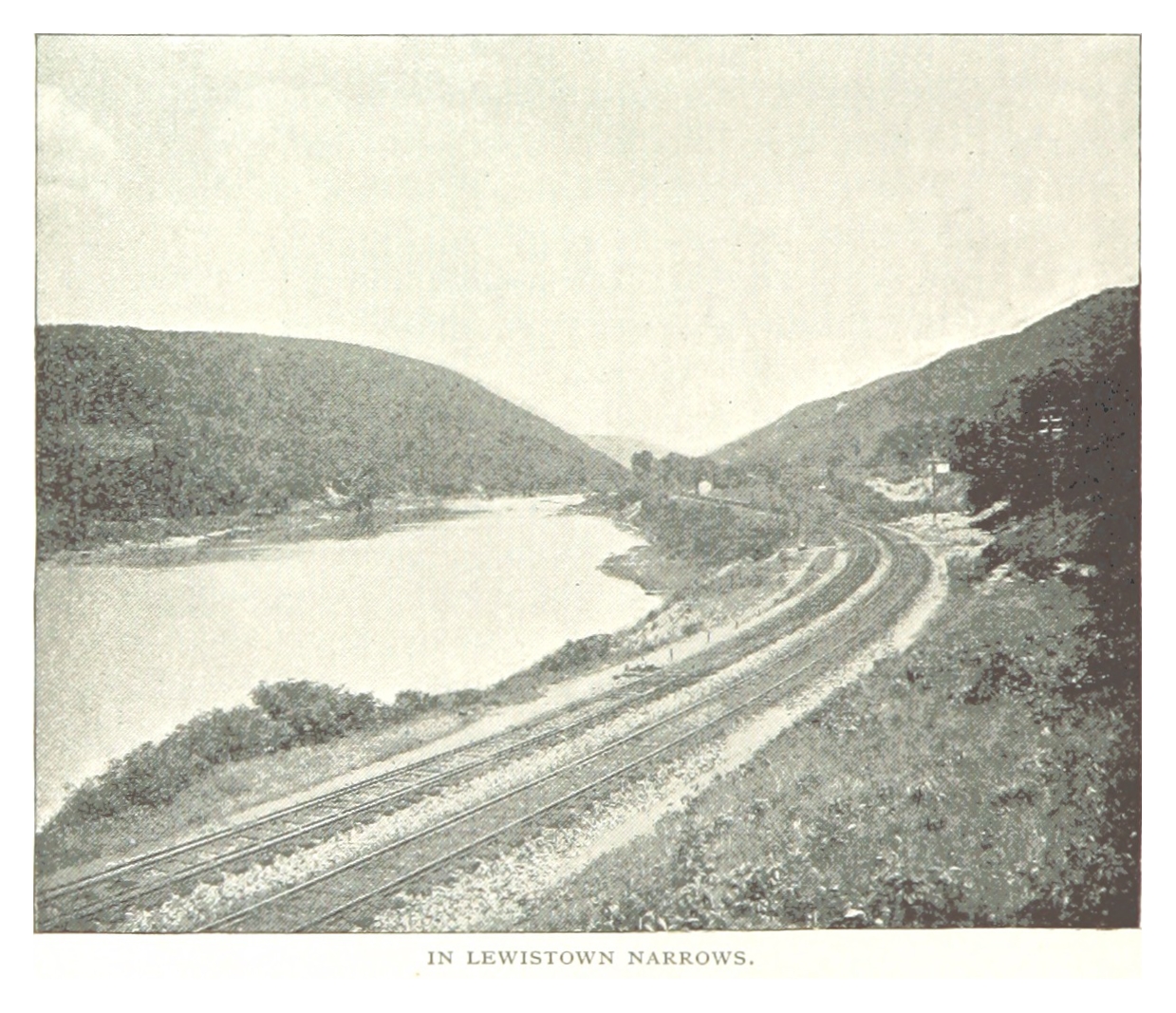
Maxwell, John’s youngest brother, was also a merchant by 1850, but he was in Lewistown, sixty miles from Harrisburg and about 160 miles from Philadelphia.  What was he doing there? Unlike Harrisburg, it was not the state capital, and unlike Philadelphia, it was not a major seaport city.  But it was by 1850 itself an important trading center based on its location near the Pennsylvania Canal and the railroads.  Mifflin County, where Lewistown is located, had a population of close to 15,000 people in 1850 so it was not an insignificant location.  I assume that Maxwell, arriving after his brother John, had also started as a peddler, selling the wares he obtained from his brother, and traveling around the state, until he was able to save enough money and establish a store in his own territory, close enough to his brothers, but not so close as to compete for business.

According to the JewishGen KehillaLinks page for Lewistown, Pennsylvania, found here , the Mifflin County Historical Society had no records of Jews before 1862, but obviously Maxwell was already there. In fact, there was a street named for him:

A map of Lewistown in 1870 shows that Nathan Frank had a store at Brown and Market Streets, listed in a business directory of the time as Franks — Dry Goods, Carpets, Clothing, Furnishings, Goods, Etc.”  Spruce Street was at that time listed as Nusbaum Street and in April, 1880 M. Nusbaum — Clothing & Gents Furnishings was advertised. By 1907 however Nusbaum & Co. was no longer listed in the directory.

The biggest mystery to me is why Leopold Nusbaum ended up in Blythe as a butcher. Blythe is sixty miles from Harrisburg and a hundred miles from Philadelphia.  Like Lewistown, it was also located near railroads and the canals.  I cannot find anything about its population in 1850, but even today its population is under a thousand.  Schuykill County, where Blythe is located, however, had an overall population of over sixty thousand in 1850, which was a doubling of its 1840 population.  Something must have been happening there, but I’ve not yet been able to figure out why its population exploded in that ten year period.  Perhaps that explains why Leopold was living there with his wife Rosa and two young sons in 1850.  But why was he a butcher? Certainly he could not have been a kosher butcher; even today the Jewish population of Blythe is 0%.  At any rate, by 1860, as we will see, Leopold and his family had left Blythe and moved to Harrisburg, where Leopold also followed in his brother’s footsteps and became a merchant.

Thus, the Nusbaum story is not unlike the story of many of those German Jewish immigrants who came to the US, started off as peddlers, and then became merchants, owning stores all over the United States. It must have taken a lot of hard work and a courageous spirit to move to this new country, carrying a heavy pack hundreds of miles through undeveloped territory, dealing with strangers who spoke a strange language, on your own and alone for most of the week.  It must have taken much determination and persistence to do this week after week, maybe for a few years or more, until you had made enough money to find one town to settle in and establish a store.  And then it must have been a hard life, living as perhaps the only Jewish family in that town far away from other family members and other Jews.  In my posts to follow, I will trace the lives of my Nusbaum peddler and merchant relatives and how they progressed in America.


Whose Clothing Were They Wearing?

I recently posted these two photographs of two of the Strolowitz/Adler sisters, Rebecca (Ray) and Leah.

Leah Strolowitz Adler

Leah Strolowitz Adler

Ray Strolowitz Adler

Ray Strolowitz Adler

A number of people asked me questions about the photographs.  In particular, people were struck by the fact that two poor immigrant young women were dressed so well and were able to sit for a formal portrait.  The photograph was dated 1918, so Ray and Leah had only been in the US for about ten years.  They were both working as dressmakers.  How could they afford these luxuries like furs and hats and fancy shoes and a studio photograph?

I did some research online but did not find anything that indicated that photographers provided clothing for customers to wear, although there are many references to the props photographers kept in their studios to add interest to the photographs.  There is also this quote from a website that addresses the question of how to determine the date of a particular photograph:

“Your ancestor may have only owned one nice dress or suit that was used for all sorts of occasions. Perhaps they did not own a nice suit of clothing and borrowed one from the photographer.”

http://www.genealogytoday.com/articles/reader.mv?ID=1149

I also posted a question to the Tracing the Tribe group on Facebook about these issues and received numerous responses that were very helpful.  One commenter pointed out that since Leah and Ray were dressmakers, it was entirely possible that they made these outfits themselves.  The commenter recalled that her own ancestor was able to create fashionable dresses from older clothing and scraps by copying what she had seen in store windows.  Another commenter made the point that furs may not have been that expensive back then.  There was also discussion of the possibility that the furs and hats were props supplied by the photographer to supplement the clothing that belonged to the customers.  And some commenters believed that photographers did have clothing at their studios for the customers to wear.

As to the question of the cost of having a portrait taken, several people pointed out that having portraits done, regardless of your economic status, was very common.  Immigrants wanted to be able to send photographs back to the old country and to mark their own special occasions.  http://gary.saretzky.com/photohistory/resources/photo_in_nj_July_2010.pdf  This website points out that with improved photographic techniques, it was in fact not that expensive to have a formal photograph taken even for a family of limited means.  The early 20th century saw the development of postcard photographs in the size used like the ones of Leah and Ray, and the website states that they were a “cheaper, quicker format for producing prints, made photo portraits available to almost everyone.”

I was also able to locate some information about the photographer.  From the photographs I was able to find his name, Rothman, and address, 186 East 116th Street in New York.  By using the stevemorse.org tool for finding an address on a census, I was able to find Isadore Rothman, recent Russian immigrant, residing at 186 East 116th Street.  In 1916, Mr. Rothman was working for a different studio, Mantor Photographic Studio, according to the 1916 New York directory.  So perhaps Rothman was just starting out on his own when Ray and Leah came to have their pictures taken.  They also all lived in the East Harlem neighborhood.

Isadore Rothman on the 1920 census

Isadore Rothman on the 1920 census

So I don’t know the answer for sure, but it is possible that Leah and Ray made their outfits or borrowed them from the photographer or from someone else or a combination of both.   I guess we will never know.  And it is also possible that these photographs were not that expensive despite their seeming formality and quality.

UPDATE:  I just received this comment from Ava Cohn, an expert in using photographs in genealogical research.  She said, “Photographers did have props that were used in photos. By this time, however, the clothes were usually not part of what was “borrowed” from the photographer. As many have suggested, our Jewish ancestors were tailors in Europe and quite adept at pattern-making and sewing. There were also many companies that produced patterns and sewing one’s own clothes was both a business and a past-time. Studio photos were relatively inexpensive. …  And btw, if you are certain that your photos were taken in 1918, then Ray’s outfit is not the latest fashion. Her skirt length and shape are more typical of the 1916-1917 period.”  You can learn more about Ava Cohn and her services at her website, Sherlock Cohn.

A Photo Essay: The Strolowitz Adler Family, Joe Louis, and The Resilience of the Human Spirit

It’s been a long time since I’ve written about the Strolowitz Adler line in my family tree since I have been focused on my father’s Cohen line, but I have now completed my research on one other member of the Strolowitz Adler family so am taking a short break from the Cohens in order to report on that research.

Tillie Rosenzweig Strolowitz Adler was my great-grandmother Ghitla Rosenzweig Goldschlager’s sister.  Tillie was the aunt who provided a home for my grandfather Isadore Goldschlager and his sister Betty when their father died in 1909.  Tillie had been recently widowed herself after her husband Jacob had died shortly after arriving in NYC from Iasi.  Tillie also outlived two of her sons, Pincus and Isidor, both of whom had died from serious illnesses as young adults.  Her other five children lived to adulthood, but many of them also faced some personal struggles and in some cases tragic deaths.  Only Leah, the youngest child, seemed to lead a long and happy life with a long and happy marriage to Ben Schwartz.

The only one of Tillie’s children I had not yet written about was Rebecca, the fifth child born in 1892 in Iasi.  She was fifteen when she immigrated to the US with her parents and younger brother and sister in December, 1907, and in 1910 and 1915 she was working in a sweatshop as a dressmaker.

I am very fortunate to have this beautiful photograph of Rebecca Strolowitz Adler.  All the photos included in this post were provided by  members of the extended family.

Ray Adler

Rebecca Strolowitz/Ray Adler (undated)

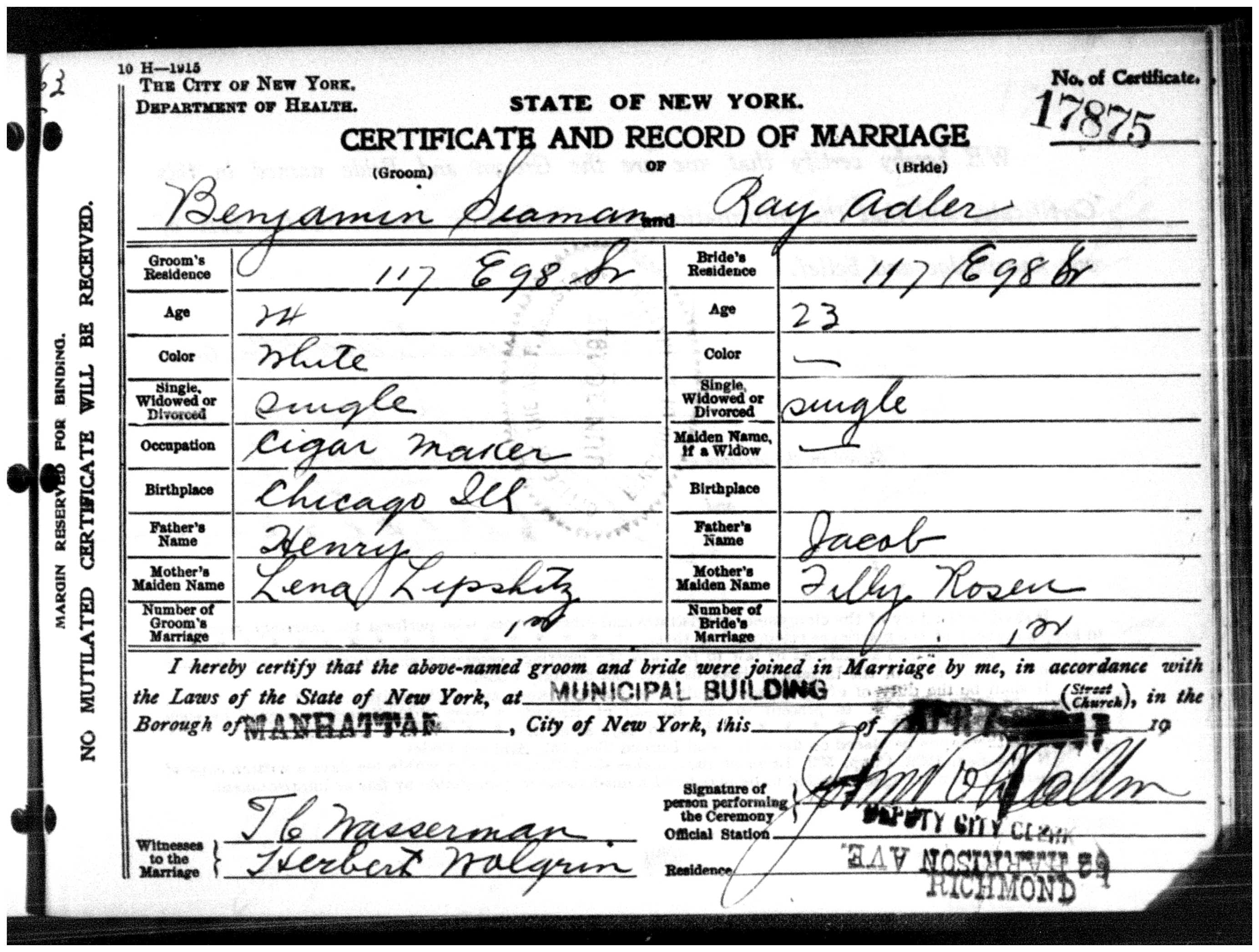
On April 7, 1917, Rebecca, now using the name Ray, married Ben Seamon.

Ray Adler and Ben Seamon marriage certificate

Ray Adler and Ben Seamon marriage certificate

Ben was born in Chicago in 1893.  He enlisted in the US Army in November, 1917, and served during World War I until he was honorably discharged in January, 1919.  Ray and Ben’s first child Jerome was born in June 1919, and as of 1920, Ben was working as a foreman in a dressmaking shop (perhaps this is where he had met Ray?).  By 1925, Ray and Ben had two sons, Jerome born in 1919, and Paul, born in December, 1920, and the family had moved to the Bronx.  Ben was now working as a chauffeur.  Their third son, Harold, was born in October, 1924, and Ben and Ray’s youngest child Thelma was born in 1926.

By 1930, however, Ray was living with her children in the home of her brother David Adler along with his wife Bertha and their daughter Tessie in Manhattan.  Ben, on the other hand, was living in the Bronx with his mother and his brothers Samuel and Mannie Seamon.

Mannie Seamon ran a gym where he trained boxers, and according to the 1930 census, both Manny and Ben were working as managers at the gym at that time.  According to Mannie’s obituary in the NYTimes dated March 26, 1983, in 1937, Mannie was hired as the assistant to the trainer for Joe Louis, the world heavyweight boxing champion from 1937 until 1949, and in 1942 when that trainer died, Mannie became Joe Louis’ trainer, working in that position until 1951.

Manny Seamon and Joe Louis

Manny Seamon and Joe Louis

Mannie also had trained many other boxers, including Benny Leonard, the World Lightweight Boxing Champion.  According to Ben Seamon’s obituary in the July 25, 1971 NY Times, Ben also had been a boxer and a boxing trainer.

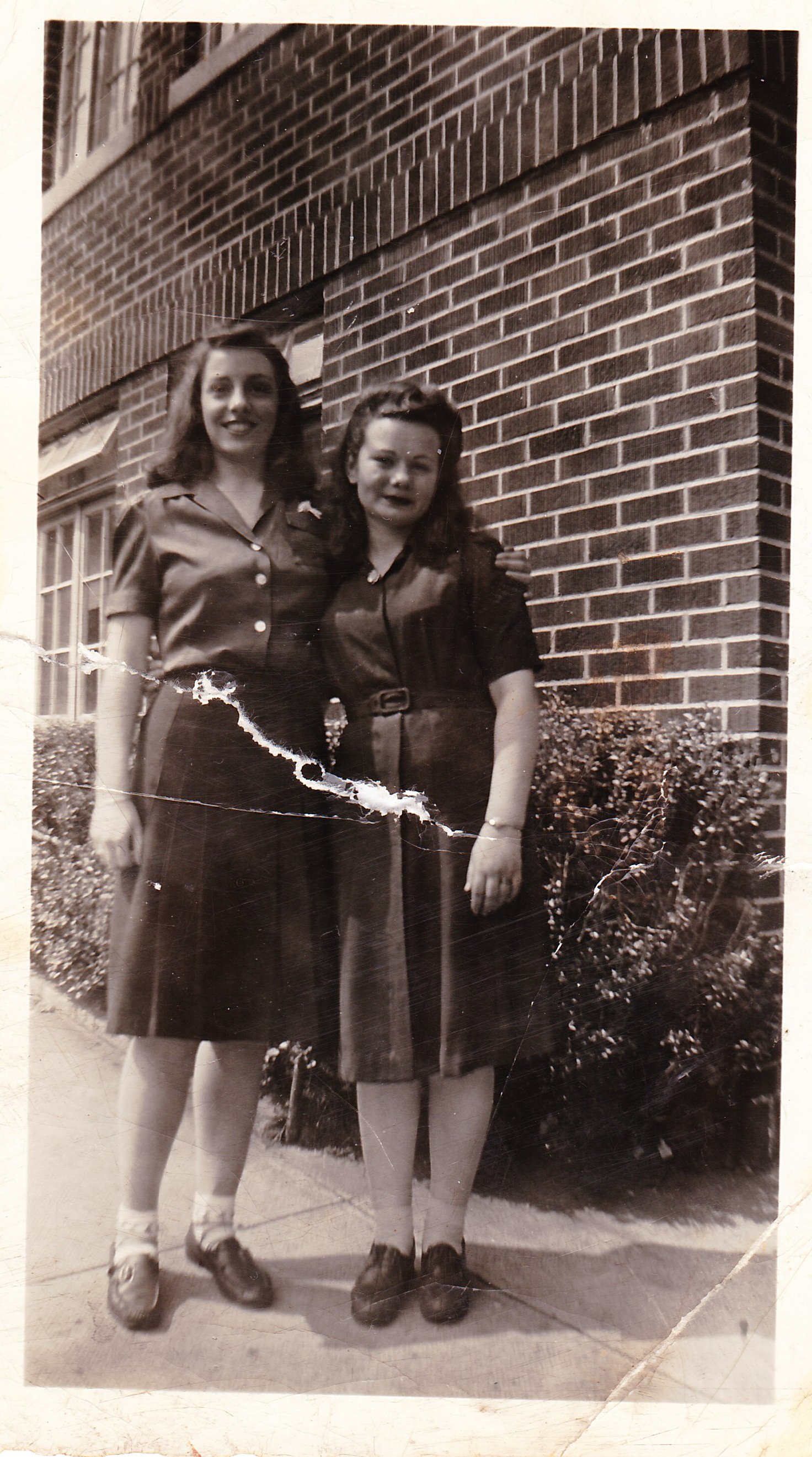
During the Depression, Ray became a patient at the Central Islip State Hospital.  I was not able to find any records for Ray after 1942. Her two youngest children, Thelma and Harold, were admitted to the Hebrew Orphan Asylum (HOA) in Manhattan on June 28, 1935.  Thelma resided there from ages 9 through 15.   Harold was discharged to return to live with his father on February 25, 1940;   Ben was then working as an announcer for boxing and wrestling bouts.  Thelma was discharged from the HOA on July 20, 1941, two months before the HOA closed in Sept. 1941.

Thelma Seamon visited by her cousin Teddy Schwartz

Teddy Schwartz, daughter of Leah Adler Schwartz, visiting her cousin Thelma Seamon around 1944

But it all seemed to work out well for Thelma.  While at the orphanage, she met her future husband, Nathan Letnick, who was also a resident there.  Thelma graduated from high school in 1942.

Thelma Graduation photo 1946

Thelma Seamon graduation photograph 1942

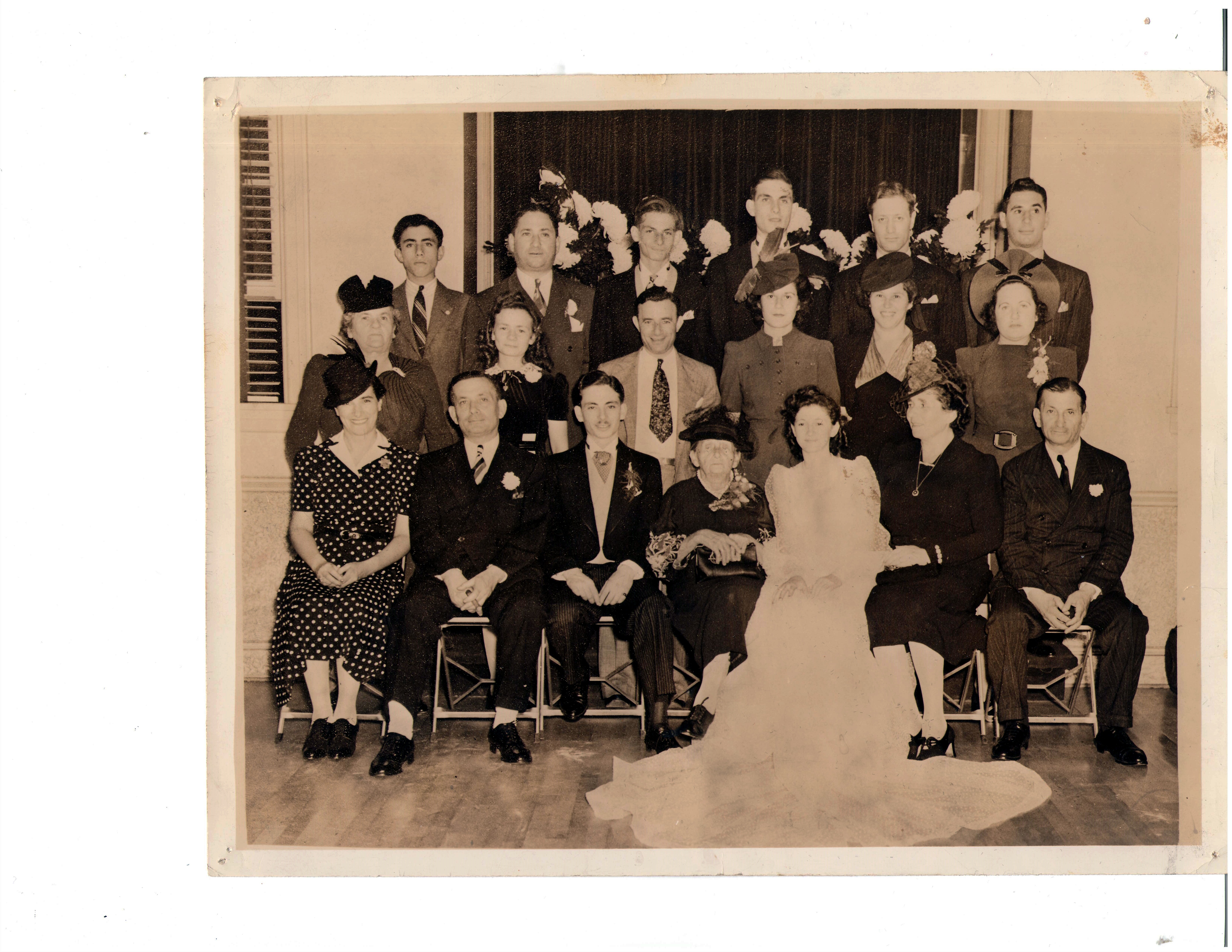
Jerome Seamon married Lillian Wolf on September 22, 1940:

Wedding of Jerome Seamon and Lillian Wolf September 22, 1940

Wedding of Jerome Seamon and Lillian Wolf September 22, 1940

Pictured here are Mannie Seamon (top row, second from left), Harry Seamon (right of Mannie), Paul Seamon (right of Harry).  Thelma is second from the left in the middle row.  In the front row, Ben Seamon is second from the left, then the groom Jerome Seamon, Ben’s mother, and the bride Lillian Wolf Seamon.  The others are relatives and cousins from the Seamon side of the family.

All three of Ben and Ray’s sons and their son-in-law Nathan served overseas during World War II, and Paul received a Purple Heart for his service.  Thelma worked at Western Electric in Manhattan during World War II.

Thelma working at Western Electric during World War II

Thelma working at Western Electric during World War II

Nathan Letnick and Thelma Seamon were married after the war on November 10, 1946.  Here is their wedding photograph with the extended family.

Nathan Letnick and Thelma Seamon's wedding 1946

Nathan Letnick and Thelma Seamon’s wedding 1946

Among those pictured above are the following people, most of whom are referred to in this post:

Back row, far left: Paul Seamon;  Middle row, far left: Jerry Seamon; Front row: Lillian Wolf Seamon (Jerry’s wife); Ben Seamon’s sister, Ida; Nathan Letnick; Thelma Seamon Letnick; Ben Seamon; Ben’s sister Bertha.

Nathan graduated from NYU with degrees in business, thanks to the GI Bill. The four Seamon children, Jerome, Paul, Harold, and Thelma,  eventually moved to Long Island after the war, where all except Harold married and raised families.

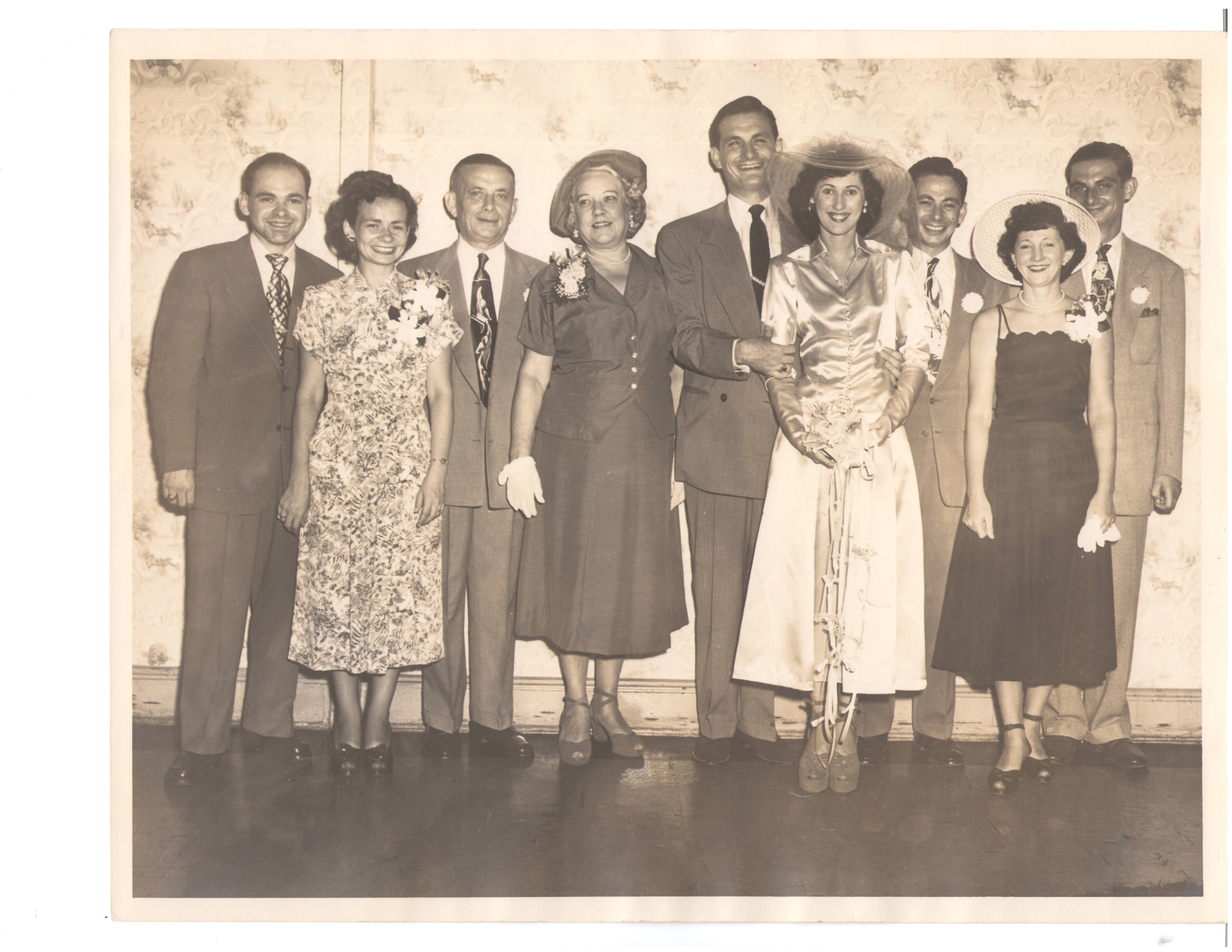
Here is a photograph from the wedding of Paul Seamon and Marilyn Tobetsky on August 6, 1949, showing all of Ray and Ben’s children and their spouses as well as Ben:

Wedding of Paul Seamon and Marilyn Tobetsky 1949

Wedding of Paul Seamon and Marilyn Tobetsky 1949

From left to right:  Nathan Letnick, Thelma Seamon Letnick, Ben Seamon, Mae, Paul Seamon, Marilyn Seamon, Jerome Seamon, Lillian Seamon,  and Harold Seamon

As for Ben, I found  a World War II draft registration dated 1942 that indicates that he was employed by the Town Pump in Tullahoma, Tennessee, but was residing with Jerome in the Bronx.  Ben moved to Florida sometime after 1952 and worked at a dog racing track now known as the Mardi Gras Casino.  He died in July, 1971, and is buried at Long Island National Cemetery.

After retirement Nat and Thelma moved to Florida.  They were still married in 2000 when tragically Thelma was killed by an elderly driver who had Alzheimer’s.  Nat died six years later.  Thelma’s daughter told me that one of Thelma’s passions was knitting:  “All her adult life, everyone knew my mother to be knitting something for everyone and anyone having a baby.”

Finally, a more recently dated photograph of Thelma and her brother Paul in 2000.

Thelma & Paul April 8, 2000

The story of Tillie Strolowitz Adler and her children is a story filled with lots of  heartbreak and  hardship but ultimately survival.  They all came as immigrants from Romania to New York City and sought happiness and success, which did not come easily to them.  Although they may have struggled, the generations who followed them found a home here in the US, served their country, and ultimately not only survived but thrived.  These photographs reflect the resilience of the human spirit better than I can ever capture it in words.

All Things Considered, I’d Rather Be in Philadelphia

W.C. Fields, who was born in Philadelphia, used to make fun of his birthplace as a staid and boring place by threatening to have the line, “All things considered, I’d rather be in Philadelphia,” as the epitaph on his gravestone.  (Apparently, that threat was never carried out.)  Philadelphia has often been overshadowed by New York to its north and by Washington to its south.  I remember traveling to Philadelphia to visit my relatives when I was a child, my siblings and I fidgeting in the back seat of the car as my father fought through the traffic on the ugly New Jersey Turnpike.

English: W.C. Fields

English: W.C. Fields (Photo credit: Wikipedia)

My grandmother Eva Cohen and her second husband Frank Crocker lived in what I remember as a small apartment in Philadelphia, and somehow it was always hot and humid whenever we visited.  I was only nine when my grandmother died, so my memories are somewhat vague, but I do remember watching a baseball game with Poppy Frank, as we called him, discussing the merits of Sandy Koufax versus Don Drysdale (the Phillies were obviously playing the Dodgers that particular visit).  We would sit and visit for a while, have lunch or dinner, and then pile back in the car, suffer through the Jersey Turnpike again, fidgeting and bickering in the backseat.  So I guess I could relate to W.C. Fields’ sentiments about his hometown.  Somehow I associated Philadelphia with long car rides, being tortured by my siblings, and hot, humid weather.  I wish I could remember more about my grandmother, but as a child, I was focused on childish things. Well, and baseball.  As I wrote before, I remember her as beautiful, reserved, and very dignified, a true gentle-woman in both senses of the word.

So given my somewhat skewed views of the City of Brotherly Love, I did wonder why my Cohen relatives (and in fact all of my father’s lines) ended up in Philadelphia.  They sailed into New York City—why did they leave the Greatest City in the World to go to its poor stepsibling to the south? I asked my father, who was born and raised in Philadelphia, this question the other day, and he said something about William Penn and how Philadelphia was a Quaker city and probably more tolerant of Jews.

I decided to do some research to answer a couple of questions: What was Philadelphia like for Jews in the 1840s and 1850s when the Cohens arrived? Where did they live in the city, and what were the socioeconomic conditions like in those areas? What drew them there instead of New York or some other American city?

I found a wonderful resource, a book by Robert P. Swierenga, a historian who has published several books about the Dutch in the United States.  The book I relied on is titled The Forerunners: Dutch Jewry in the North American Diaspora (Wayne State University Press 1994), and in it Swierenga traced the immigration of Dutch Jews to America and their settlements in several US cities, including Philadelphia.  I read the chapter on Philadelphia and learned not only about the Dutch Jews who settled there, but more generally about the history of Jews in Philadelphia.  After reading this chapter, I better understand why the Cohen family decided to settle there.

Philadelphia had one of the earliest Jewish communities in the United States.  In 1776 it had the third largest Jewish population of American cities, after New York and Charleston; there were 300 Jews living in Philadelphia at that time.  That number grew to 200 families by 1778 as Jews sought refuge there during the Revolutionary War.  The population was largely Sephardic, and the first synagogue was formed in 1782, Congregation Mikveh Israel, an Orthodox Sephardic synagogue.  Once the war ended, however, many of the Jews returned to their prior homes, and by 1790 there were only 25 Jewish families or about 150 people.  (Swierenga, pp. 118-119)

English: Former home of Mikveh Israel Synagogu...

Former home of Mikveh Israel Synagogue

There was a growing number of non-Sephardic Jews settling in Philadelphia after the Revolution, however, as immigrants from Germany, Poland and the Netherlands began to arrive, and in 1790 these people formed a new synagogue, Rodeph Shalom, which would adhere to Ashkenazi practices.  Rodeph Shalom was the first Ashkenazi synagogue in North America, and most of its first congregants were Dutch.  (Swierenga, pp. 119-120)

Rodeph Shalom Synagogue on the NRHP since Augu...

Rodeph Shalom Synagogue on the NRHP since August 7, 2007. At 607–615 North Broad St., in the Poplar neighborhood of Philadelphia. (Photo credit: Wikipedia)

The Jewish population really started to grow in the early 19th century.  In 1820, there were 450 Jews in Philadelphia; in 1830 there were 730.  By 1840, there were 1500, and then there was a huge surge to 6000 by 1850 and to 10,000 by 1860.  This, of course, was the period my Cohen relatives began to arrive in Philadelphia—between about 1848 and 1851.  In fact, according to Swierenga, a substantial number of these Jewish immigrants were Dutch Jews.  (p. 120)

In his discussion of Dutch Jews, Swierenga included not only those who came directly from the Netherlands (meaning primarily Amsterdam), but also those, like my ancestors, who had emigrated from Amsterdam to England before coming to America.  Based on his research, he concluded that for the most part the Dutch Jews who came to Philadelphia tended to come directly from Amsterdam whereas those who had first stopped in London tended to end up in New York.  Swierenga found that in 1850 and 1860 there were only two Dutch Jewish families in Philadelphia who had had children born in England. (Swierenga, p. 125)  Was he counting my relatives? Hart Levy Cohen’s children were born in England, but did they count as “children?” On the other hand, Jacob’s daughter Fannie was born in England, and although his later children were born in the US, his family must have been one of those two families.

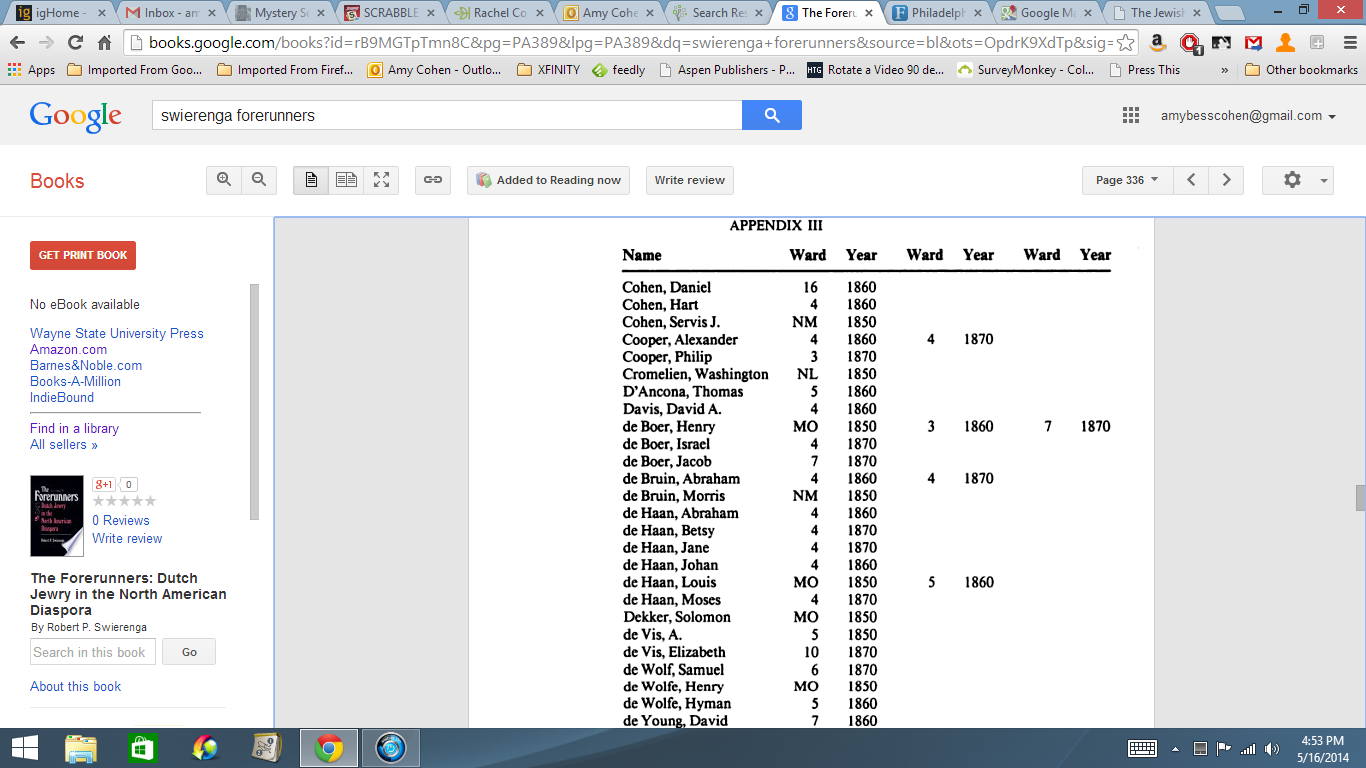
In fact, this screenshot from Appendix III in Swierenga’s book, captioned “Dutch Jewish Household Heads and Working Adults in Philadelphia 1850, 1860 and 1870,” shows that Swierenga did count Hart Cohen as one of those Dutch Jews.

Appendix III from Swierenga. The Forerunners

Appendix III from Swierenga. The Forerunners

Based on this data as compared to his findings that there was a greater number of Dutch Jewish families in New York with children born in England, Swierenga reached the following conclusion: “Clearly, the Dutch Jews in Philadelphia had been better off economically in the Netherlands, and they immigrated earlier than those settling in New York, who out of economic necessity spent a longer sojourn in London.  For the Philadelphia Dutch Jews, a London stopover or two-stage migration was not as necessary or desirable.” (p. 126)

I found this observation very interesting. Obviously, my ancestors did make that two-stage migration.  Did they do that because they could not afford to get directly to the US, or did they originally plan to stay in London?  Does this mean that Hart and Rachel were not as well-off as many of the other young couples who left Amsterdam at the end of the 18th century?
The Dutch Jewish community was located in the south side of Philadelphia. With the large wave of German immigrants in the 1840s, the Dutch Jews had moved south to Wards 1 through 5, and primarily Wards 4 and 5, located between what is now Broad Street and the Delaware River and South Street to the south and 2d Street to the north.  Swierenga described these two wards as slums.  Ward 4 is where Jacob and his family lived for many years at 136 South Street.   Was he living in a slum with his large family and three servants? It seems unlikely.  The neighborhood must have been somewhat economically diverse to attract what Swierenga himself had described as a fairly comfortable Dutch Jewish population.  (pp. 139-146)

This growing community of Dutch Jews eventually decided to form their own synagogue and leave Rodeph Shalom, which had become increasingly made up of congregants who had emigrated from Germany.  Also, Rodeph Shalom and Mikveh Israel as well as a third synagogue, Beth Israel, were all located in the north side of Philadelphia.  (Swierenga, pp. 127-129) Thus, in 1852 the Dutch Jewish families formed their own synagogue, B’nai Israel, on the south side where Jacob and Rachel were living in 1850. (pp. 130-145)

Between the 1850s and 1880, however, the Dutch Jews increasingly left the south side of Philadelphia and moved to neighborhoods further north.  Those who remained could not support their own synagogue, and B’nai Israel was closed in 1879.  By the end of the 19th century, the Dutch Jewish community had integrated into the larger Jewish community and had disappeared as a separate cultural subgroup.  (pp. 135, 320)  As I move forward from 1860 in tracing my Cohen relatives, I will keep in mind this shift to see whether or not they were a part of that trend.

After reading this material and understanding more about the history of the Jewish community in Philadelphia in the first half of the 19th century, I better understand why my ancestors chose Philadelphia.  It had a distinct Dutch Jewish community, which might have been very attractive to them after the Chut experience as outsiders in London.  It had a long history of a diverse but cooperative overall Jewish population.  And perhaps, like today, it seemed less overwhelming and more affordable than New York City.

I now read, “All things considered, I’d rather be in Philadelphia” in a whole new light.

Enhanced by Zemanta

Hart Cohen and Family 1851-1860: Philadelphia

Philadelphia, circa 1860, from the Library of Congress Prints and Photographs Division

By 1860, almost all my Cohen relatives had left England and moved to Philadelphia.  Only Moses Cohen remained behind.  My great-great grandfather Jacob Cohen had emigrated from England to Philadelphia in 1848 with his wife Sarah and his daughter Fannie.  Although I am not certain as to when Lewis, the oldest brother, left England, these naturalization papers dated October 27, 1848, appear to be his, meaning that he had left England earlier than Jacob.

UPDATE:  I now believe that Moses also had left England around 1848.  See my subsequent post.

Lewis H Cohen naturalization ED PA 1848

Lewis H Cohen naturalization ED PA 1848

I have located one 1846 ship manifest from England to New York with the name Lewis Cohen on it.  The ship manifest is for the passenger ship Ward Chipman, sailing from Liverpool to New York, arriving in New York on August 12, 1846.

Lewis Cohen ship manifest 1846

Lewis Cohen ship manifest 1846

Neither the ship manifest  nor the naturalization papers have enough detail for me to be absolutely certain that either or both relate to my relative, but from the 1860 US census I know that by 1860 Lewis was definitely in Philadelphia, living with his father and siblings.

Hart, Elizabeth, Lewis and Jonah Cohen 1860 US census

Hart, Elizabeth, Lewis and Jonah Cohen 1860 US census

Just last night I located the ship manifest for Hart, Elizabeth and Jonah.  They left England together on the ship Julia Richmond and arrived in New York in September, 1851.  Jonah was identified as a dealer, and the manifest indicates that they were coming with only one box.

Hart, Jonas and Elizabeth Cohen ship manifest September 1, 1851

Hart, Jonas and Elizabeth Cohen ship manifest September 1, 1851

Interestingly, I also found a document that indicates that Hart may have made a trip to the Netherlands in June, 1851 from England.  Although the name is only listed as “HL Cohen” and gives his occupation as “schoenmaker,” or shoemaker, it does give his birthplace as Amsterdam, so it could very well have been Hart.  Perhaps he was visiting his birthplace one more time before crossing the Atlantic.  Perhaps he was taking Rachel’s body to be buried there.  Once I locate Rachel’s death record, I may know more about this trip.

H L Cohen arrival in England June 17, 1851

H L Cohen arrival in England June 19, 1851

Thus, by 1860, all of the then living descendants of Hart and Rachel Cohen aside from Moses were living in Philadelphia. (I am assuming that Jonas and the John listed in 1841 were the same person.)  By 1860 my great-grandparents Jacob and Sarah had had many children.  As I have already written, by 1850 they had three children, Fanny, who was born in 1846 in England, and Joseph and Isaac, born in Philadelphia in 1848 and 1850, respectively.  In the next decade, Sarah gave birth to six more children: Hart (1851), Rachel (1853), Reuben (1854), Maria (1856), Hannah (1857) and Elizabeth (1858). All of the children except the youngest three were in school.  That made a grand total of nine children born between 1846 and 1858, and there were several more born in the next decade as well, including my great-grandfather Emanuel.  I find it interesting that contrary to the traditional Jewish practice of naming a child after a deceased relative, Jacob named a son Hart in 1851 before his father Hart had died and named a daughter Elizabeth while his sister Elizabeth was still alive.  Rachel presumably was named for Jacob’s mother who had died before 1853.

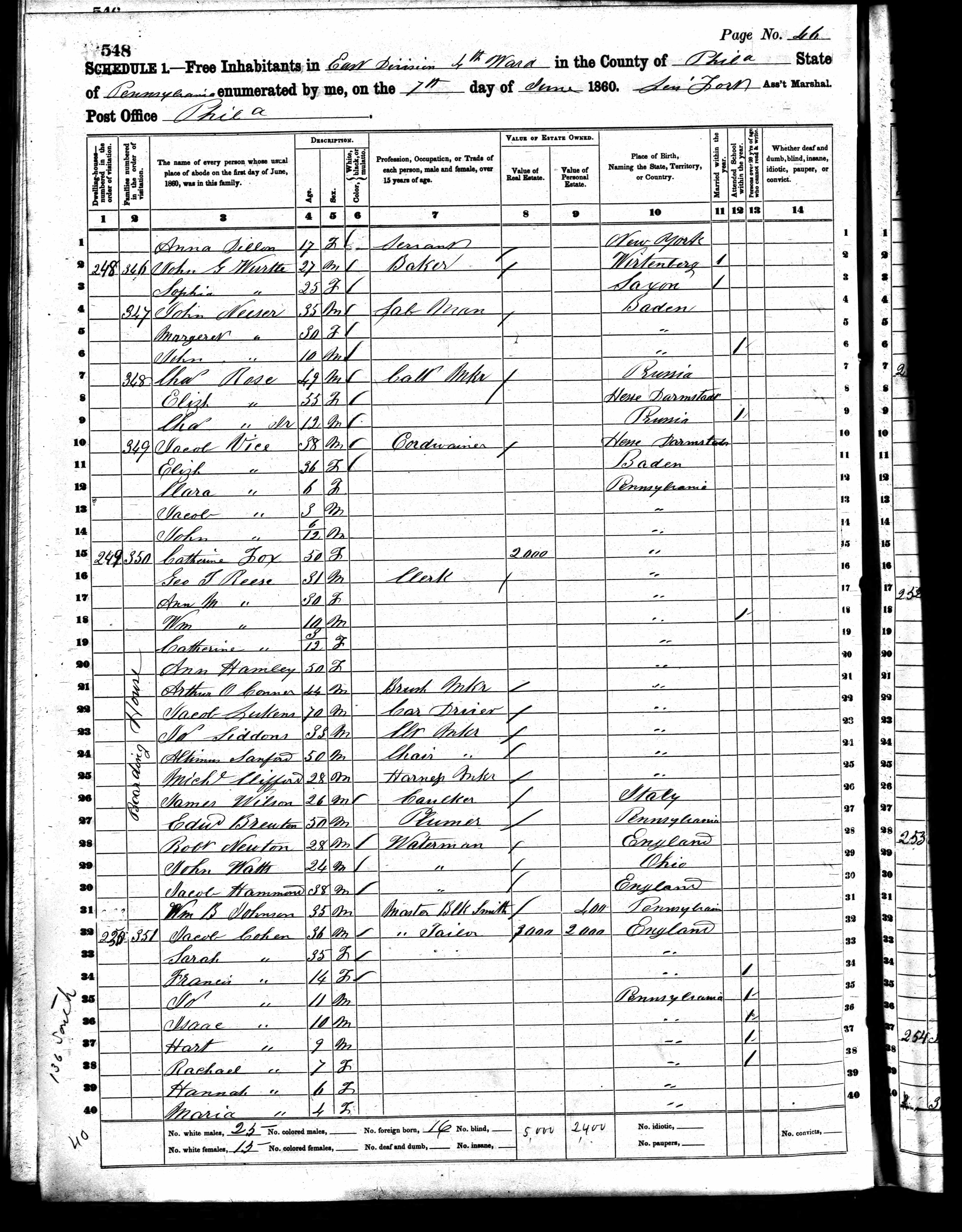
Although Jacob’s occupation is listed as a tailor on the 1860 US census, this seems inconsistent with the earlier census in 1850 when he was a dealer in second hand goods and with the 1841 English census when he was working as a china dealer.  Perhaps the census taker heard “dealer” as “tailor”?  Since Jacob also had the most assets of anyone else listed on this page of the census, $1000 in real estate and $2000 in personal property, it seems more likely that he was a merchant than a tailor.  He also had three servants living in the household: Eliza Mackey, Mary McDonough, and Margaret Gallagher.  There was also a 24 year old man named Lazarus Jacobs living with the family; this might have been a cousin through Jacob’s mother and/or his wife Sarah since both were Jacobs by birth.  Jacob thus had nine children, an adult relative, three servants as well as his wife Sarah and himself to support in 1860.  Could he have been making such a good living as a tailor?

Jacob and Sarah Cohen and family 1860 US census

Jacob and Sarah Cohen and family 1860 US census

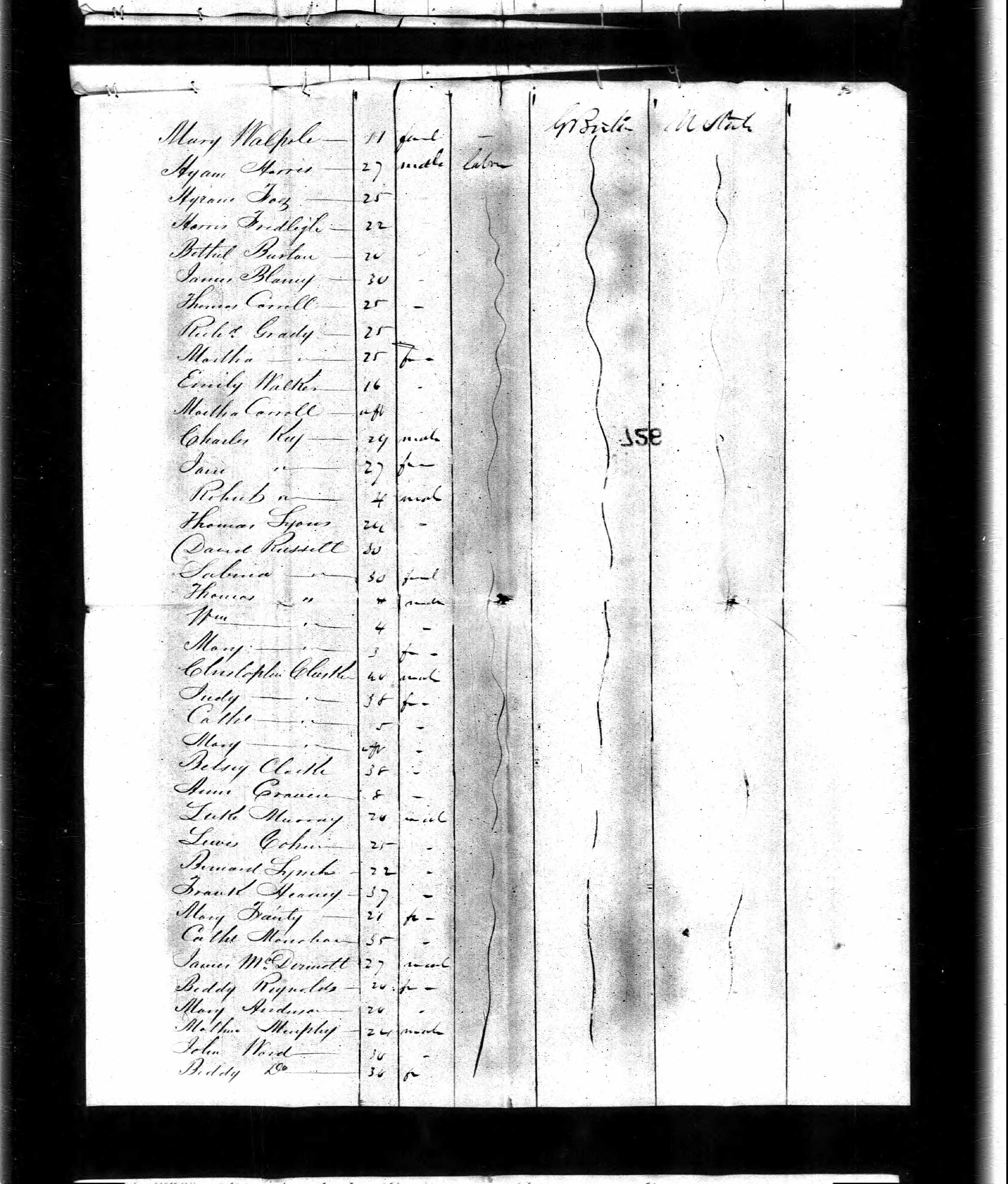
Interestingly, Lewis and Jonah were also listed as tailors on the 1860 census.  They were living in the same district as Jacob, the 4th Ward, East Division, and the census appears to have been taken by the same census taker, although the signature is hard to decipher.  Were their accents so difficult for this census taker to understand? Or were these three brothers really tailors?  Lewis, Jonah, Elizabeth and their father Hart were all living together and had $1000 in personal assets, more in line with the shop owners on the census pages than the tailors, but perhaps the three Cohen brothers were all very successful tailors. However, according to the 1863 Pennsylvania Septennial Census, a census taken of all taxable residents, Lewis and Jonas were then engaged in sales and Jacob was listed as a dealer, not as tailors, so I am still inclined to think that the 1860 census taker heard “dealer” as “tailor” for all the Cohen men.

Lewis and Jonas Cohen on the 1863 PA Septennial Census

Lewis and Jonas Cohen on the 1863 PA Septennial Census

Jacob Cohen PA Septicentennial Census 1863

Jacob Cohen PA Septicentennial Census 1863

As I puzzled over this particular question of whether or not they were tailors, I became curious about the neighborhood they lived in and the socioeconomic character of that neighborhood. This led me to wonder about the history of Jews in Philadelphia and to ask why this family settled in Philadelphia, not New York, despite having sailed into New York when immigrating to this country. I am now doing some preliminary research into those questions and will report back on what I learn.

What has struck me as particularly interesting as I research and report on the immigration of my Cohen ancestors to Philadelphia is how different it feels from the immigration of my mother’s family, the Brotmans, Goldschlagers and Rosenzweigs.  Unlike the rather desperate conditions that my mother’s family faced in their home countries and the poverty they experienced after coming to the US, my Cohen ancestors left England not because they were oppressed or poor but for better conditions and opportunities here in America.  Although I am sure they faced some anti-Semitism and some isolation as Chuts and were not wealthy but at best middle class merchants, they came to America for less drastic reasons and with far more advantages than my mother’s relatives.  Not only were they more economically secure, they came speaking English.  They did not have to struggle to understand a new language, which must have made their adjustment far easier than it did for my Galician and Romanian ancestors who spoke no English when they arrived.

By 1860, the Cohens were settled in America and some of them were already or soon to be American citizens.  They were here a good 40 years before the Brotmans and some of the Rosenzweigs and about 50 years or more before many of the Goldschlagers and the other Rosenzweigs.   My father’s other lines also arrived here far earlier than my mother’s family.  My parents represent in many ways a merger of the two distinct waves of Jewish immigration to America.  When they were growing up, there was still a distinct class line between the older Jews from Western Europe and the newer Jews from Eastern Europe.  Today we don’t even think about those distinctions, except in historical terms.  But the two groups started differently and arrived under different conditions, creating for many years an economic and cultural gap between them.


Enhanced by Zemanta

Happy Mother’s Day

I am not usually a big fan of Mother’s Day.  It’s always seemed like a “Hallmark” holiday to me, manufactured for commercial purposes to sell cards and overpriced meals at overcrowded restaurants.  And I say this as a mother, not as a daughter. But this year I’d like to pay tribute to all the mothers I’ve learned about through my genealogy research.

First, to Bessie Brotman, my great-grandmother, who journeyed to America like so many other immigrant women alone with two young children, who took in the young children of her husband Joseph’s first marriage and raised them.  Bessie then lost that husband after being in the US for only ten years and after bearing three more children with him, one born just months before he died, leaving her as a widow with three very young children and several older children.  Bessie remarried and then took care of not only her children but the numerous children of her second husband, Philip Moskowitz.  She was a sweet and loving woman who brought love to all those children.

Bessie Brotman

Bessie Brotman

I’d also like to pay tribute to my other great-grandmother on my mother’s side, Ghitla Rosenzweig Goldschlager.  She also made the journey to America, only to find when she arrived that her husband Moritz had died  months before her arrival.  She also persisted and survived, as did her sister Tillie, also widowed shortly after arriving in the US and having seven children to care for herself. She had a generous enough heart to take in my grandfather and his sister Betty after their father died and before their mother arrived from Romania.  The third Rosenzweig sister Zusi also lost her husband and raised her son Nathan on her own after losing his twin brother as a month old infant.  All the Rosenzweig sisters suffered such terrible heartbreak.

Ghitla Rosenzweig Goldschlager

Ghitla Rosenzweig Goldschlager

I am thinking also of my grandmother Gussie, who never spoke of her childhood and who lost her father when she was only five years old.  She then moved in with her sister Tillie when her mother remarried rather than live in a household filled with stepsiblings and a stepfather she did not like.  She took care of her younger siblings from a very early age and then took care of her three young nephews before marrying my grandfather and raising three children of her own.  Despite her own unhappiness, she was a loving grandmother and always made us laugh and smile.

Gussie with Jody Julie and Ira 1962

Gussie with Jody Julie  Ira and me 1962

My grandmother’s two sisters also come to mind this Mother’s Day—Frieda, who died from complications of childbirth and thus never got to experience the joys of motherhood, and Tillie, who my mother and her siblings remember as being a devoted aunt who took them places and brought them baked goods, gifts and most importantly lots of love and affection.

Tillie

Tillie

My other grandmother, Eva Schoenthal Cohen, whose story I’ve not yet told, also lost her husband at a young age and managed to move on, remarrying later in life.  My memories of her are of a soft-spoken, beautiful woman, who had experienced a great deal of sadness but carried herself with a lot of pride and dignity.  I also think about my two great-grandmothers, my father’s grandmothers. who took care of him and my Aunt Eva when his parents were not able to do so.

Eva Cphen

Eva Cohen

All who read this blog know that my Aunt Elaine was our family matriarch, the one who kept the family history and saw to it that we all knew each other and were part of each other’s lives.  She was thirteen years older than my mother and often like a second mother to her as well as her sister and friend.  She could always make us laugh, always make us feel loved.

Elaine and Jeff 1949

Elaine and Jeff 1949

And, of course, I am thinking of my own mother.  She is and always has been a devoted, loving mother who gives her love unconditionally.  Alhtough she has said that she was so young when I was born that she had no idea what she was doing, she did everything right.  She, along with my father, have always made me feel special, loved and valued.  I grew up believing that I could do and be anything I wanted.  To this day my mother is someone I  turn to when I have something good or bad to share.  She is always there to listen, not to pass judgment, but to listen and to provide support.

My mother and me 1952

My mother and me 1952

My mother and my daughters and grandson

My mother and my daughters and grandson 2011

And finally, I am thinking of my daughters, the ones who enabled me to take on the title of mother myself.  Somehow despite all my mistakes, and there were many, they both grew up to be amazing young women who love with all their hearts and bring joy to all who are lucky enough to know them.  They taught me how to be a mother just by letting me watch them  become the people they were always meant to be.  I don’t need cards or overpriced meals at overcrowded restaurants.  I am just happy getting to be their mother every day of the year.

Happy Mother’s Day to all!

Enhanced by Zemanta