Nusbaum Album: Are These My Seligmann Relatives from Germany?

With more realistic expectations but nevertheless high hopes, I awaited Ava’s final work on the Nusbaum Album, some of the photographs from Germany. Although there were some photographs from Stuttgart, Berlin, and Wiesbaden, since I did not know of any relatives living in those places in the mid to late 19th century, I focused on the photographs taken in Bingen and Mainz. Although my closest Seligmann relatives lived in the small town of Gau-Algesheim, both Bingen and Mainz were relatively close by and the closest cities to Gau-Algesheim, and many relatives eventually moved there. It seemed most likely that that my Seligmann relatives would have gone to one of those two cities to be photographed.

I selected three photographs from Mainz, all taken by the same photographer, Carl Hertel, and two from Bingen, both taken by J.B. Hilsdorf. These were all on the back of the first four pages at the beginning of the album whereas other photographs from Germany including from Mainz and Bingen were much later in the album. I hoped that meant the ones earlier in the album were more likely closer relatives.

The first Mainz photograph was dated by Ava as taken between 1873 and 1874; she noted that in 1874, Hertel became a court photographer. She wrote, “Generally, when a photographer was appointed as a court photographer that information would appear on the mounting card in the imprint and after the photographer’s name with the letters HOF. Since there is no indication of this appointment, I am placing the date of the photograph before 1874.”1 In addition, another photograph of Hertel’s found elsewhere with the same imprint was dated 1873.

Ava estimated the age of the man as mid to late 70s based on the lines on his face and the style of his tie. That meant the man was born in about 1800-1804. Ava speculated that this could be my three-times great-grandfather Moritz Seligmann, who was born in 1800. And this time I was able to confirm that speculation because I belatedly remembered that I have an actual photograph of Moritz that I had obtained from a cousin years back:

Moritz Seligmann

So bingo! We had a positive identification!

Moving on to the next two Mainz photos, Ava concluded that they also were taken between 1873 and 1874 based on the information she’d already found about Hertel. The first one she believed to be of a man who was in his thirties, perhaps 35, so born in about 1838-1839. The younger man on that same page appeared to her to be eighteen so born in about 1855. Since these photographs were all taken by the same photographer at about the same time, I thought that perhaps these two younger men were sons of Moritz Seligmann, that is, brothers of Bernard, my great-great-grandfather. In addition, they appeared on the second page of Germany photographs right after the photograph of Moritz, who appeared on the first page of the Germany photographs in the album.

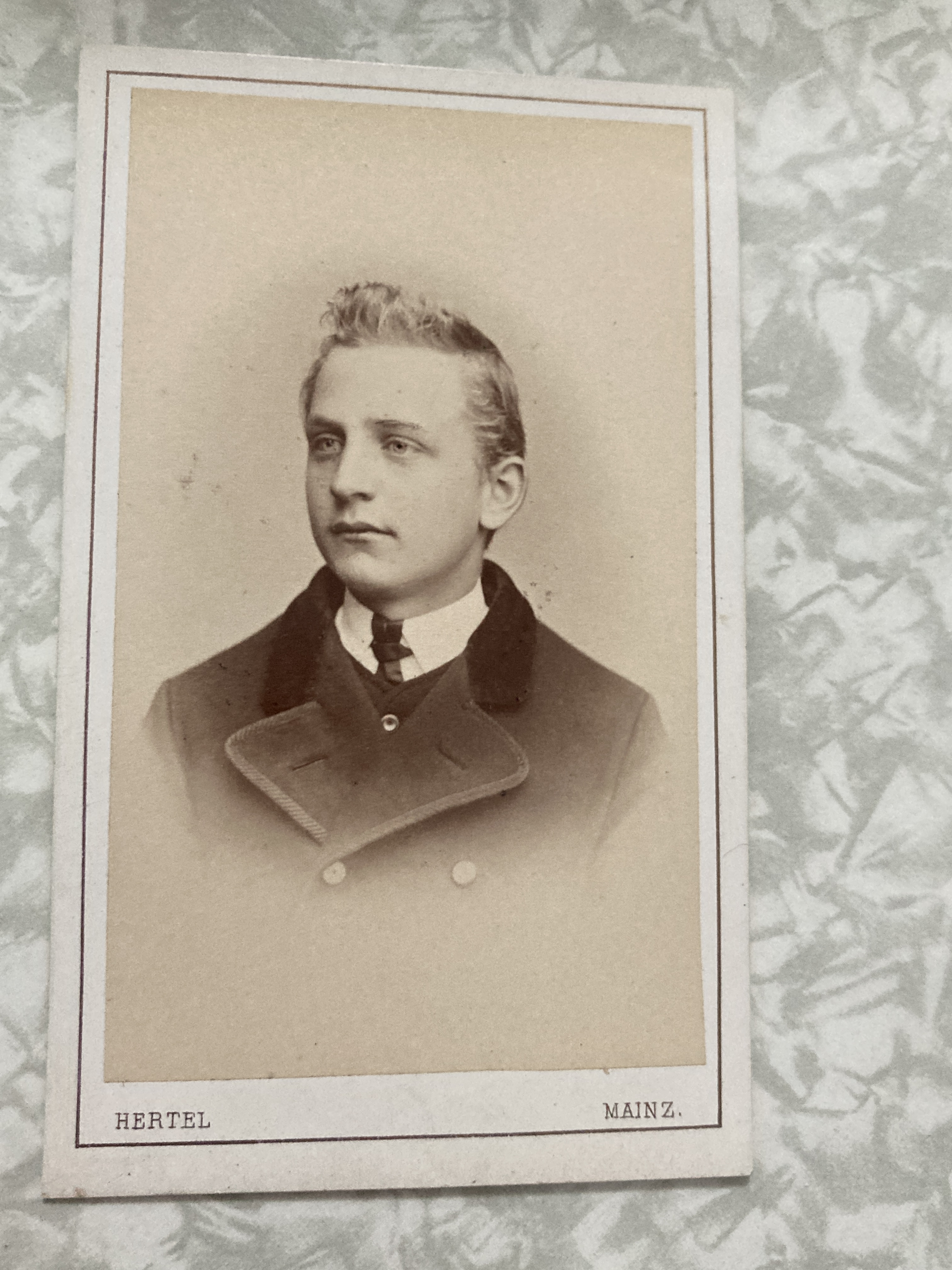
Looking at the family tree, I found two possibilities. The older “son” could be Hieronymous Seligmann, born in 1839. The younger “son” could be Moritz’s youngest child, Jakob Seligmann, born in 1853. I was excited at the thought that perhaps I finally had found some relatives I could identify in the album.

I shared my analysis with Ava. She was skeptical that the younger man was Jakob Seligmann because she had identified Jakob in a photograph from a different set of photographs that she had worked on during an earlier project, and she did not see any similarities or enough to believe that the blonde teenager photographed in Mainz was the same person identified as Onkle Jakob in the later photograph.
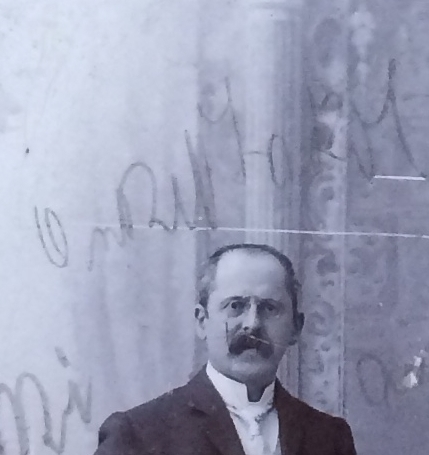
We went back and forth with me trying my lawyerly best to persuade her that the blonde man could have grown up to be the dark haired Oncle Jakob. But in the end I failed to do so. I have to defer to Ava. She’s the expert, and I am a biased viewer hoping to see what I want to see. But if this was not Jakob Seligmann, who was it? I don’t know. Maybe a nephew or a cousin. Maybe not anyone in the family at all.

Knowing now that the Hertel photographs were likely taken before 1874 as Ava concluded, I looked on my own at the other three Hertel photographs taken in Mainz that appear later in the album:


Who are these three women? I don’t know since I have no photographs to use for comparison. Two of them look too young to be Bernard Seligman’s sisters Mathilde and Pauline, who were born in 1845 and 1847, respectively, and certainly too young to be his half-sister Caroline born in 1833, if the photographs were taken around 1873 as Ava concluded about the other Hertel photographs. And they are too old looking to be the children of any of Bernard’s siblings. So sadly they also will remain unidentified.

The next photograph I asked Ava to analyze is on the same page as the two blonde men except this photograph was taken in Bingen, not Mainz, by J.B. Hilsdorf, who was in business in Bingen from 1861 to 1891, according to Ava’s research. When I believed that the other two men on that page were Hieronymous and Jakob, I speculated that this third man could be their brother August, the only other son of Moritz Seligmann who survived beyond 1853 and was living in Germany.

Based on the size of this particular photograph, Ava dated it in the mid-1860s. She thought the man was between 30 and 35 so born between 1827 and 1834.2 August Seligmann was born in 1841 so too young to be the man in this photograph. In addition, Ava compared this photograph to one I have of August and found them to be dissimilar. It didn’t take as much to persuade me this time.

August Seligmann

That left one last photograph for Ava to analyze, the second photograph from Bingen that I had selected.
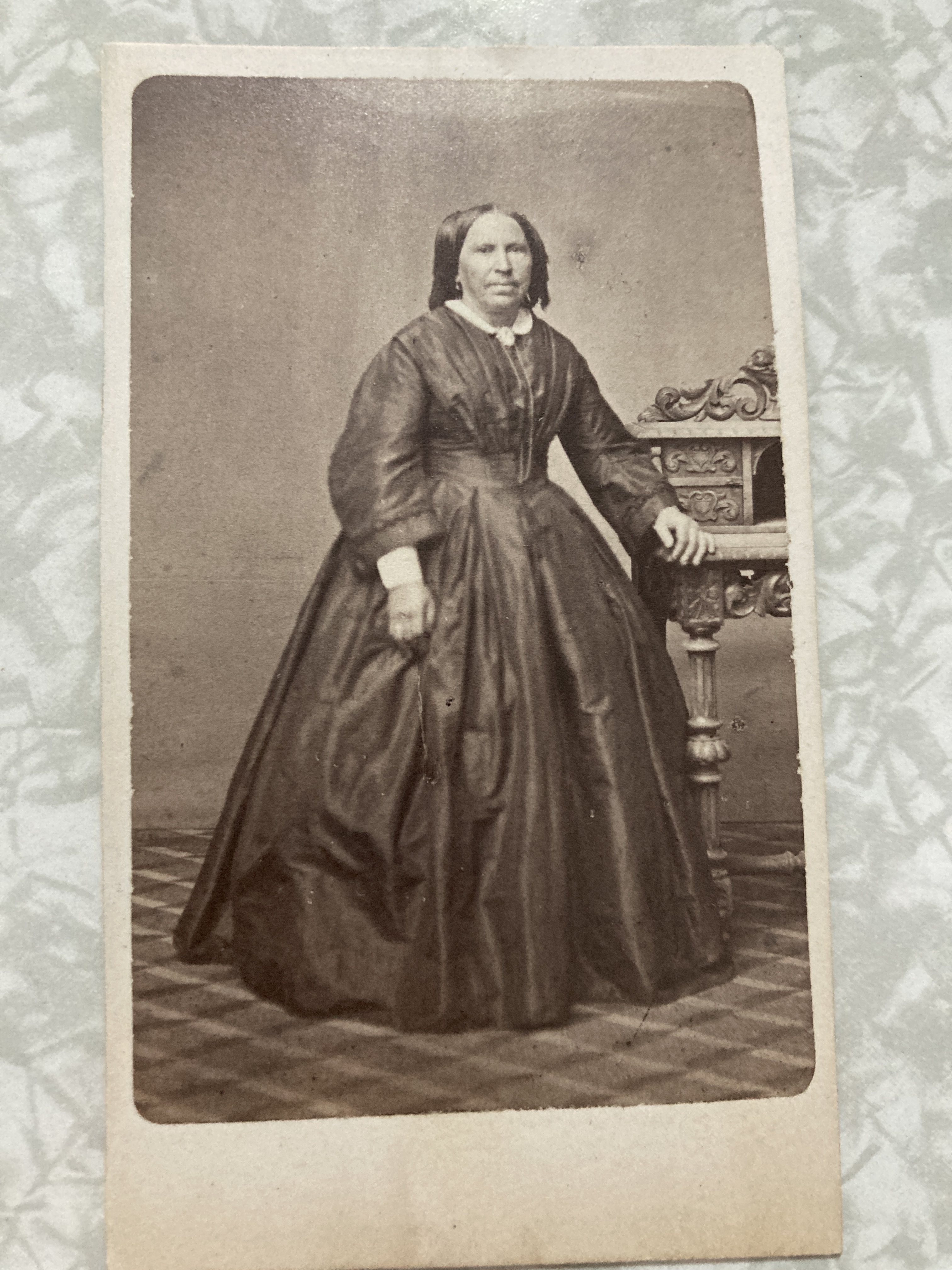
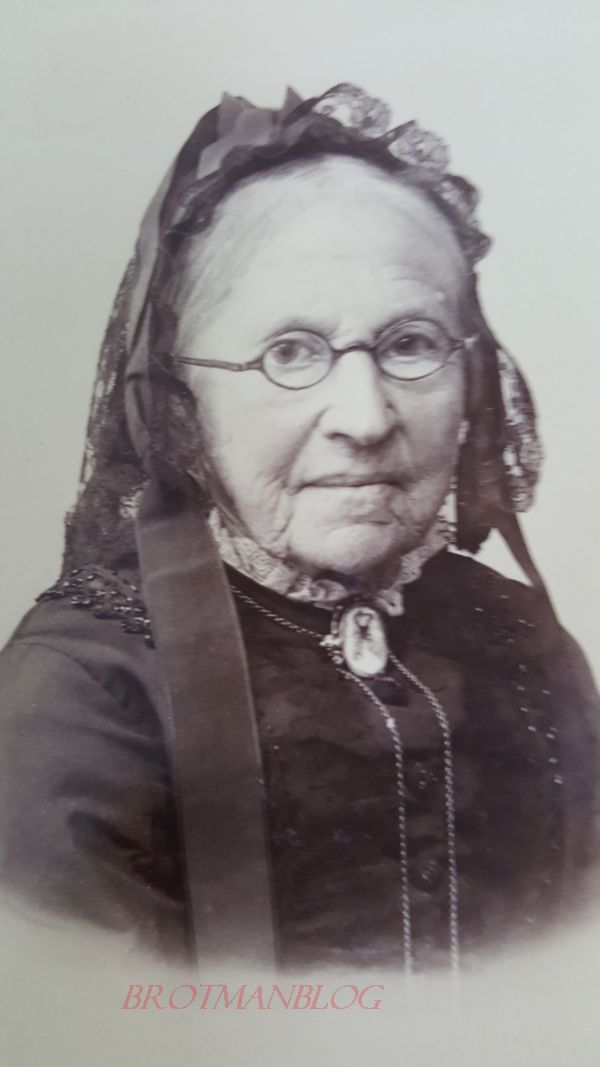
It also was taken by J.B. Hilsdorf, and for the same reasons Ava dated it in the mid-1860s. She estimated the woman’s age to be in her late 40s, early 50s, giving her a birth year range of 1812 to 1817. Based on the age and other photographs I have of my three-times great-grandmother Babette Schoenfeld Seligmann, Ava thought there was a good possibility that this photograph was also Babette. Here are the other photographs of Babette that Ava used for comparison.
Ava did an incredible job of researching the photographers and the photographs they’ve taken to come up with reliable time frames for when the album photographs were likely taken. But it is only possible to go so far with identification without known photographs of the people in your family to use for comparison. You can narrow down the possibilities and eliminate those who clearly do not fit within the parameters of the dates, but you can never be 100% confident of the specific identity of the person in the photograph based just on dates and locations. I wish I had more photographs that Ava could have used to make facial comparisons, but I don’t. I have to accept that I may never know who most of these people were.

Fortunately, there were a handful of photographs in the Nusbaum Album that were labeled and that I could on my own identify and place in my family tree. More on those in my next few posts.


  1. Ava Cohn, Analysis of Nusbaum Album #4, March 17, 2024 
  2. Ava Cohn, Analysis of Nusbaum Album #5, April 3 ,2024

Annlis Schäfer Seligmann 1924-2017

We have returned from our trip to Germany, and I have many things to share about the experience.  It was a trip filled with many joyous moments as well as many sad and heartbreaking moments.  One of the greatest joys and definitely the saddest moment involved Annlis Seligmann, mother of my dear cousin Wolfgang.

Annlis and Wolfgang

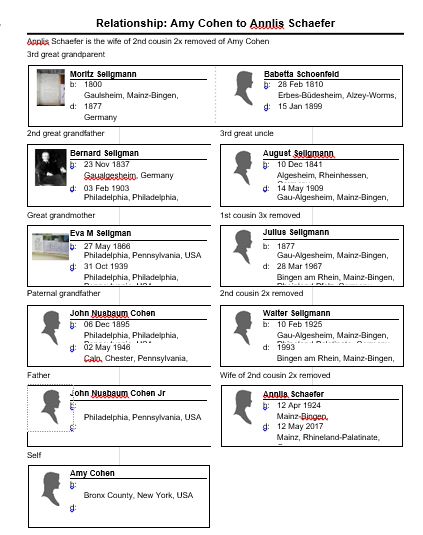
When Wolfgang found my blog almost two and half years ago, it was the result of a family research project he was sharing with his mother.  Annlis was not born a Seligmann; she was born Annlis Schäfer on April 12, 1924.  But in 1965 she married Wolfgang’s father Walter Seligmann, who died in 1993, and she was fascinated with the history of his family.  When the Seligmann family discovered the “magic suitcase” that had belonged to Walter’s brother Herbert, Annlis and Wolfgang began to search through the documents to learn more about the Seligmann family history.  Because Wolfgang could not read the old German script, Annlis had to decipher many of the old records and documents for him.

At some point in this process, Wolfgang discovered my blog, and together the three of us—Annlis, Wolfgang, and I—all worked together to find many of the missing pieces of the Seligmann family.  We were able to figure out how many of the people named in those documents were related to us all.  Without their help, I would not have found many of the Seligmanns who died in the Holocaust or who, like my cousins Lotte Wiener Furst and Fred Michel, were able to escape Germany before it was too late.

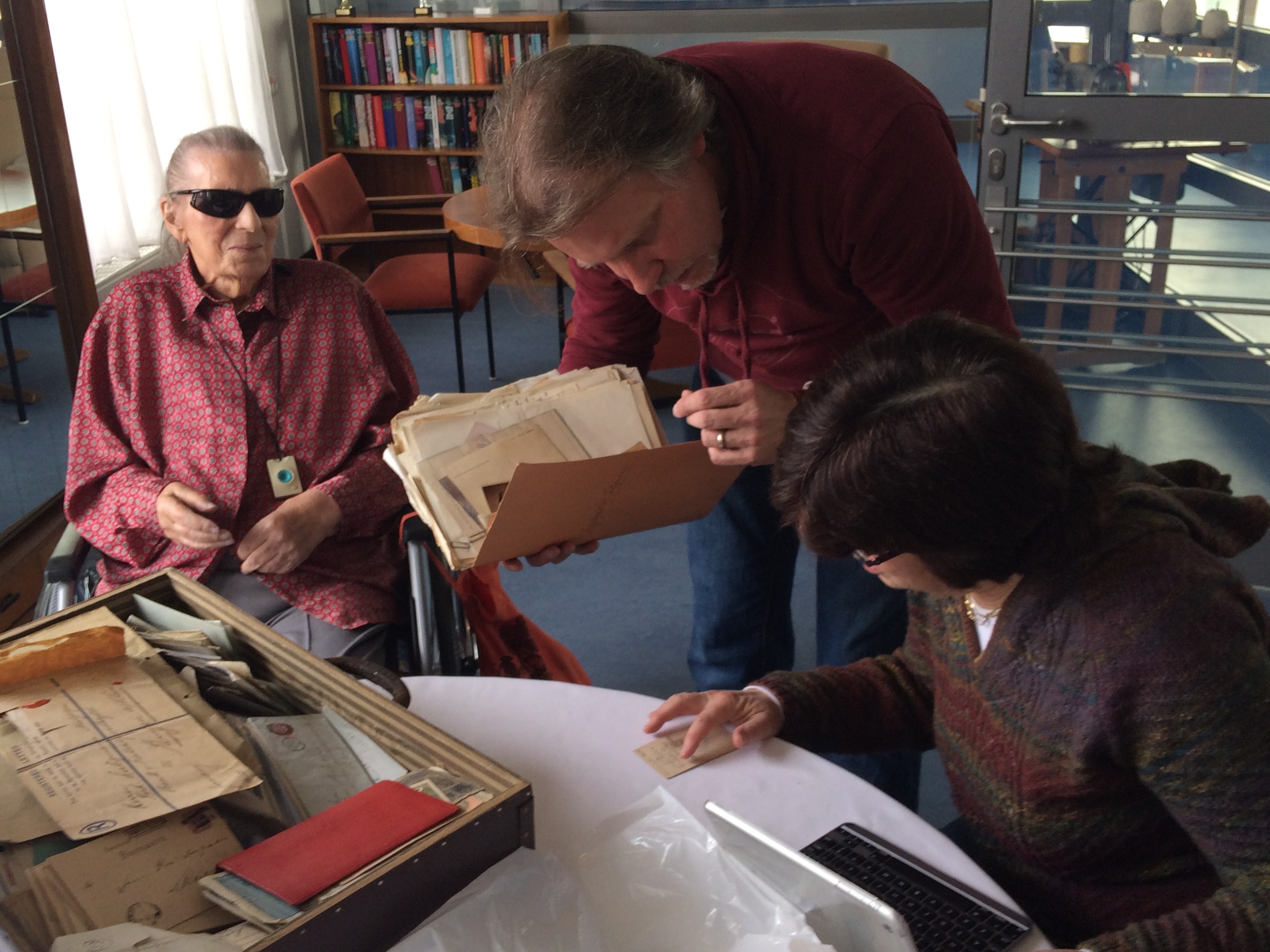
So when I was planning my trip to Germany, one of my priorities was to meet not only Wolfgang, his wife Bärbel, and daughter Milena, but also his mother Annlis.  We arrived in Germany on May 2, and the first thing we were scheduled to do on May 3 was meet Annlis.  We went with Wolfgang to the senior residence where she was living in Mainz (like an assisted living facility in the US) first thing that morning. Annlis did not speak English, so I was able to test my baby German.  With Wolfgang’s help, we were able to communicate.

She and Wolfgang showed me some family photographs, and I shared with her photographs of my parents, children, and grandchildren.  We looked through the magic suitcase together (there are still hundreds of letters and postcards still to be translated). Despite the language obstacles, I felt a strong connection to Annlis and was sad to say goodbye when our visit ended.

Annlis had been in declining health in recent months.  Her vision had become so poor that she could no longer read and help translate the documents, but she remained very interested in the family history and, according to Wolfgang, had been very anxious to meet me.  After our visit, she expressed to Wolfgang how happy she had been to meet me.  I was so touched and, of course, felt the same way.

So you can imagine my shock when less than ten days later while still in Germany, I received a message from Wolfgang telling me that his mother had died.  I was stunned and so sad.  And heartbroken for Wolfgang and his family.

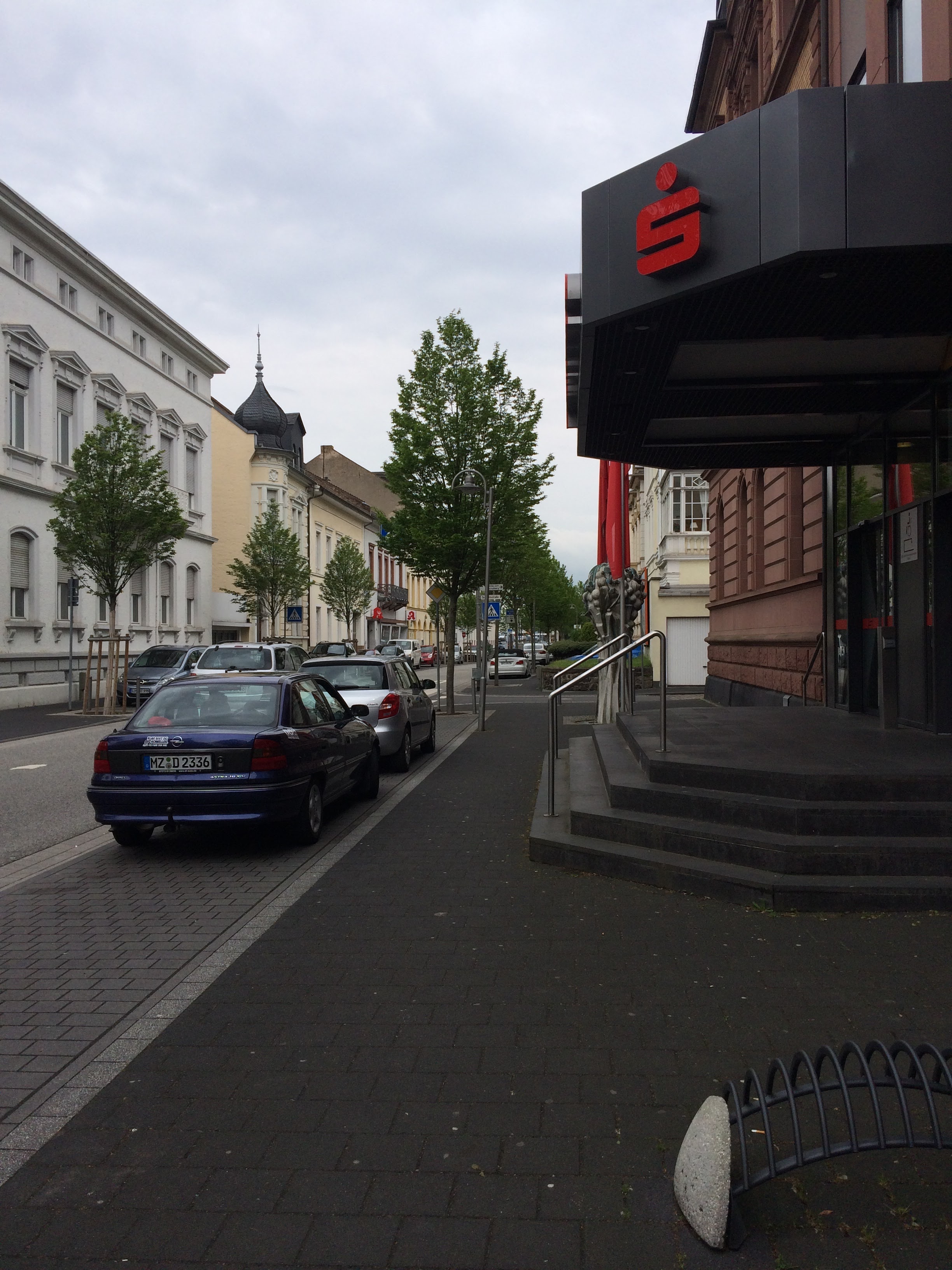
Annlis lived a long and full life.  From Wolfgang I know that she grew up in Mainz where she also lived for the last five years of her life.  During World War II, she was working in Bingen.  In September, 1944, she witnessed the murder of an American soldier, Odis Lee Apple, whose plane had been shot down and crashed nearby.  As described here by Wolfgang himself on the website for the radio station where he works, the caretaker for the building where Annlis worked notified the people in the office that an American soldier was walking on the street outside the building.

Annlis and three of her co-workers left the building and followed Apple, whom she described as a man with a friendly face.  Then suddenly the building’s caretaker rushed out onto the street in his SA uniform and shot Apple.  He did not die right away, but was suffering terribly from the gunshot wound.  At some point someone else shot him, and he died.

Street in Bingen where Annlis worked and witnessed the murder of Odis Lee Apple

After the war, the US Army investigated Apple’s death; Annlis provided testimony, and several people were sentenced to prison.  The caretaker, however, had died not long after the shooting during a bombing attack on Bingen.

According to Wolfgang, his mother never forgot this incident and was horrified by what she had witnessed. Even though at that point the US was at war against Germany, Annlis knew it was wrong to kill someone in cold blood like that.

Tribute to Odis Lee Apple at the spot where he was shot

It was not until twenty years after the war that Annlis married Walter Seligmann in 1965.  Together they raised their son Wolfgang in a neighborhood outside of Mainz in an apartment overlooking the valley.  She lived in that apartment until five years before her death when she moved to the building where I met with her on May 3.

Annlis Seligmann lived a good and long life; she had just turned 93 a month before her death.  I feel so privileged and fortunate that I was able to be a part of her life in the last two years and especially that I was able to meet her in person, share some time with her, and give her a hug.  My heart goes out to Wolfgang, Bärbel, Milena, and the entire extended family.  May her memory be a blessing.


Gau-Algesheim and the Seligmans: My Great-great-grandfather’s Birthplace and What I Learned

Coat of arms of Gau-Algesheim

Coat of arms of Gau-Algesheim (Photo credit: Wikipedia)

From several documents and historical references, I know that Bernard Seligman, my great-great-grandfather, and his brothers Adolph and Sigmund were born in a small town close to the Rhine River called Gau-Algesheim in what was then the Hesse Darmstadt region of Germany. Today it is located in the Mainz-Bingen district in the Rheinland-Pfalz state in Germany.   Gau-Algesheim is about 15 miles southwest of Mainz and 40 miles southwest of Frankfort, Germany.  Its population in 2012 was under seven thousand people, and it is less than five miles square in area.[1]   From the photographs posted on the town’s official website, it appears to be a very charming and scenic location.  There are wineries nearby, and tourism appears to be an important source of revenue for the town.[2]


What was Gau-Algesheim like almost 200 years ago when my ancestors were living there?  How long had my Seligman ancestors been there, and were there any family members who remained behind after Bernard and his brothers left? How long had there been Jews living in Gau-Algesheim, and are there any left today? These were the questions that interested me the most about my great-great-grandfather’s birthplace.

There is a book about the history of Jews in Gau-Algesheim written by Ludwig Hellriegel in 1986, Die Geschichte der Gau-Algesheimer Juden, but unfortunately there is no copy available online, and the closest hard copy is in the New York Public Library.  I tried to borrow it through my university’s interlibrary loan program, but was it was not available for lending.  Thus, I’ve had to piece together bits of information from Wikipedia, JewishGen.org, the Gau-Algesheim website, and http://www.alemannia-judaica.de to get some answers to my questions, relying on Google Translate in order to read the sources written in German.  What follows is a very brief skeletal history of Gau-Algesheim overall and in particular of the history of Jewish life there based on these limited secondary sources.

Gau-Algesheim has ancient roots.  There is evidence of graves dating back as far as 1800 BCE, and evidence of a settlement during Roman times as well.  In the 700s a church and a monastery were established.  Gau-Algesheim was part of the Holy Roman Empire in the Middle Ages, and during that time was under the control of various different officials and jurisdictions within the Empire and often the subject of disputes and battles for control.  See  http://en.wikipedia.org/wiki/Gau-Algesheim  http://www.gau-algesheim.de/category/stadt-gau-algesheim/geschichte/  It was part of Napoleon’s empire until 1812, and then eventually became part of the nation state of Germany in the mid-19th century.


Gau-Algesheim. Rathaus am Marktplatz.

Gau-Algesheim. Rathaus am Marktplatz. (Photo credit: Wikipedia)

Its Jewish history dates back to at least the 14th century.  By the 14th century, the town had developed into a commercial center.  Many merchants and artisans lived in the town, including herring merchants, blacksmiths, bakers, barbers, coopers, tailors, and shopkeepers.  The monasteries owned a lot of the land, and there was also a fairly large class of nobility.  By 1334, there must have been a Jewish community in Gau-Algesheim because in that year a head tax was imposed upon the Jewish residents.  According to Wikipedia, Jews were required to pay this additional tax because they were considered the property of the crown and under its protection.[3] There was also a Jewish cemetery in existence during the 14th century.  However, this community must have been a very small minority, and the Jews were certainly considered outsiders by the Catholic majority.  In 1348 there was a flu pandemic in the region, and Jews were accused of poisoning the water, such accusations then leading to pogroms across the region.

Gau-Algesheim. Langgasse.

Gau-Algesheim. Langgasse. (Photo credit: Wikipedia)

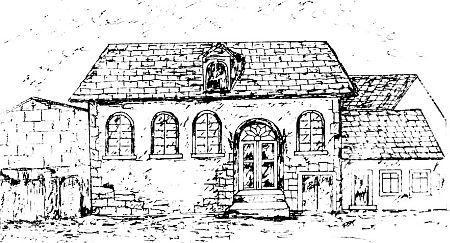
My sources do not reveal anything about Jewish life in Gau-Algesheim between 1400 and 1800, but the population in 1790 was reportedly only nineteen (it’s not clear whether this refers to people or households, but I assume it refers to total people).  In 1808 there were three Jewish families, and in 1819 only six Jewish families.  In 1857, the Jewish population was fifty people, and the Jewish population peaked in Gau-Algesheim in 1880 when it reached eighty people or 2.6% of the total population of the town, according to the alemannia-judaica website.  (JewishGen puts the 1880 population at only 66.[4])  According to alemannia-judaica, a synagogue is not mentioned as being in the town until 1838. It was described as very old and in poor condition in 1850 and was rebuilt in 1861 and renovated again in 1873-1874.  There was also a mikveh and a religious school, although it seems that there was a joint school with the nearby town of Bingen. (Bingen, by comparison, had 542 Jews in 1880, amounting to almost eight percent of its overall population; it was only six miles away from Gau-Algesheim. By further comparison, Mainz had a Jewish population of about 3,000 in 1900, and Frankfurt had almost 12,000 Jews in 1900.)[5]

The tiny size of the Jewish population in Gau-Algesheim in the 19th century in the years when my ancestors were living there surprised me.  How did my family end up there?  And why did they leave? I don’t know the answers to the first question at all and can only speculate about the second and will write more generally about it in a later post.   But what I want to focus on for now is what happened to the Jewish community in Gau-Algesheim after my great-great-grandfather Bernard and his brothers left in the middle of the 19th century.

It appears that my ancestors were not the only Jews to leave Gau-Algesheim.  By 1900, the Jewish population had declined to 27 people; in 1931 there were only 31 Jewish residents.  Presumably many of these Jews had immigrated to another country, and many may have moved to the larger cities in Germany.  In the Reichstag elections of 1933, the Nazi Party only received 26.6% of the vote in Gau-Algesheim with the Center Party carrying almost half the vote.  Unfortunately, that did not reflect the overall vote in Germany, and the Nazi Party took control of the country, soon dissolving the Reichstag and all other political parties, ultimately leading to World War II and the Holocaust.  Whatever Jews were left in Gau-Algesheim before World War II either left the town or were killed by the Nazis.

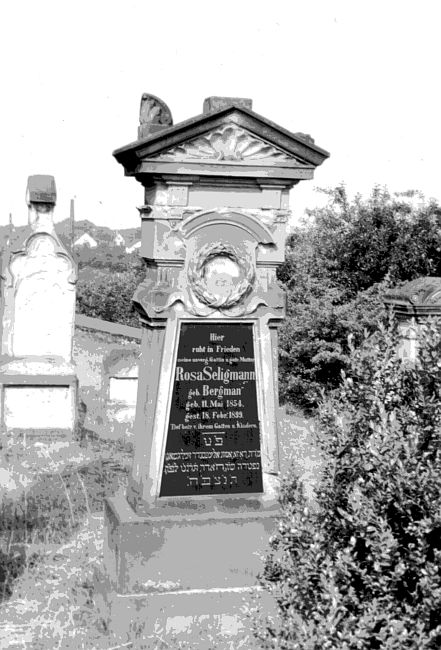
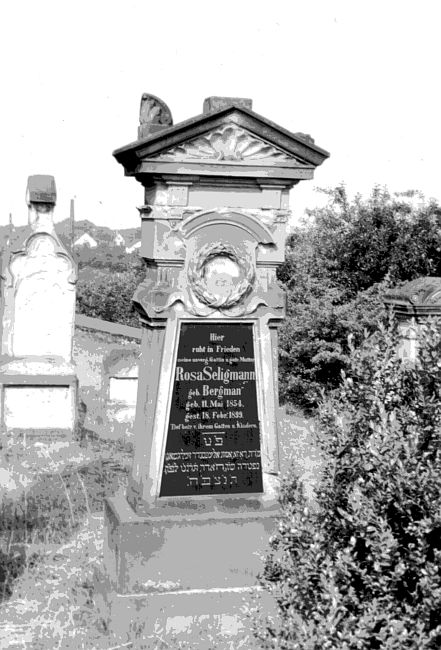
There is no Jewish community there today.  The Jewish cemetery remains, however, although it was desecrated during the Holocaust and has been vandalized several times since then.  In 2006, Walter Nathan, whose father was born in Gau-Algesheim, visited the cemetery and was so disturbed by the condition of the cemetery that he decided to work to have it restored and to create a memorial to those who were buried there and also to those who had been killed in the Holocaust.  On November 9, 2008, on the 70th anniversary of Kristallnacht, the memorial was dedicated by Nathan and many members of his extended family.[6]  Included in the headstones remaining in the cemetery was this one for a woman named Rosa Gebmann Seligmann who was born in 1853 and died in 1899 and married someone who was probably my relative.

With the help of two members of the Tracing the Tribe Facebook group, I can provide this translation of the German and the Hebrew on the headstone.  The German says, “Here rests in peace my unforgettable wife and good mother Rosa Seligman, nee Bergman, born May 11, 1854, died Feb.1 8, 1899. Deeply missed by her husband and children.  The Hebrew at the bottom says, “Here is buried Mrs. Roza wife of Alexander Seligman Died (on the) holy Shabbos 8(th day of) Adar 5659 by the small count. May her soul be bound in the bonds of life.”

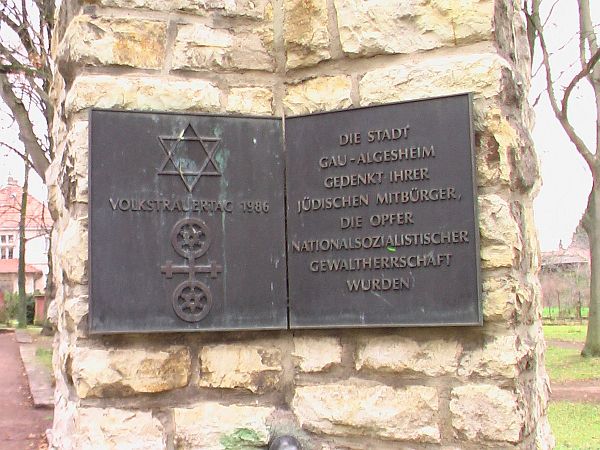
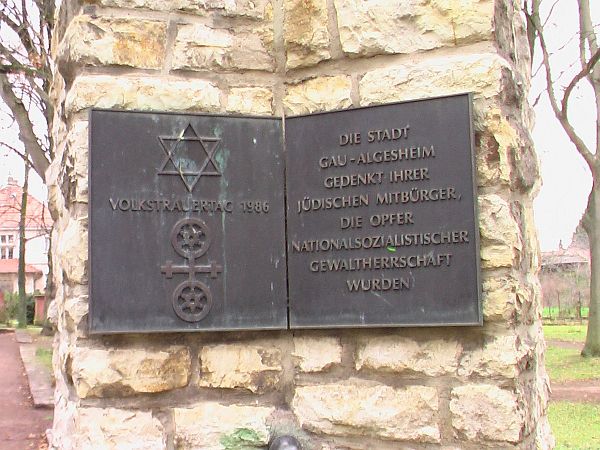
There is also a plaque in town commemorating the Jewish citizens of Gau-Algesheim who were killed by the Nazis. It says, as translated by Google Translate, “The city of Gau-Algesheim commemorates their Jewish fellow citizens who were victims of Nazi violence and domination.”


There is another plaque hanging on the wall of the cemetery listing the Jews born in Gau-Algesheim who were murdered during the Holocaust according to Memorial Book: Victims of the Persecution of Jews under the National Socialist Tyranny in Germany 1933 – 1945.  It says, “Standing in this sacred place our hearts turn to the memory of those who fell victim to the violence of the Nazis, and we vow to keep their memory alive. In solemn testimony of the unbroken faith that connects us with them, their names are referred to in profound awe. We say the Kaddish—the prayer for the dead— and remember the terrible tragedy of the Jewish people.”

Among the names listed on this second plaque were these individuals: Bettina Elisabeth Arnfeld born Seligmann (1875), Johanna Bielefeld born Seligmann (1881), Anna Goldmann born Seligmann (1889), and Moritz Seligmann (1881),.[7]

On the JewishGen.org site, I found two more Seligmanns born in Gau-Algesheim: Jacob Seligmann, born April 8, 1869, who became a resident of Neunkirche and emigrated in 1935 to Luxembourg, and Laura Seligmann Winter, born June 9, 1870, who was also a resident of Neunkirche and immigrated to Luxembourg in 1935. [8]

These may have been my relatives.  Given the small size of the Jewish community that lived in Gau-Algesheim, I have to assume that at least some if not all of those named Seligmann were related to my great-great-grandfather Bernard and were thus related to me.  When I saw those names, I was stunned.   Because I have not found where my Brotman relatives lived in Galicia, because I have not found any Goldschlagers from Iasi who were killed in the Holocaust, because my Cohen relatives left Europe long before Hitler was even born, I had not ever before seen the names of possible relatives who were victims of the Holocaust.  But Bettina, Johanna, Anna, Moritz, Jacob, and Laura Seligmann—they were likely the nieces and nephew or the cousins of Bernard, Sigmund, Adolph and James Seligman.  They were likely my family.

Now I need to see what I can learn about them and what happened to them.  I need to be sure that their names are not forgotten.  This is what I know so far from the Yad Vashem names database:

Bettina Elizabeth Seligmann Arnfeld, born March 17, 1875, was residing in Muelheim Ruhr, Dusseldorf, Rhine Province, and was deported to Theresienstadt on July 21, 1942, and she died there on January 23, 1943.


Johanna Seligmann Bielefeld, born March 13, 1881, was living in Mainz during the war.  She died in Auschwitz.


Anna Seligmann Goldmann, born November 30, 1889, was living in Halle der Saale, Merseburg, Saxony Province.  She was deported from there May 30, 1942.  Her husband Hugo Goldmann, born in 1885, and their daughter Ruth Sara, born in 1924, were also deported that same day.  They were all murdered.


Moritz Seligmann, born in 1881, was not listed in the Yad Vashem database.  On the memorial plaque placed at the cemetery in Gau-Algesheim the only notation after his name is Verschollen, which means “missing, lost without a trace,” according to one source.


Jacob Seligmann, despite escaping Germany in 1935 and moving to Luxemburg, did not escape the Nazis.  He was killed in 1941 in Luxemburg, according to the Yad Vashem website.

Laura Seligmann Winter, who may have been Jacob’s sister, was a widow; on August 28, 1940, she also was killed in Luxemburg.


I will continue to look for more records that will tell something about the lives of these people and their families so that they can be remembered not only for how they died but also for how they lived.


“Dachau never again” by Forrest R. Whitesides – Own work. Licensed under Creative Commons Attribution-Share Alike 3.0 via Wikimedia Commons – http://commons.wikimedia.org/wiki/File:Dachau_never_again.jpg#mediaviewer/File:Dachau_never_again.jpg


[1] See http://en.wikipedia.org/wiki/Gau-Algesheim


[2] See http://www.gau-algesheim.de/category/stadt-gau-algesheim/geschichte/


[3] See http://en.wikipedia.org/wiki/Leibzoll


[4] See http://data.jewishgen.org/wconnect/wc.dll?jg~jgsys~community~-1774383


[5] See http://fr.wikipedia.org/wiki/Synagogue_de_Bingen_am_Rhein_(1905-1938)


[6] See http://www.iit.edu/magazine/spring_2009/article_1.shtml#top


[8] [8] http://www.bundesarchiv.de/gedenkbuch/directory.html